Archives

Georgie Lee and “Hero’s Redemption”

The Short and Shorter of It

by Georgie Lee

A while back, The Guardian newspaper in Britain ran an article questioning why long novels are now in vogue. The author pointed to a number of classic novels from Charles Dickens’ A Christmas Carol to Muriel Spark’s The Prime of Miss Jean Brodie (one of my favorites) and how each one only tips the scales at under 200 pages. The thrust of the article was aimed at literary fiction, but the author encouraged readers to actively look for shorter stories to read. When I read this, I jumped out of my chair and pumped my fist with excitement yelling “I like to write short!”

Now, please understand that I have nothing against long novels. The Stand (1000+ pages) and Watership Down (400 pages), are two of my favorite novels and I’ve read them both many times. I can also write longer books, as evidenced by my upcoming Harlequin Historical Engagement of Convenience. However, there have been many times in the past when I sat down to write and my word count stayed stubbornly stuck at under 60,000. My brevity can probably be blamed on my writing background. For many years I wrote poetry and screenplays. These are not high word count genres and old habits can be hard to break. My most recent release, Hero’s Redemption, despite being chocked full of blackmail, passion and angst over the past and an uncertain future, is only 34,000 words. War and Peace it is not and that’s OK. Sometimes, writing short is just the thing a writer needs.

About ten month before my contemporary novel, Labor Relations, was scheduled to release in February 2011, I had a small crisis. Here I was ready to debut a contemporary and the only novel in my backlist was a Regency romance. I needed some back list titles and I needed them fast.  However, life at the time was very busy and I didn’t have a lot of time to write (who does?). More and more e-publishers were asking for novellas and that’s when the idea hit me. I like to write short, so why not go with what I know and write to my strength. Over the next year, I wrote two contemporary novellas and one novella set in ancient Rome. At the same time, I continued working on longer novels. However, finishing and publishing the novellas gave my professional confidence a boost and allowed me to create a backlist. So, while I now focus on writing longer, I challenge you to give short a try. Sometimes it is just the thing you need to stay in the writing and publishing groove and, as I’ve discovered in my own writing, there is a lot you can pack into a little story.

About Hero’s Redemption

HerosRedemptionFinal (2)London, 1817

Devon, the Earl of Malton, is a hero for his deeds at the Battle of Waterloo. But he suffers terrible nightmares, and drinks himself to sleep most nights. A habit he vows to break when he awakes one morning to find a woman sharing his bed, no memory of how she got there, and her angry brother at his door.

Cathleen is mortified when her wastrel brother and his greedy wife propose a blackmail scheme involving the earl, but as a penniless war widow she’s at their mercy. She goes along with the plan and sneaks into Devon’s bed one night, and ends up comforting him through a night terror.

Charmed by her beauty and kindness, Devon determines that rather than pay the blackmail, he will offer his hand in marriage to Cathleen. Although she is deeply attracted to the stoic earl, Cathleen cannot understand why Devon would want to marry her. What she doesn’t know is that Devon owes her a debt that can never fully be repaid…

About the Author

A dedicated history and film buff, Georgie Lee loves combining her passion for Hollywood, history and storytelling through romantic fiction. She began writing professionally at a small TV station in San Diego before moving to Los Angeles to work in the interesting but strange world of the entertainment industry.

Georgie5.3-1Her first novel, Lady’s Wager, and her contemporary novella, Rock ‘n’ Roll Reunion are both available from Ellora’s Cave Blush. Labor Relations, a contemporary romance of Hollywood, and Studio Relations, a love story set in 1935 Hollywood, are currently available from Montlake Romance. Look for her Regency novella, Hero’s Redemption from Carina Press on July 29, 2013, and her Regency novel, Engagement of Convenience, from Harlequin Historical on October 1, 2013.

When not writing, Georgie enjoys reading non-fiction history and watching any movie with a costume and an accent. Please visit  www.georgie-lee.com for more information about Georgie and her novels.

Contacts

Facebook: https://www.facebook.com/pages/Georgie-Lee/259729314054846?ref=hl

Twitter: @GeorgieLeeBooks

Goodreads: http://www.goodreads.com/author/show/2985551.Georgie_Lee

Blog: http://georgielee.blogspot.com

Website: www.georgie-lee.com

Available

Carina Press • Amazon

Welcome to the History Lovers Grand Tour & Scavenger Hunt!

—International—

graphic4medweb copy

As the name implies, we’re a group of readers and authors who love both history and romance, especially when they’re combined in a delightful story. If you feel the same, you’re welcome to join us on our Facebook page and converse with us about historical romance fiction.

Below you’ll find authors of historical romances set in a wide variety of time periods. Perhaps by participating in our Grand Tour you’ll discover some new authors for your future reading pleasure. Hop around to your heart’s content, feel free to comment on the posts, hunt for answers to the authors’ questions, and perhaps you’ll be one of our 25 lucky prize winners (see contest details below)…although you’re already a winner if you find a new story to read, do you not agree?

The theme for this tour is Courting Rituals, and for my post, I’ve chosen to talk about the difficulty of finding suitable husbands for young ladies confined to the country.

The Plight of Country Ladies of Limited Means

Previous posts about the London Season and Almack’s have mentioned the most appealing attractions in London, and I’m sure these will be described by some of the other Regency authors on this tour. But what I’d like to consider here is how difficult it could be for a genteel young lady confined to the country to find a suitable husband.

All you have to do is recall the situation of the Bennet family from Pride and Prejudice to understand that it was not an easy task, even if the young lady was exceedingly pretty like Jane or appealing in other ways like Lizzie. While the Bennets possessed no wealth or aristocratic family connections to give them entrée into the elegant ballrooms of London society, they were still of sufficiently high social status to prevent them from making matches with the lower classes: farmers, tradesmen, etc. Consequently, young ladies like Lizzie Bennet and Charlotte Lucas often had to choose between a mundane marriage to a man like Mr. Collins or a life of blessed spinsterhood. Jane Austen herself chose the latter when her own Mr. Darcy failed to appear.

Genteel country families did socialize, of course. There were dinners and parties and, for those who had the means, house parties, where guests were invited to spend a week or more hobnobbing with their host family. Young people could become acquainted at local assemblies or at other community activities, such as church services or local fêtes, such as the one Theresa and Damian organized for the village of Granville in Treasuring Theresa.

However, in many places there was a dearth of eligible suitors. Well-to-do families could send their sons and daughters to London to find spouses, which reduced the number even further for young ladies like the Bennet daughters. All things considered, Mrs. Bennet’s excitement when she heard Netherfield was to be let to a young single man of means seems only natural. Such an opportunity did not come often; surely one of her girls could manage to entice him into marriage.

The Bennet family’s situation was an unenviable one also because the estate was entailed to the nearest male relative, which meant that the house and attached lands would pass to Mr. Collins upon Mr. Bennet’s death. While there would be a jointure of some sort for his widow and daughters, it wouldn’t be much, and they would have to find another place to live as well. If one of the daughters could marry well, they would be able to assist their mother and sisters when Longbourne passed to Mr. Collins.

Lady Theresa

Lady Theresa

Although she is an earl’s daughter and did have a London Season, Lady Theresa is a country girl who has always expected to marry the boy next door, Reese Bromfield, the squire’s son. But when her father loses his fortune and Reese returns from London with a fiancée, Theresa’s options are few. To make it worse, her father becomes ill and seems determined to match Theresa with his heir, a distant cousin she despises…and who returns her feelings full-force. But what other options does she have? Marriage to a Cit in search of aristocratic connections? A life of servitude as a governess or companion? What would you do in a similar situation?

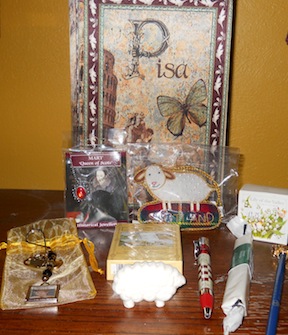
The prize I am offering is a wooden gift box of goodies from London and Scotland ($50 value) and it will go to one lucky responder (chosen randomly) to the question: What would you do if you were in a situation similar to Lady Theresa’s? Be sure to include your email address with your comment.

Inside the lovely wooden box: Mary Queen of Scots necklace, sheep ornament, Treasuring Theresa keychain in bag, bar of soap, bath crystals, sheep soap, pen, pencil, Castles and Palaces of Scotland playing cards

Inside the lovely wooden box: Mary Queen of Scots necklace, sheep ornament, Treasuring Theresa keychain in bag, bar of soap, bath crystals, sheep soap, pen, pencil, Castles and Palaces of Scotland playing cards

Here’s my question for the scavenger hunt: In the British system of primogeniture, titles and estates were often entailed, or required to be passed on, to what person after the death of the owner?

Click on the History Lovers Grand Tour page to fill in the answer, and you may continue on from there. Enjoy!

About Treasuring Theresa

At the betrothal ball of the man she had expected to marry herself, Lady Theresa latches on to Damian Ashby, hoping to divert attention from her own humiliating situation. Of course, she’s not seriously interested because he’s a useless London fribble, in her opinion. He is not favorably impressed with her either.

Still, she’s the daughter of an earl, and he’s the heir to her father’s title and estate, so they are destined to spend more time in each other’s company…sooner rather than later. And who knew that the two of them would develop an unlikely attraction to one another?

But can a London swell and a country lady ever make their diverse lives and interests work together?

Excerpt

The dancing had already begun when they arrived. Damian stayed close at Theresa’s side, his arm lightly around her so that his fingers pressed into the small of her back, while she introduced him to her friends and acquaintances. They shared a set of country dances, and when he returned to her side after fetching a glass of lemonade, she was chatting merrily with a cluster of her friends, so he danced a trio of sets with some of the other young ladies. He managed to get back to her in time for the supper dance, just ahead of a tall, fresh-faced youth in a poorly tied Mathematical and a waistcoat that went out of style years ago.

Damian Ashby, Lord Clinton

Damian Ashby, Lord Clinton

“When does the waltzing begin?” he whispered as they performed the elaborate steps of the country dance. “I must claim the first waltz.”

“We do not waltz here,” she whispered back. “It’s considered far too scandalous. Besides,” she added when they came back together, “we have already danced twice. A third would make us the talk of the shire.”

He chuckled. “Isn’t that what you were aiming for at the Sedgely ball? A juicy scandal to divert the gossips’ attention?”

She looked up at him in surprise. “You know,” she said, “I just realized I don’t care about that anymore. I’m glad Reese is happy with Eugenia.”

“Indeed,” he managed, wondering why he suddenly felt so relieved.

She did condescend to dance another set with him, and Damian hoped all of the old biddy gossips had noticed.

On the return trip, Mrs. Noble babbled on incessantly about gowns and stale cakes while Damian found his eyes lingering over the curvaceous form of the young lady on the seat across from him, the light of the moon being thankfully dim enough to conceal his bold appraisal.

She was silent, in a reflective mood, her head turned toward the window and the shadowed images of the scenery outside.

“Imagine that scamp Dickie Fielding enticing the Hampton chit to meet him in the garden!” Mrs. Noble exclaimed indignantly. “Why I thought her father would explode when they were discovered.” She lowered her voice. “I have it on good authority that they were embracing,” she revealed. “A dreadful scandal indeed should they not marry post-haste.”

Theresa’s head shot around to face him, and he knew she was recalling that night at the betrothal ball when she’d tried to lure him out to the terrace and he’d made a hasty escape. He rather thought now that he would enjoy a pleasant interlude alone in the moonlight with her. He would hold her against him, her head on his chest, while his hands swept over her curves. When he felt her pulse rising, he would draw her chin toward him and take her lips in a long kiss while his other hand would cup her breast, already pebbling with her desire.

Damian froze. What was he thinking? Cousin Theresa was no strumpet. The only way he could indulge in such carnal delights with her would include an obligatory wedding first. And that was out of the question.

Wasn’t it?

Available

Ellora’s Cave • Amazon • Barnes & Noble • AllRomance eBooks • Kobo • Sony

History Lovers Grand Tour Authors

Rue Allyn • Amylynn Bright  • Collette Cameron • Téa Cooper  • Beverley Eikli  • Susana Ellis • Aileen Fish • Debra Glass  • Amy Hearst • Evangeline Holland • Piper Huguley • Eliza Knight  • Kristen Koster • Cora Lee  • Georgie Lee • Suzi Love • Denise Lynn • Deborah Macgillivray  • Barbara Monajem • Shelly Munro • Ella Quinn • Eva Scott  • Shereen Vedam  • Elaine Violette

Prizes

  1. Each author will offer a prize for a contest, the specifics of which is set up entirely by her. The contest will be open to all participants, regardless of geographic location. For logistical purposes, authors may substitute a digital prize (gift card, etc.) of equal value for another prize that might prove difficult to mail to a distant location.
  2. The Grand Prize for the Scavenger Hunt will be awarded to the participant with the most correct answers to the authors’ scavenger hunt questions.  In case of a tie, the winner will be chosen randomly.
  3. The winners will be posted on the History Lovers Grand Tour page the following week.

Scavenger Hunt

  • Click on the above links to each author’s blog. The blog tour entry can be identified by the graphic in the upper right corner of the post. If it is not the top post, look for the graphic in a prominent location on the sidebar, and click on it to find the blog tour entry.
  • Read the blog post and the author’s short answer question at the end. Locate the answer to the question, then click on the link to the History Lovers Grand Tour page and type in the answer next to the author’s name. Be sure to fill in the your name and email address!
  • You may go back to same page and read more of the author’s post (excerpt, etc.) or you may click on another author’s name on the answer sheet and repeat the process.
  • When you are finished, check to make sure the spaces for your name and email address are filled in correctly, and submit your answer sheet to the tour coordinator. If you submit an incomplete answer sheet, you may come back later and make another submission with the remaining answers when you have more time.
  • Any questions about the scavenger hunt should be directed to the tour coordinator .

Rue Allyn: Photography in the Old West + GIVEAWAY

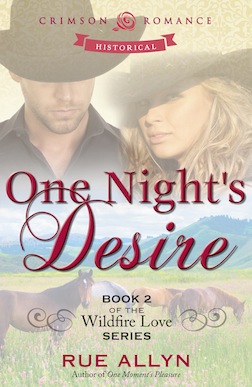
Rue is offering two chances to win a free digital copy of One Night’s Desire. See contest details below.

Susana, thank you very much for inviting me to visit with your followers today to tell them a little about my newest release, One Night’s Desire, and some factoids about nature photography in the late nineteenth century.

A visit to Yellowstone and Grand Teton National Parks in 2008 with a friend who is a superior photographer inspired an important detail of One Night’s Desire. Because I began to share my friend’s interest in photography (although I lack her skill) I started to look into the source of many of iconic images associated with the parks. I discovered that the expeditionary force responsible for mapping and recording the details of the Yellowstone area included a photographer by the name of William Henry Jackson. His pictures are the first of the area and are the foundation for many of those iconic images. You can read about his adventures and see copies of his photographs in Bob Blair’s compilation “The Pioneer Photographer.” The difficulties of transporting photographic equipment to remote locations and the complexities of timing exposures for just the right light, are just two of the small struggles Jackson dealt with in addition to the rigors of a years long expedition in country where survival was risky at best. One story in particular about Jackson balancing his equipment on a cliff side to capture an especially compelling image of a waterfall was especially inspiring. I was so moved that I repeated as much of the action of that story as I could in One Night’s Desire. With digital cameras, we don’t have half the struggle to create photographs that Jackson had. His efforts were truly heroic and contributed greatly to the creation of Yellowstone as a national park. I owe him not only for the inspiration he gave to my story but for the images and places that he preserved.

Giveaway: Two Chances to Win a Free Download of One Night’s Desire.

  1. Leave a comment about this post, photography, the national parks, or any topic you prefer and/or
  2. Leave a review of one of my currently available books at Amazon. Just check my author page for book details.

I’ll be collecting entries throughout the entire One Night’s Desire release tour (June 13 – July 29, the  schedule of appearances can be found here. The winner will be announced July 31st on my blog.

About One Night’s Desire

roses2A WOMAN ON THE RUN: Rustlers, claim jumpers and fire, nothing will stop Kiera Alden from reuniting her family. But an accusation of murder threatens her dreams and sets Marshall Evrett Quinn on her trail. She may be able to escape prison bars and eventually prove her innocence, but she can’t escape Quinn’s love.

A LAWMAN IN HOT PURSUIT: Marshall Evrett Quinn is relentless in pursuit of law-breakers, and pretty Kiera Alden is no exception. Clever and courageous, she evades him until a chance encounter turns the tables. Finally he has this elusive desperado under arrest, but success is bittersweet when she captures his heart.

Excerpt

http://rueallyn.com/2c2ONDexcerpt.html

Available

Amazon

One Night’s Desire and its sister book One Moment’s Pleasure are heavily discounted at Amazon for the entire month of July.

About the Author

????????????Author of historical, contemporary, and erotic romances, Rue Allyn fell in love with happily ever after the day she heard her first story. She is deliriously married to her sweetheart of many years and loves to hear from readers about their favorite books and real life adventures.  Learn more about Rue and her books at http://RueAllyn.com.

Contacts

Website • Facebook  • Twitter • Goodreads • Amazon • Blog

Regency Rites: Almack’s Assembly Rooms

What was Almack’s?

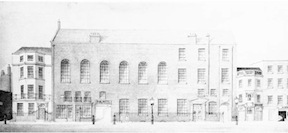
Almack’s was founded in 1765 by a Mr. McCall. The building was located on King Street just off St. James Street* and included a large ballroom, as well as supper rooms and card rooms.

Almack’s was ruled by a select committee of society matrons known as the Lady Patronesses. These ladies ruled the club with an iron hand; only the crème de la crème (about 25%) of London society were authorized to cross the threshold of this exclusive circle. Each application for membership was carefully scrutinized by the high-handed patronesses, who were not above using their power for retribution against their rivals or other personal reasons.

The food served was not of the best quality. Alcohol was not served—only tea and lemonade.The floor of the ballroom was said to be dreadful, and the rigid rules set by the patronesses could not be broken by anyone. It is said that the Duke of Wellington, the hero of the Peninsular War, was refused admission because he did not sport the proper dress—knee breeches, white neckcloth, and a long-tailed coat. The doors were locked precisely at eleven o’clock and no one was allowed in after that for any reason. There was a long list of”do’s” and “don’ts” (mostly don’ts) for the young debutantes, and any infraction could result in expulsion from the club and social censure. When the waltz was finally given the seal of approval—it was condemned for years as being scandalous due to the close proximity of the dancers’ bodies—the young ladies had to be individually approved to dance it by one of the patronesses.

Almack's Assembly Rooms

Almack’s Assembly Rooms

Almack’s balls were decidedly not anywhere near the grandest balls of the London Season, so why did the matchmaking mothers of the haut ton scramble to get their hands on those square cardboard vouchers that would gain them admittance?

One word—marriage. Almack’s was the exclusive “marriage mart” of the ton. While potential spouses for your sons and daughters could be found elsewhere, the “best” ones could ideally be found at Almack’s, where the average, everyday riffraff need not apply. Who wouldn’t want their daughter to find a wealthy, well-connected—perhaps titled—spouse to enrich the family fortunes? Matchmaking mothers everywhere yearned to have their marriageable offspring included among the exclusive company of Almack’s.

Who were the Patronesses?

The Lady Patronesses—six or seven at any one time—were:

Lady Castlereagh

Lady Castlereagh

Lady Castlereagh (Emily Anne) was a wealthy earl’s daughter who married the Viscount Castlereagh (later the 2nd Marquess of Londonderry), who held many political posts (Secretary of States for War, Secretary of State for Foreign Affairs, and leader of the House of Commons) during the period. Lady Castlereagh was the one who insisted that the door to Almack’s be closed promptly at eleven. She and Mrs. Drummond Burrell were both known for their disdainful arrogance.

Lady Jersey

Lady Jersey

Lady Jersey, “Queen Sarah,” “Silence,” or “Sally” to her close friends was the wealthy daughter of the 10th Earl of Westmoreland who married the 5th Earl of Jersey. Lady Jersey’s mother-in-law, Lady Frances Jersey, was at one time the mistress of the Prince of Wales (it was she who recommended he choose Princess Caroline for his wife), and her parents eloped to Gretna Green (quite the scandal). Lady Jersey’s younger sister married the brother of the scandalous Lady Caroline Lamb, but when the latter ridiculed her in her vengeful novel Glenarvon, Lady Jersey barred her from Almack’s forever.

Lady Sefton

Lady Sefton

Lady Sefton (Maria) assisted many a green girl to negotiate the hazards of the marriage mart. Her husband was an enthusiastic sporting man, and a member of the Four-in-Hand Club (an elite club for only the best drivers).

Lady Cowper

Lady Cowper

Lady Cowper (Emily) was the daughter of the great political hostess, Lady Melbourne, and due to her mother’s numerous affairs, her paternity was never verified. She disapproved of her sister-in-law, Lady Caroline Lamb, but was otherwise known as one of the kindest of the patronesses.

Princess Esterhazy

Princess Esterhazy

Princess Esterhazy (Thérèse) was the grand niece of Queen Charlotte and never let anyone forget it. Her husband Prince Paul Esterhazy served as the Austrian ambassador to England 1815-1842. She and the Countess Lieven demonstrated the utmost in continental sophistication.

Countess Lieven

Countess Lieven

Countess Lieven (Dorothea) was the first foreigner to serve as a patroness of Almack’s. Her husband the Count was the Russian ambassador to England from 1812 to 1834. Besides being a leader of London society, she was a significant political force in Great Britain, France and Russia.

Mrs. Drummond Burrell

Mrs. Drummond Burrell

Mrs. Drummond Burrell (Clementina) was a great heiress and daughter of an earl who later became a baroness when her husband succeeded to his father’s title. Although one of the younger patronesses, she was considered the most arrogant and haughty of them all.

Appearance was everything.

It’s interesting to note that while London society, as demonstrated by the Lady Patronesses, demanded a high degree of moral perfection, it was really the façade that counted. As long as you behaved with discretion—i.e., didn’t get caught—you could have adulterous affairs with impunity. While it was expected that wives would remain faithful to their husbands until the birth of an heir or two, after that, it was quite common for both husband and wife to indulge in affairs. It was widely known that Lady Melbourne had affairs with politically powerful men who fathered many of her children, but her the importance of her position precluded any open censure.

Most of the Lady Patronesses of Almack’s had notorious affairs. Emily Cowper, taking the advice of her mother, the above-mentioned Lady Melbourne, to be true to her lover rather than her husband, had a long affair with Lord Palmerston, who later became Prime Minister, and after her husband died, they married and lived happily ever after.

As long as it was behind closed doors—and you were wealthy and important enough—you could get away with a considerably lower standard of behavior. Of course, marriages tended to be more about property, wealth and family connections than any sort of love or affection, so perhaps such scenarios were a natural result of cold-blooded unions.

The King Street location of Almack’s is an office building now; when I was there two weeks ago, it was covered with scaffolding. Christie’s Auction House is across the street.

The Regency Rites series

Regency Rites: The Well-Dressed Regency Lady 

Regency Rites: Presentation at Court

Regency Rites: Almack’s Assembly Rooms 

Regency Rites: The London Season

Regency Rites: The London Season

The Haut Ton

The haut ton referred to the members of some three hundred families who owned large estates that supplied their primary income. Sometimes they were called “the upper ten thousand.” Not all were titled, but they were usually at least well-connected and wealthy enough to stand the enormous expenses of socializing with the crème de la crème of English society, which included:

  • owning or renting a suitable residence in a fashionable area of London (in addition to a great country home on their estate), along with the requisite servants, stables, etc.
  • extensive wardrobes in the first stare of fashion for all members of the family who participated in the Season
  • food, drink, decorations, musicians, etc. required to provide entertainment for other members of the ton in grand style
  • costs of renting theatre boxes, purchasing entrance tickets to public entertainments, such as the Vauxhall Pleasure Gardens, Astley’s Amphitheatre, etc.
  • allowance or pin money for wives, sons or daughters.

What was the London Season?

Lady Theresa

Lady Theresa

The London Season evolved from the legislative sessions of Parliament, which would run roughly from January/February to June. Generally, a peer would bring his family to London sometime after the holidays, which provided a perfect opportunity for their families to socialize and seek suitable spouses for their children. The Season didn’t heat up until spring, though, and by the end of June, most of the first families escaped the odiferous heat of London for the fresh air of their country estates or perhaps a seaside resort.

Many families would return to London in September for the “Little Season,” which was much less prestigious, but few were left in Town by the end of November.

Essentially, anyone who was anyone would participate in the London Season, even if they had to run up enormous debts to do it.

In Treasuring Theresa, an earl’s daughter such as Lady Theresa would be expected to have a London Season and make a suitable marriage. Unfortunately, however, her first Season was unsuccessful, and later, there was no money for it, so when childhood sweetheart Reese Bromfield broke her heart by betrothing himself to another, Lady Theresa’s options for marriage were limited. Incidentally, Reese Bromfield, as the son of a squire, was not highly-connected, but as the son of a wealthy member of the gentry, he would have been welcomed to participate in the ton, although not, perhaps, in the highest circles.

What did people do in the London Season?

Vauxhall Pleasure Gardens

Vauxhall Pleasure Gardens

London offered—and still does to this day—an endless number of delights for visitors, regardless of status. In the early 19th century, one could walk or ride through the park (Hyde Park or Green Park were quite popular), visit the British Museum or any number of museums or galleries, attend a circus performance at Astley’s Amphitheatre, visit the Pleasure Gardens of Vauxhall with its nightly fireworks, and attend the theatre or opera. The best shopping in the world could be had on Bond Street, and for the gentlemen there was racing, boxing, gaming, and all sorts of attractions that couldn’t be found on a remote country estate.

For the haut ton, there were balls and parties, soirées, routs, musical evenings, Venetian breakfasts, al fresco teas, extravagant dinners…all sorts of opportunities to hobnob with wealthy aristocrats and politicians and make connections that could potentially lead to even higher status and prestige.

Hyde Park

Hyde Park

It was all great fun—but very expensive, especially for those who succumbed to the gambling fever. Entire fortunes were won and lost in this period—and not just by the gentlemen either. Before she died in 1806, Georgiana, the Duchess of Devonshire, had lost what amounts today to a billion dollars. (See Lady P’s insights on that here.)

What did people do the rest of the year?

Whatever they wished! Many spent the summer on their country estates, which generally sported expansive mansions with huge ballrooms that could be used for house parties, during which they would entertain their friends from other parts of England for a week or more. Sometimes gentlemen took a personal interest in their estates, but often the management was left to a steward or estate manager so that the owner was free to participate in local society, or travel to the seaside, or take the waters at a spa resort, such as Bath. Hunting and fishing were popular sports for the gentlemen.

Damian Ashby, Lord Clinton

Damian Ashby, Lord Clinton

In Treasuring Theresa, Damian Ashby was a society dandy who despised the country, except for the income it provided him. Lady Theresa despised the superficiality of the ton and preferred life on her country estate, where she counted among her friends villagers and commoners, as well as the local gentry. How will these two seemingly complete opposites manage to bear each other’s company for an extended period of time as her dying father wishes?

About Treasuring Theresa (a sweet Regency short story)

At the betrothal ball of the man she had expected to marry herself, Lady Theresa latches on to Damian Ashby, hoping to divert attention from her own humiliating situation. Of course, she’s not seriously interested because he’s a useless London fribble, in her opinion. He is not favorably impressed with her either.

Still, she’s the daughter of an earl, and he’s the heir to her father’s title and estate, so they are destined to spend more time in each other’s company…sooner rather than later. And who knew that the two of them would develop an unlikely attraction to one another?

But can a London swell and a country lady ever make their diverse lives and interests work together?

Note: Excerpts and additional reads—including an epilogue to this story—are available here.

Available

Ellora’s CaveAmazonBarnes & NobleAllRomance eBooksKobo

The Regency Rites series

Regency Rites: The Well-Dressed Regency Lady 

Regency Rites: Presentation at Court

Regency Rites: Almack’s Assembly Rooms 

Regency Rites: The London Season

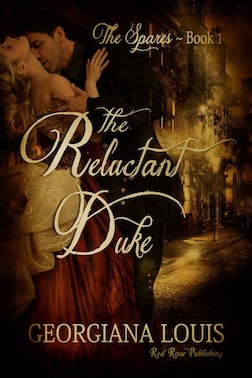
Georgiana Louis and “The Reluctant Duke” + Giveaway

Georgiana is offering a digital copy of The Ruined Marquis, the second in the Spares series, to the most original commenter.

Why I Love the Regency Period

I did an interview on an American radio station last week and the host asked me why I wrote about the Regency period, as there was no Regency period in Australia. I had to laugh, because I rarely write about things I know about. Where’s the fun in that?

Instead I write about places I dream of, times that interest me.

Ever since I picked up Sabrina Jeffries’ To Pleasure a Prince in a secondhand book store, I have been hooked on the Regency period. And it’s not because of the clothes either!

I actually find the clothes to be quite horrible, and don’t write much about them.

Instead, what I love, are the rules, the society and most of all I love the changes within society that began through that period. The way love matches within the aristocracy and gentry became more common, versus the contracted marriages of the the late 18th century.

I love the rules about how a lady must act, the ridiculous double standards for gentlemen.

The Regency period was a time when ladies became more than just a pretty society piece. Ladies who had conversation became more prized, and I think that is what totally enthralls me.

I hope you enjoy my Spares series—I loved writing it. My four, tortured heroes and the women who bring them to their knees.

About The Reluctant Duke

Colin Lyre, recently inherited 10th Duke of Lincoln, has been told his whole life that he is superfluous to his family.

When he must deal with the responsibility and stress that comes with his new title, he flounders rather badly. He is determined do his ‘duty’’ and marry an ‘appropriate Duchess.’

Life throws Colin’s plans wayward when he rescues the beautiful Annabelle from a ball. She makes him realize how much better his life could be, but he doesn’t know if he truly deserves such happiness.

Annabelle wants nothing to do with the responsibility of marrying a title. She simply wants to make a suitable match with a gentleman who can support her family.

Colin is Annabelle’s perfect prince until she realizes what life as his life would be like. However, making the rational decision to stay away from one another is much harder than either of them expects.

Available

Red Rose Publishing

Excerpt

TheReluctantDuke_LRG“Thank you so much sir. I need to get out of here before anyone sees me. Can you help me please?” She implored through her ministrations.

“Oh… of… course I can,” Colin stammered, his mind racing with the logistics of how to get her out of the grounds unseen. Why hadn’t he been thinking about that before she mentioned it? He should have been the one to offer aid.

“I can’t be found like this,” Her voice broke on the words and two fresh tears slipped down her cheeks. “No one would ever marry me.”

Colin’s heart all but broke at the pitiful look on her face, for it was indeed true. Her beauty and virginity were the two things that would be her greatest assets on the marriage mart. If people regarded her as damaged goods, no one of any consequence would marry her, no matter how beautiful she was.

“I’ll get you out of here, let’s walk towards the front of the house and you can hide whilst I get a carriage.” Colin put his arm gingerly around the angel, ushering her towards the house.

“I’m Annabelle by the way,” she sniffed as she wiped her face again with his now soaked handkerchief.

“Oh … well…” Colin stammered again, how did this beautiful woman keep flabbergasting him? He’d never been so verbally incompetent in his life.

“I think we’re past polite names do not you? After all, you have probably seen more of me tonight than any one should before marriage.”

Colin was shocked by her honest and far too accurate assessment of the situation. It occurred to him if someone saw them in her current state of ‘dress’ it would be his head on the chopping block, or in the parson’s trap as the case may be.

“I do not want to get married,” he blurted out louder than he should have, stopping her in their rather quick race to the front gate.

Annabelle chuckled at him.

“I did not mean I wanted to marry you, my lord. I just meant that considering the state you found me in and after all you have done for me tonight, the least I could do was introduce myself as Annabelle and not Miss such and such, daughter of such and such.” She sighed loudly. “I hate all that.”

Colin smiled despite himself. Was there really a marriageable female here that did not care about connections? He frowned cynically, he did not think she’d feel the same way when she was properly introduced to him.

“I’m Colin,” he smiled shyly at her. He’d never been introduced as just ‘Colin’ in his entire 26 years. What an odd, exhilarating feeling. ‘Colin’ could be anyone, do anything.

“Colin,” she said his name with a slight huskiness that sent a bolt of desire to his groin.

About the Author

all photos sept 2011 282Georgiana Louis is a chiropractor, wife and mother in the real world. However, her passion for writing could not be denied. She fell in love with romance novels at the tender age of eleven. Thousands of books have been read, absorbed and enjoyed since then. More recently, the wonderful world of Regency romance—dashing heroes and beautiful heroines in an era just beginning to accept love matches. Please join her in the fictional world, where everything ends as it should, happily ever after.

Contacts

Joan Vincent and The Honour Series

It is my pleasure to introduce Joan Vincent, whose Dell Candelight Regencies I used to read years ago. I was so delighted to run into Joan and her sister Vera at the Romantic Times Convention in Kansas City last month and to discover that she is back to writing her fabulous Regencies once again!

Susana Ellis and Joan Vincent at Club RT in Kansas City

Susana Ellis and Joan Vincent at Club RT in Kansas City

I came to write the Honour series in a very roundabout manner. Between 1977 and 1983 I sold eight novels that were published in the Dell Candlelight series. I returned to teaching in 1983 because my daughters needed dental surgery and braces. I still wrote that first year but gave it up when the demands on time and energy from the combination of family, teaching, and learning computers, networking etc. became too great. It wasn’t until 2000 when I retired that I returned to writing at the urging of my sister, Vera. The book I chose to write was one for which I sketched a brief outline before I discontinued writing. In fact, I had described it in such detail that my daughters both remembered me talking about it almost twenty years earlier.

I did some review research on 1808 England. Then I studied my outline, sketched my characters, and began writing. I was surprised that after so many years the story flowed so easily. That is, it flowed until I was in the midst of Chapter Five. In the middle of that chapter I was astounded as I typed one character telling another that Mr. Martin had died.  Mr. Martin was the villain. You don’t have much of a book if it is only five chapters long! (This is just one of my many experiences when my characters acted like true children of the mind and did what they pleased no matter what an outline said! Thankfully, I learned this happens to other writers also.)

My sister Vera has always read my books as I wrote them so I visited with her about the problem. Then I decided to let the mind mull it over in its own strange way for a few days. When I returned to the keyboard I found a new villain already in the book and a deliciously evil one at that-—the French master spy Donatien. The only problem was that it completely changed the tone of the book from a sweet regency like my earlier work into something more complex and definitely darker. I thought on it a few more days and came up with the idea of a Napoleonic spy mystery with an element of romance.  I revamped my characters and their motivation a bit and learned the hero was an officer in the 15th Light Dragoons with four fellow officers who were very good friends.  One of these had a very important part in the book.

By Chapter Seven I knew I needed an English spy but who to pull out of the character hat?  Once again I brainstormed with Vera. She came up with the idea of using Andre Ribeymon, Baron de la Croix. Andre had first appeared in Bond of Honour, published in the early 80’s as the six-year-old nephew of the heroine. In 1808 he would be in his early 20’s and ripe for adventure. Of course he would have a good friend to go on escapades with him and Hadleigh Tarrant, the hero in Honour’s Choice came to life. What was truly fascinating was that I later realized Donatien is also in Bond of Honour. He is part of a group that attempted to kidnap Andre.

At that point I had seven strong hero types and an excellent villain in Donatien. I had this vision of my seven posed like the men in that old 80’s western The Magnificent Seven—the 15th Light Dragoons in their regimentals (Bellaport, Danbury, Merristorm, Vincouer and Goodchurch for those unfamiliar with the Honour series), Andre in his guise as a dandy and Hadleigh in his staid Brummel style-dress. I also had six more stories—one for each of my other heroes—come to me full-blown in which each man in turn would battle Donatien and also find his true love.

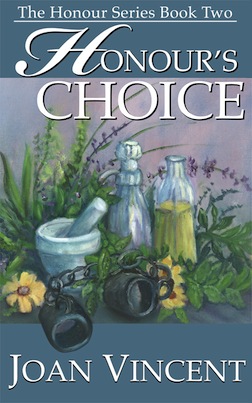
Choice-final epub coverThe Honour Series was not a nine-month term baby but more a month in gestation. Writing about how it came to be has reminded me of how many pillars underpin a book! And I haven’t even told you about the two gentlemen from the Royal Agricultural Society in Britain who helped me, via email, track down where and when the Agricultural Society met in 1809. It is a minor point in Choice but one I wanted to have it correct. It almost takes a village to write a book.

Honour’s Choice, the story of an older woman and younger man, came into existence long before the so-called cougar trend began.  Anyone who reads the story would hardly think of Sarah as a cougar in any guise. Her knowledge of herbal medicine led me to a lot of research on the topic and many calls to my sister-in-law who is a nurse and who plied doctors with questions for me. I can’t really remember when I realized Hadleigh had a fascination with insects, but that aspect of his life has also led me to many books on bugs I never thought I’d read. Hadleigh and Sarah have struck a strong chord with all who have read their story. That has been true from the first very rough draft, although sadly, I’d have to admit I’m not certain why. I am very glad I wrote their story and hope those who read it enjoy it as much as I did.

About Honour’s Choice (The Honour Series Book Two)

She’s the only one who can help when a spy hunt goes terribly wrong.

1809 England. Hadleigh Tarrant joins in the hunt for government bullion thieves. Captured and tortured by their leader Donatien, Hadleigh is left to die. Sarah, Lady Edgerton, a middle-aged widow, nurses the critically injured Hadleigh when he is found near her home despite the danger to her reputation. Their hearts choose each other, but Hadleigh is haunted by the tragedy of his parent’s marriage and fears that love will cause him pain worse than that of any torture. Sarah, trapped by the years between them and secrets that would turn him from her forever, tries to hide her love and do what is best for Hadleigh by giving him up. Donatien, the malicious French spy reappears determined to purloin military secrets. He is also intent upon a revenge that threatens Sarah and Hadleigh’s growing love and their very lives. Hadleigh must unmask the spy before he and Sarah can decide between dishonour and Honour’s Choice.

  4* Review from RT Book Reviews

Available

Amazon • Barnes & Noble

About the Author

jvincentJoan Vincent lives with her husband in Kansas. Her hobbies include sewing for and playing with her young grandchildren, quilt making and quilting, flower arranging, and research. Her husband claims her favorite hobby/passion is filling an ever-increasing number of bookcases with books on all facets of 18-19th century English, French, and Spanish life and politics.

JV Website

Facebook

blog

Joan’s earlier Regencies are available at Regency Reads.

  • The Audacious Miss
  • A Bond of Honour
  • The Curious Rogue
  • The Education of Joanne
  • Never To Part
  • The Promise Rose
  • Rescued By Love
  • A Scheme For Love
  • Thomasina

Episode #15: Lady P On Assignment in 1814 Kent

Susana: Lady P, who is still visiting her daughter’s family in 19th century Kent, heard some rather juicy gossip about the scion of a prominent family in the area and decided to investigate, intending to present the results of her investigation to me in an attempt to make reparations for making free with my credit card to buy gifts for her grandchildren prior to her return to her own time period.

Lady P [interrupting]: Although I know Susana well enough to know that it is not the money that concerns her; it’s something called the Prime Directive. So silly really, to think that something as innocuous as the Laugh and Learn Learning Puppy could cause the end of the world. [Shaking her head] In any case, I sent a note to Lord Rutherford to call upon me at my son-in-law’s home in Thanport at his earliest convenience, and he was pleased to do so.

* * * * * *

Lady P: I am much obliged to you, sir, for your prompt response to my invitation.

Rutherford [bowing]: You indicated that it was a matter of some urgency?

Lady P: Yes, indeed. Rumor has it, my lord, that you are a sapskull.

Rutherford [eyebrows raised]: A sapskull, madam? Indeed? And how did you come to that conclusion?

Lady P: Although perhaps it is merely a ploy to draw attention from your dabbling in the area of espionage.

Rutherford: Espionage? Really, my lady. I think you’ve been reading too many Minerva romance books.

Lady P [waving an arm]: Do not be alarmed; your secret is safe with me. I am more concerned about your attentions toward a certain highly-regarded young lady in the area.

Rutherford [rather stiffly]: If you mean Miss Marsh…I suppose it is no secret that I am courting her.

Lady P: It is hardly flattering to Miss Marsh that you spent so many years sniffing after Lady Phoebe and only turned to her when Lady Phoebe became engaged to another.

Rutherford: I was not sniffing after Lady Phoebe. She has never been more than a friend. I was merely waiting until Miss Marsh attained an age to marry. [Under his breath: Shocking how meddlesome older ladies can be!]

Lady P [with narrowed eyes]: What was that about older ladies?

Rutherford: Nothing ma’am. Are you quite finished with your interest in my affairs?

Lady P: Not even close, my lord. Then you waited on the sidelines while Miss Marsh received countless offers of marriage…surely any sensible man would have made an effort to fix his interest with the woman he intends to marry. What if she’d have accepted one of them? Where would you be, then?

Rutherford: I had the situation well in hand. If it appeared as if she were interested in another gentleman, I would have stepped in.

Lady P: Why did you decide on Miss Marsh? What are the qualities you saw in her that gave you the impression that she would make a suitable wife for you?

Rutherford: I have known her all her life. She is a well-behaved, proper lady who has all the attributes I desire in a wife. Furthermore she is used to taking her lead from me. I wish to live a well ordered life. With Miss Marsh there will be no surprises.

Lady P: I understand, however, that Miss Marsh has turned down your offer of marriage.

Rutherford [running a finger down his cravat]: That is true. A fit of pique, only.

Lady P: But you persist in pursuing her. What makes you think you can prevail upon her to change her mind? Miss Marsh appears to be a young lady who knows her own mind. I doubt she will be easily importuned.

Rutherford: I have been busy during the past couple of years. Once I spend some time dancing attendance on her, I’m sure she’ll come around. After all, we have been close friends for years.

The Secret Life of Miss Anna MarshLady P: What can you offer Miss Marsh that her other suitors could not?

Rutherford: I beg your pardon, my lady, but these questions are extremely intrusive. [To himself: not to mention something I don’t wish to think about.]

Lady P: How have your feelings changed toward Miss Marsh since your return to Kent?

Rutherford: Really, these questions are outside of enough. My feelings toward Miss Marsh are no concern of yours. All anyone need know is that I intend to make her my wife. You can tell that to Lady Blanchard. [Rutherford mutters behind his hand: Now if I can only convince Anna. I wish I knew why the devil she is being so difficult.)

[A maid comes in and whispers in Lady P’s ear.]

Lady P [to the maid]: Tell my daughter I’ll be along shortly. [to Lord Rutherford]: I do beg your pardon, Lord Rutherford, but a domestic squabble requires my attention. Before you depart, however, there is one last point of curiosity I should like you to satisfy, if you would be so kind.

Rutherford [rolling his eyes]: By all means, my lady. I have no wish to leave your curiosity unfulfilled.

Lady P [with a saucy grin]: Can you tell me where I might find a copy of that book Miss Marsh found in the library? You know, the one with all the—er—fascinating illustrations? I have a novelist friend who would give her eye-teeth to have one.

Rutherford [clearing his throat] I believe I must take my leave of you, madam. It’s been a pleasure, of course.

Lady P [winking and offering her hand]: Indeed it has, Lord Rutherford. I wish you well in your endeavor to win Miss Marsh’s affections. Perhaps a match between you is not quite so ill-conceived as I thought.

Rutherford: À bientôt, my lady. [softly cursing as he walks out the door]

About The Secret Life of Miss Anna Marsh

Since she was a young girl, Anna Marsh has dreamed of Sebastian, Baron Rutherford asking for her hand in marriage. But that was in another life when her brother Harry was alive, before she vowed to secretly continue the work he valiantly died for. Now as Sebastian finally courts Anna, she must thwart his advances. Were he to discover her secret, he would never deem her a suitable wife…

Sebastian has always known Anna would become his wife someday. He expects few obstacles, but when she dissuades him at every turn he soon realizes there is much more to this intriguing woman. Somehow he must prove to her that they are meant to be together. But first he must unravel the seductive mystery that is Miss Anna Marsh…

Available for pre-order on Amazon.com

SusanaSays3Susana Says: Fabulous Read, 5/5 stars

On the surface, Anna Marsh appears to have everything a young lady could wish for. She’s beautiful, accomplished, well-mannered, and sought after by countless eligible gentlemen. She’s also a wealthy heiress. But Anna is not a typical debutante. She has a secret life that she is determined never to give upeven if it means she must remain unmarried the rest of her life. In any case, the man she’s always loved, Sebastian, Lord Rutherford, seeks a biddable, compliant wife, which she knows she’ll never be.

Sebastian, Lord Rutherford has been waiting for Anna to mature into a desirable young lady, and now that she has, he’s ready to pop the question. But when he doesn’t get the answer he expects, he becomes all the more determined to win her heart. But how can he truly love Anna when he doesn’t really know her? The question becomes: is he a suitable husband for her?

Anna is a strong, independent woman determined to make more of her life than the typical society maven. There were times in the beginning when I wanted to slap Rutherford silly for taking Anna for granted for so long, but, on the other hand, there is nothing quite like seeing a man grovel to appease his lady, and Rutherford manages to do so quite satisfactorily.

There is a very sweet secondary romance in this story, and also a mystery to solve originating from Anna’s “secret life.”

The Secret Life of Miss Anna Marsh is the second in a series, following The Seduction of Lady Phoebe. The book stands well on its own, however. This review was written from an ARC provided by the author, who, incidentally, has the first book on pre-order. Ella Quinn is a wonderful new talent in the Regency world, and this Regency devotee looka forward to enjoying her future works.

About the Author

Ella QuinnElla’s studies and other jobs have always been on the serious side. Reading historical romances, especially Regencies, were her escape. Eventually her love of historical novels led her to start writing them.

She is married to her wonderful husband of twenty-nine years. They have a son and granddaughter, Great Dane and a Chartreux. After living in the South Pacific, Central America, North Africa, England and Europe, she and her husband decided to make St. Thomas, VI home.

Ella is a member of the Romance Writers of America, The Beau Monde and Hearts Across History. She is represented by Elizabeth Pomada of Larsen-Pomada Literary Agency, and published by Kensington. Her debut novel The Seduction of Lady Phoebe, will release in September 2013

Contacts

Website: (Up soon) www.ellaquinnauthor.com

Facebook: www.facebook.com/EllaQuinnAuthor

Twitter www.twitter.com/ellaquinnauthor

Blog http://ellaquinnauthor.wordpresscom


The Lady P Series

Episode #1: Susana’s Adventures With Lady P: The Introduction

Episode #2: Lady P Talks About… Pride and Prejudice?

Episode #3: Lady P and the Duchess Who Lost a Billion Dollars

Episode #4: Lady P and the Face On the $100 Bill

Episode #5: In Which Lady P Discovers Sparkly Fabrics and Ponders Violating the Prime Directive

Episode #6: Lady P Dishes the Dirt on the Duchess of Devonshire

Episode #7: The Political Exploits of Lady P and the Duchess of Devonshire

Episode #8: Lady P and the Prince Regent’s Illicit Marriage

Episode #9: In Which Lady P Depletes the Cooking Sherry During Her Discussion of Caroline of Brunswick

Episode #10: Lord Byron: Mad, Bad, and Dangerous to Know

Episode #11: In Which Lady P Talks About Hannah More and the Rights of Women

Episode #12: Lady P’s Revelations Regarding George III and His Peculiar Progeny

Episode #13: Lady P Discusses the Luddite Uprising, the Assassination of Spencer Perceval, and the General Unfairness of Life

Episode #14: In Which Leticia, Lady Beauchamp, Pops In For an Interview On Her Personal Acquaintance With Princess Charlotte of Wales

Episode #15: Lady P On Assignment in 1814 Kent

Lady P Quizzes Jane Livingston, the Hero’s Sister From “A Twelfth Night Tale”

Guest Author Elizabeth Bailey: A Lady In Name

The Georgian Gentleman’s Version of the Little Black Book

by Elizabeth Bailey

Women who fell from grace in the 18th Century had few options open to them. Get married with speed was top of the list. Preferably to the fellow with whom you did the deed, but frankly anyone of respectability would do.

If Darcy had not intervened to get Lydia married to wicked Wickham, as Lizzie Bennet points out, not only Lydia, but her four sisters would have been tainted and probably doomed to spinsterhood since they had no money to bribe a prospective bridegroom into overlooking the disgrace.

prostitutes0003

A page from Harris’s List

The Bennet girls were lucky. In reality, the family would likely have disowned Lydia. When Wickham tired of her, she was young and pretty enough to have found herself another protector. As time went on, Lydia might have drifted in the direction of Covent Garden where she could well have found herself portrayed in a couple of extremely frank paragraphs in the annual publication of Harris’s List of Covent-Garden Ladies.

This fascinating little volume was started in 1757 by one Samuel Derrick, as a venture to get himself out of debtor’s prison. His lively descriptions of the ladies who made themselves available for a gentleman’s amours proved so popular that he not only procured his release, but he started a phenomenon that continued until 1795.

Almost all the ladies spoken of as being of good education evidently fell into “the life”, as it was popularly called, by way of seduction and subsequent abandonment.

Like Miss Char-ton (note the missing letter, a thinly veiled anonymity) of No. 12, Gress Street, who “came of reputable parents…yet the address of a designing villain, too soon found means to ruin her; forsaken by her friends, pursued by shame and necessity; she had no other alternative…”
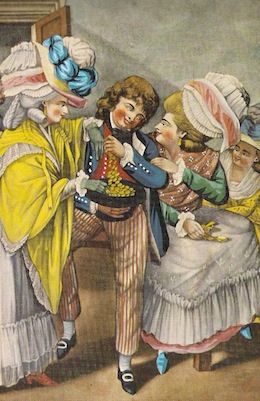
Prostitutes propositioning a sailor

Prostitutes propositioning a sailor

Seduction was not confined to the educated classes. There was Miss Le-, of Berwick-Street, Soho, who “was debauched by a young counsellor, from a boarding-school near town, where she was apprentice.”

Then there was Miss We-ls, of No. 35, Newman-Street, daughter of a Welsh farmer, who is described as being “as wild as a goat, of a sandy colour, her features are small, and is a tight little piece.” She was sent to London when young where “a young gentleman ingratiated him so far into her graces, as to gain her consent to make him happy by her ruin, under a promise of marriage” and then he subsequently “abandoned her to the reproaches and calumny of a merciless world”.

The majority of the ladies featured in this entertaining little black book for your pleasure-seeking young buck were in their teens or early twenties. An example is Miss Townsend, nineteen, of whom we learn that “the use of the needle first fired this lady’s imagination with the use of a certain pin”. This sort of witty euphemism abounds.

Perhaps it is not surprising that the anodyne of choice for a number of the ladies is strong liquor. Like Miss Godfrey, a commanding female, who “will take brandy with any one, or drink and swear, and though but little, will fight a good battle.”

The women are delineated in detail, depending on their particular attractions: “she is amorous to the greatest degree, and has courage enough not to be afraid of the largest and strongest man that ever drew weapon in the cause of love”. Or non-attractions, as “but a middling face, with large features, a coarse hand and arm, and in stature short and clumsy”, but she is “an excellent bedfellow”.

Their looks are described: “of a middle size, black eyes, plump made and her skin good” or another with “fine blue eyes that are delicious”. We are told about good teeth and “sweet breath”, in a day where these were rare. We hear about “yielding limbs, though beautiful when together, are still more ravishing when separated”.

Disposition is mentioned, whether she is “agreeable” or “animated with no small degree of vanity” or indeed “a pompous heroic girl, without either wit or humour”. There is a figure to suit every taste, and an accommodation for every sexual whim. We learn whether or not she has a keeper (which doesn’t stop any lady selling her favours elsewhere) and what it may cost our young man about town to enjoy her charms.
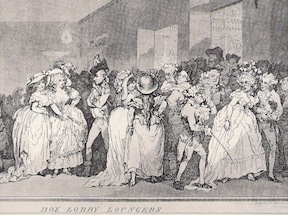
Prostitutes angling for business in the lobby of a theatre

Prostitutes angling for business in the lobby of a theatre

One or two guineas appears the norm, with here and there a more expensive luxury on offer. The genteel Miss Le- above, who was led into sin, is only seventeen and “has a piece of the termagant about her”, but she commands three or four guineas for her services, which include birching for those so inclined. While Miss – of Wardour Street, who is “but newly arrived” and “darts such irresistible glances as can scarcely fail to engage the hearts of the beholders” will not accept less than five guineas. Mrs Ho-fey, on the other hand, who “calls forth all her powers to give delight with uncommon success” will happily settle for half a guinea.

A guinea (one pound, one shilling) seems a pathetic sum to us. Yet these women were the middling class of prostitute. They could not aspire to the heights of high-class courtesans like the later Harriette Wilson, whose clients included the Duke of Wellington, but they were a good deal better off than the street corner girls who plied their trade for a few pence, or a few shillings at best.

But whether they earned a pittance or a fortune, many women ended up selling their bodies to make ends meet. There were 50,000 prostitutes in London in 1797, according to a contemporary magistrate’s account. That statistic argues a lack of opportunities for women to find gainful employment. The better bred, the fewer the options.

It’s tempting to withhold sympathy for our Covent-Garden ladies when you convert their earnings to the present day. In today’s money, a guinea is worth around £60. A lady’s maid was paid less than that in a year, and no doubt worked a lot harder. While Miss Le- with her five guineas was getting buying power to the tune of our £300 every time she lay flat on her back!

What’s more, these ladies of the night could afford to please themselves how they lived, which was more than could be said for most wives, be their husbands lord or boot boy. They lived in comfortable apartments, had a great deal of freedom, could pick and choose among their clientele, and enjoy all the entertainments on offer in the shops and theatres of the time. And all at the trifling cost of respectability.
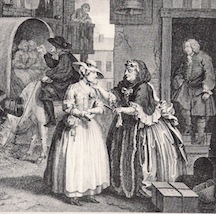
Hogarth—a bawd from a brothel enticing a country girl newly arrived in London

Hogarth—a bawd from a brothel enticing a country girl newly arrived in London

The downside was the future. The lifestyle was no sinecure. There are very few females over thirty in Harris’s List. Assuming one could avoid a dose of “the pox” or any other disease and live, what to do when the charms of youth faded? How many of them were canny enough to salt away a quantity of takings as insurance?

A few, one assumes, if they had garnered sufficient fortune, might be lucky enough to marry. Others are mentioned as having moved into brothel-keeping themselves. But the rest?

What happened to Sally Robinson, who was given five shillings at the age of fifteen to cure her of the clap “which she got from her deflowerer”? On the town in 1761, what hope had “a tall, fat girl” of any kind of living thirty years later? Or Kitty Buckley, who was one of the few older females and already 35 in 1761? She was “reported to have ruined twenty keepers” because she was “as wicked as a devil, and as extravagant as Cleopatra”. Since she had been in the bailiff’s hands about three times a year, did she end her days in prison?

While Harris’s List is a delight in many ways, there is something a little distasteful in the warts-and-all public exposure of a whole generation of unfortunate females, whose only mistake was to succumb to the lure of sensual gratification.

Besides marriage or prostitution, was there any other way out for the fallen woman? If they were lucky, or had kind and generous relatives, there was hope. Transported to another place, perhaps with an allowance, they could start a new life under an assumed name – but with the shadow of the past always ready to catch up with them.

This is of course a familiar theme in our modern take on the historical romance. Our heroine is plucked from this life of shame and obscurity by the love of a good man. What better way to compensate her for enduring such punishment for what was, to our twenty-first century thinking, perfectly natural behaviour?

As for the luscious Covent-Garden Ladies, who had the gumption to use the only means they had of making a decent living – good for you, ladies!

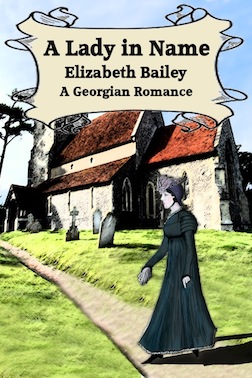
About A Lady In Name

On discovering she is the illegitimate daughter of a peer of the realm, Lucy Graydene, bereft and grieving, sets out to confront Lord Pennington with the result of his misdeeds. She finds instead his autocratic heir, Stefan Ankerville, and is dragged willy-nilly into the new earl’s unconventional family. Lucy is driven to battle for her independence while she struggles against the venom of the half-sister she never knew she had.

When the secrets of Lucy’s past begin to unravel, she is reluctantly obliged to rely on Stefan’s help. Can Lucy overcome a dangerous attraction to the earl, with whom an alliance is impossible? Or is there a faint hope of happiness in the hidden truth of her origins?

Excerpt

The hubbub of a busy inn penetrated dimly into the quiet of the upstairs parlour. It was a small apartment, designed for privacy rather than comfort, and furnished with the minimum of necessities. A chill hung in the January air, little eased by the meagre warmth from a fire in the grate, but the solitary occupant of the room appeared unaffected by this circumstance, although her aspect was far from relaxed.
Lady in Name 500 x 750She was seated on one of the straight high-backed chairs placed about the heavy oaken table at which travellers were encouraged to partake of refreshments, but she had not thought to move it nearer to the hearth. Nor was there any sign that she had availed herself of the innkeeper’s offerings to assuage either hunger or thirst. She was clad in a plain black greatcoat, and a simple black bonnet, unadorned, concealed her hair and a good deal of her face. She sat perfectly upright and still, except for her gloved hands, which she repeatedly clasped and unclasped where they lay in her lap.

From time to time, her eyes flickered to the door, as if in the expectation of its opening at any moment. And once she cast a frowning glance at the case clock on the mantel, which was dragging its way about the eleventh hour, its steady ticking pulling her out of her unquiet thoughts.

She scarcely knew what she was doing here, and the longer she waited for an arrival upon which she could place no real dependence, the stronger grew her anxieties. What had she to hope for, thrusting herself upon the notice of Lord Pennington? The man who had repudiated her three and twenty years ago was unlikely to greet her sudden appearance with complaisance. Nor could she imagine the intervening years had changed one hard-hearted enough to reject all responsibility for the consequences of his libertine conduct. Despite his cloth, Papa’s dictum, frequently uttered, had been that a leopard never changes his spots.

The remembrance caught at her heartstrings, turning a knife in the wound. Papa—so she must always think of him. She churned again with the futile yearnings that had plagued her from the instant of his uttering the fateful confession.

If only he had not chosen to reveal the horrid truth of her origins. If only he had been spared the necessity. If only the Almighty had spared him. And most painful of all, if only Lucy had been more alert to his weakness after the dreadful downpour.

It had caught him on a visit to Mrs Mimms—one of the poorest of Papa’s parishioners, her cottage situated a good five miles from Upledon vicarage with no vestige of shelter between. The dread picture of his return, his clothes dripping, his horse streaming in the deluge, had haunted Lucy from the onset of his short and fatal illness.

In vain had Papa protested at her rage of tears, his once round tones faint with effort as he drew each difficult breath. ‘My child, you could not have known. Recollect that I was well for days after the incident.’

‘Apparently well,’ Lucy had argued, fierce against the inevitable doom she was powerless to prevent. ‘You were pale, Papa. And you could not stand for long without a rest. I see it now. I should have seen it then.’

‘Lucy, there is nothing you could have done. It is God’s will, and you must accept it.’

But Lucy was incapable of trusting to the will of a deity who could deprive her at one stroke of her sole source of loving comfort and the entirety of her life’s belief. Oh, Papa, if only you had not told me! Except that if he had not, he would not have been the man she had known and cared for as her father: compassionate, patient, and the exemplar of “the milk of human kindness” demanded by his calling. Else he could not have taken to his heart and raised as his own the child of dubious parentage Lucy now knew herself to be.

Caught in the turmoil of her unhappy thoughts, the opening of the door took Lucy unawares. She jumped, her eyes flying to the aperture where a man stood revealed. She took in a tall frame enveloped in the grey of a many-caped greatcoat, one slender hand holding to the door handle. From under a dark beaver hat, a steel gaze pierced her in a countenance considerably younger than Lucy had anticipated.

Startled, she shot out of her chair, starting forward a step or two, a riot of question leaping to her tongue.

‘Oh! Surely you cannot be—? There must be some mistake! Unless—have you been sent by him? Or, no—perhaps you have mistaken the room?’ Lucy gathered her scattered thoughts. ‘This is a private parlour, sir.’

The gentleman made no move to vacate the room, but the disconcerting violence of his regard lessened a trifle.

‘Miss Graydene?’

‘Yes, I am she. But you—I was expecting Lord Pennington.’

‘I am Pennington.’

Elizabeth Bailey close-up reducedAvailable

AMAZON UK • AMAZON US

About the Author

Elizabeth Bailey grew up in Africa with unconventional parents, where she loved reading and drama. On returning to England, she developed her career in acting, theatre directing and finally writing. Elizabeth has 18 novels published by Harlequin Mills & Boon and recently began a Georgian historical crime series of which the first two books were published by Berkley (Penguin US). But since she still loves romance, Elizabeth is delighted with the opportunity to publish her work independently.

Contacts

Website • Facebook • Twitter • Blog
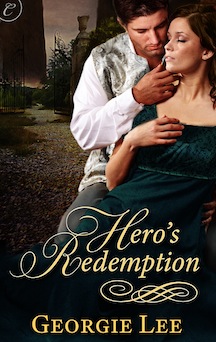
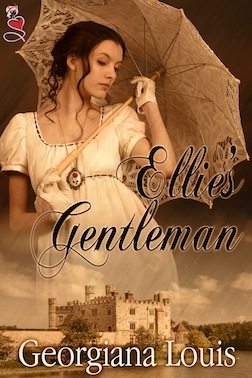
Author Georgiana Louis and “Ellie’s Gentleman” + Giveaway

My guest today is Georgiana Louis, author of Ellie’s GentlemanGeorgiana is offering a digital copy of Julia Quinn’s The Bridgertons’ Happily Ever After to the person with the most original comment.

Welcome to Susana’s Parlour, Fiona, and thanks for consenting to be interviewed!

What comes first: the plot or the characters?

To be honest it depends on the book. For Ellie’s Gentleman it was the characters. I saw Ellie in her carriage, riding home after another failed Season in London. I could just feel her relief to be out of the city and then just wrote. She literally falls over Robert in the next scene and it just unwound like that.

Are you a plotter or a pantser?

A total pantser. I often write for submission calls, as this one was. A publisher asked for sweet stories in the Regency era, with a Christmas theme and 12-25,000 words. So I thought, “I can do that.” Started writing and ended up somewhere in the middle.

Do you have a favourite quote or saying?

Yes, I have a few. But the one that stands out is:

“I wish I was a glow worm, a glow worm’s never glum, coz how can you be grumpy when the sun shines out your bum?”

What author or authors have influenced you?

Sabrina Jeffries was the first author I read from the Regency period. Her book To Pleasure a Prince lured me away from the Mills and Boon books I was reading and I never looked back. I love her style, also Eloisa James, Julia Quinn. Diana Gabaldon’s style of invoking the senses and using both first and third person has been interesting to read and learn from too.

Do you ever suffer from writers block and if so, what do you do about it?

I do on occasion, with Ellie’s Gentleman especially. It was my first true sweet book where you can’t use physical contact to move the story along. It was much harder than I ever thought it would be.

I just put it down and wrote another story. Then I’d pick it up again and get stuck. I asked my beta readers and critique partners for help and even asked my husband for plot ideas.

I love to write and do so every single day. So if one story isn’t working I start another and write till I’m stuck or tired again.

It works for me.

About Ellie’s Gentleman

Ellie Sommers is twenty years old, beautiful, lively and intelligent. She has finally returned to her family home after another long London season. She wants nothing more than to stay in her beloved country town and ride her horses. Enter Robert Blakely, a widower and a true gentleman. He has come to spend Christmas with his long-time friend William, Ellie’s father. Robert has no wish to marry again and is shocked to discover his own interest in the beautiful daughter of his friend. The only problem is that he is twice her age and a widower who has convinced himself he will never marry again.

Excerpt

“Oh Father! Whatever have you done?” Ellie raced along the hall to her father’s side. Her father merely laughed and growled at her.

“I twisted my ankle. Stop fussing. I’ve had a big enough lecture from Robert.”

Robert frowned at him. “Well, you know how many potholes are in those fields, whatever were you doing walking through one?”

Ellie's Gentleman300dpiHer father just grumbled and after struggling free, hopped to a chair.

“Jennings, call the doctor for an opinion and get me to my room. I’m sure by dinner I will be much better.”

He turned his steady green gaze on her. “Ellie, my dear, how has your day been?”

She smiled. Her father was the very best parent she could hope for. “It has been good, thank you father. I was hoping to go for a walk shortly.”

Robert removed his jacket and shook his head at her. “It’s raining quite heavily now I’m afraid.”

Ellie sighed, she didn’t feel like doing much else today. “Perhaps you could play a game of chess with her, Robert.”

Ellie heard her father’s suggestion and smiled. He had always been proud that she could play chess as well as any of his friends.

Robert smiled. “I wouldn’t have thought you could play, Ellie.”

She lifted her eyebrows at him. “My father needed an opponent for many years when I was younger. It is set up in the library Robert, if you would care to join me?”

She watched his reaction and saw a fleeting panic before he nodded. “Of course. Allow me to see your father settled first.”

Her father hmmphed and called to two of the younger footmen. “You go and enjoy yourself and I will see you at dinner.”

Ellie stood side by side with Robert as her father was helped up the stairs to his bedroom. Ellie waited, hands clasped behind her back. Robert turned to her and indicated down the hall. “Lead the way Miss Ellie.”

Ellie blushed and turned. Why was she not able to control her face better around this man?

She walked slowly so that her cheeks would calm down, then made her way straight over to the chess board. “I’m always white, if that is all right Robert?”

He smiled and nodded his head. “I am always black, so I believe that is perfect.”

Ellie hid her smile as she sat down into the chair and Robert sat opposite her. She moved her first piece and watched his clever eyes begin to make many moves ahead. A real chess player.

“Which mount did they give you to ride today?”

A ghost of a smile flitted across Robert’s lovely wide mouth before he moved his piece and looked up.

“A lovely, docile gelding.”

She nodded. How typical!

“You should have taken Storm Cloud. He would have enjoyed a walk.”

Robert’s grey eyes lit up at the mention of the stallion. He appreciated a beautiful horse just as she did.

“I did not think a stallion like that one would want to walk.”

Ellie giggled at his tone and moved another piece.

Robert frowned but moved his piece just as quickly.

“He doesn’t generally, but he does enjoy being out of the barn. I’m sure you could handle a gentle gallop.”

Robert looked at her wide eyes and burst out laughing. Ellie couldn’t help the accompanying laugh that bubbled up from her throat. He had such a wonderfully relaxed way of being.

Ellie moved her pawn, captured Robert’s castle and watched him frown once again.

“You are quite aggressive, young lady.”

Ellie flushed. Hardly. “My father taught me to put all of my effort into an endeavor if I wish for it. And in this circumstance, I wish to beat you.”

Robert laughed again and moved his pawn to capture another of her pawns. “At this rate, you just may. But I won’t give up without a fight.”

Ellie smiled and concentrated harder. “Oh, I wouldn’t expect it of you Robert.”

His dark eyebrows rose for a moment but he dropped his head and concentrated on their playing.

It was a quick, intense game that Ellie won by the skin of her teeth. As she took the black king into her sweating palm, victory filled her. “That was so enjoyable!” she squealed at him.

all photos sept 2011 282Robert groaned and slid back in his chair away from her. “For you, maybe. It has been many years since I have lost a game of chess.”

Rolling the chess piece in her hand, Ellie stood up to leave the room. It would be dinner time soon; she must dress. “Perhaps we could play again?”

Robert stood up and bowed to her, putting out his hand for the chess piece. Ellie looked at his hand for a moment before she reached out and placed it in his warm palm. Her fingertips grazed the skin of his palm and he gasped before he curled his fingers around the king.

Robert cleared his throat his throat and nodded. “Yes, I would like that.”

With feet that felt like they were floating on a cloud, Ellie ascended the stairs and made her way to her room. Which gown would be best for tonight?

Available

Steam eReads • Amazon

About the Author

Georgiana Louis is a chiropractor, wife and mother in the real world. However, her passion for writing could not be denied. She fell in love with romance novels at the tender age of eleven. Thousands of books have been read, absorbed and enjoyed since then. More recently, the wonderful world of Regency romance—dashing heroes and beautiful heroines in an era just beginning to accept love matches. Please join her in the fictional world, where everything ends as it should, happily ever after.

Contacts