Archives

Amusements of Old London: The Cockpit

Amusements of Old London

William B. Boulton, 1901

“… an attempt to survey the amusements of Londoners during a period which began… with the Restoration of King Charles the Second and ended with the accession of Her Majesty Queen Victoria.”
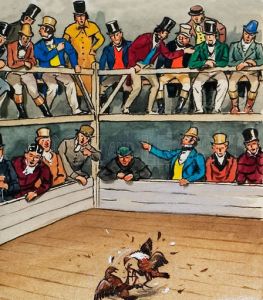
Cock-fighting in Georgian England

Cock-fighting in Georgian England

Cock-fighting is recorded as the diversion of ingenious schoolboys by Fitz-Stephen in the reign of Henry the Second… it was prohibited by Edward the Third… it was encouraged by Henry the Eighth, who built the first royal cockpit at Whitehall… it was so much the vogue in high circles in the reign of Charles the First that Vandyck painted a picture of the court watching a match in the royal pit… Oliver Cromwell quite naturally suppressed the diversion by an Act of 1654… and… all its ancient glories were revived by the joyful restoration of King Charles the Second. Modern England, as we contend, began with the days of that monarch, or soon after; we propose therefore to confine our survey of the sport to the days of his Majesty, and since.

Mr. Pepys’s cockpit experience (December 21, 1663)

Being directed by sight of bills upon the walls, I did go to Shoe Lane to see a cock-fight at a new pit there, a sport I never was at in my life. But, Lord, to see the strange variety of people—from Parliament man…to the poorest ‘prentices, bakers, brewers, butchers, draymen, and what not—and all these fellows one with another in swearing, cursing, and betting, and yet I would not but have seen it once. I soon had enough of it, it being strange to observe the nature of these poor creatures; how they will fight till they drop down dead upon the table and strike after they are ready to give up the ghost, not offering to run away when they are wearing or wounded past doing further, whereas when a dunghill brood comes, he will, after a sharp stroke that pricks him, run off the stage, and they wring off his neck without much more ado. Whereas the other they preserve, though their eyes be both out, for breed only of a true cock of the game. Sometimes a cock that has had ten to one against him will be chance give an unlucky blow, and it will strike the other stark dead in a moment, that he never stirs more; but the common rule is that though a cock neither runs nor dies, yet if any man will bet £10 to a crown, and nobody take the bet, the game is given over, and not sooner.  One thing more, it is strange to see how people of this poor rank, that look as if they had not bread to put in their mouths, shall bet three or four pounds at one bet and lose it, and yet bet as much the next battle (so they call every match of two cocks), so that one of them will lose £10 or £20 at a meeting; thence having had enough of it.

William Hogarth: The Cock Fight

William Hogarth: The Cock Fight

Cock-fighting

The sport of cock-fighting was not something that could be taken up by just anyone. The requisite breeding and training of the birds for at least two years prior to any matches required a great deal of money, as well as time and attention. But it could be very lucrative also, since the owners received the benefit of portions of the gate-money provided by the spectators.

Numerous books and treatises were written on the manner of breeding and training cocks, including how to choose them when small, how to feed them, and how to set them to spar with each other.

For a sparring match they covered “the cocks’ heels with a pair of hots made of bombasted leather,” that is, they improvised a sort of boxing-gloves for these interesting birds.

Prior to a match, the cock was trimmed for the fight, “his tail cut into the shape of a short fan… [and] his pinions… trimmed feather by feather, each quill being cut at a slant in order that in rising a lucky stroke might take out the eye of his adversary. Finally, his legs were furnished with the deadly ‘gaffles’ or spurs… some two inches in length, and curved like a surgeon’s needle… either of steel or a silver alloy.”

Birds were matched according to weight, those of middle weight (3-1/2 – 4-1/2 lbs.) being preferred for important venues such as the Royal Cockpit.

As you might imagine, this type of undertaking was not for any but the very rich. Poorer men, however, could and did enjoy the sport as spectators.

The Royal Cock Pit

The Royal Cock Pit

Three Orders

The Long Main—those between cities or countries—provided a full week of entertainment, since the time and expense of traveling made it impractical for an event of short duration.

The Short Main lasted a couple of days or even a few hours, and was much infiltrated by amateurs.

The Welch Main was fought for a prize of some sort—”a purse, a gold cup, a fat hog, or some other prize.” The Welch main was rather like a violent dodgeball tournament, something like the Hunger Games. Thirty-two cocks

…were arranged in sixteen pairs, and each couple fought to the death. The winners, or such as survived, were again matched in pairs, and the battle renewed. The eight winners of this second contest provided four pairs for the third; the survivors of the third contest made a couple of pairs for the penultimate combat; and the final issue of the Welch Main lay between this pair of devoted fowl, from which the much-enduring winner of the whole contest emerged… Its opportunities for betting were no greater certainly than in the Long Main… but it had great attractions for the choice spirits of the cockpit…

The Battle Royal, another variation, was simply a bloodbath of any number of birds in the pit, with the last survivor being the winner.

The determination shown by the finest cocks was astonishing. It is no exaggeration to say that the best cocks of the game would show fight as long as a spark of life remained in their devoted bodies. They might be maimed and even blinded, but when confronted by their enemy they would concentrate what little vitality was left to them in the menacing ruffling of their hackles and an expiring peck. This was so well understood that a blinded cock was never declared beaten until his beak was rubbed against that of his adversary.
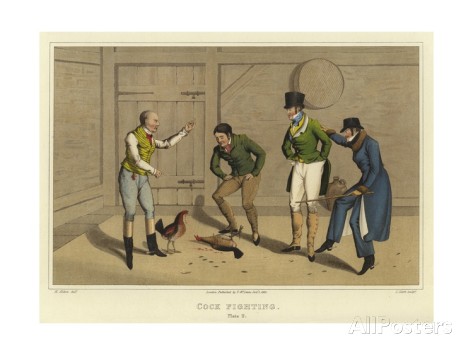
Cock-fighting, Henry Thomas Aiken

Cock-fighting, Henry Thomas Aiken

A somewhat secretive endeavor

It was probably due to its gory nature and the presence of “rough” company that caused aficionados of the “sport” to keep a low profile. Boulton suggests that it was never a particularly popular support among the fashionable men of St. James’s, since there is only one entry in an entire century mentioning cock-fighting in the betting-book at White’s. The Earl of Derby and the Earl of Sefton were known to be supporters, as well as “the families of Warburton, Wilbrahams, Egertons, and Cholmondeleys” and “Lord Mexborough, the Cottons and the Meynells, Admiral Rous, Lord Chesterfield, and General Peel.”

A continuous outcry

Protests about its cruelty were commonplace, as you can see by this satirical advertisement:

“This is to give notice to all lovers of cruelty and promoters of misery, that at the George Inn, on Wednesday, in the Whitsun week, will be provided for their diversion the savage sport of cock-fighting, which cannot but give delight to every breast divested of humanity, and for music, oaths and curses will not fail to resound round the pit, so that this pastime must be greatly approved by such as have no reverence for the Deity nor benevolence for His creatures.”

The Gloucester Journal, 1756
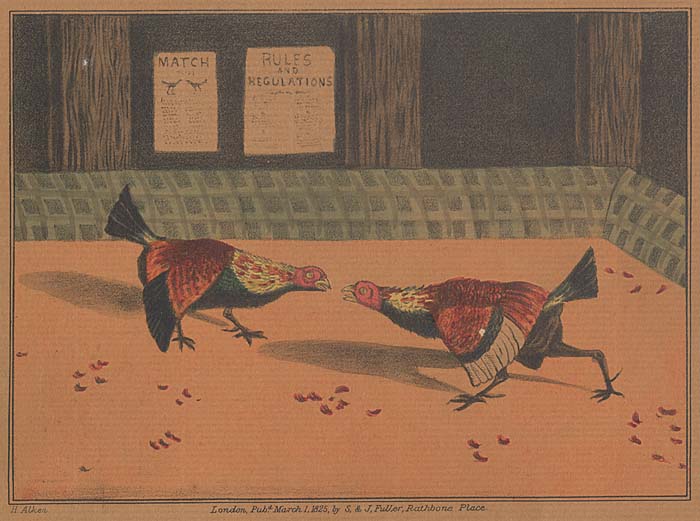
cocks

The Cruelty to Animals Act of 1835

This Act amended existing legislation to include (as ‘cattle’) bulls, dogs, bears, goats and sheep, to prohibit bear-baiting and cockfighting, which facilitated further legislation to protect animals, create shelters, veterinary hospitals and more humane transportation and slaughter.

In spite of this legislation cock-fighting did not expire without a struggle. There is an account of [a secretive meeting] in the interesting but rambling memoirs of the Honourable Grantley Berkeley, showing how the Count de Salis, a magistrate, lent his premises near Cranford to Berkeley and his friends for the purpose, gave him the keys of the whole place, and then called in the police and hauled Berkeley before the Bench at Uxbridge. There was much fun excited by the non-appearance of the count, “the cock who would not fight,” and Berkeley was fined five pounds.

Amusements of Old London series

Amusements of Old London: The Play Tables

Amusements of Old London

William B. Boulton, 1901

“… an attempt to survey the amusements of Londoners during a period which began… with the Restoration of King Charles the Second and ended with the accession of Her Majesty Queen Victoria.”

Hazard & White’s

Hazard, the precursor of crap) was a game of pure chance where all players had a fairly equal chance of winning. But as it spread into the lower classes, “organized cheating at low taverns and gaming-houses became a regular profession.” Loaded dice was one way, but there were plenty of other ways. The often violent responses to cheating are illustrated in Rowlandson’s “Kick up at a Hazard Table.”

rowlandson-kickup-at-hazard-table

The game of hazard first became popular in the late 17th century at  the coffee-houses, such as (Mrs.) White’s Chocolate House and The Cocoa Tree. Early in the next century, the more fashionable gentlemen at White’s, wishing to avoid the card sharps and other unpleasant types that were inevitably present at these places, formed a more exclusive, private club, “where they could lose fortunes to each other in all privacy and decorum.” Considered by critics to be a “pit of destruction,” White’s saw many fortunes change hands at the turn of a dice.

Young Mr. Harvey of Chigwell, for instance, lost £100,000 to Mr. O’Birne, an Irish gamester. “You can never pay me,” said O’Birne. “Yes, my estate will sell for the money,” was the spirited reply. “No,” said O’Birne, “I will win but ten thousand, and you shall throw for the odd ninety.” They did so and Harvey won, lived to become an admiral, and to fight under Nelson at Trafalgar.

The Georges and Gaming at Court

It was a necessary qualification of a courtier of George the Second to be prepared to sit down with that monarch and the Suffolks and Walmodens and the other picturesque appanages of the court and lose a comfortable sum. Twelfth Night was always a fixture for a sitting of more than ordinary importance at St. James’s. On one of these occasions luck was in favour of Lord Chesterfield, who won so much money that he was afraid to carry it home with him through the streets, and was seen by Queen Caroline from a private window of the palace to trip up the staircase of the Countess of Suffolk’s apartments. He was never in favour at court afterwards.

George III, on the other hand, banished gaming at court and even White’s gambling became quite tame, which is why Almack’s (later Brooks’s) was opened as a venue for serious gamesters, such as Charles James Fox, who was known for playing carelessly “for the excitement alone,” without any concern for the consequences. On one particular day in 1771, after playing hazard for twenty-two hours and losing £11,000, he gave a speech at Westminster, went to White’s and drank until seven in the morning, and then to Almack’s, where he won £6,000, and later in the afternoon took off for Newmarket. A week later, he was back in London and lost £10,000.

Faro

The game of Faro evolved from a game called “basset,” played in the Stuart courts.

Faro was played between the dealer or keeper of the “bank” and the rest of the company, and, like hazard, it gave excitement to as many people as could find room round the table… Each of the company placed his stake upon any card of the thirteen he chose, and when the stakes were all set the dealer took a full pack and dealt it into two heaps, one on his right hand the other on his left, two cards at a time. He paid the stakes placed on such cards as fell on the right-hand pack, and received those of such as fell on his left hand. The dealing of each pair of cards was called a “coup,” and the dealer paid or received such stakes as were decided after each coup… [t]he odds were enormously in favour of the dealer. He claimed all ties, that is, when the same card appeared on both packs, the last card but one of the pack delivered its stake to him upon whichever hand it fell, and there was the impalpable but very real advantage of which was known as the “pull of the table” in his favour.

At Brooks’s, where faro reigned supreme, Charles James Fox and Richard Fitzpatrick (a Whig associate) had a very successful partnership. Lord Robert Spencer’s partnership with Mr. Hare enabled him to win £100,000, whereupon he gave up gambling entirely and purchased an estate in Sussex. “The success of the faro banks at Brooks’s was such that it led to the game being forbidden at White’s by a special rule of the managers.”

Faro, however, was played at many of the great houses and by women of fashion, who would “hire a dealer at five guineas a night to conduct operations, and to suggest that the profits of the table went to him and not to the hostess… to disguise the commercial nature of the transaction…”

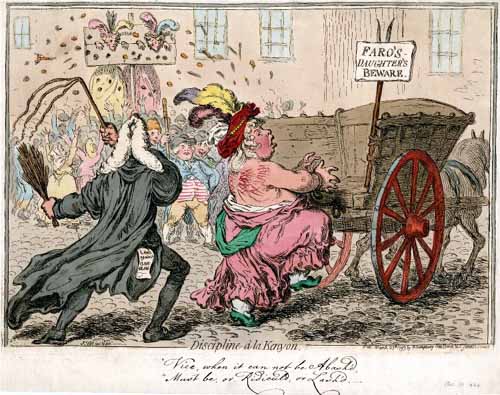
Following the 1797 public scandal in the courts where three society ladies were each fined £50 for playing at a public gaming-table—and the popularity of Mr. Gillray’s prints, such as “Pharaoh’s daughters in the pillory and at the cart tail”—the game lost much of its following.

faros-daughters-gillray

E.O.

E.O., a type of of roulette with a ball and a special table, called roly-poly, from the Continent, found at race meetings, country fairs, and the streets of London, lent itself well to cheating. Colonel O’Kelly, the eventual owner of Eclipse set himself up in business by winning at E.O.

Gaming Houses and the Damage They Caused

Cheap gaming houses all over town featured hazard, roulette, rouge et noir, and macao for small stakes. Frequent raiding did not discourage them, since fines were easily paid.

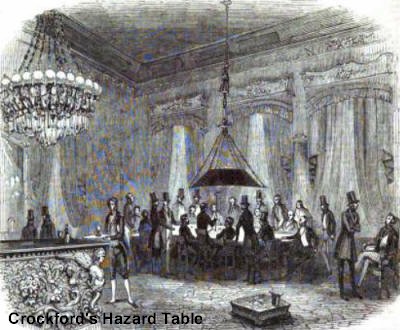
A hazard table at Crockford's

A hazard table at Crockford’s

The mischief these places did is almost incalculable; bankruptcies, embezzlements, duels, and suicides resulting from gaming were of weekly occurrence, and it would seem that half the tradesmen and clerks of London were before the magistrates or the coroners of the last years of [the 18th] century and the first quarter of [the 19th].

Hazard and faro had gone out of the older clubs, and club gaming of the [early 19th century] was represented by extremely deep play at whist at White’s and Brook’s. Macao flourished for a while at Wattiers, where the members lived on each other for some eight or ten years until their estates disappeared and the club expired by the flight of its supporters to Boulogne.

Such were the houses in which round games flourished after their decline at the great clubs. They steadily drained the pockets of the aristocracy of England for nearly half a century, and there is scarcely a great family to-day which does not still feel the effects of the play that went on within their doors sixty years ago.

Crockford’s Club

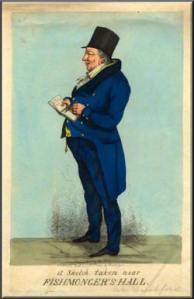
crockford_william_npgthomasjonesWilliam Crockford, a fishmonger who had a shop in the Strand near Temple Bar, made a killing on a turf transaction and rose from partnerships in shady gaming establishments to spending £94,000 to open his own fashionable club, Crockford’s Club, in 1827.

There is one thing, and one only, to be said in favour of Mr. Crockford’s enterprise, which, is that this establishment did away with the practice of gentlemen playing against each other for large sums. At Crockford’s, the game was one of Gentlemen versus Players, the players being always Mr. Crockford’s officials at the French hazard table, and the sole object of his business was to win the money of his patrons.

A committee of gentlemen was given charge of accepting and rejecting members, with the effect of making “entry to Crockford’s as difficult as to White’s or Brooks’s.” The price of subscription to Crockford’s establishment was low, but “in exchange for the princely accommodation of his house, and such fare as was unobtainable at any other club, Crockford asked for nothing in return that gentlemen should condescend to take a cast at his table at French hazard.” This incarnation of the old game required a fee called “box money” and “the pull of the table” that went directly into the coffers of the house.

crockfords-club

The men who walked into Crockford’s with their eyes open to encounter these odds were the pick of the society of the day, the men who had fought the battles of the country under Wellington, and men who were making great reputations at Westminster, as well as mere butterflies like the Dandies who loafed through life at White’s. They were most of them men of exceptional parts, and distinguished for shrewdness and ability in one walk of life or another, and yet in the short space of ten years, between the opening of the club in 1827 and the succession of her Majesty, their losses converted Mr. Crockford into a millionaire at least. There is absolutely no record of any considerable sum of money ever won at the place by a player.

The second Earl of Sefton lost £200,000 in his lifetime. His son, after paying off the debt, lost another £40,000. Sir Godfrey Webster lost £50,000 at a sitting. Other losers of enormous sums: Lord Rivers, Lord Chesterfield, Lord Anglesey, Lord D’Orsay.

Even before the Gaming Act of 1845, Crockford, having pretty much won all the money to be won, started consolidating and concealing his assets with a view toward retirement. When called to give evidence, he claimed that increasing age caused him to give over the management to the committee of gentlemen tasked with running the membership of the club.

“High play in England, as we believe, burnt itself out in those orgies at Crockford’s.”

The Scandal at Graham’s Club

Another reason for the decline of serious gaming in England was the cheating scandal at Graham’s Club in St. James’s Street.

…a man of an old and honoured name was detected cheating at whist, and was denounced as a dishonest trickster in a newspaper, the Satirist. He brought an action against his accusers, failed in it, went abroad, and died… the details of the trial disclosed ugly features in the circumstances which had much interest for thoughtful people, and undoubtedly tended to bring the whole institution of play for high stakes between gentlemen into great disrepute.

Witnesses at the trial testified that they had witnessed him cheating in any number of ways a hundred times and more, and not only did not turn him in, but continued to sit down with him to play at private clubs. Undoubtedly, many of them were cheating themselves, and thus had no wish to have their play scrutinized. Packs of his marked cards were produced in court. His hacking cough, which always resulted in producing a king of trump, became known as “—’s king cough.”

Since those days of Crockford’s and Graham’s and the Gaming Act, high play has ceased to be any considerable part of the social life of London at clubs or elsewhere.

The Gaming Act of 1845

made a wager unenforceable as a legal contract and stood as law, though amended, until 2007.

Crockford's today is an exclusive casino in Mayfair

Crockford’s today is an exclusive casino in Mayfair


Amusements of Old London series

Amusements of London: The Masked Assembly

Amusements of Old London

William B. Boulton, 1901

“… an attempt to survey the amusements of Londoners during a period which began… with the Restoration of King Charles the Second and ended with the accession of Her Majesty Queen Victoria.”

The Ridotto in Venice, Pietro Longhi, 1750's

The Ridotto in Venice, Pietro Longhi, 1750’s

The wearing of masks to disguise one’s identity was nothing new when the “quasi heathenish fêtes” of the medieval Venetians spread to 17th century England. After all, inquisitors, executioners, and highwaymen wore them as they completed their odious business. Pagan rites such as Bacchanalia and Saturnalia and the fêtes des innocents or fêtes de fous were masked revels in which participants could, along with their attire, shed their normal scruples and give way to their impulses. While there are accounts of masked events in Henry VIII’s court as well as the some of the Stuarts’, the “true masquerade,” where all guests were dressed in costume, was a long time coming to England from the Continent, probably because of its foreign origin in a Papist country.

It was only at the beginning of the 18th century that moralizing on the subject of masquerades began to appear in publications such as The Tatler and The Spectator.

It is worthy of note that the masked assembly was never an institution that had any great vogue among the common people, either in this country, or elsewhere. The wearing of masks or of disguises in private life was from very early times the exclusive privilege of the great or of those who imitated them.

Constables or police who raided some of these events discovered prominent men and women among the masked revelers and eventually released them.

The High Constable of Westminster descended upon a masquerade at midnight and made a great haul, which he duly displayed before Mr. Fielding. That eminent magistrate sat up all night to hear the charge, “but several of them being found to be persons of distinction, the justice, not thinking it proper to expose them, after a severe reprimand, dismissed them all.

“The women either come by themselves,” says Addison, describing the amenities of the masquerade of 1711, “or are introduced by friends, who are obliged to quit them upon their first entrance to the conversation of anybody that addresses himself to them.” This by the way was one of the rules of the true masquerade, which was its chief attraction for the frisky maid or matron of those days. Introductions were unknown, and absolute incognito was possible for all who wished to preserve it. The mask and domino were inviolable, except indeed to the police, and any infringement of that rule by a masker led to the inevitable chastisement of the offender by the other men in the room, of which there are numerous fatal results recorded. “But,” continues Mr. Addison, “there are several rooms where the parties may retire and show their faces by consent.”

The subject of masquerades evoked the growing censure of the press for the next half century, but “the masquerade absolutely throve on opposition.” The Bishop of London’s scathing sermons had no effect, nor did the satirical prints and prose that was disseminated throughout the city.

There were strange financial proposals too from amateur chancellors of the exchequer, who proposed to levy taxes upon all tickets for those ungodly diversions and to devote the proceeds to the Foundling Hospital, an institution which they declared was populated by the amours which were kindled by the opportunities of the masquerade. Grave statisticians drew attention to what they contended was an appalling fact, that the vogue of the masquerade quadrupled the normal number of divorces, and pious God-fearing people, whose nerves were sorely shaken by the two smart shocks of earthquake which startled London towards the middle of the century, pointed to the judgment of heaven which these unholy revels were calling upon the town.

It was precisely during the period of this continued opposition, which stretched practically from the days of Queen Anne to those of George the Third, that the masquerade established itself as one of the chief amusements of the upper classes of society in London. Middle class England might still cherish its memories of the Puritans, but there were other views in high quarters, and a mere newspaper agitation was of little effect in a day when four-fifths of the popular could not read. The diversions of an aristocracy, too, were moderately safe from interference by legislation provided by a Parliament whose two houses were composed of the aristocracy and its nominees. The well-born and well-placed classes of Anne and the Georges, in short, with King George the Second at their head, enjoyed the fredaines of the masquerade, and determined to keep them in spite of the bishops and the moralists of the press. And they succeeded perfectly.

The appearance of “party organizers” such as “Beau Nash in Bath, Robert Arthur at White’s Club, William Brooks at Brooks’s, Almack at his Assembly Rooms in King Street, Crockford at the big gaming club in St. James’s Street” had considerable influence on the amusements of late Georgian aristocrats.

John James Heidegger

The son of a pastor from Zurich, Heidegger “wandered about Europe for a quarter of a century living by his wits and acquiring knowledge of men and cities.” He came to England at the age of fifty and enlisted in the Guards, “a regiment in which you might at that time find very well-born men among the rank and file.” Known as the “Swiss Count,” his face was considered one of the ugliest ever seen. It is said that Lord Chesterfield, in lieu of paying his bill, told his tailor, a Mr. Jolly, that “he would not pay him until he could produce an uglier man than himself.” Mr. Jolly showed up with Heidegger and promptly received his money. A measure of Heidegger’s social success is the fact that he was accepted as a member of the very exclusive White’s Club.

john_james_heidegger_by_john_faberHeidegger possessed extraordinary organizational and entrepreneurial skills. His first venture, which involved producing an opera at the Queen’s Theatre in Haymarket, brought him much financial success, and established him as a theatre consultant.

The great world took him up and caressed him; princes gave him amethyst snuff-boxes set in gold; if my lady wanted a rout arranged at her mansion, or if there was a musical entertainment or a dancing assembly to be arranged at a public room, Mr. Heidegger was called in and did the thing to perfection.

King George I loved him and made him manager of His Majesty’s Theatre in Haymarket, where he worked with Handel on producing an opera. And then he set his mind to improving masquerades (which delighted the king even more than opera).

Unfortunately, many in the theater community resented the popularity of masquerades, seeing it as competition for their own offerings. There were also plenty of rumors of gamesters, women of the street, and even highwaymen present at these affairs. But with the king’s support, Heidegger had no fear of the naysayers—the pamphleteers and moralizers and disgruntled theatre people. (Theresa Cornelys was not so fortunate.) “Heidegger boasted of making £5000 a  year by this business.” At one point, when the king signed a royal proclamation against masquerades, Heidegger called the next one a ridotto, and not only got away with it, but the king was one of the guests!

“Thou Heidegger the English taste has found

And rul’st the mob of quality with sound’

In Lent, if masquerades displease the town

Call ’em ridottos, and they will still go down.

Go on, Prince Phiz, to please the British nation

Call thy next masquerade a convocation.”

Heidegger’s legacy to the British people, according to the London Post, was the perfected masquerade. Even after his death in 1749, the masquerade continued to flourish in several new buildings around town.

Ranelagh

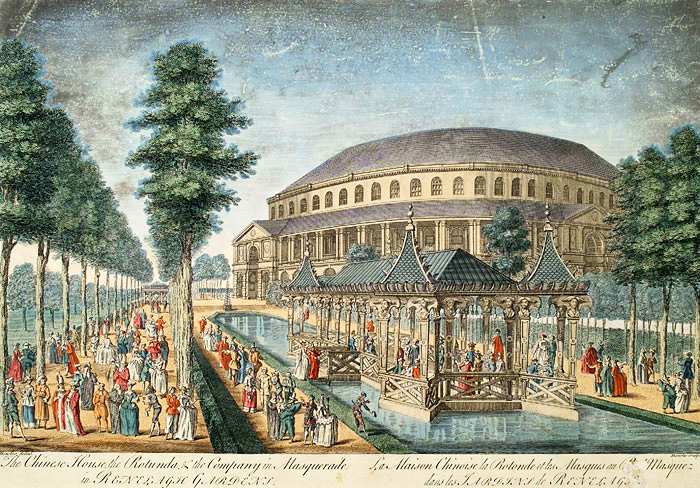
ranelagh_gardens_eighteenth_century_original

The Rotunda at Ranelagh, 142 feet in diameter, proved to be an attractive venue for masquerades. There was no stage for actors and thus it was not competition for theaters. After a very successful “Jubilee Masquerade in the Venetian manner,” on 1st May 1749 to celebrate the peace in that year, “it was determined to repeat it in the form of a subscription masquerade.” Horace Walpole writes:

When you entered you found the whole garden filled with masks and spread with tents, which remained all night very commodely. In one quarter was a maypole dressed with garlands, and people dancing round it to a tabor and pipe and rustic music, all masked, as were all the various bands of music, which were disposed in different parts of the garden, some like huntsmen with French horns, some like peasants, and a troupe of harlequins and scaramouches in the little open temple on the mount. On the canal was a sort of gondola adorned with flags and streamers, and filled with music rowing about. All round the outside of the amphitheatre were shops filled with Dresden China, Japan, &cc., and all the shopkeepers in mask. The amphitheatre was illuminated, and in the middle was a circular bower composed of all kinds of firs in tubs, from twenty to thirty feet high, under the orange trees, with small lamps in each orange, and below them all sorts of the finest auriculus in pots and festoons of natural flowers hanging from tree to tree. There were booths for tea and wine, gaming-tables, and dancing, and about two thousand persons. In short, it pleased me more than anything I ever saw.

The Inauguration of the Pantheon in Oxford Street (1772)

sophia-baddeleyIt was rumored that the managers were set against inviting women with less-than-stellar reputations, i.e. actresses and demimondaines. Sophia Baddeley was one such actress with high connections—she was Lord Melbourne’s mistress at the time—and a score or so of her supporters assembled at Pall Mall and escorted her chair to St. James’s Street, where they were joined by even more fine gentlemen from White’s. The procession continued all the way to the Pantheon, whereupon they took out their swords and frightened the porters who were ordered to deny her entrance. This allowed the triumphant Sophia to march into the “fine room under a long canopy made by the crossed swords of her gallant escort.” Eventually, the managers made their apologies to her, and two duchesses “came forward to express to Mrs. Baddeley the pleasure it gave their graces to welcome such an ornament to the assembly.”

Mrs. Cornelys of Carlisle House

was the second person to make a business of organizing amusements for the upper classes. Her story was featured in an earlier post on this blog. Click here to read more.

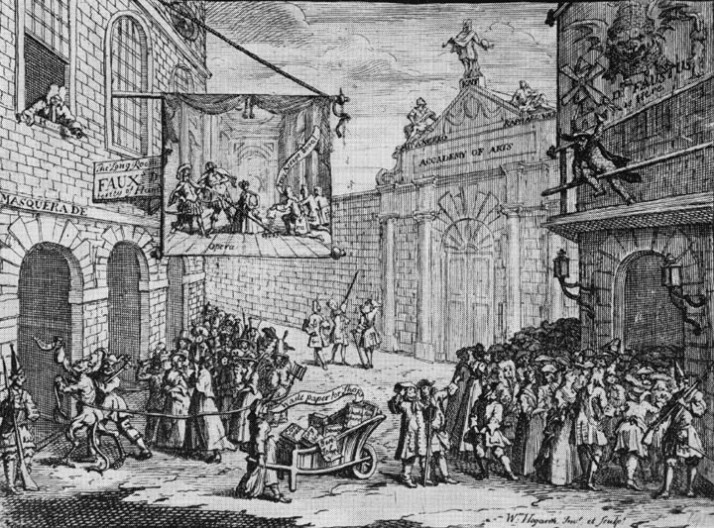
hogarth-masqueradesoperas

The Bad Taste of the Town (also known as Masquerades and Operas) is an early print by William Hogarth, published in February 1723/24. The small print mocks the contemporary fashion for foreign culture, including Palladian architecture, pantomimes based on the Italian commedia dell’arte, masquerades (masked balls), and Italian opera.


Amusements of Old London series

Amusements of Old London: The Tea Gardens

Amusements of Old London

William B. Boulton, 1901

“… an attempt to survey the amusements of Londoners during a period which began… with the Restoration of King Charles the Second and ended with the accession of Her Majesty Queen Victoria.”

An “unbroken tradition of al fresco entertainment in London over a period of two centuries*

After perusing through old publications, letters and memoirs, advertisements, diaries, and even through the records of police courts and licensing authorities, Boulton concludes that the heyday of the outdoor entertainment in London was from the time of Charles I to the end of the 19th century.

…the fireworks and the “twenty thousand additional lamps” of the Vauxhall and Cremorne… had less to do with the success of those famous institutions than the bad food and worse liquor, which Londoners are ever ready to pay for at exorbitant rates if only served out of doors.

London map 1700: https://upload.wikimedia.org/wikipedia/commons/5/52/17th_century_map_of_London_%28W.Hollar%29.jpg

When George the Third came to the throne, London, including Westminster, was bounded by Oxford Street and Holborn on the north, by the river on the south, by the outer boundary of the city on the east, and by Hyde Park, Arlington Street, and St. James’ Street on the west. All the rest of modern London was suburban merely, or open and pleasant country interspersed with wild heaths, and dotted with ancient villages.

seutter_1750_london_m

London, 1750

It was in and about a town of such dimensions then, and with such surroundings, that the al fresco entertainment took origin and developed, a town thickly populated and stuffy, it is true, the bulk of whose inhabitants lived and died with the limits of their own streets, but still a town whose innermost slum was within easy walk of a delightful country…

It was the citizens of such a town, sober merchants and shopkeepers, apprentices, sempstresses, and artisans who worked continuously, but leisurely and without much stress, during the week and spread themselves over an area of many square miles on Sundays, who formed the chief patrons of the al fresco  entertainment. The lawyers and military men… supplied their quota of course, and the aristocracy came to most of the al fresco entertainments at one time or another, but merely as incidental visitors.  [He mentions that Vauxhall and Ranelagh were the favorites for the aristocracy, but that they will mentioned in another chapter.]

London map 1890: http://www.majestymaps.com/wp-content/uploads/2014/01/1890_Bacon_Map_of_London1.jpg

Spring Garden

Spring Garden at Charing Cross was “practically a part of [Charles I’s] own gardens at Whitehall. In 1634, the bowling green was a major attraction, and apparently one could pay six shillings and drink wine and eat cold meat all day under the trees. Plagued by quarrels and other scandalous behavior, the Spring Garden was finally closed down by the Puritans in 1654, although it opened up almost immediately following the death of the Lord Protector.

This collation, indeed, was the great attraction of the place. It was difficult in those days to get a meal anywhere away from home, the coffee-houses had not yet arisen, and most of the taverns lay far eastward of Charing Cross. Great people then lived either in the city or just out of it, and Spring Garden, with its luncheon, was a convenient halting-place for refreshment on the way to, or returning from Hyde Park, where the promenade of the ring, the foot and chariot races, were at this time great attractions.

Apparently Charles II’s ministers decided the property could be made more profitable by building houses there, so “the name Spring Garden was adopted by the New Spring Gardens at Lambeth” (which became Vauxhall Gardens).

Mulberry Garden

The Mulberry Garden, which covered the site of the present Buckingham Palace and Gardens, was “of the true class of open-air entertainment… Half the dramatists of the Restoration make their characters move in its walks and arbours, and eat its tarts and cakes…” The Mulberry Garden was closed in 1674, when Vauxhall took charge of London’s al fresco tradition.

Islington Spa (New Tunbridge Wells)

In earlier times, the area around Holburn was bubbling with springs “charged with ‘chalybeate’ or ‘sulphate,’ as the doctors of that day believed and provided an excuse for a dozen or more of ‘spas,’ and ‘waters’ or ‘wells,’ each with its gardens and long room and special body of patrons… who certainly enjoyed the diversions of the place.”

Islington Spa, 1749

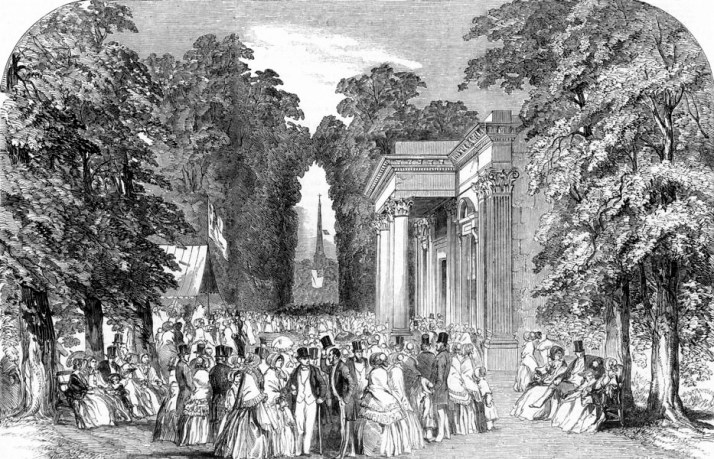
Starting in around 1685, Islington Spa became a popular watering-place. Besides the medicinal attractions of its waters and a doctor to administer it, it offered “the amusements of a tea garden,” including lime trees, coffee-house, dancing saloon, raffling shop, and gaming tables. Patrons ranged from seamstresses to aristocrats, and, of course, the pickpockets and prostitutes followed. Its popularity rose further after the Princesses Caroline and Amelia became regular visitors.

Lady Mary Wortley Montagu wrote: “New Tunbridge Wells is a very pretty and romantick place, and the water much like Bath water, but makes one vastly cold and hungary.”

Islington Spa ended in 1840 when it was overtaken by construction of streets and buildings.

Bagnigge Wells

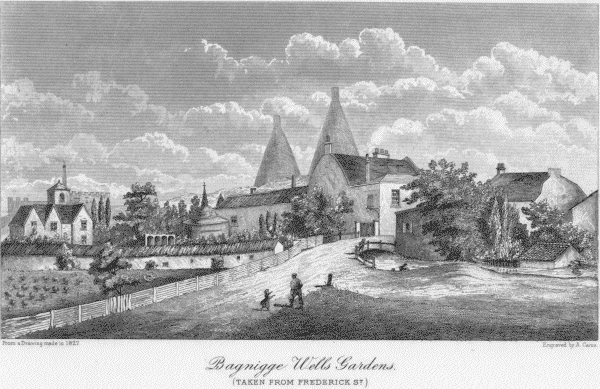
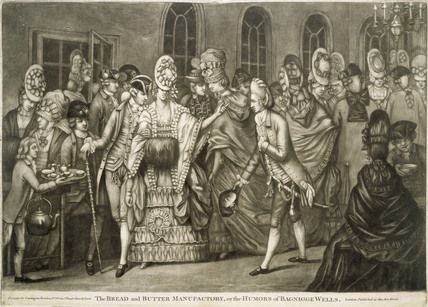
Bagnigge Wells began as Bagnigge House, the country residence of Nell Gwynn, “where King Charles the Second and his brother James delighted at times to take breakfast with that lady.” In 1759 the current owner, a Mr. Hughes, discovered that the reason his pansies and carnations did not thrive was due to the mineral content of two springs of water underneath the surface. Apparently, the water produced “a kind of giddiness, and afterwards a propensity to sleep if exercise not not interposed.”

bagnigge1

The programme of amusement at this cockney paradise was very typical of the London al fresco in its prime. In the morning the place was chiefly at the disposal of the invalids who believed in the efficacy of its waters, and who, at the height of its vogue, were to be found at Bagnigge in hundreds. Many of these partook of the early breakfast which was provided for the austere ones who drank the waters in an orthodox manner on an empty stomach. A good organ, presided over by Mr. Charles Griffiths, provided music in the pump-room for the gouty and the lame: the pump-room with its panelled walls, low ceiling, its armorial bearings, its bust of Nell Gwynn in a niche in the wall… and its general pleasant flavour of antiquity. As the day wore on the invalids withdrew and the place was prepared for another class of customers. The citizens, their wives and daughters, came for their afternoon outing; the long room if the weather threatened, and the arbours if the sun shone, were filled with sober parties of shopkeepers or with boys and their sweethearts, drinking tea and eating the bread and butter and the buns baked on the ground for which the place was famous. Negus was another of the products of Bagnigge held in much favour, and there were cider and ale for the more jovial spirits who smoked under the shade of the Fleet willows and watched the games of skittles and Dutch pins…

bagnigge-bowles

Its nearness to the city, however, made it “the paradise of the city matron” on Sundays.

Thy arbour Bagnigge, and the gay alcove

Where the frail nymphs in amorous dalliance rove,

Where ‘prentice youths enjoy the Sunday feast,

And city madams boast their Sabbath best,

Where unfledged Templars first as fops parade,

And new made ensigns sport their first cockade.

Mr. Churchill, 1779

There was some attempt at a promenade in fine dresses on Sundays, where aspiring young men about town, who were not quite the mode, graduated in deportment for the brighter glories of Ranelagh and Vauxhall. There came of course the usual hangers-on of respectability, the ladies of doubtful reputation, the “bloods of humour,” copper captains, and even on occasion famous highwaymen, like the eminent John Rann, or Sixteen-stringed Jack, who was wont to display his hectoring graces in the gardens. Such incidents, however, gave a pleasant adventurous interest to a visit to Bagnigge; a highwayman, so long as he escaped the justices, was a not unpopular character, and the ordinary citizen lost no caste in taking a glass with one of these heroes at a tea garden or tavern.

Marylebone Gardens

The Rose of Normandy began as a small tavern famous for its bowling-greens. Samuel Pepys and Sheffield, the Duke of Buckingham frequented the place in the late 17th century. The Rose also occasionally featured concerts on the king’s birthday, illuminations, acrobatic exhibitions, and other attractions. In 1738, the proprietor re-named it Marylebone Gardens and styled it as al fresco entertainment, building a large orchestra, an organ, and a building for balls and suppers. Marylebone had a reputation of being a pleasant and respectable place to enjoy the outdoors, eat, and listen to the music of Handel and Arne.

Marylebone Gardens Restrike Etching by J. Donowell http://www.easyart.com/scripts/zoom/zoom.pl?pid=37664

Marylebone Gardens Restrike Etching by J. Donowell http://www.easyart.com/scripts/zoom/zoom.pl?pid=37664

Harmony and decorum were the features of Marylebone Gardens at its prime, broken rarely by a quarrel under the trees, or the rudeness of a royal visitor like the burly Duke of Cumberland… the gentry who had country houses in the village… could send their children and their nursemaids in the summer days and evenings without fear of untoward molestation… Not that Marylebone was without its mild excitement on occasion. It is recorded that pretty Miss Fountayne, a relation of “Dr. Fountayne’s, a dean of the Established Church,” was one day taking the air in the gardens when she was saluted by a young man of a gallant bearing, who boldly kissed her before all the quality. The lady started back shocked and surprised, as in duty bound. “Be not alarmed, madam,” said the gentleman, “you can now boast that you have been kissed by Dick Turpin.”

White Conduit House

…had its “pleasing walks prettily disposed, its “genteel boxes,” with paintings in the Flemish manner, its alcoves let  into its clipped hedges, and its avenues of shady trees, and was the delight of numbers of Londoners for a century.

White Conduit House, 1749

White Conduit House, 1749

In 1754, Mr. Bartholomew, the proprietor, “provided bats and balls for his customers” to play the game of cricket in the adjoining meadow and therefore laid “the foundations of the vast organisation of the modern game.”

Belsize House

…was a country mansion opened in 1720, “with a park wilderness and garden a mile in circumference ‘filled with a variety of birds which compose a most melodious and touching harmony’… Cakes and ale were much in evidence… and foot and galloway races ‘six times round the course.’ In 1726 they ‘hunted a fat doe to death with small beagles,’ when sportsmen were invited ‘to bring their own dogs if not too large.’

belsize-house

Belsize House, 17th century

Hampstead

was famous for its wells and gardens, and even had a clergyman available for marriage-minded couples who could not afford a trip to Gretna Green. Mr. Samuel Rogers “danced minuets in his youth and met a great deal of good company.” In those days, a Londoner required a stage coach to arrive there.

Royal Well Walk, Pump Room, 1850

Royal Well Walk, Pump Room, 1850

South London

“The attractions of the South London districts were less simple and less respectable. With an unconscious humour, many of them advertised their mineral waters in competition with the spas of the north,” although it was more likely the waters pumped came from a huge marsh. “But their main attractions were more or less feeble imitations of the glories of Vauxhall, and their patrons were, speaking gnerally, of a less innocent cast of mind and less easily amused than the citizens who flocked northward to Islington or Hampstead, or westward to Marylebone.”

Some of these were Cuper’s Garden, Finch’s grotto, Bermondsey Spa Gardens, Helena Gardens, Belvidere Gardens, the Dog and Duck, St. George’s Spa, Strombolo House. and Florida Gardens.

The decline of the tea gardens

Many of these places fell victim to the urban growth of the city, exchanging the country meadows for buildings of brick and mortar. However, Mr. Boulton opines that their decline:

followed a change in the taste of the people themselves, that taste itself an inevitable consequence of an increasing population and an increasing prosperity. The simple pleasures which satisfied the London of Charles the Second left the London of George the Third unmoved, and the pleasure-seeking citizen of the London of William the Fourth had a soul altogether above the placid joys of the London of George the Third.

The longevity of Vauxhall can be attributed to the proprietors’ constant upgrading of attractions. While later visitors might not be enticed so much by the walks among the shrubbery, they could be attracted by the balloon ascensions and other circus-like events. Venues whose programs did not change with the times eventually failed and were taken over by urbanization.

The careers of the less famous gardens of the south and the west were almost invariably concluded in even less reputable circumstances, where the conduct of the raffish audiences attracted by their debased pleasures brought upon them the interference of the authorities.

*Vauxhall and Ranelagh Gardens are not included here, since the author deems them worthy of a chapter of their own.


Amusements of Old London series

Amusements of Old London: Hockley in the Hole

Amusements of Old London

William B. Boulton, 1901

“… an attempt to survey the amusements of Londoners during a period which began… with the Restoration of King Charles the Second and ended with the accession of Her Majesty Queen Victoria.”

Hockley in the Hole, Clerkenwell

screenshot-2017-01-02-12-04-32

Hockley was a venue which provided entertainments reminiscent of Elizabethan times, such as bear- and bull-baiting, sword- or cudgel-bearing gladiators, and such. It was, in the early 18th century,

the headquarters of… the “fancy,” … the organisation of rather low caste sporting characters who devoted themselves to forms of sport… more or less frowned upon by the respectable and law-abiding.

Hockley had “an atmosphere of blackguardism about [it]”. While its claims to represent the tradition of the old Bear-Garden of Queen Elizabeth I at Bankside were questionable, it did receive enough patronage to rank it as “one of the chief amusements of the town for the next half century.”

Animal-baiting (Mondays and Thursdays)

Queen Bess herself was such a “grand connoisseur” of the sport that she forbade the acting of plays on Thursday, which was the day specified for bear-baiting at Bankside. By the time of the Stuarts, however, it had descended into the ranks of “lower entertainments,” but was still “patronised more or less furtively… by persons of high station.”

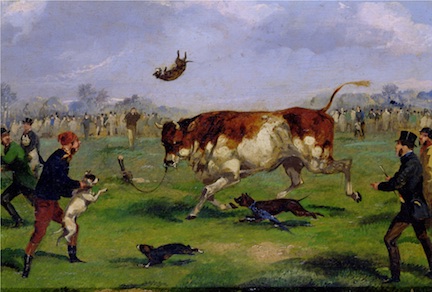
Both bulls and bears were chained to a staple in the arena or pit by a chain of about fifteen feet in length, so that the defending animal had relative freedom of movement over a circle of thirty feet. “They… are fastened from behind… and worried by great English bulldogs, not without great risque from the horns of the one and the teeth of the other.” The dog, attended by his owner, was held in front of the chained animal by the ears until he was wild with fury, and then let go.

An experienced bull

kept his feet close together to avoid any attack from beneath, and presented a horn at the advancing enemy. The horn… was either blunted at the point or provied with a sheath which minimised the risk of a gore… The old bull… relied chiefly upon getting the dog in the hollow of these long horns… and upon disabling it by a toss in the air and a drop of perhaps thirty feet on the hard floor of the pit. The experienced dog knew the danger, and avoided it as much as possible by crouching on the ground in the preliminary fencing for an opening, which usually preceded the rush for the throat. If the bull made his coup, the dog went flying into the air, often into the boxes twenty feet above the pit, as when Mr. Evelyn saw one dropped into a lady’s lap… in 1670.

PFA109529 Bull Baiting (oil on paper laid on panel) by Alken, Samuel Henry (1810-94); 17.8x26 cm; Private Collection; Photo © Bonhams, London, UK; English, out of copyright

PFA109529 Bull Baiting (oil on paper laid on panel) by Alken, Samuel Henry (1810-94); 17.8×26 cm; Private Collection; Photo ¬© Bonhams, London, UK; English, out of copyright

Bear-baiting was more dangerous to the dog and thus was more rarely seen. Variations of the sport might have two dogs attacking a bull, as well as animals such as leopards, tigers, and horses (including one ferocious horse owned by the Earl of Dorchester who had killed other horses and was deemed untamable).

bear_baiting

Note: The Cruelty to Animals Act of 1835 forbade the keeping of any house, pit, or other place for baiting or fighting any bull, bear, dog, or other animal.

Prize-fighting with weapons (the rest of the week)

The prize-fight of Hockley in the Hole “was organised solely for the purposes of exhibition and the resulting gate-money” and “performed with lethal weapons, or with cudgel and quarter-staff.” The meetings between participants (“gladiators”) were organized in advance and announced with handbills such as this one from 3rd July, 1709:

At the Bear Garden at Hockley in the Hole, near Clerkenwell Green, a trial of skill shall be performed at the noble science of self-defence, on Wednesday next, at two of the clock precisely.

I, George Grey, born in the city of Norwich, who have fought in most part of the West Indies—viz., Jamaica and Barbadoes, and several other parts of the world—in all twenty-five times, and upon the stage, and never yet was worsted, and being now lately come to London, do invite James Harris, to meet and exercise at these following weapons, viz., backsword, sword and dagger, sword and buckler, single falchion and case of falchions.

I, James Harris, master of the noble science of self-defence, and formerly rid in the Horse Guards, and have fought an hundred and ten prizes, and never left the stage to any man, will not fail, God willing, to meet this brave and bold inviter at the time and place appointed, desiring sharp swords and from him no favour.

No person to be upon the stage but the second. Vivat Regina.

While the swords were sharp and blood flowed freely,

there was never a serious attack with the point, and there is only one record of a single death as a result of half a century of fighting, and that an accidental one from blood-poisoning. No padding was used, apparently, no masks or jackets, which are necessary even in foil practice to-day, and yet it is certain that great injury was as a rule avoided.

cards-by-hogarth

Mr. Figg’s Establishment on Oxford Road had no animal-baiting and was patronized by a higher class than than Hockley. Figg’s specialized in self-defence and prize-fighting, of which Figg himself was the acclaimed master.

Female prize-fighters were popular in nearly all of these establishments, including Figg’s, and “supplied a pleasant change from the ordinary attractions of the place. The challenges were certainly arranged beforehand like [those of the men], and “words” referred to by Elizabeth [in the handbill] were no doubt exchanged over a friendly pot of porter at some favourite house of call near the Fleet Ditch… The artificial character of the quarrel and of its preliminaries, however, does not appear to have diminished the realities of the encounter.

[Hockley’s] final overthrow was the result of the growth of London and the municipal improvements which accompanied it. The whole district was drained and its level raised in 1756, when it is probable that the bear garden disappeared. The cult of the London prize-ring had already supplanted the attractions of its contests with sword and quarter-staff, and its bull and bear baitings found patronage further afield.

Amusements of Old London series

Susana’s Adventures in England: Brockhampton Estate

Much thanks to Heather King for providing transportation and companionship, as well as the infamous super dog Roxy, and not least, to Cora Lee, who formed the fourth part of our party.

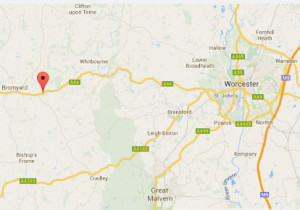
map

housepond

Lower Brockhampton is a timber-framed manor house dating back to the 14th century. The manor house is surrounded by a moat and entered by a newly-restored gatehouse. The estate includes 1000 acres of farmland and 700 acres of woodland. The ruins of a Norman church are also located on the property.

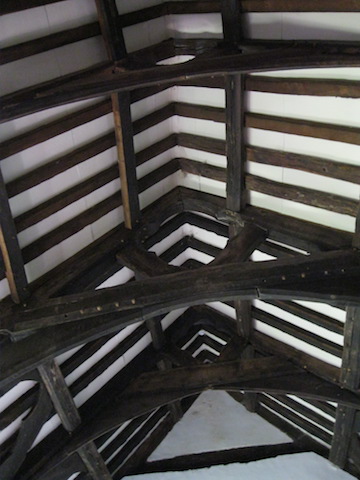
ceiling-copy

The manor house was probably built from timber sourced from the estate itself, and the history of the house is intimately connected to the rich wooded landscape that it sits within.

chairweird-copy

Making good use of the estate’s productivity was the secret to the continued wealth of the family that lived here. We know from ancient seeds and pollen found during archaeological excavations that in medieval times cereal crops were grown near the manor house, to the north of the moat.

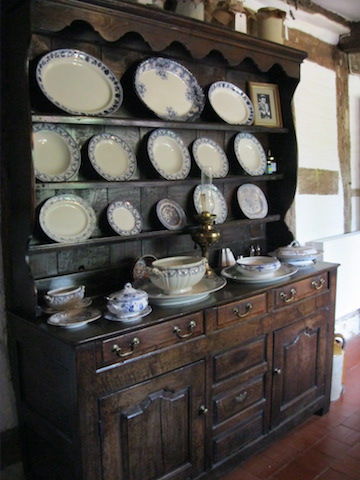
chinacabinet-copyOver the years the house was adapted by each successive generation that lived here, the original medieval great hall had an upper floor inserted into it by the Barneby family, in order to accommodate their many children.

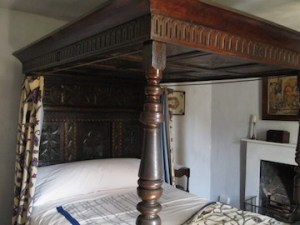
bed2-copy

As society changed it became more important for the owning family to live separately from their servants and estate workers. Eventually in the Georgian period, and under the care of Bartholomew Barneby, the owning family moved out from the ancient timber framed building and into a grander mansion house at the top of the estate.

spinningwheel

From the eighteenth century onwards the timber framed manor house was home to estate workers such as Joseph Cureton and his family. Joseph was the estate wagoner in the nineteenth century. He cared for the horses that carried out much of the heavy work on the farms and woodland that makes up Brockhampton estate.

In 2010, the National Trust undertook a major restoration project to the house using traditional wattle and daub building methods.

example of wattle and daub

example of wattle and daub

The site of the medieval village of Studmarsh is thought to be located in the estate. In 2012, an archaeological dig unearthed the foundations of two buildings that may have been part of the village.

normanchurch4-copy

Rolling green parklands and ancient woods surround the charming Brockhampton Estate. Situated on 687 hectars (1,700 acres), Brockhampton has been a farming estate for nearly 1,000 years. At the heart of the estate lies the romantic timber-framed manor house dating back to the late 14th century, and the ruined Norman chapel. To arrive here one must first cross the picturesque moat and enterer via the gatehouse, built in 1530-40. Today, Brockhampton Estate is not only a time capsule for visitors, but the grounds also provide an idyllic setting for 40 residential houses and cottages.

Gate

Gate

The grounds of Brockhampton Estate feature ancient trees, the picturesque Lawn Pool, and numerous sculptures depicting of the history of Brockhampton and the local area. Native wildlife is bountiful on the Estate, and every effort has been made to preserve and enhance habitats. This is particularly apparent in the ancient woods, where less common species can be found by the patient observer, including the scarce lesser spotted woodpecker and noctule bat.

brockhampton-3The Estate runs traditional livestock breeds, such as Hereford cattle and Ryeland sheep. However the main point of sustainability lies in the conservation and preservation of the traditional orchards. The Estate boasts some magnificent orchards, some of the most extensive in the National Trust’s care. Over 50 hectares (124 acres) is dedicated to trees bearing cherries, apples, pears, damsons and quince. The orchards are rich in bird, mammal and insect life, and provide habitats and forage for many important species. Two rare species have made the orchards their home, the mistletoe weevil and the noble chafer beetle. The orchards are part of an ongoing restoration project, and over the winter of 2011 a further 75 fruit trees were planted.

brockhampton-1

Keeping true to the history and spirit of Brockhampton Estate, a monthly farmers’ market is held on the grounds. All produce sold is produced in the local district. The Estate also hosts an annual “pick your own” event in early September where visitors can bring a bag to fill with treats from the orchard.

https://en.wikipedia.org/wiki/Brockhampton_Estate

https://www.nationaltrust.org.uk/brockhampton-estate/features/600-years-of-history-revealed-in-brockhampton-moated-manor-house

https://intofarms.org/brockhampton-estate/

Author Cora Lee coming up the stairs of the gatehouse

Author Cora Lee coming up the stairs of the gatehouse

More photos on my Pinterest board.

Susana’s Adventures in England: Hanbury Hall

house

Hanbury Hall and the Vernon Family

Originally built by the wealthy chancery lawyer Thomas Vernon, in the early 18th century, Hanbury Hall was the home of the Vernon family for nearly 250 years before it passed into the hands of the National Trust. Hanbury is the first of the National Trust’s properties in the West Midlands to have received a “green” make-over. Today, services such as electricity and water are brought in, but the goal is for the property to be as self-sufficient as possible, much as estates were meant to do in years past, producing meat, dairy, fruit, and vegetables for their households.

The Family

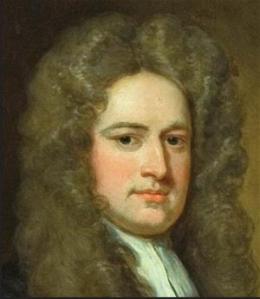
thomas-vernonThomas Vernon and his wife Mary inherited the property near Hanbury from a bachelor uncle, but it was Thomas who was responsible for acquiring the lion’s share of the 8,000 acres he left to his cousin’s son, Bowalter. Unfortunately, Bowater turned out to be a spendthrift who managed to go through much of the fortune acquired by his predecessor.

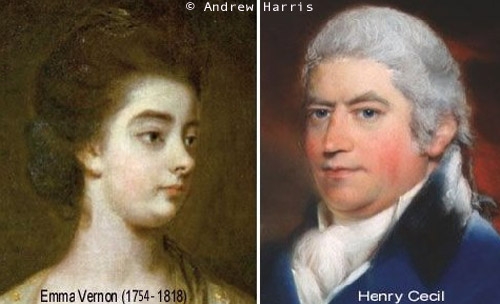
Bowater’s granddaughter Emma wed Henry Cecil, heir to the 9th Earl of Exeter, and they moved into Hanbury Hall. Unfortunately, Emma fell in love with the local church curate. When Emma confessed all to her husband, he persuaded her to break things off with the curate. But instead she ran off and escaped with her lover to Lisbon, where they were married following a scandalous divorce. Her second husband died soon, however, and Emma returned, later marrying a local lawyer.

Her humiliated first husband abandoned the place for Shropshire, posing as a gentleman farmer and marrying a farmer’s daughter. Follow his death, she and her third husband managed to regain possession, but by that time, the house had been abandoned and needed extensive repairs. Following Emma’s death in 1818, Phillips remarried and had two daughters at Hanbury Hall before moving out in 1829.

emma-and-henry

Probably the happiest inhabitants of Hanbury Hall were the Victorian Vernons, Sir Harry and Lady Georgina. Having never expected to inherit such wealth, they lived simply and happily, committed to each other and the local community.

British School; Sir Harry Foley Vernon (1834-1920), 1st Bt, MP; National Trust, Hanbury Hall; http://www.artuk.org/artworks/sir-harry-foley-vernon-18341920-1st-bt-mp-130493

Sir Harry Foley Vernon (1834-1920), 1st Bt, MP; National Trust, Hanbury Hall

Lady Georgina Sophia Baillie-Hamilton, Lady Vernon (1839-1928)

Lady Georgina Sophia Baillie-Hamilton, Lady Vernon (1839-1928)

The last Vernon, their son, Sir George, made an unhappy marriage and ended by committing suicide in 1940, thus ending the baronetcy. Eventually, the property came into the hands of the National Trust, who manages it to this day.

The House

Built of red brick, Hanbury Hall was built in the Queen Anne style, or a “William and Mary house.” Emma’s husband Henry Cecil remodeled it, creating larger rooms and enlarging the northeast pavilion, as well as landscaping the park in the style of the times. Growing up at Burghley House, he would have contact with the famous Capability Brown.

sitting-room-google

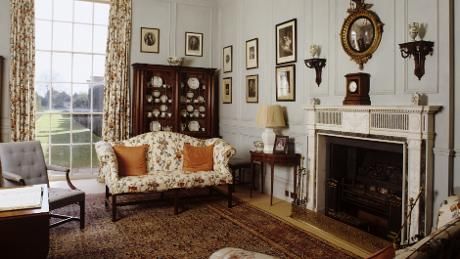
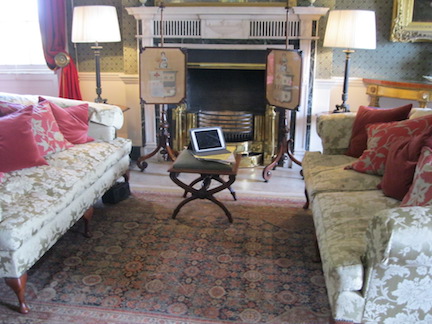
The Sitting Room was once “My Lady’s Parlour” with an attached withdrawing room. The parlour was strategically placed between the formal garden and the service quarters so that Mrs. Vernon could both entertain her guests and oversee her servants. The withdrawing room was a more private place where she could socialize with her more particular friends.
main-hall-google

fireplace-copy

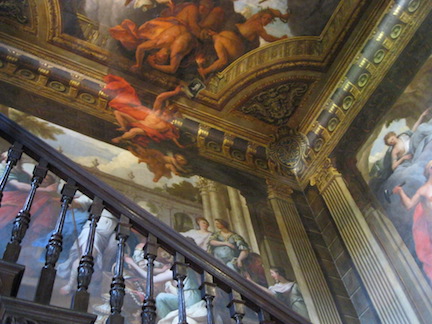
Staircase paintings by Sir James Thornhill

Staircase paintings by Sir James Thornhill

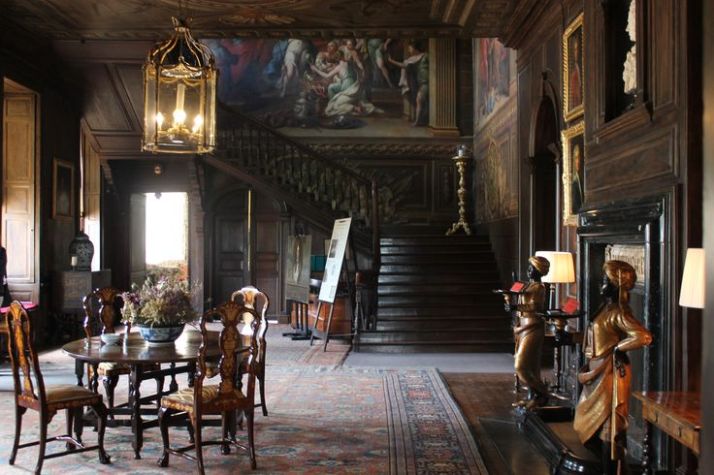
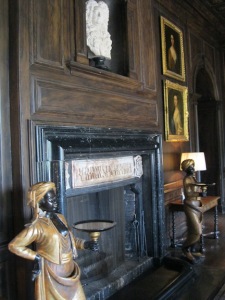
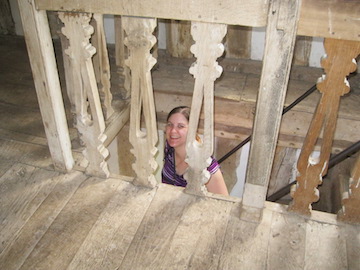
With a strongly architectural appearance, the Main Hall has an air of masculine antiquity. The cantilevered staircase with its huge wall paintings by Sir James Thornhill, rises directly from one end of the hall. The aim of the wall paintings was to represent the staircase as an open-air gallery, the ceiling removed to admit the tumbling crowd of classical gods and goddesses.

estatemap2-copy

The Smoking Room, set at the back of the house, was a convenient location for conducting the business of overseeing the estate. Paintings of the estate and one of Bowater Vernon hunting there line the walls.

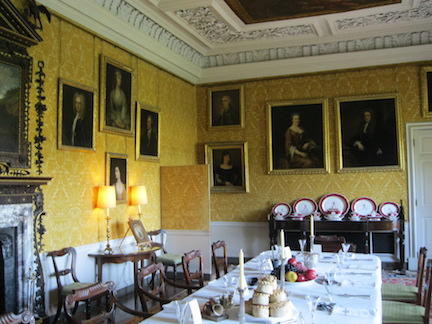
Dining Room

Dining Room

The ceiling of the Dining Room is decorated with classical paintings by Sir James Thornhill, while portraits of the Vernons line the walls.

Sir James Thornhill,self-portrait

Sir James Thornhill, self-portrait

Sir James Thornhill (1665/6-1734) was the only British large-scale painter of his time. His most famous work was the cupola at St. Paul’s Cathedral (1716), but in 1705, he was still taking smaller commissions such as this one.

drawingroom-copy

The Drawing Room takes its name from the 18th century habit of the ladies “withdrawing” from the dining room, leaving the men to discuss business and personal matters over port and tobacco.

blue-bedroom

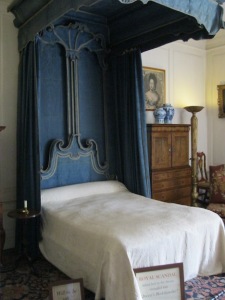
The “flying tester” bed in the Blue Bedroom is remarkably well-preserved. The worsted damask hangings date from the 1770s and have kept much of their original color since they have not been exposed to much ultraviolet light.

benchseat-copy

The Gothick Corridors are named after the wallpaper. The Gothick style romanticized the history of Northern Europe and was inspired by wild nature, tending toward strong colors.

Cedar Bedroom (Lady Georgina’s)

The Cedar Bedroom was Lady Georgina’s bedroom. She was married to Sir Harry Vernon in 1861 (although the baronetcy came along later).

The governess's bedroom

The governess’s bedroom

The Nursery is displayed as the Victorian Vernon children would have known it. The Day Room was a room for the governess, away from the children.

Hercules Bedroom

Hercules Bedroom

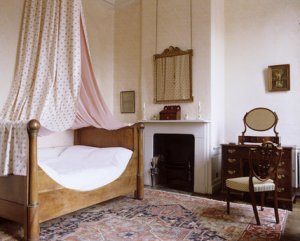
The Hercules Bedroom and Dressing-Room still appear as they must have in the 18th century. The windows have a superb view of the gardens. The Hercules Dressing-Room has a corner chimneypiece topped with a figure of Hercules.

Long Gallery

Long Gallery

The Long Gallery is actually found in a separate building, probably because it was once attached to an earlier building on the site. In Thomas Vernon’s time, it was a gentleman’s study. By Bowater Vernon’s time, it had become a picture gallery.

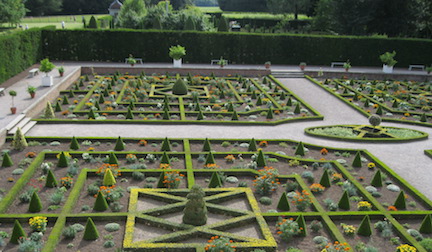
The Formal Gardens include the Sunken Parterre, the Fruit Garden, the Wilderness, the Grove, the Orangery, and the Bowling Green.

parterregarden-copy

Parterre Garden

In order to sustain a house like Hanbury, there had to be large areas given over to the serious production of food. “Snobs” Tunnel” led from the Walled Garden to the house, preventing the gardeners from being seen by the family when delivering produce. Behind the “polite” garden building of the Orangery lies the Mushroom House. The Victorian slate beds are still used to produce mushrooms today, as well as forcing rhubarb. There is also a 1750s Ice House, filled by ice gathered from a shallow ‘freezing pool’ on winter nights. An orchard has been largely replanted with over 136 apple trees. Beehives and chickens have also been introduced in the Walled Garden and Orchard.

Within the Park there is a wealth of archaeology from the Iron Age onwards. Traces of medieval ridge and furrow cultivation still exist, and to the south lie the remains of the vanished medieval village of Moreweysend.
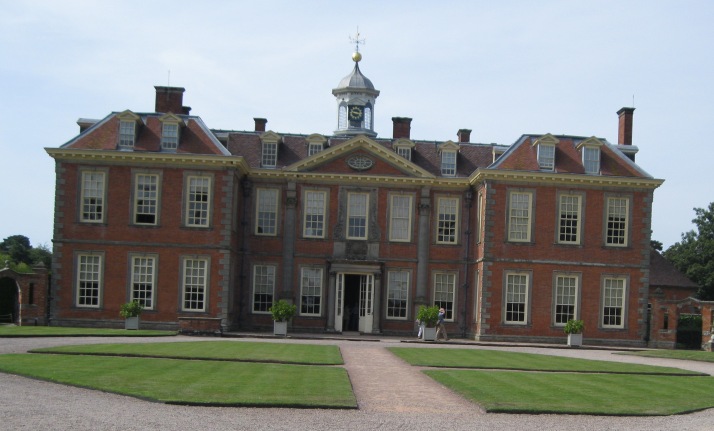
Hanbury Hall and Garden, the National Trust, ©2010

shepherdess

With thanks to Heather King for being so kind as to drive Cora Lee and me to visit Hanbury Hall, along with Roxy the Quadralingual Dog!

More photos of Hanbury Hall on my Pinterest board.

Romance of London: Samuel Rogers, the Banker Poet

Romance of London: Strange Stories, Scenes And Remarkable Person of the Great Town in 3 Volumes

John Timbs

John Timbs (1801-1875), who also wrote as Horace Welby, was an English author and aficionado of antiquities. Born in Clerkenwell, London, he was apprenticed at 16 to a druggist and printer, where he soon showed great literary promise. At 19, he began to write for Monthly Magazine, and a year later he was made secretary to the magazine’s proprietor and there began his career as a writer, editor, and antiquarian.
This particular book is available at googlebooks for free in ebook form. Or you can pay for a print version.

samuel_rogers_b1763npg

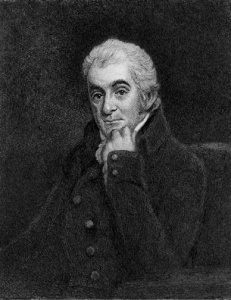
Samuel Rogers

From Wikipedia:

Samuel Rogers (30 July 1763 – 18 December 1855) was an English poet, during his lifetime one of the most celebrated, although his fame has long since been eclipsed by his Romantic colleagues and friends Wordsworth, Coleridge and Byron. His recollections of these and other friends such as Charles James Fox are key sources for information about London artistic and literary life, with which he was intimate, and which he used his wealth to support. He made his money as a banker and was also a discriminating art collector.

John Timbs’s Reflections

A few days after the death of Mr. Rogers, in 1855, there appeared the following interesting record of him from the practised pen of Mr. Robert Carruthers, who long enjoyed the friendship of the distinguished poet and patron of artists and men of letters.

It is not our intention to speak of the poetry of Mr. Rogers. In noticing it some time since we characterised it generally as presenting a classic and graceful beauty; with no slovenly or obscure lines; with fine cabinet pictures of soft and mellow lustre, and occasionally with trains of thought and association that awaken or recall tender and heroic feelings. No that personal interest in a living poet is withdrawn, and kindness and respect towards him are of no avail, it may be questioned whether Rogers’s poetry will maintain any prominent place in our literature. He will always be esteemed one of the purest disciples of the old classic school of Pope and Dryden—and to turn to him from the mystic ravings, tortures, and Red Indian chants of some modern poets, is like emerging from the wards of an hospital to fresh air and sunshine; but he wants vital interest, passion and strength, for universal popularity. He had not what Gray terms the “golden keys” that can unlock the gates of joy or horror, or open the “sacred source of sympathetic tears.”

Charles James Fox

Charles James Fox

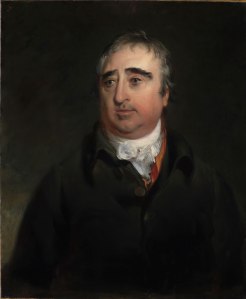
It is a man of taste and letters, as a patron of artists and authors, and as the friend of almost every illustrious man that has graced our annals for the last half century and more, that Mr. Rogers has of late years challenged public attention. He was a link between the days of Johnson, Burke, and Reynolds, and the present time. He had rambled over St. Anne’s Hill with Fox and Grattan. Sheridan addressed to him the last letter he ever wrote, begging for pecuniary assistance, that the blanket on which he was dying might not be torn from his bed by bailiffs; and Rogers answered the call with a remittance of 100 l. No man had so many books dedicated to him. Byron inscribed to him his “Giaour,” in token of “admiration of his genius, respect for his character, and gratitude for his friendship.” Moore was no less laudatory, and Moore owed substantial favours to the old poet. By his mediation his quarrel with Byron was adjusted, and when Moore fell into difficulties, the liberal hand of Rogers was opened. His benefactions in this way were almost of daily occurrence. “There is a happy and enviable poet!” said Thomas Campbell one day on leaving Rogers’s house; “he has some four or five thousand pounds a year, and he gives away fifteen hundred in charity.” And next to relieving the distress of authors and others, it was the delight of Mr. Rogers to reconcile differences and bring together men who might otherwise never meet. At his celebrated breakfast-parties persons of almost all classes and pursuits were found. He made the morning meal famous as a literary rallying point; and during the London season there was scarcely a day in which from four to six persons were not assembled at the hospitable board in St. James’s Place. There discussion as to books or pictures, anecdotes of the great of old, some racy sayings of Sheridan, Erskine, or Horne Tooke, some apt quotation or fine passage read aloud, some incident of foreign travel recounted all flowed on without restraint, and charmed the hours till mid-day. Byron has described the scene of these meetings:—

george_gordon_byron_6th_baron_byron_by_richard_westall_2“Rogers is silent, and it is said, severe. When he does talk, he talks well; and, on all subjects of taste, his delicacy of expression is pure as his poetry. If you enter his house, his drawing-room, his library, you of yourself say, this is not the dwelling of a common mind. There is not a gem, a coin, a book thrown aside on his chimney-piece, his sofa, his table, that does not bespeak an almost fastidious elegance in the possessor. But this very delicacy must be the misery of his existence. Oh, the jarrings his disposition must have encountered through life!”

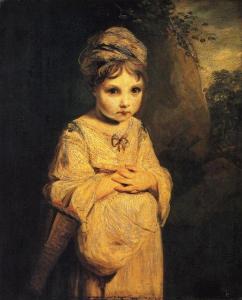
Byron’s sensitiveness coloured all he saw with his own feeling. There was none of this misery resulting from Rogers’s taste. He enjoyed life—had money, fame, honour, love, and troops of friends. His recipe for long life was “temperance, the bath, flesh-brush, and don’t fret.” But his house was really a magazine of marvels—the saloon of the Muses!—and its opening view on the garden and lawn of the Green Park in itself a picture. Paintings by Titian, Guido, Rubens, Claude, Raphael, and English artists, covered the walls. Every school, Italian and Spanish, had the representative, and not the least prized were the native landscapes of Wilson and Gainsborough, and the “Strawberry Girl” and “Puck” of Sir Joshua Reynolds. In the hall were Greek sculptures, busts, and vases, with endless articles of virtu. The library had its rare and choice editions—a drawing by Raphael, an original bust of Pope by Roubiliac, antique gems and cameos, and many precious manuscripts. Two of these he lately presented to the British Museum—Milton’s agreement with his bookseller for the copyright of “Paradise Lost” (for which he gave a hundred guineas), and Dryden’s contract with his publisher, Jacob Tonson. The whole arrangement of these rooms bespoke consummate taste and carelessness of cost. The chimney-piece of the drawing-room was of Carrera marble, sculptured with bas-reliefs and miniature statues by Flaxman; and the panels of a small library displayed the “Seven Ages of Man,” painted by Stothard. To comprehend how so much was done by one less than a noble, we must recollect Rogers’s bank, his exquisite taste, and his long life. He had written Journals of Conversations with Fox, Erskine, Horne, Tooke, and the Duke of Wellington (some of which we have seen), and those can scarcely fail to be both interesting and valuable.

Puck by Joshua Reynolds

Puck, Joshua Reynolds

The Strawberry Girl, Joshua Reynolds

The Strawberry Girl, Joshua Reynolds

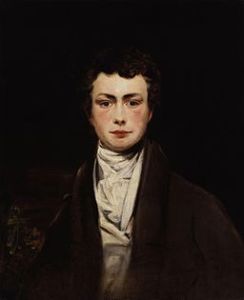
Thomas Moore

Thomas Moore

The severity of remark alluded to by Byron as characteristic of his friend, was displayed in a certain quaint shrewdness and sarcasm with which his conversation abounded, though rarely taking an offensive form. He could pay compliments as pointed as his sarcasm. Moore has recorded the pleasure he derived from one of Rogers’s remarks—”What a lucky fellow you are! Surely you must have been born with a rose on your lips and a nightingale singing on the top of your bed.” These and many other sayings, pleasant and severe, will now be remembered. But higher associations, even apart from his genius, will be associated with the name of Samuel Rogers. His generosity and taste—his readiness to oblige and serve, or to encourage and reward the humblest labourer in the literary vineyard—his devotion to all intellectual and liberal pursuits—the jealousy with which he guarded the dignity and rights of literature—the example of a straight path and spotless life extended to more than ninety-two years; these are honours and distinctions which will “gather round his tomb,” and outlast his monument.

fleshbrush

Romance of London Series

  1. Romance of London: The Lord Mayor’s Fool… and a Dessert
  2. Romance of London: Carlton House and the Regency
  3. Romance of London: The Championship at George IV’s Coronation
  4. Romance of London: Mrs. Cornelys at Carlisle House
  5. Romance of London: The Bottle Conjuror
  6. Romance of London: Bartholomew Fair
  7. Romance of London: The May Fair and the Strong Woman
  8. Romance of London: Nancy Dawson, the Hornpipe Dancer
  9. Romance of London: Milkmaids on May-Day
  10. Romance of London: Lord Stowell’s Love of Sight-seeing
  11. Romance of London: The Mermaid Hoax
  12. Romance of London: The Bluestocking and the Sweeps’ Holiday
  13. Romance of London: Comments on Hogarth’s “Industries and Idle Apprentices”
  14. Romance of London: The Lansdowne Family
  15. Romance of London: St. Margaret’s Painted Window at Westminster
  16. Romance of London: Montague House and the British Museum
  17. Romance of London: The Bursting of the South Sea Bubble
  18. Romance of London: The Thames Tunnel
  19. Romance of London: Sir William Petty and the Lansdowne Family
  20. Romance of London: Marlborough House and Sarah, Duchess of Marlborough
  21. Romance of London: The Duke of Newcastle’s Eccentricities
  22. Romance of London: Voltaire in London
  23. Romance of London: The Crossing Sweeper
  24. Romance of London: Nathan Mayer Rothschild’s Fear of Assassination
  25. Romance of London: Samuel Rogers, the Banker Poet
  26. Romance of London: The Eccentricities of Lord Byron
  27. Romance of London: A London Recluse

Susana’s Adventures in England: Lyme Park

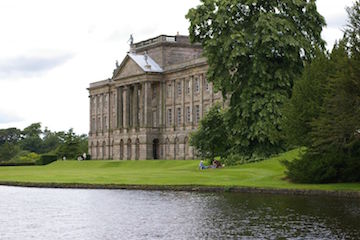
lyme_park_2

Lyme Park has been in the possession of the Legh family for 550 years. The manor was granted to the first Piers Legh and his wife Margaret in 1398 by Richard II, son of the Black Prince, as a reward for the heroic deeds in battle of her grandfather, Sir Thomas Danyers. The Leghs themselves campaigned in many 15th and 16th century battles.

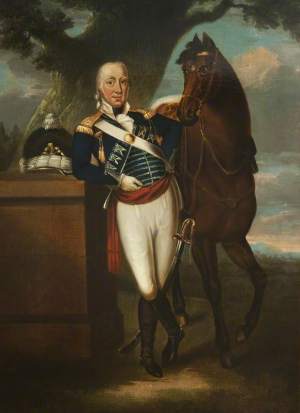
Colonel Thomas Peter Legh

Craik; Colonel Thomas Peter Legh (1753-1797) of Lyme Park; Duke of Lancaster's Own Yeomanry Museum; http://www.artuk.org/artworks/colonel-thomas-peter-legh-17531797-of-lyme-park-150355

Colonel Thomas Peter Legh (1753-1797) of Lyme Park

From Lyme Park House & Garden, a National Trust Publication:

He was best known for having raised six troops of cavalry in fourteen days in 1794—following Pitt’s call to arms in the face of increasing trouble in Europe—and for having sired seven children by seven different women, none of whom was his wife.

He left the estate to his oldest natural son, Thomas.

Thomas Legh

Thomas Legh

Thomas Legh

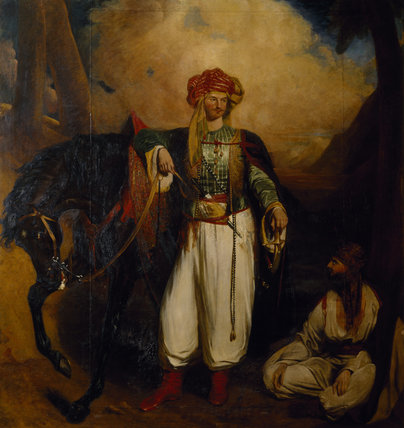
Thomas Legh, who inherited Lyme in 1797, was one of the most remarkable members of the family. By the time he came of age in 1814 he had already followed the Nile into parts of Nubia previously unexplored by Europeans, and the following year he was present at the Battle of Waterloo. He also became a well-known Egyptologist and collector of antiquities, modernised the estate farms, exploited the industrial potential of his Lancashire lands and had Lyme itself restored and extensively, but sympathetically, altered by Lewis Wyatt.

The House

The Stag Parlour

The Stag Parlour

The Leghs were notoriously fond of hunting the red deer indigenous to Lyme Park, which is no doubt the reason they made it their primary home from the late 16th century on.

The architectural style of the house varies from Elizabethan-Jacobean to Italian Palladian and baroque.

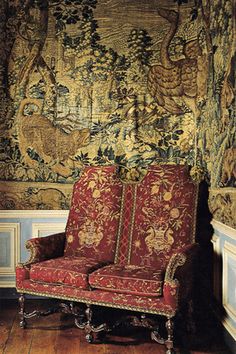
Unusual settee in the Yellow Bedroom

Unusual settee in the Yellow Bedroom

The exterior of the house was used as Pemberley in the 1995 BBC adaptation of Pride and Prejudice.

The Lyme Caxton Missal

caxtonmissal-copy

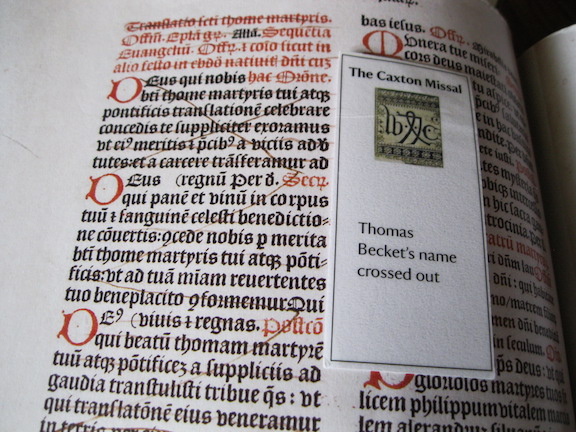
The Leghs were Roman Catholic supporters of the Stuarts in the 18th century. The missal they owned was an early printed book containing the liturgy of the mass according to the Sarum Rite, published by William Caxton in 1487. It is the only nearly complete surviving copy of its earliest known edition.

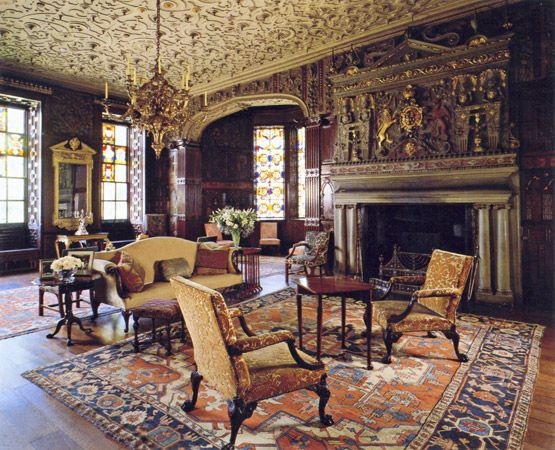
Drawing Room

Drawing Room


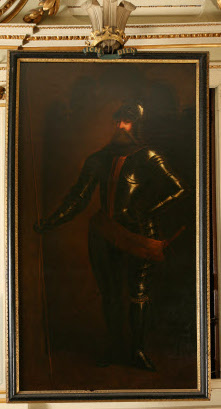
Prince Edward, Prince of Wales, `The Black Prince

Prince Edward, Prince of Wales, ‘The Black Prince’


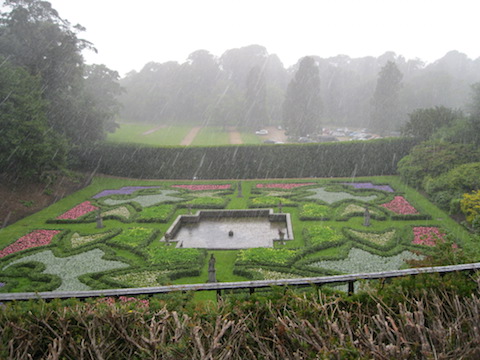
The Dutch Garden in the rain

The Dutch Garden in the rain


See more photos on my Lyme Park Pinterest page.

Susana’s Adventures in England: Arundel Castle

castle-copy

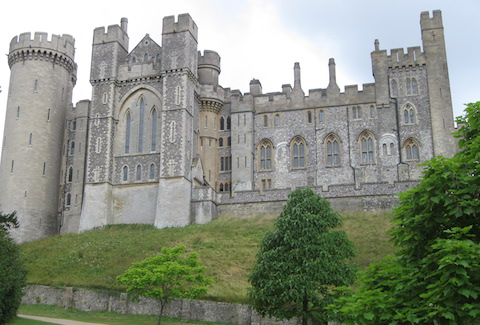
Arundel Castle was established by Roger de Montgomery, a cousin of William the Conqueror, on Christmas Day in 1067 after he was given one-fifth of Sussex and the title of Earl of Arundel in return for his agreement to defend it. The castle was damaged in the English Civil War and restored in the 18th and 19th centuries. It has been the principal seat of the Dukes of Norfolk for almost 400 years.

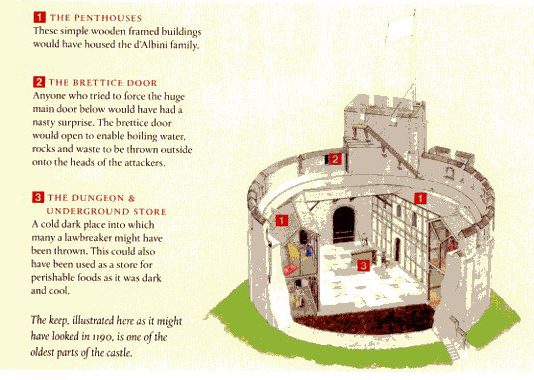
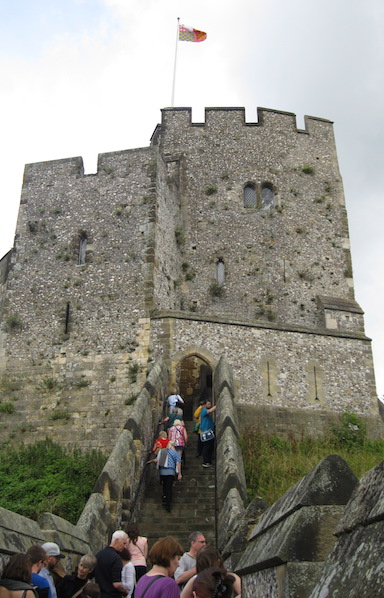
keep001

Stone apartments constructed for the Empress Matilda’s visit in 1139 still exist today.

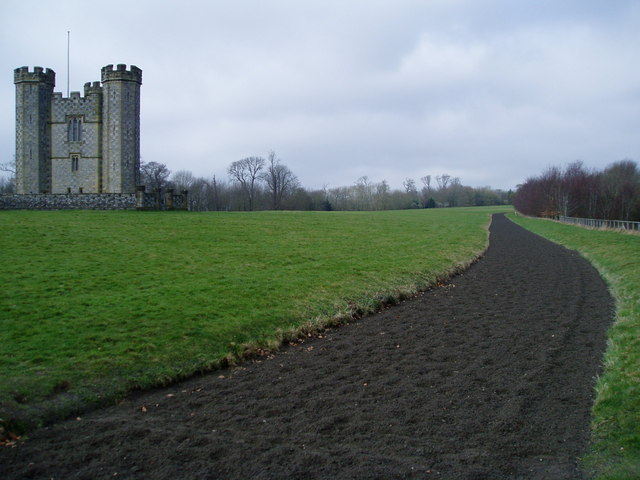
The 11th Duke of Norfolk held a large party at Arundel in 1815 to celebrate the 600th anniversary of the signing of the Magna Carta. Architect Frances Hiorne built a folly on the hill above Swanbourne Lake.

Hiorne's Tower (Folly)

Hiorne’s Tower (Folly)

Queen Victoria, when she and Prince Albert visited on 1 December 1846, did not appreciate the 11th Duke’s attempts at renovations, calling it “bad architecture.” Consequently, the 15th Duke, upon his inheritance of the Castle, carried on a “massive and scholarly renovation” of the entire house between 1875 and 1900, except for the library. This included carefully restoring the remains of the Norman castle.

The Keep

The Keep

During the second world war, the Castle was occupied by British, American, and Commonwealth troops right up to the 1944 D-Day landings.

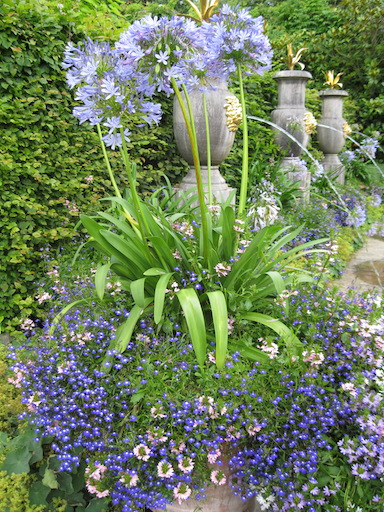
The present 18th Duke lives in a private wing with his family. He had his wife, along with the Castle Trustees, have restored and redecorated the whole interior to its Victorian magnificence, as well as improved the visitor facilities. The gardens have been upgraded to match the historic authenticity of the Castle.

garden14

garden17-copy

On exhibit at the Castle are nearly all of the family’s collection of art and historic archives, including many brought from Worksop and Norfolk House.

For more photos of Arundel Castle, check out my Pinterest Page.