Archives

An Evening at Vauxhall Gardens, Part III

In our last installment, Susana and Lady P made the requisite trip to the “ladies’ retiring room,” which Susana declined after a brief perusal of the facilities. Returning to the fringe of the dancing, she made the acquaintance of a child who offered to obtain a voucher for her to Almack’s (!!!), and listened to several songs by the sweet-voiced warbler, Mrs. Maria Theresa Bland.

A bell rang and the organ music stopped as we were swept away with the noisy crowd to the end of one of the walks where we could see a tall pole (a ship’s mast, as it turned out). A trio of young hooligans elbowed their way past us; at least one trod on the train of my gown and nearly knocked me down. Lady P threw her arm around my back and kept me vertical, but in the second or two it took me to recover, the impatient crowd behind us tossed us a few angry looks and impolite murmurs as they pushed past us. A rush of heat came over me and I could hear my heart racing, so I knew a panic attack was coming on.

madame-saqui-descending

“Can we get out of this crowd?” I asked her ladyship, trying to peer over the heads of the crowd in search of escape.

After one look at my face, she put on her stern “countess” face and aimed it at the crowd behind us. “Susana, my dear,” she said loudly. “I believe that is the Prince Regent waving at us from the Rotunda.”

A slew of people behind us stopped in their tracks and craned their necks to peer at the Rotunda. Lady P and I took the opportunity to duck out of the crowd and into a clump of trees on the right, where she took out her handkerchief and wiped the moisture off my face. The floral scent on the linen had a calming effect on my nerves, and gradually I began to feel more myself.

“Is the Prince Regent really here?” I asked her when I finally caught my breath.

“I do hope not,” she answered, lips pressing into a white slash. “Because if he is, I shall have to pay my respects, and more than likely, he will wish to be presented to you, and with you not having the slightest idea of court etiquette…”

My eyes were bulging. The thought of seeing the Prince Regent would be a thrill beyond my wildest dreams, but to actually be presented to him was a far more intoxicating notion. I started to feel a bit dizzy.

“Susana!” Lady P pounded me on the back. “Get hold of yourself or I shall have to put my hartshorn to you.”

“No, no, I’m fine. I just need to sit down.”

Fortunately, we espied a white wrought-iron bench behind a clump of trees in the near distance. Just as we were seated, we heard the sound of fireworks, and suddenly the sky was ablaze with colored lights and smoke, brief images of crowns, hearts, initials and other indistinct figures flashing in the haze.

“It’s starting!” I said, jumping to my feet, still feeling a bit dizzy, but not willing to miss the main attraction. “Let’s move ahead of these trees!”
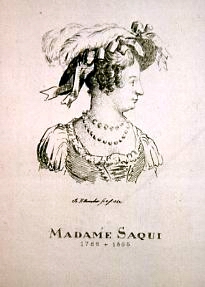
small-saqui

We cleared the obstructions just in time to see a tiny figure dart out of the darkness and smoke, her feet moving with surprising agility on the narrow rope toward the summit of tall pole, which had to be at least eighty feet high and a steep climb. I wondered what it was her husband did to her shoes to keep her from sliding backward. [I knew from my Vauxhall blog series that her husband was the only one in the family who was not a rope walker, but that he had important other responsibilities.]

Rockets exploded all around her, causing the spangles on her skirts to sparkle and make her a magical figure. The long ostrich feathers on her elaborate hat dipped and swayed as she ascended, and I found myself holding my breath like the others in the crowd lest she lose her balance or the rope become severed by a rocket [even though I knew from my research that she died of old age, her life taken over by her nostalgic memories of the past]. Reaching the midpoint, she paused for a moment to make a slight bow in our direction. Following her gaze, I looked behind us and saw a rotund figure with a familiar face about ten feet away.
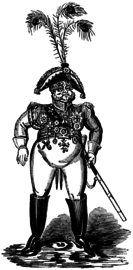
1819_prince_regent_g_cruikshank_caricature“Is that…?”

“… the Prince Regent,” Lady P hissed. “Don’t stare.”

Turning my attention back to the spectacle at hand, I saw Madame Saqui take the final quick steps to the top of the pole, where a man seated there [her husband, I assumed] grabbed her hand while she turned around and made a rapid descent amid a flash of blue lights, again stopping at the center, this time making bows in both directions and executing some graceful balletic moves before continuing her descent and dancing her way back into the smoke.

“She dances exquisitely on the horizontal rope,” said a voice behind us. “I’ve seen her at Covent Garden. As graceful as a ballerina on a stage.”

We whirled around to face a middle-aged gentleman with a smattering of reddish brown hair still remaining on his balding pate. He bowed briefly to Lady P and sent a questioning look in my direction. “A pleasure to see you again, Lady Pendleton. I hope you are enjoying yourself this fine evening.”
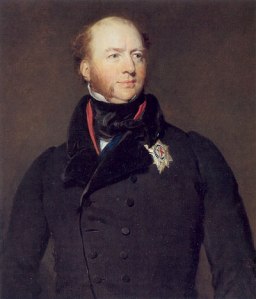
Lord Yarmouth, eventually 3rd Marquess of Hertford

Lord Yarmouth, eventually 3rd Marquess of Hertford

Lady P gave me a look that I interpreted as a “don’t-even-think-of-embarrassing-me” warning as she plastered a smile on her face and bobbed. “We are indeed, Lord Yarmouth. On a fine night such as this, Vauxhall never fails to delight us.” She nodded in my direction. “Your lordship, I’d like to present my good friend, Susana Ellis, from America. Susana, I’d like you to meet Lord Yarmouth, the son of the Marquess of Hertford.”

I swallowed and tried to gather my chaotic thoughts. Hertford. Something to do with Lady Hertford, the Prince’s mistress? What should I do? Any schooling on polite discourse I’d ever had from Lady P disappeared from my brain. I vaguely recalled her own actions and did my best to reproduce her bob. “A pleasure to meet you, Lord Yarmouth.” To my ear, it came out squeaky and I could feel my cheeks reddening. Don’t faint. Lady P will kill you if you do.

He bowed in my direction, his eyebrows furrowed. “American, you say. How delightful. They seem to be everywhere these days.” His voice signaled boredom, however.

I was saved from having to answer that by the voice of a woman calling to him from behind. “Come along, Francis! We’re removing our party back to Carlton House for dinner and dancing.”
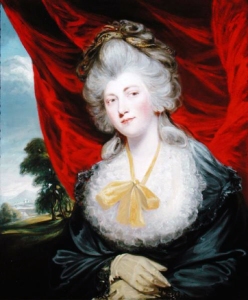
lady_hertford_1800

Isabella, 2nd Lady Hertford

Lord Yarmouth gave us an apologetic-yet-relieved smile. “My apologies, ladies. It seems I must take my leave of you.”

Lady P let out a deep breath, no doubt relieved that she would not have to present me to royalty after all, and then the woman behind the voice approached us.

“Agatha? Is that you? It’s been an age. How are you faring these days?”

Approaching us in all her royal blue splendor was a woman I assumed to be the prince’s mistress, Lady Hertford, and behind her was the magnificent royal dandy, His Royal Highness the Prince Regent, the future George IV, and he was looking at me!

More next week, same bat-time, same bat-channel!

descent-of-madame-saqui-surrounded-by-fireworks

Lady P and Susana Visit Vauxhall Gardens, Part I

An Evening at Vauxhall Gardens, Part II

An Evening at Vauxhall Gardens, Part III

An Evening at Vauxhall Gardens, Part IV

An Evening at Vauxhall Gardens, Part V

Amusements of Old London: The Play Tables

Amusements of Old London

William B. Boulton, 1901

“… an attempt to survey the amusements of Londoners during a period which began… with the Restoration of King Charles the Second and ended with the accession of Her Majesty Queen Victoria.”

Hazard & White’s

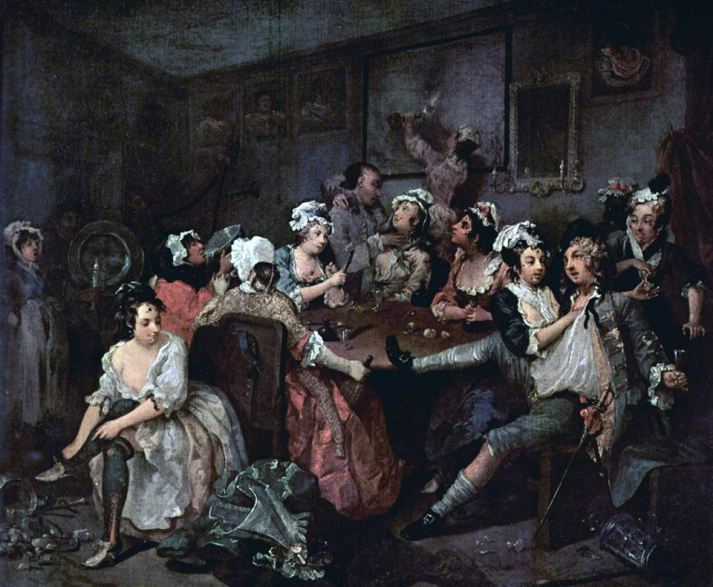
Hazard, the precursor of crap) was a game of pure chance where all players had a fairly equal chance of winning. But as it spread into the lower classes, “organized cheating at low taverns and gaming-houses became a regular profession.” Loaded dice was one way, but there were plenty of other ways. The often violent responses to cheating are illustrated in Rowlandson’s “Kick up at a Hazard Table.”

rowlandson-kickup-at-hazard-table

The game of hazard first became popular in the late 17th century at  the coffee-houses, such as (Mrs.) White’s Chocolate House and The Cocoa Tree. Early in the next century, the more fashionable gentlemen at White’s, wishing to avoid the card sharps and other unpleasant types that were inevitably present at these places, formed a more exclusive, private club, “where they could lose fortunes to each other in all privacy and decorum.” Considered by critics to be a “pit of destruction,” White’s saw many fortunes change hands at the turn of a dice.

Young Mr. Harvey of Chigwell, for instance, lost £100,000 to Mr. O’Birne, an Irish gamester. “You can never pay me,” said O’Birne. “Yes, my estate will sell for the money,” was the spirited reply. “No,” said O’Birne, “I will win but ten thousand, and you shall throw for the odd ninety.” They did so and Harvey won, lived to become an admiral, and to fight under Nelson at Trafalgar.

The Georges and Gaming at Court

It was a necessary qualification of a courtier of George the Second to be prepared to sit down with that monarch and the Suffolks and Walmodens and the other picturesque appanages of the court and lose a comfortable sum. Twelfth Night was always a fixture for a sitting of more than ordinary importance at St. James’s. On one of these occasions luck was in favour of Lord Chesterfield, who won so much money that he was afraid to carry it home with him through the streets, and was seen by Queen Caroline from a private window of the palace to trip up the staircase of the Countess of Suffolk’s apartments. He was never in favour at court afterwards.

George III, on the other hand, banished gaming at court and even White’s gambling became quite tame, which is why Almack’s (later Brooks’s) was opened as a venue for serious gamesters, such as Charles James Fox, who was known for playing carelessly “for the excitement alone,” without any concern for the consequences. On one particular day in 1771, after playing hazard for twenty-two hours and losing £11,000, he gave a speech at Westminster, went to White’s and drank until seven in the morning, and then to Almack’s, where he won £6,000, and later in the afternoon took off for Newmarket. A week later, he was back in London and lost £10,000.

Faro

The game of Faro evolved from a game called “basset,” played in the Stuart courts.

Faro was played between the dealer or keeper of the “bank” and the rest of the company, and, like hazard, it gave excitement to as many people as could find room round the table… Each of the company placed his stake upon any card of the thirteen he chose, and when the stakes were all set the dealer took a full pack and dealt it into two heaps, one on his right hand the other on his left, two cards at a time. He paid the stakes placed on such cards as fell on the right-hand pack, and received those of such as fell on his left hand. The dealing of each pair of cards was called a “coup,” and the dealer paid or received such stakes as were decided after each coup… [t]he odds were enormously in favour of the dealer. He claimed all ties, that is, when the same card appeared on both packs, the last card but one of the pack delivered its stake to him upon whichever hand it fell, and there was the impalpable but very real advantage of which was known as the “pull of the table” in his favour.

At Brooks’s, where faro reigned supreme, Charles James Fox and Richard Fitzpatrick (a Whig associate) had a very successful partnership. Lord Robert Spencer’s partnership with Mr. Hare enabled him to win £100,000, whereupon he gave up gambling entirely and purchased an estate in Sussex. “The success of the faro banks at Brooks’s was such that it led to the game being forbidden at White’s by a special rule of the managers.”

Faro, however, was played at many of the great houses and by women of fashion, who would “hire a dealer at five guineas a night to conduct operations, and to suggest that the profits of the table went to him and not to the hostess… to disguise the commercial nature of the transaction…”

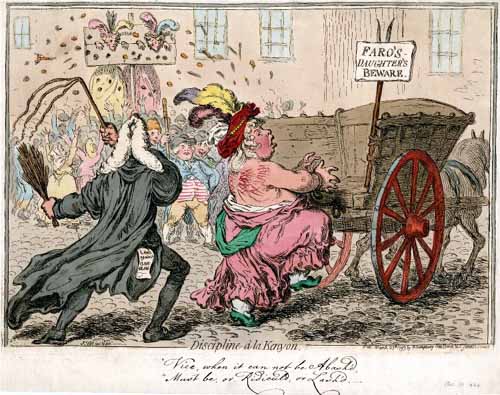
Following the 1797 public scandal in the courts where three society ladies were each fined £50 for playing at a public gaming-table—and the popularity of Mr. Gillray’s prints, such as “Pharaoh’s daughters in the pillory and at the cart tail”—the game lost much of its following.

faros-daughters-gillray

E.O.

E.O., a type of of roulette with a ball and a special table, called roly-poly, from the Continent, found at race meetings, country fairs, and the streets of London, lent itself well to cheating. Colonel O’Kelly, the eventual owner of Eclipse set himself up in business by winning at E.O.

Gaming Houses and the Damage They Caused

Cheap gaming houses all over town featured hazard, roulette, rouge et noir, and macao for small stakes. Frequent raiding did not discourage them, since fines were easily paid.

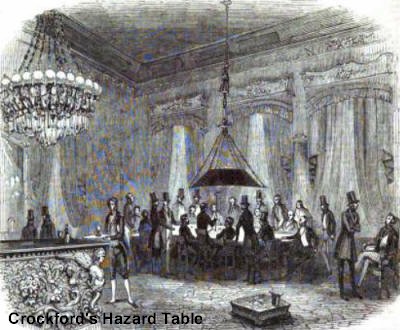
A hazard table at Crockford's

A hazard table at Crockford’s

The mischief these places did is almost incalculable; bankruptcies, embezzlements, duels, and suicides resulting from gaming were of weekly occurrence, and it would seem that half the tradesmen and clerks of London were before the magistrates or the coroners of the last years of [the 18th] century and the first quarter of [the 19th].

Hazard and faro had gone out of the older clubs, and club gaming of the [early 19th century] was represented by extremely deep play at whist at White’s and Brook’s. Macao flourished for a while at Wattiers, where the members lived on each other for some eight or ten years until their estates disappeared and the club expired by the flight of its supporters to Boulogne.

Such were the houses in which round games flourished after their decline at the great clubs. They steadily drained the pockets of the aristocracy of England for nearly half a century, and there is scarcely a great family to-day which does not still feel the effects of the play that went on within their doors sixty years ago.

Crockford’s Club

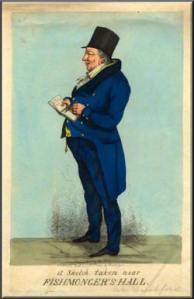
crockford_william_npgthomasjonesWilliam Crockford, a fishmonger who had a shop in the Strand near Temple Bar, made a killing on a turf transaction and rose from partnerships in shady gaming establishments to spending £94,000 to open his own fashionable club, Crockford’s Club, in 1827.

There is one thing, and one only, to be said in favour of Mr. Crockford’s enterprise, which, is that this establishment did away with the practice of gentlemen playing against each other for large sums. At Crockford’s, the game was one of Gentlemen versus Players, the players being always Mr. Crockford’s officials at the French hazard table, and the sole object of his business was to win the money of his patrons.

A committee of gentlemen was given charge of accepting and rejecting members, with the effect of making “entry to Crockford’s as difficult as to White’s or Brooks’s.” The price of subscription to Crockford’s establishment was low, but “in exchange for the princely accommodation of his house, and such fare as was unobtainable at any other club, Crockford asked for nothing in return that gentlemen should condescend to take a cast at his table at French hazard.” This incarnation of the old game required a fee called “box money” and “the pull of the table” that went directly into the coffers of the house.

crockfords-club

The men who walked into Crockford’s with their eyes open to encounter these odds were the pick of the society of the day, the men who had fought the battles of the country under Wellington, and men who were making great reputations at Westminster, as well as mere butterflies like the Dandies who loafed through life at White’s. They were most of them men of exceptional parts, and distinguished for shrewdness and ability in one walk of life or another, and yet in the short space of ten years, between the opening of the club in 1827 and the succession of her Majesty, their losses converted Mr. Crockford into a millionaire at least. There is absolutely no record of any considerable sum of money ever won at the place by a player.

The second Earl of Sefton lost £200,000 in his lifetime. His son, after paying off the debt, lost another £40,000. Sir Godfrey Webster lost £50,000 at a sitting. Other losers of enormous sums: Lord Rivers, Lord Chesterfield, Lord Anglesey, Lord D’Orsay.

Even before the Gaming Act of 1845, Crockford, having pretty much won all the money to be won, started consolidating and concealing his assets with a view toward retirement. When called to give evidence, he claimed that increasing age caused him to give over the management to the committee of gentlemen tasked with running the membership of the club.

“High play in England, as we believe, burnt itself out in those orgies at Crockford’s.”

The Scandal at Graham’s Club

Another reason for the decline of serious gaming in England was the cheating scandal at Graham’s Club in St. James’s Street.

…a man of an old and honoured name was detected cheating at whist, and was denounced as a dishonest trickster in a newspaper, the Satirist. He brought an action against his accusers, failed in it, went abroad, and died… the details of the trial disclosed ugly features in the circumstances which had much interest for thoughtful people, and undoubtedly tended to bring the whole institution of play for high stakes between gentlemen into great disrepute.

Witnesses at the trial testified that they had witnessed him cheating in any number of ways a hundred times and more, and not only did not turn him in, but continued to sit down with him to play at private clubs. Undoubtedly, many of them were cheating themselves, and thus had no wish to have their play scrutinized. Packs of his marked cards were produced in court. His hacking cough, which always resulted in producing a king of trump, became known as “—’s king cough.”

Since those days of Crockford’s and Graham’s and the Gaming Act, high play has ceased to be any considerable part of the social life of London at clubs or elsewhere.

The Gaming Act of 1845

made a wager unenforceable as a legal contract and stood as law, though amended, until 2007.

Crockford's today is an exclusive casino in Mayfair

Crockford’s today is an exclusive casino in Mayfair


Amusements of Old London series

An Evening at Vauxhall Gardens, Part II

In our last installment, Susana and Lady traveled by carriage to the Royal Vauxhall Gardens, bespoke a supper-box, chatted with a waiter, and partook of shaved ham “so thin you could see through it,” as well as other delicacies.

Ladies Retiring Room at Vauxhall

Ladies Retiring Room at Vauxhall

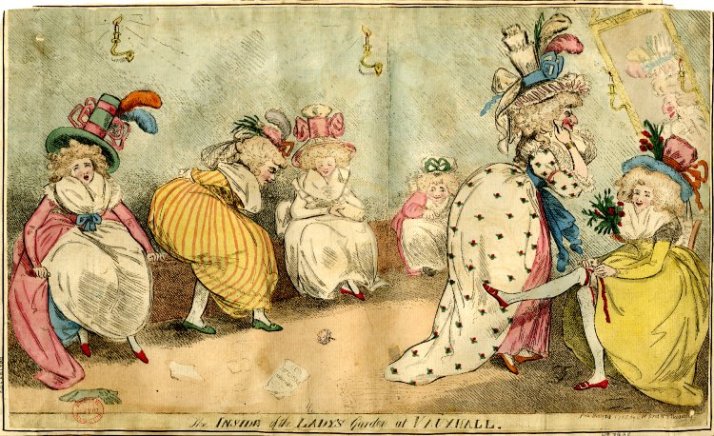
After our meal, Lady P excused herself to visit the “ladies’ retiring room.” Curiosity induced me to follow her to a large tent in a secluded area, where a young woman dressed in servant garb brightened at our approach. When Lady P shook her head slightly, the woman shrugged and looked hopefully behind us for another potential “client.” Her ladyship whispered to me that such women were there to collect tips for assisting ladies who had come without maids to help with their private needs.

Peering into the darkly-lit interior, I saw a half-dozen women seated on what appeared to be wooden seats similar to those scene in outhouses when I was a child (or the latrines at Girl Scout camp). The better-dressed ladies had maids attending to them, but I didn’t get a good glimpse because Her ladyship squeezed my shoulder and I could see by her tight jaw and raised eyebrows that it was not the thing to be staring in such a place.

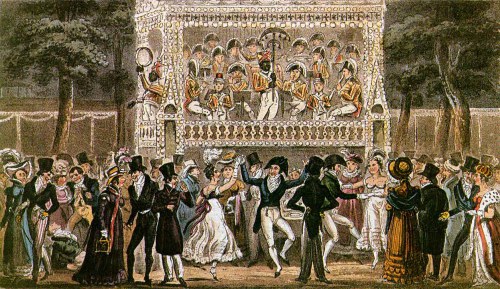
Not being especially inclined to use such things as outhouses and porta-potties except in case of emergency—and I decided I could wait until I got home—I abandoned the tent and strolled about a hundred yards away until I had left the unpleasant smells behind. From my position, I had a good view of the dancing in front of the Orchestra. It was so amazing to see the vibrant colors of the ladies’ gowns—as well as the gentlemen’s waistcoats—and I could not help but marvel at the sight of the diversity of the dancers. A soberly-dressed gentleman in charcoal gray who was partnered with a woman in serviceable blue circled among an older, elegantly-dressed couple and an energetic young couple dressed in servant garb, and they all seemed to be having a good time. Among the bystanders I could see a gentleman looking through his quizzing-glasses at me, and fearing that he might be thinking of asking me to dance—Lady P would kill me, and in any case, I have two left feet and have never waltzed in my life—I backed a little further back into the hedges, and nearly trampled a little girl.

“Oh dear, I’m sorry! I didn’t see you there, sweetheart. Are you all right?”

Print; Mezzotint engraving. Childhood: Lady Emily Caroline Catherine Frances Cowper, later Countess of Shaftesbury (1810-1872) after Sir Thomas Lawrence.Half length portrait of a child, a string of pearls round her neck. Unframed.

Lady Emily Caroline Catherine Frances Cowper, later Countess of Shaftesbury (1810-1872) after Sir Thomas Lawrence.Half length portrait of a child, a string of pearls round her neck. Unframed.

The child—about six or seven I thought—blinked rapidly after she had moved a safe distance away. Wavy dark hair curled around her childish round face, tied at the top with a pink ribbon. Dressed in white, her gown trimmed with pink bows, she didn’t have the appearance of a child who would be abandoned on her own in a place like Vauxhall.

Her eyes widened at the sound of my voice, and before she answered, she gave me a long glance from head to toe. My hands started to sweat, knowing that my gown—beautiful though it was—would not stand up to close scrutiny, created as it was from an unauthentic pattern and materials made with 21st century technology.

“You speak strangely,” she said. “You’re not from Hertfordshire, are you?”

“Uh no, I’m from America.”

She nodded as though her suspicions were confirmed. “That’s a great distance from here.”

“It is,” I agreed. “I came to visit my friend Lady Pendleton.”

She smiled. “I like her. She invited me to come to tea with Emily and Theodosia.”

Emily and Theodosia are two of Lady P’s grandchildren. [They appear in A Home for Helena.]

“I haven’t had the pleasure of meeting them as yet.”

She tilted her head. “They live in Kent. Sometimes they come to London to visit their grandmother. I visit mine as well, but she is quite ill at present.” She crossed her arms in front of her. “She is an important lady, you know.”

“She is?” I was quite eager to know the identity of this child, but I had a feeling I shouldn’t be encouraging her to talk to strange people. And I know Lady P would have a fit. I gave a quick glance behind me in case she was approaching, but the coast was clear.

“Yes. And my mother as well. She is one of the patronesses of Almack’s.” She inclined her head toward me. “Have you attended there?”

Almack's Assembly Rooms

Almack’s Assembly Rooms

I smothered a laugh. Me? At Almack’s. Not likely. But then… who could have imagined I’d ever be at the Vauxhall from two hundred years ago?

“No, I’m afraid not.”

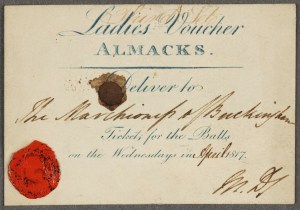
She smiled. “You do not have a voucher? Perhaps I can prevail upon my mother to get you one. You are a proper lady, are you not?”

Now that was a loaded question. I was pretty sure Lady Pendleton would not describe me thus, and I certainly didn’t feel like a Regency lady.

“I am quite certain Lady Pendleton would not invite me to her home otherwise,” I prevaricated. “I am Susana Ellis. I’m a novelist.”

almacks-voucher-stg_misc_box7-trimmed-to-voucher“You are?” she breathed. “Like Mrs. Edgeworth and Mrs. Burney?”

“More like Miss Austen,” I said before I could stop myself. I knew that Jane Austen had published her novels anonymously at first and wasn’t sure when her identity was finally revealed.

She wrinkled her brow. “Miss Austen?”

Fortunately, I was saved from responding by the sudden appearance of my time-traveling Regency friend.

“Dear Susana, I see you have found a friend.” There was a hint of irritation in her voice. “Lady Emily, have you accompanied your parents here this evening? I wonder why you have been left alone without your maid.”

Lady Pendleton’s voice was firm but kind as she viewed the little girl. Lady Emily fidgeted under her gaze. “I came with Mama and Lord Palmerston. Alice was too ill. I’m just here waiting while they finish the dance.”

Her ladyship shook her head. “I shall give your mama a talking-to when next I see her. Leaving her child unaccompanied indeed!”

Lady Emily flushed. “No! Please don’t do that! I am meant to be sitting with the Howard party.” She bobbed us a curtsey and made her adieux. “I must return in all haste.” She fled just as the music stopped.

I turned toward Lady P. “Is that—?”

lady-emily-cowper-by-sir-2

Lady Emily Cowper (1787 – 1769) by Sir Thomas Lawrence. The daughter of the famous Whig hostess, Elizabeth Lamb, Lady Melbourne, Emily was likely the result of her mother’s affair with Lord Egremont. Emily had plenty of extramarital affairs of her own, including a long one with Lord Palmerston, whom she married after the death of her husband.

“Lady Emily Caroline Catherine Frances Cowper,” confirmed my mentor. “The daughter of Lady Emily Cowper and the granddaughter of the Melbournes.”

I let that knowledge sink in. Then I giggled. “She offered to help me get a voucher to Almack’s!”

Her ladyship lifted an eyebrow. “Indeed. And what did you say to her to elicit such an offer?”

“Nothing!” I insisted. “All I said was that I am an American visiting you, and she told me she knew your granddaughters and asked me if I’d been to Almack’s…”

Lady P snorted. “Because she knew you hadn’t, of course.”

That stung a little, but I knew she was right. I’m not a proper Regency lady and never will be. I was there to observe—and that in itself was a rare privilege.

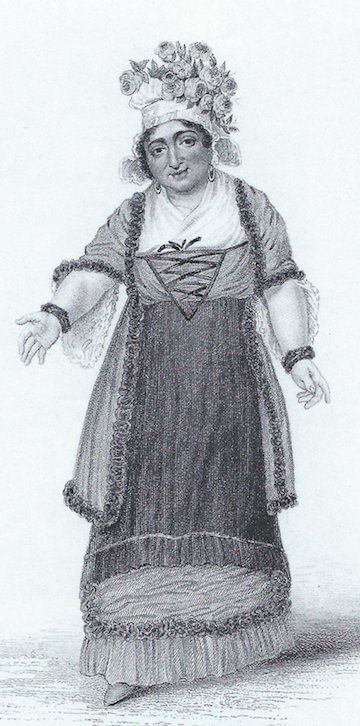
Maria Theresa Bland, née Romanzini (1769-1838) was a popular singer at Drury Lane and other venues. Sister-in-law to the actress Mrs. Jordan, she had two sons who were also musical. Her mezzo-soprano voice was idea for the singing of English ballads.

Maria Theresa Bland, née Romanzini (1769-1838) was a popular singer at Drury Lane and other venues. Sister-in-law to the actress Mrs. Jordan, she had two sons who were also musical. Her mezzo-soprano voice was ideal for the singing of English ballads.

Our conversation was interrupted with cheers and applause as a rotund little lady in a blue gown with a laced-up bodice and an enormous cap topped with colorful flowers that accentuated the roundness of her face, stepped up on the stage in front of the musicians, giving a deep bow at her introduction by the organist, Mr. James Hook. She—her name was Mrs. Bland—proceeded to sing a charming little song called “Pray Excuse Me,” that had everyone smiling and cheering for more. Her exquisite voice and cheerful vivacity more than made up for the incongruity of her appearance. Following that, she sang “Jesse o’ the Dee” and several other other songs until it was announced that the musicians would take a short respite while Mr. Hook entertained the crowd with his lively organ-playing. In spite of that, I noticed the audience starting to thin out, many heading in the same direction.

James Hook by Lemuel Francis Abbott

James Hook by Lemuel Francis Abbott

“Madame Saqui!” I breathed. Lady P nodded, and we set out to follow the crowd to the venue where the popular French tight-rope dancer would perform.

More next week, same bat-time, same bat-channel!


Lady P and Susana Visit Vauxhall Gardens, Part I

An Evening at Vauxhall Gardens, Part II

An Evening at Vauxhall Gardens, Part III
An Evening at Vauxhall Gardens, Part IV

An Evening at Vauxhall Gardens, Part V

Amusements of London: The Masked Assembly

Amusements of Old London

William B. Boulton, 1901

“… an attempt to survey the amusements of Londoners during a period which began… with the Restoration of King Charles the Second and ended with the accession of Her Majesty Queen Victoria.”

The Ridotto in Venice, Pietro Longhi, 1750's

The Ridotto in Venice, Pietro Longhi, 1750’s

The wearing of masks to disguise one’s identity was nothing new when the “quasi heathenish fêtes” of the medieval Venetians spread to 17th century England. After all, inquisitors, executioners, and highwaymen wore them as they completed their odious business. Pagan rites such as Bacchanalia and Saturnalia and the fêtes des innocents or fêtes de fous were masked revels in which participants could, along with their attire, shed their normal scruples and give way to their impulses. While there are accounts of masked events in Henry VIII’s court as well as the some of the Stuarts’, the “true masquerade,” where all guests were dressed in costume, was a long time coming to England from the Continent, probably because of its foreign origin in a Papist country.

It was only at the beginning of the 18th century that moralizing on the subject of masquerades began to appear in publications such as The Tatler and The Spectator.

It is worthy of note that the masked assembly was never an institution that had any great vogue among the common people, either in this country, or elsewhere. The wearing of masks or of disguises in private life was from very early times the exclusive privilege of the great or of those who imitated them.

Constables or police who raided some of these events discovered prominent men and women among the masked revelers and eventually released them.

The High Constable of Westminster descended upon a masquerade at midnight and made a great haul, which he duly displayed before Mr. Fielding. That eminent magistrate sat up all night to hear the charge, “but several of them being found to be persons of distinction, the justice, not thinking it proper to expose them, after a severe reprimand, dismissed them all.

“The women either come by themselves,” says Addison, describing the amenities of the masquerade of 1711, “or are introduced by friends, who are obliged to quit them upon their first entrance to the conversation of anybody that addresses himself to them.” This by the way was one of the rules of the true masquerade, which was its chief attraction for the frisky maid or matron of those days. Introductions were unknown, and absolute incognito was possible for all who wished to preserve it. The mask and domino were inviolable, except indeed to the police, and any infringement of that rule by a masker led to the inevitable chastisement of the offender by the other men in the room, of which there are numerous fatal results recorded. “But,” continues Mr. Addison, “there are several rooms where the parties may retire and show their faces by consent.”

The subject of masquerades evoked the growing censure of the press for the next half century, but “the masquerade absolutely throve on opposition.” The Bishop of London’s scathing sermons had no effect, nor did the satirical prints and prose that was disseminated throughout the city.

There were strange financial proposals too from amateur chancellors of the exchequer, who proposed to levy taxes upon all tickets for those ungodly diversions and to devote the proceeds to the Foundling Hospital, an institution which they declared was populated by the amours which were kindled by the opportunities of the masquerade. Grave statisticians drew attention to what they contended was an appalling fact, that the vogue of the masquerade quadrupled the normal number of divorces, and pious God-fearing people, whose nerves were sorely shaken by the two smart shocks of earthquake which startled London towards the middle of the century, pointed to the judgment of heaven which these unholy revels were calling upon the town.

It was precisely during the period of this continued opposition, which stretched practically from the days of Queen Anne to those of George the Third, that the masquerade established itself as one of the chief amusements of the upper classes of society in London. Middle class England might still cherish its memories of the Puritans, but there were other views in high quarters, and a mere newspaper agitation was of little effect in a day when four-fifths of the popular could not read. The diversions of an aristocracy, too, were moderately safe from interference by legislation provided by a Parliament whose two houses were composed of the aristocracy and its nominees. The well-born and well-placed classes of Anne and the Georges, in short, with King George the Second at their head, enjoyed the fredaines of the masquerade, and determined to keep them in spite of the bishops and the moralists of the press. And they succeeded perfectly.

The appearance of “party organizers” such as “Beau Nash in Bath, Robert Arthur at White’s Club, William Brooks at Brooks’s, Almack at his Assembly Rooms in King Street, Crockford at the big gaming club in St. James’s Street” had considerable influence on the amusements of late Georgian aristocrats.

John James Heidegger

The son of a pastor from Zurich, Heidegger “wandered about Europe for a quarter of a century living by his wits and acquiring knowledge of men and cities.” He came to England at the age of fifty and enlisted in the Guards, “a regiment in which you might at that time find very well-born men among the rank and file.” Known as the “Swiss Count,” his face was considered one of the ugliest ever seen. It is said that Lord Chesterfield, in lieu of paying his bill, told his tailor, a Mr. Jolly, that “he would not pay him until he could produce an uglier man than himself.” Mr. Jolly showed up with Heidegger and promptly received his money. A measure of Heidegger’s social success is the fact that he was accepted as a member of the very exclusive White’s Club.

john_james_heidegger_by_john_faberHeidegger possessed extraordinary organizational and entrepreneurial skills. His first venture, which involved producing an opera at the Queen’s Theatre in Haymarket, brought him much financial success, and established him as a theatre consultant.

The great world took him up and caressed him; princes gave him amethyst snuff-boxes set in gold; if my lady wanted a rout arranged at her mansion, or if there was a musical entertainment or a dancing assembly to be arranged at a public room, Mr. Heidegger was called in and did the thing to perfection.

King George I loved him and made him manager of His Majesty’s Theatre in Haymarket, where he worked with Handel on producing an opera. And then he set his mind to improving masquerades (which delighted the king even more than opera).

Unfortunately, many in the theater community resented the popularity of masquerades, seeing it as competition for their own offerings. There were also plenty of rumors of gamesters, women of the street, and even highwaymen present at these affairs. But with the king’s support, Heidegger had no fear of the naysayers—the pamphleteers and moralizers and disgruntled theatre people. (Theresa Cornelys was not so fortunate.) “Heidegger boasted of making £5000 a  year by this business.” At one point, when the king signed a royal proclamation against masquerades, Heidegger called the next one a ridotto, and not only got away with it, but the king was one of the guests!

“Thou Heidegger the English taste has found

And rul’st the mob of quality with sound’

In Lent, if masquerades displease the town

Call ’em ridottos, and they will still go down.

Go on, Prince Phiz, to please the British nation

Call thy next masquerade a convocation.”

Heidegger’s legacy to the British people, according to the London Post, was the perfected masquerade. Even after his death in 1749, the masquerade continued to flourish in several new buildings around town.

Ranelagh

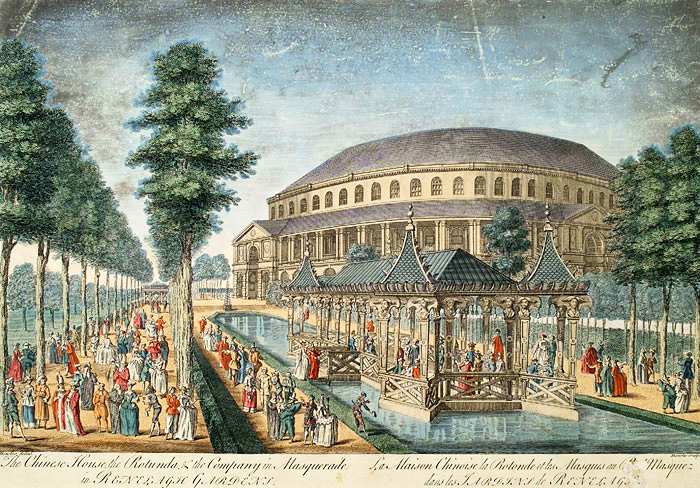
ranelagh_gardens_eighteenth_century_original

The Rotunda at Ranelagh, 142 feet in diameter, proved to be an attractive venue for masquerades. There was no stage for actors and thus it was not competition for theaters. After a very successful “Jubilee Masquerade in the Venetian manner,” on 1st May 1749 to celebrate the peace in that year, “it was determined to repeat it in the form of a subscription masquerade.” Horace Walpole writes:

When you entered you found the whole garden filled with masks and spread with tents, which remained all night very commodely. In one quarter was a maypole dressed with garlands, and people dancing round it to a tabor and pipe and rustic music, all masked, as were all the various bands of music, which were disposed in different parts of the garden, some like huntsmen with French horns, some like peasants, and a troupe of harlequins and scaramouches in the little open temple on the mount. On the canal was a sort of gondola adorned with flags and streamers, and filled with music rowing about. All round the outside of the amphitheatre were shops filled with Dresden China, Japan, &cc., and all the shopkeepers in mask. The amphitheatre was illuminated, and in the middle was a circular bower composed of all kinds of firs in tubs, from twenty to thirty feet high, under the orange trees, with small lamps in each orange, and below them all sorts of the finest auriculus in pots and festoons of natural flowers hanging from tree to tree. There were booths for tea and wine, gaming-tables, and dancing, and about two thousand persons. In short, it pleased me more than anything I ever saw.

The Inauguration of the Pantheon in Oxford Street (1772)

sophia-baddeleyIt was rumored that the managers were set against inviting women with less-than-stellar reputations, i.e. actresses and demimondaines. Sophia Baddeley was one such actress with high connections—she was Lord Melbourne’s mistress at the time—and a score or so of her supporters assembled at Pall Mall and escorted her chair to St. James’s Street, where they were joined by even more fine gentlemen from White’s. The procession continued all the way to the Pantheon, whereupon they took out their swords and frightened the porters who were ordered to deny her entrance. This allowed the triumphant Sophia to march into the “fine room under a long canopy made by the crossed swords of her gallant escort.” Eventually, the managers made their apologies to her, and two duchesses “came forward to express to Mrs. Baddeley the pleasure it gave their graces to welcome such an ornament to the assembly.”

Mrs. Cornelys of Carlisle House

was the second person to make a business of organizing amusements for the upper classes. Her story was featured in an earlier post on this blog. Click here to read more.

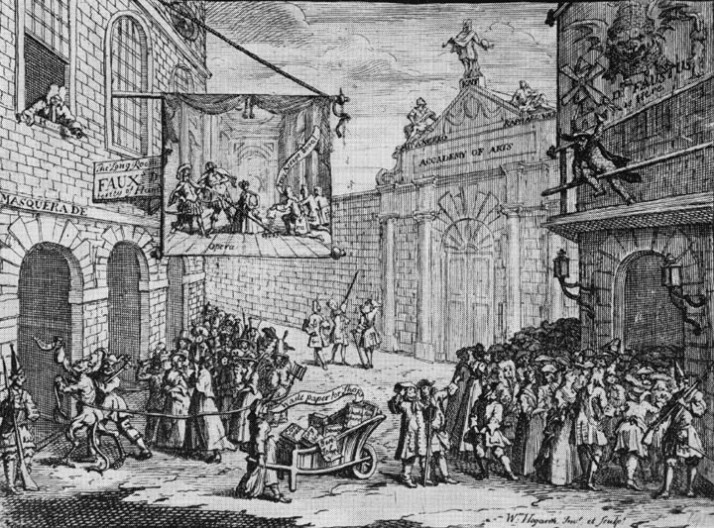
hogarth-masqueradesoperas

The Bad Taste of the Town (also known as Masquerades and Operas) is an early print by William Hogarth, published in February 1723/24. The small print mocks the contemporary fashion for foreign culture, including Palladian architecture, pantomimes based on the Italian commedia dell’arte, masquerades (masked balls), and Italian opera.


Amusements of Old London series

Lady P and Susana Visit Vauxhall Gardens (Part I)

Agatha Tate, Lady Pendleton

Agatha Tate, Lady Pendleton

Susana: Readers, I am elated to report to you that Lady Pendleton has finally granted my wish to travel back in time with her. We are going to Vauxhall—a place that no longer exists in this century—and I am going to actually stroll down the Dark Walks and see for myself what is going on behind the bushes.

Lady P: Now Susana, you will promise to behave as a proper lady would or there will be no trip to the past for you. Ever.

Susana [rolling her eyes]: Whatever you say, your ladyship.

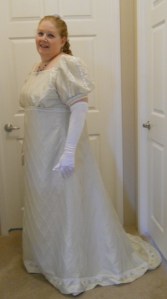
Lady P [inspecting Susana’s clothing]: The gown your mother made you is unexceptionable, I suppose. The hair will have to do since there is no time to have Izzie [her abigail] work her magic on it.

Susana [peering into the mirror]: I think it looks fabulous with the ringlets piece added.

gown427-4Lady P: Of course you do. [Shakes her head.] Now, as for the accent… I suppose I can pass you off as American as I did with Helena [from A Home for Helena], but it would be best if you said as little as possible and allowed me to do the talking.

Susana [eyes widening]: Now wait a minute…

Lady P [straightening her posture]: Do you wish to go or not?

Susana: Yes!

Lady P: Then…

Susana: I promise to follow your lead, my lady. [Aside] This is going to be great! I’ll tell you all about it when I get back!

***

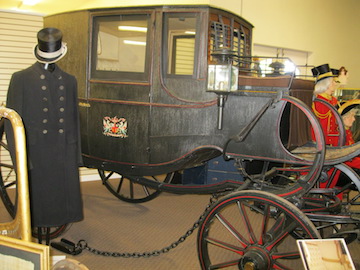
I wanted to arrive by boat, but her ladyship clearly did not trust me not to overturn it and cause a scandal, so we went by carriage instead. Although it was shiny and black and carried the Pendleton crest, it was nothing like the Dress Coach owned by the Emperor Franz Josef that I saw a few weeks ago at the Carriage Museum here in Florida. The interior was a lovely purple velvet, and the seats were reasonably comfortable, although the ride was definitely jerkier than riding in an automobile. The springs were fairly good; however, I know I’d get nauseous if I ever tried to read anything in one of these things.

Entering a carriage with a long dress and train is not the easiest thing to do, even with a set of steps and coachman to hold your hand. But I assure you that leaving the carriage is even more hazardous. My foot got caught in my train and I ended up falling into the coachman’s arms. He seemed taken aback for a few seconds, and then set me firmly upon the ground and afterward straightened his fine purple and gold coat. Lady P shook her head, looked around quickly to see if anyone was watching, and then took my arm and dragged me to the entrance.

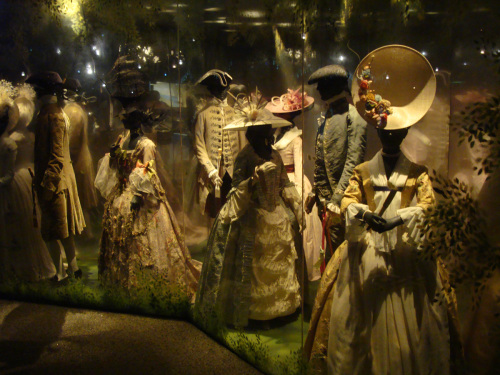
This a photo taken from a scene you can see at the Museum of London. The costumes are too early, of course, but Lady P would not let me bring a camera along.

This a photo taken from a scene you can see at the Museum of London. The costumes are too early, of course, but Lady P would not let me bring a camera along, so you’ll have to imagine 1817 costumes instead.

My first impression of Vauxhall Gardens was the brilliance of the thousands of lanterns in the trees. I briefly wondered how long it took someone to light all those lanterns and how safe it was to have burning flames in trees, but then someone bumped into me and I became aware that the place was teeming with people. People of all sizes and shapes and social classes. Elegantly-dressed ladies and gentlemen with canes and reticules strolled on the same ground as working-class folk in their Sunday best. Some were dancing in front of the orchestra building while others stood on the outskirts chatting and laughing, some leaning on trees. I stood there, mesmerized by the colors, sounds, and smells until her ladyship informed me that she had bespoken a supper-box.

“Are we going to have shaved ham as thin as paper?” I asked eagerly. Everyone knows that the food at Vauxhall was overpriced. That was how they made a profit. Nothing has changed in that regard. In modern times you still pay unreasonable prices for food at airports and amusement parks like Cedar Point.

A nearby gentleman eyed me suspiciously, and Lady P reminded me that I had promised to keep talking to a minimum.

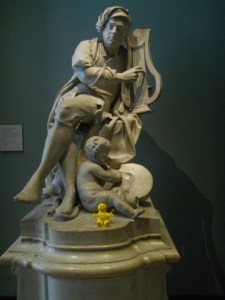
Squidgeworth and the Handel statue that used to sit in Vauxhall Gardens

Squidgeworth and the Handel statue that used to sit in Vauxhall Gardens

The supper-box was simply a covered nook supplied with a table and benches on three sides. The supper-box paintings were long gone, as I knew from having blogged on Vauxhall for nearly a year. I had seen some of them at the Victoria & Albert Museum, as well as the statue of Handel. I craned my neck to look around for it, but couldn’t remember where it was in 1817, since it had been relocated many times its ±200 years in the gardens. The waiter (nattily dressed in fawn breeches with a turquoise shirt and purple waistcoat) who promptly appeared to take our food order said it was in the eastern alcove on the ground floor of the Orchestra. He seemed surprised to hear that I was interested in seeing it. I guess it was old and boring to people of 1817. I seemed to recall that it was removed from the Gardens soon after. Well, tastes change over time. What attracted people in the 17th century seemed tame by the 19th century. Vauxhall lasted for so much longer than others did primarily because its owners continually sought to re-invest their profits into upgraded facilities and entertainment.

Isaac Cruikshank, A Country Farmer & Waiter at Vauxhall. A farmer in country dress, on his first visit to Vauxhall, has ordered ham in expectation of a plateful of English gammon. When the waiter brings him the notoriously thin slices that were Vauxhall ham, the farmer is furious.

Isaac Cruikshank, A Country Farmer & Waiter at Vauxhall. A farmer in country dress, on his first visit to Vauxhall, has ordered ham in expectation of a plateful of English gammon. When the waiter brings him the notoriously thin slices that were Vauxhall ham, the farmer is furious.

Mr. Jackson (the waiter) was much more eager to tell of us Madame Saqui’s upcoming performance on the tightrope. He told us she had been a personal favorite of the former emperor Napoleon Bonaparte and had even crossed the Seine River on a tightrope. She had been performing at Covent Garden in the past year since the war with France ended, and the proprietors were over the moon to have snagged her for Vauxhall. I wanted to get up and head over to the venue immediately, but her ladyship insisted I remain until the food arrived, since she had been required to pay for it first (Waiters were more like independent contractors. They had to pay for the food themselves when they picked it up from the kitchen.)

We had plates of ham and chicken, cheese, salad, and a plate of cakes and custards, with wine to drink, which I did with good humor, even though I don’t normally drink wine. Any Regency author worth her salt should know that you don’t go around ordering water in that time period, since it wasn’t safe. Since I don’t like the taste of wine, I didn’t mind that it wasn’t of good quality. Lady P winced when she drank it, though. But she said it was definitely better than the cooking wine she had been reduced to drinking in my alcohol-free kitchen in Toledo. [She was quick to learn to pick out the good wines at the nearby liquor store, though.]

orchestra

The music varied from military tunes to softer ballads and classical music, much by Handel, as Lady P informed me (being not terribly knowledgeable about music). “Cherry Ripe” and “Lass of Richmond Hill” were among them. It was simply fascinating to sit there eating and listening to the music and watching all the people enjoy the atmosphere. I had to pinch myself to make sure I was really there. In Vauxhall Gardens. In 1817. With real Regency-era people. Wow. Just wow.

More next week, same bat-time, same bat-channel!

Lady P and Susana Visit Vauxhall Gardens, Part I

An Evening at Vauxhall Gardens, Part II

An Evening at Vauxhall Gardens, Part III
An Evening at Vauxhall Gardens, Part IV

An Evening at Vauxhall Gardens, Part V

Amusements of Old London: The Tea Gardens

Amusements of Old London

William B. Boulton, 1901

“… an attempt to survey the amusements of Londoners during a period which began… with the Restoration of King Charles the Second and ended with the accession of Her Majesty Queen Victoria.”

An “unbroken tradition of al fresco entertainment in London over a period of two centuries*

After perusing through old publications, letters and memoirs, advertisements, diaries, and even through the records of police courts and licensing authorities, Boulton concludes that the heyday of the outdoor entertainment in London was from the time of Charles I to the end of the 19th century.

…the fireworks and the “twenty thousand additional lamps” of the Vauxhall and Cremorne… had less to do with the success of those famous institutions than the bad food and worse liquor, which Londoners are ever ready to pay for at exorbitant rates if only served out of doors.

London map 1700: https://upload.wikimedia.org/wikipedia/commons/5/52/17th_century_map_of_London_%28W.Hollar%29.jpg

When George the Third came to the throne, London, including Westminster, was bounded by Oxford Street and Holborn on the north, by the river on the south, by the outer boundary of the city on the east, and by Hyde Park, Arlington Street, and St. James’ Street on the west. All the rest of modern London was suburban merely, or open and pleasant country interspersed with wild heaths, and dotted with ancient villages.

seutter_1750_london_m

London, 1750

It was in and about a town of such dimensions then, and with such surroundings, that the al fresco entertainment took origin and developed, a town thickly populated and stuffy, it is true, the bulk of whose inhabitants lived and died with the limits of their own streets, but still a town whose innermost slum was within easy walk of a delightful country…

It was the citizens of such a town, sober merchants and shopkeepers, apprentices, sempstresses, and artisans who worked continuously, but leisurely and without much stress, during the week and spread themselves over an area of many square miles on Sundays, who formed the chief patrons of the al fresco  entertainment. The lawyers and military men… supplied their quota of course, and the aristocracy came to most of the al fresco entertainments at one time or another, but merely as incidental visitors.  [He mentions that Vauxhall and Ranelagh were the favorites for the aristocracy, but that they will mentioned in another chapter.]

London map 1890: http://www.majestymaps.com/wp-content/uploads/2014/01/1890_Bacon_Map_of_London1.jpg

Spring Garden

Spring Garden at Charing Cross was “practically a part of [Charles I’s] own gardens at Whitehall. In 1634, the bowling green was a major attraction, and apparently one could pay six shillings and drink wine and eat cold meat all day under the trees. Plagued by quarrels and other scandalous behavior, the Spring Garden was finally closed down by the Puritans in 1654, although it opened up almost immediately following the death of the Lord Protector.

This collation, indeed, was the great attraction of the place. It was difficult in those days to get a meal anywhere away from home, the coffee-houses had not yet arisen, and most of the taverns lay far eastward of Charing Cross. Great people then lived either in the city or just out of it, and Spring Garden, with its luncheon, was a convenient halting-place for refreshment on the way to, or returning from Hyde Park, where the promenade of the ring, the foot and chariot races, were at this time great attractions.

Apparently Charles II’s ministers decided the property could be made more profitable by building houses there, so “the name Spring Garden was adopted by the New Spring Gardens at Lambeth” (which became Vauxhall Gardens).

Mulberry Garden

The Mulberry Garden, which covered the site of the present Buckingham Palace and Gardens, was “of the true class of open-air entertainment… Half the dramatists of the Restoration make their characters move in its walks and arbours, and eat its tarts and cakes…” The Mulberry Garden was closed in 1674, when Vauxhall took charge of London’s al fresco tradition.

Islington Spa (New Tunbridge Wells)

In earlier times, the area around Holburn was bubbling with springs “charged with ‘chalybeate’ or ‘sulphate,’ as the doctors of that day believed and provided an excuse for a dozen or more of ‘spas,’ and ‘waters’ or ‘wells,’ each with its gardens and long room and special body of patrons… who certainly enjoyed the diversions of the place.”

Islington Spa, 1749

Starting in around 1685, Islington Spa became a popular watering-place. Besides the medicinal attractions of its waters and a doctor to administer it, it offered “the amusements of a tea garden,” including lime trees, coffee-house, dancing saloon, raffling shop, and gaming tables. Patrons ranged from seamstresses to aristocrats, and, of course, the pickpockets and prostitutes followed. Its popularity rose further after the Princesses Caroline and Amelia became regular visitors.

Lady Mary Wortley Montagu wrote: “New Tunbridge Wells is a very pretty and romantick place, and the water much like Bath water, but makes one vastly cold and hungary.”

Islington Spa ended in 1840 when it was overtaken by construction of streets and buildings.

Bagnigge Wells

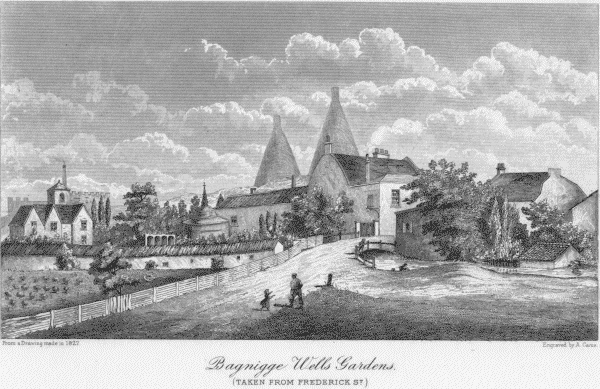
Bagnigge Wells began as Bagnigge House, the country residence of Nell Gwynn, “where King Charles the Second and his brother James delighted at times to take breakfast with that lady.” In 1759 the current owner, a Mr. Hughes, discovered that the reason his pansies and carnations did not thrive was due to the mineral content of two springs of water underneath the surface. Apparently, the water produced “a kind of giddiness, and afterwards a propensity to sleep if exercise not not interposed.”

bagnigge1

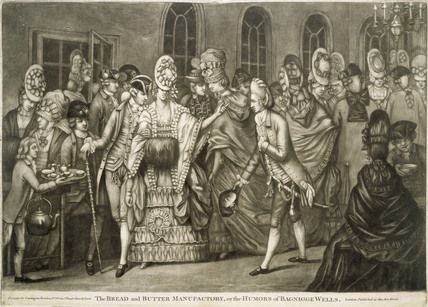
The programme of amusement at this cockney paradise was very typical of the London al fresco in its prime. In the morning the place was chiefly at the disposal of the invalids who believed in the efficacy of its waters, and who, at the height of its vogue, were to be found at Bagnigge in hundreds. Many of these partook of the early breakfast which was provided for the austere ones who drank the waters in an orthodox manner on an empty stomach. A good organ, presided over by Mr. Charles Griffiths, provided music in the pump-room for the gouty and the lame: the pump-room with its panelled walls, low ceiling, its armorial bearings, its bust of Nell Gwynn in a niche in the wall… and its general pleasant flavour of antiquity. As the day wore on the invalids withdrew and the place was prepared for another class of customers. The citizens, their wives and daughters, came for their afternoon outing; the long room if the weather threatened, and the arbours if the sun shone, were filled with sober parties of shopkeepers or with boys and their sweethearts, drinking tea and eating the bread and butter and the buns baked on the ground for which the place was famous. Negus was another of the products of Bagnigge held in much favour, and there were cider and ale for the more jovial spirits who smoked under the shade of the Fleet willows and watched the games of skittles and Dutch pins…

bagnigge-bowles

Its nearness to the city, however, made it “the paradise of the city matron” on Sundays.

Thy arbour Bagnigge, and the gay alcove

Where the frail nymphs in amorous dalliance rove,

Where ‘prentice youths enjoy the Sunday feast,

And city madams boast their Sabbath best,

Where unfledged Templars first as fops parade,

And new made ensigns sport their first cockade.

Mr. Churchill, 1779

There was some attempt at a promenade in fine dresses on Sundays, where aspiring young men about town, who were not quite the mode, graduated in deportment for the brighter glories of Ranelagh and Vauxhall. There came of course the usual hangers-on of respectability, the ladies of doubtful reputation, the “bloods of humour,” copper captains, and even on occasion famous highwaymen, like the eminent John Rann, or Sixteen-stringed Jack, who was wont to display his hectoring graces in the gardens. Such incidents, however, gave a pleasant adventurous interest to a visit to Bagnigge; a highwayman, so long as he escaped the justices, was a not unpopular character, and the ordinary citizen lost no caste in taking a glass with one of these heroes at a tea garden or tavern.

Marylebone Gardens

The Rose of Normandy began as a small tavern famous for its bowling-greens. Samuel Pepys and Sheffield, the Duke of Buckingham frequented the place in the late 17th century. The Rose also occasionally featured concerts on the king’s birthday, illuminations, acrobatic exhibitions, and other attractions. In 1738, the proprietor re-named it Marylebone Gardens and styled it as al fresco entertainment, building a large orchestra, an organ, and a building for balls and suppers. Marylebone had a reputation of being a pleasant and respectable place to enjoy the outdoors, eat, and listen to the music of Handel and Arne.

Marylebone Gardens Restrike Etching by J. Donowell http://www.easyart.com/scripts/zoom/zoom.pl?pid=37664

Marylebone Gardens Restrike Etching by J. Donowell http://www.easyart.com/scripts/zoom/zoom.pl?pid=37664

Harmony and decorum were the features of Marylebone Gardens at its prime, broken rarely by a quarrel under the trees, or the rudeness of a royal visitor like the burly Duke of Cumberland… the gentry who had country houses in the village… could send their children and their nursemaids in the summer days and evenings without fear of untoward molestation… Not that Marylebone was without its mild excitement on occasion. It is recorded that pretty Miss Fountayne, a relation of “Dr. Fountayne’s, a dean of the Established Church,” was one day taking the air in the gardens when she was saluted by a young man of a gallant bearing, who boldly kissed her before all the quality. The lady started back shocked and surprised, as in duty bound. “Be not alarmed, madam,” said the gentleman, “you can now boast that you have been kissed by Dick Turpin.”

White Conduit House

…had its “pleasing walks prettily disposed, its “genteel boxes,” with paintings in the Flemish manner, its alcoves let  into its clipped hedges, and its avenues of shady trees, and was the delight of numbers of Londoners for a century.

White Conduit House, 1749

White Conduit House, 1749

In 1754, Mr. Bartholomew, the proprietor, “provided bats and balls for his customers” to play the game of cricket in the adjoining meadow and therefore laid “the foundations of the vast organisation of the modern game.”

Belsize House

…was a country mansion opened in 1720, “with a park wilderness and garden a mile in circumference ‘filled with a variety of birds which compose a most melodious and touching harmony’… Cakes and ale were much in evidence… and foot and galloway races ‘six times round the course.’ In 1726 they ‘hunted a fat doe to death with small beagles,’ when sportsmen were invited ‘to bring their own dogs if not too large.’

belsize-house

Belsize House, 17th century

Hampstead

was famous for its wells and gardens, and even had a clergyman available for marriage-minded couples who could not afford a trip to Gretna Green. Mr. Samuel Rogers “danced minuets in his youth and met a great deal of good company.” In those days, a Londoner required a stage coach to arrive there.

Royal Well Walk, Pump Room, 1850

Royal Well Walk, Pump Room, 1850

South London

“The attractions of the South London districts were less simple and less respectable. With an unconscious humour, many of them advertised their mineral waters in competition with the spas of the north,” although it was more likely the waters pumped came from a huge marsh. “But their main attractions were more or less feeble imitations of the glories of Vauxhall, and their patrons were, speaking gnerally, of a less innocent cast of mind and less easily amused than the citizens who flocked northward to Islington or Hampstead, or westward to Marylebone.”

Some of these were Cuper’s Garden, Finch’s grotto, Bermondsey Spa Gardens, Helena Gardens, Belvidere Gardens, the Dog and Duck, St. George’s Spa, Strombolo House. and Florida Gardens.

The decline of the tea gardens

Many of these places fell victim to the urban growth of the city, exchanging the country meadows for buildings of brick and mortar. However, Mr. Boulton opines that their decline:

followed a change in the taste of the people themselves, that taste itself an inevitable consequence of an increasing population and an increasing prosperity. The simple pleasures which satisfied the London of Charles the Second left the London of George the Third unmoved, and the pleasure-seeking citizen of the London of William the Fourth had a soul altogether above the placid joys of the London of George the Third.

The longevity of Vauxhall can be attributed to the proprietors’ constant upgrading of attractions. While later visitors might not be enticed so much by the walks among the shrubbery, they could be attracted by the balloon ascensions and other circus-like events. Venues whose programs did not change with the times eventually failed and were taken over by urbanization.

The careers of the less famous gardens of the south and the west were almost invariably concluded in even less reputable circumstances, where the conduct of the raffish audiences attracted by their debased pleasures brought upon them the interference of the authorities.

*Vauxhall and Ranelagh Gardens are not included here, since the author deems them worthy of a chapter of their own.


Amusements of Old London series

Amusements of Old London: Hockley in the Hole

Amusements of Old London

William B. Boulton, 1901

“… an attempt to survey the amusements of Londoners during a period which began… with the Restoration of King Charles the Second and ended with the accession of Her Majesty Queen Victoria.”

Hockley in the Hole, Clerkenwell

screenshot-2017-01-02-12-04-32

Hockley was a venue which provided entertainments reminiscent of Elizabethan times, such as bear- and bull-baiting, sword- or cudgel-bearing gladiators, and such. It was, in the early 18th century,

the headquarters of… the “fancy,” … the organisation of rather low caste sporting characters who devoted themselves to forms of sport… more or less frowned upon by the respectable and law-abiding.

Hockley had “an atmosphere of blackguardism about [it]”. While its claims to represent the tradition of the old Bear-Garden of Queen Elizabeth I at Bankside were questionable, it did receive enough patronage to rank it as “one of the chief amusements of the town for the next half century.”

Animal-baiting (Mondays and Thursdays)

Queen Bess herself was such a “grand connoisseur” of the sport that she forbade the acting of plays on Thursday, which was the day specified for bear-baiting at Bankside. By the time of the Stuarts, however, it had descended into the ranks of “lower entertainments,” but was still “patronised more or less furtively… by persons of high station.”

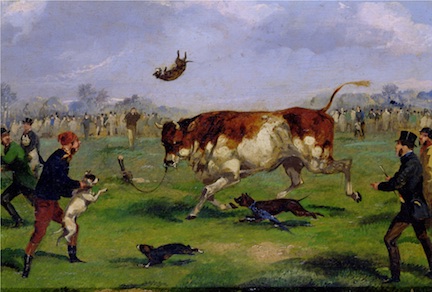
Both bulls and bears were chained to a staple in the arena or pit by a chain of about fifteen feet in length, so that the defending animal had relative freedom of movement over a circle of thirty feet. “They… are fastened from behind… and worried by great English bulldogs, not without great risque from the horns of the one and the teeth of the other.” The dog, attended by his owner, was held in front of the chained animal by the ears until he was wild with fury, and then let go.

An experienced bull

kept his feet close together to avoid any attack from beneath, and presented a horn at the advancing enemy. The horn… was either blunted at the point or provied with a sheath which minimised the risk of a gore… The old bull… relied chiefly upon getting the dog in the hollow of these long horns… and upon disabling it by a toss in the air and a drop of perhaps thirty feet on the hard floor of the pit. The experienced dog knew the danger, and avoided it as much as possible by crouching on the ground in the preliminary fencing for an opening, which usually preceded the rush for the throat. If the bull made his coup, the dog went flying into the air, often into the boxes twenty feet above the pit, as when Mr. Evelyn saw one dropped into a lady’s lap… in 1670.

PFA109529 Bull Baiting (oil on paper laid on panel) by Alken, Samuel Henry (1810-94); 17.8x26 cm; Private Collection; Photo © Bonhams, London, UK; English, out of copyright

PFA109529 Bull Baiting (oil on paper laid on panel) by Alken, Samuel Henry (1810-94); 17.8×26 cm; Private Collection; Photo ¬© Bonhams, London, UK; English, out of copyright

Bear-baiting was more dangerous to the dog and thus was more rarely seen. Variations of the sport might have two dogs attacking a bull, as well as animals such as leopards, tigers, and horses (including one ferocious horse owned by the Earl of Dorchester who had killed other horses and was deemed untamable).

bear_baiting

Note: The Cruelty to Animals Act of 1835 forbade the keeping of any house, pit, or other place for baiting or fighting any bull, bear, dog, or other animal.

Prize-fighting with weapons (the rest of the week)

The prize-fight of Hockley in the Hole “was organised solely for the purposes of exhibition and the resulting gate-money” and “performed with lethal weapons, or with cudgel and quarter-staff.” The meetings between participants (“gladiators”) were organized in advance and announced with handbills such as this one from 3rd July, 1709:

At the Bear Garden at Hockley in the Hole, near Clerkenwell Green, a trial of skill shall be performed at the noble science of self-defence, on Wednesday next, at two of the clock precisely.

I, George Grey, born in the city of Norwich, who have fought in most part of the West Indies—viz., Jamaica and Barbadoes, and several other parts of the world—in all twenty-five times, and upon the stage, and never yet was worsted, and being now lately come to London, do invite James Harris, to meet and exercise at these following weapons, viz., backsword, sword and dagger, sword and buckler, single falchion and case of falchions.

I, James Harris, master of the noble science of self-defence, and formerly rid in the Horse Guards, and have fought an hundred and ten prizes, and never left the stage to any man, will not fail, God willing, to meet this brave and bold inviter at the time and place appointed, desiring sharp swords and from him no favour.

No person to be upon the stage but the second. Vivat Regina.

While the swords were sharp and blood flowed freely,

there was never a serious attack with the point, and there is only one record of a single death as a result of half a century of fighting, and that an accidental one from blood-poisoning. No padding was used, apparently, no masks or jackets, which are necessary even in foil practice to-day, and yet it is certain that great injury was as a rule avoided.

cards-by-hogarth

Mr. Figg’s Establishment on Oxford Road had no animal-baiting and was patronized by a higher class than than Hockley. Figg’s specialized in self-defence and prize-fighting, of which Figg himself was the acclaimed master.

Female prize-fighters were popular in nearly all of these establishments, including Figg’s, and “supplied a pleasant change from the ordinary attractions of the place. The challenges were certainly arranged beforehand like [those of the men], and “words” referred to by Elizabeth [in the handbill] were no doubt exchanged over a friendly pot of porter at some favourite house of call near the Fleet Ditch… The artificial character of the quarrel and of its preliminaries, however, does not appear to have diminished the realities of the encounter.

[Hockley’s] final overthrow was the result of the growth of London and the municipal improvements which accompanied it. The whole district was drained and its level raised in 1756, when it is probable that the bear garden disappeared. The cult of the London prize-ring had already supplanted the attractions of its contests with sword and quarter-staff, and its bull and bear baitings found patronage further afield.

Amusements of Old London series

Susana’s Adventure at the Carriage Museum

Grand Oaks Resort

Weirsdale, Florida

weirsdale-map

If you think you must travel across the pond to find great historical inspiration, you would be wrong! I’ve been living half the year in Florida for several years now, and just this month discovered the existence of this fabulous museum—only a half-hour drive away!

I travel to the UK every year and have seen some of the best museums and historical sites out there, and I have to rank this one right up with them. The London Transport Museum in Covent Garden is wonderful, but honestly, it doesn’t hold a candle to this one, at least in terms of carriages. The Carriage Museum here has more types of curricles and phaetons and landaus and broughams than I have ever seen in one place. I will definitely be returning here often.

carriagehorsebarb3-copy

We had a lovely drive around the 340-acre property lined with scenic pastures and oak trees in a carriage drawn by two beautiful Clydesdale horses. Afterwards, we browsed in the gift shop and had lunch in the bistro. There is a luxurious spa on site that people come from all over central Florida to enjoy.

The Grand Oaks Resort is also a major center for equestrian events for spectators and competitors, including polo and dressage. Also offered are first-class boarding and training facilities. (Heather King would love this place, especially the dressage competition in mid-January!)

The Grand Oaks Resort is only an hour drive from Orlando, so if you’re heading this way to take in the Disney and other attractions, consider setting aside a day in the countryside away from the crowds. You won’t be disappointed, and neither will your family.

1874 Omnibus

1874 Omnibus

From MuseumsUSA:

The Grand Oaks Museum is home to one of the world’s largest private collections of carriages and equine artifacts. Step back in time and enjoy the elegance and pageantry of over 160 European and American Carriages, including the elaborate 1850 Armbruster Dress Chariot once owned by Emperor of Austria Franz Joseph, and his wife, Elisabeth. Our Museum uniquely offers a glimpse into the history of the relationship between man and horse and clearly defines the manner in which the horse has helped shape the history of man.

dresscoach4-copy

1850 Armbruster Dress Chariot once owned by Emperor of Austria Franz Joseph, and his wife, Elisabeth

Livery

Livery

Since 1995, The Grand Oaks Museum has opened its doors to the public with an extraordinary display of historical artifacts, while educating visitors with tours, seminars and special programs in a live setting. Take a journey through time into the world of man’s most vital mode of transportation of past centuries. Museum visitors have a rare opportunity to see an English Omnibus, a horse-drawn fire fighting apparatus, a World War I supply wagon, the colorful and ornate Sicilian Caretta and a Dutch Tikker. This Tikker is one of a pair; the other was displayed by Count de Hamptinne in the Hotel Particulier in Ghent, Belgium. And that’s only the beginning of what this Museum has to offer.

Website

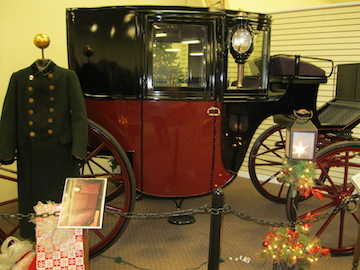
The Brougham (1895)

brougham-copy

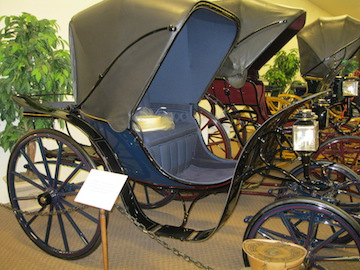
1895 Brougham

Inspired, if not only designed by Lord Brougham, a statesman of the early 19th century, this lovely vehicle seats 2 passengers facing forward. The low-slung body affords easy entry to this elegant coach luxuriously upholstered for the comfort of a noble gentleman. The interior was often fitted with ashtrays, a clock, and mirrors.

Coachman-driven, the passenger is able to communicate with the driver through a tubular whistle hanging on the interior of the carriage. A system of long and short whistles would inform the driver to turn left, right, stop, or proceed on homeward.

Many Broughams were driven to a strong single horse; but others were set up for a pair, as this one is.

The Clarence (1897)

The Clarence, 1897

The Clarence, 1897

Like the Brougham, the Clarence is a coachman-driven vehicle, but this larger carriage affords seating for four people, two facing forward, and two riding backward. Fitted with lamps for evening use, it would carry a gentleman and his friends to the opera or a formal dinner party.

This larger vehicle required a pair of horses, and a footman in livery would ride next to the coachman to assist when passengers entered or exited the carriage. He would also “head” the pair if a vehicle waited while the party enjoyed their evening’s activities. Blankets for the horses would be carried in the boot under the coachman’s seat.

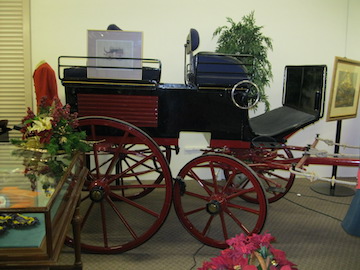
The Four-Wheel Dog Cart (1894)

Four-wheel dog cart (1897)

Four-wheel dog cart (1897)

This rare example of a Dog Cart seats six, rather than four, persons. Notice the bench seat between the front and back seats. It would be used for children or small adults agile enough to mount the carriage over the back wheel.

The wheel on the right side of the driver’s seat operates the friction brake on the back wheel of the carriage just below the level of the axle. This wheel design is generally seen on vehicles made in France, but is not favored on British carriages because the driver, or Whip, must shift his position on the seat in order to apply the brake.

This vehicle is set up for a pair of light horses.

George IV Phaeton (1910)

George IV Phaeton (1910)

George IV Phaeton (1910)

This vehicle was copied from one made for King George IV in 1824, who needed an “easy entry,” more stable vehicle than the highflyer of his youth. As more and more ladies began to take up the art of driving, the carriage design appealed, permitting them to mount the carriage easily despite their long skirts. The high curving dashboard obliterated the horses’ hindquarters from view, saving the lady any embarrassment and protecting fashionable clothing.

When driving classes for ladies were introduced at some American horse shows in the late 1890’s, Brewster and other builders quickly offered George IV Phaetons with their own unique features.

Spider Phaeton (1881)

spiderphaeton2-copy

Spider Phaeton (1881)

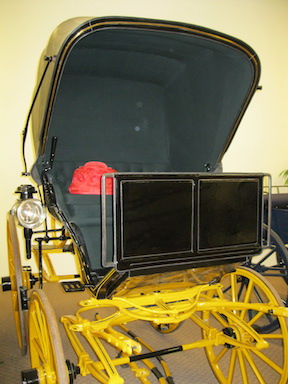
During the latter part of the nineteenth century, when park driving was at its peak, the Spider Phaeton became the perfect vehicle for showing a spirited single or pair of horses. The body of the vehicle resembles that of a Tilbury Gig, and the carriage almost always has a hood. The groom’s single seat, which is often on branch irons, is connected by an iron framework, giving the appearance of lightness and elegance. The fine lines of this vehicle would flatter a horse’s action, and the lighter weight would allow the animal free flowing movement.

With open futchels, this vehicle can be put to either a pair or a single horse.

Traveling Coach (1800)

travelingcoach-copy

Dating from the early 1800’s, this coach was used for long distance travel before the advent of the railroads. A luxurious vehicle, this one seats two persons facing forward with room for two seated backwards. The seats can be made into a bed where two occupants can stretch their legs out under the driver’s seat to offer the possibility of a night’s sleep, as accommodations at inns and post houses were generally poor. The body is moving on Cee-springs and is connected to the perch with leather straps to prevent excessive side sway.

This vehicle has a driver’s seat, but these coaches were often posted to allow more room for luggage and cargo to be carried. Teams of horses would be changed out a stage stops along the way.

The patina on this vehicle simulates the look of a traveling coach which has been on the road for some time. The interior is newly re-upholstered, but the other appointments are original to the carriage. The shutters can be used to shade the occupants from both daylight and inclement weather.

Goat Caleche

Goat Caleche

Goat Caleche

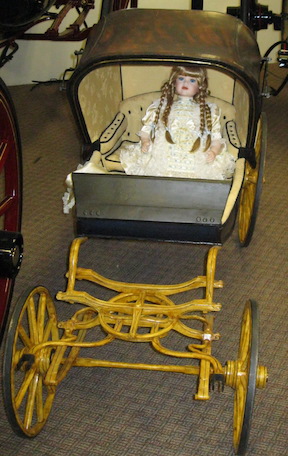
Another vehicle intended to be put to a goat which would have been led by a liveried groom, this beautiful caleche follows the same curving lines as its full-sized counterpart. The upholstery is light and rich in appearance, and the folding hood is lined in the same material.

A nanny might take her charges out for an afternoon stroll with this vehicle.

Hansom Cab (1895)

Hansom Cab (1895)

Hansom Cab (1895)

The Hansom Cab is named for its early designer, Mr. J.A. Hansom, but cabs used for public transport in the latter half of the 19th century bear little resemblance to earlier models.

The driver sits at the rear of the box, high above for a better view of the city. An unusually strong and quiet cab horse was required to pull the vehicle, as the shaft weight was extremely heavy. At rest, the driver would release the “spoke” under the carriage and ask the horse to back a few steps. This would help to pull some of the carriage weight off the animal’s back and save him for further work.

The public Hansom was thought to be an improper vehicle for a lady to use by herself. But many privately owned, immaculately appointed Hansoms, like this beautiful example, were used instead of a Brougham or a Victoria for simple trips around town.

Char-de-côté

chardelac2-copy

a Swiss invention, built for viewing scenery, especially lakes

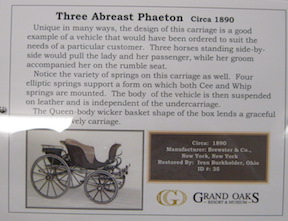
Three Abreast Phaeton (1890)

3abreastphaeton-copy

More photos on my Pinterest board.

Susana’s Adventures in England: Hanbury Hall

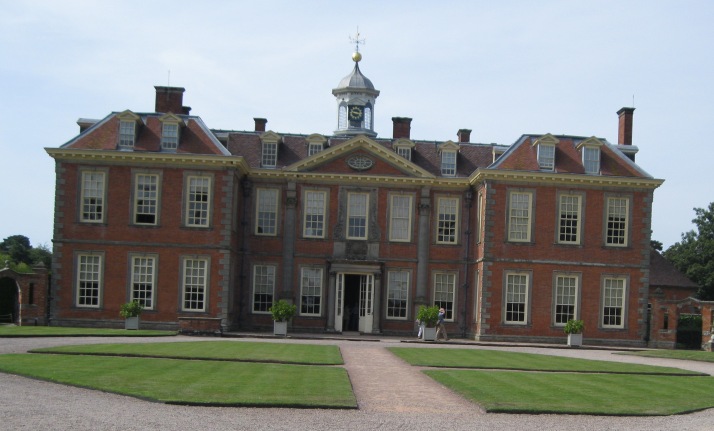
house

Hanbury Hall and the Vernon Family

Originally built by the wealthy chancery lawyer Thomas Vernon, in the early 18th century, Hanbury Hall was the home of the Vernon family for nearly 250 years before it passed into the hands of the National Trust. Hanbury is the first of the National Trust’s properties in the West Midlands to have received a “green” make-over. Today, services such as electricity and water are brought in, but the goal is for the property to be as self-sufficient as possible, much as estates were meant to do in years past, producing meat, dairy, fruit, and vegetables for their households.

The Family

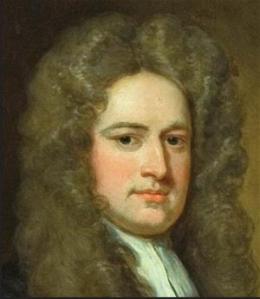
thomas-vernonThomas Vernon and his wife Mary inherited the property near Hanbury from a bachelor uncle, but it was Thomas who was responsible for acquiring the lion’s share of the 8,000 acres he left to his cousin’s son, Bowalter. Unfortunately, Bowater turned out to be a spendthrift who managed to go through much of the fortune acquired by his predecessor.

Bowater’s granddaughter Emma wed Henry Cecil, heir to the 9th Earl of Exeter, and they moved into Hanbury Hall. Unfortunately, Emma fell in love with the local church curate. When Emma confessed all to her husband, he persuaded her to break things off with the curate. But instead she ran off and escaped with her lover to Lisbon, where they were married following a scandalous divorce. Her second husband died soon, however, and Emma returned, later marrying a local lawyer.

Her humiliated first husband abandoned the place for Shropshire, posing as a gentleman farmer and marrying a farmer’s daughter. Follow his death, she and her third husband managed to regain possession, but by that time, the house had been abandoned and needed extensive repairs. Following Emma’s death in 1818, Phillips remarried and had two daughters at Hanbury Hall before moving out in 1829.

emma-and-henry

Probably the happiest inhabitants of Hanbury Hall were the Victorian Vernons, Sir Harry and Lady Georgina. Having never expected to inherit such wealth, they lived simply and happily, committed to each other and the local community.

British School; Sir Harry Foley Vernon (1834-1920), 1st Bt, MP; National Trust, Hanbury Hall; http://www.artuk.org/artworks/sir-harry-foley-vernon-18341920-1st-bt-mp-130493

Sir Harry Foley Vernon (1834-1920), 1st Bt, MP; National Trust, Hanbury Hall

Lady Georgina Sophia Baillie-Hamilton, Lady Vernon (1839-1928)

Lady Georgina Sophia Baillie-Hamilton, Lady Vernon (1839-1928)

The last Vernon, their son, Sir George, made an unhappy marriage and ended by committing suicide in 1940, thus ending the baronetcy. Eventually, the property came into the hands of the National Trust, who manages it to this day.

The House

Built of red brick, Hanbury Hall was built in the Queen Anne style, or a “William and Mary house.” Emma’s husband Henry Cecil remodeled it, creating larger rooms and enlarging the northeast pavilion, as well as landscaping the park in the style of the times. Growing up at Burghley House, he would have contact with the famous Capability Brown.

sitting-room-google

The Sitting Room was once “My Lady’s Parlour” with an attached withdrawing room. The parlour was strategically placed between the formal garden and the service quarters so that Mrs. Vernon could both entertain her guests and oversee her servants. The withdrawing room was a more private place where she could socialize with her more particular friends.

main-hall-google

fireplace-copy

Staircase paintings by Sir James Thornhill

Staircase paintings by Sir James Thornhill

With a strongly architectural appearance, the Main Hall has an air of masculine antiquity. The cantilevered staircase with its huge wall paintings by Sir James Thornhill, rises directly from one end of the hall. The aim of the wall paintings was to represent the staircase as an open-air gallery, the ceiling removed to admit the tumbling crowd of classical gods and goddesses.

estatemap2-copy

The Smoking Room, set at the back of the house, was a convenient location for conducting the business of overseeing the estate. Paintings of the estate and one of Bowater Vernon hunting there line the walls.

Dining Room

Dining Room

The ceiling of the Dining Room is decorated with classical paintings by Sir James Thornhill, while portraits of the Vernons line the walls.

Sir James Thornhill,self-portrait

Sir James Thornhill, self-portrait

Sir James Thornhill (1665/6-1734) was the only British large-scale painter of his time. His most famous work was the cupola at St. Paul’s Cathedral (1716), but in 1705, he was still taking smaller commissions such as this one.

drawingroom-copy

The Drawing Room takes its name from the 18th century habit of the ladies “withdrawing” from the dining room, leaving the men to discuss business and personal matters over port and tobacco.

blue-bedroom

The “flying tester” bed in the Blue Bedroom is remarkably well-preserved. The worsted damask hangings date from the 1770s and have kept much of their original color since they have not been exposed to much ultraviolet light.

benchseat-copy

The Gothick Corridors are named after the wallpaper. The Gothick style romanticized the history of Northern Europe and was inspired by wild nature, tending toward strong colors.

Cedar Bedroom (Lady Georgina’s)

The Cedar Bedroom was Lady Georgina’s bedroom. She was married to Sir Harry Vernon in 1861 (although the baronetcy came along later).

The governess's bedroom

The governess’s bedroom

The Nursery is displayed as the Victorian Vernon children would have known it. The Day Room was a room for the governess, away from the children.

Hercules Bedroom

Hercules Bedroom

The Hercules Bedroom and Dressing-Room still appear as they must have in the 18th century. The windows have a superb view of the gardens. The Hercules Dressing-Room has a corner chimneypiece topped with a figure of Hercules.

Long Gallery

Long Gallery

The Long Gallery is actually found in a separate building, probably because it was once attached to an earlier building on the site. In Thomas Vernon’s time, it was a gentleman’s study. By Bowater Vernon’s time, it had become a picture gallery.

The Formal Gardens include the Sunken Parterre, the Fruit Garden, the Wilderness, the Grove, the Orangery, and the Bowling Green.

parterregarden-copy

Parterre Garden

In order to sustain a house like Hanbury, there had to be large areas given over to the serious production of food. “Snobs” Tunnel” led from the Walled Garden to the house, preventing the gardeners from being seen by the family when delivering produce. Behind the “polite” garden building of the Orangery lies the Mushroom House. The Victorian slate beds are still used to produce mushrooms today, as well as forcing rhubarb. There is also a 1750s Ice House, filled by ice gathered from a shallow ‘freezing pool’ on winter nights. An orchard has been largely replanted with over 136 apple trees. Beehives and chickens have also been introduced in the Walled Garden and Orchard.

Within the Park there is a wealth of archaeology from the Iron Age onwards. Traces of medieval ridge and furrow cultivation still exist, and to the south lie the remains of the vanished medieval village of Moreweysend.

Hanbury Hall and Garden, the National Trust, ©2010

shepherdess

With thanks to Heather King for being so kind as to drive Cora Lee and me to visit Hanbury Hall, along with Roxy the Quadralingual Dog!

More photos of Hanbury Hall on my Pinterest board.

Jude Knight: Revealed in Mist

Revealed in Mist and the Sex Trade

In my new release, my heroine is a spy, assigned to work in the house of a courtesan. Courtesans were at the apex of the sex trade: highly-skilled entertainers who traded on their looks and sex appeal to earn a living. The book also includes a visit to a brothel, in the excerpt I share below this historical note.

At the time I write about, according to Dan Cruickshank’s The Secret History of Georgian London, one in five women in London earned income from the sale of sex. He called London:

a vast, hostile, soulless, wicked all-devouring but also fatally attractive place that makes and breaks, that tempts, inflames, satisfies, yet corrupts and ultimately kills.

15357069_723570637792505_509043981_n

Sex workers—defined as those who made some or part of their living by selling sex—ranged from those offering a quick bang up against a wall in a slum alley to those accepting gifts from hopeful admirers while mixing on the fringes of Society. And everything in between.

Most prostitutes seem to have been working class girls who, having surrendered their virtue to a man of their own class, sought some profit from their lapse. One woman said:

she had got tired of service, wanted to see life and be independent; & so she had become a prostitute…She…enjoyed it very much, thought it might raise her & perhaps be profitable

Which it was, giving her enough savings to purchase a coffee house and set up in business. For others, prostitution was seasonal, or a temporary reaction to a financial crisis. Many worked for a year or two, then took their savings home, and married or set up in business. Prostitution might also be a way to supplement income from another job; seamstresses and milliners, in particular, were so poorly paid that many of them sold their bodies as well.

Those who worked in wealthier areas, such as the West End, were more likely to find wealthy clients, and those with bit parts in the theatre, who then—as now—might be turned off in a moment if the performance did not please the audience, were well positioned to find a wealthy admirer to keep them in the style to which they would like to become accustomed.

A clever, pretty, talented girl could hope to attract a generous protector, perhaps even an admirer so besotted he would marry her. It happened, though rarely. More commonly, a man would set his mistress up in a house or apartment, and visit her when he was at leisure until he tired of her or she of him.

Many sex workers, if not most, were in less fortunate circumstances. Those running the brothels sought constantly for fresh girls to please the appetites of their customers. A girl who accepted a job, or even a bed for the night, might find herself put to work whether she wished or not, her virginity auctioned to the highest bidder, and her share of the income withheld to pay for her food, board, clothing, and whatever else the brothel-keeper could imagine.

About Revealed in Mist

15355955_723564717793097_1274535715_n

Their pasts could bring them together or separate them forever.

Prue’s job is to uncover secrets, but she hides a few of her own. When she is framed for murder and cast into Newgate, her one-time lover comes to her rescue. Will revealing what she knows help in their hunt for blackmailers, traitors, and murderers? Or threaten all she holds dear?

Enquiry agent David solves problems for the ton, but will never be one of them. When his latest case includes his legitimate half-brothers as well as the lover who left him months ago, he finds the past and the circumstances of his birth difficult to ignore. Danger to Prue makes it impossible.

Amazon • SmashwordsiBooksBarnes and Noble

Excerpt

Their first stop was, predictably, a brothel, The Dancing Dove—an expensive brothel, by the youth of the workers and the quality of the fittings, but with the same sickening smells of cheap perfume, sex, sweat, and despair as the others his work had taken him into. He allowed himself to be introduced to a statuesque redhead who was considerably older than she was made up to appear.

“Fanny, show my young friend a good time, eh?” Talbot commanded, and David followed her to one of the rooms.

He had a better use for the bed than the exercise Talbot imagined. He was beginning to feel the loss of a night’s sleep.

“Don’t bother,” he told the prostitute, as she began to unbutton her blouse. “When were the sheets last changed?”

“Maybe three days.” She looked uncertainly at the bed and back at him. “How do you want me then?”

David explained. “What I’d like you to do is sit in the chair over there and wake me in half an hour. Before we leave this room, I’ll give you double what I gave your bawd. And when we get back out there, you’ll pretend to everyone, especially my friend, that we’ve coupled.”

The prostitute frowned. “You’ll pay me. Just to sleep in the bed.”

“On the bed, but yes. Miss Fanny… or is it Miss Frances…? You’re very desirable, but I’m very, very tired, and I’d rather nobody knew…”

She nodded. “It’s Dorothea, really. But Old Hatchet-Face, who owns the place, she said that was not a good name for a whore.”

“Do you have a way to tell the hour, Miss Dorothea?” He’d removed his coat, but he laid it on the bed and stretched out beside it. No point in putting temptation in the woman’s way. He’d wake in an instant if she approached the bed to check his pockets.

She nodded. “I can hear the clock tower down the street. It chimes the quarters. It’ll be just on the half I wake you.”

“Good. Thank you.” His nose wrinkled, but he’d slept in places more rank. Willing his body to relax, he closed his eyes, and Mist was suddenly there stretched beside him. No. He was here to sleep, not to fantasise about the only woman he desired.

“Mister? Mr. Walker?” He woke to the woman’s whisper. “It’s been half an hour.”

Yes. The half was still chiming. Half an hour was not enough, but it took the edge off his weariness. He’d cope.

In the main sitting area, Dorothea poured him a glass of wine and perched on the arm of his chair, leaning against him while he waited for Talbot. Her silence money safely in the pocket she had tied to her waist under her skirt, she had obviously decided to throw herself fully into her part.

Talbot arrived some minutes later, buttoning his breeches. His companion was smiling admiringly up at him, but David caught the contemptuous grimace she passed to her companions behind Talbot’s back.

“That’s the ticket,” Talbot said to David, grinning at the way Dorothea was draped over him. “Can’t get enough of you here, can they? They should pay us for servicing them. Hah! That’s a good one. They should pay us, eh?” And he slapped the bottom of his companion with expansive glee.

“You want another round, Walker? Or what about an exotic dance? I know a place where the girls…” he gestured expansively, shaping improbably curvaceous shapes in the air.

“That sounds very exciting, Sir,” David said, back to being suitably grateful. “Is it a place we could get something to eat, Sir? All that exercise…”

“Good lad. Worked up an appetite, eh? Oh, to be young again. Come on, then, lad. The night is young. We’ll stop at a coffee house and then go on to Sultan’s Palace.”

David saluted Dorothea with a kiss on the cheek and received a warm smile in return. “Best half hour I ever spent in this place,” she told him loudly, “and that’s the truth.”

Meet Jude Knight

Jude Knight copyJude Knight’s writing goal is to transport readers to another time, another place, where they can enjoy adventure and romance, thrill to trials and challenges, uncover secrets and solve mysteries, delight in a happy ending, and return from their virtual holiday refreshed and ready for anything.

Website and BlogFacebookTwitterPinterest 

Email Follow me on Amazon