Tag Archive | Susana Ellis

Guest Author Elizabeth Bailey: A Lady In Name

The Georgian Gentleman’s Version of the Little Black Book

by Elizabeth Bailey

Women who fell from grace in the 18th Century had few options open to them. Get married with speed was top of the list. Preferably to the fellow with whom you did the deed, but frankly anyone of respectability would do.

If Darcy had not intervened to get Lydia married to wicked Wickham, as Lizzie Bennet points out, not only Lydia, but her four sisters would have been tainted and probably doomed to spinsterhood since they had no money to bribe a prospective bridegroom into overlooking the disgrace.

prostitutes0003

A page from Harris’s List

The Bennet girls were lucky. In reality, the family would likely have disowned Lydia. When Wickham tired of her, she was young and pretty enough to have found herself another protector. As time went on, Lydia might have drifted in the direction of Covent Garden where she could well have found herself portrayed in a couple of extremely frank paragraphs in the annual publication of Harris’s List of Covent-Garden Ladies.

This fascinating little volume was started in 1757 by one Samuel Derrick, as a venture to get himself out of debtor’s prison. His lively descriptions of the ladies who made themselves available for a gentleman’s amours proved so popular that he not only procured his release, but he started a phenomenon that continued until 1795.

Almost all the ladies spoken of as being of good education evidently fell into “the life”, as it was popularly called, by way of seduction and subsequent abandonment.

Like Miss Char-ton (note the missing letter, a thinly veiled anonymity) of No. 12, Gress Street, who “came of reputable parents…yet the address of a designing villain, too soon found means to ruin her; forsaken by her friends, pursued by shame and necessity; she had no other alternative…”

Prostitutes propositioning a sailor

Prostitutes propositioning a sailor

Seduction was not confined to the educated classes. There was Miss Le-, of Berwick-Street, Soho, who “was debauched by a young counsellor, from a boarding-school near town, where she was apprentice.”

Then there was Miss We-ls, of No. 35, Newman-Street, daughter of a Welsh farmer, who is described as being “as wild as a goat, of a sandy colour, her features are small, and is a tight little piece.” She was sent to London when young where “a young gentleman ingratiated him so far into her graces, as to gain her consent to make him happy by her ruin, under a promise of marriage” and then he subsequently “abandoned her to the reproaches and calumny of a merciless world”.

The majority of the ladies featured in this entertaining little black book for your pleasure-seeking young buck were in their teens or early twenties. An example is Miss Townsend, nineteen, of whom we learn that “the use of the needle first fired this lady’s imagination with the use of a certain pin”. This sort of witty euphemism abounds.

Perhaps it is not surprising that the anodyne of choice for a number of the ladies is strong liquor. Like Miss Godfrey, a commanding female, who “will take brandy with any one, or drink and swear, and though but little, will fight a good battle.”

The women are delineated in detail, depending on their particular attractions: “she is amorous to the greatest degree, and has courage enough not to be afraid of the largest and strongest man that ever drew weapon in the cause of love”. Or non-attractions, as “but a middling face, with large features, a coarse hand and arm, and in stature short and clumsy”, but she is “an excellent bedfellow”.

Their looks are described: “of a middle size, black eyes, plump made and her skin good” or another with “fine blue eyes that are delicious”. We are told about good teeth and “sweet breath”, in a day where these were rare. We hear about “yielding limbs, though beautiful when together, are still more ravishing when separated”.

Disposition is mentioned, whether she is “agreeable” or “animated with no small degree of vanity” or indeed “a pompous heroic girl, without either wit or humour”. There is a figure to suit every taste, and an accommodation for every sexual whim. We learn whether or not she has a keeper (which doesn’t stop any lady selling her favours elsewhere) and what it may cost our young man about town to enjoy her charms.

Prostitutes angling for business in the lobby of a theatre

Prostitutes angling for business in the lobby of a theatre

One or two guineas appears the norm, with here and there a more expensive luxury on offer. The genteel Miss Le- above, who was led into sin, is only seventeen and “has a piece of the termagant about her”, but she commands three or four guineas for her services, which include birching for those so inclined. While Miss – of Wardour Street, who is “but newly arrived” and “darts such irresistible glances as can scarcely fail to engage the hearts of the beholders” will not accept less than five guineas. Mrs Ho-fey, on the other hand, who “calls forth all her powers to give delight with uncommon success” will happily settle for half a guinea.

A guinea (one pound, one shilling) seems a pathetic sum to us. Yet these women were the middling class of prostitute. They could not aspire to the heights of high-class courtesans like the later Harriette Wilson, whose clients included the Duke of Wellington, but they were a good deal better off than the street corner girls who plied their trade for a few pence, or a few shillings at best.

But whether they earned a pittance or a fortune, many women ended up selling their bodies to make ends meet. There were 50,000 prostitutes in London in 1797, according to a contemporary magistrate’s account. That statistic argues a lack of opportunities for women to find gainful employment. The better bred, the fewer the options.

It’s tempting to withhold sympathy for our Covent-Garden ladies when you convert their earnings to the present day. In today’s money, a guinea is worth around £60. A lady’s maid was paid less than that in a year, and no doubt worked a lot harder. While Miss Le- with her five guineas was getting buying power to the tune of our £300 every time she lay flat on her back!

What’s more, these ladies of the night could afford to please themselves how they lived, which was more than could be said for most wives, be their husbands lord or boot boy. They lived in comfortable apartments, had a great deal of freedom, could pick and choose among their clientele, and enjoy all the entertainments on offer in the shops and theatres of the time. And all at the trifling cost of respectability.
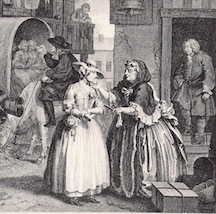
Hogarth—a bawd from a brothel enticing a country girl newly arrived in London

Hogarth—a bawd from a brothel enticing a country girl newly arrived in London

The downside was the future. The lifestyle was no sinecure. There are very few females over thirty in Harris’s List. Assuming one could avoid a dose of “the pox” or any other disease and live, what to do when the charms of youth faded? How many of them were canny enough to salt away a quantity of takings as insurance?

A few, one assumes, if they had garnered sufficient fortune, might be lucky enough to marry. Others are mentioned as having moved into brothel-keeping themselves. But the rest?

What happened to Sally Robinson, who was given five shillings at the age of fifteen to cure her of the clap “which she got from her deflowerer”? On the town in 1761, what hope had “a tall, fat girl” of any kind of living thirty years later? Or Kitty Buckley, who was one of the few older females and already 35 in 1761? She was “reported to have ruined twenty keepers” because she was “as wicked as a devil, and as extravagant as Cleopatra”. Since she had been in the bailiff’s hands about three times a year, did she end her days in prison?

While Harris’s List is a delight in many ways, there is something a little distasteful in the warts-and-all public exposure of a whole generation of unfortunate females, whose only mistake was to succumb to the lure of sensual gratification.

Besides marriage or prostitution, was there any other way out for the fallen woman? If they were lucky, or had kind and generous relatives, there was hope. Transported to another place, perhaps with an allowance, they could start a new life under an assumed name – but with the shadow of the past always ready to catch up with them.

This is of course a familiar theme in our modern take on the historical romance. Our heroine is plucked from this life of shame and obscurity by the love of a good man. What better way to compensate her for enduring such punishment for what was, to our twenty-first century thinking, perfectly natural behaviour?

As for the luscious Covent-Garden Ladies, who had the gumption to use the only means they had of making a decent living – good for you, ladies!

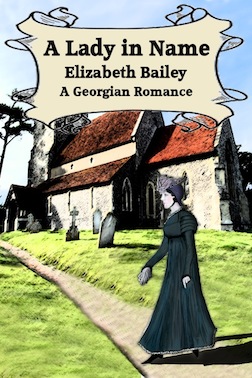
About A Lady In Name

On discovering she is the illegitimate daughter of a peer of the realm, Lucy Graydene, bereft and grieving, sets out to confront Lord Pennington with the result of his misdeeds. She finds instead his autocratic heir, Stefan Ankerville, and is dragged willy-nilly into the new earl’s unconventional family. Lucy is driven to battle for her independence while she struggles against the venom of the half-sister she never knew she had.

When the secrets of Lucy’s past begin to unravel, she is reluctantly obliged to rely on Stefan’s help. Can Lucy overcome a dangerous attraction to the earl, with whom an alliance is impossible? Or is there a faint hope of happiness in the hidden truth of her origins?

Excerpt

The hubbub of a busy inn penetrated dimly into the quiet of the upstairs parlour. It was a small apartment, designed for privacy rather than comfort, and furnished with the minimum of necessities. A chill hung in the January air, little eased by the meagre warmth from a fire in the grate, but the solitary occupant of the room appeared unaffected by this circumstance, although her aspect was far from relaxed.
Lady in Name 500 x 750She was seated on one of the straight high-backed chairs placed about the heavy oaken table at which travellers were encouraged to partake of refreshments, but she had not thought to move it nearer to the hearth. Nor was there any sign that she had availed herself of the innkeeper’s offerings to assuage either hunger or thirst. She was clad in a plain black greatcoat, and a simple black bonnet, unadorned, concealed her hair and a good deal of her face. She sat perfectly upright and still, except for her gloved hands, which she repeatedly clasped and unclasped where they lay in her lap.

From time to time, her eyes flickered to the door, as if in the expectation of its opening at any moment. And once she cast a frowning glance at the case clock on the mantel, which was dragging its way about the eleventh hour, its steady ticking pulling her out of her unquiet thoughts.

She scarcely knew what she was doing here, and the longer she waited for an arrival upon which she could place no real dependence, the stronger grew her anxieties. What had she to hope for, thrusting herself upon the notice of Lord Pennington? The man who had repudiated her three and twenty years ago was unlikely to greet her sudden appearance with complaisance. Nor could she imagine the intervening years had changed one hard-hearted enough to reject all responsibility for the consequences of his libertine conduct. Despite his cloth, Papa’s dictum, frequently uttered, had been that a leopard never changes his spots.

The remembrance caught at her heartstrings, turning a knife in the wound. Papa—so she must always think of him. She churned again with the futile yearnings that had plagued her from the instant of his uttering the fateful confession.

If only he had not chosen to reveal the horrid truth of her origins. If only he had been spared the necessity. If only the Almighty had spared him. And most painful of all, if only Lucy had been more alert to his weakness after the dreadful downpour.

It had caught him on a visit to Mrs Mimms—one of the poorest of Papa’s parishioners, her cottage situated a good five miles from Upledon vicarage with no vestige of shelter between. The dread picture of his return, his clothes dripping, his horse streaming in the deluge, had haunted Lucy from the onset of his short and fatal illness.

In vain had Papa protested at her rage of tears, his once round tones faint with effort as he drew each difficult breath. ‘My child, you could not have known. Recollect that I was well for days after the incident.’

‘Apparently well,’ Lucy had argued, fierce against the inevitable doom she was powerless to prevent. ‘You were pale, Papa. And you could not stand for long without a rest. I see it now. I should have seen it then.’

‘Lucy, there is nothing you could have done. It is God’s will, and you must accept it.’

But Lucy was incapable of trusting to the will of a deity who could deprive her at one stroke of her sole source of loving comfort and the entirety of her life’s belief. Oh, Papa, if only you had not told me! Except that if he had not, he would not have been the man she had known and cared for as her father: compassionate, patient, and the exemplar of “the milk of human kindness” demanded by his calling. Else he could not have taken to his heart and raised as his own the child of dubious parentage Lucy now knew herself to be.

Caught in the turmoil of her unhappy thoughts, the opening of the door took Lucy unawares. She jumped, her eyes flying to the aperture where a man stood revealed. She took in a tall frame enveloped in the grey of a many-caped greatcoat, one slender hand holding to the door handle. From under a dark beaver hat, a steel gaze pierced her in a countenance considerably younger than Lucy had anticipated.

Startled, she shot out of her chair, starting forward a step or two, a riot of question leaping to her tongue.

‘Oh! Surely you cannot be—? There must be some mistake! Unless—have you been sent by him? Or, no—perhaps you have mistaken the room?’ Lucy gathered her scattered thoughts. ‘This is a private parlour, sir.’

The gentleman made no move to vacate the room, but the disconcerting violence of his regard lessened a trifle.

‘Miss Graydene?’

‘Yes, I am she. But you—I was expecting Lord Pennington.’

‘I am Pennington.’

Elizabeth Bailey close-up reducedAvailable

AMAZON UK • AMAZON US

About the Author

Elizabeth Bailey grew up in Africa with unconventional parents, where she loved reading and drama. On returning to England, she developed her career in acting, theatre directing and finally writing. Elizabeth has 18 novels published by Harlequin Mills & Boon and recently began a Georgian historical crime series of which the first two books were published by Berkley (Penguin US). But since she still loves romance, Elizabeth is delighted with the opportunity to publish her work independently.

Contacts
Website • Facebook • Twitter • Blog

Author Georgiana Louis and “Ellie’s Gentleman” + Giveaway

My guest today is Georgiana Louis, author of Ellie’s GentlemanGeorgiana is offering a digital copy of Julia Quinn’s The Bridgertons’ Happily Ever After to the person with the most original comment.

Welcome to Susana’s Parlour, Fiona, and thanks for consenting to be interviewed!

What comes first: the plot or the characters?

To be honest it depends on the book. For Ellie’s Gentleman it was the characters. I saw Ellie in her carriage, riding home after another failed Season in London. I could just feel her relief to be out of the city and then just wrote. She literally falls over Robert in the next scene and it just unwound like that.

Are you a plotter or a pantser?

A total pantser. I often write for submission calls, as this one was. A publisher asked for sweet stories in the Regency era, with a Christmas theme and 12-25,000 words. So I thought, “I can do that.” Started writing and ended up somewhere in the middle.

Do you have a favourite quote or saying?

Yes, I have a few. But the one that stands out is:

“I wish I was a glow worm, a glow worm’s never glum, coz how can you be grumpy when the sun shines out your bum?”

What author or authors have influenced you?

Sabrina Jeffries was the first author I read from the Regency period. Her book To Pleasure a Prince lured me away from the Mills and Boon books I was reading and I never looked back. I love her style, also Eloisa James, Julia Quinn. Diana Gabaldon’s style of invoking the senses and using both first and third person has been interesting to read and learn from too.

Do you ever suffer from writers block and if so, what do you do about it?

I do on occasion, with Ellie’s Gentleman especially. It was my first true sweet book where you can’t use physical contact to move the story along. It was much harder than I ever thought it would be.

I just put it down and wrote another story. Then I’d pick it up again and get stuck. I asked my beta readers and critique partners for help and even asked my husband for plot ideas.

I love to write and do so every single day. So if one story isn’t working I start another and write till I’m stuck or tired again.

It works for me.

About Ellie’s Gentleman

Ellie Sommers is twenty years old, beautiful, lively and intelligent. She has finally returned to her family home after another long London season. She wants nothing more than to stay in her beloved country town and ride her horses. Enter Robert Blakely, a widower and a true gentleman. He has come to spend Christmas with his long-time friend William, Ellie’s father. Robert has no wish to marry again and is shocked to discover his own interest in the beautiful daughter of his friend. The only problem is that he is twice her age and a widower who has convinced himself he will never marry again.

Excerpt

“Oh Father! Whatever have you done?” Ellie raced along the hall to her father’s side. Her father merely laughed and growled at her.

“I twisted my ankle. Stop fussing. I’ve had a big enough lecture from Robert.”

Robert frowned at him. “Well, you know how many potholes are in those fields, whatever were you doing walking through one?”

Ellie's Gentleman300dpiHer father just grumbled and after struggling free, hopped to a chair.

“Jennings, call the doctor for an opinion and get me to my room. I’m sure by dinner I will be much better.”

He turned his steady green gaze on her. “Ellie, my dear, how has your day been?”

She smiled. Her father was the very best parent she could hope for. “It has been good, thank you father. I was hoping to go for a walk shortly.”

Robert removed his jacket and shook his head at her. “It’s raining quite heavily now I’m afraid.”

Ellie sighed, she didn’t feel like doing much else today. “Perhaps you could play a game of chess with her, Robert.”

Ellie heard her father’s suggestion and smiled. He had always been proud that she could play chess as well as any of his friends.

Robert smiled. “I wouldn’t have thought you could play, Ellie.”

She lifted her eyebrows at him. “My father needed an opponent for many years when I was younger. It is set up in the library Robert, if you would care to join me?”

She watched his reaction and saw a fleeting panic before he nodded. “Of course. Allow me to see your father settled first.”

Her father hmmphed and called to two of the younger footmen. “You go and enjoy yourself and I will see you at dinner.”

Ellie stood side by side with Robert as her father was helped up the stairs to his bedroom. Ellie waited, hands clasped behind her back. Robert turned to her and indicated down the hall. “Lead the way Miss Ellie.”

Ellie blushed and turned. Why was she not able to control her face better around this man?

She walked slowly so that her cheeks would calm down, then made her way straight over to the chess board. “I’m always white, if that is all right Robert?”

He smiled and nodded his head. “I am always black, so I believe that is perfect.”

Ellie hid her smile as she sat down into the chair and Robert sat opposite her. She moved her first piece and watched his clever eyes begin to make many moves ahead. A real chess player.

“Which mount did they give you to ride today?”

A ghost of a smile flitted across Robert’s lovely wide mouth before he moved his piece and looked up.

“A lovely, docile gelding.”

She nodded. How typical!

“You should have taken Storm Cloud. He would have enjoyed a walk.”

Robert’s grey eyes lit up at the mention of the stallion. He appreciated a beautiful horse just as she did.

“I did not think a stallion like that one would want to walk.”

Ellie giggled at his tone and moved another piece.

Robert frowned but moved his piece just as quickly.

“He doesn’t generally, but he does enjoy being out of the barn. I’m sure you could handle a gentle gallop.”

Robert looked at her wide eyes and burst out laughing. Ellie couldn’t help the accompanying laugh that bubbled up from her throat. He had such a wonderfully relaxed way of being.

Ellie moved her pawn, captured Robert’s castle and watched him frown once again.

“You are quite aggressive, young lady.”

Ellie flushed. Hardly. “My father taught me to put all of my effort into an endeavor if I wish for it. And in this circumstance, I wish to beat you.”

Robert laughed again and moved his pawn to capture another of her pawns. “At this rate, you just may. But I won’t give up without a fight.”

Ellie smiled and concentrated harder. “Oh, I wouldn’t expect it of you Robert.”

His dark eyebrows rose for a moment but he dropped his head and concentrated on their playing.

It was a quick, intense game that Ellie won by the skin of her teeth. As she took the black king into her sweating palm, victory filled her. “That was so enjoyable!” she squealed at him.

all photos sept 2011 282Robert groaned and slid back in his chair away from her. “For you, maybe. It has been many years since I have lost a game of chess.”

Rolling the chess piece in her hand, Ellie stood up to leave the room. It would be dinner time soon; she must dress. “Perhaps we could play again?”

Robert stood up and bowed to her, putting out his hand for the chess piece. Ellie looked at his hand for a moment before she reached out and placed it in his warm palm. Her fingertips grazed the skin of his palm and he gasped before he curled his fingers around the king.

Robert cleared his throat his throat and nodded. “Yes, I would like that.”

With feet that felt like they were floating on a cloud, Ellie ascended the stairs and made her way to her room. Which gown would be best for tonight?

Available

Steam eReads • Amazon

About the Author

Georgiana Louis is a chiropractor, wife and mother in the real world. However, her passion for writing could not be denied. She fell in love with romance novels at the tender age of eleven. Thousands of books have been read, absorbed and enjoyed since then. More recently, the wonderful world of Regency romance—dashing heroes and beautiful heroines in an era just beginning to accept love matches. Please join her in the fictional world, where everything ends as it should, happily ever after.

Contacts

The Gossip Sheet With Star Scrivener Amylynn Bright + GIVEAWAY!

Susana is offering one lucky commenter a game of Monarchs of England: The Classic Game of English Royalty directly from England (2-4 players, ages 7-adult). Please include your email address on your post.

I met up with His Grace, the Duke of Morewether, and Lady Penelope at the fashionable wedding of their good friends and brother, Lord Dalton and Lady Olivia. I was able to convince them to dish on the newlyweds.

Amylynn Bright
Reporting for the The Gossip Sheet

The Gossip Sheet: The couple is so obviously in love. How did the newlyweds meet?

His Grace: I wasn’t there, but I understand she quite literally threw herself at him.

Lady Penelope: That’s not it at all. Don’t tell salacious lies. The poor woman fainted from exhaustion on Bond Street. My brother caught her. It was really quite romantic.

HG: And then he took her right home and put her to bed. (The duke waggled his eyebrows)

LP: That’s true only in the sense that she was unconscious.

HG: Apparently the smooching didn’t happen until days later.

LP: Your Grace! I assure you and your readers that nothing untoward happened.

HG: Right.

TGS: So when did you finally think they would end up together?

HG: Oh that’s easy. As soon as he started showing up at my house drunk and trying to fight me.

LP: From what I understand gentlemen try to fight you all the time. Are you suggesting you’re a great, all-knowing duke? That you’re the greatest matchmaker in London?

HG: No, but when one of my best friends appears and threatens to clock me, I can usually deduce a woman is at the root of the trouble.

LP: It’s more likely the result of the fact that you’re so hittable, your Grace.

HG: Oh, then perhaps you’re suggesting you’re the better matchmaker?

LP: Well, she was my friend first.

HG: (snorts) If you were such a good friend, why was Lady Olivia and her brother living on the streets of London then?

LP: (cough) I think we’re getting off track of the question. You wanted to know when I thought they were meant to be together. I’d say after their first dance. You know you’re right, your Grace. Henry did start acting like quite the ass about then.

TGS: Were there any bumps along the way before the wedding?

HG: Bumps?! Good lord, there were veritable upheavals along the way.

LP: Indeed. Between the threats on her life, and then mine – it’s a miracle, really.

HG: Remember that ridiculous debacle at the docks?

LP: Oh that part was really quite exciting, I thought.

HG: That’s because you were warm and dry, not shoved into the Thames.

LP: (shakes her head) You weren’t shoved.

HG: What do you know? You were safe on your boat.

LP: You have to admit, we ladies were awfully heroic, don’t you think?

HG: (grumbled something unintelligible)

TGS: So you both think the bride and groom are well suited for each other then?

HG: Well, since she’s not interested in me, then yes, she should end up with Dalton.

LP: Most definitely. They’re just lovely together. I couldn’t be happier for them.

TGS: What advice would you offer the couple as they start married life?

MGS600x900HG: I always find it’s best—

LP: (Interrupts) Don’t listen to him. I hear he can’t even keep a mistress. I’d tell my brother and dear sister-in-law to get me a niece or nephew right away.

HG: Oh for God’s sake! (wanders off)

About Miss Goldsleigh’s Secret

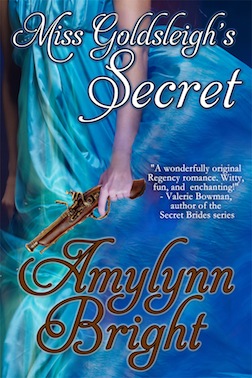
When Henry Cavendish, Marquess of Dalton, leapt to catch the fainting woman before she hit the cobblestone, he never thought that one chivalrous act would set his well ordered life on end.  His ingrained need to protect her has every bit as much to do with her enchanting beauty as it does his desire to wipe the hunted look from her startling blue eyes. He thinks he has everything in hand, but the lady has secrets that puts everything he loves at risk.

Olivia Goldsleigh just wants to live without terror, but a gunshot in the night proves things can always get worse. The beautiful and god-like Lord Dalton swears to protect her, to make the danger go away. She wants the man, the life, the family, the bliss he promises, but her secrets are certain to destroy them all.

Amazon

About Lady Belling’s Secret

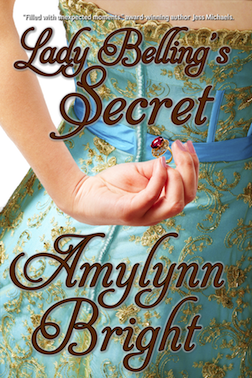
Bellings600x900Francesca Belling is torn between two worlds—her past infatuation with her brother’s best friend and her future obligations. She never intended to end up in the bed of her longtime crush, Thomas Wallingham, but that’s exactly where she finds herself.

Unfortunately, mail is slow during a war. She thought he knew everything. He had never suspected.

Thomas has always wanted to be a part of the Belling’s family but he was too foolish to grab the chance when she threw herself at him before. Instead, he ran off to war.  Emboldened by his new-found appreciation for a grown-up Francesca, he finds that dream is within his reach.

If she thinks he’s running away this time, she has no idea what she’s in for.

Amazon

About the Author

Amylynn read her first romance novel in 2008 after being a lifelong literary snob.  By the time she was done, she was hooked. Inspired, she challenged herself to write an entire manuscript from start to finish.  Lady Belling’s Secret became the first in a three series set. 

She is an Arizona native and lives in the same house her husband owned before they were married.  Amylynn fears she will never call another state home unless someone tells her husband there are forty-nine others to choose from.  In reality, she’d settle for a walk-in closet. 

Her family consists of the aforementioned husband, two beautiful children, two dogs, two cats, some fish, and a hankering for a panda. She’d like it mentioned she’s never been in prison but we’ll see how that panda thing works out.

Contacts

Facebook • Twitter • Blog • Website • Amazon Author Page

Episode #14: In Which Leticia, Lady Beauchamp, Pops In For an Interview On Her Personal Acquaintance With Princess Charlotte of Wales

Susana [to the Reader]: I’m afraid Lady P had to return to the 19th century for a christening (no, not Damian and Theresa’s this time, but one of her own daughters’ offspring). She promised to return after she’s had a comfortable coze with her daughters and grandchildren, but in the meantime, she sent someone who she said was a personal friend of Princess Charlotte, the daughter of the Prince Regent.

Lady Beauchamp: I would not characterize our acquaintanceship in quite that manner, Miss Ellis.

Susana: Forgive me, Lady Beauchamp, but I am not finished speaking to the readers.

Lady Beauchamp: Well, do hurry, then. I have an important social engagement this afternoon.

Susana [taking a deep breath]: Yes, well, Lady Beauchamp is the former Leticia Snodgrass, who was presented in London about the same time as Lady P’s niece-by-marriage, Theresa Ashby. You can read more about that in the epilogue to Treasuring Theresa, which is a free read on my web site: http://www.susanaellis.com/pub.html.

gloria_gown_stern

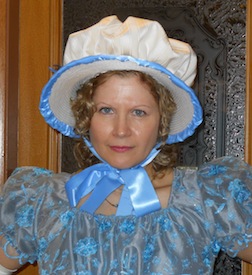
Leticia, Lady Beauchamp, née Snodgrass

Lady Beauchamp: Is it really? I daresay I should like to see how I am characterized in the story.

Susana [hurriedly]: Perhaps we should get back to the subject at hand, you being a marchioness and your time being so valuable and all. Why don’t you begin by telling us about your marriage and your family?

Lady Beauchamp: Of course. I was quite sought-after in my first season—many offers were made for my hand, you know—but there were only a handful of dukes that year and they were all married, so I chose to wed Lord Beauchamp. We had a fabulous wedding at St. George’s, and the Prince kissed my hand and called me the most beautiful bride he’d ever seen.

Susana: And your husband and family? Please tell us about them.

Lady Beauchamp: Fortunately, my youngest, George Augustus, takes after his mother. [Smiling] He has the most adorable cherubic face and blue eyes so like mine. I think it quite likely that his hair will lighten before long as well.

Susana: And your older son?

Lady Beauchamp [grimacing]: It is most unfortunate that Robert William takes after his father. Sturdy, bookish, and quite dull. At least dear Robbie has not lost his hair as his father has. Lord Beauchamp is much older than I, you know. His first wife gave him only daughters, but it was I who gave him his heir and a spare. [Preening]

Susana: I…see. Well, now that my readers are informed as to your…uh…pedigree, let us move on to the topic at hand. How did you become acquainted with the Princess Charlotte, Lady Beauchamp?

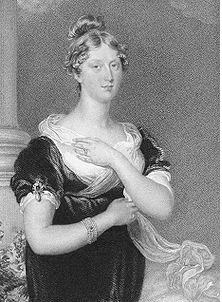
Princess Charlotte of Wales, during her pregnancy

Princess Charlotte of Wales, during her pregnancy

Lady Beauchamp [wrinkling her nose]: Of course. Well, we had met in passing at ton events when she was a child, although rarely with her mother, since her father wished to limit her exposure to her mother’s eccentricities. [Coughing delicately]. Blood will tell, however. Lady de Clifford, who had the charge of her at the time—only a baroness, you know—gave her far too much freedom. The girl had no sense of propriety—quite the hoyden as a child, but it was far worse when she reached adolescence.

Susana: Well, adolescence is a difficult time for everyone. I taught thirteen-year-olds for twenty-five years, you know. The best thing about it is that it eventually passes. I suppose the Princess showed the usual interest in the opposite sex?

Lady Beauchamp [shaking her head]: Oh, much worse than that, my dear Miss Ellis! If it wasn’t one of her cousins (illegitimate, you understand), it was William, Duke of Gloucester. They all took her fancy at one time or another. The rumors were rampant all over Town! Upon this proof that she took after her scandalous mother, the Prince Regent made arrangements for a marriage with William of Orange, hoping for an alliance with the Netherlands. It all came to nothing of course. Stubborn, stubborn girl! Not at all the sort of girl who ought to be a princess!

Susana: Do you know why she didn’t like the Prince of Orange?

Lady Beauchamp [curling her lip]: Indeed I do. She confided in me once—quite soon after she and Prince Leopold had settled at Claremont House—which is near Beauchamp’s estate in Surrey, you know—that he refused to promise to allow her mother to visit them after they were married because of her scandalous reputation, and after that, she steadfastly refused to have him. [Leaning closer to Susana] Of course, by then her mother had already fled to the Continent, and she never saw her again anyway.

Susana: How sad!

Lady Beauchamp [shrugging]: Was it? Many would say it was all for the best.

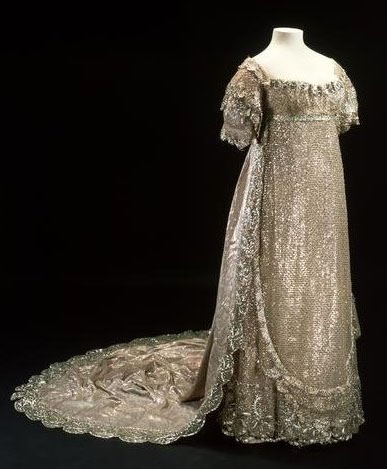
Princess Charlotte's silver lace wedding gown

Princess Charlotte’s silver lace wedding gown

Susana: So you socialized with the royal pair after their marriage. What can you tell us about them?

Lady Beauchamp: Quite a boring pair, really. Prince Leopold—who was quite impoverished, you understand, before he wed the heir to the throne of England—took rather too much of an interest in agriculture for my taste. Of course, he and Beauchamp used to tramp all over looking at crops, of all things. Her Royal Highness thought it was quaint.

Susana: But they got on well together?

Lady Beauchamp [reluctantly]: I suppose they must have. I never heard talk of rows between them, and her manner of dress became more sedate after her marriage. Indeed, Prince Leopold seemed to have a calming influence on her. We shared a box at the races once, and when Her Royal Highness began to show rather more enthusiasm than was proper, her husband caught her attention and said, “Doucement, chérie,” and she immediately smiled and regained her composure.

Susana [eyes filling with tears]: How sweet! What a shame their time together was so short! Were you around her during her pregnancy?

Lady Beauchamp: Her confinement, Miss Ellis. Do try to exercise a bit of restraint in your speech, even though you are American. [Sighing heavily]. Indeed I did see her a few times, although as her condition advanced, she was kept in seclusion. Considering all of the doctors who were consulted, one would have thought at least one would have been able to assist her safely through her trial. But no, she was allowed to eat until she reached elephantine proportions, and then they tried to starve her until she turned despondent. Why, Sir Richard Croft was not even a physician! My own husband would never have allowed a mere accoucheur near me when I was brought to bed. But it’s like my mother says, everything the Prince Regent touches ends in failure. Born under an unlucky star, she believes.

Susana: I understand Prince Leopold never recovered from the death of his wife and son.

Lady Beauchamp: Nor has England either. One would think the world has come to an end. The King has no legitimate grandchildren and his youngest son is over forty. The city closed down for two weeks and within a few days there was no black cloth to be had, as all of England was in mourning. Beauchamp said there wasn’t a dry eye to be seen during the funeral, when she was laid to rest with her son at her feet in St. George’s Chapel at Windsor Castle. To be sure, I can’t imagine what will happen to the succession now. I suppose all of the royal princes will run out and marry and try to sire an heir as quickly as possible. [Pursing her lips] Well, all I can say is they’d be well advised to do it soon, because the King’s health deteriorates as we speak, and the Regent isn’t much better. [Sliding her chair closer to Susana] My dear Miss Ellis, it occurs to me that you must be in possession of—shall we say?—interesting information about what happened with the succession. Perhaps you would be kind enough to indulge my curiosity?

Susana [glancing at her watch]: Oh dear, look at the time! If you do not return immediately, Lady Beauchamp, I fear you will be late for Lady Pritchard’s Venetian Breakfast. Do accept my sincere thanks for condescending to speak with me this morning!

Lady Beauchamp [with narrowed eyes]: As it happens, you are correct, Miss Ellis. I really must take my leave of you. However, you can be sure that I shall seek out Lady Pendleton as soon as may be to discover what she knows. [She waves her arms and disappears.]

Susana [gripping the arms of her chair]: I do wonder how this time travel thing is managed. Lady P has mentioned something about an old lady who runs the apothecary shop on Dapple Street, but she has so far declined to go into detail. [Frowning] When she does return, we are going to have a long chat about a few things I discovered after she left. For one thing, my digital camera is missing…after she went on a photography binge taking pictures of everything, even the engine of the car. And then there is a little matter of charges on my credit card for $800 at Toys R Us and more than $300 at the Battery Warehouse. Did she hear nothing I told her about the Prime Directive?

Lady P will be back soon. As always, please do comment if you have any questions you’d like to ask Lady P about the late Georgian/Regency era. She does love to chat!

The Lady P Series

Episode #1: Susana’s Adventures With Lady P: The Introduction

Episode #2: Lady P Talks About… Pride and Prejudice?

Episode #3: Lady P and the Duchess Who Lost a Billion Dollars

Episode #4: Lady P and the Face On the $100 Bill

Episode #5: In Which Lady P Discovers Sparkly Fabrics and Ponders Violating the Prime Directive

Episode #6: Lady P Dishes the Dirt on the Duchess of Devonshire

Episode #7: The Political Exploits of Lady P and the Duchess of Devonshire

Episode #8: Lady P and the Prince Regent’s Illicit Marriage

Episode #9: In Which Lady P Depletes the Cooking Sherry During Her Discussion of Caroline of Brunswick

Episode #10: Lord Byron: Mad, Bad, and Dangerous to Know

Episode #11: In Which Lady P Talks About Hannah More and the Rights of Women

Episode #12: Lady P’s Revelations Regarding George III and His Peculiar Progeny

Episode #13: Lady P Discusses the Luddite Uprising, the Assassination of Spencer Perceval, and the General Unfairness of Life

Episode #14: In Which Leticia, Lady Beauchamp, Pops In For an Interview On Her Personal Acquaintance With Princess Charlotte of Wales

Episode #15: Lady P On Assignment in 1814 Kent

Lady P Quizzes Jane Livingston, the Hero’s Sister From “A Twelfth Night Tale”

Guest Author Beverley Oakley and “Her Gilded Prison” + GIVEAWAY

Hi Susana,

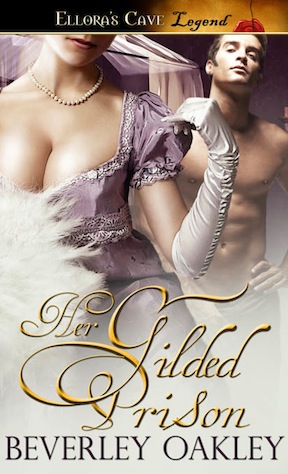
Thank you so much for having me here to talk about my debut erotic historical romance with Ellora’s Cave, Her Gilded Prison.

Beverley Eikli and her Rhodesian Ridgeback, HomerHer Gilded Prison is classified ‘erotic’ because the theme is sexual, and yet the story itself is more that of a good and faithful woman in the Regency era inadvertently discovering fulfilment in her limited sphere. I say ‘inadvertent’ because Lady Sybil’s motivations are purely altruistic to begin with, though the story has aroused contention amongst readers.

Some see it as a story about infidelity. The official blurb would suggest that’s the case, however, I wrote the story based around the question: ‘How far would a good and virtuous woman go to ensure the security of her daughters and the viability of the estate to which her husband has devoted his life?’

My heroine, Lady Sybil, and her husband have had four children in their twenty years of marriage. Two sons have died in their early teens and two daughters remain. Lady Sybil is still able to have children but her husband, who is utterly devoted to his mistress, cannot bring himself to sire an heir with his wife.

So Lady Sybil, desperate to ensure the estate doesn’t go to an unworthy distant relative who would then have the right to cast out her daughters once he inherits, decides upon bold action to provide the heir her husband cannot, or will not.

Her Gilded Prison is not about infidelity but about courage and determination to do what is right by an unloving husband and dependant daughters. Love becomes the complication—but only later.

Below is a letter my heroine, the lovely, unloved Lady Sybil might have written to her distant cousin, Persephone, hinting at her confused feelings. Although the letter doesn’t appear in Her Gilded Prison, it lays out Lady Sybil’s sentiments and motivations in courting the attentions of my gorgeous hero, Stephen, who is transformed from a “laddish” young man to a sensitive and caring and ultimately very heroic hero through his deepening affection for Lady Sybil, a woman forced into marriage with a man who has never loved her.

My dearest Persephone,

You will no doubt be expecting the usual weekly, prosaic account of my life: that Hetty remains terrified of the prospect of her London come-out as she is convinced no one will ask her to stand up with them; that Araminta is as defiant as ever and determined to ignore the shadow cast by her London season’s dramatic finale last year.

Nothing changes when it comes to my daughters, and my fears are as great as ever for them: that Araminta will singe more than just her wings in the flame she’s fanned to her own magnificence; and that Hetty will moulder in the country, never blooming as she might were she to experience the true regard of a kind and caring gentleman.

A regard I have never known from Humphry who nevertheless continues to provide us with everything we need, other than his affection and attention. He reserves that for—

Ah, but Persephone, you know the pain is too great to mention her name, even to you, my dearest cousin. It is not jealousy that prevents me. Simply the pain of believing I will never in my lifetime know the love or consideration of a good man.

But now I must confess to you a foolish woman’s fancy. The daydream of an old woman who ought to know better for I will be one-and-forty my next birthday and my concentration should be focused only on my daughters’ successes—not on my daydreams.

Dearest cousin, you have always been the voice of reason when I heard none from my chivvying, unsentimental mother and my disinterested father who would still have me wed Humphry when they knew his heart belonged to another.

The fact is, I believe I have garnered the special interest of a kind and very handsome young man. For a week I have tried to convince myself that I must be quite queer in the attic. Indeed I must, for this young man, Stephen, was—until yesterday—Humphry’s heir and has been staying with us to learn the running of the estate.

And now for the most shocking part of this letter which occurred at close to midnight last night and turned our lives upside down. Humphry’s nephew, the late Edgar, whom we were all so relieved to learn had been killed at Corunna, made his miraculous reappearance upon our doorstep. I thought Humphry would die from the shock. It certainly was not pleasure for now Stephen—capable, intelligent Stephen, Humphry’s distant cousin whom he’d been grooming as his heir—has been usurped by a dullard.

I wept bitter tears afterwards as I prostrated myself upon my lonely bed —not because Edgar will become the next viscount but because it is I who have failed. I have not provided Humphry with a male heir who will inherit all that for which my husband has worked; my failure imperils my daughters’ security if they do not marry, for it is quite possible Edgar will deny them tenure in the family home. He is contrary like that.

And now I must end for there is much to organise with Edgar’s return. Sadness weighs heavy upon my heart at the thought of farewelling Stephen whose charm and good nature have brightened the moods of everyone here.

Ah, Persephone, I would provide Humphry with an heir if he would only come to me but he will never betray that woman. Not even to try for the son who would change all our fortunes for the better.

Tomorrow I will solicit Stephen’s counsel. When he first arrived I thought him young and, being so handsome, surely overly fond of the young ladies.  I was wrong. He is wise beyond his years, and he is kind. And, to my astonishment, he seems to hold me in high regard. The way he looks at me…

Foolish, I know. I will not pursue that line of thought. Suffice to say I feel sure he will listen well. I’m sure he will help me with the terrible conundrum that places all of us in such peril…”

About Her Gilded Prison

HerGildedPrisonLady Sybil’s perfect life is a perfect lie. Her husband spends more time with his beloved mistress and illegitimate children than he does with her. Worse, since he no longer beds her, they’re left with only a distant cousin as heir. While her husband lives, Sybil knows no erotic touches, no passion. No love. If her husband dies, her home will be entailed to Stephen, a stranger.

When Stephen visits the property that will one day be his, he’s instantly ensnared in a web of lust, longing and lies. For how can he resist Lady Sybil, a woman so full of beauty and life? A woman who deserves to be loved and worshipped and set free from the gilded prison in which she’s trapped? Stephen is determined to show Lady Sybil every pleasure she’s been deprived of, even if it means being forever condemned in society’s eyes.

Inside Scoop: This erotic Regency romance features an intense, taboo relationship between an older woman and a younger man.

A Romantica® historical erotic romance from Ellora’s Cave

“Think “Downton Abbey with sex….”

 Update and Giveaway

Thank you so much for having me here today. I’ve really enjoyed it. It’s helped take my mind off losing my lovely Homer, the handsome Rhodesian Ridgeback you’ll see in my profile picture and who has been with the family for eleven years.

On a happier note, the sequel to Her Gilded Prison has just been acquired, I’m very pleased to announce. It’s called Dangerous Gentlemen and is as different in tone as possible from Her Gilded Prison as it follows the unexpected path of Lady Sybil’s quiet daughter Hetty through London revels.

I’d also love to offer a giveaway of my English Civil War novella The Cavalier to one random commenter.

 Available

Ellora’s Cave • Amazon

Contacts

www.beverleyoakley.com

www.facebook/AuthorBeverleyOakley

http://beverleyeikli.blogspot.com

@BeverleyOakley

Colette Cameron: “Highlander’s Hope” and Author Interview + GIVEAWAY

A hearty welcome to Colette Cameron, a fellow Regency romance author! Colette is offering a $10.00 Amazon gift card drawing to anyone that comments and also connects with her on Twitter, Facebook, or follows her blog. Just leave a comment here explaining how you connected and leave an email address so she can contact the winner.

Susana, thank you so much for hosting me today. I’m thrilled to be here!

What inspired you to start writing?

Collette CameronI’ve always enjoyed writing, or perhaps, I should say it came easily for me. That’s before I decided to try my hand at writing a romance novel.  A notice that someday I’d write a book had floated around in the back of my mind for years.  Not a romance novel of course. I couldn’t  write one of those. All that dialogue! So what did I sit down and write? You guessed it. A historical romance

Once I started writing Highlander’s Hope, I was addicted. This what I was meant to do! Next to raising my three children, it’s been the most challenging and rewarding experience I’ve ever had.

How long have you been writing?

I started writing in February 2011.  That nagging notion to write a book became more persistent, so one day, I plopped myself in front of my computer and starting typing away. I had absolutely no idea what I was doing—or what I was getting myself into.

What advice would you give to writers just starting out?

Critique partners are a must! I didn’t have any for Highlander’s Hope.

Learn all you can about the publishing industry and about the craft of writing. I know many people have an innate gift for writing but here are still the mechanics that must be mastered.  Attend workshops and conferences, join writers groups like Romance Writers of America, and read, read, read.  Read books in the genre you write in to stay abreast of what’s currently being published. Read books on the craft of writing. Read articles and blogs of other writers. You will be amazed at how much you’ll learn and how many other writers and authors are willing to help you.

Do you ever suffer from writer’s block? If so, what do you do about it?

I haven’t suffered from writer’s block yet, though I had times where I’ll get stuck on a plot point. I let my mind play around with it a bit—sometimes it takes a few days—and then, all of a sudden, a solution will pop into my mind. That happened at the doctor’s office the other day. Poof, right in the middle of reading a book about life during the Regency era, I read something that triggered a whole scenario. It solved a plot problem and gave me a good three or four chapters of material.

What comes first: the plot or the characters?

I hadn’t thought about that before. For my first three books, it has been the characters. I have another nine planned, and most of those I already know who at least one of the main protagonists is. I do have notes for several story plots though, and I don’t have characters for all of them yet.

Are you a plotter or a pantser?

A friend of mine calls me a linear panster. It’s an oxymoron but it works for me, because I do write from beginning to end—I just don’t know exactly where I’m going along the way. Sometimes that’s great. I’ll write something that astounds me. Other times I write something that doesn’t move the story forward, and I end up cutting it. Even those cut scenes have value though. I’ve used phrases, ideas, or parts of them for some of my other work. I like to post them on my blog for my readers to enjoy too.

All my books start with a single scene or idea, and the book develops around it. I do have ideas or plot points that I want to include in my books, but I also love seeing where my characters and the story take me. I couldn’t possibly come up with some of the things in advance that emerge as the story progresses. I often wonder, “Where did that come from?”

For my last two stories, I’ve completed Goal, Motivation and Conflict charts for my hero and heroine. I also have a questionnaire of over fifty questions I complete for each of them. By having both those items in my writer’s toolbox, I really know my characters. I don’t get stuck wondering what they’ll do or say.

Tell us something about your newest release that is NOT in the blurb.

Yvette is allergic to anything alcohol.  Her pets are named after Roman or Greek Gods and their names all begin with “A”.

Ewan plays the bagpipes, and has four younger siblings.

Are you working on something at present that you would like to tell us about?

I’m currently working on The Earl’s Enticement. It’s the third book in my Blue Rose Trilogy.

The story is about Adaira (Addy) Ferguson, an outspoken Scottish aristocrat who cares more for horses than she does society’s conventions. She wears breeches, swears, and mistaking him for his blackguard brother, abducts Roark (Rory) Marquardt, The Earl of Clarendon.

What are you reading now?

I’ve been doing a lot of reading on Regency history lately. Right now I’m reading “What Jane Austen Ate and Charles Dickens Knew.”

What is your favorite food? Least favorite? Why?

My favorite food is Chicken Alfredo or Spinach Tortellini in Alfredo sauce. I love pasta in any kind of white sauce.  I loathe peas and mushrooms. Ugh! When I was little, I was forced to eat canned peas. My great grandmother told me I’d like them when I grew up. Nope. Still don’t like peas. Mushrooms remind me of slugs and they taste like dirt.  Betcha wish you hadn’t asked me that question!

What is one thing your readers would be most surprised to learn about you?

I never set out to be a romance author. In fact, romance is the one kind of book I thought I’d never be able to write.

If your publisher offered to fly you anywhere in the world to do research on an upcoming project, where would you mostly likely want to go? Why?

I’m so glad you asked. Scotland. I need to do research for my six book Regency Highlander series.

Do you write in multiple genres or just one? If just one, would you consider straying outside your genre?

I only write Regency historical right now, though with the highlanders, I suppose you could say I write Scot’s highlander historicals too. I do have a couple ideas for a historical paranormal and a contemporary too.

What is something you’d like to accomplish in your writing career next year?

I’d like to get The Earl’s Enticement completed and submitted and complete a stand-alone novel that is begging to be written.

Every writer dreams of getting “the call.” What were you doing when yours came? Who got to hear the good news first?

We had just gotten home from camping. I’d submitted a full manuscript the day before we left. When I checked my email, there was an email from Soul Mate Publishing saying they wanted to publish Highlander’s Hope. Naturally, I remained calm and oh, so casually mentioned my good fortune to the hubby and daughter.

That’s a colossal lie. I vaguely remember running outside and jumping into my husband’s arms, completely incoherent and crying. He thought someone had died.

What are your favorite pastimes?

I enjoy gardening, bird watching and amateur photography.

What is the one modern convenience you can’t do without?

Hot water and toilets.

How did you pick the names for your characters?

I did a search of Scots first names for Ewan. I wanted something a bit  different but not really odd. Ewan sounds like a strong name, and as I got to know him, he name really seemed to fit him. McTavish just sounded lovely.  His English title, Viscount Sethwick, I made up. I always wanted a son names Seth, but my hubby didn’t like the name.

I wanted Yvette to have a French name because her mother had been French. Ironically, it wasn’t until after I named her that I realized I’d picked yet another name  that rhymes with several family names: Collette, Minette, Georgette, and Annette. No…, I’m not kidding!

Stapleton is a nice hardy English name.

What’s something unusual you found during your research?

Yvette is allergic to spirits (alcohol) which was a bit of a problem during the Regency era. Water wasn’t safe to drink, so people generally didn’t drink it. Even children drank coffee, tea, and spirits. Poor Yvette, does drink a lot of tea!

I also  had to research marriage laws because her stepbrother tries to force her to marry him. Stepsiblings could legally marry, but there were a whole list of other marriages that were deemed illegal. For instance, if a man’s wife died, he couldn’t marry her sister.

And then there was the delightful Scots Canon Law I used to get Ewan and Yvette married without a ceremony. Scots church law allowed anyone to over see the exchanging of vows. In Scotland, irregular marriages included simply proclaiming your were married in from of witnesses.

What’s  first thing you look for when you are choosing a romance novel to read? Why?

Okay, so you’ve picked out a book to read.

Can you tell me something that really annoys you after you’ve bought a book and started to read it…or maybe even finished it?

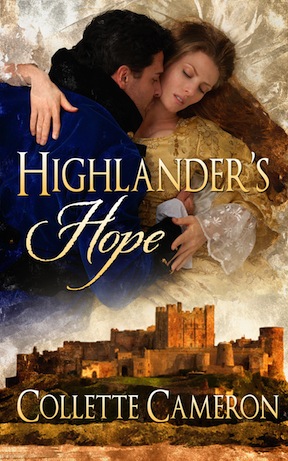
About Highlander’s Hope

Highlander's Hope May 2013She was the heiress determined never to marry.

Shipping heiress Yvette Stapleton is wary of fortune hunting men and their false declarations of love. She’d rather become a spinster than imprisoned in the bonds of marriage. At first, she doesn’t recognize the dangerously handsome man who rescues her from assailants on London’s docks. Her reaction to Lord Sethwick’s passionate kisses soon have her reconsidering her cynical views on matrimony.

He was the nobleman who vowed to make her his own. 

Not a day has gone by that Ewan McTavish, Lord Sethwick and Laird of Craiglocky, hasn’t dreamed of the sensual beauty he danced with two years ago; he’s determined to win her heart. On a mission to stop a War Office traitor, he unwittingly draws Yvette into deadly international intrigue. To protect her, he exploits Scottish Canon law to declare her his lawful wife—without benefit of a ceremony. Yvette is furious upon discovering the irregular marriage is legally binding, though she never said, “I do.”

Amidst murder and betrayal, Ewan attempts to win Yvette’s forgiveness. But is it too late? Has his manipulation cost him her love?

Excerpt

Take a peek at several excerpts posted on my blog below.

http://www.blueroseromance.com/2013/04/final-excerpt-of-highlanders-hope.html?spref=tw

About the Author

In February 2011, Collette decided to sit down and write a Regency suspense romance. She wrote Highlander’s Hope, the first book in her Blue Rose Trilogy. She has a BS in Liberal Studies and a Master’s in Teaching. She’s been married for 30 years, has 3 amazing adult children, and 5 dachshunds. Her puppy, Ayva, sits on her lap while she writes. Ayva also nibbles at and lies on the keyboard. Collette loves a good joke, the beach, trivia, birds, shabby chic, and Cadbury Chocolate. She just finished The Viscount’s Vow, the second book in the series.  It releases from Soul Mate Publishing next year. You’ll always find dogs, birds, quirky—sometimes naughty—humor, and a dash of inspiration in her novels.

Contacts

Web site • Blog • Facebook Fan Page • Facebook Page • Twitter • Google+ • Linked In • Pinterest

Soul Mate Publishing Author’s Blog • Goodreads

Cheryl Holt’s Love’s Promise Scavenger Hunt Blog Tour GIVEAWAY!

LPScavengerHuntBTGraphicSM

Blog Tour Schedule

5/13 Rambling from this Chic: excerpt 1/giveaway

5/14 Harlie’s Book Reviews: review and excerpt 2/giveaway

5/15 Romancing Rakes for the Love of Romance: review and excerpt 3/giveaway

5/16 Confession of a Romaholics: review and excerpt 4/giveaway

5/17 Romancing the Book Reviews: review and excerpt 5/giveaway

5/20 Susana’s Parlour: review and excerpt 6/giveaway

5/21 bookworm2bookworm: review and excerpt 7/giveaway

5/22 Rockn’ the Muses: excerpt 8/giveaway

5/23 Saucy & Sinful Reviews: excerpt 9/giveaway

5/24 Romantic Crush Junkies Reviews eZine Blog: review and excerpt 10/giveaway

Lord Trent Series

Charles Sinclair, the Earl of Trent, is England’s most notorious roué. He never sired any lawful children with his aging, bitter wife. But he has many illegitimate children scattered across the kingdom.

His oldest son, Phillip, is on a quest to find his lost half-siblings, to create a family with them and to fix any damage inflicted on their lives by their father’s licentious conduct. The three books, Love’s Promise, Love’s Price, and Love’s Peril tell the stories of four of Lord Trent’s lost children.

Finally coming in 2013, Cheryl’s long-buried trilogy—three fabulous novels filled with heartbreak, dashing characters, drama, passion and love—will sweep you away!

About Love’s Promise (Book 1)

LovesPromise72SMWith the death of his older brother, Michael Wainwright, Viscount Henley, has become heir to his father, Duke of Clarendon.  The Wainwright men are renowned cads, and as his brother’s will is read, it’s discovered that he sired an illegitimate son and has left the eight-year-old boy his entire fortune.  Michael decides to bring the boy to London so he can be showered with all the wealth and status guaranteed by his inheritance.  But first, he has to gain custody from the boy’s aunt, who is determined to keep her nephew away from Michael’s dissolute family.

Frances “Fanny” Carrington has always lived in a small village in the country.  As a newborn, she was left in a basket on the church steps and raised by the vicar and his wife.  But they’ve died, and Fanny is in dire straits, struggling to raise her nephew, to keep food on the table and a roof over their heads.  When she begins to receive correspondence from Michael, asking for custody, she can’t help but be suspicious.  For years, the Wainwrights have refused to claim her nephew or provide financial assistance to him.  She’s alarmed by their sudden interest.  What can it mean?

As Michael finally meets Fanny, their attraction is swift, blatant, and dangerous.  He can’t fight the need to have her at any cost, and gradually, he lures her into his decadent life of affluence and privilege.  But she’s never possessed the callous nature required to thrive in the cut-throat world of the aristocracy, so she can never understand the peril she faces from those who would do anything to keep them apart…

Excerpt 6

CHAPTER TWO

 “Where are you off to now, Fanny?”

Frances Carrington, called Fanny by her family, glanced over at her sister, Camilla.  Though Fanny was twenty and Camilla twenty-five, Camilla acted like a petulant adolescent, and Fanny often felt as if she was Camilla’s mother.

“It’s so beautiful outside.  I thought I’d walk to the village.”

“You just went yesterday,” Camilla complained.  “I swear, you’re restless as a hen when the fox is lurking.  What’s the matter with you?”

“The vicar’s wife is supposed to pay me for the mending I completed.”

“How can you take that old biddy’s charity?”

“It’s not charity.  I worked hard on that sewing, and I won’t apologize for it.”

“Aren’t you a bloody saint?”

It was a constant quarrel between them.  Camilla wouldn’t lift a finger to earn any money, despite how dire their situation, but she was quick to criticize when Fanny did anything that might alleviate some of their financial distress.

Fanny was galled at being forced to rely on the paltry coins the vicar’s wife doled out, especially when the sanctimonious woman enjoyed flaunting her elevated position and how it contrasted with Fanny’s reduced one.

For three decades, Fanny’s father had been the vicar.  They’d lived in a fine house next to the church, had been respected members of the community, so when she knocked on the rear door of the parsonage, she felt like a supplicant or a beggar.  She’d be invited in to see the new minister writing his sermons at what had been her father’s desk.  His wife would be sitting on the sofa in what had been Fanny’s mother’s parlor.

At one humiliating point, Fanny had sold her mother’s wedding ring to the vicar in order to purchase food.  He’d given the ring to his wife as a gift, and whenever Fanny stopped by, she cruelly waved it under Fanny’s nose.

The tonic was bitter to swallow, but in the past few years, she’d suffered so many indignities that one more hardly registered.  She could tolerate the other woman’s condescension if it helped her support her nephew, Thomas.

“Camilla, please,” Fanny scolded.  “Watch your language.”

Fanny gestured toward Thomas who was across the room at the dining table, practicing his letters.

“He’s heard worse,” Camilla said.

“Yes, he has,” Fanny agreed, “but we needn’t broaden his base vocabulary.”

“Don’t tell me how to speak to my own boy.”

Fanny couldn’t win the argument, so she didn’t try.

“I’ll be back in a few hours.  If she pays me as she promised, I’ll bring some stew meat with me.”

“Meat, bah!” Camilla sniped.  “Fat and gristle is more like.”

Camilla was always angry that they couldn’t afford the quality of victuals that had been their typical fare in better times.  Her sense of entitlement—as well as her gnawing hunger—made her surly.

Though she never said as much, she seemed to blame Fanny for their poverty, as if their father’s death, and Camilla’s subsequent plunge to indigence, had somehow been Fanny’s fault.  Fanny was weary of defending herself over the calamities, and she was eager to be away.

She grabbed her shawl and bonnet, and she stood in front of the mirror, studying her reflection as she tied the bow under her chin.

With her slender torso, heart-shaped face, and bright green eyes, she recognized that she was attractive.  Her hair was long and blond, an unusual shade of luxurious gold, the color of ripened wheat.  Since they had no servants, she rarely styled it, finding it quicker to simply brush the lengthy tresses and pull them back with a ribbon.

But her looks didn’t matter, and she shouldn’t continue to pretend that they did.  Her lack of a dowry insured there would be no husband, no family of her own.  She’d never even had a beau, and circumstances had compelled her to accept that she never would.

Still, it was amusing to dream of a different life, one filled with pretty gowns and tons of delicious food, where there was no need to worry over the least little problem.

She wasn’t a woman prone to vanity, but there was no concealing the fact that her dress was shabby and plain, her bonnet tattered and torn.  She couldn’t help but wish that she had a fashionable outfit to wear into the village, but cash was scarce and new clothes a frivolous extravagance.

She slipped out and hurried down the path to the lane, when Thomas called to her from their decrepit cottage.

“Aunt Fanny!  May I come with you?”

Available at Amazon and Barnes & Noble

SusanaSays3

Susana Reviews Love’s Promise

Susana Says: Good Read, 4 out of 5 Stars

Love’s Promise is one of those books that draws me in so deeply that I don’t want to stop for anything, not even meals! Holt’s books have a tendency to make me feel as though I’m there myself, walking in Fanny’s shoes and feeling her attachment to her nephew, her desperation to keep him near and ensure his wellbeing, and then, later, her wildly fluctuating feelings for Michael, the man who seems destined to shatter all of her hopes and dreams.

Fanny is a great heroine, resourceful, determined, with a big heart. She can’t be bought with coin or jewels, as Michael discovers to his chagrin. The only leverage he can find to lure her to his bed is the promise of being near to her nephew. Her love for young Thomas makes her vulnerable, and Michael has no scruples against using it to get what he wants.

And therein lies the rub. While some say that rakes make the best heroes (or husbands), a rake who is too depraved just doesn’t ring true. As the son of a depraved duke, perhaps there is some justification for Michael’s selfish, cruel behavior throughout most of the book. Neither he nor his sister Anne knew love from either of their parents, so why would they know enough to want it for themselves, let alone be able to recognize it when it came? In the case of both siblings, it took the steadfast love of another to force them to come to terms with the superficiality of their lives and values and give them the impetus to reach out and risk everything for love.

If you are looking for a lighthearted romp in Regency ballrooms, this is not the story for you. The Regency world portrayed here is dark and cruel and filled with heartless villains in every corner. Between the debauched aristocrats who hop from bed to bed ruining young ladies right and left with no concern for anything but their own pleasure and the cruelty of nearly everyone else, this is not the book for the faint of heart.

It’s always been a cruel, cruel world, and the Regency one was no exception. There are times when you doubt that Fanny and Michael will ever have their happy ending; there are so many obstacles keeping them apart and you on the edge of your seat. But I guarantee you won’t want to put this one down. Holt’s fast-paced dialogue, paired with the emotional turmoil, will keep you turning the pages all the way to the end.

Giveaway

Cheryl Holt is giving away ten (10) print copies of Love’s Promise, the first release in her historical romance Trent Trilogy. The giveaway is open to US, Canadian, and international readers. Click here for the rafflecopter.

About the Author

cheryl-holt-with-pearlsCheryl Holt is a New York Times, USA Today and Amazon bestselling author of thirty-five novels.

She’s also a lawyer and mom, and at age 40, with two babies at home, she started a new career as a commercial fiction writer. She’d hoped to be a suspense novelist, but couldn’t sell any of her manuscripts, so she ended up taking a detour into romance, where she was stunned to discover that she has an incredible knack for writing some of the world’s greatest love stories.

Her books have been released to wide acclaim, and she has won or been nominated for many national awards. She is particularly proud to have been named Best Storyteller of the Year by the trade magazine, Romantic Times Book Reviews.

Her hot sexy, dramatic stories of passion and illicit love have captivated fans around the world, and she’s celebrated as the Queen of Erotic Romance, which is currently the fastest selling sub-genre of women’s fiction. Due to the ferocity of some of her characters, she’s also known as the International Queen of Villains.

She received degrees in music, languages, and education from South Dakota State University, and her juris doctorate was obtained at the University of Wyoming. Her colorful and chaotic employment history includes such variety as public school teacher, cook, bartender, lobbyist, and political activist. She also did brief stints in metro-Denver as a deputy district attorney and administrative law judge.

“…a master writer…”  —Fallen Angel reviews

“Best storyteller of the year…” —Romantic Times Magazine

Contacts

www.cherylholt.com

https://twitter.com/theCherylHolt

http://www.facebook.com/pages/The-Official-Cheryl-Holt-fanpage/292658201347

Kae Elle Wheeler and “The English Lily”: Lady Yarmouth’s Letter

Lady Kendra has led a long fruitful life. But as a young woman, and in a major turning point of her life, her time with Charles Thomas was cut remarkably short. To ease her mind, she sends him a heart-filled letter.

Dear Mr. Thomas,

I realize it is most inappropriate for me to send you this letter, but rest assured I have my husband’s utmost approval. It has been many years since I last saw you, and the memory still haunts my dreams I fear. I thought if I could enlighten you to my situation we might each finally move forward, where ever that might be for you now.

Since that most fateful day aboard the Cécile, I married Joseph. True, he was a most successful magician, but I am pleased to say he has proved an even more devoted husband and father. We have four beautiful children. Our eldest and heir to Yarmouth named Charles for you, my dear friend. You would be most proud of Charles, for he is a brilliant scholar and benefactor of The School for the Poor and Unfortunate.  The others fell closely in his footsteps in their efforts to realize your dreams. Aaron, our most athletic is an avid hunter and horseman. Our girls, twins, mind, Julia and Jane, followed in their father’s way with his magic. Oh, not that Joseph would allow them to tread the boards! But he taught them all of his silly parlour tricks on which the two took to perfecting and creating with havoc of their own.

For many years, I kept in very close contact with your mother, to her very end. I am proud she called me Friend. Finally, you will be most happy to know my husband reads a beautiful poem or story to me each and every night when we retire, and on occasion, I find I quite enjoy reading one to him as well.

I hope this note will offer you the peace that is descending on me as I pen it.

Yours forever, most devotedly so,

Kendra Frazier, Lady Yarmouth

About The English Lily

TheEnglishLily7366_300Lady Kendra Frazier is devastated. The love of her life just married another, and now all she desires is to be as far away as possible. Viscount Lawrie, Joseph Pinetti Gray, is facing financial ruin and needs a wealthy heiress.  Luckily for him, Kendra’s impetuous nature has handed him the fortuity he requires to save his family’s downfall. But Joseph’s carefully cultivated plans come to a grinding halt when he finds himself falling in love for what should have only been a marriage of convenience. And how can an old cursed doll help?

Excerpt

He rushed over.  “Thank God,” he whispered.  He crouched down next to her.  “Thank God,” he said again, touching his forehead to hers.

“Joseph?  Lord Lawrie?”  Her voice cracked.  Her white glove was no longer white.  He wished he could have protected her from that.

Leaning back, he peeled the stained fabric away.

Her hand clenched.  “My hands—”

He brushed his lips over the tiny scars. “Your hand is perfect,” he said.  “We’ll have to marry, you know.”

“Married.  I’ve dreamed of marrying,” she whispered, smiling.  Her eyes were dry, but in them he read the shock and fear.

Something tight squeezed Joseph’s chest, he found he could hardly breathe.  Death hovered over them.  While he might fail in creating bliss for Kendra’s last moments on this earth, he could offer her the whimsical fairytale.

Joseph dropped her hand and cupped her head with both hands.  “Lady Kendra Frazier, would you do me the honor of becoming my wife, mademoiselle, s’il vous plaît?”

With a stately incline of her head, she replied with a trembling smile.  “I shall be honored, Viscount Lawrie, Chevalier Joseph Pinetti Gray.  Lord Hardwick’s Marriage Act was enforced in Scotland, in fifty-four, so we’ve no need to post the banns.”  A small hysterical laugh erupted.  “Shall we escape to Gretna Green, my lord?”

Her spirit touched him as nothing else could. Even in the throes of shock and danger, she managed to recall his full proper name and title. He pulled her to him as heavy steps echoed on the wooden planks just beyond the door.  But for a moment he could pretend they would live a long and fruitful life together. “Oui, Gretna Green suits my purposes, perfectly, love,” he whispered against her lips, before crushing them beneath his own.

The door crashed back.

Available

Amazon 

Wild Rose Press 

About the Author

IMG_8577Kae Elle Wheeler has a BA degree from the University of Central Oklahoma in Management Information Systems that includes over forty credit hours of vocal music.  As a computer programmer the past fifteen years, she utilizes karaoke for her vocal music talents. Other passions include fantasy football, NBA and  musical theatre season tickets, and jazzercise. Because to quote Nora Roberts to a one time question, if she worked out? Her reply, “You have to get off your ass.”

Kae began has been a member of the Oklahoma Chapter of Romance Writer’s of America and the RWA since March of 2007.  She grew up in the Dallas area and definitely considers herself a city girl.  She does not limit her travels to Writer Conferences in San Francisco, Washington DC, Seattle, Dallas, New Jersey, New York City and Atlanta because Jazzercise has fun conferences too (Denver, Palm Springs and Orlando). You can’t keep her at home!

She is a member of several RWA Chapters, including DARA, The Beau Monde and Passionate Ink. She has held several positions in the OKRWA Chapter, currently serving as Programs Director. As an avid reader of romance and patron of theatre, her main sources of inspiration come from mostly an over-active imagination. She currently resides in Edmond, Oklahoma with her musically talented husband, Al, and their bossy cat, Carly.

Contacts

http://kathylwheeler.com

http://klwheeler.com

http://facebook.com/kathylwheeler

http://twitter.com/kathylwheeler

Episode #13: Lady P Discusses the Luddite Uprising, the Assassination of Spencer Perceval, and the General Unfairness of Life

Lady Pendleton, Damian Ashby’s eccentric aunt (see the epilogue to Treasuring Theresa on Susana’s web site), is visiting Susana from the early 19th century. She’s intrigued by life in 21st century Toledo, Ohio, and, of course, Susana is thrilled to have the opportunity to pick her brain about life in Regency England. It certainly gives her a great deal to write about in Susana’s Parlour!

Susana: Lady P and I recently returned to Ohio after spending a month in Florida where she enjoyed taking daily “constitutionals” around the retirement village where my parents live, and eventually condescended to take a dip in the heated pool, although the bathing costume she rigged for herself raised more than a few eyebrows from the other swimmers.

Lady P [indignantly]: My dear Susana, I could not possibly have appeared in public in those-those underthings you and your mother wore. I should have been utterly humiliated!

Susana: They are called swimsuits, Lady P. Bathing costumes. And that’s what everyone else wore.

Lady P [with a hand to her head]: The gentlemen—such as they were—were much worse. I thought I would swoon when I saw those naked chests!

Susana [chuckling]: But surely you have seen a bare-chested man before, Lady P. Why, you and Lord P were married for nearly twenty years, were you not?

Lady P: Well, of course I did, but not in public, Susana. Why, my Pendleton was exceedingly conscious of propriety. He would never have appeared in public half-dressed; why his valet would have slit his own throat before allowing it!

Susana [biting her lips to keep from laughing at the thought of the suicidal valet]: These gentlemen are from the 21st century, Lady P. Frankly, what these men wore was quite modest compared to some of the younger gentlemen. Don’t you remember that day when we went to the beach and saw—

Lady P [shuddering]: Do not even remind me, Susana. The young women’s attire…why they were nearly as naked as the day they were born! Where is their sense of modesty?

Susana [making a mental note to avoid beaches and pools in the future]: Perhaps we should get back to today’s topic—the Luddite revolt in 1811-12. Can you tell my readers what you recall of that uncertain time?

Lady P: Indeed I can, although one could wish to forget it.

ludditesSusana: It started in the Midlands with the stocking industry, when stockingers, using looms and equipment leased from their employers in their homes, lost more than half their income when they were forced to produce cheap stockings that their employers could sell in larger quantities and increase their profits. Is that correct?

Lady P: How could I forget? Those stockings fell apart after barely a week of wear, and even the servants disdained them!

Susana: That was the same year the harvest failed, and food prices rose to an alarming level, and more and more people were suffering in economic distress.

Lady P: A shilling for a loaf of bread! It was outrageous!

Susana: People became desperate, and before long, gangs of disguised men started going around destroying the frames and looms used to produce the stockings to protest the treatment of the workers and the poverty more and more of them were forced to endure.

Lady P: That may be how it started, Susana, but it escalated into so much more than that. Why, many of us feared an uprising against the monarchy comparable to the French Terror of barely two decades past. And there wasn’t much to be done about it; Pendleton told me that fully half of the militia had taken up the cudgel for General Ludd in stealth and would turn against their officers in a trice if ordered to put down the revolutionaries.

Susana: I’m curious to know what Lord P thought should be done about it. He was a Tory, and the Tories were in power. Did he approve the decision to make frame-breaking a capital offense?

Lady P [shaking her head and sighing]: No, of course he did not. He thought it was incredibly stupid to think that masses of starving insurgents could be deterred by fear of the gibbet if they were caught. [Swallowing hard] He was, in fact, quite moved by Lord Byron’s speech in the House of Lords, where he decried the Tories’ attempt to solve the problem by force. He insisted—quite eloquently, Lord P admitted—that the Midland workers were being exploited to increase the profits of a few hosiers, and that the resulting misery benefitted no one.

Susana [thoughtfully]: The more things change, the more they stay the same. [Seeing Lady P’s raised eyebrow]: I was just thinking of how the Ohio House of Representatives just voted to eliminate the forty-hour work week so that employers won’t have to pay overtime—pay them double—for working more than that.

Lady P: As to that, I can’t say, Susana. But that is one reason I became a Whig. I would never go so far as to overturn the entire government and plunge the country into turmoil and terror such as what happened in France, but I have always believed that certain reforms to prevent the poor from being exploited could be instituted without much upheaval, and that the entire country would be the better for it. [Sighing] Dear Pendleton felt the same, but he was unable to persuade his colleagues to listen to reason. As afraid as they were of a revolution, the only solution the Tories could agree on was to threaten the insurgents.

Susana: It wasn’t long after that the Tories fell out of power, didn’t they? After the assassination of the Prime Minister?

Lady P: Indeed, and it was well-deserved too. Not because the Whigs’ ideas were much better, although they certainly used the Tories’ imprudence to their advantage. The Prince Regent’s intemperate behavior and his treatment of his wife made him vastly unpopular, so the Whigs took up the cudgel for Princess Caroline, proclaiming that she was being badly treated, and causing more riots, spreading to the north.

percevalSusana: And didn’t the people actually cheer the assassin as he was led to his execution a week later? There was that much dissatisfaction with the government that they cheered the murderer of the Prime Minister?

Lady P [tight-lipped]: Poor Lord Perceval. He was a good man. Had twelve children, you know. A family man. He could have gone far, if it weren’t for that Bellingham fellow shooting him in the House of Commons. Do you know the government wouldn’t even give him a public funeral because they were fearful of riots? I hardly knew what to say to his wife Jane when I saw her after that.

Susana [sighing]: Some things seem so unfair, don’t they? Like my friend whose daughter just died of breast cancer at age thirty-seven. Or many of my friends whose husbands lost their jobs and couldn’t find anything comparable afterward because of their age and the cost of health insurance. What do you say? How do you help them?

Lady P [clucking]: I suppose there will always be misery and injustice, no matter how diligently we try to eliminate it.

Susana: But that doesn’t mean we should stop trying.

Lady P [smiling]: Exactly. Now, Susana, don’t you think something should be done about all the weeds in the back garden? Since the weather turned warmer, they seem to be popping up all over the place.

Susana [leaving the room]: Have at ’em, Lady P. There’s a hoe in the shed and some work gloves in the drawer over there.

Lady P [frowning]: And where might you be going, then?

Susana [from the office]: I have a Christmas story to write. Deadline, you know. Can’t be bothered with weeds for awhile.

Lady P makes a beeline for the back door, audibly grumbling about “misplaced priorities,” “writing Christmas stories in May,” and that she “really should go back to the 19th century where there were gardeners to do such onerous tasks.”

As always, please do comment if you have any questions you’d like to ask Lady P about the late Georgian/Regency era. She does love to chat!

The Lady P Series

Episode #1: Susana’s Adventures With Lady P: The Introduction

Episode #2: Lady P Talks About… Pride and Prejudice?

Episode #3: Lady P and the Duchess Who Lost a Billion Dollars

Episode #4: Lady P and the Face On the $100 Bill

Episode #5: In Which Lady P Discovers Sparkly Fabrics and Ponders Violating the Prime Directive

Episode #6: Lady P Dishes the Dirt on the Duchess of Devonshire

Episode #7: The Political Exploits of Lady P and the Duchess of Devonshire

Episode #8: Lady P and the Prince Regent’s Illicit Marriage

Episode #9: In Which Lady P Depletes the Cooking Sherry During Her Discussion of Caroline of Brunswick

Episode #10: Lord Byron: Mad, Bad, and Dangerous to Know

Episode #11: In Which Lady P Talks About Hannah More and the Rights of Women

Episode #12: Lady P’s Revelations Regarding George III and His Peculiar Progeny

Episode #13: Lady P Discusses the Luddite Uprising, the Assassination of Spencer Perceval, and the General Unfairness of Life

Episode #14: In Which Leticia, Lady Beauchamp, Pops In For an Interview On Her Personal Acquaintance With Princess Charlotte of Wales

Episode #15: Lady P On Assignment in 1814 Kent

Lady P Quizzes Jane Livingston, the Hero’s Sister From “A Twelfth Night Tale”

Regency Romance With a Gothic Twist: Interview With Elf Ahearn, Author of “A Rogue in Sheep’s Clothing”

Today I am pleased to welcome Elf Ahearn to Susana’s Parlour. She writes “Regency romance with a Gothic twist” and her book, A Rogue in Sheep’s Clothing is currently available (see below).

She’s giving away a free copy to the commenter who gives her the best response to her question about their favorite and/or most-hated food. (Just for the record, I detest lima beans too, Elf!)

Elf HeadshotWhat inspired you to start writing?

My friend, a beautiful fellow-journalist named Susan Baker, and I decided to form a literary society. At our first meeting only three of us met, me, Susan and this guy named Dave. We read scraggly little fragments of our fiction to one another and offered lame criticism mostly based on good reporting skills. Susan’s piece was incredible, though. It was a story about a crabby old woman befriended by a guy who takes the time to talk to her—to find out what made her so upset.

After that first meeting Susan left the paper for a job at the front desk of a factory. The pressure to make deadlines, she said, was killing her. In fact, I’d noticed that for hours sometimes, she’d just sit and stare at an empty screen on her monitor.

Despite her move, we decided to hold another literary society meeting. When that day dawned, however, Susan couldn’t make it, and Dave had to write an article about a planning and zoning meeting. “It’s just you, Elf,” Susan said, “You have to carry the torch.”

A few weeks passed and Susan and I decided that the ideal excuse for a get-together was to celebrate our birthdays. She just couldn’t muster the energy to write for a literary society anymore, she told me. The weekend before the scheduled date, I was staying with my boyfriend, (now my wonderful husband) when my sister called. Susan had telephoned with the message that she wouldn’t be able to meet for our birthdays after all. I didn’t call her back. I figured I’d phone her Monday.

So, Monday came and I dialed Susan’s number. Her roommate picked up. Over the weekend, the roommate told me, Susan drove to the far end of a parking lot in Poughkeepsie. She aimed her car at the brick wall of a church and hit the gas. The impact killed her.

Susan’s father approached me at her memorial service. He had a package for me—a birthday present from her. When I unwrapped it I found a red journal with lined pages. At the center of its cover, delicately surrounded by a picture of a smiling sun, curling flowers and puffy clouds, were the words, “Seize the Moment.” I’m not going to say that I write for Susan or even that I write for her memory, I write because I have to and I write because, as she so permanently proved, the moment is now.

How long have you been writing?

I wanted to be a writer when I was a kid, but my spelling was atrocious. Teachers left snarky notes all over my short stories—always about the spelling. My father had an expression, “xysizzle.” That’s what most three-syllable words looked like after I got through with them. So, I was afraid to write. Then a man named Steve Jobs teamed up with another guy named Bill Gates. They invented this magical machine that made it possible for me to write without anyone knowing what a terrible speller I am. Steve, Bill—you’ve made a lot of money—but still, I owe ya.

What advice would you give to writers just starting out?

Take classes! It’s amazing how much teachers know. But, if they’re not supportive, ditch ‘em. Nobody, but nobody, needs to hear how much they stink.

What comes first: the plot or the characters?

I ascribe to the “big bang” theory of plotting. At the climax of my novels, I want gnashing of teeth and rending of clothes, fire, thunder and a whole lot of other dramatic stuff. Ergo, I usually have the end in mind before I start, but the characters push me around before I get there.

What is your work schedule like when writing?

I’m most creative at night, in bed. I don’t want to count the number of times my husband has gently pried the computer from my sleeping fingers.

What is your favorite food? Least favorite? Why?

Lima beans and creatures of the sea are the bane of my existence. Otherwise, I’m not picky.

What is something you’d like to accomplish in your writing career next year?

Naturally, I’d like to be on the New York Times Bestseller List with movie executives licking my toes for a chance to make a film of A Rogue in Sheep’s Clothing. On the off chance that that doesn’t work out, I’d like to see the last two books in the Albright Sisters series published. Crimson Romance, the publishers of Rogue, already purchased Lord Monroe’s Dark Tower. That’s the second book in the series. Hopefully, they’ll be interested in taking them all on.

Every writer dreams of getting “the call.” What were you doing when yours came? Who got to hear the good news first?

My friend, Liz Shore, got the call first and I was super excited for her because she’d been through heck in a hand basket, and she earned that contract. Then two days later, Jennifer Lawlor, my editor at Crimson Romance, sent me an email accepting Lord Monroe’s Dark Tower. I asked about A Rogue in Sheep’s Clothing and a few hours later she wrote back saying they wanted that book as well!

Strangely, the news depressed me. Weird, right? I wandered around the house for a few hours totally unnerved. At last, I called my husband. He was so thrilled that I finally allowed myself to be happy. After that, I called Liz and we screamed for like fifteen minutes.

I’d love to hear from Susana’s Parlour readers. How about telling me what your favorite/most hated foods are? The best answer gets a free digital copy of A Rogue in Sheep’s Clothing.

About A Rogue in Sheep’s Clothing

roses2In Lord Hugh Davenport’s opinion, women of the ton perpetually hide behind a mask of deception. That’s hard for Ellie Albright, the daughter of an earl, to swallow—especially since she’s disguised herself as a stable hand to get back the prized stallion her father sold to Hugh to pay a debt. If Hugh learns her true identity she’ll lose the horse and her family will go bankrupt. Somehow, though, losing Hugh’s affection is beginning to seem even worse.

Already only a step away from being snagged in her own web of lies, Ellie’s deceit threatens to spin out of control when Hugh’s mother invites Ellie and her sisters to a house party. Now Ellie has to scramble to keep Hugh from knowing she’s the stable girl he wants to marry, while simultaneously trying to win his trust as herself. Can she keep her costumes straight long enough to save her family? And even if she does, will it be worth losing his love?

Available on

Amazon.com (Kindle), iTunes (iPad, etc.), Barnes & Noble (Nook) and BookStrand.com.

Visit me at www.elfahearn.com or become a pal at Facebook by going to elfahearnauthor.

Excerpt

A stiff breeze swept up the massive stone edifice bringing the scent of heather, gorse, and a tinge of the dank salt sea. The beauty of it sobered her. “My God, it’s magnificent,” she said, feeling the sun’s warmth and the chill of the breeze on her cheeks. For miles around she saw only the dip and rise of the yellowed moors disappearing into soft, distant gray.

Hugh joined her cliff-side. He settled on a patch of thin, wind-whipped grass. Ellie plopped down beside him and took a deep whiff of the heather he’d picked for her on the trail. “Ah,” she said. “It smells like England.”

Hugh broke off a branch of the plant and put it between his teeth. “Tastes like her, too,” he said. Ellie laughed.

Then they grew silent, listening to the rustle of grass, feeling the hot sun, and breathing the rich smell of sweet flowers and fecund herbs.

“This is my day,” said Hugh, lying back in the grass. “You may have a piece of it.”

Ellie swatted him with the stalk of heather. “I shall take your captain’s salute on horseback.”

“And I shall take this moment, right now,” he said, closing his eyes.

They were silent again. Ellie lay back and snuggled into the grass. The cool wind couldn’t reach her here – just the thick heat of the sun. She closed her eyes, too.

A fly tickled her forehead. She brushed it away. It came back and tickled her again. She opened her eyes in time to see Hugh leaning over her, the branch of heather in his teeth. He flicked it away from her face.

“You’re the annoying fly,” she said, lunging to pull the heather from his mouth. He caught her wrists and rolled onto his back. She struggled, enjoying the feel of his large, callused hands. “I suppose if I were really clever,” she said, giving up and leaning on his chest, “I could get that branch without using my hands.”

“Oh yes, and how would you do that?” replied Hugh, a glint in his eye.

Ellie leaned over and, bringing her face close to his mouth, pulled the heather from his teeth.

A bolt of electricity raced through her. She hadn’t meant to be so intimate—hadn’t anticipated the heat of his flesh against hers, or the soft velvet of a corner of his lips. Her heart beat fast and her face grew hot. She looked away, dropping the heather from her mouth. “I’m never getting married,” she blurted.

Hugh studied her. “Then I’m not either.”

Gently, he brushed a bit of heather from her lips.

The caress stirred a small fire. She closed her eyes and lay back down on the grass. Joy washed over her. “That’s wonderful,” she sighed. Hugh’s hand closed on hers.

About the Author

Elf Ahearn, yes, that is her real name, lives in New York with her wonderful husband and a pesky (yet irresistible) cat. Learn more about her at www.elfahearn.com or friend her on Facebook.