Blair Bancroft: The Welshman’s Bride

FOUR Books in a Month??

Somewhere around December first of 2015, I began to wonder why I was feeling so harried. And finally it came to me. Without ever intending to get myself into such a fix, I had actually worked on four different books in November. My advice to writers? Don’t do it. The experience was mind-boggling. In fact, I’m still suffering from shock as I write this, half-way through December. Here’s how it happened:

I was happily finishing and editing my latest Regency Gothic, The Welshman’s Bride, when word came that Rebel Princess, Book 1 in my new SyFy series, Blue Moon Rising, had been accepted by Kindle Scout. This sent me into a frenzy of reading the fine print in my contract, inquiring about what I had to do next, getting permission to add my other books to the end notes, and creating said end notes. Naturally, selling Book 1 inspired me to look at Book 2, which is finished, but I just had to read it again because I had a sneaking suspicion it needed more than a little revision. This, of course, ended in a complete rewrite of the last two chapters. And right in the middle of that, Book 3 insisted on being born. The words simply refused to stay in my head until the other projects were complete.

Alas, I soon discovered I had visualized the start of Book 3 in the wrong place. It absolutely had to overlap Book 2. Which meant a scene in Book 2 needed to be rewritten to match the expanded scene from a different point of view in Book 3. Aargh! Thus, four books in one month.

Seriously, writers, do not do this. It messes with the head. Two books, maybe. As authors approach the end of a book, I think most of us allow thoughts of the next one to intrude. But four books at once ends in Confusion Rampant. In my case, the head-leaping from Wales in 1818 to a rebellion in the distant future, then back. Over and over again.

Did The Welshman’s Bride survive this cavalier treatment? I can only hope so. By the time you read this blog, it should be available on Amazon, Smashwords, and other online venues. Will you find the rebellion in space popping up in Wales? Perhaps a spaceship hovering over the rugged Welsh scenery? I can only hope not. But who knows? After the November I had, anything is possible.

So what about my poor Regency Gothic that nearly got swamped by three SyFy books? For those who might wonder what I mean by Regency Gothic, that’s a name I invented for a first-person Gothic novel set in the Regency period. (Most classic Gothic novels have Victorian or Contemporary settings. For example, the masterpieces of the genre by Victoria Holt and Mary Stewart. They are almost all based on women alone and threatened, with their husbands or gentlemen friends as the chief suspect. You might call them tales of murder and suspense, with Gothic atmosphere.)

In my Regency Gothics I tend to create heroines who are far from perfect. In The Welshman’s Bride I’ve taken this a step further, presenting a heroine who stumbles from one disastrous situation to the next. If you like your heroines noble, self-sacrificing, cheerful, and flexible about subjects such as a husband’s mistress, then you may not like Jocelyn Hawley Maddox. If, however, you like to read about heroines who have human faults, then she’s just the girl for you. Here’s a peek at The Welshman’s Bride.

Welshman's Bride 05 Final copy

Although it seems likely she is being married for the magnificence of her dowry, Jocelyn Hawley accepts an offer of marriage from a Welshman. And quickly discovers she is as unprepared for marriage as she is for her new family—a mother-in-law who insists on living in Wales’ Medieval past and a sister-in-law who seems to be trying to get rid of her. Jocelyn is also plagued by the problem of her husband’s mistress and a series of disastrous incidents—some potentially lethal—that dog her footsteps. As she grows more alienated from her husband, who barks at her to “grow up,” she finds herself the classic stranger in a strange land. Where it appears someone is trying to kill her.

AmazonBarnes & Noble • Kobo

~ * ~

Thank you for joining me today. Whether as an author or as part of your daily life, I hope my cautionary tale will keep you from doing—as the old saying goes—“biting off more than you chew”!

Blair Bancroft, Longwood, Florida, December 2015

WebsiteBlog


Vauxhall Gardens: The Final Decades, Part I

vauxhallbook

Vauxhall Gardens: A History

David Coke & Alan Borg

The Vauxhall Pleasure Gardens is one of the places I’d love to slip back in time to visit, just to catch a glimpse of what it was like. After recently splurging to buy this lovely coffee-table book, I thought it might make a wonderful subject for a new blog series. But do buy the book too, if you can! The photos are fabulous!

Changing Up

Thomas Bish and Frederick Gye, who took over management of the Gardens in 1821, decided that “the traditional formula of concerts, suppers, and fireworks” had to be expanded in order to compete with Astley’s Amphitheatre and the West End theaters. In addition to a revamped decor and a grand Panoramic Scene “in lieu of the old Cascade,’ a Grand Masked Fete in honor of the coronation of George IV was held on July 23. Among the attractions was a 24-foot transparency of “His Majesty in his Coronation Robes, with a distant view of Westminster Abbey, attended by Minerva, and a great number of Allegorical figures” painted by Henry Singleton RA. This lavish event included

  • numerous illuminated devices, representing ‘national trophies… designed for the occasion
  • Monsieur Chalons, magician
  • Ramo Samee, Indian juggler
  • Mr. Wilson, tightrope performer
  • Mr. Gyngell’s troop of tightrope dancers
  • Fantoccini and his Ombres Chinoises (shadow puppets)
  • dancers, including the “celebrated English morris dancers”
  • military savoyards, Pandeans, Scotch, and other bands
  • premier performance of A Grand National Ode by the orchestra
  • supper by Mr. Ward of Bond Street
  • performance of one of Handel’s coronation anthems

This very successful event was repeated the next day, but the death of Queen Caroline of Brunswick the following day definitively ended any further repetitions.

Transparencies and Optical Devices

The Heptaplasiesoptron, otherwise known as the ‘Fancy Reflective Proscenium’ was built in 1821 by Mr. Bradwell of the Theatre Royal, Covent Garden. It was composed of

A number of large plates of looking-glass placed in the form of a semi-hexagon, which constitute the walls of the exhibition; and in these seven points of reflection are gained for the view of several illuminated revolving pillars and palm trees, twining serpents, and a fountain of real water; the whole lighted by coloured lamps and brilliant cut-glass chandeliers. Before this splendid scene is exhibited (which is from ten till one o’clock) it is hidden by two curtains of azure-blue silk, richly fringed and ornamented with gold.

 The Submarine Cave:

The Submarine Cave, Royal Gardens, Vauxhall, engraving, 1822 (Boolean Library, Oxford. James Winston Collection, Gough Adds. Surrey C.22, item 2). Painted by the main staff artists, Mr. Thorn and his son Francis, this was one of the new attractions for the 1822 season, the first in which the gardens permitted to use the prefix 'Royal'.

The Submarine Cave, Royal Gardens, Vauxhall, engraving, 1822 (Bodleian Library, Oxford. James Winston Collection, Gough Adds. Surrey C.22, item 2). Painted by the main staff artists, Mr. Thorn and his son Francis, this was one of the new attractions for the 1822 season, the first in which the gardens permitted to use the prefix ‘Royal’.

The back scene of this exhibition is a rich fancy view, consisting of a water-fall, castles, and a fine romantic landscape beyond; this has a peculiarly good effect as a day scene. Before it is placed the rocky entrance to a marine cavern, the arch of which is eighty feet in the interior span; and within this entrance are placed the Water Works. This exhibition commences at 10 o’clock, when it is brilliantly lighted up with concealed lamps.

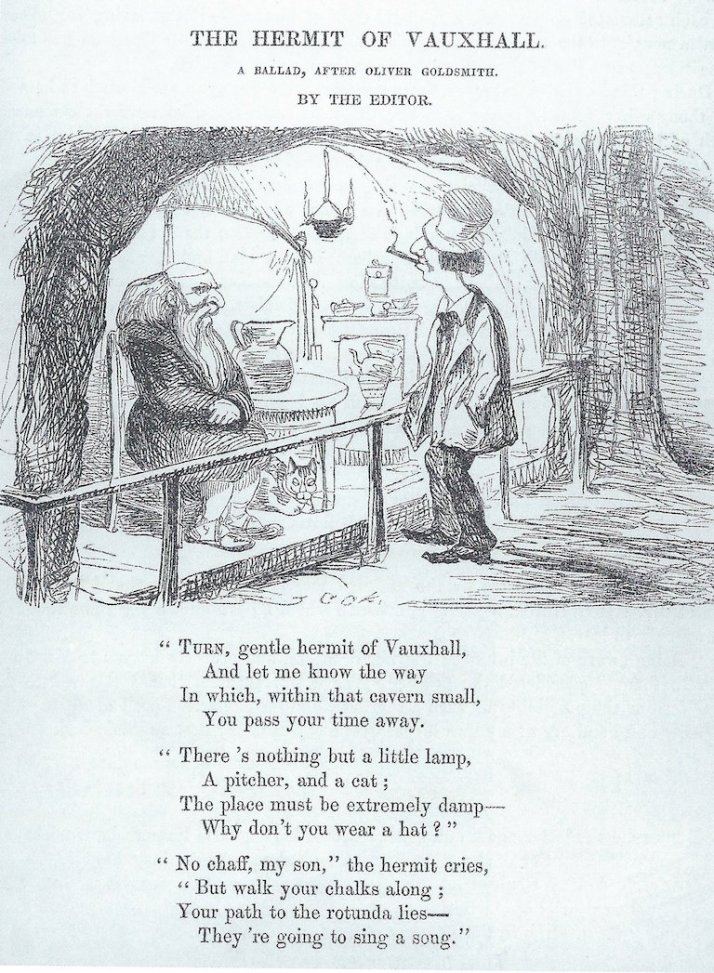
The Hermitage:

hermit

Anon., The Hermit of Vauxhall, engraving, 1832 (Minet Library, London, Lambeth Archives Department, V. of. 207). This is a rare view of the interior of the Hermitage and of the hermit himself. The verses are a parody of Oliver Goldsmith’s lengthy ballad The Hermit (1765), the first line of which is, ‘Turn, gentle hermit of the dale’.

…Made of wood and canvas, it represented the interior of a hermit’s cottage, with the hermit ready by lamplight. First installed in 1757, this too was painted by Mr Thorn and… was presumably constantly re-painted. The Hermitage became a fixture and was soon supplied with a live hermit, a fortune-teller.

The Thorns: Staff Artists

The Thorns, father and son (Francis), seem to have been the main staff artists…; their task was to change or renew the views and transparencies on show at regular intervals. So industrious were they that it is almost impossible to keep up with the succession of spectacular views that graced the gardens.

Over the years, these included:

diorama

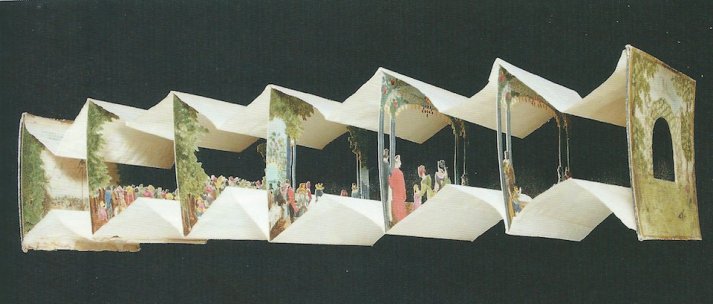
Optical toy or peepshow, color etching on cut sheets of card, 1822 (private collection). This souvenir of a Vauxhall Juvenile Fete folds flat but expands to give an in-depth perspective view of the gardens.

  • “a view of Naples by moonlight, with a vivid representation of Mount Vesuvius during an eruption”
  • Rotterdam by Moonlight
  • Paris from the Observatory
  • a Storm off the Cape of Good Hope
  • Fingal’s Cave
  • Views of Captain Ross’s Voyages to the North Pole
  • a moonlight scene of the ruins of an Italian abbey
  • ‘a stupendous diorama of the Golden Temple of Honan’
  • a model of St. Mark’s Square in Venice
  • ‘a dioramic picture of the proposed new Houses of Parliament after the designs of Mr. Barry’
  • ‘a Grand Moving Panorama of the voyage of the Nassau balloon up to 400 ft in length’.

The Royal Gardens, Vauxhall

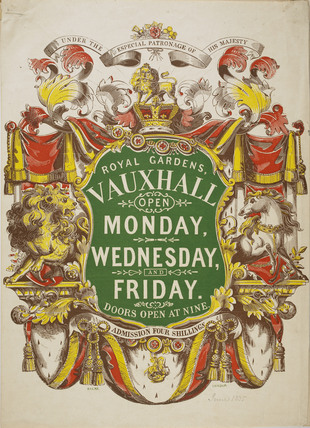
Poster, June 1835 (Museum of London, 2007.1/82). From 1822 onwards the proprietors squeezed every ounce of publicity out of the Royal designation of the gardens.

Poster, June 1835 (Museum of London, 2007.1/82). From 1822 onwards the proprietors squeezed every ounce of publicity out of the Royal designation of the gardens.

On June 3, 1822, the gardens opened under a new title, issued by Royal Warrant: “The Royal Gardens, Vauxhall.” The new king had visited the gardens frequently as Prince of Wales, and winning his patronage a great promotional coup. “The main entrance was rebuilt, with a portico surmounted by a large carved Royal Arms.”

Juvenile Fetes for Children

juvenile fete

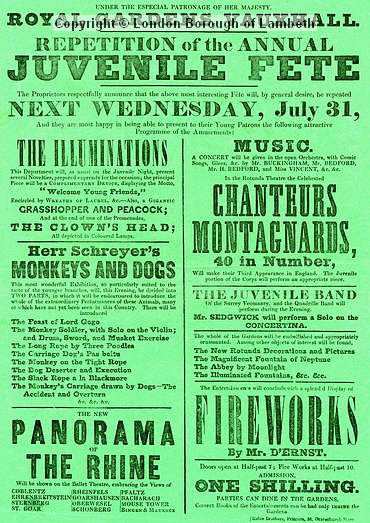
Poster advertising the Annual Juvenile Fete, 1824 (Lambeth Landmark 1383). The first such event was held on 13 July 1821 and proved so popular that it was decided to feature at least one every year. The attractions offered at Juvenile Fetes differed little from those on ordinary nights, although the songs avoided the doubles entendres designed for adult ears.

Saturday having been long considered problematic due to the objections of evangelical clergymen to keeping the gardens open after midnight, the new proprietors decided to hold a Juvenile Fete for children. “The first of these took place on 13 July 1821, starting at 5:30 and ending by 10 p.m. With much the same program as an ordinary night. It proved hugely popular.”

Dancing in the Gardens

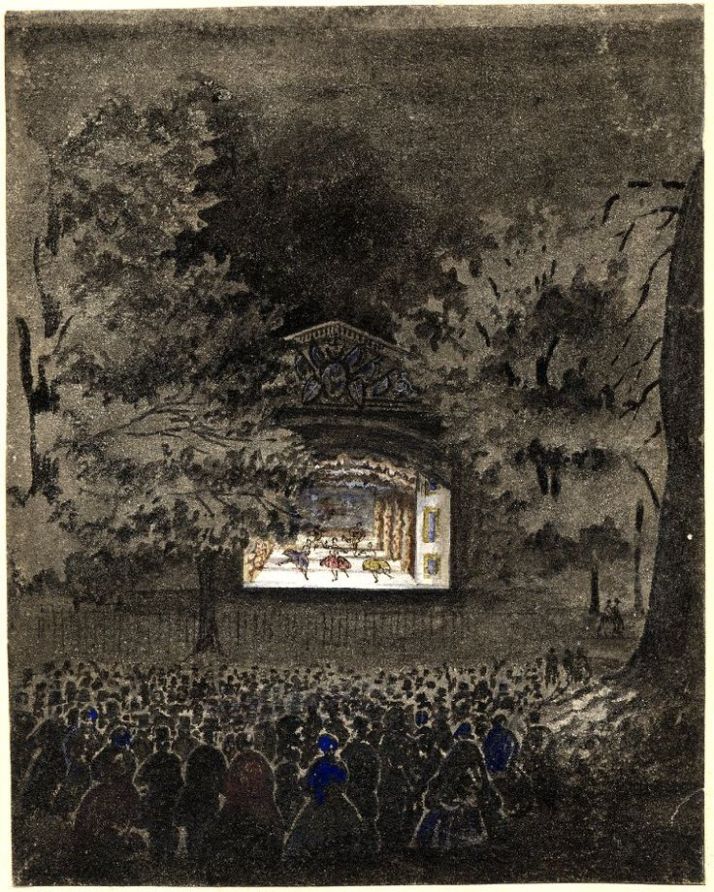
Anon., The Ballet Theatre, brush drawing in grey wash, touched with colored chalks, 1840-45 (British Museum, London, 1966.0212.1). The stage is surrounded by large trees and there is no seating provided.

Anon., The Ballet Theatre, brush drawing in grey wash, touched with colored chalks, 1840-45 (British Museum, London, 1966.0212.1). The stage is surrounded by large trees and there is no seating provided.

Having been granted a licence for Public Music and Dancing (spectator dancing only), “…of the 1823 season two new theaters were erected: one with appropriate scenery and decorations for the Juvenile Ballets; the other, in the Rotunda, for a ‘Novel Entertainment, diversified with dialogue, songs, and imitations’… The first ballet was Cendrillon, danced entirely by children, although adults took part in subsequent years.

The Aerial

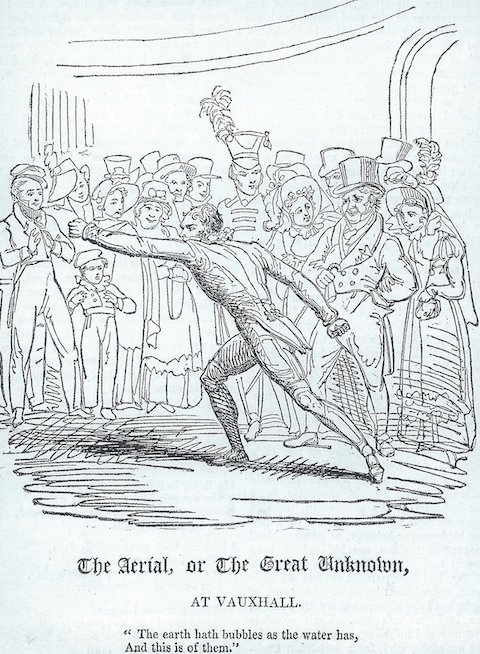
Anon., The Aerial, or The Great Unknown, at Vauxhall, engraving, 1825 (Minet Library, London, Lambeth Archives Department, V. of. 153). 'The Aerial' was an eccentric called Joseph Leeming who believed he was a person of unrivaled beauty. His appearances at Vauxhall during the 1825 season were widely reported in the press and provided good free publicity for the gardens.

Anon., The Aerial, or The Great Unknown, at Vauxhall, engraving, 1825 (Minet Library, London, Lambeth Archives Department, V. of. 153). ‘The Aerial’ was an eccentric called Joseph Leeming who believed he was a person of unrivaled beauty. His appearances at Vauxhall during the 1825 season were widely reported in the press and provided good free publicity for the gardens.

The summer of 1825… was most notable for the appearance of one of those strange characters who were drawn to Vauxhall from time to time. This was ‘The Aerial,’ the pseudonym of Joseph Leeming, whose eccentric behavior made him briefly the centre of attention. He claimed that his surpassing beauty was ‘without equal in nature or art, this or in any other age of the globe’. Having arrived in London from Manchester, he donned a blue and silver jacket, theatrical trunks or short breeches, silk stockings and blue kid shoes, with a double frill or ruff round his neck and wristbands trimmed with lace. Once in the gardens, he was taken by most visitors to be one of the performers, because he was not wearing a hat. But towards the end of the evening, people began to ask who or what he was. As The Times of 2 July 1825 reported:

An individual in a splendid dress of Spanish costume has excited much attention at Vauxhall Gardens. Having walked or rather skipped round the promenade, with a great air of consequence, saluting the company as he passed along, he at length mingled amongst the audience in the front of the orchestra, and distributed a number of cards on each which was written ‘The Aerial challenges the whole world to find a man that can in any way compete with him as such.’ After having served about three or four hundred of these challenges, he darted off like lightening, taking the whole circuit of the Gardens in his career, and made his exit through the grand entrance into the road where a carriage was waiting for him, into which he sprang and was driven off.

…His final visit to Vauxhall was on the evening of the Juvenile Fete, when he got drunk, and slept in a cloakroom until morning. After this he was informed that he would be refused entry to the gardens on any future occasion.

Susana’s Vauxhall Blog Post Series

  1. Vauxhall Gardens: A History
  2. Vauxhall Gardens: Jonathan Tyers—“The Master Builder of Delight” 
  3. Vauxhall Gardens: A New Direction
  4. Vauxhall Gardens: The Orchestra and the Supper-Boxes 
  5. Vauxhall Gardens: The Organ, the Turkish Tent, and the Rotunda
  6. Vauxhall Gardens: Three Piazzas of Supper-Boxes
  7. Vauxhall Gardens: “whither every body must go or appear a sort of Monster in polite Company”
  8. Vauxhall Gardens: The Competition
  9. Vauxhall Gardens: The Artwork, Part I
  10. Vauxhall Gardens: The Artwork, Part II
  11. Vauxhall Gardens: The Music, 1732-1859
  12. Vauxhall Gardens: The Business Side
  13. Vauxhall Gardens: Developments from 1751-1786
  14. Vauxhall Gardens: Thomas Rowlandson’s Painting (1785)
  15. ‎Vauxhall Gardens: The Third Generation of the Tyers Family and the Jubilee of 1786
  16. Vauxhall Gardens: An Era of Change (1786-1822), Part I
  17. Vauxhall Gardens: An Era of Change (1786-1822), Part II
  18. Vauxhall Gardens: An Era of Change (1786-1822), Part III
  19. Vauxhall Gardens: The Final Years, Part I
  20. Vauxhall Gardens: The Final Years, Part II
  21. Vauxhall Gardens: The Final Years, Part III
  22. Vauxhall Gardens: The Final Years, Part IV
  23. Vauxhall Gardens: Farewell, for ever

Alina K. Field: Rosalyn’s Ring

woman writing copy

An Invitation to a Wedding

1 January, 1817

My dear Miss Harris,

I hope this note finds you well and that the severe storms of last week did not interfere with the children’s Christmas. I so sincerely planned to spend Christmas Day with the children, but a most urgent matter arose in the district of my birth regarding my maid’s cousin. Her husband, the vile man, was SELLING her, imagine! I trust you will understand my absence at your Yuletide table, and I will certainly relate the particulars to you later, though the matter has been resolved in a way that I am resigned to finding satisfactory.

But Miss Harris, this is not why I’m writing. You will find the following information most irregular, perhaps, but I beg your indulgence and count on the liberality of your friendship. The weather being quite bad, I arrived only yesterday in London and am staying at the home of Viscount Cathmore, the most kind and gentle man who now has the estate that was once my family’s.

Miss Harris, please do send a note back with my messenger and tell me that you will visit me here in Grafton Street tomorrow afternoon, for Lord Cathmore and I are to be married then by Special License.

I am sending along some of Cook’s exquisite biscuits for the children, and you must plan tomorrow to stay for dinner and hear Hamish’s most generous proposals for the children. He is quite rich, and I do hope you will come and hear him out.

Do let me know that you will come, for your friendship means so very much to me, and you must let me know if any of the girls are ready for service as I am in sore need of a new maid.

Your dear friend,

Rosalyn Montegu

new cover copy

About Rosalyn’s Ring

When a young woman is put up for auction in a wife sale, Rosalyn Montagu seizes the chance to rescue her—and to recover a treasured family heirloom, her father’s signet ring. Her plans are thwarted by the newly anointed Viscount Cathmore who finds her provoking beauty, upper crust manner, and larcenous streak intriguing. Her secrets rouse his jaded heart, including the truth of her identity—she is the woman whose home he has usurped. But more mysteries swirl around Rosalyn’s past, and Cathmore is just the man to help her uncover the truth.

Amazon

Excerpt

“A woman cannot buy a wife,” someone said. “‘Tis unnatural.”

Rosalyn rallied herself. “What is unnatural is selling a human being,” she shouted. “What is a travesty is to celebrate our Lord’s birthday by selling a mother and child to God knows what fate.”

The crowd rumbled angrily. Mindy spoke, but Rosalyn could not hear her words, and a hard look from Ned Morgan silenced his property. Mindy cast her eyes down until he turned away, then went back to her bold appraisal of the crowd.

“I will bid in your behalf,” Cathmore said quietly to Rosalyn. “Do you agree?”

Her heart pounding, she nodded.

“What is your limit?”

Her limit? Surely the notes in her boot were more than enough to outbid this lot. She would hope to not go that high; it would mean an entire year of leanness, not just for her, but for the orphans.

And yet, a woman should not be sold, even if it meant no sweets for the children and Rosalyn’s own sacrifices.

“I will tell you when to stop,” she said.

“Very well.” He stood tall. “You may disregard the lady’s bid.”

“Then get on with it,” Ned Morgan shouted.

The wizened auctioneer rapped the bar again and called for bids.

“Tuppence, I said.” The bid came again from the bar.

“A half crown.”

That voice came from nearby, and Rosalyn recognized it. Mr. Logan’s strong tenor resonated with determination. He exchanged a look and a nod with Cathmore, and smiled at Mindy, who sent him a glowing smile in reply.

Ned Morgan’s big fist came down on the bar, rattling glasses. “It’s not enough, Logan,” he shouted. “Not for what ye done.”

Rosalyn tasted bile. They all knew each other. Cathmore, Logan, Morgan.

“Bid three shillings,” Rosalyn hissed at Cathmore.

He called out her bid and sent Logan the smallest of shrugs. Logan countered, Morgan pounded, and Rosalyn looked for Nelly.

What is she doing?

Nelly had moved closer to Ned Morgan, her eyes glittering with excitement. Not pain, not worry over her cousin, and not desire to hold her baby nephew.

Hot anger spiked in Rosalyn. The cause was just, but the drive to come here had been Nelly’s. That she had no interest in the babe did not surprise Rosalyn—Nelly didn’t like children—but her gaze was on Morgan, not Mindy.

A commotion at the center of the room drew everyone’s eyes. Two men had squared off, their jaws moving, their fists poised. Morgan shouted at the auctioneer, the men, and the crowd, and sent angry glares at Logan and Cathmore. His eyes landed on Rosalyn and he bellowed louder.

Rosalyn could not keep track of the bidding, but she could hear Cathmore’s rumble and the auctioneer’s, and the melodic, determined tones of Logan.

She felt dizzy, and hot, and more than a little worried. She heard Cathmore call out a bid, but she didn’t know if it was pence, or shillings, or something more. She touched his arm to get his attention. “What is the bid?”

Behind them, another melee flared. The auctioneer pounded, and men shouted. A body veered and pushed her at Cathmore, who caught her close and led her quickly away from the trouble and into the private dining room.

Rosalyn struggled to breathe. His arms held her loosely, but his nearness took her breath away. No man had ever held her like this, and she had trouble finding her composure.

“The bidding!” she said, choking. “What was the b—”

His lips pressed down on hers and silenced her.

About the Author

Alina K. Field copyAward winning author Alina K. Field earned a Bachelor of Arts Degree in English and German literature, but she found her true passion in reading and writing romance. Though her roots are in the Midwest, after six very, very, very cold years in Chicago, she moved to Southern California and hasn’t looked back. She shares a midcentury home with her husband and a blue-eyed cat who conned his way in for dinner one day and decided the food was too good to leave.

She is the author of the 2014 Book Buyer’s Best winner in the novella category, Rosalyn’s Ring, a Regency novella; and the novel-length sequel, a 2015 RONE Award finalist, Bella’s Band, both Soul Mate Publishing releases.

WebsiteFacebookTwitterGoodreads


Collette Cameron: Heartbreak and Honor

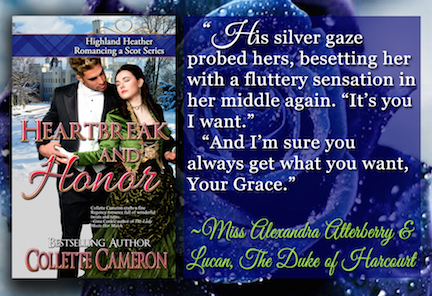
HAH_meme_4 copy

Scottish Gypsies

Highland Travelers or Black Tinkers

By Collette Cameron

The term gypsy is a misnomer derived from Egyptian, much like the label Indian for Native Americans, and Romany Gypsies are quite different than the Highland Scottish Travellers or Black tinkers as they were known.

Though both groups, as well as at least a half a dozen other nomadic tribes, traveled throughout Scotland, the Roma’s origins trace back to India, whereas the Black Tinkers (in Gaelic-The Ceárdannan or the craftsmen) are mostly a genetic indigenous Scots.

That meant I had to rethink Tasara Faas, my heroine in Heartbreak and Honor.

I’d written a story with a part Roma heroine before, The Viscount’s Vow, but the Highland gypsies were vastly different. Everything from her dress, customs, and speech had to be researched because she’s far more like a Scotswoman than a Romany.

[ File # csp6407646, License # 2835035 ] Licensed through http://www.canstockphoto.com in accordance with the End User License Agreement (http://www.canstockphoto.com/legal.php) (c) Can Stock Photo Inc. / konradbak

Some Scottish Highland Traveler families do claim Roma heritage, and their Scottish–Gaelic cant contains Romany or Anglo-Romany words. In fact, some groups call themselves Nackin which is thought to be of Hindi origin.

No surprise there since the various tribes date back at least five hundred years in Scotland. However, the prevalence of the Roma influence is seen more in the Lowland travellers rather than the Highlands.

canstockphoto7116746 copy

The Black Tinkers language is secret and has never been recorded in writing, according to one source. Many hold typical Scottish surnames such as Stewart, Macmillan, MacDonald, and Cameron. They possess a strong belief in the importance of family and purity taboos, much like the Roma travellers.

And much like the European Roma, the Highland Travelers were (are) a maligned segment of population. Stereotyped as thieves, con men, and fortune tellers, stories were broadly circulated that gypsies would kidnap children. In an odd twist, gypsies’ feared abduction themselves. Many disappeared and were thought victims used in medical schools for dissection. Rumors abounded of illegitimate children of the gentry or haute ton, being sold or given to the gypsies as well.

canstockphoto5584840 copy

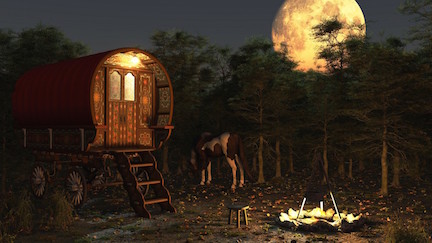
Highland Travelers were so despised, that during the 17th century, Scottish law ordered them to “quit the realm” or hang. Scottish Travelers toted their goods in carts and pitched bowed tents while the Roma typically lived in vardos, a type of caravan wagon. Some sources also claim the Highland Scottish Travelers used caravans as well.

Today, usage of the terms gypsy or even tinker is considered derogatory.

Though a Scottish Regency Romance, Heartbreak and Honor uses the abduction and persecution elements of the Scottish gypsies to help spread their unique, and often unfortunate, tale.

What unusual elements do you enjoy reading about in a historical romance?

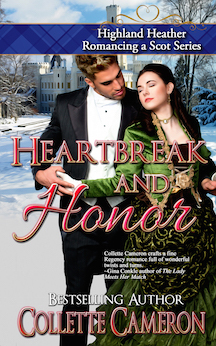
HeartbreakandHonor3_850 copy

About Heartbreak and Honor

Highland Heather Romancing a Scot Series, Book 3

Abducted by a band of renegade Scots, Highland gypsy Tasara Faas doesn’t hesitate to blacken her rescuer’s eye when the charming duke attempts to steal a kiss. Afterward, she learns she’s the long-lost heiress Alexandra Atterberry and is expected to take her place among the elite society she’s always disdained.

Lucan, the Duke of Harcourt, promised his gravely ill mother he’d procure a wife by Christmastide, but intrigued by the feisty lass he saved in Scotland, he finds the haut ton ladies lacking. Spying Alexa at a London ball, he impulsively decides to make the knife-wielding gypsy his bride despite her aversion to him and her determination to return to the Highlands.

The adversary responsible for Alexa’s disappearance as a toddler still covets her fortune and joins forces with Harcourt’s arch nemesis. Amidst a series of suspicious misfortunes, Lucan endeavors to win Alexa’s love and expose the conspirators but only succeeds in reaffirming Alexa’s belief that she is inadequate to become his duchess.

Amazon

Excerpt

“Duke? What’s a ruddy English duke doing sneaking into a Scottish keep’s chamber?” Tasara flinched. She hadn’t meant to speak aloud.

“Why, rescuing you, of course.”

Did he wink? Cocky fellow, wasn’t he? But then, he was a duke. The attitude came with the title, no doubt present from birth. Probably had his noble bum and snotty nose wiped with the finest linen or silk. Astonishing that he deemed to exert himself enough to muster a sweat. Didn’t nobility have servants do everything for them?

Muted voices and calls echoed from somewhere in the keep.

Attempting to recognize a voice, she tilted her head.

The horrific shrieks and roars of minutes ago had ceased, although an occasional shrill cry yet rang through the stone passageways, raising the hair along her nape.

“Ye be here to rescue us?” Holding Lala’s pudgy hand, György knelt on the bed, his ebony eyes wary and no doubt sprinkled with a dab of excitement too.

In the muted light, Tasara couldn’t be certain. Lads dreamt about adventures of this sort.

“I am, indeed, young sir.” His grace smiled, his teeth gleaming in the half-light. “Whom do I have the pleasure of addressing?”

György shook his sister’s grip loose.

She jammed her thumb in her mouth and toyed with the curls tumbling atop her left shoulder. She stared at the duke, her gaze wide and distrusting.

After scooting from the bed, György gave a handsome bow. “György Faas, Yer Highness, and these be me sisters, Tasara and Lala.”

“It’s Your Grace, György, not Your Highness.”

I think.

Tasara’s attention swung between the duke and her brother. Harcourt probably had been treated like royalty his entire life.

“Grace? Are ye sure, Tasara?” György pulled a silly face and snickered. “That be a lass’s name.”

The duke chuckled again, the rich timbre resonating from his chest. “So it is. Most embarrassing, I’ll admit, but I’m afraid someone started the ridiculous tradition far too long ago for me to change things now. I’m just grateful they didn’t select Chastity or Prudence.”

Aye, me too, Your Chastity.” György clutched his belly in glee and laughed harder. “Dinnae ye have a given name?”

“Indeed, I do. Several as matter of fact. I’m named Rochester after my father, though I prefer to be addressed as Harcourt or Lucan, which is part of my middle name, Lucan-Ashford.”

His agreeableness irked Tasara. No doubt he could charm the fur from a fox and have the creature thanking him for the honor of losing its hide.

About the Author

Collette Cameron copyBestselling, award-winning Historical Romance Author, Collette Cameron, pens Scottish and Regency Romances featuring rogues, rapscallions, rakes, and the intrepid damsels who reform them. Mother to three and self-proclaimed Cadbury chocoholic, she’s crazy about dachshunds, cobalt blue, and makes her home in Oregon with her husband and five mini-dachshunds. You’ll always find animals, quirky—sometimes naughty—humor, and a dash of inspiration in her novels. To learn more about Collette and her books, visit collettecameron.com

Her award-winning Castle Brides Series, Highland Heather Romancing a Scot Series, and Conundrums of the Misses Culpeppers Series, as well as her other books, are all available on Amazon and other major retailers.

Website • Blog • Twitter • Facebook • Regency Rose Newsletter


Vauxhall Gardens: An Era of Change (1786-1822), Part III

vauxhallbook

Vauxhall Gardens: A History

David Coke & Alan Borg

The Vauxhall Pleasure Gardens is one of the places I’d love to slip back in time to visit, just to catch a glimpse of what it was like. After recently splurging to buy this lovely coffee-table book, I thought it might make a wonderful subject for a new blog series. But do buy the book too, if you can! The photos are fabulous!

Madame Saqui

Madame Saqui at Vauxhall

Marguerite-Antoinette Lalanne came from an acrobatic family performing first at provincial fairs in France, and then at the fashionable Tivoli Gardens (‘The Paris Vauxhall’). Madame Saqui, as she was after her marriage,   became so popular in France that Napoleon arranged for her to perform for his army, after which she had her coach painted with an imperial eagle.

Once the War with France had definitively come to an end, Vauxhall proprietors George Rogers Barrett and Jonathan Tyers Barrett were determined to persuade her to come to England to perform at Vauxhall. Her first performance, however, was at Covent Garden Theatre. See the print below “of her descending from the balcony on a tight rope, brandishing two large flags, as the men in the audience look up her skirt with telescopes. The caption reads: ‘A Wonderful THING from PARIS… or Madame SACCHI gratifying John Bulls curiosity, at Covent Garden Theatre, April 1816.’

Madame Saqui at Covent Garden

Madame Saqui at Covent Garden

Prior to the opening of the 1816 Vauxhall Season on 3 June, the advertisements included:

At the end of the first Act Mme and Messrs Sachi will go through a variety of surprising evolutions on the Tight Ropse… at the conclusion of the concert… fireworks… when Madame Sachi, in the midst of a brilliant display of Chinese fire, will perform her astonishing Ascension, as exhibited in the Gardens of Tivoli in Paris. Admission to the Gardens is lowered from 4s to 3s 6d.

The weather was perfect and the crowds flocked to catch a glimpse of the new attraction.  The enormous success of the evening led to announcement that Madame Saqui’s troupe would perform every night until further notice. As they did, virtually every night of every season until 1820.

In her first year at Vauxhall, on the birthday of the Prince Regent, Madame Saqui exhibited her ‘grandest Feat which she had the honor of performing before the Sovereigns of Europe two years since, at Paris’—no doubt one of her spectacular ascents… [In 1819], instead of ascending from the ground, she suddenly appeared in the centre of a blazing star, 60 feet above the heads of the astonished crowd; from this she descended amidst a shower of fire accompanied by martial music. Then she turned round, ran back up the rope to the fiery star, only to be lost to view in a new barrage of fireworks. She also continued to perform with her daughter Adèle, the pair dancing an allemande on two or three ropes.

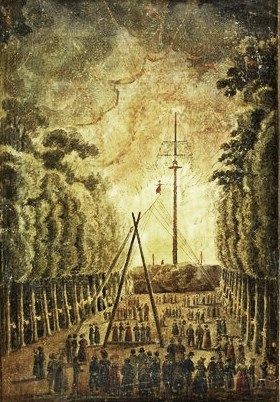
Vauxhall Madam Saqui Descending In 1816, Madame Saqui ascended and descended a tightrope that was fixed to a sixty foot mast accompanied by a firework display

Madame Saqui left Vauxhall after the close of the season in 1820 to do other things, eventually retiring and falling on hard times. She did come out of retirement at the age of seventy-five, performing at the Hippodrome. A correspondent to L’Intermédiare des chercheurs et des curieux said:

When I was a child, I saw her dance on the tightrope at the Hippodrome; she was seventy-five. It was a pitiful sight to see this decrepit figure in a pink costume, her face the color of faded parchment surmounted by a grotesque diadem. She gained in my childhood memory as an unforgettable image of the evil diary Carabosse.

Musicians

One of the characteristics of many Vauxhall performers long service. “It was not unusual for musicians, including singers, to work each season in the gardens for at least twenty years, and some served for much longer: the kettledrummer Jacob Nelson held the record at fifty years…”

James Hook, composer and organist, was a fixture at the park from 1772-1821, composing “over two thousand songs and  at least twenty organ concertos.”

William Parke, an oboist who joined Vauxhall with his brother John in 1776, composed numerous songs, concertos and other pieces, and also wrote Musical Memoires, which is full of information about the music at Vauxhall.

Strolling Players were the Savoyards , who played French and Venetian ballads in groups of four or five throughout the gardens following the main concert in the Orchestra, on instruments that included flutes and cymbals. The Pandeans (although some considered them to be the same as the Savoyards) played on pan-pipes. “The Duchess of Devonshire is known to have preferred the Pandeans…”

Charles Taylor received £290 in 1812. He

…was one of the longest-serving and most popular Vauxhall singers, especially noted for his comic songs. He first appeared in the gardens in 1794, returning regularly thereafter. He made the speech on the last night of the season several times and, unusually for a vocalist, rose to become Director of Music in 1822.

Mrs. Bland first appeared in 1790, retiring in 1823.

21 Mrs Bland THUMB

Described as ‘the sweet-voiced, dumpy little ballad singer’, she was said to have ‘refused an offer [for the 1789 season] of the Vauxhall Managers, to the tune of one hundred and sixty guineas.’ Her voice was ideally suited to the countless ballads that Hook and others wrote for her. Sometimes these demanded special effects—in June 1818, for example, she sang a new song by Parke, which was echoed in a distant part of the gardens by a bugle-horn.

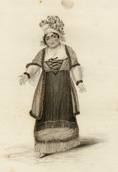
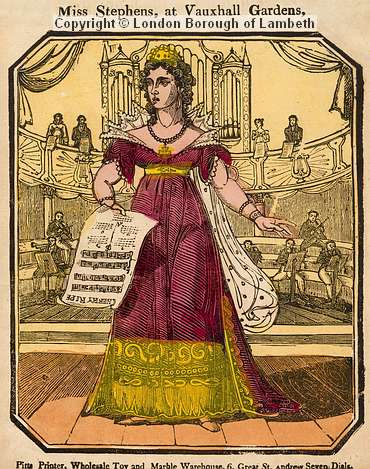
Catherine (Kitty) Stephens, an actress and soprano, married the 5th Earl of Essex in 1838.

Miss Stephens

Charles Dignum first appeared in 1794, but became notable at Vauxhall during the first two decades of the 19th century. “He was well-known for his duets with Mrs Bland, especially Long Time I’ve Courted You, Miss,  a dialogue between a shy sailor and a flirtatious lady.

John Braham, a popular operatic tenor, made his first appearance at Vauxhall as a boy soprano in 1787, “returning as an established star for the season of 1826, for the enormous fee of 800 guineas.”

Miss Feron (Fearon), known for her imitative talent, performed “a new comic song by Parke called The Romp or the Great Catalani, in which she used her powers of mimicry to parody the famous Italian soprano.” This act became so popular that it was repeated often and Parke writes:

…The recitative which introduces the air, ending with the words Great Catalini, it became necessary, in order to make the music accord with the poetry, to repeat a part of the last word, by which it read thus: Great Cat, Great Catalani. This, I was informed, gave umbrage to the lady, who, having perhaps an aversion to the feline race, said that she liked the song very well, with the exception of the Great Cat in it.”

Comic Songs

Parke’s Great Catalani was an early example of the double-entendre, that came to dominate the music hall… The words of many of these songs were published and sold at the gardens, so that the public came to know them by heart and to glamour for their repeated performance.

Susana’s Vauxhall Blog Post Series

  1. Vauxhall Gardens: A History
  2. Vauxhall Gardens: Jonathan Tyers—“The Master Builder of Delight” 
  3. Vauxhall Gardens: A New Direction
  4. Vauxhall Gardens: The Orchestra and the Supper-Boxes 
  5. Vauxhall Gardens: The Organ, the Turkish Tent, and the Rotunda
  6. Vauxhall Gardens: Three Piazzas of Supper-Boxes
  7. Vauxhall Gardens: “whither every body must go or appear a sort of Monster in polite Company”
  8. Vauxhall Gardens: The Competition
  9. Vauxhall Gardens: The Artwork, Part I
  10. Vauxhall Gardens: The Artwork, Part II
  11. Vauxhall Gardens: The Music, 1732-1859
  12. Vauxhall Gardens: The Business Side
  13. Vauxhall Gardens: Developments from 1751-1786
  14. Vauxhall Gardens: Thomas Rowlandson’s Painting (1785)
  15. ‎Vauxhall Gardens: The Third Generation of the Tyers Family and the Jubilee of 1786
  16. Vauxhall Gardens: An Era of Change (1786-1822), Part I
  17. Vauxhall Gardens: An Era of Change (1786-1822), Part II
  18. Vauxhall Gardens: An Era of Change (1786-1822), Part III
  19. Vauxhall Gardens: The Final Years, Part I
  20. Vauxhall Gardens: The Final Years, Part II
  21. Vauxhall Gardens: The Final Years, Part III
  22. Vauxhall Gardens: The Final Years, Part IV
  23. Vauxhall Gardens: Farewell, for ever

Jacki Delecki: A Christmas Code (Giveaway)

bigstock-Christmas-background-with-fir--70639783-copy

Tis the Season…for romantic suspense!

As a romantic suspense author, I am always in search of new ideas and concepts that I can weave into my stories and plots. What might sound like homework to some is more like a challenging scavenger hunt to me. The idea is to collect a variety of random ideas and then figure out how to assemble them into a compelling tale of intrigue.

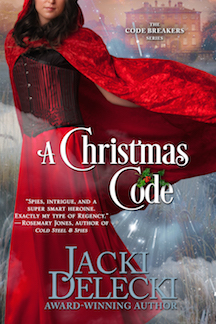
For A Christmas Code, Book 2 of the Regency romantic suspense series, the Code Breakers, I combined elements from the winter holiday season to craft a story that features an attempted poisoning set against the elegant backdrop of the Regency Ton. In this story, the hero Ash is poisoned by a dose of ground up holly berries meant for the Prince Regent.

JackiDelecki_AChristmasCode_HR copyA popular accent used in Christmas decorations, holly is an evergreen shrub that can grow to be a tree, and there are more than 400 different varieties of the plant. The fruit and leaves contain a mix of caffeine-like alkaloid theobromine, caffeine and glycosides (theobromine is also found in chocolate and cocoa).

People and pets avoid the prickly leaves, but children may be attracted to the bright red berries. As few as 20 can be lethal if consumed, and eating just three berries can cause nausea, vomiting and diarrhea. More severe symptoms include drowsiness, slowed breathing and heart rate, coma and death.

Ash catches a lucky break, because, while holly berries are toxic, people rarely die from ingesting this type of poison. Nowadays modern medicine can treat individuals who consume holly berries, but that wasn’t always the case.

I recently released the audiobook version of A Christmas Code, which is narrated by the talented Pearl Hewitt, who also narrated two other books in this series: A Code of Love and A Code of the Heart. You can listen to an audio sample here: http://bit.ly/1ToZIx9

Comment on this blog for a chance to win a digital or audiobook of A Christmas Code.

Fans of holiday romance are in for an added treat from Jacki Delecki. A holiday edition of Marriage Under Fire, Book 4 of the Grayce Walters contemporary romantic suspense, is available. This edition features more than 9,000 words of exclusive content, including Maddy and Hunter’s romantic Christmas wedding with Grayce, Davis, Hollie, James and the entire Grayce Walters crew. The holiday edition of Marriage Under Fire is available at Amazon, Barnes & Noble, iBooks, Kobo and Google Play for a limited time. Readers who have already purchased the book can enjoy the new scenes for free by accessing the updated ebook.

About the Author

Head Shot copyJacki Delecki is a bestselling romantic suspense writer. Delecki’s Grayce Walters Series, which chronicles the adventures of a Seattle animal acupuncturist, was an editor’s selection by USA Today. Delecki’s Romantic Regency The Code Breaker Series hit number one on Amazon. Both acclaimed series are available for purchase at http://www.JackiDelecki.com. To learn more about Jacki and her books and to be the first to hear about giveaways join her newsletter found on her website. Follow her on FB—Jacki Delecki; Twitter @jackidelecki.

Callie Hutton: The Highlander’s Accidental Marriage

Interview with Callie Hutton

Susana: What inspired you to start writing?

Callie: When I was a child I used to make up stories in my head that would entertain me when I was falling to sleep at night, or on long boring road trips. This continued on until adulthood, when I decided writing them down would be a good idea. I wrote many short stories for magazines and newspapers and then finally decided to write a book in 2010.

Susana: What comes first: the plot or the characters?

Callie: Almost always the plot. But if I’m writing a series, then the character will come first. But sometimes the character, as he or she appeared in another book, gives me the idea for his or her story.

Susana: Are you a plotter or a pantser?

Callie: I started off a panster, but after about five books I started plotting and now I find I do it all the time. I do extensive research, do character sketches, plot out the story, put all that information into a binder, and then outline it all, chapter by chapter, onto a white board.

Susana: Tell us something about your newest release that is NOT in the blurb.

Callie: Lady Sarah Lacey has a secret reason why she doesn’t want a husband. At least not at this time in her life.

Susana: Are you working on something at present that you would like to tell us about?

Callie: Right now I am working on The Highlander’s Distraction. This is the final story in the Marriage Mart Mayhem series, staring the youngest sister, Mary. She’s visiting sister Sarah when she gets herself into trouble.

Susana: What author or authors have most influenced your writing?

Callie: Linda Lael Miller, Eloisa James, Julia Quinn, Lorraine Heath just to name a few.

Susana: Is there a writer you idolize? If so, why?

Callie: Probably Sandra Brown. She started off writing category romance and managed to segue into a top selling romantic suspense author. I would love to follow her career path.

THAM1600 (1) copy

About The Highlander’s Accidental Marriage

Lady Sarah Lacey is on her way to the Highlands to visit her twin sister, Lady Sybil MacBride, when she meets with an accident. Stranded on the road, she encounters Professor Braeden McKinnon, traveling to his home near Sarah’s destination. She cajoles him into escorting her and her maid.

As they take to the road together, Braeden finds the fiery Lady Sarah a handful of trouble. But nothing prepares him for the words she utters in front of witnesses that binds them together in matrimony. Waiting for word that he has been selected to work on an archeological dig in Rome, he had no intention of taking a wife for a long time. Now that she has accidentally married them, however, perhaps it would not be such a bad thing, after all.

Except Sarah has no intention of being anyone’s wife. She has other plans . . .

Entangled Publishing

Excerpt

She smiled at him. “Yes. I am ready.” Without another word, she sashayed over to his horse and stood next to it, her eyebrows raised. “Well. Are we leaving?”

Professor McKinnon had to shut his mouth, which hung open. He stomped over and, grasping her waist, flung her onto the horse’s back. She immediately began to slide to the other side, the weight of the wet clothes pulling her over. He reached out and grabbed her, tugging her the other way. Her arms flailing, she slid toward him and fell off, landing on him, sending both of them into the mud.

She lay sprawled on top of his muscular body, not more than an inch from his surprised expression. Mud splattered his spectacles as well as the rest of his face. Unable to help herself, she burst out laughing. He glowered at her and then his muscles relaxed, a slight smile teasing his lips which turned into a grin. “I’d love to lie here with ye on top of me, lass, but I dinna think we’ll get very far if ye do. ’Tis not fond of an audience, I am.”

About the Author

CroppedUSA Today best selling author of The Elusive Wife, Callie Hutton writes both Western Historical and Regency romance, with “historic elements and sensory details” (The Romance Reviews). She also pens an occasional contemporary or two. Callie lives in Oklahoma with several rescue dogs, two adult children, and daughter-in-law (thankfully all not in the same house), and her top cheerleader husband of thirty-eight years. She also welcomed twin grandsons to her ever expanding family in August of 2015.

WebsiteFacebookTwitter • Goodreads

 Amazon Author Central

Bliss Bennet: A Man Without a Mistress

The Real Regency Scandal Sheets?

by Bliss Bennet

Plotlines featuring scandal sheets have become a staple of the Regency-set historical romance, mirroring the current-day popularity of magazines and television shows devoted entirely to celebrity gossip. But did newspapers devoted to spreading tittle-tattle about the high and mighty really exist during the Regency period?

According to the Oxford English Dictionary, the term “scandal sheet” did not enter the lexicon until the first decade of the twentieth century. And an advanced search of Google Books reveals only a slightly earlier date, with citations from no earlier than the 1890s. But perhaps “scandal sheet” was simply not the term in use during the period for newspapers or magazine devoted to scandal?

In his book Scandal: A Scurrilous History of Gossip, Roger Wilkes sets the date for the publication of what we might today call full-fledged scandal sheets a good bit earlier than the existence of the term itself. But still not in the Regency. Gossip columns appeared in English newspapers as early as 1704 (when Daniel Defoe, known today for his novel Robinson Crusoe, created the informal “Advice from the Scandalous Club” for his new paper, Review), and gossip pamphlets on specific subjects were also published during the eighteenth century. But newspapers devoted entirely to scandalmongering did not begin to be published until the 1820s.

I’ve been wondering, then, if a more historically accurate analog to today’s People, Entertainment Tonight, and National Enquirer might be a “scandal sheet” of an entirely different sort than a newspaper: the popular satirical print. The period between 1760 and 1820 is often referred to as the “Golden Age of Caricature,” in part because of the prints satirizing the British Royal family that proliferated during this period. But many high-ranking political and social figures besides King George and his relations found themselves the butt of a satirical print’s pointed humor. The audience for such prints was wide, just as it is for today’s scandal sheets; the middling sorts as well as aristocrats could afford a sixpence for a plain folio mezzotint, or a shilling for a colored one, the typical price for a print in the late eighteenth century.

The Jersey Smuggler

The Prince Regent, caught in bed with his mistress, Lady Jersey, by his wife

[James Gillray, The Jersey Smuggler Detected; —or—good causes for discontent [separation]. 1796. British Museum.]

Blockheads

The Prince Regent ridiculed as a blockhead, along with many other famed political leaders of the day

[George and Isaac Cruikshank, Blockheads. Frontispiece from A Political Lecture on Heads, Alias Blockheads!!! 1819. Vialibri.net.]

Gillray_-_Sir_Richard_Worse-than-sly,_exposing_his_wife's_bottom;_-_o_fye! copy

A major Regency scandal: the Worsley crim com trial, which brought to light shameful details of Sir Richard’s voyeuristic sexual tendencies, details which satirist Gillray did not shy away from skewering

[James Gillray, Sir Richard Worse-than-Sly, exposing his wife’s bottom; — O fye! 1782.]

Regency-era satirical prints have their roots in both visual caricature and in literary satire. In the late 16th century, Italian brothers Annibale and Agostino Carracci applied the words carico and caricare (to load, or to exaggerate) to some of the exaggerated portraits they drew, starting a trend for caricatures on the Continent. During the seventeenth century, art collectors and young men on the Grand Tour brought many examples of Italian caricatures back to England, some of which caught the eye of English publisher Arthur Pond. In 1736, Pond printed a collection of drawings by Annibale Carraci and other Italian caricaturists, which proved immediately and widely popular with London audiences. Noting the high sales of Pond’s collection, English artists soon began combining the exaggeration of the visual caricature with the biting satire of the period’s literature to create their own home-grown prints. Thus beginning a craze for satiric prints in England that lasted well into the nineteenth century.

Miss Macaroni

One of the earliest prints to feature a print shop, reputedly the Darlys’s shop on the Strand

[John Raphael Smith, Miss Macaroni and her gallant at a print shop. 1773. Guildhall Library, Corporation of London.]

During the seventeenth century, St. Paul’s and Fleet Street were where one would go to find shops devoted entirely to selling individual prints, right alongside booksellers and printers. Most sold both art prints and comic ones, although by 1762, satiric prints had grown so popular that Mary and Matthew Darlys, known as the “Fun Merchants” (at 39 Strand) opened a shop devoted entirely to comic prints. By the early 1800s, print shops had branched out westward along Fleet Street and the Strand, to the new developments around St. James’s in Westminster. John Bowles (under the sign of the Black Horse in St. Paul’s Churchyard), James Bretherton (134 Bond Street) and Mrs. Humphreys (in St. James’s) were some of the more popular purveyors. Publishers William Holland and Samuel William Fores even set up exhibition rooms that featured only prints, and charged entry fees to viewers. “In Holland’s Caricature Exhibition rooms may be seen, the largest Collection of Prints and Drawings in Europe,” claimed Holland’s advertisements; “The most complete Collection. Ever exposed to public View in this Kingdom,” countered Fores’s.

Given the often lewd, rude, and even pornographic nature of many of the era’s prints, it’s hardly surprising to discover that many Regency commentators bemoaned the open display of satirical prints in shop windows. Take for example, John Corry’s “Caricature and Printshops,” from his 1801 Satirical View of London:

Dandy Pickpockets

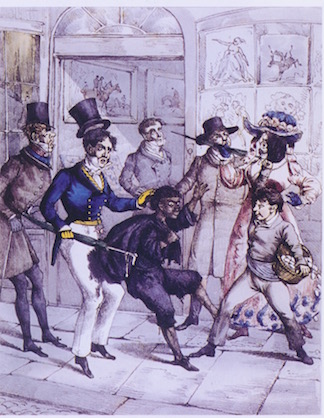
Satiric print depicting the dangers of print shop gazing!

[Isaac Robert Cruikshank, Dandy Pickpockets, Diving. 1818. Hand colored etching. Museum of London.]

Casualties of streetwalking copy

Satiric print depicting the dangers of print shop gazing!

[Anonymous, Casualties of London Street Walking: A Strong Impression. 1826. Guildhall Library, Corporation of London.]

This humorous mode of satirising folly is very prejudicial to the multitude in many respects: — in the loss of time to those who stop to contemplate the different figures; the opportunities given to pickpockets to exercise their art; and that incitement to licentiousness occasioned by the sight of voluptuous painting. The indecent attitudes obscene labels, and similar decorations, must have a powerful effect on the feelings of susceptible youth; and it is an authenticated fact, that girls often go in parties to visit the windows of printshops, that they may amuse themselves with the view of prints which imbue the most impure ideas. Before these windows, the apprentice loiters unmindful to his master’s business. And thither prostitutes hasten, and fascinating glances endeavor to allure the giddy and the vain who stop to gaze on the Sleeping Venus, the British Venus and a variety of seductive representations of naked feminine beauty. (75-77)

Mrs. Humphreys copy

Mrs. Humphrey’s print shop, published by Mrs. Humphrey herself; the caption translates as “Shame on he who thinks evil of it”

[Anonymous. Honi Soit Qui Mal Y Pense, published by G. Humphrey. 1821. Colored etching. Guildhall Library, Corporation of London.]

Wouldn’t you love to attend one of those print shop-gazing parties? I know I would. In fact, it was after reading this passage that I had the idea to include a scene set outside a shop that peddles satirical prints in my latest historical romance, A Man without a Mistress. In the window of Bretherton’s (an actual print shop of the period), Sir Peregrine Sayre spies a print of the recently deceased Lord Saybrook cavorting with an obviously diseased courtesan. To keep the fast-approaching daughter of Lord Saybrook, Sibilla Pennington, from catching sight of the scandalous print (and thereby discovering the true cause of her father’s death, venereal disease), Sayre is forced to make a bet with her, a bet that will only entangle him further with the headstrong young woman whom he’d promised himself he’d stay far away from. And, of course, further scandal ensues . . .

Man Without a Mistress eBook Cover Large copy

If you’re interested in finding out more about Regency era satirical prints, check out these resources:

Baker, Kenneth. George IV, A Life in Caricature. London: Thames and Hudson, 2005.

Bills, Mark. The Art of Satire: London in Caricature. London: Philip Wilson/Museum of London, 2006.

Donald, Diana. The Age of Caricature: Satirical Prints in the Reign of George III. New Haven: Yale UP, 1996.

Cindy McCreery, The Satirical Gaze: Prints of Women in Late Eighteenth Century England. London: Oxford UP, 2004.

Roger Wilkes, Scandal: A Scurrilous History of Gossip. London: Atlantic Books, 2002.

About A Man Without a Mistress

A man determined to atone for the past

For seven long years, Sir Peregrine Sayre has tried to assuage his guilt over the horrifying events of his twenty-first birthday by immersing himself in political work—and by avoiding all entanglements with the ladies of the ton. But when his mentor sends him on a quest to track down purportedly penitent prostitutes, the events of his less-than-innocent past threaten not only his own political career, but the life of a vexatious viscount’s daughter as well.

A woman who will risk anything for the future

Raised to be a political wife, but denied the opportunity by her father’s untimely death, Sibilla Pennington has little desire to wed as soon as her period of mourning is over. Why should she have to marry just so her elder brothers might be free of her hoydenish ways and her blazingly angry grief? To delay their plans, Sibilla vows only to accept a betrothal with a man as politically astute as was her father—and, in retaliation for her brothers’ amorous peccadillos, only one who has never kept a mistress. Surely there is no such man in all of London.

When Sibilla’s attempt to free a reformed maidservant from the clutches of a former procurer throw her into the midst of Per’s penitent search, she finds herself inextricably drawn to the cool, reserved baronet. But as the search grows ever more dangerous, Sibilla’s penchant for risk taking cannot help but remind Per of the shames he’s spent years trying to outrun. Can Per continue to hide the guilt and ghosts of his past without endangering his chance at a passionate future with Sibilla?

AllRomance E-booksAmazonBarnes & Noble CreatespaceKoboiBooks

About the Author

DSC_0682 1 x 2Bliss Bennet writes smart, edgy novels for readers who love history as much as they love romance. Despite being born and bred in New England, Bliss finds herself fascinated by the history of that country across the pond, particularly the politically-volatile period known as the English Regency. Historical Novel Society’s Indie Reviews praised her first book, A Rebel without a Rogue, deeming it “a sparkling debut.”

Bliss’s mild-mannered alter ego, Jackie Horne, writes about the intersection of gender and genre at the Romance Novels for Feminists blog. (http://www.romancenovelsforfeminists.blogspot.com)

Website FacebookTwitter


Deneane Clark, Alanna Lucas, Charlotte Russell: 3 Yuletide Wishes (A Regency Anthology)

What is your favorite holiday tradition?

Deneane: My son, daughter and my daughter’s best friend (who might as well be my daughter) roll a Scattergories dice early in December. We buy inexpensive and quirky little items that begin with that letter and get together for a Stuffing Stockings with Stupid Stuff party. We play board games, have some drinks, eat some food and just enjoy an evening of laughter and fun.

Alanna: Decorating the Christmas tree with my family, then watching Christmas Vacation.

Charlotte: Hunting for that perfect tree, preferably a fresh-cut one, and decorating it.

What is your favorite holiday food?

Deneane: My mother’s cornbread dressing.

Alanna: I love Panettone- especially with a cup of espresso.

Charlotte: Old family recipe for sugar cookies that uses sour whipping cream and almond extract. They are the best!

Tell us about a Regency Christmas tradition that appears in your story.

Deneane: Mistletoe gathering! In my book, the children in Cornwall gather bunches of it to sell and make a little Christmas pocket change.

Alanna: On Christmas Eve, Antonia and Dracon decorate the house with holly, ivy, and of course, mistletoe.

Charlotte: Hmm, from the title you can probably guess there is a kissing bough, but I’ll also reveal that the hero, Jack, brings in a Yule log.

Tell us something about your story that is NOT in the blurb.

Deneane: HOPE has an underlying theme of female empowerment that comes through without feeling strident or overbearing.

Alanna: Antonia loves to play the violin.

Charlotte: The heroine, Isabella, is deaf.

3YuletideWishes copy

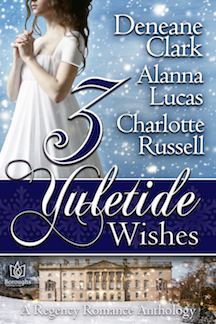
About 3 Yuletide Wishes

Three men, three vows.

Three Holiday Novellas—with and without peers.

Hope by Deneane Clark

His gambler brother the viscount took everything from Milton Anthony Windham, including his chance at love, but Tony is nonetheless determined to save his family estate from ruin. Success will require the help of his cousins the Ackerly sisters and a hasty marriage to a well-situated woman, all before the end of the holiday season. Hope awaits.

A Marchioness for Christmas by Alanna Lucas

Dracon, the 7th Marquess of Trawden, detests Christmastide, which is a reminder of all he has lost. This year, however, during his flight from London merriment to his ancestral home in the country, he will encounter a carriage accident that brings him face to face with Miss Antonia Madeley…and a chance to reverse the mistakes of the past.

The Kissing Bough by Charlotte Russell

Years ago, Jack Telford did what he must in order to “succeed.” It cost him his one true love. Now, haunted by memories of what could have been and dreams of what still might be, despite her “unsuitability”, despite what the act may cost him, he will travel through snow and across country to reunite with Isabella wherever she may be and make her understand the words she was always meant to hear.

AmazonAllRomance eBooksBoroughs PublishingSmashwords

About the Authors

Deneane Clark

deneaneelise_1354040029_86 copyDeneane Elise Clark is an historical romance novelist. Her published work includes the The Virtue Series, a lighthearted romp through the ballrooms and bedrooms of Regency London. The books tell the love stories of the motherless Ackerly sisters, beginning with Grace, continuing with the stories of Faith and Charity, and concludes with the newly released Mercy. Her upcoming work includes stand-alone continuations featuring the Ackerly sisters in Hope, a novella featured in a Christmas Regency anthology, and will continue in 2016 with Prudence and Temperance. Deneane’s books have been published in the United States, Canada, the UK, and Australia, and have been translated into several languages, including Dutch, Norwegian, and Turkish.

Deneane grew up in New Orleans and misses it dreadfully. Currently, she resides near Charlotte, NC, but has also lived in the Northeast, the Midwest, and on the West Coast. She prefers mountains to beaches, cities to suburbs, and suburbs to rural areas, and would be perfectly content if she could just manage to convince the world to flip flop the working day so people slept during the day and worked at night.

A single mom, Deneane raised her now grown up children while working full time and writing at night. Her daughter enjoys traveling, so moves in and out as the mood strikes, and her son is serving our great country in the United States Marine Corps. She enjoys sparkling beverages, music, plays trivia with an amazing bunch of friends, and travels any time she gets the chance.

Deneane loves interaction with her readers. You can friend and/or follow her on Facebook, Twitter, Tumblr, and Instagram. If you’re not a fan of social media, she also writes a blog. And, although it sometimes takes a while, she makes every attempt to respond to all emails, messages and comments.

BlogTwitterTumblrFacebookInstagram

Amazon Author Page • Boroughs Author Page

Alanna Lucas

AlannaMulti-published historical romance author Alanna Lucas grew up in Southern California, but always dreamed of distant lands and bygone eras. From an early age, she took an interest in history and travel, and is thrilled to incorporate those diversions into her writing. Alanna writes Regency and Western historical romance.

When she is not daydreaming of her next travel destination Alanna can be found researching, spending time with family, or going for long walks. She makes her home in California with her husband, children, one sweet dog, and hundreds of books.

Just for the record, you can never have too many shoes, handbags, or books. And travel is a must.

WebsiteFacebookTwitter 

Amazon Author PageBoroughs Author Page

Charlotte Russell

CharlotteRussell - Copy copyCharlotte Russell didn’t always know she wanted to be a writer. At one point she had grand plans to be an architect, until she realized she couldn’t draw anything more complicated than a stick figure. So, she enrolled at the University of Notre Dame and studied her first love—history. Now she puts all that historical knowledge to good use by writing romances set in Regency England. When not pounding on the keyboard, she watches sports with her husband (yes, he’s lucky!), chauffeurs her three kids around, volunteers for too many things, and entertains two cats.

 WebsiteFacebookTwitter

Amazon Author PageBoroughs Author Page

Julie Johnstone, Katherine Bone, Collette Cameron, Jillian Chantal, Samantha Grace, Alanna Lucas, Lauren Smith, Victoria Vane: Once Upon a True Love’s Kiss

Once-Upon-A-True-Love39s-Kiss2D-Cover

USA Today Best-selling author, Julie Johnstone, joins best-selling, award-winning authors, Katherine Bone, Collette Cameron, Jillian Chantal, Samantha Grace, Alanna Lucas, Lauren Smith, and Victoria Vane in this delightful limited edition, containing eight tantalizing kiss-and-tell stories. Meet dashing, wildly charming rogues, spies, pirates, rakes and their extraordinary, intrepid heroines as they whisk you along on sweet to sizzling romantic romps in these wickedly entertaining historical romances.

After Forever by Julie Johnstone

Lady Julia is hired to turn a rogue into a gentleman and receives lessons in love and desire.

Widowed Lady Julianna Barrows never wants to fall in love again. But when the notorious former boxer Nash Overton hires her to transform him into a gentleman, Julianna quickly becomes the student, learning more about passion than she’s ever known, and more importantly, learning how to love again. 2 1/2 Kisses

The Pirate’s Duchess by Katherine Bone

A duke masquerading as a pirate to “rob from the rich and give to the poor” sheds his darkest-kept secrets to keep from losing the duchess his wife has become.

Duty forces him to take on the pirate code, but honor brings him back.

Prudence, Duchess of Blackmoor, has one desire—to be happy again. After struggling to overcome the horrifying death of her husband, she accepts an earl’s offer of marriage, confident she’s taking a step in the right direction. But demons, refuse to die, and Prudence finds herself caught in an intricate web of deceit that threatens the very foundations of all she holds dear.

Tobias, the Duke of Blackmoor, crosses the line when an assassination attempt on him fails. To restore the reputations of friends under attack by the same villain, and ensure his wife’s safety, he stages his own death, becoming The Black Regent, a notorious pirate bent on brandishing justice, never thinking he’d survive. But to his amazement, he has, and now the darkest-kept secrets are not worth losing the duchess his wife has become. 2 1/2 Kisses

Her Scandalous Wish by Collette Cameron

A marriage offer obligated by duty . . . an acceptance compelled by desperation.

Philomena Pomfrett is resigned to spinsterhood, but to ease her dying brother’s fretting, she reluctantly agrees to attend a London Season with one purpose—to acquire a husband. Stumbling upon her hiding in a secluded garden arbor during a ball, Bradford, Viscount Kingsley doesn’t recognize his first love, yet something about the mysterious woman enthralls him, and he steals a passionate, moonlit kiss.

Caught in the act by Philomena’s brother, Bradford is issued an ultimatum—a duel or marry Philomena. He offers marriage, but even impoverished and with no other decent prospects, she rejects his half-hearted proposal until her brother collapses. Now, Philomena’s faced with marrying a man who deserted her once already. 2 Kisses

Milady and Her Spy by Jillian Chantal

A lady, a spy, a traitor… a battle of wills.

Raised in the country after her mother’s death with only the company of three unruly brothers, Lady Augusta Covington is more proficient at fencing, riding and playing cards than being prim and proper. Myles Cuthbert, a spy in His Majesty’s service on a mission to find and expose a traitor, crosses paths with Lady Augusta when she rides to the aid of her brother, believing him to be injured. With the assignment at risk, Cuthbert agrees to accept the assistance of the troublesome lady eager for intrigue. As they move forward, his sense of obligation to her and the danger involved stir his soul. 1 Kiss

Kissed By a Scottish Rogue by Samantha Grace

Scottish land steward Fergus McTaggert calls a temporary truce with his employer’s companion only to discover their passionate battles have been masking their hidden desires.

His Mother Insists He Needs a Wife.

Fergus McTaggart, Aldmist Fell’s land steward, has no time for wife hunting. Any day his employer’s sisters will be arriving at the Scottish castle for a long overdue reunion. Fergus is determined to make their stay memorable, but all anyone is likely to recall are the loud rows between him and his employer’s cheeky paid companion.

She Insists He Needs a Good Knock to the Head.

Edith Gallagher has been charged with watching over her employer’s youngest sister while the family winters in Scotland, but the stubborn land steward interferes at every turn. Eventually, she and the Scot call a truce for the sisters’ sakes only to discover their passionate battles are masking hidden desires. 2 Kisses

Stolen Kisses From the Viscount by Alanna Lucas

A rake, an heiress, and stolen kisses…this seduction could be his last.

Desperate times call for drastic measures as Miss Aveline Redgrave enters her third season. Fearful of fortune hunters, she attempts to stay clear of Lord Leybourne, a rogue who is not to be trusted. But his seductive smile and enticing kisses awaken a passion that threatens her common sense. No stranger to scandal, Leybourne is determined to save his family from ruin whatever the cost, even marrying an heiress he doesn’t love. But an unexpected desire and need to protect threatens his plans. Will past heartaches and a devastating wager destroy their future or will true love’s kiss triumph? 3 Kisses

Tempted By a Rogue by Lauren Smith

Gemma never planned on falling in love with her childhood sweetheart’s best friend, Jasper, when he returns home, but she can’t resist the naval officer’s brooding charm.

Gemma plans to marry James, her childhood sweetheart. With every letter written between them while he’s been off at sea, their love has grown. Now they will be reunited with his return to England. But the man whose words she’d fallen in love with isn’t James…

Jasper, a gentleman rogue of the first order, is trapped. Talked into a scheme by his friend, he pretended to be James for eleven years while writing to Gemma. He’s promised James he’d break it off. But when he returns home, his secret will come out – and he’ll lose the one woman he can’t live without. 4 Kisses

The Redemption of Julian Price by Victoria Vane

She gave him a chance to bury his past… but the price would be his heart…

Burdened by the past…Orphaned at a young age and left to run wild, at eighteen Julian Price joins the fight against Napoleon in the hope of attaining honor. Devastated when his best friend, Thomas, is killed in battle, Julian returns home burdened with guilt, only to find his wastrel uncle has squandered his inheritance.

Desperate to live her own life… Facing a future of drudgery caring for her aging mother and raising her brother’s children, Henrietta Houghton believes her chance at a real life died with Thomas, the only man who ever wanted her. But Henrietta is still full of dreams. When her wealthy aunt, offers her a gift of ten thousand pounds, Henrietta finally has the chance to choose her own destiny.

Everything has a price…With a fortune at her command, Henrietta offers Julian a marriage of convenience, unaware that she really offers Julian a means of salvation—not just his fortune, but his very soul. 3 Kisses

Amazon • Kobo • iTunes • Barnes & Noble

Facebook • Twitter
SusanaSays3Susana Says

A lovely mélange of charming romantic tales by highly acclaimed authors: 4/5 stars

A former boxer determined to raise his and his daughter’s status in life falls in love with his widowed etiquette tutor. A widowed lady’s second marriage ceremony is interrupted by… her dead husband! A young lady promises her ailing brother she will find a husband encounters the beau who deserted her when she was scarred in a fire. Another young lady finds herself embroiled in a dangerous espionage plot with a handsome young spy. A lady’s companion with a tarnished background finds herself drawn to the annoyingly handsome Scottish land steward. A rakish young viscount in need of a wealthy wife to compensate for his late father’s profligacy pursues a young lady determined to avoid fortune hunters. A not-so-young lady who has been exchanging love letters with her childhood sweetheart at sea eagerly awaits his homecoming, but what happens when the man who returns is someone else entirely? With her first love a casualty of war and the prospect of a life of nothing but drudgery, a young lady is offered the opportunity to forge her own destiny… with a man in need of much more than her money.

If you are looking for well-written romantic tales for a pleasant evening’s diversion, you won’t be disappointed by this delightful anthology.

About the Authors

Julie Johnstone is an USA TODAY best-selling author of edgy Regency Romance. She feels she’s living the dream by working with her passion of creating worlds from her imagination. When not writing, she’s chasing her precocious children around, cooking, reading or exercising. Julie loves to hear from her readers.

WebsiteFacebookTwitter

Katherine Bone is an Amazon #1 best-selling Historical Romance Author passionate about history since she had the opportunity to travel to various Army bases, castles, battlegrounds, and cathedrals as an Army brat-turned-Officer’s-Wife. Now she lives in the south where she writes about Rogues, Rebels and Rakes, aka Pirates, Lords, Captains, Duty, Honor, and Country and the happily-ever-afters every alpha male and damsel deserve.

WebsiteFacebookTwitter

Jillian Chantal is a 2015 RONE Finalist and lives on the beautiful coast of Florida, and even though she loves her little slice of paradise, she’s an Anglophile at heart. Writing in a variety of romance genres makes her happy, but she has a particular fondness for the Georgian/Regency era as it was the age she adored as a teen and as her introduction to the world of happily-ever-afters. Living on the gulf coast also reminds Jillian, daily, that even though she loves the past, she needs the present. Air conditioning is vital for her survival.

WebsiteFacebookTwitter

Collette Cameron is an Amazon #1 best-selling and award-winning Historical Romance Author of more than ten Scottish and Regency Romances featuring rogues, rapscallions, rakes, and the intrepid damsels who reform them. Mother to three and self-proclaimed Cadbury chocoholic, she makes her home in Oregon with her husband and five mini-dachshunds. You’ll always find animals, quirky—sometimes naughty—humor, and a dash of inspiration in her novels.

Website FacebookTwitter

Samantha Grace is an Amazon best-Selling, RITA-nominated Historical Romance Author who discovered the appeal of a great love story at the age of four, thanks to Disney’s “Robin Hood”. She didn’t care that Robin Hood and Maid Marian were cartoon animals. It was her first happily-ever-after experience, and she wanted the warm fuzzies to go on forever. Now that Samantha is grown, she enjoys creating happy-endings for characters that spring from her imagination. Publisher’s Weekly describes her stories as “fresh and romantic” with subtle humor and charm. Samantha describes romance writing as the best job ever.

WebsiteFacebookTwitter

Alanna Lucas is an Amazon best-selling author and grew up in Southern California, but always dreamed of distant lands and bygone eras. From an early age she took interest in art, history, and travel, and enjoys incorporating those diversions into her writing. However, she believes that true love is the greatest source of inspiration and is always an adventure. Alanna makes her home in California where she spends her time writing historical romances, dreaming of her next travel destination, spending time with family, and staying up too late indulging in her favorite past time, reading.

WebsiteFacebookTwitter

Lauren Smith is an attorney by day, is an Amazon best-selling, award winning author by night, who pens adventurous and edgy romance stories by the light of her smart phone flashlight app. She’s a native Oklahoman who lives with her three pets: a feisty chinchilla, sophisticated cat, and dapper little schnauzer. She’s won multiple awards in several romance subgenres including being a New England Reader’s Choice Winner, Greater Detroit Bookseller’s Best Award Finalist and a Semi-Finalist for the Mary Wollstonecraft Shelley Award.

Website FacebookTwitter

Victoria Vane is an Amazon #1 bestselling author of smart and sexy romance. Her works range from comedic romps to emotionally compelling erotic romance and have received over twenty awards and nominations to include: a 2015 Red Carpet Finalist for Best Contemporary romance (SLOW HAND), 2014 RONE Winner for Best Historical Post Medieval Romance (Treacherous Temptations), and Library Journal Best E-Book romance of 2012 (The Devil DeVere series). Victoria also writes romantic historical fiction as Emery Lee. She currently resides in Palm Coast, Florida with her husband, two sons, a little black dog, and an Arabian horse.

WebsiteFacebookTwitter

For the purpose of this anthology, the following ratings apply:

One KissStories will either not have consummated love scenes, or subtly sexy undetailed scenes behind a closed bedroom door. You’re not invited inside. Sorry.

Two KissesStories are more sensual than sweet with some love scenes that are more sensual than graphic. You might blush, but you won’t need a fan.

Three KissesStories are sexier and bolder with more explicit love scenes and the language used to describe them may be more graphic. A fan and a cool beverage might be in order, but you won’t experience everything. *Wink*

Four KissesStories have frequent, graphic love scenes with explicit language. Be prepared to blush and stand in front of the air conditioner, a tall, iced drink in hand. Clothing is optional.

Five KissesStories have frequent graphic, descriptive love scenes and/or contain subject matter some readers may find objectionable. Blushing guaranteed, and you might learn a thing or two or three. But never fear, we won’t tattle if you don’t.