Sheri Cobb South: Waiting Game (John Pickett #5)

quizzing glass copyLast Wednesday marked the release of Too Hot to Handel, the fifth novel in the John Pickett series of mysteries set in Regency England. I’ve so looked forward to this one, for a couple of reasons: it’s my personal favorite and, not coincidentally, it’s the one that finally resolves the romance between Bow Street Runner John Pickett and the widowed Julia, Lady Fieldhurst, whom he first met, quite literally over her husband’s dead body, in the first book of the series, In Milady’s Chamber.

But before there was Too Hot to Handel, there was Waiting Game—a novella that was never intended as part of the series at all, and yet sold more than 1,500 copies in the last month alone.

How did it happen? It’s a long story—no pun intended. Too Hot to Handel was originally scheduled for March 2016, but just before Christmas my publisher, Five Star/Cengage, announced that due to unforeseen circumstances, the entire 2016 publishing schedule was being delayed three months, pushing my March release date back to June. Now, a three-month postponement may not seem like much, but when marketing plans are measured in months, not weeks, every one of those months is crucial. My bookmarks had already been printed with “March 2016” as the release date—and I didn’t even want to think about what the interruption meant as far as ARCs, which would probably go out much too late for the major reviewers such as Publishers Weekly and Library Journal.

But the people I felt the worst for were my readers. I’d left them a romantic cliffhanger at the end of the previous book, Dinner Most Deadly, which concludes with [spoiler alert!] John Pickett recklessly declaring himself to Julia, who is too stunned—and too moved—to respond. I had assured readers they wouldn’t have long to wait for resolution on this, since the next book would be out in only six months, rather than the more typical ten to twelve, and now I discovered that I was wrong. Granted, it wasn’t my fault, but I still felt like I’d lied to them.

I felt like I owed fans of the series something to make it up to them. I’d had some success with a prequel novella called Pickpocket’s Apprentice, so I decided to write a short piece to self-publish in March, something that would fill in the gap in the timeline between the end of Dinner Most Deadly and the beginning of Too Hot to Handel. Ironically, that gap was also three months, from November 1808 to February 1809.

It was a good idea in theory, but I soon realized I’d written myself into a corner. The book’s setting made it practically imperative that the Christmas season be addressed in some way, but I didn’t want it to turn into a Christmas story, given that it would be released in March. Furthermore, since the text of Too Hot to Handel makes it very clear that there has been no interaction between Pickett and Julia during those three months, I somehow had to advance the romance without ever putting the potential lovebirds together.

Waiting Game 001 copyOne of the women in my writers’ group suggested that I let Pickett be actively trying to avoid being seen by Lady Fieldhurst, and it seemed to me that this situation would lend itself well to comedy. Since Pickett had extracted a reluctant promise from his magistrate not to send him on cases involving the aristocracy, where he might encounter Julia, I decided to create a scenario involving the merchant middle class. Of course there would be a marriageable young woman whose advances he would have to rebuff. (There’s always some girl after poor John Pickett; it’s a running gag throughout the series.) Throw in a big dog named Brutus who manages to steal almost every scene in which he appears, and the story practically began to write itself. And hey, since this story involved a linen-draper’s shop, wouldn’t it be fun to include a cameo appearance by a youthful Ethan Brundy, titular hero of The Weaver Takes a Wife, the most popular book I’ve ever written? (After writing three books about the man, I should have known him better than that. He refused to remain a mere bit player, and insisted on assuming a significantly larger role than I’d intended.)

It’s not strictly necessary to read Waiting Game to enjoy Too Hot to Handel, but I do strongly recommend reading at least one of the John Pickett mysteries before reading the romantic denouement. While the mystery will stand alone, the love story will be more satisfying if you’re at least somewhat familiar with the characters’ history up to this point. Besides, romantic resolution, much like book publication, is all the sweeter for having been delayed.

Waiting Game

AmazonBarnes & NobleKoboiBooks

Too Hot to Handel

AmazonBarnes & Noble

Commenters

Win a copy of both John Pickett novellas (Waiting Game and the prequel novella, Pickpocket’s Apprentice) by leaving a comment.

Check out this great offer from Sheri!

Sheri is concerned that the three month delay might have a deleterious effect on sales of Too Hot to Handel to libraries. So… anyone who requests that their library purchase Too Hot to Handel can email a screen shot of their filled-out request form to her at Cobbsouth@aol.com along with their mailing address, and she’ll send them a handy-dandy jar opener and an 8-page coloring book featuring scenes from her novels. See photo below of both prizes. No drawing on this one; anyone who requests that their library purchase the book, and sends me a screenshot as proof, automatically wins.

20160617_110359_resized copy

About the Author

Sheri Cobb South is the author of more than twenty novels, including the John Pickett mystery series and the critically acclaimed Regency romance, The Weaver Takes a Wife. A native of Alabama, she now lives in Loveland, Colorado.
Jessica Cale: How Royal Copenhagen Conquered Europe

Eighteenth Century Porcelain: How Royal Copenhagen Conquered Europe

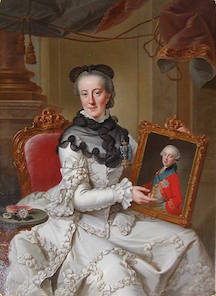
13509851_263614374004128_2085781765_oThe Royal Porcelain Factory (Den Kongelige Porcelænsfabrik), better known as Royal Copenhagen, was founded in a converted post office in Copenhagen on May 1st, 1775 under the protection of Queen Juliane Marie. Although porcelain had been made in Germany since 1710, it was not produced in Denmark until chemist Frantz Heinrich Müller developed a method for its manufacture in 1774. Juliane Marie had an interest in mineralogy and porcelain was a family passion: both her brother, Charles I of Brunswick-Wolfenbüttel, and sister, who was married to Frederik II of Prussia, had founded porcelain factories in Germany.

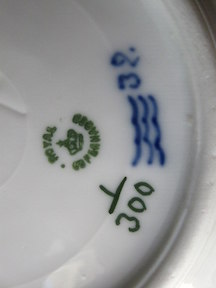
The factory’s first pieces were dining sets for the royal family. Juliane Marie insisted each piece be stamped with the factory’s mark, three wavy lines that symbolized Denmark’s three straights–the Øresund, the Great Belt and the Little Belt–as well as the royal crown stamp to highlight the firm’s royal connections. Each piece is marked this way to this day.

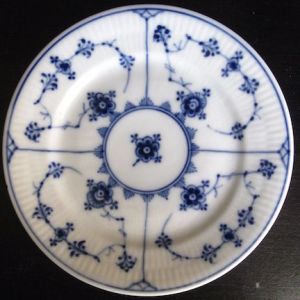
Blue and white china became popular across Europe as early as the seventeenth century with the import of goods from the far east. The fine porcelain of China’s Ming and Qing dynasties sparked an enduring love for floral patterns in blue and white and Royal Copenhagen quickly developed their own. Blue Fluted Plain (Danish: Musselmalet) was their first pattern and at more than two hundred fifty years old, it is the world’s oldest china pattern still in production.

13467665_263614317337467_432371625_oBlue Fluted Plain was inspired by Chinese floral patterns and updated to include flowers native to Denmark. Cinquefoils were added to the stylized chrysanthemums to give the pattern a more Nordic appearance. The ultramarine blue pigment in the paint was originally purchased from the Blaafarveværket (“blue colour factory”) in Norway, a company that provided up to eighty percent of the world’s cobalt during the nineteenth century. Each piece was and continues to be hand-painted by blue painters who spend at least four years in training for the position.

Since its development in 1775, Blue Fluted Plain has appeared on more than two thousand different pieces and has inspired countless imitations. It reached the height of its popularity in the early nineteenth century and appeared on everything from tea cups to washbasins and chamber pots.

Lord Nelson brought Royal Copenhagen porcelain back for his mistress, Lady Hamilton, following the Danish defeat at the Battle of Copenhagen in 1801. While Denmark lost that particular battle, Royal Copenhagen’s invasion of Britain was a success. It qualified for London’s World Expo in 1851 and gained international fame by winning the grand prize at Paris’ World Expo in 1889.

13509748_263614310670801_2069635372_oThis pattern has also appeared in some well-researched historical films and television shows, so not only does the pattern “look right” for the period, but even newer pieces are historically accurate for any time after 1775. You can still find pieces in this pattern to this day, so if you would like to add a little eighteenth century elegance to your kitchen or a touch of the Regency to your cup of tea, look for Royal Copenhagen’s Blue Fluted Plain.

Note: For more images or shopping information, Replacements Ltd. has a spectacular assortment of pieces in this pattern here: http://www.replacements.com/webquote/rcoblfp.htm

About The Long Way Home

The Long Way Home, Book 3 in The Southwark Saga is a magical, adult fairy tale that will keep you entertained from start to finish. Find out what happens when a paranoid king, a poison plot, and hideous shoes prove… it’s not easy being Cinderella!

coverAfter saving the life of the glamorous Marquise de Harfleur, painfully shy barmaid Alice Henshawe is employed as the lady’s companion and whisked away to Versailles. There, she catches King Louis’ eye and quickly becomes a court favorite as the muse for Charles Perrault’s Cinderella. The palace appears to be heaven itself, but there is danger hidden beneath the façade and Alice soon finds herself thrust into a world of intrigue, murder, and Satanism at the heart of the French court.

Having left his apprenticeship to serve King Charles as a spy, Jack Sharpe is given a mission that may just kill him. In the midst of the Franco-Dutch war, he is to investigate rumors of a poison plot by posing as a courtier, but he has a mission of his own. His childhood friend Alice Henshawe is missing and he will stop at nothing to see her safe. When he finds her in the company of the very people he is meant to be investigating, Jack begins to wonder if the sweet girl he grew up with has a dark side.

When a careless lie finds them accidentally married, Alice and Jack must rely on one another to survive the intrigues of the court. As old affection gives way to new passion, suspicion lingers. Can they trust each other, or is the real danger closer than they suspect?

AmazonBarnes & NobleKoboiBooks

About the Author

jessicaJessica Cale is a historical romance author, a Bluestocking Belle, and a journalist based in North Carolina. Originally from Minnesota, she lived in Wales for several years where she earned a BA in History and an MFA in Creative Writing while climbing castles and photographing mines for history magazines. She kidnapped (“married”) her very own British prince (close enough) and is enjoying her happily ever after with him in a place where no one understands his accent. You can visit her at www.authorjessicacale.com.

Her series, The Southwark Saga, is available now. You can visit her at www.dirtysexyhistory.com.


Romance of London: The Thames Tunnel

Romance of London: Strange Stories, Scenes And Remarkable Person of the Great Town in 3 Volumes

John Timbs

John Timbs (1801-1875), who also wrote as Horace Welby, was an English author and aficionado of antiquities. Born in Clerkenwell, London, he was apprenticed at 16 to a druggist and printer, where he soon showed great literary promise. At 19, he began to write for Monthly Magazine, and a year later he was made secretary to the magazine’s proprietor and there began his career as a writer, editor, and antiquarian.

This particular book is available at googlebooks for free in ebook form. Or you can pay for a print version.

The Thames Tunnel

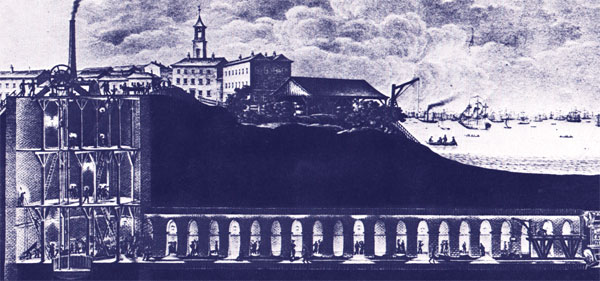
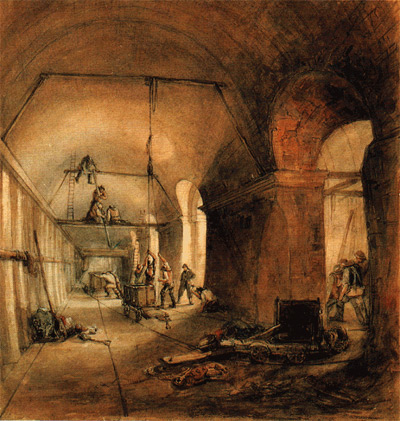
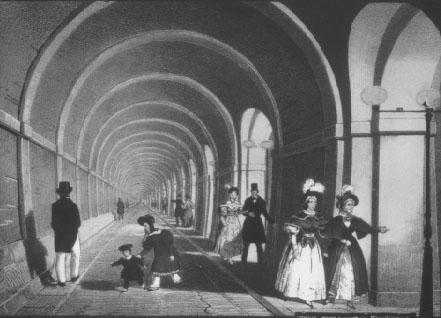
The first successful tunnel constructed beneath a navigable river was built between 1825 and 1843 by Thomas Cochrane and Marc Brunel, along with Brunel’s son, Isambard. Although it was meant to facilitate horse-drawn carriages traffic, that never happened. Currently it is part of the London Overground railway network.

From Wikipedia:

Brunel and Cochrane patented the tunnelling shield, a revolutionary advance in tunnelling technology, in January 1818. In 1823 Brunel produced a plan for a tunnel between Rotherhithe and Wapping, which would be dug using his new shield. Financing was soon found from private investors, including the Duke of Wellington, and a Thames Tunnel Company was formed in 1824, the project beginning in February 1825.

Thames_tunnel_shield

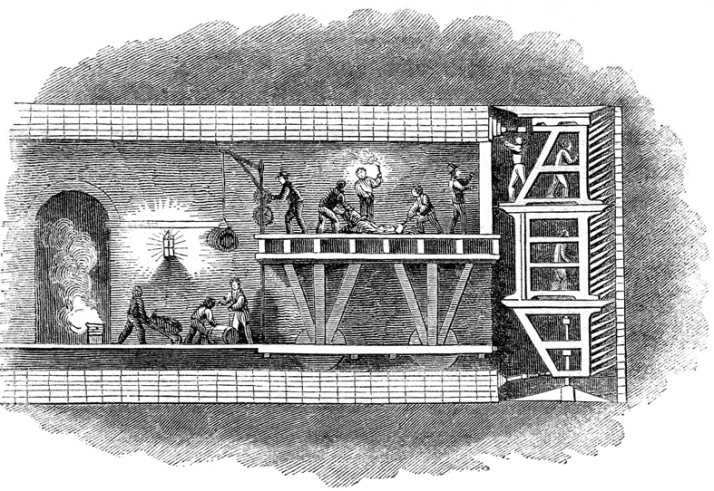
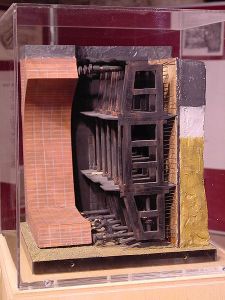
The tunnelling shield, built at Henry Maudslay’s Lambeth works and assembled in the Rotherhithe shaft, was the key to Brunel’s construction of the Thames Tunnel. The Illustrated London News described how it worked:

Scale model of the Brunel shield

Scale model of the Brunel shield

The mode in which this great excavation was accomplished was by means of a powerful apparatus termed a shield, consisting of twelve great frames, lying close to each other like as many volumes on the shelf of a book-case, and divided into three stages or stories, thus presenting 36 chambers of cells, each for one workman, and open to the rear, but closed in the front with moveable boards. The front was placed against the earth to be removed, and the workman, having removed one board, excavated the earth behind it to the depth directed, and placed the board against the new surface exposed. The board was then in advance of the cell, and was kept in its place by props; and having thus proceeded with all the boards, each cell was advanced by two screws, one at its head and the other at its foot, which, resting against the finished brickwork and turned, impelled it forward into the vacant space. The other set of divisions then advanced. As the miners worked at one end of the cell, so the bricklayers formed at the other the top, sides and bottom.

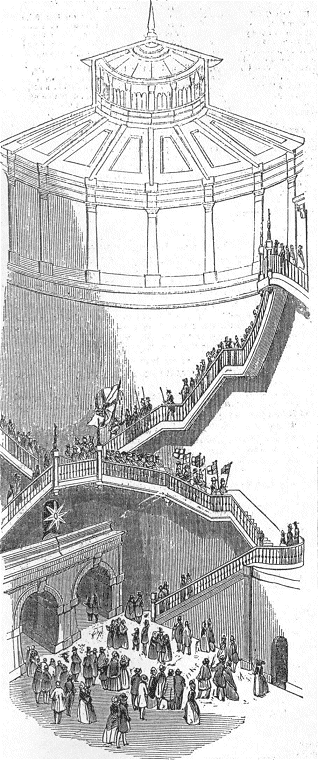
Although it was a triumph of civil engineering, the Thames Tunnel was not a financial success. It had cost a fortune to build – £454,000 to dig and another £180,000 to fit out – far exceeding its initial cost estimates. Proposals to extend the entrance to accommodate wheeled vehicles failed owing to cost, and it was used only by pedestrians. It became a major tourist attraction, attracting about two million people a year, each paying a penny to pass through, and became the subject of popular songs. The American traveller William Allen Drew commented that “No one goes to London without visiting the Tunnel” and described it as the “eighth wonder of the world.”

Flooding on the Thames Tunnel

Isambard Brunel

Isambard Brunel

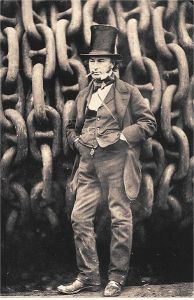
This stupendous work had considerably advanced by May 1827, when the bed of the river being examined by a diving-bell, the soil was found to be extremely loose; and on the 18th of May, as the tide rose, the ground seemed as though it were alive. The water was pressing in at all points, and it was not long in entering. Occasional bursts of diluted silt were followed by an overwhelming flood of slush and water, which drove all before it. The men, forced out of the shield, fled towards the bottom of the shaft. The water came on in a great wav, threatening to sweep them back under the arch by its recoil against the circular wall of the shaft. The lowest flight of steps was reached, and the recoil wave surged under the men’s feet. They hurried up the stairs of the shaft, and it was thought that all of them had come in, when the cry was raised, “A rope! A rope! Save him! Save him!” Some unfortunate workman had been left behind, and was seen struggling in the water. Young Brunel, seizing a rope, slid down one of the iron ties of the shaft, reached the water, passed the rope around the man’s body, and he was immediately drawn up. It proved to be old Tillett, the engine-man. The roll was then called, and every man answered to his name; but the Tunnel works were, for the time, completely drowned.

Thamestunnelcutout1840On examination of the bed of the river from the diving-bell, a large hole was found extending from the centre of the Tunnel excavation to a considerable distance eastwards. Measures were taken to fill up the opening with bags of clay, laid so as to form an arch in the bed of the river immediately over the work. More bags of clay were then sunk; and after about thirty thousand cubic feet of clay had been thrown into the hole, the pumping was resumed, and the state of the work could be examined from the inside in a boat. On the 10th of November following, the Tunnel had again been so far cleared of water that young Brunel determined to give a dinner in one of the arches to about fifty friends of the undertaking; while above a hundred of the leading workmen were similarly regaled in the adjoining arch. The band of the Coldstream Guards enlivened the scene, and the proceedings went off with great éclat. The celebration had, however, been premature; and the young engineer had been ‘hallooing before he was out of the ‘—water; for in two months the Thames again burst in, owing in some measure to the incautiousness of young Brunel himself, and the river held possession of the Tunnel for several years.

Thames_tunnel_construction_1830

Thames Tunnel construction, 1830

The funds of the Tunnel Company were by this time exhausted; and it was determined to make an appeal to the country for the means of finishing it. A subscription-list was opened, and 18,500l promised; but this sum was a mere “flea-bite,” and the works remained suspended. The Government, at length, consented to make a loan of 246,000l for the purpose of enabling the Tunnel to be completed, and the first installment was advanced in December 1834. The water was then pumped out of the Tunnel, and the works were recommenced, after having been at a standstill for a period of seven years. A new shield, of excellent construction, was supplied by the Messrs. Rennie, which was satisfactorily placed in position by the 1st of March 1836. But the difficulties of the undertaking were not yet entirely overcome; the river broke in again and again—three times in twenty weeks, within a distance of only twenty-six feet; but by perseverance and skill the water was ultimately mastered, and the work was at last brought to a completion, and opened to the public on the 25th of March 1843.

Thamestunnel

Thamestunnelshaft

2005 Thames Tunnel from Wapping

2005 Thames Tunnel from Wapping

The Brunel Museum

Nearby in Rotherhithe, the original Brunel Engine House is open to visitors as the Brunel Museum. It was built to house the drainage pumps for the tunnel and has now been restored. Wikipedia says that “[I]t is still possible to take a walking tour through the tunnel to Wapping from Rotherhithe and back, but these are infrequent and on an ad-hoc basis as they can only take place when that section of the line is closed for maintenance.


Romance of London Series

  1. Romance of London: The Lord Mayor’s Fool… and a Dessert
  2. Romance of London: Carlton House and the Regency
  3. Romance of London: The Championship at George IV’s Coronation
  4. Romance of London: Mrs. Cornelys at Carlisle House
  5. Romance of London: The Bottle Conjuror
  6. Romance of London: Bartholomew Fair
  7. Romance of London: The May Fair and the Strong Woman
  8. Romance of London: Nancy Dawson, the Hornpipe Dancer
  9. Romance of London: Milkmaids on May-Day
  10. Romance of London: Lord Stowell’s Love of Sight-seeing
  11. Romance of London: The Mermaid Hoax
  12. Romance of London: The Bluestocking and the Sweeps’ Holiday
  13. Romance of London: Comments on Hogarth’s “Industries and Idle Apprentices”
  14. Romance of London: The Lansdowne Family
  15. Romance of London: St. Margaret’s Painted Window at Westminster
  16. Romance of London: Montague House and the British Museum
  17. Romance of London: The Bursting of the South Sea Bubble
  18. Romance of London: The Thames Tunnel
  19. Romance of London: Sir William Petty and the Lansdowne Family
  20. Romance of London: Marlborough House and Sarah, Duchess of Marlborough
  21. Romance of London: The Duke of Newcastle’s Eccentricities
  22. Romance of London: Voltaire in London
  23. Romance of London: The Crossing Sweeper
  24. Romance of London: Nathan Mayer Rothschild’s Fear of Assassination
  25. Romance of London: Samuel Rogers, the Banker Poet
  26. Romance of London: The Eccentricities of Lord Byron
  27. Romance of London: A London Recluse

Nicole Zoltack: Loving Outside of Your Class

Back in the day, and even nowadays, people look down on certain relationships, especially if the people involved are from different classes. How can a duke or other titled person fall for someone outside of the ton? A movie star and a nobody? An actor and a musician? (Okay, I’m sour about the rumors of Tom Hiddleston and Taylor Swift, I’ll admit it.)

vauxhall

During the Regency era, aristocrats weren’t supposed to marry from other classes. Money, land, reputation, politics… they were what drove marriage for the upper crust. For the working class—the servants, maids, housekeepers, soldiers, etc—marriage was very important. Their parents had less of a say in whom they married, and they were a little more autonomous; however that was only within their own class, of course.

If a handmaid were to fall for a viscount… if a stablehand were to love a lady, most likely, it would not have played out well in real life, but what’s the fun in that?

lowerclasses

My series, Beyond Boundaries, is specifically about couples who fall in love despite obstacles like class.

If you were a lady back in the Regency, do you think you would ever consider someone outside of your class despite what your parents wish for you, despite the opinions of your friends and peers? I like to think I would!

About Masked Love (Beyond Boundaries #1)

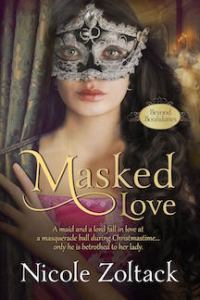
maskedloveIsabelle will do anything for her lady, even accompany her to a masquerade ball. Lady Theodosia needs extra support for tomorrow she will meet the man her par-ents have pledged her to.

Meeting an enchanting young man during the course of the evening makes Isabelle wish for a life she can never have. Imagine her shock when he shows up the next morning, announcing his claim on Lady Thedosia.

Torn between duty and desire, Isabelle hopes for something more this Christmas.

Amazon

13446322_867608668635_2112547213_o

Starry Love (Beyond Boundaries #2)

With the Season rapidly approaching, Lady Elizabeth is ready to make her match until her father is stricken deathly ill. Her mother is desperate and hails for doctors, surgeons, even apothecaries. The upkeep of the house falls on Elizabeth, and she spend long hours beside her father, watching as he betters one day and fares worse on others. Long walks with the stable hand Callum on starry nights save Elizabeth’s sanity.

When the inevitable happens, Lady Elizabeth is forced to go to London. The gentlemen there, however, hold no candle to the kind and caring Scottish Callum.

Shortly before her father’s death, Callum returned to his homeland to try and find a cure for her father. As time passes with no word, no letters, Elizabeth must choose whether the love that blossomed between them is worth denying the man her mother wishes for her.

Amazon

About the Author

nicole photoNicole Zoltack loves to write in many genres, especially romance, whether fantasy, paranormal, or regency. She’s also an editor for MuseItUp Publishing and works as a freelance editor.

When she’s not writing about gentlemen and their ladies, knights, superheroes, or witches, she loves to spend time with her loving husband, three energetic young boys, and precious baby girl. She enjoys riding horses (pretending they’re unicorns, of course!) and going to the PA Renaissance Faire, dressed in garb. She’ll also read anything she can get her hands on. Her current favorite TV shows are The Walking Dead and Arrow.

To learn more about Nicole and her work, visit her blog at http://NicoleZoltack.blogspot.com. She can be found on most any social media site under Nicole Zoltack. Stalk away!

Jude Knight: A notorious woman visits the Parlour

Rebecca, Lady Overton prefers to be out of the public eye. Before she consented to join her author for tea in Susana’s Parlour, she extracted a promise that this interview would not be published until more than 200 years in her future.

“I have had notoriety and notice enough for a lifetime, Jude,” she says. “You saw to that.”

Becky is right. As the Rose of Frampton, treasured mistress to the notorious Marquis of Aldridge, she was whispered about (but not acknowledged) the length and breadth of polite Society. It is no consolation to her that I was only doing my job, nor that I did not know anything about her history when I started. I thought to write a cheerful romp about a dissolute rake, not a story about how a woman with few choices nonetheless made the best ones she could, and eventually won her way to a happy marriage and a secure family.

She does not wait for an answer to her remark. “And you are still doing it,” she scolds. “This latest start of yours has spread my story to countries that did not even exist when I was alive. That smug look does not make me feel better, you know!”

I wipe the grin off my face. I have been posting A Baron for Becky on Wattpad for months, one chapter a week until it was completed. In the past month it has taken off, garnering hundreds of reads every day. I am particularly thrilled that 15% of my reads are from India, another 10% from the Philippines, and more than 50% overall from countries in Africa and Asia where I do not normally sell books.

“You have to admit,” Becky continues, “it is not at all a light, frothy read. Girlhood trauma? Years of suffering? Two heroes, Jude, and neither of them particularly heroic seen in a certain light.”

“It is a story of resilience, Becky. You survived, and eventually you thrived. And both your first hero and your second helped with that. More than they hindered, I am sure you will agree. Did you know that Susana, our hostess today, has a story on Wattpad that is actually called ‘Resilience’? You might enjoy meeting her heroine. You have some sad circumstances in common.”

“Ah,” Becky says. “Betrayed into a brothel, was she? Poor girl.”

“It comes right in the end,” I sooth. “After all, we write happy endings, Susana and I.”

Becky’s speaking look states her opinion as loudly as words. Perhaps that which does not kill you makes you stronger, but the memories and the scars remain, giving a dark underpinning the future happiness. I dream that people who have had their choices torn from them will find hope and the courage to find new choices by reading stories about heroines like Becky. But pain endured and overcome is still pain.

“We are about to start posting a new book, Mari Christie and I,” I tell Becky, hoping to change the direction of her thoughts.

It works. “Mari Christie? She writes as Mariana Gabrielle, does she not? She created my dear friend Kali. Is the book about her?”

“No, indeed. This is something different. Never Kiss a Toad is about the romance between Aldridge’s daughter Sal and his friend Wellbridge’s son David. The first part goes up next Friday.”

About Never Kiss a Toad

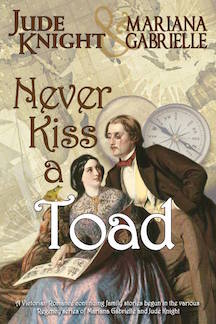
Never Kiss a Toad copyDavid “Toad” Northope, heir to the Duke of Wellbridge and rogue in the mold of his infamous father, knows Lady Sarah “Sal” Grenford, daughter of the once-profligate Duke of Haverford, will always hold his heart. But when the two teens are caught in bed together by their horrified parents, he is sent away to finish school on the Continent, and she is thrown into the depths of her first London Season.

Can two reformed rakes keep their children from making the same mistakes they did? The dukes decide keeping them apart will do the trick, so as the children reach their majority, Toad is put to work at sea, learning to manage his mother’s shipping concern, and Sal is taken to the other side of the world, as far from him as possible.

How will Toad and Sal’s love withstand long years of separation, not to mention nasty lies, vicious rumors, attractive other suitors, and well-meaning parents who threaten to destroy their future before it has begun?

To be published in weekly instalments on Wattpad, alternating between Mariana Gabrielle’s page and Jude Knight’s.

Jude Knight

Mariana Gabrielle

(Mariana Gabrielle is also posting Royal Regard, in which you can read about the fraught and beleaguered courtship of Toad’s parents, and Jude is posting stories from her collection Hand-Turned Tales.)

About A Baron for Becky

BfB cover final small copyBecky is the envy of the courtesans of the demi-monde – the indulged mistress of the wealthy and charismatic Marquis of Aldridge. But she dreams of a normal life; one in which her daughter can have a future that does not depend on beauty, sex, and the whims of a man.

Finding herself with child, she hesitates to tell Aldridge. Will he cast her off, send her away, or keep her and condemn another child to this uncertain shadow world?

The devil-may-care face Hugh shows to the world hides a desperate sorrow; a sorrow he tries to drown with drink and riotous living. His years at war haunt him, but even more, he doesn’t want to think about the illness that robbed him of the ability to father a son. When he dies, his barony will die with him. His title will fall into abeyance, and his estate will be scooped up by the Crown.

When Aldridge surprises them both with a daring proposition, they do not expect love to be part of the bargain.

Follow A Baron for Becky on Wattpad, or purchase while it is on sale for 99c

Smashwords

iBooks

Amazon

Barnes & Noble

About the Author

Jude Knight copyJude Knight has been telling stories all her life: making up serial tales to amuse her friends and children, imagining sequels to books that have moved her and left her wanting more, occasionally submitting short stories to magazines and the radio, starting more than a dozen novels set in different times and places.

She has devoted most of the last forty years to a career in commercial writing and raising a large family (most recently as grandmother-in-residence while a daughter was out of action for three years). She and her own personal romantic hero, with whom she has shared those forty+ years, now live with two cats and frequent visitors in a small town in rural New Zealand.

Judy wrote and published her first historical romance in 2014, and now has the wind in her sails and a head full of strong determined heroines, heroes with the sense to appreciate them, and villains you’ll love to loathe.

Website and Blog • Facebook • Twitter • Pinterest

Romance of London: The Bursting of the South Sea Bubble

Romance of London: Strange Stories, Scenes And Remarkable Person of the Great Town in 3 Volumes

John Timbs

John Timbs (1801-1875), who also wrote as Horace Welby, was an English author and aficionado of antiquities. Born in Clerkenwell, London, he was apprenticed at 16 to a druggist and printer, where he soon showed great literary promise. At 19, he began to write for Monthly Magazine, and a year later he was made secretary to the magazine’s proprietor and there began his career as a writer, editor, and antiquarian.

This particular book is available at googlebooks for free in ebook form. Or you can pay for a print version.

The word “Bubble” as applied to any ruinous speculation, was first applied to the transactions of the South Sea Company, in the disastrous year 1720. It originated in the exaggerated representations of the sudden riches to be realized by the opening of new branches of trade to the South Sea, the monopoly of which was to be secured to the South Sea Company, upon their pretext of paying off the National Debt. The Company was to become the richest the world ever saw, and each hundred pounds of their stock would produce hundreds per annum to the holder. By this means the stock was raised to near 400; it then fluctuated, and settled at 330.

512px-South_Sea_Bubble

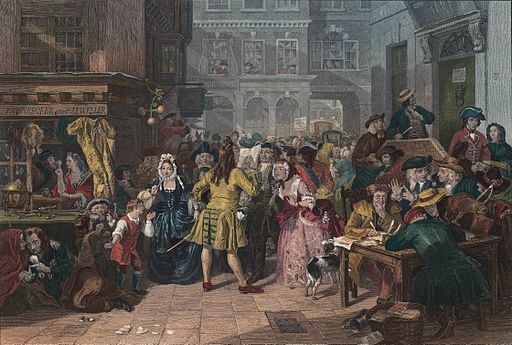
E.M. Ward, “‘Change Alley during the South Sea Bubble.”

Exchange Alley was the seat of the gambling fever;* it was blocked up every day by crowds, as were Cornhill and Lombard Street with carriages.  In the words of the ballads of the day:—

There is a gulf where thousands fell,

There all the bold adventurers came;

A narrow sound, though deep as hell,

‘Change Alley is the dreadful name.—Swift

Then stars and garters did appear

Among the meaner rabble;

To buy and sell, to see and hear

The Jews and Gentiles squabble.

The greatest ladies thither came,

And plied in chariots daily,

Or pawned their jewels for a sum

To venture in the Alley.

Innumerable bubble companies soon started up, by which one million and a half sterling was won and lost in a very short time. The absurdity of the schemes was monstrous: one was “a company for carrying on an undertaking of great advantage, but nobody to know where it is.” In all these bubbles, persons of both sexes alike engaged; the men meeting their brokers at taverns and coffee-houses, and the ladies at the shops of milliners and haberdashers; and in Exchange Alley, shares in the same bubble were sold, at the same instant, then per cent. Higher at one end of the Alley than the other. Meanwhile, the Minister warmed the nation, and the King declared such projects unlawful, and trafficking brokers were liable to 5,000l penalty. The companies were dissolved, but others as soon sprung up. The folly was satirized in caricatures and “stock-jobbing cards.” When Sir Isaac Newton was asked about the continuance of the rising of the South Sea stock, he answered that he could not calculate the madness of the people…

Among the victims was Gay, the poet [author of The Beggar’s Opera], who having had some South Sea Stock presented to him, supposed himself to be the master of 20,000l: his friends importuned him to sell, but he refused, and profit and principal were lost. The ministers grew more alarmed, the directors were insulted in the streets, and riots were apprehended; a run commenced upon the most eminent goldsmiths and bankers, some of whom absconded.

The Committee of Secrecy reported to Parliament the results of their enquiry, showing how false and fictitious entries had been made in the books, erasures and alterations made, and leaves torn out; and some of the most important books had been destroyed altogether. The properties of many thousands of persons, amounting to many millions of money, had been away with. Fictitious stock had been distributed among members of the Government, by way of bribe, to facilitate the passing of the Bill. One of the Secretaries to the Treasury had received 250,000l, as the difference in the price of some stock, and the account of the Chancellor of the Exchequer showed 794,451l. He proved the greatest criminal, and was expelled the House, all his estate seized, and he was committed a close prisoner to the Tower of London. Next day Sir George Casual, of a firm of jobbers who had implicated in the business, was expelled the House, committed to the Tower, and ordered to refund 250,000l. Mr. Craggs the elder died the day before his examination was to have come on. He left a fortune of a million and a half, which was confiscated for the benefit of the sufferers. Every director was mulcted [fined], and two millions and fourteen thousand pounds were confiscated, each director being allowed a small residue to begin the world anew.

The history of the Bubble and other speculations contemporaneously with the South Sea scheme is well narrated in Charles Mackay’s Memoirs of Extraordinary Popular Delusions, vol. i. Pp. 45-84.

The Night Singer of Shares

The Night Singer of Shares

It was about the year 1688 that the world ‘stock-jobber’ was first heard in London. In the short space of four years a crowd of companies, every one of which confidently held out to subscribers the hope of immense gains, sprang into existence: the Insurance Company, the Paper Company, the Lutestring Company, the Pearl Fishery Company, the Glass Bottle Company, the Alum Company, the Blythe Coal Company, the Sword-blade Company. There was a Tapestry Company, which would soon furnish pretty hangings for all the parlours of the middle class, and for all the bed-chambers of the higher.

Others included in Mackay’s publication were:

  • The Copper Company
  • The Diving Company (to investigate shipwrecks), which put on an impressive show of their advanced diving equipment on the Thames for fine gentlemen and ladies eager to be a part of such thrilling treasure-hunting
  • The Greenland Fishing Company
  • The Tanning Company
  • The Royal Academy Company, which would educate 2000 winners of a lottery in Latin, Greek, Hebrew, French, Spanish, conic sections, trigonometry, heraldry, japanning, fortification, bookkeeping, and the art of playing the theorbo.

Some of these companies took large mansions and printed their advertisements in gilded letters. Others, less ostentatious, were content with ink, and met at coffee-houses in the neighbourhood of the Royal Exchange. Jonathan’s and Garraway’s were in a constant ferment with brokers, buyers, sellers, meetings of directors, meetings of proprietors. Time-bargains soon came into fashion. Extensive combinations were formed, and monstrous fables were circulated, for the purpose of raising or depressing the price of shares.

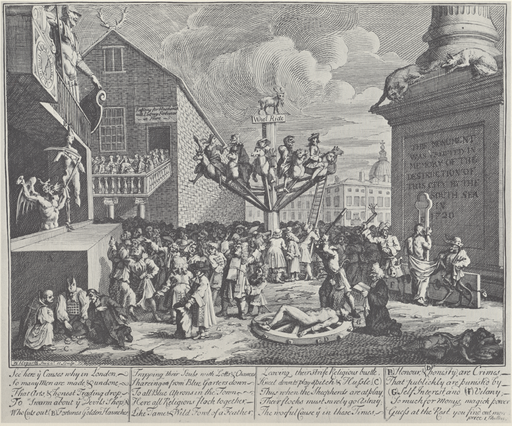
William Hogarth, Emblematical Print on the South Sea Scheme (1721). In the bottom left corner are Protestant, Catholic, and Jewish figures gambling, while in the middle there is a huge machine, like a merry-go-round, which people are boarding. At the top is a goat, written below which is "Who'l Ride". The people are scattered around the picture with a sense of disorder, while the progress of the well-dressed people towards the ride in the middle represents the foolishness of the crowd in buying stock in the South Sea Company, which spent more time issuing stock than anything else.

William Hogarth, Emblematical Print on the South Sea Scheme (1721). In the bottom left corner are Protestant, Catholic, and Jewish figures gambling, while in the middle there is a huge machine, like a merry-go-round, which people are boarding. At the top is a goat, written below which is “Who’l Ride”. The people are scattered around the picture with a sense of disorder, while the progress of the well-dressed people towards the ride in the middle represents the foolishness of the crowd in buying stock in the South Sea Company, which spent more time issuing stock than anything else.

Our country witnessed for the first time those phenomena for which a long experience has made us familiar—a mania, of which the symptoms were essentially the same with those of the mania of 1721, of the mania of 1825, of the mania of 1845, seized the public mind. An impatience to be rich, a contempt for those slow but sure gains which are the proper reward of industry, patience and thrift, spread through society. The spirit of the cogging dicers of Whitefriars took possession of the grave senators of the City, wardens of trades, deputies, aldermen. It was much easier and much more lucrative to put forth a lying prospectus, announcing a new stock, to persuade ignorant people that the dividends could not fall short of twenty per cent., and to part with 5,000l of this imaginary wealth for ten thousand sold guineas, than to load a ship with well-chosen cargo for Virginia or the Levant. Every day a new bubble was puffed into existence, rose buoyant, shone bright, burst, and was forgotten.

*Mr. E.M. Ward, R.A., has painted, with wonderful effect, “‘Change Alley during the South Sea Bubble,” a picture very properly placed in our National Gallery. [Currently Tate]

Susana’s remarks

Plus ça change, plus c’est la même chose.

The more things change, the more they stay the same. 

  • You aren’t going to win a big lottery prize. Or the Publishers’ Clearing House Sweepstakes. Or find buried treasure in your backyard.
  • When someone—even if it’s the Pope himself—offers you something that’s too good to be true, it really is too good to be true. Don’t be fooled.
  • Don’t be greedy. Be satisfied with “slow but sure gains” that are the reward of industry, patience and thrift.”


Romance of London Series

  1. Romance of London: The Lord Mayor’s Fool… and a Dessert
  2. Romance of London: Carlton House and the Regency
  3. Romance of London: The Championship at George IV’s Coronation
  4. Romance of London: Mrs. Cornelys at Carlisle House
  5. Romance of London: The Bottle Conjuror
  6. Romance of London: Bartholomew Fair
  7. Romance of London: The May Fair and the Strong Woman
  8. Romance of London: Nancy Dawson, the Hornpipe Dancer
  9. Romance of London: Milkmaids on May-Day
  10. Romance of London: Lord Stowell’s Love of Sight-seeing
  11. Romance of London: The Mermaid Hoax
  12. Romance of London: The Bluestocking and the Sweeps’ Holiday
  13. Romance of London: Comments on Hogarth’s “Industries and Idle Apprentices”
  14. Romance of London: The Lansdowne Family
  15. Romance of London: St. Margaret’s Painted Window at Westminster
  16. Romance of London: Montague House and the British Museum
  17. Romance of London: The Bursting of the South Sea Bubble
  18. Romance of London: The Thames Tunnel
  19. Romance of London: Sir William Petty and the Lansdowne Family
  20. Romance of London: Marlborough House and Sarah, Duchess of Marlborough
  21. Romance of London: The Duke of Newcastle’s Eccentricities
  22. Romance of London: Voltaire in London
  23. Romance of London: The Crossing Sweeper
  24. Romance of London: Nathan Mayer Rothschild’s Fear of Assassination
  25. Romance of London: Samuel Rogers, the Banker Poet
  26. Romance of London: The Eccentricities of Lord Byron
  27. Romance of London: A London Recluse

Regan Walker: Rebel Warrior

Edgar was the Rightful King

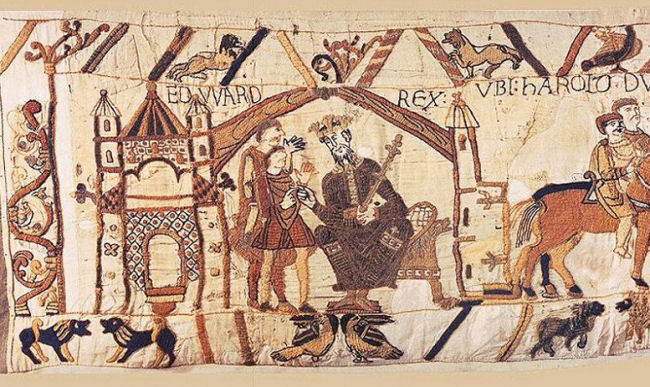
When Edward the Confessor, a gentle, pious king, who left no direct heirs, died on January 5, 1066, there were several candidates to become King of England in his place. One thing to keep in mind: under English law, no one, not even the king, could promise the crown to anyone. That was for the Witan, a council of nobles and spiritual leaders, to decide. What was the Witan to do?

Bayeux Tapestry: King Edward the Confessor Talks to Earl Harold

Bayeux Tapestry: King Edward the Confessor Talks to Earl Harold

In England, Harold Godwinson, Earl of Wessex, wanted the job. But he was only Edward’s brother-in-law. Harold claimed Edward had given the throne to him on his deathbed. And so he might have done, even though he was thought to have murdered Edward’s brother.

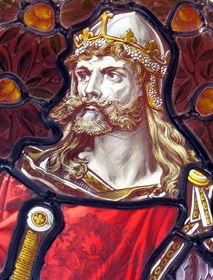
Harald Hardrada King of Norway

Harald Hardrada King of Norway

In Norway, King Harald Hardrada had inherited land in England from King Canute who had once been King of England. Hardrada believed this meant he had a claim to be the King of England. Well, why not? After all, he was supported by Tostig, Harold of Wessex’s brother and Hardrada was already the powerful King of Norway. And he was planning to take England by force if he must.

King Sweyn of Denmark

King Sweyn of Denmark

There was another Scandinavian king who had a claim to the throne, too. King Sweyn of Denmark’s uncle had been Canute the Great, King of England, Denmark and Norway. Canute was ruling England when Edward took over. But Sweyn waited until Hardrada was defeated in his claim, then took his time to rally his hundreds of longships and fighting men. The Danes did not arrive in England until 1069, but more about that in my novel, Rogue Knight.

William the Conqueror Arriving in England

William the Conqueror Arriving in England

Meanwhile, across the English Channel lay Normandy and William, the bastard son of Robert, Duke of Normandy. William, now the duke, was Edward’s first cousin’s son. Seems a stretch to me, but this guy had ambition. And he had already demonstrated he was ruthless in battle. Besides all that, he told some tale about Edward having promised him the crown of England. But it seems Edward promised the crown to many, so what was that? William also claimed that Harold of Wessex had vowed to help him become king one day. Not sure about that and neither are the historians but then William’s folks wrote most of the history so there you have it.

As his father’s heir and now Duke of Normandy, William was used to ruling a large land. Why not more? So, William the Bastard planned to invade England just like Harald Hardrada. The plot thickens.

So what happened? The Witan named Harold of Wessex king. But we all know what happened to him…

Harald Hardrada invaded the north of England. King Harold fought him off. Weakened by the battle they’d just fought, Harold’s men trudged south to meet William the Bastard at Hastings where his men were storming ashore from Normandy. In a daylong battle, Harold was killed.

But one claimant to the throne of England remained… an heir of Edward’s. Indeed, Edgar Ætheling was the rightful heir to the throne. “Ætheling” is an Old English term used in Anglo-Saxon England to designate the princes of the royal dynasty eligible for the kingship. And so Edgar was. His father, Edmund Ironside, was King Edward’s half brother until he was killed, some say by poisoning. Unfortunately, when King Edward died, Edgar was only 14 or 15, a bit young to be leading soldiers and fighting off contenders for the crown.

Nevertheless, upon King Harold’s death, Edgar was named king, but he was never crowned because William the Bastard, earning his name as “the Conqueror”, moved in and took over.

Although Edgar had many supporters and, in 1069, joined with the Danes and the rebels in Yorkshire in a bid to reclaim England, through a series of fiascos, their fight was unsuccessful.

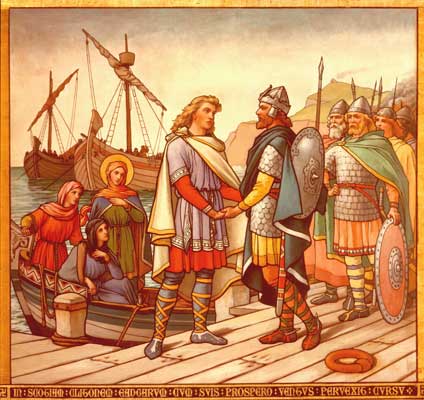
Edgar, his mother and two sisters fled to Scotland where King Malcolm welcomed them. And that is where Edgar enters my newest medieval romance, Rebel Warrior, set in Scotland in 1072.

Malcolm welcoming Edgar

Malcolm welcoming Edgar to Scotland

By then, Edgar was 21 and though the rightful king, he would be denied his legacy. But one day his family would regain the throne in a manner of speaking. Edgar’s niece, Edith, daughter of Edgar’s sister Margaret who married the King of Scots, would become Queen of England, marrying Henry I.

If you want to see Edgar and his beautiful sister Margaret in Scotland, you will have to read Rebel Warrior!

ReganWalker_RebelWarrior_800 copy


“Master storytelling transports you to medieval Scotland!”

Paula Quinn, NY Times Bestselling Author

About Rebel Warrior

When your destiny lies far from where you began…

Scotland 1072

The Norman Conqueror robbed Steinar of Talisand of his noble father and his lands, forcing him to flee to Scotland while still recovering from a devastating wound. At the royal court, Steinar becomes scribe to the unlettered King of Scots while secretly regaining his skill with a sword.

The first time Steinar glimpses the flame-haired maiden, Catrìona of the Vale of Leven, he is drawn to her spirited beauty. She does not fit among the ladies who serve the devout queen. Not pious, not obedient and not given to stitchery, the firebrand flies a falcon! Though Catrìona captures Steinar’s attention, he is only a scribe and she is promised to another.

Catrìona has come to Malcolm’s court wounded in spirit from the vicious attack on her home by Northmen who slayed her parents and her people. But that is not all she will suffer. The man she thought to wed will soon betray her.

When all is lost, what hope is there for love? Can a broken heart be mended? Can a damaged soul be healed?

Rebel Warrior on Amazon:

US • UK

About the Author

Regan Walker profile pic 2014 copyRegan Walker is an award-winning, #1 bestselling, multi-published author of Regency, Georgian and Medieval romance. She has five times been featured on USA TODAY’s HEA blog and twice nominated for the prestigious RONE award (her novel, The Red Wolf’s Prize won Best Historical Novel for 2015 in the medieval category). Regan writes historically authentic novels with real history and real historic figures where her readers experience history, adventure and love.

Goodreads • Website • Facebook • Twitter

Pinterest storyboard for Rebel Warrior

Romance of London: Montague House and the British Museum

Romance of London: Strange Stories, Scenes And Remarkable Person of the Great Town in 3 Volumes

John Timbs

John Timbs (1801-1875), who also wrote as Horace Welby, was an English author and aficionado of antiquities. Born in Clerkenwell, London, he was apprenticed at 16 to a druggist and printer, where he soon showed great literary promise. At 19, he began to write for Monthly Magazine, and a year later he was made secretary to the magazine’s proprietor and there began his career as a writer, editor, and antiquarian.

This particular book is available at googlebooks for free in ebook form. Or you can pay for a print version.

The Burning of Montague House

This noble mansion, situated on the north side of Great Russell Street, Bloomsbury, was first built about 1674, by Ralph Montague, Esq., afterwards Baron Montague of Boughton, and Duke of Montague, Keeper of the Wardrobe to Charles II., and who was subsequently in high favor with King William and Queen Anne. The house was erected in the manner of a French palace, from the design of Robert Hooke, the celebrated mathematician, and the inventor of spring-clocks and pocket-watches, and much employed in the rebuilding of London after the Great Fire; he was also Curator of the Royal Society, in the year 1678.

Within ten years this superb mansion was burned down by accident, or rather, by the carelessness of a servant. John Evelyn records in his Diary:—“Jan. 19. 1686.—This night was burnt to the ground my Lord Montague’s palace in Bloomsbery, than which, for paintings and furniture, there was nothing more glorious in England. This happened by the neglect of a servant airing, as they call it, some goods by the fire, in a moist season; indeed, so wet and mild a season had scarce been seen in man’s memory.”

The house was at this time in the occupation of the Earl of Devonshire, to whom Lord Montague had let it, for the sum of 500 guineas by the year. Of its destruction we find another entry:—

Whitehall, the 21st Jan. 1685-6.

“On Wednesday, at one in the morning, a sad fire happened at Montague House, in Bloomsbury, occasioned by the steward’s airing some hangings, &c., in expectation of my Lord Montague’s return home; and sending afterwards a woman to see that the fire-pans with charcoal were removed, which she told me she had done, though she never came there. The loss that my Lord Montague has sustained by this accident is estimated at 40,000l., besides 6,000l. In plate; and my Lord Devonshire’s loss in pictures, hangings, and other furniture is very considerable.”

The North Prospect of Mountague House by James Simonic, 1715

The North Prospect of Mountague House by James Simonic, 1715

Montague House is rebuilt

Lord Montague’s large income was again placed in requisition for the reconstruction of his palace; and though executed by French artists, the plan (that of the hotels of the nobility at Paris) was the same, the new structure being raised upon the foundations and burnt walls of the old one. The architect now employed was one Peter Poughet, a native of Marseilles, who was assisted in the decoration by Charles de la Fosse, Jaques Rousseau, and Jean Baptist Monoyer…  This exclusive employment of French artists in the new house gave rise to the popular but improbable tale, that Montague House was rebuilt at the expense of Louis XIV., to whose court Lord Montague had twice been sent as ambassador.

The second Montague House was finished about 1687; and the eccentric but munificent owner, who in 1705, was created Marquis of Monthermer and Duke of Montague, resided in it till after his death, which took place March 9, 1709. He was succeeded in his titles and estates by his son John, second Duke of Montague, who quitted the vicinity of St. Giles’s for the more courtly region of Whitehall. While a new mansion was being erected for him there, he, however, continued to reside in one of the wings of Montague House. After his removal to Whitehall, the house in Great Russell Street remained unoccupied, until it was purchased, by Act of Parliament, of Lord Halifax, for 10,250l., in the spring of 1754, for “the British Museum.”

Montagu House drawing by Nicholas Sutton, published in 1754

Montagu House drawing by Nicholas Sutton, published in 1754

The British Museum

The building must have been in a very dilapidated condition, for the repairs cost more than the purchase, and, with furniture, &c., amounted to the large sum of 29,736l. 10s. 10d.

In plan, the old Museum resembled a French hotel of the first class: consisting of a large and lofty pile, with two sides built for offices, and a high front wall, with an arched doorway, and above it an octangular turret, surmounted by a cupola and vane; this was the principal entrance, and was known as “Montague Great Gate;” and at each extremity of the wall was a square turret.

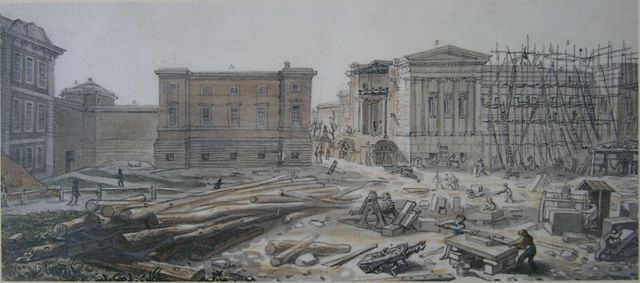
Left to Right: Montagu House, Towny Gallery, and Sir Robert Smirkes' West Wing Under Construction, July 1828

Left to Right: Montagu House, Towny Gallery, and Sir Robert Smirkes’ West Wing Under Construction, July 1828

To the original building additions were made from time to time, as the collection increased, until 1820, when the rebuilding of the Museum was commenced; the plan bordering three sides of the spacious area formerly occupied by the gardens of Montague House, behind the original mansion. By this means, the collection was removed from the old into the new building as the latter progressed, without any inconvenience to the public. In like manner, the principal front took the place of the old Montague House façade, which was removed piecemeal; and strange it was to see the lofty pitched roof, balustraded attic, and large windowed front of “the French manner,” giving way to the Grecian architecture of Sir Robert Smirke’s new design. The octangular and not unpicturesque apartment over the great gateway lingered for some time after, and was the last to disappear of old Montague House. The materials were sold by auction; and curious was it to see such pieces of the painted walls and ceilings as could be removed entire, bringing a few shillings—one of La Fosse’s deities for half-a-crown, or a bunch of Monoyer’s flowers for 1s. 6d.

The Waddesdon Bequest

This has nothing to do with Montague House, but is just something interesting I came across while researching this blog post. Last summer I visited Waddesdon Manor in Aylesbury, which is where Baron Ferdinand de Rothschild displayed the treasures he acquired from his travels to the Continent and beyond. Baron Rothschild is quite the romantic figure. He fell in love and married his second cousin Evelina, only to lose her in childbirth eighteen months later. He never married again, but spent his life in the acquisition and admiration of beautiful objects. Click here to take a look at my Pinterest board for Waddesdon Manor.

In 1898 he bequeathed the contents of his New Smoking Room at Waddesdon Manor to the British Museum.

This consisted of almost 300 pieces of objets d’art et de vertu which included exquisite examples of jewellery, plate, enamel, carvings, glass and maiolica, among them the Holy Thorn Reliquary, probably created in the 1390s in Paris for John, Duke of Berry. The collection was in the tradition of a schatzkammer or treasure house such as those formed by the Renaissance princes of Europe. Baron Ferdinand’s will was most specific, and failure to observe the terms would make it void, the collection should be

placed in a special room to be called the Waddesdon Bequest Room separate and apart from the other contents of the Museum and thenceforth for ever thereafter, keep the same in such room or in some other room to be substituted for it

The Waddesdon Bequest

The Waddesdon Bequest

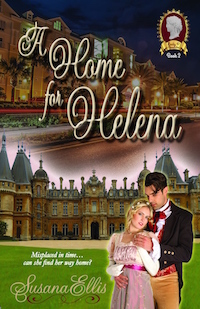
As a footnote, the cover of my time travel, A Home for Helena, includes a photograph of Waddesdon Manor taken last September at the time of my visit.

Home for Helena Cover 200x309

Amazon

Romance of London Series

  1. Romance of London: The Lord Mayor’s Fool… and a Dessert
  2. Romance of London: Carlton House and the Regency
  3. Romance of London: The Championship at George IV’s Coronation
  4. Romance of London: Mrs. Cornelys at Carlisle House
  5. Romance of London: The Bottle Conjuror
  6. Romance of London: Bartholomew Fair
  7. Romance of London: The May Fair and the Strong Woman
  8. Romance of London: Nancy Dawson, the Hornpipe Dancer
  9. Romance of London: Milkmaids on May-Day
  10. Romance of London: Lord Stowell’s Love of Sight-seeing
  11. Romance of London: The Mermaid Hoax
  12. Romance of London: The Bluestocking and the Sweeps’ Holiday
  13. Romance of London: Comments on Hogarth’s “Industries and Idle Apprentices”
  14. Romance of London: The Lansdowne Family
  15. Romance of London: St. Margaret’s Painted Window at Westminster
  16. Romance of London: Montague House and the British Museum
  17. Romance of London: The Bursting of the South Sea Bubble
  18. Romance of London: The Thames Tunnel
  19. Romance of London: Sir William Petty and the Lansdowne Family
  20. Romance of London: Marlborough House and Sarah, Duchess of Marlborough
  21. Romance of London: The Duke of Newcastle’s Eccentricities
  22. Romance of London: Voltaire in London
  23. Romance of London: The Crossing Sweeper
  24. Romance of London: Nathan Mayer Rothschild’s Fear of Assassination
  25. Romance of London: Samuel Rogers, the Banker Poet
  26. Romance of London: The Eccentricities of Lord Byron
  27. Romance of London: A London Recluse

Beverley Oakley: The Mysterious Governess (Daughters of Sin, Book 3)

Catostconspirators

The Cato Street Conspiracy and Queen Caroline’s Return to England—Two Important Events of 1820

 Historical Romance Author, Beverley Oakley, recently brought one of her characters, Miss Araminta Partington, to tea. Miss Partington, who has an extremely high opinion of her attractions, and of her knowledge of most matters, elucidated on the background to the new book in which she features called The Mysterious Governess, part of the Daughters of Sin series, which touches on the events before and after the Cato Street Conspiracy of 1820.

Miss Partington: Hello Susana, and thank you so much for inviting me to take a dish of tea in your parlor. I must say, it’s very comforting to know I can sleep at night in the knowledge that those dreadful men—Arthur Thistlewood, Edward Spence and the others – who call themselves “The Society of Spencean Philanthropists”, have been either hanged or transported for life for their parts in the Cato Street Conspiracy.

Susana: A delight to have you here, too, Araminta. Yes, what a shock to the public! What do you suppose they were hoping to achieve?

Miss Partington: Why, utter madness, in my opinion! Mr. Thistlewood talked of desiring a “Government of the People of Great Britain,” which would take power out of the hands of Parliament and the landed elite and place it into the hands of the people.” In my opinion, that’s tantamount to stealing Papa’s estate and giving it to Jane, my useless maid, who only last week lost one of my silver hairpins.

Susana: Goodness, that does sound dire! I’m referring to the plot, of course. Was there violence?

Miss Partington: Fortunately, the only violence was after the Coldstream Guards and Bow Street runners ran into the loft where these miscreants were plotting that night’s intended rampage through the home of the Lord President of His Majesty’s Privy Council, Lord Harrowby. Indeed, they were intending to murder the entire King’s Cabinet before taking to the streets of London to storm the Bank of England and the Tower of London. They hoped to stir up revolution in our country, like in America and France only a few decades ago.

Susana: Good Lord! How was it possible that law enforcement was able to apprehend the plotters?

Pageflex Persona [document: PRS0000038_00064]Miss Partington: Well, apparently, the Government knew what they were about and had planted spies in their organization. My Cousin, Stephen Cranbourne, works for the Foreign Office. I’m sure he’d have confided in me had I not been on rather… er… friendly terms with Lord Debenham who is rumored to be associated with the Spenceans. He’s not, of course. I made sure to burn the incriminating letter his cousin wrote before she drank poison. Aren’t the daffodils beautiful at this time of year? I’ve trimmed my bonnet with several bunches. Sir Aubrey does think them fetching. Yes, I’ve transferred my affections to Sir Aubrey as I think he’d be far easier to manage than dangerous Lord Debenham.

Susana: Yes, the daffodils are, indeed, beautiful. And I was so sorry to hear about Lord Debenham’s cousin. I believe she was Sir Aubrey’s late wife. But, back to politics, do tell me, when was the Spenceans’ plot brought to nought? My apologies for my ignorance, I’ve been in France for some time.

Miss Partington: On February 23, 1820, but of course, it’s not really news any more since the gossip sheets—and indeed, the newspapers—are having much more fun giving us all the thrilling details of George IV’s estranged wife Queen Caroline arriving from continental Europe, a few months afterwards, and attempting to take her place as Queen consort. Personally, I think someone with such atrocious dress sense doesn’t deserve to be queen, but, not everyone agrees with me—which I always find rather odd, really. Of course, the Prince Regent only agreed to marry Princess Caroline of Brunswick back at the end of the last century so his father would clear his debts. £630,000 pounds is rather a lot of money, though I imagine that if I owed such a sum, I might be induced to marry Lord Debenham above Sir Aubrey, despite his wicked reputation and the fact Lord Debenham would be so much more difficult to manage.

Susana: Yes, your half-sister, Miss Larissa Hazlett, has inferred the same.

Miss Partington: My half-sister? [Miss Partington rises.]Let me assure you, I do not have a half-sister. Any resemblance between that dreary governess and myself is entirely coincidental. Now, if you’ll excuse me… while it has been most pleasant, I must leave now for an appointment I’ve just remembered. Yes, it’s all part of a little plan I’m implementing to put that dreary governess right back in her box!

About The Mysterious Governess

Two beautiful sisters—one illegitimate, the other nobly born—compete for love amidst the scandal and intrigue of a Regency London Season.

Lissa Hazlett lives life in the shadows. The beautiful, illegitimate daughter of Viscount Partington earns her living as an overworked governess while her vain and spoiled half sister, Araminta, enjoys London’s social whirl as its most feted debutante.

When Lissa’s rare talent as a portraitist brings her unexpectedly into the bosom of society—and into the midst of a scandal involving Araminta and suspected English traitor Lord Debenham—she finds an unlikely ally: charming and besotted Ralph Tunley, Lord Debenham’s underpaid, enterprising secretary. Ralph can’t afford to leave the employ of the villainous viscount much less keep a wife but he can help Lissa cleverly navigate a perilous web of lies that will ensure everyone gets what they deserve.

Amazon.com • Amazon.co.uk • Apple iBooks • Barnes & Noble • Kobo

Excerpt

Although The Mysterious Governess is about Lissa, who is Araminta’s half-sister, the plot involves them equally. Lissa is hard-working and honourable, the antithesis of Araminta, as you will see below, in this short extract:

“Is everything all right, Miss? Were the fireworks grand? You’re back earlier than I’d ‘spected.” Jane, who was polishing the silver bottles on her mistress’s dressing table, looked up nervously as Araminta entered the room.

Without a word, Araminta brought one arm across the entire surface and sent powder bottles, perfume vials, hairbrushes and jewelry boxes crashing to the floor.

Then she threw herself onto her bed and burst into noisy tears.

“Oh, Miss, I take it things didn’t go to plan,” said Jane, going down on her knees to start to clean up the mess before changing her mind and putting a tentatively soothing hand upon Araminta’s back.

“No, they did not!” Araminta shrieked, beating her fists upon the counterpane.

“So, His Lordship didn’t ask you to marry him, then?”

“Yes he did!” Araminta rolled onto her back and glared at Jane. “He asked me to marry him and then said he had to go away on important business for two months! Two months! Where does that leave me? In an impossible situation, I don’t need to tell you. I might as well throw myself in the river, except the water’s far too cold and I’m hardly about to copy bacon-brained Edgar. There must be another way.”

“Poison?”

“I mean to get out of this mess, you stupid girl!” Araminta screamed. Feverishly, she began to bite her fingernails before realizing the damage she was doing to an important asset. “Oh, Jane, don’t look like you’re related to a mule. Come up with a plan, for dear Lord’s sake!”

About the Author

Beverley Eikli author picBeverley Oakley was seventeen when she bundled up her first 500+ page romance and sent it to a publisher. However, drowning her heroine on the last page was not in line with the expectations of romance readers so Beverley became a journalist.

In 2009, Beverley published her first novel. Since then she has written more than thirteen sizzling historical romances, filled with mystery and intrigue, mostly set in England during the Georgian, Regency and Victoria eras.

Beverley lives near Melbourne opposite a picturesque nineteenth century insane asylum with the handsome Norwegian bush pilot she met in Botswana, their two beautiful daughters and a rambunctious Rhodesian Ridgeback the size of a pony.

Beverley also writes more psychological historicals, and Colonial-Africa- set romantic adventures, as Beverley Eikli.

WebsiteFacebookGoodreadsTwitter

Romance of London: St. Margaret’s Painted Window at Westminster

Romance of London: Strange Stories, Scenes And Remarkable Person of the Great Town in 3 Volumes

John Timbs

John Timbs (1801-1875), who also wrote as Horace Welby, was an English author and aficionado of antiquities. Born in Clerkenwell, London, he was apprenticed at 16 to a druggist and printer, where he soon showed great literary promise. At 19, he began to write for Monthly Magazine, and a year later he was made secretary to the magazine’s proprietor and there began his career as a writer, editor, and antiquarian.

This particular book is available at googlebooks for free in ebook form. Or you can buy a print version.

YES

The history of the painted glass cinquecento Window, which, in 1758, was placed in the chancel, over the altar of St. Margaret’s Church, is truly romantic.

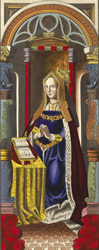
Elizabeth of York

Elizabeth of York

This beautiful window (said to have been executed at Gouda, in Holland, and to have occupied five years in the making) was originally intended by the magistrates of Dort as a present to Henry VII., by whom it was intended for his Chapel at Westminster; or as some say, it was ordered by Ferdinand and Isabella on the occasion of Prince Arthur being affianced, in 1499, to the Princess Catherine of Arragon, their portraits being procured for the purpose.

The three middle compartments represent the Crucifixion, with the usual accompaniments of angels receiving in a chalice the blood which drops from the wounds of the Saviour. Over the good thief an angel is represented wafting his soul to Paradise; and over the wicked, the devil in the shape of a dragon carrying his soul to a place of punishment. In the six upper compartments are six angels holding the emblems of crucifixion: the cross, the sponge, the crown of thorns, the hammer, the rods and nails. In the right hand lower compartment is Arthur, Prince of Wales (eldest son of Henry VII); and in the companion or left side, Catherine of Arragon, his bride (afterwards married to his brother Henry VIII., and divorced by him). Over the head of Prince Arthur is a full-length figure of St. George, with the red and white roses of England; and over Catherine of Arragon, a full-length figure of St. Catherine, with the bursting pomegranate, the emblem of the kingdom of Granada.

Prince Arthur died before the window was finished; the King himself before it could be erected. Succeeding events—the marriage of Henry VIII. To the bride or widow of his brother, with the subsequent divorce of Catherine—rendered the window wholly unfit for the place for which it was intended.

The window through the ages

  1. Catherine of Aragon

    Catherine of Aragon

    Henry VIII gave it to Waltham Abbey, Essex.

  2. At the Dissolution, Robert Fuller, the last Abbot, sent it to his private chapel at New Hall, also in Essex.
  3. It was later acquired by the father of Anne Boleyn.
  4. Queen Elizabeth I gave it to Thomas Ratcliff, Earl of Sussex, who was living at New Hall.
  5. It was purchased by Villiers, Duke of Buckingham, favorite of James I.
  6. Its next owner was Oliver Cromwell.
  7. At the Restoration, it reverted to the second Duke of Buckingham.
  8. It was purchased, along with New Hall, to General Monk, Duke of Albermarle. The duke buried it underground to keep it from the Puritans. After the Restoration he returned it to his chapel at New Hall.
  9. After he died and his son as well, the hall became the property of the duchess, and fell into ruin and decay.
  10. John Olmius, Esq., purchased the property and demolished the chapel, preserving the window.
  11. Eventually it was purchased by Mr. Conyers, of Copt Hall, Essex, for 50 guineas, for his own chapel.
  12. Conyers’ son, Mr. John Conyers sold the window in 1758 to the churchwardens of St. Margaret’s Westminster for 400 guineas.
St. Margaret's Church (background)

St. Margaret’s Church (background)

“It is worth the walk”

It is worth a walk to St. Margaret’s to see this window. The late Mr. Winston, the great authority upon glass-painting, says of it: “Though at present much begrimed with London smoke and soot, it may be cited as an example of the pictorial excellence attainable in a glass-painting without any violation of the fundamental rules and conditions of the art. The harmonious arrangement of the coloring is worthy of attention. It is the most beautiful work in this respect that I am acquainted with.”

The church has been in our time, as it was centuries ago in Stow’s time, “in danger of pulling down;” which, if carried into effect, would add another leaf to the history of the St. Margaret’s Painted Window.

Thankfully, this last threat to the location of this window have not come to pass. I’m definitely putting St. Margaret’s on my list for this year’s trip, in August.

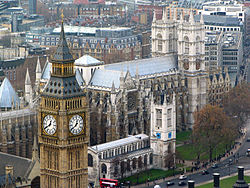
St. Margaret's Church from the London Eye

St. Margaret’s Church from the London Eye


Romance of London Series

  1. Romance of London: The Lord Mayor’s Fool… and a Dessert
  2. Romance of London: Carlton House and the Regency
  3. Romance of London: The Championship at George IV’s Coronation
  4. Romance of London: Mrs. Cornelys at Carlisle House
  5. Romance of London: The Bottle Conjuror
  6. Romance of London: Bartholomew Fair
  7. Romance of London: The May Fair and the Strong Woman
  8. Romance of London: Nancy Dawson, the Hornpipe Dancer
  9. Romance of London: Milkmaids on May-Day
  10. Romance of London: Lord Stowell’s Love of Sight-seeing
  11. Romance of London: The Mermaid Hoax
  12. Romance of London: The Bluestocking and the Sweeps’ Holiday
  13. Romance of London: Comments on Hogarth’s “Industries and Idle Apprentices”
  14. Romance of London: The Lansdowne Family
  15. Romance of London: St. Margaret’s Painted Window at Westminster
  16. Romance of London: Montague House and the British Museum
  17. Romance of London: The Bursting of the South Sea Bubble
  18. Romance of London: The Thames Tunnel
  19. Romance of London: Sir William Petty and the Lansdowne Family
  20. Romance of London: Marlborough House and Sarah, Duchess of Marlborough
  21. Romance of London: The Duke of Newcastle’s Eccentricities
  22. Romance of London: Voltaire in London
  23. Romance of London: The Crossing Sweeper
  24. Romance of London: Nathan Mayer Rothschild’s Fear of Assassination
  25. Romance of London: Samuel Rogers, the Banker Poet
  26. Romance of London: The Eccentricities of Lord Byron
  27. Romance of London: A London Recluse