Susana’s Adventures in England: Syon House

syonpark

If you’re looking for a stately home to visit in or near London, Syon House is a great choice. Located on the Thames across from Kew Gardens, you can get there by Underground (take the District line toward Richmond, get off at Gunnarsbury) and bus, (take the 237 or 267 bus to Brentlea). The pedestrian entrance is on your right when you get off the bus).

Syon House history

Syon began as an abbey, founded in 1415 by Henry V and closed in 1539 by the Dissolution of the Monasteries. Catherine Howard, fifth wife of Henry VIII, was imprisoned here prior to her execution in 1542. The 1st Duke of Somerset acquired it and had it renovated in Italian Renaissance style. In 1594, the 9th Earl of Northumberland acquired it and has owned it ever since.

A Royal Row

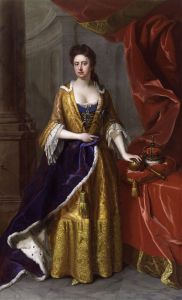
Queen Anne (1705)

Queen Anne (1705)

(from Wikipedia)

In the late 17th century, Syon was in the possession of Charles Seymour, 6th Duke of Somerset, through his wife, Elizabeth Seymour (née Percy). After the future Queen Anne had a disagreement with her sister, Mary II (wife of William III, also known as William of Orange), over her friendship with Sarah Churchill, Countess of Marlborough, she was evicted from her court residence at the Palace of Whitehall and stayed at Syon with her close friends, the Somersets, in 1692. Anne gave birth to a stillborn child there. Shortly after the birth, Mary came to visit her, again demanding that Anne dismiss the Countess of Marlborough and stormed out again when Anne flatly refused.

Mary II, 1685

Mary II, 1685

In the 18th century, Hugh Percy, 1st Duke of Northumberland, commissioned architect and interior designer Robert Adam and landscape designer Lancelot “Capability” Brown to redesign the house and estate. Work began on the interior reconstruction project in 1762. Five large rooms on the west, south and east sides of the House, were completed before work ceased in 1769. A central rotunda, which Adams had intended for the interior courtyard space, was not implemented, due to cost.

Robert Adam!

Robert Adam's plan for Syon House

Robert Adam’s plan for Syon House

from Wikipedia:

Syon House’s exterior was erected in 1547 while under the ownership of the 1st Duke of Somerset. Syon’s current interior was designed by Robert Adam in 1762 under the commission of the 1st Duke and Duchess of Northumberland.

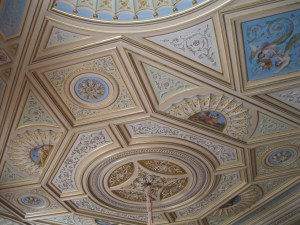
coloredceilingcornerThe well known “Adam style” is said to have begun with Syon House. It was commissioned to be built in the Neo-classical style, which was fulfilled, but Adam’s eclectic style doesn’t end there. Syon is filled with multiple styles and inspirations including a huge influence of Roman antiquity, highly visible Romantic, Picturesque, Baroque and Mannerist styles and a dash of Gothic. There is also evidence in his decorative motifs of his influence by Pompeii that he received while studying in Italy. Adam’s plan of Syon House included a complete set of rooms on the main floor, a domed rotunda with a circular inner colonnade meant for the main courtyard (‘meant for’ meaning that this rotunda was not built due to a lack of funds), five main rooms on the west, east and south side of the building, a pillared ante-room famous for its colour, a Great Hall, a grand staircase (though not built as grand as originally designed) and a Long Gallery stretching 136 feet long. Adam’s most famous addition is the suite of state rooms and as such they remain exactly as they were built.

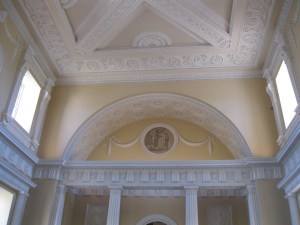
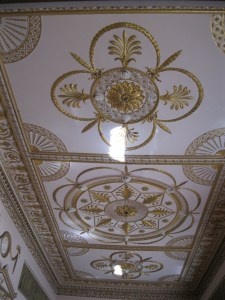
geometricceiling2More specific to the interior of Adam’s rooms is where the elaborate detail and colour shines through. Adam added detailed marble chimneypieces, shuttering doors and doorways in the Drawing Room, along with fluted columns with Corinthian capitals. The long gallery, which is about 14 feet high and 14 feet wide, contains many recesses and niches into the thick wall for books along with rich and light decoration and stucco-covered walls and ceiling. At the end of the gallery is a closet with a domed circle supported by eight columns; halfway through the columns is a doorway imitating a niche.

More photos on my Syon Park Pinterest Page: https://www.pinterest.com/susanaauthor/syon-park/

ceilingalcove

corner3

goldturquoisecorner

librarybooks&portraits

beautifulvase

delicategoldceiling

Regina Jeffers: Angel Comes to the Devil’s Keep (Giveaway)

English Titles & Peerages

Many of the minor plot lines in my latest Regency romantic suspense concern who could inherit a title. There is the matter of the Marquess of Malvern’s losing his memory. Should the Duke of Devilfoard declare his eldest son incompetent and petition for his second son to assume control of the dukedom? Was such even legal? And what of the missing Earl of Sandahl? The original earl falls overboard on his “honeymoon” and cannot be found. Should he be declared dead? If so, who inherits? The logical answer is the second son, but that solution is not what it seems.

So, what do we know of peerages? When reading historical fiction/historical romance there are many misconceptions about titles. First thing a reader must know is not all titles are created equal. For example, a baronet may pass on his title to his heir, but he is not considered part of the Peerage in the United Kingdom. There are some 800+ peers in modern day England whose titles may be inherited. Peers include Dukes/Duchesses, Marquesses/Marchionesses, Earls/Countesses, Viscounts/Viscountesses, and Barons/Baronesses. The law that applies to a particular British title depends upon when it was bestowed upon the family and the method of its creation.

Peerages of England, Great Britain, and the United Kingdom follow English law; the difference between them is that Peerages of England were created before the Act of Union 1707, Peerages of Great Britain between 1707 and the Union with Ireland in 1800, and Peerages of the United Kingdom since 1800. Irish Peerages follow the law of the Kingdom of Ireland, which is very like English law, except no Irish peers have been created since 1898, and they have no part in the present governance of the United Kingdom. Scottish Peerage law is generally similar to English law, but differs in innumerable points of detail, often being more similar to medieval practice.” (Burke’s Guide to British Titles: Courtesy Titles. Burke’s Peerage and Gentry. 2005)

A title may be created by a writ of summons, which means that a person is summoned to Parliament. A writ of summons is a document calling Members of the House of Lords to Parliament. Members of the Lords may not take their seats until they have obtained their writ of summons. Writs of summons are issued by direction of the Lord Chancellor from the office of the Clerk of the Crown in Chancery. New writs are issued before the meeting of each Parliament to all Lords Spiritual and Temporal who have a right to seats in the House. (Francis Palgrave (1788-1861), Parliamentary Writs and Writs of Military Summons (2 volumes, 1827 and 1834) Writs of summons set out the titles of the Sovereign and the recipient of the writ. They state the reason for Parliament’s calling upon the individual.

When the Earl of Berkley died, his oldest son applied for a writ of summons to the House of Lords. The Committee on Privilege turned him down and said he and the other brothers born before 1795 were illegitimate and that the earldom had fallen to the sixteen-year-old born in 1796. The boy was too young to do anything about the matter and his oldest brother and mother ran things. When he came of age, he never put forth a claim to the earldom However, he was, by right and law, the earl so anything requiring the signature of the earl had to be signed by him. He signed responsibility over to his oldest brother, but the title itself went dormant until he died.

Titles may also be created by letters of patent. This method sets out a created peerage and names the person in question. It may limit the course of descent to the male line, with only legitimate children having a right to the title. (Scottish titles permit the “legitimacy” to be determined by a marriage, not simply a marriage at time of the birth.) Traditionally, only the peer sits in the House of Lords, but from the time of Edward IV, an heir to the title (who also held additional titles) could sit in the HOL as one of his father’s subsidiary dignities. This is possible through a writ of acceleration.

Letters patent granting the Dukedom of Marlborough to Sir John Churchill were later amended by Parliament (via Wikipedia)

Letters patent granting the Dukedom of Marlborough to Sir John Churchill were later amended by Parliament (via Wikipedia)

Letters Patent can be amended by Act of Parliament. Likely, the two most famous examples of amending Letters were the Dukedom of Marlborough in 1706 and the Duke of Windsor in 1936.

A person who is a possible heir to a peerage is said to be “in remainder.” A title becomes extinct (opposite to extant, which means alive) when all possible heirs (as provided by the letters patent) have died out, i.e., there is nobody in remainder at the death of the holder. A title becomes dormant if nobody has claimed the title or if no claim has been satisfactorily proven. A title goes into abeyance if there is more than one person equally entitled to be the holder.

In the past, peerages were sometimes forfeit or attainted under Acts of Parliament, most often as the result of treason on the part of the holder. The blood of an attainted peer was considered “corrupted,” consequently his or her descendants could not inherit the title. If all descendants of the attainted peer were to die out, however, then an heir from another branch of the family not affected by the attainder could take the title. The Forfeiture Act 1870 abolished corruption of blood; instead of losing the peerage, a peer convicted of treason would be disqualified from sitting in Parliament for the period of imprisonment.

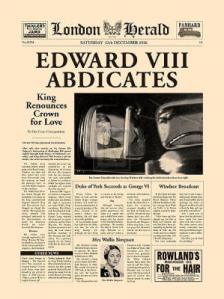
London Herald (Edward VIII’s Abdicates)

London Herald (Edward VIII’s Abdicates)

Nothing prevents a British peerage from being held by a foreign citizen (although such peers cannot sit in the House of Lords). Several descendants of George III were British peers and German subjects; the Lords Fairfax of Cameron were American citizens for several generations.

“Hereditary peers do not have the automatic right to a writ of summons to the House. Irish peerages may not be disclaimed. A peer who disclaims the peerage loses all titles, rights and privileges associated with the peerage; his wife or her husband is similarly affected. No further hereditary peerages may be conferred upon the person, but life peerages may be. The peerage remains without a holder until the death of the peer making the disclaimer, when it descends normally.” (Hereditary Peers) https://en.wikipedia.org/wiki/Hereditary_peer

So what can a person do if he does not wish to accept the title? He could simply refuse to take up the title or touch the money. Technically he’d still be the title’s holder, but to have the full title and honors he must be confirmed before Parliament, and all the legal stuff has to be done to ensure he is the correct heir. He can simply not claim the title and not style himself by the title, but it remains it place at his disposal. The person does not need to send in the writ of summons to the House of Lords, and he can refuse to use the title, but someone must care for the property, and no one else may claim the title while he is alive. He can also do something drastic, such as commit treason, in which case he and his family would be stripped of the title, but no one would recommend such a step. It would be easier simply not to claim the title.

Like it or not, the heir cannot be disinherited to prevent his assuming the title. If there is a living person and the lawful successor to a title, he cannot be displaced unless convicted of a crime. During the Regency there was no way to disclaim a peerage except by not using it and not sending in a request for a seat in the House of Lords.

AngelCover copy

About Angel Comes to the Devil’s Keep

Huntington McLaughlin, the Marquess of Malvern, wakes in a farmhouse, after a head injury, being tended by an ethereal “angel,” who claims to be his wife. However, reality is often deceptive, and Angelica Lovelace is far from innocent in Hunt’s difficulties. Yet, there is something about the woman that calls to him as no other ever has. When she attends his mother’s annual summer house party, their lives are intertwined in a series of mistaken identities, assaults, kidnappings, overlapping relations, and murders, which will either bring them together forever or tear them irretrievably apart. As Hunt attempts to right his world from problems caused by the head injury that has robbed him of parts of his memory, his best friend, the Earl of Remmington, makes it clear that he intends to claim Angelica as his wife. Hunt must decide whether to permit her to align herself with the earldom or claim the only woman who stirs his heart–and if he does the latter, can he still serve the dukedom with a hoydenish American heiress at his side?

An early review

Angel Comes to Devil’s Keep is a well-written tale of courage and sacrifice and what women went through in order to marry well in Regency England. The author did her homework and it shows in an authenticity that we don’t often see in Regency romances.

Pre-orders available now

NookKobo • SmashwordsBlack Opal Books

Available everywhere on August 6, 2016

Giveaway

Leave a comment below to be eligible for an eBook copy of Angel Comes to the Devils Keep (Book 1 of the TwinsTrilogy). The giveaway ends at midnight EDT, August 7, 2016.

About the Author

author photoRegina Jeffers, a public classroom teacher for thirty-nine years, considers herself a Jane Austen enthusiast. She is the author of several Austen-inspired novels, including Darcy’s Passions, Darcy’s Temptation, Vampire Darcy’s Desire, Captain Wentworth’s Persuasion, The Phantom of Pemberley, Christmas at Pemberley, The Disappearance of Georgiana Darcy, Honor and Hope, and The Mysterious Death of Mr. Darcy. She also writes Regency romances: The Scandal of Lady Eleanor, A Touch of Velvet, A Touch of Cashémere, A Touch of Grace, A Touch of Mercy, A Touch of Love, and The First Wives’ Club. A Time Warner Star Teacher and Martha Holden Jennings Scholar, Jeffers often serves as a consultant in language arts and media literacy. Currently living outside Charlotte, North Carolina, she spends her time with her writing, gardening, and her adorable grandchildren.

WebsiteBlog  • AustenAuthorsTwitterFacebook

Caroline Warfield: The Renegade Wife

13923256_10154297249220833_2665876749316707228_o

Love is worth the risk…

New cover, new release, new series! Coming in October

The heroes and heroines of Caroline Warfield’s Dangerous series overcame challenges even after their happy ending. Their children seek their own happiness in distant lands in Warfield’s new Children of the Empire series. In The Renegade Wife, first of the new series, reclusive Rand Wheatly finds contentment in his remote cabin in Upper Canada, intent on making his fortune in timber, until his precious solitude is disrupted by a woman running from an ugly past. He quickly realizes she wasn’t what she claims, but now she’s on the run again and time is running out for him to save her.

Caroline is celebrating with a GIVEAWAY on her website.

http://wp.me/p5qiDD-vj

Gina Danna: The Wicked North (Book 1 – Hearts Touched by Fire)

May I Introduce….

Picture1

By the time of the American Civil War, Victorian America followed many of Great Britain’s rules of society. Ladies looked forward to their next copy of Godey’s for the latest fashion for instance. What Queen Victoria did in London set the tide for manners and etiquette both in England and “across the pond” here in the United States. It is these actions that dictated society and guarded the sexes that give us a taste of life back then. Let us take a look at the foundation of society as set back in the mid-19th century.

Introductions: When people met back then, introductions were made based on the rules of etiquette. No man would consider simply walking up to a lady he didn’t know and say “hi”. That was considered rude and crass. If there was a lady he wished to meet, he needed to find someone who knew them both to make introductions. “Miss Smith, may I introduce Mr. Silvers of Charleston…” Now, if Mr. Silvers was of low account and totally unsuitable for the lady, this friend could deny introducing him or if it was made and she didn’t care for Silvers, she could snub him off. Really raise her nose as it were and ignore the man. This, of course, would be held against him as unworthy and the news passed quickly to avoid him.

While we are here, let us discuss names. Gentlemen and the workingman were always called Mr. Lastname while in public. Ladies were Miss if they were single or Mrs. if they were married (there was no such creature as “Ms.”). Mrs. John Smith was Mary Smith’s public name as ladies took their husband’s surname at marriage and protocol stated the first in public. If Mary was single and her father’s name was Charles Silvers, her name on invitations to her coming out ball were “Miss Charles Silvers invites…”

Picture2

At societal gatherings, like a ball, a couple was announced as Mr. Charles Silvers and lady – not even Mrs. Charles Silvers if she is his wife!

It was a gentleman’s role to protect the fairer sex. For instance, if he was with her on the boardwalk in the city, he’d place himself between the street and her to keep her away from harm if a wagon or horse got out of control and barreled into the curb or to give her another type of barrier from mud or horse dung from slinging off the road onto the curb. If she were on an outing with a servant, the maid or male servant would serve the same purpose.

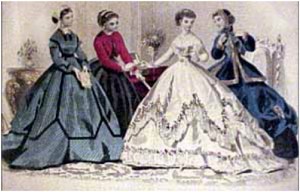
If a man was courting a lady, first the man had to ask her father for permission (or her male guardian if her father was deceased). Courting had its own rules. Ladies of the lower classes could marry at age 14 – an age we writers shy from, considering today’s way of thinking. Middle to upper class ladies usually had a “coming out” at about 18 or 19 years of age. Many times this was a ball where they were introduced and they dressed in bright pastels like pink, yellow or light green, often with flowers in their hair – even if it was winter. They wore the light colors because in candle or oil light, darker color dresses blended with the walls but the light stood out.

Picture3

As they made the marriage circuit, it should be easy to find a husband in America at this time as the number of men out numbered the women prior to the War. Granted, some men headed west where land was cheap but that is another discussion. If a man wanted to court a lady, he needed to be 5 to 10 years older than her (if she was 18, he needed to be 23-28) and show he had the way and means to support her and their future children – in other words, he needed to have a job and a house, not living at home off of mom and dad.

Courting rules were simple – the couple was never allowed alone. A trusted servant or family member accompanied them – trusted by the parents, not the daughter. If she liked him enough, she might allow him to call her by her first name but it was her decision, not his. Otherwise, she was Miss Silvers.

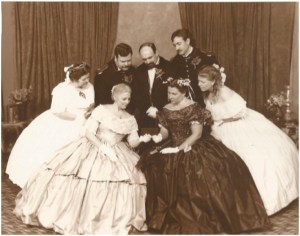
Also, fashion had women wearing gloves whenever they were out or in formal situations. These gloves were generally white or ivory though they could match the color of her dress. Made of kid leather for the upper classes and cloth for the lower, these gloves protected her hands from the sun and other elements and from chafing. If she started to have feelings for her gentleman friend, not only would she allow him to call her by her first name, but also grant him the privilege of holding her bare hand (prior to this, only her father, brothers and lady friends could do so). And gentlemen of all classes wore gloves as well and one reason was, it was an honor and a privilege to help a lady in distress (i.e.: she fell or needed help in a carriage). If he ruined her gloves with callus on his hands, he was obligated to replace her gloves. For the workingman, kid gloves equaled more than he made in a month!

Picture4

Back to courting, there were two ways a couple could be “alone.” One was on the front porch – basically they were on display for the whole street. No hanky-panky there. The other was the front parlor. Usually the front parlor had a couple of doors to it and/or a parlor mirror. These mirrors were convex in shape and reflected EVERYTHING in the room that anyone could see as they passed the doorway. Quite a hampering device.

Rule of thumb was if they were alone anywhere else for more than fifteen minutes, she was ruined, a “soiled dove”, and no man would want her therefore the young man with her would be forced to marry her to save her reputation. The “shotgun” marriage so to speak though there no doubt was a time or two daddy stood with a loaded gun and cocked it if the man almost backed out from saying “I do.” If he was shot after the ceremony, she was a widow and in good standing. Not saying that happened but…

Divorce – unacceptable in the Victorian age. Only one ground allowed it to happen and that was infidelity, mostly by the wife. No, if you didn’t like your spouse, you might live on different floors of the house and never meet or in different houses but if invited to an event, you went together as husband and wife and put a front on for society.

If she made it to age 23 without getting a proposal (a forward lady, speaking her own thoughts or opinions and not being the demur delicate flower could steer men away), the lady was now a spinster, “put on the shelf” as it were. If she attended balls, she had to wear the darker colors of navy, dark green, etc. with no flowers in her hair and sit against the wall, resigned.

Society wasn’t designed to have ladies be “independent”. Women were under male guardianship their entire lives – first their father than husband. If a wallflower, they still were under dad and could be the mistress to their father’s home if mother was dead, the nanny to their sibling’s kids or work in a hat boutique – those were about the only options available. If they taught, they had to go out to the wild west (at this time, Kansas City represented the wild west) for lady teachers were not the norm in the 19th century and very few allowed to teach in a classroom. The west was desperate for teachers so they’d take anyone willing to travel to the sparsely settled wilderness. If in KC teaching, she meets the man of her dreams and they marry, it is expected of her to quit teaching.

Which brings us to another issue –

Work. Ladies didn’t work. The lower classes did but middle to upper were not suppose to. Even if her husband lost his job, it was unacceptable for her to work, as it’s his job to make the money to feed and support the family and hers to raise the kids and run the house (the “Spheres of Domesticity” firmly in place). Therefore, some took in mending or laundry, under the table, and kept it hidden. If discovered, it could be a problem. And as to domestic abuse, the rule was what happened behind marriage doors was no one’s business. Quite disturbing.

Untitled 5

This is a taste of society in Victorian America. There are plenty of etiquette books made at that time – these were for the middle and lower class and mostly for men so they’d know how to carry themselves. Upper classes were taught this as they grew up.

What time do you want to live in? Back then, it’s very polite and structured but for ladies of an independent nature, it was hell!

About The Wicked North

Bound by duty and honor to wear the Union blue, a Southern-born West Point officer fights his own desires and the need to protect the woman he abandoned, he disobeys his orders to find her, as the Army of the Potomac marches toward her family’s home near Richmond.
She has the guts and willpower to protect her home from the hated Yankee aggressors, but when that traitor to the South appears at her door, she’s torn between wanting to shoot him and to be held in his arms again. Can she forgive him for their past indiscretion or does she turn him in to be executed, a traitor to both sides? 
In the summer of 1862, her family’s plantation becomes the personal battle ground between them as deceit, betrayal and passion ignite the flames of love and hate that burn brighter than the roar of the guns and rivers of blood surrounding them.

 Excerpt

Find out where your enemy is. Get at him as soon as you can, and strike him as hard as you can. And keep moving on!

General U.S. Grant, Virginia, June 1862

Emma Silvers was not afraid to shoot Yankees.

She leveled the .57 caliber Enfield rifle at the line of blue coats standing before her porch at Rose Hill that evening. She counted ten men, fully armed and wielding torches. They reeked of wet wool, sweat and gun powder–a noxious mixture combined with the scent of pink roses surrounding the house. Bile rose in her throat. She swallowed hard.

The officer took a step forward. In the dim light, she couldn’t discern his face, though she saw him flinch as she pointed the muzzle at him.

GinaDanna_TheWIckedNorth1400 copy“I want you off my land, now,” she demanded, her voice remarkably even despite her pounding heart. At twenty-two years and virtually alone, she knew one able-bodied man could easily overwhelm her. With no able men and few slaves remaining, she only had bravado left.

“Now, ma’am,” the Union officer began. He spoke like a gentleman, but, dressed in blue, he was an imposter as far as she was concerned.

Jeremiah, just behind her right shoulder, cocked the hammer on his rifle—a welcome sound to her ears. Good boy, Emma thought. If the Yankees didn’t believe she was a threat, she hoped the armed slave boy next to her got the message across. She wasn’t allowing any soldiers on her property again.

The rifle felt heavier by the minute, making her muscles ache, and she feared she’d drop it. The weapon was foreign to her hands, but as the war raged closer to her home, she learned to use it. She wasn’t very good at it, but, as close as the Yankees were, she was bound to hit one of them. She didn’t want to pull the trigger. The gun’s recoil would knock her off her feet, throwing her aim off. With so few bullets left, she’d hate to lose the shot.

The light streamed through the open front door across the officer as he stepped onto the porch. She saw his face and the nose of the gun slipped. Jack Fontaine, that good-for-nothing traitor! How dare he come here, especially after what had happened last summer? Rage took control and gave her the added strength to pull the muzzle up to his chest as she cocked the trigger.

“Emma, please,” he said softly. He looked at her the same way he had that night months ago, his green eyes glowing like emeralds in the light. She remembered those eyes, those mesmerizing emerald eyes. They were all hers the night she had lost her heart to him. The night he had betrayed her. Her anger flared. No. Not this time. Not again, she vowed. Gritting her teeth, Emma narrowed her gaze.

“Get away from me, Jack, or I swear to God, I’ll blow a hole through you and send you straight to hell!”

Inside the house, a babe wailed. Emma instinctively turned. Jack reached for her and she panicked, squeezing the trigger. The rifle exploded, throwing her backwards, pain shooting into her shoulder. But instead of falling, she found herself in Jack’s arms as they wrapped around her, shielding her back from the impact of the wooden floor.

The patrol stormed onto the porch and into the house. Lying in his embrace, his body shielding hers as his troops marched past them, Emma couldn’t breathe. Her eyes were wide open. She felt the heat of him around her. The scent of him invaded her senses. Warm, masculine, and spicy rolled into one. She fought the heat in her belly, but it was hard as his eyes locked onto hers, his lips only inches away.

She closed her eyes. Behind her, the wailing continued, and she heard the thud of soldiers’ boots inside. Her jaw tightened as she glared at him. “Get off me, Jack.”

About the Author

AuthorPic_Great and Unfortunate Desires copyA USA Today Bestselling author, Gina Danna was born in St. Louis, Missouri, and has spent the better part of her life reading. History has always been her love and she spent numerous hours devouring historical romance stories, always dreaming of writing one of her own. After years of writing historical academic papers to achieve her undergraduate and graduate degrees in History, and then for museum programs and exhibits, she found the time to write her own historical romantic fiction novels.

Now, living in Texas,under the supervision of her three dogs, she writes amid a library of research books, with her only true break away is to spend time with her other life long dream – her Arabian horse – with him, her muse can play.

WebsiteFacebookTwitter

Romance of London: Voltaire in London

Romance of London: Strange Stories, Scenes And Remarkable Person of the Great Town in 3 Volumes

John Timbs

John Timbs (1801-1875), who also wrote as Horace Welby, was an English author and aficionado of antiquities. Born in Clerkenwell, London, he was apprenticed at 16 to a druggist and printer, where he soon showed great literary promise. At 19, he began to write for Monthly Magazine, and a year later he was made secretary to the magazine’s proprietor and there began his career as a writer, editor, and antiquarian.

This particular book is available at googlebooks for free in ebook form. Or you can pay for a print version.

Voltaire in London

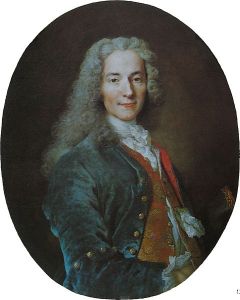
François-Marie Arouet, otherwise known as Voltaire, 1724-5

François-Marie Arouet, otherwise known as Voltaire, 1724-5

Voltaire lodged at the sign of the White Peruke, a fashionable French perruquier’s, in Maiden Lane, Covent Garden. In Swift’s Works (vol. xx of the duodecimo edition, p. 294), there is a letter to him, in English, by Voltaire, and dated from this house. The English seems a little too perfect. There is another following it which looks more authentic. But there is no doubt that Voltaire, while in England, made himself such a master of the language, as to be able to write in it with singular correctness for a foreigner. He was then young. He had been imprisoned in the Bastile for a libel; came over here, on his release; procured many subscriptions for the “Henriade;” published in English “An Essay on Epic Poetry,” and remained some years, during which he became acquainted with the principal men of letters—Pope, Congreve, and Young. He is said to have talked so indecently at Pope’s table (probably no more than was thought decent by the belles in France), that the good old lady, the poet’s mother was obliged to retire. Objecting, at Lord Chesterfield’s table, to the allegories of Milton, Young is said to have accosted him in the well-known couplet:—

Thou art so witty, profligate, and thin,

Thou seem’st a Milton, with his Death and Sin.

But this story has been doubted. Voltaire left England with such a mass of subscriptions for his Henriade as laid the foundation of his fortunes, and with great admiration of English talent and genius, particularly that of Newton and Locke, which, with all his insinuations against our poetry, he took warm pains to extend, and never gave up. He was fond to the last of showing he had not forgotten his English. Somebody telling him that Johnson had spoken well of his talents, he said, in English, “He is a clever fellow;” but the gentleman observing that the doctor did not think well of his religion, he added, “a superstitious dog.”

During his residence in Maiden Lane, there is a story of Voltaire’s having been beset, in one of his walks, by the people, who ridiculed him as a Frenchman. He got upon the steps of a door-way and harangued them in their own language in praise of English liberty and the nation; upon which, the story adds, they hailed him as a fine fellow, and carried him to his lodgings on their shoulders.—Leigh Hunt’s Town.

La Henriade

From Wikipedia:

323px-HenriadeVoltaire

La Henriade is an epic poem of 1723 written by the French Enlightenment writer and philosopher Voltaire. According to Voltaire himself, the poem concerns and was written in honour of the life of Henry IV of France, and is a celebration of his life. The ostensible subject is the siege of Paris in 1589 by Henry III in consort with Henry of Navarre, soon to be Henry IV, but its themes are the twin evils of religious fanaticism and civil discord. It also concerns the political state of France. Voltaire aimed to be the French Virgil, outdoing the master by preserving Aristotelian unity of place—a property of classical tragedy rather than epic—”by keeping the human action confined between Paris and Ivry. It was first printed (under the title La Ligue) in 1723, and reprinted dozens of times within Voltaire’s lifetime.

Voltaire in Great Britain

From Wikipedia:

The Bastille, 1715

The Bastille, 1715

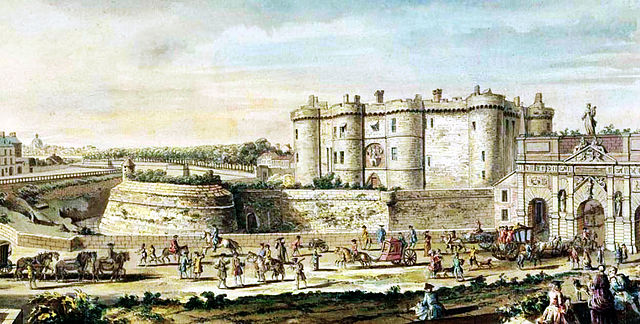
In early 1726, a young French nobleman, the chevalier de Rohan-Chabot, taunted Voltaire about his change of name, and Voltaire retorted that his name would be honoured while de Rohan would dishonour his. Infuriated, de Rohan arranged for Voltaire to be beaten up by thugs a few days later. Seeking compensation, redress, or revenge, Voltaire challenged de Rohan to a duel, but the aristocratic de Rohan family arranged for Voltaire to be arrested and imprisoned in the Bastille on 17 April 1726 without a trial or an opportunity to defend himself. Fearing an indefinite prison sentence, Voltaire suggested that he be exiled to England as an alternative punishment, which the French authorities accepted. On 2 May, he was escorted from the Bastille to Calais, where he was to embark for Britain.

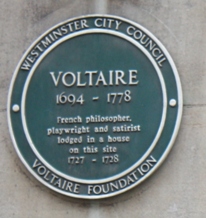
maiden-lane 061-plakette-5In England, Voltaire lived largely in Wandsworth with acquaintances including Everard Fawkener. From December 1727 to June 1728 he lodged at Maiden Lane, Covent Garden, now commemorated by a plaque, to be nearer to his British publisher. Voltaire circulated throughout English high society, meeting Alexander Pope, John Gay, Jonathan Swift, Lady Mary Wortley Montagu, Sarah, Duchess of Marlborough, and many other members of the nobility and royalty. Voltaire’s exile in Great Britain greatly influenced his thinking. He was intrigued by Britain’s constitutional monarchy in contrast to French absolutism, and by the country’s greater support of the freedoms of speech and religion. He was influenced by the writers of the age, and developed an interest in earlier English literature, especially the works of Shakespeare, still relatively unknown in continental Europe. Despite pointing out his deviations from neoclassical standards, Voltaire saw Shakespeare as an example that French writers might emulate, since French drama, despite being more polished, lacked on-stage action. Later, however, as Shakespeare’s influence began growing in France, Voltaire tried to set a contrary example with his own plays, decrying what he considered Shakespeare’s barbarities. Voltaire may have been present at the funeral of Isaac Newton and met Newton’s niece, Catherine Conduitt. In 1727 he published two essays in English, Upon the Civil Wars of France, Extracted from Curious Manuscripts, and Upon Epic Poetry of the European Nations, from Homer Down to Milton.

After two and a half years in exile, Voltaire returned to France, and after a few months living in Dieppe, the authorities permitted him to return to Paris. At a dinner, French mathematician Charles Marie de La Condamine proposed buying up the lottery that was organized by the French government to pay off its debts, and Voltaire joined the consortium, earning perhaps a million livres. He invested the money cleverly and on this basis managed to convince the Court of Finances that he was of good conduct and so was able to take control of a capital inheritance from his father that had hitherto been tied up in trust. He was now indisputably rich.

Further success followed, in 1732, with his play Zaïre, which when published in 1733 carried a dedication to Fawkener that praised English liberty and commerce. At this time he published his views on British attitudes toward government, literature, religion and science in a collection of essays in letter form entitled Letters Concerning the English Nation (London, 1733). In 1734, they were published in French as Lettres philosophiques in Rouen. Because the publisher released the book without the approval of the royal censor and Voltaire regarded the British constitutional monarchy as more developed and more respectful of human rights (particularly religious tolerance) than its French counterpart, the French publication of Letters caused a huge scandal; the book was publicly burnt and banned, and Voltaire was forced again to flee Paris.

Romance of London Series

  1. Romance of London: The Lord Mayor’s Fool… and a Dessert
  2. Romance of London: Carlton House and the Regency
  3. Romance of London: The Championship at George IV’s Coronation
  4. Romance of London: Mrs. Cornelys at Carlisle House
  5. Romance of London: The Bottle Conjuror
  6. Romance of London: Bartholomew Fair
  7. Romance of London: The May Fair and the Strong Woman
  8. Romance of London: Nancy Dawson, the Hornpipe Dancer
  9. Romance of London: Milkmaids on May-Day
  10. Romance of London: Lord Stowell’s Love of Sight-seeing
  11. Romance of London: The Mermaid Hoax
  12. Romance of London: The Bluestocking and the Sweeps’ Holiday
  13. Romance of London: Comments on Hogarth’s “Industries and Idle Apprentices”
  14. Romance of London: The Lansdowne Family
  15. Romance of London: St. Margaret’s Painted Window at Westminster
  16. Romance of London: Montague House and the British Museum
  17. Romance of London: The Bursting of the South Sea Bubble
  18. Romance of London: The Thames Tunnel
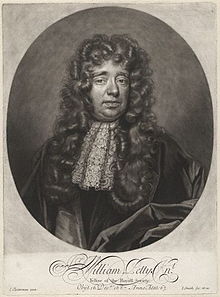
  19. Romance of London: Sir William Petty and the Lansdowne Family
  20. Romance of London: Marlborough House and Sarah, Duchess of Marlborough
  21. Romance of London: The Duke of Newcastle’s Eccentricities
  22. Romance of London: Voltaire in London
  23. Romance of London: The Crossing Sweeper
  24. Romance of London: Nathan Mayer Rothschild’s Fear of Assassination
  25. Romance of London: Samuel Rogers, the Banker Poet
  26. Romance of London: The Eccentricities of Lord Byron
  27. Romance of London: A London Recluse

Sherry Ewing: To Follow My Heart (The Knights of Berwyck, A Quest Through Time) + Giveaway

To_Follow_My_Heart 400x copyI’d like to thank Susana for allowing me the opportunity to showcase my latest medieval/time travel release: To Follow My Heart: The Knights of Berwyck, A Quest Through Time Novel (Book Three). If you’ve never read one of my novels, I’m Sherry Ewing and write historical and time travel romances to awaken the soul one heart at a time.

I don’t know about you, but I’m a huge fan of any book that throws a knight and a modern day woman together. I never had any intention of writing time travels. Somehow they just came about and I now have a whole series going on with secondary characters from my free medieval romance If My Heart Could See You. Who knew?

To Follow My Heart follows the story of Jenna Sinclair, a modern day woman living in San Francisco who is heartbroken over the breakup with her fiancé. Fletcher Monroe, a 12th century knight and captain of the guard of Berwyck’s garrison knights, has his own issues of attempting to get over a woman who would never be his. Image how surprised both my characters are when Jenna mysteriously slips through time and falls at his feet on an ocean beach.

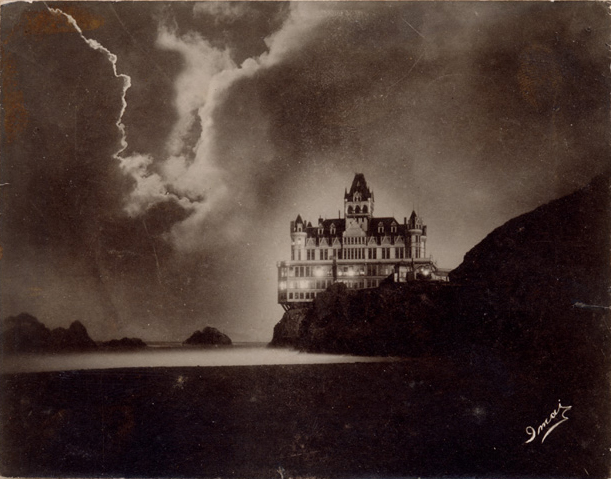
The second Cliff House, circa 1900

This book, in particular, is near and dear to my heart because I have showcased some of my favorite places around the city by the bay. The Cliff House, along Ocean Beach, has a long history in San Francisco and is managed by the National Park Service; specifically, Golden Gate National Recreation Area, one of the largest urban parks in the NPS system.

CliffHouseStorm PD image

I’ve spent a lot of years walking this beach contemplating my own life, much like Jenna, and felt the need to have her falling through time beneath the rock face under the Cliff House. I was wonderfully surprised when one day, right before the release of To Follow My Heart, my daughter and I took advantage of a beautiful summer day and I was actually able to walk all the way around the cliff from Ocean Beach to the Sutro Baths side. In all the years I’ve walked there, the tides were never right since the water is usually right up against the cliff. It gave me a whole new perspective of how my characters felt doing the very same thing. If you’d like to learn more about the Cliff House, check out this NPS website at https://www.nps.gov/goga/learn/historyculture/cliff-house.htm. The NPS is celebrating their 100-year centennial so it’s a great time to Find Your Park and enjoy what these special places can offer you and your family!

In case you’re wondering, all my books can be read as stand-alones but if you read them in order, you’ll see characters as they’re introduced. I just love when I read a series and see returning characters that I’ve come to love, don’t you?

My Books

Haven’t read my books? Then start with a free download of the start of my series with If My Heart Could See You. It’s up on all major online retailers. Here’s the Amazon link: http://amzn.to/1LV1qnk. Need the next two books in the series? I’ve got a special deal on a box set called Hearts Across Time for $0.99. It includes For All of Ever and Only For You. Amazon Link: http://amzn.to/1BV0DM4

box set pic from FB copy

Giveaway!

I’ll give one random comment an e-copy of my medieval romance A Knight To Call My Own so just answer me this:

Do you visit a national park where you live? If not, then tell me one of your favorite places you like to visit.

Thanks again to Susana for allowing me to spend some time with her readers. Keep reading to learn more about To Follow My Heart, along with finding the buy links!

About To Follow My Heart: The Knights of Berwyck, A Quest Through Time Novel (Book Three)

Love is a leap. Sometimes you need to jump…

After a gut wrenching break up with her fiancé, Jenna Sinclair heads to the coast to do a little soul searching. To say everything is subject to change is putting it mildly. Her world is not only turned upside down, but pretty much torn asunder when she is pulled through a time gate on the beach beneath the Cliff House and transported more than eight hundred years into the past.

Fletcher Monroe, captain of the garrison knights at Berwyck Castle, has wasted too much time pining for a woman who will never be his. When he finally decides to move on with his life and focus on his duties, he is suddenly confronted with a woman who magically appears at his feet. This could either be the best thing that has ever happened to him or another cursed event in a string of many. He soon finds he is wildly attracted to her, but she’s scared to death of him – not a very encouraging beginning.

From the shores of California to twelfth century England and back again, Jenna and Fletcher must find a way to reconcile their two different worlds before Time forever tears them apart.

Excerpt

Jenna came back from her musing, only to blink in shock at the distortion directly in front of her. The disturbance in the air was almost akin to the ripples one found in a lake or pond after a stone had been cast into its smooth waters. She reached out to touch it, but before she knew what was happening, some unseen force pushed her forward, even while at the same time she became surrounded by an icy fog. The wind in her face screeched at a high pitch in her ears in the same tone as a ghoulish banshee on Halloween. Her body seemed as if it were being pulled, stretched, and sucked through a tight tube, much like a dust mote stuck within a vacuum cleaner. She was tossed and turned around and around as her own screams echoed all about her.

Unsure what was happening, she cried out, hoping for someone to come and help her. No one answered her call, yet she continued to yell, all the same. Had she somehow fallen into the ocean, and was she being pulled out with the tide? No…that couldn’t be right, since she didn’t have the feeling of water filling her lungs. Time seemed to have no meaning, and she had no idea how long she had been in this state of…falling into nothingness and unbeing.

And then, everything stopped its frantic pace, abruptly, as though she were in a car that had come to a sudden halt at a red light causing her to lurch forward in her seat. Jenna was thrust headfirst to face-plant into the beach while her purse flew through the air when she hit the ground. She coughed, spitting out copious granules of sand. Wiping her mouth, she tasted a bit of blood from her cut lip and raised her hand to shield her face from the glaring brightness around her. Sunlight? She closed her eyes and reopened them, not believing what she was seeing, for the sun was as bright as in the height of a new day. But how could that be, she wondered? It was almost evening, with darkness about to settle down to caress the earth.

As if she hadn’t been mistreated enough, nature decided to continue its torment of her when a rogue wave came up from behind, knocking her into the frigid water. She came up sputtering, completely drenched, and began crawling her way up the beach to catch her breath.

When she was at last able to manage it, Jenna stood, but she did so on wavering legs. She attempted to get her bearings. Her hands shook uncontrollably. Some things hadn’t changed. Her heels were still held by the straps in her fingers. She was still on the beach…the ocean was on her left. Her purse was lying on the ground, and she bent to pick it up to place it on her shoulder. She began to wonder if she had somehow passed out when she lifted her head in the direction of the Cliff House.

What the hell? Where is it, and why is a friggin’ castle sitting in its place? Dammit! This isn’t even San Francisco. She felt herself begin to panic, because the terrain was nowhere close to what she was used to. Her pulse quickened, and she swore her heart was about to burst from her chest.

“My lady, keep calm.”

The sudden vibration of sound caused her to let out a shriek. Her lips quivered in fright. She brought her hand to her mouth to stifle yet another scream that automatically burst from her mouth. She was so disoriented it took several moments of trying to adjust her vision before the deep baritone of a man’s voice actually began to register in her head.

Then, she saw him, leaning casually up against a bolder of considerable size with his arms folded against his chest. A horse stood behind him with no tether of any kind to keep him from returning to a barn. The steed just waited for the stranger to come and fetch it, that is, if that was what you did with a horse besides go for a ride. The beast shook its black mane, nostrils flaring as though it were angry.

Jenna’s hand moved down to her throat, her eyes wide, as she gaped at the man. Everything about his appearance screamed dark, mysterious, and even a little dangerous. She should be wary of him. Thick black hair hung in soft waves down to broad shoulders. A muscular chest narrowed down to lean hips, and his dark shirt only accented the ruggedness of his body as it clung to him in the blowing wind. She swore she saw a sword hanging from the belt at his waist and could only imagine what kind of a man would keep a weapon of that kind on his person. He was clothed completely in black with the exception of the dark red cloak billowing out behind him, whipped by the ocean breeze. Was it her imagination, or did its color remind her of the same shade as blood?

Good God Almighty! How far could she run before he would catch her? Surely, from the look of him, he had something sinister in mind. Panic set in, and she dug inside her purse to pull out a container of mace. Trying her best to appear in control of the situation, she extended her arm. “Stay away from me,” she yelled. “I’m not afraid to use this and call the cops.”

He pushed off the rock with a smirk upon his face, as if he knew some inside joke of which she wouldn’t be allowed to know the punch line. The closer he came, the farther she backed up until the waves of the ocean splashed up to her thighs. The coldness of the water gave her another shock, as if she hadn’t already had enough in the last few minutes to last her a life time.

“Come out of the water, mademoiselle, for surely one dunking is enough for one day.” He held out his hand. “You shall catch a chill, and we are not in need of another ghostly apparition giving us advice, no matter how he may feel ’tis needed to guide us.”

“Sweet Jesus, I’m dead,” Jenna whispered in fright. Trying to determine which direction she should run so she could get away from this lunatic, her gaze darted back and forth.

“You are most certainly not dead, my lady. And, I assure you, I mean you no harm.”

Again, he extended his hand for her to take, but she had no plans to go anywhere with this handsome stranger towering over her. Handsome? Where did that thought come from?

About the Author

sherrySherry Ewing picked up her first historical romance when she was a teenager and has been hooked ever since. A bestselling author, she writes historical & time travel romances to awaken the soul one heart at a time. Always wanting to write a novel but busy raising her children, she finally took the plunge in 2008 and wrote her first Regency. She is a member of Romance Writers of America, The Beau Monde & The Bluestocking Belles. Sherry is currently working on her next novel and when not writing, she can be found in the San Francisco area at her day job as an Information Technology Specialist.

Sherry enjoys interacting with her readers. You can email her on her website or find her on these social media outlets:

Website/BlogBluestocking BellesFacebookTwitter

GoodreadsPinterest

Sign up for my

Newsletter  & Street Team

Romance of London: The Duke of Newcastle’s Eccentricities

John Timbs (1801-1875), who also wrote as Horace Welby, was an English author and aficionado of antiquities. Born in Clerkenwell, London, he was apprenticed at 16 to a druggist and printer, where he soon showed great literary promise. At 19, he began to write for Monthly Magazine, and a year later he was made secretary to the magazine’s proprietor and there began his career as a writer, editor, and antiquarian.

This particular book is available at googlebooks for free in ebook form. Or you can pay for a print version.

From Wikipedia:

512px-1stDukeOfNewcastleOld

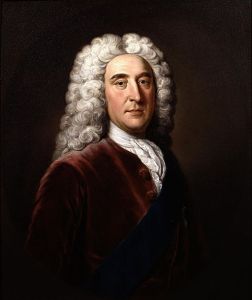
Thomas Pelham-Holles, 1st Duke of Newcastle

Thomas Pelham-Holles, 1st Duke of Newcastle upon Tyne and 1st Duke of Newcastle-under-Lyne KG PC (21 July 1693 – 17 November 1768) was a British Whig statesman, whose official life extended throughout the Whig supremacy of the 18th century. He is commonly known as the Duke of Newcastle.

A protégé of Sir Robert Walpole, he served under him for more than twenty years, until 1742. He held power with his brother, Henry Pelham (the Prime Minister of Great Britain), until 1754. He had at this point served as a Secretary of State continuously for thirty years—dominating British foreign policy.

Walpole gladly welcomed the young Newcastle into his coterie, firstly because he believed he could easily control him, and secondly because it would strengthen his hand against the rival Whig factions. Newcastle joined with Walpole because he, correctly, believed that he was going to dominate British politics for a generation.

Robert Walpole, 1st Earl of Orford

Robert Walpole, 1st Earl of Orford

After Henry’s death the Duke held his late brother’s position for six years, in two separate periods. While his first premiership was not particularly notable, Newcastle precipitated the Seven Years’ War, which would cause his resignation from his high position. After his second term as Prime Minister, he served for a short while in Lord Rockingham’s ministry, before retiring from government. Few politicians in British history matched his skills and industry in using patronage to maintain power over long stretches of time. He was most effective, however, as a deputy to a leader of greater ability, such as Walpole, his brother, or Pitt.

Historian Harry Dickinson says that he became:

notorious for his fussiness and fretfulness, his petty jealousies, his reluctance to accept responsibility for his actions, and his inability to pursue any political objective to his own satisfaction or to the nations profit…. Many modern historians have depicted him as the epitome of unredeemed mediocrity and as a veritable buffoon in office.

The Duke of Newcastle’s Eccentricities

Horace Walpole

Horace Walpole

There is scarcely any public man in our history of whose manners and conversation so many particulars have been preserved, as of the Duke of Newcastle, the well-known leader in the Pelham Administration under George II. Single stories may be unfounded or exaggerated. But all the stories about him, whether told by people who were perpetually seeing him in Parliament, and attending his levées in Lincoln’s Inn Fields, or by Grub Street writers who had never more than a glimpse of his star through the windows of his gilded coach, are of the same character. Horace Walpole and Smollett differed in their tastes and opinions as much as two human beings could differ. They quite different society. Walpole played at cards with countesses, and corresponded with ambassadors. Smollett passed his life surrounded by printers’ devils and famished scribblers. Yet, Walpole’s Duke and Smollett’s Duke are as like as if they were both from one hand. Smollett’s Newcastle runs out of his dressing-room, with his face covered with soap-suds, to embrace the Moorish envoy. Walpole’s Newcastle pushes his way into the Duke of Grafton’s sick-room to kiss the old nobleman’s plasters. No man was so unmercifully satirised. But in truth he was himself a satire ready made. All that the art of the satirist does for other men, nature had done for him. Whatever was absurd about him, stood out with grotesque prominence from the rest of the character. He was a living, moving, talkng caricature. His gait was a shuffling trot; his utterance a rapid stutter; he was always in a hurry; he was never in time; he abounded in fulsome caresses and hysterical tears. His oratory resembled that of Justice Shallow. It was nonsense effervescent with animal spirits and impertinence. Of his ignorance many anecdotes remain, some well authenticated, some probably invented at coffee-houses, but all exquisitely characteristic:—”Oh—yes—yes—to be sure—Annapolis must be defended—troops must be sent to Annapolis—Pray where is Annapolis?”—”Cape Breton an island! wonderful!—show it me in the map. So it is, sure enough. My dear sir, you always bring us good news. I must go and tell the King that Great Britain is an island.”

And this man was, during near thirty years, Secretary of State, and during near ten years, First Lord of the Treasury! His large fortune, his strong hereditary connections, his great parliamentary interest, will not alone explain this extraordinary fact. His success is a signal instance of what may be effected by a man who devotes his whole heart and soul, without reserve, to one object. He was eaten up by ambition. He was greedy after power with a greediness all his own. He was jealous of all his colleagues, and even of his own brother. Under the disguise of levity he was false eyond all example of political falsehood. All the able of men of his time ridiculed him as a dunce, a driveller, a child who never knew his own mind for an hour together; and he overreached them all round.—Lord Macaulay, on Walpole’s Letters.

Romance of London Series

  1. Romance of London: The Lord Mayor’s Fool… and a Dessert
  2. Romance of London: Carlton House and the Regency
  3. Romance of London: The Championship at George IV’s Coronation
  4. Romance of London: Mrs. Cornelys at Carlisle House
  5. Romance of London: The Bottle Conjuror
  6. Romance of London: Bartholomew Fair
  7. Romance of London: The May Fair and the Strong Woman
  8. Romance of London: Nancy Dawson, the Hornpipe Dancer
  9. Romance of London: Milkmaids on May-Day
  10. Romance of London: Lord Stowell’s Love of Sight-seeing
  11. Romance of London: The Mermaid Hoax
  12. Romance of London: The Bluestocking and the Sweeps’ Holiday
  13. Romance of London: Comments on Hogarth’s “Industries and Idle Apprentices”
  14. Romance of London: The Lansdowne Family
  15. Romance of London: St. Margaret’s Painted Window at Westminster
  16. Romance of London: Montague House and the British Museum
  17. Romance of London: The Bursting of the South Sea Bubble
  18. Romance of London: The Thames Tunnel
  19. Romance of London: Sir William Petty and the Lansdowne Family
  20. Romance of London: Marlborough House and Sarah, Duchess of Marlborough
  21. Romance of London: The Duke of Newcastle’s Eccentricities
  22. Romance of London: Voltaire in London
  23. Romance of London: The Crossing Sweeper
  24. Romance of London: Nathan Mayer Rothschild’s Fear of Assassination
  25. Romance of London: Samuel Rogers, the Banker Poet
  26. Romance of London: The Eccentricities of Lord Byron
  27. Romance of London: A London Recluse

Alicia Quigley: Lady, Lover, Smuggler Spy (Giveaway)

It’s exciting to be guest blogging here at Susana’s Parlor on Bastille Day! The storming of the Bastille radically changed the path of French and European history in ways that are integral to the period in which most of my stories are set, the English Regency. One minor (but fun) example is the way in which the heavy full-skirted gowns and immense coiffures and hats of 1788 had completely given way to the simple, slim, “classical” silhouette by 1795.
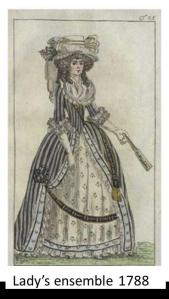
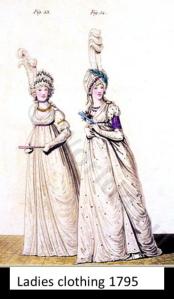
Photo 1Photo 2

In revolutionary France, this mode of dress was associated with democratic societies such as ancient Greece and the Roman republic.

More important in the long term, the political instability that resulted from the overthrow of the French monarchy also opened the door to the Napoleonic era, and wars that not only extended throughout Europe and into the Middle East, but into North and South America. These military campaigns, and the fear of democratic radicalism crossing the Channel from France, hugely impacted English society at the time, hardening the conservative views of many English aristocrats about the importance of birth and breeding even as the industrial revolution and trade with India created a rapidly growing class of nouveau riche.
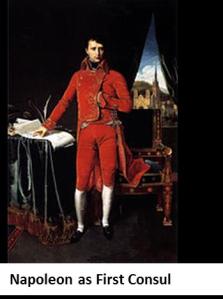
Photo 3Only six years after Bastille Day, Napoleon, who was then just 26, and had joined the French Army to promote Republican ideals, had undertaken his first campaign against Austria and Italy after saving the French Directory, the successor to the first revolutionary government. He conquered Italy and became a national hero, and then embarked on an invasion of Egypt that was his launch pad to becoming the ruler of the entire country in 1799 as First Consul.

Napoleon successfully replaced the unstable revolutionary government with a more sustainable populist regime, albeit one that was rather authoritarian. Napoleon is remembered most today for his wars, ill-fated campaign in Russia and eventual defeat, and his government reforms are often ignored. In spite of the Declaration of the Rights of Man by the first revolutionaries, Napoleon was in many ways far more the basis for the modern state that recognizes the rights of the individual than the Revolution itself. The revolutionaries were disorganized, philosophically polarized and devolved into the violence, irrationality and bloodshed of the Terror.

Photo 4Napoleon however, had a positive mania for organization and codification and introduced secular education, replacement of feudalism with modern property law, and the Napoleonic Code that set forth clear civil and criminal law that specified and codified the rules of due process that protect people living in functional states today (as well as numerous other reforms).

Napoleon’s mania for organization was pervasive; he not only set up vast and detailed bureaucracies for military and civil administration, he personally took a hand in facilitating the meetings. One weird manifestation of this was his largely successful effort to control the smuggling trade between England and France for his own benefit. His success was remarkable when one considers the strenuous efforts the English had made for centuries to bring smuggling under control with minimal results.

Napoleon’s job was perhaps easier, because he didn’t want to abolish or heavily tax the trade as the English did, but rather to centralize it and document the comings and goings of the smugglers, at least partially in order to facilitate the smuggling of gold guineas badly needed by his government to pay his troops and prosecute his wars.

This led Napoleon to establish a “ville des smoglers” or city of smugglers, initially located at Dunkirk and later at the more secure city of Gravelines nearby. French authorities received and documented the arriving English smugglers and their transactions with their French counterparts. They actively encouraged smuggling, even allowing the boats to be built there for British crews when the Inland Revenue Service and Royal Navy destroyed boats to prevent it.

I found the story of the City of Smugglers irresistible and a perfect backdrop for Lady, Lover, Smuggler, Spy the third book of my Arlingbys Regency romance and intrigue series. In this book, Valerie Carlton is the well born but impoverished widow of a soldier who lost his life in the Peninsular Wars, while Sir Tarquin Arlingby conceals his secret spying behind his wealthy gentleman of fashion persona. Their love story stretches from London across the English Channel to the City of Smugglers as they seek to uncover Napoleon’s secrets to support the English troops.

In the excerpt below, our daring duo is about to get their first glance at the fortress of Gravelines and the City of Smugglers.

About Lady, Lover, Smuggler, Spy

Mrs. Valerie Carlton is the widow of a soldier who died in the Peninsular Wars. Disowned by her family for “marrying down,” she survives working as a governess. When the elder son of the family makes unwelcome advances, Valerie leaves, seeking refuge with a close friend until she can find another position.

Sir Tarquin Arlingby, a wealthy, handsome bachelor on his way home, is staying at the same inn as Valerie and witnesses her being robbed before she can board the coach. He goes to Valerie’s aid and is instantly attracted to her. As her friend’s home is near his estate, he offers to drive her there.

An unfortunate accident forces the pair to spend a night in a village inn. Over dinner, Valerie talks about her experiences during the Spanish campaign against Napoleon and the sense of mission that she felt following the drum, which she misses in her current life. Sir Tarquin, who is secretly spying for the Crown by masquerading as a smuggler to pass information in and out of France, is intrigued by her bravery and his attraction increases. Valerie is also drawn to the handsome baronet.

Tarquin needs a French-speaking woman to pose as a smuggler during a mission to the “City of Smugglers” in Gravelines. When he discovers that Valerie speaks French like a native, he successfully recruits her for the job.

Will the pair survive their dangerous mission? Will they finally acknowledge the depth of their feelings for each other?

Find out in Lady, Lover, Smuggler, Spy, a Regency romance with intrigue, humor and just the right amount of moderately explicit sex for those readers who enjoy sensuality with their romances.

Lady, Lover, Smuggler, Spy

Excerpt

Much later, Valerie awoke to Tarquin shaking her shoulder. She looked around in surprise to note the sun just rising over the horizon.

“Madame Carleon, we are approaching the shoreline. You will wish to watch as we arrive,” he said.

Bien sur, Jake,” she replied, gathering her wits. She looked across the water to see the coastline clearly delineated before them. The golden-pink rays of the rising sun imbued the sandy, rolling shoreline with a pearly glow, and wavelets sparkled in the emerging daylight. As the shore grew rapidly closer with the long oar strokes of the rowers, she could see the narrow mouth of a waterway cutting through the beach. They glided into the channel and moved inland as rich green farm fields, dotted with cows and distant villages, scrolled past on either side.

Within an hour they were approaching the fortress of Gravelines. The looming walls, built hundreds of years earlier, reminded Valerie of the fortresses her husband had helped to besiege in Spain, and she shivered a little at the violent memories they awoke in her.

To banish her unwelcome recollections, she looked over at Tarquin. In the daylight she could see he had been correct in saying that a change of clothing and some walnut juice to temporarily brown his skin did much to disguise him. His blonde hair was tousled, his face looked as though work in the sun and wind had tanned it, and a day or two of stubble on his cheeks gave him the appearance of a farmer or deckhand. His billowing cotton shirt was partially covered with a leather vest, and the open collar allowed her to see the strong column of his throat. She acknowledged ruefully that the disguise made him no less attractive. Many a woman would take an interest in Jake West.

But there was little time for daydreams. As they drew up to a pier, the crew sprang into action. Tarquin shipped his oar and stood in one lithe movement, while Valerie grabbed her reticule from its spot atop the tarpaulin covering the golden cargo destined to support Napoleon’s armies. Seconds later, she found herself on the pier with the members of the guinea boat’s crew and other passengers, facing what appeared to be a small army of customs inspectors, coast guards, and police officers.

Unfamiliar with the procedure and somewhat intimidated by the crowd of officials, Valerie stood as close to Tarquin as possible, taking reassurance from his height and strength, while attempting to maintain an outward calm. A hard faced customs official wearing close fitting white breeches and an elaborate green coat crisscrossed with bright white leather straps approached her.

He looked her over briefly. “Qui etes vous, madame?” he barked.

Madame Carleon, une modiste,” she replied, handing over her papers. “I am here to select fabrics, trims and stock for my shop. Ces hommes ne peuvent pas selecter les mieux tissus.” For additional effect, she sniffed and cast a dismissive glance towards Tarquin.

Bien sur, madame,” the inspector said, giving her a more interested look and a smile. He rifled through her papers, pausing a moment to squint at one of them, as Valerie held her breath. “Allez, you may go.” He leered at her, his eyes raking over her figure. “A pity you live in England. France could use a fine woman such as you.”

“You never know,” said Valerie saucily, “I may return. Particularly if there are more strapping men such as you.”

“Not too many like me, but I’m sure I could satisfy you.”

Valerie laughed and moved on, giving him a teasing glance over her shoulder. The inspector, clearly recognizing Tarquin, nodded at him briefly, and he followed in her wake.

When they were out of earshot, Tarquin spoke in a low voice. “You did well there. That was a member of the Douane Imperiale, Napoleon’s elite customs unit. All of its members have served in the Army and they undertake armed missions when necessary.”

“I’m glad I didn’t know that before I spoke with him,” Valerie laughed.

“I’m sure I did not encourage you to flirt with the officials,” observed Tarquin.

“It seemed to be the easiest way to convince him I’m harmless.” She glanced up at him. “Are you jealous?”

“Jake West has no right to be jealous of Madame Carleon’s doings,” responded Tarquin, and she had to be content with that.

She turned away and watched the crowd bustling around them with interest. “What do we do now?”

“Let us go find some bread and coffee first,” he suggested. “Then I will take you to the fabric merchants. We will spend one night here; it takes them some time to count the gold and be sure that all is accounted for, and that the manifest is accurate. There is an inn for the smugglers that is quite decent. Everything here is very well organized.”

Valerie looked about her. Although the walls ran close around it, and the primary language to be heard was French, she thought she could have been in a market town almost anywhere. There were counting houses, and a great many shops, inns, taverns, and other businesses.

“It seems to be,” she agreed. “I’m afraid I had another picture in my head, with dark, narrow streets and people skulking about in the shadows. Instead it is almost disappointingly ordinary.”

Tarquin smiled. “Everything required for the smugglers to conduct their business has been thought of. There is even a shipyard, for in some regions the tidesmen have taken to destroying the guinea boats, so they make them here, and then row them to England to pick up the cargoes.”

“That’s rather shocking,” Valerie replied.

Tarquin shrugged. “I suppose it is. I am doing all I can to improve matters, but that is the reality of the treachery we are contending with.”

Giveaway: Two lucky commenters will receive free copies of Lady, Lover, Smuggler, Spy. The winners will be randomly chosen one week after this post is published.

About the Author

Alicia Quigley is a lifelong lover of romance novels, who fell in love with Jane Austen in grade school, and Georgette Heyer in junior high.  She made up games with playing cards using the face cards for Heyer characters, and sewed regency gowns (walking dresses, riding habits and bonnets that even Lydia Bennett wouldn’t have touched) for her Barbie.  In spite of her terrible science and engineering addiction, she remains a devotee of the romance, and enjoys turning her hand to their production as well as their consumption.

Website • Twitter • Facebook • Amazon Author Page

Romance of London: Marlborough House and Sarah, Duchess of Marlborough

Romance of London: Strange Stories, Scenes And Remarkable Person of the Great Town in 3 Volumes

John Timbs

John Timbs (1801-1875), who also wrote as Horace Welby, was an English author and aficionado of antiquities. Born in Clerkenwell, London, he was apprenticed at 16 to a druggist and printer, where he soon showed great literary promise. At 19, he began to write for Monthly Magazine, and a year later he was made secretary to the magazine’s proprietor and there began his career as a writer, editor, and antiquarian.
This particular book is available at googlebooks for free in ebook form. Or you can pay for a print version.

About the Churchills

John_Churchill_in_his_thirties

John Churchill, 1st Duke of Marlborough, was a great military hero who reaped many honors and financial rewards from his service to five English monarchs. His wife Sarah was an intimate friend of Queen Anne… until Sarah’s hot temper and conceit earned her dismissal from court. For more about Sarah, Duchess of Marlborough, check out this article in Wikipedia.

Queen Anne (1705)

Queen Anne (1705)

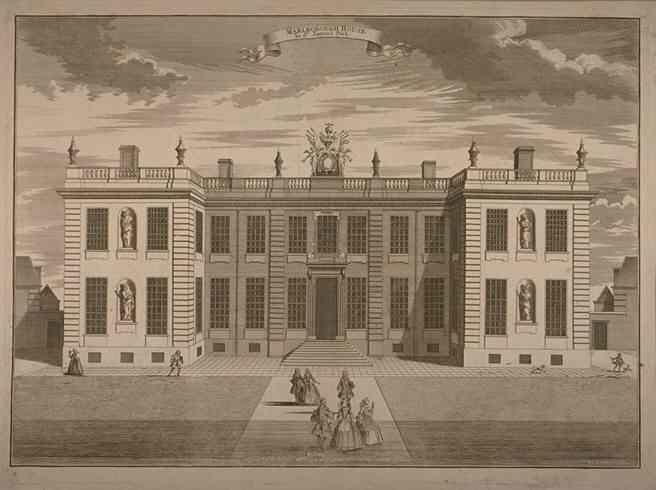
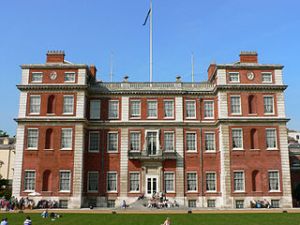
Marlborough House

Marlborough_House_-_superior_version

Little can be said, architecturally, of Marlborough House, notwithstanding it was designed by Sir Christopher Wren, who was employed, not because he was preferred, but that Vanbrugh might be vexed. Respecting Marlborough House, Pennant says

To the east of St. James’s Palace, in the reign of Queen Anne, was built Marlborough House, at the expense of the public. It appears by one of the views of St. James’s, published before the existence of this house, that it was built in part of the Royal Gardens, granted for that purpose by her Majesty. The present Duke [Pennant writes in 1793] added an upper story, and improved the ground floor, which originally wanted a great room. This national compliment cost no less than 40,000l.

As regards the site, Pennant’s account is corroborated by other authorities, who say that the mansion of the famous John Churchill was built on ground “which had been used for keeping pheasants, guinea-hens, partridges, and other fowl, and on that piece of ground taken out of St. James’s Park, then in possession of Henry Boyle, one of her Majesty’s principal Secretaries of State.”

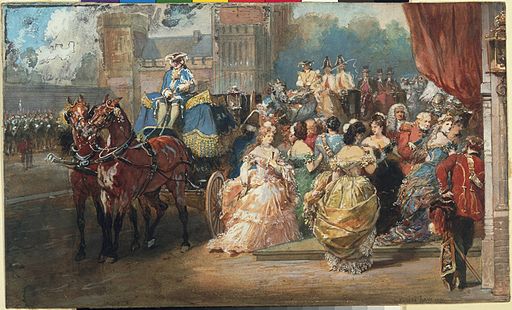
Entry to a Drawing Room at Marlborough House (1871)

Entry to a Drawing Room at Marlborough House (1871)

The Duchess both experienced and caused great mortifications here. She used to speak of the King in the adjacent palace as her “neighbor George.” The entrance to the house from Pall Mall was, as it still is, a crooked and inconvenient one. To remedy this defect, she intended to purchase some houses… for the purpose of pulling them down and constructing a more commodious entry to the mansion; but Sir Robert Walpole [whom she considered to be her greatest enemy], with no more dignified motive than mere spite, secured the houses and ground, and erected buildings [there], which… blocked in the front of the Duchess’ mansion. She was subjected to a more temporary, but as inconvenient blockade, when the preparations for the wedding of the imperious Princess Anne [does Timbs mean Mary?] and her ugly husband, the Prince of Orange, was going on. Among other preparations, a boarded gallery, through which the nuptial procession was to pass, was built up close against the Duchess’ windows, completely darkening her rooms. As the boards remained there during the postponement of the ceremony, the Duchess used to look at them with the remark, “I wish the Princess would oblige me by taking away her ‘orange chest!'”*

320px-Marlborough_House

Note: Currently the home of the Commonwealth Secretariat, the house is usually open to the public for Open House Weekend each September.

The Character of the Duchess

Sarah, Duchess of Marlborough

Sarah, Duchess of Marlborough

From the Memoirs of Mrs. Delany:

The conversation turned upon the famous Duchess of Marlborough: among others, one striking anecdote, that though she appeared affected in the highest degree at the death of her grand-daughter, the Duchess of Bedford, she sent the day after she died for the jewels she had given her, saying ‘she had only lent them;’ the answer was that she ‘had said she would never demand those jewels again except she danced at court;‘ her answer was ‘then she would be —- if she would not dance at court,’ &c. … She used to say that she was very certain she should go to heaven, and as her ambition went even beyond the grave, that she knew she should have one of the highest seats.

A few of the Duchess’ eccentricities and extravagancies have been put together somewhat in the humorous manner of our early story-books, as follows:

This is the woman who wrote the characters of her contemporaries with a pen dipped in gall and wormwood. This is the Duchess who gave 10,000l to Mr. Pitt for his noble defense of the constitution of his country! … This is the Duchess who, in her old age, used to feign asleep after dinner, and say bitter things at table pat and appropriate, but as if she was not aware of what was going on! This is the lady who drew that beautiful distinction that it was wrong to wish Sir Robert Walpole dead, but only common justice to wish him well hanged. This is the Duchess who tumbled her thoughts out as they arose, and wrote like the wife of the Great Duke Marlborough. This is the lady who quarreled with a wit upon paper (Sir John Vanbrugh), and actually got the better of him in the long run; who shut out the architect of Blenheim from seeing his own edifice, and made him dangle his time away at an inn while his friends were shown the house of the eccentric Sarah.

This is the Duchess who, ever proud and ever malignant, was persuaded to offer her favorite grand-daughter, Lady Diana Spencer, afterwards Duchess of Bedford, to the Prince of Wales, with a fortune of a hundred thousand pounds. He accepted the proposal and the day was fixed for their being secretly married at the Duchess’ Lodge, in the Great Park, at Windsor. Sir Robert Walpole got intelligence of the project, prevented it, and the secret was buried in silence.

This is the Duchess—The wisest fool much time has ever made—who refused the proffered hand of the proud Duke of Somerset, for the sole and sufficient reason that no one should share her heart with the great Duke of Marlborough.

This is the illustrious lady who superintended the building of Blenheim, examined contracts and tenders, talked with carpenters and masons, and thinking sevenpence-halfpenny a bushel for lime too much by a farthing, waged a war to the knife on so small a matter.

This is the celebrated Sarah, who, at the age of eighty-four, when she was told she must either submit to be blistered or die, exclaimed in anger, and with a start in bed, “I won’t be blistered, and I won’t die!”

The Duchess died, notwithstanding what she said, at Marlborough House, in 1774.

*Dr. Doran’s Queens of England—House of Hanover


Romance of London Series

  1. Romance of London: The Lord Mayor’s Fool… and a Dessert
  2. Romance of London: Carlton House and the Regency
  3. Romance of London: The Championship at George IV’s Coronation
  4. Romance of London: Mrs. Cornelys at Carlisle House
  5. Romance of London: The Bottle Conjuror
  6. Romance of London: Bartholomew Fair
  7. Romance of London: The May Fair and the Strong Woman
  8. Romance of London: Nancy Dawson, the Hornpipe Dancer
  9. Romance of London: Milkmaids on May-Day
  10. Romance of London: Lord Stowell’s Love of Sight-seeing
  11. Romance of London: The Mermaid Hoax
  12. Romance of London: The Bluestocking and the Sweeps’ Holiday
  13. Romance of London: Comments on Hogarth’s “Industries and Idle Apprentices”
  14. Romance of London: The Lansdowne Family
  15. Romance of London: St. Margaret’s Painted Window at Westminster
  16. Romance of London: Montague House and the British Museum
  17. Romance of London: The Bursting of the South Sea Bubble
  18. Romance of London: The Thames Tunnel
  19. Romance of London: Sir William Petty and the Lansdowne Family
  20. Romance of London: Marlborough House and Sarah, Duchess of Marlborough
  21. Romance of London: The Duke of Newcastle’s Eccentricities
  22. Romance of London: Voltaire in London
  23. Romance of London: The Crossing Sweeper
  24. Romance of London: Nathan Mayer Rothschild’s Fear of Assassination
  25. Romance of London: Samuel Rogers, the Banker Poet
  26. Romance of London: The Eccentricities of Lord Byron
  27. Romance of London: A London Recluse

Romance of London: Sir William Petty and the Lansdowne Family

Romance of London: Strange Stories, Scenes And Remarkable Person of the Great Town in 3 Volumes

John Timbs

John Timbs (1801-1875), who also wrote as Horace Welby, was an English author and aficionado of antiquities. Born in Clerkenwell, London, he was apprenticed at 16 to a druggist and printer, where he soon showed great literary promise. At 19, he began to write for Monthly Magazine, and a year later he was made secretary to the magazine’s proprietor and there began his career as a writer, editor, and antiquarian.

This particular book is available at googlebooks for free in ebook form. Or you can pay for a print version.

Sir William Petty and the Lansdowne Family

220px-Sir_William_PettySir William Petty is commonly described as “the founder of the house of Lansdowne,” a statement which is not sufficiently exact for all readers.

The story of William Petty, from May 1623, when he was born at Romsey, in Hampshire, to the time of his interment in the Norman church of that town, in 1687, is one of those lessons of life which can scarcely be too often repeated.

Petty was the son of a clothier in humble circumstances, was sent to Romsey Grammar School, and determined next to study at the University of Caen, in Normandy. Thither he sped, supporting himself by the way, with “a little stock of merchandise,” as a pedlar. He returned to England, and apprenticed himself to a sea captain, who, however, “drubbed him with a rope’s-end for the badness of his sight. This ill-treatment disgusted him with the navy; he took to the study of medicine, and while at Paris for that purpose became so poor as to subsist for two or three weeks entirely on walnuts; but, by help of the pedlar trade, he came back to England with money in his pocket. Here he exercised his liking for mechanics by inventing a letter-copying machine, or, as he called it, “an instrument for the art of double writing,” which he patented, for seventeen years, in 1648; and this very instrument is the prototype of the manifold letter-writers of our times. Petty likewise practiced chemistry and physic; and at his lodgings in Oxford were held the first meetings to form the Royal Society. At Oxford, Petty acted as deputy to the anatomical professor there: he lodged at an apothecary’s house, “because of the convenience of inspecting drugs.” In 1652 Petty was appointed Physician-General to the Army in Ireland. In 1664 he undertook the survey of Ireland; and in 1666, he had completed the measurement of two million and eight thousand acres of forfeited lands, for which, by contract, he was to receive one penny per acre. Sir William Petty is better known in our day as a writer upon trade and commerce and political arithmetic.

typewriter

Language, Technology, and Society, by Richard Sproat (2010)


polygraph

Darren Wershler-Henry’s The Iron Whim: A Fragmented History of Typewriting (2005)

Among Sir W. Petty’s inventions was “a double-bottomed ship, to sail against wind and tide.” He wrote on dyeing and on woolen cloth manufacture; he speculated in ironworks, lead-mince, a pilchard fishery, and timber trade; and all this time took an active part in the discussions of the Royal Society. He also built Tokenhouse Yard, Rothbury, on the site of the Earl of Arundel’s house and garden: and he held property in the yard at the time of the Great Fire. His will, made in 1661, details his birth, boohoo, education, adventures, studies, attainments, and promotions in life, commencing “with three-score pounds at the age of twenty,” an being in the receipt of 15,000l per annum a short time before his death, at which time he was residing in the corner house on the east side of Sackville Street, Piccadilly, opposite St. James’s Church. The widow of Sir William Petty was created Baroness Shelburn. He left two sons and a daughter. The eldest son succeeded to the title; but, dying without issue, it was revived in Henry, the second son, great uncle of the first Marquis of Lansdowne.

The remains of Sir William Petty rest in Romsey Church, where, on the south side of the choir, a plain slab bore the inscription, “Here Layes Sir William Petty;” but a more fitting memorial of his celebrated lineal ancestor was, in 1862, erected by the late Marquis of Lansdowne.

Monument to Sir William Petty, Romsey Church, Hampshire

Monument to Sir William Petty, Romsey Church, Hampshire

From Wikipedia:

Sir William Petty FRS (26 May 1623 – 16 December 1687) was an English economist, scientist and philosopher. He first became prominent serving Oliver Cromwell and Commonwealth in Ireland. He developed efficient methods to survey the land that was to be confiscated and given to Cromwell’s soldiers. He also managed to remain prominent under King Charles II and King James II, as did many others who had served Cromwell.

He was Member of the Parliament of England briefly and was also a scientist, inventor, and entrepreneur, and was a charter member of the Royal Society. It is for his theories on economics and his methods of political arithmetic that he is best remembered, however, and to him is attributed the philosophy of ‘laissez-faire’ in relation to government activity. He was knighted in 1661. He was the great-grandfather of Prime Minister William Petty Fitzmaurice, 2nd Earl of Shelburne and 1st Marquess of Lansdowne.

William Petty's great-grandson, William Petty-Fitzmaurice, 2nd Earl of Shelburne and 1st Marquess of Landsdowne, Prime Minister of England

William Petty’s great-grandson, William Petty-Fitzmaurice, 2nd Earl of Shelburne and 1st Marquess of Landsdowne, Prime Minister of England


Romance of London Series

  1. Romance of London: The Lord Mayor’s Fool… and a Dessert
  2. Romance of London: Carlton House and the Regency
  3. Romance of London: The Championship at George IV’s Coronation
  4. Romance of London: Mrs. Cornelys at Carlisle House
  5. Romance of London: The Bottle Conjuror
  6. Romance of London: Bartholomew Fair
  7. Romance of London: The May Fair and the Strong Woman
  8. Romance of London: Nancy Dawson, the Hornpipe Dancer
  9. Romance of London: Milkmaids on May-Day
  10. Romance of London: Lord Stowell’s Love of Sight-seeing
  11. Romance of London: The Mermaid Hoax
  12. Romance of London: The Bluestocking and the Sweeps’ Holiday
  13. Romance of London: Comments on Hogarth’s “Industries and Idle Apprentices”
  14. Romance of London: The Lansdowne Family
  15. Romance of London: St. Margaret’s Painted Window at Westminster
  16. Romance of London: Montague House and the British Museum
  17. Romance of London: The Bursting of the South Sea Bubble
  18. Romance of London: The Thames Tunnel
  19. Romance of London: Sir William Petty and the Lansdowne Family
  20. Romance of London: Marlborough House and Sarah, Duchess of Marlborough
  21. Romance of London: The Duke of Newcastle’s Eccentricities
  22. Romance of London: Voltaire in London
  23. Romance of London: The Crossing Sweeper
  24. Romance of London: Nathan Mayer Rothschild’s Fear of Assassination
  25. Romance of London: Samuel Rogers, the Banker Poet
  26. Romance of London: The Eccentricities of Lord Byron
  27. Romance of London: A London Recluse