Archives

The Belles’ Holiday Wassailing Tour: Course #4

Welcome to the 4th stop of the

Belles’ Holiday Wassailing Tour!

Lady Pendleton

Lady Pendleton

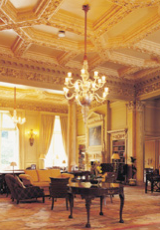
The time-traveling Lady Pendleton and her family welcome you to Christmas 1811 at the Pendleton estate in Wittersham, East Sussex. Present are: Lady Julia Tate, her eldest daughter; Lady Philippa Bland and her husband George, Viscount Hooper; Lady Sarah Newsome, her husband Sir Henry Newsome, and their two daughters, Emily (2) and Theodora (3 months).

Note: Julia’s sister Lady Sarah and her family feature prominently in the sequel to An Ultimate Escape, which is titled A Home for Helena (available soon).

To win a digital copy of Lost and Found Lady and a lovely perfumed frame and cameo, mention (1)  your favorite Christmas film and (2) the name and title of the hero of Amy Rose Bennett’s story in Mistletoe, Marriage, and Mayhem in the comments below (one random commenter will be chosen). The answer can be found on her post here: http://amyrosebennett.com/the-bluestocking-belles-holiday-wassailing-tour/.
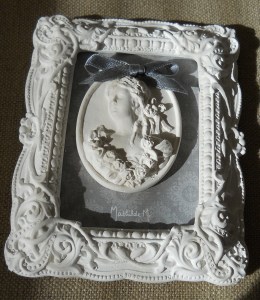
perfumedframe&cameo

Separator

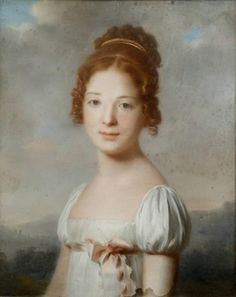
Lady Julia Tate

Lady Julia Tate

Lady Pendleton, her daughter Julia, and Oliver Stanton are characters in The Ultimate Escape, a time travel novella in Mistletoe, Marriage, and Mayhem.

Oliver Stanton

Mr. Oliver Stanton

On the eve of her wedding, Julia realizes she cannot marry her fiancé after all, no matter that it’s been her dream for eight long years. Too distraught to face him, she follows in her mother’s footsteps and flees to the future for a brief reprieve.

Oliver knows he has bungled things badly, but he is determined to win the woman he loves, even if he must travel through time to do it.

Separator

Christmas 1810 had been a sober affair, the Pendletons’ first without their beloved patriarch’s gentle humor. A year later, however, his wife and daughters had recovered from their grief well enough to feel his spiritual presence in their lives.

“Remember how Papa loved to sing Christmas carols before dinner?” Julia suggested as they waited in front of the fire in the music room for their Christmas dinner to be ready. “I’d like to suggest Deck the Halls. Philippa, will you play for us?”

Philippa raised her eyebrows. “You may do it yourself, Julia. We all had the same music lessons, after all.”

Julia shrugged. “I’m holding the baby,” she argued. “Little Theodosia is fast asleep. You would surely not wish to wake her, would you?”

Lady Pendleton and her youngest daughter exchanged a glance. The rivalry between Julia and Philippa had become routine in their family, even after they had become adults.

Philippa gave Julia a look of annoyance and moved to the pianoforte. “What song shall we begin with?” she asked, deliberately ignoring Julia’s request.

“I Thaw Thwee Ships come thailing in,” chimed in two-year-old Emily, “on Chwithmath Day, on Chwithmath Day.”

Sarah’s oldest daughter was playing on the floor with a model of the HMS Victory, Lord Nelson’s ship at the Battle of Trafalgar, that her father had given her for Christmas. Her mother had lightheartedly accused him of wishing Emily were a boy, but for whatever reason, their little daughter eschewed her dolls for the colorfully-painted ship.

“Emily has decided. I Saw Three Ships it is,” Philippa agreed, and played a chord to begin the singing.

Separator

I Saw Three Ships

https://www.youtube.com/watch?v=C5LROczmJHg

Separator

Excerpt from The Ultimate Escape

She’d been standing there a few minutes, beginning to feel the sudden chilling of the air through her fur-lined cloak when the door to the house opened and a stout, middle-aged woman gestured for her to come inside.

“Weren’t you told to come in through the back entrance? We’ve been expecting you for over an hour, you know. Dear me, you must be freezing to death out there… might have a bit of snow this evening, or so they say.”

Julia’s mouth fell open. They were expecting her? No, of course not. She was being mistaken for someone else.

“I don’t think…” she began, but was interrupted by another, taller, woman, who unhooked her cloak and dragged her into a back room.

“The hair needs some work,” she commented as she surveyed Julia’s appearance. The dress is the right period, but the freckles! The agency surely knows proper ladies of the Regency did not have freckles.”

Julia’s eyes narrowed. She’d heard enough of that nonsense in her early years. “I assure you, they did, madam, if that was the complexion they were born with.” Scrubbing them with lemon juice and taking parasols everywhere had never made much of a difference, so she had learned to accept hers gracefully.

The tall woman raised her eyebrows and mumbled something about the “impertinence of young people these days,” and the other woman brought her some coffee and biscuits, and before she knew what was happening, her hair was restyled, her gown brushed and tidied, and she was sent upstairs to the “Striped Drawing Room” to mingle with the guests and talk to them about what it was like to live in “the Regency.”

There was an awkward moment or two before she learned that “the Regency” was the period from 1811-1820 when the Prince of Wales ruled as his father’s proxy until the king’s death in 1820. The Prince had been Regent for nearly two years in her own time, but nobody she knew called it “the Regency.” And she hadn’t, of course, known the date of the King’s death. That caused a tear or two until she realized suddenly that he had been dead for nearly 200 years, and so was everyone else she knew. Even she herself. Just thinking about it made her head spin.

But she didn’t have long to brood, because there were visitors to talk to. And other interesting things to learn—more awkward moments—such as the name of the house—Apsley House—and its most famous occupant—the Duke of Wellington, who turned out to be Arthur Wellesley, a particular friend of her father’s who, in her time, had only recently been made a marquess. From listening to the guides of some of the groups who toured the house, she learned that Wellesley had triumphed against the French emperor in a famous battle in an obscure Belgian town called Waterloo… that he had been showered with lavish gifts from all over the world, and even become Prime Minister. How intriguing!

Although she found it amusing to speak with the visitors about attending balls and dinners and answering a multitude of questions about the period in which she lived, she was relieved when the young woman whose place she had taken finally arrived, and she could leave to continue her explorations of the London of the future. What else might she discover before returning to her own time?

Separator

christmasgoose

“The Christmas goose looks lovely,” Lady Pendleton commented, her eyes a bit moist. “Will you not carve it, Sir Henry? It is a Tate family tradition for the senior male to carve the bird.”

The butler placed the goose on the table in front of him, and a footman handed him the necessary utensils.

“My pleasure, your ladyship.” He rose and winked at Lady Sarah, who bit her lip to keep from smiling. It was no secret that she was considerably younger than her husband and that he had nearly a decade on Philippa’s husband, Viscount Hooper. “I’ve carved a few birds in my time.”

Yorkshire Christmas pie

http://www.janeausten.co.uk/yorkshire-christmas-pie-georgian-turducken/

First make a good standing crust, let the wall and bottom be very thick; bone a turkey, a goose, a fowl, a partridge, and a pigeon. Season them all very well, take half an ounce of mace, half an ounce of nutmegs, a quarter of an ounce of cloves, and half an ounce of black pepper, all beat fine together, two large spoonfuls of salt, and then mix them together. Open the fowls all down the back, and bone them; first the pigeon, then the partridge, cover them; then the fowl, then the goose, and then the turkey, which must be large; season them all well first, and lay them in the crust, so as it will look only like a whole turkey; then have a hare ready cased, and wiped with a clean cloth. Cut it to pieces; that is, joint it, season it, and lay it as close as you can on one side; and the other side woodcocks, moor game, and what sort of wild fowl you can get. Season them well, and lay them close, put at least four pounds of butter into the pie, then lay on your lid, which must be a very thick one, and let it be well baked. It must have a very hot oven, and will take at least four hours.

Recipe from: Hannah Glasse, The Art of Cookery Made Plain and Easy, 1747

With thanks to the Jane Austen Society (Please see above link for an in-depth discussion of the recipe)

Separator

Wassail

http://www.foodnetwork.com/recipes/alton-brown/wassail-recipe.html

Recipe by: Alton Brown

Ingredients

  • 6 small Fuji apples, cored
  • 1 cup brown sugar
  • 1 cup water
  • 72 ounces ale
  • 750 ml Madeira
  • 10 whole cloves
  • 10 whole allspice berries
  • 1 cinnamon stick, 2-inches long
  • 1 teaspoon ground ginger
  • 1 teaspoon ground nutmeg
  • 6 large eggs, separated

Directions

  • Preheat the oven to 350 degrees F.
  • Put the apples into an 8 by 8-inch glass baking dish. Spoon the brown sugar into the center of each apple, dividing the sugar evenly among them. Pour the water into the bottom of the dish and bake until tender, about 45 minutes.
  • Pour the ale and Madeira into a large slow cooker. Put the cloves, allspice, and cinnamon into a small muslin bag or cheesecloth, tied with kitchen twine, and add to the slow cooker along with the ginger and nutmeg. Set the slow cooker to medium heat and bring the mixture to at least 120 degrees F. Do not boil.
  • Add the egg whites to a medium bowl and using a hand mixer, beat until stiff peaks form. Put the egg yolks into a separate bowl and beat until lightened in color and frothy, approximately 2 minutes. Add the egg whites to the yolks and using the hand mixer, beat, just until combined. Slowly add 4 to 6 ounces of the alcohol mixture from the slow cooker to the egg mixture, beating with the hand mixer on low speed. Return this mixture to the slow cooker and whisk to combine.
  • Add the apples and the liquid from the baking dish to the wassail and stir to combine. Ladle into cups and serve.

Separator

Negus

http://www.janeausten.co.uk/negus/

To every pint of port wine, allow 1 quart of boiling water, 1/4 lb. of sugar, 1 lemon, grated nutmeg to taste.

As this beverage is more usually drunk at children’s parties than at any other, the wine need not be very old or expensive for the purpose, a new fruity wine answering very well for it. Put the wine into a jug, rub some lumps of sugar (equal to 1/4 lb.) on the lemon-rind until all the yellow part of the skin is absorbed, then squeeze the juice, and strain it. Add the sugar and lemon-juice to the port wine, with the grated nutmeg; pour over it the boiling water, cover the jug, and, when the beverage has cooled a little, it will be fit for use. Negus may also be made of sherry, or any other sweet white wine, but is more usually made of port than of any other beverage.

Sufficient: Allow 1 pint of wine, with the other ingredients in proportion, for a party of 9 or 10 children.

Recipe from: Mrs. Beeton’s Book of Household Management, 1861

With thanks to the Jane Austen Society (Please see above link for an in-depth discussion of the recipe)

separator

Box-Set-3D-Square-Web

Mistletoe, Marriage, and Mayhem: A Bluestocking Belles Collection
In this collection of novellas, the Bluestocking Belles bring you seven runaway Regency brides resisting and romancing their holiday heroes under the mistletoe. Whether scampering away or dashing toward their destinies, avoiding a rogue or chasing after a scoundrel, these ladies and their gentlemen leave miles of mayhem behind them on the slippery road to a happy-ever-after.

***All proceeds benefit the Malala Fund.***

Goodreads Reviews

Amazon | Smashwords | Amazon UK | Amazon Australia | Amazon Canada | Barnes & Noble | iTunes | Kobo

Donate to the Malala Fund

Separator

Links to all of the Belles’ holiday wassailing stops, with a different Regency era Christmas carol, dinner selection, and beverage, and wassail recipes at every stop that you can make in the modern kitchen.

christmas

Digital Christmas Card by EKDuncan using digital Christmas ornaments of Regency ladies

Vauxhall Gardens: An Era of Change (1786-1822), Part II

vauxhallbook

Vauxhall Gardens: A History

David Coke & Alan Borg

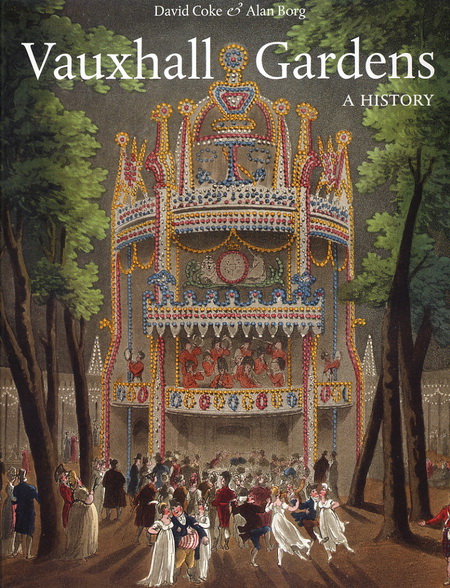
The Vauxhall Pleasure Gardens is one of the places I’d love to slip back in time to visit, just to catch a glimpse of what it was like. After recently splurging to buy this lovely coffee-table book, I thought it might make a wonderful subject for a new blog series. But do buy the book too, if you can!

Grand Military Fetes and Displays

The first record of a military fete was on 30 May 1786, the day after the Jubilee, when transparencies of British men-of-war by the marine painter John Thomas Serres (1759-1825) were presented with other decorations, including a representation of the British lion trampling the Spanish flag. The newly formed Duke of York’s Band played military airs and was to perform regularly in the gardens until 1816. This period saw an increasing presence of soldiers and military bands, theoretically in response to the threat of invasion from France, but more directly in an attempt to rival the jingoistic displays to be seen at Astley’s. In 1787 the Cascade, the most famous of Vauxhall attractions in the eighteenth century, included marching soldiers. These military displays gradually expanded and needed more space, so from 1816 the Cascade site was used by Madame Saqui’s rope-dancing troupe.

Eventually, grand military fetes to celebrate actual events involved firework displays.

On 11 June 1810, Mizra Abul Hassan Khan wrote about his visit to the Gardens for the Grand Oriental Fete in honour of the Persian Ambassador:

The avenues were lighted by rows of tall candelabra and by lanterns hung from trees. In one place there were fireworks: when they did not rise high enough, everyone laughed and said ‘Shocking!’ The fireworks ended with the name of the Qibleh of the Universe written in Persian letters! Everyone appreciated this display and clapped their hands together. From there we went to a large covered place, beautifully lighted and decorated, like a theatre in the city. It was built to accommodate 5000 people in case of rain. After the fireworks, some people sat down to eat; later they danced.

American Samuel Morse, inventor of the Morse code, visiting on 17 September 1811:

A few evenings since I visited the celebrated Vauxhall Gardens, of which you have doubtless often heard. I must say they far exceeded my expectations; I never before had an idea of such splendor. The moment I went in I was almost struck blind with the blaze of light proceeding from thousands of lamps and those of every color. […] All is gayety throughout the gardens; every one is in motion, and care, that bane of human happiness, for a time seems to have lost her dominion over the human heart. Had the Eastern sage, who was in search of the land of happiness, at this moment been introduced into Vauxhall, I think his ost exalted conceptions of happiness would have been surpassed, and he would rest contented in having at last found the object of his wishes. […] The music and this course of dancing continue till about four o’clock in the morning, when the lights are extinguished and the company disperses. On this evening, which was by now means considered as a full night, the company consisted of perhaps three thousand persons.

vauxhall-pleasure-gardens-00364-800

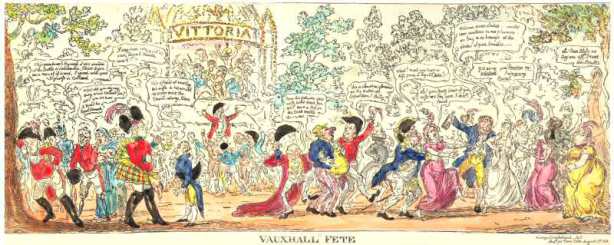
George Cruikshank, Vauxhall Fete, engraving, 1813 (British Museum, London., 1862.1217.309). This satirical print shows many of the leading figures who attended the Grand Festival in honor of the Battle of Vittoria. On the left the Duke of York vomits against a tree; other notables include the Duke of Sussex in Highland uniform, the Duke of Clarence dressed as an Admiral, the Lord Mayor of London and Lord Castlereigh. On the far right a fat lady exclaims ‘They’re all drunk, the Brutes.’

Grand Festival of the Battle of Vittoria

On 20 July 1813, a Grand Festival of the Battle of Vittoria was held in honor of the then Marquess Wellesley, who attended. “The festival was ‘perhaps the most superb and costly entertainment ever given in England’ and such was its popularity that ‘the limited number’ of tickets ‘was exceeded and, in consequence, from ten to fifteen pounds was offered for a ticket’”. Byron noted:

There is to be a thing on Tuesday ycleped a national fete. The Regent and *** are to be there, and everybody else, who has shillings enough for what was once a guinea. Vauxhall is the scene—there are six tickets issued for the modest women, and it is supposed that there will be three to spare. The passports for the lax are beyond my arithmetic.

At a dinner for twelve hundred people in the Rotunda, the VIPs sat at a crescent-shaped, raised table. There was also

a row of crimson steps covered with massive pieces of ornamental gold and silver plate, with the bust of the Lord Wellington on the summit. At the foot, and leaning against a silver vase of exquisite workmanship, was the Marshal’s staff taken in the battle. Two trumpeters in their state liveries and with silver trumpets, stood forward from the pile, and between them a grenadier of the Guards held the standard of the 100th French regiment of the line.

Neither George III nor the Prince of Wales attended (in spite of Byron’s expectation), but otherwise, the list of attendees was quite impressive. Wellesley arrived late for the dinner and found his seat of honor occupied, but presumably that was quickly dealt with. The ladies joined the party at 9 p.m., and at 11 p.m., the Princess of Wales arrived. She

was conducted around the chief promenade several times by his Royal Highness the Duke of Gloucester and Col St Leger. The Princess was hailed repeatedly with loud greeting, and repaid the attentions of the company in the most courteous manner. She was dressed ina white satin train with a dark vet and ornaments, richly embroidered. On her head-dress she wore a green wreath, with diamonds.

Even later, “many of the nobility came from the Opera House after the conclusion of the ballet.”

In the course of the evening a new air called The plains of Vitoria was performed by the orchestra, while military bands, including those of the Foot and Life Guards, the Duke of Kent’s Regiment, and the 7th Hussars, played and marched up and down the Walks. ‘The appearance of some of these bands in the forest part of the garden was extremely picturesque, and presented some idea, at times, of soldiers in a campaign regaling and reposing themselves under the shade. The fireworks were set off in three sessions, at 11 p.m. and at 1 and 2 a.m. These were devised and directed by ‘Colonel Congreve’, the inventor of the Congreve Rocket, which was much used in the Napoleonic wars.

Other Military Fetes at Vauxhall

More fabulous military fetes were held in the following year, one of 13 June 1814 to celebrate the Treaty of Paris, and in August, a mock sea battle (Grand Mechanical Naumachia). Although there were fireworks on 15 August 1815 following Napoleon’s surrender at Waterloo, there were no specific events to mark the occasion until 18 June 1817. This became an annual celebration, eventually involving a reconstruction of the battle on the southeast side of the old Grand Walk, which became known as the Waterloo Ground.

View of Vauxhall, Lady's magazine

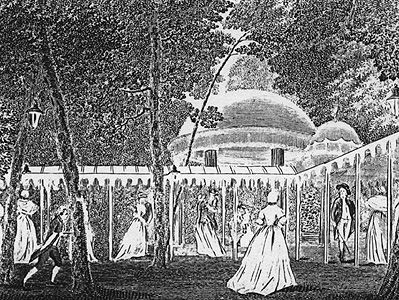
Anon., View of Vauxhall Gardens, engraving (Lambeth Landmark 1260) from the Lady’s Magazine, XXX (1799), supplement. The walks were covered to counter the rains which proverbially started when the Vauxhall season opened; they were extended all round the Grove in 1810.


Susana’s Vauxhall Blog Post Series

Louisa Cornell: Christmas Revels II (Giveaway)

How to Survive a Regency Family Christmas

With Christmas a little over a month away, the thoughts of any lady of the house must turn to…

“Who invited all of these people and how will I keep them entertained?”

There are all sorts of possibilities available to the discerning hostess of today. Many guests simply require a place to plug in their phone or their laptop. A television and a stack of Christmas DVD’s can provide hours of amusement to guests of all ages. Video games, board games, bowl games, and music to suit every ear and every pair of dancing feet can be provided at the mere touch of a button. And let us not forget, if all else fails, a nice Christmas punch laced with a suitable spike can keep those hard to please guests quiet if not entertained.

Think of the dilemma faced by the mistress of the house in England two hundred years ago. Unpredictable weather, no electronic options, and each and every friend, acquaintance, and relation looking to be fed, housed, and amused. What is a Regency era lady of the manor to do? Fortunately there are a number of Regency Christmas traditions designed to keep the guests occupied and the lady’s reputation as the consummate hostess secure.

As many Christmas gatherings might last as long as a month (from St. Nicholas Day to Epiphany or Twelfth Night,) a good hostess had to provide a bounty of entertainment for her guests. Trapped in a house, no matter how large and stately, with friends and relatives for an entire month could be trying at best and akin to a wartime siege at worst. In addition to the usual Regency party games – charades and whist, here are a few sources of entertainment common to a Regency Christmas.

On St. Nicholas Day (December 6th) small gifts were exchanged among friends. This marked the official beginning of the Christmas season. After this the rounds of Christmas balls, parties and visits ensued.

While Christmas carols might be sung around the piano by friends and family, caroling as we know it was not something members of the ton did, save perhaps a group of young people out for a lark.

However, while there were no Christmas carolers in Regency England, there were wassail groups who would go from house to house singing begging songs in the hope of receiving food, drink, and money. Wassail was a mixture of beer, wine and brandy and was usually served to the singers at each house.

The house was not decorated for Christmas until Christmas Eve. To do so earlier was thought to bring bad luck. Whilst servants often “brought in the greens,” as it was called, a more creative hostess might send her guests, especially the younger ones, to make up a party and go out into the estate’s forests and woodlands in search of greenery to festoon the manor. The guests enjoyed a bit of fresh air and exercise and there were many opportunities for young men and women to end up under the mistletoe for a surreptitious kiss as they cut it for kissing boughs to be hung in each open doorway and out of the way corner for later “accidental” meetings. Men had the opportunity to show off for the ladies as they dragged the yule log into the house to be lit from a stub from last year’s log and burnt in the hearth until Twelfth Night.

Another source of entertainment were troupes of players called mummers, a tradition dating back to the medieval era. These varied from professional players to groups of lower class men who went from door to door asking if mummers were wanted. A good hostess might even hire a specific troupe to stop and entertain her guests. They were dressed in elaborate costumes with high paper caps – gilded and spangled, and ribbons of every color tied to their clothes. The characters of St. George and the Prince were also armed with ten swords. Their performance was called a “mysterie,” a very specific sort of play, which ended with a song and the collection of funds from those who had enjoyed the performance.

It is thought these mummers’ plays were the forerunners of a Regency tradition still alive today in England – the Christmas pantomime. It usually opened on Boxing Day (December 26th) and was performed in local theatres. Drury Lane hosted one in London and even Astley’s Amphitheatre held a special Christmas spectacular.

Another Boxing Day activity for the men in attendance, and some of the more adventurous ladies, was fox hunting. The Boxing Day Hunt was a long standing tradition, one I observed when I lived in England as a child.

Under the heading of a Regency version of “Hey y’all, watch this!” comes the Christmas game of Snapdragon. Raisins were soaked in brandy in a large shallow bowl. The lights were snuffed out, and the brandy lit. People had to try and grasp a raisin and eat it without burning themselves. I think you’d have to soak me in brandy to get me to try it!

A more tame version of the game was called bullet pudding and is described here in a letter from Jane Austen’s niece, Fanny Knight, to a friend.

Godmersham Park, 17 January 1804

…I was surprised to hear that you did not know what a Bullet Pudding is, but as you don’t I will endeavour to describe it as follows:

You must have a large pewter dish filled with flour which you must pile up into a sort of pudding with a peek at top. You must then lay a bullet at top and everybody cuts a slice of it, and the person that is cutting it when it falls must poke about with their noses and chins till they find it and then take it out with their mouths of which makes them strange figures all covered with flour but the worst is that you must not laugh for fear of the flour getting up your nose and mouth and choking you: You must not use your hands in taking the Bullet out.

I think this might be a successful game even today. It sounds like a great deal of fun.

Christmas trees were not prevalent during the Regency, although some houses were known to put up small ones bedecked with small gifts. They were made more popular in England by Queen Victoria and Prince Albert in the middle of the 19th century. However, on Epiphany Eve, men would gather round a tree, usually in an orchard, with cider and guns. In an ancient ceremony, they would drink to the tree and fire the guns to drive away evil spirits and promote the vigor of the trees. Horn-blowing was an alternative to firing guns. One would hope the lady had a physician in attendance, just in case.

A more ambitious hostess might engage her guests in performing their own Christmas play. With a month to write and rehearse it, some of these plays were quite elaborate. And on Twelfth Night (the official end of the Christmas season) gifts were exchanged again and a masquerade party was held. To add to the fun, guests sometimes had to search the house for elements of their costumes. Sometimes they would draw names of characters they were to play throughout the party. The characters’ names usually described the sort of person the guest was to portray. Mrs. Candor – a lady who always speaks with perfect frankness. Miss Tittletattle, who speaks nothing but gossip. Lord Bumblefoot, who trods on ladies’ toes when dancing. The character must be maintained throughout the party.

Once the Twelfth Night festivities were over it was time to take your leave until next year. As you can see, a lack of electronic devices did not hinder the ladies and gentlemen of the Regency era from celebrating Christmas with a great deal of laughter, joy, friendship, and love. Exactly what I wish for each of you during this most wonderful of seasons!

Do you have any unique Christmas traditions or forms of entertainment enjoyed by your friends and family? Tell us about them! A random commenter will receive an e-copy of either Christmas Revels or Christmas Revels II – winner’s choice.

CR - ebook cover copy

About Christmas Revels II

Let the Revels begin—again! Four new stories with four distinctive voices:

The Vicar’s Christmas by Anna D. Allen

Margaret Trent never needs anything or anyone, but when two London solicitors show up on her doorstep, she needs a hero. Enter Henry Ogden, mild-mannered village vicar. Hardly the stuff of heroes . . . until adversity brings out unexpected talents.

A Christmas Equation by Hannah Meredith

A chance meeting between a reluctant viscount and a self-effacing companion revives memories of their shared past—a time when they were very different people. With secrets to keep, Sarah Clendenin wishes Benjamin Radcliff gone . . . but he’s making calculations of his own.

Crimson Snow by Kate Parker

A trail of blood drops leads Jane Merrywether to a wounded stranger—the only person standing in the way of her wicked guardian becoming an earl. John Rexford, long-thought dead, has returned to claim his inheritance and his promised bride . . . if he can survive a murderous Christmas.

A Perfectly Unregimented Christmas by Louisa Cornell

After years at war, Viscount Pennyworth returns to his ancestral home to find some peace and quiet and to avoid the holiday he loathes. But four naughty boys, a bonnet-wearing goat, a one-eyed cat, a family secret, and one Annabelle Winters, governess, make this a Christmas he’ll never forget.

AmazonBarnes & Noble iBooks • Kobo


Excerpt

A Perfectly Unregimented Christmas

“And what of Christmas, my lord? Are the boys to have no part of the holiday?”

“I have not celebrated Christmas in twenty years, Mrs. Winters. Soldiers seldom have much chance on the battlefield.”

“This is not a battlefield, my lord. This is your home. And theirs while they remain.”

He crossed the room to where she sat. Putting one hand on the table and the other on the back of her chair, he leaned over her. The scent of soap, leather, and cloves made her want to move closer, but she did not dare.

“I have been pelted with snow-covered potatoes, knocked down the stairs, attacked by some unidentified one-eyed creature—”

“Attila. He’s a cat.”

“By what right does that thing call himself a cat? I have had my breakfast poisoned, my patience tried, and my sanity called into question. What would you call it, if not a battlefield? There will be no Christmas in this house.” He blinked. Slowly removed his hands. And took a step back. With a brief nod he turned to go.

“We’ll just see about that,” Belle muttered.

“Do not go to war with me, madam. I have years of experience and tricks you cannot begin to imagine.” He threw open the parlor door and stalked down the corridor, his boots delivering a ringing celebration of his temper.

“So do I, Colonel Miserington. So. Do. I.”


About the Author

100_0239[1] (3) Revise2 copyLouisa Cornell read her first historical romance novel, Jane Austen’s Pride and Prejudice, at the age of nine. This inspired her to spend the next three years writing the most horrible historical romance novel ever created. Fortunately, it has yet to see the light of day. As Louisa spent those three years living in a little English village in Suffolk (thanks to her father’s Air Force career), it is no surprise she developed a lifelong love of all things British, especially British history and Regency-set romance novels. (And Earl Grey tea!)

During those same three years, Louisa’s vocal talent was discovered. Her study of music began at the London College of Music and continued once she returned to the States. After four music degrees and a year of study at the Mozarteum in Salzburg, Austria, Louisa was fortunate enough to embark on a singing career in opera houses in Germany, Austria, and most of Eastern Europe. As a traveling diva, Louisa discovered playing a role costumed in lingerie in March can be a chilling experience, and in most Romanian B&B’s hot water is strictly a matter of opinion.

Now retired from an active career in opera, Louisa has returned to her first love— writing Regency-set historical romance. Her publishing debut, A PERFECTLY DREADFUL CHRISTMAS (from the anthology Christmas Revels,) won the 2015 Holt Medallion for Best Romance Novella.

Two time Golden Heart finalist, three time Daphne du Maurier winner, and three time Royal Ascot winner, Louisa lives in LA (Lower Alabama) with Frodo, a Chihuahua so grouchy he has been banned from six veterinary clinics, several perfectly amiable small dogs, one large, goofy dog named Duke, and a cat who terminates vermin with extreme prejudice.

WebsiteFacebookTwitter


Vauxhall Gardens: An Era of Change (1786-1822), Part I

vauxhallbook

Vauxhall Gardens: A History

David Coke & Alan Borg

The Vauxhall Pleasure Gardens is one of the places I’d love to slip back in time to visit, just to catch a glimpse of what it was like. After recently splurging to buy this lovely coffee-table book, I thought it might make a wonderful subject for a new blog series. But do buy the book too, if you can! The photos are fabulous!

While the years from 1732 to 1786 were the undoubtedly the heyday of Vauxhall, the years following the Jubilee continued to attract large numbers of visitors and was the most popular outdoor entertainment for many years. Charles Burney’s daughter Sarah wrote in 1807:

You should quit your Devonshire Shades were it only to share in the universal rage there is for going to Vauxhall. I never knew anything like it. The whole London World seems to be seized with a fit of the fool.

Vauxhall fashions

Vauxhall Fashions, engraving (David Coke’s collection) from La Belle Assemblée no. 7 (August 1806). Many dressmakers and retailers advertised their wares as representing the latest fashions seen at Vauxhall.

Scenes from Vauxhall were presented on stage, authors such as John Keats, Pierce Egan, and William Thackeray wrote about it, and others tried to copy it, in London and elsewhere. Bath’s Sydney Gardens, opened in 1795 and much visited by Jane Austen, was modeled on Vauxhall in London, as was Tivoli in Copenhagen. Vauxhalls started appearing everywhere.

Exif_JPEG_PICTURE

One half of the world don’t know how t’other lives, Sung by Mr. Dignum in Vauxhall Gardens, etching, 1805 (British Museum, London, 1861.0518.1087). A very popular tenor at the gardens, Dignum also gave the farewell address at the end of several seasons.

A change in clientele

In the early nineteenth century, however, with England’s middle and working classes rapidly expanding due to the Industrial Revolution and the rapid growth of London’s population, Vauxhall’s clientele began to change as well.

The social balance was changing too; the old aristocracy watched nervously as France spiralled into revolutionary chaos, and several of the great families decided to move back to the country, to avoid the potential dangers of urban unrest… In addition, social circles were becoming more restricted and inward-looking; the London aristocracy was being rapidly overtaken in terms of numbers by the professional middle classes of industrialists, businessmen, doctors and lawyers. To support them, huge numbers of labourers, tradesmen and servants moved to the capital.

Because of this influx, houses began to pop up in and around Vauxhall, which meant that the Kennington Street area was no longer a country hamlet, but a part of the city itself, and the residents didn’t always appreciate all the racket coming from Vauxhall in the early hours of the morning.

Picturesque Elevation of the Iron Bridge created over the Thames at Vauxhall, engraving, 1816 (David Coke's collection). Designed by the engineer James Walker, the new bridge greatly shortened the land journey from London to Vauxhall Gardens.

Picturesque Elevation of the Iron Bridge created over the Thames at Vauxhall, engraving, 1816 (David Coke’s collection). Designed by the engineer James Walker, the new bridge greatly shortened the land journey from London to Vauxhall Gardens.

A significant advantage was the completion of the new Vauxhall Bridge in August 1816, which shortened considerably the route from the West End.

The bridge remained open all night, both for pedestrians and for coaches, catering for those revellers who stayed on into the small hours, to the annoyance of the local residents who were trying to sleep.

A change of attractions

The form of the entertainments at Vauxhall remained traditional to the end of the eighteenth century. Various new attractions were introduced only gradually and these were directly in response to new forms of popular entertainment that had sprung up elsewhere in London.

One of these was Philip Astley’s enormously popular shows, with “daring displays of horsemanship”, as well as jugglers, tight-rope walkers, and great pageants of historical events. See my post of Astley’s Amphitheatre here.

Vauxhall had always promoted patriotic songs and military bands, and later added battle reconstructions and victory celebrations, after Astley’s model. The Battle of Waterloo was considered to be the “most spectacular event ever staged at Vauxhall.”

Boat races on the Thames was another innovation, which including a rowing race for watermen and a sailing match for ‘gentlemen’s pleasure sailing boats’. Which was followed by a grand gala in the gardens, of course. In 1812, the contest was called the Vauxhall Grand Regatta.

Vauxhall Sailing Match, engraving, 1800 (Minet Library, London, Lambeth Archives Department, V. fo. 57). This appears to be the only surviving image of one of the Vauxhall sailing matches.

Vauxhall Sailing Match, engraving, 1800 (Minet Library, London, Lambeth Archives Department, V. fo. 57). This appears to be the only surviving image of one of the Vauxhall sailing matches.

Advances in science and technology brought ballooning to the gardens, the first balloon ascension beginning in 1802, but not becoming a regular feature until the 1820’s. André Jacques Garnerin, the first Vauxhall aeronaut, experimented with making parachute jumps from balloons. One of his flights included releasing a cat from a height of 600 feet, who descended safely into some resident’s garden. George Colman the younger, a playwright, wrote

Poor Puss in a grand parachute
Was sent to sail down through the air
Plump’d into a garden of fruit,
And played up old Gooseberry there:
The gardener transpiring with fear,
Stared just like a hundred struck hogs;
And swore, tho’ the sky was quite clear,
‘Twas beginning to rain cats and dogs.

Fireworks, first introduced in 1783, were limited to special occasions at first, but pyrotechnic displays did not become standard until 1798.

When it was time for the fireworks to start, a bell was rung and everyone went to the firework ground at the far eastern end of the gardens. The hours varied, displays being advertised at 9, 10 and 11 p.m.; on gala nights there was often more than one show.

Changes in proprietors and prices

Jonathan Tyers the younger’s son-in-law, Bryant Barrett, managed the gardens until his death in 1809, when his sons Jonathan Tyers Barrett and George Rogers Barrett inherited. Jonathan Barrett became sole owner in 1818. In 1821, the gardens were leased to relatives and business partners Thomas Bish and Frederick Gye, later joined by Richard Hughes, “and the trio used their option to buy the property in 1825 for £30,000.”

In 1792, the price of admission was raised to 2 shillings for regular nights and 3 shillings for the Grand Galas (masquerades), which involved elaborate fancy dress.


Susana’s Vauxhall Blog Post Series

Vauxhall Gardens: The Third Generation of the Tyers Family and the Jubilee of 1786

vauxhallbook

Vauxhall Gardens: A History

David Coke & Alan Borg

The Vauxhall Pleasure Gardens is one of the places I’d love to slip back in time to visit, just to catch a glimpse of what it was like. After recently splurging to buy this lovely coffee-table book, I thought it might make a wonderful subject for a new blog series. But do buy the book too, if you can! The photos are fabulous!

Following Jonathan Tyers’s death in 1767, his son Jonathan Tyers the younger managed the gardens, along with the assistance of his sister Elizabeth Wood and other family members, until 1786. At that time, the responsibility for the park was passed on to Bryant Barrett, who was Tyers the younger’s son-in-law, married to his only daughter, Elizabeth.

Barrett was a wax chandler by trade, which was a fortunate coincidence, since Vauxhall Gardens must have been spending a fortune on candles and lighting fixtures.

The most visible aspect of Barrett’s initiative appears in the start of regular newspaper advertisements giving details of the musical programmes for each evening; but it was also at this time that proprietors began to sponsor sailing matches on the Thames.

Lean years at Vauxhall

The 1770’s and early 1780’s had been lean ones for Vauxhall, partly because of the increase in crime and vandalism within its walks; but bad behaviour was clearly not the proprietors’ only problem. …quite apart from financial depression in the early 1770’s and grim news from the American colonies, the appalling weather of the summers of 1775-7 had cost the Tyers family a great deal. …

Samuel Arnold finally had to close Marylebone Gardens in 1778… No clear reason is given for this, but the complaints of local residents, especially about the fireworks, are bound to have been a contributor factor. Ironically, Marylebone’s initial advantage in being so close to London had become its eventual downfall.

The Jubilee of 1786

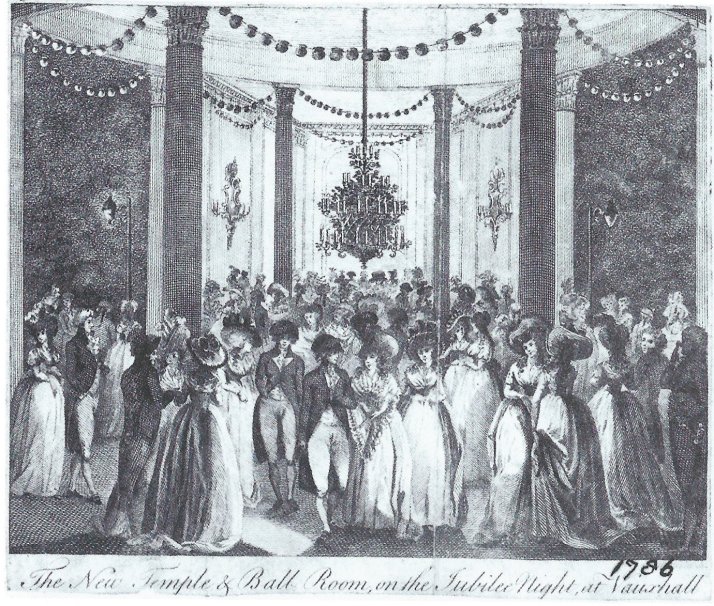
J. Wooding, The New Temple & Ball Room, on the Jubilee Night, at Vauxhall, engraving, c. 1786. The circular Grand Temple at the junction of the Grand South Walk and the Centre Cross Walk, with the temporary ballrooms added to its north and south. The artist was keen to show all the different forms of lighting in use.

J. Wooding, The New Temple & Ball Room, on the Jubilee Night, at Vauxhall, engraving, c. 1786. The circular Grand Temple at the junction of the Grand South Walk and the Centre Cross Walk, with the temporary ballrooms added to its north and south. The artist was keen to show all the different forms of lighting in use.

The approach of the half-century mark of the opening of Vauxhall Gardens “must have come as a godsend to Barrett at the start of his proprietorship.”

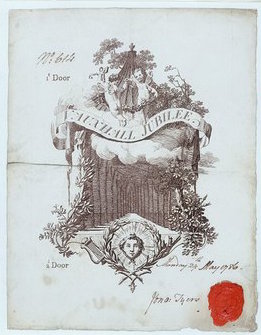
The last great fashionable event had been the hugely successful Ridotto al Fresco of 1769. In a conscious attempt to remind people of the ‘good old days’, when the gardens had last been patronised by fashionable society, the design of the ticket for the vent of the event of seventeen years earlier was adapted for the 1786 Jubilee.

Ticket for the Vauxhall Jubilee, 29 May, engraving. Signed, dated and sealed by Jonathan Tyers the younger, although the management of the park was now in the hands of his son-in-law, Bryant Barrett.

Ticket for the Vauxhall Jubilee, 29 May, engraving. Signed, dated and sealed by Jonathan Tyers the younger, although the management of the park was now in the hands of his son-in-law, Bryant Barrett.

In preparation for the event, which took place on 29 May 1786, the following renovations were completed:

  1. The buildings around the Grove were painted in an elegant pale blue and white livery, and flowering shrubs were planted to appeal to the modern taste in gardening.
  2.  The Rotunda’s interior decoration was completely renewed, with modern mirrors, and the Ionic columns of the Pillared Saloon were renewed with a rich deep pink scagliola. Window frames were replaced and draped with tasselled crimson and silver fabric, and the Rotunda Orchestra was filled with evergreen plants under a decorated ceiling. In the other recess (where the original Rotunda Orchestra had been housed), the large transparent painting of George, Prince of Wales (later the Prince Regent and George IV) in a noble classical pose was replaced with another transparency depicting an amphitheatre of the Corinthian order, through which could be seen a perspective view of a garden. (Apparently, the original transparency was criticized by some as having nothing in common with the Prince’s true character.)
  3. 14,000 coloured lights and wreaths of artificial flowers were draped around the pillars and in festoons around the cornices of the Covered Walks.
  4. A circular Grand Temple was set up at the crossing of the Grand South Walk and the Centre Cross Walk, “little more than a dome on eight classical columns.”
  5. The Centre Cross Walk was partly built over to give more dancing space in two temporary ballrooms, attached to the Grand Temple on the north and south. “The walls of these ballrooms were painted with Arcadian pastoral scenes beyond a range of Ionic columns decorated with wreaths of flowers, while the ceiling showed a sky filled with ‘tender variegated clouds.’” …In each of the ballrooms was an alcove for the musicians, and others for tables stocked with lemonade, capillaire, and orgeat (soft drinks flavoured with orange flower or almond syrup.) The whole strucutre was of course illuminated with thousands of coloured lamps ‘producing a refugency of light that dazzles and surprises.’
  6. On the site of the former Prince’s Pavilion (built for George III’s father), a new room was created for Prince George and his party.
  7. The entrance to the gardens on Kennington Lane was renewed and enlarged, soon becoming the main coach-entrance, later to be expanded with cloakrooms, waiting-rooms, and other public facilities.
handbill

Handbill for the Vauxhall Jubilee, 1786. A very plain and understated piece of printing, designed only to impart information about the event.

The Jubilee was attended by somewhere between five and six thousand people, most in fashionable and elegant costume, a few in fancy dress, which in this period meant smart dress with added details, such as feathers, flowers, ribbons, ruffs, etc., not character costumes.

There were last night above 6000 persons present, and among them some of the first people in the kingdom, but as is always the case at Vauxhall, it was a mélange; the cit and the courtier jostled each other with the usual familiarity; the half guinea was no repellent to the middling order; John Bull loves to shoulder his superiors in rank, his betters he’ll not allow them to be; and where he pays as much for admission, he never considers them to be more than his equals.

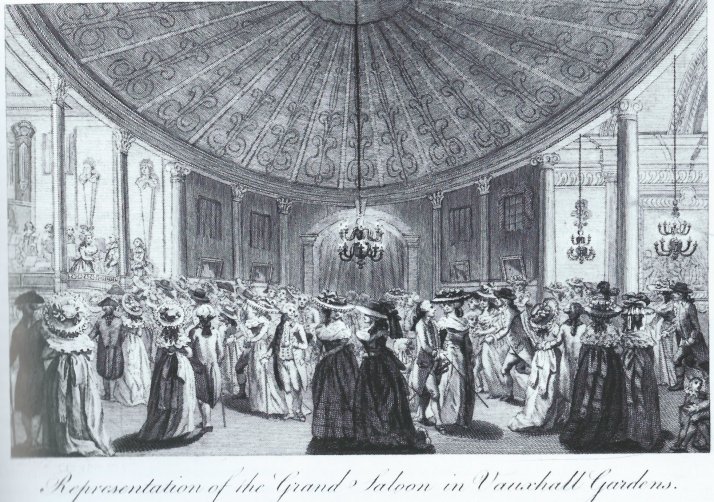
Anon., Representation of the Grand Saloon in Vauxhall Gardens, engraving, after 1786. An unusual view of the renovated Rotunda interior, taken from the entrance off the Grand Walk. The Rotunda Orchestra is on the left, and one of Hayman's paintings from his Seven-Years War series is visible in the Pillared Saloon on the right.

Anon., Representation of the Grand Saloon in Vauxhall Gardens, engraving, after 1786. An unusual view of the renovated Rotunda interior, taken from the entrance off the Grand Walk. The Rotunda Orchestra is on the left, and one of Hayman’s paintings from his Seven-Years War series is visible in the Pillared Saloon on the right.

On the following day, the gardens were opened to four thousand people who were not able to get tickets after those for the first event were sold out.

A successful season

Barrett took advantage of the popular trend of holding military fetes to honor the huge numbers of soldiers coming home from North America by promoting a patriotic tone to this one, with large transparencies framed by martial and naval motifs.

Later that year, when George III escaped a “rather pathetic assassination” by a housemaid with a knife outside St. James’s Palace, Vauxhall celebrated the king’s survival with a new patriotic song by James Hook and an organ concerto with variations on God Save the King.

Barrett’s first season at the helm “once more confirmed Vauxhall as a popular and respectable venue for fashionable society during the 1780’s. However,

…the public attitude towards the gardens was beginning to undergo a fundamental change. The largely unquestioning indulgence was now a thing of the past, and questions were being asked as to whether a pleasure garden was more of a nuisance than a benefit. The establishment’s opposition to public entertainment was strengthening.

Neighbors who had complained for years about the disruption caused by those returning home in the early hours of the morning, were starting to be heard.


Susana’s Vauxhall Blog Post Series

  1. Vauxhall Gardens: A History
  2. Vauxhall Gardens: Jonathan Tyers—“The Master Builder of Delight” 
  3. Vauxhall Gardens: A New Direction
  4. Vauxhall Gardens: The Orchestra and the Supper-Boxes 
  5. Vauxhall Gardens: The Organ, the Turkish Tent, and the Rotunda
  6. Vauxhall Gardens: Three Piazzas of Supper-Boxes
  7. Vauxhall Gardens: “whither every body must go or appear a sort of Monster in polite Company”
  8. Vauxhall Gardens: The Competition
  9. Vauxhall Gardens: The Artwork, Part I
  10. Vauxhall Gardens: The Artwork, Part II
  11. Vauxhall Gardens: The Music, 1732-1859
  12. Vauxhall Gardens: The Business Side
  13. Vauxhall Gardens: Developments from 1751-1786
  14. Vauxhall Gardens: Thomas Rowlandson’s Painting (1785)
  15. ‎Vauxhall Gardens: The Third Generation of the Tyers Family and the Jubilee of 1786
  16. Vauxhall Gardens: An Era of Change (1786-1822), Part I
  17. Vauxhall Gardens: An Era of Change (1786-1822), Part II
  18. Vauxhall Gardens: An Era of Change (1786-1822), Part III
  19. Vauxhall Gardens: The Final Years, Part I
  20. Vauxhall Gardens: The Final Years, Part II
  21. Vauxhall Gardens: The Final Years, Part III
  22. Vauxhall Gardens: The Final Years, Part IV
  23. Vauxhall Gardens: Farewell, for ever

Vauxhall Gardens: Thomas Rowlandson’s Painting (1785)

vauxhallbook

Vauxhall Gardens: A History

David Coke & Alan Borg

The Vauxhall Pleasure Gardens is one of the places I’d love to slip back in time to visit, just to catch a glimpse of what it was like. After recently splurging to buy this lovely coffee-table book, I thought it might make a wonderful subject for a new blog series. But do buy the book too, if you can! The photos are fabulous!

I’m so excited! I just bought a mounted poster of this painting in color from art.com to hang in my bedroom/office here in Florida.

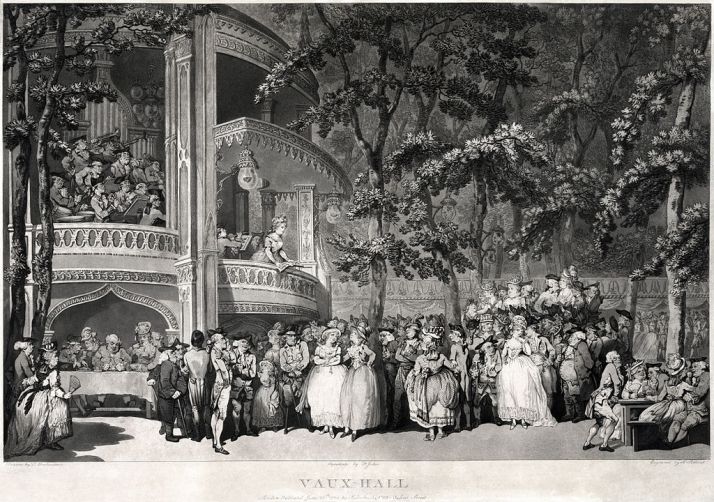
By the time this painting appeared, Jonathan Tyers had died and Vauxhall Gardens passed on to his wife and children, but it was his son Jonathan Tyers Jr.—that n’er-do-well younger son who wed a widowed lady much older than he and caused a giant rift among his parents—who assumed his father’s role in managing the park.

Thomas_Rowlandson_-_Vaux-Hall_-_Dr._Johnson,_Oliver_Goldsmith,_Mary_Robinson,_et_al


In the supper-box on the left we see, reading left to right, James BoswellMrs Thrale (who appears twice), Dr. Johnson, and Oliver Goldsmith.

The ‘macaroni’ Captain Edward Topham (scandalmonger to The World) is quizzing Georgiana, Duchess of Devonshire and her sister Lady Duncannon (Sheridan’s Lady Bessborough), watched by a naval figure with an eye patch and a wooden leg (not included in the Mellon version), always called Admiral Paisley, but Paisley did not lose his leg and eye until 1st June 1794, so it cannot be him. To the left of him, a young girl (a young boy in the Mellon version) holding the hand of a man who could be the comic actor, William Parsons, or Rowlandson’s friend Jack Bannister.

Peering at the two ladies from behind a tree is a figure traditionally, though improbably, identified as Sir Henry Bate-Dudley, the ‘Fighting Parson’, editor of the Morning Herald; he is more likely to be Thomas Tyers (son of Jonathan Tyers the great entrepreneur and proprietor of Vauxhall Gardens from 1729 until 1767) who stands next to the Scotsman James Perry, editor of the London Gazette. The couple on their right could well be the artist himself and his current girlfriend. and to the right of them stands the actress Mary ‘Perdita’ Robinson, with her husband on her right and the Prince of Wales (later George IV) on her left.

Looking up at the singer, the couple on the extreme left, have been identified as the actress Miss Hartley, in company with one of her many admirers, possibly Mr. Colman, but, suggested by their position apart from the crowd, they could also be members of the Tyers family (most likely Jonathan jr. and his wife Margaret, or their son-in-law Bryant Barrett and his wife Elizabeth. The large lady seated at the table on the right is Mrs Barry, the old Madam of Sutton Street, Soho, with two of her customers and one of her girls.

In the orchestra, we can see Jacob Nelson, the tympanist, who had played at Vauxhall since 1735, and died there after fifty years’ performing, Mr Fisher on oboe, probably Hezekiah Cantelo and Mr. Sargent on trumpet, and Barthélemon, the leader, who retired in 1783. James Hook, the composer, organist, musical director and prolific song-writer, may be seen between Barthelemon and the singer, the 38-year-old Frederika Weichsell, who was Rowlandson’s next-door neighbour in Church Street, and the mother of Mrs. Elizabeth Billington. Elizabeth had just (aged 18) married James Billington, a double-bass player, in 1783, much against her parents’ wishes.

A number of those present in this scene had already died by the time Rowlandson produced the painting, and the affair between the Prince and Perdita Robinson was already over.

Although there is no direct evidence for this, it seems likely, because of the dating, and because of the central position of the singer, that the painting was created by Rowlandson as a retirement gift for Frederika Weichsel, whether from him personally, or specially commissioned by the proprietors of the gardens.


Susana’s Vauxhall Blog Post Series

  1. Vauxhall Gardens: A History
  2. Vauxhall Gardens: Jonathan Tyers—“The Master Builder of Delight” 
  3. Vauxhall Gardens: A New Direction
  4. Vauxhall Gardens: The Orchestra and the Supper-Boxes 
  5. Vauxhall Gardens: The Organ, the Turkish Tent, and the Rotunda
  6. Vauxhall Gardens: Three Piazzas of Supper-Boxes
  7. Vauxhall Gardens: “whither every body must go or appear a sort of Monster in polite Company”
  8. Vauxhall Gardens: The Competition
  9. Vauxhall Gardens: The Artwork, Part I
  10. Vauxhall Gardens: The Artwork, Part II
  11. Vauxhall Gardens: The Music, 1732-1859
  12. Vauxhall Gardens: The Business Side
  13. Vauxhall Gardens: Developments from 1751-1786
  14. Vauxhall Gardens: Thomas Rowlandson’s Painting (1785)
  15. ‎Vauxhall Gardens: The Third Generation of the Tyers Family and the Jubilee of 1786
  16. Vauxhall Gardens: An Era of Change (1786-1822), Part I
  17. Vauxhall Gardens: An Era of Change (1786-1822), Part II
  18. Vauxhall Gardens: An Era of Change (1786-1822), Part III
  19. Vauxhall Gardens: The Final Years, Part I
  20. Vauxhall Gardens: The Final Years, Part II
  21. Vauxhall Gardens: The Final Years, Part III
  22. Vauxhall Gardens: The Final Years, Part IV
  23. Vauxhall Gardens: Farewell, for ever

Vauxhall Gardens: Developments from 1751-1786

vauxhallbook

Vauxhall Gardens: A History

David Coke & Alan Borg

The Vauxhall Pleasure Gardens is one of the places I’d love to slip back in time to visit, just to catch a glimpse of what it was like. After recently splurging to buy this lovely coffee-table book, I thought it might make a wonderful subject for a new blog series. But do buy the book too, if you can! The photos are fabulous!

The year 1751 marked the pinnacle of Jonathan Tyers’s success. After twenty years his vision was at last complete, and the basic ensemble of landscape and buildings was in place. The following year the act to license places of public entertainment was passed, leaving just the three major gardens, Marylebone, Ranelagh and Vauxhall, with a virtual monopoly for the time being. Vauxhall’s prestige would never be higher, and the artworks, design and refreshments would never be surpassed. The opening night of the season, Monday 20 May, was attended by about seven thousand visitors, all eager to see the most recent changes, and to enjoy the new musical performances.

A contemporary publication that effectively and entirely objectively sums up Tyers’s achievements is Stephen Whatley’s guide to the main towns and villages of interest in the country, England’s Gazetteer. Apart from a short description of classical statuary at Cuper’s Gardens, the only entry for a pleasure garden is under “Foxhall (Surry)’ (neither Ranelagh nor Marylebone merited a mention):

This is the place, where are those called Spring Gardens, laid out in so grand a taste, that they are frequented, in the 3 summer months, by most of the nobility and gentry, then in and near London; and are often honoured with some of the royal family, who are here entertained with the sweet song of numbers of nightingales, in concert with the best band of musick in England. Here are fine pavilions, shady groves, and most delightful walks, illuminated by above 1000 lamps, so disposed, that they all take fire together, almost as quick as lightning, and dart such a sudden blaze, as is perfectly surprizing. Here are, among others, 2 curious statues of Apollo the god, and Mr. Handel the master of musick; and in the centre of the area, where the walks terminate, is erected the temple for the musicians, which is encompassed all round with handsome seats, decorated with pleasant paintings, on subjects most happily adapted to the season, place, and company.

The growing success of Vauxhall can be attributed directly to Jonathan Tyers’s continual upgrades in music, lights, and fine costumes. Profits from major events were plowed right back into the gardens, which is what drew an increasing number of visitors.

The Pillared Saloon

Prior to the 1751 season, the Pillared Saloon was opened up and an extension created that provided for space for artwork and made space for half again as many visitors. Unfortunately, the design was awkward and unsophisticated and was probably created by inexperienced students at the St. Martin’s Lane Academy.

PILLARED SALLON REMODEL

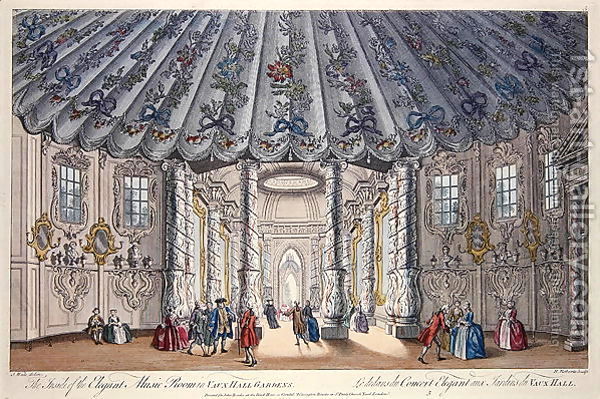
H. Roberts after S. Wale, The Inside of the Elegant Music Room in Vaux Hall Gardens, engraving, 1752 (British Library, London)

The new indoor orchestra stand opposite the Pillared Saloon, behind a balustrade that separated it from the audience, shared its awkward style; the same foliate columns framed it, and similar paintings decorated its ceiling. It must have been a substantial space, as an Irish visitor in 1752 claimed that he saw fifty-four musicians performing there, accompanying the singers Thomas Lowe and Isabella Burchell.

The Triumphal Arches and Decorative Paintings

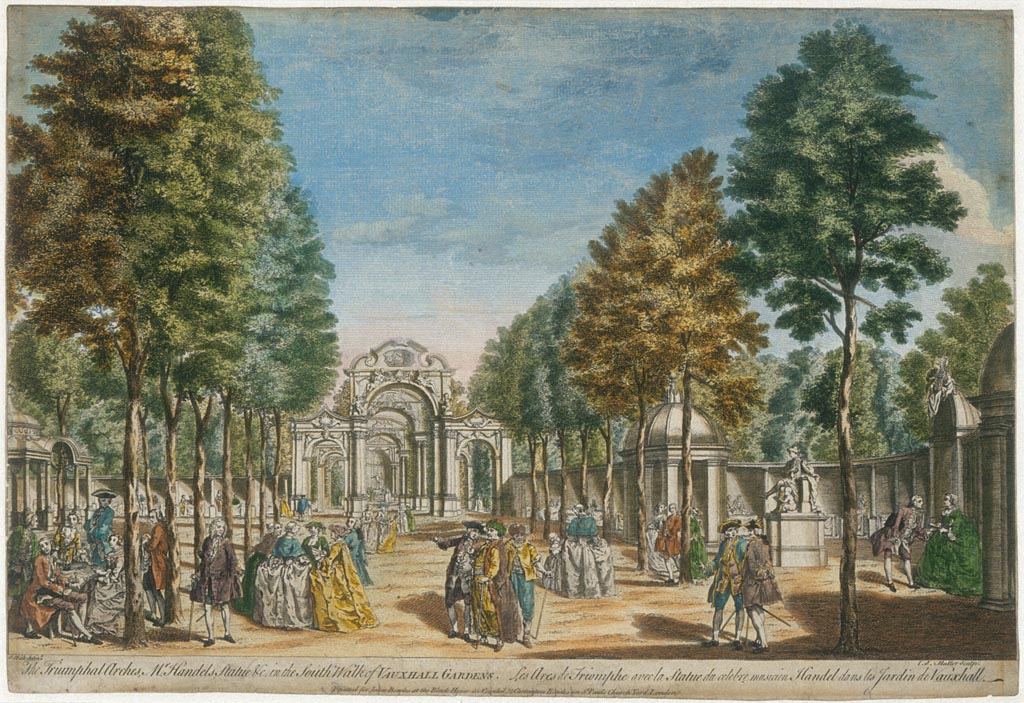
In contrast to the gaucherie of the Pillared Saloon, the three triumphal arches built over the South Walk at about the same time presented a more elegant, though more predictable, classical appearance… [T]hey were designed by ‘an ingenious Italian’ and made of timber and painted canvas.

ARCHES

J.S. Muller after S. Wale, The Walk of Triumphal Arches and the Statue of Mr. Handle in Vauxhall Garden, engraving, 1751 (British Library, London).

…the undeniably theatrical view through the three Vauxhall arches to the piece of scenery at the end of the walk must have been impressive; the vista was focused and enclosed by the surrounding trees, and the trompe-l’oeil effect of the scenery seen at the proper distance was intended to draw visitors to that end of the walk, where, on arrival, they could marvel at the skill of the artist, who had fooled them into thinking it was a three-dimensional object.

PALMYRA

E. Rooker after Canaletto, A Vew of the Center Cross Walk &c. in Vauxhall Gardens, engraving, 1751 (British Library, London).

In addition to these theatrical-esque arches, four large scenes were painted and installed at the end of the walks, to camouflage the surrounding landscape and introduce a bit of fantasy. The Temple of Neptune, at the end of the South Walk, was soon replaced by the ruins of Palmyra, after the publication of Robert Wood’s journey there. A painting of an alcove of three niches with figures of Flora and the Genii, at the end of the Dark Walk, was replaced with a scene of a Chinese Garden in 1762. “At the opposite end was an altogether more eccentric scene of another alcove, but this one bore a representation of a scaffolding and ladder ready for artists to work on the canvas.” The explanation for this:

An eminent artist, but of dissipated character, was employed by the first proprietors of the gardens to paint some classical designs at the end of one of the walks; but the delay in their completion so irritated the proprietor, that, having to leave London for a fortnight, he declared to the artist that he would listen to no further excuses, and that if he found his scaffold, paint-pots, &c. on his return, they should be thrown over the garden wall. On his return, perceiving, as he thought, in the same position, the scaffold, paint-pots, &c., he hastened to the spot to put his threat into execution, when, to his great amazement, he found them to be so accurately pictured on the canvas, that he ever after lavished the most extravagant praises upon the delinquent artist.

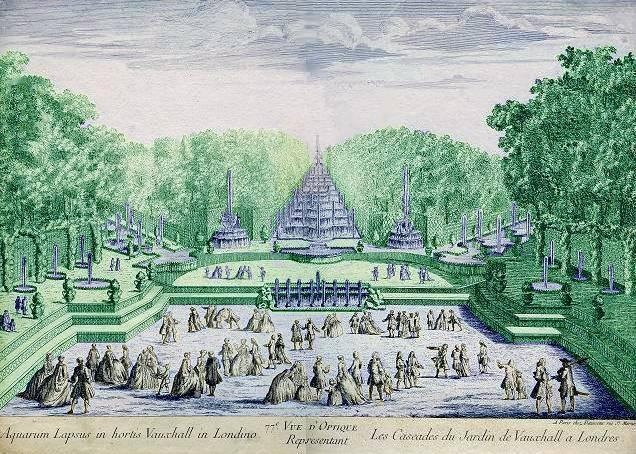
The Cascade

The most popular of Tyers’s additions in the 1750’s was the artificial Cascade, which was likely conceived by Frances Hayman, from his work with scenery and special effects in the theater.

The Cascade was concealed behind a curtain which was drawn back at a particular time in the evening, as night fell, to reveal a three-dimensional illuminated scene of a landscape with a precipitous waterfall: the illusion was created with sheets of tin fixed to moving belts, turned by a team of Tyers’s lamplighters; when it was running, the noise and spectacle must have been terrific.

Throughout its existence the Cascade underwent various improvements, enlargements, alterations, replacements, demolitions, and moves, which continued into the 1840’s. No visual representation of it survives, but at the height of its popularity in 1762 an anonymous author described it as:

a most beautiful landscape in perspective of a fine open hilly country with a miller’s house and a water mill, all illuminated by concealed lights; but the principal object that strikes the eye is a cascade or water fall. The exact appearance of water is seen flowing down a declivity; and the turning the wheel of the mill, it rises up in a foam at the bottom, and then glides away. This moving picture attended with the noise of the cascade has a very pleasing and surprising effect on both the eye and ear.

Until well into the 1820’s, when it was demolished to make way for the new Ballet Theatre, the Cascade continued to delight and surprise Vauxhall audiences, with depictions of the tidal race and watermill at London Bridge, of distance military encampments, and other scenes.

CASCADE

Well, I did find this image of the Cascade! Or at least it purports to be such.

The Gothic Orchestra

The original Orchestra building had outlived its usefulness, and was replaced in 1757-8 with a sort of Gothic-style building, made of wood and plaster and painted white and ‘bloom’, whatever that is. This building remained through the end of the gardens, having a domed roof with a “finial of Prince of Wales feathers”. The organ and musicians occupied the top floor, with supper-boxes on the bottom. The upper floor had graduated seating that made the musicians visible to the audience.

vauxhall_Muller_1751

Anon., A Perspective View of the Grand Walk in Vauxhall Gardens, and the Orchestra, engraving (David Coke’s collection), from the Gentleman’s Magazine (August 1765). The earliest view of the new Gothic Orchestra, built in 1757.

The Company

As we have mentioned previously, Vauxhall attracted a diverse group of visitors, more than any other entertainment of the period. The bulk of its income, however, came from the “Smarts,” which were middle-class young men, known for their licentiousness and self-indulgence, who came to show off to their female companions. A press reporter put it this way in July 1738:

The Smarts are, as it were, the sole Authors of our publick diversions at the Theatre they have a majority of the pit and the boxes: to them the Opera owes its subsistence, and Vaux Hall, the agreeable Vauxhall! would be a wilderness without them.

A big draw for the lower classes was the opportunity to encounter the upper classes, royalty, or other celebrities, that they would not normally be allowed anywhere near.

An account of a visit by an upper-class party is given by Horace Walpole:

I had a card from Lady Caroline Petersham to go with her to Vauxhall. I went accordingly to her house at half an hour after seven, and found her and little Ashe, or the pollard Ashe, as they call her; they had just finished their last layer of red, and looked as handsome as crimson could make them. […] We got into the best order we could and marched to our barge, with a boat of French horns attending and little Ashe singing. We paraded some time up the river and at last debarked at Vauxhall […]. At last we assembled in our booth, Lady Caroline in the front, with the vizor of her hat erect, and looking gloriously jolly and handsome. She had fetched my brother Orford from the next box, where he was enjoying himself with his Norsa and his petite partie, to help us to mince chickens. We minced seven chickens into a china dish, which Lady C. stewed over a lamp with three pats of butter and a flagon of water, stirring and rattling and laughing, and we every minute expecting to have the dish fly about our ears. She had brought Betty [Neale] the fruit girl, with hampers of strawberries and cherries from Rogers’s, and made her wait upon us, and then made her sup by us at a little table […]. In short, the whole air of our party was sufficient as you will easily imagine to take up the whole attention of the garden, so much so, that from eleven o’clock till half an hour after one, we had the whole concourse round our booth, at last they came into the little gardens of each booth on the sides of ours, till Harry Vane took up a bumper and drank their healths, and was proceeding to treat them with still greater freedom. It was three o’clock before we got home.

Then there was Henry Timberlake, who brought a group of Cherokee Indians to the gardens on two occasions, the second advertised ahead of time drawing ten thousand curious onlookers. (Note: those Cherokees had a very busy schedule. Take a peek here.)

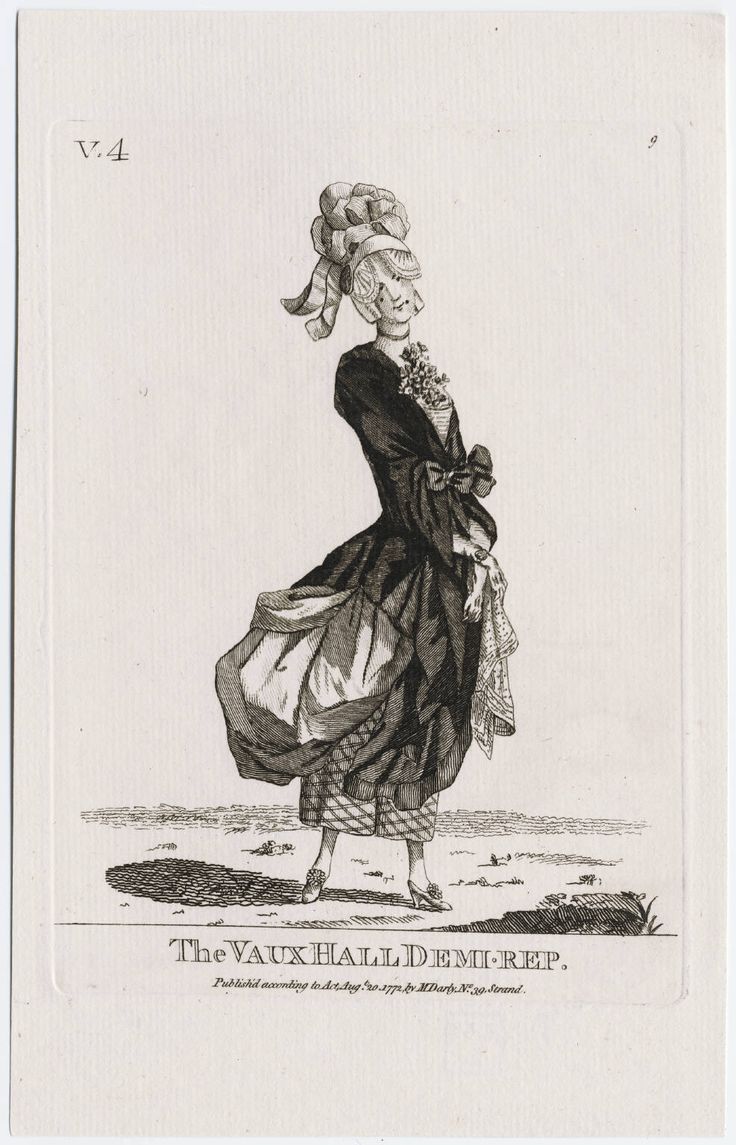
A ‘silent majority’ of visitors came from the professional classes, lawyers, doctors, parsons, and increasingly in the 1780’s, after Tyers’s death, prostitutes and the demi-monde.

demi-rep

Anon., The Vauxhall Demi-Rep, engraving, 1772 (Senate House Library, London). One of the working girls who frequented the gardens. Less a prostitute than an escort, the demo-rep would join an all-male party to titillate and amuse the men.


Susana’s Vauxhall Blog Post Series

  1. Vauxhall Gardens: A History
  2. Vauxhall Gardens: Jonathan Tyers—“The Master Builder of Delight” 
  3. Vauxhall Gardens: A New Direction
  4. Vauxhall Gardens: The Orchestra and the Supper-Boxes 
  5. Vauxhall Gardens: The Organ, the Turkish Tent, and the Rotunda
  6. Vauxhall Gardens: Three Piazzas of Supper-Boxes
  7. Vauxhall Gardens: “whither every body must go or appear a sort of Monster in polite Company”
  8. Vauxhall Gardens: The Competition
  9. Vauxhall Gardens: The Artwork, Part I
  10. Vauxhall Gardens: The Artwork, Part II
  11. Vauxhall Gardens: The Music, 1732-1859
  12. Vauxhall Gardens: The Business Side
  13. Vauxhall Gardens: Developments from 1751-1786
  14. Vauxhall Gardens: Thomas Rowlandson’s Painting (1785)
  15. ‎Vauxhall Gardens: The Third Generation of the Tyers Family and the Jubilee of 1786
  16. Vauxhall Gardens: An Era of Change (1786-1822), Part I
  17. Vauxhall Gardens: An Era of Change (1786-1822), Part II
  18. Vauxhall Gardens: An Era of Change (1786-1822), Part III
  19. Vauxhall Gardens: The Final Years, Part I
  20. Vauxhall Gardens: The Final Years, Part II
  21. Vauxhall Gardens: The Final Years, Part III
  22. Vauxhall Gardens: The Final Years, Part IV
  23. Vauxhall Gardens: Farewell, for ever

Encounter at White’s: a cross-post with Nicole Zoltack

Whites Club London-M

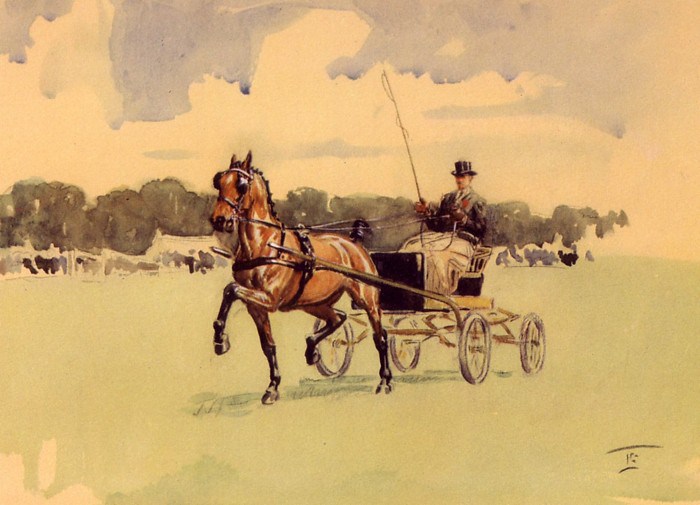
Oliver handed his hat and gloves to the porter as he removed his coat and presented it as well. Shivering in the notoriously chilly foyer at White’s Club, he made his way quickly toward the drawing room, where no doubt there would be a roaring fire. After more than a fortnight of escorting his fiancée and her mother to balls and ton events nearly every evening, not to mention drives in the park and ices at Gunter’s—along with his responsibilities at the bank—he was looking forward to an evening with his cronies and nice cognac or two. White’s always had the best spirits in town.

Oliver Stanton

Oliver Stanton

He hadn’t got very far, however, when he very nearly collided with Stephen Huntington, Duke of Wyngate, who was emerging from the card room with an expression of tight-lipped determination on his face.

“Pardon me,” the duke said, straightening his coat somewhat nervously.

“No need,” said Oliver easily. “Wasn’t watching where I was going. Join me in a drink, Your Grace?”

The duke blinked and stumbled back a step. “Why yes, I would appreciate that, Stanton.”

The two men strolled to the drawing room and claimed two leather chairs near the fire.

“A cognac for me,” Oliver told the waiter. “Wyngate?”

"Portrait of Citizen Guerin," by Robert Lefevre, 1801, French. The Age of Napoleon. Ed. Katell le Bourhis. NY: The Metropolitan Museum of Art / Harry N. Abrams, Inc., 1989. p.82, pl. 72.

Stephen Huntington, Duke of Wyngate

He liked Stephen Huntington, and not just because he was a duke and one of the bank’s best customers. He was an honorable man and not at all puffed up about it. Some titled gentlemen didn’t deign to speak to him unless it was at the bank and they needed access to their money. Wyngate wasn’t that sort.

“Cognac sounds perfect.” The duke rubbed his forehead.

“Right away, gentlemen.” The waiter bowed and disappeared into the back rooms.

The duke cleared his throat. “I-I have a strange question for you, Stanton, if I may.”

Oliver nodded. Who was he to gainsay a duke, even if he wished to. And he was curious to know what was behind the normally easy-going duke’s skittish behavior.

“Have we crossed paths, recently? Since the Hansens’ ball last week, I mean?”

Oliver’s eyes narrowed. “Why no, I don’t believe so. Why do you ask?”

Stephen tugged at his collar. “Ah… well, that’s good. That’s good,” he repeated. “You see… I have heard rumors that there is a man impersonating me throughout the country. I can scarcely believe it! But I cannot ignore such a thing, lest it be true and the wretch is up to serious mischief.”

Oliver’s eyes widened. “Impersonating you? But how is that possible? You are widely known in London, Your Grace.”

shapeimage_1The duke plucked a glass of brandy from the waiter’s tray and took a long sip. Oliver did likewise, wondering who would dare to play such a trick on the Duke of Wyngate, of all people.

“I do not know. I guess the reprobate must resemble me. Sound like me as well.” Wyngate took another swallow and set down his glass. “No one has come to the bank asking about my money recently? That could certainly be a factor.”

“Money is always a factor,” Oliver said dryly. “But no, I can assure you that your accounts are safe. I would have been notified had someone come to withdraw funds unexpectedly.” He set his own glass on the table. “How did the news come to you of this extraordinary situation?”

“My friends.” He gestured behind him toward the card room. “They can be rather prone to jokes and mischief, but somehow I doubt they would jest about something as serious as this.” He shrugged. “No need to concern yourself further. I am certain the matter will be resolved shortly. Now tell me, Stanton. I see that Lady Julia has recovered from her illness. Will your nuptials be rescheduled soon?”

Lady Julia Tate (at age 27)

Lady Julia Tate

Oliver winced, as he always did when that particular question was raised, which was happening quite frequently in the fortnight or so since their wedding guests had been sent home without witnessing a wedding or even catching sight of the bride and groom.

“I do not mean to pry.” Wyngate drank the last of cognac. “I was hoping one of us was happy.”

“Soon,” Oliver said. “These things take time to arrange, you know. The ladies expect such things. And I wouldn’t want my bride to be deprived of the wedding of her dreams simply because she was taken ill the night before the first one was to take place.”

He grinned. “What about you, Wyngate? Any interest in setting up your own nursery any time soon?” Any man with a title had to concern himself with the matter of an heir sooner a later. Particularly a duke.

“Oh no. Not I. I am not the least bit interested in marriage. And even if I were, with an imposter running about, I will be far too busy to woo and win the heart of any lady.”

Oliver chuckled. “A wealthy duke could have his choice of any young lady in the ton. With or without the wooing. But you must certainly investigate this matter of an imposter. Particularly if he resembles you to the extent that he could ruin your reputation. Do let me know if I can be of any assistance to you, Your Grace.”

“Thank you. You have always been a loyal and good friend.” Wyngate stood. “I would appreciate it if you could keep this matter to yourself. Unless you should happen to see another me…” He shook his head.

map

“Of course, Your Grace.”

“I should be off to try to track this rogue down. Do take care.” The duke turned and called for his horse.

Oliver rose and offered his hand. “Good luck, Your Grace.”

“You as well.” The duke shook his hand and gave him a tight smile. “Shall I expect another wedding invitation any time soon?”

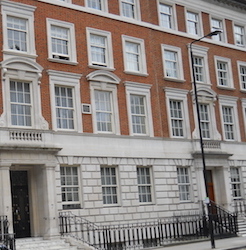
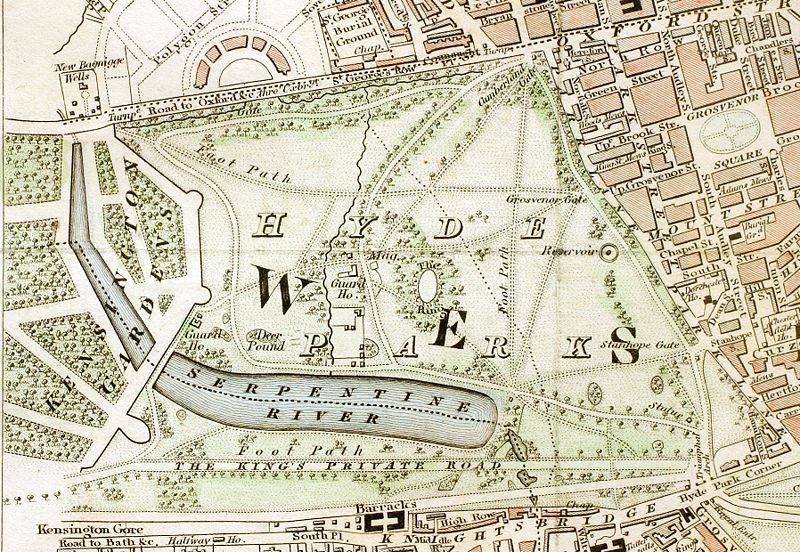
“Of course, Your Grace.” At least Oliver hoped it would be soon. The new house on Manchester Square was nearly ready, and he was eager to finally have Julia as his wife at last.

Vauxhall Gardens: The Business Side

vauxhallbook

Vauxhall Gardens: A History

David Coke & Alan Borg

The Vauxhall Pleasure Gardens is one of the places I’d love to slip back in time to visit, just to catch a glimpse of what it was like. After recently splurging to buy this lovely coffee-table book, I thought it might make a wonderful subject for a new blog series. But do buy the book too, if you can! The photos are fabulous!

Vauxhall’s huge success after Jonathan Tyers’s acquisition of the property, which had been in existence for seventy years as the “New Spring Gardens”, can be attributed to the man’s perception that his idealistic dream must be counter-balanced by sound financial practices. An essential element of this was publicity, and of this, Tyers proved to be a master. How did he do this?

Promoting Vauxhall

He promoted the gardens as a sort of “heaven on earth,” a magical sort of place to lift one’s spirits after a hard day in the real world.

[T]his was achieved through stories in literature and the printed media, through popular songs and through the artworks and music he commissioned. The second was the flattery of his audience; he consistently treated his visitors as special people, always referring to them as persons of quality, ladies and gentlemen, patriots, libertarians, educated people who appreciated fine things and good music. And the last was the simple dissemination of factual information about Vauxhall, its history, its current attractions, and how this pleasure garden should be enjoyed, by means of articles in newspapers and periodicals, of histories and guidebooks and of topographical and satirical engravings.

John Lockman, Publicist

John Lockman, Publicist

In truth, of course, Vauxhall fell short of perfection, and that’s where John Lockman came in. He was a sort of early publicist, who wrote poems and songs designed to “underscore Tyers’s transformation of a notorious gathering place for drunks, gamblers and prostitutes into a civilised pleasure garden where anyone could enjoy a decorous evening’s entertainment without risk to their reputation.”
Lockman’s assistance was necessary because it was impossible to exclude troublemakers, particularly if they were respectably dressed. “[I]t was easier to sell an enhanced image of the place to a persuadable public.

Tyers was always careful to make everybody in his clientele feel good about themselves, and in particular about their patronage of Vauxhall. In his press announcements, for instance, he would often start by thanking his visitors for their support, especially if the weather had been bad, and would repeatedly finish by pledging to keep out of his gardens anyone not worthy of their company.

Another tactic was to use magazines and newspapers. Newspapers, of course, were a no-brainer. Letters such as the “S. Toupee” articles published in Scots Magazine may or may not have been instigated by Tyers, but they certainly proved valuable in driving up excitement for Vauxhall. “Of the Luxury of the English; and a Description of Ranelagh Gardens and Vaux-hall, in a Letter from a Foreigner to his Friend at Paris,” supposedly written by Henry Fielding (a friend of Tyers) and commissioned by Tyers, piled on the praise for Vauxhall in comparison to Ranelagh Gardens.

A female audience was enticed to Vauxhall by published songs and by scenes in novels set in Vauxhall Gardens. And then there were the Love at First Sight articles, or “Lonely Hearts” columns, which may or may not have been genuine. Here’s one from the London Chronicle in August 1758:

A young Lady who was at Vauxhall on Thursday night last, in company with two gentlemen, could not but observe a young gentleman in blue and a gold-laced hat, who, being near her by the orchestra during the performance, especially the last song, gazed upon her with the utmost attention. He earnestly hopes (if unmarried) she will favour him with a line directed to A.D. at the bar of the Temple Exchange Coffee-house, Temple-bar, to inform him whether fortune, family, and character, may not entitle him upon a further knowledge, to hope an interest in her heart.

Another marketing tactic was to engage actors dressed as gentlemen to patronize coffee-houses to express their intention to go to Vauxhall and entreat others to meet them there.

Tyers’s Management Style

It goes without saying that if one wishes to have customers return, one has to ensure that their first time is as pleasant and enjoyable as possible. If you knew Jonathan Tyers—and you probably wouldn’t because it was never himself he wanted to promote and therefore took pains to remain in the background—you could see him in the kitchens working as hard as his employees to get the food out to the customers.

Waiters, or “drawers” were freelance employees, who were constrained to work hard in order to earn tips and keep their posts. Since in other venues, “drawers” were known to steal from their employers, “Vauxhall waiters were required to pay for the food on collection from the kitchens, and themselves ran the risk of defaulting customers, especially if they had not been sufficiently polite or efficient in their service.”

Although he had to maintain a strict discipline among his employees, he was a thoughtful employer. When two of his waiters married two of his barmaids, he provided wedding rings and an elaborate dinner at his home in Denbies, with fifty of his staff as guests.

one shilling coin

Vauxhall Tickets

Up until 1736, the admission cost was sixpence, but afterward, the price was doubled to one shilling. Considering the expense of maintaining and improving the gardens and contriving new entertainments, this seems modest indeed; however, there was more to be made from the food and drink once the visitors were admitted. For the visitors, there was also the cost of dressing respectably and the cost of transportation. The one shilling price was fixed until 1792, when it was doubled to two shillings.

Season Ticket greySeason Ticket grey reverse

In 1737 Tyers initiated a subscription price, or season ticket. The metal tickets were issued to a thousand people at a guinea each, and would admit two people to the gardens for the entire season. Not only did this ensure repeat visits by two thousand people, it provided him with funds upfront to use for maintenance and improvement.

The relief on the obverse usually represented, through classical imagery, a particular aspect of Vauxhall Gardens, often associated with the music. On the reverse was engraved the subscriber’s name, accompanied… by the ticket’s number.

silver ticket

silver ticket

In 1738, the tickets were made of silver and the price rose by three shillings. In 1741, the price was raised to two guineas.

As a comparison, a season ticket for two to the Great Room in Soho was five guineas, while individual concerts were ten and a half shillings, the same price as Handel’s fundraising concert at the Foundling Hospital in 1749. Almack’s (founded in 1765) charged ten guineas for a once-weekly ball over twelve weeks, so Vauxhall tickets were considered quite a bargain.

Hogarth's gold "perpetual" ticket

Hogarth’s gold “perpetual” ticket

Attendance

“S. Toupee” in his letters in Scots Magazine estimated that “not less than one thousand shillings are received each evening of performance during the season,” not including season ticket holders. Special events, such as the rehearsal of Handel’s Music for the Royal Fireworks, drew several thousand spectators. Opening and closing nights and royal birthdays also drew large crowds.

The opening night of the 1769 season, for instance, was a remarkably fine evening for the time of year, and it was estimated that ‘there were upwards of twenty thousand of the first nobility present.’

Crime and Disorder

Even though it suffered occasional lean times, there can be little doubt that eighteenth-century Vauxhall Gardens became the most popular single visitor attraction for London… With these numbers of people coming together, especially to a place where alcohol was available, crime, vandalism and disorder were inevitable.

Nor was it just pickpockets and prostitutes his police force (initiated in 1732) had to deal with. While Tyers encouraged his waiters to restrict alcohol consumption, it was difficult for them or even him to police the mischievous London Bucks, who were of a class higher than his. Tyers and his staff managed these problems themselves, even if it meant “eating” the cost of vandalism, not wanting to involve courts, which would draw bad publicity. “S. Toupee,” in one of his letters in 1739, “pointed out that there was ‘a man in the posture of a Constable, to protect the Ladies from any insult, &c.’ at the end of each walk.

Besides the half-dozen or so constables, he employed up to eight men to guard the route from the river and led a (possibly regular) blitz against the pickpockets.

Refreshments

Anyone who has worked in the restaurant industry can tell you how difficult a task it is to prepare food for crowds of people, but how many restaurants have to cater for 500-1000 or more hungry people? This is a logistical nightmare that Tyers managed with aplomb.

Consistent with his insistence on featuring English art and music, the food at Vauxhall was simple and English. There were complaints about the prices, of course. Here are some prices from one of the “S. Toupee” letters in 1739:

  • one bottle of French claret: 5 shillings
  • one cold chicken: 2-1/2 shillings
  • one quarter of cyder: 1 shilling
  • one quart of small-beer: 4 pence
  • one slice of bread: 2 pence
  • one slice of cheese: 4 pence
  • dish of ham or beef: 1 shilling, salad, an extra pence
  • sweet pastries: 1 shilling
  • custards and cheesecakes: 4 pence
  • heart cakes and Shrewsbury cakes: 2 pence
  • one bottle of champagne and arrack: 8 shillings
  • two pounds of ice: sixpence
Isaac Cruikshank, A Country Farmer & Waiter at Vauxhall. A farmer in country dress, on his first visit to Vauxhall, has ordered ham in expectation of a plateful of English gammon. When the waiter brings him the notoriously thin slices that were Vauxhall ham, the farmer is furious.

Isaac Cruikshank, A Country Farmer & Waiter at Vauxhall. A farmer in country dress, on his first visit to Vauxhall, has ordered ham in expectation of a plateful of English gammon. When the waiter brings him the notoriously thin slices that were Vauxhall ham, the farmer is furious.

Even a devoted fan such as “S. Toupee” confessed that the food was expensive. The sliced meats were thin, especially the ham. “This was all part of the fun of the evening—a great joke on fashionable society who were happy to play along.” A well-known verse alluding to this:

Never trouble Ham House, or its inmates at all,

For a ghost, that may be but a sham,

But seek in a sandwich that’s cut at Vauxhall,

For the true apparition of Ham.’

Note:

The cost of the food did not alter significantly over the whole period from Tyers’s re-launch until the gardens’ final closure; the prices of wines and spirits, however, were a different matter, rising sharply in the nineteenth century.

Susana’s Vauxhall Blog Post Series

  1. Vauxhall Gardens: A History
  2. Vauxhall Gardens: Jonathan Tyers—“The Master Builder of Delight” 
  3. Vauxhall Gardens: A New Direction
  4. Vauxhall Gardens: The Orchestra and the Supper-Boxes 
  5. Vauxhall Gardens: The Organ, the Turkish Tent, and the Rotunda
  6. Vauxhall Gardens: Three Piazzas of Supper-Boxes
  7. Vauxhall Gardens: “whither every body must go or appear a sort of Monster in polite Company”
  8. Vauxhall Gardens: The Competition
  9. Vauxhall Gardens: The Artwork, Part I
  10. Vauxhall Gardens: The Artwork, Part II
  11. Vauxhall Gardens: The Music, 1732-1859
  12. Vauxhall Gardens: The Business Side
  13. Vauxhall Gardens: Developments from 1751-1786
  14. Vauxhall Gardens: Thomas Rowlandson’s Painting (1785)
  15. ‎Vauxhall Gardens: The Third Generation of the Tyers Family and the Jubilee of 1786
  16. Vauxhall Gardens: An Era of Change (1786-1822), Part I
  17. Vauxhall Gardens: An Era of Change (1786-1822), Part II
  18. Vauxhall Gardens: An Era of Change (1786-1822), Part III
  19. Vauxhall Gardens: The Final Years, Part I
  20. Vauxhall Gardens: The Final Years, Part II
  21. Vauxhall Gardens: The Final Years, Part III
  22. Vauxhall Gardens: The Final Years, Part IV
  23. Vauxhall Gardens: Farewell, for ever

Strange happenings in Hyde Park: a Bluestocking Belles cross-post

Today on Susana’s Parlour, Jude Knight and I have something special: a stand-alone short story with two characters from the Bluestocking Belles’ holiday box set, Mistletoe, Marriage, and Mayhem. Mary, the heroine of Jude’s story, Gingerbread Bride, meets Agatha Tate, Lady Pendleton, the mother of Julia Tate, the heroine of my story, The Ultimate Escape. In this episode, Lady Pendleton is just returning from a two-week journey into the twentieth century. Yes, she is a time-traveling Regency lady (who has appeared on this blog on several occasions in the past).

Pissarro_Hyde_Park

Agatha Tate staggered backwards as her feet touched the ground until, unable to reclaim her balance, she toppled over onto the soft grass at Hyde Park.

“Wh-at?” She put a hand to her aching temple and tried to regain her bearings. “Where am I?”

Agatha Tate, Lady Pendleton

Agatha Tate, Lady Pendleton

She opened her eyes and could see a vague image of a young girl in front of her. A girl who had likely seen her materialize out of nowhere, she realized as her wits were restored to her. Good heavens! How was she going to explain something was… well… unexplainable?

The girl—a young woman really, Agatha could see as her vision cleared—stepped forward, blinking rapidly. “May I help you?”

“Uh… who are you?” Agatha asked, her head still throbbing. “How long have you been there?”

Agatha pulled herself up into a sitting position and cast about for her shopping bag, which had landed in a nearby bush. “Oh my, can you get that for me, my dear? I need to change my attire before anyone sees me.”

She was still wearing her animal print leather jeans and denim jacket, which was certain to startle an inhabitant of London in 1799. Of course, she should have changed to her original clothing prior to leaving the twentieth century, but she’d been so stricken by the need to see her family again that she’d collected her bag, pulled out the stone, and uttered the gypsy’s spell before the thought could occur to her.

“Well, before anyone ELSE sees me. I shouldn’t want to cause a scandal.”

Mary Pritchard

Mary Pritchard

The bemused young lady fetched the bag and handed it to her. Agatha could see that her bright red hair was tousled and she seemed to be short of breath.

“Mary Pritchard, ma’am, at your service.” The young lady curtseyed politely.

“A pleasure to meet you, Miss Pritchard. Please allow me to introduce myself. I am not usually so rag-mannered, but since we have met in such unconventional circumstances…. Oh dear, there I go again! I am Lady Pendleton. My husband is Lord Pendleton, of Wittersham.”

“I am pleased to make your acquaintance, my lady.” She glanced at their surroundings, and returned her gaze toward Agatha with a reassuring smile. “We are hidden here, I think. I will keep a lookout un case Viscount B… in case anyone comes this way while you are changing.”

Agatha smiled, feeling a bit sheepish. “How very kind of you, Miss Pritchard. I was just about to ask if you would do me that small favor.”

She took the bag behind a bush and began to tug at the tight leather jeans. “Oh, I know I shouldn’t have had that last Big Mac,” she groaned.

Upon seeing the look of bewilderment on Miss Pritchard’s face, Agatha rolled her eyes. She already had a great deal to explain to the kind young woman. She’d better watch her tongue from her on in.

She coughed. “I’m afraid I’ve been over-indulging during the past fortnight. I hope my old clothes will still fit.”

“Have you traveled far?” Miss Pritchard asked politely.

Agatha grinned. “You could say that, I suppose.”

A crashing further back in the woods startled them, particularly Miss Pritchard, whose hand went to her chest as she turned toward the origin of the sound. She appeared frightened out of her skin.

Lady Pendleton pulled her yellow morning gown over her head. “Are you well, my child?”

I’m the one who has traveled 200 years and she’s the one who looks white enough to be a ghost.

“I… ah… you must wondering, ma’am, at my being here without an escort. That sound is, I think, my escort. If he finds me, would you be kind enough to say I am with you?”

The poor girl was trembling! Agatha stepped out from behind the bush and folded the girl into her embrace. Why she looked to be only a year or two older than her own daughter Julia!

“Your escort… attacked you? How did that happen?”

After a brief moment, Mary returned her embrace. She was a brave one—or perhaps foolish—to trust a complete stranger, particularly under these circumstances.

“I refused his proposal, and he thought to force me. I… ah… punched him in… ah… I distracted him and ran.”

What are Miss Pritchard’s parents thinking to allow her to be escorted by such a villain?

Miss Pritchard bit her lip. “I do not know what to do. If I tell my aunt, she will say that we must marry, and I would rather throw myself into the Thames than marry a man who only wants my money.” She sighed. “Actually, I would rather throw him into the Thames.”

Agatha straightened up. “This… this… Boswell won’t harm you as long as I’m here, my child.” She grinned. “The Serpentine is a great deal closer. Will that do instead, do you think?”

No. 42, Grosvenor Square, the Pendletons' London home

No. 42, Grosvenor Square, the Pendletons’ London home

She turned her back. “Hurry, do me up and we’ll away from here. I live in Grosvenor Square; it’s not too far.”

The girl chuckled and hastened to oblige. Agatha gathered her discarded clothing and stuffed them into the bag, realizing she would have to keep on her twentieth century boots since she had left the old ones behind.

“Ma’am, I could not help but notice the manner of your arrival and your attire. Would you think me impertinent if I asked where you came from?”

Agatha swallowed. What to say? Perhaps she could avoid the question… a little while longer.

“It’s a long story. What concerns me most at the moment is what your parents could have been thinking to leave you alone with such a rogue.”

Miss Pritchard sighed. “I came to live with my aunt when my papa died. The rogue is her son, I am afraid. She is as keen to have the inheritance my papa left me as her son is.”

Agatha’s nostrils flared. “How disgraceful! Clearly, she is not a fit guardian. Is there no one else who can offer you protection, my dear?” She pressed her lips together. “My husband and I don’t hold with arranged marriages. Not for our three daughters, or for anyone else, if it can possibly be helped.”

800px-Hyde_Park_London_from_1833_Schmollinger_map

She set a fast pace toward the Grosvenor Gate. She wasn’t about to allow this scoundrel to make off with Miss Pritchard under any circumstances, but it would be best if they avoid a direct confrontation.

“He doesn’t even want me,” her young charge burst out. “I heard him tell his friends that he would park me in the country while spent my lovely money!”

As they approached the gate, Agatha paused and looked cautiously behind her for any sign of a pursuer and sighed with relief at not seeing one. Followed by a moment of uncertainty. The more she thought about her own family and how they must have worried about her disappearance, the more eager she was to hurry home and beg their forgiveness. On the other hand, she wasn’t sure she was quite ready to confront them—particularly not her husband George. In any case, she couldn’t abandon this poor little dove to her mercenary aunt and odious cousin. What to do? What to do?

“I’ve got it,” she said. “Tea!”

“Tea would be very welcome,” said Mary. “I have no wish to go home until I decide what to do about beastly Bosville.”

Agatha knew of a delightful little bookshop on Mount Street that served tea, which frankly she had not enjoyed half so well during her travels into the future.

“Let us have a brief respite at my friend Mrs. Marlowe’s bookshop,” she suggested. “She is very cordial and serves the best tea and biscuits in Town.”

Mary’s face brightened. “I know it!” Mary said. “She has an excellent range of books.”

Suddenly she moved to one side, putting Agatha between her and the carriageway, where a dark-haired dandy was driving a phaeton at a furious pace out of the gate and into the street beyond.

1948-TROTTING-HACKNEY-CARRIAGE-HORSE-PRINT_700_600_QVBO

“Forgive me,” she said, “I am not usually so nervous, but that was my cousin, and I would rather he did not see me at present. Although,” she added, “I suppose it is silly of me, for what could he do in all this crowd? And I will take care not to be alone with him again, you may be sure.”

Agatha shook her head. “He looked very angry. It’s best to avoid a confrontation. Let’s away to Mount Street and refresh ourselves while we plan our strategy.” She was thinking “strategies”, because she had to come up with one for her own situation as well.

The bookshop was as busy as ever, with several customers waiting their turn at the counter. Mary led them up the stairs to the tearoom, where little tables invited friendly conversation.

tea table

“Lady Pendleton, I hope you do not think me rude, but I could not help but notice your attire when you—er—arrived. And—it cannot be true, can it? You seemed to appear out of nowhere!”

Agatha blanched. A more prudent woman would not have considered confiding her situation—as strange as it was—to a young girl such as Mary, but then, Agatha had never been known for her prudence.

“I’ll have a cup of Bohea,” she told the waiter. “And some strawberry tarts if you have them. What would you like, my dear?”

“Souchong, please,” Mary said. “And strawberry tarts sound wonderful.”

After the waiter had departed, Agatha turned to Mary. She might as well get it over with. “When you saw me earlier today, I was wearing clothing from the twentieth century. I-uh- was visiting there for the past two weeks. I suppose you might call me—a sort of time traveler.”

Agatha’s hands were clammy. It sounded so ridiculous to say such a thing, and she wouldn’t have believed it herself if she hadn’t experienced it firsthand. But she was going to have to say it again—soon—to her husband, so she’d best get over her fears now rather than later

Mary opened her mouth and closed it again. “How marvelous,” she said at last. “I have traveled much of the world, but to travel in time? How wonderful!” She sat up straight in her chair, her eyes widened.

“Marvelous, yes, it is at that,” Agatha agreed. “Quite fascinating. An amusing and rather unconventional manner of escaping one’s problems. But now… I find myself having to face them after all.”

Mary nodded. “Running away does not solve things. Though it can win you time to find a solution.”

Their conversation was interrupted by the arrival of the tea. Agatha poured for both of them.

teapot

“You are wise for your age,” she commented as she passed her the plate of tarts.

Mary smiled. “Thank you, ma’am. I am on my own, you see, and must think for myself. And I am of age, though I know I look younger. My youth is a great disadvantage. Were I older, I could move to my own residence, and no one would be in the least scandalized.” She sighed.

Agatha leaned in and lightly stroked Mary’s arm. “I have three daughters at home. Julia, my eldest, is fourteen. I have missed them all so much, and my husband most of all. But I needed time to reflect on my situation, and knew my mother and aunts would only tell me to go back to my husband.”

Lady Julia Tate (at age 27)

Lady Julia Tate (at age 27)

She shook her head. “Marriage is not something to be rushed into. My George and I married for affection and fell in love later. And for the most part, we have rubbed along very well. I never thought he would turn into a—despot.” She winced, knowing in her heart that George was not a despot. Someone had wounded his pride. That holier-than-thou William Wilberforce, who despised some of her political friends because he disapproved of their morals.

Mary grimaced. “But are you going home now?”

Agatha’s mouth went dry and she took another sip of her tea.

“I am,” she said. “I must. I cannot abandon my daughters. Or my husband.”

“Of course not,” Mary agreed.

“But George must know that I won’t have a despot for a husband. While women do not have the sort of freedoms in this century that they will have in the future,”—she saw Mary’s eyes widen in surprised—“we do have options, and he must surely know I would not hesitate to take some of them, undesirable though they would be.”

She licked her lips with cautious hope. “If I know my George, though, he has long ago forgotten his anger amidst his concern for my absence.” She smiled as she imagined a tender reconciliation between them. She felt a sense of calm.

Taking the last sip of tea, she set her cup down. “It appears that my path is quite clear. I must return home and have a serious discussion with my husband. As for you, my dear, I wonder if you haven’t any other relatives you could appeal to, since clearly these Bosvilles are not suitable.”

Mary’s face brightened. “I wonder that I did not think of that! Yes, indeed! I have three more aunts, though I have not met them. Papa said I was to come to London. He thought Aunt Bosville might help me to find a husband.” Her color deepened, her fair skin showing her embarrassment. “I find I am not in the fashionable mode, however. Being raised on a naval ship does not prepare one to talk nonsense, and faint, and be ridiculously frilly and the like. And then…” she gestured at her bright red hair and freckles, “there is how I look.”

Agatha raised an eyebrow. “I see nothing amiss with your appearance. Your coloring may not be the fashion this year, but it does not prevent you from having an appeal of your own. Indeed, my eldest daughter is flame-haired and freckled, and I am quite certain she will grow into her own beauty when she past the tomboy phase.” She grinned. “Red hair is quite popular in the twentieth century. I observed that many of the younger ladies had deliberately colored their hair red, or at least a portion of it.” She frowned. “Of course, there were also shades of blue and green that I could not like at all, but that was the way of things—or will be, I should say. Society is so much more liberated in the future.”

Mary leaned forward. “Lady Pendleton, do you think… Could you tell me how you came to travel through time? Could I do it?”

Agatha wrinkled her brow. “Oh no, my dear! I think it would be quite ill-advised for someone so young to venture off into a completely different world. You may be certain I will not breathe a word of it to any of my daughters, at least not until they are old enough to have learned to resolve their problems rather than try to avoid them. No indeed, dear Mary, we must find a rather more conventional solution to your dilemma.”

“I am familiar with adventures, Lady Pendleton. I have been in a number of tight spots in many parts of the world. Though I have needed rescue from time to time, and I suppose I cannot expect Rick—Lieutenant Redepenning—to follow me two hundred years into the future.”

Now this was a promising development. “This Rick-er-Lieutenant Redepenning… you say he has come to your rescue in the past? Sounds like a delightful young man. The two of you appear to have a great deal in common. Is he eligible, do you think?” She winked. “I must confess that I would like to see my daughter Julia make a match with Oliver, who lives next door to us in Wittersham. They have been close friends forever.” She sighed. “Although it remains to be seen how well they deal with each other as adults.”

“Things can certainly change when one grows up, Mary sighed. “We were good friends when we were younger, but now… Lady Pendleton, a friend would visit a friend, would he not? If he were in London, and she were in London? A lady cannot call upon a gentleman, after all. Aunt would not even allow me to send a note! At first he was recovering from his injury, but he has been seen about Town these past six weeks and has not been to see me.” She sighed again, more deeply this time. “No, eligible or not, Rick the Rogue is not interested in plain Mary Pritchard.”

Then she brightened. “I will go to my aunts in Haslemere, Lady Pendleton. I will make the arrangements today.”

“Do you need a place to stay before you leave, Miss Pritchard?” Agatha patted her hand. “You would be welcome, if you think your return to Lady Bosville’s house would put you at risk.”

Mary shook her head. “I am quite sure that is not necessary, my lady. My cousin is unlikely to dare anything further. If he should return home, that is. He often stays away for days at a time.”

“I do hope that is the case, dear. However,” she added in a maternal tone, “Do not neglect to hire a post chaise, and your own outriders. You have a maid who can accompany you, I take it?”

“The public coach goes straight through to Haslemere, where my aunts live. Yes, I do believe it is the perfect solution. Thank you for your counsel, Lady Pendleton. And best of luck with your own reunion. I am certain your family will be over-the-top excited to have you back again!”

I hope so too, Agatha thought. In any case, it was time she found out. She rose from her seat and reached for Mary’s hand.

“It was a great pleasure to meet you, Miss Pritchard. My sincere thanks for your assistance in the park earlier. I can trust on your discretion, I suppose?”

At Mary’s nod, she clasped Mary’s shoulder. “I wish you well on your journey. And if you need any further assistance, please send for me at Grosvenor Square. Number forty-two.”

And the two of them departed the bookshop to face their own separate destinies.

Click here to read the story from Mary Pritchard’s point of view.

Click here for more information about Mistletoe, Marriage, and Mayhem.

Join us on Facebook for our launch of Mistletoe, Marriage and Mayhem on November 1, 2015.

Our Christmas Party Box Rafflecopter is here.

Celebrate with us!

Close-up-of-explosion-of-champagne-bottle-cork2