Archives

Sheri Cobb South: Too Hot to Handel (Giveaway)

Every novel contains, or should contain, certain scenes that stick in the reader’s memory long after the book is finished. The definitive scene in my newest release, Too Hot to Handel, finds Bow Street Runner John Pickett and his Lady Fieldhurst escaping a burning Drury Lane Theatre. This is the only book I’ve ever written that is centered upon an actual event; the Theatre Royal at Drury Lane really did burn down on 24 February, 1809. So, how much was real, and how much is the product of my imagination? Let’s take a look.

First of all, theatre fires were not a rare, or even a new, phenomenon. They had been regular occurrences since the theatres reopened after the Restoration of Charles II. Before that time, fire hadn’t been much of an issue. The theatres of ancient times had been outdoor affairs, and plays had been staged during the daytime. Even Shakespeare’s Globe Theatre, although enclosed all around, had a roof that was largely open to the sky, in order to reduce as much as possible the need for artificial lighting. But advances in theatre brought added risk of fire: the Globe burned down in 1613, when a cannon used for special effects in a production of Henry VIII misfired, setting the thatching over the stage ablaze. Although the theatre was destroyed, the only injury reported was one unfortunate man whose breeches were set on fire. (Quick-thinking theatergoers extinguished the flames by dousing him with ale.)

The real change came with the Restoration, when the re-opening of the theatres was celebrated with a host of innovations. The most prominent of these, of course, was the appearance of actresses in female roles that had previously been played by boys. Another, perhaps less-discussed innovation was the rash of theatre-building, including venues at Lincoln’s Inn Fields (1661) Drury Lane (1663), the Haymarket (1720), and Covent Garden (1731). Unlike their open-air predecessors, these new venues were fully enclosed. This meant performances were no longer limited to daylight hours, but it also meant that all performances, even those staged during the day, required artificial lighting. And artificial lighting meant open flames—either candles or oil lamps—and lots of them.

When we consider the combination of open flames and rowdy crowds—capacity in the new theatres rose from 650 seats at Drury Lane in 1700 to 3,600 by the time of the 1809 fire—the number of theatre fires is no longer surprising. In those days before electricity, the theatre at Drury Lane burned twice (in 1672 and again in 1809), as did the one at Covent Garden, aka the Royal Opera House (in 1808 and 1856). Ironically, only fifteen years earlier, in 1794, the Drury Lane theatre had installed a fire curtain made of iron—the first theatre in London to do so—along with large water tanks beneath the roof that could be used for special effects as well as fire safety.

With all these precautions in place, how, then, did it burn? No one knows. The theatre season was greatly subdued during Lent, with fewer plays being performed, and nothing, not even a rehearsal, was taking place on that Friday night in 1809. Since the theatre was apparently empty, there were no injuries, but from the incident we get the wonderful (if apocryphal) account of Richard Brimsley Sheridan—playwright, Member of Parliament, and manager of the Drury Lane theatre, who in 1794 had bankrolled the construction of the enormous new theatre from his own private fortune—watching the blaze from a nearby pub. When urged by his friends to go home, he is reported to have said, “Can a man not enjoy a glass of wine by his own fireside?”

Of course, from a writer’s perspective, the destruction of an empty building makes for dull fiction. So for the purposes of my story, I filled the theatre to its full 3,600-seat capacity and staged a production of Handel’s oratorio Esther. Besides being suitably sober for Lent, it contains a passionate duet between Esther and the king that made it a natural choice for Too Hot to Handel, certainly the most romantic of the John Pickett mysteries. And the fact that so little is known about the cause of the fire gave me the freedom to create my own “what if?” scenario.

Click here to see Sheri’s photos of the Drury Lane theatre before and after the fire in 1809.

51lvnXHv9RL._SX322_BO1,204,203,200_

About Too Hot to Handel

When a rash of jewel thefts strikes London, magistrate Patrick Colquhoun resolves to deploy his Bow Street Runners to put astop to the thefts. The Russian Princess Olga Fyodorovna is to attend a production of Handel’s Esther at Drury Lane Theatre,where she will wear a magnificent diamond necklace. The entire Bow Street force will be stationed at various locations around the theatre—including John Pickett, who will occupy a box directly across the theatre from the princess.

In order to preserve his incognito, Pickett must appear to be nothing more than a private gentleman attending the theatre. Mr. Colquhoun recommends that he have a female companion—a lady, in fact, who might prevent him from making any glaring faux pas. But the only lady of Pickett’s acquaintance is Julia, Lady Fieldhurst, to whom he accidentally contracted a Scottish irregular marriage several months earlier, and with whom he is seeking an annulment against his own inclinations—and for whom he recklessly declared his love, secure in the knowledge that he would never see her again.

The inevitable awkwardness of their reunion is forgotten when the theatre catches fire. Pickett and Julia, trapped in a third tier box, must escape via a harrowing descent down a rope fashioned from the curtains adorning their box. Once outside, Pickett is struck in the head and left unconscious. Suddenly it is up to Julia not only to nurse him back to health, but to discover his attacker and bring the culprit to justice.

Note: This book will be released on June 22, 2016. However, the previous book in the series is available.

In My Lady’s Chamber

Excerpt

Pickett opened the door of the theatre box, and immediately stepped back as he was struck with a wall of heat. The corridor was alive with flame, and as they stood staring into the inferno, a burning beam from the ceiling fell almost at their feet. He slammed the door shut.

“We won’t be going out that way,” he remarked, glancing wildly about the box for some other method of exit. He seized one of the heavy curtains flanking the box and pulled until it collapsed into his arms in a pile of red velvet. He located the edge and began ripping it into long strips.

“What are you doing?” asked her ladyship, her voice muffled by the folds of his handkerchief over her mouth.

Pickett jerked his head toward the sconce mounted on the wall between their box and its neighbor. Its many candles, so impressive only moments ago, now appeared pale and puny compared to the flames dancing all around them.

“I’m making a rope to tie to that candelabrum. You can climb down into the pit and escape from there. And don’t wait for me. As soon as your feet reach the floor, I want you to forget everything you ever learned about being a lady—push, shove, do whatever you have to do, but GET OUT, do you understand?”

“And what about you, Mr. Pickett?”

He glanced at the brass fixture. “I’m not sure if it will bear my weight, my lady. I suppose I’ll have to try—I don’t much fancy my chances in the corridor—but I’ll not make the attempt until I see you safely down.”

She leaned over the balustrade and looked past the three tiers of boxes to the pit some forty feet below, then turned back to confront Pickett. “Setting aside the likelihood that I would lose my grip and plummet to my death, do you honestly think I would leave you alone up here, to make your escape—or not!—as best you might? No, Mr. Pickett, I will not have it! Either we go together, or we do not go at all!”

The crash of falling timbers punctuated this statement, and although there was nothing at all humorous in the situation, he gave her a quizzical little smile. “ ‘ ’Til death do us part,’ Mrs. Pickett?”

She lifted her chin. “Just so, Mr. Pickett.”

The author is offering a trade-size paperback ARC of Too Hot to Handel to a random commenter.

About the Author

Five Star author photo copyAt the age of sixteen, Sheri Cobb South discovered Georgette Heyer, and came to the startling realization that she had been born into the wrong century. Although she doubtless would have been a chambermaid had she actually lived in Regency England, that didn’t stop her from fantasizing about waltzing the night away in the arms of a handsome, wealthy, and titled gentleman.

Since Georgette Heyer was dead and could not write any more Regencies, Ms. South came to the conclusion she would simply have to do it herself. In addition to her popular series of Regency mysteries featuring idealistic young Bow Street Runner John Pickett (described by All About Romance as “a little young, but wholly delectable”), she is the award-winning author of several Regency romances, including the critically acclaimed The Weaver Takes a Wife.

A native and long-time resident of Alabama, Ms. South recently moved to Loveland, Colorado, where she has a stunning view of Long’s Peak from her office window.
Website • Facebook • Goodreads

FREE on Kindle: The Ultimate Escape

Gold satin silk fabric closeup texture and background


The Ultimate Escape is Book 1 in The Lady P Chronicles, a Regency time travel series.

If you haven’t obtained your copy yet, now is the time! The novella is free on Kindle THIS WEEK ONLY!

On the eve of her wedding, Julia realizes she cannot marry her fiancé after all, no matter that it’s been her dream for eight long years. Too distraught to face him, she follows in her mother’s footsteps and flees to the future for a brief reprieve. Oliver knows he has bungled things badly, but he is determined to win the woman he loves, even if he must travel through time to do it.

FREE ON KINDLE: http://ow.ly/4mZYIP

Alicia Quigley: Lady, Lover, Smuggler, Spy (Giveaway)

A Tale of Two Soldiers: Class in Wellington’s Army

by Alicia Quigley

Social hierarchy was rigid and strict in Regency England, and there were relatively few paths for ambitious sons of the middle classes to work their way in to the gentry. Only three professions offered a nearly certain entrée: the law, the Church, and the military. In the military an ambitious and brave young man could, if he survived and was clever about his career, make a reasonable income, achieve or purchase promotion, and eventually, perhaps even be knighted, or have a title created for him. Some well-known examples from Wellington’s era include General Sir Harry Smith, and General Colin Campbell who was made the 1st Baron Clyde.

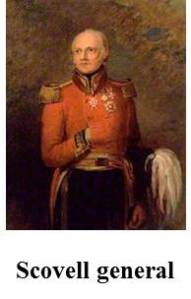
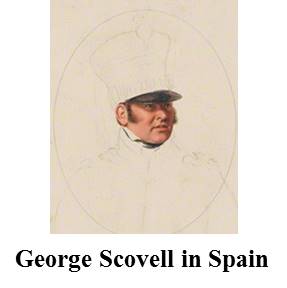
George Scovell in SpainHowever, the military was also viewed as a very good career for the younger sons of aristocrats, and they typically received preferential treatment. The stories of George Scovell, and Lord Fitzroy Somerset, who served on Wellington’s staff at the same time during the Peninsular War are good examples. The Duke of Wellington, who was the younger son of an Irish peer, held strong views about the importance of “family, money and influence” in moving up in the military, and surrounded himself with other scions of the aristocracy as his aides-de-camp whom he referred to as “my boys.” He distrusted the emerging new ‘scientific soldiering’ being introduced, which was particularly important in the case of the artillery, (which was rapidly gaining relevance) but also for all other aspects of soldiering.

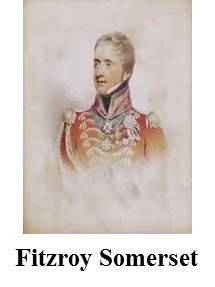
In this post, let’s compare the careers of Lord Fitzroy Somerset, a younger son of the Duke of Beaufort, who was born in beautiful Badminton Castle, a privileged younger son of the Duke of Beaufort, and Mr. George Scovell, an ambitious young man with little breeding or money, but great intelligence and ambition.

Scovell GeneralGeorge Scovell attended the recently established Royal Military Academy, learning the methods scientific soldiering and in 1798 purchased a commission as a Cornet in the 4th Queens Own Hussars, a cavalry regiment. A young Winston Churchill started his career as a Cornet in the same regiment 97 years later. The cavalry was the glamour side of the military, and Scovell was tremendously proud of this position. But, as a socially insignificant scientific soldier, promotions were hard to get.

As George also had siblings who needed financial help, he had to sell out of the cavalry and join the infantry, a drop in social status that he felt deeply. He moved to the Quartermaster General’s staff, where he excelled due to his education and diligence, although he had to purchase his promotions to captain and major. His accomplishments included, besides helping improve logistics in the Peninsula, standing up a new unit of Scouts with English, Spanish and Portuguese soldiers, and critically, cracking Napoleon’s Paris Chiffre in his spare time, thus making Napoleon’s plans available to the English.

Scovell was given the opportunity in 1813 to raise and command a new regiment, the Staff Corps of Cavalry, also known as the Staff Dragoons or the Corps of Gendarmerie which was the first recognized unit of military police in the British army. He was knighted and received the Knight Commander of the Order of the Bath (KCB) and continued his career in the Army, even becoming a colonel in the in the same cavalry regiment he had to sell out of earlier. Later, he was the Lieutenant-Governor and then Governor of the Royal Military College, Sandhurst(1829-1856), where he helped expand scientific soldiering in the British army. He received the Knight Grand Cross in 1860 and retired from the Army as a general. His hard work finally brought him success, but it was a long time in the making.

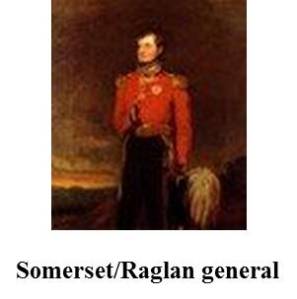
Fitzroy SomersetLord Fitzroy Somerset also joined the Army in the peninsula as a Cornet, this time in the 4th Light Dragoons, in 1804. He was promoted to Lieutenant in 1805, and captain in 1808, presumably by purchase since he transferred to the 43rd Regiment of Foot. He went to Spain in 1808 as one of Wellingtons’s crew of aristocratic aides-de-camp. Somerset’s bravery and gallantry is not in question; he was involved in leading charges in any number major battles in Spain, and was the first over the wall at the bloody storming of Badajoz. He was only twenty-four when he was promoted to lieutenant colonel in 1812.

Somerset fought in numerous other brutal battles, and served at Waterloo, where he lost his right arm. He also received the KCB in 1815. He went into politics, became Military Secretary, and eventually returned to active duty. He was named Baron Raglan, and eventually Field Marshal. He is famous for being the general on whose watch the Charge of the Light Brigade occurred. As a sidebar on the advantages of being a duke’s son in the army, it is worth noting that Lord Fitzroy’s older brother Lord Robert Somerset, also became an army general!

Somerset_Raglan GeneralTwo soldiers of very different backgrounds, with very different paths to military success. What do you think of this?

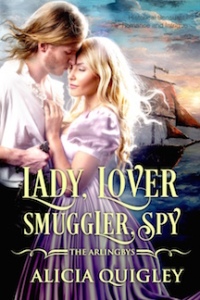
In my soon-to-be-released Lady, Lover, Smuggler, Spy, we have a similar juxtaposition: our hero, Sir Tarquin Arlingby, is a titled gentleman involved in finding smugglers who are running guinea boats to France, and are getting letters back and forth for French spies.

Our heroine, Valerie Carlton, is a military widow, whose husband was more the George Scovell-type soldier. She followed the drum and learned first-hand the adventures, dangers and sense of commitment to something greater than herself that came from the experience. The two are thrown together through a series of odd events and find themselves in quite an exciting—and potentially deadly—adventure.

Excerpt

Note: This book will be up for pre-order soon! The author will choose a random commenter to receive of the first two books in the series, A Collector’s Item and The Contraband Courtship.

Sir Tarquin handed her to a seat in front of the fire, and then took a chair across from her, settling into it comfortably and crossing his elegantly booted ankles. “So, Mrs. Carlton, I find that I am almost vulgarly curious about your past. It is evident that you are a gentlewoman, yet I found you penniless and unescorted at the Angel this morning. How did that come to pass?”

Valerie gazed down at her hands, before looking at him. “I am the oldest daughter of Lord Upleadon and his first wife,” she answered, “and married Robert Carlton, an officer in the Light Division.”

“Upleadon?” exclaimed Sir Tarquin. “You are an Upleadon, yet I found you alone, penniless, and ready to board a mail coach?”

LadyLoverSmugglerSpy_Final-FJM_Kindle_1800x2700 copy“My father did not approve of Mr. Carlton, I fear,” Valerie answered economically.

“That stiff rumped old tartar–” Sir Tarquin suddenly recalled that his listener was not only a lady, but also the daughter of the gentleman he was about to malign, and fell silent.

“Quite so,” Valerie responded with a definite hint of laughter in her voice. “In any event, when I insisted on marrying Mr. Carlton my father cut me off entirely. Even when my husband was among the dead at Sabugal he refused to see me.”

“While I’m not well acquainted with the baron, as he is a good deal older than I am and moves in very different circles, I’m sorry to say that I can easily imagine him lacking remorse. You must have been a mere child. How have you managed since then?”

“When I returned to England, several of my friends had married, and were happy to help me get on my feet. I was mourning my husband, and had no wish to remarry or to be a burden on them, however, so I quickly found a position as a governess.”

“But the Battle of Sabugal was three years since. Have you been a governess all this time?” Sir Tarquin asked.

She nodded. “I had only been with the Forneys for in a few months. When I first became a governess I was in charge of a young lady who needed some polishing before she came out, as her parents were not people of fashion. I enjoyed it very much; the daughter was charming and her mother and father were kind and grateful. Unfortunately the two positions that followed it have been much less satisfactory.”

Valerie fell silent, looking down at her hands, and Sir Tarquin, finding himself appreciating the sight of her blonde curls, fine figure, and aura of calm, didn’t need to stretch his imagination far to imagine the son of the Forney household had been unable to resist the temptation of the pretty governess.

“It makes me angry to think of you being preyed upon,” he said abruptly, much to his own surprise.

“It is a common enough problem, and far worse has befallen others. He did not force me and, while Mrs. Forney was unkind, I left of my own volition,” said Valerie uncomfortably. “My friends have helped me before and will help me now. I would rather spend my time with children, but perhaps I will have to seek employment as a companion to an older lady instead.”

“You do not deserve a life as a drudge to children or as the companion of elderly harridan, who will doubtless have a horrid grandson who will treat you as Mr. Forney did,” Sir Tarquin exclaimed. “You are young, and have given far too much.”

“Whatever do you mean?” she asked.

“You sacrificed a husband and a family to your country, did you not?”

“I suppose you could say so, although it has been three long years since then.” A wistful look came over her face. “It seems so long ago. Thinking of it now, Robert and I were both practically children; it is almost as though it happened to someone else, or was a story someone told to me.”

“Yet you are still all but penniless and without protection as a result, are you not? That is not much of an ending to the story.”

She gazed at him thoughtfully. “It was my decision, though I was far too young to understand the possible consequences. In some ways it was worth it all the same; I loved Robert as much as an eighteen-year-old can love anyone, and perhaps even more, I loved following the drum.”

Sir Tarquin looked startled. “Did you really? Surely it was a very hard life for a gently bred and sheltered young lady?”

Valerie laughed. “Indeed it was! I had no notion that such hardships were ahead of me. Yet the sense of purpose, of being needed and useful, and of having a meaning to my life was so powerful, that it overcame them all. I was always rather bookish, and never truly enjoyed the rounds of parties and balls, to my stepmother’s despair.”

“Even in the tail of the Army with all the camp followers, and rabble you felt so?” Sir Tarquin asked curiously.

“Oh, I rode with the column, Sir Tarquin,” she exclaimed proudly. “I had no children to care for and I was handy with horses even before I went on campaign, for my father’s stables are renowned and I spent a great deal of time in them as a child. I soon learned to kill and stew a chicken, and make sure that there was always something to eat at our billet, so it was not long before many of the other officers were to be found at our table.”

“You rode with the column?” her companion echoed in surprise.

“Except when an engagement was imminent, yes. In many respects it was as safe as being in the tail of the Army, for Robert’s friends would watch out for me. I moved rearward when there was any real danger.”

“But it must have been difficult to be so far ahead without any servants to help you.”

“Oh, my husband engaged a woman for me, a large, rather foul mouthed Scotswoman, who was a match for most of the men! She did much of the heaviest work, although I helped, of course.” Sir Tarquin watched as Valerie’s eyes filled with memories that were clearly dear to her. “His batman was also there, and it never seemed as though things were unmanageable. Difficult yes, but even the worst days were just another challenge to rise to…” Valerie’s voice trailed off, and she gazed into the fire, seeing another place and time.

Sir Tarquin watched her in pensive silence, for a moment and then stood, shaking his head to dispel the thoughts that filled it. “My glass is empty. May I pour you some more punch as well, Mrs. Carlton?”

Valerie shook off her memories, and handed him her empty glass. “Thank you, Sir Tarquin. You have a way with a punchbowl, it seems.” She watched as he walked away, enjoying the wide set of his shoulders, and athleticism of his gait. After some moments he returned and offered her the cup, now full of warm, spicy liquid. Her fingers brushed his slightly as she took it. She looked away, taking a sip.

“I so miss feeling part of something bigger than me,” she murmured. “A governess makes herself useful, I suppose, but it is not the same. Being a paid companion would be even duller, I fear.”

Sir Tarquin, who still stood beside her chair, reached out with one long finger and tipped her chin up, gazing into her face intently.

“You most assuredly must not be a companion to a querulous dowager,” he murmured. “It would be an utter waste.”

Valerie stared back at him, at a loss to answer. In the quiet and warmth of the private parlor they seemed removed from the world, and she simply waited for him to act. He gave a tiny sigh, and then lowered his mouth to hers, pressing her lips firmly yet gently as he sought the right pressure. Her mouth trembled a little, and he lifted his, only to press it against hers at a slightly different angle before drawing back, to kiss her cheek, and then one of her eyelids, which had fluttered closed, before releasing her chin and stepping away.

About the Author

AQ Twitter AviAlicia Quigley is a lifelong lover of romance novels, who fell in love with Jane Austen in grade school, and Georgette Heyer in junior high. She made up games with playing cards using the face cards for Heyer characters, and sewed regency gowns (walking dresses, riding habits and bonnets that even Lydia Bennett wouldn’t have touched) for her Barbie. In spite of her terrible science and engineering addiction, she remains a devotee of the romance, and enjoys turning her hand to their production as well as their consumption.

Website • Twitter • Facebook • Amazon Author Page


Romance of London: Milkmaids on May-Day

Romance of London: Strange Stories, Scenes And Remarkable Person of the Great Town in 3 Volumes

John Timbs

John Timbs (1801-1875), who also wrote as Horace Welby, was an English author and aficionado of antiquities. Born in Clerkenwell, London, he was apprenticed at 16 to a druggist and printer, where he soon showed great literary promise. At 19, he began to write for Monthly Magazine, and a year later he was made secretary to the magazine’s proprietor and there began his career as a writer, editor, and antiquarian.

This particular book is available at googlebooks for free in ebook form. Or you can pay for a print version.

Milkmaids on May-Day

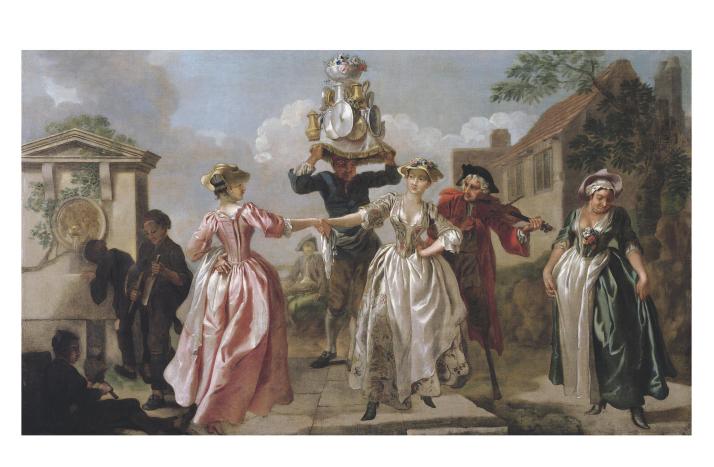
On this gay festival, the Londoners of the present century have seen little. J.T. Smith, in his amusing Book for a Rainy Day, describes the carnival of nearly a century since, May 1771: “The gaiety during the merry month of May (says Smith) was to me most delightful; my feet, though I know nothing of the positions, kept pace with those of the blooming milkmaids, who danced round their garlands of massive plate, hired from the silversmiths, to the amount of several hundreds of pounds, for the purpose of placing round an obelisk, covered with silk, fixed upon a chairman’s horse. The most showy flowers of the season were arranged so as to fill up the openings between the dishes, plates, butter-boats, cream-jugs, and tankards. The obelisk was carried by two chairmen, in gold-laced hats, six or more handsome milkmaids in pink and blue gowns, drawn through the pocket-holes, for they had one on either side; yellow or scarlet petticoats, neatly quilted; high-heeled shoes; mob-caps, with lappets of lace resting on their shoulders; nosegays in their bosoms; and flat Woffington hats, covered with ribbons of every color. A magnificent silver tea-urn surmounted the obelisk, the stand of which was profusely decorated with scarlet tulips. A smart, slender fellow of a fiddler, in a sky-blue coat, wit his hat covered with ribbons, attended; and the master of the group was accompanied by a constable, to protect the plate from too close a pressure of the crowd, when the maids were dancing.”

One of Hayman’s paintings in Vauxhall Gardens, was the Milkmaids on May-day: here the garland of plate was carried by a man on his head; the milkmaids, who danced to the music of a wooden-legged fiddler, were very elegant. They had ruffled cuffs; their hats were flat, but not Woffingtons, but more resembled those of the Billingsgate fish-women. In Larcom’s Cries of London, published by Tempest, there is “a Merry Milkmaid;” she is dancing with a small garland of plate upon her head; and her dress is of the latter part of King William the Third’s reign, or the commencement of the reign of Queen Anne.

Francis Hayman’s May Day (Supper-box) Painting

From the V & A:

One of the ancient customs observed on May Day that persisted until the early 19th century was the ‘Milkmaid’s Garland.’ The milkmaids would dress in their best clothes and dance in the streets for their customers. A donation from the customers and from passers-by was expected. A ‘garland’ – a pyramid of borrowed silver tankards, plates and flagons decorated with flowers – was paraded by the milkmaids or carried, as in this painting, by a porter. Francis Hayman also included another May Day custom in his picture: that of the young chimney-sweeps noisily beating their brushes and shovels.

©Victoria and Albert Museum, London

Francis Hayman, Vauxhall Gardens, supper-box painting, ©Victoria and Albert Museum, London

See more about May-Day here. 

So… what’s a Woffington hat?

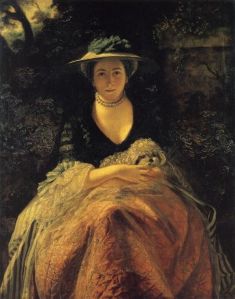
Here’s a portrait of famous courtesan Nelly O’Brien wearing what is described as a “Woffington hat” in Great Portraits Seen and Described by Great Writers. 

Actress and courtesan Nelly O'Brien in a Woffington hat

Actress and courtesan Nelly O’Brien in a Woffington hat

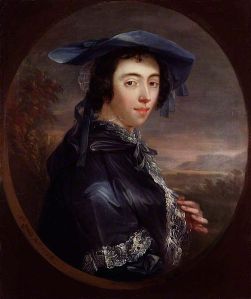
Apparently, this flat style of hat was named after Peg Woffington, Irish actress and lover of David Garrick in Georgian England.

Irish actress Peg Woffington

Irish actress Peg Woffington

Oh, and about Billingsgate fish-women…

In the 18th century, fishwives frequently appeared in satires as fearsome scourges of fops and foreigners. Their vigorous and decisive mien was contrasted with that of politicians who were, by contrast, portrayed as vacillating and weak. For example, in Isaac Cruikshank’s A New Catamaran Expedition!!!, a fleet of Billingsgate fishwives sails across the English Channel to terrorise the French and shame the British Prime Minister Pitt for his inaction.

By Isaac Cruikshank (publisher- Willm. Holland, London) [Public domain], via Wikimedia Commons

By Isaac Cruikshank (publisher- Willm. Holland, London) [Public domain], via Wikimedia Commons

Romance of London Series

  1. Romance of London: The Lord Mayor’s Fool… and a Dessert
  2. Romance of London: Carlton House and the Regency
  3. Romance of London: The Championship at George IV’s Coronation
  4. Romance of London: Mrs. Cornelys at Carlisle House
  5. Romance of London: The Bottle Conjuror
  6. Romance of London: Bartholomew Fair
  7. Romance of London: The May Fair and the Strong Woman
  8. Romance of London: Nancy Dawson, the Hornpipe Dancer
  9. Romance of London: Milkmaids on May-Day
  10. Romance of London: Lord Stowell’s Love of Sight-seeing
  11. Romance of London: The Mermaid Hoax
  12. Romance of London: The Bluestocking and the Sweeps’ Holiday
  13. Romance of London: Comments on Hogarth’s “Industries and Idle Apprentices”
  14. Romance of London: The Lansdowne Family
  15. Romance of London: St. Margaret’s Painted Window at Westminster
  16. Romance of London: Montague House and the British Museum
  17. Romance of London: The Bursting of the South Sea Bubble
  18. Romance of London: The Thames Tunnel
  19. Romance of London: Sir William Petty and the Lansdowne Family
  20. Romance of London: Marlborough House and Sarah, Duchess of Marlborough
  21. Romance of London: The Duke of Newcastle’s Eccentricities
  22. Romance of London: Voltaire in London
  23. Romance of London: The Crossing Sweeper
  24. Romance of London: Nathan Mayer Rothschild’s Fear of Assassination
  25. Romance of London: Samuel Rogers, the Banker Poet
  26. Romance of London: The Eccentricities of Lord Byron
  27. Romance of London: A London Recluse

Romance of London: Nancy Dawson the Hornpipe-Dancer

Romance of London: Strange Stories, Scenes And Remarkable Person of the Great Town in 3 Volumes

John Timbs

John Timbs (1801-1875), who also wrote as Horace Welby, was an English author and aficionado of antiquities. Born in Clerkenwell, London, he was apprenticed at 16 to a druggist and printer, where he soon showed great literary promise. At 19, he began to write for Monthly Magazine, and a year later he was made secretary to the magazine’s proprietor and there began his career as a writer, editor, and antiquarian.

This particular book is available at googlebooks for free in ebook form. Or you can pay for a print version.

Nancy Dawson

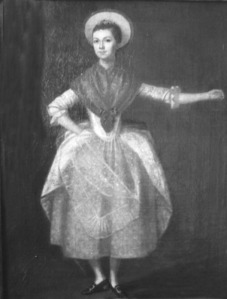
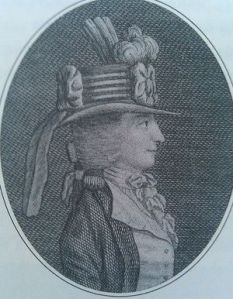
nancy dawson portraitNancy Dawson, the famous hornpipe-dancer, of Covent Garden Theatre, in the last century, when a girl, set up the skittles [a form of bowling] at a tavern in High Street, Marylebone. She next, according to Sir William Musgrave’s Adversaria, in the British Museum, became the wife of a publican near Kelso, on the borders of Scotland. She became so popular a dancer that every verse of a song in praise of her declared the poet to be dying in love for Nancy Dawson; and its tune is so lively as that of Sir Roger de Coverley. In 1760, she transferred her services from Covent Garden Theatre to that other house [Drury Lane]. On the 23rd of September, in that year, the Beggar’s Opera was performed at Drury Lane, when the playbill thus announced her: “In Act iii, a Hornpipe by Miss Dawson, her first appearance here.” It seems that she was engaged to oppose Mrs. Vernon in the same exhibition at the rival house, and there is a full-length print of her in the character. There is also a portrait of her in the Garrick Club collection.

Nancy died in Hampstead, on the 27th of May 1767; she was buried behind the Foundling Hospital, in the ground belonging to St. George the Martyr, where is a tombstone to her memory, simply inscribed “Here lies Nancy Dawson.”

From Wikipedia:

Nancy Dawson was the stage name of Ann Newton (c.1728-1767), a famous London dancer and actress. She rose to fame performing a solo rendition of a hornpipe between acts in The Beggar’s Opera at Covent Garden Theatre in 1759.

Her early life is unclear; she may have been born at Axminster, Devon. At sixteen she joined the company of a certain Griffin, a puppet-showman, who taught her to dance; and a figure dancer of Sadler’s Wells, seeing her performance, found her a place at his own theatre. As the story goes, her figure, novelty and technical excellence made her career.

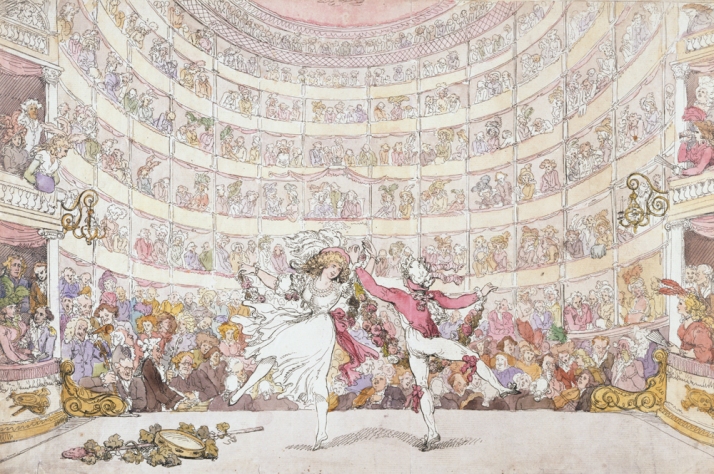
In her second summer season at Sadler’s Wells Nancy Dawson was promoted to the part of Columbine, and in the following winter she made her first appearance at Covent Garden Theatre under Edward Shuter, in The Prophetess by Thomas Betterton. On 22 April 1758 the Merry Wives of Windsor was played for her benefit. In October 1759, during the run of The Beggar’s Opera, the man who danced the hornpipe among the thieves fell ill, and his place was taken by Nancy Dawson. From that moment she became a celebrity. The production enjoyed an unusually long run, and the house was crowded nightly.

Nancy Dawson was induced by an increase of salary to move to Drury Lane, where she appeared for the first time on 23 September 1760 in The Beggar’s Opera. Here for the next three years she dance in its frequent revivals, and in a variety of Christmas entertainments, such as ‘Harlequin’s Invasion,’ ‘Fortunatus,’ and the ‘Enchanter’ in which there also appeared Joseph Grimaldi and the Miss Baker who succeeded Nancy Dawson in popular favour as a dancer. On Christmas Eve 1763 a pantomime called the ‘Rites of Hecate’ was produced at Drury Lane, and on that day and the 26th of the month Nancy Dawson appeared; but her name is absent from the bills of subsequent representations.

The Hornpipe

From Sonny Watson’s Sweetswing.com:

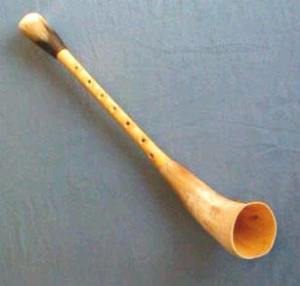
tbhp_M2The lively Hornpipe is really very characteristic of the English in nature and is a very old Celtic solo dance that is very much based on the sailor’s abilities during the dancing with the sailors originally performing it with folded arms. The steps are clearly ship wise such as hauling in the anchor, climbing or rigging ropes etc. The Sailor’s Hornpipe was most popular during the 16th to 18th Centuries but the original (Hornpipe) goes much farther back and was originally done by men only.

It is said that the English sailing ship and Royal Navy Captain James Cook (1728-1779) thought dancing was most useful to keep his men in good health during a voyage. When it was calm, and the sailors had consequently nothing to do, he made them dance —

Sailors’ hornpipe: https://www.youtube.com/watch?v=kBU0z3xdC0o

2006AN9345_rowlandson_ballet_etching

The Ballad of Nancy Dawson*

Of all the girls in our town,

The red, the black, the fair, the brown,

That dance and prance it up and down,

There’s none like Nancy Dawson.


300px-Dawson2Her easy mien, her shape so neat,

She foots, she trips, she looks so sweet;

Her every motion’s so complete,

I die for Nancy Dawson.


See how she comes to give surprise,

With joy and pleasure in her eyes:

To give delight she always tries,

So means my Nancy Dawson.


Was there no task, t’obstruct the way,

No shutter old, no house so gay,

A bet of fifty pounds I’d lay,

That I gained Nancy Dawson.


See how the opera takes a run

Exceeding Hamlet, Lear and Lun

Though in it there would be no fun,

Was’t not for Nancy Dawson.


Lithograph of Nancy Dawson c 1760Though beard and brent charm ev’ry night

And female peachum’s justly right,

And filch and lockit please the sight,

‘Tis kept by Nancy Dawson.


See little davey strut and puff,

‘Confound the opera and such stuff,

My house is never full enough,

A curse on Nancy Dawson”.


Though G[arric]k he had has his day

And forced the town his laws t’obey,

With Jonny Rich is come in play,

With the help of Nancy Dawson.


*Lyrics attributed to George Alexander Stevens. Tune attributed to Thomas Arne

Hear it performed here: https://www.youtube.com/watch?v=YTan2rliiKU


Romance of London Series

  1. Romance of London: The Lord Mayor’s Fool… and a Dessert
  2. Romance of London: Carlton House and the Regency
  3. Romance of London: The Championship at George IV’s Coronation
  4. Romance of London: Mrs. Cornelys at Carlisle House
  5. Romance of London: The Bottle Conjuror
  6. Romance of London: Bartholomew Fair
  7. Romance of London: The May Fair and the Strong Woman
  8. Romance of London: Nancy Dawson, the Hornpipe Dancer
  9. Romance of London: Milkmaids on May-Day
  10. Romance of London: Lord Stowell’s Love of Sight-seeing
  11. Romance of London: The Mermaid Hoax
  12. Romance of London: The Bluestocking and the Sweeps’ Holiday
  13. Romance of London: Comments on Hogarth’s “Industries and Idle Apprentices”
  14. Romance of London: The Lansdowne Family
  15. Romance of London: St. Margaret’s Painted Window at Westminster
  16. Romance of London: Montague House and the British Museum
  17. Romance of London: The Bursting of the South Sea Bubble
  18. Romance of London: The Thames Tunnel
  19. Romance of London: Sir William Petty and the Lansdowne Family
  20. Romance of London: Marlborough House and Sarah, Duchess of Marlborough
  21. Romance of London: The Duke of Newcastle’s Eccentricities
  22. Romance of London: Voltaire in London
  23. Romance of London: The Crossing Sweeper
  24. Romance of London: Nathan Mayer Rothschild’s Fear of Assassination
  25. Romance of London: Samuel Rogers, the Banker Poet
  26. Romance of London: The Eccentricities of Lord Byron
  27. Romance of London: A London Recluse

Romance of London: The May Fair and the Strong Woman

Romance of London: Strange Stories, Scenes And Remarkable Person of the Great Town in 3 Volumes

John Timbs

John Timbs (1801-1875), who also wrote as Horace Welby, was an English author and aficionado of antiquities. Born in Clerkenwell, London, he was apprenticed at 16 to a druggist and printer, where he soon showed great literary promise. At 19, he began to write for Monthly Magazine, and a year later he was made secretary to the magazine’s proprietor and there began his career as a writer, editor, and antiquarian.

This particular book is available at googlebooks for free in ebook form. Or you can pay for a print version.

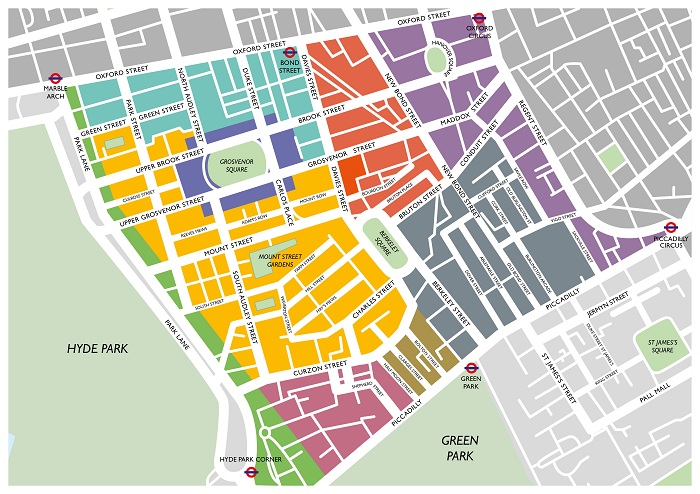
Mayfair

From Wikipedia:

Mayfair was mainly open fields until development started in the Shepherd Market area around 1686 to accommodate the May Fair that had moved from Haymarket in St. James’s.

Mayfair was part of the parish of St Martin in the Fields. It is named after the annual fortnight-long May Fair that, from 1686 to 1764, took place on the site that is Shepherd Market. The fair was previously held in Haymarket; it moved in 1764 to Fair Field in Bow in the East End of London, after complaints from the residents.

Sir Thomas Grosvenor, 3rd Baronet married Mary Davis, heiress to part of the Manor of Ebury, in 1677; the Grosvenor family gained 40 hectares (100 acres) of Mayfair. Most of the Mayfair area was built during the mid 17th century to mid 18th century as a fashionable residential district, by a number of landlords, the most important of them being the Grosvenor family, which in 1874 became the Dukes of Westminster. In 1724 Mayfair became part of the new parish of St George Hanover Square, which stretched to Bond Street in the south part of Mayfair and almost to Regent Street north of Conduit Street. The northern boundary was Oxford Street and the southern boundary fell short of Piccadilly. The parish continued west of Mayfair into Hyde Park and then south to include Belgravia and other areas.

Mayfair Neighborhoods

Present-day Mayfair Neighborhoods

May Fair a Century Ago

We find a curious picture of this west-end carnival by that painstaking antiquary, John Carter, who, writing in 1816, says: “Fifty years have passed away since this place of amusement was at its height of attraction: the spot where the Fair was held still retains the name of May Fair… The market-house consisted of two stories: first story, a long and cross aisle for butchers’ shops, and, externally, other shops connected with culinary purposes; second story, used as a theatre at Fair-time for dramatic performances… Below, the butchers gave place to toy men and gingerbread-bakers. At present, the upper story is unfolded, the lower nearly deserted by the butchers, and their shops occupied by needy peddling dealers in small wares; in truth, a most deplorable contrast to what once was such a point of allurement. In the area encompassing the market building were booths for jugglers, prize-fighters both at cudgels and back-swords, boxing-matches, and wild-beasts. The sports not under cover were mountebanks, fire-eaters, ass-racing, sausage-tables, dice-ditto, up-and-downs, merry-go-rounds, bull-baiting, grinning for a hat, running for a shift, hasty-pudding-eaters, eel-divers, and an infinite variety of other similar pastimes.”

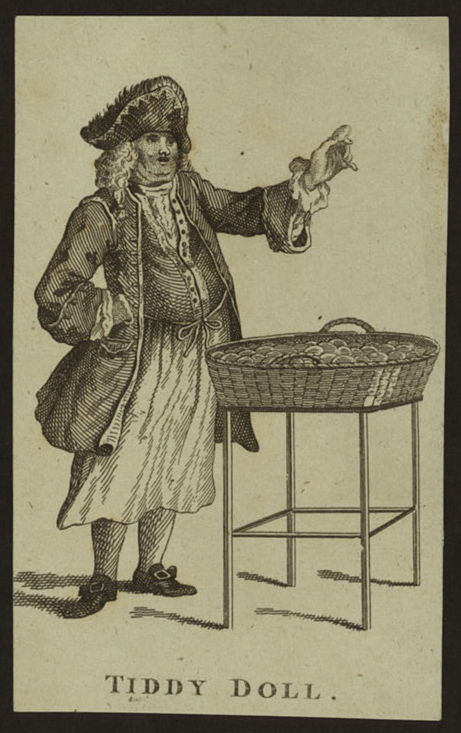
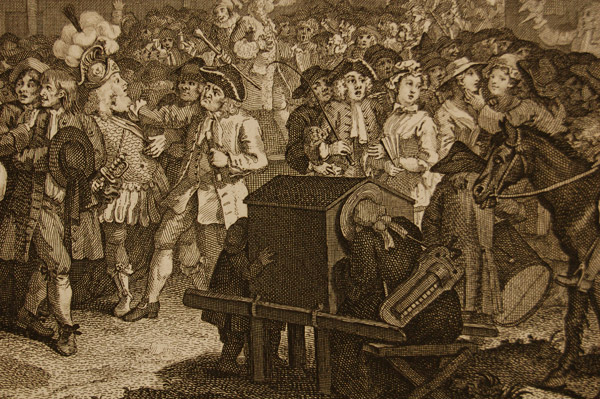
Tiddy Doll, Gingerbread Baker (NYPL Digital Library) Tiddy Doll was a famed 18th century gingerbread vendor, a well-known sight amongst the butchers and toy-men, jugglers and fire-eaters at London’s Bartholomew Fair and Shepherd’s Market in Mayfair. He was even known to ply his wares at public executions, and can be seen in the lower right-hand corner of Hogarth’s Idle Prentice Executed at Tyburn, waving a spicy cake to the boisterous mob. His real name was apparently Ford, acquiring his nickname from a habit of ending his addresses to the crowd with the last lines of a popular ballad, “tid-dy did-dy dol-lol, ti-tid-dy ti-ti, tid-dy tid-dy, dol.” Wearing a white apron over his customary white gold laced suit, ruffled shirt, laced hat and feather and silk stockings, “like a person of rank,” his name was associated for many years with a person dressed out of character, as “you are as tawdry as Tiddy-doll; you are quite Tiddy-doll,” etc.

Tiddy Doll, Gingerbread Baker (NYPL Digital Library)
Tiddy Doll was a famed 18th century gingerbread vendor, a well-known sight amongst the butchers and toy-men, jugglers and fire-eaters at London’s Bartholomew Fair and Shepherd’s Market in Mayfair. He was even known to ply his wares at public executions, and can be seen in the lower right-hand corner of Hogarth’s Idle Prentice Executed at Tyburn, waving a spicy cake to the boisterous mob. His real name was apparently Ford, acquiring his nickname from a habit of ending his addresses to the crowd with the last lines of a popular ballad, “tid-dy did-dy dol-lol, ti-tid-dy ti-ti, tid-dy tid-dy, dol.” Wearing a white apron over his customary white gold laced suit, ruffled shirt, laced hat and feather and silk stockings, “like a person of rank,” his name was associated for many years with a person dressed out of character, as “you are as tawdry as Tiddy-doll; you are quite Tiddy-doll,” etc.

The Woman and the Anvil

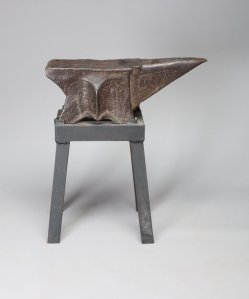
anvil

18th century anvil

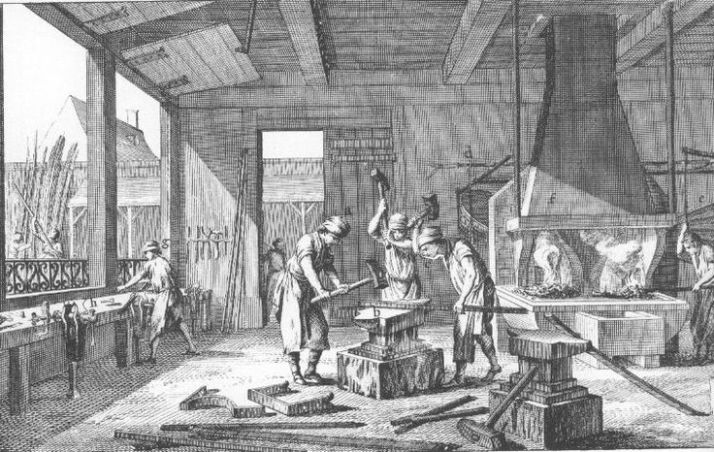
One of the marvels of May Fair, in its latest revival, was the performance of a strong woman, the wife of a Frenchman, exhibited in a house in Sun Court, Shepherd’s Market. The following account is given by John Carter, and may be relied on, as Carter was born and passed his youthful days in Piccadilly [Carter’s Statuary]. He tells us that a blacksmith’s anvil being procured from White Horse Street, with three of the men, they brought it up, and placed it on the floor of the exhibition-room. The woman was short, but most beautifully and delicately formed, and of a most lovely countenance. She first let down her hair (a light auburn), of a length descending to her knees, which she twisted round the projecting part of the anvil, and then, with seeming ease, lifted the ponderous mass some inches from the floor. After this, a bed was placed in the middle of the room; when, reclining on her back, and uncovering her bosom, the husband ordered the smiths to place thereon the anvil, and forge upon it a horse-shoe! This they obeyed: by taking from the fire a red-hot piece of iron, and with their forging hammers completing the shoe with the same might and indifference as when in the shop at their constant labour. The prostrate fair one seemed to endure this with greatest composure, talking and singing during the whole process: then, with an effort, which to the bystanders appeared supernatural, she cast the anvil from off her body, jumping up at the same moment with extreme gaiety, and without the least discomposure of her dress or person. That there was no trick or collusion was obvious from the evidence: the spectators stood about the room with Carter’s family and friends; the smiths were strangers to the Frenchman, but known to Carter, the narrator. She next placed her naked feet on a red-hot salamander, without injury, the wonder of which was, however, understood even at that time.*

Blacksmith's shop

Blacksmith’s shop

*Mr. Daniel, of Canonbury, thought the Strong Woman to have been Mrs. Allchorne, who died in Drury Lane in 1817, at a very advanced age. Madame performed at Bartholomew Fair in 1752.


Romance of London Series

  1. Romance of London: The Lord Mayor’s Fool… and a Dessert
  2. Romance of London: Carlton House and the Regency
  3. Romance of London: The Championship at George IV’s Coronation
  4. Romance of London: Mrs. Cornelys at Carlisle House
  5. Romance of London: The Bottle Conjuror
  6. Romance of London: Bartholomew Fair
  7. Romance of London: The May Fair and the Strong Woman
  8. Romance of London: Nancy Dawson, the Hornpipe Dancer
  9. Romance of London: Milkmaids on May-Day
  10. Romance of London: Lord Stowell’s Love of Sight-seeing
  11. Romance of London: The Mermaid Hoax
  12. Romance of London: The Bluestocking and the Sweeps’ Holiday
  13. Romance of London: Comments on Hogarth’s “Industries and Idle Apprentices”
  14. Romance of London: The Lansdowne Family
  15. Romance of London: St. Margaret’s Painted Window at Westminster
  16. Romance of London: Montague House and the British Museum
  17. Romance of London: The Bursting of the South Sea Bubble
  18. Romance of London: The Thames Tunnel
  19. Romance of London: Sir William Petty and the Lansdowne Family
  20. Romance of London: Marlborough House and Sarah, Duchess of Marlborough
  21. Romance of London: The Duke of Newcastle’s Eccentricities
  22. Romance of London: Voltaire in London
  23. Romance of London: The Crossing Sweeper
  24. Romance of London: Nathan Mayer Rothschild’s Fear of Assassination
  25. Romance of London: Samuel Rogers, the Banker Poet
  26. Romance of London: The Eccentricities of Lord Byron
  27. Romance of London: A London Recluse

Romance of London: Bartholomew Fair

Romance of London: Strange Stories, Scenes And Remarkable Person of the Great Town in 3 Volumes

John Timbs

John Timbs (1801-1875), who also wrote as Horace Welby, was an English author and aficionado of antiquities. Born in Clerkenwell, London, he was apprenticed at 16 to a druggist and printer, where he soon showed great literary promise. At 19, he began to write for Monthly Magazine, and a year later he was made secretary to the magazine’s proprietor and there began his career as a writer, editor, and antiquarian.

This particular book is available at googlebooks for free in ebook form. Or you can pay for a print version.

The vow of a jester

Rahere_Jester_to_Henry_1st

Rahere, jester to King Henry I

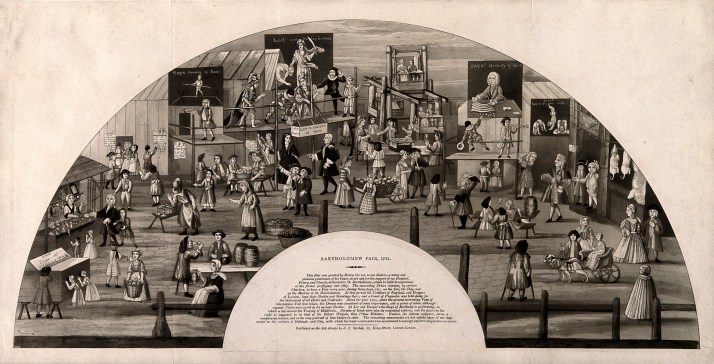
This famous Fair, formerly held every year in Smithfield, at Bartholomewtide [August 24], and within the precinct of the Priory of St. Bartholomew, originated in a grant of land from Henry I., to his jester Rahere, who, disgusted by his manner of living, repented him of his sins, and undertook a pilgrimage to Rome. Here, attacked by sickness, he made a vow, that if he recovered his health, he would found a hospital for poor men. Being reinstated, and on his return to England to fulfill his promise, St. Bartholomew is said to have appeared to him in a vision, and commanded him to found a Church in Smithfield, in his name… The site, which had been previously pointed out in a singular manner to Edward the Confessor, as proper for a house of prayer, was a mere marsh, for the most part covered with water; while on that portion which was not so, stood the common gallows—”the Elms,” in Smithfield, which for centuries after continued to be the place of execution.

The Bartholomew Fair

St. Bartholomew's Church

St. Bartholomew’s Church

The Priory, however, looked to temporal as well as spiritual aid, for his foundation; and therefore, obtained a royal charter to hold a Fair annually at Bartholomewtide, for three days—on the eve, the fête-day of the saint, and the day after; “firm peace,” being granted to all persons frequenting the Fair of St. Bartholomew. This brought traders from all parts, to Smithfield: thither resorted clothiers and drapers, not merely of England, but all countries, who there exposed their goods for sale. The stalls or booths were erected within the walls of the priory churchyard, the gates of which were locked each night, and a watch was set in order to protect the various wares…

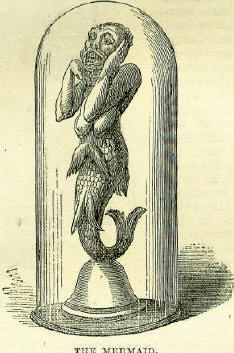
murmaid

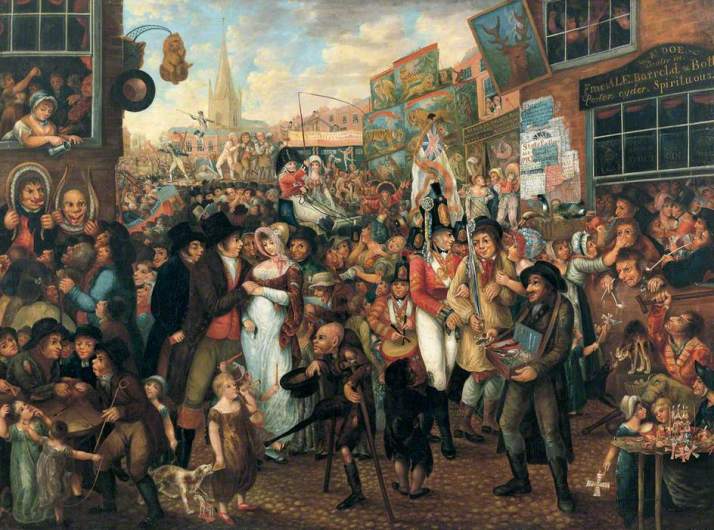
At the dissolution of religious houses, the privilege of the Fair was in part transferred to the Mayor and Corporation; and in part to Richard Rich, Lord Rich, who died in 1560, and was ancestor of the Earls of Warwick and Holland. It ceased, however to be a cloth fair of any great importance in the reign of Queen Elizabeth. The drapers of London found another and more extensive market for their woolens; and the clothiers, in the increase of communication between distant places, a wider field for the sale of their manufactures. It subsequently became a Fair of a very diversified character. Monsters, motions, rolls, and rarities were the new attractions to be seen; and the Fair was converted into a kind of London carnival for persons of every condition and degree of life. The Fair was proclaimed by the Lord Mayor, beneath the entrance arch of the priory; and its original connexion with the cloth trade was commemorated in a mock proclamation on the evening before, made by a company of drapers and tailors, who met at the Hand and Shears, a house of call for their fraternity in Cloth Fair, whence they marched and announced the Fair opened and concluded with shouting and the “snapping of shears.”

With respect to the tolls, Strype tells us that “Each person having a booth, paid so much per foot for the first three days. The Earl of Warwick and Holland is concerned in the toll gathered the first three days in the fair, being a penny for each burthen of good brought in or carried out; and to that end there are persons that stand at all the entrances into the Fair…

bartholomewfairup

The Fair lengthens to fourteen days

“In the reign of Charles II., as might be expected, the Fair was extended from three to fourteen days, when all classes, high and low, visited the carnival.” Pepys mentioned walking up and down the fair grounds on August 30, 1667, and discovering Lady Castlemaine at a puppet-play, “and the street full of people, expecting her coming out.” In 1668, Pepys went to the fair “to see the mare that tells money, and many things to admiration, and then the dancing of the ropes, and also the Irish stage play, which is very ridiculous.”

(c) Dover Collections; Supplied by The Public Catalogue Foundation

(c) Dover Collections; Supplied by The Public Catalogue Foundation

Theatrical booths were very popular. “Ben Jonson, the actor (says Dr. Rimbault), was connected with the booth before 1694, in which year he joined Cibber’s company; he was celebrated as the grave-digger in Hamlet…

Here were motions or puppet-shows of Jerusalem, Nineveh, and Norwich; and the Gunpowder Plot played nine times in an afternoon; wild beasts, dwarfs, and other monstrosities; operas and tight-rope-dancing and sarabands [dances]; dogs dancing the morris; the hare beating the tabor; and rolls of every degree.

Bartholomew Fair 1825

Bartholomew Fair 1825

From a newspaper in 1734:

At Goodwin’s Large Theatrical Booth, opposite the White Hart, in West Smithfield, near Cow Lane, the town will be entertained with a humorous Comedy of three acts, called ‘The Intriguing Footman, or the Spaniard Outwitted;’ with a Pantomime entertainment of Dancing, between a Soldier and a Sailor, and a Tinker and a Tailor, and Buxom Joan of Deptford.

At Hippisley and Chapman’s Great Theatrical Booth, in the George Inn Yard, Smithfield, the town will be humorously diverted with an excellent entertainment; Signor Arthurian, who has a most surprising talent at grimace, and will, on this occasion, introduce upwards of fifty whimsical, sorrowful, comical, and diverting faces.”

The fourteen days were found too long, for the excesses committed were very great; and in the year 1708, the period of the Fair was restricted to its old duration of three days.

Hogarth 1733

Hogarth 1733

Three days of revelry

The influence of the fair in the neighborhood was to make general holiday… We read that in Little Britain, “during the time of the Fair, there was nothing going on but gossiping and gadding about. The still quiet streets of Little Britain were overrun with an irruption of strange figures and faces; every tavern was a scene of rout and revel. The fiddle and the song are heard from the taproom, morning, noon, and night; and at each window might be seen some group of loose companions, with half-shut eyes, hats on one side, pipe in mouth, tankard in hand, fondling, and prosing, and singing maudlin songs over their liquor. Even the sober decorum of private families was no proof against this saturnalia. There was no such thing as keeping maid-servants within doors. Their brains were absolutely set maddening with Punch and the puppet-show; the flying horses; Signior Polito; the Fire-eater, the celebrated Mr. Paap; and the Irish Giant. The children, too, lavished all their holiday-money in toys and gilt gingerbread, and filled the house with the Lilliputian din of drums, trumpets, and penny whistles.”

V0014666 Bartholomew Fair, site of St. Bartholomew's Hospital, London Credit: Wellcome Library, London. Wellcome Images images@wellcome.ac.uk http://wellcomeimages.org Bartholomew Fair, site of St. Bartholomew's Hospital, London, pictured in 1721. Aquatint with etching, c. 1800. Published: - Copyrighted work available under Creative Commons Attribution only licence CC BY 4.0 http://creativecommons.org/licenses/by/4.0/

Bartholomew Fan

The end of Bartholomew Fair

The Lord Mayor and Aldermen had, for 300 years, tried by orders, proclamations, juries, and presentments to abolish the Fair, but without effect; when the Court of Common Council took the work in hand. Having obtained entire control over the Fair by the purchase of Lord Kensington’s interest, they refused to let standings for shows and booths; they prevailed upon the Lord Mayor and Sheriffs to give up the practice of going to open the Fair in state, with a herald to proclaim it, and officers to marshal the procession; the posting of the proclamation about the streets, interdicting rioting and debauchery during the days of the Fair and within its precincts, were discontinued… In 1852, not a single show was to be seen on the ground; and in 1855 the Fair expired… and Bartholomew Fair was extinct.

Author’s Note: I’m thinking of having my Regency characters attend the fair, even though it was rather scandalous. What do you think?

Bartholomew-Fair

Romance of London Series

  1. Romance of London: The Lord Mayor’s Fool… and a Dessert
  2. Romance of London: Carlton House and the Regency
  3. Romance of London: The Championship at George IV’s Coronation
  4. Romance of London: Mrs. Cornelys at Carlisle House
  5. Romance of London: The Bottle Conjuror
  6. Romance of London: Bartholomew Fair
  7. Romance of London: The May Fair and the Strong Woman
  8. Romance of London: Nancy Dawson, the Hornpipe Dancer
  9. Romance of London: Milkmaids on May-Day
  10. Romance of London: Lord Stowell’s Love of Sight-seeing
  11. Romance of London: The Mermaid Hoax
  12. Romance of London: The Bluestocking and the Sweeps’ Holiday
  13. Romance of London: Comments on Hogarth’s “Industries and Idle Apprentices”
  14. Romance of London: The Lansdowne Family
  15. Romance of London: St. Margaret’s Painted Window at Westminster
  16. Romance of London: Montague House and the British Museum
  17. Romance of London: The Bursting of the South Sea Bubble
  18. Romance of London: The Thames Tunnel
  19. Romance of London: Sir William Petty and the Lansdowne Family
  20. Romance of London: Marlborough House and Sarah, Duchess of Marlborough
  21. Romance of London: The Duke of Newcastle’s Eccentricities
  22. Romance of London: Voltaire in London
  23. Romance of London: The Crossing Sweeper
  24. Romance of London: Nathan Mayer Rothschild’s Fear of Assassination
  25. Romance of London: Samuel Rogers, the Banker Poet
  26. Romance of London: The Eccentricities of Lord Byron
  27. Romance of London: A London Recluse

Romance of London: The Bottle Conjuror

Romance of London: Strange Stories, Scenes And Remarkable Person of the Great Town in 3 Volumes

John Timbs

John Timbs (1801-1875), who also wrote as Horace Welby, was an English author and aficionado of antiquities. Born in Clerkenwell, London, he was apprenticed at 16 to a druggist and printer, where he soon showed great literary promise. At 19, he began to write for Monthly Magazine, and a year later he was made secretary to the magazine’s proprietor and there began his career as a writer, editor, and antiquarian.

This particular book is available at googlebooks for free in ebook form. Or you can pay for a print version.

A “foolish experiment on the credulity of the public”

2nd Duke of Montagu

2nd Duke of Montagu

The Duke of Montague being in company with some other noblemen, proposed a wager, that let a man advertise to do the most impossible thing in the world, he would find fools enough in London to fill a playhouse, who would think him in earnest. “Surely,” said Lord Chesterfield, “if a man should say that he would jump into a quart bottle, nobody would believe that!” The Duke was somewhat staggered; but for the sake of the jest, determined to make experiment. Accordingly it was advertised that the next day, (Jan. 10, 1749,) a person would, at the Haymarket Theatre, “play on a common walking-cane the music of every instrument then used, to surprising perfection; that he would, on the stage, get into a tavern quart bottle, without equivocation, and while there, sing several songs, and suffer any spectator to handle the bottle; that if any spectator should come masked, he would, if requested, declare who he was; and that, in a private room, he would produce the representation of any person, dead, with which the person requesting it should converse some minutes, as if alive.” The prices of admission were—gallery, 2s; pit, 3s; boxes, 5s; stage, 7s. 6d.

Haymarket Theater

Haymarket Theater

4th Earl of Chesterfield

4th Earl of Chesterfield

At night the house was crowded with curious people, many of them of the highest rank, including no less eminent a person than the Culloden Duke of Cumberland. They sat for a little while with tolerable patience, though uncheered with music; but by-and-by, the performer not appearing, signs of irritation were evinced. In answer to the continued noise of sticks and catcalls, a person belonging to the theatre came forward and explained that, in the event of a failure of performance, the money should be returned. A wag then cried out, that, if the ladies and gentlemen would give double prices, the conjuror would go into a pint bottle, which proved too much for the philosophy of the audience. A young gentleman threw a lighted candle upon the stage, and a general charge upon that part of the house followed. According to a private letter—it was written by a Scotch Jacobite lady—”Cumberland was the first that flew in a rage, and called to pull down the house… He drew his sword and was in such a rage, that somebody slipped in behind him and pulled the sword out of his hand, which was as much as to say, ‘Fools should not have chopping sticks.’ This sword of his has never been heard of, nor the person who took it. Thirty guineas of reward are offered for it. Monster of Nature, I am sure I wish he may never get it.

Haymarket Theater

Haymarket Theater

At that point, most of the audience charged out of the theater, losing items of clothing in the process, but a few stayed long enough to demolish the inside and take away much of the furnishings for a bonfire on the street.

Cumberland-Reynolds

Duke of Cumberland, younger son of George II (and of Culloden fame)


The proprietor of the theatre afterwards stated that, in apprehension of failure, he had reserved all the money taken, in order to give it back; and he would have returned it to the audience if they would have refrained from destroying his house.

The Bottle-hoax proved an excellent subject for the wits, particularly those of the Jacobite party. In Old England appeared this advertisement: “Found entangled in a slit of a lady’s demolished smock petticoat, a gilt-handled sward of martial temper and length, not much the worse of wearing, with the Spey curiously engraven on one side, and the Scheldt on the other; supposed to be taken from the fat sides of a certain great general in his hasty retreat from the Battle of Bottle Noddles, in the Haymarket. Whoever has lost it may inquire for it at the sign of the Bird and Singing Land, in Rotten Row.”

Romance of London Series

  1. Romance of London: The Lord Mayor’s Fool… and a Dessert
  2. Romance of London: Carlton House and the Regency
  3. Romance of London: The Championship at George IV’s Coronation
  4. Romance of London: Mrs. Cornelys at Carlisle House
  5. Romance of London: The Bottle Conjuror
  6. Romance of London: Bartholomew Fair
  7. Romance of London: The May Fair and the Strong Woman
  8. Romance of London: Nancy Dawson, the Hornpipe Dancer
  9. Romance of London: Milkmaids on May-Day
  10. Romance of London: Lord Stowell’s Love of Sight-seeing
  11. Romance of London: The Mermaid Hoax
  12. Romance of London: The Bluestocking and the Sweeps’ Holiday
  13. Romance of London: Comments on Hogarth’s “Industries and Idle Apprentices”
  14. Romance of London: The Lansdowne Family
  15. Romance of London: St. Margaret’s Painted Window at Westminster
  16. Romance of London: Montague House and the British Museum
  17. Romance of London: The Bursting of the South Sea Bubble
  18. Romance of London: The Thames Tunnel
  19. Romance of London: Sir William Petty and the Lansdowne Family
  20. Romance of London: Marlborough House and Sarah, Duchess of Marlborough
  21. Romance of London: The Duke of Newcastle’s Eccentricities
  22. Romance of London: Voltaire in London
  23. Romance of London: The Crossing Sweeper
  24. Romance of London: Nathan Mayer Rothschild’s Fear of Assassination
  25. Romance of London: Samuel Rogers, the Banker Poet
  26. Romance of London: The Eccentricities of Lord Byron
  27. Romance of London: A London Recluse

Romance of London: Mrs. Cornelys at Carlisle House

Romance of London: Strange Stories, Scenes And Remarkable Person of the Great Town in 3 Volumes

John Timbs

John Timbs (1801-1875), who also wrote as Horace Welby, was an English author and aficionado of antiquities. Born in Clerkenwell, London, he was apprenticed at 16 to a druggist and printer, where he soon showed great literary promise. At 19, he began to write for Monthly Magazine, and a year later he was made secretary to the magazine’s proprietor and there began his career as a writer, editor, and antiquarian.

This particular book is available at googlebooks for free in ebook form. Or you can pay for a print version.

Mrs. Cornelys at Carlisle House

Teresa Cornelys - Carlisle House Soho

Teresa Cornelys at Carlisle House, Soho

Teresa, by birth a German, and during man-years a public singer in Italy and Germany, settled in London about the year 1756, and for twenty years entertained “the votaries of fashion of both sexes” with great success. For this purpose Mrs. Cornelys obtained possession of Carlisle House, in Soho Square, formerly the mansion of the Earl of Carlisle.

Carlisle House

View of Soho Square and Carlisle House

View of Soho Square and Carlisle House

Carlisle House was of considerable extent: the Catholic chapel in Sutton Street was the banqueting-room, and the connecting passage between it and the house in Soho Square was called “the Chinese Bridge.” The arched entrance below the chapel was exclusively for chairs or sedans.

Mrs. Cornelys's assembly room at Carlisle House

Mrs. Cornelys’s assembly room at Carlisle House

The Antecedent of Almack’s?

TICKET

The nobility and gentry had the entrée of Carlisle House by payment of an annual subscription, for which they received a ticket of admission to all entertainments given there. They had the privilege of lending their tickets to friends, provided they wrote “the name of the person upon the back of the said ticket to whom they have lent it, to prevent any mistake.” Mrs. Cornelys had great success; but she had her troubles in powerful competitors; for we find her issuing this advertisement: “Whereas, it is been industriously reported, to the disadvantage of Mrs. Cornelys, that she has expressed herself dissatisfied with a subscription now on foot to build a large room in opposition to her; she esteems it her duty, in this public manner, to declare that she never once entertained a thought so unjust and unreasonable…” The “large room” here referred to in opposition is thus referred to by Horace Walpole, in a letter dated Dec. 16, 1764: “Mrs. Cornelys, apprehending the future assembly at Almack’s, has enlarged her vast room, and hung it with blue satin, and other with yellow satin; but Almack’s room, which is to be 90 feet long, proposes to swallow up both hers, as easily as Moses’s rod gobbled down those of the magician’s.” However, Mrs. Cornelys made additions to Carlisle House, with new embellishments, furniture, and decorations, which in the year 1765 cost some 2,000l… in consequence of which she was compelled to charge subscribers an additional guinea.

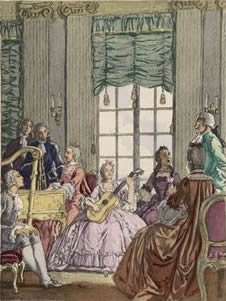
A musical evening at Carlisle House

A musical evening at Carlisle House

The ball on Feb. 26, 1770

…Mrs. Cornelys gave a magnificent fête to some 800 maskers. Walpole devotes great part of a long letter to a description of this masquerade, at which he was present.

Our civil war has been lulled asleep by a Subscription Masquerade, for which the House of Commons literally adjourned yesterday. Instead of Fairfax’s and Cromwells, we have had a crowd of Henry the Eighths, Wolseys, Vandykes, and Harlequins; and because Wilkes was not mask enough, we had a man dressed like him, with a visor in imitation of his squint, and a Cap of Liberty on a pole… The ball was last night at Soho; and, if possible, was more magnificent than the King of Denmark’s…

…The mob was beyond all belief: they held flambeaux to the windows of every coach and demanded to have the masks pulled off and put on at their pleasure, but with extreme good humor and civility. I was with my Lady Hertford and two of her daughters in her coach: the mob took me for Lord Hertford, and huzzaed and blessed me! One fellow cried out, “Are you for Wilkes?” Another said, “D—n you, you fool, what has Wilkes to do with a masquerade?”

Among the company were Lady Waldegrave, Lady Pembroke, the Duchess of Hamilton, Mrs. Crewe, Mrs. Hodges, Lady Algeria Carpenter, &c. The characters assumed were very eccentric. Sir R. Phillips appeared as “a double man,” half-miller, half chimney-sweeper. The Earl of Carlisle figured as a running footman; Mr. James, the painter, as Midas. The Duke of Devonshire was “very fine, but in no particular character.” And “Lord Edg—b, in the character of an old woman, was full as lovely as his lady.” The ladies were superbly dressed. “The Countess Dowager of Waldegrave wore a dress richly trimmed with beads and pearls, in the character of Jane Shore.” “The Duchess of Bolton, in the character of Diana, was captivating.” “Lady Stanhope, as Melpomene, was a striking fine figure.” “Lady August Stuart, as a Vestal, and Lady Caroline as a Fille de Patmos, showed that true elegance may be expressed without gold and diamonds.” “The Countess of Pomfret, in the character of a Greek Sultana, and the two Miss Fredericks, who accompanied her, as Greek slaves, made a complete group;” and to eclipse all, “Miss Moncton, daughter to Lord Galway, appeared in the character of an Indian Sultana, in a robe of cloth of gold and a rich veil. The seams of her habit were embroidered with precious stones, and she had a magnificent cluster of diamonds on her head: the jewels she wore were valued at 30,000l.”

BIGAMOUS DUCHESS OF CHUDLEIGH

The Bigamous Duchess of Kingston

An “opera strife” leads to bankruptcy

In the following year, 1771, Mrs. Cornelys got embroiled in an opera strife. Walpole writes, Feb. 22, 1771: “Our most serious war is between two Operas. Mr. Hobart, Lord Buckingham’s brother, is manager of the Haymarket. Last year he affronted Guadagni, by preferring the Zamperina, his own mistress, to the singing hero’s sister. The Duchess of Northumberland, Lady Harrington, and some of the great ladies, took up the brother, and without a license erected an opera for him at Madame Cornelys’s… Mr. Hobart began to starve, and the managers of the theatre were alarmed. To avoid the Act, she pretended to take no money, and had the assurance to advertise that the subscription was to provide coals for the poor, for she has vehemently courted the mob, and succeed in gaining their princely favour. She then declared her masquerades were for the benefit of commerce.… At last, Mr. Hobart informed against her, and the Bench of Justices, have pronounced against her. Her opera is quashed, and Guadagni… is not only fined, but was threatened to be sent to Bridewell.

Mrs. Cornelys’s masquerades were characterized not only by indecency, but also by mockery of solemn feelings and principles… The lessees of the theatre, injured by her popularity, opposed her; and she was convicted before Sir John Fielding for performing dramatic entertainments without a license.… Next, bills of indictment were preferred to the grand jury, insinuating of Mrs. Cornelys “that she does keep and maintain a common disorderly house, and did permit and suffer diverse loose, idle, and disorderly persons, as well men as women, to be and remain the whole night, rioting and otherwise misbehaving themselves.” In November following, appeared in the bankrupt list of the London Gazette, “Teresa Cornelys, Carlisle House, St. Anne, Soho, dealer.”

Pantheon_from_Papworth's_Select_Views_1816

The Pantheon, one of the competitors of Mrs. Cornelys’s that eventually caused her downfall

Mrs. Cornelys’s last stand

Nevertheless, Mrs. Cornelys resumed her revels here with great spirit in 1776. Two years later, Carlisle House was again advertised to be sold by private contract…

…Mrs. Cornelys attempted to retrieve her fortunes in various places; one being in a large detached mansion, known as Knightsbridge Grove, in Porter’s Lane, approached through a fine avenue of trees from the highway. At length, in 1785, Mrs. Cornelys gave up her precarious trade. “Ten years after,” says Davis’s Memorials of Knightsbridge, “to the great surprise of the public, she reappeared at Knightsbridge as Mrs. Smith, a retailer of asses’ milk. A suite of breakfast-rooms was opened; but her former influence could not be recovered.” The speculation failed; and at length she was confined in the Fleet Prison, where she died August 19, 1797.

In the literature of the day

Murphy, in his Epilogue to Zobeide, 1771, refers to her popularity:

Oh farewell!

For her each haunt that charms a modern belle!

Adieu, Almack’s! Cornelys! Masquerade!

Sweet Ranelagh! Vauxhall’s enchanting shade!

Combe, in his satire, The Diobalady, 1777, thus severely castigates the licentiousness of the amusements:

The ready ministers of hell’s commands, Obedient, fly and take their several stands

At Court,  Cornelys’, and the Coterie;

Where vice, more vicious by effrontery,

Fearless, unblushing, braves the eternal laws

Of God and man, to aid the devil’s cause.

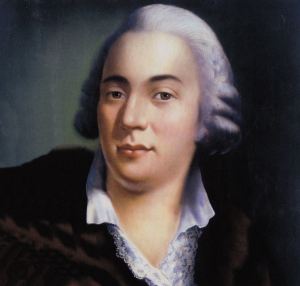
Note: Teresa Cornelys was one of the mistresses of the famous lover, Casanova, to whom she bore a child.

casanova-tour

Giacomo Girolamo Casanova


Romance of London Series

  1. Romance of London: The Lord Mayor’s Fool… and a Dessert
  2. Romance of London: Carlton House and the Regency
  3. Romance of London: The Championship at George IV’s Coronation
  4. Romance of London: Mrs. Cornelys at Carlisle House
  5. Romance of London: The Bottle Conjuror
  6. Romance of London: Bartholomew Fair
  7. Romance of London: The May Fair and the Strong Woman
  8. Romance of London: Nancy Dawson, the Hornpipe Dancer
  9. Romance of London: Milkmaids on May-Day
  10. Romance of London: Lord Stowell’s Love of Sight-seeing
  11. Romance of London: The Mermaid Hoax
  12. Romance of London: The Bluestocking and the Sweeps’ Holiday
  13. Romance of London: Comments on Hogarth’s “Industries and Idle Apprentices”
  14. Romance of London: The Lansdowne Family
  15. Romance of London: St. Margaret’s Painted Window at Westminster
  16. Romance of London: Montague House and the British Museum
  17. Romance of London: The Bursting of the South Sea Bubble
  18. Romance of London: The Thames Tunnel
  19. Romance of London: Sir William Petty and the Lansdowne Family
  20. Romance of London: Marlborough House and Sarah, Duchess of Marlborough
  21. Romance of London: The Duke of Newcastle’s Eccentricities
  22. Romance of London: Voltaire in London
  23. Romance of London: The Crossing Sweeper
  24. Romance of London: Nathan Mayer Rothschild’s Fear of Assassination
  25. Romance of London: Samuel Rogers, the Banker Poet
  26. Romance of London: The Eccentricities of Lord Byron
  27. Romance of London: A London Recluse

Romance of London: The Championship at George IV’s Coronation

Romance of London: Strange Stories, Scenes And Remarkable Person of the Great Town in 3 Volumes

John Timbs

John Timbs (1801-1875), who also wrote as Horace Welby, was an English author and aficionado of antiquities. Born in Clerkenwell, London, he was apprenticed at 16 to a druggist and printer, where he soon showed great literary promise. At 19, he began to write for Monthly Magazine, and a year later he was made secretary to the magazine’s proprietor and there began his career as a writer, editor, and antiquarian.

This particular book is available at googlebooks for free in ebook form. Or you can pay for a print version.

The Championship of England*

ScrivelsbyCourt

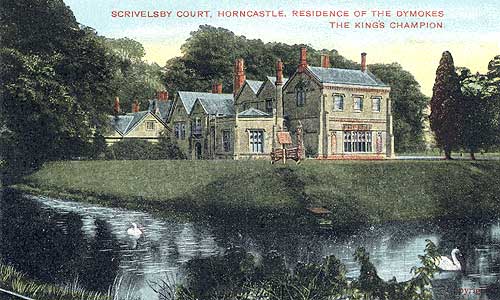
The chivalrous and dignified office of Champion of England at our coronations is conferred by the feudal manor of Scrivelsby, about two miles south of Horncastle, on the road towards Boston in Lincolnshire. By the holding of this manor, the ancient family of the Dymokes have derived the office of champion to the sovereigns of England…

edwardvi

The manor of Scrivesby, which was granted by the Conqueror to Robert de Marmion (Lord of Fontenoy, in Normandy), to be held by grand sergeantry, “to perform the office of champion at the King’s coronation.” The Marmians, it is said, where hereditary champions to the Dukes of Normandy prior to the conquest of England.

Dymock Champion

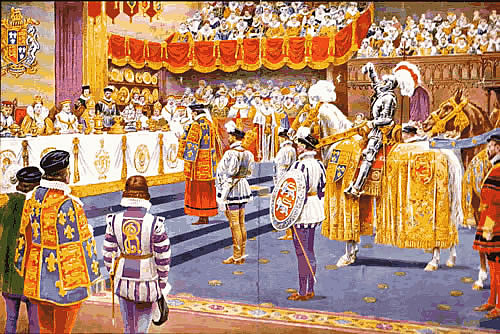
The Kings Champion in full armor in the banqueting hall at the coronation of Queen Elizabeth I

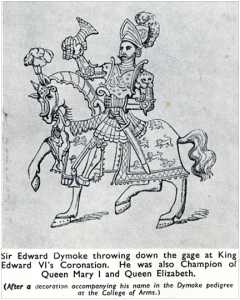
Sir John Dymoke served as Champion of England at the coronation of Richard II. Sir Robert Dymoke did so for Richard II, Henry VII, and Henry VIII. Sir Edward Dymoke was champion for Edward VI, Mary I, and Elizabeth I. John Dymoke was champion for George III, and when the time came for George IV’s coronation, the honor went to his grandson, Sir Henry Dymoke, due to the fact that his son, Rev. John Dymoke, was a cleric.

0020 16.tif

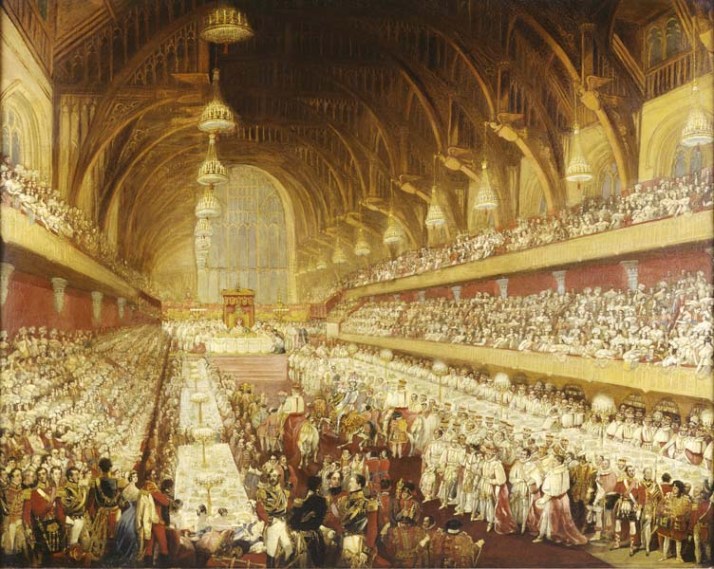
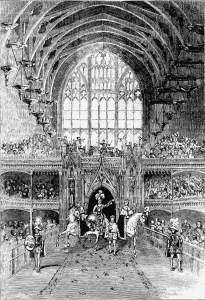
George IV’s coronation banquet was held in Westminster Hall in 1821; it was the last such banquet held.

The entry of the champion at the close of the Banquet in Westminster Hall, at the coronation of George IV., was a splendid spectacle. Haydon, the historical painter, thus describes this ancient feudal ceremony which he witnessed: “The hall-doors were opened, and the flower-girls entered, strewing flowers. The distant trumpets and shouts of the people, the slow march, and at last the appearance of the King, crowned and under a golden canopy, and the universal burst of the assembly at seeing him, affected everybody… After the banquet was over, came the most imposing scene of all, the championship. Wellington, in his coronet, walked down the hall, cheered by the officers of the Guards. He shortly returned, mounted, with Lords Anglesey [formerly the Earl of Uxbridge] and Howard. They rode gracefully to the foot of the throne, and then backed out. The hall doors opened again; and outside, in twilight, a man in dark-shadowed armor appeared against the shining sky. He then moved and passed into darkness under the arch, and suddenly Wellington, Howard, and the champion stood in full view, with doors closed behind them. This was certainly the finest sight of the day. The herald then read the challenge; the glove was thrown down. They all then proceeded to the throne.”

championship

Coronation of George IV, Westminster Hall: the Champion’s Challenge

Sir Walter Scott, in his letter describing the coronation, says, “The Duke of Wellington, with all his laurels, moved and looked deserving the baton, which was never grasped by so worthy a hand. The marquess of Anglesey showed the most exquisite grace in managing his horse, notwithstanding the want of his limb, which he left at Waterloo. I never saw so fine a bridle-hand in my life, and I am rather a judge of horsemanship. Lord Howard’s horse was worse bitted than those of the two former noblemen, but not so much as to derange the ceremony of returning back-out of the hall. The champion was performed (as of right) by young Dymoke, a fine-looking youth, but bearing, perhaps a little too much the appearance of a maiden knight to be the challenger of the world in a King’s behalf. He threw down his gauntlet, however, with becoming manhood, and showed as much horsemanship as the crowds of knights and squires around him would permit to be exhibited. On the whole, this striking part of the exhibition somewhat disappointed me, for I would have had the champion less embarrassed by his assistants, and at liberty to put his horse on the grand pas; and yet, the young Lord of Scrivelsby looked and behaved extremely well.”

Supertunica-stole-and-spurs

The Imperial Mantle was made for the coronation of George IV in 1821 and is designed in the style of earlier ones worn by the Tudor and Stuart monarchs, it is worn over the Supertunica and the Stole. The Imperial Mantle is made of gold cloth, lined with red silk and woven with colored threads designed with a pattern of crowns, eagles, fleur-de-lis, roses, thistles and shamrock held together at the chest with a gold clasp in the form of an eagle.

*George IV’s was the last coronation to include a championship.


Romance of London Series

  1. Romance of London: The Lord Mayor’s Fool… and a Dessert
  2. Romance of London: Carlton House and the Regency
  3. Romance of London: The Championship at George IV’s Coronation
  4. Romance of London: Mrs. Cornelys at Carlisle House
  5. Romance of London: The Bottle Conjuror
  6. Romance of London: Bartholomew Fair
  7. Romance of London: The May Fair and the Strong Woman
  8. Romance of London: Nancy Dawson, the Hornpipe Dancer
  9. Romance of London: Milkmaids on May-Day
  10. Romance of London: Lord Stowell’s Love of Sight-seeing
  11. Romance of London: The Mermaid Hoax
  12. Romance of London: The Bluestocking and the Sweeps’ Holiday
  13. Romance of London: Comments on Hogarth’s “Industries and Idle Apprentices”
  14. Romance of London: The Lansdowne Family
  15. Romance of London: St. Margaret’s Painted Window at Westminster
  16. Romance of London: Montague House and the British Museum
  17. Romance of London: The Bursting of the South Sea Bubble
  18. Romance of London: The Thames Tunnel
  19. Romance of London: Sir William Petty and the Lansdowne Family
  20. Romance of London: Marlborough House and Sarah, Duchess of Marlborough
  21. Romance of London: The Duke of Newcastle’s Eccentricities
  22. Romance of London: Voltaire in London
  23. Romance of London: The Crossing Sweeper
  24. Romance of London: Nathan Mayer Rothschild’s Fear of Assassination
  25. Romance of London: Samuel Rogers, the Banker Poet
  26. Romance of London: The Eccentricities of Lord Byron
  27. Romance of London: A London Recluse