Archives

Vauxhall Gardens: The Competition

vauxhallbook

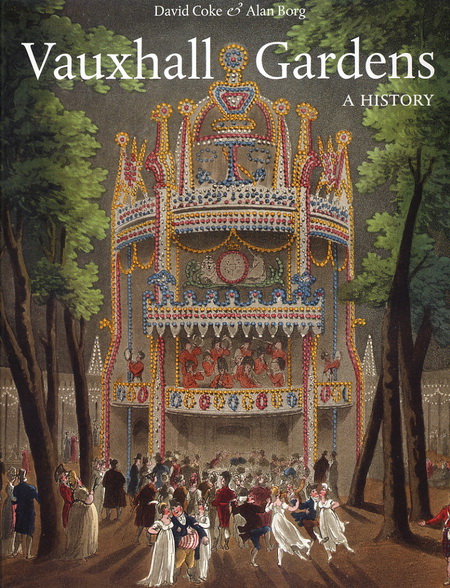
Vauxhall Gardens: A History

David Coke & Alan Borg

The Vauxhall Pleasure Gardens is one of the places I’d love to slip back in time to visit, just to catch a glimpse of what it was like. After recently splurging to buy this lovely coffee-table book, I thought it might make a wonderful subject for a new blog series. But do buy the book too, if you can! The photos are fabulous!

“Imitation is the sincerest form of flattery.”

The success of Vauxhall naturally spawned imitators, but Vauxhall “outstripped all of them, not only in visitor numbers and longevity, but in the national and international renown achieved by the gardens, its use by writers as a setting in plays and novels, and the fact that its name became synonymous with the pleasure garden throughout Britain and all over the world.”

Ranelagh and Marylebone, however, did give Vauxhall’s founder a run for his money. S. Toupée, a correspondent from Scots Magazine (see last week’s post), writes:

It may not be amiss to tell you, the spirit of imitation increases amongst us every day. Vaux-hall has produced tickets and accommodations of the same nature, at Marybone, on this side of the Thames, and at Caper’s gardens, on t’other.”

Marylebone Gardens

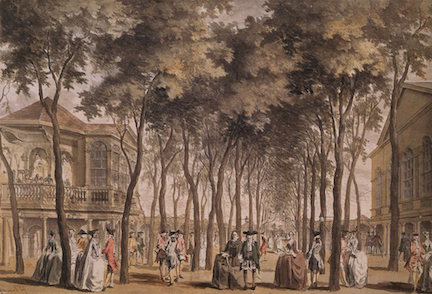
John Donowell, A View of the Orchestra with the Band of Music, the Grand Walk &c. in Marybone Gardens, watercolor, 1755.

John Donowell, A View of the Orchestra with the Band of Music, the Grand Walk &c. in Marybone Gardens, watercolor, 1755.

Prior to its purchase by Daniel Gough, landlord of the neighboring Rose Tavern in 1737, Marylebone Gardens was “little more than a bowling green and gaming house.” In his attempt to imitate Vauxhall, “Gough built an outdoor Orchestra there… and installed an organ by Richard Bridge. In the winter of 1739-40 he added a Great Room for balls and suppers, facing the Orchestra.”

High quality music was the main attraction at Marylebone, and fireworks were added here decades before Vauxhall.

However, Marylebone did not even try to compete with Vauxhall in the visual arts, or in the order maintained in the gardens, and this proved to be its downfall; it was less selective of its visitors, and less proscriptive in the activities enjoyed by them, allowing the garden to become a haven for card-sharps and gamblers… Marylebone Gardens eventually closed, unmourned and leaving little trace, in 1778.

Ranelagh Gardens

T. Bowles after J. Maurer. Raleigh House and Gardens with the Rotunda, engraving, 1745.

T. Bowles after J. Maurer. Ranelagh House and Gardens with the Rotunda, engraving, 1745.

Opened in April 1742 by a syndicate of businessmen who saw the problems Vauxhall was having with inclement weather, Ranelagh featured a huge rotunda, inspired by the Pantheon in Rome.

Giovanni Antonio Canal, il Canaletto. The Interior of the Rotunda at Ranelagh, oil on canvas, c.1751.

Giovanni Antonio Canal, il Canaletto. The Interior of the Rotunda at Ranelagh, oil on canvas, c.1751.

Large numbers of people could saunter, take refreshments and listen to music without any of the natural inconveniences of an English summer. The building itself, especially the great domed space inside, became an architectural wonder in its own right, attracting crowds just to see, even during construction. With its grand central orchestra stand rising to the roof, its two levels of supper-boxes around the walls, its elaborate plaster decorations and chandeliers, this mostly timber Rotunda, 185 feet in diameter, was a remarkable space… During its first year at least, the Rotunda was the subject of much talk among fashionable society; Catherine Talbot wrote to Elizabeth Carter just two months after it had opened, saying that London’s neighborhood

is enriched since you was here, with a building which I am told exceeds in taste and magnificence every one in Europe: to untravelled eyes like mine ’tis to be sure an amazing fine thing, and quite worth your coming to see it next year, by which time they may possibly have found all that it wants to make it complete; some use for it answerable to the fineness and stateliness of the structure, for to be sure it is quite vexatious at present to see all the pomp and splendour of a Roman amphitheatre, devoted to no better use than a twelvepenny entertainment of cold ham and chicken.

Ranelagh did give Vauxhall a run for its money, however, even “beating Vauxhall at its own game” for a time. However,

once it lost its novelty it also lost much of its appeal. It was always the least disreputable of the pleasure gardens, being free of strong liquor and of gambling. This attracted the older generation and the more conservative sector of the public, as did the half-crown admission cost (to include tea and coffee), which excluded a large section of the London population. It was this very respectability, and the limited opportunities for change, that eventually drove away the fashionable set of the next generation and led to Ranelagh’s final downfall.

Like Marylebone, and indeed like Vauxhall itself, Ranelagh started to run into real difficulties around 1780, when, because of riots in London and perceived threats of invasion from across the Channel, the public enjoyment of frivolous pleasures had become socially less acceptable. Its proprietors battled on for another twenty years, but finally gave up 1803, unable to adapt to the demands of a new and more demanding public.

Vauxhall Reigns Supreme

…the al fresco character of Vauxhall, and its intimations of physical and moral danger, were essential features of its popular appeal. The Rotunda undeniably kept Ranelagh’s visitors’ feet dry, and eliminated any element of risk, but once everybody had seen and been seen by everybody else, the circular promenade became profoundly dull and repetitive. The walks at Vauxhall, although all straight and at right angles to one another, were at least all different, and allowed visitors to choose which way they walked, and to escape the bright lights, while still hearing the music.

None of Vauxhall’s rivals encompassed such a strong moral ideology as Vauxhall, and few invested anything like the same amounts as Tyers in the design or in the artworks that decorated and themed their gardens. It is certainly due in part to these factors that Vauxhall succeeded above its competitors.

Susana’s Vauxhall Blog Post Series

  1. Vauxhall Gardens: A History
  2. Vauxhall Gardens: Jonathan Tyers—“The Master Builder of Delight” 
  3. Vauxhall Gardens: A New Direction
  4. Vauxhall Gardens: The Orchestra and the Supper-Boxes 
  5. Vauxhall Gardens: The Organ, the Turkish Tent, and the Rotunda
  6. Vauxhall Gardens: Three Piazzas of Supper-Boxes
  7. Vauxhall Gardens: “whither every body must go or appear a sort of Monster in polite Company”
  8. Vauxhall Gardens: The Competition
  9. Vauxhall Gardens: The Artwork, Part I
  10. Vauxhall Gardens: The Artwork, Part II
  11. Vauxhall Gardens: The Music, 1732-1859
  12. Vauxhall Gardens: The Business Side
  13. Vauxhall Gardens: Developments from 1751-1786
  14. Vauxhall Gardens: Thomas Rowlandson’s Painting (1785)
  15. ‎Vauxhall Gardens: The Third Generation of the Tyers Family and the Jubilee of 1786
  16. Vauxhall Gardens: An Era of Change (1786-1822), Part I
  17. Vauxhall Gardens: An Era of Change (1786-1822), Part II
  18. Vauxhall Gardens: An Era of Change (1786-1822), Part III
  19. Vauxhall Gardens: The Final Years, Part I
  20. Vauxhall Gardens: The Final Years, Part II
  21. Vauxhall Gardens: The Final Years, Part III
  22. Vauxhall Gardens: The Final Years, Part IV
  23. Vauxhall Gardens: Farewell, for ever

Alicia Quigley: The Contraband Courtship

ContrabandCourtship2Final-FJM_High_Res_1800x2700 copy

I’m happy to be back at Susana’s Parlour! I always enjoy my visits!

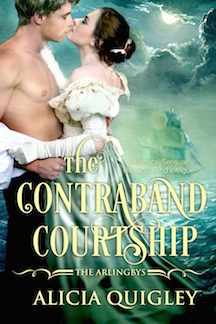
My latest book, The Contraband Courtship, came out in July. This is the second book in The Arlingbys series and it deals with Malcolm Arlingby, the Earl of Wroxton, the brother of Rowena Arlingby whose romance with the Earl of Brayleigh was the subject of the first book of the series, A Collectors Item. In that story, Rowena helped solve a murder case a dozen years old, which had resulted in the unjust exile of Malcolm to the Continent when he was falsely accused. In The Contraband Courtship, the Earl of Wroxton has returned to his estates for the first time in all those years to find that smugglers are using his property with impunity to move casks from the coast inland. However, that’s not all he finds.

He meets his headstrong neighbor, Helena Keighley, who is most definitely not impressed with “the Wicked Earl,” as he’s been dubbed. Neither is Malcolm all that fond of Helena. They make the perfect pair, though. Despite Malcolm’s name having been cleared, there are still those in the ton who look upon him as scandalous. Helena, unbeknownst to Malcolm at first, is no less welcome in polite society, having been the subject of a scandal during her Season.

I’ve written before on the topic of smuggling in the Regency, an issue that plays a huge role in The Contraband Courtship. This time, I’d like to talk about the courtship, not the contraband. Though if Helena hadn’t been part of a scandal years earlier, this courtship would be considered contraband (OK, we’d have to tweak the definition a bit as the word refers to goods, not relationships).

Courtship in the Regency

was a very serious undertaking that came with a fair number of rules. It was, for the woman, a matter of planning for the rest of her life. She wasn’t allowed to take an overt part in the process (baffling, no?) in order to protect her reputation and, in fact, had very little control in the matter other than the ability to refuse an unwanted suitor.

The man looking for a wife bore the responsibility of winning over a prospective bride. While technically powerless, that prospective bride did have some behind-the-scenes ability to influence the outcome. The fine art of flirting or subtler tactics such as seeking introductions while not appearing overly eager are a couple examples. Women had to be very careful, though; if they were seen as taking too much control, they ran the risk of being labeled hoydens.

Of course, the whole process was further complicated by those rules I mentioned. The couple could:

  • Never be alone in a room
  • Never travel in a carriage without a chaperone
  • Never speak privately (though dances were one way of bypassing that one)
  • Not correspond with or give presents to one another
  • Not have any intimate touch, including handshakes (again, dancing helped)
  • Not call each other by their Christian names
  • Not dance more than two dances on a given evening (rumors of an engagement were sure to follow if they did)

Indeed, the allowed form of greeting and leave taking was a curtsy or a slight bow of the head.

How does this impact Malcolm and Helena? In many respects, it gave them a lot more freedom. Plus, they were out in the country and not in ever-watchful London. Though, the social graces were minded in the country, too, there were fewer eyes trained on them. As a man in this situation, Malcolm has more freedom than Helena anyway; however, that’s only increased due to the location and his already somewhat tarnished reputation.

Helena, on the other hand, is in a unique position.

Her scandalous reputation also frees her from many of the usual social strictures of courtship. In her case, the freedom extended to not even considering the issue. After her disgrace, she retired to her family’s estate which she ultimately managed for her minor brother. Marriage was, in her mind, simply no longer an option.

Helena is much luckier than many Fallen Women, as they were known. It was not uncommon in the era for disgraced women to become prostitutes or courtesans. The difference between the two was often the level of companionship and the price. Courtesans offered more than just sex; a man could find companionship and, depending on the courtesan, intellectual entertainment.

Given Helena’s character, I cannot imagine either option would have appealed to her. Fortunately for her, she had an understanding family and the opportunity to return home to tend the estate. I find her to be a woman of great courage in the face of unfortunate circumstances. Such courage, strength of will and intellect make her the perfect woman for Malcolm, the Wicked Earl.

I hope you’ve enjoyed this peek into the courtship customs of the era. As always, it’s been a joy for me to share them with you!

About The Counterfeit Courtship

Malcolm Arlingby, Rowena’s headstrong brother from A Collector’s Item, settles into his new life as the Earl of Wroxton. Content to while away his time in the decadence he missed during his exile from England, Malcolm hasn’t been paying attention to the duties that come with the title. A letter from the mistress of a neighboring estate warns of smugglers using Malcolm’s lands for their dastardly deeds and he must finally put aside his entertainments to handle the business of being an Earl.

Helena, the one who sent the letter, is not the sour spinster Malcolm was expecting, however. She is a beautiful, vibrant and equally headstrong woman who is more than ready to take Malcolm to task for ignoring his duties. As the pair becomes embroiled in solving the problem of the smugglers, a strong attraction develops. The smugglers aren’t going without a fight, though.

Will a chance encounter with his new neighbor bring Malcolm all the things he never knew he wanted? Or, will the smugglers destroy it all? Find out in “The Contraband Courtship.”

Amazon

Excerpt

THE CONTRABAND COURTSHIP

CHAPTER 1

Malcolm Arlingby, Earl of Wroxton, awoke as the first rays of sun peeked around the edges of the burgundy velvet curtains that hung over the windows of his bedroom. He laid comfortably for a moment, appreciating the fineness of the linens that covered the bed, the luxury of the over-stuffed goose feather pillows, and the enormous size of the carved mahogany bed in which he rested. It was a far cry, he thought, from his life not six months before.

So much had changed, and yet so much had not. He still awoke early, no matter how late he stayed out, and he slept lightly, always with a sense of his surroundings. But this morning was much as the past mornings had been; he was safely ensconced in a luxurious bedroom, servants at his beck and call, the Wroxton fortune at his disposal, no longer having to live by his wits or earn his keep at the gambling table.

He rolled over and lazily eyed the woman who lay next to him. She slept soundly, her dusky hair strewn across the white pillows, one arm thrown over her head, the lace-edged sheet pushed down so one rounded breast peeped above it, its nipple a dusky pink. Malcolm reached out, touching it gently with one finger. Instantly it puckered and elongated, and, with a knowing smile, he lowered his lips, eagerly suckling the pointed tip.

“Mmmm.” The woman stirred, and, without opening her eyes, raised one hand to cradle his head. “What time is it?”

“Early, I think,” responded Malcolm. “Do you wish to go back to sleep?”

“I’m here for you any time, Malcolm,” she answered. Slowly she raised her eyelids to reveal a pair of liquid brown eyes flecked with gold. “Day or night.”

“Well, it’s barely day, but if you have time for me now…” Malcolm pushed the sheet down to cup her other breast in his hand as he moved to straddle her.

“Always,” she answered, her hands moving caressingly over his muscular chest, to follow the arrow of blond hair downward under the soft linen sheets. Malcolm groaned as her clever fingers found their target, and speared his fingers through her hair, as he pressed his mouth to hers, kissing her deeply. When he raised his head, she smiled and repeated, “Any time.” Then with a salacious smile she added “Any way

Much later Malcolm turned away from Estella and rolled onto his back, reaching out for a cigarette. “I can’t imagine what ails your husband, to neglect you so, Estella. You’re beautiful, more than willing, but not demanding, and amusing to converse with. Yet he is almost never at your side.”

“Richard is always pleasant company, when he is about,” she replied. “But he married only to provide an heir for the estates. It’s his duty, and he did it, but not with enthusiasm.”

“So, not much in the petticoat line, it seems,” Malcolm remarked. “Do you suppose he is a man milliner?”

“Oh, I have no notion,” Estella answered. “I am very fond of him you know, and he’s very helpful when it comes to all manner of things; he knows where the best tea is to be had, and the latest modiste, and is always completely correct when it comes to advising one on looking one’s best. But he has his own friends and amusements and really, I am not inclined to trouble him, if he does not trouble me. As long as I bring no cuckoos into the nest, he will not be unhappy.”

She rolled over onto him, propping herself on his chest with her forearms. “But why are we wasting our time discussing my husband? I promise you, he is not spending a moment worrying about me.”

Some hours later Malcolm strode down St. James Street, impeccably clad in dark blue coat of fine wool broadcloth. His cravat was tied in the mathematical knot, and his biscuit-hued pantaloons were tucked into betasseled Hessian boots with a mirror-like polish. He had left Estella sipping chocolate in his bed, well-sated. He knew she was clever enough to be gone by the time he returned; she knew better than to be demanding, and, in return, he indulged all her whims. Never, he thought, had he been more contented.

He strode up the stairs to White’s with a jaunty step. As he entered, a few heads turned, and he greeted their looks with a grin. Taking up a paper, he seated himself in a high-backed leather chair.

“Who’s the dashing fellow who just walked in?” asked one elderly gentleman of the man next to him.

Horace Worth gave him a surprised look. “Haven’t you heard? Oh, I’d forgot you’d been on the Continent these past months. Holmwood. That is the Earl of Wroxton.”

The gentleman turned in surprise. “Wroxton? I thought Felix Arlingby was the current earl.”

Mr. Worth shook his head. “No, that fellow is Malcolm Arlingby, the old earl’s son, returned to take up his birthright. “

The other man gaped. “Not the murderer?”

“No, not the murderer, or so it seems,” said Mr. Worth. “It appears that we were all mistaken. Malcolm Arlingby’s name has been cleared, and he has succeeded to his father’s estate.”

“Well, I’ll be damned. He was gone for twelve years or more, was he not?”

“At least. And now he’s back and has been cutting quite a swathe through Society,” said Mr. Worth with a shrug. “The ladies, of course, cannot resist his looks or his reputation as a bit of a rake, and as for the men—outside of some jealousy among them, there’s nothing not to like. He’s a fine horseman, a pleasant companion, pays his debts of honor, and is generous with his funds.”

As they gazed at Malcolm, an elegant dark haired gentleman entered the room and paused for a moment, obviously searching for someone. His sharp green eyes eventually lit on Malcolm, and he strolled across the room, dropping into the chair across from him. The elderly gentleman drew in his breath.

“Isn’t that Brayleigh?” he asked. “Malcolm Arlingby and the Earl of Brayleigh always loathed each other. I wonder they are sitting across from each other.”

Mr. Worth laughed. You have been gone far too long,” he said. “Brayleigh is married to Wroxton’s sister. They are—well, I will not say they are the best of friends, but they tolerate each other. I understand Lady Brayleigh will brook nothing else.”

“Well, I’ll be,” said his friend, staring openly at the two men. “Brayleigh and Wroxton are being civil to one another? I would never have believed it if I didn’t see it with my own eyes!”

Brayleigh looked around and sighed. “You might as well put down your newspaper, Arlingby, I know you’re aware I’m here,” he said.

Malcolm lowered the offending broadsheet a few inches and peered at Brayleigh over the top of it. “Am I to have no peace?” he asked peevishly.

“None at all,” said Brayleigh with equanimity. “I wonder you can tolerate the attention. Horace has obviously just told the entire story to Rupert Holmwood. He is gaping at us as though we are here solely for his entertainment.”

Malcolm shook his head. “It is always thus. Just when I think everyone knows of it, some damned idiot turns up who must be enlightened.” He folded the paper and tossed it on the table next to him. “I don’t imagine you’re here for the pleasure of my company, Brayleigh. What does my sister want?”

A small smile appeared on Brayleigh’s face. “How well you understand me,” he murmured. “Rowena indeed asked me to find you and bid you wait upon her this afternoon. I gather she has some matters she wishes to discuss with you.”

“Lord help me,” said Malcolm. “What is it now?”

“I apprehend it has something to do with the Wroxton estates,” replied Brayleigh. “That, and your friendship with the lovely Estella Lacey.”

Malcolm groaned. “She has heard of that, has she?”

Brayleigh raised an eyebrow. “All of London has heard of that. Surely you were not under the misapprehension that the pair of you have been discreet?”

“We have no reason to be discreet, so I can’t see why anyone should care,” complained Malcolm. “Her husband has no interest in her now that she has given him a son, and it is not as though I have a wife to worry about.”

“And yet, everyone does care, because you are the notorious Malcolm Arlingby,” said Brayleigh. “Really, I would think that at this point you would be beyond being surprised.”

Malcolm shrugged. “It can’t be helped,” he said. He gave Brayleigh a rueful grin. “And a bit of gossip doesn’t matter to me. After all, if I survived the last twelve years, I can survive this.”

“Then you will not mind returning with me to Brayleigh House and explaining it all to Rowena,” said the earl calmly.

“I’d rather go to Almack’s and dance with chits just out of the school room all night, and you know it,” said Malcolm cheerfully. “But I suppose I had better get it out of the way. Rowena is nothing if not persistent.”

“A wise choice.” The earl stood. “The sooner you get this over with, the sooner you can return to the charming Estella.”

Malcolm rose reluctantly. “If Rowena doesn’t have other plans for me,” he said gloomily.

Brayleigh laid a sympathetic hand on his shoulder. “I have no doubt that your sister only has your best interests at heart,” he said.

“That’s what I’m afraid of,” replied Malcolm.

The two men strolled out of the room, leaving Mr. Holmwood gaping after them.

One half hour later Malcolm and the earl entered the library at Brayleigh House, where a woman sat in an overstuffed leather chair, reading a book. She looked up when the two of them entered, and rose to her feet, her dress of figured muslin fluttering around her. Her wide violet eyes sparkled as she ran a few steps and threw herself into Brayleigh’s arms.

“Alaric, you found him,” she said. “How kind of you to help me.”

Brayleigh dropped a kiss on her cheek and slipped one arm around her waist. “It was not difficult, but I’m always happy when I can please you, my dear,” he answered.

“Lord, you two are tiresome,” protested Malcolm, throwing himself into an armchair. His stretched his long legs out in front of him and glared at them. “I think I liked it better when you were quarrelling all the time. At least that was entertaining.”

Brayleigh shook his head and released his wife. “I’m sorry you no longer find us amusing, Wroxton,” he said. “I, on the other hand, find this existence entirely pleasurable.”

He looked at his wife with a satisfied smiled, and she flushed slightly and reached out and took his hand.

“No, don’t start pawing at each other again, I can’t abide it,” said Malcolm. “What did you want to see me about, Rowena?”

With an amused glance at her husband, Rowena sank into the chair across from him, while Brayleigh leaned on the corner of the desk, his arms folded.

“Oh ho, it must be something very serious,” said Malcolm. “I count on you, Brayleigh, to give me your support.”

“Oh, I don’t meddle in Arlingby affairs,” said the earl calmly. “You will have to contend with Rowena in this matter.”

Malcolm groaned. “All right, what is it then?”

Rowena made an exasperated sound. “Malcolm, I know that you missed England and the pleasures of London dreadfully while you were on the Continent,” she said briskly. “But you have been the Earl of Wroxton for eight months now, and you still have not visited the estate.”

“I stay in close contact with the bailiff,” said Malcolm peevishly. “And both Father and Felix took good care of Wroxton. There is no reason for me to interfere in its running. Indeed, I doubt I’d be thanked for poking my nose into it.”

“But surely you wish to visit Wroxton and see how things go on,” said Rowena. “And you did tell me you wished to rebuild the stables.”

“What are you going on about? I have my horses here in London, where I can use them, and I’ve sent several to Wroxton as breeding stock. I don’t know why you’re suddenly so concerned about this,” Malcolm asked. “I think I deserve to enjoy myself a bit after everything that happened.”

“Of course you do, dear,” Rowena assured him. “It is just that—well, that it has been some time, and I wonder if perhaps you need to—well, think of the future a bit more.”

“Is this about Estella?” asked Malcolm suspiciously.

“Well, it is not only about Mrs. Lacey,” said Rowena, looking a bit embarrassed. “But, certainly, I have my concerns about her. She is married, Malcolm, and unlikely to be free to wed you any time soon.”

“Wed me?” Malcolm gave a hoot of laughter. “I should say not!”

“You see?” said Rowena. “I know that you wish to enjoy yourself, and I would never say you did not deserve to, but surely you are aware of the duty you owe your family.”

“Rowena, I have years ahead of me to sire a pack of children, if that’s what I decide needs to be done,” said Malcolm. “But for now, I have no interest in leg shackling myself to one woman. I’ve spent twelve years on the Continent living by my wits, and damn, I want to enjoy myself now. One of Estella’s principal charms—outside of the most obvious ones—is that she cannot importune me to marry her!”

“You are being very vexing,” said Rowena. “It is not that I wish to deny you your pleasures, Malcolm—”

“I should say not! And, sister dear, should you even know about Estella?”

“Don’t be ridiculous,” said Rowena crossly. “All the world knows about the two of you. I’m hardly an innocent. The gossips are only too happy to inform me that half the ladies in London have either succumbed to you since your return or to Alaric prior to our marriage.”

“Only half? Well, you might have taken Brayleigh out of circulation, Rowena, but you can’t force me into such a staid existence.” Malcolm gave his sister a shrewd glance. “There’s more here than you’re telling me. You might as well come out with it.”

Rowena exchanged a glance with Alaric. “Well, if you must know, I have received a letter from Helena Keighley.”

“Who?” asked Malcolm.

“Helena Keighley. The daughter of Sir Douglas.” At Malcolm’s blank look, Rowena sighed. “Really, Malcolm, this is why you must go to Wroxton. Sir Douglas Keighley’s estate marches with Wroxton to the west. You must have met him, and Helena, dozens of times when you were a child.”

“Oh yes, Keighley, I remember the name,” said Malcolm. “Sir Douglas, you say? As I recall, Father said he was a bruising rider to hounds.”

“Yes, Malcolm, I’m sure he was,” said Rowena impatiently. “But this has nothing to do with fox hunting. “

“A pity, I might almost be tempted to leave London for that,” said Malcolm. “What does this Miss Keighley want?”

“I received a letter from Helena a few days ago,” she said, producing a folded piece of paper and waving it at Malcolm. “She would have written to you, but had no idea where to find you, and we are acquainted. She is a year or two older than I am, but we did spend some time together as children, and of course I have met her at assemblies and house parties. Surely you remember her.”

“I can’t be bothered to remember your childhood friends, Rowena,” said Malcolm. “I had other things to attend to. What does this mysterious letter say?” asked Malcolm.

Rowena unfolded the letter and perused it quickly. “Here it is,” she said. “It seems that French brandy is being smuggled in through Kent, and the lack of interest of the Earl of Wroxton in his estate has been taken as a sign that his lands are free to be used for this purpose. While Felix Arlingby was not a strong-minded gentleman, he cared enough to prevent such nonsense, but now landings occur almost nightly. I have no doubt that some of the servants have been bribed to allow this. The whole affair is unsettling; I have no desire to see Keighley lands overrun by ruffians because Wroxton is poorly managed. It is imperative that your brother cease his wastrel ways and take up the responsibilities that come with his birthright. He was ever an irresponsible young man, but surely the circumstances of the past years must have brought him some wisdom, no matter how slight. Please inform him that he is needed immediately at Wroxton.”

“What a termagant!” said Malcolm. “She doesn’t even know me, and she’s calling me a wastrel!”

“You might not remember Helena, but I have no doubt she remembers you,” said Rowena. “You were wont to tease her unmercifully when we were young.”

“Did I?” asked Malcolm. “Well, she no doubt deserved it; she sounds to be remarkably pert. And why isn’t Sir Douglas attending to this? It seems deuced odd to me that Miss Keighley should be meddling.”

“Sir Douglas is elderly and—and not quite right in the head,” said Rowena. “And her brother is only seventeen. Helena has been managing the estate quite successfully for some years.”

“She’s unmarried, I suppose?” asked Malcolm. When Rowena nodded, he shook his head. “I can see her now; a prim and proper spinster, glaring at me from behind spectacles.”

“That is not fair,” protested Rowena. “Helena is really quite lovely.”

“Then why is she unmarried?” retorted Malcolm.

Rowena looked nonplussed. “Really, Malcolm, Miss Keighley’s personal life is not what I wanted to talk to you about. Surely you can see that you must go to Wroxton and take care of this.”

“I don’t see why the bailiff can’t handle it,” said Malcolm. He groaned when Rowena glared at him. “Oh, very well, I will go to Wroxton. You are right; I should have gone months ago. I am the new earl, and it’s time I took charge.”

At Rowena’s look of amazement, he laughed. “I’m not such a wastrel as you and Miss Keighley think, little sister,” he said. “I know I should have visited long ago, but I didn’t want to force cousin Felix to leave hastily, and then, after he moved out—well, then other things happened, and I didn’t care to leave London. But it shouldn’t take long to tidy this up, and I can do the pretty in the county; talk to the gentry, visit the tenants, and be back in no time.”

Rowena blinked. “Thank you, Malcolm.”

He laughed. “You thought it would be much harder to convince me, didn’t you? But some time away from London won’t go amiss—Lady Hartsmoor seems determined that I shall marry that whey-faced daughter of hers, and if I make myself scarce, perhaps some other fool will catch her eye.”

“I’m just pleased you are going, and, to be truthful, I wouldn’t want you marrying Lady Maria; she seems dreadfully dull. I will write to Helena and tell her that you will be visiting Wroxton soon.” She paused. “You won’t take Mrs. Lacey with you, will you? I’m not sure the countryside is ready for her.”

“I doubt she’d go,” said Malcolm cheerfully. “She’s very fond of me, but fonder of her modiste, I’d say. And when I return she’ll be that much happier to see me.”

He stood and dropped a kiss on Rowena’s cheek. “I will try to not disgrace the Arlingby name,” he said teasingly. “But this Miss Keighley sounds terrifying. I only hope I can stand up to her!”

“Don’t be ridiculous,” said Rowena fondly. “I’m sure you will take care of things quickly, and Helena will be a great help to you. She is very sensible and intelligent.”

Malcolm grinned. “So, not my sort of woman at all,” he laughed. “I’ll leave in a few days, and be back before you know it.” He shook Alaric’s hand and, with a wink at Rowena, sauntered out of the room.

Rowena shook her head as the door closed behind him. Alaric walked over to her and took her in his arms.

“Why did you not tell him about Helena Keighley?” he asked.

Rowena wrinkled her nose. “He was gone when the scandal broke, and does not know of it. There is no reason to spread gossip, particularly when I have no idea what truly happened. Helena never speaks of it, and I know better than most about being compromised! I see no reason to cause her further distress.”

“He is expecting a dried up spinster,” said Alaric. “I’d say Miss Keighley will be a bit of a surprise.”

Rowena laughed. “Indeed, she will. I suppose it is too much to hope that Malcolm will understand how extraordinary she is.”

“Your brother? He can’t see past the end of his nose,” said Alaric. At Rowena’s cross look, he chuckled. “And now, my dear, I am weary of the subject of the Earl of Wroxton. Perhaps we can find a more congenial way to amuse ourselves.”

With that, he lowered his lips to Rowena’s, and she very soon put Malcolm out of her mind.

CHAPTER 2

Malcolm left Brayleigh House in a thoughtful mood. He knew that Rowena was right, and that he should have traveled to his estates long ago. But he had always found an excellent excuse not to visit; at first he had not wanted to rush the removal of his cousin, who had been named the earl in his absence, and then there had been innumerable amusements to attend and the threads of old friendships to pick up. And Estella, of course. She had blown into his life and into his bed in a matter of days, a situation that he did not regret.

In his more reflective moments, he realized too that he had avoided visiting Wroxton because it made him think of his father and the days before his exile on the continent. He had respected his father, but as a youth had thought him too staid and serious. To a youthful Malcolm it had seemed as though his father’s interest in his estates and his books had kept him from enjoying life to its fullest. Visiting the Wroxton lands as the new earl would mean that it was time for him to take up the responsibilities and duties of his father.

Malcolm ran a hand through his fair hair and frowned. It had to be faced, he supposed. It was not as though he would have to stay long, though. He would nip down to Kent, make sure the local authorities were on the job, spend a week or so placating the neighbors, and see that Miss Keighley was no longer upset. It was a good thing she was a spinster, he thought. He knew the ladies found his dashing ways attractive, and he had little doubt that he would be able to charm her.

His soon arrived home and he entered the hallway with a frown on his face. He started slightly when he saw Estella in the center of the room, looking charming in a lavender-hued muslin morning dress with VanDyked trim. She gazed into the mirror, holding a deep poke bonnet, as though she had just been preparing to nestle it over the abundance of dark brown ringlets that surrounded her piquant face.

She blinked her large hazel eyes at him in the mirror and turned, smiling. “What are you doing back here so quickly?” she asked. “I was just leaving.”

Malcolm paused a moment to admire her fine figure, and then took her hand. “It’s just as well,” he said. “I need to talk to you.”

“What did you need to say to me, Malcolm?” she purred, moving closer to him.

“It’s not that, Estella,” said Malcolm hastily. At the look on her face, he shook his head. “Not that I’d mind at all, but I do want to talk to you for a moment.”

“Talk?” said Estella. “You rarely want to do that.”

“It’s just that I need to go down to Wroxton for a week or so,” he said.

“Whatever for?” asked Estella. “Surely your bailiff can handle matters for you. The countryside at this time of year would be dismal.”

“No doubt,” said Malcolm. “But I’ve avoided it as long as I can, and now there is a matter of smugglers. The neighbors think they’re using my property and want me to put a stop to it.”

“You?” Estella laughed. “You’d be more likely to encourage them, no doubt. I’ve never known you to question where your brandy comes from.”

Malcolm grinned reluctantly. “It’s not that I particularly care about the smugglers. But they’re upsetting the tenants and the neighboring gentry. My sister tells me it is high time I take up my duties as earl.”

Estella pouted charmingly. “Your sister again,” she said. “Why does she feel she needs to meddle in your life?”

“My sister is the reason I’m the Earl of Wroxton, and not dead, or still in exile,” observed Malcolm. “Besides, in this case, she is right.”

“Are you sure she’s not simply trying to get you away from me?” asked Estella.

“Well, I don’t suppose it bothers her that we’ll be apart,” observed Malcolm. “But I don’t think that’s her main concern.”

Estella glanced at him out of the corner of her eye. “I could go with you,” she ventured.

Malcolm laughed. “Didn’t you just say the country is dismal at this time of year? I would enjoy your company, but it won’t do to shock the gentry on my first visit home in twelve years. It’s not that I won’t miss you, Estella, but you wouldn’t be happy at Wroxton.”

“So you will simply leave me here alone? I shall grow bored,” she warned.

“Don’t try to make me feel sorry for you; I doubt you’ll miss me for a second,” said Malcolm cheerfully.

“And if I find another man to amuse me?” asked Estella.

“That’s your business, darling,” said Malcolm cheerfully. “I never asked you to be true to me.”

Estella made an exasperated noise. “You might at least pretend you care for me,” she said.

Malcolm chuckled. “If you thought I cared for you, you’d take advantage of me, my dear,” he said. “But I’ll admit that I will miss you, especially at night.”

Estella smiled winningly. “I will miss you, too,” she murmured.

“Then I’ll look forward to my return,” said Malcolm cheerfully. “I’ll wrap up this little problem and take care of Miss Keighley as quick as can be and come back to town before you have time to notice I’ve gone.”

“Miss Keighley?” asked Estella.

“Aye,” said Malcolm. “She’s the daughter of the neighboring estate. It seems she wrote to my sister to complain of the smugglers. I take it she’s a bit of a dragon and will need some soothing.”

“Miss Helena Keighley?” asked Estella.

“Dash it, stop saying her name over and over,” said Malcolm. “Yes, Miss Helena Keighley.”

“Oh,” said Estella, stretching the word out to several syllables.

“Oh, what?” asked Malcolm crossly.

“I think I am acquainted with your Miss Keighley,” said Estella.

“She’s not my Miss Keighley,” responded Malcolm. “She sounds remarkably as though she’s nobody’s Miss Keighley.”

“Well, then I believe I know Miss Helena Keighley,” said Estella. “We are much of an age, and she came out the same year I did.”

“Well, she’s unmarried, so I gather she didn’t make a splash,” said Malcolm.

“Oh, she made a splash,” said Estella, looking a bit smug.

“Damn it, Estella, if you want to tell me something, tell me,” said Malcolm peevishly.

Estella shrugged. “Miss Keighley was quite lovely, if you care for lanky redheads.”

“I prefer petite brunettes, myself,” said Malcolm promptly.

“I suppose I should be glad of that,” Estella said coyly. “As I said, she was quite lovely in her own way, but she didn’t attract many suitors.”

“And why was that?” asked Malcolm.

Estella shrugged. “She seemed to think rather highly of herself,” she ventured. “She was forever expressing her opinion. The gentlemen were rather taken aback.”

Malcolm grinned. “I imagine they were. Rowena has that effect on men, though Brayleigh doesn’t seem to care.”

“Well, I thought her quite tiresome,” said Estella. “I suppose someone may eventually have made her an offer, as her father is wealthy, but then something happened.” She paused dramatically.

“I suppose it must have, as she is unmarried,” said Malcolm unhurriedly.

Estella glowered at him for a moment. “If you are minded to be unpleasant, I won’t go on.”

Malcolm shrugged. “Then don’t,” he said. “I’ve no interest in old scandals.”

“Oh, you are impossible,” laughed Estella. “But I will tell you anyway. “

“I thought you might,” said Malcolm.

“One night, at a rout at Montagu House, she was discovered in a compromising situation with Lord Denby,” said Estella, lowering her voice in a conspiratorial manner. “They were quite alone in a curtained anteroom, and he was holding her in his arms!”

Malcolm wrinkled his nose. “I can’t like Denby,” he observed. “He always seemed to be a bit underbred.”

“That is not the point,” said Estella. “Miss Keighley apparently found him attractive enough! But then something even more shocking happened!”

“Well, I’m not all that shocked by your first revelation,” observed Malcolm. “I know from experience that things aren’t always what they appear.”

“You cannot possibly be defending her,” objected Estella.

“I don’t know the woman, why would I defend her?” said Malcolm. “She’s making my life deuced uncomfortable just now. I only said that things aren’t always what they appear to be.”

“You can be so tiresome at times,” said Estella. She paused, and then leapt back into her story. “As I said, the story became more complicated. Lord Denby proposed, of course, as he was honor bound. And Miss Keighley turned him down!”

“Did she so?” asked Malcolm. “Smart girl. As I said, Denby always makes me a bit uncomfortable.”

“Well, she was kissing him, so I have no idea why she turned him down. She was ruined, of course! No man would have her, as she clearly had no care at all of her virtue!”

Malcolm laughed at that. “Since when do you have such a care of yours, Estella?”

Estella drew herself up. “I am married, and there is no breath of doubt with regard to my son’s parentage,” she replied, offended.

“But you haven’t seen your husband in months,” said Malcolm. “And it’s no secret whose bed you are in each night.”

“Richard doesn’t care. And I am married,” Estella repeated.

“Ah, I see,” said Malcolm. “That makes all the difference.”

“It does indeed,” said Estella. “We all know how these things work. If you mean to say Miss Keighley is much like me, I think I will be very hurt.”

“Oh, I’m sure she’s not like you at all,” said Malcolm.

Estella looked at him closely, wondering whether to be offended. She finally smiled charmingly. “You are such a wretch, Malcolm,” she offered. “I am convinced you are trying to provoke me.”

Malcolm smiled lazily. “Now, why would I want to do that? I am happiest when you are pleased with me, to be sure.”

“If you wish me to be pleased with you, you will no longer compare me to Miss Keighley,” replied Estella.

“If you will forgive me, I am tired of the subject,” said Malcolm. “Surely there is something more interesting we can do than discuss a spinster I do not remember who is doing her best to make my life uncomfortable.”

Estella glanced at him from under her lashes. “I was about to leave,” she said. “But if you wish, I could stay for a bit.”

“A capital idea,” said Malcolm.

CHAPTER 3

One week later Malcolm rode up to Keighley Hall on a well-made dark bay hack. He eyed the timber-framed manor house closely; while it was several centuries old, it was well-kept, and the paths and grounds surrounding it were manicured and verdant. Clearly, whoever was attending to the land had a fine attention to detail.

A footman emerged from the house to take the reins of his horse, and he dismounted gracefully, with a word of thanks.

“Is Sir Douglas at home?” he asked.

“Sir Douglas does not see visitors,” said the manservant. “If it’s about anything to do with the estate, you’d be wanting Miss Keighley.”

Malcolm sighed. He had hoped he might be able to avoid the redoubtable Miss Keighley. But he could recognize when he was defeated.

“Is Miss Keighley available, then?” he asked.

“She’s not in the house,” ventured the man. “She’d be down at the stables. I don’t know how long it will be before she returns.”

“Well, I have business with her that can’t wait,” said Malcolm. “I’ll find her for myself.”

“Miss Keighley might prefer that you wait in the house,” said the footman doubtfully. “I could show you in and fetch her for you.”

“It doesn’t matter,” said Malcolm. “I know her from when we were children. I doubt she will care.”

Under the lackey’s doubtful gaze, Malcolm stalked off in the direction of the stables. As he walked, he looked around him, absently admiring the tidiness of the grounds. It compared favorably to Wroxton, and he felt a pang of guilt about the neglect his ancestral lands had suffered over the past months. Miss Keighley clearly knew well how to run an estate. He was too accustomed to Rowena’s unconventional behavior to consider that odd, but he nonetheless felt a reluctance to meet her. He had a constitutional dislike of being ordered about, and he feared that Miss Keighley was very much the sort of woman who would feel he needed guidance.

Miss Helena Keighley pushed a lock of auburn hair out of her eyes and sighed, as she felt at the loose bun she had gathered her hair in before coming out to check the horses that morning. Reassured that it was not going to come down completely, she rubbed her hands over the canvas apron that covered her faded blue-grey linsey-woolsey dress, and the equally worn dark blue spencer she wore over it. She looked at the groom and the horse he was holding in the barn aisle.

“Is he lame, Macklin?” she asked.

“Yes, came out of his stall this morning limping, miss,” he replied.

“Poor boy,” Helena crooned to the horse as she reached down to lift his hoof. She felt it carefully, finding a sensitive spot. “You can feel the heat in it. ‘Tis almost certainly an abscess,” she said. “Soak it in Epsom salts, and put a drawing poultice on it. Perhaps we can bring it to the surface, so it will drain.”

“Aye miss, I thought the same. I expect we’ll have a bit of time with him for the next few weeks though. The wet weather in the spring always seems to bring it out in him.”

Helena smiled her agreement, and patted the horse’s neck in sympathy, then blew gently at his soft nose. The smile brought a glow to her face, and lit up her large brown eyes. Framed with thick black lashes despite her auburn hair, and surmounted by finely shaped brows, they typically surveyed the world with a bit of cynicism, but were softened now by her affection for the horse. She had a straight nose, high cheekbones and plush-lipped mouth above a very firm chin. With her fine complexion and delicate color, she presented a rather startling contrast to the decidedly shabby garments she wore. Helena raised her face from the horse, removed her apron and looked at the groom.

“Thank you, Macklin,” she said. “I suppose I will go back to the house now.”

The groom nodded and walked away, leading the limping horse slowly. Helena stood for moment, enjoying the pleasant scent of the hay in the stalls and savoring the time alone. While she was truly devoted to tending the estate that belonged to her father and would pass from him to her brother, at times it seemed as though she never had a moment for herself. If tomorrow were fine, perhaps she would shirk some of her duties and take a book down to the cliffs for a few hours.

Her reverie was interrupted by the sounds of boot heels ringing on the floor of the stables, and a cheerful whistle. She looked up to see a tall, slender gentleman sauntering towards her, dressed very elegantly in a riding coat of a green so dark it was reminiscent of a pine forest at night, buff colored breeches, and white topped riding boots, clearly made to measure and polished to a mirror shine. His pale hair was modishly cut à la Brutus, and his angelic blue eyes were wide set in a face that, while not classically handsome, held a great deal of charm. She drew in her breath slightly. Many years had passed, but she certainly recognized Malcolm Arlingby, despite the tiny lines that now creased the outer edges of his eyelids. It seemed her letter to Rowena had done its work.

She looked down at herself, momentarily dismayed by the shabbiness of the grey dress she was wearing, but then dismissed the thought. If Malcolm had not already heard of her scandalous past, someone was bound to enlighten him soon. It made very little difference what she might look like. She stepped forward into the sunlight that slanted across the stable.

Malcolm stopped, the whistle arrested on his lips. His eyes trailed over Helena’s slender figure and widened.

“I was expecting a groom, or perhaps a stable boy,” he said cheerfully. “But I think you’ll do, my girl.”

Helena’s eyes widened at his impertinent words, and she opened her mouth to give him a sharp set down, but Malcolm continued.

“Where’s your mistress? I have business with her, and was told she was to be found in the stables.”

Helena froze. Clearly, he not only did not recognize her, and had mistaken her for a servant. She glared at him disdainfully.

“You’re a haughty one, ain’t you?” said Malcolm, a laugh in his voice. “Is Lady Helena not about then?”

Aware that her genteel speech would give her away, Helena said nothing.

Malcolm shrugged. “Women,” he said. “Never where you want them to be. But you, on the other hand—well, if I’d remembered the serving girls were so lovely in Kent, I’d have been back before this.”

Before Helena could react, Malcolm had an arm firmly about her shoulders and had pulled her close to his lean body. Helena was startled to realize that, despite her own height, her head just barely overtopped his shoulder. Before she could contemplate that fact any further, however, Malcolm lowered his head to hers and kissed her firmly on the lips. She made an outraged sound.

“Hush,” said Malcolm cheerfully. “It’s not as though you haven’t been kissed before, my girl.”

Helena raised her hands to his chest to push him away, but somehow found herself only pressing her palms against his broad shoulders, as she breathed in the hint of sandalwood and cinnamon scent that must have lingered from his morning ablutions, spiked with the warmth and scent of his skin. It was remarkably appealing, and she breathed in deeply, feeling her lips soften against his. The earl clearly felt her relax, for his hands slid down to her waist, pressing her chest against his. He slanted his head a little and she felt his lips pressing hers open. She felt her bosom swell and tighten, and her lips opened involuntarily and when Malcolm’s tongue touched hers, a bolt of sensation shot downward, and she felt an instant urge to press her hips forward against his. Suddenly, reality intruded on her, and she pushed firmly against Malcolm’s chest, wresting her lips from his. He moved back a half step, and then dropped his head to briefly kiss the side of her neck before straightening.

Malcolm gazed down at her steadily, a hint of perturbation in his eyes. “That was—remarkable,” he said softly. “Some local lad is a lucky fellow, to be sure.”

Helena stepped back, fighting the urge to press her hand to her lips. She had made a grave mistake it seemed, in not informing Malcolm who she was. But that was, nonetheless, no excuse for his behavior. It seemed that his years abroad had not taught him discretion. But, she realized ruefully, hers had been equally lacking. Something about Wroxton’s scent, feel, and presence seemed to call to her on an elemental level.

Malcolm pulled himself together and, fishing in his pocket, produced a guinea, which he pressed into her hand. “I thank you, my dear,” he said. “I did not mean to impose upon you, but your loveliness could not be resisted. I meant to see your mistress, but somehow I cannot regret her absence. Do you know where I might find her?”

Helena paused a moment, and then tilted her chin at him proudly. “I don’t know,” she said, producing her finest Kentish accent. It was imperfect, but the earl did not appear to notice. “But her abigail told me she means to go to the assembly at Folkestone tonight.”

Malcolm groaned. “I can’t abide country dances. So provincial and the refreshments are terrible. Do you think Miss Keighley has returned to the house?”

Helena shook her head firmly. “No, she’s not in the house,” she assured him.

About the Author
AQ Twitter Avi copy

Alicia Quigley is a lifelong lover of romance novels, who fell in love with Jane Austen in grade school, and Georgette Heyer in junior high. She made up games with playing cards using the face cards for Heyer characters, and sewed regency gowns (walking dresses, riding habits and bonnets that even Lydia Bennett wouldn’t have touched) for her Barbie. In spite of her terrible science and engineering addiction, she remains a devotee of the romance, and enjoys turning her hand to their production as well as their consumption.

WebsiteBlog • FacebookTwitter

Author page


Vauxhall Gardens: “whither every body must go or appear a sort of Monster in polite Company”

vauxhallbook

Vauxhall Gardens: A History

David Coke & Alan Borg

The Vauxhall Pleasure Gardens is one of the places I’d love to slip back in time to visit, just to catch a glimpse of what it was like. After recently splurging to buy this lovely coffee-table book, I thought it might make a wonderful subject for a new blog series. But do buy the book too, if you can! The photos are fabulous!

The Toupee Letters

Scots Magazine ran a series of articles in 1739-40 purporting to be “from a London correspondent, a certain ‘S. Toupee’, portraying the social scene in London, and at Vauxhall in particular, to the Scottish readership.”

The letters begin by explaining that because ordinary people of the London beau monde in search of simple pleasures were no longer satisfied with the traditional pastime of enjoying the beauties of nature, for their own sake, more fashionable amusements had been brought in from overseas, in particular the ridotto al fresco. Just how popular the gardens had become is illustrated by the fact that, despite the ingrained British dread of damp evenings, and the gentry’s habit of moving to the country in the summer, the average nightly number of paying visitors… was around a thousand. From this, it is possible to calculate that, as the Vauxhall season lasted for about one hundred evenings between May and September, the annual admissions income would amount to £5000 to £6000, a healthy figure that must have been substantially more than the normal revenue expenditure to run such a venture.

The type of entertainment provided was considered to be very new; it was well received, especially by fashionable ladies whose social life hitherto had been restricted to calling on acquaintances or going to the occasional ball, all within a very small circle of friends and relatives. Pleasure gardens opened up a whole new world to these people—a polite and exciting world where they could go with their family or friends, where they were free to entertain and mix socially with an infinitely broader circle than had been possible previously.

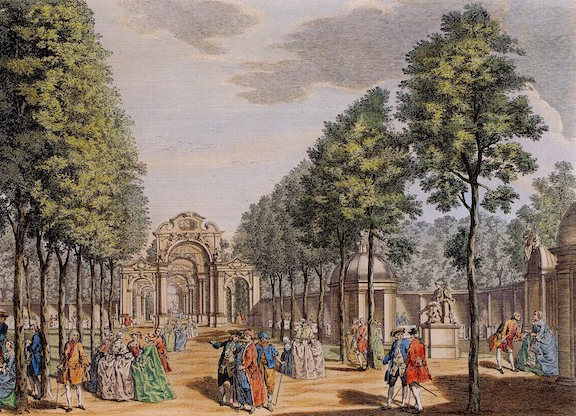
J. Maurer, A Perspective View of Vaux Hall Garden, etching, hand-coloured, 1744 (David Coke's collection). The view looking down the Grand South Walk before the classical triumphal arches were installed, with Roubiliac's Grand Alcove on the right.

J. Maurer, A Perspective View of Vaux Hall Garden, etching, hand-coloured, 1744 (David Coke’s collection). The view looking down the Grand South Walk before the classical triumphal arches were installed, with Roubiliac’s Grand Alcove on the right.

A Typical Visit to Vauxhall (from 7-10 p.m.)

The journey usually began with a boat ride from Whitehall or Westminster. On one occasion, Toupee writes about accompanying “a family group including Tom, a young musician who played the latest opera melodies on his French horn, while Miss Kitty was asked by her mother to sing one of the latest Italian songs.”

Others on their way to the gardens in neighbouring boats included ‘Sir John, from Fenchurch-street’, with his wife and all his children, attended by a footman. A Cheapside apprentence called William was on an illicit outing with Sukey, his master’s daughter… ‘An honest old mechanick’ and his wife followed; he was returning to Vauxhall after many years’ absence, to see how it had changed, reassuring his wife that the gardens must be a respectable place for her to be going, because the Prince of Wales himself was a regular visitor. This piece is clear evidence for the type of social mix that Tyers wanted to see at Vauxhall, although it is equally clear that, just because people inhabited the same space and came into direct contact, they did not necessarily interact in any meaningful way.

Pet dogs were not allowed in the gardens, but that did not stop people bringing them along for the ride, maybe to occupy the liveried footman who would not be admitted by Tyers’s gatekeeper, but could walk the dog in the fields of Lambeth. Having entered the tardens, Toupee’s party saw all the sights, listened to the music and strolled around the walks, watching and being watched by the other visitors.

The third letter, concerning the hour before closure at 10 p.m., starts with a detailed description of the dinner, accompanied by music from the Orchestra. The dramatic finale to the letter is the boat trip home, recounting the dangers of the riverside and the traditional ‘Thames ribaldry’, long-winded insults from the occupants of nearby boats that were suffered by voyagers as far apart in time as Addison’s Sir Roger in 1711 and Oakman’s John Gilpin in 1785.

“Sexual freedom was intrinsic to the gardens”

The overriding topic that runs flagrantly throughout the three letters is the meeting of the sexes, and the self-evident truth that human nature takes full advantage of any liberty offered to it. If Toupee is to be believed, Tyers was promoting his gardens as a place for lovers to meet, for initiating and nurturing romantic attachments, for sexual intrigue and adventures, and for illicit affairs; or, if he was not promoting these activities as such, he created an environment that made them possible and, indeed, inevitable. The river-crossing, the music, the paintings, the food, the walks and even the weather were all seen by Toupee as legitimate means to this one specific end.

The focus for most of the licentious activity in the gardens was not the Grove or the surrounding supper-boxes, which were too public, but the Druid’s Walk or Lover’s Walk, an unlit avenue running between and parallel with the Grand South Walk and Kennington Lane. It was distinguished from the other avenues by the fact that the trees met overhead, plunging it into shadow even before dusk. This concealing shade was unrelieved by artificial light until 1764, when magistrates forced Tyers to act against the immoral behaviour that the darkness encouraged, and to install lighting there.

At its eastern end, the Druid’s Walk met the avenue that ran around the eastern and northern edges of the gardens, always known as the Dark Walks; the darkness heightened the receptivity of impressionable young minds to emotional seduction, and no female reputation was safe…

Tyers employed constables to patrol the end of each walk in an attempt to keep such incidences to a minimum, but even they were not able to watch everybody all the time.

“The… cold and miserable spring of 1740”

I was blown through and through, in such a manner, as to drink four full glasses of French wine, before I knew I was alive. And, in that cold condition, as returning by water would have endanger’d my life, I was forced to be shook in a most unmerciful hack, till one half of my joins were distorted, and the other bruised to a jelly.

Indeed, all of the Toupee letters highlight the fact that the pleasures of the evening were never without their discomforts; and that a full enjoyment of the experience was predicated upon a full participation in the inconveniences, dangers and risks, whether perceived or real.

“The outstanding fashionable attraction of the London summer season”

In a sample letter from a young lady in town to her aunt in the country, published in 1741, the novelist Samuel Richardson confirmed that regular visits to the gardens had become an obligatory feature of the fashionable lifestyle, having his subject comment… that ‘I went on Monday last to Vaux-hall Gardens, whither every body must go, or appear a sort of Monster in polite Company.’

Susana’s Vauxhall Blog Post Series

  1. Vauxhall Gardens: A History
  2. Vauxhall Gardens: Jonathan Tyers—“The Master Builder of Delight” 
  3. Vauxhall Gardens: A New Direction
  4. Vauxhall Gardens: The Orchestra and the Supper-Boxes 
  5. Vauxhall Gardens: The Organ, the Turkish Tent, and the Rotunda
  6. Vauxhall Gardens: Three Piazzas of Supper-Boxes
  7. Vauxhall Gardens: “whither every body must go or appear a sort of Monster in polite Company”
  8. Vauxhall Gardens: The Competition
  9. Vauxhall Gardens: The Artwork, Part I
  10. Vauxhall Gardens: The Artwork, Part II
  11. Vauxhall Gardens: The Music, 1732-1859
  12. Vauxhall Gardens: The Business Side
  13. Vauxhall Gardens: Developments from 1751-1786
  14. Vauxhall Gardens: Thomas Rowlandson’s Painting (1785)
  15. ‎Vauxhall Gardens: The Third Generation of the Tyers Family and the Jubilee of 1786
  16. Vauxhall Gardens: An Era of Change (1786-1822), Part I
  17. Vauxhall Gardens: An Era of Change (1786-1822), Part II
  18. Vauxhall Gardens: An Era of Change (1786-1822), Part III
  19. Vauxhall Gardens: The Final Years, Part I
  20. Vauxhall Gardens: The Final Years, Part II
  21. Vauxhall Gardens: The Final Years, Part III
  22. Vauxhall Gardens: The Final Years, Part IV
  23. Vauxhall Gardens: Farewell, for ever

Vikki Vaught: Lady Overton’s Perilous Journey

I want to thank Susana for having me on her blog today. I’m very exciting about my new release, Lady Overton’s Perilous Journey. This is the first book in my Honorable Rogue series. This series is set in early 19th century England & America. I’d like to discuss some of the fascinating research I did for my book.

photo (2) copyI originally set this book in 1809, but on further research I discovered Jefferson convinced the U.S. congress to pass the Embargo Act of 1807, which stopped all foreign trade. While Jefferson did not want to involve the U.S. in the conflict between France and England, he wanted to put in place financial sanctions that could possibly hurt these countries economically. This act devastated the economy. American ships literally remained in port rotting in the harbors.

Here is some background history that led up to the embargo. Britain and France resumed their war in 1803, causing relations to become strained between any countries, deciding to remain neutral. In 1806 France passed a law against trading with neutral countries, and since America did not take sides in the conflict between the two countries, the French began plundering American ships. In 1807, Britain passed a bill prohibiting trade between France and neutral countries. The British began seizing American vessels and demanding that all ships pull into their ports before they were allowed to trade with other countries.

The British also started boarding American vessels and began seizing any sailors they deemed were deserters from the Royal British Navy. This infuriated the U.S. and thousands of American sailors were unlawfully impressed into the British Navy.

During the last sixteen days of Jefferson’s presidency, a bill was passed replacing the Embargo Act with the Non-Intercourse Act of 1809. While this act opened up trade again, it did not allow trade with Britain. Since my story has my heroine fleeing England on an American vessel, I needed to move it to a different year, prior to the escalating issues between the two countries. Since 1802 was the only year that England and France were not at war, I decided to place my story in that year.

This was by no means the only research I did for Lady Overton’s Perilous Journey, but was certainly the most important. While this is a novel of fiction, I wanted to ensure that the happenings within the story were possible.

I hope you’ll enjoy the romance between Alex and Anissa as much as I enjoyed writing their love story. Happy reading!

Halloween Background

About Lady Overton’s Perilous Journey

When her son’s life is threatened, Anissa, Marchioness of Overton, seeks refuge by sailing to America. Before the ship reaches the high seas, sparks fly between her and Captain Alex Hawks. Although the young widow may be lonely, and afraid, she cannot risk the diversion a romantic entanglement could bring, no matter how much she wants to lose herself in the captain’s embrace.

The Captain vows to protect the young Lord Overton, but can offer no assurance that the marchioness will leave his ship with her virtue intact. Alex is drawn to Anissa’s beauty and courage, as a hummingbird is to the nectar of a flower. How long can he fight a losing battle before he surrenders and makes her his own?

Will Alex be able to keep this remarkable woman and her child safe? Will his passion for Anissa be enough or will their differences keep them apart?

Secret CravingsAmazonBarnes & NobleARe

Excerpt

She cuddled her sleeping child close as she scanned the overcrowded common area. Her insides churned as she wove her way through the crowded tables, the chairs filled with dirty, unsavory-looking men. The strong smell of sweat mingled with ale threatened to turn her stomach and had her breathing through her mouth.

Anissa approached the man the stable boy had described. “Sir, are you Captain Hawks?”

He turned around, and in a drawling voice, he answered, “Well, darlin’, that’s my name.” He swept his tri-corn hat from his head, stood and bowed. “Captain Alex Hawks, at your service. What can I do for you?”

Anissa gazed up into the blackest eyes she had ever seen and wanted to fall into them. Mesmerized, she blinked as a shiver ran across her shoulders. This was not the time to notice this man’s eyes, no matter how compelling they were. Now was the time to use her charms to convince him to take her on his ship.

“My name is—” she quickly searched for a name, not wanting to give him her identity, “—Mrs. Carlson. I would like to pay for passage on your ship. I understand you are leaving for America this morning.” Then, thinking of a city she had heard of in America, she added, “I need to go to Boston, where some of my family lives. Would you be able to help me?”

Captain Hawks gave her an appraising stare, which unnerved her. This man was intimidating, to say the least. “I’m not going to Boston. And, I don’t normally take on passengers. I’m headed to Baltimore, and it’s a far piece from Boston, darlin’.”

“Please take me. I have to leave for America as soon as possible.” Anissa had to convince him to allow her passage. “And as far as your destination is concerned, I’m sure once I am in America, I shall be able to travel to Boston from there.”

“Darlin’, do you even know where Baltimore is and how far it is from Boston?”

Anissa wished he would quit calling her darling. It was quite presumptuous of him, and she did not appreciate it at all. Of course, she did not want to anger him, so she kept her feelings to herself. “Well, no, not really. How far is it?”

“It’s over four hundred miles,” Captain Hawks explained, as if he were speaking to a child, which further irritated her, tugging at her frazzled nerves. “You would be better served if you found a passenger ship going there. I have an associate who should be arriving in a few days, and his ship is going to Boston. He also takes passengers. I’m sure he would be happy to take you on board.”

Oh, dear, why did I say Boston? Please, Lord, let me convince him to take me.

Every hour brought her closer to the chance of discovery. She could not afford to wait for another ship. She needed to get as far away from Lord Howard as possible, immediately.

“Captain, I do not have a few days to wait. My uncle is dreadfully ill. He may only have a few months to live, so I need to leave right away. Please allow me to travel on your ship.” She looked up at him, willing a few tears into her eyes, praying to gain his sympathy.

Captain Hawks sighed and rolled his obsidian eyes toward the ceiling. “I know I’m going to regret this. All right, darlin’, if it’s that important, I’ll take you. I hope you realize how uncomfortable this voyage will be for you and the child. The cabin you will be in barely has room to turn around in. Are you sure you don’t want to reconsider?”

“We shall be fine, regardless of the conditions.”

He shook his head, sending her heart to the floor.

Oh, Lord, please don’t let him change his mind.

What shall I do if he has?

About the Author

Vikki Vaught started her writing career when a story invaded her mind and would not leave.

Over the last few years, she has written more than a half dozen historical romances and is presently working on her next. Her new release, Lady Overton’s Perilous Journey, published by Secret Cravings Publishing is the first book in her Honorable Rogue series.

Vikki loves a “Happily Ever After”, and she writes them in her stories. While romance is the central theme of all her books, she includes some significant historical event or place in all her novels.

While all her books are love stories, she has also written short contemporary sweet romances as Vikki McCombie and erotic romances using the pen name of V.L. Edwards.

For the last decade, Vikki has lived in the beautiful foothills of the Smoky Mountains of Tennessee with her beloved husband, Jim, who is the most tolerant man in the world to put up with her when she is in a writing frenzy. When she is not writing or working her day job, you’ll find her curled up in a comfortable chair reading her Kindle, lost in a good book with a cup of tea at her side.

WebsiteEmailFacebookTwitterGoogle+Pinterest

Amazon Author Page • Goodreads Author Page 

Vauxhall Gardens: Three Piazzas of Supper-Boxes

vauxhallbook

Vauxhall Gardens: A History

David Coke & Alan Borg

The Vauxhall Pleasure Gardens is one of the places I’d love to slip back in time to visit, just to catch a glimpse of what it was like. After recently splurging to buy this lovely coffee-table book, I thought it might make a wonderful subject for a new blog series. But do buy the book too, if you can! The photos are fabulous!

A Splash of the Exotic

The… striking similarity between the Grove and travellers’ descriptions of the great piazza of San Marco in Venice, where citizens were able to arrive by water, take refreshments, listen to music and watch street entertainers, would have highlighted Vauxhall’s exotic pedigree, evoking images of faraway places. This fusion of the familiar with the foreign, a constant feature of the gardens, is likely to have been a deliberate move to give visitors the thrill of romantic and magical scenes without the discomfort of distant travel.

In contrast to the aristocratic or amateur owners of great private gardens, whose wealth allowed them to indulge themselves with indiscriminate allusions to the classical past, ancient mythologies and dreamworlds, Tyers’s overriding consideration in all his investments at Vauxhall was the commercial imperative. Providing that it also furthered his aims, every improvement had to attract more people and increase his profits if it was to justify itself. The sales of food and drink represented the bulk of his income, so the more people he could persuade to purchase refreshments in the gardens, the better it was for his business. Increasing the number of supper-boxes by inserting several sweeping ‘piazzas’, or crescents of supper-boxes, was a very effective and elegant way of achieving this.

The Temple of Comus (later the Chinese Pavilions)

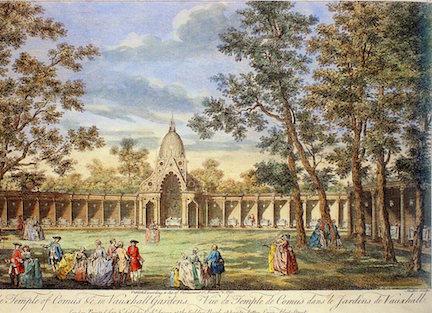
The Temple of Comus was named… after the god of cheer and good food… Ben Jonson described Comus as the ‘Prime master of arts, and the giver of wit;’ he is also associated with music and with floral decorations. The god thus encompassed all the purposes of the new building, which, although primarily devoted to dining, allowed for the appreciation of the arts and music as well as polite conversation in civilised surroundings.

J.S. Muller after Canaletto, A View of the Temple of Comus &c. in Vauxhall Gardens, an engraving hand-colored, 1751 (David Coke's collection). Families with small children are promenading in the foreground.

J.S. Muller after Canaletto, A View of the Temple of Comus &c. in Vauxhall Gardens, an engraving hand-colored, 1751 (David Coke’s collection). Families with small children are promenading in the foreground.

Initially, the building was “classical in style, with a colonnade of Ionic columns supporting a straight entablature, topped with urn finials; the semicircle flowed in a smooth curve out of the straight colonnade of the northern range of supper-boxes.” However, the designer also incorporated Gothic arches and “broad-ramped scrolls [that] acted as buttresses for the dome” and other unorthodox details. “The apparent breaking of architectural rules, mingling different styles in the same building, was deliberate and entirely typical of the unorthodox design of the English Rococo, which aimed to create playful, light-hearted works.”

piazza002 copy

T. Bowles after S. Wale. A View of the Chinese Pavillions and Boxes in Vaux Hall Gardens, engraving. c. 1840 (David Coke’s collection). This is a reprint of Bowles’ plate of 1751, published by Francis West, a Fleet Street optician and printseller who acquired many original plates of London views, probably after the sale of trade stock by Robert Wilkinson, Bowles’ successor, in 1825. The buildings of the Temple of Comus are shown with their newly applied elaborate surface decoration.

The Handel Piazza

piazza003 copy

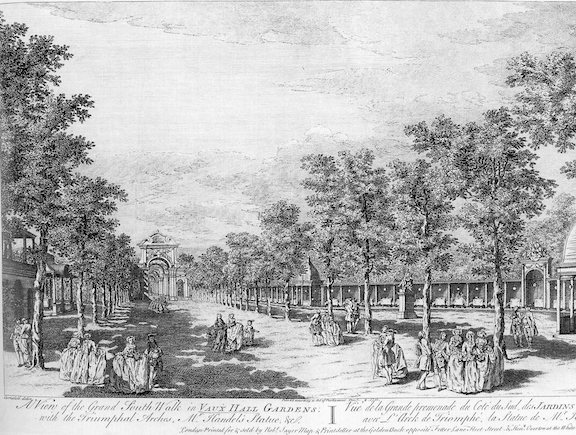
J.S. Muller after S. Wale, The Triumphal Arches, Mr. Handel’s Statue &c. in the South Walk of Vauxhall Gardens, engraving, c. 1840 (David Coke’s collection). The early version of the Handel Piazza.

The Handel Piazza on the Grand South Walk started life as a small semicircular colonnade of plain boxes, little more than an open setting for Roubiliac’s statue of the composer… The piazza was built in the simplest Doric order, although the domes of the two terminal pavilions were topped with Gothic lanterns. The rebuilding of 1750-51 created a much broader colonnade, with twenty-two flat-roofed boxes, still of the Doric order, but with urn finials on the roof over each column. As in the Temple of Comus, the central pavilion was more elaborate, marked out by the use of the Ionic order, with swagged decorations between the columns, but here in the Handel Piazza the classical order and restraint were maintained… This new structure added considerably to the number of supper-boxes available on the Grand South Walk… The opposing arrangement and contrasting decorative styles of the Chinese Pavilions and the Handel Piazza epitomise Tyers’s ideological belief in the balance between excess and moderation, with Comus appropriately representing pleasure and excess, and Handel, in his simpler classical architectural setting, representing virtuous sobriety.

piazza004 copy

J.S. Muller after Canaletto, A View of the Grand South Walk in Vaux Hall Gardens, with the Triumphal Arches, Mr. Handel’s Statue, &c. Engraving, 1751 (British Library, London). On the right is the second version of the Handel Piazza, with more supper-boxes.

The Gothic Piazza

The Gothic Piazza, looking down the Grand South Walk from its western end, is not shown from the front in any engraving of Vauxhall, although Wale’s General Prospect shows it from the back just to the south (right) of the Prince’s Pavilion). It is, however, fully described in Lockman’s Sketch, as

a little Semi-circle of Pavillions, in an elegant Gothic Style […}. At each Foot of this Semi-Circle, stands a lofty Gothic Tent, each having a fine Glass Chandelier, the Lamps in which are of a very peculiar frame, as are those in the grand Tent, built in the Grove, &c. In the Center of this Semi-Circle is a Pavilion, with a Portico before it; and over the Pavillion, a kind of Gothic Tower, with a Turret at Top. Here a Glass Moon was to have been seen; but its Light was found too dazzling for the Eye. Those who survey’d the Alley, the Grove, &c. thro’ this Glass, saw a lovely Representation of them in Miniature. As the painted triumphal Arches before mentioned are in the Grecian Style, and these Pavillions in the Gothic, they form a very pleasing Contrast.

…The implication is that visitors could climb to the top of the central pavilion of this piazza, to look down on the gardens through an optical device or lens during daylight, and after that, after dark, a light was shone through it towards visitors in the Grove, possibly spotlighting courting couples. [Scandal!]

“A remarkable body of original and innovatory architecture”

The group of structures in and around the Grove at the end of the 1740’s, comprising the Orchestra and organ buildings, the supper-boxes and three piazzas, the Prince’s Pavilion, the Turkish Tent and the Rotunda, represent a remarkably body of original and innovatory architecture that was both decorative and practical, achieved by Tyers and his team in the space of just thirteen years. Few other patrons could boast of such a diverse collection of modern works of architecture. The sheer expense incurred in this building spree is evidence of the level of Tyers’s income; as Hogarth’s friend the enameller Jean-André Rouquet wrote at the time, ‘The director of the entertainments of this garden acquires and expends very considerable sums of money there every year. He was born for undertakings of this kind. He is a man of an elegant and bold taste; afraid of no expence, when the point is to divert the public’—or rather, to attract the paying public to Vauxhall.

The fact that this elegant and bold taste was devoted to a pleasure garden, and that the buildings no longer exist, should not detract from their importance in the context of the development of British architecture, and in particular, of British interior design in the eighteenth century. They would have been some of the best-known modern buildings in the country, seen by tens of thousands of visitors every year.

Supper-Box Furniture

furniture001 copy

In the 1730’s and 1740’s, furniture at Vauxhall… was plain and serviceable, the tables usually covered with baize on linen. Rectangular square-legged farmhouse tables and foxed plain benches served the supper-boxes, with free-standing backless benches and plain tables out in the Grove. The Grove also boasted a number of slatted wooden garden seats, their circular inward-facing form, accessed through a single opening, providing the ideal setting for polite conversation for an intimate rendezvous.

furniture002

By the early 1750’s, however, contemporary engravings show a number of more elaborate and expensive tables and benches in the supper-boxes. The carved Rococo table-legs, showing below the tablecloths, appear to be ornamented with double-C scrolls.

After this brief period, however, the furniture again reverted to a simple farmhouse style. Indeed, it would be unsurprising if the carved Rococo tables of the 1750’s were found to be too delicate for the abuse they would have received at Vauxhall from the visitors and weather.

Susana’s Vauxhall Blog Post Series

  1. Vauxhall Gardens: A History
  2. Vauxhall Gardens: Jonathan Tyers—“The Master Builder of Delight” 
  3. Vauxhall Gardens: A New Direction
  4. Vauxhall Gardens: The Orchestra and the Supper-Boxes 
  5. Vauxhall Gardens: The Organ, the Turkish Tent, and the Rotunda
  6. Vauxhall Gardens: Three Piazzas of Supper-Boxes
  7. Vauxhall Gardens: “whither every body must go or appear a sort of Monster in polite Company”
  8. Vauxhall Gardens: The Competition
  9. Vauxhall Gardens: The Artwork, Part I
  10. Vauxhall Gardens: The Artwork, Part II
  11. Vauxhall Gardens: The Music, 1732-1859
  12. Vauxhall Gardens: The Business Side
  13. Vauxhall Gardens: Developments from 1751-1786
  14. Vauxhall Gardens: Thomas Rowlandson’s Painting (1785)
  15. ‎Vauxhall Gardens: The Third Generation of the Tyers Family and the Jubilee of 1786
  16. Vauxhall Gardens: An Era of Change (1786-1822), Part I
  17. Vauxhall Gardens: An Era of Change (1786-1822), Part II
  18. Vauxhall Gardens: An Era of Change (1786-1822), Part III
  19. Vauxhall Gardens: The Final Years, Part I
  20. Vauxhall Gardens: The Final Years, Part II
  21. Vauxhall Gardens: The Final Years, Part III
  22. Vauxhall Gardens: The Final Years, Part IV
  23. Vauxhall Gardens: Farewell, for ever

Wendy LaCapra: Lady Scandal

VBT_TourBanner_LadyScandal copy

The author will award one of ten ebooks to ten randomly drawn winners via Rafflecopter. Click here for the Rafflecopter. Click the banner above to follow the tour and increase your chances of winning.

Interview with Wendy LaCapra

Susana: Any weird things you do when you’re alone?

Wendy: When my husband is traveling, I leave the hall lights (which are LED’s) on all night. I also tend to over-indulge in pasta J

Susana: What is your favorite quote and why?

Wendy: My day is made if I can quote Prince Humperdinck, “Skip to the end” or (and this is more rare) the Man in Black himself, “If we only had a wheelbarrow, now that would be something.”

Susana: Who is your favorite author and why?

Wendy: Can’t name just one. In romance I am a big fan of Gaelen Foley, Joanna Bourne, Mary Balogh & Eileen Dreyer to name just a few.

Susana: What, in your opinion, are the most important elements of good writing?

Wendy: I cannot dissect. I think different authors have different strengths (dialogue, characterization, great description, subtle use of narrative techniques) and if they lead with their strength the book they create is going to be fabulous.

Susana: Where did you get the idea for this book?

Wendy: I’m not sure. This series started with a snippit of research about the charge of petty treason, started to take form with more research on Lady Worsley, but when I started writing, all three Furies stepped on stage at once, fully formed. It may have taken some false starts to find Sophia’s match, but once she met Randolph, the rest of the story flowed.

01MediaKit_Teaser1 copy

About Lady Scandal

London, 1784

Sophia Baneham has lived in the poison of her dead father’s shadow for longer than she cares to admit. Now she exists outside of polite society’s influence, holding gambling parties for London’s most dangerous men. When a man walks into one of her soirees, a compelling mix of charisma and icy control, he offers the lady of sin a wager she can’t refuse…

Lord Randolph is a spy in the service of His Majesty, but he’s given an oath to protect the daughter of his mentor. Even as his gamble of marriage starts to spiral out of control and his passions ignite, Randolph is determined that he’ll handle things his way…

But when danger closes in, Randolph won’t just have to protect Sophia from an intended killer. He’ll have to protect her from himself…

Amazon Barnes & Noble

Excerpt

He had never before failed in a mission. Never.

Clearly, he had been off his game and there was only one reason.

BookCover_LadyScandal copySophia.

Before they had met, Randolph had thought of Sophia as an evil-made-necessary—a means to probe the secrets Baneham had left behind. But then she had turned her cornflower blue eyes on him and everything had changed.

…Hours after returning from India, he arrived at a Fury soiree—uninvited. Lady Sophia’s footman stuttered under his glower, but the man refused to grant him entry. No one could be admitted to the soiree, the man insisted, without approval of the hostess, even if accompanied, as Randolph was, by the hostess’s cousin.

He remained in the hall, suffering the indignity of his wait with hands clasped behind his back. The entry was hardly what he had expected of Baneham’s home. The man had been the epitome of male. These furnishings could only be described as—he suppressed an inward shudder—dainty.

He peered into the rooms beyond. The dandies within did nothing to dilute the feminine air. The library was a rainbow of velvet jackets and frothing cravats, topped with clouds of fluffed white wigs. Even from the distance, the scent proved this the motliest male collection of Eau du Cologne enthusiasts ever assembled.

“Cousin Charles has brought me a gift, I see.” Her voice sang over his veins the way the wind sang against lines of a hoisted sail—the song sank all the way into his cock.

He turned.

The voice came from a petite, provocatively curved woman sewn into her pink silk bodice—he could think of no other way the fabric could fit so tight. Her hair powder was laced with a matching pink hue. She looked like strawberries and cream and, if he was permitted a taste of her lips, he was certain she’d be as mouthwateringly sweet.

Her gaze dropped from his face and traveled boldly down his body.

By Saint George, he wanted a sampling of her sweetness.

“Lord Randolph,” he said, “at your service.”

Her faint smile implied a flirtatious scold. “You do not have an invitation, Lord Randolph.”

“Soon remedied, I hope. I am recently returned from the continent.” She did not need to know which continent—nor how recently. “I have heard your soirees are the must-attend events for any London rake worth his salt.”

“Do you fancy yourself a rake, then, Lord Randolph?” She sounded hopeful, blast her sensual voice.

He leaned forward and whispered, “Issue me an invitation, sweetness, and I will provide any proof you may require.”

“No proof is required…” a faint, secret smile teased her mouth—both challenge and invitation, “at present.”

…It had been lust at first sight. She lit a carnal fire in his blood and the resulting burn was hotter and deeper than any he’d known.

About the Author

AuthorPhoto_LadyScandal copyWendy LaCapra, a 2012 Golden Heart® Finalist, has been reading romance since she discovered Victoria Holt (in the library’s adult section!)  From that point on, her only dream was to create worlds with historical richness, intrigue and pleasure. She lives in NYC with her husband and can occasionally be found gossiping about history and romance with the Dashing Duchesses or burning up the web with those mystical mistresses of resilience, the GH class of 2012 aka the Firebirds.

Website FacebookTwitter

LadyScandalGiveaway copy


Vauxhall Gardens: The Organ, the Turkish Tent, and the Rotunda

vauxhallbook

Vauxhall Gardens: A History

David Coke & Alan Borg

The Vauxhall Pleasure Gardens is one of the places I’d love to slip back in time to visit, just to catch a glimpse of what it was like. After recently splurging to buy this lovely coffee-table book, I thought it might make a wonderful subject for a new blog series. But do buy the book too, if you can! The photos are fabulous!

The Organ Building

In 1737, the Organ Building was built, after numerous delays related to “the acoustics and audible range of the organ in this outdoor setting, as well as the damping of the building itself to ensure that no structural vibrations spoiled the sound.”

This square structure was the same width as the Orchestra, and was on three levels; a heavy lower storey supported the first floor where a short bridge joined the two buildings together. This first floor, at the same level as the first floor of the Orchestra, was partly taken up by the organ console and pipes, and partly by a covered open space running all around it. The building then rose to the ‘belfry’, which had louvred semicircular openings on all four faces to project the sound of the organ around the gardens… The lower storey, totally unrelieved by any surface decoration, was pierced by a triple arch on each of its four plain faces, one taller arch flanked by two smaller; the taller central arch on each face was a hybrid triform arch which gave the building a real visual strength and presence.

organ005

Vauxhall and the Weather

The typical rainy English weather, especially on opening day every spring, was a significant problem for an outdoor business such as this one. In 1740, due to the loss in business caused by the poor weather of 1739, Tyers announced “several considerable Additions and Improvements,” which were later described as “Conveniences for receiving Company in cold or rainy Weather,” whatever that means.

Weather-related jokes at Vauxhall’s expense were commonplace; especially popular was the one about a farmer waiting to see when the gardens were going to open, so he would know when to plant his crops, a good few days of drenching rain being assured.
The regularity of rain on Vauxhall’s opening night increased in the nineteenth century; so much so that, at one stage, announcements advertising the forthcoming opening were carried around town printed on umbrellas.

The Three “Tents”

In 1742 Henry Fielding described his impressions on entering the gardens. The first structures he saw there were ‘two similar Tents’ under the trees of the Grove, ‘of such a Contrivance and Form, as a Painter of Genius and Judgement would chuse to adorn his Landscape with.’ If these were, in fact, the shelters that Tyers had announced two years earlier offering protection from cold and wet weather, their position was certainly appropriate, between the Orchestra and the Prince’s Pavilion, and only a few yards from the entrance and the servery. The word ‘tent’ did not specifically apply to a canvas structure; indeed, it could refer to almost any temporary building, especially in a garden.

A “Turkish Tent” was built as an undercover dining area for visitors who could not get a supper-box or wanted to have a more entertaining party. “Its exotic style, more closely associated with Venetian festivals… allowed visitors to act the part of Eastern potentates relaxing on their magnificent bed under a grande baldacchino.

The design of this structure is clearly more informal and frivolous than the strictly classical styles favored by Tyers in his earlier buildings.

The Rotunda

In the 1740’s, other entrepreneurs jumped into the pleasure gardens business, the most successful of which were Ranelagh and Marylebone Gardens.

In the face of serious competition from such places and in view of the unreliable British summer, Tyers was under constant pressure to introduce regular improvements whenever adequate funding was available. At the end of the 1740s he went one step further, and, playing the proprietors of Ranelagh at their own game, installed a major new structure as a grand assembly room and concert hall for use by the band when the weather was too wet or windy.

Variously called the ‘Umbrella Room’, the ‘Music Room’, the ‘Great Room’ or simply the Rotunda, Tyers’s building, with its orchestra stand and organ, was capable of accommodating as many musicians as its outdoor equivalent.

rotunda006

The most remarkable feature of the original Rotunda was undoubtedly the chandelier described by Lockman as having been designed by a gentleman amateur. This chandelier, 11 feet across and with 72 candles, must have been one of the largest in the country, a hugely impressive piece of furniture, and its grandeur was considerably enlightened sometime later by the addition of a plaster sculpture, the Rape of Semele by Jupiter.

The Rotunda was redecorated at intervals… The modelled floral decoration of the ceiling was stripped out in 1765, and the roof re-painted ‘in the resemblance of a shall. For the opening gala of Tuesday 18 May 1790, the Rotunda, growing ever more exotic, was fitted up in imitation of a Persian divan. It was then redecorated several times, becoming by turns a garden tent, a Roman military pavilion, an Indian garden-room and, finally, a circus hippodrome, with two tiers of audience boxes, a proscenium stage and a central ring for displays of horsemanship and circus acts.


Susana’s Vauxhall Blog Post Series

  1. Vauxhall Gardens: A History
  2. Vauxhall Gardens: Jonathan Tyers—“The Master Builder of Delight” 
  3. Vauxhall Gardens: A New Direction
  4. Vauxhall Gardens: The Orchestra and the Supper-Boxes 
  5. Vauxhall Gardens: The Organ, the Turkish Tent, and the Rotunda
  6. Vauxhall Gardens: Three Piazzas of Supper-Boxes
  7. Vauxhall Gardens: “whither every body must go or appear a sort of Monster in polite Company”
  8. Vauxhall Gardens: The Competition
  9. Vauxhall Gardens: The Artwork, Part I
  10. Vauxhall Gardens: The Artwork, Part II
  11. Vauxhall Gardens: The Music, 1732-1859
  12. Vauxhall Gardens: The Business Side
  13. Vauxhall Gardens: Developments from 1751-1786
  14. Vauxhall Gardens: Thomas Rowlandson’s Painting (1785)
  15. ‎Vauxhall Gardens: The Third Generation of the Tyers Family and the Jubilee of 1786
  16. Vauxhall Gardens: An Era of Change (1786-1822), Part I
  17. Vauxhall Gardens: An Era of Change (1786-1822), Part II
  18. Vauxhall Gardens: An Era of Change (1786-1822), Part III
  19. Vauxhall Gardens: The Final Years, Part I
  20. Vauxhall Gardens: The Final Years, Part II
  21. Vauxhall Gardens: The Final Years, Part III
  22. Vauxhall Gardens: The Final Years, Part IV
  23. Vauxhall Gardens: Farewell, for ever

Vauxhall Gardens: The Orchestra and the Supper-Boxes

vauxhallbook

Vauxhall Gardens: A History

David Coke & Alan Borg

The Vauxhall Pleasure Gardens is one of the places I’d love to slip back in time to visit, just to catch a glimpse of what it was like. After recently splurging to buy this lovely coffee-table book, I thought it might make a wonderful subject for a new blog series. But do buy the book too, if you can! The photos are fabulous!

The Orchestra

Across from the Prince’s Pavilion, mentioned in last week’s post, stood the open-air bandstand known as the Orchestra, which opened on 3 June 1735.

There is built in the Grove of the Spring-Gardens at Vaux-Hall, an Octagon Temple, intended to serve as an Orchestra, for a Band of our finest Instrumental Performers; who will play (beginning at Five every Evening during the Summer-Season) the compositions of Mr. Handel, and other celebrated Masters. Upon Trial, the Concert had a wonderful Effect, the Sounds spreading through every Part of this delightful Garden; so that Gentlemen and Ladies, whether walking, or sitting in the Alcoves, may hear it to the greatest Advantage. Though there has not yet been any Thing of this kind exhibited among us, and the Master of the Gardens has put himself to a considerable Expence upon this Occasion, yet nothing will be requir’d for this innocent and elegant additional Entertainment, which will begin Tomorrow at the Hour above-mentioned.

This building, with a base of large blocks of roughened masonry, supported an upper floor, an octagonal room enclosed by eight arches illuminated by a central chandelier. The outer area of the first (second) floor was bounded by a low balustrade.

Although the opening night was plagued with poor weather, a good audience was in attendance.

Yesterday being so rainy, little no Company was expected in the Spring-Gardens at Vaux-Hall, for which reason the Concert was to have been put off till this Evening; but a great Number of Coaches and Persons of the best Fashion coming in, the Concert was open’d; several very fine musical Compositions were perform’d, to the great Satisfaction of the Hearers, and especially of the Judges of Musick, many of whom were present on this Occasion. The Gardens, tho’ so very pleasant in themselves, were yet greatly improv’d by the Harmony, which had different Effects (but all delightful) in the various parts of the Garden; so that all the elegant Company seem’d very desirous of encouraging this rural kind of Opera, which pleas’d no less from the Execution than from the Novelty of it.

As popular as the orchestra music became, it was soon clear that the large number of trees were a detriment to the acoustics. Tyers lost no time in removing “a great Number of Trees… from the Thicket joyning to the Orchestra,” and placing “several Tables and Seats fixed at proper Distances, in the Openings” so that visitors could enjoy refreshments while listening to the music.

The Orchestra itself was able to accommodate, on its upper level, as many as thirty seated and standing musicians. The building’s actual dimensions… judging from the numerous visual sources… measured over 20 feet in diameter and about 25 feet in height to the tip of the conical slated roof—quite a small building, but certainly large enough for its purpose.

bars003

From a satirical pamphet “A Trip to Vaux-hall (1737): Notice the bar in the lower left where waiters went to collect food orders for the visitors. Also, the roof terrace above where Tyers could keep an eye on everything.

The Supper-Boxes

Between September of 1735 and April 1736, during the off-season, more improvements were made.

The Improvements in the Spring-Gardens at Vaux Hall (which have employ’d upwards of 100 Hands ever since last August) being now finish’d, and a Band, consisting of above thirty of the ablest Performers provided, the Musical Assembly will be open’d next Wednesday [19 May]. The Grove, which is considerably enlarged and finely laid out in Gravel Walks, is embellish’d with a great Number of Colonades [the supper-boxes]; and in the Centre is an Edifice, in the Form of a Temple, for the Band, who will play the favourite Pieces of the most eminent Masters. The whole is so advantageously dispos’d, that 3000 Persons may sit at ease, and see one another during the Entertainment. In the Grove, above 300 Glass Lights are set up, all which are illuminated in half a Minute, and have a beautiful Effect on the Verdure. For the better Conveniency of the Company, a great Number of Waiters, &c., are provided; and in order that this innocent and agreeable Entertainment may be conducted with such a Decency, as many induce the politest Persons, and those of the most serious Character to honour it with their Presence, a proper Guard will attend to keep out all lewd and disorderly Persons. —Notwithstanding the very great Expence the Master has been, and must necessarily be at, during the Season, yet it was his intention to have admitted all Persons into his Gardens in the same Manner as last Summer; but as Numbers resorted thither who were no ways qualify’d to intermix with Persons of better Fashion; for this Reason he has been persuaded to let none enter but with Tickets (to be given out at the Door) at One Shilling each, which Ticket will be afterwards taken at the Entertainment in the Gardens, as One Shilling, if desir’d.

The old arbors and rickety supper-boxes in existence before Tyers came upon the scene were tossed away in favor of new and orderly ones arranged outside of the Orchestra. The Vauxhall Fan, which was produced and sold for three consecutive years (1736-8) as new features were introduced (only the first of which still exists) shows the view from the entrance, looking down the Grand Walk, with the Orchestra building on the right.

Many of the trees carry a globe lamp on a bracket, and more lamps hang on lamp-posts and from the ceiling of each supper-box. The edition of 1737 added the organ building behind the Orchestra, and in 1738 Roubiliac’s new statue of Handel was included.

The Vauxhall Fan (1736)

The Vauxhall Fan (1736)

In such a manner,Tyers made use of the popularity and intriguing “language” of the fan as a clever marketing tool.

The north and south ranges of supper-boxes… made up of more than twenty boxes each, were almost 300 feet long and about six to eight feet deep. A shorter range of eight boxes on the far side of the Grove between the two parallel walks, was around 100 feet long, making each box about 12 feet wide. The boxes themselves were initially open on all sides, with only a rail dividing adjacent supper parties from each other, leading to unwonted intimacies between friends and strangers alike. From 1741 or ’42 solid walls divided every box from its neighbour, and each one was roofed with waxed cloth and had a fixed bench around three sides of its table.

The layout of the Grove was remarkably formal and austere, like an ancient Greek agora. Through his arrangement of the boxes Tyers discouraged overtly immoral or intemperate behavior by providing a setting where there were no hidden corners and where the privacy enjoyed by Pepys and his contemporaries was difficult to achieve.

The exact number of supper-boxes in the years before 1751 is difficult to estimate, but it must have been around fifty-five. This rose sharply to over 130 in 1751, reaching a maximum of about 140 around 1800, before falling back to about 90 in the 1840’s.

The many additions to the number of boxes demonstrate that dining space was always at a premium, and that Tyers was under constant pressure to provide additional seating for his visitors wherever he could. This not only boosted his profits from food sales, but also helped his staff earn additional tips by finding more private seating for parties of visitors.

Susana’s Vauxhall Blog Post Series

  1. Vauxhall Gardens: A History
  2. Vauxhall Gardens: Jonathan Tyers—“The Master Builder of Delight” 
  3. Vauxhall Gardens: A New Direction
  4. Vauxhall Gardens: The Orchestra and the Supper-Boxes 
  5. Vauxhall Gardens: The Organ, the Turkish Tent, and the Rotunda
  6. Vauxhall Gardens: Three Piazzas of Supper-Boxes
  7. Vauxhall Gardens: “whither every body must go or appear a sort of Monster in polite Company”
  8. Vauxhall Gardens: The Competition
  9. Vauxhall Gardens: The Artwork, Part I
  10. Vauxhall Gardens: The Artwork, Part II
  11. Vauxhall Gardens: The Music, 1732-1859
  12. Vauxhall Gardens: The Business Side
  13. Vauxhall Gardens: Developments from 1751-1786
  14. Vauxhall Gardens: Thomas Rowlandson’s Painting (1785)
  15. ‎Vauxhall Gardens: The Third Generation of the Tyers Family and the Jubilee of 1786
  16. Vauxhall Gardens: An Era of Change (1786-1822), Part I
  17. Vauxhall Gardens: An Era of Change (1786-1822), Part II
  18. Vauxhall Gardens: An Era of Change (1786-1822), Part III
  19. Vauxhall Gardens: The Final Years, Part I
  20. Vauxhall Gardens: The Final Years, Part II
  21. Vauxhall Gardens: The Final Years, Part III
  22. Vauxhall Gardens: The Final Years, Part IV
  23. Vauxhall Gardens: Farewell, for ever

Collette Cameron: Virtue and Valor

sugar loaf moulds copy

One Lump or Two?

by Collette Cameron

Often, when reading historicals (Over four decades now! Gads!) I’ll read something and not think twice about it.

In this instance, I’m talking about lumps of sugar, you know, as in, Do you want one lump or two in your tea?

For years, I mistakenly assumed it was the British way of referring to sugar cubes, which weren’t patented until 1843 by Jakub Krystof Rad who operated a sugar refinery. According to history, his wife sliced her finger cutting a lump of sugar and complained that sugar should come in a convenient size for a teacup. Being a dutiful husband, he created the nifty little units we take for granted today.

220px-Cukrová_homole_001 copyThe English, however, had to wait until 1875 for the luxury of sugar cubes on their tea trays.

Until the late nineteenth century, sugar was purchased in whitish cone-shaped loaves or pieces hacked from a loaf with a chisel and hammer (Hard stuff-those loaves!).

After a lengthy refining process, the sugar was poured into cone-shaped molds with a small hole in the bottom to let the dark syrup drain out. To whiten the sugar, a solution of dissolved loaf sugar or white clay was repeatedly applied to the large end of the loaf, and as the liquid drained through the sugar, it purged any remaining molasses or dark coloring.

Once tapped from the molds, the sugar was wrapped in blue paper to enhance the whiteness.

The largest loaves (called bastards) were lower grade sugar, and as you can imagine, the smaller loaves were extremely expensive.

sugar copy

After purchasing whatever quality of sugar the mistress of the household could afford, how did she fill her sugar basin? She couldn’t very well pass around the entire loaf and ask her guest so take a lick! I did read sometimes larger chunks were simply dunked in the tea because they wouldn’t fit into the cup.

Those were dried and used again. I’m truly hoping not by different guests.

The elite ladies of the ton, weren’t about to get their dainty fingers sticky, no indeed. Plucking a lump or two from a china sugar basin with tongs was much preferred.

But, how to get those neat little lumps?

sugar nips copy

First, a section of sugar had to be hammered from the loaf, and then nippers—an iron plyer-like tool—were used to lop of a hunk.

That in itself was no easy chore.

The larger cones weighed thirty pounds and measured fourteen inches tall with a three foot base. The higher quality cones used for tea typically weighed between one and three pounds with only a six-inch base and were much more manageable.

220px-Zuckerhüte_Zucker-Museum copy

Still, no convenient granulated sugar or cubes for those Regency biscuits or tea!

sugar nippers on stand copy

Some nippers came on stands so the user could put their weight into nipping off a piece of sugar. Naturally, tidy, uniform lumps were preferred for serving guests, and that chore generally fell to the mistress of the house or a highly trusted servant.

Sugar, like tea, was expensive and both were often kept in locked chests or caddies to which the mistress kept the keys. Some sugar chests had compartments for powdered and granulated sugar.

Just how did the cook come by powdered and granulated sugar? The lumps were pounded or grated to create granulated sugar and a mortar and pestle was used to make powdered sugar.

download copy

Now, don’t you have even more appreciation for those elaborate confections nibbled by callers as they whispered about the latest on dit over a steaming cup of sugar-sweetened tea?

In my new release, Virtue and Valor (Highland Heather Romancing a Scot, Book 2), Isobel enjoys a morning cup of tea.

VirtueandValor_MEME_4 copy

About Virtue and Valor (Highland Heather Romancing a Scot Series, Book 2)

Bartholomew Yancy never expected to inherit an English earldom and had no intention of marrying. Now, the Earl of Ramsbury and last in his line, he’s obligated to resign his position as England’s War Secretary, find a wife, and produce an heir. Only one woman holds the least appeal: Isobel Ferguson, an exquisite Scotswoman. Brought to Scotland to mediate between feuding clans, he doggedly woos her.

Disillusioned with men pursuing her for her attractiveness, rather than her unusual intellect, Isobel has all but abandoned any hope of finding a husband in the Highlands. Not only does she believe Yancy no different than her other suitors, he’s a notorious rake. She’s been told he’s practically betrothed. Therefore, his interest in her cannot possibly be honorable, and so she shuns his attentions.

When Isobel is mistakenly abducted by a band of rogue Scots, Yancy risks his life to rescues her. To salvage her compromised reputation, her brother and father insist she marry him. Yancy readily agrees, but Isobel—knowing full well she’s fated for spinsterhood by refusing his offer— won’t be coerced into marriage.

Amazon

Excerpt

Pouring a cup of tea, Isobel inhaled the heady scent. She added two lumps of sugar and a dash of milk before stirring the contents.

perf5.000x8.000.inddShe adored the smell of hot tea. The scent reminded her of her childhood. Every morning, Mother had gathered the children around her for a cuddle and enjoyed a cup with them.

Lifting the hand-painted teacup to her lips, Isobel eyed the disgruntled maid stomping about the bedchamber, casting her astringent glances every now and again.

“Suppose this means ye be plannin’ on wallowin’ about in the muck too.” Maura did exaggerate so.

Isobel pointedly focused her attention on the ceiling to keep from rolling her eyes.

“I do not wallow, as you know full well.” She wiggled her free hand at the maid. “My hands and nails shan’t even get dirty.”

“Ladies do not collect rocks and dead things turned to rocks.” Maura harrumphed and trundled her way to the rumpled bed. She shuddered dramatically. “It be unnatural, I tell ye. Creatures turned to stone. They be cursed. The same as Lot’s wife in the Good Book.”

“She was turned into a pillar of salt, not stone.” Isobel suppressed a chuckle and spread jam over a roll.

Humph. Stone. Salt. It makes no matter to me.”

Maura patted the purple and white coverlet into place then adjusted a couple of pillows to her satisfaction. “A curse is a curse—like those Callanish sinners turned to stone for their heathen activities on the Sabbath.”

“Maura, that’s Superstitious drivel. The Callanish Circle was used to track lunar activity.”

Clearly baffled, Maura pursed her lips and squinted at Isobel. “Loony activity?”

Lunar. The path of the moon.” Isobel smiled, pointing with a forefinger and drawing an arc in the air.

“The sinner’s-to-stone business is nonsense. Simply a silly legend spread by the early Kirk of Scotland to discourage rites they didn’t approve of.”

About the Author

Collette Cameron copyBestselling, award-winning author, Collette Cameron, has a Bachelor of Science in Liberal Studies and a Master’s in Teaching. Author of the Castle Brides Series, Highland Heather Romancing a Scot Series, and Conundrums of the Misses Culpepper Series, Collette writes Regency and Scottish historicals and makes her home in the Pacific Northwest with her husband and five mini-dachshunds. Mother to three and a self-proclaimed Cadbury Chocolate chocoholic, Collette loves a good joke, inspirational quotes, flowers, trivia, and all things shabby chic or cobalt blue. You’ll always find dogs, birds, quirky—sometimes naughty—humor, and a dash of inspiration in her novels.

Her motto for life? You can’t have too much chocolate, too many hugs, too many flowers, or too many books. She’s thinking about adding shoes to that list.

Connect with Collette:

Website • Blue Rose Romance Blog • Twitter • Facebook • Newsletter

Resources:

http://www.nytimes.com/2012/11/18/magazine/who-made-that-sugar-cube.html?_r=0

http://www.oldandinteresting.com/sugar-nippers.aspx

https://en.wikipedia.org/wiki/Sugarloaf

https://regencyredingote.wordpress.com/2008/11/14/take-your-lumps-sweet-ones/

http://etiquipedia.blogspot.com/2014/04/regency-era-etiquette-and-when-sugar.html

Images courtesy of Wikimedia Commons

Vauxhall Gardens: A New Direction

vauxhallbook

Vauxhall Gardens: A History

David Coke & Alan Borg

The Vauxhall Pleasure Gardens is one of the places I’d love to slip back in time to visit, just to catch a glimpse of what it was like. After recently splurging to buy this lovely coffee-table book, I thought it might make a wonderful subject for a new blog series. But do buy the book too, if you can! The photos are fabulous!

William Hogarth Comes to the Rescue

The Painter and his Pug 1745 William Hogarth 1697-1764 Purchased 1824 http://www.tate.org.uk/art/work/N00112

The Painter and his Pug 1745 William Hogarth

In our last installment, Vauxhall mastermind Jonathan Tyers was facing financial ruin when his most recent event wiped away all the profits of his other three. The story goes that his good friend William Hogarth, who still lived nearby, saw Tyers looking very dejected and asked what was the matter. Tyers replied that he was just trying to decide whether hanging himself or drowning was a better way to kill himself. Hogarth convinced him to wait until the following day, when he would share some ideas that might help. It can’t be known for certain what those ideas were, but it is clear that Hogarth was responsible for turning around the situation at Vauxhall.

In 1733 Tyers presented his friend William Hogarth with a solid gold pass to the gardens, giving free entry in perpetuity to a coach full of people. This unique and generous gift was accompanied by something even more precious, a small portrait of Tyers himself, painted when he was a young man visiting Paris, a gesture made in recognition of Hogarth’s many past favours.

hogarth pass

One of Hogarth’s ideas undoubtedly had to do with including contemporary English art, as he was always looking for places to display his own work and that of friends and students. Hogarth also persuaded Tyers to tone down his old-fashioned moralizing and use pleasure and enjoyment as his educational tools.

Early Design and Layout

When Jonathan Tyers took on Vauxhall Gardens, the site was more like a densely wooded park than a garden, and was basically a rectangle of mixed deciduous woodland, mainly elm, lime and sycamore, cut through by a grid of several long walks at approximate right angles to each other.

There were in the public areas no bodies of water or fountains, no angles other than right angles, no formal flower beds, no mound, no topiary, no serpentine walks, nor the mazes or grottos…

Sophisticated landscape design played little part in Tyers’s Vauxhall, which was intended to accommodate as many people as possible with seeming overcrowded, while at the same time never appearing too sparsely populated.

The Proprietor’s House: the Entrance to the Gardens

prop001

The Proprietor’s House (right) which served as the entrance to the gardens (Vauxhall is written upon the doorway). The left side may have been the residence of the Tyers family.

The interior of the Proprietor’s House was described in the 1830’s by a writer who called himself the ‘tame cat’ of the gardens. On some of the ceilings ‘there were dim paintings, which the proprietor averred were the works of William Hogarth’. The house also boasted a large ballroom and ten bedrooms on the second floor. On the ground floor, above extensive cellars, there were:

Two handsome Parlours, with Dove and Marble Chimney Pieces, and Folding Doors, with Communication into the Pavilion Supper Rooms, and Private Entrance from the Lane, with Noble Light Staircase, Manager’s Office, and Public Entrance, called the Water Gate, with Money Takers’ Officers; Housekeeper’s Room, with Presses; Spacious Bar fronting the Gardens; Bread Room; Store Room; Pantry; China Room; Chicken Pantry; Glass Room; Punch Room; Pastry Room, with Tiled Bottom, and Confectionary, with Two excellent Ovens, Stewing Stoves, and Dressers, a capital large Paved Kitchen, with Dresser and Shelves; Scullery, with Pump of fine Water; and Yard, with detached Servants’ Dining Room; Pantry; Larder; Boiling House; Ham Room; Shed; and Servants’ Office.

Entering the gardens through this substantial house, at least for the first-time visitor, would have been a thrilling experience. After the discomfort of the journey, the modest entrance door, and the gloomy passage through the house, the first sight of the gardens, with their confusion of noise, colour, smell and movement, would have been breathtaking, like the raising of a curtain in a theatre, immediately transporting the visitor to another world.

The Prince’s Pavilion and Great Room

prince002

Situated adjacent to the Proprietor’s House, and accessible from it, [the Prince’s Pavilion] was a Kentian, classically inspired rectangular building with a portico of four Doric columns, set up on a basement storey, and accessed by a double flight of seven steps over a low arch… At the back of the portico, through a central door, was a single large drawing-room.

The name ‘Prince’s Pavilion’ refers specifically to the broad open-fronted portico at the front of the building… The attached Great Room or Salon was reached through the rusticated central doorway at the back of the portico. This room was richly decorated… It was fitted with fine mirrors, a grand chandelier, and a series of busts of modern worthies, including Isaac Newton, Alexander Pope and Abraham de Moivre.

Regular news reports attest to the prince’s frequent use of the pavilion and the Great Room behind it. On a typical occasion in 1737, a Saturday evening early in the season, the prince and his party, including the Earl of Darnley and the Earl of Crawford, Lord and Lady Torrington, Lady Irwin and Lord Baltimore, danced and supped in the Great Room from seven until midnight, after which their river journey back to Whitehall was accompanied by trumpets and French horns.

Susana’s Vauxhall Blog Post Series

  1. Vauxhall Gardens: A History
  2. Vauxhall Gardens: Jonathan Tyers—“The Master Builder of Delight” 
  3. Vauxhall Gardens: A New Direction
  4. Vauxhall Gardens: The Orchestra and the Supper-Boxes 
  5. Vauxhall Gardens: The Organ, the Turkish Tent, and the Rotunda
  6. Vauxhall Gardens: Three Piazzas of Supper-Boxes
  7. Vauxhall Gardens: “whither every body must go or appear a sort of Monster in polite Company”
  8. Vauxhall Gardens: The Competition
  9. Vauxhall Gardens: The Artwork, Part I
  10. Vauxhall Gardens: The Artwork, Part II
  11. Vauxhall Gardens: The Music, 1732-1859
  12. Vauxhall Gardens: The Business Side
  13. Vauxhall Gardens: Developments from 1751-1786
  14. Vauxhall Gardens: Thomas Rowlandson’s Painting (1785)
  15. ‎Vauxhall Gardens: The Third Generation of the Tyers Family and the Jubilee of 1786
  16. Vauxhall Gardens: An Era of Change (1786-1822), Part I
  17. Vauxhall Gardens: An Era of Change (1786-1822), Part II
  18. Vauxhall Gardens: An Era of Change (1786-1822), Part III
  19. Vauxhall Gardens: The Final Years, Part I
  20. Vauxhall Gardens: The Final Years, Part II
  21. Vauxhall Gardens: The Final Years, Part III
  22. Vauxhall Gardens: The Final Years, Part IV
  23. Vauxhall Gardens: Farewell, for ever