Archives

Gloria Gay: The Road to Winterhill

Interview with Gloria Gay

Susana: What inspired you to start writing?

Gloria: I was given a book as a gift at school. Later the Nancy Drew, Dana Girls and Judy Bolton books inspired me to write, but I thought people were born writers and I didn’t know if I was born to be a writer. A silly idea but that’s what I thought at the time.

Susana: How long have you been writing?

UntitledGloria: I began to think seriously about writing when I became obsessed with Rebecca by Daphne DuMaurier and I thought I’d write a gothic novel similar to Rebecca.

Susana: What advice would you give to writers just starting out?

Gloria: Read read read the kind of book you would like to write. It’s important for a person who wants to be a writer to understand that there is a structure to a novel and if you don’t learn how to do this you get your reader either bogged down with too much description at the beginning or the reader becomes lost with too many characters, etc. A person wanting to become a writer should read a few books on plot, structure, characterization, etc. A few courses on writing would also be of immense help. Also, join a writers club.

Susana: Do you ever suffer from writer’s block, if so, what do you do about it?

Gloria: I suffer from what I call daily writer freeze rather than writer’s block. Each day I have to force myself to start, by doing the following: I read the last paragraph and I either add to it or re-write it. Once I get going, I’m all right.

Susana: What comes first, the plot or the characters?

Gloria: For me the characters have always come first for inspiration. Usually either a scene pops up in my mind without any effort on my part or I think of a character that has started to “call” at me and I make up a scene in my mind. So it’s always a scene or character, never plot unless small slivers of an idea for the plot are tangled up in the character because of the way the character is.

I’m definitely a pantser, as you can see from the previous question.

I’ve never outlined a plot before writing a book. I do start writing the synopsis and list of characters once I have some of the book written but only so that I will have an idea of where I’m going and will not get tangled up with the characters.

Susana: Tell us something about your newest release this is not in the blurb.

Gloria: My heroine is an ugly duckling, a timid, kind, sweet girl who is her mother’s victim and this kind of heroine is not popular with readers of Regencies in the United States, unfortunately. In England they seem to love ugly duckling heroines because I got a few five-star reviews right away and the book is doing well there.

The heroines of all my other Regencies are beautiful and feisty, some spectacularly so. These are the kinds of heroines Regency readers like although this kind of heroine does not reflect real life. But I guess readers prefer to identify with beautiful and feisty. There are some reviewers in Amazon who are the mirror bullies of the school ground and they are allowed to do so by the hide-behind the fake name system.

Thankfully, blog reviewers stand behind their review with their name. This, to me is a breath of fresh air that is going through the publishing world.

cover

About The Road to Winterhill

In the silence of St. George’s Cathedral, the clergyman’s voice rang out unnaturally loud: “Do you, Richard Branston, Earl of Berrington, take this woman, Belinda Presleigh, of Hunsley Manor, as your lawful wedded wife, to love and honor until death do you part?”

The few wedding guests crowding around them waited for Berrington’s response which was long in coming. Belinda saw their smirks and heard their muffled laughter.

She felt the sting of tears in her eyes at the long pause and realized she could not undo what she had done. The awful deed had come to roost in her heart.

She wished he would say no. She’d rather be jilted than that awful hesitation in which everyone looked at each other, some with smirks of “I told you so.”

Finally, Lord Berrington’s voice rang out—loud, impatient and clear: “I do.”

Amazon

About the Author

Author Gloria Gay’s love of painting and writing has always been entwined in her life. Her debut novel, First Season, earned a four-star review from Romantic Times Book Review. She recently published a new, expanded version of First Season under the title, Love in a Dangerous Season.

Recently, Boroughs Publishing Group published her Regency historical romances, Scandal at Almack’s and Lovely Little Liar.

Gloria also published a new edition of Canceled Courtship under the title, Kissed in the Dark, as well as Enchanted Summer, a Regency romance and A Bridge Through Time, a time travel romance.

Gloria and her husband Enrique, an architect, have three grown children and six grandchildren and they are lucky to have them all living near them in San Diego, California.

FacebookTwitter


Romance of London: The Championship at George IV’s Coronation

Romance of London: Strange Stories, Scenes And Remarkable Person of the Great Town in 3 Volumes

John Timbs

John Timbs (1801-1875), who also wrote as Horace Welby, was an English author and aficionado of antiquities. Born in Clerkenwell, London, he was apprenticed at 16 to a druggist and printer, where he soon showed great literary promise. At 19, he began to write for Monthly Magazine, and a year later he was made secretary to the magazine’s proprietor and there began his career as a writer, editor, and antiquarian.

This particular book is available at googlebooks for free in ebook form. Or you can pay for a print version.

The Championship of England*

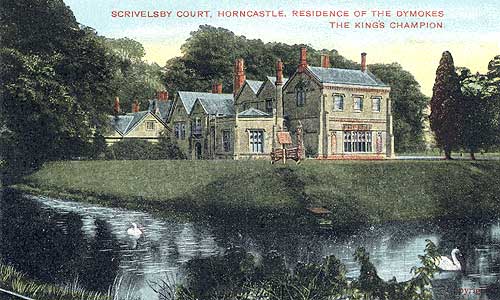
ScrivelsbyCourt

The chivalrous and dignified office of Champion of England at our coronations is conferred by the feudal manor of Scrivelsby, about two miles south of Horncastle, on the road towards Boston in Lincolnshire. By the holding of this manor, the ancient family of the Dymokes have derived the office of champion to the sovereigns of England…

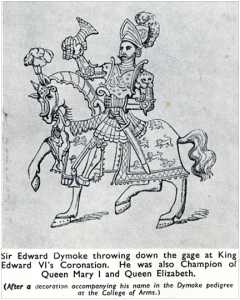
edwardvi

The manor of Scrivesby, which was granted by the Conqueror to Robert de Marmion (Lord of Fontenoy, in Normandy), to be held by grand sergeantry, “to perform the office of champion at the King’s coronation.” The Marmians, it is said, where hereditary champions to the Dukes of Normandy prior to the conquest of England.

Dymock Champion

The Kings Champion in full armor in the banqueting hall at the coronation of Queen Elizabeth I

Sir John Dymoke served as Champion of England at the coronation of Richard II. Sir Robert Dymoke did so for Richard II, Henry VII, and Henry VIII. Sir Edward Dymoke was champion for Edward VI, Mary I, and Elizabeth I. John Dymoke was champion for George III, and when the time came for George IV’s coronation, the honor went to his grandson, Sir Henry Dymoke, due to the fact that his son, Rev. John Dymoke, was a cleric.

0020 16.tif

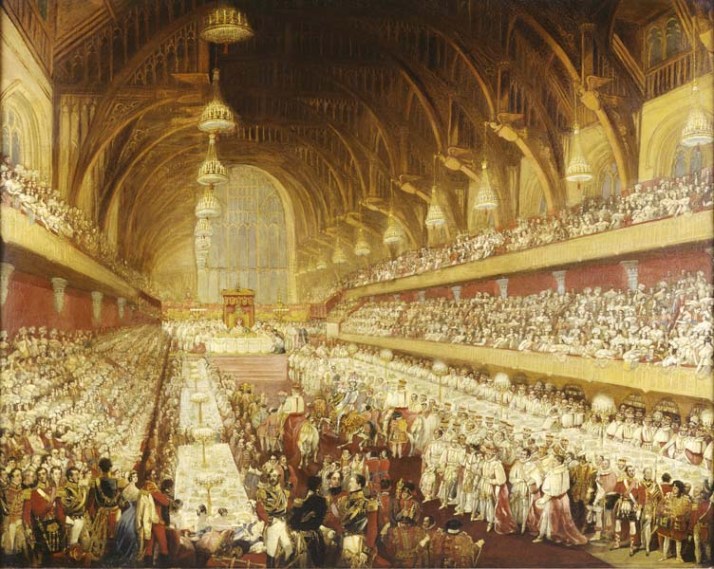
George IV’s coronation banquet was held in Westminster Hall in 1821; it was the last such banquet held.

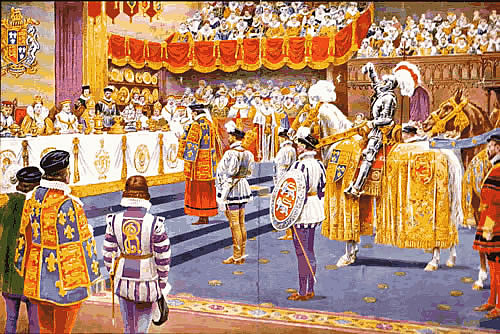
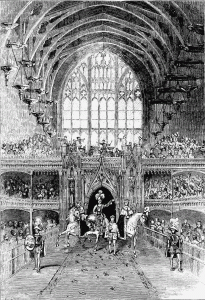
The entry of the champion at the close of the Banquet in Westminster Hall, at the coronation of George IV., was a splendid spectacle. Haydon, the historical painter, thus describes this ancient feudal ceremony which he witnessed: “The hall-doors were opened, and the flower-girls entered, strewing flowers. The distant trumpets and shouts of the people, the slow march, and at last the appearance of the King, crowned and under a golden canopy, and the universal burst of the assembly at seeing him, affected everybody… After the banquet was over, came the most imposing scene of all, the championship. Wellington, in his coronet, walked down the hall, cheered by the officers of the Guards. He shortly returned, mounted, with Lords Anglesey [formerly the Earl of Uxbridge] and Howard. They rode gracefully to the foot of the throne, and then backed out. The hall doors opened again; and outside, in twilight, a man in dark-shadowed armor appeared against the shining sky. He then moved and passed into darkness under the arch, and suddenly Wellington, Howard, and the champion stood in full view, with doors closed behind them. This was certainly the finest sight of the day. The herald then read the challenge; the glove was thrown down. They all then proceeded to the throne.”

championship

Coronation of George IV, Westminster Hall: the Champion’s Challenge

Sir Walter Scott, in his letter describing the coronation, says, “The Duke of Wellington, with all his laurels, moved and looked deserving the baton, which was never grasped by so worthy a hand. The marquess of Anglesey showed the most exquisite grace in managing his horse, notwithstanding the want of his limb, which he left at Waterloo. I never saw so fine a bridle-hand in my life, and I am rather a judge of horsemanship. Lord Howard’s horse was worse bitted than those of the two former noblemen, but not so much as to derange the ceremony of returning back-out of the hall. The champion was performed (as of right) by young Dymoke, a fine-looking youth, but bearing, perhaps a little too much the appearance of a maiden knight to be the challenger of the world in a King’s behalf. He threw down his gauntlet, however, with becoming manhood, and showed as much horsemanship as the crowds of knights and squires around him would permit to be exhibited. On the whole, this striking part of the exhibition somewhat disappointed me, for I would have had the champion less embarrassed by his assistants, and at liberty to put his horse on the grand pas; and yet, the young Lord of Scrivelsby looked and behaved extremely well.”

Supertunica-stole-and-spurs

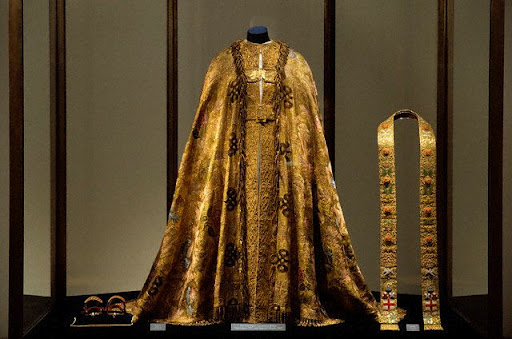
The Imperial Mantle was made for the coronation of George IV in 1821 and is designed in the style of earlier ones worn by the Tudor and Stuart monarchs, it is worn over the Supertunica and the Stole. The Imperial Mantle is made of gold cloth, lined with red silk and woven with colored threads designed with a pattern of crowns, eagles, fleur-de-lis, roses, thistles and shamrock held together at the chest with a gold clasp in the form of an eagle.

*George IV’s was the last coronation to include a championship.


Romance of London Series

  1. Romance of London: The Lord Mayor’s Fool… and a Dessert
  2. Romance of London: Carlton House and the Regency
  3. Romance of London: The Championship at George IV’s Coronation
  4. Romance of London: Mrs. Cornelys at Carlisle House
  5. Romance of London: The Bottle Conjuror
  6. Romance of London: Bartholomew Fair
  7. Romance of London: The May Fair and the Strong Woman
  8. Romance of London: Nancy Dawson, the Hornpipe Dancer
  9. Romance of London: Milkmaids on May-Day
  10. Romance of London: Lord Stowell’s Love of Sight-seeing
  11. Romance of London: The Mermaid Hoax
  12. Romance of London: The Bluestocking and the Sweeps’ Holiday
  13. Romance of London: Comments on Hogarth’s “Industries and Idle Apprentices”
  14. Romance of London: The Lansdowne Family
  15. Romance of London: St. Margaret’s Painted Window at Westminster
  16. Romance of London: Montague House and the British Museum
  17. Romance of London: The Bursting of the South Sea Bubble
  18. Romance of London: The Thames Tunnel
  19. Romance of London: Sir William Petty and the Lansdowne Family
  20. Romance of London: Marlborough House and Sarah, Duchess of Marlborough
  21. Romance of London: The Duke of Newcastle’s Eccentricities
  22. Romance of London: Voltaire in London
  23. Romance of London: The Crossing Sweeper
  24. Romance of London: Nathan Mayer Rothschild’s Fear of Assassination
  25. Romance of London: Samuel Rogers, the Banker Poet
  26. Romance of London: The Eccentricities of Lord Byron
  27. Romance of London: A London Recluse

Alanna Lucas: Waltzing with the Earl

Interview with Alanna Lucas

Susana: What is your favorite food? Least favorite? Why?

AlannaAlanna: My favorite food is pasta. Well, pasta, chocolate, and wine- but not altogether 😉 Chutney would be my least favorite. Let’s just say that chutney and a ten-hour flight are not a good combination and leave it at that.

Susana: What has been your biggest adventure to date?

Alanna: Marriage and children. There is never a dull moment and we have had some wonderful family adventures!

Susana: Is there a writer you idolize? If so, who?

Alanna: I adore Sabrina Jeffries! She is the nicest, sweetest person, and an awesome writer!

Susana: What is the one modern convenience you can’t do without?

Alanna: All the conveniences one would find in a bathroom. Especially hot running water.

Susana: Do you have a favorite quote or saying?

Alanna: “The world is a book, and those who do not travel read only a page” ~ St. Augustine

Susana: What are you reading now?

Alanna: I am rereading Lord of Scoundrels by Loretta Chase. Such a great book!

Susana: What advice would you give to writers just starting out?

Alanna: Write, take classes, write, join a professional writer’s organization- like RWA, and write. Oh, and never give up 🙂

Waltzing with the Earl copy

About Waltzing with the Earl

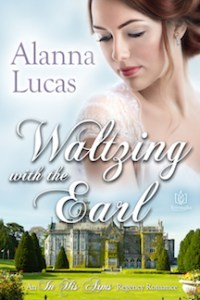
Believing he is cursed, Tristram, Lord Trevena, the Earl of Longstone, agrees to do just one favor for a friend, to dance with the man’s sister, but the beautiful and headstrong Isabel Albryght will settle for no less than claiming his lonely heart.

A Prophecy Foretold

Raised by her doting older brother, Isabel Albryght grew up cosseted and protected. She enjoyed her life in the country, her books, and her freedom. Then her brother married. Within months Isabel’s best friend married. It seemed it was time for Isabel to marry, too. Socially awkward and a bit too keen for most of the ton, Isabel proceeded to have the most horrible season on record… until she was approached by Tristram, the Earl of Longstone.

Two dances. That was all Tristram could offer anyone when considering his family curse, which had taken all he loved in the last ten years, so his promise to the beautiful Miss Albryght’s brother was simply that. The ton would soon see she was a desirable partner, her awkwardness would fade and other young swains would beat feet to her doorstep. But then he held her in his arms, and the delightful Isabel became his beating heart. Headstrong and full of passion, she believed she might waltz them away from Death. She alone could tempt him to try.

AmazonSmashwordsAReBoroughs

Excerpt

The temperature in the room rose by several degrees—it was positively sweltering. Isabel did not know how much longer she could tolerate standing in the midst of hell, surrounded by a mixture of unidentifiable odors and loud boisterous laughter. She thought her head would explode.

Closing her tired eyes, she brought her gloved hand to her temple. Isabel could feel her body sway, but was unable to stop the motion. She could not even gather her wits about her to stamp down, or even beg, the feelings to cooperate. Isabel could sense another mishap was forthcoming, which further added to her distress. And she had been doing so well.

A gentle hand came to her elbow. “Allow me to accompany you onto the balcony for some fresh air, Miss Albryght.” Lord Trevena’s voice broke through the haze. His tone was soft and full of concern.

Isabel opened her eyes; they felt thick and heavy, and still out of focus. Tristram somehow managed to maneuver her through the crush without bumping into anyone. The moment they reached the unoccupied balcony, the cool evening breeze cleared the haziness Isabel had been fighting in her head.

They strolled to the edge of the balcony, partly hidden within the shadows, and clear of any curious gossipmongers. The garden beyond was concealed in darkness, but the lingering scent of blooming roses wafted through the air. Tristram released his gentle hold on her arm. The absence of his hand made her heart lurch, wanting more.

Isabel turned to face him. Even in the dim light, his clear blue eyes sparkled like stars in the night. She struggled to find the words, but when they finally came, they would not stop.

“Thank you for coming to my aid. I am quite recovered now. The room was quite warm and the noise…”

“Isabel,” Tristram said in a deep husky tone. Her name on his lips sent a jolt of excitement through her body.

Taking a step closer, he brought his hand to her face, his gloved thumb dancing intimately across her cheek. Her heart pounded against her ribs, practically stealing her breath.

“Lord Trevena.” His name exited her lips in a breathy gasp.

He bent his head and whispered his name across her cheek. “Tristram.”

Isabel could not imagine anything more sensual than this moment. She lifted her chin, and their cheeks brushed. His lips were so close, but still too far away. His warm breath teased her senses. Closing her eyes, she waited for his kiss.

About the Author

Alanna Lucas grew up in Southern California, but always dreamed of distant lands and bygone eras. From an early age she took interest in art, history, and travel, and enjoys incorporating those diversions into her writing. However, she believes that true love is the greatest source of inspiration and is always an adventure.

Alanna makes her home in California where she spends her time writing historical romances, dreaming of her next travel destination, spending time with family, and staying up too late indulging in her favorite past time, reading.

WebsiteFacebook Twitter

Boroughs Author Page • Amazon Author Page

Romance Books 4 Us

Romance of London: Carlton House and the Regency

Romance of London: Strange Stories, Scenes And Remarkable Person of the Great Town in 3 Volumes

John Timbs

John Timbs (1801-1875), who also wrote as Horace Welby, was an English author and aficionado of antiquities. Born in Clerkenwell, London, he was apprenticed at 16 to a druggist and printer, where he soon showed great literary promise. At 19, he began to write for Monthly Magazine, and a year later he was made secretary to the magazine’s proprietor and there began his career as a writer, editor, and antiquarian.

This particular book is available at googlebooks for free in ebook form. Or you can pay for a print version.

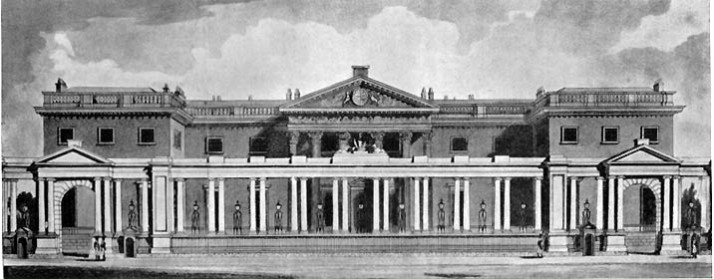
Carlton1

The frontage of Carlton House

Carlton House and the Regency

The Prince Regent’s residence at Carlton House is another place frequently mentioned in historical fiction that is no longer in existence. I had heard that it burned down, but Timbs reports the following:

Carlton House having grown dingy in its fittings, and its history prompting many disagreeable associations, the King projected the enlargement and eventually the rebuilding of Buckingham House; Carlton House was taken down in 1826; the columns of the portico have been transferred to the National Gallery. The exact site of this palace of a century is now the opening between the York Column and the foot of Regent Street.

Plan_of_Carlton_Palace_in_1821

Plan showing the main floor and the suite of reception rooms on the lower ground floor

 Origins

Carlton House, as a royal palace, existed for nearly a century, and was the scene of many important state events, as well as of much prodigality and bad taste. The house, which fronted St. Alban’s Street and St. James’s Park, was originally built by Henry Boyles, Baron Carlton, on a piece of ground leased to him by Queen Anne, in 1709, at 35l. a year; it is described as “parcel of the Royal Garden, near St. James’s Palace,” and “the wood-work and wilderness adjoining.” From Lord Carlton the house and grounds descended to his nephew, Lord Burlington, the architect: he bested it, in 1732, upon his mother, the Countess Dowager of Burlington, who, in the same year, transferred it to Frederick, Prince of Wales, father of George III. The House was a building of red brick, with wings, and was afterwards cased with stone by Sir Robert Taylor. In Lord Burlington’s time, the grounds, which ran westward as far as Marlborough House, were laid out by Kent, in imitation of Pope’s garden at Twickenham. There is a large and fine engraving of the grounds by Woollett; bowers, grottoes, and terminal busts abounding.

Under the Prince Regent (George IV)

When, in 1783, the Prince of Wales, afterwards George IV, was allowed a separate establishment, Carlton House was assigned for his residence, and Holland, the architect, was called in, and added the chief features,—the Ionic screen and the Corinthian portico, fronting Pall Mall. [Horace] Walpole writes to the Countess of Ossor, in the autumn of 1785:

We went to see the Prince’s new palace in Pall Mall; and were charmed. It will be the most perfect in Europe. There is an august simplicity that astonished me. You cannot call it magnificent: it is the taste and propriety that strike. Every ornament is at a proper distance and not one too large, but all delicate and now, with more freedom and variety than Greek ornaments… As Gobert [French architect]… designed the decorations, I expected a more tawdry assemblage of fantastic vagaries than in Mrs. Cornelys’s masquerade-rooms. [Teresa Cornelys, operatic soprano, held many fashionable gatherings at Carlisle House, had many lovers, and bore a child of Casanova.]… There are three most spacious apartments, all looking on the lovely garden, a terrace, the state apartment, and an attic. The portico, vestibule, hall, and staircase will be superb, and, to my taste, full of perspectives; the jewel of all is a small music-room, that opens into a green recess and winding walk of the garden… I forgot to tell you how admirably all the carving, stucco, and ornaments are executed; but whence the money is to come I conceive not—all the tin mines of Cornwall would not pay a quarter. How sick one shall be after this chaste palace, of Mr. Adam’s [Robert Adam, popular 18th century architect] gingerbread and sippets of embroidery!

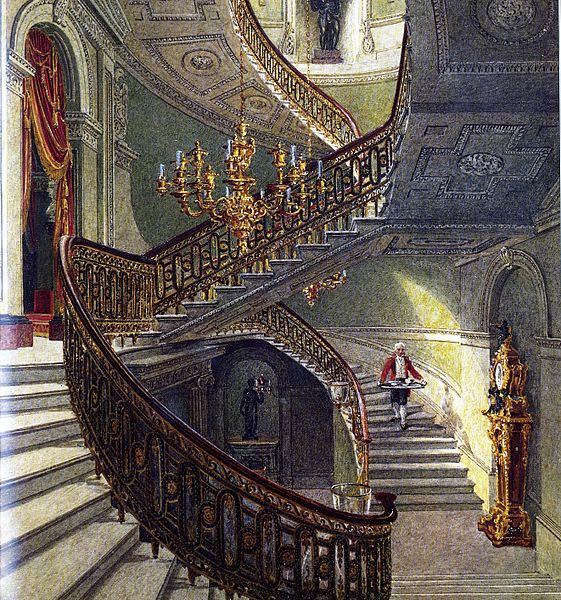
561px-CarltonStaircase

The main staircase, from Pyne’s Royal Residences (1819)

Timbs’s later assessment was not so kind. He says that the conservatory, “imitated from Henry VII’s Chapel, was a failure,” the blue velvet draperies “heavy and dark”; and the “Gothic dining-room was poor.” He found the armory to be “the most curious collection of arms in the world, [filling] four rooms.”

Here was John Hamden’s sword, said to be the work of Cellini; and a golden throne of the King of Candy was backed with a sun of diamonds and precious stones. Here, too, were arms from all nations—caps, boots, spurs, turbans, shields, bows, dresses, models of horses, helmets, sabres, swords, daggers, canopies, palanquins, guns, coats of mail, and other costly presents from all parts of the world.

In the plate-room were some fine specimens of King Charles’s plate; other plate was disposed in the centre of the room, in columns of gold and silver plates, and dishes, and drawers filled with gold and silver knives, forks, spoons, &c.…

The palace was superbly fitted for the Prince’s marriage: 26,000l. Was voted for furnishing, 28,000l. For jewels and plate, and 27,000l for the expense of the marriage. Here was born the Princess Charlotte, January 16, 1796, and the baptism took place on February 11; here, also, the Princess was married, May 2, 1816.

The Fête of June 19, 1811

The most magnificent State event of the Regency was the event given at Carlton House on June 19, 1811, being then the only experiment ever made to give a supper to 2,000 of the nobility and gentry. Covers were laid for 400 in the palace, and for 1,600 in the pavilions and gardens. The fête was attended by Louis XVIII, and the French princes then in exile; and a vast assemblage of beauty, rank, and fashion. The saloon at the foot of the staircase represented a bower with a grotto, lined with a profusion of shrubs and flowers. The grand table extended the whole length of the conservatory, and across Carlton House to the length of 200 feet. Along the centre of the table, about six inches above the surface, a canal of pure water continued flowing from a silver fountain, beautifully constructed at the head of the table. Its banks were covered with green moss and aquatic flowers; gold and silver fish swam and sported through the bubbling current, which produced a pleasing murmur where it fell, and formed a cascade at the outlet. At the head of the table, above the fountain, sat His Royal Highness the Prince Regent on a plain mahogany chair with a feather back. The most particular friends of the Prince were arranged on each side. They were attended by sixty servitors; seven waited on the Prince, besides six of the King’s, and six of the Queen’s footmen, in their state liveries, with one man in a complete suit of ancient armour.

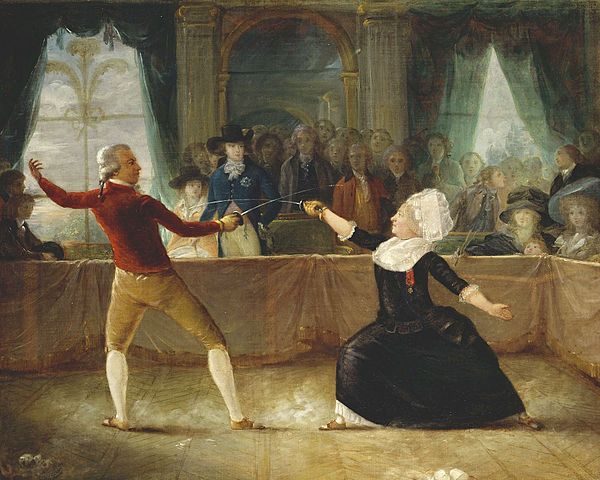
600px-Saint-George_D'Eon_Robineau

Fencing Match between Chevalier de Saint-Georges and ‘La chevalière D’Eon’ on April 9, 1787 in Carlton House, painting by Charles Jean Robineau

Historical tidbit

Timbs mentions that the portico of Carlton House was the site of the “first public application of the newly-invented lighting by gas.”

Author’s Reflections

I’m thinking the fête might come in hand for a scene in my next story—as an example of the decadence and excess of the Prince Regent. What do you think?


Romance of London Series

  1. Romance of London: The Lord Mayor’s Fool… and a Dessert
  2. Romance of London: Carlton House and the Regency
  3. Romance of London: The Championship at George IV’s Coronation
  4. Romance of London: Mrs. Cornelys at Carlisle House
  5. Romance of London: The Bottle Conjuror
  6. Romance of London: Bartholomew Fair
  7. Romance of London: The May Fair and the Strong Woman
  8. Romance of London: Nancy Dawson, the Hornpipe Dancer
  9. Romance of London: Milkmaids on May-Day
  10. Romance of London: Lord Stowell’s Love of Sight-seeing
  11. Romance of London: The Mermaid Hoax
  12. Romance of London: The Bluestocking and the Sweeps’ Holiday
  13. Romance of London: Comments on Hogarth’s “Industries and Idle Apprentices”
  14. Romance of London: The Lansdowne Family
  15. Romance of London: St. Margaret’s Painted Window at Westminster
  16. Romance of London: Montague House and the British Museum
  17. Romance of London: The Bursting of the South Sea Bubble
  18. Romance of London: The Thames Tunnel
  19. Romance of London: Sir William Petty and the Lansdowne Family
  20. Romance of London: Marlborough House and Sarah, Duchess of Marlborough
  21. Romance of London: The Duke of Newcastle’s Eccentricities
  22. Romance of London: Voltaire in London
  23. Romance of London: The Crossing Sweeper
  24. Romance of London: Nathan Mayer Rothschild’s Fear of Assassination
  25. Romance of London: Samuel Rogers, the Banker Poet
  26. Romance of London: The Eccentricities of Lord Byron
  27. Romance of London: A London Recluse

Em Brown: Master and Temptress Erotic Historical Trilogy

Who was G#?

In Book 3 of the Master and Temptress Erotic Historical trilogy, Granville Sharp makes a “cameo” appearance at a key time for the hero, Charles Gallant. Gallant is standing for Parliament, and the issue of slavery puts him between a rock and a hard place as he attempts to secure the endorsement of key figures in the community, whose support can assure him victory.

The year before, England had formally abolished the slave trade but left the institution of slavery intact in her colonies. At the time, England was the largest slave trafficker in the world. Granville Sharp played a significant role in leading the campaign to abolish the slave trade.

Born into a musical family in 1735, the son of an Archdeacon, Sharp loved to debate and discuss theology. He became active on the issue of slavery after coming across Jonathan Strong, a young black slave beaten so badly that he had to spend four months in the hospital. Sharp and his brother paid for Strong’s medical bills. Sharp started to study English law and “could not believe the law of England was really so injurious to natural rights.”

In 1772, a slave named James Somerset, who had run away from his master, asked Sharp for help. Sharp worked with Somerset’s lawyers, and the case was ruled in Somerset’s favor. The case was a pivotal one in the history of abolition because it effectively set slaves free in English territory (but not her colonies) because Lord Mansfield, the Chief Justice of the King’s Bench, wrote that English law, absent an act of Parliament, did not provide for slavery.

A few years later, Sharp was approached by Quakers, who had been active in the cause of abolition but barred from full participation in English society. The Quakers needed Anglican support, and Sharp was an obvious choice. In 1787, nine Quakers and three Anglicans formed The Society for Effecting the Abolition of the Slave Trade. Working with William Wilberforce, a young MP tapped by Pitt the Younger to lead the cause of abolition in Parliament, Sharp and the Society campaigned for 20 years before Parliament finally passed The Slave Trade Act 1807.

Sharp, who sometimes signed his name “G#”, passed away in 1813 and did not live to see the full abolition of slavery in 1833. A memorial tablet erected for Sharp can be seen in Westminster Abbey.

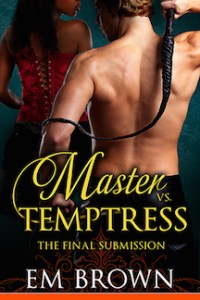
Master vs. Temptress: The Final Submission (Book 3) is available for only $0.99 until February 28th. Plus, you can now get Seducing the Master (Book 1) for FREE. Click here to get your copy today.

EmBrown_MasterVsTemptresstheFinalSubmission_200

About The Master & Temptress Trilogy

“Ravage Me.”

No man has ever resisted the charms of Miss Terrell before, but Master Gallant refuses to grant her request and have his way with her.

Miss Terrell is spoken for by Sir Arthur, a man with a dubious past but whose wealth and influence hold the key to Charles Gallant’s bid for Parliament. Without Sir Arthur’s support, Charles will not realize his lifelong ambition to win election and succeed where his father before him had failed.
But Terrell cannot quell her scorching desire for Master Gallant, whose deft hand and command of rope bondage inflame her deepest, darkest cravings. She will tempt the Master to surrender. Only love can stop her, but it will devastate them both.

READER ADVISORY: This Regency-set erotic romance contains themes of dominance and submission, BDSM elements, and other forms of wicked wantonness.

Start this epic romance for FREE with Seducing the Master. Click here to get your free ebook today.

Excerpt from Seducing the Master

He pinned her with a solemn stare. “Behave yourself, Miss Terrell, or I will remove you by force.”

“I should like nothing more than to receive your punishment, Master Gallant.”

He inhaled sharply. The saucy jade. Catching her off-guard with a quick movement, he wrapped his arm about her waist and whirled her over to the other side of the doorframe. She landed against the wall with a soft thud. Disengaging himself, he grabbed the handle of the door and pulled, intending to depart without his usual civility.

To his surprise, the door did not open. At first he thought it to be stuck, but then he noticed that the key was missing from the lock. He turned to look at Miss Terrell, whose lips curled in a slight but telling grin.

He could hardly believe the woman—the chit. Did she truly intend to hold him hostage?

“Produce the key, Miss Terrell,” he commanded.

She returned a smoldering stare. “Dominate me first. Do unto me as you had done to Mistress Scarlet.”

He felt his nostrils flare. He needed no second reminders of her, especially from Miss Terrell, who now tested his patience much like Greta had, but for wholly different purposes.

“You think impudence will gain you what you seek?” he asked.

She leaned toward him. “If my impudence displeases you, then punish me for it. Punish me…hard.”

He stared at her in disbelief. No woman had ever made such a request of him. He wanted to reiterate that she knew not what she spoke. She had witnessed but one instance of the punishment he had applied to Miss Greta.

As if guessing his thoughts, she added, “I can withstand anything you desire to do to me, Master Gallant.”

“That is a bold and foolhardy statement. You know nothing of what I am capable.”

Pressing herself back against the wall, she cupped her breasts and caressed her ribs. “Prove me wrong. I dare you to.”

He shook his head. He was done with challenges.

“I vow I can endure more than Mistress Scarlet, more than any person of either sex. I could be the most perfect submissive for you.”

“Unlikely. You have already shown a penchant for misbehavior.”

“You could correct my waywardness.”

He frowned—because the prospect did not repulse him as he would have wanted it to.

“You need have no reservation with me,” she continued. “You would be free to unleash your full strength, to test the breadth of your wicked creativeness.”

His blood pumped forcefully through his veins at her words. “Miss Terrell, this tête-à-tête serves no purpose. I bid you desist from wasting your time as well as mine.”

Stepping forward, she grabbed the lapels of his coat and pulled herself closer to him. Lust burned like anger in her eyes, calling to a primal part of him that he could not ignore. Her skirts brushed against his legs, and her corset nearly touched where his hardened length was fast becoming visible.

“Then ravage me.”

She reached for his burgeoning erection, but, dropping his articles, he grasped both her wrists and pinned them above her head to the door behind.

“Miss Terrell, I am done with this tomfoolery. Produce the key.”

She squirmed a little in his hold. “I should be happy to, Master Gallant, after you have had your way with me. You cannot deny that you desire to do so.”

He pressed his lips together in a grim line. The scent of the pomade she used in her hair wafted into his nose once more. Their bodies were far too close together for comfort. She slid her leg along his. Holding her wrists aloft with one hand, he cupped her chin with the other and lifted her gaze to meet his eyes.

“The key, Miss Terrell,” he demanded, unable to keep the vexation from his voice.

She did not blink and demanded, equally hotly, “Ravage me.

Her words rang in his ears like a song of sirens. The air between them grew thin. With a frustrated grunt, he yanked her from the door and dragged her across the room to the sideboard where he kept the ropes.

GET THIS EBOOK (PLUS 3 MORE!) FROM EM BROWN BY CLICKING HERE.

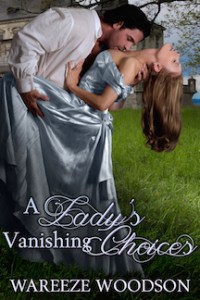
Wareeze Woodson: A Lady’s Vanishing Choices

This is a tidbit of recent history, all of 60 years ago. This is a true incident, not of historical value, but interesting.

This spark stayed in the recesses of my mind for years. When I was a young child, a friend of my dad’s stopped by our house. No one thinks a child of five or so is paying any attention, but I had my antenna up. The friend was vastly upset and his story came pouring out. Seems this friend and two or three other guys along with a few women were camped out on the beach at Galveston. They drank and caroused for a few days, nearly a week of heavy drinking. Earlier on the last morning, the campers woke only to discover one of the women had died during the night. They buried her body there on the beach and scuttled away like so many crabs rushing back into the sea.

My dad tried to talk his friend into going to the police, but the fellow was afraid he’d be blamed for the incident. He was the one that brought the women with him to the party. He wouldn’t report the incident. When hurricane, IKE, hit Galveston, so much was destroyed. During the rebuilding, a skeleton of a female was discovered and reported on the news. It was believed the remains had been in the ground for fifty years or better. I thought it must have been the same woman. I remembered! SPARK, SPARK.

When Bethany Littleton was a child, she wrote several letters not included in the novel, A Lady’s Vanishing Choices. Here is a little peek at the first one.

Dearest Mummy,

I don’t know how to send this letter to Heaven, but it makes me feel better to write to you. I’ll keep it in a box until I can find a way. I miss you so much. My tenth year is nearly here, my first birthday without you and father. There is a kind lady in the village and I like her. She has a shop and lets me visit her. She gives me tea and cake, too. Not just for my birthday either.

Uncle Arthur and Aunt Gertrude are so mean. Eleanor isn’t nice either, except sometimes. I wish father had named someone else to take care of me. I don’t like this new place near Chatham either. I have a small room under the roof and I can hear the rain at night. I’m afraid of storms where wind rattles the windows and lightning flashes in the sky. Sometimes, the cat visits my room. I like animals.

Me and my dog ran away yesterday, but the vicar found us and brought us back. Aunt Gertrude said I was a wicked, bad girl, wild and as plain as a pudding. I have no dowry either. I don’t know what that all means, but it sounds dreadful. She took my dog away. I cried and cried, but my dog is still gone. I’ll never let Aunt Gertrude see me cry again. No matter what. I’ll wash my face and learn to keep everything inside.

I shall leave here when I reach one and twenty years and never, never come back. I didn’t mean to let tears fall on this page. Still, no one shall ever, ever read it, so it don’t matter. When I have time, I’ll write again.

Love,

Bethany

WW_ALadysVanishingChoices_Apple_1400x2100 copy

About A Lady’s Vanishing Choices

Vexed with her aunt, Bethany takes the gig without permission. She pulls up to master her temper and wanders into the woods. From her sheltered position, she watches a man bury a long bundle large enough to hold a corpse. She thinks she has escaped undetected, but danger follows her. In her reckless handling of the ribbons, she nearly runs Lord Royce Rivton off the lane.

Lord Rivton is in search of a spy and must investigate her family, his closest neighbor. Both at cross purposes, the sparks fly and when he rescues her, he places her in a compromising position. They marry as expected, but their road is not smooth. She is still in mortal danger. He must find and capture the killer/spy while trying to save his wife. A tattered string weaves together this tale of murder, abduction and espionage.

Amazon

Excerpt

The clatter of a thud and scrape against the ground reached Bethany’s ears. What on earth? Alert now, she strained to listen. Again the thud and scrape echoed in a steady rhythm. She recognized the noise of a shovel being plied. Such a sound deep in the forest instantly announced something unusual, even sinister and dangerous. The hairs on back of her neck stood on end and she froze in place. She was alone, vulnerable. Discovery of her presence could herald a ruined reputation perhaps even sending her into actual peril. She shivered. Why had she allowed vexation and self-pity to drive her to act on such a reckless impulse?

Holding her breath, she inched forward ever so quietly and crouched behind a screen of bushes. Alarm curled down her spine, but the urge to discover the source of the sound pushed her forward. Peeking through the foliage, she viewed a small clearing with a mound of freshly turned dirt piled in the center. A man flung another scoop full onto the heap and continued to dig. What could possibly be his purpose? The odor of moist soil reached Bethany, reminding her of her situation, alone and deep in the woods. She recalled the old adage about curiosity and the cat. She caught her breath. The cat died. Nevertheless, she couldn’t drag herself away.

About the Author

001 copyI am a native of Texas and still live in this great state. I write period romance tangled with suspense. I married my high school sweetheart, years and years ago. We raised four children and have eight grandchildren, and grandchildren are Grand. At the moment, all my children and my grandchildren live within seventy miles of our home, lots of visits. My husband and I still love each other after all these years the stuff romance is made of, Happy Ever After!

WebsiteTwitterFacebook


Meara Platt: A Midsummer’s Kiss and Once Upon a Regency (Double Giveaway)

Meara copySusana, thank you so much for having me on Susana’s Parlour, a particular thrill for me because I’m a fan and often peek in to learn more about my favorite authors. For those who don’t know me, I’m Meara Platt and I write Regency-era historical romances. Some of your readers may know me from my Farthingale series; all three books released to date have been Amazon international bestsellers, and I’m looking forward to the release of Book 4 in the series, A Midsummer’s Kiss, scheduled to release this week!

Also scheduled to release this week is a box set called Once Upon A Regency: Timeless Tales And Fables, a set of nine Regency romance novellas inspired by fairy tales. My story in this set is Wish Upon A Kiss based upon Sleeping Beauty. Samantha Grace, Sue London, Ari Thatcher (she also writes as Aileen Fish), Amanda Mariel, and others—all have stories inspired by one of their favorite tales or fables: The Little Mermaid, Beauty and the Beast, Little Red Riding Hood, Alice In Wonderland, etc. It has been so much fun working with them and I look forward to more collaborations in the future. Our Once Upon A Regency launch party is February 5thWe’d love to see you there.

I also have a gift for all who stopped by my guest blog today. Please read through to the end and you’ll find a thank you from me as well as a contest where I’ll be giving away a prize.

Interview

Susana: What inspired you to start writing?

Meara: Actually it wasn’t inspiration, but a matter of chance. I’ve always loved historical romance, then several years ago I read a string of bad Regency romances, and after grumbling and tossing aside book after book, my husband suggested that I stop whining and write one myself. So I did, and it was AWFUL! Fortunately, I was not so deluded to think it was a masterpiece. I knew I needed help, lots of it. So after bumping into Nora Roberts in a NYC elevator – and by chance we happened to be wearing the same dress, which is what got us briefly chatting – I took it as a sign that I had to start writing. She was there for a Romance Writers of America conference, so I lurked and poked around and realized this was for me. I joined and am a member to this day. I also joined my local RWA chapter, went to all the monthly meetings, took workshops, went to conferences, and absorbed as much knowledge as possible. The ability to write an engaging story comes naturally to some of the lucky few. That wasn’t me. English is not my native language, but that was the least of it. I didn’t understand the concept of writing a tight story, had no clue what plot or conflict really were, and didn’t realize that by giving my hero and heroine certain strengths and weaknesses, I could create their goals and motivations to propel their story. Hopefully, I finally got those details right with the Farthingale series. The stories aren’t just love stories, they’re also about family, and the chaotic humor and character of this large family is as much a part of the romance as the compelling love story for each sister as she falls in love with (and creates heaps of trouble for) the man she’s destined to marry.

Susana: What is the best advice you can give to other writers?

Meara: The best advice I can give writers is to learn as much as you can about story structure, characters, conflict, and goals, and then take that knowledge and write from your heart. Write with affection and respect for your characters whether they’re good or evil, make them as real as they can be, and also respect your readers. Be honest about what you’re giving them. Don’t design your covers or write blurbs to entice a reader, then fail to deliver. Also know your strengths and weaknesses. Even though I may give my characters some difficult emotional baggage, as I did for my hero, Ian, the Duke of Edgeware, in The Duke I’m Going To Marry, I don’t think I’m capable of writing a dark story – so no matter what I throw at my hero or heroine, it’s done with a gentle hand and liberal use of humor to soften whatever pain they’re experiencing. My readers know they will always get strength and optimism in my stories as well as (hopefully) some laugh out loud moments as my alpha hero is brought to his knees in surrender by the clueless and innocent Farthingale sister who will steal his heart.

Susana: What happened when you got “the call”?

Meara: When I got “the call” it came after many rejections and very close calls and lovely revision letters, but the timing was right for me. Any sooner, and I would not have understood my strengths and weaknesses as a writer, or found my natural voice. You know the saying, when it rains it pours? The offer from my publisher came as I was about to receive an offer from another publisher. My publisher offered a generous multi-book deal and their business model was a perfect fit for me, so I accepted and have not regretted the decision. I also must add that this book deal came about because I knew a writer who had just published with them and she recommended me – it came out of the blue and the publisher acted fast because of the recommendation. She put her reputation on the line and would never have recommended someone she thought would make her look bad. As much as we write the books of our heart, this is also a business. Others rely on you to get your part done on time and to work with others from editing to cover art to promotions, and with other authors on boxsets or other collaborations. While artistic temperament might inspire a writer to create, that unreliable temperament will be viewed as toxic to others. So I’ve cleaned up a favorite saying of mine, a great line from a good friend of mine. It’s a simple bit of caution that applies to all we do – don’t be a jerk. Your position is never elevated by stepping on others.

Susana: How do you deal with writer’s block?
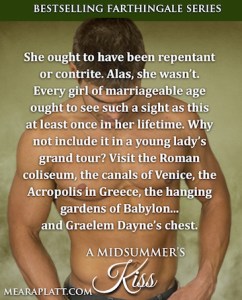
AMK-Teaser3FINAL copyMeara: That’s best answered by talking about my characters. I may have trouble writing a scene or figuring out an ending that readers will remember, but I don’t really have writer’s block. I have diarrhea of the mouth (or typing fingers) and have so much in my head that I hope I’ll have the time to get it all out! After years of trial and error, I found that what works best for me when starting a book is to decide upon the characters first and figure out what they need the most and what they want to avoid at all costs. My heroes especially will spend their entire story avoiding what we all know is best for them. For example, in my debut book, My Fair Lily, I knew that Lily Farthingale had to be a spectacle-wearing bluestocking who is gorgeous – dark hair and vivid blue eyes – who knows everything about books and nothing about men. I paired her with Ewan Cameron, an irreverent Scot, a man of action, who detests all things English and only comes down to London because of a deathbed promise made to his father. He’s brought along his shaggy, loveable but clumsy sheepdog, and his dog falls in love with Lily at first sight. So does Ewan, but he’s too stubborn (just like a Scot) to admit it to himself. Lily has an identical twin, Daffodil, and her story is The Duke I’m Going To Marry. I paired Daffodil, a girl with a big heart and lots of love to give, with Ian Markham, the notorious Duke of Edgeware, a man who has sworn he’ll never marry or fall in love. Most think he’s just arrogant and independent, but it’s really because he’s harboring a dark secret. It takes Daffodil’s strength, her intelligence and sharp wit, and her ability to love, to finally convince Ian to open up his heart to her and allow himself to find happiness. In Rules For Reforming A Rake, Daisy Farthingale enters her debut season with a slight tarnish to her reputation. To regain her respectability, she’s decided to marry the most respectable man she can find. Of course, she falls in love with Gabriel Dayne, London’s most notorious rakehell. What is Daisy to do? She sets about reforming him, of course. The right match helps the story to tell itself. In my upcoming release, A Midsummer’s Kiss, Laurel Farthingale accidentally runs down Graelem Dayne while riding her horse, and amid the chaos, Graelem’s leg is broken. Graelem has to find a girl to marry by Midsummer’s Day or he’ll lose a vast inheritance. When a remorseful Laurel gives her sacred promise to do whatever it takes to make it up to him, he accepts and tells her that she can make it up to him by marrying him. Graelem is another stubborn Scot (I love those heroes) and Laurel is hot-tempered, independent, and will only marry for love, not some sham betrothal that she agreed to because she gave her word. Graelem has only thirty days – and while hindered with a broken leg – to convince Laurel that they’re meant to be together.

Susana: Tell us about what story you’re currently working on.
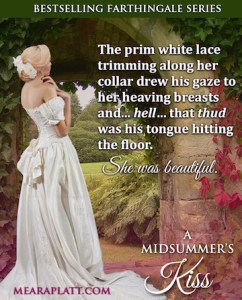
AMKTeaser1FINAL copyI’d like to talk a little about Once Upon A Regency and my contribution to it, Wish Upon A Kiss for several reasons. The first is that it is a new release, so I’m excited to talk about it. The second, and most important reason, is that it is a collaborative effort with authors I admire and with whom I’ve since become friends. It is this bond of friendship that is as important to me as any book I’ve written. The same amazing thing happened with the talented authors who, along with me, were a part of Kathryn Le Veque’s Kindle World of the deWolfe Pack launch. We’ve all become as close as sisters and chat every day. My contribution to the deWolfe Pack world is Nobody’s Angel – another story about the power of love to conquer all, and how miracles can happen. But back to Once Upon A Regency and my Sleeping Beauty inspired story. Obviously, it is about Winnie, my heroine who is raised by her three ditzy godmothers. She lives quietly in the Lake District countryside and doesn’t know her true identity. The hero, Ardaric, comes upon her and is drawn to her from their first meeting. He insists on remaining to protect her when her life is suddenly threatened. As in Sleeping Beauty, he defeats evil to save the girl he loves. Winnie is a strong heroine in her own right and worthy of Ardaric’s love. What is the secret that I am about to reveal only to readers of Susana’s Parlour? As I finished the story, my nephew’s wife gave birth to their first child and they called him Ardaric. I fell in love with the new baby and his name – so STOP THE PRESSES! My hero’s name became Ardaric. So this story has special meaning for me beyond pride of authorship of this story!

In my books, family plays a big role. In this, I feel my childhood influenced much of my writing. I was born in Cairo, Egypt and spent most of my childhood moving from country to country before my family finally settled in the US. So we’ve lived in Egypt, France, and Australia until finally reaching the US. Although having to leave Egypt led to some very difficult times for my family, I can look back with happiness on the time I spent there. We spent only a short time in France, but several years in Australia (loved, loved, loved those wonderful years in Sydney, Australia) before leaving to join the rest of our family in the US. To me, Australia was paradise, and I was sad to leave. My twin sister and I still have the stuffed koala bear toys we were given as gifts from our friends and we treasure them to this day. Amid all the upheaval, the one constant in our lives was love of family and deep appreciation for the friends we made along the way. When I write about the power of good over evil, it has a very real meaning to me and I hope it will also have meaning to many readers who have faced hardships in their lives. My stories are also messages of hope – to stay strong, be kind to others, and good things will come to you.

Susana: Tell us about your favorite authors.

Meara: I’m an avid reader and enjoy reading many genres, but Regency is my favorite. A close second are the other historical (medieval, highlander, Viking, Victorian) romance genres. I also love a good cozy mystery or fantasy/paranormal tale. I don’t like stories that are dark and painful or about evil, twisted characters or selfish characters. I’m a hobbit in real life – I like warmth and comfort and don’t do well with nasty adventures that make me late for dinner. When I read, I want to feel good and cheer for the heroines as they find love with their worthy heroes. Judith McNaught is my all time favorite historical romance author. Today, I read Christi Caldwell and Julie Johnstone – love their books. I’ve also read Victorian romance author Amanda Mariel and love her stories. I also highly recommend the authors in the Kindle World of the deWolfe Pack – they’re all best sellers in their genres and are most deserving of the glory.

Susana: What are your writing plans for 2016?

Meara: There are more stories coming from me in 2016. Along with the Regency romances, I’m also launching a paranormal Regency series – an ambitious 4-book series that may grow into more books. I’ve always been a fan of fairy tales and fairy lore, so several years ago I decided to create a Fae world that exists in Regency times – in the Lake District, which is a favorite place of mine – and as we know, faeries and faerie lore were very popular in the 1800’s. Faeries (unlike Tinkerbell depicted in Disney’s version) are a form of demon. So are dragons and, ahem, hunky alpha dukes who happen to be able to shift into dragons, and protect England from those really, really evil demons of the underworld who intend to wreak havoc on the British subjects. There’s a Fae prophecy involved and everyone is searching for the Regency lass who is the only one who can save Fae and humans from domination by these underworld demons. Lots of fun, chaos, and Regency heroines who are strong enough to conquer demons even though they don’t know how to wield a battle sword, much less be able to lift one. No matter how dire the circumstances, there may be death and destruction, but in any Meara Platt book, there will also be laughter and happily ever after endings.

Susana, I’ve enjoyed my visit to your parlour so much! I hope those who joined us enjoyed this chat as well. I’ll be giving away a Farthingale ebook of choice to one winner. To be eligible, just leave a comment answering this question:

Would you read a Regency romance with paranormal elements and – strictly optional – let me know what you like about them?

For all who joined me in Susana’s Parlour, here’s the link to my newsletter where you’ll find the freebie Farthingale novella as a gift from me to you. It’s called If You Kissed Me. http://bit.ly/FreeRegencyNovella. If you would rather not sign onto my newsletter, just email me at plattmeara@gmail.com and I’ll email you the novella.
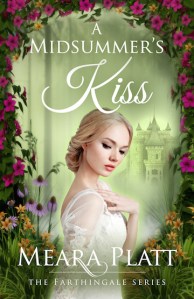
AMidsummer'sKissCover copy

About A Midsummer’s Kiss

Sometimes love happens at the most unexpected times and in the most unexpected places. Sometimes it quietly sneaks up on you, and sometimes it knocks you over on a London street, just as it happens to Lord Graelem Dayne when Laurel Farthingale’s horse runs him over and breaks his leg. Graelem has until Midsummer’s Day, a mere thirty days away to find a wife or lose a large inheritance, so when a remorseful Laurel begs his forgiveness and promises to do anything, anything for him, he takes her up on that promise and insists that she marry him.

Laurel Farthingale has no intention of becoming Graelem Dayne’s biddable bride and is furious that he’s tricked her into a betrothal. She plans to marry another, her long-time friend and childhood infatuation who is now in London to propose to her, for she’s a Farthingale and everyone knows that Farthingales only marry for love. But as she comes to know Graelem, she realizes that he may very well be the man she’s destined to love. Can he ever love her above his desire to secure his baronial fortune?

My Fair Lily (Book 1)

The Duke I’m Going to Marry (Book 2)

Rules for Reforming a Rake (Book 3)

 A Midsummer’s Kiss (Book 4)

Once Upon A Regency: Pre-order for 99 cents

Nobody’s Angel

Excerpt

“Blessed Scottish saints,” Graelem said in a husky murmur. “Are you saying that I’m the only man who’s ever kissed you?”

“In that crude and plundering way. Yes.” In that wonderful, fires-of-hell-take-me-I’m-yours way that still had her blushing and wanting to rip the shirt off his body and run her hands along his hot, golden skin? Laurel cleared her throat. “In any way at all? Yes. You’re the first.”

A solemn quiet came over him, but he shook out of it quickly. “Laurel, lass.” He spoke with a gentleness not present before. “You can’t possibly love him.”

“I knew you were going to say that.” She curled her hands into fists and returned his gaze with a scowl of exasperation. “I do love him. I don’t love you. The kiss we shared was a mistake. I wasn’t myself. I was distraught and uncertain.”

She paused a moment and swallowed hard. “But thank you for not taking advantage of me. Had you tried, I think I would have let you.” Because she was crazed and hurting. No other reason. Certainly not because she felt any desire for the oaf.

Goodness and mercy! Why would she feel anything for him?

“I know, lass,” he said with a nod. “But I gave you my promise that I wouldn’t touch you against your will and I’ll keep to it. You wanted the kiss and it was harmless enough.” He leaned closer still. “Granted, you wanted more. But I will not have you shamed or living with regrets for your actions on one of the most difficult days of your life. When you marry me—”

If I marry you. Which I won’t.” Drat! The words sounded uncertain even to her ears.

“I’ll make you a bargain.”

She shot to her feet, instantly wary. “What sort of bargain?”

“I’ll agree to attend these bloody teas and musicales if you stop dismissing the idea of our marriage.”

She nibbled her lip in thought and noticed that Graelem’s eyes darkened as he watched her. Honestly, why did the oaf have to be blessed with dangerously seductive eyes? They should have been watery or rimmed in red. They weren’t. His eyes were clear and magnificent. “No more dismissing the idea of our marriage? I’ll agree not to mention it when we chat”— but I’ll still think it— “so long as you don’t dismiss out of hand the young ladies I plan to invite to said teas and musicales.”

“Agreed.” He gave her a heart-melting smile. “Care to seal it with a handshake?”

No, she’d much rather seal it with a kiss. A lips-locked, tongues-plundering string of kisses to be precise. “Blessed Scottish saints,” he said in a hoarse whisper and rose from his chair to stand beside her. “Don’t look at me that way, lass.”

“What way?” She felt her heart beating faster and the heat in her cheeks was now spreading through her body, blazing a fiery trail through her veins. Graelem stood too close. She put her hand on his chest to nudge him back, but somehow her hand curled against the front of his shirt and she found herself tugging his big body closer instead.

Oh, dear. The wrong way.

“What’s it to be, lass?” His mouth felt feather soft against her ear. “Do we seal our bargain with a safe and proper handshake?” His cool breath sent very hot tingles up and down her spine. “Or would you rather we seal it with a dangerously improper kiss?”

She let out a soft gasp. Did the man have no shame?

About the Author

Meara Platt is happily married to her Russell Crowe look-alike husband, and they have two terrific children. She lives in one of the many great towns on Long Island, New York, and loves it, except for the traffic. She has traveled the world, occasionally lectures, and always finds time to write. Her favorite place in all the world is England’s Lake District, which may not come as a surprise since many of her stories are set in that idyllic landscape, including her Romance Writers of America Golden Heart award winning story to be released as Book 3 in her paranormal romance Garden series, which is set to debut in 2016. Learn more about bestselling author Meara Platt by visiting her website at www.mearaplatt.com.

Amazon Author PageBookbubWebsite

World of the de Wolfe Pack Facebook Page

Vauxhall Gardens: Farewell for Ever

vauxhallbook

The Vauxhall Pleasure Gardens is one of the places I’d love to slip back in time to visit, just to catch a glimpse of what it was like. After recently splurging to buy this lovely coffee-table book, I thought it might make a wonderful subject for a new blog series. But do buy the book too, if you can! The photos are fabulous!

The Final Season: 18-25 July, 1859

blog_vauxhall playbill 07353-1

The Public is respectfully informed that this celebrated Place of Amusement, after an existence of nearly a Century and a Half, and receiving within its Portals the elite of the World is DOOMED TO BE DESTROYED; on Tuesday 26th Workmen will commence taking down the whole of the Buildings, and clearing the Ground in order to Let it for Building purposes. It is therefore with great pleasure that Mr G Stevens, for thirty five years connected with the establishment, informs the public that, through the kindness of the owner of the property, he is enabled to open the Gardens for The last Illuminations! The last Concerts! The Last Horsemanship! The Last Fireworks! The Last Music! The last Dancing! The Last Suppers! And The Last Punch!

On the last night, the “Grand Illumination Gala” included a military band in the Old Orchestra, a juvenile ballet; an equestrian troupe in the Rotunda, as well as numerous acrobats and rope dancers. Dancing on the new Leviathan platform ended with the usual fireworks, but no balloons.

The doors opened at 7 p.m., admission was only 1s, and over fifteen thousand people attended. At the end of the evening Mr. Russell Grover sang the last song, Nevermore shall I return; the last dance was a gallop and, after a short period of silence, the National Anthem was played. Then people began running to the trees on the platform breaking off twigs as souvenirs. Arthur Munby was there and recorded in his diary:

To Vauxhall. It was the last night: dense crowds of people filled the gardens: the circus, the ballet, the dancing & concerts, the supper-rooms, the rifle shooting, the fortune telling, the colored maps and the statues in the long walks—all were there as usual; there was no sign of dissolution: there was nothing in the noisy gaiety of the people (except perhaps that noisy gaiety itself) to show that they knew they were meeting there for the last time. But over all, in large letters formed of colored lamps, hung the words ‘Farewell for ever.’ These were the moral of it all… It is indeed much for a thoughtful man, to have seen the last of Vauxhall: to muse for the last time in those dim lighted alleys, and cry Vanitas vanitatum, and call up melancholy shows of Kings & Court ladies to put to shame the living laughing crowd: but the real sting is, that it is all over.

It’s all gone

All moveable items were sold at auction at bargain prices. The property itself, which was by now extremely valuable for development, was divided up into building plots. The only building left standing today—and it is nearly unrecognizable at this point—is the house that was originally built for the widow of Jonathan Tyers the younger.

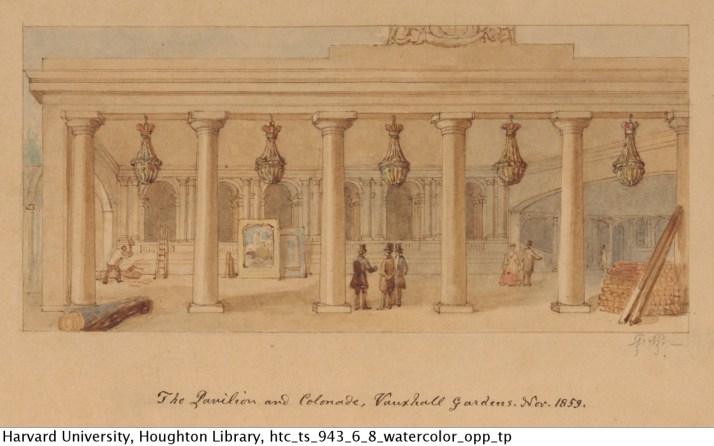
pavilion and colonade

Anon., The Pavilion and Colonnade, Vauxhall Gardens, watercolour, November 1859 (Houghton Library, Cambridge, Mass., Harvard Theatre Collection, Evert Jansen Wendell Bequest, TS 943.6.8F). The pictures have been removed from the walls and workmen prepare for the final demolition.

Why did Vauxhall close?

The weather was always a problem, and became a standing joke that farmers could always count on rain on the day of Vauxhall’s opening for the season. As the years passed, however, “an increasing number of covered areas, where entertainment could be provided even in a downpour” were introduced. Inclement weather is nothing new to outdoor events, but generally “if the attraction is good enough, the public will put up with the rain and the inconvenient delays or postponements associated with bad weather.”

Essentially, though, the Gardens failed to appeal to the Victorian middle classes.

In the seventeenth and eighteenth centuries visitors to Vauxhall would experience an idealized version of a rural idyll—trees, walks and nightingales, supplemented increasingly by music, dining, drinking and man-made illusions… By the end of the eighteenth century, however, it was not enough; the changes in the structure of London society… brought to the gardens a new, less sophisticated clientele for whom the rural idyll no longer exerted its traditional charm. Londoners increasingly saw themselves as citizens of a great industrial power that was coming to dominate the world through trade and military might… [T]he new audiences wanted to be entertained, amazed and thrilled by new attractions that appealed to the self-confident and patriotic spirit of the age.

Madame Saqui’s daring high wire act and Charles Green’s balloons kept the place running long past the time it would naturally have folded. Expensive new novelties added rarely paid for themselves. Inept management and annual battles with magistrates over the renewal of the license—which resulted in increasing restrictions—also contributed to Vauxhall’s demise.

“There was, of course, always a significant section of the potential Vauxhall audience who opposed all attempts to turn the gardens into a modern popular attraction and pined for the good old days under Tyers.” However, in its beginnings, the Vauxhall area was largely rural. “The creeping urbanisation of the area brought with it the seeds of the final failure of the gardens. As they were no longer truly rural, the original reason for their existence disappeared. Yet if they were to offer little more than the theatres and music halls, they were a long way from the centre of town.”

A-photograph-of-Vauxhall--007

Vauxhall Gardens, photograph, c.1859 (Lambeth Landmark, 1259). One of only two known nineteenth-century photographs of the gardens. Lit by the setting sun, the figures in the foreground are standing on the New Monster (or Leviathan) Platform and give an idea of the scale of the Orchestra, the original building of 1758 much altered and lamp-encrusted. The caryatids supporting the sounding board were probably added during the remodeling of 1845.

Vauxhall, farewell forever


Susana’s Vauxhall Blog Post Series

  1. Vauxhall Gardens: A History
  2. Vauxhall Gardens: Jonathan Tyers—“The Master Builder of Delight” 
  3. Vauxhall Gardens: A New Direction
  4. Vauxhall Gardens: The Orchestra and the Supper-Boxes 
  5. Vauxhall Gardens: The Organ, the Turkish Tent, and the Rotunda
  6. Vauxhall Gardens: Three Piazzas of Supper-Boxes
  7. Vauxhall Gardens: “whither every body must go or appear a sort of Monster in polite Company”
  8. Vauxhall Gardens: The Competition
  9. Vauxhall Gardens: The Artwork, Part I
  10. Vauxhall Gardens: The Artwork, Part II
  11. Vauxhall Gardens: The Music, 1732-1859
  12. Vauxhall Gardens: The Business Side
  13. Vauxhall Gardens: Developments from 1751-1786
  14. Vauxhall Gardens: Thomas Rowlandson’s Painting (1785)
  15. ‎Vauxhall Gardens: The Third Generation of the Tyers Family and the Jubilee of 1786
  16. Vauxhall Gardens: An Era of Change (1786-1822), Part I
  17. Vauxhall Gardens: An Era of Change (1786-1822), Part II
  18. Vauxhall Gardens: An Era of Change (1786-1822), Part III
  19. Vauxhall Gardens: The Final Years, Part I
  20. Vauxhall Gardens: The Final Years, Part II
  21. Vauxhall Gardens: The Final Years, Part III
  22. Vauxhall Gardens: The Final Years, Part IV
  23. Vauxhall Gardens: Farewell, for ever


Vauxhall Gardens: The Final Years, Part IV

vauxhallbook

Vauxhall Gardens: A History

David Coke & Alan Borg

The Vauxhall Pleasure Gardens is one of the places I’d love to slip back in time to visit, just to catch a glimpse of what it was like. After recently splurging to buy this lovely coffee-table book, I thought it might make a wonderful subject for a new blog series. But do buy the book too, if you can! The photos are fabulous!

Financial Setbacks & Bankruptcy

Vauxhall had suffered financial setbacks regularly over the years, but especially in its later years, when it changed hands frequently. Bankruptcy was declared in 1840, when the gardens were closed and auctions were held for “all sorts of fittings and decorations from the gardens, including many of the paintings; the Royal Nassau balloon, which had originally cost over £2000 was sold to [balloonist] Green for £500.”

Nevertheless, it opened again in 1841, when George Catlin’s “Red Indians” were introduced to the gardens. These tableaux vivant were made up of, in Catlin’s own words:

twenty living figures in Indian costumes, forming groups of their ceremonies, domestic scenes and warfare. These were got up and presented with much labour to myself, and gave great satisfaction; as by them I furnished so vivid and lifelike an illustration of Indian life as I had seen it in the wilderness.

From the satirical magazine Punch:

We wended our way to the ‘royal property’, to take a last look at the long-expiring gardens. It was a wet night—the lamps burnt dimly—the military band played in the minor key—the waiters stalked about with so silent, melancholy a tread, that we took their towels for pocket-handkerchiefs; the concert in the open rain went off tamely—dirge-like, in spite of the ‘Siege of Acre’, which was described in a set of quadrilles, embellished with blue fire and maroons, and adorned with a dozen drums, thumped at intervals, like death notes, in various parts of the doomed gardens. The divertissement was anything but diverting, when we reflect upon the impending fate of the ‘Rotunda’, in which it was performed.

Although it was announced that ‘Vauxhall would positively close its doors for ever’ on September 8th, 1841, it did open again for the 1842 season, but despite new acts such as Ducrow’s questions (now under the management of his black protégé, Mungo) and the exhibition of Napoleon’s state carriage taken from Waterloo, the gardens remained unprofitable. Vauxhall did not open at all in 1843.

In 1844, the new lessee brought the “Ioway Indians” to Vauxhall. An native encampment was established “on the old Waterloo Ground, from which the party of fourteen (three chiefs, five braves, four squaws, a child and a papoose) emerged from wigwams. They performed only in the afternoon and stayed in lodgings at night.”

This arrangement was one of very great pleasure to the Indians, as it allowed a free space to exercise in during their leisure hours, amongst trees and shrubbery, affording them almost a complete resumption of Indian life in the wilderness, as they had the uninterrupted range of the gardens during the hours that the public were not there to witness their amusements.

The next few years, surprisingly, were quite profitable for Vauxhall, with upgrades and new acts such as Monsieur Musard, “Napoleon of the Quadrille,” with his band of a hundred musicians.

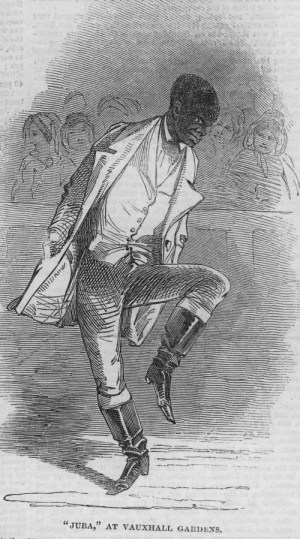
Master Juba

One of the most famous of all Vauxhall performers, William Henry Lane, was an import from the saloons and dance halls of Manhattan.

juba-vauxhall

Anon., Juba at Vauxhall Gardens, engraving (David Coke’s collection) from the Illustrated London News (5 August 1848), 77. William Henry Lane, known as Master Juba, created a sensation in London and was known as the “Dancinest fellow ever was”. He is credited with the invention of tap-dancing.

Playing the banjo and the tambourine, he was known as the “Dancinest fellow ever was’ and hailed as the inventor of tap-dancing. Dickens made him famous in his American Notes, describing a lively young negro, who is the wit of the assembly, and the greatest dancer ever known. He never leaves off making queer faces, and is the delight of all the rest, who grin from ear to ear incessantly.”

Originally one of six so-called “Ethiopian Serenaders”, Juba was unquestionably the most talented although it was at Vauxhall where he became a star attraction. From the Illustrated London News:

How could Juba enter into their wonderful complications so naturally? How could he tie his legs into such knots, and fling them about so recklessly, or make his feet twinkle until you lose sight of them altogether in his energy. The great Boz immortalised him; and he deserved the glory thus conferred.

The Final Seasons

royal vauxhall gardens

Poster advertising Van Amburgh and Juba, 1848 (British Library, London, EVAN.474). This illustrates current attractions at the gardens and features (clockwise from top left): the Grand View of Constantinople; the Grand Orchestra; the Rotunda Theatre; the Ballet Theatre; the Coral Cave; the Pavilion and Musical Promenade; the Neptune Fountain; and C.W. Pell’s Serenaders.

In spite of continued financial problems, Vauxhall limped on a few more years, with a lion tamer renowned for putting his head the lions’ mouths (Van Amburgh), the Algerine Family (“clothed in rich Arabian silks and reclining on luxurious divans”), boat races, masquerades, the Great Italian Singers (1851), military fetes featuring the Crimean War, and the American bareback rider, Mr. James Robinson in 1859.

But when the last night came, on 13 October, it must have been clear to all that Vauxhall could continue no longer.

Susana’s Vauxhall Blog Post Series

  1. Vauxhall Gardens: A History
  2. Vauxhall Gardens: Jonathan Tyers—“The Master Builder of Delight” 
  3. Vauxhall Gardens: A New Direction
  4. Vauxhall Gardens: The Orchestra and the Supper-Boxes 
  5. Vauxhall Gardens: The Organ, the Turkish Tent, and the Rotunda
  6. Vauxhall Gardens: Three Piazzas of Supper-Boxes
  7. Vauxhall Gardens: “whither every body must go or appear a sort of Monster in polite Company”
  8. Vauxhall Gardens: The Competition
  9. Vauxhall Gardens: The Artwork, Part I
  10. Vauxhall Gardens: The Artwork, Part II
  11. Vauxhall Gardens: The Music, 1732-1859
  12. Vauxhall Gardens: The Business Side
  13. Vauxhall Gardens: Developments from 1751-1786
  14. Vauxhall Gardens: Thomas Rowlandson’s Painting (1785)
  15. ‎Vauxhall Gardens: The Third Generation of the Tyers Family and the Jubilee of 1786
  16. Vauxhall Gardens: An Era of Change (1786-1822), Part I
  17. Vauxhall Gardens: An Era of Change (1786-1822), Part II
  18. Vauxhall Gardens: An Era of Change (1786-1822), Part III
  19. Vauxhall Gardens: The Final Years, Part I
  20. Vauxhall Gardens: The Final Years, Part II
  21. Vauxhall Gardens: The Final Years, Part III
  22. Vauxhall Gardens: The Final Years, Part IV
  23. Vauxhall Gardens: Farewell, for ever

Diane Dario: The Rake’s Redemption

I have been reading romance novels since the age of fourteen.

Regency romances are one of my all-time favorite eras (grand ballrooms, dinner parties while sitting next to a grand duke or war hero just returned from fighting against Napoleon and the French, hey I girl can dream, can’t she).

When I am not reading or writing the stories I have visions in my head, I am enjoying the joyful moments with my growing family, the ballet and romantic movies.

Writing has always been a great passion for me, a long road of many ups and downs (and lots of online writing classes) and the years it took to get the craft right, finally, all my time and efforts paid off and now my dream of becoming a published author is now a reality.

It just goes to prove dreams can come true as long as you do not give up on them.

Susana: What is your favorite part of writing?

Diane: The research and having the opportunity to let my imagination run away with me as I go into another place and time while creating romantic stories.

Susana: Your current release, The Rake’s Redemption, takes a slightly different spin on the “left at the altar” storyline. Where did you get the idea for your unique spin on this familiar theme?

Diane: I always enjoyed reading second chance on romance books and I thought I could do this and the hard part was trying to come up with a plot that wasn’t used before. I do hope you like Caroline and Pierce as they found the love they once shared wasn’t lost forever.

Susana: This story also has elements of the difficulties soldiers face when they return home. Who or what was your inspiration for this secondary theme?

Diane: The anniversary of Waterloo and I thought what must it have felt like to be battle, seeing your fellow soldiers and friends die right before your eyes.

Susana: What do you have coming up next?

Diane: January 2016 – A Christmas Regency novella – The Earl’s Christmas Embrace – matchmaking gone astray. First of a series of war heroes coming home and searching for their missing friend.

Post Traumatic Stress Disorder (PTSD)

While researching for my debut novella The Rake’s Redemption, I stumbled upon PTSD and thought my hero, Pierce Mortimer, just returning from the Napoleonic wars, most likely had suffered this illness on this return home.

In Regency England, they would not have had the name or medical understanding that we have today. It was not until World War I that they termed the condition shell shock.

Research on the condition of PTSD in the 18th century has meant significant digging and piecing together information given to them in bits and pieces. Suffering with PTSD could lead one to re-experiencing experiences through recollections, dreams or acting as if the event is still going on.

PTSD is not limited to just re-experiencing. There are many pieces of the puzzle. There could be attempts to numb or avoid the topic of what he experiences with copious amounts of alcohol. There would be outburst or anger or one might have difficulty in social situations.

The Napoleonic wars were long and drawn out and it is not inconceivable that soldiers did not return with PTSD. They just would had a different name for it.

In regards to the Royal Navy, they were believed to just be melancholy. War and its consequences (death, disease) were so commonplace during the 18th century that those who had symptoms of PTSD were called cowards. The names they had for PTSD were cerebro-spinal shock or wind contusions. The condition was treated with skepticism which had to be difficult for a soldier who had no physical wounds.

IMG_1342 copy

Amazon

About Rake’s Redemption

Rake’s Redemption is a story of love interrupted by a young man’s call to duty…

Pierce, a younger son, realizes that the life of a military officer is far beneath what the woman he loves deserves. Despite her reassurances, he makes a decision to leave her behind, which will haunt him even after he returns from the war.

Caroline, socially ruined by a failed elopement, yearns for a husband and children of her own. Finally deciding to accept the attentions of eligible bachelors, her world is turned upside down once again when her brother in law returns from fighting Napoleon on the peninsula.

When Pierce returns to his childhood home, he and Caroline soon realize they share a sizzling physical attraction. But will the lingering pain of rejection she carries and his dark memories of battle stand in the way of love?

About the Author

IMG_0006Always an avid reader, Diane was introduced to the world of historical romance at the age of fourteen by favorite aunt. From that day, she determined to create her own world of romance, filled with the British aristocracy and the turbulent Regency era, during and after the Napoleonic Wars.

When not reading or writing about dukes, earls, and their ladies, Diane spends her time making beautiful memories with her husband and children, attending the ballet, or watching movies (love stories, of course!).