Archives

Romance of London: The Thames Tunnel

Romance of London: Strange Stories, Scenes And Remarkable Person of the Great Town in 3 Volumes

John Timbs

John Timbs (1801-1875), who also wrote as Horace Welby, was an English author and aficionado of antiquities. Born in Clerkenwell, London, he was apprenticed at 16 to a druggist and printer, where he soon showed great literary promise. At 19, he began to write for Monthly Magazine, and a year later he was made secretary to the magazine’s proprietor and there began his career as a writer, editor, and antiquarian.

This particular book is available at googlebooks for free in ebook form. Or you can pay for a print version.

The Thames Tunnel

The first successful tunnel constructed beneath a navigable river was built between 1825 and 1843 by Thomas Cochrane and Marc Brunel, along with Brunel’s son, Isambard. Although it was meant to facilitate horse-drawn carriages traffic, that never happened. Currently it is part of the London Overground railway network.

From Wikipedia:

Brunel and Cochrane patented the tunnelling shield, a revolutionary advance in tunnelling technology, in January 1818. In 1823 Brunel produced a plan for a tunnel between Rotherhithe and Wapping, which would be dug using his new shield. Financing was soon found from private investors, including the Duke of Wellington, and a Thames Tunnel Company was formed in 1824, the project beginning in February 1825.
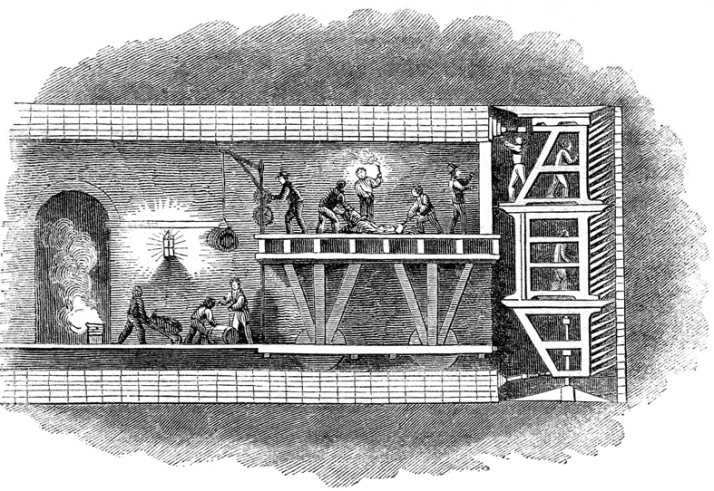
Thames_tunnel_shield

The tunnelling shield, built at Henry Maudslay’s Lambeth works and assembled in the Rotherhithe shaft, was the key to Brunel’s construction of the Thames Tunnel. The Illustrated London News described how it worked:
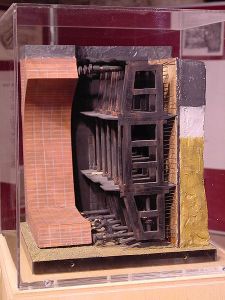
Scale model of the Brunel shield

Scale model of the Brunel shield

The mode in which this great excavation was accomplished was by means of a powerful apparatus termed a shield, consisting of twelve great frames, lying close to each other like as many volumes on the shelf of a book-case, and divided into three stages or stories, thus presenting 36 chambers of cells, each for one workman, and open to the rear, but closed in the front with moveable boards. The front was placed against the earth to be removed, and the workman, having removed one board, excavated the earth behind it to the depth directed, and placed the board against the new surface exposed. The board was then in advance of the cell, and was kept in its place by props; and having thus proceeded with all the boards, each cell was advanced by two screws, one at its head and the other at its foot, which, resting against the finished brickwork and turned, impelled it forward into the vacant space. The other set of divisions then advanced. As the miners worked at one end of the cell, so the bricklayers formed at the other the top, sides and bottom.

Although it was a triumph of civil engineering, the Thames Tunnel was not a financial success. It had cost a fortune to build – £454,000 to dig and another £180,000 to fit out – far exceeding its initial cost estimates. Proposals to extend the entrance to accommodate wheeled vehicles failed owing to cost, and it was used only by pedestrians. It became a major tourist attraction, attracting about two million people a year, each paying a penny to pass through, and became the subject of popular songs. The American traveller William Allen Drew commented that “No one goes to London without visiting the Tunnel” and described it as the “eighth wonder of the world.”

Flooding on the Thames Tunnel
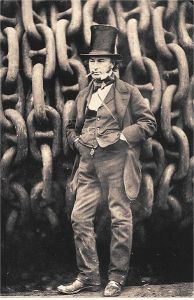
Isambard Brunel

Isambard Brunel

This stupendous work had considerably advanced by May 1827, when the bed of the river being examined by a diving-bell, the soil was found to be extremely loose; and on the 18th of May, as the tide rose, the ground seemed as though it were alive. The water was pressing in at all points, and it was not long in entering. Occasional bursts of diluted silt were followed by an overwhelming flood of slush and water, which drove all before it. The men, forced out of the shield, fled towards the bottom of the shaft. The water came on in a great wav, threatening to sweep them back under the arch by its recoil against the circular wall of the shaft. The lowest flight of steps was reached, and the recoil wave surged under the men’s feet. They hurried up the stairs of the shaft, and it was thought that all of them had come in, when the cry was raised, “A rope! A rope! Save him! Save him!” Some unfortunate workman had been left behind, and was seen struggling in the water. Young Brunel, seizing a rope, slid down one of the iron ties of the shaft, reached the water, passed the rope around the man’s body, and he was immediately drawn up. It proved to be old Tillett, the engine-man. The roll was then called, and every man answered to his name; but the Tunnel works were, for the time, completely drowned.
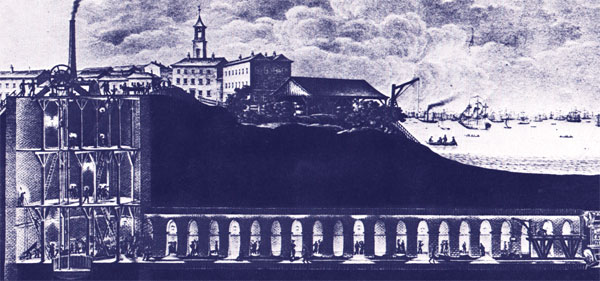
Thamestunnelcutout1840On examination of the bed of the river from the diving-bell, a large hole was found extending from the centre of the Tunnel excavation to a considerable distance eastwards. Measures were taken to fill up the opening with bags of clay, laid so as to form an arch in the bed of the river immediately over the work. More bags of clay were then sunk; and after about thirty thousand cubic feet of clay had been thrown into the hole, the pumping was resumed, and the state of the work could be examined from the inside in a boat. On the 10th of November following, the Tunnel had again been so far cleared of water that young Brunel determined to give a dinner in one of the arches to about fifty friends of the undertaking; while above a hundred of the leading workmen were similarly regaled in the adjoining arch. The band of the Coldstream Guards enlivened the scene, and the proceedings went off with great éclat. The celebration had, however, been premature; and the young engineer had been ‘hallooing before he was out of the ‘—water; for in two months the Thames again burst in, owing in some measure to the incautiousness of young Brunel himself, and the river held possession of the Tunnel for several years.
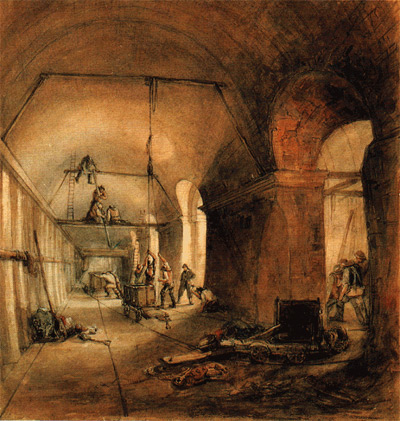
Thames_tunnel_construction_1830

Thames Tunnel construction, 1830

The funds of the Tunnel Company were by this time exhausted; and it was determined to make an appeal to the country for the means of finishing it. A subscription-list was opened, and 18,500l promised; but this sum was a mere “flea-bite,” and the works remained suspended. The Government, at length, consented to make a loan of 246,000l for the purpose of enabling the Tunnel to be completed, and the first installment was advanced in December 1834. The water was then pumped out of the Tunnel, and the works were recommenced, after having been at a standstill for a period of seven years. A new shield, of excellent construction, was supplied by the Messrs. Rennie, which was satisfactorily placed in position by the 1st of March 1836. But the difficulties of the undertaking were not yet entirely overcome; the river broke in again and again—three times in twenty weeks, within a distance of only twenty-six feet; but by perseverance and skill the water was ultimately mastered, and the work was at last brought to a completion, and opened to the public on the 25th of March 1843.
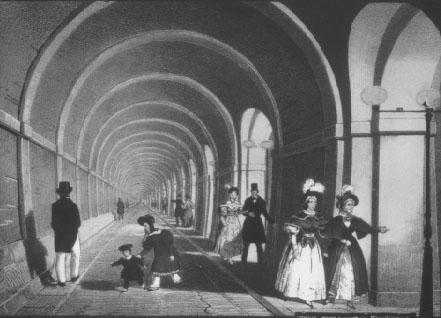
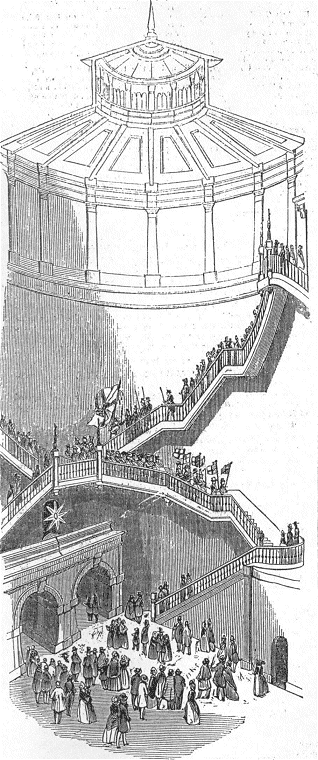
Thamestunnel

Thamestunnelshaft

2005 Thames Tunnel from Wapping

2005 Thames Tunnel from Wapping

The Brunel Museum

Nearby in Rotherhithe, the original Brunel Engine House is open to visitors as the Brunel Museum. It was built to house the drainage pumps for the tunnel and has now been restored. Wikipedia says that “[I]t is still possible to take a walking tour through the tunnel to Wapping from Rotherhithe and back, but these are infrequent and on an ad-hoc basis as they can only take place when that section of the line is closed for maintenance.


Romance of London Series

  1. Romance of London: The Lord Mayor’s Fool… and a Dessert
  2. Romance of London: Carlton House and the Regency
  3. Romance of London: The Championship at George IV’s Coronation
  4. Romance of London: Mrs. Cornelys at Carlisle House
  5. Romance of London: The Bottle Conjuror
  6. Romance of London: Bartholomew Fair
  7. Romance of London: The May Fair and the Strong Woman
  8. Romance of London: Nancy Dawson, the Hornpipe Dancer
  9. Romance of London: Milkmaids on May-Day
  10. Romance of London: Lord Stowell’s Love of Sight-seeing
  11. Romance of London: The Mermaid Hoax
  12. Romance of London: The Bluestocking and the Sweeps’ Holiday
  13. Romance of London: Comments on Hogarth’s “Industries and Idle Apprentices”
  14. Romance of London: The Lansdowne Family
  15. Romance of London: St. Margaret’s Painted Window at Westminster
  16. Romance of London: Montague House and the British Museum
  17. Romance of London: The Bursting of the South Sea Bubble
  18. Romance of London: The Thames Tunnel
  19. Romance of London: Sir William Petty and the Lansdowne Family
  20. Romance of London: Marlborough House and Sarah, Duchess of Marlborough
  21. Romance of London: The Duke of Newcastle’s Eccentricities
  22. Romance of London: Voltaire in London
  23. Romance of London: The Crossing Sweeper
  24. Romance of London: Nathan Mayer Rothschild’s Fear of Assassination
  25. Romance of London: Samuel Rogers, the Banker Poet
  26. Romance of London: The Eccentricities of Lord Byron
  27. Romance of London: A London Recluse

Nicole Zoltack: Loving Outside of Your Class

Back in the day, and even nowadays, people look down on certain relationships, especially if the people involved are from different classes. How can a duke or other titled person fall for someone outside of the ton? A movie star and a nobody? An actor and a musician? (Okay, I’m sour about the rumors of Tom Hiddleston and Taylor Swift, I’ll admit it.)

vauxhall

During the Regency era, aristocrats weren’t supposed to marry from other classes. Money, land, reputation, politics… they were what drove marriage for the upper crust. For the working class—the servants, maids, housekeepers, soldiers, etc—marriage was very important. Their parents had less of a say in whom they married, and they were a little more autonomous; however that was only within their own class, of course.

If a handmaid were to fall for a viscount… if a stablehand were to love a lady, most likely, it would not have played out well in real life, but what’s the fun in that?

lowerclasses

My series, Beyond Boundaries, is specifically about couples who fall in love despite obstacles like class.

If you were a lady back in the Regency, do you think you would ever consider someone outside of your class despite what your parents wish for you, despite the opinions of your friends and peers? I like to think I would!

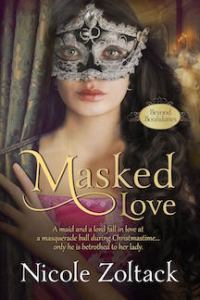
About Masked Love (Beyond Boundaries #1)

maskedloveIsabelle will do anything for her lady, even accompany her to a masquerade ball. Lady Theodosia needs extra support for tomorrow she will meet the man her par-ents have pledged her to.

Meeting an enchanting young man during the course of the evening makes Isabelle wish for a life she can never have. Imagine her shock when he shows up the next morning, announcing his claim on Lady Thedosia.

Torn between duty and desire, Isabelle hopes for something more this Christmas.

Amazon

13446322_867608668635_2112547213_o

Starry Love (Beyond Boundaries #2)

With the Season rapidly approaching, Lady Elizabeth is ready to make her match until her father is stricken deathly ill. Her mother is desperate and hails for doctors, surgeons, even apothecaries. The upkeep of the house falls on Elizabeth, and she spend long hours beside her father, watching as he betters one day and fares worse on others. Long walks with the stable hand Callum on starry nights save Elizabeth’s sanity.

When the inevitable happens, Lady Elizabeth is forced to go to London. The gentlemen there, however, hold no candle to the kind and caring Scottish Callum.

Shortly before her father’s death, Callum returned to his homeland to try and find a cure for her father. As time passes with no word, no letters, Elizabeth must choose whether the love that blossomed between them is worth denying the man her mother wishes for her.

Amazon

About the Author

nicole photoNicole Zoltack loves to write in many genres, especially romance, whether fantasy, paranormal, or regency. She’s also an editor for MuseItUp Publishing and works as a freelance editor.

When she’s not writing about gentlemen and their ladies, knights, superheroes, or witches, she loves to spend time with her loving husband, three energetic young boys, and precious baby girl. She enjoys riding horses (pretending they’re unicorns, of course!) and going to the PA Renaissance Faire, dressed in garb. She’ll also read anything she can get her hands on. Her current favorite TV shows are The Walking Dead and Arrow.

To learn more about Nicole and her work, visit her blog at http://NicoleZoltack.blogspot.com. She can be found on most any social media site under Nicole Zoltack. Stalk away!

Jude Knight: A notorious woman visits the Parlour

Rebecca, Lady Overton prefers to be out of the public eye. Before she consented to join her author for tea in Susana’s Parlour, she extracted a promise that this interview would not be published until more than 200 years in her future.

“I have had notoriety and notice enough for a lifetime, Jude,” she says. “You saw to that.”

Becky is right. As the Rose of Frampton, treasured mistress to the notorious Marquis of Aldridge, she was whispered about (but not acknowledged) the length and breadth of polite Society. It is no consolation to her that I was only doing my job, nor that I did not know anything about her history when I started. I thought to write a cheerful romp about a dissolute rake, not a story about how a woman with few choices nonetheless made the best ones she could, and eventually won her way to a happy marriage and a secure family.

She does not wait for an answer to her remark. “And you are still doing it,” she scolds. “This latest start of yours has spread my story to countries that did not even exist when I was alive. That smug look does not make me feel better, you know!”

I wipe the grin off my face. I have been posting A Baron for Becky on Wattpad for months, one chapter a week until it was completed. In the past month it has taken off, garnering hundreds of reads every day. I am particularly thrilled that 15% of my reads are from India, another 10% from the Philippines, and more than 50% overall from countries in Africa and Asia where I do not normally sell books.

“You have to admit,” Becky continues, “it is not at all a light, frothy read. Girlhood trauma? Years of suffering? Two heroes, Jude, and neither of them particularly heroic seen in a certain light.”

“It is a story of resilience, Becky. You survived, and eventually you thrived. And both your first hero and your second helped with that. More than they hindered, I am sure you will agree. Did you know that Susana, our hostess today, has a story on Wattpad that is actually called ‘Resilience’? You might enjoy meeting her heroine. You have some sad circumstances in common.”

“Ah,” Becky says. “Betrayed into a brothel, was she? Poor girl.”

“It comes right in the end,” I sooth. “After all, we write happy endings, Susana and I.”

Becky’s speaking look states her opinion as loudly as words. Perhaps that which does not kill you makes you stronger, but the memories and the scars remain, giving a dark underpinning the future happiness. I dream that people who have had their choices torn from them will find hope and the courage to find new choices by reading stories about heroines like Becky. But pain endured and overcome is still pain.

“We are about to start posting a new book, Mari Christie and I,” I tell Becky, hoping to change the direction of her thoughts.

It works. “Mari Christie? She writes as Mariana Gabrielle, does she not? She created my dear friend Kali. Is the book about her?”

“No, indeed. This is something different. Never Kiss a Toad is about the romance between Aldridge’s daughter Sal and his friend Wellbridge’s son David. The first part goes up next Friday.”

About Never Kiss a Toad

Never Kiss a Toad copyDavid “Toad” Northope, heir to the Duke of Wellbridge and rogue in the mold of his infamous father, knows Lady Sarah “Sal” Grenford, daughter of the once-profligate Duke of Haverford, will always hold his heart. But when the two teens are caught in bed together by their horrified parents, he is sent away to finish school on the Continent, and she is thrown into the depths of her first London Season.

Can two reformed rakes keep their children from making the same mistakes they did? The dukes decide keeping them apart will do the trick, so as the children reach their majority, Toad is put to work at sea, learning to manage his mother’s shipping concern, and Sal is taken to the other side of the world, as far from him as possible.

How will Toad and Sal’s love withstand long years of separation, not to mention nasty lies, vicious rumors, attractive other suitors, and well-meaning parents who threaten to destroy their future before it has begun?

To be published in weekly instalments on Wattpad, alternating between Mariana Gabrielle’s page and Jude Knight’s.

Jude Knight

Mariana Gabrielle

(Mariana Gabrielle is also posting Royal Regard, in which you can read about the fraught and beleaguered courtship of Toad’s parents, and Jude is posting stories from her collection Hand-Turned Tales.)

About A Baron for Becky

BfB cover final small copyBecky is the envy of the courtesans of the demi-monde – the indulged mistress of the wealthy and charismatic Marquis of Aldridge. But she dreams of a normal life; one in which her daughter can have a future that does not depend on beauty, sex, and the whims of a man.

Finding herself with child, she hesitates to tell Aldridge. Will he cast her off, send her away, or keep her and condemn another child to this uncertain shadow world?

The devil-may-care face Hugh shows to the world hides a desperate sorrow; a sorrow he tries to drown with drink and riotous living. His years at war haunt him, but even more, he doesn’t want to think about the illness that robbed him of the ability to father a son. When he dies, his barony will die with him. His title will fall into abeyance, and his estate will be scooped up by the Crown.

When Aldridge surprises them both with a daring proposition, they do not expect love to be part of the bargain.

Follow A Baron for Becky on Wattpad, or purchase while it is on sale for 99c

Smashwords

iBooks

Amazon

Barnes & Noble

About the Author

Jude Knight copyJude Knight has been telling stories all her life: making up serial tales to amuse her friends and children, imagining sequels to books that have moved her and left her wanting more, occasionally submitting short stories to magazines and the radio, starting more than a dozen novels set in different times and places.

She has devoted most of the last forty years to a career in commercial writing and raising a large family (most recently as grandmother-in-residence while a daughter was out of action for three years). She and her own personal romantic hero, with whom she has shared those forty+ years, now live with two cats and frequent visitors in a small town in rural New Zealand.

Judy wrote and published her first historical romance in 2014, and now has the wind in her sails and a head full of strong determined heroines, heroes with the sense to appreciate them, and villains you’ll love to loathe.

Website and Blog • Facebook • Twitter • Pinterest

Romance of London: Montague House and the British Museum

Romance of London: Strange Stories, Scenes And Remarkable Person of the Great Town in 3 Volumes

John Timbs

John Timbs (1801-1875), who also wrote as Horace Welby, was an English author and aficionado of antiquities. Born in Clerkenwell, London, he was apprenticed at 16 to a druggist and printer, where he soon showed great literary promise. At 19, he began to write for Monthly Magazine, and a year later he was made secretary to the magazine’s proprietor and there began his career as a writer, editor, and antiquarian.

This particular book is available at googlebooks for free in ebook form. Or you can pay for a print version.

The Burning of Montague House

This noble mansion, situated on the north side of Great Russell Street, Bloomsbury, was first built about 1674, by Ralph Montague, Esq., afterwards Baron Montague of Boughton, and Duke of Montague, Keeper of the Wardrobe to Charles II., and who was subsequently in high favor with King William and Queen Anne. The house was erected in the manner of a French palace, from the design of Robert Hooke, the celebrated mathematician, and the inventor of spring-clocks and pocket-watches, and much employed in the rebuilding of London after the Great Fire; he was also Curator of the Royal Society, in the year 1678.

Within ten years this superb mansion was burned down by accident, or rather, by the carelessness of a servant. John Evelyn records in his Diary:—“Jan. 19. 1686.—This night was burnt to the ground my Lord Montague’s palace in Bloomsbery, than which, for paintings and furniture, there was nothing more glorious in England. This happened by the neglect of a servant airing, as they call it, some goods by the fire, in a moist season; indeed, so wet and mild a season had scarce been seen in man’s memory.”

The house was at this time in the occupation of the Earl of Devonshire, to whom Lord Montague had let it, for the sum of 500 guineas by the year. Of its destruction we find another entry:—

Whitehall, the 21st Jan. 1685-6.

“On Wednesday, at one in the morning, a sad fire happened at Montague House, in Bloomsbury, occasioned by the steward’s airing some hangings, &c., in expectation of my Lord Montague’s return home; and sending afterwards a woman to see that the fire-pans with charcoal were removed, which she told me she had done, though she never came there. The loss that my Lord Montague has sustained by this accident is estimated at 40,000l., besides 6,000l. In plate; and my Lord Devonshire’s loss in pictures, hangings, and other furniture is very considerable.”

The North Prospect of Mountague House by James Simonic, 1715

The North Prospect of Mountague House by James Simonic, 1715

Montague House is rebuilt

Lord Montague’s large income was again placed in requisition for the reconstruction of his palace; and though executed by French artists, the plan (that of the hotels of the nobility at Paris) was the same, the new structure being raised upon the foundations and burnt walls of the old one. The architect now employed was one Peter Poughet, a native of Marseilles, who was assisted in the decoration by Charles de la Fosse, Jaques Rousseau, and Jean Baptist Monoyer…  This exclusive employment of French artists in the new house gave rise to the popular but improbable tale, that Montague House was rebuilt at the expense of Louis XIV., to whose court Lord Montague had twice been sent as ambassador.

The second Montague House was finished about 1687; and the eccentric but munificent owner, who in 1705, was created Marquis of Monthermer and Duke of Montague, resided in it till after his death, which took place March 9, 1709. He was succeeded in his titles and estates by his son John, second Duke of Montague, who quitted the vicinity of St. Giles’s for the more courtly region of Whitehall. While a new mansion was being erected for him there, he, however, continued to reside in one of the wings of Montague House. After his removal to Whitehall, the house in Great Russell Street remained unoccupied, until it was purchased, by Act of Parliament, of Lord Halifax, for 10,250l., in the spring of 1754, for “the British Museum.”

Montagu House drawing by Nicholas Sutton, published in 1754

Montagu House drawing by Nicholas Sutton, published in 1754

The British Museum

The building must have been in a very dilapidated condition, for the repairs cost more than the purchase, and, with furniture, &c., amounted to the large sum of 29,736l. 10s. 10d.

In plan, the old Museum resembled a French hotel of the first class: consisting of a large and lofty pile, with two sides built for offices, and a high front wall, with an arched doorway, and above it an octangular turret, surmounted by a cupola and vane; this was the principal entrance, and was known as “Montague Great Gate;” and at each extremity of the wall was a square turret.

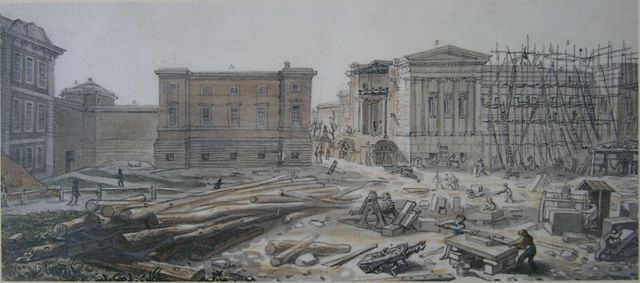
Left to Right: Montagu House, Towny Gallery, and Sir Robert Smirkes' West Wing Under Construction, July 1828

Left to Right: Montagu House, Towny Gallery, and Sir Robert Smirkes’ West Wing Under Construction, July 1828

To the original building additions were made from time to time, as the collection increased, until 1820, when the rebuilding of the Museum was commenced; the plan bordering three sides of the spacious area formerly occupied by the gardens of Montague House, behind the original mansion. By this means, the collection was removed from the old into the new building as the latter progressed, without any inconvenience to the public. In like manner, the principal front took the place of the old Montague House façade, which was removed piecemeal; and strange it was to see the lofty pitched roof, balustraded attic, and large windowed front of “the French manner,” giving way to the Grecian architecture of Sir Robert Smirke’s new design. The octangular and not unpicturesque apartment over the great gateway lingered for some time after, and was the last to disappear of old Montague House. The materials were sold by auction; and curious was it to see such pieces of the painted walls and ceilings as could be removed entire, bringing a few shillings—one of La Fosse’s deities for half-a-crown, or a bunch of Monoyer’s flowers for 1s. 6d.

The Waddesdon Bequest

This has nothing to do with Montague House, but is just something interesting I came across while researching this blog post. Last summer I visited Waddesdon Manor in Aylesbury, which is where Baron Ferdinand de Rothschild displayed the treasures he acquired from his travels to the Continent and beyond. Baron Rothschild is quite the romantic figure. He fell in love and married his second cousin Evelina, only to lose her in childbirth eighteen months later. He never married again, but spent his life in the acquisition and admiration of beautiful objects. Click here to take a look at my Pinterest board for Waddesdon Manor.

In 1898 he bequeathed the contents of his New Smoking Room at Waddesdon Manor to the British Museum.

This consisted of almost 300 pieces of objets d’art et de vertu which included exquisite examples of jewellery, plate, enamel, carvings, glass and maiolica, among them the Holy Thorn Reliquary, probably created in the 1390s in Paris for John, Duke of Berry. The collection was in the tradition of a schatzkammer or treasure house such as those formed by the Renaissance princes of Europe. Baron Ferdinand’s will was most specific, and failure to observe the terms would make it void, the collection should be

placed in a special room to be called the Waddesdon Bequest Room separate and apart from the other contents of the Museum and thenceforth for ever thereafter, keep the same in such room or in some other room to be substituted for it

The Waddesdon Bequest

The Waddesdon Bequest

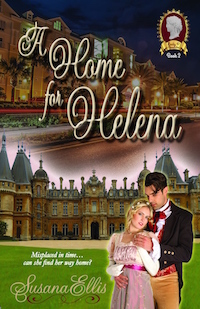
As a footnote, the cover of my time travel, A Home for Helena, includes a photograph of Waddesdon Manor taken last September at the time of my visit.

Home for Helena Cover 200x309

Amazon

Romance of London Series

  1. Romance of London: The Lord Mayor’s Fool… and a Dessert
  2. Romance of London: Carlton House and the Regency
  3. Romance of London: The Championship at George IV’s Coronation
  4. Romance of London: Mrs. Cornelys at Carlisle House
  5. Romance of London: The Bottle Conjuror
  6. Romance of London: Bartholomew Fair
  7. Romance of London: The May Fair and the Strong Woman
  8. Romance of London: Nancy Dawson, the Hornpipe Dancer
  9. Romance of London: Milkmaids on May-Day
  10. Romance of London: Lord Stowell’s Love of Sight-seeing
  11. Romance of London: The Mermaid Hoax
  12. Romance of London: The Bluestocking and the Sweeps’ Holiday
  13. Romance of London: Comments on Hogarth’s “Industries and Idle Apprentices”
  14. Romance of London: The Lansdowne Family
  15. Romance of London: St. Margaret’s Painted Window at Westminster
  16. Romance of London: Montague House and the British Museum
  17. Romance of London: The Bursting of the South Sea Bubble
  18. Romance of London: The Thames Tunnel
  19. Romance of London: Sir William Petty and the Lansdowne Family
  20. Romance of London: Marlborough House and Sarah, Duchess of Marlborough
  21. Romance of London: The Duke of Newcastle’s Eccentricities
  22. Romance of London: Voltaire in London
  23. Romance of London: The Crossing Sweeper
  24. Romance of London: Nathan Mayer Rothschild’s Fear of Assassination
  25. Romance of London: Samuel Rogers, the Banker Poet
  26. Romance of London: The Eccentricities of Lord Byron
  27. Romance of London: A London Recluse

Beverley Oakley: The Mysterious Governess (Daughters of Sin, Book 3)

Catostconspirators

The Cato Street Conspiracy and Queen Caroline’s Return to England—Two Important Events of 1820

 Historical Romance Author, Beverley Oakley, recently brought one of her characters, Miss Araminta Partington, to tea. Miss Partington, who has an extremely high opinion of her attractions, and of her knowledge of most matters, elucidated on the background to the new book in which she features called The Mysterious Governess, part of the Daughters of Sin series, which touches on the events before and after the Cato Street Conspiracy of 1820.

Miss Partington: Hello Susana, and thank you so much for inviting me to take a dish of tea in your parlor. I must say, it’s very comforting to know I can sleep at night in the knowledge that those dreadful men—Arthur Thistlewood, Edward Spence and the others – who call themselves “The Society of Spencean Philanthropists”, have been either hanged or transported for life for their parts in the Cato Street Conspiracy.

Susana: A delight to have you here, too, Araminta. Yes, what a shock to the public! What do you suppose they were hoping to achieve?

Miss Partington: Why, utter madness, in my opinion! Mr. Thistlewood talked of desiring a “Government of the People of Great Britain,” which would take power out of the hands of Parliament and the landed elite and place it into the hands of the people.” In my opinion, that’s tantamount to stealing Papa’s estate and giving it to Jane, my useless maid, who only last week lost one of my silver hairpins.

Susana: Goodness, that does sound dire! I’m referring to the plot, of course. Was there violence?

Miss Partington: Fortunately, the only violence was after the Coldstream Guards and Bow Street runners ran into the loft where these miscreants were plotting that night’s intended rampage through the home of the Lord President of His Majesty’s Privy Council, Lord Harrowby. Indeed, they were intending to murder the entire King’s Cabinet before taking to the streets of London to storm the Bank of England and the Tower of London. They hoped to stir up revolution in our country, like in America and France only a few decades ago.

Susana: Good Lord! How was it possible that law enforcement was able to apprehend the plotters?

Pageflex Persona [document: PRS0000038_00064]Miss Partington: Well, apparently, the Government knew what they were about and had planted spies in their organization. My Cousin, Stephen Cranbourne, works for the Foreign Office. I’m sure he’d have confided in me had I not been on rather… er… friendly terms with Lord Debenham who is rumored to be associated with the Spenceans. He’s not, of course. I made sure to burn the incriminating letter his cousin wrote before she drank poison. Aren’t the daffodils beautiful at this time of year? I’ve trimmed my bonnet with several bunches. Sir Aubrey does think them fetching. Yes, I’ve transferred my affections to Sir Aubrey as I think he’d be far easier to manage than dangerous Lord Debenham.

Susana: Yes, the daffodils are, indeed, beautiful. And I was so sorry to hear about Lord Debenham’s cousin. I believe she was Sir Aubrey’s late wife. But, back to politics, do tell me, when was the Spenceans’ plot brought to nought? My apologies for my ignorance, I’ve been in France for some time.

Miss Partington: On February 23, 1820, but of course, it’s not really news any more since the gossip sheets—and indeed, the newspapers—are having much more fun giving us all the thrilling details of George IV’s estranged wife Queen Caroline arriving from continental Europe, a few months afterwards, and attempting to take her place as Queen consort. Personally, I think someone with such atrocious dress sense doesn’t deserve to be queen, but, not everyone agrees with me—which I always find rather odd, really. Of course, the Prince Regent only agreed to marry Princess Caroline of Brunswick back at the end of the last century so his father would clear his debts. £630,000 pounds is rather a lot of money, though I imagine that if I owed such a sum, I might be induced to marry Lord Debenham above Sir Aubrey, despite his wicked reputation and the fact Lord Debenham would be so much more difficult to manage.

Susana: Yes, your half-sister, Miss Larissa Hazlett, has inferred the same.

Miss Partington: My half-sister? [Miss Partington rises.]Let me assure you, I do not have a half-sister. Any resemblance between that dreary governess and myself is entirely coincidental. Now, if you’ll excuse me… while it has been most pleasant, I must leave now for an appointment I’ve just remembered. Yes, it’s all part of a little plan I’m implementing to put that dreary governess right back in her box!

About The Mysterious Governess

Two beautiful sisters—one illegitimate, the other nobly born—compete for love amidst the scandal and intrigue of a Regency London Season.

Lissa Hazlett lives life in the shadows. The beautiful, illegitimate daughter of Viscount Partington earns her living as an overworked governess while her vain and spoiled half sister, Araminta, enjoys London’s social whirl as its most feted debutante.

When Lissa’s rare talent as a portraitist brings her unexpectedly into the bosom of society—and into the midst of a scandal involving Araminta and suspected English traitor Lord Debenham—she finds an unlikely ally: charming and besotted Ralph Tunley, Lord Debenham’s underpaid, enterprising secretary. Ralph can’t afford to leave the employ of the villainous viscount much less keep a wife but he can help Lissa cleverly navigate a perilous web of lies that will ensure everyone gets what they deserve.

Amazon.com • Amazon.co.uk • Apple iBooks • Barnes & Noble • Kobo

Excerpt

Although The Mysterious Governess is about Lissa, who is Araminta’s half-sister, the plot involves them equally. Lissa is hard-working and honourable, the antithesis of Araminta, as you will see below, in this short extract:

“Is everything all right, Miss? Were the fireworks grand? You’re back earlier than I’d ‘spected.” Jane, who was polishing the silver bottles on her mistress’s dressing table, looked up nervously as Araminta entered the room.

Without a word, Araminta brought one arm across the entire surface and sent powder bottles, perfume vials, hairbrushes and jewelry boxes crashing to the floor.

Then she threw herself onto her bed and burst into noisy tears.

“Oh, Miss, I take it things didn’t go to plan,” said Jane, going down on her knees to start to clean up the mess before changing her mind and putting a tentatively soothing hand upon Araminta’s back.

“No, they did not!” Araminta shrieked, beating her fists upon the counterpane.

“So, His Lordship didn’t ask you to marry him, then?”

“Yes he did!” Araminta rolled onto her back and glared at Jane. “He asked me to marry him and then said he had to go away on important business for two months! Two months! Where does that leave me? In an impossible situation, I don’t need to tell you. I might as well throw myself in the river, except the water’s far too cold and I’m hardly about to copy bacon-brained Edgar. There must be another way.”

“Poison?”

“I mean to get out of this mess, you stupid girl!” Araminta screamed. Feverishly, she began to bite her fingernails before realizing the damage she was doing to an important asset. “Oh, Jane, don’t look like you’re related to a mule. Come up with a plan, for dear Lord’s sake!”

About the Author

Beverley Eikli author picBeverley Oakley was seventeen when she bundled up her first 500+ page romance and sent it to a publisher. However, drowning her heroine on the last page was not in line with the expectations of romance readers so Beverley became a journalist.

In 2009, Beverley published her first novel. Since then she has written more than thirteen sizzling historical romances, filled with mystery and intrigue, mostly set in England during the Georgian, Regency and Victoria eras.

Beverley lives near Melbourne opposite a picturesque nineteenth century insane asylum with the handsome Norwegian bush pilot she met in Botswana, their two beautiful daughters and a rambunctious Rhodesian Ridgeback the size of a pony.

Beverley also writes more psychological historicals, and Colonial-Africa- set romantic adventures, as Beverley Eikli.

WebsiteFacebookGoodreadsTwitter

Romance of London: St. Margaret’s Painted Window at Westminster

Romance of London: Strange Stories, Scenes And Remarkable Person of the Great Town in 3 Volumes

John Timbs

John Timbs (1801-1875), who also wrote as Horace Welby, was an English author and aficionado of antiquities. Born in Clerkenwell, London, he was apprenticed at 16 to a druggist and printer, where he soon showed great literary promise. At 19, he began to write for Monthly Magazine, and a year later he was made secretary to the magazine’s proprietor and there began his career as a writer, editor, and antiquarian.

This particular book is available at googlebooks for free in ebook form. Or you can buy a print version.

YES

The history of the painted glass cinquecento Window, which, in 1758, was placed in the chancel, over the altar of St. Margaret’s Church, is truly romantic.

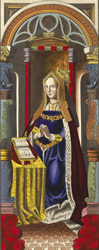
Elizabeth of York

Elizabeth of York

This beautiful window (said to have been executed at Gouda, in Holland, and to have occupied five years in the making) was originally intended by the magistrates of Dort as a present to Henry VII., by whom it was intended for his Chapel at Westminster; or as some say, it was ordered by Ferdinand and Isabella on the occasion of Prince Arthur being affianced, in 1499, to the Princess Catherine of Arragon, their portraits being procured for the purpose.

The three middle compartments represent the Crucifixion, with the usual accompaniments of angels receiving in a chalice the blood which drops from the wounds of the Saviour. Over the good thief an angel is represented wafting his soul to Paradise; and over the wicked, the devil in the shape of a dragon carrying his soul to a place of punishment. In the six upper compartments are six angels holding the emblems of crucifixion: the cross, the sponge, the crown of thorns, the hammer, the rods and nails. In the right hand lower compartment is Arthur, Prince of Wales (eldest son of Henry VII); and in the companion or left side, Catherine of Arragon, his bride (afterwards married to his brother Henry VIII., and divorced by him). Over the head of Prince Arthur is a full-length figure of St. George, with the red and white roses of England; and over Catherine of Arragon, a full-length figure of St. Catherine, with the bursting pomegranate, the emblem of the kingdom of Granada.

Prince Arthur died before the window was finished; the King himself before it could be erected. Succeeding events—the marriage of Henry VIII. To the bride or widow of his brother, with the subsequent divorce of Catherine—rendered the window wholly unfit for the place for which it was intended.

The window through the ages

  1. Catherine of Aragon

    Catherine of Aragon

    Henry VIII gave it to Waltham Abbey, Essex.

  2. At the Dissolution, Robert Fuller, the last Abbot, sent it to his private chapel at New Hall, also in Essex.
  3. It was later acquired by the father of Anne Boleyn.
  4. Queen Elizabeth I gave it to Thomas Ratcliff, Earl of Sussex, who was living at New Hall.
  5. It was purchased by Villiers, Duke of Buckingham, favorite of James I.
  6. Its next owner was Oliver Cromwell.
  7. At the Restoration, it reverted to the second Duke of Buckingham.
  8. It was purchased, along with New Hall, to General Monk, Duke of Albermarle. The duke buried it underground to keep it from the Puritans. After the Restoration he returned it to his chapel at New Hall.
  9. After he died and his son as well, the hall became the property of the duchess, and fell into ruin and decay.
  10. John Olmius, Esq., purchased the property and demolished the chapel, preserving the window.
  11. Eventually it was purchased by Mr. Conyers, of Copt Hall, Essex, for 50 guineas, for his own chapel.
  12. Conyers’ son, Mr. John Conyers sold the window in 1758 to the churchwardens of St. Margaret’s Westminster for 400 guineas.
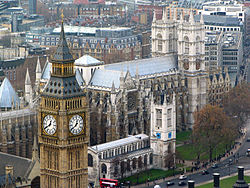
St. Margaret's Church (background)

St. Margaret’s Church (background)

“It is worth the walk”

It is worth a walk to St. Margaret’s to see this window. The late Mr. Winston, the great authority upon glass-painting, says of it: “Though at present much begrimed with London smoke and soot, it may be cited as an example of the pictorial excellence attainable in a glass-painting without any violation of the fundamental rules and conditions of the art. The harmonious arrangement of the coloring is worthy of attention. It is the most beautiful work in this respect that I am acquainted with.”

The church has been in our time, as it was centuries ago in Stow’s time, “in danger of pulling down;” which, if carried into effect, would add another leaf to the history of the St. Margaret’s Painted Window.

Thankfully, this last threat to the location of this window have not come to pass. I’m definitely putting St. Margaret’s on my list for this year’s trip, in August.

St. Margaret's Church from the London Eye

St. Margaret’s Church from the London Eye


Romance of London Series

  1. Romance of London: The Lord Mayor’s Fool… and a Dessert
  2. Romance of London: Carlton House and the Regency
  3. Romance of London: The Championship at George IV’s Coronation
  4. Romance of London: Mrs. Cornelys at Carlisle House
  5. Romance of London: The Bottle Conjuror
  6. Romance of London: Bartholomew Fair
  7. Romance of London: The May Fair and the Strong Woman
  8. Romance of London: Nancy Dawson, the Hornpipe Dancer
  9. Romance of London: Milkmaids on May-Day
  10. Romance of London: Lord Stowell’s Love of Sight-seeing
  11. Romance of London: The Mermaid Hoax
  12. Romance of London: The Bluestocking and the Sweeps’ Holiday
  13. Romance of London: Comments on Hogarth’s “Industries and Idle Apprentices”
  14. Romance of London: The Lansdowne Family
  15. Romance of London: St. Margaret’s Painted Window at Westminster
  16. Romance of London: Montague House and the British Museum
  17. Romance of London: The Bursting of the South Sea Bubble
  18. Romance of London: The Thames Tunnel
  19. Romance of London: Sir William Petty and the Lansdowne Family
  20. Romance of London: Marlborough House and Sarah, Duchess of Marlborough
  21. Romance of London: The Duke of Newcastle’s Eccentricities
  22. Romance of London: Voltaire in London
  23. Romance of London: The Crossing Sweeper
  24. Romance of London: Nathan Mayer Rothschild’s Fear of Assassination
  25. Romance of London: Samuel Rogers, the Banker Poet
  26. Romance of London: The Eccentricities of Lord Byron
  27. Romance of London: A London Recluse
Romance of London: The Lansdowne Family

Romance of London: Strange Stories, Scenes And Remarkable Person of the Great Town in 3 Volumes

John Timbs

John Timbs (1801-1875), who also wrote as Horace Welby, was an English author and aficionado of antiquities. Born in Clerkenwell, London, he was apprenticed at 16 to a druggist and printer, where he soon showed great literary promise. At 19, he began to write for Monthly Magazine, and a year later he was made secretary to the magazine’s proprietor and there began his career as a writer, editor, and antiquarian.

This particular book is available at googlebooks for free in ebook form. Or you can pay for a print version.

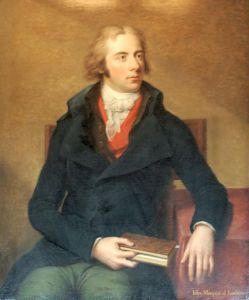
William Petty, 1st Marquis Lansdowne

William Petty, 1st Marquis Lansdowne

In 1805 died the second Marquis of Landsdowne, having by this time passed very much out of popular notice, and the principal cause of public regret for his demise was that only a fortnight before his death he had declared his knowledge of the Junius secret [see below], and yet among his papers was to be found no indication that could lead to its discovery. He was succeeded by his eldest son, the Earl of Wycombe, whose first act on coming into possession was to sell almost all of the literary and artistic treasures which his father had accumulated with so much love and labour. The greater part of these were dispersed under the hammer of the auctioneer, many of the pictures going to enrich the Grosvenor, the National, and other galleries; only the Lansdowne MSS. Were kept together, being purchased by the British Museum; while the gallery of antique marbles was the sole portion of the collection for which the Marquis showed any appreciation—his opinion being expressed in the fact that he purchased it from his father’s executors for 6,000l. If, however, this nobleman did not show much respect to his father’s cultivated tastes, he was not without a certain ancestral pride; for he tried to build a vessel on the principle of Sir William Petty’s double-bottomed ship that was to sail against wind and tide—a model of which was then, and is perhaps still, exhibited in the Council-room of the Royal Society. Of nautical habits, he also built near the Southampton Water a marine villa, in which, from dining-hall and private bower to kitchen and scullery, all was utter Gothic, while the gardens belonging to the castle were laid out at Romsey, some ten or twelve miles distant, on a site which formed the original estate of the Petty family.

John Petty, 2nd Marquis of Lansdowne

John Petty, 2nd Marquis of Lansdowne

Here, if not in his yacht voyaging to Ireland or the Continent, he spent most of his time. In London he was a marked man—remarkable for his disregard of dress, and for the pride which he took in appearing on the coldest days in winter without a greatcoat and without gloves. He died in November 1809, and was succeeded by his half-brother, the fourth [third] Marquis, whose first care was to purchase the antique marbles from his sister-in-law, and there at Landsdowne House they may now be seen—some of them, as the youthful Hercules and the Mercury, justly considered the finest statues of the kind that have found their way to this country. As for the pictures, when the Marquis succeeded to the title, in 1809, there was not one in this splendid mansion, with the exception of a few family portraits; but Lord Lansdowne set himself to the formation of a gallery which now comprises nearly 200 pictures of rare interest and value, but miscellaneous in their character, no school nor master predominating unless it be Sir Joshua Reynolds. Some of the portraits in this collection are of great interest. There is the celebrated portrait of Pope by Jervas; Reynolds’s wonderful portrait of Sterne; one of Franklin, by Gainsborough; a beautiful one of Peg Woffington, by Hogarth; Lady Hamilton appears twice—as a bacchante and a gipsy, from the pencil of Romney; Horner, the old college friend of Lord Lansdowne, is not forgotten; but, most interesting of all, there is the lovely portrait of Mrs. Sheridan, as St. Cecilia, painted by Reynolds.

mrs. sheridan

Mrs. Richard Brinsley Sheridan, by Gainsborough

It may recall with some vividness the fashion of those times if we record a little incident connected with this portrait. During the short-lived Ministery of “All the Talents,” the Whig leaders celebrated their return to power by a continual found of festivities, in which Sheridan outside all his colleagues. One Sunday (25th of May 1806) he gave a grand dinner; on the Monday following a supper and ball, at which the dancing was prolonged to past eight o’clock next morning; on the Tuesday, a christening, a masque, and another ball, the Prince being present on each occasion, and the Lord Chancellor Erskine and the young Chanceller of the Exchequer, Henry Petty, being conspicuous among the dancers. On the occasion of the dinner, the portrait of Mrs. Sheridan was redeemed for one night only from the pawnbroker’s, and exhibited in its place in the dining-room; when poor Sheridan died, it was still in possession of the pawnbroker; it then fell into the hands of Sheridan’s solicitor, and from him it was purchased for 600l. By Lord Lansdowne. In this little incident we get some glimpses of that conviviality for which the Whigs were distinguished. “Le Whig est la femme de votre Gouvernement,” says Balzac, and the truth of the remark is especially illustrated in that social influence which the Whigs have always cultivated more than the Tories.*

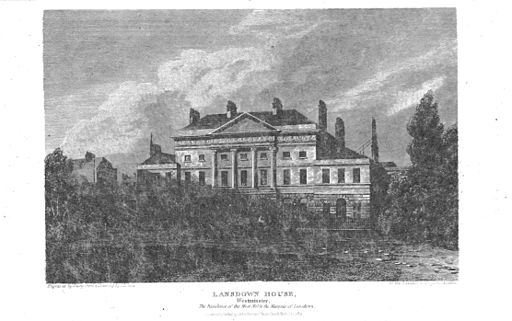
Lansdowne House (1820)

Lansdowne House (1820)

Lansdowne House was built by Robert Adam for the Marquis of Bute, when minister to George III, and sold by the Marquis before completion to Lord Shelburne, afterwards Marquis of Lansdowne, for 22,000l., which was supposed to be 3,000l. Less than it cost. There is, also, a piece of political scandal—that Lansdowne House was constructed by one Peace (Lord Bute’s, in 1762), and paid for by another (Lord Shelburne’s, in 1783).

*From The Times journal

Lansdowne House was partially demolished in the 1930’s to make room for a new road, and some of its noted interiors located elsewhere.

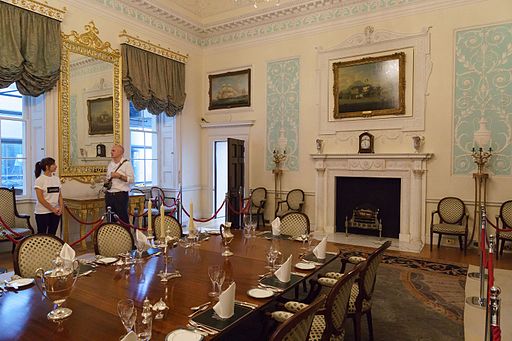
The dining room from Landsdowne House, now located at the Lloyd's Building

The dining room from Landsdowne House, now located at the Lloyd’s Building


A drawing room now found at the Philadelphia Museum of Art

A drawing room now found at the Philadelphia Museum of Art


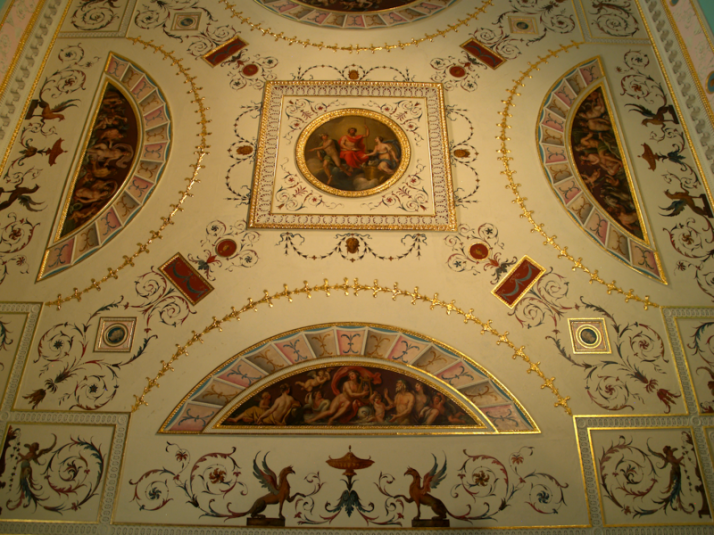
Lansdowne House ceiling (Robert Adam)

Lansdowne House ceiling (Robert Adam)


*The Junius Secret

Junius was the pseudonym of a man who wrote letters exposing corruption in government from 1768 to 1772. His identity has never been discovered, but was the source of much speculation. If Lord Lansdowne indeed knew it, he died without revealing the secret.

More information on Wikipedia.

The Secret Revealed of the Authorship of Junius’s Letters

Sarah Waldock: The Advertised Bride

Lady L’s Outrage

“MATRIMONY – A lady of good birth and breeding, and without a stain on her character wishes, for reasons which will be revealed to any successful candidate to MARRY a young man of sufficient fortune and gentility to keep her in the state to which she is accustomed. His age should not exceed thirty years, and he should be of pleasant and amiable disposition. His income not to be less than two hundred guineas per annum. Reply post-paid only, to DC, care of the Landlord, ‘The Bell’, Saxmundham.”

“I ask you, what sort of woman of good birth and breeding writes a letter to the newspaper like that? Of course, once it came out that it was one of those shameless Brandon women, it became quite clear. Did you know the Brandons haven’t been free of scandal since the first Baron ran off with a nun in the fourteenth century? And recently there was that Crim. Con. case brought by the current baron, and his niece went off with one of the most notorious rakes in the land.

51OJbyOGLbL._SY344_BO1,204,203,200_But I was telling you about how this shameless hussy somehow managed to entrap the most eligible bachelor of all, the Honourable Mr. Percival Braidwood, whose blond locks gleam like gold and who has the profile of a Greek god. Add that to his fortune, reputed to be a cool ten thousand a year, and that before he inherits the baronetcy, and you can see why it’s just not fair that this nobody second cousin or whatever she is should win him. It was a trick, of that I’m sure. How she got him to answer such an advertisement is beyond me, or maybe she just took advantage of him staying in an inn where she was perusing likely candidates. I am certain she must have managed to arrange for him to compromise her in some way, and he such a gentlemen he had no choice but to offer marriage!

Am I jealous? Of course I’m jealous! I spent the entire season trying to catch Mr. Braidwood’s attention, and I am beautiful and accomplished, and an excellent conversationalist, as well as being fashionably dark. We were a perfect foil, my raven locks and his golden ones. It goes to prove, doesn’t it, that he must have been trapped, because why else would he end up married to a blonde whose hair isn’t even dark enough in colour to call a proper blonde?

Oh, no, I don’t want to give my name; well, if you must, write it down as Lady L. Listen, if you breathe a word to the Honourable Mrs. Eldridge that I spoke about her brother’s bride, I shall find ways to make it very uncomfortable for you. What does she say? Oh, Isolde is putting a brave face on it and declaring it a love match. A love match? Why, she obviously doesn’t know that this chit Diana, or whatever her name is, placed an advertisement in two provincial newspapers, and I found out about it which is why I came to you with the full story. I even found one of her disappointed suitors, whose hand and heart she spurned for greater wealth, despite the poor man being a widower with young children. No of course I wouldn’t marry an impoverished rector with brats, what do you take me for?

There was no call to say that, fellow.”

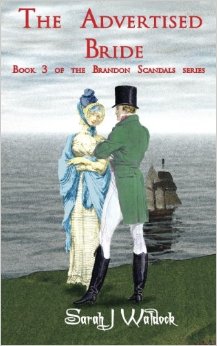
The Advertised Bride

The Advertised Bride was written with much input from my mother, who died while I was writing it, and I want to dedicate it not only to her, but to all women who have escaped from abusive families.  As well as having escaped an abusive father, my mother helped set up a local women’s refuge.  I hope Dinah’s escape will be inspirational for other women who feel trapped.

 Amazon

 Excerpt

“Dinah, such a long face! Surely you do not long for a husband to argue comparisons over?”

“No, and that’s the problem!” cried Dinah. “I am to be married after Christmas, and to a horrid old man who leered at me, and he has sweaty hands, and skin like mahogany, all wrinkled like a walnut, and Papa is not to be argued with over it. Indeed, I am afraid he will take me away, for Uncle Adam put him in a passion, criticising Marjorie’s husband.”

“Oh dear,” said Imogen. “Well, there is nothing else for it; you will have to get married before the end of the holidays. Have you any beaux?”

“No, I have never even been to a dance. I’m only sixteen and Mama said I should come out when I was seventeen. I shan’t be seventeen until April and that will be too late, and besides, Papa will say that coming out is unnecessary as he has found me a husband.”

“I can only see one course open to you, then, as I do not think you could manage to run away as I did without help,” said Imogen.

“You must think me very poor spirited,” said Dinah.

“No, my dear, I think you very much downtrodden, like a governess to horrible children, only your father is more childish than the most horrible child I have ever heard of,” said Imogen. “Fancy not being able to control his temper at his age!”

“I don’t think he ever had to,” said Dinah. “What idea did you have?”

“Why, insert an advertisement in the Ipswich Journal and the Norfolk Chronicle that you are looking for a husband, and then marry the one you like the most,” said Imogen. “I will help you to interview those who take your interest from their letters.”

“But Imogen, Papa might see the advertisement!” cried Dinah.

“Silly, you do not put it in your name,” said Imogen. “You write something like ‘Young lady seeks matrimony with a man of sufficient means and gentility to support a wife of breeding, no older than thirty. Send post-paid envelope to … oh, to some inn.”

 About the Author 

sarahwaldockSarah Waldock grew up in Suffolk and still resides there, in charge of a husband, and under the ownership of sundry cats. All Sarah’s cats are rescue cats and many of them have special needs. They like to help her write and may be found engaging in such helpful pastimes as turning the screen display upside-down, or typing random messages in kittycode into her computer.

Sarah claims to be an artist who writes. Her degree is in art, and she got her best marks writing essays for it. She writes largely historical novels, in order to retain some hold on sanity in an increasingly insane world. There are some writers who claim to write because they have some control over their fictional worlds, but Sarah admits to being thoroughly bullied by her characters who do their own thing and often refuse to comply with her ideas. It makes life more interesting, and she enjoys the surprises they spring on her. Her characters’ surprises are usually less messy [and much less noisy] than the surprises her cats spring.

Sarah has tried most of the crafts and avocations which she mentions in her books, on the principle that it is easier to write about what you know. She does not ride horses, since the Good Lord in his mercy saw fit to invent Gottleib Daimler to save her from that experience; and she has not tried blacksmithing. She would like to wave cheerily at anyone in any security services who wonder about middle aged women who read up about making gunpowder and poisonous plants.

Sarah’s History Place BlogSarah’s Cats Blog

Romance of London: Comments on Hogarth’s “Industrious and Idle Apprentices”

Romance of London: Strange Stories, Scenes And Remarkable Person of the Great Town in 3 Volumes

John Timbs

John Timbs (1801-1875), who also wrote as Horace Welby, was an English author and aficionado of antiquities. Born in Clerkenwell, London, he was apprenticed at 16 to a druggist and printer, where he soon showed great literary promise. At 19, he began to write for Monthly Magazine, and a year later he was made secretary to the magazine’s proprietor and there began his career as a writer, editor, and antiquarian.

This particular book is available at googlebooks for free in ebook form. Or you can pay for a print version.

Comments on Hogarth’s “Industrious and Idle Apprentices”

William Makepeace Thackeray

William Makepeace Thackeray

Mr. Thackeray, in his Lectures on the English Humorists, thus vividly paints the scenes of Hogarth’s masterpieces; at the same time he very ingeniously contrasts the past with the present—one of the more immediate benefits of the Lecture: the past is generally interesting, but it chiefly becomes instructive when brought under the powerful focus of the present. His account of Hogarth’s “Apprentices” is a masterpiece in this way:

1William_Hogarth_-_Industry_and_Idleness,_Plate_1;_The_Fellow_'Prentices_at_their_Looms

William_Hogarth-Industry and Idleness, Plate 1; The Fellow ‘Prentices at their Looms

Fair-haired Frank Goodchild smiles at his work, whilst naughty Tom Idle snores over his loom. Frank reads the edifying ballads of Whittington and the London ‘Prentice: whilst that reprobate Tom Idle prefers Moll Flanders, and drinks hugely of beer.

2william_hogarth_-_industry_and_idleness_plate_2_the_industrious_prentice_performing_the_duty_of_a_christian.png

William Hogarth-industry and idleness plate 2 the industrious prentice_performing the duty of a Christian

Frank goes to church on a Sunday, and warbles hymns from the gallery; while Tom lies on a tomb-stone outside playing at halfpenny-under-the-hat, and with street blackguards, and deservedly caned by the beadle.

william_hogarth_-_industry_and_idleness_plate_3_the_idle_prentice_at_play_in_the_church_yard_during_divine_service

william hogarth -industry and idleness plate 3 the idle prentice at play in the church yard during divine service

Frank is made overseer of the business; whilst Tom is sent to sea.

4William_Hogarth_-_Industry_and_Idleness,_Plate_4;_The_Industrious_'Prentice_a_Favourite,_and_entrusted_by_his_Master

William_Hogarth Industry and Idleness, Plate 4; The Industrious ‘Prentice a Favourite, and entrusted by his Master


william_hogarth_-_industry_and_idleness_plate_5_the_idle_prentice_turnd_away_and_sent_to_sea

william hogarth – industry and idleness plate 5 the idle prentice turnd away and sent to sea

Frank is taken into partnership, and marries his master’s daughter, sends out broken victuals to the poor, and listens in his night-cap and gown with the lovely Mrs. Goodchild by his side, to the nuptial music of the city bands and the marrow-bones and cleavers; whilst idle Tom, returned from sea, shudders in a garret lest the officers are coming to take him for picking pockets.

william_hogarth_-_industry_and_idleness_plate_6_the_industrious_prentice_out_of_his_time__married_to_his_masters_daughter

william hogarth – industry and idleness plate 6 the industrious prentice out of his time married to his masters daughter

william_hogarth_-_industry_and_idleness_plate_7_the_idle_prentice_returnd_from_sea__in_a_garret_with_common_prostitute

william hogarth – industry and idleness plate 7 the idle prentice returnd from sea in a garret with common prostitute

The Worshipful Francis Goodchild, Esq., becomes Sheriff of London, and partakes of the most splendid dinners which money can purchase or alderman devour; whilst poor Tom is taken up in a night cellar, with that one-eyed and disreputable accomplice who first taught him to play chuck-farthing on a Sunday.

william_hogarth_-_industry_and_idleness_plate_8_the_industrious_prentice_grown_right__sheriff_of_london

william hogarth – industry and idleness plate 8 the industrious prentice grown right sheriff of london

What happens next? Tom is brought up before the justice of his county, in the person of Mr. Alderman Goodchild, who weeps as he recognizes his old brother ‘prentice, as Tom’s one-eyed friend peaches on him, as the clerk makes out the poor rogue’s ticket for Newgate.

william_hogarth_-_industry_and_idleness_plate_9_the_idle_prentice_betrayed_and_taken_in_a_night-cellar_with_his_accomplice

william hogarth – industry and idleness plate 9 the idle prentice betrayed and taken in a night-cellar with his accomplice


william_hogarth_-_industry_and_idleness_plate_10_the_industrious_prentice_alderman_of_london_the_idle_on_brought_before_him__impreachd_by_his_accomplice

william hogarth -industry and idleness plate 10 the industrious prentice alderman of_london the idle on brought before him impreachd by his accomplice

Then the end comes. Tom goes to Tyburn in a cart with a coffin in it; whilst the right Honorable Francis Goodchild, Lord Mayor of London, proceeds to his Mansion House, in his gilt coach, with four footmen and a sword-bearer, whilst the companies of London march in the august procession, whilst the train-bands of the city fire their pieces and get drunk in his honor; and oh, crowning delight and glory of all, whilst his majesty the king looks out of his royal balcony, with his ribbon on his breast, and his queen and his star by his side at the corner house of St. Paul’s Church-yard, where the toy-shop is now.

william_hogarth_-_industry_and_idleness_plate_11_the_idle_prentice_executed_at_tyburn

william_hogarth- industry and idleness plate 11 the idle prentice executed at tyburn


william_hogarth_-_industry_and_idleness_plate_12_the_industrious_prentice_lord-mayor_of_london

william_hogarth -industry and idleness plate 12 the industrious prentice ord-mayor of london

How the times have changed! The new Post-office now not disadvantageously occupies that spot where the scaffolding is on the picture, where the tipsy trainband-man is lurching against the post, with his wig over one eye, and the ‘prentice-boy is trying to kiss the pretty girl in the gallery. Past away ‘prentice boy and pretty girl! Past away tipsy trainband-man with wig and bandolier! On the spot where Tom Idle (for whom I have an unaffected pity) made his exit from this wicked world, and where you see the hangman smoking his pipe, as he reclines on the gibbet, and views the hills of Harrow on Hampstead beyond—a splendid marble arch, a vast and modern city—clean, airy, painted drab, populous with nursery-maids and children, the abodes of wealth and comfort—the elegant, the prosperous, the polite Tyburnia rises, the most respectable district in the habitable globe!

In that last plate of the London Apprentices, in which the apotheosis of the Right Honorable Francis Goodchild is drawn, a ragged fellow is represented in the corner of the simple kindly piece, offering for sale a broadside, purporting to contain an account of the appearance of the ghost of Tom Idle, executed at Tyburn. Could Tom’s ghost have made its appearance in 1847, and not in 1747, what changes would have been remarked by that astonished escaped criminal! Over that road which the hangman used to travel constantly, and the Oxford stage twice a week, go ten thousand carriages every day; over yonder road, by which Dick Turpin fled to Windsor, and Squire Western journeyed into town, when he came to take up his quarters at the Hercules Pillars not he outskirts of London, what a rush of civilization and order flows now! What armies of gentlemen with umbrellas march to banks, and chambers, and counting-houses! What regiments of nursery-maids and pretty infantry: what peaceful processions of policemen, what light broughams and what gay carriages, what swarms of busy apprentices and artificers, riding on omnibus-roofs, pass daily and hourly! Tom Idle’s times are quite changed; many of the institutions gone into disuse which were admired in his day. There’s more pity and kindness, and a better chance for poor Tom’s successors now than at that simpler period, when Fielding hanged him, and Hogarth drew him.

One hundred and fifty years after Thackeray’s assertions that the world is a kinder place toward kids like Idle Tom, I’m not so certain I can say the same. As a former teacher, it seems to me that the system is still stacked against kids who “dance to a different drum” or who are raised in poverty and/or by indifferent parents. And I’ll be damned if I know how to change that. What do you think?


Romance of London Series

  1. Romance of London: The Lord Mayor’s Fool… and a Dessert
  2. Romance of London: Carlton House and the Regency
  3. Romance of London: The Championship at George IV’s Coronation
  4. Romance of London: Mrs. Cornelys at Carlisle House
  5. Romance of London: The Bottle Conjuror
  6. Romance of London: Bartholomew Fair
  7. Romance of London: The May Fair and the Strong Woman
  8. Romance of London: Nancy Dawson, the Hornpipe Dancer
  9. Romance of London: Milkmaids on May-Day
  10. Romance of London: Lord Stowell’s Love of Sight-seeing
  11. Romance of London: The Mermaid Hoax
  12. Romance of London: The Bluestocking and the Sweeps’ Holiday
  13. Romance of London: Comments on Hogarth’s “Industries and Idle Apprentices”
  14. Romance of London: The Lansdowne Family
  15. Romance of London: St. Margaret’s Painted Window at Westminster
  16. Romance of London: Montague House and the British Museum
  17. Romance of London: The Bursting of the South Sea Bubble
  18. Romance of London: The Thames Tunnel
  19. Romance of London: Sir William Petty and the Lansdowne Family
  20. Romance of London: Marlborough House and Sarah, Duchess of Marlborough
  21. Romance of London: The Duke of Newcastle’s Eccentricities
  22. Romance of London: Voltaire in London
  23. Romance of London: The Crossing Sweeper
  24. Romance of London: Nathan Mayer Rothschild’s Fear of Assassination
  25. Romance of London: Samuel Rogers, the Banker Poet
  26. Romance of London: The Eccentricities of Lord Byron
  27. Romance of London: A London Recluse

Romance of London: The Bluestocking and the Sweeps’ Holiday

Romance of London: Strange Stories, Scenes And Remarkable Person of the Great Town in 3 Volumes

John Timbs

John Timbs (1801-1875), who also wrote as Horace Welby, was an English author and aficionado of antiquities. Born in Clerkenwell, London, he was apprenticed at 16 to a druggist and printer, where he soon showed great literary promise. At 19, he began to write for Monthly Magazine, and a year later he was made secretary to the magazine’s proprietor and there began his career as a writer, editor, and antiquarian.

This particular book is available at googlebooks for free in ebook form. Or you can pay for a print version.

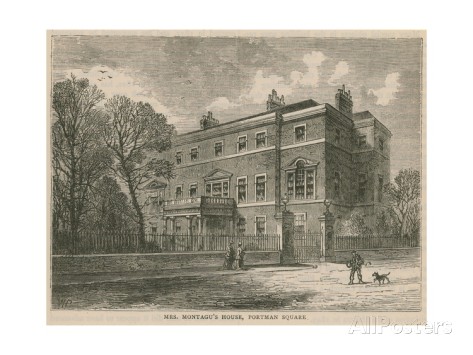
Montague House, Portman Square

Montague House, Portman Square

Elizabeth Montague’s Bluestocking Parties

At the north-west angle of Portman Square is Montague House, built for Mrs. Elizabeth Montague, authoress of the Vindication of Shakespeare against Voltaire. She had often been a guest at the second Lord Oxford’s, the resort of Pope and his contemporaries; she was the intimate friend of Pulteney and Littleton; and she survived to entertain Johnson, Goldsmith, Burke, and Reynolds, to their respective deaths. Dr. Beattie was among her visitors; and Mrs. Carter, the translator of Epictetus, was her intimate friend, correspondent, and visitor. At Montague House Mrs. Montague had her blue stocking parties; and here she gave on the first of May, “Sweeps’ Holiday,” which originated in the discovery among the fraternity of chimney-sweeps, of the eccentric Edward Wortley Montague, ‘son of the famous Lady Mary Wortley Montague, by her husband, Edward Wortley.’

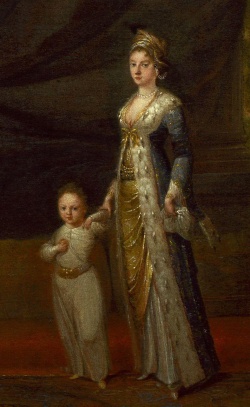
Lady Mary Wortley Montagu with Her Son Edward. Lady Mary was the first to bring smallpox inoculation to Western medicine after her experiences in the Ottoman Empire.

Lady Mary Wortley Montagu with Her Son Edward. Lady Mary was the first to bring smallpox inoculation to Western medicine after her experiences in the Ottoman Empire.

Edward Wortley Montague

This hopeful boy was born at Wharncliffe Lodge, in Yorkshire, about the year 1714; he was sent to Westminster School, whence he ran away, and was more than a year apprentice to a fisherman at Blackwall; he was sent back to Westminster, again ran away, and bound himself to the master of an Oporto vessel, a Quaker, from whom he escaped immediately on landing. In one of these flights, he changed clothes with a chimney-sweep, and for some time followed that occupation. After a long and anxious search, he was discovered by his friends, and restored to his parents, on the first of May, at the family mansion in Portman Square.

800px-Edward_Wortley_Montagu_by_Matthew_William_Peters

A 1775 portrait of Edward Wortley Montagu by Matthew William Peters

He had also served an apprenticeship among a traveling troop of showmen, who were distinguished by their skill in horsemanship; then worked in the fields in Holland as a day-laborer; next hired himself as a postillion; he then assumed the attire of an abbot, and passed for one at Rome. He next then passed for a Lutheran preacher at Hamburg, and was universally popular! He subsequently embraced the Mahomedan religion, and conformed to all Turkish habits, even to chewing opium and sitting cross-legged on the floor! With the Hebrew, Arabic, the Persian, and the Chadic he was as well acquainted as his native tongue. He at one time returned to England, and acted more comformably to his rank, and was returned as a member in two successive parliaments… But Montague’s profuse expenses soon compelled him to quit his native country, and he again assumed his wandering habits, and eventually died at Padua, at the age of sixty-two years.

The First of May: A Day for Chimney Sweeps

CHIMNEY SWEEP. A chimney sweep and his young helper. Line engraving, English, 18th century.

CHIMNEY SWEEP. A chimney sweep and his young helper. Line engraving, English, 18th century.

To commemorate the restoration of the truant to his family, in the grounds attached to Montague House, his relative, Mrs. Elizabeth Montague, for many years feasted the chimney-sweeps of London, on the first of May, with roast-beef and plum-pudding, “so that they might enjoy one happy day in the year.” And this special treat is said to have given rise to the general sweeps’ holiday. Mrs. Montague died in the year 1800, in her 80th year.

Portrait of Elizabeth_Montagu (1718-1800) by Allan Ramsay (1713-1784) in 1762

Portrait of Elizabeth Montagu (1718-1800) by Allan Ramsay (1713-1784) in 1762


Incidentally, chimney sweeps’ cancer is the first industrially-related cancer to be found (1775).

sweepsholiday

In honor of Sweeps’ Holiday:

Name any works of art, literature, movies, etc. that prominently feature chimney sweeps.


Romance of London Series

  1. Romance of London: The Lord Mayor’s Fool… and a Dessert
  2. Romance of London: Carlton House and the Regency
  3. Romance of London: The Championship at George IV’s Coronation
  4. Romance of London: Mrs. Cornelys at Carlisle House
  5. Romance of London: The Bottle Conjuror
  6. Romance of London: Bartholomew Fair
  7. Romance of London: The May Fair and the Strong Woman
  8. Romance of London: Nancy Dawson, the Hornpipe Dancer
  9. Romance of London: Milkmaids on May-Day
  10. Romance of London: Lord Stowell’s Love of Sight-seeing
  11. Romance of London: The Mermaid Hoax
  12. Romance of London: The Bluestocking and the Sweeps’ Holiday
  13. Romance of London: Comments on Hogarth’s “Industries and Idle Apprentices”
  14. Romance of London: The Lansdowne Family
  15. Romance of London: St. Margaret’s Painted Window at Westminster
  16. Romance of London: Montague House and the British Museum
  17. Romance of London: The Bursting of the South Sea Bubble
  18. Romance of London: The Thames Tunnel
  19. Romance of London: Sir William Petty and the Lansdowne Family
  20. Romance of London: Marlborough House and Sarah, Duchess of Marlborough
  21. Romance of London: The Duke of Newcastle’s Eccentricities
  22. Romance of London: Voltaire in London
  23. Romance of London: The Crossing Sweeper
  24. Romance of London: Nathan Mayer Rothschild’s Fear of Assassination
  25. Romance of London: Samuel Rogers, the Banker Poet
  26. Romance of London: The Eccentricities of Lord Byron
  27. Romance of London: A London Recluse