Archives

Vauxhall Gardens: The Artwork, Part I

vauxhallbook

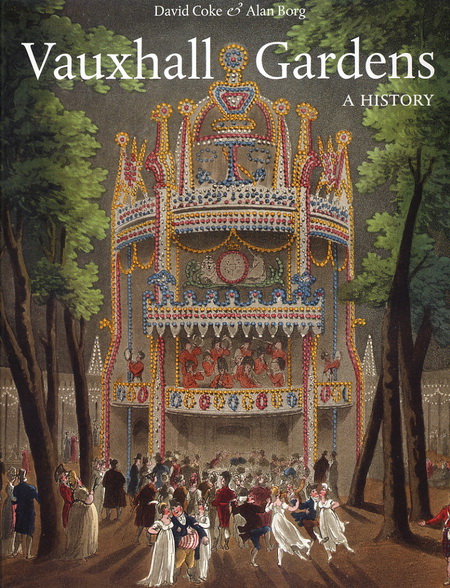
Vauxhall Gardens: A History

David Coke & Alan Borg

The Vauxhall Pleasure Gardens is one of the places I’d love to slip back in time to visit, just to catch a glimpse of what it was like. After recently splurging to buy this lovely coffee-table book, I thought it might make a wonderful subject for a new blog series. But do buy the book too, if you can! The photos are fabulous!

A Statue for the Greatest Composer of English Music (1738)

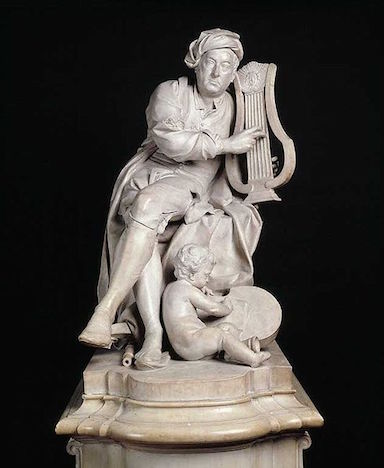
The life-sized sculpture of George Frideric Handel by Louis François Roubiliac (1702-62) was

the most important of Tyers’s early series of artistic commissions for the gardens. This work epitomised the explosive moment of the English Rococo style, not for any inclusion of outwardly Rococo motifs, but for the new spirit of playfulness and informality that it embodied, and it came to personify Vauxhall Gardens.
handel statue

There is now near finished a Statue of the justly celebrated Mr. Handel, exquisitely done by the ingenious Mr. Raubillac, of St. Martin’s-Lane, Statuary, out of one entire Block of white Marble, which is to be placed in a grand Nich, erected on Purpose in the great Grove at Vaux-hall Gardens.
alcove1

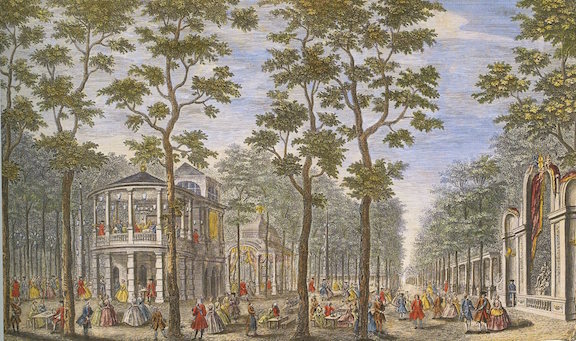
Note the Handel statue in its “Grand Nich” (original placement) at right

The “Grand Nich” or “Grand Alcove” was demolished after a decade to make room for more supper-boxes, and the statue was left free-standing until 1762, when it was arranged under a Doric portico similar in size to the “Grand Nich.” In 1786, following the Vauxhall Jubilee celebrations, it was removed to the back of the Orchestra. Before it was removed from the gardens in 1818, it held court in the New Supper Room built in 1791, and then, in 1813, “to its own small circular domed temple behind the Orchestra.”

Victoria and Albert Museum

The Handel statue can be seen today at the Victoria and Albert Museum in London, along with a group of the original supper-box paintings and Roubiliac’s terracotta model for the portrait bust of Jonathan Tyers.

In spite of many years’ exposure to the elements, to vandalism, accidental damage, relocations and restorations, the surface of the sculpture still bears the sculptor’s marks and finished, evidence of his high degree of skill and craftsmanship, equally of his mastery and love of the material.

“A mass audience for contemporary art”
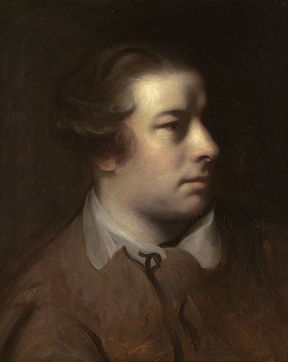
Francis Hayman by Sir Thomas Lawrence

Francis Hayman by Sir Thomas Lawrence, 1760’s

Artwork was an important element in Jonathan Tyers’ vision of capturing his visitors’ emotions and induce them “to enjoy themselves, to refresh their spirits and to spend their money.” In order to do this, Tyers formed an alliance with his friend William Hogarth’s nearby academy to produce the work he needed, which included buildings, paintings, sculptures, furnitures, tableware, glass, interiors, and lighting. This arrangement benefitted both parties, providing Tyers with the high-quality artisans he needed at a reasonable cost, and an opportunity for Hogarth’s students’ work to be displayed to the public in a way not seen before. The person chosen to manage the project was the theatrical scene-painter, Francis Hayman (1708-76).
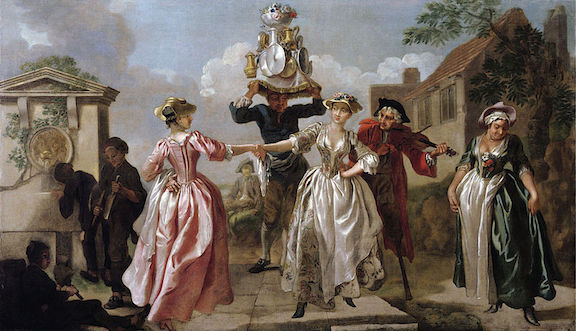
Francis Hayman and studio, The Milkmaids' Garland, oil on canvas, c. 1740 (Victoria and Albert Museum, London)

Francis Hayman and studio, The Milkmaids’ Garland, oil on canvas, c. 1740 (Victoria and Albert Museum, London)

The Supper-Box Paintings

To add color and enhance the visitor’s mood, the back upper wall of each supper-box in the 1730’s and 40’s was decorated by an eight foot by five painting, designed by Francis Hayman and H.F. Gravelot and painted by the students at St. Martin’s Lane Academy. These paintings

represent people from all sectors of society, from villagers, peasant children and milkmaids to aristocratic and fashionable ladies and gentlemen. Painted on a large scale, some of the figures are nearly life-sized and close enough to the picture plane for the viewer to discern their expressions and interrelationships.
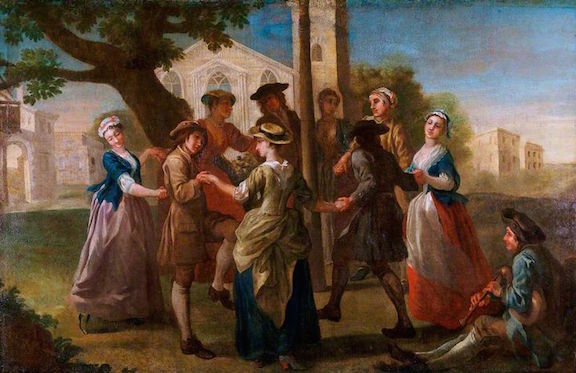
Francis Hayman and stuido, Country Dancers round the Maypole, oil on canvas, late 1730's (Victoria and Albert Museum, London)

Francis Hayman and stuido, Country Dancers round the Maypole, oil on canvas, late 1730’s (Victoria and Albert Museum, London)

The pictures depicted scenes of theatre, daily life and rustic amusements. A Toupee letter (see post here) of 28 June 1739 states that, when the paintings were revealed,

the eye is relieved by the agreeable surprise of some of the most favoured fancies of our poets in the most remarkable scenes of our comedies, some of the celebrated dancers, &c. in their most remarkable attitudes, several of the childish diversions, and other whims that are well enough liked by most people at a time they are disposed to smile, and every thing of a light kind, and tending to unbend the thoughts, has an effect desired before it is felt.
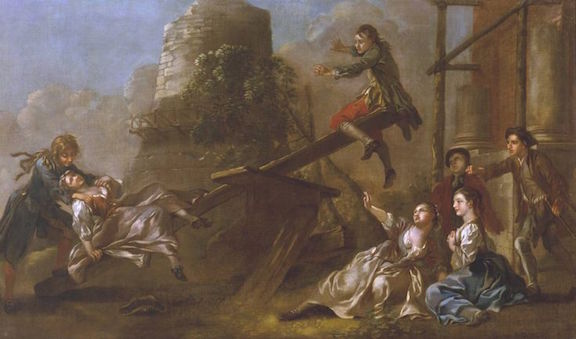
Francis Hayman and studio, The Play of See-saw, oil on canvas, 1740-43 (Tate, London)

Francis Hayman and studio, The Play of See-saw, oil on canvas, 1740-43 (Tate, London)

The Display of the Paintings

In the 1730’s the supper-boxes were open on all sides during daylight hours, to allow visitors to enjoy the views over the neighbouring countryside. However, as dusk fell, Tyers had created two extraordinary surprises for his guests. The first was the almost magical instantaneous illumination of the gardens with oil lamps. This wonder was swiftly followed by a second spectacular special effect, namely:

a master piece of machinery, by which all the English ladys and delicate gentlemen are in a moment screend from the damps of the night air. […] When the clock strikes nine, there is heard a third sound of the whistle, and immediately there rises, as out of the earth, a vast number of rollers, which unfolding themselves as they rise, cover all the boxes in three of their sides, and fasten themselves in the extremitys of each box. All these coverings are painted with elegant designs, in lively colours, so that each box is enclosed by three large pictures, and at the same time that they completely protect the company from the injurys of the air, present a numerous collection of grand and pleasing paintings.

By 1741, all the paintings were fixed in position on the back or side wall of the boxes… Tyers had introduced further improvements and the supper-boxes had been adapted to make them more weatherproof, more robust and more firmly divided from each other.
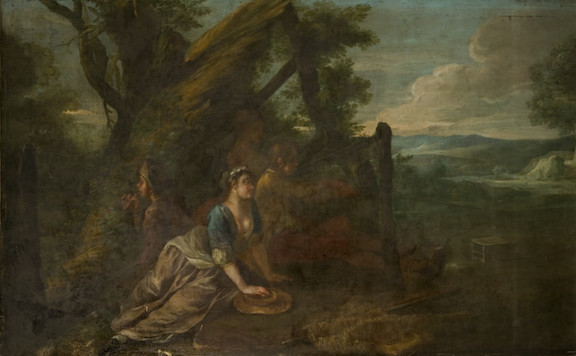
Francis Hayman and studio, Bird-catching, by a Decoy with a Whistle and Net, oil on canvas, c. 1740 (Victoria and Albert Museum, London)

Francis Hayman and studio, Bird-catching, by a Decoy with a Whistle and Net, oil on canvas, c. 1740 (Victoria and Albert Museum, London)

In spite of all the damage inflicted on these paintings by their exposure to the weather, the proximity of food, wine, candles, and oil lamps—not to mention the early days of being rolled up and down on a nightly basis—many of these paintings remained at Vauxhall for a hundred years.


Susana’s Vauxhall Blog Post Series

  1. Vauxhall Gardens: A History
  2. Vauxhall Gardens: Jonathan Tyers—“The Master Builder of Delight” 
  3. Vauxhall Gardens: A New Direction
  4. Vauxhall Gardens: The Orchestra and the Supper-Boxes 
  5. Vauxhall Gardens: The Organ, the Turkish Tent, and the Rotunda
  6. Vauxhall Gardens: Three Piazzas of Supper-Boxes
  7. Vauxhall Gardens: “whither every body must go or appear a sort of Monster in polite Company”
  8. Vauxhall Gardens: The Competition
  9. Vauxhall Gardens: The Artwork, Part I
  10. Vauxhall Gardens: The Artwork, Part II
  11. Vauxhall Gardens: The Music, 1732-1859
  12. Vauxhall Gardens: The Business Side
  13. Vauxhall Gardens: Developments from 1751-1786
  14. Vauxhall Gardens: Thomas Rowlandson’s Painting (1785)
  15. ‎Vauxhall Gardens: The Third Generation of the Tyers Family and the Jubilee of 1786
  16. Vauxhall Gardens: An Era of Change (1786-1822), Part I
  17. Vauxhall Gardens: An Era of Change (1786-1822), Part II
  18. Vauxhall Gardens: An Era of Change (1786-1822), Part III
  19. Vauxhall Gardens: The Final Years, Part I
  20. Vauxhall Gardens: The Final Years, Part II
  21. Vauxhall Gardens: The Final Years, Part III
  22. Vauxhall Gardens: The Final Years, Part IV
  23. Vauxhall Gardens: Farewell, for ever

Vauxhall Gardens: The Competition

vauxhallbook

Vauxhall Gardens: A History

David Coke & Alan Borg

The Vauxhall Pleasure Gardens is one of the places I’d love to slip back in time to visit, just to catch a glimpse of what it was like. After recently splurging to buy this lovely coffee-table book, I thought it might make a wonderful subject for a new blog series. But do buy the book too, if you can! The photos are fabulous!

“Imitation is the sincerest form of flattery.”

The success of Vauxhall naturally spawned imitators, but Vauxhall “outstripped all of them, not only in visitor numbers and longevity, but in the national and international renown achieved by the gardens, its use by writers as a setting in plays and novels, and the fact that its name became synonymous with the pleasure garden throughout Britain and all over the world.”

Ranelagh and Marylebone, however, did give Vauxhall’s founder a run for his money. S. Toupée, a correspondent from Scots Magazine (see last week’s post), writes:

It may not be amiss to tell you, the spirit of imitation increases amongst us every day. Vaux-hall has produced tickets and accommodations of the same nature, at Marybone, on this side of the Thames, and at Caper’s gardens, on t’other.”

Marylebone Gardens

John Donowell, A View of the Orchestra with the Band of Music, the Grand Walk &c. in Marybone Gardens, watercolor, 1755.

John Donowell, A View of the Orchestra with the Band of Music, the Grand Walk &c. in Marybone Gardens, watercolor, 1755.

Prior to its purchase by Daniel Gough, landlord of the neighboring Rose Tavern in 1737, Marylebone Gardens was “little more than a bowling green and gaming house.” In his attempt to imitate Vauxhall, “Gough built an outdoor Orchestra there… and installed an organ by Richard Bridge. In the winter of 1739-40 he added a Great Room for balls and suppers, facing the Orchestra.”

High quality music was the main attraction at Marylebone, and fireworks were added here decades before Vauxhall.

However, Marylebone did not even try to compete with Vauxhall in the visual arts, or in the order maintained in the gardens, and this proved to be its downfall; it was less selective of its visitors, and less proscriptive in the activities enjoyed by them, allowing the garden to become a haven for card-sharps and gamblers… Marylebone Gardens eventually closed, unmourned and leaving little trace, in 1778.

Ranelagh Gardens

T. Bowles after J. Maurer. Raleigh House and Gardens with the Rotunda, engraving, 1745.

T. Bowles after J. Maurer. Ranelagh House and Gardens with the Rotunda, engraving, 1745.

Opened in April 1742 by a syndicate of businessmen who saw the problems Vauxhall was having with inclement weather, Ranelagh featured a huge rotunda, inspired by the Pantheon in Rome.

Giovanni Antonio Canal, il Canaletto. The Interior of the Rotunda at Ranelagh, oil on canvas, c.1751.

Giovanni Antonio Canal, il Canaletto. The Interior of the Rotunda at Ranelagh, oil on canvas, c.1751.

Large numbers of people could saunter, take refreshments and listen to music without any of the natural inconveniences of an English summer. The building itself, especially the great domed space inside, became an architectural wonder in its own right, attracting crowds just to see, even during construction. With its grand central orchestra stand rising to the roof, its two levels of supper-boxes around the walls, its elaborate plaster decorations and chandeliers, this mostly timber Rotunda, 185 feet in diameter, was a remarkable space… During its first year at least, the Rotunda was the subject of much talk among fashionable society; Catherine Talbot wrote to Elizabeth Carter just two months after it had opened, saying that London’s neighborhood

is enriched since you was here, with a building which I am told exceeds in taste and magnificence every one in Europe: to untravelled eyes like mine ’tis to be sure an amazing fine thing, and quite worth your coming to see it next year, by which time they may possibly have found all that it wants to make it complete; some use for it answerable to the fineness and stateliness of the structure, for to be sure it is quite vexatious at present to see all the pomp and splendour of a Roman amphitheatre, devoted to no better use than a twelvepenny entertainment of cold ham and chicken.

Ranelagh did give Vauxhall a run for its money, however, even “beating Vauxhall at its own game” for a time. However,

once it lost its novelty it also lost much of its appeal. It was always the least disreputable of the pleasure gardens, being free of strong liquor and of gambling. This attracted the older generation and the more conservative sector of the public, as did the half-crown admission cost (to include tea and coffee), which excluded a large section of the London population. It was this very respectability, and the limited opportunities for change, that eventually drove away the fashionable set of the next generation and led to Ranelagh’s final downfall.

Like Marylebone, and indeed like Vauxhall itself, Ranelagh started to run into real difficulties around 1780, when, because of riots in London and perceived threats of invasion from across the Channel, the public enjoyment of frivolous pleasures had become socially less acceptable. Its proprietors battled on for another twenty years, but finally gave up 1803, unable to adapt to the demands of a new and more demanding public.

Vauxhall Reigns Supreme

…the al fresco character of Vauxhall, and its intimations of physical and moral danger, were essential features of its popular appeal. The Rotunda undeniably kept Ranelagh’s visitors’ feet dry, and eliminated any element of risk, but once everybody had seen and been seen by everybody else, the circular promenade became profoundly dull and repetitive. The walks at Vauxhall, although all straight and at right angles to one another, were at least all different, and allowed visitors to choose which way they walked, and to escape the bright lights, while still hearing the music.

None of Vauxhall’s rivals encompassed such a strong moral ideology as Vauxhall, and few invested anything like the same amounts as Tyers in the design or in the artworks that decorated and themed their gardens. It is certainly due in part to these factors that Vauxhall succeeded above its competitors.

Susana’s Vauxhall Blog Post Series

  1. Vauxhall Gardens: A History
  2. Vauxhall Gardens: Jonathan Tyers—“The Master Builder of Delight” 
  3. Vauxhall Gardens: A New Direction
  4. Vauxhall Gardens: The Orchestra and the Supper-Boxes 
  5. Vauxhall Gardens: The Organ, the Turkish Tent, and the Rotunda
  6. Vauxhall Gardens: Three Piazzas of Supper-Boxes
  7. Vauxhall Gardens: “whither every body must go or appear a sort of Monster in polite Company”
  8. Vauxhall Gardens: The Competition
  9. Vauxhall Gardens: The Artwork, Part I
  10. Vauxhall Gardens: The Artwork, Part II
  11. Vauxhall Gardens: The Music, 1732-1859
  12. Vauxhall Gardens: The Business Side
  13. Vauxhall Gardens: Developments from 1751-1786
  14. Vauxhall Gardens: Thomas Rowlandson’s Painting (1785)
  15. ‎Vauxhall Gardens: The Third Generation of the Tyers Family and the Jubilee of 1786
  16. Vauxhall Gardens: An Era of Change (1786-1822), Part I
  17. Vauxhall Gardens: An Era of Change (1786-1822), Part II
  18. Vauxhall Gardens: An Era of Change (1786-1822), Part III
  19. Vauxhall Gardens: The Final Years, Part I
  20. Vauxhall Gardens: The Final Years, Part II
  21. Vauxhall Gardens: The Final Years, Part III
  22. Vauxhall Gardens: The Final Years, Part IV
  23. Vauxhall Gardens: Farewell, for ever

Vauxhall Gardens: “whither every body must go or appear a sort of Monster in polite Company”

vauxhallbook

Vauxhall Gardens: A History

David Coke & Alan Borg

The Vauxhall Pleasure Gardens is one of the places I’d love to slip back in time to visit, just to catch a glimpse of what it was like. After recently splurging to buy this lovely coffee-table book, I thought it might make a wonderful subject for a new blog series. But do buy the book too, if you can! The photos are fabulous!

The Toupee Letters

Scots Magazine ran a series of articles in 1739-40 purporting to be “from a London correspondent, a certain ‘S. Toupee’, portraying the social scene in London, and at Vauxhall in particular, to the Scottish readership.”

The letters begin by explaining that because ordinary people of the London beau monde in search of simple pleasures were no longer satisfied with the traditional pastime of enjoying the beauties of nature, for their own sake, more fashionable amusements had been brought in from overseas, in particular the ridotto al fresco. Just how popular the gardens had become is illustrated by the fact that, despite the ingrained British dread of damp evenings, and the gentry’s habit of moving to the country in the summer, the average nightly number of paying visitors… was around a thousand. From this, it is possible to calculate that, as the Vauxhall season lasted for about one hundred evenings between May and September, the annual admissions income would amount to £5000 to £6000, a healthy figure that must have been substantially more than the normal revenue expenditure to run such a venture.

The type of entertainment provided was considered to be very new; it was well received, especially by fashionable ladies whose social life hitherto had been restricted to calling on acquaintances or going to the occasional ball, all within a very small circle of friends and relatives. Pleasure gardens opened up a whole new world to these people—a polite and exciting world where they could go with their family or friends, where they were free to entertain and mix socially with an infinitely broader circle than had been possible previously.

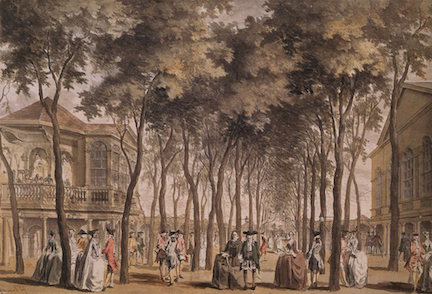
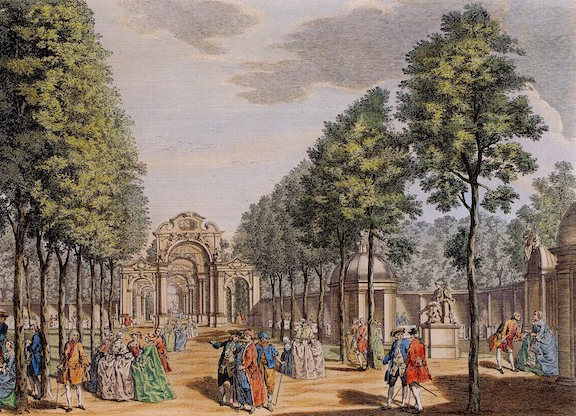
J. Maurer, A Perspective View of Vaux Hall Garden, etching, hand-coloured, 1744 (David Coke's collection). The view looking down the Grand South Walk before the classical triumphal arches were installed, with Roubiliac's Grand Alcove on the right.

J. Maurer, A Perspective View of Vaux Hall Garden, etching, hand-coloured, 1744 (David Coke’s collection). The view looking down the Grand South Walk before the classical triumphal arches were installed, with Roubiliac’s Grand Alcove on the right.

A Typical Visit to Vauxhall (from 7-10 p.m.)

The journey usually began with a boat ride from Whitehall or Westminster. On one occasion, Toupee writes about accompanying “a family group including Tom, a young musician who played the latest opera melodies on his French horn, while Miss Kitty was asked by her mother to sing one of the latest Italian songs.”

Others on their way to the gardens in neighbouring boats included ‘Sir John, from Fenchurch-street’, with his wife and all his children, attended by a footman. A Cheapside apprentence called William was on an illicit outing with Sukey, his master’s daughter… ‘An honest old mechanick’ and his wife followed; he was returning to Vauxhall after many years’ absence, to see how it had changed, reassuring his wife that the gardens must be a respectable place for her to be going, because the Prince of Wales himself was a regular visitor. This piece is clear evidence for the type of social mix that Tyers wanted to see at Vauxhall, although it is equally clear that, just because people inhabited the same space and came into direct contact, they did not necessarily interact in any meaningful way.

Pet dogs were not allowed in the gardens, but that did not stop people bringing them along for the ride, maybe to occupy the liveried footman who would not be admitted by Tyers’s gatekeeper, but could walk the dog in the fields of Lambeth. Having entered the tardens, Toupee’s party saw all the sights, listened to the music and strolled around the walks, watching and being watched by the other visitors.

The third letter, concerning the hour before closure at 10 p.m., starts with a detailed description of the dinner, accompanied by music from the Orchestra. The dramatic finale to the letter is the boat trip home, recounting the dangers of the riverside and the traditional ‘Thames ribaldry’, long-winded insults from the occupants of nearby boats that were suffered by voyagers as far apart in time as Addison’s Sir Roger in 1711 and Oakman’s John Gilpin in 1785.

“Sexual freedom was intrinsic to the gardens”

The overriding topic that runs flagrantly throughout the three letters is the meeting of the sexes, and the self-evident truth that human nature takes full advantage of any liberty offered to it. If Toupee is to be believed, Tyers was promoting his gardens as a place for lovers to meet, for initiating and nurturing romantic attachments, for sexual intrigue and adventures, and for illicit affairs; or, if he was not promoting these activities as such, he created an environment that made them possible and, indeed, inevitable. The river-crossing, the music, the paintings, the food, the walks and even the weather were all seen by Toupee as legitimate means to this one specific end.

The focus for most of the licentious activity in the gardens was not the Grove or the surrounding supper-boxes, which were too public, but the Druid’s Walk or Lover’s Walk, an unlit avenue running between and parallel with the Grand South Walk and Kennington Lane. It was distinguished from the other avenues by the fact that the trees met overhead, plunging it into shadow even before dusk. This concealing shade was unrelieved by artificial light until 1764, when magistrates forced Tyers to act against the immoral behaviour that the darkness encouraged, and to install lighting there.

At its eastern end, the Druid’s Walk met the avenue that ran around the eastern and northern edges of the gardens, always known as the Dark Walks; the darkness heightened the receptivity of impressionable young minds to emotional seduction, and no female reputation was safe…

Tyers employed constables to patrol the end of each walk in an attempt to keep such incidences to a minimum, but even they were not able to watch everybody all the time.

“The… cold and miserable spring of 1740”

I was blown through and through, in such a manner, as to drink four full glasses of French wine, before I knew I was alive. And, in that cold condition, as returning by water would have endanger’d my life, I was forced to be shook in a most unmerciful hack, till one half of my joins were distorted, and the other bruised to a jelly.

Indeed, all of the Toupee letters highlight the fact that the pleasures of the evening were never without their discomforts; and that a full enjoyment of the experience was predicated upon a full participation in the inconveniences, dangers and risks, whether perceived or real.

“The outstanding fashionable attraction of the London summer season”

In a sample letter from a young lady in town to her aunt in the country, published in 1741, the novelist Samuel Richardson confirmed that regular visits to the gardens had become an obligatory feature of the fashionable lifestyle, having his subject comment… that ‘I went on Monday last to Vaux-hall Gardens, whither every body must go, or appear a sort of Monster in polite Company.’

Susana’s Vauxhall Blog Post Series

  1. Vauxhall Gardens: A History
  2. Vauxhall Gardens: Jonathan Tyers—“The Master Builder of Delight” 
  3. Vauxhall Gardens: A New Direction
  4. Vauxhall Gardens: The Orchestra and the Supper-Boxes 
  5. Vauxhall Gardens: The Organ, the Turkish Tent, and the Rotunda
  6. Vauxhall Gardens: Three Piazzas of Supper-Boxes
  7. Vauxhall Gardens: “whither every body must go or appear a sort of Monster in polite Company”
  8. Vauxhall Gardens: The Competition
  9. Vauxhall Gardens: The Artwork, Part I
  10. Vauxhall Gardens: The Artwork, Part II
  11. Vauxhall Gardens: The Music, 1732-1859
  12. Vauxhall Gardens: The Business Side
  13. Vauxhall Gardens: Developments from 1751-1786
  14. Vauxhall Gardens: Thomas Rowlandson’s Painting (1785)
  15. ‎Vauxhall Gardens: The Third Generation of the Tyers Family and the Jubilee of 1786
  16. Vauxhall Gardens: An Era of Change (1786-1822), Part I
  17. Vauxhall Gardens: An Era of Change (1786-1822), Part II
  18. Vauxhall Gardens: An Era of Change (1786-1822), Part III
  19. Vauxhall Gardens: The Final Years, Part I
  20. Vauxhall Gardens: The Final Years, Part II
  21. Vauxhall Gardens: The Final Years, Part III
  22. Vauxhall Gardens: The Final Years, Part IV
  23. Vauxhall Gardens: Farewell, for ever
Vauxhall Gardens: Three Piazzas of Supper-Boxes

vauxhallbook

Vauxhall Gardens: A History

David Coke & Alan Borg

The Vauxhall Pleasure Gardens is one of the places I’d love to slip back in time to visit, just to catch a glimpse of what it was like. After recently splurging to buy this lovely coffee-table book, I thought it might make a wonderful subject for a new blog series. But do buy the book too, if you can! The photos are fabulous!

A Splash of the Exotic

The… striking similarity between the Grove and travellers’ descriptions of the great piazza of San Marco in Venice, where citizens were able to arrive by water, take refreshments, listen to music and watch street entertainers, would have highlighted Vauxhall’s exotic pedigree, evoking images of faraway places. This fusion of the familiar with the foreign, a constant feature of the gardens, is likely to have been a deliberate move to give visitors the thrill of romantic and magical scenes without the discomfort of distant travel.

In contrast to the aristocratic or amateur owners of great private gardens, whose wealth allowed them to indulge themselves with indiscriminate allusions to the classical past, ancient mythologies and dreamworlds, Tyers’s overriding consideration in all his investments at Vauxhall was the commercial imperative. Providing that it also furthered his aims, every improvement had to attract more people and increase his profits if it was to justify itself. The sales of food and drink represented the bulk of his income, so the more people he could persuade to purchase refreshments in the gardens, the better it was for his business. Increasing the number of supper-boxes by inserting several sweeping ‘piazzas’, or crescents of supper-boxes, was a very effective and elegant way of achieving this.

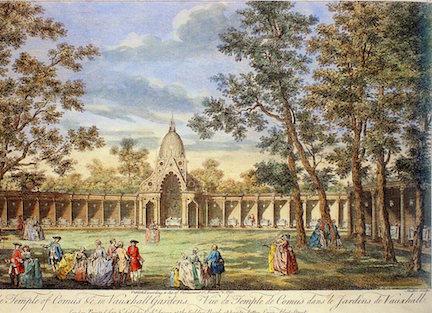
The Temple of Comus (later the Chinese Pavilions)

The Temple of Comus was named… after the god of cheer and good food… Ben Jonson described Comus as the ‘Prime master of arts, and the giver of wit;’ he is also associated with music and with floral decorations. The god thus encompassed all the purposes of the new building, which, although primarily devoted to dining, allowed for the appreciation of the arts and music as well as polite conversation in civilised surroundings.

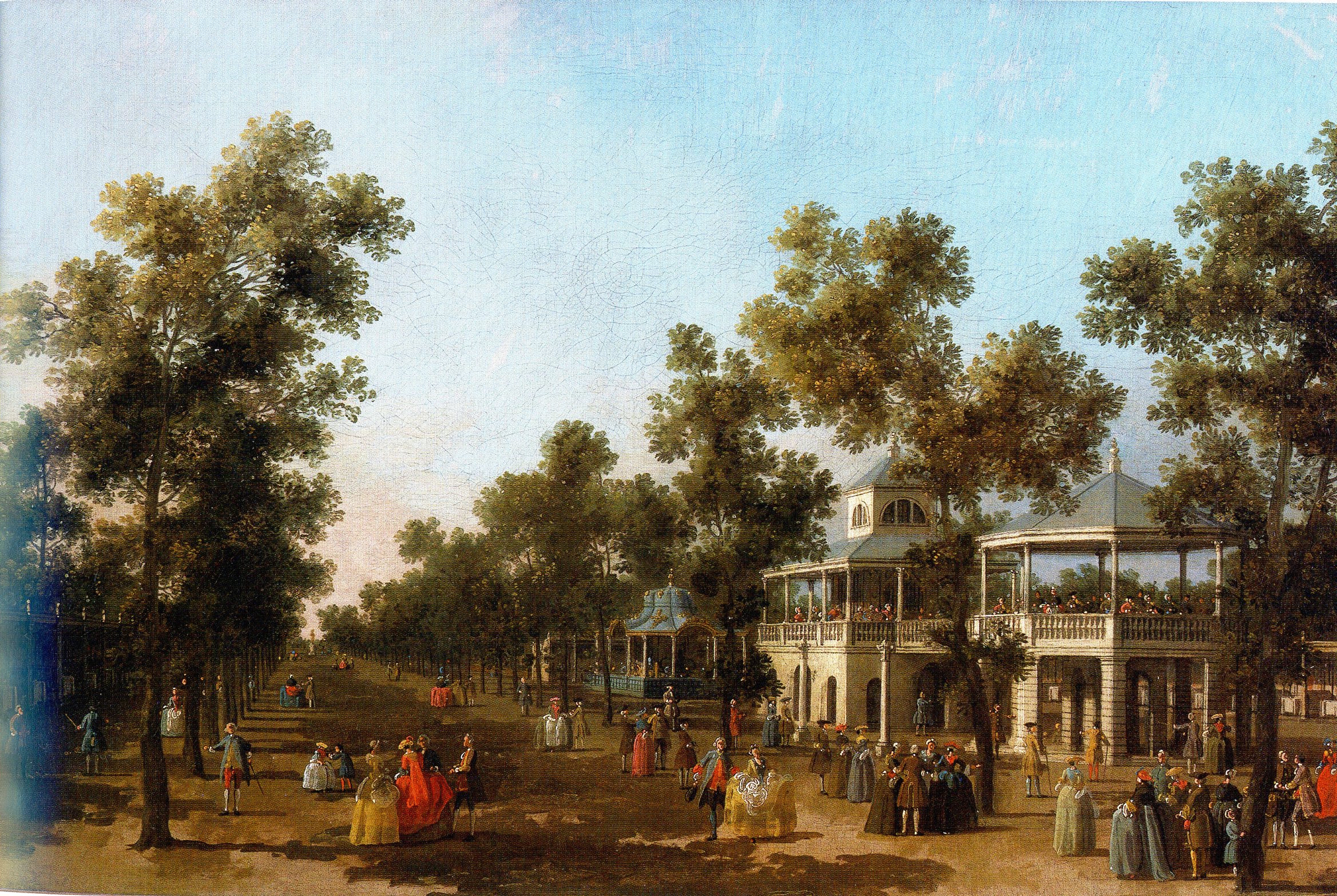
J.S. Muller after Canaletto, A View of the Temple of Comus &c. in Vauxhall Gardens, an engraving hand-colored, 1751 (David Coke's collection). Families with small children are promenading in the foreground.

J.S. Muller after Canaletto, A View of the Temple of Comus &c. in Vauxhall Gardens, an engraving hand-colored, 1751 (David Coke’s collection). Families with small children are promenading in the foreground.

Initially, the building was “classical in style, with a colonnade of Ionic columns supporting a straight entablature, topped with urn finials; the semicircle flowed in a smooth curve out of the straight colonnade of the northern range of supper-boxes.” However, the designer also incorporated Gothic arches and “broad-ramped scrolls [that] acted as buttresses for the dome” and other unorthodox details. “The apparent breaking of architectural rules, mingling different styles in the same building, was deliberate and entirely typical of the unorthodox design of the English Rococo, which aimed to create playful, light-hearted works.”

piazza002 copy

T. Bowles after S. Wale. A View of the Chinese Pavillions and Boxes in Vaux Hall Gardens, engraving. c. 1840 (David Coke’s collection). This is a reprint of Bowles’ plate of 1751, published by Francis West, a Fleet Street optician and printseller who acquired many original plates of London views, probably after the sale of trade stock by Robert Wilkinson, Bowles’ successor, in 1825. The buildings of the Temple of Comus are shown with their newly applied elaborate surface decoration.

The Handel Piazza

piazza003 copy

J.S. Muller after S. Wale, The Triumphal Arches, Mr. Handel’s Statue &c. in the South Walk of Vauxhall Gardens, engraving, c. 1840 (David Coke’s collection). The early version of the Handel Piazza.

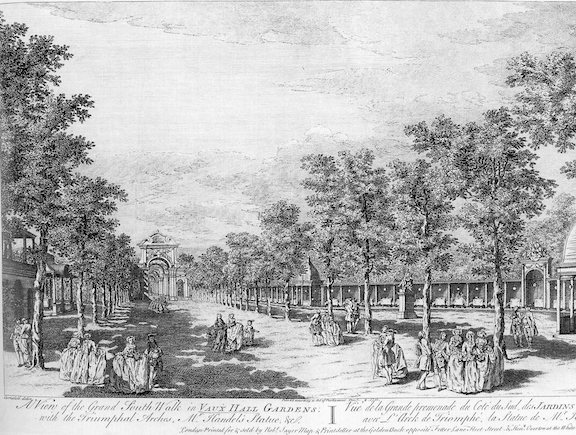
The Handel Piazza on the Grand South Walk started life as a small semicircular colonnade of plain boxes, little more than an open setting for Roubiliac’s statue of the composer… The piazza was built in the simplest Doric order, although the domes of the two terminal pavilions were topped with Gothic lanterns. The rebuilding of 1750-51 created a much broader colonnade, with twenty-two flat-roofed boxes, still of the Doric order, but with urn finials on the roof over each column. As in the Temple of Comus, the central pavilion was more elaborate, marked out by the use of the Ionic order, with swagged decorations between the columns, but here in the Handel Piazza the classical order and restraint were maintained… This new structure added considerably to the number of supper-boxes available on the Grand South Walk… The opposing arrangement and contrasting decorative styles of the Chinese Pavilions and the Handel Piazza epitomise Tyers’s ideological belief in the balance between excess and moderation, with Comus appropriately representing pleasure and excess, and Handel, in his simpler classical architectural setting, representing virtuous sobriety.

piazza004 copy

J.S. Muller after Canaletto, A View of the Grand South Walk in Vaux Hall Gardens, with the Triumphal Arches, Mr. Handel’s Statue, &c. Engraving, 1751 (British Library, London). On the right is the second version of the Handel Piazza, with more supper-boxes.

The Gothic Piazza

The Gothic Piazza, looking down the Grand South Walk from its western end, is not shown from the front in any engraving of Vauxhall, although Wale’s General Prospect shows it from the back just to the south (right) of the Prince’s Pavilion). It is, however, fully described in Lockman’s Sketch, as

a little Semi-circle of Pavillions, in an elegant Gothic Style […}. At each Foot of this Semi-Circle, stands a lofty Gothic Tent, each having a fine Glass Chandelier, the Lamps in which are of a very peculiar frame, as are those in the grand Tent, built in the Grove, &c. In the Center of this Semi-Circle is a Pavilion, with a Portico before it; and over the Pavillion, a kind of Gothic Tower, with a Turret at Top. Here a Glass Moon was to have been seen; but its Light was found too dazzling for the Eye. Those who survey’d the Alley, the Grove, &c. thro’ this Glass, saw a lovely Representation of them in Miniature. As the painted triumphal Arches before mentioned are in the Grecian Style, and these Pavillions in the Gothic, they form a very pleasing Contrast.

…The implication is that visitors could climb to the top of the central pavilion of this piazza, to look down on the gardens through an optical device or lens during daylight, and after that, after dark, a light was shone through it towards visitors in the Grove, possibly spotlighting courting couples. [Scandal!]

“A remarkable body of original and innovatory architecture”

The group of structures in and around the Grove at the end of the 1740’s, comprising the Orchestra and organ buildings, the supper-boxes and three piazzas, the Prince’s Pavilion, the Turkish Tent and the Rotunda, represent a remarkably body of original and innovatory architecture that was both decorative and practical, achieved by Tyers and his team in the space of just thirteen years. Few other patrons could boast of such a diverse collection of modern works of architecture. The sheer expense incurred in this building spree is evidence of the level of Tyers’s income; as Hogarth’s friend the enameller Jean-André Rouquet wrote at the time, ‘The director of the entertainments of this garden acquires and expends very considerable sums of money there every year. He was born for undertakings of this kind. He is a man of an elegant and bold taste; afraid of no expence, when the point is to divert the public’—or rather, to attract the paying public to Vauxhall.

The fact that this elegant and bold taste was devoted to a pleasure garden, and that the buildings no longer exist, should not detract from their importance in the context of the development of British architecture, and in particular, of British interior design in the eighteenth century. They would have been some of the best-known modern buildings in the country, seen by tens of thousands of visitors every year.

Supper-Box Furniture

furniture001 copy

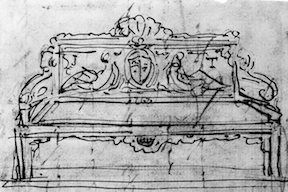
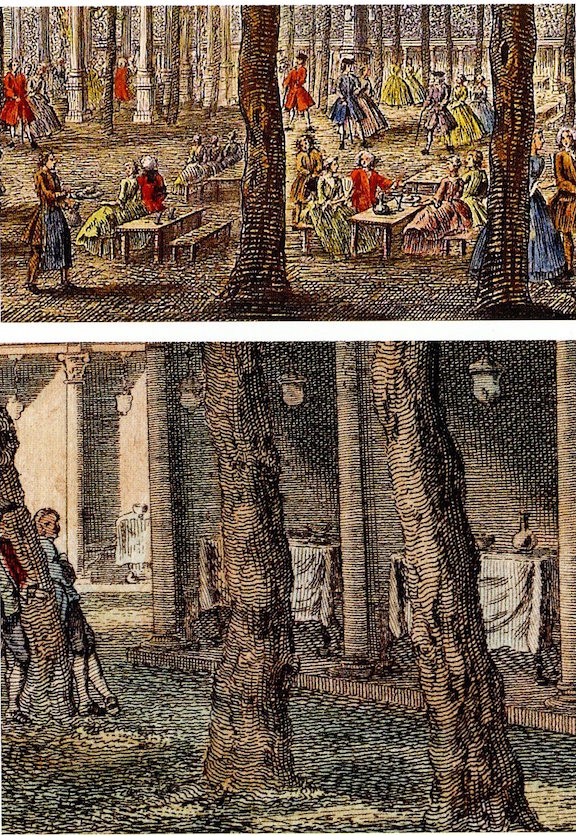
In the 1730’s and 1740’s, furniture at Vauxhall… was plain and serviceable, the tables usually covered with baize on linen. Rectangular square-legged farmhouse tables and foxed plain benches served the supper-boxes, with free-standing backless benches and plain tables out in the Grove. The Grove also boasted a number of slatted wooden garden seats, their circular inward-facing form, accessed through a single opening, providing the ideal setting for polite conversation for an intimate rendezvous.

furniture002

By the early 1750’s, however, contemporary engravings show a number of more elaborate and expensive tables and benches in the supper-boxes. The carved Rococo table-legs, showing below the tablecloths, appear to be ornamented with double-C scrolls.

After this brief period, however, the furniture again reverted to a simple farmhouse style. Indeed, it would be unsurprising if the carved Rococo tables of the 1750’s were found to be too delicate for the abuse they would have received at Vauxhall from the visitors and weather.

Susana’s Vauxhall Blog Post Series

  1. Vauxhall Gardens: A History
  2. Vauxhall Gardens: Jonathan Tyers—“The Master Builder of Delight” 
  3. Vauxhall Gardens: A New Direction
  4. Vauxhall Gardens: The Orchestra and the Supper-Boxes 
  5. Vauxhall Gardens: The Organ, the Turkish Tent, and the Rotunda
  6. Vauxhall Gardens: Three Piazzas of Supper-Boxes
  7. Vauxhall Gardens: “whither every body must go or appear a sort of Monster in polite Company”
  8. Vauxhall Gardens: The Competition
  9. Vauxhall Gardens: The Artwork, Part I
  10. Vauxhall Gardens: The Artwork, Part II
  11. Vauxhall Gardens: The Music, 1732-1859
  12. Vauxhall Gardens: The Business Side
  13. Vauxhall Gardens: Developments from 1751-1786
  14. Vauxhall Gardens: Thomas Rowlandson’s Painting (1785)
  15. ‎Vauxhall Gardens: The Third Generation of the Tyers Family and the Jubilee of 1786
  16. Vauxhall Gardens: An Era of Change (1786-1822), Part I
  17. Vauxhall Gardens: An Era of Change (1786-1822), Part II
  18. Vauxhall Gardens: An Era of Change (1786-1822), Part III
  19. Vauxhall Gardens: The Final Years, Part I
  20. Vauxhall Gardens: The Final Years, Part II
  21. Vauxhall Gardens: The Final Years, Part III
  22. Vauxhall Gardens: The Final Years, Part IV
  23. Vauxhall Gardens: Farewell, for ever

Vauxhall Gardens: The Organ, the Turkish Tent, and the Rotunda

vauxhallbook

Vauxhall Gardens: A History

David Coke & Alan Borg

The Vauxhall Pleasure Gardens is one of the places I’d love to slip back in time to visit, just to catch a glimpse of what it was like. After recently splurging to buy this lovely coffee-table book, I thought it might make a wonderful subject for a new blog series. But do buy the book too, if you can! The photos are fabulous!

The Organ Building

In 1737, the Organ Building was built, after numerous delays related to “the acoustics and audible range of the organ in this outdoor setting, as well as the damping of the building itself to ensure that no structural vibrations spoiled the sound.”

This square structure was the same width as the Orchestra, and was on three levels; a heavy lower storey supported the first floor where a short bridge joined the two buildings together. This first floor, at the same level as the first floor of the Orchestra, was partly taken up by the organ console and pipes, and partly by a covered open space running all around it. The building then rose to the ‘belfry’, which had louvred semicircular openings on all four faces to project the sound of the organ around the gardens… The lower storey, totally unrelieved by any surface decoration, was pierced by a triple arch on each of its four plain faces, one taller arch flanked by two smaller; the taller central arch on each face was a hybrid triform arch which gave the building a real visual strength and presence.

organ005

Vauxhall and the Weather

The typical rainy English weather, especially on opening day every spring, was a significant problem for an outdoor business such as this one. In 1740, due to the loss in business caused by the poor weather of 1739, Tyers announced “several considerable Additions and Improvements,” which were later described as “Conveniences for receiving Company in cold or rainy Weather,” whatever that means.

Weather-related jokes at Vauxhall’s expense were commonplace; especially popular was the one about a farmer waiting to see when the gardens were going to open, so he would know when to plant his crops, a good few days of drenching rain being assured.
The regularity of rain on Vauxhall’s opening night increased in the nineteenth century; so much so that, at one stage, announcements advertising the forthcoming opening were carried around town printed on umbrellas.

The Three “Tents”

In 1742 Henry Fielding described his impressions on entering the gardens. The first structures he saw there were ‘two similar Tents’ under the trees of the Grove, ‘of such a Contrivance and Form, as a Painter of Genius and Judgement would chuse to adorn his Landscape with.’ If these were, in fact, the shelters that Tyers had announced two years earlier offering protection from cold and wet weather, their position was certainly appropriate, between the Orchestra and the Prince’s Pavilion, and only a few yards from the entrance and the servery. The word ‘tent’ did not specifically apply to a canvas structure; indeed, it could refer to almost any temporary building, especially in a garden.

A “Turkish Tent” was built as an undercover dining area for visitors who could not get a supper-box or wanted to have a more entertaining party. “Its exotic style, more closely associated with Venetian festivals… allowed visitors to act the part of Eastern potentates relaxing on their magnificent bed under a grande baldacchino.

The design of this structure is clearly more informal and frivolous than the strictly classical styles favored by Tyers in his earlier buildings.

The Rotunda

In the 1740’s, other entrepreneurs jumped into the pleasure gardens business, the most successful of which were Ranelagh and Marylebone Gardens.

In the face of serious competition from such places and in view of the unreliable British summer, Tyers was under constant pressure to introduce regular improvements whenever adequate funding was available. At the end of the 1740s he went one step further, and, playing the proprietors of Ranelagh at their own game, installed a major new structure as a grand assembly room and concert hall for use by the band when the weather was too wet or windy.

Variously called the ‘Umbrella Room’, the ‘Music Room’, the ‘Great Room’ or simply the Rotunda, Tyers’s building, with its orchestra stand and organ, was capable of accommodating as many musicians as its outdoor equivalent.

rotunda006

The most remarkable feature of the original Rotunda was undoubtedly the chandelier described by Lockman as having been designed by a gentleman amateur. This chandelier, 11 feet across and with 72 candles, must have been one of the largest in the country, a hugely impressive piece of furniture, and its grandeur was considerably enlightened sometime later by the addition of a plaster sculpture, the Rape of Semele by Jupiter.

The Rotunda was redecorated at intervals… The modelled floral decoration of the ceiling was stripped out in 1765, and the roof re-painted ‘in the resemblance of a shall. For the opening gala of Tuesday 18 May 1790, the Rotunda, growing ever more exotic, was fitted up in imitation of a Persian divan. It was then redecorated several times, becoming by turns a garden tent, a Roman military pavilion, an Indian garden-room and, finally, a circus hippodrome, with two tiers of audience boxes, a proscenium stage and a central ring for displays of horsemanship and circus acts.


Susana’s Vauxhall Blog Post Series

  1. Vauxhall Gardens: A History
  2. Vauxhall Gardens: Jonathan Tyers—“The Master Builder of Delight” 
  3. Vauxhall Gardens: A New Direction
  4. Vauxhall Gardens: The Orchestra and the Supper-Boxes 
  5. Vauxhall Gardens: The Organ, the Turkish Tent, and the Rotunda
  6. Vauxhall Gardens: Three Piazzas of Supper-Boxes
  7. Vauxhall Gardens: “whither every body must go or appear a sort of Monster in polite Company”
  8. Vauxhall Gardens: The Competition
  9. Vauxhall Gardens: The Artwork, Part I
  10. Vauxhall Gardens: The Artwork, Part II
  11. Vauxhall Gardens: The Music, 1732-1859
  12. Vauxhall Gardens: The Business Side
  13. Vauxhall Gardens: Developments from 1751-1786
  14. Vauxhall Gardens: Thomas Rowlandson’s Painting (1785)
  15. ‎Vauxhall Gardens: The Third Generation of the Tyers Family and the Jubilee of 1786
  16. Vauxhall Gardens: An Era of Change (1786-1822), Part I
  17. Vauxhall Gardens: An Era of Change (1786-1822), Part II
  18. Vauxhall Gardens: An Era of Change (1786-1822), Part III
  19. Vauxhall Gardens: The Final Years, Part I
  20. Vauxhall Gardens: The Final Years, Part II
  21. Vauxhall Gardens: The Final Years, Part III
  22. Vauxhall Gardens: The Final Years, Part IV
  23. Vauxhall Gardens: Farewell, for ever
Vauxhall Gardens: The Orchestra and the Supper-Boxes

vauxhallbook

Vauxhall Gardens: A History

David Coke & Alan Borg

The Vauxhall Pleasure Gardens is one of the places I’d love to slip back in time to visit, just to catch a glimpse of what it was like. After recently splurging to buy this lovely coffee-table book, I thought it might make a wonderful subject for a new blog series. But do buy the book too, if you can! The photos are fabulous!

The Orchestra

Across from the Prince’s Pavilion, mentioned in last week’s post, stood the open-air bandstand known as the Orchestra, which opened on 3 June 1735.

There is built in the Grove of the Spring-Gardens at Vaux-Hall, an Octagon Temple, intended to serve as an Orchestra, for a Band of our finest Instrumental Performers; who will play (beginning at Five every Evening during the Summer-Season) the compositions of Mr. Handel, and other celebrated Masters. Upon Trial, the Concert had a wonderful Effect, the Sounds spreading through every Part of this delightful Garden; so that Gentlemen and Ladies, whether walking, or sitting in the Alcoves, may hear it to the greatest Advantage. Though there has not yet been any Thing of this kind exhibited among us, and the Master of the Gardens has put himself to a considerable Expence upon this Occasion, yet nothing will be requir’d for this innocent and elegant additional Entertainment, which will begin Tomorrow at the Hour above-mentioned.

This building, with a base of large blocks of roughened masonry, supported an upper floor, an octagonal room enclosed by eight arches illuminated by a central chandelier. The outer area of the first (second) floor was bounded by a low balustrade.

Although the opening night was plagued with poor weather, a good audience was in attendance.

Yesterday being so rainy, little no Company was expected in the Spring-Gardens at Vaux-Hall, for which reason the Concert was to have been put off till this Evening; but a great Number of Coaches and Persons of the best Fashion coming in, the Concert was open’d; several very fine musical Compositions were perform’d, to the great Satisfaction of the Hearers, and especially of the Judges of Musick, many of whom were present on this Occasion. The Gardens, tho’ so very pleasant in themselves, were yet greatly improv’d by the Harmony, which had different Effects (but all delightful) in the various parts of the Garden; so that all the elegant Company seem’d very desirous of encouraging this rural kind of Opera, which pleas’d no less from the Execution than from the Novelty of it.

As popular as the orchestra music became, it was soon clear that the large number of trees were a detriment to the acoustics. Tyers lost no time in removing “a great Number of Trees… from the Thicket joyning to the Orchestra,” and placing “several Tables and Seats fixed at proper Distances, in the Openings” so that visitors could enjoy refreshments while listening to the music.

The Orchestra itself was able to accommodate, on its upper level, as many as thirty seated and standing musicians. The building’s actual dimensions… judging from the numerous visual sources… measured over 20 feet in diameter and about 25 feet in height to the tip of the conical slated roof—quite a small building, but certainly large enough for its purpose.

bars003

From a satirical pamphet “A Trip to Vaux-hall (1737): Notice the bar in the lower left where waiters went to collect food orders for the visitors. Also, the roof terrace above where Tyers could keep an eye on everything.

The Supper-Boxes

Between September of 1735 and April 1736, during the off-season, more improvements were made.

The Improvements in the Spring-Gardens at Vaux Hall (which have employ’d upwards of 100 Hands ever since last August) being now finish’d, and a Band, consisting of above thirty of the ablest Performers provided, the Musical Assembly will be open’d next Wednesday [19 May]. The Grove, which is considerably enlarged and finely laid out in Gravel Walks, is embellish’d with a great Number of Colonades [the supper-boxes]; and in the Centre is an Edifice, in the Form of a Temple, for the Band, who will play the favourite Pieces of the most eminent Masters. The whole is so advantageously dispos’d, that 3000 Persons may sit at ease, and see one another during the Entertainment. In the Grove, above 300 Glass Lights are set up, all which are illuminated in half a Minute, and have a beautiful Effect on the Verdure. For the better Conveniency of the Company, a great Number of Waiters, &c., are provided; and in order that this innocent and agreeable Entertainment may be conducted with such a Decency, as many induce the politest Persons, and those of the most serious Character to honour it with their Presence, a proper Guard will attend to keep out all lewd and disorderly Persons. —Notwithstanding the very great Expence the Master has been, and must necessarily be at, during the Season, yet it was his intention to have admitted all Persons into his Gardens in the same Manner as last Summer; but as Numbers resorted thither who were no ways qualify’d to intermix with Persons of better Fashion; for this Reason he has been persuaded to let none enter but with Tickets (to be given out at the Door) at One Shilling each, which Ticket will be afterwards taken at the Entertainment in the Gardens, as One Shilling, if desir’d.

The old arbors and rickety supper-boxes in existence before Tyers came upon the scene were tossed away in favor of new and orderly ones arranged outside of the Orchestra. The Vauxhall Fan, which was produced and sold for three consecutive years (1736-8) as new features were introduced (only the first of which still exists) shows the view from the entrance, looking down the Grand Walk, with the Orchestra building on the right.

Many of the trees carry a globe lamp on a bracket, and more lamps hang on lamp-posts and from the ceiling of each supper-box. The edition of 1737 added the organ building behind the Orchestra, and in 1738 Roubiliac’s new statue of Handel was included.

The Vauxhall Fan (1736)

The Vauxhall Fan (1736)

In such a manner,Tyers made use of the popularity and intriguing “language” of the fan as a clever marketing tool.

The north and south ranges of supper-boxes… made up of more than twenty boxes each, were almost 300 feet long and about six to eight feet deep. A shorter range of eight boxes on the far side of the Grove between the two parallel walks, was around 100 feet long, making each box about 12 feet wide. The boxes themselves were initially open on all sides, with only a rail dividing adjacent supper parties from each other, leading to unwonted intimacies between friends and strangers alike. From 1741 or ’42 solid walls divided every box from its neighbour, and each one was roofed with waxed cloth and had a fixed bench around three sides of its table.

The layout of the Grove was remarkably formal and austere, like an ancient Greek agora. Through his arrangement of the boxes Tyers discouraged overtly immoral or intemperate behavior by providing a setting where there were no hidden corners and where the privacy enjoyed by Pepys and his contemporaries was difficult to achieve.

The exact number of supper-boxes in the years before 1751 is difficult to estimate, but it must have been around fifty-five. This rose sharply to over 130 in 1751, reaching a maximum of about 140 around 1800, before falling back to about 90 in the 1840’s.

The many additions to the number of boxes demonstrate that dining space was always at a premium, and that Tyers was under constant pressure to provide additional seating for his visitors wherever he could. This not only boosted his profits from food sales, but also helped his staff earn additional tips by finding more private seating for parties of visitors.

Susana’s Vauxhall Blog Post Series

  1. Vauxhall Gardens: A History
  2. Vauxhall Gardens: Jonathan Tyers—“The Master Builder of Delight” 
  3. Vauxhall Gardens: A New Direction
  4. Vauxhall Gardens: The Orchestra and the Supper-Boxes 
  5. Vauxhall Gardens: The Organ, the Turkish Tent, and the Rotunda
  6. Vauxhall Gardens: Three Piazzas of Supper-Boxes
  7. Vauxhall Gardens: “whither every body must go or appear a sort of Monster in polite Company”
  8. Vauxhall Gardens: The Competition
  9. Vauxhall Gardens: The Artwork, Part I
  10. Vauxhall Gardens: The Artwork, Part II
  11. Vauxhall Gardens: The Music, 1732-1859
  12. Vauxhall Gardens: The Business Side
  13. Vauxhall Gardens: Developments from 1751-1786
  14. Vauxhall Gardens: Thomas Rowlandson’s Painting (1785)
  15. ‎Vauxhall Gardens: The Third Generation of the Tyers Family and the Jubilee of 1786
  16. Vauxhall Gardens: An Era of Change (1786-1822), Part I
  17. Vauxhall Gardens: An Era of Change (1786-1822), Part II
  18. Vauxhall Gardens: An Era of Change (1786-1822), Part III
  19. Vauxhall Gardens: The Final Years, Part I
  20. Vauxhall Gardens: The Final Years, Part II
  21. Vauxhall Gardens: The Final Years, Part III
  22. Vauxhall Gardens: The Final Years, Part IV
  23. Vauxhall Gardens: Farewell, for ever
Vauxhall Gardens: A New Direction

vauxhallbook

Vauxhall Gardens: A History

David Coke & Alan Borg

The Vauxhall Pleasure Gardens is one of the places I’d love to slip back in time to visit, just to catch a glimpse of what it was like. After recently splurging to buy this lovely coffee-table book, I thought it might make a wonderful subject for a new blog series. But do buy the book too, if you can! The photos are fabulous!

William Hogarth Comes to the Rescue

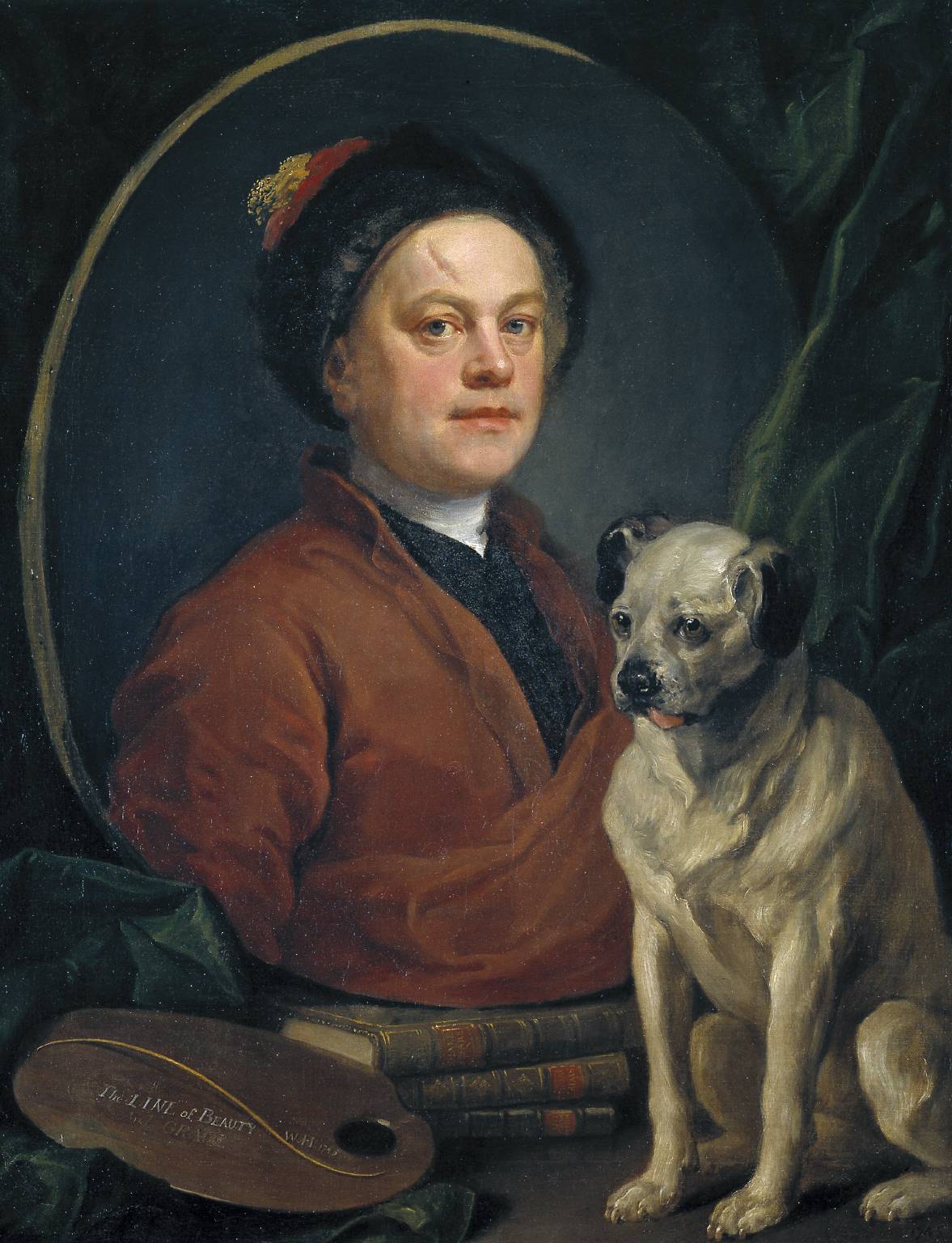
The Painter and his Pug 1745 William Hogarth 1697-1764 Purchased 1824 http://www.tate.org.uk/art/work/N00112

The Painter and his Pug 1745 William Hogarth

In our last installment, Vauxhall mastermind Jonathan Tyers was facing financial ruin when his most recent event wiped away all the profits of his other three. The story goes that his good friend William Hogarth, who still lived nearby, saw Tyers looking very dejected and asked what was the matter. Tyers replied that he was just trying to decide whether hanging himself or drowning was a better way to kill himself. Hogarth convinced him to wait until the following day, when he would share some ideas that might help. It can’t be known for certain what those ideas were, but it is clear that Hogarth was responsible for turning around the situation at Vauxhall.

In 1733 Tyers presented his friend William Hogarth with a solid gold pass to the gardens, giving free entry in perpetuity to a coach full of people. This unique and generous gift was accompanied by something even more precious, a small portrait of Tyers himself, painted when he was a young man visiting Paris, a gesture made in recognition of Hogarth’s many past favours.

hogarth pass

One of Hogarth’s ideas undoubtedly had to do with including contemporary English art, as he was always looking for places to display his own work and that of friends and students. Hogarth also persuaded Tyers to tone down his old-fashioned moralizing and use pleasure and enjoyment as his educational tools.

Early Design and Layout

When Jonathan Tyers took on Vauxhall Gardens, the site was more like a densely wooded park than a garden, and was basically a rectangle of mixed deciduous woodland, mainly elm, lime and sycamore, cut through by a grid of several long walks at approximate right angles to each other.

There were in the public areas no bodies of water or fountains, no angles other than right angles, no formal flower beds, no mound, no topiary, no serpentine walks, nor the mazes or grottos…

Sophisticated landscape design played little part in Tyers’s Vauxhall, which was intended to accommodate as many people as possible with seeming overcrowded, while at the same time never appearing too sparsely populated.

The Proprietor’s House: the Entrance to the Gardens

prop001

The Proprietor’s House (right) which served as the entrance to the gardens (Vauxhall is written upon the doorway). The left side may have been the residence of the Tyers family.

The interior of the Proprietor’s House was described in the 1830’s by a writer who called himself the ‘tame cat’ of the gardens. On some of the ceilings ‘there were dim paintings, which the proprietor averred were the works of William Hogarth’. The house also boasted a large ballroom and ten bedrooms on the second floor. On the ground floor, above extensive cellars, there were:

Two handsome Parlours, with Dove and Marble Chimney Pieces, and Folding Doors, with Communication into the Pavilion Supper Rooms, and Private Entrance from the Lane, with Noble Light Staircase, Manager’s Office, and Public Entrance, called the Water Gate, with Money Takers’ Officers; Housekeeper’s Room, with Presses; Spacious Bar fronting the Gardens; Bread Room; Store Room; Pantry; China Room; Chicken Pantry; Glass Room; Punch Room; Pastry Room, with Tiled Bottom, and Confectionary, with Two excellent Ovens, Stewing Stoves, and Dressers, a capital large Paved Kitchen, with Dresser and Shelves; Scullery, with Pump of fine Water; and Yard, with detached Servants’ Dining Room; Pantry; Larder; Boiling House; Ham Room; Shed; and Servants’ Office.

Entering the gardens through this substantial house, at least for the first-time visitor, would have been a thrilling experience. After the discomfort of the journey, the modest entrance door, and the gloomy passage through the house, the first sight of the gardens, with their confusion of noise, colour, smell and movement, would have been breathtaking, like the raising of a curtain in a theatre, immediately transporting the visitor to another world.

The Prince’s Pavilion and Great Room

prince002

Situated adjacent to the Proprietor’s House, and accessible from it, [the Prince’s Pavilion] was a Kentian, classically inspired rectangular building with a portico of four Doric columns, set up on a basement storey, and accessed by a double flight of seven steps over a low arch… At the back of the portico, through a central door, was a single large drawing-room.

The name ‘Prince’s Pavilion’ refers specifically to the broad open-fronted portico at the front of the building… The attached Great Room or Salon was reached through the rusticated central doorway at the back of the portico. This room was richly decorated… It was fitted with fine mirrors, a grand chandelier, and a series of busts of modern worthies, including Isaac Newton, Alexander Pope and Abraham de Moivre.

Regular news reports attest to the prince’s frequent use of the pavilion and the Great Room behind it. On a typical occasion in 1737, a Saturday evening early in the season, the prince and his party, including the Earl of Darnley and the Earl of Crawford, Lord and Lady Torrington, Lady Irwin and Lord Baltimore, danced and supped in the Great Room from seven until midnight, after which their river journey back to Whitehall was accompanied by trumpets and French horns.

Susana’s Vauxhall Blog Post Series

  1. Vauxhall Gardens: A History
  2. Vauxhall Gardens: Jonathan Tyers—“The Master Builder of Delight” 
  3. Vauxhall Gardens: A New Direction
  4. Vauxhall Gardens: The Orchestra and the Supper-Boxes 
  5. Vauxhall Gardens: The Organ, the Turkish Tent, and the Rotunda
  6. Vauxhall Gardens: Three Piazzas of Supper-Boxes
  7. Vauxhall Gardens: “whither every body must go or appear a sort of Monster in polite Company”
  8. Vauxhall Gardens: The Competition
  9. Vauxhall Gardens: The Artwork, Part I
  10. Vauxhall Gardens: The Artwork, Part II
  11. Vauxhall Gardens: The Music, 1732-1859
  12. Vauxhall Gardens: The Business Side
  13. Vauxhall Gardens: Developments from 1751-1786
  14. Vauxhall Gardens: Thomas Rowlandson’s Painting (1785)
  15. ‎Vauxhall Gardens: The Third Generation of the Tyers Family and the Jubilee of 1786
  16. Vauxhall Gardens: An Era of Change (1786-1822), Part I
  17. Vauxhall Gardens: An Era of Change (1786-1822), Part II
  18. Vauxhall Gardens: An Era of Change (1786-1822), Part III
  19. Vauxhall Gardens: The Final Years, Part I
  20. Vauxhall Gardens: The Final Years, Part II
  21. Vauxhall Gardens: The Final Years, Part III
  22. Vauxhall Gardens: The Final Years, Part IV
  23. Vauxhall Gardens: Farewell, for ever
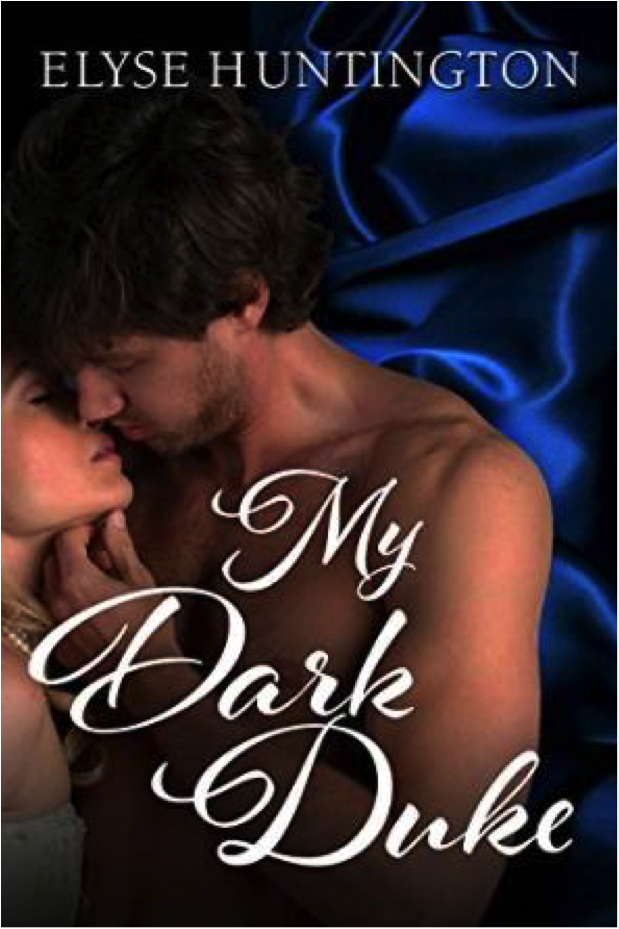
Elyse Huntington: My Dark Duke

Elyse Huntington Interviews

the Duke and Duchess of Trent

As the clock in the hall chimes, I try not to fidget. The most famous couple in the beau monde had finally agreed to be interviewed and they had chosen me over all the other publications; most of whom had many scores more readers than my modest ladies’ magazine. I could scarce believe my good fortune. Yet the expensive furnishings in the room do much to convince me that this is in truth reality, and not just a dream.

The door opens and I leap to my feet as the Duke and Duchess of Trent enter. It is difficult not to stare. They are an extraordinarily handsome couple, both possessing dark hair and eyes, both tall and lean. The duchess smiles at me as I curtsy and waves for me to sit. Trent is more reserved; however, I detect nothing but good humour in his eyes.

We exchange greetings and after we have settled on our respective sofas, I compliment Her Grace on the magnificence of her cream-coloured silk gown which is heavily adorned with lace. She laughs. “Why, thank you. It is one of James’ favourites. It brings back a fond memory for both of us.”

Intrigued, I ask what that memory is.

“Why don’t you tell the tale, darling?” says the duchess.

Untitled“I met Alethea in a library at a ball her godfather was hosting.” The duke’s voice is a baritone, silkily rich and smooth. I could have listened to him for hours. He chuckles, surprising me. The smile softens the severity of his features, making him appear even more attractive. I am beginning to see why the duchess had married him after previously refusing six offers of marriage. “Actually,” says the duke, “it would be more accurate to say that she fell upon me as I was trying to save her.”

“He was most heroic,” teases the duchess while her husband shakes his head, looking amused.

“What was it about His Grace that attracted you?” I ask.

“Hmm . . . He is a very handsome man, as you can clearly see.”

I hear the duke clearing his throat somewhat uncomfortably and bite back a smile.

The duchess continues. “It is hard to say. There was something between us from the start, what I do not know. James has this presence that makes it difficult for you to concentrate on anything other than him. And he can be very charming. Indeed I found I could not say no to him.”

“I beg to differ,” interrupts Trent, arching an eyebrow at his wife. “You could say no, and you did.”

I can’t help but smile when the duchess sighs and gives me a look as if to say ‘men’.

“I saw that,” drawls the duke and she flashes him an impudent smile in reply. The obvious love in the look they exchange makes my heart contract.

I turn to Trent. “And you, Your Grace, what drew you to Her Grace?”

“Her independent spirit, her intelligence, her skill in fencing, her love of reading. Everything about her made me want to spend more and more time with her until I realised that I wanted nothing more than to spend every minute of the rest of my life with her at my side.”

“James,” whispers the duchess, tears in her eyes.

He takes her hand and kisses it before turning back to me. He looks faintly embarrassed. “I am not normally so expressive.”

It is enormously sweet and I feel privileged at being able to witness this intimacy between them. I remind myself to continue. “Would you care to address the rumour that you were forced to marry?”

It is the duchess who replies. “I will neither confirm nor deny that rumour, but as you can see, we are blissfully happy.”

“And what about His Grace’s past,” I venture, wondering if the duchess would even deign to answer my impertinent question. “Did that not give you pause?”

“Yes, of course it did,” she replied, surprising me with her candidness. “But I knew that James was not guilty of what he had been accused of. And I was right.”

“I see.” I wanted to ask the next question, but from the duke gives me a speaking look and I know my time with them has come to an end. As I thank them for their time and take my leave, I can’t help wondering if I will ever find the kind of love that the Dark Duke has found with his duchess.

About My Dark Duke

A steamy Georgian romance about desire, the importance of staying true to yourself and the power of the past to cast a shadow on the present.

Since his notorious wife died in mysterious circumstances, rumours about James, the handsome Duke of Trent, have scandalized society. Now, he must marry again—but finding an eligible woman willing to overlook his past won’t be easy.

Defiantly single, Lady Alethea Sinclair has already turned down six offers of marriage. She prefers living on her own terms and refuses to answer to any man. Yet when Alethea meets the seductive and enigmatic Duke she finds herself strangely drawn to him.

Intrigued by Alethea’s defiance of society’s expectations, James is instantly taken with the willful beauty and soon they are enjoying a playful flirtation. And when circumstances force them into a comprising situation, he does the honourable thing and marries her.

But adjusting to the constraints of marriage doesn’t come easily to the rebellious Alethea and, despite their growing feelings for each other, the Duke’s troubled past keeps getting in the way. Can they learn to trust each other and give love a chance before it’s too late?

AmazonKobo

Also available on iBooks and Google Play.

About the Author

OLYMPUS DIGITAL CAMERA

Elyse spent her childhood years in Borneo. She moved to Australia when she was a teenager and was an avid reader of romances. It was her love of historical romance that led her to write My Dark Duke, which finaled in the Romance Writers of Australia Emerald Award contest in 2014.

A lawyer by profession, Elyse is a self-confessed compulsive buyer of any books featuring dukes. She also loves reading stories featuring alpha billionaires—undoubtedly because they are the embodiment of modern-day dukes. Elyse spends her free time (and perhaps a little too much of her not-so-free time) fantasising about wickedly handsome heroes and the strong heroines who ultimately tame them.

Elyse loves to hear from her readers. You can contact her via:

WebsiteFacebook

Check out the bonus epilogue for My Dark Duke at her website.

Vauxhall Gardens: Jonathan Tyers— “The Master Builder of Delight”

vauxhallbook

Vauxhall Gardens: A History

David Coke & Alan Borg

The Vauxhall Pleasure Gardens is one of the places I’d love to slip back in time to visit, just to catch a glimpse of what it was like. After recently splurging to buy this lovely coffee-table book, I thought it might make a wonderful subject for a new blog series. But do buy the book too, if you can! The photos are fabulous!

“The Master Builder of Delight”

In 1729, the site of the “Vauxhall Spring-Gardens was leased to a twenty-seven-year-old entrepreneur called Jonathan Tyers, whose goal was to transform it from a sort of seedy rural tavern to a respectable venue for all social classes.

A fellmonger (dealer in animal hides or skins) by trade, Jonathan was not content to continue the family business, successful though it was. Driven by a desire to raise his family’s status—and improve the world as he did so—Tyers believed that culture and pleasurable entertainments should not be the sole prerogative of the upper classes, but that the middle and lower classes deserved to find some enjoyment in their lives as well.

tyers family

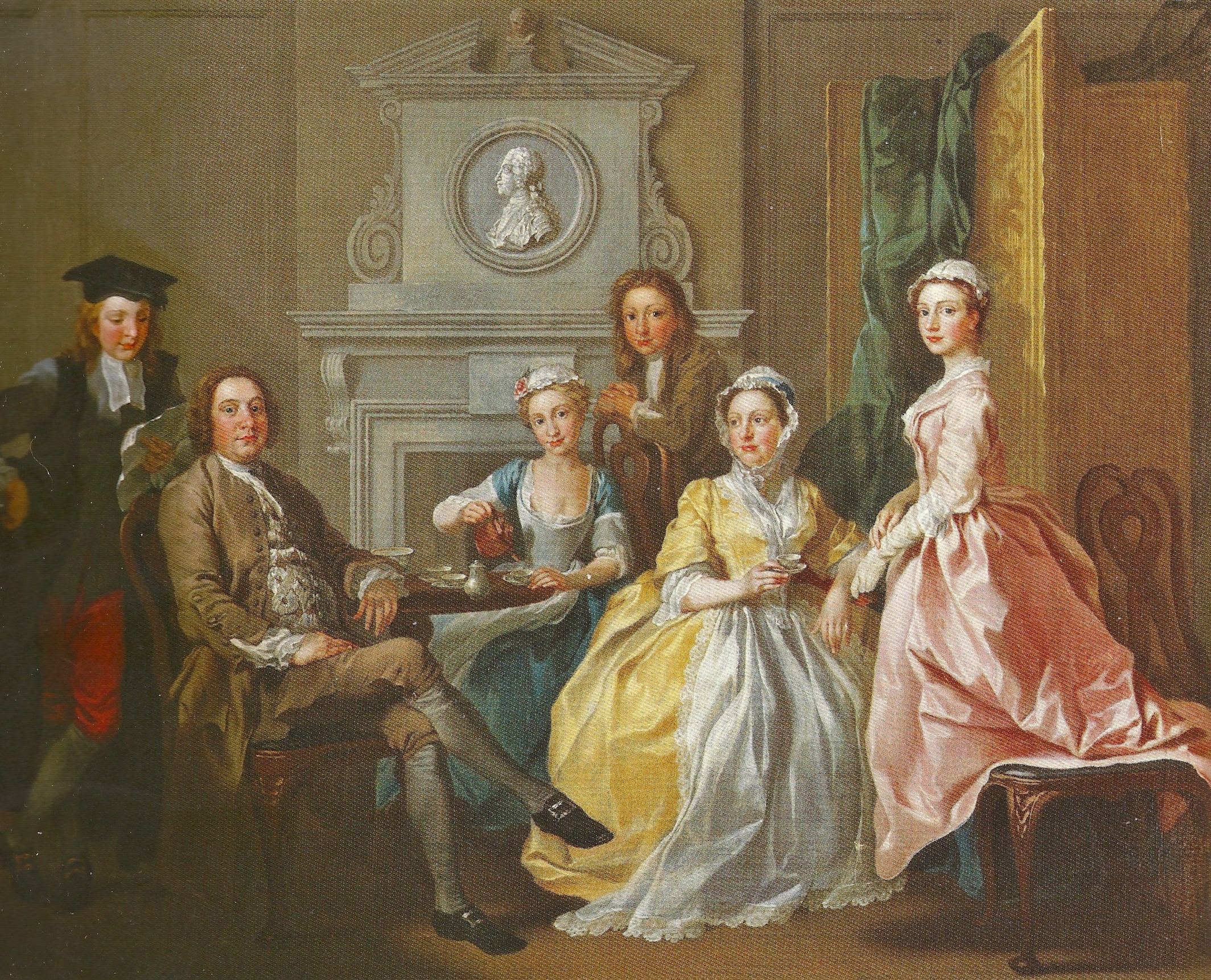
Family portrait by Francis Hayman, Jonathan Tyers and his Family, 1740. Left to right: Elder son Thomas, Jonathan, daughter Elizabeth, son Jonathan, wife Elizabeth, daughter Margaret.

Jonathan Tyers was a very complex character, with more than his fair share of contradictions and eccentricities. Upright, intelligent and self-assured, he also exhibited strains of arrogance and ambition. However, his ambitions were clearly projected chiefly upon his business rather than himself, while his personal aspirations were driven by a wish to raise his own status and that of his family to gentry, an object in which he succeeded at a remarkably early age. (p.35)

Through his association with The Wits’ Club, a social club for freethinkers, scholars, libertarians, and writers, Tyers became good friends with Charles Burney, Henry Fielding, William Hogarth, Harry Hatsell, Edward Moore, Thomas Cooke, Richard Dawson, and Leonard Howard. The club first met at Vauxhall Gardens later moved to a nearby tavern. Many of the ideas behind his development of the gardens came from the discussions at this club.

Although he never managed to mix with fashionable society in his lifetime, he was held in great respect and admiration by his peers, so much so that he was elected to the Royal Society of Arts in 1757, where he would have met many other prominent people, including Benjamin Franklin, when he visited London.

He and his creation were even featured in his friend Henry Fielding’s work of fiction, Amelia (1751).

The extreme Beauty and Elegance of this Place is well known to almost every one of my Readers; and happy is it for me that it is so; since to give an adequate Idea of it, would exceed my Power of Description. To delineate the particular Beauties of these Gardens, would, indeed, require as much pains and as much Paper too, as to rehearse all the good Actions of their Master [Tyers], whose Life proves the Truth of an Observation which I have read in some Ethic Writer, that a truly elegant Taste is generally accompanied with an Excellency of Heart; or in other Words, that true Virtue is, indeed, nothing else but true Taste.

The_Works_of_Henry_Fielding_Amelia_v2_1000373134

Tyers’s Mission

Besides his goal of cleaning up the gardens’ reputation, Tyers hoped to use the venue to improve people’s lives “through contact beauty and quality.” In other words, he planned to provide the lower orders with both art and beauty, and also expose them to “polite society,” who would educate them by example.

His influence on the manners and morals of eighteenth-century society was to be far-reaching, and his patronage of artists and designers would change the face of British art. But it was his ideological beliefs and priorities, his egalitarianism and his conviction that the pursuit of pleasure was a basic human right, and a vital element of the balanced life, that would really motivate his proprietorship of Vauxhall Gardens.

The Ridotto al Fresco

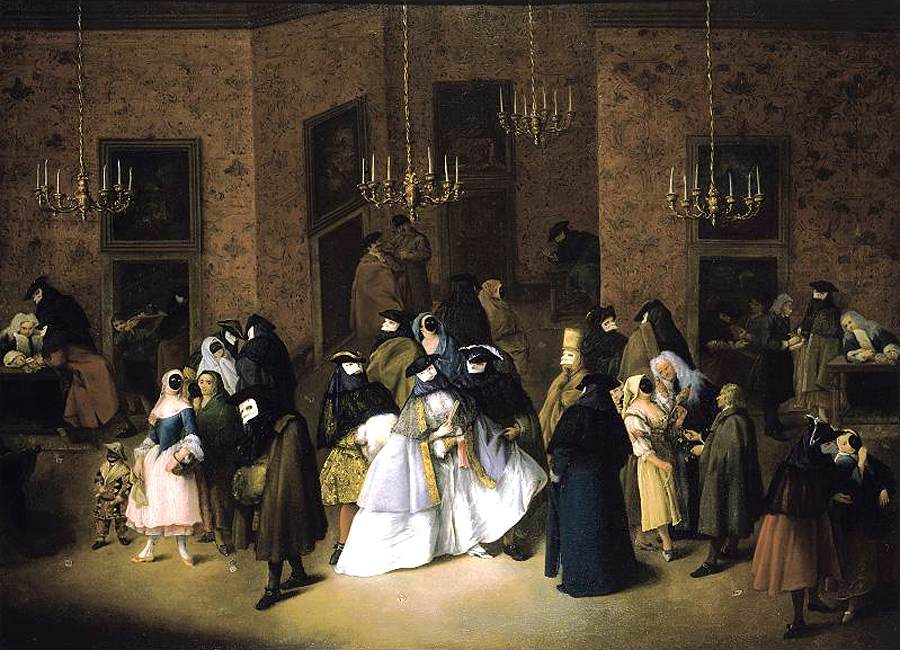
Tyers’s first event at Vauxhall was a masquerade ball in the manner of the Italian carnival in the spring of 1731. Not much is known of this event, except that there was outdoor dancing in masquerade costume and was restricted to the upper classes.

The Ridotto in Venice, Pietro Longhi, 1750's

The Ridotto in Venice, Pietro Longhi, 1750’s

By contrast, his second event in April of 1732, was attended by the poorer class of people, including “an oyster girl, a barber’s apprentice, a lawyer, an army captain, a doctor, a vicar and a number of prostitutes…”

The third event, considered to be the opening ceremony of Tyers’s Vauxhall Gardens, took place on 7 June 1732 and included the presence of Frederick, Prince of Wales. Under the guidance of John James Heidegger, Tyers created an extraordinary event that was talked about for years. A hundred armed soldiers were employed for the security of the distinguished guests, and he “hired the Westminster and Lambeth ferrymen for the whole night to carry his guests across the river and back.” Even with an admission fee of a guinea—which only the wealthy could afford—“between three and four hundred people actually attended the ridotto.” Besides the Prince of Wales’s entourage, the guests included politicians and their friends, “lawyers, bankers, printers, brewers, churchmen, military men and aristocrats.” The party broke up at around four in the morning. “The principal entertainments…were dancing and feasting, combined with the social intercourse between masked guests.”

The Ridotto in Venice, Pietro Longhi, 1750's

The Ridotto in Venice, Pietro Longhi, 1750’s

While by most accounts—particularly in the view of the Prince of Wales—this event was a great success, other accounts indicate that there was a distinct theme of preaching and moralizing via buildings set up to show the misery and pain that result from excessive self-indulgence that may have not gone over too well with the party-minded guests.

In any case, his final ridotto, which was held two weeks later on 21 June, likely at the request of the Prince, who was having the time of his life, was attended by only half as many, which, considering his expenses, would likely have completely wiped out any profits from the four events. No doubt this is the reason Tyers held no such events during 1733 or 1734, although the gardens themselves likely continued to be open to the public.

Susana’s Vauxhall Blog Post Series

  1. Vauxhall Gardens: A History
  2. Vauxhall Gardens: Jonathan Tyers—“The Master Builder of Delight” 
  3. Vauxhall Gardens: A New Direction
  4. Vauxhall Gardens: The Orchestra and the Supper-Boxes 
  5. Vauxhall Gardens: The Organ, the Turkish Tent, and the Rotunda
  6. Vauxhall Gardens: Three Piazzas of Supper-Boxes
  7. Vauxhall Gardens: “whither every body must go or appear a sort of Monster in polite Company”
  8. Vauxhall Gardens: The Competition
  9. Vauxhall Gardens: The Artwork, Part I
  10. Vauxhall Gardens: The Artwork, Part II
  11. Vauxhall Gardens: The Music, 1732-1859
  12. Vauxhall Gardens: The Business Side
  13. Vauxhall Gardens: Developments from 1751-1786
  14. Vauxhall Gardens: Thomas Rowlandson’s Painting (1785)
  15. ‎Vauxhall Gardens: The Third Generation of the Tyers Family and the Jubilee of 1786
  16. Vauxhall Gardens: An Era of Change (1786-1822), Part I
  17. Vauxhall Gardens: An Era of Change (1786-1822), Part II
  18. Vauxhall Gardens: An Era of Change (1786-1822), Part III
  19. Vauxhall Gardens: The Final Years, Part I
  20. Vauxhall Gardens: The Final Years, Part II
  21. Vauxhall Gardens: The Final Years, Part III
  22. Vauxhall Gardens: The Final Years, Part IV
  23. Vauxhall Gardens: Farewell, for ever
“A few words on Coaching Inns” and Conclusion

dust jacket

The following post is the twenty-seventh and final of a series based on information obtained from a fascinating book Susana obtained for research purposes. Coaching Days & Coaching Ways by W. Outram Tristram, first published in 1888, is replete with commentary about travel and roads and social history told in an entertaining manner, along with a great many fabulous illustrations. A great find for anyone seriously interested in English history!

“…And now a few words on the Coaching Inns”

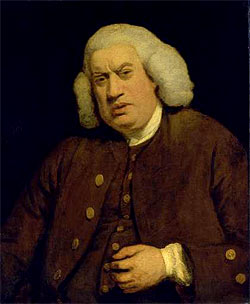
Dr. Samuel Johnson

Dr. Samuel Johnson

“There is no private house,” said Johnson—it was in the Old Chapel House inn in Oxfordshire, on the Birmingham Road, that he gave vent to the profundity—“there is no place,” he said, at which people can enjoy themselves as well as at a capital tavern like this. Let there be ever so great a plenty of good things, ever so much grandeur, ever so much elegance, ever so much desire that every guest should be easy, in the nature of things it cannot be. There must always be some degree of care and anxiety. The master of the house is anxious to entertain his friends; these in their turn are anxious to be agreeable to him, and to no one but a very impudent dog can as freely command what is in another man’s house as if it were his own. Whereas at a tavern there is a general freedom from anxiety. You are sure you are welcome, and the more noise you make the more trouble you give, the more good things you call for, the welcomer you are. No servants will attend you with the alacrity which waiters do, who are incited by the prospect of an immediate reward in proportion as they please. No, sir; there is nothing which has been contrived by man by which so much happiness is produced as by a good tavern or inn.”

Lamenting the loss of the “finest examples of this hospitable sort of architecture”

Hear, hear! say I; but while on the subject of inns may remark that I have been much disappointed in my ramblings; in truth began some six years too late from this point of view. For in that interval the country has been deprived of many of its finest examples of this hospitable sort of architecture. Of those fine examples—few and far between—which still remain, many are now sinking into a state of irremediable disrepair—witness the great inn at Stilton for one—and will in the near fulness of time doubtless be improved altogether off the face of the earth.

george inn norton st philip

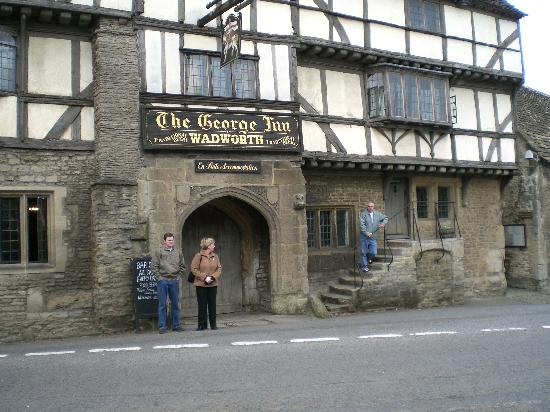
The George Inn, Norton St. Philip (near Bath)

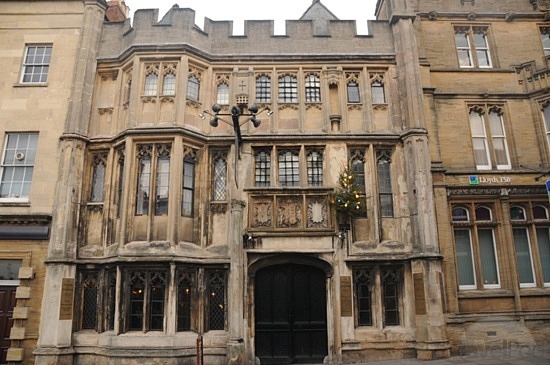
At Norton St. Philip, then, in Somersetshire, seven miles south-east of Bath, there still stands in the George Inn, a half-timbered, fifteenth century house, of the finest possible type. Monmouth passed the night of June 26th, 1685 at this George…At Glastonbury, in the same county, an inn of the same name—the George—with front one splendid mass of panelling, pierced where necessary for windows, the finest piece of domestic work in one of the most entrancing towns in England from an antiquary’s point of view, dates from the fourth Edward; while, to go further afield for a fine specimen of a different period, at Scole in Suffolk, the White Hart, erected in 1655 by John Peck, merchant, of Norwich, still retains some fine carving, and had till the end of the last century an enormous sign containing many figures—Diana and Actaeon, Charon, Cerberus, and sundry other worthies, carved in wood by Fairchild, at a cost of 1057 pounds.

george-pilgrims-hotel-1492-glastonbury-n1-st-fillans

The George & Pilgrim Hotel, Glastonbury

Conclusion

If a minor measure of success attends my enterprize I shall be content—content, that is to say, if I have caught some flavour of the romance of the Great Roads of England from the time when the Flying Machine of Charles the Second’s age lumbered out of the Belle Savage Yard, up to the day when the Holyhead Mail via Shrewsbury, timed at eleven miles an hour, was our fathers’ wonder, and the pride of this perfect road— “Mr. Bicknell’s spicy team of greys.”

scole-scole-inn-5279

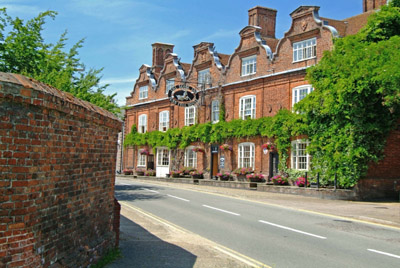
The Scole Inn, Suffolk (formerly White Hart)

scole_inn_stairs

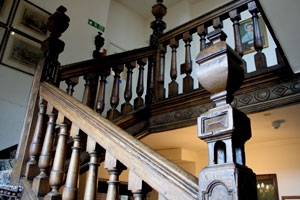
Stairs at the Scole Inn


 Index to all the posts in this series

1: The Bath Road: The (True) Legend of the Berkshire Lady

2: The Bath Road: Littlecote and Wild William Darrell

3: The Bath Road: Lacock Abbey

4: The Bath Road: The Bear Inn at Devizes and the “Pictorial Chronicler of the Regency”

5: The Exeter Road: Flying Machines, Muddy Roads and Well-Mannered Highwaymen

6: The Exeter Road: A Foolish Coachman, a Dreadful Snowstorm and a Romance

7: The Exeter Road in 1823: A Myriad of Changes in Fifty Years

8: The Exeter Road: Basingstoke, Andover and Salisbury and the Events They Witnessed

9: The Exeter Road: The Weyhill Fair, Amesbury Abbey and the Extraordinary Duchess of Queensberry

10: The Exeter Road: Stonehenge, Dorchester and the Sad Story of the Monmouth Uprising

11: The Portsmouth Road: Royal Road or Road of Assassination?

12: The Brighton Road: “The Most Nearly Perfect, and Certainly the Most Fashionable of All”

13: The Dover Road: “Rich crowds of historical figures”

14: The Dover Road: Blackheath and Dartford

15: The Dover Road: Rochester and Charles Dickens

16: The Dover Road: William Clements, Gentleman Coachman

17: The York Road: Hadley Green, Barnet

18: The York Road: Enfield Chase and the Gunpowder Treason Plot

19: The York Road: The Stamford Regent Faces the Peril of a Flood

20: The York Road: The Inns at Stilton

21: The Holyhead Road: The Gunpowder Treason Plot

22: The Holyhead Road: Three Notable Coaching Accidents

23: The Holyhead Road: Old Lal the Legless Man and His Extraordinary Flying Machine

24: The Holyhead Road: The Coachmen “More Celebrated Even Than the Most Celebrated of Their Rivals” (Part I)

25: The Holyhead Road: The Coachmen “More Celebrated Even Than the Most Celebrated of Their Rivals” (Part II)

26: Flying Machines and Waggons and What It Was Like To Travel in Them

27: “A few words on Coaching Inns” and Conclusion