Archives

Susana’s Adventures in England: Charlecote Park

In my mind, Charlecote Park will always be associated with buses—and the frustration of trying to find the one you need to take you to your destination. Maybe it’s not fair, since the problem I had was in part due to my own error, and it was certainly not the first time I’ve had issues finding transportation between train stations and stately manors, but it will forever be remembered as the place where I “lost it.” Or, as I put it when relating the story later to my friend Cora Lee, “I totally freaked out.”
rail-station

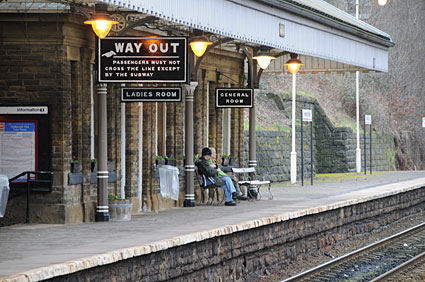
The rail system in the UK is fabulous, especially if you get a BritRail pass before you leave. The BritRail pass makes reservations unnecessary, so you can get on any train without having to worry about timing. Unfortunately, there is a little matter of the distance between the rail station and your destination.

I’ve found Cheryl Bolen’s England’s Stately Homes By Train very helpful in this regard because she gives specific instructions for buses and taxis. But things don’t always work out the way they’re supposed to. For example, when you leave the train station and are confronted with a listing of buses that shows every number except the one you need, and nobody around you knows anything about that one, what do you do? My solution: find a taxi. The extra money is definitely worth the peace of mind.

bus

But you still have to find a way back to the train station. If you have a mobile phone, you can call the cab company that brought you there. Or you can make an arrangement with the taxi driver to pick you up at a certain time, but then you might have to cut your visit short, which is a shame, since these stately manors have so many sights to see besides the interior of the house.

So, make sure you have a mobile phone. Because you never know when you are going to find yourself at a station that has no taxi and no pay telephone. Even if the online information says there is a telephone there, it won’t help you if the telephone is inside a building and the building is closed for the weekend—or the bank holiday—or is just always closed and nobody bothered to update the information on the website.

So what happened at Charlecote Park?

At Leamington Spa, I walked outside looking for a bus station adjacent to the train station. (Later, I realized the directions said “bus stop”, but the bus stop in front of the train station did not list Charlecote anywhere, and the one across the road had a sign that said, “Check schedule,” which was not helpful, since I didn’t have one.) I walked around and asked several people if they knew how to get to Charlecote Park. They did not. So I returned to the train station and asked an employee at a window there where the bus station was. He said to take the path to the left, follow it around a bend, and it would be on the next street. Um, no. It was just a street.

I walked one way for a few blocks, then saw a bus going the other way, so I changed direction. On the way, I asked a construction worker, who scratched his head and said first one way, then the other. I kept walking. The road curved around and I asked an older couple who were getting out of a car with tennis racquets.

“The bus station? Oh, it’s right next to the rail station, right around this curve!”

Really? How had I missed it? I must be a real dunce. So I asked them if I should turn and go back the way I came or just keep going around the curve. They discussed it for a few moments, and then shrugged and said it was six of one and half a dozen of the other. So I decided to follow the curve rather than retrace my steps, which was probably a mistake, since I found myself on a busy highway that seemed to go on forever.

By the time I had reached the rail station again, I had already walked four miles and was about to lose my temper. But then I saw a taxi stand, and my problems were over. Or so I thought.

I did finally get to Charlecote Park. My first action was to get a latte and scone at the cafe and rest my aching feet. I did feel better after that, and kept telling myself the same thing I told my ten-year-old nephew when I took him and my sister to Mexico for two weeks: Think of it as an adventure you can brag to your friends about. What are a few hardships to a veteran traveler?

scone

But getting there is only half the problem. You always have to find a way to get back.

This time, I queried the staff in the ticket office, telling them the story of the non-existent bus station. They were sympathetic, but couldn’t tell me anything about a bus station. An elderly volunteer “who knows everything about the buses here” shook his head and said, “There hasn’t been a bus station in Leamington Spa for more than fifteen years.”

Aha! No wonder I couldn’t find it!

But there are buses to Leamington Spa. One employee got out the schedule to prove it to me. The bus stop is just around the corner. Turn right at the entrance and go around the corner and it’s right there. Such nice, reassuring people. This time I would find the bus stop!

But I didn’t. There wasn’t any bus stop. Had I misunderstood the directions? Or was this an unmarked bus stop that only locals knew about? By this time, I was really upset. Hopping mad, in fact.

But I had to do something. So I found myself at the Charlecote Pheasant Hotel. At first there didn’t appear to be anyone there. Really? This just wasn’t my day. Finally, I found a workman who directed me to the front desk, where, when I got there, I promptly burst into tears.

Humiliating, you say? I was way beyond that. The kind young woman at the desk offered me water and showed me to a place where I could sit and calm down. She was so helpful! When I was ready, she showed me where the bus stop was (and no, there wasn’t a sign), and I managed to get back to the train station all in one piece, and only slightly the worse for wear.

The moral of the story is—. Well, there really isn’t one. Having a mobile phone wouldn’t have helped in this situation. But when you travel, even if you have a great guidebook, expect to find unexpected difficulties. Do not expect that locals will always be able to help you—especially if you ask them for something that doesn’t exist. But do expect to find kind, compassionate people who will help you when you need it most. In the end, it will turn out to be a grand adventure you can tell all your friends and even laugh about. Maybe.

Charlecote Park

house

Charlecote Park was built by Sir Thomas Lucy in 1558. Located in Warwickshire, four miles from Shakespeare’s home, Stratford-upon-Avon, it is famous for having housed Queen Elizabeth I. According to legend, a young William Shakespeare was caught poaching deer here, and he took his revenge on Sir Thomas by portraying him as the fussy Justice Shallow in The Merry Wives of Windsor. The famous Capability Brown worked his magic on the landscaping here, but he had to do it without cutting down a single tree.
wall-whenryviii

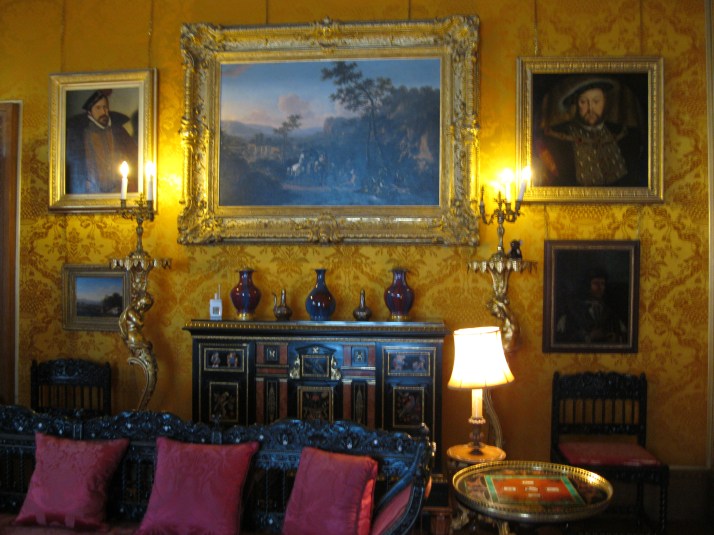
George Hammond Lucy and his wife Mary Elizabeth refitted the house in the mid-nineteenth century in the style of “Good Queen Bess” or Elizabethan Revival. With the help of designer and heraldic expert Thomas Willement, they filled the new rooms with heraldic stained glass, early editions of Shakespeare, and ebony furniture (which they thought to be Tudor). Many tables and cabinets came from the bankruptcy sale of collector William Beckford.

Check out my photos from Charlecote Park here.

Romance of London: The Crossing Sweeper

Romance of London: Strange Stories, Scenes And Remarkable Person of the Great Town in 3 Volumes

John Timbs

John Timbs (1801-1875), who also wrote as Horace Welby, was an English author and aficionado of antiquities. Born in Clerkenwell, London, he was apprenticed at 16 to a druggist and printer, where he soon showed great literary promise. At 19, he began to write for Monthly Magazine, and a year later he was made secretary to the magazine’s proprietor and there began his career as a writer, editor, and antiquarian.

This particular book is available at googlebooks for free in ebook form. Or you can pay for a print version.

article

What is a Crossing Sweeper?

From Wikipedia:

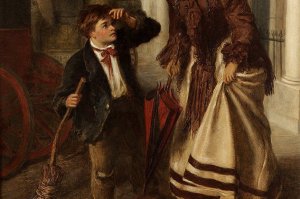
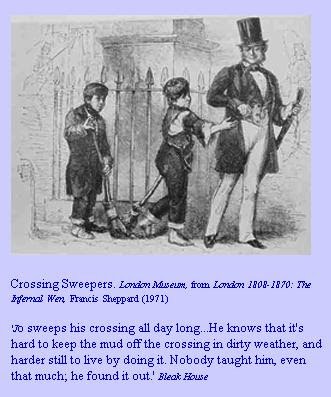
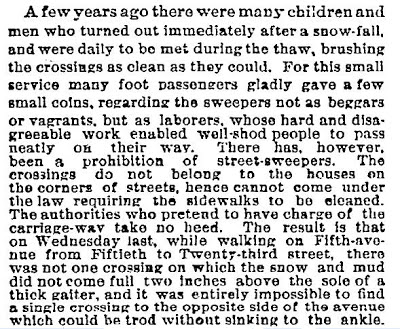
Crossing sweepers were a common sight on the streets of large cities during much of the 19th century. The predominance of horse-drawn vehicles—and the general uncleanliness of urban streets—entailed certain difficulties in crossing intersections. For example, the long dresses of many elite women might easily be soiled by horse droppings (among other forms of refuse). Crossing sweepers, by sweeping the pavement ahead of a person crossing the street and creating a path that was referred to as a “broom walk,” thus offered a service, particularly to the more affluent.

A-crossing-sweeper-clearing-the-street-for-a-fashionably-dressed-woman

A Remarkable Tale

The Rev. Samuel Bache, Minister of the New Meeting House, Birmingham, received the following very remarkable story from a venerable friend, one of the principal members of his congregation, some five-and-twenty years hence.

child sweeper

The late Mr. Simcox, of Harbourne, near Birmingham, who was largely engaged in the nail trade, in one of his visits to London, on business, was suddenly overtaken by a heavy shower of rain, from which he sought shelter under an archway: the rain continued for a long time with unabated violence, and he was, consequently, obliged to remain his place of shelter. He was soon agreeably surprised by a footman approaching with an umbrella, with his master’s compliments, and that he had observed the gentleman standing so long under the archway, that he feared he might take cold, and therefore would be glad if he would come and take shelter in his house—an invitation which Mr. Simcox gladly accepted. He was ushered into a drawing-room, where the master of the house was sitting, and he received from him a friendly welcome.

crossing+sweepers

Scarcely, however, had Mr. Simcox set eyes on his host, than he was struck with a vague remembrance of having seen him before; but where, or under what circumstances, he was altogether unable to call to mind. “You seem, sir,” said he, “to look at me as though you had seen me before.” Mr. Simcox acknowledged that his host was right in his conjectures, but confessed his entire inability to recall the occasion. “You are right, sir,” said the old gentleman; “and if you will pledge your word as a man of honour to keep my secret, and not to disclosed to anyone what I am now going to tell you until you have seen the notice of my death in the London papers, I have no objection to remind you where and how you have known me.”

In St. James’s Park, near Spring Gardens, you may pass every day an old man, who sweeps a crossing there, and whose begging is attended by this strange peculiarity—that whatever be the amount of the alms bestowed on him, he will retain only a halfpenny, and scrupulously return to the donor all the rest. Such an unusual proceeding naturally excites the curiosity of those who hear of it; and anyone who has himself made the experiment, when he happens to be walking by with a friend, is almost sure to say to him, ‘Do you see that old fellow there? He is the strangest beggar you ever saw in your life. If you give him sixpence, he will be sure to give you fivepence-halfpenny back again.’ Of course, his friend makes the experiment, which turns out as predicted; and as crowds of people are constantly passing, there are numbers of persons every day who make the same trial; and thus the old man gets many a halfpenny from the curiosity of the passers by, in addition to what he obtains from their compassion.”

“I, sir,” continued the old gentleman, “am that beggar. Many years ago, I first hit upon the expedient for the relief of my then pressing necessities; for I was at that time utterly destitute; but finding the scheme answer beyond my expectations, I was induced to carry it on until I had at last, and with the aid of profitable investment, realized a handsome fortune, enabling me to live in the comfort in which you find me this day. And now, sir, such is the force of habit, that, thought I am no longer under any necessity for continuing this plan, I find myself quite unable to give it up; and, accordingly, every morning I leave home, apparently for business purposes, and go to a room, where I put on my old beggar’s clothes, and continue sweeping my crossing in the park till a certain hour in the afternoon, when I go back to my room, resume my usual dress, and return home in time for dinner, as you see me this day.”

Mr. Simcox, as a gentleman and a man of honour, scrupulously fulfilled his pledge; but having seen in the London papers the announcement of the beggar’s death, he then communicated this strange story. The name of this eccentric person is not known; but the incidents are recollected by more than one narrator.

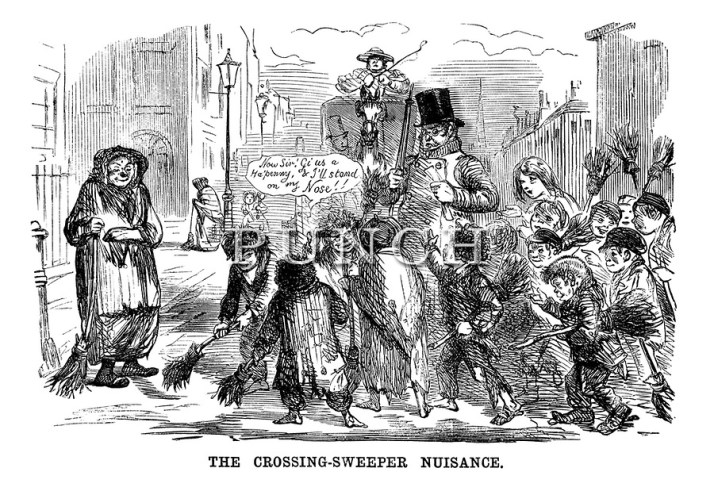
The crossing-sweeper nuisance.

Crossing-sweeping as a Career Choice?

Apparently some sweepers, even without gimmicks, made a good living from it.

The produce of a street crossing in London is sometimes considerable. At an inquest held on the body of a crossing sweeper, who had died suddenly, Mr. Wakley, the coroner, said that the sweeper of a crossing sold his interest in it for 40l. A juror observed that crosswings were freehold, by which many proprietors amassed, in former days, sums of 500l, 1,000l, 4,000l. Another juror alluded to the sweeper of the crossing at Bridge Street, Blackfriars, who bequeathed a large sum to Miss Waithman (daughter of the alderman) in gratitude for her benevolence in giving him his dinner every Sunday; and another gentleman said that the sweeper of a crossing near Hyde Park bequeathed 1,000l to a gentleman who was in the habit of giving him 6d whenever he passed his crossing.

Romance of London Series

  1. Romance of London: The Lord Mayor’s Fool… and a Dessert
  2. Romance of London: Carlton House and the Regency
  3. Romance of London: The Championship at George IV’s Coronation
  4. Romance of London: Mrs. Cornelys at Carlisle House
  5. Romance of London: The Bottle Conjuror
  6. Romance of London: Bartholomew Fair
  7. Romance of London: The May Fair and the Strong Woman
  8. Romance of London: Nancy Dawson, the Hornpipe Dancer
  9. Romance of London: Milkmaids on May-Day
  10. Romance of London: Lord Stowell’s Love of Sight-seeing
  11. Romance of London: The Mermaid Hoax
  12. Romance of London: The Bluestocking and the Sweeps’ Holiday
  13. Romance of London: Comments on Hogarth’s “Industries and Idle Apprentices”
  14. Romance of London: The Lansdowne Family
  15. Romance of London: St. Margaret’s Painted Window at Westminster
  16. Romance of London: Montague House and the British Museum
  17. Romance of London: The Bursting of the South Sea Bubble
  18. Romance of London: The Thames Tunnel
  19. Romance of London: Sir William Petty and the Lansdowne Family
  20. Romance of London: Marlborough House and Sarah, Duchess of Marlborough
  21. Romance of London: The Duke of Newcastle’s Eccentricities
  22. Romance of London: Voltaire in London
  23. Romance of London: The Crossing Sweeper
  24. Romance of London: Nathan Mayer Rothschild’s Fear of Assassination
  25. Romance of London: Samuel Rogers, the Banker Poet
  26. Romance of London: The Eccentricities of Lord Byron
  27. Romance of London: A London Recluse

Journal of a Georgian Gentleman

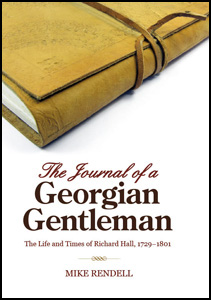
The Journal of a Georgian Gentleman:

The Life and Times of Richard Hall, 1729-1801

by Mike Rendell

cover_sml_bdr

https://www.amazon.com/Journal-Georgian-Gentleman-Richard-1729-1801-ebook/dp/B00A3EY1TO

Treasures from the Past

Have you ever wished you could find a trunk somewhere that is full of diaries and papers and mementos from one of your ancestors? Remnants from the past that give you a glimpse of the person, and not just the name and dates generally found in family Bibles or ancestry.com?

Sadly, most of my ancestors weren’t the sort to write things down, so when they disappeared from the earth, most of their life experiences disappeared with them. One exception was my great-grandfather, Jess Sherry. An educator who valued words, he left a legacy of writings that are in many ways as apropos today as they were a hundred years ago.

silhouette__Custom__400x400

A silhouette of Richard Hall, made by his daughter Martha.

Preface

In his lifetime Richard kept copious notebooks, diaries and journals as well as everyday ephemera of the time—newspaper cuttings, admission tickets, catalogues and so on. Apart from a dozen contemporaneously written diaries which are still extant, Richard completed numerous retrospective accounts of events which had influenced his life. These were often interspersed with details about the weather, the price of bread, recipes for making wine, inventories of his assets, and so forth. Separately he also maintained little notebooks on favoured topics—‘Observables’ (referring to what he had seen and noted, e.g. eclipses, earthquakes, violent storms and other natural phenomena), ‘Fossils’ (which he took to mean anything dug out of the ground) and ‘Receipts’ (i.e., recipes, which included medicines rather than just meals). He left behind his collection of coins, shells and fossils. He was also, from the 1750’s onwards, an avid collector of books, many of them bought from local booksellers.

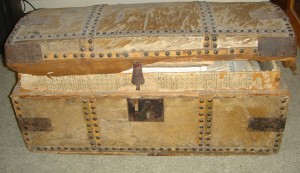
trunk

Richard often wrote his thoughts and ideas—as well as copied out sermons—in manuscript books, which were then bound up. Many remain. A fastidious record-keeper, at the end of each year he would set out a list of the books which he had read—and most of these lists survive, too. Together these collections give a fascinating insight into the man and his times. Many of the items were stored in Richard’s horse-hair trunk. One of the restrospective journals is entitled ‘Family and Personal Recollections’. It begins:

I have frequently thought of writing a little history of my life interspersed with as much information as I could collect from letters and memorandum in my possession, of my family connexions. No very striking incidents, I am fully aware will be presented. Still I trust it may be attended with benefit in awakening feelings of deep humility and a lively gratitude in my own mind whilst it will afford an outline of a family history to my children they could not otherwise obtain.

What follows is a story of the life of Richard Hall—my great-great-great-great grandfather. It is based on what Richard himself wrote and collected—with some additional material from his son, who maintained the family tradition of retrospective musing and diary-keeping, and from his brother-in-law William, whose three surviving diaries give a fascinating counterpart to what was happening in the Hall family in the middle part of the eighteenth century. To this family source material has been added background information—to give a fuller picture of Richard’s life and times.

Richard’s Story

Richard’s grandfather Thomas, a gentleman farmer, managed to survive “the end of the English Civil War—the execution of Charles I, Oliver Cromwell’s Protectorate, the Restoration of Charles II, the upheavals of the reign of James II, the accession of William of Orange and the start of the Hanoverian dynasty.” But also, he was financially ruined by the notorious South Sea Bubble (see blog post here). The end result was that Thomas’s son Francis had to go to London to find work, as many did in that situation. Francis got an apprenticeship with a hosier, which, as the author puts it, was “quite a step down for a young man brought up as the son of a ‘gentleman farmer’.

An only child, Richard was brought up on Red Lion Street in Southwark. What was it like for him growing up in that rather unsavory neighborhood? Rendell sets that scene for us, using historical data that is pure gold for a historical author who might be seeking a background for a character who was in trade during that period.

How were babies treated? Words pronounced? What would Richard have learned in school? What did they eat? How did they cook? What was the postal system like? The roads? Was it necessary to have a passport to travel abroad? How much did Richard weigh? How much did things cost? Where did he go for entertainment and what curiosities garnered his interest? What did men and women wear?

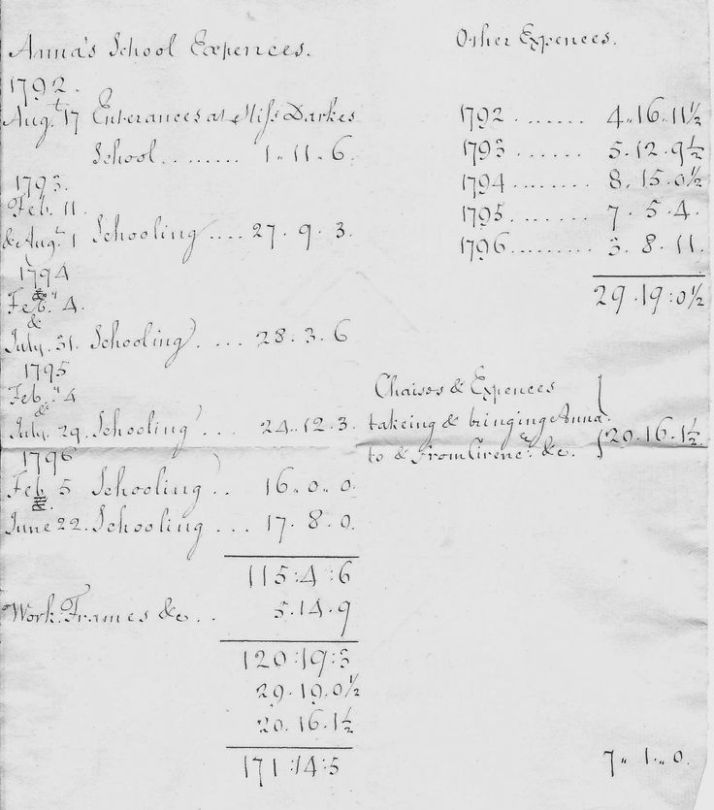
In 1766, Richard, aiming for a more fashionable clientele, signed a contract to build a shop on London Bridge (“the corner London Thames Street, London Bridge). With this move, now he was able to offer fabrics as well as silk stockings. He took out fire insurance. Eventually, he took on his own son as apprentice. And his life continued, well-documented—through 1801. Even better, his descendants had the good sense not to destroy the remnants that he left.

school expenses

Do you have an ancestor who left journals or writings behind to document his/her life? What sort of plans do you have to document your own life for your descendants?

About the Author

Mike RendellBorn in Bristol, England, Mike Rendell read Law at Southampton University. After graduation he joined a Bristol law firm where he was to launch the UK s first 24/7 residential property transfer service. He contributed regular articles on property matters to legal journals and wrote a weekly legal advice column in the local press. He retired in 2003 and now lives with his wife Philippa, sometimes on the edge of Dartmoor in the South West of England, and sometimes in Spain, where he tends his garden of olives, pomegranates and citrus fruits. He has two children from a former marriage. He is currently working on a novel set in Georgian England as well as on a book to be published by Pen & Sword entitled “Sex, Scandal and Satire – in bed with the Georgians” – due out 2015/6.

WebsiteTwitter


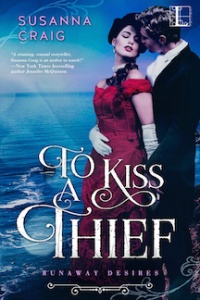
Susanna Craig: To Kiss a Thief (Giveaway)

A Place in Time

When you turn the last page and close the book, what sticks with you? An intriguing character? A shocking plot twist?

What about the setting?

I’m a firm believer that historical romance should capture a place in time, or else it’s not really historical romance. Whether it’s Victorian London or Tang Dynasty China, a story’s setting, when done well, shapes everything the characters—and readers—experience.

For my Runaway Desires series, I chose the late Georgian period, specifically the 1790s, because I knew that tumultuous decade would offer plenty of built-in tension and conflict, including political and economic uncertainties, war, and the fight to end slavery. It’s a slightly edgier cousin of the much-beloved Regency period. It’s also when Jane Austen’s first three novels were written (and arguably set).

In To Kiss a Thief, the first book in the series, the heroine, Sarah, is suspected of infidelity and involvement in the disappearance of a priceless sapphire necklace. Rather than face the scandal, she runs away. Three years later, her husband finds her on the northern coast of Devonshire and wonders why on earth Sarah had chosen such a place to hide away… She would almost certainly have been better able to disappear in London, where one could very nearly get away with anything under cover of anonymity. But in a fishing village of a few hundred souls, her arrival would have been remarked by all.

And it has. From the baker to the apothecary’s wife, everyone in Haverhythe has an opinion about Sarah. At heart, To Kiss a Thief is a small-town romance, and as my hero and heroine reconnect with one another, they are confronted and comforted by the members of this close-knit community.

Because I wanted the place and its people to leap off the page, I was determined to ground my fictional village in reality. I chose the general location of Britain’s West Country for its proximity to Bristol, where Sarah’s parents live. I wanted the temptation to go home to be always on her horizon—literally. Then, one evening, as I idly scanned that coastal region via Google Earth looking for inspiration, I stumbled upon Clovelly.

320px-Clovelly_-_Harbour02

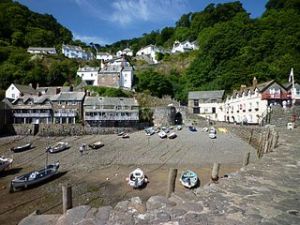
Clovelly harbor

From its appearance in the Domesday Book to the present day, Clovelly has enjoyed a long and interesting history. The picturesque village of fewer than 500 people has been a popular tourist destination since the Victorian period, thanks in part to one of its most famous residents, novelist Charles Kingsley. It is privately owned, and has belonged to just three different families since the thirteenth century.

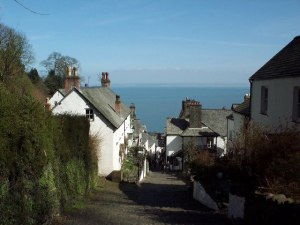
I made use of several of Clovelly’s distinctive elements in constructing the fictional Haverhythe. One is its unique geography. Built into a cliff overlooking the Bristol Channel, the village consists primarily of a single, cottage-lined street that descends some 400 feet to the water. In the harbor lies another striking feature: a massive stone quay, built in in the fourteenth century. Once the ships’ cargo has been offloaded, it is transported overland via sledges drawn by donkeys.

Clovelly main street

Clovelly, main street

In To Kiss a Thief, characters travel the steep main street of Haverhythe under the watchful eye of all the village. Gossip travels “up-along” and “down-along” more quickly than the donkeys. And several memorable moments for my hero and heroine take place on the quay that curls into the harbor.

Unfortunately, I haven’t yet had the pleasure of visiting Clovelly in person. But I’ve never visited the late eighteenth century, either. Like most writers of historical fiction, I find extensive research essential to crafting the best stories I can. I read about Clovelly’s history and geography, pored over the treasure trove of pictures online, and combined that information with my own experience of another coastal town, Tenby (Wales), to create my heroine’s perfectly imperfect hiding spot.

Travel, even in the pages of a book, makes us richer. Wherever your next reading adventure takes you, I hope you enjoy your visit!

What’s the most memorable setting of a book you’ve read? Or what’s your favorite real-life travel destination? One person will be chosen at random from the comments on this post to receive an e-book of To Kiss a Thief. The giveaway ends at midnight on August 21st.

AmazoniBooksBarnes & NobleKobo

AReGoogle Play

About To Kiss a Thief

TO KISS A THIEF low res copyIn the first book of a captivating new series set in Georgian England, a disgraced woman hides from her marriage—for better or worse…

Sarah Pevensey had hoped her arranged marriage to St. John Sutliffe, Viscount Fairfax, could become something more. But almost before it began, it ended in a scandal that shocked London society. Accused of being a jewel thief, Sarah fled to a small fishing village to rebuild her life.

The last time St. John saw his new wife, she was nestled in the lap of a soldier, disheveled, and no longer in possession of his family’s heirloom sapphire necklace. Now, three years later, he has located Sarah and is determined she pay for her crimes. But the woman he finds is far from what he expected. Humble and hardworking, Sarah has nothing to hide from her husband—or so it appears. Yet as he attempts to woo her to uncover her secrets, St. John soon realizes that if he’s not careful, she’ll steal his heart…

Excerpt

About the Author

IMG_8280_2 copyA love affair with historical romances led Susanna Craig to a degree (okay, three degrees) in literature and a career as an English professor. When she’s not teaching or writing academic essays about Jane Austen and her contemporaries, she enjoys putting her fascination with words and knowledge of the period to better use: writing Regency-era romances she hopes readers will find both smart and sexy. She makes her home among the rolling hills of Kentucky horse country, along with her historian husband, their unstoppable little girl, and a genuinely grumpy cat.

WebsiteFacebookGoodreadsTwitter

Susana’s Adventures in England: Syon House

syonpark

If you’re looking for a stately home to visit in or near London, Syon House is a great choice. Located on the Thames across from Kew Gardens, you can get there by Underground (take the District line toward Richmond, get off at Gunnarsbury) and bus, (take the 237 or 267 bus to Brentlea). The pedestrian entrance is on your right when you get off the bus).

Syon House history

Syon began as an abbey, founded in 1415 by Henry V and closed in 1539 by the Dissolution of the Monasteries. Catherine Howard, fifth wife of Henry VIII, was imprisoned here prior to her execution in 1542. The 1st Duke of Somerset acquired it and had it renovated in Italian Renaissance style. In 1594, the 9th Earl of Northumberland acquired it and has owned it ever since.

A Royal Row

Queen Anne (1705)

Queen Anne (1705)

(from Wikipedia)

In the late 17th century, Syon was in the possession of Charles Seymour, 6th Duke of Somerset, through his wife, Elizabeth Seymour (née Percy). After the future Queen Anne had a disagreement with her sister, Mary II (wife of William III, also known as William of Orange), over her friendship with Sarah Churchill, Countess of Marlborough, she was evicted from her court residence at the Palace of Whitehall and stayed at Syon with her close friends, the Somersets, in 1692. Anne gave birth to a stillborn child there. Shortly after the birth, Mary came to visit her, again demanding that Anne dismiss the Countess of Marlborough and stormed out again when Anne flatly refused.

Mary II, 1685

Mary II, 1685

In the 18th century, Hugh Percy, 1st Duke of Northumberland, commissioned architect and interior designer Robert Adam and landscape designer Lancelot “Capability” Brown to redesign the house and estate. Work began on the interior reconstruction project in 1762. Five large rooms on the west, south and east sides of the House, were completed before work ceased in 1769. A central rotunda, which Adams had intended for the interior courtyard space, was not implemented, due to cost.

Robert Adam!

Robert Adam's plan for Syon House

Robert Adam’s plan for Syon House

from Wikipedia:

Syon House’s exterior was erected in 1547 while under the ownership of the 1st Duke of Somerset. Syon’s current interior was designed by Robert Adam in 1762 under the commission of the 1st Duke and Duchess of Northumberland.

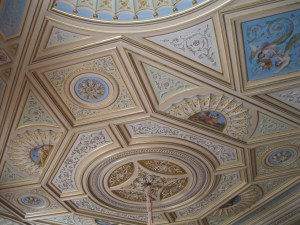
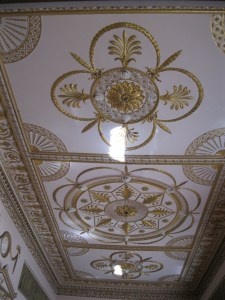
coloredceilingcornerThe well known “Adam style” is said to have begun with Syon House. It was commissioned to be built in the Neo-classical style, which was fulfilled, but Adam’s eclectic style doesn’t end there. Syon is filled with multiple styles and inspirations including a huge influence of Roman antiquity, highly visible Romantic, Picturesque, Baroque and Mannerist styles and a dash of Gothic. There is also evidence in his decorative motifs of his influence by Pompeii that he received while studying in Italy. Adam’s plan of Syon House included a complete set of rooms on the main floor, a domed rotunda with a circular inner colonnade meant for the main courtyard (‘meant for’ meaning that this rotunda was not built due to a lack of funds), five main rooms on the west, east and south side of the building, a pillared ante-room famous for its colour, a Great Hall, a grand staircase (though not built as grand as originally designed) and a Long Gallery stretching 136 feet long. Adam’s most famous addition is the suite of state rooms and as such they remain exactly as they were built.

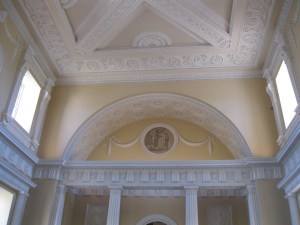
geometricceiling2More specific to the interior of Adam’s rooms is where the elaborate detail and colour shines through. Adam added detailed marble chimneypieces, shuttering doors and doorways in the Drawing Room, along with fluted columns with Corinthian capitals. The long gallery, which is about 14 feet high and 14 feet wide, contains many recesses and niches into the thick wall for books along with rich and light decoration and stucco-covered walls and ceiling. At the end of the gallery is a closet with a domed circle supported by eight columns; halfway through the columns is a doorway imitating a niche.

More photos on my Syon Park Pinterest Page: https://www.pinterest.com/susanaauthor/syon-park/

ceilingalcove

corner3

goldturquoisecorner

librarybooks&portraits

beautifulvase

delicategoldceiling

Romance of London: Voltaire in London

Romance of London: Strange Stories, Scenes And Remarkable Person of the Great Town in 3 Volumes

John Timbs

John Timbs (1801-1875), who also wrote as Horace Welby, was an English author and aficionado of antiquities. Born in Clerkenwell, London, he was apprenticed at 16 to a druggist and printer, where he soon showed great literary promise. At 19, he began to write for Monthly Magazine, and a year later he was made secretary to the magazine’s proprietor and there began his career as a writer, editor, and antiquarian.

This particular book is available at googlebooks for free in ebook form. Or you can pay for a print version.

Voltaire in London

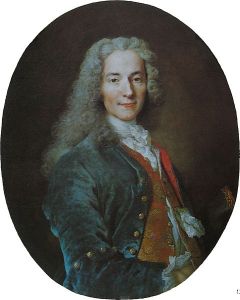
François-Marie Arouet, otherwise known as Voltaire, 1724-5

François-Marie Arouet, otherwise known as Voltaire, 1724-5

Voltaire lodged at the sign of the White Peruke, a fashionable French perruquier’s, in Maiden Lane, Covent Garden. In Swift’s Works (vol. xx of the duodecimo edition, p. 294), there is a letter to him, in English, by Voltaire, and dated from this house. The English seems a little too perfect. There is another following it which looks more authentic. But there is no doubt that Voltaire, while in England, made himself such a master of the language, as to be able to write in it with singular correctness for a foreigner. He was then young. He had been imprisoned in the Bastile for a libel; came over here, on his release; procured many subscriptions for the “Henriade;” published in English “An Essay on Epic Poetry,” and remained some years, during which he became acquainted with the principal men of letters—Pope, Congreve, and Young. He is said to have talked so indecently at Pope’s table (probably no more than was thought decent by the belles in France), that the good old lady, the poet’s mother was obliged to retire. Objecting, at Lord Chesterfield’s table, to the allegories of Milton, Young is said to have accosted him in the well-known couplet:—

Thou art so witty, profligate, and thin,

Thou seem’st a Milton, with his Death and Sin.

But this story has been doubted. Voltaire left England with such a mass of subscriptions for his Henriade as laid the foundation of his fortunes, and with great admiration of English talent and genius, particularly that of Newton and Locke, which, with all his insinuations against our poetry, he took warm pains to extend, and never gave up. He was fond to the last of showing he had not forgotten his English. Somebody telling him that Johnson had spoken well of his talents, he said, in English, “He is a clever fellow;” but the gentleman observing that the doctor did not think well of his religion, he added, “a superstitious dog.”

During his residence in Maiden Lane, there is a story of Voltaire’s having been beset, in one of his walks, by the people, who ridiculed him as a Frenchman. He got upon the steps of a door-way and harangued them in their own language in praise of English liberty and the nation; upon which, the story adds, they hailed him as a fine fellow, and carried him to his lodgings on their shoulders.—Leigh Hunt’s Town.

La Henriade

From Wikipedia:

323px-HenriadeVoltaire

La Henriade is an epic poem of 1723 written by the French Enlightenment writer and philosopher Voltaire. According to Voltaire himself, the poem concerns and was written in honour of the life of Henry IV of France, and is a celebration of his life. The ostensible subject is the siege of Paris in 1589 by Henry III in consort with Henry of Navarre, soon to be Henry IV, but its themes are the twin evils of religious fanaticism and civil discord. It also concerns the political state of France. Voltaire aimed to be the French Virgil, outdoing the master by preserving Aristotelian unity of place—a property of classical tragedy rather than epic—”by keeping the human action confined between Paris and Ivry. It was first printed (under the title La Ligue) in 1723, and reprinted dozens of times within Voltaire’s lifetime.
Voltaire in Great Britain

From Wikipedia:

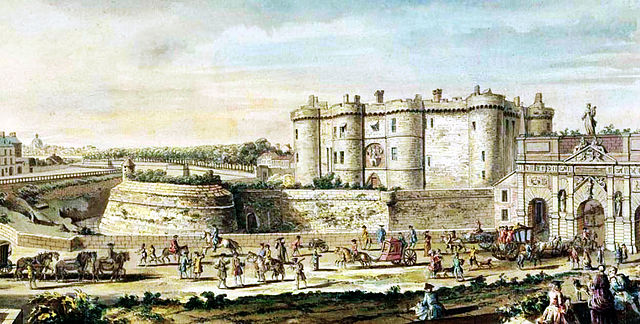
The Bastille, 1715

The Bastille, 1715

In early 1726, a young French nobleman, the chevalier de Rohan-Chabot, taunted Voltaire about his change of name, and Voltaire retorted that his name would be honoured while de Rohan would dishonour his. Infuriated, de Rohan arranged for Voltaire to be beaten up by thugs a few days later. Seeking compensation, redress, or revenge, Voltaire challenged de Rohan to a duel, but the aristocratic de Rohan family arranged for Voltaire to be arrested and imprisoned in the Bastille on 17 April 1726 without a trial or an opportunity to defend himself. Fearing an indefinite prison sentence, Voltaire suggested that he be exiled to England as an alternative punishment, which the French authorities accepted. On 2 May, he was escorted from the Bastille to Calais, where he was to embark for Britain.

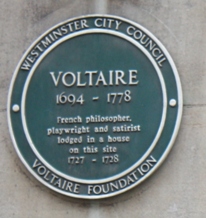
maiden-lane 061-plakette-5In England, Voltaire lived largely in Wandsworth with acquaintances including Everard Fawkener. From December 1727 to June 1728 he lodged at Maiden Lane, Covent Garden, now commemorated by a plaque, to be nearer to his British publisher. Voltaire circulated throughout English high society, meeting Alexander Pope, John Gay, Jonathan Swift, Lady Mary Wortley Montagu, Sarah, Duchess of Marlborough, and many other members of the nobility and royalty. Voltaire’s exile in Great Britain greatly influenced his thinking. He was intrigued by Britain’s constitutional monarchy in contrast to French absolutism, and by the country’s greater support of the freedoms of speech and religion. He was influenced by the writers of the age, and developed an interest in earlier English literature, especially the works of Shakespeare, still relatively unknown in continental Europe. Despite pointing out his deviations from neoclassical standards, Voltaire saw Shakespeare as an example that French writers might emulate, since French drama, despite being more polished, lacked on-stage action. Later, however, as Shakespeare’s influence began growing in France, Voltaire tried to set a contrary example with his own plays, decrying what he considered Shakespeare’s barbarities. Voltaire may have been present at the funeral of Isaac Newton and met Newton’s niece, Catherine Conduitt. In 1727 he published two essays in English, Upon the Civil Wars of France, Extracted from Curious Manuscripts, and Upon Epic Poetry of the European Nations, from Homer Down to Milton.

After two and a half years in exile, Voltaire returned to France, and after a few months living in Dieppe, the authorities permitted him to return to Paris. At a dinner, French mathematician Charles Marie de La Condamine proposed buying up the lottery that was organized by the French government to pay off its debts, and Voltaire joined the consortium, earning perhaps a million livres. He invested the money cleverly and on this basis managed to convince the Court of Finances that he was of good conduct and so was able to take control of a capital inheritance from his father that had hitherto been tied up in trust. He was now indisputably rich.

Further success followed, in 1732, with his play Zaïre, which when published in 1733 carried a dedication to Fawkener that praised English liberty and commerce. At this time he published his views on British attitudes toward government, literature, religion and science in a collection of essays in letter form entitled Letters Concerning the English Nation (London, 1733). In 1734, they were published in French as Lettres philosophiques in Rouen. Because the publisher released the book without the approval of the royal censor and Voltaire regarded the British constitutional monarchy as more developed and more respectful of human rights (particularly religious tolerance) than its French counterpart, the French publication of Letters caused a huge scandal; the book was publicly burnt and banned, and Voltaire was forced again to flee Paris.

Romance of London Series

  1. Romance of London: The Lord Mayor’s Fool… and a Dessert
  2. Romance of London: Carlton House and the Regency
  3. Romance of London: The Championship at George IV’s Coronation
  4. Romance of London: Mrs. Cornelys at Carlisle House
  5. Romance of London: The Bottle Conjuror
  6. Romance of London: Bartholomew Fair
  7. Romance of London: The May Fair and the Strong Woman
  8. Romance of London: Nancy Dawson, the Hornpipe Dancer
  9. Romance of London: Milkmaids on May-Day
  10. Romance of London: Lord Stowell’s Love of Sight-seeing
  11. Romance of London: The Mermaid Hoax
  12. Romance of London: The Bluestocking and the Sweeps’ Holiday
  13. Romance of London: Comments on Hogarth’s “Industries and Idle Apprentices”
  14. Romance of London: The Lansdowne Family
  15. Romance of London: St. Margaret’s Painted Window at Westminster
  16. Romance of London: Montague House and the British Museum
  17. Romance of London: The Bursting of the South Sea Bubble
  18. Romance of London: The Thames Tunnel
  19. Romance of London: Sir William Petty and the Lansdowne Family
  20. Romance of London: Marlborough House and Sarah, Duchess of Marlborough
  21. Romance of London: The Duke of Newcastle’s Eccentricities
  22. Romance of London: Voltaire in London
  23. Romance of London: The Crossing Sweeper
  24. Romance of London: Nathan Mayer Rothschild’s Fear of Assassination
  25. Romance of London: Samuel Rogers, the Banker Poet
  26. Romance of London: The Eccentricities of Lord Byron
  27. Romance of London: A London Recluse

Romance of London: The Duke of Newcastle’s Eccentricities

John Timbs (1801-1875), who also wrote as Horace Welby, was an English author and aficionado of antiquities. Born in Clerkenwell, London, he was apprenticed at 16 to a druggist and printer, where he soon showed great literary promise. At 19, he began to write for Monthly Magazine, and a year later he was made secretary to the magazine’s proprietor and there began his career as a writer, editor, and antiquarian.

This particular book is available at googlebooks for free in ebook form. Or you can pay for a print version.

From Wikipedia:

512px-1stDukeOfNewcastleOld

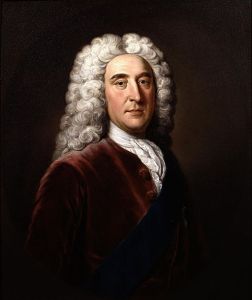
Thomas Pelham-Holles, 1st Duke of Newcastle

Thomas Pelham-Holles, 1st Duke of Newcastle upon Tyne and 1st Duke of Newcastle-under-Lyne KG PC (21 July 1693 – 17 November 1768) was a British Whig statesman, whose official life extended throughout the Whig supremacy of the 18th century. He is commonly known as the Duke of Newcastle.

A protégé of Sir Robert Walpole, he served under him for more than twenty years, until 1742. He held power with his brother, Henry Pelham (the Prime Minister of Great Britain), until 1754. He had at this point served as a Secretary of State continuously for thirty years—dominating British foreign policy.

Walpole gladly welcomed the young Newcastle into his coterie, firstly because he believed he could easily control him, and secondly because it would strengthen his hand against the rival Whig factions. Newcastle joined with Walpole because he, correctly, believed that he was going to dominate British politics for a generation.

Robert Walpole, 1st Earl of Orford

Robert Walpole, 1st Earl of Orford

After Henry’s death the Duke held his late brother’s position for six years, in two separate periods. While his first premiership was not particularly notable, Newcastle precipitated the Seven Years’ War, which would cause his resignation from his high position. After his second term as Prime Minister, he served for a short while in Lord Rockingham’s ministry, before retiring from government. Few politicians in British history matched his skills and industry in using patronage to maintain power over long stretches of time. He was most effective, however, as a deputy to a leader of greater ability, such as Walpole, his brother, or Pitt.

Historian Harry Dickinson says that he became:

notorious for his fussiness and fretfulness, his petty jealousies, his reluctance to accept responsibility for his actions, and his inability to pursue any political objective to his own satisfaction or to the nations profit…. Many modern historians have depicted him as the epitome of unredeemed mediocrity and as a veritable buffoon in office.

The Duke of Newcastle’s Eccentricities

Horace Walpole

Horace Walpole

There is scarcely any public man in our history of whose manners and conversation so many particulars have been preserved, as of the Duke of Newcastle, the well-known leader in the Pelham Administration under George II. Single stories may be unfounded or exaggerated. But all the stories about him, whether told by people who were perpetually seeing him in Parliament, and attending his levées in Lincoln’s Inn Fields, or by Grub Street writers who had never more than a glimpse of his star through the windows of his gilded coach, are of the same character. Horace Walpole and Smollett differed in their tastes and opinions as much as two human beings could differ. They quite different society. Walpole played at cards with countesses, and corresponded with ambassadors. Smollett passed his life surrounded by printers’ devils and famished scribblers. Yet, Walpole’s Duke and Smollett’s Duke are as like as if they were both from one hand. Smollett’s Newcastle runs out of his dressing-room, with his face covered with soap-suds, to embrace the Moorish envoy. Walpole’s Newcastle pushes his way into the Duke of Grafton’s sick-room to kiss the old nobleman’s plasters. No man was so unmercifully satirised. But in truth he was himself a satire ready made. All that the art of the satirist does for other men, nature had done for him. Whatever was absurd about him, stood out with grotesque prominence from the rest of the character. He was a living, moving, talkng caricature. His gait was a shuffling trot; his utterance a rapid stutter; he was always in a hurry; he was never in time; he abounded in fulsome caresses and hysterical tears. His oratory resembled that of Justice Shallow. It was nonsense effervescent with animal spirits and impertinence. Of his ignorance many anecdotes remain, some well authenticated, some probably invented at coffee-houses, but all exquisitely characteristic:—”Oh—yes—yes—to be sure—Annapolis must be defended—troops must be sent to Annapolis—Pray where is Annapolis?”—”Cape Breton an island! wonderful!—show it me in the map. So it is, sure enough. My dear sir, you always bring us good news. I must go and tell the King that Great Britain is an island.”

And this man was, during near thirty years, Secretary of State, and during near ten years, First Lord of the Treasury! His large fortune, his strong hereditary connections, his great parliamentary interest, will not alone explain this extraordinary fact. His success is a signal instance of what may be effected by a man who devotes his whole heart and soul, without reserve, to one object. He was eaten up by ambition. He was greedy after power with a greediness all his own. He was jealous of all his colleagues, and even of his own brother. Under the disguise of levity he was false eyond all example of political falsehood. All the able of men of his time ridiculed him as a dunce, a driveller, a child who never knew his own mind for an hour together; and he overreached them all round.—Lord Macaulay, on Walpole’s Letters.

Romance of London Series

  1. Romance of London: The Lord Mayor’s Fool… and a Dessert
  2. Romance of London: Carlton House and the Regency
  3. Romance of London: The Championship at George IV’s Coronation
  4. Romance of London: Mrs. Cornelys at Carlisle House
  5. Romance of London: The Bottle Conjuror
  6. Romance of London: Bartholomew Fair
  7. Romance of London: The May Fair and the Strong Woman
  8. Romance of London: Nancy Dawson, the Hornpipe Dancer
  9. Romance of London: Milkmaids on May-Day
  10. Romance of London: Lord Stowell’s Love of Sight-seeing
  11. Romance of London: The Mermaid Hoax
  12. Romance of London: The Bluestocking and the Sweeps’ Holiday
  13. Romance of London: Comments on Hogarth’s “Industries and Idle Apprentices”
  14. Romance of London: The Lansdowne Family
  15. Romance of London: St. Margaret’s Painted Window at Westminster
  16. Romance of London: Montague House and the British Museum
  17. Romance of London: The Bursting of the South Sea Bubble
  18. Romance of London: The Thames Tunnel
  19. Romance of London: Sir William Petty and the Lansdowne Family
  20. Romance of London: Marlborough House and Sarah, Duchess of Marlborough
  21. Romance of London: The Duke of Newcastle’s Eccentricities
  22. Romance of London: Voltaire in London
  23. Romance of London: The Crossing Sweeper
  24. Romance of London: Nathan Mayer Rothschild’s Fear of Assassination
  25. Romance of London: Samuel Rogers, the Banker Poet
  26. Romance of London: The Eccentricities of Lord Byron
  27. Romance of London: A London Recluse

Romance of London: Marlborough House and Sarah, Duchess of Marlborough

Romance of London: Strange Stories, Scenes And Remarkable Person of the Great Town in 3 Volumes

John Timbs

John Timbs (1801-1875), who also wrote as Horace Welby, was an English author and aficionado of antiquities. Born in Clerkenwell, London, he was apprenticed at 16 to a druggist and printer, where he soon showed great literary promise. At 19, he began to write for Monthly Magazine, and a year later he was made secretary to the magazine’s proprietor and there began his career as a writer, editor, and antiquarian.

This particular book is available at googlebooks for free in ebook form. Or you can pay for a print version.

About the Churchills

John_Churchill_in_his_thirties

John Churchill, 1st Duke of Marlborough, was a great military hero who reaped many honors and financial rewards from his service to five English monarchs. His wife Sarah was an intimate friend of Queen Anne… until Sarah’s hot temper and conceit earned her dismissal from court. For more about Sarah, Duchess of Marlborough, check out this article in Wikipedia.

Queen Anne (1705)

Queen Anne (1705)

Marlborough House

Marlborough_House_-_superior_version

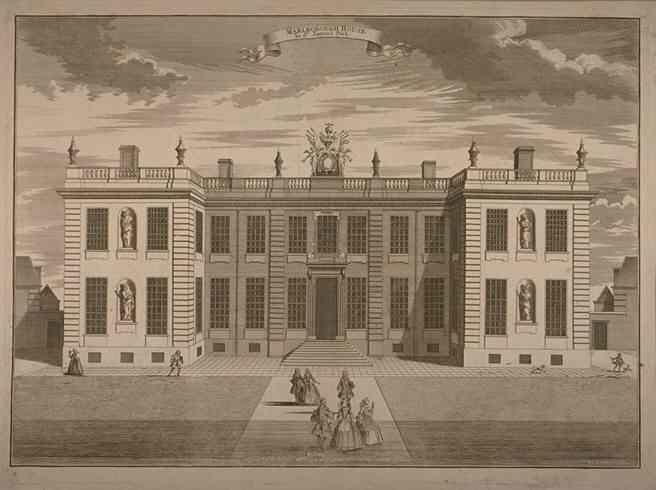
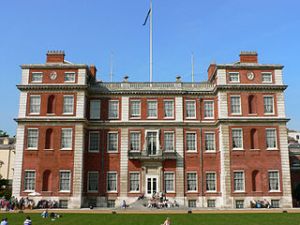
Little can be said, architecturally, of Marlborough House, notwithstanding it was designed by Sir Christopher Wren, who was employed, not because he was preferred, but that Vanbrugh might be vexed. Respecting Marlborough House, Pennant says

To the east of St. James’s Palace, in the reign of Queen Anne, was built Marlborough House, at the expense of the public. It appears by one of the views of St. James’s, published before the existence of this house, that it was built in part of the Royal Gardens, granted for that purpose by her Majesty. The present Duke [Pennant writes in 1793] added an upper story, and improved the ground floor, which originally wanted a great room. This national compliment cost no less than 40,000l.

As regards the site, Pennant’s account is corroborated by other authorities, who say that the mansion of the famous John Churchill was built on ground “which had been used for keeping pheasants, guinea-hens, partridges, and other fowl, and on that piece of ground taken out of St. James’s Park, then in possession of Henry Boyle, one of her Majesty’s principal Secretaries of State.”

Entry to a Drawing Room at Marlborough House (1871)

Entry to a Drawing Room at Marlborough House (1871)

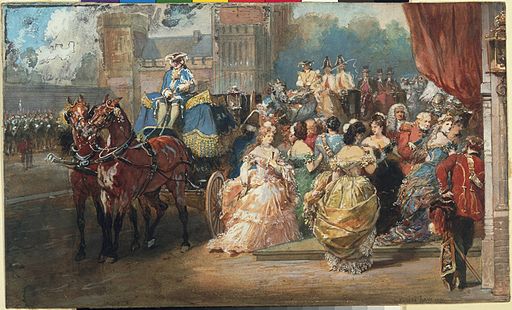
The Duchess both experienced and caused great mortifications here. She used to speak of the King in the adjacent palace as her “neighbor George.” The entrance to the house from Pall Mall was, as it still is, a crooked and inconvenient one. To remedy this defect, she intended to purchase some houses… for the purpose of pulling them down and constructing a more commodious entry to the mansion; but Sir Robert Walpole [whom she considered to be her greatest enemy], with no more dignified motive than mere spite, secured the houses and ground, and erected buildings [there], which… blocked in the front of the Duchess’ mansion. She was subjected to a more temporary, but as inconvenient blockade, when the preparations for the wedding of the imperious Princess Anne [does Timbs mean Mary?] and her ugly husband, the Prince of Orange, was going on. Among other preparations, a boarded gallery, through which the nuptial procession was to pass, was built up close against the Duchess’ windows, completely darkening her rooms. As the boards remained there during the postponement of the ceremony, the Duchess used to look at them with the remark, “I wish the Princess would oblige me by taking away her ‘orange chest!'”*

320px-Marlborough_House

Note: Currently the home of the Commonwealth Secretariat, the house is usually open to the public for Open House Weekend each September.

The Character of the Duchess

Sarah, Duchess of Marlborough

Sarah, Duchess of Marlborough

From the Memoirs of Mrs. Delany:

The conversation turned upon the famous Duchess of Marlborough: among others, one striking anecdote, that though she appeared affected in the highest degree at the death of her grand-daughter, the Duchess of Bedford, she sent the day after she died for the jewels she had given her, saying ‘she had only lent them;’ the answer was that she ‘had said she would never demand those jewels again except she danced at court;‘ her answer was ‘then she would be —- if she would not dance at court,’ &c. … She used to say that she was very certain she should go to heaven, and as her ambition went even beyond the grave, that she knew she should have one of the highest seats.

A few of the Duchess’ eccentricities and extravagancies have been put together somewhat in the humorous manner of our early story-books, as follows:

This is the woman who wrote the characters of her contemporaries with a pen dipped in gall and wormwood. This is the Duchess who gave 10,000l to Mr. Pitt for his noble defense of the constitution of his country! … This is the Duchess who, in her old age, used to feign asleep after dinner, and say bitter things at table pat and appropriate, but as if she was not aware of what was going on! This is the lady who drew that beautiful distinction that it was wrong to wish Sir Robert Walpole dead, but only common justice to wish him well hanged. This is the Duchess who tumbled her thoughts out as they arose, and wrote like the wife of the Great Duke Marlborough. This is the lady who quarreled with a wit upon paper (Sir John Vanbrugh), and actually got the better of him in the long run; who shut out the architect of Blenheim from seeing his own edifice, and made him dangle his time away at an inn while his friends were shown the house of the eccentric Sarah.

This is the Duchess who, ever proud and ever malignant, was persuaded to offer her favorite grand-daughter, Lady Diana Spencer, afterwards Duchess of Bedford, to the Prince of Wales, with a fortune of a hundred thousand pounds. He accepted the proposal and the day was fixed for their being secretly married at the Duchess’ Lodge, in the Great Park, at Windsor. Sir Robert Walpole got intelligence of the project, prevented it, and the secret was buried in silence.

This is the Duchess—The wisest fool much time has ever made—who refused the proffered hand of the proud Duke of Somerset, for the sole and sufficient reason that no one should share her heart with the great Duke of Marlborough.

This is the illustrious lady who superintended the building of Blenheim, examined contracts and tenders, talked with carpenters and masons, and thinking sevenpence-halfpenny a bushel for lime too much by a farthing, waged a war to the knife on so small a matter.

This is the celebrated Sarah, who, at the age of eighty-four, when she was told she must either submit to be blistered or die, exclaimed in anger, and with a start in bed, “I won’t be blistered, and I won’t die!”

The Duchess died, notwithstanding what she said, at Marlborough House, in 1774.

*Dr. Doran’s Queens of England—House of Hanover


Romance of London Series

  1. Romance of London: The Lord Mayor’s Fool… and a Dessert
  2. Romance of London: Carlton House and the Regency
  3. Romance of London: The Championship at George IV’s Coronation
  4. Romance of London: Mrs. Cornelys at Carlisle House
  5. Romance of London: The Bottle Conjuror
  6. Romance of London: Bartholomew Fair
  7. Romance of London: The May Fair and the Strong Woman
  8. Romance of London: Nancy Dawson, the Hornpipe Dancer
  9. Romance of London: Milkmaids on May-Day
  10. Romance of London: Lord Stowell’s Love of Sight-seeing
  11. Romance of London: The Mermaid Hoax
  12. Romance of London: The Bluestocking and the Sweeps’ Holiday
  13. Romance of London: Comments on Hogarth’s “Industries and Idle Apprentices”
  14. Romance of London: The Lansdowne Family
  15. Romance of London: St. Margaret’s Painted Window at Westminster
  16. Romance of London: Montague House and the British Museum
  17. Romance of London: The Bursting of the South Sea Bubble
  18. Romance of London: The Thames Tunnel
  19. Romance of London: Sir William Petty and the Lansdowne Family
  20. Romance of London: Marlborough House and Sarah, Duchess of Marlborough
  21. Romance of London: The Duke of Newcastle’s Eccentricities
  22. Romance of London: Voltaire in London
  23. Romance of London: The Crossing Sweeper
  24. Romance of London: Nathan Mayer Rothschild’s Fear of Assassination
  25. Romance of London: Samuel Rogers, the Banker Poet
  26. Romance of London: The Eccentricities of Lord Byron
  27. Romance of London: A London Recluse

Jessica Cale: How Royal Copenhagen Conquered Europe

Eighteenth Century Porcelain: How Royal Copenhagen Conquered Europe

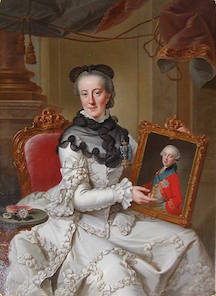
13509851_263614374004128_2085781765_oThe Royal Porcelain Factory (Den Kongelige Porcelænsfabrik), better known as Royal Copenhagen, was founded in a converted post office in Copenhagen on May 1st, 1775 under the protection of Queen Juliane Marie. Although porcelain had been made in Germany since 1710, it was not produced in Denmark until chemist Frantz Heinrich Müller developed a method for its manufacture in 1774. Juliane Marie had an interest in mineralogy and porcelain was a family passion: both her brother, Charles I of Brunswick-Wolfenbüttel, and sister, who was married to Frederik II of Prussia, had founded porcelain factories in Germany.

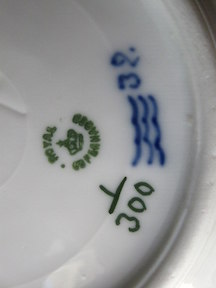
The factory’s first pieces were dining sets for the royal family. Juliane Marie insisted each piece be stamped with the factory’s mark, three wavy lines that symbolized Denmark’s three straights–the Øresund, the Great Belt and the Little Belt–as well as the royal crown stamp to highlight the firm’s royal connections. Each piece is marked this way to this day.

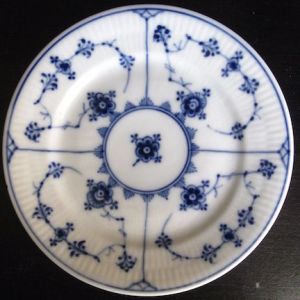
Blue and white china became popular across Europe as early as the seventeenth century with the import of goods from the far east. The fine porcelain of China’s Ming and Qing dynasties sparked an enduring love for floral patterns in blue and white and Royal Copenhagen quickly developed their own. Blue Fluted Plain (Danish: Musselmalet) was their first pattern and at more than two hundred fifty years old, it is the world’s oldest china pattern still in production.

13467665_263614317337467_432371625_oBlue Fluted Plain was inspired by Chinese floral patterns and updated to include flowers native to Denmark. Cinquefoils were added to the stylized chrysanthemums to give the pattern a more Nordic appearance. The ultramarine blue pigment in the paint was originally purchased from the Blaafarveværket (“blue colour factory”) in Norway, a company that provided up to eighty percent of the world’s cobalt during the nineteenth century. Each piece was and continues to be hand-painted by blue painters who spend at least four years in training for the position.

Since its development in 1775, Blue Fluted Plain has appeared on more than two thousand different pieces and has inspired countless imitations. It reached the height of its popularity in the early nineteenth century and appeared on everything from tea cups to washbasins and chamber pots.

Lord Nelson brought Royal Copenhagen porcelain back for his mistress, Lady Hamilton, following the Danish defeat at the Battle of Copenhagen in 1801. While Denmark lost that particular battle, Royal Copenhagen’s invasion of Britain was a success. It qualified for London’s World Expo in 1851 and gained international fame by winning the grand prize at Paris’ World Expo in 1889.

13509748_263614310670801_2069635372_oThis pattern has also appeared in some well-researched historical films and television shows, so not only does the pattern “look right” for the period, but even newer pieces are historically accurate for any time after 1775. You can still find pieces in this pattern to this day, so if you would like to add a little eighteenth century elegance to your kitchen or a touch of the Regency to your cup of tea, look for Royal Copenhagen’s Blue Fluted Plain.

Note: For more images or shopping information, Replacements Ltd. has a spectacular assortment of pieces in this pattern here: http://www.replacements.com/webquote/rcoblfp.htm

About The Long Way Home

The Long Way Home, Book 3 in The Southwark Saga is a magical, adult fairy tale that will keep you entertained from start to finish. Find out what happens when a paranoid king, a poison plot, and hideous shoes prove… it’s not easy being Cinderella!

coverAfter saving the life of the glamorous Marquise de Harfleur, painfully shy barmaid Alice Henshawe is employed as the lady’s companion and whisked away to Versailles. There, she catches King Louis’ eye and quickly becomes a court favorite as the muse for Charles Perrault’s Cinderella. The palace appears to be heaven itself, but there is danger hidden beneath the façade and Alice soon finds herself thrust into a world of intrigue, murder, and Satanism at the heart of the French court.

Having left his apprenticeship to serve King Charles as a spy, Jack Sharpe is given a mission that may just kill him. In the midst of the Franco-Dutch war, he is to investigate rumors of a poison plot by posing as a courtier, but he has a mission of his own. His childhood friend Alice Henshawe is missing and he will stop at nothing to see her safe. When he finds her in the company of the very people he is meant to be investigating, Jack begins to wonder if the sweet girl he grew up with has a dark side.

When a careless lie finds them accidentally married, Alice and Jack must rely on one another to survive the intrigues of the court. As old affection gives way to new passion, suspicion lingers. Can they trust each other, or is the real danger closer than they suspect?

AmazonBarnes & NobleKoboiBooks

About the Author

jessicaJessica Cale is a historical romance author, a Bluestocking Belle, and a journalist based in North Carolina. Originally from Minnesota, she lived in Wales for several years where she earned a BA in History and an MFA in Creative Writing while climbing castles and photographing mines for history magazines. She kidnapped (“married”) her very own British prince (close enough) and is enjoying her happily ever after with him in a place where no one understands his accent. You can visit her at www.authorjessicacale.com.

Her series, The Southwark Saga, is available now. You can visit her at www.dirtysexyhistory.com.


Nicole Zoltack: Loving Outside of Your Class

Back in the day, and even nowadays, people look down on certain relationships, especially if the people involved are from different classes. How can a duke or other titled person fall for someone outside of the ton? A movie star and a nobody? An actor and a musician? (Okay, I’m sour about the rumors of Tom Hiddleston and Taylor Swift, I’ll admit it.)

vauxhall

During the Regency era, aristocrats weren’t supposed to marry from other classes. Money, land, reputation, politics… they were what drove marriage for the upper crust. For the working class—the servants, maids, housekeepers, soldiers, etc—marriage was very important. Their parents had less of a say in whom they married, and they were a little more autonomous; however that was only within their own class, of course.

If a handmaid were to fall for a viscount… if a stablehand were to love a lady, most likely, it would not have played out well in real life, but what’s the fun in that?

lowerclasses

My series, Beyond Boundaries, is specifically about couples who fall in love despite obstacles like class.

If you were a lady back in the Regency, do you think you would ever consider someone outside of your class despite what your parents wish for you, despite the opinions of your friends and peers? I like to think I would!

About Masked Love (Beyond Boundaries #1)

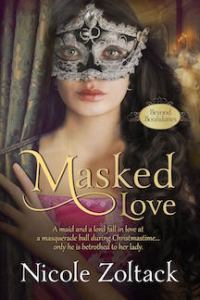
maskedloveIsabelle will do anything for her lady, even accompany her to a masquerade ball. Lady Theodosia needs extra support for tomorrow she will meet the man her par-ents have pledged her to.

Meeting an enchanting young man during the course of the evening makes Isabelle wish for a life she can never have. Imagine her shock when he shows up the next morning, announcing his claim on Lady Thedosia.

Torn between duty and desire, Isabelle hopes for something more this Christmas.

Amazon

13446322_867608668635_2112547213_o

Starry Love (Beyond Boundaries #2)

With the Season rapidly approaching, Lady Elizabeth is ready to make her match until her father is stricken deathly ill. Her mother is desperate and hails for doctors, surgeons, even apothecaries. The upkeep of the house falls on Elizabeth, and she spend long hours beside her father, watching as he betters one day and fares worse on others. Long walks with the stable hand Callum on starry nights save Elizabeth’s sanity.

When the inevitable happens, Lady Elizabeth is forced to go to London. The gentlemen there, however, hold no candle to the kind and caring Scottish Callum.

Shortly before her father’s death, Callum returned to his homeland to try and find a cure for her father. As time passes with no word, no letters, Elizabeth must choose whether the love that blossomed between them is worth denying the man her mother wishes for her.

Amazon

About the Author

nicole photoNicole Zoltack loves to write in many genres, especially romance, whether fantasy, paranormal, or regency. She’s also an editor for MuseItUp Publishing and works as a freelance editor.

When she’s not writing about gentlemen and their ladies, knights, superheroes, or witches, she loves to spend time with her loving husband, three energetic young boys, and precious baby girl. She enjoys riding horses (pretending they’re unicorns, of course!) and going to the PA Renaissance Faire, dressed in garb. She’ll also read anything she can get her hands on. Her current favorite TV shows are The Walking Dead and Arrow.

To learn more about Nicole and her work, visit her blog at http://NicoleZoltack.blogspot.com. She can be found on most any social media site under Nicole Zoltack. Stalk away!