Archives

Romance of London: The Crossing Sweeper

Romance of London: Strange Stories, Scenes And Remarkable Person of the Great Town in 3 Volumes

John Timbs

John Timbs (1801-1875), who also wrote as Horace Welby, was an English author and aficionado of antiquities. Born in Clerkenwell, London, he was apprenticed at 16 to a druggist and printer, where he soon showed great literary promise. At 19, he began to write for Monthly Magazine, and a year later he was made secretary to the magazine’s proprietor and there began his career as a writer, editor, and antiquarian.

This particular book is available at googlebooks for free in ebook form. Or you can pay for a print version.
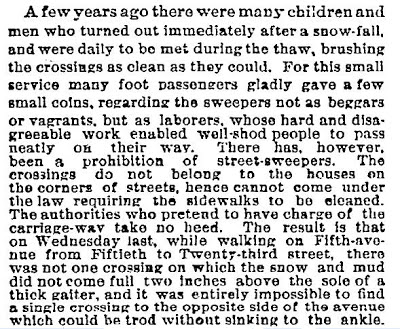
article

What is a Crossing Sweeper?

From Wikipedia:

Crossing sweepers were a common sight on the streets of large cities during much of the 19th century. The predominance of horse-drawn vehicles—and the general uncleanliness of urban streets—entailed certain difficulties in crossing intersections. For example, the long dresses of many elite women might easily be soiled by horse droppings (among other forms of refuse). Crossing sweepers, by sweeping the pavement ahead of a person crossing the street and creating a path that was referred to as a “broom walk,” thus offered a service, particularly to the more affluent.

A-crossing-sweeper-clearing-the-street-for-a-fashionably-dressed-woman

A Remarkable Tale

The Rev. Samuel Bache, Minister of the New Meeting House, Birmingham, received the following very remarkable story from a venerable friend, one of the principal members of his congregation, some five-and-twenty years hence.
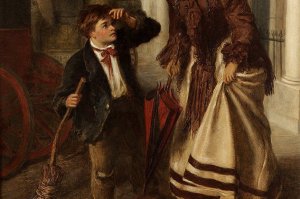
child sweeper

The late Mr. Simcox, of Harbourne, near Birmingham, who was largely engaged in the nail trade, in one of his visits to London, on business, was suddenly overtaken by a heavy shower of rain, from which he sought shelter under an archway: the rain continued for a long time with unabated violence, and he was, consequently, obliged to remain his place of shelter. He was soon agreeably surprised by a footman approaching with an umbrella, with his master’s compliments, and that he had observed the gentleman standing so long under the archway, that he feared he might take cold, and therefore would be glad if he would come and take shelter in his house—an invitation which Mr. Simcox gladly accepted. He was ushered into a drawing-room, where the master of the house was sitting, and he received from him a friendly welcome.
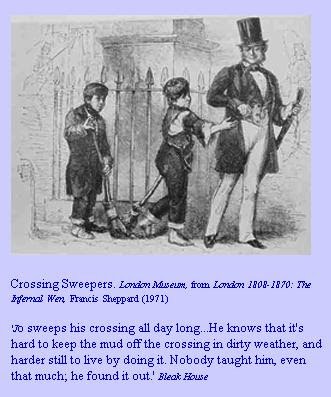
crossing+sweepers

Scarcely, however, had Mr. Simcox set eyes on his host, than he was struck with a vague remembrance of having seen him before; but where, or under what circumstances, he was altogether unable to call to mind. “You seem, sir,” said he, “to look at me as though you had seen me before.” Mr. Simcox acknowledged that his host was right in his conjectures, but confessed his entire inability to recall the occasion. “You are right, sir,” said the old gentleman; “and if you will pledge your word as a man of honour to keep my secret, and not to disclosed to anyone what I am now going to tell you until you have seen the notice of my death in the London papers, I have no objection to remind you where and how you have known me.”

In St. James’s Park, near Spring Gardens, you may pass every day an old man, who sweeps a crossing there, and whose begging is attended by this strange peculiarity—that whatever be the amount of the alms bestowed on him, he will retain only a halfpenny, and scrupulously return to the donor all the rest. Such an unusual proceeding naturally excites the curiosity of those who hear of it; and anyone who has himself made the experiment, when he happens to be walking by with a friend, is almost sure to say to him, ‘Do you see that old fellow there? He is the strangest beggar you ever saw in your life. If you give him sixpence, he will be sure to give you fivepence-halfpenny back again.’ Of course, his friend makes the experiment, which turns out as predicted; and as crowds of people are constantly passing, there are numbers of persons every day who make the same trial; and thus the old man gets many a halfpenny from the curiosity of the passers by, in addition to what he obtains from their compassion.”

“I, sir,” continued the old gentleman, “am that beggar. Many years ago, I first hit upon the expedient for the relief of my then pressing necessities; for I was at that time utterly destitute; but finding the scheme answer beyond my expectations, I was induced to carry it on until I had at last, and with the aid of profitable investment, realized a handsome fortune, enabling me to live in the comfort in which you find me this day. And now, sir, such is the force of habit, that, thought I am no longer under any necessity for continuing this plan, I find myself quite unable to give it up; and, accordingly, every morning I leave home, apparently for business purposes, and go to a room, where I put on my old beggar’s clothes, and continue sweeping my crossing in the park till a certain hour in the afternoon, when I go back to my room, resume my usual dress, and return home in time for dinner, as you see me this day.”

Mr. Simcox, as a gentleman and a man of honour, scrupulously fulfilled his pledge; but having seen in the London papers the announcement of the beggar’s death, he then communicated this strange story. The name of this eccentric person is not known; but the incidents are recollected by more than one narrator.
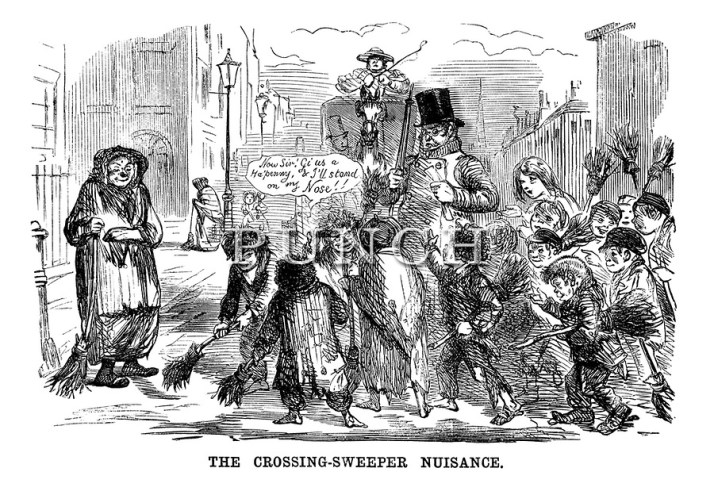
The crossing-sweeper nuisance.

Crossing-sweeping as a Career Choice?

Apparently some sweepers, even without gimmicks, made a good living from it.

The produce of a street crossing in London is sometimes considerable. At an inquest held on the body of a crossing sweeper, who had died suddenly, Mr. Wakley, the coroner, said that the sweeper of a crossing sold his interest in it for 40l. A juror observed that crosswings were freehold, by which many proprietors amassed, in former days, sums of 500l, 1,000l, 4,000l. Another juror alluded to the sweeper of the crossing at Bridge Street, Blackfriars, who bequeathed a large sum to Miss Waithman (daughter of the alderman) in gratitude for her benevolence in giving him his dinner every Sunday; and another gentleman said that the sweeper of a crossing near Hyde Park bequeathed 1,000l to a gentleman who was in the habit of giving him 6d whenever he passed his crossing.

Romance of London Series

  1. Romance of London: The Lord Mayor’s Fool… and a Dessert
  2. Romance of London: Carlton House and the Regency
  3. Romance of London: The Championship at George IV’s Coronation
  4. Romance of London: Mrs. Cornelys at Carlisle House
  5. Romance of London: The Bottle Conjuror
  6. Romance of London: Bartholomew Fair
  7. Romance of London: The May Fair and the Strong Woman
  8. Romance of London: Nancy Dawson, the Hornpipe Dancer
  9. Romance of London: Milkmaids on May-Day
  10. Romance of London: Lord Stowell’s Love of Sight-seeing
  11. Romance of London: The Mermaid Hoax
  12. Romance of London: The Bluestocking and the Sweeps’ Holiday
  13. Romance of London: Comments on Hogarth’s “Industries and Idle Apprentices”
  14. Romance of London: The Lansdowne Family
  15. Romance of London: St. Margaret’s Painted Window at Westminster
  16. Romance of London: Montague House and the British Museum
  17. Romance of London: The Bursting of the South Sea Bubble
  18. Romance of London: The Thames Tunnel
  19. Romance of London: Sir William Petty and the Lansdowne Family
  20. Romance of London: Marlborough House and Sarah, Duchess of Marlborough
  21. Romance of London: The Duke of Newcastle’s Eccentricities
  22. Romance of London: Voltaire in London
  23. Romance of London: The Crossing Sweeper
  24. Romance of London: Nathan Mayer Rothschild’s Fear of Assassination
  25. Romance of London: Samuel Rogers, the Banker Poet
  26. Romance of London: The Eccentricities of Lord Byron
  27. Romance of London: A London Recluse
Vanessa Kelly: My Fair Princess (Giveaway)

My Fair Princess 2 copy

Thanks so much for hosting me on your blog today—it’s a pleasure to be here with you and your readers, Susana!

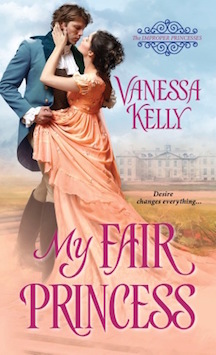
With My Fair Princess, I’m thrilled to be introducing a new historical romance series called The Improper Princesses. It’s Regency-set, and it’s a spin-off from my previous series, The Renegade Royals. Both are grounded in a specific historical element—the rather outrageous love lives of the sons of King George III.

The term “Regency rake” could very well have been coined for the Prince Regent and his royal brothers. They lived large (literally and figuratively), gambling, drinking, and engaging in numerous sexual affairs. The Prince Regent, later George IV, took several mistresses, which included actresses (one of whom he secretly married), and possibly fathered up to four illegitimate children.

The Duke of York also had several by-blows, perhaps as many as five, and the Duke of Clarence (later William IV) sired ten children with his mistress, Mrs. Jordan. I could go on, but you get the picture! As you can see, in developing a series based on this topic I had plenty of material to work with. Even better, very little—if anything—was known about many of these children, which left plenty of leeway in creating my fictional characters.

In The Renegade Royals I featured heroes who were the illegitimate sons of England’s princes. The Improper Princesses, however, features the illegitimate daughters in the starring roles. As challenging as the “stain” of illegitimacy was for male children, just imagine what it would have been like for females born of illicit relationships during that era. Plenty of room for drama and conflict in their stories!

The heroine of My Fair Princess is Gillian Dryden, the product of a relationship between the notorious Duke of Cumberland and a young widow. Gillian was basically raised in exile in Sicily, where she grew up as a tomboy. She’s a crack shot, a terrific rider, and carries knives in her boots. Gillian also developed the unfortunate hobby of hunting bandits who terrorized the countryside and were responsible for the death of her beloved stepfather.

Because of this risky avocation, Gillian’s family deems it time for her to return home to England, where she can learn to be a proper lady and find a respectable husband. The man tasked with this challenge is Charles Penley, the Duke of Leverton, who happens to be the most polite and sophisticated man in London.

Let’s just say that Charles has his work cut out for him, and let’s also say that Gillian’s training and transformation don’t go exactly as planned!

I had great fun writing this book, and I really enjoyed grounding the story in a small part of the lives of England’s princes. In this case, the truth was definitely more outrageous than fiction!

Are you a fan of real-life historical characters in your historical romance? Can there be too much history in romance? Two people who comment will win signed, print copies of How to Marry a Royal Highlander, the 4th book in The Renegade Royals Series.

About My Fair Princess

First, Vanessa Kelly brought readers The Renegade Royals. Now, in a delightfully witty new series, she introduces The Improper Princesses—three young women descended from royalty, each bound for her own thrilling adventure . . .

Despite being the illegitimate daughter of a prince, Gillian Dryden is happily ignorant of all social graces. After growing up wild in Italy, Gillian has been ordered home to England to find a suitable husband. And Charles Valentine Penley, the excessively proper, distractingly handsome Duke of Leverton, has agreed to help transform her from a willful tomboy to a blushing debutante.

Powerful and sophisticated, Charles can make or break reputations with a well-placed word. But his new protégée, with her habit of hunting bandits and punching earls, is a walking scandal. The ton is aghast . . . but Charles is thoroughly intrigued. Tasked with taking the hoyden in hand, he longs to take her in his arms instead. Can such an outrageous attraction possibly lead to a fairytale ending?

AmazonBarnes & NobleKoboiBooks

IndieBoundThe Book Depository

Excerpt

http://www.vanessakellyauthor.com/books/my-fair-princess/excerpt-my-fair-princess/

About the Author

IMG_0031 copyVanessa Kelly is an award-winning author who was named by Booklist, the review journal of the American Library Association, as one of the “New Stars of Historical Romance.”  Her Regency-set historical romances have been nominated for awards in a number of contests, and her second book, Sex and The Single Earl, won the prestigious Maggie Medallion for Best Historical Romance. The Renegade Royals, her last series, was a national bestseller. Vanessa also writes contemporary romance with her husband as VK Sykes.

BlogWebsiteTwitterFacebook

Susana’s Adventures in England: Syon House

syonpark

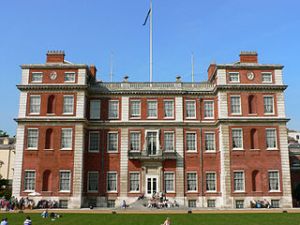
If you’re looking for a stately home to visit in or near London, Syon House is a great choice. Located on the Thames across from Kew Gardens, you can get there by Underground (take the District line toward Richmond, get off at Gunnarsbury) and bus, (take the 237 or 267 bus to Brentlea). The pedestrian entrance is on your right when you get off the bus).

Syon House history

Syon began as an abbey, founded in 1415 by Henry V and closed in 1539 by the Dissolution of the Monasteries. Catherine Howard, fifth wife of Henry VIII, was imprisoned here prior to her execution in 1542. The 1st Duke of Somerset acquired it and had it renovated in Italian Renaissance style. In 1594, the 9th Earl of Northumberland acquired it and has owned it ever since.

A Royal Row

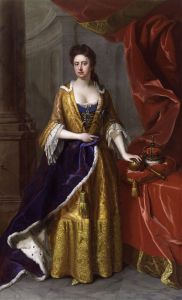
Queen Anne (1705)

Queen Anne (1705)

(from Wikipedia)

In the late 17th century, Syon was in the possession of Charles Seymour, 6th Duke of Somerset, through his wife, Elizabeth Seymour (née Percy). After the future Queen Anne had a disagreement with her sister, Mary II (wife of William III, also known as William of Orange), over her friendship with Sarah Churchill, Countess of Marlborough, she was evicted from her court residence at the Palace of Whitehall and stayed at Syon with her close friends, the Somersets, in 1692. Anne gave birth to a stillborn child there. Shortly after the birth, Mary came to visit her, again demanding that Anne dismiss the Countess of Marlborough and stormed out again when Anne flatly refused.

Mary II, 1685

Mary II, 1685

In the 18th century, Hugh Percy, 1st Duke of Northumberland, commissioned architect and interior designer Robert Adam and landscape designer Lancelot “Capability” Brown to redesign the house and estate. Work began on the interior reconstruction project in 1762. Five large rooms on the west, south and east sides of the House, were completed before work ceased in 1769. A central rotunda, which Adams had intended for the interior courtyard space, was not implemented, due to cost.

Robert Adam!

Robert Adam's plan for Syon House

Robert Adam’s plan for Syon House

from Wikipedia:

Syon House’s exterior was erected in 1547 while under the ownership of the 1st Duke of Somerset. Syon’s current interior was designed by Robert Adam in 1762 under the commission of the 1st Duke and Duchess of Northumberland.

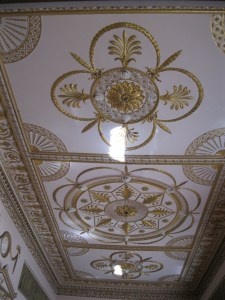
coloredceilingcornerThe well known “Adam style” is said to have begun with Syon House. It was commissioned to be built in the Neo-classical style, which was fulfilled, but Adam’s eclectic style doesn’t end there. Syon is filled with multiple styles and inspirations including a huge influence of Roman antiquity, highly visible Romantic, Picturesque, Baroque and Mannerist styles and a dash of Gothic. There is also evidence in his decorative motifs of his influence by Pompeii that he received while studying in Italy. Adam’s plan of Syon House included a complete set of rooms on the main floor, a domed rotunda with a circular inner colonnade meant for the main courtyard (‘meant for’ meaning that this rotunda was not built due to a lack of funds), five main rooms on the west, east and south side of the building, a pillared ante-room famous for its colour, a Great Hall, a grand staircase (though not built as grand as originally designed) and a Long Gallery stretching 136 feet long. Adam’s most famous addition is the suite of state rooms and as such they remain exactly as they were built.

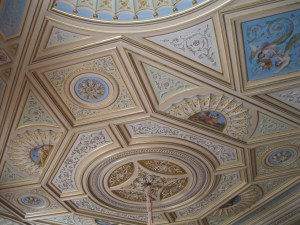
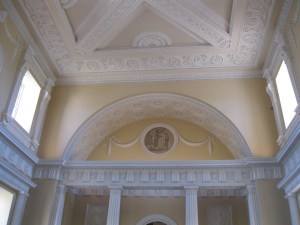
geometricceiling2More specific to the interior of Adam’s rooms is where the elaborate detail and colour shines through. Adam added detailed marble chimneypieces, shuttering doors and doorways in the Drawing Room, along with fluted columns with Corinthian capitals. The long gallery, which is about 14 feet high and 14 feet wide, contains many recesses and niches into the thick wall for books along with rich and light decoration and stucco-covered walls and ceiling. At the end of the gallery is a closet with a domed circle supported by eight columns; halfway through the columns is a doorway imitating a niche.

More photos on my Syon Park Pinterest Page: https://www.pinterest.com/susanaauthor/syon-park/

ceilingalcove

corner3

goldturquoisecorner

librarybooks&portraits

beautifulvase

delicategoldceiling

Romance of London: Voltaire in London

Romance of London: Strange Stories, Scenes And Remarkable Person of the Great Town in 3 Volumes

John Timbs

John Timbs (1801-1875), who also wrote as Horace Welby, was an English author and aficionado of antiquities. Born in Clerkenwell, London, he was apprenticed at 16 to a druggist and printer, where he soon showed great literary promise. At 19, he began to write for Monthly Magazine, and a year later he was made secretary to the magazine’s proprietor and there began his career as a writer, editor, and antiquarian.

This particular book is available at googlebooks for free in ebook form. Or you can pay for a print version.

Voltaire in London

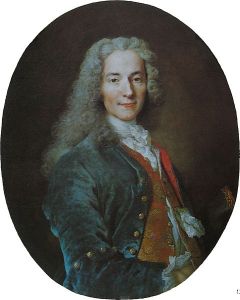
François-Marie Arouet, otherwise known as Voltaire, 1724-5

François-Marie Arouet, otherwise known as Voltaire, 1724-5

Voltaire lodged at the sign of the White Peruke, a fashionable French perruquier’s, in Maiden Lane, Covent Garden. In Swift’s Works (vol. xx of the duodecimo edition, p. 294), there is a letter to him, in English, by Voltaire, and dated from this house. The English seems a little too perfect. There is another following it which looks more authentic. But there is no doubt that Voltaire, while in England, made himself such a master of the language, as to be able to write in it with singular correctness for a foreigner. He was then young. He had been imprisoned in the Bastile for a libel; came over here, on his release; procured many subscriptions for the “Henriade;” published in English “An Essay on Epic Poetry,” and remained some years, during which he became acquainted with the principal men of letters—Pope, Congreve, and Young. He is said to have talked so indecently at Pope’s table (probably no more than was thought decent by the belles in France), that the good old lady, the poet’s mother was obliged to retire. Objecting, at Lord Chesterfield’s table, to the allegories of Milton, Young is said to have accosted him in the well-known couplet:—

Thou art so witty, profligate, and thin,

Thou seem’st a Milton, with his Death and Sin.

But this story has been doubted. Voltaire left England with such a mass of subscriptions for his Henriade as laid the foundation of his fortunes, and with great admiration of English talent and genius, particularly that of Newton and Locke, which, with all his insinuations against our poetry, he took warm pains to extend, and never gave up. He was fond to the last of showing he had not forgotten his English. Somebody telling him that Johnson had spoken well of his talents, he said, in English, “He is a clever fellow;” but the gentleman observing that the doctor did not think well of his religion, he added, “a superstitious dog.”

During his residence in Maiden Lane, there is a story of Voltaire’s having been beset, in one of his walks, by the people, who ridiculed him as a Frenchman. He got upon the steps of a door-way and harangued them in their own language in praise of English liberty and the nation; upon which, the story adds, they hailed him as a fine fellow, and carried him to his lodgings on their shoulders.—Leigh Hunt’s Town.

La Henriade

From Wikipedia:

323px-HenriadeVoltaire

La Henriade is an epic poem of 1723 written by the French Enlightenment writer and philosopher Voltaire. According to Voltaire himself, the poem concerns and was written in honour of the life of Henry IV of France, and is a celebration of his life. The ostensible subject is the siege of Paris in 1589 by Henry III in consort with Henry of Navarre, soon to be Henry IV, but its themes are the twin evils of religious fanaticism and civil discord. It also concerns the political state of France. Voltaire aimed to be the French Virgil, outdoing the master by preserving Aristotelian unity of place—a property of classical tragedy rather than epic—”by keeping the human action confined between Paris and Ivry. It was first printed (under the title La Ligue) in 1723, and reprinted dozens of times within Voltaire’s lifetime.

Voltaire in Great Britain

From Wikipedia:

The Bastille, 1715

The Bastille, 1715

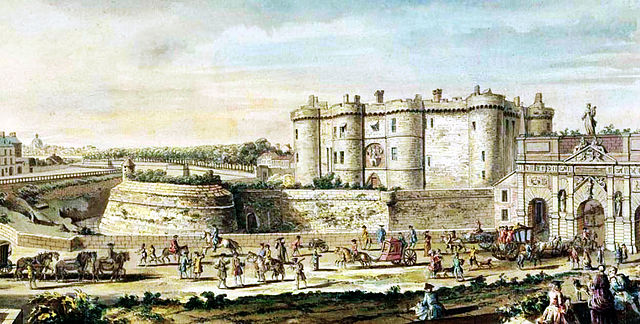
In early 1726, a young French nobleman, the chevalier de Rohan-Chabot, taunted Voltaire about his change of name, and Voltaire retorted that his name would be honoured while de Rohan would dishonour his. Infuriated, de Rohan arranged for Voltaire to be beaten up by thugs a few days later. Seeking compensation, redress, or revenge, Voltaire challenged de Rohan to a duel, but the aristocratic de Rohan family arranged for Voltaire to be arrested and imprisoned in the Bastille on 17 April 1726 without a trial or an opportunity to defend himself. Fearing an indefinite prison sentence, Voltaire suggested that he be exiled to England as an alternative punishment, which the French authorities accepted. On 2 May, he was escorted from the Bastille to Calais, where he was to embark for Britain.

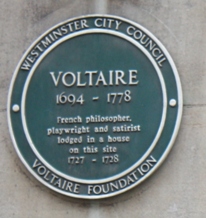
maiden-lane 061-plakette-5In England, Voltaire lived largely in Wandsworth with acquaintances including Everard Fawkener. From December 1727 to June 1728 he lodged at Maiden Lane, Covent Garden, now commemorated by a plaque, to be nearer to his British publisher. Voltaire circulated throughout English high society, meeting Alexander Pope, John Gay, Jonathan Swift, Lady Mary Wortley Montagu, Sarah, Duchess of Marlborough, and many other members of the nobility and royalty. Voltaire’s exile in Great Britain greatly influenced his thinking. He was intrigued by Britain’s constitutional monarchy in contrast to French absolutism, and by the country’s greater support of the freedoms of speech and religion. He was influenced by the writers of the age, and developed an interest in earlier English literature, especially the works of Shakespeare, still relatively unknown in continental Europe. Despite pointing out his deviations from neoclassical standards, Voltaire saw Shakespeare as an example that French writers might emulate, since French drama, despite being more polished, lacked on-stage action. Later, however, as Shakespeare’s influence began growing in France, Voltaire tried to set a contrary example with his own plays, decrying what he considered Shakespeare’s barbarities. Voltaire may have been present at the funeral of Isaac Newton and met Newton’s niece, Catherine Conduitt. In 1727 he published two essays in English, Upon the Civil Wars of France, Extracted from Curious Manuscripts, and Upon Epic Poetry of the European Nations, from Homer Down to Milton.

After two and a half years in exile, Voltaire returned to France, and after a few months living in Dieppe, the authorities permitted him to return to Paris. At a dinner, French mathematician Charles Marie de La Condamine proposed buying up the lottery that was organized by the French government to pay off its debts, and Voltaire joined the consortium, earning perhaps a million livres. He invested the money cleverly and on this basis managed to convince the Court of Finances that he was of good conduct and so was able to take control of a capital inheritance from his father that had hitherto been tied up in trust. He was now indisputably rich.

Further success followed, in 1732, with his play Zaïre, which when published in 1733 carried a dedication to Fawkener that praised English liberty and commerce. At this time he published his views on British attitudes toward government, literature, religion and science in a collection of essays in letter form entitled Letters Concerning the English Nation (London, 1733). In 1734, they were published in French as Lettres philosophiques in Rouen. Because the publisher released the book without the approval of the royal censor and Voltaire regarded the British constitutional monarchy as more developed and more respectful of human rights (particularly religious tolerance) than its French counterpart, the French publication of Letters caused a huge scandal; the book was publicly burnt and banned, and Voltaire was forced again to flee Paris.

Romance of London Series

  1. Romance of London: The Lord Mayor’s Fool… and a Dessert
  2. Romance of London: Carlton House and the Regency
  3. Romance of London: The Championship at George IV’s Coronation
  4. Romance of London: Mrs. Cornelys at Carlisle House
  5. Romance of London: The Bottle Conjuror
  6. Romance of London: Bartholomew Fair
  7. Romance of London: The May Fair and the Strong Woman
  8. Romance of London: Nancy Dawson, the Hornpipe Dancer
  9. Romance of London: Milkmaids on May-Day
  10. Romance of London: Lord Stowell’s Love of Sight-seeing
  11. Romance of London: The Mermaid Hoax
  12. Romance of London: The Bluestocking and the Sweeps’ Holiday
  13. Romance of London: Comments on Hogarth’s “Industries and Idle Apprentices”
  14. Romance of London: The Lansdowne Family
  15. Romance of London: St. Margaret’s Painted Window at Westminster
  16. Romance of London: Montague House and the British Museum
  17. Romance of London: The Bursting of the South Sea Bubble
  18. Romance of London: The Thames Tunnel
  19. Romance of London: Sir William Petty and the Lansdowne Family
  20. Romance of London: Marlborough House and Sarah, Duchess of Marlborough
  21. Romance of London: The Duke of Newcastle’s Eccentricities
  22. Romance of London: Voltaire in London
  23. Romance of London: The Crossing Sweeper
  24. Romance of London: Nathan Mayer Rothschild’s Fear of Assassination
  25. Romance of London: Samuel Rogers, the Banker Poet
  26. Romance of London: The Eccentricities of Lord Byron
  27. Romance of London: A London Recluse

Romance of London: The Duke of Newcastle’s Eccentricities

John Timbs (1801-1875), who also wrote as Horace Welby, was an English author and aficionado of antiquities. Born in Clerkenwell, London, he was apprenticed at 16 to a druggist and printer, where he soon showed great literary promise. At 19, he began to write for Monthly Magazine, and a year later he was made secretary to the magazine’s proprietor and there began his career as a writer, editor, and antiquarian.

This particular book is available at googlebooks for free in ebook form. Or you can pay for a print version.

From Wikipedia:

512px-1stDukeOfNewcastleOld

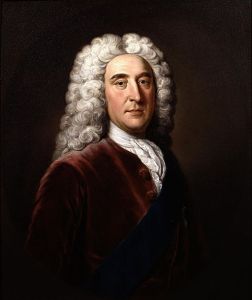
Thomas Pelham-Holles, 1st Duke of Newcastle

Thomas Pelham-Holles, 1st Duke of Newcastle upon Tyne and 1st Duke of Newcastle-under-Lyne KG PC (21 July 1693 – 17 November 1768) was a British Whig statesman, whose official life extended throughout the Whig supremacy of the 18th century. He is commonly known as the Duke of Newcastle.

A protégé of Sir Robert Walpole, he served under him for more than twenty years, until 1742. He held power with his brother, Henry Pelham (the Prime Minister of Great Britain), until 1754. He had at this point served as a Secretary of State continuously for thirty years—dominating British foreign policy.

Walpole gladly welcomed the young Newcastle into his coterie, firstly because he believed he could easily control him, and secondly because it would strengthen his hand against the rival Whig factions. Newcastle joined with Walpole because he, correctly, believed that he was going to dominate British politics for a generation.

Robert Walpole, 1st Earl of Orford

Robert Walpole, 1st Earl of Orford

After Henry’s death the Duke held his late brother’s position for six years, in two separate periods. While his first premiership was not particularly notable, Newcastle precipitated the Seven Years’ War, which would cause his resignation from his high position. After his second term as Prime Minister, he served for a short while in Lord Rockingham’s ministry, before retiring from government. Few politicians in British history matched his skills and industry in using patronage to maintain power over long stretches of time. He was most effective, however, as a deputy to a leader of greater ability, such as Walpole, his brother, or Pitt.

Historian Harry Dickinson says that he became:

notorious for his fussiness and fretfulness, his petty jealousies, his reluctance to accept responsibility for his actions, and his inability to pursue any political objective to his own satisfaction or to the nations profit…. Many modern historians have depicted him as the epitome of unredeemed mediocrity and as a veritable buffoon in office.

The Duke of Newcastle’s Eccentricities

Horace Walpole

Horace Walpole

There is scarcely any public man in our history of whose manners and conversation so many particulars have been preserved, as of the Duke of Newcastle, the well-known leader in the Pelham Administration under George II. Single stories may be unfounded or exaggerated. But all the stories about him, whether told by people who were perpetually seeing him in Parliament, and attending his levées in Lincoln’s Inn Fields, or by Grub Street writers who had never more than a glimpse of his star through the windows of his gilded coach, are of the same character. Horace Walpole and Smollett differed in their tastes and opinions as much as two human beings could differ. They quite different society. Walpole played at cards with countesses, and corresponded with ambassadors. Smollett passed his life surrounded by printers’ devils and famished scribblers. Yet, Walpole’s Duke and Smollett’s Duke are as like as if they were both from one hand. Smollett’s Newcastle runs out of his dressing-room, with his face covered with soap-suds, to embrace the Moorish envoy. Walpole’s Newcastle pushes his way into the Duke of Grafton’s sick-room to kiss the old nobleman’s plasters. No man was so unmercifully satirised. But in truth he was himself a satire ready made. All that the art of the satirist does for other men, nature had done for him. Whatever was absurd about him, stood out with grotesque prominence from the rest of the character. He was a living, moving, talkng caricature. His gait was a shuffling trot; his utterance a rapid stutter; he was always in a hurry; he was never in time; he abounded in fulsome caresses and hysterical tears. His oratory resembled that of Justice Shallow. It was nonsense effervescent with animal spirits and impertinence. Of his ignorance many anecdotes remain, some well authenticated, some probably invented at coffee-houses, but all exquisitely characteristic:—”Oh—yes—yes—to be sure—Annapolis must be defended—troops must be sent to Annapolis—Pray where is Annapolis?”—”Cape Breton an island! wonderful!—show it me in the map. So it is, sure enough. My dear sir, you always bring us good news. I must go and tell the King that Great Britain is an island.”

And this man was, during near thirty years, Secretary of State, and during near ten years, First Lord of the Treasury! His large fortune, his strong hereditary connections, his great parliamentary interest, will not alone explain this extraordinary fact. His success is a signal instance of what may be effected by a man who devotes his whole heart and soul, without reserve, to one object. He was eaten up by ambition. He was greedy after power with a greediness all his own. He was jealous of all his colleagues, and even of his own brother. Under the disguise of levity he was false eyond all example of political falsehood. All the able of men of his time ridiculed him as a dunce, a driveller, a child who never knew his own mind for an hour together; and he overreached them all round.—Lord Macaulay, on Walpole’s Letters.

Romance of London Series

  1. Romance of London: The Lord Mayor’s Fool… and a Dessert
  2. Romance of London: Carlton House and the Regency
  3. Romance of London: The Championship at George IV’s Coronation
  4. Romance of London: Mrs. Cornelys at Carlisle House
  5. Romance of London: The Bottle Conjuror
  6. Romance of London: Bartholomew Fair
  7. Romance of London: The May Fair and the Strong Woman
  8. Romance of London: Nancy Dawson, the Hornpipe Dancer
  9. Romance of London: Milkmaids on May-Day
  10. Romance of London: Lord Stowell’s Love of Sight-seeing
  11. Romance of London: The Mermaid Hoax
  12. Romance of London: The Bluestocking and the Sweeps’ Holiday
  13. Romance of London: Comments on Hogarth’s “Industries and Idle Apprentices”
  14. Romance of London: The Lansdowne Family
  15. Romance of London: St. Margaret’s Painted Window at Westminster
  16. Romance of London: Montague House and the British Museum
  17. Romance of London: The Bursting of the South Sea Bubble
  18. Romance of London: The Thames Tunnel
  19. Romance of London: Sir William Petty and the Lansdowne Family
  20. Romance of London: Marlborough House and Sarah, Duchess of Marlborough
  21. Romance of London: The Duke of Newcastle’s Eccentricities
  22. Romance of London: Voltaire in London
  23. Romance of London: The Crossing Sweeper
  24. Romance of London: Nathan Mayer Rothschild’s Fear of Assassination
  25. Romance of London: Samuel Rogers, the Banker Poet
  26. Romance of London: The Eccentricities of Lord Byron
  27. Romance of London: A London Recluse

Romance of London: Marlborough House and Sarah, Duchess of Marlborough

Romance of London: Strange Stories, Scenes And Remarkable Person of the Great Town in 3 Volumes

John Timbs

John Timbs (1801-1875), who also wrote as Horace Welby, was an English author and aficionado of antiquities. Born in Clerkenwell, London, he was apprenticed at 16 to a druggist and printer, where he soon showed great literary promise. At 19, he began to write for Monthly Magazine, and a year later he was made secretary to the magazine’s proprietor and there began his career as a writer, editor, and antiquarian.

This particular book is available at googlebooks for free in ebook form. Or you can pay for a print version.

About the Churchills

John_Churchill_in_his_thirties

John Churchill, 1st Duke of Marlborough, was a great military hero who reaped many honors and financial rewards from his service to five English monarchs. His wife Sarah was an intimate friend of Queen Anne… until Sarah’s hot temper and conceit earned her dismissal from court. For more about Sarah, Duchess of Marlborough, check out this article in Wikipedia.

Queen Anne (1705)

Queen Anne (1705)

Marlborough House

Marlborough_House_-_superior_version

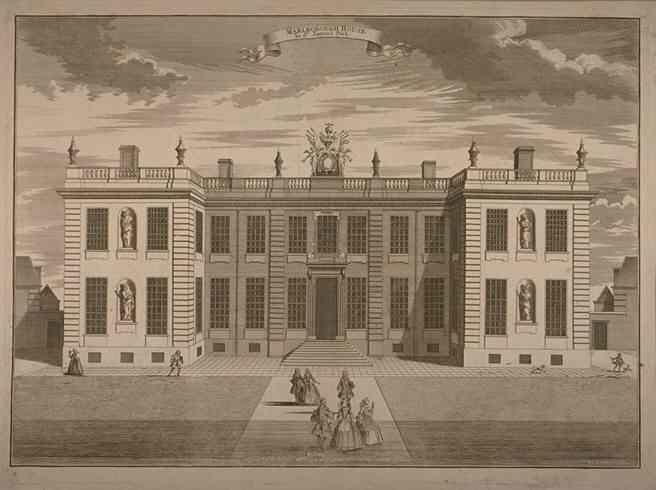
Little can be said, architecturally, of Marlborough House, notwithstanding it was designed by Sir Christopher Wren, who was employed, not because he was preferred, but that Vanbrugh might be vexed. Respecting Marlborough House, Pennant says

To the east of St. James’s Palace, in the reign of Queen Anne, was built Marlborough House, at the expense of the public. It appears by one of the views of St. James’s, published before the existence of this house, that it was built in part of the Royal Gardens, granted for that purpose by her Majesty. The present Duke [Pennant writes in 1793] added an upper story, and improved the ground floor, which originally wanted a great room. This national compliment cost no less than 40,000l.

As regards the site, Pennant’s account is corroborated by other authorities, who say that the mansion of the famous John Churchill was built on ground “which had been used for keeping pheasants, guinea-hens, partridges, and other fowl, and on that piece of ground taken out of St. James’s Park, then in possession of Henry Boyle, one of her Majesty’s principal Secretaries of State.”

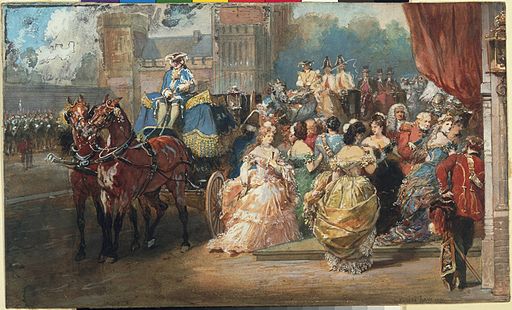
Entry to a Drawing Room at Marlborough House (1871)

Entry to a Drawing Room at Marlborough House (1871)

The Duchess both experienced and caused great mortifications here. She used to speak of the King in the adjacent palace as her “neighbor George.” The entrance to the house from Pall Mall was, as it still is, a crooked and inconvenient one. To remedy this defect, she intended to purchase some houses… for the purpose of pulling them down and constructing a more commodious entry to the mansion; but Sir Robert Walpole [whom she considered to be her greatest enemy], with no more dignified motive than mere spite, secured the houses and ground, and erected buildings [there], which… blocked in the front of the Duchess’ mansion. She was subjected to a more temporary, but as inconvenient blockade, when the preparations for the wedding of the imperious Princess Anne [does Timbs mean Mary?] and her ugly husband, the Prince of Orange, was going on. Among other preparations, a boarded gallery, through which the nuptial procession was to pass, was built up close against the Duchess’ windows, completely darkening her rooms. As the boards remained there during the postponement of the ceremony, the Duchess used to look at them with the remark, “I wish the Princess would oblige me by taking away her ‘orange chest!'”*

320px-Marlborough_House

Note: Currently the home of the Commonwealth Secretariat, the house is usually open to the public for Open House Weekend each September.

The Character of the Duchess

Sarah, Duchess of Marlborough

Sarah, Duchess of Marlborough

From the Memoirs of Mrs. Delany:

The conversation turned upon the famous Duchess of Marlborough: among others, one striking anecdote, that though she appeared affected in the highest degree at the death of her grand-daughter, the Duchess of Bedford, she sent the day after she died for the jewels she had given her, saying ‘she had only lent them;’ the answer was that she ‘had said she would never demand those jewels again except she danced at court;‘ her answer was ‘then she would be —- if she would not dance at court,’ &c. … She used to say that she was very certain she should go to heaven, and as her ambition went even beyond the grave, that she knew she should have one of the highest seats.

A few of the Duchess’ eccentricities and extravagancies have been put together somewhat in the humorous manner of our early story-books, as follows:

This is the woman who wrote the characters of her contemporaries with a pen dipped in gall and wormwood. This is the Duchess who gave 10,000l to Mr. Pitt for his noble defense of the constitution of his country! … This is the Duchess who, in her old age, used to feign asleep after dinner, and say bitter things at table pat and appropriate, but as if she was not aware of what was going on! This is the lady who drew that beautiful distinction that it was wrong to wish Sir Robert Walpole dead, but only common justice to wish him well hanged. This is the Duchess who tumbled her thoughts out as they arose, and wrote like the wife of the Great Duke Marlborough. This is the lady who quarreled with a wit upon paper (Sir John Vanbrugh), and actually got the better of him in the long run; who shut out the architect of Blenheim from seeing his own edifice, and made him dangle his time away at an inn while his friends were shown the house of the eccentric Sarah.

This is the Duchess who, ever proud and ever malignant, was persuaded to offer her favorite grand-daughter, Lady Diana Spencer, afterwards Duchess of Bedford, to the Prince of Wales, with a fortune of a hundred thousand pounds. He accepted the proposal and the day was fixed for their being secretly married at the Duchess’ Lodge, in the Great Park, at Windsor. Sir Robert Walpole got intelligence of the project, prevented it, and the secret was buried in silence.

This is the Duchess—The wisest fool much time has ever made—who refused the proffered hand of the proud Duke of Somerset, for the sole and sufficient reason that no one should share her heart with the great Duke of Marlborough.

This is the illustrious lady who superintended the building of Blenheim, examined contracts and tenders, talked with carpenters and masons, and thinking sevenpence-halfpenny a bushel for lime too much by a farthing, waged a war to the knife on so small a matter.

This is the celebrated Sarah, who, at the age of eighty-four, when she was told she must either submit to be blistered or die, exclaimed in anger, and with a start in bed, “I won’t be blistered, and I won’t die!”

The Duchess died, notwithstanding what she said, at Marlborough House, in 1774.

*Dr. Doran’s Queens of England—House of Hanover


Romance of London Series

  1. Romance of London: The Lord Mayor’s Fool… and a Dessert
  2. Romance of London: Carlton House and the Regency
  3. Romance of London: The Championship at George IV’s Coronation
  4. Romance of London: Mrs. Cornelys at Carlisle House
  5. Romance of London: The Bottle Conjuror
  6. Romance of London: Bartholomew Fair
  7. Romance of London: The May Fair and the Strong Woman
  8. Romance of London: Nancy Dawson, the Hornpipe Dancer
  9. Romance of London: Milkmaids on May-Day
  10. Romance of London: Lord Stowell’s Love of Sight-seeing
  11. Romance of London: The Mermaid Hoax
  12. Romance of London: The Bluestocking and the Sweeps’ Holiday
  13. Romance of London: Comments on Hogarth’s “Industries and Idle Apprentices”
  14. Romance of London: The Lansdowne Family
  15. Romance of London: St. Margaret’s Painted Window at Westminster
  16. Romance of London: Montague House and the British Museum
  17. Romance of London: The Bursting of the South Sea Bubble
  18. Romance of London: The Thames Tunnel
  19. Romance of London: Sir William Petty and the Lansdowne Family
  20. Romance of London: Marlborough House and Sarah, Duchess of Marlborough
  21. Romance of London: The Duke of Newcastle’s Eccentricities
  22. Romance of London: Voltaire in London
  23. Romance of London: The Crossing Sweeper
  24. Romance of London: Nathan Mayer Rothschild’s Fear of Assassination
  25. Romance of London: Samuel Rogers, the Banker Poet
  26. Romance of London: The Eccentricities of Lord Byron
  27. Romance of London: A London Recluse

Romance of London: Sir William Petty and the Lansdowne Family

Romance of London: Strange Stories, Scenes And Remarkable Person of the Great Town in 3 Volumes

John Timbs

John Timbs (1801-1875), who also wrote as Horace Welby, was an English author and aficionado of antiquities. Born in Clerkenwell, London, he was apprenticed at 16 to a druggist and printer, where he soon showed great literary promise. At 19, he began to write for Monthly Magazine, and a year later he was made secretary to the magazine’s proprietor and there began his career as a writer, editor, and antiquarian.

This particular book is available at googlebooks for free in ebook form. Or you can pay for a print version.

Sir William Petty and the Lansdowne Family

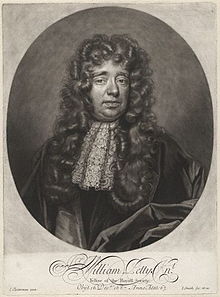
220px-Sir_William_PettySir William Petty is commonly described as “the founder of the house of Lansdowne,” a statement which is not sufficiently exact for all readers.

The story of William Petty, from May 1623, when he was born at Romsey, in Hampshire, to the time of his interment in the Norman church of that town, in 1687, is one of those lessons of life which can scarcely be too often repeated.

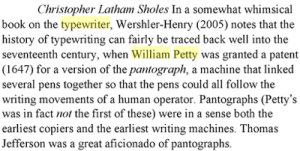
Petty was the son of a clothier in humble circumstances, was sent to Romsey Grammar School, and determined next to study at the University of Caen, in Normandy. Thither he sped, supporting himself by the way, with “a little stock of merchandise,” as a pedlar. He returned to England, and apprenticed himself to a sea captain, who, however, “drubbed him with a rope’s-end for the badness of his sight. This ill-treatment disgusted him with the navy; he took to the study of medicine, and while at Paris for that purpose became so poor as to subsist for two or three weeks entirely on walnuts; but, by help of the pedlar trade, he came back to England with money in his pocket. Here he exercised his liking for mechanics by inventing a letter-copying machine, or, as he called it, “an instrument for the art of double writing,” which he patented, for seventeen years, in 1648; and this very instrument is the prototype of the manifold letter-writers of our times. Petty likewise practiced chemistry and physic; and at his lodgings in Oxford were held the first meetings to form the Royal Society. At Oxford, Petty acted as deputy to the anatomical professor there: he lodged at an apothecary’s house, “because of the convenience of inspecting drugs.” In 1652 Petty was appointed Physician-General to the Army in Ireland. In 1664 he undertook the survey of Ireland; and in 1666, he had completed the measurement of two million and eight thousand acres of forfeited lands, for which, by contract, he was to receive one penny per acre. Sir William Petty is better known in our day as a writer upon trade and commerce and political arithmetic.

typewriter

Language, Technology, and Society, by Richard Sproat (2010)


polygraph

Darren Wershler-Henry’s The Iron Whim: A Fragmented History of Typewriting (2005)

Among Sir W. Petty’s inventions was “a double-bottomed ship, to sail against wind and tide.” He wrote on dyeing and on woolen cloth manufacture; he speculated in ironworks, lead-mince, a pilchard fishery, and timber trade; and all this time took an active part in the discussions of the Royal Society. He also built Tokenhouse Yard, Rothbury, on the site of the Earl of Arundel’s house and garden: and he held property in the yard at the time of the Great Fire. His will, made in 1661, details his birth, boohoo, education, adventures, studies, attainments, and promotions in life, commencing “with three-score pounds at the age of twenty,” an being in the receipt of 15,000l per annum a short time before his death, at which time he was residing in the corner house on the east side of Sackville Street, Piccadilly, opposite St. James’s Church. The widow of Sir William Petty was created Baroness Shelburn. He left two sons and a daughter. The eldest son succeeded to the title; but, dying without issue, it was revived in Henry, the second son, great uncle of the first Marquis of Lansdowne.

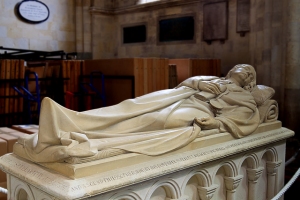
The remains of Sir William Petty rest in Romsey Church, where, on the south side of the choir, a plain slab bore the inscription, “Here Layes Sir William Petty;” but a more fitting memorial of his celebrated lineal ancestor was, in 1862, erected by the late Marquis of Lansdowne.

Monument to Sir William Petty, Romsey Church, Hampshire

Monument to Sir William Petty, Romsey Church, Hampshire

From Wikipedia:

Sir William Petty FRS (26 May 1623 – 16 December 1687) was an English economist, scientist and philosopher. He first became prominent serving Oliver Cromwell and Commonwealth in Ireland. He developed efficient methods to survey the land that was to be confiscated and given to Cromwell’s soldiers. He also managed to remain prominent under King Charles II and King James II, as did many others who had served Cromwell.

He was Member of the Parliament of England briefly and was also a scientist, inventor, and entrepreneur, and was a charter member of the Royal Society. It is for his theories on economics and his methods of political arithmetic that he is best remembered, however, and to him is attributed the philosophy of ‘laissez-faire’ in relation to government activity. He was knighted in 1661. He was the great-grandfather of Prime Minister William Petty Fitzmaurice, 2nd Earl of Shelburne and 1st Marquess of Lansdowne.

William Petty's great-grandson, William Petty-Fitzmaurice, 2nd Earl of Shelburne and 1st Marquess of Landsdowne, Prime Minister of England

William Petty’s great-grandson, William Petty-Fitzmaurice, 2nd Earl of Shelburne and 1st Marquess of Landsdowne, Prime Minister of England


Romance of London Series

  1. Romance of London: The Lord Mayor’s Fool… and a Dessert
  2. Romance of London: Carlton House and the Regency
  3. Romance of London: The Championship at George IV’s Coronation
  4. Romance of London: Mrs. Cornelys at Carlisle House
  5. Romance of London: The Bottle Conjuror
  6. Romance of London: Bartholomew Fair
  7. Romance of London: The May Fair and the Strong Woman
  8. Romance of London: Nancy Dawson, the Hornpipe Dancer
  9. Romance of London: Milkmaids on May-Day
  10. Romance of London: Lord Stowell’s Love of Sight-seeing
  11. Romance of London: The Mermaid Hoax
  12. Romance of London: The Bluestocking and the Sweeps’ Holiday
  13. Romance of London: Comments on Hogarth’s “Industries and Idle Apprentices”
  14. Romance of London: The Lansdowne Family
  15. Romance of London: St. Margaret’s Painted Window at Westminster
  16. Romance of London: Montague House and the British Museum
  17. Romance of London: The Bursting of the South Sea Bubble
  18. Romance of London: The Thames Tunnel
  19. Romance of London: Sir William Petty and the Lansdowne Family
  20. Romance of London: Marlborough House and Sarah, Duchess of Marlborough
  21. Romance of London: The Duke of Newcastle’s Eccentricities
  22. Romance of London: Voltaire in London
  23. Romance of London: The Crossing Sweeper
  24. Romance of London: Nathan Mayer Rothschild’s Fear of Assassination
  25. Romance of London: Samuel Rogers, the Banker Poet
  26. Romance of London: The Eccentricities of Lord Byron
  27. Romance of London: A London Recluse
Romance of London: The Thames Tunnel

Romance of London: Strange Stories, Scenes And Remarkable Person of the Great Town in 3 Volumes

John Timbs

John Timbs (1801-1875), who also wrote as Horace Welby, was an English author and aficionado of antiquities. Born in Clerkenwell, London, he was apprenticed at 16 to a druggist and printer, where he soon showed great literary promise. At 19, he began to write for Monthly Magazine, and a year later he was made secretary to the magazine’s proprietor and there began his career as a writer, editor, and antiquarian.

This particular book is available at googlebooks for free in ebook form. Or you can pay for a print version.

The Thames Tunnel

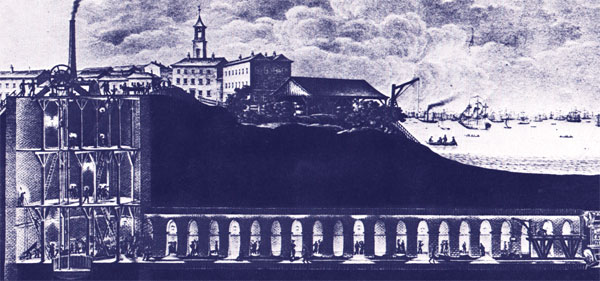
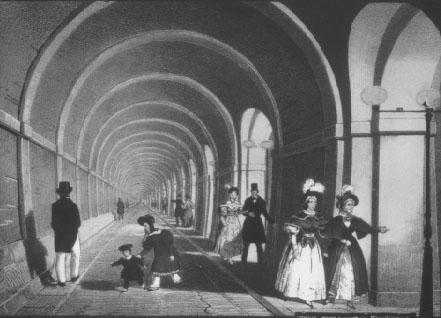
The first successful tunnel constructed beneath a navigable river was built between 1825 and 1843 by Thomas Cochrane and Marc Brunel, along with Brunel’s son, Isambard. Although it was meant to facilitate horse-drawn carriages traffic, that never happened. Currently it is part of the London Overground railway network.

From Wikipedia:

Brunel and Cochrane patented the tunnelling shield, a revolutionary advance in tunnelling technology, in January 1818. In 1823 Brunel produced a plan for a tunnel between Rotherhithe and Wapping, which would be dug using his new shield. Financing was soon found from private investors, including the Duke of Wellington, and a Thames Tunnel Company was formed in 1824, the project beginning in February 1825.

Thames_tunnel_shield

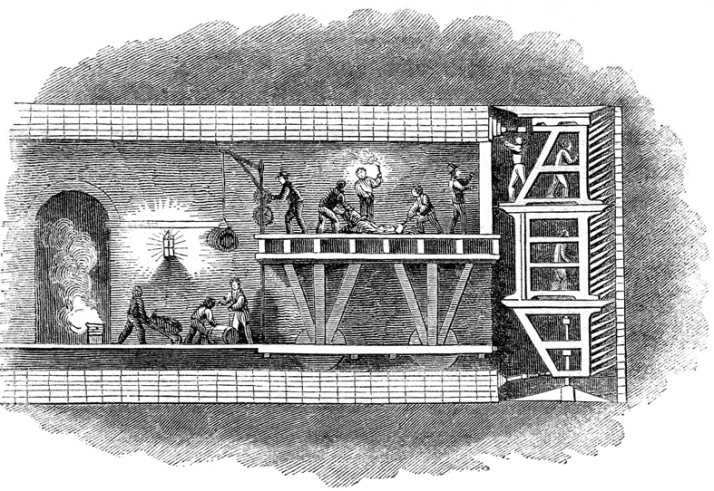
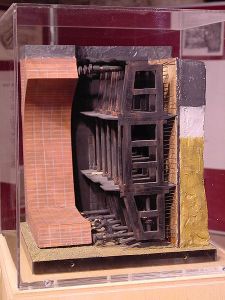
The tunnelling shield, built at Henry Maudslay’s Lambeth works and assembled in the Rotherhithe shaft, was the key to Brunel’s construction of the Thames Tunnel. The Illustrated London News described how it worked:

Scale model of the Brunel shield

Scale model of the Brunel shield

The mode in which this great excavation was accomplished was by means of a powerful apparatus termed a shield, consisting of twelve great frames, lying close to each other like as many volumes on the shelf of a book-case, and divided into three stages or stories, thus presenting 36 chambers of cells, each for one workman, and open to the rear, but closed in the front with moveable boards. The front was placed against the earth to be removed, and the workman, having removed one board, excavated the earth behind it to the depth directed, and placed the board against the new surface exposed. The board was then in advance of the cell, and was kept in its place by props; and having thus proceeded with all the boards, each cell was advanced by two screws, one at its head and the other at its foot, which, resting against the finished brickwork and turned, impelled it forward into the vacant space. The other set of divisions then advanced. As the miners worked at one end of the cell, so the bricklayers formed at the other the top, sides and bottom.

Although it was a triumph of civil engineering, the Thames Tunnel was not a financial success. It had cost a fortune to build – £454,000 to dig and another £180,000 to fit out – far exceeding its initial cost estimates. Proposals to extend the entrance to accommodate wheeled vehicles failed owing to cost, and it was used only by pedestrians. It became a major tourist attraction, attracting about two million people a year, each paying a penny to pass through, and became the subject of popular songs. The American traveller William Allen Drew commented that “No one goes to London without visiting the Tunnel” and described it as the “eighth wonder of the world.”

Flooding on the Thames Tunnel

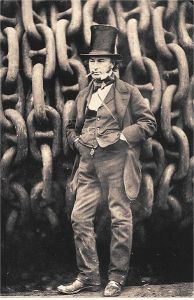
Isambard Brunel

Isambard Brunel

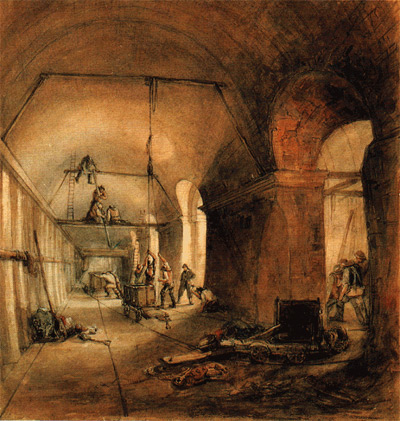
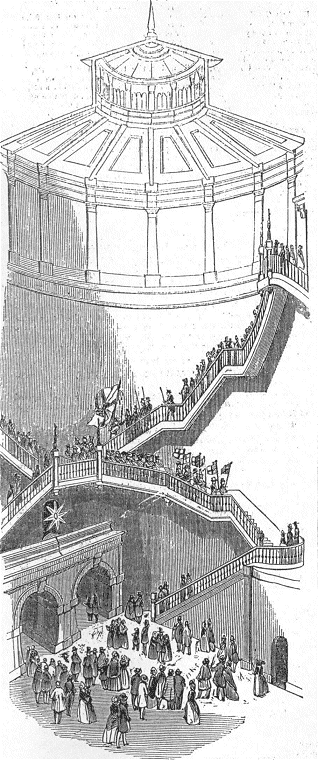
This stupendous work had considerably advanced by May 1827, when the bed of the river being examined by a diving-bell, the soil was found to be extremely loose; and on the 18th of May, as the tide rose, the ground seemed as though it were alive. The water was pressing in at all points, and it was not long in entering. Occasional bursts of diluted silt were followed by an overwhelming flood of slush and water, which drove all before it. The men, forced out of the shield, fled towards the bottom of the shaft. The water came on in a great wav, threatening to sweep them back under the arch by its recoil against the circular wall of the shaft. The lowest flight of steps was reached, and the recoil wave surged under the men’s feet. They hurried up the stairs of the shaft, and it was thought that all of them had come in, when the cry was raised, “A rope! A rope! Save him! Save him!” Some unfortunate workman had been left behind, and was seen struggling in the water. Young Brunel, seizing a rope, slid down one of the iron ties of the shaft, reached the water, passed the rope around the man’s body, and he was immediately drawn up. It proved to be old Tillett, the engine-man. The roll was then called, and every man answered to his name; but the Tunnel works were, for the time, completely drowned.

Thamestunnelcutout1840On examination of the bed of the river from the diving-bell, a large hole was found extending from the centre of the Tunnel excavation to a considerable distance eastwards. Measures were taken to fill up the opening with bags of clay, laid so as to form an arch in the bed of the river immediately over the work. More bags of clay were then sunk; and after about thirty thousand cubic feet of clay had been thrown into the hole, the pumping was resumed, and the state of the work could be examined from the inside in a boat. On the 10th of November following, the Tunnel had again been so far cleared of water that young Brunel determined to give a dinner in one of the arches to about fifty friends of the undertaking; while above a hundred of the leading workmen were similarly regaled in the adjoining arch. The band of the Coldstream Guards enlivened the scene, and the proceedings went off with great éclat. The celebration had, however, been premature; and the young engineer had been ‘hallooing before he was out of the ‘—water; for in two months the Thames again burst in, owing in some measure to the incautiousness of young Brunel himself, and the river held possession of the Tunnel for several years.

Thames_tunnel_construction_1830

Thames Tunnel construction, 1830

The funds of the Tunnel Company were by this time exhausted; and it was determined to make an appeal to the country for the means of finishing it. A subscription-list was opened, and 18,500l promised; but this sum was a mere “flea-bite,” and the works remained suspended. The Government, at length, consented to make a loan of 246,000l for the purpose of enabling the Tunnel to be completed, and the first installment was advanced in December 1834. The water was then pumped out of the Tunnel, and the works were recommenced, after having been at a standstill for a period of seven years. A new shield, of excellent construction, was supplied by the Messrs. Rennie, which was satisfactorily placed in position by the 1st of March 1836. But the difficulties of the undertaking were not yet entirely overcome; the river broke in again and again—three times in twenty weeks, within a distance of only twenty-six feet; but by perseverance and skill the water was ultimately mastered, and the work was at last brought to a completion, and opened to the public on the 25th of March 1843.

Thamestunnel

Thamestunnelshaft

2005 Thames Tunnel from Wapping

2005 Thames Tunnel from Wapping

The Brunel Museum

Nearby in Rotherhithe, the original Brunel Engine House is open to visitors as the Brunel Museum. It was built to house the drainage pumps for the tunnel and has now been restored. Wikipedia says that “[I]t is still possible to take a walking tour through the tunnel to Wapping from Rotherhithe and back, but these are infrequent and on an ad-hoc basis as they can only take place when that section of the line is closed for maintenance.


Romance of London Series

  1. Romance of London: The Lord Mayor’s Fool… and a Dessert
  2. Romance of London: Carlton House and the Regency
  3. Romance of London: The Championship at George IV’s Coronation
  4. Romance of London: Mrs. Cornelys at Carlisle House
  5. Romance of London: The Bottle Conjuror
  6. Romance of London: Bartholomew Fair
  7. Romance of London: The May Fair and the Strong Woman
  8. Romance of London: Nancy Dawson, the Hornpipe Dancer
  9. Romance of London: Milkmaids on May-Day
  10. Romance of London: Lord Stowell’s Love of Sight-seeing
  11. Romance of London: The Mermaid Hoax
  12. Romance of London: The Bluestocking and the Sweeps’ Holiday
  13. Romance of London: Comments on Hogarth’s “Industries and Idle Apprentices”
  14. Romance of London: The Lansdowne Family
  15. Romance of London: St. Margaret’s Painted Window at Westminster
  16. Romance of London: Montague House and the British Museum
  17. Romance of London: The Bursting of the South Sea Bubble
  18. Romance of London: The Thames Tunnel
  19. Romance of London: Sir William Petty and the Lansdowne Family
  20. Romance of London: Marlborough House and Sarah, Duchess of Marlborough
  21. Romance of London: The Duke of Newcastle’s Eccentricities
  22. Romance of London: Voltaire in London
  23. Romance of London: The Crossing Sweeper
  24. Romance of London: Nathan Mayer Rothschild’s Fear of Assassination
  25. Romance of London: Samuel Rogers, the Banker Poet
  26. Romance of London: The Eccentricities of Lord Byron
  27. Romance of London: A London Recluse
Nicole Zoltack: Loving Outside of Your Class

Back in the day, and even nowadays, people look down on certain relationships, especially if the people involved are from different classes. How can a duke or other titled person fall for someone outside of the ton? A movie star and a nobody? An actor and a musician? (Okay, I’m sour about the rumors of Tom Hiddleston and Taylor Swift, I’ll admit it.)

vauxhall

During the Regency era, aristocrats weren’t supposed to marry from other classes. Money, land, reputation, politics… they were what drove marriage for the upper crust. For the working class—the servants, maids, housekeepers, soldiers, etc—marriage was very important. Their parents had less of a say in whom they married, and they were a little more autonomous; however that was only within their own class, of course.

If a handmaid were to fall for a viscount… if a stablehand were to love a lady, most likely, it would not have played out well in real life, but what’s the fun in that?

lowerclasses

My series, Beyond Boundaries, is specifically about couples who fall in love despite obstacles like class.

If you were a lady back in the Regency, do you think you would ever consider someone outside of your class despite what your parents wish for you, despite the opinions of your friends and peers? I like to think I would!

About Masked Love (Beyond Boundaries #1)

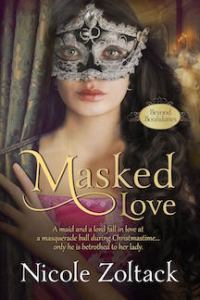
maskedloveIsabelle will do anything for her lady, even accompany her to a masquerade ball. Lady Theodosia needs extra support for tomorrow she will meet the man her par-ents have pledged her to.

Meeting an enchanting young man during the course of the evening makes Isabelle wish for a life she can never have. Imagine her shock when he shows up the next morning, announcing his claim on Lady Thedosia.

Torn between duty and desire, Isabelle hopes for something more this Christmas.

Amazon

13446322_867608668635_2112547213_o

Starry Love (Beyond Boundaries #2)

With the Season rapidly approaching, Lady Elizabeth is ready to make her match until her father is stricken deathly ill. Her mother is desperate and hails for doctors, surgeons, even apothecaries. The upkeep of the house falls on Elizabeth, and she spend long hours beside her father, watching as he betters one day and fares worse on others. Long walks with the stable hand Callum on starry nights save Elizabeth’s sanity.

When the inevitable happens, Lady Elizabeth is forced to go to London. The gentlemen there, however, hold no candle to the kind and caring Scottish Callum.

Shortly before her father’s death, Callum returned to his homeland to try and find a cure for her father. As time passes with no word, no letters, Elizabeth must choose whether the love that blossomed between them is worth denying the man her mother wishes for her.

Amazon

About the Author

nicole photoNicole Zoltack loves to write in many genres, especially romance, whether fantasy, paranormal, or regency. She’s also an editor for MuseItUp Publishing and works as a freelance editor.

When she’s not writing about gentlemen and their ladies, knights, superheroes, or witches, she loves to spend time with her loving husband, three energetic young boys, and precious baby girl. She enjoys riding horses (pretending they’re unicorns, of course!) and going to the PA Renaissance Faire, dressed in garb. She’ll also read anything she can get her hands on. Her current favorite TV shows are The Walking Dead and Arrow.

To learn more about Nicole and her work, visit her blog at http://NicoleZoltack.blogspot.com. She can be found on most any social media site under Nicole Zoltack. Stalk away!

Jude Knight: A notorious woman visits the Parlour

Rebecca, Lady Overton prefers to be out of the public eye. Before she consented to join her author for tea in Susana’s Parlour, she extracted a promise that this interview would not be published until more than 200 years in her future.

“I have had notoriety and notice enough for a lifetime, Jude,” she says. “You saw to that.”

Becky is right. As the Rose of Frampton, treasured mistress to the notorious Marquis of Aldridge, she was whispered about (but not acknowledged) the length and breadth of polite Society. It is no consolation to her that I was only doing my job, nor that I did not know anything about her history when I started. I thought to write a cheerful romp about a dissolute rake, not a story about how a woman with few choices nonetheless made the best ones she could, and eventually won her way to a happy marriage and a secure family.

She does not wait for an answer to her remark. “And you are still doing it,” she scolds. “This latest start of yours has spread my story to countries that did not even exist when I was alive. That smug look does not make me feel better, you know!”

I wipe the grin off my face. I have been posting A Baron for Becky on Wattpad for months, one chapter a week until it was completed. In the past month it has taken off, garnering hundreds of reads every day. I am particularly thrilled that 15% of my reads are from India, another 10% from the Philippines, and more than 50% overall from countries in Africa and Asia where I do not normally sell books.

“You have to admit,” Becky continues, “it is not at all a light, frothy read. Girlhood trauma? Years of suffering? Two heroes, Jude, and neither of them particularly heroic seen in a certain light.”

“It is a story of resilience, Becky. You survived, and eventually you thrived. And both your first hero and your second helped with that. More than they hindered, I am sure you will agree. Did you know that Susana, our hostess today, has a story on Wattpad that is actually called ‘Resilience’? You might enjoy meeting her heroine. You have some sad circumstances in common.”

“Ah,” Becky says. “Betrayed into a brothel, was she? Poor girl.”

“It comes right in the end,” I sooth. “After all, we write happy endings, Susana and I.”

Becky’s speaking look states her opinion as loudly as words. Perhaps that which does not kill you makes you stronger, but the memories and the scars remain, giving a dark underpinning the future happiness. I dream that people who have had their choices torn from them will find hope and the courage to find new choices by reading stories about heroines like Becky. But pain endured and overcome is still pain.

“We are about to start posting a new book, Mari Christie and I,” I tell Becky, hoping to change the direction of her thoughts.

It works. “Mari Christie? She writes as Mariana Gabrielle, does she not? She created my dear friend Kali. Is the book about her?”

“No, indeed. This is something different. Never Kiss a Toad is about the romance between Aldridge’s daughter Sal and his friend Wellbridge’s son David. The first part goes up next Friday.”

About Never Kiss a Toad

Never Kiss a Toad copyDavid “Toad” Northope, heir to the Duke of Wellbridge and rogue in the mold of his infamous father, knows Lady Sarah “Sal” Grenford, daughter of the once-profligate Duke of Haverford, will always hold his heart. But when the two teens are caught in bed together by their horrified parents, he is sent away to finish school on the Continent, and she is thrown into the depths of her first London Season.

Can two reformed rakes keep their children from making the same mistakes they did? The dukes decide keeping them apart will do the trick, so as the children reach their majority, Toad is put to work at sea, learning to manage his mother’s shipping concern, and Sal is taken to the other side of the world, as far from him as possible.

How will Toad and Sal’s love withstand long years of separation, not to mention nasty lies, vicious rumors, attractive other suitors, and well-meaning parents who threaten to destroy their future before it has begun?

To be published in weekly instalments on Wattpad, alternating between Mariana Gabrielle’s page and Jude Knight’s.

Jude Knight

Mariana Gabrielle

(Mariana Gabrielle is also posting Royal Regard, in which you can read about the fraught and beleaguered courtship of Toad’s parents, and Jude is posting stories from her collection Hand-Turned Tales.)

About A Baron for Becky

BfB cover final small copyBecky is the envy of the courtesans of the demi-monde – the indulged mistress of the wealthy and charismatic Marquis of Aldridge. But she dreams of a normal life; one in which her daughter can have a future that does not depend on beauty, sex, and the whims of a man.

Finding herself with child, she hesitates to tell Aldridge. Will he cast her off, send her away, or keep her and condemn another child to this uncertain shadow world?

The devil-may-care face Hugh shows to the world hides a desperate sorrow; a sorrow he tries to drown with drink and riotous living. His years at war haunt him, but even more, he doesn’t want to think about the illness that robbed him of the ability to father a son. When he dies, his barony will die with him. His title will fall into abeyance, and his estate will be scooped up by the Crown.

When Aldridge surprises them both with a daring proposition, they do not expect love to be part of the bargain.

Follow A Baron for Becky on Wattpad, or purchase while it is on sale for 99c

Smashwords

iBooks

Amazon

Barnes & Noble

About the Author

Jude Knight copyJude Knight has been telling stories all her life: making up serial tales to amuse her friends and children, imagining sequels to books that have moved her and left her wanting more, occasionally submitting short stories to magazines and the radio, starting more than a dozen novels set in different times and places.

She has devoted most of the last forty years to a career in commercial writing and raising a large family (most recently as grandmother-in-residence while a daughter was out of action for three years). She and her own personal romantic hero, with whom she has shared those forty+ years, now live with two cats and frequent visitors in a small town in rural New Zealand.

Judy wrote and published her first historical romance in 2014, and now has the wind in her sails and a head full of strong determined heroines, heroes with the sense to appreciate them, and villains you’ll love to loathe.

Website and Blog • Facebook • Twitter • Pinterest