Archives

Bliss Bennet: A Man Without a Mistress

The Real Regency Scandal Sheets?

by Bliss Bennet

Plotlines featuring scandal sheets have become a staple of the Regency-set historical romance, mirroring the current-day popularity of magazines and television shows devoted entirely to celebrity gossip. But did newspapers devoted to spreading tittle-tattle about the high and mighty really exist during the Regency period?

According to the Oxford English Dictionary, the term “scandal sheet” did not enter the lexicon until the first decade of the twentieth century. And an advanced search of Google Books reveals only a slightly earlier date, with citations from no earlier than the 1890s. But perhaps “scandal sheet” was simply not the term in use during the period for newspapers or magazine devoted to scandal?

In his book Scandal: A Scurrilous History of Gossip, Roger Wilkes sets the date for the publication of what we might today call full-fledged scandal sheets a good bit earlier than the existence of the term itself. But still not in the Regency. Gossip columns appeared in English newspapers as early as 1704 (when Daniel Defoe, known today for his novel Robinson Crusoe, created the informal “Advice from the Scandalous Club” for his new paper, Review), and gossip pamphlets on specific subjects were also published during the eighteenth century. But newspapers devoted entirely to scandalmongering did not begin to be published until the 1820s.

I’ve been wondering, then, if a more historically accurate analog to today’s People, Entertainment Tonight, and National Enquirer might be a “scandal sheet” of an entirely different sort than a newspaper: the popular satirical print. The period between 1760 and 1820 is often referred to as the “Golden Age of Caricature,” in part because of the prints satirizing the British Royal family that proliferated during this period. But many high-ranking political and social figures besides King George and his relations found themselves the butt of a satirical print’s pointed humor. The audience for such prints was wide, just as it is for today’s scandal sheets; the middling sorts as well as aristocrats could afford a sixpence for a plain folio mezzotint, or a shilling for a colored one, the typical price for a print in the late eighteenth century.

The Jersey Smuggler

The Prince Regent, caught in bed with his mistress, Lady Jersey, by his wife

[James Gillray, The Jersey Smuggler Detected; —or—good causes for discontent [separation]. 1796. British Museum.]

Blockheads

The Prince Regent ridiculed as a blockhead, along with many other famed political leaders of the day

[George and Isaac Cruikshank, Blockheads. Frontispiece from A Political Lecture on Heads, Alias Blockheads!!! 1819. Vialibri.net.]

Gillray_-_Sir_Richard_Worse-than-sly,_exposing_his_wife's_bottom;_-_o_fye! copy

A major Regency scandal: the Worsley crim com trial, which brought to light shameful details of Sir Richard’s voyeuristic sexual tendencies, details which satirist Gillray did not shy away from skewering

[James Gillray, Sir Richard Worse-than-Sly, exposing his wife’s bottom; — O fye! 1782.]

Regency-era satirical prints have their roots in both visual caricature and in literary satire. In the late 16th century, Italian brothers Annibale and Agostino Carracci applied the words carico and caricare (to load, or to exaggerate) to some of the exaggerated portraits they drew, starting a trend for caricatures on the Continent. During the seventeenth century, art collectors and young men on the Grand Tour brought many examples of Italian caricatures back to England, some of which caught the eye of English publisher Arthur Pond. In 1736, Pond printed a collection of drawings by Annibale Carraci and other Italian caricaturists, which proved immediately and widely popular with London audiences. Noting the high sales of Pond’s collection, English artists soon began combining the exaggeration of the visual caricature with the biting satire of the period’s literature to create their own home-grown prints. Thus beginning a craze for satiric prints in England that lasted well into the nineteenth century.

Miss Macaroni

One of the earliest prints to feature a print shop, reputedly the Darlys’s shop on the Strand

[John Raphael Smith, Miss Macaroni and her gallant at a print shop. 1773. Guildhall Library, Corporation of London.]

During the seventeenth century, St. Paul’s and Fleet Street were where one would go to find shops devoted entirely to selling individual prints, right alongside booksellers and printers. Most sold both art prints and comic ones, although by 1762, satiric prints had grown so popular that Mary and Matthew Darlys, known as the “Fun Merchants” (at 39 Strand) opened a shop devoted entirely to comic prints. By the early 1800s, print shops had branched out westward along Fleet Street and the Strand, to the new developments around St. James’s in Westminster. John Bowles (under the sign of the Black Horse in St. Paul’s Churchyard), James Bretherton (134 Bond Street) and Mrs. Humphreys (in St. James’s) were some of the more popular purveyors. Publishers William Holland and Samuel William Fores even set up exhibition rooms that featured only prints, and charged entry fees to viewers. “In Holland’s Caricature Exhibition rooms may be seen, the largest Collection of Prints and Drawings in Europe,” claimed Holland’s advertisements; “The most complete Collection. Ever exposed to public View in this Kingdom,” countered Fores’s.

Given the often lewd, rude, and even pornographic nature of many of the era’s prints, it’s hardly surprising to discover that many Regency commentators bemoaned the open display of satirical prints in shop windows. Take for example, John Corry’s “Caricature and Printshops,” from his 1801 Satirical View of London:

Dandy Pickpockets

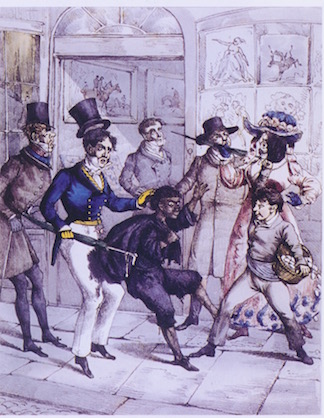
Satiric print depicting the dangers of print shop gazing!

[Isaac Robert Cruikshank, Dandy Pickpockets, Diving. 1818. Hand colored etching. Museum of London.]
Casualties of streetwalking copy

Satiric print depicting the dangers of print shop gazing!

[Anonymous, Casualties of London Street Walking: A Strong Impression. 1826. Guildhall Library, Corporation of London.]

This humorous mode of satirising folly is very prejudicial to the multitude in many respects: — in the loss of time to those who stop to contemplate the different figures; the opportunities given to pickpockets to exercise their art; and that incitement to licentiousness occasioned by the sight of voluptuous painting. The indecent attitudes obscene labels, and similar decorations, must have a powerful effect on the feelings of susceptible youth; and it is an authenticated fact, that girls often go in parties to visit the windows of printshops, that they may amuse themselves with the view of prints which imbue the most impure ideas. Before these windows, the apprentice loiters unmindful to his master’s business. And thither prostitutes hasten, and fascinating glances endeavor to allure the giddy and the vain who stop to gaze on the Sleeping Venus, the British Venus and a variety of seductive representations of naked feminine beauty. (75-77)

Mrs. Humphreys copy

Mrs. Humphrey’s print shop, published by Mrs. Humphrey herself; the caption translates as “Shame on he who thinks evil of it”

[Anonymous. Honi Soit Qui Mal Y Pense, published by G. Humphrey. 1821. Colored etching. Guildhall Library, Corporation of London.]

Wouldn’t you love to attend one of those print shop-gazing parties? I know I would. In fact, it was after reading this passage that I had the idea to include a scene set outside a shop that peddles satirical prints in my latest historical romance, A Man without a Mistress. In the window of Bretherton’s (an actual print shop of the period), Sir Peregrine Sayre spies a print of the recently deceased Lord Saybrook cavorting with an obviously diseased courtesan. To keep the fast-approaching daughter of Lord Saybrook, Sibilla Pennington, from catching sight of the scandalous print (and thereby discovering the true cause of her father’s death, venereal disease), Sayre is forced to make a bet with her, a bet that will only entangle him further with the headstrong young woman whom he’d promised himself he’d stay far away from. And, of course, further scandal ensues . . .

Man Without a Mistress eBook Cover Large copy

If you’re interested in finding out more about Regency era satirical prints, check out these resources:

Baker, Kenneth. George IV, A Life in Caricature. London: Thames and Hudson, 2005.

Bills, Mark. The Art of Satire: London in Caricature. London: Philip Wilson/Museum of London, 2006.

Donald, Diana. The Age of Caricature: Satirical Prints in the Reign of George III. New Haven: Yale UP, 1996.

Cindy McCreery, The Satirical Gaze: Prints of Women in Late Eighteenth Century England. London: Oxford UP, 2004.

Roger Wilkes, Scandal: A Scurrilous History of Gossip. London: Atlantic Books, 2002.

About A Man Without a Mistress

A man determined to atone for the past

For seven long years, Sir Peregrine Sayre has tried to assuage his guilt over the horrifying events of his twenty-first birthday by immersing himself in political work—and by avoiding all entanglements with the ladies of the ton. But when his mentor sends him on a quest to track down purportedly penitent prostitutes, the events of his less-than-innocent past threaten not only his own political career, but the life of a vexatious viscount’s daughter as well.

A woman who will risk anything for the future

Raised to be a political wife, but denied the opportunity by her father’s untimely death, Sibilla Pennington has little desire to wed as soon as her period of mourning is over. Why should she have to marry just so her elder brothers might be free of her hoydenish ways and her blazingly angry grief? To delay their plans, Sibilla vows only to accept a betrothal with a man as politically astute as was her father—and, in retaliation for her brothers’ amorous peccadillos, only one who has never kept a mistress. Surely there is no such man in all of London.

When Sibilla’s attempt to free a reformed maidservant from the clutches of a former procurer throw her into the midst of Per’s penitent search, she finds herself inextricably drawn to the cool, reserved baronet. But as the search grows ever more dangerous, Sibilla’s penchant for risk taking cannot help but remind Per of the shames he’s spent years trying to outrun. Can Per continue to hide the guilt and ghosts of his past without endangering his chance at a passionate future with Sibilla?

AllRomance E-booksAmazonBarnes & Noble CreatespaceKoboiBooks

About the Author

DSC_0682 1 x 2Bliss Bennet writes smart, edgy novels for readers who love history as much as they love romance. Despite being born and bred in New England, Bliss finds herself fascinated by the history of that country across the pond, particularly the politically-volatile period known as the English Regency. Historical Novel Society’s Indie Reviews praised her first book, A Rebel without a Rogue, deeming it “a sparkling debut.”

Bliss’s mild-mannered alter ego, Jackie Horne, writes about the intersection of gender and genre at the Romance Novels for Feminists blog. (http://www.romancenovelsforfeminists.blogspot.com)


Website FacebookTwitter


Cheryl Bolen: An Egyptian Affair

Tomorrow is release day for my fourth lighthearted Regent Mystery, An Egyptian Affair, so I’m especially grateful that Susana invited me here today. Just as an aside, I actually have two releases tomorrow. The second, One Golden Ring, Brazen Brides #2, is a re-release of a Christmas novel which was selected Best Historical of 2005 (Holt Medallion) and has been in and out of print (mostly out) ever since.

Many of you have been following my Regent Mysteries featuring Captain Jack Dryden and his wife, Lady Daphne. As their romance has already been told, each of the new Regent Mysteries, whilst featuring them as sleuths for the Prince Regent, features a fresh new romance.

In this book, Jack and Daphne must travel to Egypt to investigate the disappearance of an Indian Prince who was obtaining nearly priceless antiquities for the British Prince Regent. Since Daphne’s youngest sister, Lady Rosemary, is enamored of all things Egypt, they must take her along. Also accompanying them is Britain’s most imminent Egyptology scholar, Stanton Maxwell. Of course, Rosemary couldn’t possibly be romantically interested in such a nerd when one dashing captain of his majesty’s dragoons has captured her heart. Or could she?

Cheryl: Thanks, Lady Daphne, for visiting Susana’s Parlour today. So glad you’ve brought along your sister. I understand you’re just back from an exciting trip to Egypt.

Lady Daphne: Indeed. Rosemary and I have decided that since few British women have ever traveled to the Orient, we shall be have a little salon for the purpose of sharing our experiences in Egypt.

Cheryl: Are you going to tell the other ladies about the perils you faced?

Lady Rosemary: My brother-in-law Captain Jack Dryden does much clandestine work for the Crown and has sworn me to secrecy. However, I don’t mind sharing our experiences with things like crocodiles on the Nile or cobras.

Lady Daphne: (Scrunching up her nose and narrowing her eyes as she peers through her spectacles at her sister) Oh, but we won’t discuss the cobra that was intentionally placed in our bedchamber whilst we slept. I shouldn’t want to discourage faint-hearted ladies from traveling to Egypt. We loved it very much.

Cheryl: I suppose to you, Lady Rosemary, Egypt will always hold terribly romantic memories. Did you not marry your husband there before you had to return to England?

Lady Rosemary: Indeed I did. But I can say no more. We must save all the breath-taking details for the readers of your book.

An Egyptian Affair copy

Excerpt

You can read an excerpt of the book here http://www.cherylbolen.com/egyptian~ex.htm.

AmazoniBooks Barnes & Noble • Kobo

About the Author 

Cheryl Bolen copyAn Egyptian Affair is the 30th book by Cheryl Bolen, a New York Times and USA Today best-selling author. Many of her books have placed in contests, including the Daphne du Maurier (romantic suspense) and have been translated into ten languages. She was Notable New Author in 1999. In 2006 she won the Holt Medallion, Best Historical, and in 2012 she won Best Historical in the International Digital Awards and she’s had four other titles place in that competition. Her 2011 Christmas novella was named Best Novella in the Romance Through the Ages.

WebsiteBlogFacebook

Vauxhall Gardens: An Era of Change (1786-1822), Part II

vauxhallbook

Vauxhall Gardens: A History

David Coke & Alan Borg

The Vauxhall Pleasure Gardens is one of the places I’d love to slip back in time to visit, just to catch a glimpse of what it was like. After recently splurging to buy this lovely coffee-table book, I thought it might make a wonderful subject for a new blog series. But do buy the book too, if you can!

Grand Military Fetes and Displays

The first record of a military fete was on 30 May 1786, the day after the Jubilee, when transparencies of British men-of-war by the marine painter John Thomas Serres (1759-1825) were presented with other decorations, including a representation of the British lion trampling the Spanish flag. The newly formed Duke of York’s Band played military airs and was to perform regularly in the gardens until 1816. This period saw an increasing presence of soldiers and military bands, theoretically in response to the threat of invasion from France, but more directly in an attempt to rival the jingoistic displays to be seen at Astley’s. In 1787 the Cascade, the most famous of Vauxhall attractions in the eighteenth century, included marching soldiers. These military displays gradually expanded and needed more space, so from 1816 the Cascade site was used by Madame Saqui’s rope-dancing troupe.

Eventually, grand military fetes to celebrate actual events involved firework displays.

On 11 June 1810, Mizra Abul Hassan Khan wrote about his visit to the Gardens for the Grand Oriental Fete in honour of the Persian Ambassador:

The avenues were lighted by rows of tall candelabra and by lanterns hung from trees. In one place there were fireworks: when they did not rise high enough, everyone laughed and said ‘Shocking!’ The fireworks ended with the name of the Qibleh of the Universe written in Persian letters! Everyone appreciated this display and clapped their hands together. From there we went to a large covered place, beautifully lighted and decorated, like a theatre in the city. It was built to accommodate 5000 people in case of rain. After the fireworks, some people sat down to eat; later they danced.

American Samuel Morse, inventor of the Morse code, visiting on 17 September 1811:

A few evenings since I visited the celebrated Vauxhall Gardens, of which you have doubtless often heard. I must say they far exceeded my expectations; I never before had an idea of such splendor. The moment I went in I was almost struck blind with the blaze of light proceeding from thousands of lamps and those of every color. […] All is gayety throughout the gardens; every one is in motion, and care, that bane of human happiness, for a time seems to have lost her dominion over the human heart. Had the Eastern sage, who was in search of the land of happiness, at this moment been introduced into Vauxhall, I think his ost exalted conceptions of happiness would have been surpassed, and he would rest contented in having at last found the object of his wishes. […] The music and this course of dancing continue till about four o’clock in the morning, when the lights are extinguished and the company disperses. On this evening, which was by now means considered as a full night, the company consisted of perhaps three thousand persons.

vauxhall-pleasure-gardens-00364-800

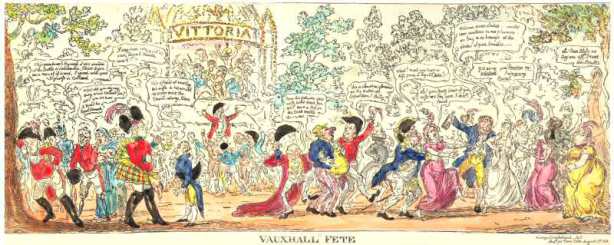
George Cruikshank, Vauxhall Fete, engraving, 1813 (British Museum, London., 1862.1217.309). This satirical print shows many of the leading figures who attended the Grand Festival in honor of the Battle of Vittoria. On the left the Duke of York vomits against a tree; other notables include the Duke of Sussex in Highland uniform, the Duke of Clarence dressed as an Admiral, the Lord Mayor of London and Lord Castlereigh. On the far right a fat lady exclaims ‘They’re all drunk, the Brutes.’

Grand Festival of the Battle of Vittoria

On 20 July 1813, a Grand Festival of the Battle of Vittoria was held in honor of the then Marquess Wellesley, who attended. “The festival was ‘perhaps the most superb and costly entertainment ever given in England’ and such was its popularity that ‘the limited number’ of tickets ‘was exceeded and, in consequence, from ten to fifteen pounds was offered for a ticket’”. Byron noted:

There is to be a thing on Tuesday ycleped a national fete. The Regent and *** are to be there, and everybody else, who has shillings enough for what was once a guinea. Vauxhall is the scene—there are six tickets issued for the modest women, and it is supposed that there will be three to spare. The passports for the lax are beyond my arithmetic.

At a dinner for twelve hundred people in the Rotunda, the VIPs sat at a crescent-shaped, raised table. There was also

a row of crimson steps covered with massive pieces of ornamental gold and silver plate, with the bust of the Lord Wellington on the summit. At the foot, and leaning against a silver vase of exquisite workmanship, was the Marshal’s staff taken in the battle. Two trumpeters in their state liveries and with silver trumpets, stood forward from the pile, and between them a grenadier of the Guards held the standard of the 100th French regiment of the line.

Neither George III nor the Prince of Wales attended (in spite of Byron’s expectation), but otherwise, the list of attendees was quite impressive. Wellesley arrived late for the dinner and found his seat of honor occupied, but presumably that was quickly dealt with. The ladies joined the party at 9 p.m., and at 11 p.m., the Princess of Wales arrived. She

was conducted around the chief promenade several times by his Royal Highness the Duke of Gloucester and Col St Leger. The Princess was hailed repeatedly with loud greeting, and repaid the attentions of the company in the most courteous manner. She was dressed ina white satin train with a dark vet and ornaments, richly embroidered. On her head-dress she wore a green wreath, with diamonds.

Even later, “many of the nobility came from the Opera House after the conclusion of the ballet.”

In the course of the evening a new air called The plains of Vitoria was performed by the orchestra, while military bands, including those of the Foot and Life Guards, the Duke of Kent’s Regiment, and the 7th Hussars, played and marched up and down the Walks. ‘The appearance of some of these bands in the forest part of the garden was extremely picturesque, and presented some idea, at times, of soldiers in a campaign regaling and reposing themselves under the shade. The fireworks were set off in three sessions, at 11 p.m. and at 1 and 2 a.m. These were devised and directed by ‘Colonel Congreve’, the inventor of the Congreve Rocket, which was much used in the Napoleonic wars.

Other Military Fetes at Vauxhall

More fabulous military fetes were held in the following year, one of 13 June 1814 to celebrate the Treaty of Paris, and in August, a mock sea battle (Grand Mechanical Naumachia). Although there were fireworks on 15 August 1815 following Napoleon’s surrender at Waterloo, there were no specific events to mark the occasion until 18 June 1817. This became an annual celebration, eventually involving a reconstruction of the battle on the southeast side of the old Grand Walk, which became known as the Waterloo Ground.

View of Vauxhall, Lady's magazine

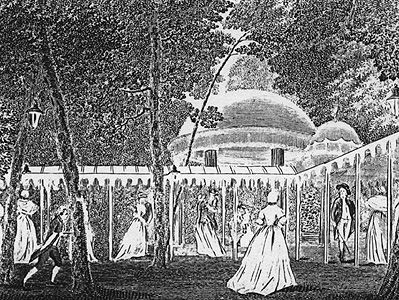
Anon., View of Vauxhall Gardens, engraving (Lambeth Landmark 1260) from the Lady’s Magazine, XXX (1799), supplement. The walks were covered to counter the rains which proverbially started when the Vauxhall season opened; they were extended all round the Grove in 1810.


Susana’s Vauxhall Blog Post Series

Vauxhall Gardens: The Third Generation of the Tyers Family and the Jubilee of 1786

vauxhallbook

Vauxhall Gardens: A History

David Coke & Alan Borg

The Vauxhall Pleasure Gardens is one of the places I’d love to slip back in time to visit, just to catch a glimpse of what it was like. After recently splurging to buy this lovely coffee-table book, I thought it might make a wonderful subject for a new blog series. But do buy the book too, if you can! The photos are fabulous!

Following Jonathan Tyers’s death in 1767, his son Jonathan Tyers the younger managed the gardens, along with the assistance of his sister Elizabeth Wood and other family members, until 1786. At that time, the responsibility for the park was passed on to Bryant Barrett, who was Tyers the younger’s son-in-law, married to his only daughter, Elizabeth.

Barrett was a wax chandler by trade, which was a fortunate coincidence, since Vauxhall Gardens must have been spending a fortune on candles and lighting fixtures.

The most visible aspect of Barrett’s initiative appears in the start of regular newspaper advertisements giving details of the musical programmes for each evening; but it was also at this time that proprietors began to sponsor sailing matches on the Thames.

Lean years at Vauxhall

The 1770’s and early 1780’s had been lean ones for Vauxhall, partly because of the increase in crime and vandalism within its walks; but bad behaviour was clearly not the proprietors’ only problem. …quite apart from financial depression in the early 1770’s and grim news from the American colonies, the appalling weather of the summers of 1775-7 had cost the Tyers family a great deal. …

Samuel Arnold finally had to close Marylebone Gardens in 1778… No clear reason is given for this, but the complaints of local residents, especially about the fireworks, are bound to have been a contributor factor. Ironically, Marylebone’s initial advantage in being so close to London had become its eventual downfall.

The Jubilee of 1786

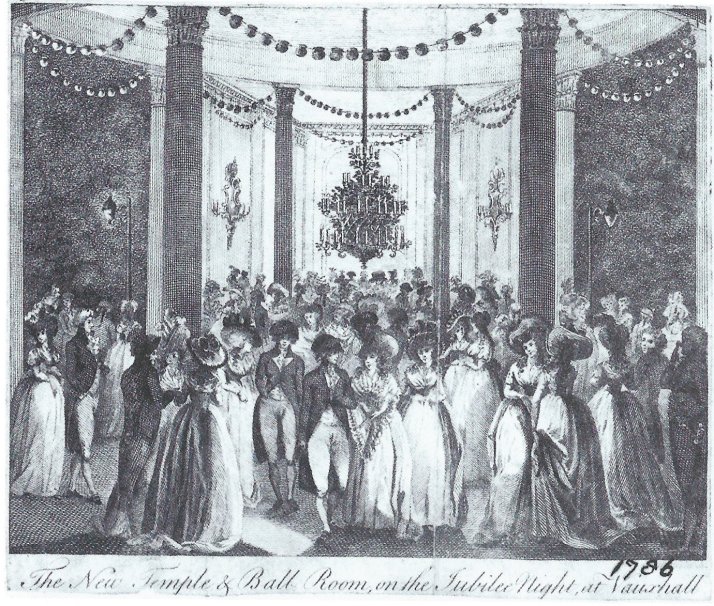
J. Wooding, The New Temple & Ball Room, on the Jubilee Night, at Vauxhall, engraving, c. 1786. The circular Grand Temple at the junction of the Grand South Walk and the Centre Cross Walk, with the temporary ballrooms added to its north and south. The artist was keen to show all the different forms of lighting in use.

J. Wooding, The New Temple & Ball Room, on the Jubilee Night, at Vauxhall, engraving, c. 1786. The circular Grand Temple at the junction of the Grand South Walk and the Centre Cross Walk, with the temporary ballrooms added to its north and south. The artist was keen to show all the different forms of lighting in use.

The approach of the half-century mark of the opening of Vauxhall Gardens “must have come as a godsend to Barrett at the start of his proprietorship.”

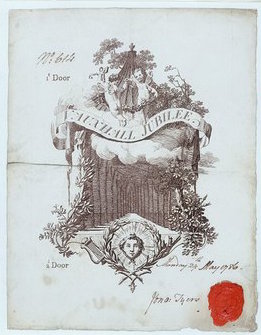
The last great fashionable event had been the hugely successful Ridotto al Fresco of 1769. In a conscious attempt to remind people of the ‘good old days’, when the gardens had last been patronised by fashionable society, the design of the ticket for the vent of the event of seventeen years earlier was adapted for the 1786 Jubilee.

Ticket for the Vauxhall Jubilee, 29 May, engraving. Signed, dated and sealed by Jonathan Tyers the younger, although the management of the park was now in the hands of his son-in-law, Bryant Barrett.

Ticket for the Vauxhall Jubilee, 29 May, engraving. Signed, dated and sealed by Jonathan Tyers the younger, although the management of the park was now in the hands of his son-in-law, Bryant Barrett.

In preparation for the event, which took place on 29 May 1786, the following renovations were completed:

  1. The buildings around the Grove were painted in an elegant pale blue and white livery, and flowering shrubs were planted to appeal to the modern taste in gardening.
  2.  The Rotunda’s interior decoration was completely renewed, with modern mirrors, and the Ionic columns of the Pillared Saloon were renewed with a rich deep pink scagliola. Window frames were replaced and draped with tasselled crimson and silver fabric, and the Rotunda Orchestra was filled with evergreen plants under a decorated ceiling. In the other recess (where the original Rotunda Orchestra had been housed), the large transparent painting of George, Prince of Wales (later the Prince Regent and George IV) in a noble classical pose was replaced with another transparency depicting an amphitheatre of the Corinthian order, through which could be seen a perspective view of a garden. (Apparently, the original transparency was criticized by some as having nothing in common with the Prince’s true character.)
  3. 14,000 coloured lights and wreaths of artificial flowers were draped around the pillars and in festoons around the cornices of the Covered Walks.
  4. A circular Grand Temple was set up at the crossing of the Grand South Walk and the Centre Cross Walk, “little more than a dome on eight classical columns.”
  5. The Centre Cross Walk was partly built over to give more dancing space in two temporary ballrooms, attached to the Grand Temple on the north and south. “The walls of these ballrooms were painted with Arcadian pastoral scenes beyond a range of Ionic columns decorated with wreaths of flowers, while the ceiling showed a sky filled with ‘tender variegated clouds.’” …In each of the ballrooms was an alcove for the musicians, and others for tables stocked with lemonade, capillaire, and orgeat (soft drinks flavoured with orange flower or almond syrup.) The whole strucutre was of course illuminated with thousands of coloured lamps ‘producing a refugency of light that dazzles and surprises.’
  6. On the site of the former Prince’s Pavilion (built for George III’s father), a new room was created for Prince George and his party.
  7. The entrance to the gardens on Kennington Lane was renewed and enlarged, soon becoming the main coach-entrance, later to be expanded with cloakrooms, waiting-rooms, and other public facilities.
handbill

Handbill for the Vauxhall Jubilee, 1786. A very plain and understated piece of printing, designed only to impart information about the event.

The Jubilee was attended by somewhere between five and six thousand people, most in fashionable and elegant costume, a few in fancy dress, which in this period meant smart dress with added details, such as feathers, flowers, ribbons, ruffs, etc., not character costumes.

There were last night above 6000 persons present, and among them some of the first people in the kingdom, but as is always the case at Vauxhall, it was a mélange; the cit and the courtier jostled each other with the usual familiarity; the half guinea was no repellent to the middling order; John Bull loves to shoulder his superiors in rank, his betters he’ll not allow them to be; and where he pays as much for admission, he never considers them to be more than his equals.

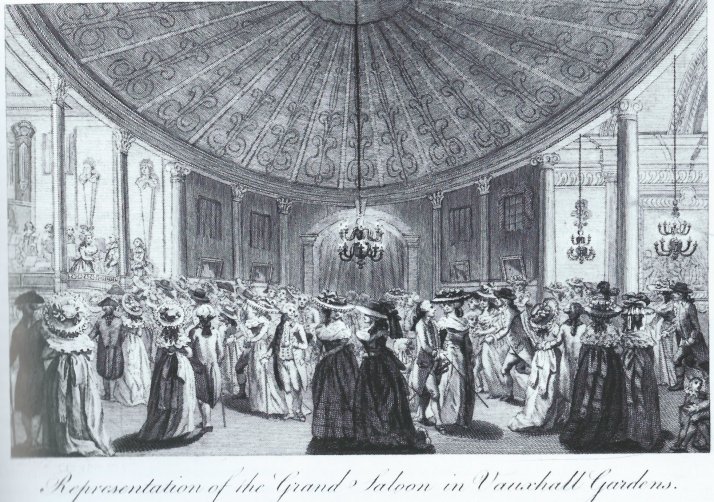
Anon., Representation of the Grand Saloon in Vauxhall Gardens, engraving, after 1786. An unusual view of the renovated Rotunda interior, taken from the entrance off the Grand Walk. The Rotunda Orchestra is on the left, and one of Hayman's paintings from his Seven-Years War series is visible in the Pillared Saloon on the right.

Anon., Representation of the Grand Saloon in Vauxhall Gardens, engraving, after 1786. An unusual view of the renovated Rotunda interior, taken from the entrance off the Grand Walk. The Rotunda Orchestra is on the left, and one of Hayman’s paintings from his Seven-Years War series is visible in the Pillared Saloon on the right.

On the following day, the gardens were opened to four thousand people who were not able to get tickets after those for the first event were sold out.

A successful season

Barrett took advantage of the popular trend of holding military fetes to honor the huge numbers of soldiers coming home from North America by promoting a patriotic tone to this one, with large transparencies framed by martial and naval motifs.

Later that year, when George III escaped a “rather pathetic assassination” by a housemaid with a knife outside St. James’s Palace, Vauxhall celebrated the king’s survival with a new patriotic song by James Hook and an organ concerto with variations on God Save the King.

Barrett’s first season at the helm “once more confirmed Vauxhall as a popular and respectable venue for fashionable society during the 1780’s. However,

…the public attitude towards the gardens was beginning to undergo a fundamental change. The largely unquestioning indulgence was now a thing of the past, and questions were being asked as to whether a pleasure garden was more of a nuisance than a benefit. The establishment’s opposition to public entertainment was strengthening.

Neighbors who had complained for years about the disruption caused by those returning home in the early hours of the morning, were starting to be heard.


Susana’s Vauxhall Blog Post Series

  1. Vauxhall Gardens: A History
  2. Vauxhall Gardens: Jonathan Tyers—“The Master Builder of Delight” 
  3. Vauxhall Gardens: A New Direction
  4. Vauxhall Gardens: The Orchestra and the Supper-Boxes 
  5. Vauxhall Gardens: The Organ, the Turkish Tent, and the Rotunda
  6. Vauxhall Gardens: Three Piazzas of Supper-Boxes
  7. Vauxhall Gardens: “whither every body must go or appear a sort of Monster in polite Company”
  8. Vauxhall Gardens: The Competition
  9. Vauxhall Gardens: The Artwork, Part I
  10. Vauxhall Gardens: The Artwork, Part II
  11. Vauxhall Gardens: The Music, 1732-1859
  12. Vauxhall Gardens: The Business Side
  13. Vauxhall Gardens: Developments from 1751-1786
  14. Vauxhall Gardens: Thomas Rowlandson’s Painting (1785)
  15. ‎Vauxhall Gardens: The Third Generation of the Tyers Family and the Jubilee of 1786
  16. Vauxhall Gardens: An Era of Change (1786-1822), Part I
  17. Vauxhall Gardens: An Era of Change (1786-1822), Part II
  18. Vauxhall Gardens: An Era of Change (1786-1822), Part III
  19. Vauxhall Gardens: The Final Years, Part I
  20. Vauxhall Gardens: The Final Years, Part II
  21. Vauxhall Gardens: The Final Years, Part III
  22. Vauxhall Gardens: The Final Years, Part IV
  23. Vauxhall Gardens: Farewell, for ever

Vauxhall Gardens: Thomas Rowlandson’s Painting (1785)

vauxhallbook

Vauxhall Gardens: A History

David Coke & Alan Borg

The Vauxhall Pleasure Gardens is one of the places I’d love to slip back in time to visit, just to catch a glimpse of what it was like. After recently splurging to buy this lovely coffee-table book, I thought it might make a wonderful subject for a new blog series. But do buy the book too, if you can! The photos are fabulous!

I’m so excited! I just bought a mounted poster of this painting in color from art.com to hang in my bedroom/office here in Florida.

By the time this painting appeared, Jonathan Tyers had died and Vauxhall Gardens passed on to his wife and children, but it was his son Jonathan Tyers Jr.—that n’er-do-well younger son who wed a widowed lady much older than he and caused a giant rift among his parents—who assumed his father’s role in managing the park.

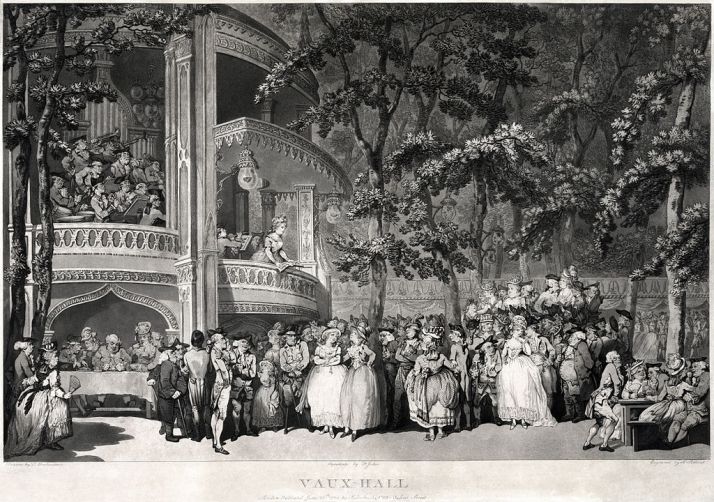
Thomas_Rowlandson_-_Vaux-Hall_-_Dr._Johnson,_Oliver_Goldsmith,_Mary_Robinson,_et_al


In the supper-box on the left we see, reading left to right, James BoswellMrs Thrale (who appears twice), Dr. Johnson, and Oliver Goldsmith.

The ‘macaroni’ Captain Edward Topham (scandalmonger to The World) is quizzing Georgiana, Duchess of Devonshire and her sister Lady Duncannon (Sheridan’s Lady Bessborough), watched by a naval figure with an eye patch and a wooden leg (not included in the Mellon version), always called Admiral Paisley, but Paisley did not lose his leg and eye until 1st June 1794, so it cannot be him. To the left of him, a young girl (a young boy in the Mellon version) holding the hand of a man who could be the comic actor, William Parsons, or Rowlandson’s friend Jack Bannister.

Peering at the two ladies from behind a tree is a figure traditionally, though improbably, identified as Sir Henry Bate-Dudley, the ‘Fighting Parson’, editor of the Morning Herald; he is more likely to be Thomas Tyers (son of Jonathan Tyers the great entrepreneur and proprietor of Vauxhall Gardens from 1729 until 1767) who stands next to the Scotsman James Perry, editor of the London Gazette. The couple on their right could well be the artist himself and his current girlfriend. and to the right of them stands the actress Mary ‘Perdita’ Robinson, with her husband on her right and the Prince of Wales (later George IV) on her left.

Looking up at the singer, the couple on the extreme left, have been identified as the actress Miss Hartley, in company with one of her many admirers, possibly Mr. Colman, but, suggested by their position apart from the crowd, they could also be members of the Tyers family (most likely Jonathan jr. and his wife Margaret, or their son-in-law Bryant Barrett and his wife Elizabeth. The large lady seated at the table on the right is Mrs Barry, the old Madam of Sutton Street, Soho, with two of her customers and one of her girls.

In the orchestra, we can see Jacob Nelson, the tympanist, who had played at Vauxhall since 1735, and died there after fifty years’ performing, Mr Fisher on oboe, probably Hezekiah Cantelo and Mr. Sargent on trumpet, and Barthélemon, the leader, who retired in 1783. James Hook, the composer, organist, musical director and prolific song-writer, may be seen between Barthelemon and the singer, the 38-year-old Frederika Weichsell, who was Rowlandson’s next-door neighbour in Church Street, and the mother of Mrs. Elizabeth Billington. Elizabeth had just (aged 18) married James Billington, a double-bass player, in 1783, much against her parents’ wishes.

A number of those present in this scene had already died by the time Rowlandson produced the painting, and the affair between the Prince and Perdita Robinson was already over.

Although there is no direct evidence for this, it seems likely, because of the dating, and because of the central position of the singer, that the painting was created by Rowlandson as a retirement gift for Frederika Weichsel, whether from him personally, or specially commissioned by the proprietors of the gardens.


Susana’s Vauxhall Blog Post Series

  1. Vauxhall Gardens: A History
  2. Vauxhall Gardens: Jonathan Tyers—“The Master Builder of Delight” 
  3. Vauxhall Gardens: A New Direction
  4. Vauxhall Gardens: The Orchestra and the Supper-Boxes 
  5. Vauxhall Gardens: The Organ, the Turkish Tent, and the Rotunda
  6. Vauxhall Gardens: Three Piazzas of Supper-Boxes
  7. Vauxhall Gardens: “whither every body must go or appear a sort of Monster in polite Company”
  8. Vauxhall Gardens: The Competition
  9. Vauxhall Gardens: The Artwork, Part I
  10. Vauxhall Gardens: The Artwork, Part II
  11. Vauxhall Gardens: The Music, 1732-1859
  12. Vauxhall Gardens: The Business Side
  13. Vauxhall Gardens: Developments from 1751-1786
  14. Vauxhall Gardens: Thomas Rowlandson’s Painting (1785)
  15. ‎Vauxhall Gardens: The Third Generation of the Tyers Family and the Jubilee of 1786
  16. Vauxhall Gardens: An Era of Change (1786-1822), Part I
  17. Vauxhall Gardens: An Era of Change (1786-1822), Part II
  18. Vauxhall Gardens: An Era of Change (1786-1822), Part III
  19. Vauxhall Gardens: The Final Years, Part I
  20. Vauxhall Gardens: The Final Years, Part II
  21. Vauxhall Gardens: The Final Years, Part III
  22. Vauxhall Gardens: The Final Years, Part IV
  23. Vauxhall Gardens: Farewell, for ever

Cerise DeLand: Her Beguiling Butler (Giveaway)

About Historical Accuracy…

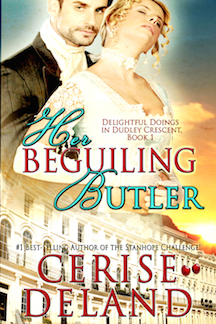
$_57 copy

With your romance, do you crave accurate history? A sense of time and place? Cerise tells all about Her Beguiling Butler!

Say you like historicals and you often wonder what’s true and what isn’t?

I can’t speak for other authors, but I do desperately try to bring you The Real Stuff.

For example, what’s real in Her Beguiling Butler?

You see a date at the beginning of the book, January 17, 1820. Why?

Because when I plotted the book, I wanted to note precisely when George III (he of the American Revolution!) died and what happened.

So I had to work backwards from that.

Yes. You need to read the book to learn how and when the news reached London!

The Prince of Wales is not considered a fine fellow by most people in the novel. Is that true?

Yes. Prinny, by the time of his ascent to his father’s throne (not official by the way until a year later at his coronation) was considered a spendthrift and profligate. He’d had so many mistresses and appealed to Parliament to spend so much on his homes and his clothes (as well as other debts), many in the Realm were not happy.

In fact, they rather liked old George, his father.

Lady Ranford is being considered by the courts to assume a title on her own. Is that possible for a woman to inherit a title in her own right?

Yes. And hopefully you’ll read the book to learn how that’s done!

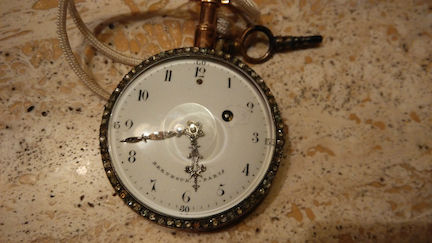
The chiming watch piece that Finnley carries around with him to make certain the house runs on time was a real time piece. I did not invent it.

It was delicately made by Ferdinand Berthoud. His work was very popular, aside from being very expensive.

The mourning practices for King George III that most noblemen observed did indeed happen.

What sorts of observances did they have to employ?

Ah. Do read the book for a description!

Does Dudley Crescent exist?

No. I made it up!  I also made up the man who was given the land by Charles II!

So what is the picture on the front cover of the novel?

What do you think it is? Comment here and win a digital copy of Her Beguiling Butler!

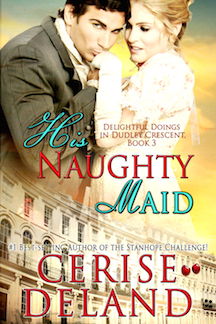
Do look for #2 and #3 in series when I give you a governess and a maid who are more than they appear to be!

giveaway

One lucky commenter wins a swag pack containing a Susana Ellis mug and other goodies!

Her Beguiling Butler by Cerise DeLand copy

About Her Beguiling Butler

The lovely widow at No. 10 Dudley Crescent hopes to lead a merry life without any husband to replace the elderly one she recently buried. Yet Lady Ranford finds herself in a pickle. Her new butler, Finnley, is not only the most obstinate man she’s ever met, but he’s a virile enigma.

She’s never been lured to naughtiness with a man. Heaven knows, she certainly shouldn’t fantasize about the tall, dark, scowling creature who runs her household like a finely tuned clock.

But she can’t help herself. She needs to taste him—or dismiss him.
Finnley, poor fellow, has a few risqué dreams of his own about how he’d like to handle the delectable widow. Alone in his rooms, he resolves to deny how her humor riddles his mind and how her beauty steals his breath away.

None of his solutions are proper.

All of his desires are quite…dear me…scandalous.
But what’s a butler to do when the very life of his beloved employer is at stake? And he cannot control his need to protect her and…ahem…bed her?

AMAZON  • ARe  • NOOK  • KOBO

About the Author

Cerise DeLand is #1 bestselling author of Regency romances! And a top selling author of contemporaries too!

WebsiteTwitterNewsletter

His Naughty Maid by Cerise DeLand copy

His Tempting Governess by Cerise DeLand copy

The Dover Road: Blackheath and Dartford

dust jacket

The following post is the fourteenth of a series based on information obtained from a fascinating book Susana recently obtained for research purposes. Coaching Days & Coaching Ways by W. Outram Tristram, first published in 1888, is replete with commentary about travel and roads and social history told in an entertaining manner, along with a great many fabulous illustrations. A great find for anyone seriously interested in English history!

Note: Comment to enter the contest for Susana’s September Giveaway, a lovely necklace from London’s National Gallery (see photo at right).

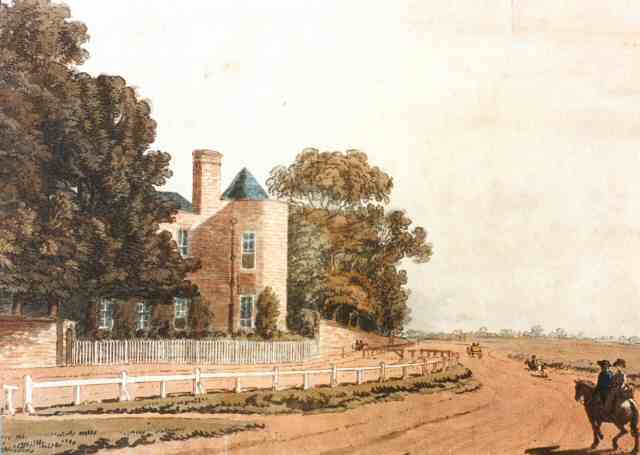
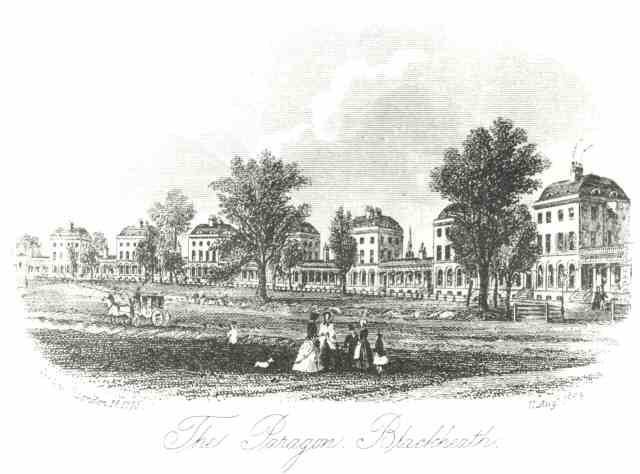
Blackheath: Dark-Colored Heathland

The area of Blackheath is about seven miles from London Bridge. Originally the name of an open space for public meetings of the ancient hundred of Blackheath, this name was also given to the Victorian suburb that was developed later in the 19th century. While this area was certainly used for burial pits for the victims of the Black Death in the 14th century, it was only one of many used for such a purpose in London and was not the source of the name. Blackheath comes from Old English, “dark-colored heathland,” undoubtedly referring to the color of the soil.

Besides a queen devoted to junketings [Queen Caroline, who lived at Montague House], a letter-writing father, bent on directing his son to the deuce [Lord Chesterfield], and a great warrior [Major General James Wolfe, conqueror of Quebec], rebellion has in the good old days…raised its head on this celebrated spot; and it raised its head in the person of Wat Tyler, who was here in 1381 at the head of one hundred thousand other heads (which was wise of him seeing that he had previously cracked a poll-tax collector’s head at Dartford, after drinking too much ale, I suppose, at the celebrated Bull Inn). Another rebel was here, at Blackheath 1497. Lord Audley to wit, who went through the somewhat aimless exercise of bringing troops all the way from Cornwall, pitching their tents, and immediately afterwards suffering defeat at the hands of Henry the Seventh.

Montague House, residence of Queen Caroline

Montague House, residence of Queen Caroline

The Predecessor of Rotten Row?

For this celebrated spot occupied in the annals of England much the same sort of position apparently as Rotten Row occupies in the annals of contemporary fashion. It was the place where kings and ministers met casually on their way to or from London, and babbled of the weather, the price of corn, the latest hanging, the odds on the next bear-fight, the state of the unemployed, or any other kindred subject which might suggest itself to medieval brains, in an open space, where it was not too windy.

blackheath

Henry the Fifth a Spoilsport?

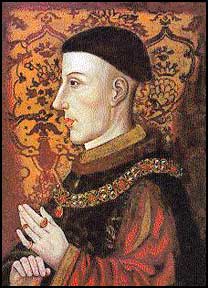
On his return to London, “The Victor of Agincourt” was greeted here by “the mayor and five hundred citizens of London. The mayor and aldermen had prepared an elaborate reception, with wine and scarlet and gold robes and all the trappings. But Henry “nipped all the worthy mayor’s preparations in the bud,” refusing to accept the praise and thanks that should go to God.

A pious decision, but one which must have been extremely unsatisfactory to town councillors who had launched forth in the way of dress and decorations, and to the thousands of Londoners who had flocked out to Blackheath to see the show.

Henry V: not in a proper mood to be fêted

Henry V: not in a proper mood to be fêted

Henry the Eighth: A Guilty Conscience?

It was here on Blackheath that the already muchly married king publicly received his fourth wife, with all due decency and decorum, having already made up his royal mind to put her away privately. For Henry on this occasion did not play fair; and though he pretended to Anne of Cleves herself that it was at this meeting on Blackheath that he had first seen here—in saying so, he said that which was not; for he had already privately inspected her at the Crown Inn at Rochester. It was on this occasion it may be remembered that the bluff Tudor gave way to a regrettable license of speech at first sight of the goods the gods had provided for him, and said many things unfit for publication; which shocked the onlookers, and made Cromwell put his hands to his head to feel if it was still in his shoulders.

Alas, Cromwell, as the advocate for this marriage, paid for his folly with his head. Anne of Cleves, however,

was content to forego the dubious joys of married life for the possession of the several manors in Kent and Sussex that her grateful late lord bestowed upon her. The number of these manors exceeds belief, and at the same time gracefully gauges Henry’s conception of the magnitude of the matrimonial peril past. Indeed, it seems to me that…whenever he had nothing villainous on hand, and was disinclined for tennis, he gave Anne of Cleves a manor or two simply to while away the time.

setWidth320-The-Manor-Gatehouse1

The Manor Gatehouse is all that is left of the manor Henry VIII presented to Anne of Cleves as “one of the first manors granted to this little-married but much-dowered lady.”

Charles II’s Triumphant Procession

…it was in 1660 no doubt that the grandest of its historical pageants was to be seen: when the long reaction against Puritanism had suddenly triumphed, and all England went mad on a May morning at the Restoration of her exiled king; when through sixty-one miles as it were of conduits running wine, triumphal arches, gabled streets hung with tapestry—through battalions of citizens in various bands, some arrayed in coats of black velvet with gold chains, some in military suits of cloth of gold or silver—Charles, who had slept at Rochester the night before, rode on to Blackheath between his brothers, the Dukes of York and Gloucester.

Charles II riding into London

Charles II riding into London

Sir Walter Scott, in his novel Woodstock (1826), paints a picture of Charles catching a glimpse of the characters of the novel in the crowd and making a point to dismount, prevent the aged Sir Henry Lee from rising, and ask for his blessing, after which, “his very faithful servant, having seen the desire of his eyes, was gathered to his fathers.”Quite a poignant scene, but could not have happened in real life since Sir Henry had passed away fifty years earlier. Don’t you just love historical fiction?

Charles Dickens: “veritable genius of the road”

His memory burns by the way—as all but the wicked man who has not read Pickwick and David Copperfield will remember—and indeed A Tale of Two Cities. For in the second chapter of that wonderful book the very spirit of the Dover Road in George the Third’s time is caught as if by magic.

A Tale of Two Cities: read Chapter Two here: http://www.online-literature.com/dickens/twocities/2/

Who does not remember these things? Who has not read them again and again? I declare that I think this second chapter of A Tale of Two Cities a picture of the old coaching days more perfect than any that has been painted. Every detail is there in three pages.

tale

George IV Insulted at the Bull Inn

In 1822

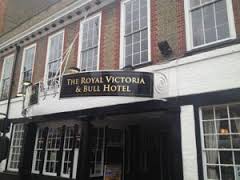
…while the great Fourth George was majestically reposing in his royal post-chaise in front of the old archway he experienced an unpleasant surprise. A very ungentlemanly man named Calligan, a working currier who ought to have known better, suddenly projected his head into the carriage window, and observed in a voice of thunder, “You’re a murderer!” an historical allusion to the king’s late treatment of Queen Caroline, which made the royal widower “sit up”. Upon which a bystander named Morris knocked the personal currier down,and the window of the post-chaise was pulled up, and the post-boy told to drive on as quickly as possible.

The Royal Victoria and Bull Inn (formerly the Bull Inn)

The Royal Victoria and Bull Hotel (formerly the Bull Inn)


 Index to all the posts in this series

1: The Bath Road: The (True) Legend of the Berkshire Lady

2: The Bath Road: Littlecote and Wild William Darrell

3: The Bath Road: Lacock Abbey

4: The Bath Road: The Bear Inn at Devizes and the “Pictorial Chronicler of the Regency”

5: The Exeter Road: Flying Machines, Muddy Roads and Well-Mannered Highwaymen

6: The Exeter Road: A Foolish Coachman, a Dreadful Snowstorm and a Romance

7: The Exeter Road in 1823: A Myriad of Changes in Fifty Years

8: The Exeter Road: Basingstoke, Andover and Salisbury and the Events They Witnessed

9: The Exeter Road: The Weyhill Fair, Amesbury Abbey and the Extraordinary Duchess of Queensberry

10: The Exeter Road: Stonehenge, Dorchester and the Sad Story of the Monmouth Uprising

11: The Portsmouth Road: Royal Road or Road of Assassination?

12: The Brighton Road: “The Most Nearly Perfect, and Certainly the Most Fashionable of All”

13: The Dover Road: “Rich crowds of historical figures”

14: The Dover Road: Blackheath and Dartford

15: The Dover Road: Rochester and Charles Dickens

16: The Dover Road: William Clements, Gentleman Coachman

17: The York Road: Hadley Green, Barnet

18: The York Road: Enfield Chase and the Gunpowder Treason Plot

19: The York Road: The Stamford Regent Faces the Peril of a Flood

20: The York Road: The Inns at Stilton

21: The Holyhead Road: The Gunpowder Treason Plot

22: The Holyhead Road: Three Notable Coaching Accidents

23: The Holyhead Road: Old Lal the Legless Man and His Extraordinary Flying Machine

24: The Holyhead Road: The Coachmen “More Celebrated Even Than the Most Celebrated of Their Rivals” (Part I)

25: The Holyhead Road: The Coachmen “More Celebrated Even Than the Most Celebrated of Their Rivals” (Part II)

26: Flying Machines and Waggons and What It Was Like To Travel in Them

27: “A few words on Coaching Inns” and Conclusion

The Brighton Road: “The Most Nearly Perfect, and Certainly the Most Fashionable of All”

dust jacket

The following post is the twelfth of a series based on information obtained from a fascinating book Susana recently obtained for research purposes. Coaching Days & Coaching Ways by W. Outram Tristram, first published in 1888, is chock full of commentary about travel and roads and social history told in an entertaining manner, along with a great many fabulous illustrations. A great find for anyone seriously interested in English history!

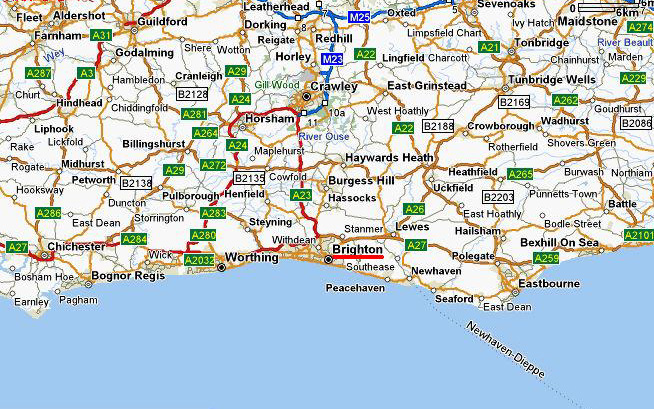
The Brighton Road, Mr. Tristram suggests, might be called the “Regent’s Road,” since it was the Prince who, once he determined the health benefits of the seaside city, saw to it that the road was made passable.

For before the Pavilion was, Brighton was about as easy to get at as the Cranmere Pool in the middle of Dartmoor, the moon, the North Pole, the special exits in case of fire at our principal theatres, or anything else on earth totally inaccessible.

It was in 1750 when Brighton was nothing but a small fishing village that Doctor Richard Russell visited and proclaimed that sea water was beneficial to health, which began the exodus of wealthy hypochondriacs to seaside resorts. At that time, however, our author suggests that oxen were required to cope with the deep ruts. “People got into coaches to go to Brighton and only got out of them when they were overturned.”

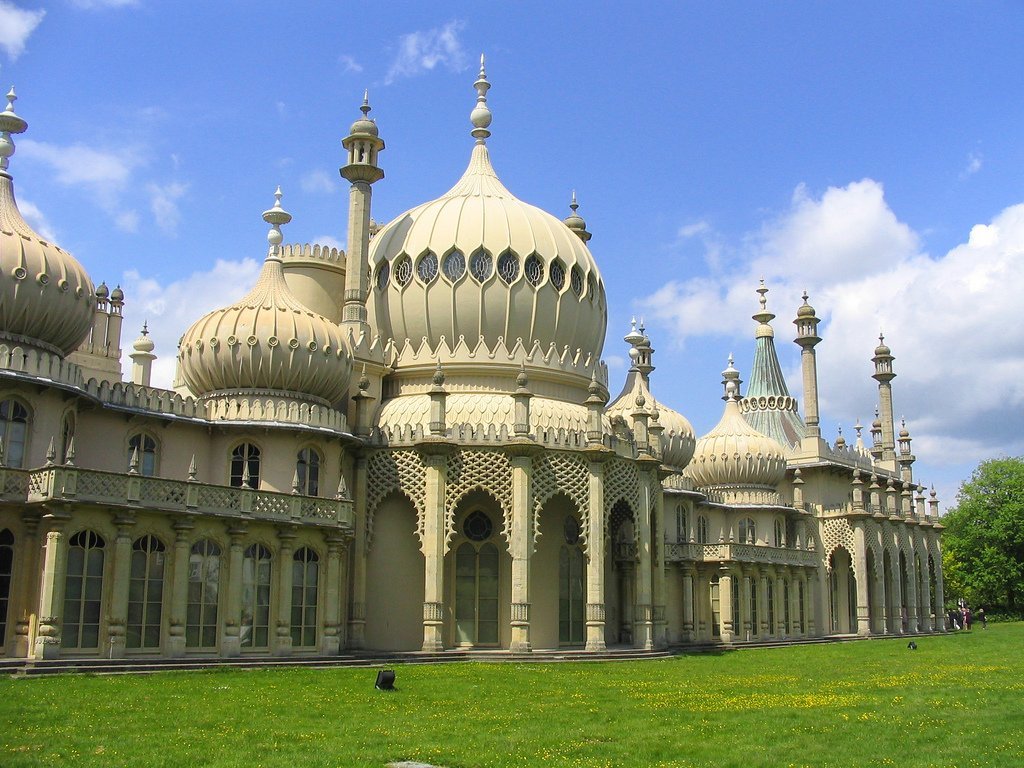
All these horrors of the Brighton Road the much abused George the Fourth did away, with a sweep as it were of his fat, bejewelled and august hand! He built the Pavilion, and people from all parts of the country came straightway to see it and him… the crowds soon found…that if they were to come to Brighton, and to court, they had better have some decent road to come upon. And from this simple bringing home of a plain truth came into existence the Brighton Road—“perhaps the most nearly perfect, and certainly the most fashionable of all.”

Brighton Pavilion1

Brighton Pavilion

Cuckfield Park, Cuckfield, West Sussex

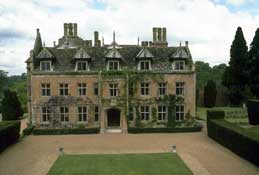
This sixteenth century manor is known for its ghost, said to be that of Anne Sergison, who, already afflicted with a somewhat combative nature, had to fight a long and sordid court battle to get it. It came to light after her brother’s death that the thirteen-year-old girl assumed to be his daughter was actually a “supposititious” (don’t you just love that word?) child imposed on him by his wife. No one knows what happened to the girl and her mother, but Anne’s ghost has been spotted in the corridors and the avenue leading to the house, and some say she particularly attended her granddaughter’s wedding in 1890. No rest for the wicked, so they say.

Cuckfield Park was the inspiration for William Harrison Ainsworth’s novel Rookwood.

Cuckfield Park

Cuckfield Park

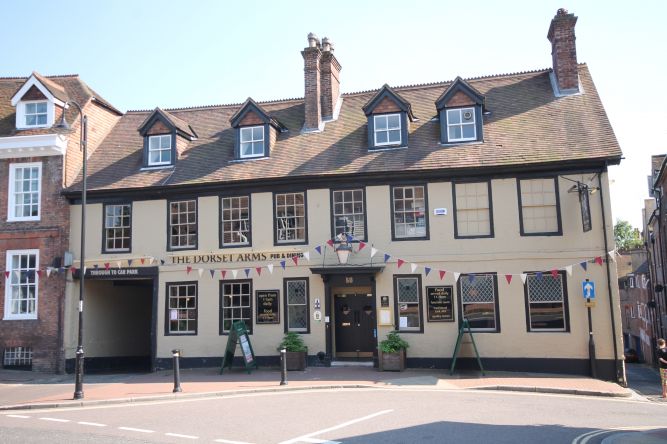
The Dorset Arms, East Grinstead

All distinguished travellers on the Brighton Road pulled up as a matter of course at the Dorset Arms. Amongst those whose names have been handed down as habitual visitors, was Lord Liverpool, who always stayed at the Dorset Arms when on his way to visit the Harcourt seat near Buxted… Another constant guest was Lord Seymour, who died, I believe, in 1837—mean, I am sorry to say…and yet not mean either one way, for if he didn’t eat and drink much, he possessed a passion for illumination which must have produced some respectable items in the bill—thirty wax candles or more burning in his bedroom all night. Spencer Perceval too (the Prime Minister remarkable for great ability and for having been shot in the lobby of the House of Commons in 1812 by John Bellingham) must have been a familiar figure at the Dorset Arms, for the house from which he was married in 1790 to Miss Jane Wilson stands just at the bottom of the Dorset Arms’ garden.
The Dorset Arms

The Dorset Arms

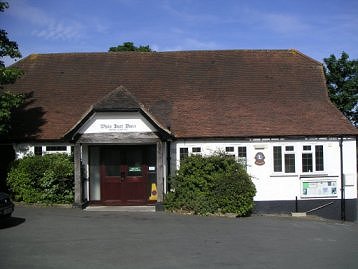
The Clayton Arms, formerly the White Hart and currently the White Hart Barn, Godstone Green

It is said the that in 1815 the Regent, the Tsar of Russia, and many royal visitors stayed at the inn on their way to Blindley Heath, to be present at the fight for the championship of England…Blindley Heath was one of the most popular and celebrated of prize-fighting rendezvous.

“The Fancy were all upon the alert soon after breakfast” (I quote from Boxiana’s description of the Grand Pugilistic combat between Randall and Martin, at Crawley Down, thirty miles from London, on Tuesday, May 4, 1819 “on the Monday to ascertain the seat of action; and as soon as the important whisper had gone forth, that Crawley Down was likely to be the place, the toddlers were off in a twinkling… Between the hours of two and three o’clock in the afternoon upwards of a hundred gigs were counted passing through Croydon… Long before eight o’clock in the evening every bed belonging to the inns and public houses in Godstone, East Grinstead, Reigate, Bletchingley, &c., were doubly and some trebly occupied.”

“Those persons whose blunt enabled them to procure beds, could not obtain any sleep, for carriages of every description were passing through the above towns all night… The brilliants also left Brighton and Worthing at about the same period, and thus were the roads thronged in every direction… It is supposed if the carriages had all been placed in one line they would have reached from London to Crawley. The amateurs were of the highest distinction, and several noblemen and foreigners of rank were upon the ground.”

The White Hart Barn, now the village hall of Godstone Green

The White Hart Barn, now the village hall of Godstone Green

Regent and emperor putting up at a wayside inn to witness a fight for the championship!…The noblemen and foreigners of rank crowding round the twenty-four foot ring! What can give us a better idea of the Brighton Road in its prime than these facts? What paint more vividly what I call its “Regency flavour”, its slang, its coarseness, its virility—in a word, its “Corinthianism”?

brighton-map

 Index to all the posts in this series

1: The Bath Road: The (True) Legend of the Berkshire Lady
2: The Bath Road: Littlecote and Wild William Darrell

3: The Bath Road: Lacock Abbey

4: The Bath Road: The Bear Inn at Devizes and the “Pictorial Chronicler of the Regency”

5: The Exeter Road: Flying Machines, Muddy Roads and Well-Mannered Highwaymen

6: The Exeter Road: A Foolish Coachman, a Dreadful Snowstorm and a Romance

7: The Exeter Road in 1823: A Myriad of Changes in Fifty Years

8: The Exeter Road: Basingstoke, Andover and Salisbury and the Events They Witnessed

9: The Exeter Road: The Weyhill Fair, Amesbury Abbey and the Extraordinary Duchess of Queensberry

10: The Exeter Road: Stonehenge, Dorchester and the Sad Story of the Monmouth Uprising

11: The Portsmouth Road: Royal Road or Road of Assassination?

12: The Brighton Road: “The Most Nearly Perfect, and Certainly the Most Fashionable of All”

13: The Dover Road: “Rich crowds of historical figures”

14: The Dover Road: Blackheath and Dartford

15: The Dover Road: Rochester and Charles Dickens

16: The Dover Road: William Clements, Gentleman Coachman

17: The York Road: Hadley Green, Barnet

18: The York Road: Enfield Chase and the Gunpowder Treason Plot

19: The York Road: The Stamford Regent Faces the Peril of a Flood

20: The York Road: The Inns at Stilton

21: The Holyhead Road: The Gunpowder Treason Plot

22: The Holyhead Road: Three Notable Coaching Accidents

23: The Holyhead Road: Old Lal the Legless Man and His Extraordinary Flying Machine

24: The Holyhead Road: The Coachmen “More Celebrated Even Than the Most Celebrated of Their Rivals” (Part I)

25: The Holyhead Road: The Coachmen “More Celebrated Even Than the Most Celebrated of Their Rivals” (Part II)

26: Flying Machines and Waggons and What It Was Like To Travel in Them

27: “A few words on Coaching Inns” and Conclusion

Hertford House and the Wallace Collection

One of my favorite activities is to visit beautiful, historic houses with lovely art and furnishings—even better if they are Georgian. In addition to the lovely rooms, there are so many captivating stories to remind me of the bygone era and the colorful personalities who used to live and/or socialize within them.

WallaceHouse

Hertford House is located on Manchester Square only blocks from the flat I’ve leased near Baker Street and quite close to the fabulous shops on Oxford Street as well. Because it’s small compared to other museums in London, it’s much less crowded and suitable for a leisurely visit. It is more of an art gallery than an example of a Georgian home, however, but if you enjoy both, you’re in luck!

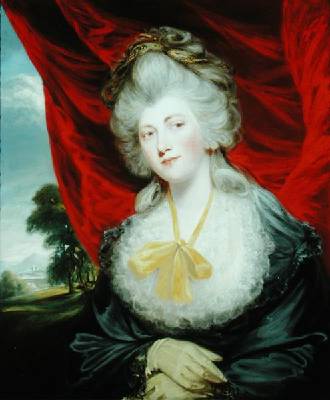
Lady Hertford, 1800

Lady Hertford, 1800

The historical gossip that I wanted to know immediately if this home had anything to do with the Marchioness of Hertford who was a longtime mistress of the Prince Regent. Yes, indeed, Lady Hertford was the wife of the 2nd Marquess, but it was the 4th Marquess who left the house and the collection to his illegitimate son, Sir Richard Wallace, whose widow left it to the nation.

Seymour-Conway was the family name of the Hertfords (think Jane Seymour, Henry VIII’s third wife), and they were close connections to the Duke of Somerset.

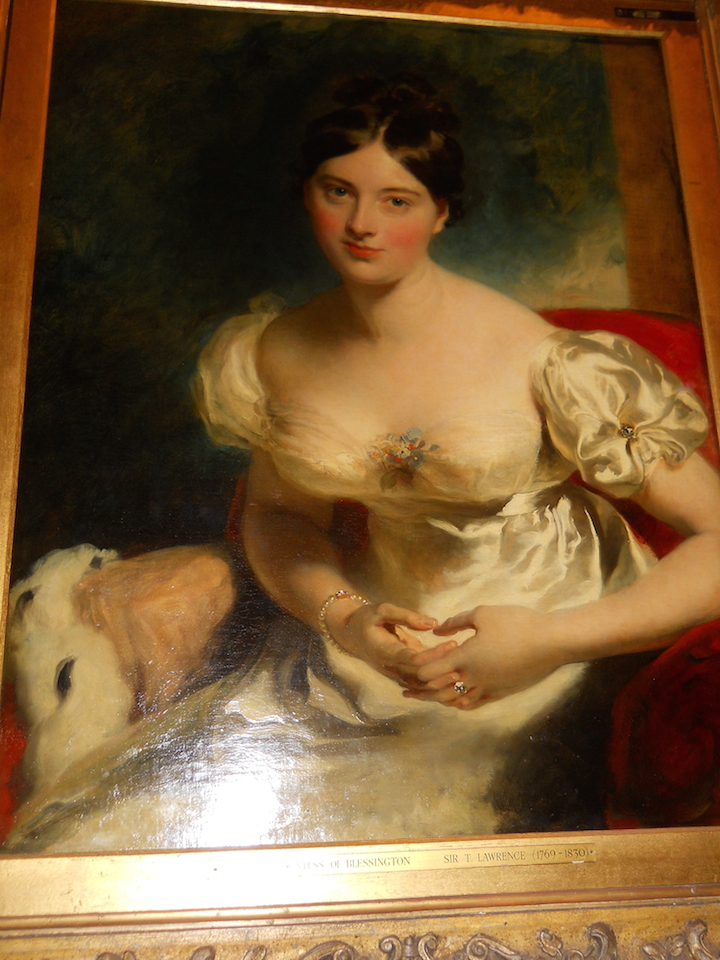
Marguerite, Countess of Blessington

Marguerite, Countess of Blessington

The house is filled with beautiful rooms and art treasures, as well as an armory. In the very first salon is a lovely painting of the Countess of Blessington by Sir Thomas Lawrence (as beautiful as she appears, it is said that she was even more ravishing in person). The countess’s beauty literally took her from rags to riches, as she rose from a sea captain’s mistress to an earl’s wife, and eventually into a ménage à trois with a young Comte d’Orsay. Besides her beauty, she was quite intelligent and held glittering salons for the crème de la crème of European society, including Lord Byron, of whom she wrote in Conversations with Lord Byron.

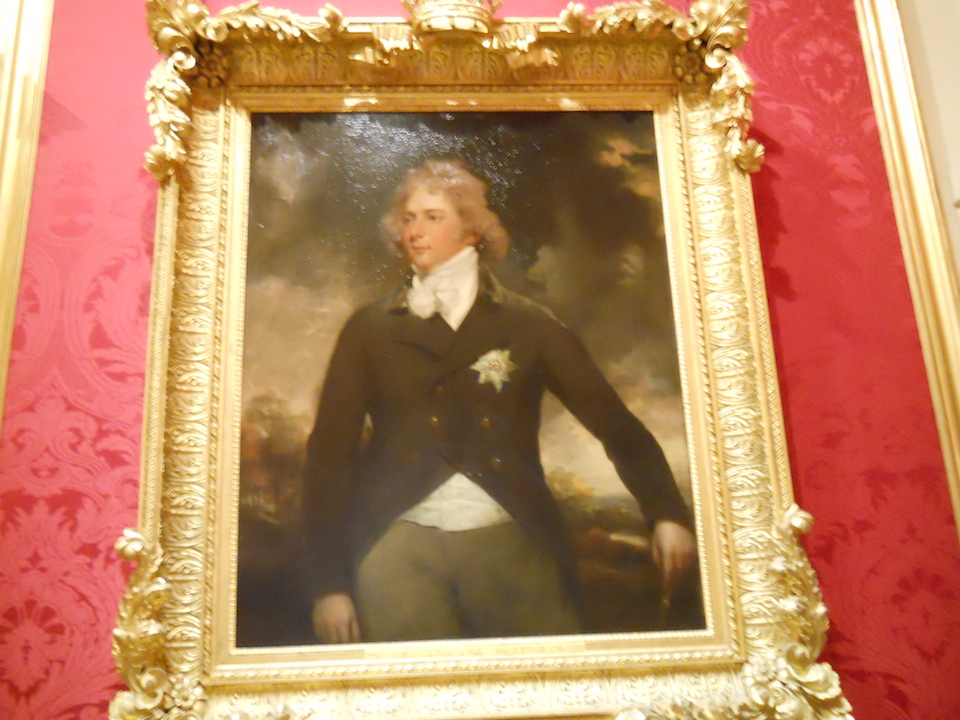
George, Prince of Wales (later George IV)

George, Prince of Wales (later George IV)

The painting of the Prince of Wales as he was in 1792) was presented to the 3rd Marquess in 1810 while his mother was the Prince’s mistress. And there’s a lovely Lawrence portrait of Emma Hamilton as well.

Emma Hamilton

Emma Hamilton

In another room is a portrait by Gainsborough of Mary Robinson, the Prince Regent’s first mistress, as Perdita in Shakespeare’s A Winter’s Tale.

Mary Robinson, as Perdita

Mary Robinson, as Perdita

Franz Halz’s The Laughing Cavalier is here, and much, much more. Admission is free, and being so close, I can see myself returning for at least one more visit.

cavalier

Franz Hals’s The Laughing Cavalier

Be sure to put it on your list for your next trip to London!

For more photos of paintings and furnishings, check out my Pinterest board!

The Regency Gentleman’s Passion For the Turf

racecourse

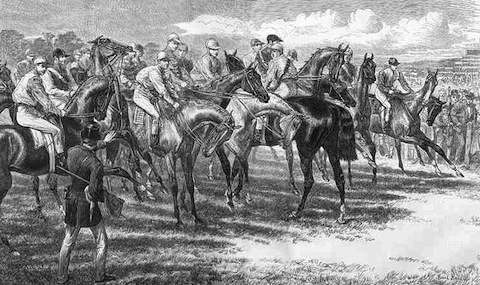
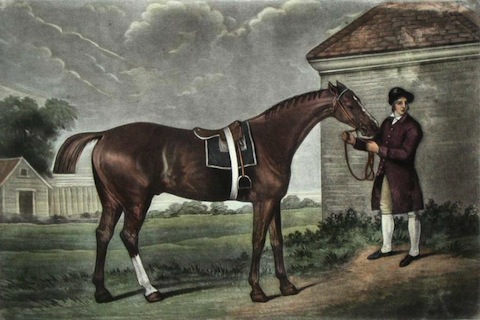
Breeding and training thoroughbreds for racing was the passion of many wealthy gentlemen of good birth. Even more participated in watching and wagering the races. Newmarket, with its network of race courses, sponsored seven race meetings a year, and a third of all the race horses in England were trained nearby. (Transporting horses was very difficult, and most horses were walked to the race course, so it was better to keep them as near as possible.)

Around 500 spectators—nearly all upper-class—gathered to watch the race on horseback, sitting on top of carriage roofs, or standing around the course at Newmarket, as there were no grandstands as there were at other courses. In 1809, the 2000 Guineas, a sweepstakes for three-year-olds was established at Rowley Mile. The 1000 Guineas, a race for three-year-old fillies was established in 1817 at the less taxing course of Ditch Mile.

newmarket

Prince George was an enthusiastic participant in racing in his younger days (1788-1791), but withdrew in a huff when the jockey of his horse Escape was involved in a dreadful scandal, and the Jockey Club—the organization that oversaw the sport—insisted that the Prince give the jockey his marching orders. What was the scandal? A matter of Escape losing a race one day, forcing the odds up for the next day, resulting in the Prince winning a large sum of money. The Prince continued to patronize the races, however. He just could not resist the lure of the excitement and gambling.

Types of Races

Horse matches were head-to-head contests where individual owners would agree on a wager, and the winner took all. Spectators would make side bets as well. In one famous match, Hambletonian vs. Diamond, almost 300,000 pounds changed hands.

Plate and cup matches, where the prize was a trophy, were quite common as well.

The sweepstakes, however, with a line-up of horses running against each other, was the most popular in the late 18th/early 19th century. The owners put up a specified sum to subscribe to the race, and the winner took everything.

Race Courses

Ascot, with its close proximity to London, became a popular venue for fashionable race fans. In 1814, popular heroes such as Blücher, Tsar Alexander, the King of Prussia and Hetnan Platov provided additional entertainment for the race-mad hordes.

epsom downs

Epsom Downs

Epsom Downs, home of the legendary horse Eclipse, drew large crowds of the fashionable on Derby Day (named after the Earl of Derby who was instrumental in its development), a one-and-a-half mile race for three-year-olds. The only permanent structure on the course was Prinny’s stand, a miniature “castle” with Gothic arches where he could sit with his cronies to enjoy the races.

Eclipse

Eclipse

Other race courses were Goodwood in Yorkshire, Newcastle, Chester, Warwick, Winchester and Doncaster. Raikes (a dandy, banker and diarist) says:

“The Prince made Brighton and Lewes the gaiest scene of the year in England. The Pavilion was full of guests; the Steyne was crowded with all the rank and fashion from London during that week; the best horses were brought from Newmarket and the North, to run at these races, on which immense sums were depending; and the course was graced by the handsomest equipages.”

The Jockey Club

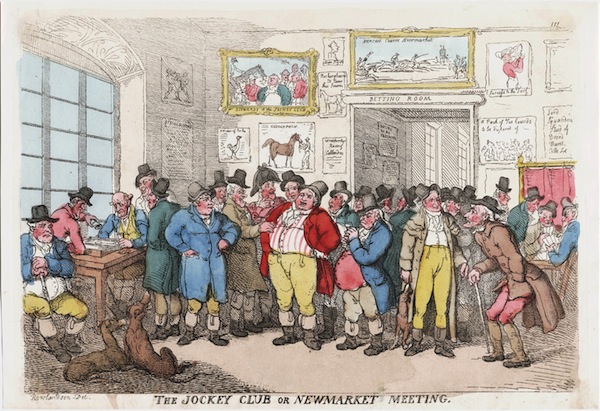
The organization responsible for regulating the racing world was the Jockey Club, whose members in 1790 included the Prince Regent, the Dukes of Bedford, Cumberland, Devonshire, and Norfolk. The Jockey Club established rules for such things as record-keeping and ensured that they were followed.

Wagering

As in London clubs and gaming hells, fortunes were won and lost at race courses. Brummell, too, lost large sums on horse racing. Raikes says:

“…I was never more surprised than when, in 1816, one morning he confided to me, that he must fly the country that night and by stealth. The next day he was landed in Calais, and, as he said, without any resources. I had several letters from him, at that time written with much cleverness, in which his natural high spirits struggled manfully against his overpowering reverses; but from the first he felt confident that he should never be able to return to his own country.”

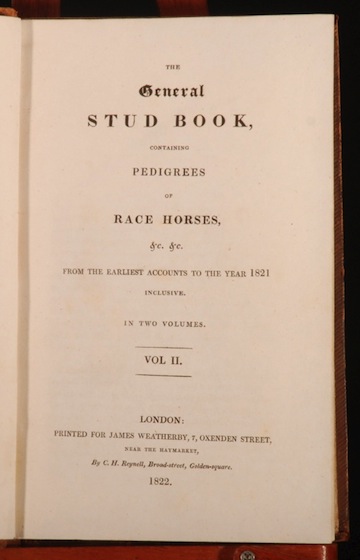
Stud Book

Stud Book

Laudermilk, Sharon H. and Hamlin, Theresa L., The Regency Companion, Garland Publishing, 1989.

The Regency Gentleman series

The Regency Gentleman: His Upbringing

The Fashionable Gentleman

The Rise and Fall of Beau Brummell 

Gentlemen’s Clubs in Regency London

Captain Who?

Gentlemen’s Sports in the Regency

The Gentleman’s Passion for Horses

Riding to the Hounds

The Regency Gentleman’s Passion for the Turf