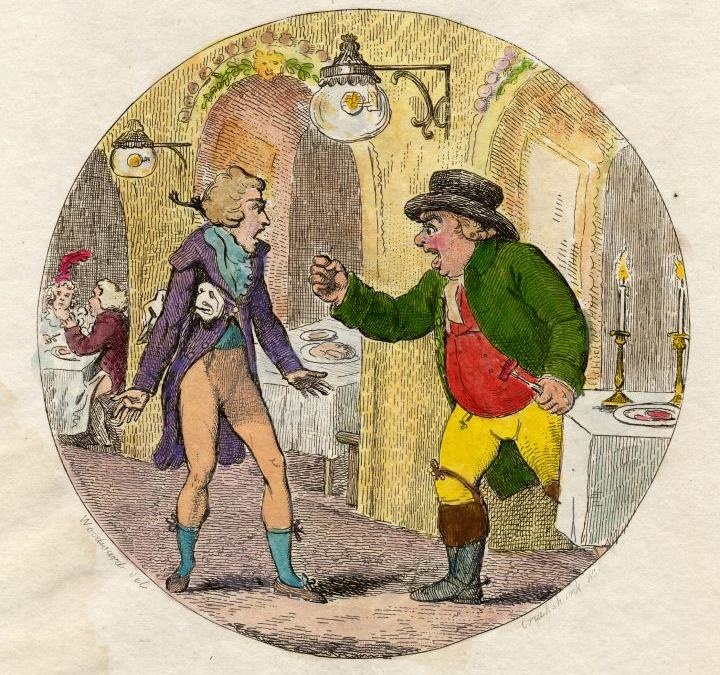
Archives

Vauxhall Gardens: The Final Decades, Part I

vauxhallbook

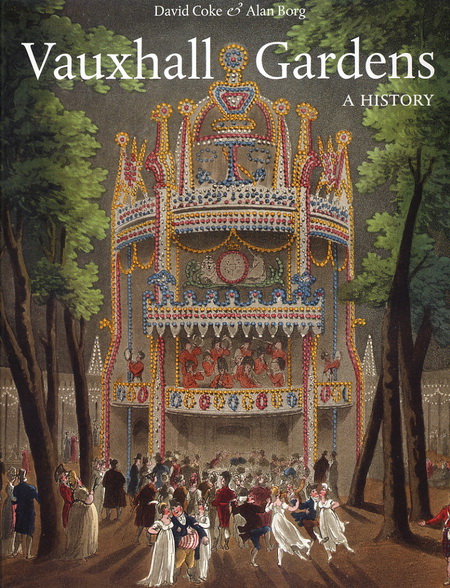
Vauxhall Gardens: A History

David Coke & Alan Borg

The Vauxhall Pleasure Gardens is one of the places I’d love to slip back in time to visit, just to catch a glimpse of what it was like. After recently splurging to buy this lovely coffee-table book, I thought it might make a wonderful subject for a new blog series. But do buy the book too, if you can! The photos are fabulous!

Changing Up

Thomas Bish and Frederick Gye, who took over management of the Gardens in 1821, decided that “the traditional formula of concerts, suppers, and fireworks” had to be expanded in order to compete with Astley’s Amphitheatre and the West End theaters. In addition to a revamped decor and a grand Panoramic Scene “in lieu of the old Cascade,’ a Grand Masked Fete in honor of the coronation of George IV was held on July 23. Among the attractions was a 24-foot transparency of “His Majesty in his Coronation Robes, with a distant view of Westminster Abbey, attended by Minerva, and a great number of Allegorical figures” painted by Henry Singleton RA. This lavish event included

  • numerous illuminated devices, representing ‘national trophies… designed for the occasion
  • Monsieur Chalons, magician
  • Ramo Samee, Indian juggler
  • Mr. Wilson, tightrope performer
  • Mr. Gyngell’s troop of tightrope dancers
  • Fantoccini and his Ombres Chinoises (shadow puppets)
  • dancers, including the “celebrated English morris dancers”
  • military savoyards, Pandeans, Scotch, and other bands
  • premier performance of A Grand National Ode by the orchestra
  • supper by Mr. Ward of Bond Street
  • performance of one of Handel’s coronation anthems

This very successful event was repeated the next day, but the death of Queen Caroline of Brunswick the following day definitively ended any further repetitions.

Transparencies and Optical Devices

The Heptaplasiesoptron, otherwise known as the ‘Fancy Reflective Proscenium’ was built in 1821 by Mr. Bradwell of the Theatre Royal, Covent Garden. It was composed of

A number of large plates of looking-glass placed in the form of a semi-hexagon, which constitute the walls of the exhibition; and in these seven points of reflection are gained for the view of several illuminated revolving pillars and palm trees, twining serpents, and a fountain of real water; the whole lighted by coloured lamps and brilliant cut-glass chandeliers. Before this splendid scene is exhibited (which is from ten till one o’clock) it is hidden by two curtains of azure-blue silk, richly fringed and ornamented with gold.

 The Submarine Cave:

The Submarine Cave, Royal Gardens, Vauxhall, engraving, 1822 (Boolean Library, Oxford. James Winston Collection, Gough Adds. Surrey C.22, item 2). Painted by the main staff artists, Mr. Thorn and his son Francis, this was one of the new attractions for the 1822 season, the first in which the gardens permitted to use the prefix 'Royal'.

The Submarine Cave, Royal Gardens, Vauxhall, engraving, 1822 (Bodleian Library, Oxford. James Winston Collection, Gough Adds. Surrey C.22, item 2). Painted by the main staff artists, Mr. Thorn and his son Francis, this was one of the new attractions for the 1822 season, the first in which the gardens permitted to use the prefix ‘Royal’.

The back scene of this exhibition is a rich fancy view, consisting of a water-fall, castles, and a fine romantic landscape beyond; this has a peculiarly good effect as a day scene. Before it is placed the rocky entrance to a marine cavern, the arch of which is eighty feet in the interior span; and within this entrance are placed the Water Works. This exhibition commences at 10 o’clock, when it is brilliantly lighted up with concealed lamps.

The Hermitage:
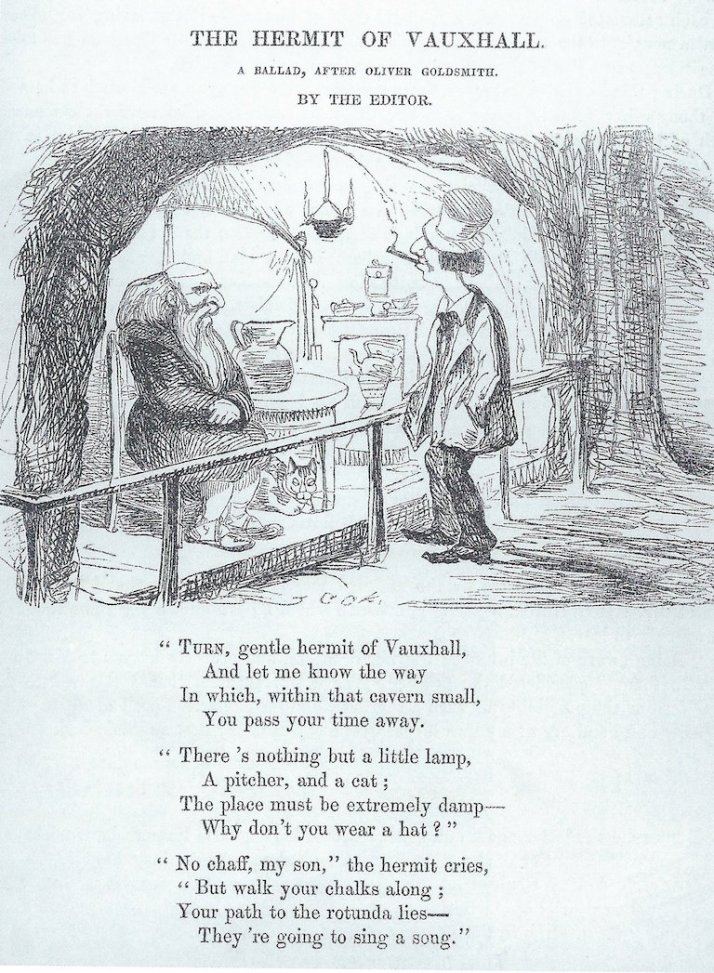
hermit

Anon., The Hermit of Vauxhall, engraving, 1832 (Minet Library, London, Lambeth Archives Department, V. of. 207). This is a rare view of the interior of the Hermitage and of the hermit himself. The verses are a parody of Oliver Goldsmith’s lengthy ballad The Hermit (1765), the first line of which is, ‘Turn, gentle hermit of the dale’.

…Made of wood and canvas, it represented the interior of a hermit’s cottage, with the hermit ready by lamplight. First installed in 1757, this too was painted by Mr Thorn and… was presumably constantly re-painted. The Hermitage became a fixture and was soon supplied with a live hermit, a fortune-teller.

The Thorns: Staff Artists

The Thorns, father and son (Francis), seem to have been the main staff artists…; their task was to change or renew the views and transparencies on show at regular intervals. So industrious were they that it is almost impossible to keep up with the succession of spectacular views that graced the gardens.

Over the years, these included:
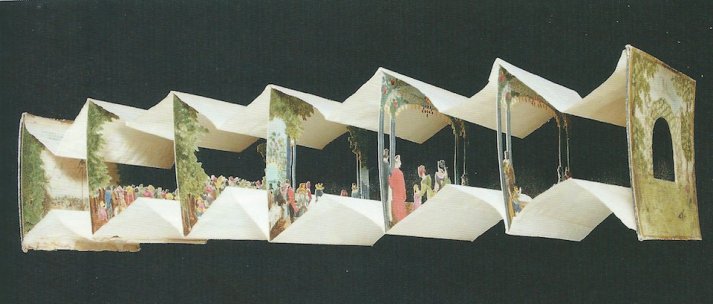
diorama

Optical toy or peepshow, color etching on cut sheets of card, 1822 (private collection). This souvenir of a Vauxhall Juvenile Fete folds flat but expands to give an in-depth perspective view of the gardens.

  • “a view of Naples by moonlight, with a vivid representation of Mount Vesuvius during an eruption”
  • Rotterdam by Moonlight
  • Paris from the Observatory
  • a Storm off the Cape of Good Hope
  • Fingal’s Cave
  • Views of Captain Ross’s Voyages to the North Pole
  • a moonlight scene of the ruins of an Italian abbey
  • ‘a stupendous diorama of the Golden Temple of Honan’
  • a model of St. Mark’s Square in Venice
  • ‘a dioramic picture of the proposed new Houses of Parliament after the designs of Mr. Barry’
  • ‘a Grand Moving Panorama of the voyage of the Nassau balloon up to 400 ft in length’.

The Royal Gardens, Vauxhall
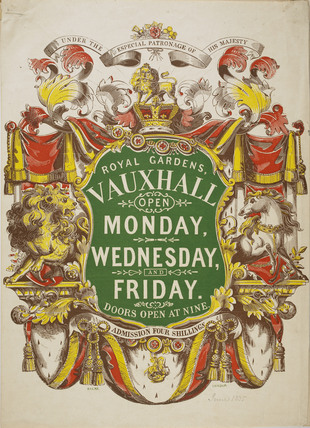
Poster, June 1835 (Museum of London, 2007.1/82). From 1822 onwards the proprietors squeezed every ounce of publicity out of the Royal designation of the gardens.

Poster, June 1835 (Museum of London, 2007.1/82). From 1822 onwards the proprietors squeezed every ounce of publicity out of the Royal designation of the gardens.

On June 3, 1822, the gardens opened under a new title, issued by Royal Warrant: “The Royal Gardens, Vauxhall.” The new king had visited the gardens frequently as Prince of Wales, and winning his patronage a great promotional coup. “The main entrance was rebuilt, with a portico surmounted by a large carved Royal Arms.”

Juvenile Fetes for Children
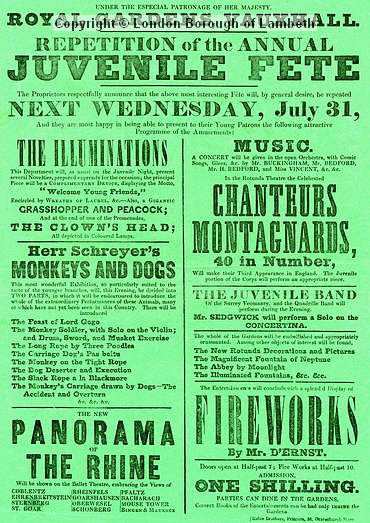
juvenile fete

Poster advertising the Annual Juvenile Fete, 1824 (Lambeth Landmark 1383). The first such event was held on 13 July 1821 and proved so popular that it was decided to feature at least one every year. The attractions offered at Juvenile Fetes differed little from those on ordinary nights, although the songs avoided the doubles entendres designed for adult ears.

Saturday having been long considered problematic due to the objections of evangelical clergymen to keeping the gardens open after midnight, the new proprietors decided to hold a Juvenile Fete for children. “The first of these took place on 13 July 1821, starting at 5:30 and ending by 10 p.m. With much the same program as an ordinary night. It proved hugely popular.”

Dancing in the Gardens
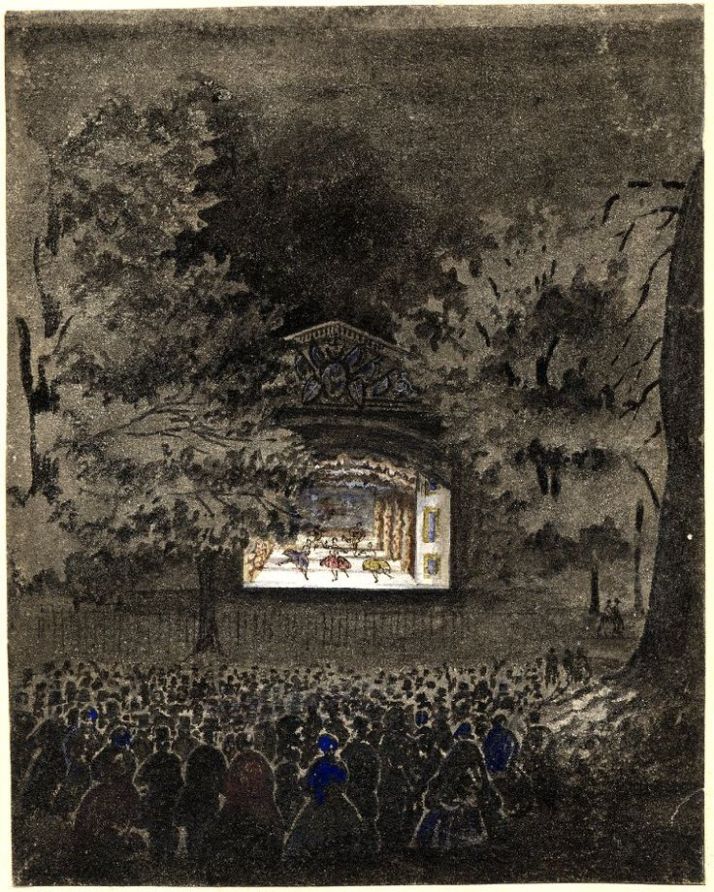
Anon., The Ballet Theatre, brush drawing in grey wash, touched with colored chalks, 1840-45 (British Museum, London, 1966.0212.1). The stage is surrounded by large trees and there is no seating provided.

Anon., The Ballet Theatre, brush drawing in grey wash, touched with colored chalks, 1840-45 (British Museum, London, 1966.0212.1). The stage is surrounded by large trees and there is no seating provided.

Having been granted a licence for Public Music and Dancing (spectator dancing only), “…of the 1823 season two new theaters were erected: one with appropriate scenery and decorations for the Juvenile Ballets; the other, in the Rotunda, for a ‘Novel Entertainment, diversified with dialogue, songs, and imitations’… The first ballet was Cendrillon, danced entirely by children, although adults took part in subsequent years.

The Aerial
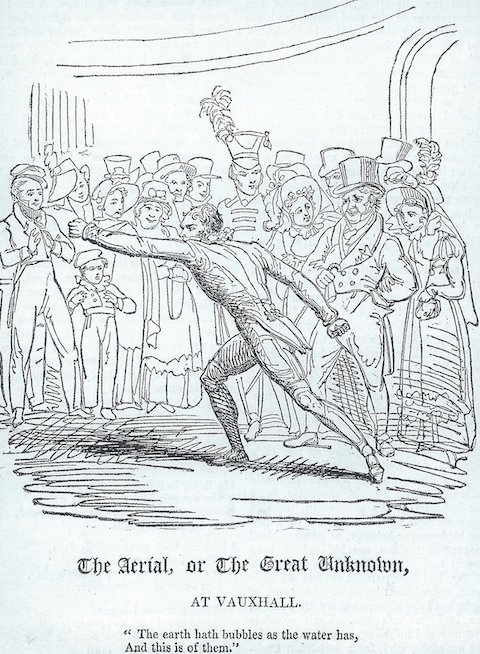
Anon., The Aerial, or The Great Unknown, at Vauxhall, engraving, 1825 (Minet Library, London, Lambeth Archives Department, V. of. 153). 'The Aerial' was an eccentric called Joseph Leeming who believed he was a person of unrivaled beauty. His appearances at Vauxhall during the 1825 season were widely reported in the press and provided good free publicity for the gardens.

Anon., The Aerial, or The Great Unknown, at Vauxhall, engraving, 1825 (Minet Library, London, Lambeth Archives Department, V. of. 153). ‘The Aerial’ was an eccentric called Joseph Leeming who believed he was a person of unrivaled beauty. His appearances at Vauxhall during the 1825 season were widely reported in the press and provided good free publicity for the gardens.

The summer of 1825… was most notable for the appearance of one of those strange characters who were drawn to Vauxhall from time to time. This was ‘The Aerial,’ the pseudonym of Joseph Leeming, whose eccentric behavior made him briefly the centre of attention. He claimed that his surpassing beauty was ‘without equal in nature or art, this or in any other age of the globe’. Having arrived in London from Manchester, he donned a blue and silver jacket, theatrical trunks or short breeches, silk stockings and blue kid shoes, with a double frill or ruff round his neck and wristbands trimmed with lace. Once in the gardens, he was taken by most visitors to be one of the performers, because he was not wearing a hat. But towards the end of the evening, people began to ask who or what he was. As The Times of 2 July 1825 reported:

An individual in a splendid dress of Spanish costume has excited much attention at Vauxhall Gardens. Having walked or rather skipped round the promenade, with a great air of consequence, saluting the company as he passed along, he at length mingled amongst the audience in the front of the orchestra, and distributed a number of cards on each which was written ‘The Aerial challenges the whole world to find a man that can in any way compete with him as such.’ After having served about three or four hundred of these challenges, he darted off like lightening, taking the whole circuit of the Gardens in his career, and made his exit through the grand entrance into the road where a carriage was waiting for him, into which he sprang and was driven off.

…His final visit to Vauxhall was on the evening of the Juvenile Fete, when he got drunk, and slept in a cloakroom until morning. After this he was informed that he would be refused entry to the gardens on any future occasion.

Susana’s Vauxhall Blog Post Series

  1. Vauxhall Gardens: A History
  2. Vauxhall Gardens: Jonathan Tyers—“The Master Builder of Delight” 
  3. Vauxhall Gardens: A New Direction
  4. Vauxhall Gardens: The Orchestra and the Supper-Boxes 
  5. Vauxhall Gardens: The Organ, the Turkish Tent, and the Rotunda
  6. Vauxhall Gardens: Three Piazzas of Supper-Boxes
  7. Vauxhall Gardens: “whither every body must go or appear a sort of Monster in polite Company”
  8. Vauxhall Gardens: The Competition
  9. Vauxhall Gardens: The Artwork, Part I
  10. Vauxhall Gardens: The Artwork, Part II
  11. Vauxhall Gardens: The Music, 1732-1859
  12. Vauxhall Gardens: The Business Side
  13. Vauxhall Gardens: Developments from 1751-1786
  14. Vauxhall Gardens: Thomas Rowlandson’s Painting (1785)
  15. ‎Vauxhall Gardens: The Third Generation of the Tyers Family and the Jubilee of 1786
  16. Vauxhall Gardens: An Era of Change (1786-1822), Part I
  17. Vauxhall Gardens: An Era of Change (1786-1822), Part II
  18. Vauxhall Gardens: An Era of Change (1786-1822), Part III
  19. Vauxhall Gardens: The Final Years, Part I
  20. Vauxhall Gardens: The Final Years, Part II
  21. Vauxhall Gardens: The Final Years, Part III
  22. Vauxhall Gardens: The Final Years, Part IV
  23. Vauxhall Gardens: Farewell, for ever
Vauxhall Gardens: An Era of Change (1786-1822), Part III

vauxhallbook

Vauxhall Gardens: A History

David Coke & Alan Borg

The Vauxhall Pleasure Gardens is one of the places I’d love to slip back in time to visit, just to catch a glimpse of what it was like. After recently splurging to buy this lovely coffee-table book, I thought it might make a wonderful subject for a new blog series. But do buy the book too, if you can! The photos are fabulous!

Madame Saqui

Madame Saqui at Vauxhall

Marguerite-Antoinette Lalanne came from an acrobatic family performing first at provincial fairs in France, and then at the fashionable Tivoli Gardens (‘The Paris Vauxhall’). Madame Saqui, as she was after her marriage,   became so popular in France that Napoleon arranged for her to perform for his army, after which she had her coach painted with an imperial eagle.

Once the War with France had definitively come to an end, Vauxhall proprietors George Rogers Barrett and Jonathan Tyers Barrett were determined to persuade her to come to England to perform at Vauxhall. Her first performance, however, was at Covent Garden Theatre. See the print below “of her descending from the balcony on a tight rope, brandishing two large flags, as the men in the audience look up her skirt with telescopes. The caption reads: ‘A Wonderful THING from PARIS… or Madame SACCHI gratifying John Bulls curiosity, at Covent Garden Theatre, April 1816.’

Madame Saqui at Covent Garden

Madame Saqui at Covent Garden

Prior to the opening of the 1816 Vauxhall Season on 3 June, the advertisements included:

At the end of the first Act Mme and Messrs Sachi will go through a variety of surprising evolutions on the Tight Ropse… at the conclusion of the concert… fireworks… when Madame Sachi, in the midst of a brilliant display of Chinese fire, will perform her astonishing Ascension, as exhibited in the Gardens of Tivoli in Paris. Admission to the Gardens is lowered from 4s to 3s 6d.

The weather was perfect and the crowds flocked to catch a glimpse of the new attraction.  The enormous success of the evening led to announcement that Madame Saqui’s troupe would perform every night until further notice. As they did, virtually every night of every season until 1820.

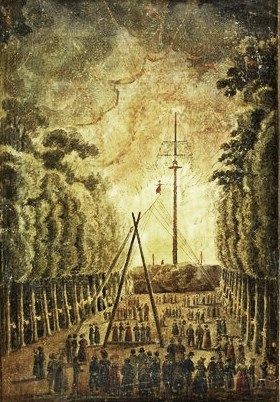
In her first year at Vauxhall, on the birthday of the Prince Regent, Madame Saqui exhibited her ‘grandest Feat which she had the honor of performing before the Sovereigns of Europe two years since, at Paris’—no doubt one of her spectacular ascents… [In 1819], instead of ascending from the ground, she suddenly appeared in the centre of a blazing star, 60 feet above the heads of the astonished crowd; from this she descended amidst a shower of fire accompanied by martial music. Then she turned round, ran back up the rope to the fiery star, only to be lost to view in a new barrage of fireworks. She also continued to perform with her daughter Adèle, the pair dancing an allemande on two or three ropes.

Vauxhall Madam Saqui Descending In 1816, Madame Saqui ascended and descended a tightrope that was fixed to a sixty foot mast accompanied by a firework display

Madame Saqui left Vauxhall after the close of the season in 1820 to do other things, eventually retiring and falling on hard times. She did come out of retirement at the age of seventy-five, performing at the Hippodrome. A correspondent to L’Intermédiare des chercheurs et des curieux said:

When I was a child, I saw her dance on the tightrope at the Hippodrome; she was seventy-five. It was a pitiful sight to see this decrepit figure in a pink costume, her face the color of faded parchment surmounted by a grotesque diadem. She gained in my childhood memory as an unforgettable image of the evil diary Carabosse.

Musicians

One of the characteristics of many Vauxhall performers long service. “It was not unusual for musicians, including singers, to work each season in the gardens for at least twenty years, and some served for much longer: the kettledrummer Jacob Nelson held the record at fifty years…”

James Hook, composer and organist, was a fixture at the park from 1772-1821, composing “over two thousand songs and  at least twenty organ concertos.”

William Parke, an oboist who joined Vauxhall with his brother John in 1776, composed numerous songs, concertos and other pieces, and also wrote Musical Memoires, which is full of information about the music at Vauxhall.

Strolling Players were the Savoyards , who played French and Venetian ballads in groups of four or five throughout the gardens following the main concert in the Orchestra, on instruments that included flutes and cymbals. The Pandeans (although some considered them to be the same as the Savoyards) played on pan-pipes. “The Duchess of Devonshire is known to have preferred the Pandeans…”

Charles Taylor received £290 in 1812. He

…was one of the longest-serving and most popular Vauxhall singers, especially noted for his comic songs. He first appeared in the gardens in 1794, returning regularly thereafter. He made the speech on the last night of the season several times and, unusually for a vocalist, rose to become Director of Music in 1822.

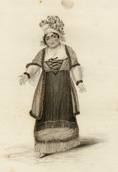
Mrs. Bland first appeared in 1790, retiring in 1823.

21 Mrs Bland THUMB

Described as ‘the sweet-voiced, dumpy little ballad singer’, she was said to have ‘refused an offer [for the 1789 season] of the Vauxhall Managers, to the tune of one hundred and sixty guineas.’ Her voice was ideally suited to the countless ballads that Hook and others wrote for her. Sometimes these demanded special effects—in June 1818, for example, she sang a new song by Parke, which was echoed in a distant part of the gardens by a bugle-horn.

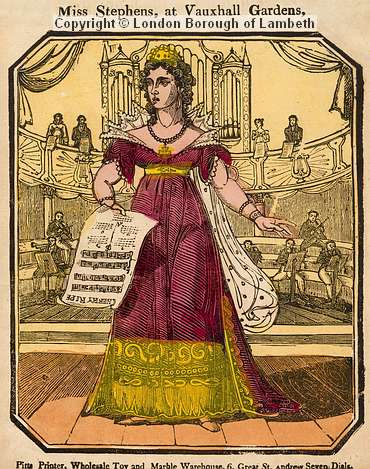
Catherine (Kitty) Stephens, an actress and soprano, married the 5th Earl of Essex in 1838.

Miss Stephens

Charles Dignum first appeared in 1794, but became notable at Vauxhall during the first two decades of the 19th century. “He was well-known for his duets with Mrs Bland, especially Long Time I’ve Courted You, Miss,  a dialogue between a shy sailor and a flirtatious lady.

John Braham, a popular operatic tenor, made his first appearance at Vauxhall as a boy soprano in 1787, “returning as an established star for the season of 1826, for the enormous fee of 800 guineas.”

Miss Feron (Fearon), known for her imitative talent, performed “a new comic song by Parke called The Romp or the Great Catalani, in which she used her powers of mimicry to parody the famous Italian soprano.” This act became so popular that it was repeated often and Parke writes:

…The recitative which introduces the air, ending with the words Great Catalini, it became necessary, in order to make the music accord with the poetry, to repeat a part of the last word, by which it read thus: Great Cat, Great Catalani. This, I was informed, gave umbrage to the lady, who, having perhaps an aversion to the feline race, said that she liked the song very well, with the exception of the Great Cat in it.”

Comic Songs

Parke’s Great Catalani was an early example of the double-entendre, that came to dominate the music hall… The words of many of these songs were published and sold at the gardens, so that the public came to know them by heart and to glamour for their repeated performance.

Susana’s Vauxhall Blog Post Series

  1. Vauxhall Gardens: A History
  2. Vauxhall Gardens: Jonathan Tyers—“The Master Builder of Delight” 
  3. Vauxhall Gardens: A New Direction
  4. Vauxhall Gardens: The Orchestra and the Supper-Boxes 
  5. Vauxhall Gardens: The Organ, the Turkish Tent, and the Rotunda
  6. Vauxhall Gardens: Three Piazzas of Supper-Boxes
  7. Vauxhall Gardens: “whither every body must go or appear a sort of Monster in polite Company”
  8. Vauxhall Gardens: The Competition
  9. Vauxhall Gardens: The Artwork, Part I
  10. Vauxhall Gardens: The Artwork, Part II
  11. Vauxhall Gardens: The Music, 1732-1859
  12. Vauxhall Gardens: The Business Side
  13. Vauxhall Gardens: Developments from 1751-1786
  14. Vauxhall Gardens: Thomas Rowlandson’s Painting (1785)
  15. ‎Vauxhall Gardens: The Third Generation of the Tyers Family and the Jubilee of 1786
  16. Vauxhall Gardens: An Era of Change (1786-1822), Part I
  17. Vauxhall Gardens: An Era of Change (1786-1822), Part II
  18. Vauxhall Gardens: An Era of Change (1786-1822), Part III
  19. Vauxhall Gardens: The Final Years, Part I
  20. Vauxhall Gardens: The Final Years, Part II
  21. Vauxhall Gardens: The Final Years, Part III
  22. Vauxhall Gardens: The Final Years, Part IV
  23. Vauxhall Gardens: Farewell, for ever
Bliss Bennet: A Man Without a Mistress

The Real Regency Scandal Sheets?

by Bliss Bennet

Plotlines featuring scandal sheets have become a staple of the Regency-set historical romance, mirroring the current-day popularity of magazines and television shows devoted entirely to celebrity gossip. But did newspapers devoted to spreading tittle-tattle about the high and mighty really exist during the Regency period?

According to the Oxford English Dictionary, the term “scandal sheet” did not enter the lexicon until the first decade of the twentieth century. And an advanced search of Google Books reveals only a slightly earlier date, with citations from no earlier than the 1890s. But perhaps “scandal sheet” was simply not the term in use during the period for newspapers or magazine devoted to scandal?

In his book Scandal: A Scurrilous History of Gossip, Roger Wilkes sets the date for the publication of what we might today call full-fledged scandal sheets a good bit earlier than the existence of the term itself. But still not in the Regency. Gossip columns appeared in English newspapers as early as 1704 (when Daniel Defoe, known today for his novel Robinson Crusoe, created the informal “Advice from the Scandalous Club” for his new paper, Review), and gossip pamphlets on specific subjects were also published during the eighteenth century. But newspapers devoted entirely to scandalmongering did not begin to be published until the 1820s.

I’ve been wondering, then, if a more historically accurate analog to today’s People, Entertainment Tonight, and National Enquirer might be a “scandal sheet” of an entirely different sort than a newspaper: the popular satirical print. The period between 1760 and 1820 is often referred to as the “Golden Age of Caricature,” in part because of the prints satirizing the British Royal family that proliferated during this period. But many high-ranking political and social figures besides King George and his relations found themselves the butt of a satirical print’s pointed humor. The audience for such prints was wide, just as it is for today’s scandal sheets; the middling sorts as well as aristocrats could afford a sixpence for a plain folio mezzotint, or a shilling for a colored one, the typical price for a print in the late eighteenth century.

The Jersey Smuggler

The Prince Regent, caught in bed with his mistress, Lady Jersey, by his wife

[James Gillray, The Jersey Smuggler Detected; —or—good causes for discontent [separation]. 1796. British Museum.]

Blockheads

The Prince Regent ridiculed as a blockhead, along with many other famed political leaders of the day

[George and Isaac Cruikshank, Blockheads. Frontispiece from A Political Lecture on Heads, Alias Blockheads!!! 1819. Vialibri.net.]

Gillray_-_Sir_Richard_Worse-than-sly,_exposing_his_wife's_bottom;_-_o_fye! copy

A major Regency scandal: the Worsley crim com trial, which brought to light shameful details of Sir Richard’s voyeuristic sexual tendencies, details which satirist Gillray did not shy away from skewering

[James Gillray, Sir Richard Worse-than-Sly, exposing his wife’s bottom; — O fye! 1782.]

Regency-era satirical prints have their roots in both visual caricature and in literary satire. In the late 16th century, Italian brothers Annibale and Agostino Carracci applied the words carico and caricare (to load, or to exaggerate) to some of the exaggerated portraits they drew, starting a trend for caricatures on the Continent. During the seventeenth century, art collectors and young men on the Grand Tour brought many examples of Italian caricatures back to England, some of which caught the eye of English publisher Arthur Pond. In 1736, Pond printed a collection of drawings by Annibale Carraci and other Italian caricaturists, which proved immediately and widely popular with London audiences. Noting the high sales of Pond’s collection, English artists soon began combining the exaggeration of the visual caricature with the biting satire of the period’s literature to create their own home-grown prints. Thus beginning a craze for satiric prints in England that lasted well into the nineteenth century.

Miss Macaroni

One of the earliest prints to feature a print shop, reputedly the Darlys’s shop on the Strand

[John Raphael Smith, Miss Macaroni and her gallant at a print shop. 1773. Guildhall Library, Corporation of London.]

During the seventeenth century, St. Paul’s and Fleet Street were where one would go to find shops devoted entirely to selling individual prints, right alongside booksellers and printers. Most sold both art prints and comic ones, although by 1762, satiric prints had grown so popular that Mary and Matthew Darlys, known as the “Fun Merchants” (at 39 Strand) opened a shop devoted entirely to comic prints. By the early 1800s, print shops had branched out westward along Fleet Street and the Strand, to the new developments around St. James’s in Westminster. John Bowles (under the sign of the Black Horse in St. Paul’s Churchyard), James Bretherton (134 Bond Street) and Mrs. Humphreys (in St. James’s) were some of the more popular purveyors. Publishers William Holland and Samuel William Fores even set up exhibition rooms that featured only prints, and charged entry fees to viewers. “In Holland’s Caricature Exhibition rooms may be seen, the largest Collection of Prints and Drawings in Europe,” claimed Holland’s advertisements; “The most complete Collection. Ever exposed to public View in this Kingdom,” countered Fores’s.

Given the often lewd, rude, and even pornographic nature of many of the era’s prints, it’s hardly surprising to discover that many Regency commentators bemoaned the open display of satirical prints in shop windows. Take for example, John Corry’s “Caricature and Printshops,” from his 1801 Satirical View of London:

Dandy Pickpockets

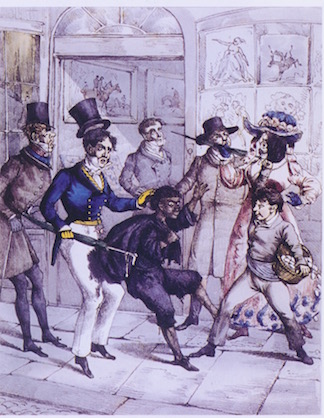
Satiric print depicting the dangers of print shop gazing!

[Isaac Robert Cruikshank, Dandy Pickpockets, Diving. 1818. Hand colored etching. Museum of London.]

Casualties of streetwalking copy

Satiric print depicting the dangers of print shop gazing!

[Anonymous, Casualties of London Street Walking: A Strong Impression. 1826. Guildhall Library, Corporation of London.]

This humorous mode of satirising folly is very prejudicial to the multitude in many respects: — in the loss of time to those who stop to contemplate the different figures; the opportunities given to pickpockets to exercise their art; and that incitement to licentiousness occasioned by the sight of voluptuous painting. The indecent attitudes obscene labels, and similar decorations, must have a powerful effect on the feelings of susceptible youth; and it is an authenticated fact, that girls often go in parties to visit the windows of printshops, that they may amuse themselves with the view of prints which imbue the most impure ideas. Before these windows, the apprentice loiters unmindful to his master’s business. And thither prostitutes hasten, and fascinating glances endeavor to allure the giddy and the vain who stop to gaze on the Sleeping Venus, the British Venus and a variety of seductive representations of naked feminine beauty. (75-77)

Mrs. Humphreys copy

Mrs. Humphrey’s print shop, published by Mrs. Humphrey herself; the caption translates as “Shame on he who thinks evil of it”

[Anonymous. Honi Soit Qui Mal Y Pense, published by G. Humphrey. 1821. Colored etching. Guildhall Library, Corporation of London.]

Wouldn’t you love to attend one of those print shop-gazing parties? I know I would. In fact, it was after reading this passage that I had the idea to include a scene set outside a shop that peddles satirical prints in my latest historical romance, A Man without a Mistress. In the window of Bretherton’s (an actual print shop of the period), Sir Peregrine Sayre spies a print of the recently deceased Lord Saybrook cavorting with an obviously diseased courtesan. To keep the fast-approaching daughter of Lord Saybrook, Sibilla Pennington, from catching sight of the scandalous print (and thereby discovering the true cause of her father’s death, venereal disease), Sayre is forced to make a bet with her, a bet that will only entangle him further with the headstrong young woman whom he’d promised himself he’d stay far away from. And, of course, further scandal ensues . . .

Man Without a Mistress eBook Cover Large copy

If you’re interested in finding out more about Regency era satirical prints, check out these resources:

Baker, Kenneth. George IV, A Life in Caricature. London: Thames and Hudson, 2005.

Bills, Mark. The Art of Satire: London in Caricature. London: Philip Wilson/Museum of London, 2006.

Donald, Diana. The Age of Caricature: Satirical Prints in the Reign of George III. New Haven: Yale UP, 1996.

Cindy McCreery, The Satirical Gaze: Prints of Women in Late Eighteenth Century England. London: Oxford UP, 2004.

Roger Wilkes, Scandal: A Scurrilous History of Gossip. London: Atlantic Books, 2002.

About A Man Without a Mistress

A man determined to atone for the past

For seven long years, Sir Peregrine Sayre has tried to assuage his guilt over the horrifying events of his twenty-first birthday by immersing himself in political work—and by avoiding all entanglements with the ladies of the ton. But when his mentor sends him on a quest to track down purportedly penitent prostitutes, the events of his less-than-innocent past threaten not only his own political career, but the life of a vexatious viscount’s daughter as well.

A woman who will risk anything for the future

Raised to be a political wife, but denied the opportunity by her father’s untimely death, Sibilla Pennington has little desire to wed as soon as her period of mourning is over. Why should she have to marry just so her elder brothers might be free of her hoydenish ways and her blazingly angry grief? To delay their plans, Sibilla vows only to accept a betrothal with a man as politically astute as was her father—and, in retaliation for her brothers’ amorous peccadillos, only one who has never kept a mistress. Surely there is no such man in all of London.

When Sibilla’s attempt to free a reformed maidservant from the clutches of a former procurer throw her into the midst of Per’s penitent search, she finds herself inextricably drawn to the cool, reserved baronet. But as the search grows ever more dangerous, Sibilla’s penchant for risk taking cannot help but remind Per of the shames he’s spent years trying to outrun. Can Per continue to hide the guilt and ghosts of his past without endangering his chance at a passionate future with Sibilla?

AllRomance E-booksAmazonBarnes & Noble CreatespaceKoboiBooks

About the Author

DSC_0682 1 x 2Bliss Bennet writes smart, edgy novels for readers who love history as much as they love romance. Despite being born and bred in New England, Bliss finds herself fascinated by the history of that country across the pond, particularly the politically-volatile period known as the English Regency. Historical Novel Society’s Indie Reviews praised her first book, A Rebel without a Rogue, deeming it “a sparkling debut.”

Bliss’s mild-mannered alter ego, Jackie Horne, writes about the intersection of gender and genre at the Romance Novels for Feminists blog. (http://www.romancenovelsforfeminists.blogspot.com)

Website FacebookTwitter


Cheryl Bolen: An Egyptian Affair

Tomorrow is release day for my fourth lighthearted Regent Mystery, An Egyptian Affair, so I’m especially grateful that Susana invited me here today. Just as an aside, I actually have two releases tomorrow. The second, One Golden Ring, Brazen Brides #2, is a re-release of a Christmas novel which was selected Best Historical of 2005 (Holt Medallion) and has been in and out of print (mostly out) ever since.

Many of you have been following my Regent Mysteries featuring Captain Jack Dryden and his wife, Lady Daphne. As their romance has already been told, each of the new Regent Mysteries, whilst featuring them as sleuths for the Prince Regent, features a fresh new romance.

In this book, Jack and Daphne must travel to Egypt to investigate the disappearance of an Indian Prince who was obtaining nearly priceless antiquities for the British Prince Regent. Since Daphne’s youngest sister, Lady Rosemary, is enamored of all things Egypt, they must take her along. Also accompanying them is Britain’s most imminent Egyptology scholar, Stanton Maxwell. Of course, Rosemary couldn’t possibly be romantically interested in such a nerd when one dashing captain of his majesty’s dragoons has captured her heart. Or could she?

Cheryl: Thanks, Lady Daphne, for visiting Susana’s Parlour today. So glad you’ve brought along your sister. I understand you’re just back from an exciting trip to Egypt.

Lady Daphne: Indeed. Rosemary and I have decided that since few British women have ever traveled to the Orient, we shall be have a little salon for the purpose of sharing our experiences in Egypt.

Cheryl: Are you going to tell the other ladies about the perils you faced?

Lady Rosemary: My brother-in-law Captain Jack Dryden does much clandestine work for the Crown and has sworn me to secrecy. However, I don’t mind sharing our experiences with things like crocodiles on the Nile or cobras.

Lady Daphne: (Scrunching up her nose and narrowing her eyes as she peers through her spectacles at her sister) Oh, but we won’t discuss the cobra that was intentionally placed in our bedchamber whilst we slept. I shouldn’t want to discourage faint-hearted ladies from traveling to Egypt. We loved it very much.

Cheryl: I suppose to you, Lady Rosemary, Egypt will always hold terribly romantic memories. Did you not marry your husband there before you had to return to England?

Lady Rosemary: Indeed I did. But I can say no more. We must save all the breath-taking details for the readers of your book.

An Egyptian Affair copy

Excerpt

You can read an excerpt of the book here http://www.cherylbolen.com/egyptian~ex.htm.

AmazoniBooks Barnes & Noble • Kobo

About the Author 

Cheryl Bolen copyAn Egyptian Affair is the 30th book by Cheryl Bolen, a New York Times and USA Today best-selling author. Many of her books have placed in contests, including the Daphne du Maurier (romantic suspense) and have been translated into ten languages. She was Notable New Author in 1999. In 2006 she won the Holt Medallion, Best Historical, and in 2012 she won Best Historical in the International Digital Awards and she’s had four other titles place in that competition. Her 2011 Christmas novella was named Best Novella in the Romance Through the Ages.

WebsiteBlogFacebook

Vauxhall Gardens: An Era of Change (1786-1822), Part II

vauxhallbook

Vauxhall Gardens: A History

David Coke & Alan Borg

The Vauxhall Pleasure Gardens is one of the places I’d love to slip back in time to visit, just to catch a glimpse of what it was like. After recently splurging to buy this lovely coffee-table book, I thought it might make a wonderful subject for a new blog series. But do buy the book too, if you can!

Grand Military Fetes and Displays

The first record of a military fete was on 30 May 1786, the day after the Jubilee, when transparencies of British men-of-war by the marine painter John Thomas Serres (1759-1825) were presented with other decorations, including a representation of the British lion trampling the Spanish flag. The newly formed Duke of York’s Band played military airs and was to perform regularly in the gardens until 1816. This period saw an increasing presence of soldiers and military bands, theoretically in response to the threat of invasion from France, but more directly in an attempt to rival the jingoistic displays to be seen at Astley’s. In 1787 the Cascade, the most famous of Vauxhall attractions in the eighteenth century, included marching soldiers. These military displays gradually expanded and needed more space, so from 1816 the Cascade site was used by Madame Saqui’s rope-dancing troupe.

Eventually, grand military fetes to celebrate actual events involved firework displays.

On 11 June 1810, Mizra Abul Hassan Khan wrote about his visit to the Gardens for the Grand Oriental Fete in honour of the Persian Ambassador:

The avenues were lighted by rows of tall candelabra and by lanterns hung from trees. In one place there were fireworks: when they did not rise high enough, everyone laughed and said ‘Shocking!’ The fireworks ended with the name of the Qibleh of the Universe written in Persian letters! Everyone appreciated this display and clapped their hands together. From there we went to a large covered place, beautifully lighted and decorated, like a theatre in the city. It was built to accommodate 5000 people in case of rain. After the fireworks, some people sat down to eat; later they danced.

American Samuel Morse, inventor of the Morse code, visiting on 17 September 1811:

A few evenings since I visited the celebrated Vauxhall Gardens, of which you have doubtless often heard. I must say they far exceeded my expectations; I never before had an idea of such splendor. The moment I went in I was almost struck blind with the blaze of light proceeding from thousands of lamps and those of every color. […] All is gayety throughout the gardens; every one is in motion, and care, that bane of human happiness, for a time seems to have lost her dominion over the human heart. Had the Eastern sage, who was in search of the land of happiness, at this moment been introduced into Vauxhall, I think his ost exalted conceptions of happiness would have been surpassed, and he would rest contented in having at last found the object of his wishes. […] The music and this course of dancing continue till about four o’clock in the morning, when the lights are extinguished and the company disperses. On this evening, which was by now means considered as a full night, the company consisted of perhaps three thousand persons.

vauxhall-pleasure-gardens-00364-800

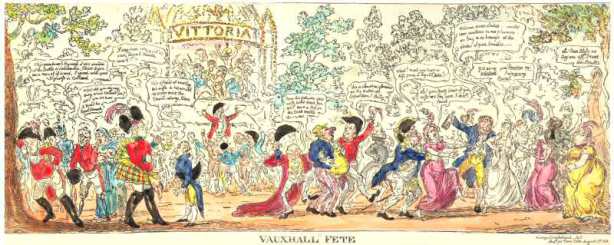
George Cruikshank, Vauxhall Fete, engraving, 1813 (British Museum, London., 1862.1217.309). This satirical print shows many of the leading figures who attended the Grand Festival in honor of the Battle of Vittoria. On the left the Duke of York vomits against a tree; other notables include the Duke of Sussex in Highland uniform, the Duke of Clarence dressed as an Admiral, the Lord Mayor of London and Lord Castlereigh. On the far right a fat lady exclaims ‘They’re all drunk, the Brutes.’

Grand Festival of the Battle of Vittoria

On 20 July 1813, a Grand Festival of the Battle of Vittoria was held in honor of the then Marquess Wellesley, who attended. “The festival was ‘perhaps the most superb and costly entertainment ever given in England’ and such was its popularity that ‘the limited number’ of tickets ‘was exceeded and, in consequence, from ten to fifteen pounds was offered for a ticket’”. Byron noted:

There is to be a thing on Tuesday ycleped a national fete. The Regent and *** are to be there, and everybody else, who has shillings enough for what was once a guinea. Vauxhall is the scene—there are six tickets issued for the modest women, and it is supposed that there will be three to spare. The passports for the lax are beyond my arithmetic.

At a dinner for twelve hundred people in the Rotunda, the VIPs sat at a crescent-shaped, raised table. There was also

a row of crimson steps covered with massive pieces of ornamental gold and silver plate, with the bust of the Lord Wellington on the summit. At the foot, and leaning against a silver vase of exquisite workmanship, was the Marshal’s staff taken in the battle. Two trumpeters in their state liveries and with silver trumpets, stood forward from the pile, and between them a grenadier of the Guards held the standard of the 100th French regiment of the line.

Neither George III nor the Prince of Wales attended (in spite of Byron’s expectation), but otherwise, the list of attendees was quite impressive. Wellesley arrived late for the dinner and found his seat of honor occupied, but presumably that was quickly dealt with. The ladies joined the party at 9 p.m., and at 11 p.m., the Princess of Wales arrived. She

was conducted around the chief promenade several times by his Royal Highness the Duke of Gloucester and Col St Leger. The Princess was hailed repeatedly with loud greeting, and repaid the attentions of the company in the most courteous manner. She was dressed ina white satin train with a dark vet and ornaments, richly embroidered. On her head-dress she wore a green wreath, with diamonds.

Even later, “many of the nobility came from the Opera House after the conclusion of the ballet.”

In the course of the evening a new air called The plains of Vitoria was performed by the orchestra, while military bands, including those of the Foot and Life Guards, the Duke of Kent’s Regiment, and the 7th Hussars, played and marched up and down the Walks. ‘The appearance of some of these bands in the forest part of the garden was extremely picturesque, and presented some idea, at times, of soldiers in a campaign regaling and reposing themselves under the shade. The fireworks were set off in three sessions, at 11 p.m. and at 1 and 2 a.m. These were devised and directed by ‘Colonel Congreve’, the inventor of the Congreve Rocket, which was much used in the Napoleonic wars.

Other Military Fetes at Vauxhall

More fabulous military fetes were held in the following year, one of 13 June 1814 to celebrate the Treaty of Paris, and in August, a mock sea battle (Grand Mechanical Naumachia). Although there were fireworks on 15 August 1815 following Napoleon’s surrender at Waterloo, there were no specific events to mark the occasion until 18 June 1817. This became an annual celebration, eventually involving a reconstruction of the battle on the southeast side of the old Grand Walk, which became known as the Waterloo Ground.

View of Vauxhall, Lady's magazine

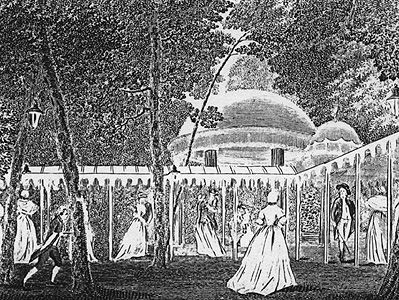
Anon., View of Vauxhall Gardens, engraving (Lambeth Landmark 1260) from the Lady’s Magazine, XXX (1799), supplement. The walks were covered to counter the rains which proverbially started when the Vauxhall season opened; they were extended all round the Grove in 1810.


Susana’s Vauxhall Blog Post Series

Vauxhall Gardens: An Era of Change (1786-1822), Part I

vauxhallbook

Vauxhall Gardens: A History

David Coke & Alan Borg

The Vauxhall Pleasure Gardens is one of the places I’d love to slip back in time to visit, just to catch a glimpse of what it was like. After recently splurging to buy this lovely coffee-table book, I thought it might make a wonderful subject for a new blog series. But do buy the book too, if you can! The photos are fabulous!

While the years from 1732 to 1786 were the undoubtedly the heyday of Vauxhall, the years following the Jubilee continued to attract large numbers of visitors and was the most popular outdoor entertainment for many years. Charles Burney’s daughter Sarah wrote in 1807:

You should quit your Devonshire Shades were it only to share in the universal rage there is for going to Vauxhall. I never knew anything like it. The whole London World seems to be seized with a fit of the fool.

Vauxhall fashions

Vauxhall Fashions, engraving (David Coke’s collection) from La Belle Assemblée no. 7 (August 1806). Many dressmakers and retailers advertised their wares as representing the latest fashions seen at Vauxhall.

Scenes from Vauxhall were presented on stage, authors such as John Keats, Pierce Egan, and William Thackeray wrote about it, and others tried to copy it, in London and elsewhere. Bath’s Sydney Gardens, opened in 1795 and much visited by Jane Austen, was modeled on Vauxhall in London, as was Tivoli in Copenhagen. Vauxhalls started appearing everywhere.

Exif_JPEG_PICTURE

One half of the world don’t know how t’other lives, Sung by Mr. Dignum in Vauxhall Gardens, etching, 1805 (British Museum, London, 1861.0518.1087). A very popular tenor at the gardens, Dignum also gave the farewell address at the end of several seasons.

A change in clientele

In the early nineteenth century, however, with England’s middle and working classes rapidly expanding due to the Industrial Revolution and the rapid growth of London’s population, Vauxhall’s clientele began to change as well.

The social balance was changing too; the old aristocracy watched nervously as France spiralled into revolutionary chaos, and several of the great families decided to move back to the country, to avoid the potential dangers of urban unrest… In addition, social circles were becoming more restricted and inward-looking; the London aristocracy was being rapidly overtaken in terms of numbers by the professional middle classes of industrialists, businessmen, doctors and lawyers. To support them, huge numbers of labourers, tradesmen and servants moved to the capital.

Because of this influx, houses began to pop up in and around Vauxhall, which meant that the Kennington Street area was no longer a country hamlet, but a part of the city itself, and the residents didn’t always appreciate all the racket coming from Vauxhall in the early hours of the morning.

Picturesque Elevation of the Iron Bridge created over the Thames at Vauxhall, engraving, 1816 (David Coke's collection). Designed by the engineer James Walker, the new bridge greatly shortened the land journey from London to Vauxhall Gardens.

Picturesque Elevation of the Iron Bridge created over the Thames at Vauxhall, engraving, 1816 (David Coke’s collection). Designed by the engineer James Walker, the new bridge greatly shortened the land journey from London to Vauxhall Gardens.

A significant advantage was the completion of the new Vauxhall Bridge in August 1816, which shortened considerably the route from the West End.

The bridge remained open all night, both for pedestrians and for coaches, catering for those revellers who stayed on into the small hours, to the annoyance of the local residents who were trying to sleep.

A change of attractions

The form of the entertainments at Vauxhall remained traditional to the end of the eighteenth century. Various new attractions were introduced only gradually and these were directly in response to new forms of popular entertainment that had sprung up elsewhere in London.

One of these was Philip Astley’s enormously popular shows, with “daring displays of horsemanship”, as well as jugglers, tight-rope walkers, and great pageants of historical events. See my post of Astley’s Amphitheatre here.

Vauxhall had always promoted patriotic songs and military bands, and later added battle reconstructions and victory celebrations, after Astley’s model. The Battle of Waterloo was considered to be the “most spectacular event ever staged at Vauxhall.”

Boat races on the Thames was another innovation, which including a rowing race for watermen and a sailing match for ‘gentlemen’s pleasure sailing boats’. Which was followed by a grand gala in the gardens, of course. In 1812, the contest was called the Vauxhall Grand Regatta.

Vauxhall Sailing Match, engraving, 1800 (Minet Library, London, Lambeth Archives Department, V. fo. 57). This appears to be the only surviving image of one of the Vauxhall sailing matches.

Vauxhall Sailing Match, engraving, 1800 (Minet Library, London, Lambeth Archives Department, V. fo. 57). This appears to be the only surviving image of one of the Vauxhall sailing matches.

Advances in science and technology brought ballooning to the gardens, the first balloon ascension beginning in 1802, but not becoming a regular feature until the 1820’s. André Jacques Garnerin, the first Vauxhall aeronaut, experimented with making parachute jumps from balloons. One of his flights included releasing a cat from a height of 600 feet, who descended safely into some resident’s garden. George Colman the younger, a playwright, wrote

Poor Puss in a grand parachute
Was sent to sail down through the air
Plump’d into a garden of fruit,
And played up old Gooseberry there:
The gardener transpiring with fear,
Stared just like a hundred struck hogs;
And swore, tho’ the sky was quite clear,
‘Twas beginning to rain cats and dogs.

Fireworks, first introduced in 1783, were limited to special occasions at first, but pyrotechnic displays did not become standard until 1798.

When it was time for the fireworks to start, a bell was rung and everyone went to the firework ground at the far eastern end of the gardens. The hours varied, displays being advertised at 9, 10 and 11 p.m.; on gala nights there was often more than one show.

Changes in proprietors and prices

Jonathan Tyers the younger’s son-in-law, Bryant Barrett, managed the gardens until his death in 1809, when his sons Jonathan Tyers Barrett and George Rogers Barrett inherited. Jonathan Barrett became sole owner in 1818. In 1821, the gardens were leased to relatives and business partners Thomas Bish and Frederick Gye, later joined by Richard Hughes, “and the trio used their option to buy the property in 1825 for £30,000.”

In 1792, the price of admission was raised to 2 shillings for regular nights and 3 shillings for the Grand Galas (masquerades), which involved elaborate fancy dress.


Susana’s Vauxhall Blog Post Series

Vauxhall Gardens: The Third Generation of the Tyers Family and the Jubilee of 1786

vauxhallbook

Vauxhall Gardens: A History

David Coke & Alan Borg

The Vauxhall Pleasure Gardens is one of the places I’d love to slip back in time to visit, just to catch a glimpse of what it was like. After recently splurging to buy this lovely coffee-table book, I thought it might make a wonderful subject for a new blog series. But do buy the book too, if you can! The photos are fabulous!

Following Jonathan Tyers’s death in 1767, his son Jonathan Tyers the younger managed the gardens, along with the assistance of his sister Elizabeth Wood and other family members, until 1786. At that time, the responsibility for the park was passed on to Bryant Barrett, who was Tyers the younger’s son-in-law, married to his only daughter, Elizabeth.

Barrett was a wax chandler by trade, which was a fortunate coincidence, since Vauxhall Gardens must have been spending a fortune on candles and lighting fixtures.

The most visible aspect of Barrett’s initiative appears in the start of regular newspaper advertisements giving details of the musical programmes for each evening; but it was also at this time that proprietors began to sponsor sailing matches on the Thames.

Lean years at Vauxhall

The 1770’s and early 1780’s had been lean ones for Vauxhall, partly because of the increase in crime and vandalism within its walks; but bad behaviour was clearly not the proprietors’ only problem. …quite apart from financial depression in the early 1770’s and grim news from the American colonies, the appalling weather of the summers of 1775-7 had cost the Tyers family a great deal. …

Samuel Arnold finally had to close Marylebone Gardens in 1778… No clear reason is given for this, but the complaints of local residents, especially about the fireworks, are bound to have been a contributor factor. Ironically, Marylebone’s initial advantage in being so close to London had become its eventual downfall.

The Jubilee of 1786

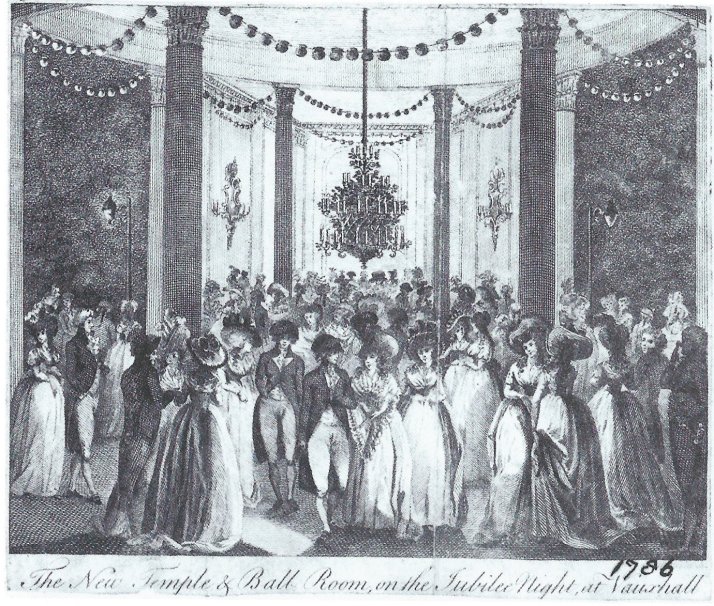
J. Wooding, The New Temple & Ball Room, on the Jubilee Night, at Vauxhall, engraving, c. 1786. The circular Grand Temple at the junction of the Grand South Walk and the Centre Cross Walk, with the temporary ballrooms added to its north and south. The artist was keen to show all the different forms of lighting in use.

J. Wooding, The New Temple & Ball Room, on the Jubilee Night, at Vauxhall, engraving, c. 1786. The circular Grand Temple at the junction of the Grand South Walk and the Centre Cross Walk, with the temporary ballrooms added to its north and south. The artist was keen to show all the different forms of lighting in use.

The approach of the half-century mark of the opening of Vauxhall Gardens “must have come as a godsend to Barrett at the start of his proprietorship.”

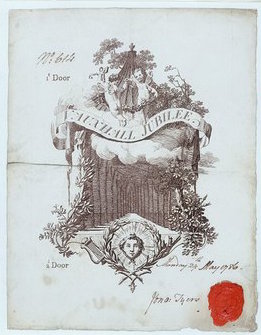
The last great fashionable event had been the hugely successful Ridotto al Fresco of 1769. In a conscious attempt to remind people of the ‘good old days’, when the gardens had last been patronised by fashionable society, the design of the ticket for the vent of the event of seventeen years earlier was adapted for the 1786 Jubilee.

Ticket for the Vauxhall Jubilee, 29 May, engraving. Signed, dated and sealed by Jonathan Tyers the younger, although the management of the park was now in the hands of his son-in-law, Bryant Barrett.

Ticket for the Vauxhall Jubilee, 29 May, engraving. Signed, dated and sealed by Jonathan Tyers the younger, although the management of the park was now in the hands of his son-in-law, Bryant Barrett.

In preparation for the event, which took place on 29 May 1786, the following renovations were completed:

  1. The buildings around the Grove were painted in an elegant pale blue and white livery, and flowering shrubs were planted to appeal to the modern taste in gardening.
  2.  The Rotunda’s interior decoration was completely renewed, with modern mirrors, and the Ionic columns of the Pillared Saloon were renewed with a rich deep pink scagliola. Window frames were replaced and draped with tasselled crimson and silver fabric, and the Rotunda Orchestra was filled with evergreen plants under a decorated ceiling. In the other recess (where the original Rotunda Orchestra had been housed), the large transparent painting of George, Prince of Wales (later the Prince Regent and George IV) in a noble classical pose was replaced with another transparency depicting an amphitheatre of the Corinthian order, through which could be seen a perspective view of a garden. (Apparently, the original transparency was criticized by some as having nothing in common with the Prince’s true character.)
  3. 14,000 coloured lights and wreaths of artificial flowers were draped around the pillars and in festoons around the cornices of the Covered Walks.
  4. A circular Grand Temple was set up at the crossing of the Grand South Walk and the Centre Cross Walk, “little more than a dome on eight classical columns.”
  5. The Centre Cross Walk was partly built over to give more dancing space in two temporary ballrooms, attached to the Grand Temple on the north and south. “The walls of these ballrooms were painted with Arcadian pastoral scenes beyond a range of Ionic columns decorated with wreaths of flowers, while the ceiling showed a sky filled with ‘tender variegated clouds.’” …In each of the ballrooms was an alcove for the musicians, and others for tables stocked with lemonade, capillaire, and orgeat (soft drinks flavoured with orange flower or almond syrup.) The whole strucutre was of course illuminated with thousands of coloured lamps ‘producing a refugency of light that dazzles and surprises.’
  6. On the site of the former Prince’s Pavilion (built for George III’s father), a new room was created for Prince George and his party.
  7. The entrance to the gardens on Kennington Lane was renewed and enlarged, soon becoming the main coach-entrance, later to be expanded with cloakrooms, waiting-rooms, and other public facilities.
handbill

Handbill for the Vauxhall Jubilee, 1786. A very plain and understated piece of printing, designed only to impart information about the event.

The Jubilee was attended by somewhere between five and six thousand people, most in fashionable and elegant costume, a few in fancy dress, which in this period meant smart dress with added details, such as feathers, flowers, ribbons, ruffs, etc., not character costumes.

There were last night above 6000 persons present, and among them some of the first people in the kingdom, but as is always the case at Vauxhall, it was a mélange; the cit and the courtier jostled each other with the usual familiarity; the half guinea was no repellent to the middling order; John Bull loves to shoulder his superiors in rank, his betters he’ll not allow them to be; and where he pays as much for admission, he never considers them to be more than his equals.

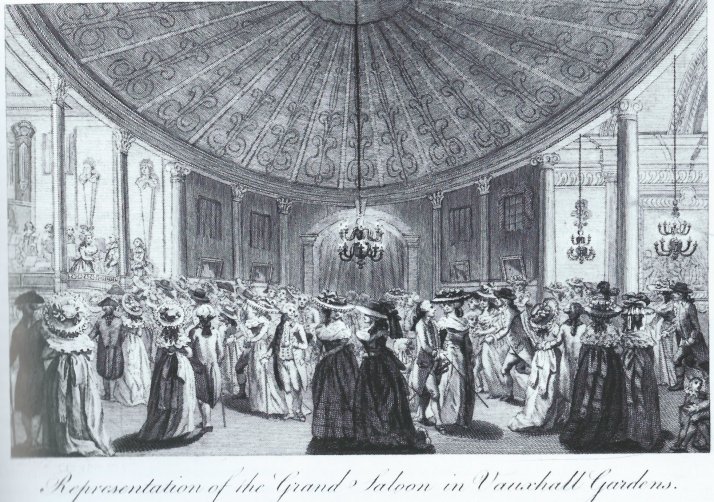
Anon., Representation of the Grand Saloon in Vauxhall Gardens, engraving, after 1786. An unusual view of the renovated Rotunda interior, taken from the entrance off the Grand Walk. The Rotunda Orchestra is on the left, and one of Hayman's paintings from his Seven-Years War series is visible in the Pillared Saloon on the right.

Anon., Representation of the Grand Saloon in Vauxhall Gardens, engraving, after 1786. An unusual view of the renovated Rotunda interior, taken from the entrance off the Grand Walk. The Rotunda Orchestra is on the left, and one of Hayman’s paintings from his Seven-Years War series is visible in the Pillared Saloon on the right.

On the following day, the gardens were opened to four thousand people who were not able to get tickets after those for the first event were sold out.

A successful season

Barrett took advantage of the popular trend of holding military fetes to honor the huge numbers of soldiers coming home from North America by promoting a patriotic tone to this one, with large transparencies framed by martial and naval motifs.

Later that year, when George III escaped a “rather pathetic assassination” by a housemaid with a knife outside St. James’s Palace, Vauxhall celebrated the king’s survival with a new patriotic song by James Hook and an organ concerto with variations on God Save the King.

Barrett’s first season at the helm “once more confirmed Vauxhall as a popular and respectable venue for fashionable society during the 1780’s. However,

…the public attitude towards the gardens was beginning to undergo a fundamental change. The largely unquestioning indulgence was now a thing of the past, and questions were being asked as to whether a pleasure garden was more of a nuisance than a benefit. The establishment’s opposition to public entertainment was strengthening.

Neighbors who had complained for years about the disruption caused by those returning home in the early hours of the morning, were starting to be heard.


Susana’s Vauxhall Blog Post Series

  1. Vauxhall Gardens: A History
  2. Vauxhall Gardens: Jonathan Tyers—“The Master Builder of Delight” 
  3. Vauxhall Gardens: A New Direction
  4. Vauxhall Gardens: The Orchestra and the Supper-Boxes 
  5. Vauxhall Gardens: The Organ, the Turkish Tent, and the Rotunda
  6. Vauxhall Gardens: Three Piazzas of Supper-Boxes
  7. Vauxhall Gardens: “whither every body must go or appear a sort of Monster in polite Company”
  8. Vauxhall Gardens: The Competition
  9. Vauxhall Gardens: The Artwork, Part I
  10. Vauxhall Gardens: The Artwork, Part II
  11. Vauxhall Gardens: The Music, 1732-1859
  12. Vauxhall Gardens: The Business Side
  13. Vauxhall Gardens: Developments from 1751-1786
  14. Vauxhall Gardens: Thomas Rowlandson’s Painting (1785)
  15. ‎Vauxhall Gardens: The Third Generation of the Tyers Family and the Jubilee of 1786
  16. Vauxhall Gardens: An Era of Change (1786-1822), Part I
  17. Vauxhall Gardens: An Era of Change (1786-1822), Part II
  18. Vauxhall Gardens: An Era of Change (1786-1822), Part III
  19. Vauxhall Gardens: The Final Years, Part I
  20. Vauxhall Gardens: The Final Years, Part II
  21. Vauxhall Gardens: The Final Years, Part III
  22. Vauxhall Gardens: The Final Years, Part IV
  23. Vauxhall Gardens: Farewell, for ever
Vauxhall Gardens: Thomas Rowlandson’s Painting (1785)

vauxhallbook

Vauxhall Gardens: A History

David Coke & Alan Borg

The Vauxhall Pleasure Gardens is one of the places I’d love to slip back in time to visit, just to catch a glimpse of what it was like. After recently splurging to buy this lovely coffee-table book, I thought it might make a wonderful subject for a new blog series. But do buy the book too, if you can! The photos are fabulous!

I’m so excited! I just bought a mounted poster of this painting in color from art.com to hang in my bedroom/office here in Florida.

By the time this painting appeared, Jonathan Tyers had died and Vauxhall Gardens passed on to his wife and children, but it was his son Jonathan Tyers Jr.—that n’er-do-well younger son who wed a widowed lady much older than he and caused a giant rift among his parents—who assumed his father’s role in managing the park.

Thomas_Rowlandson_-_Vaux-Hall_-_Dr._Johnson,_Oliver_Goldsmith,_Mary_Robinson,_et_al


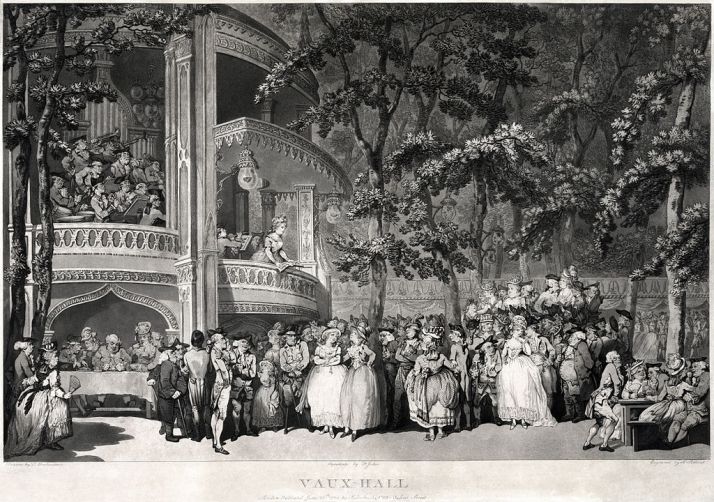
In the supper-box on the left we see, reading left to right, James BoswellMrs Thrale (who appears twice), Dr. Johnson, and Oliver Goldsmith.

The ‘macaroni’ Captain Edward Topham (scandalmonger to The World) is quizzing Georgiana, Duchess of Devonshire and her sister Lady Duncannon (Sheridan’s Lady Bessborough), watched by a naval figure with an eye patch and a wooden leg (not included in the Mellon version), always called Admiral Paisley, but Paisley did not lose his leg and eye until 1st June 1794, so it cannot be him. To the left of him, a young girl (a young boy in the Mellon version) holding the hand of a man who could be the comic actor, William Parsons, or Rowlandson’s friend Jack Bannister.

Peering at the two ladies from behind a tree is a figure traditionally, though improbably, identified as Sir Henry Bate-Dudley, the ‘Fighting Parson’, editor of the Morning Herald; he is more likely to be Thomas Tyers (son of Jonathan Tyers the great entrepreneur and proprietor of Vauxhall Gardens from 1729 until 1767) who stands next to the Scotsman James Perry, editor of the London Gazette. The couple on their right could well be the artist himself and his current girlfriend. and to the right of them stands the actress Mary ‘Perdita’ Robinson, with her husband on her right and the Prince of Wales (later George IV) on her left.

Looking up at the singer, the couple on the extreme left, have been identified as the actress Miss Hartley, in company with one of her many admirers, possibly Mr. Colman, but, suggested by their position apart from the crowd, they could also be members of the Tyers family (most likely Jonathan jr. and his wife Margaret, or their son-in-law Bryant Barrett and his wife Elizabeth. The large lady seated at the table on the right is Mrs Barry, the old Madam of Sutton Street, Soho, with two of her customers and one of her girls.

In the orchestra, we can see Jacob Nelson, the tympanist, who had played at Vauxhall since 1735, and died there after fifty years’ performing, Mr Fisher on oboe, probably Hezekiah Cantelo and Mr. Sargent on trumpet, and Barthélemon, the leader, who retired in 1783. James Hook, the composer, organist, musical director and prolific song-writer, may be seen between Barthelemon and the singer, the 38-year-old Frederika Weichsell, who was Rowlandson’s next-door neighbour in Church Street, and the mother of Mrs. Elizabeth Billington. Elizabeth had just (aged 18) married James Billington, a double-bass player, in 1783, much against her parents’ wishes.

A number of those present in this scene had already died by the time Rowlandson produced the painting, and the affair between the Prince and Perdita Robinson was already over.

Although there is no direct evidence for this, it seems likely, because of the dating, and because of the central position of the singer, that the painting was created by Rowlandson as a retirement gift for Frederika Weichsel, whether from him personally, or specially commissioned by the proprietors of the gardens.


Susana’s Vauxhall Blog Post Series

  1. Vauxhall Gardens: A History
  2. Vauxhall Gardens: Jonathan Tyers—“The Master Builder of Delight” 
  3. Vauxhall Gardens: A New Direction
  4. Vauxhall Gardens: The Orchestra and the Supper-Boxes 
  5. Vauxhall Gardens: The Organ, the Turkish Tent, and the Rotunda
  6. Vauxhall Gardens: Three Piazzas of Supper-Boxes
  7. Vauxhall Gardens: “whither every body must go or appear a sort of Monster in polite Company”
  8. Vauxhall Gardens: The Competition
  9. Vauxhall Gardens: The Artwork, Part I
  10. Vauxhall Gardens: The Artwork, Part II
  11. Vauxhall Gardens: The Music, 1732-1859
  12. Vauxhall Gardens: The Business Side
  13. Vauxhall Gardens: Developments from 1751-1786
  14. Vauxhall Gardens: Thomas Rowlandson’s Painting (1785)
  15. ‎Vauxhall Gardens: The Third Generation of the Tyers Family and the Jubilee of 1786
  16. Vauxhall Gardens: An Era of Change (1786-1822), Part I
  17. Vauxhall Gardens: An Era of Change (1786-1822), Part II
  18. Vauxhall Gardens: An Era of Change (1786-1822), Part III
  19. Vauxhall Gardens: The Final Years, Part I
  20. Vauxhall Gardens: The Final Years, Part II
  21. Vauxhall Gardens: The Final Years, Part III
  22. Vauxhall Gardens: The Final Years, Part IV
  23. Vauxhall Gardens: Farewell, for ever

Vauxhall Gardens: Developments from 1751-1786

vauxhallbook

Vauxhall Gardens: A History

David Coke & Alan Borg

The Vauxhall Pleasure Gardens is one of the places I’d love to slip back in time to visit, just to catch a glimpse of what it was like. After recently splurging to buy this lovely coffee-table book, I thought it might make a wonderful subject for a new blog series. But do buy the book too, if you can! The photos are fabulous!

The year 1751 marked the pinnacle of Jonathan Tyers’s success. After twenty years his vision was at last complete, and the basic ensemble of landscape and buildings was in place. The following year the act to license places of public entertainment was passed, leaving just the three major gardens, Marylebone, Ranelagh and Vauxhall, with a virtual monopoly for the time being. Vauxhall’s prestige would never be higher, and the artworks, design and refreshments would never be surpassed. The opening night of the season, Monday 20 May, was attended by about seven thousand visitors, all eager to see the most recent changes, and to enjoy the new musical performances.

A contemporary publication that effectively and entirely objectively sums up Tyers’s achievements is Stephen Whatley’s guide to the main towns and villages of interest in the country, England’s Gazetteer. Apart from a short description of classical statuary at Cuper’s Gardens, the only entry for a pleasure garden is under “Foxhall (Surry)’ (neither Ranelagh nor Marylebone merited a mention):

This is the place, where are those called Spring Gardens, laid out in so grand a taste, that they are frequented, in the 3 summer months, by most of the nobility and gentry, then in and near London; and are often honoured with some of the royal family, who are here entertained with the sweet song of numbers of nightingales, in concert with the best band of musick in England. Here are fine pavilions, shady groves, and most delightful walks, illuminated by above 1000 lamps, so disposed, that they all take fire together, almost as quick as lightning, and dart such a sudden blaze, as is perfectly surprizing. Here are, among others, 2 curious statues of Apollo the god, and Mr. Handel the master of musick; and in the centre of the area, where the walks terminate, is erected the temple for the musicians, which is encompassed all round with handsome seats, decorated with pleasant paintings, on subjects most happily adapted to the season, place, and company.

The growing success of Vauxhall can be attributed directly to Jonathan Tyers’s continual upgrades in music, lights, and fine costumes. Profits from major events were plowed right back into the gardens, which is what drew an increasing number of visitors.

The Pillared Saloon

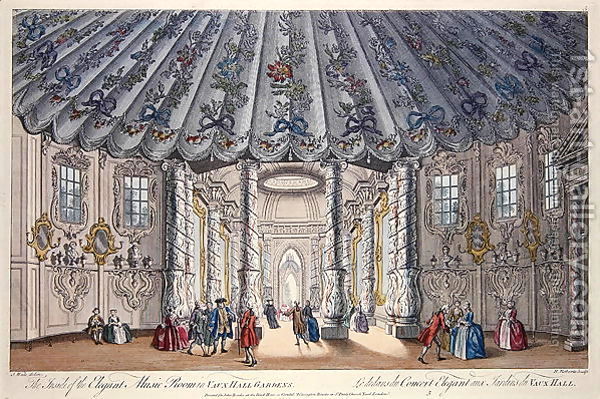
Prior to the 1751 season, the Pillared Saloon was opened up and an extension created that provided for space for artwork and made space for half again as many visitors. Unfortunately, the design was awkward and unsophisticated and was probably created by inexperienced students at the St. Martin’s Lane Academy.

PILLARED SALLON REMODEL

H. Roberts after S. Wale, The Inside of the Elegant Music Room in Vaux Hall Gardens, engraving, 1752 (British Library, London)

The new indoor orchestra stand opposite the Pillared Saloon, behind a balustrade that separated it from the audience, shared its awkward style; the same foliate columns framed it, and similar paintings decorated its ceiling. It must have been a substantial space, as an Irish visitor in 1752 claimed that he saw fifty-four musicians performing there, accompanying the singers Thomas Lowe and Isabella Burchell.

The Triumphal Arches and Decorative Paintings

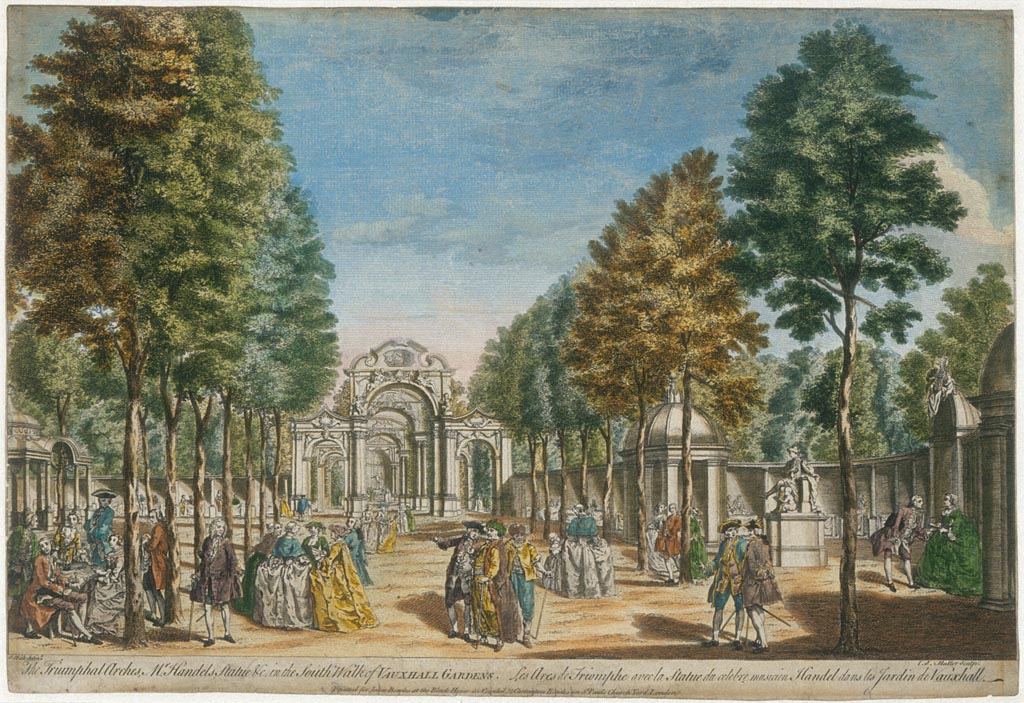
In contrast to the gaucherie of the Pillared Saloon, the three triumphal arches built over the South Walk at about the same time presented a more elegant, though more predictable, classical appearance… [T]hey were designed by ‘an ingenious Italian’ and made of timber and painted canvas.

ARCHES

J.S. Muller after S. Wale, The Walk of Triumphal Arches and the Statue of Mr. Handle in Vauxhall Garden, engraving, 1751 (British Library, London).

…the undeniably theatrical view through the three Vauxhall arches to the piece of scenery at the end of the walk must have been impressive; the vista was focused and enclosed by the surrounding trees, and the trompe-l’oeil effect of the scenery seen at the proper distance was intended to draw visitors to that end of the walk, where, on arrival, they could marvel at the skill of the artist, who had fooled them into thinking it was a three-dimensional object.

PALMYRA

E. Rooker after Canaletto, A Vew of the Center Cross Walk &c. in Vauxhall Gardens, engraving, 1751 (British Library, London).

In addition to these theatrical-esque arches, four large scenes were painted and installed at the end of the walks, to camouflage the surrounding landscape and introduce a bit of fantasy. The Temple of Neptune, at the end of the South Walk, was soon replaced by the ruins of Palmyra, after the publication of Robert Wood’s journey there. A painting of an alcove of three niches with figures of Flora and the Genii, at the end of the Dark Walk, was replaced with a scene of a Chinese Garden in 1762. “At the opposite end was an altogether more eccentric scene of another alcove, but this one bore a representation of a scaffolding and ladder ready for artists to work on the canvas.” The explanation for this:

An eminent artist, but of dissipated character, was employed by the first proprietors of the gardens to paint some classical designs at the end of one of the walks; but the delay in their completion so irritated the proprietor, that, having to leave London for a fortnight, he declared to the artist that he would listen to no further excuses, and that if he found his scaffold, paint-pots, &c. on his return, they should be thrown over the garden wall. On his return, perceiving, as he thought, in the same position, the scaffold, paint-pots, &c., he hastened to the spot to put his threat into execution, when, to his great amazement, he found them to be so accurately pictured on the canvas, that he ever after lavished the most extravagant praises upon the delinquent artist.

The Cascade

The most popular of Tyers’s additions in the 1750’s was the artificial Cascade, which was likely conceived by Frances Hayman, from his work with scenery and special effects in the theater.

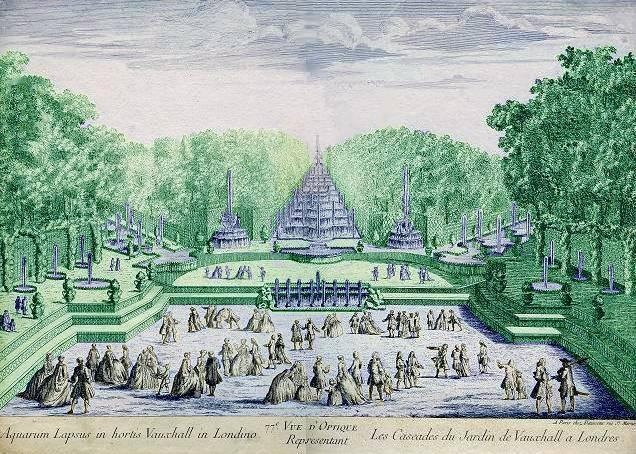
The Cascade was concealed behind a curtain which was drawn back at a particular time in the evening, as night fell, to reveal a three-dimensional illuminated scene of a landscape with a precipitous waterfall: the illusion was created with sheets of tin fixed to moving belts, turned by a team of Tyers’s lamplighters; when it was running, the noise and spectacle must have been terrific.

Throughout its existence the Cascade underwent various improvements, enlargements, alterations, replacements, demolitions, and moves, which continued into the 1840’s. No visual representation of it survives, but at the height of its popularity in 1762 an anonymous author described it as:

a most beautiful landscape in perspective of a fine open hilly country with a miller’s house and a water mill, all illuminated by concealed lights; but the principal object that strikes the eye is a cascade or water fall. The exact appearance of water is seen flowing down a declivity; and the turning the wheel of the mill, it rises up in a foam at the bottom, and then glides away. This moving picture attended with the noise of the cascade has a very pleasing and surprising effect on both the eye and ear.

Until well into the 1820’s, when it was demolished to make way for the new Ballet Theatre, the Cascade continued to delight and surprise Vauxhall audiences, with depictions of the tidal race and watermill at London Bridge, of distance military encampments, and other scenes.

CASCADE

Well, I did find this image of the Cascade! Or at least it purports to be such.

The Gothic Orchestra

The original Orchestra building had outlived its usefulness, and was replaced in 1757-8 with a sort of Gothic-style building, made of wood and plaster and painted white and ‘bloom’, whatever that is. This building remained through the end of the gardens, having a domed roof with a “finial of Prince of Wales feathers”. The organ and musicians occupied the top floor, with supper-boxes on the bottom. The upper floor had graduated seating that made the musicians visible to the audience.

vauxhall_Muller_1751

Anon., A Perspective View of the Grand Walk in Vauxhall Gardens, and the Orchestra, engraving (David Coke’s collection), from the Gentleman’s Magazine (August 1765). The earliest view of the new Gothic Orchestra, built in 1757.

The Company

As we have mentioned previously, Vauxhall attracted a diverse group of visitors, more than any other entertainment of the period. The bulk of its income, however, came from the “Smarts,” which were middle-class young men, known for their licentiousness and self-indulgence, who came to show off to their female companions. A press reporter put it this way in July 1738:

The Smarts are, as it were, the sole Authors of our publick diversions at the Theatre they have a majority of the pit and the boxes: to them the Opera owes its subsistence, and Vaux Hall, the agreeable Vauxhall! would be a wilderness without them.

A big draw for the lower classes was the opportunity to encounter the upper classes, royalty, or other celebrities, that they would not normally be allowed anywhere near.

An account of a visit by an upper-class party is given by Horace Walpole:

I had a card from Lady Caroline Petersham to go with her to Vauxhall. I went accordingly to her house at half an hour after seven, and found her and little Ashe, or the pollard Ashe, as they call her; they had just finished their last layer of red, and looked as handsome as crimson could make them. […] We got into the best order we could and marched to our barge, with a boat of French horns attending and little Ashe singing. We paraded some time up the river and at last debarked at Vauxhall […]. At last we assembled in our booth, Lady Caroline in the front, with the vizor of her hat erect, and looking gloriously jolly and handsome. She had fetched my brother Orford from the next box, where he was enjoying himself with his Norsa and his petite partie, to help us to mince chickens. We minced seven chickens into a china dish, which Lady C. stewed over a lamp with three pats of butter and a flagon of water, stirring and rattling and laughing, and we every minute expecting to have the dish fly about our ears. She had brought Betty [Neale] the fruit girl, with hampers of strawberries and cherries from Rogers’s, and made her wait upon us, and then made her sup by us at a little table […]. In short, the whole air of our party was sufficient as you will easily imagine to take up the whole attention of the garden, so much so, that from eleven o’clock till half an hour after one, we had the whole concourse round our booth, at last they came into the little gardens of each booth on the sides of ours, till Harry Vane took up a bumper and drank their healths, and was proceeding to treat them with still greater freedom. It was three o’clock before we got home.

Then there was Henry Timberlake, who brought a group of Cherokee Indians to the gardens on two occasions, the second advertised ahead of time drawing ten thousand curious onlookers. (Note: those Cherokees had a very busy schedule. Take a peek here.)

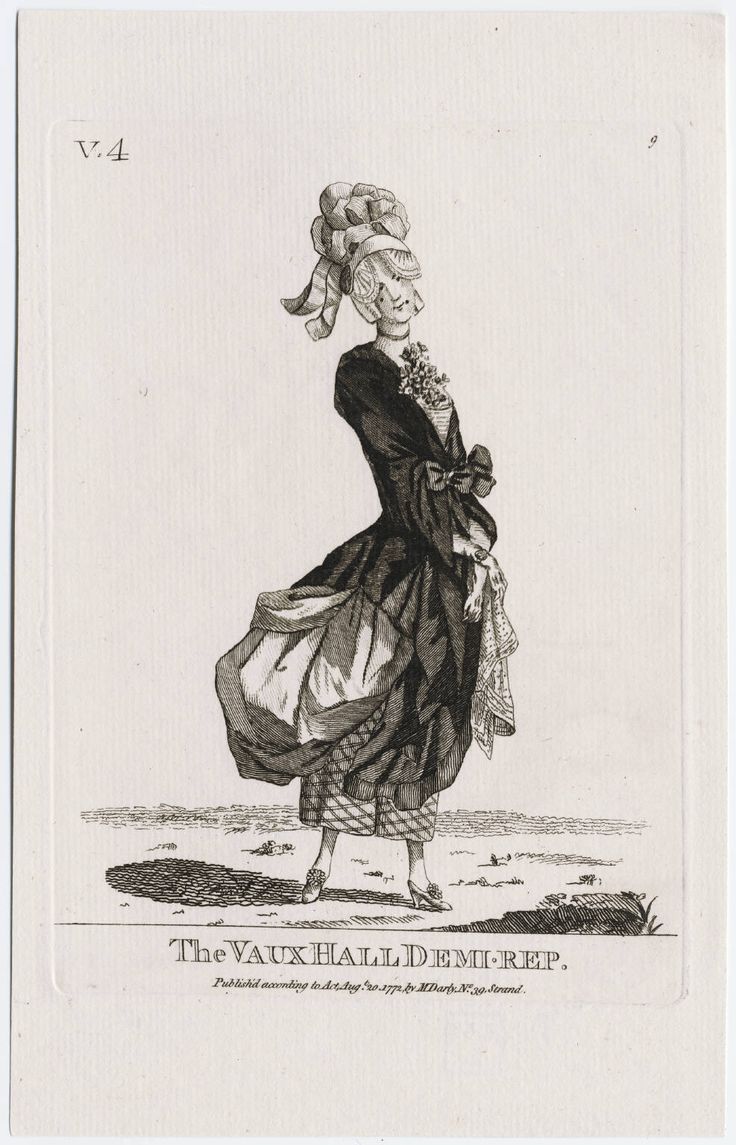
A ‘silent majority’ of visitors came from the professional classes, lawyers, doctors, parsons, and increasingly in the 1780’s, after Tyers’s death, prostitutes and the demi-monde.

demi-rep

Anon., The Vauxhall Demi-Rep, engraving, 1772 (Senate House Library, London). One of the working girls who frequented the gardens. Less a prostitute than an escort, the demo-rep would join an all-male party to titillate and amuse the men.


Susana’s Vauxhall Blog Post Series

  1. Vauxhall Gardens: A History
  2. Vauxhall Gardens: Jonathan Tyers—“The Master Builder of Delight” 
  3. Vauxhall Gardens: A New Direction
  4. Vauxhall Gardens: The Orchestra and the Supper-Boxes 
  5. Vauxhall Gardens: The Organ, the Turkish Tent, and the Rotunda
  6. Vauxhall Gardens: Three Piazzas of Supper-Boxes
  7. Vauxhall Gardens: “whither every body must go or appear a sort of Monster in polite Company”
  8. Vauxhall Gardens: The Competition
  9. Vauxhall Gardens: The Artwork, Part I
  10. Vauxhall Gardens: The Artwork, Part II
  11. Vauxhall Gardens: The Music, 1732-1859
  12. Vauxhall Gardens: The Business Side
  13. Vauxhall Gardens: Developments from 1751-1786
  14. Vauxhall Gardens: Thomas Rowlandson’s Painting (1785)
  15. ‎Vauxhall Gardens: The Third Generation of the Tyers Family and the Jubilee of 1786
  16. Vauxhall Gardens: An Era of Change (1786-1822), Part I
  17. Vauxhall Gardens: An Era of Change (1786-1822), Part II
  18. Vauxhall Gardens: An Era of Change (1786-1822), Part III
  19. Vauxhall Gardens: The Final Years, Part I
  20. Vauxhall Gardens: The Final Years, Part II
  21. Vauxhall Gardens: The Final Years, Part III
  22. Vauxhall Gardens: The Final Years, Part IV
  23. Vauxhall Gardens: Farewell, for ever

Vauxhall Gardens: The Business Side

vauxhallbook

Vauxhall Gardens: A History

David Coke & Alan Borg

The Vauxhall Pleasure Gardens is one of the places I’d love to slip back in time to visit, just to catch a glimpse of what it was like. After recently splurging to buy this lovely coffee-table book, I thought it might make a wonderful subject for a new blog series. But do buy the book too, if you can! The photos are fabulous!

Vauxhall’s huge success after Jonathan Tyers’s acquisition of the property, which had been in existence for seventy years as the “New Spring Gardens”, can be attributed to the man’s perception that his idealistic dream must be counter-balanced by sound financial practices. An essential element of this was publicity, and of this, Tyers proved to be a master. How did he do this?

Promoting Vauxhall

He promoted the gardens as a sort of “heaven on earth,” a magical sort of place to lift one’s spirits after a hard day in the real world.

[T]his was achieved through stories in literature and the printed media, through popular songs and through the artworks and music he commissioned. The second was the flattery of his audience; he consistently treated his visitors as special people, always referring to them as persons of quality, ladies and gentlemen, patriots, libertarians, educated people who appreciated fine things and good music. And the last was the simple dissemination of factual information about Vauxhall, its history, its current attractions, and how this pleasure garden should be enjoyed, by means of articles in newspapers and periodicals, of histories and guidebooks and of topographical and satirical engravings.

John Lockman, Publicist

John Lockman, Publicist

In truth, of course, Vauxhall fell short of perfection, and that’s where John Lockman came in. He was a sort of early publicist, who wrote poems and songs designed to “underscore Tyers’s transformation of a notorious gathering place for drunks, gamblers and prostitutes into a civilised pleasure garden where anyone could enjoy a decorous evening’s entertainment without risk to their reputation.”
Lockman’s assistance was necessary because it was impossible to exclude troublemakers, particularly if they were respectably dressed. “[I]t was easier to sell an enhanced image of the place to a persuadable public.

Tyers was always careful to make everybody in his clientele feel good about themselves, and in particular about their patronage of Vauxhall. In his press announcements, for instance, he would often start by thanking his visitors for their support, especially if the weather had been bad, and would repeatedly finish by pledging to keep out of his gardens anyone not worthy of their company.

Another tactic was to use magazines and newspapers. Newspapers, of course, were a no-brainer. Letters such as the “S. Toupee” articles published in Scots Magazine may or may not have been instigated by Tyers, but they certainly proved valuable in driving up excitement for Vauxhall. “Of the Luxury of the English; and a Description of Ranelagh Gardens and Vaux-hall, in a Letter from a Foreigner to his Friend at Paris,” supposedly written by Henry Fielding (a friend of Tyers) and commissioned by Tyers, piled on the praise for Vauxhall in comparison to Ranelagh Gardens.

A female audience was enticed to Vauxhall by published songs and by scenes in novels set in Vauxhall Gardens. And then there were the Love at First Sight articles, or “Lonely Hearts” columns, which may or may not have been genuine. Here’s one from the London Chronicle in August 1758:

A young Lady who was at Vauxhall on Thursday night last, in company with two gentlemen, could not but observe a young gentleman in blue and a gold-laced hat, who, being near her by the orchestra during the performance, especially the last song, gazed upon her with the utmost attention. He earnestly hopes (if unmarried) she will favour him with a line directed to A.D. at the bar of the Temple Exchange Coffee-house, Temple-bar, to inform him whether fortune, family, and character, may not entitle him upon a further knowledge, to hope an interest in her heart.

Another marketing tactic was to engage actors dressed as gentlemen to patronize coffee-houses to express their intention to go to Vauxhall and entreat others to meet them there.

Tyers’s Management Style

It goes without saying that if one wishes to have customers return, one has to ensure that their first time is as pleasant and enjoyable as possible. If you knew Jonathan Tyers—and you probably wouldn’t because it was never himself he wanted to promote and therefore took pains to remain in the background—you could see him in the kitchens working as hard as his employees to get the food out to the customers.
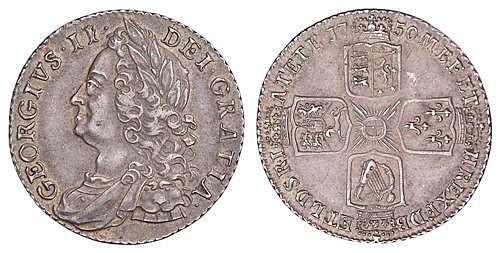
Waiters, or “drawers” were freelance employees, who were constrained to work hard in order to earn tips and keep their posts. Since in other venues, “drawers” were known to steal from their employers, “Vauxhall waiters were required to pay for the food on collection from the kitchens, and themselves ran the risk of defaulting customers, especially if they had not been sufficiently polite or efficient in their service.”

Although he had to maintain a strict discipline among his employees, he was a thoughtful employer. When two of his waiters married two of his barmaids, he provided wedding rings and an elaborate dinner at his home in Denbies, with fifty of his staff as guests.

one shilling coin

Vauxhall Tickets

Up until 1736, the admission cost was sixpence, but afterward, the price was doubled to one shilling. Considering the expense of maintaining and improving the gardens and contriving new entertainments, this seems modest indeed; however, there was more to be made from the food and drink once the visitors were admitted. For the visitors, there was also the cost of dressing respectably and the cost of transportation. The one shilling price was fixed until 1792, when it was doubled to two shillings.

Season Ticket greySeason Ticket grey reverse

In 1737 Tyers initiated a subscription price, or season ticket. The metal tickets were issued to a thousand people at a guinea each, and would admit two people to the gardens for the entire season. Not only did this ensure repeat visits by two thousand people, it provided him with funds upfront to use for maintenance and improvement.

The relief on the obverse usually represented, through classical imagery, a particular aspect of Vauxhall Gardens, often associated with the music. On the reverse was engraved the subscriber’s name, accompanied… by the ticket’s number.

silver ticket
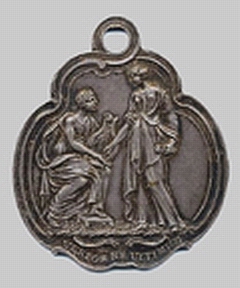
silver ticket
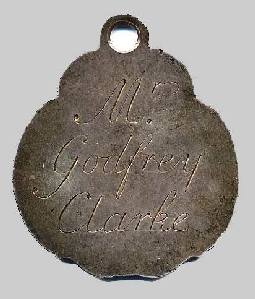
In 1738, the tickets were made of silver and the price rose by three shillings. In 1741, the price was raised to two guineas.

As a comparison, a season ticket for two to the Great Room in Soho was five guineas, while individual concerts were ten and a half shillings, the same price as Handel’s fundraising concert at the Foundling Hospital in 1749. Almack’s (founded in 1765) charged ten guineas for a once-weekly ball over twelve weeks, so Vauxhall tickets were considered quite a bargain.

Hogarth's gold "perpetual" ticket

Hogarth’s gold “perpetual” ticket

Attendance

“S. Toupee” in his letters in Scots Magazine estimated that “not less than one thousand shillings are received each evening of performance during the season,” not including season ticket holders. Special events, such as the rehearsal of Handel’s Music for the Royal Fireworks, drew several thousand spectators. Opening and closing nights and royal birthdays also drew large crowds.

The opening night of the 1769 season, for instance, was a remarkably fine evening for the time of year, and it was estimated that ‘there were upwards of twenty thousand of the first nobility present.’

Crime and Disorder

Even though it suffered occasional lean times, there can be little doubt that eighteenth-century Vauxhall Gardens became the most popular single visitor attraction for London… With these numbers of people coming together, especially to a place where alcohol was available, crime, vandalism and disorder were inevitable.

Nor was it just pickpockets and prostitutes his police force (initiated in 1732) had to deal with. While Tyers encouraged his waiters to restrict alcohol consumption, it was difficult for them or even him to police the mischievous London Bucks, who were of a class higher than his. Tyers and his staff managed these problems themselves, even if it meant “eating” the cost of vandalism, not wanting to involve courts, which would draw bad publicity. “S. Toupee,” in one of his letters in 1739, “pointed out that there was ‘a man in the posture of a Constable, to protect the Ladies from any insult, &c.’ at the end of each walk.

Besides the half-dozen or so constables, he employed up to eight men to guard the route from the river and led a (possibly regular) blitz against the pickpockets.

Refreshments

Anyone who has worked in the restaurant industry can tell you how difficult a task it is to prepare food for crowds of people, but how many restaurants have to cater for 500-1000 or more hungry people? This is a logistical nightmare that Tyers managed with aplomb.

Consistent with his insistence on featuring English art and music, the food at Vauxhall was simple and English. There were complaints about the prices, of course. Here are some prices from one of the “S. Toupee” letters in 1739:

  • one bottle of French claret: 5 shillings
  • one cold chicken: 2-1/2 shillings
  • one quarter of cyder: 1 shilling
  • one quart of small-beer: 4 pence
  • one slice of bread: 2 pence
  • one slice of cheese: 4 pence
  • dish of ham or beef: 1 shilling, salad, an extra pence
  • sweet pastries: 1 shilling
  • custards and cheesecakes: 4 pence
  • heart cakes and Shrewsbury cakes: 2 pence
  • one bottle of champagne and arrack: 8 shillings
  • two pounds of ice: sixpence
Isaac Cruikshank, A Country Farmer & Waiter at Vauxhall. A farmer in country dress, on his first visit to Vauxhall, has ordered ham in expectation of a plateful of English gammon. When the waiter brings him the notoriously thin slices that were Vauxhall ham, the farmer is furious.

Isaac Cruikshank, A Country Farmer & Waiter at Vauxhall. A farmer in country dress, on his first visit to Vauxhall, has ordered ham in expectation of a plateful of English gammon. When the waiter brings him the notoriously thin slices that were Vauxhall ham, the farmer is furious.

Even a devoted fan such as “S. Toupee” confessed that the food was expensive. The sliced meats were thin, especially the ham. “This was all part of the fun of the evening—a great joke on fashionable society who were happy to play along.” A well-known verse alluding to this:

Never trouble Ham House, or its inmates at all,

For a ghost, that may be but a sham,

But seek in a sandwich that’s cut at Vauxhall,

For the true apparition of Ham.’

Note:

The cost of the food did not alter significantly over the whole period from Tyers’s re-launch until the gardens’ final closure; the prices of wines and spirits, however, were a different matter, rising sharply in the nineteenth century.

Susana’s Vauxhall Blog Post Series

  1. Vauxhall Gardens: A History
  2. Vauxhall Gardens: Jonathan Tyers—“The Master Builder of Delight” 
  3. Vauxhall Gardens: A New Direction
  4. Vauxhall Gardens: The Orchestra and the Supper-Boxes 
  5. Vauxhall Gardens: The Organ, the Turkish Tent, and the Rotunda
  6. Vauxhall Gardens: Three Piazzas of Supper-Boxes
  7. Vauxhall Gardens: “whither every body must go or appear a sort of Monster in polite Company”
  8. Vauxhall Gardens: The Competition
  9. Vauxhall Gardens: The Artwork, Part I
  10. Vauxhall Gardens: The Artwork, Part II
  11. Vauxhall Gardens: The Music, 1732-1859
  12. Vauxhall Gardens: The Business Side
  13. Vauxhall Gardens: Developments from 1751-1786
  14. Vauxhall Gardens: Thomas Rowlandson’s Painting (1785)
  15. ‎Vauxhall Gardens: The Third Generation of the Tyers Family and the Jubilee of 1786
  16. Vauxhall Gardens: An Era of Change (1786-1822), Part I
  17. Vauxhall Gardens: An Era of Change (1786-1822), Part II
  18. Vauxhall Gardens: An Era of Change (1786-1822), Part III
  19. Vauxhall Gardens: The Final Years, Part I
  20. Vauxhall Gardens: The Final Years, Part II
  21. Vauxhall Gardens: The Final Years, Part III
  22. Vauxhall Gardens: The Final Years, Part IV
  23. Vauxhall Gardens: Farewell, for ever