Archives

Romance of London: Sir William Petty and the Lansdowne Family

Romance of London: Strange Stories, Scenes And Remarkable Person of the Great Town in 3 Volumes

John Timbs

John Timbs (1801-1875), who also wrote as Horace Welby, was an English author and aficionado of antiquities. Born in Clerkenwell, London, he was apprenticed at 16 to a druggist and printer, where he soon showed great literary promise. At 19, he began to write for Monthly Magazine, and a year later he was made secretary to the magazine’s proprietor and there began his career as a writer, editor, and antiquarian.

This particular book is available at googlebooks for free in ebook form. Or you can pay for a print version.

Sir William Petty and the Lansdowne Family

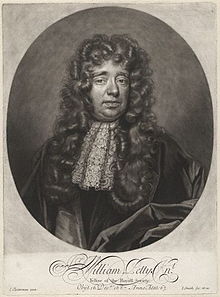
220px-Sir_William_PettySir William Petty is commonly described as “the founder of the house of Lansdowne,” a statement which is not sufficiently exact for all readers.

The story of William Petty, from May 1623, when he was born at Romsey, in Hampshire, to the time of his interment in the Norman church of that town, in 1687, is one of those lessons of life which can scarcely be too often repeated.

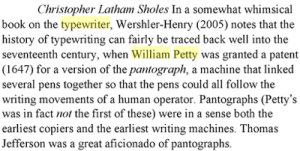
Petty was the son of a clothier in humble circumstances, was sent to Romsey Grammar School, and determined next to study at the University of Caen, in Normandy. Thither he sped, supporting himself by the way, with “a little stock of merchandise,” as a pedlar. He returned to England, and apprenticed himself to a sea captain, who, however, “drubbed him with a rope’s-end for the badness of his sight. This ill-treatment disgusted him with the navy; he took to the study of medicine, and while at Paris for that purpose became so poor as to subsist for two or three weeks entirely on walnuts; but, by help of the pedlar trade, he came back to England with money in his pocket. Here he exercised his liking for mechanics by inventing a letter-copying machine, or, as he called it, “an instrument for the art of double writing,” which he patented, for seventeen years, in 1648; and this very instrument is the prototype of the manifold letter-writers of our times. Petty likewise practiced chemistry and physic; and at his lodgings in Oxford were held the first meetings to form the Royal Society. At Oxford, Petty acted as deputy to the anatomical professor there: he lodged at an apothecary’s house, “because of the convenience of inspecting drugs.” In 1652 Petty was appointed Physician-General to the Army in Ireland. In 1664 he undertook the survey of Ireland; and in 1666, he had completed the measurement of two million and eight thousand acres of forfeited lands, for which, by contract, he was to receive one penny per acre. Sir William Petty is better known in our day as a writer upon trade and commerce and political arithmetic.

typewriter

Language, Technology, and Society, by Richard Sproat (2010)


polygraph

Darren Wershler-Henry’s The Iron Whim: A Fragmented History of Typewriting (2005)

Among Sir W. Petty’s inventions was “a double-bottomed ship, to sail against wind and tide.” He wrote on dyeing and on woolen cloth manufacture; he speculated in ironworks, lead-mince, a pilchard fishery, and timber trade; and all this time took an active part in the discussions of the Royal Society. He also built Tokenhouse Yard, Rothbury, on the site of the Earl of Arundel’s house and garden: and he held property in the yard at the time of the Great Fire. His will, made in 1661, details his birth, boohoo, education, adventures, studies, attainments, and promotions in life, commencing “with three-score pounds at the age of twenty,” an being in the receipt of 15,000l per annum a short time before his death, at which time he was residing in the corner house on the east side of Sackville Street, Piccadilly, opposite St. James’s Church. The widow of Sir William Petty was created Baroness Shelburn. He left two sons and a daughter. The eldest son succeeded to the title; but, dying without issue, it was revived in Henry, the second son, great uncle of the first Marquis of Lansdowne.

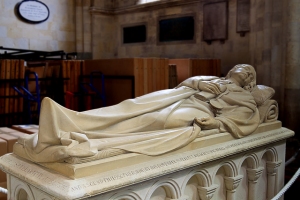
The remains of Sir William Petty rest in Romsey Church, where, on the south side of the choir, a plain slab bore the inscription, “Here Layes Sir William Petty;” but a more fitting memorial of his celebrated lineal ancestor was, in 1862, erected by the late Marquis of Lansdowne.

Monument to Sir William Petty, Romsey Church, Hampshire

Monument to Sir William Petty, Romsey Church, Hampshire

From Wikipedia:

Sir William Petty FRS (26 May 1623 – 16 December 1687) was an English economist, scientist and philosopher. He first became prominent serving Oliver Cromwell and Commonwealth in Ireland. He developed efficient methods to survey the land that was to be confiscated and given to Cromwell’s soldiers. He also managed to remain prominent under King Charles II and King James II, as did many others who had served Cromwell.

He was Member of the Parliament of England briefly and was also a scientist, inventor, and entrepreneur, and was a charter member of the Royal Society. It is for his theories on economics and his methods of political arithmetic that he is best remembered, however, and to him is attributed the philosophy of ‘laissez-faire’ in relation to government activity. He was knighted in 1661. He was the great-grandfather of Prime Minister William Petty Fitzmaurice, 2nd Earl of Shelburne and 1st Marquess of Lansdowne.

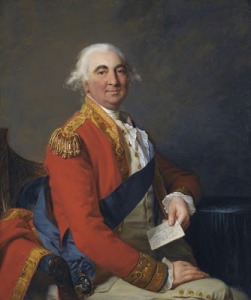
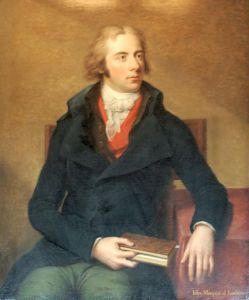
William Petty's great-grandson, William Petty-Fitzmaurice, 2nd Earl of Shelburne and 1st Marquess of Landsdowne, Prime Minister of England

William Petty’s great-grandson, William Petty-Fitzmaurice, 2nd Earl of Shelburne and 1st Marquess of Landsdowne, Prime Minister of England


Romance of London Series

  1. Romance of London: The Lord Mayor’s Fool… and a Dessert
  2. Romance of London: Carlton House and the Regency
  3. Romance of London: The Championship at George IV’s Coronation
  4. Romance of London: Mrs. Cornelys at Carlisle House
  5. Romance of London: The Bottle Conjuror
  6. Romance of London: Bartholomew Fair
  7. Romance of London: The May Fair and the Strong Woman
  8. Romance of London: Nancy Dawson, the Hornpipe Dancer
  9. Romance of London: Milkmaids on May-Day
  10. Romance of London: Lord Stowell’s Love of Sight-seeing
  11. Romance of London: The Mermaid Hoax
  12. Romance of London: The Bluestocking and the Sweeps’ Holiday
  13. Romance of London: Comments on Hogarth’s “Industries and Idle Apprentices”
  14. Romance of London: The Lansdowne Family
  15. Romance of London: St. Margaret’s Painted Window at Westminster
  16. Romance of London: Montague House and the British Museum
  17. Romance of London: The Bursting of the South Sea Bubble
  18. Romance of London: The Thames Tunnel
  19. Romance of London: Sir William Petty and the Lansdowne Family
  20. Romance of London: Marlborough House and Sarah, Duchess of Marlborough
  21. Romance of London: The Duke of Newcastle’s Eccentricities
  22. Romance of London: Voltaire in London
  23. Romance of London: The Crossing Sweeper
  24. Romance of London: Nathan Mayer Rothschild’s Fear of Assassination
  25. Romance of London: Samuel Rogers, the Banker Poet
  26. Romance of London: The Eccentricities of Lord Byron
  27. Romance of London: A London Recluse

Jessica Cale: How Royal Copenhagen Conquered Europe

Eighteenth Century Porcelain: How Royal Copenhagen Conquered Europe

13509851_263614374004128_2085781765_oThe Royal Porcelain Factory (Den Kongelige Porcelænsfabrik), better known as Royal Copenhagen, was founded in a converted post office in Copenhagen on May 1st, 1775 under the protection of Queen Juliane Marie. Although porcelain had been made in Germany since 1710, it was not produced in Denmark until chemist Frantz Heinrich Müller developed a method for its manufacture in 1774. Juliane Marie had an interest in mineralogy and porcelain was a family passion: both her brother, Charles I of Brunswick-Wolfenbüttel, and sister, who was married to Frederik II of Prussia, had founded porcelain factories in Germany.

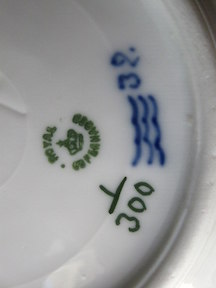
The factory’s first pieces were dining sets for the royal family. Juliane Marie insisted each piece be stamped with the factory’s mark, three wavy lines that symbolized Denmark’s three straights–the Øresund, the Great Belt and the Little Belt–as well as the royal crown stamp to highlight the firm’s royal connections. Each piece is marked this way to this day.

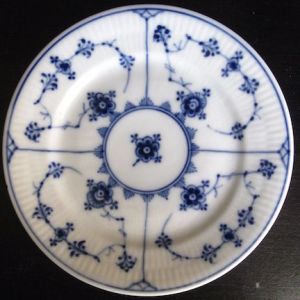
Blue and white china became popular across Europe as early as the seventeenth century with the import of goods from the far east. The fine porcelain of China’s Ming and Qing dynasties sparked an enduring love for floral patterns in blue and white and Royal Copenhagen quickly developed their own. Blue Fluted Plain (Danish: Musselmalet) was their first pattern and at more than two hundred fifty years old, it is the world’s oldest china pattern still in production.

13467665_263614317337467_432371625_oBlue Fluted Plain was inspired by Chinese floral patterns and updated to include flowers native to Denmark. Cinquefoils were added to the stylized chrysanthemums to give the pattern a more Nordic appearance. The ultramarine blue pigment in the paint was originally purchased from the Blaafarveværket (“blue colour factory”) in Norway, a company that provided up to eighty percent of the world’s cobalt during the nineteenth century. Each piece was and continues to be hand-painted by blue painters who spend at least four years in training for the position.

Since its development in 1775, Blue Fluted Plain has appeared on more than two thousand different pieces and has inspired countless imitations. It reached the height of its popularity in the early nineteenth century and appeared on everything from tea cups to washbasins and chamber pots.

Lord Nelson brought Royal Copenhagen porcelain back for his mistress, Lady Hamilton, following the Danish defeat at the Battle of Copenhagen in 1801. While Denmark lost that particular battle, Royal Copenhagen’s invasion of Britain was a success. It qualified for London’s World Expo in 1851 and gained international fame by winning the grand prize at Paris’ World Expo in 1889.

13509748_263614310670801_2069635372_oThis pattern has also appeared in some well-researched historical films and television shows, so not only does the pattern “look right” for the period, but even newer pieces are historically accurate for any time after 1775. You can still find pieces in this pattern to this day, so if you would like to add a little eighteenth century elegance to your kitchen or a touch of the Regency to your cup of tea, look for Royal Copenhagen’s Blue Fluted Plain.

Note: For more images or shopping information, Replacements Ltd. has a spectacular assortment of pieces in this pattern here: http://www.replacements.com/webquote/rcoblfp.htm

About The Long Way Home

The Long Way Home, Book 3 in The Southwark Saga is a magical, adult fairy tale that will keep you entertained from start to finish. Find out what happens when a paranoid king, a poison plot, and hideous shoes prove… it’s not easy being Cinderella!

coverAfter saving the life of the glamorous Marquise de Harfleur, painfully shy barmaid Alice Henshawe is employed as the lady’s companion and whisked away to Versailles. There, she catches King Louis’ eye and quickly becomes a court favorite as the muse for Charles Perrault’s Cinderella. The palace appears to be heaven itself, but there is danger hidden beneath the façade and Alice soon finds herself thrust into a world of intrigue, murder, and Satanism at the heart of the French court.

Having left his apprenticeship to serve King Charles as a spy, Jack Sharpe is given a mission that may just kill him. In the midst of the Franco-Dutch war, he is to investigate rumors of a poison plot by posing as a courtier, but he has a mission of his own. His childhood friend Alice Henshawe is missing and he will stop at nothing to see her safe. When he finds her in the company of the very people he is meant to be investigating, Jack begins to wonder if the sweet girl he grew up with has a dark side.

When a careless lie finds them accidentally married, Alice and Jack must rely on one another to survive the intrigues of the court. As old affection gives way to new passion, suspicion lingers. Can they trust each other, or is the real danger closer than they suspect?

AmazonBarnes & NobleKoboiBooks

About the Author

jessicaJessica Cale is a historical romance author, a Bluestocking Belle, and a journalist based in North Carolina. Originally from Minnesota, she lived in Wales for several years where she earned a BA in History and an MFA in Creative Writing while climbing castles and photographing mines for history magazines. She kidnapped (“married”) her very own British prince (close enough) and is enjoying her happily ever after with him in a place where no one understands his accent. You can visit her at www.authorjessicacale.com.

Her series, The Southwark Saga, is available now. You can visit her at www.dirtysexyhistory.com.


Romance of London: The Thames Tunnel

Romance of London: Strange Stories, Scenes And Remarkable Person of the Great Town in 3 Volumes

John Timbs

John Timbs (1801-1875), who also wrote as Horace Welby, was an English author and aficionado of antiquities. Born in Clerkenwell, London, he was apprenticed at 16 to a druggist and printer, where he soon showed great literary promise. At 19, he began to write for Monthly Magazine, and a year later he was made secretary to the magazine’s proprietor and there began his career as a writer, editor, and antiquarian.

This particular book is available at googlebooks for free in ebook form. Or you can pay for a print version.

The Thames Tunnel

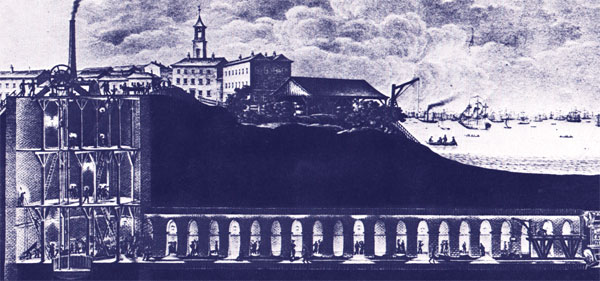
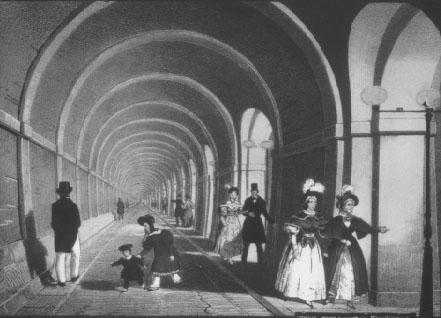
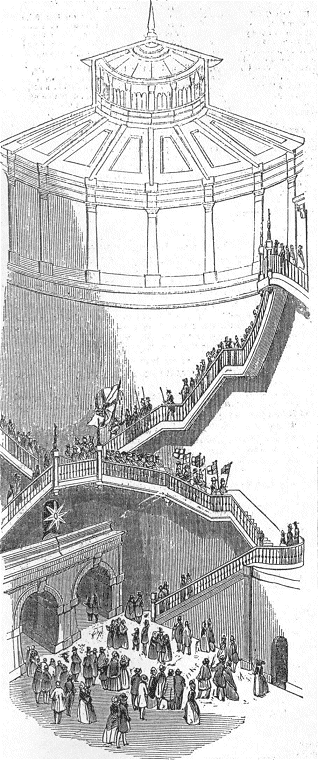
The first successful tunnel constructed beneath a navigable river was built between 1825 and 1843 by Thomas Cochrane and Marc Brunel, along with Brunel’s son, Isambard. Although it was meant to facilitate horse-drawn carriages traffic, that never happened. Currently it is part of the London Overground railway network.

From Wikipedia:

Brunel and Cochrane patented the tunnelling shield, a revolutionary advance in tunnelling technology, in January 1818. In 1823 Brunel produced a plan for a tunnel between Rotherhithe and Wapping, which would be dug using his new shield. Financing was soon found from private investors, including the Duke of Wellington, and a Thames Tunnel Company was formed in 1824, the project beginning in February 1825.

Thames_tunnel_shield

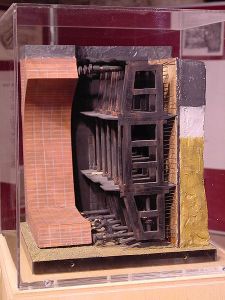
The tunnelling shield, built at Henry Maudslay’s Lambeth works and assembled in the Rotherhithe shaft, was the key to Brunel’s construction of the Thames Tunnel. The Illustrated London News described how it worked:

Scale model of the Brunel shield

Scale model of the Brunel shield

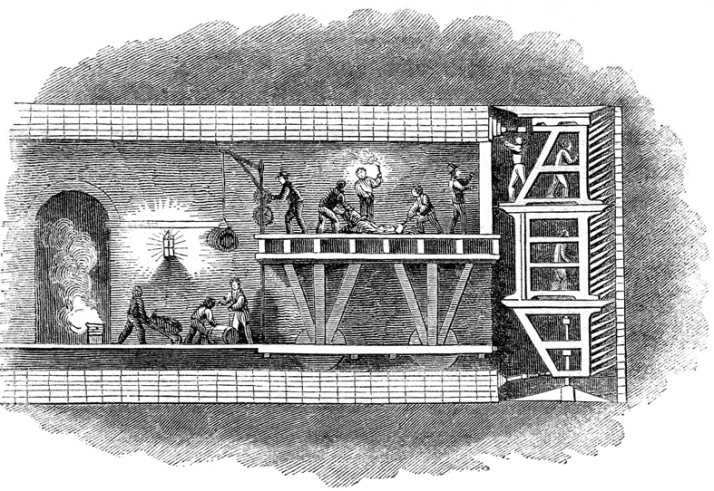
The mode in which this great excavation was accomplished was by means of a powerful apparatus termed a shield, consisting of twelve great frames, lying close to each other like as many volumes on the shelf of a book-case, and divided into three stages or stories, thus presenting 36 chambers of cells, each for one workman, and open to the rear, but closed in the front with moveable boards. The front was placed against the earth to be removed, and the workman, having removed one board, excavated the earth behind it to the depth directed, and placed the board against the new surface exposed. The board was then in advance of the cell, and was kept in its place by props; and having thus proceeded with all the boards, each cell was advanced by two screws, one at its head and the other at its foot, which, resting against the finished brickwork and turned, impelled it forward into the vacant space. The other set of divisions then advanced. As the miners worked at one end of the cell, so the bricklayers formed at the other the top, sides and bottom.

Although it was a triumph of civil engineering, the Thames Tunnel was not a financial success. It had cost a fortune to build – £454,000 to dig and another £180,000 to fit out – far exceeding its initial cost estimates. Proposals to extend the entrance to accommodate wheeled vehicles failed owing to cost, and it was used only by pedestrians. It became a major tourist attraction, attracting about two million people a year, each paying a penny to pass through, and became the subject of popular songs. The American traveller William Allen Drew commented that “No one goes to London without visiting the Tunnel” and described it as the “eighth wonder of the world.”

Flooding on the Thames Tunnel

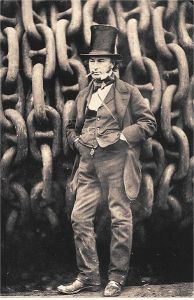
Isambard Brunel

Isambard Brunel

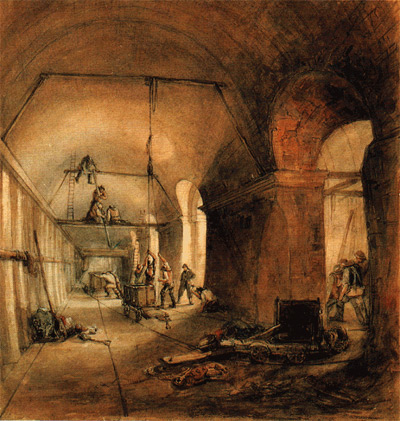
This stupendous work had considerably advanced by May 1827, when the bed of the river being examined by a diving-bell, the soil was found to be extremely loose; and on the 18th of May, as the tide rose, the ground seemed as though it were alive. The water was pressing in at all points, and it was not long in entering. Occasional bursts of diluted silt were followed by an overwhelming flood of slush and water, which drove all before it. The men, forced out of the shield, fled towards the bottom of the shaft. The water came on in a great wav, threatening to sweep them back under the arch by its recoil against the circular wall of the shaft. The lowest flight of steps was reached, and the recoil wave surged under the men’s feet. They hurried up the stairs of the shaft, and it was thought that all of them had come in, when the cry was raised, “A rope! A rope! Save him! Save him!” Some unfortunate workman had been left behind, and was seen struggling in the water. Young Brunel, seizing a rope, slid down one of the iron ties of the shaft, reached the water, passed the rope around the man’s body, and he was immediately drawn up. It proved to be old Tillett, the engine-man. The roll was then called, and every man answered to his name; but the Tunnel works were, for the time, completely drowned.

Thamestunnelcutout1840On examination of the bed of the river from the diving-bell, a large hole was found extending from the centre of the Tunnel excavation to a considerable distance eastwards. Measures were taken to fill up the opening with bags of clay, laid so as to form an arch in the bed of the river immediately over the work. More bags of clay were then sunk; and after about thirty thousand cubic feet of clay had been thrown into the hole, the pumping was resumed, and the state of the work could be examined from the inside in a boat. On the 10th of November following, the Tunnel had again been so far cleared of water that young Brunel determined to give a dinner in one of the arches to about fifty friends of the undertaking; while above a hundred of the leading workmen were similarly regaled in the adjoining arch. The band of the Coldstream Guards enlivened the scene, and the proceedings went off with great éclat. The celebration had, however, been premature; and the young engineer had been ‘hallooing before he was out of the ‘—water; for in two months the Thames again burst in, owing in some measure to the incautiousness of young Brunel himself, and the river held possession of the Tunnel for several years.

Thames_tunnel_construction_1830

Thames Tunnel construction, 1830

The funds of the Tunnel Company were by this time exhausted; and it was determined to make an appeal to the country for the means of finishing it. A subscription-list was opened, and 18,500l promised; but this sum was a mere “flea-bite,” and the works remained suspended. The Government, at length, consented to make a loan of 246,000l for the purpose of enabling the Tunnel to be completed, and the first installment was advanced in December 1834. The water was then pumped out of the Tunnel, and the works were recommenced, after having been at a standstill for a period of seven years. A new shield, of excellent construction, was supplied by the Messrs. Rennie, which was satisfactorily placed in position by the 1st of March 1836. But the difficulties of the undertaking were not yet entirely overcome; the river broke in again and again—three times in twenty weeks, within a distance of only twenty-six feet; but by perseverance and skill the water was ultimately mastered, and the work was at last brought to a completion, and opened to the public on the 25th of March 1843.

Thamestunnel

Thamestunnelshaft

2005 Thames Tunnel from Wapping

2005 Thames Tunnel from Wapping

The Brunel Museum

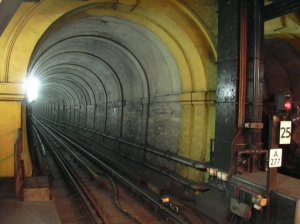
Nearby in Rotherhithe, the original Brunel Engine House is open to visitors as the Brunel Museum. It was built to house the drainage pumps for the tunnel and has now been restored. Wikipedia says that “[I]t is still possible to take a walking tour through the tunnel to Wapping from Rotherhithe and back, but these are infrequent and on an ad-hoc basis as they can only take place when that section of the line is closed for maintenance.


Romance of London Series

  1. Romance of London: The Lord Mayor’s Fool… and a Dessert
  2. Romance of London: Carlton House and the Regency
  3. Romance of London: The Championship at George IV’s Coronation
  4. Romance of London: Mrs. Cornelys at Carlisle House
  5. Romance of London: The Bottle Conjuror
  6. Romance of London: Bartholomew Fair
  7. Romance of London: The May Fair and the Strong Woman
  8. Romance of London: Nancy Dawson, the Hornpipe Dancer
  9. Romance of London: Milkmaids on May-Day
  10. Romance of London: Lord Stowell’s Love of Sight-seeing
  11. Romance of London: The Mermaid Hoax
  12. Romance of London: The Bluestocking and the Sweeps’ Holiday
  13. Romance of London: Comments on Hogarth’s “Industries and Idle Apprentices”
  14. Romance of London: The Lansdowne Family
  15. Romance of London: St. Margaret’s Painted Window at Westminster
  16. Romance of London: Montague House and the British Museum
  17. Romance of London: The Bursting of the South Sea Bubble
  18. Romance of London: The Thames Tunnel
  19. Romance of London: Sir William Petty and the Lansdowne Family
  20. Romance of London: Marlborough House and Sarah, Duchess of Marlborough
  21. Romance of London: The Duke of Newcastle’s Eccentricities
  22. Romance of London: Voltaire in London
  23. Romance of London: The Crossing Sweeper
  24. Romance of London: Nathan Mayer Rothschild’s Fear of Assassination
  25. Romance of London: Samuel Rogers, the Banker Poet
  26. Romance of London: The Eccentricities of Lord Byron
  27. Romance of London: A London Recluse

Romance of London: The Bursting of the South Sea Bubble

Romance of London: Strange Stories, Scenes And Remarkable Person of the Great Town in 3 Volumes

John Timbs

John Timbs (1801-1875), who also wrote as Horace Welby, was an English author and aficionado of antiquities. Born in Clerkenwell, London, he was apprenticed at 16 to a druggist and printer, where he soon showed great literary promise. At 19, he began to write for Monthly Magazine, and a year later he was made secretary to the magazine’s proprietor and there began his career as a writer, editor, and antiquarian.

This particular book is available at googlebooks for free in ebook form. Or you can pay for a print version.

The word “Bubble” as applied to any ruinous speculation, was first applied to the transactions of the South Sea Company, in the disastrous year 1720. It originated in the exaggerated representations of the sudden riches to be realized by the opening of new branches of trade to the South Sea, the monopoly of which was to be secured to the South Sea Company, upon their pretext of paying off the National Debt. The Company was to become the richest the world ever saw, and each hundred pounds of their stock would produce hundreds per annum to the holder. By this means the stock was raised to near 400; it then fluctuated, and settled at 330.

512px-South_Sea_Bubble

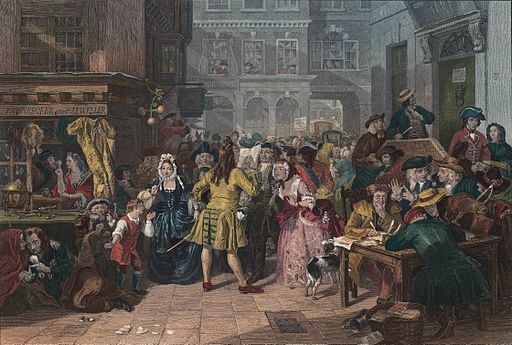
E.M. Ward, “‘Change Alley during the South Sea Bubble.”

Exchange Alley was the seat of the gambling fever;* it was blocked up every day by crowds, as were Cornhill and Lombard Street with carriages.  In the words of the ballads of the day:—

There is a gulf where thousands fell,

There all the bold adventurers came;

A narrow sound, though deep as hell,

‘Change Alley is the dreadful name.—Swift

Then stars and garters did appear

Among the meaner rabble;

To buy and sell, to see and hear

The Jews and Gentiles squabble.

The greatest ladies thither came,

And plied in chariots daily,

Or pawned their jewels for a sum

To venture in the Alley.

Innumerable bubble companies soon started up, by which one million and a half sterling was won and lost in a very short time. The absurdity of the schemes was monstrous: one was “a company for carrying on an undertaking of great advantage, but nobody to know where it is.” In all these bubbles, persons of both sexes alike engaged; the men meeting their brokers at taverns and coffee-houses, and the ladies at the shops of milliners and haberdashers; and in Exchange Alley, shares in the same bubble were sold, at the same instant, then per cent. Higher at one end of the Alley than the other. Meanwhile, the Minister warmed the nation, and the King declared such projects unlawful, and trafficking brokers were liable to 5,000l penalty. The companies were dissolved, but others as soon sprung up. The folly was satirized in caricatures and “stock-jobbing cards.” When Sir Isaac Newton was asked about the continuance of the rising of the South Sea stock, he answered that he could not calculate the madness of the people…

Among the victims was Gay, the poet [author of The Beggar’s Opera], who having had some South Sea Stock presented to him, supposed himself to be the master of 20,000l: his friends importuned him to sell, but he refused, and profit and principal were lost. The ministers grew more alarmed, the directors were insulted in the streets, and riots were apprehended; a run commenced upon the most eminent goldsmiths and bankers, some of whom absconded.

The Committee of Secrecy reported to Parliament the results of their enquiry, showing how false and fictitious entries had been made in the books, erasures and alterations made, and leaves torn out; and some of the most important books had been destroyed altogether. The properties of many thousands of persons, amounting to many millions of money, had been away with. Fictitious stock had been distributed among members of the Government, by way of bribe, to facilitate the passing of the Bill. One of the Secretaries to the Treasury had received 250,000l, as the difference in the price of some stock, and the account of the Chancellor of the Exchequer showed 794,451l. He proved the greatest criminal, and was expelled the House, all his estate seized, and he was committed a close prisoner to the Tower of London. Next day Sir George Casual, of a firm of jobbers who had implicated in the business, was expelled the House, committed to the Tower, and ordered to refund 250,000l. Mr. Craggs the elder died the day before his examination was to have come on. He left a fortune of a million and a half, which was confiscated for the benefit of the sufferers. Every director was mulcted [fined], and two millions and fourteen thousand pounds were confiscated, each director being allowed a small residue to begin the world anew.

The history of the Bubble and other speculations contemporaneously with the South Sea scheme is well narrated in Charles Mackay’s Memoirs of Extraordinary Popular Delusions, vol. i. Pp. 45-84.

The Night Singer of Shares

The Night Singer of Shares

It was about the year 1688 that the world ‘stock-jobber’ was first heard in London. In the short space of four years a crowd of companies, every one of which confidently held out to subscribers the hope of immense gains, sprang into existence: the Insurance Company, the Paper Company, the Lutestring Company, the Pearl Fishery Company, the Glass Bottle Company, the Alum Company, the Blythe Coal Company, the Sword-blade Company. There was a Tapestry Company, which would soon furnish pretty hangings for all the parlours of the middle class, and for all the bed-chambers of the higher.

Others included in Mackay’s publication were:

  • The Copper Company
  • The Diving Company (to investigate shipwrecks), which put on an impressive show of their advanced diving equipment on the Thames for fine gentlemen and ladies eager to be a part of such thrilling treasure-hunting
  • The Greenland Fishing Company
  • The Tanning Company
  • The Royal Academy Company, which would educate 2000 winners of a lottery in Latin, Greek, Hebrew, French, Spanish, conic sections, trigonometry, heraldry, japanning, fortification, bookkeeping, and the art of playing the theorbo.

Some of these companies took large mansions and printed their advertisements in gilded letters. Others, less ostentatious, were content with ink, and met at coffee-houses in the neighbourhood of the Royal Exchange. Jonathan’s and Garraway’s were in a constant ferment with brokers, buyers, sellers, meetings of directors, meetings of proprietors. Time-bargains soon came into fashion. Extensive combinations were formed, and monstrous fables were circulated, for the purpose of raising or depressing the price of shares.

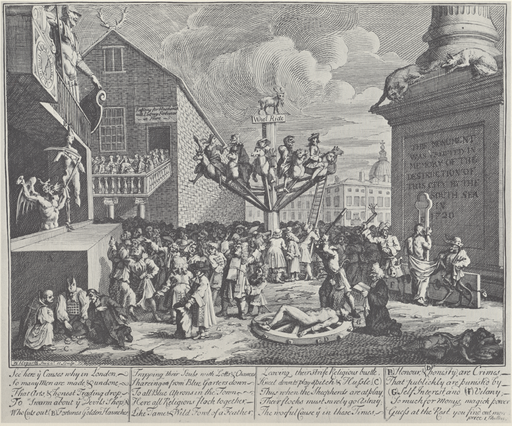
William Hogarth, Emblematical Print on the South Sea Scheme (1721). In the bottom left corner are Protestant, Catholic, and Jewish figures gambling, while in the middle there is a huge machine, like a merry-go-round, which people are boarding. At the top is a goat, written below which is "Who'l Ride". The people are scattered around the picture with a sense of disorder, while the progress of the well-dressed people towards the ride in the middle represents the foolishness of the crowd in buying stock in the South Sea Company, which spent more time issuing stock than anything else.

William Hogarth, Emblematical Print on the South Sea Scheme (1721). In the bottom left corner are Protestant, Catholic, and Jewish figures gambling, while in the middle there is a huge machine, like a merry-go-round, which people are boarding. At the top is a goat, written below which is “Who’l Ride”. The people are scattered around the picture with a sense of disorder, while the progress of the well-dressed people towards the ride in the middle represents the foolishness of the crowd in buying stock in the South Sea Company, which spent more time issuing stock than anything else.

Our country witnessed for the first time those phenomena for which a long experience has made us familiar—a mania, of which the symptoms were essentially the same with those of the mania of 1721, of the mania of 1825, of the mania of 1845, seized the public mind. An impatience to be rich, a contempt for those slow but sure gains which are the proper reward of industry, patience and thrift, spread through society. The spirit of the cogging dicers of Whitefriars took possession of the grave senators of the City, wardens of trades, deputies, aldermen. It was much easier and much more lucrative to put forth a lying prospectus, announcing a new stock, to persuade ignorant people that the dividends could not fall short of twenty per cent., and to part with 5,000l of this imaginary wealth for ten thousand sold guineas, than to load a ship with well-chosen cargo for Virginia or the Levant. Every day a new bubble was puffed into existence, rose buoyant, shone bright, burst, and was forgotten.

*Mr. E.M. Ward, R.A., has painted, with wonderful effect, “‘Change Alley during the South Sea Bubble,” a picture very properly placed in our National Gallery. [Currently Tate]

Susana’s remarks

Plus ça change, plus c’est la même chose.

The more things change, the more they stay the same. 

  • You aren’t going to win a big lottery prize. Or the Publishers’ Clearing House Sweepstakes. Or find buried treasure in your backyard.
  • When someone—even if it’s the Pope himself—offers you something that’s too good to be true, it really is too good to be true. Don’t be fooled.
  • Don’t be greedy. Be satisfied with “slow but sure gains” that are the reward of industry, patience and thrift.”


Romance of London Series

  1. Romance of London: The Lord Mayor’s Fool… and a Dessert
  2. Romance of London: Carlton House and the Regency
  3. Romance of London: The Championship at George IV’s Coronation
  4. Romance of London: Mrs. Cornelys at Carlisle House
  5. Romance of London: The Bottle Conjuror
  6. Romance of London: Bartholomew Fair
  7. Romance of London: The May Fair and the Strong Woman
  8. Romance of London: Nancy Dawson, the Hornpipe Dancer
  9. Romance of London: Milkmaids on May-Day
  10. Romance of London: Lord Stowell’s Love of Sight-seeing
  11. Romance of London: The Mermaid Hoax
  12. Romance of London: The Bluestocking and the Sweeps’ Holiday
  13. Romance of London: Comments on Hogarth’s “Industries and Idle Apprentices”
  14. Romance of London: The Lansdowne Family
  15. Romance of London: St. Margaret’s Painted Window at Westminster
  16. Romance of London: Montague House and the British Museum
  17. Romance of London: The Bursting of the South Sea Bubble
  18. Romance of London: The Thames Tunnel
  19. Romance of London: Sir William Petty and the Lansdowne Family
  20. Romance of London: Marlborough House and Sarah, Duchess of Marlborough
  21. Romance of London: The Duke of Newcastle’s Eccentricities
  22. Romance of London: Voltaire in London
  23. Romance of London: The Crossing Sweeper
  24. Romance of London: Nathan Mayer Rothschild’s Fear of Assassination
  25. Romance of London: Samuel Rogers, the Banker Poet
  26. Romance of London: The Eccentricities of Lord Byron
  27. Romance of London: A London Recluse

Romance of London: Montague House and the British Museum

Romance of London: Strange Stories, Scenes And Remarkable Person of the Great Town in 3 Volumes

John Timbs

John Timbs (1801-1875), who also wrote as Horace Welby, was an English author and aficionado of antiquities. Born in Clerkenwell, London, he was apprenticed at 16 to a druggist and printer, where he soon showed great literary promise. At 19, he began to write for Monthly Magazine, and a year later he was made secretary to the magazine’s proprietor and there began his career as a writer, editor, and antiquarian.

This particular book is available at googlebooks for free in ebook form. Or you can pay for a print version.

The Burning of Montague House

This noble mansion, situated on the north side of Great Russell Street, Bloomsbury, was first built about 1674, by Ralph Montague, Esq., afterwards Baron Montague of Boughton, and Duke of Montague, Keeper of the Wardrobe to Charles II., and who was subsequently in high favor with King William and Queen Anne. The house was erected in the manner of a French palace, from the design of Robert Hooke, the celebrated mathematician, and the inventor of spring-clocks and pocket-watches, and much employed in the rebuilding of London after the Great Fire; he was also Curator of the Royal Society, in the year 1678.

Within ten years this superb mansion was burned down by accident, or rather, by the carelessness of a servant. John Evelyn records in his Diary:—“Jan. 19. 1686.—This night was burnt to the ground my Lord Montague’s palace in Bloomsbery, than which, for paintings and furniture, there was nothing more glorious in England. This happened by the neglect of a servant airing, as they call it, some goods by the fire, in a moist season; indeed, so wet and mild a season had scarce been seen in man’s memory.”

The house was at this time in the occupation of the Earl of Devonshire, to whom Lord Montague had let it, for the sum of 500 guineas by the year. Of its destruction we find another entry:—

Whitehall, the 21st Jan. 1685-6.

“On Wednesday, at one in the morning, a sad fire happened at Montague House, in Bloomsbury, occasioned by the steward’s airing some hangings, &c., in expectation of my Lord Montague’s return home; and sending afterwards a woman to see that the fire-pans with charcoal were removed, which she told me she had done, though she never came there. The loss that my Lord Montague has sustained by this accident is estimated at 40,000l., besides 6,000l. In plate; and my Lord Devonshire’s loss in pictures, hangings, and other furniture is very considerable.”

The North Prospect of Mountague House by James Simonic, 1715

The North Prospect of Mountague House by James Simonic, 1715

Montague House is rebuilt

Lord Montague’s large income was again placed in requisition for the reconstruction of his palace; and though executed by French artists, the plan (that of the hotels of the nobility at Paris) was the same, the new structure being raised upon the foundations and burnt walls of the old one. The architect now employed was one Peter Poughet, a native of Marseilles, who was assisted in the decoration by Charles de la Fosse, Jaques Rousseau, and Jean Baptist Monoyer…  This exclusive employment of French artists in the new house gave rise to the popular but improbable tale, that Montague House was rebuilt at the expense of Louis XIV., to whose court Lord Montague had twice been sent as ambassador.

The second Montague House was finished about 1687; and the eccentric but munificent owner, who in 1705, was created Marquis of Monthermer and Duke of Montague, resided in it till after his death, which took place March 9, 1709. He was succeeded in his titles and estates by his son John, second Duke of Montague, who quitted the vicinity of St. Giles’s for the more courtly region of Whitehall. While a new mansion was being erected for him there, he, however, continued to reside in one of the wings of Montague House. After his removal to Whitehall, the house in Great Russell Street remained unoccupied, until it was purchased, by Act of Parliament, of Lord Halifax, for 10,250l., in the spring of 1754, for “the British Museum.”

Montagu House drawing by Nicholas Sutton, published in 1754

Montagu House drawing by Nicholas Sutton, published in 1754

The British Museum

The building must have been in a very dilapidated condition, for the repairs cost more than the purchase, and, with furniture, &c., amounted to the large sum of 29,736l. 10s. 10d.

In plan, the old Museum resembled a French hotel of the first class: consisting of a large and lofty pile, with two sides built for offices, and a high front wall, with an arched doorway, and above it an octangular turret, surmounted by a cupola and vane; this was the principal entrance, and was known as “Montague Great Gate;” and at each extremity of the wall was a square turret.

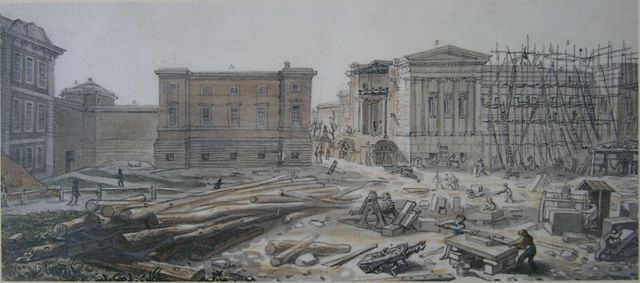
Left to Right: Montagu House, Towny Gallery, and Sir Robert Smirkes' West Wing Under Construction, July 1828

Left to Right: Montagu House, Towny Gallery, and Sir Robert Smirkes’ West Wing Under Construction, July 1828

To the original building additions were made from time to time, as the collection increased, until 1820, when the rebuilding of the Museum was commenced; the plan bordering three sides of the spacious area formerly occupied by the gardens of Montague House, behind the original mansion. By this means, the collection was removed from the old into the new building as the latter progressed, without any inconvenience to the public. In like manner, the principal front took the place of the old Montague House façade, which was removed piecemeal; and strange it was to see the lofty pitched roof, balustraded attic, and large windowed front of “the French manner,” giving way to the Grecian architecture of Sir Robert Smirke’s new design. The octangular and not unpicturesque apartment over the great gateway lingered for some time after, and was the last to disappear of old Montague House. The materials were sold by auction; and curious was it to see such pieces of the painted walls and ceilings as could be removed entire, bringing a few shillings—one of La Fosse’s deities for half-a-crown, or a bunch of Monoyer’s flowers for 1s. 6d.

The Waddesdon Bequest

This has nothing to do with Montague House, but is just something interesting I came across while researching this blog post. Last summer I visited Waddesdon Manor in Aylesbury, which is where Baron Ferdinand de Rothschild displayed the treasures he acquired from his travels to the Continent and beyond. Baron Rothschild is quite the romantic figure. He fell in love and married his second cousin Evelina, only to lose her in childbirth eighteen months later. He never married again, but spent his life in the acquisition and admiration of beautiful objects. Click here to take a look at my Pinterest board for Waddesdon Manor.

In 1898 he bequeathed the contents of his New Smoking Room at Waddesdon Manor to the British Museum.

This consisted of almost 300 pieces of objets d’art et de vertu which included exquisite examples of jewellery, plate, enamel, carvings, glass and maiolica, among them the Holy Thorn Reliquary, probably created in the 1390s in Paris for John, Duke of Berry. The collection was in the tradition of a schatzkammer or treasure house such as those formed by the Renaissance princes of Europe. Baron Ferdinand’s will was most specific, and failure to observe the terms would make it void, the collection should be

placed in a special room to be called the Waddesdon Bequest Room separate and apart from the other contents of the Museum and thenceforth for ever thereafter, keep the same in such room or in some other room to be substituted for it

The Waddesdon Bequest

The Waddesdon Bequest

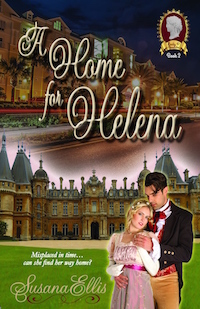
As a footnote, the cover of my time travel, A Home for Helena, includes a photograph of Waddesdon Manor taken last September at the time of my visit.

Home for Helena Cover 200x309

Amazon

Romance of London Series

  1. Romance of London: The Lord Mayor’s Fool… and a Dessert
  2. Romance of London: Carlton House and the Regency
  3. Romance of London: The Championship at George IV’s Coronation
  4. Romance of London: Mrs. Cornelys at Carlisle House
  5. Romance of London: The Bottle Conjuror
  6. Romance of London: Bartholomew Fair
  7. Romance of London: The May Fair and the Strong Woman
  8. Romance of London: Nancy Dawson, the Hornpipe Dancer
  9. Romance of London: Milkmaids on May-Day
  10. Romance of London: Lord Stowell’s Love of Sight-seeing
  11. Romance of London: The Mermaid Hoax
  12. Romance of London: The Bluestocking and the Sweeps’ Holiday
  13. Romance of London: Comments on Hogarth’s “Industries and Idle Apprentices”
  14. Romance of London: The Lansdowne Family
  15. Romance of London: St. Margaret’s Painted Window at Westminster
  16. Romance of London: Montague House and the British Museum
  17. Romance of London: The Bursting of the South Sea Bubble
  18. Romance of London: The Thames Tunnel
  19. Romance of London: Sir William Petty and the Lansdowne Family
  20. Romance of London: Marlborough House and Sarah, Duchess of Marlborough
  21. Romance of London: The Duke of Newcastle’s Eccentricities
  22. Romance of London: Voltaire in London
  23. Romance of London: The Crossing Sweeper
  24. Romance of London: Nathan Mayer Rothschild’s Fear of Assassination
  25. Romance of London: Samuel Rogers, the Banker Poet
  26. Romance of London: The Eccentricities of Lord Byron
  27. Romance of London: A London Recluse

Beverley Oakley: The Mysterious Governess (Daughters of Sin, Book 3)

Catostconspirators

The Cato Street Conspiracy and Queen Caroline’s Return to England—Two Important Events of 1820

 Historical Romance Author, Beverley Oakley, recently brought one of her characters, Miss Araminta Partington, to tea. Miss Partington, who has an extremely high opinion of her attractions, and of her knowledge of most matters, elucidated on the background to the new book in which she features called The Mysterious Governess, part of the Daughters of Sin series, which touches on the events before and after the Cato Street Conspiracy of 1820.

Miss Partington: Hello Susana, and thank you so much for inviting me to take a dish of tea in your parlor. I must say, it’s very comforting to know I can sleep at night in the knowledge that those dreadful men—Arthur Thistlewood, Edward Spence and the others – who call themselves “The Society of Spencean Philanthropists”, have been either hanged or transported for life for their parts in the Cato Street Conspiracy.

Susana: A delight to have you here, too, Araminta. Yes, what a shock to the public! What do you suppose they were hoping to achieve?

Miss Partington: Why, utter madness, in my opinion! Mr. Thistlewood talked of desiring a “Government of the People of Great Britain,” which would take power out of the hands of Parliament and the landed elite and place it into the hands of the people.” In my opinion, that’s tantamount to stealing Papa’s estate and giving it to Jane, my useless maid, who only last week lost one of my silver hairpins.

Susana: Goodness, that does sound dire! I’m referring to the plot, of course. Was there violence?

Miss Partington: Fortunately, the only violence was after the Coldstream Guards and Bow Street runners ran into the loft where these miscreants were plotting that night’s intended rampage through the home of the Lord President of His Majesty’s Privy Council, Lord Harrowby. Indeed, they were intending to murder the entire King’s Cabinet before taking to the streets of London to storm the Bank of England and the Tower of London. They hoped to stir up revolution in our country, like in America and France only a few decades ago.

Susana: Good Lord! How was it possible that law enforcement was able to apprehend the plotters?

Pageflex Persona [document: PRS0000038_00064]Miss Partington: Well, apparently, the Government knew what they were about and had planted spies in their organization. My Cousin, Stephen Cranbourne, works for the Foreign Office. I’m sure he’d have confided in me had I not been on rather… er… friendly terms with Lord Debenham who is rumored to be associated with the Spenceans. He’s not, of course. I made sure to burn the incriminating letter his cousin wrote before she drank poison. Aren’t the daffodils beautiful at this time of year? I’ve trimmed my bonnet with several bunches. Sir Aubrey does think them fetching. Yes, I’ve transferred my affections to Sir Aubrey as I think he’d be far easier to manage than dangerous Lord Debenham.

Susana: Yes, the daffodils are, indeed, beautiful. And I was so sorry to hear about Lord Debenham’s cousin. I believe she was Sir Aubrey’s late wife. But, back to politics, do tell me, when was the Spenceans’ plot brought to nought? My apologies for my ignorance, I’ve been in France for some time.

Miss Partington: On February 23, 1820, but of course, it’s not really news any more since the gossip sheets—and indeed, the newspapers—are having much more fun giving us all the thrilling details of George IV’s estranged wife Queen Caroline arriving from continental Europe, a few months afterwards, and attempting to take her place as Queen consort. Personally, I think someone with such atrocious dress sense doesn’t deserve to be queen, but, not everyone agrees with me—which I always find rather odd, really. Of course, the Prince Regent only agreed to marry Princess Caroline of Brunswick back at the end of the last century so his father would clear his debts. £630,000 pounds is rather a lot of money, though I imagine that if I owed such a sum, I might be induced to marry Lord Debenham above Sir Aubrey, despite his wicked reputation and the fact Lord Debenham would be so much more difficult to manage.

Susana: Yes, your half-sister, Miss Larissa Hazlett, has inferred the same.

Miss Partington: My half-sister? [Miss Partington rises.]Let me assure you, I do not have a half-sister. Any resemblance between that dreary governess and myself is entirely coincidental. Now, if you’ll excuse me… while it has been most pleasant, I must leave now for an appointment I’ve just remembered. Yes, it’s all part of a little plan I’m implementing to put that dreary governess right back in her box!

About The Mysterious Governess

Two beautiful sisters—one illegitimate, the other nobly born—compete for love amidst the scandal and intrigue of a Regency London Season.

Lissa Hazlett lives life in the shadows. The beautiful, illegitimate daughter of Viscount Partington earns her living as an overworked governess while her vain and spoiled half sister, Araminta, enjoys London’s social whirl as its most feted debutante.

When Lissa’s rare talent as a portraitist brings her unexpectedly into the bosom of society—and into the midst of a scandal involving Araminta and suspected English traitor Lord Debenham—she finds an unlikely ally: charming and besotted Ralph Tunley, Lord Debenham’s underpaid, enterprising secretary. Ralph can’t afford to leave the employ of the villainous viscount much less keep a wife but he can help Lissa cleverly navigate a perilous web of lies that will ensure everyone gets what they deserve.

Amazon.com • Amazon.co.uk • Apple iBooks • Barnes & Noble • Kobo

Excerpt

Although The Mysterious Governess is about Lissa, who is Araminta’s half-sister, the plot involves them equally. Lissa is hard-working and honourable, the antithesis of Araminta, as you will see below, in this short extract:

“Is everything all right, Miss? Were the fireworks grand? You’re back earlier than I’d ‘spected.” Jane, who was polishing the silver bottles on her mistress’s dressing table, looked up nervously as Araminta entered the room.

Without a word, Araminta brought one arm across the entire surface and sent powder bottles, perfume vials, hairbrushes and jewelry boxes crashing to the floor.

Then she threw herself onto her bed and burst into noisy tears.

“Oh, Miss, I take it things didn’t go to plan,” said Jane, going down on her knees to start to clean up the mess before changing her mind and putting a tentatively soothing hand upon Araminta’s back.

“No, they did not!” Araminta shrieked, beating her fists upon the counterpane.

“So, His Lordship didn’t ask you to marry him, then?”

“Yes he did!” Araminta rolled onto her back and glared at Jane. “He asked me to marry him and then said he had to go away on important business for two months! Two months! Where does that leave me? In an impossible situation, I don’t need to tell you. I might as well throw myself in the river, except the water’s far too cold and I’m hardly about to copy bacon-brained Edgar. There must be another way.”

“Poison?”

“I mean to get out of this mess, you stupid girl!” Araminta screamed. Feverishly, she began to bite her fingernails before realizing the damage she was doing to an important asset. “Oh, Jane, don’t look like you’re related to a mule. Come up with a plan, for dear Lord’s sake!”

About the Author

Beverley Eikli author picBeverley Oakley was seventeen when she bundled up her first 500+ page romance and sent it to a publisher. However, drowning her heroine on the last page was not in line with the expectations of romance readers so Beverley became a journalist.

In 2009, Beverley published her first novel. Since then she has written more than thirteen sizzling historical romances, filled with mystery and intrigue, mostly set in England during the Georgian, Regency and Victoria eras.

Beverley lives near Melbourne opposite a picturesque nineteenth century insane asylum with the handsome Norwegian bush pilot she met in Botswana, their two beautiful daughters and a rambunctious Rhodesian Ridgeback the size of a pony.

Beverley also writes more psychological historicals, and Colonial-Africa- set romantic adventures, as Beverley Eikli.

WebsiteFacebookGoodreadsTwitter

Romance of London: St. Margaret’s Painted Window at Westminster

Romance of London: Strange Stories, Scenes And Remarkable Person of the Great Town in 3 Volumes

John Timbs

John Timbs (1801-1875), who also wrote as Horace Welby, was an English author and aficionado of antiquities. Born in Clerkenwell, London, he was apprenticed at 16 to a druggist and printer, where he soon showed great literary promise. At 19, he began to write for Monthly Magazine, and a year later he was made secretary to the magazine’s proprietor and there began his career as a writer, editor, and antiquarian.

This particular book is available at googlebooks for free in ebook form. Or you can buy a print version.

YES

The history of the painted glass cinquecento Window, which, in 1758, was placed in the chancel, over the altar of St. Margaret’s Church, is truly romantic.

Elizabeth of York

Elizabeth of York

This beautiful window (said to have been executed at Gouda, in Holland, and to have occupied five years in the making) was originally intended by the magistrates of Dort as a present to Henry VII., by whom it was intended for his Chapel at Westminster; or as some say, it was ordered by Ferdinand and Isabella on the occasion of Prince Arthur being affianced, in 1499, to the Princess Catherine of Arragon, their portraits being procured for the purpose.

The three middle compartments represent the Crucifixion, with the usual accompaniments of angels receiving in a chalice the blood which drops from the wounds of the Saviour. Over the good thief an angel is represented wafting his soul to Paradise; and over the wicked, the devil in the shape of a dragon carrying his soul to a place of punishment. In the six upper compartments are six angels holding the emblems of crucifixion: the cross, the sponge, the crown of thorns, the hammer, the rods and nails. In the right hand lower compartment is Arthur, Prince of Wales (eldest son of Henry VII); and in the companion or left side, Catherine of Arragon, his bride (afterwards married to his brother Henry VIII., and divorced by him). Over the head of Prince Arthur is a full-length figure of St. George, with the red and white roses of England; and over Catherine of Arragon, a full-length figure of St. Catherine, with the bursting pomegranate, the emblem of the kingdom of Granada.

Prince Arthur died before the window was finished; the King himself before it could be erected. Succeeding events—the marriage of Henry VIII. To the bride or widow of his brother, with the subsequent divorce of Catherine—rendered the window wholly unfit for the place for which it was intended.

The window through the ages

  1. Catherine of Aragon

    Catherine of Aragon

    Henry VIII gave it to Waltham Abbey, Essex.

  2. At the Dissolution, Robert Fuller, the last Abbot, sent it to his private chapel at New Hall, also in Essex.
  3. It was later acquired by the father of Anne Boleyn.
  4. Queen Elizabeth I gave it to Thomas Ratcliff, Earl of Sussex, who was living at New Hall.
  5. It was purchased by Villiers, Duke of Buckingham, favorite of James I.
  6. Its next owner was Oliver Cromwell.
  7. At the Restoration, it reverted to the second Duke of Buckingham.
  8. It was purchased, along with New Hall, to General Monk, Duke of Albermarle. The duke buried it underground to keep it from the Puritans. After the Restoration he returned it to his chapel at New Hall.
  9. After he died and his son as well, the hall became the property of the duchess, and fell into ruin and decay.
  10. John Olmius, Esq., purchased the property and demolished the chapel, preserving the window.
  11. Eventually it was purchased by Mr. Conyers, of Copt Hall, Essex, for 50 guineas, for his own chapel.
  12. Conyers’ son, Mr. John Conyers sold the window in 1758 to the churchwardens of St. Margaret’s Westminster for 400 guineas.
St. Margaret's Church (background)

St. Margaret’s Church (background)

“It is worth the walk”

It is worth a walk to St. Margaret’s to see this window. The late Mr. Winston, the great authority upon glass-painting, says of it: “Though at present much begrimed with London smoke and soot, it may be cited as an example of the pictorial excellence attainable in a glass-painting without any violation of the fundamental rules and conditions of the art. The harmonious arrangement of the coloring is worthy of attention. It is the most beautiful work in this respect that I am acquainted with.”

The church has been in our time, as it was centuries ago in Stow’s time, “in danger of pulling down;” which, if carried into effect, would add another leaf to the history of the St. Margaret’s Painted Window.

Thankfully, this last threat to the location of this window have not come to pass. I’m definitely putting St. Margaret’s on my list for this year’s trip, in August.

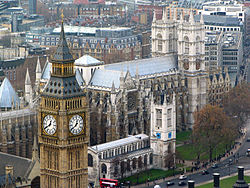
St. Margaret's Church from the London Eye

St. Margaret’s Church from the London Eye


Romance of London Series

  1. Romance of London: The Lord Mayor’s Fool… and a Dessert
  2. Romance of London: Carlton House and the Regency
  3. Romance of London: The Championship at George IV’s Coronation
  4. Romance of London: Mrs. Cornelys at Carlisle House
  5. Romance of London: The Bottle Conjuror
  6. Romance of London: Bartholomew Fair
  7. Romance of London: The May Fair and the Strong Woman
  8. Romance of London: Nancy Dawson, the Hornpipe Dancer
  9. Romance of London: Milkmaids on May-Day
  10. Romance of London: Lord Stowell’s Love of Sight-seeing
  11. Romance of London: The Mermaid Hoax
  12. Romance of London: The Bluestocking and the Sweeps’ Holiday
  13. Romance of London: Comments on Hogarth’s “Industries and Idle Apprentices”
  14. Romance of London: The Lansdowne Family
  15. Romance of London: St. Margaret’s Painted Window at Westminster
  16. Romance of London: Montague House and the British Museum
  17. Romance of London: The Bursting of the South Sea Bubble
  18. Romance of London: The Thames Tunnel
  19. Romance of London: Sir William Petty and the Lansdowne Family
  20. Romance of London: Marlborough House and Sarah, Duchess of Marlborough
  21. Romance of London: The Duke of Newcastle’s Eccentricities
  22. Romance of London: Voltaire in London
  23. Romance of London: The Crossing Sweeper
  24. Romance of London: Nathan Mayer Rothschild’s Fear of Assassination
  25. Romance of London: Samuel Rogers, the Banker Poet
  26. Romance of London: The Eccentricities of Lord Byron
  27. Romance of London: A London Recluse

Romance of London: The Lansdowne Family

Romance of London: Strange Stories, Scenes And Remarkable Person of the Great Town in 3 Volumes

John Timbs

John Timbs (1801-1875), who also wrote as Horace Welby, was an English author and aficionado of antiquities. Born in Clerkenwell, London, he was apprenticed at 16 to a druggist and printer, where he soon showed great literary promise. At 19, he began to write for Monthly Magazine, and a year later he was made secretary to the magazine’s proprietor and there began his career as a writer, editor, and antiquarian.

This particular book is available at googlebooks for free in ebook form. Or you can pay for a print version.

William Petty, 1st Marquis Lansdowne

William Petty, 1st Marquis Lansdowne

In 1805 died the second Marquis of Landsdowne, having by this time passed very much out of popular notice, and the principal cause of public regret for his demise was that only a fortnight before his death he had declared his knowledge of the Junius secret [see below], and yet among his papers was to be found no indication that could lead to its discovery. He was succeeded by his eldest son, the Earl of Wycombe, whose first act on coming into possession was to sell almost all of the literary and artistic treasures which his father had accumulated with so much love and labour. The greater part of these were dispersed under the hammer of the auctioneer, many of the pictures going to enrich the Grosvenor, the National, and other galleries; only the Lansdowne MSS. Were kept together, being purchased by the British Museum; while the gallery of antique marbles was the sole portion of the collection for which the Marquis showed any appreciation—his opinion being expressed in the fact that he purchased it from his father’s executors for 6,000l. If, however, this nobleman did not show much respect to his father’s cultivated tastes, he was not without a certain ancestral pride; for he tried to build a vessel on the principle of Sir William Petty’s double-bottomed ship that was to sail against wind and tide—a model of which was then, and is perhaps still, exhibited in the Council-room of the Royal Society. Of nautical habits, he also built near the Southampton Water a marine villa, in which, from dining-hall and private bower to kitchen and scullery, all was utter Gothic, while the gardens belonging to the castle were laid out at Romsey, some ten or twelve miles distant, on a site which formed the original estate of the Petty family.

John Petty, 2nd Marquis of Lansdowne

John Petty, 2nd Marquis of Lansdowne

Here, if not in his yacht voyaging to Ireland or the Continent, he spent most of his time. In London he was a marked man—remarkable for his disregard of dress, and for the pride which he took in appearing on the coldest days in winter without a greatcoat and without gloves. He died in November 1809, and was succeeded by his half-brother, the fourth [third] Marquis, whose first care was to purchase the antique marbles from his sister-in-law, and there at Landsdowne House they may now be seen—some of them, as the youthful Hercules and the Mercury, justly considered the finest statues of the kind that have found their way to this country. As for the pictures, when the Marquis succeeded to the title, in 1809, there was not one in this splendid mansion, with the exception of a few family portraits; but Lord Lansdowne set himself to the formation of a gallery which now comprises nearly 200 pictures of rare interest and value, but miscellaneous in their character, no school nor master predominating unless it be Sir Joshua Reynolds. Some of the portraits in this collection are of great interest. There is the celebrated portrait of Pope by Jervas; Reynolds’s wonderful portrait of Sterne; one of Franklin, by Gainsborough; a beautiful one of Peg Woffington, by Hogarth; Lady Hamilton appears twice—as a bacchante and a gipsy, from the pencil of Romney; Horner, the old college friend of Lord Lansdowne, is not forgotten; but, most interesting of all, there is the lovely portrait of Mrs. Sheridan, as St. Cecilia, painted by Reynolds.

mrs. sheridan

Mrs. Richard Brinsley Sheridan, by Gainsborough

It may recall with some vividness the fashion of those times if we record a little incident connected with this portrait. During the short-lived Ministery of “All the Talents,” the Whig leaders celebrated their return to power by a continual found of festivities, in which Sheridan outside all his colleagues. One Sunday (25th of May 1806) he gave a grand dinner; on the Monday following a supper and ball, at which the dancing was prolonged to past eight o’clock next morning; on the Tuesday, a christening, a masque, and another ball, the Prince being present on each occasion, and the Lord Chancellor Erskine and the young Chanceller of the Exchequer, Henry Petty, being conspicuous among the dancers. On the occasion of the dinner, the portrait of Mrs. Sheridan was redeemed for one night only from the pawnbroker’s, and exhibited in its place in the dining-room; when poor Sheridan died, it was still in possession of the pawnbroker; it then fell into the hands of Sheridan’s solicitor, and from him it was purchased for 600l. By Lord Lansdowne. In this little incident we get some glimpses of that conviviality for which the Whigs were distinguished. “Le Whig est la femme de votre Gouvernement,” says Balzac, and the truth of the remark is especially illustrated in that social influence which the Whigs have always cultivated more than the Tories.*

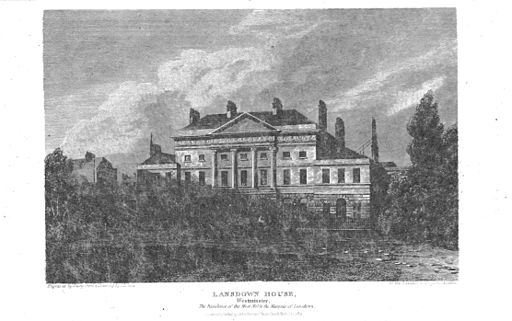
Lansdowne House (1820)

Lansdowne House (1820)

Lansdowne House was built by Robert Adam for the Marquis of Bute, when minister to George III, and sold by the Marquis before completion to Lord Shelburne, afterwards Marquis of Lansdowne, for 22,000l., which was supposed to be 3,000l. Less than it cost. There is, also, a piece of political scandal—that Lansdowne House was constructed by one Peace (Lord Bute’s, in 1762), and paid for by another (Lord Shelburne’s, in 1783).

*From The Times journal

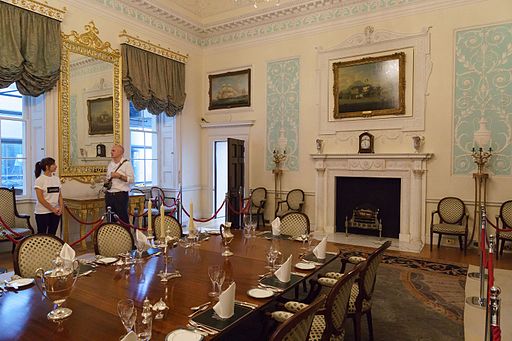
Lansdowne House was partially demolished in the 1930’s to make room for a new road, and some of its noted interiors located elsewhere.

The dining room from Landsdowne House, now located at the Lloyd's Building

The dining room from Landsdowne House, now located at the Lloyd’s Building


A drawing room now found at the Philadelphia Museum of Art

A drawing room now found at the Philadelphia Museum of Art


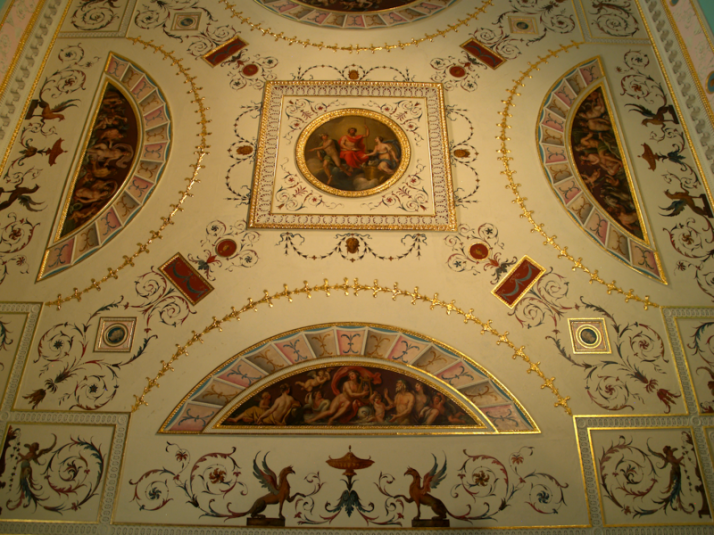
Lansdowne House ceiling (Robert Adam)

Lansdowne House ceiling (Robert Adam)


*The Junius Secret

Junius was the pseudonym of a man who wrote letters exposing corruption in government from 1768 to 1772. His identity has never been discovered, but was the source of much speculation. If Lord Lansdowne indeed knew it, he died without revealing the secret.

More information on Wikipedia.

The Secret Revealed of the Authorship of Junius’s Letters

Romance of London: Comments on Hogarth’s “Industrious and Idle Apprentices”

Romance of London: Strange Stories, Scenes And Remarkable Person of the Great Town in 3 Volumes

John Timbs

John Timbs (1801-1875), who also wrote as Horace Welby, was an English author and aficionado of antiquities. Born in Clerkenwell, London, he was apprenticed at 16 to a druggist and printer, where he soon showed great literary promise. At 19, he began to write for Monthly Magazine, and a year later he was made secretary to the magazine’s proprietor and there began his career as a writer, editor, and antiquarian.

This particular book is available at googlebooks for free in ebook form. Or you can pay for a print version.

Comments on Hogarth’s “Industrious and Idle Apprentices”

William Makepeace Thackeray

William Makepeace Thackeray

Mr. Thackeray, in his Lectures on the English Humorists, thus vividly paints the scenes of Hogarth’s masterpieces; at the same time he very ingeniously contrasts the past with the present—one of the more immediate benefits of the Lecture: the past is generally interesting, but it chiefly becomes instructive when brought under the powerful focus of the present. His account of Hogarth’s “Apprentices” is a masterpiece in this way:

1William_Hogarth_-_Industry_and_Idleness,_Plate_1;_The_Fellow_'Prentices_at_their_Looms

William_Hogarth-Industry and Idleness, Plate 1; The Fellow ‘Prentices at their Looms

Fair-haired Frank Goodchild smiles at his work, whilst naughty Tom Idle snores over his loom. Frank reads the edifying ballads of Whittington and the London ‘Prentice: whilst that reprobate Tom Idle prefers Moll Flanders, and drinks hugely of beer.

2william_hogarth_-_industry_and_idleness_plate_2_the_industrious_prentice_performing_the_duty_of_a_christian.png

William Hogarth-industry and idleness plate 2 the industrious prentice_performing the duty of a Christian

Frank goes to church on a Sunday, and warbles hymns from the gallery; while Tom lies on a tomb-stone outside playing at halfpenny-under-the-hat, and with street blackguards, and deservedly caned by the beadle.

william_hogarth_-_industry_and_idleness_plate_3_the_idle_prentice_at_play_in_the_church_yard_during_divine_service

william hogarth -industry and idleness plate 3 the idle prentice at play in the church yard during divine service

Frank is made overseer of the business; whilst Tom is sent to sea.

4William_Hogarth_-_Industry_and_Idleness,_Plate_4;_The_Industrious_'Prentice_a_Favourite,_and_entrusted_by_his_Master

William_Hogarth Industry and Idleness, Plate 4; The Industrious ‘Prentice a Favourite, and entrusted by his Master


william_hogarth_-_industry_and_idleness_plate_5_the_idle_prentice_turnd_away_and_sent_to_sea

william hogarth – industry and idleness plate 5 the idle prentice turnd away and sent to sea

Frank is taken into partnership, and marries his master’s daughter, sends out broken victuals to the poor, and listens in his night-cap and gown with the lovely Mrs. Goodchild by his side, to the nuptial music of the city bands and the marrow-bones and cleavers; whilst idle Tom, returned from sea, shudders in a garret lest the officers are coming to take him for picking pockets.

william_hogarth_-_industry_and_idleness_plate_6_the_industrious_prentice_out_of_his_time__married_to_his_masters_daughter

william hogarth – industry and idleness plate 6 the industrious prentice out of his time married to his masters daughter

william_hogarth_-_industry_and_idleness_plate_7_the_idle_prentice_returnd_from_sea__in_a_garret_with_common_prostitute

william hogarth – industry and idleness plate 7 the idle prentice returnd from sea in a garret with common prostitute

The Worshipful Francis Goodchild, Esq., becomes Sheriff of London, and partakes of the most splendid dinners which money can purchase or alderman devour; whilst poor Tom is taken up in a night cellar, with that one-eyed and disreputable accomplice who first taught him to play chuck-farthing on a Sunday.

william_hogarth_-_industry_and_idleness_plate_8_the_industrious_prentice_grown_right__sheriff_of_london

william hogarth – industry and idleness plate 8 the industrious prentice grown right sheriff of london

What happens next? Tom is brought up before the justice of his county, in the person of Mr. Alderman Goodchild, who weeps as he recognizes his old brother ‘prentice, as Tom’s one-eyed friend peaches on him, as the clerk makes out the poor rogue’s ticket for Newgate.

william_hogarth_-_industry_and_idleness_plate_9_the_idle_prentice_betrayed_and_taken_in_a_night-cellar_with_his_accomplice

william hogarth – industry and idleness plate 9 the idle prentice betrayed and taken in a night-cellar with his accomplice


william_hogarth_-_industry_and_idleness_plate_10_the_industrious_prentice_alderman_of_london_the_idle_on_brought_before_him__impreachd_by_his_accomplice

william hogarth -industry and idleness plate 10 the industrious prentice alderman of_london the idle on brought before him impreachd by his accomplice

Then the end comes. Tom goes to Tyburn in a cart with a coffin in it; whilst the right Honorable Francis Goodchild, Lord Mayor of London, proceeds to his Mansion House, in his gilt coach, with four footmen and a sword-bearer, whilst the companies of London march in the august procession, whilst the train-bands of the city fire their pieces and get drunk in his honor; and oh, crowning delight and glory of all, whilst his majesty the king looks out of his royal balcony, with his ribbon on his breast, and his queen and his star by his side at the corner house of St. Paul’s Church-yard, where the toy-shop is now.

william_hogarth_-_industry_and_idleness_plate_11_the_idle_prentice_executed_at_tyburn

william_hogarth- industry and idleness plate 11 the idle prentice executed at tyburn


william_hogarth_-_industry_and_idleness_plate_12_the_industrious_prentice_lord-mayor_of_london

william_hogarth -industry and idleness plate 12 the industrious prentice ord-mayor of london

How the times have changed! The new Post-office now not disadvantageously occupies that spot where the scaffolding is on the picture, where the tipsy trainband-man is lurching against the post, with his wig over one eye, and the ‘prentice-boy is trying to kiss the pretty girl in the gallery. Past away ‘prentice boy and pretty girl! Past away tipsy trainband-man with wig and bandolier! On the spot where Tom Idle (for whom I have an unaffected pity) made his exit from this wicked world, and where you see the hangman smoking his pipe, as he reclines on the gibbet, and views the hills of Harrow on Hampstead beyond—a splendid marble arch, a vast and modern city—clean, airy, painted drab, populous with nursery-maids and children, the abodes of wealth and comfort—the elegant, the prosperous, the polite Tyburnia rises, the most respectable district in the habitable globe!

In that last plate of the London Apprentices, in which the apotheosis of the Right Honorable Francis Goodchild is drawn, a ragged fellow is represented in the corner of the simple kindly piece, offering for sale a broadside, purporting to contain an account of the appearance of the ghost of Tom Idle, executed at Tyburn. Could Tom’s ghost have made its appearance in 1847, and not in 1747, what changes would have been remarked by that astonished escaped criminal! Over that road which the hangman used to travel constantly, and the Oxford stage twice a week, go ten thousand carriages every day; over yonder road, by which Dick Turpin fled to Windsor, and Squire Western journeyed into town, when he came to take up his quarters at the Hercules Pillars not he outskirts of London, what a rush of civilization and order flows now! What armies of gentlemen with umbrellas march to banks, and chambers, and counting-houses! What regiments of nursery-maids and pretty infantry: what peaceful processions of policemen, what light broughams and what gay carriages, what swarms of busy apprentices and artificers, riding on omnibus-roofs, pass daily and hourly! Tom Idle’s times are quite changed; many of the institutions gone into disuse which were admired in his day. There’s more pity and kindness, and a better chance for poor Tom’s successors now than at that simpler period, when Fielding hanged him, and Hogarth drew him.

One hundred and fifty years after Thackeray’s assertions that the world is a kinder place toward kids like Idle Tom, I’m not so certain I can say the same. As a former teacher, it seems to me that the system is still stacked against kids who “dance to a different drum” or who are raised in poverty and/or by indifferent parents. And I’ll be damned if I know how to change that. What do you think?


Romance of London Series

  1. Romance of London: The Lord Mayor’s Fool… and a Dessert
  2. Romance of London: Carlton House and the Regency
  3. Romance of London: The Championship at George IV’s Coronation
  4. Romance of London: Mrs. Cornelys at Carlisle House
  5. Romance of London: The Bottle Conjuror
  6. Romance of London: Bartholomew Fair
  7. Romance of London: The May Fair and the Strong Woman
  8. Romance of London: Nancy Dawson, the Hornpipe Dancer
  9. Romance of London: Milkmaids on May-Day
  10. Romance of London: Lord Stowell’s Love of Sight-seeing
  11. Romance of London: The Mermaid Hoax
  12. Romance of London: The Bluestocking and the Sweeps’ Holiday
  13. Romance of London: Comments on Hogarth’s “Industries and Idle Apprentices”
  14. Romance of London: The Lansdowne Family
  15. Romance of London: St. Margaret’s Painted Window at Westminster
  16. Romance of London: Montague House and the British Museum
  17. Romance of London: The Bursting of the South Sea Bubble
  18. Romance of London: The Thames Tunnel
  19. Romance of London: Sir William Petty and the Lansdowne Family
  20. Romance of London: Marlborough House and Sarah, Duchess of Marlborough
  21. Romance of London: The Duke of Newcastle’s Eccentricities
  22. Romance of London: Voltaire in London
  23. Romance of London: The Crossing Sweeper
  24. Romance of London: Nathan Mayer Rothschild’s Fear of Assassination
  25. Romance of London: Samuel Rogers, the Banker Poet
  26. Romance of London: The Eccentricities of Lord Byron
  27. Romance of London: A London Recluse

Alicia Quigley: Lady, Lover, Smuggler, Spy (Giveaway)

A Tale of Two Soldiers: Class in Wellington’s Army

by Alicia Quigley

Social hierarchy was rigid and strict in Regency England, and there were relatively few paths for ambitious sons of the middle classes to work their way in to the gentry. Only three professions offered a nearly certain entrée: the law, the Church, and the military. In the military an ambitious and brave young man could, if he survived and was clever about his career, make a reasonable income, achieve or purchase promotion, and eventually, perhaps even be knighted, or have a title created for him. Some well-known examples from Wellington’s era include General Sir Harry Smith, and General Colin Campbell who was made the 1st Baron Clyde.
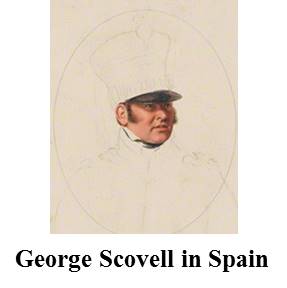
George Scovell in SpainHowever, the military was also viewed as a very good career for the younger sons of aristocrats, and they typically received preferential treatment. The stories of George Scovell, and Lord Fitzroy Somerset, who served on Wellington’s staff at the same time during the Peninsular War are good examples. The Duke of Wellington, who was the younger son of an Irish peer, held strong views about the importance of “family, money and influence” in moving up in the military, and surrounded himself with other scions of the aristocracy as his aides-de-camp whom he referred to as “my boys.” He distrusted the emerging new ‘scientific soldiering’ being introduced, which was particularly important in the case of the artillery, (which was rapidly gaining relevance) but also for all other aspects of soldiering.

In this post, let’s compare the careers of Lord Fitzroy Somerset, a younger son of the Duke of Beaufort, who was born in beautiful Badminton Castle, a privileged younger son of the Duke of Beaufort, and Mr. George Scovell, an ambitious young man with little breeding or money, but great intelligence and ambition.
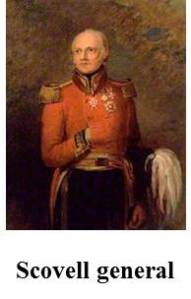
Scovell GeneralGeorge Scovell attended the recently established Royal Military Academy, learning the methods scientific soldiering and in 1798 purchased a commission as a Cornet in the 4th Queens Own Hussars, a cavalry regiment. A young Winston Churchill started his career as a Cornet in the same regiment 97 years later. The cavalry was the glamour side of the military, and Scovell was tremendously proud of this position. But, as a socially insignificant scientific soldier, promotions were hard to get.

As George also had siblings who needed financial help, he had to sell out of the cavalry and join the infantry, a drop in social status that he felt deeply. He moved to the Quartermaster General’s staff, where he excelled due to his education and diligence, although he had to purchase his promotions to captain and major. His accomplishments included, besides helping improve logistics in the Peninsula, standing up a new unit of Scouts with English, Spanish and Portuguese soldiers, and critically, cracking Napoleon’s Paris Chiffre in his spare time, thus making Napoleon’s plans available to the English.

Scovell was given the opportunity in 1813 to raise and command a new regiment, the Staff Corps of Cavalry, also known as the Staff Dragoons or the Corps of Gendarmerie which was the first recognized unit of military police in the British army. He was knighted and received the Knight Commander of the Order of the Bath (KCB) and continued his career in the Army, even becoming a colonel in the in the same cavalry regiment he had to sell out of earlier. Later, he was the Lieutenant-Governor and then Governor of the Royal Military College, Sandhurst(1829-1856), where he helped expand scientific soldiering in the British army. He received the Knight Grand Cross in 1860 and retired from the Army as a general. His hard work finally brought him success, but it was a long time in the making.
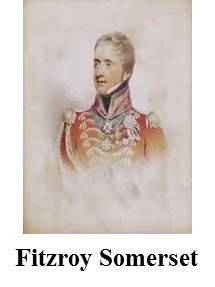
Fitzroy SomersetLord Fitzroy Somerset also joined the Army in the peninsula as a Cornet, this time in the 4th Light Dragoons, in 1804. He was promoted to Lieutenant in 1805, and captain in 1808, presumably by purchase since he transferred to the 43rd Regiment of Foot. He went to Spain in 1808 as one of Wellingtons’s crew of aristocratic aides-de-camp. Somerset’s bravery and gallantry is not in question; he was involved in leading charges in any number major battles in Spain, and was the first over the wall at the bloody storming of Badajoz. He was only twenty-four when he was promoted to lieutenant colonel in 1812.

Somerset fought in numerous other brutal battles, and served at Waterloo, where he lost his right arm. He also received the KCB in 1815. He went into politics, became Military Secretary, and eventually returned to active duty. He was named Baron Raglan, and eventually Field Marshal. He is famous for being the general on whose watch the Charge of the Light Brigade occurred. As a sidebar on the advantages of being a duke’s son in the army, it is worth noting that Lord Fitzroy’s older brother Lord Robert Somerset, also became an army general!
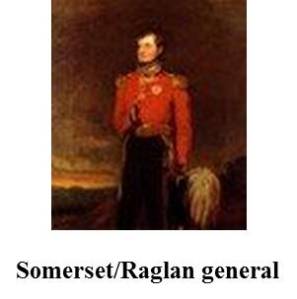
Somerset_Raglan GeneralTwo soldiers of very different backgrounds, with very different paths to military success. What do you think of this?

In my soon-to-be-released Lady, Lover, Smuggler, Spy, we have a similar juxtaposition: our hero, Sir Tarquin Arlingby, is a titled gentleman involved in finding smugglers who are running guinea boats to France, and are getting letters back and forth for French spies.

Our heroine, Valerie Carlton, is a military widow, whose husband was more the George Scovell-type soldier. She followed the drum and learned first-hand the adventures, dangers and sense of commitment to something greater than herself that came from the experience. The two are thrown together through a series of odd events and find themselves in quite an exciting—and potentially deadly—adventure.

Excerpt

Note: This book will be up for pre-order soon! The author will choose a random commenter to receive of the first two books in the series, A Collector’s Item and The Contraband Courtship.

Sir Tarquin handed her to a seat in front of the fire, and then took a chair across from her, settling into it comfortably and crossing his elegantly booted ankles. “So, Mrs. Carlton, I find that I am almost vulgarly curious about your past. It is evident that you are a gentlewoman, yet I found you penniless and unescorted at the Angel this morning. How did that come to pass?”

Valerie gazed down at her hands, before looking at him. “I am the oldest daughter of Lord Upleadon and his first wife,” she answered, “and married Robert Carlton, an officer in the Light Division.”

“Upleadon?” exclaimed Sir Tarquin. “You are an Upleadon, yet I found you alone, penniless, and ready to board a mail coach?”
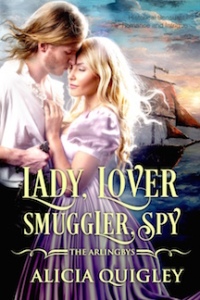
LadyLoverSmugglerSpy_Final-FJM_Kindle_1800x2700 copy“My father did not approve of Mr. Carlton, I fear,” Valerie answered economically.

“That stiff rumped old tartar–” Sir Tarquin suddenly recalled that his listener was not only a lady, but also the daughter of the gentleman he was about to malign, and fell silent.

“Quite so,” Valerie responded with a definite hint of laughter in her voice. “In any event, when I insisted on marrying Mr. Carlton my father cut me off entirely. Even when my husband was among the dead at Sabugal he refused to see me.”

“While I’m not well acquainted with the baron, as he is a good deal older than I am and moves in very different circles, I’m sorry to say that I can easily imagine him lacking remorse. You must have been a mere child. How have you managed since then?”

“When I returned to England, several of my friends had married, and were happy to help me get on my feet. I was mourning my husband, and had no wish to remarry or to be a burden on them, however, so I quickly found a position as a governess.”

“But the Battle of Sabugal was three years since. Have you been a governess all this time?” Sir Tarquin asked.

She nodded. “I had only been with the Forneys for in a few months. When I first became a governess I was in charge of a young lady who needed some polishing before she came out, as her parents were not people of fashion. I enjoyed it very much; the daughter was charming and her mother and father were kind and grateful. Unfortunately the two positions that followed it have been much less satisfactory.”

Valerie fell silent, looking down at her hands, and Sir Tarquin, finding himself appreciating the sight of her blonde curls, fine figure, and aura of calm, didn’t need to stretch his imagination far to imagine the son of the Forney household had been unable to resist the temptation of the pretty governess.

“It makes me angry to think of you being preyed upon,” he said abruptly, much to his own surprise.

“It is a common enough problem, and far worse has befallen others. He did not force me and, while Mrs. Forney was unkind, I left of my own volition,” said Valerie uncomfortably. “My friends have helped me before and will help me now. I would rather spend my time with children, but perhaps I will have to seek employment as a companion to an older lady instead.”

“You do not deserve a life as a drudge to children or as the companion of elderly harridan, who will doubtless have a horrid grandson who will treat you as Mr. Forney did,” Sir Tarquin exclaimed. “You are young, and have given far too much.”

“Whatever do you mean?” she asked.

“You sacrificed a husband and a family to your country, did you not?”

“I suppose you could say so, although it has been three long years since then.” A wistful look came over her face. “It seems so long ago. Thinking of it now, Robert and I were both practically children; it is almost as though it happened to someone else, or was a story someone told to me.”

“Yet you are still all but penniless and without protection as a result, are you not? That is not much of an ending to the story.”

She gazed at him thoughtfully. “It was my decision, though I was far too young to understand the possible consequences. In some ways it was worth it all the same; I loved Robert as much as an eighteen-year-old can love anyone, and perhaps even more, I loved following the drum.”

Sir Tarquin looked startled. “Did you really? Surely it was a very hard life for a gently bred and sheltered young lady?”

Valerie laughed. “Indeed it was! I had no notion that such hardships were ahead of me. Yet the sense of purpose, of being needed and useful, and of having a meaning to my life was so powerful, that it overcame them all. I was always rather bookish, and never truly enjoyed the rounds of parties and balls, to my stepmother’s despair.”

“Even in the tail of the Army with all the camp followers, and rabble you felt so?” Sir Tarquin asked curiously.

“Oh, I rode with the column, Sir Tarquin,” she exclaimed proudly. “I had no children to care for and I was handy with horses even before I went on campaign, for my father’s stables are renowned and I spent a great deal of time in them as a child. I soon learned to kill and stew a chicken, and make sure that there was always something to eat at our billet, so it was not long before many of the other officers were to be found at our table.”

“You rode with the column?” her companion echoed in surprise.

“Except when an engagement was imminent, yes. In many respects it was as safe as being in the tail of the Army, for Robert’s friends would watch out for me. I moved rearward when there was any real danger.”

“But it must have been difficult to be so far ahead without any servants to help you.”

“Oh, my husband engaged a woman for me, a large, rather foul mouthed Scotswoman, who was a match for most of the men! She did much of the heaviest work, although I helped, of course.” Sir Tarquin watched as Valerie’s eyes filled with memories that were clearly dear to her. “His batman was also there, and it never seemed as though things were unmanageable. Difficult yes, but even the worst days were just another challenge to rise to…” Valerie’s voice trailed off, and she gazed into the fire, seeing another place and time.

Sir Tarquin watched her in pensive silence, for a moment and then stood, shaking his head to dispel the thoughts that filled it. “My glass is empty. May I pour you some more punch as well, Mrs. Carlton?”

Valerie shook off her memories, and handed him her empty glass. “Thank you, Sir Tarquin. You have a way with a punchbowl, it seems.” She watched as he walked away, enjoying the wide set of his shoulders, and athleticism of his gait. After some moments he returned and offered her the cup, now full of warm, spicy liquid. Her fingers brushed his slightly as she took it. She looked away, taking a sip.

“I so miss feeling part of something bigger than me,” she murmured. “A governess makes herself useful, I suppose, but it is not the same. Being a paid companion would be even duller, I fear.”

Sir Tarquin, who still stood beside her chair, reached out with one long finger and tipped her chin up, gazing into her face intently.

“You most assuredly must not be a companion to a querulous dowager,” he murmured. “It would be an utter waste.”

Valerie stared back at him, at a loss to answer. In the quiet and warmth of the private parlor they seemed removed from the world, and she simply waited for him to act. He gave a tiny sigh, and then lowered his mouth to hers, pressing her lips firmly yet gently as he sought the right pressure. Her mouth trembled a little, and he lifted his, only to press it against hers at a slightly different angle before drawing back, to kiss her cheek, and then one of her eyelids, which had fluttered closed, before releasing her chin and stepping away.

About the Author
AQ Twitter AviAlicia Quigley is a lifelong lover of romance novels, who fell in love with Jane Austen in grade school, and Georgette Heyer in junior high. She made up games with playing cards using the face cards for Heyer characters, and sewed regency gowns (walking dresses, riding habits and bonnets that even Lydia Bennett wouldn’t have touched) for her Barbie. In spite of her terrible science and engineering addiction, she remains a devotee of the romance, and enjoys turning her hand to their production as well as their consumption.

Website • Twitter • Facebook • Amazon Author Page