Archives

Elizabeth Boyce: Valor Under Siege (Giveaway)

Kissing and Voting in the Regency Era

by Elizabeth Boyce

In election years, I frequently become misty-eyed about the work of suffragettes whose valiant efforts finally culminated in women being granted the right to vote in the UK in 1918, and in the USA in 1920.

It’s easy to imagine that prior to having the franchise, women were not involved in politics. It’s particularly easy to imagine Regency-era ladies were too constrained by social etiquette and gender roles to hold a political opinion, much less express one, but friend, we would be wrong. So very, very wrong.

Women did not have the right to vote in the UK during the Regency era, but they played a vital role in the political life of the nation. Lady Holland was an ardent supporter of the Whig party in the during the Regency, and her home, Holland House, became unofficial headquarters for the Whigs. She and other political hostesses worked on behalf of their favored party by hosting suppers and salons for politicians after Parliament had let out for the day. Debates continued over a meal and caucuses were held in drawing rooms. Women were expected to be present at such events; in fact, a political evening only attended by men—a “man dinner,” it was uningeniously called—was quite a letdown for guests.

But the political work of women during the Regency was not contained to the domestic sphere. The female family members of a man running for political office were expected to help get him elected. Women canvassed their communities, going door to door to speak to voters and, maybe more importantly, those voters’ wives. You see, even though only men could vote, his vote was often regarded as the common property of his household, and wives could absolutely influence how that vote was cast (Remember, this was before secret ballots; a husband who voted against his family’s wishes might have had to answer for it at home!).

This canvassing was not limited to voters of their own class. During an election, ladies of the upper echelons mingled with the public of all social orders. It wasn’t unheard of for a duchess to call upon a butcher in an effort to win his vote.

In addition to knocking on doors, women bestowed little gifts upon the electorate, such as preserves, candles, or lengths of fabric. Such treating was not seen as bribery at that time. Regency-era voters expected to be wooed!

Speaking of wooing, sometimes canvassing became a little more… personal… than jams and ribbons. Remember the duchess and the butcher I mentioned a moment ago? In the election of 1784, the Duchess of Devonshire, while canvassing on behalf of James Fox, a Whig, was said to have kissed voters to win their support—including a butcher. The incident was the subject of political cartoons, and Fox’s Tory opponents attempted to smear Fox through his association with the duchess, but the Whigs were unfazed by the scandal. The party called upon the duchess to continue her work, and Fox retained his seat in Parliament.

My latest release, Valor Under Siege (The Honorables, book 3), features a small town Parliamentary election. It was lots of fun to pit my Whig hero, Norman Wynford-Scott, against Lady Elsa Fay, a former Tory political hostess who runs circles around Norman when it comes to canvassing. It was wonderful, too, to learn about the political system of the era I enjoy so much, and gain a greater appreciation for women’s roles in that world.

Giveaway: To win an e-book copy of Honor Among Thieves (The Honorables, book 1), please leave a comment sharing your own thoughts or memories about women getting involved in a man’s world–be it politics, the workplace, academia, etc. Contest closes 11:59 PM EDT on Wednesday, September 14, 2016. One winner will be chosen at random from all eligible commenters.

valorundersiege-copy

About Valor Under Siege

All’s fair in love and politics . . .

When ambitious solicitor Norman Wynford-Scott is ousted from his legal studies due to a holiday revel spun out of control, he adapts a new plan of running for the Parliament seat of a local village. Only trouble is, the same irresistible woman who ruined his good name is thwarting his campaign at every turn.

Widowed and drink-addicted, Lady Elsa Fay has retreated to the family village of Fleck to regain her sobriety. She’s distracting herself from her troubles – and her memories of the one passionate night she shared with Norman – by organizing the Parliament campaign of her husband’s cousin. Until Norman arrives intent on winning the seat for himself.

Shamed and determined, Elsa will do all she can to send her former friend and now adversary packing – even if it means breaking her own heart in the process.

Amazon

About the Author

eb-author-shot-copyElizabeth Boyce’s first taste of writing glory was when she won a gift basket in the local newspaper’s Mother’s Day “Why my Mom is the Best” essay competition at age eight. From that moment, she knew she was destined for bigger and better gift baskets. With visions of hard salamis and tiny crackers dancing in her head, she has authored seven Regency novels and novellas, resulting, thus far, in two gift baskets from adoring fans (AKA amazing friends).

Elizabeth lives in South Carolina and shares her artisanal cheeses with her husband and three children. She sneaks some to the cat when no one else is looking.

Facebook Twitter


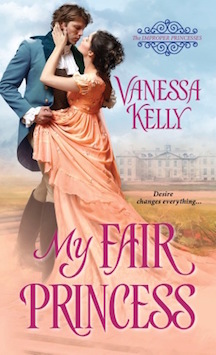
Vanessa Kelly: My Fair Princess (Giveaway)

My Fair Princess 2 copy

Thanks so much for hosting me on your blog today—it’s a pleasure to be here with you and your readers, Susana!

With My Fair Princess, I’m thrilled to be introducing a new historical romance series called The Improper Princesses. It’s Regency-set, and it’s a spin-off from my previous series, The Renegade Royals. Both are grounded in a specific historical element—the rather outrageous love lives of the sons of King George III.

The term “Regency rake” could very well have been coined for the Prince Regent and his royal brothers. They lived large (literally and figuratively), gambling, drinking, and engaging in numerous sexual affairs. The Prince Regent, later George IV, took several mistresses, which included actresses (one of whom he secretly married), and possibly fathered up to four illegitimate children.

The Duke of York also had several by-blows, perhaps as many as five, and the Duke of Clarence (later William IV) sired ten children with his mistress, Mrs. Jordan. I could go on, but you get the picture! As you can see, in developing a series based on this topic I had plenty of material to work with. Even better, very little—if anything—was known about many of these children, which left plenty of leeway in creating my fictional characters.

In The Renegade Royals I featured heroes who were the illegitimate sons of England’s princes. The Improper Princesses, however, features the illegitimate daughters in the starring roles. As challenging as the “stain” of illegitimacy was for male children, just imagine what it would have been like for females born of illicit relationships during that era. Plenty of room for drama and conflict in their stories!

The heroine of My Fair Princess is Gillian Dryden, the product of a relationship between the notorious Duke of Cumberland and a young widow. Gillian was basically raised in exile in Sicily, where she grew up as a tomboy. She’s a crack shot, a terrific rider, and carries knives in her boots. Gillian also developed the unfortunate hobby of hunting bandits who terrorized the countryside and were responsible for the death of her beloved stepfather.

Because of this risky avocation, Gillian’s family deems it time for her to return home to England, where she can learn to be a proper lady and find a respectable husband. The man tasked with this challenge is Charles Penley, the Duke of Leverton, who happens to be the most polite and sophisticated man in London.

Let’s just say that Charles has his work cut out for him, and let’s also say that Gillian’s training and transformation don’t go exactly as planned!

I had great fun writing this book, and I really enjoyed grounding the story in a small part of the lives of England’s princes. In this case, the truth was definitely more outrageous than fiction!

Are you a fan of real-life historical characters in your historical romance? Can there be too much history in romance? Two people who comment will win signed, print copies of How to Marry a Royal Highlander, the 4th book in The Renegade Royals Series.

About My Fair Princess

First, Vanessa Kelly brought readers The Renegade Royals. Now, in a delightfully witty new series, she introduces The Improper Princesses—three young women descended from royalty, each bound for her own thrilling adventure . . .

Despite being the illegitimate daughter of a prince, Gillian Dryden is happily ignorant of all social graces. After growing up wild in Italy, Gillian has been ordered home to England to find a suitable husband. And Charles Valentine Penley, the excessively proper, distractingly handsome Duke of Leverton, has agreed to help transform her from a willful tomboy to a blushing debutante.

Powerful and sophisticated, Charles can make or break reputations with a well-placed word. But his new protégée, with her habit of hunting bandits and punching earls, is a walking scandal. The ton is aghast . . . but Charles is thoroughly intrigued. Tasked with taking the hoyden in hand, he longs to take her in his arms instead. Can such an outrageous attraction possibly lead to a fairytale ending?

AmazonBarnes & NobleKoboiBooks

IndieBoundThe Book Depository

Excerpt

http://www.vanessakellyauthor.com/books/my-fair-princess/excerpt-my-fair-princess/

About the Author

IMG_0031 copyVanessa Kelly is an award-winning author who was named by Booklist, the review journal of the American Library Association, as one of the “New Stars of Historical Romance.”  Her Regency-set historical romances have been nominated for awards in a number of contests, and her second book, Sex and The Single Earl, won the prestigious Maggie Medallion for Best Historical Romance. The Renegade Royals, her last series, was a national bestseller. Vanessa also writes contemporary romance with her husband as VK Sykes.

BlogWebsiteTwitterFacebook

Susanna Craig: To Kiss a Thief (Giveaway)

A Place in Time

When you turn the last page and close the book, what sticks with you? An intriguing character? A shocking plot twist?

What about the setting?

I’m a firm believer that historical romance should capture a place in time, or else it’s not really historical romance. Whether it’s Victorian London or Tang Dynasty China, a story’s setting, when done well, shapes everything the characters—and readers—experience.

For my Runaway Desires series, I chose the late Georgian period, specifically the 1790s, because I knew that tumultuous decade would offer plenty of built-in tension and conflict, including political and economic uncertainties, war, and the fight to end slavery. It’s a slightly edgier cousin of the much-beloved Regency period. It’s also when Jane Austen’s first three novels were written (and arguably set).

In To Kiss a Thief, the first book in the series, the heroine, Sarah, is suspected of infidelity and involvement in the disappearance of a priceless sapphire necklace. Rather than face the scandal, she runs away. Three years later, her husband finds her on the northern coast of Devonshire and wonders why on earth Sarah had chosen such a place to hide away… She would almost certainly have been better able to disappear in London, where one could very nearly get away with anything under cover of anonymity. But in a fishing village of a few hundred souls, her arrival would have been remarked by all.

And it has. From the baker to the apothecary’s wife, everyone in Haverhythe has an opinion about Sarah. At heart, To Kiss a Thief is a small-town romance, and as my hero and heroine reconnect with one another, they are confronted and comforted by the members of this close-knit community.

Because I wanted the place and its people to leap off the page, I was determined to ground my fictional village in reality. I chose the general location of Britain’s West Country for its proximity to Bristol, where Sarah’s parents live. I wanted the temptation to go home to be always on her horizon—literally. Then, one evening, as I idly scanned that coastal region via Google Earth looking for inspiration, I stumbled upon Clovelly.

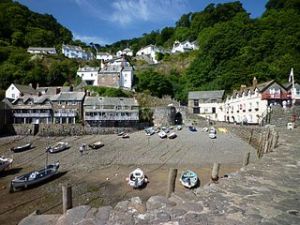
320px-Clovelly_-_Harbour02

Clovelly harbor

From its appearance in the Domesday Book to the present day, Clovelly has enjoyed a long and interesting history. The picturesque village of fewer than 500 people has been a popular tourist destination since the Victorian period, thanks in part to one of its most famous residents, novelist Charles Kingsley. It is privately owned, and has belonged to just three different families since the thirteenth century.

I made use of several of Clovelly’s distinctive elements in constructing the fictional Haverhythe. One is its unique geography. Built into a cliff overlooking the Bristol Channel, the village consists primarily of a single, cottage-lined street that descends some 400 feet to the water. In the harbor lies another striking feature: a massive stone quay, built in in the fourteenth century. Once the ships’ cargo has been offloaded, it is transported overland via sledges drawn by donkeys.

Clovelly main street

Clovelly, main street

In To Kiss a Thief, characters travel the steep main street of Haverhythe under the watchful eye of all the village. Gossip travels “up-along” and “down-along” more quickly than the donkeys. And several memorable moments for my hero and heroine take place on the quay that curls into the harbor.

Unfortunately, I haven’t yet had the pleasure of visiting Clovelly in person. But I’ve never visited the late eighteenth century, either. Like most writers of historical fiction, I find extensive research essential to crafting the best stories I can. I read about Clovelly’s history and geography, pored over the treasure trove of pictures online, and combined that information with my own experience of another coastal town, Tenby (Wales), to create my heroine’s perfectly imperfect hiding spot.

Travel, even in the pages of a book, makes us richer. Wherever your next reading adventure takes you, I hope you enjoy your visit!

What’s the most memorable setting of a book you’ve read? Or what’s your favorite real-life travel destination? One person will be chosen at random from the comments on this post to receive an e-book of To Kiss a Thief. The giveaway ends at midnight on August 21st.

AmazoniBooksBarnes & NobleKobo

AReGoogle Play

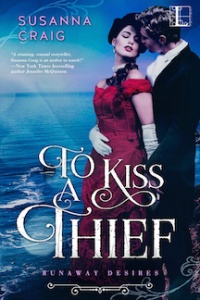
About To Kiss a Thief

TO KISS A THIEF low res copyIn the first book of a captivating new series set in Georgian England, a disgraced woman hides from her marriage—for better or worse…

Sarah Pevensey had hoped her arranged marriage to St. John Sutliffe, Viscount Fairfax, could become something more. But almost before it began, it ended in a scandal that shocked London society. Accused of being a jewel thief, Sarah fled to a small fishing village to rebuild her life.

The last time St. John saw his new wife, she was nestled in the lap of a soldier, disheveled, and no longer in possession of his family’s heirloom sapphire necklace. Now, three years later, he has located Sarah and is determined she pay for her crimes. But the woman he finds is far from what he expected. Humble and hardworking, Sarah has nothing to hide from her husband—or so it appears. Yet as he attempts to woo her to uncover her secrets, St. John soon realizes that if he’s not careful, she’ll steal his heart…

Excerpt

About the Author

IMG_8280_2 copyA love affair with historical romances led Susanna Craig to a degree (okay, three degrees) in literature and a career as an English professor. When she’s not teaching or writing academic essays about Jane Austen and her contemporaries, she enjoys putting her fascination with words and knowledge of the period to better use: writing Regency-era romances she hopes readers will find both smart and sexy. She makes her home among the rolling hills of Kentucky horse country, along with her historian husband, their unstoppable little girl, and a genuinely grumpy cat.

WebsiteFacebookGoodreadsTwitter

Alicia Quigley: Lady, Lover, Smuggler Spy (Giveaway)

It’s exciting to be guest blogging here at Susana’s Parlor on Bastille Day! The storming of the Bastille radically changed the path of French and European history in ways that are integral to the period in which most of my stories are set, the English Regency. One minor (but fun) example is the way in which the heavy full-skirted gowns and immense coiffures and hats of 1788 had completely given way to the simple, slim, “classical” silhouette by 1795.
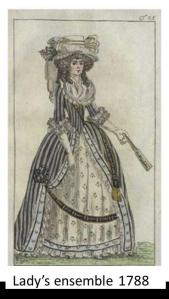
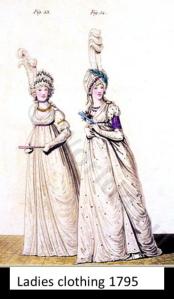
Photo 1Photo 2

In revolutionary France, this mode of dress was associated with democratic societies such as ancient Greece and the Roman republic.

More important in the long term, the political instability that resulted from the overthrow of the French monarchy also opened the door to the Napoleonic era, and wars that not only extended throughout Europe and into the Middle East, but into North and South America. These military campaigns, and the fear of democratic radicalism crossing the Channel from France, hugely impacted English society at the time, hardening the conservative views of many English aristocrats about the importance of birth and breeding even as the industrial revolution and trade with India created a rapidly growing class of nouveau riche.
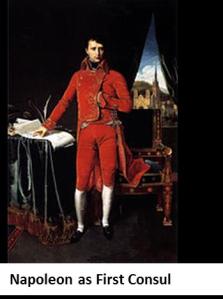
Photo 3Only six years after Bastille Day, Napoleon, who was then just 26, and had joined the French Army to promote Republican ideals, had undertaken his first campaign against Austria and Italy after saving the French Directory, the successor to the first revolutionary government. He conquered Italy and became a national hero, and then embarked on an invasion of Egypt that was his launch pad to becoming the ruler of the entire country in 1799 as First Consul.

Napoleon successfully replaced the unstable revolutionary government with a more sustainable populist regime, albeit one that was rather authoritarian. Napoleon is remembered most today for his wars, ill-fated campaign in Russia and eventual defeat, and his government reforms are often ignored. In spite of the Declaration of the Rights of Man by the first revolutionaries, Napoleon was in many ways far more the basis for the modern state that recognizes the rights of the individual than the Revolution itself. The revolutionaries were disorganized, philosophically polarized and devolved into the violence, irrationality and bloodshed of the Terror.

Photo 4Napoleon however, had a positive mania for organization and codification and introduced secular education, replacement of feudalism with modern property law, and the Napoleonic Code that set forth clear civil and criminal law that specified and codified the rules of due process that protect people living in functional states today (as well as numerous other reforms).

Napoleon’s mania for organization was pervasive; he not only set up vast and detailed bureaucracies for military and civil administration, he personally took a hand in facilitating the meetings. One weird manifestation of this was his largely successful effort to control the smuggling trade between England and France for his own benefit. His success was remarkable when one considers the strenuous efforts the English had made for centuries to bring smuggling under control with minimal results.

Napoleon’s job was perhaps easier, because he didn’t want to abolish or heavily tax the trade as the English did, but rather to centralize it and document the comings and goings of the smugglers, at least partially in order to facilitate the smuggling of gold guineas badly needed by his government to pay his troops and prosecute his wars.

This led Napoleon to establish a “ville des smoglers” or city of smugglers, initially located at Dunkirk and later at the more secure city of Gravelines nearby. French authorities received and documented the arriving English smugglers and their transactions with their French counterparts. They actively encouraged smuggling, even allowing the boats to be built there for British crews when the Inland Revenue Service and Royal Navy destroyed boats to prevent it.

I found the story of the City of Smugglers irresistible and a perfect backdrop for Lady, Lover, Smuggler, Spy the third book of my Arlingbys Regency romance and intrigue series. In this book, Valerie Carlton is the well born but impoverished widow of a soldier who lost his life in the Peninsular Wars, while Sir Tarquin Arlingby conceals his secret spying behind his wealthy gentleman of fashion persona. Their love story stretches from London across the English Channel to the City of Smugglers as they seek to uncover Napoleon’s secrets to support the English troops.

In the excerpt below, our daring duo is about to get their first glance at the fortress of Gravelines and the City of Smugglers.

About Lady, Lover, Smuggler, Spy

Mrs. Valerie Carlton is the widow of a soldier who died in the Peninsular Wars. Disowned by her family for “marrying down,” she survives working as a governess. When the elder son of the family makes unwelcome advances, Valerie leaves, seeking refuge with a close friend until she can find another position.

Sir Tarquin Arlingby, a wealthy, handsome bachelor on his way home, is staying at the same inn as Valerie and witnesses her being robbed before she can board the coach. He goes to Valerie’s aid and is instantly attracted to her. As her friend’s home is near his estate, he offers to drive her there.

An unfortunate accident forces the pair to spend a night in a village inn. Over dinner, Valerie talks about her experiences during the Spanish campaign against Napoleon and the sense of mission that she felt following the drum, which she misses in her current life. Sir Tarquin, who is secretly spying for the Crown by masquerading as a smuggler to pass information in and out of France, is intrigued by her bravery and his attraction increases. Valerie is also drawn to the handsome baronet.

Tarquin needs a French-speaking woman to pose as a smuggler during a mission to the “City of Smugglers” in Gravelines. When he discovers that Valerie speaks French like a native, he successfully recruits her for the job.

Will the pair survive their dangerous mission? Will they finally acknowledge the depth of their feelings for each other?

Find out in Lady, Lover, Smuggler, Spy, a Regency romance with intrigue, humor and just the right amount of moderately explicit sex for those readers who enjoy sensuality with their romances.

Lady, Lover, Smuggler, Spy

Excerpt

Much later, Valerie awoke to Tarquin shaking her shoulder. She looked around in surprise to note the sun just rising over the horizon.

“Madame Carleon, we are approaching the shoreline. You will wish to watch as we arrive,” he said.

Bien sur, Jake,” she replied, gathering her wits. She looked across the water to see the coastline clearly delineated before them. The golden-pink rays of the rising sun imbued the sandy, rolling shoreline with a pearly glow, and wavelets sparkled in the emerging daylight. As the shore grew rapidly closer with the long oar strokes of the rowers, she could see the narrow mouth of a waterway cutting through the beach. They glided into the channel and moved inland as rich green farm fields, dotted with cows and distant villages, scrolled past on either side.

Within an hour they were approaching the fortress of Gravelines. The looming walls, built hundreds of years earlier, reminded Valerie of the fortresses her husband had helped to besiege in Spain, and she shivered a little at the violent memories they awoke in her.

To banish her unwelcome recollections, she looked over at Tarquin. In the daylight she could see he had been correct in saying that a change of clothing and some walnut juice to temporarily brown his skin did much to disguise him. His blonde hair was tousled, his face looked as though work in the sun and wind had tanned it, and a day or two of stubble on his cheeks gave him the appearance of a farmer or deckhand. His billowing cotton shirt was partially covered with a leather vest, and the open collar allowed her to see the strong column of his throat. She acknowledged ruefully that the disguise made him no less attractive. Many a woman would take an interest in Jake West.

But there was little time for daydreams. As they drew up to a pier, the crew sprang into action. Tarquin shipped his oar and stood in one lithe movement, while Valerie grabbed her reticule from its spot atop the tarpaulin covering the golden cargo destined to support Napoleon’s armies. Seconds later, she found herself on the pier with the members of the guinea boat’s crew and other passengers, facing what appeared to be a small army of customs inspectors, coast guards, and police officers.

Unfamiliar with the procedure and somewhat intimidated by the crowd of officials, Valerie stood as close to Tarquin as possible, taking reassurance from his height and strength, while attempting to maintain an outward calm. A hard faced customs official wearing close fitting white breeches and an elaborate green coat crisscrossed with bright white leather straps approached her.

He looked her over briefly. “Qui etes vous, madame?” he barked.

Madame Carleon, une modiste,” she replied, handing over her papers. “I am here to select fabrics, trims and stock for my shop. Ces hommes ne peuvent pas selecter les mieux tissus.” For additional effect, she sniffed and cast a dismissive glance towards Tarquin.

Bien sur, madame,” the inspector said, giving her a more interested look and a smile. He rifled through her papers, pausing a moment to squint at one of them, as Valerie held her breath. “Allez, you may go.” He leered at her, his eyes raking over her figure. “A pity you live in England. France could use a fine woman such as you.”

“You never know,” said Valerie saucily, “I may return. Particularly if there are more strapping men such as you.”

“Not too many like me, but I’m sure I could satisfy you.”

Valerie laughed and moved on, giving him a teasing glance over her shoulder. The inspector, clearly recognizing Tarquin, nodded at him briefly, and he followed in her wake.

When they were out of earshot, Tarquin spoke in a low voice. “You did well there. That was a member of the Douane Imperiale, Napoleon’s elite customs unit. All of its members have served in the Army and they undertake armed missions when necessary.”

“I’m glad I didn’t know that before I spoke with him,” Valerie laughed.

“I’m sure I did not encourage you to flirt with the officials,” observed Tarquin.

“It seemed to be the easiest way to convince him I’m harmless.” She glanced up at him. “Are you jealous?”

“Jake West has no right to be jealous of Madame Carleon’s doings,” responded Tarquin, and she had to be content with that.

She turned away and watched the crowd bustling around them with interest. “What do we do now?”

“Let us go find some bread and coffee first,” he suggested. “Then I will take you to the fabric merchants. We will spend one night here; it takes them some time to count the gold and be sure that all is accounted for, and that the manifest is accurate. There is an inn for the smugglers that is quite decent. Everything here is very well organized.”

Valerie looked about her. Although the walls ran close around it, and the primary language to be heard was French, she thought she could have been in a market town almost anywhere. There were counting houses, and a great many shops, inns, taverns, and other businesses.

“It seems to be,” she agreed. “I’m afraid I had another picture in my head, with dark, narrow streets and people skulking about in the shadows. Instead it is almost disappointingly ordinary.”

Tarquin smiled. “Everything required for the smugglers to conduct their business has been thought of. There is even a shipyard, for in some regions the tidesmen have taken to destroying the guinea boats, so they make them here, and then row them to England to pick up the cargoes.”

“That’s rather shocking,” Valerie replied.

Tarquin shrugged. “I suppose it is. I am doing all I can to improve matters, but that is the reality of the treachery we are contending with.”

Giveaway: Two lucky commenters will receive free copies of Lady, Lover, Smuggler, Spy. The winners will be randomly chosen one week after this post is published.

About the Author

Alicia Quigley is a lifelong lover of romance novels, who fell in love with Jane Austen in grade school, and Georgette Heyer in junior high.  She made up games with playing cards using the face cards for Heyer characters, and sewed regency gowns (walking dresses, riding habits and bonnets that even Lydia Bennett wouldn’t have touched) for her Barbie.  In spite of her terrible science and engineering addiction, she remains a devotee of the romance, and enjoys turning her hand to their production as well as their consumption.

Website • Twitter • Facebook • Amazon Author Page
Jessica Cale: How Royal Copenhagen Conquered Europe

Eighteenth Century Porcelain: How Royal Copenhagen Conquered Europe

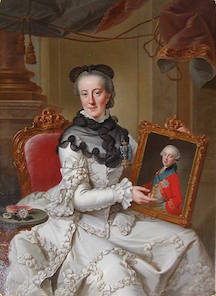
13509851_263614374004128_2085781765_oThe Royal Porcelain Factory (Den Kongelige Porcelænsfabrik), better known as Royal Copenhagen, was founded in a converted post office in Copenhagen on May 1st, 1775 under the protection of Queen Juliane Marie. Although porcelain had been made in Germany since 1710, it was not produced in Denmark until chemist Frantz Heinrich Müller developed a method for its manufacture in 1774. Juliane Marie had an interest in mineralogy and porcelain was a family passion: both her brother, Charles I of Brunswick-Wolfenbüttel, and sister, who was married to Frederik II of Prussia, had founded porcelain factories in Germany.

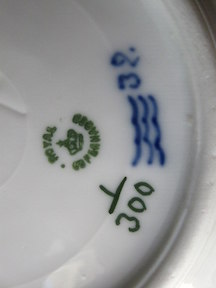
The factory’s first pieces were dining sets for the royal family. Juliane Marie insisted each piece be stamped with the factory’s mark, three wavy lines that symbolized Denmark’s three straights–the Øresund, the Great Belt and the Little Belt–as well as the royal crown stamp to highlight the firm’s royal connections. Each piece is marked this way to this day.

Blue and white china became popular across Europe as early as the seventeenth century with the import of goods from the far east. The fine porcelain of China’s Ming and Qing dynasties sparked an enduring love for floral patterns in blue and white and Royal Copenhagen quickly developed their own. Blue Fluted Plain (Danish: Musselmalet) was their first pattern and at more than two hundred fifty years old, it is the world’s oldest china pattern still in production.

13467665_263614317337467_432371625_oBlue Fluted Plain was inspired by Chinese floral patterns and updated to include flowers native to Denmark. Cinquefoils were added to the stylized chrysanthemums to give the pattern a more Nordic appearance. The ultramarine blue pigment in the paint was originally purchased from the Blaafarveværket (“blue colour factory”) in Norway, a company that provided up to eighty percent of the world’s cobalt during the nineteenth century. Each piece was and continues to be hand-painted by blue painters who spend at least four years in training for the position.

Since its development in 1775, Blue Fluted Plain has appeared on more than two thousand different pieces and has inspired countless imitations. It reached the height of its popularity in the early nineteenth century and appeared on everything from tea cups to washbasins and chamber pots.

Lord Nelson brought Royal Copenhagen porcelain back for his mistress, Lady Hamilton, following the Danish defeat at the Battle of Copenhagen in 1801. While Denmark lost that particular battle, Royal Copenhagen’s invasion of Britain was a success. It qualified for London’s World Expo in 1851 and gained international fame by winning the grand prize at Paris’ World Expo in 1889.

13509748_263614310670801_2069635372_oThis pattern has also appeared in some well-researched historical films and television shows, so not only does the pattern “look right” for the period, but even newer pieces are historically accurate for any time after 1775. You can still find pieces in this pattern to this day, so if you would like to add a little eighteenth century elegance to your kitchen or a touch of the Regency to your cup of tea, look for Royal Copenhagen’s Blue Fluted Plain.

Note: For more images or shopping information, Replacements Ltd. has a spectacular assortment of pieces in this pattern here: http://www.replacements.com/webquote/rcoblfp.htm

About The Long Way Home

The Long Way Home, Book 3 in The Southwark Saga is a magical, adult fairy tale that will keep you entertained from start to finish. Find out what happens when a paranoid king, a poison plot, and hideous shoes prove… it’s not easy being Cinderella!

coverAfter saving the life of the glamorous Marquise de Harfleur, painfully shy barmaid Alice Henshawe is employed as the lady’s companion and whisked away to Versailles. There, she catches King Louis’ eye and quickly becomes a court favorite as the muse for Charles Perrault’s Cinderella. The palace appears to be heaven itself, but there is danger hidden beneath the façade and Alice soon finds herself thrust into a world of intrigue, murder, and Satanism at the heart of the French court.

Having left his apprenticeship to serve King Charles as a spy, Jack Sharpe is given a mission that may just kill him. In the midst of the Franco-Dutch war, he is to investigate rumors of a poison plot by posing as a courtier, but he has a mission of his own. His childhood friend Alice Henshawe is missing and he will stop at nothing to see her safe. When he finds her in the company of the very people he is meant to be investigating, Jack begins to wonder if the sweet girl he grew up with has a dark side.

When a careless lie finds them accidentally married, Alice and Jack must rely on one another to survive the intrigues of the court. As old affection gives way to new passion, suspicion lingers. Can they trust each other, or is the real danger closer than they suspect?

AmazonBarnes & NobleKoboiBooks

About the Author

jessicaJessica Cale is a historical romance author, a Bluestocking Belle, and a journalist based in North Carolina. Originally from Minnesota, she lived in Wales for several years where she earned a BA in History and an MFA in Creative Writing while climbing castles and photographing mines for history magazines. She kidnapped (“married”) her very own British prince (close enough) and is enjoying her happily ever after with him in a place where no one understands his accent. You can visit her at www.authorjessicacale.com.

Her series, The Southwark Saga, is available now. You can visit her at www.dirtysexyhistory.com.


Regan Walker: Rebel Warrior

Edgar was the Rightful King

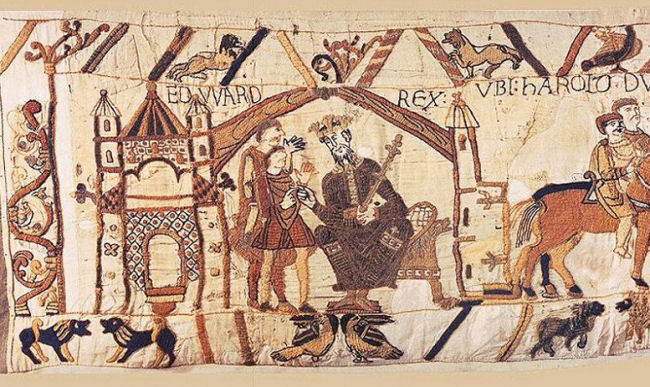
When Edward the Confessor, a gentle, pious king, who left no direct heirs, died on January 5, 1066, there were several candidates to become King of England in his place. One thing to keep in mind: under English law, no one, not even the king, could promise the crown to anyone. That was for the Witan, a council of nobles and spiritual leaders, to decide. What was the Witan to do?

Bayeux Tapestry: King Edward the Confessor Talks to Earl Harold

Bayeux Tapestry: King Edward the Confessor Talks to Earl Harold

In England, Harold Godwinson, Earl of Wessex, wanted the job. But he was only Edward’s brother-in-law. Harold claimed Edward had given the throne to him on his deathbed. And so he might have done, even though he was thought to have murdered Edward’s brother.

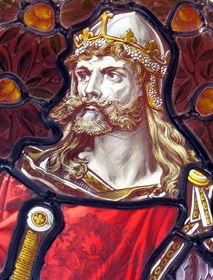
Harald Hardrada King of Norway

Harald Hardrada King of Norway

In Norway, King Harald Hardrada had inherited land in England from King Canute who had once been King of England. Hardrada believed this meant he had a claim to be the King of England. Well, why not? After all, he was supported by Tostig, Harold of Wessex’s brother and Hardrada was already the powerful King of Norway. And he was planning to take England by force if he must.

King Sweyn of Denmark

King Sweyn of Denmark

There was another Scandinavian king who had a claim to the throne, too. King Sweyn of Denmark’s uncle had been Canute the Great, King of England, Denmark and Norway. Canute was ruling England when Edward took over. But Sweyn waited until Hardrada was defeated in his claim, then took his time to rally his hundreds of longships and fighting men. The Danes did not arrive in England until 1069, but more about that in my novel, Rogue Knight.

William the Conqueror Arriving in England

William the Conqueror Arriving in England

Meanwhile, across the English Channel lay Normandy and William, the bastard son of Robert, Duke of Normandy. William, now the duke, was Edward’s first cousin’s son. Seems a stretch to me, but this guy had ambition. And he had already demonstrated he was ruthless in battle. Besides all that, he told some tale about Edward having promised him the crown of England. But it seems Edward promised the crown to many, so what was that? William also claimed that Harold of Wessex had vowed to help him become king one day. Not sure about that and neither are the historians but then William’s folks wrote most of the history so there you have it.

As his father’s heir and now Duke of Normandy, William was used to ruling a large land. Why not more? So, William the Bastard planned to invade England just like Harald Hardrada. The plot thickens.

So what happened? The Witan named Harold of Wessex king. But we all know what happened to him…

Harald Hardrada invaded the north of England. King Harold fought him off. Weakened by the battle they’d just fought, Harold’s men trudged south to meet William the Bastard at Hastings where his men were storming ashore from Normandy. In a daylong battle, Harold was killed.

But one claimant to the throne of England remained… an heir of Edward’s. Indeed, Edgar Ætheling was the rightful heir to the throne. “Ætheling” is an Old English term used in Anglo-Saxon England to designate the princes of the royal dynasty eligible for the kingship. And so Edgar was. His father, Edmund Ironside, was King Edward’s half brother until he was killed, some say by poisoning. Unfortunately, when King Edward died, Edgar was only 14 or 15, a bit young to be leading soldiers and fighting off contenders for the crown.

Nevertheless, upon King Harold’s death, Edgar was named king, but he was never crowned because William the Bastard, earning his name as “the Conqueror”, moved in and took over.

Although Edgar had many supporters and, in 1069, joined with the Danes and the rebels in Yorkshire in a bid to reclaim England, through a series of fiascos, their fight was unsuccessful.

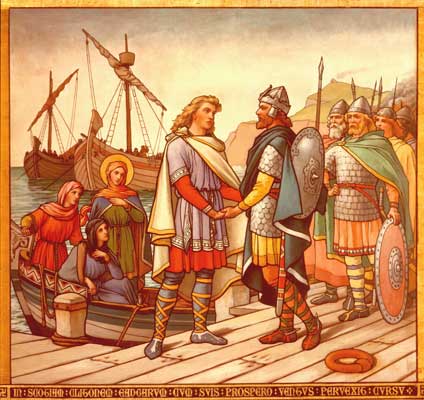
Edgar, his mother and two sisters fled to Scotland where King Malcolm welcomed them. And that is where Edgar enters my newest medieval romance, Rebel Warrior, set in Scotland in 1072.

Malcolm welcoming Edgar

Malcolm welcoming Edgar to Scotland

By then, Edgar was 21 and though the rightful king, he would be denied his legacy. But one day his family would regain the throne in a manner of speaking. Edgar’s niece, Edith, daughter of Edgar’s sister Margaret who married the King of Scots, would become Queen of England, marrying Henry I.

If you want to see Edgar and his beautiful sister Margaret in Scotland, you will have to read Rebel Warrior!

ReganWalker_RebelWarrior_800 copy


“Master storytelling transports you to medieval Scotland!”

Paula Quinn, NY Times Bestselling Author

About Rebel Warrior

When your destiny lies far from where you began…

Scotland 1072

The Norman Conqueror robbed Steinar of Talisand of his noble father and his lands, forcing him to flee to Scotland while still recovering from a devastating wound. At the royal court, Steinar becomes scribe to the unlettered King of Scots while secretly regaining his skill with a sword.

The first time Steinar glimpses the flame-haired maiden, Catrìona of the Vale of Leven, he is drawn to her spirited beauty. She does not fit among the ladies who serve the devout queen. Not pious, not obedient and not given to stitchery, the firebrand flies a falcon! Though Catrìona captures Steinar’s attention, he is only a scribe and she is promised to another.

Catrìona has come to Malcolm’s court wounded in spirit from the vicious attack on her home by Northmen who slayed her parents and her people. But that is not all she will suffer. The man she thought to wed will soon betray her.

When all is lost, what hope is there for love? Can a broken heart be mended? Can a damaged soul be healed?

Rebel Warrior on Amazon:

US • UK

About the Author

Regan Walker profile pic 2014 copyRegan Walker is an award-winning, #1 bestselling, multi-published author of Regency, Georgian and Medieval romance. She has five times been featured on USA TODAY’s HEA blog and twice nominated for the prestigious RONE award (her novel, The Red Wolf’s Prize won Best Historical Novel for 2015 in the medieval category). Regan writes historically authentic novels with real history and real historic figures where her readers experience history, adventure and love.

Goodreads • Website • Facebook • Twitter

Pinterest storyboard for Rebel Warrior

Beverley Oakley: The Mysterious Governess (Daughters of Sin, Book 3)

Catostconspirators

The Cato Street Conspiracy and Queen Caroline’s Return to England—Two Important Events of 1820

 Historical Romance Author, Beverley Oakley, recently brought one of her characters, Miss Araminta Partington, to tea. Miss Partington, who has an extremely high opinion of her attractions, and of her knowledge of most matters, elucidated on the background to the new book in which she features called The Mysterious Governess, part of the Daughters of Sin series, which touches on the events before and after the Cato Street Conspiracy of 1820.

Miss Partington: Hello Susana, and thank you so much for inviting me to take a dish of tea in your parlor. I must say, it’s very comforting to know I can sleep at night in the knowledge that those dreadful men—Arthur Thistlewood, Edward Spence and the others – who call themselves “The Society of Spencean Philanthropists”, have been either hanged or transported for life for their parts in the Cato Street Conspiracy.

Susana: A delight to have you here, too, Araminta. Yes, what a shock to the public! What do you suppose they were hoping to achieve?

Miss Partington: Why, utter madness, in my opinion! Mr. Thistlewood talked of desiring a “Government of the People of Great Britain,” which would take power out of the hands of Parliament and the landed elite and place it into the hands of the people.” In my opinion, that’s tantamount to stealing Papa’s estate and giving it to Jane, my useless maid, who only last week lost one of my silver hairpins.

Susana: Goodness, that does sound dire! I’m referring to the plot, of course. Was there violence?

Miss Partington: Fortunately, the only violence was after the Coldstream Guards and Bow Street runners ran into the loft where these miscreants were plotting that night’s intended rampage through the home of the Lord President of His Majesty’s Privy Council, Lord Harrowby. Indeed, they were intending to murder the entire King’s Cabinet before taking to the streets of London to storm the Bank of England and the Tower of London. They hoped to stir up revolution in our country, like in America and France only a few decades ago.

Susana: Good Lord! How was it possible that law enforcement was able to apprehend the plotters?

Pageflex Persona [document: PRS0000038_00064]Miss Partington: Well, apparently, the Government knew what they were about and had planted spies in their organization. My Cousin, Stephen Cranbourne, works for the Foreign Office. I’m sure he’d have confided in me had I not been on rather… er… friendly terms with Lord Debenham who is rumored to be associated with the Spenceans. He’s not, of course. I made sure to burn the incriminating letter his cousin wrote before she drank poison. Aren’t the daffodils beautiful at this time of year? I’ve trimmed my bonnet with several bunches. Sir Aubrey does think them fetching. Yes, I’ve transferred my affections to Sir Aubrey as I think he’d be far easier to manage than dangerous Lord Debenham.

Susana: Yes, the daffodils are, indeed, beautiful. And I was so sorry to hear about Lord Debenham’s cousin. I believe she was Sir Aubrey’s late wife. But, back to politics, do tell me, when was the Spenceans’ plot brought to nought? My apologies for my ignorance, I’ve been in France for some time.

Miss Partington: On February 23, 1820, but of course, it’s not really news any more since the gossip sheets—and indeed, the newspapers—are having much more fun giving us all the thrilling details of George IV’s estranged wife Queen Caroline arriving from continental Europe, a few months afterwards, and attempting to take her place as Queen consort. Personally, I think someone with such atrocious dress sense doesn’t deserve to be queen, but, not everyone agrees with me—which I always find rather odd, really. Of course, the Prince Regent only agreed to marry Princess Caroline of Brunswick back at the end of the last century so his father would clear his debts. £630,000 pounds is rather a lot of money, though I imagine that if I owed such a sum, I might be induced to marry Lord Debenham above Sir Aubrey, despite his wicked reputation and the fact Lord Debenham would be so much more difficult to manage.

Susana: Yes, your half-sister, Miss Larissa Hazlett, has inferred the same.

Miss Partington: My half-sister? [Miss Partington rises.]Let me assure you, I do not have a half-sister. Any resemblance between that dreary governess and myself is entirely coincidental. Now, if you’ll excuse me… while it has been most pleasant, I must leave now for an appointment I’ve just remembered. Yes, it’s all part of a little plan I’m implementing to put that dreary governess right back in her box!

About The Mysterious Governess

Two beautiful sisters—one illegitimate, the other nobly born—compete for love amidst the scandal and intrigue of a Regency London Season.

Lissa Hazlett lives life in the shadows. The beautiful, illegitimate daughter of Viscount Partington earns her living as an overworked governess while her vain and spoiled half sister, Araminta, enjoys London’s social whirl as its most feted debutante.

When Lissa’s rare talent as a portraitist brings her unexpectedly into the bosom of society—and into the midst of a scandal involving Araminta and suspected English traitor Lord Debenham—she finds an unlikely ally: charming and besotted Ralph Tunley, Lord Debenham’s underpaid, enterprising secretary. Ralph can’t afford to leave the employ of the villainous viscount much less keep a wife but he can help Lissa cleverly navigate a perilous web of lies that will ensure everyone gets what they deserve.

Amazon.com • Amazon.co.uk • Apple iBooks • Barnes & Noble • Kobo

Excerpt

Although The Mysterious Governess is about Lissa, who is Araminta’s half-sister, the plot involves them equally. Lissa is hard-working and honourable, the antithesis of Araminta, as you will see below, in this short extract:

“Is everything all right, Miss? Were the fireworks grand? You’re back earlier than I’d ‘spected.” Jane, who was polishing the silver bottles on her mistress’s dressing table, looked up nervously as Araminta entered the room.

Without a word, Araminta brought one arm across the entire surface and sent powder bottles, perfume vials, hairbrushes and jewelry boxes crashing to the floor.

Then she threw herself onto her bed and burst into noisy tears.

“Oh, Miss, I take it things didn’t go to plan,” said Jane, going down on her knees to start to clean up the mess before changing her mind and putting a tentatively soothing hand upon Araminta’s back.

“No, they did not!” Araminta shrieked, beating her fists upon the counterpane.

“So, His Lordship didn’t ask you to marry him, then?”

“Yes he did!” Araminta rolled onto her back and glared at Jane. “He asked me to marry him and then said he had to go away on important business for two months! Two months! Where does that leave me? In an impossible situation, I don’t need to tell you. I might as well throw myself in the river, except the water’s far too cold and I’m hardly about to copy bacon-brained Edgar. There must be another way.”

“Poison?”

“I mean to get out of this mess, you stupid girl!” Araminta screamed. Feverishly, she began to bite her fingernails before realizing the damage she was doing to an important asset. “Oh, Jane, don’t look like you’re related to a mule. Come up with a plan, for dear Lord’s sake!”

About the Author

Beverley Eikli author picBeverley Oakley was seventeen when she bundled up her first 500+ page romance and sent it to a publisher. However, drowning her heroine on the last page was not in line with the expectations of romance readers so Beverley became a journalist.

In 2009, Beverley published her first novel. Since then she has written more than thirteen sizzling historical romances, filled with mystery and intrigue, mostly set in England during the Georgian, Regency and Victoria eras.

Beverley lives near Melbourne opposite a picturesque nineteenth century insane asylum with the handsome Norwegian bush pilot she met in Botswana, their two beautiful daughters and a rambunctious Rhodesian Ridgeback the size of a pony.

Beverley also writes more psychological historicals, and Colonial-Africa- set romantic adventures, as Beverley Eikli.

WebsiteFacebookGoodreadsTwitter

Amy Rose Bennett: Master of Strathburn (Giveaway)

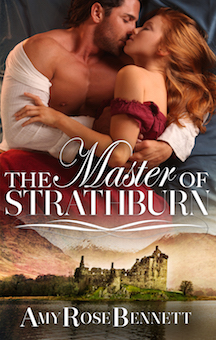
MasterOfStrathburnFINAL copy 2

The Master of Strathburn is essentially a tale about Robert Grant, a wanted Jacobite. After surviving the Battle of Culloden, he escapes to France and then the Caribbean. However, after a decade of living in exile, he desperately wants to return to Scotland and reconcile with his estranged father, the Earl of Strathburn. The only problem is, there is still a price on his head—he isn’t fortunate enough to have been granted a pardon through the Act of Indemnity in 1747. Not only that, his dissolute half-brother Simon and avaricious step-mother would have him arrested by the British in the blink of an eye to prevent him from reclaiming his birthright. Of course, when Robert returns to Lochrose Castle, his long-lost Highland home, the adventures and the romance begin…

Scotland and its rich history has always fascinated me. The idea for writing a novel set around the time of the second Jacobite Rebellion, the Forty-five, came to me when I was sixteen, after I’d read a short story about Flora MacDonald, the brave young woman who helped Bonnie Prince Charlie—the Pretender to the Scottish throne and indeed, the throne of England—escape the Highlands after the rebellion failed. Of course, I’ve done a lot more research into the period since then. After reading about Culloden—the last battle of the rebellion in which the Jacobite army was resoundingly defeated—I knew I particularly wanted to write about a Jacobite hero who was present at the battle and his struggles dealing with the aftermath following the failed uprising. And hence Robert Grant’s story came to life in my mind.

Culloden Memorial Cairn copy

The Battle of Culloden took place at Drumossie Moor, not far from Inverness in the north-west of Scotland on April 16, 1746. I was fortunate enough to visit the site several years ago; it was actually only a few days after the anniversary of the battle and families who’d lost relatives had laid wreaths against the memorial cairn. The moor is actually classified as a war grave and there are small headstones marking the places where particular clansmen fell. It is estimated that 1500 to 2000 Jacobite soldiers were killed or wounded during the brief battle whereas the British army sustained only fifty casualties. Needless to say, visiting Culloden was a very moving experience.

About Master of Strathburn

A sweeping, sexy Highland romance about a wanted Jacobite with a wounded soul, and a spirited Scottish lass on the run.

Robert Grant has returned home to Lochrose Castle in the Highlands to reconcile with his long-estranged father, the Earl of Strathburn. But there is a price on Robert’s head, and his avaricious younger half-brother, Simon, doesn’t want him reclaiming his birthright. And it’s not only Simon and the redcoats that threaten to destroy Robert’s plans after a flame-haired complication of the feminine kind enters the scene…

Jessie Munroe is forced to flee Lochrose Castle after the dissolute Simon Grant tries to coerce her into becoming his mistress. After a fateful encounter with a mysterious and handsome hunter, Robert, in a remote Highland glen, she throws her lot in with the stranger—even though she suspects he is a fugitive. She soon realizes that this man is dangerous in an entirely different way to Simon…

Despite their searing attraction, Robert and Jessie struggle to trust each other as they both seek a place to call home. The stakes are high and only one thing is certain: Simon Grant is in pursuit of them both…

AmazonBarnes & NobleiBooksKoboGoogle Play

In the following excerpt, Robert has just escaped the Battle of Culloden by the skin of his teeth. Or has he?

Excerpt

April 16, 1746

Lochrose Castle, Strathspey, Scotland

‘You’ve got a bloody nerve, Robert.’

‘Aye, I do.’ Robert Grant—the soon-to-be disinherited Master of Strathburn and Viscount Lochrose—squinted through the dark spots clustering his field of vision, trying in vain to focus on his sneering half-brother Simon. The bayonet wound across his shoulder-blade throbbed with such thought-stealing intensity, it was all he could do to stay seated upon his trembling, sweating horse. There was no way he would be able to dismount unassisted. He’d end up with his face firmly planted in the gravel of the forecourt. ‘But for the love of God, Simon …’ he continued, his voice no more than a hoarse rasp. ‘Just help me down. I’m wounded for Christ’s sake …’

He barely recalled the moment the English soldier’s blade had sliced across his back. The horror of everything else that had taken place only hours before on Drumossie Moor flooded his mind. Made the nausea rise in his gullet anew.

Simon snorted. ‘You must’ve had a blow to the head then, or else you would’ve remembered that Father forbade you to come back.’ He glanced past Robert, down the gravel drive toward Lochrose’s gates. ‘You’ve killed them all, haven’t you? It was a rout, just like Father said it would be, wasn’t it?’ His grey gaze, flint-hard with accusation and long-held resentment, returned to Robert. ‘He will never forgive you for this.’

No doubt. Twenty-six Clan Grant men dead. And I was the arrogant young cock who led them all out like lambs to the slaughter.

Robert swallowed down both the bile and bitter self-acrimony burning his throat. ‘I know,’ he croaked. ‘But please … I just need to hide until I can move on … tomorrow.’

Even though he had flagrantly disobeyed their father and had led out the clan at Culloden, Robert prayed that he would be shown a modicum of compassion. That the earl would at least grant his eldest son sanctuary for a single night before he fled Scotland to spend a life in exile in some far-flung place. Robert didn’t want to put his family at risk for harbouring a fugitive, but he just couldn’t go on any farther.

Simon smiled, the sentiment not quite reaching his eyes. ‘Of course, dear brother. I shall have a room prepared for you.’ He gripped Robert’s forearm with one hand at the same time he slapped the blood-soaked plaid sticking to his shoulder.

Bastard. Agonising, white-hot pain instantly knifed through Robert. Even as black oblivion at last rose up to claim him, he didn’t fail to notice that Simon was still smiling.

Giveaway: For a chance to win a Kindle copy of my Regency noir style romance set in Scotland, just tell me what it is you love about Highland romances.

About the Author

AuthorPic copyAmy Rose Bennett has always wanted to be a writer for as long as she can remember. An avid reader with a particular love for historical romance, it seemed only natural to write stories in her favorite genre. She has a passion for creating emotion-packed—and sometimes a little racy—stories set in the Georgian and Regency periods. Of course, her strong-willed heroines and rakish heroes always find their happily ever after.

Amy is happily married to her own Alpha male hero, has two beautiful daughters, and a rather loopy Rhodesian Ridgeback. She has been a speech pathologist for many years but is currently devoting her time to her one other true calling—writing romance.

Website and BlogFacebookTwitterPinterest


Sherry Ewing: Hearts Across Time Box Set (Giveaway)

I’d like to thank Susana for allowing me the opportunity to showcase my first box set. I’m Sherry Ewing and I write historical and time travel romances to awaken the soul one heart at a time.

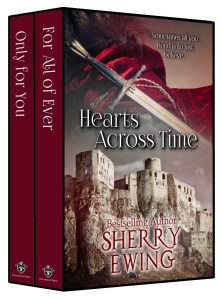
Today I’d like to tell you about this special edition box set entitled Hearts Across Time: The Knights of Berwyck, A Quest Through Time Novel (Books One & Two) that released April 17, 2016. It contains my full-length novels For All of Ever and Only For You. Katherine and Riorden just happen to be my favorite characters I’ve created so far.

Attachment-1Originally, I had no plans to write a time travel. In fact, after I had finished my debut medieval romance, If My Heart Could See You (which is a free eBook by the way), I had every intention of writing about the youngest sister Lynet (A Knight To Call My Own). If you’re a writer, then you know how our characters have a mind of their own and will tell you the direction their lives will go. If you’re a reader, well…let me tell you its true…authors really do have voices inside their heads!

So Katherine and Riorden were “born,” so to speak, along with Katherine’s thee other friends who slipped through time in a turret at Bamburgh castle. I had so much fun writing these books that it spun a whole series and the next book, To Follow My Heart, will release this summer. I continue to be amazed at the amount of research that is available to authors these days and if you haven’t visited Bamburgh’s site, and love castles, don’t miss out! It’s very interactive with a video fly by, rooms to see, and lots of historical information on its origins dating back to its first recorded history in 547AD. And if that’s not enough, be sure to open some of the books in the “library”.

I’d like to show of a painting that a friend of my daughter, Kimberly King, did for me. Originally it was going to be my cover but timing being what it was for the both of us, it just didn’t work out. But I still wanted to have this beautiful piece a part of my book so I put it on the back cover of the print version. Kim took everything I wanted to depict a scene where Katherine see’s Riorden in a painting for the very first time when she at last learns his name. It’s still one of my favorite scenes in the book.

Since Susana and I are part of the Bluestocking Belles, I’d like to do a giveaway of my upcoming release Under the Mistletoe, that was originally part of the Belles’ box set Mistletoe, Marriage, & Mayhem. It will be available for just $0.99 on May 8th.

For a chance to win an eCopy of Under the Mistletoe, tell me the first historical romance you ever read and why it’s stuck with you all these years. I’ll choose a random comment as the winner.

About Hearts Across Time: The Knights of Berwick, A Quest Through Time Novel (Books One & Two)

Sometimes all you need is to just believe…

For All of Ever: Katherine Wakefield has dreamed and written of her knight in shining armor all her life. Yet, how could she have known that when she and her three closest friends take a dream vacation to England that they’d find themselves thrown back more than eight hundred years into the past? Riorden de Deveraux travels to Bamburgh answering the summons of King Henry II. But nothing prepares him for the beautiful vision of a strangely clad ghost who first appears in his chamber. Centuries are keeping them apart until Time gives them a chance at finding love. Will the past of one consume what their future may hold, or will Time take the decision from them and hurdle Katherine forward to where she truly belongs?

Only For You: Katherine de Deveraux has it all but settling into her duties at Warkworth Castle is not easy and downright dangerous to her well-being. Consumed with memories of his father, Riorden must deal with his sire’s widow. Yet how could he know how far Marguerite will go to have the life she feels they were meant to live? Torn apart, Time becomes their true enemy while Marguerite continues her ploy to keep Riorden at her side. With all hope lost, will Katherine & Riorden find a way to save their marriage?

AmazonBarnes & NobleiBooksKobo

Excerpt

She needed fresh air…that’s what she needed. Turning into the Great Hall to catch up with her friends, she found herself riveted to the floor. Even if she’d wanted to move, she couldn’t have. Hardly believing what she was seeing, she became mesmerized when the tourists milling around the chamber slowly vanished before her eyes.

box set pic from FBOnly one man was left standing at the far end of the room, or rather, one knight. He had been reaching for something on a table when Katherine saw his shoulders flinch. His red cape swirled around his legs when he turned to face her. Their eyes locked and Katherine’s breath left her at the intensity reflected in his face. Shock, intermingled with excitement, rushed through her. Her whole body began to tingle. Good God, it’s him! Her mind screamed. He stood there with such a commanding presence about him that she had no recourse but to move in his direction.

Inch by inch, the distance between them lessened as he, too, moved swiftly across the floor. Her arm extended, she reached for him, and yet their meeting was not to be. He quickly vanished, passing right through her. Her body lurched from the contact when the wispy vapor that had been him disintegrated upon their meeting. A soft cry of distress escaped her lips. How could fate be so cruel as to take him from her before they could speak even one word together?

Modern surroundings returned, and Katherine became disorientated when she was rudely bumped by some jerk, who didn’t even mutter an apology. She swiveled around, trying to see if her knight was maybe still lurking in the hall, but there was no trace of him.

She had taken no more than a few short steps, when a voice whispered inside her head. Katherine…come back to me, my love.

sherryAbout the Author

Sherry Ewing picked up her first historical romance when she was a teenager and has been hooked ever since. A bestselling author, she writes historical & time travel romances to awaken the soul one heart at a time. Always wanting to write a novel but busy raising her children, she finally took the plunge in 2008 and wrote her first Regency. She is a member of Romance Writers of America, The Beau Monde & The Bluestocking Belles. Sherry is currently working on her next novel and when not writing, she can be found in the San Francisco area at her day job as an Information Technology Specialist.

Sherry enjoys interacting with her readers.

WebsiteBluestocking BellesFacebookTwitter

GoodreadsPinterest • Newsletter


Sheri Cobb South: Too Hot to Handel (Giveaway)

Every novel contains, or should contain, certain scenes that stick in the reader’s memory long after the book is finished. The definitive scene in my newest release, Too Hot to Handel, finds Bow Street Runner John Pickett and his Lady Fieldhurst escaping a burning Drury Lane Theatre. This is the only book I’ve ever written that is centered upon an actual event; the Theatre Royal at Drury Lane really did burn down on 24 February, 1809. So, how much was real, and how much is the product of my imagination? Let’s take a look.

First of all, theatre fires were not a rare, or even a new, phenomenon. They had been regular occurrences since the theatres reopened after the Restoration of Charles II. Before that time, fire hadn’t been much of an issue. The theatres of ancient times had been outdoor affairs, and plays had been staged during the daytime. Even Shakespeare’s Globe Theatre, although enclosed all around, had a roof that was largely open to the sky, in order to reduce as much as possible the need for artificial lighting. But advances in theatre brought added risk of fire: the Globe burned down in 1613, when a cannon used for special effects in a production of Henry VIII misfired, setting the thatching over the stage ablaze. Although the theatre was destroyed, the only injury reported was one unfortunate man whose breeches were set on fire. (Quick-thinking theatergoers extinguished the flames by dousing him with ale.)

The real change came with the Restoration, when the re-opening of the theatres was celebrated with a host of innovations. The most prominent of these, of course, was the appearance of actresses in female roles that had previously been played by boys. Another, perhaps less-discussed innovation was the rash of theatre-building, including venues at Lincoln’s Inn Fields (1661) Drury Lane (1663), the Haymarket (1720), and Covent Garden (1731). Unlike their open-air predecessors, these new venues were fully enclosed. This meant performances were no longer limited to daylight hours, but it also meant that all performances, even those staged during the day, required artificial lighting. And artificial lighting meant open flames—either candles or oil lamps—and lots of them.

When we consider the combination of open flames and rowdy crowds—capacity in the new theatres rose from 650 seats at Drury Lane in 1700 to 3,600 by the time of the 1809 fire—the number of theatre fires is no longer surprising. In those days before electricity, the theatre at Drury Lane burned twice (in 1672 and again in 1809), as did the one at Covent Garden, aka the Royal Opera House (in 1808 and 1856). Ironically, only fifteen years earlier, in 1794, the Drury Lane theatre had installed a fire curtain made of iron—the first theatre in London to do so—along with large water tanks beneath the roof that could be used for special effects as well as fire safety.

With all these precautions in place, how, then, did it burn? No one knows. The theatre season was greatly subdued during Lent, with fewer plays being performed, and nothing, not even a rehearsal, was taking place on that Friday night in 1809. Since the theatre was apparently empty, there were no injuries, but from the incident we get the wonderful (if apocryphal) account of Richard Brimsley Sheridan—playwright, Member of Parliament, and manager of the Drury Lane theatre, who in 1794 had bankrolled the construction of the enormous new theatre from his own private fortune—watching the blaze from a nearby pub. When urged by his friends to go home, he is reported to have said, “Can a man not enjoy a glass of wine by his own fireside?”

Of course, from a writer’s perspective, the destruction of an empty building makes for dull fiction. So for the purposes of my story, I filled the theatre to its full 3,600-seat capacity and staged a production of Handel’s oratorio Esther. Besides being suitably sober for Lent, it contains a passionate duet between Esther and the king that made it a natural choice for Too Hot to Handel, certainly the most romantic of the John Pickett mysteries. And the fact that so little is known about the cause of the fire gave me the freedom to create my own “what if?” scenario.

Click here to see Sheri’s photos of the Drury Lane theatre before and after the fire in 1809.

51lvnXHv9RL._SX322_BO1,204,203,200_

About Too Hot to Handel

When a rash of jewel thefts strikes London, magistrate Patrick Colquhoun resolves to deploy his Bow Street Runners to put astop to the thefts. The Russian Princess Olga Fyodorovna is to attend a production of Handel’s Esther at Drury Lane Theatre,where she will wear a magnificent diamond necklace. The entire Bow Street force will be stationed at various locations around the theatre—including John Pickett, who will occupy a box directly across the theatre from the princess.

In order to preserve his incognito, Pickett must appear to be nothing more than a private gentleman attending the theatre. Mr. Colquhoun recommends that he have a female companion—a lady, in fact, who might prevent him from making any glaring faux pas. But the only lady of Pickett’s acquaintance is Julia, Lady Fieldhurst, to whom he accidentally contracted a Scottish irregular marriage several months earlier, and with whom he is seeking an annulment against his own inclinations—and for whom he recklessly declared his love, secure in the knowledge that he would never see her again.

The inevitable awkwardness of their reunion is forgotten when the theatre catches fire. Pickett and Julia, trapped in a third tier box, must escape via a harrowing descent down a rope fashioned from the curtains adorning their box. Once outside, Pickett is struck in the head and left unconscious. Suddenly it is up to Julia not only to nurse him back to health, but to discover his attacker and bring the culprit to justice.

Note: This book will be released on June 22, 2016. However, the previous book in the series is available.

In My Lady’s Chamber

Excerpt

Pickett opened the door of the theatre box, and immediately stepped back as he was struck with a wall of heat. The corridor was alive with flame, and as they stood staring into the inferno, a burning beam from the ceiling fell almost at their feet. He slammed the door shut.

“We won’t be going out that way,” he remarked, glancing wildly about the box for some other method of exit. He seized one of the heavy curtains flanking the box and pulled until it collapsed into his arms in a pile of red velvet. He located the edge and began ripping it into long strips.

“What are you doing?” asked her ladyship, her voice muffled by the folds of his handkerchief over her mouth.

Pickett jerked his head toward the sconce mounted on the wall between their box and its neighbor. Its many candles, so impressive only moments ago, now appeared pale and puny compared to the flames dancing all around them.

“I’m making a rope to tie to that candelabrum. You can climb down into the pit and escape from there. And don’t wait for me. As soon as your feet reach the floor, I want you to forget everything you ever learned about being a lady—push, shove, do whatever you have to do, but GET OUT, do you understand?”

“And what about you, Mr. Pickett?”

He glanced at the brass fixture. “I’m not sure if it will bear my weight, my lady. I suppose I’ll have to try—I don’t much fancy my chances in the corridor—but I’ll not make the attempt until I see you safely down.”

She leaned over the balustrade and looked past the three tiers of boxes to the pit some forty feet below, then turned back to confront Pickett. “Setting aside the likelihood that I would lose my grip and plummet to my death, do you honestly think I would leave you alone up here, to make your escape—or not!—as best you might? No, Mr. Pickett, I will not have it! Either we go together, or we do not go at all!”

The crash of falling timbers punctuated this statement, and although there was nothing at all humorous in the situation, he gave her a quizzical little smile. “ ‘ ’Til death do us part,’ Mrs. Pickett?”

She lifted her chin. “Just so, Mr. Pickett.”

The author is offering a trade-size paperback ARC of Too Hot to Handel to a random commenter.

About the Author

Five Star author photo copyAt the age of sixteen, Sheri Cobb South discovered Georgette Heyer, and came to the startling realization that she had been born into the wrong century. Although she doubtless would have been a chambermaid had she actually lived in Regency England, that didn’t stop her from fantasizing about waltzing the night away in the arms of a handsome, wealthy, and titled gentleman.

Since Georgette Heyer was dead and could not write any more Regencies, Ms. South came to the conclusion she would simply have to do it herself. In addition to her popular series of Regency mysteries featuring idealistic young Bow Street Runner John Pickett (described by All About Romance as “a little young, but wholly delectable”), she is the award-winning author of several Regency romances, including the critically acclaimed The Weaver Takes a Wife.

A native and long-time resident of Alabama, Ms. South recently moved to Loveland, Colorado, where she has a stunning view of Long’s Peak from her office window.

Website • Facebook • Goodreads