Archives

Regency Rites: The London Season

The Haut Ton

The haut ton referred to the members of some three hundred families who owned large estates that supplied their primary income. Sometimes they were called “the upper ten thousand.” Not all were titled, but they were usually at least well-connected and wealthy enough to stand the enormous expenses of socializing with the crème de la crème of English society, which included:

  • owning or renting a suitable residence in a fashionable area of London (in addition to a great country home on their estate), along with the requisite servants, stables, etc.
  • extensive wardrobes in the first stare of fashion for all members of the family who participated in the Season
  • food, drink, decorations, musicians, etc. required to provide entertainment for other members of the ton in grand style
  • costs of renting theatre boxes, purchasing entrance tickets to public entertainments, such as the Vauxhall Pleasure Gardens, Astley’s Amphitheatre, etc.
  • allowance or pin money for wives, sons or daughters.

What was the London Season?

Lady Theresa

Lady Theresa

The London Season evolved from the legislative sessions of Parliament, which would run roughly from January/February to June. Generally, a peer would bring his family to London sometime after the holidays, which provided a perfect opportunity for their families to socialize and seek suitable spouses for their children. The Season didn’t heat up until spring, though, and by the end of June, most of the first families escaped the odiferous heat of London for the fresh air of their country estates or perhaps a seaside resort.

Many families would return to London in September for the “Little Season,” which was much less prestigious, but few were left in Town by the end of November.

Essentially, anyone who was anyone would participate in the London Season, even if they had to run up enormous debts to do it.

In Treasuring Theresa, an earl’s daughter such as Lady Theresa would be expected to have a London Season and make a suitable marriage. Unfortunately, however, her first Season was unsuccessful, and later, there was no money for it, so when childhood sweetheart Reese Bromfield broke her heart by betrothing himself to another, Lady Theresa’s options for marriage were limited. Incidentally, Reese Bromfield, as the son of a squire, was not highly-connected, but as the son of a wealthy member of the gentry, he would have been welcomed to participate in the ton, although not, perhaps, in the highest circles.

What did people do in the London Season?
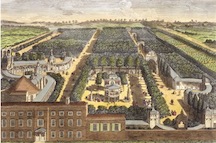
Vauxhall Pleasure Gardens

Vauxhall Pleasure Gardens

London offered—and still does to this day—an endless number of delights for visitors, regardless of status. In the early 19th century, one could walk or ride through the park (Hyde Park or Green Park were quite popular), visit the British Museum or any number of museums or galleries, attend a circus performance at Astley’s Amphitheatre, visit the Pleasure Gardens of Vauxhall with its nightly fireworks, and attend the theatre or opera. The best shopping in the world could be had on Bond Street, and for the gentlemen there was racing, boxing, gaming, and all sorts of attractions that couldn’t be found on a remote country estate.

For the haut ton, there were balls and parties, soirées, routs, musical evenings, Venetian breakfasts, al fresco teas, extravagant dinners…all sorts of opportunities to hobnob with wealthy aristocrats and politicians and make connections that could potentially lead to even higher status and prestige.

Hyde Park

Hyde Park

It was all great fun—but very expensive, especially for those who succumbed to the gambling fever. Entire fortunes were won and lost in this period—and not just by the gentlemen either. Before she died in 1806, Georgiana, the Duchess of Devonshire, had lost what amounts today to a billion dollars. (See Lady P’s insights on that here.)

What did people do the rest of the year?

Whatever they wished! Many spent the summer on their country estates, which generally sported expansive mansions with huge ballrooms that could be used for house parties, during which they would entertain their friends from other parts of England for a week or more. Sometimes gentlemen took a personal interest in their estates, but often the management was left to a steward or estate manager so that the owner was free to participate in local society, or travel to the seaside, or take the waters at a spa resort, such as Bath. Hunting and fishing were popular sports for the gentlemen.
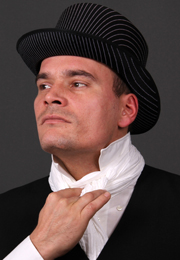
Damian Ashby, Lord Clinton

Damian Ashby, Lord Clinton

In Treasuring Theresa, Damian Ashby was a society dandy who despised the country, except for the income it provided him. Lady Theresa despised the superficiality of the ton and preferred life on her country estate, where she counted among her friends villagers and commoners, as well as the local gentry. How will these two seemingly complete opposites manage to bear each other’s company for an extended period of time as her dying father wishes?

About Treasuring Theresa (a sweet Regency short story)

At the betrothal ball of the man she had expected to marry herself, Lady Theresa latches on to Damian Ashby, hoping to divert attention from her own humiliating situation. Of course, she’s not seriously interested because he’s a useless London fribble, in her opinion. He is not favorably impressed with her either.

Still, she’s the daughter of an earl, and he’s the heir to her father’s title and estate, so they are destined to spend more time in each other’s company…sooner rather than later. And who knew that the two of them would develop an unlikely attraction to one another?

But can a London swell and a country lady ever make their diverse lives and interests work together?

Note: Excerpts and additional reads—including an epilogue to this story—are available here.

Available

Ellora’s CaveAmazonBarnes & NobleAllRomance eBooksKobo

The Regency Rites series

Regency Rites: The Well-Dressed Regency Lady 

Regency Rites: Presentation at Court
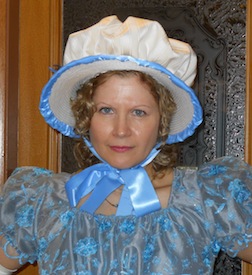
Regency Rites: Almack’s Assembly Rooms 

Regency Rites: The London Season

Historical Romance Deal Breaker #4: Cliffhanger Endings

Blast From the Past: Susana just got back from traveling in Scotland and she thought some of you might enjoy revisiting some of her previous posts on Susana’s Parlour.

Decades of reading historical romances have led me to develop strong opinions of what defines a truly satisfying story, so the other day I set about making a list of characteristics that turn a potential five-star read into a one- or two-star. Admittedly, there are some skillful authors who manage to successfully incorporate one or more of these scenarios in their books; however, I have run across quite a few more who in my opinion haven’t quite managed it.

These are what I call “deal breakers”—characteristics that make a book a wall-banger. Not surprisingly, many involve character, particularly, the character of the hero and heroine. They have to be likable. They have to be three-dimensional, i.e., well-drawn-out characters with flaws, not fairy princesses. And they have to be able to fall in love, convincingly, the head-over-heels kind of love.

Overview of Susana’s Historical Romance Deal-Breakers

  1. Reluctant Heroes
  2. Adultery
  3. Anachronistic Behavior and Historical Inaccuracies
  4. Cliffhanger Endings
  5. Unattractive or Drop-Dead Gorgeous Heroines
  6. Heroes With Mistresses or Who Sleep With Servants
  7. Drop-Dead Gorgeous Heroes
  8. Promiscuous Heroines
  9. Contrived Endings
  10. Waifs and Silly Heroines
  11. Long Separations
  12. Excessively Cruel Heroes and Heroines
  13. Breaking the Rules: Why Some Authors Get Away With It

The fourth deal breaker is cliffhanger endings.

There’s nothing more annoying than to get to the last chapter of a book and discover that it’s not the end. That you have to buy another book to find out how your protagonists fared.

If I really care about the characters, I may buy the sequel. But I am seething inside, and any chance I will ever trust that author again is virtually gone. Even if it’s a favorite author.

If the sequel isn’t even available yet, there is no chance I will buy it. Because months later, I won’t likely care about those characters anymore.

Why do authors cheat their readers this way? If it’s meant as a technique to promote books, it’s a misguided one indeed. Nobody likes to be teased or manipulated. Eventually, readers will get disgusted and move on.

I adore a good romance series, with cameo appearances by protagonists from previous books. I love it when secondary characters from a previous book become the protagonists in the sequel. If the books aren’t spaced too far apart (i.e., I haven’t had time to forget all about them), I will buy all of them just to make sure my old friends are still doing well.

But if there’s no satisfactory HEA at the end of the book—if I discover that instead of being rewarded for their suffering, my hero and heroine have more tribulations in store for them in the next book—I’m seriously wanting my money—and my time—back.

What do you think? Are there some authors who can get away with teasing their readers with cliffhangers?

Historical Romance Deal Breaker #3: Anachronistic Behavior and Historical Inaccuracies

Blast From the Past: Susana is traveling in Scotland this week and she thought some of you might enjoy revisiting some of her previous posts on Susana’s Parlour.

Decades of reading historical romances have led me to develop strong opinions of what defines a truly satisfying story, so the other day I set about making a list of characteristics that turn a potential five-star read into a one- or two-star. Admittedly, there are some skillful authors who manage to successfully incorporate one or more of these scenarios in their books; however, I have run across quite a few more who in my opinion haven’t quite managed it.

These are what I call “deal breakers”—characteristics that make a book a wall-banger. Not surprisingly, many involve character, particularly, the character of the hero and heroine. They have to be likable. They have to be three-dimensional, i.e., well-drawn-out characters with flaws, not fairy princesses. And they have to be able to fall in love, convincingly, the head-over-heels kind of love.

Overview of Susana’s Historical Romance Deal Breakers

  1. Reluctant Heroes
  2. Adultery
  3. Anachronistic Behavior and Historical Inaccuracies
  4. Cliffhanger Endings
  5. Unattractive or Drop-Dead Gorgeous Heroines
  6. Heroes With Mistresses or Who Sleep With Servants
  7. Drop-Dead Gorgeous Heroes
  8. Promiscuous Heroines
  9. Contrived Endings
  10. Waifs and Silly Heroines
  11. Long Separations
  12. Excessively Cruel Heroes and Heroines
  13. Breaking the Rules: Why Some Authors Get Away With It

Deal breaker #3 is: anachronistic behavior and historical inaccuracies.

So many of the newer historical authors seem to be turning out what I consider contemporary stories in historical settings, and it seems as though many readers don’t care. The curvy girl on the cover wears a beautiful gown, and the novel is full of balls and handsome dukes, and if the girl sneaks out to the garden and engages in steamy sex with someone, reviewers praise it to the heavens for being “hot.” Am I the only one who questions the assumption that a gently-born young woman would be allowed to accompany a gentleman on the terrace for more than five minutes without her chaperone coming to look for her?

While I have to acknowledge that readers new to this genre may not recognize these problems, too many indications of the author’s ignorance of the time period can ruin a book for those of us who know better. And it may well be that the author doesn’t care. If all she is looking for are a few extra dollars and some temporary éclat, the ease of self-publishing can give her the platform, and her devoted friends and family can shower her work with favorable reviews until she moves on with her life.

Unfortunately, it’s not just the self-published stories that feature egregious historical inaccuracies. It seems as though the editors—if they still exist—are also unfamiliar with the time periods of the books they handle. Either that or they are so over-worked they hope the readers will be too engrossed in the story to balk at a few “minor” issues. And it’s true: I find I can ignore a problem or two in an otherwise wonderful read. However, if there are too many, or if the entire plot is dependent upon some unlikely scenario, that’s when the book ceases to be a pleasurable experience and becomes a wall-banger for me.

Here are some anachronisms and historical inaccuracies I have encountered just within the past five months in books considered historical romances (not erotica*), all involving young, innocent heroines:

  • The heroine is allowed to leave her home and walk around London without any sort of chaperone, in some cases even going to call on a single gentleman alone.
  • The heroine attends a house party hosted by a gentleman known for his scandalous house parties—which is enough in itself to ruin her reputation—but she is so loosely chaperoned that she and her lover can easily sneak into each other’s rooms at night.
  • In a medieval, the hero and heroine cannot marry because their siblings are married to each other, which by church law makes them siblings as well. So they run off and pretend to be married. Really? While our 21st century wisdom tells us this law is ridiculous, these characters lived with medieval cultural and religious mores; the guilt over time would eventually take its toll, even if their deception were never uncovered. NOT a satisfactory HEA.
  • The heroine attends a ball and inadvertently has sex with a stranger in a library so dark they cannot see each other’s faces.
  • The heroine’s father wants her to marry an old lecher and tells her to allow him whatever liberties he wants.
  • The heroine is allowed to remain alone in the family home with no supervision.
  • The heroine is allowed to host her brother’s scandalous house parties.
  • The heroine goes shopping for a gown to wear at a ball that very evening. (I suppose she dropped in at Harrod’s to look through the dresses on the rack?)
  • Waffles are served for breakfast.
  • The heroine is allowed to entertain gentleman callers and ride in a closed carriage with a gentleman with no supervision.
  • The hero is a male prostitute in a brothel where aristocrats bring their daughters to be “breached” prior to the wedding night. (!!!)
  • The author doesn’t understand British titles and refers to a young girl as Lady Davenport instead of Lady Camilla. (HINT: before writing a historical novel set in England, read up on the proper use of titles. It’s really not something you can just guess at.)
  • An illegitimate son is the heir to his legitimate half-brother’s title and estate.
  • A man is allowed to marry his father’s or brother’s widow, or a woman is allowed to marry her deceased sister’s widower.

What anachronisms and historical inaccuracies make a book a wall-banger for you?


Historical Romance Deal Breaker #2: Adultery

Blast From the Past: Susana is traveling in Scotland this week and she thought some of you might enjoy revisiting some of her previous posts on Susana’s Parlour.

Decades of reading historical romances have led me to develop strong opinions of what defines a truly satisfying story, so the other day I set about making a list of characteristics that turn a potential five-star read into a one- or two-star. Admittedly, there are some skillful authors who manage to successfully incorporate one or more of these scenarios in their books; however, I have run across quite a few more who in my opinion haven’t quite managed it.

These are what I call “deal breakers”—characteristics that make a book a wall-banger. Not surprisingly, many involve character, particularly, the character of the hero and heroine. They have to be likable. They have to be three-dimensional, i.e., well-drawn-out characters with flaws, not fairy princesses. And they have to be able to fall in love, convincingly, the head-over-heels kind of love.

Overview of Susana’s Historical Romance Deal Breakers

  1. Reluctant Heroes
  2. Adultery
  3. Anachronistic Behavior and Historical Inaccuracies
  4. Cliffhanger Endings
  5. Unattractive or Drop-Dead Gorgeous Heroines
  6. Heroes With Mistresses or Who Sleep With Servants
  7. Drop-Dead Gorgeous Heroes
  8. Promiscuous Heroines
  9. Contrived Endings
  10. Waifs and Silly Heroines
  11. Long Separations
  12. Excessively Cruel Heroes and Heroines
  13. Breaking the Rules: Why Some Authors Get Away With It

The second one is adultery involving the hero or heroine.

I’ve seen scenarios where the non-hero husband is cruel and abusive, even threatening to kill the heroine (especially in medievals), but I don’t find that a good enough excuse for adultery. I wouldn’t tell a 21st century abused woman that she either has to go back to her husband or go to a nunnery (perhaps the closest thing to a medieval equivalent of a shelter for battered women), but in medieval times there weren’t many other options. In one story I read recently, the abused wife ran away to a distant town with her lover and they pretended to be married. But the guilt of their deceit had already started to tarnish their relationship before the book’s conclusion, leaving the reader with a very unsatisfactory HEA. (In fact, the story was set up in such a way as to make a satisfactory HEA impossible.) I know this isn’t fair by 21st century standards, but you really should not write a novel set in medieval times and then proceed to ignore the social and religious mores of the time. Less knowledgeable readers might not notice, but those of us who have read widely in the genre will recognize an amateur when we see it. [Historical inaccuracy, another deal breaker, will be discussed in a later post.]

What about a spouse who is ill, disabled, or confined to a mental institution? Or a spouse who has run off with another person and disappeared? While I do not expect a hero to remain celibate forever under these circumstances, I cannot like the heroine to be his mistress. Remember Jane Eyre? She knew she couldn’t have a proper HEA with Edward while his wife was living, even if she was a lunatic. I mean, how can you justify stigmatizing your children with the label “bastard”? Somehow, the HEA has to include a legal marriage, and I can’t believe a heroine who starts out as a mistress can have that much confidence that her husband/protector won’t eventually deceive her as well.

Oh, and the plots where the sterile husband invites his best friend to impregnate his wife? NO! Forget it! It doesn’t matter if the husband is good or evil, the whole adultery/deception angle opens up a Pandora’s box of guilt and fear that always manages to tarnish the HEA in some way.

What about you? Do find adultery in a historical romance acceptable in some situations?


Historical Romance Deal Breaker #1: Reluctant Heroes

Blast From the Past: Susana is traveling in Scotland this week and she thought some of you might enjoy revisiting some of her previous posts on Susana’s Parlour.

Decades of reading historical romances have led me to develop strong opinions of what defines a truly satisfying story, so the other day I set about making a list of characteristics that turn a potential five-star read into a one- or two-star. Admittedly, there are some skillful authors who manage to successfully incorporate one or more of these scenarios in their books; however, I have run across quite a few more who in my opinion haven’t quite managed it.

Overview of Susana’s Historical Romance Deal Breakers

  1. Reluctant Heroes
  2. Adultery
  3. Anachronistic Behavior and Historical Inaccuracies
  4. Cliffhanger Endings
  5. Unattractive or Drop-Dead Gorgeous Heroines
  6. Heroes With Mistresses or Who Sleep With Servants
  7. Drop-Dead Gorgeous Heroes
  8. Promiscuous Heroines
  9. Contrived Endings
  10. Waifs and Silly Heroines
  11. Long Separations
  12. Excessively Cruel Heroes and Heroines
  13. Breaking the Rules: Why Some Authors Get Away With It

These are what I call “deal breakers”—characteristics that make a book a wall-banger. Not surprisingly, many involve character, particularly the character of the hero and heroine. They have to be likable. They have to be three-dimensional, i.e., well-drawn-out characters with flaws, not fairy princesses. And they have to be able to fall in love, convincingly, the head-over-heels kind of love.

The first deal breaker for me is the reluctant hero.

Nothing is guaranteed to turn me off a book so much as a hero who denies his feelings until the very last chapter. Certainly some initial reluctance is expected; what Regency buck is eager to tie himself down to a leg-shackle before he has sown his wild oats? But the attraction needs to happen fairly soon after he meets the heroine; there must be indications early on that he enjoys her presence, resents it when other men pay her attention, etc. Which doesn’t mean that love at first sight is de rigueur. Instant attractions can be quite wonderful, but ultimately, the feelings between them must be based on something other than physical characteristics.

Below are some examples of reluctant heroes I have encountered recently:

  • The hero was so in love with his deceased wife that he cannot imagine ever risking his heart again, so when he starts falling for the heroine (poor thing), he determines to marry another young lady he doesn’t care as much for instead. Heroes cannot be idiots.
  • The hero recognizes his soulmate, but continually spurns her because childhood traumas make him feel unworthy. Heroes cannot be whiners.
  • The hero is damaged from his experiences in the war, but not too much to fall into bed with his deceased best friend’s sister. When events come to the point where her reputation will be ruined, he refuses point-blank to marry her. Heroes cannot use the heroine and then abandon her.
  • The hero is a notorious rake who has determined never to marry, and when faced with the love of his life, he runs away with another woman, forcing her to marry another man, who abuses her cruelly. Heroes cannot be jerks.
  • The hero and the heroine share a kiss in a moonlit garden and arrange several more meetings. When the heroine, who is being pressured to marry a wealthy old man, begs the hero to marry her, he confesses that he is already married (how could he forget?), and abandons her to a miserable marriage. Heroes cannot be cowardly or adulterers.

Of course, the above cases are extreme; many times the reluctant hero is simply…reluctant. Not mean or cruel or particularly stupid. . . just there. While he may not get my dander up, he’s also…boring. And frankly, heroes cannot be boring either.

What do you think? Can you add some examples of reluctant heroes that you have encountered lately? Or can you think of stories where an initially reluctant hero successfully makes the transition into delightfully besotted hero? I’d love to hear about them!

Episode #14: In Which Leticia, Lady Beauchamp, Pops In For an Interview On Her Personal Acquaintance With Princess Charlotte of Wales

Susana [to the Reader]: I’m afraid Lady P had to return to the 19th century for a christening (no, not Damian and Theresa’s this time, but one of her own daughters’ offspring). She promised to return after she’s had a comfortable coze with her daughters and grandchildren, but in the meantime, she sent someone who she said was a personal friend of Princess Charlotte, the daughter of the Prince Regent.

Lady Beauchamp: I would not characterize our acquaintanceship in quite that manner, Miss Ellis.

Susana: Forgive me, Lady Beauchamp, but I am not finished speaking to the readers.

Lady Beauchamp: Well, do hurry, then. I have an important social engagement this afternoon.

Susana [taking a deep breath]: Yes, well, Lady Beauchamp is the former Leticia Snodgrass, who was presented in London about the same time as Lady P’s niece-by-marriage, Theresa Ashby. You can read more about that in the epilogue to Treasuring Theresa, which is a free read on my web site: http://www.susanaellis.com/pub.html.

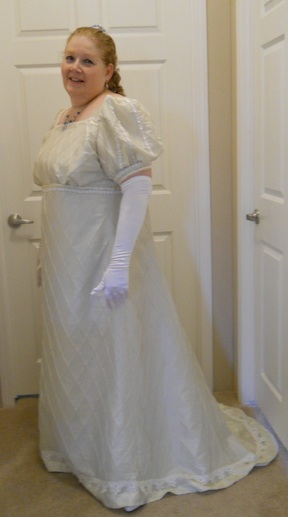
gloria_gown_stern

Leticia, Lady Beauchamp, née Snodgrass

Lady Beauchamp: Is it really? I daresay I should like to see how I am characterized in the story.

Susana [hurriedly]: Perhaps we should get back to the subject at hand, you being a marchioness and your time being so valuable and all. Why don’t you begin by telling us about your marriage and your family?

Lady Beauchamp: Of course. I was quite sought-after in my first season—many offers were made for my hand, you know—but there were only a handful of dukes that year and they were all married, so I chose to wed Lord Beauchamp. We had a fabulous wedding at St. George’s, and the Prince kissed my hand and called me the most beautiful bride he’d ever seen.

Susana: And your husband and family? Please tell us about them.

Lady Beauchamp: Fortunately, my youngest, George Augustus, takes after his mother. [Smiling] He has the most adorable cherubic face and blue eyes so like mine. I think it quite likely that his hair will lighten before long as well.

Susana: And your older son?

Lady Beauchamp [grimacing]: It is most unfortunate that Robert William takes after his father. Sturdy, bookish, and quite dull. At least dear Robbie has not lost his hair as his father has. Lord Beauchamp is much older than I, you know. His first wife gave him only daughters, but it was I who gave him his heir and a spare. [Preening]

Susana: I…see. Well, now that my readers are informed as to your…uh…pedigree, let us move on to the topic at hand. How did you become acquainted with the Princess Charlotte, Lady Beauchamp?

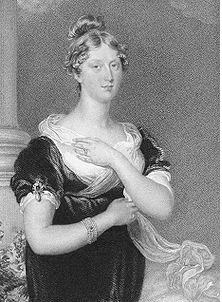
Princess Charlotte of Wales, during her pregnancy

Princess Charlotte of Wales, during her pregnancy

Lady Beauchamp [wrinkling her nose]: Of course. Well, we had met in passing at ton events when she was a child, although rarely with her mother, since her father wished to limit her exposure to her mother’s eccentricities. [Coughing delicately]. Blood will tell, however. Lady de Clifford, who had the charge of her at the time—only a baroness, you know—gave her far too much freedom. The girl had no sense of propriety—quite the hoyden as a child, but it was far worse when she reached adolescence.

Susana: Well, adolescence is a difficult time for everyone. I taught thirteen-year-olds for twenty-five years, you know. The best thing about it is that it eventually passes. I suppose the Princess showed the usual interest in the opposite sex?

Lady Beauchamp [shaking her head]: Oh, much worse than that, my dear Miss Ellis! If it wasn’t one of her cousins (illegitimate, you understand), it was William, Duke of Gloucester. They all took her fancy at one time or another. The rumors were rampant all over Town! Upon this proof that she took after her scandalous mother, the Prince Regent made arrangements for a marriage with William of Orange, hoping for an alliance with the Netherlands. It all came to nothing of course. Stubborn, stubborn girl! Not at all the sort of girl who ought to be a princess!

Susana: Do you know why she didn’t like the Prince of Orange?

Lady Beauchamp [curling her lip]: Indeed I do. She confided in me once—quite soon after she and Prince Leopold had settled at Claremont House—which is near Beauchamp’s estate in Surrey, you know—that he refused to promise to allow her mother to visit them after they were married because of her scandalous reputation, and after that, she steadfastly refused to have him. [Leaning closer to Susana] Of course, by then her mother had already fled to the Continent, and she never saw her again anyway.

Susana: How sad!

Lady Beauchamp [shrugging]: Was it? Many would say it was all for the best.

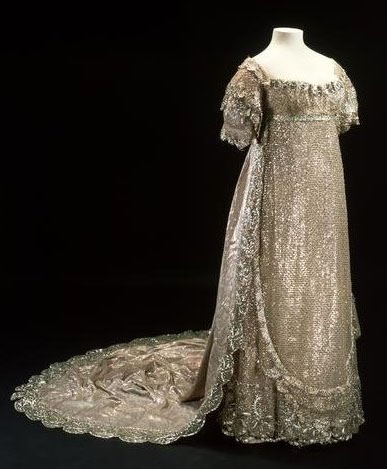
Princess Charlotte's silver lace wedding gown

Princess Charlotte’s silver lace wedding gown

Susana: So you socialized with the royal pair after their marriage. What can you tell us about them?

Lady Beauchamp: Quite a boring pair, really. Prince Leopold—who was quite impoverished, you understand, before he wed the heir to the throne of England—took rather too much of an interest in agriculture for my taste. Of course, he and Beauchamp used to tramp all over looking at crops, of all things. Her Royal Highness thought it was quaint.

Susana: But they got on well together?

Lady Beauchamp [reluctantly]: I suppose they must have. I never heard talk of rows between them, and her manner of dress became more sedate after her marriage. Indeed, Prince Leopold seemed to have a calming influence on her. We shared a box at the races once, and when Her Royal Highness began to show rather more enthusiasm than was proper, her husband caught her attention and said, “Doucement, chérie,” and she immediately smiled and regained her composure.

Susana [eyes filling with tears]: How sweet! What a shame their time together was so short! Were you around her during her pregnancy?

Lady Beauchamp: Her confinement, Miss Ellis. Do try to exercise a bit of restraint in your speech, even though you are American. [Sighing heavily]. Indeed I did see her a few times, although as her condition advanced, she was kept in seclusion. Considering all of the doctors who were consulted, one would have thought at least one would have been able to assist her safely through her trial. But no, she was allowed to eat until she reached elephantine proportions, and then they tried to starve her until she turned despondent. Why, Sir Richard Croft was not even a physician! My own husband would never have allowed a mere accoucheur near me when I was brought to bed. But it’s like my mother says, everything the Prince Regent touches ends in failure. Born under an unlucky star, she believes.

Susana: I understand Prince Leopold never recovered from the death of his wife and son.

Lady Beauchamp: Nor has England either. One would think the world has come to an end. The King has no legitimate grandchildren and his youngest son is over forty. The city closed down for two weeks and within a few days there was no black cloth to be had, as all of England was in mourning. Beauchamp said there wasn’t a dry eye to be seen during the funeral, when she was laid to rest with her son at her feet in St. George’s Chapel at Windsor Castle. To be sure, I can’t imagine what will happen to the succession now. I suppose all of the royal princes will run out and marry and try to sire an heir as quickly as possible. [Pursing her lips] Well, all I can say is they’d be well advised to do it soon, because the King’s health deteriorates as we speak, and the Regent isn’t much better. [Sliding her chair closer to Susana] My dear Miss Ellis, it occurs to me that you must be in possession of—shall we say?—interesting information about what happened with the succession. Perhaps you would be kind enough to indulge my curiosity?

Susana [glancing at her watch]: Oh dear, look at the time! If you do not return immediately, Lady Beauchamp, I fear you will be late for Lady Pritchard’s Venetian Breakfast. Do accept my sincere thanks for condescending to speak with me this morning!

Lady Beauchamp [with narrowed eyes]: As it happens, you are correct, Miss Ellis. I really must take my leave of you. However, you can be sure that I shall seek out Lady Pendleton as soon as may be to discover what she knows. [She waves her arms and disappears.]

Susana [gripping the arms of her chair]: I do wonder how this time travel thing is managed. Lady P has mentioned something about an old lady who runs the apothecary shop on Dapple Street, but she has so far declined to go into detail. [Frowning] When she does return, we are going to have a long chat about a few things I discovered after she left. For one thing, my digital camera is missing…after she went on a photography binge taking pictures of everything, even the engine of the car. And then there is a little matter of charges on my credit card for $800 at Toys R Us and more than $300 at the Battery Warehouse. Did she hear nothing I told her about the Prime Directive?

Lady P will be back soon. As always, please do comment if you have any questions you’d like to ask Lady P about the late Georgian/Regency era. She does love to chat!

The Lady P Series

Episode #1: Susana’s Adventures With Lady P: The Introduction

Episode #2: Lady P Talks About… Pride and Prejudice?

Episode #3: Lady P and the Duchess Who Lost a Billion Dollars

Episode #4: Lady P and the Face On the $100 Bill

Episode #5: In Which Lady P Discovers Sparkly Fabrics and Ponders Violating the Prime Directive

Episode #6: Lady P Dishes the Dirt on the Duchess of Devonshire

Episode #7: The Political Exploits of Lady P and the Duchess of Devonshire

Episode #8: Lady P and the Prince Regent’s Illicit Marriage

Episode #9: In Which Lady P Depletes the Cooking Sherry During Her Discussion of Caroline of Brunswick

Episode #10: Lord Byron: Mad, Bad, and Dangerous to Know

Episode #11: In Which Lady P Talks About Hannah More and the Rights of Women

Episode #12: Lady P’s Revelations Regarding George III and His Peculiar Progeny

Episode #13: Lady P Discusses the Luddite Uprising, the Assassination of Spencer Perceval, and the General Unfairness of Life

Episode #14: In Which Leticia, Lady Beauchamp, Pops In For an Interview On Her Personal Acquaintance With Princess Charlotte of Wales

Episode #15: Lady P On Assignment in 1814 Kent

Lady P Quizzes Jane Livingston, the Hero’s Sister From “A Twelfth Night Tale”

Episode #13: Lady P Discusses the Luddite Uprising, the Assassination of Spencer Perceval, and the General Unfairness of Life

Lady Pendleton, Damian Ashby’s eccentric aunt (see the epilogue to Treasuring Theresa on Susana’s web site), is visiting Susana from the early 19th century. She’s intrigued by life in 21st century Toledo, Ohio, and, of course, Susana is thrilled to have the opportunity to pick her brain about life in Regency England. It certainly gives her a great deal to write about in Susana’s Parlour!

Susana: Lady P and I recently returned to Ohio after spending a month in Florida where she enjoyed taking daily “constitutionals” around the retirement village where my parents live, and eventually condescended to take a dip in the heated pool, although the bathing costume she rigged for herself raised more than a few eyebrows from the other swimmers.

Lady P [indignantly]: My dear Susana, I could not possibly have appeared in public in those-those underthings you and your mother wore. I should have been utterly humiliated!

Susana: They are called swimsuits, Lady P. Bathing costumes. And that’s what everyone else wore.

Lady P [with a hand to her head]: The gentlemen—such as they were—were much worse. I thought I would swoon when I saw those naked chests!

Susana [chuckling]: But surely you have seen a bare-chested man before, Lady P. Why, you and Lord P were married for nearly twenty years, were you not?

Lady P: Well, of course I did, but not in public, Susana. Why, my Pendleton was exceedingly conscious of propriety. He would never have appeared in public half-dressed; why his valet would have slit his own throat before allowing it!

Susana [biting her lips to keep from laughing at the thought of the suicidal valet]: These gentlemen are from the 21st century, Lady P. Frankly, what these men wore was quite modest compared to some of the younger gentlemen. Don’t you remember that day when we went to the beach and saw—

Lady P [shuddering]: Do not even remind me, Susana. The young women’s attire…why they were nearly as naked as the day they were born! Where is their sense of modesty?

Susana [making a mental note to avoid beaches and pools in the future]: Perhaps we should get back to today’s topic—the Luddite revolt in 1811-12. Can you tell my readers what you recall of that uncertain time?

Lady P: Indeed I can, although one could wish to forget it.

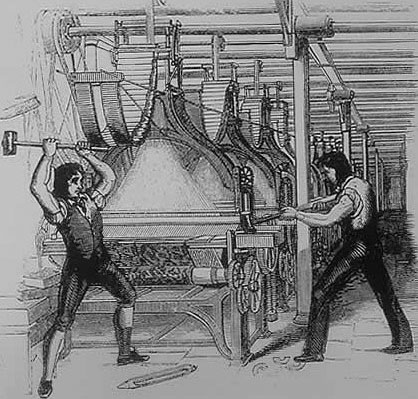
ludditesSusana: It started in the Midlands with the stocking industry, when stockingers, using looms and equipment leased from their employers in their homes, lost more than half their income when they were forced to produce cheap stockings that their employers could sell in larger quantities and increase their profits. Is that correct?

Lady P: How could I forget? Those stockings fell apart after barely a week of wear, and even the servants disdained them!

Susana: That was the same year the harvest failed, and food prices rose to an alarming level, and more and more people were suffering in economic distress.

Lady P: A shilling for a loaf of bread! It was outrageous!

Susana: People became desperate, and before long, gangs of disguised men started going around destroying the frames and looms used to produce the stockings to protest the treatment of the workers and the poverty more and more of them were forced to endure.

Lady P: That may be how it started, Susana, but it escalated into so much more than that. Why, many of us feared an uprising against the monarchy comparable to the French Terror of barely two decades past. And there wasn’t much to be done about it; Pendleton told me that fully half of the militia had taken up the cudgel for General Ludd in stealth and would turn against their officers in a trice if ordered to put down the revolutionaries.

Susana: I’m curious to know what Lord P thought should be done about it. He was a Tory, and the Tories were in power. Did he approve the decision to make frame-breaking a capital offense?

Lady P [shaking her head and sighing]: No, of course he did not. He thought it was incredibly stupid to think that masses of starving insurgents could be deterred by fear of the gibbet if they were caught. [Swallowing hard] He was, in fact, quite moved by Lord Byron’s speech in the House of Lords, where he decried the Tories’ attempt to solve the problem by force. He insisted—quite eloquently, Lord P admitted—that the Midland workers were being exploited to increase the profits of a few hosiers, and that the resulting misery benefitted no one.

Susana [thoughtfully]: The more things change, the more they stay the same. [Seeing Lady P’s raised eyebrow]: I was just thinking of how the Ohio House of Representatives just voted to eliminate the forty-hour work week so that employers won’t have to pay overtime—pay them double—for working more than that.

Lady P: As to that, I can’t say, Susana. But that is one reason I became a Whig. I would never go so far as to overturn the entire government and plunge the country into turmoil and terror such as what happened in France, but I have always believed that certain reforms to prevent the poor from being exploited could be instituted without much upheaval, and that the entire country would be the better for it. [Sighing] Dear Pendleton felt the same, but he was unable to persuade his colleagues to listen to reason. As afraid as they were of a revolution, the only solution the Tories could agree on was to threaten the insurgents.

Susana: It wasn’t long after that the Tories fell out of power, didn’t they? After the assassination of the Prime Minister?

Lady P: Indeed, and it was well-deserved too. Not because the Whigs’ ideas were much better, although they certainly used the Tories’ imprudence to their advantage. The Prince Regent’s intemperate behavior and his treatment of his wife made him vastly unpopular, so the Whigs took up the cudgel for Princess Caroline, proclaiming that she was being badly treated, and causing more riots, spreading to the north.

percevalSusana: And didn’t the people actually cheer the assassin as he was led to his execution a week later? There was that much dissatisfaction with the government that they cheered the murderer of the Prime Minister?

Lady P [tight-lipped]: Poor Lord Perceval. He was a good man. Had twelve children, you know. A family man. He could have gone far, if it weren’t for that Bellingham fellow shooting him in the House of Commons. Do you know the government wouldn’t even give him a public funeral because they were fearful of riots? I hardly knew what to say to his wife Jane when I saw her after that.

Susana [sighing]: Some things seem so unfair, don’t they? Like my friend whose daughter just died of breast cancer at age thirty-seven. Or many of my friends whose husbands lost their jobs and couldn’t find anything comparable afterward because of their age and the cost of health insurance. What do you say? How do you help them?

Lady P [clucking]: I suppose there will always be misery and injustice, no matter how diligently we try to eliminate it.

Susana: But that doesn’t mean we should stop trying.

Lady P [smiling]: Exactly. Now, Susana, don’t you think something should be done about all the weeds in the back garden? Since the weather turned warmer, they seem to be popping up all over the place.

Susana [leaving the room]: Have at ’em, Lady P. There’s a hoe in the shed and some work gloves in the drawer over there.

Lady P [frowning]: And where might you be going, then?

Susana [from the office]: I have a Christmas story to write. Deadline, you know. Can’t be bothered with weeds for awhile.

Lady P makes a beeline for the back door, audibly grumbling about “misplaced priorities,” “writing Christmas stories in May,” and that she “really should go back to the 19th century where there were gardeners to do such onerous tasks.”

As always, please do comment if you have any questions you’d like to ask Lady P about the late Georgian/Regency era. She does love to chat!

The Lady P Series

Episode #1: Susana’s Adventures With Lady P: The Introduction

Episode #2: Lady P Talks About… Pride and Prejudice?

Episode #3: Lady P and the Duchess Who Lost a Billion Dollars

Episode #4: Lady P and the Face On the $100 Bill

Episode #5: In Which Lady P Discovers Sparkly Fabrics and Ponders Violating the Prime Directive

Episode #6: Lady P Dishes the Dirt on the Duchess of Devonshire

Episode #7: The Political Exploits of Lady P and the Duchess of Devonshire

Episode #8: Lady P and the Prince Regent’s Illicit Marriage

Episode #9: In Which Lady P Depletes the Cooking Sherry During Her Discussion of Caroline of Brunswick

Episode #10: Lord Byron: Mad, Bad, and Dangerous to Know

Episode #11: In Which Lady P Talks About Hannah More and the Rights of Women

Episode #12: Lady P’s Revelations Regarding George III and His Peculiar Progeny

Episode #13: Lady P Discusses the Luddite Uprising, the Assassination of Spencer Perceval, and the General Unfairness of Life

Episode #14: In Which Leticia, Lady Beauchamp, Pops In For an Interview On Her Personal Acquaintance With Princess Charlotte of Wales

Episode #15: Lady P On Assignment in 1814 Kent

Lady P Quizzes Jane Livingston, the Hero’s Sister From “A Twelfth Night Tale”

The Dress: Episode #3

In Kansas City at the Romantic Times Convention!

We did it!

The dress and coat are both done, no thanks to me since I got sick the last couple of days and couldn’t even help with the handwork. The best I could do was show up for fittings, pose for pictures, and eventually, pack up the car for the 1200-mile trip from the Florida retirement community to Kansas City. I still feel a bit like the wicked stepsister, taking off for the ball while leaving Cinderella at home to prepare two houses (mine and hers) for the summer while we head back to Ohio. I seriously owe you, Mom!

gown427-4My mom’s a genius! Not only did she do a fantastic job on both garments, but she sewed on hanger loops and outfitted me with a needle and thread in case something goes wrong. She really deserves to be here at RT on Wednesday night when I wear it to the Ellora’s Cave disco party (not going to do any disco dancing, however) and the 30th Anniversary Ball on Thursday. I’ve promised photos, and they’ll be posted here as well.

Observations on the entire process

  • This is not a project for an amateur. I could never have done this myself, and I do have some sewing experience. The fitted bodice required a LOT of pattern alterations, since we couldn’t use any sort of stretchy fabric and still remain anywhere close to authentic.
  • The gown my sister had made had two separate drawstrings in the bodice to make it more fitted, since she was not available for fittings. That turned out well, but I’m not sure that would have worked well with the pattern we used.
  • We had to fudge on the back closings, since we could not get the eyehole punch to work through two layers of fabric and interfacing. In the end, we used hooks and eyes and snaps, and yes, I do need a lady’s maid to help me into it. (Any volunteers?)

How much did I spend on this project?

  • As to that, I’m not sure I really want to know. The most costly trip to Jo-Ann’s was $143, and that was mostly for the fabric and lining (for both the gown and the coat). The price for the trim and lace was another $100 or so (and totally worth it, I think you will agree), and there were several other trips to Jo-Ann’s in various towns for things like interfacing and other sewing notions. A few things (like the eyehole punch) got returned too, so I can’t tell you the final cost. But I would guess it was at least $350, and that does NOT include the hours and hours my mother put into it. But that’s not all! I also invested a considerable sum in accessories, including:
  • Regency slippers with “diamond” clips, plus clockwork stockings, from American Duchess
  • ringlet hairpiece
  • three different tiaras (couldn’t make up my mind)
  • long white gloves
  • brooch to wear with the coat
  • special “undies” (not authentic, but who’s going to know?)

gown_detailBut it’s not about the money.

It’s never been about the money.

It started with my friend Ellen’s idea for promoting Susana Ellis the author at conferences like this one (although I suspect that I will not be the only one in costume here.) But it became so much more than that. I never could have guessed how much my mother and I bonded during this process—from the first days of discussing the project to the difficult decisions about fabric choice (would you believe we originally intended the blue satin to be the gown and the cream pintuck taffeta to be the coat?) and many setbacks (like when the sleeve had to be redone and then we had to abandon the project for a few days to head north for a funeral) and wondering if it was possible to finish both garments in time for the conference.

Surprisingly, even my father became invested in this project. During the times when he seemed to have some health setbacks himself and Mom started worrying about having to head north earlier than planned and not being able to finish the coat, he told her to quit worrying about him and just finish it! He wanted to see the final product as much as we did, and thus, he started working harder at his physical therapy exercises (he has Parkinson’s).

Today’s the day!

I’m writing this on Wednesday, so by the time this goes live, the first event (the Ellora’s Cave disco party) will be over and hopefully I will have some photos to post. I’m planning to wear the gown for a Club RT appearance at 3:30, and then comes the stage walk with the Ellora’s Cave caveman. Oh yeah!

Click here for the video of the walk across the stage!

coat427-3On Thursday I’ll be wearing it for the Expo from 4-6 and then the RT ball in the evening. On Friday morning I have another appearance at Club RT. By then I’m sure it’ll be ready for the dry cleaner’s and the next opportunity, probably the RWA Conference in Atlanta.

If you are going to be at any of these events, please come up and chat with me and check out the gown in person. I’m looking forward to making lots of reader-author friends while I’m here, and I do hope you will be one of them! Warning: don’t be surprised if I ask you to be “lady’s maid” for me! Regency ball gowns were generally worn by well-off young ladies with abigails to assist them in dressing, and unfortunately, my first choice in lady’s maids—my sister Gloria—had to stay home with her cat. Where is a hunky Ellora’s Cave caveman when you need one?

Oh, and in case you’re wondering: Mom is NOT interested in taking this up as a profession or a hobby. Being retired in itself is a very time-consuming activity. Once is enough…and I’m the lucky one!

The Dress: Episode #1

The Dress: Episode #2

What Makes a Tortured Hero?

 What Makes a Tortured Hero?

When I think of a tortured hero, I think of Outlander’s Jamie Fraser, who had to let Claire return to the 20th century to save her life and that of their baby, and then endured 20 years without her, knowing that she was living with her 20th century husband and he’d never see her again, or their child. (Of course, Claire was equally tortured, and her 20th century husband as well, but they had Brianna, while Jamie was all alone (well, mostly anyway).

????????????????????????????????????????In Treasuring Theresa, Damian tells himself he’s not at all interested in a country bumpkin like Cousin Theresa, but why does it bother him to think that she’s still in love with Reese Bromfield, the man she always expected to marry?

In Cherishing Charlotte, my current WIP, Colin discovers that his past family squabbles are not nearly so torturous as falling in love with his employer’s granddaughter who is fated to marry a worthless fribble in order to save her family from penury.

In the as-yet-untitled next project, Gabriel, having suffered through a previous marriage to a lunatic, finally finds a woman he wishes to share his life with, but then discovers she has deceived him. He should steer clear of her. Hasn’t he learned his lesson?

One thing all of these “tortured heroes” has in common is their willingness to risk everything to protect the women they love. Jamie has to allow Claire and the baby leave him forever. Damian has to prove his worth to win Lady Theresa’s heart. Colin must allow Charlotte to marry her cousin because he himself cannot save her family. And Gabriel has to come to an understanding that the circumstances of Isabelle’s past gave her no option but to do what she did, and that a life with her is worth fighting for.

Who is your favorite tortured hero? What makes him a tortured hero, in your opinion?

Treasuring Theresa, a 45-page Regency short story, is available now at Ellora’s Cave, Amazon, Barnes & Noble, All-Romance eBooks, Sony, Google Books, and Bookstrand.

Click here to find one of my favorite scenes. (The official excerpt is here.)

Note that all Ellora’s Cave books are 50% off on All-Romance eBooks for the month of April!

More information about Cherishing Charlotte, Susana’s current WIP, is available here.

Episode #12: Lady P’s Revelations Regarding George III and His Peculiar Progeny

Lady Pendleton, Damian Ashby’s eccentric aunt (see the epilogue to Treasuring Theresa on Susana’s web site), is visiting Susana from the early 19th century. She’s intrigued by life in 21st century Toledo, Ohio, and, of course, Susana is thrilled to have the opportunity to pick her brain about life in Regency England. It certainly gives her a great deal to write about in Susana’s Parlour!

georgeiiiSusana: [to the Reader]: Lady Pendleton’s opinions on George III tend to be diametrically opposed to mine, which she attributes to my “ignorance due to indoctrination by history books written by misguided wretches attempting to justify the dreadful bloodbath caused by the radical colonists.”

It seems doubtful that we will ever come to agreement on that score—too many years of July 4th picnics and fireworks and, pledging allegiance to the flag, and singing “The Star-Spangled Banner”—but I have begun to see George III in a more sympathetic light. More than 200 years have passed and since my trip to England last year, I have come to realize that the English do not see him as the tyrant “we” do (and I say “we” even though at least some of my ancestors still lived in England during that time), and most never did.

And I have to say—in spite of all the patriotism instilled in me over decades—I am intrigued with the idea of growing up speaking with a British accent. (Can I be deported for saying that?)

Lady P: You must admit that the American accent sounds decidedly low class, Susana. Perhaps I could give you lessons in enunciating. Much like that Henry Higgins did to Eliza in that film we saw the other evening. You would never pass for upper class in society, of course, but it would be a definite improvement.

Susana: I thank you for offering, Lady P, but I’ll stick with the lazy American drawl for now. Perhaps some other time.

Lady P: Very well. Shall we discuss His Royal Highness King George III for your readers? Where shall I start?

Susana: At the beginning would be best. Where did you meet him?

Lady P: I was too young to attend his wedding to Queen Charlotte, but I do recall my mother bringing home a flower—was it a camellia or a rose?—but it was pink and she put it in one of the heaviest books in the library for pressing. I remember feeling very sad that she had to destroy such a pretty posy in order to preserve it. I wonder what happened to it? I believe my brother Henry inherited all the books in the library, so perhaps it’s still there. He was never one to read or study overmuch.

Susana: But you did meet him at some point?

Lady P: Goodness, yes. During my come-out—my mother was so vexed that the Royal Pair failed to attend my presentation ball—I was presented to Queen Charlotte, as were all of the young debutantes, you know, and I did meet them once or twice that season. After I was married to Lord Pendleton, we met more often. Lord P was in the House of Lords, you know, and we were obliged to attend certain political events.

Susana: What did you think of him?

Lady P: He was a kindly old man, quite stodgy, you understand. As a young girl, I didn’t appreciate that quality in him. One expected the King to be a cut above the rest of society, and he wasn’t at all. I recall complaining to Pendleton about the plainness of the fare at Windsor Castle and why the King could not have a French chef as skilled as ours, and he said the King didn’t appreciate rich food anymore than he did the French. Good, hearty English fare was good enough, he said.

Susana: I hear his marriage was a love-match.

Lady P [snorting in a very unladylike manner]: Romance again, Susana? Americans seem obsessed with it. The King met his betrothed on the day of the wedding. He wasn’t allowed to marry Lady Sarah Lennox when he wished to because she was only the sister of a duke. Royalty must marry royalty, you know. Or at least they did in my time.

Susana: But they did have fifteen children, so the marriage must have been somewhat of a success.

Lady P: Oh indeed, they got on well after that. Queen Charlotte was not well-favored, but she had a very pleasant disposition. She was a perfect wife for a down-to-earth man like the King.

Susana: So what happened to their children? The sons, at least, did not seem to be able to sustain such happy marriages. Look at the Prince Regent, for example. His life was like the antithesis of his father’s.

Lady P: Indeed. The King disliked his oldest son intensely. Frederick was his favorite. Pendleton told me the King often bemoaned the fact that Frederick was not his oldest son. Brought up to be a military man. He was the Commander-in-Chief of the Army, you know, until the scandal.

Susana: The scandal?

Lady P: Apparently he passed on military secrets to his mistress, a sly little hussy by the name of Mary Anne Clarke. She took bribes in exchange for promotions, and although she was the one to blame, it was his indiscretion in telling her such things that caused him to resign in disgrace. [shaking her head sadly] Should have stuck by his long-suffering wife. Frederica was a most amiable woman.

Susana: So even his favorite had feet of clay. What about the others? Wasn’t one of them accused of murder?

Lady P: Ernest, that was. He was an odd sort. Spread all sorts of cruel rumors about his brothers. His valet turned up with his throat cut, and it was whispered that he’d been seduced by his master, who murdered him when the man attempted to blackmail him.

Susana: Oh my. Homosexuals were hung in those days, were they not?

Lady P: Indeed they were. It would have been a massive scandal had that little fact become known. Which is no doubt why the inquest determined that the man committed suicide.

Susana [shuddering]: Who commits suicide by cutting their throat?

Lady P: Exactly. Not to mention that the man was left-handed, and the deed had to have been done with his right hand. [sighing] But I suppose such things must be done to protect the monarchy and the nation.

Susana: Surely among fifteen children there must have been at least one or two who turned out well. What about the daughters?

Lady P: Poor Amelia died in 1810. She was 27 and unmarried, since she had not been allowed to marry the man of her choice, Charles Fitzroy. She was the youngest and the King’s favorite and he was never the same after that. The other girls—well, the oldest, Princess Charlotte was married to the King of Württemburg—remained unmarried and living at home, and dear me, they never dissembled about expressing how they felt about that. Well, they were all rather plain, like their mother, and ran to fat, but they did adore their father, no matter how unstable he become as the years passed.

Susana: The Prince of Wales was made Regent because of his illness, which has been called dementia. Did you ever see him in that state, or know someone who did?

Lady P: I did not, of course, since he was kept in seclusion as soon as he began to exhibit symptoms. But Pendleton did, on one occasion, when he was attending the King on parliamentary business. [clucking her tongue]. He began speaking in shrill tones, so quickly that he could not be easily understood, calling for “the woman he loved,” a certain Lady Pembroke who served at court. His eyes bulged and he dropped his breeches to reveal his backside. Pendleton was horrified when I nearly fell over laughing when he described it. He said it was a horrifying experience.

Susana: The King of England mooned your husband? Heavens, what a sight that must have been! [grinning broadly]

Lady P: Harrumph! It was, rather. And yet I did feel very sorry for him. He was a fine king and deserved much better than to be afflicted by such an undignified malady. And then to have his sons to be such bounders, and one of his daughters to bear an illegitimate child… It is almost a blessing that such distressing news was kept from him.

Susana [sighing]: My belief in fairytale royal marriages died a tragic death after what happened with Princess Diana. Although I can’t help hoping that Prince William and Kate will end up happily.

Lady P: They do seem a sensible pair, and very well-matched, like my nephew Damian and his wife Theresa. Have I told you Theresa is expecting again?

mi_hacienda_edited-1Susana: You’ve mentioned it a few times. What do you think about Subway for dinner?

Lady P: What was that Spanish place we went to last week? I rather fancy one of those—what do you call them—burros?

Susana: Burritos, Lady P. And it was Mexican, not Spanish. Mi Hacienda, on Glanzman Street. They offer salsa lessons on Wednesday nights. What do you say we paint the town while we’re at it.

Lady P: A burrito will do, Susana. And perhaps some of those savory chips. Never had anything like them before. Do you suppose I can take the recipe back with me for my own cook to prepare?

Susana [shaking her head]: Sorry, Lady P. We’ve had this discussion before. Remember the Prime Directive?

As always, please do comment if you have any questions you’d like to ask Lady P about the late Georgian/Regency era. She does love to chat!

The Lady P Series

Episode #1: Susana’s Adventures With Lady P: The Introduction

Episode #2: Lady P Talks About… Pride and Prejudice?

Episode #3: Lady P and the Duchess Who Lost a Billion Dollars

Episode #4: Lady P and the Face On the $100 Bill

Episode #5: In Which Lady P Discovers Sparkly Fabrics and Ponders Violating the Prime Directive

Episode #6: Lady P Dishes the Dirt on the Duchess of Devonshire

Episode #7: The Political Exploits of Lady P and the Duchess of Devonshire

Episode #8: Lady P and the Prince Regent’s Illicit Marriage

Episode #9: In Which Lady P Depletes the Cooking Sherry During Her Discussion of Caroline of Brunswick

Episode #10: Lord Byron: Mad, Bad, and Dangerous to Know

Episode #11: In Which Lady P Talks About Hannah More and the Rights of Women

Episode #12: Lady P’s Revelations Regarding George III and His Peculiar Progeny

Episode #13: Lady P Discusses the Luddite Uprising, the Assassination of Spencer Perceval, and the General Unfairness of Life

Episode #14: In Which Leticia, Lady Beauchamp, Pops In For an Interview On Her Personal Acquaintance With Princess Charlotte of Wales

Episode #15: Lady P On Assignment in 1814 Kent

Lady P Quizzes Jane Livingston, the Hero’s Sister From “A Twelfth Night Tale”