Archives

Amy Rose Bennett: Master of Strathburn (Giveaway)

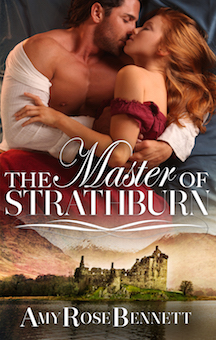
MasterOfStrathburnFINAL copy 2

The Master of Strathburn is essentially a tale about Robert Grant, a wanted Jacobite. After surviving the Battle of Culloden, he escapes to France and then the Caribbean. However, after a decade of living in exile, he desperately wants to return to Scotland and reconcile with his estranged father, the Earl of Strathburn. The only problem is, there is still a price on his head—he isn’t fortunate enough to have been granted a pardon through the Act of Indemnity in 1747. Not only that, his dissolute half-brother Simon and avaricious step-mother would have him arrested by the British in the blink of an eye to prevent him from reclaiming his birthright. Of course, when Robert returns to Lochrose Castle, his long-lost Highland home, the adventures and the romance begin…

Scotland and its rich history has always fascinated me. The idea for writing a novel set around the time of the second Jacobite Rebellion, the Forty-five, came to me when I was sixteen, after I’d read a short story about Flora MacDonald, the brave young woman who helped Bonnie Prince Charlie—the Pretender to the Scottish throne and indeed, the throne of England—escape the Highlands after the rebellion failed. Of course, I’ve done a lot more research into the period since then. After reading about Culloden—the last battle of the rebellion in which the Jacobite army was resoundingly defeated—I knew I particularly wanted to write about a Jacobite hero who was present at the battle and his struggles dealing with the aftermath following the failed uprising. And hence Robert Grant’s story came to life in my mind.
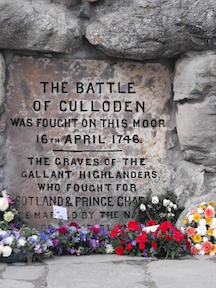
Culloden Memorial Cairn copy

The Battle of Culloden took place at Drumossie Moor, not far from Inverness in the north-west of Scotland on April 16, 1746. I was fortunate enough to visit the site several years ago; it was actually only a few days after the anniversary of the battle and families who’d lost relatives had laid wreaths against the memorial cairn. The moor is actually classified as a war grave and there are small headstones marking the places where particular clansmen fell. It is estimated that 1500 to 2000 Jacobite soldiers were killed or wounded during the brief battle whereas the British army sustained only fifty casualties. Needless to say, visiting Culloden was a very moving experience.

About Master of Strathburn

A sweeping, sexy Highland romance about a wanted Jacobite with a wounded soul, and a spirited Scottish lass on the run.

Robert Grant has returned home to Lochrose Castle in the Highlands to reconcile with his long-estranged father, the Earl of Strathburn. But there is a price on Robert’s head, and his avaricious younger half-brother, Simon, doesn’t want him reclaiming his birthright. And it’s not only Simon and the redcoats that threaten to destroy Robert’s plans after a flame-haired complication of the feminine kind enters the scene…

Jessie Munroe is forced to flee Lochrose Castle after the dissolute Simon Grant tries to coerce her into becoming his mistress. After a fateful encounter with a mysterious and handsome hunter, Robert, in a remote Highland glen, she throws her lot in with the stranger—even though she suspects he is a fugitive. She soon realizes that this man is dangerous in an entirely different way to Simon…

Despite their searing attraction, Robert and Jessie struggle to trust each other as they both seek a place to call home. The stakes are high and only one thing is certain: Simon Grant is in pursuit of them both…

AmazonBarnes & NobleiBooksKoboGoogle Play

In the following excerpt, Robert has just escaped the Battle of Culloden by the skin of his teeth. Or has he?

Excerpt

April 16, 1746

Lochrose Castle, Strathspey, Scotland

‘You’ve got a bloody nerve, Robert.’

‘Aye, I do.’ Robert Grant—the soon-to-be disinherited Master of Strathburn and Viscount Lochrose—squinted through the dark spots clustering his field of vision, trying in vain to focus on his sneering half-brother Simon. The bayonet wound across his shoulder-blade throbbed with such thought-stealing intensity, it was all he could do to stay seated upon his trembling, sweating horse. There was no way he would be able to dismount unassisted. He’d end up with his face firmly planted in the gravel of the forecourt. ‘But for the love of God, Simon …’ he continued, his voice no more than a hoarse rasp. ‘Just help me down. I’m wounded for Christ’s sake …’

He barely recalled the moment the English soldier’s blade had sliced across his back. The horror of everything else that had taken place only hours before on Drumossie Moor flooded his mind. Made the nausea rise in his gullet anew.

Simon snorted. ‘You must’ve had a blow to the head then, or else you would’ve remembered that Father forbade you to come back.’ He glanced past Robert, down the gravel drive toward Lochrose’s gates. ‘You’ve killed them all, haven’t you? It was a rout, just like Father said it would be, wasn’t it?’ His grey gaze, flint-hard with accusation and long-held resentment, returned to Robert. ‘He will never forgive you for this.’

No doubt. Twenty-six Clan Grant men dead. And I was the arrogant young cock who led them all out like lambs to the slaughter.

Robert swallowed down both the bile and bitter self-acrimony burning his throat. ‘I know,’ he croaked. ‘But please … I just need to hide until I can move on … tomorrow.’

Even though he had flagrantly disobeyed their father and had led out the clan at Culloden, Robert prayed that he would be shown a modicum of compassion. That the earl would at least grant his eldest son sanctuary for a single night before he fled Scotland to spend a life in exile in some far-flung place. Robert didn’t want to put his family at risk for harbouring a fugitive, but he just couldn’t go on any farther.

Simon smiled, the sentiment not quite reaching his eyes. ‘Of course, dear brother. I shall have a room prepared for you.’ He gripped Robert’s forearm with one hand at the same time he slapped the blood-soaked plaid sticking to his shoulder.

Bastard. Agonising, white-hot pain instantly knifed through Robert. Even as black oblivion at last rose up to claim him, he didn’t fail to notice that Simon was still smiling.

Giveaway: For a chance to win a Kindle copy of my Regency noir style romance set in Scotland, just tell me what it is you love about Highland romances.

About the Author

AuthorPic copyAmy Rose Bennett has always wanted to be a writer for as long as she can remember. An avid reader with a particular love for historical romance, it seemed only natural to write stories in her favorite genre. She has a passion for creating emotion-packed—and sometimes a little racy—stories set in the Georgian and Regency periods. Of course, her strong-willed heroines and rakish heroes always find their happily ever after.

Amy is happily married to her own Alpha male hero, has two beautiful daughters, and a rather loopy Rhodesian Ridgeback. She has been a speech pathologist for many years but is currently devoting her time to her one other true calling—writing romance.

Website and BlogFacebookTwitterPinterest
 

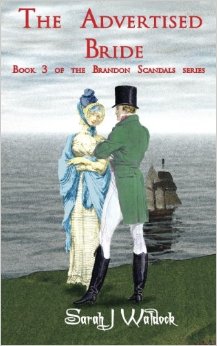
Sarah Waldock: The Advertised Bride

Lady L’s Outrage

“MATRIMONY – A lady of good birth and breeding, and without a stain on her character wishes, for reasons which will be revealed to any successful candidate to MARRY a young man of sufficient fortune and gentility to keep her in the state to which she is accustomed. His age should not exceed thirty years, and he should be of pleasant and amiable disposition. His income not to be less than two hundred guineas per annum. Reply post-paid only, to DC, care of the Landlord, ‘The Bell’, Saxmundham.”

“I ask you, what sort of woman of good birth and breeding writes a letter to the newspaper like that? Of course, once it came out that it was one of those shameless Brandon women, it became quite clear. Did you know the Brandons haven’t been free of scandal since the first Baron ran off with a nun in the fourteenth century? And recently there was that Crim. Con. case brought by the current baron, and his niece went off with one of the most notorious rakes in the land.

51OJbyOGLbL._SY344_BO1,204,203,200_But I was telling you about how this shameless hussy somehow managed to entrap the most eligible bachelor of all, the Honourable Mr. Percival Braidwood, whose blond locks gleam like gold and who has the profile of a Greek god. Add that to his fortune, reputed to be a cool ten thousand a year, and that before he inherits the baronetcy, and you can see why it’s just not fair that this nobody second cousin or whatever she is should win him. It was a trick, of that I’m sure. How she got him to answer such an advertisement is beyond me, or maybe she just took advantage of him staying in an inn where she was perusing likely candidates. I am certain she must have managed to arrange for him to compromise her in some way, and he such a gentlemen he had no choice but to offer marriage!

Am I jealous? Of course I’m jealous! I spent the entire season trying to catch Mr. Braidwood’s attention, and I am beautiful and accomplished, and an excellent conversationalist, as well as being fashionably dark. We were a perfect foil, my raven locks and his golden ones. It goes to prove, doesn’t it, that he must have been trapped, because why else would he end up married to a blonde whose hair isn’t even dark enough in colour to call a proper blonde?

Oh, no, I don’t want to give my name; well, if you must, write it down as Lady L. Listen, if you breathe a word to the Honourable Mrs. Eldridge that I spoke about her brother’s bride, I shall find ways to make it very uncomfortable for you. What does she say? Oh, Isolde is putting a brave face on it and declaring it a love match. A love match? Why, she obviously doesn’t know that this chit Diana, or whatever her name is, placed an advertisement in two provincial newspapers, and I found out about it which is why I came to you with the full story. I even found one of her disappointed suitors, whose hand and heart she spurned for greater wealth, despite the poor man being a widower with young children. No of course I wouldn’t marry an impoverished rector with brats, what do you take me for?

There was no call to say that, fellow.”

The Advertised Bride

The Advertised Bride was written with much input from my mother, who died while I was writing it, and I want to dedicate it not only to her, but to all women who have escaped from abusive families.  As well as having escaped an abusive father, my mother helped set up a local women’s refuge.  I hope Dinah’s escape will be inspirational for other women who feel trapped.

 Amazon

 Excerpt

“Dinah, such a long face! Surely you do not long for a husband to argue comparisons over?”

“No, and that’s the problem!” cried Dinah. “I am to be married after Christmas, and to a horrid old man who leered at me, and he has sweaty hands, and skin like mahogany, all wrinkled like a walnut, and Papa is not to be argued with over it. Indeed, I am afraid he will take me away, for Uncle Adam put him in a passion, criticising Marjorie’s husband.”

“Oh dear,” said Imogen. “Well, there is nothing else for it; you will have to get married before the end of the holidays. Have you any beaux?”

“No, I have never even been to a dance. I’m only sixteen and Mama said I should come out when I was seventeen. I shan’t be seventeen until April and that will be too late, and besides, Papa will say that coming out is unnecessary as he has found me a husband.”

“I can only see one course open to you, then, as I do not think you could manage to run away as I did without help,” said Imogen.

“You must think me very poor spirited,” said Dinah.

“No, my dear, I think you very much downtrodden, like a governess to horrible children, only your father is more childish than the most horrible child I have ever heard of,” said Imogen. “Fancy not being able to control his temper at his age!”

“I don’t think he ever had to,” said Dinah. “What idea did you have?”

“Why, insert an advertisement in the Ipswich Journal and the Norfolk Chronicle that you are looking for a husband, and then marry the one you like the most,” said Imogen. “I will help you to interview those who take your interest from their letters.”
“But Imogen, Papa might see the advertisement!” cried Dinah.

“Silly, you do not put it in your name,” said Imogen. “You write something like ‘Young lady seeks matrimony with a man of sufficient means and gentility to support a wife of breeding, no older than thirty. Send post-paid envelope to … oh, to some inn.”

 About the Author 

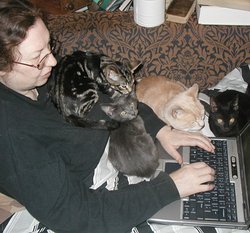
sarahwaldockSarah Waldock grew up in Suffolk and still resides there, in charge of a husband, and under the ownership of sundry cats. All Sarah’s cats are rescue cats and many of them have special needs. They like to help her write and may be found engaging in such helpful pastimes as turning the screen display upside-down, or typing random messages in kittycode into her computer.

Sarah claims to be an artist who writes. Her degree is in art, and she got her best marks writing essays for it. She writes largely historical novels, in order to retain some hold on sanity in an increasingly insane world. There are some writers who claim to write because they have some control over their fictional worlds, but Sarah admits to being thoroughly bullied by her characters who do their own thing and often refuse to comply with her ideas. It makes life more interesting, and she enjoys the surprises they spring on her. Her characters’ surprises are usually less messy [and much less noisy] than the surprises her cats spring.

Sarah has tried most of the crafts and avocations which she mentions in her books, on the principle that it is easier to write about what you know. She does not ride horses, since the Good Lord in his mercy saw fit to invent Gottleib Daimler to save her from that experience; and she has not tried blacksmithing. She would like to wave cheerily at anyone in any security services who wonder about middle aged women who read up about making gunpowder and poisonous plants.

Sarah’s History Place BlogSarah’s Cats Blog

Romance of London: Comments on Hogarth’s “Industrious and Idle Apprentices”

Romance of London: Strange Stories, Scenes And Remarkable Person of the Great Town in 3 Volumes

John Timbs

John Timbs (1801-1875), who also wrote as Horace Welby, was an English author and aficionado of antiquities. Born in Clerkenwell, London, he was apprenticed at 16 to a druggist and printer, where he soon showed great literary promise. At 19, he began to write for Monthly Magazine, and a year later he was made secretary to the magazine’s proprietor and there began his career as a writer, editor, and antiquarian.

This particular book is available at googlebooks for free in ebook form. Or you can pay for a print version.

Comments on Hogarth’s “Industrious and Idle Apprentices”

William Makepeace Thackeray

William Makepeace Thackeray

Mr. Thackeray, in his Lectures on the English Humorists, thus vividly paints the scenes of Hogarth’s masterpieces; at the same time he very ingeniously contrasts the past with the present—one of the more immediate benefits of the Lecture: the past is generally interesting, but it chiefly becomes instructive when brought under the powerful focus of the present. His account of Hogarth’s “Apprentices” is a masterpiece in this way:

1William_Hogarth_-_Industry_and_Idleness,_Plate_1;_The_Fellow_'Prentices_at_their_Looms

William_Hogarth-Industry and Idleness, Plate 1; The Fellow ‘Prentices at their Looms

Fair-haired Frank Goodchild smiles at his work, whilst naughty Tom Idle snores over his loom. Frank reads the edifying ballads of Whittington and the London ‘Prentice: whilst that reprobate Tom Idle prefers Moll Flanders, and drinks hugely of beer.

2william_hogarth_-_industry_and_idleness_plate_2_the_industrious_prentice_performing_the_duty_of_a_christian.png

William Hogarth-industry and idleness plate 2 the industrious prentice_performing the duty of a Christian

Frank goes to church on a Sunday, and warbles hymns from the gallery; while Tom lies on a tomb-stone outside playing at halfpenny-under-the-hat, and with street blackguards, and deservedly caned by the beadle.

william_hogarth_-_industry_and_idleness_plate_3_the_idle_prentice_at_play_in_the_church_yard_during_divine_service

william hogarth -industry and idleness plate 3 the idle prentice at play in the church yard during divine service

Frank is made overseer of the business; whilst Tom is sent to sea.

4William_Hogarth_-_Industry_and_Idleness,_Plate_4;_The_Industrious_'Prentice_a_Favourite,_and_entrusted_by_his_Master

William_Hogarth Industry and Idleness, Plate 4; The Industrious ‘Prentice a Favourite, and entrusted by his Master


william_hogarth_-_industry_and_idleness_plate_5_the_idle_prentice_turnd_away_and_sent_to_sea

william hogarth – industry and idleness plate 5 the idle prentice turnd away and sent to sea

Frank is taken into partnership, and marries his master’s daughter, sends out broken victuals to the poor, and listens in his night-cap and gown with the lovely Mrs. Goodchild by his side, to the nuptial music of the city bands and the marrow-bones and cleavers; whilst idle Tom, returned from sea, shudders in a garret lest the officers are coming to take him for picking pockets.

william_hogarth_-_industry_and_idleness_plate_6_the_industrious_prentice_out_of_his_time__married_to_his_masters_daughter

william hogarth – industry and idleness plate 6 the industrious prentice out of his time married to his masters daughter

william_hogarth_-_industry_and_idleness_plate_7_the_idle_prentice_returnd_from_sea__in_a_garret_with_common_prostitute

william hogarth – industry and idleness plate 7 the idle prentice returnd from sea in a garret with common prostitute

The Worshipful Francis Goodchild, Esq., becomes Sheriff of London, and partakes of the most splendid dinners which money can purchase or alderman devour; whilst poor Tom is taken up in a night cellar, with that one-eyed and disreputable accomplice who first taught him to play chuck-farthing on a Sunday.

william_hogarth_-_industry_and_idleness_plate_8_the_industrious_prentice_grown_right__sheriff_of_london

william hogarth – industry and idleness plate 8 the industrious prentice grown right sheriff of london

What happens next? Tom is brought up before the justice of his county, in the person of Mr. Alderman Goodchild, who weeps as he recognizes his old brother ‘prentice, as Tom’s one-eyed friend peaches on him, as the clerk makes out the poor rogue’s ticket for Newgate.

william_hogarth_-_industry_and_idleness_plate_9_the_idle_prentice_betrayed_and_taken_in_a_night-cellar_with_his_accomplice

william hogarth – industry and idleness plate 9 the idle prentice betrayed and taken in a night-cellar with his accomplice


william_hogarth_-_industry_and_idleness_plate_10_the_industrious_prentice_alderman_of_london_the_idle_on_brought_before_him__impreachd_by_his_accomplice

william hogarth -industry and idleness plate 10 the industrious prentice alderman of_london the idle on brought before him impreachd by his accomplice

Then the end comes. Tom goes to Tyburn in a cart with a coffin in it; whilst the right Honorable Francis Goodchild, Lord Mayor of London, proceeds to his Mansion House, in his gilt coach, with four footmen and a sword-bearer, whilst the companies of London march in the august procession, whilst the train-bands of the city fire their pieces and get drunk in his honor; and oh, crowning delight and glory of all, whilst his majesty the king looks out of his royal balcony, with his ribbon on his breast, and his queen and his star by his side at the corner house of St. Paul’s Church-yard, where the toy-shop is now.

william_hogarth_-_industry_and_idleness_plate_11_the_idle_prentice_executed_at_tyburn

william_hogarth- industry and idleness plate 11 the idle prentice executed at tyburn


william_hogarth_-_industry_and_idleness_plate_12_the_industrious_prentice_lord-mayor_of_london

william_hogarth -industry and idleness plate 12 the industrious prentice ord-mayor of london

How the times have changed! The new Post-office now not disadvantageously occupies that spot where the scaffolding is on the picture, where the tipsy trainband-man is lurching against the post, with his wig over one eye, and the ‘prentice-boy is trying to kiss the pretty girl in the gallery. Past away ‘prentice boy and pretty girl! Past away tipsy trainband-man with wig and bandolier! On the spot where Tom Idle (for whom I have an unaffected pity) made his exit from this wicked world, and where you see the hangman smoking his pipe, as he reclines on the gibbet, and views the hills of Harrow on Hampstead beyond—a splendid marble arch, a vast and modern city—clean, airy, painted drab, populous with nursery-maids and children, the abodes of wealth and comfort—the elegant, the prosperous, the polite Tyburnia rises, the most respectable district in the habitable globe!

In that last plate of the London Apprentices, in which the apotheosis of the Right Honorable Francis Goodchild is drawn, a ragged fellow is represented in the corner of the simple kindly piece, offering for sale a broadside, purporting to contain an account of the appearance of the ghost of Tom Idle, executed at Tyburn. Could Tom’s ghost have made its appearance in 1847, and not in 1747, what changes would have been remarked by that astonished escaped criminal! Over that road which the hangman used to travel constantly, and the Oxford stage twice a week, go ten thousand carriages every day; over yonder road, by which Dick Turpin fled to Windsor, and Squire Western journeyed into town, when he came to take up his quarters at the Hercules Pillars not he outskirts of London, what a rush of civilization and order flows now! What armies of gentlemen with umbrellas march to banks, and chambers, and counting-houses! What regiments of nursery-maids and pretty infantry: what peaceful processions of policemen, what light broughams and what gay carriages, what swarms of busy apprentices and artificers, riding on omnibus-roofs, pass daily and hourly! Tom Idle’s times are quite changed; many of the institutions gone into disuse which were admired in his day. There’s more pity and kindness, and a better chance for poor Tom’s successors now than at that simpler period, when Fielding hanged him, and Hogarth drew him.

One hundred and fifty years after Thackeray’s assertions that the world is a kinder place toward kids like Idle Tom, I’m not so certain I can say the same. As a former teacher, it seems to me that the system is still stacked against kids who “dance to a different drum” or who are raised in poverty and/or by indifferent parents. And I’ll be damned if I know how to change that. What do you think?


Romance of London Series

  1. Romance of London: The Lord Mayor’s Fool… and a Dessert
  2. Romance of London: Carlton House and the Regency
  3. Romance of London: The Championship at George IV’s Coronation
  4. Romance of London: Mrs. Cornelys at Carlisle House
  5. Romance of London: The Bottle Conjuror
  6. Romance of London: Bartholomew Fair
  7. Romance of London: The May Fair and the Strong Woman
  8. Romance of London: Nancy Dawson, the Hornpipe Dancer
  9. Romance of London: Milkmaids on May-Day
  10. Romance of London: Lord Stowell’s Love of Sight-seeing
  11. Romance of London: The Mermaid Hoax
  12. Romance of London: The Bluestocking and the Sweeps’ Holiday
  13. Romance of London: Comments on Hogarth’s “Industries and Idle Apprentices”
  14. Romance of London: The Lansdowne Family
  15. Romance of London: St. Margaret’s Painted Window at Westminster
  16. Romance of London: Montague House and the British Museum
  17. Romance of London: The Bursting of the South Sea Bubble
  18. Romance of London: The Thames Tunnel
  19. Romance of London: Sir William Petty and the Lansdowne Family
  20. Romance of London: Marlborough House and Sarah, Duchess of Marlborough
  21. Romance of London: The Duke of Newcastle’s Eccentricities
  22. Romance of London: Voltaire in London
  23. Romance of London: The Crossing Sweeper
  24. Romance of London: Nathan Mayer Rothschild’s Fear of Assassination
  25. Romance of London: Samuel Rogers, the Banker Poet
  26. Romance of London: The Eccentricities of Lord Byron
  27. Romance of London: A London Recluse

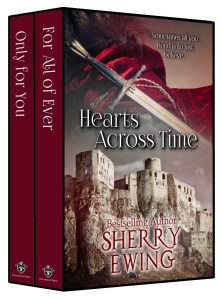
Sherry Ewing: Hearts Across Time Box Set (Giveaway)

I’d like to thank Susana for allowing me the opportunity to showcase my first box set. I’m Sherry Ewing and I write historical and time travel romances to awaken the soul one heart at a time.

Today I’d like to tell you about this special edition box set entitled Hearts Across Time: The Knights of Berwyck, A Quest Through Time Novel (Books One & Two) that released April 17, 2016. It contains my full-length novels For All of Ever and Only For You. Katherine and Riorden just happen to be my favorite characters I’ve created so far.

Attachment-1Originally, I had no plans to write a time travel. In fact, after I had finished my debut medieval romance, If My Heart Could See You (which is a free eBook by the way), I had every intention of writing about the youngest sister Lynet (A Knight To Call My Own). If you’re a writer, then you know how our characters have a mind of their own and will tell you the direction their lives will go. If you’re a reader, well…let me tell you its true…authors really do have voices inside their heads!

So Katherine and Riorden were “born,” so to speak, along with Katherine’s thee other friends who slipped through time in a turret at Bamburgh castle. I had so much fun writing these books that it spun a whole series and the next book, To Follow My Heart, will release this summer. I continue to be amazed at the amount of research that is available to authors these days and if you haven’t visited Bamburgh’s site, and love castles, don’t miss out! It’s very interactive with a video fly by, rooms to see, and lots of historical information on its origins dating back to its first recorded history in 547AD. And if that’s not enough, be sure to open some of the books in the “library”.

I’d like to show of a painting that a friend of my daughter, Kimberly King, did for me. Originally it was going to be my cover but timing being what it was for the both of us, it just didn’t work out. But I still wanted to have this beautiful piece a part of my book so I put it on the back cover of the print version. Kim took everything I wanted to depict a scene where Katherine see’s Riorden in a painting for the very first time when she at last learns his name. It’s still one of my favorite scenes in the book.

Since Susana and I are part of the Bluestocking Belles, I’d like to do a giveaway of my upcoming release Under the Mistletoe, that was originally part of the Belles’ box set Mistletoe, Marriage, & Mayhem. It will be available for just $0.99 on May 8th.

For a chance to win an eCopy of Under the Mistletoe, tell me the first historical romance you ever read and why it’s stuck with you all these years. I’ll choose a random comment as the winner.

About Hearts Across Time: The Knights of Berwick, A Quest Through Time Novel (Books One & Two)

Sometimes all you need is to just believe…

For All of Ever: Katherine Wakefield has dreamed and written of her knight in shining armor all her life. Yet, how could she have known that when she and her three closest friends take a dream vacation to England that they’d find themselves thrown back more than eight hundred years into the past? Riorden de Deveraux travels to Bamburgh answering the summons of King Henry II. But nothing prepares him for the beautiful vision of a strangely clad ghost who first appears in his chamber. Centuries are keeping them apart until Time gives them a chance at finding love. Will the past of one consume what their future may hold, or will Time take the decision from them and hurdle Katherine forward to where she truly belongs?

Only For You: Katherine de Deveraux has it all but settling into her duties at Warkworth Castle is not easy and downright dangerous to her well-being. Consumed with memories of his father, Riorden must deal with his sire’s widow. Yet how could he know how far Marguerite will go to have the life she feels they were meant to live? Torn apart, Time becomes their true enemy while Marguerite continues her ploy to keep Riorden at her side. With all hope lost, will Katherine & Riorden find a way to save their marriage?

AmazonBarnes & NobleiBooksKobo

Excerpt

She needed fresh air…that’s what she needed. Turning into the Great Hall to catch up with her friends, she found herself riveted to the floor. Even if she’d wanted to move, she couldn’t have. Hardly believing what she was seeing, she became mesmerized when the tourists milling around the chamber slowly vanished before her eyes.

box set pic from FBOnly one man was left standing at the far end of the room, or rather, one knight. He had been reaching for something on a table when Katherine saw his shoulders flinch. His red cape swirled around his legs when he turned to face her. Their eyes locked and Katherine’s breath left her at the intensity reflected in his face. Shock, intermingled with excitement, rushed through her. Her whole body began to tingle. Good God, it’s him! Her mind screamed. He stood there with such a commanding presence about him that she had no recourse but to move in his direction.

Inch by inch, the distance between them lessened as he, too, moved swiftly across the floor. Her arm extended, she reached for him, and yet their meeting was not to be. He quickly vanished, passing right through her. Her body lurched from the contact when the wispy vapor that had been him disintegrated upon their meeting. A soft cry of distress escaped her lips. How could fate be so cruel as to take him from her before they could speak even one word together?

Modern surroundings returned, and Katherine became disorientated when she was rudely bumped by some jerk, who didn’t even mutter an apology. She swiveled around, trying to see if her knight was maybe still lurking in the hall, but there was no trace of him.

She had taken no more than a few short steps, when a voice whispered inside her head. Katherine…come back to me, my love.

sherryAbout the Author

Sherry Ewing picked up her first historical romance when she was a teenager and has been hooked ever since. A bestselling author, she writes historical & time travel romances to awaken the soul one heart at a time. Always wanting to write a novel but busy raising her children, she finally took the plunge in 2008 and wrote her first Regency. She is a member of Romance Writers of America, The Beau Monde & The Bluestocking Belles. Sherry is currently working on her next novel and when not writing, she can be found in the San Francisco area at her day job as an Information Technology Specialist.

Sherry enjoys interacting with her readers.

WebsiteBluestocking BellesFacebookTwitter

GoodreadsPinterest • Newsletter
 

Romance of London: The Bluestocking and the Sweeps’ Holiday

Romance of London: Strange Stories, Scenes And Remarkable Person of the Great Town in 3 Volumes

John Timbs

John Timbs (1801-1875), who also wrote as Horace Welby, was an English author and aficionado of antiquities. Born in Clerkenwell, London, he was apprenticed at 16 to a druggist and printer, where he soon showed great literary promise. At 19, he began to write for Monthly Magazine, and a year later he was made secretary to the magazine’s proprietor and there began his career as a writer, editor, and antiquarian.

This particular book is available at googlebooks for free in ebook form. Or you can pay for a print version.

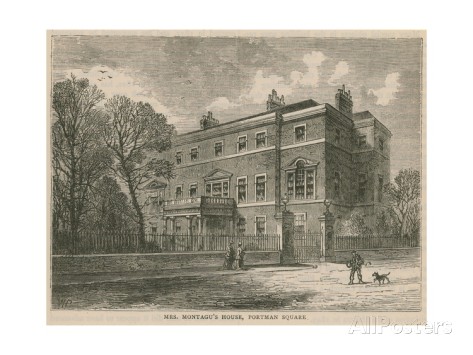
Montague House, Portman Square

Montague House, Portman Square

Elizabeth Montague’s Bluestocking Parties

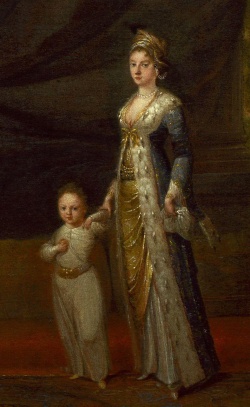
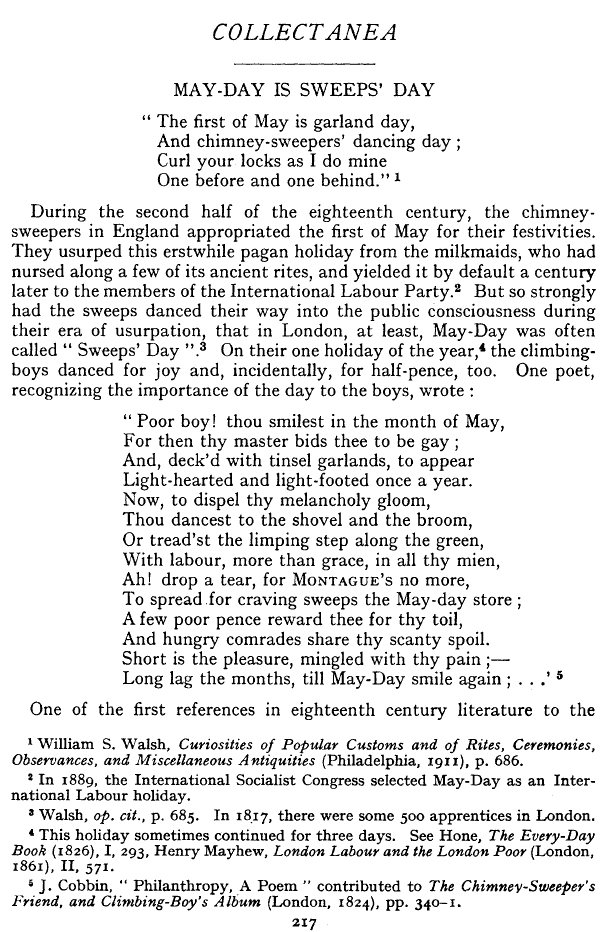
At the north-west angle of Portman Square is Montague House, built for Mrs. Elizabeth Montague, authoress of the Vindication of Shakespeare against Voltaire. She had often been a guest at the second Lord Oxford’s, the resort of Pope and his contemporaries; she was the intimate friend of Pulteney and Littleton; and she survived to entertain Johnson, Goldsmith, Burke, and Reynolds, to their respective deaths. Dr. Beattie was among her visitors; and Mrs. Carter, the translator of Epictetus, was her intimate friend, correspondent, and visitor. At Montague House Mrs. Montague had her blue stocking parties; and here she gave on the first of May, “Sweeps’ Holiday,” which originated in the discovery among the fraternity of chimney-sweeps, of the eccentric Edward Wortley Montague, ‘son of the famous Lady Mary Wortley Montague, by her husband, Edward Wortley.’
Lady Mary Wortley Montagu with Her Son Edward. Lady Mary was the first to bring smallpox inoculation to Western medicine after her experiences in the Ottoman Empire.

Lady Mary Wortley Montagu with Her Son Edward. Lady Mary was the first to bring smallpox inoculation to Western medicine after her experiences in the Ottoman Empire.

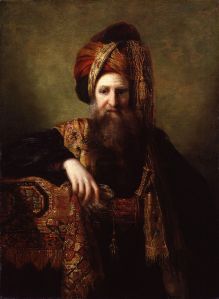
Edward Wortley Montague

This hopeful boy was born at Wharncliffe Lodge, in Yorkshire, about the year 1714; he was sent to Westminster School, whence he ran away, and was more than a year apprentice to a fisherman at Blackwall; he was sent back to Westminster, again ran away, and bound himself to the master of an Oporto vessel, a Quaker, from whom he escaped immediately on landing. In one of these flights, he changed clothes with a chimney-sweep, and for some time followed that occupation. After a long and anxious search, he was discovered by his friends, and restored to his parents, on the first of May, at the family mansion in Portman Square.

800px-Edward_Wortley_Montagu_by_Matthew_William_Peters

A 1775 portrait of Edward Wortley Montagu by Matthew William Peters

He had also served an apprenticeship among a traveling troop of showmen, who were distinguished by their skill in horsemanship; then worked in the fields in Holland as a day-laborer; next hired himself as a postillion; he then assumed the attire of an abbot, and passed for one at Rome. He next then passed for a Lutheran preacher at Hamburg, and was universally popular! He subsequently embraced the Mahomedan religion, and conformed to all Turkish habits, even to chewing opium and sitting cross-legged on the floor! With the Hebrew, Arabic, the Persian, and the Chadic he was as well acquainted as his native tongue. He at one time returned to England, and acted more comformably to his rank, and was returned as a member in two successive parliaments… But Montague’s profuse expenses soon compelled him to quit his native country, and he again assumed his wandering habits, and eventually died at Padua, at the age of sixty-two years.

The First of May: A Day for Chimney Sweeps

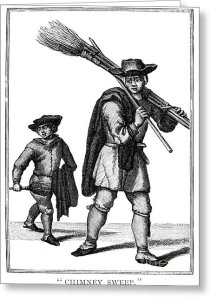
CHIMNEY SWEEP. A chimney sweep and his young helper. Line engraving, English, 18th century.

CHIMNEY SWEEP. A chimney sweep and his young helper. Line engraving, English, 18th century.

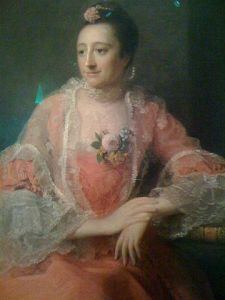
To commemorate the restoration of the truant to his family, in the grounds attached to Montague House, his relative, Mrs. Elizabeth Montague, for many years feasted the chimney-sweeps of London, on the first of May, with roast-beef and plum-pudding, “so that they might enjoy one happy day in the year.” And this special treat is said to have given rise to the general sweeps’ holiday. Mrs. Montague died in the year 1800, in her 80th year.

Portrait of Elizabeth_Montagu (1718-1800) by Allan Ramsay (1713-1784) in 1762

Portrait of Elizabeth Montagu (1718-1800) by Allan Ramsay (1713-1784) in 1762


Incidentally, chimney sweeps’ cancer is the first industrially-related cancer to be found (1775).

sweepsholiday

In honor of Sweeps’ Holiday:

Name any works of art, literature, movies, etc. that prominently feature chimney sweeps.


Romance of London Series

  1. Romance of London: The Lord Mayor’s Fool… and a Dessert
  2. Romance of London: Carlton House and the Regency
  3. Romance of London: The Championship at George IV’s Coronation
  4. Romance of London: Mrs. Cornelys at Carlisle House
  5. Romance of London: The Bottle Conjuror
  6. Romance of London: Bartholomew Fair
  7. Romance of London: The May Fair and the Strong Woman
  8. Romance of London: Nancy Dawson, the Hornpipe Dancer
  9. Romance of London: Milkmaids on May-Day
  10. Romance of London: Lord Stowell’s Love of Sight-seeing
  11. Romance of London: The Mermaid Hoax
  12. Romance of London: The Bluestocking and the Sweeps’ Holiday
  13. Romance of London: Comments on Hogarth’s “Industries and Idle Apprentices”
  14. Romance of London: The Lansdowne Family
  15. Romance of London: St. Margaret’s Painted Window at Westminster
  16. Romance of London: Montague House and the British Museum
  17. Romance of London: The Bursting of the South Sea Bubble
  18. Romance of London: The Thames Tunnel
  19. Romance of London: Sir William Petty and the Lansdowne Family
  20. Romance of London: Marlborough House and Sarah, Duchess of Marlborough
  21. Romance of London: The Duke of Newcastle’s Eccentricities
  22. Romance of London: Voltaire in London
  23. Romance of London: The Crossing Sweeper
  24. Romance of London: Nathan Mayer Rothschild’s Fear of Assassination
  25. Romance of London: Samuel Rogers, the Banker Poet
  26. Romance of London: The Eccentricities of Lord Byron
  27. Romance of London: A London Recluse

Sheri Cobb South: Too Hot to Handel (Giveaway)

Every novel contains, or should contain, certain scenes that stick in the reader’s memory long after the book is finished. The definitive scene in my newest release, Too Hot to Handel, finds Bow Street Runner John Pickett and his Lady Fieldhurst escaping a burning Drury Lane Theatre. This is the only book I’ve ever written that is centered upon an actual event; the Theatre Royal at Drury Lane really did burn down on 24 February, 1809. So, how much was real, and how much is the product of my imagination? Let’s take a look.

First of all, theatre fires were not a rare, or even a new, phenomenon. They had been regular occurrences since the theatres reopened after the Restoration of Charles II. Before that time, fire hadn’t been much of an issue. The theatres of ancient times had been outdoor affairs, and plays had been staged during the daytime. Even Shakespeare’s Globe Theatre, although enclosed all around, had a roof that was largely open to the sky, in order to reduce as much as possible the need for artificial lighting. But advances in theatre brought added risk of fire: the Globe burned down in 1613, when a cannon used for special effects in a production of Henry VIII misfired, setting the thatching over the stage ablaze. Although the theatre was destroyed, the only injury reported was one unfortunate man whose breeches were set on fire. (Quick-thinking theatergoers extinguished the flames by dousing him with ale.)

The real change came with the Restoration, when the re-opening of the theatres was celebrated with a host of innovations. The most prominent of these, of course, was the appearance of actresses in female roles that had previously been played by boys. Another, perhaps less-discussed innovation was the rash of theatre-building, including venues at Lincoln’s Inn Fields (1661) Drury Lane (1663), the Haymarket (1720), and Covent Garden (1731). Unlike their open-air predecessors, these new venues were fully enclosed. This meant performances were no longer limited to daylight hours, but it also meant that all performances, even those staged during the day, required artificial lighting. And artificial lighting meant open flames—either candles or oil lamps—and lots of them.

When we consider the combination of open flames and rowdy crowds—capacity in the new theatres rose from 650 seats at Drury Lane in 1700 to 3,600 by the time of the 1809 fire—the number of theatre fires is no longer surprising. In those days before electricity, the theatre at Drury Lane burned twice (in 1672 and again in 1809), as did the one at Covent Garden, aka the Royal Opera House (in 1808 and 1856). Ironically, only fifteen years earlier, in 1794, the Drury Lane theatre had installed a fire curtain made of iron—the first theatre in London to do so—along with large water tanks beneath the roof that could be used for special effects as well as fire safety.

With all these precautions in place, how, then, did it burn? No one knows. The theatre season was greatly subdued during Lent, with fewer plays being performed, and nothing, not even a rehearsal, was taking place on that Friday night in 1809. Since the theatre was apparently empty, there were no injuries, but from the incident we get the wonderful (if apocryphal) account of Richard Brimsley Sheridan—playwright, Member of Parliament, and manager of the Drury Lane theatre, who in 1794 had bankrolled the construction of the enormous new theatre from his own private fortune—watching the blaze from a nearby pub. When urged by his friends to go home, he is reported to have said, “Can a man not enjoy a glass of wine by his own fireside?”

Of course, from a writer’s perspective, the destruction of an empty building makes for dull fiction. So for the purposes of my story, I filled the theatre to its full 3,600-seat capacity and staged a production of Handel’s oratorio Esther. Besides being suitably sober for Lent, it contains a passionate duet between Esther and the king that made it a natural choice for Too Hot to Handel, certainly the most romantic of the John Pickett mysteries. And the fact that so little is known about the cause of the fire gave me the freedom to create my own “what if?” scenario.

Click here to see Sheri’s photos of the Drury Lane theatre before and after the fire in 1809.

51lvnXHv9RL._SX322_BO1,204,203,200_

About Too Hot to Handel

When a rash of jewel thefts strikes London, magistrate Patrick Colquhoun resolves to deploy his Bow Street Runners to put astop to the thefts. The Russian Princess Olga Fyodorovna is to attend a production of Handel’s Esther at Drury Lane Theatre,where she will wear a magnificent diamond necklace. The entire Bow Street force will be stationed at various locations around the theatre—including John Pickett, who will occupy a box directly across the theatre from the princess.

In order to preserve his incognito, Pickett must appear to be nothing more than a private gentleman attending the theatre. Mr. Colquhoun recommends that he have a female companion—a lady, in fact, who might prevent him from making any glaring faux pas. But the only lady of Pickett’s acquaintance is Julia, Lady Fieldhurst, to whom he accidentally contracted a Scottish irregular marriage several months earlier, and with whom he is seeking an annulment against his own inclinations—and for whom he recklessly declared his love, secure in the knowledge that he would never see her again.

The inevitable awkwardness of their reunion is forgotten when the theatre catches fire. Pickett and Julia, trapped in a third tier box, must escape via a harrowing descent down a rope fashioned from the curtains adorning their box. Once outside, Pickett is struck in the head and left unconscious. Suddenly it is up to Julia not only to nurse him back to health, but to discover his attacker and bring the culprit to justice.

Note: This book will be released on June 22, 2016. However, the previous book in the series is available.

In My Lady’s Chamber

Excerpt

Pickett opened the door of the theatre box, and immediately stepped back as he was struck with a wall of heat. The corridor was alive with flame, and as they stood staring into the inferno, a burning beam from the ceiling fell almost at their feet. He slammed the door shut.

“We won’t be going out that way,” he remarked, glancing wildly about the box for some other method of exit. He seized one of the heavy curtains flanking the box and pulled until it collapsed into his arms in a pile of red velvet. He located the edge and began ripping it into long strips.

“What are you doing?” asked her ladyship, her voice muffled by the folds of his handkerchief over her mouth.

Pickett jerked his head toward the sconce mounted on the wall between their box and its neighbor. Its many candles, so impressive only moments ago, now appeared pale and puny compared to the flames dancing all around them.

“I’m making a rope to tie to that candelabrum. You can climb down into the pit and escape from there. And don’t wait for me. As soon as your feet reach the floor, I want you to forget everything you ever learned about being a lady—push, shove, do whatever you have to do, but GET OUT, do you understand?”

“And what about you, Mr. Pickett?”

He glanced at the brass fixture. “I’m not sure if it will bear my weight, my lady. I suppose I’ll have to try—I don’t much fancy my chances in the corridor—but I’ll not make the attempt until I see you safely down.”

She leaned over the balustrade and looked past the three tiers of boxes to the pit some forty feet below, then turned back to confront Pickett. “Setting aside the likelihood that I would lose my grip and plummet to my death, do you honestly think I would leave you alone up here, to make your escape—or not!—as best you might? No, Mr. Pickett, I will not have it! Either we go together, or we do not go at all!”

The crash of falling timbers punctuated this statement, and although there was nothing at all humorous in the situation, he gave her a quizzical little smile. “ ‘ ’Til death do us part,’ Mrs. Pickett?”

She lifted her chin. “Just so, Mr. Pickett.”

The author is offering a trade-size paperback ARC of Too Hot to Handel to a random commenter.

About the Author

Five Star author photo copyAt the age of sixteen, Sheri Cobb South discovered Georgette Heyer, and came to the startling realization that she had been born into the wrong century. Although she doubtless would have been a chambermaid had she actually lived in Regency England, that didn’t stop her from fantasizing about waltzing the night away in the arms of a handsome, wealthy, and titled gentleman.

Since Georgette Heyer was dead and could not write any more Regencies, Ms. South came to the conclusion she would simply have to do it herself. In addition to her popular series of Regency mysteries featuring idealistic young Bow Street Runner John Pickett (described by All About Romance as “a little young, but wholly delectable”), she is the award-winning author of several Regency romances, including the critically acclaimed The Weaver Takes a Wife.

A native and long-time resident of Alabama, Ms. South recently moved to Loveland, Colorado, where she has a stunning view of Long’s Peak from her office window.

Website • Facebook • Goodreads

FREE on Kindle: The Ultimate Escape

Gold satin silk fabric closeup texture and background


The Ultimate Escape is Book 1 in The Lady P Chronicles, a Regency time travel series.

If you haven’t obtained your copy yet, now is the time! The novella is free on Kindle THIS WEEK ONLY!

On the eve of her wedding, Julia realizes she cannot marry her fiancé after all, no matter that it’s been her dream for eight long years. Too distraught to face him, she follows in her mother’s footsteps and flees to the future for a brief reprieve. Oliver knows he has bungled things badly, but he is determined to win the woman he loves, even if he must travel through time to do it.

FREE ON KINDLE: http://ow.ly/4mZYIP

Romance of London: The Mermaid Hoax

Romance of London: Strange Stories, Scenes And Remarkable Person of the Great Town in 3 Volumes

John Timbs

John Timbs (1801-1875), who also wrote as Horace Welby, was an English author and aficionado of antiquities. Born in Clerkenwell, London, he was apprenticed at 16 to a druggist and printer, where he soon showed great literary promise. At 19, he began to write for Monthly Magazine, and a year later he was made secretary to the magazine’s proprietor and there began his career as a writer, editor, and antiquarian.

This particular book is available at googlebooks for free in ebook form. Or you can pay for a print version.

The Mermaid Hoax

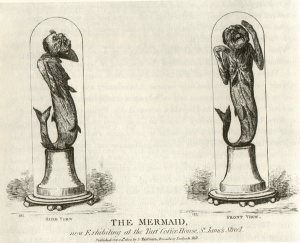
The absurd notion, that there are “Mermen and Mermaids, half man or woman and the remainder fish,” has long been exploded; but, little more than 40 years ago since (in 1822) thousands of dupes were attracted to the Egyptian Hall, in Piccadilly, to see a pretended Mermaid, when 300 or 400 persons paid daily one shilling each for the indulgence of their credulity! The imposture was, however, too gross to last long; and it was ascertained to be the dried skin of the head and shoulders of a monkey, attached very neatly to the dried skin of a fish of the salmon kind, with the head cut off; the compounds figure being stuffed and highly varnished, the better to deceive the eye. This grotesque object was taken by a Dutch vessel from on board a native Malacca boat; and from the reverence shown to it by the sailors, it is supposed to have represented the incarnation of one of the idol-gods of the Molucca Islands.

The mermaid

This impudent hoax upon the good people of London was the work of a Japanese fisherman, who seems to have displayed ingenuity for the mere purpose of making money by his countrymen’s passion for everything odd and strange. He contrived to unite the upper half of the monkey to the lower half of the fish so successfully as to defy ordinary inspection. He then gave out that he had caught the creature alive in his net, but that it had died shortly after being taken out of the water; and he derived considerably pecuniary profit from his cunning in more ways than one. The exhibition of the sea-monster to Japanese curiosity paid well; but yet more productive was the assertion that the half-human fish, having spoken during the few minutes it existed out of its native element, had predicted a certain number of years of wonderful fertility, and a fatal epidemic, the only remedy for which would be the possession of the marine prophet’s likeness. The sale of these pictured mermaids was immense. Either the composite animal, or another, the offspring of the success of the first, was sold to the Dutch factory, and transmitted to Batavia, where it fell into the hands of speculation American, who brought it to Europe, and here, in the years 1822-23, exhibited his purchase as a real mermaid in every capital, to the admiration of the ignorant, the perplexity of some affectedly learned, and the filling of his own purse.

…Still, the creature must have been so unsightly as to reduce Dryden’s definition of a mermaid—a fine woman ending in a fish’s tail—to a witty fancy.

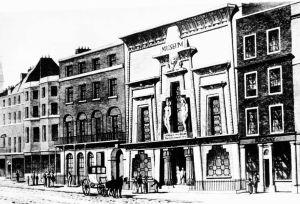
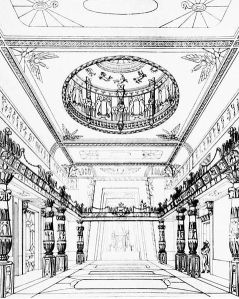
The Egyptian Hall in Piccadilly

The Egyptian Hall was commissioned by William Bullock to house his collection of curiosities and completed in 1812—the first building in England to be influenced by the Egyptian style. Before opening the hall (also called the London Museum or Bullock’s Museum), Bullock displayed his collection in Sheffield and Liverpool. He made money from selling tickets for various spectaculars. Bullock made £35,000 from exhibiting Napoleonic era artifacts, including Napoleon’s carriage from Waterloo. In 1819, the Hall became a major venue for exhibiting art, particularly very large pieces. Admission was usually one shilling.

Egyptian_Hall,_Piccadilly_1815_edited

478px-Egyptian_Hall_redesigned_by_JB_Papworth

Romance of London Series

  1. Romance of London: The Lord Mayor’s Fool… and a Dessert
  2. Romance of London: Carlton House and the Regency
  3. Romance of London: The Championship at George IV’s Coronation
  4. Romance of London: Mrs. Cornelys at Carlisle House
  5. Romance of London: The Bottle Conjuror
  6. Romance of London: Bartholomew Fair
  7. Romance of London: The May Fair and the Strong Woman
  8. Romance of London: Nancy Dawson, the Hornpipe Dancer
  9. Romance of London: Milkmaids on May-Day
  10. Romance of London: Lord Stowell’s Love of Sight-seeing
  11. Romance of London: The Mermaid Hoax
  12. Romance of London: The Bluestocking and the Sweeps’ Holiday
  13. Romance of London: Comments on Hogarth’s “Industries and Idle Apprentices”
  14. Romance of London: The Lansdowne Family
  15. Romance of London: St. Margaret’s Painted Window at Westminster
  16. Romance of London: Montague House and the British Museum
  17. Romance of London: The Bursting of the South Sea Bubble
  18. Romance of London: The Thames Tunnel
  19. Romance of London: Sir William Petty and the Lansdowne Family
  20. Romance of London: Marlborough House and Sarah, Duchess of Marlborough
  21. Romance of London: The Duke of Newcastle’s Eccentricities
  22. Romance of London: Voltaire in London
  23. Romance of London: The Crossing Sweeper
  24. Romance of London: Nathan Mayer Rothschild’s Fear of Assassination
  25. Romance of London: Samuel Rogers, the Banker Poet
  26. Romance of London: The Eccentricities of Lord Byron
  27. Romance of London: A London Recluse

Alicia Quigley: Lady, Lover, Smuggler, Spy (Giveaway)

A Tale of Two Soldiers: Class in Wellington’s Army

by Alicia Quigley

Social hierarchy was rigid and strict in Regency England, and there were relatively few paths for ambitious sons of the middle classes to work their way in to the gentry. Only three professions offered a nearly certain entrée: the law, the Church, and the military. In the military an ambitious and brave young man could, if he survived and was clever about his career, make a reasonable income, achieve or purchase promotion, and eventually, perhaps even be knighted, or have a title created for him. Some well-known examples from Wellington’s era include General Sir Harry Smith, and General Colin Campbell who was made the 1st Baron Clyde.

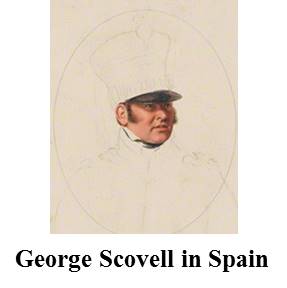
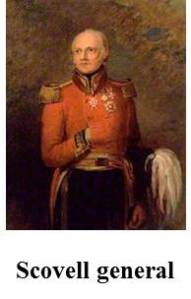
George Scovell in SpainHowever, the military was also viewed as a very good career for the younger sons of aristocrats, and they typically received preferential treatment. The stories of George Scovell, and Lord Fitzroy Somerset, who served on Wellington’s staff at the same time during the Peninsular War are good examples. The Duke of Wellington, who was the younger son of an Irish peer, held strong views about the importance of “family, money and influence” in moving up in the military, and surrounded himself with other scions of the aristocracy as his aides-de-camp whom he referred to as “my boys.” He distrusted the emerging new ‘scientific soldiering’ being introduced, which was particularly important in the case of the artillery, (which was rapidly gaining relevance) but also for all other aspects of soldiering.

In this post, let’s compare the careers of Lord Fitzroy Somerset, a younger son of the Duke of Beaufort, who was born in beautiful Badminton Castle, a privileged younger son of the Duke of Beaufort, and Mr. George Scovell, an ambitious young man with little breeding or money, but great intelligence and ambition.

Scovell GeneralGeorge Scovell attended the recently established Royal Military Academy, learning the methods scientific soldiering and in 1798 purchased a commission as a Cornet in the 4th Queens Own Hussars, a cavalry regiment. A young Winston Churchill started his career as a Cornet in the same regiment 97 years later. The cavalry was the glamour side of the military, and Scovell was tremendously proud of this position. But, as a socially insignificant scientific soldier, promotions were hard to get.

As George also had siblings who needed financial help, he had to sell out of the cavalry and join the infantry, a drop in social status that he felt deeply. He moved to the Quartermaster General’s staff, where he excelled due to his education and diligence, although he had to purchase his promotions to captain and major. His accomplishments included, besides helping improve logistics in the Peninsula, standing up a new unit of Scouts with English, Spanish and Portuguese soldiers, and critically, cracking Napoleon’s Paris Chiffre in his spare time, thus making Napoleon’s plans available to the English.

Scovell was given the opportunity in 1813 to raise and command a new regiment, the Staff Corps of Cavalry, also known as the Staff Dragoons or the Corps of Gendarmerie which was the first recognized unit of military police in the British army. He was knighted and received the Knight Commander of the Order of the Bath (KCB) and continued his career in the Army, even becoming a colonel in the in the same cavalry regiment he had to sell out of earlier. Later, he was the Lieutenant-Governor and then Governor of the Royal Military College, Sandhurst(1829-1856), where he helped expand scientific soldiering in the British army. He received the Knight Grand Cross in 1860 and retired from the Army as a general. His hard work finally brought him success, but it was a long time in the making.

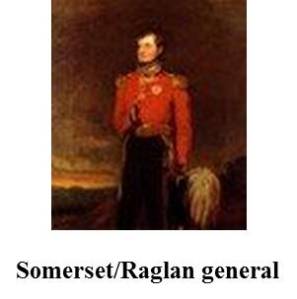
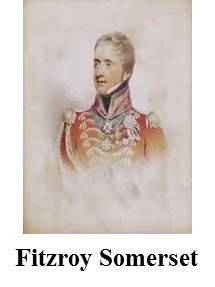
Fitzroy SomersetLord Fitzroy Somerset also joined the Army in the peninsula as a Cornet, this time in the 4th Light Dragoons, in 1804. He was promoted to Lieutenant in 1805, and captain in 1808, presumably by purchase since he transferred to the 43rd Regiment of Foot. He went to Spain in 1808 as one of Wellingtons’s crew of aristocratic aides-de-camp. Somerset’s bravery and gallantry is not in question; he was involved in leading charges in any number major battles in Spain, and was the first over the wall at the bloody storming of Badajoz. He was only twenty-four when he was promoted to lieutenant colonel in 1812.

Somerset fought in numerous other brutal battles, and served at Waterloo, where he lost his right arm. He also received the KCB in 1815. He went into politics, became Military Secretary, and eventually returned to active duty. He was named Baron Raglan, and eventually Field Marshal. He is famous for being the general on whose watch the Charge of the Light Brigade occurred. As a sidebar on the advantages of being a duke’s son in the army, it is worth noting that Lord Fitzroy’s older brother Lord Robert Somerset, also became an army general!

Somerset_Raglan GeneralTwo soldiers of very different backgrounds, with very different paths to military success. What do you think of this?

In my soon-to-be-released Lady, Lover, Smuggler, Spy, we have a similar juxtaposition: our hero, Sir Tarquin Arlingby, is a titled gentleman involved in finding smugglers who are running guinea boats to France, and are getting letters back and forth for French spies.

Our heroine, Valerie Carlton, is a military widow, whose husband was more the George Scovell-type soldier. She followed the drum and learned first-hand the adventures, dangers and sense of commitment to something greater than herself that came from the experience. The two are thrown together through a series of odd events and find themselves in quite an exciting—and potentially deadly—adventure.

Excerpt

Note: This book will be up for pre-order soon! The author will choose a random commenter to receive of the first two books in the series, A Collector’s Item and The Contraband Courtship.

Sir Tarquin handed her to a seat in front of the fire, and then took a chair across from her, settling into it comfortably and crossing his elegantly booted ankles. “So, Mrs. Carlton, I find that I am almost vulgarly curious about your past. It is evident that you are a gentlewoman, yet I found you penniless and unescorted at the Angel this morning. How did that come to pass?”

Valerie gazed down at her hands, before looking at him. “I am the oldest daughter of Lord Upleadon and his first wife,” she answered, “and married Robert Carlton, an officer in the Light Division.”

“Upleadon?” exclaimed Sir Tarquin. “You are an Upleadon, yet I found you alone, penniless, and ready to board a mail coach?”

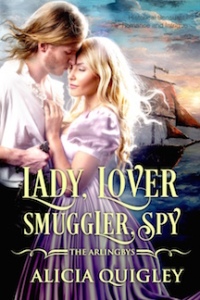
LadyLoverSmugglerSpy_Final-FJM_Kindle_1800x2700 copy“My father did not approve of Mr. Carlton, I fear,” Valerie answered economically.

“That stiff rumped old tartar–” Sir Tarquin suddenly recalled that his listener was not only a lady, but also the daughter of the gentleman he was about to malign, and fell silent.

“Quite so,” Valerie responded with a definite hint of laughter in her voice. “In any event, when I insisted on marrying Mr. Carlton my father cut me off entirely. Even when my husband was among the dead at Sabugal he refused to see me.”

“While I’m not well acquainted with the baron, as he is a good deal older than I am and moves in very different circles, I’m sorry to say that I can easily imagine him lacking remorse. You must have been a mere child. How have you managed since then?”

“When I returned to England, several of my friends had married, and were happy to help me get on my feet. I was mourning my husband, and had no wish to remarry or to be a burden on them, however, so I quickly found a position as a governess.”

“But the Battle of Sabugal was three years since. Have you been a governess all this time?” Sir Tarquin asked.

She nodded. “I had only been with the Forneys for in a few months. When I first became a governess I was in charge of a young lady who needed some polishing before she came out, as her parents were not people of fashion. I enjoyed it very much; the daughter was charming and her mother and father were kind and grateful. Unfortunately the two positions that followed it have been much less satisfactory.”

Valerie fell silent, looking down at her hands, and Sir Tarquin, finding himself appreciating the sight of her blonde curls, fine figure, and aura of calm, didn’t need to stretch his imagination far to imagine the son of the Forney household had been unable to resist the temptation of the pretty governess.

“It makes me angry to think of you being preyed upon,” he said abruptly, much to his own surprise.

“It is a common enough problem, and far worse has befallen others. He did not force me and, while Mrs. Forney was unkind, I left of my own volition,” said Valerie uncomfortably. “My friends have helped me before and will help me now. I would rather spend my time with children, but perhaps I will have to seek employment as a companion to an older lady instead.”

“You do not deserve a life as a drudge to children or as the companion of elderly harridan, who will doubtless have a horrid grandson who will treat you as Mr. Forney did,” Sir Tarquin exclaimed. “You are young, and have given far too much.”

“Whatever do you mean?” she asked.

“You sacrificed a husband and a family to your country, did you not?”

“I suppose you could say so, although it has been three long years since then.” A wistful look came over her face. “It seems so long ago. Thinking of it now, Robert and I were both practically children; it is almost as though it happened to someone else, or was a story someone told to me.”

“Yet you are still all but penniless and without protection as a result, are you not? That is not much of an ending to the story.”

She gazed at him thoughtfully. “It was my decision, though I was far too young to understand the possible consequences. In some ways it was worth it all the same; I loved Robert as much as an eighteen-year-old can love anyone, and perhaps even more, I loved following the drum.”

Sir Tarquin looked startled. “Did you really? Surely it was a very hard life for a gently bred and sheltered young lady?”

Valerie laughed. “Indeed it was! I had no notion that such hardships were ahead of me. Yet the sense of purpose, of being needed and useful, and of having a meaning to my life was so powerful, that it overcame them all. I was always rather bookish, and never truly enjoyed the rounds of parties and balls, to my stepmother’s despair.”

“Even in the tail of the Army with all the camp followers, and rabble you felt so?” Sir Tarquin asked curiously.

“Oh, I rode with the column, Sir Tarquin,” she exclaimed proudly. “I had no children to care for and I was handy with horses even before I went on campaign, for my father’s stables are renowned and I spent a great deal of time in them as a child. I soon learned to kill and stew a chicken, and make sure that there was always something to eat at our billet, so it was not long before many of the other officers were to be found at our table.”

“You rode with the column?” her companion echoed in surprise.

“Except when an engagement was imminent, yes. In many respects it was as safe as being in the tail of the Army, for Robert’s friends would watch out for me. I moved rearward when there was any real danger.”

“But it must have been difficult to be so far ahead without any servants to help you.”

“Oh, my husband engaged a woman for me, a large, rather foul mouthed Scotswoman, who was a match for most of the men! She did much of the heaviest work, although I helped, of course.” Sir Tarquin watched as Valerie’s eyes filled with memories that were clearly dear to her. “His batman was also there, and it never seemed as though things were unmanageable. Difficult yes, but even the worst days were just another challenge to rise to…” Valerie’s voice trailed off, and she gazed into the fire, seeing another place and time.

Sir Tarquin watched her in pensive silence, for a moment and then stood, shaking his head to dispel the thoughts that filled it. “My glass is empty. May I pour you some more punch as well, Mrs. Carlton?”

Valerie shook off her memories, and handed him her empty glass. “Thank you, Sir Tarquin. You have a way with a punchbowl, it seems.” She watched as he walked away, enjoying the wide set of his shoulders, and athleticism of his gait. After some moments he returned and offered her the cup, now full of warm, spicy liquid. Her fingers brushed his slightly as she took it. She looked away, taking a sip.

“I so miss feeling part of something bigger than me,” she murmured. “A governess makes herself useful, I suppose, but it is not the same. Being a paid companion would be even duller, I fear.”

Sir Tarquin, who still stood beside her chair, reached out with one long finger and tipped her chin up, gazing into her face intently.

“You most assuredly must not be a companion to a querulous dowager,” he murmured. “It would be an utter waste.”

Valerie stared back at him, at a loss to answer. In the quiet and warmth of the private parlor they seemed removed from the world, and she simply waited for him to act. He gave a tiny sigh, and then lowered his mouth to hers, pressing her lips firmly yet gently as he sought the right pressure. Her mouth trembled a little, and he lifted his, only to press it against hers at a slightly different angle before drawing back, to kiss her cheek, and then one of her eyelids, which had fluttered closed, before releasing her chin and stepping away.

About the Author

AQ Twitter AviAlicia Quigley is a lifelong lover of romance novels, who fell in love with Jane Austen in grade school, and Georgette Heyer in junior high. She made up games with playing cards using the face cards for Heyer characters, and sewed regency gowns (walking dresses, riding habits and bonnets that even Lydia Bennett wouldn’t have touched) for her Barbie. In spite of her terrible science and engineering addiction, she remains a devotee of the romance, and enjoys turning her hand to their production as well as their consumption.

Website • Twitter • Facebook • Amazon Author Page


Romance of London: Lord Stowell’s Love of Sight-seeing

Romance of London: Strange Stories, Scenes And Remarkable Person of the Great Town in 3 Volumes

John Timbs

John Timbs (1801-1875), who also wrote as Horace Welby, was an English author and aficionado of antiquities. Born in Clerkenwell, London, he was apprenticed at 16 to a druggist and printer, where he soon showed great literary promise. At 19, he began to write for Monthly Magazine, and a year later he was made secretary to the magazine’s proprietor and there began his career as a writer, editor, and antiquarian.

This particular book is available at googlebooks for free in ebook form. Or you can pay for a print version.

William Scott, First (and only) Lord Stowell

William Scott (1745-1836) was born in Northumberland to a father who was in the business of transporting coal. Both William and his brother John became successful jurists, William becoming a judge of the high court of admiralty and elected a Fellow of the Royal Society, and John eventually becoming Earl of Eldon and Lord Chancellor of England. William was raised to the peerage as a baron following the coronation of George IV in 1821. William was twice married, but as the only one of his four children was a female, the title became extinct after his death at age 90.

More information at Wikipedia.

https://commons.wikimedia.org/wiki/File%3AWilliam_Scott%2C_1st_Baron_Stowell_(1745-1836)%2C_by_William_Owen_(1769-1825).jpg

William Scott, 1st Baron Stowell (1745-1836, Wikimedia Commons

Lord Stowell’s Love of Sightseeing

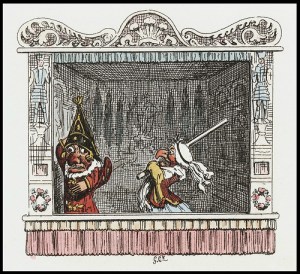
Punch & Judy by Cruikshank, 1828

Punch & Judy by Cruikshank, 1828

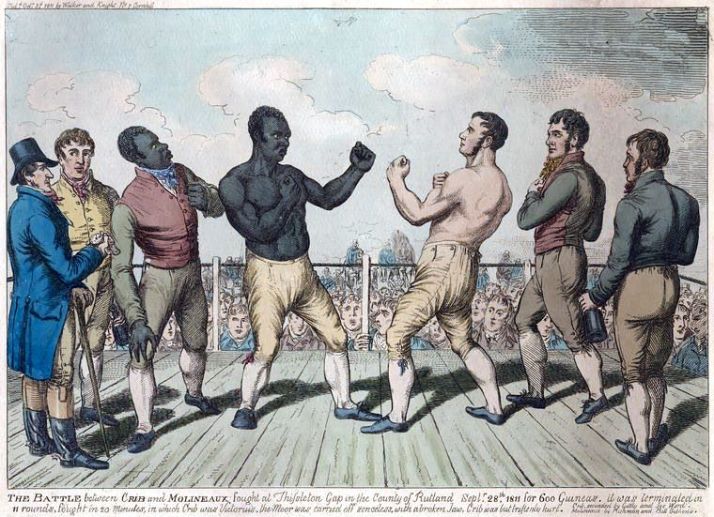
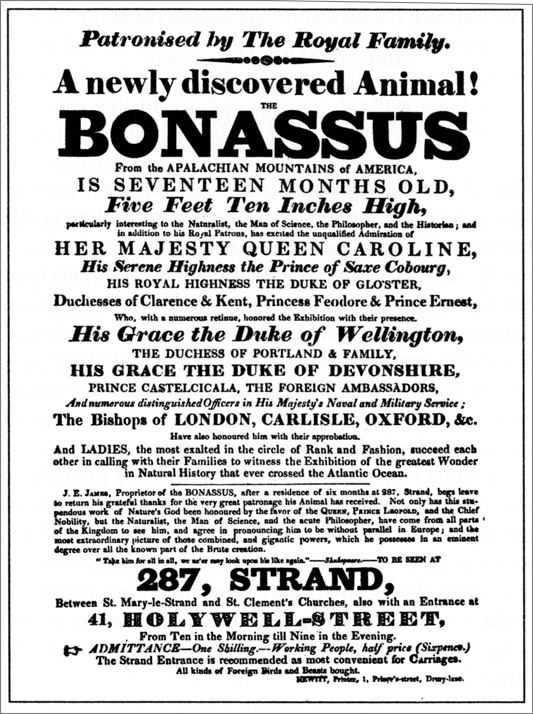
Lord Stowell loved manly sports, and was not above being pleased with the most rude and simple diversions. He gloried in Punch and Judy—their fun stirred his mirth without, as in Goldsmith’s case, provoking spleen. He made a boast on one occasion that there was not a puppet-show in London he had not visited, and when turned fourscore, was caught watching one at a distance with children of less growth in high glee.  He has been known to make a party with Wyndham to visit Cribb’s, and to have attended the “fives court” as a favourite resort. “There were curious characters,” he observed, “to be seen at these places.” He was the most indefatigable sight-seer in London. Whatever show could be visited for a shilling, or less, was visited by Lord Stowell. In the western end of London there was a room generally let for exhibitions. At the entrance, as it is said, Lord Stowell presented himself, eager to see “the green monster serpent,” which had lately issued cards of invitation to the public. As he was pulling out his purse to pay for his admission, a sharp but honest north-country lad, whose business it was to take the money, recognized him as an old customer, and knowing his name, thus addressed him: “We can’t take your shilling, my lord; ’tis the old serpent which you have seen twice before in other colors; but ye shall go in and see her.” He entered, saved his money, and enjoyed his third visit to the painted beauty. This love of “seeing sights” was, on another occasion, productive of a whimsical incident. Some forty years ago, an animal, called a “Bonassus,” was exhibited in the Strand. On Lord Stowell’s paying it a second visit, the keeper very courteously told his lordship that he was welcome to come, gratuitously, as often as he pleased. Within a day or two after this, however, there appeared, under the bills of the exhibition, in conspicuous characters, “Under the patronage of the Right Hon. Lord Stowell;” an announcement of which the noble and learned lord’s friends availed themselves, by passing many a joke upon him; all which he took with the greatest good humor.

bonassus

The Bonassus…proved to be a troublesome neighbour—a constant annoyance. The following letter was intended to have been sent to the “Annoyance Jury,” by the occupier of the house in the Strand (nearly opposite Norfolk-street) adjoining that in which the “Bonassus” was exhibited:—

March 28, 1822

“Gentlemen,—I Am sorry to trouble you but I Am so Anoyd By next Door Neighbour the Bonassus and with Beasts, that I cannot live in my House—for the stench of the Beast is So Great And their is only A Slight petition Betwixt the houses and the Beast are continually Breaking through in to my Different Rooms And I am always loosing my lodgers in Consequence of the Beast first A Monkey made Its way in My Bedroom next the Jackall came in to the Yard and this last week the people in My Second floor have been Alarmed in the Dead of the Night By Monkey Breaking through into the Closet and are Going to leave in Consequence this being the third lodgers I have lost on account of the Beast And I have been letting my Second Floor at Half the Rent—And those men of Mr. James are Bawling the whole Day Against My Window—and continually taking peoples attention from My Window—And I am quite pestered with Rats and I Am Confident they came from the Exhebition—And in Short the Injury and Nuisance is So Great as almost Impossible to Describe But to be so Anoyd By such an Imposter I think is Very Hard—Gentlemen your Early inquiry will oblige your Servant—T.W.—.

N.B. And if I mention anything to Mr. James He only Abuses me with the Most Uncouth Language.”

Susana’s note: Apologies to English teachers everywhere, who have no doubt suffered through many such essays in their noble careers.

Lord Stowell enjoyed attending boxing matches at Cribb's, especially in his later years

Lord Stowell enjoyed attending boxing matches at Cribb’s, especially in his later years


Romance of London Series

  1. Romance of London: The Lord Mayor’s Fool… and a Dessert
  2. Romance of London: Carlton House and the Regency
  3. Romance of London: The Championship at George IV’s Coronation
  4. Romance of London: Mrs. Cornelys at Carlisle House
  5. Romance of London: The Bottle Conjuror
  6. Romance of London: Bartholomew Fair
  7. Romance of London: The May Fair and the Strong Woman
  8. Romance of London: Nancy Dawson, the Hornpipe Dancer
  9. Romance of London: Milkmaids on May-Day
  10. Romance of London: Lord Stowell’s Love of Sight-seeing
  11. Romance of London: The Mermaid Hoax
  12. Romance of London: The Bluestocking and the Sweeps’ Holiday
  13. Romance of London: Comments on Hogarth’s “Industries and Idle Apprentices”
  14. Romance of London: The Lansdowne Family
  15. Romance of London: St. Margaret’s Painted Window at Westminster
  16. Romance of London: Montague House and the British Museum
  17. Romance of London: The Bursting of the South Sea Bubble
  18. Romance of London: The Thames Tunnel
  19. Romance of London: Sir William Petty and the Lansdowne Family
  20. Romance of London: Marlborough House and Sarah, Duchess of Marlborough
  21. Romance of London: The Duke of Newcastle’s Eccentricities
  22. Romance of London: Voltaire in London
  23. Romance of London: The Crossing Sweeper
  24. Romance of London: Nathan Mayer Rothschild’s Fear of Assassination
  25. Romance of London: Samuel Rogers, the Banker Poet
  26. Romance of London: The Eccentricities of Lord Byron
  27. Romance of London: A London Recluse