Archives

Cheryl Holt’s Love’s Promise Scavenger Hunt Blog Tour GIVEAWAY!

LPScavengerHuntBTGraphicSM

Blog Tour Schedule

5/13 Rambling from this Chic: excerpt 1/giveaway

5/14 Harlie’s Book Reviews: review and excerpt 2/giveaway

5/15 Romancing Rakes for the Love of Romance: review and excerpt 3/giveaway

5/16 Confession of a Romaholics: review and excerpt 4/giveaway

5/17 Romancing the Book Reviews: review and excerpt 5/giveaway

5/20 Susana’s Parlour: review and excerpt 6/giveaway

5/21 bookworm2bookworm: review and excerpt 7/giveaway

5/22 Rockn’ the Muses: excerpt 8/giveaway

5/23 Saucy & Sinful Reviews: excerpt 9/giveaway

5/24 Romantic Crush Junkies Reviews eZine Blog: review and excerpt 10/giveaway

Lord Trent Series

Charles Sinclair, the Earl of Trent, is England’s most notorious roué. He never sired any lawful children with his aging, bitter wife. But he has many illegitimate children scattered across the kingdom.

His oldest son, Phillip, is on a quest to find his lost half-siblings, to create a family with them and to fix any damage inflicted on their lives by their father’s licentious conduct. The three books, Love’s Promise, Love’s Price, and Love’s Peril tell the stories of four of Lord Trent’s lost children.

Finally coming in 2013, Cheryl’s long-buried trilogy—three fabulous novels filled with heartbreak, dashing characters, drama, passion and love—will sweep you away!

About Love’s Promise (Book 1)

LovesPromise72SMWith the death of his older brother, Michael Wainwright, Viscount Henley, has become heir to his father, Duke of Clarendon.  The Wainwright men are renowned cads, and as his brother’s will is read, it’s discovered that he sired an illegitimate son and has left the eight-year-old boy his entire fortune.  Michael decides to bring the boy to London so he can be showered with all the wealth and status guaranteed by his inheritance.  But first, he has to gain custody from the boy’s aunt, who is determined to keep her nephew away from Michael’s dissolute family.

Frances “Fanny” Carrington has always lived in a small village in the country.  As a newborn, she was left in a basket on the church steps and raised by the vicar and his wife.  But they’ve died, and Fanny is in dire straits, struggling to raise her nephew, to keep food on the table and a roof over their heads.  When she begins to receive correspondence from Michael, asking for custody, she can’t help but be suspicious.  For years, the Wainwrights have refused to claim her nephew or provide financial assistance to him.  She’s alarmed by their sudden interest.  What can it mean?

As Michael finally meets Fanny, their attraction is swift, blatant, and dangerous.  He can’t fight the need to have her at any cost, and gradually, he lures her into his decadent life of affluence and privilege.  But she’s never possessed the callous nature required to thrive in the cut-throat world of the aristocracy, so she can never understand the peril she faces from those who would do anything to keep them apart…

Excerpt 6

CHAPTER TWO

 “Where are you off to now, Fanny?”

Frances Carrington, called Fanny by her family, glanced over at her sister, Camilla.  Though Fanny was twenty and Camilla twenty-five, Camilla acted like a petulant adolescent, and Fanny often felt as if she was Camilla’s mother.

“It’s so beautiful outside.  I thought I’d walk to the village.”

“You just went yesterday,” Camilla complained.  “I swear, you’re restless as a hen when the fox is lurking.  What’s the matter with you?”

“The vicar’s wife is supposed to pay me for the mending I completed.”

“How can you take that old biddy’s charity?”

“It’s not charity.  I worked hard on that sewing, and I won’t apologize for it.”

“Aren’t you a bloody saint?”

It was a constant quarrel between them.  Camilla wouldn’t lift a finger to earn any money, despite how dire their situation, but she was quick to criticize when Fanny did anything that might alleviate some of their financial distress.

Fanny was galled at being forced to rely on the paltry coins the vicar’s wife doled out, especially when the sanctimonious woman enjoyed flaunting her elevated position and how it contrasted with Fanny’s reduced one.

For three decades, Fanny’s father had been the vicar.  They’d lived in a fine house next to the church, had been respected members of the community, so when she knocked on the rear door of the parsonage, she felt like a supplicant or a beggar.  She’d be invited in to see the new minister writing his sermons at what had been her father’s desk.  His wife would be sitting on the sofa in what had been Fanny’s mother’s parlor.

At one humiliating point, Fanny had sold her mother’s wedding ring to the vicar in order to purchase food.  He’d given the ring to his wife as a gift, and whenever Fanny stopped by, she cruelly waved it under Fanny’s nose.

The tonic was bitter to swallow, but in the past few years, she’d suffered so many indignities that one more hardly registered.  She could tolerate the other woman’s condescension if it helped her support her nephew, Thomas.

“Camilla, please,” Fanny scolded.  “Watch your language.”

Fanny gestured toward Thomas who was across the room at the dining table, practicing his letters.

“He’s heard worse,” Camilla said.

“Yes, he has,” Fanny agreed, “but we needn’t broaden his base vocabulary.”

“Don’t tell me how to speak to my own boy.”

Fanny couldn’t win the argument, so she didn’t try.

“I’ll be back in a few hours.  If she pays me as she promised, I’ll bring some stew meat with me.”

“Meat, bah!” Camilla sniped.  “Fat and gristle is more like.”

Camilla was always angry that they couldn’t afford the quality of victuals that had been their typical fare in better times.  Her sense of entitlement—as well as her gnawing hunger—made her surly.

Though she never said as much, she seemed to blame Fanny for their poverty, as if their father’s death, and Camilla’s subsequent plunge to indigence, had somehow been Fanny’s fault.  Fanny was weary of defending herself over the calamities, and she was eager to be away.

She grabbed her shawl and bonnet, and she stood in front of the mirror, studying her reflection as she tied the bow under her chin.

With her slender torso, heart-shaped face, and bright green eyes, she recognized that she was attractive.  Her hair was long and blond, an unusual shade of luxurious gold, the color of ripened wheat.  Since they had no servants, she rarely styled it, finding it quicker to simply brush the lengthy tresses and pull them back with a ribbon.

But her looks didn’t matter, and she shouldn’t continue to pretend that they did.  Her lack of a dowry insured there would be no husband, no family of her own.  She’d never even had a beau, and circumstances had compelled her to accept that she never would.

Still, it was amusing to dream of a different life, one filled with pretty gowns and tons of delicious food, where there was no need to worry over the least little problem.

She wasn’t a woman prone to vanity, but there was no concealing the fact that her dress was shabby and plain, her bonnet tattered and torn.  She couldn’t help but wish that she had a fashionable outfit to wear into the village, but cash was scarce and new clothes a frivolous extravagance.

She slipped out and hurried down the path to the lane, when Thomas called to her from their decrepit cottage.

“Aunt Fanny!  May I come with you?”

Available at Amazon and Barnes & Noble

SusanaSays3

Susana Reviews Love’s Promise

Susana Says: Good Read, 4 out of 5 Stars

Love’s Promise is one of those books that draws me in so deeply that I don’t want to stop for anything, not even meals! Holt’s books have a tendency to make me feel as though I’m there myself, walking in Fanny’s shoes and feeling her attachment to her nephew, her desperation to keep him near and ensure his wellbeing, and then, later, her wildly fluctuating feelings for Michael, the man who seems destined to shatter all of her hopes and dreams.

Fanny is a great heroine, resourceful, determined, with a big heart. She can’t be bought with coin or jewels, as Michael discovers to his chagrin. The only leverage he can find to lure her to his bed is the promise of being near to her nephew. Her love for young Thomas makes her vulnerable, and Michael has no scruples against using it to get what he wants.

And therein lies the rub. While some say that rakes make the best heroes (or husbands), a rake who is too depraved just doesn’t ring true. As the son of a depraved duke, perhaps there is some justification for Michael’s selfish, cruel behavior throughout most of the book. Neither he nor his sister Anne knew love from either of their parents, so why would they know enough to want it for themselves, let alone be able to recognize it when it came? In the case of both siblings, it took the steadfast love of another to force them to come to terms with the superficiality of their lives and values and give them the impetus to reach out and risk everything for love.

If you are looking for a lighthearted romp in Regency ballrooms, this is not the story for you. The Regency world portrayed here is dark and cruel and filled with heartless villains in every corner. Between the debauched aristocrats who hop from bed to bed ruining young ladies right and left with no concern for anything but their own pleasure and the cruelty of nearly everyone else, this is not the book for the faint of heart.

It’s always been a cruel, cruel world, and the Regency one was no exception. There are times when you doubt that Fanny and Michael will ever have their happy ending; there are so many obstacles keeping them apart and you on the edge of your seat. But I guarantee you won’t want to put this one down. Holt’s fast-paced dialogue, paired with the emotional turmoil, will keep you turning the pages all the way to the end.

Giveaway

Cheryl Holt is giving away ten (10) print copies of Love’s Promise, the first release in her historical romance Trent Trilogy. The giveaway is open to US, Canadian, and international readers. Click here for the rafflecopter.

About the Author

cheryl-holt-with-pearlsCheryl Holt is a New York Times, USA Today and Amazon bestselling author of thirty-five novels.

She’s also a lawyer and mom, and at age 40, with two babies at home, she started a new career as a commercial fiction writer. She’d hoped to be a suspense novelist, but couldn’t sell any of her manuscripts, so she ended up taking a detour into romance, where she was stunned to discover that she has an incredible knack for writing some of the world’s greatest love stories.

Her books have been released to wide acclaim, and she has won or been nominated for many national awards. She is particularly proud to have been named Best Storyteller of the Year by the trade magazine, Romantic Times Book Reviews.

Her hot sexy, dramatic stories of passion and illicit love have captivated fans around the world, and she’s celebrated as the Queen of Erotic Romance, which is currently the fastest selling sub-genre of women’s fiction. Due to the ferocity of some of her characters, she’s also known as the International Queen of Villains.

She received degrees in music, languages, and education from South Dakota State University, and her juris doctorate was obtained at the University of Wyoming. Her colorful and chaotic employment history includes such variety as public school teacher, cook, bartender, lobbyist, and political activist. She also did brief stints in metro-Denver as a deputy district attorney and administrative law judge.

“…a master writer…”  —Fallen Angel reviews

“Best storyteller of the year…” —Romantic Times Magazine

Contacts

www.cherylholt.com

https://twitter.com/theCherylHolt

http://www.facebook.com/pages/The-Official-Cheryl-Holt-fanpage/292658201347

Kae Elle Wheeler and “The English Lily”: Lady Yarmouth’s Letter

Lady Kendra has led a long fruitful life. But as a young woman, and in a major turning point of her life, her time with Charles Thomas was cut remarkably short. To ease her mind, she sends him a heart-filled letter.

Dear Mr. Thomas,

I realize it is most inappropriate for me to send you this letter, but rest assured I have my husband’s utmost approval. It has been many years since I last saw you, and the memory still haunts my dreams I fear. I thought if I could enlighten you to my situation we might each finally move forward, where ever that might be for you now.

Since that most fateful day aboard the Cécile, I married Joseph. True, he was a most successful magician, but I am pleased to say he has proved an even more devoted husband and father. We have four beautiful children. Our eldest and heir to Yarmouth named Charles for you, my dear friend. You would be most proud of Charles, for he is a brilliant scholar and benefactor of The School for the Poor and Unfortunate.  The others fell closely in his footsteps in their efforts to realize your dreams. Aaron, our most athletic is an avid hunter and horseman. Our girls, twins, mind, Julia and Jane, followed in their father’s way with his magic. Oh, not that Joseph would allow them to tread the boards! But he taught them all of his silly parlour tricks on which the two took to perfecting and creating with havoc of their own.

For many years, I kept in very close contact with your mother, to her very end. I am proud she called me Friend. Finally, you will be most happy to know my husband reads a beautiful poem or story to me each and every night when we retire, and on occasion, I find I quite enjoy reading one to him as well.

I hope this note will offer you the peace that is descending on me as I pen it.

Yours forever, most devotedly so,

Kendra Frazier, Lady Yarmouth

About The English Lily

TheEnglishLily7366_300Lady Kendra Frazier is devastated. The love of her life just married another, and now all she desires is to be as far away as possible. Viscount Lawrie, Joseph Pinetti Gray, is facing financial ruin and needs a wealthy heiress.  Luckily for him, Kendra’s impetuous nature has handed him the fortuity he requires to save his family’s downfall. But Joseph’s carefully cultivated plans come to a grinding halt when he finds himself falling in love for what should have only been a marriage of convenience. And how can an old cursed doll help?

Excerpt

He rushed over.  “Thank God,” he whispered.  He crouched down next to her.  “Thank God,” he said again, touching his forehead to hers.

“Joseph?  Lord Lawrie?”  Her voice cracked.  Her white glove was no longer white.  He wished he could have protected her from that.

Leaning back, he peeled the stained fabric away.

Her hand clenched.  “My hands—”

He brushed his lips over the tiny scars. “Your hand is perfect,” he said.  “We’ll have to marry, you know.”

“Married.  I’ve dreamed of marrying,” she whispered, smiling.  Her eyes were dry, but in them he read the shock and fear.

Something tight squeezed Joseph’s chest, he found he could hardly breathe.  Death hovered over them.  While he might fail in creating bliss for Kendra’s last moments on this earth, he could offer her the whimsical fairytale.

Joseph dropped her hand and cupped her head with both hands.  “Lady Kendra Frazier, would you do me the honor of becoming my wife, mademoiselle, s’il vous plaît?”

With a stately incline of her head, she replied with a trembling smile.  “I shall be honored, Viscount Lawrie, Chevalier Joseph Pinetti Gray.  Lord Hardwick’s Marriage Act was enforced in Scotland, in fifty-four, so we’ve no need to post the banns.”  A small hysterical laugh erupted.  “Shall we escape to Gretna Green, my lord?”

Her spirit touched him as nothing else could. Even in the throes of shock and danger, she managed to recall his full proper name and title. He pulled her to him as heavy steps echoed on the wooden planks just beyond the door.  But for a moment he could pretend they would live a long and fruitful life together. “Oui, Gretna Green suits my purposes, perfectly, love,” he whispered against her lips, before crushing them beneath his own.

The door crashed back.

Available

Amazon 

Wild Rose Press 

About the Author

IMG_8577Kae Elle Wheeler has a BA degree from the University of Central Oklahoma in Management Information Systems that includes over forty credit hours of vocal music.  As a computer programmer the past fifteen years, she utilizes karaoke for her vocal music talents. Other passions include fantasy football, NBA and  musical theatre season tickets, and jazzercise. Because to quote Nora Roberts to a one time question, if she worked out? Her reply, “You have to get off your ass.”

Kae began has been a member of the Oklahoma Chapter of Romance Writer’s of America and the RWA since March of 2007.  She grew up in the Dallas area and definitely considers herself a city girl.  She does not limit her travels to Writer Conferences in San Francisco, Washington DC, Seattle, Dallas, New Jersey, New York City and Atlanta because Jazzercise has fun conferences too (Denver, Palm Springs and Orlando). You can’t keep her at home!

She is a member of several RWA Chapters, including DARA, The Beau Monde and Passionate Ink. She has held several positions in the OKRWA Chapter, currently serving as Programs Director. As an avid reader of romance and patron of theatre, her main sources of inspiration come from mostly an over-active imagination. She currently resides in Edmond, Oklahoma with her musically talented husband, Al, and their bossy cat, Carly.

Contacts

http://kathylwheeler.com

http://klwheeler.com

http://facebook.com/kathylwheeler

http://twitter.com/kathylwheeler

Episode #13: Lady P Discusses the Luddite Uprising, the Assassination of Spencer Perceval, and the General Unfairness of Life

Lady Pendleton, Damian Ashby’s eccentric aunt (see the epilogue to Treasuring Theresa on Susana’s web site), is visiting Susana from the early 19th century. She’s intrigued by life in 21st century Toledo, Ohio, and, of course, Susana is thrilled to have the opportunity to pick her brain about life in Regency England. It certainly gives her a great deal to write about in Susana’s Parlour!

Susana: Lady P and I recently returned to Ohio after spending a month in Florida where she enjoyed taking daily “constitutionals” around the retirement village where my parents live, and eventually condescended to take a dip in the heated pool, although the bathing costume she rigged for herself raised more than a few eyebrows from the other swimmers.

Lady P [indignantly]: My dear Susana, I could not possibly have appeared in public in those-those underthings you and your mother wore. I should have been utterly humiliated!

Susana: They are called swimsuits, Lady P. Bathing costumes. And that’s what everyone else wore.

Lady P [with a hand to her head]: The gentlemen—such as they were—were much worse. I thought I would swoon when I saw those naked chests!

Susana [chuckling]: But surely you have seen a bare-chested man before, Lady P. Why, you and Lord P were married for nearly twenty years, were you not?

Lady P: Well, of course I did, but not in public, Susana. Why, my Pendleton was exceedingly conscious of propriety. He would never have appeared in public half-dressed; why his valet would have slit his own throat before allowing it!

Susana [biting her lips to keep from laughing at the thought of the suicidal valet]: These gentlemen are from the 21st century, Lady P. Frankly, what these men wore was quite modest compared to some of the younger gentlemen. Don’t you remember that day when we went to the beach and saw—

Lady P [shuddering]: Do not even remind me, Susana. The young women’s attire…why they were nearly as naked as the day they were born! Where is their sense of modesty?

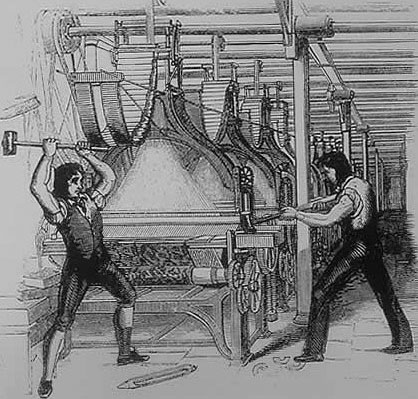
Susana [making a mental note to avoid beaches and pools in the future]: Perhaps we should get back to today’s topic—the Luddite revolt in 1811-12. Can you tell my readers what you recall of that uncertain time?

Lady P: Indeed I can, although one could wish to forget it.

ludditesSusana: It started in the Midlands with the stocking industry, when stockingers, using looms and equipment leased from their employers in their homes, lost more than half their income when they were forced to produce cheap stockings that their employers could sell in larger quantities and increase their profits. Is that correct?

Lady P: How could I forget? Those stockings fell apart after barely a week of wear, and even the servants disdained them!

Susana: That was the same year the harvest failed, and food prices rose to an alarming level, and more and more people were suffering in economic distress.

Lady P: A shilling for a loaf of bread! It was outrageous!

Susana: People became desperate, and before long, gangs of disguised men started going around destroying the frames and looms used to produce the stockings to protest the treatment of the workers and the poverty more and more of them were forced to endure.

Lady P: That may be how it started, Susana, but it escalated into so much more than that. Why, many of us feared an uprising against the monarchy comparable to the French Terror of barely two decades past. And there wasn’t much to be done about it; Pendleton told me that fully half of the militia had taken up the cudgel for General Ludd in stealth and would turn against their officers in a trice if ordered to put down the revolutionaries.

Susana: I’m curious to know what Lord P thought should be done about it. He was a Tory, and the Tories were in power. Did he approve the decision to make frame-breaking a capital offense?

Lady P [shaking her head and sighing]: No, of course he did not. He thought it was incredibly stupid to think that masses of starving insurgents could be deterred by fear of the gibbet if they were caught. [Swallowing hard] He was, in fact, quite moved by Lord Byron’s speech in the House of Lords, where he decried the Tories’ attempt to solve the problem by force. He insisted—quite eloquently, Lord P admitted—that the Midland workers were being exploited to increase the profits of a few hosiers, and that the resulting misery benefitted no one.

Susana [thoughtfully]: The more things change, the more they stay the same. [Seeing Lady P’s raised eyebrow]: I was just thinking of how the Ohio House of Representatives just voted to eliminate the forty-hour work week so that employers won’t have to pay overtime—pay them double—for working more than that.

Lady P: As to that, I can’t say, Susana. But that is one reason I became a Whig. I would never go so far as to overturn the entire government and plunge the country into turmoil and terror such as what happened in France, but I have always believed that certain reforms to prevent the poor from being exploited could be instituted without much upheaval, and that the entire country would be the better for it. [Sighing] Dear Pendleton felt the same, but he was unable to persuade his colleagues to listen to reason. As afraid as they were of a revolution, the only solution the Tories could agree on was to threaten the insurgents.

Susana: It wasn’t long after that the Tories fell out of power, didn’t they? After the assassination of the Prime Minister?

Lady P: Indeed, and it was well-deserved too. Not because the Whigs’ ideas were much better, although they certainly used the Tories’ imprudence to their advantage. The Prince Regent’s intemperate behavior and his treatment of his wife made him vastly unpopular, so the Whigs took up the cudgel for Princess Caroline, proclaiming that she was being badly treated, and causing more riots, spreading to the north.

percevalSusana: And didn’t the people actually cheer the assassin as he was led to his execution a week later? There was that much dissatisfaction with the government that they cheered the murderer of the Prime Minister?

Lady P [tight-lipped]: Poor Lord Perceval. He was a good man. Had twelve children, you know. A family man. He could have gone far, if it weren’t for that Bellingham fellow shooting him in the House of Commons. Do you know the government wouldn’t even give him a public funeral because they were fearful of riots? I hardly knew what to say to his wife Jane when I saw her after that.

Susana [sighing]: Some things seem so unfair, don’t they? Like my friend whose daughter just died of breast cancer at age thirty-seven. Or many of my friends whose husbands lost their jobs and couldn’t find anything comparable afterward because of their age and the cost of health insurance. What do you say? How do you help them?

Lady P [clucking]: I suppose there will always be misery and injustice, no matter how diligently we try to eliminate it.

Susana: But that doesn’t mean we should stop trying.

Lady P [smiling]: Exactly. Now, Susana, don’t you think something should be done about all the weeds in the back garden? Since the weather turned warmer, they seem to be popping up all over the place.

Susana [leaving the room]: Have at ’em, Lady P. There’s a hoe in the shed and some work gloves in the drawer over there.

Lady P [frowning]: And where might you be going, then?

Susana [from the office]: I have a Christmas story to write. Deadline, you know. Can’t be bothered with weeds for awhile.

Lady P makes a beeline for the back door, audibly grumbling about “misplaced priorities,” “writing Christmas stories in May,” and that she “really should go back to the 19th century where there were gardeners to do such onerous tasks.”

As always, please do comment if you have any questions you’d like to ask Lady P about the late Georgian/Regency era. She does love to chat!

The Lady P Series

Episode #1: Susana’s Adventures With Lady P: The Introduction

Episode #2: Lady P Talks About… Pride and Prejudice?

Episode #3: Lady P and the Duchess Who Lost a Billion Dollars

Episode #4: Lady P and the Face On the $100 Bill

Episode #5: In Which Lady P Discovers Sparkly Fabrics and Ponders Violating the Prime Directive

Episode #6: Lady P Dishes the Dirt on the Duchess of Devonshire

Episode #7: The Political Exploits of Lady P and the Duchess of Devonshire

Episode #8: Lady P and the Prince Regent’s Illicit Marriage

Episode #9: In Which Lady P Depletes the Cooking Sherry During Her Discussion of Caroline of Brunswick

Episode #10: Lord Byron: Mad, Bad, and Dangerous to Know

Episode #11: In Which Lady P Talks About Hannah More and the Rights of Women

Episode #12: Lady P’s Revelations Regarding George III and His Peculiar Progeny

Episode #13: Lady P Discusses the Luddite Uprising, the Assassination of Spencer Perceval, and the General Unfairness of Life

Episode #14: In Which Leticia, Lady Beauchamp, Pops In For an Interview On Her Personal Acquaintance With Princess Charlotte of Wales

Episode #15: Lady P On Assignment in 1814 Kent

Lady P Quizzes Jane Livingston, the Hero’s Sister From “A Twelfth Night Tale”

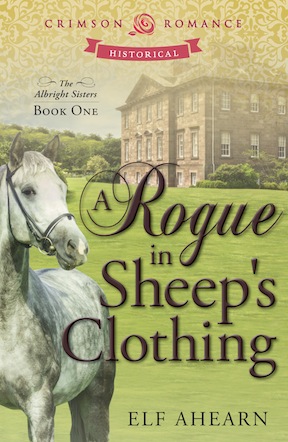
Regency Romance With a Gothic Twist: Interview With Elf Ahearn, Author of “A Rogue in Sheep’s Clothing”

Today I am pleased to welcome Elf Ahearn to Susana’s Parlour. She writes “Regency romance with a Gothic twist” and her book, A Rogue in Sheep’s Clothing is currently available (see below).

She’s giving away a free copy to the commenter who gives her the best response to her question about their favorite and/or most-hated food. (Just for the record, I detest lima beans too, Elf!)

Elf HeadshotWhat inspired you to start writing?

My friend, a beautiful fellow-journalist named Susan Baker, and I decided to form a literary society. At our first meeting only three of us met, me, Susan and this guy named Dave. We read scraggly little fragments of our fiction to one another and offered lame criticism mostly based on good reporting skills. Susan’s piece was incredible, though. It was a story about a crabby old woman befriended by a guy who takes the time to talk to her—to find out what made her so upset.

After that first meeting Susan left the paper for a job at the front desk of a factory. The pressure to make deadlines, she said, was killing her. In fact, I’d noticed that for hours sometimes, she’d just sit and stare at an empty screen on her monitor.

Despite her move, we decided to hold another literary society meeting. When that day dawned, however, Susan couldn’t make it, and Dave had to write an article about a planning and zoning meeting. “It’s just you, Elf,” Susan said, “You have to carry the torch.”

A few weeks passed and Susan and I decided that the ideal excuse for a get-together was to celebrate our birthdays. She just couldn’t muster the energy to write for a literary society anymore, she told me. The weekend before the scheduled date, I was staying with my boyfriend, (now my wonderful husband) when my sister called. Susan had telephoned with the message that she wouldn’t be able to meet for our birthdays after all. I didn’t call her back. I figured I’d phone her Monday.

So, Monday came and I dialed Susan’s number. Her roommate picked up. Over the weekend, the roommate told me, Susan drove to the far end of a parking lot in Poughkeepsie. She aimed her car at the brick wall of a church and hit the gas. The impact killed her.

Susan’s father approached me at her memorial service. He had a package for me—a birthday present from her. When I unwrapped it I found a red journal with lined pages. At the center of its cover, delicately surrounded by a picture of a smiling sun, curling flowers and puffy clouds, were the words, “Seize the Moment.” I’m not going to say that I write for Susan or even that I write for her memory, I write because I have to and I write because, as she so permanently proved, the moment is now.

How long have you been writing?

I wanted to be a writer when I was a kid, but my spelling was atrocious. Teachers left snarky notes all over my short stories—always about the spelling. My father had an expression, “xysizzle.” That’s what most three-syllable words looked like after I got through with them. So, I was afraid to write. Then a man named Steve Jobs teamed up with another guy named Bill Gates. They invented this magical machine that made it possible for me to write without anyone knowing what a terrible speller I am. Steve, Bill—you’ve made a lot of money—but still, I owe ya.

What advice would you give to writers just starting out?

Take classes! It’s amazing how much teachers know. But, if they’re not supportive, ditch ‘em. Nobody, but nobody, needs to hear how much they stink.

What comes first: the plot or the characters?

I ascribe to the “big bang” theory of plotting. At the climax of my novels, I want gnashing of teeth and rending of clothes, fire, thunder and a whole lot of other dramatic stuff. Ergo, I usually have the end in mind before I start, but the characters push me around before I get there.

What is your work schedule like when writing?

I’m most creative at night, in bed. I don’t want to count the number of times my husband has gently pried the computer from my sleeping fingers.

What is your favorite food? Least favorite? Why?

Lima beans and creatures of the sea are the bane of my existence. Otherwise, I’m not picky.

What is something you’d like to accomplish in your writing career next year?

Naturally, I’d like to be on the New York Times Bestseller List with movie executives licking my toes for a chance to make a film of A Rogue in Sheep’s Clothing. On the off chance that that doesn’t work out, I’d like to see the last two books in the Albright Sisters series published. Crimson Romance, the publishers of Rogue, already purchased Lord Monroe’s Dark Tower. That’s the second book in the series. Hopefully, they’ll be interested in taking them all on.

Every writer dreams of getting “the call.” What were you doing when yours came? Who got to hear the good news first?

My friend, Liz Shore, got the call first and I was super excited for her because she’d been through heck in a hand basket, and she earned that contract. Then two days later, Jennifer Lawlor, my editor at Crimson Romance, sent me an email accepting Lord Monroe’s Dark Tower. I asked about A Rogue in Sheep’s Clothing and a few hours later she wrote back saying they wanted that book as well!

Strangely, the news depressed me. Weird, right? I wandered around the house for a few hours totally unnerved. At last, I called my husband. He was so thrilled that I finally allowed myself to be happy. After that, I called Liz and we screamed for like fifteen minutes.

I’d love to hear from Susana’s Parlour readers. How about telling me what your favorite/most hated foods are? The best answer gets a free digital copy of A Rogue in Sheep’s Clothing.

About A Rogue in Sheep’s Clothing

roses2In Lord Hugh Davenport’s opinion, women of the ton perpetually hide behind a mask of deception. That’s hard for Ellie Albright, the daughter of an earl, to swallow—especially since she’s disguised herself as a stable hand to get back the prized stallion her father sold to Hugh to pay a debt. If Hugh learns her true identity she’ll lose the horse and her family will go bankrupt. Somehow, though, losing Hugh’s affection is beginning to seem even worse.

Already only a step away from being snagged in her own web of lies, Ellie’s deceit threatens to spin out of control when Hugh’s mother invites Ellie and her sisters to a house party. Now Ellie has to scramble to keep Hugh from knowing she’s the stable girl he wants to marry, while simultaneously trying to win his trust as herself. Can she keep her costumes straight long enough to save her family? And even if she does, will it be worth losing his love?

Available on

Amazon.com (Kindle), iTunes (iPad, etc.), Barnes & Noble (Nook) and BookStrand.com.

Visit me at www.elfahearn.com or become a pal at Facebook by going to elfahearnauthor.

Excerpt

A stiff breeze swept up the massive stone edifice bringing the scent of heather, gorse, and a tinge of the dank salt sea. The beauty of it sobered her. “My God, it’s magnificent,” she said, feeling the sun’s warmth and the chill of the breeze on her cheeks. For miles around she saw only the dip and rise of the yellowed moors disappearing into soft, distant gray.

Hugh joined her cliff-side. He settled on a patch of thin, wind-whipped grass. Ellie plopped down beside him and took a deep whiff of the heather he’d picked for her on the trail. “Ah,” she said. “It smells like England.”

Hugh broke off a branch of the plant and put it between his teeth. “Tastes like her, too,” he said. Ellie laughed.

Then they grew silent, listening to the rustle of grass, feeling the hot sun, and breathing the rich smell of sweet flowers and fecund herbs.

“This is my day,” said Hugh, lying back in the grass. “You may have a piece of it.”

Ellie swatted him with the stalk of heather. “I shall take your captain’s salute on horseback.”

“And I shall take this moment, right now,” he said, closing his eyes.

They were silent again. Ellie lay back and snuggled into the grass. The cool wind couldn’t reach her here – just the thick heat of the sun. She closed her eyes, too.

A fly tickled her forehead. She brushed it away. It came back and tickled her again. She opened her eyes in time to see Hugh leaning over her, the branch of heather in his teeth. He flicked it away from her face.

“You’re the annoying fly,” she said, lunging to pull the heather from his mouth. He caught her wrists and rolled onto his back. She struggled, enjoying the feel of his large, callused hands. “I suppose if I were really clever,” she said, giving up and leaning on his chest, “I could get that branch without using my hands.”

“Oh yes, and how would you do that?” replied Hugh, a glint in his eye.

Ellie leaned over and, bringing her face close to his mouth, pulled the heather from his teeth.

A bolt of electricity raced through her. She hadn’t meant to be so intimate—hadn’t anticipated the heat of his flesh against hers, or the soft velvet of a corner of his lips. Her heart beat fast and her face grew hot. She looked away, dropping the heather from her mouth. “I’m never getting married,” she blurted.

Hugh studied her. “Then I’m not either.”

Gently, he brushed a bit of heather from her lips.

The caress stirred a small fire. She closed her eyes and lay back down on the grass. Joy washed over her. “That’s wonderful,” she sighed. Hugh’s hand closed on hers.

About the Author

Elf Ahearn, yes, that is her real name, lives in New York with her wonderful husband and a pesky (yet irresistible) cat. Learn more about her at www.elfahearn.com or friend her on Facebook.

Spotlight on Regency Author Joan Smith + Giveaway

I’ve been making my way through two shelves of Joan Smith books for quite some time (guaranteed fun reads), and the other day when I found one that I felt was truly outstanding, it occurred to me that it was a shame that few young people—who may not have been born in the 70’s, 80’s, and 90’s when Joan Smith was producing her delightful Regencies—have had the opportunity to read her work. (Note: Joan also wrote as Jennie Gallant; don’t overlook those titles when you come across them.)

Oh, you can find them in used bookstores, and nearly 70 of them can be found in the Kindle store for $3.99, not to mention on the Regency Reads web site for $5 a pop, but let’s face it, authors’ backlists don’t get the sort of promotion the newer titles do, and most younger people will probably never know what they missed.

So I decided to do my part in getting the word out. What sort of reader would appreciate Joan’s Regencies? Anyone who enjoys

  • traditional, “sweet” Regencies. Her stories will never be outdated.
  • spirited heroes and heroines with a sense of humor
  • witty dialogue à la Georgette Heyer without the superfluous narrative found in other books
  • three-dimensional, memorable secondary characters
  • well-crafted plots and believable scenarios
  • lively romps through Regency society in a variety of English locales

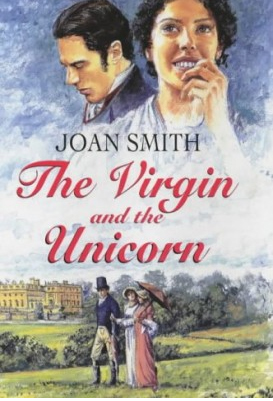
The Virgin and the Unicorn

the virgin and the unicornThis is the book that inspired me to write this post. I wrote this review for Amazon:

Miranda has known the Herscham family all her life; thus, she knows better than to set her cap for Lord Rotham, the oldest son, who has proven to be a ramshackle young man of the worst sort–not to mention the one who had played fast and loose with her older sister’s affections all those years ago. Miranda has been sent to stay with the Herschams, ostensibly because of her younger sister’s bout with the measles, but Miranda knows her parents are hoping she will make a match of it with Pavel, the younger Herscham son. It seems hopeless, though, since Pavel is only eighteen–the same as Miranda–and they’ve always been more like siblings.

Lord Rotham unexpectedly returns from his post at the Vienna Congress, and although he has a serious problem on his hands, he finds himself inexplicably drawn to Miranda, who proves to be immune from his practiced charm. It gives him pause to realize how his antics of the past have tainted him in Miranda’s eyes, and this latest escapade of his–having stolen a valuable French tapestry from a cathedral on a lark–is not showing his character in any good light either. Still, there’s no keeping secrets in that household, especially after the tapestry is stolen and the servant left guarding it seriously wounded. Since this matter is likely to cause an international incident, somehow they have got to figure out who stole it and get it back again.

Rotham knows what he wants almost from the first, and even his affectionate parents see it before Miranda does. But how can she take this rogue seriously when he was the cause of her sister Trudie’s anguish in the past? No doubt he had cut quite a swathe through the great ladies at the Vienna Congress before returning home. And hadn’t she seen the looks he’d exchanged with the beautiful comtesse who was also lodging with the Hershams? No, Miranda is far too sensible to have her head turned by a gentleman with HIS track record.

And yet…is Miranda truly so cautious and staid herself? Perhaps the truth is that she’s been waiting for an opportunity to have an adventure herself…and who better but an experienced rogue–one who is feeling seriously remorseful of his misspent youth–to accompany her?

I love the characters, the close family relationships, the witty repartee, especially Pavel’s remark about the lump on Rotham’s forehead giving him the look of a unicorn, a reference to the famous tapestry of “The Virgin and the Unicorn”. (No need to worry; it was a minor injury that soon faded.) The implication being, of course, that Miranda was the virgin who had tamed the unicorn without really trying to; he had voluntarily laid his head in her lap in a gesture of eternal surrender.

Joan Smith is a talented author; it is to be hoped that her books will be released in ebook format for the enjoyment of newer readers, who do not often get the chance to read such delightful Regencies these days.

Who is Joan Smith and What’s She Up To These Days?

This is the bio you will find at the end of most of Joan Smith’s books and on web sites. (It’s dated, as Joan hasn’t published anything since 1998, as far as I can tell.)

Joan Smith is a graduate of Queen’s University in Kingston, Ontario, and the Ontario College of Education. She has taught French and English in high school and English in college. When she began writing, her interest in Jane Austen and Lord Byron led to her first choice of genre, the Regency, which she especially liked for its wit and humor. She is the author of over a hundred books, including Regencies, many with a background of mystery, for Fawcett and Walker, contemporary mysteries for Berkley, historical mysteries for Fawcett and St. Martin’s, romances for Silhouette, along with a few historicals and gothics. She has had books in the Doubleday Book Club and the Literary Guild, been on Walden’s Bestseller list, had two Regencies selected for the Romantic Times ten best ever Regencies, and had one book condensed in a magazine. Her favorite travel destination is England, where she researches her books. Her hobbies are gardening, painting, sculpture and reading. She is married and has three children. A prolific writer, she is currently working on Regencies and various mysteries at her home in Georgetown, Ontario.

Update from Joan as of April 22, 2013:

The bio you have pretty well covers it. Still following the same interests, along with a keen interest in healthy cooking. I’m a widow now, enjoying time with the growing family of grandkids and great grandkids.

Have you read any of Joan’s books and if so, what do you like best about them?

Joan Smith Giveaway

In case you haven’t had the pleasure of reading any of Joan’s books lately, I’m offering one lucky commenter the following six books from my Joan Smith collection. Do make sure you leave your email address in the comment so I can contact you if you happen to be the lucky winner.

The Barefoot Baroness (1992)

After one disastrous Season, Laura Harwood had no designs for snagging a husband. She hardly felt qualified to accompany her cousin, Olivia, Baroness Pilmore, to London for her debut.

However, Olivia’s fears of social failure proved unfounded—although meeting the Season’s social lion, Lord Hyatt, whose artistic talent was rivaled only by his masculine perfection, was a bit troubling.

His interest in painting Olivia’s portrait put Laura on her guard. Was it Olivia’s aesthetic countenance or her fortune that Hyatt found so appealing? Moreover, Laura found Hyatt’s attention to herself most disturbing. Alas, she knew it was simply a matter of time until he saw her for the provincial miss that she was.

The Royal Scamp (1989)

She had her pick of dashing gentlemen, but was one among them a common thief?

Naturally, eyebrows rose when Esther Lowden, a lady of quality, turned her family estate into a country inn. But business had never been better, thanks to the notorious highwayman whose midnight escapades encouraged fearful travelers to stay the evening.

Dabbed the “Royal Scamp,” he was rumored to be quite the gentleman, bestowing kisses on his more comely victims. Indeed, Esther suspected, he might even be one of the dashing new arrivals at Lowden Arms.

Well, no proper businesswoman would harbor a criminal. But which gentleman wore the mask of a highwayman…and which wore the face of love?

Reprise (1982)

No one ever dreamed that Prudence Mallow, who wrote novels and was not London’s most ravishing beauty, would ever capture the heart of the dashing Lord Dammler. The fact that he wrote poetry was, of course, a bond with his beloved. But he cherished her most for her beauty of spirit and her lively intelligence.

Alas, one day Prue unexpectedly visits her fiancé at his home only to discover his former mistress prancing about in appallingly few clothes. Naturally this leads her to believe that Dammler has renewed his erstwhile erotic relationship.

And so Prue decides to get even—in a very novel manner.

Valerie (1981)

Valerie was a lioness!

Tall, sandy-haired, with golden feline eyes. What better model could her eccentric aunt find for the heroine of her latest anonymous romance novel?

But the plot of life proved far richer than fiction. For when Valerie arrived at her aunt’s country estate, she suddenly found herself in the midst of high society séances and chicanery…where secret passages hid stolen jewels, where money changed hands as fast as Val changed gowns. And where distant French cousins and dashingly attractive, if poor, scholars, turned out to be as intangible as ghosts, as flimsy as certain “famous” fortunes, and as illusive and longed-for as love.

Tea & Scandal (1996)

There was much ado about something at Wildercliffe!

Exceedingly wealthy Lord Pargeter had married his housekeeper…then expired, leaving the woman an heiress. There was something havey-cavey about the whole business, especially when the woman’s niece, Jane Lonsdale, arrived unexpectedly from her teaching position at Miss Prism’s Academy.

Across the lake, neighbors at Swann Hall were most interested. Visiting acquaintance Lord Fenwick decided to investigate…and was very intrigued by Jane, whose past hinted deliciously of scandal and whose lovely face and lively spirit fascinated him even more.

As devilishly attractive as she found Lord Fenwick, Jane kept frantically busy trying to keep her past a secret and was not gullible enough to succumb to the charms of a man too curious about her for his intentions to be nobel!

Bath Scandal (1991)

How much mischief could anyone get into in Bath?

At the insistence of his high-minded fiancéer, Lord Southam had dispatched his unruly tomboy of a sister, Gillie, to an acquaintance in Bath. Mrs. Beatrice Searle, an elegant widow, could surely smooth the girl’s rough edges.

But when rumors of Gillie running free with a reckless gambler reached Southam, he wondered if Mrs. Searle was still the unexeptionable lady he knew years ago. Determined to see how matters stood, Southam was unprepared for the charming, beautiful, and somewhat fast-living Beatrice Searl. And with his wild oat-sowing days about to end, how could he ignore the charms of a merry widow?

joan_smith_books

Sources of Joan’s Books

The Belgrave House (her non-Regency titles)

Regency Reads (Regency and Georgian titles)

Links

Joan Smith: The Canadian Georgette Heyer

Joan Smith on Goodreads

Jennie Gallant on Goodreads

Joan Smith on Shelfari

Romance Wiki (Joan’s Silhouette titles)

Many thanks to Peggy, Carola Dunn, and others from the Regency Yahoo Forum and the Mary Balogh Fan Forum for the great leads they passed on, and to Neff Rotter of Belgrave House for contacting Joan and getting a brief update on her for this post.

BTW, Joan: I was a French/English teacher also for a lot of years!

The Dress: Episode #3

In Kansas City at the Romantic Times Convention!

We did it!

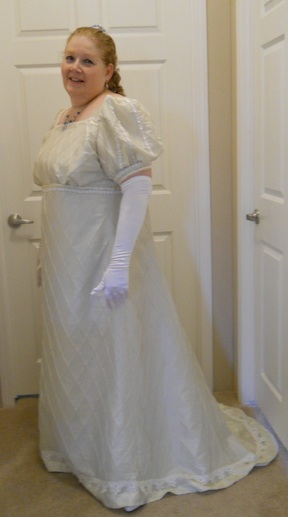
The dress and coat are both done, no thanks to me since I got sick the last couple of days and couldn’t even help with the handwork. The best I could do was show up for fittings, pose for pictures, and eventually, pack up the car for the 1200-mile trip from the Florida retirement community to Kansas City. I still feel a bit like the wicked stepsister, taking off for the ball while leaving Cinderella at home to prepare two houses (mine and hers) for the summer while we head back to Ohio. I seriously owe you, Mom!

gown427-4My mom’s a genius! Not only did she do a fantastic job on both garments, but she sewed on hanger loops and outfitted me with a needle and thread in case something goes wrong. She really deserves to be here at RT on Wednesday night when I wear it to the Ellora’s Cave disco party (not going to do any disco dancing, however) and the 30th Anniversary Ball on Thursday. I’ve promised photos, and they’ll be posted here as well.

Observations on the entire process

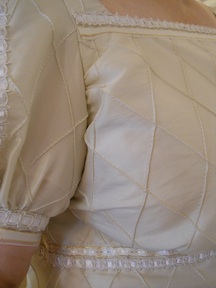
  • This is not a project for an amateur. I could never have done this myself, and I do have some sewing experience. The fitted bodice required a LOT of pattern alterations, since we couldn’t use any sort of stretchy fabric and still remain anywhere close to authentic.
  • The gown my sister had made had two separate drawstrings in the bodice to make it more fitted, since she was not available for fittings. That turned out well, but I’m not sure that would have worked well with the pattern we used.
  • We had to fudge on the back closings, since we could not get the eyehole punch to work through two layers of fabric and interfacing. In the end, we used hooks and eyes and snaps, and yes, I do need a lady’s maid to help me into it. (Any volunteers?)

How much did I spend on this project?

  • As to that, I’m not sure I really want to know. The most costly trip to Jo-Ann’s was $143, and that was mostly for the fabric and lining (for both the gown and the coat). The price for the trim and lace was another $100 or so (and totally worth it, I think you will agree), and there were several other trips to Jo-Ann’s in various towns for things like interfacing and other sewing notions. A few things (like the eyehole punch) got returned too, so I can’t tell you the final cost. But I would guess it was at least $350, and that does NOT include the hours and hours my mother put into it. But that’s not all! I also invested a considerable sum in accessories, including:
  • Regency slippers with “diamond” clips, plus clockwork stockings, from American Duchess
  • ringlet hairpiece
  • three different tiaras (couldn’t make up my mind)
  • long white gloves
  • brooch to wear with the coat
  • special “undies” (not authentic, but who’s going to know?)

gown_detailBut it’s not about the money.

It’s never been about the money.

It started with my friend Ellen’s idea for promoting Susana Ellis the author at conferences like this one (although I suspect that I will not be the only one in costume here.) But it became so much more than that. I never could have guessed how much my mother and I bonded during this process—from the first days of discussing the project to the difficult decisions about fabric choice (would you believe we originally intended the blue satin to be the gown and the cream pintuck taffeta to be the coat?) and many setbacks (like when the sleeve had to be redone and then we had to abandon the project for a few days to head north for a funeral) and wondering if it was possible to finish both garments in time for the conference.

Surprisingly, even my father became invested in this project. During the times when he seemed to have some health setbacks himself and Mom started worrying about having to head north earlier than planned and not being able to finish the coat, he told her to quit worrying about him and just finish it! He wanted to see the final product as much as we did, and thus, he started working harder at his physical therapy exercises (he has Parkinson’s).

Today’s the day!

I’m writing this on Wednesday, so by the time this goes live, the first event (the Ellora’s Cave disco party) will be over and hopefully I will have some photos to post. I’m planning to wear the gown for a Club RT appearance at 3:30, and then comes the stage walk with the Ellora’s Cave caveman. Oh yeah!

Click here for the video of the walk across the stage!

coat427-3On Thursday I’ll be wearing it for the Expo from 4-6 and then the RT ball in the evening. On Friday morning I have another appearance at Club RT. By then I’m sure it’ll be ready for the dry cleaner’s and the next opportunity, probably the RWA Conference in Atlanta.

If you are going to be at any of these events, please come up and chat with me and check out the gown in person. I’m looking forward to making lots of reader-author friends while I’m here, and I do hope you will be one of them! Warning: don’t be surprised if I ask you to be “lady’s maid” for me! Regency ball gowns were generally worn by well-off young ladies with abigails to assist them in dressing, and unfortunately, my first choice in lady’s maids—my sister Gloria—had to stay home with her cat. Where is a hunky Ellora’s Cave caveman when you need one?

Oh, and in case you’re wondering: Mom is NOT interested in taking this up as a profession or a hobby. Being retired in itself is a very time-consuming activity. Once is enough…and I’m the lucky one!

The Dress: Episode #1

The Dress: Episode #2

What Makes a Tortured Hero?

 What Makes a Tortured Hero?

When I think of a tortured hero, I think of Outlander’s Jamie Fraser, who had to let Claire return to the 20th century to save her life and that of their baby, and then endured 20 years without her, knowing that she was living with her 20th century husband and he’d never see her again, or their child. (Of course, Claire was equally tortured, and her 20th century husband as well, but they had Brianna, while Jamie was all alone (well, mostly anyway).

????????????????????????????????????????In Treasuring Theresa, Damian tells himself he’s not at all interested in a country bumpkin like Cousin Theresa, but why does it bother him to think that she’s still in love with Reese Bromfield, the man she always expected to marry?

In Cherishing Charlotte, my current WIP, Colin discovers that his past family squabbles are not nearly so torturous as falling in love with his employer’s granddaughter who is fated to marry a worthless fribble in order to save her family from penury.

In the as-yet-untitled next project, Gabriel, having suffered through a previous marriage to a lunatic, finally finds a woman he wishes to share his life with, but then discovers she has deceived him. He should steer clear of her. Hasn’t he learned his lesson?

One thing all of these “tortured heroes” has in common is their willingness to risk everything to protect the women they love. Jamie has to allow Claire and the baby leave him forever. Damian has to prove his worth to win Lady Theresa’s heart. Colin must allow Charlotte to marry her cousin because he himself cannot save her family. And Gabriel has to come to an understanding that the circumstances of Isabelle’s past gave her no option but to do what she did, and that a life with her is worth fighting for.

Who is your favorite tortured hero? What makes him a tortured hero, in your opinion?

Treasuring Theresa, a 45-page Regency short story, is available now at Ellora’s Cave, Amazon, Barnes & Noble, All-Romance eBooks, Sony, Google Books, and Bookstrand.

Click here to find one of my favorite scenes. (The official excerpt is here.)

Note that all Ellora’s Cave books are 50% off on All-Romance eBooks for the month of April!

More information about Cherishing Charlotte, Susana’s current WIP, is available here.

Episode #12: Lady P’s Revelations Regarding George III and His Peculiar Progeny

Lady Pendleton, Damian Ashby’s eccentric aunt (see the epilogue to Treasuring Theresa on Susana’s web site), is visiting Susana from the early 19th century. She’s intrigued by life in 21st century Toledo, Ohio, and, of course, Susana is thrilled to have the opportunity to pick her brain about life in Regency England. It certainly gives her a great deal to write about in Susana’s Parlour!

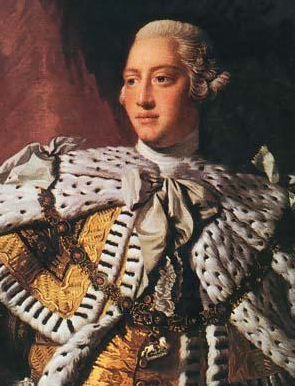
georgeiiiSusana: [to the Reader]: Lady Pendleton’s opinions on George III tend to be diametrically opposed to mine, which she attributes to my “ignorance due to indoctrination by history books written by misguided wretches attempting to justify the dreadful bloodbath caused by the radical colonists.”

It seems doubtful that we will ever come to agreement on that score—too many years of July 4th picnics and fireworks and, pledging allegiance to the flag, and singing “The Star-Spangled Banner”—but I have begun to see George III in a more sympathetic light. More than 200 years have passed and since my trip to England last year, I have come to realize that the English do not see him as the tyrant “we” do (and I say “we” even though at least some of my ancestors still lived in England during that time), and most never did.

And I have to say—in spite of all the patriotism instilled in me over decades—I am intrigued with the idea of growing up speaking with a British accent. (Can I be deported for saying that?)

Lady P: You must admit that the American accent sounds decidedly low class, Susana. Perhaps I could give you lessons in enunciating. Much like that Henry Higgins did to Eliza in that film we saw the other evening. You would never pass for upper class in society, of course, but it would be a definite improvement.

Susana: I thank you for offering, Lady P, but I’ll stick with the lazy American drawl for now. Perhaps some other time.

Lady P: Very well. Shall we discuss His Royal Highness King George III for your readers? Where shall I start?

Susana: At the beginning would be best. Where did you meet him?

Lady P: I was too young to attend his wedding to Queen Charlotte, but I do recall my mother bringing home a flower—was it a camellia or a rose?—but it was pink and she put it in one of the heaviest books in the library for pressing. I remember feeling very sad that she had to destroy such a pretty posy in order to preserve it. I wonder what happened to it? I believe my brother Henry inherited all the books in the library, so perhaps it’s still there. He was never one to read or study overmuch.

Susana: But you did meet him at some point?

Lady P: Goodness, yes. During my come-out—my mother was so vexed that the Royal Pair failed to attend my presentation ball—I was presented to Queen Charlotte, as were all of the young debutantes, you know, and I did meet them once or twice that season. After I was married to Lord Pendleton, we met more often. Lord P was in the House of Lords, you know, and we were obliged to attend certain political events.

Susana: What did you think of him?

Lady P: He was a kindly old man, quite stodgy, you understand. As a young girl, I didn’t appreciate that quality in him. One expected the King to be a cut above the rest of society, and he wasn’t at all. I recall complaining to Pendleton about the plainness of the fare at Windsor Castle and why the King could not have a French chef as skilled as ours, and he said the King didn’t appreciate rich food anymore than he did the French. Good, hearty English fare was good enough, he said.

Susana: I hear his marriage was a love-match.

Lady P [snorting in a very unladylike manner]: Romance again, Susana? Americans seem obsessed with it. The King met his betrothed on the day of the wedding. He wasn’t allowed to marry Lady Sarah Lennox when he wished to because she was only the sister of a duke. Royalty must marry royalty, you know. Or at least they did in my time.

Susana: But they did have fifteen children, so the marriage must have been somewhat of a success.

Lady P: Oh indeed, they got on well after that. Queen Charlotte was not well-favored, but she had a very pleasant disposition. She was a perfect wife for a down-to-earth man like the King.

Susana: So what happened to their children? The sons, at least, did not seem to be able to sustain such happy marriages. Look at the Prince Regent, for example. His life was like the antithesis of his father’s.

Lady P: Indeed. The King disliked his oldest son intensely. Frederick was his favorite. Pendleton told me the King often bemoaned the fact that Frederick was not his oldest son. Brought up to be a military man. He was the Commander-in-Chief of the Army, you know, until the scandal.

Susana: The scandal?

Lady P: Apparently he passed on military secrets to his mistress, a sly little hussy by the name of Mary Anne Clarke. She took bribes in exchange for promotions, and although she was the one to blame, it was his indiscretion in telling her such things that caused him to resign in disgrace. [shaking her head sadly] Should have stuck by his long-suffering wife. Frederica was a most amiable woman.

Susana: So even his favorite had feet of clay. What about the others? Wasn’t one of them accused of murder?

Lady P: Ernest, that was. He was an odd sort. Spread all sorts of cruel rumors about his brothers. His valet turned up with his throat cut, and it was whispered that he’d been seduced by his master, who murdered him when the man attempted to blackmail him.

Susana: Oh my. Homosexuals were hung in those days, were they not?

Lady P: Indeed they were. It would have been a massive scandal had that little fact become known. Which is no doubt why the inquest determined that the man committed suicide.

Susana [shuddering]: Who commits suicide by cutting their throat?

Lady P: Exactly. Not to mention that the man was left-handed, and the deed had to have been done with his right hand. [sighing] But I suppose such things must be done to protect the monarchy and the nation.

Susana: Surely among fifteen children there must have been at least one or two who turned out well. What about the daughters?

Lady P: Poor Amelia died in 1810. She was 27 and unmarried, since she had not been allowed to marry the man of her choice, Charles Fitzroy. She was the youngest and the King’s favorite and he was never the same after that. The other girls—well, the oldest, Princess Charlotte was married to the King of Württemburg—remained unmarried and living at home, and dear me, they never dissembled about expressing how they felt about that. Well, they were all rather plain, like their mother, and ran to fat, but they did adore their father, no matter how unstable he become as the years passed.

Susana: The Prince of Wales was made Regent because of his illness, which has been called dementia. Did you ever see him in that state, or know someone who did?

Lady P: I did not, of course, since he was kept in seclusion as soon as he began to exhibit symptoms. But Pendleton did, on one occasion, when he was attending the King on parliamentary business. [clucking her tongue]. He began speaking in shrill tones, so quickly that he could not be easily understood, calling for “the woman he loved,” a certain Lady Pembroke who served at court. His eyes bulged and he dropped his breeches to reveal his backside. Pendleton was horrified when I nearly fell over laughing when he described it. He said it was a horrifying experience.

Susana: The King of England mooned your husband? Heavens, what a sight that must have been! [grinning broadly]

Lady P: Harrumph! It was, rather. And yet I did feel very sorry for him. He was a fine king and deserved much better than to be afflicted by such an undignified malady. And then to have his sons to be such bounders, and one of his daughters to bear an illegitimate child… It is almost a blessing that such distressing news was kept from him.

Susana [sighing]: My belief in fairytale royal marriages died a tragic death after what happened with Princess Diana. Although I can’t help hoping that Prince William and Kate will end up happily.

Lady P: They do seem a sensible pair, and very well-matched, like my nephew Damian and his wife Theresa. Have I told you Theresa is expecting again?

mi_hacienda_edited-1Susana: You’ve mentioned it a few times. What do you think about Subway for dinner?

Lady P: What was that Spanish place we went to last week? I rather fancy one of those—what do you call them—burros?

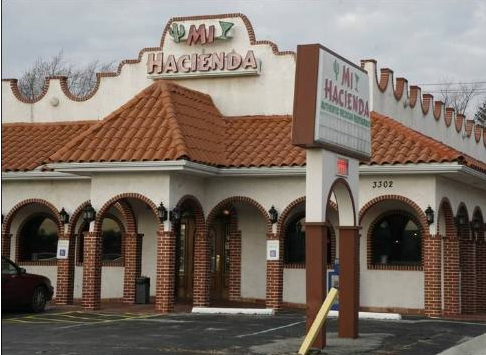
Susana: Burritos, Lady P. And it was Mexican, not Spanish. Mi Hacienda, on Glanzman Street. They offer salsa lessons on Wednesday nights. What do you say we paint the town while we’re at it.

Lady P: A burrito will do, Susana. And perhaps some of those savory chips. Never had anything like them before. Do you suppose I can take the recipe back with me for my own cook to prepare?

Susana [shaking her head]: Sorry, Lady P. We’ve had this discussion before. Remember the Prime Directive?

As always, please do comment if you have any questions you’d like to ask Lady P about the late Georgian/Regency era. She does love to chat!

The Lady P Series

Episode #1: Susana’s Adventures With Lady P: The Introduction

Episode #2: Lady P Talks About… Pride and Prejudice?

Episode #3: Lady P and the Duchess Who Lost a Billion Dollars

Episode #4: Lady P and the Face On the $100 Bill

Episode #5: In Which Lady P Discovers Sparkly Fabrics and Ponders Violating the Prime Directive

Episode #6: Lady P Dishes the Dirt on the Duchess of Devonshire

Episode #7: The Political Exploits of Lady P and the Duchess of Devonshire

Episode #8: Lady P and the Prince Regent’s Illicit Marriage

Episode #9: In Which Lady P Depletes the Cooking Sherry During Her Discussion of Caroline of Brunswick

Episode #10: Lord Byron: Mad, Bad, and Dangerous to Know

Episode #11: In Which Lady P Talks About Hannah More and the Rights of Women

Episode #12: Lady P’s Revelations Regarding George III and His Peculiar Progeny

Episode #13: Lady P Discusses the Luddite Uprising, the Assassination of Spencer Perceval, and the General Unfairness of Life

Episode #14: In Which Leticia, Lady Beauchamp, Pops In For an Interview On Her Personal Acquaintance With Princess Charlotte of Wales

Episode #15: Lady P On Assignment in 1814 Kent

Lady P Quizzes Jane Livingston, the Hero’s Sister From “A Twelfth Night Tale”

The Dress: Episode 2 + Giveaway

This post is part of a mini-series about the experiences of my mother and me in creating a Regency gown for the Romantic Times Convention on May 1-5, 2013 in Kansas City. You can find Episode 1, where we shopped for fabric and struggled with cutting out the dress pieces here.

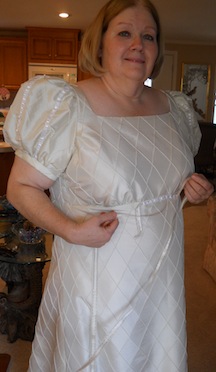
DSCN0032I tried the dress on and it fits!!!

It’s not finished yet. The fastening at the back remains to be done, plus the hem and lots of trim. But it does look like a dress now, and it does look pretty good on me, if I do say myself!

My mom’s a genius!

However, we had a bit of a setback a week ago when my uncle died unexpectedly and we all had to fly north for the funeral. It was cold and nasty and, well, sad, because we had to say goodbye to Uncle Bob, but it was good to see friends and family we haven’t seen for years.

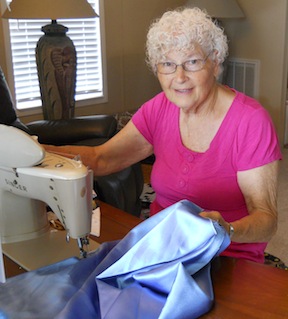
We still have a couple of weeks left, though, before I have to take off for Kansas City, and it’s quite likely we’ll have the blue satin coat done too, by that time. She’s already got the pieces for the gown and the lining cut out, as well as the organdy ruffle at the collar and the sleeve stays. We think this will go faster than the gown, since she’s already worked out the fit issues. But it is still rather a complicated design and she’s something of a perfectionist, so she’ll be putting in a lot of hours. That worries me a little bit, because I don’t want her to wear herself out. I try to help with lunch and errands and Dad, but I am seriously going to owe her after this. Big time.

Mom_sewing

Mom_cutting2

    Mom_fabric

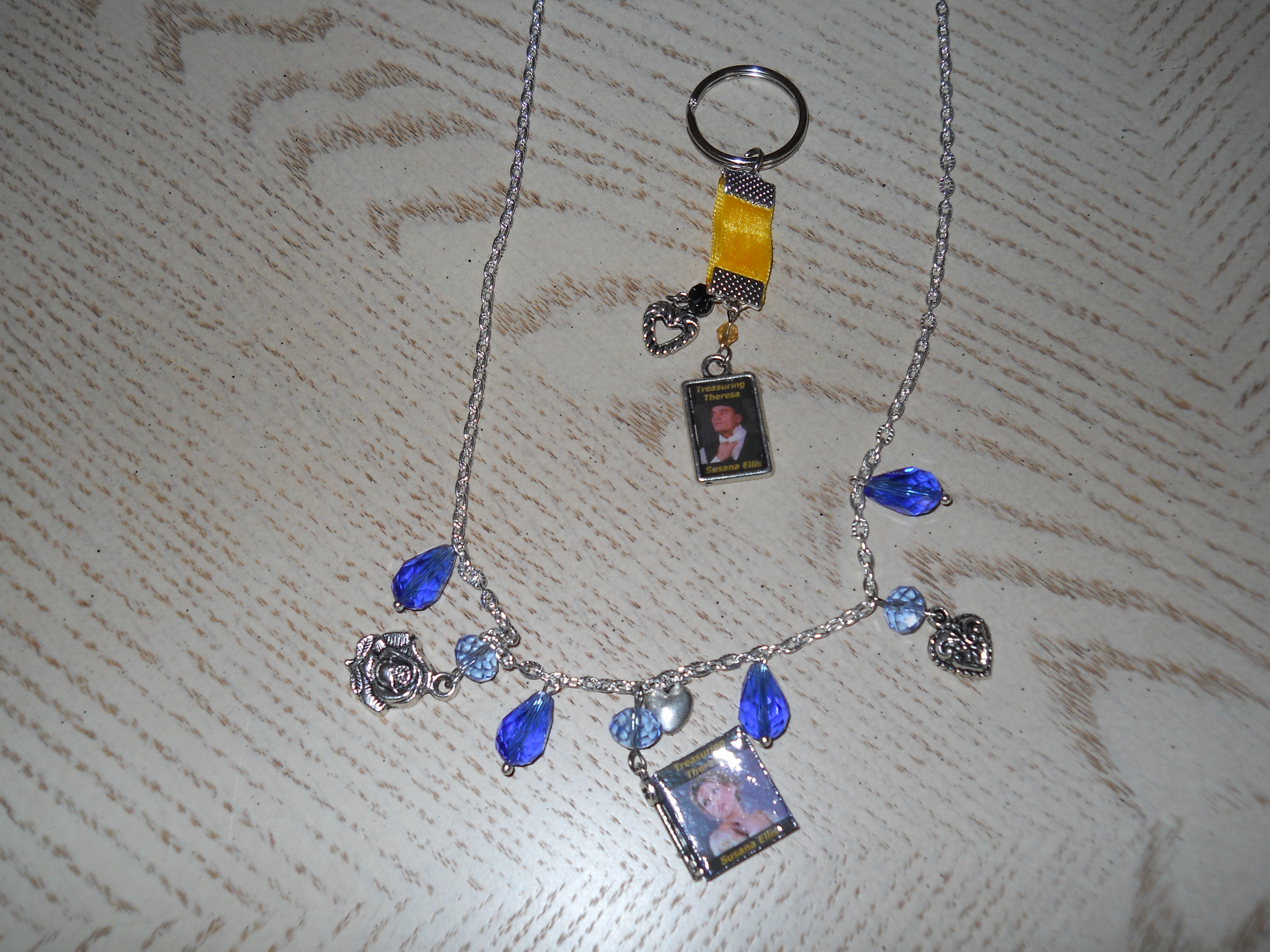
She also just had her 75th birthday on April 15th and wouldn’t let us buy her anything. Of course, I did give her a Treasuring Theresa necklace (see below), but I’m going to have do something really nice for her for Mother’s Day this year. Hmm. What can you give someone who doesn’t want you to “waste” money on her?

TT_necklace_keychain

Please comment with any suggestions you may have of how I can show my appreciation to Mom for her commitment to this massive project. One random commenter will receive a Treasuring Theresa keychain (see above), with Damian on one side and Theresa on the other).

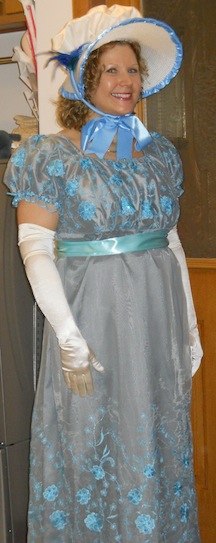
Letitia_gown_bonnet6P.S. Here’s my sister Gloria (aka Letitia, Lady Beauchamp) in the Regency gown she had made from an artisan on Etsy recently (and the hat our mother made). I offered to take her with me to the RT Convention as my lady’s maid (trust me, somebody is going to have to help me in and out of this gown), but she said she can’t leave her cat that long. A cat? Really? Hmm. At least I know where I stand!

Stand by for further reports on the progress with “The Dress.” The deadline approaches, but I have perfect confidence in my mother’s abilities.

Oh, and in case you’re wondering: Mom is NOT interested in taking this up as a profession or a hobby. Being retired is in itself very time-consuming. Once is enough for her…and I’m the lucky one!

Meg Mims: Traveling the Transcontinental Railroad + Giveaway

Meg is offering a free digital copy of Double or Nothing for one lucky reader and I’m throwing in a $10 Amazon gift card for another. To enter: leave a comment (and your email address) on this blog entry and then click here to enter the Rafflecopter. The winner will be chosen and notified on April 19th. Good luck!

I love reading historical fiction. I love researching them even more… and the transcontinental railroad is a favorite topic because the first book in my Double Series is a twist of True Grit and Murder on the Orient Express. Double Crossing won the 2012 Spur Award for Best First Novel, and my new release, Double or Nothing, is the sequel. Book two is not set on a train, but incorporates some further information about the New York to San Francisco railroad.

So let’s talk trains! Most people take for granted the highways of today. Over 150 years ago, when gold was first discovered in California, men hoping to get rich traveled to San Francisco via steamships which navigated through the dangerous Panama River and jungle region in Central America. Settlers heading west chose stage coaches, river boats, Conestoga wagons, oxen or horses, which dictated how far one could go—and such trips would often take many months due to weather, Indians and no real roads.

After the ‘war of Rebellion,’ the Union Pacific began laying tracks west from Omaha. They had their own problems with marauding Indians, the Rocky mountains and keeping up the pace (although I’m not certain the AMC series Hell on Wheels is all that accurate). The Central Pacific had far greater obstacles and dangers. Relentless winter storms in the Sierra Nevada mountains stalled the work. Snow sheds were fashioned to keep progress going, and thank goodness for nitroglycerin and the Chinese laborers who gave their lives to build that route. The five-mile-long Summit Tunnel in the Sierra Nevada took 15 months, in fact, to finish. The “race” between the two companies ended at Promontory Point in Utah in May of 1869.

After the Golden Spike ceremony that joined the two lines, travelers could begin in New York and end up in Sacramento within a week or 10 days in good weather. But travel wasn’t easy. The Pullman Palace sleeping cars proved expensive for the average traveler, but were not luxurious by any standard. Station houses with 30-minute meal stops gave way to dining cars within the decade. Indians who had often sabotaged the Union Pacific crews withdrew further north to fight at the Little Big Horn—and eventual defeat after that short-lived victory by the turn of the century. The Western Pacific railroad was also built from Sacramento via Stockton and San Jose to get as close to San Francisco as possible, although many people took a spur railroad to Vallejo and then a ferry across the Bay. Within 25 years, the majority of fruit shipped to the East Coast from California via refrigerated freight cars.

The transcontinental railroad proved to be the biggest fuel for American western expansion. My Double series gives the reader that sense of the west, of adventure and mystery, a touch of romance, and a bit of inspiration as well. Double Crossing is a twist of True Grit and Murder on the Orient Express, while Double or Nothing continues the adventures of Lily and Ace with a twist on The Fugitive.

DOUBLE CROSSING—BOOK 1

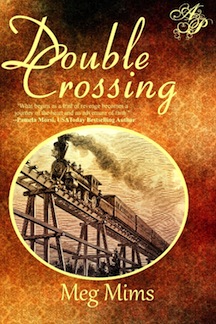
Endorsed Double Crossing 500 x 750A murder arranged as a suicide…a missing deed…and a bereft daughter whose sheltered world is shattered.

August, 1869: Lily Granville is stunned by her father’s murder. Only one other person knows about a valuable California gold mine deed — both are now missing. Lily heads west on the newly opened transcontinental railroad, determined to track the killer. She soon realizes she is no longer the hunter but the prey.

As things progress from bad to worse, Lily is uncertain who to trust—the China-bound missionary who wants to marry her, or the wandering Texan who offers to protect her … for a price. Will Lily survive the journey and unexpected betrayal?

Click here to see the BOOK VIDEO

DoubleorNothing 500x750 (3)DOUBLE OR NOTHING—BOOK 2

A mysterious explosion. A man framed for murder. A strong woman determined to prove his innocence.

October, 1869: Lily Granville, heiress to a considerable fortune, rebels against her uncle’s strict rules. Ace Diamond, determined to win Lily, invests in a dynamite factory but his success fails to impress her guardian. An explosion in San Francisco, mere hours before Lily elopes with Ace to avoid a forced marriage, sets off a chain of consequences.

When Ace is framed for murder before their wedding night, Lily must find proof to save him from a hangman’s noose. Will she become a widow before a true wife?

CLICK HERE TO SEE THE BOOK VIDEO!

About the Author

Meg in ViennaClocks and time play a big part in any late bloomer’s life. And time plays a vital part in every mystery.

Meg Mims is an award-winning author and artist. She writes blended genres – historical, western, adventure, romance, suspense and mystery. Her first book, Double Crossing, won the 2012 Spur Award for Best First Novel from Western Writers of America and  was named a Finalist in the Best Books of 2012 from USA Book News for Fiction: Western.  Double or Nothing is the sequel. Meg has also written two contemporary romance novellas,The Key to Love and Santa Paws — which reached the Amazon Kindle Bestseller list.

Excerpt 

DOUBLE CROSSING — Chapter One

I burst into the house. Keeping the flimsy telegram envelope, I dumped half a dozen packages into the maid’s waiting arms. “Where’s Father? I need to speak to him.”

“He’s in the library, Miss Lily. With Mr. Todaro.”

Oh, bother. I didn’t have time to deal with Emil Todaro, my father’s lawyer. He was the last person I wanted to see—but that couldn’t be helped. Thanking Etta, I raced down the hall. Father turned from his roll-top desk, spectacles perched on his thin nose and hands full of rustling papers. Todaro rose from an armchair with a courteous bow. His silver waistcoat buttons strained over his belly and his balding head shone in the sunlight. I forced myself to nod in his direction and then planted a quick kiss on Father’s leathery cheek. The familiar scents of pipe tobacco and bay rum soothed my nervous energy.

“I didn’t expect you back so early, Lily. What is it?”

With an uneasy glance at Todaro, I slipped him the envelope. “The telegraph messenger boy caught me on my way home.” My voice dropped. “It’s from Uncle Harrison.”

Father poked up his wire rims while he pored over the brief message. His shoulders slumped. “I’ll speak plainly, Lily, because Mr. Todaro and I were discussing this earlier. My brother sent word that George Hearst intends to claim the Early Bird mine in a Sacramento court. Harrison believes his business partner never filed the deed. He needs to prove our ownership.”

“Hearst holds an interest in the Comstock Lode, Colonel.” Todaro had perked up, his long knobby fingers forming a steeple. The lawyer resembled an amphibian, along with his deep croak of a voice. “His lawyers are just as ambitious and ruthless in court.”

Father peered over his spectacles. “Yes, but I have the original deed. I didn’t plan to visit California until next month, so we’ll have to move up our trip.”

“Oh!” I clasped my hands, a thrill racing through me. “I’m dying to visit all the shops out there, especially in San Francisco. When do we leave?”

“We? I meant myself and Mr. Todaro.”

I stared at the lawyer, who didn’t conceal a sly smirk. “You cannot leave me behind, Father. I promised to visit Uncle Harrison, and what if I decide to go to China?”

“Lily, I refuse to discuss the matter. This trip is anything but a lark.”

“It’s a grueling two thousand miles on the railroad, Miss Granville. Conditions out west are far too dangerous for a young lady,” Todaro said. “Even with an escort.”

“The new transcontinental line has been operating all summer. Plenty of women have traveled to California. I’ve read the newspaper reports.”

“I’m afraid the Union and Central Pacific cars are not as luxurious as the reports say. You have no idea. The way stations are abominable, for one thing.”

I flashed a smile at him. “I’m ready for adventure. That’s why I’ve considered joining the missionary team with Mr. Mason.”

Father scowled. “You are not leaving Evanston until I give my approval.”

“You mean until you dissuade me from ‘such a ridiculous notion.’”

“Need I remind you of the fourth commandment, Lily?”

“No, Father. We’ll discuss this later.”

My face flushed hot. Annoyed by being reprimanded in front of Todaro, I ignored the rest of the conversation. I’d always wanted to see the open prairie and perhaps a buffalo herd chased by Indians, the majestic Rocky Mountains and California. California, with its mining camps, lush green meadows and warm sunshine, the cities of Sacramento and San Francisco that had to be as exhilarating as downtown Chicago. I’d pored over the grainy pen-and-ink drawings in the Chicago Times. Uncle Harrison, who’d gone west several years ago to make a fortune and succeeded, for the most part, would welcome me with open arms. I plopped down on an armchair and fingered the ridges of the brass floor lamp beside me. Somehow I needed to persuade Father to allow me to tag along on this trip.

Contacts

Website   Facebook page for Double Series   Amazon Author Page   Twitter