Archives

Vauxhall Gardens: Three Piazzas of Supper-Boxes

vauxhallbook

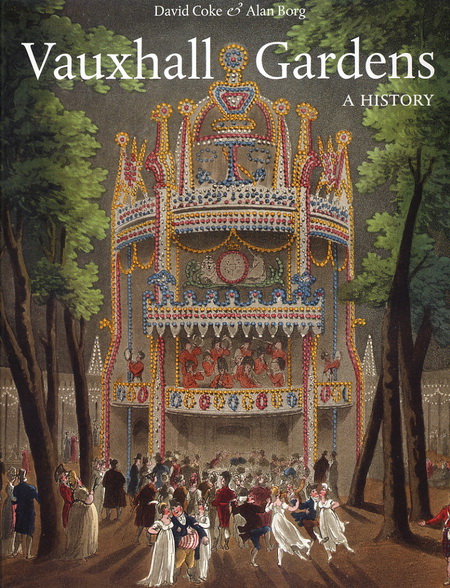
Vauxhall Gardens: A History

David Coke & Alan Borg

The Vauxhall Pleasure Gardens is one of the places I’d love to slip back in time to visit, just to catch a glimpse of what it was like. After recently splurging to buy this lovely coffee-table book, I thought it might make a wonderful subject for a new blog series. But do buy the book too, if you can! The photos are fabulous!

A Splash of the Exotic

The… striking similarity between the Grove and travellers’ descriptions of the great piazza of San Marco in Venice, where citizens were able to arrive by water, take refreshments, listen to music and watch street entertainers, would have highlighted Vauxhall’s exotic pedigree, evoking images of faraway places. This fusion of the familiar with the foreign, a constant feature of the gardens, is likely to have been a deliberate move to give visitors the thrill of romantic and magical scenes without the discomfort of distant travel.

In contrast to the aristocratic or amateur owners of great private gardens, whose wealth allowed them to indulge themselves with indiscriminate allusions to the classical past, ancient mythologies and dreamworlds, Tyers’s overriding consideration in all his investments at Vauxhall was the commercial imperative. Providing that it also furthered his aims, every improvement had to attract more people and increase his profits if it was to justify itself. The sales of food and drink represented the bulk of his income, so the more people he could persuade to purchase refreshments in the gardens, the better it was for his business. Increasing the number of supper-boxes by inserting several sweeping ‘piazzas’, or crescents of supper-boxes, was a very effective and elegant way of achieving this.

The Temple of Comus (later the Chinese Pavilions)

The Temple of Comus was named… after the god of cheer and good food… Ben Jonson described Comus as the ‘Prime master of arts, and the giver of wit;’ he is also associated with music and with floral decorations. The god thus encompassed all the purposes of the new building, which, although primarily devoted to dining, allowed for the appreciation of the arts and music as well as polite conversation in civilised surroundings.
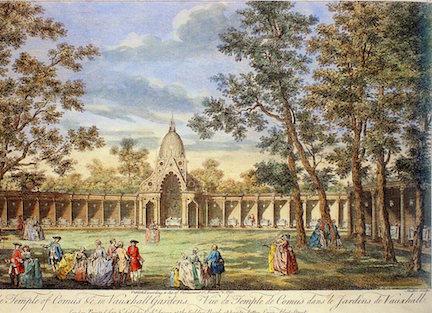
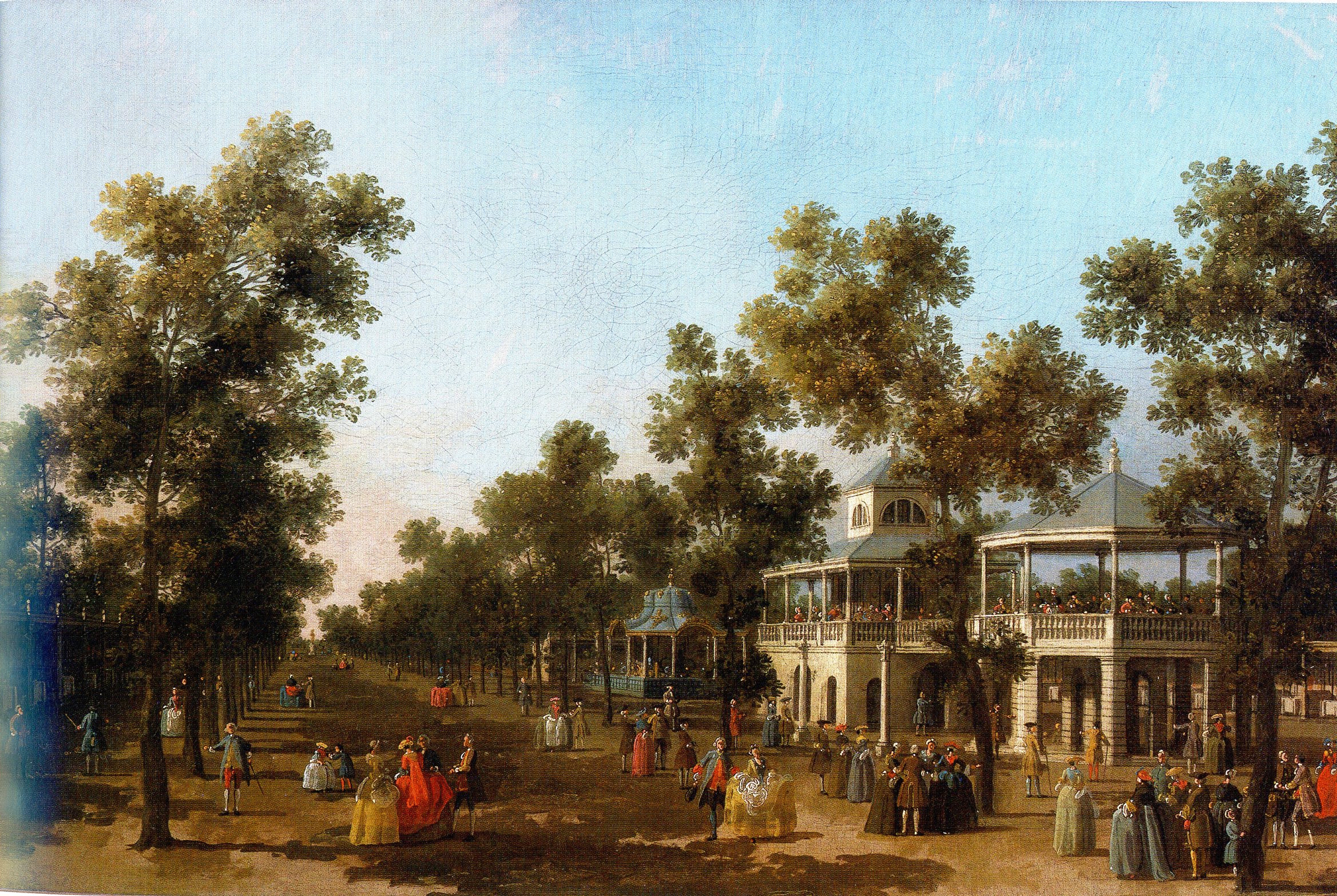
J.S. Muller after Canaletto, A View of the Temple of Comus &c. in Vauxhall Gardens, an engraving hand-colored, 1751 (David Coke's collection). Families with small children are promenading in the foreground.

J.S. Muller after Canaletto, A View of the Temple of Comus &c. in Vauxhall Gardens, an engraving hand-colored, 1751 (David Coke’s collection). Families with small children are promenading in the foreground.

Initially, the building was “classical in style, with a colonnade of Ionic columns supporting a straight entablature, topped with urn finials; the semicircle flowed in a smooth curve out of the straight colonnade of the northern range of supper-boxes.” However, the designer also incorporated Gothic arches and “broad-ramped scrolls [that] acted as buttresses for the dome” and other unorthodox details. “The apparent breaking of architectural rules, mingling different styles in the same building, was deliberate and entirely typical of the unorthodox design of the English Rococo, which aimed to create playful, light-hearted works.”

piazza002 copy

T. Bowles after S. Wale. A View of the Chinese Pavillions and Boxes in Vaux Hall Gardens, engraving. c. 1840 (David Coke’s collection). This is a reprint of Bowles’ plate of 1751, published by Francis West, a Fleet Street optician and printseller who acquired many original plates of London views, probably after the sale of trade stock by Robert Wilkinson, Bowles’ successor, in 1825. The buildings of the Temple of Comus are shown with their newly applied elaborate surface decoration.

The Handel Piazza
piazza003 copy

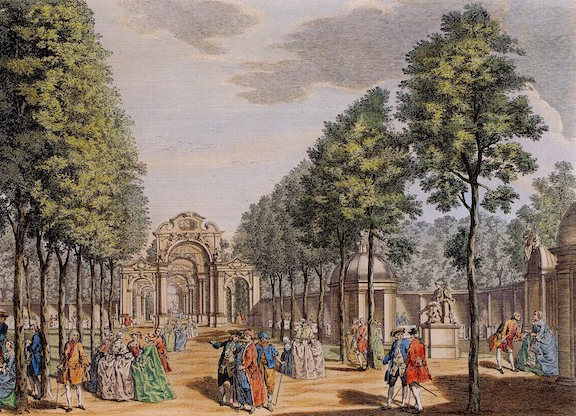
J.S. Muller after S. Wale, The Triumphal Arches, Mr. Handel’s Statue &c. in the South Walk of Vauxhall Gardens, engraving, c. 1840 (David Coke’s collection). The early version of the Handel Piazza.

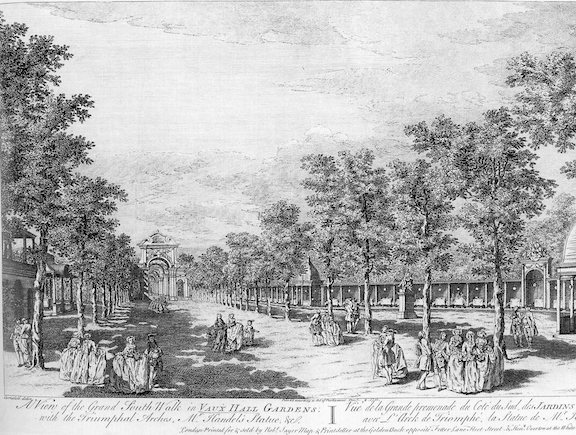
The Handel Piazza on the Grand South Walk started life as a small semicircular colonnade of plain boxes, little more than an open setting for Roubiliac’s statue of the composer… The piazza was built in the simplest Doric order, although the domes of the two terminal pavilions were topped with Gothic lanterns. The rebuilding of 1750-51 created a much broader colonnade, with twenty-two flat-roofed boxes, still of the Doric order, but with urn finials on the roof over each column. As in the Temple of Comus, the central pavilion was more elaborate, marked out by the use of the Ionic order, with swagged decorations between the columns, but here in the Handel Piazza the classical order and restraint were maintained… This new structure added considerably to the number of supper-boxes available on the Grand South Walk… The opposing arrangement and contrasting decorative styles of the Chinese Pavilions and the Handel Piazza epitomise Tyers’s ideological belief in the balance between excess and moderation, with Comus appropriately representing pleasure and excess, and Handel, in his simpler classical architectural setting, representing virtuous sobriety.
piazza004 copy

J.S. Muller after Canaletto, A View of the Grand South Walk in Vaux Hall Gardens, with the Triumphal Arches, Mr. Handel’s Statue, &c. Engraving, 1751 (British Library, London). On the right is the second version of the Handel Piazza, with more supper-boxes.

The Gothic Piazza

The Gothic Piazza, looking down the Grand South Walk from its western end, is not shown from the front in any engraving of Vauxhall, although Wale’s General Prospect shows it from the back just to the south (right) of the Prince’s Pavilion). It is, however, fully described in Lockman’s Sketch, as

a little Semi-circle of Pavillions, in an elegant Gothic Style […}. At each Foot of this Semi-Circle, stands a lofty Gothic Tent, each having a fine Glass Chandelier, the Lamps in which are of a very peculiar frame, as are those in the grand Tent, built in the Grove, &c. In the Center of this Semi-Circle is a Pavilion, with a Portico before it; and over the Pavillion, a kind of Gothic Tower, with a Turret at Top. Here a Glass Moon was to have been seen; but its Light was found too dazzling for the Eye. Those who survey’d the Alley, the Grove, &c. thro’ this Glass, saw a lovely Representation of them in Miniature. As the painted triumphal Arches before mentioned are in the Grecian Style, and these Pavillions in the Gothic, they form a very pleasing Contrast.

…The implication is that visitors could climb to the top of the central pavilion of this piazza, to look down on the gardens through an optical device or lens during daylight, and after that, after dark, a light was shone through it towards visitors in the Grove, possibly spotlighting courting couples. [Scandal!]

“A remarkable body of original and innovatory architecture”

The group of structures in and around the Grove at the end of the 1740’s, comprising the Orchestra and organ buildings, the supper-boxes and three piazzas, the Prince’s Pavilion, the Turkish Tent and the Rotunda, represent a remarkably body of original and innovatory architecture that was both decorative and practical, achieved by Tyers and his team in the space of just thirteen years. Few other patrons could boast of such a diverse collection of modern works of architecture. The sheer expense incurred in this building spree is evidence of the level of Tyers’s income; as Hogarth’s friend the enameller Jean-André Rouquet wrote at the time, ‘The director of the entertainments of this garden acquires and expends very considerable sums of money there every year. He was born for undertakings of this kind. He is a man of an elegant and bold taste; afraid of no expence, when the point is to divert the public’—or rather, to attract the paying public to Vauxhall.

The fact that this elegant and bold taste was devoted to a pleasure garden, and that the buildings no longer exist, should not detract from their importance in the context of the development of British architecture, and in particular, of British interior design in the eighteenth century. They would have been some of the best-known modern buildings in the country, seen by tens of thousands of visitors every year.

Supper-Box Furniture
furniture001 copy

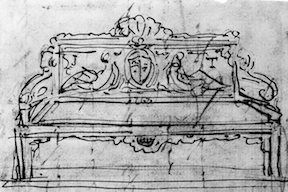
In the 1730’s and 1740’s, furniture at Vauxhall… was plain and serviceable, the tables usually covered with baize on linen. Rectangular square-legged farmhouse tables and foxed plain benches served the supper-boxes, with free-standing backless benches and plain tables out in the Grove. The Grove also boasted a number of slatted wooden garden seats, their circular inward-facing form, accessed through a single opening, providing the ideal setting for polite conversation for an intimate rendezvous.
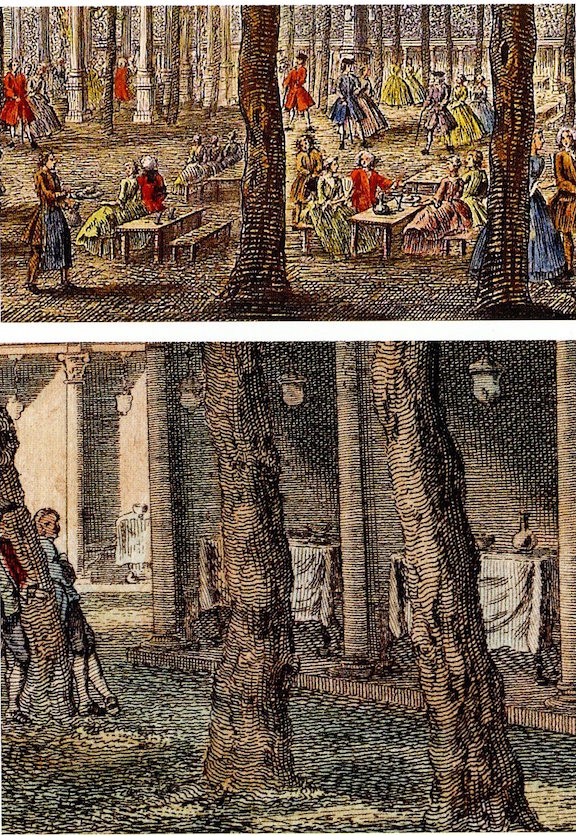
furniture002

By the early 1750’s, however, contemporary engravings show a number of more elaborate and expensive tables and benches in the supper-boxes. The carved Rococo table-legs, showing below the tablecloths, appear to be ornamented with double-C scrolls.

After this brief period, however, the furniture again reverted to a simple farmhouse style. Indeed, it would be unsurprising if the carved Rococo tables of the 1750’s were found to be too delicate for the abuse they would have received at Vauxhall from the visitors and weather.

Susana’s Vauxhall Blog Post Series

  1. Vauxhall Gardens: A History
  2. Vauxhall Gardens: Jonathan Tyers—“The Master Builder of Delight” 
  3. Vauxhall Gardens: A New Direction
  4. Vauxhall Gardens: The Orchestra and the Supper-Boxes 
  5. Vauxhall Gardens: The Organ, the Turkish Tent, and the Rotunda
  6. Vauxhall Gardens: Three Piazzas of Supper-Boxes
  7. Vauxhall Gardens: “whither every body must go or appear a sort of Monster in polite Company”
  8. Vauxhall Gardens: The Competition
  9. Vauxhall Gardens: The Artwork, Part I
  10. Vauxhall Gardens: The Artwork, Part II
  11. Vauxhall Gardens: The Music, 1732-1859
  12. Vauxhall Gardens: The Business Side
  13. Vauxhall Gardens: Developments from 1751-1786
  14. Vauxhall Gardens: Thomas Rowlandson’s Painting (1785)
  15. ‎Vauxhall Gardens: The Third Generation of the Tyers Family and the Jubilee of 1786
  16. Vauxhall Gardens: An Era of Change (1786-1822), Part I
  17. Vauxhall Gardens: An Era of Change (1786-1822), Part II
  18. Vauxhall Gardens: An Era of Change (1786-1822), Part III
  19. Vauxhall Gardens: The Final Years, Part I
  20. Vauxhall Gardens: The Final Years, Part II
  21. Vauxhall Gardens: The Final Years, Part III
  22. Vauxhall Gardens: The Final Years, Part IV
  23. Vauxhall Gardens: Farewell, for ever
Wendy LaCapra: Lady Scandal

VBT_TourBanner_LadyScandal copy

The author will award one of ten ebooks to ten randomly drawn winners via Rafflecopter. Click here for the Rafflecopter. Click the banner above to follow the tour and increase your chances of winning.

Interview with Wendy LaCapra

Susana: Any weird things you do when you’re alone?

Wendy: When my husband is traveling, I leave the hall lights (which are LED’s) on all night. I also tend to over-indulge in pasta J

Susana: What is your favorite quote and why?

Wendy: My day is made if I can quote Prince Humperdinck, “Skip to the end” or (and this is more rare) the Man in Black himself, “If we only had a wheelbarrow, now that would be something.”

Susana: Who is your favorite author and why?

Wendy: Can’t name just one. In romance I am a big fan of Gaelen Foley, Joanna Bourne, Mary Balogh & Eileen Dreyer to name just a few.

Susana: What, in your opinion, are the most important elements of good writing?

Wendy: I cannot dissect. I think different authors have different strengths (dialogue, characterization, great description, subtle use of narrative techniques) and if they lead with their strength the book they create is going to be fabulous.

Susana: Where did you get the idea for this book?

Wendy: I’m not sure. This series started with a snippit of research about the charge of petty treason, started to take form with more research on Lady Worsley, but when I started writing, all three Furies stepped on stage at once, fully formed. It may have taken some false starts to find Sophia’s match, but once she met Randolph, the rest of the story flowed.

01MediaKit_Teaser1 copy

About Lady Scandal

London, 1784

Sophia Baneham has lived in the poison of her dead father’s shadow for longer than she cares to admit. Now she exists outside of polite society’s influence, holding gambling parties for London’s most dangerous men. When a man walks into one of her soirees, a compelling mix of charisma and icy control, he offers the lady of sin a wager she can’t refuse…

Lord Randolph is a spy in the service of His Majesty, but he’s given an oath to protect the daughter of his mentor. Even as his gamble of marriage starts to spiral out of control and his passions ignite, Randolph is determined that he’ll handle things his way…

But when danger closes in, Randolph won’t just have to protect Sophia from an intended killer. He’ll have to protect her from himself…

Amazon Barnes & Noble

Excerpt

He had never before failed in a mission. Never.

Clearly, he had been off his game and there was only one reason.

BookCover_LadyScandal copySophia.

Before they had met, Randolph had thought of Sophia as an evil-made-necessary—a means to probe the secrets Baneham had left behind. But then she had turned her cornflower blue eyes on him and everything had changed.

…Hours after returning from India, he arrived at a Fury soiree—uninvited. Lady Sophia’s footman stuttered under his glower, but the man refused to grant him entry. No one could be admitted to the soiree, the man insisted, without approval of the hostess, even if accompanied, as Randolph was, by the hostess’s cousin.

He remained in the hall, suffering the indignity of his wait with hands clasped behind his back. The entry was hardly what he had expected of Baneham’s home. The man had been the epitome of male. These furnishings could only be described as—he suppressed an inward shudder—dainty.

He peered into the rooms beyond. The dandies within did nothing to dilute the feminine air. The library was a rainbow of velvet jackets and frothing cravats, topped with clouds of fluffed white wigs. Even from the distance, the scent proved this the motliest male collection of Eau du Cologne enthusiasts ever assembled.

“Cousin Charles has brought me a gift, I see.” Her voice sang over his veins the way the wind sang against lines of a hoisted sail—the song sank all the way into his cock.

He turned.

The voice came from a petite, provocatively curved woman sewn into her pink silk bodice—he could think of no other way the fabric could fit so tight. Her hair powder was laced with a matching pink hue. She looked like strawberries and cream and, if he was permitted a taste of her lips, he was certain she’d be as mouthwateringly sweet.

Her gaze dropped from his face and traveled boldly down his body.

By Saint George, he wanted a sampling of her sweetness.

“Lord Randolph,” he said, “at your service.”

Her faint smile implied a flirtatious scold. “You do not have an invitation, Lord Randolph.”

“Soon remedied, I hope. I am recently returned from the continent.” She did not need to know which continent—nor how recently. “I have heard your soirees are the must-attend events for any London rake worth his salt.”

“Do you fancy yourself a rake, then, Lord Randolph?” She sounded hopeful, blast her sensual voice.

He leaned forward and whispered, “Issue me an invitation, sweetness, and I will provide any proof you may require.”

“No proof is required…” a faint, secret smile teased her mouth—both challenge and invitation, “at present.”

…It had been lust at first sight. She lit a carnal fire in his blood and the resulting burn was hotter and deeper than any he’d known.

About the Author

AuthorPhoto_LadyScandal copyWendy LaCapra, a 2012 Golden Heart® Finalist, has been reading romance since she discovered Victoria Holt (in the library’s adult section!)  From that point on, her only dream was to create worlds with historical richness, intrigue and pleasure. She lives in NYC with her husband and can occasionally be found gossiping about history and romance with the Dashing Duchesses or burning up the web with those mystical mistresses of resilience, the GH class of 2012 aka the Firebirds.

Website FacebookTwitter

LadyScandalGiveaway copy


Vauxhall Gardens: The Organ, the Turkish Tent, and the Rotunda

vauxhallbook

Vauxhall Gardens: A History

David Coke & Alan Borg

The Vauxhall Pleasure Gardens is one of the places I’d love to slip back in time to visit, just to catch a glimpse of what it was like. After recently splurging to buy this lovely coffee-table book, I thought it might make a wonderful subject for a new blog series. But do buy the book too, if you can! The photos are fabulous!

The Organ Building

In 1737, the Organ Building was built, after numerous delays related to “the acoustics and audible range of the organ in this outdoor setting, as well as the damping of the building itself to ensure that no structural vibrations spoiled the sound.”

This square structure was the same width as the Orchestra, and was on three levels; a heavy lower storey supported the first floor where a short bridge joined the two buildings together. This first floor, at the same level as the first floor of the Orchestra, was partly taken up by the organ console and pipes, and partly by a covered open space running all around it. The building then rose to the ‘belfry’, which had louvred semicircular openings on all four faces to project the sound of the organ around the gardens… The lower storey, totally unrelieved by any surface decoration, was pierced by a triple arch on each of its four plain faces, one taller arch flanked by two smaller; the taller central arch on each face was a hybrid triform arch which gave the building a real visual strength and presence.

organ005

Vauxhall and the Weather

The typical rainy English weather, especially on opening day every spring, was a significant problem for an outdoor business such as this one. In 1740, due to the loss in business caused by the poor weather of 1739, Tyers announced “several considerable Additions and Improvements,” which were later described as “Conveniences for receiving Company in cold or rainy Weather,” whatever that means.

Weather-related jokes at Vauxhall’s expense were commonplace; especially popular was the one about a farmer waiting to see when the gardens were going to open, so he would know when to plant his crops, a good few days of drenching rain being assured.
The regularity of rain on Vauxhall’s opening night increased in the nineteenth century; so much so that, at one stage, announcements advertising the forthcoming opening were carried around town printed on umbrellas.

The Three “Tents”

In 1742 Henry Fielding described his impressions on entering the gardens. The first structures he saw there were ‘two similar Tents’ under the trees of the Grove, ‘of such a Contrivance and Form, as a Painter of Genius and Judgement would chuse to adorn his Landscape with.’ If these were, in fact, the shelters that Tyers had announced two years earlier offering protection from cold and wet weather, their position was certainly appropriate, between the Orchestra and the Prince’s Pavilion, and only a few yards from the entrance and the servery. The word ‘tent’ did not specifically apply to a canvas structure; indeed, it could refer to almost any temporary building, especially in a garden.

A “Turkish Tent” was built as an undercover dining area for visitors who could not get a supper-box or wanted to have a more entertaining party. “Its exotic style, more closely associated with Venetian festivals… allowed visitors to act the part of Eastern potentates relaxing on their magnificent bed under a grande baldacchino.

The design of this structure is clearly more informal and frivolous than the strictly classical styles favored by Tyers in his earlier buildings.

The Rotunda

In the 1740’s, other entrepreneurs jumped into the pleasure gardens business, the most successful of which were Ranelagh and Marylebone Gardens.

In the face of serious competition from such places and in view of the unreliable British summer, Tyers was under constant pressure to introduce regular improvements whenever adequate funding was available. At the end of the 1740s he went one step further, and, playing the proprietors of Ranelagh at their own game, installed a major new structure as a grand assembly room and concert hall for use by the band when the weather was too wet or windy.

Variously called the ‘Umbrella Room’, the ‘Music Room’, the ‘Great Room’ or simply the Rotunda, Tyers’s building, with its orchestra stand and organ, was capable of accommodating as many musicians as its outdoor equivalent.

rotunda006

The most remarkable feature of the original Rotunda was undoubtedly the chandelier described by Lockman as having been designed by a gentleman amateur. This chandelier, 11 feet across and with 72 candles, must have been one of the largest in the country, a hugely impressive piece of furniture, and its grandeur was considerably enlightened sometime later by the addition of a plaster sculpture, the Rape of Semele by Jupiter.

The Rotunda was redecorated at intervals… The modelled floral decoration of the ceiling was stripped out in 1765, and the roof re-painted ‘in the resemblance of a shall. For the opening gala of Tuesday 18 May 1790, the Rotunda, growing ever more exotic, was fitted up in imitation of a Persian divan. It was then redecorated several times, becoming by turns a garden tent, a Roman military pavilion, an Indian garden-room and, finally, a circus hippodrome, with two tiers of audience boxes, a proscenium stage and a central ring for displays of horsemanship and circus acts.


Susana’s Vauxhall Blog Post Series

  1. Vauxhall Gardens: A History
  2. Vauxhall Gardens: Jonathan Tyers—“The Master Builder of Delight” 
  3. Vauxhall Gardens: A New Direction
  4. Vauxhall Gardens: The Orchestra and the Supper-Boxes 
  5. Vauxhall Gardens: The Organ, the Turkish Tent, and the Rotunda
  6. Vauxhall Gardens: Three Piazzas of Supper-Boxes
  7. Vauxhall Gardens: “whither every body must go or appear a sort of Monster in polite Company”
  8. Vauxhall Gardens: The Competition
  9. Vauxhall Gardens: The Artwork, Part I
  10. Vauxhall Gardens: The Artwork, Part II
  11. Vauxhall Gardens: The Music, 1732-1859
  12. Vauxhall Gardens: The Business Side
  13. Vauxhall Gardens: Developments from 1751-1786
  14. Vauxhall Gardens: Thomas Rowlandson’s Painting (1785)
  15. ‎Vauxhall Gardens: The Third Generation of the Tyers Family and the Jubilee of 1786
  16. Vauxhall Gardens: An Era of Change (1786-1822), Part I
  17. Vauxhall Gardens: An Era of Change (1786-1822), Part II
  18. Vauxhall Gardens: An Era of Change (1786-1822), Part III
  19. Vauxhall Gardens: The Final Years, Part I
  20. Vauxhall Gardens: The Final Years, Part II
  21. Vauxhall Gardens: The Final Years, Part III
  22. Vauxhall Gardens: The Final Years, Part IV
  23. Vauxhall Gardens: Farewell, for ever

Leigh Michaels: Magical Weddings

“Taking the Waters” in Regency England

by Leigh Michaels

When I turned my novella, Her Wedding Wager, over to the beta readers, one of them commented, “I don’t understand this sentence: ‘My uncle was taking the waters in Tunbridge Wells last summer.’

Taking the waters meant drinking or bathing in the water from a natural mineral spring, which was thought to cure pretty much everything from heart disease to infertility.

Leigh MichaelsMost readers of historical romances are familiar with Bath, where many an aristocratic family visited the natural hot springs and where Romans had established the famous baths during their occupation of England. But among the other spa towns and mineral springs prominent in England was Tunbridge Wells, located southeast of London, with relatively easy access during the Regency era via a turnpike road. Not as famous as Bath, Tunbridge Wells first gained notoriety in the 17th century when the springs were discovered.

Ailing individuals who drank the water found that it smelled foul and tasted vile. “Treatments” often included drinking several glasses throughout each day.

I’m tempted to wonder if people actually felt better after their course of treatment, or if they only talked themselves into feeling better so they could stop!

What odd treatments used in the past have you heard or read about?

Leigh will gift an ebook —Gentlemen in Waiting—to one commenter.

About Her Wedding Wager

Celia’s best hope of finding a husband – and avoiding the marriage her uncle has in mind for her – is Lady Stone’s high-society wedding party. With two earls, a viscount, and a baron to choose from, Celia should be content. So why is she paying more attention to her distant cousin Simon Montrose? He’s not only the man her Uncle Rupert thinks she should marry, but Simon’s the one who bet her she can’t capture a titled gentleman before the party’s over.

WeddingWager-cover web copy

Excerpt

Noting the way her mother’s lower lip trembled at the reminder, Celia changed the subject. “As I was about to say, Uncle Rupert, if a London Season is out of the question, then Lady Stone’s house party is by far your best opportunity to get me off your hands and married. You keep telling me that the young men I meet at the assemblies here are far beneath my touch.”

“And so they are. Haven’t seen any yet with ambition or good sense. And not a one with so much as a pair of coppers to rub together, either, which is why they cast their gaze toward my fortune. But the only man you need is right here.” Rupert waved his fork toward Simon.

Her cousin? Of course he wasn’t serious, to imply that she and Simon…

Celia couldn’t help it. She giggled.

About Magical Weddings

box set cover small copy

Her Wedding Wager is the lead-off title in the boxed set, Magical Weddings. Leigh Michaels is the award-winning author of more than 100 books, including historical romance, contemporary romance, and non-fiction. More than 35 million copies of her books are in print in 25 languages and 120 countries. She is the author of On Writing Romance and teaches romance writing online at Gotham Writers Workshop.

Website Facebook TwitterBlog

Whether real or only in the hearts of the bride and groom, the magic of weddings is undeniable. And irresistible! As these 15 enchanting happily-ever-afters by bestselling and award-winning authors prove.

From sweet to spicy, the romances bundled into this set cross time and unite hearts, cast spells of laughter, battle wedding jitters and fight back tears, while weaving love’s hopeful magic throughout 1400 pages.

The boxed set includes a variety of sub-genres, lengths, and heat levels – something for everyone.

Her Wedding Wager by Leigh Michaels, National bestselling and Award-winning author. Celia’s doomed to an arranged marriage–unless she can win the most important bet of her life!

The Last Wedding at Drayhome (Breens Mist Witches) by Aileen Harkwood. Never underestimate the power of a witch and warlock in love who have nothing left to lose.

The Dress by Eve Devon. Two couples, 400 years apart. From a masquerade ball in Venice 1615 to a wedding in England 2015, can a dress laced with magic weave its spell through the fabric of time?

Second Chance Bride by Raine English, USA Today bestselling and Award-winning author. She thinks she’s marrying the man of her dreams, until a telepathic rescue dog leads her to someone else… Will this bride-to-be say “I do” to the wrong man?

Two Hearts Surrendered by Tamara Ferguson, Bestselling and Award-winning author. Will two warring hearts be strong enough to survive the ultimate battle?

Something Borrowed, Something Blue by Lynda Haviland. She has a wedding to crash–until love gets in the way!

Heart of the Secret (Witches of Lane County) by Jody A. Kessler, Bestselling and Award-winning author. A 500 year-old curse, a witch who will do anything to marry her one true love, and the heart of a secret that will either divide them or bring them together…forever.

The Jealous Love of a Scoundrel by Jane Lark, National bestselling author. How do you fight a calling that comes from your soul?

A Wedding Across the Winds of Time by Bess McBride, National bestselling author. Darius and Molly found each other Across the Winds of Time. Now, it’s time for their wedding!

Kiss This by L.L. Muir, National bestselling and Award-winning author. You never expect the florist to catch the bouquet…

Caution is a Virtue by Jennifer Gilby Roberts. How much is too much to risk for love?

Loving Lindy by Jan Romes. In order to become the bank’s new Vice President, Gunther Justin has to be “settled.” With Lindy McPherson posing as his fiancé everything is set to go off without a hitch–until real feelings get in the way.

With this Kiss by Heather Thurmeier. Does a simple kiss have enough magic to reunite lovers?

Real Magic by Elsa Winckler. She’s the bridesmaid, he’s a best man. Will the magical evening stay just that or will it turn out to be real after all?

The Wedding Guests (A Tassamara Short Story) by Sarah Wynde. When unexpected guests attend Akira and Zane’s wedding, lives will change forever. But for better or for worse?

Amazon.comAmazon.ukAmazon.ca

Barnes & NobleKobo iBooksGooglePlay

Vauxhall Gardens: The Orchestra and the Supper-Boxes

vauxhallbook

Vauxhall Gardens: A History

David Coke & Alan Borg

The Vauxhall Pleasure Gardens is one of the places I’d love to slip back in time to visit, just to catch a glimpse of what it was like. After recently splurging to buy this lovely coffee-table book, I thought it might make a wonderful subject for a new blog series. But do buy the book too, if you can! The photos are fabulous!

The Orchestra

Across from the Prince’s Pavilion, mentioned in last week’s post, stood the open-air bandstand known as the Orchestra, which opened on 3 June 1735.

There is built in the Grove of the Spring-Gardens at Vaux-Hall, an Octagon Temple, intended to serve as an Orchestra, for a Band of our finest Instrumental Performers; who will play (beginning at Five every Evening during the Summer-Season) the compositions of Mr. Handel, and other celebrated Masters. Upon Trial, the Concert had a wonderful Effect, the Sounds spreading through every Part of this delightful Garden; so that Gentlemen and Ladies, whether walking, or sitting in the Alcoves, may hear it to the greatest Advantage. Though there has not yet been any Thing of this kind exhibited among us, and the Master of the Gardens has put himself to a considerable Expence upon this Occasion, yet nothing will be requir’d for this innocent and elegant additional Entertainment, which will begin Tomorrow at the Hour above-mentioned.

This building, with a base of large blocks of roughened masonry, supported an upper floor, an octagonal room enclosed by eight arches illuminated by a central chandelier. The outer area of the first (second) floor was bounded by a low balustrade.

Although the opening night was plagued with poor weather, a good audience was in attendance.

Yesterday being so rainy, little no Company was expected in the Spring-Gardens at Vaux-Hall, for which reason the Concert was to have been put off till this Evening; but a great Number of Coaches and Persons of the best Fashion coming in, the Concert was open’d; several very fine musical Compositions were perform’d, to the great Satisfaction of the Hearers, and especially of the Judges of Musick, many of whom were present on this Occasion. The Gardens, tho’ so very pleasant in themselves, were yet greatly improv’d by the Harmony, which had different Effects (but all delightful) in the various parts of the Garden; so that all the elegant Company seem’d very desirous of encouraging this rural kind of Opera, which pleas’d no less from the Execution than from the Novelty of it.

As popular as the orchestra music became, it was soon clear that the large number of trees were a detriment to the acoustics. Tyers lost no time in removing “a great Number of Trees… from the Thicket joyning to the Orchestra,” and placing “several Tables and Seats fixed at proper Distances, in the Openings” so that visitors could enjoy refreshments while listening to the music.

The Orchestra itself was able to accommodate, on its upper level, as many as thirty seated and standing musicians. The building’s actual dimensions… judging from the numerous visual sources… measured over 20 feet in diameter and about 25 feet in height to the tip of the conical slated roof—quite a small building, but certainly large enough for its purpose.

bars003

From a satirical pamphet “A Trip to Vaux-hall (1737): Notice the bar in the lower left where waiters went to collect food orders for the visitors. Also, the roof terrace above where Tyers could keep an eye on everything.

The Supper-Boxes

Between September of 1735 and April 1736, during the off-season, more improvements were made.

The Improvements in the Spring-Gardens at Vaux Hall (which have employ’d upwards of 100 Hands ever since last August) being now finish’d, and a Band, consisting of above thirty of the ablest Performers provided, the Musical Assembly will be open’d next Wednesday [19 May]. The Grove, which is considerably enlarged and finely laid out in Gravel Walks, is embellish’d with a great Number of Colonades [the supper-boxes]; and in the Centre is an Edifice, in the Form of a Temple, for the Band, who will play the favourite Pieces of the most eminent Masters. The whole is so advantageously dispos’d, that 3000 Persons may sit at ease, and see one another during the Entertainment. In the Grove, above 300 Glass Lights are set up, all which are illuminated in half a Minute, and have a beautiful Effect on the Verdure. For the better Conveniency of the Company, a great Number of Waiters, &c., are provided; and in order that this innocent and agreeable Entertainment may be conducted with such a Decency, as many induce the politest Persons, and those of the most serious Character to honour it with their Presence, a proper Guard will attend to keep out all lewd and disorderly Persons. —Notwithstanding the very great Expence the Master has been, and must necessarily be at, during the Season, yet it was his intention to have admitted all Persons into his Gardens in the same Manner as last Summer; but as Numbers resorted thither who were no ways qualify’d to intermix with Persons of better Fashion; for this Reason he has been persuaded to let none enter but with Tickets (to be given out at the Door) at One Shilling each, which Ticket will be afterwards taken at the Entertainment in the Gardens, as One Shilling, if desir’d.

The old arbors and rickety supper-boxes in existence before Tyers came upon the scene were tossed away in favor of new and orderly ones arranged outside of the Orchestra. The Vauxhall Fan, which was produced and sold for three consecutive years (1736-8) as new features were introduced (only the first of which still exists) shows the view from the entrance, looking down the Grand Walk, with the Orchestra building on the right.

Many of the trees carry a globe lamp on a bracket, and more lamps hang on lamp-posts and from the ceiling of each supper-box. The edition of 1737 added the organ building behind the Orchestra, and in 1738 Roubiliac’s new statue of Handel was included.

The Vauxhall Fan (1736)

The Vauxhall Fan (1736)

In such a manner,Tyers made use of the popularity and intriguing “language” of the fan as a clever marketing tool.

The north and south ranges of supper-boxes… made up of more than twenty boxes each, were almost 300 feet long and about six to eight feet deep. A shorter range of eight boxes on the far side of the Grove between the two parallel walks, was around 100 feet long, making each box about 12 feet wide. The boxes themselves were initially open on all sides, with only a rail dividing adjacent supper parties from each other, leading to unwonted intimacies between friends and strangers alike. From 1741 or ’42 solid walls divided every box from its neighbour, and each one was roofed with waxed cloth and had a fixed bench around three sides of its table.

The layout of the Grove was remarkably formal and austere, like an ancient Greek agora. Through his arrangement of the boxes Tyers discouraged overtly immoral or intemperate behavior by providing a setting where there were no hidden corners and where the privacy enjoyed by Pepys and his contemporaries was difficult to achieve.

The exact number of supper-boxes in the years before 1751 is difficult to estimate, but it must have been around fifty-five. This rose sharply to over 130 in 1751, reaching a maximum of about 140 around 1800, before falling back to about 90 in the 1840’s.

The many additions to the number of boxes demonstrate that dining space was always at a premium, and that Tyers was under constant pressure to provide additional seating for his visitors wherever he could. This not only boosted his profits from food sales, but also helped his staff earn additional tips by finding more private seating for parties of visitors.

Susana’s Vauxhall Blog Post Series

  1. Vauxhall Gardens: A History
  2. Vauxhall Gardens: Jonathan Tyers—“The Master Builder of Delight” 
  3. Vauxhall Gardens: A New Direction
  4. Vauxhall Gardens: The Orchestra and the Supper-Boxes 
  5. Vauxhall Gardens: The Organ, the Turkish Tent, and the Rotunda
  6. Vauxhall Gardens: Three Piazzas of Supper-Boxes
  7. Vauxhall Gardens: “whither every body must go or appear a sort of Monster in polite Company”
  8. Vauxhall Gardens: The Competition
  9. Vauxhall Gardens: The Artwork, Part I
  10. Vauxhall Gardens: The Artwork, Part II
  11. Vauxhall Gardens: The Music, 1732-1859
  12. Vauxhall Gardens: The Business Side
  13. Vauxhall Gardens: Developments from 1751-1786
  14. Vauxhall Gardens: Thomas Rowlandson’s Painting (1785)
  15. ‎Vauxhall Gardens: The Third Generation of the Tyers Family and the Jubilee of 1786
  16. Vauxhall Gardens: An Era of Change (1786-1822), Part I
  17. Vauxhall Gardens: An Era of Change (1786-1822), Part II
  18. Vauxhall Gardens: An Era of Change (1786-1822), Part III
  19. Vauxhall Gardens: The Final Years, Part I
  20. Vauxhall Gardens: The Final Years, Part II
  21. Vauxhall Gardens: The Final Years, Part III
  22. Vauxhall Gardens: The Final Years, Part IV
  23. Vauxhall Gardens: Farewell, for ever

Collette Cameron: Virtue and Valor

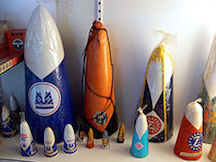
sugar loaf moulds copy

One Lump or Two?

by Collette Cameron

Often, when reading historicals (Over four decades now! Gads!) I’ll read something and not think twice about it.

In this instance, I’m talking about lumps of sugar, you know, as in, Do you want one lump or two in your tea?

For years, I mistakenly assumed it was the British way of referring to sugar cubes, which weren’t patented until 1843 by Jakub Krystof Rad who operated a sugar refinery. According to history, his wife sliced her finger cutting a lump of sugar and complained that sugar should come in a convenient size for a teacup. Being a dutiful husband, he created the nifty little units we take for granted today.

220px-Cukrová_homole_001 copyThe English, however, had to wait until 1875 for the luxury of sugar cubes on their tea trays.

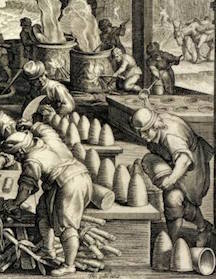
Until the late nineteenth century, sugar was purchased in whitish cone-shaped loaves or pieces hacked from a loaf with a chisel and hammer (Hard stuff-those loaves!).

After a lengthy refining process, the sugar was poured into cone-shaped molds with a small hole in the bottom to let the dark syrup drain out. To whiten the sugar, a solution of dissolved loaf sugar or white clay was repeatedly applied to the large end of the loaf, and as the liquid drained through the sugar, it purged any remaining molasses or dark coloring.

Once tapped from the molds, the sugar was wrapped in blue paper to enhance the whiteness.

The largest loaves (called bastards) were lower grade sugar, and as you can imagine, the smaller loaves were extremely expensive.

sugar copy

After purchasing whatever quality of sugar the mistress of the household could afford, how did she fill her sugar basin? She couldn’t very well pass around the entire loaf and ask her guest so take a lick! I did read sometimes larger chunks were simply dunked in the tea because they wouldn’t fit into the cup.

Those were dried and used again. I’m truly hoping not by different guests.

The elite ladies of the ton, weren’t about to get their dainty fingers sticky, no indeed. Plucking a lump or two from a china sugar basin with tongs was much preferred.

But, how to get those neat little lumps?

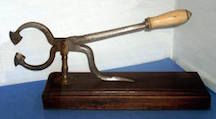
sugar nips copy

First, a section of sugar had to be hammered from the loaf, and then nippers—an iron plyer-like tool—were used to lop of a hunk.

That in itself was no easy chore.

The larger cones weighed thirty pounds and measured fourteen inches tall with a three foot base. The higher quality cones used for tea typically weighed between one and three pounds with only a six-inch base and were much more manageable.

220px-Zuckerhüte_Zucker-Museum copy

Still, no convenient granulated sugar or cubes for those Regency biscuits or tea!

sugar nippers on stand copy

Some nippers came on stands so the user could put their weight into nipping off a piece of sugar. Naturally, tidy, uniform lumps were preferred for serving guests, and that chore generally fell to the mistress of the house or a highly trusted servant.

Sugar, like tea, was expensive and both were often kept in locked chests or caddies to which the mistress kept the keys. Some sugar chests had compartments for powdered and granulated sugar.

Just how did the cook come by powdered and granulated sugar? The lumps were pounded or grated to create granulated sugar and a mortar and pestle was used to make powdered sugar.

download copy

Now, don’t you have even more appreciation for those elaborate confections nibbled by callers as they whispered about the latest on dit over a steaming cup of sugar-sweetened tea?

In my new release, Virtue and Valor (Highland Heather Romancing a Scot, Book 2), Isobel enjoys a morning cup of tea.

VirtueandValor_MEME_4 copy

About Virtue and Valor (Highland Heather Romancing a Scot Series, Book 2)

Bartholomew Yancy never expected to inherit an English earldom and had no intention of marrying. Now, the Earl of Ramsbury and last in his line, he’s obligated to resign his position as England’s War Secretary, find a wife, and produce an heir. Only one woman holds the least appeal: Isobel Ferguson, an exquisite Scotswoman. Brought to Scotland to mediate between feuding clans, he doggedly woos her.

Disillusioned with men pursuing her for her attractiveness, rather than her unusual intellect, Isobel has all but abandoned any hope of finding a husband in the Highlands. Not only does she believe Yancy no different than her other suitors, he’s a notorious rake. She’s been told he’s practically betrothed. Therefore, his interest in her cannot possibly be honorable, and so she shuns his attentions.

When Isobel is mistakenly abducted by a band of rogue Scots, Yancy risks his life to rescues her. To salvage her compromised reputation, her brother and father insist she marry him. Yancy readily agrees, but Isobel—knowing full well she’s fated for spinsterhood by refusing his offer— won’t be coerced into marriage.

Amazon

Excerpt

Pouring a cup of tea, Isobel inhaled the heady scent. She added two lumps of sugar and a dash of milk before stirring the contents.

perf5.000x8.000.inddShe adored the smell of hot tea. The scent reminded her of her childhood. Every morning, Mother had gathered the children around her for a cuddle and enjoyed a cup with them.

Lifting the hand-painted teacup to her lips, Isobel eyed the disgruntled maid stomping about the bedchamber, casting her astringent glances every now and again.

“Suppose this means ye be plannin’ on wallowin’ about in the muck too.” Maura did exaggerate so.

Isobel pointedly focused her attention on the ceiling to keep from rolling her eyes.

“I do not wallow, as you know full well.” She wiggled her free hand at the maid. “My hands and nails shan’t even get dirty.”

“Ladies do not collect rocks and dead things turned to rocks.” Maura harrumphed and trundled her way to the rumpled bed. She shuddered dramatically. “It be unnatural, I tell ye. Creatures turned to stone. They be cursed. The same as Lot’s wife in the Good Book.”

“She was turned into a pillar of salt, not stone.” Isobel suppressed a chuckle and spread jam over a roll.

Humph. Stone. Salt. It makes no matter to me.”

Maura patted the purple and white coverlet into place then adjusted a couple of pillows to her satisfaction. “A curse is a curse—like those Callanish sinners turned to stone for their heathen activities on the Sabbath.”

“Maura, that’s Superstitious drivel. The Callanish Circle was used to track lunar activity.”

Clearly baffled, Maura pursed her lips and squinted at Isobel. “Loony activity?”

Lunar. The path of the moon.” Isobel smiled, pointing with a forefinger and drawing an arc in the air.

“The sinner’s-to-stone business is nonsense. Simply a silly legend spread by the early Kirk of Scotland to discourage rites they didn’t approve of.”

About the Author

Collette Cameron copyBestselling, award-winning author, Collette Cameron, has a Bachelor of Science in Liberal Studies and a Master’s in Teaching. Author of the Castle Brides Series, Highland Heather Romancing a Scot Series, and Conundrums of the Misses Culpepper Series, Collette writes Regency and Scottish historicals and makes her home in the Pacific Northwest with her husband and five mini-dachshunds. Mother to three and a self-proclaimed Cadbury Chocolate chocoholic, Collette loves a good joke, inspirational quotes, flowers, trivia, and all things shabby chic or cobalt blue. You’ll always find dogs, birds, quirky—sometimes naughty—humor, and a dash of inspiration in her novels.

Her motto for life? You can’t have too much chocolate, too many hugs, too many flowers, or too many books. She’s thinking about adding shoes to that list.

Connect with Collette:

Website • Blue Rose Romance Blog • Twitter • Facebook • Newsletter

Resources:

http://www.nytimes.com/2012/11/18/magazine/who-made-that-sugar-cube.html?_r=0

http://www.oldandinteresting.com/sugar-nippers.aspx

https://en.wikipedia.org/wiki/Sugarloaf

https://regencyredingote.wordpress.com/2008/11/14/take-your-lumps-sweet-ones/

http://etiquipedia.blogspot.com/2014/04/regency-era-etiquette-and-when-sugar.html

Images courtesy of Wikimedia Commons

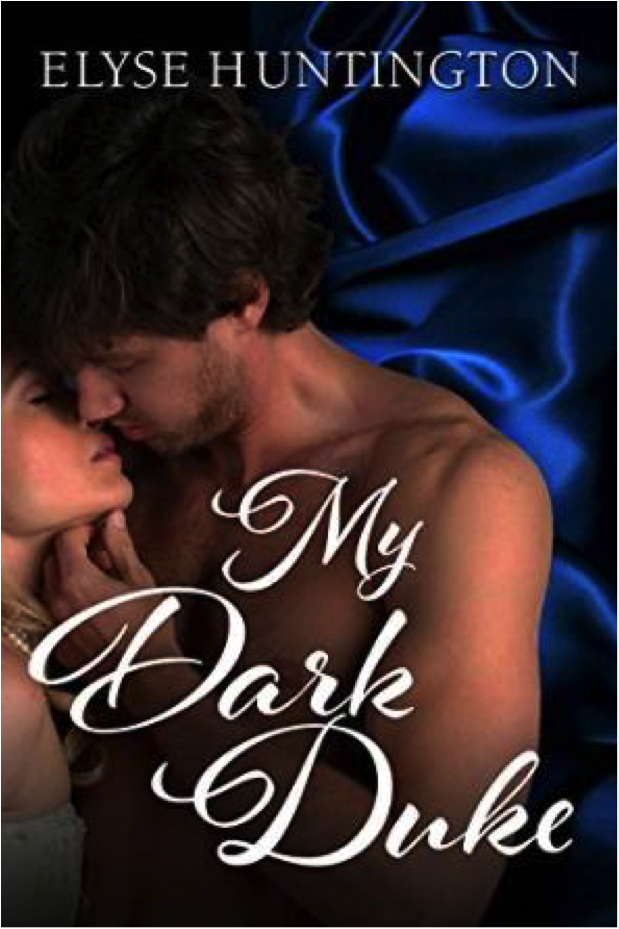
Elyse Huntington: My Dark Duke

Elyse Huntington Interviews

the Duke and Duchess of Trent

As the clock in the hall chimes, I try not to fidget. The most famous couple in the beau monde had finally agreed to be interviewed and they had chosen me over all the other publications; most of whom had many scores more readers than my modest ladies’ magazine. I could scarce believe my good fortune. Yet the expensive furnishings in the room do much to convince me that this is in truth reality, and not just a dream.

The door opens and I leap to my feet as the Duke and Duchess of Trent enter. It is difficult not to stare. They are an extraordinarily handsome couple, both possessing dark hair and eyes, both tall and lean. The duchess smiles at me as I curtsy and waves for me to sit. Trent is more reserved; however, I detect nothing but good humour in his eyes.

We exchange greetings and after we have settled on our respective sofas, I compliment Her Grace on the magnificence of her cream-coloured silk gown which is heavily adorned with lace. She laughs. “Why, thank you. It is one of James’ favourites. It brings back a fond memory for both of us.”

Intrigued, I ask what that memory is.

“Why don’t you tell the tale, darling?” says the duchess.

Untitled“I met Alethea in a library at a ball her godfather was hosting.” The duke’s voice is a baritone, silkily rich and smooth. I could have listened to him for hours. He chuckles, surprising me. The smile softens the severity of his features, making him appear even more attractive. I am beginning to see why the duchess had married him after previously refusing six offers of marriage. “Actually,” says the duke, “it would be more accurate to say that she fell upon me as I was trying to save her.”

“He was most heroic,” teases the duchess while her husband shakes his head, looking amused.

“What was it about His Grace that attracted you?” I ask.

“Hmm . . . He is a very handsome man, as you can clearly see.”

I hear the duke clearing his throat somewhat uncomfortably and bite back a smile.

The duchess continues. “It is hard to say. There was something between us from the start, what I do not know. James has this presence that makes it difficult for you to concentrate on anything other than him. And he can be very charming. Indeed I found I could not say no to him.”

“I beg to differ,” interrupts Trent, arching an eyebrow at his wife. “You could say no, and you did.”

I can’t help but smile when the duchess sighs and gives me a look as if to say ‘men’.

“I saw that,” drawls the duke and she flashes him an impudent smile in reply. The obvious love in the look they exchange makes my heart contract.

I turn to Trent. “And you, Your Grace, what drew you to Her Grace?”

“Her independent spirit, her intelligence, her skill in fencing, her love of reading. Everything about her made me want to spend more and more time with her until I realised that I wanted nothing more than to spend every minute of the rest of my life with her at my side.”

“James,” whispers the duchess, tears in her eyes.

He takes her hand and kisses it before turning back to me. He looks faintly embarrassed. “I am not normally so expressive.”

It is enormously sweet and I feel privileged at being able to witness this intimacy between them. I remind myself to continue. “Would you care to address the rumour that you were forced to marry?”

It is the duchess who replies. “I will neither confirm nor deny that rumour, but as you can see, we are blissfully happy.”

“And what about His Grace’s past,” I venture, wondering if the duchess would even deign to answer my impertinent question. “Did that not give you pause?”

“Yes, of course it did,” she replied, surprising me with her candidness. “But I knew that James was not guilty of what he had been accused of. And I was right.”

“I see.” I wanted to ask the next question, but from the duke gives me a speaking look and I know my time with them has come to an end. As I thank them for their time and take my leave, I can’t help wondering if I will ever find the kind of love that the Dark Duke has found with his duchess.

About My Dark Duke

A steamy Georgian romance about desire, the importance of staying true to yourself and the power of the past to cast a shadow on the present.

Since his notorious wife died in mysterious circumstances, rumours about James, the handsome Duke of Trent, have scandalized society. Now, he must marry again—but finding an eligible woman willing to overlook his past won’t be easy.

Defiantly single, Lady Alethea Sinclair has already turned down six offers of marriage. She prefers living on her own terms and refuses to answer to any man. Yet when Alethea meets the seductive and enigmatic Duke she finds herself strangely drawn to him.

Intrigued by Alethea’s defiance of society’s expectations, James is instantly taken with the willful beauty and soon they are enjoying a playful flirtation. And when circumstances force them into a comprising situation, he does the honourable thing and marries her.

But adjusting to the constraints of marriage doesn’t come easily to the rebellious Alethea and, despite their growing feelings for each other, the Duke’s troubled past keeps getting in the way. Can they learn to trust each other and give love a chance before it’s too late?

AmazonKobo

Also available on iBooks and Google Play.

About the Author

OLYMPUS DIGITAL CAMERA

Elyse spent her childhood years in Borneo. She moved to Australia when she was a teenager and was an avid reader of romances. It was her love of historical romance that led her to write My Dark Duke, which finaled in the Romance Writers of Australia Emerald Award contest in 2014.

A lawyer by profession, Elyse is a self-confessed compulsive buyer of any books featuring dukes. She also loves reading stories featuring alpha billionaires—undoubtedly because they are the embodiment of modern-day dukes. Elyse spends her free time (and perhaps a little too much of her not-so-free time) fantasising about wickedly handsome heroes and the strong heroines who ultimately tame them.

Elyse loves to hear from her readers. You can contact her via:

WebsiteFacebook

Check out the bonus epilogue for My Dark Duke at her website.

Bath: a guide for readers of The Third MacPherson Sister

BTP_BathCityCentreMap_V2

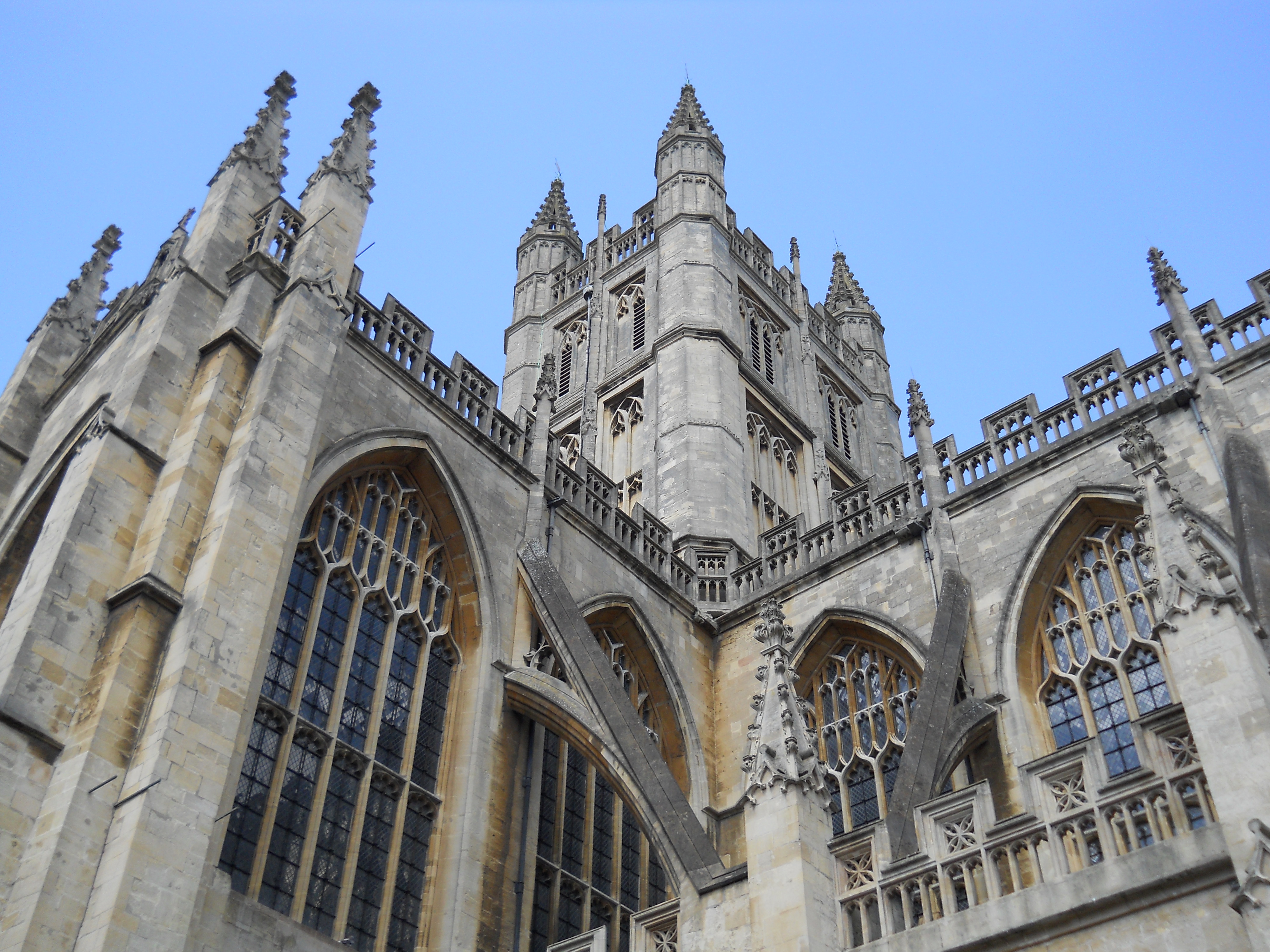
Bath Abbey

Five things to know about Bath Abbey*

  • Three different churches have occupied the site of today’s Abbey since 757 AD. First, an Anglo-Saxon monastery which was pulled down by the Norman conquerors of England; then a massive Norman cathedral which was begun about 1090 but lay in ruins by late 15th century; and finally, the present Abbey Church as we now know it.
  • The first King of all England, King Edgar was crowned on this site in 973 (as shown above). The service set the precedent for the coronation of all future Kings and Queens of England including Elizabeth II.
  • The first sight most visitors have of Bath Abbey is the West front, with its unique ladders of Angels. The story behind this is that the Bishop of Bath, Oliver King, is said to have had a dream of angels ascending and descending into heaven which inspired the design and which also inspired him to build a new Abbey church – the last great medieval cathedral to have been built in England.
  • After the dissolution of the monasteries in 1539 by order of King Henry VIII, the Abbey lay in ruins for more than 70 years. It wasn’t until 1616, that much of the building we see today was repaired and in use as a parish church and over two hundred years later, in the 1830s, that local architect George Manners added new pinnacles and flying buttresses to the exterior and inside, built a new organ on a screen over the crossing, more galleries over the choir and installed extra seating.
  • The Abbey as we know it is the work of Sir George Gilbert Scott, who from 1864 to 1874, completely transformed the inside of the Abbey to conform with his vision of Victorian Gothic architecture. His most significant contribution must surely be the replacement of the ancient wooden ceiling over the nave with the spectacular stone fan vaulting we see today.

*http://www.bathabbey.org/history

Photo by Barbara S. Andrews

Photo by Barbara S. Andrews

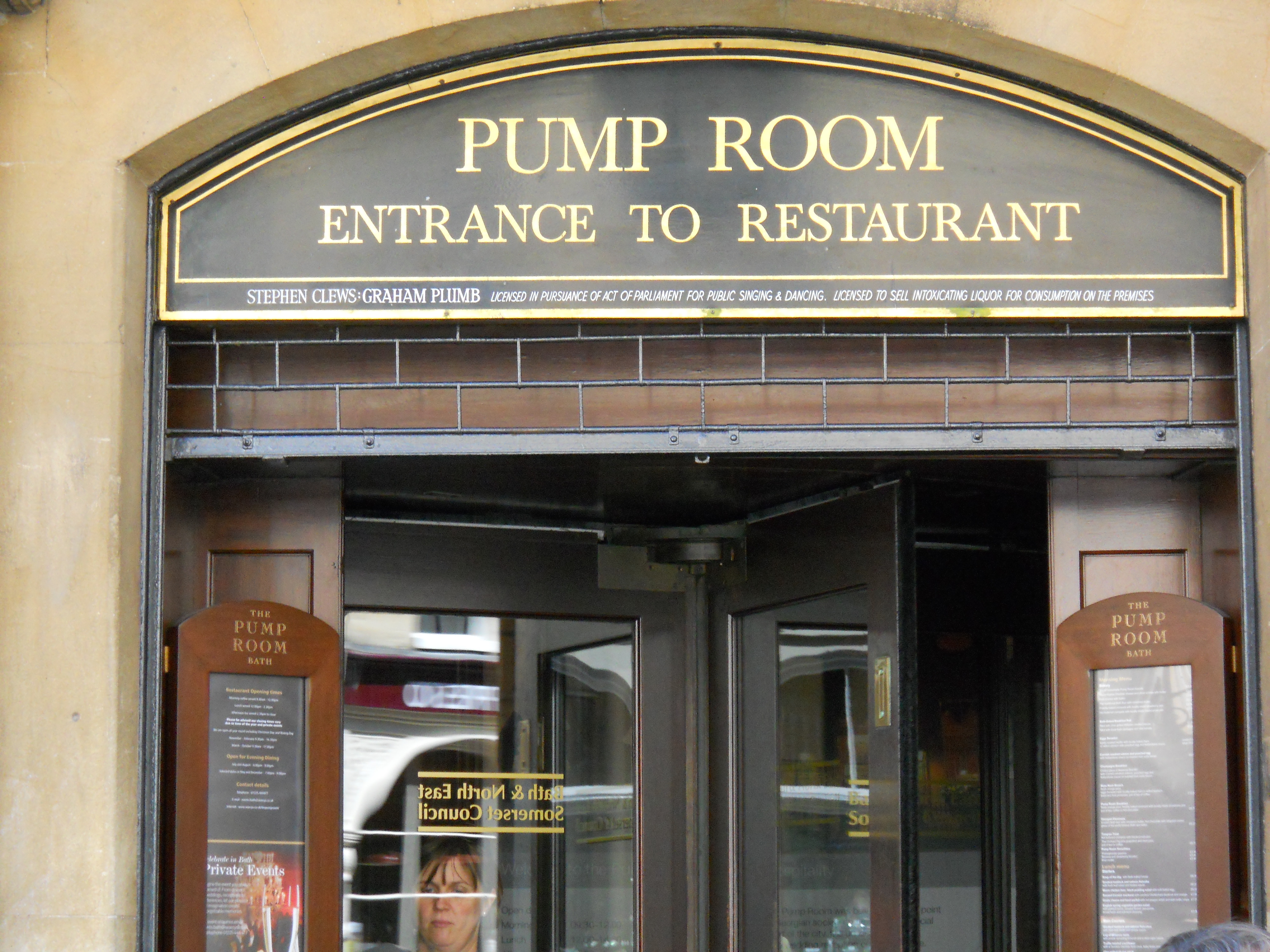
The Pump Room

Situated next to main street entrance to the Roman Baths, visitors can sample the waters from the warm spring which fills the Roman Baths. The building also houses a restaurant, where it is popular to sample the afternoon tea.

pumproomsign

Photo by Barbara S. Andrews

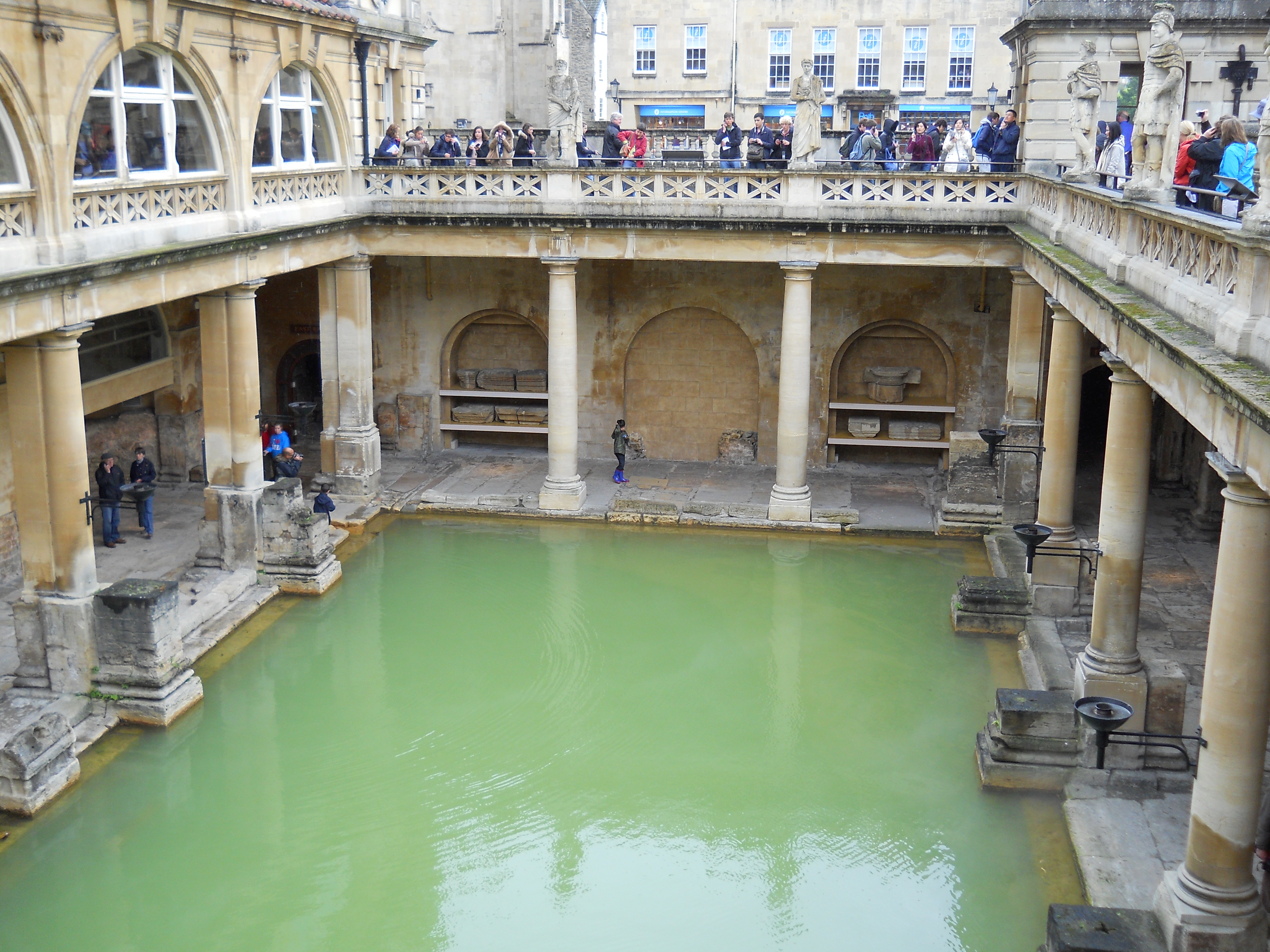
The Roman Baths

The house is a well-preserved Roman site for public bathing. The Roman Baths themselves are below the modern street level. There are four main features: the Sacred Spring, the Roman Temple, the Roman Bath House and the Museum holding finds from Roman Bath. The buildings above street level date from the 19th century.

Photo by Barbara S. Andrews

Photo by Barbara S. Andrews

The Pulteney Bridge

The bridge features two ranges of shops designed in the Palladian style c. 1770, between them forming a narrow street over the bridge. The street and buildings sit above three segmental arches of equal span.

The shops on the north side have cantilevered rear extensions. Consequently the northern external façade of the bridge is asymmetrical, much altered and of no architectural merit, whereas the southern external side clearly shows the hand of Robert Adam.

Shops on the Pulteney Bridge  By Erebus555 at English Wikipedia [CC BY-SA 3.0 (http://creativecommons.org/licenses/by-sa/3.0) or GFDL (http://www.gnu.org/copyleft/fdl.html)], via Wikimedia Commons

Shops on the Pulteney Bridge
By Erebus555 at English Wikipedia [CC BY-SA 3.0 (http://creativecommons.org/licenses/by-sa/3.0) or GFDL (http://www.gnu.org/copyleft/fdl.html)%5D, via Wikimedia Commons

Sydney Gardens (formerly Bath Vauxhall Gardens)

The Sydney Gardens are the only remaining 18th century pleasure gardens in England.

The gardens were constructed in the 1790s opening in 1795 as a commercial pleasure grounds, following the development of Bathwick by Sir William Pulteney, 5th Baronet across the River Avon from the city centre. The original plans were by Thomas Baldwin and completed by Charles Harcourt Masters who included a maze or labyrinth, grotto, sham castle and an artificial rural scene with moving figures powered by a clockwork mechanism. The gardens were illuminated by over 15,000 “variegated lamps”. Around 1810 the Kennet and Avon Canal was built through the gardens.

Sydney Gardens  By Plumbum64 (Own work) [CC BY-SA 3.0 (http://creativecommons.org/licenses/by-sa/3.0)], via Wikimedia Commons

Sydney Gardens
By Plumbum64 (Own work) [CC BY-SA 3.0 (http://creativecommons.org/licenses/by-sa/3.0)%5D, via Wikimedia Commons

The Sydney Hotel

The Sydney Hotel was built within the gardens. The original design for the hotel, prepared by Thomas Baldwin in 1794, was a two-storey building which would serve the pleasure gardens. After Baldwin was bankrupted his design for the hotel was not implemented. Instead a three-storey building was designed by Charles Harcourt Masters. The foundation stone was laid in 1796 and the building was ready by 1799. Visitors entered the gardens through the Hotel. Projecting from the rear of the building at first floor level was a conservatory and a semi-circular Orchestra with a wide covered loggia below. Two semi-circular rows of supper boxes projected from the sides of the building. The gardens were used daily for promenades and public breakfasts which were attended by Jane Austen among others. At public breakfasts tea, coffee, rolls and Sally Lunn buns were served at about midday, followed by dancing. There were generally three evening galas each summer, usually on the birthdays of George III and the Prince of Wales, and in July to coincide with the Bath races. During these galas the gardens were lit with thousands of lamps and the guests took supper accompanied by music and fireworks. Breakfasts, coffee-drinking, newspaper-reading and card-playing took place in the ground floor of the Hotel and dancing in a ballroom on the first floor. All the rooms could be hired for private parties and meetings.

The Assembly Rooms

The Assembly Rooms formed the hub of fashionable Georgian society in the city, the venue being described as “the most noble and elegant of any in the kingdom” They were originally known as the Upper Rooms as there was also a lower assembly room in the city, which closed soon after the Upper Rooms opened. They served the newly built fashionable area which included The Circus, Queen Square and the Royal Crescent.

People would gather in the rooms in the evening for balls and other public functions, or simply to play cards. Mothers and chaperones bringing their daughters to Bath for the social season, hoping to marry them off to a suitable husband, would take their charge to such events where, very quickly, one might meet all the eligible men currently in the City.

Photo by Barbara S. Andrews

Photo by Barbara S. Andrews

The Theatre Royal

The present main entrance to the Theatre Royal, in Sawclose, was built in 1720 by Thomas Greenway, and was Beau Nash’s first house. The exterior of the building, with arches, pilasters, garlands and ornaments, which is visible from Beauford Square, was designed by George Dance the Younger and erected by John Palmer.

The theatre itself was erected in 1805, replacing the Old Orchard Street Theatre which was also called the Theatre Royal, which is now a Freemason’s Hall.

The theatre is said to be haunted by The Grey Lady, who was an actress centuries ago. She has been seen watching productions in the Grey Lady Box, and she leaves the distinctive scent of Jasmine. She has been seen and scented in recent years.

Theatre Royal, Bath   By MichaelMaggs (Own work) [CC BY-SA 2.5 (http://creativecommons.org/licenses/by-sa/2.5)], via Wikimedia Commons

Theatre Royal, Bath
By MichaelMaggs (Own work) [CC BY-SA 2.5 (http://creativecommons.org/licenses/by-sa/2.5)%5D, via Wikimedia Commons

Text from Wikipedia.

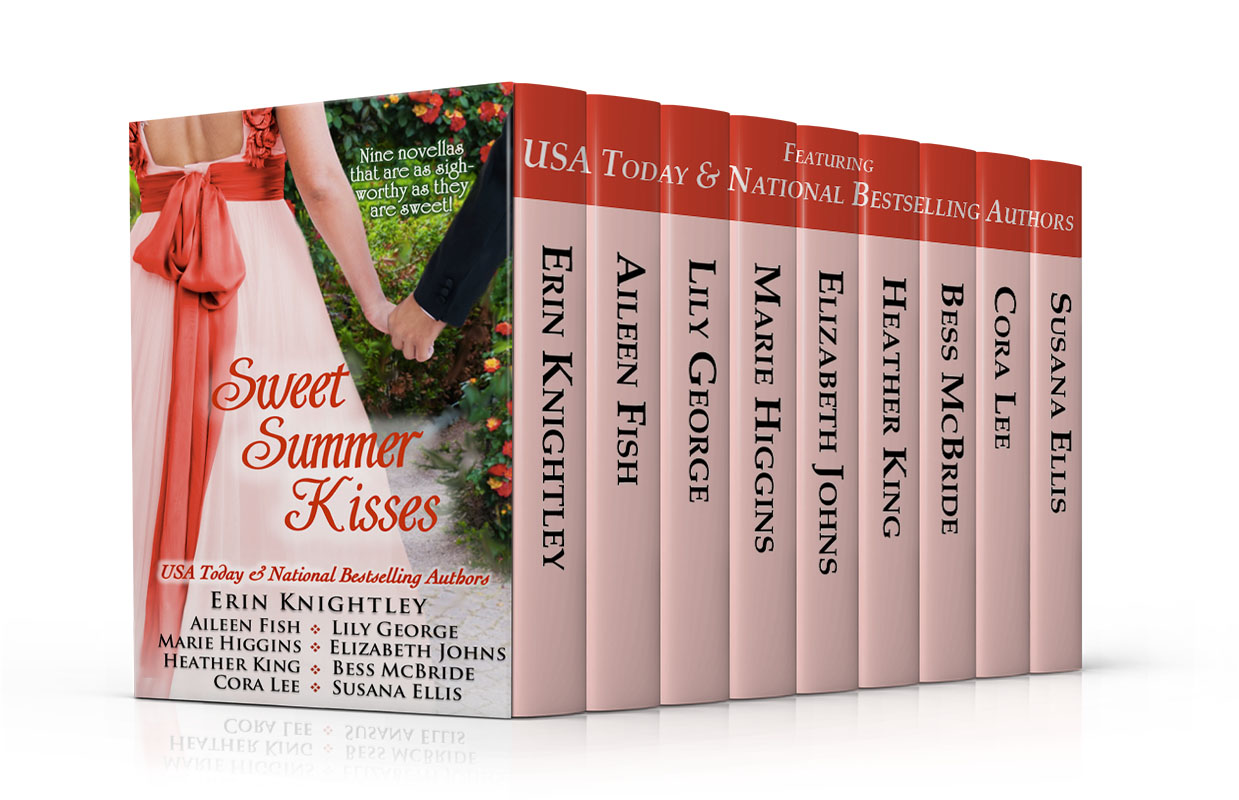
About The Third MacPherson Sister (part of the Sweet Summer Kisses anthology)

TheThirdMacPhersonSister2inchAfter a disastrous fourth Season in London, Rebecca and her mother take refuge in Bath to determine their next course of action. Rebecca has always known she’ll never be able to measure up to her older sisters, the “Golden Twins,” who were the reigning queens of the ton in their day, but surely there is a gentleman somewhere capable of appreciating her finer qualities.

Miles Framingham, Duke of Aylesbury, finds himself in need a wife… although he doesn’t really want one. Burdened with the responsibilities of a dukedom from a young age, what he really yearns for is freedom. Marriage to the right woman, though, might not be such an onerous task.

When the hapless Rebecca finds herself pushed into the lap of this eminently eligible duke in the nave of Bath Abbey, a match between them seems ordained by the heavens… except for the little matter of his past history with her sisters.

SweetSummerKisses2med

Bluestockings and wallflowers seek happily-ever-afters. Only handsome, respectable and deeply romantic persons need apply. Dukes and marquesses will be given special consideration. Apply within.  

This anthology contains nine fun, heart-tugging, and wholesomely romantic Regency novellas that are as sigh-worthy as they are sweet, brought to you by USA Today and national bestselling, award-winning authors.

AmazonBarnes & NobleKoboiBooks • Google

Vanessa Kelly: How to Marry a Royal Highlander

HIGHLANDER

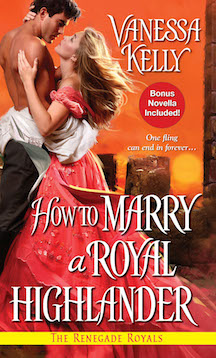
About How to Marry a Royal Highlander

Illegitimate yet thoroughly irresistible, the Renegade Royals are leaving behind their careers as daring spies for the greatest adventure of all…

At sixteen, Alasdair Gilbride, heir to a Scottish earldom, fled the Highlands and an arranged betrothal. Ten years later, Alasdair must travel home to face his responsibilities. It’s a task that would be much easier without the distracting presence of the most enticing woman he’s ever met…

After one escapade too many, Eden Whitney has been snubbed by the ton. The solution: rusticating in the Scottish wilderness, miles from all temptation. Except, of course, for brawny, charming Alasdair. The man is so exasperating she’d likely kill him before they reach the border—if someone else weren’t trying to do just that. Now Eden and Alasdair are plunging into a scandalous affair with his life and her reputation at stake—and their hearts already irreparably lost…

SusanaSays3Susana Says

… another Renegade Royal meets his match: 5/5 stars

Alasdair Gilbride, a natural son of the Duke of Kent (who will soon become the father of the future Queen Victoria), has been avoiding his responsibilities as heir to a Scottish earldom (through his deceased mother) for the past ten years by serving his country as a spy during the war with France. The war is over, his grandfather is ailing, and he no longer has any excuse for avoiding his dilemma—an unwanted betrothal to his cousin.

At the same time, Eden Whitney finds herself needing to get out of Town for awhile. The last thing she wants to do is spend the winter in a cold castle in Scotland, but her mother insists they accept Captain Gilbride’s offer. Edie and Gilbride have always had a bickering sort of relationship, but the closer they get to the frozen tundra that Scotland is presumed to be, the more her feelings for him begin to melt her antagonism. But family honor demands that he marry another… even if breaks her heart.

Like the rest of the Renegade Royals, Alasdair harbors his share of guilt and shame for being the “cuckoo in the nest,” even though he was the innocent party, and even though he does legitimately carry the blood of the earl his grandfather, through his mother. Eventually that’s what causes him to abandon the family and seek honor through service to his country. But does that mean he can get away with breaking a betrothal and wreaking havoc in the clan without a pang of conscience?

The relationship between Alec and Eden was amusing to watch, as it was easy to see how they felt about each other even before they could admit it to themselves. Mrs. Whitney took a bit longer to warm up to, but even she proved to be a worthy opponent to the crotchety old earl. How to Marry a Royal Highlander was a truly enjoyable read, and I highly recommend it—whether or not you’ve read any of the other books in the series.

About the Author

IMG_0031 copyVanessa Kelly is an award-winning author who was named by Booklist, the review journal of the American Library Association, as one of the “New Stars of Historical Romance.” Her sensual, Regency-set historical romances have been nominated for awards in a number of contests, and her second book, Sex and The Single Earl, won the prestigious Maggie Medallion for Best Historical Romance. Her third book, My Favorite Countess, was nominated for an RT Reviewers’ Choice Award for Best Regency Historical Romance.

Vanessa’s current series, The Renegade Royals, is a national bestseller. The first book in the series, Secrets for Seducing a Royal Bodyguard, received a starred review from Publishers Weekly.

When she’s not dreaming up plots for her next Regency historical novel, Vanessa is writing USA Today Bestselling contemporary romance with her husband under the pen name of V.K. Sykes. The first book in their forthcoming Seashell Bay Series will be released by Grand Central in February, 2015.

You can find Vanessa at www.vanessakellyauthor.com or at www.vksykes.com. She’s also a member of The Jaunty Quills, a group of bestselling authors like Kristan Higgins, Shana Galen, and Jesse Hayworth. You can visit The Jaunty Quills at www.jauntyquills.com.

Vauxhall Gardens: Jonathan Tyers— “The Master Builder of Delight”

vauxhallbook

Vauxhall Gardens: A History

David Coke & Alan Borg

The Vauxhall Pleasure Gardens is one of the places I’d love to slip back in time to visit, just to catch a glimpse of what it was like. After recently splurging to buy this lovely coffee-table book, I thought it might make a wonderful subject for a new blog series. But do buy the book too, if you can! The photos are fabulous!

“The Master Builder of Delight”

In 1729, the site of the “Vauxhall Spring-Gardens was leased to a twenty-seven-year-old entrepreneur called Jonathan Tyers, whose goal was to transform it from a sort of seedy rural tavern to a respectable venue for all social classes.

A fellmonger (dealer in animal hides or skins) by trade, Jonathan was not content to continue the family business, successful though it was. Driven by a desire to raise his family’s status—and improve the world as he did so—Tyers believed that culture and pleasurable entertainments should not be the sole prerogative of the upper classes, but that the middle and lower classes deserved to find some enjoyment in their lives as well.

tyers family

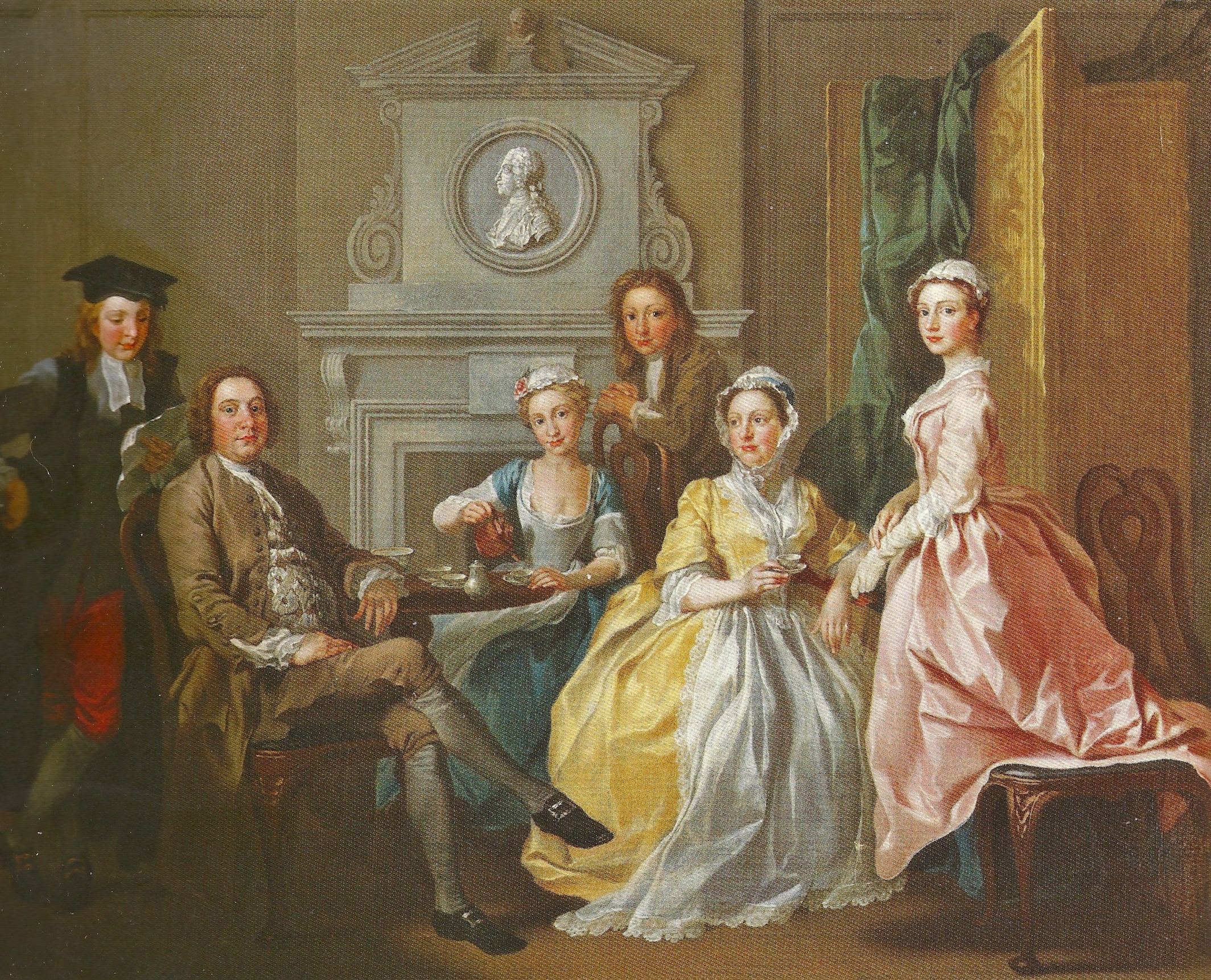
Family portrait by Francis Hayman, Jonathan Tyers and his Family, 1740. Left to right: Elder son Thomas, Jonathan, daughter Elizabeth, son Jonathan, wife Elizabeth, daughter Margaret.

Jonathan Tyers was a very complex character, with more than his fair share of contradictions and eccentricities. Upright, intelligent and self-assured, he also exhibited strains of arrogance and ambition. However, his ambitions were clearly projected chiefly upon his business rather than himself, while his personal aspirations were driven by a wish to raise his own status and that of his family to gentry, an object in which he succeeded at a remarkably early age. (p.35)

Through his association with The Wits’ Club, a social club for freethinkers, scholars, libertarians, and writers, Tyers became good friends with Charles Burney, Henry Fielding, William Hogarth, Harry Hatsell, Edward Moore, Thomas Cooke, Richard Dawson, and Leonard Howard. The club first met at Vauxhall Gardens later moved to a nearby tavern. Many of the ideas behind his development of the gardens came from the discussions at this club.

Although he never managed to mix with fashionable society in his lifetime, he was held in great respect and admiration by his peers, so much so that he was elected to the Royal Society of Arts in 1757, where he would have met many other prominent people, including Benjamin Franklin, when he visited London.

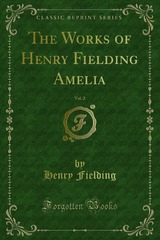
He and his creation were even featured in his friend Henry Fielding’s work of fiction, Amelia (1751).

The extreme Beauty and Elegance of this Place is well known to almost every one of my Readers; and happy is it for me that it is so; since to give an adequate Idea of it, would exceed my Power of Description. To delineate the particular Beauties of these Gardens, would, indeed, require as much pains and as much Paper too, as to rehearse all the good Actions of their Master [Tyers], whose Life proves the Truth of an Observation which I have read in some Ethic Writer, that a truly elegant Taste is generally accompanied with an Excellency of Heart; or in other Words, that true Virtue is, indeed, nothing else but true Taste.

The_Works_of_Henry_Fielding_Amelia_v2_1000373134

Tyers’s Mission

Besides his goal of cleaning up the gardens’ reputation, Tyers hoped to use the venue to improve people’s lives “through contact beauty and quality.” In other words, he planned to provide the lower orders with both art and beauty, and also expose them to “polite society,” who would educate them by example.

His influence on the manners and morals of eighteenth-century society was to be far-reaching, and his patronage of artists and designers would change the face of British art. But it was his ideological beliefs and priorities, his egalitarianism and his conviction that the pursuit of pleasure was a basic human right, and a vital element of the balanced life, that would really motivate his proprietorship of Vauxhall Gardens.

The Ridotto al Fresco

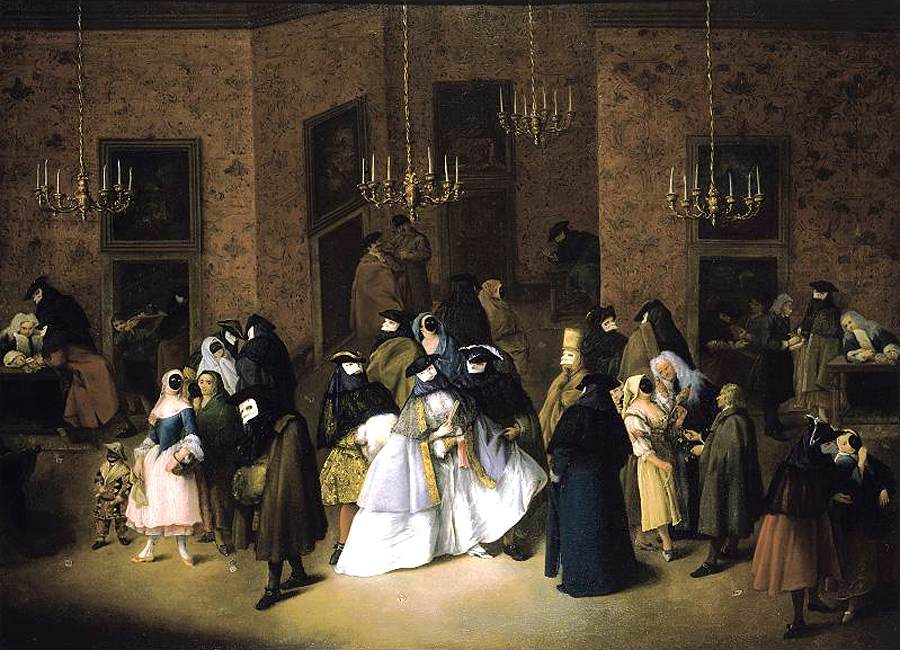
Tyers’s first event at Vauxhall was a masquerade ball in the manner of the Italian carnival in the spring of 1731. Not much is known of this event, except that there was outdoor dancing in masquerade costume and was restricted to the upper classes.

The Ridotto in Venice, Pietro Longhi, 1750's

The Ridotto in Venice, Pietro Longhi, 1750’s

By contrast, his second event in April of 1732, was attended by the poorer class of people, including “an oyster girl, a barber’s apprentice, a lawyer, an army captain, a doctor, a vicar and a number of prostitutes…”

The third event, considered to be the opening ceremony of Tyers’s Vauxhall Gardens, took place on 7 June 1732 and included the presence of Frederick, Prince of Wales. Under the guidance of John James Heidegger, Tyers created an extraordinary event that was talked about for years. A hundred armed soldiers were employed for the security of the distinguished guests, and he “hired the Westminster and Lambeth ferrymen for the whole night to carry his guests across the river and back.” Even with an admission fee of a guinea—which only the wealthy could afford—“between three and four hundred people actually attended the ridotto.” Besides the Prince of Wales’s entourage, the guests included politicians and their friends, “lawyers, bankers, printers, brewers, churchmen, military men and aristocrats.” The party broke up at around four in the morning. “The principal entertainments…were dancing and feasting, combined with the social intercourse between masked guests.”

The Ridotto in Venice, Pietro Longhi, 1750's

The Ridotto in Venice, Pietro Longhi, 1750’s

While by most accounts—particularly in the view of the Prince of Wales—this event was a great success, other accounts indicate that there was a distinct theme of preaching and moralizing via buildings set up to show the misery and pain that result from excessive self-indulgence that may have not gone over too well with the party-minded guests.

In any case, his final ridotto, which was held two weeks later on 21 June, likely at the request of the Prince, who was having the time of his life, was attended by only half as many, which, considering his expenses, would likely have completely wiped out any profits from the four events. No doubt this is the reason Tyers held no such events during 1733 or 1734, although the gardens themselves likely continued to be open to the public.

Susana’s Vauxhall Blog Post Series

  1. Vauxhall Gardens: A History
  2. Vauxhall Gardens: Jonathan Tyers—“The Master Builder of Delight” 
  3. Vauxhall Gardens: A New Direction
  4. Vauxhall Gardens: The Orchestra and the Supper-Boxes 
  5. Vauxhall Gardens: The Organ, the Turkish Tent, and the Rotunda
  6. Vauxhall Gardens: Three Piazzas of Supper-Boxes
  7. Vauxhall Gardens: “whither every body must go or appear a sort of Monster in polite Company”
  8. Vauxhall Gardens: The Competition
  9. Vauxhall Gardens: The Artwork, Part I
  10. Vauxhall Gardens: The Artwork, Part II
  11. Vauxhall Gardens: The Music, 1732-1859
  12. Vauxhall Gardens: The Business Side
  13. Vauxhall Gardens: Developments from 1751-1786
  14. Vauxhall Gardens: Thomas Rowlandson’s Painting (1785)
  15. ‎Vauxhall Gardens: The Third Generation of the Tyers Family and the Jubilee of 1786
  16. Vauxhall Gardens: An Era of Change (1786-1822), Part I
  17. Vauxhall Gardens: An Era of Change (1786-1822), Part II
  18. Vauxhall Gardens: An Era of Change (1786-1822), Part III
  19. Vauxhall Gardens: The Final Years, Part I
  20. Vauxhall Gardens: The Final Years, Part II
  21. Vauxhall Gardens: The Final Years, Part III
  22. Vauxhall Gardens: The Final Years, Part IV
  23. Vauxhall Gardens: Farewell, for ever