Tag Archive | Susana Ellis

The Bath Road: Lacock Abbey

The following post is the third of a series based on information obtained from a fascinating book Susana recently obtained for research purposes. Coaching Days & Coaching Ways by W. Outram Tristram, first published in 1888, is chock full of commentary about travel and roads and social history told in an entertaining manner, along with a great many fabulous illustrations. A great find for anyone seriously interested in English history!

dust jacket

Lacock Abbey and Romance

While I’ve visited the village of Lacock, wandering through the charming little town which was filmed as Meriton in the 1995 BBC version of Pride and Prejudice on two occasions, both were group tours not allowing enough time to visit the Abbey. All I could do was peer longingly through the iron gates and vow someday to return. Next time.
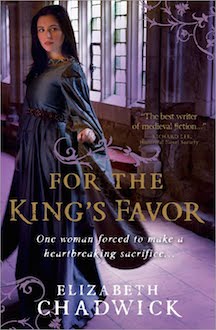
For the Kings Favor by Elizabeth Chadwick - CoverIt was on one of the tours that I learned the connection between Lacock Abbey and a book I had recently read by Elizabeth Chadwick, For the King’s Favor. Highly recommended for any fan of British history! It’s the story of a former mistress of Henry II who is torn away from her son and married off to another. A small part in the story is played by the illegitimate son, William Longespée, brought up in the king’s household. It turns out that William married Ela, 3rd Countess of Salisbury and became the 3rd Earl of Salisbury. (Yep, a title that could be inherited by a female, believe or not!)

It must have been a happy marriage, not only because they had at least eight children (not that unusual in those days), but because when he died, his widow founded an abbey in his honor, endowing it with rich farmlands which returned large profits from wool. The inscription on her tombstone indicates that she was a very well-loved lady:

Below lie buried the bones of the venerable Ela, who gave this sacred house as a home for the nuns. She also had lived here as holy abbess and Countess of Salisbury, full of good works.

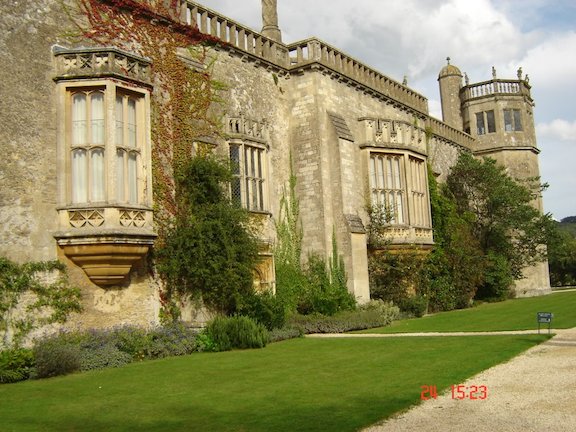
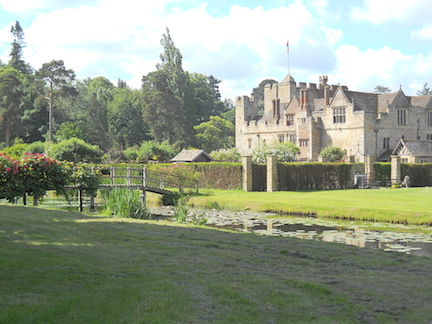
In the sixteenth century during Henry VIII’s Dissolution of the Monasteries, Lacock Abbey was fortunate to escape destruction when it was sold to Sir William Sharington for 783 pounds, and he turned it into a private residence, demolishing the church and making extensive renovations, apparently showing quite good taste. His tastes were expensive, however, and later on he was convicted of embezzling from the Bristol Mint.
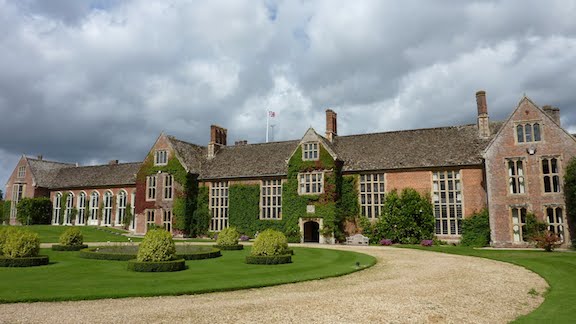
abbey

lacock-abbey

http://uktripper.com/visits/lacock-abbey Lacock Abbey photo – Copyright: Andrew Cox 2010

A Famous Elopement (Don’t try this at home!)

From Coaching Days and Coaching Ways:

Here [Lacock] there is an Abbey with a romance attached to it, which tells how a young lady, discoursing one night to her lover from the battlements of the Abbey church, though strictly forbidden to do so by her papa, remarked “I will leap down to you” (which was surely very unwise), and leapt. The wind came to the rescue and “got under her coates” (the ulster I presume of the 16th century) and thus assisted, the young lady, whose name was Sherington [sic], flopped into the arms of the young man, whose name was Talbot, and killed him to all appearances fatally dead on the spot, at which she sat down and wept. Upon this the defunct Talbot, who had been only temporarily deprived of breath, came to life again, and at the same moment the lady’s father, with a fine instinct for a melodramatic situation, jumped out of a bush and observed that “as his daughter had made such a leap to him she should e’en marry him,” meaning Talbot, which was rather obscure, but exactly what the young lady wanted, and married she was to Talbot, whose Christian name was John, brought him the Abbey as a dowry, and lived happily ever after.”

As much as I enjoy Mr. Tristram’s turn of phrase, there are times when I have doubts about the accuracy of his statements. While it is true that a Sharington owned Lacock Abbey, I cannot find that he ever had any children. Nonetheless, it is true that Lacock Abbey was owned by Talbots in its later years, including the famous William Henry Fox Talbot, who is credited with the invention of the calotype process, a precursor of photographic processes of the 19th and 20th centuries. I even saw his grave at the Lacock cemetery just outside the village. So…who knows? It might be true!
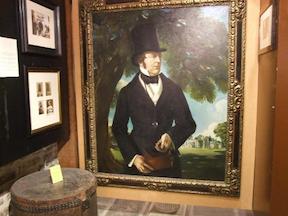
William Henry Fox Talbot
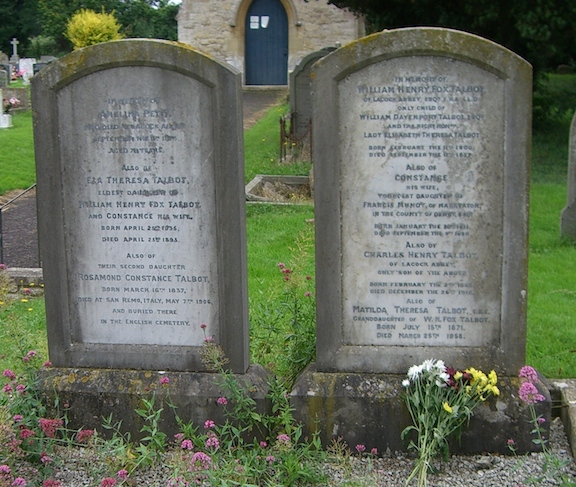
William Henry Fox Talbot

Fox_Talbot_grave

Visiting Lacock, Lacock Abbey, and the Fox Talbot Museum
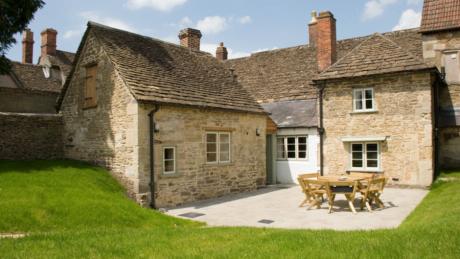
cottageWhile you’re there, why not stay in a timber-framed cottage located right in the heart of the village? A bit pricey, perhaps, but it has four bedrooms and sleeps six, and what better way to relive the past than to live in a charming cottage in a quaint little town for a couple of days! (You might also check out the bed and breakfast establishments available in the village.)
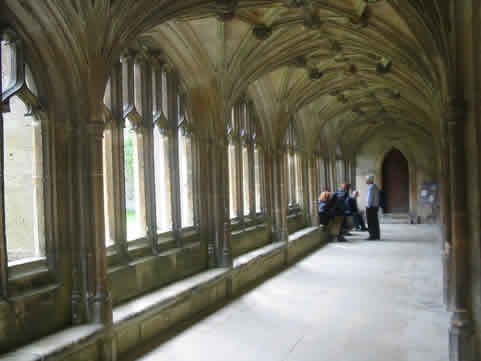
Anybody recognize the cloisters from a famous movie?

Anybody recognize the cloisters from a famous movie?

Update: Lacock Abbey stumbled upon this post and informed me that the young lady who accidentally “killed” her lover was Olive Sharington, daughter of Henry Sharington, who inherited the Abbey from his brother William, who had no children. Mystery solved!

 Index to all the posts in this series

1: The Bath Road: The (True) Legend of the Berkshire Lady

2: The Bath Road: Littlecote and Wild William Darrell

3: The Bath Road: Lacock Abbey

4: The Bath Road: The Bear Inn at Devizes and the “Pictorial Chronicler of the Regency”

5: The Exeter Road: Flying Machines, Muddy Roads and Well-Mannered Highwaymen

6: The Exeter Road: A Foolish Coachman, a Dreadful Snowstorm and a Romance

7: The Exeter Road in 1823: A Myriad of Changes in Fifty Years

8: The Exeter Road: Basingstoke, Andover and Salisbury and the Events They Witnessed

9: The Exeter Road: The Weyhill Fair, Amesbury Abbey and the Extraordinary Duchess of Queensberry

10: The Exeter Road: Stonehenge, Dorchester and the Sad Story of the Monmouth Uprising

11: The Portsmouth Road: Royal Road or Road of Assassination?

12: The Brighton Road: “The Most Nearly Perfect, and Certainly the Most Fashionable of All”

13: The Dover Road: “Rich crowds of historical figures”

14: The Dover Road: Blackheath and Dartford

15: The Dover Road: Rochester and Charles Dickens

16: The Dover Road: William Clements, Gentleman Coachman

17: The York Road: Hadley Green, Barnet

18: The York Road: Enfield Chase and the Gunpowder Treason Plot

19: The York Road: The Stamford Regent Faces the Peril of a Flood

20: The York Road: The Inns at Stilton

21: The Holyhead Road: The Gunpowder Treason Plot

22: The Holyhead Road: Three Notable Coaching Accidents

23: The Holyhead Road: Old Lal the Legless Man and His Extraordinary Flying Machine

24: The Holyhead Road: The Coachmen “More Celebrated Even Than the Most Celebrated of Their Rivals” (Part I)

25: The Holyhead Road: The Coachmen “More Celebrated Even Than the Most Celebrated of Their Rivals” (Part II)

26: Flying Machines and Waggons and What It Was Like To Travel in Them
27: “A few words on Coaching Inns” and Conclusion

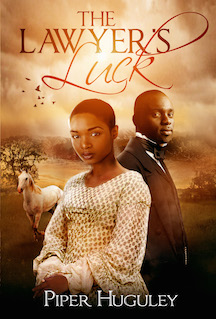
Piper Huguley: The Lawyer’s Luck (Home To Mitford College Series)

Lawyer copy

About The Lawyer’s Luck

Oberlin, Ohio – 1844

Lawrence Stewart is a rare man. Raised with his grandmother’s Miami Indian tribe, he’s a Negro with brown skin, and has consistently walked between two worlds most of his life. He devotes his time and study to becoming a lawyer, fully intending to obtain justice for the ousted Miami Indians. No Negro man has accomplished these things before, but he is not daunted. His life is perfectly set until one June day….

Aurelia “Realie” Baxter made her way from enslavement in Georgia to the free land Lake Huron in Ohio. Far from happy as a slave doing the bidding of a woman cooped up in a house all day, Realie is a bona fide tomboy with a special gift with horses. Now, she is so close to freedom in Canada, she can smell it, but her plans are interrupted when Lawrence shoots her…by mistake….

AmazonBarnes & NobleKobo

About the Author

piper-huguley-rigginsPiper G Huguley is the author of “Migrations of the Heart,” a five-book series of inspirational historical romances set in the early 20th century featuring African American characters.  Book one in the series, A Virtuous Ruby won the Golden Rose contest in Historical Romance in 2013 and is a Golden Heart finalist in 2014.  Book four in the series, A Champion’s Heart, was a Golden Heart finalist in 2013.

On release, the prequel novella to the “Home To Milford College” series, The Lawyer’s Luck reached #1 Amazon Bestseller status on the African American Christian Fiction charts.

She blogs about the history behind her novels at http://piperhuguley.com. She lives in Atlanta, Georgia with her husband and son.

The Frost of Springtime: Rachel L. Demeter

BBT The Frost of Sprintime Banner copy 2

Rachel will be awarding a $15 Amazon gift card and 5 autographed bookmarks via rafflecopter during the tour (US ONLY). Click here for the Rafflecopter. Click on the banner above to follow the tour and increase your chances of winning.

About The Frost of Springtime

To rescue her was to rescue his own soul.

On a cold Parisian night, Vicomte Aleksender de Lefèvre forges an everlasting bond with a broken girl during her darkest hour, rescuing her from a life of abuse and misery. Tormented by his own demons, he finds his first bit of solace in sheltering little Sofia Rose.

But when Aleksender is drawn away by the Franco-Prussian war, the seasons pass. And in that long year, Sofia matures into a stunning young woman—a dancer with an understanding of devotion and redemption far surpassing her age.

Alongside his closest friend, Aleksender returns home to find that “home” is gone—replaced by revolution, bloodshed, betrayal—and a love always out of reach. Scarred inside and out, he’s thrust into a world of sensuality and violence—a world in which all his hours have now grown dark, and where only Sofia might bring an end to the winter in his heart.

Inspired by the 1871 Paris Commune, The Frost of Springtime is a poignant tale of revolution, redemption, and the healing power of love.

 Goodreads

AmazonAmazon (print) • Barnes & Noble

Book Video

Excerpt

Sofia saw the memories buried within his eyes. Gunshots. Screams. Rolling cannons and the faded cries of despair. They lodged inside Aleksender, battling for his soul.

MEDIA KIT Teaser 1 PAIN IS IN THE MIND - TEASER QUOTE copySofia rose from the ground and tentatively crouched behind him. Remaining silent, her hands sunk below the material of his dress shirt and encouraged him with gentle caresses.

“Disease and death were everywhere. Men with boils and rashes the size of saucers. Anyway, we almost managed to escape. It was a good mile away that we were spotted. They were corrupt soldiers, nothing but hungry dogs with a taste for blood-lust. We were tied at the wrists and ankles, crammed inside a tent. Whether it was days or weeks, I cannot say.” Scoffing under his breath, he spat, “The fools demanded answers. They demanded our plans. Strategies. We refused each time. Even so none of us knew anything.”

“Oh, Alek. Why didn’t you tell them? To think you could have avoided so much pain.”

His shoulders lifted into a dry shrug. “I suppose we took a morbid delight in their frustration.” His voice was icy, harsh and void of all emotion. “And besides—it was the prospect of whipping information from our skin that kept us alive. But we were eventually returned to the camp. Bloodied, battered and burned—but alive.” Aleksender passed fingertips through his hairline. “Till this day, I have no idea what changed their minds …” Aleksender sighed and gave an afterthought, “Word had spread of their rather unorthodox methods, so to speak. According to rumor, they’d paid dearly.”

“I pray they burn in hell,” Sofia gasped. “Every last one of them!”

Aleksender laughed, amused by her goodhearted blasphemy. “Ah, Sofia, ma chérie. You do wonders for me.” And then a sudden thought came to his mind. “Christophe was there with me.”

“In the tents?” Sofia murmured, her heart reaching out to both heroes.

Aleksender merely nodded.

Although she’d never had the pleasure of meeting Monsieur Cleef, his name inspired a strange twinge of nostalgia inside her gut. Aleksender had often spoken of his dear friend—a rather admirable man of big ideas and too little restraint. From what she knew of the roguish skirt-chaser, she’d always admired him very much.

“Such wonderfully brave men,” she crooned, caressing one of many scars. “You have a soldier’s heart.”

Cloaked beneath the darkness, Sofia’s fingertips moved over his back in hypnotic motions, not leaving an inch of him unloved. “Do they pain you much?”

“No,” he hoarsely answered, “they are no bother.” His body trembled within her arms. “Not any longer.”

Between tentative kisses and muffled sniffles, she whispered, “To think of the pain you endured. The cruelty—your suffering.”

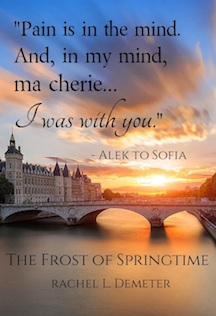
Aligning their two bodies, Aleksender cradled Sofia’s face between his palms and sweetly stroked her skin. Sofia’s toes curled against the barrier of her slippers. It was intoxicating. By far the sweetest moment in her nineteen years of life. With a last kiss, he whispered into her mouth, “Pain is in the mind. And, in my mind, ma chérie … I was with you.”

Additional Excerpts

About the Author

MEDIA KIT RachelDemeter_portrait copyRachel L. Demeter lives in the beautiful hills of Anaheim, California with Teddy, her goofy lowland sheepdog, and high school sweetheart of ten years. She enjoys writing dark, edgy romances that challenge the reader’s emotions and examine the redeeming power of love.

Imagining stories and characters has been Rachel’s passion for longer than she can remember. Before learning how to read or write, she would dictate stories while her mom would jot them down for her. She has a special affinity for the tortured hero and unconventional romances. Whether sculpting the protagonist or antagonist, she always ensures that every character is given a soul.

Rachel strives to intricately blend elements of romance, suspense, and horror. Some common themes her stories never stray too far from: forbidden romance, soul mates, the power of love to redeem, mend all wounds, and triumph over darkness. Her dream is to move readers and leave an emotional impact through her words.

WebsiteFacebook TwitterGoodreads

Google+PinterestNewsletter


The Bath Road: Littlecote and Wild William Darrell

The following post is the second of a series based on information obtained from a fascinating book Susana recently obtained for research purposes. Coaching Days & Coaching Ways by W. Outram Tristram, first published in 1888, is chock full of commentary about travel and roads and social history told in an entertaining manner, along with a great many fabulous illustrations. A great find for anyone seriously interested in English history!

058

Littlecote House

Littlecote House

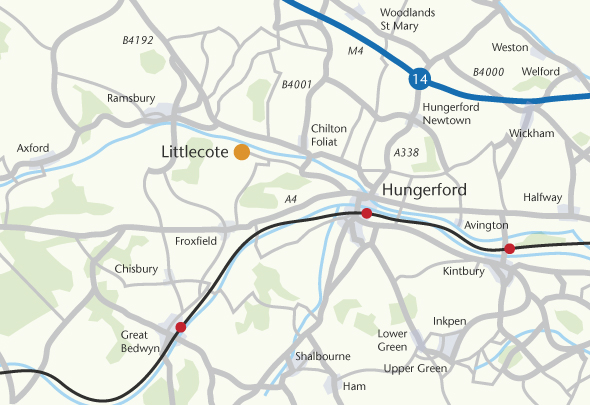
Littlecote House, near Ramsbury, Wiltshire, was first a medieval mansion, built around 1290 by the de Calstone family. It fell into the hands of William Darrell in 1415 when he married Elizabeth de Calstone. The Tudor mansion was built in the mid-sixteenth century. Henry VIII courted his third wife Jane Seymour here; her grandmother was a Darrell. Elizabeth I, James I, Charles II and William of Orange stayed here.

map

Wild William Darrell (1539-89)

The last Darrell at Littlecote is best remembered for his contentiousness and scandals. His father having left Littlecote to his mistress, Mary Fortescue (who liked to call herself Lady Darrell), William set in motion a series of lawsuits to wrest it away from her. This was the first of countless lawsuits filed in his lifetime, which ended by draining him of his fortune and forcing him to mortgage or sell most of the 25 manors inherited from his father. Litigation with his mother’s family over one such manor lasted 20 years!

Not the sort of man you’d want as a neighbor!

Darrell was also known for his amorous exploits. The most famous was his affair with the wife of Sir Walter Hungerford, who was subsequently abandoned by her husband when she wrote this to Darrell:

“I, by the oath I have sworn upon the holy evangelist, do acknowledge that if Sir Walter Hungerford, my husband now living, do depart out of this life … I will take you to my husband.”

An Elizabethan Horror Story

Enjoy Mr. Tristram’s dramatic narration in Coaching Days & Coaching Ways:

The whole story would pass before us under a ghostly, shimmering, ghoul-like glamour: the midwife at Shefford, a village seven miles off, waked in the dead of night, with a promise of high pay for her office on condition that she should be blindfolded! the headlong ride through the wild weather behind the silent serving man! the arrival at a large house which was strange to her! the mounting of the long stairs, which the woman, shadowed already with some grim foreboding, counted carefully as she passed up them! the delivery in a gloomy, richly furnished room of a masked lady! the entrance of a tall man “of ferocious aspect”, who seized the newborn child, thrust it into the fire that was blazing on the hearth, ground it under his heavy boot till it was cinders! then the trembling departure of the pale spectator of the hideous scene, blindfolded as she had come, aghast, speechless, carrying a heavy bribe with her as the price of guilty silence, but carrying also a piece of the curtain which she had cut out of the bed—all this scene of horror how the author of The Dragon Volant would have described it for us! And all this horror is history!

The original deposition made on her death-bed by the midwife, whose name was Mrs. Barnes, and committed to writing by Mr. Bridges, magistrate of Great Shefford, is in existence to this day, and is proof beyond cavil. It is from this point that rumour begins. That rumour, backed in my opinion by damning circumstance, has for two hundred years connected the tragedy with Littlecote House and William Darrell, commonly called Wild Darrell, then its proprietor. It is alleged that the midwife’s depositions set justice on the murderer’s track, and that the fitting of the piece of curtain which Mrs. Barnes had taken away with her into a rent found in the curtain of the Haunted Room at Littlecote, marked the scene of the murder. Wild Darrell was tried for his life, it is said, but escaped by bribing the officers of the law with the reversion of his large estates. But—so runs the rumour—the memory of his crime pursued him. He was haunted by ghastly spectres which he tried to forget in wild excesses, but which no seas of claret would lay. Finally as he was riding recklessly down the steep downs, with the scene of his atrocity in sight, at headlong speed, the reins loose, his body swaying in the saddle, pale, wild-eyed, unkempt, the very picture of debauched and guilty recklessness, tearing from the Furies of the past, that past confronted him. The apparition of a babe burning in a flame barred his path. The horse reared violently at the supernatural sight. Darrell was violently thrown, and the wicked neck, which had escaped the halter by a bribe, was broken at last as it deserved to be.

Wild Darrell is remembered but as a name now, and as a name for all that is wicked. (Coaching Days & Coaching Ways, pp. 38-41)

Sir Walter Scott recounted this story in the notes to his narrative poem, Rokeby. (Free on Google, check out p. 400).

Littlecote House Hotel

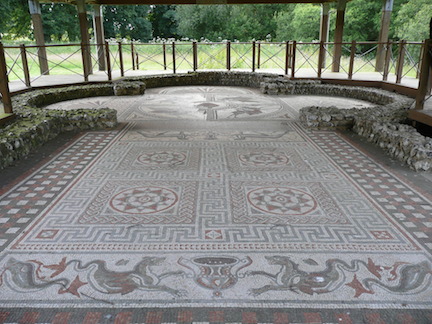
Guess what? Not only can you visit Littlecote House, but you can stay overnight in the Tudor mansion, as Susana did recently at Chatsworth, Hever Castle, and Leeds Castle! Besides the house and gardens (and ghosts, perhaps?), there are remains of a Roman villa and a lovely mosaic as well. Check it out!

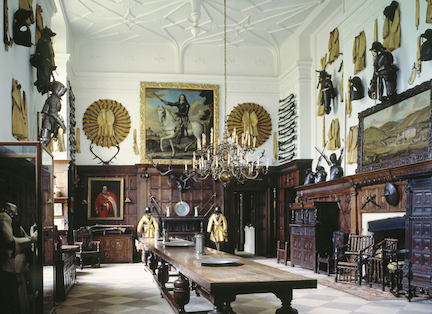
The Great Hall

The Great Hall

The garden of Littlecote House Hotel in Wiltshire

The gardens

Roman mosaic

Roman mosaic

Ruins of Roman Villa

Ruins of Roman Villa


 Index to all the posts in this series

1: The Bath Road: The (True) Legend of the Berkshire Lady

2: The Bath Road: Littlecote and Wild William Darrell

3: The Bath Road: Lacock Abbey

4: The Bath Road: The Bear Inn at Devizes and the “Pictorial Chronicler of the Regency”

5: The Exeter Road: Flying Machines, Muddy Roads and Well-Mannered Highwaymen

6: The Exeter Road: A Foolish Coachman, a Dreadful Snowstorm and a Romance

7: The Exeter Road in 1823: A Myriad of Changes in Fifty Years

8: The Exeter Road: Basingstoke, Andover and Salisbury and the Events They Witnessed

9: The Exeter Road: The Weyhill Fair, Amesbury Abbey and the Extraordinary Duchess of Queensberry

10: The Exeter Road: Stonehenge, Dorchester and the Sad Story of the Monmouth Uprising

11: The Portsmouth Road: Royal Road or Road of Assassination?

12: The Brighton Road: “The Most Nearly Perfect, and Certainly the Most Fashionable of All”

13: The Dover Road: “Rich crowds of historical figures”

14: The Dover Road: Blackheath and Dartford

15: The Dover Road: Rochester and Charles Dickens

16: The Dover Road: William Clements, Gentleman Coachman

17: The York Road: Hadley Green, Barnet

18: The York Road: Enfield Chase and the Gunpowder Treason Plot

19: The York Road: The Stamford Regent Faces the Peril of a Flood

20: The York Road: The Inns at Stilton

21: The Holyhead Road: The Gunpowder Treason Plot

22: The Holyhead Road: Three Notable Coaching Accidents

23: The Holyhead Road: Old Lal the Legless Man and His Extraordinary Flying Machine

24: The Holyhead Road: The Coachmen “More Celebrated Even Than the Most Celebrated of Their Rivals” (Part I)

25: The Holyhead Road: The Coachmen “More Celebrated Even Than the Most Celebrated of Their Rivals” (Part II)

26: Flying Machines and Waggons and What It Was Like To Travel in Them

27: “A few words on Coaching Inns” and Conclusion

The Bath Road: The (True) Legend of the Berkshire Lady

The following post is the first of a series based on information obtained from a fascinating book Susana recently obtained for research purposes. Coaching Days & Coaching Ways by W. Outram Tristram, first published in 1888, is chock full of commentary about travel and roads and social history told in an entertaining manner, along with a great many fabulous illustrations. A wonderful find for anyone seriously interested in English history!

dust jacket

Frances Kendrick: The Berkshire Lady

map

As we follow the Bath Road, Tristram recounts the story of Frances Kendrick, a nineteen-year-old young lady who is fortunate to be not only beautiful and gracious, but also very wealthy and, atypical for the time, retains full control of her life and her fortune. Not surprisingly, nearly every young man she meets falls in love with her and offers her marriage. Many of them are exceedingly eligible, but she turns them all down because she doesn’t reciprocate their feelings. Most young ladies would have felt under pressure to choose one, but Frances has no parents and thus no reason to do so.

Eventually, the rejected suitors get together and start a rumor that Miss Kendrick deliberately leads them on so that she can enjoy their misery when she refuses their offers of marriage. It is all nonsense done out of spite, of course, but it has the effect of nearly ruining her chance of finding true love.

Benjamin Child, Esq. is a workaholic, poverty-stricken barrister who also happens to be unpretentious and quite good-looking himself. Like all the rest, he is instantly attracted to the lovely heiress, and she to him, to the point where her rejected suitors decide to put a spanner in the works by taking him aside and telling him that Miss Kendrick is a soulless thief of hearts. Benjamin doesn’t like the idea of being considered a fortune-hunter anyway, so he takes off for London and tries unsuccessfully to forget about Frances Kendrick.

Poor Frances is heartbroken. She has finally found the gentleman of her dreams, and he doesn’t seem to share her feelings. After discovering the rumors being circulated about her, she is desperate to find a way to prove to him that her character has been unfairly tarnished and that she truly loves him. But how can she do that when he won’t come near her?

berkslady

Fight me or marry me!

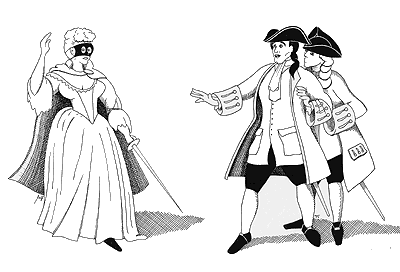
What she does sounds like a scenario in a historical romance, but it really did happen! Frances issues a challenge to Mr. Child to fight a mortal duel in Calcott Park (part of her estate). Despite the fact that the challenge gives no pretext for the duel, Mr. Child shows up and finds himself facing a masked, cloaked young lady with a sword who tells him in no uncertain terms that he can either fight her or marry her. By this time, he has discerned her identity and, pleased to find that she returns his feelings, agrees to marry her with a special license in St. Mary’s Church, Walgrave.

Prospect Park, the site of the famous (non) duel

Prospect Park, the site of the famous (non) duel

I love a good legend, and what a treat to discover it really did happen!

Frances Kendrick and Benjamin Child were married March 28, 1707 at St. Mary’s Church in Wargrave, as you can see for yourself in the parish register. When Frances died in 1722, her eccentric husband had her placed in a lead coffin shaped to follow exactly the lines of her body, which was laid to rest in the Kendrick family vault at St. Mary’s Church in Reading. (The coffin was found and examined in 1820.)

Benjamin sold Calcott House (although he later refused to move out of it and the new owner had to destroy the house to get him out of it), and later moved to a farm on the estate that he remodeled and became what is now known as Prospect House. It is here where the ghost of the Berkshire Lady is said to roam, seeking her true love.

Prospect Park Mansion House

Prospect Park Mansion House

You can read the famous ballad of the Berkshire Lady here. Even better, you can read an 1879 fictionalized version of the story by Katherine Sarah MacQuoid on Google here. (I heartily recommend it!) More details about the story behind the legend are here.

Through the tollgate: an example of the illustrations

Through the tollgate: an example of the illustrations in the book

 Index to all the posts in this series

1: The Bath Road: The (True) Legend of the Berkshire Lady

2: The Bath Road: Littlecote and Wild William Darrell

3: The Bath Road: Lacock Abbey

4: The Bath Road: The Bear Inn at Devizes and the “Pictorial Chronicler of the Regency”

5: The Exeter Road: Flying Machines, Muddy Roads and Well-Mannered Highwaymen

6: The Exeter Road: A Foolish Coachman, a Dreadful Snowstorm and a Romance

7: The Exeter Road in 1823: A Myriad of Changes in Fifty Years

8: The Exeter Road: Basingstoke, Andover and Salisbury and the Events They Witnessed

9: The Exeter Road: The Weyhill Fair, Amesbury Abbey and the Extraordinary Duchess of Queensberry

10: The Exeter Road: Stonehenge, Dorchester and the Sad Story of the Monmouth Uprising

11: The Portsmouth Road: Royal Road or Road of Assassination?

12: The Brighton Road: “The Most Nearly Perfect, and Certainly the Most Fashionable of All”

13: The Dover Road: “Rich crowds of historical figures”

14: The Dover Road: Blackheath and Dartford

15: The Dover Road: Rochester and Charles Dickens

16: The Dover Road: William Clements, Gentleman Coachman

17: The York Road: Hadley Green, Barnet

18: The York Road: Enfield Chase and the Gunpowder Treason Plot

19: The York Road: The Stamford Regent Faces the Peril of a Flood

20: The York Road: The Inns at Stilton

21: The Holyhead Road: The Gunpowder Treason Plot

22: The Holyhead Road: Three Notable Coaching Accidents

23: The Holyhead Road: Old Lal the Legless Man and His Extraordinary Flying Machine

24: The Holyhead Road: The Coachmen “More Celebrated Even Than the Most Celebrated of Their Rivals” (Part I)

25: The Holyhead Road: The Coachmen “More Celebrated Even Than the Most Celebrated of Their Rivals” (Part II)

26: Flying Machines and Waggons and What It Was Like To Travel in Them
27: “A few words on Coaching Inns” and Conclusion

Lily’s Leap: Téa Cooper

It’s all about the dress.

My heroines seem to spend most of their time galloping around on horses and getting themselves into all kind of scrapes. Their day-to-day clothes are very much based on those worn by some of the more notorious female characters of Australian history.

Mary Ann Bugg was the sometime wife of one of Australia’s more famous bushrangers, Captain Moonlight. Newspaper reports of the time describe her as looking like a young boy, wearing moleskin trousers, a thick shirt, a monkey jacket, knee length boots and a cabbage tree hat. The type of clothes a stockman of the day wore.

Both my heroines in Lily’s Leap and Matilda’s Freedom are fiercely independent women, born and bred in the Australian bush. Although Lily grew up with many of the privileges of wealth, Matilda is the daughter of convict parents.

Nevertheless, as we all know, at some point every girl needs a party dress.

After a week on the road with a motley crew of bushrangers Lily arrives at her aunt’s house in Sydney and she has to conform. I chose this example from the Powerhouse Museum Collection as “her” dress.

A few years later Matilda borrows it when she arrives in Sydney with only the clothes on her back after her family’s farm has been destroyed by fire.

It’s fun to slip a little bit of reality into a story.

This dress has an interesting history. It belonged to a Sarah Thomas. She brought it with her from England when she arrived in Australia with her husband as a free settler in the late 1830s.

Lily's Dress copy

Women’s day dress, 1840 – 1850 Collection: Powerhouse Museum, Sydney. Photo: Sue Stafford

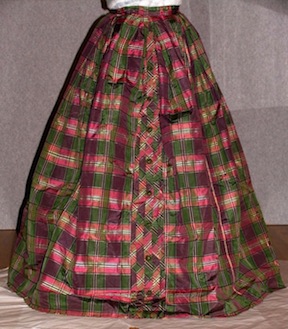
Sarah Thomas was an interesting individual and obviously (like me) had a preference for checks! She made herself this skirt en route to Australia and wore it until her death in 1878 which, since she had ten children, is pretty amazing! You can find out more about Sarah, her story and her skirt here.

Tartan-skirt-895x1024 copy

Check taffeta skirt worn by Sarah Thomas, c. 1839 Collection: Tongarra Museum, Photo: Rebecca Evans

Excerpt from Lily’s Leap

Lily pushed back the blankets and peered around her in horror. The sun streaming in through the fine lawn curtains told her it was long past dawn and the time the horses should have been loaded. She reached her hand out to the pot of tea next to a cup on the bedside table. It was cold to the touch.

Shouting a string of curses she’d picked up from Jem, she scampered from the bed searching for her riding breeches, and failing to find them threw the checked silk taffeta dress over her head and shook her hair back while she fumbled with the mass of intricate buttons. With a pair of slippers clasped in her hands she ran down the stairs barefooted.
‘Good morning, Lily.’

She ignored her aunt’s greeting. Panic laced her chest tighter than the hurriedly fastened buttons of her unaccustomed dress. “The horses. Are we too late? They should have been loaded hours ago.”

And from Matilda’s Freedom

His blood warmed as she approached and he saw the way her breeches hugged the sculpted curves of her thighs.

‘Good morning. I hope I haven’t kept you waiting.’ She turned to greet the horses and threw a smile at him over her shoulder.

The outline of her buttocks as she turned away from him took his breath away. She was not even remotely self-conscious and looked more comfortable now than in the tartan dress she’d worn on the evening they’d first met. Her supple fingers caressed the neck of her bay mare, and the horse whinnied its approval.

Kit understood why.

Note: Matilda is helping celebrate Lily’s release, and for a short time, Matilda’s Freedom is only 99¢ on Amazon!

About Lily’s Leap

From Escape’s Queen of Australian historical romance comes a story about a privileged member of Australian’s squattocracy, a bushranger, and a very special horse.

Born into the rough, but privileged society of the Australian colonial landowners, Lilibeth Dungarven finds herself married, widowed, and, much to her distress, back under her father’s thumb, all before her twenty-first birthday. Determined not to forgo her dream of breeding the perfect racehorse, Lilibeth ignores propriety and sets out to restore the family’s flagging fortunes.

When Captain Tom and his mismatched band of bushrangers stumble across a mob of the best horses they’ve ever seen, and the daughter of the famed Dungarven horse stud, they know their fortunes have changed. Their catch is worth a king’s ransom. All they have to do is hold her for seven days. How hard can it be to control the pampered daughter of a colonial upstart?

 Harlequin EscapeAmazon Amazon.aus iTunes • Kobo

Reviews

Forget work, forget all your responsibilities and slide into this delicious story … a well-written book by a talented writer … since I doubt I’ll be visiting Australia, it was a treat to feel like I was there, herding horses to market across the Australian Outback. The landscape assumes the position of a character in this exciting romance; playing a pivotal role in Lily’s adventure. A fabulous read by a very talented Aussie author … I have no hesitation in HIGHLY recommending Lily’s Leap.”

http://mywrittenromance.com/2014/06/06/lilys-leap-by-tea-cooper-review

https://www.goodreads.com/review/show/946141614?book_show_action=false&page=1

https://www.goodreads.com/review/show/961167774?book_show_action=true&page=1

Excerpt

Hunter Valley, Australia 1848

LilysLeap_TeaCooper small copyLilibeth Dungarven’s cry of pure pleasure soared skywards as the massive black stallion rose to clear the fallen tree, sending the horrors of the last four years scuttling into the dirt of the ancient land.

Clenching her knees against Nero’s heaving flanks she bent low, ducking the overhanging branches framing the bush track, her cheek pressed to the warmth of his muscular neck. When the erratic pounding in her chest settled she drew Nero to a shuddering halt and pushed the damp curls back from her forehead.

A pair of black cockatoos, disturbed by her madcap gallop, shrieked their annoyance and resettled in the whispering casuarina trees. The crack of their beaks as they threw the mangled nuts to the ground filled the silence. Below her the ribbon of sandstone road weaved its way towards Payne’s Crossing and she shielded her eyes from the sun, searching for her mob of horses.

A glint of reflected sunlight drew her eye to a mounted figure in the middle of the road. Despite the hat pulled low shadowing his face, the stockwhip crack of his words registered deep in her belly.

‘Bail up! Guns down and off the horses.’

‘What do you think you…?’ Constricted by the tension in her throat her words petered out. No one would dare steal such a valuable mob of horses. They were branded. Everyone in the colony knew the Dungarven brand. To lose them was unthinkable. Years of breeding — the first pure Dungarven bloodlines. Months proving herself capable of managing the sale and the trip to Sydney. And now a hold up! It would not happen. Not if Lilibeth Dungarven had any say in the matter.
About the Author

TeaCoopersmall copyTéa Cooper lives in a stone cottage on one hundred acres of bushland, just outside the time-warp village of Wollombi, NSW Australia. When she isn’t writing, Téa can be found haunting the local museum or chatting to the locals, who offer a never-ending source of inspiration.

Lily’s Leap is Téa’s second Australian historical romance set in Wollombi. Her first, Matilda’s Freedom is available now.

In October, Jazz Baby, a 1920s rags to riches story set in Sydney will be released and in February 2015, Forgotten Fragrance, Book I of a family saga entitled From the Ocean to the Outback. At the moment she is working on a parallel time-line series called The Adventures of Miss Abigail Wynter. She has also written three contemporary romances.

WebsiteFacebookTwitterGoodreadsPinterest 

Renee Reynolds and A Marquis For All Seasons

BBT_AMarquisForAllSeasons_Banner

Renee will be awarding a replica of the locket and chain worn by the heroine in the book, and a copy of A Marquis For All Seasons (choice of print or ebook; print will be autographed) to a randomly drawn commenter during the tour (US ONLY). Click here for the Rafflecopter. Click on the banner to follow the tour and increase your chances of winning.

Renee Reynolds prize giveaway bronze long necklace with locket

About A Marquis For All Seasons

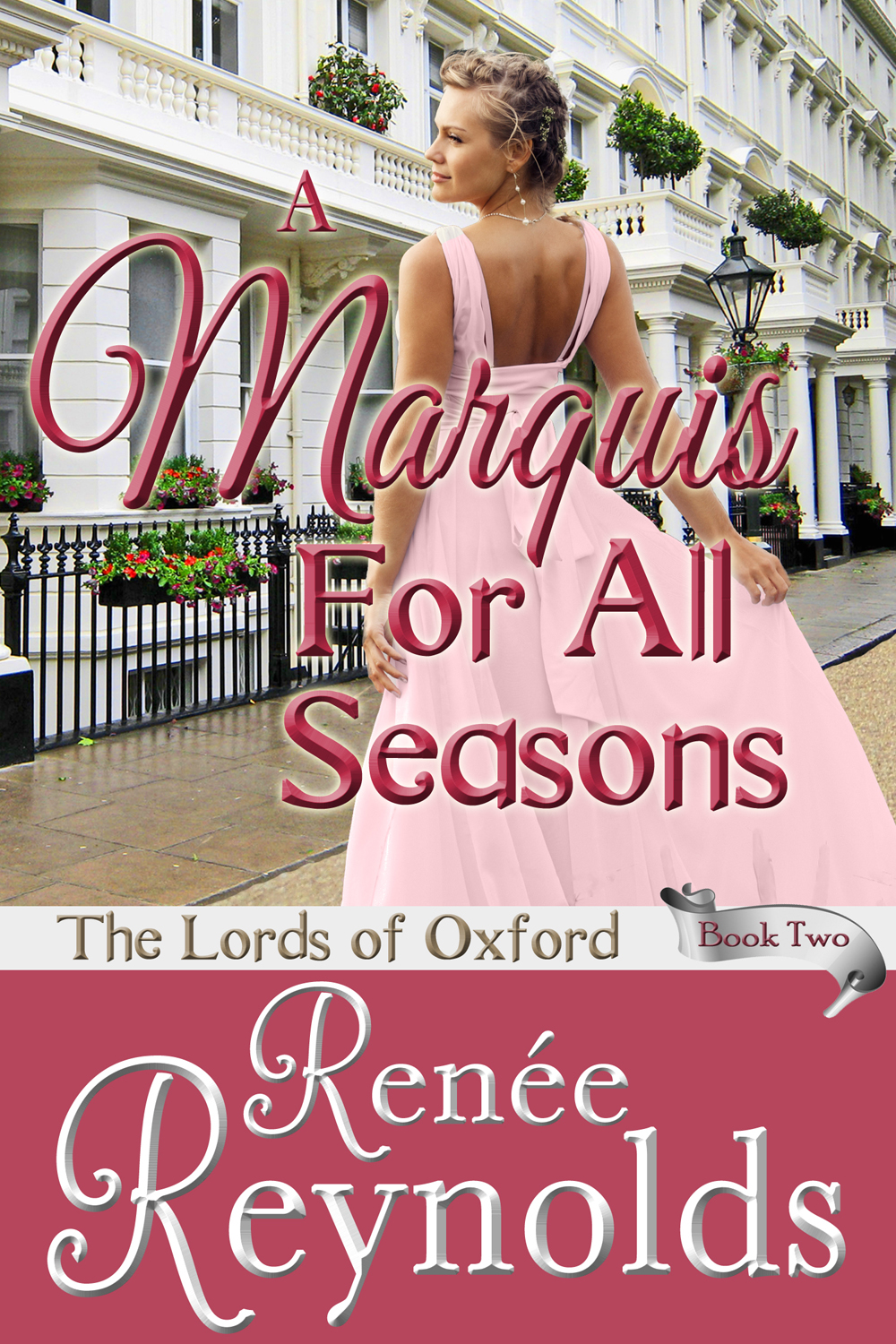
Lady Miranda Leighton and the Marquis of Stafford, Roman de Courtenay, have a similar problem: their families want them to find a spouse. Together they hatch the perfect scheme: they will pretend an attachment and trick their families in their pursuit of one last season of unencumbered entertainment. Yet, in each other’s constant company, they find their ruse giving rise to some surprisingly very real feelings. What happens when you set out to fool society, but only end up fooling yourselves?

Excerpt

“Let us take each day as it comes, and decide entertainments best suited to our attendance closer to the events,” Lord Stafford suggested with a resigned air. He sighed, suddenly weary at the drastic turn his summer was taking. His time would not be his own, it seemed. At least Lady Miranda did not ask him to undertake the ridiculous, such as a trip to Tattersall’s, a gambling hell, or Almack’s. He could well manage a few parties and the occasional turn through Hyde Park. He grinned suddenly. “We shall woo our families with the idea that we woo each other,” he quipped.

Cover_A Marquis For All SeasonsMiranda groaned, rolling her eyes but grinning in response. “And we shall have the most fun possible in the process.”

“Yes, well, that remains to be seen. I suppose it depends on one’s definition of ‘fun,’” he returned as his brows drew together in thought.

“And in one’s ability to experience it. I give you leave to pay me as many pretty comments as necessary,” she teased.

“Then, I give you leave to swoon, but no more than twice, and only after conveying your raptures over the delicacy of my words.”

Miranda squeezed his arm in delight as they neared the gazebo. “I’m not ashamed to admit it: I plan to enjoy our ruse immensely.”

“While I plan to suffer all for the greater good.”

“As long as you ‘suffer all’ with a besotted air, you may suffer as much as you see fit.”

About the Author

AuthorPicAuthor Renée Reynolds grew up all over the world as the daughter of a globe-trotting Marine father and spirited and supportive mother. Their family motto was you can never learn too much, travel too much, or talk too much.

She majored in majors in college, and after obtaining a host of degrees she decided not to use any of them and instead writes about what she cannot do – go back in time to dance at balls, flirt with lords, gentlemen, and scoundrels, and gallop unfashionably down Rotten Row during the most fashionable hour.

After dodging a few Collinses and Wickhams, Renée happily snared a Darcy. Her HEA turned out to be in Texas, where she resides with “the hubs, the kiddos, a boisterous menagerie of indoor and outdoor animals, and a yard of meticulously maintained weeds.” She has happily tagged on this addendum to the family motto: you can never read too much, too often, or too late at night.

WebsiteTwitterFacebookFacebook fan page

Apsley House Celebrates the 199th Anniversary of the Victory of Waterloo

wellington

Arthur Wellesley, Duke of Wellington

Many authors of historical romance are passionate about military history and delight in studying every little detail. I have to admit that I was always bored in history class when we studied battles and dates and stuff. To me, history is the story is people and how they lived, what they thought, and how they struggled through life’s challenges. Which is why I love visiting historical homes and museums and imagining what it was like back then.

As much as Society tried to ignore the military conflicts and live their lives normally (much as we do even today), these wars—particularly the Peninsular War—directly affected them. As a Regency romance author, I don’t (or haven’t) written directly about this war with Napoleon, but it is important to know about it because my characters would have known about it, and it would no doubt have affected their thoughts and attitudes. Britain lost 15,000, the Prussians, 7,000, at Waterloo alone (Napoleon lost 25,000 and 8,000 captured). That’s not counting the losses in the previous years. And keep in mind that France was only an English Channel away, so there was a good chance Napoleon might try to invade Britain itself at some point. (It wasn’t quite like WWII where Britain was actually attacked by German warplanes, but it had to be a concern of the British people during the Regency era as well.)

For that reason alone, I embrace the study of this important battle, and why I returned to Apsley House (Wellington’s home) this weekend for the Waterloo Festival.

Jacques-Louis_David_-_The_Emperor_Napoleon_in_His_Study_at_the_Tuileries_-_Google_Art_ProjectImagine how the history of the world would have changed had Napoleon emerged the victor at Waterloo? Would he indeed have been able to conquer the world? There is no doubt that he was a military genius, but he was human and made some mistakes that contributed to his downfall. Of course, the heavy downpour the day before the battle was a contributing factor as well.

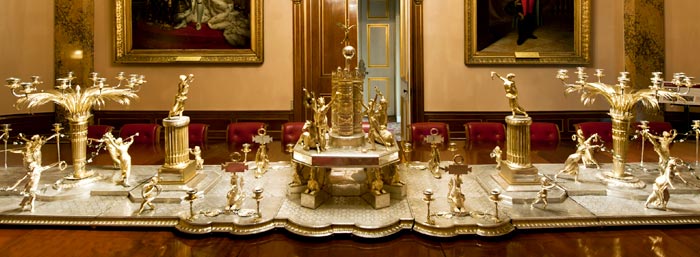
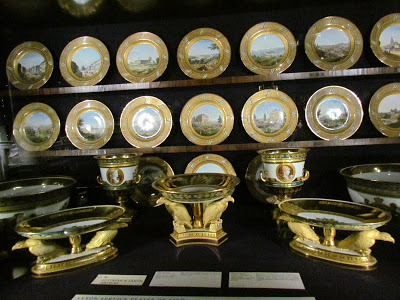
Apsley House is a beautiful home, full of portraits of Wellington and his cronies and important statesmen of the time. (Did you know he and Napoleon were born the same year?) I have a feeling Wellington actually admired Napoleon’s military acumen, in spite of his determination to thwart the man’s ambitions to rule the world. I’ve seen a lot of beautiful homes this summer, and I love to savor each and every piece, but the one thing that really impresses me about Apsley House is the numerous, extravagant gifts that were pressed upon the Iron Duke from grateful statesmen all over the world. The priceless silver pieces, the china and porcelain, the furniture, the sculptures—this extraordinary man did the world a tremendous favor by managing to stop the most cunning, determined, and ambitious man anyone of the time had ever seen.

spectacular-silver

porcelain

silver

Arthur Wellesley, the Duke of Wellington, was like a god!

The Festival

Besides visiting the house itself, during the festival included various events. For example, I enjoyed watching the demonstration of the soldiers of the 95th Rifles. See the video here. I believe they will improve with practice! Then, in the ballroom, another “soldier” gave a rundown of the battle using vegetables, fruits, and baguettes. The end of the demonstration is here.

95th Rifles

95th Rifles

For more photos of Apsley House, Wellington, and Waterloo, check out my Pinterest page here.

Next year is the bicentennial. Are you up for a trip to London in 2015?


Hever Castle: Anne Boleyn’s Childhood Home

castle5

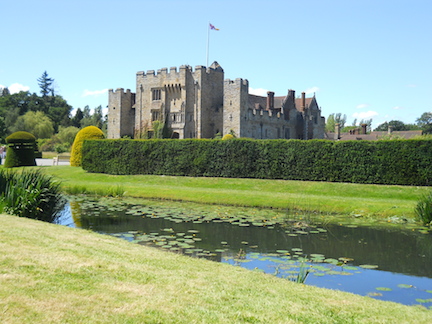
The original defensive castle was started in 1270, and in the 15th and 16th centuries, it became the home of the powerful Bullen (Boleyn) family, who added the Tudor dwelling to the castle. This is where Thomas Boleyn, a diplomat and politician who later became the 1st Earl of Wiltshire and the 1st Earl of Ormond lived with his wife, Elizabeth Howard (daughter of the Duke of Norfolk), and their three surviving children, George, Anne, and Mary.

Anne Boleyn

Anne Boleyn

Anne, of course, was destined to become the second wife of Henry VIII—and the reason for his break from Rome to make himself the Head of the Church of England so that he could grant himself a divorce from his first wife, Catherine of Aragon, who had failed to give him a son. And since Anne herself could only give him a daughter, a pretext had to be found to get rid of her so that he could find a woman who would. She was convicted of adultery and incest with her brother George, and both of them were executed on the block.

Henry VIII

Henry VIII

Very tragic. But it was Anne’s daughter Elizabeth who would become one of the greatest monarchs of England, the Virgin Queen Elizabeth I. And Thomas Boleyn, who lies in the nearby church, is her maternal grandfather.

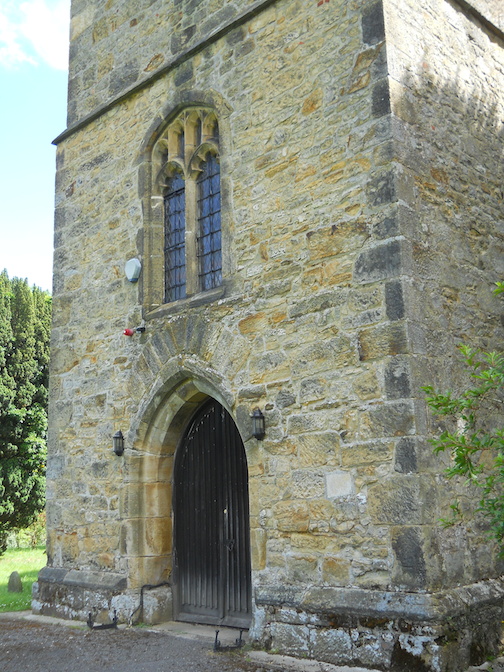
Church where Thomas Boleyn is buried

Church where Thomas Boleyn is buried

Poor Henry is more known for his marital discords than anything else he did, unless it might be destroying England’s greatest monasteries in order to steal their wealth to fund his lifestyle. (Apologies to anyone reading this who might be a Henry VIII fan, but as you can see, I’m not one.) His third wife gave him a son and promptly died, and he had his marriage to Anne of Cleves, annulled. In the annulment document, she was granted Hever Castle, which had come to him at the death of Thomas Boleyn, among other properties.

Anne of Cleves

Anne of Cleves

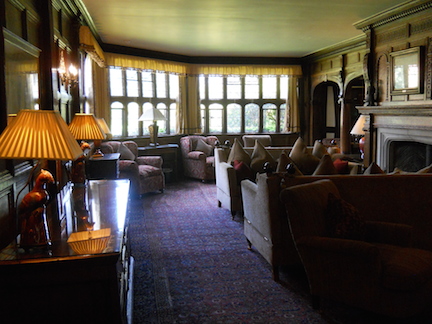
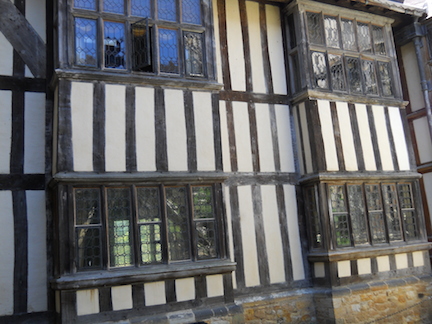
By the early 20th century, the property was in poor repair and was purchased by the American millionaire, William Waldorf Astoria, for a family residence. He added the Astor Wing, built in Tudor style, which has now become the Hever Castle Luxury Bed & Breakfast. I stayed there and highly recommend it! Be sure to book ahead, as rooms are limited.

astor3

Astor Wing

astor2

Astor Wing

One of the things I noticed here was the large number of families, including seniors in wheelchairs, visiting the castle and grounds. I’m pretty sure the castle isn’t accessible to wheelchairs, but the gardens have ramps so that Granny and Aunt Sally can come to enjoy the beauty of nature. I have also noticed that many of these sites offer playgrounds and activities for children, and that school children come here for field trips. Lucky kids! Imagine how much more knowledgeable and interested in history they will be when they are older than our American kids are!

castle20

Yes, it has a moat and a drawbridge!

Yes, it has a moat and a drawbridge!

courtyard2


Banquet Hall

Banquet Hall

Maze

Maze

garden14

For more photos, check out my Pinterest page.

Hever Castle is near Edenbridge, Kent. And if you go there by train, make sure to have a mobile phone with you, because there is no one, absolutely no one, at the Hever train station!

The Banqueting House: An Artistic and Historical Masterpiece

banqueting8

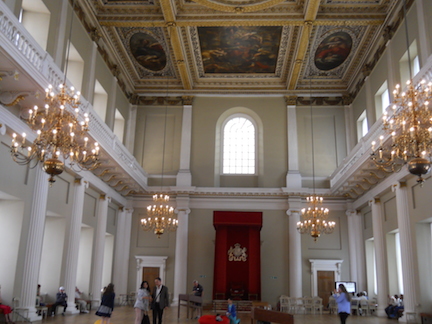
The Banqueting House on Whitehall Street is the only remaining building of the Palace of Whitehall, which was the primary residence of English monarchs for much of the 17th century. In its day, it was the largest palace in Europe, eclipsing even Versailles and the Vatican with its 1500 rooms. Henry VIII married Anne Boleyn and Jane Seymour there (in 1533 and 1536), and it was there where he died in 1547.

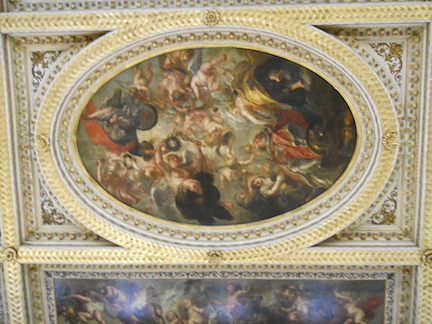
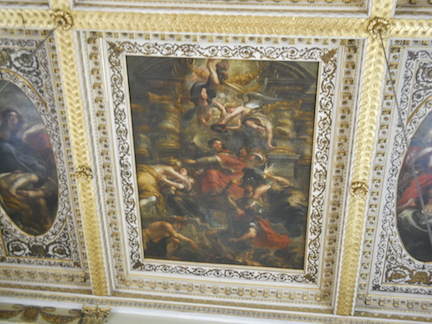
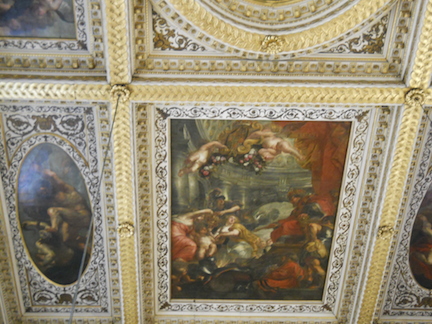
banqueting2In 1622 James I commissioned Inigo Jones to redesign the Banqueting Room, and Charles I was responsible for adding the beautiful ceiling with paintings by Rubens. These paintings, designed to reinforce Charles I’s belief in the divine right of kings, were completed in Antwerp and rolled up for transportation to England, where they were painstakingly laid out and attached to coffers in the ceiling.

Prior to the addition the ceilings, the room was often used for elaborate masques and pageants. Afterward, it was determined that the smoke from the bright lights would damage the ceiling, and it was used primarily for official functions.

It was across this floor that Charles I walked one final time before meeting his fate on the scaffold constructed outside. (So much for the divine right kings.)

banqueting9For some reason, Cromwell chose not to destroy the building as he did so many other buildings symbolic of royal preference. Perhaps because he decided to use it for his own state functions.

Fires in 1691 and 1698 destroyed nearly all the Whitehall Palace buildings, except for this one, probably because Sir Christopher Wren, the reigning architect of the day, had the building next to it blown up to prevent the fire from spreading to the Banqueting House.

A Single Room

While it’s only a single room, it’s definitely something not to be missed. The audio guide that comes with your admission fee is excellent, there are lots of chairs and benches where you sit and gaze at the room while listening, and if you’re very fortunate, you can grab one of the beanbags on the floor and lie prone while admiring the lovely ceiling. When I was there on a Saturday, there weren’t a lot of people there—while I expect everywhere else in Westminster was teeming with crowds as usual—and I could lie there and contemplate the historical and artistic significance of the room in peace.

banqueting3

banqueting5

banquetint4

banqueting6

throne