Tag Archive | Susana Ellis

Vauxhall Gardens: An Era of Change (1786-1822), Part I

vauxhallbook

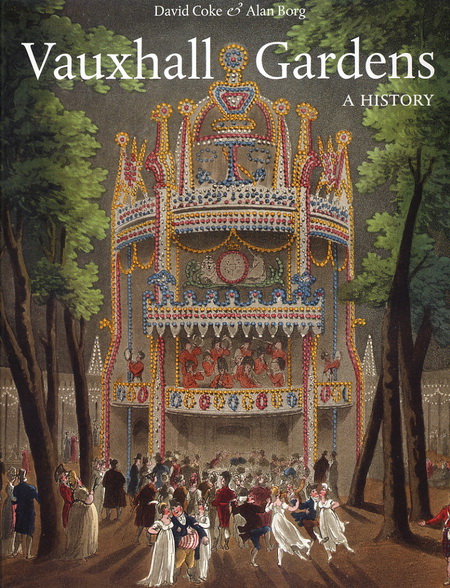
Vauxhall Gardens: A History

David Coke & Alan Borg

The Vauxhall Pleasure Gardens is one of the places I’d love to slip back in time to visit, just to catch a glimpse of what it was like. After recently splurging to buy this lovely coffee-table book, I thought it might make a wonderful subject for a new blog series. But do buy the book too, if you can! The photos are fabulous!

While the years from 1732 to 1786 were the undoubtedly the heyday of Vauxhall, the years following the Jubilee continued to attract large numbers of visitors and was the most popular outdoor entertainment for many years. Charles Burney’s daughter Sarah wrote in 1807:

You should quit your Devonshire Shades were it only to share in the universal rage there is for going to Vauxhall. I never knew anything like it. The whole London World seems to be seized with a fit of the fool.

Vauxhall fashions

Vauxhall Fashions, engraving (David Coke’s collection) from La Belle Assemblée no. 7 (August 1806). Many dressmakers and retailers advertised their wares as representing the latest fashions seen at Vauxhall.

Scenes from Vauxhall were presented on stage, authors such as John Keats, Pierce Egan, and William Thackeray wrote about it, and others tried to copy it, in London and elsewhere. Bath’s Sydney Gardens, opened in 1795 and much visited by Jane Austen, was modeled on Vauxhall in London, as was Tivoli in Copenhagen. Vauxhalls started appearing everywhere.
Exif_JPEG_PICTURE

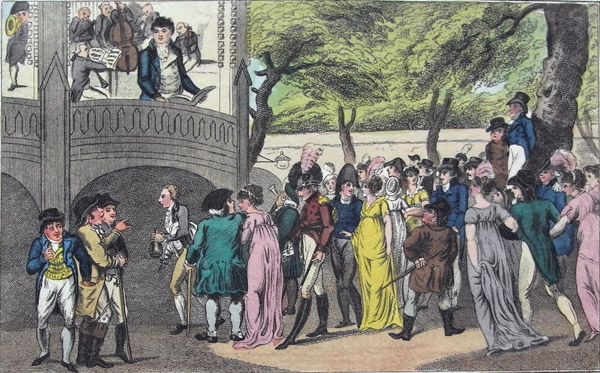
One half of the world don’t know how t’other lives, Sung by Mr. Dignum in Vauxhall Gardens, etching, 1805 (British Museum, London, 1861.0518.1087). A very popular tenor at the gardens, Dignum also gave the farewell address at the end of several seasons.

A change in clientele

In the early nineteenth century, however, with England’s middle and working classes rapidly expanding due to the Industrial Revolution and the rapid growth of London’s population, Vauxhall’s clientele began to change as well.

The social balance was changing too; the old aristocracy watched nervously as France spiralled into revolutionary chaos, and several of the great families decided to move back to the country, to avoid the potential dangers of urban unrest… In addition, social circles were becoming more restricted and inward-looking; the London aristocracy was being rapidly overtaken in terms of numbers by the professional middle classes of industrialists, businessmen, doctors and lawyers. To support them, huge numbers of labourers, tradesmen and servants moved to the capital.

Because of this influx, houses began to pop up in and around Vauxhall, which meant that the Kennington Street area was no longer a country hamlet, but a part of the city itself, and the residents didn’t always appreciate all the racket coming from Vauxhall in the early hours of the morning.

Picturesque Elevation of the Iron Bridge created over the Thames at Vauxhall, engraving, 1816 (David Coke's collection). Designed by the engineer James Walker, the new bridge greatly shortened the land journey from London to Vauxhall Gardens.

Picturesque Elevation of the Iron Bridge created over the Thames at Vauxhall, engraving, 1816 (David Coke’s collection). Designed by the engineer James Walker, the new bridge greatly shortened the land journey from London to Vauxhall Gardens.

A significant advantage was the completion of the new Vauxhall Bridge in August 1816, which shortened considerably the route from the West End.

The bridge remained open all night, both for pedestrians and for coaches, catering for those revellers who stayed on into the small hours, to the annoyance of the local residents who were trying to sleep.

A change of attractions

The form of the entertainments at Vauxhall remained traditional to the end of the eighteenth century. Various new attractions were introduced only gradually and these were directly in response to new forms of popular entertainment that had sprung up elsewhere in London.

One of these was Philip Astley’s enormously popular shows, with “daring displays of horsemanship”, as well as jugglers, tight-rope walkers, and great pageants of historical events. See my post of Astley’s Amphitheatre here.

Vauxhall had always promoted patriotic songs and military bands, and later added battle reconstructions and victory celebrations, after Astley’s model. The Battle of Waterloo was considered to be the “most spectacular event ever staged at Vauxhall.”

Boat races on the Thames was another innovation, which including a rowing race for watermen and a sailing match for ‘gentlemen’s pleasure sailing boats’. Which was followed by a grand gala in the gardens, of course. In 1812, the contest was called the Vauxhall Grand Regatta.

Vauxhall Sailing Match, engraving, 1800 (Minet Library, London, Lambeth Archives Department, V. fo. 57). This appears to be the only surviving image of one of the Vauxhall sailing matches.

Vauxhall Sailing Match, engraving, 1800 (Minet Library, London, Lambeth Archives Department, V. fo. 57). This appears to be the only surviving image of one of the Vauxhall sailing matches.

Advances in science and technology brought ballooning to the gardens, the first balloon ascension beginning in 1802, but not becoming a regular feature until the 1820’s. André Jacques Garnerin, the first Vauxhall aeronaut, experimented with making parachute jumps from balloons. One of his flights included releasing a cat from a height of 600 feet, who descended safely into some resident’s garden. George Colman the younger, a playwright, wrote

Poor Puss in a grand parachute
Was sent to sail down through the air
Plump’d into a garden of fruit,
And played up old Gooseberry there:
The gardener transpiring with fear,
Stared just like a hundred struck hogs;
And swore, tho’ the sky was quite clear,
‘Twas beginning to rain cats and dogs.

Fireworks, first introduced in 1783, were limited to special occasions at first, but pyrotechnic displays did not become standard until 1798.

When it was time for the fireworks to start, a bell was rung and everyone went to the firework ground at the far eastern end of the gardens. The hours varied, displays being advertised at 9, 10 and 11 p.m.; on gala nights there was often more than one show.

Changes in proprietors and prices

Jonathan Tyers the younger’s son-in-law, Bryant Barrett, managed the gardens until his death in 1809, when his sons Jonathan Tyers Barrett and George Rogers Barrett inherited. Jonathan Barrett became sole owner in 1818. In 1821, the gardens were leased to relatives and business partners Thomas Bish and Frederick Gye, later joined by Richard Hughes, “and the trio used their option to buy the property in 1825 for £30,000.”

In 1792, the price of admission was raised to 2 shillings for regular nights and 3 shillings for the Grand Galas (masquerades), which involved elaborate fancy dress.


Susana’s Vauxhall Blog Post Series

Vauxhall Gardens: The Third Generation of the Tyers Family and the Jubilee of 1786

vauxhallbook

Vauxhall Gardens: A History

David Coke & Alan Borg

The Vauxhall Pleasure Gardens is one of the places I’d love to slip back in time to visit, just to catch a glimpse of what it was like. After recently splurging to buy this lovely coffee-table book, I thought it might make a wonderful subject for a new blog series. But do buy the book too, if you can! The photos are fabulous!

Following Jonathan Tyers’s death in 1767, his son Jonathan Tyers the younger managed the gardens, along with the assistance of his sister Elizabeth Wood and other family members, until 1786. At that time, the responsibility for the park was passed on to Bryant Barrett, who was Tyers the younger’s son-in-law, married to his only daughter, Elizabeth.

Barrett was a wax chandler by trade, which was a fortunate coincidence, since Vauxhall Gardens must have been spending a fortune on candles and lighting fixtures.

The most visible aspect of Barrett’s initiative appears in the start of regular newspaper advertisements giving details of the musical programmes for each evening; but it was also at this time that proprietors began to sponsor sailing matches on the Thames.

Lean years at Vauxhall

The 1770’s and early 1780’s had been lean ones for Vauxhall, partly because of the increase in crime and vandalism within its walks; but bad behaviour was clearly not the proprietors’ only problem. …quite apart from financial depression in the early 1770’s and grim news from the American colonies, the appalling weather of the summers of 1775-7 had cost the Tyers family a great deal. …

Samuel Arnold finally had to close Marylebone Gardens in 1778… No clear reason is given for this, but the complaints of local residents, especially about the fireworks, are bound to have been a contributor factor. Ironically, Marylebone’s initial advantage in being so close to London had become its eventual downfall.

The Jubilee of 1786

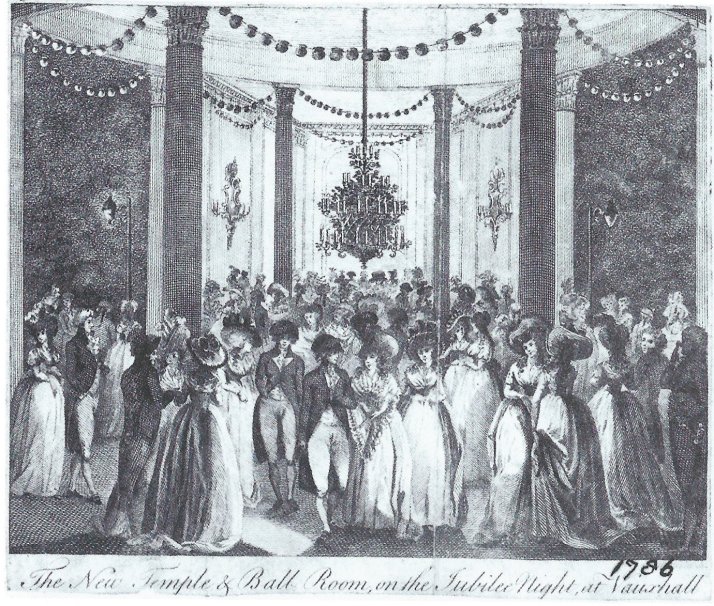
J. Wooding, The New Temple & Ball Room, on the Jubilee Night, at Vauxhall, engraving, c. 1786. The circular Grand Temple at the junction of the Grand South Walk and the Centre Cross Walk, with the temporary ballrooms added to its north and south. The artist was keen to show all the different forms of lighting in use.

J. Wooding, The New Temple & Ball Room, on the Jubilee Night, at Vauxhall, engraving, c. 1786. The circular Grand Temple at the junction of the Grand South Walk and the Centre Cross Walk, with the temporary ballrooms added to its north and south. The artist was keen to show all the different forms of lighting in use.

The approach of the half-century mark of the opening of Vauxhall Gardens “must have come as a godsend to Barrett at the start of his proprietorship.”

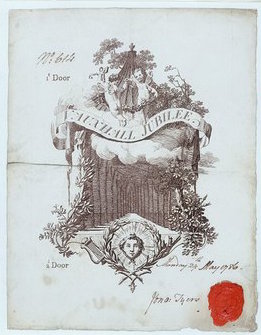
The last great fashionable event had been the hugely successful Ridotto al Fresco of 1769. In a conscious attempt to remind people of the ‘good old days’, when the gardens had last been patronised by fashionable society, the design of the ticket for the vent of the event of seventeen years earlier was adapted for the 1786 Jubilee.

Ticket for the Vauxhall Jubilee, 29 May, engraving. Signed, dated and sealed by Jonathan Tyers the younger, although the management of the park was now in the hands of his son-in-law, Bryant Barrett.

Ticket for the Vauxhall Jubilee, 29 May, engraving. Signed, dated and sealed by Jonathan Tyers the younger, although the management of the park was now in the hands of his son-in-law, Bryant Barrett.

In preparation for the event, which took place on 29 May 1786, the following renovations were completed:

  1. The buildings around the Grove were painted in an elegant pale blue and white livery, and flowering shrubs were planted to appeal to the modern taste in gardening.
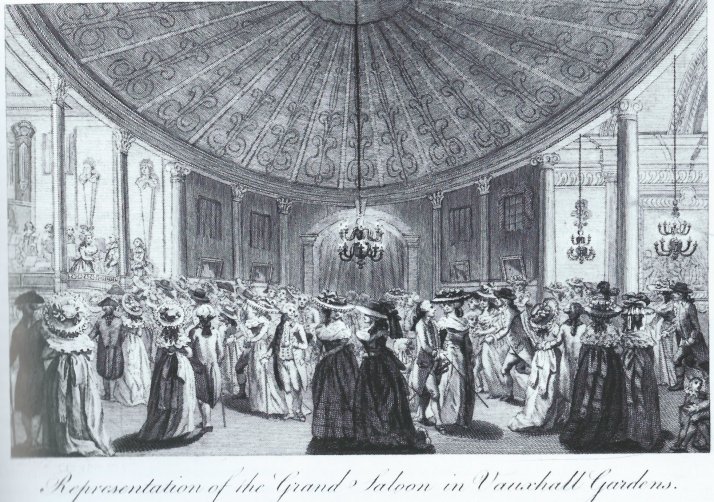
  2.  The Rotunda’s interior decoration was completely renewed, with modern mirrors, and the Ionic columns of the Pillared Saloon were renewed with a rich deep pink scagliola. Window frames were replaced and draped with tasselled crimson and silver fabric, and the Rotunda Orchestra was filled with evergreen plants under a decorated ceiling. In the other recess (where the original Rotunda Orchestra had been housed), the large transparent painting of George, Prince of Wales (later the Prince Regent and George IV) in a noble classical pose was replaced with another transparency depicting an amphitheatre of the Corinthian order, through which could be seen a perspective view of a garden. (Apparently, the original transparency was criticized by some as having nothing in common with the Prince’s true character.)
  3. 14,000 coloured lights and wreaths of artificial flowers were draped around the pillars and in festoons around the cornices of the Covered Walks.
  4. A circular Grand Temple was set up at the crossing of the Grand South Walk and the Centre Cross Walk, “little more than a dome on eight classical columns.”
  5. The Centre Cross Walk was partly built over to give more dancing space in two temporary ballrooms, attached to the Grand Temple on the north and south. “The walls of these ballrooms were painted with Arcadian pastoral scenes beyond a range of Ionic columns decorated with wreaths of flowers, while the ceiling showed a sky filled with ‘tender variegated clouds.’” …In each of the ballrooms was an alcove for the musicians, and others for tables stocked with lemonade, capillaire, and orgeat (soft drinks flavoured with orange flower or almond syrup.) The whole strucutre was of course illuminated with thousands of coloured lamps ‘producing a refugency of light that dazzles and surprises.’
  6. On the site of the former Prince’s Pavilion (built for George III’s father), a new room was created for Prince George and his party.
  7. The entrance to the gardens on Kennington Lane was renewed and enlarged, soon becoming the main coach-entrance, later to be expanded with cloakrooms, waiting-rooms, and other public facilities.
handbill

Handbill for the Vauxhall Jubilee, 1786. A very plain and understated piece of printing, designed only to impart information about the event.

The Jubilee was attended by somewhere between five and six thousand people, most in fashionable and elegant costume, a few in fancy dress, which in this period meant smart dress with added details, such as feathers, flowers, ribbons, ruffs, etc., not character costumes.

There were last night above 6000 persons present, and among them some of the first people in the kingdom, but as is always the case at Vauxhall, it was a mélange; the cit and the courtier jostled each other with the usual familiarity; the half guinea was no repellent to the middling order; John Bull loves to shoulder his superiors in rank, his betters he’ll not allow them to be; and where he pays as much for admission, he never considers them to be more than his equals.

Anon., Representation of the Grand Saloon in Vauxhall Gardens, engraving, after 1786. An unusual view of the renovated Rotunda interior, taken from the entrance off the Grand Walk. The Rotunda Orchestra is on the left, and one of Hayman's paintings from his Seven-Years War series is visible in the Pillared Saloon on the right.

Anon., Representation of the Grand Saloon in Vauxhall Gardens, engraving, after 1786. An unusual view of the renovated Rotunda interior, taken from the entrance off the Grand Walk. The Rotunda Orchestra is on the left, and one of Hayman’s paintings from his Seven-Years War series is visible in the Pillared Saloon on the right.

On the following day, the gardens were opened to four thousand people who were not able to get tickets after those for the first event were sold out.

A successful season

Barrett took advantage of the popular trend of holding military fetes to honor the huge numbers of soldiers coming home from North America by promoting a patriotic tone to this one, with large transparencies framed by martial and naval motifs.

Later that year, when George III escaped a “rather pathetic assassination” by a housemaid with a knife outside St. James’s Palace, Vauxhall celebrated the king’s survival with a new patriotic song by James Hook and an organ concerto with variations on God Save the King.

Barrett’s first season at the helm “once more confirmed Vauxhall as a popular and respectable venue for fashionable society during the 1780’s. However,

…the public attitude towards the gardens was beginning to undergo a fundamental change. The largely unquestioning indulgence was now a thing of the past, and questions were being asked as to whether a pleasure garden was more of a nuisance than a benefit. The establishment’s opposition to public entertainment was strengthening.

Neighbors who had complained for years about the disruption caused by those returning home in the early hours of the morning, were starting to be heard.


Susana’s Vauxhall Blog Post Series

  1. Vauxhall Gardens: A History
  2. Vauxhall Gardens: Jonathan Tyers—“The Master Builder of Delight” 
  3. Vauxhall Gardens: A New Direction
  4. Vauxhall Gardens: The Orchestra and the Supper-Boxes 
  5. Vauxhall Gardens: The Organ, the Turkish Tent, and the Rotunda
  6. Vauxhall Gardens: Three Piazzas of Supper-Boxes
  7. Vauxhall Gardens: “whither every body must go or appear a sort of Monster in polite Company”
  8. Vauxhall Gardens: The Competition
  9. Vauxhall Gardens: The Artwork, Part I
  10. Vauxhall Gardens: The Artwork, Part II
  11. Vauxhall Gardens: The Music, 1732-1859
  12. Vauxhall Gardens: The Business Side
  13. Vauxhall Gardens: Developments from 1751-1786
  14. Vauxhall Gardens: Thomas Rowlandson’s Painting (1785)
  15. ‎Vauxhall Gardens: The Third Generation of the Tyers Family and the Jubilee of 1786
  16. Vauxhall Gardens: An Era of Change (1786-1822), Part I
  17. Vauxhall Gardens: An Era of Change (1786-1822), Part II
  18. Vauxhall Gardens: An Era of Change (1786-1822), Part III
  19. Vauxhall Gardens: The Final Years, Part I
  20. Vauxhall Gardens: The Final Years, Part II
  21. Vauxhall Gardens: The Final Years, Part III
  22. Vauxhall Gardens: The Final Years, Part IV
  23. Vauxhall Gardens: Farewell, for ever
Vauxhall Gardens: Thomas Rowlandson’s Painting (1785)

vauxhallbook

Vauxhall Gardens: A History

David Coke & Alan Borg

The Vauxhall Pleasure Gardens is one of the places I’d love to slip back in time to visit, just to catch a glimpse of what it was like. After recently splurging to buy this lovely coffee-table book, I thought it might make a wonderful subject for a new blog series. But do buy the book too, if you can! The photos are fabulous!

I’m so excited! I just bought a mounted poster of this painting in color from art.com to hang in my bedroom/office here in Florida.

By the time this painting appeared, Jonathan Tyers had died and Vauxhall Gardens passed on to his wife and children, but it was his son Jonathan Tyers Jr.—that n’er-do-well younger son who wed a widowed lady much older than he and caused a giant rift among his parents—who assumed his father’s role in managing the park.

Thomas_Rowlandson_-_Vaux-Hall_-_Dr._Johnson,_Oliver_Goldsmith,_Mary_Robinson,_et_al


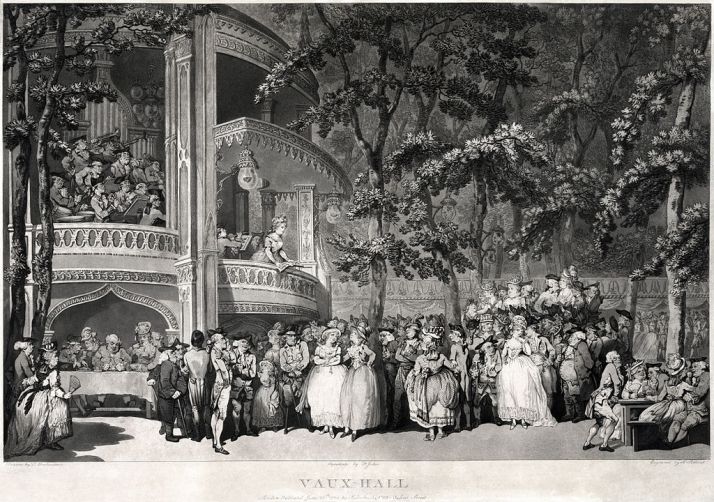
In the supper-box on the left we see, reading left to right, James BoswellMrs Thrale (who appears twice), Dr. Johnson, and Oliver Goldsmith.

The ‘macaroni’ Captain Edward Topham (scandalmonger to The World) is quizzing Georgiana, Duchess of Devonshire and her sister Lady Duncannon (Sheridan’s Lady Bessborough), watched by a naval figure with an eye patch and a wooden leg (not included in the Mellon version), always called Admiral Paisley, but Paisley did not lose his leg and eye until 1st June 1794, so it cannot be him. To the left of him, a young girl (a young boy in the Mellon version) holding the hand of a man who could be the comic actor, William Parsons, or Rowlandson’s friend Jack Bannister.

Peering at the two ladies from behind a tree is a figure traditionally, though improbably, identified as Sir Henry Bate-Dudley, the ‘Fighting Parson’, editor of the Morning Herald; he is more likely to be Thomas Tyers (son of Jonathan Tyers the great entrepreneur and proprietor of Vauxhall Gardens from 1729 until 1767) who stands next to the Scotsman James Perry, editor of the London Gazette. The couple on their right could well be the artist himself and his current girlfriend. and to the right of them stands the actress Mary ‘Perdita’ Robinson, with her husband on her right and the Prince of Wales (later George IV) on her left.

Looking up at the singer, the couple on the extreme left, have been identified as the actress Miss Hartley, in company with one of her many admirers, possibly Mr. Colman, but, suggested by their position apart from the crowd, they could also be members of the Tyers family (most likely Jonathan jr. and his wife Margaret, or their son-in-law Bryant Barrett and his wife Elizabeth. The large lady seated at the table on the right is Mrs Barry, the old Madam of Sutton Street, Soho, with two of her customers and one of her girls.

In the orchestra, we can see Jacob Nelson, the tympanist, who had played at Vauxhall since 1735, and died there after fifty years’ performing, Mr Fisher on oboe, probably Hezekiah Cantelo and Mr. Sargent on trumpet, and Barthélemon, the leader, who retired in 1783. James Hook, the composer, organist, musical director and prolific song-writer, may be seen between Barthelemon and the singer, the 38-year-old Frederika Weichsell, who was Rowlandson’s next-door neighbour in Church Street, and the mother of Mrs. Elizabeth Billington. Elizabeth had just (aged 18) married James Billington, a double-bass player, in 1783, much against her parents’ wishes.

A number of those present in this scene had already died by the time Rowlandson produced the painting, and the affair between the Prince and Perdita Robinson was already over.

Although there is no direct evidence for this, it seems likely, because of the dating, and because of the central position of the singer, that the painting was created by Rowlandson as a retirement gift for Frederika Weichsel, whether from him personally, or specially commissioned by the proprietors of the gardens.


Susana’s Vauxhall Blog Post Series

  1. Vauxhall Gardens: A History
  2. Vauxhall Gardens: Jonathan Tyers—“The Master Builder of Delight” 
  3. Vauxhall Gardens: A New Direction
  4. Vauxhall Gardens: The Orchestra and the Supper-Boxes 
  5. Vauxhall Gardens: The Organ, the Turkish Tent, and the Rotunda
  6. Vauxhall Gardens: Three Piazzas of Supper-Boxes
  7. Vauxhall Gardens: “whither every body must go or appear a sort of Monster in polite Company”
  8. Vauxhall Gardens: The Competition
  9. Vauxhall Gardens: The Artwork, Part I
  10. Vauxhall Gardens: The Artwork, Part II
  11. Vauxhall Gardens: The Music, 1732-1859
  12. Vauxhall Gardens: The Business Side
  13. Vauxhall Gardens: Developments from 1751-1786
  14. Vauxhall Gardens: Thomas Rowlandson’s Painting (1785)
  15. ‎Vauxhall Gardens: The Third Generation of the Tyers Family and the Jubilee of 1786
  16. Vauxhall Gardens: An Era of Change (1786-1822), Part I
  17. Vauxhall Gardens: An Era of Change (1786-1822), Part II
  18. Vauxhall Gardens: An Era of Change (1786-1822), Part III
  19. Vauxhall Gardens: The Final Years, Part I
  20. Vauxhall Gardens: The Final Years, Part II
  21. Vauxhall Gardens: The Final Years, Part III
  22. Vauxhall Gardens: The Final Years, Part IV
  23. Vauxhall Gardens: Farewell, for ever

Caroline Warfield: Dangerous Weakness (Giveaway)

DANGEROUS WEAKNESS2 (5) copy 

Night Owl Reviews, in reviewing Dangerous Works, said, “There is nothing so entertaining as watching a man who is always in control lose that control.” I was delighted because that is exactly what I tried to accomplish in that story. The Marquess of Glenaire, cool, calm and in control, managed the lives of his friends through two novels and a novella. I was determined to muss his hear, rip his suit, and throw him into the unknown.

How about you? Do you like to see a man is just too perfect lose it?  I’ll give a Kindle copy of Dangerous Works to one person who comments.

About Dangerous Weakness

If women were as easily managed as the affairs of state—or the recalcitrant Ottoman Empire—Richard Hayden, Marquess of Glenaire, would be a happier man. As it was the creatures—one woman in particular—made hash of his well-laid plans and bedeviled him on all sides.

Lily Thornton came home from Saint Petersburg in pursuit of marriage. She wants a husband and a partner, not an overbearing, managing man. She may be “the least likely candidate to be Marchioness of Glenaire,” but her problems are her own to fix, even if those problems include both a Russian villain and an interfering Ottoman official.

Given enough facts, Richard can fix anything. But protecting that impossible woman is proving to be almost as hard as protecting his heart, especially when Lily’s problems bring her dangerously close to an Ottoman revolution. As Lily’s personal problems entangle with Richard’s professional ones, and she pits her will against his, he chases her across the pirate-infested Mediterranean. Will she discover surrender isn’t defeat? It might even have its own sweet reward.

Amazon US http://amzn.to/1L8IDXp

Amazon UK http://amzn.to/1JYxerM

Amazon Canada http://amzn.to/1NwQmMt

Amazon Euro http://amzn.to/1PrxeAQ

Amazon India http://amzn.to/1hdwC6C

Amazon Aus http://bit.ly/1NikayC

Excerpt

“Who invited Lilias Thornton?” Richard demanded under his breath. His eyes followed a slender young woman who paced out the steps of the Quadrille across the parquet floor of the earl’s ballroom.

“No ‘thank you for turning your country seat into a diplomatic snake pit for an entire week so the haut ton can mingle with exotic visitors from the East while the foreign secretary manages the fate of Greece over Brandy and cards?’” Will demanded.

Richard looked at his friend, one eyebrow raised. “Chadbourn Park fit the need precisely. I thanked your Catherine this morning.”

Will grunted. “My Catherine worked miracles when Sahin Pasha showed up with six extra people in his party.”

“We can’t predict how many retainers the Turks will impose,” Richard growled. The Ottomans danced to their own tune; the Foreign Office never knows what to expect. Richard loathed the unpredictable. He went back to surveying the overheated ballroom.

“Who invited Lilias Thornton?” he repeated while he moved along the mirrored wall of the earl’s spectacular ballroom to a position next to a massive marble urn that gave him a better view of his quarry. His eyes never left the dancers.

Will snatched two glasses of champagne from a footman stationed discreetly along the softly flocked wall, tray in hand. He handed one to Richard who took it without looking.

“Catherine also had to scurry when your mother demanded that she invite three more marriageable young ladies and their eager mamas,” Will complained.

“I would rather that she refused.”

“Refuse the Duchess of Sudbury? Surely you jest.”

Richard nodded without taking his gaze from the dancers. “I jest. I have less control over my mother than I do Sahin Pasha.” He loathed loss of control even more than unpredictability. He had been forced to sidestep the marriage-minded chits for two days.

Right now only one woman interested him, Lilias Thornton. He watched her throw her head back, send auburn curls bouncing, and laugh up at her partner. She dances with grace, I’ll give her that—grace and unbridled joy. A man could lose his senses over that look. The last thing he needed was to lose his senses.

Will followed his friend’s line of sight. “Beautiful woman,” he acknowledged. “Catherine called her dress ‘beyond perfection.’”

That dress radiates so damned much continental sophistication she makes the women around her look countrified, my esteemed mother’s protégées included. The woman laughed freely again, and Richard felt himself harden in spite of his determination; the surge of attraction irritated him. I have no time for such nonsense.

“Who invited her?” he demanded. “It’s a matter of some urgency.”

Will shrugged. “I believe Catherine included some regular attendees at your sister’s literary salon. She must be one of those. You said to invite women who could provide intelligent conversation to members of the diplomatic corps.”

“So I did. My men tell me she has been in conversation with Konstantin Volkov three times these past two days.”

“You’re tracking her conversations?”

“Volkov’s. He has no official role, yet he follows the Russian delegation and slinks through society in the shadows. I want to know who he works for, why he sought an invitation, and what he intends.”

The entire house party had been arranged to provide a discreet opportunity for the foreign secretary—or more precisely, Richard, his second—to persuade Ottoman officials to moderate their suppression of revolutionary rumbling in Greece. England did not want the kind of chaos that would tempt Russia. Expansionist Russia threatened all of Europe. The weak and floundering Ottoman Empire did not.

“Ask him,” Will suggested. “Unless diplomacy requires a more devious approach.”

“Lilias Thornton accompanied her father to St. Petersburg three years ago. The crown appointed him to the trade delegation at our embassy there,” Richard explained. “She returned without him rather abruptly in early January. I wonder why. Volkov arrived shortly after. It puzzles me.” He did not like puzzles.

“It isn’t unusual for a young woman of marriageable age to seek London before the Season starts,” a woman’s voice cut in. Catherine Landrum, Will’s countess, reached for her husband’s glass and took a sip. She tasted it slowly, seemed to pronounce it fit, and handed the glass back. “Lilias made it clear she’s seeking a good marriage,” the countess told Richard. “Who is Volkov?”

“She’s well beyond the age,” he answered. He ignored her question about the Russian.

“Surely not!” Catherine laughed. “Twenty-two may be somewhat older than the norm . . .” She paused when a young woman of seventeen pranced by and smiled coyly at the marquess over her partner’s shoulder.

“Well, perhaps quite a bit older,” she acknowledged when they passed.

“She served as her father’s hostess in his postings abroad since she turned sixteen. She has shown no interest in the marriage mart until this year,” Richard said. “I don’t care about the gossip. I want to know about her connection to Konstantin Volkov.”

“Ask her,” the countess suggested.

“I intend to,” Richard said as the last notes of the dance faded. He set out in the woman’s direction.

About the Author

Carol Roddy - Author

Carol Roddy – Author

Caroline Warfield has at various times been an army brat, a librarian, a poet, a raiser of children, a nun, a bird watcher, an Internet and Web services manager, a conference speaker, an indexer, a tech writer, a genealogist, and, of course, a romantic. She has sailed through the English channel while it was still mined from WWII, stood on the walls of Troy, searched Scotland for the location of an entirely fictional castle (and found it), climbed the steps to the Parthenon, floated down the Thames from the Tower to Greenwich, shopped in the Ginza, lost herself in the Louvre, gone on a night safari at the Singapore zoo, walked in the Black Forest, and explored the underground cistern of Istanbul. By far the biggest adventure has been life-long marriage to a prince among men.

She sits in front of a keyboard at a desk surrounded by windows, looks out at the trees and imagines. Her greatest joy is when one of those imaginings comes to life on the page and in the imagination of her readers.

WebsiteFacebookTwitterEmail • Newsletter

Dangerous Weakness Pinterest Board

Bluestocking Belles • Bluestocking Bookshop

Other Books by Caroline

Dangerous Works

Dangerous Secrets

Vauxhall Gardens: Developments from 1751-1786

vauxhallbook

Vauxhall Gardens: A History

David Coke & Alan Borg

The Vauxhall Pleasure Gardens is one of the places I’d love to slip back in time to visit, just to catch a glimpse of what it was like. After recently splurging to buy this lovely coffee-table book, I thought it might make a wonderful subject for a new blog series. But do buy the book too, if you can! The photos are fabulous!

The year 1751 marked the pinnacle of Jonathan Tyers’s success. After twenty years his vision was at last complete, and the basic ensemble of landscape and buildings was in place. The following year the act to license places of public entertainment was passed, leaving just the three major gardens, Marylebone, Ranelagh and Vauxhall, with a virtual monopoly for the time being. Vauxhall’s prestige would never be higher, and the artworks, design and refreshments would never be surpassed. The opening night of the season, Monday 20 May, was attended by about seven thousand visitors, all eager to see the most recent changes, and to enjoy the new musical performances.

A contemporary publication that effectively and entirely objectively sums up Tyers’s achievements is Stephen Whatley’s guide to the main towns and villages of interest in the country, England’s Gazetteer. Apart from a short description of classical statuary at Cuper’s Gardens, the only entry for a pleasure garden is under “Foxhall (Surry)’ (neither Ranelagh nor Marylebone merited a mention):

This is the place, where are those called Spring Gardens, laid out in so grand a taste, that they are frequented, in the 3 summer months, by most of the nobility and gentry, then in and near London; and are often honoured with some of the royal family, who are here entertained with the sweet song of numbers of nightingales, in concert with the best band of musick in England. Here are fine pavilions, shady groves, and most delightful walks, illuminated by above 1000 lamps, so disposed, that they all take fire together, almost as quick as lightning, and dart such a sudden blaze, as is perfectly surprizing. Here are, among others, 2 curious statues of Apollo the god, and Mr. Handel the master of musick; and in the centre of the area, where the walks terminate, is erected the temple for the musicians, which is encompassed all round with handsome seats, decorated with pleasant paintings, on subjects most happily adapted to the season, place, and company.

The growing success of Vauxhall can be attributed directly to Jonathan Tyers’s continual upgrades in music, lights, and fine costumes. Profits from major events were plowed right back into the gardens, which is what drew an increasing number of visitors.

The Pillared Saloon

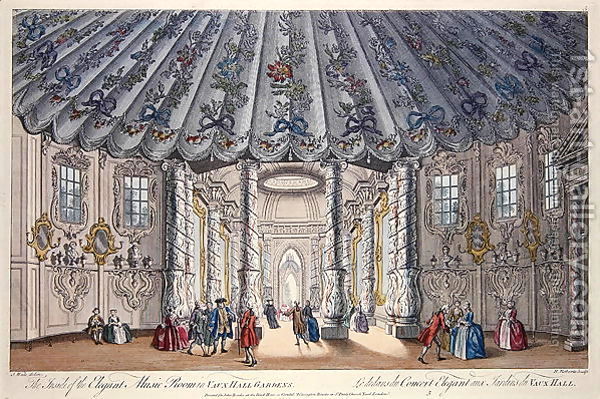
Prior to the 1751 season, the Pillared Saloon was opened up and an extension created that provided for space for artwork and made space for half again as many visitors. Unfortunately, the design was awkward and unsophisticated and was probably created by inexperienced students at the St. Martin’s Lane Academy.

PILLARED SALLON REMODEL

H. Roberts after S. Wale, The Inside of the Elegant Music Room in Vaux Hall Gardens, engraving, 1752 (British Library, London)

The new indoor orchestra stand opposite the Pillared Saloon, behind a balustrade that separated it from the audience, shared its awkward style; the same foliate columns framed it, and similar paintings decorated its ceiling. It must have been a substantial space, as an Irish visitor in 1752 claimed that he saw fifty-four musicians performing there, accompanying the singers Thomas Lowe and Isabella Burchell.

The Triumphal Arches and Decorative Paintings

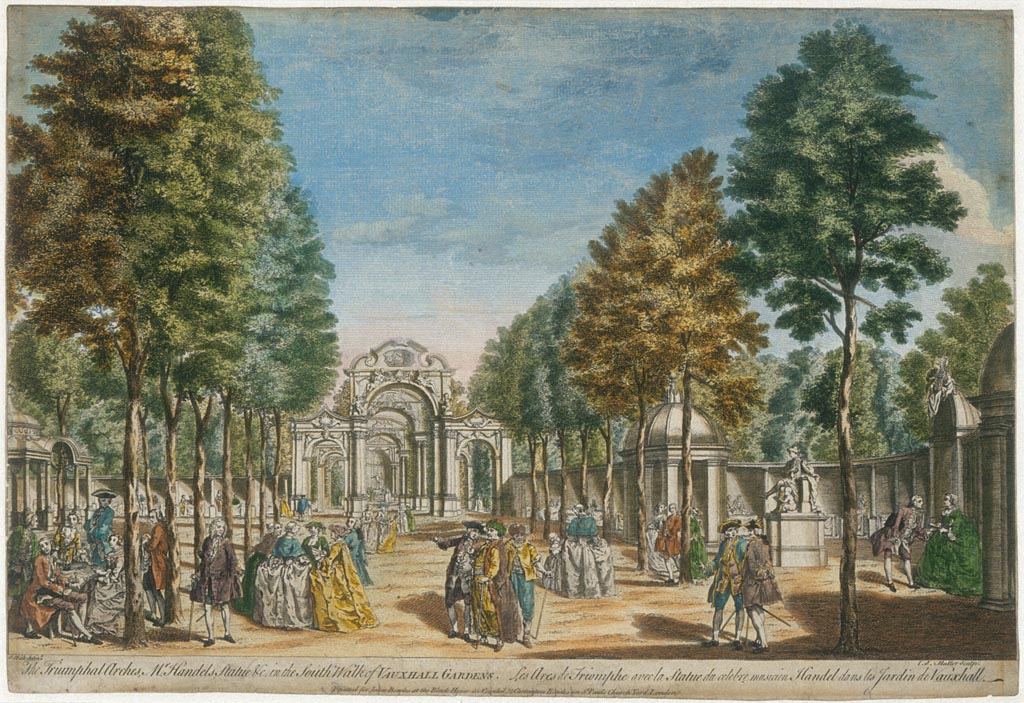
In contrast to the gaucherie of the Pillared Saloon, the three triumphal arches built over the South Walk at about the same time presented a more elegant, though more predictable, classical appearance… [T]hey were designed by ‘an ingenious Italian’ and made of timber and painted canvas.

ARCHES

J.S. Muller after S. Wale, The Walk of Triumphal Arches and the Statue of Mr. Handle in Vauxhall Garden, engraving, 1751 (British Library, London).

…the undeniably theatrical view through the three Vauxhall arches to the piece of scenery at the end of the walk must have been impressive; the vista was focused and enclosed by the surrounding trees, and the trompe-l’oeil effect of the scenery seen at the proper distance was intended to draw visitors to that end of the walk, where, on arrival, they could marvel at the skill of the artist, who had fooled them into thinking it was a three-dimensional object.

PALMYRA

E. Rooker after Canaletto, A Vew of the Center Cross Walk &c. in Vauxhall Gardens, engraving, 1751 (British Library, London).

In addition to these theatrical-esque arches, four large scenes were painted and installed at the end of the walks, to camouflage the surrounding landscape and introduce a bit of fantasy. The Temple of Neptune, at the end of the South Walk, was soon replaced by the ruins of Palmyra, after the publication of Robert Wood’s journey there. A painting of an alcove of three niches with figures of Flora and the Genii, at the end of the Dark Walk, was replaced with a scene of a Chinese Garden in 1762. “At the opposite end was an altogether more eccentric scene of another alcove, but this one bore a representation of a scaffolding and ladder ready for artists to work on the canvas.” The explanation for this:

An eminent artist, but of dissipated character, was employed by the first proprietors of the gardens to paint some classical designs at the end of one of the walks; but the delay in their completion so irritated the proprietor, that, having to leave London for a fortnight, he declared to the artist that he would listen to no further excuses, and that if he found his scaffold, paint-pots, &c. on his return, they should be thrown over the garden wall. On his return, perceiving, as he thought, in the same position, the scaffold, paint-pots, &c., he hastened to the spot to put his threat into execution, when, to his great amazement, he found them to be so accurately pictured on the canvas, that he ever after lavished the most extravagant praises upon the delinquent artist.

The Cascade

The most popular of Tyers’s additions in the 1750’s was the artificial Cascade, which was likely conceived by Frances Hayman, from his work with scenery and special effects in the theater.

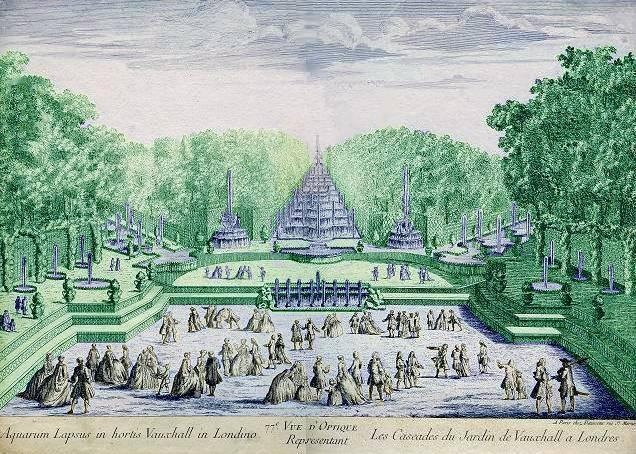
The Cascade was concealed behind a curtain which was drawn back at a particular time in the evening, as night fell, to reveal a three-dimensional illuminated scene of a landscape with a precipitous waterfall: the illusion was created with sheets of tin fixed to moving belts, turned by a team of Tyers’s lamplighters; when it was running, the noise and spectacle must have been terrific.

Throughout its existence the Cascade underwent various improvements, enlargements, alterations, replacements, demolitions, and moves, which continued into the 1840’s. No visual representation of it survives, but at the height of its popularity in 1762 an anonymous author described it as:

a most beautiful landscape in perspective of a fine open hilly country with a miller’s house and a water mill, all illuminated by concealed lights; but the principal object that strikes the eye is a cascade or water fall. The exact appearance of water is seen flowing down a declivity; and the turning the wheel of the mill, it rises up in a foam at the bottom, and then glides away. This moving picture attended with the noise of the cascade has a very pleasing and surprising effect on both the eye and ear.

Until well into the 1820’s, when it was demolished to make way for the new Ballet Theatre, the Cascade continued to delight and surprise Vauxhall audiences, with depictions of the tidal race and watermill at London Bridge, of distance military encampments, and other scenes.

CASCADE

Well, I did find this image of the Cascade! Or at least it purports to be such.

The Gothic Orchestra

The original Orchestra building had outlived its usefulness, and was replaced in 1757-8 with a sort of Gothic-style building, made of wood and plaster and painted white and ‘bloom’, whatever that is. This building remained through the end of the gardens, having a domed roof with a “finial of Prince of Wales feathers”. The organ and musicians occupied the top floor, with supper-boxes on the bottom. The upper floor had graduated seating that made the musicians visible to the audience.

vauxhall_Muller_1751

Anon., A Perspective View of the Grand Walk in Vauxhall Gardens, and the Orchestra, engraving (David Coke’s collection), from the Gentleman’s Magazine (August 1765). The earliest view of the new Gothic Orchestra, built in 1757.

The Company

As we have mentioned previously, Vauxhall attracted a diverse group of visitors, more than any other entertainment of the period. The bulk of its income, however, came from the “Smarts,” which were middle-class young men, known for their licentiousness and self-indulgence, who came to show off to their female companions. A press reporter put it this way in July 1738:

The Smarts are, as it were, the sole Authors of our publick diversions at the Theatre they have a majority of the pit and the boxes: to them the Opera owes its subsistence, and Vaux Hall, the agreeable Vauxhall! would be a wilderness without them.

A big draw for the lower classes was the opportunity to encounter the upper classes, royalty, or other celebrities, that they would not normally be allowed anywhere near.

An account of a visit by an upper-class party is given by Horace Walpole:

I had a card from Lady Caroline Petersham to go with her to Vauxhall. I went accordingly to her house at half an hour after seven, and found her and little Ashe, or the pollard Ashe, as they call her; they had just finished their last layer of red, and looked as handsome as crimson could make them. […] We got into the best order we could and marched to our barge, with a boat of French horns attending and little Ashe singing. We paraded some time up the river and at last debarked at Vauxhall […]. At last we assembled in our booth, Lady Caroline in the front, with the vizor of her hat erect, and looking gloriously jolly and handsome. She had fetched my brother Orford from the next box, where he was enjoying himself with his Norsa and his petite partie, to help us to mince chickens. We minced seven chickens into a china dish, which Lady C. stewed over a lamp with three pats of butter and a flagon of water, stirring and rattling and laughing, and we every minute expecting to have the dish fly about our ears. She had brought Betty [Neale] the fruit girl, with hampers of strawberries and cherries from Rogers’s, and made her wait upon us, and then made her sup by us at a little table […]. In short, the whole air of our party was sufficient as you will easily imagine to take up the whole attention of the garden, so much so, that from eleven o’clock till half an hour after one, we had the whole concourse round our booth, at last they came into the little gardens of each booth on the sides of ours, till Harry Vane took up a bumper and drank their healths, and was proceeding to treat them with still greater freedom. It was three o’clock before we got home.

Then there was Henry Timberlake, who brought a group of Cherokee Indians to the gardens on two occasions, the second advertised ahead of time drawing ten thousand curious onlookers. (Note: those Cherokees had a very busy schedule. Take a peek here.)

A ‘silent majority’ of visitors came from the professional classes, lawyers, doctors, parsons, and increasingly in the 1780’s, after Tyers’s death, prostitutes and the demi-monde.

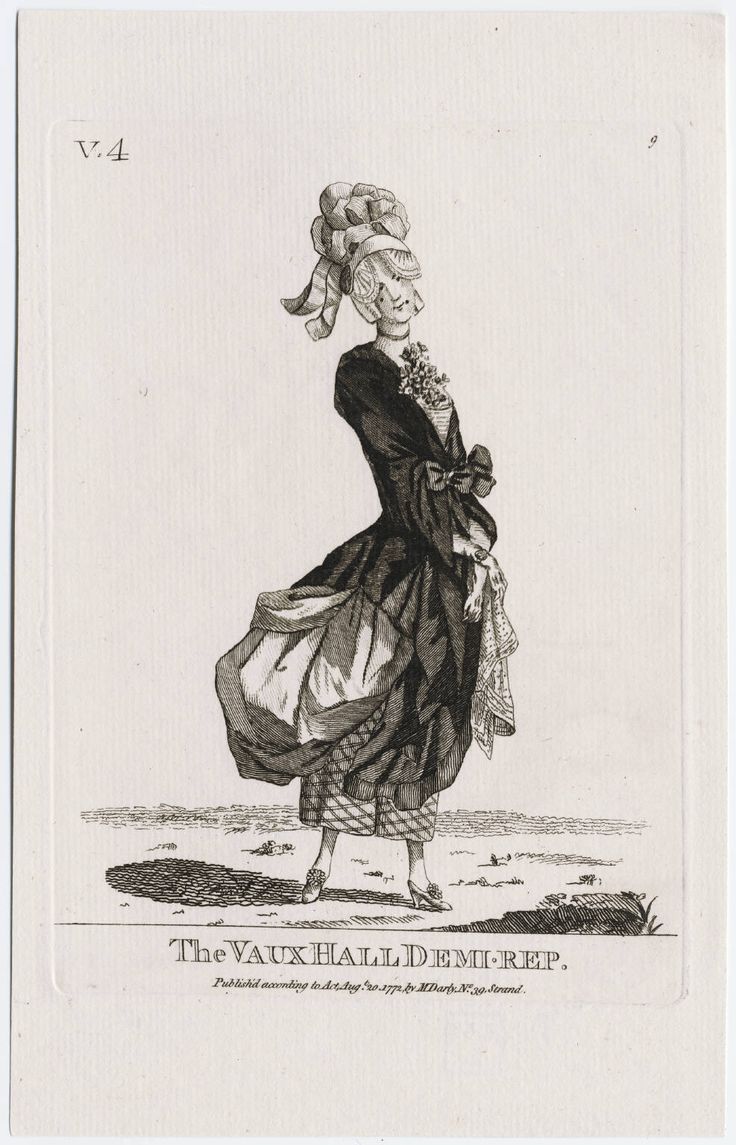
demi-rep

Anon., The Vauxhall Demi-Rep, engraving, 1772 (Senate House Library, London). One of the working girls who frequented the gardens. Less a prostitute than an escort, the demo-rep would join an all-male party to titillate and amuse the men.


Susana’s Vauxhall Blog Post Series

  1. Vauxhall Gardens: A History
  2. Vauxhall Gardens: Jonathan Tyers—“The Master Builder of Delight” 
  3. Vauxhall Gardens: A New Direction
  4. Vauxhall Gardens: The Orchestra and the Supper-Boxes 
  5. Vauxhall Gardens: The Organ, the Turkish Tent, and the Rotunda
  6. Vauxhall Gardens: Three Piazzas of Supper-Boxes
  7. Vauxhall Gardens: “whither every body must go or appear a sort of Monster in polite Company”
  8. Vauxhall Gardens: The Competition
  9. Vauxhall Gardens: The Artwork, Part I
  10. Vauxhall Gardens: The Artwork, Part II
  11. Vauxhall Gardens: The Music, 1732-1859
  12. Vauxhall Gardens: The Business Side
  13. Vauxhall Gardens: Developments from 1751-1786
  14. Vauxhall Gardens: Thomas Rowlandson’s Painting (1785)
  15. ‎Vauxhall Gardens: The Third Generation of the Tyers Family and the Jubilee of 1786
  16. Vauxhall Gardens: An Era of Change (1786-1822), Part I
  17. Vauxhall Gardens: An Era of Change (1786-1822), Part II
  18. Vauxhall Gardens: An Era of Change (1786-1822), Part III
  19. Vauxhall Gardens: The Final Years, Part I
  20. Vauxhall Gardens: The Final Years, Part II
  21. Vauxhall Gardens: The Final Years, Part III
  22. Vauxhall Gardens: The Final Years, Part IV
  23. Vauxhall Gardens: Farewell, for ever
Encounter at White’s: a cross-post with Nicole Zoltack

Whites Club London-M

Oliver handed his hat and gloves to the porter as he removed his coat and presented it as well. Shivering in the notoriously chilly foyer at White’s Club, he made his way quickly toward the drawing room, where no doubt there would be a roaring fire. After more than a fortnight of escorting his fiancée and her mother to balls and ton events nearly every evening, not to mention drives in the park and ices at Gunter’s—along with his responsibilities at the bank—he was looking forward to an evening with his cronies and nice cognac or two. White’s always had the best spirits in town.

Oliver Stanton

Oliver Stanton

He hadn’t got very far, however, when he very nearly collided with Stephen Huntington, Duke of Wyngate, who was emerging from the card room with an expression of tight-lipped determination on his face.

“Pardon me,” the duke said, straightening his coat somewhat nervously.

“No need,” said Oliver easily. “Wasn’t watching where I was going. Join me in a drink, Your Grace?”

The duke blinked and stumbled back a step. “Why yes, I would appreciate that, Stanton.”

The two men strolled to the drawing room and claimed two leather chairs near the fire.

“A cognac for me,” Oliver told the waiter. “Wyngate?”

"Portrait of Citizen Guerin," by Robert Lefevre, 1801, French. The Age of Napoleon. Ed. Katell le Bourhis. NY: The Metropolitan Museum of Art / Harry N. Abrams, Inc., 1989. p.82, pl. 72.

Stephen Huntington, Duke of Wyngate

He liked Stephen Huntington, and not just because he was a duke and one of the bank’s best customers. He was an honorable man and not at all puffed up about it. Some titled gentlemen didn’t deign to speak to him unless it was at the bank and they needed access to their money. Wyngate wasn’t that sort.

“Cognac sounds perfect.” The duke rubbed his forehead.

“Right away, gentlemen.” The waiter bowed and disappeared into the back rooms.

The duke cleared his throat. “I-I have a strange question for you, Stanton, if I may.”

Oliver nodded. Who was he to gainsay a duke, even if he wished to. And he was curious to know what was behind the normally easy-going duke’s skittish behavior.

“Have we crossed paths, recently? Since the Hansens’ ball last week, I mean?”

Oliver’s eyes narrowed. “Why no, I don’t believe so. Why do you ask?”

Stephen tugged at his collar. “Ah… well, that’s good. That’s good,” he repeated. “You see… I have heard rumors that there is a man impersonating me throughout the country. I can scarcely believe it! But I cannot ignore such a thing, lest it be true and the wretch is up to serious mischief.”

Oliver’s eyes widened. “Impersonating you? But how is that possible? You are widely known in London, Your Grace.”

shapeimage_1The duke plucked a glass of brandy from the waiter’s tray and took a long sip. Oliver did likewise, wondering who would dare to play such a trick on the Duke of Wyngate, of all people.

“I do not know. I guess the reprobate must resemble me. Sound like me as well.” Wyngate took another swallow and set down his glass. “No one has come to the bank asking about my money recently? That could certainly be a factor.”

“Money is always a factor,” Oliver said dryly. “But no, I can assure you that your accounts are safe. I would have been notified had someone come to withdraw funds unexpectedly.” He set his own glass on the table. “How did the news come to you of this extraordinary situation?”

“My friends.” He gestured behind him toward the card room. “They can be rather prone to jokes and mischief, but somehow I doubt they would jest about something as serious as this.” He shrugged. “No need to concern yourself further. I am certain the matter will be resolved shortly. Now tell me, Stanton. I see that Lady Julia has recovered from her illness. Will your nuptials be rescheduled soon?”

Lady Julia Tate (at age 27)

Lady Julia Tate

Oliver winced, as he always did when that particular question was raised, which was happening quite frequently in the fortnight or so since their wedding guests had been sent home without witnessing a wedding or even catching sight of the bride and groom.

“I do not mean to pry.” Wyngate drank the last of cognac. “I was hoping one of us was happy.”

“Soon,” Oliver said. “These things take time to arrange, you know. The ladies expect such things. And I wouldn’t want my bride to be deprived of the wedding of her dreams simply because she was taken ill the night before the first one was to take place.”

He grinned. “What about you, Wyngate? Any interest in setting up your own nursery any time soon?” Any man with a title had to concern himself with the matter of an heir sooner a later. Particularly a duke.

“Oh no. Not I. I am not the least bit interested in marriage. And even if I were, with an imposter running about, I will be far too busy to woo and win the heart of any lady.”

Oliver chuckled. “A wealthy duke could have his choice of any young lady in the ton. With or without the wooing. But you must certainly investigate this matter of an imposter. Particularly if he resembles you to the extent that he could ruin your reputation. Do let me know if I can be of any assistance to you, Your Grace.”

“Thank you. You have always been a loyal and good friend.” Wyngate stood. “I would appreciate it if you could keep this matter to yourself. Unless you should happen to see another me…” He shook his head.

map

“Of course, Your Grace.”

“I should be off to try to track this rogue down. Do take care.” The duke turned and called for his horse.

Oliver rose and offered his hand. “Good luck, Your Grace.”

“You as well.” The duke shook his hand and gave him a tight smile. “Shall I expect another wedding invitation any time soon?”

“Of course, Your Grace.” At least Oliver hoped it would be soon. The new house on Manchester Square was nearly ready, and he was eager to finally have Julia as his wife at last.

Vauxhall Gardens: The Business Side

vauxhallbook

Vauxhall Gardens: A History

David Coke & Alan Borg

The Vauxhall Pleasure Gardens is one of the places I’d love to slip back in time to visit, just to catch a glimpse of what it was like. After recently splurging to buy this lovely coffee-table book, I thought it might make a wonderful subject for a new blog series. But do buy the book too, if you can! The photos are fabulous!

Vauxhall’s huge success after Jonathan Tyers’s acquisition of the property, which had been in existence for seventy years as the “New Spring Gardens”, can be attributed to the man’s perception that his idealistic dream must be counter-balanced by sound financial practices. An essential element of this was publicity, and of this, Tyers proved to be a master. How did he do this?

Promoting Vauxhall

He promoted the gardens as a sort of “heaven on earth,” a magical sort of place to lift one’s spirits after a hard day in the real world.

[T]his was achieved through stories in literature and the printed media, through popular songs and through the artworks and music he commissioned. The second was the flattery of his audience; he consistently treated his visitors as special people, always referring to them as persons of quality, ladies and gentlemen, patriots, libertarians, educated people who appreciated fine things and good music. And the last was the simple dissemination of factual information about Vauxhall, its history, its current attractions, and how this pleasure garden should be enjoyed, by means of articles in newspapers and periodicals, of histories and guidebooks and of topographical and satirical engravings.

John Lockman, Publicist

John Lockman, Publicist

In truth, of course, Vauxhall fell short of perfection, and that’s where John Lockman came in. He was a sort of early publicist, who wrote poems and songs designed to “underscore Tyers’s transformation of a notorious gathering place for drunks, gamblers and prostitutes into a civilised pleasure garden where anyone could enjoy a decorous evening’s entertainment without risk to their reputation.”
Lockman’s assistance was necessary because it was impossible to exclude troublemakers, particularly if they were respectably dressed. “[I]t was easier to sell an enhanced image of the place to a persuadable public.

Tyers was always careful to make everybody in his clientele feel good about themselves, and in particular about their patronage of Vauxhall. In his press announcements, for instance, he would often start by thanking his visitors for their support, especially if the weather had been bad, and would repeatedly finish by pledging to keep out of his gardens anyone not worthy of their company.

Another tactic was to use magazines and newspapers. Newspapers, of course, were a no-brainer. Letters such as the “S. Toupee” articles published in Scots Magazine may or may not have been instigated by Tyers, but they certainly proved valuable in driving up excitement for Vauxhall. “Of the Luxury of the English; and a Description of Ranelagh Gardens and Vaux-hall, in a Letter from a Foreigner to his Friend at Paris,” supposedly written by Henry Fielding (a friend of Tyers) and commissioned by Tyers, piled on the praise for Vauxhall in comparison to Ranelagh Gardens.

A female audience was enticed to Vauxhall by published songs and by scenes in novels set in Vauxhall Gardens. And then there were the Love at First Sight articles, or “Lonely Hearts” columns, which may or may not have been genuine. Here’s one from the London Chronicle in August 1758:

A young Lady who was at Vauxhall on Thursday night last, in company with two gentlemen, could not but observe a young gentleman in blue and a gold-laced hat, who, being near her by the orchestra during the performance, especially the last song, gazed upon her with the utmost attention. He earnestly hopes (if unmarried) she will favour him with a line directed to A.D. at the bar of the Temple Exchange Coffee-house, Temple-bar, to inform him whether fortune, family, and character, may not entitle him upon a further knowledge, to hope an interest in her heart.

Another marketing tactic was to engage actors dressed as gentlemen to patronize coffee-houses to express their intention to go to Vauxhall and entreat others to meet them there.

Tyers’s Management Style

It goes without saying that if one wishes to have customers return, one has to ensure that their first time is as pleasant and enjoyable as possible. If you knew Jonathan Tyers—and you probably wouldn’t because it was never himself he wanted to promote and therefore took pains to remain in the background—you could see him in the kitchens working as hard as his employees to get the food out to the customers.

Waiters, or “drawers” were freelance employees, who were constrained to work hard in order to earn tips and keep their posts. Since in other venues, “drawers” were known to steal from their employers, “Vauxhall waiters were required to pay for the food on collection from the kitchens, and themselves ran the risk of defaulting customers, especially if they had not been sufficiently polite or efficient in their service.”

Although he had to maintain a strict discipline among his employees, he was a thoughtful employer. When two of his waiters married two of his barmaids, he provided wedding rings and an elaborate dinner at his home in Denbies, with fifty of his staff as guests.

one shilling coin

Vauxhall Tickets

Up until 1736, the admission cost was sixpence, but afterward, the price was doubled to one shilling. Considering the expense of maintaining and improving the gardens and contriving new entertainments, this seems modest indeed; however, there was more to be made from the food and drink once the visitors were admitted. For the visitors, there was also the cost of dressing respectably and the cost of transportation. The one shilling price was fixed until 1792, when it was doubled to two shillings.

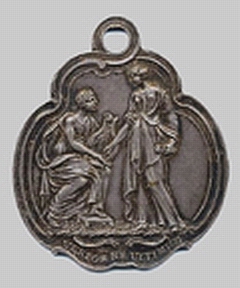
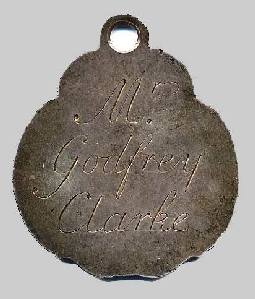
Season Ticket greySeason Ticket grey reverse

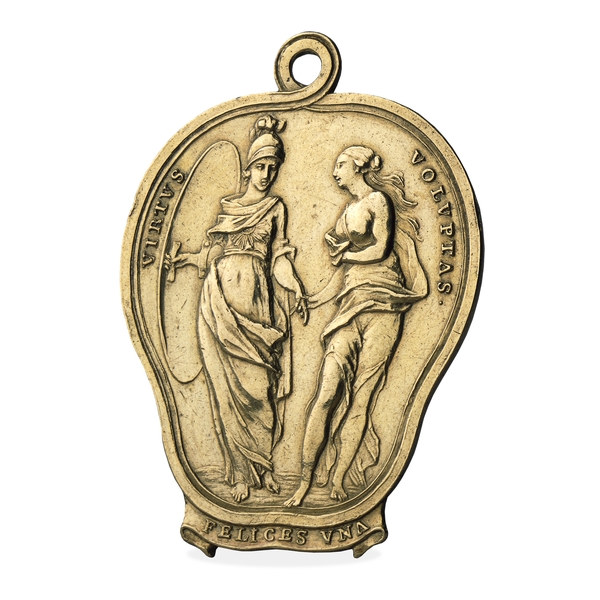
In 1737 Tyers initiated a subscription price, or season ticket. The metal tickets were issued to a thousand people at a guinea each, and would admit two people to the gardens for the entire season. Not only did this ensure repeat visits by two thousand people, it provided him with funds upfront to use for maintenance and improvement.

The relief on the obverse usually represented, through classical imagery, a particular aspect of Vauxhall Gardens, often associated with the music. On the reverse was engraved the subscriber’s name, accompanied… by the ticket’s number.

silver ticket

silver ticket

In 1738, the tickets were made of silver and the price rose by three shillings. In 1741, the price was raised to two guineas.

As a comparison, a season ticket for two to the Great Room in Soho was five guineas, while individual concerts were ten and a half shillings, the same price as Handel’s fundraising concert at the Foundling Hospital in 1749. Almack’s (founded in 1765) charged ten guineas for a once-weekly ball over twelve weeks, so Vauxhall tickets were considered quite a bargain.

Hogarth's gold "perpetual" ticket

Hogarth’s gold “perpetual” ticket

Attendance

“S. Toupee” in his letters in Scots Magazine estimated that “not less than one thousand shillings are received each evening of performance during the season,” not including season ticket holders. Special events, such as the rehearsal of Handel’s Music for the Royal Fireworks, drew several thousand spectators. Opening and closing nights and royal birthdays also drew large crowds.

The opening night of the 1769 season, for instance, was a remarkably fine evening for the time of year, and it was estimated that ‘there were upwards of twenty thousand of the first nobility present.’

Crime and Disorder

Even though it suffered occasional lean times, there can be little doubt that eighteenth-century Vauxhall Gardens became the most popular single visitor attraction for London… With these numbers of people coming together, especially to a place where alcohol was available, crime, vandalism and disorder were inevitable.

Nor was it just pickpockets and prostitutes his police force (initiated in 1732) had to deal with. While Tyers encouraged his waiters to restrict alcohol consumption, it was difficult for them or even him to police the mischievous London Bucks, who were of a class higher than his. Tyers and his staff managed these problems themselves, even if it meant “eating” the cost of vandalism, not wanting to involve courts, which would draw bad publicity. “S. Toupee,” in one of his letters in 1739, “pointed out that there was ‘a man in the posture of a Constable, to protect the Ladies from any insult, &c.’ at the end of each walk.

Besides the half-dozen or so constables, he employed up to eight men to guard the route from the river and led a (possibly regular) blitz against the pickpockets.

Refreshments

Anyone who has worked in the restaurant industry can tell you how difficult a task it is to prepare food for crowds of people, but how many restaurants have to cater for 500-1000 or more hungry people? This is a logistical nightmare that Tyers managed with aplomb.

Consistent with his insistence on featuring English art and music, the food at Vauxhall was simple and English. There were complaints about the prices, of course. Here are some prices from one of the “S. Toupee” letters in 1739:

  • one bottle of French claret: 5 shillings
  • one cold chicken: 2-1/2 shillings
  • one quarter of cyder: 1 shilling
  • one quart of small-beer: 4 pence
  • one slice of bread: 2 pence
  • one slice of cheese: 4 pence
  • dish of ham or beef: 1 shilling, salad, an extra pence
  • sweet pastries: 1 shilling
  • custards and cheesecakes: 4 pence
  • heart cakes and Shrewsbury cakes: 2 pence
  • one bottle of champagne and arrack: 8 shillings
  • two pounds of ice: sixpence
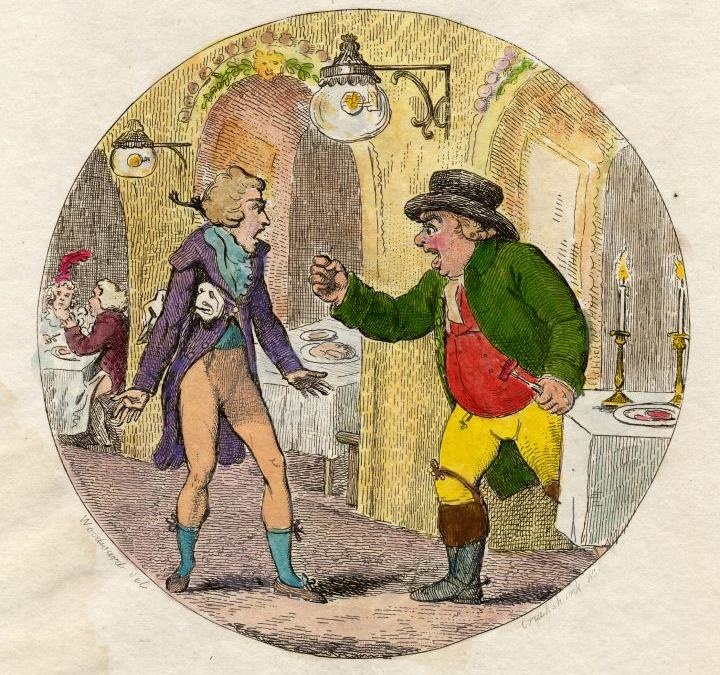
Isaac Cruikshank, A Country Farmer & Waiter at Vauxhall. A farmer in country dress, on his first visit to Vauxhall, has ordered ham in expectation of a plateful of English gammon. When the waiter brings him the notoriously thin slices that were Vauxhall ham, the farmer is furious.

Isaac Cruikshank, A Country Farmer & Waiter at Vauxhall. A farmer in country dress, on his first visit to Vauxhall, has ordered ham in expectation of a plateful of English gammon. When the waiter brings him the notoriously thin slices that were Vauxhall ham, the farmer is furious.

Even a devoted fan such as “S. Toupee” confessed that the food was expensive. The sliced meats were thin, especially the ham. “This was all part of the fun of the evening—a great joke on fashionable society who were happy to play along.” A well-known verse alluding to this:

Never trouble Ham House, or its inmates at all,

For a ghost, that may be but a sham,

But seek in a sandwich that’s cut at Vauxhall,

For the true apparition of Ham.’

Note:

The cost of the food did not alter significantly over the whole period from Tyers’s re-launch until the gardens’ final closure; the prices of wines and spirits, however, were a different matter, rising sharply in the nineteenth century.

Susana’s Vauxhall Blog Post Series

  1. Vauxhall Gardens: A History
  2. Vauxhall Gardens: Jonathan Tyers—“The Master Builder of Delight” 
  3. Vauxhall Gardens: A New Direction
  4. Vauxhall Gardens: The Orchestra and the Supper-Boxes 
  5. Vauxhall Gardens: The Organ, the Turkish Tent, and the Rotunda
  6. Vauxhall Gardens: Three Piazzas of Supper-Boxes
  7. Vauxhall Gardens: “whither every body must go or appear a sort of Monster in polite Company”
  8. Vauxhall Gardens: The Competition
  9. Vauxhall Gardens: The Artwork, Part I
  10. Vauxhall Gardens: The Artwork, Part II
  11. Vauxhall Gardens: The Music, 1732-1859
  12. Vauxhall Gardens: The Business Side
  13. Vauxhall Gardens: Developments from 1751-1786
  14. Vauxhall Gardens: Thomas Rowlandson’s Painting (1785)
  15. ‎Vauxhall Gardens: The Third Generation of the Tyers Family and the Jubilee of 1786
  16. Vauxhall Gardens: An Era of Change (1786-1822), Part I
  17. Vauxhall Gardens: An Era of Change (1786-1822), Part II
  18. Vauxhall Gardens: An Era of Change (1786-1822), Part III
  19. Vauxhall Gardens: The Final Years, Part I
  20. Vauxhall Gardens: The Final Years, Part II
  21. Vauxhall Gardens: The Final Years, Part III
  22. Vauxhall Gardens: The Final Years, Part IV
  23. Vauxhall Gardens: Farewell, for ever
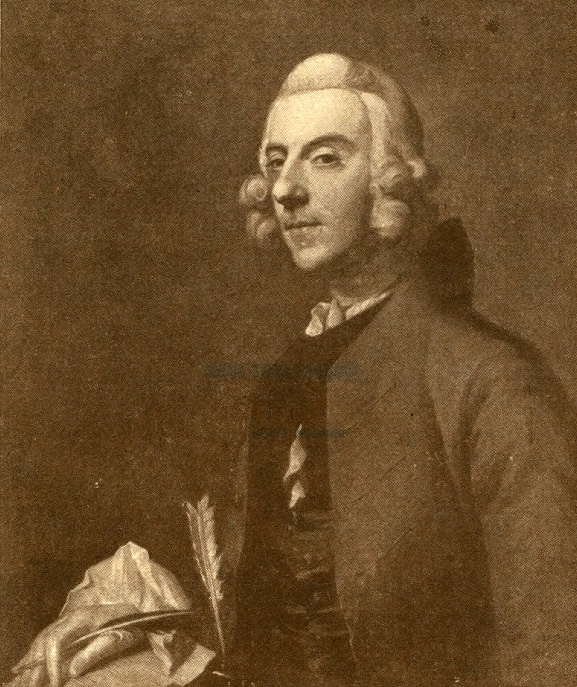
Cerise DeLand: Her Beguiling Butler (Giveaway)

About Historical Accuracy…

$_57 copy

With your romance, do you crave accurate history? A sense of time and place? Cerise tells all about Her Beguiling Butler!

Say you like historicals and you often wonder what’s true and what isn’t?

I can’t speak for other authors, but I do desperately try to bring you The Real Stuff.

For example, what’s real in Her Beguiling Butler?

You see a date at the beginning of the book, January 17, 1820. Why?

Because when I plotted the book, I wanted to note precisely when George III (he of the American Revolution!) died and what happened.

So I had to work backwards from that.

Yes. You need to read the book to learn how and when the news reached London!

The Prince of Wales is not considered a fine fellow by most people in the novel. Is that true?

Yes. Prinny, by the time of his ascent to his father’s throne (not official by the way until a year later at his coronation) was considered a spendthrift and profligate. He’d had so many mistresses and appealed to Parliament to spend so much on his homes and his clothes (as well as other debts), many in the Realm were not happy.

In fact, they rather liked old George, his father.

Lady Ranford is being considered by the courts to assume a title on her own. Is that possible for a woman to inherit a title in her own right?

Yes. And hopefully you’ll read the book to learn how that’s done!

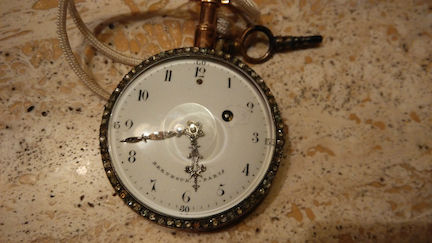
The chiming watch piece that Finnley carries around with him to make certain the house runs on time was a real time piece. I did not invent it.

It was delicately made by Ferdinand Berthoud. His work was very popular, aside from being very expensive.

The mourning practices for King George III that most noblemen observed did indeed happen.

What sorts of observances did they have to employ?

Ah. Do read the book for a description!

Does Dudley Crescent exist?

No. I made it up!  I also made up the man who was given the land by Charles II!

So what is the picture on the front cover of the novel?

What do you think it is? Comment here and win a digital copy of Her Beguiling Butler!

Do look for #2 and #3 in series when I give you a governess and a maid who are more than they appear to be!

giveaway

One lucky commenter wins a swag pack containing a Susana Ellis mug and other goodies!

Her Beguiling Butler by Cerise DeLand copy

About Her Beguiling Butler

The lovely widow at No. 10 Dudley Crescent hopes to lead a merry life without any husband to replace the elderly one she recently buried. Yet Lady Ranford finds herself in a pickle. Her new butler, Finnley, is not only the most obstinate man she’s ever met, but he’s a virile enigma.

She’s never been lured to naughtiness with a man. Heaven knows, she certainly shouldn’t fantasize about the tall, dark, scowling creature who runs her household like a finely tuned clock.
But she can’t help herself. She needs to taste him—or dismiss him.
Finnley, poor fellow, has a few risqué dreams of his own about how he’d like to handle the delectable widow. Alone in his rooms, he resolves to deny how her humor riddles his mind and how her beauty steals his breath away.

None of his solutions are proper.

All of his desires are quite…dear me…scandalous.
But what’s a butler to do when the very life of his beloved employer is at stake? And he cannot control his need to protect her and…ahem…bed her?

AMAZON  • ARe  • NOOK  • KOBO

About the Author

Cerise DeLand is #1 bestselling author of Regency romances! And a top selling author of contemporaries too!

WebsiteTwitterNewsletter

His Naughty Maid by Cerise DeLand copy

His Tempting Governess by Cerise DeLand copy

Vauxhall Gardens: The Music, 1732-1859

vauxhallbook

Vauxhall Gardens: A History

David Coke & Alan Borg

The Vauxhall Pleasure Gardens is one of the places I’d love to slip back in time to visit, just to catch a glimpse of what it was like. After recently splurging to buy this lovely coffee-table book, I thought it might make a wonderful subject for a new blog series. But do buy the book too, if you can! The photos are fabulous!

Before Vauxhall, professional, high quality music was expensive and therefore restricted to the wealthy. Because it was usually performed in private drawing rooms or concert halls, the concept of performing it in the open air was also a novelty. At a time when music from past masters was popular, Tyers introduced music by contemporary English or London-based composers. Oftentimes, the music (and the musicians) were the same as those performing in London theaters during the winter.

Tyers exposed a substantially larger audience to serious music than had ever been possible or even conceivable before. The fact that he did so in a setting where the audience could choose to listen or not, and could choose where to listen from, fundamentally transformed the public’s experience of musical performance, and led to a much wider and easier acceptance of the concert as a public entertainment.

Instrumental Music

Following the construction of the Orchestra building, which resolved several acoustical issues from performing in the open air, in 1735, music became

the crucial ingredient in setting the tone for an evening at Vauxhall. It promoted relaxed enjoyment, and its rational elegance was a catalyst for good behaviour and conversation among the company.

The unusual experience of listening to music in the open air and, after dark… held a very special allure for the audience. There is no doubt that music heard from a distant point of the garden… would have been attractive, providing a good excuse to lure members of the opposite sex away from the crowded Grove… On her eventful visit to Vauxhall, Fanny Burney’s heroine Evelina was particularly impressed by its al fresco music, if not seduced by its freedoms… Despite the disagreeable company, she recounts that

There was a concert, in the course of which, a hautbois concerto was so charmingly played that I could have thought myself upon enchanted ground, had I had spirits more gentle to associate with. The Hautboy in the open air is heavenly.

Click here for a previous post about the Orchestra.

The construction of the Organ building, and the installation of the massive organ, resolved the problem of volume, since its range could reach throughout the gardens, and even beyond. Click here for a previous post about the Organ.

Handel and Vauxhall

Squidgeworth found a friend!

Squidgeworth found a friend at the Foundling Museum

Just as Handel’s statue dominated the Grove, his music dominated Vauxhall’s repertory for a hundred years. Handel and Tyers had a mutually beneficial relationship that likely developed into close friendship. Tyers’s press articles tended to focus only on Handel’s music, and the promotion of his music before the crowds of Vauxhall helped him rise to popular fame.

Vocal Music

Due to a concern for propriety, Tyers resisted song at Vauxhall for at least a dozen years. By this time, Vauxhall was being criticized for “the absence of song on the grounds that, without lyrics, music ‘lacked interpretation,’ and was therefore less conducive to good humour among the audience.”

Soon after, Cecilia Young, a soprano who later married Vauxhall’s music director, Thomas Arne, was engaged, and the “introduction of song as a regular element of the programme launched the most perennial popular feature of the Vauxhall evening.”

Thomas_Augustine_Arne_portrait_by_Zoffany

Thomas Arne

Thomas Arne’s ballads “were, from 1745, regularly performed at the gardens to huge applause, and they were published in the first Vauxhall songbook, Lyric Harmony, which appeared in September of that year.” Arne’s songs, which were lighthearted and natural, appealed to a wide array of people, and thus fit in with Tyers’s own philosophy to make the arts available to all.

The lyrics of Vauxhall songs… are basically in the pastoral and romantic ballad style that evolved in the late seventeenth century from a long tradition of popular song… Over the next few decades, ballads absorbed influences from other popular music forms, particularly Italian opera, to become the genre known as the Vauxhall song.

rule_britannia_01a

Thomas Arne’s version of “God Save the King” was first performed at Drury Lane in 1745. He also wrote, “Rule Britannia,” another patriotic song. Click here to hear the latter song on the BBC website. I’m sure you will find it familiar.

A second genre that was to become popular with Vauxhall audiences was the patriotic song, one of the earliest types to be regularly heard at the gardens. Exploiting topical events as they did, they highlighted the link between the dutiful virtus of victorious military action and the pleasurable voluptas enjoyed by Vauxhall’s visitors, fully complementing the ideals behind Tyers’s management.

The songs regularly sung at Vauxhall and the other gardens enjoyed a wide currency. They were published not only as songsheets and in songbooks, but also in periodicals, particularly women’s magazines. Among the moral tales, romances, fashion hints, poetry, recipes and other items thought suitable for female consumption, editors of magazines such as the Ladies Complete Pocket Book or the Universal Magazine would often slip in the ‘favourite new songs’ being featured at the pleasure gardens in the current season, to be enjoyed by Vauxhall’s many “armchair” visitors around the country.

Besides the salary paid by Tyers and passes to allow them to come and go as they wished, “well-loved singers were rewarded by the audience who threw money at their feet.”

A thirty-two-year-old Oliver Goldsmith described a visit to the gardens around 1760, full of praise for the singers and the band.

The satisfaction which I received the first night I went there was greater than my expectations; I went in company of several friends of both sexes, whose virtues I regard and judgments I esteem. The music, the entertainments, but particularly the singing, diffused that good humour among us which constitutes the true happiness of Society.

Music after Jonathan Tyers’s death

After 1761, ownership was taken over by Tyers’s son, Jonathan Tyers the younger, and very little changed at first, until the early 1780’s, when strolling bands were introduced, possibly as an economic gesture, and the quality of music declined.

The introduction of Haydn’s compositions in 1783 marked the faltering start of a new era at Vauxhall. Haydn soon gained a wide following, even toppling Handel from his long-running supremacy.

Regular press advertisements detailing the evening’s program appeared in 1786, when Bryant Barrett, Jonathan Tyers the younger’s son-in-law, took over management of the gardens. Apparently he believed the audience to be more sophisticated about music and thus more interested in knowing beforehand what would be included.

James Hook

James Hook

James Hook, Vauxhall’s music director from the early 1770s until 1821, composed over two thousand songs specifically for Vauxhall and performed an organ concerto every evening at closing time.

…each season introduced an entirely new crop of songs, numbering between thirty and forty-five, with no repeats from previous years; the most popular songs received as many as fifty performances through the season… Most of the half dozen or so singers employed each year appeared every evening, Monday to Saturday, from mid-May to late August. This represented around eighty-five evenings out of a hundred—a tough programme for any performer, especially when singing out of doors.

The Vauxhall Effect

As a music promoter, Tyers was unusual at the time in not being a professional musician himself; it was his judgement and business sense that determined his visitors’ experience, and dictated the selection of people he employed to take his vision forward. The renown of his performers was less important than their ability to express a particular house style.

Performers at Vauxhall

For a list of performers at Vauxhall (musical and otherwise), check this website: Vauxhall Gardens: 1661-1859.


Susana’s Vauxhall Blog Post Series

  1. Vauxhall Gardens: A History
  2. Vauxhall Gardens: Jonathan Tyers—“The Master Builder of Delight” 
  3. Vauxhall Gardens: A New Direction
  4. Vauxhall Gardens: The Orchestra and the Supper-Boxes 
  5. Vauxhall Gardens: The Organ, the Turkish Tent, and the Rotunda
  6. Vauxhall Gardens: Three Piazzas of Supper-Boxes
  7. Vauxhall Gardens: “whither every body must go or appear a sort of Monster in polite Company”
  8. Vauxhall Gardens: The Competition
  9. Vauxhall Gardens: The Artwork, Part I
  10. Vauxhall Gardens: The Artwork, Part II
  11. Vauxhall Gardens: The Music, 1732-1859
  12. Vauxhall Gardens: The Business Side
  13. Vauxhall Gardens: Developments from 1751-1786
  14. Vauxhall Gardens: Thomas Rowlandson’s Painting (1785)
  15. ‎Vauxhall Gardens: The Third Generation of the Tyers Family and the Jubilee of 1786
  16. Vauxhall Gardens: An Era of Change (1786-1822), Part I
  17. Vauxhall Gardens: An Era of Change (1786-1822), Part II
  18. Vauxhall Gardens: An Era of Change (1786-1822), Part III
  19. Vauxhall Gardens: The Final Years, Part I
  20. Vauxhall Gardens: The Final Years, Part II
  21. Vauxhall Gardens: The Final Years, Part III
  22. Vauxhall Gardens: The Final Years, Part IV
  23. Vauxhall Gardens: Farewell, for ever

Sheri Cobb South: Dinner Most Deadly (Giveaway)

Five Star author photo copy

Dinner Most Deadly is the fourth book in my series of Regency-set mysteries featuring Bow Street Runner John Pickett, and in some ways it’s the riskiest. I call it my Empire Strikes Back book, because I still remember how appalled we all were when that movie came out in 1980, and the ending left us hanging: Han Solo frozen in carbonite? Luke’s dead (or so we thought) father, the Jedi hero, is Darth Vader??? And we were going to have to wait three years to find out what happened next?

In the case of Dinner Most Deadly, the cliffhanger involves the Scottish marriage by declaration which was accidentally contracted by John Pickett and Julia, Lady Fieldhurst, in Family Plot. When Julia returns from Scotland restless and out of sorts, her friend Lady Dunnington decides what Julia needs is a lover—and arranges a dinner party with half a dozen male guests from whom Julia may take her pick. But one of the men is murdered, and when John Pickett is summoned from Bow Street, he must not only find the killer, but break the news of their “marriage” to Julia. As with the other books, the mystery is solved, but the romance is more unresolved than ever as the couple must go about seeking an annulment—a process far messier than most romance novels lead readers to believe.

I’ll admit, I was more than a bit nervous about how readers would react. I had braced myself for a big outcry against “sequel-bait,” but to my relief, it hasn’t happened. I hope that’s because readers understand that, because of the enormous social gulf between them, Julia’s mind is not going to leap immediately to marriage. She is, however, appalled at what the annulment process is going to demand of poor John: the only grounds available to them are inability to consummate, and since she was married for six years—during which any such problem would certainly have been addressed—that leaves him to take the fall. She’s never known a man who loved her enough to sacrifice for her, and although she’s deeply moved by his willingness to do so, she doesn’t quite know how to respond. It’s going to take something drastic to force her to confront her own feelings—and that something comes up in the next book, Too Hot to Handel.

Thankfully, readers won’t have to wait three years to find out what happens next, but only about six months: my publisher has scheduled Too Hot to Handel for March 2016.

If you’re new to the series but want to give it a try, I would strongly suggest beginning with In Milady’s Chamber, the first in the series, to follow the progression of the romance as it develops. In order, the books are: (1) In Milady’s Chamber; (2) A Dead Bore; (3) Family Plot; (4) Dinner Most Deadly; and (5) Too Hot to Handel. There’s also a prequel novella, Pickpocket’s Apprentice, which traces John Pickett’s rise from 14-year-old pickpocket to nineteen-year-old Bow Street Runner.

Giveaway: Sheri will award a hardcover, dust jacketed copy of Dinner Most Deadly ($25.95 retail) to one lucky commenter.

DinnerMostDeadlyFront copy

About Dinner Most Deadly

When Julia, Lady Fieldhurst, returns from her sojourn in Scotland restless and out of sorts, her friend Emily, Lady Dunnington, decides what Julia needs is a lover. Lady Dunnington plans a select dinner party with half a dozen male guests from whom Julia may choose a paramour. Emily also invites a potential lover for herself: Sir Reginald Montague, a man whose urbane manner and dangerous good looks hide a host of unsavory secrets.

Alas, Emily’s little dinner is a disaster from the outset. Every gentleman at the table bears some unspoken grudge against Sir Reginald, and then dinner is interrupted by Emily’s estranged husband. He and his lady have a heated discussion which ends with Lord Dunnington’s vowing to put a stop to his wife’s pursuit of Sir Reginald “no matter what it takes.” But the coup de grâce comes at the end of the evening, when Sir Reginald is shot dead.

Bow Street Runner John Pickett is summoned to Emily’s house, where he is taken aback to find Julia. For in addition to investigating the case, he is faced with the awkward task of informing her that their masquerade as a married couple in Scotland (Family Plot) has resulted in their being legally wed. Beset by distractions—not the least of which are the humiliating annulment process and the flattering attentions of Lady Dunnington’s pretty young housemaid—Pickett must find the killer of a man whom everyone has reason to want dead.

KindleDiscounted Hardcover

Excerpt

For the first time in the interview, the solicitor’s professional demeanor faltered. “The only possibility that remains is, er, that is, it involves consummation of the union.”

“But you just said a lack of consummation did not constitute grounds,” protested Lady Fieldhurst.

“No, but if either party should be unable to—that is, to be incapable of—” He took a deep breath and started over. “Your ladyship, I must remind you that you and the late Lord Fieldhurst were married for six years. If, during that time, it had come to light that you were—were incapable of participating in the act that might have given your husband the heir he desired so desperately, he would surely have sought such an annulment for himself years ago.” He turned to Pickett. “Such being the case, that only leaves . . .”

As the solicitor’s implication dawned, Pickett flushed a deep red.

Lady Fieldhurst was equally embarrassed, but considerably more vocal. “You cannot ask Mr. Pickett to—to—” Words failed her. She broke off and tried again. “Mr. Pickett may not be married, but I daresay there is a female somewhere who could destroy such a claim simply by coming forward and—and—”

“As a matter of fact,” Pickett said miserably, “there isn’t.”

“There isn’t?” echoed Lady Fieldhurst.

Pickett shook his head and prayed for the floor to open up and swallow him.

“There isn’t,” she murmured, regarding him with new eyes.

“But,” he added hastily, “that isn’t to say I couldn’t—that is, I—I have no reason to suppose that—that all my parts are not—not in good working order.”

“Oh, my.” She snatched up one of the solicitor’s legal papers and began fanning herself with it. “Oh, my.”

About the Author

At the age of sixteen, Sheri Cobb South discovered Georgette Heyer, and came to the startling realization that she had been born into the wrong century. Although she doubtless would have been a chambermaid had she actually lived in Regency England, that didn’t stop her from fantasizing about waltzing the night away in the arms of a handsome, wealthy, and titled gentleman.

Since Georgette Heyer was dead and could not write any more Regencies, Ms. South came to the conclusion she would simply have to do it herself. In addition to her popular series of Regency mysteries featuring idealistic young Bow Street Runner John Pickett (described by All About Romance as “a little young, but wholly delectable”), she is the award-winning author of several Regency romances, including the critically acclaimed The Weaver Takes a Wife.

A native and long-time resident of Alabama, Ms. South recently moved to Loveland, Colorado, where she has a stunning view of Long’s Peak from her office window.

WebsiteFacebookGoodreads