Tag Archive | Regency romance

Elizabeth Boyce: Valor Under Siege (Giveaway)

Kissing and Voting in the Regency Era

by Elizabeth Boyce

In election years, I frequently become misty-eyed about the work of suffragettes whose valiant efforts finally culminated in women being granted the right to vote in the UK in 1918, and in the USA in 1920.

It’s easy to imagine that prior to having the franchise, women were not involved in politics. It’s particularly easy to imagine Regency-era ladies were too constrained by social etiquette and gender roles to hold a political opinion, much less express one, but friend, we would be wrong. So very, very wrong.

Women did not have the right to vote in the UK during the Regency era, but they played a vital role in the political life of the nation. Lady Holland was an ardent supporter of the Whig party in the during the Regency, and her home, Holland House, became unofficial headquarters for the Whigs. She and other political hostesses worked on behalf of their favored party by hosting suppers and salons for politicians after Parliament had let out for the day. Debates continued over a meal and caucuses were held in drawing rooms. Women were expected to be present at such events; in fact, a political evening only attended by men—a “man dinner,” it was uningeniously called—was quite a letdown for guests.

But the political work of women during the Regency was not contained to the domestic sphere. The female family members of a man running for political office were expected to help get him elected. Women canvassed their communities, going door to door to speak to voters and, maybe more importantly, those voters’ wives. You see, even though only men could vote, his vote was often regarded as the common property of his household, and wives could absolutely influence how that vote was cast (Remember, this was before secret ballots; a husband who voted against his family’s wishes might have had to answer for it at home!).

This canvassing was not limited to voters of their own class. During an election, ladies of the upper echelons mingled with the public of all social orders. It wasn’t unheard of for a duchess to call upon a butcher in an effort to win his vote.

In addition to knocking on doors, women bestowed little gifts upon the electorate, such as preserves, candles, or lengths of fabric. Such treating was not seen as bribery at that time. Regency-era voters expected to be wooed!

Speaking of wooing, sometimes canvassing became a little more… personal… than jams and ribbons. Remember the duchess and the butcher I mentioned a moment ago? In the election of 1784, the Duchess of Devonshire, while canvassing on behalf of James Fox, a Whig, was said to have kissed voters to win their support—including a butcher. The incident was the subject of political cartoons, and Fox’s Tory opponents attempted to smear Fox through his association with the duchess, but the Whigs were unfazed by the scandal. The party called upon the duchess to continue her work, and Fox retained his seat in Parliament.

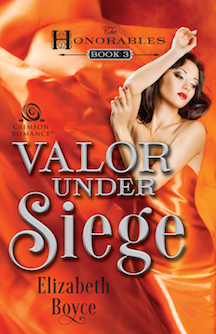
My latest release, Valor Under Siege (The Honorables, book 3), features a small town Parliamentary election. It was lots of fun to pit my Whig hero, Norman Wynford-Scott, against Lady Elsa Fay, a former Tory political hostess who runs circles around Norman when it comes to canvassing. It was wonderful, too, to learn about the political system of the era I enjoy so much, and gain a greater appreciation for women’s roles in that world.

Giveaway: To win an e-book copy of Honor Among Thieves (The Honorables, book 1), please leave a comment sharing your own thoughts or memories about women getting involved in a man’s world–be it politics, the workplace, academia, etc. Contest closes 11:59 PM EDT on Wednesday, September 14, 2016. One winner will be chosen at random from all eligible commenters.

valorundersiege-copy

About Valor Under Siege

All’s fair in love and politics . . .

When ambitious solicitor Norman Wynford-Scott is ousted from his legal studies due to a holiday revel spun out of control, he adapts a new plan of running for the Parliament seat of a local village. Only trouble is, the same irresistible woman who ruined his good name is thwarting his campaign at every turn.

Widowed and drink-addicted, Lady Elsa Fay has retreated to the family village of Fleck to regain her sobriety. She’s distracting herself from her troubles – and her memories of the one passionate night she shared with Norman – by organizing the Parliament campaign of her husband’s cousin. Until Norman arrives intent on winning the seat for himself.

Shamed and determined, Elsa will do all she can to send her former friend and now adversary packing – even if it means breaking her own heart in the process.

Amazon

About the Author

eb-author-shot-copyElizabeth Boyce’s first taste of writing glory was when she won a gift basket in the local newspaper’s Mother’s Day “Why my Mom is the Best” essay competition at age eight. From that moment, she knew she was destined for bigger and better gift baskets. With visions of hard salamis and tiny crackers dancing in her head, she has authored seven Regency novels and novellas, resulting, thus far, in two gift baskets from adoring fans (AKA amazing friends).

Elizabeth lives in South Carolina and shares her artisanal cheeses with her husband and three children. She sneaks some to the cat when no one else is looking.

Facebook Twitter


Ella Quinn: When a Marquis Chooses a Bride (The Worthingtons, Book 2)

I’m so glad to be back visiting Susana and all of you!

I’m here today to tell you about When a Marquis Chooses a Bride, Book #2 in The Worthingtons.

For those of you who read Three Weeks to Wed, the first book in the series, you might recall Charlotte bemoaning that her dearest friend, Dotty Stern could not come out with her. In typical Worthington fashion they figured out a way to give Dotty her Season, and that’s when the fun begins.

Note: Ella is giving a signed copy of When a Marquis Chooses a Bride to one random commenter.

About When a Marquis Chooses a Bride

Thanks to their large extended family and unconventional courtship, The Worthingtons have seen their share of scandal and excitement. But nothing has prepared them for this… 

When a Marquis Chooses a Bride copy

The Dowager Lady Worthington isn’t quite sure what to make of country-girl Dorothea Stern. As the granddaughter of the Duke of Bristol, Dotty is schooled in the ways and means of the nobility. But her sharp wit and outspoken nature has everyone in a tizzy. Especially their cousin, Dominic, the Marquis of Merton.

Prematurely stuffy, Dom was raised by his cheerless uncle to be wary of a host of things, including innovation, waltzing, and most perilous of all: true love. Still, there’s something about Dotty, beyond her beauty, that Dom cannot resist. But the odds are against him if he intends to win her as his bride. Will he choose loyalty to his family—or risk everything for the one woman he believes is his perfect match…

Amazon KindleAmazon Print • Amazon CanadaBarnes & Noble

BAMiBooksKobo

Excerpt

Early afternoon sun poured through the windows of the large airy schoolroom in Stern Manor. The space was filled with bookcases, four desks, two sofas, and sundry toys.

Miss Dorothea Stern sat on the larger of the much-used sofas, threading a strand of rose silk through her embroidery needle. She had one more Damask rose to complete before the slippers she was making for her mother were completed.

But no matter how hard she tried, she could not escape the fact that the neighborhood was sadly flat now that her best friend, Lady Charlotte Carpenter, was gone. For years, they had planned to come out together, just as they had done everything else since they were in leading strings.

In the meantime, there was a great deal to keep Dotty busy. Since her mother’s accident, she had taken up Mama’s duties. Dotty enjoyed visiting their tenants, talking to the children and their mothers, and finding ways to help them.

“Dotty,” her six-year-old sister, Martha, whined, “Scruffy won’t stay still.”

Scruffy, a three-legged dog Dotty had saved from a hunter’s trap, was resisting Martha’s efforts to tie a ribbon on him. “Sweetie, boys don’t like frills. Put it on your doll instead.”

Fifteen-year-old Henrietta glanced up from the book she was reading. “She took it off the doll.”

“Henny,” Dotty asked, “aren’t you supposed to be practicing your harp?”

Her sister stuck her tongue out. “No, I’m supposed to be reading Ovid in Greek.”

Their father, Sir Henry, was a classical scholar and had been a rector before his older brother’s death a few years ago. Much to Henny’s dismay, he had decided to teach all the children Latin and Greek.

Dotty took in the book her sister held. The marble cover was a trademark of the Minerva Press novels. “That is not Ovid.”

Puffing out a breath of air, Henny rolled her eyes. “Aren’t ladies supposed to be fashionably stupid?”

“No, they are supposed to appear stupid,” Dotty replied tartly. “Which is completely ridiculous. I refuse to marry a gentleman who thinks women should not have brains.”

“If that’s the case, you may become a spinster,” Henny shot back.

“Lord Worthington likes that Grace is clever.” Dotty resisted a smug smile. “I’m sure there must be other gentlemen who believe as he does.”

Charlotte’s older sister, Grace, was now the Countess of Worthington. She had taken all five of the younger children with her to London for Charlotte’s come out. Shortly after arriving in Town, Grace had met and fallen in love with Mattheus, Earl of Worthington. They had wed three weeks later.

Not long ago, Grace and her new husband had returned to Stanwood Hall for a few days so that Lord Worthington, who was now guardian to her brothers and sisters, as well as his own sisters, could inspect the property.

Before Henny could retort, the door opened. “Miss”—Dotty’s maid, Polly, glanced around the room, her gaze settling on Dotty—“Her ladyship asked me to come fetch you.”

Dotty pulled the thread through, secured the needle, and set the slipper down. “Is she all right?”

“Oh yes, miss.” Polly bounced from foot to foot. “She got a letter from London and sent for you straightaway.”

Dotty hurried to the door. “I hope everything is all right.” There was nothing wonderful in receiving a letter from London. Practically everyone they knew was in Town for the Season. Mama and Dotty should have been there as well, yet the day before their planned departure her mother slipped and broke her leg.

“No, miss,” the maid said as she hurried after her. “Her ladyship was smiling.”

“Well, I suppose the sooner I get to her, the sooner I shall find out what she wants.” A minute later, she knocked on the door to her mother’s parlor and entered. “Mama, what is it?”

Waving a sheet of paper in her hand, her mother smiled broadly. “Unexpected and wonderful news. You shall have your Season after all!”

Dotty’s jaw dropped. She snapped it shut and made her way over to a chair next to her mother. “I don’t understand. I thought Grandmamma Bristol couldn’t sponsor me because of Aunt Mary’s confinement.”

This”—Mama waved the letter through the air again—“is from Grace.”

About the Author

Ella QuinnBestselling author Ella Quinn’s studies and other jobs have always been on the serious side. Reading historical romances, especially Regencies, were her escape. Eventually her love of historical novels led her to start writing them. She has just finished her first series, The Marriage Game, and her new series, The Worthingtons began in April 2016.

She is married to her wonderful husband of over thirty years. They have a son, two granddaughters, and a dog. After living in the South Pacific, Central America, North Africa, England and Europe, she and her husband decided to make their dreams come true and are now living on a sailboat cruising the Caribbean and North America.

She loves having readers connect with her.

WebsiteFacebookTwitter


Christina McKnight: The Thief Steals Her Earl (Giveaway)

Using History to Your Advantage

As a historical writer I am constantly researching interesting topics to include in my novels. This includes anything from obscure French history (Scorned Ever More, A Lady Forsaken Book Three) or rare wind instruments said to have been created by Greek gods (The Thief Steals Her Earl, Craven House Series Book One). My latest hero, Simon Montgomery, the Earl of Cartwright, lives his life according to math, statistics, and science. Due to his uncle’s betrayal, it is safer for Cart to surround himself with facts and historical objects as opposed to anyone who can hurt him again.

In The Thief Steals Her Earl, Cart is a subscriber to Silliman’s Journal, currently known as the American Journal of Science. Professor Benjamin Silliman started the publication in 1818 and focused primarily on the natural sciences and geology. My hero uses the knowledge from an article to explain the natural forces that make it impossible for my heroine and him to stay apart. He believed that there were unseen forces at work, things that modern science could not yet explain, but were there, nonetheless. This research added an entirely new level to the story, deepening my character’s motivations and beliefs.

(More information: http://www.ajsonline.org/site/misc/about.xhtml)

Giveaway

What interesting historical fact did you learn while reading a romance novel?  One commenter will win an e-copy of The Thief Steals Her Heart.

About The Thief Steals Her Earl

The_Thief_Steals_Her_Earl_600x900 copyFollowing the passing of his father and an unforgivable act by a family member ending in near ruin for his family, Simon Montgomery, the new Earl of Cartwright, is forced to return home without finishing his education. However, that doesn’t stop Cart from absorbing every morsel of knowledge he can.

Unfortunately, doing so and applying his every moment to restoring his family’s lost heirlooms while seeing to his sister’s upbringing and attempting to wrangle his mother’s frivolous spending habits has made him somewhat of a recluse, a man unsure of how to live life unless it’s focused around academia, order, and routine. But what happens when Cart is faced with a woman as intelligent as he but far more cunning?

Miss Judith Pengarden has lived her entire life under her eldest sister’s firm yet loving guidance. When she discovers her family is in jeopardy of losing their home, Jude decides to use her skills to help them pay off their unsettled debts. However, when Jude attempts to steal from the wrong house, she finds herself alone, locked in a dank room at the night watchman’s residence, and she vows to stop thinking so spontaneously and risking her family’s name to scandal. Unfortunately, there are some loose ends that need to be tied up before she can. Luckily for her, however, she may have just met the man who can help her family and also steal a piece of her heart.

When Jude meets Lord Cartwright at a London garden party, he seems the perfect man to solve all her problems—a recluse unfamiliar with London Society and studied in antiquities. A lord like none she has met, Jude soon realizes that Cart is more valuable to her than any painting, sculpture, or vase.  But when she’s caught in possession of Cart’s long-lost family heirloom, completely unaware of what it really means, can she convince him that things are far from what they seem? That despite the deceit and subterfuge, her heart is in the right place. With her family…and with him.

AmazoniBooksBarnes & NobleKobo

Excerpt

Prologue

London, England

March 1818

Miss Judith Pengarden should be anywhere but edging down the darkened halls of Lord Gunther’s London townhouse, the chilled wall pressed to her back. Possibly having a late meal with her siblings or trying her hand at yet another card game her youngest sister insisted she learn. Or even attending the opera house. However, she was, indeed, sneaking through the drafty interior of a home long past needing a complete renovation. It was difficult to understand why her twin sister, Samantha, thought there was anything of value in this long-forgotten, ramshackle house.

In the hour Jude had scoured the musty second floor by candlelight, she’d discovered nothing but molding draperies, neglected family heirlooms, and unpolished wooden furniture. It was impossible to envision someone living within these walls, let alone storing a precious, ancient, and very valuable vase, carelessly placed on an end table.

“Oh, I should have known better than to trust you,” Jude mumbled, cursing her own inability to see past her twin’s many fables. It was more likely Sam hadn’t even met Lord Gunther, nor overheard him boasting about his prized vase.

She searched the all-but-abandoned townhouse with only the current wing left to explore. Making one final turn, Jude looked down the short, dim corridor, knowing this was her last hope of finding what she’d come for; what she’d risked her neck to procure.

Immediately, she noticed that this hall was better kept than the rest of the home; the floors were swept clean, if not polished to shine, the long draperies were held back by finely tied lengths of cord, and a small table sat just to the left of a set of double doors.

Jude had found the lord’s private chambers.

Finally.

She grasped her long skirt in her hand and sprinted to the end of the hall, pausing before the table.

Nestled securely on it was what she’d risked all to find; its porcelain surface recently wiped clean, removing any dust that may have gathered to dull its fine colors and artfully crafted exterior.

Her breath left her as she admired the piece’s eternal beauty—only overshadowed by its worth.

It became increasingly difficult to draw air in as she lifted her fingers and gently touched the vase, feeling the slight ripples of the artist’s brushstrokes as he—or she—used delicate hands to paint the piece. Or so she imagined.

The thought of taking the artifact in her hands and descending the flight of stairs to scurry to her carriage, which was waiting several houses down the street and around the corner, terrified her.

Not that she—and Sam—hadn’t planned this ruse carefully, but never had Jude imagined herself breaking into another’s home to steal something of great import. Once she held the vase, removed it from Lord Gunther’s home, and traded it for enough pounds to settle her family’s debts and feed all of Craven House’s occupants for many years, a weight would be added to her shoulders. A line would be crossed and it wouldn’t be easy to step back over.

Jude pulled her hand back as if the vase had burned her.

Maybe she could tell Sam that she hadn’t found the piece, convince her it likely never existed, that their plan had been flawed from the start and they’d find another way to help their family. But she knew their options were limited and their time quickly running out.

Jude shook her head, casting out any lingering doubts. Her family needed help, and if she and Sam could provide their eldest sister with a fraction of financial security, then they owed her that.

And that safeguard, the answer to Craven House’s dilemma, sat before her—waiting to be taken…all but calling to Jude to remove it from this dusty, dilapidated house and transport it to a new owner who would worship its delicacy as was deserving.

The vase was practically begging her to take hold and liberate it from its cruel circumstances.

The intricately crafted piece belonged in a museum; a place where the public could admire its beauty and historical worth, not hidden away in this dusty old house.

That Jude would also gain something from the transaction was a bonus she could live with.

Not one to turn down the opportunity to give something a freedom formerly denied, Jude grabbed the vase, surprised at its weightlessness in her hands.

She wondered if she let the vase go if it would float to the floor, gliding like a feather.

When images of it shattering as it hit the ground flooded her mind, Jude tucked the piece under her arm securely and retraced her steps to the servants’ stairs.

Holding her breath once more, she descended the stairs two at a time before halting at the closed door that separated the stairwell from the hall that led from the front of the house to the kitchen.

Jude set her ear to the dull, cold door and listened.

Not a sound could be heard beyond.

No footsteps, no quiet whispers, no closing doors.

Not even a clock sounded anywhere in the house.

A shiver went through her. Her body was alert to the oddness of it all, but she pushed the door open and made her way to the room right off the main foyer. There, a window still stood ajar, waiting for her to crawl back through and lower herself to the shrubs below.

She was horrified at the exhilaration she felt as she moved through the abandoned house.

Jude only prayed she made it home safely—and that Marce, her eldest sister, appreciated all Jude did to help support everyone who sought refuge at Craven House. Not that Marce could ever know where the money came from, only that it appeared in her private chambers—as if from thin air.

The cool night breeze brushed across Jude’s face as she stared out the open window.

It was her last opportunity to turn around, return the vase to its rightful place, and depart with no one the wiser.

And her conscience clear of any wrongdoing.

With a deep breath, Jude made the only decision that made sense for her and her family’s future; she held the vase out of the window and released it, allowing it to fall.

…Directly into her twin sister’s waiting hands below.

Chapter One

London, England

May 1818

Jude plucked at the sturdy wool of her filth-streaked pinafore as she held her breath to keep the wretched smells at bay. The stink of unwashed bodies, moldy, forgotten food, and wet animal was overpowered only by the stench of a coppery odor she knew to be spilled blood. She’d certainly need to burn her current garment as soon as she was released and able to return to Craven House—if one of her siblings ever saw fit to collect her.

To do away with such a precious thing as a dress was not something she’d always had the liberty to do. For many years, she counted herself lucky to possess several dresses—even though she shared each with Samantha. The time she and her siblings had spent at Craven House should have prepared Jude for this night; men angered by too much drink, which turned into arguing, which led to fisticuffs and blood—the smell of which was something she’d never forget, though her family had tried to keep her far from it as much as possible.

A sliver of the rising sun outside the narrow window of her cell allowed a slice of light to penetrate her dank enclosure; though Jude would have been happy to remain ignorant of her despicable surroundings. Her dress, though made from a thick material, still snagged on the rough, splintering bench below her. But after hours of standing—and pacing—Jude had to rest her aching legs. It was either the sticky, grimy, wooden bench or the more intolerable hard-packed dirt floor littered with discarded food and a pail filled with what she was told was water but appeared murkier than the River Thames.

Actually, she’d prefer a swim in the Thames as opposed to her current predicament. She only hoped her elder brother, Garrett, didn’t ship her to the country for all the trouble she’d caused. The trouble she presumed herself in. A sojourn to the country would be preferable to what Marce, her imperious sister, would do to her if she found out about Jude’s escapades.

She’d seen herself as invincible; above being caught—so much so that Jude should be in a complete panic. But the surreal nature of her position hadn’t faded to allow in the stark actuality she faced.

It was supposed to be only once—the vase from Lord Gunther’s townhouse. They were to sell the piece, give the money to Marce, and be free to live with some semblance of peace knowing their home was safe. But the vase remained at Craven House and now their family’s future was in jeopardy. They should have known that a stolen vase would not go unnoticed and unreported in the post. They should not have been so delusional as to think they could take the vase and gain coin for it as easily as selling wares inside the marketplace.

As of now, she’d been left unaccompanied in this darkened room, the door securely locked, for hours. No one had come to inquire about her well-being; no offers of refreshment or fare, no blanket to ward off the night chill. She hadn’t heard another person since the constable had slammed the door shut on her with his sharp reprimand to not cause him further grievance or he’d make her sorry.

She was unsure how much longer she’d be locked in this room—her stomach let out a loud growl in protest at the thought—or even if her twin, Samantha, knew where she’d been taken.

One thing Jude was certain of; she didn’t relish spending another moment alone here. The window was too narrow for her to wiggle through and the door was bolted from the outside.

This led her to hours of pondering how she’d ended up here—what path she could have taken to deliver herself from such a wretched circumstance.

Her night had started off simple enough, with she and her twin devising a plan to remove fourteenth century Bible leaves from Lord Asherton’s townhouse—a far less notable and traceable antiquity than the vase from Lord Gunther, but almost as valuable. It should have been easy. Samantha was to meet the lord in question at a dinner party she was attending with friends while Jude slipped into his home, collected the ancient papers, and disappeared as if she’d never been there. They’d heard during a recent outing that the man’s house was light on servants as many had traveled to Lord Asherton’s country estate ahead of his scheduled departure on the morrow. The perfect time for their heist.

But little had gone as planned.

After searching a study on the ground floor, Jude had fled down a dark hallway when she’d heard voices coming from the kitchen, growing louder as she rushed in the opposite direction. It hadn’t been difficult to slip into an empty room, rush to a door, and flee—that was until her cap was ripped from her head as she bolted by a coat rack positioned inside what appeared to be a lady’s sitting room. Jude had quickly retrieved the cap, tugged it back into place to hide her red hair, and continued toward a door she hoped would open to a garden sitting area…and her freedom.

She was mere steps from the door when the alarm sounded behind her.

Not the shouts of an infuriated lord or the call to halt by a faithful servant, but rather the searing shriek of a child. Jude barely glanced over her shoulder to see her identifier before rushing through the door, along the side of the house, and around to the narrow lane behind the row of townhouses.

Several hours later, her ears still rung from the high-pitched screech.

She would never forget the rounded, frightened eyes of the young girl who’d peered at Jude from her seat on the lounge, a throw blanket lying haphazardly across her lap as she read a book. Her tousled hair fell around her shoulders, still crimped from her plaits. A pristine white night shift gathered at her throat in a bow.

Jude couldn’t accurately describe the girl beyond her long, dark hair and frightened look.

All she’d thought about at that moment was getting as far away from Lord Asherton’s home as possible, the valuable Bible leaves be damned.

Fleeing from the house and gaining a block’s distance hadn’t stopped an alarm being sounded. The night watchman was rushing around the corner, his lamp held high to illuminate his way.

The burly man, dressed in merchant’s trousers and coat, was only identifiable by the shiny tin star pinned to his jacket pocket. The swinging lamp sent light reflecting off the dinted piece of metal as they both stood stock-still, staring at one another. The pair was caught in the small circle of light given off by the uplighter. His expression was likely a mirror image of hers; fright.

She hadn’t expected to be caught and it was probable he had never apprehended a suspected criminal on his nightly watch.

She was an unchaperoned woman, dressed in a less than fashionable gown with a cap hiding her hair. It was reasonable for the constable to question her on principle alone, for what woman would be traversing the deserted London streets at close to midnight?

Maybe she should have run. Sam would have vouched for this course of action.

Certainly, she should not have agreed to the harebrained notion in the first place. Marce would have counseled against it.

The man wasn’t armed. Most night watchmen took to their route with nothing more than a billy club as protection.

And so, the standoff continued. Jude was analyzing the watchman’s size and strength; concluding he would easily outrun her on foot in a section of London she was unfamiliar with.

There’d been little else for her to do but employ her twin’s claimed talent for charming men. Unfortunately, her voice didn’t hold the sultry depth of Sam’s, nor was Jude adept at the coy behavior needed to lull a man into feeling secure enough to allow his guard to fall.

And so, she’d relented and allowed the watchman to lock her in this room—as any criminal would deserve.

Jude gave in to her exhaustion and leaned back against the grimy wall, needing to forget her many mistakes. She settled against the cold wall of her locked cell and drew her knees to her chest, allowing her dress to cover her chilled feet. As her head met the hard surface of the stone, she closed her eyes, begging her tears to stay where they belonged, unshed.

She would not cry. That right had been taken from her when she and her twin had decided to help bring extra income to Craven House—they’d known the risk they’d agreed to take with their actions.

She breathed deeply, allowing the stench of her surroundings to invade her nostrils and then expelled gradually, slowing her pulse. If she could calm herself, maybe sleep would take over and she’d wake to find it had all been an unpleasant nightmare. She’d awaken in her warm bed with Sam nestled in her matching one a few feet away, both tucked deeply under their soft, peach eyelet, down blankets. Jude would share her horrid dream with Sam. They’d laugh as they crawled from the warmth of their well-sprung beds and rang for their maid to help them prepare for their day of shopping and entertainments.

Except, Sam and Jude shared one bed, hadn’t the luxury of a maid, nor the spare funds for as much as even a new pair of gloves.

Marce reminded her younger sisters, daily, each time they offered their complaints, that many women were much less fortunate than they. At least they had a roof over their heads, food in their pantry, and some hope for a more fruitful future if they minded their behavior and attracted fine suitors.

And they had love.

They undoubtedly had an abundance of love.

But love would not keep the debt collectors at bay, nor garner additional food for their table.

And a new dress or two for them all would be appreciated, especially since Lady Haversham had been so kind as to sponsor their societal debut.

Jude huffed. It was a trivial, selfish thought, especially when she was perched on a splintered bench with her head leaning against a grime-covered wall in a room that hadn’t been properly swept in Lord knew how long.

From somewhere outside the cell, Jude heard loud, angry voices. They were muffled by the wall and door separating her from other parts of the building housing her, but the aggression in the dominant voice was unmistakable.

Jude would prefer a large hole open in the room and swallow her, as opposed to the force of nature currently headed her way. Only moments would pass before the ire presently unleashed on the night watchman who dared keep Miss Judith Pengarden locked in a room, would be refocused on Jude herself.

“I will not stand for this, Garrett,” Marce, Jude’s eldest sister and only motherly figure, bit out harshly as a key was slid into the lock. “I will have this door opened at once or I will bring the fires of Hades down on this establishment.” Marce’s emphasis on the word left no doubt in anyone’s mind what her family’s matriarch thought of the night watchman and his lodgings.

“Dear sister,” Garrett coaxed. “The man is only doing his job, earning a respectable salary while keeping the night streets free of vagabonds.”

“Judith is most certainly not a vagabond.” Marce’s voice rose three octaves until it was almost a shrill scream. “Now, release her at once or I will be forced to call on Lord Haversham or Lord Chastain. I am certain you know both the earl and the duke. They will quickly settle all this once and for all.”

Jude could picture her sister stamping her foot, her fury intensifying with each word.

No one dared defy Marce—not at Craven House or anywhere else she’d witnessed her sister in action.

“Ma’am,” the night watchman stammered, clearly resigned to following Marce’s orders. “My apologies for the mistake. The alarm was sounded and the butler in the household gave a description matching Miss Judith’s appearance.”

“And when you found nothing incriminating on her person, you decided the best course of action was to lock her up for hours in this flea-infested room? Most certainly not proper accommodations for a woman of her status.”

“Calm yourself, Marce.” Garrett attempted to soothe his sister’s wrath. “I know Mr. Newman would not purposely apprehend an innocent young woman.”

“I can assure you it was not—“ Newman tried unsuccessfully to interject.

“I will not calm down.” The door was wrenched open, its hinges groaning in protest at the swift movement. “If one hair on her head is harmed, I will have you drawn and quartered!”

Marce, her blonde hair falling down her back unrestrained and her coat buttoned down her front, stormed into the room with Garrett close on her heels. The night watchman remained outside, likely knowing it’s safer for him to stay out of Jude’s eldest sister’s reach.

“Again,” said Mr. Newman. “I was also worried about her being out late at night. She could have been set upon by any sort of unsavory character. She was without a chaperone and was unwilling to give me any information about herself beyond your direction, Lord Garrett.”

Jude would have laughed at the use of Garrett’s name spoken so formally, but that would draw Marce’s attention far sooner than Jude was prepared for.

Her sister may be vehemently protective of her siblings, but that in no way meant she coddled them.

“That will be all, Mr. Newman.” Retreating footsteps sounded as the poor man heeded Marce’s curt dismissal. But with his retreating steps, Marce’s concern also fled. “What exactly were you doing wandering London at midnight?”

Jude knew better than to speak. It was a rhetorical question meant to keep her silent, for Marce was in no way finished talking.

“I can tell you where you were not last night. You were not attending the Buckhams’ soiree with Lady Haversham and Mrs. Jakeston, as you should have been. You also did not arrive home with Samantha. I dare say you did not so much as depart with your twin at the start of your evening.” Marce’s brow rose, daring Jude to refute her. “What do you have to say for yourself, Judith Pengarden?”

Marce only used the siblings’ full names when trouble was afoot and she knew it could tarnish their family—as much as their scandal-ridden clan could be tarnished where they hung on the fringes of London’s proper ton.

“Is there something you’d like to hear from me?” Jude retorted, any calm she may have achieved disappearing.

It irked Jude to no end that Marce viewed her as a mere child—always the girl in plaits and kid boots—not a mature, educated woman, old enough by society’s standards to marry and start her own home and family. However, here Jude sat: in a dank room when any proper lady should be abed, accused of stealing into the home of a member of the beau monde.

And all because she was attempting to help her family.

Garrett stepped between his sisters. “I beg the both of you, finish this conversation in a less public,” he paused, looking at the filth overtaking the room, as if seeing it for the first time, “and certainly more hygienic, place. After Jude is allowed a hot—very hot—bath to cleanse this awful stink from her.”

Mockingly, he brought a loose tendril of her hair to his nose and sniffed, disgust masking his teasing nature.

She swatted at his hand and allowed her curl to fall from his grasp.

Jude looked to her sister, silently pleading for Marce to take Garrett’s suggestion.

Marce’s narrowed stare said she wasn’t convinced they need move their conversation. “I have a mind to leave you here.”

“Leave me here?” Jude gulped.

“Leave her here?” Garrett said at the same time.

“Why not?” Marce set her hand on her hip as she stepped around her younger brother to face Jude once more. “I am unsure what you—and likely Sam—are up to, but I will not allow you to run about London with no regard for the consequences. Both for you and our family as a whole.”

“I despise when you speak rationally.” Jude crossed her arms and stood, signaling her desire to depart. “It would be best to return home before we are spotted leaving a place of such ill repute.”

“Thank you for thinking of someone and something other than your own pleasures,” Marce said before turning on her heels and leaving the room with as much fanfare as she’d entered it. She left Garrett and Jude staring blankly at one another. “Come along, you two.”

The comment stung, but the truth in Marce’s words was undeniable. Her sister may not admit when she needed help, but Jude’s actions were risky and not as thought out as she’d hoped. It was highly likely Jude would never be adept at such things. Thankfully, she had no interest in repeating her actions. Not until their financial situation became increasingly dire, at least.

She vowed to refocus on being rid of the vase and not entangling herself in any more harrowing escapades about London.

“I have no doubt your reasoning for tarrying about after the midnight hour is very compelling, yet less than savory.” Garrett took Jude’s elbow and guided her from the dirty room, both of them squeezing through the doorway. “Sam’s note of warning did not find me abed either.” He winked with his words, letting Jude know he was concerned about her but would not pry—as he loathed his siblings prying into his affairs.

Jude turned rounded eyes on her elder brother—the lone wolf of a family full of females. She’d often wondered what occupied his many leisurely hours, but her need to respect his privacy outweighed her interest.

“Do not dally.” Marce’s call floated down the long corridor leading to the front of the establishment, her sure footsteps keeping time. “I have no qualms about leaving the pair of you to secure your own transport home.”

Jude allowed Garrett to walk her down the hall as she suppressed a sigh at her sister’s ire.

The situation seemed drastically less dreadful now that she was among the free again.

She and Garrett nodded to the watchman as they crossed the threshold into the cool morning air. A little bird chirped in the tree bordering the front walk.

“You will owe her answers when you arrive home,” Garrett confided.

“I am aware.”

“I hope you have thought up a plausible explanation in your hours spent locked down.”

“I have not,” Jude said.

Both remained quiet as a man came down the path before them. The stranger removed his hat and nodded to Marce in greeting. If her sister issued any response, it was too quiet for Jude to hear.

“Good morn,” the man greeted Jude and Garrett, a grim smile on his face as he looked away. His hair fell across his forehead at the movement, but he quickly brushed it aside. As he did, Jude noticed the youthfulness of his face.

She glanced over her shoulder as the man pushed his spectacles farther onto the bridge of his nose and strode into the night watchman’s home, his trousers and coat wrinkled as if he’d either slept in them or was against bothering his valet this early in the day.

“And to you, good sir,” Garrett called as the door closed behind the man, her brother’s shoulders lifting as he steered Jude toward their waiting carriage. It was very much like Garrett to puff his chest when faced with a gentleman of peerage, something he longed to be but had given up on years before—the forgotten younger son of a deceased lord.

Garrett’s horse stood tethered to a post nearby.

Jude’s heart sank. “You will not return to Craven House with us?”

“I fear not, mop,” he said, handing her up into the carriage where Marce was already arranging her skirts. “I have much to attend to.”

Marce chuckled softly from inside. “I’m certain he does.”

He turned a peeved look at their eldest sister inside the dim conveyance before continuing, “However, I will be round this afternoon to discuss…things.”

Jude hoped they could discuss “things” without her present, for she was certain she would be excluded from any and all talks of punishment due her.

“I shall be canceling my trip,” Marce said when Jude seated herself across from her. “There is something afoot and I will not let this family go to ruins in my absence.”

There was certainly something happening, but it was far more concerning than Sam’s and Jude’s antics.

“It is one week, Marce.” Garrett entered the carriage, his own transport forgotten as he motioned Jude to scoot over and allow him room to sit.

Their sister left her siblings for only one short week every year. Sometimes it was immediately following the holiday season, other times it was during the summer months, but she always returned a bit lighter in nature. They’d come to relish the short time Marce was gone, never asking her destination. But Payton—Jude’s youngest sister—had assumed for years that Marce traveled to Bath for several days of rest before returning to her obligations. Jude’s sisters envied Marce’s travels, thinking they were excluded from something enjoyable, but Jude could only imagine the weight on her sister’s shoulders. She cared for so many—receiving nothing in return. If she sought a few days to live a normal, carefree life then Jude could not blame her for taking it.

Many days, Jude wished she had the fortitude to do the same.

Take her life and future into her own hands, provide for herself instead of partaking in what Marce worked tirelessly to provide for them. Instead, she’d been told continually that at her tender age, she was still to be taken care of. Far too young and innocent to take on any further responsibilities.

And that had led to finding another way around Marce’s ban on Jude being anything more than a debutante—protected, sheltered, and treated as a delicate thing.

A way to help support their large household and push the debt collectors back. One time. That was to be the end of it, but when they’d been unable to sell the stolen vase, they’d had to alter their plans slightly, which included Jude taking the Bible leaves.

Another failure and setback for them.

“I can handle things at Craven House in your absence.”

Garrett’s declaration snapped Jude back to the present.

“That is not necessary,” Jude snapped. “We are of an age to care for ourselves.”

“In a fashion similar to last night?” Marce asked. “I think not.”

“Then it is settled—“ Garrett started.

“Nothing is settled,” Marce refuted, turning a sharp look on the pair. “I no more trust you to keep Craven House from burning to the ground than I trust the twins. It’s bloody insane, but I think Payton has a better handle on herself than the lot of you.”

“Payton?” Jude and Garrett said at the same time, once again.

“Do stop doing that,” Jude hissed at her brother. “People will think you and I are more closely related than Samantha and me.”

“Is that so awful?” he teased. “I am undoubtedly more attractive than she.”

“We look identical, you cad!” Jude felt her temper rising as it did on most occasions when she and Garrett were in the same place.

“Then I will be the pretty twin.” Garrett fluttered his eyes, his long lashes being one of his most notable features—if not as manly as he’d like. “I am certain to have many offers for my hand. Our dear eldest sister will be fighting off my hungry suitors!”

Jude swatted at him and he hurriedly scooted out of her reach on the bench seat, fluttering his hand as if fanning the heat from his face.

His actions were at odds with his purely masculine, deep chuckle at his lark.

It only took a moment for her annoyance to fade and a smile to appear.

He jested with Jude constantly. She should feel honored to have their only brother’s undivided attention so regularly when he rarely noticed Payton or Sam, but that also meant he kept better watch over her.

He loved his sisters, but Jude especially. Though he was a man about town, he never went long without visiting Craven House, no matter how often Marce insisted she did not need his concern over their well-being.

“You two will certainly send me to an early grave with your mischief,” Marce declared, her voice thin with exhaustion.

The trio settled into a companionable silence as their carriage traversed the bustling morning streets. A footman followed with Garrett’s mount. Each was lost to their own musings as the carriage found its way quickly home.

Mr. Curtis opened the carriage door with a flourish befitting a man half his age.

“M’lady.” He bowed to Marce as she exited, his back creaking with his effort. “This missive came for ye when ye was out.”

“Not another one,” Jude heard Marce mumble. “This has to stop.”

“You will rectify this shortly, will you not?” Garrett asked as he stepped down and turned to assist Jude. But she rebuffed his assistance and he turned back to Marce. “I do hope this is the last time.”

“For all of our futures, I certainly hope so.”

Jude hopped down from the carriage, snapping a quick glance at the letter before it disappeared into the folds of her sister’s gown. The envelope was labeled as clearly as the others Jude had seen: Notice: Delinquency—Funds Due!

She couldn’t help but feel she’d been privy to a conversation that was not meant for her ears.

In that instant, Jude regretted her decisions for the night, yet at the same time, knew the ends justified the means. She must remember she was, indeed, helping Marce and everyone who called Craven House their home. Though she needed to focus more on not getting caught if her great measures were to help and not hinder everything her family had worked so hard for.

About the Author

2015-09-18_11.22.55_pp-2 copyChristina McKnight is a book lover turned writer. From a young age, her mother encouraged her to tell her own stories. She’s been writing ever since.

Christina enjoys a quiet life in Northern California with her family, her wine, and lots of coffee. Oh, and her books…don’t forget her books! Most days she can be found writing, reading, or traveling the great state of California.

TwitterWebsiteFacebook

Regina Jeffers: Angel Comes to the Devil’s Keep (Giveaway)

English Titles & Peerages

Many of the minor plot lines in my latest Regency romantic suspense concern who could inherit a title. There is the matter of the Marquess of Malvern’s losing his memory. Should the Duke of Devilfoard declare his eldest son incompetent and petition for his second son to assume control of the dukedom? Was such even legal? And what of the missing Earl of Sandahl? The original earl falls overboard on his “honeymoon” and cannot be found. Should he be declared dead? If so, who inherits? The logical answer is the second son, but that solution is not what it seems.

So, what do we know of peerages? When reading historical fiction/historical romance there are many misconceptions about titles. First thing a reader must know is not all titles are created equal. For example, a baronet may pass on his title to his heir, but he is not considered part of the Peerage in the United Kingdom. There are some 800+ peers in modern day England whose titles may be inherited. Peers include Dukes/Duchesses, Marquesses/Marchionesses, Earls/Countesses, Viscounts/Viscountesses, and Barons/Baronesses. The law that applies to a particular British title depends upon when it was bestowed upon the family and the method of its creation.

Peerages of England, Great Britain, and the United Kingdom follow English law; the difference between them is that Peerages of England were created before the Act of Union 1707, Peerages of Great Britain between 1707 and the Union with Ireland in 1800, and Peerages of the United Kingdom since 1800. Irish Peerages follow the law of the Kingdom of Ireland, which is very like English law, except no Irish peers have been created since 1898, and they have no part in the present governance of the United Kingdom. Scottish Peerage law is generally similar to English law, but differs in innumerable points of detail, often being more similar to medieval practice.” (Burke’s Guide to British Titles: Courtesy Titles. Burke’s Peerage and Gentry. 2005)

A title may be created by a writ of summons, which means that a person is summoned to Parliament. A writ of summons is a document calling Members of the House of Lords to Parliament. Members of the Lords may not take their seats until they have obtained their writ of summons. Writs of summons are issued by direction of the Lord Chancellor from the office of the Clerk of the Crown in Chancery. New writs are issued before the meeting of each Parliament to all Lords Spiritual and Temporal who have a right to seats in the House. (Francis Palgrave (1788-1861), Parliamentary Writs and Writs of Military Summons (2 volumes, 1827 and 1834) Writs of summons set out the titles of the Sovereign and the recipient of the writ. They state the reason for Parliament’s calling upon the individual.

When the Earl of Berkley died, his oldest son applied for a writ of summons to the House of Lords. The Committee on Privilege turned him down and said he and the other brothers born before 1795 were illegitimate and that the earldom had fallen to the sixteen-year-old born in 1796. The boy was too young to do anything about the matter and his oldest brother and mother ran things. When he came of age, he never put forth a claim to the earldom However, he was, by right and law, the earl so anything requiring the signature of the earl had to be signed by him. He signed responsibility over to his oldest brother, but the title itself went dormant until he died.

Titles may also be created by letters of patent. This method sets out a created peerage and names the person in question. It may limit the course of descent to the male line, with only legitimate children having a right to the title. (Scottish titles permit the “legitimacy” to be determined by a marriage, not simply a marriage at time of the birth.) Traditionally, only the peer sits in the House of Lords, but from the time of Edward IV, an heir to the title (who also held additional titles) could sit in the HOL as one of his father’s subsidiary dignities. This is possible through a writ of acceleration.

Letters patent granting the Dukedom of Marlborough to Sir John Churchill were later amended by Parliament (via Wikipedia)

Letters patent granting the Dukedom of Marlborough to Sir John Churchill were later amended by Parliament (via Wikipedia)

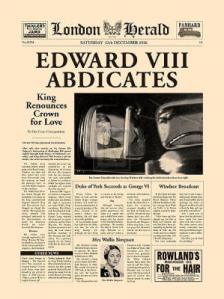
Letters Patent can be amended by Act of Parliament. Likely, the two most famous examples of amending Letters were the Dukedom of Marlborough in 1706 and the Duke of Windsor in 1936.

A person who is a possible heir to a peerage is said to be “in remainder.” A title becomes extinct (opposite to extant, which means alive) when all possible heirs (as provided by the letters patent) have died out, i.e., there is nobody in remainder at the death of the holder. A title becomes dormant if nobody has claimed the title or if no claim has been satisfactorily proven. A title goes into abeyance if there is more than one person equally entitled to be the holder.

In the past, peerages were sometimes forfeit or attainted under Acts of Parliament, most often as the result of treason on the part of the holder. The blood of an attainted peer was considered “corrupted,” consequently his or her descendants could not inherit the title. If all descendants of the attainted peer were to die out, however, then an heir from another branch of the family not affected by the attainder could take the title. The Forfeiture Act 1870 abolished corruption of blood; instead of losing the peerage, a peer convicted of treason would be disqualified from sitting in Parliament for the period of imprisonment.

London Herald (Edward VIII’s Abdicates)

London Herald (Edward VIII’s Abdicates)

Nothing prevents a British peerage from being held by a foreign citizen (although such peers cannot sit in the House of Lords). Several descendants of George III were British peers and German subjects; the Lords Fairfax of Cameron were American citizens for several generations.

“Hereditary peers do not have the automatic right to a writ of summons to the House. Irish peerages may not be disclaimed. A peer who disclaims the peerage loses all titles, rights and privileges associated with the peerage; his wife or her husband is similarly affected. No further hereditary peerages may be conferred upon the person, but life peerages may be. The peerage remains without a holder until the death of the peer making the disclaimer, when it descends normally.” (Hereditary Peers) https://en.wikipedia.org/wiki/Hereditary_peer

So what can a person do if he does not wish to accept the title? He could simply refuse to take up the title or touch the money. Technically he’d still be the title’s holder, but to have the full title and honors he must be confirmed before Parliament, and all the legal stuff has to be done to ensure he is the correct heir. He can simply not claim the title and not style himself by the title, but it remains it place at his disposal. The person does not need to send in the writ of summons to the House of Lords, and he can refuse to use the title, but someone must care for the property, and no one else may claim the title while he is alive. He can also do something drastic, such as commit treason, in which case he and his family would be stripped of the title, but no one would recommend such a step. It would be easier simply not to claim the title.

Like it or not, the heir cannot be disinherited to prevent his assuming the title. If there is a living person and the lawful successor to a title, he cannot be displaced unless convicted of a crime. During the Regency there was no way to disclaim a peerage except by not using it and not sending in a request for a seat in the House of Lords.

AngelCover copy

About Angel Comes to the Devil’s Keep

Huntington McLaughlin, the Marquess of Malvern, wakes in a farmhouse, after a head injury, being tended by an ethereal “angel,” who claims to be his wife. However, reality is often deceptive, and Angelica Lovelace is far from innocent in Hunt’s difficulties. Yet, there is something about the woman that calls to him as no other ever has. When she attends his mother’s annual summer house party, their lives are intertwined in a series of mistaken identities, assaults, kidnappings, overlapping relations, and murders, which will either bring them together forever or tear them irretrievably apart. As Hunt attempts to right his world from problems caused by the head injury that has robbed him of parts of his memory, his best friend, the Earl of Remmington, makes it clear that he intends to claim Angelica as his wife. Hunt must decide whether to permit her to align herself with the earldom or claim the only woman who stirs his heart–and if he does the latter, can he still serve the dukedom with a hoydenish American heiress at his side?

An early review

Angel Comes to Devil’s Keep is a well-written tale of courage and sacrifice and what women went through in order to marry well in Regency England. The author did her homework and it shows in an authenticity that we don’t often see in Regency romances.

Pre-orders available now

NookKobo • SmashwordsBlack Opal Books

Available everywhere on August 6, 2016

Giveaway

Leave a comment below to be eligible for an eBook copy of Angel Comes to the Devils Keep (Book 1 of the TwinsTrilogy). The giveaway ends at midnight EDT, August 7, 2016.

About the Author

author photoRegina Jeffers, a public classroom teacher for thirty-nine years, considers herself a Jane Austen enthusiast. She is the author of several Austen-inspired novels, including Darcy’s Passions, Darcy’s Temptation, Vampire Darcy’s Desire, Captain Wentworth’s Persuasion, The Phantom of Pemberley, Christmas at Pemberley, The Disappearance of Georgiana Darcy, Honor and Hope, and The Mysterious Death of Mr. Darcy. She also writes Regency romances: The Scandal of Lady Eleanor, A Touch of Velvet, A Touch of Cashémere, A Touch of Grace, A Touch of Mercy, A Touch of Love, and The First Wives’ Club. A Time Warner Star Teacher and Martha Holden Jennings Scholar, Jeffers often serves as a consultant in language arts and media literacy. Currently living outside Charlotte, North Carolina, she spends her time with her writing, gardening, and her adorable grandchildren.

WebsiteBlog  • AustenAuthorsTwitterFacebook

Alicia Quigley: Lady, Lover, Smuggler Spy (Giveaway)

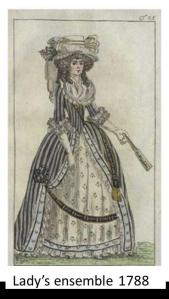
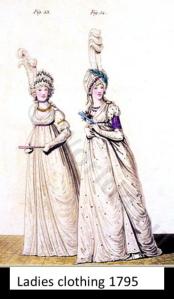
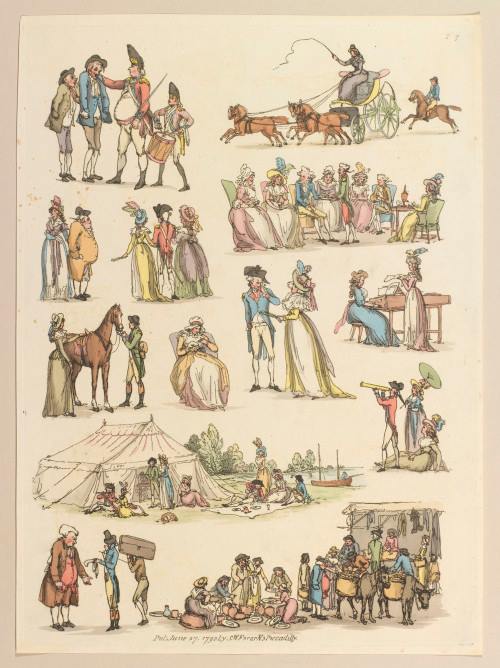
It’s exciting to be guest blogging here at Susana’s Parlor on Bastille Day! The storming of the Bastille radically changed the path of French and European history in ways that are integral to the period in which most of my stories are set, the English Regency. One minor (but fun) example is the way in which the heavy full-skirted gowns and immense coiffures and hats of 1788 had completely given way to the simple, slim, “classical” silhouette by 1795.

Photo 1Photo 2

In revolutionary France, this mode of dress was associated with democratic societies such as ancient Greece and the Roman republic.

More important in the long term, the political instability that resulted from the overthrow of the French monarchy also opened the door to the Napoleonic era, and wars that not only extended throughout Europe and into the Middle East, but into North and South America. These military campaigns, and the fear of democratic radicalism crossing the Channel from France, hugely impacted English society at the time, hardening the conservative views of many English aristocrats about the importance of birth and breeding even as the industrial revolution and trade with India created a rapidly growing class of nouveau riche.

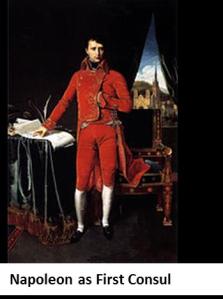
Photo 3Only six years after Bastille Day, Napoleon, who was then just 26, and had joined the French Army to promote Republican ideals, had undertaken his first campaign against Austria and Italy after saving the French Directory, the successor to the first revolutionary government. He conquered Italy and became a national hero, and then embarked on an invasion of Egypt that was his launch pad to becoming the ruler of the entire country in 1799 as First Consul.

Napoleon successfully replaced the unstable revolutionary government with a more sustainable populist regime, albeit one that was rather authoritarian. Napoleon is remembered most today for his wars, ill-fated campaign in Russia and eventual defeat, and his government reforms are often ignored. In spite of the Declaration of the Rights of Man by the first revolutionaries, Napoleon was in many ways far more the basis for the modern state that recognizes the rights of the individual than the Revolution itself. The revolutionaries were disorganized, philosophically polarized and devolved into the violence, irrationality and bloodshed of the Terror.

Photo 4Napoleon however, had a positive mania for organization and codification and introduced secular education, replacement of feudalism with modern property law, and the Napoleonic Code that set forth clear civil and criminal law that specified and codified the rules of due process that protect people living in functional states today (as well as numerous other reforms).

Napoleon’s mania for organization was pervasive; he not only set up vast and detailed bureaucracies for military and civil administration, he personally took a hand in facilitating the meetings. One weird manifestation of this was his largely successful effort to control the smuggling trade between England and France for his own benefit. His success was remarkable when one considers the strenuous efforts the English had made for centuries to bring smuggling under control with minimal results.

Napoleon’s job was perhaps easier, because he didn’t want to abolish or heavily tax the trade as the English did, but rather to centralize it and document the comings and goings of the smugglers, at least partially in order to facilitate the smuggling of gold guineas badly needed by his government to pay his troops and prosecute his wars.

This led Napoleon to establish a “ville des smoglers” or city of smugglers, initially located at Dunkirk and later at the more secure city of Gravelines nearby. French authorities received and documented the arriving English smugglers and their transactions with their French counterparts. They actively encouraged smuggling, even allowing the boats to be built there for British crews when the Inland Revenue Service and Royal Navy destroyed boats to prevent it.

I found the story of the City of Smugglers irresistible and a perfect backdrop for Lady, Lover, Smuggler, Spy the third book of my Arlingbys Regency romance and intrigue series. In this book, Valerie Carlton is the well born but impoverished widow of a soldier who lost his life in the Peninsular Wars, while Sir Tarquin Arlingby conceals his secret spying behind his wealthy gentleman of fashion persona. Their love story stretches from London across the English Channel to the City of Smugglers as they seek to uncover Napoleon’s secrets to support the English troops.

In the excerpt below, our daring duo is about to get their first glance at the fortress of Gravelines and the City of Smugglers.

About Lady, Lover, Smuggler, Spy

Mrs. Valerie Carlton is the widow of a soldier who died in the Peninsular Wars. Disowned by her family for “marrying down,” she survives working as a governess. When the elder son of the family makes unwelcome advances, Valerie leaves, seeking refuge with a close friend until she can find another position.

Sir Tarquin Arlingby, a wealthy, handsome bachelor on his way home, is staying at the same inn as Valerie and witnesses her being robbed before she can board the coach. He goes to Valerie’s aid and is instantly attracted to her. As her friend’s home is near his estate, he offers to drive her there.

An unfortunate accident forces the pair to spend a night in a village inn. Over dinner, Valerie talks about her experiences during the Spanish campaign against Napoleon and the sense of mission that she felt following the drum, which she misses in her current life. Sir Tarquin, who is secretly spying for the Crown by masquerading as a smuggler to pass information in and out of France, is intrigued by her bravery and his attraction increases. Valerie is also drawn to the handsome baronet.

Tarquin needs a French-speaking woman to pose as a smuggler during a mission to the “City of Smugglers” in Gravelines. When he discovers that Valerie speaks French like a native, he successfully recruits her for the job.

Will the pair survive their dangerous mission? Will they finally acknowledge the depth of their feelings for each other?

Find out in Lady, Lover, Smuggler, Spy, a Regency romance with intrigue, humor and just the right amount of moderately explicit sex for those readers who enjoy sensuality with their romances.

Lady, Lover, Smuggler, Spy

Excerpt

Much later, Valerie awoke to Tarquin shaking her shoulder. She looked around in surprise to note the sun just rising over the horizon.

“Madame Carleon, we are approaching the shoreline. You will wish to watch as we arrive,” he said.

Bien sur, Jake,” she replied, gathering her wits. She looked across the water to see the coastline clearly delineated before them. The golden-pink rays of the rising sun imbued the sandy, rolling shoreline with a pearly glow, and wavelets sparkled in the emerging daylight. As the shore grew rapidly closer with the long oar strokes of the rowers, she could see the narrow mouth of a waterway cutting through the beach. They glided into the channel and moved inland as rich green farm fields, dotted with cows and distant villages, scrolled past on either side.

Within an hour they were approaching the fortress of Gravelines. The looming walls, built hundreds of years earlier, reminded Valerie of the fortresses her husband had helped to besiege in Spain, and she shivered a little at the violent memories they awoke in her.

To banish her unwelcome recollections, she looked over at Tarquin. In the daylight she could see he had been correct in saying that a change of clothing and some walnut juice to temporarily brown his skin did much to disguise him. His blonde hair was tousled, his face looked as though work in the sun and wind had tanned it, and a day or two of stubble on his cheeks gave him the appearance of a farmer or deckhand. His billowing cotton shirt was partially covered with a leather vest, and the open collar allowed her to see the strong column of his throat. She acknowledged ruefully that the disguise made him no less attractive. Many a woman would take an interest in Jake West.

But there was little time for daydreams. As they drew up to a pier, the crew sprang into action. Tarquin shipped his oar and stood in one lithe movement, while Valerie grabbed her reticule from its spot atop the tarpaulin covering the golden cargo destined to support Napoleon’s armies. Seconds later, she found herself on the pier with the members of the guinea boat’s crew and other passengers, facing what appeared to be a small army of customs inspectors, coast guards, and police officers.

Unfamiliar with the procedure and somewhat intimidated by the crowd of officials, Valerie stood as close to Tarquin as possible, taking reassurance from his height and strength, while attempting to maintain an outward calm. A hard faced customs official wearing close fitting white breeches and an elaborate green coat crisscrossed with bright white leather straps approached her.

He looked her over briefly. “Qui etes vous, madame?” he barked.

Madame Carleon, une modiste,” she replied, handing over her papers. “I am here to select fabrics, trims and stock for my shop. Ces hommes ne peuvent pas selecter les mieux tissus.” For additional effect, she sniffed and cast a dismissive glance towards Tarquin.

Bien sur, madame,” the inspector said, giving her a more interested look and a smile. He rifled through her papers, pausing a moment to squint at one of them, as Valerie held her breath. “Allez, you may go.” He leered at her, his eyes raking over her figure. “A pity you live in England. France could use a fine woman such as you.”

“You never know,” said Valerie saucily, “I may return. Particularly if there are more strapping men such as you.”

“Not too many like me, but I’m sure I could satisfy you.”

Valerie laughed and moved on, giving him a teasing glance over her shoulder. The inspector, clearly recognizing Tarquin, nodded at him briefly, and he followed in her wake.

When they were out of earshot, Tarquin spoke in a low voice. “You did well there. That was a member of the Douane Imperiale, Napoleon’s elite customs unit. All of its members have served in the Army and they undertake armed missions when necessary.”

“I’m glad I didn’t know that before I spoke with him,” Valerie laughed.

“I’m sure I did not encourage you to flirt with the officials,” observed Tarquin.

“It seemed to be the easiest way to convince him I’m harmless.” She glanced up at him. “Are you jealous?”

“Jake West has no right to be jealous of Madame Carleon’s doings,” responded Tarquin, and she had to be content with that.

She turned away and watched the crowd bustling around them with interest. “What do we do now?”

“Let us go find some bread and coffee first,” he suggested. “Then I will take you to the fabric merchants. We will spend one night here; it takes them some time to count the gold and be sure that all is accounted for, and that the manifest is accurate. There is an inn for the smugglers that is quite decent. Everything here is very well organized.”

Valerie looked about her. Although the walls ran close around it, and the primary language to be heard was French, she thought she could have been in a market town almost anywhere. There were counting houses, and a great many shops, inns, taverns, and other businesses.

“It seems to be,” she agreed. “I’m afraid I had another picture in my head, with dark, narrow streets and people skulking about in the shadows. Instead it is almost disappointingly ordinary.”

Tarquin smiled. “Everything required for the smugglers to conduct their business has been thought of. There is even a shipyard, for in some regions the tidesmen have taken to destroying the guinea boats, so they make them here, and then row them to England to pick up the cargoes.”

“That’s rather shocking,” Valerie replied.

Tarquin shrugged. “I suppose it is. I am doing all I can to improve matters, but that is the reality of the treachery we are contending with.”

Giveaway: Two lucky commenters will receive free copies of Lady, Lover, Smuggler, Spy. The winners will be randomly chosen one week after this post is published.

About the Author

Alicia Quigley is a lifelong lover of romance novels, who fell in love with Jane Austen in grade school, and Georgette Heyer in junior high.  She made up games with playing cards using the face cards for Heyer characters, and sewed regency gowns (walking dresses, riding habits and bonnets that even Lydia Bennett wouldn’t have touched) for her Barbie.  In spite of her terrible science and engineering addiction, she remains a devotee of the romance, and enjoys turning her hand to their production as well as their consumption.

Website • Twitter • Facebook • Amazon Author Page

Nicole Zoltack: Loving Outside of Your Class

Back in the day, and even nowadays, people look down on certain relationships, especially if the people involved are from different classes. How can a duke or other titled person fall for someone outside of the ton? A movie star and a nobody? An actor and a musician? (Okay, I’m sour about the rumors of Tom Hiddleston and Taylor Swift, I’ll admit it.)

vauxhall

During the Regency era, aristocrats weren’t supposed to marry from other classes. Money, land, reputation, politics… they were what drove marriage for the upper crust. For the working class—the servants, maids, housekeepers, soldiers, etc—marriage was very important. Their parents had less of a say in whom they married, and they were a little more autonomous; however that was only within their own class, of course.

If a handmaid were to fall for a viscount… if a stablehand were to love a lady, most likely, it would not have played out well in real life, but what’s the fun in that?

lowerclasses

My series, Beyond Boundaries, is specifically about couples who fall in love despite obstacles like class.

If you were a lady back in the Regency, do you think you would ever consider someone outside of your class despite what your parents wish for you, despite the opinions of your friends and peers? I like to think I would!

About Masked Love (Beyond Boundaries #1)

maskedloveIsabelle will do anything for her lady, even accompany her to a masquerade ball. Lady Theodosia needs extra support for tomorrow she will meet the man her par-ents have pledged her to.

Meeting an enchanting young man during the course of the evening makes Isabelle wish for a life she can never have. Imagine her shock when he shows up the next morning, announcing his claim on Lady Thedosia.

Torn between duty and desire, Isabelle hopes for something more this Christmas.

Amazon

13446322_867608668635_2112547213_o

Starry Love (Beyond Boundaries #2)

With the Season rapidly approaching, Lady Elizabeth is ready to make her match until her father is stricken deathly ill. Her mother is desperate and hails for doctors, surgeons, even apothecaries. The upkeep of the house falls on Elizabeth, and she spend long hours beside her father, watching as he betters one day and fares worse on others. Long walks with the stable hand Callum on starry nights save Elizabeth’s sanity.

When the inevitable happens, Lady Elizabeth is forced to go to London. The gentlemen there, however, hold no candle to the kind and caring Scottish Callum.

Shortly before her father’s death, Callum returned to his homeland to try and find a cure for her father. As time passes with no word, no letters, Elizabeth must choose whether the love that blossomed between them is worth denying the man her mother wishes for her.

Amazon

About the Author

nicole photoNicole Zoltack loves to write in many genres, especially romance, whether fantasy, paranormal, or regency. She’s also an editor for MuseItUp Publishing and works as a freelance editor.

When she’s not writing about gentlemen and their ladies, knights, superheroes, or witches, she loves to spend time with her loving husband, three energetic young boys, and precious baby girl. She enjoys riding horses (pretending they’re unicorns, of course!) and going to the PA Renaissance Faire, dressed in garb. She’ll also read anything she can get her hands on. Her current favorite TV shows are The Walking Dead and Arrow.

To learn more about Nicole and her work, visit her blog at http://NicoleZoltack.blogspot.com. She can be found on most any social media site under Nicole Zoltack. Stalk away!

Jude Knight: A notorious woman visits the Parlour

Rebecca, Lady Overton prefers to be out of the public eye. Before she consented to join her author for tea in Susana’s Parlour, she extracted a promise that this interview would not be published until more than 200 years in her future.

“I have had notoriety and notice enough for a lifetime, Jude,” she says. “You saw to that.”

Becky is right. As the Rose of Frampton, treasured mistress to the notorious Marquis of Aldridge, she was whispered about (but not acknowledged) the length and breadth of polite Society. It is no consolation to her that I was only doing my job, nor that I did not know anything about her history when I started. I thought to write a cheerful romp about a dissolute rake, not a story about how a woman with few choices nonetheless made the best ones she could, and eventually won her way to a happy marriage and a secure family.

She does not wait for an answer to her remark. “And you are still doing it,” she scolds. “This latest start of yours has spread my story to countries that did not even exist when I was alive. That smug look does not make me feel better, you know!”

I wipe the grin off my face. I have been posting A Baron for Becky on Wattpad for months, one chapter a week until it was completed. In the past month it has taken off, garnering hundreds of reads every day. I am particularly thrilled that 15% of my reads are from India, another 10% from the Philippines, and more than 50% overall from countries in Africa and Asia where I do not normally sell books.

“You have to admit,” Becky continues, “it is not at all a light, frothy read. Girlhood trauma? Years of suffering? Two heroes, Jude, and neither of them particularly heroic seen in a certain light.”

“It is a story of resilience, Becky. You survived, and eventually you thrived. And both your first hero and your second helped with that. More than they hindered, I am sure you will agree. Did you know that Susana, our hostess today, has a story on Wattpad that is actually called ‘Resilience’? You might enjoy meeting her heroine. You have some sad circumstances in common.”

“Ah,” Becky says. “Betrayed into a brothel, was she? Poor girl.”

“It comes right in the end,” I sooth. “After all, we write happy endings, Susana and I.”

Becky’s speaking look states her opinion as loudly as words. Perhaps that which does not kill you makes you stronger, but the memories and the scars remain, giving a dark underpinning the future happiness. I dream that people who have had their choices torn from them will find hope and the courage to find new choices by reading stories about heroines like Becky. But pain endured and overcome is still pain.

“We are about to start posting a new book, Mari Christie and I,” I tell Becky, hoping to change the direction of her thoughts.

It works. “Mari Christie? She writes as Mariana Gabrielle, does she not? She created my dear friend Kali. Is the book about her?”

“No, indeed. This is something different. Never Kiss a Toad is about the romance between Aldridge’s daughter Sal and his friend Wellbridge’s son David. The first part goes up next Friday.”

About Never Kiss a Toad

Never Kiss a Toad copyDavid “Toad” Northope, heir to the Duke of Wellbridge and rogue in the mold of his infamous father, knows Lady Sarah “Sal” Grenford, daughter of the once-profligate Duke of Haverford, will always hold his heart. But when the two teens are caught in bed together by their horrified parents, he is sent away to finish school on the Continent, and she is thrown into the depths of her first London Season.

Can two reformed rakes keep their children from making the same mistakes they did? The dukes decide keeping them apart will do the trick, so as the children reach their majority, Toad is put to work at sea, learning to manage his mother’s shipping concern, and Sal is taken to the other side of the world, as far from him as possible.

How will Toad and Sal’s love withstand long years of separation, not to mention nasty lies, vicious rumors, attractive other suitors, and well-meaning parents who threaten to destroy their future before it has begun?

To be published in weekly instalments on Wattpad, alternating between Mariana Gabrielle’s page and Jude Knight’s.

Jude Knight

Mariana Gabrielle

(Mariana Gabrielle is also posting Royal Regard, in which you can read about the fraught and beleaguered courtship of Toad’s parents, and Jude is posting stories from her collection Hand-Turned Tales.)

About A Baron for Becky

BfB cover final small copyBecky is the envy of the courtesans of the demi-monde – the indulged mistress of the wealthy and charismatic Marquis of Aldridge. But she dreams of a normal life; one in which her daughter can have a future that does not depend on beauty, sex, and the whims of a man.

Finding herself with child, she hesitates to tell Aldridge. Will he cast her off, send her away, or keep her and condemn another child to this uncertain shadow world?

The devil-may-care face Hugh shows to the world hides a desperate sorrow; a sorrow he tries to drown with drink and riotous living. His years at war haunt him, but even more, he doesn’t want to think about the illness that robbed him of the ability to father a son. When he dies, his barony will die with him. His title will fall into abeyance, and his estate will be scooped up by the Crown.

When Aldridge surprises them both with a daring proposition, they do not expect love to be part of the bargain.

Follow A Baron for Becky on Wattpad, or purchase while it is on sale for 99c

Smashwords

iBooks

Amazon

Barnes & Noble

About the Author

Jude Knight copyJude Knight has been telling stories all her life: making up serial tales to amuse her friends and children, imagining sequels to books that have moved her and left her wanting more, occasionally submitting short stories to magazines and the radio, starting more than a dozen novels set in different times and places.

She has devoted most of the last forty years to a career in commercial writing and raising a large family (most recently as grandmother-in-residence while a daughter was out of action for three years). She and her own personal romantic hero, with whom she has shared those forty+ years, now live with two cats and frequent visitors in a small town in rural New Zealand.

Judy wrote and published her first historical romance in 2014, and now has the wind in her sails and a head full of strong determined heroines, heroes with the sense to appreciate them, and villains you’ll love to loathe.

Website and Blog • Facebook • Twitter • Pinterest

Beverley Oakley: The Mysterious Governess (Daughters of Sin, Book 3)

Catostconspirators

The Cato Street Conspiracy and Queen Caroline’s Return to England—Two Important Events of 1820

 Historical Romance Author, Beverley Oakley, recently brought one of her characters, Miss Araminta Partington, to tea. Miss Partington, who has an extremely high opinion of her attractions, and of her knowledge of most matters, elucidated on the background to the new book in which she features called The Mysterious Governess, part of the Daughters of Sin series, which touches on the events before and after the Cato Street Conspiracy of 1820.

Miss Partington: Hello Susana, and thank you so much for inviting me to take a dish of tea in your parlor. I must say, it’s very comforting to know I can sleep at night in the knowledge that those dreadful men—Arthur Thistlewood, Edward Spence and the others – who call themselves “The Society of Spencean Philanthropists”, have been either hanged or transported for life for their parts in the Cato Street Conspiracy.

Susana: A delight to have you here, too, Araminta. Yes, what a shock to the public! What do you suppose they were hoping to achieve?

Miss Partington: Why, utter madness, in my opinion! Mr. Thistlewood talked of desiring a “Government of the People of Great Britain,” which would take power out of the hands of Parliament and the landed elite and place it into the hands of the people.” In my opinion, that’s tantamount to stealing Papa’s estate and giving it to Jane, my useless maid, who only last week lost one of my silver hairpins.

Susana: Goodness, that does sound dire! I’m referring to the plot, of course. Was there violence?

Miss Partington: Fortunately, the only violence was after the Coldstream Guards and Bow Street runners ran into the loft where these miscreants were plotting that night’s intended rampage through the home of the Lord President of His Majesty’s Privy Council, Lord Harrowby. Indeed, they were intending to murder the entire King’s Cabinet before taking to the streets of London to storm the Bank of England and the Tower of London. They hoped to stir up revolution in our country, like in America and France only a few decades ago.

Susana: Good Lord! How was it possible that law enforcement was able to apprehend the plotters?

Pageflex Persona [document: PRS0000038_00064]Miss Partington: Well, apparently, the Government knew what they were about and had planted spies in their organization. My Cousin, Stephen Cranbourne, works for the Foreign Office. I’m sure he’d have confided in me had I not been on rather… er… friendly terms with Lord Debenham who is rumored to be associated with the Spenceans. He’s not, of course. I made sure to burn the incriminating letter his cousin wrote before she drank poison. Aren’t the daffodils beautiful at this time of year? I’ve trimmed my bonnet with several bunches. Sir Aubrey does think them fetching. Yes, I’ve transferred my affections to Sir Aubrey as I think he’d be far easier to manage than dangerous Lord Debenham.

Susana: Yes, the daffodils are, indeed, beautiful. And I was so sorry to hear about Lord Debenham’s cousin. I believe she was Sir Aubrey’s late wife. But, back to politics, do tell me, when was the Spenceans’ plot brought to nought? My apologies for my ignorance, I’ve been in France for some time.

Miss Partington: On February 23, 1820, but of course, it’s not really news any more since the gossip sheets—and indeed, the newspapers—are having much more fun giving us all the thrilling details of George IV’s estranged wife Queen Caroline arriving from continental Europe, a few months afterwards, and attempting to take her place as Queen consort. Personally, I think someone with such atrocious dress sense doesn’t deserve to be queen, but, not everyone agrees with me—which I always find rather odd, really. Of course, the Prince Regent only agreed to marry Princess Caroline of Brunswick back at the end of the last century so his father would clear his debts. £630,000 pounds is rather a lot of money, though I imagine that if I owed such a sum, I might be induced to marry Lord Debenham above Sir Aubrey, despite his wicked reputation and the fact Lord Debenham would be so much more difficult to manage.

Susana: Yes, your half-sister, Miss Larissa Hazlett, has inferred the same.

Miss Partington: My half-sister? [Miss Partington rises.]Let me assure you, I do not have a half-sister. Any resemblance between that dreary governess and myself is entirely coincidental. Now, if you’ll excuse me… while it has been most pleasant, I must leave now for an appointment I’ve just remembered. Yes, it’s all part of a little plan I’m implementing to put that dreary governess right back in her box!

About The Mysterious Governess

Two beautiful sisters—one illegitimate, the other nobly born—compete for love amidst the scandal and intrigue of a Regency London Season.

Lissa Hazlett lives life in the shadows. The beautiful, illegitimate daughter of Viscount Partington earns her living as an overworked governess while her vain and spoiled half sister, Araminta, enjoys London’s social whirl as its most feted debutante.

When Lissa’s rare talent as a portraitist brings her unexpectedly into the bosom of society—and into the midst of a scandal involving Araminta and suspected English traitor Lord Debenham—she finds an unlikely ally: charming and besotted Ralph Tunley, Lord Debenham’s underpaid, enterprising secretary. Ralph can’t afford to leave the employ of the villainous viscount much less keep a wife but he can help Lissa cleverly navigate a perilous web of lies that will ensure everyone gets what they deserve.

Amazon.com • Amazon.co.uk • Apple iBooks • Barnes & Noble • Kobo

Excerpt

Although The Mysterious Governess is about Lissa, who is Araminta’s half-sister, the plot involves them equally. Lissa is hard-working and honourable, the antithesis of Araminta, as you will see below, in this short extract:

“Is everything all right, Miss? Were the fireworks grand? You’re back earlier than I’d ‘spected.” Jane, who was polishing the silver bottles on her mistress’s dressing table, looked up nervously as Araminta entered the room.

Without a word, Araminta brought one arm across the entire surface and sent powder bottles, perfume vials, hairbrushes and jewelry boxes crashing to the floor.

Then she threw herself onto her bed and burst into noisy tears.

“Oh, Miss, I take it things didn’t go to plan,” said Jane, going down on her knees to start to clean up the mess before changing her mind and putting a tentatively soothing hand upon Araminta’s back.

“No, they did not!” Araminta shrieked, beating her fists upon the counterpane.

“So, His Lordship didn’t ask you to marry him, then?”

“Yes he did!” Araminta rolled onto her back and glared at Jane. “He asked me to marry him and then said he had to go away on important business for two months! Two months! Where does that leave me? In an impossible situation, I don’t need to tell you. I might as well throw myself in the river, except the water’s far too cold and I’m hardly about to copy bacon-brained Edgar. There must be another way.”

“Poison?”

“I mean to get out of this mess, you stupid girl!” Araminta screamed. Feverishly, she began to bite her fingernails before realizing the damage she was doing to an important asset. “Oh, Jane, don’t look like you’re related to a mule. Come up with a plan, for dear Lord’s sake!”

About the Author

Beverley Eikli author picBeverley Oakley was seventeen when she bundled up her first 500+ page romance and sent it to a publisher. However, drowning her heroine on the last page was not in line with the expectations of romance readers so Beverley became a journalist.

In 2009, Beverley published her first novel. Since then she has written more than thirteen sizzling historical romances, filled with mystery and intrigue, mostly set in England during the Georgian, Regency and Victoria eras.

Beverley lives near Melbourne opposite a picturesque nineteenth century insane asylum with the handsome Norwegian bush pilot she met in Botswana, their two beautiful daughters and a rambunctious Rhodesian Ridgeback the size of a pony.

Beverley also writes more psychological historicals, and Colonial-Africa- set romantic adventures, as Beverley Eikli.

WebsiteFacebookGoodreadsTwitter

Sarah Waldock: The Advertised Bride

Lady L’s Outrage

“MATRIMONY – A lady of good birth and breeding, and without a stain on her character wishes, for reasons which will be revealed to any successful candidate to MARRY a young man of sufficient fortune and gentility to keep her in the state to which she is accustomed. His age should not exceed thirty years, and he should be of pleasant and amiable disposition. His income not to be less than two hundred guineas per annum. Reply post-paid only, to DC, care of the Landlord, ‘The Bell’, Saxmundham.”

“I ask you, what sort of woman of good birth and breeding writes a letter to the newspaper like that? Of course, once it came out that it was one of those shameless Brandon women, it became quite clear. Did you know the Brandons haven’t been free of scandal since the first Baron ran off with a nun in the fourteenth century? And recently there was that Crim. Con. case brought by the current baron, and his niece went off with one of the most notorious rakes in the land.

51OJbyOGLbL._SY344_BO1,204,203,200_But I was telling you about how this shameless hussy somehow managed to entrap the most eligible bachelor of all, the Honourable Mr. Percival Braidwood, whose blond locks gleam like gold and who has the profile of a Greek god. Add that to his fortune, reputed to be a cool ten thousand a year, and that before he inherits the baronetcy, and you can see why it’s just not fair that this nobody second cousin or whatever she is should win him. It was a trick, of that I’m sure. How she got him to answer such an advertisement is beyond me, or maybe she just took advantage of him staying in an inn where she was perusing likely candidates. I am certain she must have managed to arrange for him to compromise her in some way, and he such a gentlemen he had no choice but to offer marriage!

Am I jealous? Of course I’m jealous! I spent the entire season trying to catch Mr. Braidwood’s attention, and I am beautiful and accomplished, and an excellent conversationalist, as well as being fashionably dark. We were a perfect foil, my raven locks and his golden ones. It goes to prove, doesn’t it, that he must have been trapped, because why else would he end up married to a blonde whose hair isn’t even dark enough in colour to call a proper blonde?

Oh, no, I don’t want to give my name; well, if you must, write it down as Lady L. Listen, if you breathe a word to the Honourable Mrs. Eldridge that I spoke about her brother’s bride, I shall find ways to make it very uncomfortable for you. What does she say? Oh, Isolde is putting a brave face on it and declaring it a love match. A love match? Why, she obviously doesn’t know that this chit Diana, or whatever her name is, placed an advertisement in two provincial newspapers, and I found out about it which is why I came to you with the full story. I even found one of her disappointed suitors, whose hand and heart she spurned for greater wealth, despite the poor man being a widower with young children. No of course I wouldn’t marry an impoverished rector with brats, what do you take me for?

There was no call to say that, fellow.”

The Advertised Bride

The Advertised Bride was written with much input from my mother, who died while I was writing it, and I want to dedicate it not only to her, but to all women who have escaped from abusive families.  As well as having escaped an abusive father, my mother helped set up a local women’s refuge.  I hope Dinah’s escape will be inspirational for other women who feel trapped.

 Amazon

 Excerpt

“Dinah, such a long face! Surely you do not long for a husband to argue comparisons over?”

“No, and that’s the problem!” cried Dinah. “I am to be married after Christmas, and to a horrid old man who leered at me, and he has sweaty hands, and skin like mahogany, all wrinkled like a walnut, and Papa is not to be argued with over it. Indeed, I am afraid he will take me away, for Uncle Adam put him in a passion, criticising Marjorie’s husband.”

“Oh dear,” said Imogen. “Well, there is nothing else for it; you will have to get married before the end of the holidays. Have you any beaux?”

“No, I have never even been to a dance. I’m only sixteen and Mama said I should come out when I was seventeen. I shan’t be seventeen until April and that will be too late, and besides, Papa will say that coming out is unnecessary as he has found me a husband.”

“I can only see one course open to you, then, as I do not think you could manage to run away as I did without help,” said Imogen.

“You must think me very poor spirited,” said Dinah.

“No, my dear, I think you very much downtrodden, like a governess to horrible children, only your father is more childish than the most horrible child I have ever heard of,” said Imogen. “Fancy not being able to control his temper at his age!”

“I don’t think he ever had to,” said Dinah. “What idea did you have?”

“Why, insert an advertisement in the Ipswich Journal and the Norfolk Chronicle that you are looking for a husband, and then marry the one you like the most,” said Imogen. “I will help you to interview those who take your interest from their letters.”

“But Imogen, Papa might see the advertisement!” cried Dinah.

“Silly, you do not put it in your name,” said Imogen. “You write something like ‘Young lady seeks matrimony with a man of sufficient means and gentility to support a wife of breeding, no older than thirty. Send post-paid envelope to … oh, to some inn.”

 About the Author 

sarahwaldockSarah Waldock grew up in Suffolk and still resides there, in charge of a husband, and under the ownership of sundry cats. All Sarah’s cats are rescue cats and many of them have special needs. They like to help her write and may be found engaging in such helpful pastimes as turning the screen display upside-down, or typing random messages in kittycode into her computer.

Sarah claims to be an artist who writes. Her degree is in art, and she got her best marks writing essays for it. She writes largely historical novels, in order to retain some hold on sanity in an increasingly insane world. There are some writers who claim to write because they have some control over their fictional worlds, but Sarah admits to being thoroughly bullied by her characters who do their own thing and often refuse to comply with her ideas. It makes life more interesting, and she enjoys the surprises they spring on her. Her characters’ surprises are usually less messy [and much less noisy] than the surprises her cats spring.

Sarah has tried most of the crafts and avocations which she mentions in her books, on the principle that it is easier to write about what you know. She does not ride horses, since the Good Lord in his mercy saw fit to invent Gottleib Daimler to save her from that experience; and she has not tried blacksmithing. She would like to wave cheerily at anyone in any security services who wonder about middle aged women who read up about making gunpowder and poisonous plants.

Sarah’s History Place BlogSarah’s Cats Blog

FREE on Kindle: The Ultimate Escape

Gold satin silk fabric closeup texture and background


The Ultimate Escape is Book 1 in The Lady P Chronicles, a Regency time travel series.

If you haven’t obtained your copy yet, now is the time! The novella is free on Kindle THIS WEEK ONLY!

On the eve of her wedding, Julia realizes she cannot marry her fiancé after all, no matter that it’s been her dream for eight long years. Too distraught to face him, she follows in her mother’s footsteps and flees to the future for a brief reprieve. Oliver knows he has bungled things badly, but he is determined to win the woman he loves, even if he must travel through time to do it.

FREE ON KINDLE: http://ow.ly/4mZYIP