Tag Archive | Regency romance

Kathryn Kane: Deflowering Daisy 

Interview with Kathryn Kane

Susana: What inspired you to start writing?

Kathryn: After college I was a museum curator and later the curator of a historic house. I enjoyed working with historic furnishings and artifacts and learning how they were made and used in their own time. Some years ago, having left the museum field for the tech industry, I realized I could put my knowledge of social and cultural history, as well as the history of things to use. As an author, I could create historically accurate environments for my characters and enable those characters to use those objects as they were originally intended. Many of those objects have interesting aspects to their use which I though would enrich my stories for my readers.

Susana: How long have you been writing?

Kathryn: In terms of scholarly articles, I have been writing for over twenty years. But when in comes to romance, about six years. I went through a number of different stories, with multiple drafts, as I honed my romance-writing skills. I think now I have found the right balance in my work, telling a heart-warming romance within a historically accurate setting.

Susana: What advice would you give to writers just starting out?

Kathryn: Read. But not just romance novels. Take the time to read lots of reviews of romance novels, particularly in your preferred genre. Doing that gave me the confidence to write the stories I wanted to write, since I discovered there were quite a lot of readers out there who liked the same kind of stories I did. I think that kind of confidence improves your writing and helps you to write with your own, true voice.

Susana: Do you ever suffer from writer’s block? If so, what do you do about it?

Kathryn: Occasionally. Fortunately, I have a few solutions, or perhaps I should say, distractions, available to me. I have found that the easiest way for me to break through writer’s block is to get my mind off the blockage for a time. Physical exercise is often the best distraction for me, so I go for a long ride on my bicycle, if the weather is fine. If not, I am fortunate to live near a property which is now a large park, but used to be one the greatest country estates in New England in the early nineteenth century. Since I wrote my Master’s thesis on the estate, though the buildings are all gone, I know not only what they looked like, but how they were furnished. As I walk, I imagine life on the estate when it was at its peak. Usually, by the time I get home, new ideas are bubbling up and my writer’s block dissolves away. If a walk or a bide ride don’t do the trick, I switch gears and work on an article for my Regency history blog. It takes a lot of concentration, and by the time I finish a new article, the next chapter in my current romance does not seem quite so daunting.

Susana: Tell us something about your newest release that is NOT in the blurb.

Kathryn: My debut Regency romance is called Deflowering Daisy, so, as a play on the title, I have woven a number of snippets of floral history into the story. Daisy is the heroine of the story, who got her name after I did quite a lot of research into a number of flowers with names which start with “D” to find just the right characteristics. Though daisies seem to be quite common flowers, they have several valuable properties, one of which is that of healing. The hero of the story, David, is a former spy who is war-weary, soul-sick and desperately in need of healing. And the heroine, Daisy, thinks she is just as common and seemingly insignificant as the flower after which she is named. Through the course of the story, Daisy and David give each other forgiveness, self-esteem and peace, with the help of a lot of flowers.

Susana: Are you working on something at present that you would like to tell us about?

Kathryn: It is a change of genre for me, a romantic fantasy with ecological overtones. I am working on the story of a young woman who offers herself as the human sacrifice to save an ancient forest. The guardian of the forest, a powerful wizard who hates humans for the damage they have inflicted on his forest, accepts her offer. However, as he comes to know her, he finds he cannot bear the thought of her death. Yet, without it, he will die along with the forest.

Susana: What author or authors have most influenced your writing?

Kathryn: Georgette Heyer. She created the Regency romance genre, which is my favorite. She was also a diligent researcher who did her best to write historically accurate stories. I do my best to emulate her efforts in my own work, since I so much enjoyed reading hers.

Susana: What did you want to be when you grew up?

Kathryn: A librarian, since I thought all the books were kept at the library and I love books. Then, after reading lots of books by Georgette Heyer when I was in high school, I decided I wanted to study history when I went to college. But I still love libraries, because I still love books.

Susana: What is your favorite food? Least favorite? Why?

Kathryn: My favorite food is ice cream, because it is sweet, cool and creamy.
My least favorite food is liver, because it is liver.

Susana: What is one thing your readers would be most surprised to learn about you?

Kathryn: That I love progressive rock and roll, especially Rick Wakeman, Yes, and Emerson Lake and Palmer. I don’t listen to prog rock when I write, because I find it too compelling and am not able to concentrate. But I often listen to it when I am working around the house or relaxing and can give it my full attention. I find the rich layers of sound in prog rock very satisfying. Since I like those layers in music, I also try to incorporate them into the stories I write.

Susana: If your publisher offered to fly you anywhere in the world to do research on an upcoming project, where would you mostly likely want to go? Why?

Kathryn: England, in particular Bath. I have never been there, though I have read a lot about it. Jane Austen and her family spent several years there, and quite a lot of the city which remains today was there during the Regency. To me, it is the most “Regency” city in England and I would love to have the time to walk the streets and visit places like the Pump Room and the Assembly Rooms to soak up the atmosphere and get a sense of the space.

Susana: Do you have a favorite quote or saying?

Kathryn: It is the last line from the poem, To Lucasta, Going to the Wars, by Richard Lovelace.
“I could not love thee (Dear) so much,
Lov’d I not Honour more.”

Susana: Do you write in multiple genres or just one? If just one, would you consider straying outside your genre?

Kathryn:  I write primarily in Regency romance, but in the past couple of years some stories in the fantasy genre have just popped into my head and I had to write them down. It was the only way to get those characters out of my head. I am currently re-working one with an eye to publication.

Susana: What are your favorite pastimes?

Kathryn: I enjoy riding my bicycle, but I freely admit, I am a fair-weather cyclist and only ride on sunny days. However, my real passion is needlework. I love all forms of needlework. I love to crochet and tat, and I am learning to make cord with a lucet. Embroidery is also a great pleasure for me, particularly when it involves beads and silk ribbon. I love to sew, especially quilting, and have made a number of “straight” quilts, but crazy quilts are my real favorites.

Susana: What is the one modern convenience you can’t do without?

Kathryn: A washing machine. Working with fabrics requires they be washed before using to remove the chemicals with which they are treated, so a washing machine is the most important modern convenience to me. Though I am also quite fond of my clothes dryer, my iron and my steamer.

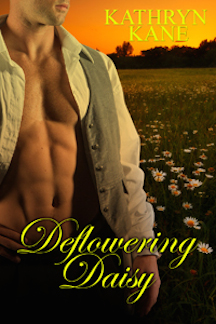
About Deflowering Daisy

“She cannot remain a virgin!”

For so she was, after nearly a decade of marriage. When she was sixteen, Daisy had willingly, happily, married a man more than fifty years her senior, to escape a forced marriage to a man she abhorred. Though Sir Arthur Hammond had been a wild rake in his youth, he was so deeply in love with his late, beloved first wife that he never considered consummating his second marriage, certainly not with a woman he considered a daughter. But now, knowing he was dying and that he would be leaving sweet, innocent Daisy ignorant of the physical intimacies which could be enjoyed between a man and a woman, he felt that it was imperative she be given the knowledge which would prepare her for the life of a wealthy widow. Armed with the knowledge of physical intimacy, she would be much better prepared to deal with any fortune hunter who might try to seduce her into marriage for her money. And who better to initiate Daisy into the pleasures of the bedchamber than his godson. David had become nearly a recluse since a tragedy which occurred while he was serving the Crown against the forces of Napoleon Bonaparte. Prior to that, his skill as a tender and considerate lover had been bruited about in certain circles. Therefore, Sir Arthur believed that David was just the man to introduce Daisy to physical pleasure. And what might spending time with true and gentle Daisy do for David?

Jupiter Gardens Press • Barnes & Noble Nook Books • Amazon Kindle

Excerpt

London
May 1816

She cannot remain a virgin!”

“You want me to rape your wife?” David Everard rose from his chair, shocked to his core. Sir Arthur Hammond, a man whom he had admired and respected all his life, his godfather and the man he loved as dearly as a father, was asking him to deflower his wife.

“No!” exclaimed Sir Arthur. “No, of course not. She is as dear to me as a daughter.”
Deflowering Daisy-96dpi_200 copy“And yet, in six weeks’ time, you propose to give this young lady into my keeping for the express purpose that I violate her person and take her virginity. A young lady, I might add, whom I have never met, a young lady to whom I will be a complete stranger.” His eyes narrowed as he fixed his godfather with the same withering stare which had broken more than one enemy agent under intense interrogation. “She does not know who I am?”

“No, I am sorry to say, she does not,” the older man responded with equanimity, and a note of sadness. Sir Arthur met his gaze without flinching. “I have not spoken of you, David, to anyone, even George, from the day I gave you my word I would not. I keep my promises, young man!”

“Yes, sir, I know. It gave me hope you would be safe.”

“I made that promise to you only because you asked it of me. I was never afraid.”

“But I was,” he admitted. “It was necessary that everyone believed my friends and family had cast me off. I did not want to take the chance anyone might think they could get to me through you or George. I wanted the world to think I was nothing to you, nor you to me. I had to know you were both safe in order to do what I had to, for England.”

“And you have, my boy,” Sir Arthur said. “But the war is over now and Boney is put away for good, in no small part thanks to you, I am sure.”

“Don’t try to make me into a hero, Arthur,” he said. “I am nothing of the sort.”

“Hrrmph! I will never think you anything else, no matter what you say,” came the staunch rejoinder.

Though he did not reply, deep in his soul, David felt again a wave of infinite gratitude for his godfather’s unconditional loyalty to him. Without it, he was not sure he would have been able to endure these past few months as the social exile he had become since that day on Beachy Head.

“You have spent most of this past decade risking life and limb here and on the Continent, to protect England. Have you not the courage to spend one week to protect a kind and gentle young lady and a host of orphans?”

“Protect her by taking her to bed? If she is as you say, I am sure you can find any number of men willing to bed her.”

“There is no one else I can turn to, no one else I can trust. You are like a son to me.”

“So, now you are advocating incest?” David asked, his voice thick with sarcasm. “You want a man you consider a son to violate the woman you consider a daughter?” Was it possible for this to get any more repugnant, he wondered to himself.

“God’s teeth, David!” the older man shot back. “You bloody well know that is not what I am asking. Or why.” He took a long, slow, deep breath. “You have a reputation for having a way with women. It is said you give your bedmates pleasure equal to what you take, that you are a kind and considerate lover. That is what I want for Daisy. She is a complete innocent. She should be initiated tenderly, gently, by a man who will appreciate her quality.”

“Then find a man of quality to initiate her, not some spawn of hell unfit to associate with civilized people.” David walked the few paces to the fireplace as his bitter words fell into silence. When Sir Arthur did not speak, he turned. “I have not touched a woman in nearly a year and I have never taken a virgin,” he admitted. “I am the last man of whom you should ask this.”

“You are the only man I can ask, David,” the older man replied. “Despite your words, I know you to be the most decent and honorable man of my acquaintance. And Daisy is a very special girl, a loyal and generous soul whose sweet spirit should not be crushed by a cold-hearted bedding. I know you would never do that to her.”

“She is your wife. You can do the deed yourself,” David reminded him.

“No, my boy,” Sir Arthur said on a sigh. “Even if I were not much too old for her, there was only ever Millie for me. From the day I met her I never wanted another woman. Even though she is more than eleven years gone, there will never be anyone else.”

“Then encourage her to take a lover,” David suggested, trying to keep the desperation from his voice. He dropped back into his chair.

“I have tried for years, but she has never shown interest in any gentleman to whom I have introduced her. Of which there are few, near our estate in Kent,” he admitted. “And I can seldom get her to leave the country in order to broaden her acquaintance in London. She is determined to be a devoted and faithful wife, even though I doubt she has any concept of what unfaithfulness would entail. And now, it is too late. I cannot leave her so exposed, at such risk.”

“Why? What is so different now?”

Please visit Kathryn’s Books page at her web site for an extended excerpt.

Historical Snippet: Embroidery

Early in the story, the heroine, Daisy is working on her embroidery, of flowers, of course. When she puts it away for the evening, she pauses to look at her thimble when she takes it off. It is a very special thimble which means a great deal to her. It has a tiny purple enamel pansy which marks it as the product of the famous Palais Royal in Paris. The needlework implements and workboxes which were sold at the Palais Royal were considered to be the finest available at the time. Daisy received a small Palais Royal workbox on her first wedding anniversary. She had never been given anything so fine in all her life and that gift was so important to her that it quite literally saved her life. (You will have to read the story to find out how).

Though the Palais Royal stitching implements and workboxes were available only in Paris, there were still quite a number of English ladies during the Regency who had a set. Some had been acquired by the English who traveled to Paris during the Peace of Amiens, but there were also those who had contacts in Paris who could make special acquisitions for them. Therefore, despite Napoleon’s blockade, these luxury items still made their way to the needlewomen of England. And it is almost certain that any lady lucky enough to receive a workbox or implement set from Palais Royal would treasure it. These items were beautifully made and quite a few of them had delightful little secrets. Some contained music boxes, others had secret compartments, and still others were made as realistic miniatures of other objects.

More information about the exquisite Palais Royal sewing implements and workboxes can be found at Kathryn’s blog, The Regency Redingote.

About the Author
KKane_AuthorAvatarAV300Kathryn Kane is a historian and former museum curator who has enjoyed Regency romances since she first discovered them in her teens. She credits the novels of Georgette Heyer with influencing her choice of college curriculum, and she now takes advantage of her knowledge of history to write her own stories of romance in the Regency. Though she now has a career in the tech industry, she has never lost her love of the period and continues to enjoy reading Regency novels and researching her favorite period of English history.
Allison Lane: Regency Masquerades

Late Georgian Carriage Travel

Have you ever wondered how long it would take to drive 200 miles in 1810 and whether the average person could afford the trip?

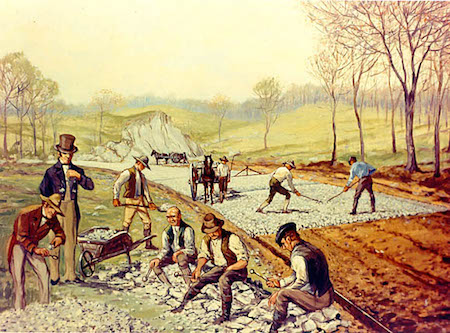
Building a macadamized road

Building a macadamized road

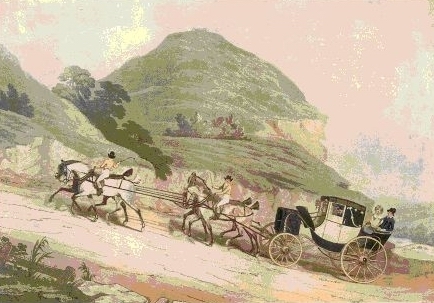
Long-distance travel in England during the late 18th and early 19th centuries was slow and very expensive, which explains why most people spent their entire lives within five miles of their birthplace. But the upper classes did travel—to London, to their secondary estates, to visit friends… Yet it wasn’t easy. Roads were bad—muddy, rutted, sometimes completely impassible due to weather. The turnpikes gradually improved as the 18th century progressed, but even with that, by 1800 only the Bath-to-London road was truly good – it had been moved and rebuilt from scratch in 1787. Macadamization, which produced a smooth, fast surface, did not start nationally until 1818, wasn’t finished on the turnpikes until 1828, and wasn’t affordable for secondary roads until well into Victoria’s reign. During the upgrade, many travelers encountered detours that sent them along secondary roads, country lanes, or worse. (I encountered a similar situation a few years ago when my European highway turned into a construction zone; the detour sent me down a winding country lane and across a muddy pasture to reach a second winding country lane that finally returned to the main road. Scenic, but I hadn’t expected the pasture…)

Private traveling chariot

Private traveling chariot

Anyone traveling more than twenty miles had to hire horses because using personal horses for a long journey doubled or tripled the total travel time. If the traveler owned a carriage, he would hire one or two pairs to pull it. The number of horses depended on his desired speed, the weight of the loaded vehicle, and how many hills the road climbed. Hired horses were changed out every 15-20 miles. Each pair of horses came with a postilion who controlled his pair, cared for their needs, and got them back to their home stable. Post horses were hired by the mile. Every ostler knew the precise distance to the next change, so travelers paid for the hire in advance, then tipped the postilions at the end of their stage.

If the traveler did not own a carriage, he could hire one from the post office. Post office vehicles were called yellow bounders because of their color and inadequate suspensions. They were rented for a single stage just like the horses, so the traveler had to change carriages along with the horses.

Another expense of travel was turnpike tolls. Every turnpike was littered with toll gates—by the Regency there were more than 8000 of them. Tolls were collected by turnpike trusts and used to maintain the section of road under their jurisdiction. Parliament established each trust as a way to provide good roads without the government having to pay for them. Secondary roads were maintained by the parishes, which rarely had much money, so anyone wanting to travel quickly without getting bogged down in mud used turnpikes whenever possible. But all those tolls added up—each trust set its own base price, but all charged according to vehicle type and the number of horses pulling it.

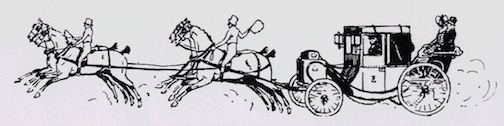
3 - chaise with two postillion driven teams copy

Chaise with two postilion driven teams

When using hired horses, speed on the turnpikes averaged about five miles per hour. Postilions operated under a strictly enforced speed limit of seven miles per hour along rural turnpikes, but they had to slow for all towns and villages and stop at every toll gate which slowed their overall speed. On secondary roads the average speed was less because the road surface was so bad. After macadamization was complete, the speed limit was raised so the average speed jumped to ten miles per hour during the golden age of coaching from 1830-1840. After 1840, long-distance travel mostly switched to trains, with carriages covering only the short distance to and from the nearest railroad station.

When heading to London for the Season, the travel party would contain a man, his wife, and any older children not in school—young children usually stayed in the country. Each family member had a lady’s maid or valet. There might also be a governess and/or tutor for the children, a secretary for the husband, and possibly a secretary or companion for his wife. They might even take their housekeeper and butler, along with a coachman to drive them while in town. Plus luggage. Obviously, this would require multiple carriages, so travel expenses would skyrocket. Another reason London Seasons were so expensive.

About Regency Masquerades

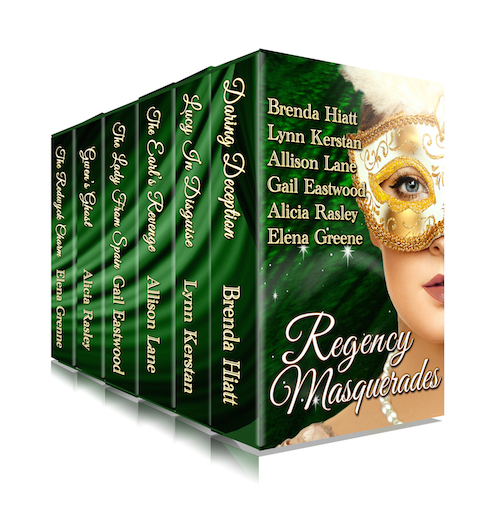
Six beloved bestselling and award-winning Regency authors bring you six full-length novels of disguise, deception and secret identities. From sweet to subtly sensual, these traditional Regency Romances demonstrate that true love can see through even the most elaborate mask! 

This special, limited-edition set includes:

Daring Deception, by NYT and USA Today bestselling author Brenda Hiatt
When her brother promises her in marriage to pay a gaming debt, Miss Chesterton dons a disguise to prove Lord Seabrooke a fortune hunter. But even as she gathers evidence, she finds herself losing her heart to the handsome Earl.

Lucy in Disguise, by RITA® Award-winning author Lynn Kerstan
A charming aristocrat in trouble is rescued by a young woman disguised as a Lancashire Witch. Love comes swiftly, but she’ll only agree to wed if they protect her friend, a fearful heiress, from a greedy and dangerous family.

The Earl’s Revenge, by award-winning author Allison Lane
A battle of wits unmasks the secret lives of the Earl of Bridgeport and his former fiancée Elaine Thompson. Only love might prevent ruination.

The Lady from Spain, by award-winning author Gail Eastwood
A young woman posing as a Spanish widow returns to England after Napoleon’s war, set on a dangerous quest. Can the handsome lord who must unmask her also turn her heart toward love?

Gwen’s Ghost, by RITA® Award-winning authors Alicia Rasley and Lynn Kerstan
An unredeemed rake must mask his true self so that he can undo the damage he caused with his life–and his death.

The Redwyck Charm, by multiple award-winning author Elena Greene
Heiress Juliana Hutton masquerades as an opera dancer to escape an arranged marriage to the Earl of Amberley, but fate has different plans…

Regency Masquerades cover copy

AmazoniBooks Barnes & NobleKobo

About the Author

Since publishing her first Regency romance in 1996, Allison Lane has won numerous writing awards. Her current project is a digital boxed set titled Regency Masquerades, which contains six full-length novels by six award-winning authors, each involving disguise, impersonation, or masquerade. The characters hide behind false facades, but as you read, you will discover that their charades ultimately lead them to true love. Regency Masquerades is now available at an introductory price of $0.99 from Amazon, B&N, iBooks, and Kobo.

Wareeze Woodson: An Enduring Love

Blog commenters qualify to enter to win Susana’s September Giveaway, a lovely necklace from London’s National Gallery (see photo at right). Don’t forget to include your email address!

Interview with Wareeze Woodson

Susana: Tell us about your writing journey and what it took to get published.

Wareeze: I’ve been an avid reader for years and have always rearranged the ending of the story to suit myself, especially if it didn’t end in the proper manner. Only happy ever-after endings are allowed, and even those do not always end as I would like.

Years ago, I forgot how many, I attended a seminar on writing. We were encouraged to submit a few pages for the agents to review. When my turn arrived to talk to an agent, he told me I was too fat and unattractive to continue writing. He suggested I give up. In his opinion, it was a waste of my time as I’d never make it.

That was certainly discouraging, but after attending writing classes and growing much older, I joined the group Romance Writers of America. One would say, I am a glutton for punishment and stubborn to boot. I joined a critique group in my local chapter of RWA and polished my craft. I met a publisher at The Lone Star convention who decided to take a chance on me. Now I’m a published author. A long and sometimes very hard journey, but I made it.

6376129 copySusana: What inspired you to write An Enduring Love?

Wareeze: A neighbor lost her husband during the war, but he returned. Instead of going their separate ways, they worked to build a life together again. I admire that effort.

Susana: What’s the most interesting fact/tidbit you learned while researching your book?

Wareeze: Most of us realize how few rights women had in the 1800s, but tons of readers still expect the heroine to act as women do today. Fat chance! A husband had total rights of ownership of the children, crudely put, but true. He could forbid his wife the privilege of even seeing her children if he decided to do so. When a woman married, even a wealthy woman, every dime became her husband’s. He could spend it on anything he so desired, even gamble it away and deny her a new gown at his whim. A family could arrange a trust fund for her children, but her wealth passed from her father’s or brother’s hands to her husband.

Susana: What do you like most about your hero?

Wareeze: I admire a man who does the honorable thing regardless of the cost to himself. Rhys thought his wife was dead, and he moved on. He struggled to find his love for her again, a man of strength and conviction.

Susana: What do you like most about your heroine?

Wareeze: I admire her ability to live through the pain of rejection with pride and dignity. She made the very best of a bad situation.

Susana: What are you working on next?

Wareeze: A Lady’s Vanishing Choices is my work in progress, my 4th period romance set in the Regency era.

This one is a romantic thriller, complete with a serial killer/spy all rolled into one. Taking the gig without her uncle’s permission, she views a man burying a body. In her haste to escape, she nearly runs over the hero. He’s trying to find a traitor, and her family is under suspicion. Is she innocence, a mere dupe, or is she involved? Can he save her or should he even try? Will she let him?

About An Enduring Love

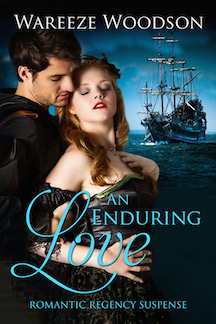
Born and raised in Latvia, Rebecca Balodis marries Rhys Sudduth, an English diplomat. Shortly thereafter, he is summoned home to attend his father’s deathbed. Rebecca cannot accompany him at the time and becomes trapped in the turmoil plaguing her country. He is informed she died in the upheaval.

Final-An-Enduring-Love-(med) copyNearly four years later, she escapes and arrives in London with their son in tow. Arriving in the middle of his sister’s ball is very awkward, especially since Rhys plans to announce his betrothal to a young debutante later in the evening.

Trouble, tangled in suspense and danger, follow her from Latvia. Can this pair ever find or even recognize an enduring love? Is it worth keeping?

Amazon

Excerpt

The gangplank of the Dragon’s Stirr had been lowered ready for Latvian passengers to board. The creak of the ropes tying the vessel to the dock rasped Rebecca’s nerves, reminding her that soon Rhys would sail back to England without her. Devastated by the thought of such a loss and at such a time, she swallowed hard. How can I bear to let him leave me behind?

Standing on the dock in the mid-day sun, she tried to hold back her sobs and for a moment, she feared her knees might give way beneath her. She clinched her jaw, trying to hold steady and caught the lapels of Rhys’s finely tailored jacket with trembling fingers. A rising ocean breeze stirred his dark hair and swirled her skirts about her ankles as he placed his hand over hers.

When Rebecca gazed into Rhys’ deep blue eyes, Gorgi Weister’s words intruded. Sudduth is almost believable when he claims undying devotion. I admire his talent. Her chest burned with apprehension and she gulped a deep breath. What if Weister is correct? Does Rhys wish to abandon me as Weister implied?  

Weister’s sly innuendoes and the sound of his mocking laughter circled in her mind, but she pushed such negative views aside. Guilt for allowing a moment of doubt to fester filled her with shame, but that too, she brushed aside. Ne! I refuse to believe Rhys would desert me. Although we have only been married a few months his love is strong and will endure forever, as will mine. Nevertheless, doubt crawled into her head, impossible to completely deny. Still, why would a government official such as Gorgi Weister attempt to stir trouble with lies? It made no sense!

About the Author

I am a native of Texas and still live in this great state. I married my high school sweetheart, years and years ago. We raised four children and have eight grandchildren, and grandchildren are Grand. At the moment, all my children and my grandchildren live within seventy miles of our home, lots of visits. My husband and I still love each other after all these years the stuff romance is made of, Happy Ever After!

WebsiteFacebookTwitterGoodreads

Regency Dressmakers and Their Fabrics

By Wareeze Woodson

Dressmakers, historically known as mantua-makers or a modiste fashioned custom garments for her clientele. Sewing everything by hand took several hours of labor, and the more elaborate the gown, the higher the price. Many times these women sewed well into the night to finish a gown for a special client. A modiste or dressmaker sewed a fine seam. A straight stitch is hard to make, but the best dressmaker’s of the day sewed twelve straight stitches in an inch of fabric. What an artist!

Fabric, available and most often used during the Regency period, were varied. Silk, satin, wool, velvet and cotton each had its place in the construction of a garment. Satin weaves, twill weaves, and plain weaves are the three basic types of weaving by which the majority of woven products are formed.

Some of the names of these fabrics in the finished state are as follows:

Silk, the most favored for the soft feel and the easily draping properties of the fabric, was much in demand. Satin and velvet were woven from silk. The differences rest with the weave of the threads.

Satin was much in demand as well. There are several types of satin made in different ways. Satin is usually a warp-faced weaving technique in which warp yarns are “floated” over weft yarns, although there are also weft-faced satins.

Baronet or baronette has a cotton back and a silk front, similar to georgette.

Charmeuse is a lightweight, draping satin-weave fabric with a dull reverse.

Double faced satin is woven with a glossy surface on both sides. It is possible for both sides to have a different pattern, albeit using the same colors.

Duchess satin is a particularly luxurious, heavy, stiff satin.

Faconne is jacquard woven satin.

Farmer’s satin or Venetian cloth is made from mercerised cotton.

Gattar is satin made with a silk warp and a cotton weft.

Messaline is lightweight and loosely woven.

Georgette is a sheer, lightweight, dull-finished crape fabric named after the early 20th century French dressmaker Georgette de la Plante. Originally made from silk, georgette is made with highly twisted yarns. Its characteristic crinkly surface is created by alternating S- and Z-twist yarns in both warp and weft. Georgette is made in solid colors and prints and is used for blouses, dresses, evening gowns, and trimmings.

Crêpe or crape is a silk or wool fabric with a distinctively crisp, crimped appearance.

Cambric or batiste, one of the finest and most dense kinds of cloth is a lightweight plain-weave fabric woven in greige, then bleached, piece-dyed and often glazed or calendered. Initially, in the 19th century, it was made of linen, then cotton. Cambric is used for linens, shirtings, handkerchieves and as fabric for lace and needlework. Cambric was originally a kind of fine white plain-weave linen cloth made at or near Cambrai. White linen cambric was used to fashion fine shirts, underwear, shirt frills, cravats, collars and cuffs, handkerchiefs, and infant wear.

Nainsook is a fine, soft muslin fabric. (cotton)

Lawn cloth or lawn is a plain weave textile, originally of linen but now chiefly cotton. Lawn is designed using fine, high count yarns, which results in a silky, untextured feel. The fabric is made using either combed or carded yarns. When lawn is made using combed yarns, with a soft feel and slight luster, it is known as “nainsook”. The term lawn is also used in the textile industry to refer to a type of starched crisp finish given to a cloth product. The finish can be applied to a variety of fine fabrics, prints or plain

Lawn is a lightweight, sheer cloth, crisper than voile but not as crisp as organdy. Lawn is known for its semi-transparency, which can range from gauzy or sheer to an almost opaque effect, known as lining or utility lawn. The finish used on lawn ranges from soft to semi-crisp to crisp, but the fabric is never completely stiff. Lawn can be white, or may be dyed or printed.

Batiste is a fine cloth made from cotton or wool or a blend, and the softest of the lightweight opaque fabrics.

Kerseymere is a fine woolen cloth with a fancy twill weave.

Trims used for decoration: Ruffle, frill, or furbelow is a strip of fabric, lace or ribbon tightly gathered or pleated on one edge to add as trim to a garment or bedding and such.

The term flounce is a particular type of fabric manipulation that creates a similar look but with less bulk than a ruffle. A flounce is created by cutting a curved strip of fabric and applying the inner or shorter edge to the garment. The depth of the curve as well as the width of the fabric determines the depth of the flounce. A godet is a circle wedge that can be inserted into a flounce to further deepen the outer floating wave without adding additional bulk at the point of attachment to the body of the garment, such as at the hemline, collar or sleeve.

Fringe is an ornamental textile trim applied to an edge of an item, such as drapery, a flag, epaulettes, or decorative tassel.

French bead edgings, worked muslin jaconet, embroidery, knotted ribbons and pearl rosettes were also used to enhance a creation.

Terms for apparel: Gowns, day dresses, walking-dresses were all dresses and includes a ball-gowns, riding apparel along with travel garments.

A pelisse was a short cape, shawls and cloaks, many fur-lined were worn to protect the wearer from a chill in the air or on occasion to display a new purchase.

A caraco was a jacket like bodice worn with a petticoat and had sleeves to the elbow, a popular style.

Panniers were side hoops worn under the petticoat with a caraco.

A redingote was a gown with a tight bodice and long sleeves with a collar much like a man’s jacket. The petticoat formed the front of the gown with an overskirt to match the bodice.

Gloves, some short to above the wrist and some covered the elbow, were always worn in public or gathering outside the home.

Hats and bonnets of every description were also worn for any outing. Dressmakers often made hats as well.

Alina K. Field: Bella’s Band

Interview With Alina K. Field

Today’s guest at Susana’s Parlour is Alina K. Field, author of Bella’s Band, released September 3, 2014 by Soul Mate Publishing. Alina will give one lucky commenter a $5 Amazon gift certificate. And don’t forget that all commenters this month are eligible to win Susana’s September Giveaway, a lovely necklace from London’s National Gallery Gift Shop (see photo at right).

Susana: How long have you been writing?

Alina_K._Field copyAlina: I’ve been writing since I picked up that first crayon, though I have to say, the early days were mostly school reports, journals, and poetry. I wrote a lot of poetry in my growing-up years, but I was too intimidated to tackle fiction. The kind of stories I liked to both read and make up in my head were not the kind we studied in our literature classes! Even then I was a commercial fiction girl.

I didn’t start my first novel until 1985, and I didn’t type “the end” on that story until 2009. In between I had a chaotic and busy time of working, moving, caring for children, animals, and in-laws, and working some more—just the usual woman’s lot! In 2008 I was able to catch my breath, and when in a fit of closet-cleaning I stumbled across that partial manuscript, I started writing again.

Susana: So I take it, that lapse in writing was not writer’s block? Do you ever suffer from it? If so, what do you do about it?

Alina: I do have times when I struggle with a story, though I don’t consciously think of it as being blocked. It’s more a case of—well this is going to sound weird maybe!—tangling my muse up in self-doubt and external stresses. My cure for this problem is

  1. go back and ground myself in the characters’ overall goals,
  2. give myself permission to write cr*p, and
  3. write every day, even if I’m only squeezing out a page.

Susana: Are you a plotter or a pantser?

Alina: I like to have an idea of where I’m going in terms of turning points, but the thought of planning out scenes in great detail is terrifying. I’ve tried it, and for me it’s a muse-zapper.

Susana: Tell us something about your newest release that is NOT in the blurb.

Alina: I had my spinster heroine visit a respectable brothel. In the first draft, she merely lingered in the back garden waiting for the “abbess” to come out and talk to her. In the next draft, she entered the house. It was so much fun to write that scene.

And, no spoilers here, but there is a surprise at the end of the book that has nothing to do with the resolution of the murder.

Susana: Are you working on something at present that you would like to tell us about?

Alina: I’m writing the next book in this Regency series. The hero is the not-so-lowly-as-we-thought steward in Bella’s Band. It turns out that he’s the eldest son of an earl, albeit illegitimate. Gosh, and I didn’t know that when I was writing Bella’s Band! I’ve put this story down several times to work on other priorities, and I’m anxious to get back to it.

Susana: Describe the “perfect hero”. What about the “perfect hero” for you?

Alina: My author friend Anne Cleeland says what women want from a hero is devotion to the heroine. I think she’s right. The external bits—his looks, his muscle, his ability to provide—those are the tools he uses to attract and protect his woman, but they’re not necessarily essential (think of some of Mary Balogh’s wounded heroes). Whether he’s madly in love from page one, or comes around to it through the course of the story, the perfect hero shows through his deeds how much he cares for the heroine. The perfect hero is either honorable from the start, or “uncovers” the honor at his core through this great love. What’s better than a bad boy hero reformed by love?

As for me, I had the good fortune to marry my hero many years ago! He’s perfect in all the important ways.

Gabby copySusana: What would we find under your bed?

Alina: Dust bunnies, of course, I’m an author! Oh, and you might find a squeaky toy that belongs to my dog. [sending along a picture for you to include here, if you wish] I used to do some under-the-bed storage until my sister feng shuid my house. Apparently, it’s very bad to sleep on concealed clutter. Now that space is dusty, but otherwise pristine.

Amazon

About Bella’s Band

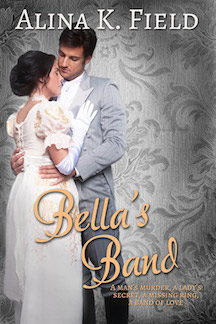
Bella's-Band-Final-(med)-copy copyBullets, blades, and incendiary bombs—Major Steven Beauverde, the latest Earl of Hackwell, belongs in that world, and is determined to get back to it. His brother’s murder has forced Steven out of the army and into the title, but he has no interest in being the Earl, and worse, no idea how to salvage the depleted estate. A rumor that his brother had a son by a woman who may be a) the murderer, and b) his brother’s wife, sets Steven on a mission to find her, the boy, and—Steven ardently hopes—proof of a secret marriage that will set Steven free.

Annabelle Harris is a country heiress and a confirmed spinster resettled in London to find her sister, the mistress to the Earl of Hackwell. While she searches, she fills her home with orphans and street urchins. When the Earl is murdered, Annabelle’s sister thrusts the Earl’s illegitimate child into Annabelle’s care and disappears. Now, with suspicion pointing at her sister, Annabelle has begun a new quest—to find her sibling and clear her name.

When their paths converge, the reluctant Earl and the determined spinster find themselves rethinking their goals, and stepping up to fight back when the real murderer shows up.

Excerpt

Surprise pinned Annabelle to the cracked leather seat of the carriage and finally her heart restarted and picked up its pounding.

“Good evening, my lady.” Lord Hackwell flashed her a wide, easy smile that made his face glow like a boy who had pulled a very fast one.

The shock eased. She realized she felt not one whit of fear.

“Is this an abduction, Lord Hackwell? I have never been abducted before. Shall I scream with alarm? Do you mean to harm me?”

His smile disappeared and his face grew too serious. “I mean to protect you, Miss Harris. This is an escort. I mean to see that you return home unharmed.”

“I see. Unharmed, except for the besmirching of my reputation. Shall we appear in the scandal sheets tomorrow, do you suppose?”

“In this bourgeois neighborhood? I think not. Unless, the man who helped you into the hackney is someone of interest?”

Oh, he was prying, and she was so tempted to lead him on. But of course, she had Robby to think about. “Very much so. He is my solicitor. He asked me to dinner to counterbalance his wife’s inquisitive aunt who is visiting from the country, and curious about all things criminal, political, and financial. The poor man has difficulty balancing his client’s confidentiality with his need to be polite to his children’s future benefactress. She is wealthy, I believe.”

“So he set her on you. And how did you maintain your secrets, Miss Harris?”

“We spoke of my home.”

“Which is?”

A ribbon of sensation uncurled in her secret places. The space between her and Lord Hackwell had shrunk, and his dark eyes showed more than an interest in her pedigree. Her nerves tingled with the anticipated pleasure of a repeat of the earlier kiss.

I must not.

“Yorkshire,” she said, as blandly as possible. “I grew up on a good-sized estate there.”

“Do you plan to take Robby there?”

Sudden tears pricked her eyes and she turned quickly to the window. Robby and Thomas would have loved Ryeland. With acres and acres of freedom and kind neighbors, they could have played for hours and had adventures that didn’t involve cutpurses and the Watch.

“Miss Harris?”

“No, Lord Hackwell. My family home was entailed. The cousin who inherited, I’ve only met once, at my father’s funeral.” And his invitation to linger had been merely perfunctory. Besides, staying in the district of her childhood would beg questions about Veronica.

“So you had no brothers. Is your mother living?”

He hadn’t asked about sisters. That was curious. Perhaps he suspected her relationship with Miss Miller was more than a friendship, and was coming to the question, inch by torturing inch.

“You are dancing again, Lord Hackwell. It is ever so tiresome. Let us get you to the facts. I am the eldest surviving child of Edward Harris, who died two years ago. I had a brother, who died many years before. I have a younger sister who has found a position and made a life with a distant cousin in Scotland. My mother has been gone since I was eighteen. I am twenty-seven years old now. I never had a coming out, because my father took ill, and needed me to manage the estate.”

His eyes widened and he went very still, examining her. The air around them seemed charged with a kind of explosive tension.

Oh heavens. He was finding fault with the country spinster. The gown was from her mourning two years previous, outdated of course, and she felt her hair slipping again, and she’d never been one to effect powders and pigments. “Yes. Well—”

You managed an estate?”

“Astonishing, isn’t it?” She waved a gloved hand in the air, and he captured it.

He dropped a kiss on her knuckle. “And you managed the household also?”

“Yes, of course.”

“And you don’t care for dancing?”

“I enjoy dancing very much, though my experience is limited to our local assembly. I have not been to a ball in so many ages, and never a town ball.”

“No Almack’s.”

She could only laugh at that and shake her head. She receive a voucher for Almack’s? Ridiculous.

“No waltzing, Miss Harris?” His manner remained intense.

“Sadly, no, Lord Hackwell, I have never waltzed.”

He straightened in his seat and his eyes looked ahead. “But you have counted ploughs,” he said thoughtfully.

Tears pricked again, suddenly and unexpectedly. What a dismal woman she was. Too plain, too proper, too practical. Alone in a closed hackney with a devastatingly handsome man, and they were talking about farm equipment.

Never had she felt more desire to be younger, prettier, more daring. This must have been how Veronica had felt.

Her heart filled with compassion and grief. “Ye—yes. Ploughs. Very important they’re correctly deployed. Fate of the tenants’ crops and the estate’s income depends upon them.” She sniffed.

“What’s this?” His large ungloved hand covered her smaller ones, enveloping her in his warmth. “I’ve distressed you?”

She shook her head and tried to compose herself.

“Of course I have, my dear. I’ve reminded you of your lost home.”

“It is fine, sir. My current home is—is not the best, but it is mine, and I can afford to move to something better if the neighborhood deteriorates further. You needn’t worry about Robby. I will give him a good life. Not, perhaps, an aristocratic one, but—”

“Shall I tell you about myself, Miss Harris? Yes. I believe I must.” He cocked his leg on the seat so he sat sideways, and extended his hand to caress the back of her neck. The other remained squarely over her folded hands. “I am twenty-nine. The younger son of the Earl of Hackwell. The very, as it has turned out, needful spare. My mother was the second of two wives. She died not long after I was born. My father sent me off to be fostered, then off to Eton, and then to university for a very short while. I’m not much of a scholar. I landed in the army, where I found I could do something of worth.”

His mouth had grown taut and his hand had tightened over hers, so that she could feel his tension.

“Thomas, the late, great, Lord Hackwell, aside from one lengthy grand tour, was kept close under the paternal wing and learned the business of managing the earldom, standing in the House of Lords, and immersing himself in society. From the state of the accounts, it was the last activity that drew most of his interest.”

He let his fingers caress her neck, distractedly, as though the gesture comforted him, like petting a favorite hound.

Comforting to him; deliciously unsettling to her. Pleasure rippled through her at each touch. She held her breath, lest his fingers pause too long in his search for his next words.

“I can bow properly and make reasonably polite conversation, but I was never much good in a ballroom or drawing room, Miss Harris. Still, like every gentleman with a purse, I had my share of immersing myself in pleasure. Here, and on the continent.” He lapsed into a momentary dark silence. “Not so much since my return.”

“You fought at Waterloo?”

“Yes. And before, on the peninsula.”

And before that too, at every step of his motherless, fatherless life, she’d warrant. As in the children’s game she played with the boys, Annabelle drew out a hand from the pile and pressed his between hers.

And her heart skipped with a realization. Lord Hackwell had no family except Robby.

She felt his eyes fixed on her. He drew her head closer and she could smell his woodsy clean scent, so intensely male. The carriage passed by a street lamp and into a dark stretch, and she could no longer discern the outline of his face.

Her heart tingled and her breath came in short little huffs of anticipated pleasure.

“Annabelle,” he whispered. “What do they call you? Anna? Belle?”

She tensed remembering her chat with Lady Rosalyn.

“It is Belle. How very appropriate.” He kissed her hand.

“Bella,” she whispered. “And not appropriate at all. How did you learn my name?”

“Bella.” He breathed her name in a brandy-laced murmur. “The maid at the Harley Street house gave me your last name. And by the way, she worships you.”

Dear Trish. Annabelle pushed at the seat and squirmed, with no success. He still held her fast.

“I’ve found that servants know everything and talk prodigiously.” He dropped a kiss on her nose.

Annabelle bit back a disagreement and stilled. In a properly run household, gossip was squashed. The poor man had never lived in a properly run household.

His lips hovered over her and she waited. He’d kissed her nose. Perhaps he’d been aiming for her mouth and missed. She wanted one more kiss. She would be safe. In a carriage on a public street, he wouldn’t attempt to take more.

***

Steven held himself an inch away from her lips. Her nose had been cold, but heat radiated between them, holding them in a warm cocoon. She smelled of plain soap and faint lavender. There was nothing cloying about Miss Harris. He’d breached a line of defense with the use of the pet name. Bella. She wanted him to kiss her.

Not yet. Not yet. She was lovely, and innocent, and perfect. He was known for his quick thinking under duress, and he’d made up his mind. He would do this honorably. He was not his brother. It would not be a seduction.

“Bella, you are right that we should dispense with the dance. You are right that we should speak to the point, and so I will. I think you and I, we should wed.”

What?” She jumped a full inch from the seat before settling back.

About the Author

Award-winning author Alina K. Field earned a Bachelor of Arts Degree in English and German literature, but she found her true passion in reading and writing romance. Though her roots are in the Midwest, after six very, very, very cold years in Chicago, she moved to Southern California and hasn’t looked back. She shares a midcentury home with her husband and a blue-eyed cat who conned his way in for dinner one day and decided the food was too good to leave.

FacebookTwitter Website & Blog

D.W. Wilkin: Caution’s Heir

18-4-18

My Dear Lady Chevly

You know that as we are the closest of friends I never in all the long years that we have known each, resort to gossip.

Untitled1

Oops, ink spill, I have to cut a new quill.

I know you are thinking of the time I shared that delicious piece about Devonshire, and then well the other time about Caro Lamb, but who wasn’t talking about Caro then. Poor creature.

Very well, I am sure you want to know as quickly as I can relate it, especially before someone mentions it and you are nabbed. I so hate being betwattled that way.

It is Bartle’s nephew, Daventry. Oh, I know you know all about how he took that fool Hroek for everything he had. And how your Chevly was there and said that Daventry was a gentleman through and through, trying to make light of the bet and return it all to Hroek. Shame that the man was not like his elder brother. Now that was a marquess!

And I well remember how we both made eyes at the man when he came to Town. The old marquess, not his nit of a brother. Well, did you know that the new one had a daughter? I surely didn’t. She’s never been to Town nor had a season at all. Well, of course not if she’s never been to Town. Louisa. That is her name. Lady Louisa Booth.

Well, she is in London now. Showed up at the Earl of Daventry’s house this very morning. She and her companion and claimed that as how Daventry won everything from her father, who has apparently fled for the Americas, including all in his house, Daventry had won her too!

I know you must be choking, as I was when my maid ran in to inform me of all that was taking place about Golden Square. I haven’t got more than a glimpse of the girl through the window, and she looks fetching from what I can see. Wouldn’t that just choke Bartle as if she swallowed a fish bone. Her nephew married to a penniless chit, when she hopes to snare a fortune for the man and repair the wealth that her brother the Duke has wasted.

I intend to drop my card over there later and hope that the girl will call upon me. I will write as soon as she does.

Yours,

Dartenmore

About Caution’s Heir

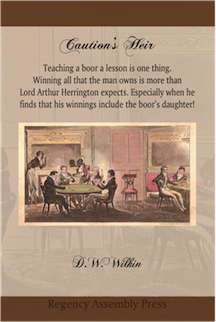
coverTeaching a boor a lesson is one thing.

Winning all that the man owns is more than Lord Arthur Herrington expects. Especially when he finds that his winnings include the boor’s daughter!

The Duke of Northampshire spent fortunes in his youth. The reality of which his son, Arthur the Earl of Daventry, learns all too well when sent off to school with nothing in his pocket. Learning to fill that pocket leads him on a road to frugality and his becoming a sober man of Town. A sober but very much respected member of the Ton.

Lady Louisa Booth did not have much hope for her father, known in the country for his profligate ways. Yet when the man inherited her gallant uncle’s title and wealth, she hoped he would reform. Alas, that was not to be the case.

When she learned everything was lost, including her beloved home, she made it her purpose to ensure that Lord Arthur was not indifferent to her plight. An unmarried young woman cast adrift in society without a protector. A role that Arthur never thought to be cast as. A role he had little idea if he could rise to such occasion. Yet would Louisa find Arthur to be that one true benefactor? Would Arthur make this obligation something more? Would a game of chance lead to love?

 Amazon (digital) • Amazon (print)

Barnes & NobleiBooksSmashwords

Caution’s Heir Website

About the Author

UntitledAn award winning author, Mr. Wilkin is a graduate in history. He has been writing in various genres for thirty years. Extensive study of premodern civilizations, including years as a re-enactor of medieval, renaissance and regency times has given Mr. Wilkin an insight into such antiquated cultures.

Trained in fighting forms as well as his background in history lends his fantasy work to encompass mores beyond simple hero quests to add the depth of the world and political forms to his tales.

Throughout his involvement with various periods of long ago days, he has also learned the dances of those times. Not only becoming proficient at them but also teaching thousands how to do them as well.

Mr. Wilkin regularly posts about Regency history at his blog, and is a member of English Historical Fiction Authors. His very first article was published while in college, and though that magazine is defunct, he still waits patiently for the few dollars the publisher owes him for the piece.

Mr. Wilkin is also the author of several Regency romances, and including a sequel to the epic Pride and Prejudice by Jane Austen. His recent work, Beggars Can’t Be Choosier has won the prestigious Outstanding Historical Romance award from Romance Reviews Magazine.

Blog

Blog post about Caution’s Heir

Maggi Andersen: What a Rake Wants (The Spies of Mayfair Series)

Interview With Maggi Andersen

Susana: What inspired you to start writing?

Maggi: I needed little inspiration I remember writing at a very young age. When I had the time to devote to a career in writing, I took it up seriously.

Susana: How long have you been writing?

AuthorPicMaggi: I began 15 years ago. I wrote my first book for my master’s degree. It was a murder mystery titled Murder in Devon.

Susana: What advice would you give to writers just starting out?

Maggi: Patience is something writers need in spades, although these days it’s not nearly as bad as it was years ago, when we had to post everything and wait months for a reply. It takes time to find your voice and learn your craft though. Don’t be too hasty sending off your work. Make sure it’s as perfect as you can get it. Put it aside for as long as you can and then look at it with new eyes. You’ll be surprised at the mistakes you’ll find, and what you can see to improve it. Wait a few weeks if you can. Another example of why we need patience! J

Susana: Do you ever suffer from writer’s block? If so, what do you do about it?

Maggi: No, never. I don’t believe in it. If I run out of ideas, I just start writing. The creative brain kicks into action and something will come. You can always edit the first draft. You can’t edit a blank page.

Susana: What comes first: the plot or the characters?

Maggi: When I first began writing it was plot driven, but now the characters drive the story. Sometimes, without me at the wheel.

Susana: Are you a plotter or a pantser?

Maggi: I tend to be a bit of both. I know the ending. It’s not hard it’s a romance! I plot a scene ahead but that can change as the characters lead me off somewhere surprising. I like the panster element in my writing because it can go off on tangents I would never have thought of plotting the story. A spy story or mystery needs more plotting. I like to end up with a reasonable first draft.

Susana: Tell us something about your newest release that is NOT in the blurb.

Maggi: Flynn, Lord Montsimon is playing the game of a rake due to the hurt he suffered as a child in Ireland. It takes a woman like Lady Althea Brookwood to show him his true feelings and melt his heart. My inspiration for Flynn came from Errol Flynn, the Australian actor. Despite his racy reputation, Flynn was known to be a cultured gentleman. I love his movies, who doesn’t like Captain Blood?

Susana: Are you working on something at present that you would like to tell us about?

Maggi: I’m writing another Regency series, The Baxendale Sisters. The first is Lady Honor’s story. The book is titled: Honor’s Debt.

Susana: What are you reading now?

Maggi: Not a historical. Slow Hand by Victoria Vane. It’s great!

Susana: What author or authors have most influenced your writing?

Maggi: Surprisingly, Harlan Coben. A suspense writer can learn a lot from the way he crafts his stories. My love of historials came from Georgette Heyer, Victoria Holt, Eloisa James and Jane Austen. I like Julia Quinn and Anna Campbell too.

Susana: What is your work schedule like when writing?

Maggi: I spend long hours at my desk every day. (My husband is retired from the law and does the cooking). I don’t write at night, I join him to watch something on the television or read.

Susana: What did you want to be when you grew up?

Maggi: I dreamed of living in an English country village while writing. (My artist mother was born of English parents, and this was her dream too) I now live in a quaint, Australian country village in the Southern Highlands of New South Wales, where tourists come to see the spring gardens. And I spend my days writing, so I guess I’ve come close to living my dream.

Susana: What is your favorite food? Least favorite? Why?

Maggi: My love of all kinds of cheeses, which comes from my Danish father. Least favorite, any kind of offal. I remember my Dad loved brains and my mother would cook them for him on his birthday. Yuk!

Susana: What is one thing your readers would be most surprised to learn about you?

Maggi: My first job was in a bank, and for a creative person like me, I found it difficult and boring. I can balance a check book though.

Susana: Is there a writer you idolize? If so, who?

Maggi: I’d have to say Mary Stewart who died recently in her 90s. She was a poet and wrote the first romantic suspense novels. I have her entire library.

Question for the Readers: What problem didn’t occur to Althea when she chose the gown she wore?

About What a Rake Wants

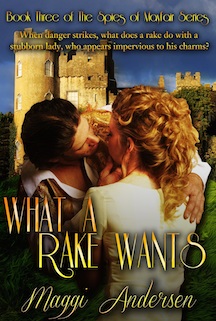
WARW2 copyKing George sends his private investigator, an Irishman, Kieran Flynn, Lord Montsimon, on a mission, the reason for which is unclear. Is it a plot against the Crown? Or something entirely unrelated? Flynn’s inquiries lead him to the widow, Lady Althea Brookwood. Known amongst the ton as a rake, Flynn is rarely turned down by a lady, and when Althea refuses not just him but many other men, he becomes intrigued.

After her neighbor, Sir Harold Crowthorne informs Lady Althea that he means to take her country property, Owltree Cottage, by fair means or foul, she must search for help. The first man she turns to is promptly murdered and the second lies to her. That leaves Flynn, Lord Montsimon, a man she has been studiously avoiding. But Montsimon is decidedly unhelpful, and more than a little mysterious. Her only option is to seduce him. Lady Althea has little confidence that she will succeed, especially as before her husband was killed in a duel, he often told her she was quite hopeless at intimacy.

When a spy is murdered, Flynn wonders just what Althea knows and what her involvement might be with the man the king wants Flynn to investigate.

Amazon Kindle • Amazon Print

Excerpt

(Lord Montsimon and Lady Althea Brookwood are forced to share a bed for the night.)

The attic room had a low, sloping ceiling. A green hook rug covered the floor and a jug, basin, and towels had been placed on the tall dresser. A straight-backed chair sat in the corner and the bed against the far wall. Mrs. Fletcher’s description of the bed had been accurate: the small wooden bedstead was covered in a bright quilt and not designed for two. Althea stared at it, her throat tight with dismay, as Montsimon shut the door. His nearness in the small space was overwhelming.

Seemingly unaffected, Montsimon peeled off his coat and sat on the feather-filled mattress, which sank visibly under his weight. He looked annoyingly at home. He tugged at his cravat then undid the buttons on his shirt to reveal a strong throat and a glimpse of dark chest hair. She took in the male strength, the cleanliness and beauty of him and turned away to fuss with her cloak before hanging it over the chair.

“Would you help me off with my boots?”

“I’m hardly a valet,” she said, sounding peevish.

“Not as strong, but we shall manage,” he said with a grin. His waistcoat joined his coat on the chair. How much was he going to remove? She wished her breath would slow.

Althea took hold of the mud-splashed, black leather Hessian boot and pulled. It didn’t budge.

“Perhaps a bit harder?”

Annoyed by his manner, she gave a violent yank. The boot slid down Montsimon’s well-defined calf so fast she fell onto her derriere on the hard plank floor.

“Are you all right?” His grin widened as he leapt up.

“Perfectly.” She waved his hand away and climbed to her feet, resisting a rub of the damaged area. “Your other foot if you please.”

“If you’re sure?” he asked with a burst of laughter.

With a dismissive scowl, she planted her feet and taking a firm hold of the boot, eased it down more gradually. It slid off his leg without further mishap. There was something disturbingly intimate about his broad chest encased in white linen, the form-fitting grey trousers and his big stockinged feet. Had she ever seen Brookwood this way? He always came to her chamber dressed in his banyan and slippers. And she had dreaded the sight of him.

Montsimon stood, ducking his head under a beam. “You’ll never manage that dress on your own.”

She crossed her arms. “I’m keeping it on.”

“Such a pretty gown was meant for a drawing room, not for sleeping in.”

“Nevertheless, I shall sleep in it.” She perched on the chair and took off her shoes.

He frowned. “Give me a look at those.”

“Why?” She handed them to him.

He turned a shoe over in his big hands. The sole of one had worn through. “These are about to fall apart. I had no idea you wore such flimsy shoes.”

“They are meant for drawing rooms, my lord. As is my dress.”

“That gown will look like a rag in the morning. As you have nothing else to change into, you will have to bear it until we return to London.”

Why did he so often make sense? She brushed down her skirts, which were already dreadfully crushed, and was forced to agree. She wasn’t a shy, green girl; she just didn’t want to inflame Flynn’s passions. It would take very little, she suspected. But her underwear covered her and was perfectly modest. “The bed is too small. A gentleman would sleep in the chair.”

His eyebrows flew up. “It’s made of wood.”

“Obviously.”

He flapped a hand in dismissal. “I intend to sleep in that bed, my lady. Where you choose to sleep is entirely up to you. I’m going downstairs to wash at the pump. While I’m away, you can undress and hide beneath the covers.” He paused, one hand on the doorknob. “Again, do you require help to undo those impossible little buttons at your back?”

“Odd that this problem didn’t occur to me when I chose to wear it.” Her lips puckered in annoyance. While they were arguing, what remained of the night was passing. She turned her back. “If you will.” If he treated her like a servant, she would do likewise.

Her hair had begun to escape the topknot, and she swept it up out of the way, scattering pins. She tingled under the gentle touch of his fingers as they moved down her back. Her gown fell away. “What are you doing?”

“Unlacing your stays. You can’t sleep in this uncomfortable garment!”

“I had intended to,” she said, pulling away as he tugged at the laces. Too late, she felt them give.

“You have lovely hair, Althea,” he said softly.

His use of her name was very seductive. Her pulse skittered alarmingly. She spun around, clutching the bodice of her dress to her chest as her stays slipped to the floor.

Montsimon looked her up and down, warm approval in his gaze.

She backed away from him, longing for the shelter of darkness. “Once I’m in bed, shall I blow out the candle?”

“If you wish.” Montsimon closed the door behind him.

About the Author

Maggi Andersen lives with her lawyer husband in a quaint old town in the Southern Highlands of New South Wales, Australia. She began writing fiction after raising three children and studying for a BA and an MA in Creative Writing.

When not creating stories, Maggi reads, enjoys her garden, goes for long walks and feeds the local wildlife. Her six kookaburras (Australian Kingfishers) prefer to be hand fed.

An Amazon bestselling Regency author, Maggi writes in several genres, contemporary and historical romances and young adult novels. Having grown up reading Enid Blyton and Georgette Heyer, Maggi’s romances are filled with adventure, mystery or intrigue, but always with a happy ending.

Her latest releases:

The Spies of Mayfair Series

A Baron in Her Bed

Taming a Gentleman Spy

What a Rake Wants

Website

Historical Tidbit

Did you know that in the fifteenth century, only a few could afford glass windows? They became more common in the sixteenth but were still expensive. When people moved they took their windows with them! Tudor windows were small pieces of glass held together by strips of lead in a criss-cross or lattice pattern. To make a pane of glass, a blog of glass was blown into a cylinder-shaped bubble, which was placed on a cooling table. Then afer the bubble cooled, it was cut in half producing a small piece.

The poor, however, still had to make do with strips of linen soaked in linseed oil.

Hardwick Hall, owned by Dowager Countess of Shrewsbury, was famous for its Tudor windows. It inspired a rhyme: “Hardwick Hall more glass than wall.”

Untitled

Renee Reynolds and A Marquis For All Seasons

BBT_AMarquisForAllSeasons_Banner

Renee will be awarding a replica of the locket and chain worn by the heroine in the book, and a copy of A Marquis For All Seasons (choice of print or ebook; print will be autographed) to a randomly drawn commenter during the tour (US ONLY). Click here for the Rafflecopter. Click on the banner to follow the tour and increase your chances of winning.

Renee Reynolds prize giveaway bronze long necklace with locket

About A Marquis For All Seasons

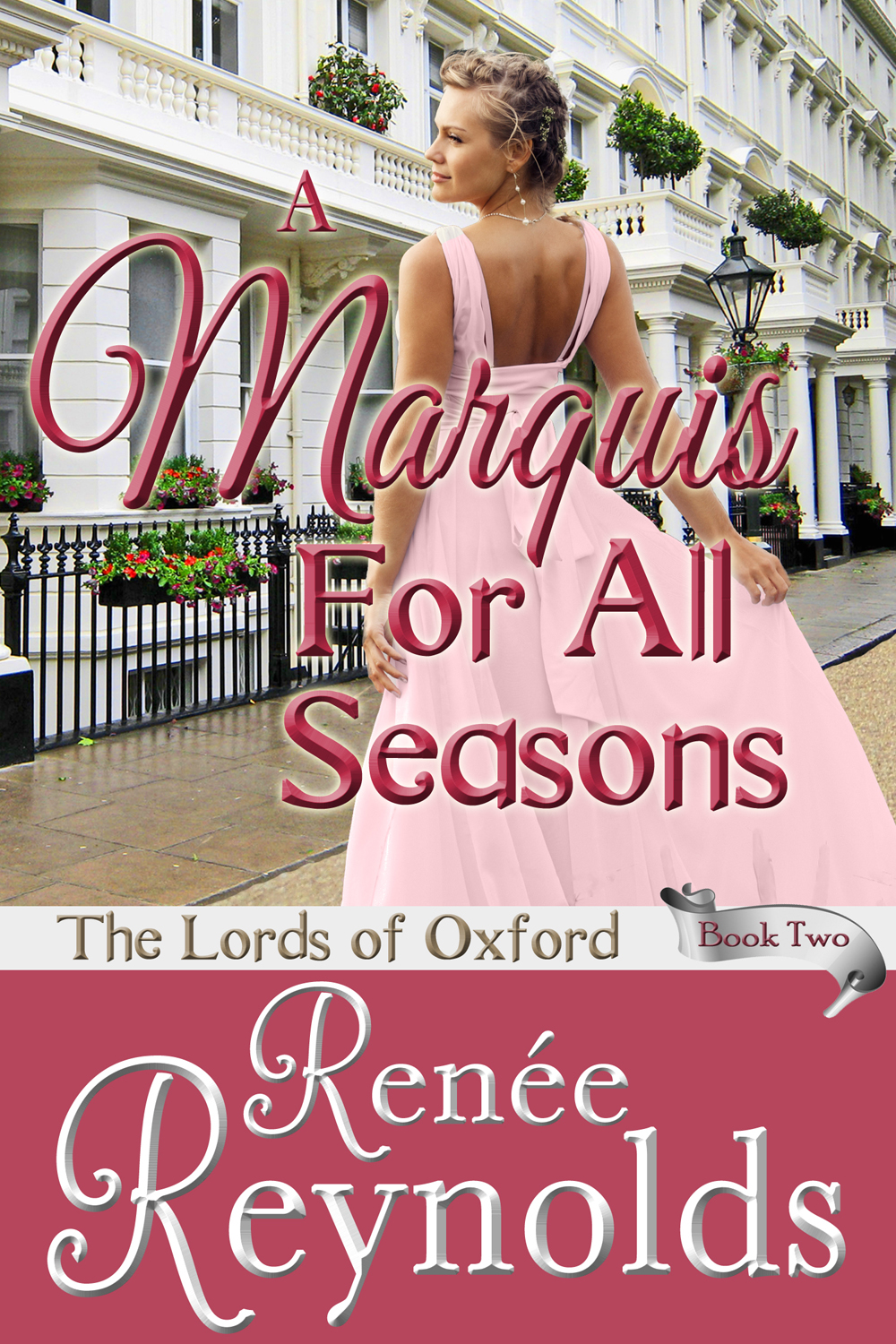
Lady Miranda Leighton and the Marquis of Stafford, Roman de Courtenay, have a similar problem: their families want them to find a spouse. Together they hatch the perfect scheme: they will pretend an attachment and trick their families in their pursuit of one last season of unencumbered entertainment. Yet, in each other’s constant company, they find their ruse giving rise to some surprisingly very real feelings. What happens when you set out to fool society, but only end up fooling yourselves?

Excerpt

“Let us take each day as it comes, and decide entertainments best suited to our attendance closer to the events,” Lord Stafford suggested with a resigned air. He sighed, suddenly weary at the drastic turn his summer was taking. His time would not be his own, it seemed. At least Lady Miranda did not ask him to undertake the ridiculous, such as a trip to Tattersall’s, a gambling hell, or Almack’s. He could well manage a few parties and the occasional turn through Hyde Park. He grinned suddenly. “We shall woo our families with the idea that we woo each other,” he quipped.

Cover_A Marquis For All SeasonsMiranda groaned, rolling her eyes but grinning in response. “And we shall have the most fun possible in the process.”

“Yes, well, that remains to be seen. I suppose it depends on one’s definition of ‘fun,’” he returned as his brows drew together in thought.

“And in one’s ability to experience it. I give you leave to pay me as many pretty comments as necessary,” she teased.

“Then, I give you leave to swoon, but no more than twice, and only after conveying your raptures over the delicacy of my words.”

Miranda squeezed his arm in delight as they neared the gazebo. “I’m not ashamed to admit it: I plan to enjoy our ruse immensely.”

“While I plan to suffer all for the greater good.”

“As long as you ‘suffer all’ with a besotted air, you may suffer as much as you see fit.”

About the Author

AuthorPicAuthor Renée Reynolds grew up all over the world as the daughter of a globe-trotting Marine father and spirited and supportive mother. Their family motto was you can never learn too much, travel too much, or talk too much.

She majored in majors in college, and after obtaining a host of degrees she decided not to use any of them and instead writes about what she cannot do – go back in time to dance at balls, flirt with lords, gentlemen, and scoundrels, and gallop unfashionably down Rotten Row during the most fashionable hour.

After dodging a few Collinses and Wickhams, Renée happily snared a Darcy. Her HEA turned out to be in Texas, where she resides with “the hubs, the kiddos, a boisterous menagerie of indoor and outdoor animals, and a yard of meticulously maintained weeds.” She has happily tagged on this addendum to the family motto: you can never read too much, too often, or too late at night.

WebsiteTwitterFacebookFacebook fan page

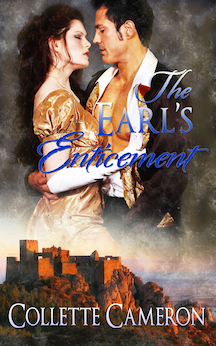
The Earl’s Enticement: Collette Cameron

TheEarlsEnticement3_850 3rd

About The Earl’s Enticement

She won’t be tamed.

A fiery, unconventional Scot, Adaira Ferguson wears breeches, swears, and has no more desire to marry than she does to follow society’s dictates of appropriate behavior. She trusts no man with the secret she desperately protects.

He can’t forget.

Haunted by his past, Roark, the Earl of Clarendon, rigidly adheres to propriety, holding himself and those around him to the highest standards, no matter the cost. Betrayed once, he’s guarded and leery of all women.

Mistaking Roark for a known spy, Adaira imprisons him. Infuriated, he vows vengeance. Realizing her error, she’s appalled and releases him, but he’s not satisfied with his freedom. Roark is determined to transform Adaira from an ill-mannered hoyden to a lady of refinement.

He succeeds only to discover, he preferred the free-spirited Scottish lass who first captured his heart.

Amazon

Excerpt

Adaira stepped around the mare and ever-so-gently touched the foal. Was the new addition a laddie or lassie? Skimming her hands over the newborn, she bent to take a peek. A colt. The sheen of his coat glistened in the muted light. Other than a white face and leg markings, he was the color of rich Turkish coffee.

“Ooh, you’re magnificent!” she breathed in awe.

“He is, indeed,” rumbled a harmonious baritone.

She whirled around. The Earl of Clarendon leaned across the stall door. His forearms rested on the top edge. He clasped a silver flask loosely in one hand. His shirtsleeves were rolled to his elbows, and he wore no waistcoat or jacket. The top of his shirt was unfastened too.

Just perfect. She wasn’t supposed to be anywhere near the earl, and here he was, in her sanctuary. She ought to be afraid, after his parting words, but she sensed something altogether different.

No, she wouldn’t stare at the crisp dark hair on his forearms or peeking from the collar of his open shirt. Bugger it. She curled her hands into fists against the oddest urge to run her fingers through the curly hair on his chest.

A bolt of unease speared her, though whether from his disquieting presence or her awareness of him as an attractive man, she couldn’t be certain.

Clearing her throat, she asked, “What are you doing here, my lord?”

About Collette Cameron

Collette CameronAward winning, Amazon best-selling, and multi-published historical romance author, Collette Cameron, has a BS in Liberal Studies and a Master’s in Teaching.  A Pacific Northwest Native, Collette’s been married for thirty years, has three amazing adult children, and five dachshunds. Collette loves a good joke, inspirational quotes, flowers, the beach, trivia, birds, shabby chic, and Cadbury Chocolate. You’ll always find dogs, birds, quirky—sometimes naughty—humor, and a dash of inspiration in her novels. Her motto for life? You can’t have too much chocolate, too many hugs, or too many flowers. She’s thinking about adding shoes to that list.

Website     Blue Rose Romance Blog   Twitter   Facebook


Wareeze Woodson and “An Enduring Love”

VBT_AnEnduringLove_Banner

Wareeze will be awarding a $25 Amazon GC to a randomly drawn commenter during the tour, and an ebook of An Enduring Love Worth Keeping will be awarded to two randomly drawn commenters during the tour. Click on the banner to follow the tour and increase your chances of winning.

About An Enduring Love

Born and raised in Latvia, Rebecca Balodis marries Rhys Sudduth, an English diplomat. Shortly thereafter, he is summoned home to attend his father’s death-bed. Rebecca cannot accompany him at the time and becomes trapped in the turmoil plaguing her country. He is informed she died in the upheaval.

Nearly four years later, she escapes and arrives in London with their son in tow. Arriving in the middle of his sister’s ball is very awkward, especially since Rhys plans to announce his betrothal to a young debutante later in the evening.

Trouble, tangled in suspense and danger, follow her from Latvia. Can this pair ever find or even recognize an enduring love? Is it worth keeping?

Excerpt

Cover_An Enduring LoveThe gangplank of the Dragon’s Stirr had been lowered ready for Latvian passengers to board. The creak of the ropes tying the vessel to the dock rasped Rebecca’s nerves, reminding her that soon Rhys would sail back to England without her. Devastated by the thought of such a loss and at such a time, she swallowed hard. How can I bare to let him leave me behind?

Standing on the dock in the mid-day sun, she tried to hold back her sobs and for a moment, she feared her knees might give way beneath her. She clinched her jaw, trying to hold steady and caught the lapels of Rhys’s finely tailored jacket with trembling fingers. A rising ocean breeze stirred his dark hair and swirled her skirts about her ankles as he placed his hand over hers.

When Rebecca gazed into Rhys’ deep blue eyes, Gorgi Weister’s words intruded. Sudduth is almost believable when he claims undying devotion. I admire his talent. Her chest burned with apprehension and she gulped a deep breath. What if Weister is correct? Does Rhys wish to abandon me as Weister implied?

Weister’s sly innuendoes and the sound of his mocking laughter circled in her mind, but she pushed such negative views aside. Guilt for allowing a moment of doubt to fester filled her with shame, but that too, she brushed aside. Ne! I refuse to believe Rhys would desert me. Although we have only been married a few months his love is strong and will endure forever, as will mine. Nevertheless, doubt crawled into her head, impossible to completely deny. Still, why would a government official such as Gorgi Weister attempt to stir trouble with lies? It made no sense!

About the Author

AuthorpicI am a native of Texas and still live in this great state. I married my high school sweetheart, years and years ago. We raised four children and have eight grandchildren, and grandchildren are Grand. At the moment, all my children and my grandchildren live within seventy miles of our home, lots of visits. My husband and I still love each other after all these years the stuff romance is made of, Happy Ever After!

Website Facebook • Twitter • Blog


Were They Waltzing in 1811? Ally Broadfield and Just a Kiss

Just a Kiss Banner

Ally is giving away a $25 Amazon Gift Card and some surprise swag. Click here for the Rafflecopter. Through May 9th.

Thank you for inviting me to your Parlour today, Susana. I’m delighted to share a bit about my debut release with you. One of the many reasons I like to write historical romance set during the Regency is that the social rules provide a perfect framework within which to tell a story. And of course, we have Jane Austen’s wonderful stories to serve as an authentic guide to the period.

One area that is not quite so clear is date when the waltz was introduced to Regency society. Though Just a Kiss takes place early in the Regency period, I wanted to have my characters waltzing. The other dances of the time, such as the quadrille and country dances, didn’t lend themselves to private conversations and close proximity like the waltz. Could my characters have danced the waltz in 1811? Perhaps.

Just-A-Kiss_750The waltz became fashionable in Vienna in the 1780s, and according to Nancy Mayer, the Regency Researcher, Byron said the waltz came to England in 1811. In an article entitled The History of the Waltz from JaneAusten.co.uk, it is said that, “While the English Country Dance is most associated with Jane Austen’s novels, many will be surprised to discover that by the early 1800′s the waltz had also made it’s [sic] way across the channel and was being danced by the more progressive of the Beau Monde.” All Things Austen states that that waltz arrived in England in “…about 1812 , but bits and pieces of the dance had been trickling in for years and adopted as figures in other dances, while the music for waltzes was often played, not as an accompaniment to the waltz but as the background to country dancing.” Certainly the waltz had not been performed at Almack’s by 1811, but I believe it is possible, and even probable that it was danced at private parties. Which is lucky for my hero and heroine, because they waltz several times during the story.

Resources:

http://www.janeausten.co.uk/the-history-of-the-waltz/

http://www.regencyresearcher.com/pages/dance1.html

Olsen, Kirsten. All Things Austen: An Encyclopedia of Austen’s World, Volume I. Connecticut: Greenwood Press, 2005.

About Just a Kiss

Charlotte Lightwood has one season to find a husband or she’ll be forced to marry her guardian’s loathsome cousin. With no title or dowry, she doesn’t have much hope of making a good match. Sebastian Wilkinson, the Earl of Marley, has been the most eligible bachelor on the marriage mart for more years than he cares to count and is very aware of his duty to marry a woman who will add to the wealth and stature of his title. Sebastian makes Charlotte an offer she can’t refuse: he will pretend to court her to help her attract more suitors in exchange for her advice about which ladies he should pursue. As they work together, their mutual attraction grows. When they realize they just might be perfect for one another, they must decide whether to bow to the dictates of society or follow their hearts.

Amazon | Barnes & Noble | Kobo | iTunes | Amazon.uk

Amazon.ca | Google BooksAll Romance ebooks | Goodreads

About the Author

bio pic largeAlly lives in Texas and is convinced her house is shrinking, possibly because she shares it with three kids, five dogs, a cat, a rabbit, and several reptiles. Oh, and her husband.  She likes to curse in Russian and spends most of her time letting dogs in and out of the house and shuttling kids around. She writes historical romance set in Regency England and Imperial Russia.

She loves to hear from readers and you can find her on her website, Facebook, Goodreads, and Twitter, though she makes no claims of using any of them properly.

WebsiteFacebookTwitterGoodreads • Youtube

Book Trailer

: