Tag Archive | historical romance

Jessica Cale: How Royal Copenhagen Conquered Europe

Eighteenth Century Porcelain: How Royal Copenhagen Conquered Europe

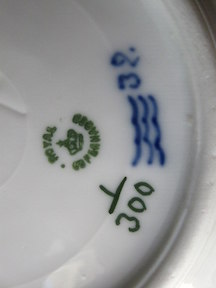
13509851_263614374004128_2085781765_oThe Royal Porcelain Factory (Den Kongelige Porcelænsfabrik), better known as Royal Copenhagen, was founded in a converted post office in Copenhagen on May 1st, 1775 under the protection of Queen Juliane Marie. Although porcelain had been made in Germany since 1710, it was not produced in Denmark until chemist Frantz Heinrich Müller developed a method for its manufacture in 1774. Juliane Marie had an interest in mineralogy and porcelain was a family passion: both her brother, Charles I of Brunswick-Wolfenbüttel, and sister, who was married to Frederik II of Prussia, had founded porcelain factories in Germany.

The factory’s first pieces were dining sets for the royal family. Juliane Marie insisted each piece be stamped with the factory’s mark, three wavy lines that symbolized Denmark’s three straights–the Øresund, the Great Belt and the Little Belt–as well as the royal crown stamp to highlight the firm’s royal connections. Each piece is marked this way to this day.

Blue and white china became popular across Europe as early as the seventeenth century with the import of goods from the far east. The fine porcelain of China’s Ming and Qing dynasties sparked an enduring love for floral patterns in blue and white and Royal Copenhagen quickly developed their own. Blue Fluted Plain (Danish: Musselmalet) was their first pattern and at more than two hundred fifty years old, it is the world’s oldest china pattern still in production.

13467665_263614317337467_432371625_oBlue Fluted Plain was inspired by Chinese floral patterns and updated to include flowers native to Denmark. Cinquefoils were added to the stylized chrysanthemums to give the pattern a more Nordic appearance. The ultramarine blue pigment in the paint was originally purchased from the Blaafarveværket (“blue colour factory”) in Norway, a company that provided up to eighty percent of the world’s cobalt during the nineteenth century. Each piece was and continues to be hand-painted by blue painters who spend at least four years in training for the position.

Since its development in 1775, Blue Fluted Plain has appeared on more than two thousand different pieces and has inspired countless imitations. It reached the height of its popularity in the early nineteenth century and appeared on everything from tea cups to washbasins and chamber pots.

Lord Nelson brought Royal Copenhagen porcelain back for his mistress, Lady Hamilton, following the Danish defeat at the Battle of Copenhagen in 1801. While Denmark lost that particular battle, Royal Copenhagen’s invasion of Britain was a success. It qualified for London’s World Expo in 1851 and gained international fame by winning the grand prize at Paris’ World Expo in 1889.

13509748_263614310670801_2069635372_oThis pattern has also appeared in some well-researched historical films and television shows, so not only does the pattern “look right” for the period, but even newer pieces are historically accurate for any time after 1775. You can still find pieces in this pattern to this day, so if you would like to add a little eighteenth century elegance to your kitchen or a touch of the Regency to your cup of tea, look for Royal Copenhagen’s Blue Fluted Plain.

Note: For more images or shopping information, Replacements Ltd. has a spectacular assortment of pieces in this pattern here: http://www.replacements.com/webquote/rcoblfp.htm

About The Long Way Home

The Long Way Home, Book 3 in The Southwark Saga is a magical, adult fairy tale that will keep you entertained from start to finish. Find out what happens when a paranoid king, a poison plot, and hideous shoes prove… it’s not easy being Cinderella!

coverAfter saving the life of the glamorous Marquise de Harfleur, painfully shy barmaid Alice Henshawe is employed as the lady’s companion and whisked away to Versailles. There, she catches King Louis’ eye and quickly becomes a court favorite as the muse for Charles Perrault’s Cinderella. The palace appears to be heaven itself, but there is danger hidden beneath the façade and Alice soon finds herself thrust into a world of intrigue, murder, and Satanism at the heart of the French court.

Having left his apprenticeship to serve King Charles as a spy, Jack Sharpe is given a mission that may just kill him. In the midst of the Franco-Dutch war, he is to investigate rumors of a poison plot by posing as a courtier, but he has a mission of his own. His childhood friend Alice Henshawe is missing and he will stop at nothing to see her safe. When he finds her in the company of the very people he is meant to be investigating, Jack begins to wonder if the sweet girl he grew up with has a dark side.

When a careless lie finds them accidentally married, Alice and Jack must rely on one another to survive the intrigues of the court. As old affection gives way to new passion, suspicion lingers. Can they trust each other, or is the real danger closer than they suspect?

AmazonBarnes & NobleKoboiBooks

About the Author

jessicaJessica Cale is a historical romance author, a Bluestocking Belle, and a journalist based in North Carolina. Originally from Minnesota, she lived in Wales for several years where she earned a BA in History and an MFA in Creative Writing while climbing castles and photographing mines for history magazines. She kidnapped (“married”) her very own British prince (close enough) and is enjoying her happily ever after with him in a place where no one understands his accent. You can visit her at www.authorjessicacale.com.

Her series, The Southwark Saga, is available now. You can visit her at www.dirtysexyhistory.com.


Amy Rose Bennett: Master of Strathburn (Giveaway)

MasterOfStrathburnFINAL copy 2

The Master of Strathburn is essentially a tale about Robert Grant, a wanted Jacobite. After surviving the Battle of Culloden, he escapes to France and then the Caribbean. However, after a decade of living in exile, he desperately wants to return to Scotland and reconcile with his estranged father, the Earl of Strathburn. The only problem is, there is still a price on his head—he isn’t fortunate enough to have been granted a pardon through the Act of Indemnity in 1747. Not only that, his dissolute half-brother Simon and avaricious step-mother would have him arrested by the British in the blink of an eye to prevent him from reclaiming his birthright. Of course, when Robert returns to Lochrose Castle, his long-lost Highland home, the adventures and the romance begin…

Scotland and its rich history has always fascinated me. The idea for writing a novel set around the time of the second Jacobite Rebellion, the Forty-five, came to me when I was sixteen, after I’d read a short story about Flora MacDonald, the brave young woman who helped Bonnie Prince Charlie—the Pretender to the Scottish throne and indeed, the throne of England—escape the Highlands after the rebellion failed. Of course, I’ve done a lot more research into the period since then. After reading about Culloden—the last battle of the rebellion in which the Jacobite army was resoundingly defeated—I knew I particularly wanted to write about a Jacobite hero who was present at the battle and his struggles dealing with the aftermath following the failed uprising. And hence Robert Grant’s story came to life in my mind.

Culloden Memorial Cairn copy

The Battle of Culloden took place at Drumossie Moor, not far from Inverness in the north-west of Scotland on April 16, 1746. I was fortunate enough to visit the site several years ago; it was actually only a few days after the anniversary of the battle and families who’d lost relatives had laid wreaths against the memorial cairn. The moor is actually classified as a war grave and there are small headstones marking the places where particular clansmen fell. It is estimated that 1500 to 2000 Jacobite soldiers were killed or wounded during the brief battle whereas the British army sustained only fifty casualties. Needless to say, visiting Culloden was a very moving experience.

About Master of Strathburn

A sweeping, sexy Highland romance about a wanted Jacobite with a wounded soul, and a spirited Scottish lass on the run.

Robert Grant has returned home to Lochrose Castle in the Highlands to reconcile with his long-estranged father, the Earl of Strathburn. But there is a price on Robert’s head, and his avaricious younger half-brother, Simon, doesn’t want him reclaiming his birthright. And it’s not only Simon and the redcoats that threaten to destroy Robert’s plans after a flame-haired complication of the feminine kind enters the scene…

Jessie Munroe is forced to flee Lochrose Castle after the dissolute Simon Grant tries to coerce her into becoming his mistress. After a fateful encounter with a mysterious and handsome hunter, Robert, in a remote Highland glen, she throws her lot in with the stranger—even though she suspects he is a fugitive. She soon realizes that this man is dangerous in an entirely different way to Simon…

Despite their searing attraction, Robert and Jessie struggle to trust each other as they both seek a place to call home. The stakes are high and only one thing is certain: Simon Grant is in pursuit of them both…

AmazonBarnes & NobleiBooksKoboGoogle Play

In the following excerpt, Robert has just escaped the Battle of Culloden by the skin of his teeth. Or has he?

Excerpt

April 16, 1746

Lochrose Castle, Strathspey, Scotland

‘You’ve got a bloody nerve, Robert.’

‘Aye, I do.’ Robert Grant—the soon-to-be disinherited Master of Strathburn and Viscount Lochrose—squinted through the dark spots clustering his field of vision, trying in vain to focus on his sneering half-brother Simon. The bayonet wound across his shoulder-blade throbbed with such thought-stealing intensity, it was all he could do to stay seated upon his trembling, sweating horse. There was no way he would be able to dismount unassisted. He’d end up with his face firmly planted in the gravel of the forecourt. ‘But for the love of God, Simon …’ he continued, his voice no more than a hoarse rasp. ‘Just help me down. I’m wounded for Christ’s sake …’

He barely recalled the moment the English soldier’s blade had sliced across his back. The horror of everything else that had taken place only hours before on Drumossie Moor flooded his mind. Made the nausea rise in his gullet anew.

Simon snorted. ‘You must’ve had a blow to the head then, or else you would’ve remembered that Father forbade you to come back.’ He glanced past Robert, down the gravel drive toward Lochrose’s gates. ‘You’ve killed them all, haven’t you? It was a rout, just like Father said it would be, wasn’t it?’ His grey gaze, flint-hard with accusation and long-held resentment, returned to Robert. ‘He will never forgive you for this.’

No doubt. Twenty-six Clan Grant men dead. And I was the arrogant young cock who led them all out like lambs to the slaughter.

Robert swallowed down both the bile and bitter self-acrimony burning his throat. ‘I know,’ he croaked. ‘But please … I just need to hide until I can move on … tomorrow.’

Even though he had flagrantly disobeyed their father and had led out the clan at Culloden, Robert prayed that he would be shown a modicum of compassion. That the earl would at least grant his eldest son sanctuary for a single night before he fled Scotland to spend a life in exile in some far-flung place. Robert didn’t want to put his family at risk for harbouring a fugitive, but he just couldn’t go on any farther.

Simon smiled, the sentiment not quite reaching his eyes. ‘Of course, dear brother. I shall have a room prepared for you.’ He gripped Robert’s forearm with one hand at the same time he slapped the blood-soaked plaid sticking to his shoulder.

Bastard. Agonising, white-hot pain instantly knifed through Robert. Even as black oblivion at last rose up to claim him, he didn’t fail to notice that Simon was still smiling.

Giveaway: For a chance to win a Kindle copy of my Regency noir style romance set in Scotland, just tell me what it is you love about Highland romances.

About the Author

AuthorPic copyAmy Rose Bennett has always wanted to be a writer for as long as she can remember. An avid reader with a particular love for historical romance, it seemed only natural to write stories in her favorite genre. She has a passion for creating emotion-packed—and sometimes a little racy—stories set in the Georgian and Regency periods. Of course, her strong-willed heroines and rakish heroes always find their happily ever after.

Amy is happily married to her own Alpha male hero, has two beautiful daughters, and a rather loopy Rhodesian Ridgeback. She has been a speech pathologist for many years but is currently devoting her time to her one other true calling—writing romance.

Website and BlogFacebookTwitterPinterest


Donna Hatch: The Suspect’s Daughter (Giveaway)

Interview with Donna Hatch

Susana: What inspired you to start writing, and how long have you been doing it?

Donna 2013 copyDonna: I’ve always been imaginative—as a child, I played make-believe constantly—but when I was about eight, a little voice inside my head kept nagging me until I finally wrote what it told me to write. Later, I learned people call this little voice “The Muse.” By eighth grade, after I’d written many stories both short and long, a teacher suggested I should aspire to be a published author, something that had never occurred to me to attempt. But I didn’t know how to go about it, so I was a closet writer for years until I finally found the courage and knowledge necessary to submit my novel to a publisher. It was a long path, with plenty of rejections, disappointments, learning, and revising. But three years after getting serious about writing as a career, my first book, The Stranger She Married, Book 1 of the Rogue Hearts Series, was accepted for publication.

Susana: Are you a plotter or a pantser?

Donna: I am a combination writer. I start with a concept and characters, then form a few basic plot points in the story. After that, I write more or less by the seat of my pants.

Susana: Tell us something about your newest release that is NOT in the blurb.

TheSuspectsDaughter_432 copyDonna: The murder plot in my newest book, The Suspect’s Daughter, Book 4 of the Rogue Hearts Series, was inspired by a true event in England known as the Cato Street Conspiracy, which thankfully, was averted largely in part due to an undercover Bow Street Runner. This event happened in 1820, the same year my book takes place. When I read about that, I knew something like this just had to be Grant’s story.

Susana: Are you working on something at present that you would like to tell us about?

Donna: I am working on a 100-page novella for a new series, and also Book 5 of the Rogue Hearts Series about a fugitive charged with the murder of her husband. By the way, all of my books are stand-alone, so you don’t have to read the first three in the series before reading Book 4.

Susana: What author or authors have most influenced your writing?

Donna: Laura Ingalls Wilder heavily influenced me. Reading her books as a child instilled in me a love of historical novels, as well for as a romance plot. Charlotte Brontë’s Jane Eyre helped cement my love of romance. And I couldn’t be a Regency author if it weren’t for Jane Austen’s brilliance.

Susana: What is your work schedule like when writing?

Donna: I write sporadically, whenever I can fit it in. With a busy family, I don’t have the luxury of sitting down to a clean desk with candles and music to inspire me. Most often, I write while waiting in a doctor’s office, or during soccer practice, or early afternoons when my children are gone, or even late at night when everyone is asleep.

Susana: If your publisher offered to fly you anywhere in the world to do research on an upcoming project, where would you mostly likely want to go? Why?

Donna: That’s a no-brainer—I’d want to go to England. I’ve done tons of research, but I’ve never seen it in person. Since my novels take place in England, I’m dying to go there. I could have a much better grasp on the sights and sounds and smells of England to create an even more believable setting for my books.

I’m also planning on writing a book that takes place in Italy, so I’d love to go there, too.

Susana: Who gave you the writing advice that sticks with you to this day?

Donna: Marsha Ward, author of western novels, told me once that I should set a really underwhelming daily word count goal. Hers, I believe, is twenty words. It sounds pathetic, doesn’t it? And counterproductive. But I discovered the wisdom of that advice. If I think I don’t have time to write on any given day, I think, “But I only have to write twenty words.” It’s pretty easy to make time to write a mere twenty words. Usually, those twenty words turn into a hundred, or five hundred. Even if I only wrote that very small, daily minimum goal, in a year I could write a full-length novel.

Thank you so much for hosting me!

Note: The author will be giving away e-copies of The Stranger She Married to two random commenters on this blog post.

TheStrangerSheMarried_432 (2) copy

About The Suspect’s Daughter

Determined to help her father with his political career, Jocelyn sets aside dreams of love until she meets a mysterious gentleman with dangerous secrets. Working undercover, Grant’s only suspect for a murder conspiracy is the father of a lady who is getting increasingly hard to ignore. They must work together to find the assassins. England’s future hangs in the balance…and so does their love.

SmashwordsB & NAmazon

About the Author

Donna Hatch is the award-winning author of the best-selling Rogue Hearts Series. A hopeless romantic and adventurer at heart, she discovered her writing passion at the tender age of 8 and has been listening to those voices ever since. She has become a sought-after workshop presenter, and also juggles freelance editing, multiple volunteer positions, and most of all, her six children (seven, counting her husband). A native of Arizona who recently transplanted to the Pacific Northwest, she and her husband of over twenty years are living proof that there really is a happily ever after.

Website  • Facebook 

Andrea K. Stein: Horizons East (Giveaway)

How My Characters Found Me

by Andrea K. Stein

Readers often ask me how I find and develop characters. I don’t – they find me. And the most amazing part is they come with their own swashbuckling tales.

My hero in Fortune’s Horizon, the first in my series of romance on the high seas, came to me while I was delivering yachts out of Charleston Harbor. One night over beers with a Charlestonian sailor at City Marina, I heard an incredible story about blockade-runners during the Civil War.

He said they would anchor near the very bar where we sat, which back then was part of a cotton warehouse. After running goods, including supplies for the Confederate Army, through the Union blockade, they would cram their sleek ships with bales of cotton for the run back out.

Heading back to Nassau, or Bermuda, they would off-load cotton to ships bound for England. Huge syndicates owned many of the blockade running steamships and would re-stock them with goods and coal to fuel their engines.

But why take all that risk? Each run in and out of ports in the South could net $1 million in 1860s money. That would be about $63 million in today’s dollars.

The British government never publicly supported the Confederate cause, but tacitly allowed the syndicates to operate in England where many of the ships were built, as well as in waters controlled by the Royal Navy.

After some research on my end as well as in London, where my British delivery captain boss went to the Admiralty to do some digging, we came up with the perfect hero for my series. Captain Jack Roberts was a British post captain on half pay from the Royal Navy. Since England was not at war, she laid off approximately 210 of her 250 post captains.

Mostly battled seasoned, a good number of those men ran the Southern blockade making fortunes for the syndicates as well as themselves, if they were enterprising, and lucky.

The most interesting thing about Captain Roberts is he ran the blockade under an assumed name, because he was the third son of an English earl, and he didn’t want to embarrass his family. So, as a romantic hero, this character kept getting better and better.

In the first entry in the series, he tangles with a woman spy who sneaks aboard his ship and infuriates him. Of course, he marries her.

For the sequel, I found another spiral of adventures Captain Roberts lived through as an adviser to the Turkish Navy. You have to love a character that writes his memoirs near the end of his life (dictated to a much younger wife) and then publishes them in a book now available through Google Books.

My sequel needed a romantic subplot, though, in addition to the further adventures of Jack and his wife, Lillie.

On a hunch, I searched Debrett’s, and lo and behold, up popped Miles, Jack’s younger brother. He joined the Bombay Fusiliers in the mid-1800s, about the time the British government took over military command from the East India Company. And, believe it or not, he was an incurable romantic, according to a quirky newspaper report found online.

I hope these wonderful people we call characters keep coming to me and whispering in my ear. My part is easy. All I have to do is listen. But if I drag my feet, they do keep me up nights with their complaints.

How about you? Do you enjoy historicals more knowing the characters have a bit of a foot in actual events? One commenter will receive a free ebook of Fortune’s Horizon in choice of format.

AndreaKStein_HorizonsEast_200 copy

About Horizons East

In 1867, adventuress Lillie Coulbourne-Roberts is desperate. Her husband Captain Jack Roberts is missing. Now a commander in the Turkish Navy, he has to meet with His Majesty the Sultan within the week. When her stuffy brother-in-law, Miles, arrives, she dragoons him into service. On leave from military service in India, he gets claustrophobic at the thought of going undercover with his precocious four-year-old nephew and the boy’s nanny who loathes him.

Horizons East, sequel to Fortune’s Horizon, is now on preorder on Amazon at $2.99 until February 10, 2016.

AndreaKStein_FortunesHorizon200 copy

Amazon

Until February 10, the first entry in the series, Fortune’s Horizon will be available at 99¢.

Amazon

About the Author

A native Ohioan, Andrea K. Stein is the daughter of a trucker and an artist. She grew up a scribbler. The stories just spilled out. A newspaper professional and electronic print consultant for thirty years, she finally ran away to sea for three years. Now she writes high seas romance while tucked away in the Rocky Mountains at 10,000 feet.

WebsiteFacebookTwitter

Alicia Quigley: The Highlander’s Yuletide Love

We all enjoy our family Christmas traditions at this time of year, and for many of us that includes putting our feet up with a nice romance novel in between decorating trees, wrapping presents, baking cookies, and all of the other Christmas fun. When the setting is the Regency period, we need to have a look at how people celebrated the season at the time. Last year I published The Yuletide Countess, and this year’s Christmas release is a sequel, The Highlander’s Yuletide Love. Both take place in Scotland in the late Regency period.

Amazon

Hogmanay

Early 19th century Christmas customs in England differed quite a bit from ours, and those in Scotland still more. For example, the Christmas tree only became common in the Victorian era, although their presence in the German-influenced royal court was documented in the 1700’s. In Scotland, there was an even bigger difference. In much of Scotland, Protestant believers viewed Christmas as a holiday that was far too Catholic, and it was seldom celebrated.

Before the Reformation occurred in 1560, Scotland celebrated Christmas as a religious holiday, in much the say way as other European countries. However, the Church of Scotland associated it with Catholicism and frowned on it. In 1640, the Scottish Parliament actually made what were referred to as “Yule vacations” illegal. Even though this was repealed in 1686, the Grinch pretty much stole Christmas in Scotland for the better part of the next 400 years! It only became a public holiday in 1958.

However, all was not cold and dark in Scotland during Yule season. Hogmanay, or New Years, had a long history of celebration including gift giving to family and friends and any number of other local superstitions and traditions. One of the best known is First Footing, or the arrival of the first guest on New Year’s Day.

A tall dark man (much like the hero in The Highlander’s Yuletide Love) bearing gifts as the “first foot” was supposed to be a sign of good luck. Gifts were also given to friends and family members on Hogmanay. Various regions of Scotland also had specific traditions. In The Highlander’s Yuletide Love, the hero hails from the Trossachs, a region near Loch Lomond. Traditionally, the men of this area would march in torchlight procession to the top of the Lomond Hills as midnight approached.

The English custom of Boxing Day, in which gifts were given to servants, tradesmen, etc. on the day after Christmas, also had an analog in Scotland. On the day after New Years day, known in the 19th century as Handsel Day one would give gifts or money to those who had waited on or worked for you during the year. The word “handsel” originates from an Old Saxon word that means, “to deliver into the hand”. During the 19th century, both of these holidays were celebrated on the first weekday after Christmas or Hogmanay, rather than always on the day after as is the present custom.

The Highlander’s Yuletide Love Final-FJM_Kindle_1800x2700 copy

Excerpt 

It was the fashionable hour of the promenade, and all around them the cream of London society swirled, the ladies glowing in their finest walking dresses, strolling arm in arm or riding in elegant carriages, while the men tooled their phaetons or rode well-bred horses. They circled one another, now and then stopping to converse, all eager to learn of the latest scandal or fashion.

Isobel tucked her arm through Sophy’s. “I think we shall outshine all the other ladies here this afternoon,” she teased.

Sophy took in Isobel’s elegant appearance in her plumed bonnet and emerald green pelisse worn over a pale yellow muslin gown. “You look fine indeed, but Miss Durand has been acclaimed the beauty of this Season, and I fear we cannot challenge her,” she laughed.

Isobel made a wry face. “That simpering nitwit? I’ve never understood what Society sees in her. Let us enjoy our drive all the same.”

Their carriage moved some ways down the path, the ladies nodding here and there to an acquaintance, and even stopping once or twice to talk briefly. Suddenly Isobel gave a little start.

“There is Colonel Stirling!” she said. “How very surprising. I haven’t seen him for an age. Francis will be delighted to know that he is in Town.”

As it would be bad ton to display her very real pleasure at seeing a friend, she waved rather languidly at a tall gentleman some distance down the path from them. He clearly saw and recognized the occupant of the barouche, and, nodding at the gentleman he was conversing with, made his way towards Isobel’s carriage.

As he drew nearer, Sophy noted the breadth of his shoulders, his narrow waist, and the powerful thighs under his fawn-colored pantaloons. His gait had the ease of an athlete, and she perceived as he reached the barouche that he was very handsome; a strong jaw, straight nose, golden brown eyes, and cropped black hair were set off by the elegant tailoring of his black coat, his perfectly arranged neckcloth, and gold-tasseled Hessians which he appeared to have been born in, so closely did they fit about the ankle.

Despite his attractiveness, Sophy also perceived an aura of arrogance surrounding him, as though he held himself aloof from his fellows, but it was countered by an air of confident masculinity that was extremely appealing. As he sauntered towards them, she was confused by the conflicting impressions that flooded her. She tried to imagine painting such a man; one whose surface was so alluring, yet who also possessed an inner chilliness, and found her mind awash in ways of translating such conflicting impressions into images. As a result, when Colonel Stirling arrived beside the barouche and Isobel introduced him, she found herself in a state of confusion.

“Lady Sophia Learmouth, may I present Colonel Stirling? He is a dear friend of Exencour’s,” she heard Isobel say.

The Colonel bowed elegantly. “It’s a pleasure to make your acquaintance, Lady Sophia. I believe I have encountered your father upon occasion.”

Sophy did her best to bring her thoughts back to the moment. “Oh thank you, Colonel Stirling. I’m delighted to be sure.”

She flushed slightly at her nonsensical response, and saw with a twinge of annoyance that Colonel Stirling, whose face had shown a touch of curiosity, now assumed a look of bland politeness. He had clearly dismissed her as a foolish girl beneath his notice, and the thought stung.

Isobel stepped in, drawing the colonel’s attention. “Have you been long in London? I hadn’t heard from Exencour that you were here, and I feel certain he would have mentioned it if he had encountered you. He speaks often of you, you know.”

A smile glimmered on the colonel’s lips. “No, Lady Exencour, I have missed much of the Season, and I seldom venture to London of late. After the death of my older brother this past year, I decided it would be best to spend some time in Scotland with my father, learning more about the estate. I shall have to sell out, I suppose, if I am to be the next laird.”

“My condolences, Colonel Stirling. You must feel the loss of your brother deeply,” Sophy said gently.

Ranulf switched his gaze from Isobel to her companion, and looked at Sophy closely for the first time. Her charming bonnet made of chip, trimmed with a garland of pink silk roses and matching silk gauze ribbons framed an expressive face, with large blue eyes fringed by dark lashes and a mouth that was full, yet surprisingly firm. Dark curls peeked out from under her hat, emphasizing the slim column of her neck. He raised his eyebrows.

“Why would you think I must necessarily miss my brother, Lady Sophia?” he asked, his voice faintly mocking. “My chief memories are of him teasing me mercilessly when we were boys, and as I embarked on a military career over a dozen years ago, I’ve seen little of him since.”

A spark of annoyance lit Sophy’s eyes. “I was being polite, and attempting to sympathize, Colonel Stirling, as you doubtless know. But I can tell you that I have a brother as well, and, as much as I wish to throttle him from time to time, if he were to suddenly disappear from my life, I would be heartbroken,” she replied, a touch of acid in her voice.

The smile grew broader, and Sophy blinked as the colonel’s handsome face grew even more attractive. “Well said, Lady Sophia. I do indeed miss my brother a great deal, if only because his death makes me take on the responsibilities of the family lands.”

Isobel glanced from Sophy to the colonel, her eyes alight with curiosity. “Colonel Stirling’s father is the Laird of Spaethness,” she said.

Sophy received the information with apparent disinterest. “Are you from the Highlands, then?”

“Yes, Spaethness is in Argyll, hidden away in the Grampians,” he replied. “We are wild Highlanders through and through.”

“No wild man out of the glens has his coats made by Weston, as yours clearly is, or wears boots with a shine such as yours,” said Sophy dryly.

A touch of amusement crept into his sleepy eyes. “I see I shall have to take my tales of kelpies and banshees elsewhere then.”

Sophy gave a gurgle of laughter despite her annoyance. “I may be a lowlander, but you must definitely find a more gullible female to impose upon than me.” She turned toward him and their eyes met and, though she relished the opportunity to give this confident gentleman a bit of a set down, she realized she had not managed to chase away the pull of his personal magnetism.

After a moment he looked away and gave her a careless reply. The conversation turned to the doings of the Season, and particularly of the Exencours’ and Colonel Stirling’s mutual acquaintance, while Sophy listened in silence. After a few minutes Isobel held her hand out to the colonel with a cheerful smile.

“We must not keep you any longer,” she said. “But do call upon us at Strancaster House. Francis will be very pleased to see you again.”

“I am always happy to see Lord Exencour, and his charming wife as well,” said the colonel. He turned to Sophy, and nodded. “It was a pleasure to meet you, Lady Sophia.”

Sophy inclined her head coldly, not failing to note that this caused the colonel’s lips to twitch slightly. She watched, annoyed, as he bowed politely while the barouche pulled away.

About the Author

AQ Twitter Avi copyAlicia Quigley is a lifelong lover of romance novels, who fell in love with Jane Austen in grade school, and Georgette Heyer in junior high.  She made up games with playing cards using the face cards for Heyer characters, and sewed regency gowns (walking dresses, riding habits and bonnets that even Lydia Bennett wouldn’t have touched) for her Barbie.  In spite of her terrible science and engineering addiction, she remains a devotee of the romance, and enjoys turning her hand to their production as well as their consumption.

Website • Twitter • Facebook • Amazon Author Page

Caroline Warfield: Dangerous Weakness (Giveaway)

DANGEROUS WEAKNESS2 (5) copy 

Night Owl Reviews, in reviewing Dangerous Works, said, “There is nothing so entertaining as watching a man who is always in control lose that control.” I was delighted because that is exactly what I tried to accomplish in that story. The Marquess of Glenaire, cool, calm and in control, managed the lives of his friends through two novels and a novella. I was determined to muss his hear, rip his suit, and throw him into the unknown.

How about you? Do you like to see a man is just too perfect lose it?  I’ll give a Kindle copy of Dangerous Works to one person who comments.

About Dangerous Weakness

If women were as easily managed as the affairs of state—or the recalcitrant Ottoman Empire—Richard Hayden, Marquess of Glenaire, would be a happier man. As it was the creatures—one woman in particular—made hash of his well-laid plans and bedeviled him on all sides.

Lily Thornton came home from Saint Petersburg in pursuit of marriage. She wants a husband and a partner, not an overbearing, managing man. She may be “the least likely candidate to be Marchioness of Glenaire,” but her problems are her own to fix, even if those problems include both a Russian villain and an interfering Ottoman official.

Given enough facts, Richard can fix anything. But protecting that impossible woman is proving to be almost as hard as protecting his heart, especially when Lily’s problems bring her dangerously close to an Ottoman revolution. As Lily’s personal problems entangle with Richard’s professional ones, and she pits her will against his, he chases her across the pirate-infested Mediterranean. Will she discover surrender isn’t defeat? It might even have its own sweet reward.

Amazon US http://amzn.to/1L8IDXp

Amazon UK http://amzn.to/1JYxerM

Amazon Canada http://amzn.to/1NwQmMt

Amazon Euro http://amzn.to/1PrxeAQ

Amazon India http://amzn.to/1hdwC6C

Amazon Aus http://bit.ly/1NikayC

Excerpt

“Who invited Lilias Thornton?” Richard demanded under his breath. His eyes followed a slender young woman who paced out the steps of the Quadrille across the parquet floor of the earl’s ballroom.

“No ‘thank you for turning your country seat into a diplomatic snake pit for an entire week so the haut ton can mingle with exotic visitors from the East while the foreign secretary manages the fate of Greece over Brandy and cards?’” Will demanded.

Richard looked at his friend, one eyebrow raised. “Chadbourn Park fit the need precisely. I thanked your Catherine this morning.”

Will grunted. “My Catherine worked miracles when Sahin Pasha showed up with six extra people in his party.”

“We can’t predict how many retainers the Turks will impose,” Richard growled. The Ottomans danced to their own tune; the Foreign Office never knows what to expect. Richard loathed the unpredictable. He went back to surveying the overheated ballroom.

“Who invited Lilias Thornton?” he repeated while he moved along the mirrored wall of the earl’s spectacular ballroom to a position next to a massive marble urn that gave him a better view of his quarry. His eyes never left the dancers.

Will snatched two glasses of champagne from a footman stationed discreetly along the softly flocked wall, tray in hand. He handed one to Richard who took it without looking.

“Catherine also had to scurry when your mother demanded that she invite three more marriageable young ladies and their eager mamas,” Will complained.

“I would rather that she refused.”

“Refuse the Duchess of Sudbury? Surely you jest.”

Richard nodded without taking his gaze from the dancers. “I jest. I have less control over my mother than I do Sahin Pasha.” He loathed loss of control even more than unpredictability. He had been forced to sidestep the marriage-minded chits for two days.

Right now only one woman interested him, Lilias Thornton. He watched her throw her head back, send auburn curls bouncing, and laugh up at her partner. She dances with grace, I’ll give her that—grace and unbridled joy. A man could lose his senses over that look. The last thing he needed was to lose his senses.

Will followed his friend’s line of sight. “Beautiful woman,” he acknowledged. “Catherine called her dress ‘beyond perfection.’”

That dress radiates so damned much continental sophistication she makes the women around her look countrified, my esteemed mother’s protégées included. The woman laughed freely again, and Richard felt himself harden in spite of his determination; the surge of attraction irritated him. I have no time for such nonsense.

“Who invited her?” he demanded. “It’s a matter of some urgency.”

Will shrugged. “I believe Catherine included some regular attendees at your sister’s literary salon. She must be one of those. You said to invite women who could provide intelligent conversation to members of the diplomatic corps.”

“So I did. My men tell me she has been in conversation with Konstantin Volkov three times these past two days.”

“You’re tracking her conversations?”

“Volkov’s. He has no official role, yet he follows the Russian delegation and slinks through society in the shadows. I want to know who he works for, why he sought an invitation, and what he intends.”

The entire house party had been arranged to provide a discreet opportunity for the foreign secretary—or more precisely, Richard, his second—to persuade Ottoman officials to moderate their suppression of revolutionary rumbling in Greece. England did not want the kind of chaos that would tempt Russia. Expansionist Russia threatened all of Europe. The weak and floundering Ottoman Empire did not.

“Ask him,” Will suggested. “Unless diplomacy requires a more devious approach.”

“Lilias Thornton accompanied her father to St. Petersburg three years ago. The crown appointed him to the trade delegation at our embassy there,” Richard explained. “She returned without him rather abruptly in early January. I wonder why. Volkov arrived shortly after. It puzzles me.” He did not like puzzles.

“It isn’t unusual for a young woman of marriageable age to seek London before the Season starts,” a woman’s voice cut in. Catherine Landrum, Will’s countess, reached for her husband’s glass and took a sip. She tasted it slowly, seemed to pronounce it fit, and handed the glass back. “Lilias made it clear she’s seeking a good marriage,” the countess told Richard. “Who is Volkov?”

“She’s well beyond the age,” he answered. He ignored her question about the Russian.

“Surely not!” Catherine laughed. “Twenty-two may be somewhat older than the norm . . .” She paused when a young woman of seventeen pranced by and smiled coyly at the marquess over her partner’s shoulder.

“Well, perhaps quite a bit older,” she acknowledged when they passed.

“She served as her father’s hostess in his postings abroad since she turned sixteen. She has shown no interest in the marriage mart until this year,” Richard said. “I don’t care about the gossip. I want to know about her connection to Konstantin Volkov.”

“Ask her,” the countess suggested.

“I intend to,” Richard said as the last notes of the dance faded. He set out in the woman’s direction.

About the Author

Carol Roddy - Author

Carol Roddy – Author

Caroline Warfield has at various times been an army brat, a librarian, a poet, a raiser of children, a nun, a bird watcher, an Internet and Web services manager, a conference speaker, an indexer, a tech writer, a genealogist, and, of course, a romantic. She has sailed through the English channel while it was still mined from WWII, stood on the walls of Troy, searched Scotland for the location of an entirely fictional castle (and found it), climbed the steps to the Parthenon, floated down the Thames from the Tower to Greenwich, shopped in the Ginza, lost herself in the Louvre, gone on a night safari at the Singapore zoo, walked in the Black Forest, and explored the underground cistern of Istanbul. By far the biggest adventure has been life-long marriage to a prince among men.

She sits in front of a keyboard at a desk surrounded by windows, looks out at the trees and imagines. Her greatest joy is when one of those imaginings comes to life on the page and in the imagination of her readers.

WebsiteFacebookTwitterEmail • Newsletter

Dangerous Weakness Pinterest Board

Bluestocking Belles • Bluestocking Bookshop

Other Books by Caroline

Dangerous Works

Dangerous Secrets

Shannon Donnelly: Lady Chance

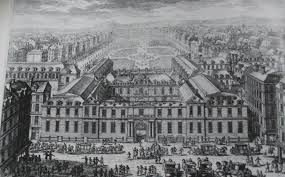
palaisroay1600

Researching the Palais Royal

One of the fun things about writing—for me, at least—is the research. I love to dig into history; in particular, I love to look for just the right setting to help a scene come alive. Lady Chance, the follow-up book to Lady Scandal, comes out this August; it’s set in Paris of 1814, and since gambling and cards are in the book, that meant I could use the Palais Royal.

The palace was originally designed by Jacques Lemercier and construction started 1628 for the infamous Cardinal Richelieu. It was originally known as the Palais Cardinal, but became a royal palace after the cardinal bequeathed the building to Louis XIII.

Louis handed the palace to the Queen Mother, Anne of Austria, and then Henrietta Maria and her daughter Henrietta Anne Stuart, who had escaped from the English civil war, took up residence. Henrietta Anne later married Phillipe de France, duc d’Orléans, and the palace became known as the House of Orléans. The duchesse was the one who created the ornamental garden of the palace.

Louis XIV was succeeded by his great-grandson, and the duc d’Orléans became regent of young Louis XV. The Palais Royal was then opened so the public could view the Orléans art collection, and that began the palace’s more public life.

Louis Philippe II held the royal palace from 1780 until his death. He renovated the building, and the garden was now surrounded by a mall of shops, cafes, salons, refreshment stands and bookstores.

At that time, the Palais Royal became a meeting ground for revolutionaries. Its owner, Philippe d’Orléans sided with the revolutionaries. He changed his name to Philippe Égalité and his house became the Palais de l’Égalité. He opened the gardens to the public and enclosed them with colonnades lined with shops.
palaisroyal-demimonde

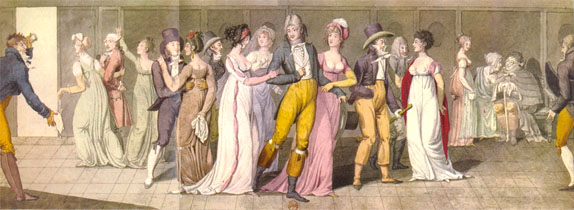
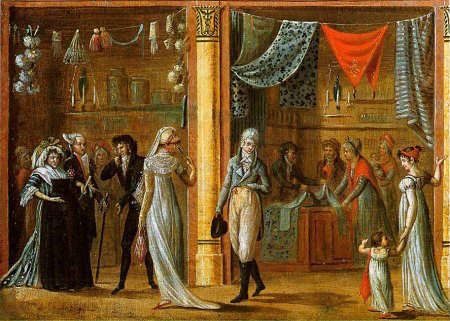
On the ground floor shops sold “perfume, musical instruments, toys, eyeglasses, candy, gloves, and dozens of other goods. Artists painted portraits, and small stands offered waffles.” The demi-monde could also parade their wares—themselves—and often had rooms on the upper floors for their customers’ convenience.

By 1807, the Palais Royal boasted “twenty-four jewelers, twenty shops of luxury furniture, fifteen restaurants, twenty-nine cafes and seventeen billiards parlors.”
palais-royal-10 copy

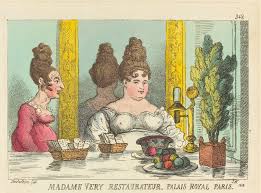
While the more elegant restaurants were open on the arcade level to those with the money to afford good food and wine, the basement of the Palais Royal offered cafés with cheap drinks, food and entertainment for the masses, such as at the Café des Aveugles.
palisroyal

Upon the death of the duc, the palace’s ownership reverted to the state, and for a time it was known as Palais du Tribunat. After the Bourbon restoration to power in 1814, the duc d’Orléans took back his title and the Palais Royal took back its name, but kept its reputation for a fashionable meeting place. And that is when Lady Chance is set.

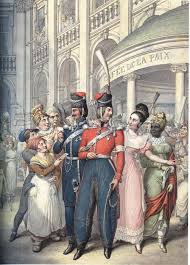
In 1814, Paris was under occupation by the allied forces that had defeated Napoleon. Russian cuirassiers, Prussian lancers, Hungarian hussars, Cossacks, and French soldiers all rubbed shoulders—and were not always in harmony with each other. But it was said of the Palais Royal that “You can see everything, hear everything, know everyone who wants to be found.”
paris_russians

Véry Frères in the Palais Royal was accounted the most expensive restaurant in Paris, and one could dine with “brilliantly lit salons, granite tables, gilt bronze candelabra and mirror-lined walls.” Trois Frères Provençaux was famous for poulet à la Marengo—Chicken Marengo, said to be the dish served Napoleon’s victory at Marengo. In Paris Between Empires, Philip Mansel talks of dining at Le Caveau, or at the royalist Café de Foy. While Café des Mille Colonnes on the first floor of arcade provided its patrons, “Mirrored salons, hung with ‘magnificent chandeliers’ and supported by Corinthian columns of green marble.” The building was also home to the fashionable resturant Le Grand Véfour.
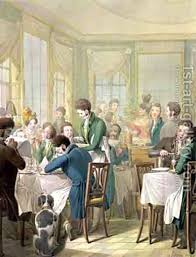
palaisroyalresturant

On the second floor, elegant card rooms offered deep gaming—these are the salons featured in Lady Chance.

About Lady Chance

Can an English lady find love and common ground with a French soldier?

In Paris of 1814, as Bourbon king again takes the throne, and the Black Cabinet—a shadowy group of agents employed by the British—is sent to unmask dangerous men and stop assassinations. When Diana, Lady Chauncey—known as Lady Chance—is recruited by her cousin to use her skill at cards to help him delve into these plots, she meets up with a man she thought dead. Diana finds herself swept into adventure and intrigue, and once again into the arms of the French officer she tangled with ten years ago. But she is no longer an impulsive girl, and he may not be the man she once thought was honorable and good.

After the recent defeat of his country, Giles Taliaris wants nothing more than a return to his family’s vineyards in Burgundy. But his younger brother seems involved in dangerous plots to return France to a republic. To get his family through these troubles, Giles can only tread warily. When he again meets meet the English girl he once knew and thought lost to him, he finds himself torn between duty and desire. Can he find his way through this tangle—and if he does, how can he convince his Diana to give up everything for him?

Amazon

Excerpt

Diana blinked twice and let her stare travel the room once more. “I rather thought the gaming rooms of the Palais Royal would be more…”

“Degenerate? Depraved? Decayed?” Jules asked.

“Grand, actually. Oh, the colonnade outside is charming, but this…” She fluttered a kid glove at their surroundings—at the draped windows, the high vaulted room with its plaster ceiling, the discreet décor with respectable landscapes hung over a tasteful, floral wallpaper. Chandeliers glittered overhead. Around them, dozens of uniformed gentlemen lounged or indulged in intense card play or watched the gaming with elegant women on their arms.
Lady Chance 01_sm copyShe had seen Russian Cossacks in the streets, distinct with their heavy boots, loose black trousers and red jackets. Inside this room, above the closed shops of the Palais Royal, officers from the Army of Silesia leaned against the walls, their uniforms as precise as their actions. Sullen French officers lurked at the edges of the room, unhappy with the foreign soldiers who had so recently beaten them. Accents and languages tumbled around her—a hint of Dutch, a dash of French, guttural Germanic phrases. Perfumes and a hint of smoky tallow from the candles scented the air. Diana gave Jules a sideways glance. “This almost looks more like the engravings I’ve seen of London clubs.”

Or like affairs of the London season, she thought. She’d had only two seasons and had not wanted a third. The play in London had always been dull or had been filled with women whose eyes glittered too brightly and gentlemen who bet too rashly. Here in the Palais Royal, just as with any notable event in London, music drifted through the rooms. A quartet was playing, she thought. Skilled enough to take on Mozart’s music and do the lively tune some justice.

Turning to her, Jules leaned closer. “The Bourbons may be back on the throne, but the Parisians look to good English coin to return prosperity. Hence this emulation of London with the rather French addition of the demi-monde in attendance. However, do not mistake matters. There are those who would have their emperor back.”

Stepping behind her, he helped her off with her cloak. He left that and his hat and cane with the porter. He wore his customary black coat, along with formal evening breeches, a white shirt, and a pale yellow waistcoat. He looked stark and properly British. She had worn gold to compliment his dress. A clinging silk that almost left her feeling a girl again with ruffles at her ankles and a daringly low Parisian neckline. They stepped into the club and Jules found them glasses of champagne. She walked the room beside him, watching him nod to acquaintances.

She had been to the Palais Royal during the day to visit the shops on the ground floor. Perfume could be had, along with toys, candy, gloves, waffles from stands, or portraits from struggling artists. But at night, the shops closed and the Palais Royal transformed itself. Véry Frères, the most expensive restaurant in Paris she had heard, offered brilliantly lit salons, granite tables, gilt-bronze candelabra and mirror-lined walls, as well as fabulous meals. In the basements of the Palais Royal, one could find establishments offering drink, food or entertainment such as at the Café des Aveugles, renowned for its orchestra of blind musicians.

They were blind for a reason for the galleries were where ladies of all shapes and colors and sizes offered themselves for sale.

This establishment—above the streets and the closed shops and below the rented rooms of those girls looking for customers—seemed designed to cater to patrons with money. There would be few enough Frenchmen who fit that description just now, Diana knew.

She had glimpsed the poverty on the journey to Paris.

The crossing to France had been long, taking fourteen hours to Boulogne with a fitful, unfriendly wind. The carriage ride to Paris had been even longer. And quite sad. This was not the country she knew from ten years ago. Old men, women, and thin boys populated the villages, for the young men had all gone to war. She had glimpsed far too many skinny cows and poorly worked fields. They had been cheered in some towns—the English liberators who had helped free France from an oppressive empire. In other towns, the French watched them pass with suspicion in their eyes. Not everyone welcomed back the rightful French king. And the destruction on the outskirts of Paris marked where battle had raged less than a fortnight ago. No wonder so many of these Frenchmen appeared so gloomy with defeat a sore and recent memory.

All that seemed put aside, however, in the pleasure houses of the Palais Royal. After a sip of champagne with bubbles that tickled her nose, Diana asked, “Just why am I being paraded?”

“A small introduction only. Making you a familiar face that will be welcomed when you deem to grace one of the tables.”

She eyed the women with their painted faces who clung to the officers’ arms. Very few sons of France seemed to be able to compete with the dashing foreigners. She glanced at Jules and kept her voice dry. “I can see the last of my respectability vanishing on the horizon.”

“Cousin, this is Paris. You may rub elbows with these delightful creatures who hire out their most intimate charms and still be free to dance with dukes and true ladies the next evening. The French understand these things.”

“It is good someone does. Now that I am decked out in the finest Paris has to offer, and have your grandmama’s emeralds hanging about my neck—I do hope your mother did not object to such a loan—what exactly is it that I am here to do?”

They had spent the journey to Paris discussing recent events, political situations, and the gossip of who was who in Paris. All of it a prelude to this—or so she guessed. To own the truth, she had simply wanted to enjoy going somewhere. Anywhere. Now she glanced around the room, a flutter in her stomach. What was she doing here? She wasn’t up to this sort of intrigue.

She forced a smile and lifted an eyebrow at Jules.

He gave her a small, approving nod. “You are doing all you must. You look a likely widow in need of amusement. Soon you shall find a spot at a select table. Win a bit. Lose more. After the drink has flowed and the hour grows late, I shall make a few introductions. Those gentlemen will lose heavily to you, I expect.”

She gave a small shrug. She had learned young how easy it was to lose at any game. Growing up, her older cousins—Jules included—had pounded home that lesson. They had never let her succeed at anything unless she deserved the win. And of her marriage—well, the less said there, the better, she thought. She twirled her fan. “Am I to keep their funds? Press them for something other than coins to clear their debts of honor to me?”

Jules’ smile did not falter, but Diana thought something hard appeared in his eyes. “Cousin, in cards, one never reveals one’s hand until all play is done. Let us say for now it is good to have certain pockets empty. It takes money to make mischief.”

She huffed out a breath. “Why do simple answers always sound only part of the truth? And chess is your game. You always plan at least seven moves ahead. So what are you not yet telling me?”

He patted her hand. “Enough for now, other than that I count on your shocking, unpredictable whims to keep us all on our toes.”

Diana shook her head and drained her champagne. “In chess, in Paris, or merely as a gamester?”

“You said it yourself—you must be an adventuress.”

Pulling in a breath, she pushed back her shoulders. “Yes, I did say so. Well, adventuring we go. Where do I begin? And I hope all this…this whatever is for a good cause.”

“Good may depend upon one’s views. Our view is to safeguard England’s interests. If certain rumors are true, a good man’s life may be at stake. However, Paris is rife just now with stories of everything from a dozen pretenders to the throne—the lost Bourbon prince returned from God knows where—to schemes that might bring back that dangerous fellow we were just discussing.”

“Ah, poor Louis-Charles, the dauphin.” She shook her head. “I would rather meet him than the former emperor.” A chill touched her back. She had met Bonaparte once. Seen him briefly, really. Before he had crowned himself emperor, and long before his recent surrender. At the time of her encounter he’d had another man’s wife on his arm, stolen from one of his generals. She still thought that a petty thing to do. She had also thought him short, fascinating in a way, and not much of a gentleman. He had once brought order to the French Revolution, but he had gone on to set Europe ablaze. And his command of a decade ago to arrest all the English in France had sent her running from Paris. That still rankled. She had been having such fun at the time. And if that had not happened, then she would not…

Ah, but this trip—and Jules—would give her better memories. She would focus on that.

It certainly took little effort to do as Jules bade her. He guided her to a table where gallant young gentlemen played—two French officers, an English gentleman in evening wear, and a Hungarian Hussar in a dashing uniform with excessive braid who at once offered her his seat. She played as Jules had asked, winning a little, losing a bit more. Jules had offered to stand the nonsense so she had no worries about emptying her purse. She found the play a touch tame. The Palais Royal was not living up to its reputation for vice. Given the circumstances, she only sipped at her wine and watched the cards fall with mild interest.

Jules soon introduced a fellow to her—a young Frenchman whose fair windswept hair and high shirt points spoke of his dandy ambitions. He joined the table, and Diana took up the cards. Jules gave her a nod and a direct stare, and she knew he wanted her to stop being careless.

She had barely dealt out the cards when a name came to her that she had never expected to hear again. A card tumbled from suddenly numb hands. Forcing a smile, Diana begged pardon. She finished the deal with stiff fingers and swept the room with a glance. It could not be, she thought, her heart beating too quick and her breath short and fast. He had died on a battlefield years ago. Someone must have only mentioned his name, that was all. But she had to look anyway. She had to be certain.

She scanned the faces nearest the entrance, seeking anything familiar—a profile, a glimpse of a captain’s uniform, a face that she could still recall from so long ago. And there—across the room in the foyer—he stood, far too solid to be a ghost.

About the Author

Shannon Donnelly’s writing has won numerous awards, including a nomination for Romance Writer’s of America’s RITA award, the Grand Prize in the “Minute Maid Sensational Romance Writer” contest, judged by Nora Roberts, and others. Her writing has repeatedly earned 4½ Star Top Pick reviews from Romantic Times magazine, as well as praise from Booklist and other reviewers, who note: “simply superb”…”wonderfully uplifting”….and “beautifully written.”

In addition to her Regency romances, she is the author of the Mackenzie Solomon, Demon/Warders Urban Fantasy series, Burn Baby Burn and Riding in on a Burning Tire, and the SF/Paranormal, Edge Walkers. Her work has been on the top seller list of Amazon.com and includes the historical romances, The Cardros Ruby and Paths of Desire.

She is the author of several young adult horror stories, and has also written computer games and offers editing and writing workshops. She lives in New Mexico with two horses, two donkeys, two dogs, and the one love of her life. Shannon can be found online at shannondonnelly.com, facebook.com/sdwriter, and twitter.
Vikki Vaught: Lady Overton’s Perilous Journey

I want to thank Susana for having me on her blog today. I’m very exciting about my new release, Lady Overton’s Perilous Journey. This is the first book in my Honorable Rogue series. This series is set in early 19th century England & America. I’d like to discuss some of the fascinating research I did for my book.

photo (2) copyI originally set this book in 1809, but on further research I discovered Jefferson convinced the U.S. congress to pass the Embargo Act of 1807, which stopped all foreign trade. While Jefferson did not want to involve the U.S. in the conflict between France and England, he wanted to put in place financial sanctions that could possibly hurt these countries economically. This act devastated the economy. American ships literally remained in port rotting in the harbors.

Here is some background history that led up to the embargo. Britain and France resumed their war in 1803, causing relations to become strained between any countries, deciding to remain neutral. In 1806 France passed a law against trading with neutral countries, and since America did not take sides in the conflict between the two countries, the French began plundering American ships. In 1807, Britain passed a bill prohibiting trade between France and neutral countries. The British began seizing American vessels and demanding that all ships pull into their ports before they were allowed to trade with other countries.

The British also started boarding American vessels and began seizing any sailors they deemed were deserters from the Royal British Navy. This infuriated the U.S. and thousands of American sailors were unlawfully impressed into the British Navy.

During the last sixteen days of Jefferson’s presidency, a bill was passed replacing the Embargo Act with the Non-Intercourse Act of 1809. While this act opened up trade again, it did not allow trade with Britain. Since my story has my heroine fleeing England on an American vessel, I needed to move it to a different year, prior to the escalating issues between the two countries. Since 1802 was the only year that England and France were not at war, I decided to place my story in that year.

This was by no means the only research I did for Lady Overton’s Perilous Journey, but was certainly the most important. While this is a novel of fiction, I wanted to ensure that the happenings within the story were possible.

I hope you’ll enjoy the romance between Alex and Anissa as much as I enjoyed writing their love story. Happy reading!

Halloween Background

About Lady Overton’s Perilous Journey

When her son’s life is threatened, Anissa, Marchioness of Overton, seeks refuge by sailing to America. Before the ship reaches the high seas, sparks fly between her and Captain Alex Hawks. Although the young widow may be lonely, and afraid, she cannot risk the diversion a romantic entanglement could bring, no matter how much she wants to lose herself in the captain’s embrace.

The Captain vows to protect the young Lord Overton, but can offer no assurance that the marchioness will leave his ship with her virtue intact. Alex is drawn to Anissa’s beauty and courage, as a hummingbird is to the nectar of a flower. How long can he fight a losing battle before he surrenders and makes her his own?

Will Alex be able to keep this remarkable woman and her child safe? Will his passion for Anissa be enough or will their differences keep them apart?

Secret CravingsAmazonBarnes & NobleARe

Excerpt

She cuddled her sleeping child close as she scanned the overcrowded common area. Her insides churned as she wove her way through the crowded tables, the chairs filled with dirty, unsavory-looking men. The strong smell of sweat mingled with ale threatened to turn her stomach and had her breathing through her mouth.

Anissa approached the man the stable boy had described. “Sir, are you Captain Hawks?”

He turned around, and in a drawling voice, he answered, “Well, darlin’, that’s my name.” He swept his tri-corn hat from his head, stood and bowed. “Captain Alex Hawks, at your service. What can I do for you?”

Anissa gazed up into the blackest eyes she had ever seen and wanted to fall into them. Mesmerized, she blinked as a shiver ran across her shoulders. This was not the time to notice this man’s eyes, no matter how compelling they were. Now was the time to use her charms to convince him to take her on his ship.

“My name is—” she quickly searched for a name, not wanting to give him her identity, “—Mrs. Carlson. I would like to pay for passage on your ship. I understand you are leaving for America this morning.” Then, thinking of a city she had heard of in America, she added, “I need to go to Boston, where some of my family lives. Would you be able to help me?”

Captain Hawks gave her an appraising stare, which unnerved her. This man was intimidating, to say the least. “I’m not going to Boston. And, I don’t normally take on passengers. I’m headed to Baltimore, and it’s a far piece from Boston, darlin’.”

“Please take me. I have to leave for America as soon as possible.” Anissa had to convince him to allow her passage. “And as far as your destination is concerned, I’m sure once I am in America, I shall be able to travel to Boston from there.”

“Darlin’, do you even know where Baltimore is and how far it is from Boston?”

Anissa wished he would quit calling her darling. It was quite presumptuous of him, and she did not appreciate it at all. Of course, she did not want to anger him, so she kept her feelings to herself. “Well, no, not really. How far is it?”

“It’s over four hundred miles,” Captain Hawks explained, as if he were speaking to a child, which further irritated her, tugging at her frazzled nerves. “You would be better served if you found a passenger ship going there. I have an associate who should be arriving in a few days, and his ship is going to Boston. He also takes passengers. I’m sure he would be happy to take you on board.”

Oh, dear, why did I say Boston? Please, Lord, let me convince him to take me.

Every hour brought her closer to the chance of discovery. She could not afford to wait for another ship. She needed to get as far away from Lord Howard as possible, immediately.

“Captain, I do not have a few days to wait. My uncle is dreadfully ill. He may only have a few months to live, so I need to leave right away. Please allow me to travel on your ship.” She looked up at him, willing a few tears into her eyes, praying to gain his sympathy.

Captain Hawks sighed and rolled his obsidian eyes toward the ceiling. “I know I’m going to regret this. All right, darlin’, if it’s that important, I’ll take you. I hope you realize how uncomfortable this voyage will be for you and the child. The cabin you will be in barely has room to turn around in. Are you sure you don’t want to reconsider?”

“We shall be fine, regardless of the conditions.”

He shook his head, sending her heart to the floor.

Oh, Lord, please don’t let him change his mind.

What shall I do if he has?

About the Author

Vikki Vaught started her writing career when a story invaded her mind and would not leave.

Over the last few years, she has written more than a half dozen historical romances and is presently working on her next. Her new release, Lady Overton’s Perilous Journey, published by Secret Cravings Publishing is the first book in her Honorable Rogue series.

Vikki loves a “Happily Ever After”, and she writes them in her stories. While romance is the central theme of all her books, she includes some significant historical event or place in all her novels.

While all her books are love stories, she has also written short contemporary sweet romances as Vikki McCombie and erotic romances using the pen name of V.L. Edwards.

For the last decade, Vikki has lived in the beautiful foothills of the Smoky Mountains of Tennessee with her beloved husband, Jim, who is the most tolerant man in the world to put up with her when she is in a writing frenzy. When she is not writing or working her day job, you’ll find her curled up in a comfortable chair reading her Kindle, lost in a good book with a cup of tea at her side.

WebsiteEmailFacebookTwitterGoogle+Pinterest

Amazon Author Page • Goodreads Author Page 

Wendy LaCapra: Lady Scandal

VBT_TourBanner_LadyScandal copy

The author will award one of ten ebooks to ten randomly drawn winners via Rafflecopter. Click here for the Rafflecopter. Click the banner above to follow the tour and increase your chances of winning.

Interview with Wendy LaCapra

Susana: Any weird things you do when you’re alone?

Wendy: When my husband is traveling, I leave the hall lights (which are LED’s) on all night. I also tend to over-indulge in pasta J

Susana: What is your favorite quote and why?

Wendy: My day is made if I can quote Prince Humperdinck, “Skip to the end” or (and this is more rare) the Man in Black himself, “If we only had a wheelbarrow, now that would be something.”

Susana: Who is your favorite author and why?

Wendy: Can’t name just one. In romance I am a big fan of Gaelen Foley, Joanna Bourne, Mary Balogh & Eileen Dreyer to name just a few.

Susana: What, in your opinion, are the most important elements of good writing?

Wendy: I cannot dissect. I think different authors have different strengths (dialogue, characterization, great description, subtle use of narrative techniques) and if they lead with their strength the book they create is going to be fabulous.

Susana: Where did you get the idea for this book?

Wendy: I’m not sure. This series started with a snippit of research about the charge of petty treason, started to take form with more research on Lady Worsley, but when I started writing, all three Furies stepped on stage at once, fully formed. It may have taken some false starts to find Sophia’s match, but once she met Randolph, the rest of the story flowed.

01MediaKit_Teaser1 copy

About Lady Scandal

London, 1784

Sophia Baneham has lived in the poison of her dead father’s shadow for longer than she cares to admit. Now she exists outside of polite society’s influence, holding gambling parties for London’s most dangerous men. When a man walks into one of her soirees, a compelling mix of charisma and icy control, he offers the lady of sin a wager she can’t refuse…

Lord Randolph is a spy in the service of His Majesty, but he’s given an oath to protect the daughter of his mentor. Even as his gamble of marriage starts to spiral out of control and his passions ignite, Randolph is determined that he’ll handle things his way…

But when danger closes in, Randolph won’t just have to protect Sophia from an intended killer. He’ll have to protect her from himself…

Amazon Barnes & Noble

Excerpt

He had never before failed in a mission. Never.

Clearly, he had been off his game and there was only one reason.

BookCover_LadyScandal copySophia.

Before they had met, Randolph had thought of Sophia as an evil-made-necessary—a means to probe the secrets Baneham had left behind. But then she had turned her cornflower blue eyes on him and everything had changed.

…Hours after returning from India, he arrived at a Fury soiree—uninvited. Lady Sophia’s footman stuttered under his glower, but the man refused to grant him entry. No one could be admitted to the soiree, the man insisted, without approval of the hostess, even if accompanied, as Randolph was, by the hostess’s cousin.

He remained in the hall, suffering the indignity of his wait with hands clasped behind his back. The entry was hardly what he had expected of Baneham’s home. The man had been the epitome of male. These furnishings could only be described as—he suppressed an inward shudder—dainty.

He peered into the rooms beyond. The dandies within did nothing to dilute the feminine air. The library was a rainbow of velvet jackets and frothing cravats, topped with clouds of fluffed white wigs. Even from the distance, the scent proved this the motliest male collection of Eau du Cologne enthusiasts ever assembled.

“Cousin Charles has brought me a gift, I see.” Her voice sang over his veins the way the wind sang against lines of a hoisted sail—the song sank all the way into his cock.

He turned.

The voice came from a petite, provocatively curved woman sewn into her pink silk bodice—he could think of no other way the fabric could fit so tight. Her hair powder was laced with a matching pink hue. She looked like strawberries and cream and, if he was permitted a taste of her lips, he was certain she’d be as mouthwateringly sweet.

Her gaze dropped from his face and traveled boldly down his body.

By Saint George, he wanted a sampling of her sweetness.

“Lord Randolph,” he said, “at your service.”

Her faint smile implied a flirtatious scold. “You do not have an invitation, Lord Randolph.”

“Soon remedied, I hope. I am recently returned from the continent.” She did not need to know which continent—nor how recently. “I have heard your soirees are the must-attend events for any London rake worth his salt.”

“Do you fancy yourself a rake, then, Lord Randolph?” She sounded hopeful, blast her sensual voice.

He leaned forward and whispered, “Issue me an invitation, sweetness, and I will provide any proof you may require.”

“No proof is required…” a faint, secret smile teased her mouth—both challenge and invitation, “at present.”

…It had been lust at first sight. She lit a carnal fire in his blood and the resulting burn was hotter and deeper than any he’d known.

About the Author

AuthorPhoto_LadyScandal copyWendy LaCapra, a 2012 Golden Heart® Finalist, has been reading romance since she discovered Victoria Holt (in the library’s adult section!)  From that point on, her only dream was to create worlds with historical richness, intrigue and pleasure. She lives in NYC with her husband and can occasionally be found gossiping about history and romance with the Dashing Duchesses or burning up the web with those mystical mistresses of resilience, the GH class of 2012 aka the Firebirds.

Website FacebookTwitter

LadyScandalGiveaway copy


Cynthia Ripley Miller: On the Edge of Sunrise

Interview with Cynthia Ripley Miller

Susana: Tell us something about the time period you’ve chosen for your first novel.

Cynthia: The few years I taught history, and my travels abroad created my desire to choose a world somewhat familiar to me. I decided that ancient Rome would become my setting, but I wanted a turbulent and exciting time span that would cross cultures and usher in the Medieval Age. From a writer’s perspective, late Rome in the fifth century AD, and the Germanic barbarian Franks—who later became the French Merovingians—filled the niche for drama, intrigue and a fresh era. It beckoned me.

Susana: What inspired your title?

C.Ripley Miller copyCynthia: On the Edge of Sunrise earned its title through a meditative moment and the strength and transformation of the characters and their personal redemptions. My heroine, Arria, and hero, Garic, are nobility in their own culture. Arria’s a Roman senator’s daughter and Garic is a tribal counselor. Arria is raised unconventionally and carries the title of Roman Envoy. Garic mirrors this distinction as a highly regarded warrior, honored for his wisdom as First Counsel to his tribal chieftain. Their ‘love at first sight’ desires force them to cross cultural boundaries; however, both are torn by responsibility and duty to their countries and families. And against the odds, the hidden secret each carries with him.

Susana: What author or authors have inspired your writing?

Cynthia: As an undergraduate student of literature, I eagerly consumed classic fiction. Authors such as Hardy, Dickens, Tolstoy and Steinbeck awakened me to worlds and insights beyond my personal experience, but another side of me loved a historical novel with an adventurous plot. When I wrote, one might say I leaned toward the dark side—genre fiction. Anne Rice’s vampires brought historical settings to life and demonstrated a diversity of human traits despite their undead status. Diana Gabaldon and her Outlander series captured my attention with her vibrant characters, Scottish history, and splash of fantasy. From these influences, I determined to write a historical and adventurous love story.

Susana: What flavor is your writing?

Cynthia: The combination of a chocolate energy bar with a pinch of cayenne might best describe my novel’s flavor. My story is fast-paced with more dialogue than narrative (although there is enough narrative for imagery and internal dialogue). I like action and conflict to keep the story fresh and some red-hot spice to make the plot tantalizing.

Susana: What is your favorite scene in On the Edge of Sunrise?

Cynthia: My favorite scene involves my heroine, Arria, being accompanied to Cambria, a Roman fort town, by the hero, Garic, a Frank warrior noble who has just saved her from a renegade group of barbarians. As they enter the city gates, they come upon a slave auction. Arria sees that in order to help save a mother and her child from slavery, she must buy them. Garic, encourages her and offers his help. The attraction between Arria and Garic has grown throughout the journey, and they share some tender moments. But just as they express their love, the commander of the Roman fort, Arria’s betrothed, interrupts them.

Susana: What books do you have in your TBR pile?

Cynthia: Angelopolis by Danielle Trussoni and Roma by Steven Saylor.

Susana: What is something unusual that most people don’t know?

Cynthia: Many people don’t know that when I was in middle school I was ‘pen pals’ with Katie Kubrick, the director Stanley Kubrick’s daughter.

Susana: What are you working on now?

Cynthia: I’m working on book two in my Long-Hair Saga series, a romantic historical with strong elements of mystery and suspense.

About On the Edge of Sunrise

When love commands, destiny must obey. Against an epic background and torn between duty and passion, Arria Felix, a Roman senator’s daughter, must choose between Rome’s decadent world and her forbidden love—Garic, a Frank barbarian noble.

ontheedgehr copyThe year is AD 450. The Roman Empire wanes as the Medieval Age awakens. Attila the Hun and his horde conquer their way across Europe into Gaul. Caught between Rome’s tottering empire and Attila’s threat are the Frankish tribes and their ‘Long-Hair’ chiefs, northern pagans in a Roman Christian world, and a people history will call the Merovingians.

A young widow, Arria longs for a purpose and a challenge. She is as well versed in politics and diplomacy as any man … but with special skills of her own.

The Emperor Valentinian, determined to gain allies to help stop the Huns, sends a remarkable envoy, a woman, to the Assembly of Warriors in Gaul. Arria will persuade the Franks to stand with Rome against Attila.

When barbarian raiders abduct Arria, the Frank blue-eyed warrior, Garic, rescues her. Alarmed by the instant and passionate attraction she feels, Arria is torn between duty and desire. Her arranged betrothal to the ambitious tribune, Drusus, her secret enlistment by Valentinian as a courier to Attila the Hun, and a mysterious riddle—threaten their love and propel them into adventure, intrigue, and Attila’s camp. Rebels in a falling empire, Arria and Garic must find the strength to defy tradition and possess the love prophesied as their destiny.

About the Author

Cynthia Ripley Miller is a first generation Italian-American writer with a love for history, languages and books. She has lived, worked, and travelled in Europe, Africa, North America and the Caribbean. As a girl, she often wondered what it would be like to journey through time (she still does), yet knew, it could only be through the imagination and words of writers and their stories. Today, she writes to bring the past to life.

Cynthia holds a master’s degree and has taught history and teaches English. Her short fiction has appeared in the anthology Summer Tapestry, at Orchard Press Mysteries.com and The Scriptor. She has reviewed for UNRV Roman History, and writes a blog, Historical Happenings and Oddities: A Distant Focus.

Cynthia has four children and lives with her husband, twin cats, Romulus and Remus, and Jessie, a German Shepherd, in a suburb of Chicago. On the Edge of Sunrise is the first in the Long-Hair Sagas; a series set in late ancient Rome and France and published by Knox Robinson Publishing.

WebsiteTwitter Facebook