Tag Archive | Henry Holland

The Microcosm of London or London in Miniature: Carlton House

published by Rudolph Ackermann in 3 volumes, 1808–1811.

The annexed print is a view of the great hall, which is conceived with a classic elegance, that does honour to the genius of the late Mr. Holland, who was the architect of Carlton House. The size of the hall is forty-four feet in length and twenty-nine in breadth. The entrance to the hall from the vestibule is by a flight of steps, which gives it an air of uncommon grandeur; it is supported by eight fine columns of the Ionic order, with architrave, frieze, and cornice. The ceiling is coved, and ornamented with plain caissons, and lighted by a skylight of an oval form. The columns are finely executed in scaglioni, of a yellow porphyry; the capitals and bases are bronzed, as are all the ornaments in the hall. In four corresponding niches are casts from the antique, of two Muses, the Antinous and the Discobulus; on the cornice are placed busts, urns, and griffins; over the niches are basso-relievos, which are also bronzed. At each . end of the hall is a stove of a new and elegant construction; six Termini of fine workmanship support a dome or canopy: the whole is executed in cast-iron bronzed. Over each fire-place is an allegorical painting in imitation of bronze basso-relievo, and compartments over the doors in the same manner: the tout-ensemble is striking and impressive. There is in this hall a symmetry and proportion, a happy adjustment of the parts to produce a whole, that are rarely seen; it is considered as the chef d’ oeuvre of Mr. Holland, and would do honour to any architect of any age or country.

Of the print it may be proper to say, that it is drawn with great accuracy and feeling, the perspective is easy and natural, and the general effect broad and simple. The figures are few, but introduced with great taste: it must be obvious, that a greater number would have impaired the general effect of the architectural design.

The new circular dining-room, when completed, will unquestionably be one of the most splendid apartments in Europe: the walls are entirely covered with silver, on which are painted Etruscan ornaments in relief, with vine-leaves, trellis-work, &c. There are eight fine Ionic columns in scaglioni, of red granite; the capitals and bases are silver, as are also the enrichments, moulding. See. of the architrave, frieze, and cornice: the latter is surmounted by an ornament that is somewhat Turkish in its character, and which, if it does not belong to the Ionic order, nevertheless adds to the splendour of the room. There are four immense pier glasses, and under each of them a fine marble chimney-piece of exquisite workmanship. As this sumptuous apartment is not yet completed, it would be improper to attempt a perfect description of it; indeed, almost the whole of Carlton House is undergoing alterations and improvements. On the south side of this apartment a door opens into the ballroom, a most magnificent and princely apartment: the walls are painted white, but the room is nearly covered with a profusion of gilding; the pilasters, architrave, frieze, and cornice are all covered with gold; the ceiling represents a pleasing sky, in which are genii sporting on the clouds; and in the compartments between the pilasters are some Etruscan ornaments, painted with great lightness and delicacy. On the opposite side another door opens into a new room, intended for a drawing-room, and though at present in a very unfinished state, it strikes the eye with the uncommon symmetry and harmony of its proportions.

Amid the curiosity and interest raised by a view of Carlton House, nothing can exceed that which is excited by an examination of

The Armory

This valuable and unique collection is a museum, not of arms only, but of various works of art, dresses, &c.: it is arranged with great order, skill, and taste, under the immediate inspection of His Royal Highness. It occupies five rooms on the attic story; the swords, firearms, &c. are disposed in various figures upon scarlet cloth, and inclosed in glass cases: the whole is kept in a state of the most perfect brightness. Here are swords of every country, many of which are curious and valuable, from having belonged to eminent men: of these the most remarkable is a sword of the famous Chevalier Boyard, the knight sans pear et sans reproche. The noble reply of this illustrious dying soldier, made to the Constable of Bourbon, deserves to be remembered. In the war between the Emperor Charles V. and Francis I. of France, the constable had gone over to the emperor, disgusted at the persecutions he met with in France, from the rage of Louisa of Savoy, the queen mother, whose overtures of marriage he had rejected. The emperor made the constable generalissimo of his armies; and in a battle which was fought in the duchy of Milan, and in which the French were obliged to retreat, the Chevalier Boyard was mortally wounded. Charles of Bourbon seeing him in this state, told him how greatly he lamented his fate. “It is not me” said the dying chevalier, “it is not me you should lament, but yourself, who are fighting against your king and country.” A sword of the great Duke of Marlborough, one of Louis XIV. and one of Charles II.: the two last are merely dress swords. A curious silver-basket-hilted broad sword of the Pretender’s, embossed with figures and foliage. But the finest sword in this collection is one of excellent workmanship, which once belonged to the celebrated patriot Hampden; it was executed by Benvenuto Cellini, a celebrated Florentine, who was much employed by Francis I. and Pope Clement VII.

Peter Torrigiano, who executed the monument of Henry VII. in Westminster abbey, endeavoured to bring over Cellini to England, to assist him; but Cellini disliking the violence of his temper, who used to boast that he had given the divine Michael Angelo a blow in the face with his fist, the marks of which he would carry to the grave*, refused to come with him. Vasari, who was contemporary with Cellini, speaks of him in the highest terms. He was originally a goldsmith and jeweller, and executed small figures in alto and basso-relievo with a delicacy of taste and liveliness of imagination not to be excelled: various coins of high estimation were executed by him for the Duke of Florence; and in the latter part of his life, he performed several large works in bronze and in marble with equal reputation. He wrote his own memoirs, which contain much curious and interesting information relative to the contemporary history of the arts.

The ornaments on the hilt and ferrule of the scabbard of this curious sword are in basso-relievo in bronze, and are intended to illustrate the life of David: it is a most beautiful piece of work, and in the highest preservation; it is kept with the greatest care in a case lined with satin.

In the armory is a youthful portrait of Charles XII. of Sweden, and beneath it is a couteau de chasse used by that monarch, of very rude and simple workmanship. A sword of General Moreau’s, and one of Marshal Luckner’s: but it would be impossible in our limits to notice a hundredth part of what is interesting in this collection.

In another room are various specimens of plate armour, helmets, and weapons; some Indian armour of very curious workmanship, composed of steel ringlets, similar to the hauberk worn by the Knights Templars, but not so heavy, and the helmets are of a different construction. Here are also some cuirasses, as worn at present in Germany; a very curious collection of firearms, of various countries, from the match-lock to the modern improvements in the firelock; air-guns, pistols, &c. In this room are also some curious saddles, Mamaluke, Turkish, &c.; some of the Turkish saddles are richly ornamented with pure gold.

Another room contains some Asiatic chain armour, and an effigy of Tippoo Sultaun on horseback, in a dress that he wore. Here are also a model of a cannon and a mortar on new principles; some delicate and curious Chinese works of art in ivory, many rich eastern dresses, and a palanquin of very costly materials.

In another apartment are some curious old English weapons, battle-axes,maces, daggers, arrows, &c.; several specimens also, from the Sandwich and other South Sea Islands, of weapons, stone hatchets, &c.

Our young men of fashion who wish to indulge a taste for antiquarian researches, may project the revival of an old pattern for that appendage of the leg called boots, from the series of them worn in various ages, which form a singular part of this collection.

In presses are kept an immense collection of rich dresses, of all countries; and indeed so extensive and multifarious are the objects, that to be justly appreciated it must be seen. His Royal Highness bestows considerable attention on this museum, and it has in consequence arrived in a few years to a pitch of unrivalled perfection. Among the dresses are sets of uniforms, from a general to a private, of all countries who have adopted uniforms, and military dresses of those who have not. All sorts of banners, colours, horse-tails, &c.; Roman swords, daggers, stilettoes, sabres, the great two-handed swords, and amongst the rest, one with which executions are performed in Germany, on the blade of which is rudely etched, on one side a figure of Justice, and on the other the mode of the execution, which is thus: — the culprit sits upon a chair, and the executioner comes behind him, and at one blow severs the head from the body. There are also some curious portraits in these apartments; besides the one of Charles XII. there is one of Frederic the Great, and various other princes and great men renowned for their talents in the art of war.

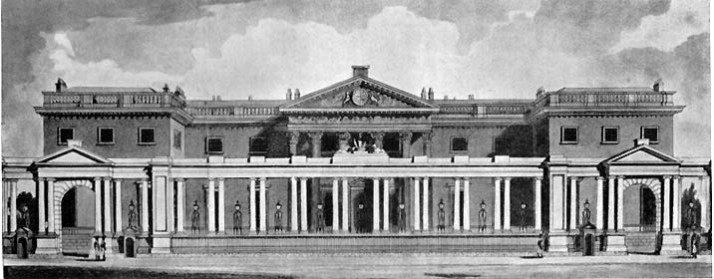
Of the exterior of Carlton House it may be sufficient to observe, that it is situated on the north side of St. James’s Park, and that the principal front faces Pall-Mall*. The portico is a most splendid and magnificent work, of the Corinthian order, enriched with every embellishment that elegant order is capable of receiving. It has been objected, that the other parts of this front are too plain to correspond with so rich a portico: the front is rustic, and therefore does not admit of ornament; but the eye is hurt by the violence of the transition from the most luxuriant decoration to the most rigid plainness. Carlton House, with its court-yard, is separated from Pall-Mall by a dwarf screen, which is surmounted by a very beautiful colonnade. A riding-house and stables, belonging to His Royal Highness, are at the back, immediately contiguous to St. James’s Park. The garden is laid out with the utmost taste and skill of which its limits are capable.

On the 8th of February, 1790, His Royal Highness the Prince of Wales had a state levee, for the first time, at his palace of Carlton House, which was the most numerous of any thing of the kind for many years; and, except the want of female nobility, was more numerous and splendid than the generality of the drawing-rooms even at St. James’s.

 Carlton House was a palace belonging to the crown, and presented by His Majesty to His Royal Highness the Prince of Wales, on his coming of age, for his public town residence. The old building being out of repair, it was judged proper by Parliament to enable His Majesty to erect the present noble edifice in its room; and Mr. Holland had the honour of being appointed the architect. There is only one thing wanting in this palace, and which, from the present state of the arts, and still more the liberal manner in which they are at present patronized, we hope it is in His Royal Highness’s contemplation to supply. It is a collection of pictures by living artists; these, selected with His Royal Highness’s well known delicacy of taste and judgment, would complete the decorations of this truly magnificent and princely palace.

 * This event happened in the palace of Cardinal di Medici: — Torrigiano being jealous of the superior honours paid to Michael Angelo, brutally struck him in the face; his nose was flattened by the blow: the aggressor fled, and entered into the army, but being soon disgusted with that life, left it and came over to England.

* Pall-Mall was formerly laid out as a walk, or place for the exercise of the mall, a game long since disused; its northern side being bounded by a row of trees, and that to the south by the old wall of St. James’s Park.

Back to Table of Contents

Lancelot “Capability” Brown and the Landscape Park

The son of a Northumberland land agent and a chambermaid, Lancelot Brown worked as the head gardener’s apprentice at the estate where his parents worked, Kirkharle Hall, owned by Sir William Loraine. His eldest brother John became the estate surveyor and eventually married Sir William’s daughter. His brother George became a mason-architect.

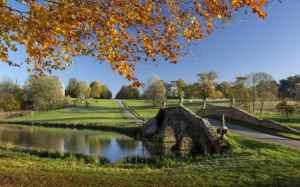
Oxford Bridge, Stowe

His first landscape commission was for a lake at Kiddington Hall in Oxfordshire. In 1741, he became an under-gardener at Lord Cobham’s estate of Stowe, in Buckinghamshire, where he worked under William Kent (see a previous post), a founder of the new English landscape garden. In 1742 at the age of 26, he was promoted to Head Gardener (at £25 a year), where he remained until 1750, at the same time taking freelance commissions from Lord Cobham’s aristocratic friends. His landscape designs were in great demand from the landed gentry, and by 1761 he was making £500 a commission and around £6000 a year. Being an expert rider, he could scope out a property and rough out a design in about an hour. As his fame increased, he would charge more than £3,000 per commission.

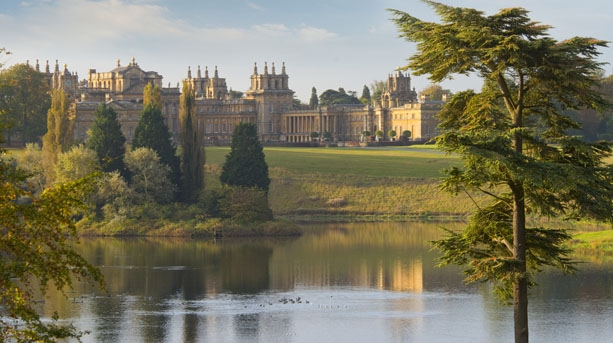
Blenheim Palace

It is estimated that Brown was responsible for over 170 gardens surrounding the finest country houses and estates in Britain. His work still endures at Croome Court (where he also designed the house), Blenheim Palace, Warwick Castle, Harewood House, Appuldurcombe House, Milton Abbey (and nearby Milton Abbas village), in traces at Kew Gardens and many other locations. “This man who refused work in Ireland because he had not finished England” was called “Capability” Brown, because he would characteristically tell his landed clients that their estates had great “capability” for landscape improvement. (Wikipedia)

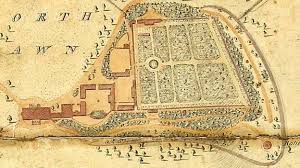
Brown’s original plans for Croome Court

Brown’s gardening abilities, honed at Kirkharle, were tremendously proficient. His subsequent success depended largely on his position as contractor, both designing improvements and then seeing the work through to its conclusion. He was skilled in all aspects of planting, drainage, dam-building and earth-moving, and possessed a ruthless business sense. This enabled him to manipulate both gentry and under-gardeners alike in order to further his own reputation… Throughout his career, Brown designed purely for the aristocracy. Many of his commissions overlapped with one another, landed as the result of family connections amidst patrons.

In 1751, Brown set himself up as landscaper and architect in Hammersmith. This move to the outskirts of London marked the beginning of a relentlessly demanding thirty years and a spectacularly successful consultancy. It also cemented a fruitful relationship with the Henry Hollands and their family. Holland the Younger (1745-1806) was, like his father, a successful architect and builder. Brown took him on as informal business partner in 1771 and son-in-law in 1773.

Brown’s cascade at Blenheim Palace

The “Park way”

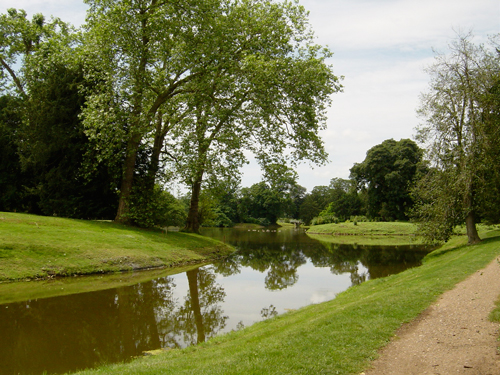
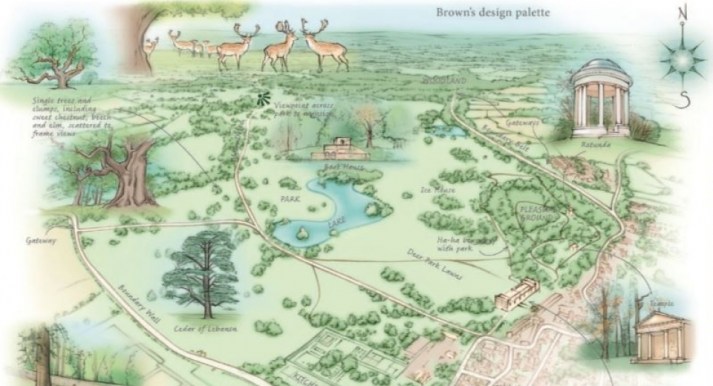
The approach taken by Brown and his followers was to strip an estate back to its basic forms: serpentine lakes, bare lawns and informal planting.

This was a revolutionary break from the artfully contrived landscapes of the gentleman amateurs, and the most ‘natural’ landscaping style the eighteenth century had yet seen… His model for a landscape park superseded anything that had come before it and dominated garden design completely. Arable fields, unsightly outbuildings and walled kitchen gardens were hidden by screens of trees, and any surviving formal features were replaced by great swathes of open pasture. Brown’s landscape minimalism effortlessly accommodated the practical needs of a landowner within an aesthetically pleasing estate.

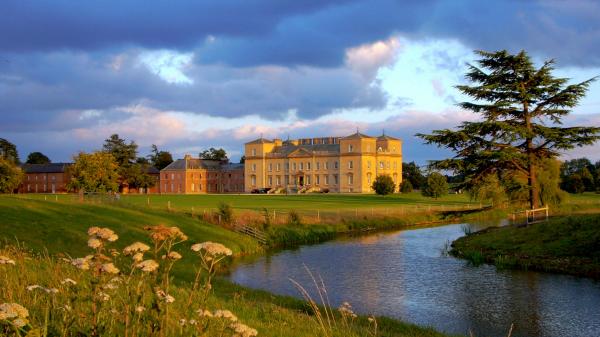
Croome Court

In creating a landscape park most owners wanted to ‘improve’ on both their estate’s fashionable status and their economic revenue… the initial creation of a landscape park could be expensive, depending on the existing topography and amount of earth-works required. It was, however, remarkably cheaper to maintain. The upkeep of formal parterres or flimsy Rococo buildings required the employment of legions of gardeners, whereas the pastoral appearance of a landscape park could be easily upheld through ranging livestock. This grazing land could even be let out to local farmers to generate further income.

Ha-ha at Croome Court

Just as he had capitalised on his patrons’ desire to consolidate land in order to secure financial and social power, so Brown manipulated their love of hunting, shooting, fishing, and beauty. Brown’s belts and copses provided the perfect cover for game birds. His expansive lakes, such as that at Compton Verney, could be used not just for fishing (as had the formal canal), but rather for boating, other hunting and providing a landscaped site with a measure of visual relief.

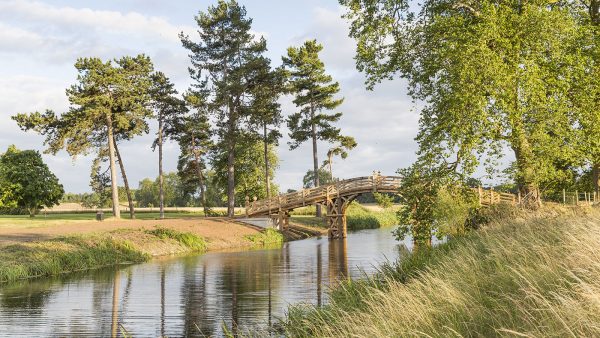
Chinese Bridge at Croome Court

Eighteenth-century landscapes were also required to entertain in a less violent manner. To this end, most large estates such as Croome and Blenheim had two circuit drives to choose from. One was suitable for walking and the other for riding around. Ladies would often take a carriage and then the various parties could reconvene at a chosen spot for refreshments… Dainty Rococo layouts were walked around, in order to appreciate fully the changing moods conjured up by exotic temples. But with these garden incidents cleared away, Brown’s carriage-drive was an invitation to explore a landscape park at high speed.

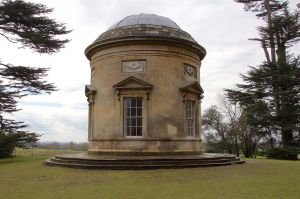
Rotunda at Croome Court

Brown also contrived glimpses of lakes and buildings through planned openings between trees and shrubs. Each view was carefully orchestrated and revealed at a specific point on the route around the landscape… At Croomie, Brown consciously screened Adam’s Island Temple with yews so that it was not visible until the bridge was crossed.

Brown ‘compared his art to literary composition.’

Now there I make a comma, and there, where a more decided turn is proper, I make a colon; at another part, where an interruption is desirable to break the view, a parenthesis; now a full stop, and then I begin another subject. (1782)

Croome Court

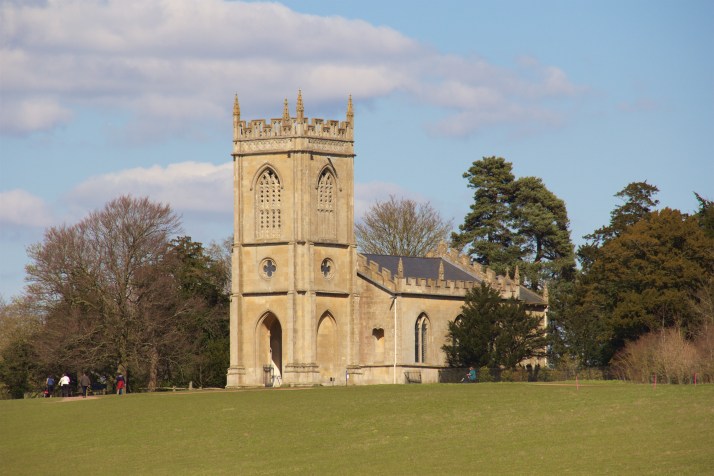
Perhaps his best known house was the Palladian Croome Court, where he was employed by George William Coventry, 6th Earl, from 1751. Croome’s unpromising marshland was drained so successfully that the earl commended Brown. ‘Who by the powers of His Indomitable and creative Genius formed this garden Out of a morass.’ However, his first phase of landscaping was virtually Rococo in style. Chinese bridges, a recumbent statue of Sabrina and a crystal-encrusted grotto were arranged around an inward-looking circuit. The original village and church were demolished and Brown’s Gothick Church of St Mary Magdalene with interiors by Robert Adam (1728-92) was reinstated on the eastern marl ridge to act as an eye-catcher. In the 1760’s a second, outer riding circuit was added. This was in accordance with the growing Picturesque fashion for wilder prospects and took in Adam’s Romanesque ruin, Dunstall Castle, as well as views of the Malverns.

Croome Court

He spent the last sixteen years of his life at his own small estate, Fenstanton Manor in Huntingdonshire, which he purchased in 1767. By the time he died in 1783 of exhaustion and old age he had amassed significant wealth. More importantly, he had joined the very landowning classes he had dedicated his life to serving.

St. Mary Magdalene’s Church, Croome


Walled garden, Croome


Croome Court


Mayer, Laura, Capability Brown and the English Landscape Garden, 2011, Shire Publications Ltd.

Romance of London: Carlton House and the Regency

Romance of London: Strange Stories, Scenes And Remarkable Person of the Great Town in 3 Volumes

John Timbs

John Timbs (1801-1875), who also wrote as Horace Welby, was an English author and aficionado of antiquities. Born in Clerkenwell, London, he was apprenticed at 16 to a druggist and printer, where he soon showed great literary promise. At 19, he began to write for Monthly Magazine, and a year later he was made secretary to the magazine’s proprietor and there began his career as a writer, editor, and antiquarian.

This particular book is available at googlebooks for free in ebook form. Or you can pay for a print version.

Carlton1

The frontage of Carlton House

Carlton House and the Regency

The Prince Regent’s residence at Carlton House is another place frequently mentioned in historical fiction that is no longer in existence. I had heard that it burned down, but Timbs reports the following:

Carlton House having grown dingy in its fittings, and its history prompting many disagreeable associations, the King projected the enlargement and eventually the rebuilding of Buckingham House; Carlton House was taken down in 1826; the columns of the portico have been transferred to the National Gallery. The exact site of this palace of a century is now the opening between the York Column and the foot of Regent Street.

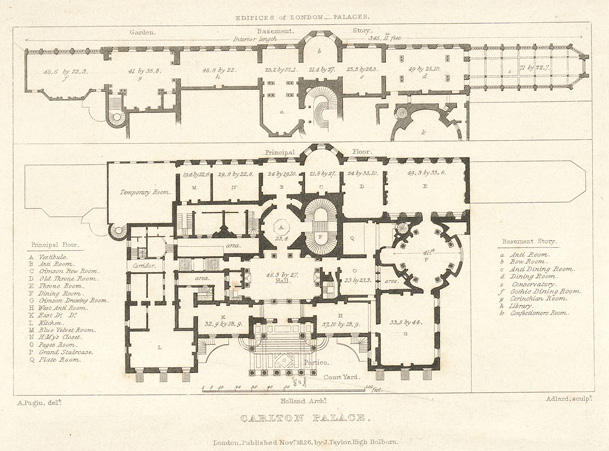
Plan_of_Carlton_Palace_in_1821

Plan showing the main floor and the suite of reception rooms on the lower ground floor

 Origins

Carlton House, as a royal palace, existed for nearly a century, and was the scene of many important state events, as well as of much prodigality and bad taste. The house, which fronted St. Alban’s Street and St. James’s Park, was originally built by Henry Boyles, Baron Carlton, on a piece of ground leased to him by Queen Anne, in 1709, at 35l. a year; it is described as “parcel of the Royal Garden, near St. James’s Palace,” and “the wood-work and wilderness adjoining.” From Lord Carlton the house and grounds descended to his nephew, Lord Burlington, the architect: he bested it, in 1732, upon his mother, the Countess Dowager of Burlington, who, in the same year, transferred it to Frederick, Prince of Wales, father of George III. The House was a building of red brick, with wings, and was afterwards cased with stone by Sir Robert Taylor. In Lord Burlington’s time, the grounds, which ran westward as far as Marlborough House, were laid out by Kent, in imitation of Pope’s garden at Twickenham. There is a large and fine engraving of the grounds by Woollett; bowers, grottoes, and terminal busts abounding.

Under the Prince Regent (George IV)

When, in 1783, the Prince of Wales, afterwards George IV, was allowed a separate establishment, Carlton House was assigned for his residence, and Holland, the architect, was called in, and added the chief features,—the Ionic screen and the Corinthian portico, fronting Pall Mall. [Horace] Walpole writes to the Countess of Ossor, in the autumn of 1785:

We went to see the Prince’s new palace in Pall Mall; and were charmed. It will be the most perfect in Europe. There is an august simplicity that astonished me. You cannot call it magnificent: it is the taste and propriety that strike. Every ornament is at a proper distance and not one too large, but all delicate and now, with more freedom and variety than Greek ornaments… As Gobert [French architect]… designed the decorations, I expected a more tawdry assemblage of fantastic vagaries than in Mrs. Cornelys’s masquerade-rooms. [Teresa Cornelys, operatic soprano, held many fashionable gatherings at Carlisle House, had many lovers, and bore a child of Casanova.]… There are three most spacious apartments, all looking on the lovely garden, a terrace, the state apartment, and an attic. The portico, vestibule, hall, and staircase will be superb, and, to my taste, full of perspectives; the jewel of all is a small music-room, that opens into a green recess and winding walk of the garden… I forgot to tell you how admirably all the carving, stucco, and ornaments are executed; but whence the money is to come I conceive not—all the tin mines of Cornwall would not pay a quarter. How sick one shall be after this chaste palace, of Mr. Adam’s [Robert Adam, popular 18th century architect] gingerbread and sippets of embroidery!

561px-CarltonStaircase

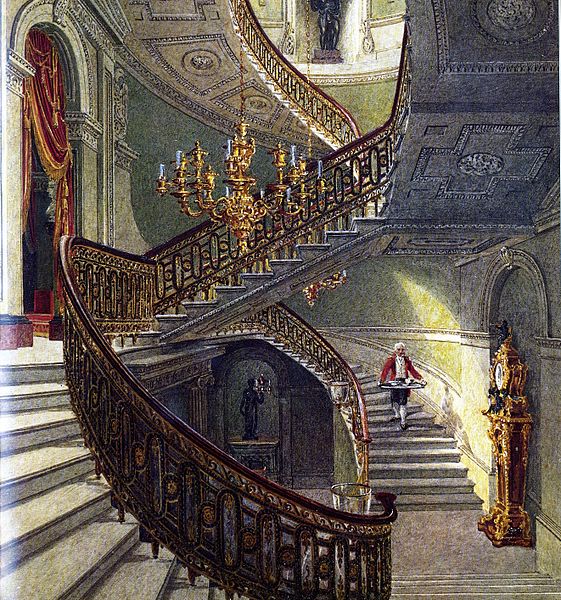
The main staircase, from Pyne’s Royal Residences (1819)

Timbs’s later assessment was not so kind. He says that the conservatory, “imitated from Henry VII’s Chapel, was a failure,” the blue velvet draperies “heavy and dark”; and the “Gothic dining-room was poor.” He found the armory to be “the most curious collection of arms in the world, [filling] four rooms.”

Here was John Hamden’s sword, said to be the work of Cellini; and a golden throne of the King of Candy was backed with a sun of diamonds and precious stones. Here, too, were arms from all nations—caps, boots, spurs, turbans, shields, bows, dresses, models of horses, helmets, sabres, swords, daggers, canopies, palanquins, guns, coats of mail, and other costly presents from all parts of the world.

In the plate-room were some fine specimens of King Charles’s plate; other plate was disposed in the centre of the room, in columns of gold and silver plates, and dishes, and drawers filled with gold and silver knives, forks, spoons, &c.…

The palace was superbly fitted for the Prince’s marriage: 26,000l. Was voted for furnishing, 28,000l. For jewels and plate, and 27,000l for the expense of the marriage. Here was born the Princess Charlotte, January 16, 1796, and the baptism took place on February 11; here, also, the Princess was married, May 2, 1816.

The Fête of June 19, 1811

The most magnificent State event of the Regency was the event given at Carlton House on June 19, 1811, being then the only experiment ever made to give a supper to 2,000 of the nobility and gentry. Covers were laid for 400 in the palace, and for 1,600 in the pavilions and gardens. The fête was attended by Louis XVIII, and the French princes then in exile; and a vast assemblage of beauty, rank, and fashion. The saloon at the foot of the staircase represented a bower with a grotto, lined with a profusion of shrubs and flowers. The grand table extended the whole length of the conservatory, and across Carlton House to the length of 200 feet. Along the centre of the table, about six inches above the surface, a canal of pure water continued flowing from a silver fountain, beautifully constructed at the head of the table. Its banks were covered with green moss and aquatic flowers; gold and silver fish swam and sported through the bubbling current, which produced a pleasing murmur where it fell, and formed a cascade at the outlet. At the head of the table, above the fountain, sat His Royal Highness the Prince Regent on a plain mahogany chair with a feather back. The most particular friends of the Prince were arranged on each side. They were attended by sixty servitors; seven waited on the Prince, besides six of the King’s, and six of the Queen’s footmen, in their state liveries, with one man in a complete suit of ancient armour.

600px-Saint-George_D'Eon_Robineau

Fencing Match between Chevalier de Saint-Georges and ‘La chevalière D’Eon’ on April 9, 1787 in Carlton House, painting by Charles Jean Robineau

Historical tidbit

Timbs mentions that the portico of Carlton House was the site of the “first public application of the newly-invented lighting by gas.”

Author’s Reflections

I’m thinking the fête might come in hand for a scene in my next story—as an example of the decadence and excess of the Prince Regent. What do you think?


Romance of London Series

  1. Romance of London: The Lord Mayor’s Fool… and a Dessert
  2. Romance of London: Carlton House and the Regency
  3. Romance of London: The Championship at George IV’s Coronation
  4. Romance of London: Mrs. Cornelys at Carlisle House
  5. Romance of London: The Bottle Conjuror
  6. Romance of London: Bartholomew Fair
  7. Romance of London: The May Fair and the Strong Woman
  8. Romance of London: Nancy Dawson, the Hornpipe Dancer
  9. Romance of London: Milkmaids on May-Day
  10. Romance of London: Lord Stowell’s Love of Sight-seeing
  11. Romance of London: The Mermaid Hoax
  12. Romance of London: The Bluestocking and the Sweeps’ Holiday
  13. Romance of London: Comments on Hogarth’s “Industries and Idle Apprentices”
  14. Romance of London: The Lansdowne Family
  15. Romance of London: St. Margaret’s Painted Window at Westminster
  16. Romance of London: Montague House and the British Museum
  17. Romance of London: The Bursting of the South Sea Bubble
  18. Romance of London: The Thames Tunnel
  19. Romance of London: Sir William Petty and the Lansdowne Family
  20. Romance of London: Marlborough House and Sarah, Duchess of Marlborough
  21. Romance of London: The Duke of Newcastle’s Eccentricities
  22. Romance of London: Voltaire in London
  23. Romance of London: The Crossing Sweeper
  24. Romance of London: Nathan Mayer Rothschild’s Fear of Assassination
  25. Romance of London: Samuel Rogers, the Banker Poet
  26. Romance of London: The Eccentricities of Lord Byron
  27. Romance of London: A London Recluse

Susana’s 2015 English Adventure: Week 4

map

On Monday I hopped on a train to Birmingham, then changed to one for Kidderminster. (I just love these English names, don’t you? Mousehole is my favorite, but I’m assured that it is a lovely place to visit despite the name.) At Kidderminster, I took a taxi to The Elms Hotel in Abberley, where I was met by the lovely Heather King and her fabulous, quadralingual dog, Roxy. Heather is an amazingly talented author of Regency stories (and, as Vandalia Black, of rather darker paranormal ones). Heather and I are online friends and have been part of two Regency anthologies, Beaux Ballrooms, and Battles and Sweet Summer Kisses. It was truly awesome to meet her in person, as well as Roxy and the ponies, Merlin and Dub-Dub, and Sootie, the black cat whose offspring were too high-in-the-instep to become acquainted with a Yankee. Heather served me Toad-in-the-Hole, which turned out to be a sort of English comfort food: sausages baked in a sort of pancake batter and served with hot gravy. Besides being very tasty, it served to warm us up inside and outside, after a day spent mucking about the ruins of Witley Court in the pouring rain. (It rains in England. Deal with it.)

Witley Court

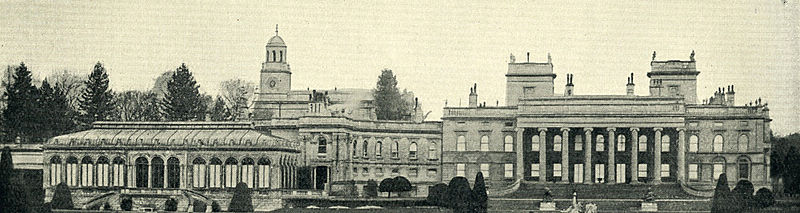
Witley Court was once one of the great houses of the Midlands, but a devastating fire in 1937 left it in ruins. While one cannot but regret the loss of such a beautiful home, the exposure of the “bare bones” has proved to be valuable to historians interested in learning about historical building practices.

800px-Witley_Court_circa_1900_2

Witley Court, 1900

Witley Court today

Witley Court today

Thomas Foley (whose grandson became the 1st Baron Foley) built the house in 1665 on the site of a manor house. Additions were made by John Nash in the 19th century, and the house was sold to the Dudley family (later to be given an earldom) in 1837.

Tramping about the ruins of the house turned out to be much more appealing than one might have expected, even in the pouring rain! The gardens are lovely, particularly the fountain (see video here), and the parish church on the property—which is not a ruin—is magnificent.

See photos here.

Berrington Hall

On Tuesday Heather, Roxy, and I visited Berrington Hall, a splendid country home in Leominster (pronounced Lemster, or so they tell me). It was designed in the late 18th century by Henry Holland, whose talent, although not eclipsing that of my favorite, Robert Adam, puts him solidly in second place, in my estimation.

In addition to the rich furnishings and décor, there was an exhibit of Georgian fashion throughout the house, which included—believe it or not—costumes from the 1995 BBC production of Pride and Prejudice. Yes, I was close enough to touch the costumes worn by Darcy and Lizzie during the final proposal scene, as well as many others. Truly an awesome experience!

Henry Holland!!!

Henry Holland!!!

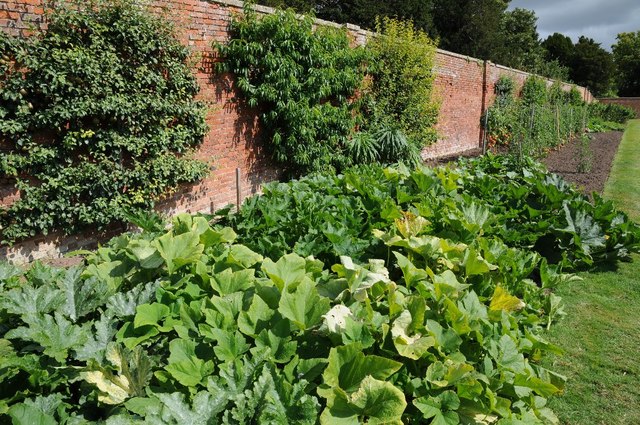
The vast grounds include a walled garden with some vintage apple trees, a ha-ha, a lake, and some lovely paths. Heather and I enjoyed a delicious picnic before exploring further some of those paths. And not a drop of rain!

See photos here.

Waddesdon Manor

On Wednesday I took a train to Aylesbury, in Buckinghamshire (where, incidentally, the estate of my hero in The Third MacPherson Sister is located) to visit Waddesdon Manor.

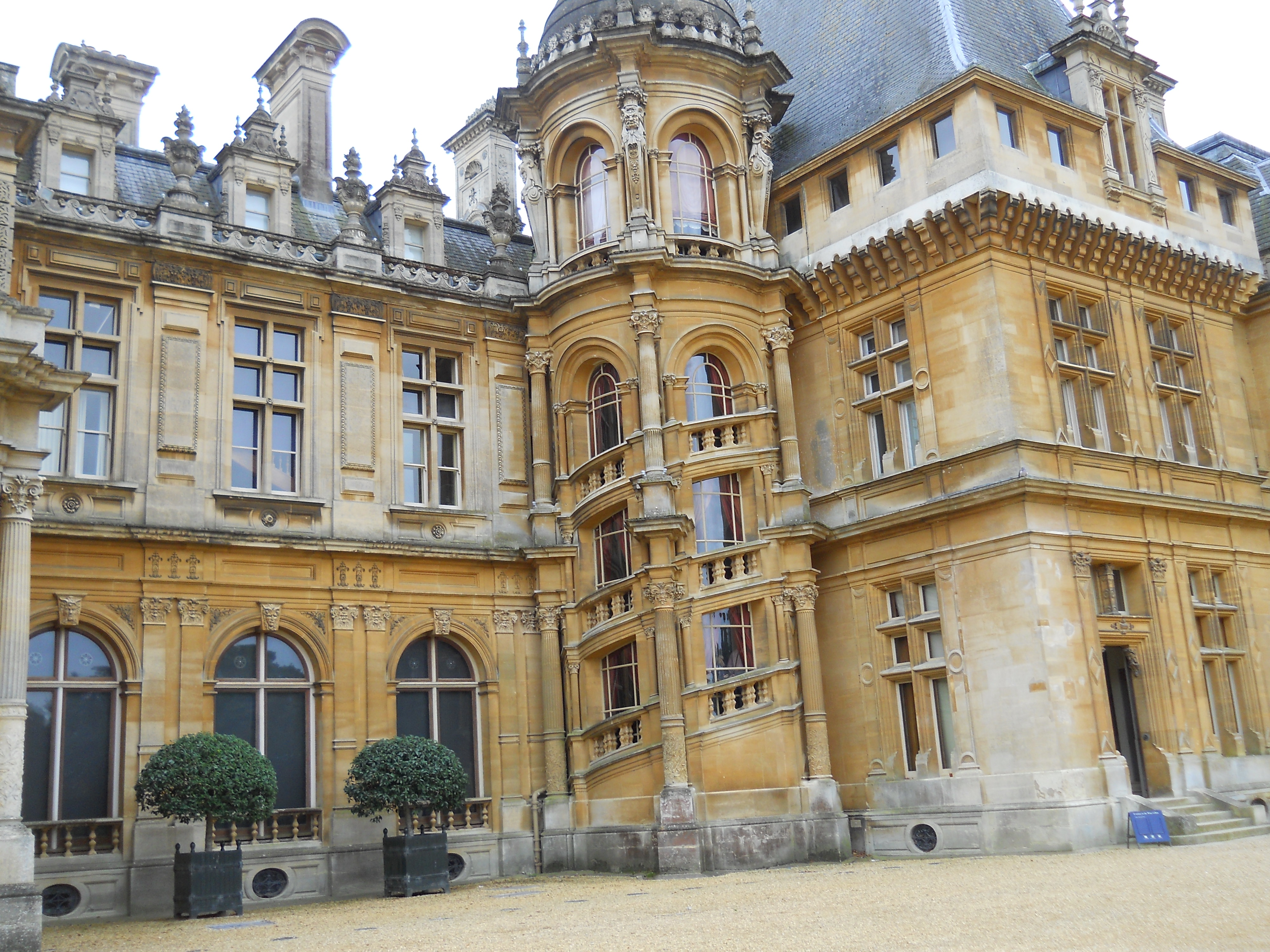
Waddesdon Manor was built in neo-renaissance style in the late 19th century as a sort of French château by the Baron Ferdinand de Rothschild of the Austrian banking family. The baron fell in love with his second cousin, Evelina, and married her, only to lose her in childbirth eighteen months later. The baron never married again, but became a compulsive collector instead. The furnishings are considered to be among the richest of any stately manor anywhere.

These stairs are reminiscent of those at the Château de Chambord in France

These stairs are reminiscent of those at the Château de Chambord in France

Unfortunately, I was only able to tour the house due to time considerations, but I plan to visit again to get a good look at the extensive grounds and other buildings, such as the Aviary and the Dairy.

Although cloudy, it didn’t rain until I had returned to London, where I got promptly soaked making a last round of Piccadilly Street and Fortnum & Mason. But hey, it rains in England. That’s why it’s so beautiful!

See photos here.

Adieu to England

Squidgeworth enjoyed his orange juice on the plane.

Squidgeworth enjoyed his orange juice on the plane.

It was with a tear in my eye as Squidgeworth and I said goodbye to England on Thursday. For now. We had a marvelous time and were fortunate to be able to visit many wonderful places, but there are still lots more on our bucket list. I’ve already booked our flight and flat for next year’s trip in August.

So much to see, so little time!

Next week: Squidgeworth and I have some travel tips for you!