Tag Archive | fashion

What’s a Pandora Doll? A Seamstress, A Soldier, and A Secret

Susana and her sisters have just discovered that they are going to participate in the Season in York, and they are excitedly planning how to manage wardrobes for the seven older girls when they have scarcely enough money for one. Thankfully, Susana is a quasi-professional dressmaker, and she can help them create a wardrobe that all can share with enough clever disguises.
“You know, Susana, I think there are some gowns and things of Mama’s up in the attic. Perhaps from our stepmothers as well, although I believe Martin removed his mother’s things for Chloe.”

“Well, he can just bring them right back, since our stepsister is to be presented too.” They knew Chloe well; she’d lived with them until her mother’s death, when her brother Martin and their guardian, their mother’s brother, took her in. She visited her half-sisters Emma and Merri occasionally. And Martin, relieved to have Patience take on Chloe’s presentation, had eagerly provided funds to pay for the ball. And her wardrobe, so that was one sister Susana did not have to clothe.

“Let’s take a look.”

It had been years since she had perused her mother’s things. Nine years since her death, when the maids had packed up her possessions and banished them to the attic. And fortunate indeed that they had made their way to Starbrook after the family had been exiled from the main house. No doubt the newest Lady Seahaven would have organized a bonfire for all of her predecessors’ belongings.

Not a nice thought, she chided herself. But it was hard to think well of the usurping Seaheavens, who had inherited and dislodged them from the home they had known all their lives.

Mama, she thought as they opened one of the chests that held her things. You were the same age as Barbara when you left us. How I wish you were still here.

The Lady Seahavens hadn’t moved much in society, as their thoughtless husband saw no need to take them along when he traveled to London, for Parliament, and other things. His ladies had no need of extravagant gowns. But they did socialize with the local gentry, so Doro and Susana did find a few of their mother’s evening gowns. Of course, they were nine years out of fashion, but Susana thought she could make them work with a few alterations. The trims were a bit worse for wear, but there might be a way to revive them.

“Oh, look at this!” 

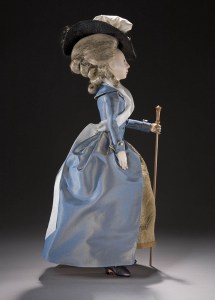
Doro held out a doll, about sixteen inches long, wrapped in delicate tissue paper. The head and body were carved of a single piece of wood; the legs were of wood too but separately attached to the torso. The upper arms were formed of stuffed linen, also attached to the torso, wooden lower arms and hands attached to those.

“I remember this!” cried Susana. “Mama showed it to me once and said it was made to resemble the Duchess of Devonshire. See the hairstyle and the wide bonnet! She has all the undergarments too! And the sash: she’s dressed for the 1784 election campaign. Mama said her grandfather had it made for her. It wasn’t a toy, though. It’s a Pandora. A fashion doll. That’s why she wouldn’t let me play with it.”
“It’s beautiful,” said Doro wistfully. “It shouldn’t be left in old trunk.”

“If we put it out somewhere, we’ll have to be sure Emma and Merri don’t get their hands on it.”

“And Jane,” Doro added absent-mindedly. “Look at the quality of the material—the stockings, the chemise, the petticoats. And there’s a corset too—looks exactly like the real thing!”

Susana ran her finger along the blue silk overdress. “The silk is very fine. I would say French, coming from that era.” She turned to the reverse side and gasped. “It’s English. It’s stamped Macclesfield Silks.”

Macclesfield Silks. Where Blaise had gone to work. With a man called Thomas Pemberton.

“Doro,” she said slowly. “What was our mother’s birth name?”

Doro squeezed her eyes shut. “We never met them, for some reason. Mama never spoke of them. I suppose they disapproved of her marriage, although most people would be over the clouds happy for their daughter to marry an earl.” She grabbed Susana’s arm. “Pemberton! Her name was Maryann Pemberton!”

Susana’s mouth fell open. Could it be true? She and Doro and Barbara related to the Thomas Pemberton of Macclesfield Silks?

“A cup of tea,” she said. “I need a cup of tea.”

Pandora Dolls

Many of you know that I collect fashion prints. I have a ton of them and love them all. But in the time prior to fashion prints, there were fashion dolls. One of them was called a Pandora.

How on earth was a fashionable lady in the 18th century able to keep up with the latest trends? The answer was the Pandora, or miniature dolls dressed up in the latest modes. Keep in mind, this was long before magazines were invented—and the first ones were incredibly rare and expensive, as they were hand-painted by groups of (probably shockingly underpaid) little girls and young women! Clothing was also far more expensive than it is today, so it was important to know all the details of the cut, colour and fabric that you wanted.

In 1712, when Britain and France were at war with each other, Pandora dolls were exempt from the ban on enemy imports, and even received a military escort! Marie-Antoinette, when preparing to go over to France from Austria, got sent a host of these dolls in different fabrics and fashions.

https://thatmuse.com/2019/11/08

Today, fashion victims use fashion magazines, shows etc. to become informed about fashion news. But what sources did they use in the 18 th century to catch the latest trends when none of these media existed? Long before the first Barbie appeared, there already existed a doll that wore lavish wardrobe and matching accessories but didn’t function as a toy at all. This paper examines how a doll called Pandora was sent abroad by French dressmakers to promote and sell Parisian fashion around the world. First, Pandora had to conquer the royal houses in Europe. Then, she made her way into the department stores and finally into the bourgeois home. Interestingly, her triumphal procession did not stop there: By the middle of the 18th century she had even crossed the Atlantic to be exhibited in Boston and New York….

The doll’s body and head were carved by hand from one piece of wood, which had been turned on a lathe. The legs were made separately and attached at the hips and knees to the Pandora’s body. The lower arms and hands were also crafted of wood; in contrast the upper arms were ‘[…] made of either soft linen fabric or kid leather, attached to the torso’. Most dolls had painted eyes, but some of them had sparkling glass eyes, which was more labour-intensive because for this purpose the doll maker had to carve diamond-shaped holes into the head and then inserted blown glass balls….

Furthermore, the fashion dolls all had either painted hair or wore wigs made of flax or wool. The hair of the dolls was designed to be worn in the popular style of the time because it was absolutely essential that besides wearing the right clothes, the Pandora had the latest hairstyle as well as accessories that matched her wardrobe. Interestingly, although most 18 th century dolls represented women or girls, there also existed male, boy and even infant dolls. Unfortunately, the vast majority of these fashion figures of the late 17 th and early 18 th century have not withstood the test of time. This is due to two reasons: Firstly, the unwieldy size of the dolls and secondly, the material that was used to make them….
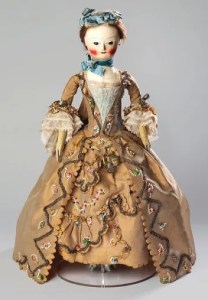
An English 18th –century fashion doll in the Fashion Gallery at the V&A. There are 6 fashion dolls in the same room.

Intended as advertisement for the French fashion and the dressmakers, the dolls functioned as mannequins and were dressed in a petite-size version of everything a fashionable woman needed to wear, including the proper foundation garments, which meant that the Pandoras were outfitted head to toe and displayed the latest fashions concerning clothes and hairstyle. ‘By the seventeenth century, when these French figures were known as “Pandora,“the dressing of the head and hair was as important as the garment’. The doll’s outer garment was a dress made of highest quality cloth: linen, cotton, wool brocade or silk, followed by a petticoat or multiple layers of petticoats, which gave the dress or skirt the desired fashionable shape. The hoop petticoat or wicker, also known as panier, was part of the women’s underwear and consisted of a basket. ‘They [the petticoats] could get as wide as 18 feet (5 metres), and satirists talked of hoops of 7 or 8 yards (6 or 7 metres) wide’. The extremely wide framework of the hoop made it difficult for women to walk through the doors, sit down on a chair or in a coach. Some even wore a stomacher, which was in fashion throughout the 17 th and 18 th century in Europe and North America. The stomacher was a v-shaped piece of fabric made either of the same material as the dress or of contrasting materials. It was worn across the chest and stomach and embroidered or decorated with pearls or other gemstones. Other key characteristics of women’s clothing that were also part of the fashion dolls’ outfit were corsets and linen shifts. Knitted stockings, shoes, a muslin cap and jewellery often completed the outfit.

Another question is: who were the potential buyers of the fashion dolls? First, the dressmakers and tailors purchased the fashion doll. Above all the Pandoras functioned as display and show items. Since fashion was extremely expensive, the rich costumers wanted to have a look at what they were going to spend their money on….

The French doll makers received orders from all over the world, since almost every British women of that time wanted to have their one little mannequin to keep abreast with the latest Parisian fashion trends. In the Augustan Age it was very common not only to adopt the French customs, etiquette, lifestyle and manners but also the clothing fashions. It is remarkable how widely the dolls were distributed geographically in the 18 th century. They were not only dispatched throughout Europe but were also shipped across the Atlantic. Travelling around the world in the name of fashion, the Pandoras took over two functions: on the one hand, they were the ideal advertising vehicle for French fashion; on the other hand, they served as a kind of diplomatic representation of France. The fashion doll became one of the most important and popular French export goods.

“New” Fashion Dolls on Etsy

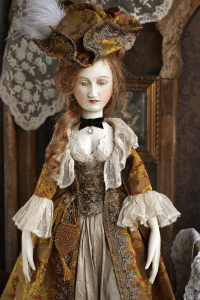
And then I discovered that newly-created French court fashion dolls can be purchased on Etsy. You might have to sell your family heirlooms to buy them, but one can dream!


Chatsworth: A Grand House, To Be Sure, But Would You Wish to Live There?

Charming Chatsworth

Since reading Amanda Foreman’s Georgiana, Duchess of Devonshire, which includes much of the infamous duchess’s letters and journal entries, I’ve been fascinated by the Devonshire family. The only thing missing among the highly dramatic history of this noble, highly-esteemed family—possibly the wealthiest in England in the Georgian era—is a happy ending. The Devonshires of this period are prime examples of failed British aristocratic marriage and family values. With a seemingly endless source of income and the highest social status, why were these people so desperately unhappy?

It also begs the question that if we all truly believe that money and possessions not only do not make us happy but tend to bring along with them worries and responsibilities to weigh us down, then why do so many of us never seem to have enough? How much is enough? A comfortable life with enough income to cover the bills sounds reasonable. But does that mean stately homes, expensive cars, and a yacht to sail around the world? If you have that, would you be satisfied, or would you yearn for even more? If the billionaires of this world were truly happy, then why do they keep going after more and more? What do you do with a billion dollars anyway, especially with tax loopholes that the ordinary citizen does not enjoy? In the end, do you get a solid gold casket or something? Do you get special privileges in heaven?

Enough preaching. I wanted to write about my Chatsworth experiences this week. Yes, there are lessons to be learned. Unfortunately, most people aren’t inclined to learn from the past, and thus we keep making the same mistakes over and over.

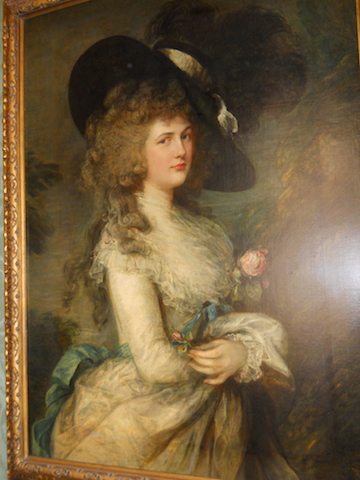
Georgiana, Duchess of Devonshire

Georgiana Cavendish, Duchess of Devonshire

Georgiana Cavendish, Duchess of Devonshire

Pronounced George-ayna, by the way. Georgiana was the oldest daughter of the First Earl Spencer and his wife, also Georgiana. The Earl and his wife were childhood sweethearts. If you visit Spencer House on St. James Place in London (see my Pinterest board here), you will be told about their great love and shown all sorts of decorative features that proclaim their love match. It truly warms the heart of a romance addict. Except that…it doesn’t ring true when you realize they subjected their beloved seventeen-year-old daughter to a loveless marriage that brought her much unhappiness. What went wrong?

Well, perhaps it wasn’t entirely their fault. Young Georgiana probably thought it was a dream come true to marry the richest man in England who also happened to be a duke (the 5th Duke of Devonshire). It must have been a shock, though, to discover that her husband had no intention of being faithful, that even at the time of their marriage, his mistress gave birth to an illegitimate daughter who was eventually brought into the Devonshire family to be raised after her mother died. Georgiana herself found it difficult to conceive and suffered miscarriages before producing three children, two daughters, and finally a son, sixteen years after her marriage.

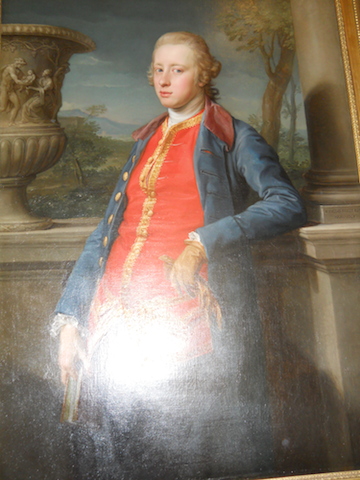
William Cavendish, 5th Duke of Devonshire

William Cavendish, 5th Duke of Devonshire

Georgiana enjoyed her life as a leading lady of fashion and politics in the ton. A friend of Queen Marie Antoinette of France, they copied each other’s fashions, including excessively tall hairstyles and large hats. Georgiana was also a leader of the Whig movement, hosting popular salons at Devonshire House in London for all the prominent Whigs of the time. (See a blog post here about her political exploits.) But with all this, she wasn’t happy. She spent lavishly, and gambled excessively (see post about her gambling exploits here), to the point where even the coffers of the richest man in England were seriously threatened. Her mother, the Countess Spencer—who also gambled beyond her means, particularly after her beloved husband died—warned her to be honest with her husband and to be more prudent in her gambling. Didn’t happen. The duke only found out the truth about her debts after her death. I guess they didn’t have Gamblers Anonymous in those days, or they’d know an addict isn’t able to manage his addiction prudently without giving it up entirely.

Georgiana seemed to have everything, and yet, she didn’t. Desperate for a close friend, when she met Lady Elizabeth Foster, who was separated from her husband and sons and seemingly destitute, Georgiana insisted she reside with them, and so began the ménage à trois. Lady Foster bore Georgiana’s husband two illegitimate children, who were brought up in the Devonshire home with their half-siblings, and Georgiana didn’t seem to mind. She and Bess were the best of friends, although many, including Lady Spencer, believed Bess to be a con-artist of the worst kind.

Charles Grey, 2nd Earl Grey and later Prime Minister

Charles Grey, 2nd Earl Grey and later Prime Minister

After the birth of her son, who later became the 6th Duke, Georgiana felt free to have love affairs of her own. She fell in love with Charles Grey, later to become an earl and a prime minister, and bore him a daughter, who was raised by the child’s paternal grandparents. Her husband was enraged and exiled Georgiana to France for three years, during which time she worried that her son would never know her. (Okay, the duke was a man of his time and perhaps not so terrible as he seems today, but punishing his wife for something he’d been doing for all their marriage just does not give a good impression of his character. Maybe it’s just me?)

Georgiana died in 1806 at 48 of a liver abscess (an eerie coincidence since I had this same affliction last fall, but am completely healed, thank heavens), and three years later, Lady Foster married the duke and became the second duchess, whereupon she admitted the paternity of her two illegitimate children and demanded that the duke provide for them as handsomely (or more so) as his legitimate children. (No, I don’t like her. Can you tell?)

Elizabeth Cavendish, second wife of the 5th Duke of Devonshire

Elizabeth Cavendish, second wife of the 5th Duke of Devonshire

The 6th Duke

Georgiana’s son was sixteen when his mother died and twenty-one when his father died and he inherited. He was active in Whig politics, but his special interest was landscaping and architecture. He had a north wing added to the house and an extensive renovation of the gardens. He spent lavishly to improve the property, which at that time included about 83,000 acres. William never married, having courted Georgiana’s sister’s daughter, Lady Caroline Ponsonby (yes, the one who went nutso over Lord Byron) and lost her to William Lamb, who undoubtedly regretted his marriage in retrospect. Perhaps His Grace realized his good fortunate in escaping a miserable marriage and couldn’t bring himself to risk it again. Certainly the marriages in his own family must have given him quite a few qualms!

The Devonshire Arms

The Devonshire Arms

The Devonshire Arms

Described as “a picturesque country pub at the heart of village life, offering the charm and character of an historic inn with a contemporary twist,” the Devonshire Arms offers comfortable rooms, superb food, and a quaint, medieval building that won’t fail to inspire any dedicated history lovers who book rooms here. Check out my Pinterest board here. And the village of Beeley is equally charming.

Chatsworth

Chatsworth is such a beautiful place, filled with such priceless art and furnishings (see Pinterest board here), that one can’t quite understand how so many of its inhabitants, possessed of great wealth and just about anything they wished, were so obviously unhappy. I thought about this a great deal as I took my time touring the rooms and listening to the audioguide, and even as I walked among the rolling hills and sheep from my lodgings to the house. So much beauty and wealth, and yet, I am not envious. At this point in my life, I don’t aspire to such heavy responsibilities, no matter the grandeur and glamorous lifestyle. It is enough for me to have the privilege of seeing it and experiencing it this one time.

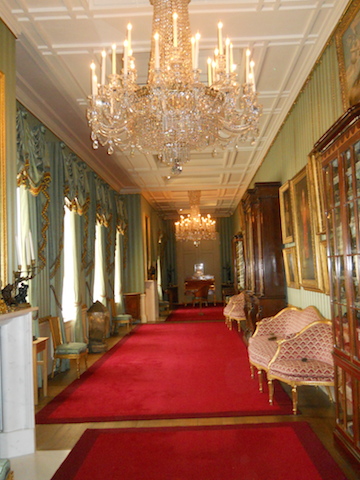
Lovely ceilings throughout the house

Lovely ceilings throughout the house

Sketches Room (my favorite)

Sketches Room (my favorite)

Countess Spencer, Georgiana's mother

Countess Spencer, Georgiana’s mother

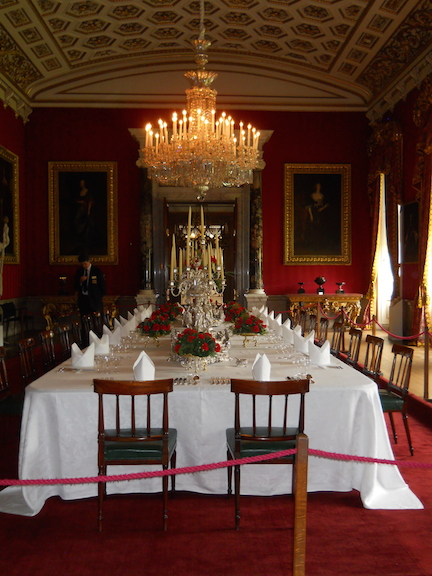
Dining Room

Dining Room

Devonshire family portraits

Devonshire family portraits

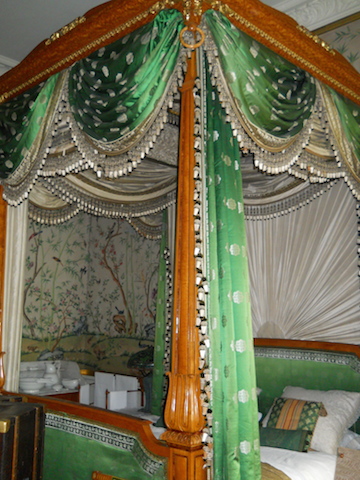
Wellington Bedroom

Wellington Bedroom

On With the New: Wall sculpture of DNA maps of current Devonshire family

On With the New: Wall sculpture of DNA maps of current Devonshire family

What do you think? Would you like to live the life of a wealthy celebrity? I’m curious to know if others feel as I do that “enough is enough”, and that happiness is not found in great wealth and possessions.

The Rise and Fall of Beau Brummell

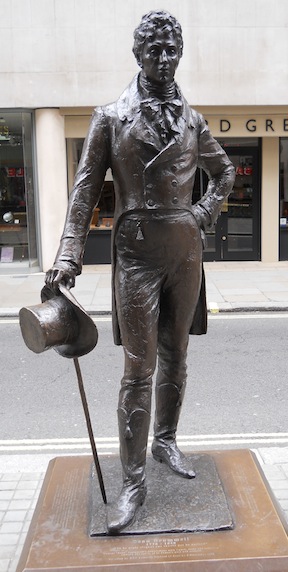
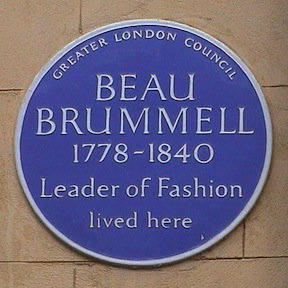
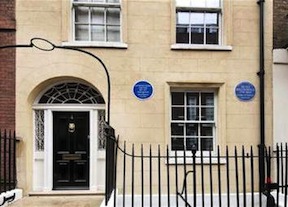
The epitome of a Regency dandy was a young man by the name of George Brummell. George did not grow up in the lap of luxury—his grandfather was rumored to be a personal servant—but his father was secretary to Lord North, and he was sent to Eton at the age of twelve in 1790, where he became very popular. Because of his attention to fashion and grooming, it wasn’t long before he became a great friend of the Prince Regent, who, in 1794, gave him a commission in his own regiment, the 10th Hussars. Brummell, nicknamed “Buck” by his intimates, spent most of his time on military leave, until he inherited 30,000 pounds and resigned, setting up his own household in 1798 at No. 4 Chesterfield Street.

BEAUBRUMMELL copy

Brummell decreed that cut and fit in a gentleman’s clothing were more important than elaborate fabrics. His insistence on cleanliness had the effect of pulling English gentlemen out of the stables and into the baths, and then poured into closely-fitting, well-cut clothing, including snow-white neckcloths tied into elaborate knots, smoothly shaved faces, and hair that required three hairdressers—one for the front, one for the sides and one for the back.

“The Beau” was known for his audacious wit and his condescending comments centering on the bad taste of others, men and women alike. A set-down from him could ruin a young person’s reputation and send them running from London in shame. Brummell and his dandies made it unfashionable to show emotion or any concern for the consequences of their actions. Although he had no social standing of his own, he had even the highest-ranked gentlemen admiring and copying his dress and behavior. Along with Lord Alvanley, Henry Pierpont and Henry Mildmay, he was part of the “Dandy Club” of Watier’s.

Unfortunately, Brummell’s extravagance, gambling and sharp tongue also led to his downfall. In 1813 at a party, the Prince Regent snubbed Brummell and Mildmay, staring them in the face while refusing to speak to them. Brummell quipped to Alvanley, “Who is your fat friend?” and that was the beginning of the end for Brummell.

In 1816 he fled to Calais where he lived in poverty until his death of syphilis in 1840.

londonrem

#4 chesterfield st.

No. 4 Chesterfield Street

Laudermilk, Sharon H. and Hamlin, Theresa L., The Regency Companion, Garland Publishing, 1989.

The Regency Gentleman series

The Regency Gentleman: His Upbringing

The Fashionable Gentleman

The Rise and Fall of Beau Brummell 

Gentlemen’s Clubs in Regency London

Captain Who?

Gentlemen’s Sports in the Regency

The Gentleman’s Passion for Horses

Riding to the Hounds

The Regency Gentleman’s Passion for the Turf