Tag Archive | Christmas

Beppie Harrison: Two Rings for Christmas

Donegal, where my Christmas novella Two Rings for Christmas takes place, is as far north and west as you can go on the island of Ireland. It’s very beautiful but stark and harsh land there: making a living from the land has always been hard. It was hard in 1817, the time of this story, and always has been. The land is mountainous and rocky, with generous peat bogs but not much in the way of arable land. Most of those who live there now—or who lived there before the terrible Time of Hunger in the middle of the 19th century—were not there by choice. But the ancient aristocracy of Ulster, defeated in the Nine Years’ War in Ulster in 1603, escaped to the continent, hoping to rally Spanish support for the Catholic cause. They died in exile.

DSCN0086 copy

Their lands were therefore defaulted to the British government, who took the opportunity to establish their Plantation Scheme, in the course of which the Catholic Irish tenants and owners of the land were displaced and Protestant settlers, primarily from Scotland but some from England, were given their land. The Catholic Irish fled west to Donegal. Even some of the Donegal land was given as plantation land to the Protestant incomers, but they found the effort of farming there too difficult and retreated east.

The time of Two Rings for Christmas is two centuries later, but the challenge of making a living in that hard and infertile place was as difficult as ever. The time of the great Irish potato famine had not yet come—that was 30 years in the future—but even then many of the young men of Donegal were heading west across the Atlantic Ocean to find some way of earning a living in America.

Fergus, a strong young man from Donegal, emigrates to Boston with the goal of earning enough money so that he can return and marry his sweetheart, Jenny. Three long years he works, until he can pay for his passage back, has some coins in his pocket, and a golden ring for Jenny. But when he returns to Donegal for Christmas, is Jenny still waiting for him?

Pageflex Persona [document: PRS0000031_00016]

About Two Rings for Christmas

Two Rings for Christmas is the story of a young Irishman, Fergus, unable to find work in Donegal, who emigrates to Boston to make some money so he can return and marry his true love, Jenny. Three long years he works, until he can pay for his passage back, has some coins in his pocket, and has bought a golden ring for Jenny. But when he comes home to Donegal for Christmas, will Jenny still be waiting?

Amazon

Excerpt

“Could not wait for me, is that it?” His voice rang out now, a challenge.

“And how was I to know that you remembered me?” Jenny snapped.

“Did not I write you letters?”

She tossed her head, and her rich brown hair lifted and then resettled on her shoulders. “Letters. Well, yes. Three letters in three long years—and the last of them more than six months ago.”

Oh. As he remembered, there had been more, but she might have the right of it. He was not good at writing letters. Somehow all the things he wanted to say ran away from his pen before he got them down to paper.

“’Twasn’t enough, you know. Six months without a word, and me mam going on at me about how you were off to Amerikay and never would come back.”

“I’m here now.”

She closed her eyes and held her hands to her temples. “Aye, you’re here, right enough. Why could you not have written to tell me so? Why could I not have known two, three weeks ago? ‘Twas only then that Daniel Beatty came and me mam said he was my last chance and—and—”

And damned if she was not crying. Jenny crying, with the ring of Daniel Beatty around her neck. What was he to do now?

His heart went soft on him. “Jenny, sweet Jenny, I wanted to surprise you. I had a ring for you, Jenny my love.”

He pulled it out of his pocket and held it in his hand.

About the Author

BeppieHarrisonPHOTO copyBeppie Harrison had the great good sense to marry an English architect, and consequently has lived a trans-Atlantic lifestyle. They now live in Michigan between trips to the old country and Ireland (which she despaired of during the years of the Troubles) and she remains fascinated by the complicated relationship between England and Ireland. Their four children have grown up and left the nest but two indignant cats remain—as good an allegory for England and Ireland as she can imagine.

Cheryl Bolen: Ex-Spinster By Christmas (House of Haverstock, Book 4)

Interview with Cheryl Bolen

Susana: When did you know you wanted to be a writer?

Cheryl Bolen copyCheryl: When the nun who was my third grade teacher explained about paragraphs and asked us to make up one, I thought, “Wow! This is something I love to do!” I was one of those kids who spelled well and absorbed grammar and punctuation rules like some women collect shoes. Therefore, when I went to college, I decided to major in journalism so I could be paid for writing. (Until the Great Digital Disruption, it wasn’t easy to make it as a novelist in New York publishing.) I did major in journalism, with a double major in English. Then I got a master’s in education in case I ever wanted to teach. I worked for two decades as a journalist, and I also taught English for six years.

Susana: Tell us about getting The Call.

Cheryl: Sadly, I wrote seven complete novels before I got The Call 19 years ago from an editor at Harlequin Historical. I started in romantic suspense and won a lot of contests but never got a contract. Then I wrote a sweeping World War II love story which won even more contests but did not sell. It did, though, sort of get me in the back door at Harlequin because the editor judging the top three manuscripts in a contest in which it placed liked my writing and said if I wrote something that took place before 1900, she’d like to see it. The only historical genre I knew was Georgette Heyer. I’d read every one of her books; so, I sat down and began A Duke Deceived, entered the beginning in a few contests to see if it was good, and it placed in every contest I entered.  So I sent the first three chapters to that Harlequin editor, and she asked to see the complete manuscript. I sent it in and waited five months before I got The Call.

I was working as news editor of our community newspaper and came home for lunch, flipped on my answering machine, and there was a message to call the editor at Harlequin. I was shaking all over. I called my husband’s office to tell him, and he said, “Why in the heck are you calling me? Call her back.” I did, and she said they wanted to buy my book. “How does an advance of $5,000 sound to you?” she asked.  I was thrilled—and still shaking—but tried to calmly say, “That sounds fine.”

Susana: So how many books have you written now?

Cheryl: In August I received a pin from Romance Writers of America for writing 35 books. Since then, I’ve published two novellas. I’ve written for Harlequin, Kensington, Love Inspired Historical, and I’ve written one book for Montlake. It was a lighthearted, romantic contemporary mystery which I envisioned as the first book in the Stately Homes Murders, set in England. I began self-publishing in 2011 and have never been happier—and never made so much money! Of my 37 titles, all but five are Regency-set historicals.

Susana: What’s the heat level of your books?

Cheryl: My first ten years of publishing, I wrote to suit the New York publishers, and they wanted hot. Now that I’m my own boss, most of my books are sensuous with the bedroom door closed.

Susana: What’s next for you?

Cheryl: My next full-length novel will be the story of the third Birmingham brother—at readers’ request. The Birminghams, the richest bankers in England, were introduced in my Brazen Brides series. I haven’t started it and have zero plot ideas. This is a hybrid series, in that the first two (Counterfeit Countess and His Golden Ring) were written for Kensington in 2005, and I’m now continuing the series with my own imprint.

ex-spinster-by-christmas-copy

About Ex-Spinster By Christmas

“Delightful author, delightful characters, delightful stories.”—Austintatious

Ever pragmatic, Lady Caroline Ponsby has given up hope she’ll ever receive a proposal of marriage from Christopher Perry, the wealthy man she’s adored for almost two years. She is determined to be an ex-spinster by Christmas. To that end, she has invited a prospective suitor to spend Christmas with her family. She knows very well that Lord Brockton would love to get his hands on her dowry, and she’d love to be a married woman with a home and family of her own.

The very idea of his Lady Caroline throwing herself away on the likes of the vile Lord Brockton rankles Christopher Perry. A pity he cannot offer for her himself, but a duke’s daughter is too far above his touch, given his family’s humble origins. Nevertheless, Christopher attends the Duke of Aldridge’s Christmas house party with the intention of thwarting Lady Caroline’s grave misalliance with Brockton. If only he’s not too late…

AmazonBarnes & NobleiBooksKobo

Excerpt

http://www.cherylbolen.com/ex-spinster%20excerpt.htm

About Cheryl Bolen

Since being named Notable New Author for 1997, Cheryl Bolen has published more than 35 books with Kensington/Zebra, Harlequin, Love Inspired Historical, Montlake, and independently. She has broken into the top 5 on the New York Times and hit the USA Today bestseller list. Her 2005 One Golden Ring won Best Historical, Holt Medallion, and her 2011 My Lord Wicked was awarded Best Historical in the International Digital Awards, the same year her Christmas novella was chosen as Best Novella. Her books have been finalists for other awards, including the Daphne du Maurier, and have been translated into a dozen languages. She’s also been the number 1 bestselling historical romance author in Germany.

She holds a bachelor’s degree in journalism and English from the University of Texas and a master’s degree from the University of Houston. Her favorite pursuits are reading diaries of dead English women, traveling to England, and watching the Texas Longhorns play football and basketball. She and her recently retired professor husband are the parents of two sons. One is an attorney, the other a journalist.

WebsiteBlogFacebook

Jude Knight: Interview with the Marquis of Aldridge (Giveaway)

Today, we are with that renowned scion of the Grenford family, the Marquis of Aldridge. As the eldest son of the Duke of Haverford whose health is understood to be failing, he has taken over much of the business of the duchy. However, he continues a vigorous social life, and is as popular on his rare appearances in a Society ballroom as he is rumoured to be in less reputable establishments.

(LC stands for Lady Correspondent. The interviewer wishes to remain anonymous, and Aldridge has sworn not to disclose her identity.)

LC: Your lordship has recently returned from Hollystone Hall, where your mother has been holding a Yuletide house party. We are informed you arrived late and left early. Do you have a particular reason for avoiding such events?

(LC blushes. She was present at both the arrival and the departure, but her questions will be printed so she cannot say so. Beyond a twitch of his eyebrows and a quirk of his lips, Aldridge does not acknowledge her deception.)

aldridge-1Aldridge: Errands for my father and other business matters kept me in town, but Her Grace my mother knew not to expect me until Christmas Eve. I would, however, have avoided the party altogether if the duchess had not required my attendance. I find that I spend such occasions avoiding debutantes with a fancy for a ducal coronet. In any house other than my mother’s, I could have discouraged them by a blatant and scandalous pursuit of a willing widow or a straying wife.

I say pursuit… But if that is not sufficient, our behaviour once I have caught the lady who has temporarily attracted my attention tends to drive away the most title-hungry of virgins and their mamas.

You would be wise to believe that my reputation is well deserved, but it is also something of a protection against all but the most ambitious.

However, as I say, I was under my mother’s roof, so the usual avenue was not open to me.

LC: So what did you do instead?

Aldridge: In the event, I had my brother with me, and we protected one another. We even shared a bed chamber, so any blushing virgin who thought to conceal herself in my bed was as much at risk of ending up with the prodigal spare, as with the disreputable heir. (Grins)

The few days I was there proved very entertaining. The duchess’s stated aim for the fortnight was to raise money for her new charity fund, but she was playing matchmaker, of course—and very successfully.

regency-fashionLC: We understand the house party was the venue for several betrothals and a marriage.

Aldridge: Yes, the Earl and Countess of Somerton married at the local church just before Christmas.

LC: Society is aghast to learn that the Earl of Somerton married the actress, Charlotte Halfpenny.

Aldridge: A magnificent actress; possibly the finest of our generation. She will, I am sure, play the part of countess to my dear friend Somerton with as much artistry as she put into her earlier roles.

Two other weddings in those weeks were associated with the house party, though they did not take place at Hollystone Hall. Lady Sophia Belvoir wed Lord Elfingham in London in a private ceremony that received, we are told, the blessing of his dying grandfather, the Duke of Winshire. And the Stanton party were delayed (with the exception of Lady Stanton), because Lord Stanton’s little sister and Frederick Woodville wished to be married in Cumbria.

LC: There is a touch of scandal in both unions, is there not? Why was Lady Stanton not at her daughter’s wedding, and what happened on that wedding journey that caused her stepson to propose to Mr Woodville’s sister?

And Lord Elfingham was made Earl of Sutton by the death of his grandfather. Or was he? The Privileges Committee will soon decide whether the new Duke of Winshire was validly married to the Persian princess who bore his large brood of children.

Aldridge: All three couples are happy. (Aldridge looks surprisingly wistful. Perhaps his mother is not the only romantic in his family.) Our sort generally look for advantage in marriage; family links, or property, or wealth. We do not, as a rule, expect to marry someone with whom we share a deep affection. They are fortunate, Lady F-Lady Correspondent.

LC: Your brother was also hopeful of a betrothal, I believe, my lord.

Aldridge: That is so. We had intended to stay to the end of the house party, but my brother received a message that recalled him to–shall we say Eastern Europe? We have not yet heard the results. I hope that he, too, is happy.

As you mentioned, though, the house party also saw several betrothals, and part of the entertainment was watching the gentlemen and their ladies stumble their way to an understanding.

Mama can take no credit for the betrothal between Mr Durand and the lovely Miss Sedgely. Their affection was fixed prior to the house party, and their fate sealed when half of Society saw them k–. Well. Never mind.

But she was, I am certain, involved in unsnarling the misperception Lord Nicholas Lacey had conceived about Lady de Courtenay. I may have helped a little myself, although flirting outrageously with the lady did not have the intended effect.

Even Mama was uncertain which of her two suitors Lady Anna Wycliffe would choose: Lord Pershore or the Duke of Barnet. But one departed early, and the other remained to be happy.

The affection between Miss Baumann and Mr Halevy also predated the house party, but Mama is undoubtedly correct that she provided the setting for its very satisfactory outcome.

And, of course, Her Grace could hardly have expected the affair between my cousin Cedrica and the chef.

Still. Nothing makes my mother happier than a courtship successfully concluded in a love match.

L.C.: And when we might expect your own betrothal, Lord Aldridge?

Aldridge: (Laughs out loud.) Did my mother put you up to asking that? All I can say is that I do not advise holding your breath.

Giveaway

bfbcover-ebook-small
revealed-in-mist-smallThe Marquis of Aldridge appears in several of the stories in Holly and Hopeful Hearts. He is one of Jude Knight’s characters, and pops up in a number of her books, including A Baron for Becky (where he is not quite the hero) and Revealed in Mist (where he is almost a villain).

To win an ecopy of A Baron for Becky or an ARC of Revealed in Mist, put your answer to the following question in the comments below. I’ll choose a commenter at random.

What did Aldridge do to try to help Lady de Courtenay?

About Holly and Hopeful Hearts

When the Duchess of Haverford sends out invitations to a Yuletide house party and a New Year’s Eve ball at her country estate, Hollystone Hall, those who respond know that Her Grace intends to raise money for her favorite cause and promote whatever marriages she can. Eight assorted heroes and heroines set out with their pocketbooks firmly clutched and hearts in protective custody. Or are they?

Valuing Vanessa, by Susana Ellis

Facing a dim future as a spinster under her mother’s thumb, Vanessa Sedgely makes a practical decision to attach an amiable gentleman who will not try to rule her life.

A Kiss for Charity, by Sherry Ewingcover-of-holly-and-hopeful-hearts-copy-2

Young widow Grace, Lady de Courtenay, has no idea how a close encounter with a rake at a masquerade ball would make her yearn for love again. Can she learn to forgive Lord Nicholas Lacey and set aside their differences to let love into her heart?

Artemis, by Jessica Cale

Actress Charlotte Halfpenny is in trouble. Pregnant, abandoned by her lover, and out of a job, Charlotte faces eviction two weeks before Christmas. When the reclusive Earl of Somerton makes her an outrageous offer, she has no choice but to accept. Could he be the man of her dreams, or is the nightmare just beginning?

The Bluestocking and the Barbarian, by Jude Knight

James must marry to please his grandfather, the duke, and to win social acceptance for himself and his father’s other foreign-born children. But only Lady Sophia Belvoir makes his heart sing, and to win her he must invite himself to spend Christmas at the home of his father’s greatest enemy. 

Christmas Kisses, by Nicole Zoltack

Louisa Wycliff, Dowager Countess of Exeter wants only for her darling daughter, Anna, to find a man she can love and marry. Appallingly, Anna has her sights on a scoundrel of a duke who chases after every skirt he sees. Anna truly thinks the dashing duke cares for her, but her mother has her doubts. 

An Open Heart, by Caroline Warfield

Esther Baumann longs for a loving husband who will help her create a home where they will teach their children to value the traditions of their people, but she wants a man who is also open to new ideas and happy to make friends outside their narrow circle. Is it so unreasonable to ask for toe curling passion as well?

Dashing Through the Snow, by Amy Rose Bennett

Headstrong bluestocking, Miss Kate Woodville, never thought her Christmas would be spent racing across England with a viscount hell-bent on vengeance. She certainly never expected to find love…

Amazon.comAmazon UKAmazon AUS Amazon CAN

SmashwordsKoboBarnes & NobleiBooks

newlogoAbout the Bluestocking Belles

The Bluestocking Belles (the “BellesInBlue”) are seven very different writers united by a love of history and a history of writing about love. From sweet to steamy, from light-hearted fun to dark tortured tales full of angst, from London ballrooms to country cottages to the sultan’s seraglio, one or more of us will have a tale to suit your tastes and mood.

Website and Home of the Teatime Tattler

FacebookTwitterPinterestAmazon Author Page

Cover Reveal: Holly and Hopeful Hearts by the Bluestocking Belles

cover-of-holly-and-hopeful-hearts-copy

About Holly and Hopeful Hearts

When the Duchess of Haverford sends out invitations to a Yuletide house party and a New Year’s Eve ball at her country estate, Hollystone Hall, those who respond know that Her Grace intends to raise money for her favorite cause and promote whatever marriages she can. Eight assorted heroes and heroines set out with their pocketbooks firmly clutched and hearts in protective custody. Or are they?

A Suitable Husband, by Jude Knight

As the Duchess of Haverford’s companion, Cedrica Grenford is not treated as a poor relation and is encouraged to mingle with Her Grace’s guests. Surely she can find a suitable husband amongst the gentlemen gathered for the duchess’s house party. Above stairs or possibly below.

Valuing Vanessa, by Susana Ellis

Facing a dim future as a spinster under her mother’s thumb, Vanessa Sedgely makes a practical decision to attach an amiable gentleman who will not try to rule her life.

A Kiss for Charity, by Sherry Ewing

Young widow Grace, Lady de Courtenay, has no idea how a close encounter with a rake at a masquerade ball would make her yearn for love again. Can she learn to forgive Lord Nicholas Lacey and set aside their differences to let love into her heart?

Excerpt

Artemis, by Jessica Cale

Actress Charlotte Halfpenny is in trouble. Pregnant, abandoned by her lover, and out of a job, Charlotte faces eviction two weeks before Christmas. When the reclusive Earl of Somerton makes her an outrageous offer, she has no choice but to accept. Could he be the man of her dreams, or is the nightmare just beginning?

Excerpt

The Bluestocking and the Barbarian, by Jude Knight

James must marry to please his grandfather, the duke, and to win social acceptance for himself and his father’s other foreign-born children. But only Lady Sophia Belvoir makes his heart sing, and to win her he must invite himself to spend Christmas at the home of his father’s greatest enemy.

Excerpt

Christmas Kisses, by Nicole Zoltack

Louisa Wycliff, Dowager Countess of Exeter wants only for her darling daughter, Anna, to find a man she can love and marry. Appallingly, Anna has her sights on a scoundrel of a duke who chases after every skirt he sees. Anna truly thinks the dashing duke cares for her, but her mother has her doubts.

Excerpt

An Open Heart, by Caroline Warfield

Esther Baumann longs for a loving husband who will help her create a home where they will teach their children to value the traditions of their people, but she wants a man who is also open to new ideas and happy to make friends outside their narrow circle. Is it so unreasonable to ask for toe curling passion as well?

Excerpt

Dashing Through the Snow, by Amy Rose Bennett

Headstrong bluestocking, Miss Kate Woodville, never thought her Christmas would be spent racing across England with a viscount hell-bent on vengeance. She certainly never expected to find love…

Excerpt

Coming November 8.

Eight original stories, 578 pages of diverse characters,  complex relationships, and happily-ever-afters for $2.99.

Pre-order Now!

Amazon.comAmazon UKAmazon AustraliaAmazon Canada

Kobo Smashwords

Excerpt from Valuing Vanessa

“Are you certain it is not an imposition, Miss Sedgely? Because I shouldn’t mind showing the ladies around myself, in Mrs. Seavers’s absence.”

Vanessa’s chin rose as she directed a firm gaze at the institution’s housekeeper. “I assure you there is no imposition whatsoever, Mrs. Barnes. I shall be pleased to guide the ladies on their tour this morning, as Matron directed.”

Mrs. Barnes flushed. Obviously she considered the task her own prerogative, but Vanessa had not taken the trouble to get the hospital matron out of town just to be foiled by the housekeeper.

“But what about your class, Miss Sedgely? The children do so look forward to them! Why, they will be exceedingly disappointed to miss them today.” She leaned in closer, her eyes gleaming. “I hear that little Willie had prepared a special passage to read for you. He is quite partial to you, you know.”

Vanessa refused to allow herself to be diverted, in spite of the tiny twinge of guilt she felt deep inside. “My maid has agreed to take my classes for today. She has assisted me previously, you know, and thus is well-known to the children.”

She gave a curt nod to the housekeeper, who took it as the dismissal it was meant to be, and walked out of the room.

The Board of Governors were conducting a meeting in a quarter hour’s time, and Vanessa had taken great pains to find a reason to be lingering in the foyer as the gentlemen arrived. It was Mr. George Durand she wished to encounter, of course. During the week since the masquerade at Vauxhall, she had unearthed a great deal of information about the attractive gentleman.

George William Durand was the grandson of a viscount, his late father being the younger son, who had made law his profession. Durand’s cousin William had become the 4th Viscount Faringdon five years ago following his father’s death, and he had four healthy sons to follow him, which meant the title was unlikely to fall to George. George had followed his father into the law profession, although interestingly, he had briefly studied landscape gardening with one of Capability Brown’s former associates. That ended after his marriage, however, when young George set himself to becoming a successful solicitor like his father. His wife, Geneviève d’Aumale, was a French émigrée, the daughter of a comte who had lost his head on the Place de la Concorde at the hands of revolutionaries. She, her sister Juliette, and their mother the comtesse had lost their lives in a carriage accident which had arisen from an attack of highwaymen.

So dreadful. Life was so ephemeral. In a matter of minutes, three ladies’ lives had been snuffed out in such a horrific manner, leaving their husbands to bear the loss as best they could. And their adolescent daughters, of course. Both Durand and Lord Nicholas had daughters, approximately the same age. And perhaps not surprisingly, both had been residing with relatives since the tragedy. Men were notoriously helpless when it came to their maturing daughters. But in retrospect, Vanessa thought it rather pitiable that the girls had effectively lost both parents in that one disastrous moment.

One thing was certain, however. A well-off gentleman with a near-grown daughter was clearly in need of a wife. And Vanessa thought she might suit this one very well indeed.

Alina K. Field: Rosalyn’s Ring

woman writing copy

An Invitation to a Wedding

1 January, 1817

My dear Miss Harris,

I hope this note finds you well and that the severe storms of last week did not interfere with the children’s Christmas. I so sincerely planned to spend Christmas Day with the children, but a most urgent matter arose in the district of my birth regarding my maid’s cousin. Her husband, the vile man, was SELLING her, imagine! I trust you will understand my absence at your Yuletide table, and I will certainly relate the particulars to you later, though the matter has been resolved in a way that I am resigned to finding satisfactory.

But Miss Harris, this is not why I’m writing. You will find the following information most irregular, perhaps, but I beg your indulgence and count on the liberality of your friendship. The weather being quite bad, I arrived only yesterday in London and am staying at the home of Viscount Cathmore, the most kind and gentle man who now has the estate that was once my family’s.

Miss Harris, please do send a note back with my messenger and tell me that you will visit me here in Grafton Street tomorrow afternoon, for Lord Cathmore and I are to be married then by Special License.

I am sending along some of Cook’s exquisite biscuits for the children, and you must plan tomorrow to stay for dinner and hear Hamish’s most generous proposals for the children. He is quite rich, and I do hope you will come and hear him out.

Do let me know that you will come, for your friendship means so very much to me, and you must let me know if any of the girls are ready for service as I am in sore need of a new maid.

Your dear friend,

Rosalyn Montegu

new cover copy

About Rosalyn’s Ring

When a young woman is put up for auction in a wife sale, Rosalyn Montagu seizes the chance to rescue her—and to recover a treasured family heirloom, her father’s signet ring. Her plans are thwarted by the newly anointed Viscount Cathmore who finds her provoking beauty, upper crust manner, and larcenous streak intriguing. Her secrets rouse his jaded heart, including the truth of her identity—she is the woman whose home he has usurped. But more mysteries swirl around Rosalyn’s past, and Cathmore is just the man to help her uncover the truth.

Amazon

Excerpt

“A woman cannot buy a wife,” someone said. “‘Tis unnatural.”

Rosalyn rallied herself. “What is unnatural is selling a human being,” she shouted. “What is a travesty is to celebrate our Lord’s birthday by selling a mother and child to God knows what fate.”

The crowd rumbled angrily. Mindy spoke, but Rosalyn could not hear her words, and a hard look from Ned Morgan silenced his property. Mindy cast her eyes down until he turned away, then went back to her bold appraisal of the crowd.

“I will bid in your behalf,” Cathmore said quietly to Rosalyn. “Do you agree?”

Her heart pounding, she nodded.

“What is your limit?”

Her limit? Surely the notes in her boot were more than enough to outbid this lot. She would hope to not go that high; it would mean an entire year of leanness, not just for her, but for the orphans.

And yet, a woman should not be sold, even if it meant no sweets for the children and Rosalyn’s own sacrifices.

“I will tell you when to stop,” she said.

“Very well.” He stood tall. “You may disregard the lady’s bid.”

“Then get on with it,” Ned Morgan shouted.

The wizened auctioneer rapped the bar again and called for bids.

“Tuppence, I said.” The bid came again from the bar.

“A half crown.”

That voice came from nearby, and Rosalyn recognized it. Mr. Logan’s strong tenor resonated with determination. He exchanged a look and a nod with Cathmore, and smiled at Mindy, who sent him a glowing smile in reply.

Ned Morgan’s big fist came down on the bar, rattling glasses. “It’s not enough, Logan,” he shouted. “Not for what ye done.”

Rosalyn tasted bile. They all knew each other. Cathmore, Logan, Morgan.

“Bid three shillings,” Rosalyn hissed at Cathmore.

He called out her bid and sent Logan the smallest of shrugs. Logan countered, Morgan pounded, and Rosalyn looked for Nelly.

What is she doing?

Nelly had moved closer to Ned Morgan, her eyes glittering with excitement. Not pain, not worry over her cousin, and not desire to hold her baby nephew.

Hot anger spiked in Rosalyn. The cause was just, but the drive to come here had been Nelly’s. That she had no interest in the babe did not surprise Rosalyn—Nelly didn’t like children—but her gaze was on Morgan, not Mindy.

A commotion at the center of the room drew everyone’s eyes. Two men had squared off, their jaws moving, their fists poised. Morgan shouted at the auctioneer, the men, and the crowd, and sent angry glares at Logan and Cathmore. His eyes landed on Rosalyn and he bellowed louder.

Rosalyn could not keep track of the bidding, but she could hear Cathmore’s rumble and the auctioneer’s, and the melodic, determined tones of Logan.

She felt dizzy, and hot, and more than a little worried. She heard Cathmore call out a bid, but she didn’t know if it was pence, or shillings, or something more. She touched his arm to get his attention. “What is the bid?”

Behind them, another melee flared. The auctioneer pounded, and men shouted. A body veered and pushed her at Cathmore, who caught her close and led her quickly away from the trouble and into the private dining room.

Rosalyn struggled to breathe. His arms held her loosely, but his nearness took her breath away. No man had ever held her like this, and she had trouble finding her composure.

“The bidding!” she said, choking. “What was the b—”

His lips pressed down on hers and silenced her.

About the Author

Alina K. Field copyAward winning author Alina K. Field earned a Bachelor of Arts Degree in English and German literature, but she found her true passion in reading and writing romance. Though her roots are in the Midwest, after six very, very, very cold years in Chicago, she moved to Southern California and hasn’t looked back. She shares a midcentury home with her husband and a blue-eyed cat who conned his way in for dinner one day and decided the food was too good to leave.

She is the author of the 2014 Book Buyer’s Best winner in the novella category, Rosalyn’s Ring, a Regency novella; and the novel-length sequel, a 2015 RONE Award finalist, Bella’s Band, both Soul Mate Publishing releases.

WebsiteFacebookTwitterGoodreads


Alicia Quigley: The Highlander’s Yuletide Love

We all enjoy our family Christmas traditions at this time of year, and for many of us that includes putting our feet up with a nice romance novel in between decorating trees, wrapping presents, baking cookies, and all of the other Christmas fun. When the setting is the Regency period, we need to have a look at how people celebrated the season at the time. Last year I published The Yuletide Countess, and this year’s Christmas release is a sequel, The Highlander’s Yuletide Love. Both take place in Scotland in the late Regency period.

Amazon

Hogmanay

Early 19th century Christmas customs in England differed quite a bit from ours, and those in Scotland still more. For example, the Christmas tree only became common in the Victorian era, although their presence in the German-influenced royal court was documented in the 1700’s. In Scotland, there was an even bigger difference. In much of Scotland, Protestant believers viewed Christmas as a holiday that was far too Catholic, and it was seldom celebrated.

Before the Reformation occurred in 1560, Scotland celebrated Christmas as a religious holiday, in much the say way as other European countries. However, the Church of Scotland associated it with Catholicism and frowned on it. In 1640, the Scottish Parliament actually made what were referred to as “Yule vacations” illegal. Even though this was repealed in 1686, the Grinch pretty much stole Christmas in Scotland for the better part of the next 400 years! It only became a public holiday in 1958.

However, all was not cold and dark in Scotland during Yule season. Hogmanay, or New Years, had a long history of celebration including gift giving to family and friends and any number of other local superstitions and traditions. One of the best known is First Footing, or the arrival of the first guest on New Year’s Day.

A tall dark man (much like the hero in The Highlander’s Yuletide Love) bearing gifts as the “first foot” was supposed to be a sign of good luck. Gifts were also given to friends and family members on Hogmanay. Various regions of Scotland also had specific traditions. In The Highlander’s Yuletide Love, the hero hails from the Trossachs, a region near Loch Lomond. Traditionally, the men of this area would march in torchlight procession to the top of the Lomond Hills as midnight approached.

The English custom of Boxing Day, in which gifts were given to servants, tradesmen, etc. on the day after Christmas, also had an analog in Scotland. On the day after New Years day, known in the 19th century as Handsel Day one would give gifts or money to those who had waited on or worked for you during the year. The word “handsel” originates from an Old Saxon word that means, “to deliver into the hand”. During the 19th century, both of these holidays were celebrated on the first weekday after Christmas or Hogmanay, rather than always on the day after as is the present custom.

The Highlander’s Yuletide Love Final-FJM_Kindle_1800x2700 copy

Excerpt 

It was the fashionable hour of the promenade, and all around them the cream of London society swirled, the ladies glowing in their finest walking dresses, strolling arm in arm or riding in elegant carriages, while the men tooled their phaetons or rode well-bred horses. They circled one another, now and then stopping to converse, all eager to learn of the latest scandal or fashion.

Isobel tucked her arm through Sophy’s. “I think we shall outshine all the other ladies here this afternoon,” she teased.

Sophy took in Isobel’s elegant appearance in her plumed bonnet and emerald green pelisse worn over a pale yellow muslin gown. “You look fine indeed, but Miss Durand has been acclaimed the beauty of this Season, and I fear we cannot challenge her,” she laughed.

Isobel made a wry face. “That simpering nitwit? I’ve never understood what Society sees in her. Let us enjoy our drive all the same.”

Their carriage moved some ways down the path, the ladies nodding here and there to an acquaintance, and even stopping once or twice to talk briefly. Suddenly Isobel gave a little start.

“There is Colonel Stirling!” she said. “How very surprising. I haven’t seen him for an age. Francis will be delighted to know that he is in Town.”

As it would be bad ton to display her very real pleasure at seeing a friend, she waved rather languidly at a tall gentleman some distance down the path from them. He clearly saw and recognized the occupant of the barouche, and, nodding at the gentleman he was conversing with, made his way towards Isobel’s carriage.

As he drew nearer, Sophy noted the breadth of his shoulders, his narrow waist, and the powerful thighs under his fawn-colored pantaloons. His gait had the ease of an athlete, and she perceived as he reached the barouche that he was very handsome; a strong jaw, straight nose, golden brown eyes, and cropped black hair were set off by the elegant tailoring of his black coat, his perfectly arranged neckcloth, and gold-tasseled Hessians which he appeared to have been born in, so closely did they fit about the ankle.

Despite his attractiveness, Sophy also perceived an aura of arrogance surrounding him, as though he held himself aloof from his fellows, but it was countered by an air of confident masculinity that was extremely appealing. As he sauntered towards them, she was confused by the conflicting impressions that flooded her. She tried to imagine painting such a man; one whose surface was so alluring, yet who also possessed an inner chilliness, and found her mind awash in ways of translating such conflicting impressions into images. As a result, when Colonel Stirling arrived beside the barouche and Isobel introduced him, she found herself in a state of confusion.

“Lady Sophia Learmouth, may I present Colonel Stirling? He is a dear friend of Exencour’s,” she heard Isobel say.

The Colonel bowed elegantly. “It’s a pleasure to make your acquaintance, Lady Sophia. I believe I have encountered your father upon occasion.”

Sophy did her best to bring her thoughts back to the moment. “Oh thank you, Colonel Stirling. I’m delighted to be sure.”

She flushed slightly at her nonsensical response, and saw with a twinge of annoyance that Colonel Stirling, whose face had shown a touch of curiosity, now assumed a look of bland politeness. He had clearly dismissed her as a foolish girl beneath his notice, and the thought stung.

Isobel stepped in, drawing the colonel’s attention. “Have you been long in London? I hadn’t heard from Exencour that you were here, and I feel certain he would have mentioned it if he had encountered you. He speaks often of you, you know.”

A smile glimmered on the colonel’s lips. “No, Lady Exencour, I have missed much of the Season, and I seldom venture to London of late. After the death of my older brother this past year, I decided it would be best to spend some time in Scotland with my father, learning more about the estate. I shall have to sell out, I suppose, if I am to be the next laird.”

“My condolences, Colonel Stirling. You must feel the loss of your brother deeply,” Sophy said gently.

Ranulf switched his gaze from Isobel to her companion, and looked at Sophy closely for the first time. Her charming bonnet made of chip, trimmed with a garland of pink silk roses and matching silk gauze ribbons framed an expressive face, with large blue eyes fringed by dark lashes and a mouth that was full, yet surprisingly firm. Dark curls peeked out from under her hat, emphasizing the slim column of her neck. He raised his eyebrows.

“Why would you think I must necessarily miss my brother, Lady Sophia?” he asked, his voice faintly mocking. “My chief memories are of him teasing me mercilessly when we were boys, and as I embarked on a military career over a dozen years ago, I’ve seen little of him since.”

A spark of annoyance lit Sophy’s eyes. “I was being polite, and attempting to sympathize, Colonel Stirling, as you doubtless know. But I can tell you that I have a brother as well, and, as much as I wish to throttle him from time to time, if he were to suddenly disappear from my life, I would be heartbroken,” she replied, a touch of acid in her voice.

The smile grew broader, and Sophy blinked as the colonel’s handsome face grew even more attractive. “Well said, Lady Sophia. I do indeed miss my brother a great deal, if only because his death makes me take on the responsibilities of the family lands.”

Isobel glanced from Sophy to the colonel, her eyes alight with curiosity. “Colonel Stirling’s father is the Laird of Spaethness,” she said.

Sophy received the information with apparent disinterest. “Are you from the Highlands, then?”

“Yes, Spaethness is in Argyll, hidden away in the Grampians,” he replied. “We are wild Highlanders through and through.”

“No wild man out of the glens has his coats made by Weston, as yours clearly is, or wears boots with a shine such as yours,” said Sophy dryly.

A touch of amusement crept into his sleepy eyes. “I see I shall have to take my tales of kelpies and banshees elsewhere then.”

Sophy gave a gurgle of laughter despite her annoyance. “I may be a lowlander, but you must definitely find a more gullible female to impose upon than me.” She turned toward him and their eyes met and, though she relished the opportunity to give this confident gentleman a bit of a set down, she realized she had not managed to chase away the pull of his personal magnetism.

After a moment he looked away and gave her a careless reply. The conversation turned to the doings of the Season, and particularly of the Exencours’ and Colonel Stirling’s mutual acquaintance, while Sophy listened in silence. After a few minutes Isobel held her hand out to the colonel with a cheerful smile.

“We must not keep you any longer,” she said. “But do call upon us at Strancaster House. Francis will be very pleased to see you again.”

“I am always happy to see Lord Exencour, and his charming wife as well,” said the colonel. He turned to Sophy, and nodded. “It was a pleasure to meet you, Lady Sophia.”

Sophy inclined her head coldly, not failing to note that this caused the colonel’s lips to twitch slightly. She watched, annoyed, as he bowed politely while the barouche pulled away.

About the Author

AQ Twitter Avi copyAlicia Quigley is a lifelong lover of romance novels, who fell in love with Jane Austen in grade school, and Georgette Heyer in junior high.  She made up games with playing cards using the face cards for Heyer characters, and sewed regency gowns (walking dresses, riding habits and bonnets that even Lydia Bennett wouldn’t have touched) for her Barbie.  In spite of her terrible science and engineering addiction, she remains a devotee of the romance, and enjoys turning her hand to their production as well as their consumption.

Website • Twitter • Facebook • Amazon Author Page

Beppie Harrison: Two Rings for Christmas

DSCN0086 copy

I don’t know exactly why I fell in love with County Donegal.

Well, I don’t know why I fell in love with Ireland! I’m married to an Englishman, and during a considerable part of the recent Troubles we were living in Ireland, and both sides, using religion to cudgel each other, exasperated and irritated me. It all seemed so medieval to be battling—actually killing each other—over what brand of Christianity you preferred.

It wasn’t until much later that I came to Ireland and found that I loved the place. For one thing, it is so green. That’s what everyone says, but the amazing part is that it’s true. Look around you and a seemingly endless variety of greens are there. Bright, fresh new greens and weathered, comfortable greens that have been there for generations. And the people! Probably what you notice first is that they love to talk about anything—mainly in that most Irish of institutions, the pub. The pub is sort of the family room of Ireland. That’s where you go to meet your friends and family, from silent old geezers with bulbous noses testifying of years of cheerful drinking to families with young children who bounce around the pub meeting friends and chattering, the young mothers with babes in arms, young men and girls eyeing each other. All are welcome. The food is usually plain and good, served on thick pottery plates. Most memorable of all are the stories. If you look as if you have time, you’ll hear the stories. So sit down, pull up a chair or a stool, be at your ease, and wait for the stories to start.

Pageflex Persona [document: PRS0000031_00016]

My stories are set in various parts of Ireland, but my Christmas novella, Two Rings for Christmas, is set in Donegal, which I think now is my favorite bit of Ireland. It is the far northwest piece of the Republic. Donegal, which had always been part of Ulster, was not included with the six counties who chose to remain part of Great Britain, but its narrow connection to the Republic of Ireland is at one point only five miles wide, the Atlantic Ocean to the west and Northern Ireland to the east. Donegal is a beautiful stretch of Ireland, with a spectacular Atlantic coastline and stark mountains. The people make their lives in valleys with more peat bogs and hills than fertile ground. The people of Donegal are a tough and stubborn population who have lived in the country they’ve loved for generations, even if the land was never really suitable for growing much besides potatoes and oats and no great quantities of them. They don’t give up easily, and like many people who have lived on the edge of subsistence for generations, they have astounding generosity in sharing what they do have.

Amazon

Excerpt

Jenny was soft and fragrant, so close to him. Fergus had known that fragrance before, but only distantly. Even that day when he had held her in his arms for the first time they stood on the quay it had not been like this. The smells of the sea and of the wet wood of the ship and the dock and the jumbled cargo being carried aboard had nearly masked the scent of Jenny, but he had known it was there. Now it was overpowering.

“What are we to do?” he asked.

She pulled away from him, slowly and reluctantly. “Things are as they are.”

“But this cannot be!”

“It is. We can share the blame alike. You did not write to me and I lost faith. So here we are. I am to be the wife of Daniel Beatty. It is as it is.”

“You cannot.”

They were standing separate now, facing each other. “What else can I do? I agreed. I took his ring.”

About the Author

BeppieHarrisonPHOTO copyBeppie’s books are on the warm and friendly side, although they deal with all the pain and anger that existed over the long centuries—almost a thousand years—when Ireland was ruled by England. But the people there, both the Irish and the English, had their moments of reaching across the gulf and being confronted with its reality. Beppie writes about those moments.

WebsiteFacebookTwitter

Other books by Beppie Harrison:

The Heart Trilogy

The Defiant Heart


Louisa Cornell: Christmas Revels II (Giveaway)

How to Survive a Regency Family Christmas

With Christmas a little over a month away, the thoughts of any lady of the house must turn to…

“Who invited all of these people and how will I keep them entertained?”

There are all sorts of possibilities available to the discerning hostess of today. Many guests simply require a place to plug in their phone or their laptop. A television and a stack of Christmas DVD’s can provide hours of amusement to guests of all ages. Video games, board games, bowl games, and music to suit every ear and every pair of dancing feet can be provided at the mere touch of a button. And let us not forget, if all else fails, a nice Christmas punch laced with a suitable spike can keep those hard to please guests quiet if not entertained.

Think of the dilemma faced by the mistress of the house in England two hundred years ago. Unpredictable weather, no electronic options, and each and every friend, acquaintance, and relation looking to be fed, housed, and amused. What is a Regency era lady of the manor to do? Fortunately there are a number of Regency Christmas traditions designed to keep the guests occupied and the lady’s reputation as the consummate hostess secure.

As many Christmas gatherings might last as long as a month (from St. Nicholas Day to Epiphany or Twelfth Night,) a good hostess had to provide a bounty of entertainment for her guests. Trapped in a house, no matter how large and stately, with friends and relatives for an entire month could be trying at best and akin to a wartime siege at worst. In addition to the usual Regency party games – charades and whist, here are a few sources of entertainment common to a Regency Christmas.

On St. Nicholas Day (December 6th) small gifts were exchanged among friends. This marked the official beginning of the Christmas season. After this the rounds of Christmas balls, parties and visits ensued.

While Christmas carols might be sung around the piano by friends and family, caroling as we know it was not something members of the ton did, save perhaps a group of young people out for a lark.

However, while there were no Christmas carolers in Regency England, there were wassail groups who would go from house to house singing begging songs in the hope of receiving food, drink, and money. Wassail was a mixture of beer, wine and brandy and was usually served to the singers at each house.

The house was not decorated for Christmas until Christmas Eve. To do so earlier was thought to bring bad luck. Whilst servants often “brought in the greens,” as it was called, a more creative hostess might send her guests, especially the younger ones, to make up a party and go out into the estate’s forests and woodlands in search of greenery to festoon the manor. The guests enjoyed a bit of fresh air and exercise and there were many opportunities for young men and women to end up under the mistletoe for a surreptitious kiss as they cut it for kissing boughs to be hung in each open doorway and out of the way corner for later “accidental” meetings. Men had the opportunity to show off for the ladies as they dragged the yule log into the house to be lit from a stub from last year’s log and burnt in the hearth until Twelfth Night.

Another source of entertainment were troupes of players called mummers, a tradition dating back to the medieval era. These varied from professional players to groups of lower class men who went from door to door asking if mummers were wanted. A good hostess might even hire a specific troupe to stop and entertain her guests. They were dressed in elaborate costumes with high paper caps – gilded and spangled, and ribbons of every color tied to their clothes. The characters of St. George and the Prince were also armed with ten swords. Their performance was called a “mysterie,” a very specific sort of play, which ended with a song and the collection of funds from those who had enjoyed the performance.

It is thought these mummers’ plays were the forerunners of a Regency tradition still alive today in England – the Christmas pantomime. It usually opened on Boxing Day (December 26th) and was performed in local theatres. Drury Lane hosted one in London and even Astley’s Amphitheatre held a special Christmas spectacular.

Another Boxing Day activity for the men in attendance, and some of the more adventurous ladies, was fox hunting. The Boxing Day Hunt was a long standing tradition, one I observed when I lived in England as a child.

Under the heading of a Regency version of “Hey y’all, watch this!” comes the Christmas game of Snapdragon. Raisins were soaked in brandy in a large shallow bowl. The lights were snuffed out, and the brandy lit. People had to try and grasp a raisin and eat it without burning themselves. I think you’d have to soak me in brandy to get me to try it!

A more tame version of the game was called bullet pudding and is described here in a letter from Jane Austen’s niece, Fanny Knight, to a friend.

Godmersham Park, 17 January 1804

…I was surprised to hear that you did not know what a Bullet Pudding is, but as you don’t I will endeavour to describe it as follows:

You must have a large pewter dish filled with flour which you must pile up into a sort of pudding with a peek at top. You must then lay a bullet at top and everybody cuts a slice of it, and the person that is cutting it when it falls must poke about with their noses and chins till they find it and then take it out with their mouths of which makes them strange figures all covered with flour but the worst is that you must not laugh for fear of the flour getting up your nose and mouth and choking you: You must not use your hands in taking the Bullet out.

I think this might be a successful game even today. It sounds like a great deal of fun.

Christmas trees were not prevalent during the Regency, although some houses were known to put up small ones bedecked with small gifts. They were made more popular in England by Queen Victoria and Prince Albert in the middle of the 19th century. However, on Epiphany Eve, men would gather round a tree, usually in an orchard, with cider and guns. In an ancient ceremony, they would drink to the tree and fire the guns to drive away evil spirits and promote the vigor of the trees. Horn-blowing was an alternative to firing guns. One would hope the lady had a physician in attendance, just in case.

A more ambitious hostess might engage her guests in performing their own Christmas play. With a month to write and rehearse it, some of these plays were quite elaborate. And on Twelfth Night (the official end of the Christmas season) gifts were exchanged again and a masquerade party was held. To add to the fun, guests sometimes had to search the house for elements of their costumes. Sometimes they would draw names of characters they were to play throughout the party. The characters’ names usually described the sort of person the guest was to portray. Mrs. Candor – a lady who always speaks with perfect frankness. Miss Tittletattle, who speaks nothing but gossip. Lord Bumblefoot, who trods on ladies’ toes when dancing. The character must be maintained throughout the party.

Once the Twelfth Night festivities were over it was time to take your leave until next year. As you can see, a lack of electronic devices did not hinder the ladies and gentlemen of the Regency era from celebrating Christmas with a great deal of laughter, joy, friendship, and love. Exactly what I wish for each of you during this most wonderful of seasons!

Do you have any unique Christmas traditions or forms of entertainment enjoyed by your friends and family? Tell us about them! A random commenter will receive an e-copy of either Christmas Revels or Christmas Revels II – winner’s choice.

CR - ebook cover copy

About Christmas Revels II

Let the Revels begin—again! Four new stories with four distinctive voices:

The Vicar’s Christmas by Anna D. Allen

Margaret Trent never needs anything or anyone, but when two London solicitors show up on her doorstep, she needs a hero. Enter Henry Ogden, mild-mannered village vicar. Hardly the stuff of heroes . . . until adversity brings out unexpected talents.

A Christmas Equation by Hannah Meredith

A chance meeting between a reluctant viscount and a self-effacing companion revives memories of their shared past—a time when they were very different people. With secrets to keep, Sarah Clendenin wishes Benjamin Radcliff gone . . . but he’s making calculations of his own.

Crimson Snow by Kate Parker

A trail of blood drops leads Jane Merrywether to a wounded stranger—the only person standing in the way of her wicked guardian becoming an earl. John Rexford, long-thought dead, has returned to claim his inheritance and his promised bride . . . if he can survive a murderous Christmas.

A Perfectly Unregimented Christmas by Louisa Cornell

After years at war, Viscount Pennyworth returns to his ancestral home to find some peace and quiet and to avoid the holiday he loathes. But four naughty boys, a bonnet-wearing goat, a one-eyed cat, a family secret, and one Annabelle Winters, governess, make this a Christmas he’ll never forget.

AmazonBarnes & Noble iBooks • Kobo


Excerpt

A Perfectly Unregimented Christmas

“And what of Christmas, my lord? Are the boys to have no part of the holiday?”

“I have not celebrated Christmas in twenty years, Mrs. Winters. Soldiers seldom have much chance on the battlefield.”

“This is not a battlefield, my lord. This is your home. And theirs while they remain.”

He crossed the room to where she sat. Putting one hand on the table and the other on the back of her chair, he leaned over her. The scent of soap, leather, and cloves made her want to move closer, but she did not dare.

“I have been pelted with snow-covered potatoes, knocked down the stairs, attacked by some unidentified one-eyed creature—”

“Attila. He’s a cat.”

“By what right does that thing call himself a cat? I have had my breakfast poisoned, my patience tried, and my sanity called into question. What would you call it, if not a battlefield? There will be no Christmas in this house.” He blinked. Slowly removed his hands. And took a step back. With a brief nod he turned to go.

“We’ll just see about that,” Belle muttered.

“Do not go to war with me, madam. I have years of experience and tricks you cannot begin to imagine.” He threw open the parlor door and stalked down the corridor, his boots delivering a ringing celebration of his temper.

“So do I, Colonel Miserington. So. Do. I.”


About the Author

100_0239[1] (3) Revise2 copyLouisa Cornell read her first historical romance novel, Jane Austen’s Pride and Prejudice, at the age of nine. This inspired her to spend the next three years writing the most horrible historical romance novel ever created. Fortunately, it has yet to see the light of day. As Louisa spent those three years living in a little English village in Suffolk (thanks to her father’s Air Force career), it is no surprise she developed a lifelong love of all things British, especially British history and Regency-set romance novels. (And Earl Grey tea!)

During those same three years, Louisa’s vocal talent was discovered. Her study of music began at the London College of Music and continued once she returned to the States. After four music degrees and a year of study at the Mozarteum in Salzburg, Austria, Louisa was fortunate enough to embark on a singing career in opera houses in Germany, Austria, and most of Eastern Europe. As a traveling diva, Louisa discovered playing a role costumed in lingerie in March can be a chilling experience, and in most Romanian B&B’s hot water is strictly a matter of opinion.

Now retired from an active career in opera, Louisa has returned to her first love— writing Regency-set historical romance. Her publishing debut, A PERFECTLY DREADFUL CHRISTMAS (from the anthology Christmas Revels,) won the 2015 Holt Medallion for Best Romance Novella.

Two time Golden Heart finalist, three time Daphne du Maurier winner, and three time Royal Ascot winner, Louisa lives in LA (Lower Alabama) with Frodo, a Chihuahua so grouchy he has been banned from six veterinary clinics, several perfectly amiable small dogs, one large, goofy dog named Duke, and a cat who terminates vermin with extreme prejudice.

WebsiteFacebookTwitter


Lauren Smith: The League of Rogues, Book 2

Character Interview with Lucien and Horatia

from His Wicked Seduction

Rochester Hall in Kent was full of life for the Christmas holidays. I was fortunate that I could take a chance to interview Lord Rochester and his soon to be bride Horatia Sheridan. Their engagement had caused quite a scandal because Horatia’s brother Cedric was Lucien’s friend, and they had fought a duel on Christmas day over Horatia’s honor, and then all three of them were nearly killed by an assassin from Lucien’s past. It was a story I needed to hear more details about and had reached out to Horatia for an interview.

Lauren_Smith_2014 copyShortly after arriving at the beautiful mansion in the countryside via coach, I was escorted to a drawing room to wait for his lordship and Horatia to arrive. A few moments later, a maid with a tea tray bustled in, followed by a handsome man in his early thirties with dark red hair and a wicked, yet playful smile. He tugged the edges of his silver waistcoat down and walked over to where I sat on the settee and bowed gracefully.

“Tis a pleasure, Madame.” He captured my hand and feathered a light kiss across my knuckles.

“Thank you, my lord. It’s a pleasure to meet you too.” I knew I was blushing, and by the amused glint in his eyes, he knew I was blushing too. Even betrothed and most decidedly off limits to a woman like me, Lucien, Lord Rochester, was irresistible.

The door opened again, to admit a woman I recognized, my friend Horatia Sheridan. In a rich blue silk gown, a color more suited to a married lady than a unmarried one, she looked stunning. In Rochester Hall, away from society’s judgmental eyes, Horatia was wearing gowns that looked much better with her fair skin.

“Lauren!” She rushed to greet me and we embraced.

“I’m so happy for you, Horatia. When I heard the news, I knew I had to come down and speak to you and meet your future husband.”

“Thank you.” Horatia snuck a little glance at Lucien who was grinning openly. The rogue. I smiled too.

“Why don’t we sit down and you can ask us your questions.” Horatia suggested.

Me: Lucien, it is no secret that you are a member of the League of Rogues. What is it like to be branded a rogue by London’s society?

Lucien: “Good lord, you don’t hold back, do you? Well, yes, I’m a member of the League. There are six of us: Godric, Cedric, Ashton, Charles, Jonathan and myself. I don’t mind the amusing moniker of the name. It suits me quite well. I’m both an acknowledged rake and a rogue, so why deny it?” he leaned back in his chair and crossed one booted knee over his ankles.

Me: So, Lucien – tell us about this Midnight Garden we’ve heard about? Is it the type of place you would think to encounter a young girl?

At this Lucien actually paled. “Right, well. It’s a place of ill repute,” he hesitated. “You know, a place where a man or woman with sensual appetites can be sated. Certainly not a place for a well bred young woman.” He coughed and shot a direct gaze at Horatia. She shrugged at him, then smoothed her skirts, as though unperturbed by his silent chastisement.

Me: Then it must have about given you a heart attack when you noticed Horatia there! Tell us about it?

“I’ll tell you,” Horatia butted in before Lucien could speak. “I think I was more shocked than he, even though it was my plan to find him. You see, I bribed one of his servants to find out where he went in the evenings, and decided that if he wanted a woman to take to bed, it had better be me, since I was so completely in love with him. Then when I came into his room, we each wore masks per the rules of the Garden, but he recognized me, and I knew it was him.” Horatia finally looked over at her lover, a playful little smile on her lips. “He thought he’d teach me a lesson and half-seduce me, but we both lost ourselves to the passion and it was wonderful.”

Me: Horatia – it must have been quite frightening to go to that place – what made you decide to do that?

“Lucien was afraid to fall in love with me because he is my brother’s best friend. Cedric would have killed him if he even looked at me in a desiring way. But I knew I had to be with Lucien, and that meant taking wild risks in order to save him from his attempt to hide from me.”

Me: It seems like you took a round about way to love – did you ever have any doubts that you would be separated?

Lucien answered this time. “Well, when her brother had his pistol pointed at my chest there were definitely doubts that I might shed this mortal coil and never seen my beloved, darling Horatia ever again.”

Horatia’s eyes sparked with tears. “And that wasn’t even the worst of it. When that assassin trapped us in the burning gardener’s cottage, I was convinced we would not make it out. But we did.” She took Lucien’s hand and they shared a secret look of love.

Me: You’ve known each other since you were quite young.  Any fun childhood memories?

Lucien laughed. “I was a young man when I met Horatia. She was only fourteen and I was in my twenties. She was also so serious as a child, determined to replace her deceased mother in the family and take care of her older brother Cedric and her younger sister Audrey.”

“And you were all charm and teasing, Lucien. It’s what drew me to you. Like a flower to the sun, I craved your light-hearted spirit to ease my serious one,” Horatia added.

Me: Were any of those memories at Rochester Hall? Had you ever spent the Christmas holidays there before with Lucien’s family?

Horatia shook her head. “I only spent one real holiday at Rochester Hall and it wasn’t during Christmas. I was there during the spring and accidentally ruined Lucien’s attempt to propose another woman. I spilled a bucket of water over her head from the top of a gazebo.”

Lucien chuckled. “I was so furious with you, love, but now I can only thank you from saving me from marrying that awful creature.” He turned to face me. “You see, I was going to marry Melanie Burns. She ended up marrying my dreaded enemy, Hugo Waverly. It was him who sent the assassin after us to kill us, but not because of Melanie. That’s another story, I won’t share here.”

Me: As one of the League of Rogues, we had never thought you’d settle down – not for years! What was it that Horatia did or said to get you to abandon your single life so quickly? 

Lucien smirked. “What indeed?” He slid a hand into the pocket of his dark blue trousers and pulled out a piece of fine red silk cut into a strip. “I discovered my little Horatia had a taste for bondage in bed, she like to be tied up, just as much as I loved to tie her up, among other things.” He winked at his future wife. “But the truth is this, she wasn’t afraid to be herself with me, even when I was a fool and tried to push her away. She was brave, bold and beautiful, and I knew a woman like that was a rare find and I couldn’t deny my feelings for her any longer. A woman like that deserves to be loved and cherished, even by a scoundrel like me.”

Me: Are you sad to leave your reputation as a playboy behind – or are you excited for whatever new adventures lie in front of you with your new wife?

He laughed. “Sad to leave behind my lonely bachelor ways? Absolutely not.”

Horatia giggled. “He’s most happily entertained with me. I keep him busy and satisfied.

“No doubt,” Lucien continued. “We’ll have plenty of children to keep us both busy. My mother will get her wish for grandchildren sooner rather than later I expect.”

Me: And now the most important question of the interview – now that Lucien is in wedded bliss, which of her children will Lady Rochester now turn her matchmaking abilities to?

“My mother? Who will her next matchmaking victim be? That’s a frightening guess to make. I feel, if I answer that I’d condemn one of my younger brothers or my sister to a wedding. But, then again, I’d love to torture one of my siblings. Let’s see, next in line by age is Lawrence, he’s like me, too stubborn for even my mother to arrange anything. Then there’s Avery, the family spy, always off on the Continent doing lord knows what to save King and Country. Then there’s Linus, he’s lovestruck with Lucinda Cavendish but far too young to marry, he’s only twenty-one. I would have to my bet on Lysandra, my only sister, just nineteen. However, she’s a real blue stocking, addicting to education and learning, not into husband hunting. I imagine my mother will set her sights on poor Lysa.”

I laughed and thanked Lucien and Horatia for allowing me to ask those rather personal questions. They in turn insisted that I stay with them through the remainder of the holidays. A Russell family Christmas? How could I refuse? Humming merrily, I picked up my belongings and went straight to my rooms, determined to write their story, His Wicked Seduction, one more adventures of the League of Rogues. I can’t wait!

About The League of Rogues, Book 2

Can the League’s most wicked rakehell be tamed? Or has this Rogue fallen too far?

Horatia Sheridan has been hopelessly in love with Lucien, her brother’s best friend, ever since he rescued her from the broken remains of her parents’ wrecked carriage. His reputation as London’s most notorious rakehell doesn’t frighten her, for under his veneer of cool authority she has glimpsed a man whose wicked desires inspire her own.
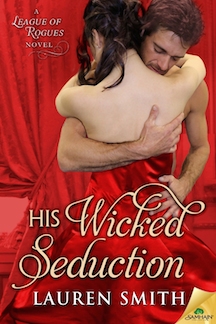
HisWickedSeduction300 copyLucien, Marquess of Rochester, has deliberately nurtured a reputation for debauchery that makes every matchmaking mother of the ton quake with fear. His one secret: he is torn between soul-ripping lust for Horatia, and the loyalty he owes her brother.

That loyalty is put to the test when an old enemy of the League threatens Horatia’s life. With Christmas drawing near, he sweeps her away to his country estate, where he can’t resist granting her one wish—to share his bed and his heart.

But sinister forces are lurking, awaiting the perfect moment to exact their revenge by destroying not only whatever happiness Lucien might find in Horatia’s arms, but the lives of those they love.

Warning: This book contains an intelligent lady who is determined to seduce her brother’s friend, a brooding rake whose toy of choice in bed is a little bit of bondage with a piece of red silk, a loyal band of merry rogues and a Christmas love so scorching you’ll need fresh snow to extinguish it.

AmazonBarnes & NobleiBooksKobo • Samhain • Google

Excerpt

She is going to be the death of me.

“Lucien! You’re not even listening to me, are you? I’m in desperate need of a new valet and you’ve been woolgathering rather than offering suggestions. I daresay you have enough for a decent coat and a pair of mittens by now.”

Lucien Russell, the Marquess of Rochester, looked to his friend Charles. They were walking down Bond Street, Lucien keeping careful watch over one particular lady without her knowledge and Charles simply enjoying the chance for an outing. The street was surprisingly crowded for so early in the day and during such foul wintry weather.

“Admit it,” Charles prodded.

Lucien fought to focus on his friend. “Sorry?”

The Earl of Lonsdale fixed him with a stern glare which, given that his usual manner tended towards jovial, was a little alarming.

“Where is your head? You’ve been out of sorts all morning.”

Lucien grunted. He had no intention of explaining himself. His thoughts were sinful ones, ones that would lead him straight to a fiery spot in Hell, assuming one wasn’t already reserved for him. All because of one woman: Horatia Sheridan.

She was halfway up Bond Street on the opposite side of the road, a beacon of beauty standing out from the women around her. A footman dressed in the Sheridan livery trailed diligently behind her with a large box in his arms. A new dress, if Lucien had to hazard a guess. She should not be out traipsing about on snow-covered walkways, not with these carriages rumbling past, casting muddy slush all over. It frustrated him to think she was risking a chill for the sake of shopping. It frustrated him more that he was so concerned about it.

“I know you think I’m a half-wit on most days, but—”

“Only most?” Lucien couldn’t resist the verbal jab.

Charles grinned. “As I was saying, it’s a bit obvious our leisurely stroll is merely a ruse. I’ve noticed we’ve stopped several times, matching the pattern of a certain lady of our acquaintance across the street.”

So Charles had been watchful after all. Lucien shouldn’t have been surprised. He hadn’t done his best to conceal his interest in Horatia Sheridan. It was too hard to fight the natural pull of his gaze whenever she was near. She was twenty years old, yet she carried herself with the natural grace of a mature and educated queen. Not many women could achieve such a feat. For as long as he’d known her, she’d been that way.

He’d been a young man in his twenties when he met her, and she’d been all of fourteen. She’d been like a little sister to him. Even then, she’d struck him as more mentally and emotionally mature than most women in their later years. There was something about her eyes, the way her doe-brown pools held a man rooted to the spot with intelligence—and in these last few months, attraction…

“You’d best stop staring,” Charles intoned quietly. “People are starting to notice.”

“She shouldn’t be out in this weather. Her brother would have a fit.” Lucien tugged his leather gloves tighter, hoping to erase the lingering effects of the chill wind that slid between his coat sleeves and gloves.

Charles burst out into a laugh, one loud enough to draw the attention of nearby onlookers. “Cedric loves her and little Audrey, but you and I both know that does not stop either of them from doing just as they please.”

There was far too much truth in that. Lucien and Charles had known Cedric, Viscount Sheridan for many years, bonded during one dark night at university. The memory of when he, Charles, Cedric and two others, Godric and Ashton, had first met always unsettled him. Still, what had happened had forged an unbreakable bond between the five of them. Later, London, or at least the society pages, had dubbed them The League of Rogues.

The League. How amusing it all was…except for one thing. The night they’d formed their alliance each of the five men had been marked by the Devil himself. A man by the name of Hugo Waverly, a fellow student at Cambridge, had sworn vengeance on them.

And sometimes Lucien wondered if they didn’t deserve it.

Lucien shook off the heavy thoughts. He was drawn to the vision of Horatia pausing to admire a shop window displaying an array of poke bonnets nestled on stands. Her beleaguered footman stood by her elbow, juggling the box in his arms. He nodded smartly as Horatia pointed out a particular bonnet. Lucien was tempted to venture forth and speak with her, possibly lure her into an alley in order to have just a moment alone with her. Even if he only spoke with her, he feared the intimacy of that conversation would get him a bullet through his heart if her brother ever found out.

Charles had walked a few feet ahead, then stopped and turned to kick a pile of snow into the street. “If this is how you mean to spend the day then consider me gone. I could be at Jackson’s Salon right now, or better yet, savoring the favors of the fine ladies at the Midnight Garden.”

Lucien knew he’d put Charles out of sorts asking him to come today, but he’d had a peculiar feeling since he’d risen this morning, as though someone was walking over his grave. Ever since Hugo Waverly had returned to London, he had been keeping on eye on Cedric’s sisters, particularly Horatia. Waverly had a way of creating collateral damage and Lucien would do anything to keep these innocent ladies safe. But she mustn’t know he was watching over her. He’d spent the last six years being outwardly cold to her, praying she’d stop gazing at him in that sweet, loving way of hers.

It was cruel of him, yes, but if he did not create some distance, he’d have had her on her back beneath him. She was too good a woman for that, and he was far too wicked to be worthy of her. Rather like a demon falling for an angel. He longed for her in ways he’d never craved for other women, and he could never have her.

The reason was simple. His public reputation did not do justice to the true depth of his debauchery. A man like him could and should never be with a woman like Horatia. She was beauty, intelligence and strength, and he would corrupt her with just one night in his arms.

Within the ton, there was scandal and then there was scandal. For a certain class of woman, being seen with the wrong man in the wrong place could be enough to ruin her reputation and damage her prospects. These fair creatures deserved nothing but the utmost in courtesy and propriety.

For others, the widows still longing for love, those who had no interest in husbands but did from time to time seek companionship, and that rare lovely breed of woman who had both the wealth and position to afford to not give a toss about what society thought, there was Lucien. He seduced them all, taught them to open themselves up to their deepest desires and needs, and seek satisfaction. Not once had a woman complained or been dissatisfied after he had departed from her bed. But there was only one bed he sought now, and it was one he should never be invited into.

He glanced about and noticed a familiar coach among the other carriages on the street. Much of the street’s traffic had been moving steadily and quicker than the people on foot, but not that coach. There was nothing unusual about it; the rider was covered with a scarf like all the others, to keep out the chill, yet each time he and Charles had crossed a street, the coach had shadowed them.

“Charles, do think we’re being followed?”

Charles brushed off some snow from his gloved hands when it dropped onto him from a nearby shop’s eave. “What? What on earth for?”

“I don’t know. That carriage. It has been with us for quite a few streets.”

“Lucien, we’re in a popular part of London. No doubt someone is shopping and ordering their carriage to keep close.”

“Hmm,” was all he said before he turned his attention back to Horatia and her footman. One of her spare gloves fell out of her cloak and onto the ground, going unnoticed by both her and her servant. Lucien debated briefly whether or not he should interfere and alert her to the fact that he and Charles had been following her. When she continued to walk ahead, leaving her glove behind, he made his decision.

Lucien caught up with his friend still ahead of him on the street. “I’ll not keep you. Horatia’s dropped a glove and I wish to return it to her.”

“Plagued by a bit of chivalry, eh? Go on then, I want to stop here a moment.” He pointed to a bookshop.

“Very good. Catch me up when you’re ready.”

Lucien dodged through the traffic on the road and was halfway across the street when pandemonium struck.

Bond Street was turned on its head as screams tore through the air. The coach that had been shadowing him raced down the road in Lucien’s direction. Yet, rather than trying to halt the team, the driver whipped the horses, urging them directly at Lucien.

He was too far across the street to turn back; he had to get to safety and get others out of the way. Horatia! She could be trampled when it passed her. Lucien’s heart shot into his throat as he ran. The driver whipped the horses again, as if sensing Lucien’s determination to escape.

“Horatia!” Lucien bellowed at the top of his lungs. “Out of the way!”

About the Author

Amazon Best Selling author, Lauren Smith is an attorney by day, author by night, who pens adventurous and edgy romance stories by the light of her smart phone flashlight app. She’s a native Oklahoman who lives with her three pets: a feisty chinchilla, sophisticated cat and dapper little schnauzer. She’s won multiple awards in several romance subgenres including being an Amazon.com Breakthrough Novel Award Quarter-Finalist and a Semi-Finalist for the Mary Wollstonecraft Shelley Award.

 WebsiteFacebookTwitterGoodreads 

“Smith’s fast-paced historical keeps readers on their toes as they’re taken hostage by a whirlwind of characters and an unforgettable romance. Readers will get their fair share of emotional outbursts, which includes laughter, lust, anger and sadness…it’s action-packed, sizzling hot and readers of all genres will enjoy the scramble to the finish.”—RT Book Reviews Magazine
 
“Lauren Smith’s debut League of Rogues novel is a fun, clever and wonderfully sympathetic read that will no doubt earn her a number of fans. Her insight into her characters and willingness to take risks with them is impressive…and brought a fresh voice and a heap of compassion, transforming it into something highly readable and quite enjoyable.”—The Romance Reviews
 
“The best thing for me was the quality of Lauren Smith’s writing. I will read her again. She is a fresh voice to watch out for.”—Romantic Historical Reviews
 
“I really enjoyed Wicked Designs, Lauren Smith’s debut Regency historical novel. This witty and entertaining romance features an emotionally scarred hero, a smart heroine and a loveable group of rogues… Emily is a delightful heroine. She is smart, courageous and spirited enough to stand up for herself. I love her determination to outwit her captors and escape. She certainly keeps those five rogues on their toes!”—Rakes and Rascals.com

A Regency Christmas Quiz

A Regency Christmas Quiz

(Answers below)

For this quiz, the Regency is defined as 1811-1830.

True/False

  1. Christmas trees lit by candles were common decorations in Regency England.
  2. Gift-giving was a prominent Christmas tradition in Regency times.
  3. The Twelve Days of Christmas began on December 26 and ended on January 6 and did not include Christmas Day because it was a solemn, holy day and not one for partying.
  4. Many Christmas traditions were pagan in origin.
  5. Although it originated as a pagan ceremony to ensure a good apple crop, wassailing became more of caroling event in the Regency.
  6. Christmas Pudding, or Plum Cake, contains raisins rather than plums.
  7. A Christmas Pudding can be made months in advance.
  8. Finding a thimble in your slice of Christmas Pudding means good luck for the coming year.
  9. Mince pie and all things Christmas were banned during Cromwell’s reign because they were considered “pagan,” but it all came back when Charles II came into power.
  10. Originally, mince pie was made with meat and spices and served as a main course.
  11. The three spices in mince pie—cinnamon, cloves and nutmeg—were meant to represent the Father, Son and Holy Spirit.
  12. Originally, the Yule Log was from the largest tree that would fit in the fireplace so it would keep burning throughout the Twelve Days of Christmas.
  13. “Mummers” were traveling troupes of actors who would go door-to-door offering to perform and sing for a few coins.
  14. In the Regency era, Christmas decorations were often left up throughout the month of January.
  15. Silent Night was one of the Christmas songs commonly sung in the Regency era.
  16. The custom of stealing kisses beneath the kissing bough, or even a sprig of mistletoe hanging from the ceiling or doorway in a place where people were certain to walk beneath it, became popular in the late eighteenth century.
  17. Boxing Day was a time to reward servants, tenants and tradesmen with gifts of money and/or food.
  18. Plough Monday, which is the Monday after Twelfth Day (Epiphany), is when the farm laborers are called back to work after the Christmastide.
  19. Christmas Eve was the traditional night for wassailing.
  20. If your piece of King Cake contained a bean, you were crowned “King” for the night.

Contest Winner

(from the Sweet N Sexy Divas blog contest)

Nancy Mayer

Regency Researcher Extraordinaire

Answers

  1. False. Christmas trees did not appear until the Victorian era, when Prince Albert brought the German custom to England.
  2. False.
  3. True.
  4. True.
  5. True.
  6. True.
  7. True.
  8. False. It means “thrift.” Finding a wishbone means good luck.
  9. True.
  10. True
  11. False. The three spices were in honor of the Three Magi who came from the Orient to honor the Christ Child.
  12. False. The Yule Log was the largest and tallest true and was inserted the long way into the fireplace, with the rest jutting out into the room. In the Regency era, it was a large log that would burn at least twelve hours on Christmas Day.
  13. True
  14. False. It was bad luck to have them up past Twelfth Day (January 6th).
  15. False. Stille Nacht was one of many German songs that were exported to Britain during the Victorian era.
  16. True.
  17. True. Because servants were required to work on Christmas Day, it was tradition to give them the next day off to spend with their families.
  18. True.
  19. False. Twelfth Night (the evening of January 5th) was the traditional night for wassailing.
  20. True. Whoever got the pea was “Queen.”

About A Twelfth Night Tale

In A Twelfth Night Tale, the Barlows celebrate the holiday with their neighbors, the Livingstons, and the St. Vincents—a wealthy viscount who is courting the elder daughter Lucy and his three daughters. Andrew Livingston, who has returned wounded from the Peninsula, suffers a few pangs of jealousy as he watches the viscount’s attentiveness to the now-grown-up-and-very-desirable Lucy. Is it too late for him to stake a claim for her?

http://www.susanaellis.com/A_Twelfth_Night_Tale.html

twelfthnighttale_msr copy200x300

Ellora’s Cave • Amazon • Barnes & Noble • Kobo