Tag Archive | Catherine of Aragon

The Microcosm of London or London in Miniature: Bridewell

published by Rudolph Ackermann in 3 volumes, 1808–1811.

The annexed print gives an accurate and interesting view of this abode of wretchedness, the Pass-Room. It was provided by a late act of Parliament, that paupers, claiming settlements in distant parts of the kingdom, should be confined for seven days previous to their being sent off to their respective parishes; and this is the room appointed by the magistracy of the city for one class of miserable females. The characters are finely varied, the general effect broad and simple, and the perspective natural and easy.

Bridewell, as early as King John, was a royal palace, formed partly out of the remains of an ancient castle, the western Arx Palatina of the city, and the residence of several of our monarchs; but in process of time became neglected: till, in 1522, Henry VIII. rebuilt it in a most magnificent manner, for the reception of the Emperor Charles V. who in that year paid him a visit: Charles was, however, lodged in Black Friars, and his suite in the new palace. A gallery of communication was thrown over Fleet-Ditch, and a passage cut through the city wall to the emperor’s apartments. Henry often lodged here, particularly in 1529, when the question of his marriage with Queen Catherine was agitated in Black Friars. It fell afterwards to decay, and was begged by the pious Prelate Ridley from Edward VI. to be converted to some charitable purpose: that of a house of correction for vagabonds of each sex and all denominations was determined on. It also answers another purpose; it is a foundation for youth who are bound apprentices to different trades under what are called Arts-Masters*; and forms part of the great plan of benevolence adopted by the amiable Edward VI. when he endowed the city hospitals, of which this is one. It is situated in Bridge-street, Black Friars, and gives the name to Bridewell precinct in the neighbourhood; the whole building forms a square, consisting of the houses of the arts-masters, who are six in number, the prisons for the men and women, the committee-room, and a chapel.

The men’s prison is a good brick building, on the western side, consisting of thirty-six sleeping-rooms, and seven other apartments. Every man has a room to himself, containing a bedstead, straw in a sacking, a blanket, and coverlet. The other rooms consist of workshops, a sick-room, which is a very comfortable apartment, and a larger, in which idle apprentices are confined separate from the other prisoners. In the working-room are junk and oakum, which the prisoners pick, and mills where they grind corn. The task-master’s apartments, and the women’s prison, which is separate from the men’s, are on this western side. The committee-room is on the south side, where a committee of the governors meet every week to examine the prisoners. There are excellent regulations to this prison: in the cellar is a bath, in which the prisoners are occasionally washed; but there is no yard for them to walk in, which is a great defect in any house of this description.

The original plan of this hospital, combined and incorporated with the hospitals of Christ and St. Thomas, was so benevolent, and of such comprehensive utility, that it is worthy to be followed, improved, and completely executed, by the wisest and best of men, in the wisest and best of times. It was to “train up the beggar’s child to virtuous industry, so that from him no more beggars should spring; to succour the aged and the diseased; to relieve the decayed housekeeper and the indigent; and to compel the wretched street-walker and the vagabond to honest labour.” Its design was, to include every class of the unfortunate, the helpless, and the depraved. To effect this, the governors were instituted, and are, as a body corporate, empowered to make* “all manner of wholesome and honest ordinances, statutes, and rules, for the good government of the poor in Bridewell.” Many very important alterations have taken place in this hospital within the last century, particularly in the years 1792 and 1793. Pennant, whose account of London was published in 1793, states the number of arts-masters at twenty; they are now reduced to six. The number of apprentices taught and maintained, he does not state; in the year 1717, they amounted to one hundred and three received within the year, and in 1718, to ninety-four. — Vide Speed. The apprentices are now reduced to thirty.

The late improvements in the buildings at Bridewell have been very great. The entrance is by a very noble front, of the Doric order; on the key-stone of the arch is a head of the illustrious founder. The apartments in this center are destined for the residence of the chamberlain of the city of London, who is also treasurer. Adjoining this building are six new houses, corresponding with the other houses in Bridge-street, the back parts of which occupy what was before a court-yard, in which resided several of the arts-masters. A new chapel, and a very noble apartment called the committee-room, complete the improvements on the eastern and principal side. On the north have been some alterations. The male prisoners are removed to a new building erected on the western side; and the arts-masters, who lived on that site, are removed to houses erected for them on the north side.

The court-room is an interesting piece of antiquity, as on its site were held courts of justice, and probably parliaments, under our early kings. At the upper end are the old arms of England; and it is wainscotted to a certain height with English oak, ornamented with carved work. This oak was formerly of that solemn colour which it attains by age, and was relieved by the carving being gilt. It must have been no small effort of ingenuity to destroy at one stroke all this venerable time-honoured grandeur: it was, however, happily achieved by daubing over with paint the fine veins and polish of the old oak, to make a very bad imitation of the pale modern wainscot; and other decorations are added in a similar taste.

On the upper part of the wall are the names, in gold letters, of benefactors to the hospital: the dates commence with 1565 and end with 1713. This is said to have been the court in which the sentence of divorce was pronounced against Catherine of Arragon, which had been concluded on in the opposite monastery of the Black Friars.

From this room is the entrance into the hall, which is a very noble one: at the upper end is a picture, by Holbein, representing Edward VI. delivering the charter of the hospital to Sir George Barnes, then lord mayor; near him are William, Earl of Pembroke, and Thomas Goodrich, Bishop of Ely. There are ten figures in the picture, besides the king, whose portrait is painted with great truth and feeling: it displays all that languor and debility which mark an approaching dissolution, and which unhappily followed so soon after, together – with that of the painter, that it has been sometimes doubted whether the picture was really painted by Holbein: his portrait, however, is introduced; it is the furthest figure in the corner on the right hand, looking over the shoulders of the persons before him.

On one side of this picture is a portrait of Charles II. sitting, and on the other that of James II. standing; they are both painted by Sir Peter Lely. Round the room are several portraits of the presidents and different benefactors, ending with that of Sir Richard Carr Glyn. The walls of this room are covered with the names of those who have been friends to the institution, written in letters of gold.

The new committee-room is finely proportioned, and in a very good style of architecture; as is the new chapel, which is divided from it by the portico, and which together occupy the whole back front of the eastern range of buildings.

The following is a list of the present officers of this hospital and Bethlem, founded by Edward VI. 1553:

  • President of both Hospitals, Sir Richard Carr Glyn, Bart. Alderman.
  • Treasurer to ditto, Richard Clark, Esq. Chamberlain of the city of London.
  • Chaplain at Bridewell, Rev. Henry Budd, B. A.
  • Physician to both, Thomas Munro, M. D.
  • Surgeon to ditto, Bryan Crowther, Esq.
  • Apothecary to ditto, Mr. John Haslam.
  • Clerk to ditto, Mr. John Poynder.
  • Steward to Bridewell, accomptant and receiver to both, Air. Bolton Hudson.
  • Porter to Bridewell, Richard Weaver.
  • Matron to ditto, Mary Rundle.

* These arts-masters were originally decayed tradesmen, and consisted of shoemakers, taylors, flax-dressers, orris and silk-weavers, &c. The apprentices used to be distinguished by a blue jacket and trowsers, and a white hat: their dress is now in the form of other people’s, distinguished only by a button bearing the head of the founder.
Back to Table of Contents

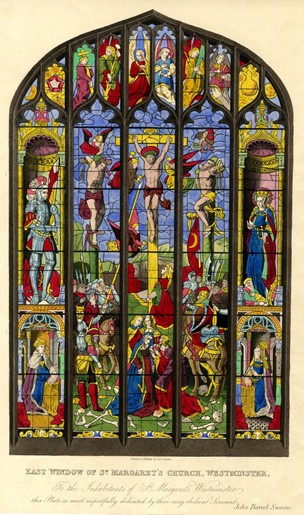
Romance of London: St. Margaret’s Painted Window at Westminster

Romance of London: Strange Stories, Scenes And Remarkable Person of the Great Town in 3 Volumes

John Timbs

John Timbs (1801-1875), who also wrote as Horace Welby, was an English author and aficionado of antiquities. Born in Clerkenwell, London, he was apprenticed at 16 to a druggist and printer, where he soon showed great literary promise. At 19, he began to write for Monthly Magazine, and a year later he was made secretary to the magazine’s proprietor and there began his career as a writer, editor, and antiquarian.

This particular book is available at googlebooks for free in ebook form. Or you can buy a print version.

YES

The history of the painted glass cinquecento Window, which, in 1758, was placed in the chancel, over the altar of St. Margaret’s Church, is truly romantic.

Elizabeth of York

Elizabeth of York

This beautiful window (said to have been executed at Gouda, in Holland, and to have occupied five years in the making) was originally intended by the magistrates of Dort as a present to Henry VII., by whom it was intended for his Chapel at Westminster; or as some say, it was ordered by Ferdinand and Isabella on the occasion of Prince Arthur being affianced, in 1499, to the Princess Catherine of Arragon, their portraits being procured for the purpose.

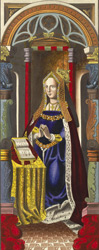
The three middle compartments represent the Crucifixion, with the usual accompaniments of angels receiving in a chalice the blood which drops from the wounds of the Saviour. Over the good thief an angel is represented wafting his soul to Paradise; and over the wicked, the devil in the shape of a dragon carrying his soul to a place of punishment. In the six upper compartments are six angels holding the emblems of crucifixion: the cross, the sponge, the crown of thorns, the hammer, the rods and nails. In the right hand lower compartment is Arthur, Prince of Wales (eldest son of Henry VII); and in the companion or left side, Catherine of Arragon, his bride (afterwards married to his brother Henry VIII., and divorced by him). Over the head of Prince Arthur is a full-length figure of St. George, with the red and white roses of England; and over Catherine of Arragon, a full-length figure of St. Catherine, with the bursting pomegranate, the emblem of the kingdom of Granada.

Prince Arthur died before the window was finished; the King himself before it could be erected. Succeeding events—the marriage of Henry VIII. To the bride or widow of his brother, with the subsequent divorce of Catherine—rendered the window wholly unfit for the place for which it was intended.

The window through the ages

  1. Catherine of Aragon

    Catherine of Aragon

    Henry VIII gave it to Waltham Abbey, Essex.

  2. At the Dissolution, Robert Fuller, the last Abbot, sent it to his private chapel at New Hall, also in Essex.
  3. It was later acquired by the father of Anne Boleyn.
  4. Queen Elizabeth I gave it to Thomas Ratcliff, Earl of Sussex, who was living at New Hall.
  5. It was purchased by Villiers, Duke of Buckingham, favorite of James I.
  6. Its next owner was Oliver Cromwell.
  7. At the Restoration, it reverted to the second Duke of Buckingham.
  8. It was purchased, along with New Hall, to General Monk, Duke of Albermarle. The duke buried it underground to keep it from the Puritans. After the Restoration he returned it to his chapel at New Hall.
  9. After he died and his son as well, the hall became the property of the duchess, and fell into ruin and decay.
  10. John Olmius, Esq., purchased the property and demolished the chapel, preserving the window.
  11. Eventually it was purchased by Mr. Conyers, of Copt Hall, Essex, for 50 guineas, for his own chapel.
  12. Conyers’ son, Mr. John Conyers sold the window in 1758 to the churchwardens of St. Margaret’s Westminster for 400 guineas.

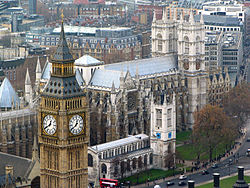
St. Margaret's Church (background)

St. Margaret’s Church (background)

“It is worth the walk”

It is worth a walk to St. Margaret’s to see this window. The late Mr. Winston, the great authority upon glass-painting, says of it: “Though at present much begrimed with London smoke and soot, it may be cited as an example of the pictorial excellence attainable in a glass-painting without any violation of the fundamental rules and conditions of the art. The harmonious arrangement of the coloring is worthy of attention. It is the most beautiful work in this respect that I am acquainted with.”

The church has been in our time, as it was centuries ago in Stow’s time, “in danger of pulling down;” which, if carried into effect, would add another leaf to the history of the St. Margaret’s Painted Window.

Thankfully, this last threat to the location of this window have not come to pass. I’m definitely putting St. Margaret’s on my list for this year’s trip, in August.

St. Margaret's Church from the London Eye

St. Margaret’s Church from the London Eye


Romance of London Series

  1. Romance of London: The Lord Mayor’s Fool… and a Dessert
  2. Romance of London: Carlton House and the Regency
  3. Romance of London: The Championship at George IV’s Coronation
  4. Romance of London: Mrs. Cornelys at Carlisle House
  5. Romance of London: The Bottle Conjuror
  6. Romance of London: Bartholomew Fair
  7. Romance of London: The May Fair and the Strong Woman
  8. Romance of London: Nancy Dawson, the Hornpipe Dancer
  9. Romance of London: Milkmaids on May-Day
  10. Romance of London: Lord Stowell’s Love of Sight-seeing
  11. Romance of London: The Mermaid Hoax
  12. Romance of London: The Bluestocking and the Sweeps’ Holiday
  13. Romance of London: Comments on Hogarth’s “Industries and Idle Apprentices”
  14. Romance of London: The Lansdowne Family
  15. Romance of London: St. Margaret’s Painted Window at Westminster
  16. Romance of London: Montague House and the British Museum
  17. Romance of London: The Bursting of the South Sea Bubble
  18. Romance of London: The Thames Tunnel
  19. Romance of London: Sir William Petty and the Lansdowne Family
  20. Romance of London: Marlborough House and Sarah, Duchess of Marlborough
  21. Romance of London: The Duke of Newcastle’s Eccentricities
  22. Romance of London: Voltaire in London
  23. Romance of London: The Crossing Sweeper
  24. Romance of London: Nathan Mayer Rothschild’s Fear of Assassination
  25. Romance of London: Samuel Rogers, the Banker Poet
  26. Romance of London: The Eccentricities of Lord Byron
  27. Romance of London: A London Recluse

The Exeter Road: The Weyhill Fair, Amesbury Abbey and the Extraordinary Duchess of Queensberry

dust jacket

The following post is the ninth of a series based on information obtained from a fascinating book Susana recently obtained for research purposes. Coaching Days & Coaching Ways by W. Outram Tristram, first published in 1888, is chock full of commentary about travel and roads and social history told in an entertaining manner, along with a great many fabulous illustrations. A great find for anyone seriously interested in English history!

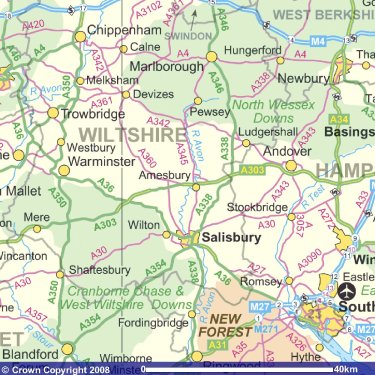
map

The Weyhill Fair

The Telegraph, rival of the Quicksilver which our author repeatedly states can do 175 miles in eighteen hours, used to pass through Weyhill, which was famous for its annual fair, “which would make those people who have never seen one stare.”

This festivity, which is indeed quite an un-English and out-of-the-way sight, begins on October 10th (Michaelmas Eve) and goes on for six days, during which all the country-side seems to have broken loose, and high junketings are to be seen. Besides junketings (which prevail chiefly on the last day of the fair in connection with peep-shows of the most blood-curdling description, whirligigs, merry-go-rounds, rifle galleries, and gingerbread) are also to be seen wonderful shows of sheep, magnificent cheeses, the finest hops in England displayed in the Farnham Row, great exhibits of machinery and enormous carthorses, and, enveloping all, a Babel indescribable.

Amesbury and the Abbey

Amesbury is where Guinevere arrived “somewhat late at night, after a ride across the Plain” after her affair with Lancelot was discovered.

“…hither came Queen Elfrida in 980…after her murder of her stepson Edward at Corfe; and, bent like all medieval murderesses suffering from a temporary mental depression, on building a church. When she came to the point however, and had interviewed the architect and the abbot, she went the whole hog and built an abbey.”

Amesbury Abbey (the church)

Amesbury Abbey (the church)

Prior to Henry VIII’s dissolution, the abbey played host, when “the Exeter road at that time was but a medieval cart-track, and a very bad one too,” to Eleanor of Brittany, sister of Prince Arthur and Mary, sixth daughter of Edward I. “Eleanor, Queen of Henry III, died here, and Katharine of Aragon stayed for a while here on her first arrival in England in 1501.”

Following the dissolution, “the abbey of Amesbury became Amesbury Abbey and passed from the Earl of Somerset, to whom it was granted by Henry VIII, into the respective hands of the Aylesburys, Boyles, and Queensberrys…”

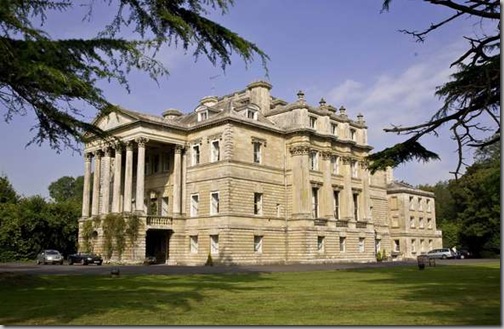
The Abbey eventually became the parish church, and the nearby mansion of the same name built by Inigo Jones is now part of a group by the same name that operates nursing and retirement homes in the area.

Amesbury Abbey_thumb

Amesbury Abbey (the stately home)

This is where Kitty, “the charming Duchess of Queensberry played the Lady Bountiful in the place, and by entertaining Prior and Gay the Abbey graced the quaint old Wiltshire town with the memories of two of the not least celebrated of the English humorists.”

The Duchess of Queensberry

According to the Douglas family history, Catherine Douglas, née Hyde, was an outspoken, rather eccentric woman who “loved walking, avoided alcohol and was an enthusiastic planter of trees at her husband’s estates.” She’d grown up “in a household frequented by literary celebrities,” and it was she about whom Prior wrote the poem “The Female Phaeton: Upon Lady Kitty’s First Appearing in Public” when she was sixteen.

Catherine Douglas, Duchess of Queensberry

Catherine Douglas, Duchess of Queensberry

Following her marriage to Charles Douglas, 3rd duke of Queensberry, the acclaimed beauty Kitty became an avid patron of the arts, to the point of being exiled from court when her defense of the playwright John Gay offended King George II. Gay spent the last years of his life at the Abbey, where he wrote the Beggar’s Opera, and was given a lavish funeral at his death in 1732.

The Douglas family history fails to mention the fascinating story of Julius Soubise, a Negro slave from the West Indies who was given to the duchess in 1764 when he was ten years old. She gave him a privileged life, treating him as her own son, and he became a noted fencing and riding master, a member of the most exclusive clubs, and quite popular among upper-class social circles. A violinist and singer, he trained in oratory with the actor David Garrick. At times he claimed to be African royalty, calling himself “Prince Ana-Ana-maboe” or the “Black Prince.” It was rumored that the duchess and her protégé had a sexual relationship, so perhaps that is the reason Soubise was left out of the family history. Is it only coincidence that the duchess died two days after Soubise sailed for India?

julius-soubise

Julius Soubise

One reason I love delving into these family histories is the interesting things you find. The 3rd Duke of Queensberry, it turns out, succeeded his father “due to special remainder,” when his older brother James was declared insane. Both of the 3rd duke’s sons predeceased him and the title passed to a distant cousin, William Douglas, who later became a friend of the Prince of Wales.

The Duchess of Queensberry Rules

Actually, it was the 9th Marquess of Queensberry to whom the  1867 code on which modern boxing is based can be attributed (although he was not the author, merely the endorser). This code, meant for both amateur and professional matches, is and was the first to mention the use of gloves for boxing. The dear duchess had nothing to do with it, having passed on ninety years earlier.

 Index to all the posts in this series

1: The Bath Road: The (True) Legend of the Berkshire Lady

2: The Bath Road: Littlecote and Wild William Darrell

3: The Bath Road: Lacock Abbey

4: The Bath Road: The Bear Inn at Devizes and the “Pictorial Chronicler of the Regency”

5: The Exeter Road: Flying Machines, Muddy Roads and Well-Mannered Highwaymen

6: The Exeter Road: A Foolish Coachman, a Dreadful Snowstorm and a Romance

7: The Exeter Road in 1823: A Myriad of Changes in Fifty Years

8: The Exeter Road: Basingstoke, Andover and Salisbury and the Events They Witnessed

9: The Exeter Road: The Weyhill Fair, Amesbury Abbey and the Extraordinary Duchess of Queensberry

10: The Exeter Road: Stonehenge, Dorchester and the Sad Story of the Monmouth Uprising

11: The Portsmouth Road: Royal Road or Road of Assassination?

12: The Brighton Road: “The Most Nearly Perfect, and Certainly the Most Fashionable of All”

13: The Dover Road: “Rich crowds of historical figures”

14: The Dover Road: Blackheath and Dartford

15: The Dover Road: Rochester and Charles Dickens

16: The Dover Road: William Clements, Gentleman Coachman

17: The York Road: Hadley Green, Barnet

18: The York Road: Enfield Chase and the Gunpowder Treason Plot

19: The York Road: The Stamford Regent Faces the Peril of a Flood

20: The York Road: The Inns at Stilton

21: The Holyhead Road: The Gunpowder Treason Plot

22: The Holyhead Road: Three Notable Coaching Accidents

23: The Holyhead Road: Old Lal the Legless Man and His Extraordinary Flying Machine

24: The Holyhead Road: The Coachmen “More Celebrated Even Than the Most Celebrated of Their Rivals” (Part I)

25: The Holyhead Road: The Coachmen “More Celebrated Even Than the Most Celebrated of Their Rivals” (Part II)

26: Flying Machines and Waggons and What It Was Like To Travel in Them

27: “A few words on Coaching Inns” and Conclusion