Tag Archive | Bluestocking Belles

Caroline Warfield: Dangerous Weakness (Giveaway)

DANGEROUS WEAKNESS2 (5) copy 

Night Owl Reviews, in reviewing Dangerous Works, said, “There is nothing so entertaining as watching a man who is always in control lose that control.” I was delighted because that is exactly what I tried to accomplish in that story. The Marquess of Glenaire, cool, calm and in control, managed the lives of his friends through two novels and a novella. I was determined to muss his hear, rip his suit, and throw him into the unknown.

How about you? Do you like to see a man is just too perfect lose it?  I’ll give a Kindle copy of Dangerous Works to one person who comments.

About Dangerous Weakness

If women were as easily managed as the affairs of state—or the recalcitrant Ottoman Empire—Richard Hayden, Marquess of Glenaire, would be a happier man. As it was the creatures—one woman in particular—made hash of his well-laid plans and bedeviled him on all sides.

Lily Thornton came home from Saint Petersburg in pursuit of marriage. She wants a husband and a partner, not an overbearing, managing man. She may be “the least likely candidate to be Marchioness of Glenaire,” but her problems are her own to fix, even if those problems include both a Russian villain and an interfering Ottoman official.

Given enough facts, Richard can fix anything. But protecting that impossible woman is proving to be almost as hard as protecting his heart, especially when Lily’s problems bring her dangerously close to an Ottoman revolution. As Lily’s personal problems entangle with Richard’s professional ones, and she pits her will against his, he chases her across the pirate-infested Mediterranean. Will she discover surrender isn’t defeat? It might even have its own sweet reward.

Amazon US http://amzn.to/1L8IDXp

Amazon UK http://amzn.to/1JYxerM

Amazon Canada http://amzn.to/1NwQmMt

Amazon Euro http://amzn.to/1PrxeAQ

Amazon India http://amzn.to/1hdwC6C

Amazon Aus http://bit.ly/1NikayC

Excerpt

“Who invited Lilias Thornton?” Richard demanded under his breath. His eyes followed a slender young woman who paced out the steps of the Quadrille across the parquet floor of the earl’s ballroom.

“No ‘thank you for turning your country seat into a diplomatic snake pit for an entire week so the haut ton can mingle with exotic visitors from the East while the foreign secretary manages the fate of Greece over Brandy and cards?’” Will demanded.

Richard looked at his friend, one eyebrow raised. “Chadbourn Park fit the need precisely. I thanked your Catherine this morning.”

Will grunted. “My Catherine worked miracles when Sahin Pasha showed up with six extra people in his party.”

“We can’t predict how many retainers the Turks will impose,” Richard growled. The Ottomans danced to their own tune; the Foreign Office never knows what to expect. Richard loathed the unpredictable. He went back to surveying the overheated ballroom.

“Who invited Lilias Thornton?” he repeated while he moved along the mirrored wall of the earl’s spectacular ballroom to a position next to a massive marble urn that gave him a better view of his quarry. His eyes never left the dancers.

Will snatched two glasses of champagne from a footman stationed discreetly along the softly flocked wall, tray in hand. He handed one to Richard who took it without looking.

“Catherine also had to scurry when your mother demanded that she invite three more marriageable young ladies and their eager mamas,” Will complained.

“I would rather that she refused.”

“Refuse the Duchess of Sudbury? Surely you jest.”

Richard nodded without taking his gaze from the dancers. “I jest. I have less control over my mother than I do Sahin Pasha.” He loathed loss of control even more than unpredictability. He had been forced to sidestep the marriage-minded chits for two days.

Right now only one woman interested him, Lilias Thornton. He watched her throw her head back, send auburn curls bouncing, and laugh up at her partner. She dances with grace, I’ll give her that—grace and unbridled joy. A man could lose his senses over that look. The last thing he needed was to lose his senses.

Will followed his friend’s line of sight. “Beautiful woman,” he acknowledged. “Catherine called her dress ‘beyond perfection.’”

That dress radiates so damned much continental sophistication she makes the women around her look countrified, my esteemed mother’s protégées included. The woman laughed freely again, and Richard felt himself harden in spite of his determination; the surge of attraction irritated him. I have no time for such nonsense.

“Who invited her?” he demanded. “It’s a matter of some urgency.”

Will shrugged. “I believe Catherine included some regular attendees at your sister’s literary salon. She must be one of those. You said to invite women who could provide intelligent conversation to members of the diplomatic corps.”

“So I did. My men tell me she has been in conversation with Konstantin Volkov three times these past two days.”

“You’re tracking her conversations?”

“Volkov’s. He has no official role, yet he follows the Russian delegation and slinks through society in the shadows. I want to know who he works for, why he sought an invitation, and what he intends.”

The entire house party had been arranged to provide a discreet opportunity for the foreign secretary—or more precisely, Richard, his second—to persuade Ottoman officials to moderate their suppression of revolutionary rumbling in Greece. England did not want the kind of chaos that would tempt Russia. Expansionist Russia threatened all of Europe. The weak and floundering Ottoman Empire did not.

“Ask him,” Will suggested. “Unless diplomacy requires a more devious approach.”

“Lilias Thornton accompanied her father to St. Petersburg three years ago. The crown appointed him to the trade delegation at our embassy there,” Richard explained. “She returned without him rather abruptly in early January. I wonder why. Volkov arrived shortly after. It puzzles me.” He did not like puzzles.

“It isn’t unusual for a young woman of marriageable age to seek London before the Season starts,” a woman’s voice cut in. Catherine Landrum, Will’s countess, reached for her husband’s glass and took a sip. She tasted it slowly, seemed to pronounce it fit, and handed the glass back. “Lilias made it clear she’s seeking a good marriage,” the countess told Richard. “Who is Volkov?”

“She’s well beyond the age,” he answered. He ignored her question about the Russian.

“Surely not!” Catherine laughed. “Twenty-two may be somewhat older than the norm . . .” She paused when a young woman of seventeen pranced by and smiled coyly at the marquess over her partner’s shoulder.

“Well, perhaps quite a bit older,” she acknowledged when they passed.

“She served as her father’s hostess in his postings abroad since she turned sixteen. She has shown no interest in the marriage mart until this year,” Richard said. “I don’t care about the gossip. I want to know about her connection to Konstantin Volkov.”

“Ask her,” the countess suggested.

“I intend to,” Richard said as the last notes of the dance faded. He set out in the woman’s direction.

About the Author

Carol Roddy - Author

Carol Roddy – Author

Caroline Warfield has at various times been an army brat, a librarian, a poet, a raiser of children, a nun, a bird watcher, an Internet and Web services manager, a conference speaker, an indexer, a tech writer, a genealogist, and, of course, a romantic. She has sailed through the English channel while it was still mined from WWII, stood on the walls of Troy, searched Scotland for the location of an entirely fictional castle (and found it), climbed the steps to the Parthenon, floated down the Thames from the Tower to Greenwich, shopped in the Ginza, lost herself in the Louvre, gone on a night safari at the Singapore zoo, walked in the Black Forest, and explored the underground cistern of Istanbul. By far the biggest adventure has been life-long marriage to a prince among men.

She sits in front of a keyboard at a desk surrounded by windows, looks out at the trees and imagines. Her greatest joy is when one of those imaginings comes to life on the page and in the imagination of her readers.

WebsiteFacebookTwitterEmail • Newsletter

Dangerous Weakness Pinterest Board

Bluestocking Belles • Bluestocking Bookshop

Other Books by Caroline

Dangerous Works

Dangerous Secrets

Encounter at White’s: a cross-post with Nicole Zoltack

Whites Club London-M

Oliver handed his hat and gloves to the porter as he removed his coat and presented it as well. Shivering in the notoriously chilly foyer at White’s Club, he made his way quickly toward the drawing room, where no doubt there would be a roaring fire. After more than a fortnight of escorting his fiancée and her mother to balls and ton events nearly every evening, not to mention drives in the park and ices at Gunter’s—along with his responsibilities at the bank—he was looking forward to an evening with his cronies and nice cognac or two. White’s always had the best spirits in town.

Oliver Stanton

Oliver Stanton

He hadn’t got very far, however, when he very nearly collided with Stephen Huntington, Duke of Wyngate, who was emerging from the card room with an expression of tight-lipped determination on his face.

“Pardon me,” the duke said, straightening his coat somewhat nervously.

“No need,” said Oliver easily. “Wasn’t watching where I was going. Join me in a drink, Your Grace?”

The duke blinked and stumbled back a step. “Why yes, I would appreciate that, Stanton.”

The two men strolled to the drawing room and claimed two leather chairs near the fire.

“A cognac for me,” Oliver told the waiter. “Wyngate?”

"Portrait of Citizen Guerin," by Robert Lefevre, 1801, French. The Age of Napoleon. Ed. Katell le Bourhis. NY: The Metropolitan Museum of Art / Harry N. Abrams, Inc., 1989. p.82, pl. 72.

Stephen Huntington, Duke of Wyngate

He liked Stephen Huntington, and not just because he was a duke and one of the bank’s best customers. He was an honorable man and not at all puffed up about it. Some titled gentlemen didn’t deign to speak to him unless it was at the bank and they needed access to their money. Wyngate wasn’t that sort.

“Cognac sounds perfect.” The duke rubbed his forehead.

“Right away, gentlemen.” The waiter bowed and disappeared into the back rooms.

The duke cleared his throat. “I-I have a strange question for you, Stanton, if I may.”

Oliver nodded. Who was he to gainsay a duke, even if he wished to. And he was curious to know what was behind the normally easy-going duke’s skittish behavior.

“Have we crossed paths, recently? Since the Hansens’ ball last week, I mean?”

Oliver’s eyes narrowed. “Why no, I don’t believe so. Why do you ask?”

Stephen tugged at his collar. “Ah… well, that’s good. That’s good,” he repeated. “You see… I have heard rumors that there is a man impersonating me throughout the country. I can scarcely believe it! But I cannot ignore such a thing, lest it be true and the wretch is up to serious mischief.”

Oliver’s eyes widened. “Impersonating you? But how is that possible? You are widely known in London, Your Grace.”

shapeimage_1The duke plucked a glass of brandy from the waiter’s tray and took a long sip. Oliver did likewise, wondering who would dare to play such a trick on the Duke of Wyngate, of all people.

“I do not know. I guess the reprobate must resemble me. Sound like me as well.” Wyngate took another swallow and set down his glass. “No one has come to the bank asking about my money recently? That could certainly be a factor.”

“Money is always a factor,” Oliver said dryly. “But no, I can assure you that your accounts are safe. I would have been notified had someone come to withdraw funds unexpectedly.” He set his own glass on the table. “How did the news come to you of this extraordinary situation?”

“My friends.” He gestured behind him toward the card room. “They can be rather prone to jokes and mischief, but somehow I doubt they would jest about something as serious as this.” He shrugged. “No need to concern yourself further. I am certain the matter will be resolved shortly. Now tell me, Stanton. I see that Lady Julia has recovered from her illness. Will your nuptials be rescheduled soon?”

Lady Julia Tate (at age 27)

Lady Julia Tate

Oliver winced, as he always did when that particular question was raised, which was happening quite frequently in the fortnight or so since their wedding guests had been sent home without witnessing a wedding or even catching sight of the bride and groom.

“I do not mean to pry.” Wyngate drank the last of cognac. “I was hoping one of us was happy.”

“Soon,” Oliver said. “These things take time to arrange, you know. The ladies expect such things. And I wouldn’t want my bride to be deprived of the wedding of her dreams simply because she was taken ill the night before the first one was to take place.”

He grinned. “What about you, Wyngate? Any interest in setting up your own nursery any time soon?” Any man with a title had to concern himself with the matter of an heir sooner a later. Particularly a duke.

“Oh no. Not I. I am not the least bit interested in marriage. And even if I were, with an imposter running about, I will be far too busy to woo and win the heart of any lady.”

Oliver chuckled. “A wealthy duke could have his choice of any young lady in the ton. With or without the wooing. But you must certainly investigate this matter of an imposter. Particularly if he resembles you to the extent that he could ruin your reputation. Do let me know if I can be of any assistance to you, Your Grace.”

“Thank you. You have always been a loyal and good friend.” Wyngate stood. “I would appreciate it if you could keep this matter to yourself. Unless you should happen to see another me…” He shook his head.

map

“Of course, Your Grace.”

“I should be off to try to track this rogue down. Do take care.” The duke turned and called for his horse.

Oliver rose and offered his hand. “Good luck, Your Grace.”

“You as well.” The duke shook his hand and gave him a tight smile. “Shall I expect another wedding invitation any time soon?”

“Of course, Your Grace.” At least Oliver hoped it would be soon. The new house on Manchester Square was nearly ready, and he was eager to finally have Julia as his wife at last.

Strange happenings in Hyde Park: a Bluestocking Belles cross-post

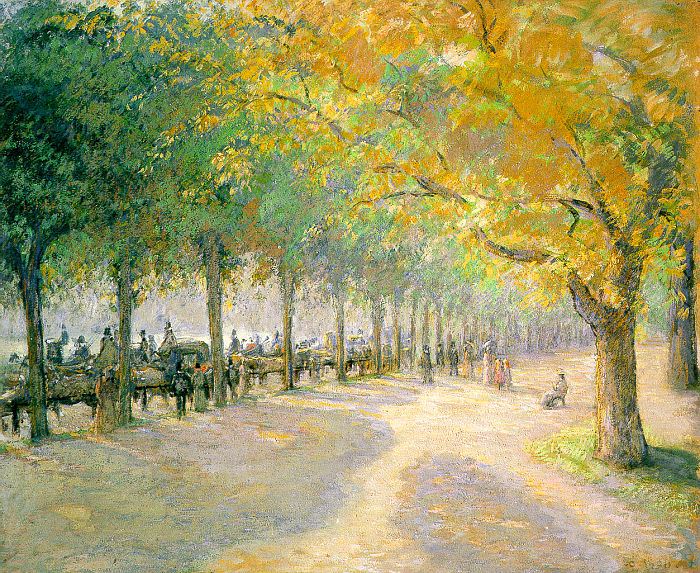
Today on Susana’s Parlour, Jude Knight and I have something special: a stand-alone short story with two characters from the Bluestocking Belles’ holiday box set, Mistletoe, Marriage, and Mayhem. Mary, the heroine of Jude’s story, Gingerbread Bride, meets Agatha Tate, Lady Pendleton, the mother of Julia Tate, the heroine of my story, The Ultimate Escape. In this episode, Lady Pendleton is just returning from a two-week journey into the twentieth century. Yes, she is a time-traveling Regency lady (who has appeared on this blog on several occasions in the past).
Pissarro_Hyde_Park

Agatha Tate staggered backwards as her feet touched the ground until, unable to reclaim her balance, she toppled over onto the soft grass at Hyde Park.

“Wh-at?” She put a hand to her aching temple and tried to regain her bearings. “Where am I?”

Agatha Tate, Lady Pendleton

Agatha Tate, Lady Pendleton

She opened her eyes and could see a vague image of a young girl in front of her. A girl who had likely seen her materialize out of nowhere, she realized as her wits were restored to her. Good heavens! How was she going to explain something was… well… unexplainable?

The girl—a young woman really, Agatha could see as her vision cleared—stepped forward, blinking rapidly. “May I help you?”

“Uh… who are you?” Agatha asked, her head still throbbing. “How long have you been there?”

Agatha pulled herself up into a sitting position and cast about for her shopping bag, which had landed in a nearby bush. “Oh my, can you get that for me, my dear? I need to change my attire before anyone sees me.”

She was still wearing her animal print leather jeans and denim jacket, which was certain to startle an inhabitant of London in 1799. Of course, she should have changed to her original clothing prior to leaving the twentieth century, but she’d been so stricken by the need to see her family again that she’d collected her bag, pulled out the stone, and uttered the gypsy’s spell before the thought could occur to her.

“Well, before anyone ELSE sees me. I shouldn’t want to cause a scandal.”
Mary Pritchard

Mary Pritchard

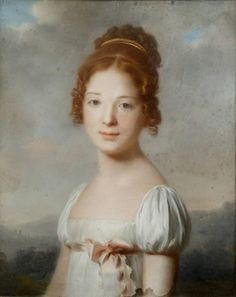
The bemused young lady fetched the bag and handed it to her. Agatha could see that her bright red hair was tousled and she seemed to be short of breath.

“Mary Pritchard, ma’am, at your service.” The young lady curtseyed politely.

“A pleasure to meet you, Miss Pritchard. Please allow me to introduce myself. I am not usually so rag-mannered, but since we have met in such unconventional circumstances…. Oh dear, there I go again! I am Lady Pendleton. My husband is Lord Pendleton, of Wittersham.”

“I am pleased to make your acquaintance, my lady.” She glanced at their surroundings, and returned her gaze toward Agatha with a reassuring smile. “We are hidden here, I think. I will keep a lookout un case Viscount B… in case anyone comes this way while you are changing.”

Agatha smiled, feeling a bit sheepish. “How very kind of you, Miss Pritchard. I was just about to ask if you would do me that small favor.”

She took the bag behind a bush and began to tug at the tight leather jeans. “Oh, I know I shouldn’t have had that last Big Mac,” she groaned.

Upon seeing the look of bewilderment on Miss Pritchard’s face, Agatha rolled her eyes. She already had a great deal to explain to the kind young woman. She’d better watch her tongue from her on in.

She coughed. “I’m afraid I’ve been over-indulging during the past fortnight. I hope my old clothes will still fit.”

“Have you traveled far?” Miss Pritchard asked politely.

Agatha grinned. “You could say that, I suppose.”

A crashing further back in the woods startled them, particularly Miss Pritchard, whose hand went to her chest as she turned toward the origin of the sound. She appeared frightened out of her skin.

Lady Pendleton pulled her yellow morning gown over her head. “Are you well, my child?”

I’m the one who has traveled 200 years and she’s the one who looks white enough to be a ghost.

“I… ah… you must wondering, ma’am, at my being here without an escort. That sound is, I think, my escort. If he finds me, would you be kind enough to say I am with you?”

The poor girl was trembling! Agatha stepped out from behind the bush and folded the girl into her embrace. Why she looked to be only a year or two older than her own daughter Julia!

“Your escort… attacked you? How did that happen?”

After a brief moment, Mary returned her embrace. She was a brave one—or perhaps foolish—to trust a complete stranger, particularly under these circumstances.

“I refused his proposal, and he thought to force me. I… ah… punched him in… ah… I distracted him and ran.”

What are Miss Pritchard’s parents thinking to allow her to be escorted by such a villain?

Miss Pritchard bit her lip. “I do not know what to do. If I tell my aunt, she will say that we must marry, and I would rather throw myself into the Thames than marry a man who only wants my money.” She sighed. “Actually, I would rather throw him into the Thames.”

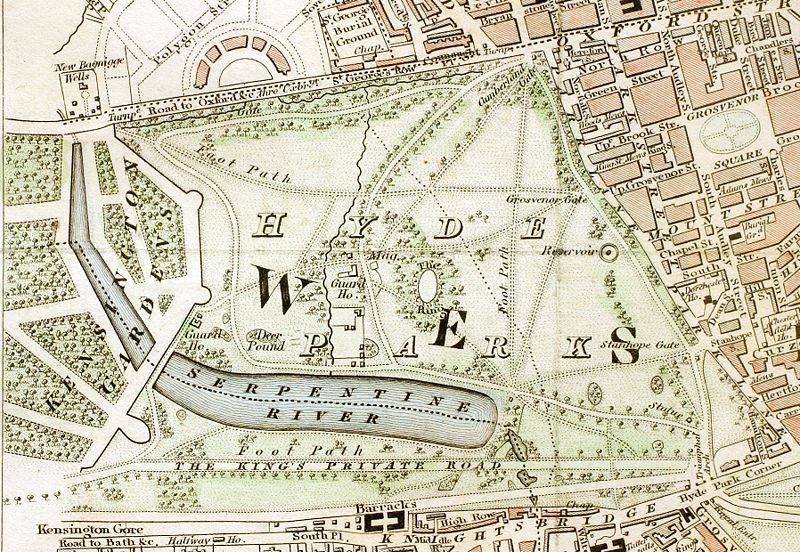
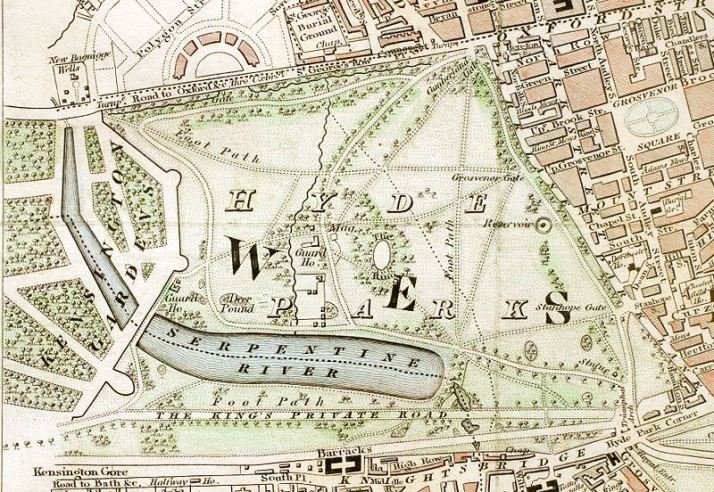
Agatha straightened up. “This… this… Boswell won’t harm you as long as I’m here, my child.” She grinned. “The Serpentine is a great deal closer. Will that do instead, do you think?”

No. 42, Grosvenor Square, the Pendletons' London home

No. 42, Grosvenor Square, the Pendletons’ London home

She turned her back. “Hurry, do me up and we’ll away from here. I live in Grosvenor Square; it’s not too far.”

The girl chuckled and hastened to oblige. Agatha gathered her discarded clothing and stuffed them into the bag, realizing she would have to keep on her twentieth century boots since she had left the old ones behind.

“Ma’am, I could not help but notice the manner of your arrival and your attire. Would you think me impertinent if I asked where you came from?”

Agatha swallowed. What to say? Perhaps she could avoid the question… a little while longer.

“It’s a long story. What concerns me most at the moment is what your parents could have been thinking to leave you alone with such a rogue.”

Miss Pritchard sighed. “I came to live with my aunt when my papa died. The rogue is her son, I am afraid. She is as keen to have the inheritance my papa left me as her son is.”

Agatha’s nostrils flared. “How disgraceful! Clearly, she is not a fit guardian. Is there no one else who can offer you protection, my dear?” She pressed her lips together. “My husband and I don’t hold with arranged marriages. Not for our three daughters, or for anyone else, if it can possibly be helped.”
800px-Hyde_Park_London_from_1833_Schmollinger_map

She set a fast pace toward the Grosvenor Gate. She wasn’t about to allow this scoundrel to make off with Miss Pritchard under any circumstances, but it would be best if they avoid a direct confrontation.

“He doesn’t even want me,” her young charge burst out. “I heard him tell his friends that he would park me in the country while spent my lovely money!”

As they approached the gate, Agatha paused and looked cautiously behind her for any sign of a pursuer and sighed with relief at not seeing one. Followed by a moment of uncertainty. The more she thought about her own family and how they must have worried about her disappearance, the more eager she was to hurry home and beg their forgiveness. On the other hand, she wasn’t sure she was quite ready to confront them—particularly not her husband George. In any case, she couldn’t abandon this poor little dove to her mercenary aunt and odious cousin. What to do? What to do?

“I’ve got it,” she said. “Tea!”

“Tea would be very welcome,” said Mary. “I have no wish to go home until I decide what to do about beastly Bosville.”

Agatha knew of a delightful little bookshop on Mount Street that served tea, which frankly she had not enjoyed half so well during her travels into the future.

“Let us have a brief respite at my friend Mrs. Marlowe’s bookshop,” she suggested. “She is very cordial and serves the best tea and biscuits in Town.”

Mary’s face brightened. “I know it!” Mary said. “She has an excellent range of books.”

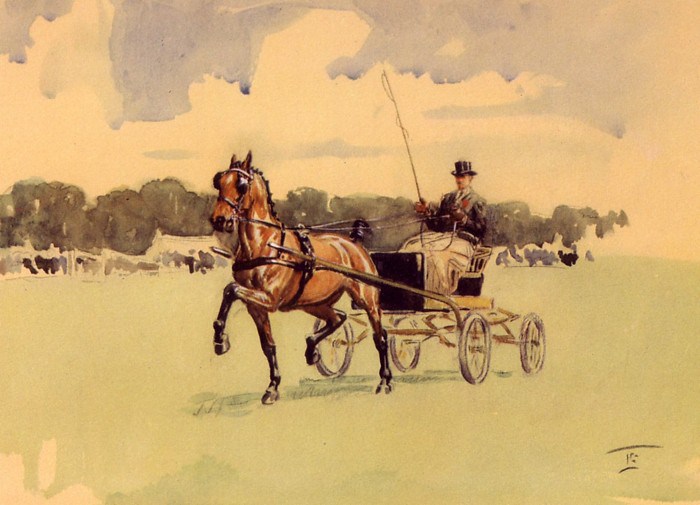
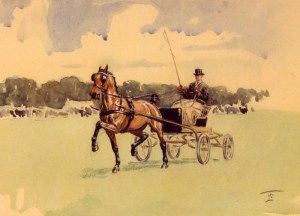
Suddenly she moved to one side, putting Agatha between her and the carriageway, where a dark-haired dandy was driving a phaeton at a furious pace out of the gate and into the street beyond.
1948-TROTTING-HACKNEY-CARRIAGE-HORSE-PRINT_700_600_QVBO

“Forgive me,” she said, “I am not usually so nervous, but that was my cousin, and I would rather he did not see me at present. Although,” she added, “I suppose it is silly of me, for what could he do in all this crowd? And I will take care not to be alone with him again, you may be sure.”

Agatha shook her head. “He looked very angry. It’s best to avoid a confrontation. Let’s away to Mount Street and refresh ourselves while we plan our strategy.” She was thinking “strategies”, because she had to come up with one for her own situation as well.

The bookshop was as busy as ever, with several customers waiting their turn at the counter. Mary led them up the stairs to the tearoom, where little tables invited friendly conversation.
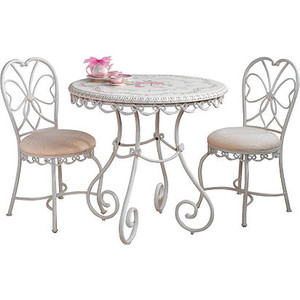
tea table

“Lady Pendleton, I hope you do not think me rude, but I could not help but notice your attire when you—er—arrived. And—it cannot be true, can it? You seemed to appear out of nowhere!”

Agatha blanched. A more prudent woman would not have considered confiding her situation—as strange as it was—to a young girl such as Mary, but then, Agatha had never been known for her prudence.

“I’ll have a cup of Bohea,” she told the waiter. “And some strawberry tarts if you have them. What would you like, my dear?”

“Souchong, please,” Mary said. “And strawberry tarts sound wonderful.”

After the waiter had departed, Agatha turned to Mary. She might as well get it over with. “When you saw me earlier today, I was wearing clothing from the twentieth century. I-uh- was visiting there for the past two weeks. I suppose you might call me—a sort of time traveler.”

Agatha’s hands were clammy. It sounded so ridiculous to say such a thing, and she wouldn’t have believed it herself if she hadn’t experienced it firsthand. But she was going to have to say it again—soon—to her husband, so she’d best get over her fears now rather than later

Mary opened her mouth and closed it again. “How marvelous,” she said at last. “I have traveled much of the world, but to travel in time? How wonderful!” She sat up straight in her chair, her eyes widened.

“Marvelous, yes, it is at that,” Agatha agreed. “Quite fascinating. An amusing and rather unconventional manner of escaping one’s problems. But now… I find myself having to face them after all.”

Mary nodded. “Running away does not solve things. Though it can win you time to find a solution.”

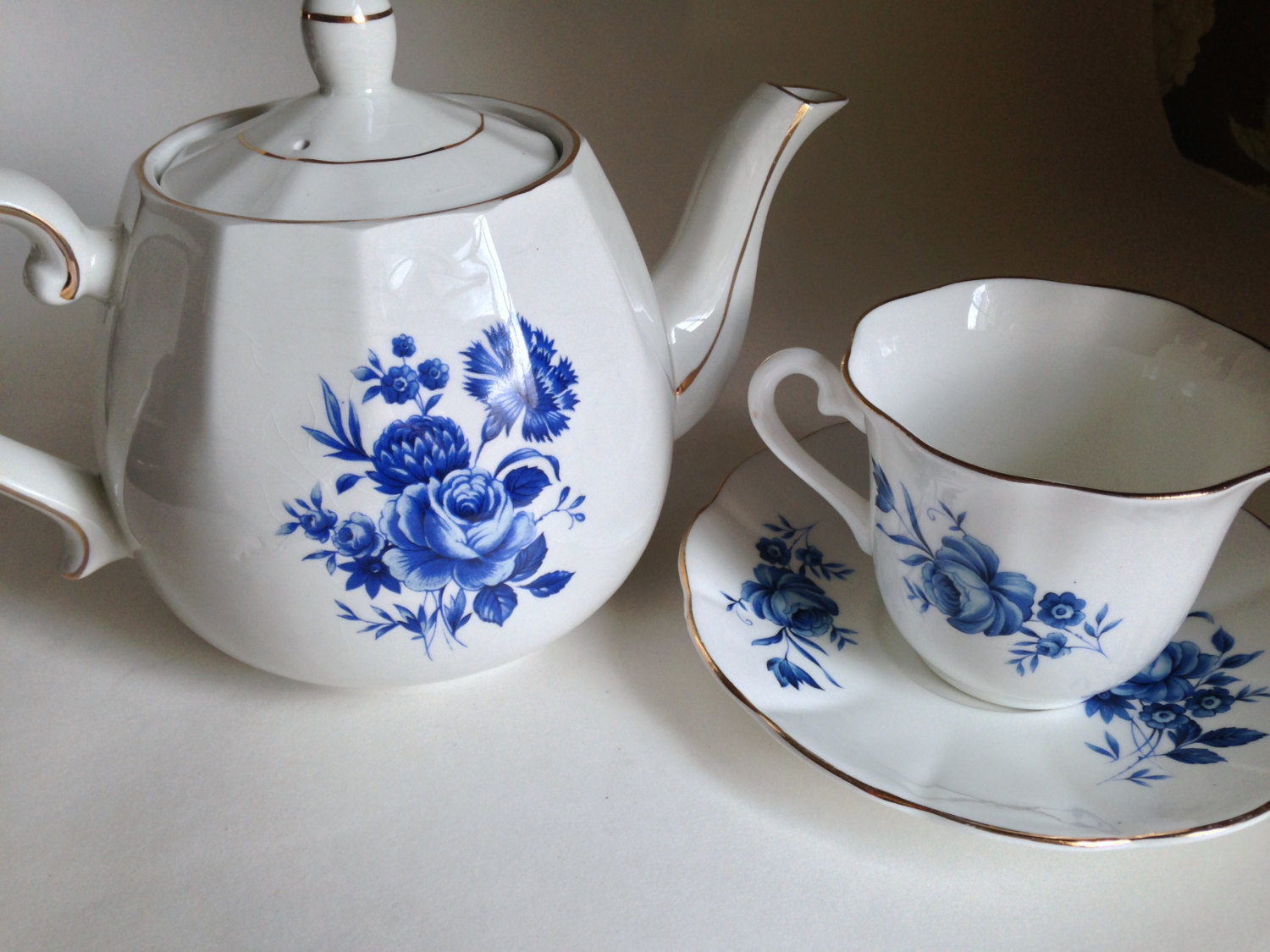
Their conversation was interrupted by the arrival of the tea. Agatha poured for both of them.
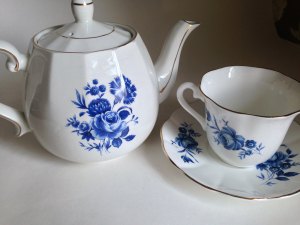
teapot

“You are wise for your age,” she commented as she passed her the plate of tarts.

Mary smiled. “Thank you, ma’am. I am on my own, you see, and must think for myself. And I am of age, though I know I look younger. My youth is a great disadvantage. Were I older, I could move to my own residence, and no one would be in the least scandalized.” She sighed.

Agatha leaned in and lightly stroked Mary’s arm. “I have three daughters at home. Julia, my eldest, is fourteen. I have missed them all so much, and my husband most of all. But I needed time to reflect on my situation, and knew my mother and aunts would only tell me to go back to my husband.”

Lady Julia Tate (at age 27)

Lady Julia Tate (at age 27)

She shook her head. “Marriage is not something to be rushed into. My George and I married for affection and fell in love later. And for the most part, we have rubbed along very well. I never thought he would turn into a—despot.” She winced, knowing in her heart that George was not a despot. Someone had wounded his pride. That holier-than-thou William Wilberforce, who despised some of her political friends because he disapproved of their morals.

Mary grimaced. “But are you going home now?”

Agatha’s mouth went dry and she took another sip of her tea.

“I am,” she said. “I must. I cannot abandon my daughters. Or my husband.”

“Of course not,” Mary agreed.

“But George must know that I won’t have a despot for a husband. While women do not have the sort of freedoms in this century that they will have in the future,”—she saw Mary’s eyes widen in surprised—“we do have options, and he must surely know I would not hesitate to take some of them, undesirable though they would be.”

She licked her lips with cautious hope. “If I know my George, though, he has long ago forgotten his anger amidst his concern for my absence.” She smiled as she imagined a tender reconciliation between them. She felt a sense of calm.

Taking the last sip of tea, she set her cup down. “It appears that my path is quite clear. I must return home and have a serious discussion with my husband. As for you, my dear, I wonder if you haven’t any other relatives you could appeal to, since clearly these Bosvilles are not suitable.”

Mary’s face brightened. “I wonder that I did not think of that! Yes, indeed! I have three more aunts, though I have not met them. Papa said I was to come to London. He thought Aunt Bosville might help me to find a husband.” Her color deepened, her fair skin showing her embarrassment. “I find I am not in the fashionable mode, however. Being raised on a naval ship does not prepare one to talk nonsense, and faint, and be ridiculously frilly and the like. And then…” she gestured at her bright red hair and freckles, “there is how I look.”

Agatha raised an eyebrow. “I see nothing amiss with your appearance. Your coloring may not be the fashion this year, but it does not prevent you from having an appeal of your own. Indeed, my eldest daughter is flame-haired and freckled, and I am quite certain she will grow into her own beauty when she past the tomboy phase.” She grinned. “Red hair is quite popular in the twentieth century. I observed that many of the younger ladies had deliberately colored their hair red, or at least a portion of it.” She frowned. “Of course, there were also shades of blue and green that I could not like at all, but that was the way of things—or will be, I should say. Society is so much more liberated in the future.”

Mary leaned forward. “Lady Pendleton, do you think… Could you tell me how you came to travel through time? Could I do it?”

Agatha wrinkled her brow. “Oh no, my dear! I think it would be quite ill-advised for someone so young to venture off into a completely different world. You may be certain I will not breathe a word of it to any of my daughters, at least not until they are old enough to have learned to resolve their problems rather than try to avoid them. No indeed, dear Mary, we must find a rather more conventional solution to your dilemma.”

“I am familiar with adventures, Lady Pendleton. I have been in a number of tight spots in many parts of the world. Though I have needed rescue from time to time, and I suppose I cannot expect Rick—Lieutenant Redepenning—to follow me two hundred years into the future.”

Now this was a promising development. “This Rick-er-Lieutenant Redepenning… you say he has come to your rescue in the past? Sounds like a delightful young man. The two of you appear to have a great deal in common. Is he eligible, do you think?” She winked. “I must confess that I would like to see my daughter Julia make a match with Oliver, who lives next door to us in Wittersham. They have been close friends forever.” She sighed. “Although it remains to be seen how well they deal with each other as adults.”

“Things can certainly change when one grows up, Mary sighed. “We were good friends when we were younger, but now… Lady Pendleton, a friend would visit a friend, would he not? If he were in London, and she were in London? A lady cannot call upon a gentleman, after all. Aunt would not even allow me to send a note! At first he was recovering from his injury, but he has been seen about Town these past six weeks and has not been to see me.” She sighed again, more deeply this time. “No, eligible or not, Rick the Rogue is not interested in plain Mary Pritchard.”

Then she brightened. “I will go to my aunts in Haslemere, Lady Pendleton. I will make the arrangements today.”

“Do you need a place to stay before you leave, Miss Pritchard?” Agatha patted her hand. “You would be welcome, if you think your return to Lady Bosville’s house would put you at risk.”

Mary shook her head. “I am quite sure that is not necessary, my lady. My cousin is unlikely to dare anything further. If he should return home, that is. He often stays away for days at a time.”

“I do hope that is the case, dear. However,” she added in a maternal tone, “Do not neglect to hire a post chaise, and your own outriders. You have a maid who can accompany you, I take it?”

“The public coach goes straight through to Haslemere, where my aunts live. Yes, I do believe it is the perfect solution. Thank you for your counsel, Lady Pendleton. And best of luck with your own reunion. I am certain your family will be over-the-top excited to have you back again!”

I hope so too, Agatha thought. In any case, it was time she found out. She rose from her seat and reached for Mary’s hand.

“It was a great pleasure to meet you, Miss Pritchard. My sincere thanks for your assistance in the park earlier. I can trust on your discretion, I suppose?”

At Mary’s nod, she clasped Mary’s shoulder. “I wish you well on your journey. And if you need any further assistance, please send for me at Grosvenor Square. Number forty-two.”

And the two of them departed the bookshop to face their own separate destinies.

Click here to read the story from Mary Pritchard’s point of view.

Click here for more information about Mistletoe, Marriage, and Mayhem.

Join us on Facebook for our launch of Mistletoe, Marriage and Mayhem on November 1, 2015.

Our Christmas Party Box Rafflecopter is here.

Celebrate with us!

Close-up-of-explosion-of-champagne-bottle-cork2

Sherry Ewing: A Knight To Call My Own

A Knight to Call my own cover

About A Knight To Call My Own

When your heart is broken, is love still worth the risk?

Lynet of Clan MacLaren knows how it feels to love someone and not have that love returned. After waiting for six long years, she has given up hope of Ian’s return. Her brother-in-law, the Devil’s Dragon of Berwyck, is tired of waiting for her to choose a husband and has decided a competition for the right to wed Lynet is just the thing his willful charge needs to force her hand.

Ian MacGillivray has returned to Berwyck Castle in search of a bride and who better than the young girl who cared for him all those years ago. But Lynet is anything but an easy conquest and he will need more than charm to win her hand in marriage.

From the English borders to the Highlands of Scotland, the chase is on for who will claim the fair Lynet. The price paid will indeed be high to ensure her safety and even higher to win her love.

Don’t miss out on Sherry’s other novels: If My Heart Could See You, a medieval romance and the beginning of her series; For All of Ever: The Knights of Berwyck, A Quest Through Time Novel (a medieval time travel romance) and Only For You, its sequel.

Amazon • Barnes & NobleKobo iBooks

Excerpt

About the Author

sherrySherry Ewing picked up her first historical romance when she was a teenager and has been hooked ever since. A bestselling author, she writes historical & time travel romances to awaken the soul one heart at a time. Always wanting to write a novel but busy raising her children, she finally took the plunge in 2008 and wrote her first Regency. She is a member of Romance Writers of America, The Beau Monde & The Bluestocking Belles. Sherry is currently working on her next novel and when not writing, she can be found in the San Francisco area at her day job as an Information Technology Specialist. You can learn more about Sherry and her published work at www.SherryEwing.com.

Website & BlogFacebookTwitterPinterest


The Bluestocking Belles: Mistletoe, Marriage & Mayhem

box set 2

The first joint volume of the Bluestocking Belles—seven Christmas novellas about runaway brides—will be released on November 1, 2015. We’re excited! It’s currently running #12 on Amazon’s Hot New Releases, and if you order it now, you’ll have it on your device by November 1 at only 99¢.

100% of royalties go to the Malala Fund. Find out more here.

About Mistletoe, Marriage & Mayhem

All She Wants for Christmas

Amy Rose Bennett

A frosty bluestocking and a hot-blooded rake. A stolen kiss and a Yuletide wedding. Sparks fly, but will hearts melt this Christmas?

The Ultimate Escape

Susana Ellis

Abandoned on his wedding day, Oliver must choose between losing his bride forever or crossing over two hundred years to find her and win her back.

‘Tis Her Season

Mariana Gabrielle

Charlotte Amberly returns a Christmas gift from her intended—the ring—then hares off to London to take husband-hunting into her own hands. Will she let herself be caught?

Gingerbread Bride

Jude Knight

Travelling with her father’s fleet has not prepared Mary Pritchard for London. When she strikes out on her own, she finds adventure, trouble, and her girlhood hero, riding once more to her rescue.

A Dangerous Nativity

Caroline Warfield

With Christmas coming, can the Earl of Chadbourn repair his widowed sister’s damaged estate, and far more damaged family? Dare he hope for love in the bargain?

Joy to the World

Nicole Zoltack

Eliza Berkeley discovers she is marrying the wrong man—on her wedding day. When the real duke turns up, will her chance at marital bliss be spoiled?

Under the Mistletoe

Sherry Ewing

Margaret Templeton will settle for Captain Morledge’s hand in marriage, until she sees the man she once loved at the Christmas party she presides over for her would-be betrothed.

Available now for pre-order price of 99¢

Amazon.comAmazon.caAmazon.uk Amazon.au

KoboiBooks

About the Bluestocking Belles

The Bluestocking Belles’ books carry you into the past for your happy-ever-after. When you have turned the last page of our novels and novellas, keep up with us (and other historical romance authors) in the Teatime Tattler, a Regency scandal sheet, and join in with the characters you love for impromptu storytelling in the Bluestocking Bookshop on Facebook. Also, look for online games and contests and monthly book chats, and find us at BellesInBlue on Facebook, Twitter, and Pinterest. Come visit at http://www.BluestockingBelles.com and kick up your bluestockinged heels!

Website FacebookTwitterPinterest • Newsletter

Check out our recent publication:

The Bluestocking Belles’ Guide to a Good Time

gamebooktoshare

  • games and puzzles related to historical romance
  • excerpts from some of the Belles’ books
  • information about the Malala Fund, to which all profits from our joint projects are committed

Free download here or purchase here for $4.99

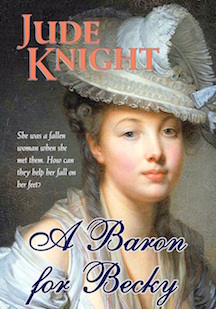
Jude Knight: A Baron for Becky

BfB cover final small copy

Aldridge Interviews His Creator

by Jude Knight

In the rush to launch A Baron for Becky, this past month I’ve given the study no more than a flick with a duster and a lick and a promise from the vacuum. Every surface is covered with papers and books. The Marquis of Aldridge looks out of place, prowling the limited space between the clutter, the two computer stations, the stack of printers, and the bookshelves.

I can’t mistake him, though. This invention of my overactive mind is actually here, in the 21st century, in my work room, tipping his head to read the book spines, and picking up the pair of copper seals on the window ledge.

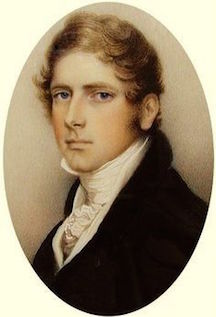
Aldridge

Anthony Grenville, Marquis of Aldridge

He is such a peacock, with his highly embroidered waistcoat, the jewelled pin placed just so in a cravat knot of his own devising, the pantaloons and coat fitting so tightly to to every muscled inch of him that my mouth goes dry. I have been happily married for forty-three and a half years, but I am neither blind nor dead, and anyone can admire the conformation of a fine thoroughbred.

What is he doing here? One of my friends had a similar visit when she offended a character by not knowing how to pronounce his name, and I must admit to providing Aldridge with plenty of reason to be annoyed with me.

“Good morning, Aldridge.”

He quirks one corner of his mouth, the signature half-grin I’ve seen so many times in my imagination. “So this is where you make us all,” he says.

“Here, on the way to and from the office, sitting up in bed, out in the lounge,” I tell him. I write all my first drafts on the iPad, which goes everywhere with me. And even when I’m not writing I’m often thinking about little bits of dialogue or ways to solve plot issues, or details of character background.

He nods as if I’ve said all that aloud. “We never leave you alone, do we?” His warm voice is sympathetic.

“Take a seat, Aldridge,” I suggest, but he shakes his head.

“There is only the one chair, ma’am,” he points out. True. I work at a standing desk and the room is small, so the only chair is the one my husband uses at his workstation. And Aldridge, whose manners are impeccable, would never sit while I remain standing.

“Fetch a chair from the next room,” I tell him, and he brings in a dining room chair, which he turns back on to the seat I’ve now taken and straddles, resting his elbows on the curved wooden top rail.

I return to his question. “You never do,” I agree. “You, in particular, Aldridge. This latest book was not on my publication schedule, but you insisted.” I have around 40 plots roughly sketched covering 20 years in the fictional world that Aldridge inhabits, and A Baron for Becky was not one of them.

He dismisses my complaint with a casual wave. “You are pleased with this book,” he reminds me. “And it is not my book, anyway. It is very much Becky’s book.”

This is true, but it was Aldridge who bothered me until I began writing. And his presence in the book is not inconsiderable.

“Is there something I can do for you, Aldridge?” I asked.

He widens his eyes, cocks his head to one side, and straightens his lips to look sincere. “I thought it would be nice to visit.” His guileless look wouldn’t fool me even if I had not made him. I raised six children. I know when someone is trying to feed me a line.

“You have some questions?” I ask.

I see the calculation in his eyes as he considers, and the moment when he decides to come clean; the relaxation of tiny muscles around the eyes and mouth, the sudden warmth in the gold flecks that lighten the brown of his eyes.

“How long do I have to wait?”

I know what he is asking, but I’m not sure what I can safely answer. It wouldn’t do to give him information he could use to avoid the stories to come. I had better find out what he already knows. “What year are you in, Aldridge?”

“1810, ma’am. The wedding was last week.”

Edward Archer by Andrew Plimer, 1815 copy

Anthony Grenville, Marquis of Aldridge

Ah. It will be a while then. In 1810, Aldridge’s happy ending was still four years in the future.

“I’m sorry, Aldridge. You will have to be patient. But trust me. I do believe in happy endings, you know.”

He stands abruptly, tipping the chair then catching it with a casual hand before pacing again—two paces to the paper store, two paces back to the bookshelf. With his back to me, he combs the fingers of one hand through his hair, a dearly familiar gesture that ripples the muscles of his shoulder in interesting ways.

When he turns again, his face is calm, set in its usual amused lines though the twinkle is missing from his eyes.

“I have no choice but to trust you, ma’am.” Then, suddenly wistful, “You will see us happy, will you not? As you did Rede and Anne, and their friends Candle and Min? A real marriage, with friendship and mutual respect as well as passion?” His brows draw together, and his voice is stern. “You are not always so kind to your characters, ma’am.”

I remember what happened to John, and am silent. Aldridge is right, but so am I. To be fair to my readers means being unfair to my characters, and happy endings for some may involve unhappy endings for others.

Aldridge will have his happy ending. I cannot promise him that, since his future must remain a mystery to him, but I know it. He has some trials to come, poor bedevilled rake that he is, but he will have his happy ending.

Perhaps he sees the truth in my eyes, because he leans over and kisses my cheek. “I know you will do your best,” he says. “I will talk to you soon.”

He fades from view, as if someone slid a transparency control, leaving nothing behind but the lingering scent of bergamot and wintergreen.

I have no doubt I’ll be hearing from him again; perhaps not in person, but certainly at 1.30am when I wake with his voice in my ears, telling me more of his personal story. Yes. Aldridge will certainly have his happy ending. In time.

A random commenter will receive a digital copy of A Baron for Becky.

About A Baron for Becky

Becky is the envy of the courtesans of the demi-monde—the indulged mistress of the wealthy and charismatic Marquis of Aldridge. But she dreams of a normal life; one in which her daughter can have a future that does not depend on beauty, sex, and the whims of a man.

Finding herself with child, she hesitates to tell Aldridge. Will he cast her off, send her away, or keep her and condemn another child to this uncertain shadow world?

The devil-may-care face Hugh shows to the world hides a desperate sorrow; a sorrow he tries to drown with drink and riotous living. His years at war haunt him, but even more, he doesn’t want to think about the illness that robbed him of the ability to father a son. When he dies, his barony will die with him. His title will fall into abeyance, and his estate will be scooped up by the Crown.

When Aldridge surprises them both with a daring proposition, they do not expect love to be part of the bargain.

Amazon • Amazon UK  • Amazon Aus

Smashwords • Barnes & Noble • iBooks • Kobo

Excerpt

The maid must have added a fresh log to the fire just before they arrived. The top was still uncharred, but flames licked up from the bed of hot embers. A twig that jutted from one side suddenly flared, turned black, and shrivelled. The bottom of the log began to glow red.

The duchess spoke again, startling Becky out of her flame-induced trance.

“What do you want for your daughter, Mrs Darling?”

“A better life,” Becky said, suddenly fierce. “A chance to be respectable. A life that does not depend on the whims of a man.”

“The first two may be achievable,” the duchess said, dryly. “The third is unlikely in the extreme. And you expect my son to help you to this goal, I take it.”

Becky was suddenly tired of polite circling. “I was saving so that I could leave this life; start again in another place under another name. But my last protector cheated me and stole from me.

“I do what I must, Your Grace. Should I have killed myself when I was disgraced? I had no skills anyone wanted to buy. I could play the piano, a little; sew, but others were faster and better; paint, but indifferently; parse a Latin sentence, but not well. Should I have starved in the gutter where they threw me?

“Well, I wasn’t given that choice. Those who took me from the gutter knew precisely what I had that others would pay for. As soon as I could, I began selling it for myself, and I Will. Not. Be. Ashamed.”

Her vehemence did not ruffle the duchess’s calm. “We all do what we must, my dear. I am not judging you. Men have the power in this world, and we women of the gentry are raised to depend on them for our survival. But you must know that Aldridge cannot offer marriage to a woman with your history.”

About the Author

Jude Knight copyJude Knight writes strong determined heroines, heroes who can appreciate a clever capable woman, villains you’ll love to loathe, and all with a leavening of humour.

Jude Knight is the pen name of Judy Knighton. After a career in commercial writing, editing, and publishing, Jude is returning to her first love, fiction. Her novella, Candle’s Christmas Chair, was released in December 2014, and is in the top ten on several Amazon bestseller lists in the US and UK. Her first novel Farewell to Kindness, was released on 1 April, and is first in a series: The Golden Redepennings.

Website • Facebook • Twitter

Newsletter • Blog • Goodreads

Mariana Gabrielle: La Déesse Noire (Giveaway)

Bluestocking-Belles-logo-01

A Hearty Welcome to Fellow Bluestocking Belle

 Mariana Gabrielle

Susana: How long have you been writing?

Mariana: I’ve been a professional writer almost twenty-five years, writing fiction since 2009.

Susana: What advice would you give to writers just starting out?

MarianaGabrielle copyMariana: Write. Write some more. Keep writing.

Susana: Do you ever suffer from writer’s block? If so, what do you do about it?

Mariana: I tend not to get writer’s block, because I am well-used to switching among projects and formats and genres. On the rare occasions when I do, I typically switch to marketing work for a while.

Susana: What comes first: the plot or the characters?

Mariana: Characters, with plot not far behind. The first draft is almost always the characters filling me in on the story, before I fictionalize [what they think are] their nonfiction accounts.

Susana: Are you a plotter or a pantser?

Mariana: Panster. Full stop. Even in nonfiction, I almost never start with a plan, and if I do, it gets tossed out the window very early. The work evolves.

Susana: Tell us something about your newest release that is NOT in the blurb.

Mariana: There are two heroes, three villains, and two sidekicks in this short novel. I am told I managed to pull it off.

Susana: Are you working on something at present that you would like to tell us about?

Mariana: I am working on a series of three prequel novellas connected to my first novel, Royal Regard, the first of which will appear in the Bluestocking Belles’ holiday box set. In ‘Tis Her Season, Charlotte and Alexander start their life together; in Shipmate, readers will learn how Bella ended up with her first husband; and in the unnamed third book, Bella’s brother, John, meets his wife, Rose.

Susana: What did you want to be when you grew up?

Mariana: I wanted to be a musical theatre star.

Susana: What is one thing your readers would be most surprised to learn about you?

Mariana: I am not—in the least—a romantic (not even a little bit).

Susana: What would we find under your bed?

Mariana: Dust. (Cats, if there are other people in the house.)

Susana: Do you write in multiple genres or just one? If just one, would you consider straying outside your genre?

Mariana: Thus far, I have only published Regency romance, but next year, I will release Blind Tribute, a mainstream historical about a Civil War newspaper reporter with divided loyalties. I am currently working in non-fiction on a marketing book, and I have already released a book-length epic poem about the Mayan underworld. As far as fiction, though, I don’t foresee straying from some form of historical.

Susana: What is something you’d like to accomplish in your writing career next year?

Mariana: I’d like to release all three Royal Regard prequel novellas, and I would like Blind Tribute to be on the verge of publication by this time next year. I wouldn’t mind having a good start on Book One of my Regency family series.

Susana: When was the moment that you knew you had to be a writer

Mariana: During the same week, in my third year of college (the first time around), I was offered an internship at the Denver Post, and was also approached by the Music Department chair to try for an audition at the National Musical Theater Conservatory. I decided writing was a more stable career path. Largely, I was correct.

Susana: Describe the “perfect hero.” What about the “perfect hero” for you?

Mariana: I am the perfect hero (and heroine) for me.

Rafflecopter contest May 15 – June 9

Print

Facebook Launch Party: June 10, 12:00 noon – 8 p.m. EDT

About La Déesse Noire

Sired by a British peer, born of a paramour to Indian royalty, Kali Matai has been destined from birth to enthrall England’s most powerful noblemen—though she hadn’t counted on becoming their pawn. Finding herself under the control of ruthless men, who will not be moved by her legendary allure, she has no choice but to use her beauty toward their malicious and clandestine ends.

When those she holds most dear are placed in peril by backroom political dealings, she enlists some of the most formidable lords in England to thwart her enemies. But even with the help of the prominent gentlemen she has captivated, securing Kali’s freedom, her family, and the man she loves, will require her protectors stop at nothing to fulfill her desires.

Amazon.comAmazon.ukBarnes and NobleKobo

iTunesAll Romance eBooksSmashwordsGoodreads

Excerpt

Mayuri had done her no favors, preparing her for the worst. Fitz had no reason to be gentle, she had been warned, no cause to concern himself with her wishes, desires, or fears. No matter how handsome, how charming, how solicitous in the drawing room, Mayuri had said, there was every possibility he would be driven entirely by his own lust, disregarding even the most basic courtesies. And no matter what he did, Kali was to pretend she had never been more excited by anything in her life.

She turned away to stare into the corner of the garish red-and-gold room, wishing it felt less like a cheap brothel, fingers tripping over the buttons of her dress, trying to speed things up to be finished that much faster.

She couldn’t help glancing at the bed, with a frame as large as a farm wagon. Piles of pillows in shades of rose, bed curtains of garish silk velvet, and a red satin eiderdown quilt nearly as thick as the feather-filled mattress. As comfortable as it all must be, she glared like it concealed a hungry crocodile.

He tugged the shirttail from his waistband and unbuttoned it over his broad chest, then came to her and held her hands motionless, kissing her fingertips.

“I will not hurt you, my sweet, I promise. No more than a pinprick, as with any woman’s first time. Mayuri explained?”

She nodded again, trying to bring her voice back under her own control. “Yes, my lord.” She’d known exactly what to expect for at least ten years.

“My name is Fitz,” he said, recalling her attention to his face, “not ‘my lord.’ I cannot bear such formality from you, Kali. Can you indulge me?”

“Yes, Si—Fitz.”

“Much better,” he said, kissing her cheek, then her earlobe, murmuring, “Now then, I prefer a woman who would invite me to her bed for the enjoyment, so I plan to ensure it. May I bring you pleasure, sweeting? Will you allow it?”

She had no right to deny him anything he wanted in bed, nor anywhere else, truth be told, and she probably knew more than he—theoretically—about the pleasures of the flesh. That he was asking her agreement and treating her as an innocent predisposed her to look past her fear.

“It is my fondest desire to please you in all things, my lor…” She trailed off when she saw his frustration at the pat response. She struggled to salvage the moment, but had no untutored words. She tried to explain this inadequacy with her eyes as she offered, grasping his hands more tightly, “Perhaps I might dance? Or indulge your… more exotic pleasures.”

She had been trained to expect anything and to use every part of her body, her mind, her wardrobe, and myriad implements to enhance any sexual act he chose. She had been told of every possibility before she was fourteen, then experienced all but the final act of coition at the hands of another, older tawaif, or the castrati who staffed Mayuri’s house of male delights.

She had not been trained in how to explain she was frightened, that she couldn’t remember how to put either of them at ease, that she was afraid of what he might ask if he kept her, but petrified he would find her wanting and send her away. It would be much simpler if he threw her across the bed and took his pleasure like a rutting dog. If, in the morning, she could remain indifferent.

About the Author

Mariana Gabrielle is a pseudonym of Mari Christie, a professional writer, editor, and designer with almost twenty-five years’ experience. Published in dozens of nonfiction and poetry periodicals since 1989, she began writing mainstream historical fiction in 2009 and Regency romance in 2013. In all genres, she creates deeply scarred characters in uncommon circumstances who overcome self-imposed barriers to reach their full potential. She is a member of the Bluestocking Belles, the Writing Wenches, and the Rocky Mountain Fiction Writers. Her first Regency romance, Royal Regard, was released in November 2014.

 Website/BlogFacebookTwitter

PinterestAmazon Author Page Goodreads

A Celebration of Waterloo: The Romance of Harry and Juana Smith

Beaux, Ballrooms, and Battles:

A Celebration of Waterloo

June 18, 1815 was the day Napoleon Bonaparte’s Grande Armée was definitively routed by the ragtag band of soldiers from the Duke of Wellington’s Allied Army in a little Belgian town called Waterloo. The cost in men’s lives was high—22,000 dead or wounded for the Allied Army and 24,000 for the French. But the war with Napoleon that had dragged on for a dozen years was over for good, and the British people once more felt secure on their island shores.

The bicentenary of the famous battle seemed like an excellent opportunity to use that setting for a story, and before I knew it, I had eight other authors eager to join me,and to make a long story short, in a bit over two weeks our anthology of nine Waterloo-themed stories will be released to the world.

You are all invited to:

The Inspiration for Lost and Found Lady

In my preparatory reading for this project, I discovered the real-life romance of Harry Smith and his wife Juana while reading Georgette Heyer’s The Spanish Bride. Add to that my deep affection for Spain and the Spanish language, and the result is a story of a romance between an injured British soldier and the extraordinary young peasant girl who rescued him after the Battle of Salamanca.

spain_Cadiz_hervas_map

Henry (Harry) George Wakelyn Smith (1787-1860)

220px-Sir_Harry_Smith

Harry was born in Whittlesey, Cambridgeshire, the son of a surgeon. He entered the army in 1805 and saw action in South America (1806-7), but it was his service in the Peninsular War with the 95th Rifles as a scout that brought him into prominence, and that’s where he met his wife. Prior to Waterloo, he served in the United States (witnessed the burning of the capitol in 1814), and after Waterloo, South Africa and India.

Juana María de los Dolores de León Smith (1798-1872)

juanasmith

A descendent of Ponce de León, Juana was orphaned at fourteen and, deprived of all family property after the siege of Badajoz in April of 1812, she and her older sister approached the British Army for protection during the atrocious massacre (indiscriminate looting, killing, and raping of Spanish civilians by British and Portuguese soldiers following the heat of battle). It was love at first sight. Despite her youth (and marriage at that age was not uncommon in Spain at the time), Juana and Harry were married four days later, and remained devoted to each other the rest of their lives.

Despite her convent upbringing, Juana insisted on remaining with Harry throughout the war, bearing the privations of army life so cheerfully that she became the darling of the 95th Rifles. Wellington himself familiarly called her “Juanita”.

From The Autobiography of Lieutenant-General Sir Harry Smith

Now comes a scene of horror I would willingly bury in oblivion. The atrocities committed by our soldiers on the poor innocent and defenceless inhabitants of the city, no words suffice to depict. Civilized man, when let loose and the bonds of morality relaxed, is a far greater beast than the savage, more refined in his cruelty, more fiend-like in every act; and oh, too truly did our heretofore noble soldiers disgrace themselves, though the officers exerted themselves to the utmost to repress it, many who had escaped the enemy being wounded in their merciful attempts! Yet this scene of debauchery, however cruel to many, to me as been the solace and the whole happiness of my life for thirty-three years. A poor defenceless maiden of thirteen years was thrown upon my generous nature through her sister, as described so ably in Johnny Kincaid’s book, of which this in an extract—

kincaid“I was conversing with a friend the day after, at the door of his tent, when we observed two ladies coming from the city, who made directly towards us; they seemed both young, and when they came near, the elder of the two threw back her mantilla to address us, showing a remarkably handsome figure, with fine features; but her sallow, sun-burnt, and careworn, though still youthful, countenance showed that in her ‘the time for tender thoughts and soft endearments had fled away and gone.’

“She at once addressed us in that confident, heroic manner so characteristic of the high-bred Spanish maiden, told us who they were—the last of an ancient and honourable house—and referred to an officer high in rank in our army, who had been quartered there in the days of her prosperity, for the truth of her tale.

“Her husband, she said, was a Spanish officer in a distant part of the kingdom; he might, or he might not, still be living. But yesterday she and this her young sister were able to live in affluence and in a handsome house; to-day they knew not where to lay their heads, where to get a change of raiment or a morsel of bread. Her house, she said, was a wreck; and, to show the indignities to which they had been subjected, she pointed to where the blood was still trickling down their necks, caused by the wrenching of their ear-rings through the flesh by the hands of worse than savages, who would not take the trouble to unclasp them!

“For herself, she said, she cared not; but for the agitated and almost unconscious maiden by her side, whom she had but lately received over from the hands of her conventual instructresses, she was in despair, and knew not what to do; and that, in the rapine and ruin which was at that moment desolating the city, she saw no security for her but the seemingly indelicate one she had adopted—of coming to the camp and throwing themselves upon the protection of any British officer who would afford it; and so great, she said, was her faith in our national character, that she knew the appeal would not be made in vain, nor the confidence abused. Nor was it made in vain! Nor could it be abused, for she stood by the side of an angel! A being more transcendingly lovely I had never before seen—one more amiable I have never yet known!

“Fourteen summers had not yet passed over her youthful countenance, which was of a delicate freshness—more English than Spanish; her face, though not perhaps rigidly beautiful, was nevertheless so remarkably handsome, and so irresistibly attractive, surmounting a figure cast in nature’s fairest mould, that to look at her was to love her; and I did love her, but I never told my love, and int the mean time another and a more impudent fellow stepped in and won her! But yet I was happy, for in him she found such a one as her loveliness and her misfortunes claimed—a man of honour, and a husband in every way worthy of her!”

“That a being so young, so lovely, and so interesting, just emancipated from the gloom of a convent, unknowing of the world and to the world unknown, should thus have been wrecked on a sea of troubles, and thrown on the mercy of strangers under circumstances so dreadful, so uncontrollable, and not have sunk to rise no more, must be the wonder of every one. Yet from the moment she was thrown on her own resources, her star was in the ascendant.”

“Guided by a just sense of rectitude, an innate purity of mind, a singleness of purpose which defied malice, and a soul that soared above circumstances, she became alike the adored of the camp and of the drawing-room, and eventually the admired associate of princes. She yet lives, in the affections of her gallant husband, in an elevated situation in life, a pattern to her sex, and everybody’s beau ideal of what a wife should be.”

I confess myself to be the “more impudent fellow,” and if any reward is due to a soldier, never was one so honoured and distinguished as I have been by the possession of this dear child (for she was little more than a child at this moment), one with a sense of honour no knight ever exceeded in the most romantic days of chivalry, an understanding superior to her years, a masculine mind with a force of character no consideration could turn from her own just sense of rectitude, and all encased in a frame of Nature’s fairest and most delicate moulding, the figure of an angel, with an eye of light and an expression which then inspired me with a maddening love which, from that period to this (now thirty-three years), has never abated under many and the most trying circumstances. Thus, as good may come out of evil, this scene of devastation and spoil yielded to me a treasure invaluable; to me who, among so many dear friends, had escaped all dangers; to me, a wild youth not meriting such reward, and, however desirous, never able to express half his gratitude to God Almighty for such signal marks of His blessing shown to so young and so thoughtless a being. From that day to this she has been my guardian angel. She has shared with me the dangers and privations, the hardships and fatigues, of a restless life of war in every quarter of the globe. No murmur has ever escaped her. Bereft of every relative, of every tie to her country but the recollection of it, united to a man of different though Christian religion, yet that man has been and is her all…”

The Protagonists of Lost and Found Lady

Rupert Ellsworth, like Harry Smith is an explorer scout with the British Army in Spain. Also like Harry, he’s a younger son seeking to make his own way in life. He might have become a career soldier as Harry did, had his life not taken a different turn in 1812. When he meets Catalina, he’s not looking for love or marriage, and if he were, it certainly wouldn’t be to a penniless Spanish Catholic!

Catalina’s upbringing wasn’t at all like Juana Smith’s. Orphaned at birth, she is taken in by a couple who treat her as an unpaid servant. Her eagerness to learn attracts the attention of a local priest, who takes it upon himself to give her an education comparable to that of an elite gentleman. When she meets Rupert, she is reflecting on her limited options for the future and wondering if she could escape her humdrum life by becoming a nun. At eighteen when she meets Rupert, she’s older than Juana, but, like Harry’s wife, she’s reached a turning point in her life.

What happens when these two meet after the Battle of Salamanca? Hmm…

waterloo_cover_best web

Amazon.comAmazon.uk Amazon.caAmazon.au

 Barnes & Noble • iBooks • Kobo

Beaux, Ballrooms, and Battles

Release Day Party: April 1, 2015, 11 a.m. – 11 p.m. EDT

Rafflecopter: ends April 18

Website: www.beauxballroomsandbattles.com

Facebook Page

Jillian Chantal: Jeremiah’s Charge

Emmaline Rothesay has her eye on Jeremiah Denby as a potential suitor. When Captain Denby experiences a life-altering incident during the course of events surrounding the Battle of Waterloo, it throws a damper on Emmaline’s plans.

Téa Cooper: The Caper Merchant

The moon in Gemini is a fertile field of dreams, ideas and adventure and Pandora Wellingham is more than ready to spread her wings. When Monsieur Cagneaux, caper merchant to the rich and famous, introduces her to the handsome dragoon she believes her stars have aligned.

Susana Ellis: Lost and Found Lady

Catalina and Rupert fell in love in Spain in the aftermath of a battle, only to be separated by circumstances. Years later, they find each other again, just as another battle is brewing, but is it too late?

Aileen Fish: Captain Lumley’s Angel

Charged with the duty of keeping his friend’s widow safe, Captain Sam Lumley watches over Ellen Staverton as she recovers from her loss, growing fonder of her as each month passes. When Ellen takes a position as a companion, Sam must confront his feelings before she’s completely gone from his life.

Victoria Hinshaw: Folie Bleue

On the night of the 30th Anniversary of the Battle of Waterloo, Aimée, Lady Prescott, reminisces about meeting her husband in Bruxelles on the eve of the fighting. She had avoided the dashing scarlet-clad British officers, but she could not resist the tempting smile and spellbinding charm of Captain Robert Prescott of the 16th Light Dragoons who—dangerously to Aimée—wore blue.

Heather King: Copenhagen’s Last Charge

When Meg Lacy finds herself riding through the streets of Brussels only hours after the Battle of Waterloo, romance is the last thing on her mind, especially with surly Lieutenant James Cooper. However, their bickering uncovers a strange empathy—until, that is, the lieutenant makes a grave error of judgment that jeopardizes their budding friendship…

Christa Paige: One Last Kiss

The moment Colin held Beatrice in his arms he wanted one last kiss to take with him into battle and an uncertain future. Despite the threat of a soldier’s death, he must survive, for he promises to return to her because one kiss from Beatrice would never be enough.

Sophia Strathmore: A Soldier Lay Dying

Amelia and Anne Evans find themselves orphaned when their father, General Evans, dies. With no other options available, Amelia accepts the deathbed proposal of Oliver Brighton, Earl of Montford, a long time family friend. When Lord Montford recovers from his battle wounds, can the two find lasting love?

David W. Wilkin: Not a Close Run Thing at All

Years, a decade. And now, Robert had come back into her life. Shortly before battle was to bring together more than three hundred thousand soldiers. They had but moments after all those years, and now, would they have any more after?