Strange happenings in Hyde Park: a Bluestocking Belles cross-post

Today on Susana’s Parlour, Jude Knight and I have something special: a stand-alone short story with two characters from the Bluestocking Belles’ holiday box set, Mistletoe, Marriage, and Mayhem. Mary, the heroine of Jude’s story, Gingerbread Bride, meets Agatha Tate, Lady Pendleton, the mother of Julia Tate, the heroine of my story, The Ultimate Escape. In this episode, Lady Pendleton is just returning from a two-week journey into the twentieth century. Yes, she is a time-traveling Regency lady (who has appeared on this blog on several occasions in the past).
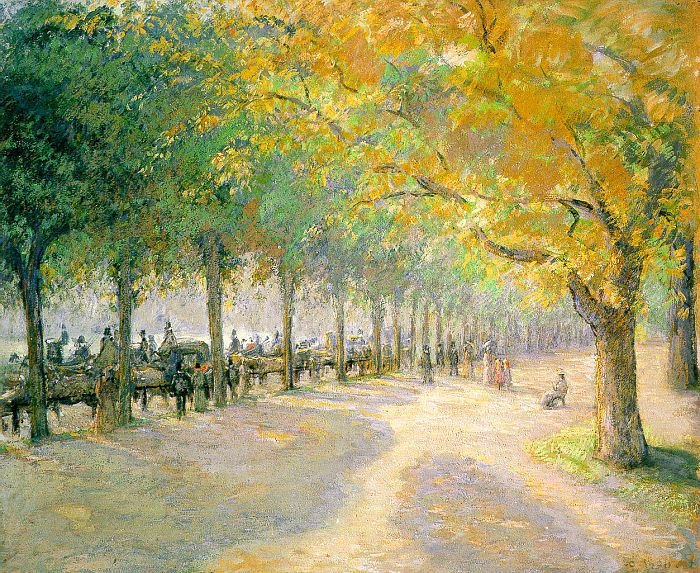
Pissarro_Hyde_Park

Agatha Tate staggered backwards as her feet touched the ground until, unable to reclaim her balance, she toppled over onto the soft grass at Hyde Park.

“Wh-at?” She put a hand to her aching temple and tried to regain her bearings. “Where am I?”

Agatha Tate, Lady Pendleton

Agatha Tate, Lady Pendleton

She opened her eyes and could see a vague image of a young girl in front of her. A girl who had likely seen her materialize out of nowhere, she realized as her wits were restored to her. Good heavens! How was she going to explain something was… well… unexplainable?

The girl—a young woman really, Agatha could see as her vision cleared—stepped forward, blinking rapidly. “May I help you?”

“Uh… who are you?” Agatha asked, her head still throbbing. “How long have you been there?”

Agatha pulled herself up into a sitting position and cast about for her shopping bag, which had landed in a nearby bush. “Oh my, can you get that for me, my dear? I need to change my attire before anyone sees me.”

She was still wearing her animal print leather jeans and denim jacket, which was certain to startle an inhabitant of London in 1799. Of course, she should have changed to her original clothing prior to leaving the twentieth century, but she’d been so stricken by the need to see her family again that she’d collected her bag, pulled out the stone, and uttered the gypsy’s spell before the thought could occur to her.

“Well, before anyone ELSE sees me. I shouldn’t want to cause a scandal.”
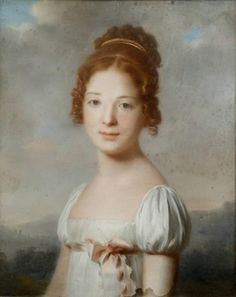
Mary Pritchard

Mary Pritchard

The bemused young lady fetched the bag and handed it to her. Agatha could see that her bright red hair was tousled and she seemed to be short of breath.

“Mary Pritchard, ma’am, at your service.” The young lady curtseyed politely.

“A pleasure to meet you, Miss Pritchard. Please allow me to introduce myself. I am not usually so rag-mannered, but since we have met in such unconventional circumstances…. Oh dear, there I go again! I am Lady Pendleton. My husband is Lord Pendleton, of Wittersham.”

“I am pleased to make your acquaintance, my lady.” She glanced at their surroundings, and returned her gaze toward Agatha with a reassuring smile. “We are hidden here, I think. I will keep a lookout un case Viscount B… in case anyone comes this way while you are changing.”

Agatha smiled, feeling a bit sheepish. “How very kind of you, Miss Pritchard. I was just about to ask if you would do me that small favor.”

She took the bag behind a bush and began to tug at the tight leather jeans. “Oh, I know I shouldn’t have had that last Big Mac,” she groaned.

Upon seeing the look of bewilderment on Miss Pritchard’s face, Agatha rolled her eyes. She already had a great deal to explain to the kind young woman. She’d better watch her tongue from her on in.

She coughed. “I’m afraid I’ve been over-indulging during the past fortnight. I hope my old clothes will still fit.”

“Have you traveled far?” Miss Pritchard asked politely.

Agatha grinned. “You could say that, I suppose.”

A crashing further back in the woods startled them, particularly Miss Pritchard, whose hand went to her chest as she turned toward the origin of the sound. She appeared frightened out of her skin.

Lady Pendleton pulled her yellow morning gown over her head. “Are you well, my child?”

I’m the one who has traveled 200 years and she’s the one who looks white enough to be a ghost.

“I… ah… you must wondering, ma’am, at my being here without an escort. That sound is, I think, my escort. If he finds me, would you be kind enough to say I am with you?”

The poor girl was trembling! Agatha stepped out from behind the bush and folded the girl into her embrace. Why she looked to be only a year or two older than her own daughter Julia!

“Your escort… attacked you? How did that happen?”

After a brief moment, Mary returned her embrace. She was a brave one—or perhaps foolish—to trust a complete stranger, particularly under these circumstances.

“I refused his proposal, and he thought to force me. I… ah… punched him in… ah… I distracted him and ran.”

What are Miss Pritchard’s parents thinking to allow her to be escorted by such a villain?

Miss Pritchard bit her lip. “I do not know what to do. If I tell my aunt, she will say that we must marry, and I would rather throw myself into the Thames than marry a man who only wants my money.” She sighed. “Actually, I would rather throw him into the Thames.”

Agatha straightened up. “This… this… Boswell won’t harm you as long as I’m here, my child.” She grinned. “The Serpentine is a great deal closer. Will that do instead, do you think?”
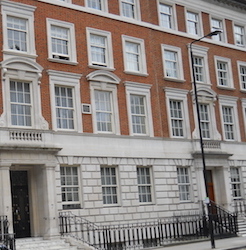
No. 42, Grosvenor Square, the Pendletons' London home

No. 42, Grosvenor Square, the Pendletons’ London home

She turned her back. “Hurry, do me up and we’ll away from here. I live in Grosvenor Square; it’s not too far.”

The girl chuckled and hastened to oblige. Agatha gathered her discarded clothing and stuffed them into the bag, realizing she would have to keep on her twentieth century boots since she had left the old ones behind.

“Ma’am, I could not help but notice the manner of your arrival and your attire. Would you think me impertinent if I asked where you came from?”

Agatha swallowed. What to say? Perhaps she could avoid the question… a little while longer.

“It’s a long story. What concerns me most at the moment is what your parents could have been thinking to leave you alone with such a rogue.”

Miss Pritchard sighed. “I came to live with my aunt when my papa died. The rogue is her son, I am afraid. She is as keen to have the inheritance my papa left me as her son is.”

Agatha’s nostrils flared. “How disgraceful! Clearly, she is not a fit guardian. Is there no one else who can offer you protection, my dear?” She pressed her lips together. “My husband and I don’t hold with arranged marriages. Not for our three daughters, or for anyone else, if it can possibly be helped.”
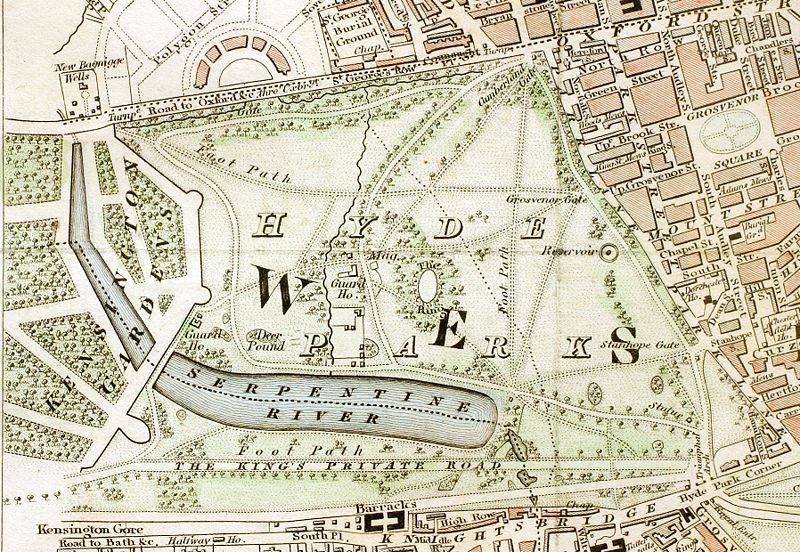
800px-Hyde_Park_London_from_1833_Schmollinger_map

She set a fast pace toward the Grosvenor Gate. She wasn’t about to allow this scoundrel to make off with Miss Pritchard under any circumstances, but it would be best if they avoid a direct confrontation.

“He doesn’t even want me,” her young charge burst out. “I heard him tell his friends that he would park me in the country while spent my lovely money!”

As they approached the gate, Agatha paused and looked cautiously behind her for any sign of a pursuer and sighed with relief at not seeing one. Followed by a moment of uncertainty. The more she thought about her own family and how they must have worried about her disappearance, the more eager she was to hurry home and beg their forgiveness. On the other hand, she wasn’t sure she was quite ready to confront them—particularly not her husband George. In any case, she couldn’t abandon this poor little dove to her mercenary aunt and odious cousin. What to do? What to do?

“I’ve got it,” she said. “Tea!”

“Tea would be very welcome,” said Mary. “I have no wish to go home until I decide what to do about beastly Bosville.”

Agatha knew of a delightful little bookshop on Mount Street that served tea, which frankly she had not enjoyed half so well during her travels into the future.

“Let us have a brief respite at my friend Mrs. Marlowe’s bookshop,” she suggested. “She is very cordial and serves the best tea and biscuits in Town.”

Mary’s face brightened. “I know it!” Mary said. “She has an excellent range of books.”

Suddenly she moved to one side, putting Agatha between her and the carriageway, where a dark-haired dandy was driving a phaeton at a furious pace out of the gate and into the street beyond.
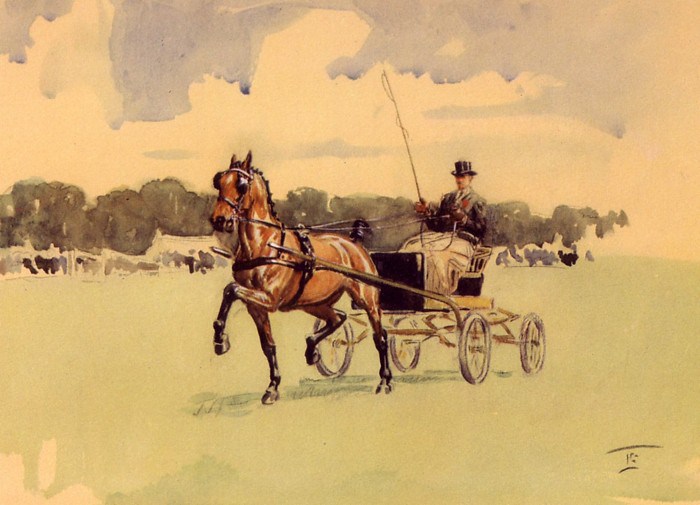
1948-TROTTING-HACKNEY-CARRIAGE-HORSE-PRINT_700_600_QVBO

“Forgive me,” she said, “I am not usually so nervous, but that was my cousin, and I would rather he did not see me at present. Although,” she added, “I suppose it is silly of me, for what could he do in all this crowd? And I will take care not to be alone with him again, you may be sure.”

Agatha shook her head. “He looked very angry. It’s best to avoid a confrontation. Let’s away to Mount Street and refresh ourselves while we plan our strategy.” She was thinking “strategies”, because she had to come up with one for her own situation as well.

The bookshop was as busy as ever, with several customers waiting their turn at the counter. Mary led them up the stairs to the tearoom, where little tables invited friendly conversation.
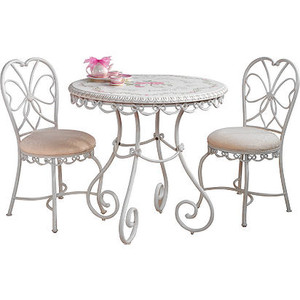
tea table

“Lady Pendleton, I hope you do not think me rude, but I could not help but notice your attire when you—er—arrived. And—it cannot be true, can it? You seemed to appear out of nowhere!”

Agatha blanched. A more prudent woman would not have considered confiding her situation—as strange as it was—to a young girl such as Mary, but then, Agatha had never been known for her prudence.

“I’ll have a cup of Bohea,” she told the waiter. “And some strawberry tarts if you have them. What would you like, my dear?”

“Souchong, please,” Mary said. “And strawberry tarts sound wonderful.”

After the waiter had departed, Agatha turned to Mary. She might as well get it over with. “When you saw me earlier today, I was wearing clothing from the twentieth century. I-uh- was visiting there for the past two weeks. I suppose you might call me—a sort of time traveler.”

Agatha’s hands were clammy. It sounded so ridiculous to say such a thing, and she wouldn’t have believed it herself if she hadn’t experienced it firsthand. But she was going to have to say it again—soon—to her husband, so she’d best get over her fears now rather than later

Mary opened her mouth and closed it again. “How marvelous,” she said at last. “I have traveled much of the world, but to travel in time? How wonderful!” She sat up straight in her chair, her eyes widened.

“Marvelous, yes, it is at that,” Agatha agreed. “Quite fascinating. An amusing and rather unconventional manner of escaping one’s problems. But now… I find myself having to face them after all.”

Mary nodded. “Running away does not solve things. Though it can win you time to find a solution.”

Their conversation was interrupted by the arrival of the tea. Agatha poured for both of them.
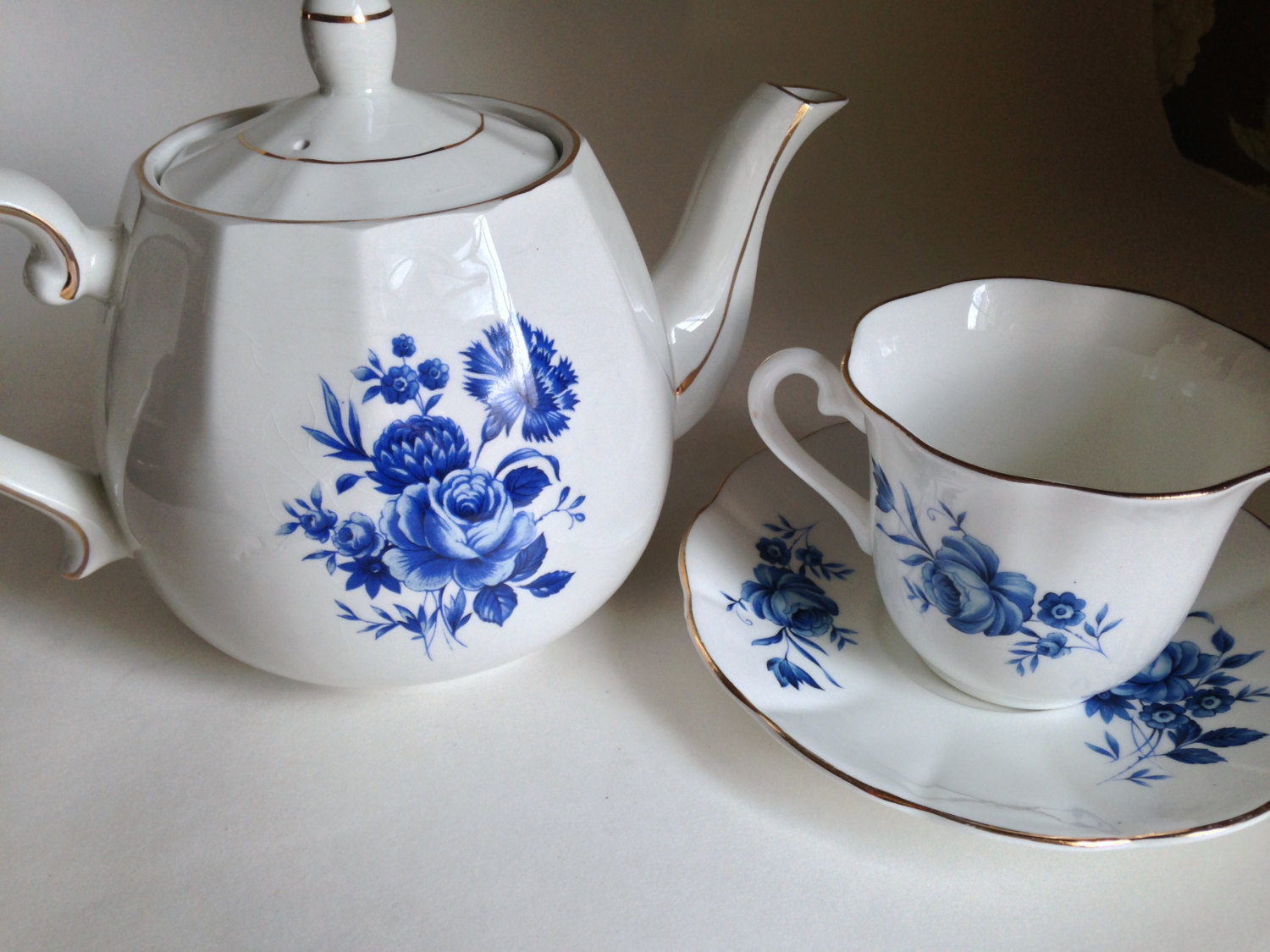
teapot

“You are wise for your age,” she commented as she passed her the plate of tarts.

Mary smiled. “Thank you, ma’am. I am on my own, you see, and must think for myself. And I am of age, though I know I look younger. My youth is a great disadvantage. Were I older, I could move to my own residence, and no one would be in the least scandalized.” She sighed.

Agatha leaned in and lightly stroked Mary’s arm. “I have three daughters at home. Julia, my eldest, is fourteen. I have missed them all so much, and my husband most of all. But I needed time to reflect on my situation, and knew my mother and aunts would only tell me to go back to my husband.”

Lady Julia Tate (at age 27)

Lady Julia Tate (at age 27)

She shook her head. “Marriage is not something to be rushed into. My George and I married for affection and fell in love later. And for the most part, we have rubbed along very well. I never thought he would turn into a—despot.” She winced, knowing in her heart that George was not a despot. Someone had wounded his pride. That holier-than-thou William Wilberforce, who despised some of her political friends because he disapproved of their morals.

Mary grimaced. “But are you going home now?”

Agatha’s mouth went dry and she took another sip of her tea.

“I am,” she said. “I must. I cannot abandon my daughters. Or my husband.”

“Of course not,” Mary agreed.

“But George must know that I won’t have a despot for a husband. While women do not have the sort of freedoms in this century that they will have in the future,”—she saw Mary’s eyes widen in surprised—“we do have options, and he must surely know I would not hesitate to take some of them, undesirable though they would be.”

She licked her lips with cautious hope. “If I know my George, though, he has long ago forgotten his anger amidst his concern for my absence.” She smiled as she imagined a tender reconciliation between them. She felt a sense of calm.

Taking the last sip of tea, she set her cup down. “It appears that my path is quite clear. I must return home and have a serious discussion with my husband. As for you, my dear, I wonder if you haven’t any other relatives you could appeal to, since clearly these Bosvilles are not suitable.”

Mary’s face brightened. “I wonder that I did not think of that! Yes, indeed! I have three more aunts, though I have not met them. Papa said I was to come to London. He thought Aunt Bosville might help me to find a husband.” Her color deepened, her fair skin showing her embarrassment. “I find I am not in the fashionable mode, however. Being raised on a naval ship does not prepare one to talk nonsense, and faint, and be ridiculously frilly and the like. And then…” she gestured at her bright red hair and freckles, “there is how I look.”

Agatha raised an eyebrow. “I see nothing amiss with your appearance. Your coloring may not be the fashion this year, but it does not prevent you from having an appeal of your own. Indeed, my eldest daughter is flame-haired and freckled, and I am quite certain she will grow into her own beauty when she past the tomboy phase.” She grinned. “Red hair is quite popular in the twentieth century. I observed that many of the younger ladies had deliberately colored their hair red, or at least a portion of it.” She frowned. “Of course, there were also shades of blue and green that I could not like at all, but that was the way of things—or will be, I should say. Society is so much more liberated in the future.”

Mary leaned forward. “Lady Pendleton, do you think… Could you tell me how you came to travel through time? Could I do it?”

Agatha wrinkled her brow. “Oh no, my dear! I think it would be quite ill-advised for someone so young to venture off into a completely different world. You may be certain I will not breathe a word of it to any of my daughters, at least not until they are old enough to have learned to resolve their problems rather than try to avoid them. No indeed, dear Mary, we must find a rather more conventional solution to your dilemma.”

“I am familiar with adventures, Lady Pendleton. I have been in a number of tight spots in many parts of the world. Though I have needed rescue from time to time, and I suppose I cannot expect Rick—Lieutenant Redepenning—to follow me two hundred years into the future.”

Now this was a promising development. “This Rick-er-Lieutenant Redepenning… you say he has come to your rescue in the past? Sounds like a delightful young man. The two of you appear to have a great deal in common. Is he eligible, do you think?” She winked. “I must confess that I would like to see my daughter Julia make a match with Oliver, who lives next door to us in Wittersham. They have been close friends forever.” She sighed. “Although it remains to be seen how well they deal with each other as adults.”

“Things can certainly change when one grows up, Mary sighed. “We were good friends when we were younger, but now… Lady Pendleton, a friend would visit a friend, would he not? If he were in London, and she were in London? A lady cannot call upon a gentleman, after all. Aunt would not even allow me to send a note! At first he was recovering from his injury, but he has been seen about Town these past six weeks and has not been to see me.” She sighed again, more deeply this time. “No, eligible or not, Rick the Rogue is not interested in plain Mary Pritchard.”

Then she brightened. “I will go to my aunts in Haslemere, Lady Pendleton. I will make the arrangements today.”

“Do you need a place to stay before you leave, Miss Pritchard?” Agatha patted her hand. “You would be welcome, if you think your return to Lady Bosville’s house would put you at risk.”

Mary shook her head. “I am quite sure that is not necessary, my lady. My cousin is unlikely to dare anything further. If he should return home, that is. He often stays away for days at a time.”

“I do hope that is the case, dear. However,” she added in a maternal tone, “Do not neglect to hire a post chaise, and your own outriders. You have a maid who can accompany you, I take it?”

“The public coach goes straight through to Haslemere, where my aunts live. Yes, I do believe it is the perfect solution. Thank you for your counsel, Lady Pendleton. And best of luck with your own reunion. I am certain your family will be over-the-top excited to have you back again!”

I hope so too, Agatha thought. In any case, it was time she found out. She rose from her seat and reached for Mary’s hand.

“It was a great pleasure to meet you, Miss Pritchard. My sincere thanks for your assistance in the park earlier. I can trust on your discretion, I suppose?”

At Mary’s nod, she clasped Mary’s shoulder. “I wish you well on your journey. And if you need any further assistance, please send for me at Grosvenor Square. Number forty-two.”

And the two of them departed the bookshop to face their own separate destinies.

Click here to read the story from Mary Pritchard’s point of view.

Click here for more information about Mistletoe, Marriage, and Mayhem.

Join us on Facebook for our launch of Mistletoe, Marriage and Mayhem on November 1, 2015.

Our Christmas Party Box Rafflecopter is here.

Celebrate with us!

Close-up-of-explosion-of-champagne-bottle-cork2

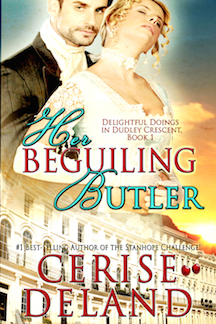
Cerise DeLand: Her Beguiling Butler (Giveaway)

About Historical Accuracy…

$_57 copy

With your romance, do you crave accurate history? A sense of time and place? Cerise tells all about Her Beguiling Butler!

Say you like historicals and you often wonder what’s true and what isn’t?

I can’t speak for other authors, but I do desperately try to bring you The Real Stuff.

For example, what’s real in Her Beguiling Butler?

You see a date at the beginning of the book, January 17, 1820. Why?

Because when I plotted the book, I wanted to note precisely when George III (he of the American Revolution!) died and what happened.

So I had to work backwards from that.

Yes. You need to read the book to learn how and when the news reached London!

The Prince of Wales is not considered a fine fellow by most people in the novel. Is that true?

Yes. Prinny, by the time of his ascent to his father’s throne (not official by the way until a year later at his coronation) was considered a spendthrift and profligate. He’d had so many mistresses and appealed to Parliament to spend so much on his homes and his clothes (as well as other debts), many in the Realm were not happy.

In fact, they rather liked old George, his father.

Lady Ranford is being considered by the courts to assume a title on her own. Is that possible for a woman to inherit a title in her own right?

Yes. And hopefully you’ll read the book to learn how that’s done!

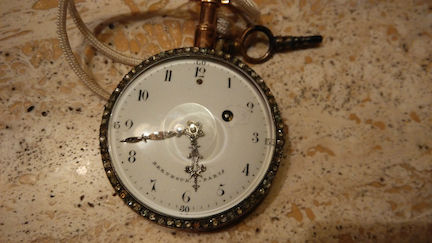
The chiming watch piece that Finnley carries around with him to make certain the house runs on time was a real time piece. I did not invent it.

It was delicately made by Ferdinand Berthoud. His work was very popular, aside from being very expensive.

The mourning practices for King George III that most noblemen observed did indeed happen.

What sorts of observances did they have to employ?

Ah. Do read the book for a description!

Does Dudley Crescent exist?

No. I made it up!  I also made up the man who was given the land by Charles II!

So what is the picture on the front cover of the novel?

What do you think it is? Comment here and win a digital copy of Her Beguiling Butler!

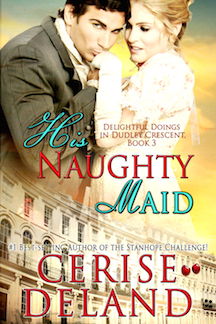
Do look for #2 and #3 in series when I give you a governess and a maid who are more than they appear to be!

giveaway

One lucky commenter wins a swag pack containing a Susana Ellis mug and other goodies!

Her Beguiling Butler by Cerise DeLand copy

About Her Beguiling Butler

The lovely widow at No. 10 Dudley Crescent hopes to lead a merry life without any husband to replace the elderly one she recently buried. Yet Lady Ranford finds herself in a pickle. Her new butler, Finnley, is not only the most obstinate man she’s ever met, but he’s a virile enigma.

She’s never been lured to naughtiness with a man. Heaven knows, she certainly shouldn’t fantasize about the tall, dark, scowling creature who runs her household like a finely tuned clock.

But she can’t help herself. She needs to taste him—or dismiss him.
Finnley, poor fellow, has a few risqué dreams of his own about how he’d like to handle the delectable widow. Alone in his rooms, he resolves to deny how her humor riddles his mind and how her beauty steals his breath away.

None of his solutions are proper.

All of his desires are quite…dear me…scandalous.
But what’s a butler to do when the very life of his beloved employer is at stake? And he cannot control his need to protect her and…ahem…bed her?

AMAZON  • ARe  • NOOK  • KOBO

About the Author

Cerise DeLand is #1 bestselling author of Regency romances! And a top selling author of contemporaries too!

WebsiteTwitterNewsletter

His Naughty Maid by Cerise DeLand copy

His Tempting Governess by Cerise DeLand copy

Vauxhall Gardens: The Music, 1732-1859

vauxhallbook

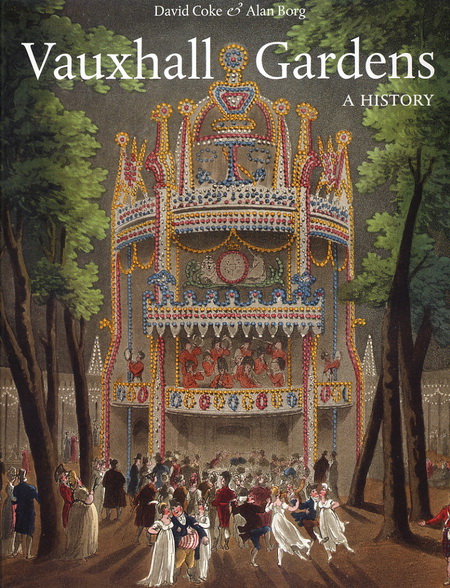
Vauxhall Gardens: A History

David Coke & Alan Borg

The Vauxhall Pleasure Gardens is one of the places I’d love to slip back in time to visit, just to catch a glimpse of what it was like. After recently splurging to buy this lovely coffee-table book, I thought it might make a wonderful subject for a new blog series. But do buy the book too, if you can! The photos are fabulous!

Before Vauxhall, professional, high quality music was expensive and therefore restricted to the wealthy. Because it was usually performed in private drawing rooms or concert halls, the concept of performing it in the open air was also a novelty. At a time when music from past masters was popular, Tyers introduced music by contemporary English or London-based composers. Oftentimes, the music (and the musicians) were the same as those performing in London theaters during the winter.

Tyers exposed a substantially larger audience to serious music than had ever been possible or even conceivable before. The fact that he did so in a setting where the audience could choose to listen or not, and could choose where to listen from, fundamentally transformed the public’s experience of musical performance, and led to a much wider and easier acceptance of the concert as a public entertainment.

Instrumental Music

Following the construction of the Orchestra building, which resolved several acoustical issues from performing in the open air, in 1735, music became

the crucial ingredient in setting the tone for an evening at Vauxhall. It promoted relaxed enjoyment, and its rational elegance was a catalyst for good behaviour and conversation among the company.

The unusual experience of listening to music in the open air and, after dark… held a very special allure for the audience. There is no doubt that music heard from a distant point of the garden… would have been attractive, providing a good excuse to lure members of the opposite sex away from the crowded Grove… On her eventful visit to Vauxhall, Fanny Burney’s heroine Evelina was particularly impressed by its al fresco music, if not seduced by its freedoms… Despite the disagreeable company, she recounts that

There was a concert, in the course of which, a hautbois concerto was so charmingly played that I could have thought myself upon enchanted ground, had I had spirits more gentle to associate with. The Hautboy in the open air is heavenly.

Click here for a previous post about the Orchestra.

The construction of the Organ building, and the installation of the massive organ, resolved the problem of volume, since its range could reach throughout the gardens, and even beyond. Click here for a previous post about the Organ.

Handel and Vauxhall

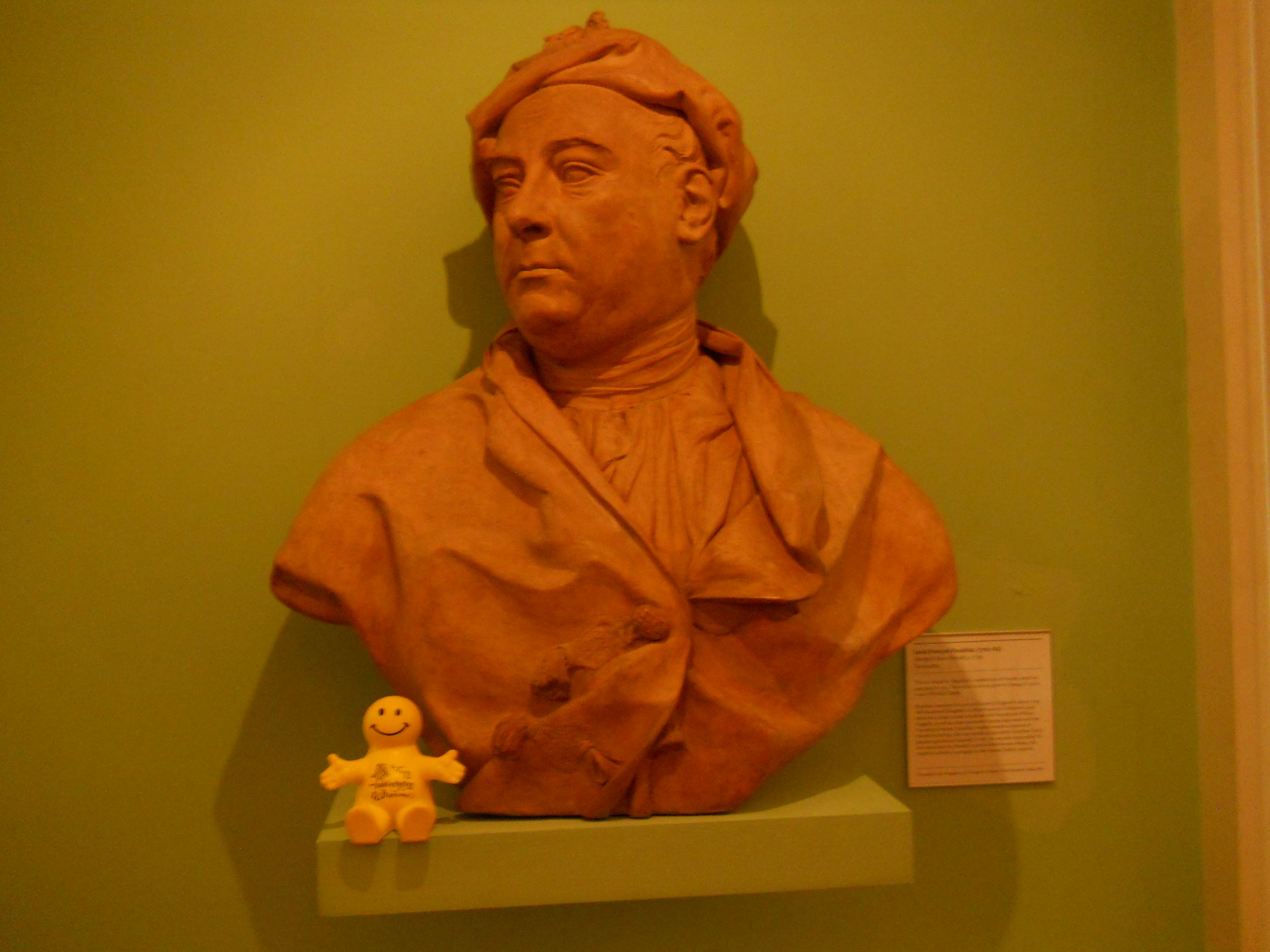
Squidgeworth found a friend!

Squidgeworth found a friend at the Foundling Museum

Just as Handel’s statue dominated the Grove, his music dominated Vauxhall’s repertory for a hundred years. Handel and Tyers had a mutually beneficial relationship that likely developed into close friendship. Tyers’s press articles tended to focus only on Handel’s music, and the promotion of his music before the crowds of Vauxhall helped him rise to popular fame.

Vocal Music

Due to a concern for propriety, Tyers resisted song at Vauxhall for at least a dozen years. By this time, Vauxhall was being criticized for “the absence of song on the grounds that, without lyrics, music ‘lacked interpretation,’ and was therefore less conducive to good humour among the audience.”

Soon after, Cecilia Young, a soprano who later married Vauxhall’s music director, Thomas Arne, was engaged, and the “introduction of song as a regular element of the programme launched the most perennial popular feature of the Vauxhall evening.”

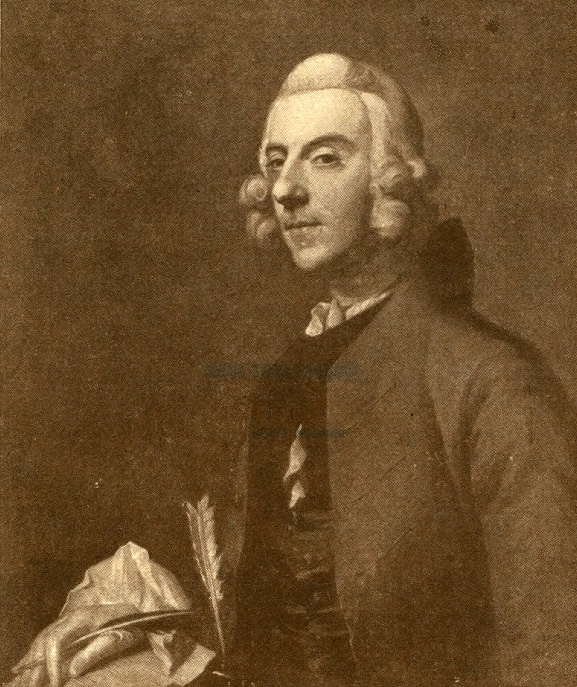
Thomas_Augustine_Arne_portrait_by_Zoffany

Thomas Arne

Thomas Arne’s ballads “were, from 1745, regularly performed at the gardens to huge applause, and they were published in the first Vauxhall songbook, Lyric Harmony, which appeared in September of that year.” Arne’s songs, which were lighthearted and natural, appealed to a wide array of people, and thus fit in with Tyers’s own philosophy to make the arts available to all.

The lyrics of Vauxhall songs… are basically in the pastoral and romantic ballad style that evolved in the late seventeenth century from a long tradition of popular song… Over the next few decades, ballads absorbed influences from other popular music forms, particularly Italian opera, to become the genre known as the Vauxhall song.

rule_britannia_01a

Thomas Arne’s version of “God Save the King” was first performed at Drury Lane in 1745. He also wrote, “Rule Britannia,” another patriotic song. Click here to hear the latter song on the BBC website. I’m sure you will find it familiar.

A second genre that was to become popular with Vauxhall audiences was the patriotic song, one of the earliest types to be regularly heard at the gardens. Exploiting topical events as they did, they highlighted the link between the dutiful virtus of victorious military action and the pleasurable voluptas enjoyed by Vauxhall’s visitors, fully complementing the ideals behind Tyers’s management.

The songs regularly sung at Vauxhall and the other gardens enjoyed a wide currency. They were published not only as songsheets and in songbooks, but also in periodicals, particularly women’s magazines. Among the moral tales, romances, fashion hints, poetry, recipes and other items thought suitable for female consumption, editors of magazines such as the Ladies Complete Pocket Book or the Universal Magazine would often slip in the ‘favourite new songs’ being featured at the pleasure gardens in the current season, to be enjoyed by Vauxhall’s many “armchair” visitors around the country.

Besides the salary paid by Tyers and passes to allow them to come and go as they wished, “well-loved singers were rewarded by the audience who threw money at their feet.”

A thirty-two-year-old Oliver Goldsmith described a visit to the gardens around 1760, full of praise for the singers and the band.

The satisfaction which I received the first night I went there was greater than my expectations; I went in company of several friends of both sexes, whose virtues I regard and judgments I esteem. The music, the entertainments, but particularly the singing, diffused that good humour among us which constitutes the true happiness of Society.

Music after Jonathan Tyers’s death

After 1761, ownership was taken over by Tyers’s son, Jonathan Tyers the younger, and very little changed at first, until the early 1780’s, when strolling bands were introduced, possibly as an economic gesture, and the quality of music declined.

The introduction of Haydn’s compositions in 1783 marked the faltering start of a new era at Vauxhall. Haydn soon gained a wide following, even toppling Handel from his long-running supremacy.

Regular press advertisements detailing the evening’s program appeared in 1786, when Bryant Barrett, Jonathan Tyers the younger’s son-in-law, took over management of the gardens. Apparently he believed the audience to be more sophisticated about music and thus more interested in knowing beforehand what would be included.

James Hook

James Hook

James Hook, Vauxhall’s music director from the early 1770s until 1821, composed over two thousand songs specifically for Vauxhall and performed an organ concerto every evening at closing time.

…each season introduced an entirely new crop of songs, numbering between thirty and forty-five, with no repeats from previous years; the most popular songs received as many as fifty performances through the season… Most of the half dozen or so singers employed each year appeared every evening, Monday to Saturday, from mid-May to late August. This represented around eighty-five evenings out of a hundred—a tough programme for any performer, especially when singing out of doors.

The Vauxhall Effect

As a music promoter, Tyers was unusual at the time in not being a professional musician himself; it was his judgement and business sense that determined his visitors’ experience, and dictated the selection of people he employed to take his vision forward. The renown of his performers was less important than their ability to express a particular house style.

Performers at Vauxhall

For a list of performers at Vauxhall (musical and otherwise), check this website: Vauxhall Gardens: 1661-1859.


Susana’s Vauxhall Blog Post Series

  1. Vauxhall Gardens: A History
  2. Vauxhall Gardens: Jonathan Tyers—“The Master Builder of Delight” 
  3. Vauxhall Gardens: A New Direction
  4. Vauxhall Gardens: The Orchestra and the Supper-Boxes 
  5. Vauxhall Gardens: The Organ, the Turkish Tent, and the Rotunda
  6. Vauxhall Gardens: Three Piazzas of Supper-Boxes
  7. Vauxhall Gardens: “whither every body must go or appear a sort of Monster in polite Company”
  8. Vauxhall Gardens: The Competition
  9. Vauxhall Gardens: The Artwork, Part I
  10. Vauxhall Gardens: The Artwork, Part II
  11. Vauxhall Gardens: The Music, 1732-1859
  12. Vauxhall Gardens: The Business Side
  13. Vauxhall Gardens: Developments from 1751-1786
  14. Vauxhall Gardens: Thomas Rowlandson’s Painting (1785)
  15. ‎Vauxhall Gardens: The Third Generation of the Tyers Family and the Jubilee of 1786
  16. Vauxhall Gardens: An Era of Change (1786-1822), Part I
  17. Vauxhall Gardens: An Era of Change (1786-1822), Part II
  18. Vauxhall Gardens: An Era of Change (1786-1822), Part III
  19. Vauxhall Gardens: The Final Years, Part I
  20. Vauxhall Gardens: The Final Years, Part II
  21. Vauxhall Gardens: The Final Years, Part III
  22. Vauxhall Gardens: The Final Years, Part IV
  23. Vauxhall Gardens: Farewell, for ever

Sheri Cobb South: Dinner Most Deadly (Giveaway)

Five Star author photo copy

Dinner Most Deadly is the fourth book in my series of Regency-set mysteries featuring Bow Street Runner John Pickett, and in some ways it’s the riskiest. I call it my Empire Strikes Back book, because I still remember how appalled we all were when that movie came out in 1980, and the ending left us hanging: Han Solo frozen in carbonite? Luke’s dead (or so we thought) father, the Jedi hero, is Darth Vader??? And we were going to have to wait three years to find out what happened next?

In the case of Dinner Most Deadly, the cliffhanger involves the Scottish marriage by declaration which was accidentally contracted by John Pickett and Julia, Lady Fieldhurst, in Family Plot. When Julia returns from Scotland restless and out of sorts, her friend Lady Dunnington decides what Julia needs is a lover—and arranges a dinner party with half a dozen male guests from whom Julia may take her pick. But one of the men is murdered, and when John Pickett is summoned from Bow Street, he must not only find the killer, but break the news of their “marriage” to Julia. As with the other books, the mystery is solved, but the romance is more unresolved than ever as the couple must go about seeking an annulment—a process far messier than most romance novels lead readers to believe.

I’ll admit, I was more than a bit nervous about how readers would react. I had braced myself for a big outcry against “sequel-bait,” but to my relief, it hasn’t happened. I hope that’s because readers understand that, because of the enormous social gulf between them, Julia’s mind is not going to leap immediately to marriage. She is, however, appalled at what the annulment process is going to demand of poor John: the only grounds available to them are inability to consummate, and since she was married for six years—during which any such problem would certainly have been addressed—that leaves him to take the fall. She’s never known a man who loved her enough to sacrifice for her, and although she’s deeply moved by his willingness to do so, she doesn’t quite know how to respond. It’s going to take something drastic to force her to confront her own feelings—and that something comes up in the next book, Too Hot to Handel.

Thankfully, readers won’t have to wait three years to find out what happens next, but only about six months: my publisher has scheduled Too Hot to Handel for March 2016.

If you’re new to the series but want to give it a try, I would strongly suggest beginning with In Milady’s Chamber, the first in the series, to follow the progression of the romance as it develops. In order, the books are: (1) In Milady’s Chamber; (2) A Dead Bore; (3) Family Plot; (4) Dinner Most Deadly; and (5) Too Hot to Handel. There’s also a prequel novella, Pickpocket’s Apprentice, which traces John Pickett’s rise from 14-year-old pickpocket to nineteen-year-old Bow Street Runner.

Giveaway: Sheri will award a hardcover, dust jacketed copy of Dinner Most Deadly ($25.95 retail) to one lucky commenter.

DinnerMostDeadlyFront copy

About Dinner Most Deadly

When Julia, Lady Fieldhurst, returns from her sojourn in Scotland restless and out of sorts, her friend Emily, Lady Dunnington, decides what Julia needs is a lover. Lady Dunnington plans a select dinner party with half a dozen male guests from whom Julia may choose a paramour. Emily also invites a potential lover for herself: Sir Reginald Montague, a man whose urbane manner and dangerous good looks hide a host of unsavory secrets.

Alas, Emily’s little dinner is a disaster from the outset. Every gentleman at the table bears some unspoken grudge against Sir Reginald, and then dinner is interrupted by Emily’s estranged husband. He and his lady have a heated discussion which ends with Lord Dunnington’s vowing to put a stop to his wife’s pursuit of Sir Reginald “no matter what it takes.” But the coup de grâce comes at the end of the evening, when Sir Reginald is shot dead.

Bow Street Runner John Pickett is summoned to Emily’s house, where he is taken aback to find Julia. For in addition to investigating the case, he is faced with the awkward task of informing her that their masquerade as a married couple in Scotland (Family Plot) has resulted in their being legally wed. Beset by distractions—not the least of which are the humiliating annulment process and the flattering attentions of Lady Dunnington’s pretty young housemaid—Pickett must find the killer of a man whom everyone has reason to want dead.

KindleDiscounted Hardcover

Excerpt

For the first time in the interview, the solicitor’s professional demeanor faltered. “The only possibility that remains is, er, that is, it involves consummation of the union.”

“But you just said a lack of consummation did not constitute grounds,” protested Lady Fieldhurst.

“No, but if either party should be unable to—that is, to be incapable of—” He took a deep breath and started over. “Your ladyship, I must remind you that you and the late Lord Fieldhurst were married for six years. If, during that time, it had come to light that you were—were incapable of participating in the act that might have given your husband the heir he desired so desperately, he would surely have sought such an annulment for himself years ago.” He turned to Pickett. “Such being the case, that only leaves . . .”

As the solicitor’s implication dawned, Pickett flushed a deep red.

Lady Fieldhurst was equally embarrassed, but considerably more vocal. “You cannot ask Mr. Pickett to—to—” Words failed her. She broke off and tried again. “Mr. Pickett may not be married, but I daresay there is a female somewhere who could destroy such a claim simply by coming forward and—and—”

“As a matter of fact,” Pickett said miserably, “there isn’t.”

“There isn’t?” echoed Lady Fieldhurst.

Pickett shook his head and prayed for the floor to open up and swallow him.

“There isn’t,” she murmured, regarding him with new eyes.

“But,” he added hastily, “that isn’t to say I couldn’t—that is, I—I have no reason to suppose that—that all my parts are not—not in good working order.”

“Oh, my.” She snatched up one of the solicitor’s legal papers and began fanning herself with it. “Oh, my.”

About the Author

At the age of sixteen, Sheri Cobb South discovered Georgette Heyer, and came to the startling realization that she had been born into the wrong century. Although she doubtless would have been a chambermaid had she actually lived in Regency England, that didn’t stop her from fantasizing about waltzing the night away in the arms of a handsome, wealthy, and titled gentleman.

Since Georgette Heyer was dead and could not write any more Regencies, Ms. South came to the conclusion she would simply have to do it herself. In addition to her popular series of Regency mysteries featuring idealistic young Bow Street Runner John Pickett (described by All About Romance as “a little young, but wholly delectable”), she is the award-winning author of several Regency romances, including the critically acclaimed The Weaver Takes a Wife.

A native and long-time resident of Alabama, Ms. South recently moved to Loveland, Colorado, where she has a stunning view of Long’s Peak from her office window.

WebsiteFacebookGoodreads

Vauxhall Gardens: The Artwork, Part II

vauxhallbook

Vauxhall Gardens: A History

David Coke & Alan Borg

The Vauxhall Pleasure Gardens is one of the places I’d love to slip back in time to visit, just to catch a glimpse of what it was like. After recently splurging to buy this lovely coffee-table book, I thought it might make a wonderful subject for a new blog series. But do buy the book too, if you can! The photos are fabulous!

The Paintings in the Pillared Saloon

The Pillared Saloon was built onto the Rotunda in 1750-51 to provide more wall space for paintings and, of course, draw more visitors. The original idea was to have allegorical paintings of the royal family—Prince Frederick and his family—demonstrating how love of the arts manifested his virtue and patriotism. Frederick’s untimely death in 1751 put paid to this idea and delayed the project for almost ten years.

Two full-length portraits of George III and Queen Charlotte in their coronation robes did appear soon after their marriage in 1761. The royal pair is known to have sat for the painter—undoubtedly Frances Hayman—in person as a special favor to Jonathan Tyers.

The Seven Years’ War Paintings

In contrast to the lightheartedness of the supper-box paintings and the drama of the Shakespearean scenes, the four remaining paintings for the Pillared Saloon were to be patriotic history paintings. These were not the typical classical scenes or representations of events from the distance past, but “very recent military actions populated by real living people wearing contemporary costume.”

[Hayman] chose not the violence of heroic death or even topographical portrayals of military action, but rather its aftermath, in order to convey the virtues of the individual British military commanders, magnanimous and humane in victory.

pillaredsaloon001

The Surrender of Montreal to General Amherst

Amazingly, this painting appeared in the Pillared Saloon in 1761, only eight months after the event it depicts.

It was the most overtly propagandic of the four military scenes, emphasising the selfless humanity of General Jeffrey Amherst: Hayman showed him handing out food to the starving and defeated population and returning to them their possessions; this was intended to be in stark contrast to the merciless treatment they might have expected from the French, had they been victorious, and especially from their Indian allies.

In the Description (1762), much is made of the contrast between the defeated and miserable French and the victorious but humane British, and the author instructed readers to view the paintings as a true representation of one of ‘the most glorious transactions of the present war’.

pillaredsaloon002

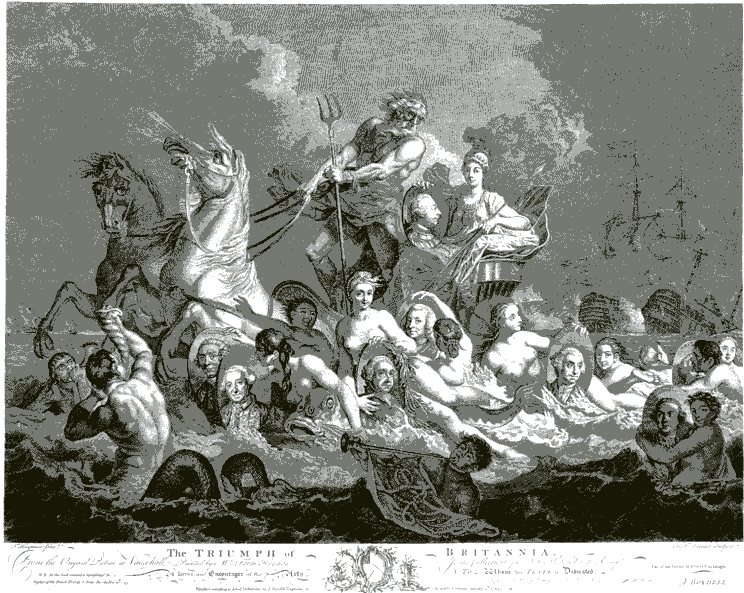
The Triumph of Britannia

The second painting, which was installed for the opening of the 1762 season, was a representation of the defeat of the French fleet at Quiberon Bay in November 1759. “As its allegorical title would suggest, it was intended to glorify the British military leaders involved in the action and the natural alliance of Britannia with Neptune that had given Britain mastery of the seas.”

However, because it did not entirely succeed in capturing the essential majestic dignity that was necessary to this type of allegorical work, the Triumph of Britannia was not always taken seriously by its audience. It is specifically and humorously singled out in Fanny Burney’s novel Evelina of 1778; during a visit to Vauxhall, Mr. Smith ridiculously mistakes the figure of Neptune for that of a famous general, despite the fact that he is wearing ‘the oddest dress for a general ever I see’.

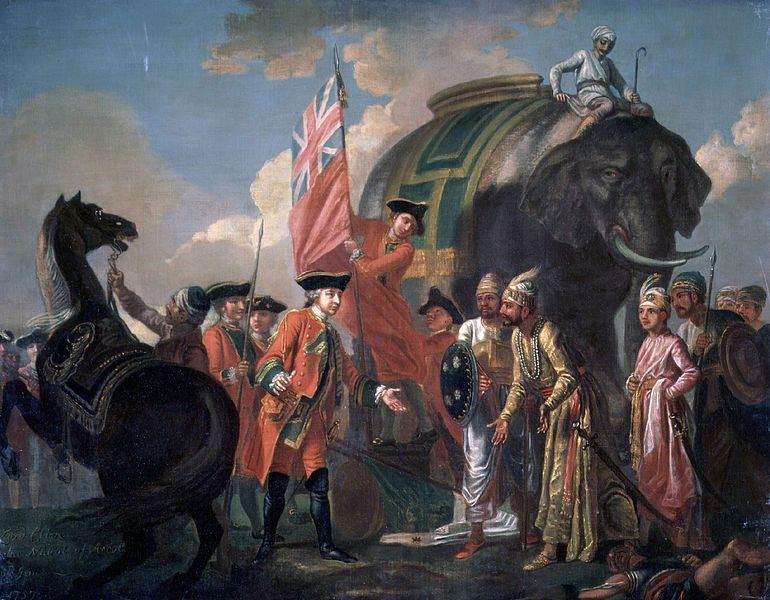
Lord Clive, Hayman, 1760

Lord Clive Receiving the Homage of the Nabob

A companion piece to the Surrender, this painting was installed in time for the 1763 season. The historical event depicted was the Battle of Plassey, at which Robert Clive ousted the ruling Nawab of Bengal, Siraj-ud-daula and, “in an apparently magnanimous act, [Clive] then supported the claim to supremacy of the elderly general Mir Jafar (c. 1691-1765), Nawab of Murshidabad, who had actually fought against the British, but who was more easily persuaded to the British point of view.”

In that battle the British forces were famously outnumbered by twenty to one, but were nevertheless victorious with the loss of only eighteen men (according to Clive), lending it the heroic ideal; in fact this was undeserved, and the British were saved from probable defeat only by the quick thinking of their artillerymen who covered their weapons and powder during a downpour, while the enemy did not.

The description of the painting started with “The subject of this picture is of the most interesting nature, to every Briton who regards the honour and propsperity of this country’, no doubt insinuating that it would be unpatriotic to criticize it.
The second description

praises General Clive for his leadership, and for his generosity in giving the sultanate to Mir Jafar;

therefore performing for his Country a most important Service, as well as procuring for the India Company and Individuals the Sum of Three Millions Sterling, for their Losses sustained at Calcutta; with such Privileges, Immunities, and Advantages, as they never enjoyed before. And this Revolution hath been moreover the Means of the India Company’s acquiring the Territorial Possessions, to the Amount of Seven hundred thousand Pounds per Annum.

In retrospect, General Clive’s generosity seems less altruistic considering the huge commercial gains resulting from the acquisition of this territory.

Britannia Distributing Laurels

A companion piece to the Triumph of Britannia, Britannia Distributing Laurels was installed in 1764. Unfortunately, no version of this piece is known to be in existence. However, it is known to have depicted the full-length figures of Generals Granby, Monckton, Albemarle, Coote, Townshend and Wolfe, all in Roman costume, allegorical in nature.

The story goes that, when Granby came to Hayman’s studio in St. Martin’s Lane, he challenged Hayman to a boxing match before the sitting. After a hesitant start, which Granby overcame by saying that the exercise would give animation to his portrait, Hayman apparently floored the marquis with a tremendous punch to the stomach, and Mrs. Hayman, hurrying upstairs to see what the noise was, found them ‘rolling over each other on the carpet like two bears.’

Tyers as the Ultimate Patron of 18th century British Art

The inscription under the engraving of Hayman’s Triumph of Britannia describes him as a ‘”Lover and Encourager of the Arts.’” He was described by Henry Angelo as having “laid out more money in the encouragement of English art than any man of his time. Indeed, his house was so full of pictures, that after hanging them, even on his stair-case, there were still some to spare.”

Jonathan Tyers didn’t just use art to further his commercial ambitions; he was a true conoisseur. And it was his dream to open up the arts to all layers of society, not just the upper class.

The huge developments in British art through the middle of the eighteenth century were in large part due to the concurrence of Vauxhall Gardens, the Foundling Hospital, the Society of Artists and the Royal Academy and to the men involved in those institutions, notably Hogarth, Hayman and, of course, Tyers… After the collaboration of Tyers and Hayman, the visual arts at Vauxhall never again received the same degree of patronage from its proprietors.

The paintings and sculpture at Vauxhall Gardens would have been the best-known works of art in England at the time, seen by tens of thousands of people, including significant numbers of artists, every year. Although Tyers owed much to Hogarth, initially the driving force behind the artistic concept of the gardens, it was Hayman, Tyers’s artistic director, who could be seen as the more influential figure. This was partly because of the huge exposure of his original work at Vauxhall, and also because he was the linchpin that held together the London art profession, with a finger in all the principal artistic pies of the time—the St Martin’s Lane Academy, Vauxhall Gardens, the Foundling Hospital, the Society of Artists and, eventually, their august offspring, the Royal Academy.

Susana’s Vauxhall Blog Post Series

  1. Vauxhall Gardens: A History
  2. Vauxhall Gardens: Jonathan Tyers—“The Master Builder of Delight” 
  3. Vauxhall Gardens: A New Direction
  4. Vauxhall Gardens: The Orchestra and the Supper-Boxes 
  5. Vauxhall Gardens: The Organ, the Turkish Tent, and the Rotunda
  6. Vauxhall Gardens: Three Piazzas of Supper-Boxes
  7. Vauxhall Gardens: “whither every body must go or appear a sort of Monster in polite Company”
  8. Vauxhall Gardens: The Competition
  9. Vauxhall Gardens: The Artwork, Part I
  10. Vauxhall Gardens: The Artwork, Part II
  11. Vauxhall Gardens: The Music, 1732-1859
  12. Vauxhall Gardens: The Business Side
  13. Vauxhall Gardens: Developments from 1751-1786
  14. Vauxhall Gardens: Thomas Rowlandson’s Painting (1785)
  15. ‎Vauxhall Gardens: The Third Generation of the Tyers Family and the Jubilee of 1786
  16. Vauxhall Gardens: An Era of Change (1786-1822), Part I
  17. Vauxhall Gardens: An Era of Change (1786-1822), Part II
  18. Vauxhall Gardens: An Era of Change (1786-1822), Part III
  19. Vauxhall Gardens: The Final Years, Part I
  20. Vauxhall Gardens: The Final Years, Part II
  21. Vauxhall Gardens: The Final Years, Part III
  22. Vauxhall Gardens: The Final Years, Part IV
  23. Vauxhall Gardens: Farewell, for ever

Sherry Ewing: A Knight To Call My Own

A Knight to Call my own cover

About A Knight To Call My Own

When your heart is broken, is love still worth the risk?

Lynet of Clan MacLaren knows how it feels to love someone and not have that love returned. After waiting for six long years, she has given up hope of Ian’s return. Her brother-in-law, the Devil’s Dragon of Berwyck, is tired of waiting for her to choose a husband and has decided a competition for the right to wed Lynet is just the thing his willful charge needs to force her hand.

Ian MacGillivray has returned to Berwyck Castle in search of a bride and who better than the young girl who cared for him all those years ago. But Lynet is anything but an easy conquest and he will need more than charm to win her hand in marriage.

From the English borders to the Highlands of Scotland, the chase is on for who will claim the fair Lynet. The price paid will indeed be high to ensure her safety and even higher to win her love.

Don’t miss out on Sherry’s other novels: If My Heart Could See You, a medieval romance and the beginning of her series; For All of Ever: The Knights of Berwyck, A Quest Through Time Novel (a medieval time travel romance) and Only For You, its sequel.

Amazon • Barnes & NobleKobo iBooks

Excerpt

About the Author

sherrySherry Ewing picked up her first historical romance when she was a teenager and has been hooked ever since. A bestselling author, she writes historical & time travel romances to awaken the soul one heart at a time. Always wanting to write a novel but busy raising her children, she finally took the plunge in 2008 and wrote her first Regency. She is a member of Romance Writers of America, The Beau Monde & The Bluestocking Belles. Sherry is currently working on her next novel and when not writing, she can be found in the San Francisco area at her day job as an Information Technology Specialist. You can learn more about Sherry and her published work at www.SherryEwing.com.

Website & BlogFacebookTwitterPinterest


Susana’s 2015 English Adventure: Travel Tips

Screen Shot 2015-09-29 at 7.13.26 AM

Plan in advance

As I’ve mentioned before, I planned mine with Cheryl Bolen’s excellent book, English Stately Homes By Train. I used the print version during the planning stage and the digital version for reference while in England. It’s always a good idea to check each location’s website before you go for updated information such as opening times.

bolen

Arrange for a home base

If your trip is longer than a week, consider renting a flat in a location central to the area you want to visit. London (Baker Street) is my choice, but it is pricey, so you’ll have to weigh the price against the value of convenience. On my recent trip, I spent six of my nineteen paid nights outside of London, which added to the cost, but was totally worth it, in my opinion, not to have to carry all of my luggage around with me.

Of course, traveling with others and splitting the cost is a great way to economize, even if you have to find a larger flat. Mine is a studio efficiency consisting of one room, a bathroom, and a tiny kitchen. Perfect for one person or perhaps a married couple.

Be sure to check for amenities before you sign the contract. My flat has satellite TV and Wifi, but no air conditioning. Last year when I was there in May and June, it was so hot I couldn’t sleep. The management finally got me a small fan, which was a great help, and I was glad to see it was still there this year.

No matter how careful you are, there may be unforeseen issues. For example, last year, someone in a nearby flat was doing construction during the day. If you plan to be out most of the day, this won’t be a problem. But if you want to stay home and rest or write on a weekday, you’ll need some really good noise-canceling headphones.

Get a cell phone

My U.S. phone does not work outside of the U.S., but my rental flat comes with one. I didn’t use it last year, but found that to be a mistake. As wonderful as the rail system in England is, there are plenty of unmanned train stations in the middle of nowhere. Last year, I found myself stranded at such a place, finding not even a public telephone, and panicked for a few moments until a kind person offered to make a call for me. This year I took the rental flat phone around with me, and needed to use it several times. (As helpful as Cheryl Bolen’s book is, there are times when you will find there are no taxis at the taxi queue you are counting on being there and you will need to call for one to get to your destination.)

If I hadn’t had to use it, it would still have been worth it for the peace of mind. I’m used to traveling on my own—although this year I did have Squidgeworth with me—but I don’t like to think I might get stranded in some unknown place. The Brits I’ve met have been exceedingly friendly and helpful, but there’s always a chance I might meet up with one who is not.

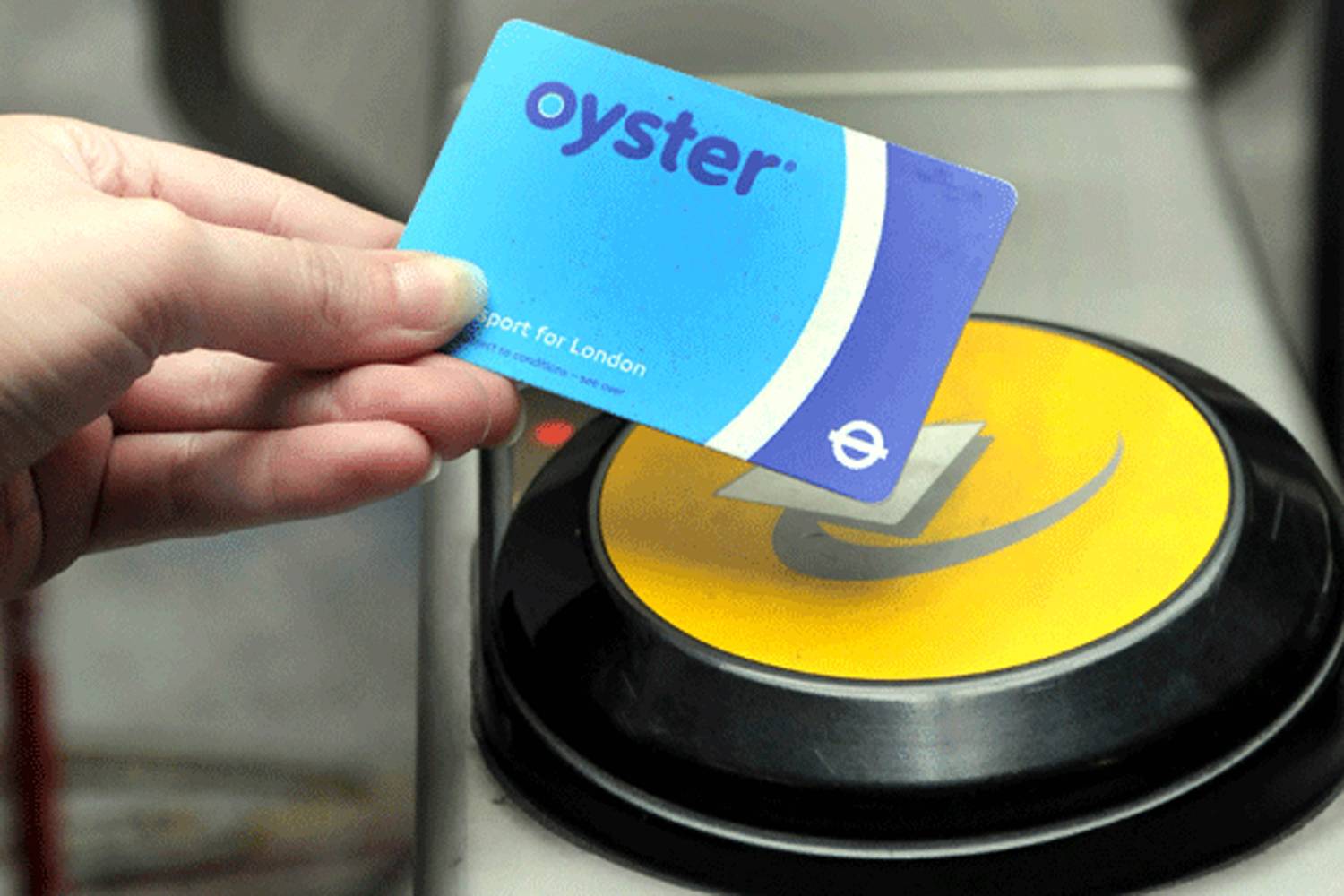
Get an Oyster card

An Oyster card is an electronic card for use in the London Underground system, which includes buses and some localized trains. You can get the card upon arrival at the airport. You pay something like £5 for the card and then whatever amount you want to load onto it. I bought mine four years ago and use it every year. It’s easy to load the card from one of the machines at each Underground station. I estimate I used about £90 on mine during my three-week trip.

oyster

If this is your first trip, you can purchase the London Pass, which gives you fast-track entry to many of the most popular London sights, and an Oyster card is included. Keep the Oyster card for future trips.

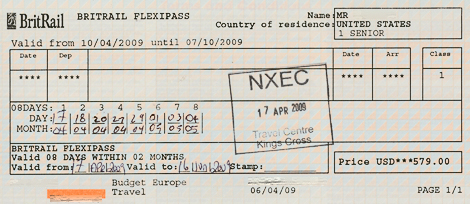
Get a BritRail pass

BritRailFlexiPass2009

This is a Google image. Mine did not cost this much.

In previous years I simply used my computer to buy rail tickets online and learned how to retrieve them from the machine at the rail station. This year I decided to try a BritRail pass instead—which must be obtained before your arrival in England. I purchased mine from the VisitBritain Shop. I wasn’t sure how many days I’d be traveling by train, but the eight-day, non-consecutive one proved perfect for my three-week trip. Besides being a money-saver, it’s convenient not to have to make a commitment for a specific train and then worry about missing it and having to buy another ticket. For example, when I went to Waddesdon Manor, I simply checked online beforehand to ascertain the availability of trains for the return journey and while there I could enjoy myself without having to rush to make it in time for the train. (I did, however, have to make arrangements with the taxi driver to pick me up at a certain time, since there is no taxi queue at Waddesdon Manor either.)

Consider purchasing English Heritage and National Trust passes

englishheritage

If many of the sights you wish to see are designated as English Heritage or National Trust locations, you might be able to save money by purchasing passes valid for the length of your trip. I purchased a National Trust pass from the VisitBritain Shop, but lost it. Oh well. I always feel good about supporting the efforts to maintain these wonderful-but-expensive historic buildings.

nationaltrust

Prepare for inclement weather

It rains in England. Get over it.

As much as we would all love having warm, sunny days for our long-anticipated visit, chances are it’s going to rain. Maybe it’ll just rain for a few minutes. But it might rain all day, and if you’re really unlucky, it might rain all day, every day. Don’t let it spoil your trip. Take a waterproof jacket and an umbrella and some good walking shoes that won’t be ruined by mud. You might not feel like traipsing through miles of gardens in rainy weather, but you can still see the manor house and the outbuildings (if any), and get a few photos of the grounds. At Witley Court, I took a video of the fountain in the rain (goes off every hour).

Frankly, I prefer a bit of rain to 80-90-degree weather. These manor houses do not have air conditioning, so when it’s hot outside, it’s at least as hot inside. But if that’s what I get, oh well. C’est la vie. Some things are just not worth whining over.

Prepare to do lots of walking

You walk to the Tube station. You walk a lot inside the Tube station. You walk from the Tube station to your destination. While at your destination, you walk. The same goes for trains. While you can take the Tube to Osterley, you still have to walk a bit to get to the grounds of Ostlerley Park, and then there is a very long driveway to get to the house. (There is a shuttle, but I didn’t encounter the shuttle until I was almost there.) In any case, you have to remember that these stately manors were built on huge estates, often set back a mile or more from the main road. If—like me—you’ve decided not to try to drive in England, you’re going to have to get used to walking. And paying for taxis for the more inaccessible places. That’s just the way it is.

The way I figure it, walking is good for me. I should walk more than I do. It’s great to be able to walk. I wear good walking shoes, carry as little as possible with me, and take Extra-Strength Tylenol when my back starts to hurt. (And I wear my Fitbit and brag online about my walking, but that’s optional.)

If you are a great walker to begin with and would like to extensively explore the grounds of the manor you are visiting, you might consider staying overnight nearby. Oftentimes the house is open only four or five hours, and the grounds a bit longer, but if you want to make thorough visits to both, you might want to plan for two days or even more. You’ll probably have to pay an extra entrance fee for an additional day, but most places have a lower fee for the grounds only. And if it’s a National Trust or English Heritage site, having the pass will save you lots if you want to visit multiple times.

Consider staying overnight at a historical site

Last year I stayed at Leeds Castle (the Stable Courtyard) and Hever Castle (the Astor Wing), and loved being able to get up early in the morning and walk in the grounds before the gates opened to the public. I also stayed at the Devonshire Arms in Beeley the night before I went to Chatsworth. Lovely little town on the Devonshire estate.

This year I stayed at the Bear Inn at Devizes, which was one of the coaching inns mentioned in my Coaching Days & Coaching Ways blog series last year. There are so many of these out-of-the-way places in England. Seek out a few and enjoy the atmosphere that comes with centuries-old buildings and towns. You won’t regret it.

Consider… gulp… renting a car and driving

Did I just say that? I guess I did. The thing is, there are lots of great places to visit  that might be more than a little problematic to get to without driving. At the moment, I still have quite a few to go before I get to that point. But if I do, would I forego visiting them just because I’m hesitant to drive on the left side of the road? I don’t think so. I’ll find a way to do it if I have to. Because I don’t think I’ll ever be done with visiting England’s great historical sites.

driving_left_0903

But when I do get to that point, I’ll be sure to warn my English friends of my travel plans so they can stay out of my way.

Addendum: About electrical converters…

You probably won’t need them. Yes, you’ll need an adapter plug or two for charging up your electronic equipment, but these days most (if not all) of them are multi-voltage devices. Click here for more information. In most cases, you won’t need to take a hair dryer with you, since hotels and B&B’s usually provide them. Newer hair dryers are dual-voltage and have a switch for 110- or 220-volt electrical currents. If you need something like a curling or straightening iron, you might consider buying one in the UK to use for this and future trips. It’s a lot simpler than messing around with converters and the like. For a toothbrush, I keep a battery-operated one in my travel case, so there’s no need to recharge it.

Heather Boyd: Miss Merton’s Last Hope (Giveaway)

Interview with Heather Boyd

Susana: Tell us about yourself.

MEDIA KIT Author ImageHeather: Greetings. I’m a regency historical romance author, indie published, and sole female in a testosterone fueled household. (Even the cat is male) I love old books, old furniture and houses and research — regency era of course.

Susana: Do you ever wish you were someone else? Who?

Heather: No. I’m pretty comfortable with myself and my life. Of course I still wish for that big lottery win, the ability to clone myself when overworked, and a years worth of coffee and chocolate in perpetuity – much like everyone else I expect.

Susana: Do you have any phobias?

Heather: Spiders and snakes, which is stupid considering I live in Australia where you can’t step out your front door without being attacked by one. Just kidding. They wait until the second step before they land on you with evil intentions.

Susana: Have you ever had an imaginary friend?

Heather: All my friends are imaginary. I’m a writer. LOL I spend so much time with my characters they become very real to me.

Susana: Take us through a typical writing day for you.

Heather: I work at my writing career full time so after I gently guide the family out the door to school and work I usually grab a coffee and settle in to write as many words as I can before midday. After lunch, words are often much slower to come by but I persist until I finish the chapter or scene I’m working on. After that I answer emails, read industry related blogs. I’m self-published so there is always something new to discover and talk about with friends. Late afternoon is spent with my family. I don’t like to write my stories late at night. I find it hard to switch off and go to sleep because my characters keep talking. Somewhere in there I’m also on Facebook or Twitter or my posting updates on website. If I’m preparing for a new release I work weekends.

Susana: How would you describe the characters in your books?

Heather: Sexy, sometimes damaged, occasionally dangerous but always willing to connect with others and take a chance they’ll find love.

About Miss Merton’s Last Hope

Book Three, Miss Mayhem Series

MMLH_DC200Over the years, Melanie Merton has used every trick and ruse to repel overeager gentlemen callers without ever revealing the real reason she won’t say yes to an offer of marriage. When neighbor Walter George jumps to her defense against slurs cast by suitor number twelve, he also pries into her past—uncovering the circumstances around a tragic loss in her childhood and her aversion to being touched by anyone. But even protective Walter must be kept at a distance for his own good, because despite a growing attraction between them, Melanie must deny him too.

Unlike other men his age in Brighton, Walter George hadn’t considered Melanie Merton for a wife because he was convinced he’d never have a chance to impress his haughty neighbor. But that was before he understood her better, before he uncovered why she kept friends and suitors alike at bay. The right husband could restore the woman he sees into some semblance of the fun-loving child of his memory, but would Walter stand a chance or become just another unlucky suitor?

AmazoniBooksKoboBarnes & Noble

Add to Goodreads Shelf

Excerpt

“Why do you think I invite you along to dine with us so often?” Valentine slapped Walter’s shoulder. “You seem to be the only man within three miles who hasn’t the least bit of interest in Melanie romantically. I am always assured Melanie has an enjoyable evening in your company.”

Walter was surprised by that claim. He had always assumed his presence made little impression on her mood. He could have stood on his head, for all the notice she took of him. “Who else is on the guest list?”

“Mr. Hartwood and his wife have consented to come.”

“I know them well, but they are an unusual choice as Julia’s first dinner guests.”

“The choice was my sister’s suggestion, actually,” Valentine confessed. “She thought a series of small, informal dinners would strike the right note to win back goodwill. Plus it’s an opportunity to casually promote the shop to someone with funds to spare.”

“Clever thinking.” Despite the frost in her manner, her choosiness about finding a husband, Melanie was well regarded by the older set of their town. She had certainly been of help in improving Valentine and Julia’s standing in society of late. “As good a place to expend the effort as any I can think of.”

“She is determined that Julia make a good impression.”

His mind jerked back to Melanie Merton and her refused suitors. Why did she not want a husband of her own yet? As far as he could tell, she rebuffed all romantic overtures. Had any of those fellows ever stood a chance to win her affections? Had any of them kissed her?

She could probably use a good kiss to loosen her corset strings. Walter imagined…

“Why are you pursing your lips?” Valentine asked suddenly.

“What?” He quickly adopted a thoughtful expression. “Oh, just thinking an idea through. There’s a factory in Portslade I heard about. Could be a good investment.”

Valentine stopped and stared at him. “How do you have money to spare for another investment already? I swear, everything you touch must turn to gold.”

“Not quite.” He grinned. “I am still eating off porcelain dinnerware.”

Valentine questioned him about the property while Walter scolded himself silently. It was a very bad idea to turn his mind to Melanie Merton, a woman who had hurt his sister so very badly in the past. Despite the friendly façade he affected before others, he was still extremely annoyed with her.

So tell me what is the sweetest thing someone has done for you? I’d like to offer an ecopy of Miss George’s Second Chance to two random commenters.

About the Author

Bestselling historical author Heather Boyd believes every character she creates deserves their own happily-ever-after, no matter how much trouble she puts them through. With that goal in mind, she writes sizzling regency romance stories that skirt the boundaries of propriety to keep readers enthralled until the wee hours of the morning. Heather has published over twenty novels and shorter works. Catch her latest news http://www.heather-boyd.com. She lives north of Sydney, Australia, and does her best to wrangle her testosterone-fuelled family (including cat Morpheus) into submission.

WebsiteTwitterFacebook

Mailing List

Susana’s 2015 English Adventure: Week 4

map

On Monday I hopped on a train to Birmingham, then changed to one for Kidderminster. (I just love these English names, don’t you? Mousehole is my favorite, but I’m assured that it is a lovely place to visit despite the name.) At Kidderminster, I took a taxi to The Elms Hotel in Abberley, where I was met by the lovely Heather King and her fabulous, quadralingual dog, Roxy. Heather is an amazingly talented author of Regency stories (and, as Vandalia Black, of rather darker paranormal ones). Heather and I are online friends and have been part of two Regency anthologies, Beaux Ballrooms, and Battles and Sweet Summer Kisses. It was truly awesome to meet her in person, as well as Roxy and the ponies, Merlin and Dub-Dub, and Sootie, the black cat whose offspring were too high-in-the-instep to become acquainted with a Yankee. Heather served me Toad-in-the-Hole, which turned out to be a sort of English comfort food: sausages baked in a sort of pancake batter and served with hot gravy. Besides being very tasty, it served to warm us up inside and outside, after a day spent mucking about the ruins of Witley Court in the pouring rain. (It rains in England. Deal with it.)

Witley Court

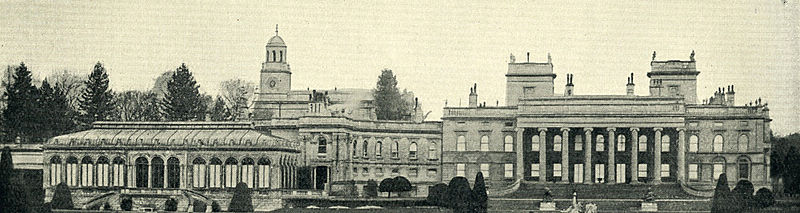
Witley Court was once one of the great houses of the Midlands, but a devastating fire in 1937 left it in ruins. While one cannot but regret the loss of such a beautiful home, the exposure of the “bare bones” has proved to be valuable to historians interested in learning about historical building practices.

800px-Witley_Court_circa_1900_2

Witley Court, 1900

Witley Court today

Witley Court today

Thomas Foley (whose grandson became the 1st Baron Foley) built the house in 1665 on the site of a manor house. Additions were made by John Nash in the 19th century, and the house was sold to the Dudley family (later to be given an earldom) in 1837.

Tramping about the ruins of the house turned out to be much more appealing than one might have expected, even in the pouring rain! The gardens are lovely, particularly the fountain (see video here), and the parish church on the property—which is not a ruin—is magnificent.

See photos here.

Berrington Hall

On Tuesday Heather, Roxy, and I visited Berrington Hall, a splendid country home in Leominster (pronounced Lemster, or so they tell me). It was designed in the late 18th century by Henry Holland, whose talent, although not eclipsing that of my favorite, Robert Adam, puts him solidly in second place, in my estimation.

In addition to the rich furnishings and décor, there was an exhibit of Georgian fashion throughout the house, which included—believe it or not—costumes from the 1995 BBC production of Pride and Prejudice. Yes, I was close enough to touch the costumes worn by Darcy and Lizzie during the final proposal scene, as well as many others. Truly an awesome experience!

Henry Holland!!!

Henry Holland!!!

The vast grounds include a walled garden with some vintage apple trees, a ha-ha, a lake, and some lovely paths. Heather and I enjoyed a delicious picnic before exploring further some of those paths. And not a drop of rain!

See photos here.

Waddesdon Manor

On Wednesday I took a train to Aylesbury, in Buckinghamshire (where, incidentally, the estate of my hero in The Third MacPherson Sister is located) to visit Waddesdon Manor.

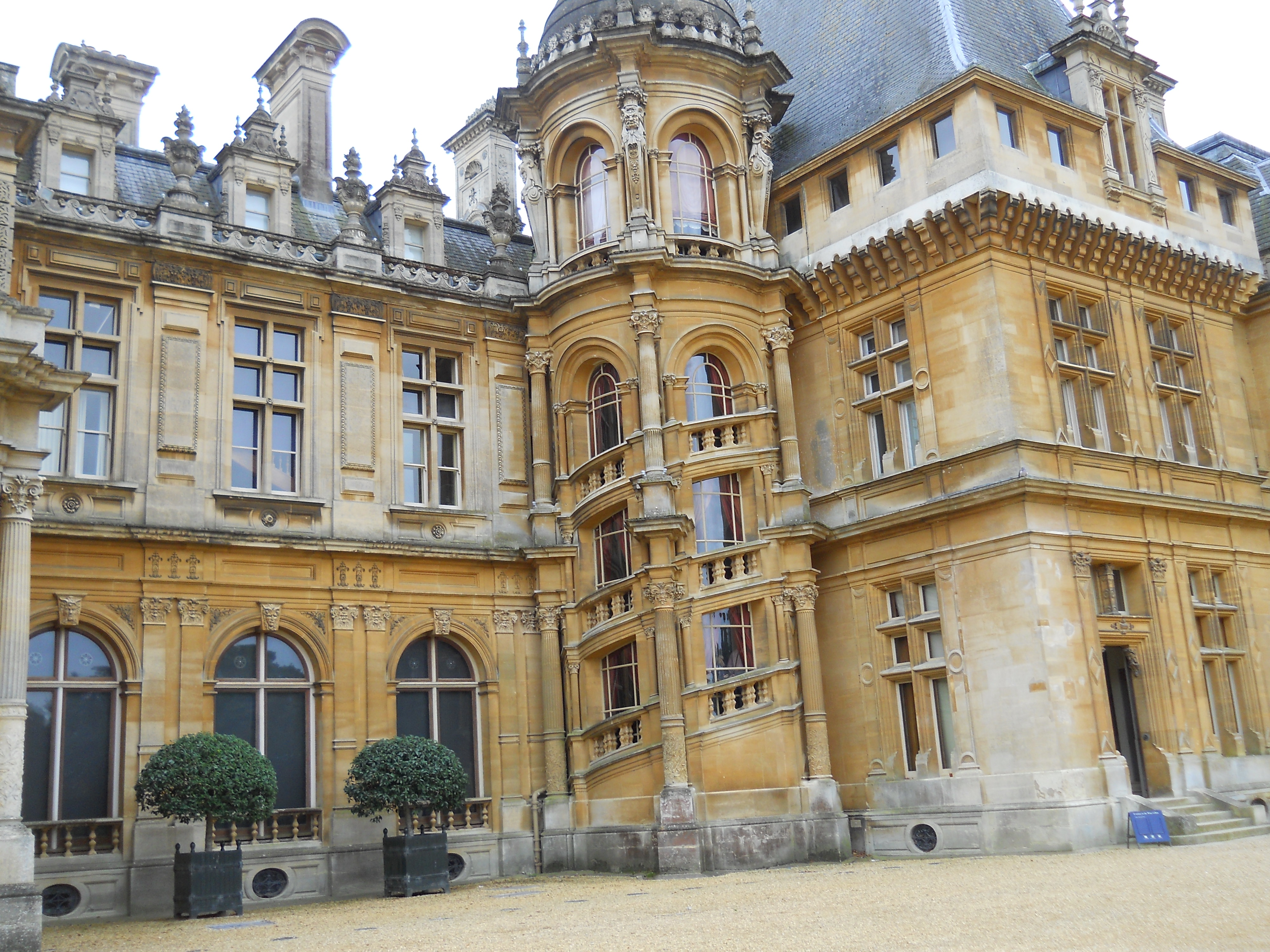
Waddesdon Manor was built in neo-renaissance style in the late 19th century as a sort of French château by the Baron Ferdinand de Rothschild of the Austrian banking family. The baron fell in love with his second cousin, Evelina, and married her, only to lose her in childbirth eighteen months later. The baron never married again, but became a compulsive collector instead. The furnishings are considered to be among the richest of any stately manor anywhere.

These stairs are reminiscent of those at the Château de Chambord in France

These stairs are reminiscent of those at the Château de Chambord in France

Unfortunately, I was only able to tour the house due to time considerations, but I plan to visit again to get a good look at the extensive grounds and other buildings, such as the Aviary and the Dairy.

Although cloudy, it didn’t rain until I had returned to London, where I got promptly soaked making a last round of Piccadilly Street and Fortnum & Mason. But hey, it rains in England. That’s why it’s so beautiful!

See photos here.

Adieu to England

Squidgeworth enjoyed his orange juice on the plane.

Squidgeworth enjoyed his orange juice on the plane.

It was with a tear in my eye as Squidgeworth and I said goodbye to England on Thursday. For now. We had a marvelous time and were fortunate to be able to visit many wonderful places, but there are still lots more on our bucket list. I’ve already booked our flight and flat for next year’s trip in August.

So much to see, so little time!

Next week: Squidgeworth and I have some travel tips for you!

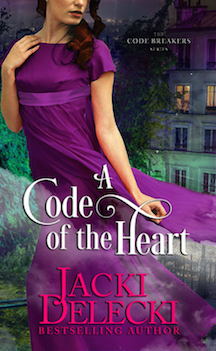
Jackie Delecki: A Code of the Heart

The making of a book trailer

by Jackie Delecki

I don’t usually create video trailers for my books, but I did create trailers for both of my audiobooks. Why, you ask? With the addition of sound, video is another way to add dimension to this engaging book promotion technique. Here is a look at the creative process that ultimately provides readers with a visual and audio “book blurb.”

Developing a book trailer starts with a script. This can be the book cover copy (also called the book blurb or book summary), an excerpt from the book, or something entirely different. For A Code of the Heart, we used a brief excerpt that reflected the storyline, plus the tag line for the Code Breakers series. The script can either be narrated or added as text.

The next step in the process is to assemble the graphic and audio components. This can be a challenge, as you must comply with copyright laws. You must have permission or be authorized to use the content in your trailer. To avoid any problems, we either use images owned by myself or the author, or stock art/music that has been purchased. You can also use material under a Creative Commons license.

Finding licensed images for Regency romance can sometimes be a challenge. One of the images we considered using for this book trailer was discarded when we realized the male model–posed in a classic historical romance cover embrace–was wearing a gold chain necklace. We didn’t want any readers complaining about the historical inaccuracy of such an image so we selected a different graphic. Another way to solve the problem of limited Regency England images is to look for photos that reflect the story elements without specifically portraying them. For example, in this book trailer, the “spilled” tea cup represents the poisoning, danger and betrayal incidents in the story, while the British flag was selected to signify the intrigue and danger to the British monarch.

The audio and video elements are crafted into a final product using Windows Movie Maker and an audio “mixing” program called Audacity.

Below are links to book trailers for my two historical romantic suspense books available as audiobooks:

A Code of Love

https://vimeo.com/101116158

A Code of the Heart

https://vimeo.com/132840807

For an audio sample of my new audiobook, listen HERE.

I hope you enjoyed learning about what goes into creating a book trailer and that it has made you curious to learn more about my Regency romantic suspense! If you’d like more information about my audiobooks, you can find A Code of Love and A Code of the Heart on Audible, Amazon and iTunes.

Giveaway!

Tell me what you enjoy most about audiobooks for a chance to win a copy of my new audiobook release, A Code of the Heart.

A Code of the Heart_1000 copy

About A Code of the Heart

Miss Amelia Bonnington has been in love with her childhood hero since she was eleven years old… or so she thought until a not-so proper impassioned and unyielding kiss from the not-so honorable and equally disreputable Lord Derrick Brinsley, gave her reason to question the feelings of the heart.

Lord Brinsley, shunned from society for running off with his brother’s fiancée, hasn’t cared about or questioned his lack of acceptance until meeting the beguiling Amelia Bonnington. One passionate moment with the fiery Miss Bonnington has him more than willing to play by society’s rules to possess the breathtaking, red-haired woman.

Amelia unwittingly becomes embroiled in espionage when she stumbles upon a smuggling ring in the modiste shop of her good friend. To prove her French friend’s innocence, she dangerously jumps into the fray, jeopardizing more than her life.

On undercover assignment to prevent the French from stealing the Royal Navy’s deadly weapon, Derrick must fight to protect British secrets from falling into the hands of foreign agents, and the chance at love with the only woman capable of redeeming him.

AmazonBarnes & NobleKobo

About the Author

Headshot 150Jacki Delecki is a bestselling romantic suspense writer. Delecki’s Grayce Walters Series, which chronicles the adventures of a Seattle animal acupuncturist, was an editor’s selection by USA Today. Delecki’s Romantic Regency The Code Breaker Series hit number one on Amazon. Both acclaimed series are available for purchase at http://www.JackiDelecki.com. To learn more about Jacki and her books and to be the first to hear about giveaways join her newsletter found on her website. Follow her on FB—Jacki Delecki; Twitter @jackidelecki.

WebsiteFacebookTwitter