Amusements of Old London: The Fairs

Amusements of Old London

William B. Boulton, 1901

“… an attempt to survey the amusements of Londoners during a period which began… with the Restoration of King Charles the Second and ended with the accession of Her Majesty Queen Victoria.”

In a country such as England that drew much more of its income from agriculture than manufacturing in this time period, it is interesting to note that the most popular time for holidays and festivities was late summer and autumn, when farming activities intensified. Just at the time when gentlemen itched to be in the country at their hunting and field sports, the peers were called to London for the rise of Parliament.

And yet it was in those months that this instinct of the English taught them to lay aside their cares and get what enjoyment they could from the means nearest at hand. Before the era of railways and cheap travelling the great mass of the population of London never went twenty miles from St. Paul’s, and the sport they enjoyed took the form of the delights provided by Hockley in the Hole, the Ducking Ponds, and the Cockpits… And yet, as the summer passed away, and the dog-days raised a heat from the cobblestones which drove the dogs themselves into the shade of alley and entry, the common people of London, instead of panting for the water-brooks or the sea-shore, prepared themselves for the great carnivals which were prepared for their delight in one or other of the great fairs of the town.

These annual gatherings followed each other in quick succession in the hot months of the year in the not very promising surroundings of Smithfield, or Southwark, or Westminster. The glory of these entertainments was at its zenith at the beginning of the eighteenth century…

…[T]heir origin was religious, their development commercial, and their apotheosis an unrestrained indulgence in pleasure or license…

The St. Bartholomew Fair

(see more on the origins of the fair on another blog post)

In the late seventeenth century, amidst all the rope dancers, jugglers, and puppet shows, a well-known actor by the name of Penkethman set up a theatrical booth. A plethora of theatrical entertainers followed, including Doggett (a comedian famous from the annual waterman’s race on the Thames), Miller (from Drury Lane), Bullock, Simpson, Colley Cibber (poet laureate and member of White’s), Quin, Macklin, Woodward, Shuter, and many more. “The theatrical movement, in fact, became so pronounced that as time went on most of the favourite actors of the day did not disdain to tread the boards in the temporary booths of the fair.”
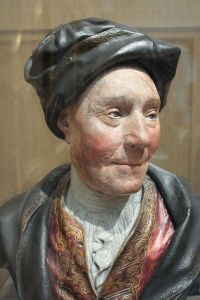
Colley Cibber, bust now at the National Portrait Gallery

Colley Cibber, bust now at the National Portrait Gallery

The dramatic entertainments which were in fashion at the fairs… consisted almost invariably of some prodigious long-winded scheme dealing with such portentous subjects as “The Loves of the Heathen Gods,” “The Creation of the World,” “The Siege of Troy,” “Jephthah’s Rash Vow,” “Tamerlane the Great,” lightened up with much comic relief, in which an eccentric English character took a part totally irrelevant to the particular epic comprised in the plot. These productions came to be called “drolls,” and you may trace int hese drolls the germs of many forms of variety entertainment popular to-day, including, perhaps, that of English pantomime… The puppet-shows… followed the dramatic taste set by the actors.

Bartholomew Fair indeed became so great a nursery of dramatic talent that many actors afterwards famous obtained their first chance at Smithfield. The fair became a sort of theatrical exchange, where managers during their annual visits were often able to find the valuable recruits, and where strolling players from the provinces were accustomed to attend in the hope of engagements with regular companies.

Henry Fielding

Henry Fielding

…[T]he managers of the great theaters found it profitable to close their houses altogether… and take their companies to Smithfield, where they found they could earn more money from the audiences who flocked to their shows during the whole day than from the single performances of the patent theatres… Mr. Henry Fielding, for instance, fresh from Eton and Leyden, but without a guinea in his pocket… set up a booth, and for ten years provided an entertainment for the people at the fair… Fielding produced “The Beggars’ Opera” at Smithfield, occasionally trod the boards himself, and received the honour of a visit from the Prince and Princess of Wales in 1732, who were much delighted with his historical drama of “The Fall of Essex.”

Unfortunately, the activities of the fair were periodically harassed by “persecution from the puritanical busybodies… [who] frequently succeeded in closing the booths, and left the fair to the gin-stalls, gaming-tables, and jugglers, diversions which were presumably less vicious in their eyes…” Sometimes the “puritanical spirits” would persuade the city government to disallow the booths on the night before the fair. “The ordinary attractions of the fair would then be enlivened by a riot of first-class dimensions, which always resulted in assault and battery, and sometimes in sudden death.”

The end of the theatrical entertainments at Smithfield came about when the powers-that-be limited the fair from fourteen days to three. Three days didn’t pay an actor or manager enough to make it worthwhile. At that point, the attractions changed to such things as menageries of wild beasts, or spectacles such as the “double-cow” or the “mermaid.” As the nineteenth century approached and the audiences became less naïve, the entertainments became slightly more sophisticated, with lion tamers putting their heads in the lion’s mouth, rope-dancing, magicians, peep-shows, etc. Just the chance of rubbing shoulders with nobles and even royalty was enough to draw people to St. Bartholomew’s.

It was no uncommon sight at St. Bartholomew’s, to see an exquisite like Chesterfield, or a great minister like Sir Robert Walpole, with his star on his breast, tasting the diversions of the fair alone and on foot. Parties of bloods from White’s and Almack’s were not above exchanging humorous badinage with the fruit-sellers, or the prettier of the strollers or acrobats, or even chucking them under the chin.

Southwark Fair

The Southwark Fair, on St. Margaret’s Hill near Southwark Town Hall, originated in the year 1550 and continued for more than two hundred years.

As the 7th of September came around in each year, the same gin stalls, gaming-tables, gingerbread stalls, and theatrical booths which had delighted Smithfield were packed up, taken across the river, and displayed in all their attractiveness to new audiences of South Londoners at Southwark.

Although smaller in scale than the fair in Smithfield, the acrobat and rope-dancing acts excelled at Southwark, primarily because of the more laissez-faire attitude of the local government. Mr. Cadman, who used to swing his way on a rope across the street from St. George’s Church tower to the mint, eventually “came to a sad end in attempting a bold flight across the Severn at Shrewsbury.”
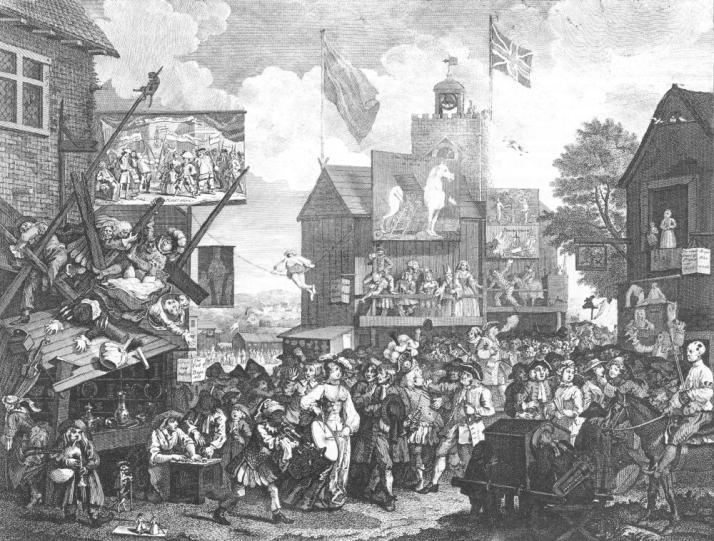
southwarkall

The humours of Southwark Fair inspired Mr. Hogarth in one of his finest efforts, wherein are reflected so admirably the life of his times, and that excellent plate of Southwark Fair is as good an illustration as need be of the importance of the festival among the popular diversions of the middle of the eighteenth century. The greatly daring acrobat on the rope stretching from the church tower to the Mint, which is out of the picture, is the great Mr. Cadman himself; the artist on the slack rope on the other side of the picture is a back view of the Violante. Mr. Figg, the famous “Master of the Noble Science of Self-defence,” displays his honourable wounds on the right. His booth is round the corner and he is riding through  the fair with very martial aspect to gather clients to witness a set-to between himself and some other bald-pated hero of the sword or quarter-staff. On the right of the pretty girl with the drum and the black page, who is effectively advertising the show which she represents, is Tamerlane the Great in full armour, being arrested by a bailiff. The enormous posters of the background, which almost blot out the church, and display the attractions of the Fall of Troy, the Royal Waxworks, and the wonderful performance of Mr. Banks and his horse, are all quite typical of the London fair, and Mr. Hogarth’s grim humour appears to perfection in the title of the show which he represents as tumbling into the street on the right, with its actors and orchestra and monkey on the pole, the “Fall Bagdad.” Note too the peep-show and the hag presiding over the gaming-table, and the pleasant glimpse of open country between the houses.

May Fair

See more about the May Fair here:

The End of the Great Fairs

These fairs mostly came to an end around the mid-eighteenth century, when the crowd became wilder, the entertainments more tawdry, and the patrons (such as the “great people of St. James’s”) harder to find. The days of when people could be entertained by simple things like tea gardens and fairs disappeared into the annals of history.
Amusements of Old London series

An Evening at Vauxhall Gardens: Part IV

An Evening at Vauxhall Gardens, Part IV

In our last installment, Susana suffers a panic attack as the crowd stampedes to view Madame Saqui’s performance on the tightrope—which she found quite remarkable for the early nineteenth century—and makes the acquaintance of the son of the Marchioness of Hertford and finds herself in the company of the Prince Regent himself!

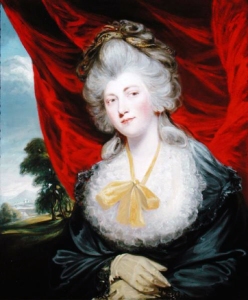
Isabella Seymour-Conway, Marchioness of Hertford

Isabella Seymour-Conway, Marchioness of Hertford

“Why Isabella, it has been over a year at least… since the Royal Wedding, I believe.”

With His Royal Highness the Prince Regent at Lady Hertford’s side, Lady P could not avoid acknowledging him, nor introducing them both to me, since they were both looking from her to me with puzzlement in their eyes.

“Your Royal Highness, how delightful to find you taking in the delights of the Royal Gardens this evening!”

She performed an elegant bow and then took my hand. “May I present to you my American friend, Miss Ellis? She is here to visit relatives, and was eager to see the famed Vauxhall Gardens.”

My muscles were quivering so much I thought I was going to faint, but one look at the expression in Lady P’s eyes was enough to motivate me to get myself together. I did my best to emulate her regal bow, which was sadly inelegant. Still, I managed to stay on my feet, and as Lady P has often told me, my American status was enough of an excuse for my awkward behavior.

regent_later“Your Highness,” I managed, my hand flying to my chest in an attempt to slow my racing heart. “I’m so—thrilled—to meet you. I’ve heard so much about you. I never thought to meet an actual king of England.” Lady P squeezed my shoulder, and I scrambled to correct my error. “That is, a future king of England.” Another squeeze. “And, of course, Lady Hertford. You have such a lovely home.”

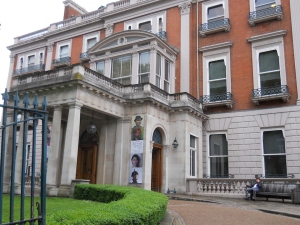
I stopped myself from saying more, but it was too late. I’d visited the former Hertford residence on Manchester Square more than once on my trips to London, as it has been open to the public—together with the exquisite furniture and art collected by some Hertford family member or another—for a hundred years or so. But that hadn’t happened yet. Oh dear.

I swallowed. “Or so I’ve heard, your ladyship.”

With the entire party giving me looks that could be described as incredulous, surprised, or furious—that last was Lady P—I added quickly, “The word of your exquisite taste in art has reached across the pond.”

Lady Hertford tapped her son’s arm with her ivory fan.

“Gracious me, I cannot accept any credit for the collections. Francis here is the true connoisseur. Why, after his Grand Tour, we had boxes and crates delivered to our door for weeks.”

The Prince Regent cleared his throat, and we all turned our attention back to him.

“Miss Ellis, it is a pleasure,” he said, his scowl belying his words. “Isabella, dear, we are expected at Carlton House.”

Lady Hertford smiled. “Of course, Your Highness.” She gave us an apologetic smile. “We really must be going. It has been good to see you again, Agatha. And to meet you, of course, Miss Ellis. A visit to our home can be easily arranged, if you would like to see it yourself. Apply to the housekeeper for an appointment.”

I believe I managed to convey my thanks as they took their leave of us.

“Well,” I said. “I have met the Prince Regent.”

Hertford House, known as the Wallace Collection, on Manchester Square

Hertford House, known as the Wallace Collection, on Manchester Square

Lady P rolled her eyes. “The less said about that, the better. Perhaps we should return to the future now.”

“Oh no! The evening is still young!” I protested. “And I’ve been invited to Manchester Square!”

Her ladyship snorted. “Invited? That was no invitation, my dear Susana.”

I blew out a puff of air. “Well, perhaps not. But I still want to go.”

“That’s not what we agreed and you know it. One evening at Vauxhall Gardens. And then you return to your own time. I won’t be responsible for disrupting the space-time continuum.”

I burst out laughing. “What nonsense! You do that all the time! What about those gifts to your grandchildren…?”

“A lapse in judgment. In any case, Henry has had them all destroyed.” But the flush that crept across her face told me I had made my point.

“Look, I’ve already mortified you in the presence of the Prince Regent. What else could possibly go wrong?”

Famous last words. Tune in next week to see what happens when Susana explores the mysterious and ever-so-scandalous Dark Walks…

Sir Richard Wallace

Sir Richard Wallace

Historical Note: Francis Seymour-Conway, 3rd Marquess of Hertford and the son of Prince Regent’s last mistress, was an avid collector of art, as were his son and grandson. It was his grandson who left the house and art collection to his illegitimate son, Sir Richard Wallace, whose widow bequeathed it to the nation. The Wallace Collection was opened to the public in 1900 and is open today, free of charge.

Wallace Collection Website

Susana’s Pinterest Page


Lady P and Susana Visit Vauxhall Gardens, Part I

An Evening at Vauxhall Gardens, Part II

An Evening at Vauxhall Gardens, Part III

An Evening at Vauxhall Gardens, Part IV

An Evening at Vauxhall Gardens, Part V

Amusements of Old London: London al fresco: Vauxhall

Amusements of Old London

William B. Boulton, 1901

“… an attempt to survey the amusements of Londoners during a period which began… with the Restoration of King Charles the Second and ended with the accession of Her Majesty Queen Victoria.”

The “New” Spring Gardens

As mentioned in an earlier post, the original Spring Gardens was adjacent to Charles I’s gardens at Whitehall, which gave it an almost royal flavor. Naturally, its popularity was enough to convince the Puritans to shut it down, although it opened up almost immediately after the death of Cromwell. However, Charles II’s ambitious building plans put an end to it, leaving the name to the sole use of the Spring Gardens that had been established earlier in Lambeth along Kennington Lane.

Established around 1660, the “New Spring Gardens,” which, confusingly, ran alongside the “Old Spring Gardens” (the two were eventually combined), charged no admission, but made its profits solely on the sale of food and beverages. “Balthazar Monconys speaks of the place as “lawns and gravel walks dividing squares of twenty to thirty yards enclosed with hedges of gooseberry trees within which were planted roses.” No doubt the coincidence of the name being the same as the former royal gardens added to its popularity, as did the fact that it could best be accessed at the time by the highway of the Thames, there being no bridge between London Bridge and Kingston.

Taking water for vauxhall - Be careful, my love, don't expose your leg

Taking water for vauxhall – Be careful, my love, don’t expose your leg

The fares on the Thames were extraordinarily moderate. There are regulations of the Corporation extant which tell us that the citizen wishing to go by Vauxhall by water could take a pair-oared wherry at Whitehall for sixpence, or if he was content with sculls for half that moderate fee. Then the journey by water was itself an attraction which brought advantages to the gardens. The place was in the country, and a visit in the heat of summer was something in the nature of an expedition to the substantial merchant from the city and his family. They were apt to stay longer and eat more after the little voyage, in which their appetites were sharpened by the fresh air of the river.

The name Vauxhall took its name from a famous manor in South Lambeth called “Fulke’s Hall,” Faukeshall, Foxhall, Vauxhall.

The Gardens After the Restoration

The humours of Spring Gardens at Charing Cross were removed to Spring Gardens at Vauxhall, with little maiming of their rites; there are the same rumours of syllabubs and cheesecakes, the same wandering of damsels through the close walks of the wildrness, the same whispering of gallants in love-locks to ladies in masks and flame-coloured gowns. Spring Gardens appear in the pages of Wycherley and Congreve, and Vanbrugh and Sedley, as a spot upon which much of the glitter and revelry of that reckless society, lately released from the bondage of the Puritans, displayed itself to the best advantage. The historical evidence of Mr. Samuel Pepys, too, is to the same effect. Samuel was there often, and in many moods; with the maids, with his wife, and without his wife but with other people’s at times. The vice of the age as exhibited by the company in the gardens, would shock him one day, and on another, he would kiss Knipp [actress Mary Nepp] in the arbour, “it being darkish.” But that quaint sinner can speak best for himself. “Thence to the new one,” he says in May of 1662, speaking of the Old and New Spring Gardens, “where I never was before, which much exceeds the other; and here we also walked, and the boy crept through the hedge, and gathered abundance of roses, and, after a long walk, passed out of the doors, as we did at the other place.”

Jonathan Tyers: The True Genius

It wasn’t until Jonathan Tyers took a lease on the place, added some acreage, and spent four years transforming the place that Vauxhall Gardens began to rise above all other such entertainments, in England, and also all of Europe (the capitals of which were damaged by war at one point or another). He saw Heidegger making a fortune on masquerades in the theatre and took the idea one step further by bringing them out-of-doors in the fresh air. His ridotto al fresco of 1732 was a great success.

It requires little imagination to recall the famous Ridotto al fresco of 1732; the river still without bridges, boat-loads of happy people in fancy-dress going up-stream, as the evening closed in, in boats preceded by others playing music, the lights of the flotilla and the fancy dresses and the music giving a touch of Venetian gaiety to the lovely but sober reaches of the Thames. There were some hundreds only of the élite of London Society admitted to this fête, as we are told, and Prince Frederick, Prince of Wales, came down the river in his barge from Kew. The night was fine, and they kept it up till the birds sang and the daylight came at four o’clock the next morning.

Hogarth's season ticket

Hogarth’s season ticket

The success of the ridotto notwithstanding, the financial side of the gardens was precarious at first. At one point, when Tyers was feeling almost suicidal, he ran across William Hogarth, who was living across the street at the time. That began a longstanding friendship between the two. Hogarth lent his abilities to the enterprise by donating a painting to one of the saloons, as well as designing the silver or bronze season tickets. He himself received a lifetime ticket “to admit a coachful”, inscribed with “in perpetuam beneficii memoriam.”

The Physical Layout

The Grove in the middle; the house in the foreground is the Prince's Pavilion

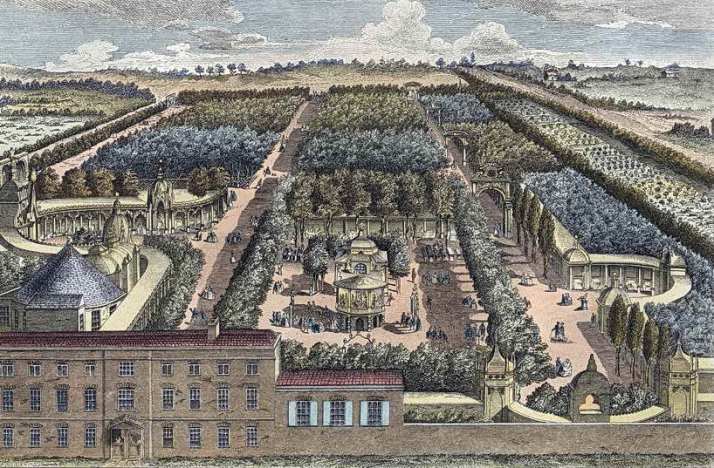
The Grove is in the middle; the house in the foreground is the Prince’s Pavilion (1751).

The place was a parallelogram, and its main features were groves of trees which eventually assumed the dignity of forest timber, intersected by gravel walks crossing each other at right angles. It was entered by a gateway through an ordinary-looking house of brick of three storeys, which with a high brick wall enclosed the gardens on the western side bounded by Kennington lane. On the three other sides its borders were the hayfields of the open country. As you entered the place from the gateway through the manager’s house you looked up the Grand Walk, planted with a stately avenue of elms, and extending the whole length of the demesne. Parallel to the Grand Walk on the right hand ran the South Walk, an avenue of much the same length and dimensions, which was crossed by three triumphal arches of a rather debased Renaissance design. A third avenue, the Grand Cross Walk, ran across the whole garden at right angles to the two avenues we have named. On the right the Grand Cross Walk gave access to the Dark Walks, the Druids’ Walk, or the Lovers’ Walk, the secluded alleys of Vauxhall which gave the place much of its fame and not a little of its attractions for some of its patrons. On the left the Grand Cross Walk led to the Wildernesses and Rural Downs, more open shrubbery-like spaces which afforded a view of the country towards the river. The whole place covered about twelve acres…

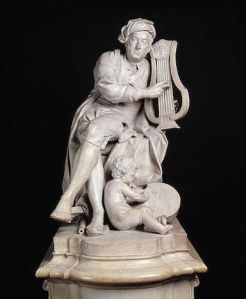
The secret to Vauxhall’s long popularity was Tyers’s dedication to constant improvements to the grounds and attractions. He had sculptures of Handel and Milton made and placed them prominently in the gardens, as well as building an impressive orchestra in what he called the “Grove,” “a space of nearly five acres near the entrance on the right, where bands of the ablest musicians in London played good music in most imposing cocked hats, and tenors and prima donnas trilled and quavered for half a century.”

handel statue

Handel statue that appeared at Vauxhall Gardens for over a century

Round and about the Grove were clustered the temples, the pavilions, the rotundas, the great rooms, the music rooms, the picture rooms, the covered colonnades for wet weather, above all the famous supper boxes built in straight rows or curving sweeps. In those famous supper boxes, where generations of Londoners ate the noted Vauxhall chicken and ham, were the paintings which gave a quaint interest to each, every picture displayed by its own little oil lamp… Above all, Mr. Tyers lighted up the darkness of his groves “with above a thousand lamps so disposed that they all took fire together, with such a sudden blaze as was perfectly surprising.”

The illuminations of Vauxhall were undoubtedly arranged with much taste, and the sudden lighting of the lamps, with a simultaneous crash of music from the orchestra, had a considerable effect. Moreover, the illuminations of Vauxhall gained greatly by contrast with the aspect of the town of that day. Long after the general use of gas, London after nightfall was a dull and gloomy place. The streets were generally narrow and ill lighted… Vauxhall was really the only place where the citizen could see anything of the beauty of artificial light intelligently employed.

Vauxhall After Tyers

The great period of Vauxhall Gardens lasted, as we believe, until the year 1791, when the ordinary price of admission of one shilling was doubled by a new management, and a series of entertainments were begun… which marked the inevitable period of decline. Jonathan Tyers died in 1767, was succeeded by his son of the same name, and the old traditions of his management lasted until the year we have named.

ballloon

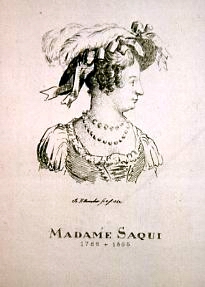
Although there were still nearly seventy years of life, and perhaps half that number of prosperity, in store for Vauxhall, its history after 1791 interests us less… The old social features of the gardens are much less in evidence during its later history, the spectacular and the sensational much more… The taste of Londoners progressed if it did not improve, and the new views of life and its opportunities, which began to prevail after the Revolution in France, were no longer satisfied with the placid joys which had delighted earlier generations… There was a firework platform erected at the eastern end of the grounds, a firework tower, and a mast sixty feet high, fright which the “ethereal Saqui” descended on the tight-rope in a blaze of blue flame and Chinese fire… As the present century ran into its teens, there were changes which may have caused old Jonathan Tyers to turn in his grave. They cut down many of the trees in his grove, and two sides of that pleasant enclosure and a geat part of the Grand Walk were covered in by a colonnade with cast-iron pillars… The later Vauxhall of dancing-floors and balloon ascents, of spectacular panoramas of Arctic regions, if Indian jugglers and Mr. Ducrow’s equestrian entertainments—above all the Vauxhall of Mr. Simpson, the wondrous master of the ceremonies, the “gentle Simpson, that kind smiling idiot,” whose personality is preserved in the wonderful etching by Robert Cruikshank… The stout at Vauxhall grew muddier, the slices of ham, if possible, thinner, the chickens more skinny, and the company more raffish as modern England became transformed by railways and Reform Bills. There was no place in London for an entertainment which in anyway represented the old pleasant tradition of the al fresco.

Robert Cruikshank, C.H. Simpson Esq.' M.C.R.G.V., engraving, 1833 (Lambeth Landmark 1301). The Master of Ceremonies is shown welcoming the Duke of Wellington, 19 August 1833, on the occasion of his benefit night. Cruikshank drew this scene in the gardens on the spot; the huge illuminated figure of Simpson was one of the special effects created for the event.

Robert Cruikshank, C.H. Simpson Esq.’ M.C.R.G.V., engraving, 1833 (Lambeth Landmark 1301). The Master of Ceremonies is shown welcoming the Duke of Wellington, 19 August 1833, on the occasion of his benefit night. Cruikshank drew this scene in the gardens on the spot; the huge illuminated figure of Simpson was one of the special effects created for the event.

For more information:

Susana’s Vauxhall Blog Post Series

Amusements of Old London series

Jacqueline Reiter: The Late Lord: The life of John Pitt, 2nd Earl of Chatham

An 18th century courtship:

The 2nd Earl of Chatham

and

Mary Elizabeth Townshend

Thank you for the opportunity to write for your blog, Susana. I’m not an author of historical romance (my latest book is straight-up non-fiction), but that doesn’t mean there’s no romance in what I write. Human nature hasn’t changed much in two hundred years. The late Georgian/Regency aristocracy undoubtedly had its fair share of rakes, adulterers and unfaithful lovers, but there were exceptions, and the subject of my biography was one of them.

One of the reasons I was attracted to write about John Pitt, 2nd Earl of Chatham is that he was so refreshingly human. He was closely related to two prime ministers – his father was William Pitt the Elder, and his brother was William Pitt the Younger, both of whom were massive over-achievers, but John was the family black sheep. Everyone expected great things of him, but he never managed to match the greatness of his immediate relatives. On the contrary, he managed to become infamous after he commanded the British expedition to Walcheren in 1809. It was a huge disaster, partly because more than a quarter of the British army came down with malaria.

johncopleydetail

John Pitt, 2nd Earl of Chatham, ca 1779. Detail from John Singleton Copley, ‘The Death of the Earl of Chatham’.

John was a complex character, a product of his parentage and of his times. One thing, however, made him very accessible to me: his love for his wife. John’s marriage lasted thirty-eight years and was childless, but he and his wife were unusually close for aristocrats of the times. They went through some very hard times, but what I want to talk about here is their courtship, which was wonderfully bashful and bumbling.

Mary Elizabeth Townshend, the object of John’s affections, was born in September 1762. She was the second daughter of Thomas Townshend, later Lord Sydney (after whom the city in Australia was named), who was an old friend and political acolyte of Pitt the Elder. Townshend’s estate was very close to Pitt the Elder’s, and the Pitt and Townshend children grew up close.

countess_chatham

Mary Elizabeth Townshend, Countess of Chatham, possibly by Edmund Miles

By the time John was twenty-two, his friendship with Mary had deepened. Between June 1778 and March 1779 he was away pursuing his military career in Gibraltar, but the British ambassador to Spain noticed the young man’s heart belonged to another. ‘I would not swear that he is not in possession of a most precious jewel,’ the ambassador told his brother, who later met John in England at Thomas Townshend’s house and worked out what was going on: ‘If he [John] has a mind to set that jewel which you suppose him possessed of very beautifully, he might consult Miss Mary Townshend.’

John and Mary had fallen in love, but Mary was only sixteen and John was in any case too bound up in his military career. He was sent off to the West Indies in early 1780 and was not able to guarantee his long-term presence in England until he transferred to a London-based regiment in 1782. At this point he began to press his suit more vigorously, and by June 1782 John’s brother William informed their mother of ‘a match of which the world here is certain, but of which [John] assures me he knows nothing, between himself and the beauty in Albemarle Street’ – Albemarle Street being Thomas Townshend’s London residence.

But John was a typical boy, and it turned out he wasn’t quite ready to commit just yet. (He was enjoying bachelorhood far too much, going to see the horse racing in Newmarket, hunting with his great friend the 4th Duke of Rutland, and sitting up late at White’s and Brooks’s to gamble at cards.) Whenever anyone questioned him about his forthcoming marriage, he dismissed the rumours with dry sarcasm as ‘stock jobbing reports’.

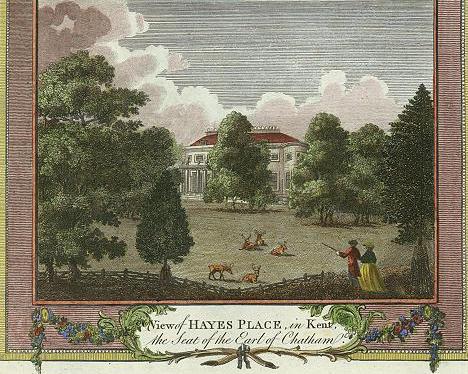
By May 1783, however, John himself had begun to believe in his own love-story. On the first of the month he took his sister Harriot on a carriage ride to his country seat, Hayes Place. Harriot wrote to their mother that the family home was ‘just now in glory, and I think my brother enjoyed very much contemplating his pretty place and thinking of the pretty lady he means to give it.’

hayes

Hayes Place, Kent

A few days later Harriot reported excitedly that John and Mary had been so publicly ‘amicable’ at a ball that she was ‘really disappointed when I found the matter was not settled there.’

It was at this point that John decided to show his colours as a man with all the gumption and emotional intelligence of a thirteen-year-old. Soldier he might be, but he simply couldn’t muster the courage to pop the question. He accepted an invitation from the Townshends to accompany the family on a weekend away, where, as Harriot pointed out meaningfully, he was purposefully provided with ‘opportunities’ to declare his feelings. Did he propose? Did he heck. He ‘had only very near[ly] done it once.’

harriot

Lady Harriot Pitt, John’s sister, by an unknown artist

Perhaps it was a romcom situation, in which the critical moment was interrupted by a family member, or a sudden crisis, or an explosion, or something like that. (Most likely John just bottled out: ‘Mary?’ ‘Yes?’ ‘……… Could you please pass the salt?’)

Either way, a week after Harriot had been eagerly anticipating her brother’s proposal, nothing had happened and the bride-to-be was getting ‘not a little fidgetty’. Even John’s brother William, who famously had no time for romance, could see that it was ‘full time’ the courtship ‘should end. I rather home it will be happily completed very soon, though it has lasted so long already that it may still last longer than seems likely.’

But by the end of May John still hadn’t proposed. He was getting very frustrated with his family, who were very close to beating him over the head with the nearest convenient blunt instrument if he didn’t make up his mind. ‘My brother and I have been beating over the same ground again,’ Harriot grumbled. ‘… I think in this sort of way all sides may be likely to get frampy.’ No idea where frampy came from (it’s not an 18th century word I recognise), but its meaning was clear.

And yet another two weeks passed in this way before John finally screwed up the courage and proposed on 5 June. Despite Harriot’s fears that she would be too fed up to accept, Mary accepted on the spot.

The marriage licence was applied for, and on 5 July 1783 John, his bride and his future father-in-law put their pens to a ten-page vellum marriage settlement bestowing a dowry on Mary of £5000, partly out of family funds and partly out of West India stocks.

marriage_settlement

John and Mary’s marriage settlement, Bromley Archives Marsham Townshend MSS 1080/3/1/1/26

The marriage itself took place in Mary’s father’s Albemarle Street house on 10 July 1783. Mary was given away by her father, whose permission had been required to secure the marriage licence, as she was still only twenty and therefore considered a legal minor. (The marriage licence described her as ‘an infant under the age of twenty-one years’, which made it sound a bit like John was a cradle-snatcher.)

OLYMPUS DIGITAL CAMERA

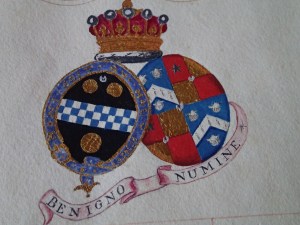
John and Mary’s crests, from a family pedigree (private collection)

‘The person that constitutes the happiness I so truly feel, is Miss Mary Townshend,’ John wrote delightedly to an old family friend shortly before the marriage. ‘… How much reason on every account I have to be so, I flatter myself all who know her will readily allow.’

Mary’s reaction is not recorded, but she must have been equally relieved.

Book Depository

References

Letters between Lord Grantham and Frederick Robinson, 1779, Bedfordshire Archves Wrest Park (Lucas) MSS L30/15/54/139 and L30/14/333/211.

Letters of Lady Harriot Pitt, John Rylands Library, University of Manchester GB 133 Eng MS 1272, ff. 32-45.

Bromley Archives, Marsham-Townshend MSS 1080/3/1/1/26.

Pitt Papers, David M. Rubenstein Rare Books and Manuscripts Library, Duke University, USA.

Earl Stanhope, Life of Pitt, 4 vols. (London, 1861).

About the Author

Jacqueline Reiter has a PhD in late 18th century political history from the University of Cambridge. A professional librarian, she lives in Cambridge with her husband and two children. She blogs at www.thelatelord.com and you can follow her on Facebook (www.facebook.com/latelordchatham) or Twitter (https://twitter.com/latelordchatham). Her first book, The Late Lord: the life of John Pitt, 2nd Earl of Chatham, was published by Pen & Sword Books in January 2017.

Amusements of Old London: The Play and the Opera

Amusements of Old London

William B. Boulton, 1901

“… an attempt to survey the amusements of Londoners during a period which began… with the Restoration of King Charles the Second and ended with the accession of Her Majesty Queen Victoria.”

The Restoration and King Charles II

The puritanical opposition to everything connected with the drama… was now exchanged for the patronage of those in high places. There has perhaps never been so good a friend to the actor and to the theatrical interest generally as his Majesty King Charles. The king, by granting a patent to Mr. Tom Killigrew at the Cockpit in Drury Lane, established that principal of monopoly in things dramatic which lasted till well on in the present reign. The actors of Drury Lane were the king’s servants and a party of the royal household under the administration of the Lord Chamberlain; a certain number of them indeed wore his Majesty’s uniform of red cloth and silver lace, and ranked as Gentlemen of the Chamber. The king’s brother, the Duke of York, had his own company at the Lincoln’s Inn Theatre in Portugal Street, or at Sir Christopher Wren’s house in Dorset Gardens under Davenant, with privileges scarcely less valuable, including a patent to which theatrical historians will trace back all the subsequent glories of the great house in Covent Garden. It was under his Majesty’s auspices that women’s parts were first played by women, and he was good enough, as we know, to honour the profession by forming very intimate alliances with some of those ladies. Lastly, there has never been a more assiduous playgoer than his Majesty King Charles himself.

Samuel Pepys

Samuel Pepys

Relying on diarists such as Samuel Pepys and John Evelyn, Mr. Boulton states

The theatre of the Restoration was in reality much more of a social resort than the play or the opera as we know them. The pit of the playhouse of the Restoration was a social exchange, where the young man of condition displayed his graces and exchanged pleasantries with his fellows; where the man of wit discharged his carefully-prepared impromptus; and where the actors and actresses, not actually engaged on the stage, were accustomed to keep themselves in evidence by mixing freely and ostentatiously with the audience. The stage-door and the green-room, too, were attractions for a large class of men whose attentions to the actresses became a source of embarrassment to the management… Finally, the patronage which Charles the Second gave to both the theatres of his time, and the nature of his relations with some of his subjects who appeared with him in the royal box, gave an interest to a visit to the play of those days which is lacking in later and more sedate times.

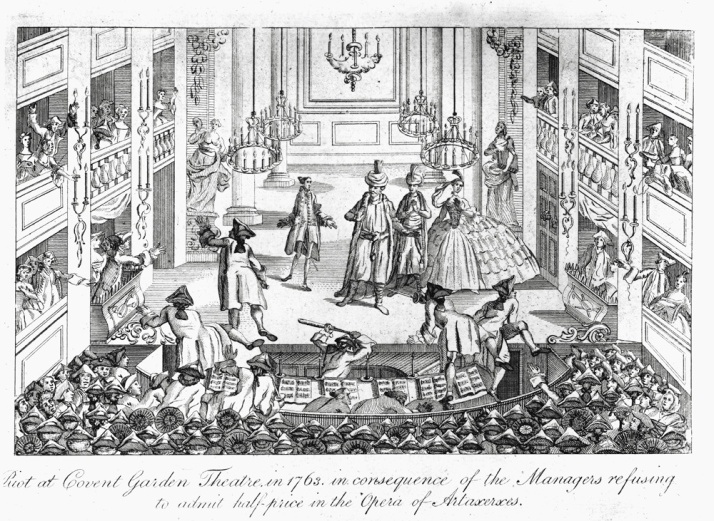
Theaters of the time consisted of the pit on the ground floor, rows of continuous boxes on the first, open seats and a few boxes on the second, and the shilling gallery on the third. “The stage ran out a distance of several feet… into the body of the theatre, and was thus exposed on three of its sides to the spectators who occupied the pit.”

Riot during a performance of Artaxerxes

Riot during a performance of Artaxerxes, 1763

The prices for each sector divided the spectators into social classes. A half-crown would get you into the pit. A shilling would get an apprentice to the gallery. A box on the second floor cost eighteen pence, and the best seats in the lower section would cost about four shillings. Although you could purchase tickets for all the seats in the box for your party, if you did not, you might well find yourself sitting next to strangers.
The only manner of reserving seats in this period was to send someone ahead to pay for your ticket and hold your seat. Footmen quite frequently performed this duty for their masters and mistresses, after which they were admitted to the upper gallery to watch the play.  Boulton says that “they became a very noisy, and consequently, a very important part of the audience.”

Pepys records seeing women on the stage in 1661; prior to that, women’s parts were played by men. He complains about having to spend outrageous amounts on oranges (at sixpence each) for the ladies in his company. The seats in the pit were rows of benches without backs.

I was sitting behind in a dark place, and a lady spit backward upon me by mistake, not seeing me, but after seeing her to be a very pretty lady I was not troubled at it all.

Ah, but Pepys did have a fondness for a pretty face!

Lavania Fenton as Polly Peachum in The Beggar's Opera

Lavania Fenton as Polly Peachum in The Beggar’s Opera

He is in continual ecstasy about the beauty of one or the other of those ladies of the Court, most constant, however, to the Castlemaine, but appreciative of the Stewart, “with her little Roman nose,” or “pretty witty Nell,” or Mrs. Middleton “with a very excellent face, and body I think.” If neither Hart nor Nell nor Knipp [Mary Knep] were there the play, however good, would not please him. With Knipp present he would enjoy the worst of pieces even by the side of Mrs. Pepys. “But it is pretty to observe,” he says, “how I did look up and down and did spy Knipp, but durst not own it to my wife, who do not like my kindness to her.” Little wonder, indeed, for Mrs. Pepys surely had much to put up with. Samuel was decorum itself by her side, but when she was away he would find himself sitting in front of Knipp and Pierce, “who pulled me by the hair, so I addressed myself to them.” Knipp sang a song in the flies at the King’s House which pleased Samuel mightily, “where Knipp, after her song in the clouds, came to me in the pit.” Finally, the shameless rogue had the conscience to put on record his feelings at the performance of the “Virgin Martyr,” where “the wind musique when the angel comes down is so sweet that it ravished me, so that it made me realy sick, as I have formerly been when in love with my wife.”

Joseph Addison by Sir Godfrey Kneller

Joseph Addison

Joseph Addison of The Spectator tells about the ladies of fashion in 1711 who took the notion of wearing patches on the right or left side of the forehead to indicate their adherence to a certain political party. Addison “tells us of Rosalinda, a famous Whig partisan, who had unfortunately a very beautiful mole on the Tory part of her forehead, which misled several coxcombs “to converse in the wrong strain, when on a sudden she has given them an unexpected fire which sunk them all at once.” Then there was Nigranilla too, “unhappy in a pimple, which forces her against her inclinations to patch on the Whig side.”

The Trunkmaker of the Upper Gallery

Addison’s immortal paper begins:

It has been observed that of late years there has been a certain person in the upper gallery of the playhouse, who, when he is pleased with anything on the stage, expresses his approbation by a loud knock upon the benches or the wainscot which may be heard over the whole house.

The Trunkmaker was a large black man whom nobody knew, who was never seen to smile, “but upon hearing anything to please him takes up his huge oaken plank and laid it upon the next piece of timber that stood in his way with exceeding vehemence. If the audience does not concur with him, he smites a second time, and if the audience is not yet awakened, looks round him with great wrath, and repeats the blow a third time, which never fails to produce the clap. …[H]e seldom went away from any tragedy by Shakespeare without leaving the wainscot completely shattered. The players cheerfully repair at their own cost whatever damages he makes… [T]he actors valued no applause which had not the sound of the oak plank in it.

During this time, it was common for certain fashionable braggadocios to linger on the stage and distract the audience from the play. Although Queen Anne issued a royal proclamation against it in 1711, but it was obviously not enforced, as can be seen in Mr. Hogarth’s painting of the Third Act of The Beggars’ Opera, where, in addition to the actors on the stage can be seen in the box on the right, the “Duke of Bolton ogling Vinnie Fenton, who he will presently remove from the stage and marry…” and the crowd of spectators on the stage in 1727.

William Hogarth, Act III, Beggar's Opera

William Hogarth, Act III, Beggar’s Opera

As Boulton has stated, the activities of the stage were only part of the entertainment. Observing the other audience members—particularly the noble ones—was a particular interest of Samuel Pepys. A rejected swain might get his revenge by throwing rubbish at a pretty actress on the stage. A particular target for disgruntled audience was the harpsichord, but if the play or grievance was really bad, the benches and seats and other furnishings might be destroyed as well.

Opera at the King’s Theatre in Haymarket

Opera was first patronized by King George I, who “gave a subscription of £1000, as well as his own name, to the Opera House.”

Farinelli

Farinelli

Fashionable London was so fond of opera in 1735 that it paid £5000 a year to Farinelli, and when that incomparable singer was at the Haymarket an enthusiastic lady in the boxes was heard to exclaim in her ecstasy, “One God, one Farinelli.” Then singers and their competing merits were a continual joy to generations of noble patrons, and their preferences for one singer or another often inspired ladies of high fashion with very unfashionable feelings. Thus when the rival warblers Cuzzoni and Faustina were appearing at the opera in 1726, they each had a party of thick and thin supporters in distinguished circles. There was the Countess of Pembroke at the head of her party in a box, who was prepared to go all lengths for Cuzzoni; the Countess of Burlington and Lady Delaware, with their train of young men in another, were fierce and determined on behalf of the Faustina. So when Cuzzoni came on the noble faction which supported Faustina hissed her into silence, when Faustina appeared she was shrieked off the stage by the devoted band at the back of my Lady Pembroke.

By the early nineteenth century,

…there was a cult of deportment which developed in social London, and constituted a tyranny under which society groaned for a couple of generations. Beau Brummell and his set at the clubs in St. James’s Street represented the male element of this autocracy of fashion, the lady patronesses at Almack’s in King Street the feminine; and at the opera they both united their forces… There was the peerless Mr. Brummell, with his satellite exquisites in Fop’s Alley, the interest of the whole mankind of the house, we are asked to believe, centred in the question of his raiment for the evening… The ladies of the grand tier, we are told, including the chaperons, were more anxious for his notice than for that of the Prince Regent. The opera, in fact, like Almack’s, was a social function which entirely outclassed anything of the sort at Court after the retirement of the poor blind King George the Third. There was no question of getting in by the mere payment of money, a committee of ladies supervised the issue of every ticket, and a man or a lady went to the opera or did not, according as their social position was or was not considered worthy of that honour by the Lady Patronesses… who controlled London society from the time of the Regency until her Majesty came to the throne. [They] were accustomed to sit in conclave upon all the young men about to enter life, and decide as to whether or not they were eligible for admission such stately functions as Almack’s and the opera.

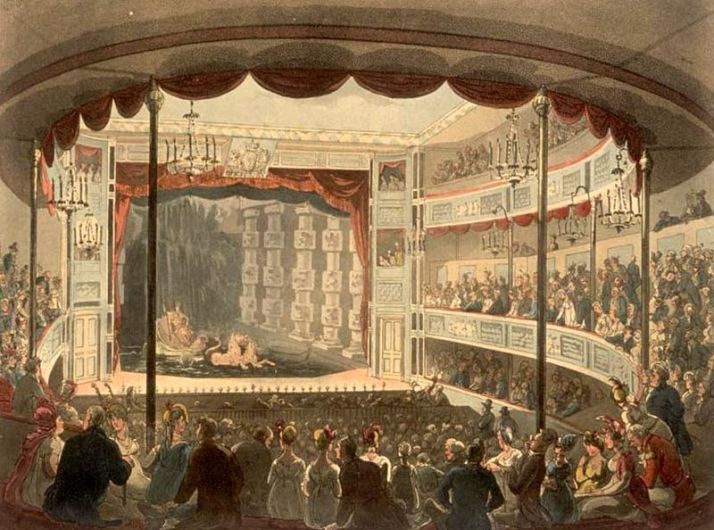
Interior of theater at Sadler's Wells, 1810

Interior of theater at Sadler’s Wells, 1810


Amusements of Old London series

Amusements of Old London: The Cockpit

Amusements of Old London

William B. Boulton, 1901

“… an attempt to survey the amusements of Londoners during a period which began… with the Restoration of King Charles the Second and ended with the accession of Her Majesty Queen Victoria.”

Cock-fighting in Georgian England

Cock-fighting in Georgian England

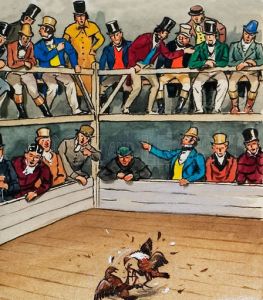
Cock-fighting is recorded as the diversion of ingenious schoolboys by Fitz-Stephen in the reign of Henry the Second… it was prohibited by Edward the Third… it was encouraged by Henry the Eighth, who built the first royal cockpit at Whitehall… it was so much the vogue in high circles in the reign of Charles the First that Vandyck painted a picture of the court watching a match in the royal pit… Oliver Cromwell quite naturally suppressed the diversion by an Act of 1654… and… all its ancient glories were revived by the joyful restoration of King Charles the Second. Modern England, as we contend, began with the days of that monarch, or soon after; we propose therefore to confine our survey of the sport to the days of his Majesty, and since.

Mr. Pepys’s cockpit experience (December 21, 1663)

Being directed by sight of bills upon the walls, I did go to Shoe Lane to see a cock-fight at a new pit there, a sport I never was at in my life. But, Lord, to see the strange variety of people—from Parliament man…to the poorest ‘prentices, bakers, brewers, butchers, draymen, and what not—and all these fellows one with another in swearing, cursing, and betting, and yet I would not but have seen it once. I soon had enough of it, it being strange to observe the nature of these poor creatures; how they will fight till they drop down dead upon the table and strike after they are ready to give up the ghost, not offering to run away when they are wearing or wounded past doing further, whereas when a dunghill brood comes, he will, after a sharp stroke that pricks him, run off the stage, and they wring off his neck without much more ado. Whereas the other they preserve, though their eyes be both out, for breed only of a true cock of the game. Sometimes a cock that has had ten to one against him will be chance give an unlucky blow, and it will strike the other stark dead in a moment, that he never stirs more; but the common rule is that though a cock neither runs nor dies, yet if any man will bet £10 to a crown, and nobody take the bet, the game is given over, and not sooner.  One thing more, it is strange to see how people of this poor rank, that look as if they had not bread to put in their mouths, shall bet three or four pounds at one bet and lose it, and yet bet as much the next battle (so they call every match of two cocks), so that one of them will lose £10 or £20 at a meeting; thence having had enough of it.

William Hogarth: The Cock Fight

William Hogarth: The Cock Fight

Cock-fighting

The sport of cock-fighting was not something that could be taken up by just anyone. The requisite breeding and training of the birds for at least two years prior to any matches required a great deal of money, as well as time and attention. But it could be very lucrative also, since the owners received the benefit of portions of the gate-money provided by the spectators.

Numerous books and treatises were written on the manner of breeding and training cocks, including how to choose them when small, how to feed them, and how to set them to spar with each other.

For a sparring match they covered “the cocks’ heels with a pair of hots made of bombasted leather,” that is, they improvised a sort of boxing-gloves for these interesting birds.

Prior to a match, the cock was trimmed for the fight, “his tail cut into the shape of a short fan… [and] his pinions… trimmed feather by feather, each quill being cut at a slant in order that in rising a lucky stroke might take out the eye of his adversary. Finally, his legs were furnished with the deadly ‘gaffles’ or spurs… some two inches in length, and curved like a surgeon’s needle… either of steel or a silver alloy.”

Birds were matched according to weight, those of middle weight (3-1/2 – 4-1/2 lbs.) being preferred for important venues such as the Royal Cockpit.

As you might imagine, this type of undertaking was not for any but the very rich. Poorer men, however, could and did enjoy the sport as spectators.

The Royal Cock Pit

The Royal Cock Pit

Three Orders

The Long Main—those between cities or countries—provided a full week of entertainment, since the time and expense of traveling made it impractical for an event of short duration.

The Short Main lasted a couple of days or even a few hours, and was much infiltrated by amateurs.

The Welch Main was fought for a prize of some sort—”a purse, a gold cup, a fat hog, or some other prize.” The Welch main was rather like a violent dodgeball tournament, something like the Hunger Games. Thirty-two cocks

…were arranged in sixteen pairs, and each couple fought to the death. The winners, or such as survived, were again matched in pairs, and the battle renewed. The eight winners of this second contest provided four pairs for the third; the survivors of the third contest made a couple of pairs for the penultimate combat; and the final issue of the Welch Main lay between this pair of devoted fowl, from which the much-enduring winner of the whole contest emerged… Its opportunities for betting were no greater certainly than in the Long Main… but it had great attractions for the choice spirits of the cockpit…

The Battle Royal, another variation, was simply a bloodbath of any number of birds in the pit, with the last survivor being the winner.

The determination shown by the finest cocks was astonishing. It is no exaggeration to say that the best cocks of the game would show fight as long as a spark of life remained in their devoted bodies. They might be maimed and even blinded, but when confronted by their enemy they would concentrate what little vitality was left to them in the menacing ruffling of their hackles and an expiring peck. This was so well understood that a blinded cock was never declared beaten until his beak was rubbed against that of his adversary.

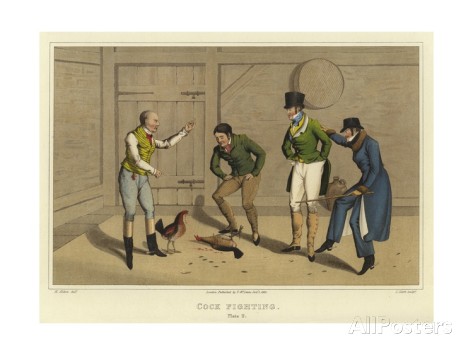
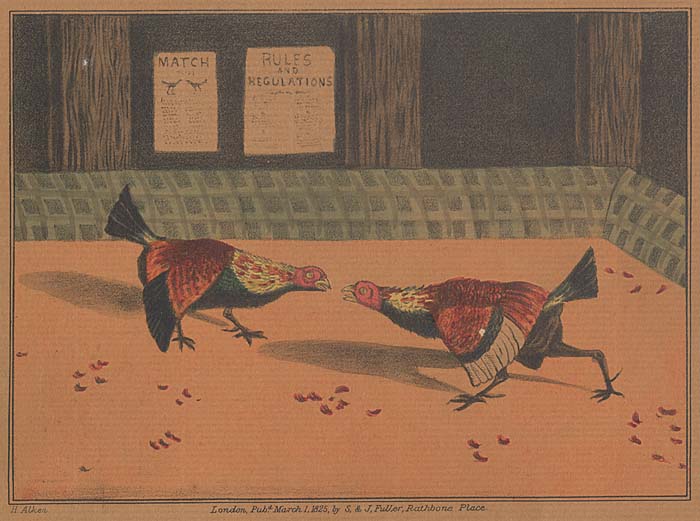
Cock-fighting, Henry Thomas Aiken

Cock-fighting, Henry Thomas Aiken

A somewhat secretive endeavor

It was probably due to its gory nature and the presence of “rough” company that caused aficionados of the “sport” to keep a low profile. Boulton suggests that it was never a particularly popular support among the fashionable men of St. James’s, since there is only one entry in an entire century mentioning cock-fighting in the betting-book at White’s. The Earl of Derby and the Earl of Sefton were known to be supporters, as well as “the families of Warburton, Wilbrahams, Egertons, and Cholmondeleys” and “Lord Mexborough, the Cottons and the Meynells, Admiral Rous, Lord Chesterfield, and General Peel.”

A continuous outcry

Protests about its cruelty were commonplace, as you can see by this satirical advertisement:

“This is to give notice to all lovers of cruelty and promoters of misery, that at the George Inn, on Wednesday, in the Whitsun week, will be provided for their diversion the savage sport of cock-fighting, which cannot but give delight to every breast divested of humanity, and for music, oaths and curses will not fail to resound round the pit, so that this pastime must be greatly approved by such as have no reverence for the Deity nor benevolence for His creatures.”

The Gloucester Journal, 1756

cocks

The Cruelty to Animals Act of 1835

This Act amended existing legislation to include (as ‘cattle’) bulls, dogs, bears, goats and sheep, to prohibit bear-baiting and cockfighting, which facilitated further legislation to protect animals, create shelters, veterinary hospitals and more humane transportation and slaughter.

In spite of this legislation cock-fighting did not expire without a struggle. There is an account of [a secretive meeting] in the interesting but rambling memoirs of the Honourable Grantley Berkeley, showing how the Count de Salis, a magistrate, lent his premises near Cranford to Berkeley and his friends for the purpose, gave him the keys of the whole place, and then called in the police and hauled Berkeley before the Bench at Uxbridge. There was much fun excited by the non-appearance of the count, “the cock who would not fight,” and Berkeley was fined five pounds.

Amusements of Old London series

An Evening at Vauxhall Gardens, Part III

In our last installment, Susana and Lady P made the requisite trip to the “ladies’ retiring room,” which Susana declined after a brief perusal of the facilities. Returning to the fringe of the dancing, she made the acquaintance of a child who offered to obtain a voucher for her to Almack’s (!!!), and listened to several songs by the sweet-voiced warbler, Mrs. Maria Theresa Bland.

A bell rang and the organ music stopped as we were swept away with the noisy crowd to the end of one of the walks where we could see a tall pole (a ship’s mast, as it turned out). A trio of young hooligans elbowed their way past us; at least one trod on the train of my gown and nearly knocked me down. Lady P threw her arm around my back and kept me vertical, but in the second or two it took me to recover, the impatient crowd behind us tossed us a few angry looks and impolite murmurs as they pushed past us. A rush of heat came over me and I could hear my heart racing, so I knew a panic attack was coming on.

madame-saqui-descending

“Can we get out of this crowd?” I asked her ladyship, trying to peer over the heads of the crowd in search of escape.

After one look at my face, she put on her stern “countess” face and aimed it at the crowd behind us. “Susana, my dear,” she said loudly. “I believe that is the Prince Regent waving at us from the Rotunda.”

A slew of people behind us stopped in their tracks and craned their necks to peer at the Rotunda. Lady P and I took the opportunity to duck out of the crowd and into a clump of trees on the right, where she took out her handkerchief and wiped the moisture off my face. The floral scent on the linen had a calming effect on my nerves, and gradually I began to feel more myself.

“Is the Prince Regent really here?” I asked her when I finally caught my breath.

“I do hope not,” she answered, lips pressing into a white slash. “Because if he is, I shall have to pay my respects, and more than likely, he will wish to be presented to you, and with you not having the slightest idea of court etiquette…”

My eyes were bulging. The thought of seeing the Prince Regent would be a thrill beyond my wildest dreams, but to actually be presented to him was a far more intoxicating notion. I started to feel a bit dizzy.

“Susana!” Lady P pounded me on the back. “Get hold of yourself or I shall have to put my hartshorn to you.”

“No, no, I’m fine. I just need to sit down.”

Fortunately, we espied a white wrought-iron bench behind a clump of trees in the near distance. Just as we were seated, we heard the sound of fireworks, and suddenly the sky was ablaze with colored lights and smoke, brief images of crowns, hearts, initials and other indistinct figures flashing in the haze.

“It’s starting!” I said, jumping to my feet, still feeling a bit dizzy, but not willing to miss the main attraction. “Let’s move ahead of these trees!”

small-saqui

We cleared the obstructions just in time to see a tiny figure dart out of the darkness and smoke, her feet moving with surprising agility on the narrow rope toward the summit of tall pole, which had to be at least eighty feet high and a steep climb. I wondered what it was her husband did to her shoes to keep her from sliding backward. [I knew from my Vauxhall blog series that her husband was the only one in the family who was not a rope walker, but that he had important other responsibilities.]

Rockets exploded all around her, causing the spangles on her skirts to sparkle and make her a magical figure. The long ostrich feathers on her elaborate hat dipped and swayed as she ascended, and I found myself holding my breath like the others in the crowd lest she lose her balance or the rope become severed by a rocket [even though I knew from my research that she died of old age, her life taken over by her nostalgic memories of the past]. Reaching the midpoint, she paused for a moment to make a slight bow in our direction. Following her gaze, I looked behind us and saw a rotund figure with a familiar face about ten feet away.

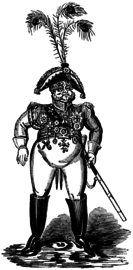
1819_prince_regent_g_cruikshank_caricature“Is that…?”

“… the Prince Regent,” Lady P hissed. “Don’t stare.”

Turning my attention back to the spectacle at hand, I saw Madame Saqui take the final quick steps to the top of the pole, where a man seated there [her husband, I assumed] grabbed her hand while she turned around and made a rapid descent amid a flash of blue lights, again stopping at the center, this time making bows in both directions and executing some graceful balletic moves before continuing her descent and dancing her way back into the smoke.

“She dances exquisitely on the horizontal rope,” said a voice behind us. “I’ve seen her at Covent Garden. As graceful as a ballerina on a stage.”

We whirled around to face a middle-aged gentleman with a smattering of reddish brown hair still remaining on his balding pate. He bowed briefly to Lady P and sent a questioning look in my direction. “A pleasure to see you again, Lady Pendleton. I hope you are enjoying yourself this fine evening.”

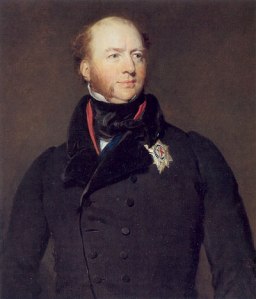
Lord Yarmouth, eventually 3rd Marquess of Hertford

Lord Yarmouth, eventually 3rd Marquess of Hertford

Lady P gave me a look that I interpreted as a “don’t-even-think-of-embarrassing-me” warning as she plastered a smile on her face and bobbed. “We are indeed, Lord Yarmouth. On a fine night such as this, Vauxhall never fails to delight us.” She nodded in my direction. “Your lordship, I’d like to present my good friend, Susana Ellis, from America. Susana, I’d like you to meet Lord Yarmouth, the son of the Marquess of Hertford.”

I swallowed and tried to gather my chaotic thoughts. Hertford. Something to do with Lady Hertford, the Prince’s mistress? What should I do? Any schooling on polite discourse I’d ever had from Lady P disappeared from my brain. I vaguely recalled her own actions and did my best to reproduce her bob. “A pleasure to meet you, Lord Yarmouth.” To my ear, it came out squeaky and I could feel my cheeks reddening. Don’t faint. Lady P will kill you if you do.

He bowed in my direction, his eyebrows furrowed. “American, you say. How delightful. They seem to be everywhere these days.” His voice signaled boredom, however.

I was saved from having to answer that by the voice of a woman calling to him from behind. “Come along, Francis! We’re removing our party back to Carlton House for dinner and dancing.”

lady_hertford_1800

Isabella, 2nd Lady Hertford

Lord Yarmouth gave us an apologetic-yet-relieved smile. “My apologies, ladies. It seems I must take my leave of you.”

Lady P let out a deep breath, no doubt relieved that she would not have to present me to royalty after all, and then the woman behind the voice approached us.

“Agatha? Is that you? It’s been an age. How are you faring these days?”

Approaching us in all her royal blue splendor was a woman I assumed to be the prince’s mistress, Lady Hertford, and behind her was the magnificent royal dandy, His Royal Highness the Prince Regent, the future George IV, and he was looking at me!

More next week, same bat-time, same bat-channel!

descent-of-madame-saqui-surrounded-by-fireworks

Lady P and Susana Visit Vauxhall Gardens, Part I

An Evening at Vauxhall Gardens, Part II

An Evening at Vauxhall Gardens, Part III

An Evening at Vauxhall Gardens, Part IV

An Evening at Vauxhall Gardens, Part V

Amusements of Old London: The Play Tables

Amusements of Old London

William B. Boulton, 1901

“… an attempt to survey the amusements of Londoners during a period which began… with the Restoration of King Charles the Second and ended with the accession of Her Majesty Queen Victoria.”

Hazard & White’s

Hazard, the precursor of crap) was a game of pure chance where all players had a fairly equal chance of winning. But as it spread into the lower classes, “organized cheating at low taverns and gaming-houses became a regular profession.” Loaded dice was one way, but there were plenty of other ways. The often violent responses to cheating are illustrated in Rowlandson’s “Kick up at a Hazard Table.”

rowlandson-kickup-at-hazard-table

The game of hazard first became popular in the late 17th century at  the coffee-houses, such as (Mrs.) White’s Chocolate House and The Cocoa Tree. Early in the next century, the more fashionable gentlemen at White’s, wishing to avoid the card sharps and other unpleasant types that were inevitably present at these places, formed a more exclusive, private club, “where they could lose fortunes to each other in all privacy and decorum.” Considered by critics to be a “pit of destruction,” White’s saw many fortunes change hands at the turn of a dice.

Young Mr. Harvey of Chigwell, for instance, lost £100,000 to Mr. O’Birne, an Irish gamester. “You can never pay me,” said O’Birne. “Yes, my estate will sell for the money,” was the spirited reply. “No,” said O’Birne, “I will win but ten thousand, and you shall throw for the odd ninety.” They did so and Harvey won, lived to become an admiral, and to fight under Nelson at Trafalgar.

The Georges and Gaming at Court

It was a necessary qualification of a courtier of George the Second to be prepared to sit down with that monarch and the Suffolks and Walmodens and the other picturesque appanages of the court and lose a comfortable sum. Twelfth Night was always a fixture for a sitting of more than ordinary importance at St. James’s. On one of these occasions luck was in favour of Lord Chesterfield, who won so much money that he was afraid to carry it home with him through the streets, and was seen by Queen Caroline from a private window of the palace to trip up the staircase of the Countess of Suffolk’s apartments. He was never in favour at court afterwards.

George III, on the other hand, banished gaming at court and even White’s gambling became quite tame, which is why Almack’s (later Brooks’s) was opened as a venue for serious gamesters, such as Charles James Fox, who was known for playing carelessly “for the excitement alone,” without any concern for the consequences. On one particular day in 1771, after playing hazard for twenty-two hours and losing £11,000, he gave a speech at Westminster, went to White’s and drank until seven in the morning, and then to Almack’s, where he won £6,000, and later in the afternoon took off for Newmarket. A week later, he was back in London and lost £10,000.

Faro

The game of Faro evolved from a game called “basset,” played in the Stuart courts.

Faro was played between the dealer or keeper of the “bank” and the rest of the company, and, like hazard, it gave excitement to as many people as could find room round the table… Each of the company placed his stake upon any card of the thirteen he chose, and when the stakes were all set the dealer took a full pack and dealt it into two heaps, one on his right hand the other on his left, two cards at a time. He paid the stakes placed on such cards as fell on the right-hand pack, and received those of such as fell on his left hand. The dealing of each pair of cards was called a “coup,” and the dealer paid or received such stakes as were decided after each coup… [t]he odds were enormously in favour of the dealer. He claimed all ties, that is, when the same card appeared on both packs, the last card but one of the pack delivered its stake to him upon whichever hand it fell, and there was the impalpable but very real advantage of which was known as the “pull of the table” in his favour.

At Brooks’s, where faro reigned supreme, Charles James Fox and Richard Fitzpatrick (a Whig associate) had a very successful partnership. Lord Robert Spencer’s partnership with Mr. Hare enabled him to win £100,000, whereupon he gave up gambling entirely and purchased an estate in Sussex. “The success of the faro banks at Brooks’s was such that it led to the game being forbidden at White’s by a special rule of the managers.”

Faro, however, was played at many of the great houses and by women of fashion, who would “hire a dealer at five guineas a night to conduct operations, and to suggest that the profits of the table went to him and not to the hostess… to disguise the commercial nature of the transaction…”

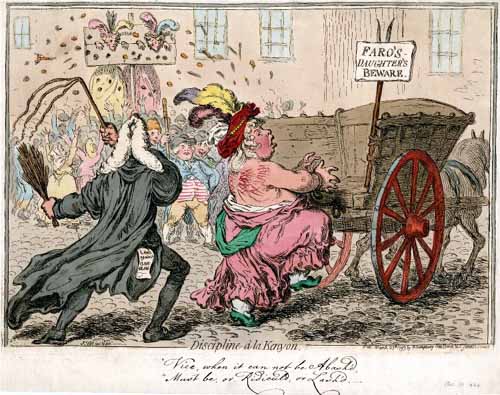
Following the 1797 public scandal in the courts where three society ladies were each fined £50 for playing at a public gaming-table—and the popularity of Mr. Gillray’s prints, such as “Pharaoh’s daughters in the pillory and at the cart tail”—the game lost much of its following.

faros-daughters-gillray

E.O.

E.O., a type of of roulette with a ball and a special table, called roly-poly, from the Continent, found at race meetings, country fairs, and the streets of London, lent itself well to cheating. Colonel O’Kelly, the eventual owner of Eclipse set himself up in business by winning at E.O.

Gaming Houses and the Damage They Caused

Cheap gaming houses all over town featured hazard, roulette, rouge et noir, and macao for small stakes. Frequent raiding did not discourage them, since fines were easily paid.

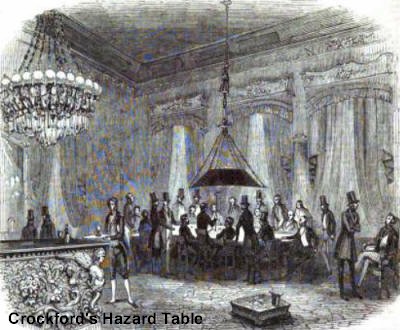
A hazard table at Crockford's

A hazard table at Crockford’s

The mischief these places did is almost incalculable; bankruptcies, embezzlements, duels, and suicides resulting from gaming were of weekly occurrence, and it would seem that half the tradesmen and clerks of London were before the magistrates or the coroners of the last years of [the 18th] century and the first quarter of [the 19th].

Hazard and faro had gone out of the older clubs, and club gaming of the [early 19th century] was represented by extremely deep play at whist at White’s and Brook’s. Macao flourished for a while at Wattiers, where the members lived on each other for some eight or ten years until their estates disappeared and the club expired by the flight of its supporters to Boulogne.

Such were the houses in which round games flourished after their decline at the great clubs. They steadily drained the pockets of the aristocracy of England for nearly half a century, and there is scarcely a great family to-day which does not still feel the effects of the play that went on within their doors sixty years ago.

Crockford’s Club

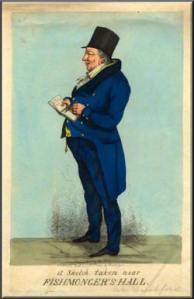
crockford_william_npgthomasjonesWilliam Crockford, a fishmonger who had a shop in the Strand near Temple Bar, made a killing on a turf transaction and rose from partnerships in shady gaming establishments to spending £94,000 to open his own fashionable club, Crockford’s Club, in 1827.

There is one thing, and one only, to be said in favour of Mr. Crockford’s enterprise, which, is that this establishment did away with the practice of gentlemen playing against each other for large sums. At Crockford’s, the game was one of Gentlemen versus Players, the players being always Mr. Crockford’s officials at the French hazard table, and the sole object of his business was to win the money of his patrons.

A committee of gentlemen was given charge of accepting and rejecting members, with the effect of making “entry to Crockford’s as difficult as to White’s or Brooks’s.” The price of subscription to Crockford’s establishment was low, but “in exchange for the princely accommodation of his house, and such fare as was unobtainable at any other club, Crockford asked for nothing in return that gentlemen should condescend to take a cast at his table at French hazard.” This incarnation of the old game required a fee called “box money” and “the pull of the table” that went directly into the coffers of the house.

crockfords-club

The men who walked into Crockford’s with their eyes open to encounter these odds were the pick of the society of the day, the men who had fought the battles of the country under Wellington, and men who were making great reputations at Westminster, as well as mere butterflies like the Dandies who loafed through life at White’s. They were most of them men of exceptional parts, and distinguished for shrewdness and ability in one walk of life or another, and yet in the short space of ten years, between the opening of the club in 1827 and the succession of her Majesty, their losses converted Mr. Crockford into a millionaire at least. There is absolutely no record of any considerable sum of money ever won at the place by a player.

The second Earl of Sefton lost £200,000 in his lifetime. His son, after paying off the debt, lost another £40,000. Sir Godfrey Webster lost £50,000 at a sitting. Other losers of enormous sums: Lord Rivers, Lord Chesterfield, Lord Anglesey, Lord D’Orsay.

Even before the Gaming Act of 1845, Crockford, having pretty much won all the money to be won, started consolidating and concealing his assets with a view toward retirement. When called to give evidence, he claimed that increasing age caused him to give over the management to the committee of gentlemen tasked with running the membership of the club.

“High play in England, as we believe, burnt itself out in those orgies at Crockford’s.”

The Scandal at Graham’s Club

Another reason for the decline of serious gaming in England was the cheating scandal at Graham’s Club in St. James’s Street.

…a man of an old and honoured name was detected cheating at whist, and was denounced as a dishonest trickster in a newspaper, the Satirist. He brought an action against his accusers, failed in it, went abroad, and died… the details of the trial disclosed ugly features in the circumstances which had much interest for thoughtful people, and undoubtedly tended to bring the whole institution of play for high stakes between gentlemen into great disrepute.

Witnesses at the trial testified that they had witnessed him cheating in any number of ways a hundred times and more, and not only did not turn him in, but continued to sit down with him to play at private clubs. Undoubtedly, many of them were cheating themselves, and thus had no wish to have their play scrutinized. Packs of his marked cards were produced in court. His hacking cough, which always resulted in producing a king of trump, became known as “—’s king cough.”

Since those days of Crockford’s and Graham’s and the Gaming Act, high play has ceased to be any considerable part of the social life of London at clubs or elsewhere.

The Gaming Act of 1845

made a wager unenforceable as a legal contract and stood as law, though amended, until 2007.

Crockford's today is an exclusive casino in Mayfair

Crockford’s today is an exclusive casino in Mayfair


Amusements of Old London series

An Evening at Vauxhall Gardens, Part II

In our last installment, Susana and Lady traveled by carriage to the Royal Vauxhall Gardens, bespoke a supper-box, chatted with a waiter, and partook of shaved ham “so thin you could see through it,” as well as other delicacies.

Ladies Retiring Room at Vauxhall

Ladies Retiring Room at Vauxhall

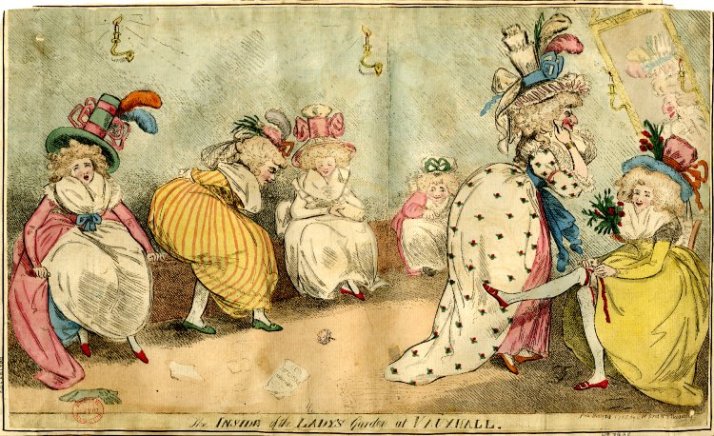
After our meal, Lady P excused herself to visit the “ladies’ retiring room.” Curiosity induced me to follow her to a large tent in a secluded area, where a young woman dressed in servant garb brightened at our approach. When Lady P shook her head slightly, the woman shrugged and looked hopefully behind us for another potential “client.” Her ladyship whispered to me that such women were there to collect tips for assisting ladies who had come without maids to help with their private needs.

Peering into the darkly-lit interior, I saw a half-dozen women seated on what appeared to be wooden seats similar to those scene in outhouses when I was a child (or the latrines at Girl Scout camp). The better-dressed ladies had maids attending to them, but I didn’t get a good glimpse because Her ladyship squeezed my shoulder and I could see by her tight jaw and raised eyebrows that it was not the thing to be staring in such a place.

Not being especially inclined to use such things as outhouses and porta-potties except in case of emergency—and I decided I could wait until I got home—I abandoned the tent and strolled about a hundred yards away until I had left the unpleasant smells behind. From my position, I had a good view of the dancing in front of the Orchestra. It was so amazing to see the vibrant colors of the ladies’ gowns—as well as the gentlemen’s waistcoats—and I could not help but marvel at the sight of the diversity of the dancers. A soberly-dressed gentleman in charcoal gray who was partnered with a woman in serviceable blue circled among an older, elegantly-dressed couple and an energetic young couple dressed in servant garb, and they all seemed to be having a good time. Among the bystanders I could see a gentleman looking through his quizzing-glasses at me, and fearing that he might be thinking of asking me to dance—Lady P would kill me, and in any case, I have two left feet and have never waltzed in my life—I backed a little further back into the hedges, and nearly trampled a little girl.

“Oh dear, I’m sorry! I didn’t see you there, sweetheart. Are you all right?”

Print; Mezzotint engraving. Childhood: Lady Emily Caroline Catherine Frances Cowper, later Countess of Shaftesbury (1810-1872) after Sir Thomas Lawrence.Half length portrait of a child, a string of pearls round her neck. Unframed.

Lady Emily Caroline Catherine Frances Cowper, later Countess of Shaftesbury (1810-1872) after Sir Thomas Lawrence.Half length portrait of a child, a string of pearls round her neck. Unframed.

The child—about six or seven I thought—blinked rapidly after she had moved a safe distance away. Wavy dark hair curled around her childish round face, tied at the top with a pink ribbon. Dressed in white, her gown trimmed with pink bows, she didn’t have the appearance of a child who would be abandoned on her own in a place like Vauxhall.

Her eyes widened at the sound of my voice, and before she answered, she gave me a long glance from head to toe. My hands started to sweat, knowing that my gown—beautiful though it was—would not stand up to close scrutiny, created as it was from an unauthentic pattern and materials made with 21st century technology.

“You speak strangely,” she said. “You’re not from Hertfordshire, are you?”

“Uh no, I’m from America.”

She nodded as though her suspicions were confirmed. “That’s a great distance from here.”

“It is,” I agreed. “I came to visit my friend Lady Pendleton.”

She smiled. “I like her. She invited me to come to tea with Emily and Theodosia.”

Emily and Theodosia are two of Lady P’s grandchildren. [They appear in A Home for Helena.]

“I haven’t had the pleasure of meeting them as yet.”

She tilted her head. “They live in Kent. Sometimes they come to London to visit their grandmother. I visit mine as well, but she is quite ill at present.” She crossed her arms in front of her. “She is an important lady, you know.”

“She is?” I was quite eager to know the identity of this child, but I had a feeling I shouldn’t be encouraging her to talk to strange people. And I know Lady P would have a fit. I gave a quick glance behind me in case she was approaching, but the coast was clear.

“Yes. And my mother as well. She is one of the patronesses of Almack’s.” She inclined her head toward me. “Have you attended there?”

Almack's Assembly Rooms

Almack’s Assembly Rooms

I smothered a laugh. Me? At Almack’s. Not likely. But then… who could have imagined I’d ever be at the Vauxhall from two hundred years ago?

“No, I’m afraid not.”

She smiled. “You do not have a voucher? Perhaps I can prevail upon my mother to get you one. You are a proper lady, are you not?”

Now that was a loaded question. I was pretty sure Lady Pendleton would not describe me thus, and I certainly didn’t feel like a Regency lady.

“I am quite certain Lady Pendleton would not invite me to her home otherwise,” I prevaricated. “I am Susana Ellis. I’m a novelist.”

almacks-voucher-stg_misc_box7-trimmed-to-voucher“You are?” she breathed. “Like Mrs. Edgeworth and Mrs. Burney?”

“More like Miss Austen,” I said before I could stop myself. I knew that Jane Austen had published her novels anonymously at first and wasn’t sure when her identity was finally revealed.

She wrinkled her brow. “Miss Austen?”

Fortunately, I was saved from responding by the sudden appearance of my time-traveling Regency friend.

“Dear Susana, I see you have found a friend.” There was a hint of irritation in her voice. “Lady Emily, have you accompanied your parents here this evening? I wonder why you have been left alone without your maid.”

Lady Pendleton’s voice was firm but kind as she viewed the little girl. Lady Emily fidgeted under her gaze. “I came with Mama and Lord Palmerston. Alice was too ill. I’m just here waiting while they finish the dance.”

Her ladyship shook her head. “I shall give your mama a talking-to when next I see her. Leaving her child unaccompanied indeed!”

Lady Emily flushed. “No! Please don’t do that! I am meant to be sitting with the Howard party.” She bobbed us a curtsey and made her adieux. “I must return in all haste.” She fled just as the music stopped.

I turned toward Lady P. “Is that—?”

lady-emily-cowper-by-sir-2

Lady Emily Cowper (1787 – 1769) by Sir Thomas Lawrence. The daughter of the famous Whig hostess, Elizabeth Lamb, Lady Melbourne, Emily was likely the result of her mother’s affair with Lord Egremont. Emily had plenty of extramarital affairs of her own, including a long one with Lord Palmerston, whom she married after the death of her husband.

“Lady Emily Caroline Catherine Frances Cowper,” confirmed my mentor. “The daughter of Lady Emily Cowper and the granddaughter of the Melbournes.”

I let that knowledge sink in. Then I giggled. “She offered to help me get a voucher to Almack’s!”

Her ladyship lifted an eyebrow. “Indeed. And what did you say to her to elicit such an offer?”

“Nothing!” I insisted. “All I said was that I am an American visiting you, and she told me she knew your granddaughters and asked me if I’d been to Almack’s…”

Lady P snorted. “Because she knew you hadn’t, of course.”

That stung a little, but I knew she was right. I’m not a proper Regency lady and never will be. I was there to observe—and that in itself was a rare privilege.

Maria Theresa Bland, née Romanzini (1769-1838) was a popular singer at Drury Lane and other venues. Sister-in-law to the actress Mrs. Jordan, she had two sons who were also musical. Her mezzo-soprano voice was idea for the singing of English ballads.

Maria Theresa Bland, née Romanzini (1769-1838) was a popular singer at Drury Lane and other venues. Sister-in-law to the actress Mrs. Jordan, she had two sons who were also musical. Her mezzo-soprano voice was ideal for the singing of English ballads.

Our conversation was interrupted with cheers and applause as a rotund little lady in a blue gown with a laced-up bodice and an enormous cap topped with colorful flowers that accentuated the roundness of her face, stepped up on the stage in front of the musicians, giving a deep bow at her introduction by the organist, Mr. James Hook. She—her name was Mrs. Bland—proceeded to sing a charming little song called “Pray Excuse Me,” that had everyone smiling and cheering for more. Her exquisite voice and cheerful vivacity more than made up for the incongruity of her appearance. Following that, she sang “Jesse o’ the Dee” and several other other songs until it was announced that the musicians would take a short respite while Mr. Hook entertained the crowd with his lively organ-playing. In spite of that, I noticed the audience starting to thin out, many heading in the same direction.

James Hook by Lemuel Francis Abbott

James Hook by Lemuel Francis Abbott

“Madame Saqui!” I breathed. Lady P nodded, and we set out to follow the crowd to the venue where the popular French tight-rope dancer would perform.

More next week, same bat-time, same bat-channel!


Lady P and Susana Visit Vauxhall Gardens, Part I

An Evening at Vauxhall Gardens, Part II

An Evening at Vauxhall Gardens, Part III

An Evening at Vauxhall Gardens, Part IV

An Evening at Vauxhall Gardens, Part V

Amusements of London: The Masked Assembly

Amusements of Old London

William B. Boulton, 1901

“… an attempt to survey the amusements of Londoners during a period which began… with the Restoration of King Charles the Second and ended with the accession of Her Majesty Queen Victoria.”

The Ridotto in Venice, Pietro Longhi, 1750's

The Ridotto in Venice, Pietro Longhi, 1750’s

The wearing of masks to disguise one’s identity was nothing new when the “quasi heathenish fêtes” of the medieval Venetians spread to 17th century England. After all, inquisitors, executioners, and highwaymen wore them as they completed their odious business. Pagan rites such as Bacchanalia and Saturnalia and the fêtes des innocents or fêtes de fous were masked revels in which participants could, along with their attire, shed their normal scruples and give way to their impulses. While there are accounts of masked events in Henry VIII’s court as well as the some of the Stuarts’, the “true masquerade,” where all guests were dressed in costume, was a long time coming to England from the Continent, probably because of its foreign origin in a Papist country.

It was only at the beginning of the 18th century that moralizing on the subject of masquerades began to appear in publications such as The Tatler and The Spectator.

It is worthy of note that the masked assembly was never an institution that had any great vogue among the common people, either in this country, or elsewhere. The wearing of masks or of disguises in private life was from very early times the exclusive privilege of the great or of those who imitated them.

Constables or police who raided some of these events discovered prominent men and women among the masked revelers and eventually released them.

The High Constable of Westminster descended upon a masquerade at midnight and made a great haul, which he duly displayed before Mr. Fielding. That eminent magistrate sat up all night to hear the charge, “but several of them being found to be persons of distinction, the justice, not thinking it proper to expose them, after a severe reprimand, dismissed them all.

“The women either come by themselves,” says Addison, describing the amenities of the masquerade of 1711, “or are introduced by friends, who are obliged to quit them upon their first entrance to the conversation of anybody that addresses himself to them.” This by the way was one of the rules of the true masquerade, which was its chief attraction for the frisky maid or matron of those days. Introductions were unknown, and absolute incognito was possible for all who wished to preserve it. The mask and domino were inviolable, except indeed to the police, and any infringement of that rule by a masker led to the inevitable chastisement of the offender by the other men in the room, of which there are numerous fatal results recorded. “But,” continues Mr. Addison, “there are several rooms where the parties may retire and show their faces by consent.”

The subject of masquerades evoked the growing censure of the press for the next half century, but “the masquerade absolutely throve on opposition.” The Bishop of London’s scathing sermons had no effect, nor did the satirical prints and prose that was disseminated throughout the city.

There were strange financial proposals too from amateur chancellors of the exchequer, who proposed to levy taxes upon all tickets for those ungodly diversions and to devote the proceeds to the Foundling Hospital, an institution which they declared was populated by the amours which were kindled by the opportunities of the masquerade. Grave statisticians drew attention to what they contended was an appalling fact, that the vogue of the masquerade quadrupled the normal number of divorces, and pious God-fearing people, whose nerves were sorely shaken by the two smart shocks of earthquake which startled London towards the middle of the century, pointed to the judgment of heaven which these unholy revels were calling upon the town.

It was precisely during the period of this continued opposition, which stretched practically from the days of Queen Anne to those of George the Third, that the masquerade established itself as one of the chief amusements of the upper classes of society in London. Middle class England might still cherish its memories of the Puritans, but there were other views in high quarters, and a mere newspaper agitation was of little effect in a day when four-fifths of the popular could not read. The diversions of an aristocracy, too, were moderately safe from interference by legislation provided by a Parliament whose two houses were composed of the aristocracy and its nominees. The well-born and well-placed classes of Anne and the Georges, in short, with King George the Second at their head, enjoyed the fredaines of the masquerade, and determined to keep them in spite of the bishops and the moralists of the press. And they succeeded perfectly.

The appearance of “party organizers” such as “Beau Nash in Bath, Robert Arthur at White’s Club, William Brooks at Brooks’s, Almack at his Assembly Rooms in King Street, Crockford at the big gaming club in St. James’s Street” had considerable influence on the amusements of late Georgian aristocrats.

John James Heidegger

The son of a pastor from Zurich, Heidegger “wandered about Europe for a quarter of a century living by his wits and acquiring knowledge of men and cities.” He came to England at the age of fifty and enlisted in the Guards, “a regiment in which you might at that time find very well-born men among the rank and file.” Known as the “Swiss Count,” his face was considered one of the ugliest ever seen. It is said that Lord Chesterfield, in lieu of paying his bill, told his tailor, a Mr. Jolly, that “he would not pay him until he could produce an uglier man than himself.” Mr. Jolly showed up with Heidegger and promptly received his money. A measure of Heidegger’s social success is the fact that he was accepted as a member of the very exclusive White’s Club.

john_james_heidegger_by_john_faberHeidegger possessed extraordinary organizational and entrepreneurial skills. His first venture, which involved producing an opera at the Queen’s Theatre in Haymarket, brought him much financial success, and established him as a theatre consultant.

The great world took him up and caressed him; princes gave him amethyst snuff-boxes set in gold; if my lady wanted a rout arranged at her mansion, or if there was a musical entertainment or a dancing assembly to be arranged at a public room, Mr. Heidegger was called in and did the thing to perfection.

King George I loved him and made him manager of His Majesty’s Theatre in Haymarket, where he worked with Handel on producing an opera. And then he set his mind to improving masquerades (which delighted the king even more than opera).

Unfortunately, many in the theater community resented the popularity of masquerades, seeing it as competition for their own offerings. There were also plenty of rumors of gamesters, women of the street, and even highwaymen present at these affairs. But with the king’s support, Heidegger had no fear of the naysayers—the pamphleteers and moralizers and disgruntled theatre people. (Theresa Cornelys was not so fortunate.) “Heidegger boasted of making £5000 a  year by this business.” At one point, when the king signed a royal proclamation against masquerades, Heidegger called the next one a ridotto, and not only got away with it, but the king was one of the guests!

“Thou Heidegger the English taste has found

And rul’st the mob of quality with sound’

In Lent, if masquerades displease the town

Call ’em ridottos, and they will still go down.

Go on, Prince Phiz, to please the British nation

Call thy next masquerade a convocation.”

Heidegger’s legacy to the British people, according to the London Post, was the perfected masquerade. Even after his death in 1749, the masquerade continued to flourish in several new buildings around town.

Ranelagh

ranelagh_gardens_eighteenth_century_original

The Rotunda at Ranelagh, 142 feet in diameter, proved to be an attractive venue for masquerades. There was no stage for actors and thus it was not competition for theaters. After a very successful “Jubilee Masquerade in the Venetian manner,” on 1st May 1749 to celebrate the peace in that year, “it was determined to repeat it in the form of a subscription masquerade.” Horace Walpole writes:

When you entered you found the whole garden filled with masks and spread with tents, which remained all night very commodely. In one quarter was a maypole dressed with garlands, and people dancing round it to a tabor and pipe and rustic music, all masked, as were all the various bands of music, which were disposed in different parts of the garden, some like huntsmen with French horns, some like peasants, and a troupe of harlequins and scaramouches in the little open temple on the mount. On the canal was a sort of gondola adorned with flags and streamers, and filled with music rowing about. All round the outside of the amphitheatre were shops filled with Dresden China, Japan, &cc., and all the shopkeepers in mask. The amphitheatre was illuminated, and in the middle was a circular bower composed of all kinds of firs in tubs, from twenty to thirty feet high, under the orange trees, with small lamps in each orange, and below them all sorts of the finest auriculus in pots and festoons of natural flowers hanging from tree to tree. There were booths for tea and wine, gaming-tables, and dancing, and about two thousand persons. In short, it pleased me more than anything I ever saw.

The Inauguration of the Pantheon in Oxford Street (1772)

sophia-baddeleyIt was rumored that the managers were set against inviting women with less-than-stellar reputations, i.e. actresses and demimondaines. Sophia Baddeley was one such actress with high connections—she was Lord Melbourne’s mistress at the time—and a score or so of her supporters assembled at Pall Mall and escorted her chair to St. James’s Street, where they were joined by even more fine gentlemen from White’s. The procession continued all the way to the Pantheon, whereupon they took out their swords and frightened the porters who were ordered to deny her entrance. This allowed the triumphant Sophia to march into the “fine room under a long canopy made by the crossed swords of her gallant escort.” Eventually, the managers made their apologies to her, and two duchesses “came forward to express to Mrs. Baddeley the pleasure it gave their graces to welcome such an ornament to the assembly.”

Mrs. Cornelys of Carlisle House

was the second person to make a business of organizing amusements for the upper classes. Her story was featured in an earlier post on this blog. Click here to read more.

hogarth-masqueradesoperas

The Bad Taste of the Town (also known as Masquerades and Operas) is an early print by William Hogarth, published in February 1723/24. The small print mocks the contemporary fashion for foreign culture, including Palladian architecture, pantomimes based on the Italian commedia dell’arte, masquerades (masked balls), and Italian opera.


Amusements of Old London series