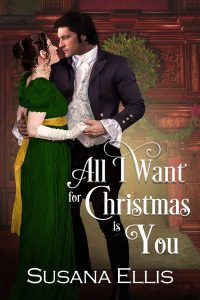
Alicia’s story begins in The Third MacPherson Sister, where her unkindness results in Rebecca MacPherson’s unceremonious removal from London. But the spoiled duke’s daughter suffers repercussions as well, and for the first time she yearns to be a better person. Perhaps the handsome young vicar might be able to help her.
Evan and Alicia are strongly attracted to each other, but she’s not for him. Her wealth and status—and his past—stand between them.
What will it take for this pair to realize that love is the only thing that matters?
“My ankle,” she said, wincing as she pointed to her left boot. “I think it’s swollen because I can’t get the boot off. Watch out for the marshy spots!” She warned him as he came to a clump of high grass. “I forgot the fens extended into Blackburn land. Merlin—that’s my horse—stepped into one and unseated me when he pulled out his foot to escape.”
“I see. And Merlin-er-bailed out on you?”
“Not at all,” she said with a superior look. “Merlin is a highly-trained stallion, you know. I sent him home to fetch help. But it’s much better that you have come along. It will be dark soon, and I wasn’t sure how long it would take them to find me.”
He caught a hint of fear in her golden-brown eyes before it was replaced with confident self-assurance.
“It would be my pleasure to escort you home, Miss—?” Then he realized she didn’t know him either, so he added hurriedly, “Evan Campbell, at your service.”
“Lady Alicia Howland, from Huntingdon Manor,” she said with a bright smile on her imminently kissable lips. Where had that thought come from?
He bent down and examined the boot. “It will have to be cut off. I’m afraid I don’t have a knife with me, however. I suppose the thing to do is to carry you to my cart”—he was suddenly embarrassed by his humble equipage— “and convey you to Blackburn Court where a doctor may be summoned.”
She nodded hesitantly. “I suppose you are right. Huntingdon is only a mile from here as the crow flies, but this little mishap has caused me to recall that it’s best to take the road than risk the fens this time of year.”
As he bent down to gather her in his arms, she added, “I think you’d best use the gate this time. I hope I’m not too heavy.”
“I’ll manage,” he said shortly. At six feet two and broad-shouldered, he was hardly a weakling. Was she afraid he would drop her?
She was no lightweight, though. Taller than average, with curves in all the right places, she was a pleasing armful rather than a burden. The feel of her arms around his neck and the proximity of her chest to his made his body stir with desires he hadn’t felt since… well, not for a very long time. He thought he’d managed to drive out the old Evan, the dissolute young man with nothing to do but seek his own pleasure. But there were times when his nemesis came back to haunt him. Like now, when he held a beautiful woman in his arms.
About Susana Ellis
Susana Ellis is a retired teacher, part-time caregiver, sewist, cook, and fashion print collector. Lifelong reading and a fascination with history led her to writing historical romances. She is one of the original Bluestocking Belles and a member of Regency Fiction Writers and the Maumee Valley Romance Authors Inc.
You can contact Susana Ellis at these social media links:
Five years ago while I was caring for my dad and had to sit with him in front of the TV for hours at a time, I wasn’t able to write stories and got very bored. (Yay Buckeyes! We love Alex Trebek!) Seriously, I wish I could do that with him now. He passed away in 2021.
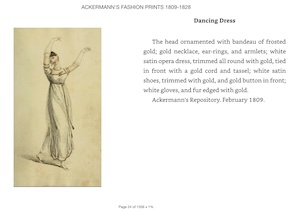
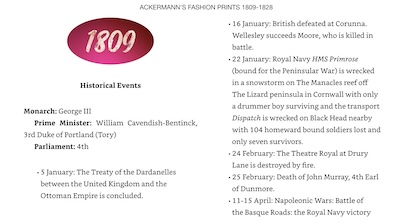
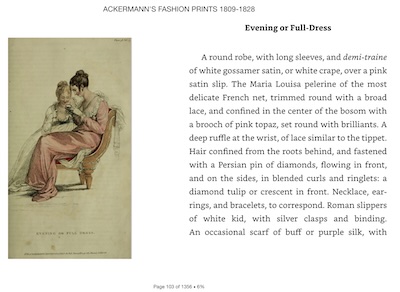
One day I discovered a website with all of the Ackermann’s Repository of the Arts volumes from 1809-1828 available to download. Wow! Thanks for doing that, Internet Archive! (I just made a donation.) The issues are all fascinating, but I was particularly interested in the fashions. To find the fashions—of which there are four per month—you have to scroll through the rest of the issue. Which is time-consuming. I mean, I just wanted to scroll through all the dresses!
So it occurred to me that I could screen-shoot the fashions and keep them in a folder and maybe find something to do with them later. If I’d had anything more important to do, I might not have bothered. I mean, there are four fashions per issue, twelve issues per year, and twenty years of issues. That’s 480 fashions! But that part was kind of mindless and I could shout out “Go Michigan State!” every once in a while, and give my dad the impression I was paying attention.
When that was accomplished, I put on my thinking cap and tried to figure out a way to make these more accessible. Make a Powerpoint presentation? A Word document? A website? That’s when it occurred to me that I could put them in a book. E-book. Print. Whatever. Such a book would be useful to me and I figured it would be so to others too. And… why not add the descriptions as well? Of course, that would mean typing pages and pages of descriptions. Talk about time-consuming! But… I’m a fast typist and I didn’t have anything more important to do, so that’s what I did. I learned I could type and half-listen to Wheel of Fortune at the same time. A useful skill to have, don’t you agree?
More screen-shooting, this time the descriptions. Organizing the fashions and descriptions into folders, then Scrivener. Typing and more typing. Sizing the fashion scans. Then copying and pasting into Vellum. Spell-checking (and learning there are all different spellings for the words in those descriptions). And creating a cover.
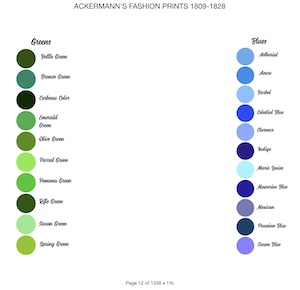
By the time I got that far, it had occurred to me to add a few pages that might be useful to authors and readers and costume designers and whoever else purchased the book. So I added additional fashion comments, color coding pages, and historical contexts for each year.
The pages added up fast. To almost 1400! That’s quite a book, even more pages than one of Gabaldon’s Outlander books. I discovered I couldn’t upload a print book that size to Amazon KDP. So I checked out Ingram Spark and discovered that even with them, I’d have to break the books up into four volumes. E-X-P-E-N-S-I-V-E! But for those who prefer print books, they are available, at least.
No problem with the e-book, however. I was able to upload the entire book for people to use on their phones or tablets for a reasonable price.
And then it occurred to me that some readers might prefer to just flip through the fashions without all the text. Creating an image-only version was easy by that time. So there’s a single print book as well as an e-book of this one too.
Which means I ended up with SEVEN different versions! Readers can pick the one or more that works for them.
Ackermann’s Repository 1809-1828: the E-book
Frankly, I prefer reading on my phone. I don’t have to carry a Kindle around with me, nor a print book. My purse is heavy enough already. So my favorite version (and I have all of them) is the E-book. The comprehensive one. It’s easy to use the Table of Contents to flip to the year I’m looking for, and I can use the original description to help me with the description of the dress in my story. I have it with me wherever I am. I can open it up in my phone or my computer (whichever is most convenient). For this reason alone, I’m glad I went through all that effort. And because I think of my dad at the same time too.
All Regency Authors Need This!
Seriously. Am I wrong?
All seven versions and buy links can be found here. You might possibly find the print books at discounted prices at my Etsy shop. Or scan the QR code below for the Amazon buy link for the e-book. I hope you find it as helpful and entertaining as I do. Let me know!
Susana Ellis is a retired teacher, part-time caregiver, sewist, cook, and fashion print collector. Lifelong reading and a fascination with history led her to writing historical romances. She is one of the original Bluestocking Belles and a member of Regency Fiction Writers and the Maumee Valley Romance Authors Inc.
Susana Bigglesworth finally gets her Happy-Ever-After with Blaise Arquette
“So, tell me the reason for this meeting,” began Susana as they all gathered around the fire in the small drawing room. “Any suitors in tow? Anyone deathly ill? I did wonder about it, you know, when I received your letter, Patience.”
She had unpacked her satchel in Doro’s (who mostly resided at the Hampton Hotel in Harrogate where she worked) and Josefina’s room, had a bit of a wash, and snacked on a plate of bread and cheese and tea prepared by their housekeeper, the loyal Mrs. Crewe.
“Oh dear!” cried her stepmother. “I didn’t mean to worry you, Susana. I made sure to post your letter early, as you were so far away.”
“I suspected as much,” Susana said easily. “And it gave me time to make arrangements for my absence.” She pushed away a twinge of regret for those she left behind. One person in particular. Who would be leaving himself on the morrow.
“I’m glad you are doing so well there,” said her stepmother with a satisfied sigh. “But I could have given you a hint of this meeting’s purpose to prevent you from unnecessary worry.”
“We’ve had no hint either,” protested Josefina, who at nineteen filled the median position between the older and the younger sisters. The latter group echoed her objection. “Why all the secrecy?” “Are we getting a stepfather?” “Tell us now, Mother!”
“Now that’s a novelty,” commented Barbara, who predated Susana by two years. “We’ve had four stepmothers (some of us), but never even one stepfather. Do tell us, Stepmother Number Five.”
Patience rolled her eyes. “Don’t be silly. I shan’t marry again. You girls are my family now, and I can’t conceive of any man taking on a woman with ten children.”
“You’re young yet, Patience. Same age as Doro and younger than Barbara, Susana, and me,” disputed Bess. “We shan’t be on your hands forever.”
“Certainly not.” “Of course not.” Her sisters echoed, followed by a silence characterized by the fidgeting of body parts, the biting of lips, the clasping of hands together, and the clearing of throats. Where are the suitors? There are no suitors. Susana thought the words were echoing through the minds of all present. No one wanted to say such a thing; they were managing to support themselves with the efforts of all who were capable, but it wasn’t suitable for a permanent situation. Susana, for one, wished to marry and have children of her own, and she was certain her other sisters did as well. But who wanted to marry penniless, essentially dowerless women, titled though they were?
“We shall see,” Patience hinted, deliberately raising her eyebrows. “I do have a lovely surprise for all of you, but you won’t persuade me to reveal it until tomorrow.”
Waves of moans and objections filled the room. “Why not?” “Tell us now, Mama.” “I won’t sleep a wink imagining what it might be.”
“Be it as it may, tomorrow, Twelfth Day, is the appointed time, and you will all be told in the morning. After breakfast.”
More groans and moans.
“Your sisters are exhausted, Dorothy from working at the hotel all day, and Susana from traveling from Leeds. We must all be refreshed and ready to take on a new and exciting challenge.”
Doro and Susana objected, but Patience was firm. “Tomorrow will be soon enough. However,” she said, turning to Susana, “we are all eager to hear about your experiences in Leeds. Your letters indicate that the dressmaking is going well, is that not right?”
Susana blushed. “Yes, it is, rather. I just completed a large project, an entire trousseau, which meant we had to start a waiting list for other customers.”
“Of course,” remarked Iris, loyally. “You make the best gowns anywhere.”
“No doubt about it,” added her twin Ivy, followed by a chorus of like sentiments around the room.
“A very useful skill indeed,” pondered their stepmother.
This story was written for the readers of the original version of Desperate Daughters who expressed concern over the absence of Susana’s story, since she played a key part in the other sisters’ stories.
Her story deserves to be told.
If you have yet to purchase Desperate Daughters, you can find it here:
To update your Kindle book version, go to Manage Your Content and Devices. Search for Desperate Daughters. If available, select Update Available, then select Update.)
Susana Ellis is a retired teacher, part-time caregiver, sewist, cook, and fashion print collector. Lifelong reading and a fascination with history led her to writing historical romances. She is one of the original Bluestocking Belles and is a member of the Regency Fiction Writers and the Maumee Valley Romance Authors Inc.
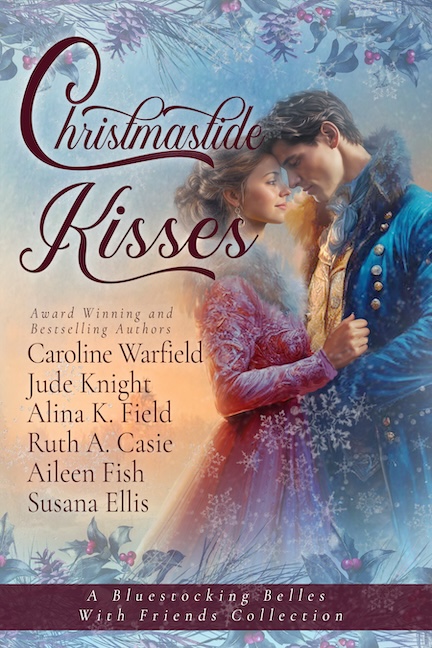
Six charming holiday season romances from award-winning and best-selling authors.
The Bluestocking Belles and Friends brighten your holidays with:
A beleaguered uncle whose wards have run off every governess–what he needs is a wife, if only he can persuade the latest applicant
A country solicitor who becomes an earl and then finds a secret that changes everything
A very proper clergyman battles very improper urges when he and a lady with a murky past find themselves snowbound
A viscount whose search to unearth generations-old family secrets kindles the fire of love for his lovely search partner
A former army captain wonders if the best friend of his ex-fiancee is the woman he should have married
A vicar with a misspent youth and the duke’s daughter who brings out the best in him
Six gentlemen and the ladies with whom they discover the power of a Christmastide Kiss.
Duncan’s Twelfth Night Miracle, by Caroline Warfield
Duncan Laidlaw, newly and unexpectedly raised to Viscount Mildrum, is in trouble. He’s been saddled with a neglected estate, a shabby household, and three wild and undisciplined children, his cousin’s step-children.
After several failed attempts he has concluded that what he needs first isn’t a governess, it is a wife, someone who can help him bring order to his home. He turns to his friend, vicar Micah Turner, to send one. What an outrageous request! Yet, Micah happens to know just the woman.
A Countess for Christmas, by Jude Knight
Louisa always knew her mother was keeping secrets. She had no idea how much her life would change when she knew the truth. Ben was content with his practice as a solicitor. He had no idea he was the last surviving male heir to a title. Christmas is a time for surprises, but will bring them each more than they expected.
Twelfth Night Treasure, by Alina K. Field
Though the Reverend Mr. Matthew Gurnwood longs to marry, he can’t afford a wife, not one without a dowry. One had to allow for the possibility of children, for it was a fact that a so-called white marriage would not do for him, at least not with the sort of woman he’d want to marry—a woman like the mysterious Miss Dubia Hastings. Disguised as a lady’s companion, Dubia Hastings has been hiding from a scandalous past, a mercenary cousin, and an impossible attraction to the very proper clergyman, Mr. Gurnwood. When they’re stranded together on Twelfth Night, dare she risk everything to tell him the truth?
The Lady and the Christmas Brooch, by Ruth A. Casie
In the historic halls of Westerfield Manor, an entwined tale of mystery, love, and destiny unfolds. Lady Genevieve and Lord Ashford embark on a challenge to uncover the hidden family secrets that span generations—before midnight. Amidst the allure of the past, they find themselves drawn into a web of intrigue fueled by secret letters, a missing treasured brooch, and the whispers of an age-old romance. As midnight draws near, Genevieve and Ashford’s bond deepens, revealing that true love, like the secrets of the past, is illuminated by those willing to look beyond the bounds of a restricted society. In a spellbinding story weaving together destiny and unwavering commitment, the legacy of a family finds itself rewritten by the enduring and profound magic that only love can offer.
All Things Merry and Bright, by Aileen Fish
When his fiancée broke off their betrothal, James fought rejection by sealing off his heart. After thirteen years, can he finally open himself to love again with his best friend’s little sister? Bea isn’t about to lose her chance at claiming the only man she’s ever desired, and this Christmas she plans to give him the long overdue gift of her heart.
All I Want For Christmas Is You, by Susana Ellis
Alicia’s story begins in The Third MacPherson Sister, where her unkindness results in Rebecca MacPherson’s unceremonious removal from London. But the spoiled duke’s daughter suffers repercussions as well, and for the first time she yearns to be a better person. Perhaps the handsome young vicar might be able to help her.
Evan and Alicia are strongly attracted to each other, but she’s not for him. Her wealth and status—and his past—stand between them. What will it take for this pair to realize that love is the only thing that matters?
Just in time for Christmas 2022 comes this boxed set of eight charming stories of love, family, and miracles. Each Belle has contributed a tale set in the festive season–one just long enough to fit in between tasks at this busy time of the year. The tales are unrelated, except by the festive season.
Some have been written for this collection, some are made-to-order stories never before published, some have been used as fan giveaways. All are delightful.
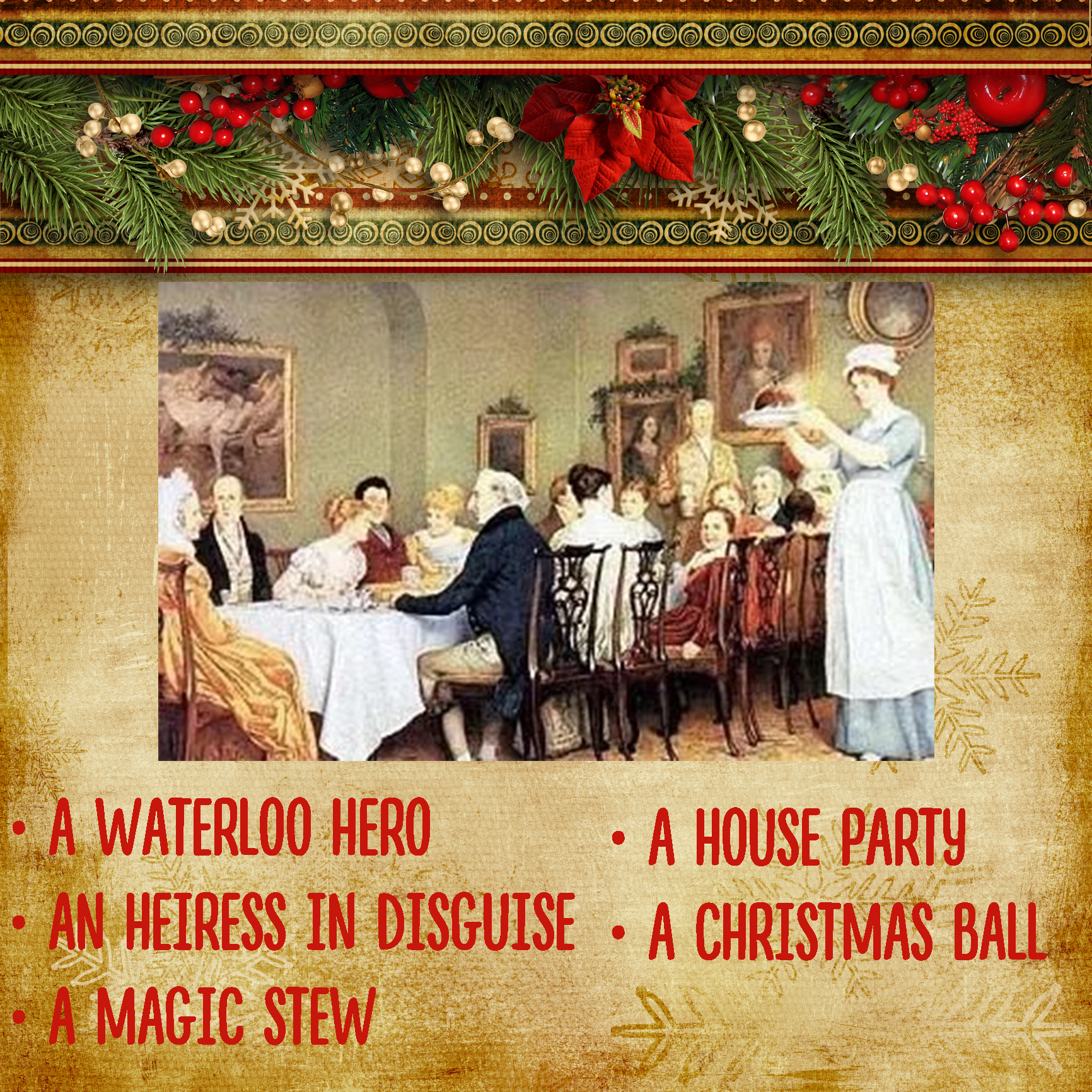
“Dear Daniel, if I’d known you were coming, I’d have put on a proper dinner rather than the simple fare we are accustomed to,” fussed his sister-in-law as the white soup was served. “A nice roast beef, perhaps, or braised lamb. Cook does a fine lamb in savory jelly.”
“Louisa, my dear, I’m sure my brother will find our simple dinners to be far superior to fare on the battlefield,” chided her husband. “I can’t imagine beans and hardtack were all that appetizing.”
Touching a napkin to his lips, Daniel shook his head. “My stomach is still not accustomed to proper meals, even after four months in London.” He grinned. “There was a chap in my regiment who used to make what he called ‘Magic Stew.’ We all contributed whatever we had from our food allotment and such things as we could forage, and no matter what was in it, we thought it the best stew we had ever tasted.”
“What was in it?” inquired Louisa. “Perhaps I could get Cook to replicate it.”
Daniel laughed. “I shouldn’t even attempt it. The ‘magic’ came from being on the march and having long lost the expectation of having tasty meals. I am convinced, Louisa, that you would not find a pot of assorted army rations with the odd vegetable tossed in at all tasty.”
The Magic Christmas Stew
Belles & Beaux
A Mistletoe Kiss: Sherry Ewing As Christmas approaches, Sophie Templeton’s one wish is a kiss beneath the mistletoe from the man who holds her heart. Spencer, Earl of Wilmott has been quietly waiting for Sophie to grow up. Has he left it too late to make his offer?
The Magic Christmas Stew: Susana Ellis The life of an idle spare was no life at all for retired Captain Daniel Winthrop. He was capable of doing many things, but they all required a wealthy bride. Governess Emily Bainbridge feared being pursued for her fortune, so she kept hers a secret. Will this pair find the courage to conquer their pride and risk all for love?
Flowers for His Lady: Alina K Field After her fall from grace years ago, Eleanor Gurnwood has made a family of the villagers in her vicar-brother’s parish. His rising career means she must choose between continuing as his minion or staying with the village. Then her past rides in on a white horse in the form of Major Sir Bramwell Huxley.
An Angel’s Promise: Rue Allyn Artis MacKai might be only a little girl, but she is not going to let a blizzard, wolves, or a deadly enemy stop her from rescuing the stolen mare and foal who are the hope of her family. It will take the spirits of her parents, a determined boy, and her desperate brother to save her.
Room at the Inn: Caroline Warfield A fatherless child requires a village with room in their hearts. A hardhearted baroness makes it impossible. The Honorable Declan Alworth steps up to make room in his heart and his home for the little treasure. How can the vicar’s niece, Maera Willis, resist either one of them?
Zara’s Locket: Jude Knight After Zara MacLaren is dismissed from her post on Christmas Eve, things go from bad to worse. When a goldsmith recognises the locket he once made in the hands of a would-be seller, he sets out to find her. What seems bad fortune might just turn into a Christmas miracle.
Three Ships: Elizabeth Ellen Carter Laura Winter lives on a tidal island that is home to a lighthouse. On a late November day a violent storm brings not only the handsome Lieutenant Michael Renten but also a clutch of pirates bent on wreaking mischief.
The Beau of Christmas Past: Cerise DeLand Years ago, Alyssa and Declan were caught enjoying a Christmas kiss, which broke Alyssa’s betrothal to another man, and caused the pair to be exiled, far from their families and one another. Home for Christmas, will they find the past something to be overcome? Or fulfilled?
The Admiralty is a brick building, containing the office and apartments for the lords commissioners of the Admiralty, who superintend the marine department, and is contiguous to the Horse Guards on the north. With respect to the architecture, the principal front facing Parliament-street displays a proof that the noble lord and board who presided at the time it was built, had objects of more consequence than symmetry and proportion to attend to: it was designed and erected by Shipley. The screen in the front (which was designed and erected by Adams) is so peculiarly elegant, that it in a degree redeems the other part from disgrace. On the top of the Admiralty are erected two telegraphs, the inside of which may be seen by proper application to the porter, or person who works the machine.
The lord high admiral is classed as the ninth and last great officer of the crown; and the honour it conferred, and trust it vested, were formerly considered to be so great, that the post was usually given either to some of the king’s younger sons, near kinsmen, or one of the chief of the nobility. To the lord high admiral belongeth the cognizance of contracts, pleas, or quarrels made upon the sea, or any part thereof which is not within any county of the realm; for his jurisdiction is wholly confined to the sea. The court is provided for the trial and punishment of all offences committed on the high seas, and is a civil court. Courts-martial in the Admiralty have a judge advocate appointed to assist them. The present judge of the Admiralty is the Right Honourable Sir William Scott, Knight, LL. D. the salary 2500/. The present king’s advocate general is Sir John Nicholl, Knight, LL. D.
In King Henry III.’s days, and in the reigns of Edward I. II. and III. Richard II. Henry IV. V. and VI. there were several admirals; for the cautious wisdom of those days would not trust a subject with so great a charge, nor permit any one man to have a certain estate in a post of so great importance. But, nevertheless, in those days there was a great admiral of England.
King Henry VL in the fourteenth year of his reign, constituted John Holland Duke of Exeter, and Henry Holland his son, admirals of England, Ireland, and Aquitaine for life.
The power of this great officer is described in a statute of Charles II.: it is enacted that he may grant commissions to inferior vice-admirals, or commanders in chief of any squadron of ships, to call and assemble courts-martial, consisting of commanders and captains; and no court-martial, where the pains of death are inflicted, shall consist of less than five captains at least; the admiral’s lieutenant to be as to this purpose esteemed as a captain: and in no case when sentence of death shall pass, by virtue of the articles (for regulating and better governing his majesty’s navies, ships of war, and forces at sea,) aforesaid, or any of them (except in case of mutiny), there shall be execution of such sentence of death, without leave of the lord high admiral, if the offence be committed within the narrow seas. But in case any of the offences aforesaid be committed in any voyage beyond the narrow seas, whereupon sentence of death shall be given in pursuance of the aforesaid articles, or any of them, then execution shall be done by order of the commander in chief of that fleet or squadron wherein sentence was passed.
He hath also power to appoint coroners to view dead bodies found on the seacoast or at sea; commissioners or judges for exercising justice in the High Court, of Admiralty; to imprison and to release, &c.
Moreover to him belong, by law and custom, all fines and forfeitures of all transgressors at sea, on the seashore, in ports, and from the first bridge on rivers towards the sea; also the goods of pirates and felons, condemned or outlawed; and all waifs, stray goods, wrecks of sea deodands; a share of all lawful prizes, lagon, jetson, flotson; that is, goods lying in the sea, goods cast by the sea on the shore, not granted formerly, or belonging to lords of manors adjoining to the sea; all great fishes, as sea-hogs, and other fishes of extraordinary bigness, called royal fishes, whales only and sturgeons excepted.
“De sturgeoni observatur quod rex ilua intergram: de balneo vero sufficit si rex habeat caput et reginse candum.” Master William Prynne, who is one of the commentators upon the above curious law, says, that the reason must be, that “our wise and learned lawgivers willed the queen to have the tail of the whale, that her majesty might have whalebone to make her stays forgetting that this was made law upwards of two hundred years before stays were ever worn or thought of. Note farther, that the bone used for stays, is taken out of the head, and not the tail of the fish.
On this ancient law being once mentioned to the late Dr. Buchan, author of Domestic Medicine, ike. &c. he repeated the following little impromptu, which I think has never before been printed:
“If a sturgeon should chance to be cast upon land,
“Honest George, Heaven bless him! the whole may command;
“But if equal misfortune befal a poor whale,
“Let the king have the head, and the queen the tail.”
It is not the object of this volume to say much concerning the great power and interest which the king of England hath in the British seas; and as to the antiquity of the Admiralty Court, and of the name of Admiral, it may be found in a record mentioned by the Lord Chief Justice Coke (Coke’s Institute, p. 142, entitled “De Superioritate Maris Angliae, et Jure Officii Admiralitatis in eodem), said to be among the archives in the Tower of London.
He is called admiral from amir, an Arabic word signifying prefect us, and in Greek marimis. His patent formerly run thus: “Anglise, Hiberniee, et Aquitaiise magnus admirallus, et praTectus generalis clargis et marium dictorum regnorum.”
The various distinguished actions which have been recorded of many of our admirals, and establish the honour and superiority of the British navy, would fill volumes. To enumerate them would occupy more space than can be here allotted to it, and does not come into the plan of this work; but to close the recital of any thing tending to the establishment of our naval character, without inserting the name of the late Lord Nelson, -would be a very improper omission.
Painters have exhausted their art in pictured representations of his actions; sculptors have hewn marble monuments to eternize his heroic professional abilities, which have been placed in the most conspicuous situations in different public buildings throughout the kingdom; and poets have invoked the muse, and exerted their utmost efforts to perpetuate his fame, in praises that, used to any other individual, might have been deemed extravagant panegyric: but the whole nation appear to have been so gratefully alive to his exalted merit, and so highly to revere his memory, that it is hardly deemed equal to what his conduct peremptorily claimed from his surviving countrymen. The Right Honourable Horatio Viscount Nelson, and Duke of Bronte, was a most active, brave, and able officer. He defeated the French fleet in Aboukir Bay, August 1, 1798, and took eight sail of the line; for which he was raised to the peerage. He was second in command at the battle of Copenhagen, where he displayed great courage and conduct; for which he was raised to the dignity of viscount. He completely defeated the combined fleet of France and Spain, off Cape Trafalgar, October 21, 1805, in which he lost his life.
In the advices some of our admirals have transmitted to the Board of Admiralty and others, there is a brevity, which Shakespeare says is the soul of wit; there is, however, a brevity, which is so admirable a model of epistolary writing, that I cannot resist transcribing one or two of them; premising, that as they are taken from memory, they may not do justice to the originals.
The first is from Sir George Rodney to the Governor of Barbadoes, and is as follows:
“Dear General,
“The battle is fought, — the day is ours, — the English flag is victorious; — we have taken the French admiral, with nine other ships, and sunk one. “G. B. R.”
The second letter was, I think, transmitted to the Admiralty.
“We have met the French fleet, and taken, sunk, or destroyed, as per margin.”
The last I shall subjoin is from a foreigner, but seems mixed up with a large portion of British spirit . It was written to Admiral Benbow, who died in October 1702, at Jamaica, of the wounds he received in an engagement with M. du Casse, in the West Indies, off the high land of St. Martha, in the same year.
Soon after Admiral Benbow’s return to Jamaica, he received a letter from M. du Casse, of which the following is a translation:
“Carthagena, August 1702.
“Sir,
“I had little hopes on Monday last but to have supped in your cabin; yet it pleased God to order otherwise: I am thankful for it. As for those cowardly captains who deserted you, hang them up; for, by G — d, they deserve it.
“Du Casse.”
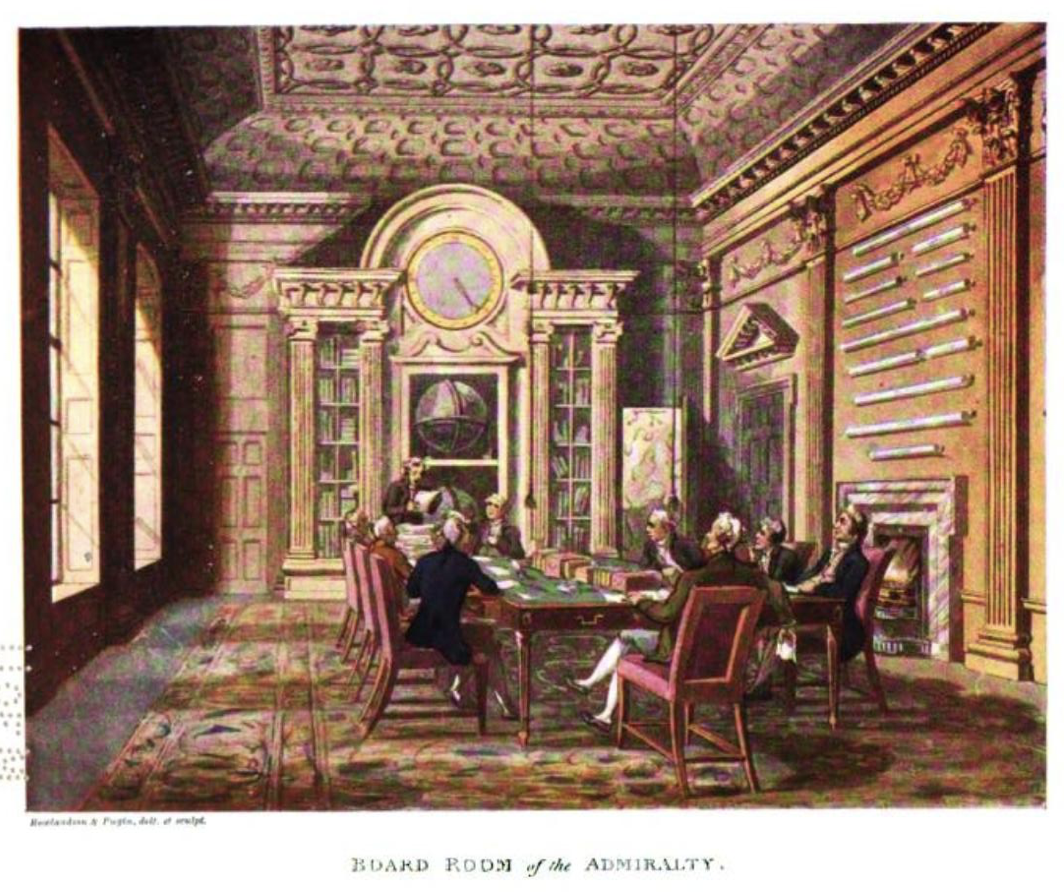
The next print is a correct interior view of THE BOARD ROOM OF THE ADMIRALTY, with its appropriate decorations of globes, books, maps, & c. The lords commissioners are represented as sitting at the table, and may be naturally supposed engaged in some business relative to the naval interest of Great Britain: and considered in that point of view, may be fairly said to be transacting a business of more real importance to this country, than any other subject that could be debated; and if taken in all its nautical relations, the acknowledged preeminence of our navy, and the various appertaining et-ceteras, it is also a matter of infinite importance to all Europe.
After what has been said, it does not seem necessary to make any remarks on the extent of the building; but, as it has been before remarked, that the noble lords were engaged in transactions of more importance than attending to the symmetry and proportion of their house, which was probably left to the architect, who might in many cases leave it to the management of his foreman, it may afford some amusement to our readers, to recite a few sportive sallies of the wits of the time on the brick and mortar of the principal front.
They said, and truly said, that it is a contemptible piece of architecture. Of the portico of this building, composed of four Ionic columns, with a pediment of stone, a story is told, that, from the strange disproportion of the shafts, is highly probable. The architect, Shipley, had made them of a proper length, when it was found that the pediment of one of his shafts had blocked up the window of one of the principal apartments; and he endeavoured to remedy the error, by carrying his columns to the roof of the building: and in truth, in its present state, one is compelled to admit the truth of what was remarked by the late George Selwyn, that though the columns are certainly neither of the Doric, Ionic, or Corinthian order, they would be admirable models to take for a new one, which might be denominated the clis, or disproportioned order; “or,” added he, “if we chose to give it immortality, baptize it with an appropriate title, and name it the Robinsonian order, in honour of Sir Thomas Robinson.”
The figure of Sir Thomas Robinson must be in the recollection of many of our readers; — so long, so lank, so lean, so bony, that he struck every one who saw him, as distinct from all other men, and out of all manner of proportion. When the late Lord Chesterfield was confined to his room by an illness, of which he felt a consciousness that he should never recover, a friend, who visited him in the character of one of Job’s comforters, gravely said, he was sorry to tell his lordship, that every body agreed in thinking he was dying, and that he was dying by inches. “Am I?” said the old peer, “am I indeed? why then I rejoice from the bottom of my soul, that I am not near so tall as Sir Thomas Robinson.”
To return to the building: certain it is that such columns never were seen either in Greece, or Rome, or any other country.
The screen in the front, which was designed and erected by Adams, is so far from being liable to any part of this censure, that it forms a striking contrast, and would, if it were possible, shew in a more glaring light the gross absurdities of the principal front of the building.
On the inside of the Admiralty are two telegraphs, which may be seen by a proper application to the porter, or person who works, the machine.
The mourning for our late venerated and beloved Queen is equally deep and general: no wonder indeed that the whole English nation should be eager to pay a tribute of respect to the memory made in the robe form, of a three-quarter height, are very general for morning: they are trimmed all round with a broad border of plain muslin or long lawn, with weepers to correspond; and are worn with lawn or muslin handkerchiefs, and large mourning ruffs, which in general are rounded at the ends, and do not quite meet in front of the throat.
Black bombazine is universally worn for dinner dress, and is also adopted for social evening parties. There is a good deal of variety in the form as well as the trimmings of dinner gowns. Frocks are very general; some are cut quite low and square round the bosom, with very short sleeves, which are formed of full puffings of black crape placed between bands of bombazine. The bust is trimmed with black crape, variously disposed; but ruches, though so long worn, appear to us most prevalent. The bottoms of the skirts are always very full trimmed with black crape; some have a broad band of crape formed into bias flutings, which are placed across; others are trimmed with black crape leaves, of which there are two or three rows placed one above another. Corkscrew rolls of crape, which are very narrow, and always four or five in number, are also a favourite trimming; and we have observed several gowns trimmed extremely high with black crape tucks.
The bodies of other dresses are made partially high round the back of the neck; the back is plain, and buttons up behind with small jet buttons; the front has a little fullness at each side of the shoulder-strap; the middle of the bust is plain, and sloped gradually on each side; the waist is very short, and the bust is trimmed round with a single row of crape disposed in wolves’ teeth. Plain long sleeve, ornamented at the hand to correspond with the bust, and finished at the bottom of the skirt with a similar but broader trimming.
We recommend this dress, at least the manner in which the body part is made, to those of our fair subscribers who are of the middle age; it is at once delicate and becoming. We understand that several matronly ladies of distinction have given orders for dresses made in this style, and we shall be glad to see it generally adopted.
Black crape over black sarsnet is universally adopted for full dress. The most elegant style is that given in our print. We have, however, noticed another, which we consider as very tasteful and worthy of attention: it is a frock; the body, formed of a fullness of crape, is made to fit the shape of the bust by jet beads, which form a kind of stomacher; the back is full; the shape is formed on each side by jet beads, and it is fastened behind with small jet buttons. A short full sleeve, the fullness looped in various places by little jet ornaments. The bottom of the skirt was trimmed with a deep flounce of black crape, which was looped in the drapery style with jet ornaments, and headed by a row of small crape roses.
We understand that it is expected; dresses both of bombazine and black crape, trimmed with white crape, will be worn, particularly by young ladies. We consider this very likely, because it is still very deep mourning, though less gloomy than all black: we have not yet, however, seen any of them.
Several trimmings, composed of black crape and intermixed with scarlet, are we understand in preparation for some very dashing élégantes. This mixture of black and scarlet has of late years have been tolerated even in the deepest mourning; in our opinion it is far from appropriate: we remember upon a late ever-to-be-lamented occasion it was seldom seen, and we believe it is now likely to be confined chiefly to those ladies whom the French would style merveilleuses.
Head-dresses, both for full- and half-dress, are mostly made in white crape. Toques and turban-hats are generally adopted in the former, and caps in the latter; they are always of a round shape, and the cauls low: some have narrow borders; others have no border, but have the head-piece formed in the toque style, that is to say, disposed in very full folds: these last are always ornamented with flowers.
Toques are usually made without any other ornament than the crape tastefully disposed in front. Turban-hats are either ornamented with flowers, or if black, with jet beads. Head-dresses are at present either entirely white or entirely black; and the former, as we have just observed, are most prevalent.
Very young ladies wear jet combs, sprigs, and tiaras, in full-dress; but for dishabille, belles of all ages wear simple undress caps, which are in general muslin, long lawn not being much used.
It is almost superfluous to mention, that all ornaments for the hair &c. at present are composed of jet.
Gloves and shoes are always of black chamois leather.
Evening Dress
A black crape dress over a black sarsnet slip: the body is cut very low and square round the bust, and is tight to the shape; it is trimmed round the bosom and the back with a rouleau of crape intermixed with jet beads: this trimming does not go round the shoulders. The bottom of the waist is finished by rounded tabs. Long sleeve, made very loose, and finished at the band by a rouleau to correspond with the bosom; the fullness of the sleeve is disposed on the shoulder in puffs, which are interspersed with jet beads, some of which also confine it across the arm: this forms a new and elegant style of half-sleeve. The bottom of the skirt is cut in broad scallops, the edges of which are ornamented with narrow black fancy trimming, and an embroidery of crape roses, with branches of crape leaves disposed between each; a second row of this trimming is laid on at a little distance from the first. The front hair is much parted on the forehead, and disposed in light loose ringlets, which fall over each ear. The hind hair is braided, and brought round the crown of the head. Head-dress, a long veil placed at the back of the head, and an elegant jet ornament, consisting of a rose and aigrette, which is also placed far back. Chamois leather gloves and shoes. Ear-rings, necklace, and cross, jet.
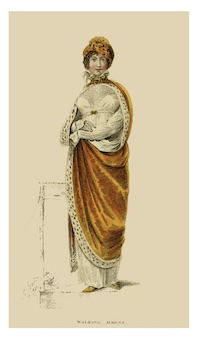
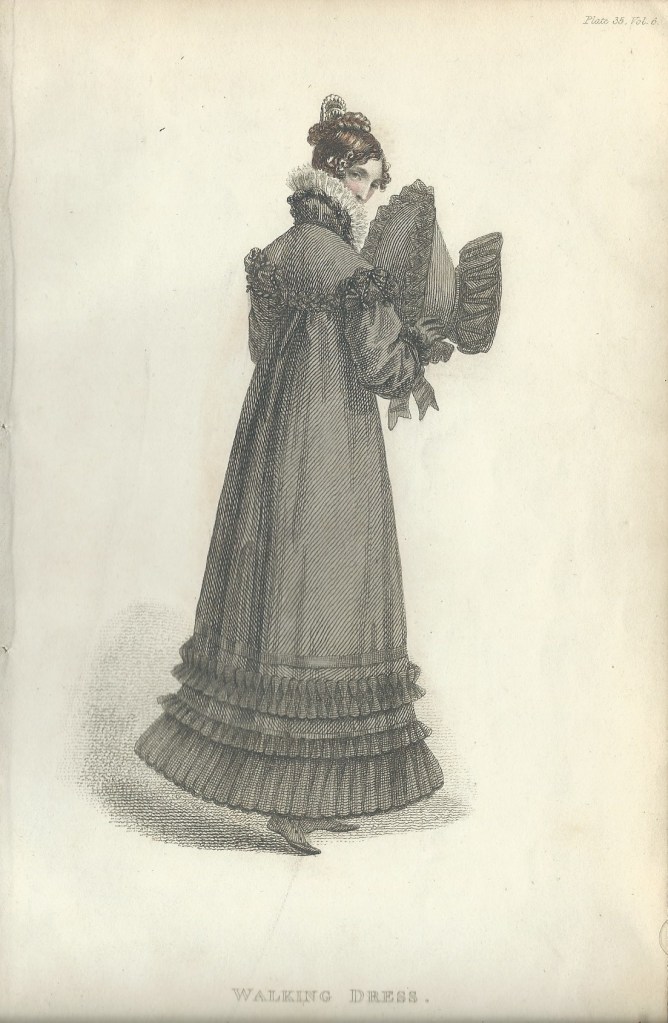
Walking Dress
A round dress of black bombazine; the body is made tight to the shape and up to the throat, but without a collar; long sleeves, with white crape weepers: the skirt is finished at the bottom with a broad black crape flounce, disposed in large plaits; over this is a very narrow flounce, which is also plaited to correspond; a little above this is a third flounce, which is quilled in the middle to correspond, and the whole is surmounted by a broad band of bias crape. The spencer worn with this dress is composed of black clothing; it is cut without a seam, and ornamented with a fullness of black crape, disposed in large plaits at the bottom of the waist: a high standing collar rounded in front, made to stand out from the neck, and edged with a light trimming of black crape: long loose sleeves, finished at the hands with black crape trimming, and surmounted by epaulettes draperied with black cord and ornamented with small tassels. Head-dress, a bonnet of black crape of a moderate size; the edge of the brim is finished with a row of large hollow plaits; the crown is trimmed to correspond. A white crape frill stands up round the throat. Gloves and shoes black chamois leather.
Admiral Cornelius Hardcastle met his future wife Léonie at the Siege of Toulon. Their daughter Cornelia is the heroine of The Marriage Obligation.
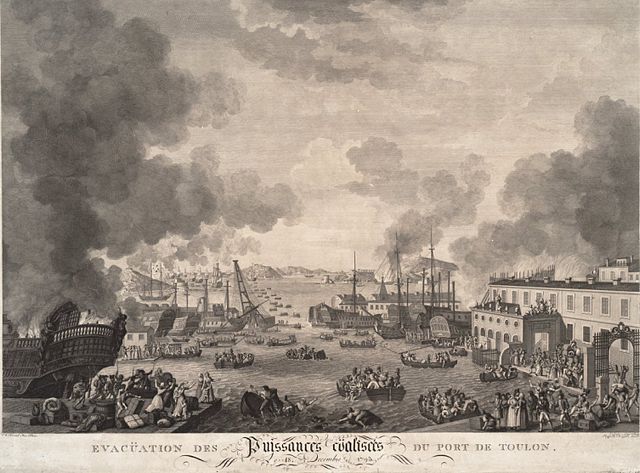
The fictional character of Admiral Hardcastle is based on Admiral Sir Benjamin Hallowell Carew, whose ship, the HMS Leviathan, took part in the evacuation of allied troops and royalist civilians being persuaded by the Republican army.
Siège_de_Toulon
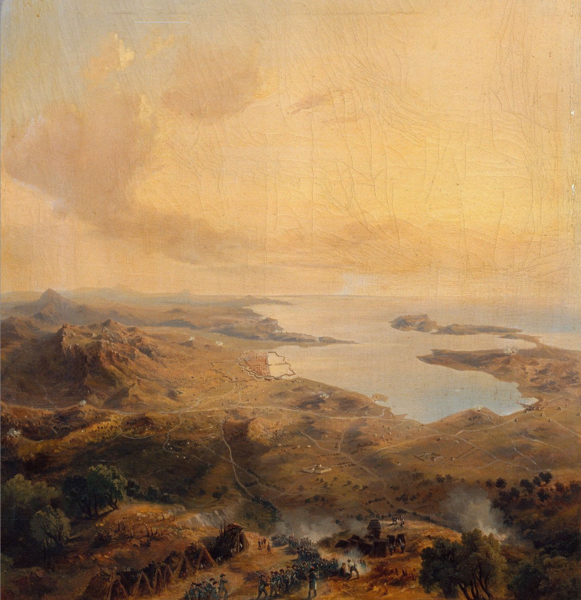
The Siege of Toulon
The Siege of Toulon (29 August – 19 December 1793) was a military operation by Republican forces against a Royalist rebellion in the southern French city of Toulon.
After a series of insurrections against the Republicans within the French cities of Lyon, Avignon, Nîmes, and Marseille, Republicans managed to recapture Marseille and punish them with severe reprisals. Upon hearing this, Toulon, which was currently in the hands of Royalist forces, called for aid from the Anglo-Spanish fleet. On 28 August, Admiral Sir Samuel Hood of the Royal Navy and Admiral Juan de Lángara of the Spanish Navy, committed a force of 13,000 British, Spanish, Neapolitan and Piedmontese troops to the French Royalists’ cause. This was a serious blow to the Republicans, since Toulon had a key naval arsenal and was the base for 26 ships (about a third of the French navy). On 1 October, Baron d’Imbert proclaimed the young Louis XVII to be king of France, and hoisted the French Royalist flag of the fleur de lys, delivering the town of Toulon to the British navy.
Les_coalises_evacuent_Toulon_en_decembre_1793
By 16 December, however, the Republicans (among them a young Bonaparte), managed to push past the Allied troops toward the waterfront. At that point, Lángara gave the order to destroy the French ships. While that was going on, Hood had ordered HMS Robust under Captain George Elphinstone and HMS Leviathan under Captain Benjamin Hallowell Carew to evacuate the allied troops from the waterfront. In addition to the soldiery, the British squadron and their boats took on board thousands of French Royalist refugees, who had flocked to the waterfront when it became clear that the city would fall to the Republicans. Robust, the last to leave, carried more than 3,000 civilians from the harbour and another 4,000 were recorded on board Princess Royal out in the roads. In total the British fleet rescued 14,877 Toulonnais from the city; witnesses on board the retreating ships reported scenes of panic on the waterfront as stampeding civilians were crushed or drowned in their haste to escape the advancing Republican soldiers, who fired indiscriminately into the fleeing populace.
Wikipedia
Author’s Note: I’ve advanced Cornelia’s age five years for the purpose of this story. An author’s prerogative!
About The Marriage Obligation
Cornelia Hardcastle has been determined never to marry since she was eighteen and discovered an ugly family secret. Now that she’s twenty-four, however, her parents want to see her settled so they can move to Canada for her father’s prestigious new government post. Not a chance!
The second son of a viscount, Preston Warrington is more than happy to leave the viscount business to his brother so he can travel the world in search of adventure. His recent stint as a spy for the British in the War with the French has come to an end, and he’s getting pressured to marry and settle down. Hell no!
How could the notorious Marriage Maker from Inverness all the way in Scotland possibly know that these two marriage-averse individuals are perfect for each other?
Excerpt
Note: At this point in the story, Cornelia has confessed her terrible secret to Preston, her husband-in-name-only.
He took her hand and led her back to the folly. “There, you got it out. That wasn’t so bad, was it?”
She tilted her head to look at him. “You’re not—shocked? Disgusted?”
He squeezed her hand and looked directly into her eyes. “Surprised, yes, certainly. Disgusted? I don’t quite understand your meaning, Cornelia.” His eyes widened. “Unless you are thinking—surely not—that I should be disgusted by you!”
She burst into tears. He pulled her trembling body into his arms and held her against him until her body quieted and the tears slowed, eventually turning into occasional hiccups. When she raised her head from his chest, he handed her his handkerchief. “Shall we sit down? When you are ready, you can tell me what it is that has you so distressed.”
Dabbing at her eyes, she nodded and allowed him to guide her back to the stone seat.
“I must look a mess,” she said finally, in a shaky voice.
“You look beautiful,” he said, his hand making gentle circles on the surface of her back.
She made a face. “Liar. I’ve seen my face in this condition before. Red eyes, splotchy cheeks, shiny nose. Definitely not a good look for me.”
In response, he reached over and turned her face toward his before capturing her lips with his for a tender kiss. Her sweet response tempted him to deepen it into something more passionate, but he sensed she was not ready for that and reined in his desire.
“Do you still believe I was lying, my dear?” he said as their kiss ended.
She swallowed. “Perhaps you were just being kind.”
Well, then. If she did indeed need more convincing, he would be more than pleased to deliver it.
He took her face in his hands again and kissed her again, this time with more pressure, then pulling away slightly to tease her lips with his tongue, before probing between them with his tongue. Her eyes widened with surprise, but far from protesting, she pressed closer to him, her arms floating to his shoulders. She smelled of violets and tasted like a combination of innocence and passion. His hands drifted to her hair, where his gentle caresses caught on pins and sent dark locks spilling down her back. When her eyes widened, he took her lips again, this time plunging his tongue between her teeth and coercing a timid response from hers.His hands floated down her back, lightly touching the side of her breasts before settling possessively at her waist.
Mine. My woman. This woman was made for me. She has to know ittoo.
When they finally pulled apart, she looked down, flushed and breathing hard.
“Well?” he said when he found himself able to talk again. “Was that a ‘just being kind’ kiss, do you think?”
She looked up at him, her eyes lit with a mischievous glow. “You’ve proved your point. There was nothing ‘kind’ about it. I must allow that you are a magnificent kisser, Preston.”
His breath quickened. “There is nothing I would like better than to kiss you like that every day. Several times, in fact. I am convinced that we could have an exemplary partnership, my dear, if we were to make our marriage a real one.”
This post is part of the Authors in Bloom Ten-Day Blog Tour. Each stop on the tour will offer a prize, and a Grand Prize of an eReader and a $25 Gift Card will be awarded to two participants who comment on each and every one of the participating blogs.
My prize is a print copy of my time travel romance, A Home for Helena, about a young woman who discovers she was kidnapped from Regency England as a child. This prize is International and will be awarded to a random commenter on this blog post.
Note: Be sure to leave your contact email in your comment so that you can be contacted if necessary.
What is technically called a made-dish, presupposes either a more elaborate mode of cookery than plain frying, boiling, or roasting or else some combination of those elementary processes,—as, for example, half-roasting and finishing in the stew-pan, which is a very common way of dressing a ragout. All dishes commonly called French dishes are of this class, such as fricassees and ragouts, meat braised, larded, &c. and so are hashes, curries, and generally all viands that are re-dressed.
…
Made-dishes are valued by the gourmand for their seasonings and piquancy, but they are equally esteemed by the economist from the circumstance of a much less quantity of material than would suffice for a boil or roast, making a handsome and highly-flavoured dish; while, by the various modes of re-dressing, every thing cold is, in a new made-dish turned to good account. The most common fault of made dishes is, that they are overdone.
…
The very name made-dish, with us implies something savoury and highly relishing, and though over seasoning is to be avoided, it is proper that made-dishes should rather be piquant than insipid.
Made-dishes of beef that has been dressed.
Few persons come to the years of eating-discretion like cold meat, and though the days are quite gone when the hospitality of the landlord was measured by the size of the joint, it still happens that where a table affords any variety of dishes, much meat will be left cold. The invention of the culinary artist is thus put on the rack for new forms and modes of dress, and new names for various dishes which are intrinsically one. The most common and the best methods of dressing cold beef are broiling, heating in the Dutch oven, or hashing.
Mrs. Leah Barlow, mother of five lovely daughters herself, has graciously condescended to provide Susana’s Parlour with some of her tasteful advisements on housewifely matters, such as meal planning and the rearing of children, in hopes that our readers will find them informative. Having recently set up a Twitter account where she will be sharing her most treasured household tips, she hopes many of you will follow her: https://twitter.com/lucybarlowsmom
Much of her advice comes from this manual, which she insists should be in every housewife’s possession:
The Cook and Housewife’s Manual, Containing the Most approved Modern Receipts for Making Soups, Gravies, Sauces, Regouts, and All Made-dishes; and for Pies, Puddings, Pickles, and Preserves; Also, for Baking Brewing, Making Home-made Wines, Cordials, &c.
Mrs. Margaret Dods (Christian Isobel Johnstone), Edinburgh, 1826
Without dowries or the opportunity to meet eligible gentlemen, the five Barlow sisters stand little chance of making advantageous marriages. When Lucy, the eldest, attracts the attention of a wealthy viscount, she knows she should encourage his attentions, since marriage to a peer will be advantageous to all. The man of her dreams was Andrew Livingston, her best friend’s brother. But he’s always treated her like a child, and now he’s betrothed to another. Perhaps the time has come to accept reality… and Lord Bexley.
Andrew returned from the Peninsular War with a lame arm and emotional scars. Surprisingly, it’s his sister’s friend, “little Lucy”—now a strikingly lovely young woman—who shows him the way out of his melancholy. But with an eligible viscount courting her, Andrew will need a little Christmas magic to win her for himself.
 Alicia’s story begins in The Third MacPherson Sister, where her unkindness results in Rebecca MacPherson’s unceremonious removal from London. But the spoiled duke’s daughter suffers repercussions as well, and for the first time she yearns to be a better person. Perhaps the handsome young vicar might be able to help her.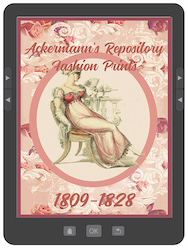











 Susana's Parlour