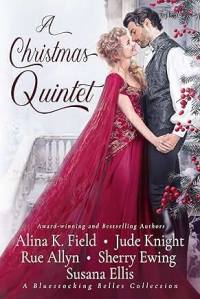
For anyone who ordered A Christmas Quintet on Amazon and received the wrong book, Amazon has advised us to (1) Ask for a refund on the order page and (2) if that doesn’t work, call 888-280-4331. Simply explain that you purchased the book, it was the wrong book, the book is no longer on your Kindle, and you require a refund.
We humbly apologize for the error and the inconvenience it has caused you.
We are still working on a solution with other vendors.
Della’s Gown for the Lauds’ Christmas Ball
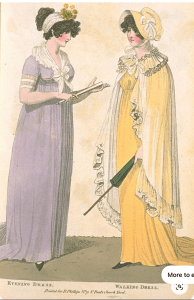
You may know that I am an avid collector of fashion prints. I have a ton of them! When I was writing Della’s Christmas Gift, I started looking around for a ball gown for her to wear at the Lauds’ Christmas Ball in 1801. This is the one I chose for her. You can read about it in this excerpt:
Madame Celeste Modiste
Leicester, Leicestershire
12 December 1801
“Well, I do think the white satin trimmed in gold would become you well, Della, with your dark hair. White is the fashionable color these days. Mama says white is the only appropriate color for young girls to wear in the evening.”
Helena held up the shimmering fabric against Della’s chest while an employee obligingly carried the remainder of the bolt.
“I told you I shan’t wear white,” Della insisted, pushing the fabric away. “White isn’t even a color. I prefer the lavender sarcenet.”
Stepping off the small stool, she selected the lavender bolt and held it under her face in front of the mirror.
Helena took a step back and studied her for a moment. “I must say, it does flatter your coloring. Perhaps with a delicate white handkerchief tied about the neck.”
Della frowned at the white handkerchief idea, but eventually agreed that white was the best trim color for the dress. Necklines for evening were lower than she was accustomed to, and she wasn’t eager to show off too much décolletage. She found her full breasts somewhat embarrassing, not to mention inconvenient when she was out tending the stock. She was secretly envious of Helena’s more elegant figure that better suited the current styles. Her bosoms didn’t jiggle when she moved quickly or danced, nor was she ogled by members of the male sex wherever she went.
After hearing her grumble about this, Helena laughed. “My dear, you don’t know how many young ladies envy your-er-fullness.” She glanced down at her own meager chest. “Mama kept telling me mine would fill out in time, but I haven’t seen evidence of it so far, and I’m a full year older than you are.”
Della’s eyes widened. “But… why? They are so… unwieldy! I’ve tried binding them to my chest, but it’s not at all comfortable, and Thomas and the farmhands laugh at me behind my back.”
A shocked gasp came from behind her. “Oh mademoiselle, you must never do such a thing again! You have lovely high bosoms that should be cherished and prized, even exploited!”
Madame Celeste grinned at Della’s white face. “Poor dear, it is such a dommage you have had no maman to guide you. For she would have advised you that a chest such as yours is highly attractive to gentlemen. Your husband will convince you of that, when you are married.”
Well! Della couldn’t understand that at all. In any case, she didn’t want a husband, unless it could be Toby Boxworth. But he seemed to prefer Helena’s more modest figure.
While she mulled over this contradiction, Madame Celeste and Helena discussed a way of using boning under the breasts in her short stays to provide more support. Following this, the young ladies sorted through ribbons and trims for the neckline and sleeves, purchased a small length of white satin for the headdress, and headed for the haberdashery next door for a few sprigs of silk lavender flowers to dress it up.
“As for slippers,” Helena suggested when they entered the ladies’ shoe shop across the street, “Purchase at least two pairs if you plan to dance. I’ve had mine shred to pieces at a ball and would have had to return home in my stockings had my maid not brought along a spare.”
“Perhaps they should be made sturdier,” Della mumbled as the proprietor approached with a bow. Helena gave her a warning glance before she smiled and spoke to him.
“My cousin wishes to be measured for two pairs of white silk dancing slippers, if you please. They’ll be needed soon, for a Christmas Eve ball.”
“Ah, for the ball at Laud Manor. Come this way, miss. We will get you fitted up in good time for the event.”
“Please, do make them as stout as you can. Miss Paget is extraordinarily fond of dancing, you see.” Helena smiled wickedly at Della, who rolled her eyes.
The shoemaker clenched his jaw. “Our footwear is always sturdy, miss. We serve the best families in the shire, and they never have cause to complain.”
I hesitate to ask this in view of the inconvenience I’ve caused by uploading the wrong file for A Christmas Quintet; however, if you could contribute a review to any book vendors or sites like Bookbub, the Belles would be exceedingly grateful! I never realized a simple mistake could cause such an avalanche of bad publicity!
Susana and her sisters have just discovered that they are going to participate in the Season in York, and they are excitedly planning how to manage wardrobes for the seven older girls when they have scarcely enough money for one. Thankfully, Susana is a quasi-professional dressmaker, and she can help them create a wardrobe that all can share with enough clever disguises.
“You know, Susana, I think there are some gowns and things of Mama’s up in the attic. Perhaps from our stepmothers as well, although I believe Martin removed his mother’s things for Chloe.”
“Well, he can just bring them right back, since our stepsister is to be presented too.” They knew Chloe well; she’d lived with them until her mother’s death, when her brother Martin and their guardian, their mother’s brother, took her in. She visited her half-sisters Emma and Merri occasionally. And Martin, relieved to have Patience take on Chloe’s presentation, had eagerly provided funds to pay for the ball. And her wardrobe, so that was one sister Susana did not have to clothe.
“Let’s take a look.”
It had been years since she had perused her mother’s things. Nine years since her death, when the maids had packed up her possessions and banished them to the attic. And fortunate indeed that they had made their way to Starbrook after the family had been exiled from the main house. No doubt the newest Lady Seahaven would have organized a bonfire for all of her predecessors’ belongings.
Not a nice thought, she chided herself. But it was hard to think well of the usurping Seaheavens, who had inherited and dislodged them from the home they had known all their lives.
Mama, she thought as they opened one of the chests that held her things. You were the same age as Barbara when you left us. How I wish you were still here.
The Lady Seahavens hadn’t moved much in society, as their thoughtless husband saw no need to take them along when he traveled to London, for Parliament, and other things. His ladies had no need of extravagant gowns. But they did socialize with the local gentry, so Doro and Susana did find a few of their mother’s evening gowns. Of course, they were nine years out of fashion, but Susana thought she could make them work with a few alterations. The trims were a bit worse for wear, but there might be a way to revive them.
“Oh, look at this!”
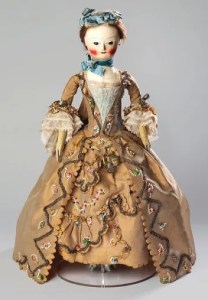
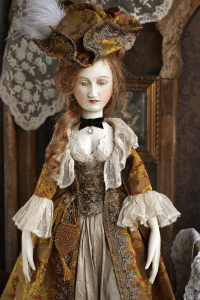
Doro held out a doll, about sixteen inches long, wrapped in delicate tissue paper. The head and body were carved of a single piece of wood; the legs were of wood too but separately attached to the torso. The upper arms were formed of stuffed linen, also attached to the torso, wooden lower arms and hands attached to those.
“I remember this!” cried Susana. “Mama showed it to me once and said it was made to resemble the Duchess of Devonshire. See the hairstyle and the wide bonnet! She has all the undergarments too! And the sash: she’s dressed for the 1784 election campaign. Mama said her grandfather had it made for her. It wasn’t a toy, though. It’s a Pandora. A fashion doll. That’s why she wouldn’t let me play with it.”
“It’s beautiful,” said Doro wistfully. “It shouldn’t be left in old trunk.”
“If we put it out somewhere, we’ll have to be sure Emma and Merri don’t get their hands on it.”
“And Jane,” Doro added absent-mindedly. “Look at the quality of the material—the stockings, the chemise, the petticoats. And there’s a corset too—looks exactly like the real thing!”
Susana ran her finger along the blue silk overdress. “The silk is very fine. I would say French, coming from that era.” She turned to the reverse side and gasped. “It’s English. It’s stamped Macclesfield Silks.”
Macclesfield Silks. Where Blaise had gone to work. With a man called Thomas Pemberton.
“Doro,” she said slowly. “What was our mother’s birth name?”
Doro squeezed her eyes shut. “We never met them, for some reason. Mama never spoke of them. I suppose they disapproved of her marriage, although most people would be over the clouds happy for their daughter to marry an earl.” She grabbed Susana’s arm. “Pemberton! Her name was Maryann Pemberton!”
Susana’s mouth fell open. Could it be true? She and Doro and Barbara related to the Thomas Pemberton of Macclesfield Silks?
“A cup of tea,” she said. “I need a cup of tea.”
Pandora Dolls
Many of you know that I collect fashion prints. I have a ton of them and love them all. But in the time prior to fashion prints, there were fashion dolls. One of them was called a Pandora.
How on earth was a fashionable lady in the 18th century able to keep up with the latest trends? The answer was the Pandora, or miniature dolls dressed up in the latest modes. Keep in mind, this was long before magazines were invented—and the first ones were incredibly rare and expensive, as they were hand-painted by groups of (probably shockingly underpaid) little girls and young women! Clothing was also far more expensive than it is today, so it was important to know all the details of the cut, colour and fabric that you wanted.
In 1712, when Britain and France were at war with each other, Pandora dolls were exempt from the ban on enemy imports, and even received a military escort! Marie-Antoinette, when preparing to go over to France from Austria, got sent a host of these dolls in different fabrics and fashions.
Today, fashion victims use fashion magazines, shows etc. to become informed about fashion news. But what sources did they use in the 18 th century to catch the latest trends when none of these media existed? Long before the first Barbie appeared, there already existed a doll that wore lavish wardrobe and matching accessories but didn’t function as a toy at all. This paper examines how a doll called Pandora was sent abroad by French dressmakers to promote and sell Parisian fashion around the world. First, Pandora had to conquer the royal houses in Europe. Then, she made her way into the department stores and finally into the bourgeois home. Interestingly, her triumphal procession did not stop there: By the middle of the 18th century she had even crossed the Atlantic to be exhibited in Boston and New York….
The doll’s body and head were carved by hand from one piece of wood, which had been turned on a lathe. The legs were made separately and attached at the hips and knees to the Pandora’s body. The lower arms and hands were also crafted of wood; in contrast the upper arms were ‘[…] made of either soft linen fabric or kid leather, attached to the torso’.Most dolls had painted eyes, but some of them had sparkling glass eyes, which was more labour-intensive because for this purpose the doll maker had to carve diamond-shaped holes into the head and then inserted blown glass balls….
Furthermore, the fashion dolls all had either painted hair or wore wigs made of flax or wool. The hair of the dolls was designed to be worn in the popular style of the time because it was absolutely essential that besides wearing the right clothes, the Pandora had the latest hairstyle as well as accessories that matched her wardrobe. Interestingly, although most 18 th century dolls represented women or girls, there also existed male, boy and even infant dolls. Unfortunately, the vast majority of these fashion figures of the late 17 th and early 18 th century have not withstood the test of time. This is due to two reasons: Firstly, the unwieldy size of the dolls and secondly, the material that was used to make them….
An English 18th –century fashion doll in the Fashion Gallery at the V&A. There are 6 fashion dolls in the same room.
Intended as advertisement for the French fashion and the dressmakers, the dolls functioned as mannequins and were dressed in a petite-size version of everything a fashionable woman needed to wear, including the proper foundation garments, which meant that the Pandoras were outfitted head to toe and displayed the latest fashions concerning clothes and hairstyle. ‘By the seventeenth century, when these French figures were known as “Pandora,“the dressing of the head and hair was as important as the garment’. The doll’s outer garment was a dress made of highest quality cloth: linen, cotton, wool brocade or silk, followed by a petticoat or multiple layers of petticoats, which gave the dress or skirt the desired fashionable shape. The hoop petticoat or wicker, also known as panier, was part of the women’s underwear and consisted of a basket. ‘They [the petticoats] could get as wide as 18 feet (5 metres), and satirists talked of hoops of 7 or 8 yards (6 or 7 metres) wide’. The extremely wide framework of the hoop made it difficult for women to walk through the doors, sit down on a chair or in a coach. Some even wore a stomacher, which was in fashion throughout the 17 th and 18 th century in Europe and North America. The stomacher was a v-shaped piece of fabric made either of the same material as the dress or of contrasting materials. It was worn across the chest and stomach and embroidered or decorated with pearls or other gemstones. Other key characteristics of women’s clothing that were also part of the fashion dolls’ outfit were corsets and linen shifts. Knitted stockings, shoes, a muslin cap and jewellery often completed the outfit.
Another question is: who were the potential buyers of the fashion dolls? First, the dressmakers and tailors purchased the fashion doll. Above all the Pandoras functioned as display and show items. Since fashion was extremely expensive, the rich costumers wanted to have a look at what they were going to spend their money on….
The French doll makers received orders from all over the world, since almost every British women of that time wanted to have their one little mannequin to keep abreast with the latest Parisian fashion trends. In the Augustan Age it was very common not only to adopt the French customs, etiquette, lifestyle and manners but also the clothing fashions. It is remarkable how widely the dolls were distributed geographically in the 18 th century. They were not only dispatched throughout Europe but were also shipped across the Atlantic. Travelling around the world in the name of fashion, the Pandoras took over two functions: on the one hand, they were the ideal advertising vehicle for French fashion; on the other hand, they served as a kind of diplomatic representation of France. The fashion doll became one of the most important and popular French export goods.
And then I discovered that newly-created French court fashion dolls can be purchased on Etsy. You might have to sell your family heirlooms to buy them, but one can dream!
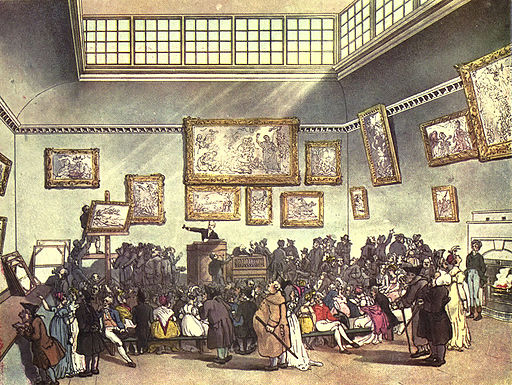
The print annexed is a spirited representation of that interesting scene, a public auction. The various effect which the lot (a Venus) has on the company, is delineated with great ability and humour. The auctioneer, animated with his subject, seems to be rapidly pouring forth such a torrent of eloquence as cannot fail to operate on the feelings of his auditors; indeed, having two of their senses enlisted in his favour, there seems to be little doubt that he will succeed. The eloquence of the rostrum is of a peculiar nature, Foote, who delineated every object that he chose with an astonishing truth and felicity, has, in his Minor, drawn an auctioneer with so much whim and drollery, and which, if a little outré, possesses so many striking characteristics, that it may serve for a portrait of the whole. Our animated auctioneer, adorning his Venus with all the flowers of rhetoric, seems to be saying, with Smirke in the Minor, “A-going for five and forty, — no body more than five and forty? — Pray, ladies and gentlemen, look at this piece! — quite flesh and blood, and only wants a touch from the torch of Prometheus, to start from the canvass and fall a-bidding!” And these flowers are not scattered in vain; (‘for,” continues Smirke, “a general plaudit ensued, — I bowed, and in three minutes knocked it down at sixty-three — ten”
The tout-ensemble of this print is marked with propriety and interest. The great variety of character, the masses of light and shade judiciously opposed to each other, the truth of the perspective, and the felicity of touch which the artist has adopted to give the idea of old pictures in the back ground, hwe the happiest effect imaginable.
That in the rage for purchasing old pictures the craft of experienced dealers should frequently impose upon those who might think it necessary to appear to have, what nature had denied them, taste and judgment, is not to be wondered at. All living genius was discouraged, or only found patrons in these dealers if they would condescend to manufacture for them Raphaels and Claudes, Corregios and Salvator Rosas. That they could not always get a sufficient supply of copies from Italy, the following extract from a valuable work may give some idea: — “Among the papers of a lately deceased virtuoso, I met with a few manuscript sheets, entitled ‘Hints for a History of the Arts in Great Britain, from the Accession of the Third George.’ The following extract proves, that painting pictures called after the ancient masters, was not confined to Italy: we had in England some industrious and laborious painters, who, like the unfortunate Chatterton, gave the honours of their best performances
To others. To the narrative there is no date, but some allusions to a late sovereign determine it to be a short time before we discovered that there were, in the works of our own poets, subjects as well worthy of the pencil as any to be found in the idle tales of antiquity, or the still more idle legends of Popery.
“The late edict of the emperor for selling the pictures of which he has despoiled the convents, will be a very fortunate circumstance for many of the artists in this country, whose sole employment is painting of old pictures; and this will be a glorious opportunity for introducing the modern antiques into the cabinets of the curious.
“A most indefatigable dealer, apprehensive that there might be a difficulty and enormous expence in procuring from abroad a sufficient quantity to gratify the eagerness of the English connoisseurs, has taken the more economical method of having a number painted here. The bill of one of his workmen, which came into my hands by an accident, I think worth preservation, and I have taken a copy for the information of future ages. Every picture is at present most sacredly preserved from the public eye, but in the course of a few months they will be smoked into antiquity, and roasted into old age, and may probably be announced in manner and form following:
‘To the Lovers of Virtu.
‘Mr. — has the heartfelt pleasure of congratulating the lovers of the fine arts upon such an opportunity of enriching their collections, as no period, from the days of the divine Apelles to the present irradiated era, ever produced; nor is it probable that there ever will be in any future age so splendid, superb, brilliant, and matchless ail assemblage of unrivalled pictures, as he begs leave to announce to the connoisseurs, are now exhibiting at his great room in; being the principal part of that magnificent bouquet, which has been accumulating for so many ages, been preserved with religious care, and contemplated with pious awe, while they had an holy refuge in the peaceful gloom of the convents of Germany. By the edict of the emperor, they are banished from their consecrated walls, and are now emerged from their obscurity with undiminished lustre! with all their native charms mellowed by the tender softening- pencil of time, and introduced to this emporium of taste! this favourite seat of the arts! this exhibition-room of the universe! and need only to be seen to produce the most pleasing and delightful sensations.
‘When it is added, that they were selected by that most judicious and quick-sighted collector. Monsieur D, it will be unnecessary to say more; his penetrating eye and unerring judgment, his boundless liberality and unremitting industry, have insured him the protection of a generous public, ever ready to patronise exertions made solely for their gratification.
‘N. B. Descriptive catalogues, with the names of the immortal artists, may be had as above.’
“THE BILL.
‘Monsieur Varnish, To Benjamin Bistre, Dr.
‘To painting the Woman caught in Adultery, on a green ground, by Hans Holbein £3 3 0
‘To Solomon’s wise Judgment, on pannel, by Michael Angelo . 2 12 6
‘To painting and canvass for a naked Mary Magdalen, in the undoubted style of Paul Veronese 2 2 0
‘To brimstone for smoking ditto 0 2 6
‘Paid Mrs. W for a live model to sit for Diana bathing, by Tintoretto 0 16 8
‘Paid for the hire of a layman, to copy the Robes of a Cardinal, for a Vandyke 0 5 0
‘Portrait of a Nun doing Penance, by Albert 0 2 2
‘Paid the female figure for sitting thirty minutes in a wet sheet, that I might give the dry manner of Vandyke* 0 10 6
‘The Tribute Money rendered with all the exactness of Quintin Mestius, the famed blacksmith of Antwerp 2 12 6
‘To Ruth at the Feet of Boaz, on an oak board, by Titian 3 3 0
‘St. Anthony preaching to the Fishes, by Salvator Rosa 3 10 0
‘The Martyrdom of St. Winifred, with a view of Holy well Bath, by Old Frank 1 11 6
‘To a large allegorical Altar-piece, consisting of Men and Angels, Florses and River-gods; ’tis thought most happily hit off for a Rubens 5 5 0
‘To Susannah bathing; the two Elders in the back ground, by Castiglione 2 2 0
‘To the Devil and St. Dunstan, high finished, by Teniers 2 2 0
‘To the Queen of Sheba falling down before Solomon, by Murillio 2 12 6
‘To Judith in the Tent of Holofernes, by Le Brun 1 16 0
‘To a Sisera in the Tent of Jael, its companion, by the same 1 16 0
‘Paid for admission into the House of Peers, to take a sketch of a great character, for a picture of Moses breaking the Tables of the Law, in the darkest manner of Rembrandt, not yet finished 0 2 6
It is to be hoped, that a general knowledge and taste for the arts are now so far diffused among us, that the nobility and gentry are awake to living merit, and can properly appreciate those powers by which the old masters have acquired their high reputation. They are no longer to be imposed on by the stale tricks of those jugglers in picture-craft, who made large fortunes by their ill-reposed confidence. A few recent examples will suffice to prove the increased taste and judgment of the public.
In March 1795, the very fine collection of pictures by the ancient masters, the property of Sir Joshua Reynolds, was sold by auction for 10,319/. 2s. 6d .; and in April 1796, various historical and fancy pieces of his own painting, together with some unclaimed portraits, were sold for 4505/. 18s. His very valuable collection of drawings and prints is not yet disposed of.
In April 1806, thirty-two choice Flemish pictures were sold by auction, and produced 6733 guineas. One of them, by Paul Potter, was knocked down at 1450 guineas; though this, it is said, was bought in.
But it is only for works of the very first-rate excellence, which, in the present state of pictorial knowledge, the nobility and gentry will be liberal; and many speculators in second and third-rate pictures have been miserably disappointed, notwithstanding the pompous and high-sounding names with which they crowded their catalogues. In the year 1802, Count Hagen consigned to England a collection of pictures, the catalogue of which announced a most select assemblage of the very first masters; and the prices they were valued at raised the expectation of cognoscent to the highest pitch: their number was about sixty, and their value he estimated at 20,000/. After many consultations whether they should be exhibited and sold by private contract, or public auction, the latter were as determined on; and that Mr. Christie, instead of two days’ view, should allow a week for their exhibition. This being settled, the sale came on, and the produce did not nearly cover the expences: it is true, that four of the best were bought in and sent back to Dresden; but the proprietor had a deficit to pay upon the others amounting to 183/. 16s. besides the freight, &c. for the return of the four unsold: so that he paid for selling his pictures, and gave them into the bargain.
About the same time a Mr. Lemmer arrived with another cargo from Vienna. This was a smaller collection, amounting to about thirty: it was generally supposed that they belonged to Count Harrach. This collection, however, met with no better success: for, after a long private exhibition, a public sale was resorted to; and the result was, that Mr. Lemmer let his rubbish go for whatever it would fetch, and bought in all the pictures that were tolerable. This mad speculation, considering the great distance, the travelling of three people in a carriage built on purpose, and drawn by six horses, and a residence of above eight months in London, could not have cost the noble speculator less than 12 or 1500/.
The fate of the Truschessian gallery is still a stronger proof of the absurd notions which foreigners entertain of the knowledge and judgment of English collectors. The count brought over a collection consisting of above one thousand pictures: and that among them were several chefs d’oeuvres, cannot be denied; but he asserted that the whole were unique, and of themselves sufficient to form a splendid national gallery; and, by his estimation, at a fourth part of their real value, they were worth 60,000/. But as Messrs. Fries, bankers at Vienna, had advanced 27,000/. to the count, and taken this collection as a security, after many unsuccessful endeavours to dispose of it, the mortgager determined to sell by public auction those not sold by private sale. These pictures were publicly exhibited for about two years: of course their merits and demerits would be fully ascertained. The net produce of the public and private sale did not amount to more than 18,000/.: and here it must be observed, that the mortgagees bought in more than twenty of the best, which they accounted for to the proprietor at the sums the auctioneer knocked them down at, and which are included in the 18,000/.
By the statute 19th Geo. III. c. 56. s. 3. it is provided, that no person shall exercise the trade or business of an auctioneer, or seller by commission, at any sale of estate, goods, or effects whatsoever, whereby the highest bidder is deemed the purchaser, without taking out a licence; which, if it is in the bills of mortality, shall be granted by the commissioners of excise, and elsewhere by the collectors, supervisors, & c.; for which licence to sell by auction in any part of England or Wales, shall be paid the sum of twenty shillings, and elsewhere five shillings; and the said licence shall be renewed annually, ten days at least before the expiration of the former; and if any person shall act without such licence, he shall forfeit 100/. if it is within the bills, and elsewhere 50/.
All kinds of property sold by auction, except cloth wove in this kingdom, and sold in the piece as taken from the loom, and in lots of 20/. or upwards, pays a duty of seven-pence in the pound; and the auctioneer shall give a bond on receiving his licence, with two sureties in 5000/. that he will, within fourteen days after every such sale, deliver an account thereof at the next excise-office, and will not sell any goods contrary to the directions of this act, 27th Geo. III. c. 13. &c.
Christie’s Auction Room
*Some of the ancient masters acquired a dry manner of painting from studying after wet drapery. WEBB on painting.
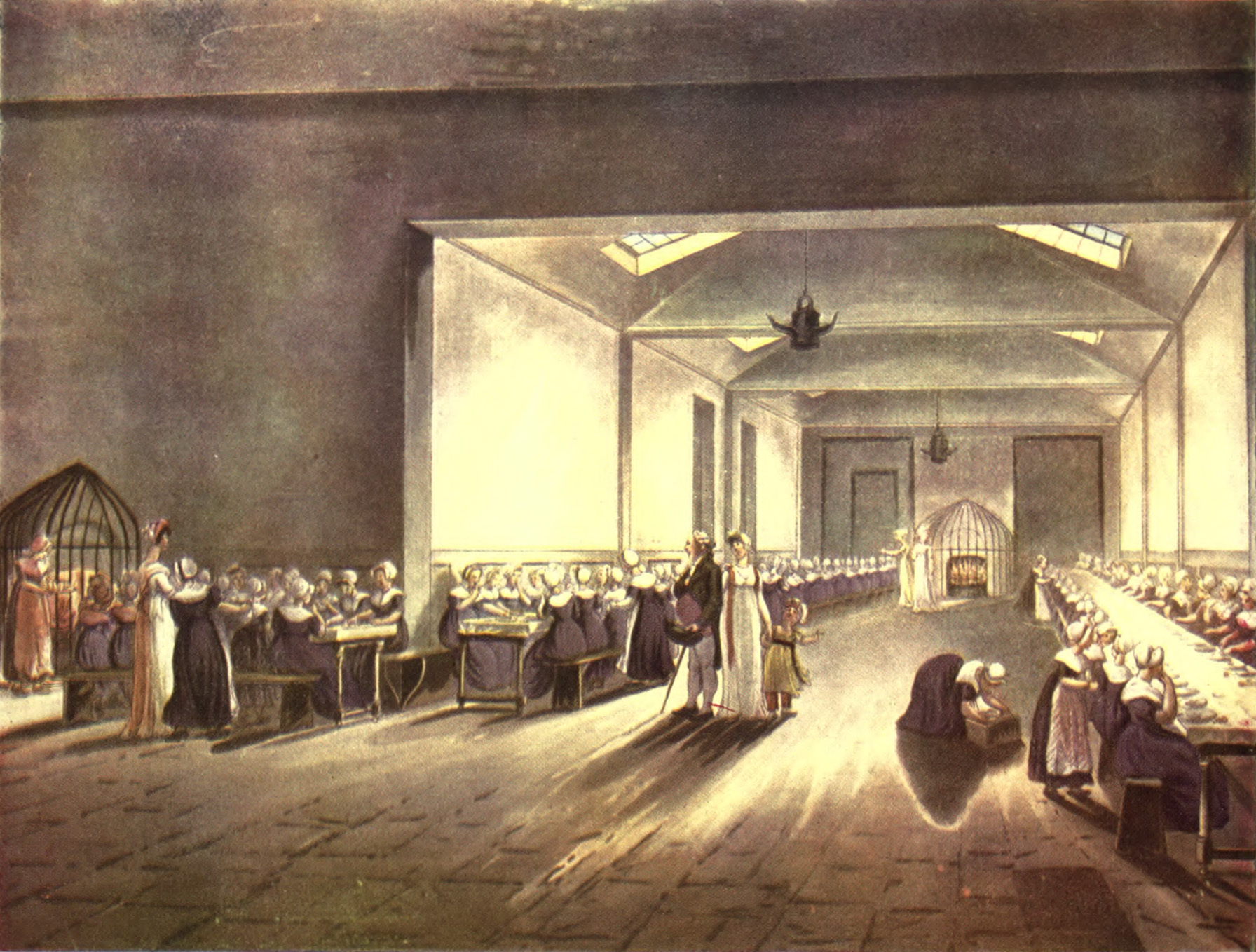
Is in the parish of Lambeth, in Surry, and was instituted in the year 1758, for the reception of friendless and deserted girls, the settlement of whose parents cannot be found. It was incorporated in the year 1800.
The annexed print is an interesting representation of the objects of this benevolent institution at their repast, in the presence of some of their guardians, who seem to contemplate the good order, cheerfulness, innocence, and comforts of their little wards, with all that interest and delight, that luxury of fine feeling, which irradiates the countenance when the heart is glowing with benevolence, animated with the exercise of an important duty, and gratified by the conviction that their virtuous endeavours are crowned with success. The coup d’ceil of the print is most impressive, and does great honour to’ the talents and feelings of the artists. The sweet innocence of the children, the benevolence of the guardians, and the chaste and matron-like simplicity of the building, aided by a fine breadth of effect, form a whole, which at the same time that the parts are in perfect harmony with each other, is admirably calculated to awaken the tender emotions of the humane heart, and excite the spectator to the exertion of those tender and kindly feelings, which do honour to our nature.
This charity owes its establishment to that vigilant and active magistrate. Sir John Fielding; who had long observed, that though the laws of this kingdom provided a parish settlement for every person, by birth, parentage, apprenticeships, &Y. yet many cases continually occurred, in which such settlements were difficult, if not impossible, to be ascertained; and therefore he and others were solicitous to remove, in part, this source of female wretchedness. By their exertions, and the continued endeavours of those who have hitherto conducted the plan, their benevolent intentions have been rewarded with the most signal success. The generous and discerning public has bestowed the means, which have prospered in the hands of the guardians, by whose care two hundred deserted females are daily sheltered and protected from vice and want, supplied with food and raiment, and taught whatever can render them useful in their situation, or comfortable and happy in themselves.
Carefully instructed in the principles of religion; in reading, writing, needlework, and household business, they are trained to habits of industry and regularity, by which means there is a supply of diligent and sober domestics for the use of that public, which, by its contributions, has so nobly acquired a right to their services.
The particular objects of this charity are, the children of soldiers, sailors, and other indigent persons, bereft of their parents, at a distance from any of their relations; who being too young to afford the necessary information respecting settlements, are often left destitute of protection and support, at an age when they are incapable of earning a subsistence, and contending with surrounding dangers.
Females of this description are, in a particular manner, the objects of compassion, and have also a double claim to the care of the humane and virtuous, from being not only exposed to the miseries of want and idleness, but, as they grow up, to the solicitations of the vicious, and the consequent misery of early seduction.
The following are some of the regulations for the government of this charity, which have been made by the guardians from time to time, and now continue in force.
Qualifications of Guardians.
The qualification of an annual guardian is, a yearly subscription of three guineas or upwards.
The qualification of a perpetual guardian is, a subscription of thirty guineas or upwards.
Legacies bequeathed to the use of this charity of one hundred pounds or upwards, when paid, shall entitle the first-named acting executor to be a perpetual guardian.
The guardians, conceiving it to be very essential for promoting one of the chief objects of this institution, earnestly solicit the ladies, who are particularly qualified for that purpose, frequently to visit the charity, inspect the management of the house, and particularly the employment of the children; also to see that they are properly instructed in housewifery, so as to be qualified for useful domestic servants; and from time to time communicate to the committee, by letter or otherwise, such observations as they shall deem proper to make.
Employment of the Children.
The children are to make and mend their own linen; make shirts, shifts, and table-linen; to do all kinds of plain needle-work, and to perform the business of the house and kitchen; to which latter twelve are appointed weekly, according to their age and abilities, to assist the cook, to wash, iron, and get up all the linen. They are likewise taught to read the Bible, write a legible hand, and understand the first four rules in arithmetic.
All kinds of plain needle-work are taken in at the Asylum, and performed
by the children at certain rates, which are regulated by the committee.
The following ore the Rules for placing out the Children.
They are to be bound apprentices for seven years, at the age of fifteen, or sooner, as domestic servants to reputable families in Great Britain.
No girl shall be apprenticed until the character of the master or mistress applying for the same, shall have been enquired into, and approved of by the committee.
Every person applying for an apprentice must appear at the committee, to give the necessary information respecting their situation, unless such appearance be dispensed with by the committee.
When any girl shall become qualified to be an apprentice, the guardian who presented her shall be acquainted therewith, in order to know if such guardian has any place in view for her.
The guardians, desirous of encouraging the children to serve their apprenticeship faithfully, have empowered the committee to grant any orphan apprenticed from the charity, who shall produce to the committee a certificate, signed by her master or mistress (or both if living), of her good behaviour during her apprenticeship, the sum of five guineas, such orphan having first returned public thanks in the chapel for the protection she has received. The committee are empowered to put out at any time, to any trade they shall think proper, such orphans as may have contracted any disease or infirmity, which may render them incapable of domestic service, with a premium not exceeding ten pounds.
The Establishment is as follows:
Patroness of the Institution.
Her Most Gracious Majesty the Queen of Great Britain
President.
His Royal Highness Prince Adolphus Frederick, Duke of Cambridge.
Vice-Presidents.
The Marquis of Blandford.
Right Honourable Earl Spencer, K. G.
Right Honourable Earl Mansfield.
Right Honourable Admiral Lord Radstock.
Right Honourable Lord Chief Baron.
Sir William Leighton, Knight and Alderman.
A chaplain, a morning preacher, an evening preacher, two physicians, two surgeons, an apothecary, a secretary, messenger, and collector. There are also a treasurer, and a committee consisting of nineteen gentlemen, that are elected annually at the general court held every April. Concerning these for each year, and many other things relative to this praise-worthy institution, every necessary particular may be found in a small abstract account to be had at the Asylum; from which we extracted the following regulations respecting devises or bequests to the charity, as we have much besides in the preceding pages.
Well-disposed persons, who may be inclined to make devises of rent, or bequests of personal property, for the benefit of this charity, being authorised so to do by the act of Parliament whereby it is incorporated, will be pleased to make such devises and bequests to this corporation by the style and title of The President, Vice-presidents, Treasurer, and Guardians of the Asylum for the Reception of Orphan Girls, the Settlement of whose Parents cannot be found.
Bankers and Receivers .
Messrs. Hankey and Co. Fenchurch-street.
Messrs. Drummond, Charing-Cross.
Messrs. Hoares, Fleet-street.
Messrs. Croft and Co. Lombard-street.
Messrs. Vere, Lucadon, and Co. Lombard-street.
Messrs. Sikes, Snaith, and Co. Mansion-house-street.
The committee, who meet at the Asylum every Thursday, at eleven o’clock in the forenoon.
Charles Wright, Esq. treasurer, and The Rev. Mr. Agutter, at the Asylum, chaplain and secretary.
We shall close the account of this benevolent institution with the animated apostrophe of the amiable Pennant.
“It is an institution of a most heavenly nature, calculated to save from perdition of soul and body the brighter part of the creation; those on whom Providence hath bestowed angelic faces and elegant forms, designed as blessings to mankind, but too often debased. The hazards that these innocents are constantly liable to from a thousand temptations, from poverty, from death of parents, from the diabolical procuress, and sometimes from the stupendous wickedness of parents themselves, who have been known to sell their beauteous girls for the purpose of prostitution, induced a worthy hand, in the year 1758, to found the Asylum, or House of Refuge. Long may it flourish, and eternal be the reward of those into whose mind so noble a design entered!”

 I hesitate to ask this in view of the inconvenience I’ve caused by uploading the wrong file for A Christmas Quintet; however, if you could contribute a review to any book vendors or sites like Bookbub, the Belles would be exceedingly grateful! I never realized a simple mistake could cause such an avalanche of bad publicity!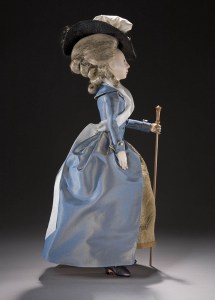



 Susana's Parlour