Archives

Allison Lane: Regency Masquerades

Late Georgian Carriage Travel

Have you ever wondered how long it would take to drive 200 miles in 1810 and whether the average person could afford the trip?

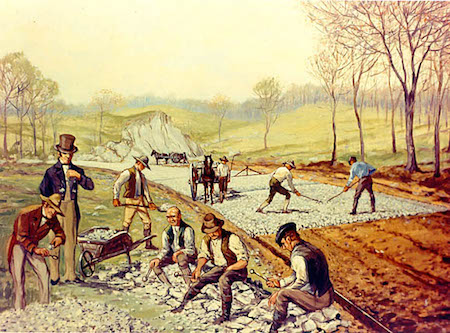
Building a macadamized road

Building a macadamized road

Long-distance travel in England during the late 18th and early 19th centuries was slow and very expensive, which explains why most people spent their entire lives within five miles of their birthplace. But the upper classes did travel—to London, to their secondary estates, to visit friends… Yet it wasn’t easy. Roads were bad—muddy, rutted, sometimes completely impassible due to weather. The turnpikes gradually improved as the 18th century progressed, but even with that, by 1800 only the Bath-to-London road was truly good – it had been moved and rebuilt from scratch in 1787. Macadamization, which produced a smooth, fast surface, did not start nationally until 1818, wasn’t finished on the turnpikes until 1828, and wasn’t affordable for secondary roads until well into Victoria’s reign. During the upgrade, many travelers encountered detours that sent them along secondary roads, country lanes, or worse. (I encountered a similar situation a few years ago when my European highway turned into a construction zone; the detour sent me down a winding country lane and across a muddy pasture to reach a second winding country lane that finally returned to the main road. Scenic, but I hadn’t expected the pasture…)

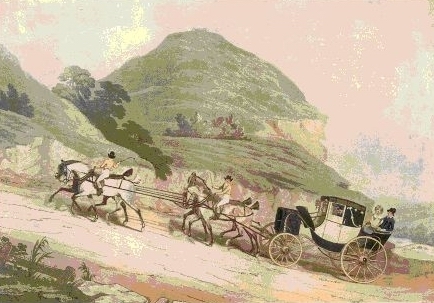
Private traveling chariot

Private traveling chariot

Anyone traveling more than twenty miles had to hire horses because using personal horses for a long journey doubled or tripled the total travel time. If the traveler owned a carriage, he would hire one or two pairs to pull it. The number of horses depended on his desired speed, the weight of the loaded vehicle, and how many hills the road climbed. Hired horses were changed out every 15-20 miles. Each pair of horses came with a postilion who controlled his pair, cared for their needs, and got them back to their home stable. Post horses were hired by the mile. Every ostler knew the precise distance to the next change, so travelers paid for the hire in advance, then tipped the postilions at the end of their stage.

If the traveler did not own a carriage, he could hire one from the post office. Post office vehicles were called yellow bounders because of their color and inadequate suspensions. They were rented for a single stage just like the horses, so the traveler had to change carriages along with the horses.

Another expense of travel was turnpike tolls. Every turnpike was littered with toll gates—by the Regency there were more than 8000 of them. Tolls were collected by turnpike trusts and used to maintain the section of road under their jurisdiction. Parliament established each trust as a way to provide good roads without the government having to pay for them. Secondary roads were maintained by the parishes, which rarely had much money, so anyone wanting to travel quickly without getting bogged down in mud used turnpikes whenever possible. But all those tolls added up—each trust set its own base price, but all charged according to vehicle type and the number of horses pulling it.

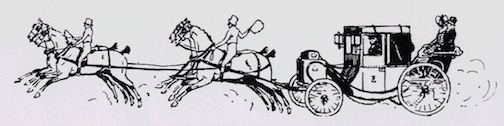
3 - chaise with two postillion driven teams copy

Chaise with two postilion driven teams

When using hired horses, speed on the turnpikes averaged about five miles per hour. Postilions operated under a strictly enforced speed limit of seven miles per hour along rural turnpikes, but they had to slow for all towns and villages and stop at every toll gate which slowed their overall speed. On secondary roads the average speed was less because the road surface was so bad. After macadamization was complete, the speed limit was raised so the average speed jumped to ten miles per hour during the golden age of coaching from 1830-1840. After 1840, long-distance travel mostly switched to trains, with carriages covering only the short distance to and from the nearest railroad station.

When heading to London for the Season, the travel party would contain a man, his wife, and any older children not in school—young children usually stayed in the country. Each family member had a lady’s maid or valet. There might also be a governess and/or tutor for the children, a secretary for the husband, and possibly a secretary or companion for his wife. They might even take their housekeeper and butler, along with a coachman to drive them while in town. Plus luggage. Obviously, this would require multiple carriages, so travel expenses would skyrocket. Another reason London Seasons were so expensive.

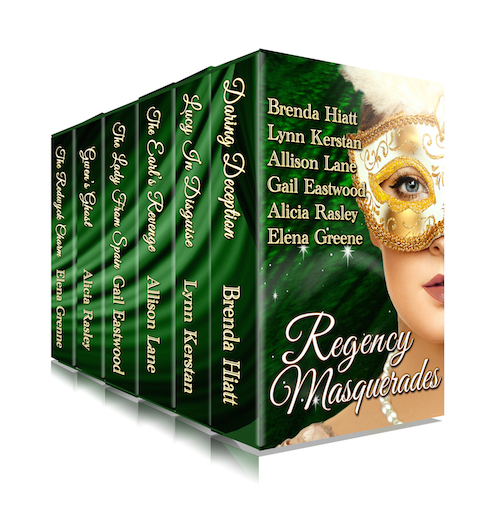
About Regency Masquerades

Six beloved bestselling and award-winning Regency authors bring you six full-length novels of disguise, deception and secret identities. From sweet to subtly sensual, these traditional Regency Romances demonstrate that true love can see through even the most elaborate mask! 

This special, limited-edition set includes:

Daring Deception, by NYT and USA Today bestselling author Brenda Hiatt
When her brother promises her in marriage to pay a gaming debt, Miss Chesterton dons a disguise to prove Lord Seabrooke a fortune hunter. But even as she gathers evidence, she finds herself losing her heart to the handsome Earl.

Lucy in Disguise, by RITA® Award-winning author Lynn Kerstan
A charming aristocrat in trouble is rescued by a young woman disguised as a Lancashire Witch. Love comes swiftly, but she’ll only agree to wed if they protect her friend, a fearful heiress, from a greedy and dangerous family.

The Earl’s Revenge, by award-winning author Allison Lane
A battle of wits unmasks the secret lives of the Earl of Bridgeport and his former fiancée Elaine Thompson. Only love might prevent ruination.

The Lady from Spain, by award-winning author Gail Eastwood
A young woman posing as a Spanish widow returns to England after Napoleon’s war, set on a dangerous quest. Can the handsome lord who must unmask her also turn her heart toward love?

Gwen’s Ghost, by RITA® Award-winning authors Alicia Rasley and Lynn Kerstan
An unredeemed rake must mask his true self so that he can undo the damage he caused with his life–and his death.

The Redwyck Charm, by multiple award-winning author Elena Greene
Heiress Juliana Hutton masquerades as an opera dancer to escape an arranged marriage to the Earl of Amberley, but fate has different plans…

Regency Masquerades cover copy

AmazoniBooks Barnes & NobleKobo

About the Author

Since publishing her first Regency romance in 1996, Allison Lane has won numerous writing awards. Her current project is a digital boxed set titled Regency Masquerades, which contains six full-length novels by six award-winning authors, each involving disguise, impersonation, or masquerade. The characters hide behind false facades, but as you read, you will discover that their charades ultimately lead them to true love. Regency Masquerades is now available at an introductory price of $0.99 from Amazon, B&N, iBooks, and Kobo.

The Dover Road: William Clements, Gentleman Coachman

dust jacket

The following post is the sixteenth of a series based on information obtained from a fascinating book Susana recently obtained for research purposes. Coaching Days & Coaching Ways by W. Outram Tristram, first published in 1888, is replete with commentary about travel and roads and social history told in an entertaining manner, along with a great many fabulous illustrations. A great find for anyone seriously interested in English history!

Artistic License

While I mean no disrespect to Canterbury and its extraordinary history, there is so much already out there on this topic that I’ve decided to skip it and focus on a particular coachman well-known and much respected for his years of service on the Canterbury-Dover Road.

Coaches On the Dover Road

dover road

112 miles round trip proved too much in one day.

Of the coaches on this Dover Road I have refrained from speaking, not because I was reserving the best thing till the last, but in point of fact for an exactly opposite reason. An indisputable subject tells me that, considering its importance as the principal route for travellers between England and France, there were not many coaches running on the Dover Road. I fancy that most people who had the wherewithal and wanted to catch a packet when the tide set, posted, and congratulated themselves. Mr. Jarvis Lorry I know was not amongst this number, but then he travelled by the Dover Mail, which was always an institution, kept good time, and carried in its day historic matter.

Mr. William Clements: Gentleman Coachman

william clements

Mr. William Clements, “Gentleman Coachman”

Of the other coaches on the Dover Road I shall make no mention. For once in the way, a catalogue, if made, would contain no sounding names in coaching story, would register no records in the way of speed, catastrophes, or drivers especially cunning, sober or drunk. Yet one coach besides the Dover Mail on this road I will mention, because next to the Mail it took high rank—in some estimations a rank above it; because with its coachman in its best days, I have had the pleasure of shaking hands. Yes! I have shaken hands with a classic coachman! No tyro he when coaching was the fashion, but an artist to the tips of his fingers—one of the old school, whom I have heard described by one who knew them well, as Grand Gentlemen; parties capable of giving Fatherly advice, to bumptious pretenders—parties who at the end of a trying journey, etc., over heavy roads took their ease at their inn with an air, disembarrassed themselves of their belchers, and sat down to a pint of sterling port.

Yes, in Mr. William Clements, who still enjoys a hale old age at Canterbury, I have chanced on a type now almost extinct, and which another generation will only read of in descriptions more or less fabulous, and wonder whether such people have ever been. Mr. Clements, who still takes a sort of paternal interest in those revivals of the coaching age which delight our millionaires during the prevalence of what we are pleased to call our summer months, lives in a snug house of his own, surrounded by memories of his former triumphs. A duchess might envy the Chippendale furniture in his drawing-room, and the bow window commands an extensive view of a rambling block of buildings which in days gone by houses the treasures of a choice stud.

As I listened to this man, it seemed to me that I came into direct personal contact with the very genius of coaching days and coaching ways—felt the impulse which throbbed in the brains of our ancestors to be at the coaching office early to book the box seat: sat by the side of a consummate master of his craft; was initiated in an instant into all its dark mysteries of “fanning,” “springing,” “pointing,” “chopping,” and “towelling.” I went through snowdrifts, I drank rums and milk; hair-breadth escapes in imminent deadly floods were momentary occurrences; I alighted at galleried inns; waiters all subservient showed me to “Concords” in all quarters of the empire. I revelled in the full glories of the coaching age in short in a moment! For had I not touched hands with its oldest, its most revered representative?

Baily’s Magazine of Sports & Pastimes, Volume 69 (Free on Google Books)

In the early 20’s, when agriculture was at its best, the farmers between Canterbury and London wanted a coach that would land them in London at noon on Monday and bring them back the same day… It was settled offhand to start a coach; Mr. Chapin said, “it must be a light coach and we will call it the Tally-ho!…It was started on that fortnight and either on its first start or soon afterwards, Mr. William Clements, whom I knew for the greater part of my life, was coachman, and at first he drove the early five o’clock Monday coach from Canterbury to London in one day, 112 miles all told; but it proved too much and afterward he drove up to London, 56 miles, and down the next day… The coach was almost always called “Clements’s coach,” and he went by the name of “gentleman coachman,” for he had quite the courtesy of Sir Roger de Coverley, combined with the most finished skill in driving his team, and he seldom went a journey without having a young lady who was travelling alone committed to his charge.

Baily says that he had the pleasure of meeting Mr. Clements and his “bright little wife, who was a very clever and well read lady,” and that, in fact, she had been one of the young ladies entrusted to him when he was a young man, and that they celebrated their golden anniversary before she passed away.

This is Why I Love Research!

In my next story, I believe I shall weave in a scene with this true-to-life “gentleman coachman.” In fact, it is beginning to take shape in my mind already! A young lady traveling to London unaccompanied in need of protection. Fabulous!

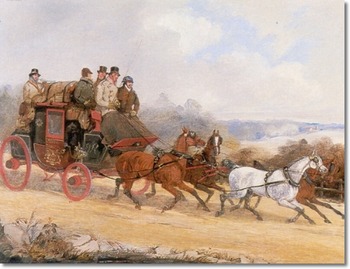
Henry Alken Sr. Dover to London Coach Summer

Henry Alken Sr.
Dover to London Coach Summer

 Index to all the posts in this series

1: The Bath Road: The (True) Legend of the Berkshire Lady

2: The Bath Road: Littlecote and Wild William Darrell

3: The Bath Road: Lacock Abbey

4: The Bath Road: The Bear Inn at Devizes and the “Pictorial Chronicler of the Regency”

5: The Exeter Road: Flying Machines, Muddy Roads and Well-Mannered Highwaymen

6: The Exeter Road: A Foolish Coachman, a Dreadful Snowstorm and a Romance

7: The Exeter Road in 1823: A Myriad of Changes in Fifty Years

8: The Exeter Road: Basingstoke, Andover and Salisbury and the Events They Witnessed

9: The Exeter Road: The Weyhill Fair, Amesbury Abbey and the Extraordinary Duchess of Queensberry

10: The Exeter Road: Stonehenge, Dorchester and the Sad Story of the Monmouth Uprising

11: The Portsmouth Road: Royal Road or Road of Assassination?

12: The Brighton Road: “The Most Nearly Perfect, and Certainly the Most Fashionable of All”

13: The Dover Road: “Rich crowds of historical figures”

14: The Dover Road: Blackheath and Dartford

15: The Dover Road: Rochester and Charles Dickens

16: The Dover Road: William Clements, Gentleman Coachman

17: The York Road: Hadley Green, Barnet

18: The York Road: Enfield Chase and the Gunpowder Treason Plot

19: The York Road: The Stamford Regent Faces the Peril of a Flood

20: The York Road: The Inns at Stilton

21: The Holyhead Road: The Gunpowder Treason Plot

22: The Holyhead Road: Three Notable Coaching Accidents

23: The Holyhead Road: Old Lal the Legless Man and His Extraordinary Flying Machine

24: The Holyhead Road: The Coachmen “More Celebrated Even Than the Most Celebrated of Their Rivals” (Part I)

25: The Holyhead Road: The Coachmen “More Celebrated Even Than the Most Celebrated of Their Rivals” (Part II)

26: Flying Machines and Waggons and What It Was Like To Travel in Them

27: “A few words on Coaching Inns” and Conclusion

The Dover Road: Rochester and Charles Dickens

dust jacket

The following post is the fifteenth of a series based on information obtained from a fascinating book Susana recently obtained for research purposes. Coaching Days & Coaching Ways by W. Outram Tristram, first published in 1888, is replete with commentary about travel and roads and social history told in an entertaining manner, along with a great many fabulous illustrations. A great find for anyone seriously interested in English history!

Comment to enter Susana’s October Giveaway, an Anne Boleyn necklace (see right) from Hever Castle in Kent.

Gad’s Hill Place: A Young Boy’s Dream

Gads-hill620_2032271b

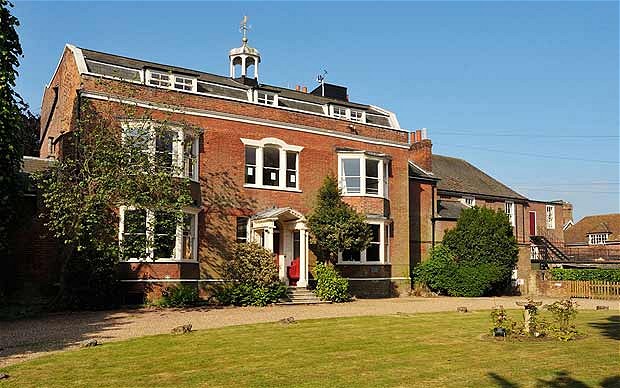
Gad’s Hill Place

John Dickens used to point out this stately home as an incentive to his nine-year-old son Charles to work hard. He meant, of course, that his son might someday own such a home, but his son took it literally and used to walk over from Chatham to inspect his future home.

I used to look at it as a wonderful Mansion (which God knows it is not) when I was a very odd little child with the first faint shadows of all my books in my head – I suppose.

Charles Dickens

Charles Dickens

Years later, after Charles had achieved fame and fortune, he heard the house was for sale and purchased it, and it became his country retreat in 1857.

Here too from his house on Gad’s Hill (and a very hideous house it is) Charles Dickens…gave novel after wonderful novel to an astonished world, which was never sated with a humour and an observation of life which were indeed Shakespearean; but kept craving and calling for more, and more—till the magician’s brain was hurt, and the magic pen began to move painfully and with labour, and the chair on Gad’s Hill was found one June morning to be empty forever.

I remember the shock of that announcement well. It was as if some pulse in the nation’s heart had stopped beating. There was as it were a feeling that some great embodied joy had left the world, and silence had fallen on places of divine laughter… Yes, the feeling was general, I think, that English literature had suffered an irremediable loss by Dickens’s death; and time has confirmed the fear. We have abandoned laughter in these days for documentary evidence, psychology, realism, and other prescriptions for sleep, and have entered on a literary era which has lost all touch and sympathy with Dickens, and is indeed divinely dull.

Mr. Tristram goes on to quote from the numerous works in which Dickens featured Rochester and its environs: The Pickwick Papers, David Copperfield, Great Expectations and Edwin Drood.

According to Wikipedia, Dickens had in his study “dummy” books with titles such as:

  • Socrates on Wedlock

  • King Henry VIII’s Evidences of Christianity

  • The Wisdom of Our Ancestors: I Ignorance, II Superstition, III The Block, IV The Stake, V The Rack, VI Dirt and VII Disease.

  • A very thin volume entitled The Virtues of Our Ancestors

(I’m loving this man’s sense of humor. Aren’t you? I could think of a few such titles for my own office.)

chalet

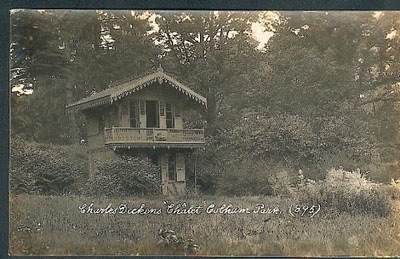
Dickens’s chalet where he wrote many of his later works on the upper floor

In 1864 his friend, the actor Charles Fechter, gave him a gift of a Swiss chalet, in 94 pieces. Dickens had it assembled across the street and later had constructed a brick-lined tunnel so that he could go back and forth from his house unobserved. His works from then on were written from the upper floor of the chalet.

Note: The chalet was transferred to the now-defunct Dickens Centre at Eastgate House in Rochester, but you can still see the chalet in the garden.

Restoration House in Rochester

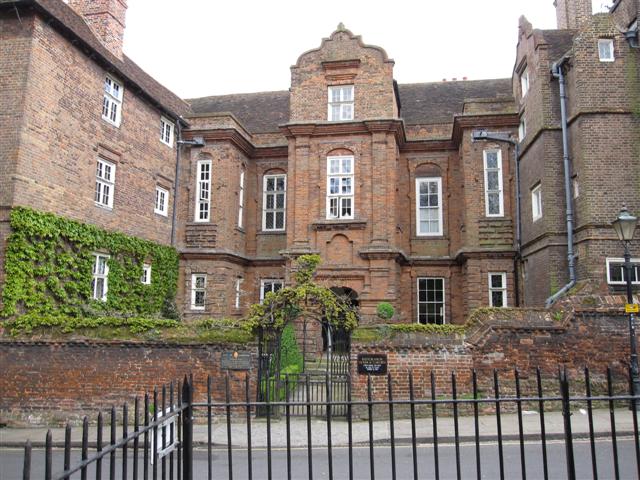
There is a passage in Great Expectations referring to this very Restoration House, a place which always took his fancy, and well it might.

restoration-house-satis-house-small

Restoration House, Rochester

“I had stopped,” thus the passage runs, “to look at the house as I passed, and its seared red brick walls, blocked windows, and strong green ivy clasping even the stacks of chimneys with its twigs and tendons, as if with sinewy old arms, made up a rich and attractive mystery.”

This mystery held him to the end. On the occasion of his last visit to Rochester, June 6th, 1870, he was seen leaning on the fence in front of the house, gazing at it, rapt, intent, as if drawing inspiration from its clustering chimneys, its storied walls so rich with memories of the past. It was anticipated, it was hoped, that the next chapter of Edwin Drood would bear the fruits of this reverie. The next chapter was never written.

 Index to all the posts in this series

1: The Bath Road: The (True) Legend of the Berkshire Lady

2: The Bath Road: Littlecote and Wild William Darrell

3: The Bath Road: Lacock Abbey

4: The Bath Road: The Bear Inn at Devizes and the “Pictorial Chronicler of the Regency”

5: The Exeter Road: Flying Machines, Muddy Roads and Well-Mannered Highwaymen

6: The Exeter Road: A Foolish Coachman, a Dreadful Snowstorm and a Romance

7: The Exeter Road in 1823: A Myriad of Changes in Fifty Years

8: The Exeter Road: Basingstoke, Andover and Salisbury and the Events They Witnessed

9: The Exeter Road: The Weyhill Fair, Amesbury Abbey and the Extraordinary Duchess of Queensberry

10: The Exeter Road: Stonehenge, Dorchester and the Sad Story of the Monmouth Uprising

11: The Portsmouth Road: Royal Road or Road of Assassination?

12: The Brighton Road: “The Most Nearly Perfect, and Certainly the Most Fashionable of All”

13: The Dover Road: “Rich crowds of historical figures”

14: The Dover Road: Blackheath and Dartford

15: The Dover Road: Rochester and Charles Dickens

16: The Dover Road: William Clements, Gentleman Coachman

17: The York Road: Hadley Green, Barnet

18: The York Road: Enfield Chase and the Gunpowder Treason Plot

19: The York Road: The Stamford Regent Faces the Peril of a Flood

20: The York Road: The Inns at Stilton

21: The Holyhead Road: The Gunpowder Treason Plot

22: The Holyhead Road: Three Notable Coaching Accidents

23: The Holyhead Road: Old Lal the Legless Man and His Extraordinary Flying Machine

24: The Holyhead Road: The Coachmen “More Celebrated Even Than the Most Celebrated of Their Rivals” (Part I)

25: The Holyhead Road: The Coachmen “More Celebrated Even Than the Most Celebrated of Their Rivals” (Part II)

26: Flying Machines and Waggons and What It Was Like To Travel in Them

27: “A few words on Coaching Inns” and Conclusion

The Dover Road: Blackheath and Dartford

dust jacket

The following post is the fourteenth of a series based on information obtained from a fascinating book Susana recently obtained for research purposes. Coaching Days & Coaching Ways by W. Outram Tristram, first published in 1888, is replete with commentary about travel and roads and social history told in an entertaining manner, along with a great many fabulous illustrations. A great find for anyone seriously interested in English history!

Note: Comment to enter the contest for Susana’s September Giveaway, a lovely necklace from London’s National Gallery (see photo at right).

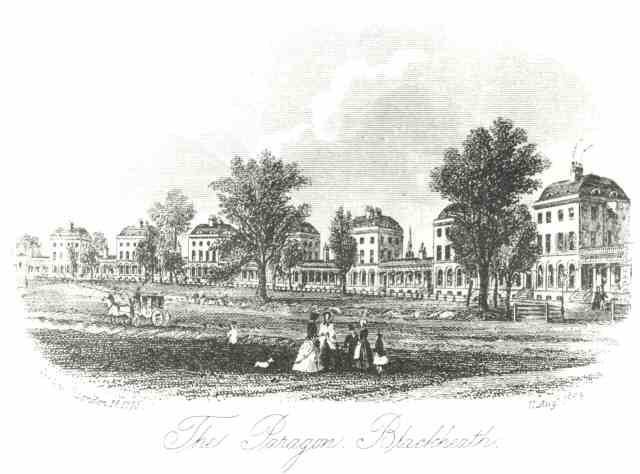
Blackheath: Dark-Colored Heathland

The area of Blackheath is about seven miles from London Bridge. Originally the name of an open space for public meetings of the ancient hundred of Blackheath, this name was also given to the Victorian suburb that was developed later in the 19th century. While this area was certainly used for burial pits for the victims of the Black Death in the 14th century, it was only one of many used for such a purpose in London and was not the source of the name. Blackheath comes from Old English, “dark-colored heathland,” undoubtedly referring to the color of the soil.

Besides a queen devoted to junketings [Queen Caroline, who lived at Montague House], a letter-writing father, bent on directing his son to the deuce [Lord Chesterfield], and a great warrior [Major General James Wolfe, conqueror of Quebec], rebellion has in the good old days…raised its head on this celebrated spot; and it raised its head in the person of Wat Tyler, who was here in 1381 at the head of one hundred thousand other heads (which was wise of him seeing that he had previously cracked a poll-tax collector’s head at Dartford, after drinking too much ale, I suppose, at the celebrated Bull Inn). Another rebel was here, at Blackheath 1497. Lord Audley to wit, who went through the somewhat aimless exercise of bringing troops all the way from Cornwall, pitching their tents, and immediately afterwards suffering defeat at the hands of Henry the Seventh.

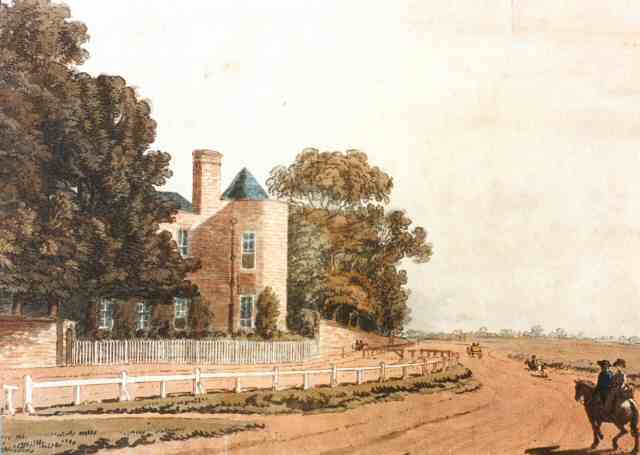
Montague House, residence of Queen Caroline

Montague House, residence of Queen Caroline

The Predecessor of Rotten Row?

For this celebrated spot occupied in the annals of England much the same sort of position apparently as Rotten Row occupies in the annals of contemporary fashion. It was the place where kings and ministers met casually on their way to or from London, and babbled of the weather, the price of corn, the latest hanging, the odds on the next bear-fight, the state of the unemployed, or any other kindred subject which might suggest itself to medieval brains, in an open space, where it was not too windy.

blackheath

Henry the Fifth a Spoilsport?

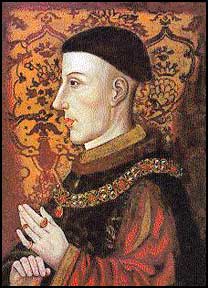
On his return to London, “The Victor of Agincourt” was greeted here by “the mayor and five hundred citizens of London. The mayor and aldermen had prepared an elaborate reception, with wine and scarlet and gold robes and all the trappings. But Henry “nipped all the worthy mayor’s preparations in the bud,” refusing to accept the praise and thanks that should go to God.

A pious decision, but one which must have been extremely unsatisfactory to town councillors who had launched forth in the way of dress and decorations, and to the thousands of Londoners who had flocked out to Blackheath to see the show.

Henry V: not in a proper mood to be fêted

Henry V: not in a proper mood to be fêted

Henry the Eighth: A Guilty Conscience?

It was here on Blackheath that the already muchly married king publicly received his fourth wife, with all due decency and decorum, having already made up his royal mind to put her away privately. For Henry on this occasion did not play fair; and though he pretended to Anne of Cleves herself that it was at this meeting on Blackheath that he had first seen here—in saying so, he said that which was not; for he had already privately inspected her at the Crown Inn at Rochester. It was on this occasion it may be remembered that the bluff Tudor gave way to a regrettable license of speech at first sight of the goods the gods had provided for him, and said many things unfit for publication; which shocked the onlookers, and made Cromwell put his hands to his head to feel if it was still in his shoulders.

Alas, Cromwell, as the advocate for this marriage, paid for his folly with his head. Anne of Cleves, however,

was content to forego the dubious joys of married life for the possession of the several manors in Kent and Sussex that her grateful late lord bestowed upon her. The number of these manors exceeds belief, and at the same time gracefully gauges Henry’s conception of the magnitude of the matrimonial peril past. Indeed, it seems to me that…whenever he had nothing villainous on hand, and was disinclined for tennis, he gave Anne of Cleves a manor or two simply to while away the time.

setWidth320-The-Manor-Gatehouse1

The Manor Gatehouse is all that is left of the manor Henry VIII presented to Anne of Cleves as “one of the first manors granted to this little-married but much-dowered lady.”

Charles II’s Triumphant Procession

…it was in 1660 no doubt that the grandest of its historical pageants was to be seen: when the long reaction against Puritanism had suddenly triumphed, and all England went mad on a May morning at the Restoration of her exiled king; when through sixty-one miles as it were of conduits running wine, triumphal arches, gabled streets hung with tapestry—through battalions of citizens in various bands, some arrayed in coats of black velvet with gold chains, some in military suits of cloth of gold or silver—Charles, who had slept at Rochester the night before, rode on to Blackheath between his brothers, the Dukes of York and Gloucester.

Charles II riding into London

Charles II riding into London

Sir Walter Scott, in his novel Woodstock (1826), paints a picture of Charles catching a glimpse of the characters of the novel in the crowd and making a point to dismount, prevent the aged Sir Henry Lee from rising, and ask for his blessing, after which, “his very faithful servant, having seen the desire of his eyes, was gathered to his fathers.”Quite a poignant scene, but could not have happened in real life since Sir Henry had passed away fifty years earlier. Don’t you just love historical fiction?

Charles Dickens: “veritable genius of the road”

His memory burns by the way—as all but the wicked man who has not read Pickwick and David Copperfield will remember—and indeed A Tale of Two Cities. For in the second chapter of that wonderful book the very spirit of the Dover Road in George the Third’s time is caught as if by magic.

A Tale of Two Cities: read Chapter Two here: http://www.online-literature.com/dickens/twocities/2/

Who does not remember these things? Who has not read them again and again? I declare that I think this second chapter of A Tale of Two Cities a picture of the old coaching days more perfect than any that has been painted. Every detail is there in three pages.

tale

George IV Insulted at the Bull Inn

In 1822

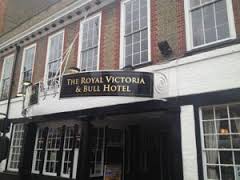
…while the great Fourth George was majestically reposing in his royal post-chaise in front of the old archway he experienced an unpleasant surprise. A very ungentlemanly man named Calligan, a working currier who ought to have known better, suddenly projected his head into the carriage window, and observed in a voice of thunder, “You’re a murderer!” an historical allusion to the king’s late treatment of Queen Caroline, which made the royal widower “sit up”. Upon which a bystander named Morris knocked the personal currier down,and the window of the post-chaise was pulled up, and the post-boy told to drive on as quickly as possible.

The Royal Victoria and Bull Inn (formerly the Bull Inn)

The Royal Victoria and Bull Hotel (formerly the Bull Inn)


 Index to all the posts in this series

1: The Bath Road: The (True) Legend of the Berkshire Lady

2: The Bath Road: Littlecote and Wild William Darrell

3: The Bath Road: Lacock Abbey

4: The Bath Road: The Bear Inn at Devizes and the “Pictorial Chronicler of the Regency”

5: The Exeter Road: Flying Machines, Muddy Roads and Well-Mannered Highwaymen

6: The Exeter Road: A Foolish Coachman, a Dreadful Snowstorm and a Romance

7: The Exeter Road in 1823: A Myriad of Changes in Fifty Years

8: The Exeter Road: Basingstoke, Andover and Salisbury and the Events They Witnessed

9: The Exeter Road: The Weyhill Fair, Amesbury Abbey and the Extraordinary Duchess of Queensberry

10: The Exeter Road: Stonehenge, Dorchester and the Sad Story of the Monmouth Uprising

11: The Portsmouth Road: Royal Road or Road of Assassination?

12: The Brighton Road: “The Most Nearly Perfect, and Certainly the Most Fashionable of All”

13: The Dover Road: “Rich crowds of historical figures”

14: The Dover Road: Blackheath and Dartford

15: The Dover Road: Rochester and Charles Dickens

16: The Dover Road: William Clements, Gentleman Coachman

17: The York Road: Hadley Green, Barnet

18: The York Road: Enfield Chase and the Gunpowder Treason Plot

19: The York Road: The Stamford Regent Faces the Peril of a Flood

20: The York Road: The Inns at Stilton

21: The Holyhead Road: The Gunpowder Treason Plot

22: The Holyhead Road: Three Notable Coaching Accidents

23: The Holyhead Road: Old Lal the Legless Man and His Extraordinary Flying Machine

24: The Holyhead Road: The Coachmen “More Celebrated Even Than the Most Celebrated of Their Rivals” (Part I)

25: The Holyhead Road: The Coachmen “More Celebrated Even Than the Most Celebrated of Their Rivals” (Part II)

26: Flying Machines and Waggons and What It Was Like To Travel in Them

27: “A few words on Coaching Inns” and Conclusion

The Brighton Road: “The Most Nearly Perfect, and Certainly the Most Fashionable of All”

dust jacket

The following post is the twelfth of a series based on information obtained from a fascinating book Susana recently obtained for research purposes. Coaching Days & Coaching Ways by W. Outram Tristram, first published in 1888, is chock full of commentary about travel and roads and social history told in an entertaining manner, along with a great many fabulous illustrations. A great find for anyone seriously interested in English history!

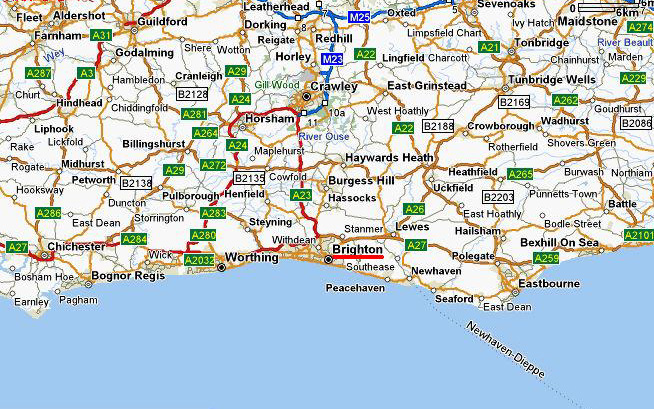
The Brighton Road, Mr. Tristram suggests, might be called the “Regent’s Road,” since it was the Prince who, once he determined the health benefits of the seaside city, saw to it that the road was made passable.

For before the Pavilion was, Brighton was about as easy to get at as the Cranmere Pool in the middle of Dartmoor, the moon, the North Pole, the special exits in case of fire at our principal theatres, or anything else on earth totally inaccessible.

It was in 1750 when Brighton was nothing but a small fishing village that Doctor Richard Russell visited and proclaimed that sea water was beneficial to health, which began the exodus of wealthy hypochondriacs to seaside resorts. At that time, however, our author suggests that oxen were required to cope with the deep ruts. “People got into coaches to go to Brighton and only got out of them when they were overturned.”

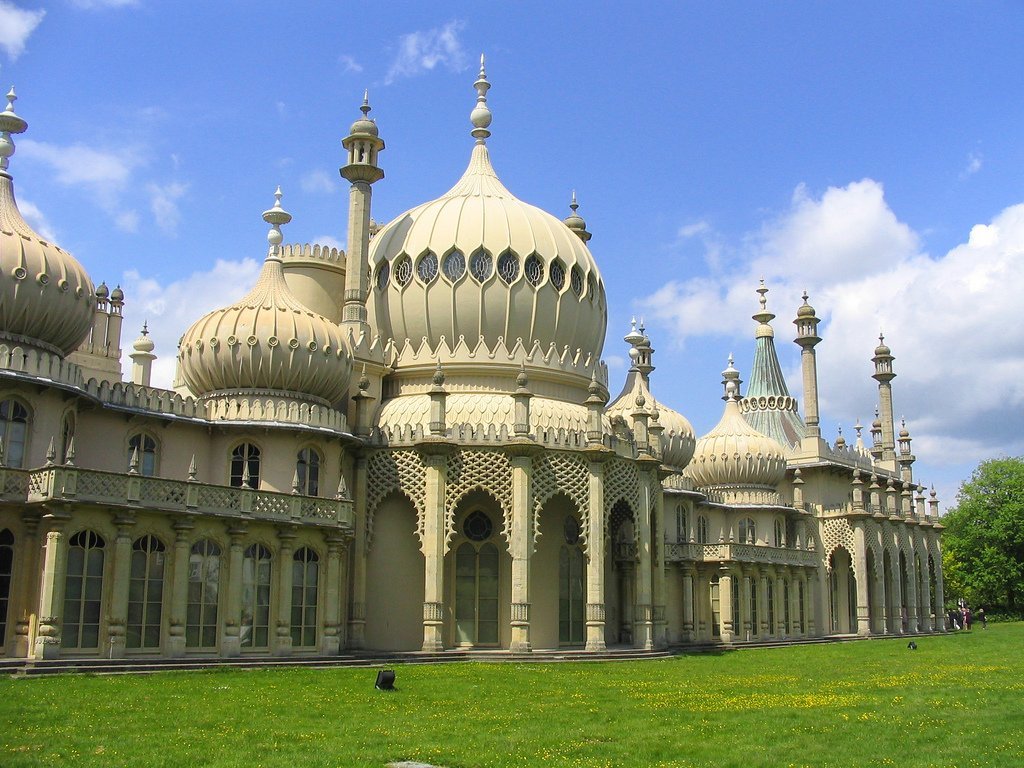
All these horrors of the Brighton Road the much abused George the Fourth did away, with a sweep as it were of his fat, bejewelled and august hand! He built the Pavilion, and people from all parts of the country came straightway to see it and him… the crowds soon found…that if they were to come to Brighton, and to court, they had better have some decent road to come upon. And from this simple bringing home of a plain truth came into existence the Brighton Road—“perhaps the most nearly perfect, and certainly the most fashionable of all.”

Brighton Pavilion1

Brighton Pavilion

Cuckfield Park, Cuckfield, West Sussex

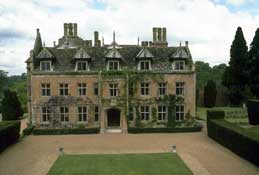
This sixteenth century manor is known for its ghost, said to be that of Anne Sergison, who, already afflicted with a somewhat combative nature, had to fight a long and sordid court battle to get it. It came to light after her brother’s death that the thirteen-year-old girl assumed to be his daughter was actually a “supposititious” (don’t you just love that word?) child imposed on him by his wife. No one knows what happened to the girl and her mother, but Anne’s ghost has been spotted in the corridors and the avenue leading to the house, and some say she particularly attended her granddaughter’s wedding in 1890. No rest for the wicked, so they say.

Cuckfield Park was the inspiration for William Harrison Ainsworth’s novel Rookwood.

Cuckfield Park

Cuckfield Park

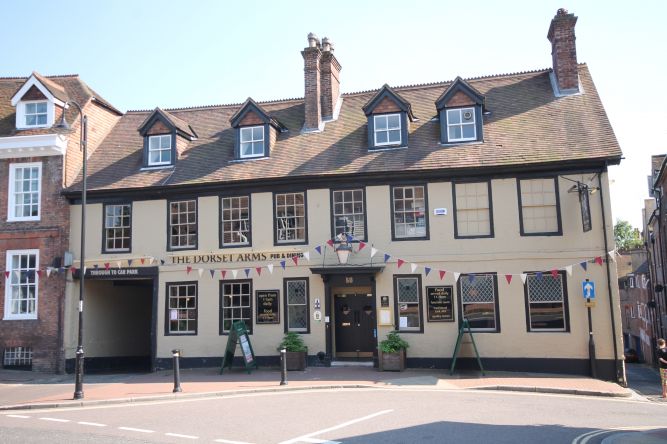
The Dorset Arms, East Grinstead

All distinguished travellers on the Brighton Road pulled up as a matter of course at the Dorset Arms. Amongst those whose names have been handed down as habitual visitors, was Lord Liverpool, who always stayed at the Dorset Arms when on his way to visit the Harcourt seat near Buxted… Another constant guest was Lord Seymour, who died, I believe, in 1837—mean, I am sorry to say…and yet not mean either one way, for if he didn’t eat and drink much, he possessed a passion for illumination which must have produced some respectable items in the bill—thirty wax candles or more burning in his bedroom all night. Spencer Perceval too (the Prime Minister remarkable for great ability and for having been shot in the lobby of the House of Commons in 1812 by John Bellingham) must have been a familiar figure at the Dorset Arms, for the house from which he was married in 1790 to Miss Jane Wilson stands just at the bottom of the Dorset Arms’ garden.

The Dorset Arms

The Dorset Arms

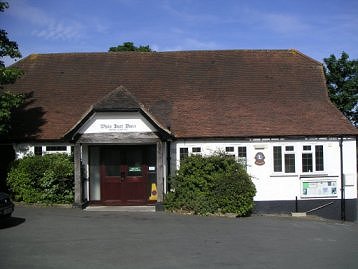
The Clayton Arms, formerly the White Hart and currently the White Hart Barn, Godstone Green

It is said the that in 1815 the Regent, the Tsar of Russia, and many royal visitors stayed at the inn on their way to Blindley Heath, to be present at the fight for the championship of England…Blindley Heath was one of the most popular and celebrated of prize-fighting rendezvous.

“The Fancy were all upon the alert soon after breakfast” (I quote from Boxiana’s description of the Grand Pugilistic combat between Randall and Martin, at Crawley Down, thirty miles from London, on Tuesday, May 4, 1819 “on the Monday to ascertain the seat of action; and as soon as the important whisper had gone forth, that Crawley Down was likely to be the place, the toddlers were off in a twinkling… Between the hours of two and three o’clock in the afternoon upwards of a hundred gigs were counted passing through Croydon… Long before eight o’clock in the evening every bed belonging to the inns and public houses in Godstone, East Grinstead, Reigate, Bletchingley, &c., were doubly and some trebly occupied.”

“Those persons whose blunt enabled them to procure beds, could not obtain any sleep, for carriages of every description were passing through the above towns all night… The brilliants also left Brighton and Worthing at about the same period, and thus were the roads thronged in every direction… It is supposed if the carriages had all been placed in one line they would have reached from London to Crawley. The amateurs were of the highest distinction, and several noblemen and foreigners of rank were upon the ground.”

The White Hart Barn, now the village hall of Godstone Green

The White Hart Barn, now the village hall of Godstone Green

Regent and emperor putting up at a wayside inn to witness a fight for the championship!…The noblemen and foreigners of rank crowding round the twenty-four foot ring! What can give us a better idea of the Brighton Road in its prime than these facts? What paint more vividly what I call its “Regency flavour”, its slang, its coarseness, its virility—in a word, its “Corinthianism”?

brighton-map

 Index to all the posts in this series

1: The Bath Road: The (True) Legend of the Berkshire Lady

2: The Bath Road: Littlecote and Wild William Darrell

3: The Bath Road: Lacock Abbey

4: The Bath Road: The Bear Inn at Devizes and the “Pictorial Chronicler of the Regency”

5: The Exeter Road: Flying Machines, Muddy Roads and Well-Mannered Highwaymen

6: The Exeter Road: A Foolish Coachman, a Dreadful Snowstorm and a Romance

7: The Exeter Road in 1823: A Myriad of Changes in Fifty Years

8: The Exeter Road: Basingstoke, Andover and Salisbury and the Events They Witnessed

9: The Exeter Road: The Weyhill Fair, Amesbury Abbey and the Extraordinary Duchess of Queensberry

10: The Exeter Road: Stonehenge, Dorchester and the Sad Story of the Monmouth Uprising

11: The Portsmouth Road: Royal Road or Road of Assassination?

12: The Brighton Road: “The Most Nearly Perfect, and Certainly the Most Fashionable of All”

13: The Dover Road: “Rich crowds of historical figures”

14: The Dover Road: Blackheath and Dartford

15: The Dover Road: Rochester and Charles Dickens

16: The Dover Road: William Clements, Gentleman Coachman

17: The York Road: Hadley Green, Barnet

18: The York Road: Enfield Chase and the Gunpowder Treason Plot

19: The York Road: The Stamford Regent Faces the Peril of a Flood

20: The York Road: The Inns at Stilton

21: The Holyhead Road: The Gunpowder Treason Plot

22: The Holyhead Road: Three Notable Coaching Accidents

23: The Holyhead Road: Old Lal the Legless Man and His Extraordinary Flying Machine

24: The Holyhead Road: The Coachmen “More Celebrated Even Than the Most Celebrated of Their Rivals” (Part I)

25: The Holyhead Road: The Coachmen “More Celebrated Even Than the Most Celebrated of Their Rivals” (Part II)

26: Flying Machines and Waggons and What It Was Like To Travel in Them

27: “A few words on Coaching Inns” and Conclusion

The Portsmouth Road: Royal Road or Road of Assassination?

dust jacket

The following post is the eleventh of a series based on information obtained from a fascinating book Susana recently obtained for research purposes. Coaching Days & Coaching Ways by W. Outram Tristram, first published in 1888, is chock full of commentary about travel and roads and social history told in an entertaining manner, along with a great many fabulous illustrations. A great find for anyone seriously interested in English history!

The Portsmouth Road has been described to me by one having authority as the Royal Road: and certainly kings and queens have passed up and down it, eaten and drunken in the Royal Rooms, still to be seen in some of the old inns; snored in the Royal Beds (also in places to be seen, but not slept in), and dreamed of ruts of bogs, and blasted heaths and impassable morasses, and all the sundry and other mild discomforts which our ancestors, whether kings or cobblers, had to put up with; or those among them at all events who travelled when the weather was rainy, and there were no real roads to travel upon.

To me however the Portsmouth Road—so called Royal—presents itself in a less august guise; so much so that if I were asked to give it a name whereby it might be especially distinguished, I should be inclined, I think, to call it the Road of Assassination. And it will be found to have claim to the title.

The Unknown Sailor

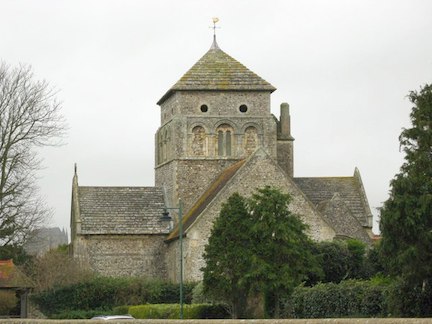
The Portsmouth Road after Godalming and Milford consisted of a “gravelly road” for five miles up Hindhead Hill that led them directly to a “silent memorial of murder,” a gravestone reminder

of a barbarous murder committed on the spot on the person of an unknown sailor (who lies buried in Thursley Churchyard, a few miles off); and airs also with some satisfaction the feeling then very prevalent (before Scotland Yard was), that murderers are a class who invariably fall into the hands of justice. We are perhaps not so credulous as this nowadays; but we put our trust in a large detective force when our throats have been cut, and hope for the best. The local police of 1786 however could have given many of our shining lights a lesson, it seems to me; for on the very afternoon of September the 4th in that year (which was the date of the murder) they apprehended three men named Lonegon, Casey, and Marshall, twelve miles further down the road…engaged in the unwise exercise of selling the murdered man’s clothes. For this, and previous indiscretions, they were presently hanged in chains on the top of Hindhead as a warning…

The ill-fated sailor, walking from London to rejoin his ship in Portsmouth, met up with three other sailors in Thursley and treated them to food and drinks before setting off again in their company. His reward was to be murdered and decapitated and thrown into a valley, where he was promptly discovered and the alarm raised. His murderers were apprehended that same day at the Sun Inn in Rake, rather unwisely selling off their victim’s clothing.

220px-Unknown_Sailors_GraveIn memory of

A generous but unfortunate Sailor

Who was barbarously murder’d on Hindhead

On September 24th 1786

By three Villains

After he had liberally treated them

And promised them his farther assistance

On the road to Portsmouth.

The Murders by the Smugglers

Sussex_Police_Authority_Map

All through the last century, then, it seems the country from Portsmouth…was infested by gangs of smugglers.

From time to time, after some unusually audacious outbreak against custom-house laws had taken place, violent reprisals were made; but on the whole the revenue officers seem to have had decidedly the worst of it, and the smugglers enjoyed an enviable immunity from the retribution of justice. The climax to this condition of affairs came on the 6th and 7th of October, 1747, when a gang of some sixty of these desperadoes assembled secretly in Charlton Forest; made a suddenly raid on Poole; broke open the custom, where a large quantity of tea which had been seized from one of their confederates, was lodged, and made off with the booty, without encountering any resistance from the surprised authorites.

barbarous11

Ye Smugglers breaking open ye King’s Custom House at Poole

The cocky smugglers made a “riotous procession” retreating with their booty, and one of them, a man named Diamond, recognized Daniel Chater, a shoemaker, in the crowd and threw him a bag of tea. The same Diamond was taken into custody at Chichester, and Chater, having been promised a reward, was persuaded to accompany a custom house officer, William Galley, to Chichester for the purpose of identifying said Diamond.

The pair made the unfortunate decision to stay at the White Hart, where the landlady, “friendly of course to smugglers and highwaymen”, suspecting that they meant harm to her friends, sent for seven of them to intervene. Galley and Chater “were prevailed upon with force to stay and drink more rum” and when unconscious, the letter Galley was carrying detailing their errand was intercepted, and the criminals debated whether or not to murder them. Two of the smugglers’ wives who had joined the party urged them to “Hang the dogs, for they came here to hang us.”

This view of the case seems to have in an instant turned men into monsters. A devilish fury possessed the whole company. Jackson rushed into the room where Chater and Galley were sleeping. He leaped upon the bed and awakened them by spurring them on the forehead. He flogged them about the head with a horsewhip till their faces poured with blood. Then they were taken out to the back yard, and both of them tied on to one horse, their four legs tied together, and these four legs tied under the horse’s belly.

They had not got a hundred yards from the house when Jackson, in one of those sudden accesses of fiendishness continually characteristic of the whole affair, and which seemed a veritable possession of the devil himself, yelled out—“Whip them! Cut them! Slash them! Damn them!” and in an instant the whole gang’s devilish fury was wreaked on their bound and helpless enemies.

Near Rake Hill, Galley fell off the horse and was presumed to be dead, so they buried him in a foxhole in Harting Coombe. When he was found, however, his hands were covering his eyes, presumably to protect them from the dirt, so he was, in effect, buried alive.

Chater did not find so fortunate a release from his torments. He was kept for over two days chained by the leg in an outhouse of the Red Lion at Rake, “in the most deplorable condition that man was ever in; his mind full of horrors, and his body all over pain and anguish with the blows and scourges they had given him.” All this while the smugglers were calmly debating as to how they should finally make an end of him. At length a decision was come to. Subjected all the way to treatment which I cannot describe, he was taken back to the same Harris Well where it had been originally proposed to murder Galley; and after an unsuccessful attempt at hanging him there, he was thrown down it, and an end put at last to his awful sufferings by heaving stones being thrown on top of him.

The heinousness of the crime demanded swift justice, and the gang was hanged at Chichester on 18th January 1749, except for one, who died of fright the night before the execution.

barbarous8

The unfortunate William Galley put by the Smugglers into the Ground … before he was quite Dead

barbarous12

Mr Galley and Mr Chater put by ye Smugglers on one Horse near Rowland Castle

The Assassination of the Duke of Buckingham

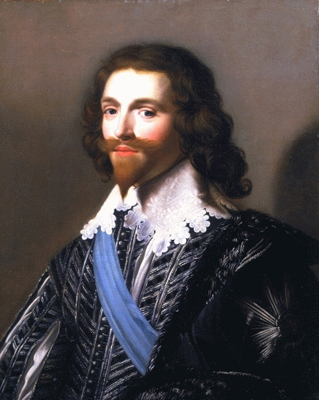
After all this, a simple assassination may strike you as a mere church picnic. But it was at the Spotted Dog Inn in 1628 that James I’s favorite (and some say lover) was assassinated by a discontented half-pay officer who had been turned down for promotion.

buckingham

It remains for me to remark that the journey of Felton to London, where he was hanged, drawn, and quartered at Tyburn, was accomplished amidst scenes of extraordinary and many-sided excitement; and coming, as it does, before a similarly mournful expedition over the same ground on the part of the Duke of Monmouth, seems to me to cast a characteristic gloom over the annals of a road—not remarkable for coaching anecdotes or coaching records—which has been called Royal, and rightly perhaps enough,—but which has yet witnessed, so far as its historical side is concerned, and so far as my knowledge goes, gloomier and more tragic scenes than any other of the great thoroughfares out of London.

These days we have organized police forces and all sorts of high-tech devices and forensic methods to apprehend and prosecute criminals…and yet crime seems to be everywhere, even such horrific murders as described here. Are today’s criminals smarter, do you think, or were more crimes undetected back then?

Comment and enter to win Susana’s September Giveaway, a lovely necklace from London’s National Gallery (see photo at right).

 Index to all the posts in this series

1: The Bath Road: The (True) Legend of the Berkshire Lady

2: The Bath Road: Littlecote and Wild William Darrell

3: The Bath Road: Lacock Abbey

4: The Bath Road: The Bear Inn at Devizes and the “Pictorial Chronicler of the Regency”

5: The Exeter Road: Flying Machines, Muddy Roads and Well-Mannered Highwaymen

6: The Exeter Road: A Foolish Coachman, a Dreadful Snowstorm and a Romance

7: The Exeter Road in 1823: A Myriad of Changes in Fifty Years

8: The Exeter Road: Basingstoke, Andover and Salisbury and the Events They Witnessed

9: The Exeter Road: The Weyhill Fair, Amesbury Abbey and the Extraordinary Duchess of Queensberry

10: The Exeter Road: Stonehenge, Dorchester and the Sad Story of the Monmouth Uprising

11: The Portsmouth Road: Royal Road or Road of Assassination?

12: The Brighton Road: “The Most Nearly Perfect, and Certainly the Most Fashionable of All”

13: The Dover Road: “Rich crowds of historical figures”

14: The Dover Road: Blackheath and Dartford

15: The Dover Road: Rochester and Charles Dickens

16: The Dover Road: William Clements, Gentleman Coachman

17: The York Road: Hadley Green, Barnet

18: The York Road: Enfield Chase and the Gunpowder Treason Plot

19: The York Road: The Stamford Regent Faces the Peril of a Flood

20: The York Road: The Inns at Stilton

21: The Holyhead Road: The Gunpowder Treason Plot

22: The Holyhead Road: Three Notable Coaching Accidents

23: The Holyhead Road: Old Lal the Legless Man and His Extraordinary Flying Machine

24: The Holyhead Road: The Coachmen “More Celebrated Even Than the Most Celebrated of Their Rivals” (Part I)

25: The Holyhead Road: The Coachmen “More Celebrated Even Than the Most Celebrated of Their Rivals” (Part II)

26: Flying Machines and Waggons and What It Was Like To Travel in Them

27: “A few words on Coaching Inns” and Conclusion

Heather Hiestand: The Kidnapped Bride

BBT_TheKidnappedBride_Banner copy

Heather will be awarding a $20 gift card to Amazon or Barnes & Noble (winner’s choice) to a randomly drawn winner via Rafflecopter during the tour. Click here for the Rafflecopter. Click the banner above to follow the tour and increase your chances of winning. Blog comments count as entries to win Susana’s September Giveaway, a lovely necklace from London’s National Gallery (see photo at right).

About The Kidnapped Bride

Pursuing this elusive heiress will be the ultimate temptation…

Lady Elizabeth Shield is used to saving herself from trouble. And even if dashing private inquiry agent Dougal Alexander just rescued her from white slavers, she’s definitely not returning to her stifling aristocratic life and unsuitable suitors. Not when there are other women in danger—and a secret promise to keep in Edinburgh. But outwitting Dougal’s tactics to return her to London and her family will be easier than staying away from his intoxicating kisses…

He’s a baron’s second son accustomed to making his own way and uncovering the truth. Now Dougal must keep Lady Elizabeth close for her own protection, but her spirited wiles are proving scandalously irresistible. His most difficult case yet will be showing her that he’s everything she truly desires—and that love is the greatest of adventures…

“Before I realized it, the unusually strong and well-developed characters of The Kidnapped Bride had sneaked up on me and captured my full attention. This is one of the best shorter books I have ever read.” –Delle Jacobs, author of Lady Wicked

AmazonBarnes & NobleiBooks

Kensington BooksKoboGoogle

Excerpt

“Ye are going to do as you are told,” Dougal said. “You have lived one misadventure after another since running away, and that is at an end. I’m taking you back tae your brothers so they can decide what to do with you.”

Cover_The Kidnapped Bride copy“My life is none of your business.”

He took her upper arm. “I’ve been paid very well to make it my business, Lady Elizabeth. And home is where you’re going.”

She attempted to wrench her arm away, but his grip was too strong. “Let go of me, you beast.”

He gripped her tighter in response. “My lady hoyden, you will obey. There is no other alternative.”

She swayed in closer to him, unable to resist his grip, then fixed her gaze on him. Something in his eyes softened. Just as he must have thought she’d given into him, she stomped on his foot, hard.

“Ow,” she cried, as the pain from stomping on hard leather reverberated up her unprotected foot.

He glanced down. “It’s no use attempting tae hurt a man wearing shoes when you haven’t any yourself.”

She was still too much of a lady to swear, but she opened her mouth to give him the tongue-lashing he deserved.

Instead of letting her speak, he grinned at her, then kissed her full on the mouth.

About the Author

Heather Hiestand photo copyHeather Hiestand was born in Illinois, but her family migrated west before she started school. Since then she has claimed Washington State as home, except for a few years in California. She wrote her first story at age seven and went on to major in creative writing at the University of Washington. Her first published fiction was a mystery short story, but since then it has been all about the many flavors of romance. Heather’s first published romance short story was set in the Victorian period, and she continues to return, fascinated by the rapid changes of the nineteenth century. The author of many novels, novellas, and short stories, she has achieved best-seller status at Amazon and Barnes and Noble. With her husband and son, she makes her home in a small town and supposedly works out of her tiny office, though she mostly writes in her easy chair in the living room.

For more information, visit Heather’s website. Heather loves to hear from readers! Her email is heather@heatherhiestand.com.

FacebookTwitterPinterest 


Wareeze Woodson: An Enduring Love

Blog commenters qualify to enter to win Susana’s September Giveaway, a lovely necklace from London’s National Gallery (see photo at right). Don’t forget to include your email address!

Interview with Wareeze Woodson

Susana: Tell us about your writing journey and what it took to get published.

Wareeze: I’ve been an avid reader for years and have always rearranged the ending of the story to suit myself, especially if it didn’t end in the proper manner. Only happy ever-after endings are allowed, and even those do not always end as I would like.

Years ago, I forgot how many, I attended a seminar on writing. We were encouraged to submit a few pages for the agents to review. When my turn arrived to talk to an agent, he told me I was too fat and unattractive to continue writing. He suggested I give up. In his opinion, it was a waste of my time as I’d never make it.

That was certainly discouraging, but after attending writing classes and growing much older, I joined the group Romance Writers of America. One would say, I am a glutton for punishment and stubborn to boot. I joined a critique group in my local chapter of RWA and polished my craft. I met a publisher at The Lone Star convention who decided to take a chance on me. Now I’m a published author. A long and sometimes very hard journey, but I made it.

6376129 copySusana: What inspired you to write An Enduring Love?

Wareeze: A neighbor lost her husband during the war, but he returned. Instead of going their separate ways, they worked to build a life together again. I admire that effort.

Susana: What’s the most interesting fact/tidbit you learned while researching your book?

Wareeze: Most of us realize how few rights women had in the 1800s, but tons of readers still expect the heroine to act as women do today. Fat chance! A husband had total rights of ownership of the children, crudely put, but true. He could forbid his wife the privilege of even seeing her children if he decided to do so. When a woman married, even a wealthy woman, every dime became her husband’s. He could spend it on anything he so desired, even gamble it away and deny her a new gown at his whim. A family could arrange a trust fund for her children, but her wealth passed from her father’s or brother’s hands to her husband.

Susana: What do you like most about your hero?

Wareeze: I admire a man who does the honorable thing regardless of the cost to himself. Rhys thought his wife was dead, and he moved on. He struggled to find his love for her again, a man of strength and conviction.

Susana: What do you like most about your heroine?

Wareeze: I admire her ability to live through the pain of rejection with pride and dignity. She made the very best of a bad situation.

Susana: What are you working on next?

Wareeze: A Lady’s Vanishing Choices is my work in progress, my 4th period romance set in the Regency era.

This one is a romantic thriller, complete with a serial killer/spy all rolled into one. Taking the gig without her uncle’s permission, she views a man burying a body. In her haste to escape, she nearly runs over the hero. He’s trying to find a traitor, and her family is under suspicion. Is she innocence, a mere dupe, or is she involved? Can he save her or should he even try? Will she let him?

About An Enduring Love

Born and raised in Latvia, Rebecca Balodis marries Rhys Sudduth, an English diplomat. Shortly thereafter, he is summoned home to attend his father’s deathbed. Rebecca cannot accompany him at the time and becomes trapped in the turmoil plaguing her country. He is informed she died in the upheaval.

Final-An-Enduring-Love-(med) copyNearly four years later, she escapes and arrives in London with their son in tow. Arriving in the middle of his sister’s ball is very awkward, especially since Rhys plans to announce his betrothal to a young debutante later in the evening.

Trouble, tangled in suspense and danger, follow her from Latvia. Can this pair ever find or even recognize an enduring love? Is it worth keeping?

Amazon

Excerpt

The gangplank of the Dragon’s Stirr had been lowered ready for Latvian passengers to board. The creak of the ropes tying the vessel to the dock rasped Rebecca’s nerves, reminding her that soon Rhys would sail back to England without her. Devastated by the thought of such a loss and at such a time, she swallowed hard. How can I bear to let him leave me behind?

Standing on the dock in the mid-day sun, she tried to hold back her sobs and for a moment, she feared her knees might give way beneath her. She clinched her jaw, trying to hold steady and caught the lapels of Rhys’s finely tailored jacket with trembling fingers. A rising ocean breeze stirred his dark hair and swirled her skirts about her ankles as he placed his hand over hers.

When Rebecca gazed into Rhys’ deep blue eyes, Gorgi Weister’s words intruded. Sudduth is almost believable when he claims undying devotion. I admire his talent. Her chest burned with apprehension and she gulped a deep breath. What if Weister is correct? Does Rhys wish to abandon me as Weister implied?  

Weister’s sly innuendoes and the sound of his mocking laughter circled in her mind, but she pushed such negative views aside. Guilt for allowing a moment of doubt to fester filled her with shame, but that too, she brushed aside. Ne! I refuse to believe Rhys would desert me. Although we have only been married a few months his love is strong and will endure forever, as will mine. Nevertheless, doubt crawled into her head, impossible to completely deny. Still, why would a government official such as Gorgi Weister attempt to stir trouble with lies? It made no sense!

About the Author

I am a native of Texas and still live in this great state. I married my high school sweetheart, years and years ago. We raised four children and have eight grandchildren, and grandchildren are Grand. At the moment, all my children and my grandchildren live within seventy miles of our home, lots of visits. My husband and I still love each other after all these years the stuff romance is made of, Happy Ever After!

WebsiteFacebookTwitterGoodreads

Regency Dressmakers and Their Fabrics

By Wareeze Woodson

Dressmakers, historically known as mantua-makers or a modiste fashioned custom garments for her clientele. Sewing everything by hand took several hours of labor, and the more elaborate the gown, the higher the price. Many times these women sewed well into the night to finish a gown for a special client. A modiste or dressmaker sewed a fine seam. A straight stitch is hard to make, but the best dressmaker’s of the day sewed twelve straight stitches in an inch of fabric. What an artist!

Fabric, available and most often used during the Regency period, were varied. Silk, satin, wool, velvet and cotton each had its place in the construction of a garment. Satin weaves, twill weaves, and plain weaves are the three basic types of weaving by which the majority of woven products are formed.

Some of the names of these fabrics in the finished state are as follows:

Silk, the most favored for the soft feel and the easily draping properties of the fabric, was much in demand. Satin and velvet were woven from silk. The differences rest with the weave of the threads.

Satin was much in demand as well. There are several types of satin made in different ways. Satin is usually a warp-faced weaving technique in which warp yarns are “floated” over weft yarns, although there are also weft-faced satins.

Baronet or baronette has a cotton back and a silk front, similar to georgette.

Charmeuse is a lightweight, draping satin-weave fabric with a dull reverse.

Double faced satin is woven with a glossy surface on both sides. It is possible for both sides to have a different pattern, albeit using the same colors.

Duchess satin is a particularly luxurious, heavy, stiff satin.

Faconne is jacquard woven satin.

Farmer’s satin or Venetian cloth is made from mercerised cotton.

Gattar is satin made with a silk warp and a cotton weft.

Messaline is lightweight and loosely woven.

Georgette is a sheer, lightweight, dull-finished crape fabric named after the early 20th century French dressmaker Georgette de la Plante. Originally made from silk, georgette is made with highly twisted yarns. Its characteristic crinkly surface is created by alternating S- and Z-twist yarns in both warp and weft. Georgette is made in solid colors and prints and is used for blouses, dresses, evening gowns, and trimmings.

Crêpe or crape is a silk or wool fabric with a distinctively crisp, crimped appearance.

Cambric or batiste, one of the finest and most dense kinds of cloth is a lightweight plain-weave fabric woven in greige, then bleached, piece-dyed and often glazed or calendered. Initially, in the 19th century, it was made of linen, then cotton. Cambric is used for linens, shirtings, handkerchieves and as fabric for lace and needlework. Cambric was originally a kind of fine white plain-weave linen cloth made at or near Cambrai. White linen cambric was used to fashion fine shirts, underwear, shirt frills, cravats, collars and cuffs, handkerchiefs, and infant wear.

Nainsook is a fine, soft muslin fabric. (cotton)

Lawn cloth or lawn is a plain weave textile, originally of linen but now chiefly cotton. Lawn is designed using fine, high count yarns, which results in a silky, untextured feel. The fabric is made using either combed or carded yarns. When lawn is made using combed yarns, with a soft feel and slight luster, it is known as “nainsook”. The term lawn is also used in the textile industry to refer to a type of starched crisp finish given to a cloth product. The finish can be applied to a variety of fine fabrics, prints or plain

Lawn is a lightweight, sheer cloth, crisper than voile but not as crisp as organdy. Lawn is known for its semi-transparency, which can range from gauzy or sheer to an almost opaque effect, known as lining or utility lawn. The finish used on lawn ranges from soft to semi-crisp to crisp, but the fabric is never completely stiff. Lawn can be white, or may be dyed or printed.

Batiste is a fine cloth made from cotton or wool or a blend, and the softest of the lightweight opaque fabrics.

Kerseymere is a fine woolen cloth with a fancy twill weave.

Trims used for decoration: Ruffle, frill, or furbelow is a strip of fabric, lace or ribbon tightly gathered or pleated on one edge to add as trim to a garment or bedding and such.

The term flounce is a particular type of fabric manipulation that creates a similar look but with less bulk than a ruffle. A flounce is created by cutting a curved strip of fabric and applying the inner or shorter edge to the garment. The depth of the curve as well as the width of the fabric determines the depth of the flounce. A godet is a circle wedge that can be inserted into a flounce to further deepen the outer floating wave without adding additional bulk at the point of attachment to the body of the garment, such as at the hemline, collar or sleeve.

Fringe is an ornamental textile trim applied to an edge of an item, such as drapery, a flag, epaulettes, or decorative tassel.

French bead edgings, worked muslin jaconet, embroidery, knotted ribbons and pearl rosettes were also used to enhance a creation.

Terms for apparel: Gowns, day dresses, walking-dresses were all dresses and includes a ball-gowns, riding apparel along with travel garments.

A pelisse was a short cape, shawls and cloaks, many fur-lined were worn to protect the wearer from a chill in the air or on occasion to display a new purchase.

A caraco was a jacket like bodice worn with a petticoat and had sleeves to the elbow, a popular style.

Panniers were side hoops worn under the petticoat with a caraco.

A redingote was a gown with a tight bodice and long sleeves with a collar much like a man’s jacket. The petticoat formed the front of the gown with an overskirt to match the bodice.

Gloves, some short to above the wrist and some covered the elbow, were always worn in public or gathering outside the home.

Hats and bonnets of every description were also worn for any outing. Dressmakers often made hats as well.

Alina K. Field: Bella’s Band

Interview With Alina K. Field

Today’s guest at Susana’s Parlour is Alina K. Field, author of Bella’s Band, released September 3, 2014 by Soul Mate Publishing. Alina will give one lucky commenter a $5 Amazon gift certificate. And don’t forget that all commenters this month are eligible to win Susana’s September Giveaway, a lovely necklace from London’s National Gallery Gift Shop (see photo at right).

Susana: How long have you been writing?

Alina_K._Field copyAlina: I’ve been writing since I picked up that first crayon, though I have to say, the early days were mostly school reports, journals, and poetry. I wrote a lot of poetry in my growing-up years, but I was too intimidated to tackle fiction. The kind of stories I liked to both read and make up in my head were not the kind we studied in our literature classes! Even then I was a commercial fiction girl.

I didn’t start my first novel until 1985, and I didn’t type “the end” on that story until 2009. In between I had a chaotic and busy time of working, moving, caring for children, animals, and in-laws, and working some more—just the usual woman’s lot! In 2008 I was able to catch my breath, and when in a fit of closet-cleaning I stumbled across that partial manuscript, I started writing again.

Susana: So I take it, that lapse in writing was not writer’s block? Do you ever suffer from it? If so, what do you do about it?

Alina: I do have times when I struggle with a story, though I don’t consciously think of it as being blocked. It’s more a case of—well this is going to sound weird maybe!—tangling my muse up in self-doubt and external stresses. My cure for this problem is

  1. go back and ground myself in the characters’ overall goals,
  2. give myself permission to write cr*p, and
  3. write every day, even if I’m only squeezing out a page.

Susana: Are you a plotter or a pantser?

Alina: I like to have an idea of where I’m going in terms of turning points, but the thought of planning out scenes in great detail is terrifying. I’ve tried it, and for me it’s a muse-zapper.

Susana: Tell us something about your newest release that is NOT in the blurb.

Alina: I had my spinster heroine visit a respectable brothel. In the first draft, she merely lingered in the back garden waiting for the “abbess” to come out and talk to her. In the next draft, she entered the house. It was so much fun to write that scene.

And, no spoilers here, but there is a surprise at the end of the book that has nothing to do with the resolution of the murder.

Susana: Are you working on something at present that you would like to tell us about?

Alina: I’m writing the next book in this Regency series. The hero is the not-so-lowly-as-we-thought steward in Bella’s Band. It turns out that he’s the eldest son of an earl, albeit illegitimate. Gosh, and I didn’t know that when I was writing Bella’s Band! I’ve put this story down several times to work on other priorities, and I’m anxious to get back to it.

Susana: Describe the “perfect hero”. What about the “perfect hero” for you?

Alina: My author friend Anne Cleeland says what women want from a hero is devotion to the heroine. I think she’s right. The external bits—his looks, his muscle, his ability to provide—those are the tools he uses to attract and protect his woman, but they’re not necessarily essential (think of some of Mary Balogh’s wounded heroes). Whether he’s madly in love from page one, or comes around to it through the course of the story, the perfect hero shows through his deeds how much he cares for the heroine. The perfect hero is either honorable from the start, or “uncovers” the honor at his core through this great love. What’s better than a bad boy hero reformed by love?

As for me, I had the good fortune to marry my hero many years ago! He’s perfect in all the important ways.

Gabby copySusana: What would we find under your bed?

Alina: Dust bunnies, of course, I’m an author! Oh, and you might find a squeaky toy that belongs to my dog. [sending along a picture for you to include here, if you wish] I used to do some under-the-bed storage until my sister feng shuid my house. Apparently, it’s very bad to sleep on concealed clutter. Now that space is dusty, but otherwise pristine.

Amazon

About Bella’s Band
Bella's-Band-Final-(med)-copy copyBullets, blades, and incendiary bombs—Major Steven Beauverde, the latest Earl of Hackwell, belongs in that world, and is determined to get back to it. His brother’s murder has forced Steven out of the army and into the title, but he has no interest in being the Earl, and worse, no idea how to salvage the depleted estate. A rumor that his brother had a son by a woman who may be a) the murderer, and b) his brother’s wife, sets Steven on a mission to find her, the boy, and—Steven ardently hopes—proof of a secret marriage that will set Steven free.

Annabelle Harris is a country heiress and a confirmed spinster resettled in London to find her sister, the mistress to the Earl of Hackwell. While she searches, she fills her home with orphans and street urchins. When the Earl is murdered, Annabelle’s sister thrusts the Earl’s illegitimate child into Annabelle’s care and disappears. Now, with suspicion pointing at her sister, Annabelle has begun a new quest—to find her sibling and clear her name.

When their paths converge, the reluctant Earl and the determined spinster find themselves rethinking their goals, and stepping up to fight back when the real murderer shows up.

Excerpt

Surprise pinned Annabelle to the cracked leather seat of the carriage and finally her heart restarted and picked up its pounding.

“Good evening, my lady.” Lord Hackwell flashed her a wide, easy smile that made his face glow like a boy who had pulled a very fast one.

The shock eased. She realized she felt not one whit of fear.

“Is this an abduction, Lord Hackwell? I have never been abducted before. Shall I scream with alarm? Do you mean to harm me?”

His smile disappeared and his face grew too serious. “I mean to protect you, Miss Harris. This is an escort. I mean to see that you return home unharmed.”

“I see. Unharmed, except for the besmirching of my reputation. Shall we appear in the scandal sheets tomorrow, do you suppose?”

“In this bourgeois neighborhood? I think not. Unless, the man who helped you into the hackney is someone of interest?”

Oh, he was prying, and she was so tempted to lead him on. But of course, she had Robby to think about. “Very much so. He is my solicitor. He asked me to dinner to counterbalance his wife’s inquisitive aunt who is visiting from the country, and curious about all things criminal, political, and financial. The poor man has difficulty balancing his client’s confidentiality with his need to be polite to his children’s future benefactress. She is wealthy, I believe.”

“So he set her on you. And how did you maintain your secrets, Miss Harris?”

“We spoke of my home.”

“Which is?”

A ribbon of sensation uncurled in her secret places. The space between her and Lord Hackwell had shrunk, and his dark eyes showed more than an interest in her pedigree. Her nerves tingled with the anticipated pleasure of a repeat of the earlier kiss.

I must not.

“Yorkshire,” she said, as blandly as possible. “I grew up on a good-sized estate there.”

“Do you plan to take Robby there?”

Sudden tears pricked her eyes and she turned quickly to the window. Robby and Thomas would have loved Ryeland. With acres and acres of freedom and kind neighbors, they could have played for hours and had adventures that didn’t involve cutpurses and the Watch.

“Miss Harris?”

“No, Lord Hackwell. My family home was entailed. The cousin who inherited, I’ve only met once, at my father’s funeral.” And his invitation to linger had been merely perfunctory. Besides, staying in the district of her childhood would beg questions about Veronica.

“So you had no brothers. Is your mother living?”

He hadn’t asked about sisters. That was curious. Perhaps he suspected her relationship with Miss Miller was more than a friendship, and was coming to the question, inch by torturing inch.

“You are dancing again, Lord Hackwell. It is ever so tiresome. Let us get you to the facts. I am the eldest surviving child of Edward Harris, who died two years ago. I had a brother, who died many years before. I have a younger sister who has found a position and made a life with a distant cousin in Scotland. My mother has been gone since I was eighteen. I am twenty-seven years old now. I never had a coming out, because my father took ill, and needed me to manage the estate.”

His eyes widened and he went very still, examining her. The air around them seemed charged with a kind of explosive tension.

Oh heavens. He was finding fault with the country spinster. The gown was from her mourning two years previous, outdated of course, and she felt her hair slipping again, and she’d never been one to effect powders and pigments. “Yes. Well—”

You managed an estate?”

“Astonishing, isn’t it?” She waved a gloved hand in the air, and he captured it.

He dropped a kiss on her knuckle. “And you managed the household also?”

“Yes, of course.”

“And you don’t care for dancing?”

“I enjoy dancing very much, though my experience is limited to our local assembly. I have not been to a ball in so many ages, and never a town ball.”

“No Almack’s.”

She could only laugh at that and shake her head. She receive a voucher for Almack’s? Ridiculous.

“No waltzing, Miss Harris?” His manner remained intense.

“Sadly, no, Lord Hackwell, I have never waltzed.”

He straightened in his seat and his eyes looked ahead. “But you have counted ploughs,” he said thoughtfully.

Tears pricked again, suddenly and unexpectedly. What a dismal woman she was. Too plain, too proper, too practical. Alone in a closed hackney with a devastatingly handsome man, and they were talking about farm equipment.

Never had she felt more desire to be younger, prettier, more daring. This must have been how Veronica had felt.

Her heart filled with compassion and grief. “Ye—yes. Ploughs. Very important they’re correctly deployed. Fate of the tenants’ crops and the estate’s income depends upon them.” She sniffed.

“What’s this?” His large ungloved hand covered her smaller ones, enveloping her in his warmth. “I’ve distressed you?”

She shook her head and tried to compose herself.

“Of course I have, my dear. I’ve reminded you of your lost home.”

“It is fine, sir. My current home is—is not the best, but it is mine, and I can afford to move to something better if the neighborhood deteriorates further. You needn’t worry about Robby. I will give him a good life. Not, perhaps, an aristocratic one, but—”

“Shall I tell you about myself, Miss Harris? Yes. I believe I must.” He cocked his leg on the seat so he sat sideways, and extended his hand to caress the back of her neck. The other remained squarely over her folded hands. “I am twenty-nine. The younger son of the Earl of Hackwell. The very, as it has turned out, needful spare. My mother was the second of two wives. She died not long after I was born. My father sent me off to be fostered, then off to Eton, and then to university for a very short while. I’m not much of a scholar. I landed in the army, where I found I could do something of worth.”

His mouth had grown taut and his hand had tightened over hers, so that she could feel his tension.

“Thomas, the late, great, Lord Hackwell, aside from one lengthy grand tour, was kept close under the paternal wing and learned the business of managing the earldom, standing in the House of Lords, and immersing himself in society. From the state of the accounts, it was the last activity that drew most of his interest.”

He let his fingers caress her neck, distractedly, as though the gesture comforted him, like petting a favorite hound.

Comforting to him; deliciously unsettling to her. Pleasure rippled through her at each touch. She held her breath, lest his fingers pause too long in his search for his next words.

“I can bow properly and make reasonably polite conversation, but I was never much good in a ballroom or drawing room, Miss Harris. Still, like every gentleman with a purse, I had my share of immersing myself in pleasure. Here, and on the continent.” He lapsed into a momentary dark silence. “Not so much since my return.”

“You fought at Waterloo?”

“Yes. And before, on the peninsula.”

And before that too, at every step of his motherless, fatherless life, she’d warrant. As in the children’s game she played with the boys, Annabelle drew out a hand from the pile and pressed his between hers.

And her heart skipped with a realization. Lord Hackwell had no family except Robby.

She felt his eyes fixed on her. He drew her head closer and she could smell his woodsy clean scent, so intensely male. The carriage passed by a street lamp and into a dark stretch, and she could no longer discern the outline of his face.

Her heart tingled and her breath came in short little huffs of anticipated pleasure.

“Annabelle,” he whispered. “What do they call you? Anna? Belle?”

She tensed remembering her chat with Lady Rosalyn.

“It is Belle. How very appropriate.” He kissed her hand.

“Bella,” she whispered. “And not appropriate at all. How did you learn my name?”

“Bella.” He breathed her name in a brandy-laced murmur. “The maid at the Harley Street house gave me your last name. And by the way, she worships you.”

Dear Trish. Annabelle pushed at the seat and squirmed, with no success. He still held her fast.

“I’ve found that servants know everything and talk prodigiously.” He dropped a kiss on her nose.

Annabelle bit back a disagreement and stilled. In a properly run household, gossip was squashed. The poor man had never lived in a properly run household.

His lips hovered over her and she waited. He’d kissed her nose. Perhaps he’d been aiming for her mouth and missed. She wanted one more kiss. She would be safe. In a carriage on a public street, he wouldn’t attempt to take more.

***

Steven held himself an inch away from her lips. Her nose had been cold, but heat radiated between them, holding them in a warm cocoon. She smelled of plain soap and faint lavender. There was nothing cloying about Miss Harris. He’d breached a line of defense with the use of the pet name. Bella. She wanted him to kiss her.

Not yet. Not yet. She was lovely, and innocent, and perfect. He was known for his quick thinking under duress, and he’d made up his mind. He would do this honorably. He was not his brother. It would not be a seduction.

“Bella, you are right that we should dispense with the dance. You are right that we should speak to the point, and so I will. I think you and I, we should wed.”

What?” She jumped a full inch from the seat before settling back.

About the Author

Award-winning author Alina K. Field earned a Bachelor of Arts Degree in English and German literature, but she found her true passion in reading and writing romance. Though her roots are in the Midwest, after six very, very, very cold years in Chicago, she moved to Southern California and hasn’t looked back. She shares a midcentury home with her husband and a blue-eyed cat who conned his way in for dinner one day and decided the food was too good to leave.

FacebookTwitter Website & Blog
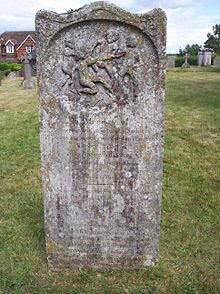
Barbara Bettis: The Heart of the Phoenix

giveaway

One lucky commenter will win an e-copy of The Heart of the Phoenix . All comments also qualify as entries for Susana’s September Giveaway, a necklace from London’s National Gallery (see photo at right).

About The Heart of the Phoenix

Some call him a ruthless mercenary; she calls him the knight of her heart.

Memories

Lady Evelynn’s childhood hero is home—bitter, hard, tempting as sin. And haunted by secrets. A now-grown Evie offers friendship, but Sir Stephen’s cruel rejection crushes her, and she resolves to forget him. Yet when an unexpected war throws them together, she finds love isn’t so easy to dismiss. If only the king hadn’t betrothed her to another.

Can Be Cruel

Sir Stephen lives a double life while he seeks the treacherous outlaws who murdered his friends. Driven by revenge he thinks his heart is closed to love. His childhood shadow, Lady Evie, unexpectedly challenges that belief. He rebuffs her, but he can’t forget her, although he knows she’s to wed the king’s favorite.

And Deadly

When his drive for vengeance leads to Evie’s kidnapping, Stephen must choose between retribution and the loved he’s denied too long. Surely King John will see reason. Convict the murderers; convince the king. Simple. Until a startling revelation threatens everything.

AmazonThe Wild Rose Press

Excerpt

Evie could tell Stephen was angry now by the way he glowered and roared in that whispery sort of way no one else could hear, but left her with no doubt of his displeasure.

THOP COVER copy“Your betrothed.” He bent and scooped her off the floor.

“What? What about him?”

“That’s the identity of the illustrious lord who’s sharing passage with us.”

“You’re drunk. And put me down. I’m perfectly capable of getting up on my own.”

“Be quiet. You have blood on your leg.”

“Of course I do. I tripped and fell trying to answer your pounding when you could easily have opened—” His words finally penetrated her throbbing head. “I’m bleeding?”

Oh, blast. The contents of her—empty—stomach churned. She attended the villagers’ hurts, bound the cuts and scrapes of servants and their children. The sight of their blood bothered her not a whit. But her own? Black spots danced at the corners of her vision, becoming larger and larger until she heard Stephen’s voice.

“Evie, Evie. What the hell?”

His voice echoed so far away. If she didn’t know better, she’d vow he sounded alarmed. Perhaps she’d close her eyes for a moment. As the ringing in her ears crescendoed, she recalled his words. Betrothed.

Her betrothed was on board?

Dear Lord, just let me die.

About the Author

Barb-4Award winning author Barbara Bettis has always loved history and English. As a college freshman, she briefly considered becoming an archeologist until she realized there likely would be bugs and snakes involved. And math.

She now lives in Missouri, where by day she’s a mild-mannered English teacher, and by night she’s an intrepid plotter of tales featuring heroines to die for—and heroes to live for.

WebsiteBlogFacebook Twitter

Historical Tidbit: Dover

Most of us are used to reading of Dover as the port closest to the continent and the one used most frequently. However, in the Middle Ages, it wasn’t always the port of choice. When King John left Normandy for England where he was to be crowned on Ascension Thursday, 1199, he landed at Shoreham on the country’s southern coast. Evidently, Shoreham was a popular port during those years. According to one source, one of the first things John did when he landed in Shoreham two days before his coronation was visit the church of St. Nicholas.

Here’s a modern photo of St. Nicholas’ Church, although one can see some of the medieval touches at the top.

St_Nicolas'_Church,_Old_Shoreham,_West_Sussex copy