Archives

Pamela Labud: To Catch a Lady

Interview with Pamela Labud

Susana: What inspired you to start writing?

Pam: I was raised in Illinois, with only 3 TV channels and a small library, I couldn’t wait for more stories, so I started writing my own at age 13. I didn’t really finish a novel until much later when I read Diana Gabaldon’s Outlander, and knew I had to write. Shortly after that I started my first historical romance novel!

Susana: How long have you been writing?

Pam's bio pic 4 copyPam: I’ve been writing romance for twenty years! Before I wrote mostly short stories and as a teenager, very depressing poetry. But, once I started writing romance, I never looked back. I love the genre and plan to write it forever!

Susana: What advice would you give to writers just starting out?

Pam: Read everything you can get your hands on! All genres and all ages. Not just in your comfort zone. Read nonfiction as well as fiction. Pay attention to the masters, and by that I mean Stephen King’s On Writing, Deb Dixon’s GMC, Chris Vogler’s The Writer’s Journey, and Self Editing for Fiction Writers by Renni Brown and Dave King, among others. Learn to write synopsis, blurbs and log lines. Learn how to pitch a book and how to gracefully accept rejections and learn from them. And, finally, the most important thing to do? Write, write, write!

Susana: Do you ever suffer from writer’s block? If so, what do you do about it?

Pam: I’ve not really suffered from writer’s block, but I do have moments of anxiety and times when the words just aren’t there. I think a block can come from several sources. Health problems, grief, fear, and even situational stress.

The best thing to do is to figure out what’s blocking you and then do your best to deal with it. Do you need medical treatment? A counselor? Time to grieve? Or, maybe a job change or help dealing with a domestic issue will make it possible to restart your writing.

Sometimes you can be blocked because of low self-esteem. “I’m no good, therefor I can’t do this. I’m a terrible person and therefore I’m a terrible writer. No one will want to read what I write, etc.”

When this happens, you really need to sit yourself down and start reciting positive affirmations. Writing is a very scary business, when you fail and when you succeed… No matter what, face that blank screen and keep trying.

Susana: What comes first the plot or the characters?

Pam: For me, it’s the characters. I grow the plot from their personality, flaws, goals and what cause conflict in their lives.  Every time they solve one problem, I give them another, bigger one. Of course, they all have that “black moment” where they think all is lost, but they figure things out and their story always works out. I believe in Happily Ever After or Happy for Now.

Susana: Are you a plotter or a pantser?

Pam: I’m a plantser! LOL! Actually, I start with my character’s profile and then pants, or free write from there until about halfway through the story. Then, I plot the rest. Also, I always know my ending before I sit down to write the first line.

Susana: What are you reading now?

Pam: I love reading Regency romances, except for when I’m actively writing in the genre. I love to read romantic suspense authors like Tammy Hoag and Kathy Reichs. At present, though, I’m reading the first book in an amazing series by Kristen Painter. The Vampire’s Mail Order Bride was so much fun! I can’t wait to finish the rest of the series.

Susana: What author or authors are most influential in your writing?

Pam: My favorite author growing up was Ray Bradbury. I so loved his books and poetry. He’s a Midwesterner like me, so his writing really resonated with me. In addition to his writing novels, he also wrote short stories and poetry. Plus, he wrote the screenplay for the first Moby Dick movie.

Later on, though I’d love authors like John Jakes, JRR Tolkien, and others, it wasn’t until I read Diana Gabaldon’s Outlander that I really had the urge to write. I’m nowhere near the kind of writer she is, but I learned to write with emotions through her more than anyone else I’ve read. And, finally Jane Austin and Mary Jo Putney were my go to for Regency stories. Mary Jo’s The Rake and The Reformer is still my favorite modern Regency romance.

Susana: What is your work schedule like when you’re writing?

Pam: All over the place! LOL! Six months ago I retired from nursing to write full time, and it has been one of the biggest challenges of my life. I have two grown daughters, and since I left nursing one of the graduated from college—three thousand miles away, and the other one got married. I also attended my first Romantic Times Convention and went to New York City for last year’s RWA National Conference. We are also doing a major reorganization of our house, so you can imagine what insanity that involves. But, I do write every day whenever and wherever I can.

Susana: What did you want to be when you grew up?

Pam: A writer, of course! After that, I decided to become a nurse. I had a long and wonderful career in nursing, 2 years as a nurse tech, and then 33 years as a registered nurse. I met lots of great people, met and married my husband of 26 years (who is also a nurse), and now have two wonderful daughters, one of which has become a nurse as well. I was always blessed with enough work to pay the bills, raise my girls and eek out time for writing, too.

Susana: What has been your biggest adventure to date?

Pam: That was definitely my first visit to New York City last July for the Romance Writers of America’s National Conference. I love that city!!! For my entire adult life, I have had a huge crush on the Big Apple. No lie. I started watching Law and Order, and fell head over heels crazy about that place. I watched Sex in the City not only for the fabulous stories, but to see NYC! And of course, CSI New York, and the list goes on. L&O the first show was my long time favorite show so I’d always felt a kinship. Then, seeing Times Square for real was just awesome. I so can’t wait to go back.

To Catch a Lady_LaBud copy

About To Catch a Lady

Ashton Blakely, the Duke of Summerton, cannot stop his aunt from meddling in his affairs. So rather than let her select a most disagreeable mate, Ashton decides to fire the first volley by holding a ball as a scheme to bag the ideal wife: a deferential girl eager to produce and raise an heir, leaving Ashton to his beloved hunting lodge and titled friends. But when Ashton falls for the one woman who isn’t willing to play his game, all his plans scatter like buckshot. Suddenly, the chase is on!

Caroline Hawkins has no interest in marriage. In fact, she has devoted her life to defending women from the indignities visited upon them by their husbands. She only chaperones her beautiful younger sister to Summerton’s ball in the hopes of saving her family from bankruptcy. She certainly doesn’t expect to catch the Duke’s eye… nor is she prepared for the heat that rises every time she thinks of his powerful build or his dark, tantalizing gaze. Caroline can run, but she cannot hide—for Ashton has already captured her heart.

AmazonBarnes & Noble Kobo

About the Author

An avid reader since age 5, Pam Labud began seriously writing romance fiction in 1996. Published in 2005, Pam’s first mass market romance novel, Spirited Away, was a Romance Writers of America’s Double RITA contest finalist. That book and the one that followed, If You Could Read My Mind, both received 4 star reviews from Romantic Times Magazine. Since, she has been published both ebooks and in print, via online publishers as well as self publishing her own backlist titles. Currently she writes historical Regency romance, western romance, paranormal romance and fantasy.

Vauxhall Gardens: The Final Decades, Part III

vauxhallbook

Vauxhall Gardens: A History

David Coke & Alan Borg

The Vauxhall Pleasure Gardens is one of the places I’d love to slip back in time to visit, just to catch a glimpse of what it was like. After recently splurging to buy this lovely coffee-table book, I thought it might make a wonderful subject for a new blog series. But do buy the book too, if you can! The photos are fabulous!

The early 1830’s marked a low period in Vauxhall’s fortunes. The weather was often poor, causing cancellations of particular events, especially fireworks. There seems to have been a lack of cash for either further investment or spectacular displays.

Among the newer attractions were Michael Boai, the ‘celebrated Chin Melodist’; Joel, the ‘Altonian Siffleur’, who imitated birds; the Singers of the Alps; Don Santiago, the Lilliputian King, only 27 inches high; the great Boa Constrictor and Anaconda. Forty thousand attended on September 8, 1830 when the gardens were free all day to celebrate the coronation of William IV.

In 1832, charity events, flower shows, and other special events were held as a way of increasing income.  “Many of these events were run under the leadership of aristocratic or even royal patrons and attracted wealthy visitors.” These included a Ladies Bazaar and Fete Champetre in aid of the Royal Dispensary for Diseases of the Ear; a Fancy Fair sponsored by the Duchess of Kent for the cause of restoring the Lady Chapel at St. Saviour’s Church, Southwark; a fete for the abolition of slavery (1834), and the ‘Superb Gala for the benefit of the Distressed Poles’.

Ballooning

Balloon ascents had been taking place at Vauxhall since 1802, but it wasn’t until the 1820’s and Charles Green that regular balloon ascents and rides were held, generating much-needed income to keep the gardens a viable enterprise.

Green’s first flight was from Green Park on 19 July 1821 in honor of William IV’s coronation. Green’s balloons were larger because he used coal gas instead of hydrogen, which was easier and safer to inflate, as well as cheaper and less harmful to the silk canopy.  Green’s

first flights from Vauxhall took place in July 1826. These were the first ever night ascents in Britain and were the climax of the firework displays. The aeronaut could be observed launching rockets and other incendiary devices from the car of the balloon beneath the main canopy.

Not only was Green a serious scientist, but also a skilled showman, which was a winning combination for Vauxhall. “In 1832 he and a ‘scientific gentleman’ went up at 6 p.m. To measure air pressures and carry out other experiments with barometers.”

Balloon ascents were the main reason for daytime opening. For the afternoon openings, Green staged balloon races with his brother and other family members, also giving rides to members of the public. Dickens went to see the spectacle and left a vivid description:

So we retraced our steps to the firework-ground, and mingled with the little crowd of people who were contemplating Mr. Green.

Some half-dozen men were restraining the impetuosity of one of the balloons, which was completely filled, and had the car already attached; and as rumors had gone abroad that a Lord was ‘going up’, the crowd were more than usually anxious and talkative. […] Just at this moment all eyes were directed to the preparations which were being made for starting. The car was attached to the second balloon, the two were brought pretty close together, and a military band commenced playing, with a zeal and fervor which would render the most timid man in existence but too happy to accept any means of quitting that particular spot on earth on which they were stationed. Then Mr. Green, sen., and his noble companion entered one car, and Mr. Green, jun., and his companion the other; and then the balloons went up, and the aerial travelers stood up, and the crowd outside roared with delight, and the two gentlemen who had never ascended before, tried to wave their flags, as if they were not nervous, but held on very fast all the while.

The Royal Vauxhall balloon

The proprietors of the gardens financed part of this balloon, which was intended by Green to be three times bigger than any previous gas ballon.

Measuring 150 feet in circumference and 80 feet high when inflated, it consisted of 2000 yards of raw Italian skill, dyed crimson and white and made up by Mssrs Soper of Spitalfields. Alternate 90-foot lengths were then stitched and glued together, producing a striking striped effect. The whole surface was coated in a varnish devised by Green himself and encased in a net of ropes. The car… was made of wickerwork, oblong in shape, with a bench seat all round the inside. On the exterior there were large gilded eagles at either end, and the sides were draped with purple and crimson velvet, richly embroidered. The cost of the whole machine was put at £2100, but since members of the public were charged for flights at the rate of £21 for gentlemen and £10 10s for ladies, this was soon recouped… Despite the cost, the public demand for flights was insatiable, as Benjamin Disraeli commented in 1837: ‘There is no news today: everything is rather flat and the room is thin as the world have gone to see the monster balloon rise from Vauxhall.

The Great Balloon of Nassau

(c) National Portrait Gallery, London; Supplied by The Public Catalogue Foundation

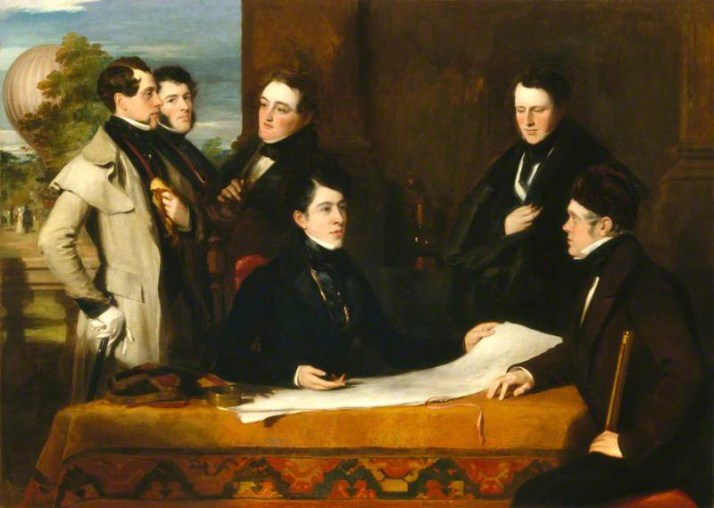
John Hollins, A Consultation prior to the Aerial Voyage to Weilburgh, oil on canvas, 1836. Green is seated on the right, discussing the voyage with Robert Holland; between them stands Thomas Monck Mason, while the group by the window comprises (left to right) Walter Prideaux, Hollins himself and Sir William Melbourne James. The balloon is visible in the gardens behind them. (c) National Portrait Gallery, London; Supplied by The Public Catalogue Foundation

On 7 November 1836—without any prior notice—Thomas Monck Mason, Robert Holland, and Green took off in an attempt at a long-distance record. Financed by Holland, the provisions included 40 pounds of ham, beef and tongue, 45 pounds of fowls, as well as preserves, sugar, bread, and biscuits—not to mention two gallons each of sherry, port and brandy, and a device for heating coffee using quicklime.

Carried along on a north-westerly breeze, they passed Canterbury at 4 p.m., dropping a message for the mayor by parachute. Night fell after their Channel crossing between Dover and Calais so they sat down to a substantial supper.… Once it was light Green began seeking a landing site and brought the balloon safely to earth at 7:30 a.m., near the town of Wilbur in the Duchy of Nassau. The aeronauts had flown 480 miles in eighteen hours, easily setting the world record for the longest balloon flight.

More Balloons

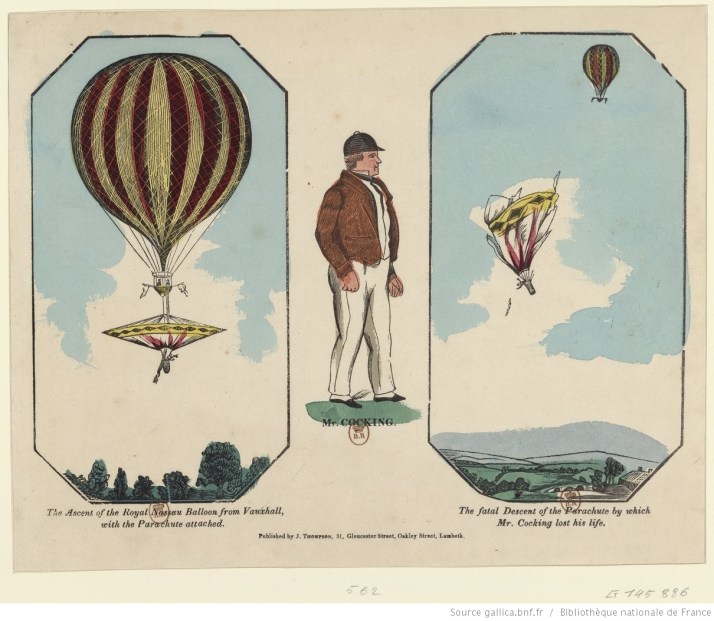
Balloons with parachutes had been done since the 1790’s, and Robert Cocking developed a theory of aerodynamics that unfortunately led to his death. Besides the fact that his theory was faulty, the parachute was far too large and heavy. Green and others tried to dissuade him, but he was adamant, and when the parachute was detached from the balloon, it sunk like a stone, and Cocking died within ten minutes of landing from a serious head wound. Vauxhall held a benefit night for Cocking’s widow and Queen Victoria sponsored a public subscription to raise funds for her as well.

cocking's parachute

The tragedy of Cocking’s upside-down parachute

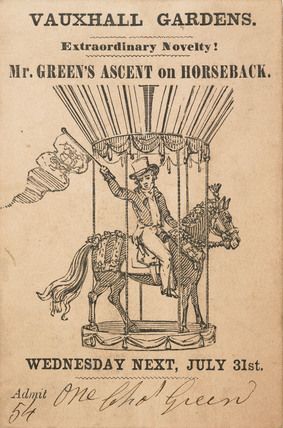
The plan for a lion tamer and a Bengali tiger to ascend never came to fruition, banned by the magistrate. “In 1850 Green went up on horseback, with his unfortunate mount locked onto a wooden platform by its hooves.

Handbill advertising Green's ascent on horseback, 31 July 1850 (Museum of London, A8955). This appears to be a complimentary ticket issued by Green himself. The flight did take place, with the horse firmly locked in place by the hooves.

Handbill advertising Green’s ascent on horseback, 31 July 1850 (Museum of London, A8955). This appears to be a complimentary ticket issued by Green himself. The flight did take place, with the horse firmly locked in place by the hooves.

George Cruikshank’s Comic Almanac for 1851

Would you want to have lived near Vauxhall with all these stunts taking place? The following piece purports to be from a disgruntled local resident:

Sir, I reside near a place of popular amusement ‘al fresco’. I am of a cheerful though quiet disposition, and should be perfectly happy but for one circumstance. During the entire summer season I am in a continual state of terror from balloons.

It was in my front garden that the Ourang-outrang descended in a parachute in 1836. I then said nothing of the annoyance caused by the mob rushing into my lawn and scrambling for fragments of the machine, of the destruction effected among my crockery by the animal attempting to escape through my scullery, nor of the alarm which his sudden appearance in the Dining room excited in the bosoms of myself and my family. I thought the balloon mania had reached its highest pitch—no such thing, Sir. After that came the Nassau Balloon which used to take a dozen people up at once exactly over my house, about once a week; till a terrible dream haunted me of seeing the whole party discharged into my premises.

Then Balloons with fireworks, waking me up every other night, and gazing at one of which, out of a window, I received a sudden blow in the eye from a firework case, descending fifteen hundred feet perpendicularly. My next alarm was occasioned by a hamper of champagne, which during a ‘perilous descent’, when a valve gave way, some intrepid aeronaut pitched through my roof at midnight.

Now folks go up on horseback. Can I walk at ease in my garden and know that the veteran Green is three miles above me, performing equestrian feats in the air? Pray, Sir, exert your influence in my behalf, or we shall shortly hear of a ‘Terrific Ascent in a cab,’ to be eclipsed by ‘First ascent of the Monster Balloon, taking up the Pimlico Omnibus.’.

not in my backyard

Susana’s Vauxhall Blog Post Series

  1. Vauxhall Gardens: A History
  2. Vauxhall Gardens: Jonathan Tyers—“The Master Builder of Delight” 
  3. Vauxhall Gardens: A New Direction
  4. Vauxhall Gardens: The Orchestra and the Supper-Boxes 
  5. Vauxhall Gardens: The Organ, the Turkish Tent, and the Rotunda
  6. Vauxhall Gardens: Three Piazzas of Supper-Boxes
  7. Vauxhall Gardens: “whither every body must go or appear a sort of Monster in polite Company”
  8. Vauxhall Gardens: The Competition
  9. Vauxhall Gardens: The Artwork, Part I
  10. Vauxhall Gardens: The Artwork, Part II
  11. Vauxhall Gardens: The Music, 1732-1859
  12. Vauxhall Gardens: The Business Side
  13. Vauxhall Gardens: Developments from 1751-1786
  14. Vauxhall Gardens: Thomas Rowlandson’s Painting (1785)
  15. ‎Vauxhall Gardens: The Third Generation of the Tyers Family and the Jubilee of 1786
  16. Vauxhall Gardens: An Era of Change (1786-1822), Part I
  17. Vauxhall Gardens: An Era of Change (1786-1822), Part II
  18. Vauxhall Gardens: An Era of Change (1786-1822), Part III
  19. Vauxhall Gardens: The Final Years, Part I
  20. Vauxhall Gardens: The Final Years, Part II
  21. Vauxhall Gardens: The Final Years, Part III
  22. Vauxhall Gardens: The Final Years, Part IV
  23. Vauxhall Gardens: Farewell, for ever

Andrea K. Stein: Horizons East (Giveaway)

How My Characters Found Me

by Andrea K. Stein

Readers often ask me how I find and develop characters. I don’t – they find me. And the most amazing part is they come with their own swashbuckling tales.

My hero in Fortune’s Horizon, the first in my series of romance on the high seas, came to me while I was delivering yachts out of Charleston Harbor. One night over beers with a Charlestonian sailor at City Marina, I heard an incredible story about blockade-runners during the Civil War.

He said they would anchor near the very bar where we sat, which back then was part of a cotton warehouse. After running goods, including supplies for the Confederate Army, through the Union blockade, they would cram their sleek ships with bales of cotton for the run back out.

Heading back to Nassau, or Bermuda, they would off-load cotton to ships bound for England. Huge syndicates owned many of the blockade running steamships and would re-stock them with goods and coal to fuel their engines.

But why take all that risk? Each run in and out of ports in the South could net $1 million in 1860s money. That would be about $63 million in today’s dollars.

The British government never publicly supported the Confederate cause, but tacitly allowed the syndicates to operate in England where many of the ships were built, as well as in waters controlled by the Royal Navy.

After some research on my end as well as in London, where my British delivery captain boss went to the Admiralty to do some digging, we came up with the perfect hero for my series. Captain Jack Roberts was a British post captain on half pay from the Royal Navy. Since England was not at war, she laid off approximately 210 of her 250 post captains.

Mostly battled seasoned, a good number of those men ran the Southern blockade making fortunes for the syndicates as well as themselves, if they were enterprising, and lucky.

The most interesting thing about Captain Roberts is he ran the blockade under an assumed name, because he was the third son of an English earl, and he didn’t want to embarrass his family. So, as a romantic hero, this character kept getting better and better.

In the first entry in the series, he tangles with a woman spy who sneaks aboard his ship and infuriates him. Of course, he marries her.

For the sequel, I found another spiral of adventures Captain Roberts lived through as an adviser to the Turkish Navy. You have to love a character that writes his memoirs near the end of his life (dictated to a much younger wife) and then publishes them in a book now available through Google Books.

My sequel needed a romantic subplot, though, in addition to the further adventures of Jack and his wife, Lillie.

On a hunch, I searched Debrett’s, and lo and behold, up popped Miles, Jack’s younger brother. He joined the Bombay Fusiliers in the mid-1800s, about the time the British government took over military command from the East India Company. And, believe it or not, he was an incurable romantic, according to a quirky newspaper report found online.

I hope these wonderful people we call characters keep coming to me and whispering in my ear. My part is easy. All I have to do is listen. But if I drag my feet, they do keep me up nights with their complaints.

How about you? Do you enjoy historicals more knowing the characters have a bit of a foot in actual events? One commenter will receive a free ebook of Fortune’s Horizon in choice of format.

AndreaKStein_HorizonsEast_200 copy

About Horizons East

In 1867, adventuress Lillie Coulbourne-Roberts is desperate. Her husband Captain Jack Roberts is missing. Now a commander in the Turkish Navy, he has to meet with His Majesty the Sultan within the week. When her stuffy brother-in-law, Miles, arrives, she dragoons him into service. On leave from military service in India, he gets claustrophobic at the thought of going undercover with his precocious four-year-old nephew and the boy’s nanny who loathes him.

Horizons East, sequel to Fortune’s Horizon, is now on preorder on Amazon at $2.99 until February 10, 2016.

AndreaKStein_FortunesHorizon200 copy

Amazon

Until February 10, the first entry in the series, Fortune’s Horizon will be available at 99¢.

Amazon

About the Author

A native Ohioan, Andrea K. Stein is the daughter of a trucker and an artist. She grew up a scribbler. The stories just spilled out. A newspaper professional and electronic print consultant for thirty years, she finally ran away to sea for three years. Now she writes high seas romance while tucked away in the Rocky Mountains at 10,000 feet.

WebsiteFacebookTwitter

Vauxhall Gardens: The Final Decades, Part II

vauxhallbook

Vauxhall Gardens: A History

David Coke & Alan Borg

The Vauxhall Pleasure Gardens is one of the places I’d love to slip back in time to visit, just to catch a glimpse of what it was like. After recently splurging to buy this lovely coffee-table book, I thought it might make a wonderful subject for a new blog series. But do buy the book too, if you can! The photos are fabulous!

C.H. Simpson: Master of Ceremonies

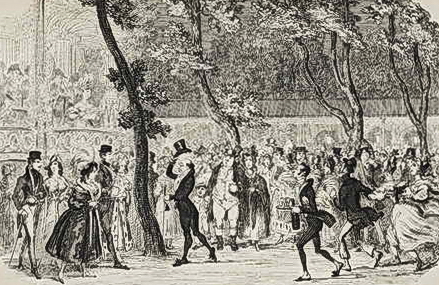
C.H. Simpson had held this office since 1797, but it wasn’t until 1826 that the decision was made to promote him as a “character” in the Gardens. “Thackeray described him as ‘the gentle Simpson, that kind smiling idiot.'”

He was renowned for his excessive politeness, servile manner and elaborate bows. With his top hat and silver-mounted cane, trademarks from the beginning his time at Vauxhall, he could easily be seen as a figure of fun. In his later years he came to be regarded as one of the great attractions of the place, greeting all visitors with his special brand obsequious courtesy.

George Cruikshank, with C.H. Simpson in the center raising his hat

George Cruikshank, with C.H. Simpson in the center raising his hat

Simpson’s exaggerated and hyperbolic style is amply demonstrated in the flowery language of his autobiography, The Life and Adventures of C.H. Simpson, Master of Ceremonies at the Royal Gardens, Vauxhall, from his Earliest Youth to the Sixty-fifth Year of his Age (Written by Myself, London, 1835)… He stated that…he was saved from drowning in a bathtub, aged three, by the family’s Newfoundland dog (called William Tell). In 1781 he joined the Royal Navy and took part in a major naval engagement in the Caribbean, the Battles of Saintes. He then enlisted as a second mate on a merchantman and sailed to New Zealand. Another voyage took him to China, but a terrible storm on the return passage determined him not to go to sea again. When he was twenty-one, already working at Vauxhall, he was set to marry a girl called Julia…; on discovering her with another, he broke off the engagement and remained a bachelor all his life.

Since almost every visitor to Vauxhall was met by Simpson there are many descriptions of him.

The appearance of this gentleman was in keeping with the oddity of his character. He was a short man, with a large head, a plain face, pitted with the small-pox, a thin thatch of hair plastered with pomatum and powder. His body and limbs were encased in black cloth of antique cut, and occasionally his head was covered with a hat as heavy as a coal-scuttle, or a life-guardsman’s helmet. This awkwardly constructed piece of felt was more often in his hand than on his head. He was continually bowing to everybody he met […] he was the very climax of obsolete politeness; the most obsequious and painstaking man to oblige everybody and express his gratitude for their condescension in giving trouble, that I ever remember to have met with.

According to another writer: ‘the moment he hears the faintest hum of an uproar, he glides away to the locus in quo, and it is miraculous to see how soon he gets to the core of the commotion. He pierces through the mob like an eel in mud.’

Robert Cruikshank, C.H. Simpson Esq.' M.C.R.G.V., engraving, 1833 (Lambeth Landmark 1301). The Master of Ceremonies is shown welcoming the Duke of Wellington, 19 August 1833, on the occasion of his benefit night. Cruikshank drew this scene in the gardens on the spot; the huge illuminated figure of Simpson was one of the special effects created for the event.

Robert Cruikshank, C.H. Simpson Esq.’ M.C.R.G.V., engraving, 1833 (Lambeth Landmark 1301). The Master of Ceremonies is shown welcoming the Duke of Wellington, 19 August 1833, on the occasion of his benefit night. Cruikshank drew this scene in the gardens on the spot; the huge illuminated figure of Simpson was one of the special effects created for the event.

Simpson’s obsequious manner was also put to use in diffusing difficult situations that arose in the gardens. If he was jostled by drunken diners, or had port splashed over his white gloves and waistcoat, he would ‘bow himself dry again’ and smile upon ‘the boorish Bacchanalian’ as though conferring the highest honour upon him.

The Battle of Waterloo

Although Vauxhall had frequently held military-themed galas and fetes, these were nothing like the stunning re-enactments performed at Astley’s Amphitheatre. Based on a play by Henry Amherst, the battle re-creation had three acts and up to the 90 riders, in addition to a huge cast of soldiers and impressive special effects.

Unsurprisingly, the Vauxhall proprietors figured they could do the same at Vauxhall, with more space and a more realistic setting.

In preparation for the show an area was cleared on either side of the firework tower, with shrubs and ornamental trees removed. The firework gallery itself was enlarged for viewers, and several supper-boxes were removed to give a clearer view from the walks in 1827. The Battle of Waterloo was to be performed by Mr Cooke’s stable of horses and his own troupe of equestrians; Cooke, a rival and imitator of Durrow based at the Royal Amphitheater in Liverpool, claimed that his Vauxhall show would involve more than a thousand performers. Every detail of the action was acted out and the performance concluded with a huge firework display, int he course of which Cooke promised to mount

His celebrated Charger, Bucephalus, and, at full speed, ride up a nearly perpendicular Rock, to the Temple of Fame, at the summit of the Fire-Work Tower, and there deposit the British and French Colours as an Emblem of Amity, in the Temple of Concord, a Feat unequalled in the Annals of Horsemanship.

This indeed took place and all were impressed by the fact that after the fiery ascent Cooke’s mount remained perfectly docile, despite the huge explosions of fireworks all around.

A review from The Times of 19 July 1827:

These Gardens presented the fullest attendance of visitors on Monday evening which we ever remember to have witnessed in that favorite scene of amusement. The leading attraction on this occasion consisted of a grand spectacle representing the Battle of Waterloo. […] We were by no means prepared to anticipate so high a degree of illusion as the exhibition of last Monday occasionally produced in the mind. […] As near a resemblance of the field of action as possible, with the various buildings of the farm-houses of La Belle Alliance, Hogomont &c was effected, aided by the trees, which, without much effort of imagination, where converted into the original wood that covered the rear of the British line. Here several hundred soldiers, horse and foot, personated the French and British troops; and after going through numerous evolutions, which were somewhat tedious, commenced the engagement, by the former attacking the wood and chateau of Hugomont, the walls of which were loopholed by British soldiers. The various features of the great battle of Waterloo were then successively presented, some of which were managed in a way that excited feelings of considerable interest. Others were, as might be expected, rather feeble, but the general effect was certainly striking; particularly when the chateau was in flames and the hostile armies furiously engaged in front of it; while here and there detached objects, such as an ammunition wagon blowing up, various single combats on horseback and on foot, Buonaparte flying from the field in his chariot, together with the roaring of the artillery, the continued discharge of musketry, and the dense clouds of smoke in which the whole scene was occasionally enveloped, imparted to it an appearance of reality, that almost rendered it independent of any effort of fancy for the moment to produce a strong illusion. The spectators seemed very much delighted with the spectacle, and from time to time loudly applauded the performance.

Of course, not everyone was so complimentary. Older folk lamented the days when one could go to Vauxhall for a pleasant evening of music and social discourse. The younger generation tended to think it was fabulous. Twelve-year-old Albert Smith:

The Battle of Waterloo was being represented on the firework ground, and I could not divest myself of the idea that it was a real engagement I was witnessing, as the sharpshooters fired from behind the trees, the artillery wagon blew up, and the struggle and conflagration took place at Hougomont. When I stood years afterwards at the real battle-field, I was disappointed in its effect, I thought it ought to have been a great deal more like Vauxhall.

Susana’s Vauxhall Blog Post Series

  1. Vauxhall Gardens: A History
  2. Vauxhall Gardens: Jonathan Tyers—“The Master Builder of Delight” 
  3. Vauxhall Gardens: A New Direction
  4. Vauxhall Gardens: The Orchestra and the Supper-Boxes 
  5. Vauxhall Gardens: The Organ, the Turkish Tent, and the Rotunda
  6. Vauxhall Gardens: Three Piazzas of Supper-Boxes
  7. Vauxhall Gardens: “whither every body must go or appear a sort of Monster in polite Company”
  8. Vauxhall Gardens: The Competition
  9. Vauxhall Gardens: The Artwork, Part I
  10. Vauxhall Gardens: The Artwork, Part II
  11. Vauxhall Gardens: The Music, 1732-1859
  12. Vauxhall Gardens: The Business Side
  13. Vauxhall Gardens: Developments from 1751-1786
  14. Vauxhall Gardens: Thomas Rowlandson’s Painting (1785)
  15. ‎Vauxhall Gardens: The Third Generation of the Tyers Family and the Jubilee of 1786
  16. Vauxhall Gardens: An Era of Change (1786-1822), Part I
  17. Vauxhall Gardens: An Era of Change (1786-1822), Part II
  18. Vauxhall Gardens: An Era of Change (1786-1822), Part III
  19. Vauxhall Gardens: The Final Years, Part I
  20. Vauxhall Gardens: The Final Years, Part II
  21. Vauxhall Gardens: The Final Years, Part III
  22. Vauxhall Gardens: The Final Years, Part IV
  23. Vauxhall Gardens: Farewell, for ever

Blair Bancroft: The Welshman’s Bride

FOUR Books in a Month??

Somewhere around December first of 2015, I began to wonder why I was feeling so harried. And finally it came to me. Without ever intending to get myself into such a fix, I had actually worked on four different books in November. My advice to writers? Don’t do it. The experience was mind-boggling. In fact, I’m still suffering from shock as I write this, half-way through December. Here’s how it happened:

I was happily finishing and editing my latest Regency Gothic, The Welshman’s Bride, when word came that Rebel Princess, Book 1 in my new SyFy series, Blue Moon Rising, had been accepted by Kindle Scout. This sent me into a frenzy of reading the fine print in my contract, inquiring about what I had to do next, getting permission to add my other books to the end notes, and creating said end notes. Naturally, selling Book 1 inspired me to look at Book 2, which is finished, but I just had to read it again because I had a sneaking suspicion it needed more than a little revision. This, of course, ended in a complete rewrite of the last two chapters. And right in the middle of that, Book 3 insisted on being born. The words simply refused to stay in my head until the other projects were complete.

Alas, I soon discovered I had visualized the start of Book 3 in the wrong place. It absolutely had to overlap Book 2. Which meant a scene in Book 2 needed to be rewritten to match the expanded scene from a different point of view in Book 3. Aargh! Thus, four books in one month.

Seriously, writers, do not do this. It messes with the head. Two books, maybe. As authors approach the end of a book, I think most of us allow thoughts of the next one to intrude. But four books at once ends in Confusion Rampant. In my case, the head-leaping from Wales in 1818 to a rebellion in the distant future, then back. Over and over again.

Did The Welshman’s Bride survive this cavalier treatment? I can only hope so. By the time you read this blog, it should be available on Amazon, Smashwords, and other online venues. Will you find the rebellion in space popping up in Wales? Perhaps a spaceship hovering over the rugged Welsh scenery? I can only hope not. But who knows? After the November I had, anything is possible.

So what about my poor Regency Gothic that nearly got swamped by three SyFy books? For those who might wonder what I mean by Regency Gothic, that’s a name I invented for a first-person Gothic novel set in the Regency period. (Most classic Gothic novels have Victorian or Contemporary settings. For example, the masterpieces of the genre by Victoria Holt and Mary Stewart. They are almost all based on women alone and threatened, with their husbands or gentlemen friends as the chief suspect. You might call them tales of murder and suspense, with Gothic atmosphere.)

In my Regency Gothics I tend to create heroines who are far from perfect. In The Welshman’s Bride I’ve taken this a step further, presenting a heroine who stumbles from one disastrous situation to the next. If you like your heroines noble, self-sacrificing, cheerful, and flexible about subjects such as a husband’s mistress, then you may not like Jocelyn Hawley Maddox. If, however, you like to read about heroines who have human faults, then she’s just the girl for you. Here’s a peek at The Welshman’s Bride.

Welshman's Bride 05 Final copy

Although it seems likely she is being married for the magnificence of her dowry, Jocelyn Hawley accepts an offer of marriage from a Welshman. And quickly discovers she is as unprepared for marriage as she is for her new family—a mother-in-law who insists on living in Wales’ Medieval past and a sister-in-law who seems to be trying to get rid of her. Jocelyn is also plagued by the problem of her husband’s mistress and a series of disastrous incidents—some potentially lethal—that dog her footsteps. As she grows more alienated from her husband, who barks at her to “grow up,” she finds herself the classic stranger in a strange land. Where it appears someone is trying to kill her.

AmazonBarnes & Noble • Kobo

~ * ~

Thank you for joining me today. Whether as an author or as part of your daily life, I hope my cautionary tale will keep you from doing—as the old saying goes—“biting off more than you chew”!

Blair Bancroft, Longwood, Florida, December 2015

WebsiteBlog


Vauxhall Gardens: The Final Decades, Part I

vauxhallbook

Vauxhall Gardens: A History

David Coke & Alan Borg

The Vauxhall Pleasure Gardens is one of the places I’d love to slip back in time to visit, just to catch a glimpse of what it was like. After recently splurging to buy this lovely coffee-table book, I thought it might make a wonderful subject for a new blog series. But do buy the book too, if you can! The photos are fabulous!

Changing Up

Thomas Bish and Frederick Gye, who took over management of the Gardens in 1821, decided that “the traditional formula of concerts, suppers, and fireworks” had to be expanded in order to compete with Astley’s Amphitheatre and the West End theaters. In addition to a revamped decor and a grand Panoramic Scene “in lieu of the old Cascade,’ a Grand Masked Fete in honor of the coronation of George IV was held on July 23. Among the attractions was a 24-foot transparency of “His Majesty in his Coronation Robes, with a distant view of Westminster Abbey, attended by Minerva, and a great number of Allegorical figures” painted by Henry Singleton RA. This lavish event included

  • numerous illuminated devices, representing ‘national trophies… designed for the occasion
  • Monsieur Chalons, magician
  • Ramo Samee, Indian juggler
  • Mr. Wilson, tightrope performer
  • Mr. Gyngell’s troop of tightrope dancers
  • Fantoccini and his Ombres Chinoises (shadow puppets)
  • dancers, including the “celebrated English morris dancers”
  • military savoyards, Pandeans, Scotch, and other bands
  • premier performance of A Grand National Ode by the orchestra
  • supper by Mr. Ward of Bond Street
  • performance of one of Handel’s coronation anthems

This very successful event was repeated the next day, but the death of Queen Caroline of Brunswick the following day definitively ended any further repetitions.

Transparencies and Optical Devices

The Heptaplasiesoptron, otherwise known as the ‘Fancy Reflective Proscenium’ was built in 1821 by Mr. Bradwell of the Theatre Royal, Covent Garden. It was composed of

A number of large plates of looking-glass placed in the form of a semi-hexagon, which constitute the walls of the exhibition; and in these seven points of reflection are gained for the view of several illuminated revolving pillars and palm trees, twining serpents, and a fountain of real water; the whole lighted by coloured lamps and brilliant cut-glass chandeliers. Before this splendid scene is exhibited (which is from ten till one o’clock) it is hidden by two curtains of azure-blue silk, richly fringed and ornamented with gold.

 The Submarine Cave:

The Submarine Cave, Royal Gardens, Vauxhall, engraving, 1822 (Boolean Library, Oxford. James Winston Collection, Gough Adds. Surrey C.22, item 2). Painted by the main staff artists, Mr. Thorn and his son Francis, this was one of the new attractions for the 1822 season, the first in which the gardens permitted to use the prefix 'Royal'.

The Submarine Cave, Royal Gardens, Vauxhall, engraving, 1822 (Bodleian Library, Oxford. James Winston Collection, Gough Adds. Surrey C.22, item 2). Painted by the main staff artists, Mr. Thorn and his son Francis, this was one of the new attractions for the 1822 season, the first in which the gardens permitted to use the prefix ‘Royal’.

The back scene of this exhibition is a rich fancy view, consisting of a water-fall, castles, and a fine romantic landscape beyond; this has a peculiarly good effect as a day scene. Before it is placed the rocky entrance to a marine cavern, the arch of which is eighty feet in the interior span; and within this entrance are placed the Water Works. This exhibition commences at 10 o’clock, when it is brilliantly lighted up with concealed lamps.

The Hermitage:

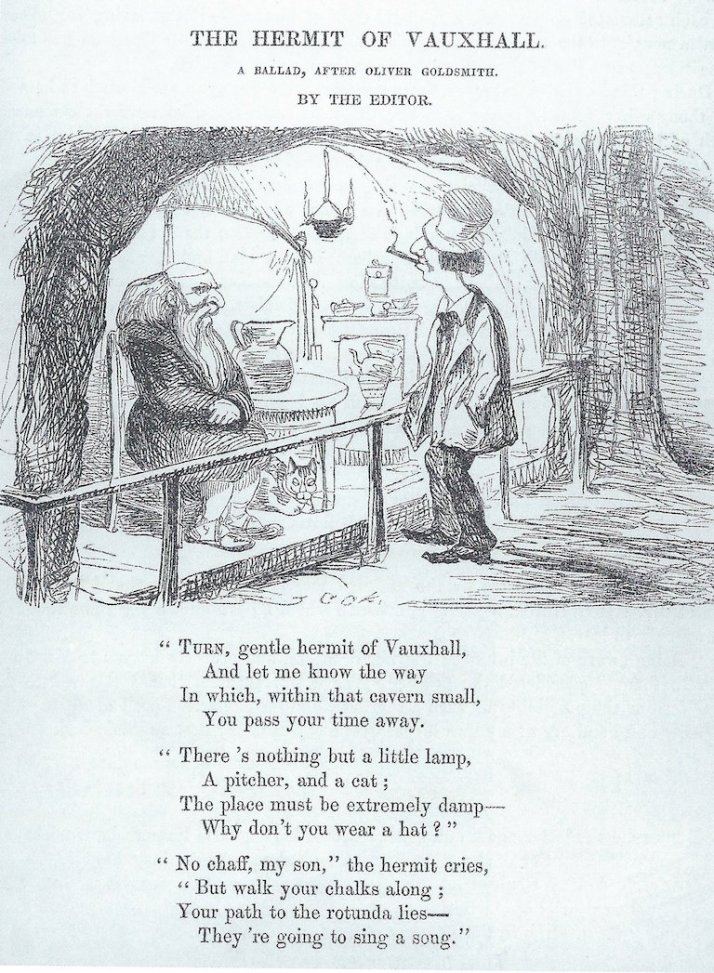
hermit

Anon., The Hermit of Vauxhall, engraving, 1832 (Minet Library, London, Lambeth Archives Department, V. of. 207). This is a rare view of the interior of the Hermitage and of the hermit himself. The verses are a parody of Oliver Goldsmith’s lengthy ballad The Hermit (1765), the first line of which is, ‘Turn, gentle hermit of the dale’.

…Made of wood and canvas, it represented the interior of a hermit’s cottage, with the hermit ready by lamplight. First installed in 1757, this too was painted by Mr Thorn and… was presumably constantly re-painted. The Hermitage became a fixture and was soon supplied with a live hermit, a fortune-teller.

The Thorns: Staff Artists

The Thorns, father and son (Francis), seem to have been the main staff artists…; their task was to change or renew the views and transparencies on show at regular intervals. So industrious were they that it is almost impossible to keep up with the succession of spectacular views that graced the gardens.

Over the years, these included:

diorama

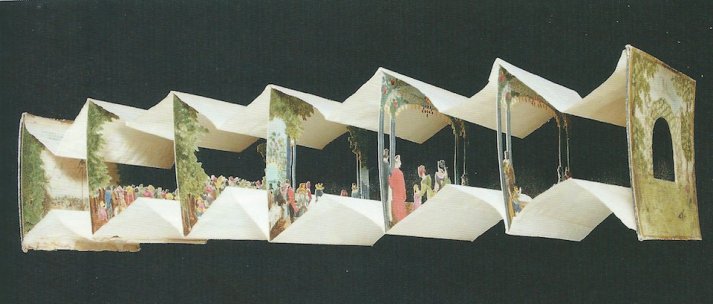
Optical toy or peepshow, color etching on cut sheets of card, 1822 (private collection). This souvenir of a Vauxhall Juvenile Fete folds flat but expands to give an in-depth perspective view of the gardens.

  • “a view of Naples by moonlight, with a vivid representation of Mount Vesuvius during an eruption”
  • Rotterdam by Moonlight
  • Paris from the Observatory
  • a Storm off the Cape of Good Hope
  • Fingal’s Cave
  • Views of Captain Ross’s Voyages to the North Pole
  • a moonlight scene of the ruins of an Italian abbey
  • ‘a stupendous diorama of the Golden Temple of Honan’
  • a model of St. Mark’s Square in Venice
  • ‘a dioramic picture of the proposed new Houses of Parliament after the designs of Mr. Barry’
  • ‘a Grand Moving Panorama of the voyage of the Nassau balloon up to 400 ft in length’.

The Royal Gardens, Vauxhall

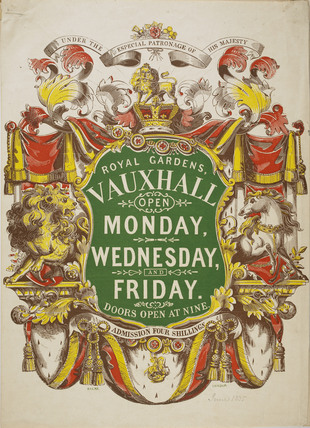
Poster, June 1835 (Museum of London, 2007.1/82). From 1822 onwards the proprietors squeezed every ounce of publicity out of the Royal designation of the gardens.

Poster, June 1835 (Museum of London, 2007.1/82). From 1822 onwards the proprietors squeezed every ounce of publicity out of the Royal designation of the gardens.

On June 3, 1822, the gardens opened under a new title, issued by Royal Warrant: “The Royal Gardens, Vauxhall.” The new king had visited the gardens frequently as Prince of Wales, and winning his patronage a great promotional coup. “The main entrance was rebuilt, with a portico surmounted by a large carved Royal Arms.”

Juvenile Fetes for Children

juvenile fete

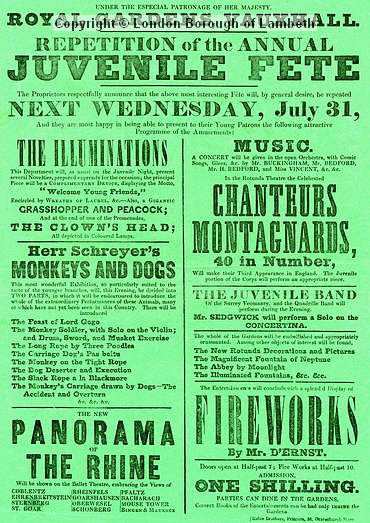
Poster advertising the Annual Juvenile Fete, 1824 (Lambeth Landmark 1383). The first such event was held on 13 July 1821 and proved so popular that it was decided to feature at least one every year. The attractions offered at Juvenile Fetes differed little from those on ordinary nights, although the songs avoided the doubles entendres designed for adult ears.

Saturday having been long considered problematic due to the objections of evangelical clergymen to keeping the gardens open after midnight, the new proprietors decided to hold a Juvenile Fete for children. “The first of these took place on 13 July 1821, starting at 5:30 and ending by 10 p.m. With much the same program as an ordinary night. It proved hugely popular.”

Dancing in the Gardens

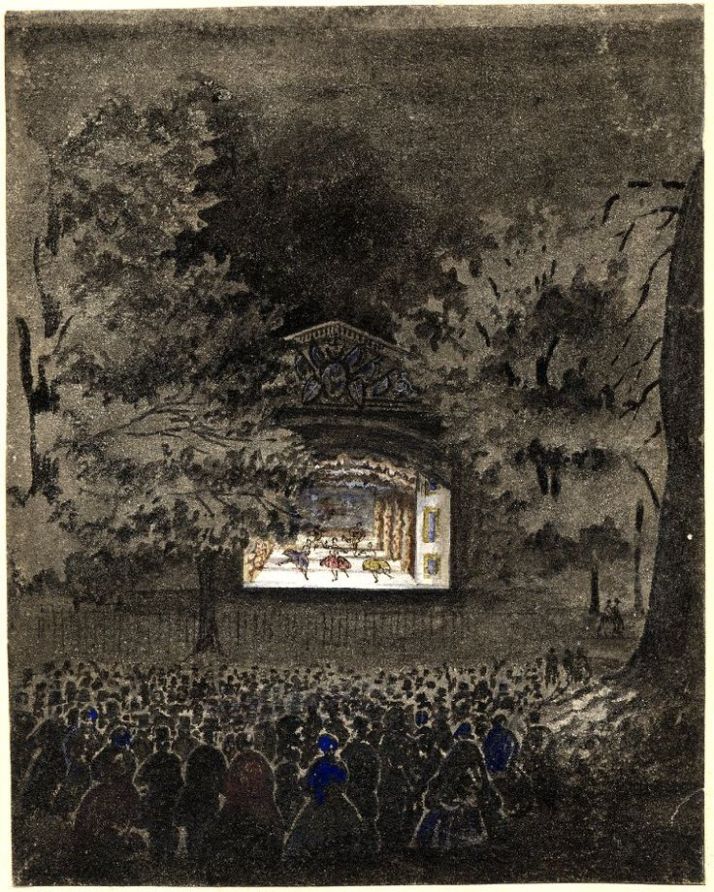
Anon., The Ballet Theatre, brush drawing in grey wash, touched with colored chalks, 1840-45 (British Museum, London, 1966.0212.1). The stage is surrounded by large trees and there is no seating provided.

Anon., The Ballet Theatre, brush drawing in grey wash, touched with colored chalks, 1840-45 (British Museum, London, 1966.0212.1). The stage is surrounded by large trees and there is no seating provided.

Having been granted a licence for Public Music and Dancing (spectator dancing only), “…of the 1823 season two new theaters were erected: one with appropriate scenery and decorations for the Juvenile Ballets; the other, in the Rotunda, for a ‘Novel Entertainment, diversified with dialogue, songs, and imitations’… The first ballet was Cendrillon, danced entirely by children, although adults took part in subsequent years.

The Aerial

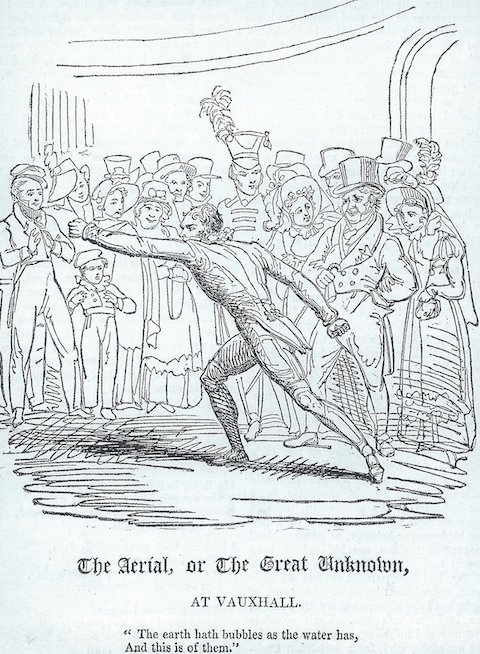
Anon., The Aerial, or The Great Unknown, at Vauxhall, engraving, 1825 (Minet Library, London, Lambeth Archives Department, V. of. 153). 'The Aerial' was an eccentric called Joseph Leeming who believed he was a person of unrivaled beauty. His appearances at Vauxhall during the 1825 season were widely reported in the press and provided good free publicity for the gardens.

Anon., The Aerial, or The Great Unknown, at Vauxhall, engraving, 1825 (Minet Library, London, Lambeth Archives Department, V. of. 153). ‘The Aerial’ was an eccentric called Joseph Leeming who believed he was a person of unrivaled beauty. His appearances at Vauxhall during the 1825 season were widely reported in the press and provided good free publicity for the gardens.

The summer of 1825… was most notable for the appearance of one of those strange characters who were drawn to Vauxhall from time to time. This was ‘The Aerial,’ the pseudonym of Joseph Leeming, whose eccentric behavior made him briefly the centre of attention. He claimed that his surpassing beauty was ‘without equal in nature or art, this or in any other age of the globe’. Having arrived in London from Manchester, he donned a blue and silver jacket, theatrical trunks or short breeches, silk stockings and blue kid shoes, with a double frill or ruff round his neck and wristbands trimmed with lace. Once in the gardens, he was taken by most visitors to be one of the performers, because he was not wearing a hat. But towards the end of the evening, people began to ask who or what he was. As The Times of 2 July 1825 reported:

An individual in a splendid dress of Spanish costume has excited much attention at Vauxhall Gardens. Having walked or rather skipped round the promenade, with a great air of consequence, saluting the company as he passed along, he at length mingled amongst the audience in the front of the orchestra, and distributed a number of cards on each which was written ‘The Aerial challenges the whole world to find a man that can in any way compete with him as such.’ After having served about three or four hundred of these challenges, he darted off like lightening, taking the whole circuit of the Gardens in his career, and made his exit through the grand entrance into the road where a carriage was waiting for him, into which he sprang and was driven off.

…His final visit to Vauxhall was on the evening of the Juvenile Fete, when he got drunk, and slept in a cloakroom until morning. After this he was informed that he would be refused entry to the gardens on any future occasion.

Susana’s Vauxhall Blog Post Series

  1. Vauxhall Gardens: A History
  2. Vauxhall Gardens: Jonathan Tyers—“The Master Builder of Delight” 
  3. Vauxhall Gardens: A New Direction
  4. Vauxhall Gardens: The Orchestra and the Supper-Boxes 
  5. Vauxhall Gardens: The Organ, the Turkish Tent, and the Rotunda
  6. Vauxhall Gardens: Three Piazzas of Supper-Boxes
  7. Vauxhall Gardens: “whither every body must go or appear a sort of Monster in polite Company”
  8. Vauxhall Gardens: The Competition
  9. Vauxhall Gardens: The Artwork, Part I
  10. Vauxhall Gardens: The Artwork, Part II
  11. Vauxhall Gardens: The Music, 1732-1859
  12. Vauxhall Gardens: The Business Side
  13. Vauxhall Gardens: Developments from 1751-1786
  14. Vauxhall Gardens: Thomas Rowlandson’s Painting (1785)
  15. ‎Vauxhall Gardens: The Third Generation of the Tyers Family and the Jubilee of 1786
  16. Vauxhall Gardens: An Era of Change (1786-1822), Part I
  17. Vauxhall Gardens: An Era of Change (1786-1822), Part II
  18. Vauxhall Gardens: An Era of Change (1786-1822), Part III
  19. Vauxhall Gardens: The Final Years, Part I
  20. Vauxhall Gardens: The Final Years, Part II
  21. Vauxhall Gardens: The Final Years, Part III
  22. Vauxhall Gardens: The Final Years, Part IV
  23. Vauxhall Gardens: Farewell, for ever

Alina K. Field: Rosalyn’s Ring

woman writing copy

An Invitation to a Wedding

1 January, 1817

My dear Miss Harris,

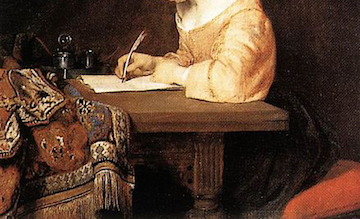
I hope this note finds you well and that the severe storms of last week did not interfere with the children’s Christmas. I so sincerely planned to spend Christmas Day with the children, but a most urgent matter arose in the district of my birth regarding my maid’s cousin. Her husband, the vile man, was SELLING her, imagine! I trust you will understand my absence at your Yuletide table, and I will certainly relate the particulars to you later, though the matter has been resolved in a way that I am resigned to finding satisfactory.

But Miss Harris, this is not why I’m writing. You will find the following information most irregular, perhaps, but I beg your indulgence and count on the liberality of your friendship. The weather being quite bad, I arrived only yesterday in London and am staying at the home of Viscount Cathmore, the most kind and gentle man who now has the estate that was once my family’s.

Miss Harris, please do send a note back with my messenger and tell me that you will visit me here in Grafton Street tomorrow afternoon, for Lord Cathmore and I are to be married then by Special License.

I am sending along some of Cook’s exquisite biscuits for the children, and you must plan tomorrow to stay for dinner and hear Hamish’s most generous proposals for the children. He is quite rich, and I do hope you will come and hear him out.

Do let me know that you will come, for your friendship means so very much to me, and you must let me know if any of the girls are ready for service as I am in sore need of a new maid.

Your dear friend,

Rosalyn Montegu

new cover copy

About Rosalyn’s Ring

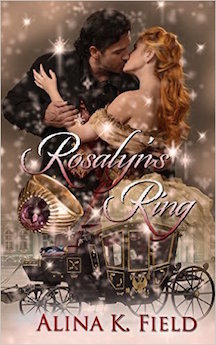
When a young woman is put up for auction in a wife sale, Rosalyn Montagu seizes the chance to rescue her—and to recover a treasured family heirloom, her father’s signet ring. Her plans are thwarted by the newly anointed Viscount Cathmore who finds her provoking beauty, upper crust manner, and larcenous streak intriguing. Her secrets rouse his jaded heart, including the truth of her identity—she is the woman whose home he has usurped. But more mysteries swirl around Rosalyn’s past, and Cathmore is just the man to help her uncover the truth.

Amazon

Excerpt

“A woman cannot buy a wife,” someone said. “‘Tis unnatural.”

Rosalyn rallied herself. “What is unnatural is selling a human being,” she shouted. “What is a travesty is to celebrate our Lord’s birthday by selling a mother and child to God knows what fate.”

The crowd rumbled angrily. Mindy spoke, but Rosalyn could not hear her words, and a hard look from Ned Morgan silenced his property. Mindy cast her eyes down until he turned away, then went back to her bold appraisal of the crowd.

“I will bid in your behalf,” Cathmore said quietly to Rosalyn. “Do you agree?”

Her heart pounding, she nodded.

“What is your limit?”

Her limit? Surely the notes in her boot were more than enough to outbid this lot. She would hope to not go that high; it would mean an entire year of leanness, not just for her, but for the orphans.

And yet, a woman should not be sold, even if it meant no sweets for the children and Rosalyn’s own sacrifices.

“I will tell you when to stop,” she said.

“Very well.” He stood tall. “You may disregard the lady’s bid.”

“Then get on with it,” Ned Morgan shouted.

The wizened auctioneer rapped the bar again and called for bids.

“Tuppence, I said.” The bid came again from the bar.

“A half crown.”

That voice came from nearby, and Rosalyn recognized it. Mr. Logan’s strong tenor resonated with determination. He exchanged a look and a nod with Cathmore, and smiled at Mindy, who sent him a glowing smile in reply.

Ned Morgan’s big fist came down on the bar, rattling glasses. “It’s not enough, Logan,” he shouted. “Not for what ye done.”

Rosalyn tasted bile. They all knew each other. Cathmore, Logan, Morgan.

“Bid three shillings,” Rosalyn hissed at Cathmore.

He called out her bid and sent Logan the smallest of shrugs. Logan countered, Morgan pounded, and Rosalyn looked for Nelly.

What is she doing?

Nelly had moved closer to Ned Morgan, her eyes glittering with excitement. Not pain, not worry over her cousin, and not desire to hold her baby nephew.

Hot anger spiked in Rosalyn. The cause was just, but the drive to come here had been Nelly’s. That she had no interest in the babe did not surprise Rosalyn—Nelly didn’t like children—but her gaze was on Morgan, not Mindy.

A commotion at the center of the room drew everyone’s eyes. Two men had squared off, their jaws moving, their fists poised. Morgan shouted at the auctioneer, the men, and the crowd, and sent angry glares at Logan and Cathmore. His eyes landed on Rosalyn and he bellowed louder.

Rosalyn could not keep track of the bidding, but she could hear Cathmore’s rumble and the auctioneer’s, and the melodic, determined tones of Logan.

She felt dizzy, and hot, and more than a little worried. She heard Cathmore call out a bid, but she didn’t know if it was pence, or shillings, or something more. She touched his arm to get his attention. “What is the bid?”

Behind them, another melee flared. The auctioneer pounded, and men shouted. A body veered and pushed her at Cathmore, who caught her close and led her quickly away from the trouble and into the private dining room.

Rosalyn struggled to breathe. His arms held her loosely, but his nearness took her breath away. No man had ever held her like this, and she had trouble finding her composure.

“The bidding!” she said, choking. “What was the b—”

His lips pressed down on hers and silenced her.

About the Author

Alina K. Field copyAward winning author Alina K. Field earned a Bachelor of Arts Degree in English and German literature, but she found her true passion in reading and writing romance. Though her roots are in the Midwest, after six very, very, very cold years in Chicago, she moved to Southern California and hasn’t looked back. She shares a midcentury home with her husband and a blue-eyed cat who conned his way in for dinner one day and decided the food was too good to leave.

She is the author of the 2014 Book Buyer’s Best winner in the novella category, Rosalyn’s Ring, a Regency novella; and the novel-length sequel, a 2015 RONE Award finalist, Bella’s Band, both Soul Mate Publishing releases.

WebsiteFacebookTwitterGoodreads


Collette Cameron: Heartbreak and Honor

HAH_meme_4 copy

Scottish Gypsies

Highland Travelers or Black Tinkers

By Collette Cameron

The term gypsy is a misnomer derived from Egyptian, much like the label Indian for Native Americans, and Romany Gypsies are quite different than the Highland Scottish Travellers or Black tinkers as they were known.

Though both groups, as well as at least a half a dozen other nomadic tribes, traveled throughout Scotland, the Roma’s origins trace back to India, whereas the Black Tinkers (in Gaelic-The Ceárdannan or the craftsmen) are mostly a genetic indigenous Scots.

That meant I had to rethink Tasara Faas, my heroine in Heartbreak and Honor.

I’d written a story with a part Roma heroine before, The Viscount’s Vow, but the Highland gypsies were vastly different. Everything from her dress, customs, and speech had to be researched because she’s far more like a Scotswoman than a Romany.

[ File # csp6407646, License # 2835035 ] Licensed through http://www.canstockphoto.com in accordance with the End User License Agreement (http://www.canstockphoto.com/legal.php) (c) Can Stock Photo Inc. / konradbak

Some Scottish Highland Traveler families do claim Roma heritage, and their Scottish–Gaelic cant contains Romany or Anglo-Romany words. In fact, some groups call themselves Nackin which is thought to be of Hindi origin.

No surprise there since the various tribes date back at least five hundred years in Scotland. However, the prevalence of the Roma influence is seen more in the Lowland travellers rather than the Highlands.

canstockphoto7116746 copy

The Black Tinkers language is secret and has never been recorded in writing, according to one source. Many hold typical Scottish surnames such as Stewart, Macmillan, MacDonald, and Cameron. They possess a strong belief in the importance of family and purity taboos, much like the Roma travellers.

And much like the European Roma, the Highland Travelers were (are) a maligned segment of population. Stereotyped as thieves, con men, and fortune tellers, stories were broadly circulated that gypsies would kidnap children. In an odd twist, gypsies’ feared abduction themselves. Many disappeared and were thought victims used in medical schools for dissection. Rumors abounded of illegitimate children of the gentry or haute ton, being sold or given to the gypsies as well.

canstockphoto5584840 copy

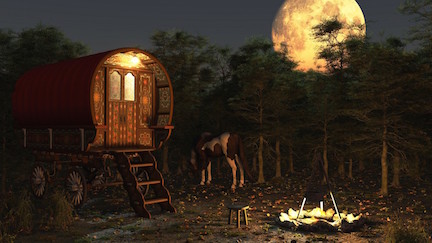
Highland Travelers were so despised, that during the 17th century, Scottish law ordered them to “quit the realm” or hang. Scottish Travelers toted their goods in carts and pitched bowed tents while the Roma typically lived in vardos, a type of caravan wagon. Some sources also claim the Highland Scottish Travelers used caravans as well.

Today, usage of the terms gypsy or even tinker is considered derogatory.

Though a Scottish Regency Romance, Heartbreak and Honor uses the abduction and persecution elements of the Scottish gypsies to help spread their unique, and often unfortunate, tale.

What unusual elements do you enjoy reading about in a historical romance?

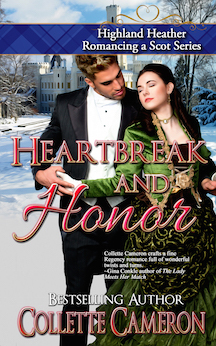
HeartbreakandHonor3_850 copy

About Heartbreak and Honor

Highland Heather Romancing a Scot Series, Book 3

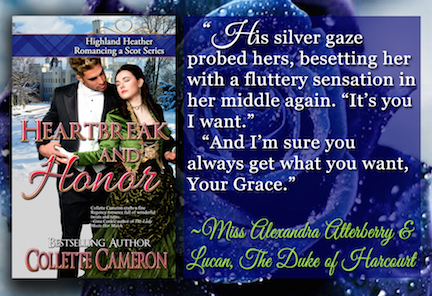
Abducted by a band of renegade Scots, Highland gypsy Tasara Faas doesn’t hesitate to blacken her rescuer’s eye when the charming duke attempts to steal a kiss. Afterward, she learns she’s the long-lost heiress Alexandra Atterberry and is expected to take her place among the elite society she’s always disdained.

Lucan, the Duke of Harcourt, promised his gravely ill mother he’d procure a wife by Christmastide, but intrigued by the feisty lass he saved in Scotland, he finds the haut ton ladies lacking. Spying Alexa at a London ball, he impulsively decides to make the knife-wielding gypsy his bride despite her aversion to him and her determination to return to the Highlands.

The adversary responsible for Alexa’s disappearance as a toddler still covets her fortune and joins forces with Harcourt’s arch nemesis. Amidst a series of suspicious misfortunes, Lucan endeavors to win Alexa’s love and expose the conspirators but only succeeds in reaffirming Alexa’s belief that she is inadequate to become his duchess.

Amazon

Excerpt

“Duke? What’s a ruddy English duke doing sneaking into a Scottish keep’s chamber?” Tasara flinched. She hadn’t meant to speak aloud.

“Why, rescuing you, of course.”

Did he wink? Cocky fellow, wasn’t he? But then, he was a duke. The attitude came with the title, no doubt present from birth. Probably had his noble bum and snotty nose wiped with the finest linen or silk. Astonishing that he deemed to exert himself enough to muster a sweat. Didn’t nobility have servants do everything for them?

Muted voices and calls echoed from somewhere in the keep.

Attempting to recognize a voice, she tilted her head.

The horrific shrieks and roars of minutes ago had ceased, although an occasional shrill cry yet rang through the stone passageways, raising the hair along her nape.

“Ye be here to rescue us?” Holding Lala’s pudgy hand, György knelt on the bed, his ebony eyes wary and no doubt sprinkled with a dab of excitement too.

In the muted light, Tasara couldn’t be certain. Lads dreamt about adventures of this sort.

“I am, indeed, young sir.” His grace smiled, his teeth gleaming in the half-light. “Whom do I have the pleasure of addressing?”

György shook his sister’s grip loose.

She jammed her thumb in her mouth and toyed with the curls tumbling atop her left shoulder. She stared at the duke, her gaze wide and distrusting.

After scooting from the bed, György gave a handsome bow. “György Faas, Yer Highness, and these be me sisters, Tasara and Lala.”

“It’s Your Grace, György, not Your Highness.”

I think.

Tasara’s attention swung between the duke and her brother. Harcourt probably had been treated like royalty his entire life.

“Grace? Are ye sure, Tasara?” György pulled a silly face and snickered. “That be a lass’s name.”

The duke chuckled again, the rich timbre resonating from his chest. “So it is. Most embarrassing, I’ll admit, but I’m afraid someone started the ridiculous tradition far too long ago for me to change things now. I’m just grateful they didn’t select Chastity or Prudence.”

Aye, me too, Your Chastity.” György clutched his belly in glee and laughed harder. “Dinnae ye have a given name?”

“Indeed, I do. Several as matter of fact. I’m named Rochester after my father, though I prefer to be addressed as Harcourt or Lucan, which is part of my middle name, Lucan-Ashford.”

His agreeableness irked Tasara. No doubt he could charm the fur from a fox and have the creature thanking him for the honor of losing its hide.

About the Author

Collette Cameron copyBestselling, award-winning Historical Romance Author, Collette Cameron, pens Scottish and Regency Romances featuring rogues, rapscallions, rakes, and the intrepid damsels who reform them. Mother to three and self-proclaimed Cadbury chocoholic, she’s crazy about dachshunds, cobalt blue, and makes her home in Oregon with her husband and five mini-dachshunds. You’ll always find animals, quirky—sometimes naughty—humor, and a dash of inspiration in her novels. To learn more about Collette and her books, visit collettecameron.com

Her award-winning Castle Brides Series, Highland Heather Romancing a Scot Series, and Conundrums of the Misses Culpeppers Series, as well as her other books, are all available on Amazon and other major retailers.

Website • Blog • Twitter • Facebook • Regency Rose Newsletter


Vauxhall Gardens: An Era of Change (1786-1822), Part III

vauxhallbook

Vauxhall Gardens: A History

David Coke & Alan Borg

The Vauxhall Pleasure Gardens is one of the places I’d love to slip back in time to visit, just to catch a glimpse of what it was like. After recently splurging to buy this lovely coffee-table book, I thought it might make a wonderful subject for a new blog series. But do buy the book too, if you can! The photos are fabulous!

Madame Saqui

Madame Saqui at Vauxhall

Marguerite-Antoinette Lalanne came from an acrobatic family performing first at provincial fairs in France, and then at the fashionable Tivoli Gardens (‘The Paris Vauxhall’). Madame Saqui, as she was after her marriage,   became so popular in France that Napoleon arranged for her to perform for his army, after which she had her coach painted with an imperial eagle.

Once the War with France had definitively come to an end, Vauxhall proprietors George Rogers Barrett and Jonathan Tyers Barrett were determined to persuade her to come to England to perform at Vauxhall. Her first performance, however, was at Covent Garden Theatre. See the print below “of her descending from the balcony on a tight rope, brandishing two large flags, as the men in the audience look up her skirt with telescopes. The caption reads: ‘A Wonderful THING from PARIS… or Madame SACCHI gratifying John Bulls curiosity, at Covent Garden Theatre, April 1816.’

Madame Saqui at Covent Garden

Madame Saqui at Covent Garden

Prior to the opening of the 1816 Vauxhall Season on 3 June, the advertisements included:

At the end of the first Act Mme and Messrs Sachi will go through a variety of surprising evolutions on the Tight Ropse… at the conclusion of the concert… fireworks… when Madame Sachi, in the midst of a brilliant display of Chinese fire, will perform her astonishing Ascension, as exhibited in the Gardens of Tivoli in Paris. Admission to the Gardens is lowered from 4s to 3s 6d.

The weather was perfect and the crowds flocked to catch a glimpse of the new attraction.  The enormous success of the evening led to announcement that Madame Saqui’s troupe would perform every night until further notice. As they did, virtually every night of every season until 1820.

In her first year at Vauxhall, on the birthday of the Prince Regent, Madame Saqui exhibited her ‘grandest Feat which she had the honor of performing before the Sovereigns of Europe two years since, at Paris’—no doubt one of her spectacular ascents… [In 1819], instead of ascending from the ground, she suddenly appeared in the centre of a blazing star, 60 feet above the heads of the astonished crowd; from this she descended amidst a shower of fire accompanied by martial music. Then she turned round, ran back up the rope to the fiery star, only to be lost to view in a new barrage of fireworks. She also continued to perform with her daughter Adèle, the pair dancing an allemande on two or three ropes.

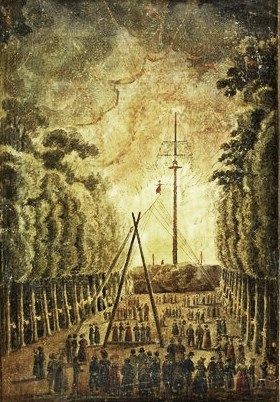
Vauxhall Madam Saqui Descending In 1816, Madame Saqui ascended and descended a tightrope that was fixed to a sixty foot mast accompanied by a firework display

Madame Saqui left Vauxhall after the close of the season in 1820 to do other things, eventually retiring and falling on hard times. She did come out of retirement at the age of seventy-five, performing at the Hippodrome. A correspondent to L’Intermédiare des chercheurs et des curieux said:

When I was a child, I saw her dance on the tightrope at the Hippodrome; she was seventy-five. It was a pitiful sight to see this decrepit figure in a pink costume, her face the color of faded parchment surmounted by a grotesque diadem. She gained in my childhood memory as an unforgettable image of the evil diary Carabosse.

Musicians

One of the characteristics of many Vauxhall performers long service. “It was not unusual for musicians, including singers, to work each season in the gardens for at least twenty years, and some served for much longer: the kettledrummer Jacob Nelson held the record at fifty years…”

James Hook, composer and organist, was a fixture at the park from 1772-1821, composing “over two thousand songs and  at least twenty organ concertos.”

William Parke, an oboist who joined Vauxhall with his brother John in 1776, composed numerous songs, concertos and other pieces, and also wrote Musical Memoires, which is full of information about the music at Vauxhall.

Strolling Players were the Savoyards , who played French and Venetian ballads in groups of four or five throughout the gardens following the main concert in the Orchestra, on instruments that included flutes and cymbals. The Pandeans (although some considered them to be the same as the Savoyards) played on pan-pipes. “The Duchess of Devonshire is known to have preferred the Pandeans…”

Charles Taylor received £290 in 1812. He

…was one of the longest-serving and most popular Vauxhall singers, especially noted for his comic songs. He first appeared in the gardens in 1794, returning regularly thereafter. He made the speech on the last night of the season several times and, unusually for a vocalist, rose to become Director of Music in 1822.

Mrs. Bland first appeared in 1790, retiring in 1823.

21 Mrs Bland THUMB

Described as ‘the sweet-voiced, dumpy little ballad singer’, she was said to have ‘refused an offer [for the 1789 season] of the Vauxhall Managers, to the tune of one hundred and sixty guineas.’ Her voice was ideally suited to the countless ballads that Hook and others wrote for her. Sometimes these demanded special effects—in June 1818, for example, she sang a new song by Parke, which was echoed in a distant part of the gardens by a bugle-horn.

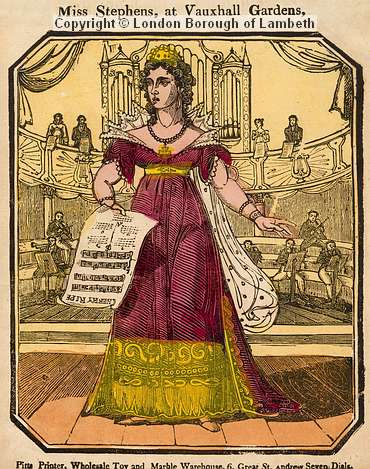
Catherine (Kitty) Stephens, an actress and soprano, married the 5th Earl of Essex in 1838.

Miss Stephens

Charles Dignum first appeared in 1794, but became notable at Vauxhall during the first two decades of the 19th century. “He was well-known for his duets with Mrs Bland, especially Long Time I’ve Courted You, Miss,  a dialogue between a shy sailor and a flirtatious lady.

John Braham, a popular operatic tenor, made his first appearance at Vauxhall as a boy soprano in 1787, “returning as an established star for the season of 1826, for the enormous fee of 800 guineas.”

Miss Feron (Fearon), known for her imitative talent, performed “a new comic song by Parke called The Romp or the Great Catalani, in which she used her powers of mimicry to parody the famous Italian soprano.” This act became so popular that it was repeated often and Parke writes:

…The recitative which introduces the air, ending with the words Great Catalini, it became necessary, in order to make the music accord with the poetry, to repeat a part of the last word, by which it read thus: Great Cat, Great Catalani. This, I was informed, gave umbrage to the lady, who, having perhaps an aversion to the feline race, said that she liked the song very well, with the exception of the Great Cat in it.”

Comic Songs

Parke’s Great Catalani was an early example of the double-entendre, that came to dominate the music hall… The words of many of these songs were published and sold at the gardens, so that the public came to know them by heart and to glamour for their repeated performance.

Susana’s Vauxhall Blog Post Series

  1. Vauxhall Gardens: A History
  2. Vauxhall Gardens: Jonathan Tyers—“The Master Builder of Delight” 
  3. Vauxhall Gardens: A New Direction
  4. Vauxhall Gardens: The Orchestra and the Supper-Boxes 
  5. Vauxhall Gardens: The Organ, the Turkish Tent, and the Rotunda
  6. Vauxhall Gardens: Three Piazzas of Supper-Boxes
  7. Vauxhall Gardens: “whither every body must go or appear a sort of Monster in polite Company”
  8. Vauxhall Gardens: The Competition
  9. Vauxhall Gardens: The Artwork, Part I
  10. Vauxhall Gardens: The Artwork, Part II
  11. Vauxhall Gardens: The Music, 1732-1859
  12. Vauxhall Gardens: The Business Side
  13. Vauxhall Gardens: Developments from 1751-1786
  14. Vauxhall Gardens: Thomas Rowlandson’s Painting (1785)
  15. ‎Vauxhall Gardens: The Third Generation of the Tyers Family and the Jubilee of 1786
  16. Vauxhall Gardens: An Era of Change (1786-1822), Part I
  17. Vauxhall Gardens: An Era of Change (1786-1822), Part II
  18. Vauxhall Gardens: An Era of Change (1786-1822), Part III
  19. Vauxhall Gardens: The Final Years, Part I
  20. Vauxhall Gardens: The Final Years, Part II
  21. Vauxhall Gardens: The Final Years, Part III
  22. Vauxhall Gardens: The Final Years, Part IV
  23. Vauxhall Gardens: Farewell, for ever

Jacki Delecki: A Christmas Code (Giveaway)

bigstock-Christmas-background-with-fir--70639783-copy

Tis the Season…for romantic suspense!

As a romantic suspense author, I am always in search of new ideas and concepts that I can weave into my stories and plots. What might sound like homework to some is more like a challenging scavenger hunt to me. The idea is to collect a variety of random ideas and then figure out how to assemble them into a compelling tale of intrigue.

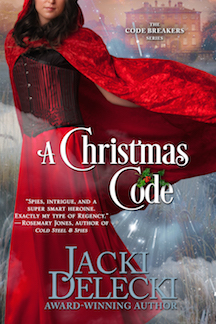
For A Christmas Code, Book 2 of the Regency romantic suspense series, the Code Breakers, I combined elements from the winter holiday season to craft a story that features an attempted poisoning set against the elegant backdrop of the Regency Ton. In this story, the hero Ash is poisoned by a dose of ground up holly berries meant for the Prince Regent.

JackiDelecki_AChristmasCode_HR copyA popular accent used in Christmas decorations, holly is an evergreen shrub that can grow to be a tree, and there are more than 400 different varieties of the plant. The fruit and leaves contain a mix of caffeine-like alkaloid theobromine, caffeine and glycosides (theobromine is also found in chocolate and cocoa).

People and pets avoid the prickly leaves, but children may be attracted to the bright red berries. As few as 20 can be lethal if consumed, and eating just three berries can cause nausea, vomiting and diarrhea. More severe symptoms include drowsiness, slowed breathing and heart rate, coma and death.

Ash catches a lucky break, because, while holly berries are toxic, people rarely die from ingesting this type of poison. Nowadays modern medicine can treat individuals who consume holly berries, but that wasn’t always the case.

I recently released the audiobook version of A Christmas Code, which is narrated by the talented Pearl Hewitt, who also narrated two other books in this series: A Code of Love and A Code of the Heart. You can listen to an audio sample here: http://bit.ly/1ToZIx9

Comment on this blog for a chance to win a digital or audiobook of A Christmas Code.

Fans of holiday romance are in for an added treat from Jacki Delecki. A holiday edition of Marriage Under Fire, Book 4 of the Grayce Walters contemporary romantic suspense, is available. This edition features more than 9,000 words of exclusive content, including Maddy and Hunter’s romantic Christmas wedding with Grayce, Davis, Hollie, James and the entire Grayce Walters crew. The holiday edition of Marriage Under Fire is available at Amazon, Barnes & Noble, iBooks, Kobo and Google Play for a limited time. Readers who have already purchased the book can enjoy the new scenes for free by accessing the updated ebook.

About the Author

Head Shot copyJacki Delecki is a bestselling romantic suspense writer. Delecki’s Grayce Walters Series, which chronicles the adventures of a Seattle animal acupuncturist, was an editor’s selection by USA Today. Delecki’s Romantic Regency The Code Breaker Series hit number one on Amazon. Both acclaimed series are available for purchase at http://www.JackiDelecki.com. To learn more about Jacki and her books and to be the first to hear about giveaways join her newsletter found on her website. Follow her on FB—Jacki Delecki; Twitter @jackidelecki.