Archives

Angelina Jameson: A Lady’s Addiction

Untitled1

Alcohol abuse in the Regency era

The heroine of my book A Lady’s Addiction has a problem with alcohol. Anna used it to self-medicate, to deal with the disgusting attentions from her husband. Now a widow, Anna struggles to rid herself of her nightly ritual of drinking a bottle of wine to dull her senses.

The term alcoholism wasn’t around in the Regency era and wasn’t coined until 1852. Reformers labeled those who often drank in excess as habitual drunkards. At the time habitual drunkenness wasn’t seen as a disease. I portrayed Anna as an alcohol abuser not an alcoholic. She uses alcohol to de-stress. If she continues on this path she would most likely become an alcoholic.

Anna’s drink of choice was wine. Wine was plentiful in upper class Regency households. Wine was a gentlemanly drink. It was imported and expensive, perfect as a posh drink for the upper classes. During the years of war between France and England it was harder to get French wine. The English turned to new favorite wines from Spain, and Portugal. These wines were Madeira, Malaga, port, or sherry. The hero in my book refers to Portuguese wine in the first chapter.

During the Gin Craze in 18th century London binge drinking became a huge social problem. Gin was cheap and readily available to the lower classes. The heavy consumption of alcohol continued during the Regency. In the Reminisces of Captain Gronow, the author stated: “Drinking was the fashion of the day.”

It is well known that George IV drank heavily. Did George’s excessive drinking reflect current fashion or set it? I think both. Drinking played an extremely important social role in eighteenth century England. Anyone who reads Regency historical novels has heard of gout. The high consumption of port and fortified wines led to the upper class disease of gout.

What about women drinking in the Regency era? While there are many cartoons and articles from the Regency showing excess drinking by men, it was much harder to find information about those Regency women who may have abused alcohol. Lady Caroline Lamb was known to be addicted to alcohol and laudanum near the end of her life. It is taken for granted that women of society drank to relieve the boredom and monotony of their lives. Women drank wine with their meals and drank sherry in the drawing room after dinner. It is not hard to imagine women overindulging with all the alcohol surrounding them.

What do you think of a romance heroine dealing with alcohol abuse? Would you prefer the hero to be the one dealing with such a struggle? One reader who leaves a comment on this blog post will receive a $10 Amazon gift card.

ALadysAddiction_w9353_2_850 copy

About A Lady’s Addiction

Anna, a widow battling alcohol addiction is convinced she is worthless unless she bears a child. She hires a lover to prove she is not frigid and may marry again and have children.

Devlyn, sterile from an accident, has returned from an assignment for the Foreign Office and inadvertently becomes Anna’s lover.

Anna and Devlyn join forces to protect an innocent child from a blackmailer. Can they come to terms not only with their feelings for each other but whether they will allow society to dictate the true significance of life?

Excerpt

She couldn’t remember the question she’d asked. His nearness unsettled her. Her entire body had flared into wakefulness the moment he entered her room. Cecily could be right; this man might be able to help with her problem.

Tonight she would play a part. She would emulate the sophisticated façade her friend Cecily Pickerel displayed. The scandalous nightgown underneath her thin robe was in fact a gift from Cecily. She would never have had enough courage to buy such a shocking garment for herself.

“You are discreet?”

“What is your name?” Franco asked, ignoring her question.

Somewhere in the back of her mind she remembered Cecily telling her she needn’t share personal information. She would never see this man again. He didn’t move in her circles. With the slightest of shrugs, she answered truthfully, “Anna.”

“Anna,” he said in a husky rasp. The way her name rolled off his tongue sent the lightest frisson along her skin. “It is a graceful, pretty name. It suits you.”

“There is no need to flatter me.” She felt heat on her cheeks. “It is a common enough name.”

“Despite our current situation, my dear, I do not believe you are at all common.”

 AmazonThe Wild Rose PressBarnes & Noble

US 99 cents to 30 April 2015

US $4.99 from 1 May 2015

About the Author

Untitled2I joined the US Air Force to see the world. My dreams of visiting the United Kingdom were fulfilled when I was stationed at RAF Lakenheath in the beautiful countryside of Suffolk, England. Five years later I returned to the states having acquired a wonderful husband and a love of all things British. I began writing as a hobby when my husband was remote to Honduras for a year. I found RWA and a local New Mexico chapter, LERA, and my hobby developed into a dream of sharing my stories with others. I currently live in the great state of Alaska with my wonderful husband and our two teenage boys.
FacebookTwitterWebsite

A Celebration of Waterloo: The Battle of Salamanca

map_sm

July 22, 1812

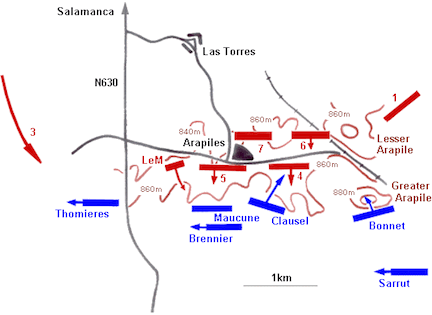
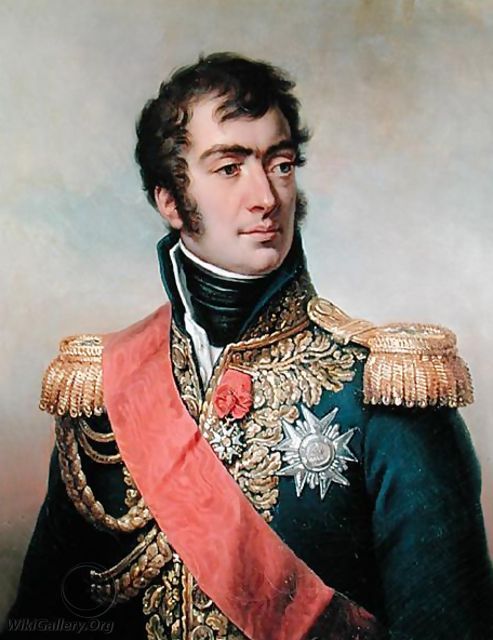
Both armies were just outside Salamanca. It was hot and humid, particularly after a heavy thunderstorm the night before. Wellington, aware that French reinforcements were expected, was planning to retreat back to Ciudad Rodrigo. Marmont, the French commander, was eager to do battle before the arrival of the reinforcements so that he could claim all the credit for defeating Wellington.

Auguste de Marmont

Auguste Marmont

However, Wellington received reports (no doubt from his Exploring Officers) that French troops were taking up positions on the slopes of two steep hills, the Arapiles (south of Salamanca). Wellington saw the danger immediately and ordered the French repulsed, sending two infantry divisions to take position below the ridge of the closer hill. Having seen the dust in the distance from the supply wagons on their way to Ciudad Rodrigo and believing that the British were in retreat, Marmont didn’t realize that most of Wellington’s troops were still hidden behind the ridge. Wellington ordered up two more divisions from Salamanca.

Cartoon - alava

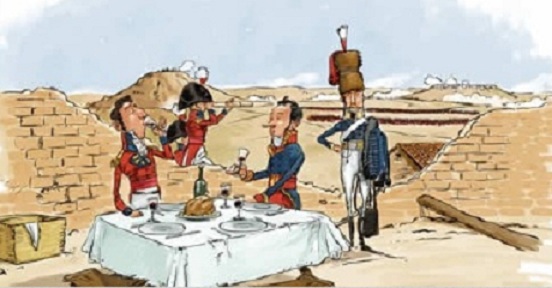
At midday, Wellington descended the near hill and joined his senior staff for a very late breakfast at a nearby farm where they had a good view of the area. Because of bullets flying from nearby skirmishes, the meal had to be moved to a safer place. Wellington paced the wall of the farmyard, scanning the area with his spyglass. When finally persuaded to eat some bread and part of a roast chicken, he grabbed one of the chicken legs and ate it with one hand while continuing to study the area between the two ridges with his spyglass.

At 2:00, he rose from the table with a whoop of delight, throwing the chicken leg over his shoulder and shouting, “By God! That will do!” and ran to his horse, ordering his men to follow him.

French troops were marching through the gap of the two ridges—exactly what he had been hoping to see. Turning to his Spanish aide-de-camp, Miguel Ricardo de Alava y Esquivel, he remarked, “Mon cher Alava, Marmont est perdu!” (My dear Alava, Marmont is lost!)

Marmont had made a fatal error in judgment and Wellington knew he was in a perfect position to crush the French.

Wellington struck hard and fast, taking the French by surprise. Marmont was badly wounded by an exploding shell and carried to the rear. Other French senior officers were killed or severely wounded, and the French had no chance to re-group.

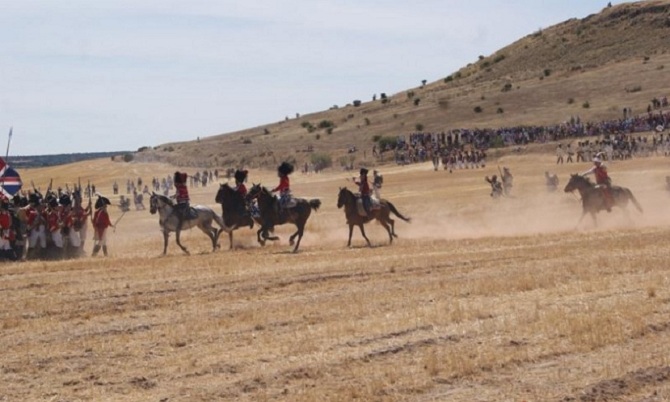
FrenchchargingasquareThe main battle took less than an hour. It was later said that Wellington had “defeated 40,000 men in 40 minutes.” Wellington himself took a ball in the thigh, but his holster took most of the hit, leaving him with a minor wound.

Unfortunately, most of the remaining French army managed to escape across the Tormes River, due to a failure of the Spanish commander abandoning his post against orders.

The night after the battle, the residents of Salamanca, having seen most of the conflict, came out onto the battlefield with provisions for the men, who had gone without eating and drinking for nearly a day while fighting a battle under the grueling Spanish sun.

Two imperial eagles snatched from the French during the Battle of Salamanca

Two imperial eagles snatched from the French during the Battle of Salamanca

Lost and Found Lady

Catalina lives near the battlefield outside a town called Las Torres. After the battle, she finds a wounded British soldier on the road and takes him to a place of safety where she can tend to his head wound. The British soldier is Rupert Ellsworth, one of Wellington’s Exploring Officers. The pair are immediately drawn to each other, but Rupert knows there’s no future for them, having promised his father he would marry a suitable English girl. A devout Catholic, Catalina is not a whore to be loved and abandoned. Still, Rupert cannot help but wish he could sweep her away from her disagreeable family. After he returns to his company, they both wonder if they will ever see each other again.

waterloo_cover_best web

Amazon.com • Amazon.uk • Amazon.ca • Amazon.au

 Barnes & Noble • iBooks • Kobo

Beaux, Ballrooms, and Battles

Release Day Party: April 1, 2015, 11 a.m. – 11 p.m. EDT

Rafflecopter: ends April 18

Website: www.beauxballroomsandbattles.com

Facebook Page

Jillian Chantal: Jeremiah’s Charge

Emmaline Rothesay has her eye on Jeremiah Denby as a potential suitor. When Captain Denby experiences a life-altering incident during the course of events surrounding the Battle of Waterloo, it throws a damper on Emmaline’s plans.

Téa Cooper: The Caper Merchant

The moon in Gemini is a fertile field of dreams, ideas and adventure and Pandora Wellingham is more than ready to spread her wings. When Monsieur Cagneaux, caper merchant to the rich and famous, introduces her to the handsome dragoon she believes her stars have aligned.

Susana Ellis: Lost and Found Lady

Catalina and Rupert fell in love in Spain in the aftermath of a battle, only to be separated by circumstances. Years later, they find each other again, just as another battle is brewing, but is it too late?

Aileen Fish: Captain Lumley’s Angel

Charged with the duty of keeping his friend’s widow safe, Captain Sam Lumley watches over Ellen Staverton as she recovers from her loss, growing fonder of her as each month passes. When Ellen takes a position as a companion, Sam must confront his feelings before she’s completely gone from his life.

Victoria Hinshaw: Folie Bleue

On the night of the 30th Anniversary of the Battle of Waterloo, Aimée, Lady Prescott, reminisces about meeting her husband in Bruxelles on the eve of the fighting. She had avoided the dashing scarlet-clad British officers, but she could not resist the tempting smile and spellbinding charm of Captain Robert Prescott of the 16th Light Dragoons who—dangerously to Aimée—wore blue.

Heather King: Copenhagen’s Last Charge

When Meg Lacy finds herself riding through the streets of Brussels only hours after the Battle of Waterloo, romance is the last thing on her mind, especially with surly Lieutenant James Cooper. However, their bickering uncovers a strange empathy—until, that is, the lieutenant makes a grave error of judgment that jeopardizes their budding friendship…

Christa Paige: One Last Kiss

The moment Colin held Beatrice in his arms he wanted one last kiss to take with him into battle and an uncertain future. Despite the threat of a soldier’s death, he must survive, for he promises to return to her because one kiss from Beatrice would never be enough.

Sophia Strathmore: A Soldier Lay Dying

Amelia and Anne Evans find themselves orphaned when their father, General Evans, dies. With no other options available, Amelia accepts the deathbed proposal of Oliver Brighton, Earl of Montford, a long time family friend. When Lord Montford recovers from his battle wounds, can the two find lasting love?

David W. Wilkin: Not a Close Run Thing at All

Years, a decade. And now, Robert had come back into her life. Shortly before battle was to bring together more than three hundred thousand soldiers. They had but moments after all those years, and now, would they have any more after?

Holly Bush: Contract to Wed

BBT_TourBanner_ContractToWed copy

Holly will be awarding a $25 Amazon or B/N GC to a randomly drawn winner via Rafflecopter during the tour. Click here for the Rafflecopter. Click the banner above to follow the tour and increase your chances of winning.

About Contract to Wed

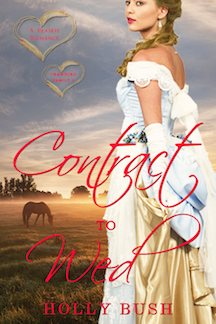
1891… Jolene Crawford Crenshaw, heiress and Boston socialite, went from her family home directly to Landonmore upon her marriage, the mansion she shared with her handsome and charismatic husband. She’d never in her life worried in the slightest over anything as crass as the dollars required to maintain that home or the lifestyle she’d been born to. Her extensive yearly wardrobe, the stables and the prime horseflesh within it, even the solid silver forks and knifes that graced her table, were expected and required to maintain the social standing that she’d cultivated over the years. But suddenly she was a widow with little money and just her pride and her secrets to keep her upright.

Max Shelby made his fortune in oil wells and cattle, but lost the love of his life the day his wife died. Now, his happy, carefree daughter needs instruction and guidance as she grows into a young lady and his dream of becoming a Senator from his adopted state of Texas seems out of reach with few political or social connections. The right wife would solve both problems. As it happens, his sister knows of a woman, a recent widow, charming, beautiful and socially astute, but in reduced circumstances, who may want to begin again. Max signed the wedding contract sight unseen.

Will Jolene be able to shed her sorrows, anger and fears to begin anew away from the censure and hidden tragedy that marred her life? Is her new husband, confident, strong and capable Max Shelby, the man, the only man, to see past her masks to find the woman beneath?

Amazon

Excerpt

“Settle down, everybody,” Zeb shouted over the din. “The boss has an announcement to make.”

Max looked around the room at his staff, more than forty of them, without the men working straight through at the wells. Most were like family to him, and many had sons or brothers or wives working here as well. The room quieted.

BookCover_ContractToWed copy“I know most of you are aching to get to the dining room and see what Maria is serving us today,” Max said. “But I wanted to let you know that I have gotten married. My bride…”

The room erupted in shouts and yahoos. The women stood to hug him and kiss his cheek, and the men lined up to shake his hand.

“When is the wedding meal to be held?” Maria asked. “I’ve got much to prepare for.”

Max asked for quiet. “This isn’t exactly that type of marriage. Let me tell you…”

“What do you mean?” Pete, the head ranch hand, asked. “I didn’t know there were different kinds of marriage! Hey, Maria, what type of marriage do we have?”

“The kind where you do as I tell you to, si amor,” she replied with a saucy swish of her skirts.

Max waited till the laughter died down. “My bride is from Boston. She’ll be arriving this Monday on the train and bringing her maid.”

“How’d you meet her, Boss?” someone asked.

“Boston?” someone else said.

Zeb came up behind him and whispered. “Maybe we didn’t think this all through to the end.”

“When did you go to Boston, Boss?

“I didn’t go to Boston,” he said.

“Then how’d you meet her?”

Max pulled off his hat and scratched his head. “Well,” he started

Zeb stepped in front of him. “Doesn’t matter how Mr. Shelby met her, and it’s nobody else’s business. Mrs. Shelby is coming here Monday, and, no doubt, this will be a big change for her. Make sure you’re on your best behavior for her arrival,” Zeb said and turned to Maria. “Let’s you and I have a talk about what needs to be done to accommodate both women.” He looked back across the silent room of workers. “Okay. Let’s eat.”

About the Author

AuthorPhoto_ContractToWed copyHolly Bush writes historical romance set on the American Prairie, in Victorian England, and recently released her first Women’s Fiction title. Her books are described as emotional, with heartfelt, sexy romance. She makes her home with her husband in Lancaster County, Pennsylvania.

 WebsiteFacebookTwitter

Lynne Barron: Pretty Poison

BBT_TourBanner_PrettyPoison copy

Lynne will be awarding a $25 Amazon or B/N GC to a randomly drawn winner via Rafflecopter during the tour. Click here for the Rafflecopter. Click the banner above to follow the tour and increase your chances of winning.

About Pretty Poison

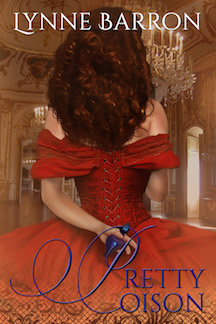
What’s an American heiress to do when a pair of britches, a plunge into a pond in the dead of winter and a broken betrothal force her to set sail across the ocean to an arranged marriage with a fortune hunting Englishman?

With her hopes and dreams sinking to the bottom of the sea like so much lost treasure, Emily Calvert falls into the pretty poison she finds in a little blue bottle.

Can Nicholas Avery, a charming aristocrat with a faulty memory for names and a family in dire need of financial salvation, convince the wounded lady that the blessed oblivion she finds in his arms is sweeter than opium?

AmazonBarnes & Noble

Excerpt

Emily took an unsteady step back, then another. Nicholas dropped his hands to his thighs, leaned his head back against the tree and closed his eyes. His chest rose and fell, his panting breath sawing in and out through his open mouth.

BookCover_PrettyPoison copy“You don’t know my name,” she accused.

Nicholas opened his eyes and looked at her the very same way her brother Charlie looked at her when he knew he’d been found out in some mischief. “You never told me.”

“You never asked,” she countered.

“A gentleman does not ask a lady her given name.”

“Oh, are we pretending you are a gentleman?”

He had the grace to look abashed, but only barely.

“Did my aunt never tell you?”

“Yes, I’m sure she did.”

“You forgot? We were nearly betrothed to be married and you could not be bothered to remember my name? Why did you not ask your father or your brother? Surely they…” her words faded away when he slowly shook his head.

“I kept thinking someone would say it eventually. Then it became something of a family joke…” It was his turn to allow his words to wither away.

“A family joke,” she repeated.

“No, not a joke precisely, more a humorous game,” he amended.

“But when you followed me into the stables, surely you could have asked me then?”

He looked away from her intent gaze. “I didn’t recognize you.”

“You didn’t recognize me?” she repeated as realization dawned. “When you kissed me, who did you think you were kissing?”

Nicholas cringed at the question.

“Who?” she demanded desperately.

“The stable master’s daughter,” he admitted with a wry shrug.

Emily opened her mouth, snapped it shut again. There were no words. No words for the ridiculousness of the situation in which she found herself.

“What’s your name?” he finally inquired with what she supposed was meant to be a charming, self-deprecating smile.

But Emily didn’t feel like being charmed and she wasn’t for a moment fooled by his attempt at boyish humility.

“Good Lord, you really are a stallion in search of a mare,” she finally said, amazement lacing the words.

“No.” He lurched away from the tree trunk, tripped over a gnarled root, righted himself. But Emily was already turning away from him, turning toward the path that would lead her back to her aunt’s house, back to face his family, who had made her into a joke.

“Wait, Miss Calvert,” he called as he ran to catch up to her.

He laid a hand on her arm as if to halt her. She shrugged his hand away and picked up her pace.

“Please, just let me explain,” he said as he fell into step beside her.

“There’s nothing to explain, I understand perfectly,” she said, proud of how calm and controlled her voice sounded. “You are in need of a broad mare and any lady will do. And while you are making up your mind, you will kiss whomever you please.”

About the Author

Write About What You Know.

Every creative writing teacher and college professor said these words to Lynne Barron in one form or another. But what did she know?

She knew she enjoyed the guilty pleasure of reading romance novels whenever she could find time between studying, working and raising her son as a single mother.

She knew quite a bit about women’s lives in the Regency and Victorian era from years spent bouncing back and forth between European History and English Literature as a major in college.

She knew precious little about romance except to know that it was more than the cliché card and a dozen red roses on Valentine’s Day.

Then she met her wonderfully romantic husband and finally she knew.

Passion, Love and Romance.

And she began to write.

WebsiteFacebookTwitter

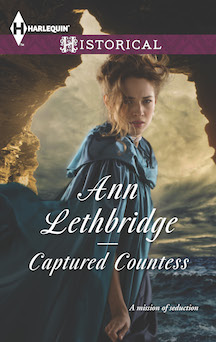
Ann Lethbridge: Captured Countess (a Beresford Abbey story)

Interview with Ann Lethbridge

Susana: What inspired you to start writing?

Ann: The first time I got my fingers on a typewriter keyboard at the age of about eight in a friend’s house, I wanted to write. I was trying to write poetry, because the typewriter allowed you to put the lines on the page in interesting shapes.

AnnLethbridge Photo copyI enjoyed writing what we called composition at school but I never actually dreamed of being “a writer.” In all of my 9-5 jobs I was required to write reports, and to brainstorm in meetings. I think the experience gave me a great appreciation and some skill in the presentation of ideas in a logical matter, and using my imagination, although it wasn’t fiction. Or shouldn’t have been, anyway. It wasn’t until much later that I attempted a novel during a period of utter enforced boredom and I won’t bore you with the details.

Having finished the first book, not a book anyone would actually want to read mind you, I was hooked.

Susana: How long have you been writing?

Ann: I began that first novel in the year 2000. Was it something about a new millennium that compelled me to start in a completely different direction? I have often wondered if it was karma or fate, or just plain luck.  Needless to say my first baby was a bit of an ugly duckling, but I persevered. Since then I have published fourteen full length novels and fourteen short stories, most of them with Harlequin Historicals. My first book came out in 2006 and all but two of the books I wrote between 2000 and now are in print.

Susana: What advice would you give to writers just starting out?

Ann: My advice would be to finish the first book, write THE END, no matter how many doubts you have. And once finished, and while you are revising and polishing, start the next one and the next.

If you receive feedback from critique partners or contests, take it under advisement, see if it works for you, but never forget that writing is a creative art and that what works for one may not work for another. It is your book. I do not advise that, however, if you land a contract and an editor. Editors are to be listened to.

While you are writing, and submitting finished books to agents and editors, or hiring editors for your story, you should also be attending conferences and writing workshops that work for your particular genre. I would also advise that it is a very bad idea to revise and revise one book over a period of years rather than moving on to something new. That sort of revision will suck the life out of a creative work, though you will need to polish each work more than once before it is ready to be shown to the world.

A writer should continue to attend writing workshops no matter how many books they have published.

For independent publishing you will need to hire a concept editor and a copy editor when your book is finished. You will need to follow their advice with respect the to manuscript, which means you need to select them carefully and trust their judgement.

Above all, persevere, not with the same book, but with the learning and the writing, and more writing.

Susana: What comes first: the plot or the characters? Are you a plotter or a pantser?

Ann: The two questions combine for me. I am a pantser, which is a horrible process because it involves many incorrect pathways and dead ends, but if I try anything else, I become bored. So I don’t.

Plot or characters: I always start with a first scene. It comes to me fully formed and rarely changes. It is almost set in stone.

I just finished a Christmas novella. I lay down on the couch and thought “Christmas…” and a scene played out in my head. It came with characters and a situation. If I try to redirect it, then it turns right back around and starts where it had before. I think this relates back to being a pantser.

Then I learn about the characters. Why they are there? What is wrong? What is right? Who they are and why they are who they are? The scene rolls out like a movie and leaves me wandering along behind trying to pick up the threads. As I said. Horrible. And it is always the same. Yuck.

Susana: Tell us something about your newest release that is NOT in the blurb.

Ann: I found this amazing bit of information—Beau Brummell played cricket for the County of Hampshire against the newly formed England team. A bit like a home team taking on the Olympic team in some sports today.

Now as we all know, The Beau does not get hot and sweaty. E.v.e.r. But he did play cricket in a pretty famous game at Lord’s Cricket Ground and he batted exceedingly well, twenty-three runs before he was caught out. And of all the luck, my heroine is French, so it gave me a bit of a chance to explain the game without it sounding stilted.  I could not resist. And nor could she. The hero, of course, managed to catch a wild ball before it hit the spectators. Well he is the hero.

Susana: What are you reading now?

Ann: I read a great deal, inside and outside my genre. I have a thing going for Grace Burrowes, Nalini Singh and Diana Gabaldon at the moment as well as fantasy writer Brandon Sanderson. Why oh why can’t these folks write faster? Honestly I love books and if the writer hooks me, I read everything they have. I love all genres, but always go back to my historical romances for my real fix.

Right now I have just finished a binge with Grace and since I am about to start a new book, likely I will be on hiatus from reading anything until I have the few first chapters down. I do not like to let another writer in my head when I am at the beginning of a book.

Susana: What is your work schedule like when writing?

Ann: I think my schedule is pretty well like most writers. I get up at around 7:30, read email, knowing I shouldn’t be reading email (it’s a procrastination tactic). After coffee and getting dressed I start work. I work on the story until noon if things are going well, naturally interrupting myself with email, to procrastinate. Afternoons are spent on the promoting side of things, errands, housework and procrastinating with email.

Susana: What did you want to be when you grew up?

Ann: A princess.

Susana: What is the funniest thing that ever happened to you as a writer?

Ann: Before I was published and I was working full time, I would write every chance I got, in the car, at a hockey game, in bed with one of those little pen lights.  One day when we were driving my daughter back to university, I spent the whole drive in the backseat writing. I know lots of people cannot do this, but reading in a car has never bothered me.

Anyway, it was a three-hour drive and I got heaps done. A whole scene of a book, now published as The Gamekeeper’s Lady. On the way home, I offered to read the scene, a sex scene, to my husband to keep him entertained, the well having dried by that time. It was dark but I had the reading light on.

He cheerfully agreed. So I read about my hero getting it on with his rather evil mistress, before he said goodbye to her. I hope I am not shocking you. After about half an hour, my dearly beloved slowed down and was looking mystified. “What is wrong,” I asked. “I haven’t a clue where we are,” he answered.

So you see it really is true, a guy’s brain moves location when he gets to thinking about you know what.  It took us at least half an hour of driving around to get us unlost and back on the right road. Thinking back, I should have claimed this as a tax-deductible expense for research.

Susana: LOL!

About Captive Countess

Never trust a spy! 

Captured Countess copyNicoletta, the Countess Vilandry, is on a dangerous mission—to lure fellow spy Gabriel D’Arcy into bed and into revealing his true loyalties. With such sensual games at play and such strong sensations awakened, suddenly Nicky’s dangerously close to exposing her real identity.

Gabe knows that the countess has been sent to seduce him. The only question is to what end? He’s never met such a captivating woman—and he’s determined to enjoy every seductive second she spends as his very willing captive!

iBooksAmazonUS • AmazonCABarnes & Noble

HarlequinChapters Indigo

Excerpt

About the Author

An army brat born in England, Ann lived all over the UK in her youth. She grew up loving history, but majored in business with history on the side. Now living in Canada, she has a husband and two lovely daughters and a Maltese Terrier called Teaser, who likes to sit on a chair beside the computer while she creates her award winning Regency historical romances.

During her successful career as an administrator, the call of the past and the stories in her imagination brought her to a fork in the road. After her first book was published in 2006, she decided to write full time and hasn’t looked back. She has given talks on the various aspects of publishing as well as workshops on the craft of writing. She blogs regularly about her research on her Regency Ramble Blog.

Over the years several of her books have won awards including an honorable mention by Foreword Magazine. She is particularly proud of her 2009 win of the Daphne DuMaurier Award for Excellence in Mystery/Suspense for The Rake’s Inherited Courtesan. Recently She finaled in the Booksellers Best and the Golden Quill.

She loves the Georgian era, and within that, the period known as the long Regency. She also adores happy endings. You will find her print books in bookstores in the month of issue, as well as on line where you will also find her e-books.

Website Blog • FacebookTwitter

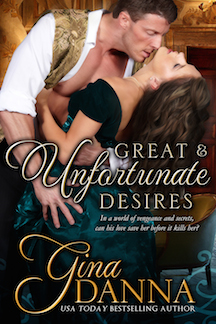
Gina Danna: Great & Unfortunate Desires

BBT_GreatAndUnfortunateDesires copy

Gina will be awarding a $10 Amazon or B/N GC to a randomly drawn winner via Rafflecopter during the tour. Click here for the Rafflecopter. Click on the banner above to follow the tour and increase your chances of winning.

About Great & Unfortunate Desires

Victorian England c. 1870

Operating as a British spy, Tristan St.James, the new Marquis of Wrenworth, barely escapes Afghanistan with his life in the spring of 1869. He plans to seek vengeance against the traitor who exposed him and for the agent he’s forced to kill. Returning to England, as a lord, he must marry. Haunted by guilt from the horrors of war, he avoids love at all costs, but finds himself drawn to the only woman who is disinterested in him.

Lady Evelyn Hurstine has waited over two years for the return of her love, a man who left for war in the East. But during that time, she suffered a brutal assault, resulting in a child and fear of any man touching her except for the man she once knew. The pursuit by the marquis scares her but her excuses against his proposal dwindle.

Their marriage strengthens into love until she discovers her husband isn’t the safety she believed but the one who killed the man she once loved. Caught in a world of intrigue and mayhem, Tristan must prove his love to her before the traitor destroys them both.

AmazonBarnes & Noble

Excerpt

“I shall talk to him shortly.”

Evelyn raised her brows, eyeing over his shoulder. “Shortly may be now, my lord.”

Cover_GreatAndUnfortunateDesires copyTristan turned. Barreling down the lawn, creating a wake in in his path, Evelyn’s father stormed toward them. Not far behind him was Huntington and his son. Tristan gauged their pace and the distance. He had a few seconds and could hear Evelyn’s foot tapping against the grass. Frankly, he was surprised she hadn’t crossed her arms in anger or left him. With every second, her behavior and decision to stay put only made him more interested in her. Damn! Her dowry and position made her exactly what he needed his English bride to be like, with a ramrod backbone and a defiance of societal rules. As Evelyn’s father got closer, there was only one thing Tristan could think of to ensure she become his. In one swift move, he turned, pulled her close, bent her backward, and pressed his cheek to hers. She gasped.

“Considering the situation, you need me as much as I need you. We are the perfect match,” he whispered, smiling and gesturing as if to kiss her.

They both knew in that moment she became his forever. The compromising position between two single people in a public setting was shocking to the ton.

Tristan heard the grass crunching under the footsteps of the Baron and his party. He didn’t look in their direction but eased back from Evelyn, watching her reaction. Suppressed fury blazed in her eyes, and her body was rigid.

“Naught, naught, naught,” he murmured. “To slap me would be appropriate but would serve you no purpose.”

Despite the fire in her gaze, she relaxed a little within his arms. “But it would give me satisfaction nevertheless,” she whispered defiantly, although she didn’t move.

About the Author

AuthorPic_Great and Unfortunate Desires copyBorn in St. Louis, Missouri, Gina Danna has spent the better part of her life reading. History has been her love and she spent numerous hours devouring historical romance stories, dreaming of writing one of her own. Years later, after receiving undergraduate and graduate degrees in History, writing academic research papers and writing for museum programs and events, she finally found the time to write her own stories of historical romantic fiction.

Now, under the supervision of her three dogs and three cats, she writes amid a library of research books, with her only true break away is to spend time with her other life long dream – her Arabian horse – with him, her muse can play.

 WebsiteFacebookTwitter

The York Road: The Stamford Regent Faces the Peril of a Flood

dust jacket

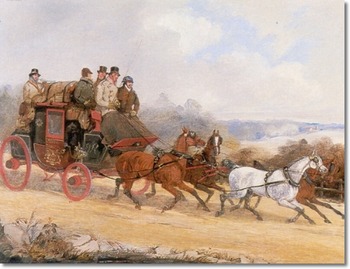
The following post is the nineteenth of a series based on information obtained from a fascinating book Susana recently obtained for research purposes. Coaching Days & Coaching Ways by W. Outram Tristram, first published in 1888, is replete with commentary about travel and roads and social history told in an entertaining manner, along with a great many fabulous illustrations. A great find for anyone seriously interested in English history!

The Playfulness of the River Ouse

Click here to see map.

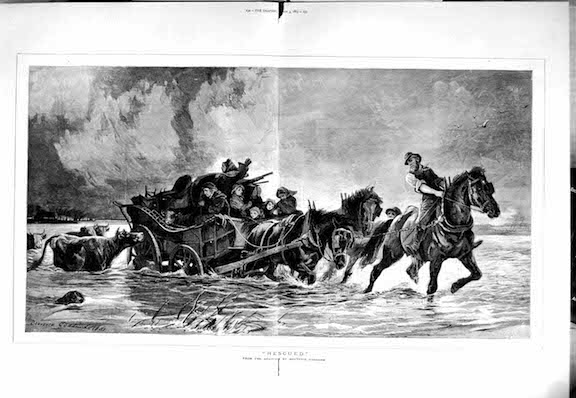
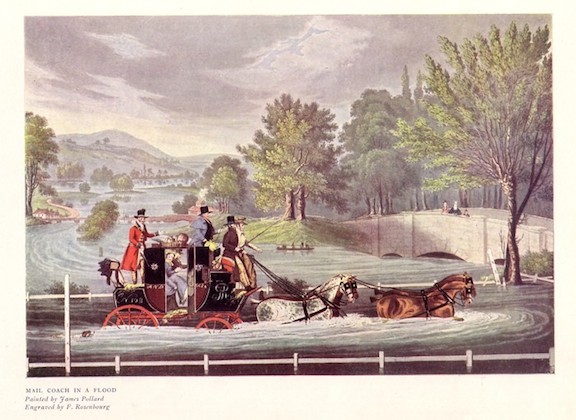
At a place called St. Neot’s, fifty-six miles from London, the Regent coach used to leave the main road, every now and then, for some reason which remains occult, and go round by some paper mills, which were naturally situated on the flat. The river Ouse has a habit, as is well known, of playfully overflowing its banks, and the consequence was that the road lying before the Regent coach lay sometimes for half a mile under water. Now an extra pair of leaders were put on, and ridden by a horsekeeper, who made the best of his way through a situation which was novel not to say precarious. The water was often up to the axle-trees; and on the particular occasion…went beyond this limit and invaded the inside of the coach. For a moment or two the Stamford Regent was afloat, also two old ladies who were inside of it, with their goods and chattels. Their cries and laments when they found the coach gradually be converted into an Ark were heartrending in the extreme. They gave themselves utterly for gone, and prepared for the most comfortable, but noisiest of all deaths. Nor were the outside passengers in very much better plight. For though they were not sitting absolutely in the water, as I am sorry to say the old ladies were; still they were sitting in wet clothes, which is the next thing to it—and in this situation commanded as fine a prospect of water above, below, and around, as has been seen by travellers I should say since the flood. In addition to this not altogether gratifying panorama of flood effects, unseen dangers were on every side; to wit, a large ditch on one side, and a series of huge heaps of stones on the other; both pleasantly invisible by reason of great waters, but both clearly there for a specific purpose; the stones to overturn the carriage; the ditch to receive it when it had been overturned. It must have been a truly critical five minutes for the Rent, Tom Hennessy, the passengers, the horses and everybody else, but they all got safely through and thanked their stairs.

 carriage flood 18831908-horse-carriage-print-river-flood_700_600_O7K9

 Index to all the posts in this series

1: The Bath Road: The (True) Legend of the Berkshire Lady

2: The Bath Road: Littlecote and Wild William Darrell

3: The Bath Road: Lacock Abbey

4: The Bath Road: The Bear Inn at Devizes and the “Pictorial Chronicler of the Regency”

5: The Exeter Road: Flying Machines, Muddy Roads and Well-Mannered Highwaymen

6: The Exeter Road: A Foolish Coachman, a Dreadful Snowstorm and a Romance

7: The Exeter Road in 1823: A Myriad of Changes in Fifty Years

8: The Exeter Road: Basingstoke, Andover and Salisbury and the Events They Witnessed

9: The Exeter Road: The Weyhill Fair, Amesbury Abbey and the Extraordinary Duchess of Queensberry

10: The Exeter Road: Stonehenge, Dorchester and the Sad Story of the Monmouth Uprising

11: The Portsmouth Road: Royal Road or Road of Assassination?

12: The Brighton Road: “The Most Nearly Perfect, and Certainly the Most Fashionable of All”

13: The Dover Road: “Rich crowds of historical figures”

14: The Dover Road: Blackheath and Dartford

15: The Dover Road: Rochester and Charles Dickens

16: The Dover Road: William Clements, Gentleman Coachman

17: The York Road: Hadley Green, Barnet

18: The York Road: Enfield Chase and the Gunpowder Treason Plot

19: The York Road: The Stamford Regent Faces the Peril of a Flood

20: The York Road: The Inns at Stilton

21: The Holyhead Road: The Gunpowder Treason Plot

22: The Holyhead Road: Three Notable Coaching Accidents

23: The Holyhead Road: Old Lal the Legless Man and His Extraordinary Flying Machine

24: The Holyhead Road: The Coachmen “More Celebrated Even Than the Most Celebrated of Their Rivals” (Part I)

25: The Holyhead Road: The Coachmen “More Celebrated Even Than the Most Celebrated of Their Rivals” (Part II)

26: Flying Machines and Waggons and What It Was Like To Travel in Them

27: “A few words on Coaching Inns” and Conclusion

Caroline Warfield: Dangerous Works

giveaway

Caroline  is offering a choice of Her Very Major Christmas by Saralee Etter or The Earl’s Christmas Delivery by Susan Gee Heino. Click here for the Rafflecopter.

Discovered in the papers of Andrew Mallet

Notes from my interview with Georgiana Hayden who, though she has hired me to tutor her, persists in being disagreeably autocratic about the work.

Summer, 1816

Cambridge, England

 AM: What on earth made you think you could approach the authorities about access to the library at Magdalene College, that bastion of male superiority?

GH:   How else am I to get the information I need for my work?

AM:   You must have had a maggot in your brain if you thought Watterson would tutor you.

GH:   I hoped interest in the work would draw him. He dismissed the women’s poems as “worthless, minor at best.”

Interviewer note: The daft woman walked right into humiliation. Alphaeus Watterson is a pompous old windbag treats the college as a private fiefdom and delights in cutting down students. He wouldn’t know good work if it bit him in the arse.

AM: How did you come to start this work that means so much to you?

GH: I found the poems of Nossis of Locri quite unexpectedly in the Anthologia Graeca.

AM: Did you actually own a copy of the Greek Anthology?

GH: Not then.

AM: Unusual reading for a woman. Some would call it peculiar. Your mother cannot have been pleased. I can’t believe she would have permitted you to own a book in Greek.

Interviewer’s note: Some would have perhaps, but not her dragon of a mother. I should know. I gave Georgiana her first Greek text when we were in our teens. She hid it behind the palms in her father’s conservatory.

GH: Of course not. She didn’t catch me reading it either.

AM: Where did you find it then?

GH: We were at the house party in the country house of a famous antiquarian. I spent my time in his library. The discovery rocked my world. The inclusion of poems by a woman shocked me. I thought that if she could write them, I could translate them. I never went back. Collecting and translating those poems gave shape to my life ever after.

AM: How many years ago was this?

GH: Six months and fourteen days after you left me waiting in my father’s drawing room for you to call.

Interviewers note: I will not discuss what happened eleven years ago. After fruitless attempts on her part to question me about it, we returned to the work.

AM: Where did you find the other poets?

GH: Here and there. Some simply quoted in books by men. Some in fragments in anthologies. They hide in plain site.

AM: Why is this work so important to you?
GH: I am enraged that they hide, that they aren’t studied as much as Pindar and the other men, that their voices are suppressed, that—

Interviewer’s note: She went on at length and became quite agitated. Georgiana in righteous rage is glorious to behold, but I digress.

AM: You know Greek. What do you want from me?

Interviewer’s note: The look of yearning on her face in response put us on dangerous ground. I rephrased my question.

AM: That is to say, what is it you want me to teach you, about Greek?

GH: It isn’t enough to uncover the literal meaning of words. To do more, I need to know about their world, their lives, and the things female education never teaches. I don’t want these poems to plod along. I want them to sing!

Interviewer’s note: There’s more to understanding love poetry than Greek culture. I fear we will discover how much together.

About Dangerous Works

Lady Georgiana Hayden has struggled for years to do scholarly work in the face of constant opposition and even outright derision from the scholarly community at Cambridge. Her family ignores her as long as she doesn’t draw attention to herself.

DangerousWorks_600x900 copyA little Greek is one thing; the art of love is another. Only one man ever tried to teach Georgiana both. She learned very young to keep her heart safe. She learned to keep loneliness at bay through work. If it takes a scandalous affair to teach her what she needs to complete her work, she will risk it. If the man in question chooses not to teach her, she will use any means at her disposal to change his mind. She is determined to give voice to the ancient women whose poetry has long been neglected.

Some scars cut deeper than others. Major Andrew Mallet returns to Cambridge a battle scarred hero. He dared to love Georgiana once and suffered swift retribution from her powerful family. The encounter cost him eleven years of his life. Determined to avoid her, he seeks work to heal his soul and make his scholar father proud. The work she offers risks his career, his peace of mind, and (worst of all) his heart.

Andrew and Georgiana battle their way through the work to a fragile partnership. Even poetry, with its musical lyrics and sensual traps, can be dangerous when you partner with the love of your life. In Regency Cambridge it can lead a lady quickly past improper to positively scandalous.

Amazon

Excerpt

Georgiana attempted to make her work, as always, her sturdy bulwark against the blows of life. This time, the work only added to her emotional vortex. She read the epigrams with new eyes, and what she found there disturbed her. “Erotos” she knew meant love, certainly, and romantic love at that. How should I translate this line? she wondered.

“‘Nothing is sweeter than love.’”

“‘Nothing is sweeter than Eros.’” In English the meaning tilted slightly with the change of wording. The next phrase appeared to be about delight or pleasure.

“Definitely Eros,” she said to the empty room. Whatever it is, Nossis prefers it to honey. Yesterday, Georgiana wouldn’t have understood. Love has a taste; she knew that now. She recalled the feel of Andrew’s mouth on hers, and the taste when he opened and let her explore. The taste was sweeter than honey, indeed. She felt warmth rise again deep within her. Heat colored her neck and pooled deep in her belly.

The words of Nossis hadn’t changed since yesterday, but Georgiana had.

About the Author

Carol Roddy - AuthorCaroline Warfield has at various times been an army brat, a librarian, a poet, a raiser of children, a nun, a bird watcher, an Internet and Web services manager, a conference speaker, an indexer, a tech writer, a genealogist, and, of course, a romantic. She has sailed through the English channel while it was still mined from WWII, stood on the walls of Troy, searched Scotland for the location of an entirely fictional castle (and found it), climbed the steps to the Parthenon, floated down the Thames from the Tower to Greenwich, shopped in the Ginza, lost herself in the Louvre, gone on a night safari at the Singapore zoo, walked in the Black Forest, and explored the underground cistern of Istanbul. By far the biggest adventure has been life-long marriage to a prince among men.

She sits in front of a keyboard at a desk surrounded by windows, looks out at the trees and imagines. Her greatest joy is when one of those imaginings comes to life on the page and in the imagination of her readers.

 FacebookWebsiteTwitterPinterest

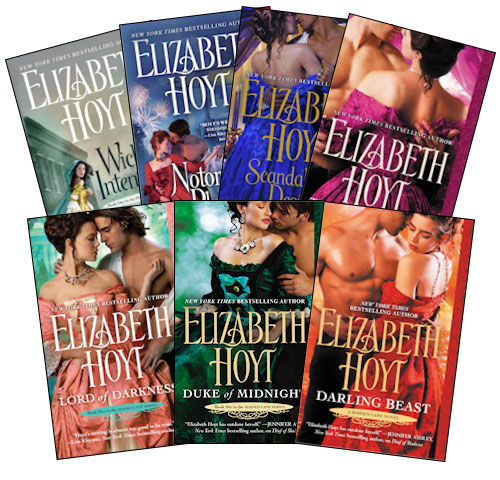
Elizabeth Hoyt: Darling Beast (Maiden Lane #7)

darlingbeast

About Darling Beast

A MAN CONDEMNED . . .

Falsely accused of murder and mute from a near-fatal beating, Apollo Greaves, Viscount Kilbourne has escaped from Bedlam. With the Crown’s soldiers at his heels, he finds refuge in the ruins of a pleasure garden, toiling as a simple gardener. But when a vivacious young woman moves in, he’s quickly driven to distraction . . .

A DESPERATE WOMAN . . .

London’s premier actress, Lily Stump, is down on her luck when she’s forced to move into a scorched theater with her maid and small son. But she and her tiny family aren’t the only inhabitants—a silent, hulking beast of a man also calls the charred ruins home. Yet when she catches him reading her plays, Lily realizes there’s more to this man than meets the eye.

OUT OF ASHES, DESIRE FLARES

Though a scorching passion draws them together, Apollo knows that Lily is keeping secrets. When his past catches up with him, he’s forced to make a choice: his love for Lily…or the explosive truth that will set him free.

maiden_covers

Excerpts: Maiden Lane Series

http://www.elizabethhoyt.com/maidenlane/books/index.php

About the Author

Elizabeth Hoyt is the New York Times, USA Today, and Publishers Weekly bestselling author of historical romance, including reader favorite, The Raven Prince.

40729Elizabeth was born in New Orleans but grew up in St. Paul, Minnesota. She was fortunate to be able to travel extensively as a child, visiting St. Andrews, Scotland; Germany; France; and Belgium. She spent a year in Oxford, England and was a summer exchange student to Kawasaki, Japan.

Elizabeth has a BA in anthropology from the University of Wisconsin at Madison and, as a result of having no clue what to do with her life thereafter, a career history as a barista, a (terrible) sales clerk, a Wisconsin Revenue Service data entry slave, and an archeological field work grunt. Fortunately, Elizabeth married relatively young and produced two children who kept her busy until her mid-thirties. At about this time, when her youngest was entering Kindergarten, Elizabeth’s mother hinted that perhaps Elizabeth should get a Real Job.

Sadly, Elizabeth was so delusional she thought writing a romance novel might qualify as a Real Job.

But! Five years later, to everyone’s surprise, she actually sold that romance novel (The Raven Prince) and began a rather successful career as a Romance Novelist. This was most fortunate since Elizabeth is singularly unqualified to do anything else but Make Up Stories.

Since then Elizabeth has written thirteen books to critical acclaim: The Prince Trilogy (The Raven Prince, The Leopard Prince, and The Serpent Prince); the Legend of the Four Soldiers series (To Taste Temptation, To Seduce a Sinner, To Beguile a Beast, and To Desire a Devil); and the Maiden Lane series (Wicked Intentions, Notorious Pleasures, Scandalous Desires, Thief of Shadows, Lord of Darkness, and the upcoming Duke of Midnight .) All of Elizabeth’s books are set in eighteenth century England and all feature a fairy tale story that serves as a foil to the main story.

Elizabeth lives in central Illinois with a pack of untrained canines and a garden in constant need of weeding.

 Website FacebookTwitterAmazon Author Page

The Dover Road: William Clements, Gentleman Coachman

dust jacket

The following post is the sixteenth of a series based on information obtained from a fascinating book Susana recently obtained for research purposes. Coaching Days & Coaching Ways by W. Outram Tristram, first published in 1888, is replete with commentary about travel and roads and social history told in an entertaining manner, along with a great many fabulous illustrations. A great find for anyone seriously interested in English history!

Artistic License

While I mean no disrespect to Canterbury and its extraordinary history, there is so much already out there on this topic that I’ve decided to skip it and focus on a particular coachman well-known and much respected for his years of service on the Canterbury-Dover Road.

Coaches On the Dover Road

dover road

112 miles round trip proved too much in one day.

Of the coaches on this Dover Road I have refrained from speaking, not because I was reserving the best thing till the last, but in point of fact for an exactly opposite reason. An indisputable subject tells me that, considering its importance as the principal route for travellers between England and France, there were not many coaches running on the Dover Road. I fancy that most people who had the wherewithal and wanted to catch a packet when the tide set, posted, and congratulated themselves. Mr. Jarvis Lorry I know was not amongst this number, but then he travelled by the Dover Mail, which was always an institution, kept good time, and carried in its day historic matter.

Mr. William Clements: Gentleman Coachman

william clements

Mr. William Clements, “Gentleman Coachman”

Of the other coaches on the Dover Road I shall make no mention. For once in the way, a catalogue, if made, would contain no sounding names in coaching story, would register no records in the way of speed, catastrophes, or drivers especially cunning, sober or drunk. Yet one coach besides the Dover Mail on this road I will mention, because next to the Mail it took high rank—in some estimations a rank above it; because with its coachman in its best days, I have had the pleasure of shaking hands. Yes! I have shaken hands with a classic coachman! No tyro he when coaching was the fashion, but an artist to the tips of his fingers—one of the old school, whom I have heard described by one who knew them well, as Grand Gentlemen; parties capable of giving Fatherly advice, to bumptious pretenders—parties who at the end of a trying journey, etc., over heavy roads took their ease at their inn with an air, disembarrassed themselves of their belchers, and sat down to a pint of sterling port.

Yes, in Mr. William Clements, who still enjoys a hale old age at Canterbury, I have chanced on a type now almost extinct, and which another generation will only read of in descriptions more or less fabulous, and wonder whether such people have ever been. Mr. Clements, who still takes a sort of paternal interest in those revivals of the coaching age which delight our millionaires during the prevalence of what we are pleased to call our summer months, lives in a snug house of his own, surrounded by memories of his former triumphs. A duchess might envy the Chippendale furniture in his drawing-room, and the bow window commands an extensive view of a rambling block of buildings which in days gone by houses the treasures of a choice stud.

As I listened to this man, it seemed to me that I came into direct personal contact with the very genius of coaching days and coaching ways—felt the impulse which throbbed in the brains of our ancestors to be at the coaching office early to book the box seat: sat by the side of a consummate master of his craft; was initiated in an instant into all its dark mysteries of “fanning,” “springing,” “pointing,” “chopping,” and “towelling.” I went through snowdrifts, I drank rums and milk; hair-breadth escapes in imminent deadly floods were momentary occurrences; I alighted at galleried inns; waiters all subservient showed me to “Concords” in all quarters of the empire. I revelled in the full glories of the coaching age in short in a moment! For had I not touched hands with its oldest, its most revered representative?

Baily’s Magazine of Sports & Pastimes, Volume 69 (Free on Google Books)

In the early 20’s, when agriculture was at its best, the farmers between Canterbury and London wanted a coach that would land them in London at noon on Monday and bring them back the same day… It was settled offhand to start a coach; Mr. Chapin said, “it must be a light coach and we will call it the Tally-ho!…It was started on that fortnight and either on its first start or soon afterwards, Mr. William Clements, whom I knew for the greater part of my life, was coachman, and at first he drove the early five o’clock Monday coach from Canterbury to London in one day, 112 miles all told; but it proved too much and afterward he drove up to London, 56 miles, and down the next day… The coach was almost always called “Clements’s coach,” and he went by the name of “gentleman coachman,” for he had quite the courtesy of Sir Roger de Coverley, combined with the most finished skill in driving his team, and he seldom went a journey without having a young lady who was travelling alone committed to his charge.

Baily says that he had the pleasure of meeting Mr. Clements and his “bright little wife, who was a very clever and well read lady,” and that, in fact, she had been one of the young ladies entrusted to him when he was a young man, and that they celebrated their golden anniversary before she passed away.

This is Why I Love Research!

In my next story, I believe I shall weave in a scene with this true-to-life “gentleman coachman.” In fact, it is beginning to take shape in my mind already! A young lady traveling to London unaccompanied in need of protection. Fabulous!

Henry Alken Sr. Dover to London Coach Summer

Henry Alken Sr.
Dover to London Coach Summer

 Index to all the posts in this series

1: The Bath Road: The (True) Legend of the Berkshire Lady

2: The Bath Road: Littlecote and Wild William Darrell

3: The Bath Road: Lacock Abbey

4: The Bath Road: The Bear Inn at Devizes and the “Pictorial Chronicler of the Regency”

5: The Exeter Road: Flying Machines, Muddy Roads and Well-Mannered Highwaymen

6: The Exeter Road: A Foolish Coachman, a Dreadful Snowstorm and a Romance

7: The Exeter Road in 1823: A Myriad of Changes in Fifty Years

8: The Exeter Road: Basingstoke, Andover and Salisbury and the Events They Witnessed

9: The Exeter Road: The Weyhill Fair, Amesbury Abbey and the Extraordinary Duchess of Queensberry

10: The Exeter Road: Stonehenge, Dorchester and the Sad Story of the Monmouth Uprising

11: The Portsmouth Road: Royal Road or Road of Assassination?

12: The Brighton Road: “The Most Nearly Perfect, and Certainly the Most Fashionable of All”

13: The Dover Road: “Rich crowds of historical figures”

14: The Dover Road: Blackheath and Dartford

15: The Dover Road: Rochester and Charles Dickens

16: The Dover Road: William Clements, Gentleman Coachman

17: The York Road: Hadley Green, Barnet

18: The York Road: Enfield Chase and the Gunpowder Treason Plot

19: The York Road: The Stamford Regent Faces the Peril of a Flood

20: The York Road: The Inns at Stilton

21: The Holyhead Road: The Gunpowder Treason Plot

22: The Holyhead Road: Three Notable Coaching Accidents

23: The Holyhead Road: Old Lal the Legless Man and His Extraordinary Flying Machine

24: The Holyhead Road: The Coachmen “More Celebrated Even Than the Most Celebrated of Their Rivals” (Part I)

25: The Holyhead Road: The Coachmen “More Celebrated Even Than the Most Celebrated of Their Rivals” (Part II)

26: Flying Machines and Waggons and What It Was Like To Travel in Them

27: “A few words on Coaching Inns” and Conclusion