Archives

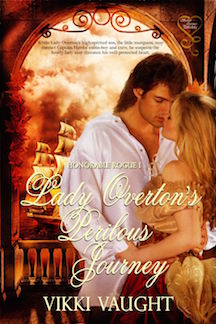
Vikki Vaught: Lady Overton’s Perilous Journey

I want to thank Susana for having me on her blog today. I’m very exciting about my new release, Lady Overton’s Perilous Journey. This is the first book in my Honorable Rogue series. This series is set in early 19th century England & America. I’d like to discuss some of the fascinating research I did for my book.

photo (2) copyI originally set this book in 1809, but on further research I discovered Jefferson convinced the U.S. congress to pass the Embargo Act of 1807, which stopped all foreign trade. While Jefferson did not want to involve the U.S. in the conflict between France and England, he wanted to put in place financial sanctions that could possibly hurt these countries economically. This act devastated the economy. American ships literally remained in port rotting in the harbors.

Here is some background history that led up to the embargo. Britain and France resumed their war in 1803, causing relations to become strained between any countries, deciding to remain neutral. In 1806 France passed a law against trading with neutral countries, and since America did not take sides in the conflict between the two countries, the French began plundering American ships. In 1807, Britain passed a bill prohibiting trade between France and neutral countries. The British began seizing American vessels and demanding that all ships pull into their ports before they were allowed to trade with other countries.

The British also started boarding American vessels and began seizing any sailors they deemed were deserters from the Royal British Navy. This infuriated the U.S. and thousands of American sailors were unlawfully impressed into the British Navy.

During the last sixteen days of Jefferson’s presidency, a bill was passed replacing the Embargo Act with the Non-Intercourse Act of 1809. While this act opened up trade again, it did not allow trade with Britain. Since my story has my heroine fleeing England on an American vessel, I needed to move it to a different year, prior to the escalating issues between the two countries. Since 1802 was the only year that England and France were not at war, I decided to place my story in that year.

This was by no means the only research I did for Lady Overton’s Perilous Journey, but was certainly the most important. While this is a novel of fiction, I wanted to ensure that the happenings within the story were possible.

I hope you’ll enjoy the romance between Alex and Anissa as much as I enjoyed writing their love story. Happy reading!
Halloween Background

About Lady Overton’s Perilous Journey

When her son’s life is threatened, Anissa, Marchioness of Overton, seeks refuge by sailing to America. Before the ship reaches the high seas, sparks fly between her and Captain Alex Hawks. Although the young widow may be lonely, and afraid, she cannot risk the diversion a romantic entanglement could bring, no matter how much she wants to lose herself in the captain’s embrace.

The Captain vows to protect the young Lord Overton, but can offer no assurance that the marchioness will leave his ship with her virtue intact. Alex is drawn to Anissa’s beauty and courage, as a hummingbird is to the nectar of a flower. How long can he fight a losing battle before he surrenders and makes her his own?

Will Alex be able to keep this remarkable woman and her child safe? Will his passion for Anissa be enough or will their differences keep them apart?

Secret CravingsAmazonBarnes & NobleARe

Excerpt

She cuddled her sleeping child close as she scanned the overcrowded common area. Her insides churned as she wove her way through the crowded tables, the chairs filled with dirty, unsavory-looking men. The strong smell of sweat mingled with ale threatened to turn her stomach and had her breathing through her mouth.

Anissa approached the man the stable boy had described. “Sir, are you Captain Hawks?”

He turned around, and in a drawling voice, he answered, “Well, darlin’, that’s my name.” He swept his tri-corn hat from his head, stood and bowed. “Captain Alex Hawks, at your service. What can I do for you?”

Anissa gazed up into the blackest eyes she had ever seen and wanted to fall into them. Mesmerized, she blinked as a shiver ran across her shoulders. This was not the time to notice this man’s eyes, no matter how compelling they were. Now was the time to use her charms to convince him to take her on his ship.

“My name is—” she quickly searched for a name, not wanting to give him her identity, “—Mrs. Carlson. I would like to pay for passage on your ship. I understand you are leaving for America this morning.” Then, thinking of a city she had heard of in America, she added, “I need to go to Boston, where some of my family lives. Would you be able to help me?”

Captain Hawks gave her an appraising stare, which unnerved her. This man was intimidating, to say the least. “I’m not going to Boston. And, I don’t normally take on passengers. I’m headed to Baltimore, and it’s a far piece from Boston, darlin’.”

“Please take me. I have to leave for America as soon as possible.” Anissa had to convince him to allow her passage. “And as far as your destination is concerned, I’m sure once I am in America, I shall be able to travel to Boston from there.”

“Darlin’, do you even know where Baltimore is and how far it is from Boston?”

Anissa wished he would quit calling her darling. It was quite presumptuous of him, and she did not appreciate it at all. Of course, she did not want to anger him, so she kept her feelings to herself. “Well, no, not really. How far is it?”

“It’s over four hundred miles,” Captain Hawks explained, as if he were speaking to a child, which further irritated her, tugging at her frazzled nerves. “You would be better served if you found a passenger ship going there. I have an associate who should be arriving in a few days, and his ship is going to Boston. He also takes passengers. I’m sure he would be happy to take you on board.”

Oh, dear, why did I say Boston? Please, Lord, let me convince him to take me.

Every hour brought her closer to the chance of discovery. She could not afford to wait for another ship. She needed to get as far away from Lord Howard as possible, immediately.

“Captain, I do not have a few days to wait. My uncle is dreadfully ill. He may only have a few months to live, so I need to leave right away. Please allow me to travel on your ship.” She looked up at him, willing a few tears into her eyes, praying to gain his sympathy.

Captain Hawks sighed and rolled his obsidian eyes toward the ceiling. “I know I’m going to regret this. All right, darlin’, if it’s that important, I’ll take you. I hope you realize how uncomfortable this voyage will be for you and the child. The cabin you will be in barely has room to turn around in. Are you sure you don’t want to reconsider?”

“We shall be fine, regardless of the conditions.”

He shook his head, sending her heart to the floor.

Oh, Lord, please don’t let him change his mind.

What shall I do if he has?

About the Author

Vikki Vaught started her writing career when a story invaded her mind and would not leave.

Over the last few years, she has written more than a half dozen historical romances and is presently working on her next. Her new release, Lady Overton’s Perilous Journey, published by Secret Cravings Publishing is the first book in her Honorable Rogue series.

Vikki loves a “Happily Ever After”, and she writes them in her stories. While romance is the central theme of all her books, she includes some significant historical event or place in all her novels.

While all her books are love stories, she has also written short contemporary sweet romances as Vikki McCombie and erotic romances using the pen name of V.L. Edwards.

For the last decade, Vikki has lived in the beautiful foothills of the Smoky Mountains of Tennessee with her beloved husband, Jim, who is the most tolerant man in the world to put up with her when she is in a writing frenzy. When she is not writing or working her day job, you’ll find her curled up in a comfortable chair reading her Kindle, lost in a good book with a cup of tea at her side.

WebsiteEmailFacebookTwitterGoogle+Pinterest

Amazon Author Page • Goodreads Author Page 

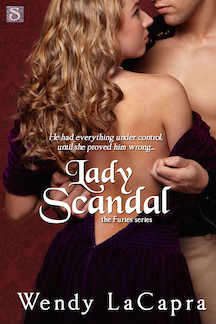
Wendy LaCapra: Lady Scandal

VBT_TourBanner_LadyScandal copy

The author will award one of ten ebooks to ten randomly drawn winners via Rafflecopter. Click here for the Rafflecopter. Click the banner above to follow the tour and increase your chances of winning.

Interview with Wendy LaCapra

Susana: Any weird things you do when you’re alone?

Wendy: When my husband is traveling, I leave the hall lights (which are LED’s) on all night. I also tend to over-indulge in pasta J

Susana: What is your favorite quote and why?

Wendy: My day is made if I can quote Prince Humperdinck, “Skip to the end” or (and this is more rare) the Man in Black himself, “If we only had a wheelbarrow, now that would be something.”

Susana: Who is your favorite author and why?

Wendy: Can’t name just one. In romance I am a big fan of Gaelen Foley, Joanna Bourne, Mary Balogh & Eileen Dreyer to name just a few.

Susana: What, in your opinion, are the most important elements of good writing?

Wendy: I cannot dissect. I think different authors have different strengths (dialogue, characterization, great description, subtle use of narrative techniques) and if they lead with their strength the book they create is going to be fabulous.

Susana: Where did you get the idea for this book?

Wendy: I’m not sure. This series started with a snippit of research about the charge of petty treason, started to take form with more research on Lady Worsley, but when I started writing, all three Furies stepped on stage at once, fully formed. It may have taken some false starts to find Sophia’s match, but once she met Randolph, the rest of the story flowed.

01MediaKit_Teaser1 copy

About Lady Scandal

London, 1784

Sophia Baneham has lived in the poison of her dead father’s shadow for longer than she cares to admit. Now she exists outside of polite society’s influence, holding gambling parties for London’s most dangerous men. When a man walks into one of her soirees, a compelling mix of charisma and icy control, he offers the lady of sin a wager she can’t refuse…

Lord Randolph is a spy in the service of His Majesty, but he’s given an oath to protect the daughter of his mentor. Even as his gamble of marriage starts to spiral out of control and his passions ignite, Randolph is determined that he’ll handle things his way…

But when danger closes in, Randolph won’t just have to protect Sophia from an intended killer. He’ll have to protect her from himself…

Amazon Barnes & Noble

Excerpt

He had never before failed in a mission. Never.

Clearly, he had been off his game and there was only one reason.

BookCover_LadyScandal copySophia.

Before they had met, Randolph had thought of Sophia as an evil-made-necessary—a means to probe the secrets Baneham had left behind. But then she had turned her cornflower blue eyes on him and everything had changed.

…Hours after returning from India, he arrived at a Fury soiree—uninvited. Lady Sophia’s footman stuttered under his glower, but the man refused to grant him entry. No one could be admitted to the soiree, the man insisted, without approval of the hostess, even if accompanied, as Randolph was, by the hostess’s cousin.

He remained in the hall, suffering the indignity of his wait with hands clasped behind his back. The entry was hardly what he had expected of Baneham’s home. The man had been the epitome of male. These furnishings could only be described as—he suppressed an inward shudder—dainty.

He peered into the rooms beyond. The dandies within did nothing to dilute the feminine air. The library was a rainbow of velvet jackets and frothing cravats, topped with clouds of fluffed white wigs. Even from the distance, the scent proved this the motliest male collection of Eau du Cologne enthusiasts ever assembled.

“Cousin Charles has brought me a gift, I see.” Her voice sang over his veins the way the wind sang against lines of a hoisted sail—the song sank all the way into his cock.

He turned.

The voice came from a petite, provocatively curved woman sewn into her pink silk bodice—he could think of no other way the fabric could fit so tight. Her hair powder was laced with a matching pink hue. She looked like strawberries and cream and, if he was permitted a taste of her lips, he was certain she’d be as mouthwateringly sweet.

Her gaze dropped from his face and traveled boldly down his body.

By Saint George, he wanted a sampling of her sweetness.

“Lord Randolph,” he said, “at your service.”

Her faint smile implied a flirtatious scold. “You do not have an invitation, Lord Randolph.”

“Soon remedied, I hope. I am recently returned from the continent.” She did not need to know which continent—nor how recently. “I have heard your soirees are the must-attend events for any London rake worth his salt.”

“Do you fancy yourself a rake, then, Lord Randolph?” She sounded hopeful, blast her sensual voice.

He leaned forward and whispered, “Issue me an invitation, sweetness, and I will provide any proof you may require.”

“No proof is required…” a faint, secret smile teased her mouth—both challenge and invitation, “at present.”

…It had been lust at first sight. She lit a carnal fire in his blood and the resulting burn was hotter and deeper than any he’d known.

About the Author

AuthorPhoto_LadyScandal copyWendy LaCapra, a 2012 Golden Heart® Finalist, has been reading romance since she discovered Victoria Holt (in the library’s adult section!)  From that point on, her only dream was to create worlds with historical richness, intrigue and pleasure. She lives in NYC with her husband and can occasionally be found gossiping about history and romance with the Dashing Duchesses or burning up the web with those mystical mistresses of resilience, the GH class of 2012 aka the Firebirds.

Website FacebookTwitter

LadyScandalGiveaway copy


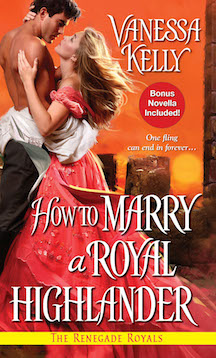
Vanessa Kelly: How to Marry a Royal Highlander

HIGHLANDER

About How to Marry a Royal Highlander

Illegitimate yet thoroughly irresistible, the Renegade Royals are leaving behind their careers as daring spies for the greatest adventure of all…

At sixteen, Alasdair Gilbride, heir to a Scottish earldom, fled the Highlands and an arranged betrothal. Ten years later, Alasdair must travel home to face his responsibilities. It’s a task that would be much easier without the distracting presence of the most enticing woman he’s ever met…

After one escapade too many, Eden Whitney has been snubbed by the ton. The solution: rusticating in the Scottish wilderness, miles from all temptation. Except, of course, for brawny, charming Alasdair. The man is so exasperating she’d likely kill him before they reach the border—if someone else weren’t trying to do just that. Now Eden and Alasdair are plunging into a scandalous affair with his life and her reputation at stake—and their hearts already irreparably lost…

SusanaSays3Susana Says

… another Renegade Royal meets his match: 5/5 stars

Alasdair Gilbride, a natural son of the Duke of Kent (who will soon become the father of the future Queen Victoria), has been avoiding his responsibilities as heir to a Scottish earldom (through his deceased mother) for the past ten years by serving his country as a spy during the war with France. The war is over, his grandfather is ailing, and he no longer has any excuse for avoiding his dilemma—an unwanted betrothal to his cousin.

At the same time, Eden Whitney finds herself needing to get out of Town for awhile. The last thing she wants to do is spend the winter in a cold castle in Scotland, but her mother insists they accept Captain Gilbride’s offer. Edie and Gilbride have always had a bickering sort of relationship, but the closer they get to the frozen tundra that Scotland is presumed to be, the more her feelings for him begin to melt her antagonism. But family honor demands that he marry another… even if breaks her heart.

Like the rest of the Renegade Royals, Alasdair harbors his share of guilt and shame for being the “cuckoo in the nest,” even though he was the innocent party, and even though he does legitimately carry the blood of the earl his grandfather, through his mother. Eventually that’s what causes him to abandon the family and seek honor through service to his country. But does that mean he can get away with breaking a betrothal and wreaking havoc in the clan without a pang of conscience?

The relationship between Alec and Eden was amusing to watch, as it was easy to see how they felt about each other even before they could admit it to themselves. Mrs. Whitney took a bit longer to warm up to, but even she proved to be a worthy opponent to the crotchety old earl. How to Marry a Royal Highlander was a truly enjoyable read, and I highly recommend it—whether or not you’ve read any of the other books in the series.

About the Author

IMG_0031 copyVanessa Kelly is an award-winning author who was named by Booklist, the review journal of the American Library Association, as one of the “New Stars of Historical Romance.” Her sensual, Regency-set historical romances have been nominated for awards in a number of contests, and her second book, Sex and The Single Earl, won the prestigious Maggie Medallion for Best Historical Romance. Her third book, My Favorite Countess, was nominated for an RT Reviewers’ Choice Award for Best Regency Historical Romance.

Vanessa’s current series, The Renegade Royals, is a national bestseller. The first book in the series, Secrets for Seducing a Royal Bodyguard, received a starred review from Publishers Weekly.

When she’s not dreaming up plots for her next Regency historical novel, Vanessa is writing USA Today Bestselling contemporary romance with her husband under the pen name of V.K. Sykes. The first book in their forthcoming Seashell Bay Series will be released by Grand Central in February, 2015.

You can find Vanessa at www.vanessakellyauthor.com or at www.vksykes.com. She’s also a member of The Jaunty Quills, a group of bestselling authors like Kristan Higgins, Shana Galen, and Jesse Hayworth. You can visit The Jaunty Quills at www.jauntyquills.com.

“A few words on Coaching Inns” and Conclusion

dust jacket

The following post is the twenty-seventh and final of a series based on information obtained from a fascinating book Susana obtained for research purposes. Coaching Days & Coaching Ways by W. Outram Tristram, first published in 1888, is replete with commentary about travel and roads and social history told in an entertaining manner, along with a great many fabulous illustrations. A great find for anyone seriously interested in English history!

“…And now a few words on the Coaching Inns”

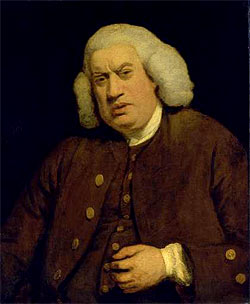
Dr. Samuel Johnson

Dr. Samuel Johnson

“There is no private house,” said Johnson—it was in the Old Chapel House inn in Oxfordshire, on the Birmingham Road, that he gave vent to the profundity—“there is no place,” he said, at which people can enjoy themselves as well as at a capital tavern like this. Let there be ever so great a plenty of good things, ever so much grandeur, ever so much elegance, ever so much desire that every guest should be easy, in the nature of things it cannot be. There must always be some degree of care and anxiety. The master of the house is anxious to entertain his friends; these in their turn are anxious to be agreeable to him, and to no one but a very impudent dog can as freely command what is in another man’s house as if it were his own. Whereas at a tavern there is a general freedom from anxiety. You are sure you are welcome, and the more noise you make the more trouble you give, the more good things you call for, the welcomer you are. No servants will attend you with the alacrity which waiters do, who are incited by the prospect of an immediate reward in proportion as they please. No, sir; there is nothing which has been contrived by man by which so much happiness is produced as by a good tavern or inn.”

Lamenting the loss of the “finest examples of this hospitable sort of architecture”

Hear, hear! say I; but while on the subject of inns may remark that I have been much disappointed in my ramblings; in truth began some six years too late from this point of view. For in that interval the country has been deprived of many of its finest examples of this hospitable sort of architecture. Of those fine examples—few and far between—which still remain, many are now sinking into a state of irremediable disrepair—witness the great inn at Stilton for one—and will in the near fulness of time doubtless be improved altogether off the face of the earth.

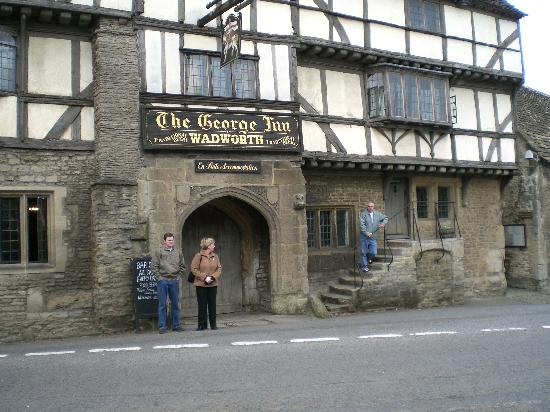
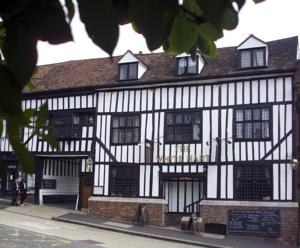
george inn norton st philip

The George Inn, Norton St. Philip (near Bath)

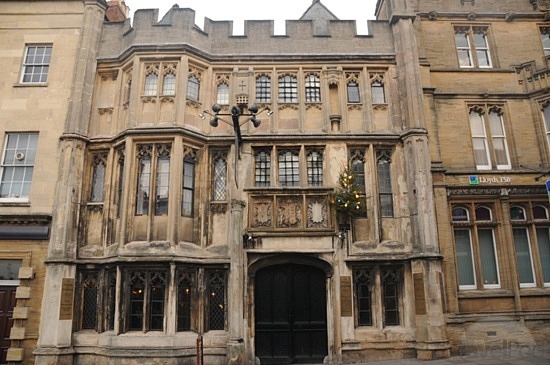
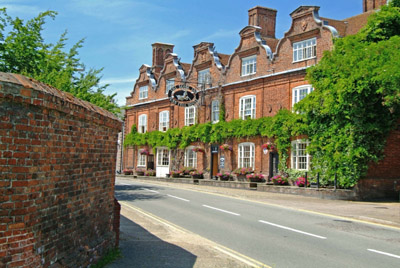
At Norton St. Philip, then, in Somersetshire, seven miles south-east of Bath, there still stands in the George Inn, a half-timbered, fifteenth century house, of the finest possible type. Monmouth passed the night of June 26th, 1685 at this George…At Glastonbury, in the same county, an inn of the same name—the George—with front one splendid mass of panelling, pierced where necessary for windows, the finest piece of domestic work in one of the most entrancing towns in England from an antiquary’s point of view, dates from the fourth Edward; while, to go further afield for a fine specimen of a different period, at Scole in Suffolk, the White Hart, erected in 1655 by John Peck, merchant, of Norwich, still retains some fine carving, and had till the end of the last century an enormous sign containing many figures—Diana and Actaeon, Charon, Cerberus, and sundry other worthies, carved in wood by Fairchild, at a cost of 1057 pounds.

george-pilgrims-hotel-1492-glastonbury-n1-st-fillans

The George & Pilgrim Hotel, Glastonbury

Conclusion

If a minor measure of success attends my enterprize I shall be content—content, that is to say, if I have caught some flavour of the romance of the Great Roads of England from the time when the Flying Machine of Charles the Second’s age lumbered out of the Belle Savage Yard, up to the day when the Holyhead Mail via Shrewsbury, timed at eleven miles an hour, was our fathers’ wonder, and the pride of this perfect road— “Mr. Bicknell’s spicy team of greys.”

scole-scole-inn-5279

The Scole Inn, Suffolk (formerly White Hart)

scole_inn_stairs

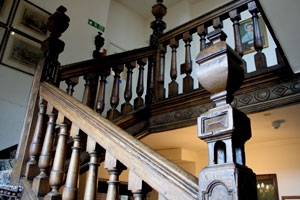
Stairs at the Scole Inn


 Index to all the posts in this series

1: The Bath Road: The (True) Legend of the Berkshire Lady

2: The Bath Road: Littlecote and Wild William Darrell

3: The Bath Road: Lacock Abbey

4: The Bath Road: The Bear Inn at Devizes and the “Pictorial Chronicler of the Regency”

5: The Exeter Road: Flying Machines, Muddy Roads and Well-Mannered Highwaymen

6: The Exeter Road: A Foolish Coachman, a Dreadful Snowstorm and a Romance

7: The Exeter Road in 1823: A Myriad of Changes in Fifty Years

8: The Exeter Road: Basingstoke, Andover and Salisbury and the Events They Witnessed

9: The Exeter Road: The Weyhill Fair, Amesbury Abbey and the Extraordinary Duchess of Queensberry

10: The Exeter Road: Stonehenge, Dorchester and the Sad Story of the Monmouth Uprising

11: The Portsmouth Road: Royal Road or Road of Assassination?

12: The Brighton Road: “The Most Nearly Perfect, and Certainly the Most Fashionable of All”

13: The Dover Road: “Rich crowds of historical figures”

14: The Dover Road: Blackheath and Dartford

15: The Dover Road: Rochester and Charles Dickens

16: The Dover Road: William Clements, Gentleman Coachman

17: The York Road: Hadley Green, Barnet

18: The York Road: Enfield Chase and the Gunpowder Treason Plot

19: The York Road: The Stamford Regent Faces the Peril of a Flood

20: The York Road: The Inns at Stilton

21: The Holyhead Road: The Gunpowder Treason Plot

22: The Holyhead Road: Three Notable Coaching Accidents

23: The Holyhead Road: Old Lal the Legless Man and His Extraordinary Flying Machine

24: The Holyhead Road: The Coachmen “More Celebrated Even Than the Most Celebrated of Their Rivals” (Part I)

25: The Holyhead Road: The Coachmen “More Celebrated Even Than the Most Celebrated of Their Rivals” (Part II)

26: Flying Machines and Waggons and What It Was Like To Travel in Them

27: “A few words on Coaching Inns” and Conclusion

Flying Machines and Waggons and What It Was Like To Travel in Them

dust jacket

The following post is the twenty-sixth of a series based on information obtained from a fascinating book Susana obtained for research purposes. Coaching Days & Coaching Ways by W. Outram Tristram, first published in 1888, is replete with commentary about travel and roads and social history told in an entertaining manner, along with a great many fabulous illustrations. A great find for anyone seriously interested in English history!

Portrait of a Flying Machine

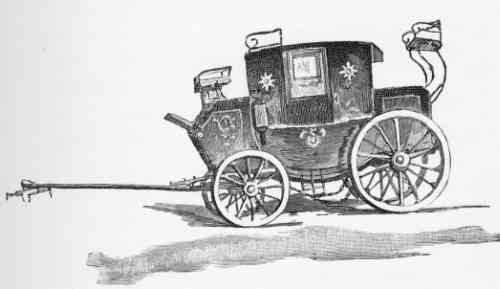
…they were principally composed of a dull black leather, thickly studded by way of ornament with broad black-headed nails, tracing out the panels in the upper tier of which were four oval windows, with heavy red wooden frames, or leather curtains. Upon the doors were displayed in large characters the names of the places whence the coach started, and where it was going to—another matter. The shape of the Flying Machine was a matter left much open to choice. You could ride in one shaped like a diving bell; or in one the exact representation of a distiller’s vat, hung equally balanced between immense back and front springs; or in one made after the pattern of a violoncello case—past all comparison the most fashionable shape. If my readers are tempted to cry why this thusness, I can only say because these violoncello-like Flying Machines hung in a more graceful posture—namely, inclining on to the back springs—and gave those who sat within it “the appearance of a stiff Guy Fawkes uneasily seated.” But this is a satiric touch, surely. To get on to the roofs, however. These generally rose into a swelling curve, which was sometimes surrounded by a high iron guard, after the manner of our more modern four-wheeled cabs. The coachman and the guard (who always held his carbine ready cocked upon his knee—an attitude which must have made inside passengers wish they had insured their lives) then sat together over a very long and narrow boot which passed under a large spreading hammercloth hanging down on all sides, and furnished with a most luxuriant fringe. Behind the coach was the immense basket, stretching far and wide beyond the body in which it was attached by long iron bars or supports passing beneath it. I am not surprised to learn that these baskets were never very great favourites, though their difference of price caused them to be frequently filled—but another proof of needs must when the devil drives—. And as for the notion of these Flying coaches when well on the road, it was “as a ship rocking or beating against a heavy sea’ straining all her timbers, with a low moaning sound as she drives over the contending waves.” With which extraordinary simile we may leave Flying Machines behind us—and any description of their successors too. For are not the models of the crack coaches in coaching’s primest age to be seen every day in Piccadilly? They are—and some very delightful rides can be had in them too.

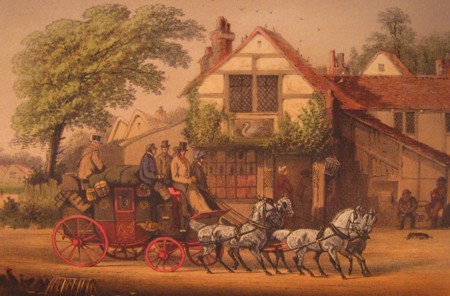
old English flying mail coach

old English flying mail coach

The experience of “travelling in one of these perfected turn-outs”

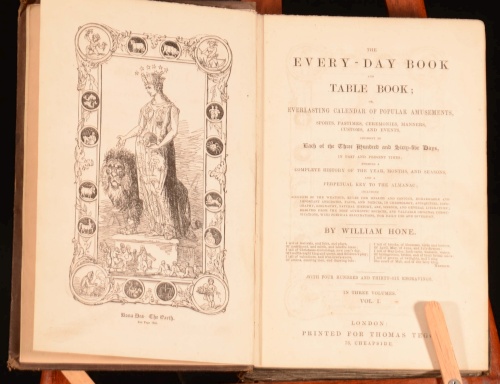
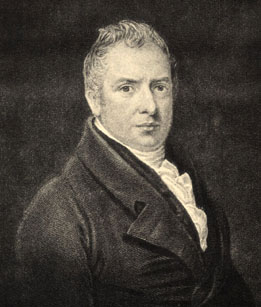
Not that travelling in these perfected turn-outs was always like riding on a bed of roses, as I have had occasion frequently to point out, which consideration brings me to the inevitable comparison of the advantages of rail versus road. On which great subject much can be said on both sides, as a celebrated Attorney-General for Honolulu once remarked. De Quincey, for instance, may talk of the “fine fluent motion of the Bristol Mail,” and call up recollections in our minds of the modern Bristol Mail’s motion as anything but fluent; he may glorify “the absolute perfection of all the appointments about the carriage and the harness, their strength, their brilliant cleanliness, their beautiful simplicity, the royal magnificence of the horses; “but here is another side to the picture. I quote from Hone’s Table-books, an extract in the style of Jingle, and worthy of him.

HONE'S BOOK

Hone’s Every-Day Book and Table Book

“STAGE COACH ADVENTURES.

“INSIDE.—Crammed full of passengers—three fat fusty old men—a young Mother and sick child—a cross old maid—a poll parrot—a bag of red herrings—double-barrelled gun (which you are afraid is loaded)—and a snarling lap dog in addition to yourself. Awake out of a sound nap with the cramp in one leg and the other in a lady’s bandbox—pay the damage (four or five shillings) for gallantry’s sake—getting out in the dark at the half-way house, in the hurry stepping into the return coach and finding yourself next morning at the very spot you had started from the evening before—not a breath of air—asthmatic old woman and child with the measles—window closed in consequence—unpleasant smell—shoes filled with warm water—look up and find it’s the child—obliged to bear it—no appeal—shut your eyes and scold the dog—pretend sleep and pinch the child—mistake—pinch the dog and get bit.—Execrate the child in return—black looks—no gentleman—pay the Coachman and drop a piece of gold in the straw—not to be found—fell through a crevice—Coachman says ‘He’ll find it.’—Can’t—get out yourself—gone—picked up by the Ostler—no time for blowing up—Coach off for next stage—lose your money—get in—lose your seat—stuck in the middle—get laughed at—lose your temper—turn sulky—and turned over in a horse-pond.

William Hone

William Hone

“OUTSIDE.—Your eye cut out by the lash of a clumsy Coachman’s whip—hat blown off into a pond by a sudden gust of wind—seated between two apprehended murderers and a noticed sheep-stealer in irons—who are being conveyed to gaol—a drunken fellow half asleep falls off the Coach—and in attempting to save himself drags you along with him into the mud—musical guard, and driver horn mad—turned over.—One leg under a bale of cotton—the other under the Coach—hands in breeches pockets—head in hamper of wine—lots of broken bottles versus broken heads.—Cut and run—send for surgeons—wounds dressed—lotion and lint four dollars—take post-chaise—get home—lay down—and laid up.”

coach

stage coach and mail

Stage coach and mail


Mail coach

Mail coach


 Index to all the posts in this series

1: The Bath Road: The (True) Legend of the Berkshire Lady

2: The Bath Road: Littlecote and Wild William Darrell

3: The Bath Road: Lacock Abbey

4: The Bath Road: The Bear Inn at Devizes and the “Pictorial Chronicler of the Regency”

5: The Exeter Road: Flying Machines, Muddy Roads and Well-Mannered Highwaymen

6: The Exeter Road: A Foolish Coachman, a Dreadful Snowstorm and a Romance

7: The Exeter Road in 1823: A Myriad of Changes in Fifty Years

8: The Exeter Road: Basingstoke, Andover and Salisbury and the Events They Witnessed

9: The Exeter Road: The Weyhill Fair, Amesbury Abbey and the Extraordinary Duchess of Queensberry

10: The Exeter Road: Stonehenge, Dorchester and the Sad Story of the Monmouth Uprising

11: The Portsmouth Road: Royal Road or Road of Assassination?

12: The Brighton Road: “The Most Nearly Perfect, and Certainly the Most Fashionable of All”

13: The Dover Road: “Rich crowds of historical figures”

14: The Dover Road: Blackheath and Dartford

15: The Dover Road: Rochester and Charles Dickens

16: The Dover Road: William Clements, Gentleman Coachman

17: The York Road: Hadley Green, Barnet

18: The York Road: Enfield Chase and the Gunpowder Treason Plot

19: The York Road: The Stamford Regent Faces the Peril of a Flood

20: The York Road: The Inns at Stilton

21: The Holyhead Road: The Gunpowder Treason Plot

22: The Holyhead Road: Three Notable Coaching Accidents

23: The Holyhead Road: Old Lal the Legless Man and His Extraordinary Flying Machine

24: The Holyhead Road: The Coachmen “More Celebrated Even Than the Most Celebrated of Their Rivals” (Part I)

25: The Holyhead Road: The Coachmen “More Celebrated Even Than the Most Celebrated of Their Rivals” (Part II)

26: Flying Machines and Waggons and What It Was Like To Travel in Them

27: “A few words on Coaching Inns” and Conclusion

The Holyhead Road: The Coachmen “More Celebrated Even Than the Most Celebrated of Their Rivals” (Part II)

dust jacket

The following post is the twenty-fifth of a series based on information obtained from a fascinating book Susana obtained for research purposes. Coaching Days & Coaching Ways by W. Outram Tristram, first published in 1888, is replete with commentary about travel and roads and social history told in an entertaining manner, along with a great many fabulous illustrations. A great find for anyone seriously interested in English history!

Sam Hayward: “An artist of a finer mould”

An artist of a finer mould was Sam Hayward, who drove the Wonder from Shifnal to Shrewsbury (18 miles). Not only was he a fine performer on the Road—but he did a deed in the usual way of business when he got into Shrewsbury which made spectators stare. The Lion yard is just on the top of the hill in Shrewsbury, and is so placed that to coachmen not demigods, to turn into it off a sharpish pitch with a heavy load was to attempt the impossible to an accompaniment of breaking poles and shrieking passengers. All other coaches coming from London went in therefore ignominiously by the backway, though they came out at the usual entrance. Not so Sam Hayward on the Wonder. Secure in the knowledge of accomplished strength he smilingly hugged the kerbstone on the near side, passed the entrance for a few yards—but yards accurately calculated—then described a round and imperial circle, and shot in under the archway a victorious, a classic charioteer. People at first thought him mad—I read, when they saw him thus as it were defying the thunder—but they soon saw that he knew what he was doing, and could do it.

Winterbotham: “amazing fresh”

Of quite a different type was one Winterbotham—who drove the Holyhead Mail four stages out of Holyhead and who on one occasion when Mr. Birch Reynardson—the great authority in this part of the world—approached the coach, was described to him by the guard as being “amazing fresh.” “Amazing fresh” is not only good in my eyes: it is delicious. And how when Winterbotham presently put in an appearance did he answer to this poetic description? Why, amazingly. “He approached rolling about like a seventy-four in a calm: or as if he were walking with a couple of soda-water bottles tied under his feet.” The peculiarity of this gait, which might have been much appreciated on the Metropolitan boards as an eccentric dancer’s new departure, did not appeal to the teller of this tale as prophetic of safety from the box-seat of a crack coach. So Winterbotham in all the meridian of his freshness was included, a solitary passenger in the stuffy inside—and Mr. Birch Reynardson himself assumed the ribbons. At the change near St. Asaph, sixty miles from Holyhead, inquires were made after Winterbotham’s condition. But all his freshness had deserted the cooped-up charioteer! He was however found fairly rational though excessively dejected, and expressed himself thus on an unique experience— “Well I think I’d better get outside now! I aren’t used to this. Well! This is traveling like a gentleman, and inside the Mail to be sure! Well! I never travelled inside a Mail or a coach before; and I dare say I never shall again! I don’t think I like the inside of a coach much; and so I’d better get out now! it feels wonderful oldd somehow to be inside the Mail; and I really hardly know how I got there.”

Dan Herbert: “perfected in his quiet method of driving bad teams without punishing them”

On the same coach, but further up the road, Dan Herbert did his twenty-four miles between Eccleshall and Lichfield with two changes, and his twenty-four miles back the same day,—an artist perfected in the quiet method, driving bad teams punctually without punishing them, rather by the medium of fine hands and temper coaxing them along. He was upwards of thirty years on the Chester and Holyhead Mail, and in consideration of his faithful and correct attention to business was awarded a scarlet coat on every anniversary of the King’s birthday.

mail coach?

George Clark: “an artist of the same calibre and of like style”

And George Clarke was an artist of the same calibre and of like style. He took the Umpire at Newport Pagnell (fifty-one miles from London), and met the down coach at Whetstone returning about nine o’clock. The most valuable of servants, because the first coachman in England for bad horses. Having always had weak horses to nurse, the ordeal had worn him down to a pattern of patience. With these and other great weights upon severe ground, he was steady, easy and economical in thong and cord, very light-handed, and sometimes even playful!

John Marchant and Bob Snow: “demigods whose steel nerves their passengers implicitly trusted”

…these men [John Marchant of the Manchester Telegraph and Bob Snow of the Defiance] drove opposition coaches, in which speed was the one thing looked up to, associated in a mild degree with a more or less reasonable amount of safety. And they drove furiously to beat the record—careful of nothing so long as the coach kept on its wheels, demi-gods whose steel nerves their passengers implicitly trusted, well knowing as they did that if those steel nerves had for an instant failed their owners the whole stock and lot would have gone to the Deuce in an instant.

'The Opposition Coaches', 1837 (1927).Artist: Charles Cooper Henderson

‘The Opposition Coaches’, 1837 (1927).Artist: Charles Cooper Henderson

It was this sort of fiery opposition kept up between the two crack Manchester coaches which called forth some such comment as the following, comments constantly to be culled from contemporary magazines:—

“Whoever takes up a newspaper in these eventful times it is even betting whether an accident by a coach or a suicide first meets his eye. Now really as the month of November is fast approaching, when from foggy weather and dark nights, both these calamities are likely to increase, I merely suggest the propriety of any unfortunate gentleman resolved on self-destruction, trying to avoid the disgrace attached to it by first taking a few journeys by some of these Dreadnought, Highflyer, or Tally-ho coaches; as in all probability he may meet with as instant a death as if he had let off one of Joe Manton’s pistols in his mouth, or severed his head from his body with one of Mr. Palmer’s best razors.”

mr. palmer's razors

Trade card of Mr. Palmer, cutler and razor-maker


 Index to all the posts in this series

1: The Bath Road: The (True) Legend of the Berkshire Lady

2: The Bath Road: Littlecote and Wild William Darrell

3: The Bath Road: Lacock Abbey

4: The Bath Road: The Bear Inn at Devizes and the “Pictorial Chronicler of the Regency”

5: The Exeter Road: Flying Machines, Muddy Roads and Well-Mannered Highwaymen

6: The Exeter Road: A Foolish Coachman, a Dreadful Snowstorm and a Romance

7: The Exeter Road in 1823: A Myriad of Changes in Fifty Years

8: The Exeter Road: Basingstoke, Andover and Salisbury and the Events They Witnessed

9: The Exeter Road: The Weyhill Fair, Amesbury Abbey and the Extraordinary Duchess of Queensberry

10: The Exeter Road: Stonehenge, Dorchester and the Sad Story of the Monmouth Uprising

11: The Portsmouth Road: Royal Road or Road of Assassination?

12: The Brighton Road: “The Most Nearly Perfect, and Certainly the Most Fashionable of All”

13: The Dover Road: “Rich crowds of historical figures”

14: The Dover Road: Blackheath and Dartford

15: The Dover Road: Rochester and Charles Dickens

16: The Dover Road: William Clements, Gentleman Coachman

17: The York Road: Hadley Green, Barnet

18: The York Road: Enfield Chase and the Gunpowder Treason Plot

19: The York Road: The Stamford Regent Faces the Peril of a Flood

20: The York Road: The Inns at Stilton

21: The Holyhead Road: The Gunpowder Treason Plot

22: The Holyhead Road: Three Notable Coaching Accidents

23: The Holyhead Road: Old Lal the Legless Man and His Extraordinary Flying Machine

24: The Holyhead Road: The Coachmen “More Celebrated Even Than the Most Celebrated of Their Rivals” (Part I)

25: The Holyhead Road: The Coachmen “More Celebrated Even Than the Most Celebrated of Their Rivals” (Part II)

26: Flying Machines and Waggons and What It Was Like To Travel in Them

27: “A few words on Coaching Inns” and Conclusion

The Holyhead Road: The Coachmen “More Celebrated Even Than the Most Celebrated of Their Rivals” (Part I)

dust jacket

The following post is the twenty-fourth of a series based on information obtained from a fascinating book Susana obtained for research purposes. Coaching Days & Coaching Ways by W. Outram Tristram, first published in 1888, is replete with commentary about travel and roads and social history told in an entertaining manner, along with a great many fabulous illustrations. A great find for anyone seriously interested in English history!

Poor Jack Matthews

…to begin with—speaking of coachmen’s fate—few I should surmise have met a more ignobly ironical one from a coachman’s point of view than did poor Jack Matthews, who drove the Oak and Nettle coaches from Welshpool to Liverpool, which were run in opposition to the Holyhead Mail and were often too fast to be safe. For poor Jack fell no willing victim to his own indiscretion, but was killed—it is with a blush for the departed that I write it—in a railway accident. In a foolish moment he took it into his head to go to Liverpool for a day’s outing, in a foolisher moment, if there be such a word, he got on the railway which was only half finished. He got on to this railway at Wrexham, intending to go as far as Chester. This feat the unfinished railway accomplished him, only however to throw him off a bridge (unfinished too, I suppose) when he got there. Well may his biographer exclaim, “Poor Jack! He would have been safer driving the Nettle Coach, in all probability!” (which “in all probability” gives us a very fair idea of the safety of the Nettle Coach! But this is a digression.) And Jack was as pretty a coachman as ever had four horses in hand. “A good workman in all respects, smart as a new pin.”

REYNARDS008871-1

Dick Vickers: “fell a victim to agriculture”

Another celebrated coachman on this road met as sad, but more consistent a fate, this was Dick Vickers, who drove the Mail between Shrewsbury and Holyhead. He fell a victim to agriculture. That is to say that though in stature he was so little “that he had to get on to six-pennyworth of coppers to look on to the top of a Stilton cheese” yet the deluded man pined to be a farmer. And he was fond of fishing too, a much more profitable pastime. However, a farmer Vickers became, in spite of his friends’ entreaties, who after a reasonable interval of anxiety found him sus per coll [hung by the neck]. This Vickers, not content with the lack of judgment he displayed while on earth, is said to haunt the scene of his indiscretion still. Though the Mail which he used to drive has long ceased to exist, they do say that at times a rambling is heard—and so on. Mr. Birch Reynardson, to get to something more tangible about Vickers, knew him well, as he seems to have known most of the crack coachmen on the Holyhead Road, through Shrewsbury, and has described them as well as he knew them in his Down the Road. The ill-fated Vickers, he writes, was a good little fellow, always civil, always sober, always most obliging, and a friend of every one along the road. And Mr. Reynardson had some opportunity of studying his model’s characteristics, particularly I should conceive on that one celebrated occasion chronicled, when he sat by him on the box-seat and saw him deal with a team comprised of the engaging attributes of “Three blind ‘uns and a bolter”, or in the coachman’s own words “Four horses, but they’ve only got two eyes among ’em, and it would be quite a well if that horse had not any so far as I know—for he makes shocking bad use of ’em at all times I can tell you.”

REYNARDSON

Old John Scott: “Hit ’em sly—hit ’em sly!”

A differently organized team was equally successfully coped with by one known to fame as Old John Scott. He drove the Chester and Holyhead Mail, and remarked to Mr. Reynardson, who was using all his art to boil up a trot going up Penmaenmawr (thirty-six miles from Holyhead), “Hit ’em sly—hit ’em sly!” And on being asked the reason for this dark advice alleged that if this particular team heard the whip before they felt it, they would never be got up Penmaenmawr at all. Nor was “hitting ’em sly” with the whip the ingenious Old John Scott’s sole method of dealing on heavy ground with this extremely sticky lot. No. He was accustomed, when the crisis came, and the coach threatened to come to a full stop where there was no proper halting place, to play a sort of rat-tat-tat with both feet on the foot-board—and lo! the sticky ones sprang up to their collars at once, as if the author of all evil was behind them. Much exercised by this extraordinary phenomenon, Mr. Reynardson with a praiseworthy impulse to arrive at the dark truth, remarked, “Well! that’s a curious dodge! What do they think is coming?” Upon which Old John Scott, saying, “Wait a pit. I’ll soon let you see what they think is coming,”—stooped down and produced from the boot a most respectable and persuasive looking “Short Tommy”. This sounds rather like a case for the Society for the Prevention of Cruelty to Animals—did we not have it on the best authority that Old John Scott was a worthy, good little, stout-made fellow, whose B was sounded like a P, and who when he said “Shall” pronounced it like Sall.

Next week: more noteworthy coachmen on this noteworthy road

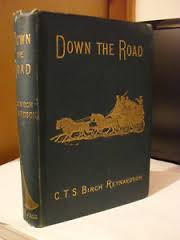
Down the Road: Reminiscences of a Gentleman Coachman, by C.T.S. Birch Reynardson

BOOK

 Index to all the posts in this series

1: The Bath Road: The (True) Legend of the Berkshire Lady

2: The Bath Road: Littlecote and Wild William Darrell

3: The Bath Road: Lacock Abbey

4: The Bath Road: The Bear Inn at Devizes and the “Pictorial Chronicler of the Regency”

5: The Exeter Road: Flying Machines, Muddy Roads and Well-Mannered Highwaymen

6: The Exeter Road: A Foolish Coachman, a Dreadful Snowstorm and a Romance

7: The Exeter Road in 1823: A Myriad of Changes in Fifty Years

8: The Exeter Road: Basingstoke, Andover and Salisbury and the Events They Witnessed

9: The Exeter Road: The Weyhill Fair, Amesbury Abbey and the Extraordinary Duchess of Queensberry

10: The Exeter Road: Stonehenge, Dorchester and the Sad Story of the Monmouth Uprising

11: The Portsmouth Road: Royal Road or Road of Assassination?

12: The Brighton Road: “The Most Nearly Perfect, and Certainly the Most Fashionable of All”

13: The Dover Road: “Rich crowds of historical figures”

14: The Dover Road: Blackheath and Dartford

15: The Dover Road: Rochester and Charles Dickens

16: The Dover Road: William Clements, Gentleman Coachman

17: The York Road: Hadley Green, Barnet

18: The York Road: Enfield Chase and the Gunpowder Treason Plot

19: The York Road: The Stamford Regent Faces the Peril of a Flood

20: The York Road: The Inns at Stilton

21: The Holyhead Road: The Gunpowder Treason Plot

22: The Holyhead Road: Three Notable Coaching Accidents

23: The Holyhead Road: Old Lal the Legless Man and His Extraordinary Flying Machine

24: The Holyhead Road: The Coachmen “More Celebrated Even Than the Most Celebrated of Their Rivals” (Part I)

25: The Holyhead Road: The Coachmen “More Celebrated Even Than the Most Celebrated of Their Rivals” (Part II)

26: Flying Machines and Waggons and What It Was Like To Travel in Them

27: “A few words on Coaching Inns” and Conclusion

A Word About the Status of Catholics in Regency England

Painting-of-a-martyr-on-the-rack_large

“Sorry, but King Henry says your religion, which until very recently was King Henry’s religion, as well as our religion, as it had been for 9 centuries, is alien and un-English”

It wasn’t until recently when I read Philippa Carr’s Miracle at St. Bruno’s that I began to feel the English people’s pain as they were forced from Catholicism to Protestantism to Catholicism again and then finally back to Protestantism at the whim Henry VIII and his offspring. The heroine’s devout Catholic father must either accept his sovereign’s “reforms”—devised solely for the purpose of enabling him to divorce his wife—or offer his head on the block. Following Henry VIII’s death, his eldest daughter—granddaughter to the originators of the Inquisition, Ferdinand and Isabella of Spain—demanded that everyone revert back to Catholicism or likewise suffer the severing of their heads. When Bloody Mary died and was replaced with her Protestant sister Elizabeth, Catholicism was abolished. No more of this religious switching back and forth, chopping off heads of devout people who happened to align themselves with the “wrong” religion.

Sir Thomas More (by Hans Holbein): refused to accept Henry VIII as Head of the Anglican Church, was convicted of treason and beheaded

Unfortunately, that meant many years of religious persecution for the Catholics. Masses had to be said it secret. Priests had to be trained abroad, and if they were caught, it meant execution for them and those who harbored them. “Priest holes” or secret hiding places were constructed in homes harbor them in case of a search.

Persecution eased a bit when Charles II took the throne; he had a Catholic wife. By the 18th century there was much more social acceptance of Catholics—they were allowed to worship at the Embassies of Catholic nations in London, for example. In 1785, the Prince of Wales (later George IV) illegally married a divorced Catholic woman, Maria Fitzherbert (never officially acknowledged). Catholics were excluded from Parliament, magistristracies, military commissions, and universities, but most other fields were open to them. Catholic worship became legal in 1791, so Catholics no longer had to have masses performed secretly in their homes.

During the Regency, a Catholic could be an officer in the army or navy, but not hold a seat in Parliament. Catholic marriages had to be performed in an Anglican church with an Anglican minister in order to be valid, although a Catholic ceremony could be held afterward (doing it first could leave them open to fines). A mixed marriage with a Catholic wife was more easily accepted in Society than one with a Catholic husband. (Although, to be fair, the Catholics didn’t approve of mixed marriages either.) The Protestant husband had to take an oath abjuring the Pope, and generally, the children were to be brought up Protestant, although in some cases, the boys were Catholic and the girls Protestant.

Catholics could go about their business much the same way as Protestants, although there was still plenty of prejudice against them. Generally, most Protestant families steered their marriageable children away from Catholics, and vice versa.

In Lost and Found Lady, Catalina, born and bred in Spain, is a devout Catholic. Rupert has promised his father he will choose a “suitable wife,” so when sparks begin to fly between him and the lovely girl who saved his life, he has to keep his emotions in check because Catalina is in no way the sort of wife his father would accept. But as their relationship grows, Rupert finally realizes that his heart has already made the choice for him.

 waterloo_cover_best web

Our Stories

Jillian Chantal: Jeremiah’s Charge

Emmaline Rothesay has her eye on Jeremiah Denby as a potential suitor. When Captain Denby experiences a life-altering incident during the course of events surrounding the Battle of Waterloo, it throws a damper on Emmaline’s plans.

Téa Cooper: The Caper Merchant

The moon in Gemini is a fertile field of dreams, ideas and adventure and Pandora Wellingham is more than ready to spread her wings. When Monsieur Cagneaux, caper merchant to the rich and famous, introduces her to the handsome dragoon she believes her stars have aligned.

Susana Ellis: Lost and Found Lady

Catalina and Rupert fell in love in Spain in the aftermath of a battle, only to be separated by circumstances. Years later, they find each other again, just as another battle is brewing, but is it too late?

Aileen Fish: Captain Lumley’s Angel

Charged with the duty of keeping his friend’s widow safe, Captain Sam Lumley watches over Ellen Staverton as she recovers from her loss, growing fonder of her as each month passes. When Ellen takes a position as a companion, Sam must confront his feelings before she’s completely gone from his life.

Victoria Hinshaw: Folie Bleue

On the night of the 30th Anniversary of the Battle of Waterloo, Aimée, Lady Prescott, reminisces about meeting her husband in Bruxelles on the eve of the fighting. She had avoided the dashing scarlet-clad British officers, but she could not resist the tempting smile and spellbinding charm of Captain Robert Prescott of the 16th Light Dragoons who— dangerously to Aimée— wore blue.

Heather King: Copenhagen’s Last Charge

When Meg Lacy finds herself riding through the streets of Brussels only hours after the Battle of Waterloo, romance is the last thing on her mind, especially with surly Lieutenant James Cooper. However, their bickering uncovers a strange empathy – until, that is, the lieutenant makes a grave error of judgment that jeopardizes their budding friendship…

Christa Paige: One Last Kiss

The moment Colin held Beatrice in his arms he wanted one last kiss to take with him into battle and an uncertain future. Despite the threat of a soldier’s death, he must survive, for he promises to return to her because one kiss from Beatrice would never be enough.

Sophia Strathmore: A Soldier Lay Dying

Amelia and Anne Evans find themselves orphaned when their father, General Evans, dies. With no other options available, Amelia accepts the deathbed proposal of Oliver Brighton, Earl of Montford, a long time family friend. When Lord Montford recovers from his battle wounds, can the two find lasting love?

David W. Wilkin: Not a Close Run Thing at All

Years, a decade. And now, Robert had come back into her life. Shortly before battle was to bring together more than three hundred thousand soldiers. They had but moments after all those years, and now, would they have any more after?

About Lost and Found Lady

On April 24, 1794, a girl child was born to an unknown Frenchwoman in a convent in Salamanca, Spain. Alas, her mother died in childbirth, and the little girl—Catalina—was given to a childless couple to raise.

Eighteen years later…the Peninsular War between the British and the French wages on, now perilously near Catalina’s home. After an afternoon yearning for adventure in her life, Catalina comes across a wounded British soldier in need of rescue. Voilà! An adventure! The sparks between them ignite, and before he returns to his post, Rupert promises to return for her.

But will he? Catalina’s grandmother warns her that some men make promises easily, but fail to carry them out. Catalina doesn’t believe Rupert is that sort, but what does she know? All she can do is wait…and pray.

But Fate has a few surprises in store for both Catalina and Rupert. When they meet again, it will be in another place where another battle is brewing, and their circumstances have been considerably altered. Will their love stand the test of time? And how will their lives be affected by the outcome of the conflict between the Iron Duke and the Emperor of the French?

Amazon.com • iBooks • Kobo • Barnes & Noble

Amazon.uk • Amazon.ca • Amazon.au

Amazon Print

The Holyhead Road: Old Lal the Legless Man and His Extraordinary Flying Machine

dust jacket

The following post is the twenty-third of a series based on information obtained from a fascinating book Susana recently obtained for research purposes. Coaching Days & Coaching Ways by W. Outram Tristram, first published in 1888, is replete with commentary about travel and roads and social history told in an entertaining manner, along with a great many fabulous illustrations. A great find for anyone seriously interested in English history!

The Holyhead Road enters Buckinghamshire at Brickhills… forty-five miles from London. …I must not leave these forty-five miles behind me without noting a curious sight which was often to be seen on this stretch from the topics of coaches before the legislature forbade the use of dogs as animals of draught. This sight was an old pauper, born without legs but with a sporting turn of mind. This natural bias led him to contrive a small waggon—very light, as may well be imagined since it had nothing but a board for the body. It was however fitted with springs, lamps, and all necessary appliances, and was drawn by a new kind of team in the form of three fox-hounds harnessed abreast.

In this flying machine of his own contriving, Old Lal, for such was the name of the old pauper born without legs—no name having been given him by his Godfathers and Godmothers at his baptism—Old Lal used to make the most terrific times. His teams were well matched in size and pace, cleverly harnessed, and he dashed by coaches making even their twelve miles an hour like the shot out of a gun, and with a slight cheer of encouragement to his team; but not in any spirit of insolence or defiances, as Captain M.E. Haworth (who in his Roaa Scrapings has preserved this episode of the North-western Road) is careful to tell us, but merely to urge the hounds to their pace.

ISLINGTON TO DUNSTABLE

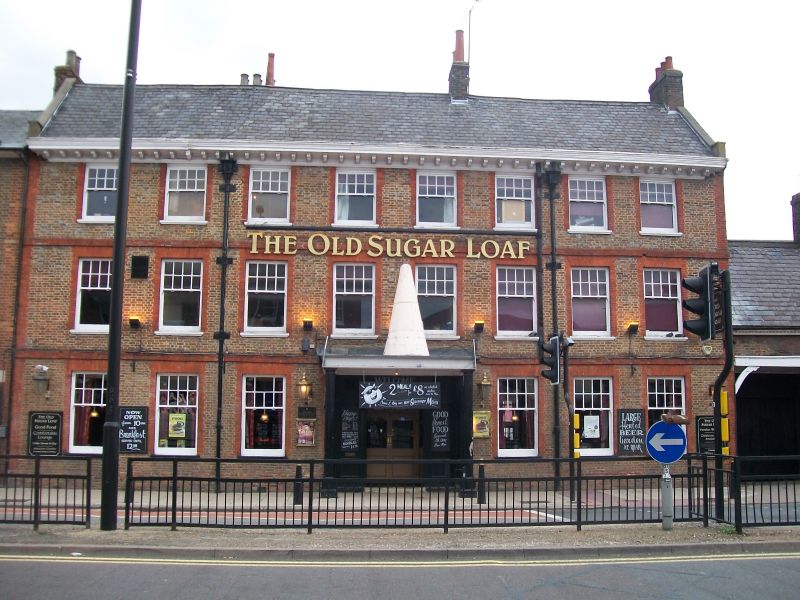
This pace in the end proved fatal to Old Lal, after having lived for many years on the alms of passengers by coaches between the Peacock at Islington and the Sugar Loaf at Dunstable. For one winter, when according to the ostler of the Sugar Loaf’s version, “the weather was terrible rough, there was snow and hice, and the storm blowed down a-many big trees, and them as stood used to ‘oller and grunt up in the Pine Bottom so that he’d heerd folks say that the fir-trees was a-rubbing themselves against one another—”one such winter as this Old Lal had not been seen for three weeks. This fact did not cause any anxiety to his friend the ostler. But one Sunday afternoon, when he had “four o’clocked his horses” and was putting a sack over his shoulders, preparatory to going down to his cottage, who should come up to him but one Trojan—a fox-hound and a respected member of Old Lal’s team. The fact that Trojan had part of his harness on, set the ostler thinking that he had cut and run, and that perhaps he had left Old Lal in trouble.

PEACOCK INN, ISLINGTON

PEACOCK INN, ISLINGTON

This supposition proved correct; but it was never believed that old Trojan was the cause of Old Lal being found dead on the side of the road some distance off his waggon which was found stuck fast between two fir-trees, with one of the hounds still in harness lying dead beside it. No! It was believed by the ostler that the guilt of Old Lal’s death lay at the door of another of the dogs—one Rocket, who turned up at the Sugar Loaf shortly after the arrival of Trojan. For this Rocket, according to the ostler, possessed many traits calculated to give rise to suspicion. In the first place, he was “a younger and more ramblier dog;” in the second place, “he never settled nowhere;” and in the third place, the last that the ostler heard of him was that, “being allers wondering fond of sport,” he had joined a pack of Harriers at Luton. …All three which considerations put together induced in the ostler the very probable belief that Rocket was the instigator of the poor old man’s death; that he (Rocket) must have caught a view of a fox, or at any rate have crossed a line of scent and bolted off the road and up through the wood, and “after he had throwed the old man out, continued the chase till the waggon got hung fast to a tree and tied them all up.” The jury, it may be remarked in conclusion, who sat on Old Lal’s remains, did not rise to this very lucid explanation of the cause of their session; for according to the ostler, they contented themselves with observing “That Old Lal was a pauper wagrant, that he had committed accidental death, and the coroner sentences him to be buried in the parish in which he was last seen alive.” He was buried in a square box accordingly, and the ostler and Trojan the fox-hound were the sole assistants at the rite.

Click here for a vintage advertisement for the Sugarloaf Inn

SUGARLOAF INN

SUGARLOAF INN

Another Version of the Tale

Tales From Tring Brewery

In this version, it was Thomas Pickford, Chairman of the Turnpike Trust who built the cart for Old Lal—who had been an ostler until losing his legs in an accident—so that he could earn money running errands and such. However, Pickford didn’t expect that the cart would be used to race coaches for the passengers’ entertainment, and in doing so, prove to be a danger to travelers. According to this source, Old Lal’s death was caused by a fox enticing the hounds to chase after him “over fields and ditches,” before getting the cart caught between the two trees and causing Old Lal’s death.


 Index to all the posts in this series

1: The Bath Road: The (True) Legend of the Berkshire Lady

2: The Bath Road: Littlecote and Wild William Darrell

3: The Bath Road: Lacock Abbey

4: The Bath Road: The Bear Inn at Devizes and the “Pictorial Chronicler of the Regency”

5: The Exeter Road: Flying Machines, Muddy Roads and Well-Mannered Highwaymen

6: The Exeter Road: A Foolish Coachman, a Dreadful Snowstorm and a Romance

7: The Exeter Road in 1823: A Myriad of Changes in Fifty Years

8: The Exeter Road: Basingstoke, Andover and Salisbury and the Events They Witnessed

9: The Exeter Road: The Weyhill Fair, Amesbury Abbey and the Extraordinary Duchess of Queensberry

10: The Exeter Road: Stonehenge, Dorchester and the Sad Story of the Monmouth Uprising

11: The Portsmouth Road: Royal Road or Road of Assassination?

12: The Brighton Road: “The Most Nearly Perfect, and Certainly the Most Fashionable of All”

13: The Dover Road: “Rich crowds of historical figures”

14: The Dover Road: Blackheath and Dartford

15: The Dover Road: Rochester and Charles Dickens

16: The Dover Road: William Clements, Gentleman Coachman

17: The York Road: Hadley Green, Barnet

18: The York Road: Enfield Chase and the Gunpowder Treason Plot

19: The York Road: The Stamford Regent Faces the Peril of a Flood

20: The York Road: The Inns at Stilton

21: The Holyhead Road: The Gunpowder Treason Plot

22: The Holyhead Road: Three Notable Coaching Accidents

23: The Holyhead Road: Old Lal the Legless Man and His Extraordinary Flying Machine

24: The Holyhead Road: The Coachmen “More Celebrated Even Than the Most Celebrated of Their Rivals” (Part I)

25: The Holyhead Road: The Coachmen “More Celebrated Even Than the Most Celebrated of Their Rivals” (Part II)

26: Flying Machines and Waggons and What It Was Like To Travel in Them

27: “A few words on Coaching Inns” and Conclusion

The Holyhead Road: Three Notable Coaching Accidents

dust jacket

The following post is the twenty-second of a series based on information obtained from a fascinating book Susana recently obtained for research purposes. Coaching Days & Coaching Ways by W. Outram Tristram, first published in 1888, is replete with commentary about travel and roads and social history told in an entertaining manner, along with a great many fabulous illustrations. A great find for anyone seriously interested in English history!

london-st albans

As soon as 1742, the North-western Roads were already famous for speed.

…it came to pass in 1754 that a company of Manchester merchants, having considered how Time flew, and to what a degree the success or non-success of commercial speculation coincided with the flight of Time, bethought them how most nearly in their passage to and from London they might fly themselves. To which end they started a new sensation called a “Flying Coach.” And they carefully put forward in a well-weighed prospectus the claims of their invention to the title, stating that there was non nonsensical pretence about the thing this time, but that in point of honest fact they seriously contemplated running their machine at the accelerated speed of five miles an hour; and that however incredible it might appear, the coach would actually, barring accidents, arrive in London four days and a half after leaving Manchester!

Before the days of MADD (Mothers Against Drunk Driving)

Bar-room_Scene,_William_Sidney_Mount,_1835

Bar-room Scene, William Sidney Mount, 1835

The first casualty to be noticed on the North-western Road occurred… so near to London indeed as Finchley Common (which is about a mile and a half beyond Highgate Archway), though the cause of the accident, the first cause, originated at a place called Redbourn, twenty-one miles down the road. And in this wise: Owing to an obstruction below Dunstable—in point of fact to heavy snow-drifts—four or five coaches started together thence. They all went at a fair pace, not racing, but passing each other at the different stages, till they reached the Green Man at Fincley, where according to immemorial prescription the four coachmen alighted for a drink, or rather for four. And now “a change came o’er the spirit of the scene.” In other words, one “Humpy,” so called either from his driving the Umpire (but I hope not) or from his having a hump on his back, which is more probably, was discovered to have taken too much spirits. For he was very noisy and shouted and hallooed at the top of his voice, though at what it is impossible to conjecture. However, the old coachman who tells the story… suspected that something would happen. So he kept behind, and waited to see what he would see. He first of all saw one of the three coaches by a fence opposite a public-house… he saw a coach lying on its side—the Manchester Umpire in fact—the coach of the too demonstrative Humpy… The forepart of the coach was broken, the luggage was scattered all over the road, also the passengers, who, thus agreeably circumstances, improved the shining hour by bewailing their bruises and cursing the conduct of Humpy. This was rather unchivalrous of them as it turned out, thus to rail against; for Humpy was also on his back perfectly helpless, “like a large black beetle,” moaning and groaning most hideously, and certainly more injured that anybody else… From Humpy himself therefore no explanation of how things had occurred was naturally forthcoming. But there were not wanting men unkind enough to allege that this complete turnover resultted from now more intricate a fact than that of the miserable Humpy having his leaders’ reins wrongly placed between his fingers, which was done when he took them from his box-passenger, after the last, the fatal, brandy and water. The natural but very embarrassing consequence was that when Humpy suddenly discovered that he was too near the fence, he pulled the wrong rein, and there they were—on their backs in the road.

No speed limits either?

'The Opposition Coaches', 1837 (1927).Artist: Charles Cooper Henderson

The Opposition Coaches, 1837, Charles Cooper Henderson (1927)

A more serious accident than this, inasmuch as one of the unfortunate passengers was killed, happened to the Holyhead Mail, a little further down the road, a mile indeed on the London side of St. Albans. This arose from the exciting but highly dangerous pastime of racing. The Holyhead Mail, via Shrewsbury, attempted to pass the Chester Mail by galloping furiously by on the wrong side of the road. The coachman of the Chester Mail resented the indignity, and pulled his leaders across his rival’s—a heap of stones conveniently placed by the road side did the rest of the business, and in a moment converted two spick and span turn-outs, full of passengers more or less alive and alarmed, into a mass of struggling horseflesh, splintered wood and groaning wounded. The inquest on the victim of this rivalry among coachmen was held at the Peahen inn in St. Albans, and a verdict of manslaughter was returned against both artists. Abundant subsequent opportunity was afforded them of meditating on their sins, for they were kept in irons in St. Albans for six months before they were tried at Hertford—in which town they enjoyed a further twelve months’ imprisonment in the county gaol.

Duty wins over heroism (unless the ladies are attractive)

The Louth Mail Accident

The Louth Mail Accident

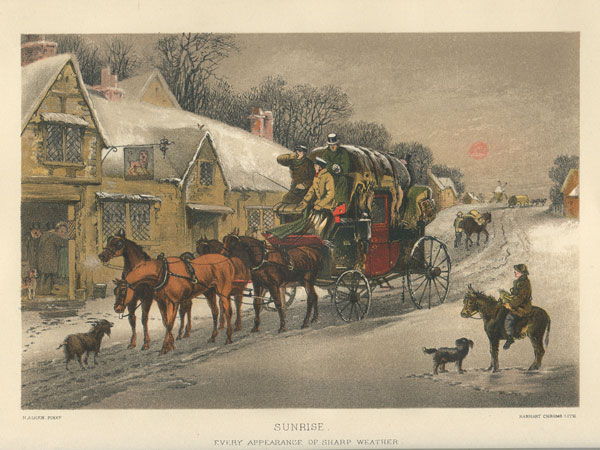
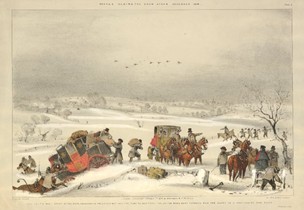
A snow effect is the next coaching incident to be chronicled in this neighbourhood of St. Albans, richer surely in its agreeably diversified crop of casualties than any other place in England. The North-western coaches… seem to have got the full benefit of the historic snow-storm of 1836. This visitation lasted the best part of a week and has never been equalled in England before or since. The drifts in some hollows were said to be twenty feet deep—which caused some passengers not unnaturally to report that they were “mountains high,” and some coachmen to state that the snow in some places was higher than their heads as they sat on the box. “Never before,” writes a correspondent of the Times of that day (quoted by Captain Malet in his Annals of the Road)—“never before within recollection was the London Mail stopped for a whole night at a few miles from London, and never before have we seen the intercourse between the southern shores of England and the metropolis interrupted for two whole days.”

White Hart Inn, St. Albans

White Hart Inn, St. Albans

…many mails and coaches remained hopelessly stuck, able neither to get up the road nor down it—a state of affairs which must have caused many passengers to use srange words, and the landlords of the Angel, White Hart, and Woolpack to make hay while the snow fell. And some people were not so fortunate as to be stuck fast in a picturesque place where there was something eat, as Burdett, the guard of the Liverpool Mail, was able to testify. For on Tuesday, December 27, of this memorable year, this guard from his vnatage point, beheld a chariot buried in the snow and without horses, safely at anchor at about a mile on the London side of St. Albans. And he had no sooner seen it—and two elderly ladies inside it, who rent the welkin with clamorous cries for help—than he found, by being suddenly precipitated head firstinto twelve feet of snow, that his coach had got into a drift too. Having recovered his perpendicular, and emptied his mouth, a natural curiosity prompted Burdett to cross-examine the ladies on their somewhat forlorn position. They told him that their post-boy and left them for St. Albans to get fresh cattle, and had been gone two hours—no doubt having elected to get brandy for himself instead. Meanwhile, there they were—and in a very deplorable plight surely. But will it be believed that this heart-moving vision of beauty in distress did not move the guard of the Liverpool Mail in the least! No! He proceeded stolidly in the plain path which is duty’s—a fact whih tends to the suspicion that the ladies cannot have been beauties. But whether they were or no, Burdett, after having heard their story, turned a deaf ear to their appeals for help. He just helped his coachman, his passengers, and his four horses on to their feet—(for the horses too had assumed a recumbent position)—and having extricated his mail, by the help of his tools, curses, and other expedients not mentioned in the text, pursued his journey to London, leaving the chariot and the ladies to their fate.

Mail Coach in a Snowstorm c.1835-40 by Charles Cooper Henderson 1803-1877

Mail Coach in a Snowstorm c. 1835-40, Charles Cooper Henderson


 Index to all the posts in this series

1: The Bath Road: The (True) Legend of the Berkshire Lady

2: The Bath Road: Littlecote and Wild William Darrell

3: The Bath Road: Lacock Abbey

4: The Bath Road: The Bear Inn at Devizes and the “Pictorial Chronicler of the Regency”

5: The Exeter Road: Flying Machines, Muddy Roads and Well-Mannered Highwaymen

6: The Exeter Road: A Foolish Coachman, a Dreadful Snowstorm and a Romance

7: The Exeter Road in 1823: A Myriad of Changes in Fifty Years

8: The Exeter Road: Basingstoke, Andover and Salisbury and the Events They Witnessed

9: The Exeter Road: The Weyhill Fair, Amesbury Abbey and the Extraordinary Duchess of Queensberry

10: The Exeter Road: Stonehenge, Dorchester and the Sad Story of the Monmouth Uprising

11: The Portsmouth Road: Royal Road or Road of Assassination?

12: The Brighton Road: “The Most Nearly Perfect, and Certainly the Most Fashionable of All”

13: The Dover Road: “Rich crowds of historical figures”

14: The Dover Road: Blackheath and Dartford

15: The Dover Road: Rochester and Charles Dickens

16: The Dover Road: William Clements, Gentleman Coachman

17: The York Road: Hadley Green, Barnet

18: The York Road: Enfield Chase and the Gunpowder Treason Plot

19: The York Road: The Stamford Regent Faces the Peril of a Flood

20: The York Road: The Inns at Stilton

21: The Holyhead Road: The Gunpowder Treason Plot

22: The Holyhead Road: Three Notable Coaching Accidents

23: The Holyhead Road: Old Lal the Legless Man and His Extraordinary Flying Machine

24: The Holyhead Road: The Coachmen “More Celebrated Even Than the Most Celebrated of Their Rivals” (Part I)

25: The Holyhead Road: The Coachmen “More Celebrated Even Than the Most Celebrated of Their Rivals” (Part II)

26: Flying Machines and Waggons and What It Was Like To Travel in Them

27: “A few words on Coaching Inns” and Conclusion