Archives

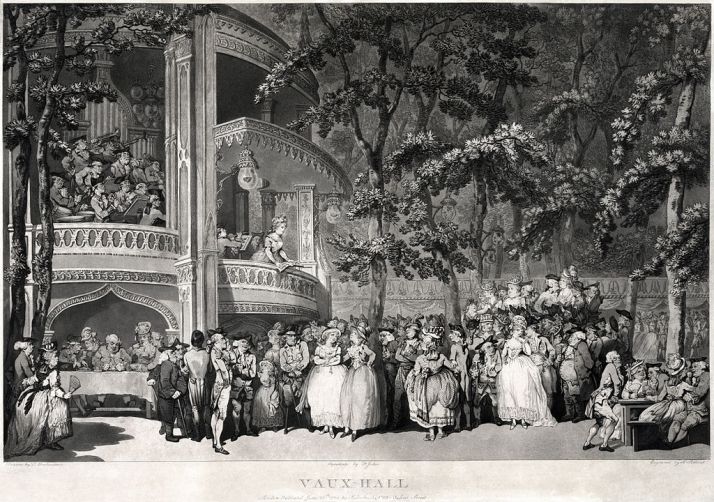
Vauxhall Gardens: Thomas Rowlandson’s Painting (1785)

vauxhallbook

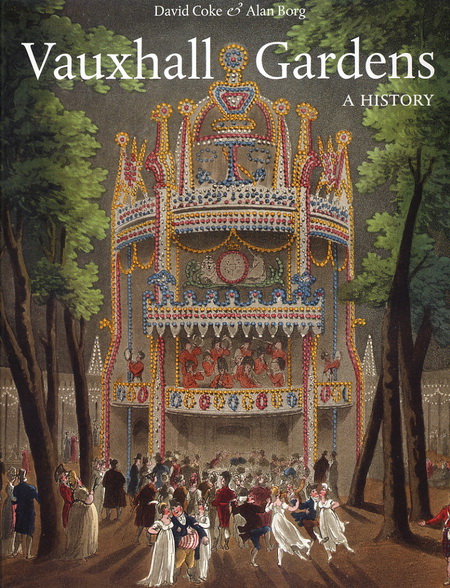
Vauxhall Gardens: A History

David Coke & Alan Borg

The Vauxhall Pleasure Gardens is one of the places I’d love to slip back in time to visit, just to catch a glimpse of what it was like. After recently splurging to buy this lovely coffee-table book, I thought it might make a wonderful subject for a new blog series. But do buy the book too, if you can! The photos are fabulous!

I’m so excited! I just bought a mounted poster of this painting in color from art.com to hang in my bedroom/office here in Florida.

By the time this painting appeared, Jonathan Tyers had died and Vauxhall Gardens passed on to his wife and children, but it was his son Jonathan Tyers Jr.—that n’er-do-well younger son who wed a widowed lady much older than he and caused a giant rift among his parents—who assumed his father’s role in managing the park.

Thomas_Rowlandson_-_Vaux-Hall_-_Dr._Johnson,_Oliver_Goldsmith,_Mary_Robinson,_et_al


In the supper-box on the left we see, reading left to right, James BoswellMrs Thrale (who appears twice), Dr. Johnson, and Oliver Goldsmith.

The ‘macaroni’ Captain Edward Topham (scandalmonger to The World) is quizzing Georgiana, Duchess of Devonshire and her sister Lady Duncannon (Sheridan’s Lady Bessborough), watched by a naval figure with an eye patch and a wooden leg (not included in the Mellon version), always called Admiral Paisley, but Paisley did not lose his leg and eye until 1st June 1794, so it cannot be him. To the left of him, a young girl (a young boy in the Mellon version) holding the hand of a man who could be the comic actor, William Parsons, or Rowlandson’s friend Jack Bannister.

Peering at the two ladies from behind a tree is a figure traditionally, though improbably, identified as Sir Henry Bate-Dudley, the ‘Fighting Parson’, editor of the Morning Herald; he is more likely to be Thomas Tyers (son of Jonathan Tyers the great entrepreneur and proprietor of Vauxhall Gardens from 1729 until 1767) who stands next to the Scotsman James Perry, editor of the London Gazette. The couple on their right could well be the artist himself and his current girlfriend. and to the right of them stands the actress Mary ‘Perdita’ Robinson, with her husband on her right and the Prince of Wales (later George IV) on her left.

Looking up at the singer, the couple on the extreme left, have been identified as the actress Miss Hartley, in company with one of her many admirers, possibly Mr. Colman, but, suggested by their position apart from the crowd, they could also be members of the Tyers family (most likely Jonathan jr. and his wife Margaret, or their son-in-law Bryant Barrett and his wife Elizabeth. The large lady seated at the table on the right is Mrs Barry, the old Madam of Sutton Street, Soho, with two of her customers and one of her girls.

In the orchestra, we can see Jacob Nelson, the tympanist, who had played at Vauxhall since 1735, and died there after fifty years’ performing, Mr Fisher on oboe, probably Hezekiah Cantelo and Mr. Sargent on trumpet, and Barthélemon, the leader, who retired in 1783. James Hook, the composer, organist, musical director and prolific song-writer, may be seen between Barthelemon and the singer, the 38-year-old Frederika Weichsell, who was Rowlandson’s next-door neighbour in Church Street, and the mother of Mrs. Elizabeth Billington. Elizabeth had just (aged 18) married James Billington, a double-bass player, in 1783, much against her parents’ wishes.

A number of those present in this scene had already died by the time Rowlandson produced the painting, and the affair between the Prince and Perdita Robinson was already over.

Although there is no direct evidence for this, it seems likely, because of the dating, and because of the central position of the singer, that the painting was created by Rowlandson as a retirement gift for Frederika Weichsel, whether from him personally, or specially commissioned by the proprietors of the gardens.


Susana’s Vauxhall Blog Post Series

  1. Vauxhall Gardens: A History
  2. Vauxhall Gardens: Jonathan Tyers—“The Master Builder of Delight” 
  3. Vauxhall Gardens: A New Direction
  4. Vauxhall Gardens: The Orchestra and the Supper-Boxes 
  5. Vauxhall Gardens: The Organ, the Turkish Tent, and the Rotunda
  6. Vauxhall Gardens: Three Piazzas of Supper-Boxes
  7. Vauxhall Gardens: “whither every body must go or appear a sort of Monster in polite Company”
  8. Vauxhall Gardens: The Competition
  9. Vauxhall Gardens: The Artwork, Part I
  10. Vauxhall Gardens: The Artwork, Part II
  11. Vauxhall Gardens: The Music, 1732-1859
  12. Vauxhall Gardens: The Business Side
  13. Vauxhall Gardens: Developments from 1751-1786
  14. Vauxhall Gardens: Thomas Rowlandson’s Painting (1785)
  15. ‎Vauxhall Gardens: The Third Generation of the Tyers Family and the Jubilee of 1786
  16. Vauxhall Gardens: An Era of Change (1786-1822), Part I
  17. Vauxhall Gardens: An Era of Change (1786-1822), Part II
  18. Vauxhall Gardens: An Era of Change (1786-1822), Part III
  19. Vauxhall Gardens: The Final Years, Part I
  20. Vauxhall Gardens: The Final Years, Part II
  21. Vauxhall Gardens: The Final Years, Part III
  22. Vauxhall Gardens: The Final Years, Part IV
  23. Vauxhall Gardens: Farewell, for ever

Vauxhall Gardens: Developments from 1751-1786

vauxhallbook

Vauxhall Gardens: A History

David Coke & Alan Borg

The Vauxhall Pleasure Gardens is one of the places I’d love to slip back in time to visit, just to catch a glimpse of what it was like. After recently splurging to buy this lovely coffee-table book, I thought it might make a wonderful subject for a new blog series. But do buy the book too, if you can! The photos are fabulous!

The year 1751 marked the pinnacle of Jonathan Tyers’s success. After twenty years his vision was at last complete, and the basic ensemble of landscape and buildings was in place. The following year the act to license places of public entertainment was passed, leaving just the three major gardens, Marylebone, Ranelagh and Vauxhall, with a virtual monopoly for the time being. Vauxhall’s prestige would never be higher, and the artworks, design and refreshments would never be surpassed. The opening night of the season, Monday 20 May, was attended by about seven thousand visitors, all eager to see the most recent changes, and to enjoy the new musical performances.

A contemporary publication that effectively and entirely objectively sums up Tyers’s achievements is Stephen Whatley’s guide to the main towns and villages of interest in the country, England’s Gazetteer. Apart from a short description of classical statuary at Cuper’s Gardens, the only entry for a pleasure garden is under “Foxhall (Surry)’ (neither Ranelagh nor Marylebone merited a mention):

This is the place, where are those called Spring Gardens, laid out in so grand a taste, that they are frequented, in the 3 summer months, by most of the nobility and gentry, then in and near London; and are often honoured with some of the royal family, who are here entertained with the sweet song of numbers of nightingales, in concert with the best band of musick in England. Here are fine pavilions, shady groves, and most delightful walks, illuminated by above 1000 lamps, so disposed, that they all take fire together, almost as quick as lightning, and dart such a sudden blaze, as is perfectly surprizing. Here are, among others, 2 curious statues of Apollo the god, and Mr. Handel the master of musick; and in the centre of the area, where the walks terminate, is erected the temple for the musicians, which is encompassed all round with handsome seats, decorated with pleasant paintings, on subjects most happily adapted to the season, place, and company.

The growing success of Vauxhall can be attributed directly to Jonathan Tyers’s continual upgrades in music, lights, and fine costumes. Profits from major events were plowed right back into the gardens, which is what drew an increasing number of visitors.

The Pillared Saloon

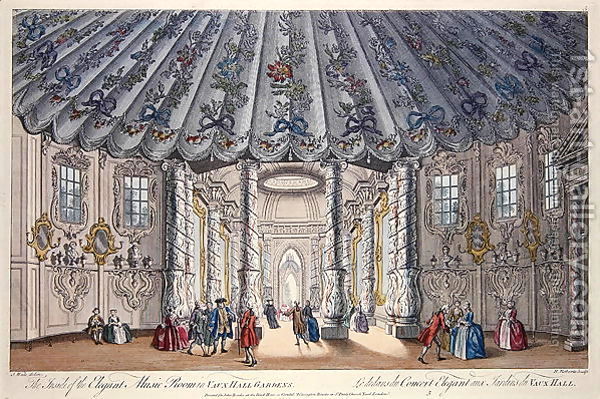
Prior to the 1751 season, the Pillared Saloon was opened up and an extension created that provided for space for artwork and made space for half again as many visitors. Unfortunately, the design was awkward and unsophisticated and was probably created by inexperienced students at the St. Martin’s Lane Academy.

PILLARED SALLON REMODEL

H. Roberts after S. Wale, The Inside of the Elegant Music Room in Vaux Hall Gardens, engraving, 1752 (British Library, London)

The new indoor orchestra stand opposite the Pillared Saloon, behind a balustrade that separated it from the audience, shared its awkward style; the same foliate columns framed it, and similar paintings decorated its ceiling. It must have been a substantial space, as an Irish visitor in 1752 claimed that he saw fifty-four musicians performing there, accompanying the singers Thomas Lowe and Isabella Burchell.

The Triumphal Arches and Decorative Paintings

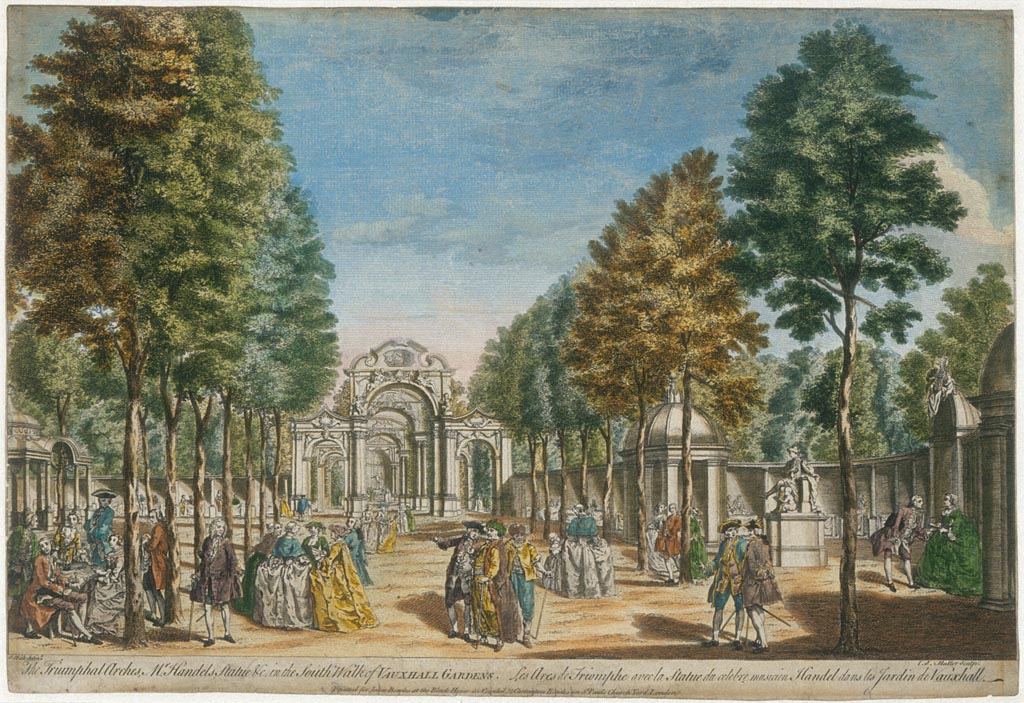
In contrast to the gaucherie of the Pillared Saloon, the three triumphal arches built over the South Walk at about the same time presented a more elegant, though more predictable, classical appearance… [T]hey were designed by ‘an ingenious Italian’ and made of timber and painted canvas.

ARCHES

J.S. Muller after S. Wale, The Walk of Triumphal Arches and the Statue of Mr. Handle in Vauxhall Garden, engraving, 1751 (British Library, London).

…the undeniably theatrical view through the three Vauxhall arches to the piece of scenery at the end of the walk must have been impressive; the vista was focused and enclosed by the surrounding trees, and the trompe-l’oeil effect of the scenery seen at the proper distance was intended to draw visitors to that end of the walk, where, on arrival, they could marvel at the skill of the artist, who had fooled them into thinking it was a three-dimensional object.

PALMYRA

E. Rooker after Canaletto, A Vew of the Center Cross Walk &c. in Vauxhall Gardens, engraving, 1751 (British Library, London).

In addition to these theatrical-esque arches, four large scenes were painted and installed at the end of the walks, to camouflage the surrounding landscape and introduce a bit of fantasy. The Temple of Neptune, at the end of the South Walk, was soon replaced by the ruins of Palmyra, after the publication of Robert Wood’s journey there. A painting of an alcove of three niches with figures of Flora and the Genii, at the end of the Dark Walk, was replaced with a scene of a Chinese Garden in 1762. “At the opposite end was an altogether more eccentric scene of another alcove, but this one bore a representation of a scaffolding and ladder ready for artists to work on the canvas.” The explanation for this:

An eminent artist, but of dissipated character, was employed by the first proprietors of the gardens to paint some classical designs at the end of one of the walks; but the delay in their completion so irritated the proprietor, that, having to leave London for a fortnight, he declared to the artist that he would listen to no further excuses, and that if he found his scaffold, paint-pots, &c. on his return, they should be thrown over the garden wall. On his return, perceiving, as he thought, in the same position, the scaffold, paint-pots, &c., he hastened to the spot to put his threat into execution, when, to his great amazement, he found them to be so accurately pictured on the canvas, that he ever after lavished the most extravagant praises upon the delinquent artist.

The Cascade

The most popular of Tyers’s additions in the 1750’s was the artificial Cascade, which was likely conceived by Frances Hayman, from his work with scenery and special effects in the theater.

The Cascade was concealed behind a curtain which was drawn back at a particular time in the evening, as night fell, to reveal a three-dimensional illuminated scene of a landscape with a precipitous waterfall: the illusion was created with sheets of tin fixed to moving belts, turned by a team of Tyers’s lamplighters; when it was running, the noise and spectacle must have been terrific.

Throughout its existence the Cascade underwent various improvements, enlargements, alterations, replacements, demolitions, and moves, which continued into the 1840’s. No visual representation of it survives, but at the height of its popularity in 1762 an anonymous author described it as:

a most beautiful landscape in perspective of a fine open hilly country with a miller’s house and a water mill, all illuminated by concealed lights; but the principal object that strikes the eye is a cascade or water fall. The exact appearance of water is seen flowing down a declivity; and the turning the wheel of the mill, it rises up in a foam at the bottom, and then glides away. This moving picture attended with the noise of the cascade has a very pleasing and surprising effect on both the eye and ear.

Until well into the 1820’s, when it was demolished to make way for the new Ballet Theatre, the Cascade continued to delight and surprise Vauxhall audiences, with depictions of the tidal race and watermill at London Bridge, of distance military encampments, and other scenes.

CASCADE

Well, I did find this image of the Cascade! Or at least it purports to be such.

The Gothic Orchestra

The original Orchestra building had outlived its usefulness, and was replaced in 1757-8 with a sort of Gothic-style building, made of wood and plaster and painted white and ‘bloom’, whatever that is. This building remained through the end of the gardens, having a domed roof with a “finial of Prince of Wales feathers”. The organ and musicians occupied the top floor, with supper-boxes on the bottom. The upper floor had graduated seating that made the musicians visible to the audience.

vauxhall_Muller_1751

Anon., A Perspective View of the Grand Walk in Vauxhall Gardens, and the Orchestra, engraving (David Coke’s collection), from the Gentleman’s Magazine (August 1765). The earliest view of the new Gothic Orchestra, built in 1757.

The Company

As we have mentioned previously, Vauxhall attracted a diverse group of visitors, more than any other entertainment of the period. The bulk of its income, however, came from the “Smarts,” which were middle-class young men, known for their licentiousness and self-indulgence, who came to show off to their female companions. A press reporter put it this way in July 1738:

The Smarts are, as it were, the sole Authors of our publick diversions at the Theatre they have a majority of the pit and the boxes: to them the Opera owes its subsistence, and Vaux Hall, the agreeable Vauxhall! would be a wilderness without them.

A big draw for the lower classes was the opportunity to encounter the upper classes, royalty, or other celebrities, that they would not normally be allowed anywhere near.

An account of a visit by an upper-class party is given by Horace Walpole:

I had a card from Lady Caroline Petersham to go with her to Vauxhall. I went accordingly to her house at half an hour after seven, and found her and little Ashe, or the pollard Ashe, as they call her; they had just finished their last layer of red, and looked as handsome as crimson could make them. […] We got into the best order we could and marched to our barge, with a boat of French horns attending and little Ashe singing. We paraded some time up the river and at last debarked at Vauxhall […]. At last we assembled in our booth, Lady Caroline in the front, with the vizor of her hat erect, and looking gloriously jolly and handsome. She had fetched my brother Orford from the next box, where he was enjoying himself with his Norsa and his petite partie, to help us to mince chickens. We minced seven chickens into a china dish, which Lady C. stewed over a lamp with three pats of butter and a flagon of water, stirring and rattling and laughing, and we every minute expecting to have the dish fly about our ears. She had brought Betty [Neale] the fruit girl, with hampers of strawberries and cherries from Rogers’s, and made her wait upon us, and then made her sup by us at a little table […]. In short, the whole air of our party was sufficient as you will easily imagine to take up the whole attention of the garden, so much so, that from eleven o’clock till half an hour after one, we had the whole concourse round our booth, at last they came into the little gardens of each booth on the sides of ours, till Harry Vane took up a bumper and drank their healths, and was proceeding to treat them with still greater freedom. It was three o’clock before we got home.

Then there was Henry Timberlake, who brought a group of Cherokee Indians to the gardens on two occasions, the second advertised ahead of time drawing ten thousand curious onlookers. (Note: those Cherokees had a very busy schedule. Take a peek here.)

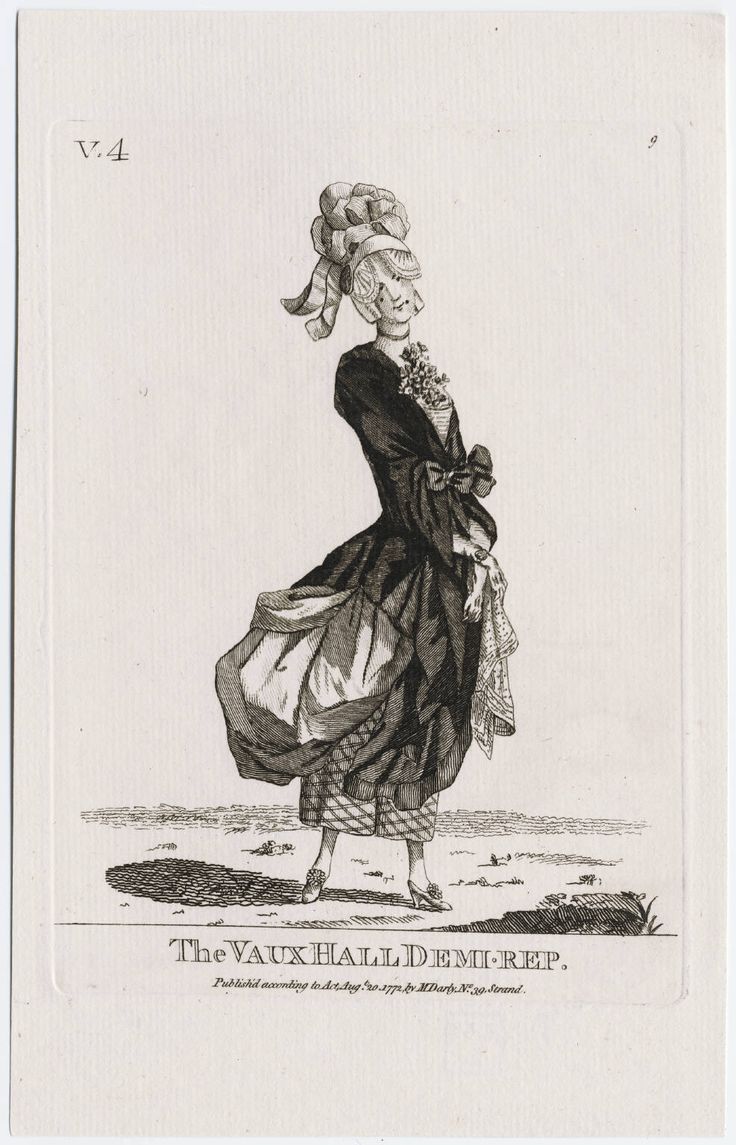
A ‘silent majority’ of visitors came from the professional classes, lawyers, doctors, parsons, and increasingly in the 1780’s, after Tyers’s death, prostitutes and the demi-monde.

demi-rep

Anon., The Vauxhall Demi-Rep, engraving, 1772 (Senate House Library, London). One of the working girls who frequented the gardens. Less a prostitute than an escort, the demo-rep would join an all-male party to titillate and amuse the men.


Susana’s Vauxhall Blog Post Series

  1. Vauxhall Gardens: A History
  2. Vauxhall Gardens: Jonathan Tyers—“The Master Builder of Delight” 
  3. Vauxhall Gardens: A New Direction
  4. Vauxhall Gardens: The Orchestra and the Supper-Boxes 
  5. Vauxhall Gardens: The Organ, the Turkish Tent, and the Rotunda
  6. Vauxhall Gardens: Three Piazzas of Supper-Boxes
  7. Vauxhall Gardens: “whither every body must go or appear a sort of Monster in polite Company”
  8. Vauxhall Gardens: The Competition
  9. Vauxhall Gardens: The Artwork, Part I
  10. Vauxhall Gardens: The Artwork, Part II
  11. Vauxhall Gardens: The Music, 1732-1859
  12. Vauxhall Gardens: The Business Side
  13. Vauxhall Gardens: Developments from 1751-1786
  14. Vauxhall Gardens: Thomas Rowlandson’s Painting (1785)
  15. ‎Vauxhall Gardens: The Third Generation of the Tyers Family and the Jubilee of 1786
  16. Vauxhall Gardens: An Era of Change (1786-1822), Part I
  17. Vauxhall Gardens: An Era of Change (1786-1822), Part II
  18. Vauxhall Gardens: An Era of Change (1786-1822), Part III
  19. Vauxhall Gardens: The Final Years, Part I
  20. Vauxhall Gardens: The Final Years, Part II
  21. Vauxhall Gardens: The Final Years, Part III
  22. Vauxhall Gardens: The Final Years, Part IV
  23. Vauxhall Gardens: Farewell, for ever

Vauxhall Gardens: The Business Side

vauxhallbook

Vauxhall Gardens: A History

David Coke & Alan Borg

The Vauxhall Pleasure Gardens is one of the places I’d love to slip back in time to visit, just to catch a glimpse of what it was like. After recently splurging to buy this lovely coffee-table book, I thought it might make a wonderful subject for a new blog series. But do buy the book too, if you can! The photos are fabulous!

Vauxhall’s huge success after Jonathan Tyers’s acquisition of the property, which had been in existence for seventy years as the “New Spring Gardens”, can be attributed to the man’s perception that his idealistic dream must be counter-balanced by sound financial practices. An essential element of this was publicity, and of this, Tyers proved to be a master. How did he do this?

Promoting Vauxhall

He promoted the gardens as a sort of “heaven on earth,” a magical sort of place to lift one’s spirits after a hard day in the real world.

[T]his was achieved through stories in literature and the printed media, through popular songs and through the artworks and music he commissioned. The second was the flattery of his audience; he consistently treated his visitors as special people, always referring to them as persons of quality, ladies and gentlemen, patriots, libertarians, educated people who appreciated fine things and good music. And the last was the simple dissemination of factual information about Vauxhall, its history, its current attractions, and how this pleasure garden should be enjoyed, by means of articles in newspapers and periodicals, of histories and guidebooks and of topographical and satirical engravings.

John Lockman, Publicist

John Lockman, Publicist

In truth, of course, Vauxhall fell short of perfection, and that’s where John Lockman came in. He was a sort of early publicist, who wrote poems and songs designed to “underscore Tyers’s transformation of a notorious gathering place for drunks, gamblers and prostitutes into a civilised pleasure garden where anyone could enjoy a decorous evening’s entertainment without risk to their reputation.”
Lockman’s assistance was necessary because it was impossible to exclude troublemakers, particularly if they were respectably dressed. “[I]t was easier to sell an enhanced image of the place to a persuadable public.

Tyers was always careful to make everybody in his clientele feel good about themselves, and in particular about their patronage of Vauxhall. In his press announcements, for instance, he would often start by thanking his visitors for their support, especially if the weather had been bad, and would repeatedly finish by pledging to keep out of his gardens anyone not worthy of their company.

Another tactic was to use magazines and newspapers. Newspapers, of course, were a no-brainer. Letters such as the “S. Toupee” articles published in Scots Magazine may or may not have been instigated by Tyers, but they certainly proved valuable in driving up excitement for Vauxhall. “Of the Luxury of the English; and a Description of Ranelagh Gardens and Vaux-hall, in a Letter from a Foreigner to his Friend at Paris,” supposedly written by Henry Fielding (a friend of Tyers) and commissioned by Tyers, piled on the praise for Vauxhall in comparison to Ranelagh Gardens.

A female audience was enticed to Vauxhall by published songs and by scenes in novels set in Vauxhall Gardens. And then there were the Love at First Sight articles, or “Lonely Hearts” columns, which may or may not have been genuine. Here’s one from the London Chronicle in August 1758:

A young Lady who was at Vauxhall on Thursday night last, in company with two gentlemen, could not but observe a young gentleman in blue and a gold-laced hat, who, being near her by the orchestra during the performance, especially the last song, gazed upon her with the utmost attention. He earnestly hopes (if unmarried) she will favour him with a line directed to A.D. at the bar of the Temple Exchange Coffee-house, Temple-bar, to inform him whether fortune, family, and character, may not entitle him upon a further knowledge, to hope an interest in her heart.

Another marketing tactic was to engage actors dressed as gentlemen to patronize coffee-houses to express their intention to go to Vauxhall and entreat others to meet them there.

Tyers’s Management Style

It goes without saying that if one wishes to have customers return, one has to ensure that their first time is as pleasant and enjoyable as possible. If you knew Jonathan Tyers—and you probably wouldn’t because it was never himself he wanted to promote and therefore took pains to remain in the background—you could see him in the kitchens working as hard as his employees to get the food out to the customers.

Waiters, or “drawers” were freelance employees, who were constrained to work hard in order to earn tips and keep their posts. Since in other venues, “drawers” were known to steal from their employers, “Vauxhall waiters were required to pay for the food on collection from the kitchens, and themselves ran the risk of defaulting customers, especially if they had not been sufficiently polite or efficient in their service.”

Although he had to maintain a strict discipline among his employees, he was a thoughtful employer. When two of his waiters married two of his barmaids, he provided wedding rings and an elaborate dinner at his home in Denbies, with fifty of his staff as guests.

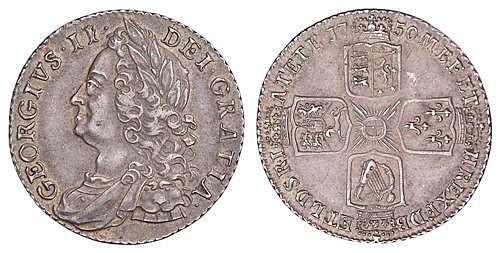
one shilling coin

Vauxhall Tickets

Up until 1736, the admission cost was sixpence, but afterward, the price was doubled to one shilling. Considering the expense of maintaining and improving the gardens and contriving new entertainments, this seems modest indeed; however, there was more to be made from the food and drink once the visitors were admitted. For the visitors, there was also the cost of dressing respectably and the cost of transportation. The one shilling price was fixed until 1792, when it was doubled to two shillings.

Season Ticket greySeason Ticket grey reverse

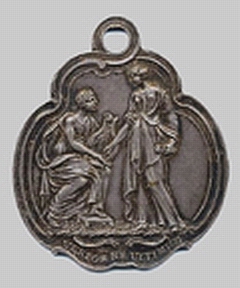
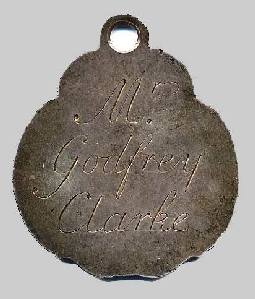
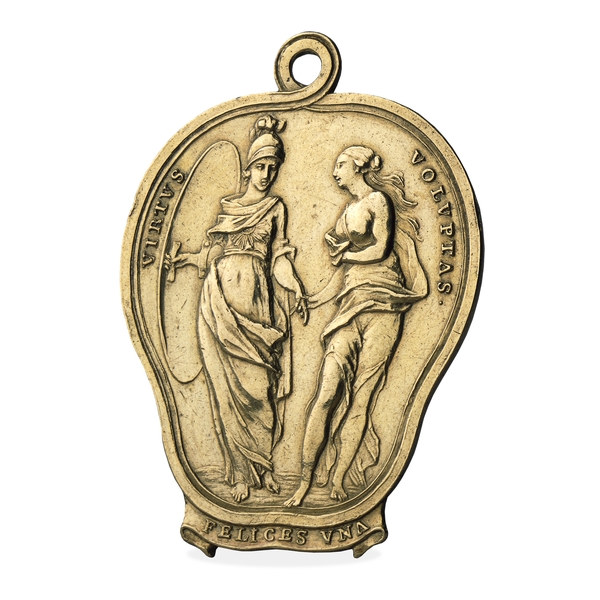
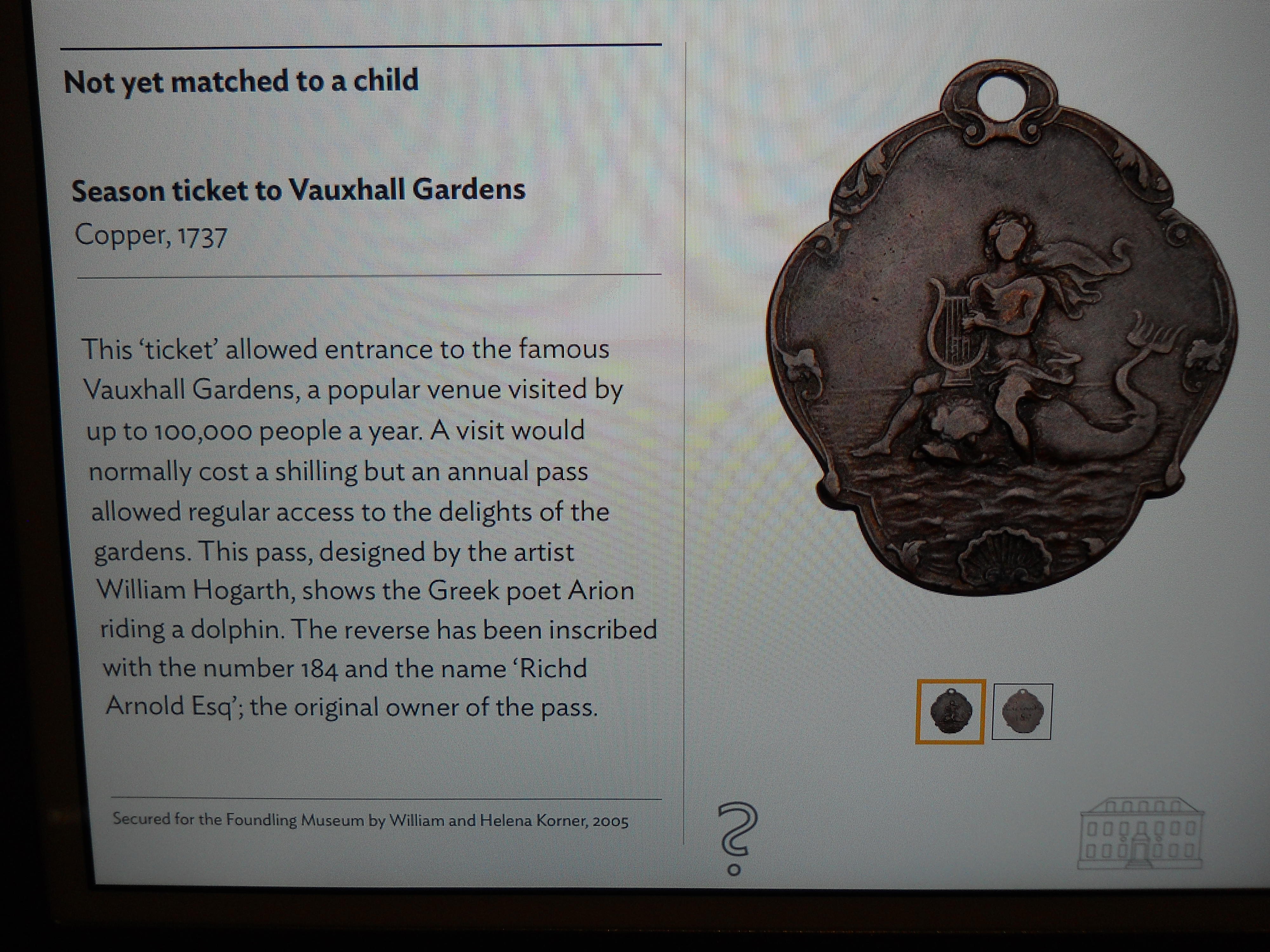
In 1737 Tyers initiated a subscription price, or season ticket. The metal tickets were issued to a thousand people at a guinea each, and would admit two people to the gardens for the entire season. Not only did this ensure repeat visits by two thousand people, it provided him with funds upfront to use for maintenance and improvement.

The relief on the obverse usually represented, through classical imagery, a particular aspect of Vauxhall Gardens, often associated with the music. On the reverse was engraved the subscriber’s name, accompanied… by the ticket’s number.

silver ticket

silver ticket

In 1738, the tickets were made of silver and the price rose by three shillings. In 1741, the price was raised to two guineas.

As a comparison, a season ticket for two to the Great Room in Soho was five guineas, while individual concerts were ten and a half shillings, the same price as Handel’s fundraising concert at the Foundling Hospital in 1749. Almack’s (founded in 1765) charged ten guineas for a once-weekly ball over twelve weeks, so Vauxhall tickets were considered quite a bargain.

Hogarth's gold "perpetual" ticket

Hogarth’s gold “perpetual” ticket

Attendance

“S. Toupee” in his letters in Scots Magazine estimated that “not less than one thousand shillings are received each evening of performance during the season,” not including season ticket holders. Special events, such as the rehearsal of Handel’s Music for the Royal Fireworks, drew several thousand spectators. Opening and closing nights and royal birthdays also drew large crowds.

The opening night of the 1769 season, for instance, was a remarkably fine evening for the time of year, and it was estimated that ‘there were upwards of twenty thousand of the first nobility present.’

Crime and Disorder

Even though it suffered occasional lean times, there can be little doubt that eighteenth-century Vauxhall Gardens became the most popular single visitor attraction for London… With these numbers of people coming together, especially to a place where alcohol was available, crime, vandalism and disorder were inevitable.

Nor was it just pickpockets and prostitutes his police force (initiated in 1732) had to deal with. While Tyers encouraged his waiters to restrict alcohol consumption, it was difficult for them or even him to police the mischievous London Bucks, who were of a class higher than his. Tyers and his staff managed these problems themselves, even if it meant “eating” the cost of vandalism, not wanting to involve courts, which would draw bad publicity. “S. Toupee,” in one of his letters in 1739, “pointed out that there was ‘a man in the posture of a Constable, to protect the Ladies from any insult, &c.’ at the end of each walk.

Besides the half-dozen or so constables, he employed up to eight men to guard the route from the river and led a (possibly regular) blitz against the pickpockets.

Refreshments

Anyone who has worked in the restaurant industry can tell you how difficult a task it is to prepare food for crowds of people, but how many restaurants have to cater for 500-1000 or more hungry people? This is a logistical nightmare that Tyers managed with aplomb.

Consistent with his insistence on featuring English art and music, the food at Vauxhall was simple and English. There were complaints about the prices, of course. Here are some prices from one of the “S. Toupee” letters in 1739:

  • one bottle of French claret: 5 shillings
  • one cold chicken: 2-1/2 shillings
  • one quarter of cyder: 1 shilling
  • one quart of small-beer: 4 pence
  • one slice of bread: 2 pence
  • one slice of cheese: 4 pence
  • dish of ham or beef: 1 shilling, salad, an extra pence
  • sweet pastries: 1 shilling
  • custards and cheesecakes: 4 pence
  • heart cakes and Shrewsbury cakes: 2 pence
  • one bottle of champagne and arrack: 8 shillings
  • two pounds of ice: sixpence
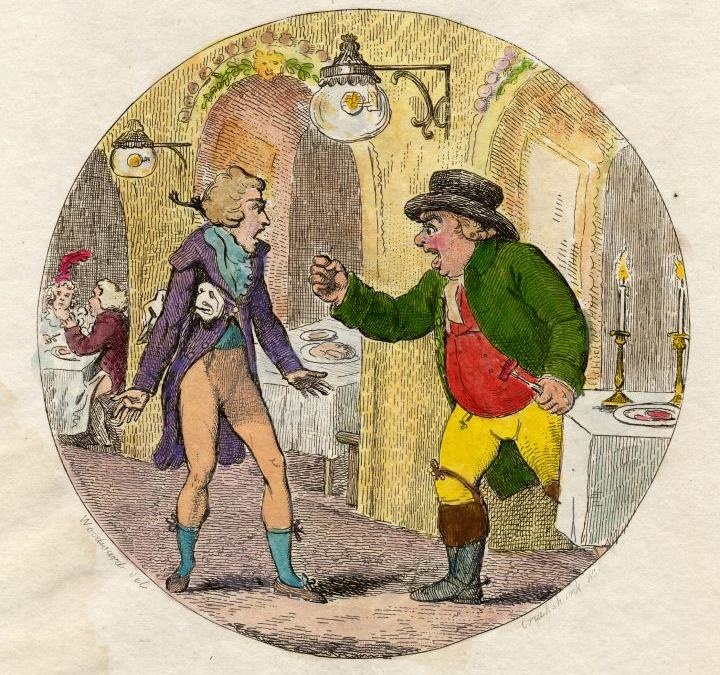
Isaac Cruikshank, A Country Farmer & Waiter at Vauxhall. A farmer in country dress, on his first visit to Vauxhall, has ordered ham in expectation of a plateful of English gammon. When the waiter brings him the notoriously thin slices that were Vauxhall ham, the farmer is furious.

Isaac Cruikshank, A Country Farmer & Waiter at Vauxhall. A farmer in country dress, on his first visit to Vauxhall, has ordered ham in expectation of a plateful of English gammon. When the waiter brings him the notoriously thin slices that were Vauxhall ham, the farmer is furious.

Even a devoted fan such as “S. Toupee” confessed that the food was expensive. The sliced meats were thin, especially the ham. “This was all part of the fun of the evening—a great joke on fashionable society who were happy to play along.” A well-known verse alluding to this:

Never trouble Ham House, or its inmates at all,

For a ghost, that may be but a sham,

But seek in a sandwich that’s cut at Vauxhall,

For the true apparition of Ham.’

Note:

The cost of the food did not alter significantly over the whole period from Tyers’s re-launch until the gardens’ final closure; the prices of wines and spirits, however, were a different matter, rising sharply in the nineteenth century.

Susana’s Vauxhall Blog Post Series

  1. Vauxhall Gardens: A History
  2. Vauxhall Gardens: Jonathan Tyers—“The Master Builder of Delight” 
  3. Vauxhall Gardens: A New Direction
  4. Vauxhall Gardens: The Orchestra and the Supper-Boxes 
  5. Vauxhall Gardens: The Organ, the Turkish Tent, and the Rotunda
  6. Vauxhall Gardens: Three Piazzas of Supper-Boxes
  7. Vauxhall Gardens: “whither every body must go or appear a sort of Monster in polite Company”
  8. Vauxhall Gardens: The Competition
  9. Vauxhall Gardens: The Artwork, Part I
  10. Vauxhall Gardens: The Artwork, Part II
  11. Vauxhall Gardens: The Music, 1732-1859
  12. Vauxhall Gardens: The Business Side
  13. Vauxhall Gardens: Developments from 1751-1786
  14. Vauxhall Gardens: Thomas Rowlandson’s Painting (1785)
  15. ‎Vauxhall Gardens: The Third Generation of the Tyers Family and the Jubilee of 1786
  16. Vauxhall Gardens: An Era of Change (1786-1822), Part I
  17. Vauxhall Gardens: An Era of Change (1786-1822), Part II
  18. Vauxhall Gardens: An Era of Change (1786-1822), Part III
  19. Vauxhall Gardens: The Final Years, Part I
  20. Vauxhall Gardens: The Final Years, Part II
  21. Vauxhall Gardens: The Final Years, Part III
  22. Vauxhall Gardens: The Final Years, Part IV
  23. Vauxhall Gardens: Farewell, for ever

Vauxhall Gardens: The Music, 1732-1859

vauxhallbook

Vauxhall Gardens: A History

David Coke & Alan Borg

The Vauxhall Pleasure Gardens is one of the places I’d love to slip back in time to visit, just to catch a glimpse of what it was like. After recently splurging to buy this lovely coffee-table book, I thought it might make a wonderful subject for a new blog series. But do buy the book too, if you can! The photos are fabulous!

Before Vauxhall, professional, high quality music was expensive and therefore restricted to the wealthy. Because it was usually performed in private drawing rooms or concert halls, the concept of performing it in the open air was also a novelty. At a time when music from past masters was popular, Tyers introduced music by contemporary English or London-based composers. Oftentimes, the music (and the musicians) were the same as those performing in London theaters during the winter.

Tyers exposed a substantially larger audience to serious music than had ever been possible or even conceivable before. The fact that he did so in a setting where the audience could choose to listen or not, and could choose where to listen from, fundamentally transformed the public’s experience of musical performance, and led to a much wider and easier acceptance of the concert as a public entertainment.

Instrumental Music

Following the construction of the Orchestra building, which resolved several acoustical issues from performing in the open air, in 1735, music became

the crucial ingredient in setting the tone for an evening at Vauxhall. It promoted relaxed enjoyment, and its rational elegance was a catalyst for good behaviour and conversation among the company.

The unusual experience of listening to music in the open air and, after dark… held a very special allure for the audience. There is no doubt that music heard from a distant point of the garden… would have been attractive, providing a good excuse to lure members of the opposite sex away from the crowded Grove… On her eventful visit to Vauxhall, Fanny Burney’s heroine Evelina was particularly impressed by its al fresco music, if not seduced by its freedoms… Despite the disagreeable company, she recounts that

There was a concert, in the course of which, a hautbois concerto was so charmingly played that I could have thought myself upon enchanted ground, had I had spirits more gentle to associate with. The Hautboy in the open air is heavenly.

Click here for a previous post about the Orchestra.

The construction of the Organ building, and the installation of the massive organ, resolved the problem of volume, since its range could reach throughout the gardens, and even beyond. Click here for a previous post about the Organ.

Handel and Vauxhall

Squidgeworth found a friend!

Squidgeworth found a friend at the Foundling Museum

Just as Handel’s statue dominated the Grove, his music dominated Vauxhall’s repertory for a hundred years. Handel and Tyers had a mutually beneficial relationship that likely developed into close friendship. Tyers’s press articles tended to focus only on Handel’s music, and the promotion of his music before the crowds of Vauxhall helped him rise to popular fame.

Vocal Music

Due to a concern for propriety, Tyers resisted song at Vauxhall for at least a dozen years. By this time, Vauxhall was being criticized for “the absence of song on the grounds that, without lyrics, music ‘lacked interpretation,’ and was therefore less conducive to good humour among the audience.”

Soon after, Cecilia Young, a soprano who later married Vauxhall’s music director, Thomas Arne, was engaged, and the “introduction of song as a regular element of the programme launched the most perennial popular feature of the Vauxhall evening.”

Thomas_Augustine_Arne_portrait_by_Zoffany

Thomas Arne

Thomas Arne’s ballads “were, from 1745, regularly performed at the gardens to huge applause, and they were published in the first Vauxhall songbook, Lyric Harmony, which appeared in September of that year.” Arne’s songs, which were lighthearted and natural, appealed to a wide array of people, and thus fit in with Tyers’s own philosophy to make the arts available to all.

The lyrics of Vauxhall songs… are basically in the pastoral and romantic ballad style that evolved in the late seventeenth century from a long tradition of popular song… Over the next few decades, ballads absorbed influences from other popular music forms, particularly Italian opera, to become the genre known as the Vauxhall song.

rule_britannia_01a

Thomas Arne’s version of “God Save the King” was first performed at Drury Lane in 1745. He also wrote, “Rule Britannia,” another patriotic song. Click here to hear the latter song on the BBC website. I’m sure you will find it familiar.

A second genre that was to become popular with Vauxhall audiences was the patriotic song, one of the earliest types to be regularly heard at the gardens. Exploiting topical events as they did, they highlighted the link between the dutiful virtus of victorious military action and the pleasurable voluptas enjoyed by Vauxhall’s visitors, fully complementing the ideals behind Tyers’s management.

The songs regularly sung at Vauxhall and the other gardens enjoyed a wide currency. They were published not only as songsheets and in songbooks, but also in periodicals, particularly women’s magazines. Among the moral tales, romances, fashion hints, poetry, recipes and other items thought suitable for female consumption, editors of magazines such as the Ladies Complete Pocket Book or the Universal Magazine would often slip in the ‘favourite new songs’ being featured at the pleasure gardens in the current season, to be enjoyed by Vauxhall’s many “armchair” visitors around the country.

Besides the salary paid by Tyers and passes to allow them to come and go as they wished, “well-loved singers were rewarded by the audience who threw money at their feet.”

A thirty-two-year-old Oliver Goldsmith described a visit to the gardens around 1760, full of praise for the singers and the band.

The satisfaction which I received the first night I went there was greater than my expectations; I went in company of several friends of both sexes, whose virtues I regard and judgments I esteem. The music, the entertainments, but particularly the singing, diffused that good humour among us which constitutes the true happiness of Society.

Music after Jonathan Tyers’s death

After 1761, ownership was taken over by Tyers’s son, Jonathan Tyers the younger, and very little changed at first, until the early 1780’s, when strolling bands were introduced, possibly as an economic gesture, and the quality of music declined.

The introduction of Haydn’s compositions in 1783 marked the faltering start of a new era at Vauxhall. Haydn soon gained a wide following, even toppling Handel from his long-running supremacy.

Regular press advertisements detailing the evening’s program appeared in 1786, when Bryant Barrett, Jonathan Tyers the younger’s son-in-law, took over management of the gardens. Apparently he believed the audience to be more sophisticated about music and thus more interested in knowing beforehand what would be included.

James Hook

James Hook

James Hook, Vauxhall’s music director from the early 1770s until 1821, composed over two thousand songs specifically for Vauxhall and performed an organ concerto every evening at closing time.

…each season introduced an entirely new crop of songs, numbering between thirty and forty-five, with no repeats from previous years; the most popular songs received as many as fifty performances through the season… Most of the half dozen or so singers employed each year appeared every evening, Monday to Saturday, from mid-May to late August. This represented around eighty-five evenings out of a hundred—a tough programme for any performer, especially when singing out of doors.

The Vauxhall Effect

As a music promoter, Tyers was unusual at the time in not being a professional musician himself; it was his judgement and business sense that determined his visitors’ experience, and dictated the selection of people he employed to take his vision forward. The renown of his performers was less important than their ability to express a particular house style.

Performers at Vauxhall

For a list of performers at Vauxhall (musical and otherwise), check this website: Vauxhall Gardens: 1661-1859.


Susana’s Vauxhall Blog Post Series

  1. Vauxhall Gardens: A History
  2. Vauxhall Gardens: Jonathan Tyers—“The Master Builder of Delight” 
  3. Vauxhall Gardens: A New Direction
  4. Vauxhall Gardens: The Orchestra and the Supper-Boxes 
  5. Vauxhall Gardens: The Organ, the Turkish Tent, and the Rotunda
  6. Vauxhall Gardens: Three Piazzas of Supper-Boxes
  7. Vauxhall Gardens: “whither every body must go or appear a sort of Monster in polite Company”
  8. Vauxhall Gardens: The Competition
  9. Vauxhall Gardens: The Artwork, Part I
  10. Vauxhall Gardens: The Artwork, Part II
  11. Vauxhall Gardens: The Music, 1732-1859
  12. Vauxhall Gardens: The Business Side
  13. Vauxhall Gardens: Developments from 1751-1786
  14. Vauxhall Gardens: Thomas Rowlandson’s Painting (1785)
  15. ‎Vauxhall Gardens: The Third Generation of the Tyers Family and the Jubilee of 1786
  16. Vauxhall Gardens: An Era of Change (1786-1822), Part I
  17. Vauxhall Gardens: An Era of Change (1786-1822), Part II
  18. Vauxhall Gardens: An Era of Change (1786-1822), Part III
  19. Vauxhall Gardens: The Final Years, Part I
  20. Vauxhall Gardens: The Final Years, Part II
  21. Vauxhall Gardens: The Final Years, Part III
  22. Vauxhall Gardens: The Final Years, Part IV
  23. Vauxhall Gardens: Farewell, for ever

Vauxhall Gardens: The Artwork, Part II

vauxhallbook

Vauxhall Gardens: A History

David Coke & Alan Borg

The Vauxhall Pleasure Gardens is one of the places I’d love to slip back in time to visit, just to catch a glimpse of what it was like. After recently splurging to buy this lovely coffee-table book, I thought it might make a wonderful subject for a new blog series. But do buy the book too, if you can! The photos are fabulous!

The Paintings in the Pillared Saloon

The Pillared Saloon was built onto the Rotunda in 1750-51 to provide more wall space for paintings and, of course, draw more visitors. The original idea was to have allegorical paintings of the royal family—Prince Frederick and his family—demonstrating how love of the arts manifested his virtue and patriotism. Frederick’s untimely death in 1751 put paid to this idea and delayed the project for almost ten years.

Two full-length portraits of George III and Queen Charlotte in their coronation robes did appear soon after their marriage in 1761. The royal pair is known to have sat for the painter—undoubtedly Frances Hayman—in person as a special favor to Jonathan Tyers.

The Seven Years’ War Paintings

In contrast to the lightheartedness of the supper-box paintings and the drama of the Shakespearean scenes, the four remaining paintings for the Pillared Saloon were to be patriotic history paintings. These were not the typical classical scenes or representations of events from the distance past, but “very recent military actions populated by real living people wearing contemporary costume.”

[Hayman] chose not the violence of heroic death or even topographical portrayals of military action, but rather its aftermath, in order to convey the virtues of the individual British military commanders, magnanimous and humane in victory.

pillaredsaloon001

The Surrender of Montreal to General Amherst

Amazingly, this painting appeared in the Pillared Saloon in 1761, only eight months after the event it depicts.

It was the most overtly propagandic of the four military scenes, emphasising the selfless humanity of General Jeffrey Amherst: Hayman showed him handing out food to the starving and defeated population and returning to them their possessions; this was intended to be in stark contrast to the merciless treatment they might have expected from the French, had they been victorious, and especially from their Indian allies.

In the Description (1762), much is made of the contrast between the defeated and miserable French and the victorious but humane British, and the author instructed readers to view the paintings as a true representation of one of ‘the most glorious transactions of the present war’.

pillaredsaloon002

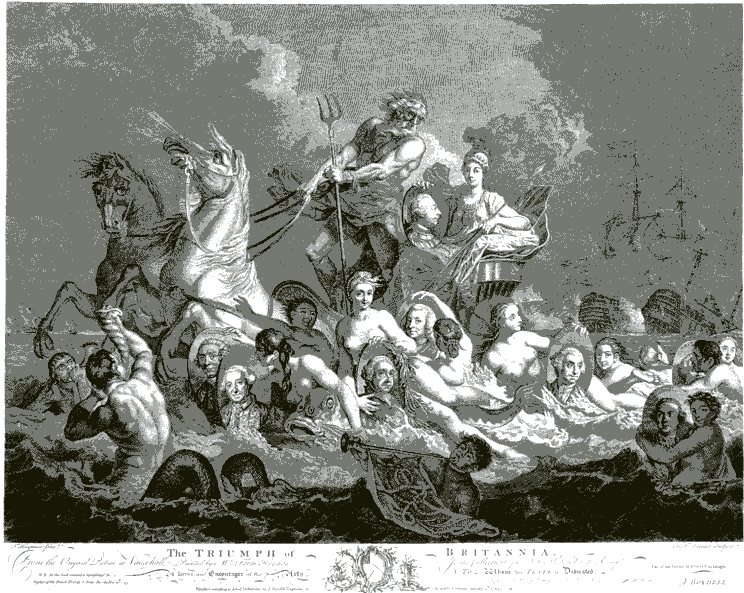
The Triumph of Britannia

The second painting, which was installed for the opening of the 1762 season, was a representation of the defeat of the French fleet at Quiberon Bay in November 1759. “As its allegorical title would suggest, it was intended to glorify the British military leaders involved in the action and the natural alliance of Britannia with Neptune that had given Britain mastery of the seas.”

However, because it did not entirely succeed in capturing the essential majestic dignity that was necessary to this type of allegorical work, the Triumph of Britannia was not always taken seriously by its audience. It is specifically and humorously singled out in Fanny Burney’s novel Evelina of 1778; during a visit to Vauxhall, Mr. Smith ridiculously mistakes the figure of Neptune for that of a famous general, despite the fact that he is wearing ‘the oddest dress for a general ever I see’.

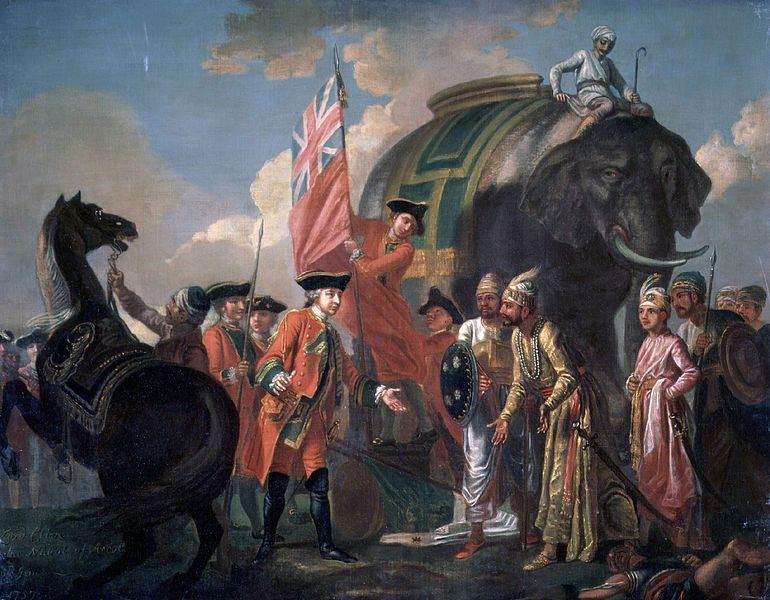
Lord Clive, Hayman, 1760

Lord Clive Receiving the Homage of the Nabob

A companion piece to the Surrender, this painting was installed in time for the 1763 season. The historical event depicted was the Battle of Plassey, at which Robert Clive ousted the ruling Nawab of Bengal, Siraj-ud-daula and, “in an apparently magnanimous act, [Clive] then supported the claim to supremacy of the elderly general Mir Jafar (c. 1691-1765), Nawab of Murshidabad, who had actually fought against the British, but who was more easily persuaded to the British point of view.”

In that battle the British forces were famously outnumbered by twenty to one, but were nevertheless victorious with the loss of only eighteen men (according to Clive), lending it the heroic ideal; in fact this was undeserved, and the British were saved from probable defeat only by the quick thinking of their artillerymen who covered their weapons and powder during a downpour, while the enemy did not.

The description of the painting started with “The subject of this picture is of the most interesting nature, to every Briton who regards the honour and propsperity of this country’, no doubt insinuating that it would be unpatriotic to criticize it.
The second description

praises General Clive for his leadership, and for his generosity in giving the sultanate to Mir Jafar;

therefore performing for his Country a most important Service, as well as procuring for the India Company and Individuals the Sum of Three Millions Sterling, for their Losses sustained at Calcutta; with such Privileges, Immunities, and Advantages, as they never enjoyed before. And this Revolution hath been moreover the Means of the India Company’s acquiring the Territorial Possessions, to the Amount of Seven hundred thousand Pounds per Annum.

In retrospect, General Clive’s generosity seems less altruistic considering the huge commercial gains resulting from the acquisition of this territory.

Britannia Distributing Laurels

A companion piece to the Triumph of Britannia, Britannia Distributing Laurels was installed in 1764. Unfortunately, no version of this piece is known to be in existence. However, it is known to have depicted the full-length figures of Generals Granby, Monckton, Albemarle, Coote, Townshend and Wolfe, all in Roman costume, allegorical in nature.

The story goes that, when Granby came to Hayman’s studio in St. Martin’s Lane, he challenged Hayman to a boxing match before the sitting. After a hesitant start, which Granby overcame by saying that the exercise would give animation to his portrait, Hayman apparently floored the marquis with a tremendous punch to the stomach, and Mrs. Hayman, hurrying upstairs to see what the noise was, found them ‘rolling over each other on the carpet like two bears.’

Tyers as the Ultimate Patron of 18th century British Art

The inscription under the engraving of Hayman’s Triumph of Britannia describes him as a ‘”Lover and Encourager of the Arts.’” He was described by Henry Angelo as having “laid out more money in the encouragement of English art than any man of his time. Indeed, his house was so full of pictures, that after hanging them, even on his stair-case, there were still some to spare.”

Jonathan Tyers didn’t just use art to further his commercial ambitions; he was a true conoisseur. And it was his dream to open up the arts to all layers of society, not just the upper class.

The huge developments in British art through the middle of the eighteenth century were in large part due to the concurrence of Vauxhall Gardens, the Foundling Hospital, the Society of Artists and the Royal Academy and to the men involved in those institutions, notably Hogarth, Hayman and, of course, Tyers… After the collaboration of Tyers and Hayman, the visual arts at Vauxhall never again received the same degree of patronage from its proprietors.

The paintings and sculpture at Vauxhall Gardens would have been the best-known works of art in England at the time, seen by tens of thousands of people, including significant numbers of artists, every year. Although Tyers owed much to Hogarth, initially the driving force behind the artistic concept of the gardens, it was Hayman, Tyers’s artistic director, who could be seen as the more influential figure. This was partly because of the huge exposure of his original work at Vauxhall, and also because he was the linchpin that held together the London art profession, with a finger in all the principal artistic pies of the time—the St Martin’s Lane Academy, Vauxhall Gardens, the Foundling Hospital, the Society of Artists and, eventually, their august offspring, the Royal Academy.

Susana’s Vauxhall Blog Post Series

  1. Vauxhall Gardens: A History
  2. Vauxhall Gardens: Jonathan Tyers—“The Master Builder of Delight” 
  3. Vauxhall Gardens: A New Direction
  4. Vauxhall Gardens: The Orchestra and the Supper-Boxes 
  5. Vauxhall Gardens: The Organ, the Turkish Tent, and the Rotunda
  6. Vauxhall Gardens: Three Piazzas of Supper-Boxes
  7. Vauxhall Gardens: “whither every body must go or appear a sort of Monster in polite Company”
  8. Vauxhall Gardens: The Competition
  9. Vauxhall Gardens: The Artwork, Part I
  10. Vauxhall Gardens: The Artwork, Part II
  11. Vauxhall Gardens: The Music, 1732-1859
  12. Vauxhall Gardens: The Business Side
  13. Vauxhall Gardens: Developments from 1751-1786
  14. Vauxhall Gardens: Thomas Rowlandson’s Painting (1785)
  15. ‎Vauxhall Gardens: The Third Generation of the Tyers Family and the Jubilee of 1786
  16. Vauxhall Gardens: An Era of Change (1786-1822), Part I
  17. Vauxhall Gardens: An Era of Change (1786-1822), Part II
  18. Vauxhall Gardens: An Era of Change (1786-1822), Part III
  19. Vauxhall Gardens: The Final Years, Part I
  20. Vauxhall Gardens: The Final Years, Part II
  21. Vauxhall Gardens: The Final Years, Part III
  22. Vauxhall Gardens: The Final Years, Part IV
  23. Vauxhall Gardens: Farewell, for ever

Susana’s 2015 English Adventure: Week 4

map

On Monday I hopped on a train to Birmingham, then changed to one for Kidderminster. (I just love these English names, don’t you? Mousehole is my favorite, but I’m assured that it is a lovely place to visit despite the name.) At Kidderminster, I took a taxi to The Elms Hotel in Abberley, where I was met by the lovely Heather King and her fabulous, quadralingual dog, Roxy. Heather is an amazingly talented author of Regency stories (and, as Vandalia Black, of rather darker paranormal ones). Heather and I are online friends and have been part of two Regency anthologies, Beaux Ballrooms, and Battles and Sweet Summer Kisses. It was truly awesome to meet her in person, as well as Roxy and the ponies, Merlin and Dub-Dub, and Sootie, the black cat whose offspring were too high-in-the-instep to become acquainted with a Yankee. Heather served me Toad-in-the-Hole, which turned out to be a sort of English comfort food: sausages baked in a sort of pancake batter and served with hot gravy. Besides being very tasty, it served to warm us up inside and outside, after a day spent mucking about the ruins of Witley Court in the pouring rain. (It rains in England. Deal with it.)

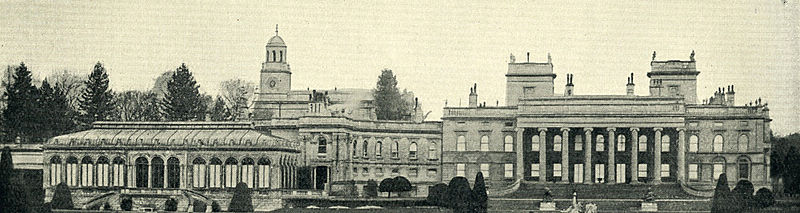
Witley Court

Witley Court was once one of the great houses of the Midlands, but a devastating fire in 1937 left it in ruins. While one cannot but regret the loss of such a beautiful home, the exposure of the “bare bones” has proved to be valuable to historians interested in learning about historical building practices.

800px-Witley_Court_circa_1900_2

Witley Court, 1900

Witley Court today

Witley Court today

Thomas Foley (whose grandson became the 1st Baron Foley) built the house in 1665 on the site of a manor house. Additions were made by John Nash in the 19th century, and the house was sold to the Dudley family (later to be given an earldom) in 1837.

Tramping about the ruins of the house turned out to be much more appealing than one might have expected, even in the pouring rain! The gardens are lovely, particularly the fountain (see video here), and the parish church on the property—which is not a ruin—is magnificent.

See photos here.

Berrington Hall

On Tuesday Heather, Roxy, and I visited Berrington Hall, a splendid country home in Leominster (pronounced Lemster, or so they tell me). It was designed in the late 18th century by Henry Holland, whose talent, although not eclipsing that of my favorite, Robert Adam, puts him solidly in second place, in my estimation.

In addition to the rich furnishings and décor, there was an exhibit of Georgian fashion throughout the house, which included—believe it or not—costumes from the 1995 BBC production of Pride and Prejudice. Yes, I was close enough to touch the costumes worn by Darcy and Lizzie during the final proposal scene, as well as many others. Truly an awesome experience!

Henry Holland!!!

Henry Holland!!!

The vast grounds include a walled garden with some vintage apple trees, a ha-ha, a lake, and some lovely paths. Heather and I enjoyed a delicious picnic before exploring further some of those paths. And not a drop of rain!

See photos here.

Waddesdon Manor

On Wednesday I took a train to Aylesbury, in Buckinghamshire (where, incidentally, the estate of my hero in The Third MacPherson Sister is located) to visit Waddesdon Manor.

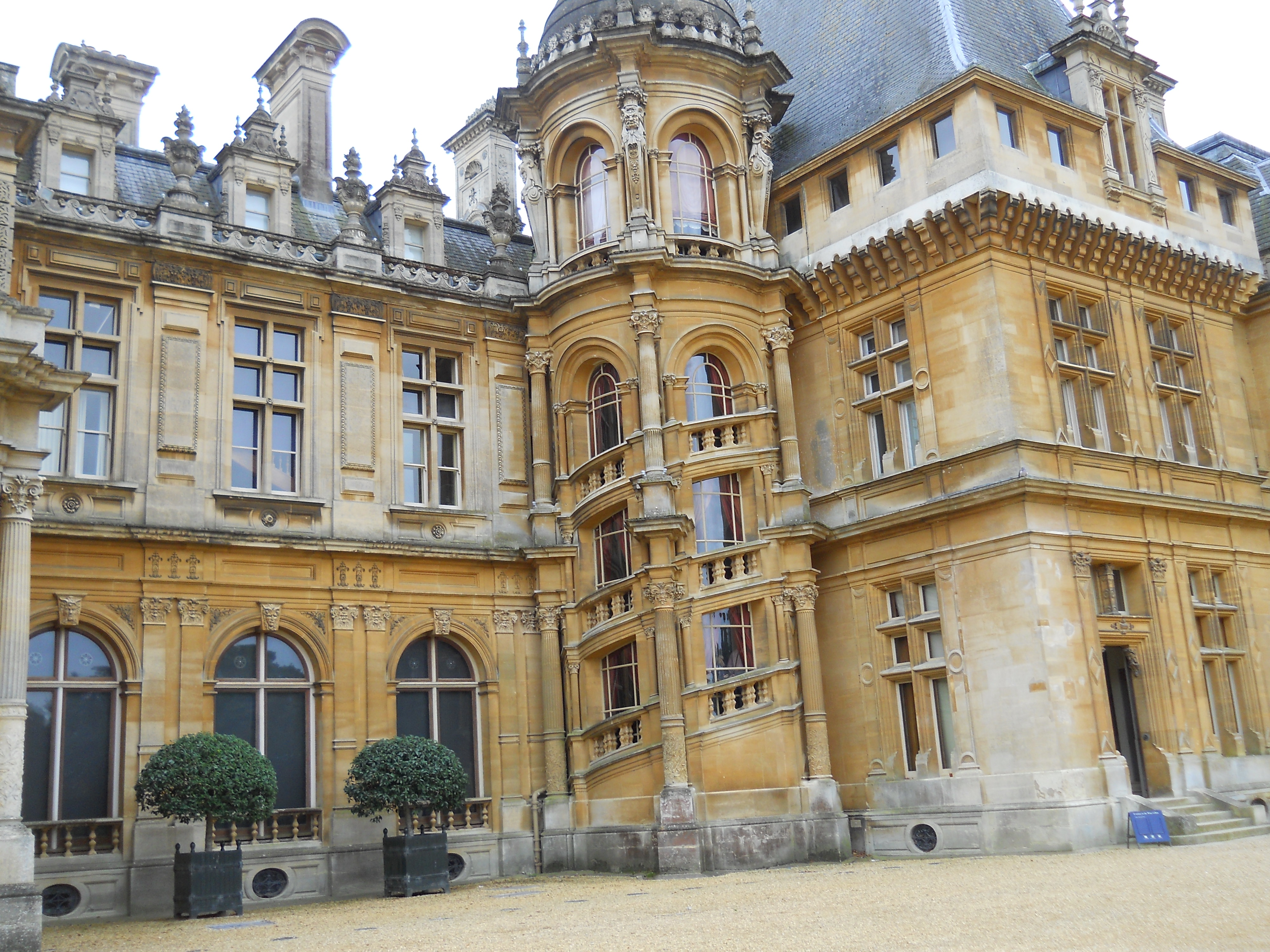
Waddesdon Manor was built in neo-renaissance style in the late 19th century as a sort of French château by the Baron Ferdinand de Rothschild of the Austrian banking family. The baron fell in love with his second cousin, Evelina, and married her, only to lose her in childbirth eighteen months later. The baron never married again, but became a compulsive collector instead. The furnishings are considered to be among the richest of any stately manor anywhere.

These stairs are reminiscent of those at the Château de Chambord in France

These stairs are reminiscent of those at the Château de Chambord in France

Unfortunately, I was only able to tour the house due to time considerations, but I plan to visit again to get a good look at the extensive grounds and other buildings, such as the Aviary and the Dairy.

Although cloudy, it didn’t rain until I had returned to London, where I got promptly soaked making a last round of Piccadilly Street and Fortnum & Mason. But hey, it rains in England. That’s why it’s so beautiful!

See photos here.

Adieu to England

Squidgeworth enjoyed his orange juice on the plane.

Squidgeworth enjoyed his orange juice on the plane.

It was with a tear in my eye as Squidgeworth and I said goodbye to England on Thursday. For now. We had a marvelous time and were fortunate to be able to visit many wonderful places, but there are still lots more on our bucket list. I’ve already booked our flight and flat for next year’s trip in August.

So much to see, so little time!

Next week: Squidgeworth and I have some travel tips for you!

Susana’s 2015 English Adventure: Week 3

house copy

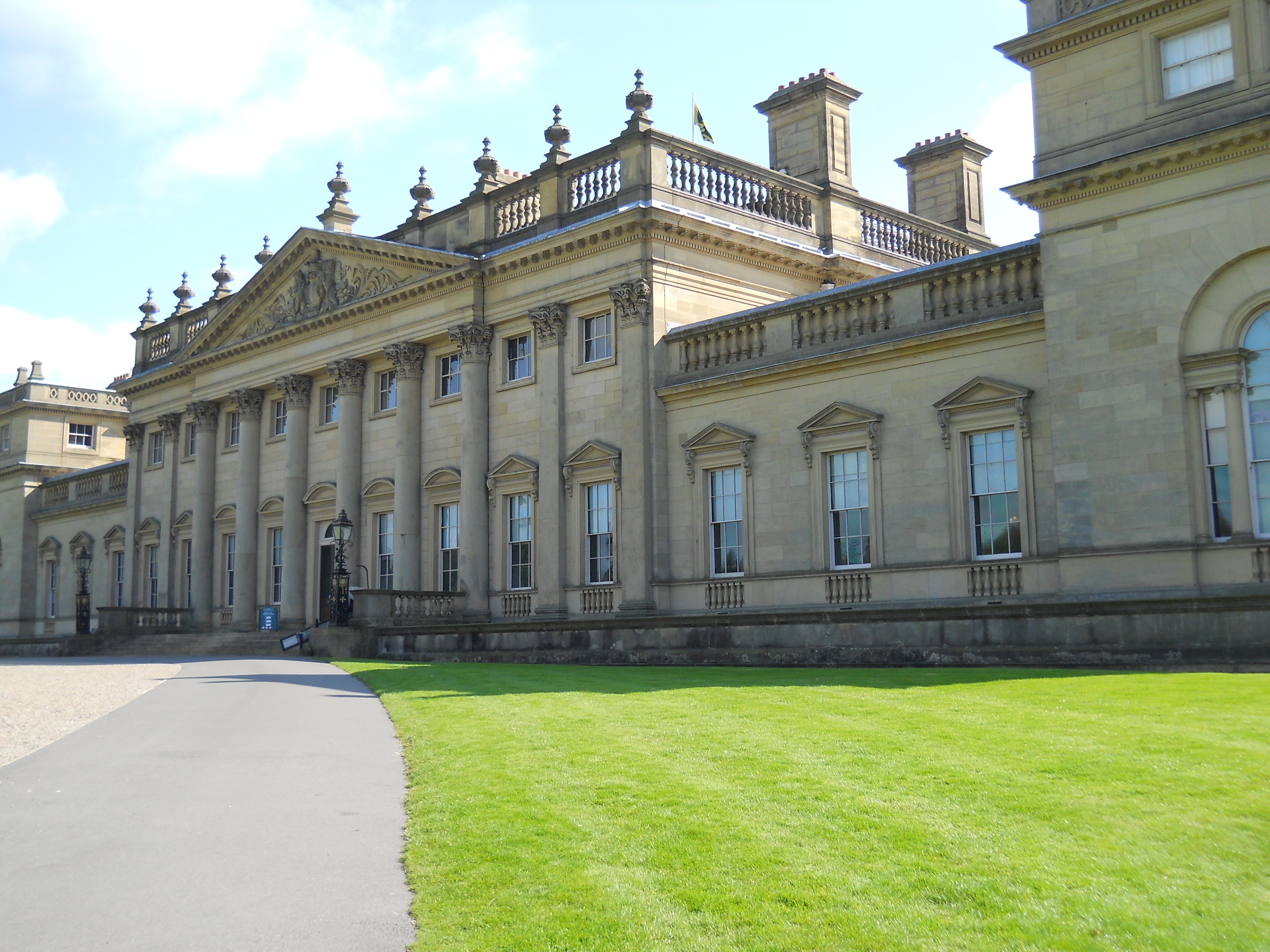
Harewood House

Harewood

On Monday I took an early train north to York, left my suitcase at the hotel, and headed off to Harewood (which can be pronounced either hairwood or hahrwood, depending on the person with whom you are speaking).

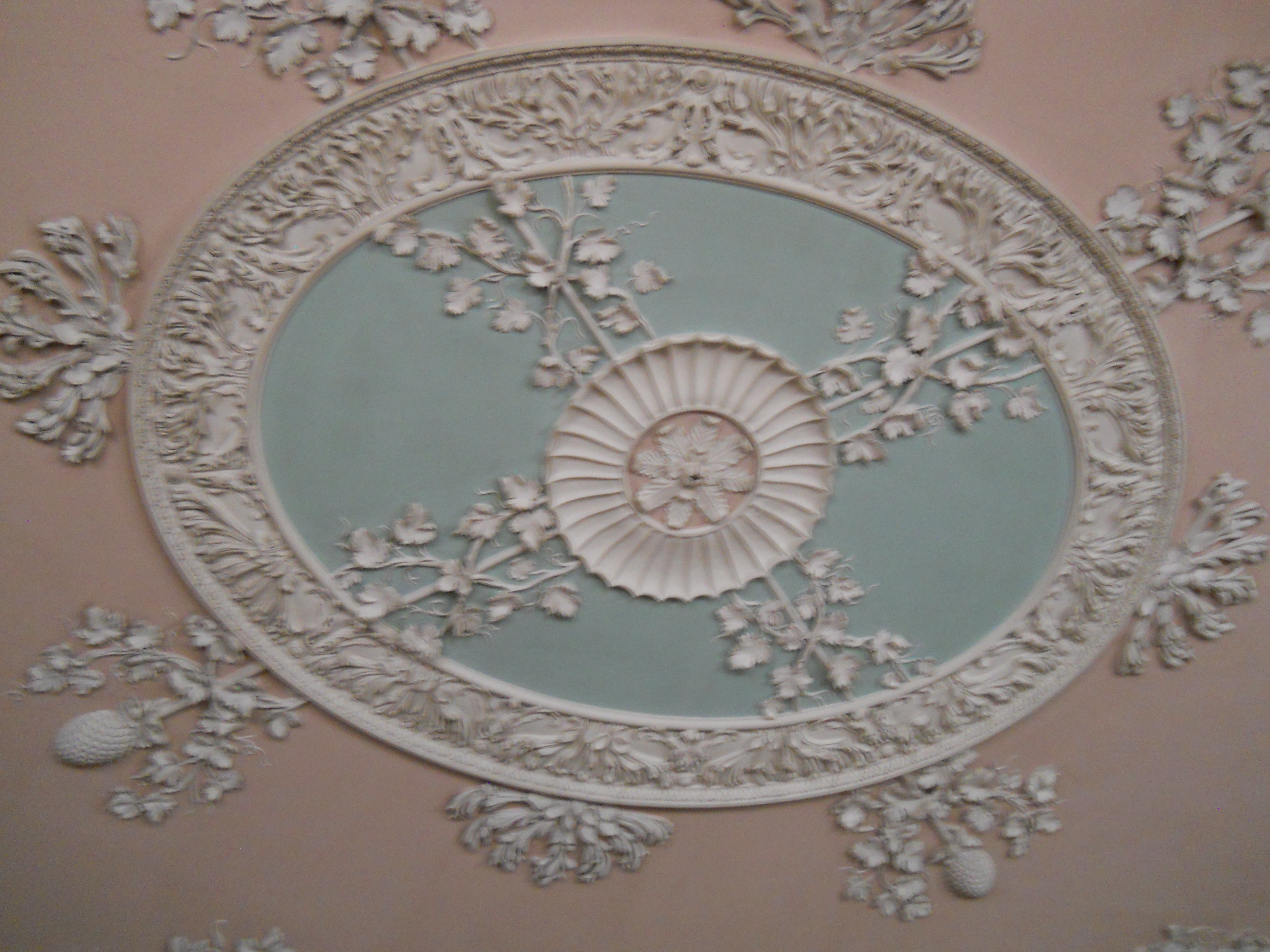
My overall reaction to Harewood is… Robert Adam! I don’t know how the man got around to accomplishing so much in England’s great houses in one lifetime, but from now on I will judge all of the ones I visit by the quality of their Robert Adam touches (or lack of it).

ceiling5 copy

Oh yes, I suppose I should mention the excellent work by Charles Barry and the Chippendale furniture too. Utterly fabulous!

In later years, Harewood was the home of Queen Elizabeth’s aunt, the Princess Mary, after she married the sixth Earl of Harewood, Henry Lascelles, who served in the First World War.

Photos of Harewood

Castle Howard

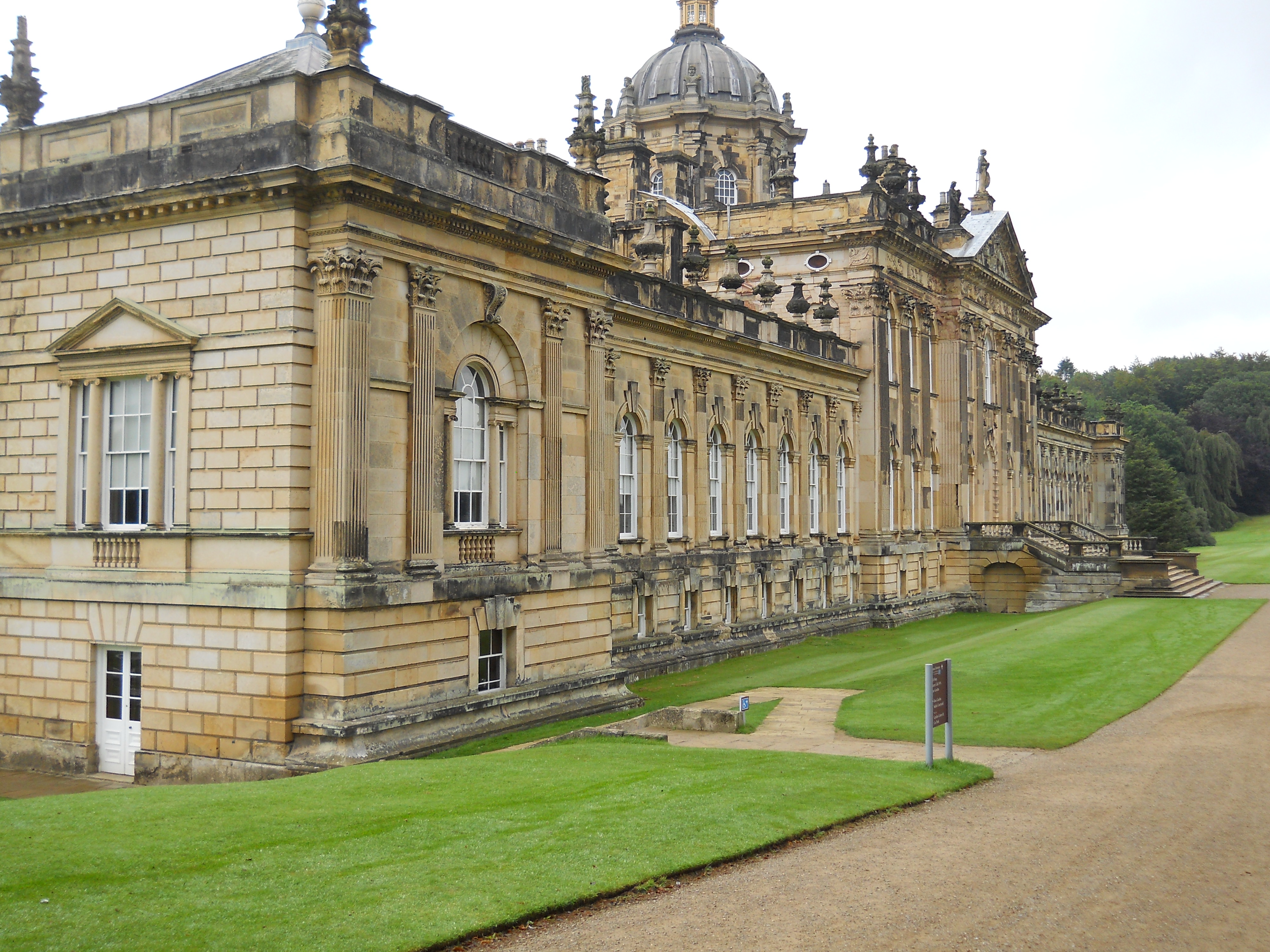
Castle Howard was originally built in 1700 by the 3rd Earl of Carlisle, who was a younger son of the Duke of Norfolk. Yes, Catherine Howard, unfortunate fifth wife of Henry VIII, was of the same family, but she predated the house. John Vanbrugh, the architect, was also the architect for Blenheim Palace, which is spectacular in itself.

The 4th and 5th earls traveled widely on the continent and were great collectors. The current earl lives at another house, and this one is owned by a private trust, headed by Carlisle family members.

CastleHoward2 copy

Castle Howard is well-known for being the setting of the popular Brideshead Revisited television series.

The 6th countess was the eldest daughter of the 5th Duke of Devonshire and his wife Georgiana. She became the mother of 12 children, and you can see her bedroom in the photos.

Photos of Castle Howard

Haworth

One of my favorite books of all time is Jane Eyre, and I loved Wuthering Heights as well. So visiting the parsonage where the Brontë family lived with their vicar father was a significant milestone. Very different from the magnificent houses I’ve been visiting on this trip! Startling to hear that nearly half of all children born at this time died before the age of six, and poor Rev. Brontë saw his wife and all his children die before he did.

paintingbyBranwell

Photos of Haworth

The Foundling Museum

If you ever wondered what happened to England’s abandoned children, this museum tells the sobering story of the Foundling Hospital, Britain’s first home for abandoned children. Mothers who left their children there also left tokens (buttons, jewelry, coins, or whatever they had) to identify their children in case their circumstances changed and they could claim them someday. Unfortunately, most of the children were never claimed. At the ages of 9-14, children were sent away to be apprentices or servants. It wasn’t an ideal situation, but at least the children were fed and clothed and educated up to a point, which was certainly better than being left to die in the streets, which was a common practice in some areas. Sadly, much of society shunned the offspring of prostitutes or unmarried couples and really didn’t consider it a great loss if they died.

One mother left a Vauxhall season pass as a token for her child

One mother left a Vauxhall season pass as a token for her child

Another focus of the museum is the founder, Thomas Coram, as well as supporters William Hogarth and George Frideric Handel and a large collection of paintings donated to the hospital that were used to entice potential contributors to come to the hospital.

Squidgeworth found a friend!

Squidgeworth found a friend!

See photos here.

St. Paul’s Cathedral

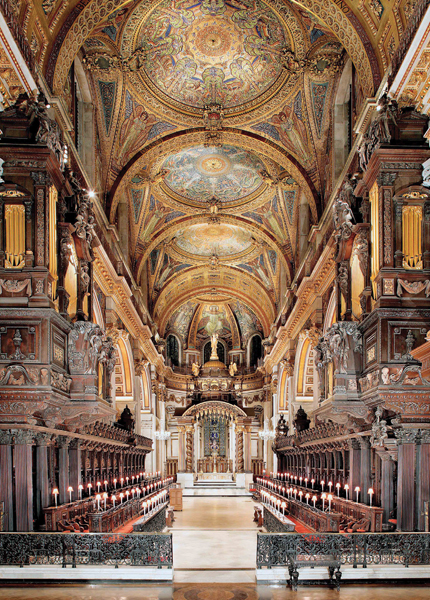
Beautiful and impressive. Admiral Lord Nelson and the Duke of Wellington are buried in the crypt.

GTO 225 London.qxp:Regional Update.qxd

See photos here.

York

Spent a day walking around York and shopping. Did the Richard III Experience and Squidgeworth got put in jail for a short time, but he smiled all the way through it. Nothing gets him down, not even getting shut up in that tiny cell.

yorkprison

See photos here.


Sadly, less than a week remains before Squidgeworth and I fly back across the pond.

So much to see, so little time!

Susana’s 2015 English Adventure: Week 2

Hatfield House

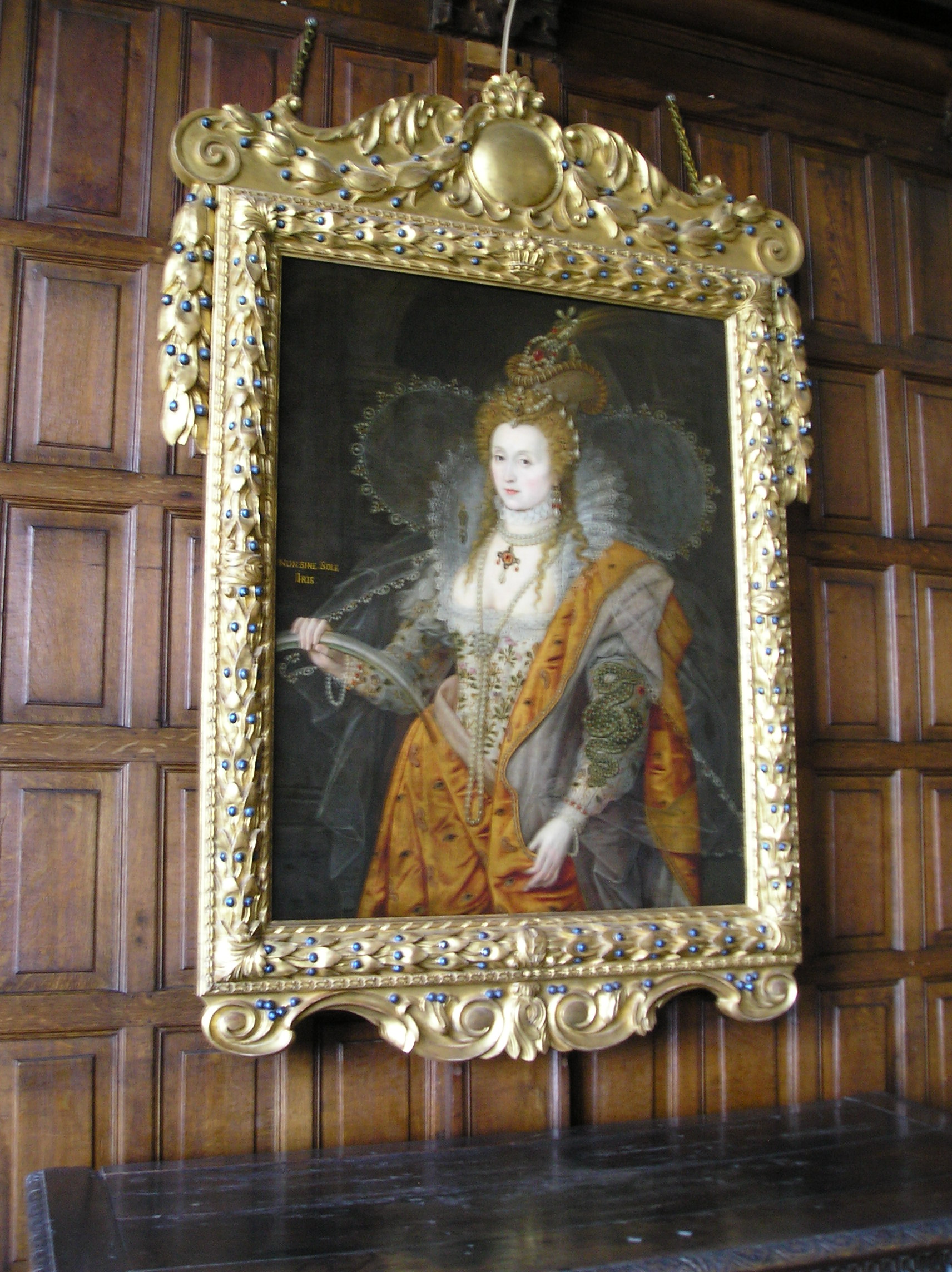
Hatfield House is a Jacobean manor built by Robert Cecil, the son of William Cecil, the most trusted advisor of Elizabeth I. Robert succeeded his father as Elizabeth’s advisor, eventually becoming an advisor of James I as well. Robert Cecil is the one who discovered the plot of Guy Fawkes and others to blow up the House of Lords. A later Cecil (James) was made Marquis of Salisbury, and the Salisburys still own and live at Hatfield House more than 500 years later.

Hatfield Palace, which stood nearby (of which only a banquet room remains) was where all of Henry VIII’s children (Mary, Elizabeth, and Edward) were raised. It was here where Elizabeth learned that she was queen after the death of her sister Mary.

OLYMPUS DIGITAL CAMERA

Elizabeth I

Photos of Hatfield House

Kenwood House

William Murray, 1st Earl of Mansfield, bought the house in 1754 and commissioned Robert Adam to remodel it, which he did from 1764-1779. The library is a masterpiece of Robert Adam genius, but the rest of the house is equally splendid. It is a pity that most of the original Adam-designed furniture was dispersed long ago, but a later owner, a Lord Iveagh, purchased the house in 1925 and displayed his fabulous collection of paintings there before leaving the house and its contents to the nation in 1927.

LIBRARY3

Lord Mansfield and his wife never had children of their own, but they did take in two young daughters of nephews: Lady Elizabeth Murray and Dido Belle, who was a mixed-race daughter of an enslaved West Indian woman. Dido Belle was the subject of a recent film, Belle.

Dido Belle and Elizabeth Murray

Dido Belle and Elizabeth Murray

Pictures of Kenwood House

Buckingham Palace

Buckingham Palace needs no introduction from me. I scheduled my trip this year so that I could visit, since it’s only open to visitors when the Queen is on holiday in Scotland (August and September). No photographs allowed, so I pinned these from other people’s Pinterest boards.

Here’s Squidgeworth ready to enjoy a coffee and scone with me after the tour.

SNACKATBUCKINGHAM

Pictures of Buckingham Palace

Osterley Park

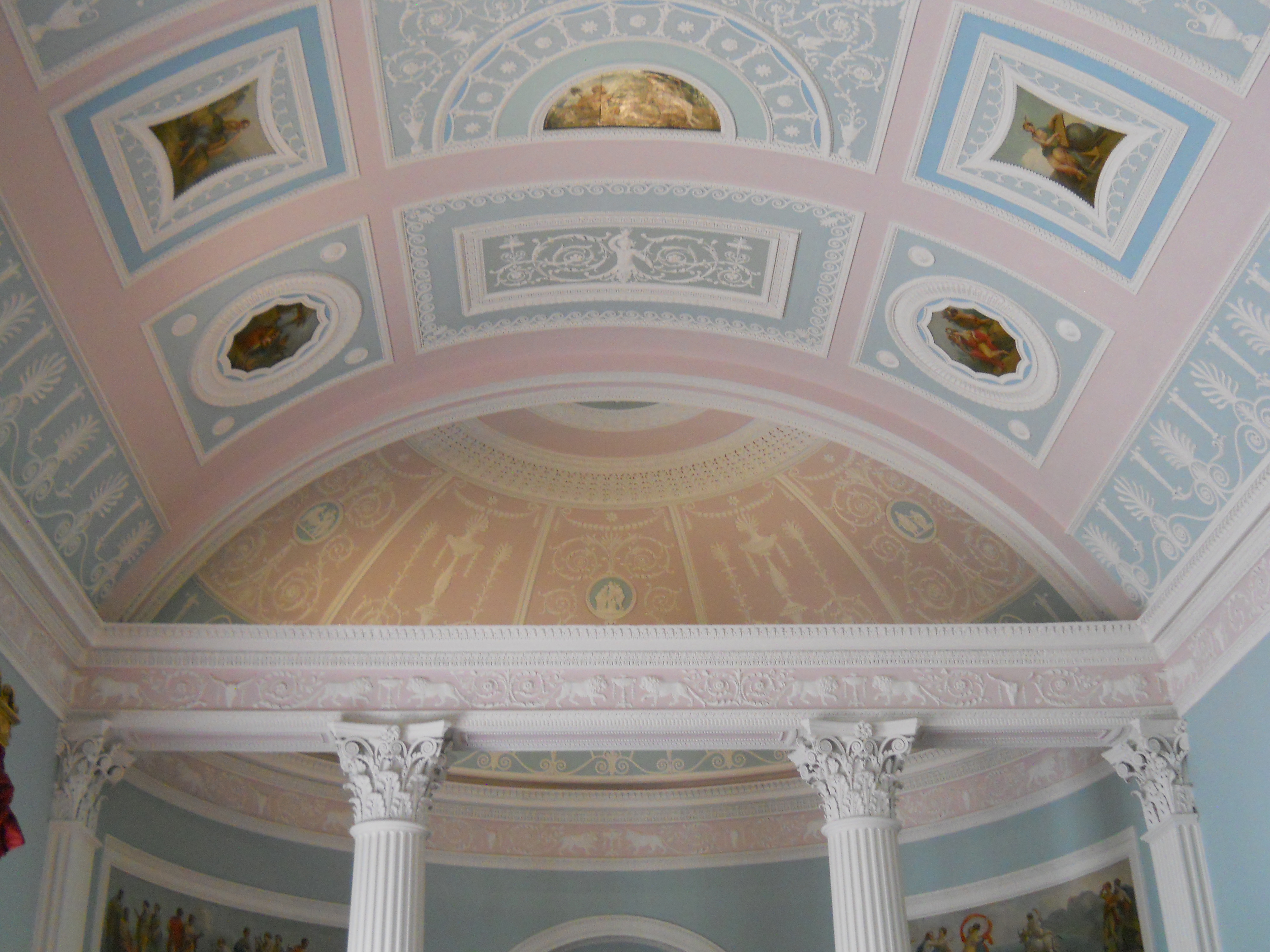
Built by Sir Thomas Gresham, financial advisor of Elizabeth I, Osterley Park was later purchased by Robert Child, a wealthy banker, who left it (and his entire fortune) to his granddaughter, Sarah Fane, who married George Villiers and became Lady Jersey (yes, Sally Jersey, one of the patronesses at Almack’s during the Regency period) a year later. But the house has been little used, as the Jerseys preferred spending their time at other properties. Here you will see not only the Robert Adam touches, but also nearly all of the original furniture, including the room where Adam worked and some of his drawings.

PINK:BLUECEILING

Pictures of Osterley Park

Devizes & the Bear Hotel

BEARHOTEL

The Bear Inn was once owned by the father of a young Thomas Lawrence, who used to charm the clientele by reciting poetry and drawing likenesses. He was quite good, and was eventually knighted for his portrait painting. See my blog post here.

Pictures of Devizes

Bath

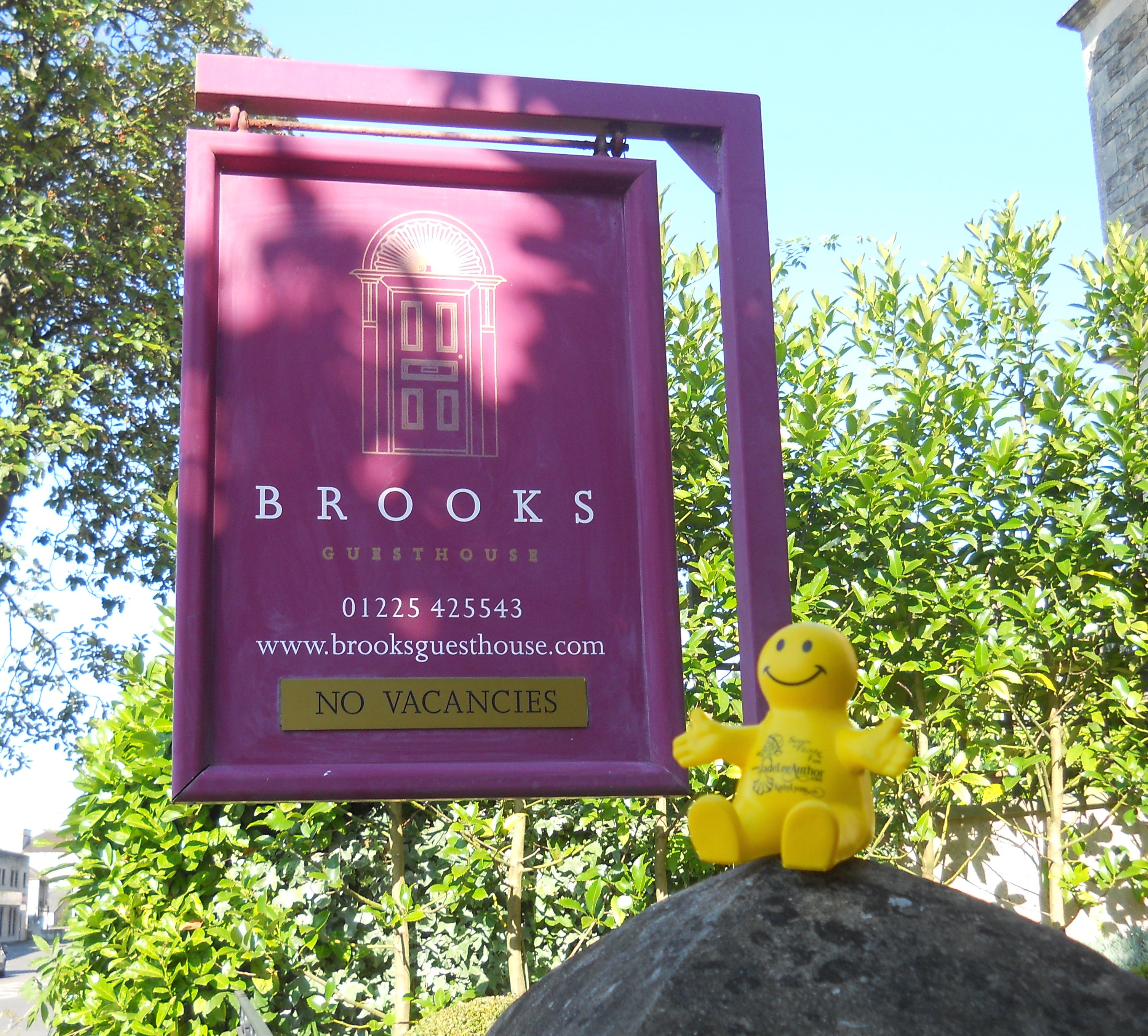
Squidgeworth and I had a very enjoyable two days in Bath, staying at the Brooks Guesthouse, where I stayed three years ago on my Rick Steves tour. Here I visited No. 1 Royal Crescent, the Jane Austen Centre, the Victoria Art Gallery, the Holburne Museum, the Assembly Rooms and Fashion Museum (second visit), and Sally Lunn’s.

Here’s Squidgeworth saying goodbye to Bath.

SquidgeBrooks

Pictures of Bath

Susana’s 2015 English Adventure: Week 1

eastbourne map

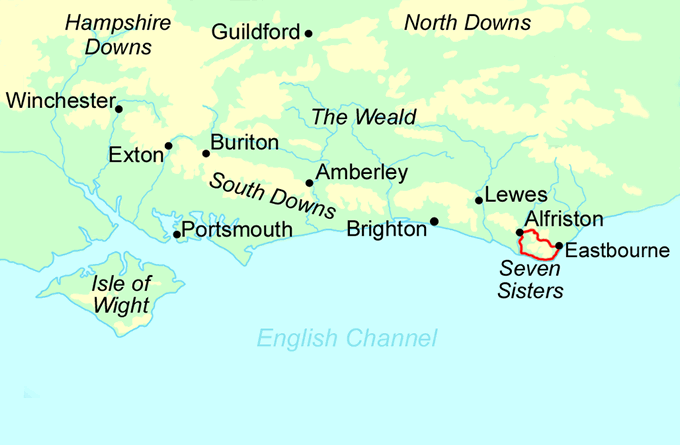
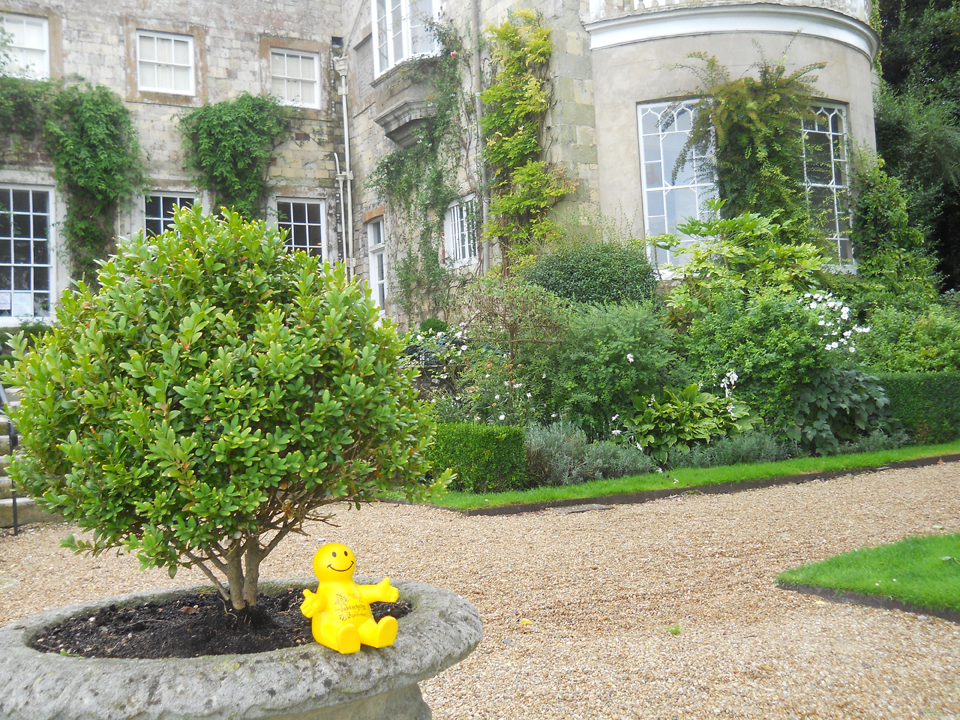
For the first three days, Squidgeworth and I were the guests of Jay Dixon, a friend of mine who lives in Eastbourne. She was kind enough to take us around to visit some historical places of interest in the area, including the Redoubt Fortress, a quaint little town called Alfriston, Firle Place, and Chartwell.

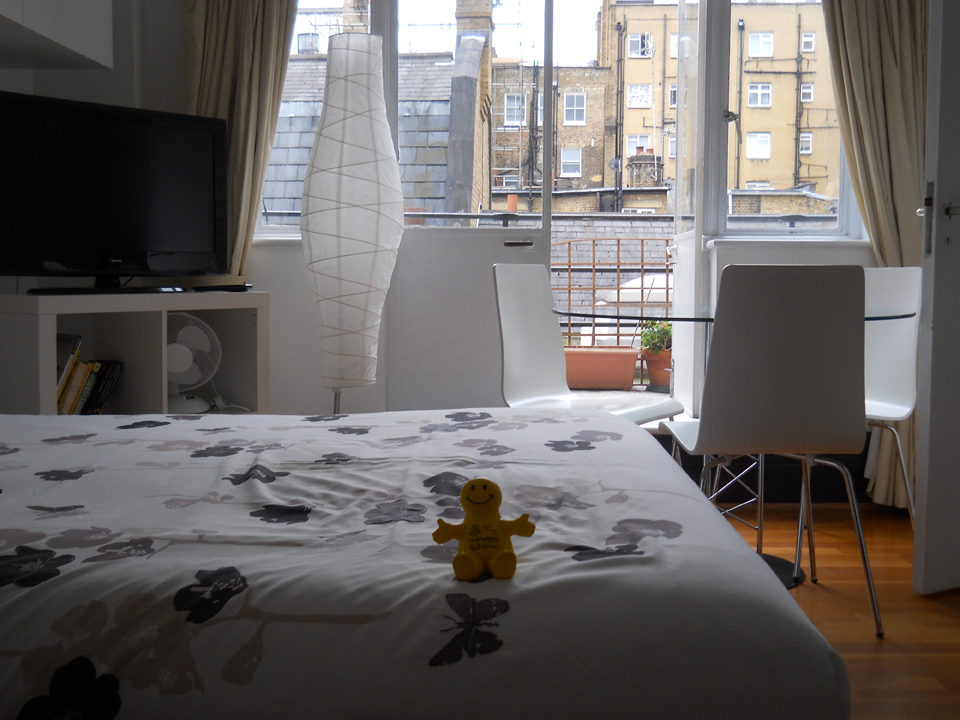
Unfortunately, I could not get my laptop to work with her Wifi system, so I had to go cold turkey from the Internet, which was instrumental later on when I arrived in London at my rental flat. It turns out that the previous renters of the flat I was scheduled for had trashed the place, and the company had switched me to another one, but I didn’t get the message because of my Internet blackout. It was a bit harrowing at first, but I was delighted that the flat they switched me to was the one I stayed in last year, near Baker Street, so I already knew the ropes. (I wanted this one, but at the time I was booking, it was already taken. There must have been a cancellation.)

Squidgeworth makes himself at home at our rental flat near Baker Street

Squidgeworth makes himself at home at our rental flat near Baker Street

Eastbourne: The Redoubt

The Redoubt is a circular military fortress that was built in 1804 when it was rumored that Napoleon had plans to invade England.

REDOUBT MODEL VILLAGE

Wikipedia

The Village of Alfriston

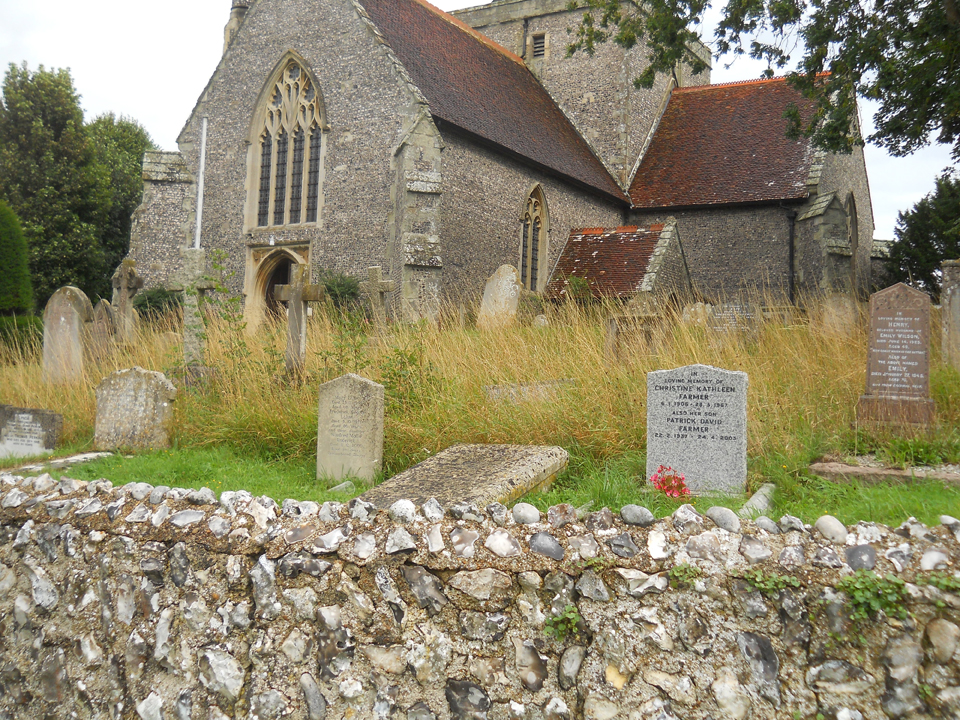
On Thursday we visited this quaint little village not far from Eastbourne. In addition to the historic buildings, a highlight was St. Andrew’s Church. The Clergy House was the first property purchased by the National Trust. Unfortunately, it was closed, but I did get photos of the outside.

The Clergy House

The Clergy House

St. Andrew's Church & Cemetery, Alfriston

St. Andrew’s Church & Cemetery, Alfriston


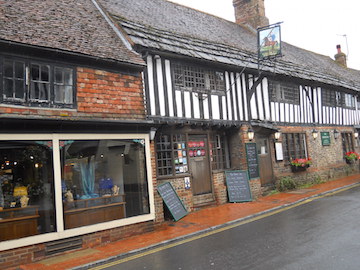
GEORGE INN copy

The George Inn, Alfriston


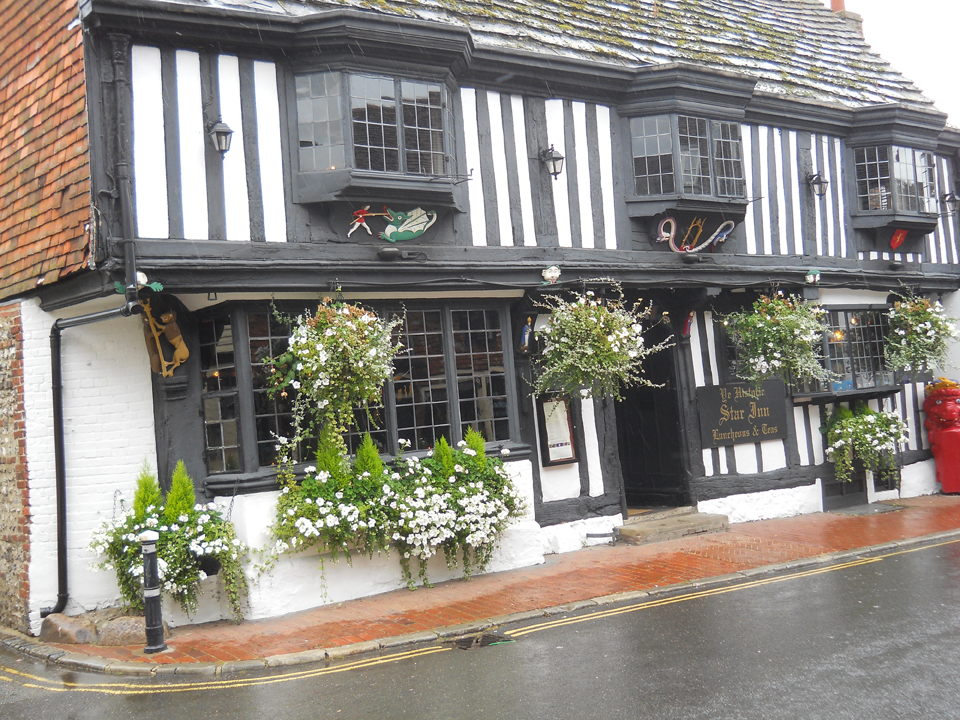
The Star Inn, Alfriston

The Star Inn, Alfriston


Squidge at a The Apiary Café in Alfriston

Squidge at a The Apiary Café in Alfriston

Wikipedia

Firle Place

Firle Place is the family seat of the Gages, the current owner being Nicholas Gage, the 8th Viscount Gage. The manor house has been in the family for over 500 years, and the estate includes a village among its 6000 acres of land. Sir John Gage was the executor of Henry VIII’s will. General Thomas Gage was at one time commander-in-chief of the British Army during the American Revolution, but was replaced after the disaster of Bunker Hill.

Squidgeworth at Firle Place

Squidgeworth at Firle Place


Firle Place

Firle Place

Wikipedia

Chartwell

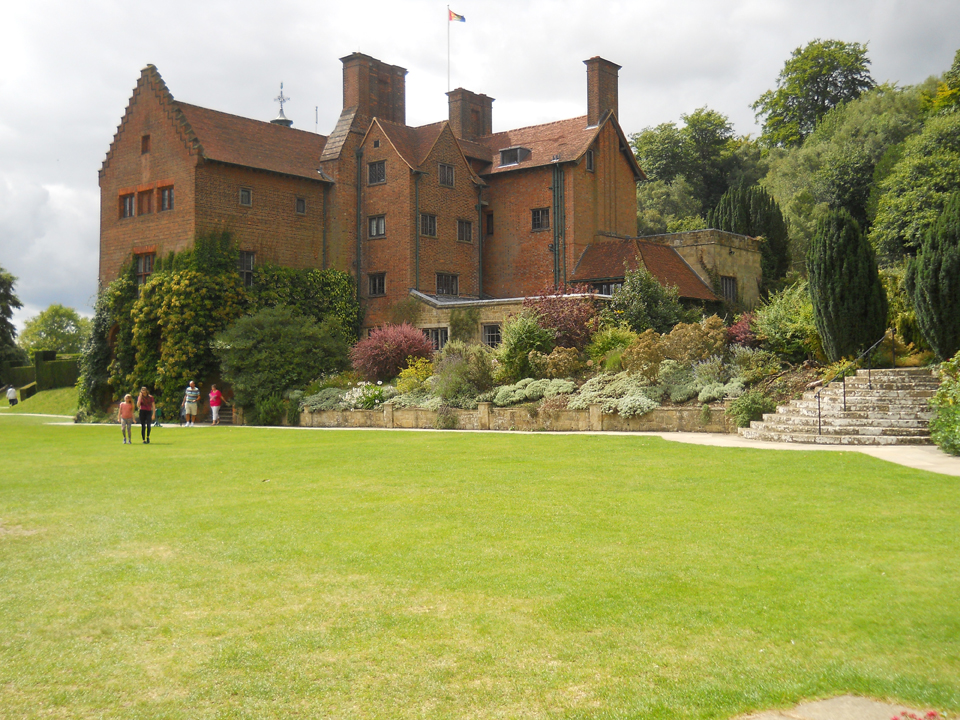
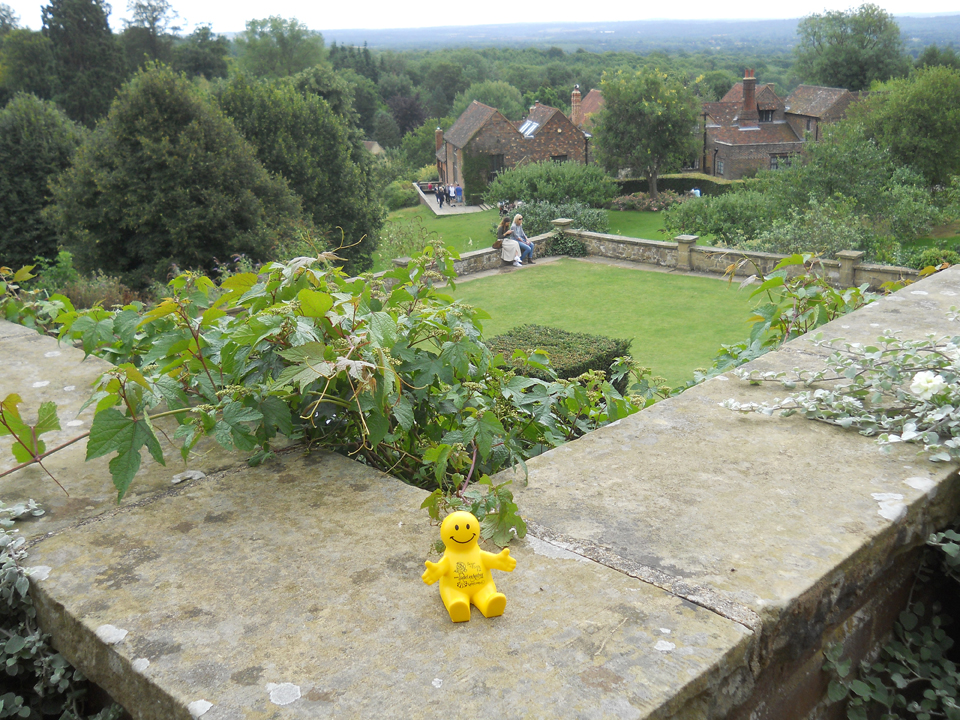
Chartwell, in Kent, was the principal residence of Winston Churchill, in his adult life. Henry VIII is believed to have stayed here during his courtship of Anne Boleyn, who lived at nearby Hever Castle.

The Churchills extensively renovated the house and gardens. Winston actually became a licensed brick layer and was noted for his wall building.

Chartwell

Chartwell


Squidgeworth at Chartwell

Squidgeworth at Chartwell

Wikipedia

The Victoria & Albert Museum

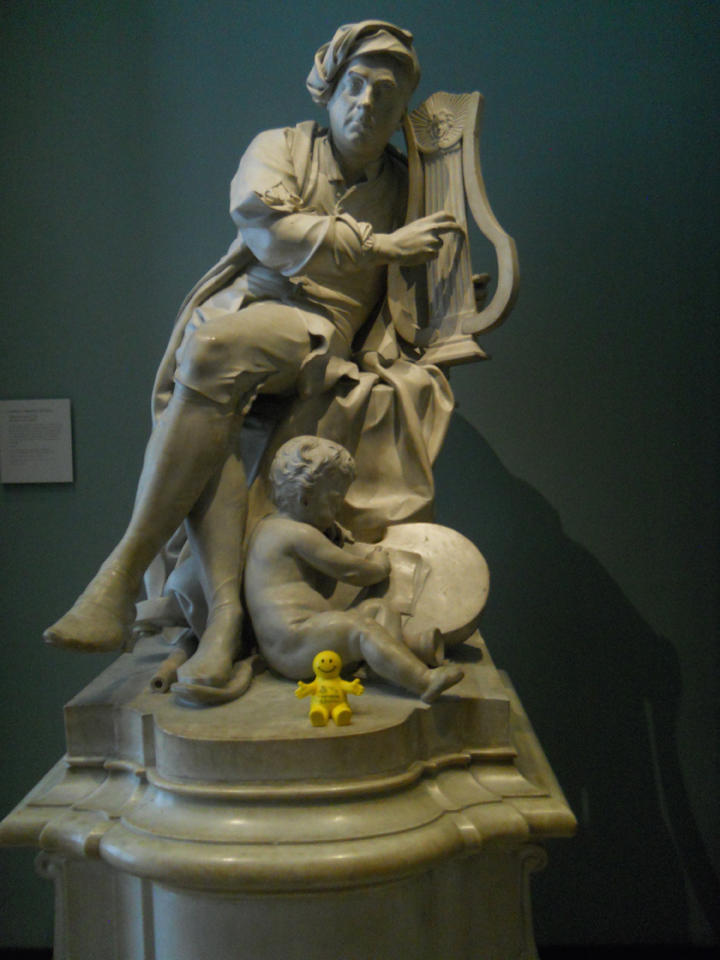
A visit to the V & A is a must for every trip to London. On this trip, my focus was Vauxhall, as the Handel statue is here, as well as three of the supper-box paintings. Unfortunately, it was difficult to get good photos of the paintings and other pictures due to the darkness of the room (which is true of many other things I tried to photograph). No doubt the low light is an attempt to preserve the aged items as long as possible. But I did get a good photo of the Handel statue, with Squidgeworth getting in on the action, as usual.

Squidgeworth and the Handel statue that used to sit in Vauxhall Gardens

Squidgeworth and the Handel statue that used to sit in Vauxhall Gardens

My Vauxhall Gardens board on Pinterest is a work in progress, but you can see there two videos about Vauxhall Gardens, one of which I photographed at the V & A and another I found on YouTube. I’ll be adding more photos as I find the time.

Susana’s Vauxhall Gardens Pinterest Board

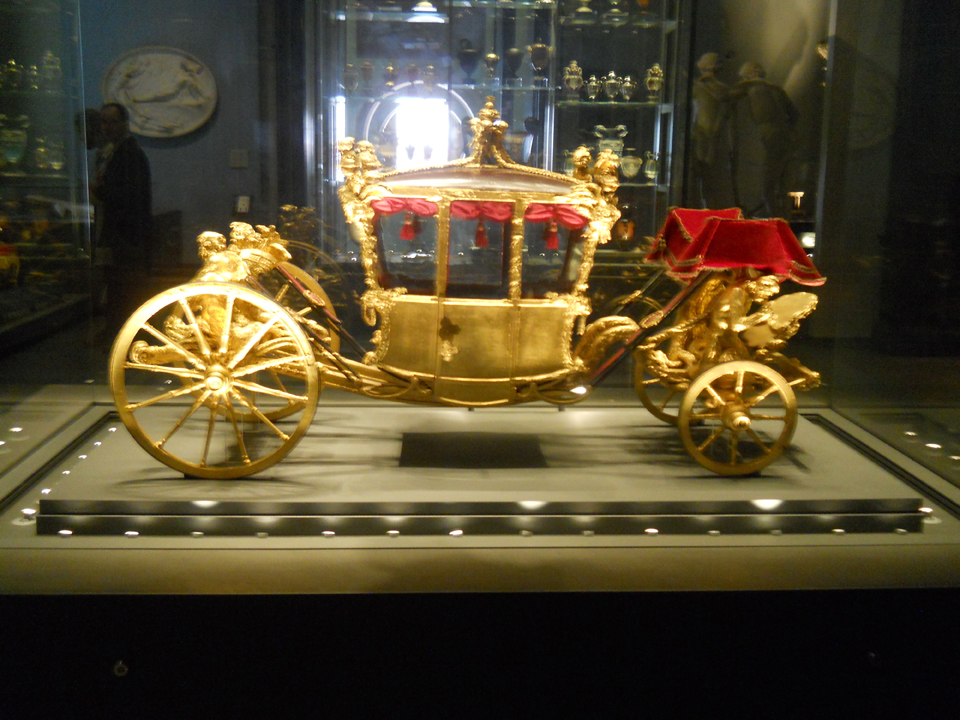
Coach at the V

Coach at the V & A Museum


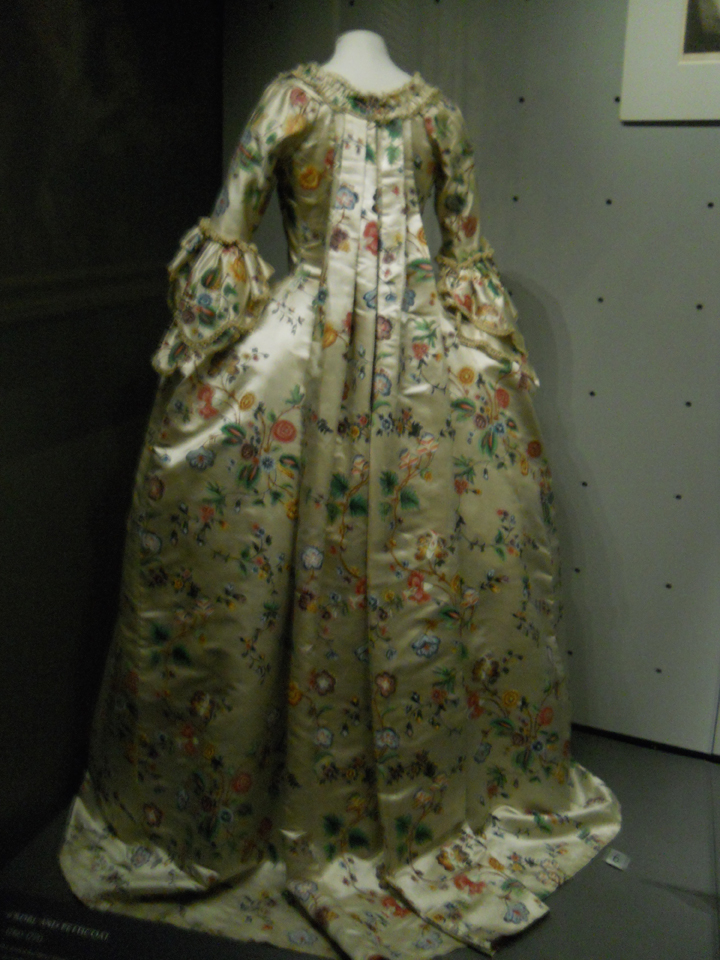
Painted silk gown

Painted silk gown at the V & A Museum

Shannon Donnelly: Lady Chance

palaisroay1600

Researching the Palais Royal

One of the fun things about writing—for me, at least—is the research. I love to dig into history; in particular, I love to look for just the right setting to help a scene come alive. Lady Chance, the follow-up book to Lady Scandal, comes out this August; it’s set in Paris of 1814, and since gambling and cards are in the book, that meant I could use the Palais Royal.

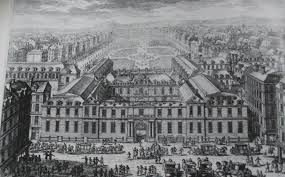
The palace was originally designed by Jacques Lemercier and construction started 1628 for the infamous Cardinal Richelieu. It was originally known as the Palais Cardinal, but became a royal palace after the cardinal bequeathed the building to Louis XIII.

Louis handed the palace to the Queen Mother, Anne of Austria, and then Henrietta Maria and her daughter Henrietta Anne Stuart, who had escaped from the English civil war, took up residence. Henrietta Anne later married Phillipe de France, duc d’Orléans, and the palace became known as the House of Orléans. The duchesse was the one who created the ornamental garden of the palace.

Louis XIV was succeeded by his great-grandson, and the duc d’Orléans became regent of young Louis XV. The Palais Royal was then opened so the public could view the Orléans art collection, and that began the palace’s more public life.

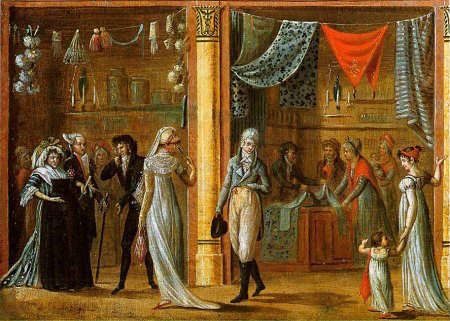
Louis Philippe II held the royal palace from 1780 until his death. He renovated the building, and the garden was now surrounded by a mall of shops, cafes, salons, refreshment stands and bookstores.

At that time, the Palais Royal became a meeting ground for revolutionaries. Its owner, Philippe d’Orléans sided with the revolutionaries. He changed his name to Philippe Égalité and his house became the Palais de l’Égalité. He opened the gardens to the public and enclosed them with colonnades lined with shops.
palaisroyal-demimonde

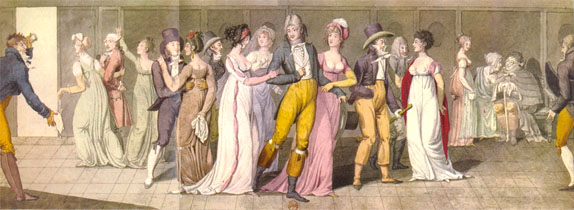
On the ground floor shops sold “perfume, musical instruments, toys, eyeglasses, candy, gloves, and dozens of other goods. Artists painted portraits, and small stands offered waffles.” The demi-monde could also parade their wares—themselves—and often had rooms on the upper floors for their customers’ convenience.

By 1807, the Palais Royal boasted “twenty-four jewelers, twenty shops of luxury furniture, fifteen restaurants, twenty-nine cafes and seventeen billiards parlors.”
palais-royal-10 copy

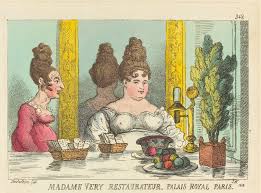
While the more elegant restaurants were open on the arcade level to those with the money to afford good food and wine, the basement of the Palais Royal offered cafés with cheap drinks, food and entertainment for the masses, such as at the Café des Aveugles.
palisroyal

Upon the death of the duc, the palace’s ownership reverted to the state, and for a time it was known as Palais du Tribunat. After the Bourbon restoration to power in 1814, the duc d’Orléans took back his title and the Palais Royal took back its name, but kept its reputation for a fashionable meeting place. And that is when Lady Chance is set.

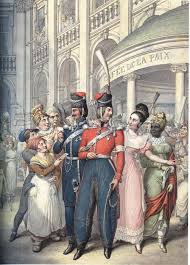
In 1814, Paris was under occupation by the allied forces that had defeated Napoleon. Russian cuirassiers, Prussian lancers, Hungarian hussars, Cossacks, and French soldiers all rubbed shoulders—and were not always in harmony with each other. But it was said of the Palais Royal that “You can see everything, hear everything, know everyone who wants to be found.”
paris_russians

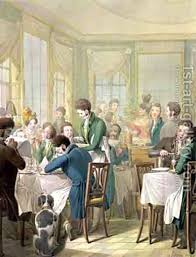
Véry Frères in the Palais Royal was accounted the most expensive restaurant in Paris, and one could dine with “brilliantly lit salons, granite tables, gilt bronze candelabra and mirror-lined walls.” Trois Frères Provençaux was famous for poulet à la Marengo—Chicken Marengo, said to be the dish served Napoleon’s victory at Marengo. In Paris Between Empires, Philip Mansel talks of dining at Le Caveau, or at the royalist Café de Foy. While Café des Mille Colonnes on the first floor of arcade provided its patrons, “Mirrored salons, hung with ‘magnificent chandeliers’ and supported by Corinthian columns of green marble.” The building was also home to the fashionable resturant Le Grand Véfour.
palaisroyalresturant

On the second floor, elegant card rooms offered deep gaming—these are the salons featured in Lady Chance.

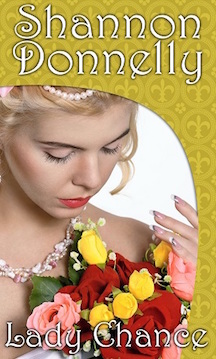
About Lady Chance

Can an English lady find love and common ground with a French soldier?

In Paris of 1814, as Bourbon king again takes the throne, and the Black Cabinet—a shadowy group of agents employed by the British—is sent to unmask dangerous men and stop assassinations. When Diana, Lady Chauncey—known as Lady Chance—is recruited by her cousin to use her skill at cards to help him delve into these plots, she meets up with a man she thought dead. Diana finds herself swept into adventure and intrigue, and once again into the arms of the French officer she tangled with ten years ago. But she is no longer an impulsive girl, and he may not be the man she once thought was honorable and good.

After the recent defeat of his country, Giles Taliaris wants nothing more than a return to his family’s vineyards in Burgundy. But his younger brother seems involved in dangerous plots to return France to a republic. To get his family through these troubles, Giles can only tread warily. When he again meets meet the English girl he once knew and thought lost to him, he finds himself torn between duty and desire. Can he find his way through this tangle—and if he does, how can he convince his Diana to give up everything for him?

Amazon

Excerpt

Diana blinked twice and let her stare travel the room once more. “I rather thought the gaming rooms of the Palais Royal would be more…”

“Degenerate? Depraved? Decayed?” Jules asked.

“Grand, actually. Oh, the colonnade outside is charming, but this…” She fluttered a kid glove at their surroundings—at the draped windows, the high vaulted room with its plaster ceiling, the discreet décor with respectable landscapes hung over a tasteful, floral wallpaper. Chandeliers glittered overhead. Around them, dozens of uniformed gentlemen lounged or indulged in intense card play or watched the gaming with elegant women on their arms.
Lady Chance 01_sm copyShe had seen Russian Cossacks in the streets, distinct with their heavy boots, loose black trousers and red jackets. Inside this room, above the closed shops of the Palais Royal, officers from the Army of Silesia leaned against the walls, their uniforms as precise as their actions. Sullen French officers lurked at the edges of the room, unhappy with the foreign soldiers who had so recently beaten them. Accents and languages tumbled around her—a hint of Dutch, a dash of French, guttural Germanic phrases. Perfumes and a hint of smoky tallow from the candles scented the air. Diana gave Jules a sideways glance. “This almost looks more like the engravings I’ve seen of London clubs.”

Or like affairs of the London season, she thought. She’d had only two seasons and had not wanted a third. The play in London had always been dull or had been filled with women whose eyes glittered too brightly and gentlemen who bet too rashly. Here in the Palais Royal, just as with any notable event in London, music drifted through the rooms. A quartet was playing, she thought. Skilled enough to take on Mozart’s music and do the lively tune some justice.

Turning to her, Jules leaned closer. “The Bourbons may be back on the throne, but the Parisians look to good English coin to return prosperity. Hence this emulation of London with the rather French addition of the demi-monde in attendance. However, do not mistake matters. There are those who would have their emperor back.”

Stepping behind her, he helped her off with her cloak. He left that and his hat and cane with the porter. He wore his customary black coat, along with formal evening breeches, a white shirt, and a pale yellow waistcoat. He looked stark and properly British. She had worn gold to compliment his dress. A clinging silk that almost left her feeling a girl again with ruffles at her ankles and a daringly low Parisian neckline. They stepped into the club and Jules found them glasses of champagne. She walked the room beside him, watching him nod to acquaintances.
She had been to the Palais Royal during the day to visit the shops on the ground floor. Perfume could be had, along with toys, candy, gloves, waffles from stands, or portraits from struggling artists. But at night, the shops closed and the Palais Royal transformed itself. Véry Frères, the most expensive restaurant in Paris she had heard, offered brilliantly lit salons, granite tables, gilt-bronze candelabra and mirror-lined walls, as well as fabulous meals. In the basements of the Palais Royal, one could find establishments offering drink, food or entertainment such as at the Café des Aveugles, renowned for its orchestra of blind musicians.

They were blind for a reason for the galleries were where ladies of all shapes and colors and sizes offered themselves for sale.

This establishment—above the streets and the closed shops and below the rented rooms of those girls looking for customers—seemed designed to cater to patrons with money. There would be few enough Frenchmen who fit that description just now, Diana knew.

She had glimpsed the poverty on the journey to Paris.

The crossing to France had been long, taking fourteen hours to Boulogne with a fitful, unfriendly wind. The carriage ride to Paris had been even longer. And quite sad. This was not the country she knew from ten years ago. Old men, women, and thin boys populated the villages, for the young men had all gone to war. She had glimpsed far too many skinny cows and poorly worked fields. They had been cheered in some towns—the English liberators who had helped free France from an oppressive empire. In other towns, the French watched them pass with suspicion in their eyes. Not everyone welcomed back the rightful French king. And the destruction on the outskirts of Paris marked where battle had raged less than a fortnight ago. No wonder so many of these Frenchmen appeared so gloomy with defeat a sore and recent memory.
All that seemed put aside, however, in the pleasure houses of the Palais Royal. After a sip of champagne with bubbles that tickled her nose, Diana asked, “Just why am I being paraded?”

“A small introduction only. Making you a familiar face that will be welcomed when you deem to grace one of the tables.”

She eyed the women with their painted faces who clung to the officers’ arms. Very few sons of France seemed to be able to compete with the dashing foreigners. She glanced at Jules and kept her voice dry. “I can see the last of my respectability vanishing on the horizon.”

“Cousin, this is Paris. You may rub elbows with these delightful creatures who hire out their most intimate charms and still be free to dance with dukes and true ladies the next evening. The French understand these things.”

“It is good someone does. Now that I am decked out in the finest Paris has to offer, and have your grandmama’s emeralds hanging about my neck—I do hope your mother did not object to such a loan—what exactly is it that I am here to do?”

They had spent the journey to Paris discussing recent events, political situations, and the gossip of who was who in Paris. All of it a prelude to this—or so she guessed. To own the truth, she had simply wanted to enjoy going somewhere. Anywhere. Now she glanced around the room, a flutter in her stomach. What was she doing here? She wasn’t up to this sort of intrigue.

She forced a smile and lifted an eyebrow at Jules.

He gave her a small, approving nod. “You are doing all you must. You look a likely widow in need of amusement. Soon you shall find a spot at a select table. Win a bit. Lose more. After the drink has flowed and the hour grows late, I shall make a few introductions. Those gentlemen will lose heavily to you, I expect.”

She gave a small shrug. She had learned young how easy it was to lose at any game. Growing up, her older cousins—Jules included—had pounded home that lesson. They had never let her succeed at anything unless she deserved the win. And of her marriage—well, the less said there, the better, she thought. She twirled her fan. “Am I to keep their funds? Press them for something other than coins to clear their debts of honor to me?”

Jules’ smile did not falter, but Diana thought something hard appeared in his eyes. “Cousin, in cards, one never reveals one’s hand until all play is done. Let us say for now it is good to have certain pockets empty. It takes money to make mischief.”

She huffed out a breath. “Why do simple answers always sound only part of the truth? And chess is your game. You always plan at least seven moves ahead. So what are you not yet telling me?”

He patted her hand. “Enough for now, other than that I count on your shocking, unpredictable whims to keep us all on our toes.”

Diana shook her head and drained her champagne. “In chess, in Paris, or merely as a gamester?”

“You said it yourself—you must be an adventuress.”

Pulling in a breath, she pushed back her shoulders. “Yes, I did say so. Well, adventuring we go. Where do I begin? And I hope all this…this whatever is for a good cause.”

“Good may depend upon one’s views. Our view is to safeguard England’s interests. If certain rumors are true, a good man’s life may be at stake. However, Paris is rife just now with stories of everything from a dozen pretenders to the throne—the lost Bourbon prince returned from God knows where—to schemes that might bring back that dangerous fellow we were just discussing.”

“Ah, poor Louis-Charles, the dauphin.” She shook her head. “I would rather meet him than the former emperor.” A chill touched her back. She had met Bonaparte once. Seen him briefly, really. Before he had crowned himself emperor, and long before his recent surrender. At the time of her encounter he’d had another man’s wife on his arm, stolen from one of his generals. She still thought that a petty thing to do. She had also thought him short, fascinating in a way, and not much of a gentleman. He had once brought order to the French Revolution, but he had gone on to set Europe ablaze. And his command of a decade ago to arrest all the English in France had sent her running from Paris. That still rankled. She had been having such fun at the time. And if that had not happened, then she would not…

Ah, but this trip—and Jules—would give her better memories. She would focus on that.

It certainly took little effort to do as Jules bade her. He guided her to a table where gallant young gentlemen played—two French officers, an English gentleman in evening wear, and a Hungarian Hussar in a dashing uniform with excessive braid who at once offered her his seat. She played as Jules had asked, winning a little, losing a bit more. Jules had offered to stand the nonsense so she had no worries about emptying her purse. She found the play a touch tame. The Palais Royal was not living up to its reputation for vice. Given the circumstances, she only sipped at her wine and watched the cards fall with mild interest.

Jules soon introduced a fellow to her—a young Frenchman whose fair windswept hair and high shirt points spoke of his dandy ambitions. He joined the table, and Diana took up the cards. Jules gave her a nod and a direct stare, and she knew he wanted her to stop being careless.

She had barely dealt out the cards when a name came to her that she had never expected to hear again. A card tumbled from suddenly numb hands. Forcing a smile, Diana begged pardon. She finished the deal with stiff fingers and swept the room with a glance. It could not be, she thought, her heart beating too quick and her breath short and fast. He had died on a battlefield years ago. Someone must have only mentioned his name, that was all. But she had to look anyway. She had to be certain.

She scanned the faces nearest the entrance, seeking anything familiar—a profile, a glimpse of a captain’s uniform, a face that she could still recall from so long ago. And there—across the room in the foyer—he stood, far too solid to be a ghost.

About the Author

Shannon Donnelly’s writing has won numerous awards, including a nomination for Romance Writer’s of America’s RITA award, the Grand Prize in the “Minute Maid Sensational Romance Writer” contest, judged by Nora Roberts, and others. Her writing has repeatedly earned 4½ Star Top Pick reviews from Romantic Times magazine, as well as praise from Booklist and other reviewers, who note: “simply superb”…”wonderfully uplifting”….and “beautifully written.”

In addition to her Regency romances, she is the author of the Mackenzie Solomon, Demon/Warders Urban Fantasy series, Burn Baby Burn and Riding in on a Burning Tire, and the SF/Paranormal, Edge Walkers. Her work has been on the top seller list of Amazon.com and includes the historical romances, The Cardros Ruby and Paths of Desire.

She is the author of several young adult horror stories, and has also written computer games and offers editing and writing workshops. She lives in New Mexico with two horses, two donkeys, two dogs, and the one love of her life. Shannon can be found online at shannondonnelly.com, facebook.com/sdwriter, and twitter.