Archives

Romance of London: The May Fair and the Strong Woman

Romance of London: Strange Stories, Scenes And Remarkable Person of the Great Town in 3 Volumes

John Timbs

John Timbs (1801-1875), who also wrote as Horace Welby, was an English author and aficionado of antiquities. Born in Clerkenwell, London, he was apprenticed at 16 to a druggist and printer, where he soon showed great literary promise. At 19, he began to write for Monthly Magazine, and a year later he was made secretary to the magazine’s proprietor and there began his career as a writer, editor, and antiquarian.

This particular book is available at googlebooks for free in ebook form. Or you can pay for a print version.

Mayfair

From Wikipedia:

Mayfair was mainly open fields until development started in the Shepherd Market area around 1686 to accommodate the May Fair that had moved from Haymarket in St. James’s.

Mayfair was part of the parish of St Martin in the Fields. It is named after the annual fortnight-long May Fair that, from 1686 to 1764, took place on the site that is Shepherd Market. The fair was previously held in Haymarket; it moved in 1764 to Fair Field in Bow in the East End of London, after complaints from the residents.

Sir Thomas Grosvenor, 3rd Baronet married Mary Davis, heiress to part of the Manor of Ebury, in 1677; the Grosvenor family gained 40 hectares (100 acres) of Mayfair. Most of the Mayfair area was built during the mid 17th century to mid 18th century as a fashionable residential district, by a number of landlords, the most important of them being the Grosvenor family, which in 1874 became the Dukes of Westminster. In 1724 Mayfair became part of the new parish of St George Hanover Square, which stretched to Bond Street in the south part of Mayfair and almost to Regent Street north of Conduit Street. The northern boundary was Oxford Street and the southern boundary fell short of Piccadilly. The parish continued west of Mayfair into Hyde Park and then south to include Belgravia and other areas.
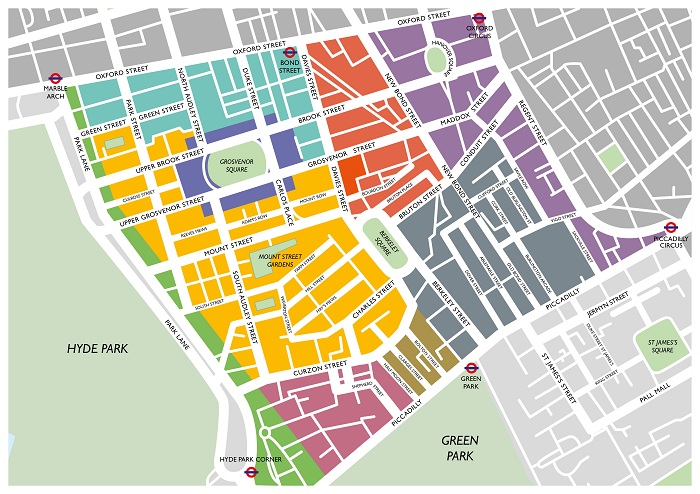
Mayfair Neighborhoods

Present-day Mayfair Neighborhoods

May Fair a Century Ago

We find a curious picture of this west-end carnival by that painstaking antiquary, John Carter, who, writing in 1816, says: “Fifty years have passed away since this place of amusement was at its height of attraction: the spot where the Fair was held still retains the name of May Fair… The market-house consisted of two stories: first story, a long and cross aisle for butchers’ shops, and, externally, other shops connected with culinary purposes; second story, used as a theatre at Fair-time for dramatic performances… Below, the butchers gave place to toy men and gingerbread-bakers. At present, the upper story is unfolded, the lower nearly deserted by the butchers, and their shops occupied by needy peddling dealers in small wares; in truth, a most deplorable contrast to what once was such a point of allurement. In the area encompassing the market building were booths for jugglers, prize-fighters both at cudgels and back-swords, boxing-matches, and wild-beasts. The sports not under cover were mountebanks, fire-eaters, ass-racing, sausage-tables, dice-ditto, up-and-downs, merry-go-rounds, bull-baiting, grinning for a hat, running for a shift, hasty-pudding-eaters, eel-divers, and an infinite variety of other similar pastimes.”
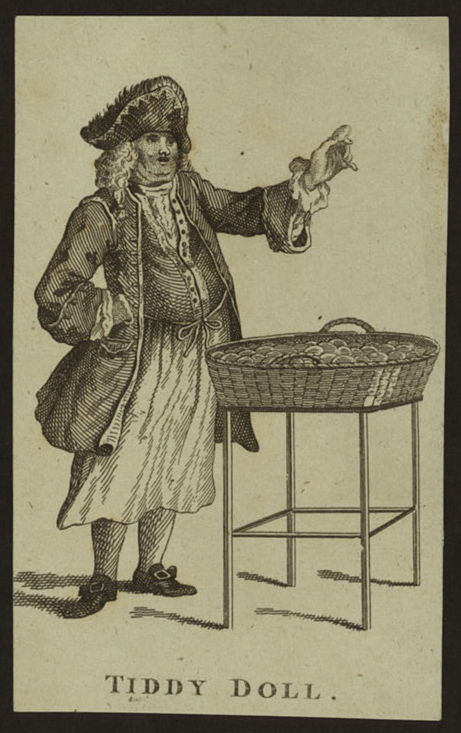
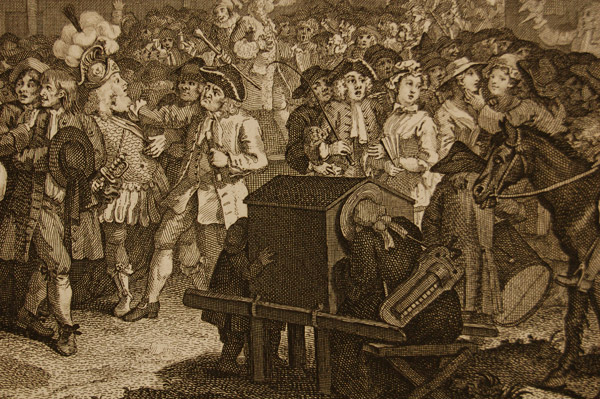
Tiddy Doll, Gingerbread Baker (NYPL Digital Library) Tiddy Doll was a famed 18th century gingerbread vendor, a well-known sight amongst the butchers and toy-men, jugglers and fire-eaters at London’s Bartholomew Fair and Shepherd’s Market in Mayfair. He was even known to ply his wares at public executions, and can be seen in the lower right-hand corner of Hogarth’s Idle Prentice Executed at Tyburn, waving a spicy cake to the boisterous mob. His real name was apparently Ford, acquiring his nickname from a habit of ending his addresses to the crowd with the last lines of a popular ballad, “tid-dy did-dy dol-lol, ti-tid-dy ti-ti, tid-dy tid-dy, dol.” Wearing a white apron over his customary white gold laced suit, ruffled shirt, laced hat and feather and silk stockings, “like a person of rank,” his name was associated for many years with a person dressed out of character, as “you are as tawdry as Tiddy-doll; you are quite Tiddy-doll,” etc.

Tiddy Doll, Gingerbread Baker (NYPL Digital Library)
Tiddy Doll was a famed 18th century gingerbread vendor, a well-known sight amongst the butchers and toy-men, jugglers and fire-eaters at London’s Bartholomew Fair and Shepherd’s Market in Mayfair. He was even known to ply his wares at public executions, and can be seen in the lower right-hand corner of Hogarth’s Idle Prentice Executed at Tyburn, waving a spicy cake to the boisterous mob. His real name was apparently Ford, acquiring his nickname from a habit of ending his addresses to the crowd with the last lines of a popular ballad, “tid-dy did-dy dol-lol, ti-tid-dy ti-ti, tid-dy tid-dy, dol.” Wearing a white apron over his customary white gold laced suit, ruffled shirt, laced hat and feather and silk stockings, “like a person of rank,” his name was associated for many years with a person dressed out of character, as “you are as tawdry as Tiddy-doll; you are quite Tiddy-doll,” etc.

The Woman and the Anvil
anvil

18th century anvil

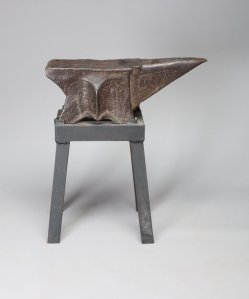
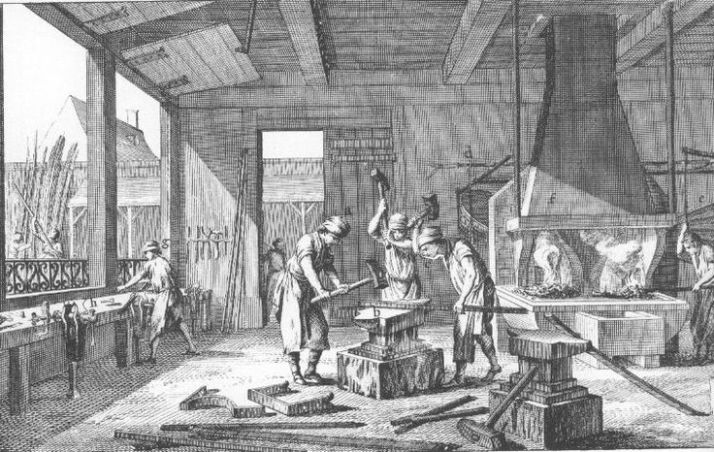
One of the marvels of May Fair, in its latest revival, was the performance of a strong woman, the wife of a Frenchman, exhibited in a house in Sun Court, Shepherd’s Market. The following account is given by John Carter, and may be relied on, as Carter was born and passed his youthful days in Piccadilly [Carter’s Statuary]. He tells us that a blacksmith’s anvil being procured from White Horse Street, with three of the men, they brought it up, and placed it on the floor of the exhibition-room. The woman was short, but most beautifully and delicately formed, and of a most lovely countenance. She first let down her hair (a light auburn), of a length descending to her knees, which she twisted round the projecting part of the anvil, and then, with seeming ease, lifted the ponderous mass some inches from the floor. After this, a bed was placed in the middle of the room; when, reclining on her back, and uncovering her bosom, the husband ordered the smiths to place thereon the anvil, and forge upon it a horse-shoe! This they obeyed: by taking from the fire a red-hot piece of iron, and with their forging hammers completing the shoe with the same might and indifference as when in the shop at their constant labour. The prostrate fair one seemed to endure this with greatest composure, talking and singing during the whole process: then, with an effort, which to the bystanders appeared supernatural, she cast the anvil from off her body, jumping up at the same moment with extreme gaiety, and without the least discomposure of her dress or person. That there was no trick or collusion was obvious from the evidence: the spectators stood about the room with Carter’s family and friends; the smiths were strangers to the Frenchman, but known to Carter, the narrator. She next placed her naked feet on a red-hot salamander, without injury, the wonder of which was, however, understood even at that time.*
Blacksmith's shop

Blacksmith’s shop

*Mr. Daniel, of Canonbury, thought the Strong Woman to have been Mrs. Allchorne, who died in Drury Lane in 1817, at a very advanced age. Madame performed at Bartholomew Fair in 1752.


Romance of London Series

  1. Romance of London: The Lord Mayor’s Fool… and a Dessert
  2. Romance of London: Carlton House and the Regency
  3. Romance of London: The Championship at George IV’s Coronation
  4. Romance of London: Mrs. Cornelys at Carlisle House
  5. Romance of London: The Bottle Conjuror
  6. Romance of London: Bartholomew Fair
  7. Romance of London: The May Fair and the Strong Woman
  8. Romance of London: Nancy Dawson, the Hornpipe Dancer
  9. Romance of London: Milkmaids on May-Day
  10. Romance of London: Lord Stowell’s Love of Sight-seeing
  11. Romance of London: The Mermaid Hoax
  12. Romance of London: The Bluestocking and the Sweeps’ Holiday
  13. Romance of London: Comments on Hogarth’s “Industries and Idle Apprentices”
  14. Romance of London: The Lansdowne Family
  15. Romance of London: St. Margaret’s Painted Window at Westminster
  16. Romance of London: Montague House and the British Museum
  17. Romance of London: The Bursting of the South Sea Bubble
  18. Romance of London: The Thames Tunnel
  19. Romance of London: Sir William Petty and the Lansdowne Family
  20. Romance of London: Marlborough House and Sarah, Duchess of Marlborough
  21. Romance of London: The Duke of Newcastle’s Eccentricities
  22. Romance of London: Voltaire in London
  23. Romance of London: The Crossing Sweeper
  24. Romance of London: Nathan Mayer Rothschild’s Fear of Assassination
  25. Romance of London: Samuel Rogers, the Banker Poet
  26. Romance of London: The Eccentricities of Lord Byron
  27. Romance of London: A London Recluse

Romance of London: Bartholomew Fair

Romance of London: Strange Stories, Scenes And Remarkable Person of the Great Town in 3 Volumes

John Timbs

John Timbs (1801-1875), who also wrote as Horace Welby, was an English author and aficionado of antiquities. Born in Clerkenwell, London, he was apprenticed at 16 to a druggist and printer, where he soon showed great literary promise. At 19, he began to write for Monthly Magazine, and a year later he was made secretary to the magazine’s proprietor and there began his career as a writer, editor, and antiquarian.

This particular book is available at googlebooks for free in ebook form. Or you can pay for a print version.

The vow of a jester

Rahere_Jester_to_Henry_1st

Rahere, jester to King Henry I

This famous Fair, formerly held every year in Smithfield, at Bartholomewtide [August 24], and within the precinct of the Priory of St. Bartholomew, originated in a grant of land from Henry I., to his jester Rahere, who, disgusted by his manner of living, repented him of his sins, and undertook a pilgrimage to Rome. Here, attacked by sickness, he made a vow, that if he recovered his health, he would found a hospital for poor men. Being reinstated, and on his return to England to fulfill his promise, St. Bartholomew is said to have appeared to him in a vision, and commanded him to found a Church in Smithfield, in his name… The site, which had been previously pointed out in a singular manner to Edward the Confessor, as proper for a house of prayer, was a mere marsh, for the most part covered with water; while on that portion which was not so, stood the common gallows—”the Elms,” in Smithfield, which for centuries after continued to be the place of execution.

The Bartholomew Fair

St. Bartholomew's Church

St. Bartholomew’s Church

The Priory, however, looked to temporal as well as spiritual aid, for his foundation; and therefore, obtained a royal charter to hold a Fair annually at Bartholomewtide, for three days—on the eve, the fête-day of the saint, and the day after; “firm peace,” being granted to all persons frequenting the Fair of St. Bartholomew. This brought traders from all parts, to Smithfield: thither resorted clothiers and drapers, not merely of England, but all countries, who there exposed their goods for sale. The stalls or booths were erected within the walls of the priory churchyard, the gates of which were locked each night, and a watch was set in order to protect the various wares…

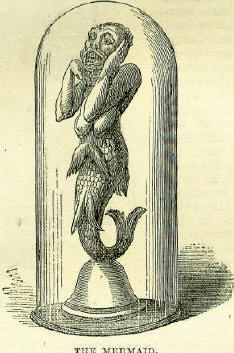
murmaid

At the dissolution of religious houses, the privilege of the Fair was in part transferred to the Mayor and Corporation; and in part to Richard Rich, Lord Rich, who died in 1560, and was ancestor of the Earls of Warwick and Holland. It ceased, however to be a cloth fair of any great importance in the reign of Queen Elizabeth. The drapers of London found another and more extensive market for their woolens; and the clothiers, in the increase of communication between distant places, a wider field for the sale of their manufactures. It subsequently became a Fair of a very diversified character. Monsters, motions, rolls, and rarities were the new attractions to be seen; and the Fair was converted into a kind of London carnival for persons of every condition and degree of life. The Fair was proclaimed by the Lord Mayor, beneath the entrance arch of the priory; and its original connexion with the cloth trade was commemorated in a mock proclamation on the evening before, made by a company of drapers and tailors, who met at the Hand and Shears, a house of call for their fraternity in Cloth Fair, whence they marched and announced the Fair opened and concluded with shouting and the “snapping of shears.”

With respect to the tolls, Strype tells us that “Each person having a booth, paid so much per foot for the first three days. The Earl of Warwick and Holland is concerned in the toll gathered the first three days in the fair, being a penny for each burthen of good brought in or carried out; and to that end there are persons that stand at all the entrances into the Fair…

bartholomewfairup

The Fair lengthens to fourteen days

“In the reign of Charles II., as might be expected, the Fair was extended from three to fourteen days, when all classes, high and low, visited the carnival.” Pepys mentioned walking up and down the fair grounds on August 30, 1667, and discovering Lady Castlemaine at a puppet-play, “and the street full of people, expecting her coming out.” In 1668, Pepys went to the fair “to see the mare that tells money, and many things to admiration, and then the dancing of the ropes, and also the Irish stage play, which is very ridiculous.”

(c) Dover Collections; Supplied by The Public Catalogue Foundation

(c) Dover Collections; Supplied by The Public Catalogue Foundation

Theatrical booths were very popular. “Ben Jonson, the actor (says Dr. Rimbault), was connected with the booth before 1694, in which year he joined Cibber’s company; he was celebrated as the grave-digger in Hamlet…

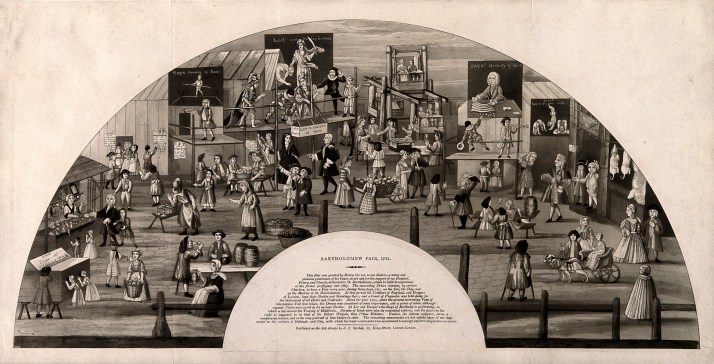
Here were motions or puppet-shows of Jerusalem, Nineveh, and Norwich; and the Gunpowder Plot played nine times in an afternoon; wild beasts, dwarfs, and other monstrosities; operas and tight-rope-dancing and sarabands [dances]; dogs dancing the morris; the hare beating the tabor; and rolls of every degree.

Bartholomew Fair 1825

Bartholomew Fair 1825

From a newspaper in 1734:

At Goodwin’s Large Theatrical Booth, opposite the White Hart, in West Smithfield, near Cow Lane, the town will be entertained with a humorous Comedy of three acts, called ‘The Intriguing Footman, or the Spaniard Outwitted;’ with a Pantomime entertainment of Dancing, between a Soldier and a Sailor, and a Tinker and a Tailor, and Buxom Joan of Deptford.

At Hippisley and Chapman’s Great Theatrical Booth, in the George Inn Yard, Smithfield, the town will be humorously diverted with an excellent entertainment; Signor Arthurian, who has a most surprising talent at grimace, and will, on this occasion, introduce upwards of fifty whimsical, sorrowful, comical, and diverting faces.”

The fourteen days were found too long, for the excesses committed were very great; and in the year 1708, the period of the Fair was restricted to its old duration of three days.

Hogarth 1733

Hogarth 1733

Three days of revelry

The influence of the fair in the neighborhood was to make general holiday… We read that in Little Britain, “during the time of the Fair, there was nothing going on but gossiping and gadding about. The still quiet streets of Little Britain were overrun with an irruption of strange figures and faces; every tavern was a scene of rout and revel. The fiddle and the song are heard from the taproom, morning, noon, and night; and at each window might be seen some group of loose companions, with half-shut eyes, hats on one side, pipe in mouth, tankard in hand, fondling, and prosing, and singing maudlin songs over their liquor. Even the sober decorum of private families was no proof against this saturnalia. There was no such thing as keeping maid-servants within doors. Their brains were absolutely set maddening with Punch and the puppet-show; the flying horses; Signior Polito; the Fire-eater, the celebrated Mr. Paap; and the Irish Giant. The children, too, lavished all their holiday-money in toys and gilt gingerbread, and filled the house with the Lilliputian din of drums, trumpets, and penny whistles.”

V0014666 Bartholomew Fair, site of St. Bartholomew's Hospital, London Credit: Wellcome Library, London. Wellcome Images images@wellcome.ac.uk http://wellcomeimages.org Bartholomew Fair, site of St. Bartholomew's Hospital, London, pictured in 1721. Aquatint with etching, c. 1800. Published: - Copyrighted work available under Creative Commons Attribution only licence CC BY 4.0 http://creativecommons.org/licenses/by/4.0/

Bartholomew Fan

The end of Bartholomew Fair

The Lord Mayor and Aldermen had, for 300 years, tried by orders, proclamations, juries, and presentments to abolish the Fair, but without effect; when the Court of Common Council took the work in hand. Having obtained entire control over the Fair by the purchase of Lord Kensington’s interest, they refused to let standings for shows and booths; they prevailed upon the Lord Mayor and Sheriffs to give up the practice of going to open the Fair in state, with a herald to proclaim it, and officers to marshal the procession; the posting of the proclamation about the streets, interdicting rioting and debauchery during the days of the Fair and within its precincts, were discontinued… In 1852, not a single show was to be seen on the ground; and in 1855 the Fair expired… and Bartholomew Fair was extinct.

Author’s Note: I’m thinking of having my Regency characters attend the fair, even though it was rather scandalous. What do you think?

Bartholomew-Fair

Romance of London Series

  1. Romance of London: The Lord Mayor’s Fool… and a Dessert
  2. Romance of London: Carlton House and the Regency
  3. Romance of London: The Championship at George IV’s Coronation
  4. Romance of London: Mrs. Cornelys at Carlisle House
  5. Romance of London: The Bottle Conjuror
  6. Romance of London: Bartholomew Fair
  7. Romance of London: The May Fair and the Strong Woman
  8. Romance of London: Nancy Dawson, the Hornpipe Dancer
  9. Romance of London: Milkmaids on May-Day
  10. Romance of London: Lord Stowell’s Love of Sight-seeing
  11. Romance of London: The Mermaid Hoax
  12. Romance of London: The Bluestocking and the Sweeps’ Holiday
  13. Romance of London: Comments on Hogarth’s “Industries and Idle Apprentices”
  14. Romance of London: The Lansdowne Family
  15. Romance of London: St. Margaret’s Painted Window at Westminster
  16. Romance of London: Montague House and the British Museum
  17. Romance of London: The Bursting of the South Sea Bubble
  18. Romance of London: The Thames Tunnel
  19. Romance of London: Sir William Petty and the Lansdowne Family
  20. Romance of London: Marlborough House and Sarah, Duchess of Marlborough
  21. Romance of London: The Duke of Newcastle’s Eccentricities
  22. Romance of London: Voltaire in London
  23. Romance of London: The Crossing Sweeper
  24. Romance of London: Nathan Mayer Rothschild’s Fear of Assassination
  25. Romance of London: Samuel Rogers, the Banker Poet
  26. Romance of London: The Eccentricities of Lord Byron
  27. Romance of London: A London Recluse
Romance of London: The Bottle Conjuror

Romance of London: Strange Stories, Scenes And Remarkable Person of the Great Town in 3 Volumes

John Timbs

John Timbs (1801-1875), who also wrote as Horace Welby, was an English author and aficionado of antiquities. Born in Clerkenwell, London, he was apprenticed at 16 to a druggist and printer, where he soon showed great literary promise. At 19, he began to write for Monthly Magazine, and a year later he was made secretary to the magazine’s proprietor and there began his career as a writer, editor, and antiquarian.

This particular book is available at googlebooks for free in ebook form. Or you can pay for a print version.

A “foolish experiment on the credulity of the public”

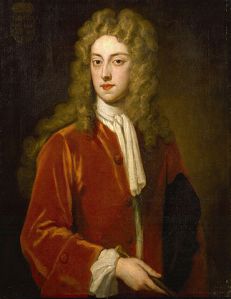
2nd Duke of Montagu

2nd Duke of Montagu

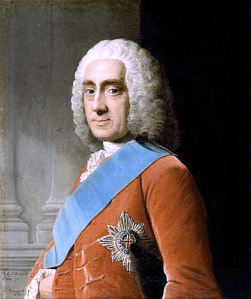
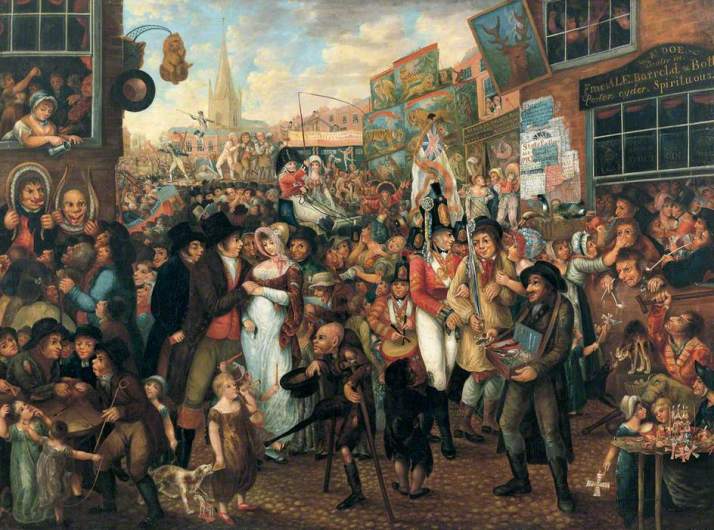
The Duke of Montague being in company with some other noblemen, proposed a wager, that let a man advertise to do the most impossible thing in the world, he would find fools enough in London to fill a playhouse, who would think him in earnest. “Surely,” said Lord Chesterfield, “if a man should say that he would jump into a quart bottle, nobody would believe that!” The Duke was somewhat staggered; but for the sake of the jest, determined to make experiment. Accordingly it was advertised that the next day, (Jan. 10, 1749,) a person would, at the Haymarket Theatre, “play on a common walking-cane the music of every instrument then used, to surprising perfection; that he would, on the stage, get into a tavern quart bottle, without equivocation, and while there, sing several songs, and suffer any spectator to handle the bottle; that if any spectator should come masked, he would, if requested, declare who he was; and that, in a private room, he would produce the representation of any person, dead, with which the person requesting it should converse some minutes, as if alive.” The prices of admission were—gallery, 2s; pit, 3s; boxes, 5s; stage, 7s. 6d.

Haymarket Theater

Haymarket Theater

4th Earl of Chesterfield

4th Earl of Chesterfield

At night the house was crowded with curious people, many of them of the highest rank, including no less eminent a person than the Culloden Duke of Cumberland. They sat for a little while with tolerable patience, though uncheered with music; but by-and-by, the performer not appearing, signs of irritation were evinced. In answer to the continued noise of sticks and catcalls, a person belonging to the theatre came forward and explained that, in the event of a failure of performance, the money should be returned. A wag then cried out, that, if the ladies and gentlemen would give double prices, the conjuror would go into a pint bottle, which proved too much for the philosophy of the audience. A young gentleman threw a lighted candle upon the stage, and a general charge upon that part of the house followed. According to a private letter—it was written by a Scotch Jacobite lady—”Cumberland was the first that flew in a rage, and called to pull down the house… He drew his sword and was in such a rage, that somebody slipped in behind him and pulled the sword out of his hand, which was as much as to say, ‘Fools should not have chopping sticks.’ This sword of his has never been heard of, nor the person who took it. Thirty guineas of reward are offered for it. Monster of Nature, I am sure I wish he may never get it.

Haymarket Theater

Haymarket Theater

At that point, most of the audience charged out of the theater, losing items of clothing in the process, but a few stayed long enough to demolish the inside and take away much of the furnishings for a bonfire on the street.

Cumberland-Reynolds

Duke of Cumberland, younger son of George II (and of Culloden fame)


The proprietor of the theatre afterwards stated that, in apprehension of failure, he had reserved all the money taken, in order to give it back; and he would have returned it to the audience if they would have refrained from destroying his house.

The Bottle-hoax proved an excellent subject for the wits, particularly those of the Jacobite party. In Old England appeared this advertisement: “Found entangled in a slit of a lady’s demolished smock petticoat, a gilt-handled sward of martial temper and length, not much the worse of wearing, with the Spey curiously engraven on one side, and the Scheldt on the other; supposed to be taken from the fat sides of a certain great general in his hasty retreat from the Battle of Bottle Noddles, in the Haymarket. Whoever has lost it may inquire for it at the sign of the Bird and Singing Land, in Rotten Row.”

Romance of London Series

  1. Romance of London: The Lord Mayor’s Fool… and a Dessert
  2. Romance of London: Carlton House and the Regency
  3. Romance of London: The Championship at George IV’s Coronation
  4. Romance of London: Mrs. Cornelys at Carlisle House
  5. Romance of London: The Bottle Conjuror
  6. Romance of London: Bartholomew Fair
  7. Romance of London: The May Fair and the Strong Woman
  8. Romance of London: Nancy Dawson, the Hornpipe Dancer
  9. Romance of London: Milkmaids on May-Day
  10. Romance of London: Lord Stowell’s Love of Sight-seeing
  11. Romance of London: The Mermaid Hoax
  12. Romance of London: The Bluestocking and the Sweeps’ Holiday
  13. Romance of London: Comments on Hogarth’s “Industries and Idle Apprentices”
  14. Romance of London: The Lansdowne Family
  15. Romance of London: St. Margaret’s Painted Window at Westminster
  16. Romance of London: Montague House and the British Museum
  17. Romance of London: The Bursting of the South Sea Bubble
  18. Romance of London: The Thames Tunnel
  19. Romance of London: Sir William Petty and the Lansdowne Family
  20. Romance of London: Marlborough House and Sarah, Duchess of Marlborough
  21. Romance of London: The Duke of Newcastle’s Eccentricities
  22. Romance of London: Voltaire in London
  23. Romance of London: The Crossing Sweeper
  24. Romance of London: Nathan Mayer Rothschild’s Fear of Assassination
  25. Romance of London: Samuel Rogers, the Banker Poet
  26. Romance of London: The Eccentricities of Lord Byron
  27. Romance of London: A London Recluse
Romance of London: Mrs. Cornelys at Carlisle House

Romance of London: Strange Stories, Scenes And Remarkable Person of the Great Town in 3 Volumes

John Timbs

John Timbs (1801-1875), who also wrote as Horace Welby, was an English author and aficionado of antiquities. Born in Clerkenwell, London, he was apprenticed at 16 to a druggist and printer, where he soon showed great literary promise. At 19, he began to write for Monthly Magazine, and a year later he was made secretary to the magazine’s proprietor and there began his career as a writer, editor, and antiquarian.

This particular book is available at googlebooks for free in ebook form. Or you can pay for a print version.

Mrs. Cornelys at Carlisle House

Teresa Cornelys - Carlisle House Soho

Teresa Cornelys at Carlisle House, Soho

Teresa, by birth a German, and during man-years a public singer in Italy and Germany, settled in London about the year 1756, and for twenty years entertained “the votaries of fashion of both sexes” with great success. For this purpose Mrs. Cornelys obtained possession of Carlisle House, in Soho Square, formerly the mansion of the Earl of Carlisle.

Carlisle House

View of Soho Square and Carlisle House

View of Soho Square and Carlisle House

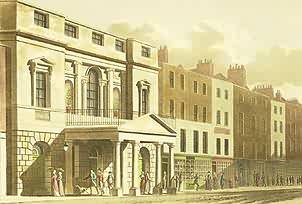
Carlisle House was of considerable extent: the Catholic chapel in Sutton Street was the banqueting-room, and the connecting passage between it and the house in Soho Square was called “the Chinese Bridge.” The arched entrance below the chapel was exclusively for chairs or sedans.

Mrs. Cornelys's assembly room at Carlisle House

Mrs. Cornelys’s assembly room at Carlisle House

The Antecedent of Almack’s?

TICKET

The nobility and gentry had the entrée of Carlisle House by payment of an annual subscription, for which they received a ticket of admission to all entertainments given there. They had the privilege of lending their tickets to friends, provided they wrote “the name of the person upon the back of the said ticket to whom they have lent it, to prevent any mistake.” Mrs. Cornelys had great success; but she had her troubles in powerful competitors; for we find her issuing this advertisement: “Whereas, it is been industriously reported, to the disadvantage of Mrs. Cornelys, that she has expressed herself dissatisfied with a subscription now on foot to build a large room in opposition to her; she esteems it her duty, in this public manner, to declare that she never once entertained a thought so unjust and unreasonable…” The “large room” here referred to in opposition is thus referred to by Horace Walpole, in a letter dated Dec. 16, 1764: “Mrs. Cornelys, apprehending the future assembly at Almack’s, has enlarged her vast room, and hung it with blue satin, and other with yellow satin; but Almack’s room, which is to be 90 feet long, proposes to swallow up both hers, as easily as Moses’s rod gobbled down those of the magician’s.” However, Mrs. Cornelys made additions to Carlisle House, with new embellishments, furniture, and decorations, which in the year 1765 cost some 2,000l… in consequence of which she was compelled to charge subscribers an additional guinea.

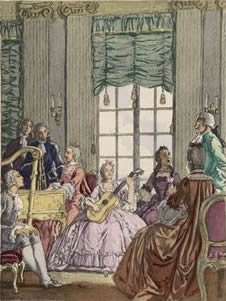
A musical evening at Carlisle House

A musical evening at Carlisle House

The ball on Feb. 26, 1770

…Mrs. Cornelys gave a magnificent fête to some 800 maskers. Walpole devotes great part of a long letter to a description of this masquerade, at which he was present.

Our civil war has been lulled asleep by a Subscription Masquerade, for which the House of Commons literally adjourned yesterday. Instead of Fairfax’s and Cromwells, we have had a crowd of Henry the Eighths, Wolseys, Vandykes, and Harlequins; and because Wilkes was not mask enough, we had a man dressed like him, with a visor in imitation of his squint, and a Cap of Liberty on a pole… The ball was last night at Soho; and, if possible, was more magnificent than the King of Denmark’s…

…The mob was beyond all belief: they held flambeaux to the windows of every coach and demanded to have the masks pulled off and put on at their pleasure, but with extreme good humor and civility. I was with my Lady Hertford and two of her daughters in her coach: the mob took me for Lord Hertford, and huzzaed and blessed me! One fellow cried out, “Are you for Wilkes?” Another said, “D—n you, you fool, what has Wilkes to do with a masquerade?”

Among the company were Lady Waldegrave, Lady Pembroke, the Duchess of Hamilton, Mrs. Crewe, Mrs. Hodges, Lady Algeria Carpenter, &c. The characters assumed were very eccentric. Sir R. Phillips appeared as “a double man,” half-miller, half chimney-sweeper. The Earl of Carlisle figured as a running footman; Mr. James, the painter, as Midas. The Duke of Devonshire was “very fine, but in no particular character.” And “Lord Edg—b, in the character of an old woman, was full as lovely as his lady.” The ladies were superbly dressed. “The Countess Dowager of Waldegrave wore a dress richly trimmed with beads and pearls, in the character of Jane Shore.” “The Duchess of Bolton, in the character of Diana, was captivating.” “Lady Stanhope, as Melpomene, was a striking fine figure.” “Lady August Stuart, as a Vestal, and Lady Caroline as a Fille de Patmos, showed that true elegance may be expressed without gold and diamonds.” “The Countess of Pomfret, in the character of a Greek Sultana, and the two Miss Fredericks, who accompanied her, as Greek slaves, made a complete group;” and to eclipse all, “Miss Moncton, daughter to Lord Galway, appeared in the character of an Indian Sultana, in a robe of cloth of gold and a rich veil. The seams of her habit were embroidered with precious stones, and she had a magnificent cluster of diamonds on her head: the jewels she wore were valued at 30,000l.”

BIGAMOUS DUCHESS OF CHUDLEIGH

The Bigamous Duchess of Kingston

An “opera strife” leads to bankruptcy

In the following year, 1771, Mrs. Cornelys got embroiled in an opera strife. Walpole writes, Feb. 22, 1771: “Our most serious war is between two Operas. Mr. Hobart, Lord Buckingham’s brother, is manager of the Haymarket. Last year he affronted Guadagni, by preferring the Zamperina, his own mistress, to the singing hero’s sister. The Duchess of Northumberland, Lady Harrington, and some of the great ladies, took up the brother, and without a license erected an opera for him at Madame Cornelys’s… Mr. Hobart began to starve, and the managers of the theatre were alarmed. To avoid the Act, she pretended to take no money, and had the assurance to advertise that the subscription was to provide coals for the poor, for she has vehemently courted the mob, and succeed in gaining their princely favour. She then declared her masquerades were for the benefit of commerce.… At last, Mr. Hobart informed against her, and the Bench of Justices, have pronounced against her. Her opera is quashed, and Guadagni… is not only fined, but was threatened to be sent to Bridewell.

Mrs. Cornelys’s masquerades were characterized not only by indecency, but also by mockery of solemn feelings and principles… The lessees of the theatre, injured by her popularity, opposed her; and she was convicted before Sir John Fielding for performing dramatic entertainments without a license.… Next, bills of indictment were preferred to the grand jury, insinuating of Mrs. Cornelys “that she does keep and maintain a common disorderly house, and did permit and suffer diverse loose, idle, and disorderly persons, as well men as women, to be and remain the whole night, rioting and otherwise misbehaving themselves.” In November following, appeared in the bankrupt list of the London Gazette, “Teresa Cornelys, Carlisle House, St. Anne, Soho, dealer.”

Pantheon_from_Papworth's_Select_Views_1816

The Pantheon, one of the competitors of Mrs. Cornelys’s that eventually caused her downfall

Mrs. Cornelys’s last stand

Nevertheless, Mrs. Cornelys resumed her revels here with great spirit in 1776. Two years later, Carlisle House was again advertised to be sold by private contract…

…Mrs. Cornelys attempted to retrieve her fortunes in various places; one being in a large detached mansion, known as Knightsbridge Grove, in Porter’s Lane, approached through a fine avenue of trees from the highway. At length, in 1785, Mrs. Cornelys gave up her precarious trade. “Ten years after,” says Davis’s Memorials of Knightsbridge, “to the great surprise of the public, she reappeared at Knightsbridge as Mrs. Smith, a retailer of asses’ milk. A suite of breakfast-rooms was opened; but her former influence could not be recovered.” The speculation failed; and at length she was confined in the Fleet Prison, where she died August 19, 1797.

In the literature of the day

Murphy, in his Epilogue to Zobeide, 1771, refers to her popularity:

Oh farewell!

For her each haunt that charms a modern belle!

Adieu, Almack’s! Cornelys! Masquerade!

Sweet Ranelagh! Vauxhall’s enchanting shade!

Combe, in his satire, The Diobalady, 1777, thus severely castigates the licentiousness of the amusements:

The ready ministers of hell’s commands, Obedient, fly and take their several stands

At Court,  Cornelys’, and the Coterie;

Where vice, more vicious by effrontery,

Fearless, unblushing, braves the eternal laws

Of God and man, to aid the devil’s cause.

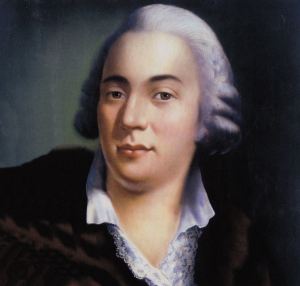
Note: Teresa Cornelys was one of the mistresses of the famous lover, Casanova, to whom she bore a child.

casanova-tour

Giacomo Girolamo Casanova


Romance of London Series

  1. Romance of London: The Lord Mayor’s Fool… and a Dessert
  2. Romance of London: Carlton House and the Regency
  3. Romance of London: The Championship at George IV’s Coronation
  4. Romance of London: Mrs. Cornelys at Carlisle House
  5. Romance of London: The Bottle Conjuror
  6. Romance of London: Bartholomew Fair
  7. Romance of London: The May Fair and the Strong Woman
  8. Romance of London: Nancy Dawson, the Hornpipe Dancer
  9. Romance of London: Milkmaids on May-Day
  10. Romance of London: Lord Stowell’s Love of Sight-seeing
  11. Romance of London: The Mermaid Hoax
  12. Romance of London: The Bluestocking and the Sweeps’ Holiday
  13. Romance of London: Comments on Hogarth’s “Industries and Idle Apprentices”
  14. Romance of London: The Lansdowne Family
  15. Romance of London: St. Margaret’s Painted Window at Westminster
  16. Romance of London: Montague House and the British Museum
  17. Romance of London: The Bursting of the South Sea Bubble
  18. Romance of London: The Thames Tunnel
  19. Romance of London: Sir William Petty and the Lansdowne Family
  20. Romance of London: Marlborough House and Sarah, Duchess of Marlborough
  21. Romance of London: The Duke of Newcastle’s Eccentricities
  22. Romance of London: Voltaire in London
  23. Romance of London: The Crossing Sweeper
  24. Romance of London: Nathan Mayer Rothschild’s Fear of Assassination
  25. Romance of London: Samuel Rogers, the Banker Poet
  26. Romance of London: The Eccentricities of Lord Byron
  27. Romance of London: A London Recluse
Romance of London: Carlton House and the Regency

Romance of London: Strange Stories, Scenes And Remarkable Person of the Great Town in 3 Volumes

John Timbs

John Timbs (1801-1875), who also wrote as Horace Welby, was an English author and aficionado of antiquities. Born in Clerkenwell, London, he was apprenticed at 16 to a druggist and printer, where he soon showed great literary promise. At 19, he began to write for Monthly Magazine, and a year later he was made secretary to the magazine’s proprietor and there began his career as a writer, editor, and antiquarian.

This particular book is available at googlebooks for free in ebook form. Or you can pay for a print version.

Carlton1

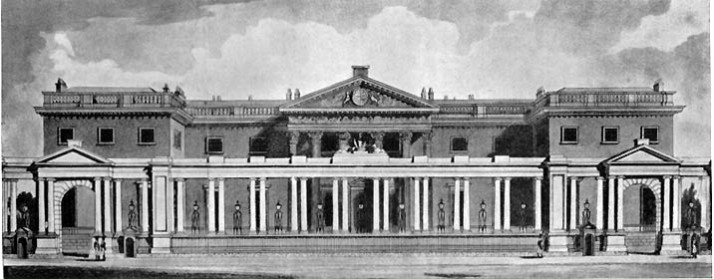
The frontage of Carlton House

Carlton House and the Regency

The Prince Regent’s residence at Carlton House is another place frequently mentioned in historical fiction that is no longer in existence. I had heard that it burned down, but Timbs reports the following:

Carlton House having grown dingy in its fittings, and its history prompting many disagreeable associations, the King projected the enlargement and eventually the rebuilding of Buckingham House; Carlton House was taken down in 1826; the columns of the portico have been transferred to the National Gallery. The exact site of this palace of a century is now the opening between the York Column and the foot of Regent Street.

Plan_of_Carlton_Palace_in_1821

Plan showing the main floor and the suite of reception rooms on the lower ground floor

 Origins

Carlton House, as a royal palace, existed for nearly a century, and was the scene of many important state events, as well as of much prodigality and bad taste. The house, which fronted St. Alban’s Street and St. James’s Park, was originally built by Henry Boyles, Baron Carlton, on a piece of ground leased to him by Queen Anne, in 1709, at 35l. a year; it is described as “parcel of the Royal Garden, near St. James’s Palace,” and “the wood-work and wilderness adjoining.” From Lord Carlton the house and grounds descended to his nephew, Lord Burlington, the architect: he bested it, in 1732, upon his mother, the Countess Dowager of Burlington, who, in the same year, transferred it to Frederick, Prince of Wales, father of George III. The House was a building of red brick, with wings, and was afterwards cased with stone by Sir Robert Taylor. In Lord Burlington’s time, the grounds, which ran westward as far as Marlborough House, were laid out by Kent, in imitation of Pope’s garden at Twickenham. There is a large and fine engraving of the grounds by Woollett; bowers, grottoes, and terminal busts abounding.

Under the Prince Regent (George IV)

When, in 1783, the Prince of Wales, afterwards George IV, was allowed a separate establishment, Carlton House was assigned for his residence, and Holland, the architect, was called in, and added the chief features,—the Ionic screen and the Corinthian portico, fronting Pall Mall. [Horace] Walpole writes to the Countess of Ossor, in the autumn of 1785:

We went to see the Prince’s new palace in Pall Mall; and were charmed. It will be the most perfect in Europe. There is an august simplicity that astonished me. You cannot call it magnificent: it is the taste and propriety that strike. Every ornament is at a proper distance and not one too large, but all delicate and now, with more freedom and variety than Greek ornaments… As Gobert [French architect]… designed the decorations, I expected a more tawdry assemblage of fantastic vagaries than in Mrs. Cornelys’s masquerade-rooms. [Teresa Cornelys, operatic soprano, held many fashionable gatherings at Carlisle House, had many lovers, and bore a child of Casanova.]… There are three most spacious apartments, all looking on the lovely garden, a terrace, the state apartment, and an attic. The portico, vestibule, hall, and staircase will be superb, and, to my taste, full of perspectives; the jewel of all is a small music-room, that opens into a green recess and winding walk of the garden… I forgot to tell you how admirably all the carving, stucco, and ornaments are executed; but whence the money is to come I conceive not—all the tin mines of Cornwall would not pay a quarter. How sick one shall be after this chaste palace, of Mr. Adam’s [Robert Adam, popular 18th century architect] gingerbread and sippets of embroidery!

561px-CarltonStaircase

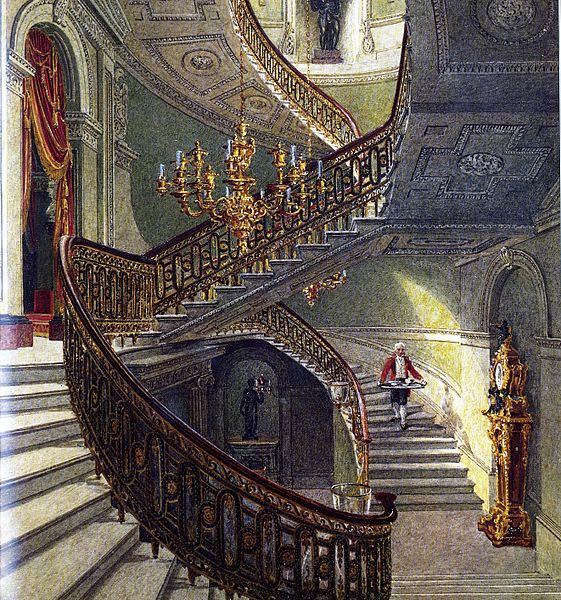
The main staircase, from Pyne’s Royal Residences (1819)

Timbs’s later assessment was not so kind. He says that the conservatory, “imitated from Henry VII’s Chapel, was a failure,” the blue velvet draperies “heavy and dark”; and the “Gothic dining-room was poor.” He found the armory to be “the most curious collection of arms in the world, [filling] four rooms.”

Here was John Hamden’s sword, said to be the work of Cellini; and a golden throne of the King of Candy was backed with a sun of diamonds and precious stones. Here, too, were arms from all nations—caps, boots, spurs, turbans, shields, bows, dresses, models of horses, helmets, sabres, swords, daggers, canopies, palanquins, guns, coats of mail, and other costly presents from all parts of the world.

In the plate-room were some fine specimens of King Charles’s plate; other plate was disposed in the centre of the room, in columns of gold and silver plates, and dishes, and drawers filled with gold and silver knives, forks, spoons, &c.…

The palace was superbly fitted for the Prince’s marriage: 26,000l. Was voted for furnishing, 28,000l. For jewels and plate, and 27,000l for the expense of the marriage. Here was born the Princess Charlotte, January 16, 1796, and the baptism took place on February 11; here, also, the Princess was married, May 2, 1816.

The Fête of June 19, 1811

The most magnificent State event of the Regency was the event given at Carlton House on June 19, 1811, being then the only experiment ever made to give a supper to 2,000 of the nobility and gentry. Covers were laid for 400 in the palace, and for 1,600 in the pavilions and gardens. The fête was attended by Louis XVIII, and the French princes then in exile; and a vast assemblage of beauty, rank, and fashion. The saloon at the foot of the staircase represented a bower with a grotto, lined with a profusion of shrubs and flowers. The grand table extended the whole length of the conservatory, and across Carlton House to the length of 200 feet. Along the centre of the table, about six inches above the surface, a canal of pure water continued flowing from a silver fountain, beautifully constructed at the head of the table. Its banks were covered with green moss and aquatic flowers; gold and silver fish swam and sported through the bubbling current, which produced a pleasing murmur where it fell, and formed a cascade at the outlet. At the head of the table, above the fountain, sat His Royal Highness the Prince Regent on a plain mahogany chair with a feather back. The most particular friends of the Prince were arranged on each side. They were attended by sixty servitors; seven waited on the Prince, besides six of the King’s, and six of the Queen’s footmen, in their state liveries, with one man in a complete suit of ancient armour.

600px-Saint-George_D'Eon_Robineau

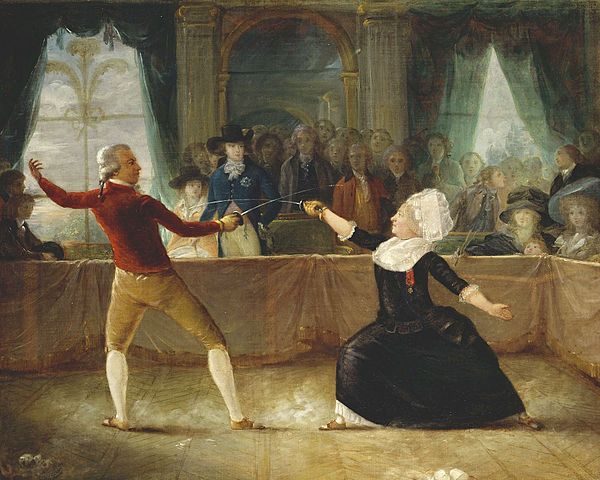
Fencing Match between Chevalier de Saint-Georges and ‘La chevalière D’Eon’ on April 9, 1787 in Carlton House, painting by Charles Jean Robineau

Historical tidbit

Timbs mentions that the portico of Carlton House was the site of the “first public application of the newly-invented lighting by gas.”

Author’s Reflections

I’m thinking the fête might come in hand for a scene in my next story—as an example of the decadence and excess of the Prince Regent. What do you think?


Romance of London Series

  1. Romance of London: The Lord Mayor’s Fool… and a Dessert
  2. Romance of London: Carlton House and the Regency
  3. Romance of London: The Championship at George IV’s Coronation
  4. Romance of London: Mrs. Cornelys at Carlisle House
  5. Romance of London: The Bottle Conjuror
  6. Romance of London: Bartholomew Fair
  7. Romance of London: The May Fair and the Strong Woman
  8. Romance of London: Nancy Dawson, the Hornpipe Dancer
  9. Romance of London: Milkmaids on May-Day
  10. Romance of London: Lord Stowell’s Love of Sight-seeing
  11. Romance of London: The Mermaid Hoax
  12. Romance of London: The Bluestocking and the Sweeps’ Holiday
  13. Romance of London: Comments on Hogarth’s “Industries and Idle Apprentices”
  14. Romance of London: The Lansdowne Family
  15. Romance of London: St. Margaret’s Painted Window at Westminster
  16. Romance of London: Montague House and the British Museum
  17. Romance of London: The Bursting of the South Sea Bubble
  18. Romance of London: The Thames Tunnel
  19. Romance of London: Sir William Petty and the Lansdowne Family
  20. Romance of London: Marlborough House and Sarah, Duchess of Marlborough
  21. Romance of London: The Duke of Newcastle’s Eccentricities
  22. Romance of London: Voltaire in London
  23. Romance of London: The Crossing Sweeper
  24. Romance of London: Nathan Mayer Rothschild’s Fear of Assassination
  25. Romance of London: Samuel Rogers, the Banker Poet
  26. Romance of London: The Eccentricities of Lord Byron
  27. Romance of London: A London Recluse
Vauxhall Gardens: Farewell for Ever

vauxhallbook

The Vauxhall Pleasure Gardens is one of the places I’d love to slip back in time to visit, just to catch a glimpse of what it was like. After recently splurging to buy this lovely coffee-table book, I thought it might make a wonderful subject for a new blog series. But do buy the book too, if you can! The photos are fabulous!

The Final Season: 18-25 July, 1859

blog_vauxhall playbill 07353-1

The Public is respectfully informed that this celebrated Place of Amusement, after an existence of nearly a Century and a Half, and receiving within its Portals the elite of the World is DOOMED TO BE DESTROYED; on Tuesday 26th Workmen will commence taking down the whole of the Buildings, and clearing the Ground in order to Let it for Building purposes. It is therefore with great pleasure that Mr G Stevens, for thirty five years connected with the establishment, informs the public that, through the kindness of the owner of the property, he is enabled to open the Gardens for The last Illuminations! The last Concerts! The Last Horsemanship! The Last Fireworks! The Last Music! The last Dancing! The Last Suppers! And The Last Punch!

On the last night, the “Grand Illumination Gala” included a military band in the Old Orchestra, a juvenile ballet; an equestrian troupe in the Rotunda, as well as numerous acrobats and rope dancers. Dancing on the new Leviathan platform ended with the usual fireworks, but no balloons.

The doors opened at 7 p.m., admission was only 1s, and over fifteen thousand people attended. At the end of the evening Mr. Russell Grover sang the last song, Nevermore shall I return; the last dance was a gallop and, after a short period of silence, the National Anthem was played. Then people began running to the trees on the platform breaking off twigs as souvenirs. Arthur Munby was there and recorded in his diary:

To Vauxhall. It was the last night: dense crowds of people filled the gardens: the circus, the ballet, the dancing & concerts, the supper-rooms, the rifle shooting, the fortune telling, the colored maps and the statues in the long walks—all were there as usual; there was no sign of dissolution: there was nothing in the noisy gaiety of the people (except perhaps that noisy gaiety itself) to show that they knew they were meeting there for the last time. But over all, in large letters formed of colored lamps, hung the words ‘Farewell for ever.’ These were the moral of it all… It is indeed much for a thoughtful man, to have seen the last of Vauxhall: to muse for the last time in those dim lighted alleys, and cry Vanitas vanitatum, and call up melancholy shows of Kings & Court ladies to put to shame the living laughing crowd: but the real sting is, that it is all over.


It’s all gone

All moveable items were sold at auction at bargain prices. The property itself, which was by now extremely valuable for development, was divided up into building plots. The only building left standing today—and it is nearly unrecognizable at this point—is the house that was originally built for the widow of Jonathan Tyers the younger.

pavilion and colonade

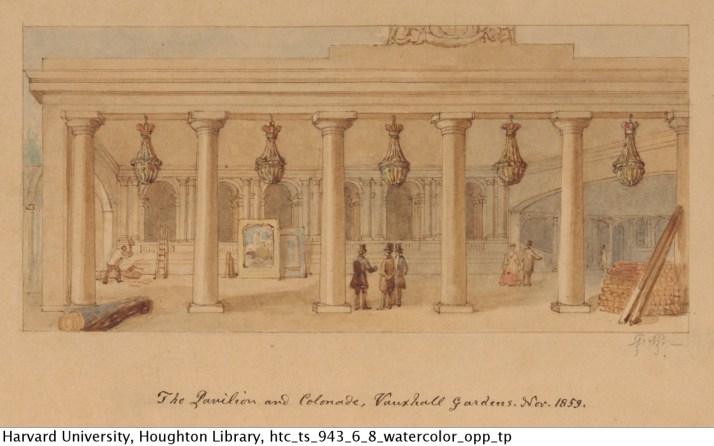
Anon., The Pavilion and Colonnade, Vauxhall Gardens, watercolour, November 1859 (Houghton Library, Cambridge, Mass., Harvard Theatre Collection, Evert Jansen Wendell Bequest, TS 943.6.8F). The pictures have been removed from the walls and workmen prepare for the final demolition.

Why did Vauxhall close?

The weather was always a problem, and became a standing joke that farmers could always count on rain on the day of Vauxhall’s opening for the season. As the years passed, however, “an increasing number of covered areas, where entertainment could be provided even in a downpour” were introduced. Inclement weather is nothing new to outdoor events, but generally “if the attraction is good enough, the public will put up with the rain and the inconvenient delays or postponements associated with bad weather.”

Essentially, though, the Gardens failed to appeal to the Victorian middle classes.

In the seventeenth and eighteenth centuries visitors to Vauxhall would experience an idealized version of a rural idyll—trees, walks and nightingales, supplemented increasingly by music, dining, drinking and man-made illusions… By the end of the eighteenth century, however, it was not enough; the changes in the structure of London society… brought to the gardens a new, less sophisticated clientele for whom the rural idyll no longer exerted its traditional charm. Londoners increasingly saw themselves as citizens of a great industrial power that was coming to dominate the world through trade and military might… [T]he new audiences wanted to be entertained, amazed and thrilled by new attractions that appealed to the self-confident and patriotic spirit of the age.

Madame Saqui’s daring high wire act and Charles Green’s balloons kept the place running long past the time it would naturally have folded. Expensive new novelties added rarely paid for themselves. Inept management and annual battles with magistrates over the renewal of the license—which resulted in increasing restrictions—also contributed to Vauxhall’s demise.

“There was, of course, always a significant section of the potential Vauxhall audience who opposed all attempts to turn the gardens into a modern popular attraction and pined for the good old days under Tyers.” However, in its beginnings, the Vauxhall area was largely rural. “The creeping urbanisation of the area brought with it the seeds of the final failure of the gardens. As they were no longer truly rural, the original reason for their existence disappeared. Yet if they were to offer little more than the theatres and music halls, they were a long way from the centre of town.”

A-photograph-of-Vauxhall--007

Vauxhall Gardens, photograph, c.1859 (Lambeth Landmark, 1259). One of only two known nineteenth-century photographs of the gardens. Lit by the setting sun, the figures in the foreground are standing on the New Monster (or Leviathan) Platform and give an idea of the scale of the Orchestra, the original building of 1758 much altered and lamp-encrusted. The caryatids supporting the sounding board were probably added during the remodeling of 1845.

Vauxhall, farewell forever


Susana’s Vauxhall Blog Post Series

  1. Vauxhall Gardens: A History
  2. Vauxhall Gardens: Jonathan Tyers—“The Master Builder of Delight” 
  3. Vauxhall Gardens: A New Direction
  4. Vauxhall Gardens: The Orchestra and the Supper-Boxes 
  5. Vauxhall Gardens: The Organ, the Turkish Tent, and the Rotunda
  6. Vauxhall Gardens: Three Piazzas of Supper-Boxes
  7. Vauxhall Gardens: “whither every body must go or appear a sort of Monster in polite Company”
  8. Vauxhall Gardens: The Competition
  9. Vauxhall Gardens: The Artwork, Part I
  10. Vauxhall Gardens: The Artwork, Part II
  11. Vauxhall Gardens: The Music, 1732-1859
  12. Vauxhall Gardens: The Business Side
  13. Vauxhall Gardens: Developments from 1751-1786
  14. Vauxhall Gardens: Thomas Rowlandson’s Painting (1785)
  15. ‎Vauxhall Gardens: The Third Generation of the Tyers Family and the Jubilee of 1786
  16. Vauxhall Gardens: An Era of Change (1786-1822), Part I
  17. Vauxhall Gardens: An Era of Change (1786-1822), Part II
  18. Vauxhall Gardens: An Era of Change (1786-1822), Part III
  19. Vauxhall Gardens: The Final Years, Part I
  20. Vauxhall Gardens: The Final Years, Part II
  21. Vauxhall Gardens: The Final Years, Part III
  22. Vauxhall Gardens: The Final Years, Part IV
  23. Vauxhall Gardens: Farewell, for ever


Vauxhall Gardens: An Era of Change (1786-1822), Part III

vauxhallbook

Vauxhall Gardens: A History

David Coke & Alan Borg

The Vauxhall Pleasure Gardens is one of the places I’d love to slip back in time to visit, just to catch a glimpse of what it was like. After recently splurging to buy this lovely coffee-table book, I thought it might make a wonderful subject for a new blog series. But do buy the book too, if you can! The photos are fabulous!

Madame Saqui

Madame Saqui at Vauxhall

Marguerite-Antoinette Lalanne came from an acrobatic family performing first at provincial fairs in France, and then at the fashionable Tivoli Gardens (‘The Paris Vauxhall’). Madame Saqui, as she was after her marriage,   became so popular in France that Napoleon arranged for her to perform for his army, after which she had her coach painted with an imperial eagle.

Once the War with France had definitively come to an end, Vauxhall proprietors George Rogers Barrett and Jonathan Tyers Barrett were determined to persuade her to come to England to perform at Vauxhall. Her first performance, however, was at Covent Garden Theatre. See the print below “of her descending from the balcony on a tight rope, brandishing two large flags, as the men in the audience look up her skirt with telescopes. The caption reads: ‘A Wonderful THING from PARIS… or Madame SACCHI gratifying John Bulls curiosity, at Covent Garden Theatre, April 1816.’

Madame Saqui at Covent Garden

Madame Saqui at Covent Garden

Prior to the opening of the 1816 Vauxhall Season on 3 June, the advertisements included:

At the end of the first Act Mme and Messrs Sachi will go through a variety of surprising evolutions on the Tight Ropse… at the conclusion of the concert… fireworks… when Madame Sachi, in the midst of a brilliant display of Chinese fire, will perform her astonishing Ascension, as exhibited in the Gardens of Tivoli in Paris. Admission to the Gardens is lowered from 4s to 3s 6d.

The weather was perfect and the crowds flocked to catch a glimpse of the new attraction.  The enormous success of the evening led to announcement that Madame Saqui’s troupe would perform every night until further notice. As they did, virtually every night of every season until 1820.

In her first year at Vauxhall, on the birthday of the Prince Regent, Madame Saqui exhibited her ‘grandest Feat which she had the honor of performing before the Sovereigns of Europe two years since, at Paris’—no doubt one of her spectacular ascents… [In 1819], instead of ascending from the ground, she suddenly appeared in the centre of a blazing star, 60 feet above the heads of the astonished crowd; from this she descended amidst a shower of fire accompanied by martial music. Then she turned round, ran back up the rope to the fiery star, only to be lost to view in a new barrage of fireworks. She also continued to perform with her daughter Adèle, the pair dancing an allemande on two or three ropes.

Vauxhall Madam Saqui Descending In 1816, Madame Saqui ascended and descended a tightrope that was fixed to a sixty foot mast accompanied by a firework display

Madame Saqui left Vauxhall after the close of the season in 1820 to do other things, eventually retiring and falling on hard times. She did come out of retirement at the age of seventy-five, performing at the Hippodrome. A correspondent to L’Intermédiare des chercheurs et des curieux said:

When I was a child, I saw her dance on the tightrope at the Hippodrome; she was seventy-five. It was a pitiful sight to see this decrepit figure in a pink costume, her face the color of faded parchment surmounted by a grotesque diadem. She gained in my childhood memory as an unforgettable image of the evil diary Carabosse.

Musicians

One of the characteristics of many Vauxhall performers long service. “It was not unusual for musicians, including singers, to work each season in the gardens for at least twenty years, and some served for much longer: the kettledrummer Jacob Nelson held the record at fifty years…”

James Hook, composer and organist, was a fixture at the park from 1772-1821, composing “over two thousand songs and  at least twenty organ concertos.”

William Parke, an oboist who joined Vauxhall with his brother John in 1776, composed numerous songs, concertos and other pieces, and also wrote Musical Memoires, which is full of information about the music at Vauxhall.

Strolling Players were the Savoyards , who played French and Venetian ballads in groups of four or five throughout the gardens following the main concert in the Orchestra, on instruments that included flutes and cymbals. The Pandeans (although some considered them to be the same as the Savoyards) played on pan-pipes. “The Duchess of Devonshire is known to have preferred the Pandeans…”

Charles Taylor received £290 in 1812. He

…was one of the longest-serving and most popular Vauxhall singers, especially noted for his comic songs. He first appeared in the gardens in 1794, returning regularly thereafter. He made the speech on the last night of the season several times and, unusually for a vocalist, rose to become Director of Music in 1822.

Mrs. Bland first appeared in 1790, retiring in 1823.

21 Mrs Bland THUMB

Described as ‘the sweet-voiced, dumpy little ballad singer’, she was said to have ‘refused an offer [for the 1789 season] of the Vauxhall Managers, to the tune of one hundred and sixty guineas.’ Her voice was ideally suited to the countless ballads that Hook and others wrote for her. Sometimes these demanded special effects—in June 1818, for example, she sang a new song by Parke, which was echoed in a distant part of the gardens by a bugle-horn.

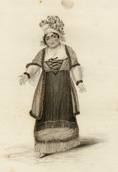
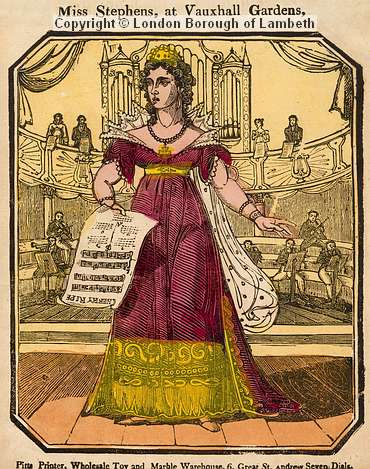
Catherine (Kitty) Stephens, an actress and soprano, married the 5th Earl of Essex in 1838.

Miss Stephens

Charles Dignum first appeared in 1794, but became notable at Vauxhall during the first two decades of the 19th century. “He was well-known for his duets with Mrs Bland, especially Long Time I’ve Courted You, Miss,  a dialogue between a shy sailor and a flirtatious lady.

John Braham, a popular operatic tenor, made his first appearance at Vauxhall as a boy soprano in 1787, “returning as an established star for the season of 1826, for the enormous fee of 800 guineas.”

Miss Feron (Fearon), known for her imitative talent, performed “a new comic song by Parke called The Romp or the Great Catalani, in which she used her powers of mimicry to parody the famous Italian soprano.” This act became so popular that it was repeated often and Parke writes:

…The recitative which introduces the air, ending with the words Great Catalini, it became necessary, in order to make the music accord with the poetry, to repeat a part of the last word, by which it read thus: Great Cat, Great Catalani. This, I was informed, gave umbrage to the lady, who, having perhaps an aversion to the feline race, said that she liked the song very well, with the exception of the Great Cat in it.”

Comic Songs

Parke’s Great Catalani was an early example of the double-entendre, that came to dominate the music hall… The words of many of these songs were published and sold at the gardens, so that the public came to know them by heart and to glamour for their repeated performance.

Susana’s Vauxhall Blog Post Series

  1. Vauxhall Gardens: A History
  2. Vauxhall Gardens: Jonathan Tyers—“The Master Builder of Delight” 
  3. Vauxhall Gardens: A New Direction
  4. Vauxhall Gardens: The Orchestra and the Supper-Boxes 
  5. Vauxhall Gardens: The Organ, the Turkish Tent, and the Rotunda
  6. Vauxhall Gardens: Three Piazzas of Supper-Boxes
  7. Vauxhall Gardens: “whither every body must go or appear a sort of Monster in polite Company”
  8. Vauxhall Gardens: The Competition
  9. Vauxhall Gardens: The Artwork, Part I
  10. Vauxhall Gardens: The Artwork, Part II
  11. Vauxhall Gardens: The Music, 1732-1859
  12. Vauxhall Gardens: The Business Side
  13. Vauxhall Gardens: Developments from 1751-1786
  14. Vauxhall Gardens: Thomas Rowlandson’s Painting (1785)
  15. ‎Vauxhall Gardens: The Third Generation of the Tyers Family and the Jubilee of 1786
  16. Vauxhall Gardens: An Era of Change (1786-1822), Part I
  17. Vauxhall Gardens: An Era of Change (1786-1822), Part II
  18. Vauxhall Gardens: An Era of Change (1786-1822), Part III
  19. Vauxhall Gardens: The Final Years, Part I
  20. Vauxhall Gardens: The Final Years, Part II
  21. Vauxhall Gardens: The Final Years, Part III
  22. Vauxhall Gardens: The Final Years, Part IV
  23. Vauxhall Gardens: Farewell, for ever

Jude Knight: Gingerbread Bride (Mistletoe, Marriage, and Mayhem)

Jude: Today, I’m here in Susana’s Parlour with Mary Pritchard, the heroine of Gingerbread Bride, which is my novella in the Bluestocking Belles’ holiday collection Mistletoe, Marriage, and Mayhem.

Jude: Mary, you have had an unusual upbringing. Can you tell us little about where you grew up?

Mary Pritchard

Mary Pritchard

Mary: Pretty much everywhere, Jude. May I call you ‘Jude’? I do not wish to be disrespectful, but I feel that I know you well. I travelled with my father’s fleet wherever he was posted, so I grew up with the wide world on my doorstep.

Jude: It is surely not common for a lady of gentle birth to be raised by her father aboard ship.

Mary: Many people do not know how common it is for families to travel aboard with their fathers and husbands. Merchant captains often take their wives with them, at least until they have children of age for schooling, and many respectable women also travel with the navy, even though Admiralty Regulations frown on them being taken to sea.

Papa had just been made captain when he married Mama, and he and his new ship were posted almost immediately to South Africa. He did not wish to leave his new bride, so he simply took her with him. He thought, I imagine, that she would go home to live with his sisters, or her own, when she was with child.

I have heard the tale from him many times about how she refused point-blank to leave him, and so I was born aboard, and my father’s ship was my nursery and my playground. Mama died when I was small, along with my little brother. Perhaps another man would have sent me home then, but Papa could not bear to be parted from me, and so that is how I came to grow up with an entire shipload of sailors for my nursemaids and guardians.

Jude: You had an unusual education, then.

Mary: I did, indeed. Not only did I grow up learning geography and botany at first hand, as it were. My father also placed no foolish restrictions on the subjects I learned, in deference to some fable about the ‘female mind’. My succession of nursemaids, hired from the countries we visited, taught me the languages of the towns in which my father took lodgings. I learned mathematics and navigation along with the midshipmen. And various governesses saw to it that I studied the so-called ladylike accomplishments.

Jude: How restrictive London must have seemed when you arrived, Mary.

Mary: London Society is restrictive. So many rules! I suspect they are designed purely to pick out those who defy them or do not know them, so that the gossips and scandalmongers can enjoy their favourite sport of tearing apart other people’s reputation.

I am a great disappointment to my aunt. I would rather read and go to the museums than waste an afternoon at a fashionable event where the only entertainment is seeing and being seen. I enjoy pretty clothes, but I have no desire to spend my entire life dressing and undressing, or shopping for something new when I have a wardrobe full of perfectly suitable garments. And, above all, I will not marry her son, Viscount Bosville. I cannot like the man, and I am fairly certain that he does not like me, either.

Knight - Gingerbread Bride - Rick Redepenning3

Lieutenant Richard Redepenning

Jude: You like Lieutenant Richard Redepenning, I say to Mary, and she flushes and presses her lips together. At first, I think she is not going to answer, but she takes a deep breath and shakes her head, so vigorously that her copper-coloured curls bounce.

Mary: The Lieutenant was my friend when we were children. One would think, would one not, that a friend could call upon another when they were in the same town? But he has been in London this two months, I have had no word from him.

At first, he was confined to bed. He was invalided home, you understand, after being injured by a falling spar. I wanted to go and see him at his sister’s, but my aunt would not allow it. The Rules, you know.

Then he began to go out in Society, and I thought ‘surely he will come to visit’. [She shakes her head again, and shifts in her seat to straighten her spine.] It would be more true to say, Jude, that I liked Lieutenant Redepenning once. I no longer know him.

12318096_536641193152118_2006443492_o

About Gingerbread Bride

Travelling with her father’s fleet has not prepared Mary Pritchard for London Society. When she strikes out on her own, she finds adventure, trouble, and her girlhood hero, riding once more to her rescue.

Naval Lieutenant Rick Redepenning has been saving his admiral’s intrepid daughter from danger since she was nine and he was fourteen. Today’s greatest danger is to his heart. How can he convince her to see him as a suitor, and not just a childhood friend?

Mistletoe, Marriage, and Mayhem: A Bluestocking Belles Collection

In this collection of novellas, the Bluestocking Belles bring you seven runaway Regency brides resisting and romancing their holiday heroes under the mistletoe. Whether scampering away or dashing toward their destinies, avoiding a rogue or chasing after a scoundrel, these ladies and their gentlemen leave miles of mayhem behind them on the slippery road to a happy-ever-after.

Amazon • Amazon UK • Amazon Australia • Barnes & Noble • iBooks • Kobo

***All proceeds benefit the Malala Fund.***

Excerpt

Whatever those two were up to, it was time to stop it. Mary, with some effort, managed to push out the ornamental trellis that blocked the window. As it crashed to the ground, Rick stopped in his tracks, looked up at the tower, then turned and went hurrying back towards the house.

Bother. Was she going to have to rescue herself? But as she thought that, the top legs of a ladder appeared. Looking over the side of the tower, she saw Rick holding the ladder steady.

“Your stair awaits, fair princess,” he joked.

Dressed, or rather undressed, as she was? She looked back at the inside wall. Perhaps she could climb back down, and he could let her out. But she’d only just made the climb and her arms were still trembling; she wasn’t sure she could get back.

Rick was looking anxious. “Is there a problem?”

“Shut your eyes, please?”

His face cleared. “Of course.” And he screwed his eyes shut, rather more dramatically than she thought necessary.

The ladder made the descent easy, and she breathed a sigh of relief as first one foot, then the other, reached the ground. She stopped breathing altogether when Rick’s arms came round her waist.

“Do you have any idea what it does to me to see you clambering around a roof, Mary Pritchard?” he asked, holding her so tight she squeaked. He didn’t release her, but instead, bent his head to rub his cheek on her hair. “I’m confident you had an excellent reason, but I swear, I’ve aged ten years in the last five minutes.”

She had had a reason, but for the moment it escaped her. “Rick?” she asked.

He let her go, stepping backwards. “I beg your pardon. For a moment I… I take it you didn’t send the note your nasty cousin gave me?”

About the Author

Jude Knight copyJude Knight has been telling stories all her life: making up serial tales to amuse her friends and children, imagining sequels to books that have moved her and left her wanting more, occasionally submitting short stories to magazines and the radio, starting more than a dozen novels set in different times and places.

She has devoted most of the last forty years to a career in commercial writing and raising a large family. She wrote and published her first historical romance in 2014, and now has the wind in her sails and a head full of strong determined heroines, heroes with the sense to appreciate them, and villains you’ll love to loathe.

Website and Blog • Facebook • Twitter • Pinterest

Vauxhall Gardens: An Era of Change (1786-1822), Part I

vauxhallbook

Vauxhall Gardens: A History

David Coke & Alan Borg

The Vauxhall Pleasure Gardens is one of the places I’d love to slip back in time to visit, just to catch a glimpse of what it was like. After recently splurging to buy this lovely coffee-table book, I thought it might make a wonderful subject for a new blog series. But do buy the book too, if you can! The photos are fabulous!

While the years from 1732 to 1786 were the undoubtedly the heyday of Vauxhall, the years following the Jubilee continued to attract large numbers of visitors and was the most popular outdoor entertainment for many years. Charles Burney’s daughter Sarah wrote in 1807:

You should quit your Devonshire Shades were it only to share in the universal rage there is for going to Vauxhall. I never knew anything like it. The whole London World seems to be seized with a fit of the fool.

Vauxhall fashions

Vauxhall Fashions, engraving (David Coke’s collection) from La Belle Assemblée no. 7 (August 1806). Many dressmakers and retailers advertised their wares as representing the latest fashions seen at Vauxhall.

Scenes from Vauxhall were presented on stage, authors such as John Keats, Pierce Egan, and William Thackeray wrote about it, and others tried to copy it, in London and elsewhere. Bath’s Sydney Gardens, opened in 1795 and much visited by Jane Austen, was modeled on Vauxhall in London, as was Tivoli in Copenhagen. Vauxhalls started appearing everywhere.

Exif_JPEG_PICTURE

One half of the world don’t know how t’other lives, Sung by Mr. Dignum in Vauxhall Gardens, etching, 1805 (British Museum, London, 1861.0518.1087). A very popular tenor at the gardens, Dignum also gave the farewell address at the end of several seasons.

A change in clientele

In the early nineteenth century, however, with England’s middle and working classes rapidly expanding due to the Industrial Revolution and the rapid growth of London’s population, Vauxhall’s clientele began to change as well.

The social balance was changing too; the old aristocracy watched nervously as France spiralled into revolutionary chaos, and several of the great families decided to move back to the country, to avoid the potential dangers of urban unrest… In addition, social circles were becoming more restricted and inward-looking; the London aristocracy was being rapidly overtaken in terms of numbers by the professional middle classes of industrialists, businessmen, doctors and lawyers. To support them, huge numbers of labourers, tradesmen and servants moved to the capital.

Because of this influx, houses began to pop up in and around Vauxhall, which meant that the Kennington Street area was no longer a country hamlet, but a part of the city itself, and the residents didn’t always appreciate all the racket coming from Vauxhall in the early hours of the morning.

Picturesque Elevation of the Iron Bridge created over the Thames at Vauxhall, engraving, 1816 (David Coke's collection). Designed by the engineer James Walker, the new bridge greatly shortened the land journey from London to Vauxhall Gardens.

Picturesque Elevation of the Iron Bridge created over the Thames at Vauxhall, engraving, 1816 (David Coke’s collection). Designed by the engineer James Walker, the new bridge greatly shortened the land journey from London to Vauxhall Gardens.

A significant advantage was the completion of the new Vauxhall Bridge in August 1816, which shortened considerably the route from the West End.

The bridge remained open all night, both for pedestrians and for coaches, catering for those revellers who stayed on into the small hours, to the annoyance of the local residents who were trying to sleep.

A change of attractions

The form of the entertainments at Vauxhall remained traditional to the end of the eighteenth century. Various new attractions were introduced only gradually and these were directly in response to new forms of popular entertainment that had sprung up elsewhere in London.

One of these was Philip Astley’s enormously popular shows, with “daring displays of horsemanship”, as well as jugglers, tight-rope walkers, and great pageants of historical events. See my post of Astley’s Amphitheatre here.

Vauxhall had always promoted patriotic songs and military bands, and later added battle reconstructions and victory celebrations, after Astley’s model. The Battle of Waterloo was considered to be the “most spectacular event ever staged at Vauxhall.”

Boat races on the Thames was another innovation, which including a rowing race for watermen and a sailing match for ‘gentlemen’s pleasure sailing boats’. Which was followed by a grand gala in the gardens, of course. In 1812, the contest was called the Vauxhall Grand Regatta.

Vauxhall Sailing Match, engraving, 1800 (Minet Library, London, Lambeth Archives Department, V. fo. 57). This appears to be the only surviving image of one of the Vauxhall sailing matches.

Vauxhall Sailing Match, engraving, 1800 (Minet Library, London, Lambeth Archives Department, V. fo. 57). This appears to be the only surviving image of one of the Vauxhall sailing matches.

Advances in science and technology brought ballooning to the gardens, the first balloon ascension beginning in 1802, but not becoming a regular feature until the 1820’s. André Jacques Garnerin, the first Vauxhall aeronaut, experimented with making parachute jumps from balloons. One of his flights included releasing a cat from a height of 600 feet, who descended safely into some resident’s garden. George Colman the younger, a playwright, wrote

Poor Puss in a grand parachute
Was sent to sail down through the air
Plump’d into a garden of fruit,
And played up old Gooseberry there:
The gardener transpiring with fear,
Stared just like a hundred struck hogs;
And swore, tho’ the sky was quite clear,
‘Twas beginning to rain cats and dogs.

Fireworks, first introduced in 1783, were limited to special occasions at first, but pyrotechnic displays did not become standard until 1798.

When it was time for the fireworks to start, a bell was rung and everyone went to the firework ground at the far eastern end of the gardens. The hours varied, displays being advertised at 9, 10 and 11 p.m.; on gala nights there was often more than one show.

Changes in proprietors and prices

Jonathan Tyers the younger’s son-in-law, Bryant Barrett, managed the gardens until his death in 1809, when his sons Jonathan Tyers Barrett and George Rogers Barrett inherited. Jonathan Barrett became sole owner in 1818. In 1821, the gardens were leased to relatives and business partners Thomas Bish and Frederick Gye, later joined by Richard Hughes, “and the trio used their option to buy the property in 1825 for £30,000.”

In 1792, the price of admission was raised to 2 shillings for regular nights and 3 shillings for the Grand Galas (masquerades), which involved elaborate fancy dress.


Susana’s Vauxhall Blog Post Series

Vauxhall Gardens: The Third Generation of the Tyers Family and the Jubilee of 1786

vauxhallbook

Vauxhall Gardens: A History

David Coke & Alan Borg

The Vauxhall Pleasure Gardens is one of the places I’d love to slip back in time to visit, just to catch a glimpse of what it was like. After recently splurging to buy this lovely coffee-table book, I thought it might make a wonderful subject for a new blog series. But do buy the book too, if you can! The photos are fabulous!

Following Jonathan Tyers’s death in 1767, his son Jonathan Tyers the younger managed the gardens, along with the assistance of his sister Elizabeth Wood and other family members, until 1786. At that time, the responsibility for the park was passed on to Bryant Barrett, who was Tyers the younger’s son-in-law, married to his only daughter, Elizabeth.

Barrett was a wax chandler by trade, which was a fortunate coincidence, since Vauxhall Gardens must have been spending a fortune on candles and lighting fixtures.

The most visible aspect of Barrett’s initiative appears in the start of regular newspaper advertisements giving details of the musical programmes for each evening; but it was also at this time that proprietors began to sponsor sailing matches on the Thames.

Lean years at Vauxhall

The 1770’s and early 1780’s had been lean ones for Vauxhall, partly because of the increase in crime and vandalism within its walks; but bad behaviour was clearly not the proprietors’ only problem. …quite apart from financial depression in the early 1770’s and grim news from the American colonies, the appalling weather of the summers of 1775-7 had cost the Tyers family a great deal. …

Samuel Arnold finally had to close Marylebone Gardens in 1778… No clear reason is given for this, but the complaints of local residents, especially about the fireworks, are bound to have been a contributor factor. Ironically, Marylebone’s initial advantage in being so close to London had become its eventual downfall.

The Jubilee of 1786

J. Wooding, The New Temple & Ball Room, on the Jubilee Night, at Vauxhall, engraving, c. 1786. The circular Grand Temple at the junction of the Grand South Walk and the Centre Cross Walk, with the temporary ballrooms added to its north and south. The artist was keen to show all the different forms of lighting in use.

J. Wooding, The New Temple & Ball Room, on the Jubilee Night, at Vauxhall, engraving, c. 1786. The circular Grand Temple at the junction of the Grand South Walk and the Centre Cross Walk, with the temporary ballrooms added to its north and south. The artist was keen to show all the different forms of lighting in use.

The approach of the half-century mark of the opening of Vauxhall Gardens “must have come as a godsend to Barrett at the start of his proprietorship.”

The last great fashionable event had been the hugely successful Ridotto al Fresco of 1769. In a conscious attempt to remind people of the ‘good old days’, when the gardens had last been patronised by fashionable society, the design of the ticket for the vent of the event of seventeen years earlier was adapted for the 1786 Jubilee.

Ticket for the Vauxhall Jubilee, 29 May, engraving. Signed, dated and sealed by Jonathan Tyers the younger, although the management of the park was now in the hands of his son-in-law, Bryant Barrett.

Ticket for the Vauxhall Jubilee, 29 May, engraving. Signed, dated and sealed by Jonathan Tyers the younger, although the management of the park was now in the hands of his son-in-law, Bryant Barrett.

In preparation for the event, which took place on 29 May 1786, the following renovations were completed:

  1. The buildings around the Grove were painted in an elegant pale blue and white livery, and flowering shrubs were planted to appeal to the modern taste in gardening.
  2.  The Rotunda’s interior decoration was completely renewed, with modern mirrors, and the Ionic columns of the Pillared Saloon were renewed with a rich deep pink scagliola. Window frames were replaced and draped with tasselled crimson and silver fabric, and the Rotunda Orchestra was filled with evergreen plants under a decorated ceiling. In the other recess (where the original Rotunda Orchestra had been housed), the large transparent painting of George, Prince of Wales (later the Prince Regent and George IV) in a noble classical pose was replaced with another transparency depicting an amphitheatre of the Corinthian order, through which could be seen a perspective view of a garden. (Apparently, the original transparency was criticized by some as having nothing in common with the Prince’s true character.)
  3. 14,000 coloured lights and wreaths of artificial flowers were draped around the pillars and in festoons around the cornices of the Covered Walks.
  4. A circular Grand Temple was set up at the crossing of the Grand South Walk and the Centre Cross Walk, “little more than a dome on eight classical columns.”
  5. The Centre Cross Walk was partly built over to give more dancing space in two temporary ballrooms, attached to the Grand Temple on the north and south. “The walls of these ballrooms were painted with Arcadian pastoral scenes beyond a range of Ionic columns decorated with wreaths of flowers, while the ceiling showed a sky filled with ‘tender variegated clouds.’” …In each of the ballrooms was an alcove for the musicians, and others for tables stocked with lemonade, capillaire, and orgeat (soft drinks flavoured with orange flower or almond syrup.) The whole strucutre was of course illuminated with thousands of coloured lamps ‘producing a refugency of light that dazzles and surprises.’
  6. On the site of the former Prince’s Pavilion (built for George III’s father), a new room was created for Prince George and his party.
  7. The entrance to the gardens on Kennington Lane was renewed and enlarged, soon becoming the main coach-entrance, later to be expanded with cloakrooms, waiting-rooms, and other public facilities.
handbill

Handbill for the Vauxhall Jubilee, 1786. A very plain and understated piece of printing, designed only to impart information about the event.

The Jubilee was attended by somewhere between five and six thousand people, most in fashionable and elegant costume, a few in fancy dress, which in this period meant smart dress with added details, such as feathers, flowers, ribbons, ruffs, etc., not character costumes.

There were last night above 6000 persons present, and among them some of the first people in the kingdom, but as is always the case at Vauxhall, it was a mélange; the cit and the courtier jostled each other with the usual familiarity; the half guinea was no repellent to the middling order; John Bull loves to shoulder his superiors in rank, his betters he’ll not allow them to be; and where he pays as much for admission, he never considers them to be more than his equals.

Anon., Representation of the Grand Saloon in Vauxhall Gardens, engraving, after 1786. An unusual view of the renovated Rotunda interior, taken from the entrance off the Grand Walk. The Rotunda Orchestra is on the left, and one of Hayman's paintings from his Seven-Years War series is visible in the Pillared Saloon on the right.

Anon., Representation of the Grand Saloon in Vauxhall Gardens, engraving, after 1786. An unusual view of the renovated Rotunda interior, taken from the entrance off the Grand Walk. The Rotunda Orchestra is on the left, and one of Hayman’s paintings from his Seven-Years War series is visible in the Pillared Saloon on the right.

On the following day, the gardens were opened to four thousand people who were not able to get tickets after those for the first event were sold out.

A successful season

Barrett took advantage of the popular trend of holding military fetes to honor the huge numbers of soldiers coming home from North America by promoting a patriotic tone to this one, with large transparencies framed by martial and naval motifs.

Later that year, when George III escaped a “rather pathetic assassination” by a housemaid with a knife outside St. James’s Palace, Vauxhall celebrated the king’s survival with a new patriotic song by James Hook and an organ concerto with variations on God Save the King.

Barrett’s first season at the helm “once more confirmed Vauxhall as a popular and respectable venue for fashionable society during the 1780’s. However,

…the public attitude towards the gardens was beginning to undergo a fundamental change. The largely unquestioning indulgence was now a thing of the past, and questions were being asked as to whether a pleasure garden was more of a nuisance than a benefit. The establishment’s opposition to public entertainment was strengthening.

Neighbors who had complained for years about the disruption caused by those returning home in the early hours of the morning, were starting to be heard.


Susana’s Vauxhall Blog Post Series

  1. Vauxhall Gardens: A History
  2. Vauxhall Gardens: Jonathan Tyers—“The Master Builder of Delight” 
  3. Vauxhall Gardens: A New Direction
  4. Vauxhall Gardens: The Orchestra and the Supper-Boxes 
  5. Vauxhall Gardens: The Organ, the Turkish Tent, and the Rotunda
  6. Vauxhall Gardens: Three Piazzas of Supper-Boxes
  7. Vauxhall Gardens: “whither every body must go or appear a sort of Monster in polite Company”
  8. Vauxhall Gardens: The Competition
  9. Vauxhall Gardens: The Artwork, Part I
  10. Vauxhall Gardens: The Artwork, Part II
  11. Vauxhall Gardens: The Music, 1732-1859
  12. Vauxhall Gardens: The Business Side
  13. Vauxhall Gardens: Developments from 1751-1786
  14. Vauxhall Gardens: Thomas Rowlandson’s Painting (1785)
  15. ‎Vauxhall Gardens: The Third Generation of the Tyers Family and the Jubilee of 1786
  16. Vauxhall Gardens: An Era of Change (1786-1822), Part I
  17. Vauxhall Gardens: An Era of Change (1786-1822), Part II
  18. Vauxhall Gardens: An Era of Change (1786-1822), Part III
  19. Vauxhall Gardens: The Final Years, Part I
  20. Vauxhall Gardens: The Final Years, Part II
  21. Vauxhall Gardens: The Final Years, Part III
  22. Vauxhall Gardens: The Final Years, Part IV
  23. Vauxhall Gardens: Farewell, for ever