Archives

Susana’s Adventures in England: Syon House

syonpark

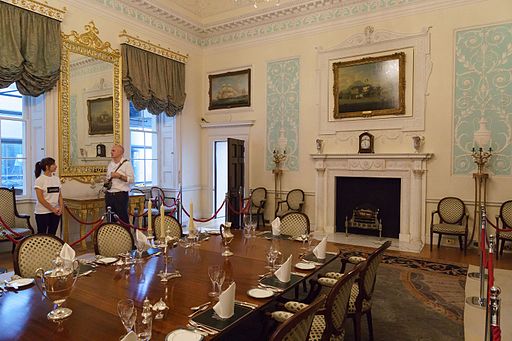
If you’re looking for a stately home to visit in or near London, Syon House is a great choice. Located on the Thames across from Kew Gardens, you can get there by Underground (take the District line toward Richmond, get off at Gunnarsbury) and bus, (take the 237 or 267 bus to Brentlea). The pedestrian entrance is on your right when you get off the bus).

Syon House history

Syon began as an abbey, founded in 1415 by Henry V and closed in 1539 by the Dissolution of the Monasteries. Catherine Howard, fifth wife of Henry VIII, was imprisoned here prior to her execution in 1542. The 1st Duke of Somerset acquired it and had it renovated in Italian Renaissance style. In 1594, the 9th Earl of Northumberland acquired it and has owned it ever since.

A Royal Row

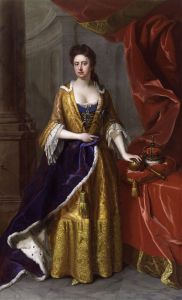
Queen Anne (1705)

Queen Anne (1705)

(from Wikipedia)

In the late 17th century, Syon was in the possession of Charles Seymour, 6th Duke of Somerset, through his wife, Elizabeth Seymour (née Percy). After the future Queen Anne had a disagreement with her sister, Mary II (wife of William III, also known as William of Orange), over her friendship with Sarah Churchill, Countess of Marlborough, she was evicted from her court residence at the Palace of Whitehall and stayed at Syon with her close friends, the Somersets, in 1692. Anne gave birth to a stillborn child there. Shortly after the birth, Mary came to visit her, again demanding that Anne dismiss the Countess of Marlborough and stormed out again when Anne flatly refused.

Mary II, 1685

Mary II, 1685

In the 18th century, Hugh Percy, 1st Duke of Northumberland, commissioned architect and interior designer Robert Adam and landscape designer Lancelot “Capability” Brown to redesign the house and estate. Work began on the interior reconstruction project in 1762. Five large rooms on the west, south and east sides of the House, were completed before work ceased in 1769. A central rotunda, which Adams had intended for the interior courtyard space, was not implemented, due to cost.

Robert Adam!

Robert Adam's plan for Syon House

Robert Adam’s plan for Syon House

from Wikipedia:

Syon House’s exterior was erected in 1547 while under the ownership of the 1st Duke of Somerset. Syon’s current interior was designed by Robert Adam in 1762 under the commission of the 1st Duke and Duchess of Northumberland.

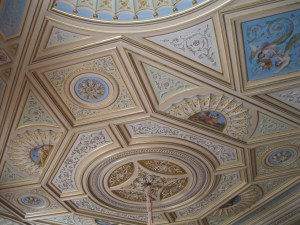
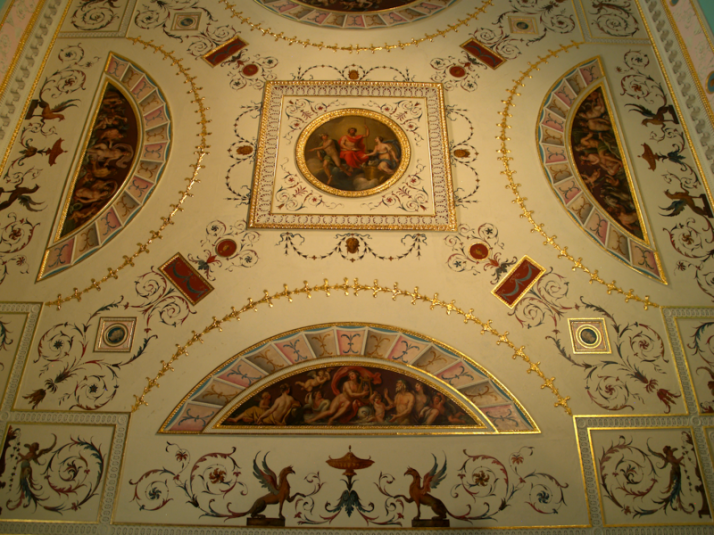
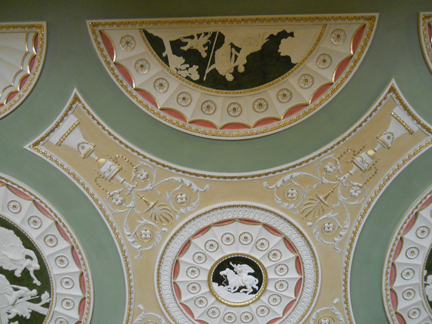
coloredceilingcornerThe well known “Adam style” is said to have begun with Syon House. It was commissioned to be built in the Neo-classical style, which was fulfilled, but Adam’s eclectic style doesn’t end there. Syon is filled with multiple styles and inspirations including a huge influence of Roman antiquity, highly visible Romantic, Picturesque, Baroque and Mannerist styles and a dash of Gothic. There is also evidence in his decorative motifs of his influence by Pompeii that he received while studying in Italy. Adam’s plan of Syon House included a complete set of rooms on the main floor, a domed rotunda with a circular inner colonnade meant for the main courtyard (‘meant for’ meaning that this rotunda was not built due to a lack of funds), five main rooms on the west, east and south side of the building, a pillared ante-room famous for its colour, a Great Hall, a grand staircase (though not built as grand as originally designed) and a Long Gallery stretching 136 feet long. Adam’s most famous addition is the suite of state rooms and as such they remain exactly as they were built.

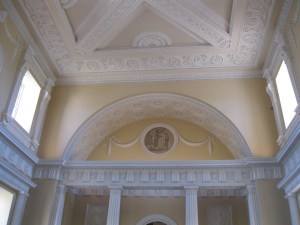
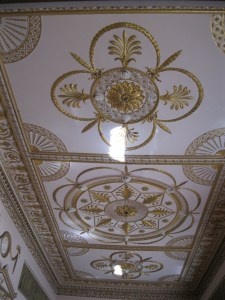
geometricceiling2More specific to the interior of Adam’s rooms is where the elaborate detail and colour shines through. Adam added detailed marble chimneypieces, shuttering doors and doorways in the Drawing Room, along with fluted columns with Corinthian capitals. The long gallery, which is about 14 feet high and 14 feet wide, contains many recesses and niches into the thick wall for books along with rich and light decoration and stucco-covered walls and ceiling. At the end of the gallery is a closet with a domed circle supported by eight columns; halfway through the columns is a doorway imitating a niche.

More photos on my Syon Park Pinterest Page: https://www.pinterest.com/susanaauthor/syon-park/

ceilingalcove

corner3

goldturquoisecorner

librarybooks&portraits

beautifulvase

delicategoldceiling

Romance of London: The Bursting of the South Sea Bubble

Romance of London: Strange Stories, Scenes And Remarkable Person of the Great Town in 3 Volumes

John Timbs

John Timbs (1801-1875), who also wrote as Horace Welby, was an English author and aficionado of antiquities. Born in Clerkenwell, London, he was apprenticed at 16 to a druggist and printer, where he soon showed great literary promise. At 19, he began to write for Monthly Magazine, and a year later he was made secretary to the magazine’s proprietor and there began his career as a writer, editor, and antiquarian.

This particular book is available at googlebooks for free in ebook form. Or you can pay for a print version.

The word “Bubble” as applied to any ruinous speculation, was first applied to the transactions of the South Sea Company, in the disastrous year 1720. It originated in the exaggerated representations of the sudden riches to be realized by the opening of new branches of trade to the South Sea, the monopoly of which was to be secured to the South Sea Company, upon their pretext of paying off the National Debt. The Company was to become the richest the world ever saw, and each hundred pounds of their stock would produce hundreds per annum to the holder. By this means the stock was raised to near 400; it then fluctuated, and settled at 330.

512px-South_Sea_Bubble

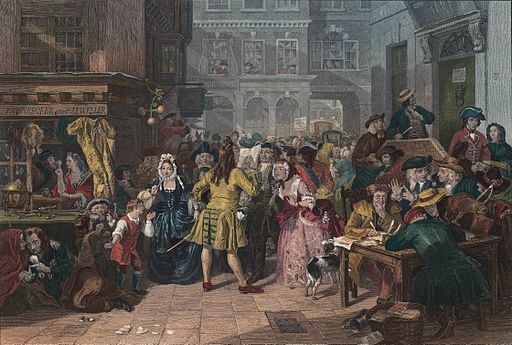
E.M. Ward, “‘Change Alley during the South Sea Bubble.”

Exchange Alley was the seat of the gambling fever;* it was blocked up every day by crowds, as were Cornhill and Lombard Street with carriages.  In the words of the ballads of the day:—

There is a gulf where thousands fell,

There all the bold adventurers came;

A narrow sound, though deep as hell,

‘Change Alley is the dreadful name.—Swift

Then stars and garters did appear

Among the meaner rabble;

To buy and sell, to see and hear

The Jews and Gentiles squabble.

The greatest ladies thither came,

And plied in chariots daily,

Or pawned their jewels for a sum

To venture in the Alley.

Innumerable bubble companies soon started up, by which one million and a half sterling was won and lost in a very short time. The absurdity of the schemes was monstrous: one was “a company for carrying on an undertaking of great advantage, but nobody to know where it is.” In all these bubbles, persons of both sexes alike engaged; the men meeting their brokers at taverns and coffee-houses, and the ladies at the shops of milliners and haberdashers; and in Exchange Alley, shares in the same bubble were sold, at the same instant, then per cent. Higher at one end of the Alley than the other. Meanwhile, the Minister warmed the nation, and the King declared such projects unlawful, and trafficking brokers were liable to 5,000l penalty. The companies were dissolved, but others as soon sprung up. The folly was satirized in caricatures and “stock-jobbing cards.” When Sir Isaac Newton was asked about the continuance of the rising of the South Sea stock, he answered that he could not calculate the madness of the people…

Among the victims was Gay, the poet [author of The Beggar’s Opera], who having had some South Sea Stock presented to him, supposed himself to be the master of 20,000l: his friends importuned him to sell, but he refused, and profit and principal were lost. The ministers grew more alarmed, the directors were insulted in the streets, and riots were apprehended; a run commenced upon the most eminent goldsmiths and bankers, some of whom absconded.

The Committee of Secrecy reported to Parliament the results of their enquiry, showing how false and fictitious entries had been made in the books, erasures and alterations made, and leaves torn out; and some of the most important books had been destroyed altogether. The properties of many thousands of persons, amounting to many millions of money, had been away with. Fictitious stock had been distributed among members of the Government, by way of bribe, to facilitate the passing of the Bill. One of the Secretaries to the Treasury had received 250,000l, as the difference in the price of some stock, and the account of the Chancellor of the Exchequer showed 794,451l. He proved the greatest criminal, and was expelled the House, all his estate seized, and he was committed a close prisoner to the Tower of London. Next day Sir George Casual, of a firm of jobbers who had implicated in the business, was expelled the House, committed to the Tower, and ordered to refund 250,000l. Mr. Craggs the elder died the day before his examination was to have come on. He left a fortune of a million and a half, which was confiscated for the benefit of the sufferers. Every director was mulcted [fined], and two millions and fourteen thousand pounds were confiscated, each director being allowed a small residue to begin the world anew.

The history of the Bubble and other speculations contemporaneously with the South Sea scheme is well narrated in Charles Mackay’s Memoirs of Extraordinary Popular Delusions, vol. i. Pp. 45-84.

The Night Singer of Shares

The Night Singer of Shares

It was about the year 1688 that the world ‘stock-jobber’ was first heard in London. In the short space of four years a crowd of companies, every one of which confidently held out to subscribers the hope of immense gains, sprang into existence: the Insurance Company, the Paper Company, the Lutestring Company, the Pearl Fishery Company, the Glass Bottle Company, the Alum Company, the Blythe Coal Company, the Sword-blade Company. There was a Tapestry Company, which would soon furnish pretty hangings for all the parlours of the middle class, and for all the bed-chambers of the higher.

Others included in Mackay’s publication were:

  • The Copper Company
  • The Diving Company (to investigate shipwrecks), which put on an impressive show of their advanced diving equipment on the Thames for fine gentlemen and ladies eager to be a part of such thrilling treasure-hunting
  • The Greenland Fishing Company
  • The Tanning Company
  • The Royal Academy Company, which would educate 2000 winners of a lottery in Latin, Greek, Hebrew, French, Spanish, conic sections, trigonometry, heraldry, japanning, fortification, bookkeeping, and the art of playing the theorbo.

Some of these companies took large mansions and printed their advertisements in gilded letters. Others, less ostentatious, were content with ink, and met at coffee-houses in the neighbourhood of the Royal Exchange. Jonathan’s and Garraway’s were in a constant ferment with brokers, buyers, sellers, meetings of directors, meetings of proprietors. Time-bargains soon came into fashion. Extensive combinations were formed, and monstrous fables were circulated, for the purpose of raising or depressing the price of shares.

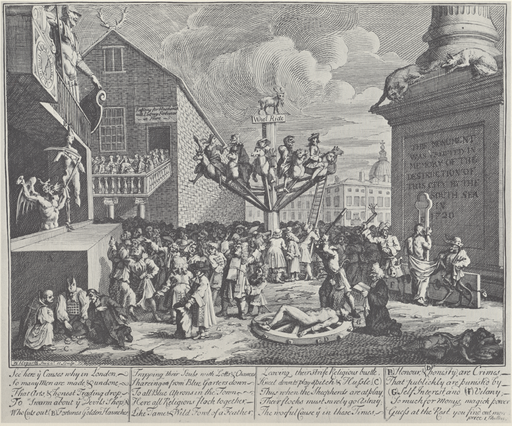
William Hogarth, Emblematical Print on the South Sea Scheme (1721). In the bottom left corner are Protestant, Catholic, and Jewish figures gambling, while in the middle there is a huge machine, like a merry-go-round, which people are boarding. At the top is a goat, written below which is "Who'l Ride". The people are scattered around the picture with a sense of disorder, while the progress of the well-dressed people towards the ride in the middle represents the foolishness of the crowd in buying stock in the South Sea Company, which spent more time issuing stock than anything else.

William Hogarth, Emblematical Print on the South Sea Scheme (1721). In the bottom left corner are Protestant, Catholic, and Jewish figures gambling, while in the middle there is a huge machine, like a merry-go-round, which people are boarding. At the top is a goat, written below which is “Who’l Ride”. The people are scattered around the picture with a sense of disorder, while the progress of the well-dressed people towards the ride in the middle represents the foolishness of the crowd in buying stock in the South Sea Company, which spent more time issuing stock than anything else.

Our country witnessed for the first time those phenomena for which a long experience has made us familiar—a mania, of which the symptoms were essentially the same with those of the mania of 1721, of the mania of 1825, of the mania of 1845, seized the public mind. An impatience to be rich, a contempt for those slow but sure gains which are the proper reward of industry, patience and thrift, spread through society. The spirit of the cogging dicers of Whitefriars took possession of the grave senators of the City, wardens of trades, deputies, aldermen. It was much easier and much more lucrative to put forth a lying prospectus, announcing a new stock, to persuade ignorant people that the dividends could not fall short of twenty per cent., and to part with 5,000l of this imaginary wealth for ten thousand sold guineas, than to load a ship with well-chosen cargo for Virginia or the Levant. Every day a new bubble was puffed into existence, rose buoyant, shone bright, burst, and was forgotten.

*Mr. E.M. Ward, R.A., has painted, with wonderful effect, “‘Change Alley during the South Sea Bubble,” a picture very properly placed in our National Gallery. [Currently Tate]

Susana’s remarks

Plus ça change, plus c’est la même chose.

The more things change, the more they stay the same. 

  • You aren’t going to win a big lottery prize. Or the Publishers’ Clearing House Sweepstakes. Or find buried treasure in your backyard.
  • When someone—even if it’s the Pope himself—offers you something that’s too good to be true, it really is too good to be true. Don’t be fooled.
  • Don’t be greedy. Be satisfied with “slow but sure gains” that are the reward of industry, patience and thrift.”


Romance of London Series

  1. Romance of London: The Lord Mayor’s Fool… and a Dessert
  2. Romance of London: Carlton House and the Regency
  3. Romance of London: The Championship at George IV’s Coronation
  4. Romance of London: Mrs. Cornelys at Carlisle House
  5. Romance of London: The Bottle Conjuror
  6. Romance of London: Bartholomew Fair
  7. Romance of London: The May Fair and the Strong Woman
  8. Romance of London: Nancy Dawson, the Hornpipe Dancer
  9. Romance of London: Milkmaids on May-Day
  10. Romance of London: Lord Stowell’s Love of Sight-seeing
  11. Romance of London: The Mermaid Hoax
  12. Romance of London: The Bluestocking and the Sweeps’ Holiday
  13. Romance of London: Comments on Hogarth’s “Industries and Idle Apprentices”
  14. Romance of London: The Lansdowne Family
  15. Romance of London: St. Margaret’s Painted Window at Westminster
  16. Romance of London: Montague House and the British Museum
  17. Romance of London: The Bursting of the South Sea Bubble
  18. Romance of London: The Thames Tunnel
  19. Romance of London: Sir William Petty and the Lansdowne Family
  20. Romance of London: Marlborough House and Sarah, Duchess of Marlborough
  21. Romance of London: The Duke of Newcastle’s Eccentricities
  22. Romance of London: Voltaire in London
  23. Romance of London: The Crossing Sweeper
  24. Romance of London: Nathan Mayer Rothschild’s Fear of Assassination
  25. Romance of London: Samuel Rogers, the Banker Poet
  26. Romance of London: The Eccentricities of Lord Byron
  27. Romance of London: A London Recluse

Romance of London: Montague House and the British Museum

Romance of London: Strange Stories, Scenes And Remarkable Person of the Great Town in 3 Volumes

John Timbs

John Timbs (1801-1875), who also wrote as Horace Welby, was an English author and aficionado of antiquities. Born in Clerkenwell, London, he was apprenticed at 16 to a druggist and printer, where he soon showed great literary promise. At 19, he began to write for Monthly Magazine, and a year later he was made secretary to the magazine’s proprietor and there began his career as a writer, editor, and antiquarian.

This particular book is available at googlebooks for free in ebook form. Or you can pay for a print version.

The Burning of Montague House

This noble mansion, situated on the north side of Great Russell Street, Bloomsbury, was first built about 1674, by Ralph Montague, Esq., afterwards Baron Montague of Boughton, and Duke of Montague, Keeper of the Wardrobe to Charles II., and who was subsequently in high favor with King William and Queen Anne. The house was erected in the manner of a French palace, from the design of Robert Hooke, the celebrated mathematician, and the inventor of spring-clocks and pocket-watches, and much employed in the rebuilding of London after the Great Fire; he was also Curator of the Royal Society, in the year 1678.

Within ten years this superb mansion was burned down by accident, or rather, by the carelessness of a servant. John Evelyn records in his Diary:—“Jan. 19. 1686.—This night was burnt to the ground my Lord Montague’s palace in Bloomsbery, than which, for paintings and furniture, there was nothing more glorious in England. This happened by the neglect of a servant airing, as they call it, some goods by the fire, in a moist season; indeed, so wet and mild a season had scarce been seen in man’s memory.”

The house was at this time in the occupation of the Earl of Devonshire, to whom Lord Montague had let it, for the sum of 500 guineas by the year. Of its destruction we find another entry:—

Whitehall, the 21st Jan. 1685-6.

“On Wednesday, at one in the morning, a sad fire happened at Montague House, in Bloomsbury, occasioned by the steward’s airing some hangings, &c., in expectation of my Lord Montague’s return home; and sending afterwards a woman to see that the fire-pans with charcoal were removed, which she told me she had done, though she never came there. The loss that my Lord Montague has sustained by this accident is estimated at 40,000l., besides 6,000l. In plate; and my Lord Devonshire’s loss in pictures, hangings, and other furniture is very considerable.”

The North Prospect of Mountague House by James Simonic, 1715

The North Prospect of Mountague House by James Simonic, 1715

Montague House is rebuilt

Lord Montague’s large income was again placed in requisition for the reconstruction of his palace; and though executed by French artists, the plan (that of the hotels of the nobility at Paris) was the same, the new structure being raised upon the foundations and burnt walls of the old one. The architect now employed was one Peter Poughet, a native of Marseilles, who was assisted in the decoration by Charles de la Fosse, Jaques Rousseau, and Jean Baptist Monoyer…  This exclusive employment of French artists in the new house gave rise to the popular but improbable tale, that Montague House was rebuilt at the expense of Louis XIV., to whose court Lord Montague had twice been sent as ambassador.

The second Montague House was finished about 1687; and the eccentric but munificent owner, who in 1705, was created Marquis of Monthermer and Duke of Montague, resided in it till after his death, which took place March 9, 1709. He was succeeded in his titles and estates by his son John, second Duke of Montague, who quitted the vicinity of St. Giles’s for the more courtly region of Whitehall. While a new mansion was being erected for him there, he, however, continued to reside in one of the wings of Montague House. After his removal to Whitehall, the house in Great Russell Street remained unoccupied, until it was purchased, by Act of Parliament, of Lord Halifax, for 10,250l., in the spring of 1754, for “the British Museum.”

Montagu House drawing by Nicholas Sutton, published in 1754

Montagu House drawing by Nicholas Sutton, published in 1754

The British Museum

The building must have been in a very dilapidated condition, for the repairs cost more than the purchase, and, with furniture, &c., amounted to the large sum of 29,736l. 10s. 10d.

In plan, the old Museum resembled a French hotel of the first class: consisting of a large and lofty pile, with two sides built for offices, and a high front wall, with an arched doorway, and above it an octangular turret, surmounted by a cupola and vane; this was the principal entrance, and was known as “Montague Great Gate;” and at each extremity of the wall was a square turret.

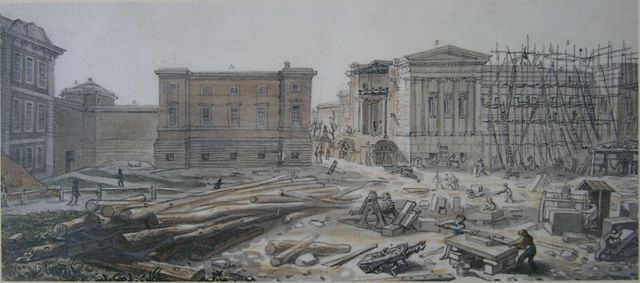
Left to Right: Montagu House, Towny Gallery, and Sir Robert Smirkes' West Wing Under Construction, July 1828

Left to Right: Montagu House, Towny Gallery, and Sir Robert Smirkes’ West Wing Under Construction, July 1828

To the original building additions were made from time to time, as the collection increased, until 1820, when the rebuilding of the Museum was commenced; the plan bordering three sides of the spacious area formerly occupied by the gardens of Montague House, behind the original mansion. By this means, the collection was removed from the old into the new building as the latter progressed, without any inconvenience to the public. In like manner, the principal front took the place of the old Montague House façade, which was removed piecemeal; and strange it was to see the lofty pitched roof, balustraded attic, and large windowed front of “the French manner,” giving way to the Grecian architecture of Sir Robert Smirke’s new design. The octangular and not unpicturesque apartment over the great gateway lingered for some time after, and was the last to disappear of old Montague House. The materials were sold by auction; and curious was it to see such pieces of the painted walls and ceilings as could be removed entire, bringing a few shillings—one of La Fosse’s deities for half-a-crown, or a bunch of Monoyer’s flowers for 1s. 6d.

The Waddesdon Bequest

This has nothing to do with Montague House, but is just something interesting I came across while researching this blog post. Last summer I visited Waddesdon Manor in Aylesbury, which is where Baron Ferdinand de Rothschild displayed the treasures he acquired from his travels to the Continent and beyond. Baron Rothschild is quite the romantic figure. He fell in love and married his second cousin Evelina, only to lose her in childbirth eighteen months later. He never married again, but spent his life in the acquisition and admiration of beautiful objects. Click here to take a look at my Pinterest board for Waddesdon Manor.

In 1898 he bequeathed the contents of his New Smoking Room at Waddesdon Manor to the British Museum.

This consisted of almost 300 pieces of objets d’art et de vertu which included exquisite examples of jewellery, plate, enamel, carvings, glass and maiolica, among them the Holy Thorn Reliquary, probably created in the 1390s in Paris for John, Duke of Berry. The collection was in the tradition of a schatzkammer or treasure house such as those formed by the Renaissance princes of Europe. Baron Ferdinand’s will was most specific, and failure to observe the terms would make it void, the collection should be

placed in a special room to be called the Waddesdon Bequest Room separate and apart from the other contents of the Museum and thenceforth for ever thereafter, keep the same in such room or in some other room to be substituted for it

The Waddesdon Bequest

The Waddesdon Bequest

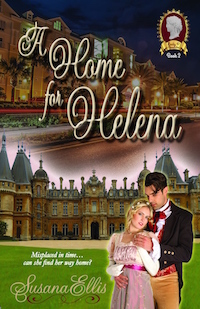
As a footnote, the cover of my time travel, A Home for Helena, includes a photograph of Waddesdon Manor taken last September at the time of my visit.

Home for Helena Cover 200x309

Amazon

Romance of London Series

  1. Romance of London: The Lord Mayor’s Fool… and a Dessert
  2. Romance of London: Carlton House and the Regency
  3. Romance of London: The Championship at George IV’s Coronation
  4. Romance of London: Mrs. Cornelys at Carlisle House
  5. Romance of London: The Bottle Conjuror
  6. Romance of London: Bartholomew Fair
  7. Romance of London: The May Fair and the Strong Woman
  8. Romance of London: Nancy Dawson, the Hornpipe Dancer
  9. Romance of London: Milkmaids on May-Day
  10. Romance of London: Lord Stowell’s Love of Sight-seeing
  11. Romance of London: The Mermaid Hoax
  12. Romance of London: The Bluestocking and the Sweeps’ Holiday
  13. Romance of London: Comments on Hogarth’s “Industries and Idle Apprentices”
  14. Romance of London: The Lansdowne Family
  15. Romance of London: St. Margaret’s Painted Window at Westminster
  16. Romance of London: Montague House and the British Museum
  17. Romance of London: The Bursting of the South Sea Bubble
  18. Romance of London: The Thames Tunnel
  19. Romance of London: Sir William Petty and the Lansdowne Family
  20. Romance of London: Marlborough House and Sarah, Duchess of Marlborough
  21. Romance of London: The Duke of Newcastle’s Eccentricities
  22. Romance of London: Voltaire in London
  23. Romance of London: The Crossing Sweeper
  24. Romance of London: Nathan Mayer Rothschild’s Fear of Assassination
  25. Romance of London: Samuel Rogers, the Banker Poet
  26. Romance of London: The Eccentricities of Lord Byron
  27. Romance of London: A London Recluse

Romance of London: St. Margaret’s Painted Window at Westminster

Romance of London: Strange Stories, Scenes And Remarkable Person of the Great Town in 3 Volumes

John Timbs

John Timbs (1801-1875), who also wrote as Horace Welby, was an English author and aficionado of antiquities. Born in Clerkenwell, London, he was apprenticed at 16 to a druggist and printer, where he soon showed great literary promise. At 19, he began to write for Monthly Magazine, and a year later he was made secretary to the magazine’s proprietor and there began his career as a writer, editor, and antiquarian.

This particular book is available at googlebooks for free in ebook form. Or you can buy a print version.

YES

The history of the painted glass cinquecento Window, which, in 1758, was placed in the chancel, over the altar of St. Margaret’s Church, is truly romantic.

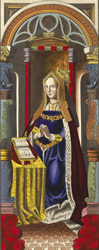
Elizabeth of York

Elizabeth of York

This beautiful window (said to have been executed at Gouda, in Holland, and to have occupied five years in the making) was originally intended by the magistrates of Dort as a present to Henry VII., by whom it was intended for his Chapel at Westminster; or as some say, it was ordered by Ferdinand and Isabella on the occasion of Prince Arthur being affianced, in 1499, to the Princess Catherine of Arragon, their portraits being procured for the purpose.

The three middle compartments represent the Crucifixion, with the usual accompaniments of angels receiving in a chalice the blood which drops from the wounds of the Saviour. Over the good thief an angel is represented wafting his soul to Paradise; and over the wicked, the devil in the shape of a dragon carrying his soul to a place of punishment. In the six upper compartments are six angels holding the emblems of crucifixion: the cross, the sponge, the crown of thorns, the hammer, the rods and nails. In the right hand lower compartment is Arthur, Prince of Wales (eldest son of Henry VII); and in the companion or left side, Catherine of Arragon, his bride (afterwards married to his brother Henry VIII., and divorced by him). Over the head of Prince Arthur is a full-length figure of St. George, with the red and white roses of England; and over Catherine of Arragon, a full-length figure of St. Catherine, with the bursting pomegranate, the emblem of the kingdom of Granada.

Prince Arthur died before the window was finished; the King himself before it could be erected. Succeeding events—the marriage of Henry VIII. To the bride or widow of his brother, with the subsequent divorce of Catherine—rendered the window wholly unfit for the place for which it was intended.

The window through the ages

  1. Catherine of Aragon

    Catherine of Aragon

    Henry VIII gave it to Waltham Abbey, Essex.

  2. At the Dissolution, Robert Fuller, the last Abbot, sent it to his private chapel at New Hall, also in Essex.
  3. It was later acquired by the father of Anne Boleyn.
  4. Queen Elizabeth I gave it to Thomas Ratcliff, Earl of Sussex, who was living at New Hall.
  5. It was purchased by Villiers, Duke of Buckingham, favorite of James I.
  6. Its next owner was Oliver Cromwell.
  7. At the Restoration, it reverted to the second Duke of Buckingham.
  8. It was purchased, along with New Hall, to General Monk, Duke of Albermarle. The duke buried it underground to keep it from the Puritans. After the Restoration he returned it to his chapel at New Hall.
  9. After he died and his son as well, the hall became the property of the duchess, and fell into ruin and decay.
  10. John Olmius, Esq., purchased the property and demolished the chapel, preserving the window.
  11. Eventually it was purchased by Mr. Conyers, of Copt Hall, Essex, for 50 guineas, for his own chapel.
  12. Conyers’ son, Mr. John Conyers sold the window in 1758 to the churchwardens of St. Margaret’s Westminster for 400 guineas.
St. Margaret's Church (background)

St. Margaret’s Church (background)

“It is worth the walk”

It is worth a walk to St. Margaret’s to see this window. The late Mr. Winston, the great authority upon glass-painting, says of it: “Though at present much begrimed with London smoke and soot, it may be cited as an example of the pictorial excellence attainable in a glass-painting without any violation of the fundamental rules and conditions of the art. The harmonious arrangement of the coloring is worthy of attention. It is the most beautiful work in this respect that I am acquainted with.”

The church has been in our time, as it was centuries ago in Stow’s time, “in danger of pulling down;” which, if carried into effect, would add another leaf to the history of the St. Margaret’s Painted Window.

Thankfully, this last threat to the location of this window have not come to pass. I’m definitely putting St. Margaret’s on my list for this year’s trip, in August.

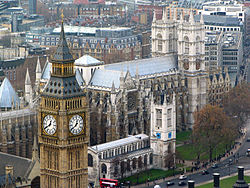
St. Margaret's Church from the London Eye

St. Margaret’s Church from the London Eye


Romance of London Series

  1. Romance of London: The Lord Mayor’s Fool… and a Dessert
  2. Romance of London: Carlton House and the Regency
  3. Romance of London: The Championship at George IV’s Coronation
  4. Romance of London: Mrs. Cornelys at Carlisle House
  5. Romance of London: The Bottle Conjuror
  6. Romance of London: Bartholomew Fair
  7. Romance of London: The May Fair and the Strong Woman
  8. Romance of London: Nancy Dawson, the Hornpipe Dancer
  9. Romance of London: Milkmaids on May-Day
  10. Romance of London: Lord Stowell’s Love of Sight-seeing
  11. Romance of London: The Mermaid Hoax
  12. Romance of London: The Bluestocking and the Sweeps’ Holiday
  13. Romance of London: Comments on Hogarth’s “Industries and Idle Apprentices”
  14. Romance of London: The Lansdowne Family
  15. Romance of London: St. Margaret’s Painted Window at Westminster
  16. Romance of London: Montague House and the British Museum
  17. Romance of London: The Bursting of the South Sea Bubble
  18. Romance of London: The Thames Tunnel
  19. Romance of London: Sir William Petty and the Lansdowne Family
  20. Romance of London: Marlborough House and Sarah, Duchess of Marlborough
  21. Romance of London: The Duke of Newcastle’s Eccentricities
  22. Romance of London: Voltaire in London
  23. Romance of London: The Crossing Sweeper
  24. Romance of London: Nathan Mayer Rothschild’s Fear of Assassination
  25. Romance of London: Samuel Rogers, the Banker Poet
  26. Romance of London: The Eccentricities of Lord Byron
  27. Romance of London: A London Recluse

Romance of London: The Lansdowne Family

Romance of London: Strange Stories, Scenes And Remarkable Person of the Great Town in 3 Volumes

John Timbs

John Timbs (1801-1875), who also wrote as Horace Welby, was an English author and aficionado of antiquities. Born in Clerkenwell, London, he was apprenticed at 16 to a druggist and printer, where he soon showed great literary promise. At 19, he began to write for Monthly Magazine, and a year later he was made secretary to the magazine’s proprietor and there began his career as a writer, editor, and antiquarian.

This particular book is available at googlebooks for free in ebook form. Or you can pay for a print version.

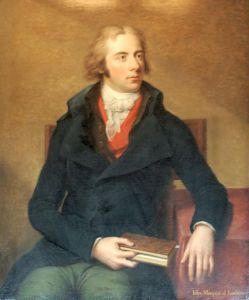
William Petty, 1st Marquis Lansdowne

William Petty, 1st Marquis Lansdowne

In 1805 died the second Marquis of Landsdowne, having by this time passed very much out of popular notice, and the principal cause of public regret for his demise was that only a fortnight before his death he had declared his knowledge of the Junius secret [see below], and yet among his papers was to be found no indication that could lead to its discovery. He was succeeded by his eldest son, the Earl of Wycombe, whose first act on coming into possession was to sell almost all of the literary and artistic treasures which his father had accumulated with so much love and labour. The greater part of these were dispersed under the hammer of the auctioneer, many of the pictures going to enrich the Grosvenor, the National, and other galleries; only the Lansdowne MSS. Were kept together, being purchased by the British Museum; while the gallery of antique marbles was the sole portion of the collection for which the Marquis showed any appreciation—his opinion being expressed in the fact that he purchased it from his father’s executors for 6,000l. If, however, this nobleman did not show much respect to his father’s cultivated tastes, he was not without a certain ancestral pride; for he tried to build a vessel on the principle of Sir William Petty’s double-bottomed ship that was to sail against wind and tide—a model of which was then, and is perhaps still, exhibited in the Council-room of the Royal Society. Of nautical habits, he also built near the Southampton Water a marine villa, in which, from dining-hall and private bower to kitchen and scullery, all was utter Gothic, while the gardens belonging to the castle were laid out at Romsey, some ten or twelve miles distant, on a site which formed the original estate of the Petty family.

John Petty, 2nd Marquis of Lansdowne

John Petty, 2nd Marquis of Lansdowne

Here, if not in his yacht voyaging to Ireland or the Continent, he spent most of his time. In London he was a marked man—remarkable for his disregard of dress, and for the pride which he took in appearing on the coldest days in winter without a greatcoat and without gloves. He died in November 1809, and was succeeded by his half-brother, the fourth [third] Marquis, whose first care was to purchase the antique marbles from his sister-in-law, and there at Landsdowne House they may now be seen—some of them, as the youthful Hercules and the Mercury, justly considered the finest statues of the kind that have found their way to this country. As for the pictures, when the Marquis succeeded to the title, in 1809, there was not one in this splendid mansion, with the exception of a few family portraits; but Lord Lansdowne set himself to the formation of a gallery which now comprises nearly 200 pictures of rare interest and value, but miscellaneous in their character, no school nor master predominating unless it be Sir Joshua Reynolds. Some of the portraits in this collection are of great interest. There is the celebrated portrait of Pope by Jervas; Reynolds’s wonderful portrait of Sterne; one of Franklin, by Gainsborough; a beautiful one of Peg Woffington, by Hogarth; Lady Hamilton appears twice—as a bacchante and a gipsy, from the pencil of Romney; Horner, the old college friend of Lord Lansdowne, is not forgotten; but, most interesting of all, there is the lovely portrait of Mrs. Sheridan, as St. Cecilia, painted by Reynolds.

mrs. sheridan

Mrs. Richard Brinsley Sheridan, by Gainsborough

It may recall with some vividness the fashion of those times if we record a little incident connected with this portrait. During the short-lived Ministery of “All the Talents,” the Whig leaders celebrated their return to power by a continual found of festivities, in which Sheridan outside all his colleagues. One Sunday (25th of May 1806) he gave a grand dinner; on the Monday following a supper and ball, at which the dancing was prolonged to past eight o’clock next morning; on the Tuesday, a christening, a masque, and another ball, the Prince being present on each occasion, and the Lord Chancellor Erskine and the young Chanceller of the Exchequer, Henry Petty, being conspicuous among the dancers. On the occasion of the dinner, the portrait of Mrs. Sheridan was redeemed for one night only from the pawnbroker’s, and exhibited in its place in the dining-room; when poor Sheridan died, it was still in possession of the pawnbroker; it then fell into the hands of Sheridan’s solicitor, and from him it was purchased for 600l. By Lord Lansdowne. In this little incident we get some glimpses of that conviviality for which the Whigs were distinguished. “Le Whig est la femme de votre Gouvernement,” says Balzac, and the truth of the remark is especially illustrated in that social influence which the Whigs have always cultivated more than the Tories.*

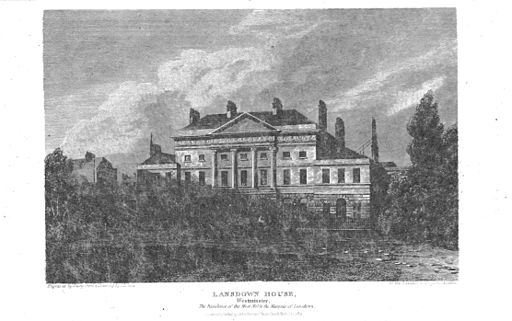
Lansdowne House (1820)

Lansdowne House (1820)

Lansdowne House was built by Robert Adam for the Marquis of Bute, when minister to George III, and sold by the Marquis before completion to Lord Shelburne, afterwards Marquis of Lansdowne, for 22,000l., which was supposed to be 3,000l. Less than it cost. There is, also, a piece of political scandal—that Lansdowne House was constructed by one Peace (Lord Bute’s, in 1762), and paid for by another (Lord Shelburne’s, in 1783).

*From The Times journal

Lansdowne House was partially demolished in the 1930’s to make room for a new road, and some of its noted interiors located elsewhere.

The dining room from Landsdowne House, now located at the Lloyd's Building

The dining room from Landsdowne House, now located at the Lloyd’s Building


A drawing room now found at the Philadelphia Museum of Art

A drawing room now found at the Philadelphia Museum of Art


Lansdowne House ceiling (Robert Adam)

Lansdowne House ceiling (Robert Adam)


*The Junius Secret

Junius was the pseudonym of a man who wrote letters exposing corruption in government from 1768 to 1772. His identity has never been discovered, but was the source of much speculation. If Lord Lansdowne indeed knew it, he died without revealing the secret.

More information on Wikipedia.

The Secret Revealed of the Authorship of Junius’s Letters

Romance of London: Comments on Hogarth’s “Industrious and Idle Apprentices”

Romance of London: Strange Stories, Scenes And Remarkable Person of the Great Town in 3 Volumes

John Timbs

John Timbs (1801-1875), who also wrote as Horace Welby, was an English author and aficionado of antiquities. Born in Clerkenwell, London, he was apprenticed at 16 to a druggist and printer, where he soon showed great literary promise. At 19, he began to write for Monthly Magazine, and a year later he was made secretary to the magazine’s proprietor and there began his career as a writer, editor, and antiquarian.

This particular book is available at googlebooks for free in ebook form. Or you can pay for a print version.

Comments on Hogarth’s “Industrious and Idle Apprentices”

William Makepeace Thackeray

William Makepeace Thackeray

Mr. Thackeray, in his Lectures on the English Humorists, thus vividly paints the scenes of Hogarth’s masterpieces; at the same time he very ingeniously contrasts the past with the present—one of the more immediate benefits of the Lecture: the past is generally interesting, but it chiefly becomes instructive when brought under the powerful focus of the present. His account of Hogarth’s “Apprentices” is a masterpiece in this way:

1William_Hogarth_-_Industry_and_Idleness,_Plate_1;_The_Fellow_'Prentices_at_their_Looms

William_Hogarth-Industry and Idleness, Plate 1; The Fellow ‘Prentices at their Looms

Fair-haired Frank Goodchild smiles at his work, whilst naughty Tom Idle snores over his loom. Frank reads the edifying ballads of Whittington and the London ‘Prentice: whilst that reprobate Tom Idle prefers Moll Flanders, and drinks hugely of beer.

2william_hogarth_-_industry_and_idleness_plate_2_the_industrious_prentice_performing_the_duty_of_a_christian.png

William Hogarth-industry and idleness plate 2 the industrious prentice_performing the duty of a Christian

Frank goes to church on a Sunday, and warbles hymns from the gallery; while Tom lies on a tomb-stone outside playing at halfpenny-under-the-hat, and with street blackguards, and deservedly caned by the beadle.

william_hogarth_-_industry_and_idleness_plate_3_the_idle_prentice_at_play_in_the_church_yard_during_divine_service

william hogarth -industry and idleness plate 3 the idle prentice at play in the church yard during divine service

Frank is made overseer of the business; whilst Tom is sent to sea.

4William_Hogarth_-_Industry_and_Idleness,_Plate_4;_The_Industrious_'Prentice_a_Favourite,_and_entrusted_by_his_Master

William_Hogarth Industry and Idleness, Plate 4; The Industrious ‘Prentice a Favourite, and entrusted by his Master


william_hogarth_-_industry_and_idleness_plate_5_the_idle_prentice_turnd_away_and_sent_to_sea

william hogarth – industry and idleness plate 5 the idle prentice turnd away and sent to sea

Frank is taken into partnership, and marries his master’s daughter, sends out broken victuals to the poor, and listens in his night-cap and gown with the lovely Mrs. Goodchild by his side, to the nuptial music of the city bands and the marrow-bones and cleavers; whilst idle Tom, returned from sea, shudders in a garret lest the officers are coming to take him for picking pockets.

william_hogarth_-_industry_and_idleness_plate_6_the_industrious_prentice_out_of_his_time__married_to_his_masters_daughter

william hogarth – industry and idleness plate 6 the industrious prentice out of his time married to his masters daughter

william_hogarth_-_industry_and_idleness_plate_7_the_idle_prentice_returnd_from_sea__in_a_garret_with_common_prostitute

william hogarth – industry and idleness plate 7 the idle prentice returnd from sea in a garret with common prostitute

The Worshipful Francis Goodchild, Esq., becomes Sheriff of London, and partakes of the most splendid dinners which money can purchase or alderman devour; whilst poor Tom is taken up in a night cellar, with that one-eyed and disreputable accomplice who first taught him to play chuck-farthing on a Sunday.

william_hogarth_-_industry_and_idleness_plate_8_the_industrious_prentice_grown_right__sheriff_of_london

william hogarth – industry and idleness plate 8 the industrious prentice grown right sheriff of london

What happens next? Tom is brought up before the justice of his county, in the person of Mr. Alderman Goodchild, who weeps as he recognizes his old brother ‘prentice, as Tom’s one-eyed friend peaches on him, as the clerk makes out the poor rogue’s ticket for Newgate.

william_hogarth_-_industry_and_idleness_plate_9_the_idle_prentice_betrayed_and_taken_in_a_night-cellar_with_his_accomplice

william hogarth – industry and idleness plate 9 the idle prentice betrayed and taken in a night-cellar with his accomplice


william_hogarth_-_industry_and_idleness_plate_10_the_industrious_prentice_alderman_of_london_the_idle_on_brought_before_him__impreachd_by_his_accomplice

william hogarth -industry and idleness plate 10 the industrious prentice alderman of_london the idle on brought before him impreachd by his accomplice

Then the end comes. Tom goes to Tyburn in a cart with a coffin in it; whilst the right Honorable Francis Goodchild, Lord Mayor of London, proceeds to his Mansion House, in his gilt coach, with four footmen and a sword-bearer, whilst the companies of London march in the august procession, whilst the train-bands of the city fire their pieces and get drunk in his honor; and oh, crowning delight and glory of all, whilst his majesty the king looks out of his royal balcony, with his ribbon on his breast, and his queen and his star by his side at the corner house of St. Paul’s Church-yard, where the toy-shop is now.

william_hogarth_-_industry_and_idleness_plate_11_the_idle_prentice_executed_at_tyburn

william_hogarth- industry and idleness plate 11 the idle prentice executed at tyburn


william_hogarth_-_industry_and_idleness_plate_12_the_industrious_prentice_lord-mayor_of_london

william_hogarth -industry and idleness plate 12 the industrious prentice ord-mayor of london

How the times have changed! The new Post-office now not disadvantageously occupies that spot where the scaffolding is on the picture, where the tipsy trainband-man is lurching against the post, with his wig over one eye, and the ‘prentice-boy is trying to kiss the pretty girl in the gallery. Past away ‘prentice boy and pretty girl! Past away tipsy trainband-man with wig and bandolier! On the spot where Tom Idle (for whom I have an unaffected pity) made his exit from this wicked world, and where you see the hangman smoking his pipe, as he reclines on the gibbet, and views the hills of Harrow on Hampstead beyond—a splendid marble arch, a vast and modern city—clean, airy, painted drab, populous with nursery-maids and children, the abodes of wealth and comfort—the elegant, the prosperous, the polite Tyburnia rises, the most respectable district in the habitable globe!

In that last plate of the London Apprentices, in which the apotheosis of the Right Honorable Francis Goodchild is drawn, a ragged fellow is represented in the corner of the simple kindly piece, offering for sale a broadside, purporting to contain an account of the appearance of the ghost of Tom Idle, executed at Tyburn. Could Tom’s ghost have made its appearance in 1847, and not in 1747, what changes would have been remarked by that astonished escaped criminal! Over that road which the hangman used to travel constantly, and the Oxford stage twice a week, go ten thousand carriages every day; over yonder road, by which Dick Turpin fled to Windsor, and Squire Western journeyed into town, when he came to take up his quarters at the Hercules Pillars not he outskirts of London, what a rush of civilization and order flows now! What armies of gentlemen with umbrellas march to banks, and chambers, and counting-houses! What regiments of nursery-maids and pretty infantry: what peaceful processions of policemen, what light broughams and what gay carriages, what swarms of busy apprentices and artificers, riding on omnibus-roofs, pass daily and hourly! Tom Idle’s times are quite changed; many of the institutions gone into disuse which were admired in his day. There’s more pity and kindness, and a better chance for poor Tom’s successors now than at that simpler period, when Fielding hanged him, and Hogarth drew him.

One hundred and fifty years after Thackeray’s assertions that the world is a kinder place toward kids like Idle Tom, I’m not so certain I can say the same. As a former teacher, it seems to me that the system is still stacked against kids who “dance to a different drum” or who are raised in poverty and/or by indifferent parents. And I’ll be damned if I know how to change that. What do you think?


Romance of London Series

  1. Romance of London: The Lord Mayor’s Fool… and a Dessert
  2. Romance of London: Carlton House and the Regency
  3. Romance of London: The Championship at George IV’s Coronation
  4. Romance of London: Mrs. Cornelys at Carlisle House
  5. Romance of London: The Bottle Conjuror
  6. Romance of London: Bartholomew Fair
  7. Romance of London: The May Fair and the Strong Woman
  8. Romance of London: Nancy Dawson, the Hornpipe Dancer
  9. Romance of London: Milkmaids on May-Day
  10. Romance of London: Lord Stowell’s Love of Sight-seeing
  11. Romance of London: The Mermaid Hoax
  12. Romance of London: The Bluestocking and the Sweeps’ Holiday
  13. Romance of London: Comments on Hogarth’s “Industries and Idle Apprentices”
  14. Romance of London: The Lansdowne Family
  15. Romance of London: St. Margaret’s Painted Window at Westminster
  16. Romance of London: Montague House and the British Museum
  17. Romance of London: The Bursting of the South Sea Bubble
  18. Romance of London: The Thames Tunnel
  19. Romance of London: Sir William Petty and the Lansdowne Family
  20. Romance of London: Marlborough House and Sarah, Duchess of Marlborough
  21. Romance of London: The Duke of Newcastle’s Eccentricities
  22. Romance of London: Voltaire in London
  23. Romance of London: The Crossing Sweeper
  24. Romance of London: Nathan Mayer Rothschild’s Fear of Assassination
  25. Romance of London: Samuel Rogers, the Banker Poet
  26. Romance of London: The Eccentricities of Lord Byron
  27. Romance of London: A London Recluse

Romance of London: The May Fair and the Strong Woman

Romance of London: Strange Stories, Scenes And Remarkable Person of the Great Town in 3 Volumes

John Timbs

John Timbs (1801-1875), who also wrote as Horace Welby, was an English author and aficionado of antiquities. Born in Clerkenwell, London, he was apprenticed at 16 to a druggist and printer, where he soon showed great literary promise. At 19, he began to write for Monthly Magazine, and a year later he was made secretary to the magazine’s proprietor and there began his career as a writer, editor, and antiquarian.

This particular book is available at googlebooks for free in ebook form. Or you can pay for a print version.

Mayfair

From Wikipedia:

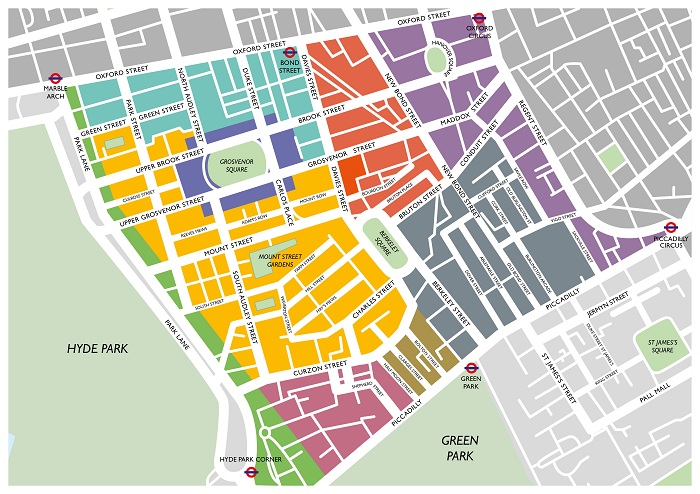
Mayfair was mainly open fields until development started in the Shepherd Market area around 1686 to accommodate the May Fair that had moved from Haymarket in St. James’s.

Mayfair was part of the parish of St Martin in the Fields. It is named after the annual fortnight-long May Fair that, from 1686 to 1764, took place on the site that is Shepherd Market. The fair was previously held in Haymarket; it moved in 1764 to Fair Field in Bow in the East End of London, after complaints from the residents.

Sir Thomas Grosvenor, 3rd Baronet married Mary Davis, heiress to part of the Manor of Ebury, in 1677; the Grosvenor family gained 40 hectares (100 acres) of Mayfair. Most of the Mayfair area was built during the mid 17th century to mid 18th century as a fashionable residential district, by a number of landlords, the most important of them being the Grosvenor family, which in 1874 became the Dukes of Westminster. In 1724 Mayfair became part of the new parish of St George Hanover Square, which stretched to Bond Street in the south part of Mayfair and almost to Regent Street north of Conduit Street. The northern boundary was Oxford Street and the southern boundary fell short of Piccadilly. The parish continued west of Mayfair into Hyde Park and then south to include Belgravia and other areas.

Mayfair Neighborhoods

Present-day Mayfair Neighborhoods

May Fair a Century Ago

We find a curious picture of this west-end carnival by that painstaking antiquary, John Carter, who, writing in 1816, says: “Fifty years have passed away since this place of amusement was at its height of attraction: the spot where the Fair was held still retains the name of May Fair… The market-house consisted of two stories: first story, a long and cross aisle for butchers’ shops, and, externally, other shops connected with culinary purposes; second story, used as a theatre at Fair-time for dramatic performances… Below, the butchers gave place to toy men and gingerbread-bakers. At present, the upper story is unfolded, the lower nearly deserted by the butchers, and their shops occupied by needy peddling dealers in small wares; in truth, a most deplorable contrast to what once was such a point of allurement. In the area encompassing the market building were booths for jugglers, prize-fighters both at cudgels and back-swords, boxing-matches, and wild-beasts. The sports not under cover were mountebanks, fire-eaters, ass-racing, sausage-tables, dice-ditto, up-and-downs, merry-go-rounds, bull-baiting, grinning for a hat, running for a shift, hasty-pudding-eaters, eel-divers, and an infinite variety of other similar pastimes.”

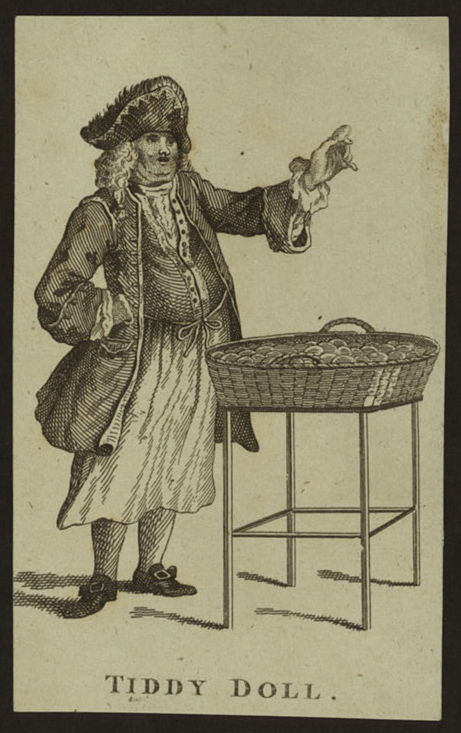
Tiddy Doll, Gingerbread Baker (NYPL Digital Library) Tiddy Doll was a famed 18th century gingerbread vendor, a well-known sight amongst the butchers and toy-men, jugglers and fire-eaters at London’s Bartholomew Fair and Shepherd’s Market in Mayfair. He was even known to ply his wares at public executions, and can be seen in the lower right-hand corner of Hogarth’s Idle Prentice Executed at Tyburn, waving a spicy cake to the boisterous mob. His real name was apparently Ford, acquiring his nickname from a habit of ending his addresses to the crowd with the last lines of a popular ballad, “tid-dy did-dy dol-lol, ti-tid-dy ti-ti, tid-dy tid-dy, dol.” Wearing a white apron over his customary white gold laced suit, ruffled shirt, laced hat and feather and silk stockings, “like a person of rank,” his name was associated for many years with a person dressed out of character, as “you are as tawdry as Tiddy-doll; you are quite Tiddy-doll,” etc.

Tiddy Doll, Gingerbread Baker (NYPL Digital Library)
Tiddy Doll was a famed 18th century gingerbread vendor, a well-known sight amongst the butchers and toy-men, jugglers and fire-eaters at London’s Bartholomew Fair and Shepherd’s Market in Mayfair. He was even known to ply his wares at public executions, and can be seen in the lower right-hand corner of Hogarth’s Idle Prentice Executed at Tyburn, waving a spicy cake to the boisterous mob. His real name was apparently Ford, acquiring his nickname from a habit of ending his addresses to the crowd with the last lines of a popular ballad, “tid-dy did-dy dol-lol, ti-tid-dy ti-ti, tid-dy tid-dy, dol.” Wearing a white apron over his customary white gold laced suit, ruffled shirt, laced hat and feather and silk stockings, “like a person of rank,” his name was associated for many years with a person dressed out of character, as “you are as tawdry as Tiddy-doll; you are quite Tiddy-doll,” etc.

The Woman and the Anvil

anvil

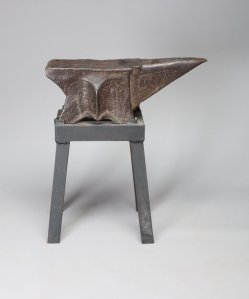
18th century anvil

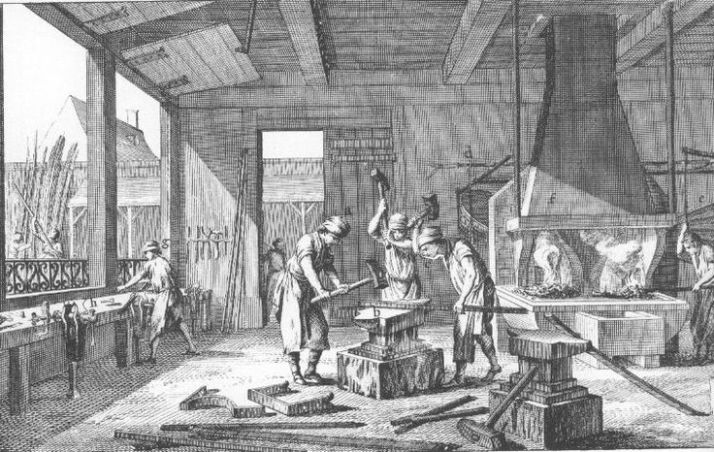
One of the marvels of May Fair, in its latest revival, was the performance of a strong woman, the wife of a Frenchman, exhibited in a house in Sun Court, Shepherd’s Market. The following account is given by John Carter, and may be relied on, as Carter was born and passed his youthful days in Piccadilly [Carter’s Statuary]. He tells us that a blacksmith’s anvil being procured from White Horse Street, with three of the men, they brought it up, and placed it on the floor of the exhibition-room. The woman was short, but most beautifully and delicately formed, and of a most lovely countenance. She first let down her hair (a light auburn), of a length descending to her knees, which she twisted round the projecting part of the anvil, and then, with seeming ease, lifted the ponderous mass some inches from the floor. After this, a bed was placed in the middle of the room; when, reclining on her back, and uncovering her bosom, the husband ordered the smiths to place thereon the anvil, and forge upon it a horse-shoe! This they obeyed: by taking from the fire a red-hot piece of iron, and with their forging hammers completing the shoe with the same might and indifference as when in the shop at their constant labour. The prostrate fair one seemed to endure this with greatest composure, talking and singing during the whole process: then, with an effort, which to the bystanders appeared supernatural, she cast the anvil from off her body, jumping up at the same moment with extreme gaiety, and without the least discomposure of her dress or person. That there was no trick or collusion was obvious from the evidence: the spectators stood about the room with Carter’s family and friends; the smiths were strangers to the Frenchman, but known to Carter, the narrator. She next placed her naked feet on a red-hot salamander, without injury, the wonder of which was, however, understood even at that time.*

Blacksmith's shop

Blacksmith’s shop

*Mr. Daniel, of Canonbury, thought the Strong Woman to have been Mrs. Allchorne, who died in Drury Lane in 1817, at a very advanced age. Madame performed at Bartholomew Fair in 1752.


Romance of London Series

  1. Romance of London: The Lord Mayor’s Fool… and a Dessert
  2. Romance of London: Carlton House and the Regency
  3. Romance of London: The Championship at George IV’s Coronation
  4. Romance of London: Mrs. Cornelys at Carlisle House
  5. Romance of London: The Bottle Conjuror
  6. Romance of London: Bartholomew Fair
  7. Romance of London: The May Fair and the Strong Woman
  8. Romance of London: Nancy Dawson, the Hornpipe Dancer
  9. Romance of London: Milkmaids on May-Day
  10. Romance of London: Lord Stowell’s Love of Sight-seeing
  11. Romance of London: The Mermaid Hoax
  12. Romance of London: The Bluestocking and the Sweeps’ Holiday
  13. Romance of London: Comments on Hogarth’s “Industries and Idle Apprentices”
  14. Romance of London: The Lansdowne Family
  15. Romance of London: St. Margaret’s Painted Window at Westminster
  16. Romance of London: Montague House and the British Museum
  17. Romance of London: The Bursting of the South Sea Bubble
  18. Romance of London: The Thames Tunnel
  19. Romance of London: Sir William Petty and the Lansdowne Family
  20. Romance of London: Marlborough House and Sarah, Duchess of Marlborough
  21. Romance of London: The Duke of Newcastle’s Eccentricities
  22. Romance of London: Voltaire in London
  23. Romance of London: The Crossing Sweeper
  24. Romance of London: Nathan Mayer Rothschild’s Fear of Assassination
  25. Romance of London: Samuel Rogers, the Banker Poet
  26. Romance of London: The Eccentricities of Lord Byron
  27. Romance of London: A London Recluse

Romance of London: Bartholomew Fair

Romance of London: Strange Stories, Scenes And Remarkable Person of the Great Town in 3 Volumes

John Timbs

John Timbs (1801-1875), who also wrote as Horace Welby, was an English author and aficionado of antiquities. Born in Clerkenwell, London, he was apprenticed at 16 to a druggist and printer, where he soon showed great literary promise. At 19, he began to write for Monthly Magazine, and a year later he was made secretary to the magazine’s proprietor and there began his career as a writer, editor, and antiquarian.

This particular book is available at googlebooks for free in ebook form. Or you can pay for a print version.

The vow of a jester

Rahere_Jester_to_Henry_1st

Rahere, jester to King Henry I

This famous Fair, formerly held every year in Smithfield, at Bartholomewtide [August 24], and within the precinct of the Priory of St. Bartholomew, originated in a grant of land from Henry I., to his jester Rahere, who, disgusted by his manner of living, repented him of his sins, and undertook a pilgrimage to Rome. Here, attacked by sickness, he made a vow, that if he recovered his health, he would found a hospital for poor men. Being reinstated, and on his return to England to fulfill his promise, St. Bartholomew is said to have appeared to him in a vision, and commanded him to found a Church in Smithfield, in his name… The site, which had been previously pointed out in a singular manner to Edward the Confessor, as proper for a house of prayer, was a mere marsh, for the most part covered with water; while on that portion which was not so, stood the common gallows—”the Elms,” in Smithfield, which for centuries after continued to be the place of execution.

The Bartholomew Fair

St. Bartholomew's Church

St. Bartholomew’s Church

The Priory, however, looked to temporal as well as spiritual aid, for his foundation; and therefore, obtained a royal charter to hold a Fair annually at Bartholomewtide, for three days—on the eve, the fête-day of the saint, and the day after; “firm peace,” being granted to all persons frequenting the Fair of St. Bartholomew. This brought traders from all parts, to Smithfield: thither resorted clothiers and drapers, not merely of England, but all countries, who there exposed their goods for sale. The stalls or booths were erected within the walls of the priory churchyard, the gates of which were locked each night, and a watch was set in order to protect the various wares…
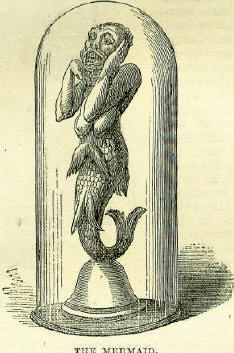
murmaid

At the dissolution of religious houses, the privilege of the Fair was in part transferred to the Mayor and Corporation; and in part to Richard Rich, Lord Rich, who died in 1560, and was ancestor of the Earls of Warwick and Holland. It ceased, however to be a cloth fair of any great importance in the reign of Queen Elizabeth. The drapers of London found another and more extensive market for their woolens; and the clothiers, in the increase of communication between distant places, a wider field for the sale of their manufactures. It subsequently became a Fair of a very diversified character. Monsters, motions, rolls, and rarities were the new attractions to be seen; and the Fair was converted into a kind of London carnival for persons of every condition and degree of life. The Fair was proclaimed by the Lord Mayor, beneath the entrance arch of the priory; and its original connexion with the cloth trade was commemorated in a mock proclamation on the evening before, made by a company of drapers and tailors, who met at the Hand and Shears, a house of call for their fraternity in Cloth Fair, whence they marched and announced the Fair opened and concluded with shouting and the “snapping of shears.”

With respect to the tolls, Strype tells us that “Each person having a booth, paid so much per foot for the first three days. The Earl of Warwick and Holland is concerned in the toll gathered the first three days in the fair, being a penny for each burthen of good brought in or carried out; and to that end there are persons that stand at all the entrances into the Fair…

bartholomewfairup

The Fair lengthens to fourteen days

“In the reign of Charles II., as might be expected, the Fair was extended from three to fourteen days, when all classes, high and low, visited the carnival.” Pepys mentioned walking up and down the fair grounds on August 30, 1667, and discovering Lady Castlemaine at a puppet-play, “and the street full of people, expecting her coming out.” In 1668, Pepys went to the fair “to see the mare that tells money, and many things to admiration, and then the dancing of the ropes, and also the Irish stage play, which is very ridiculous.”
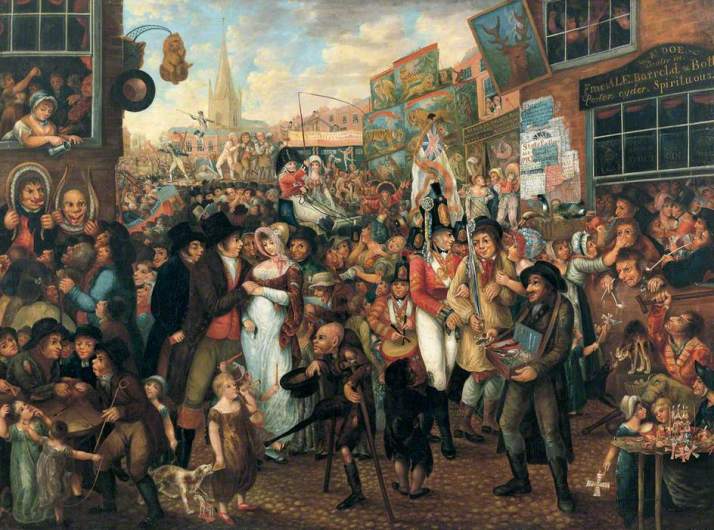
(c) Dover Collections; Supplied by The Public Catalogue Foundation

(c) Dover Collections; Supplied by The Public Catalogue Foundation

Theatrical booths were very popular. “Ben Jonson, the actor (says Dr. Rimbault), was connected with the booth before 1694, in which year he joined Cibber’s company; he was celebrated as the grave-digger in Hamlet…

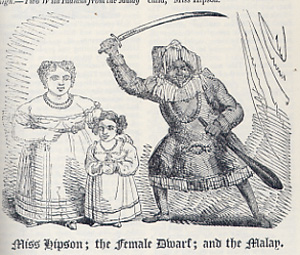
Here were motions or puppet-shows of Jerusalem, Nineveh, and Norwich; and the Gunpowder Plot played nine times in an afternoon; wild beasts, dwarfs, and other monstrosities; operas and tight-rope-dancing and sarabands [dances]; dogs dancing the morris; the hare beating the tabor; and rolls of every degree.
Bartholomew Fair 1825

Bartholomew Fair 1825

From a newspaper in 1734:

At Goodwin’s Large Theatrical Booth, opposite the White Hart, in West Smithfield, near Cow Lane, the town will be entertained with a humorous Comedy of three acts, called ‘The Intriguing Footman, or the Spaniard Outwitted;’ with a Pantomime entertainment of Dancing, between a Soldier and a Sailor, and a Tinker and a Tailor, and Buxom Joan of Deptford.

At Hippisley and Chapman’s Great Theatrical Booth, in the George Inn Yard, Smithfield, the town will be humorously diverted with an excellent entertainment; Signor Arthurian, who has a most surprising talent at grimace, and will, on this occasion, introduce upwards of fifty whimsical, sorrowful, comical, and diverting faces.”

The fourteen days were found too long, for the excesses committed were very great; and in the year 1708, the period of the Fair was restricted to its old duration of three days.
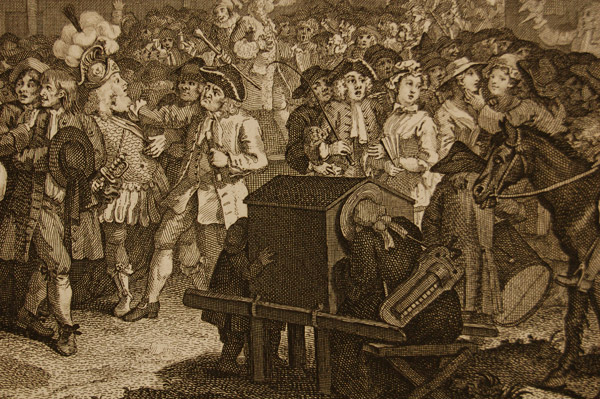
Hogarth 1733

Hogarth 1733

Three days of revelry

The influence of the fair in the neighborhood was to make general holiday… We read that in Little Britain, “during the time of the Fair, there was nothing going on but gossiping and gadding about. The still quiet streets of Little Britain were overrun with an irruption of strange figures and faces; every tavern was a scene of rout and revel. The fiddle and the song are heard from the taproom, morning, noon, and night; and at each window might be seen some group of loose companions, with half-shut eyes, hats on one side, pipe in mouth, tankard in hand, fondling, and prosing, and singing maudlin songs over their liquor. Even the sober decorum of private families was no proof against this saturnalia. There was no such thing as keeping maid-servants within doors. Their brains were absolutely set maddening with Punch and the puppet-show; the flying horses; Signior Polito; the Fire-eater, the celebrated Mr. Paap; and the Irish Giant. The children, too, lavished all their holiday-money in toys and gilt gingerbread, and filled the house with the Lilliputian din of drums, trumpets, and penny whistles.”
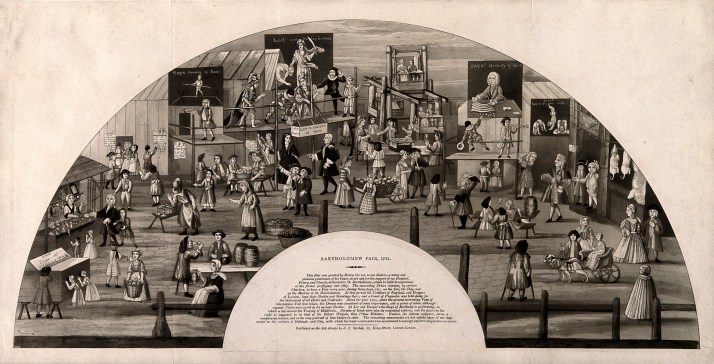
V0014666 Bartholomew Fair, site of St. Bartholomew's Hospital, London Credit: Wellcome Library, London. Wellcome Images images@wellcome.ac.uk http://wellcomeimages.org Bartholomew Fair, site of St. Bartholomew's Hospital, London, pictured in 1721. Aquatint with etching, c. 1800. Published: - Copyrighted work available under Creative Commons Attribution only licence CC BY 4.0 http://creativecommons.org/licenses/by/4.0/

Bartholomew Fan

The end of Bartholomew Fair

The Lord Mayor and Aldermen had, for 300 years, tried by orders, proclamations, juries, and presentments to abolish the Fair, but without effect; when the Court of Common Council took the work in hand. Having obtained entire control over the Fair by the purchase of Lord Kensington’s interest, they refused to let standings for shows and booths; they prevailed upon the Lord Mayor and Sheriffs to give up the practice of going to open the Fair in state, with a herald to proclaim it, and officers to marshal the procession; the posting of the proclamation about the streets, interdicting rioting and debauchery during the days of the Fair and within its precincts, were discontinued… In 1852, not a single show was to be seen on the ground; and in 1855 the Fair expired… and Bartholomew Fair was extinct.

Author’s Note: I’m thinking of having my Regency characters attend the fair, even though it was rather scandalous. What do you think?

Bartholomew-Fair

Romance of London Series

  1. Romance of London: The Lord Mayor’s Fool… and a Dessert
  2. Romance of London: Carlton House and the Regency
  3. Romance of London: The Championship at George IV’s Coronation
  4. Romance of London: Mrs. Cornelys at Carlisle House
  5. Romance of London: The Bottle Conjuror
  6. Romance of London: Bartholomew Fair
  7. Romance of London: The May Fair and the Strong Woman
  8. Romance of London: Nancy Dawson, the Hornpipe Dancer
  9. Romance of London: Milkmaids on May-Day
  10. Romance of London: Lord Stowell’s Love of Sight-seeing
  11. Romance of London: The Mermaid Hoax
  12. Romance of London: The Bluestocking and the Sweeps’ Holiday
  13. Romance of London: Comments on Hogarth’s “Industries and Idle Apprentices”
  14. Romance of London: The Lansdowne Family
  15. Romance of London: St. Margaret’s Painted Window at Westminster
  16. Romance of London: Montague House and the British Museum
  17. Romance of London: The Bursting of the South Sea Bubble
  18. Romance of London: The Thames Tunnel
  19. Romance of London: Sir William Petty and the Lansdowne Family
  20. Romance of London: Marlborough House and Sarah, Duchess of Marlborough
  21. Romance of London: The Duke of Newcastle’s Eccentricities
  22. Romance of London: Voltaire in London
  23. Romance of London: The Crossing Sweeper
  24. Romance of London: Nathan Mayer Rothschild’s Fear of Assassination
  25. Romance of London: Samuel Rogers, the Banker Poet
  26. Romance of London: The Eccentricities of Lord Byron
  27. Romance of London: A London Recluse

Susana’s 2015 English Adventure: Week 4

map

On Monday I hopped on a train to Birmingham, then changed to one for Kidderminster. (I just love these English names, don’t you? Mousehole is my favorite, but I’m assured that it is a lovely place to visit despite the name.) At Kidderminster, I took a taxi to The Elms Hotel in Abberley, where I was met by the lovely Heather King and her fabulous, quadralingual dog, Roxy. Heather is an amazingly talented author of Regency stories (and, as Vandalia Black, of rather darker paranormal ones). Heather and I are online friends and have been part of two Regency anthologies, Beaux Ballrooms, and Battles and Sweet Summer Kisses. It was truly awesome to meet her in person, as well as Roxy and the ponies, Merlin and Dub-Dub, and Sootie, the black cat whose offspring were too high-in-the-instep to become acquainted with a Yankee. Heather served me Toad-in-the-Hole, which turned out to be a sort of English comfort food: sausages baked in a sort of pancake batter and served with hot gravy. Besides being very tasty, it served to warm us up inside and outside, after a day spent mucking about the ruins of Witley Court in the pouring rain. (It rains in England. Deal with it.)
Witley Court

Witley Court was once one of the great houses of the Midlands, but a devastating fire in 1937 left it in ruins. While one cannot but regret the loss of such a beautiful home, the exposure of the “bare bones” has proved to be valuable to historians interested in learning about historical building practices.

800px-Witley_Court_circa_1900_2

Witley Court, 1900

Witley Court today

Witley Court today

Thomas Foley (whose grandson became the 1st Baron Foley) built the house in 1665 on the site of a manor house. Additions were made by John Nash in the 19th century, and the house was sold to the Dudley family (later to be given an earldom) in 1837.

Tramping about the ruins of the house turned out to be much more appealing than one might have expected, even in the pouring rain! The gardens are lovely, particularly the fountain (see video here), and the parish church on the property—which is not a ruin—is magnificent.

See photos here.

Berrington Hall

On Tuesday Heather, Roxy, and I visited Berrington Hall, a splendid country home in Leominster (pronounced Lemster, or so they tell me). It was designed in the late 18th century by Henry Holland, whose talent, although not eclipsing that of my favorite, Robert Adam, puts him solidly in second place, in my estimation.

In addition to the rich furnishings and décor, there was an exhibit of Georgian fashion throughout the house, which included—believe it or not—costumes from the 1995 BBC production of Pride and Prejudice. Yes, I was close enough to touch the costumes worn by Darcy and Lizzie during the final proposal scene, as well as many others. Truly an awesome experience!

Henry Holland!!!

Henry Holland!!!

The vast grounds include a walled garden with some vintage apple trees, a ha-ha, a lake, and some lovely paths. Heather and I enjoyed a delicious picnic before exploring further some of those paths. And not a drop of rain!

See photos here.

Waddesdon Manor

On Wednesday I took a train to Aylesbury, in Buckinghamshire (where, incidentally, the estate of my hero in The Third MacPherson Sister is located) to visit Waddesdon Manor.

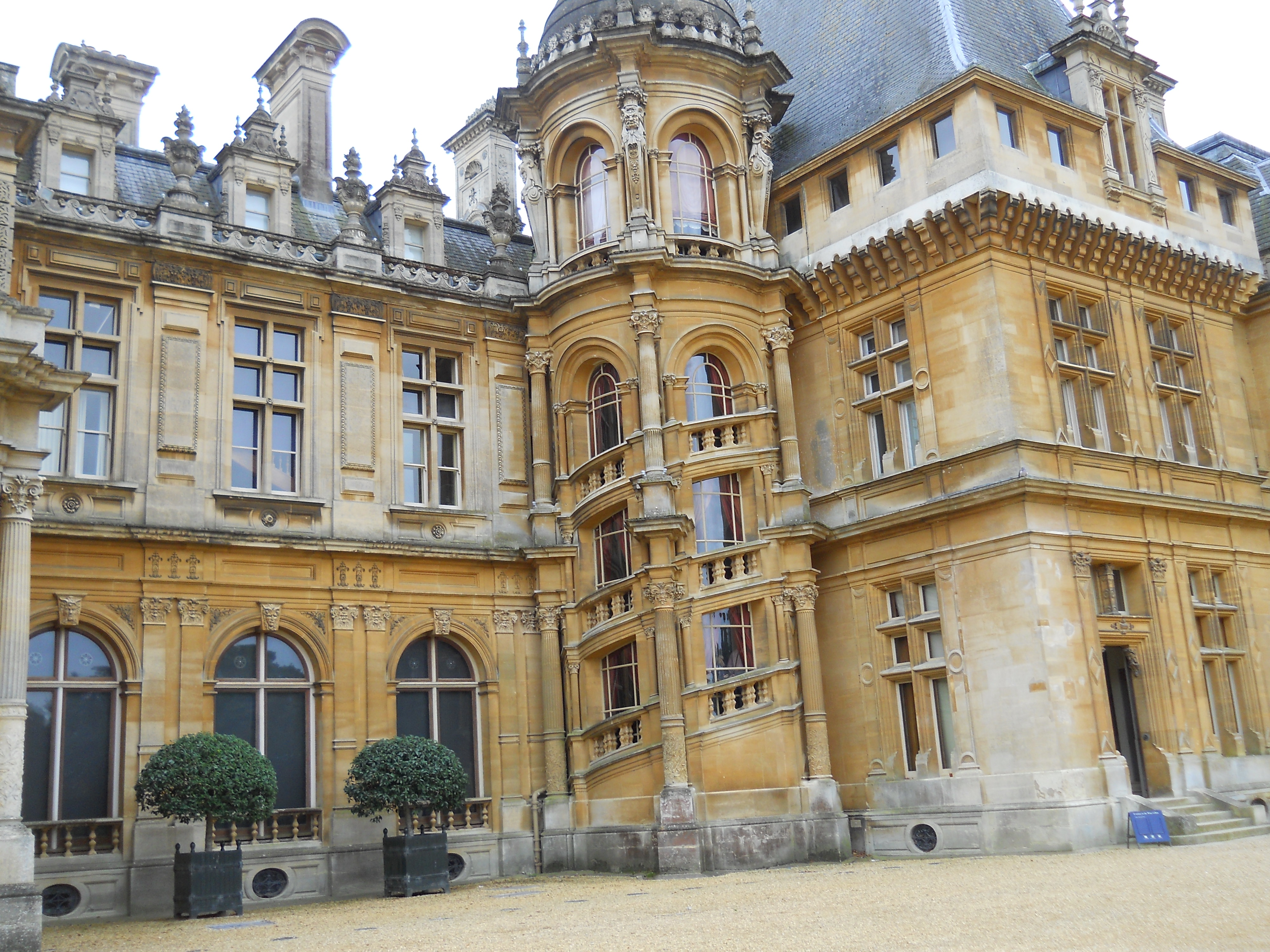
Waddesdon Manor was built in neo-renaissance style in the late 19th century as a sort of French château by the Baron Ferdinand de Rothschild of the Austrian banking family. The baron fell in love with his second cousin, Evelina, and married her, only to lose her in childbirth eighteen months later. The baron never married again, but became a compulsive collector instead. The furnishings are considered to be among the richest of any stately manor anywhere.

These stairs are reminiscent of those at the Château de Chambord in France

These stairs are reminiscent of those at the Château de Chambord in France

Unfortunately, I was only able to tour the house due to time considerations, but I plan to visit again to get a good look at the extensive grounds and other buildings, such as the Aviary and the Dairy.

Although cloudy, it didn’t rain until I had returned to London, where I got promptly soaked making a last round of Piccadilly Street and Fortnum & Mason. But hey, it rains in England. That’s why it’s so beautiful!

See photos here.

Adieu to England

Squidgeworth enjoyed his orange juice on the plane.

Squidgeworth enjoyed his orange juice on the plane.

It was with a tear in my eye as Squidgeworth and I said goodbye to England on Thursday. For now. We had a marvelous time and were fortunate to be able to visit many wonderful places, but there are still lots more on our bucket list. I’ve already booked our flight and flat for next year’s trip in August.

So much to see, so little time!

Next week: Squidgeworth and I have some travel tips for you!

Susana’s 2015 English Adventure: Week 3

house copy

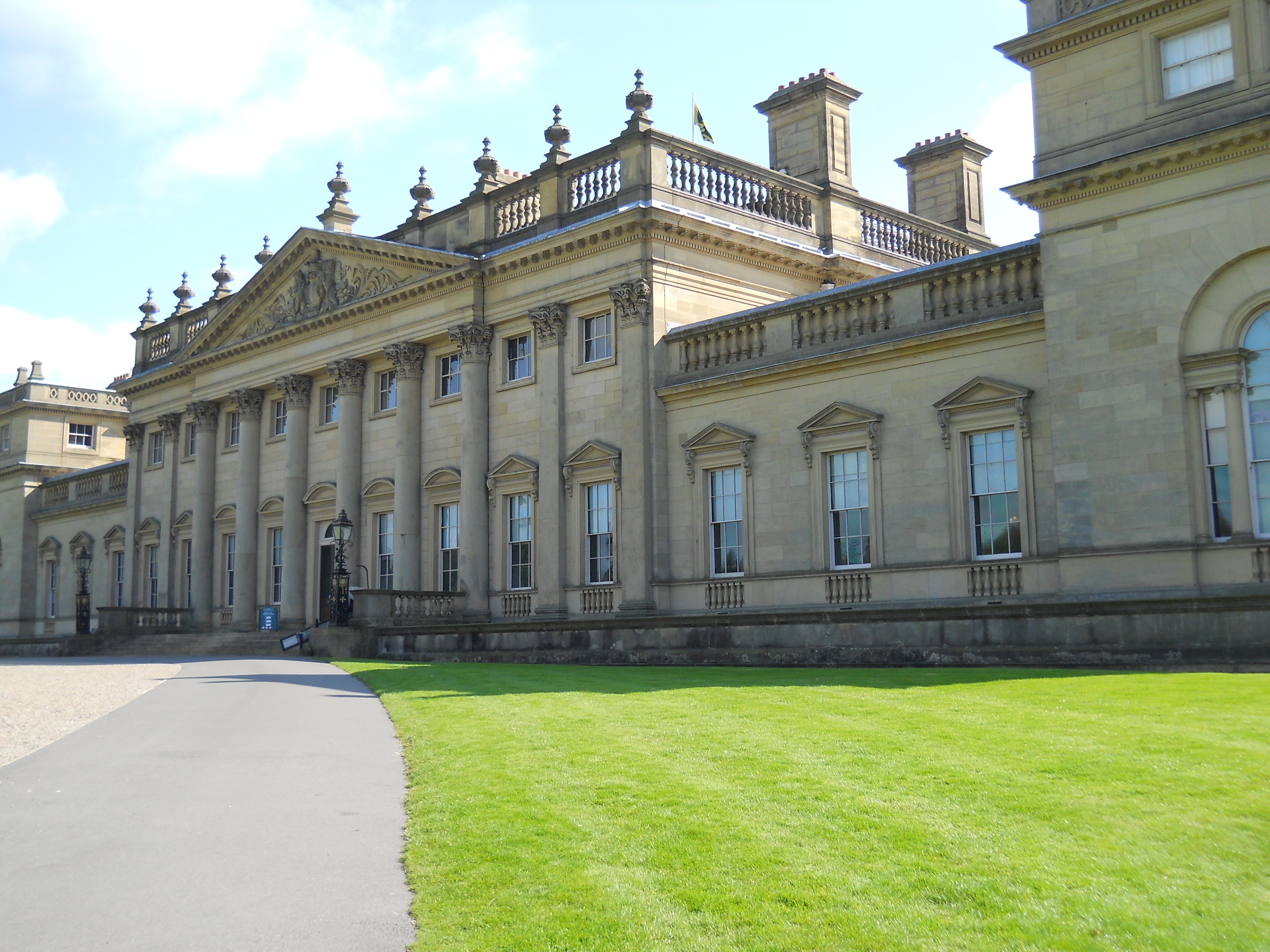
Harewood House

Harewood

On Monday I took an early train north to York, left my suitcase at the hotel, and headed off to Harewood (which can be pronounced either hairwood or hahrwood, depending on the person with whom you are speaking).

My overall reaction to Harewood is… Robert Adam! I don’t know how the man got around to accomplishing so much in England’s great houses in one lifetime, but from now on I will judge all of the ones I visit by the quality of their Robert Adam touches (or lack of it).

ceiling5 copy

Oh yes, I suppose I should mention the excellent work by Charles Barry and the Chippendale furniture too. Utterly fabulous!

In later years, Harewood was the home of Queen Elizabeth’s aunt, the Princess Mary, after she married the sixth Earl of Harewood, Henry Lascelles, who served in the First World War.

Photos of Harewood

Castle Howard

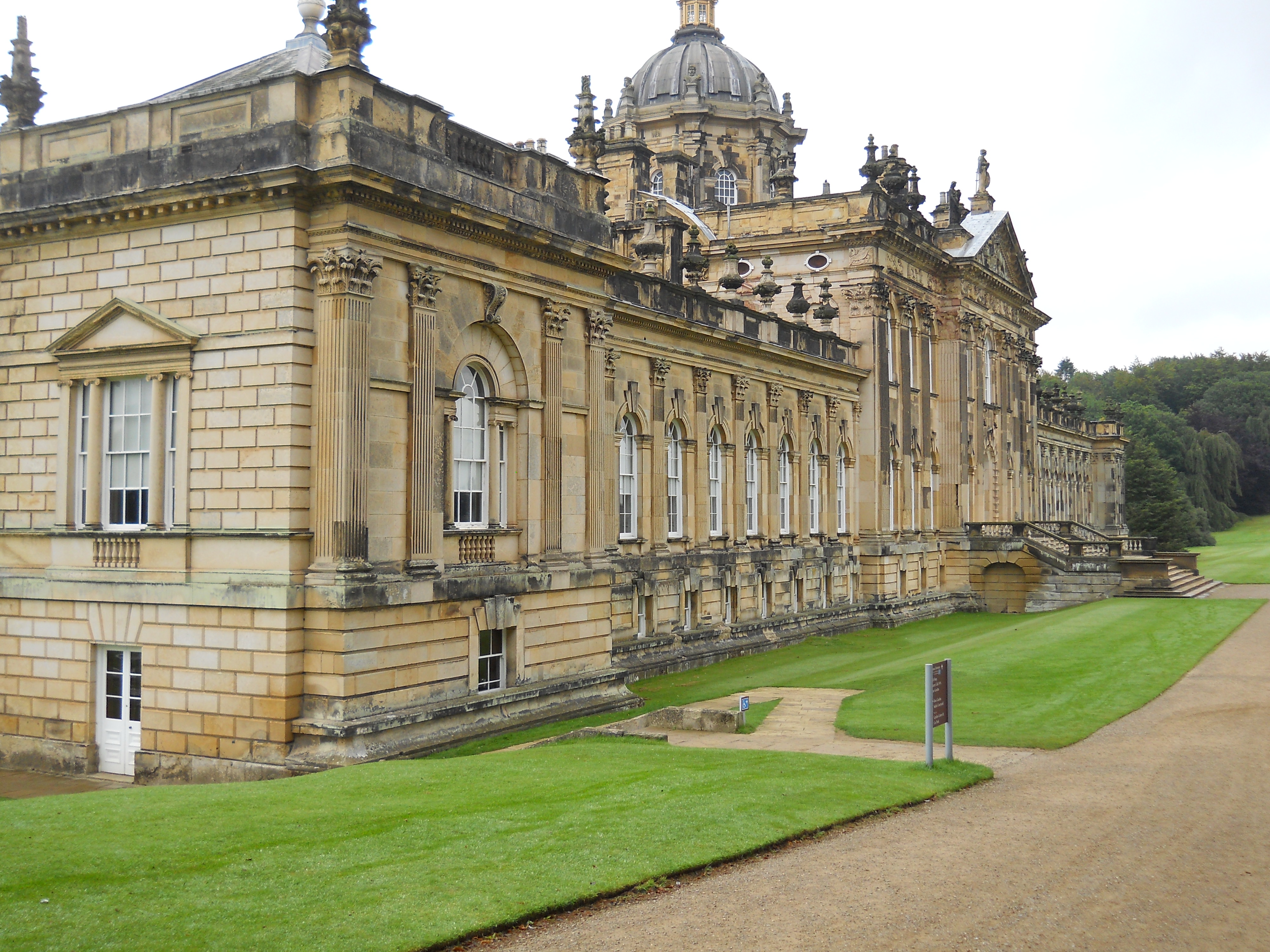
Castle Howard was originally built in 1700 by the 3rd Earl of Carlisle, who was a younger son of the Duke of Norfolk. Yes, Catherine Howard, unfortunate fifth wife of Henry VIII, was of the same family, but she predated the house. John Vanbrugh, the architect, was also the architect for Blenheim Palace, which is spectacular in itself.

The 4th and 5th earls traveled widely on the continent and were great collectors. The current earl lives at another house, and this one is owned by a private trust, headed by Carlisle family members.

CastleHoward2 copy

Castle Howard is well-known for being the setting of the popular Brideshead Revisited television series.

The 6th countess was the eldest daughter of the 5th Duke of Devonshire and his wife Georgiana. She became the mother of 12 children, and you can see her bedroom in the photos.

Photos of Castle Howard

Haworth

One of my favorite books of all time is Jane Eyre, and I loved Wuthering Heights as well. So visiting the parsonage where the Brontë family lived with their vicar father was a significant milestone. Very different from the magnificent houses I’ve been visiting on this trip! Startling to hear that nearly half of all children born at this time died before the age of six, and poor Rev. Brontë saw his wife and all his children die before he did.

paintingbyBranwell

Photos of Haworth

The Foundling Museum

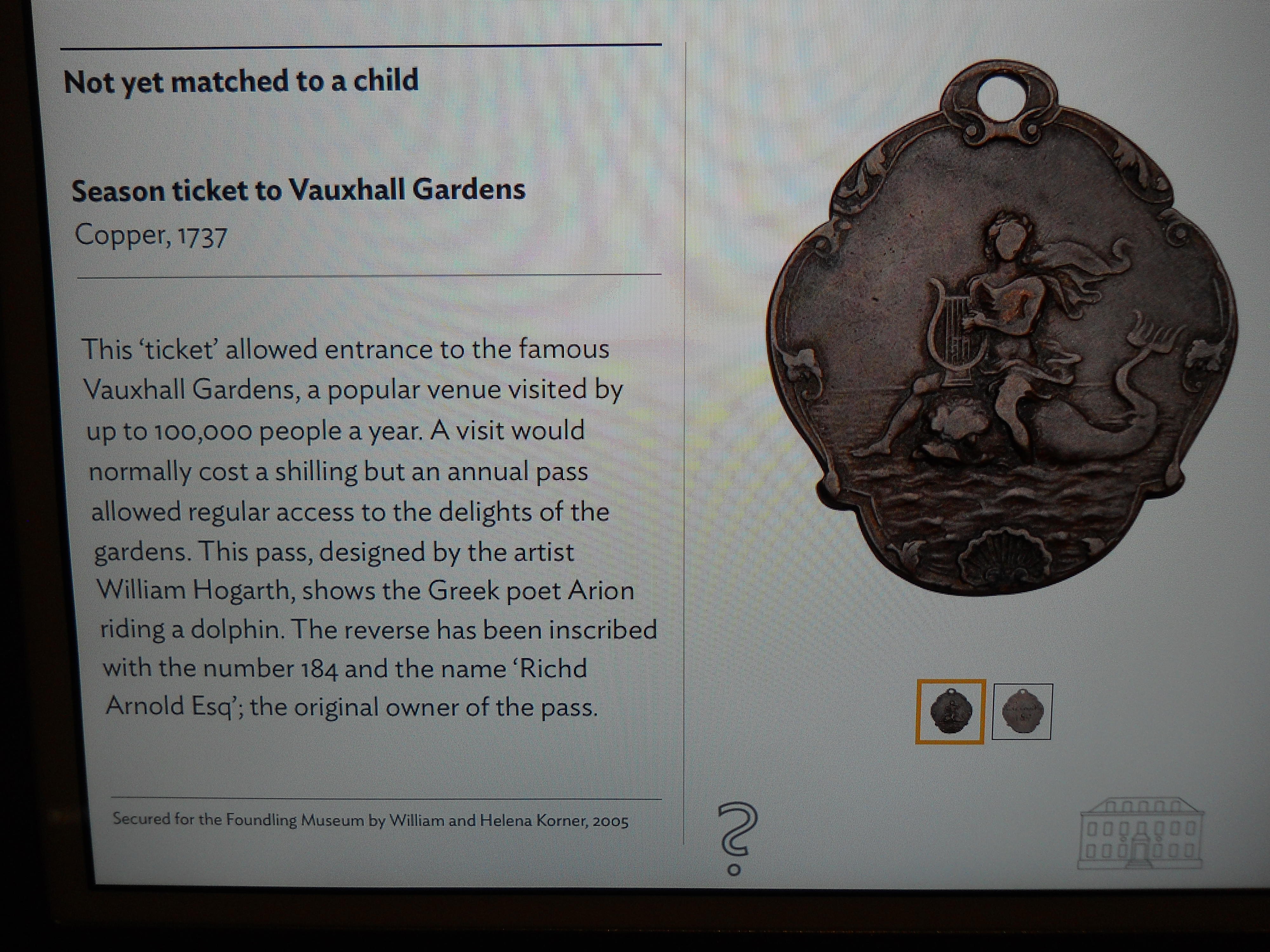
If you ever wondered what happened to England’s abandoned children, this museum tells the sobering story of the Foundling Hospital, Britain’s first home for abandoned children. Mothers who left their children there also left tokens (buttons, jewelry, coins, or whatever they had) to identify their children in case their circumstances changed and they could claim them someday. Unfortunately, most of the children were never claimed. At the ages of 9-14, children were sent away to be apprentices or servants. It wasn’t an ideal situation, but at least the children were fed and clothed and educated up to a point, which was certainly better than being left to die in the streets, which was a common practice in some areas. Sadly, much of society shunned the offspring of prostitutes or unmarried couples and really didn’t consider it a great loss if they died.

One mother left a Vauxhall season pass as a token for her child

One mother left a Vauxhall season pass as a token for her child

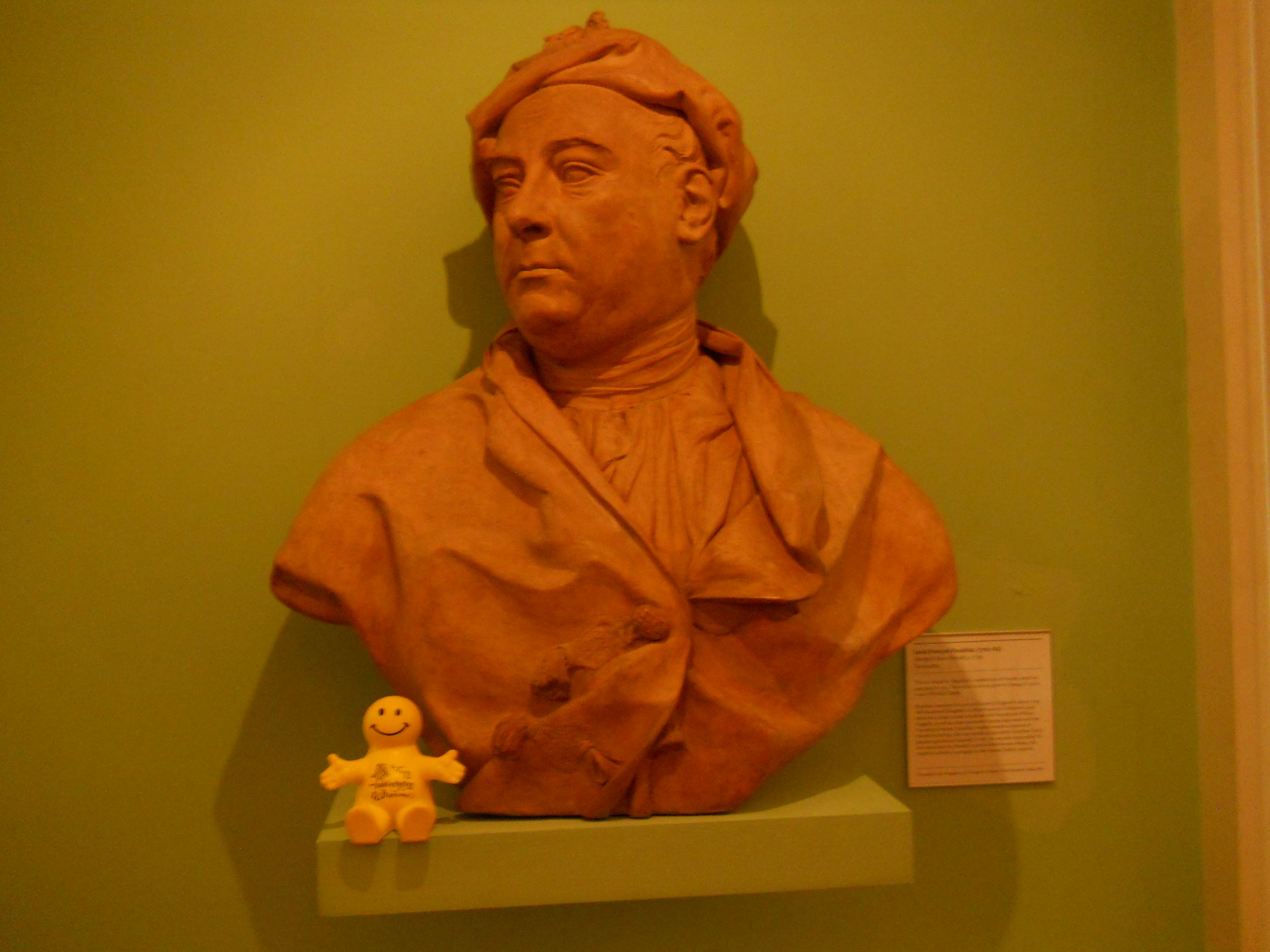
Another focus of the museum is the founder, Thomas Coram, as well as supporters William Hogarth and George Frideric Handel and a large collection of paintings donated to the hospital that were used to entice potential contributors to come to the hospital.

Squidgeworth found a friend!

Squidgeworth found a friend!

See photos here.

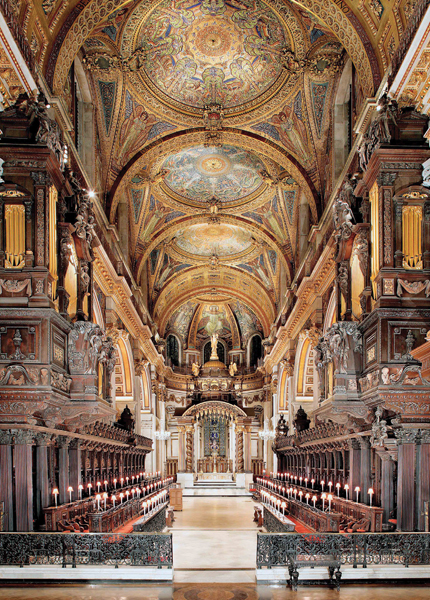
St. Paul’s Cathedral

Beautiful and impressive. Admiral Lord Nelson and the Duke of Wellington are buried in the crypt.

GTO 225 London.qxp:Regional Update.qxd

See photos here.

York

Spent a day walking around York and shopping. Did the Richard III Experience and Squidgeworth got put in jail for a short time, but he smiled all the way through it. Nothing gets him down, not even getting shut up in that tiny cell.

yorkprison

See photos here.


Sadly, less than a week remains before Squidgeworth and I fly back across the pond.

So much to see, so little time!