Archives

1814 Vauxhall and Drury Lane: The Belles’ Time Travel Machine

I hope you enjoyed your stay in WWI France via Caroline Warfield’s Blog. You are now once again in Regency England! A Malicious Rumor in the Bluestocking Belles’ Never Too Late anthology—takes place this year (as well as The Umbrella Chronicles: George and Dorothea’s Story, but you have already been there, right?), but we hope this is not your last stop via The Bluestocking Belles’ Time Machine.

Miss Alice Crocker and Mr. Peter de Luca from A Malicious Rumor are both employees of Vauxhall Gardens. Alice is a gardener and Peter is a violinist. Peter was unfairly dismissed from the Theatre Royal, Drury Lane, and Alice and her grandfather help him seek justice.

Events at Vauxhall Gardens in 1814

The season began on 15 June and ended on 26 August. The finale was highlighted by a double display of fireworks by Mons. Bologna and Signor D. Mortram.

Fireworks temple

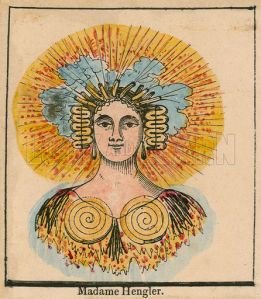
Mme. Sarah Hengler (wife of Michael Hengler who died in 1802) performed fireworks and illuminations that year.

Mme. Sarah Hengler

Sig. Vincento de Mortram, Mme. Hengler’s rival, also performed fireworks at Vauxhall that year.

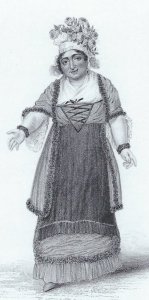
Mrs. Maria Theresa Bland was a featured performer that summer. Mrs. Bland was married to the brother of Mrs. Jordan of Covent Garden. Her mezzo-soprano voice was ideal for the singing of English ballads. Her sons Charles and James were also singers.

Maria Theresa Bland, née Romanzini

Charles Dignum first appeared in 1794, but became notable at Vauxhall during the first two decades of the 19th century. He was well-known for his duets with Mrs Bland, especially Long Time I’ve Courted You, Miss,  a dialogue between a shy sailor and a flirtatious lady.

Charles Dignum

Charles Burney, father of novelists Frances (Fanny) Burney and Sarah Burney, who played the violin and viola at Vauxhall, died that year.

Charles Burney

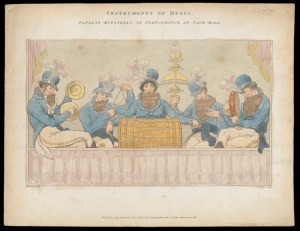
Natale Corri, brother of Domenico Corri who was the manager of Vauxhall in 1812, composed for the Pandean band from 1810-1815.

Pandean Band

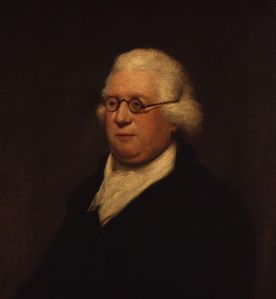
James Hook was keyboard player and composer at Vauxhall from 1772–1821. Hook wrote over two thousand songs for Vauxhall, and played organ concertos on many thousands of occasions.

James Hook by Lemuel Francis Abbott

Mr. F. Ware was music leader that year.

Mr. Burgess was punch maker for Vauxhall that year, and for a total of 40 years.

Mrs. Margarit Ross was housekeeper from 1811-1834. A permanent employee who was also in charge of the bars, Mrs. Ross kept one female assistant throughout the year. In 1822 she was paid £100 per annum.

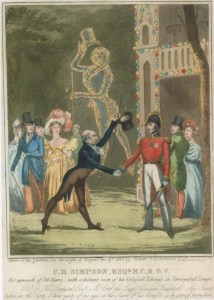
Mr. C.H. Simpson was Master of Ceremonies from 1797-1835. In 1823, he was making £34 per season.  “…the wondrous master of the ceremonies, the ‘gentle Simpson, that kind smiling idiot,’ whose personality is preserved in the wonderful etching by Robert Cruikshank…” (Amusements of Old London, William Boulton, 1901).

Robert Cruikshank, C.H. Simpson Esq.

Mr. Charles Taylor was Director of Music that year. He was one of the longest-serving and most popular Vauxhall singers, especially noted for his comic songs. He made the speech on the last night of the season several times.

Mr. Jonathan Tyers Barrett and Rev. George Rogers Barrett, both grandchildren of Vauxhall founder Jonathan Tyers, co-owned Vauxhall after the death of Jonathan Tyers Jr. in 1792 until it was sold in 1821.

Events at Drury Lane

Edmund Kean played Shylock in The Merchant of Venice for the first time on 26 January. On 12 February, he played Richard III.

On 2 March, Jane Austen wrote to her sister Cassandra: “Places are secured at Drury Lane for Saturday, but so great is the rage for seeing Kean that only a third and fourth row could be got.” On 5 March: “We were quite satisfied with Kean. I cannot imagine better acting, but the part was too short; and, excepting him and Miss Smith, and she did not quite answer my expectation, the parts were ill filled and the play heavy.”

Sarah Smith Bartley

Edmund Kean played Hamlet for the first time on 12 March. On 5 May: first performance as Othello. On 7 May: first performance as Iago. On 25 May: a benefit and first performance of Luke in Riches. On 5 November: first performance as Macbeth.

Farewell—and a Giveaway

Thank you for dropping in. Your next stop will be on Sherry Ewing’s blog, but you might want to go back to The Bluestocking Belles Time Machine and hop around at will. I wish you safe travels.

Don’t forget, each comment on every stop of the Time Machine will be counted as an entry to win a grand prize of a $25 gift voucher from Amazon and a print copy of Never Too Late.

In addition, one random commenter here will win all three of these prizes at the end of December.

William Shakespeare Ornament


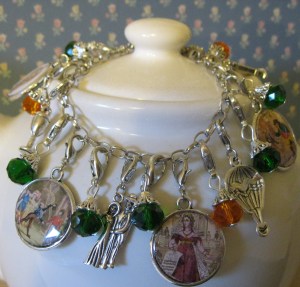
Vauxhall Charm Bracelet


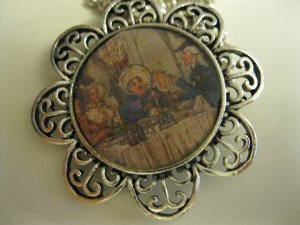
Supper-boxes Necklace

Adieu, Time Traveler. Try not to land in the midst of the Black Plague, the Great Fire of London or the sack of Rome!

About Never Too Late

Eight authors and eight different takes on four dramatic elements selected by our readers—an older heroine, a wise man, a Bible, and a compromising situation that isn’t.

Set in a variety of locations around the world over eight centuries, welcome to the romance of the Bluestocking Belles’ 2017 Holiday Anthology.

US: http://amzn.to/2y6oBg7

iBooks: http://apple.co/2yY4gXC

Kobo: http://bit.ly/2fK7vJR

Nook: http://bit.ly/2y63988

Smashwords: http://bit.ly/2xDMQkb

AU: http://amzn.to/2fycyAx

BR: http://amzn.to/2wjyWkm

CA: http://amzn.to/2yFvxxS

DE: http://amzn.to/2xA0Udb

ES: http://amzn.to/2yFIgk4

FR: http://amzn.to/2yF7gbg

IN: http://amzn.to/2fzQkhv

IT: http://amzn.to/2xzPPbW

JP: http://amzn.to/2xK5yqS

MX: http://amzn.to/2xJTlCK

NL: http://amzn.to/2hvRYkV

UK: http://amzn.to/2fyBesx

Print: http://amzn.to/2zQ36Ny

About A Malicious Rumor

Excerpt from A Malicious Rumor

Alice found her feet tapping in time to the music of the orchestra rehearsal while she inspected the site for the new illumination, which would honor the new Duke of Wellington after his victory over Bonaparte at the Battle of Paris. If only the designer had included the measurements! It was difficult to decide how to arrange the plantings without some inkling of the space requirements. With luck, the fellow himself would arrive soon, since the spectacle was planned to open the next day.

Miss Stephens must be singing tonight, she thought as she found herself humming the tune of the popular Northumberland ballad about a brave lass who rowed out in a storm to save her shipwrecked sailor beau.

O! merry row, O! merry row the bonnie, bonnie bark,

Bring back my love to calm my woe,

Before the night grows dark.

She liked the idea of a woman rescuing her man instead of the other way around. It might seem romantic to be rescued by a handsome prince, but one could not always be a damsel in distress, could one? Alice knew from her mother’s marriage that there was no happiness or romance in a marriage where one partner held all the power. She herself had no intention of placing herself in the power of any man. She would be responsible to no one but herself—and perhaps her employer, as long as she was permitted to work for a living. She narrowed her eyes. She could work as well as any man, better than some, in fact. Why did so many men feel threatened by that?

Memoirs of a Highland Lady: Harvest Home

Harvest Home

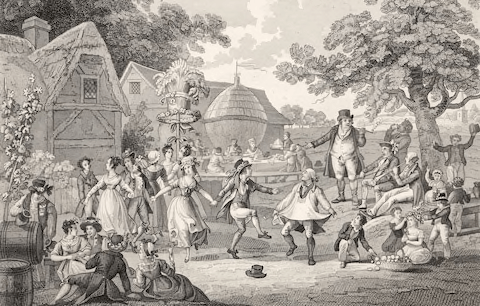
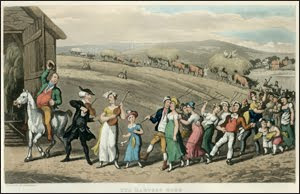
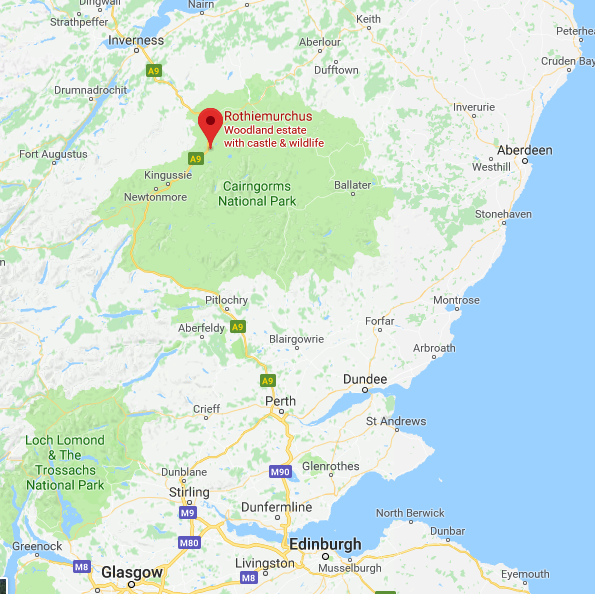
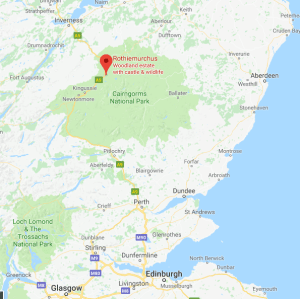
We had three harvest homes to keep in Rothiemurchus: a very small affair indeed at the Croft; a luncheon in the parlour for us children only, and a view of the barn prepared for the dinner and dance to the servants. It was a much merrier meeting at the Dell; my father and mother and all of us, stuffed into the carriage, or on it, drove there to dinner, which was served in the best parlour, my father at the head of the table, Duncan McIntosh at the foot, and those for whom there was not room at the principal board went with at least equal glee to a side table. There was always broth, mutton boiled and roasted, fowls, muirfowl*****—three or four pair in a dish—apple pie and rice pudding, such jugs upon jugs of cream. Cheese, oatcakes and butter; thick bannocks of flour instead of wheaten bread, a bottle of port, a bottle of sherry, and after dinner, do end to the whiskey punch. In the kitchen was all the remains of the sheep, more broth, more mutton, haggis, head and feet singed, puddings black and white, a pile of oaten cakes, a kit of butter, two whole cheeses, one tub of sowans*, another of curd, whey and whiskey in plenty. The kitchen party, including any servants from house or farm that could be spared so early from the Croft, the Doune, or Inverdruie, dined when we had done, and we ladies, leaving the gentlemen to more punch, took a view of the kitchen festivities before retiring to the bed chamber of Mrs McIntosh to make the tea. When the gentlemen joined us the parlour was prepared for dancing. With what extasies we heard the first sweep of that masterly bow across the strings of my father’s Cremona. It had been my grandfather’s. A small very sweetly toned instrument lent to Mr McIntosh to be kept in order. He thought it wanting in power, his reels could not be given with spirit from it, so he enlarged the S holes. What became of this valuable instrument I know not. It had been spoiled. The first Strathspey**** was danced by my father and Mrs McIntosh; as the principal personages. The other pair to form the foursome was of less consequence. If my mother danced at all, it was later in the evening. My father’s dancing was peculiar; a very quiet body and very busy feet, they shuffled away in time quick time steps of his own composition, boasting of little variety, sometimes ending in a turn about which he imagined was the fling; as English it was altogether as if he had never left Hertfordshire. My Mother did better, she moved quietly in highland matron fashion, ‘high and disposedly’ like Queen Elizabeth and Mrs McIntosh, for however lightly the lasses footed it, Etiquette forbade the wives to do more than ‘tread the measure.’ William and Mary moved in the grave style of my Mother; Johnny without instructions danced beautifully; Jane was perfection, so light, so active, and so graceful; but of all the dancers there, none were equal to little Sandy**, the present Factor, the son of Duncan McIntosh, though no son of his wife.

Harvest Home

We were accustomed to dance with all the company, just as if they had been our equals; it was always done and without injury to either party. There was no fear of undue assumption on the one side, or low familiarity on the other; a vein of thorough good breeding ran through all the ranks, of course influencing the manners and rendering the intercourse of all most particularly agreeable. About midnight the carriage would be ordered to bring our happy party home. It was late enough before the remainder separated.

The Doune harvest home was very nearly like that at the Dell, only that the dinner was in the farm kitchen and the ball in the barn, and two fiddlers stuck up on tubs formed the orchestra. A whole sheep was killed, and near a boll*** of meal baked, and a larger company was invited, for our servants were more numerous and they had leave to bring a few relations. We always went down to the farm in the carriage drawn by some of the men, who got glasses of whiskey apiece for the labour, and we all joined in all the reels the hour or two we staid, and drank punch to every body’s health made with brown sugar, and enjoyed the fun, and felt as little annoyed by all the odours of the atmosphere as any of the humbler guests to whom the Entertainment was given.

*sowans: Oats and meal steeped in water for a week until sour, when they are strained; the jelly-like liquor is left to ferment and separate; the solid matter is sowans.

**Mr McIntosh spent the winter isolated in the forest “with no companion but Mary, of a certain age, and never well-favoured. The result was Sandy, a curious compound of his young handsome father and plain elderly mother. It was this Mary who was the cook at Inverdruie, and a very good one she was, and a decent body into the bargain, much considered by Mrs McIntosh. There was no attempt to excuse, much less to conceal her history; in fact, such occurrences were too common to be commented on… [Mrs McIntosh] had brought little Sandy home at her marriage and as much as lay in her power acted a mother’s part by him; her children even accused her of undue partiality for the poor boy who was no favourite with his father. If so, the seed was sown in good ground, for Sandy was the best son she had. It was a curious state of manners, this.

***boll: 6 bushels or 48 gallons

****the Strathspey: https://www.youtube.com/watch?v=rrzxO_MUVW0, https://en.wikipedia.org/wiki/Strathspey_(dance)

*****muirfowl (red grouse)


Memoirs of a Highland Lady

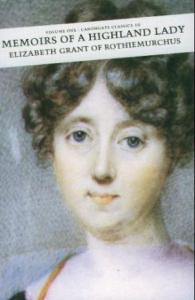
‘I was born on the 7th May 1797 of a Sunday evening at No. 5 N. side of Charlotte Square, Edinburgh, in my father’s own lately built house and I am the eldest of five children he and my mother raised to maturity.’ Thus opens one of the most famous set of memoirs ever written. Since its first bowdlerised edition in 1898, they have been consistently in print. This is the first ever complete text. Written between 1845 and 1854 the memoirs were originally intended simply for Elizabeth’s family, but these vivid and inimitable records of life in the early 19th century, and above all on the great Rothiemurchus estate, full of sharp observation and wit, form an unforgettable picture of her time. The story ends with the thirty-three-year-old Elizabeth finding her own future happiness in marriage to an Irish landowner, Colonel Smith of Baltiboys. ‘A masterpiece of historical and personal recall.’ Scotsman

Amazon

Memoirs of a Highland Lady

Memoirs of a Highland Lady: “Duchess of Sussex”

Ramsgate, Kent

“Duchess of Sussex”

Lady Augusta Murray

Mrs. Peter Grant had taken a house for us on the East Cliff, a very fine situation with a splendid sea view. We were at some distance from the town, a sort of Common all round us, and one house only near; it was indeed attached to ours, the two stood together alone, out of the way of all the rest of Ramsgate. Our neighbor was Lady Augusta Murray, called by her friends the Duchess of Sussex, although her marriage to the Duke, which really did take place abroad, was null in this country. She had been created Baroness D’Ameland, and had a pension settled on her of £3000 a year, on which to bring up her two children, a boy and girl, fine, large, handsome young people, unduly imbued with the grandeur of their birth. She never committed herself by calling herself or them by any title: ‘My boy, my girl,’ she always said in speaking of or to them. The Servants, however, mentioned them as the Prince and Princess, as did all the acquaintances who visited at the house. Prince Augustus was about 17, extremely good looking, though rather inclined to be stout; very good natured he was too, amiable and devoted to his mother. He was going into the army under the name of D’Este, a bitter pill to the Duchess, although it was one of the royal surnames, and had been chosen for his son by the Duke himself. Princess Augusta was some years younger than her brother though she looked nearly as old. She was but 12, and particularly handsome on a large scale, a fine figure, and fine features, with a charming expression of countenance. The Duchess’s house was small, though larger than ours, for she had turned the whole ground floor into one room, a library and built a dining room out behind. The drawing room floor was her own apartment, containing bedroom, sitting room, and her maid’s room; the floor above was equally divided between her son and daughter. She kept no horses, for she never drove out. She passed most of her time in a very large garden, well walled in, which covered a couple of acres or more, and extended all down the slope of the cliff to the town. Our two families soon became intimate, the younger ones especially passing the greater part of the day together, a friendship beginning then which never entirely ceased while the opportunity served to bring any of us together. The advances, however, were amusing. The Duchess, as a royal personage, must be waited on. My Mother, who was very retiring, would not take such a step forward as the leaving her name at the great lady’s door. My father, who had bowed, and been spoken to when gallantly opening gates, could do no more without his wife; so all came to a full stop. Meanwhile, Jane and I, who had made acquaintance out of the free Common of the downs with the little Princess, untroubled by any notions of etiquette, enjoyed our intercourse with our new acquaintance amazingly; Jane and she soon becoming fast friends. One evening she approached the paling which separated our two small gardens just as my Mother was stepping over the gravel towards the carriage to take her airing. I shall never forget the picture; she leaned on the top rail, her large leaved Tuscan hat thrown back off her dark close cropped hair, and her fine countenance brightened by the blush of girlish modesty, while she held up a small basket full of fine peaches, an offering from her mother. A visit of thanks was of course necessary, and found agreeable. A few days after the Duchess bade Jane tell her Mama that she had returned her call when her Mama was unluckily out, and that she hoped they would be good neighbors. On this hint we all acted. We never expected H.R.H. to call nor even believed in the reported first call. My Mother occasionally went in there with some of us. My father constantly; indeed, he soon became her confidential adviser in many of her difficulties, trying to get her through some of the troubles which harassed her existence. We were all made very happy by this addition to our Ramsgate pleasures; we liked the place itself and our life there, and above all we liked our neighbors.

From Wikipedia:

Prince Augustus Frederick, Duke of Sussex

Prince Augustus Frederick, Duke of Sussex (27 January 1773 – 21 April 1843) was the 6th son and 9th child of King George III and his consort Charlotte of Mecklenburg-Strelitz. He was the only surviving son of George III who did not pursue an army or navy career.

While travelling in Italy, the prince met Lady Augusta Murray (1768–1830), the second daughter of the 4th Earl of Dunmore. The couple secretly married in Rome on 4 April 1793. The King’s minister of Hanover affairs Ernst zu Münster was sent to Italy to escort him back to London.

The couple married again without revealing their full identities at St George’s, Hanover Square, Westminster, on 5 December 1793. Both marriages took place without the consent, or even the knowledge, of his father.

In August 1794, the Prerogative Court annulled the prince’s first marriage on the grounds that it contravened the Royal Marriages Act 1772, not having been approved by the King. However, Prince Augustus Frederick continued to live with Lady Augusta until 1801, when he received a parliamentary grant of £12,000 and the couple separated. Lady Augusta retained custody of their children and received maintenance of £4,000 a year. Their two children were named Augustus Frederick d’Este and Augusta Emma d’Este, both parents being descended from the royal House of Este. In 1806, their mother, Lady Augusta, was given royal licence to use the surname “de Ameland” instead of Murray.

Memoirs of a Highland Lady

‘I was born on the 7th May 1797 of a Sunday evening at No. 5 N. side of Charlotte Square, Edinburgh, in my father’s own lately built house and I am the eldest of five children he and my mother raised to maturity.’ Thus opens one of the most famous set of memoirs ever written. Since its first bowdlerised edition in 1898, they have been consistently in print. This is the first ever complete text. Written between 1845 and 1854 the memoirs were originally intended simply for Elizabeth’s family, but these vivid and inimitable records of life in the early 19th century, and above all on the great Rothiemurchus estate, full of sharp observation and wit, form an unforgettable picture of her time. The story ends with the thirty-three-year-old Elizabeth finding her own future happiness in marriage to an Irish landowner, Colonel Smith of Baltiboys. ‘A masterpiece of historical and personal recall.’ Scotsman

Amazon

Memoirs of a Highland Lady

Memoirs of a Highland Lady: The Moral Training of Great Men Began in a Cabin

Willie Grant was a fine handsome boy, a favourite with every body and the darling of his poor father, who had but this bright spot to cheer his dull home horizon. All this summer Willie had come to the Doune with the parson every third Sunday; that is, they came on Saturday, and generally remained over Monday. He was older than any of us, but not too old to share all our out of doors fun, and he was full of all good, really and truly sterling. We were to love one another for ever, yet we never met again. When we returned to the highlands he was in the East India Military College, and then he sailed, and though he lived to come home, marry, and to settle in the highlands, neither Jane nor I ever saw him more. How many of these fine lads did my father and Charles Grant send out to India? Some that throve, some that only passed, some that made a name we were all proud of, and not one that ever I heard of that disgraced the homely rearing of their humbly positioned but gentle born parents. The moral training of those simple times bore its fair fruits: the history of half the great men in the last age began in a cabin.

Colquhoun Grant, Gentleman Spy

Sir Charles Forbes was the son of a small farmer in Aberdeenshire. Sir William Grant, the Master of the Rolls, was a mere peasant—his Uncles floated my father’s timber down the Spey as long as they had strength to follow the calling. General William Grant was a footboy in my Uncle Rothy’s family. Sir Colquhoun Grant, though a woodsetter’s child, was but poorly reared, in the same fashion as Mrs. Pro’s fortunate boys. Sir William Macgregor, whose history should we tell it was most romantick of all, was such another. The list could be easily lengthened did my memory serve, but these were among the most striking examples of what the good plain schooling of the dominie, the principles and the pride of the parents, produced in young ardent spirits: forming characters which, however they were acted on by the world, never forgot home feelings, although they proved this differently. The Master of the Rolls, for instance, left all his relations in obscurity. A small annuity rendered his parents merely independant of hard labour; very moderate portions just secured for his sisters decent matches in their own degree; an occasional remittance in a bad season helped an Uncle or a brother out of difficulty. I never heard of his going to see them, or bringing any of them out of their own sphere to visit him. While the General shoved on his brothers, educated his nephews and nieces, pushed the boys up, married the girls well—such of them at least as had a wish to raise themselves and almost resented the folly of Peter the Pensioner (see below), who would not part with one of his flock from the very humble home he chose to keep them in. Which plan was wisest or was either quite right? Which relations were happiest—those whose feelings were sometimes hurt, or those whose frames were sometimes over wearied and but scantily refreshed? I often pondered in my own young enquiring mind over these and similar questions…

Peter the Pensioner

We knew him always as Peter the Pensioner, on account of sixpence a day my father got him from Greenwich, in lieu of an eye he had lost in some engagement. He lived in one of a row of cottages on the Mill town moor, with a very large family of children, all of whom earned their bread by labour. We had a son in the wood work and a daughter as kitchenmaid during the time their uncle the General was paying a visit to us.

Memoirs of a Highland Lady

Elizabeth Grant of Rothiemurchus

Memoirs of a Highland Lady

Never Too Late: A Bluestocking Belles Collection

Eight authors and eight different takes on four dramatic elements selected by our readers—an older heroine, a wise man, a Bible, and a compromising situation that isn’t.

Set in a variety of locations around the world over eight centuries, welcome to the romance of the Bluestocking Belles’ 2017 Holiday and More Anthology.

Special Pre-order Sale just $0.99 

After November 15th: $2.99

We’re still working on the rest of the retailer links but just in case you want to take advantage of our special pre-order price, jump on over to Amazon and order your copy now. The release date for NEVER TOO LATE is November 4th. Remember, 25% of the sales from the Belles’ box sets benefit our mutual charity, The Malala Fund. You, too, can make a difference in the life of a young woman or child by contributing to this worthy cause!

Amazon:

US: http://amzn.to/2y6oBg7
AU: http://amzn.to/2fycyAx
BR: http://amzn.to/2wjyWkm
CA: http://amzn.to/2yFvxxS
DE: http://amzn.to/2xA0Udb
ES: http://amzn.to/2yFIgk4
FR: http://amzn.to/2yF7gbg
IN: http://amzn.to/2fzQkhv
IT: http://amzn.to/2xzPPbW
JP: http://amzn.to/2xK5yqS
MX: http://amzn.to/2xJTlCK
NL: http://amzn.to/2hvRYkV
UK: http://amzn.to/2fyBesx

iBooks:

http://apple.co/2yY4gXC

Kobo:

http://bit.ly/2fK7vJR

Nook:

http://bit.ly/2y63988

Smashwords:

http://bit.ly/2xDMQkb

Print – $18.99

http://amzn.to/2zQ36Ny
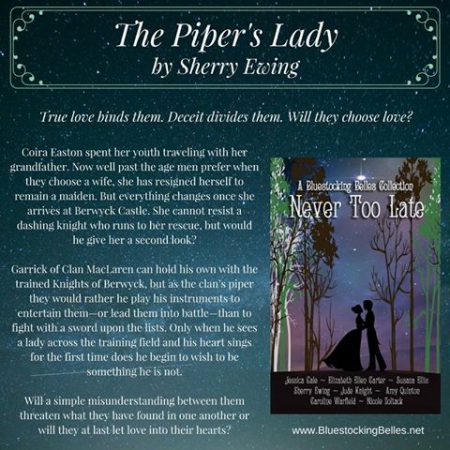

The Piper’s Lady by Sherry Ewing

True love binds them. Deceit divides them. Will they choose love?
Coira does not regret traveling with her grandfather until she is too old to wed. But perhaps it is not too late? At Berwyck Castle, a dashing knight runs to her rescue. How can she resist?

Garrick can hold his own with the trained Knights of Berwyck, but they think of him as a piper, not a fighter. When his heart sings for the new resident of the castle, he dares to wish he is something he is not. Will failure to clear her misunderstanding doom their love before it begins?

Excerpt

“You saved me,” she whispered in a shaky tone. “You are truly a gallant knight to rescue me. Your liege lord must value you as one of his warriors.”

Warrior? Him? He opened his mouth to correct her assumption but could not find the words. He knew she would think less of him if she but knew he was only the clan’s piper.

“Are ye harmed?” he murmured, still holding the pleasing womanly curves of the lady who had not yet moved from atop him. Her brow rose, and Garrick inwardly cursed knowing there was no way to hide his Scottish accent.

“Nay, but only because of your ability to move so quickly. Thank you, Sir…” She left her sentence linger in the air between them.

“Garrick,” he answered, giving her his name, “of Clan MacLaren.”

“My thanks, Sir Garrick,” she replied with a kind smile.

They seemed to come to the realization the lists had become eerily silent with the exception of one person running in their direction.

“Get your hands off her!” a voice bellowed.

Before either of them could move, the woman was ripped from his arms, and Garrick saw her enveloped in the fierce embrace of Morgan. Her arms wrapped around his neck, and Garrick could not help the feeling of jealousy assaulting his emotions and tugging at his heartstrings.

“Coira! By St. Michael’s Wings you gave me such a fright, woman,” Morgan scolded in concern. Setting her down upon her feet, he proceeded to clasp both her cheeks afore placing kisses on each.

Her Wounded Heart by Nicole Zoltack

An injured knight trespassing on Mary Bennett’s land is a threat to the widow’s
already frail refuge. Even so, she cannot turn away a man in need and tells him he has her husband’s leave to stay until Christmas.

Doran Ward wishes only to survive for one more day. However, as he begins to
heal and to pay for his lodgings by fixing the rundown manor, the wounds to Mistress Bennett’s heart intrigue him.

Can two desperate souls find hope in time for Christmas?

Excerpt 

To her surprise, her guest had laid out a few vegetables, and she set about cutting them without saying a word to him.

At one point, he reached across her for another knife.

She stiffened and jerked back.

“My apologies,” he said. “I did not mean to startle you.”

“Do not touch me,” she said, fear melting into anger in her voice. “My husband is a very strong and angry man. He shall take exception to anyone who dares to touch me.”

“Will he be joining us for dinner?” he asked as if unfazed.

She did not like to lie to him. Lying, after all, was a sin. But she also must protect herself.

“No,” she said shortly. “He already ate and has retired for the evening.”

“So it shall be only the two of us?” He glanced over his shoulder at the chunks of meat he had cooking over the fierce fire.

“Aye. You can brine-cure the meat we do not eat.”

“Very well.” He never did grab the knife but returned to tending to the meat.

Soon enough, she added the vegetables to a pot, along with some of his meat. A short time later, the stew was finished.

The man brought over two bowls. She stared at the wooden spoons in her hands. Her husband had lost their silver in yet another game.

Another sign to alert him that all is not well here.

Head back, she took a deep breath. Matters such as they were, she had no other recourse. As cold as the house was despite fires, she could not imagine anyone surviving the night out of doors. Would her good intentions spell even more doom for herself?

A Year Without Christmas by Jessica Cale 

London, 1645

Edward Rothschild returns home from war defeated in more ways than one. His friends killed and his property seized, he is an earl in name only. His family and his servants have all deserted him– all except his housekeeper, Lillian Virtue.

Lillian feels like home in a way that nothing else does, but as his servant and a recent widow, it would be impossible for them to be together. Then again, Christmas has been banned and the social order fractured; can one more impossible thing happen this year?

Excerpt

Somerton’s smile was like a bolt of lightning, a sudden flash of terrifying intensity that surprised them both. One shot of light across the darkness of his face and it was gone.
Her knees failed her suddenly and Lillian caught herself on the edge of the table just as Somerton reached out to catch her arm. His hand closed around her elbow and sent a shock up her spine.

“Are you well?”

Lillian had always held her master in the highest regard, but some part of her had feared him, as well. It was not only that her position depended upon his good graces, but he had seemed more than human to her. His presence was overwhelming and perhaps otherworldly; he had a spark of the infinite that suggested a link to the Divine. She could have easily taken him for a priest or a saint.

She had known he was objectively handsome; what she had not realized was that she thought he was handsome.

She felt her blush deepen and took a steadying breath. “Quite well, my lord. Forgive me.”
He frowned as he examined her face. “You look peaked. Join me for coffee.”

Somerton wanted her—Lillian Page, no, Virtue—to sip coffee with him in his private bedchamber? It was inappropriate, to say the least, but when she opened her mouth to object, all that came out was, “I only brought one cup.”

The Night of the Feast by Elizabeth Ellen Carter

As a spy deep in the heart of Revolutionary France, Michael St. John hopes to make amends for a wasted life his by helping the citizens of the Vendée stage a counter-revolution.

Jacqueline Archambeau, tavern owner and cook, accepts that life and love have passed her by. She never dreamed she would fight her own countrymen for the right to keep her customs and traditions.

When they plot together to steal plans at a regimental dinner will they risk their lives—and their hearts?

Excerpt 

Bonjour.” The smile on Jacqueline’s face was unexpected, as was the greeting and he found himself returning it.

Until he felt the unmistakable press of a gun barrel at his lower back. It seemed that Madame Jacqueline was not alone.

“Your knife, monsieur.” Jacqueline held out her hand.

Michael obliged, handing the weapon over hilt first.

“So, Jacques is really Jacqueline?” he asked, feeling like the world’s greatest fool.

“And I’ll take any other weapons you might have on your person,” she continued.

He hesitated, and the barrel pressed at his back became silently insistent.

“Please?” she asked as pleasantly as if she had simply asked him to pass the butter.

Michael raised his arms, threaded his fingers, and placed them at the back of his head.

“You’ve completely disarmed me, madam, but you are welcome to check for yourself.”

Hazel eyes clouded with mistrust. Jacqueline glanced to the person behind him as though looking for instruction.

“Who sent you?”

The voice behind him was that of another woman.

Michael gritted his teeth. He would kill Colonel Jeffers when they next met. The man knew his contacts were women and thought it amusing not to tell him. To further his bona fides, Jeffers had even made him memorize the first stanza of a poem, Ode To Him Who Complains, no less, by scandalous poetess Mary Darby Robinson.
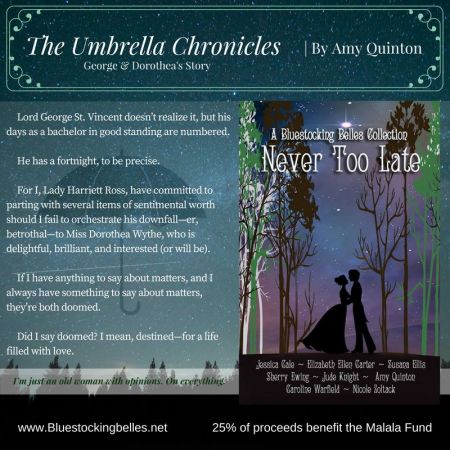
The Umbrella Chronicles: George & Dorothea’s Story

by Amy Quinton 

Lord George St. Vincent doesn’t realize it, but his days as a bachelor in good standing are numbered.

He has a fortnight, to be precise—the duration of the Marquess of Dansbury’s house party.

For I, Lady Harriett Ross, have committed to parting with several items of sentimental worth should I fail to orchestrate his downfall—er, betrothal—to Miss Dorothea Wythe, who is delightful, brilliant, and interested (or will be).

If I have anything to say about matters, and I always have something to say about matters, they’re both doomed.

Did I say doomed? I mean, destined—for a life filled with love.

Excerpt 

Without a doubt, he made her breath catch every single time he looked her way, even if only looking past her, which was pretty much all the time and kind of pitiful. But who cared? It was another secret that was all hers.

Besides, she was undoubtedly not the only woman who struggled to breathe in his presence.

Dory clenched her hands into fists and reminded herself for the millionth time that she was more of the glasses and books type (of which there were far too few in the world) than the roguish smile and flirty type (of which far too many abounded). Hence, her easy slide into spinsterhood at the ripe age of thirty-one.

Yes. St. George was blond and slender and solidly built. And he was beautiful, somehow elegantly masculine, and gloriously tall. She wasn’t the only person that understood this. Everyone acknowledged these traits as if they were all a set of facts that could be found in any book on science. Or a math fact, a proven geometrical theorem.

Like the bluestocking she was, Dory imagined writing proofs over the theory of his gentlemanly beauty. Given George St. Vincent is taller than most men. Given St. Vincent has blue eyes the color of the sky and blonde hair the color of wheat. Given George St. Vincent has a blinding smile and broad shoulders. Prove George St. Vincent is the most swoonworthy man in all of England.

Dory chuckled to herself, though she felt on the verge of hysterics.

But all of that didn’t mean he was a worthy man for her affections.

A Malicious Rumor by Susana Ellis

Vauxhall gardener Alice Crocker has had to defend herself from encroaching males all her life, but the new violinist is a different sort. So when she discovers that he is the victim of a malicious rumor, she naturally wants to help.

Peter de Luca greatly admires the lady gardener, but this is his problem to resolve.

What will it take to prove to this pair that they would be stronger together as a harmonious duo than two lonely solos?

Excerpt

Alice found her feet tapping in time to the music of the orchestra rehearsal while she inspected the site for the new illumination, which would honor the new Duke of Wellington after his victory over Bonaparte at the Battle of Paris. If only the designer had included the measurements! It was difficult to decide how to arrange the plantings without some inkling of the space requirements. With luck, the fellow himself would arrive soon, since the spectacle was planned to open the next day.

Miss Stephens must be singing tonight, she thought as she found herself humming the tune of the popular Northumberland ballad about a brave lass who rowed out in a storm to save her shipwrecked sailor beau.

O! merry row, O! merry row the bonnie, bonnie bark,

Bring back my love to calm my woe,

Before the night grows dark.

She liked the idea of a woman rescuing her man instead of the other way around. It might seem romantic to be rescued by a handsome prince, but one could not always be a damsel in distress, could one? Alice knew from her mother’s marriage that there was no happiness or romance in a marriage where one partner held all the power. She herself had no intention of placing herself in the power of any man. She would be responsible to no one but herself—and perhaps her employer, as long as she was permitted to work for a living. She narrowed her eyes. She could work as well as any man, better than some, in fact. Why did so many men feel threatened by that?

Forged in Fire by Jude Knight

Burned in their youth, neither Tad nor Lottie expected to feel the fires of love. The years have soothed the pain, and each has built a comfortable, if not fully satisfying, life, on paths that intersect and then diverge again.

But then the inferno of a volcanic eruption sears away the lies of the past and frees them to forge a future together.

Excerpt

She was nothing to him. He was sorry for her, that was all. As he’d be sorry for anyone stuck in her predicament. She’d be better off staying in New Zealand, where Mrs. Bletherow’s malice couldn’t reach her. There was work in Auckland, in shops and factories. Not that a proper English lady would consider such a thing.

She could do it, though. She wasn’t as meek as she pretended. He’d seen the steel in her, the fire in those pretty hazel eyes.

The word ‘pretty’ put a check in his stride, but it was true. She had lovely eyes. Not a pretty face, precisely. Her cheeks were too thin, her jaw too square, her nose too straight for merely ‘pretty’. But in her own way, she was magnificent. She was not as comfortably curved or as young as the females he used to chase when he was a wild youth, the sort he always thought he preferred. Not as gaudy as them, with their bright dresses and their brighter face paint. But considerably less drab than he had thought at first sight. She was a little brown hen that showed to disadvantage beside the showier feathers of the parrot, but whose feathers were a subtle symphony of shades and patterns. Besides, parrots, in his experience, were selfish, demanding creatures.


Roses in Picardy by Caroline Warfield

 After two years at war, Harry is out of metaphors for death, synonyms for brown, and images for darkness. Color among the floating islands of Amiens and life in the form of a widow and her little son surprise him with hope.

Rosemarie Legrand’s husband died, leaving her a tiny son, no money, and a savaged reputation. She struggles to simply feed the boy and has little to offer a lonely soldier.

Excerpt

Are men in Hell happier for a glimpse of Heaven?”

The piercing eyes gentled. “Perhaps not,” the old man said, “but a store of memories might be medicinal in coming months. Will you come back?”

Will I? He turned around to face forward, and the priest poled the boat out of the shallows, seemingly content to allow him his silence.

“How did you arrange my leave?” Harry asked at last, giving voice to a sudden insight.

“Prayer,” the priest said. Several moments later he, added, “And Col. Sutherland in the logistics office has become a friend. I suggested he had a pressing need for someone who could translate requests from villagers.”

“Don’t meddle, old man. Even if they use me, I’ll end up back in the trenches. Visits to Rosemarie Legrand would be futile in any case. The war is no closer to an end than it was two years ago.”

“Despair can be deadly in a soldier, corporal. You must hold on to hope. We all need hope, but to you, it can be life or death,” the priest said.

Life or death. He thought of the feel of the toddler on his shoulder and the colors of les hortillonnages. Life indeed.

The sound of the pole propelling them forward filled several minutes.

“So will you come back?” the old man asked softly. He didn’t appear discomforted by the long silence that followed.

“If I have a chance to come, I won’t be able to stay away,” Harry murmured, keeping his back to the priest.

“Then I will pray you have a chance,” the old man said softly.

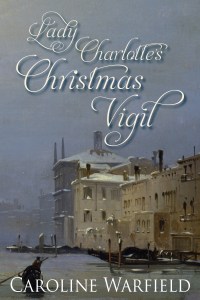
Caroline Warfield: Lady Charlotte’s Christmas Vigil

This beautiful cover for Caroline Warfield’s 2017 Christmas novella comes with the announcement that the book is available for pre-order from various retailers.

Love is the best medicine and the sweetest things in life are worth the wait, especially at Christmastime in Venice for a stranded English Lady and a dedicated doctor.

About Lady Charlotte’s Christmas Vigil

Lady Charlotte Tyree clings to one dream—to see the splendor of Rome before settling for life as the spinster sister of an earl. But now her feckless brother forces her to wait again, stranded in Venice when he falls ill, halfway to the place of her dreams. She finds the city damp, moldy, and riddled with disease.

As a physician, Salvatore Caresini well knows the danger of putrid fever. He lost his young wife to it, leaving him alone to care for their rambunctious children. He isn’t about to let the lovely English lady risk her life nursing her brother.

But Christmas is coming, that season of miracles, and with it, perhaps, lessons for two lonely people: that love heals the deepest wounds and sometimes the deepest dreams aren’t what we expect. Pre-order it here:

Amazon

Smashwords

About the Author

Carol Roddy – Author

Traveler, poet, librarian, technology manager—award winning and Amazon best-selling author Caroline Warfield has been many things (even a nun), but above all she is a romantic. Having retired to the urban wilds of eastern Pennsylvania, she reckons she is on at least her third act, happily working in an office surrounded by windows where she lets her characters lead her to adventures while she nudges them to explore the riskiest territory of all, the human heart. She is enamored of history, owls, and gardens (but not the actual act of gardening). She is also a regular contributor to History Imagined, a blog at the intersection of history and fiction, and (on a much lighter note) The Teatime Tattler, a blog in the shape of a fictional nineteenth century gossip rag.

Her current series, Children of Empire, set in the late Georgian/early Victorian period, focuses on three cousins, driven apart by lies and deceit, who must find their way back from the distant reaches of the empire.

Click here to find out more.

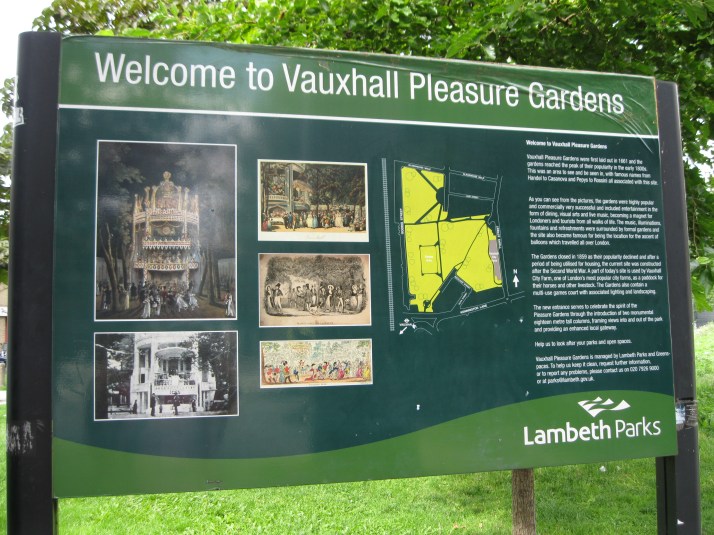
And so I went to Vauxhall Pleasure Gardens today…

…and no, it wasn’t with Lady Pendleton this time.

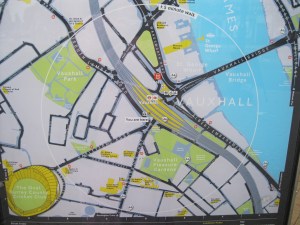
It’s remarkably easy to get there. I took the Bakerloo tube line to Oxford Circus, switched to Victoria,  got off about four stops later, at Vauxhall (also a rail station). It took a bit of walking and looking at maps to figure out which way to go, but once I found Kennington Lane, I was good. It wasn’t hard—just opposite Vauxhall Bridge, in fact. The old Vauxhall Bridge was not in existence in 1814 when the current story I’m writing takes place (it opened in 1816 and was called Regent Bridge at first), so people had to come by Westminster Bridge or by water. By water seems more romantic than coming by tube, but with all the tall buildings and traffic, I couldn’t see the river anyway.

Kennington Lane

When Jonathan Tyers first leased the “Spring Gardens,” that part of town was pretty much still rural. Not town at all. Which was really the source of its allure. One could get away from all the ugly sounds and smells of the city for an afternoon or an evening. And it was open to all classes—well, anyone with a shilling to pay, that is—and there was always something interesting to see and do.
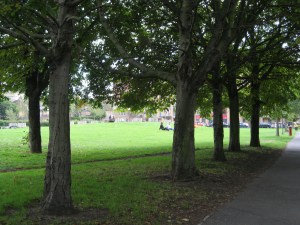
Sadly, London expanded and took over Vauxhall. As buildings were raised around it, it lost much of its appeal. In any case, the advent of trains meant that people could travel further out to see the country if they wished. In 1859, after more than a hundred years, it finished its final season.

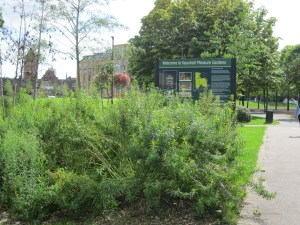
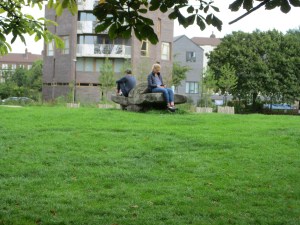
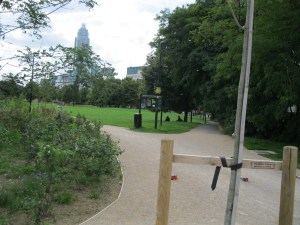
What’s left is hardly even a shadow of its former glory. A handful of grassy knolls, a modern-y stone bench, a basketball court with energetic neighborhood youth dribbling the ball from one side to the other. Further on, there are housing units, parking spaces, and even community vegetable plots on Glasshouse Walk. Nearby is the Vauxhall City Farm, where you can pay to see cattle and horses and such—I suppose there must be people still today who don’t get far out of the city.

Community Plots on Glasshouse Walk.

But the Vauxhall Pleasure Gardens still function for the pleasure of local residents. Here’s a link to one event from April of this year: https://vauxhalltrust.wordpress.com/2017/04/12/st-georges-22nd-and-23rd-april-2017/

I feel certain Jonathan Tyers would approve.

Bow Street: Henry Fielding and the War Against Crime

A House in Bow Street

Crime and the Magistracy

London 1740-1881

Anthony Babington, 1969

Henry Fielding at Bow Street

Henry Fielding

From Wikipedia:

Henry Fielding (22 April 1707 – 8 October 1754) was an English novelist and dramatist known for his rich, earthy humour and satirical prowess, and as the author of the picaresque novel Tom Jones. Additionally, he holds a significant place in the history of law enforcement, having used his authority as a magistrate to found (with his half-brother John) what some have called London’s first police force, the Bow Street Runners.

At the time of Fielding’s appointment, the position of magistrate was lowly regarded, as a large number of magistrates enriched themselves by taking bribes, charging fees, and running bail bond services.

A lampoon from the journal, Old England:

Now in the ancient shop at Bow,

(He advertises it for show),

He signs the missive warrant.

The midnight whore and thief to catch,

He sends the constable and watch,

Expert upon that errand.

From hence he comfortable draws

Subsistence out of every cause

For dinner and a bottle.

No. 4 Bow Street

In spite of the fact that the basest motives had been attributed to him in becoming a magistrate, Fielding himself regarded his appointment as something of a challenge—perhaps the greatest and the final challenge of his whole life. He was finished as a playwright, he had failed as a barrister; his only novel had been cordially, but unenthusiastically received; he was burdened with poverty and ill health.

Fielding, already an acting justice for Middlesex, was granted properties valued at £100 a year by the Duke of Bedford for the purpose of fulfilling the property qualification for the position. At some point he was sworn in as a justice for Westminster—which had no property qualification—as well. In the autumn of 1748, he took cases in his home near Drury Lane, then to Meard’s Court, St. Anne’s, and by December had moved to the Bow Street Office.

By sheer good fortune Henry Fielding was brought into contact at that time with two honourable men, Joshua Brogden and Saunders Welch, both of whom shared his views and were ready to join to the utmost in his endeavours. Brogden, who became his clerk at the Bow Street Office, had been a magistrate’s clerk before.

[Saunders Welch] had occupied the position of High Constable of Holburn for about a year when Fielding came to Bow Street.  The office of High Constable was a part-time function which usually lasted for a duration of between one and three year. As a rule, it was performed by a successful tradesman—Saunders Welch was a grocer—and carried no official remuneration apart from a limited scale of allowances, although there were, of course, ample opportunities for illicit profit. Considering the period in which he lived, Saunders Welch was a high constable of quite exceptional honesty and skill. In fact, after working with him for six or seven months, Henry Fielding said he was ‘one of the best officers who was ever concerned in the execution of justice, and to whose care, integrity, and bravery the public hath, to my knowledge, the highest obligations.’

Initial Reforms

In order to provide for his own financial maintenance—and being unwilling to participate in the unscrupulous methods of boosting income used by his predecessors—he managed to get the government to pay him a regular salary out of public service money.

One of his first actions was to keep accurate reports and publish them in the newspapers.

Before Henry Fielding arrived at Bow Street there could have been very few, if any, full and authentic reports of the proceedings which took place at a magistrate’s house or his office. However, from the outset, Fielding arranged for the details of his cases, written by his clerk, Joshua Brogden, to be published regularly in certain newspapers. His object was not self-publicity, but rather to inform as wide an audience as possible of the types of offence then prevalent, the steps he was taking to overcome them, and to give an occasional dissertation on the requirements of the criminal law.

The following appeared in the St. James’s Evening Post in mid-December, 1748.  This account of a committal to prison of a man who had attacked and wounded a young woman with a cutlass ended:

It is hoped that all Persons who have lately been robb’d or attack’d in the Street by Men in Sailor’s Jackets, in which Dress the said ones appeared, will give themselves the trouble of resorting to the Prison in order to view him. It may perhaps be of some advantage to the Publick to inform them (especially at this time) that for such Persons to go about armed with any Weapon whatever, is a very high Offence, and expressly forbidden by several old Statutes still in force, on Pain of Imprisonment and Forfeiture of their Arms.

This was one of the earliest of Fielding’s celebrated ‘admonitions’ to the public which were to play such a large part in his campaign against crime during the next few years.

Henry Fielding’s Charge

A month after his election to the Chair of Westminster Sessions, Henry Fielding was called upon to deliver a Charge to the Grand Jury of Westminster. This event took place on the 29th June, 1749, and it must have been a significant occasion for him as it was the first time since becoming a magistrate that he had been given the opportunity of making an official pronouncement. Fielding’s fellow justices were so impressed by his Charge that they passed a resolution asking him to have it printed and published, ‘for the better information of the inhabitants and public officers of this City and Liberty in the performance of their respective duties.’ The Monthly Review commented: ‘This ingenious author and worthy magistrate, in this little piece, with that judgment and knowledge of the world, and of our excellent laws (which the publick, indeed, could not but expect from him) pointed out the reigning vices and corruptions of our times [and] the legal and proper methods of curbing and punishing them…’

The War Against Crime

The 1740’s in London was a time when the highwayman, the footpad, and the house-breaker ran rampant over weak and ineffectual peace-officers, and even when a criminal was captured, there was insufficient room in jails to accommodate them.

Henry Fielding was possessed of certain qualities which would have enabled him to become an outstanding magistrate… He had a fearless  independence of spirit, a complete impartiality of approach, a breadth of human understanding, and an infinite knowledge of law and procedure. He felt very little emotional affinity with his own social class. In 1743 he wrote that, ‘the splendid palaces of the great, are often no other than Newgate with the mask on’: and added, ‘a composition of cruelty, lust, avarice, rapine, insolence, hypocrisy, fraud and treachery, glossed over with wealth and title have been treated with respect and veneration, while in Newgate they have been condemned to the gallows’.

…under Henry Fielding the Bow Street Office, whilst remaining a private room in a magistrate’s ordinary residence, was conducted on the lines of a superior court, in an atmosphere of judicial dignity and according to the strictest principles of legal propriety. The office continued to be maintained solely out of the fees which were recoverable by law and by custom from arrested persons, prisoners and applicants for process.

Fielding’s office dealt with serious crimes such as burglary, assault, riot, coining, brothel-keeping, and smuggling as well as minor ones such as drunkards, gamblers, prostitutes, vagrants and beggars.

The justice administered by Henry Fielding was a sagacious blending of sternness, understanding, and compassion. He respected the life and property of the law-abiding citizen, and he knew how easily the delicate structure of society could be imperilled by the forces of disorder; therefore, he wasted little sympathy on the robber, the armed thug, the vandal or the rioter. On the other hand, he felt the deepest pity for the neglected victims of an economic system founded upon inhumanity and self-interest.

Fielding, while he had no qualms about sending juveniles and first-offenders to prison, advocated for less severe penalties for small thefts. He particularly criticized the sentencing of vagrants to houses of detention for the wantonly idle.

What good consequence can there arise from sending idle and disorderly persons to a place where they are neither corrected or employed, and where with the conversation of many as bad, and sometimes worse than themselves, they are sure to be improved in the knowledge, and confirmed in the practice of iniquity?

Employing the assistance of the law-abiding

With no centralised police force, and no effective liaison between the peace officers of the various parishes, it was extremely difficult to achieve even a limited co-rdination of effort. To overcome this obstacle Fielding decided to make a direct appeal to the public.

NOTICE AND REQUEST TO PUBLIC

All persons who shall for the future suffer by robbers, burglars, etc., are desired immediately to bring or send the best description they can of said robbers etc., with the time, place, and circumstances of the fact to Henry Fielding,Esq. at his house in Bow Street, or to John Fielding Esp. at his house in the Strand. [John was his brother, who continued Henry’s work after his death.]

Fielding insisted on the cooperation of the law-abiding, not only for the purpose of making reports, but also in attending his examinations of prisoners in order to make identifications.

Fielding’s thief-takers

The pre-cursors of the force later known as Bow Street Runners, Fielding’s “thief-takers” was a group of six ex-constables under the command of his lieutenant, Saunders Welch. These men were on call to be summoned to pursue villains at any moment.

After a robbery or a house-breaking, a message would be rushed to Bow Street, and the thief-takers, or as many of them as were available, would set out in immediate pursuit. Strangely enough, the system worked remarkably well. This was due partly to the fact that the London criminal had never before been confronted by an organised opposition, and also to the ever-increasing knowledge and proficiency of the thief-takers.

Jack Sheppard, a celebrated criminal of the age, is imprisoned in the gate house at the door of which sits a figure, thought by some to be Jonathan Wild besieged by a crowd of people seeking the return of their stolen property.

Enquiry into the Causes of the Late Increase of Robbers

A treatise published by Fielding in 1751 stated bluntly that

“The streets of this town and the roads leading to it will shortly be impossible without the utmost hazard.” He claimed that even if the robbers were arrested, they would likely be rescued by their own gang, or by bribing or intimidating the prosecutor.

He asserted that the first cause of crime was idleness and public diversions, such as music and dancing halls. Later that year, an Act was passed bringing these entertainments under the supervision of the justices of the peace.

Next, he denounced drunkenness as “the odious vice, indeed, the parent of all others.” “He elaborated on the appalling consequences of the continued vogue of spirit-drinking, and suggested higher taxes on gin, and a much firmer control over the places where it was sold. Many of the provisions of the Gin Acts of 1751 and 1753 were based on his proposals.”

He also criticized rampant gaming and lotteries, and the application of the Poor Law, as well as defects in the criminal law and criminal procedure. A month later, “a Parliamentary Committee was set up… to revise and consider the laws in being, which relate to felonies and other offences against the peace. The Lloyd Committee… was strongly influenced by Henry Fielding’s views and made a number of recommendations which accorded closely with his suggestions. As a result, several statutes were enacted during the next few years which profoundly affected the future development of the British criminal law.”

Another of his proposals was a law be passed making it illegal to receive stolen property, thus making it more difficult for thieves to dispose of their booty. An effort was made to require pawnbrokers to obtain a license, but this was passed.

Fielding condemned the system by which criminal prosecutions had to be brought by, and in the name of, a private individual, for this resulted in a large number of known offenders never being charged at all. The victim of a crime might be deterred from charging the culprit by threats or intimidation; he might be too indolent to embark on legal proceedings; he might be tender-hearted and, in an era when every felony was nominally a capital offence, averse to taking away the life of a fellow-being; above all, he might be unable or unwilling to bear the costs involved in a prosecution [which might mean traveling great distances for himself and potential witnesses]. … The answer to this, Fielding suggested, was that the county or the nation should pay the expenses of all prosecutions. [This proposal was adapted in part and later became implemented more fully in the development of criminal prosecutions financed out of public funds and presented in the name of the Crown.]

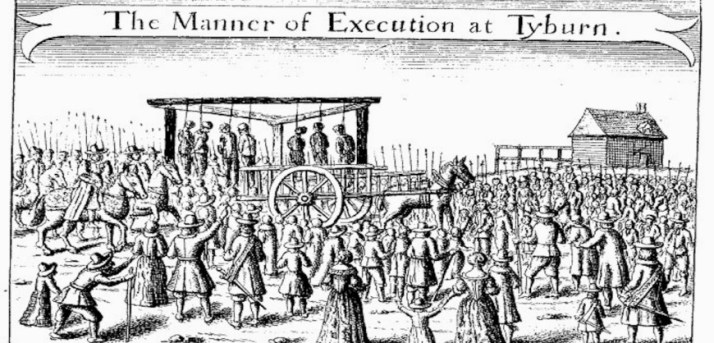
Fielding was intensely critical of the frequency of executions, and of the method in which the hangings were carried out. Fundamentally, a public execution was supposed to produce an atmosphere of terror and shame amongst the onlookers, but ‘experience hath shown that the event is directly contrary to this intention’. The triumphal procession from Newgate to Tyburn, the huge crowds; the condemned prisoner’s final speech from the scaffold; the veneration, the excitement, the acclaim—all these tended to turn a day of infamy into a day of glory.

He suggested that executions should be conducted with much greater solemnity and should be witnessed by as few spectators as possible. Further, they should take place very soon after the crime itself, ‘when public memory and resentment are at their height’. At the end of a trial, he said, the court should adjourn for four days, and then the prisoner should be brought back, sentences to death, and executed forthwith just outside the court, ‘in the sight and presence of the judges’.

Fielding’s proposal for speedier executions was “put into effect in 1752 in respect of executions for murder, by an act which provided that, unless the judge knew of reasonable cause for delay, the condemned murderer was to be hanged two days after the passing of sentence.”

Accolades at last for Henry Fielding

The Enquiry was received with interest and with praise; even Horace Walpole, no friend to Henry Fielding, described it as ‘an admirable treatise’. The Monthly Review in January 1751, paid this glowing tribute:

The public hath been hitherto not a little obliged to Mr. Fielding for the entertainment his gayer performances have afforded it, but now this gentleman hath a different claim to our thanks, for services of a more substantial nature. If he has been heretofore admired for his wit and humour, he now merits equal applause as a good magistrate, a useful and active member and a true friend to his country. As few writers have shown so just and extensive a knowledge of mankind in general, so none ever had better opportunities for being perfectly acquainted with that class which is the main subject of this performance.

Bow Street: Thomas de Veil’s London

A House in Bow Street

Crime and the Magistracy

London 1740-1881

Anthony Babington, 1969

Thomas de Veil’s London

Some time in 1740 Colonel Thomas De Veil, a justice of the peace for the Count of Middlesex and for the City and Liberty of Westminster, decided to move his magistrate’s office from Thrift Street, now called Frith Street, in Soho to a house at Bow Street in Covent Garden.

Thomas de Veil

The Covent Garden area was once pasture land owned by the Abbots of Westminster. Later, it became the site of Inigo Jones’s famous Piazza, with fashionable terraced houses and a small church. The nobility and the gentry scrambled to build homes here.

By the beginning of the eighteenth century the character of Covent Garden was undergoing a perceptible change. It was, perhaps, inevitable that the ultra-fashionable Piazza and the locality all about it should attract a swarm of tradesmen, artisans and others who were needed to cater for the requirements of the wealthy. At the same time the narrow passages, the darkened alleys, and the secluded courtyard which separated the streets and the houses drew in a far less respectable segment of the community. Another factor affecting the type of inhabitant settling in the neighbourhood was the continual tendency of the nobility and the aristocracy to drift westwards as other areas were developed further and fruther from the walls of the City. Soon after the Restoration the newly-built St. James’s Square superseded the Piazza as the centre of fashion, and in the early days of the eighteenth century Mayfair was further developed with the setting up the palatial mansions of Cavendish Square, Hanover Square and Grosevenor Square. However, one of the major factors which contributed to the transformation of Covent Garden was that it was becoming the principal artistic and theatrical locality of London.

Covent Garden in 1737, by Nebot

Actors and actresses and their audiences flocked to theaters such as Drury Lane, the Opera House, Lincoln’s Inn Fields, and Covent Gardens. Literary folk and ‘wits’ flocked to the coffee-houses such as Will’s, Buttons’s, and Tom’s. When Tom King died, his widow turned his coffee-house into a brothel. And so it was that “the streets of Covent Garden and the Strand became the chosen haunts of the prostitutes.”

Royal Opera House

“An age of lawlessness and disorder in which the power of the mob and the violence of the criminal were ever paramount”

It was becoming obvious that the current system of policing was inadequate. Streets were especially dangerous at night due to the lack of a proper lighting system.

Pickpockets

A guidebook of the period warned its readers: “A man who saunters about the capital with pockets on the outside of his coat deserves no pity.” As shown by Charles Dickens in Oliver Twist, young boys and girls could be very deft at this particular offense. Richard Oakey would trip up a woman from behind and remove her pocket (pockets dangled from the waist on the outside of a woman’s dress) before she hit the ground. Mary Young had a pair of artificial arms made so that she could sit primly in a church pew with the artificial arms folded on her lap while she used her real arms to rob from those sitting next to her.

Footpads

Henry Fielding said that the alleys, courts and lanes in London were “like a vast wood of forest in which a thief may harbour with as great security as the wild beasts do in the deserts of Africa or Arabia.” And not just at night either. Fanny Burney complained about footpads and robbers before breakfast.

Criminals operating in gangs made the situation even worse. In 1712, a band of thugs called the Mohocks would greet people in the streets and if they responded, beat them up. They attacked the watch in Devereux Court and Essex Street; they also slit two people’s noses, and cut a woman in the arm with a pen-knife. One night about twenty of them stormed the Gatehouse, wounded the jailor, and released their confederate from the jail.

No person was safe and equally no home was secure. Madam Roland… said that when the wealthy left London in the summer they took with them all their articles of value or else sent the lot to their bankers, because ‘on their return they expect to find their houses robbed.’

Highwaymen

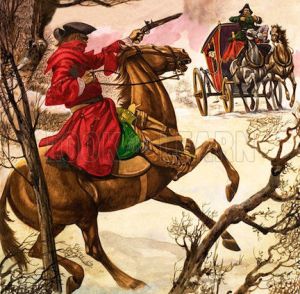
The highwaymen were regarded both by the public and amongst the criminal fraternity as being the princes of the underworld. It is difficult to understand why they had so glamorous a reputation in the eighteenth century and, indeed, why their image has been so romanticised ever since. By and large they were simply robbers on horseback and many of them had deplorable backgrounds. Dick Turpin’s gang, for example, was well-known for violence, terrorism, rape, and even murder.

Their favorite hunting-grounds were the roads just outside London. For that reason, dwellers of the suburban areas organized vigilante patrols, and in some areas, squads of soldiers were used to escort travelers in and out of town. Horace Walpole told of an attack on a post-chaise outside his home in Piccadilly, and also of a personal encounter with two of them in Hyde Park.

Why the mounting lawlessness?

Some blamed it on the “large numbers of disbanded soldiers and sailors roaming the country without work and without subsistence. Others held that it was due to drunkenness and cheap gin. A few—but a very few—saw a possible cause in the harsh administration of the Poor Laws and the way in which homeless and the destitute were hounded from parish to parish, coupled with the terrible social conditions of the poor.”

Whatever the reasons, the precincts of the capital and its approaches were deteriorating into a state of lawlessness which bordered on anarchy, and the machinery for preserving the peace was becoming increasingly impotent. The ancient system with its corner stones in the amateur magistrate and the part-time constable, had worked comparatively well throughout the ages in the rural areas of Britain but had proved completely unadaptable to an expanding urban community. At the beginning of the eighteenth century the basic problem remained unsolved—and barely appreciated.

It was in a London such as this that Colonel Thomas De Veil opened his Office at Bow Street.

The Four Times of the Day

The Four Times of the Day, a series of paintings by Hogarth in 1738, illustrated the sort of place Covent Garden had become. Read more about it here.

Curious Characters: Marquess of Granby

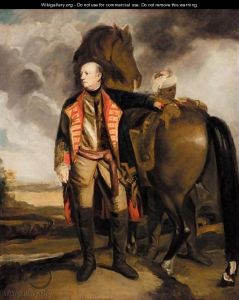
Lieutenant-General John Manners, Marquess of Granby PC (2 January 1721 – 18 October 1770) was a British soldier and the eldest son of the 3rd Duke of Rutland. As he did not outlive his father and inherit the dukedom, he was known by his father’s subsidiary title, Marquess of Granby. Granby served in the Seven Years’ War as overall commander of the British troops on the battlefield and was subsequently rewarded with the post of Commander-in-Chief of the Forces. He was popular with his troops and many public houses are still named after him today.

Granby was one of the first who understood the importance of welfare and morale for the troops. The character of British soldiering improved, and properly led the army was unbeatable in war. Nearly all the portraits show him mounting a horse, or helping the wounded. On 7 June 1760 he wrote to Viscount Barrington, Secretary at War, receiving a reply ten days later making enquiries as to the Hospital Board accommodation for his wounded men.

Granby’s tactical skill commanding the allied cavalry required courage, control and communication, also bringing Horse artillery to bear. The victory at the Battle of Warburg in July 1760 of an army three times the size distinguished his generalship, and marked the man as a genuine British military hero. His opponent, the duc de Broglie, was so impressed that he commissioned a portrait of Granby by Sir Joshua Reynolds.

He is probably best known today for being popularly supposed to have more pubs named after him than any other person – due, it is said, to his practice of setting up old soldiers of his regiment as publicans when they were too old to serve any longer.

The Marquis of Granby, Waddingham

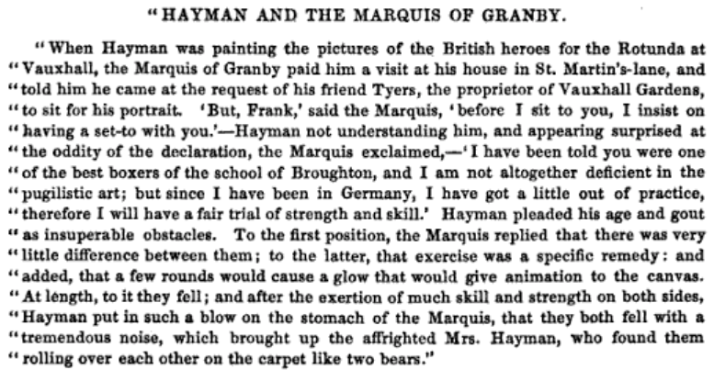
An incident between an aging Granby and Frances Hayman, the famous theatre set-designer and painter at Vauxhall Gardens, appeared in The Vauxhall Papers in 1841.

Sadly, after his military and political career ended, Granby suffered from financial problems. A close family friend wrote this after learning of his death:

“You are no stranger to the spirit of procrastination. The noblest mind that ever existed, the amiable man whom we lament was not free from it. This temper plunged him into difficulties, debts and distresses; and I have lived to see the first heir of a subject in the Kingdom have a miserable shifting life, attended by a levee of duns, and at last die broken-hearted.”

Belvoir Castle, the seat of the Rutland dukedom