Archives

Historical Romance Deal Breaker #1: Reluctant Heroes

Blast From the Past: Susana is traveling in Scotland this week and she thought some of you might enjoy revisiting some of her previous posts on Susana’s Parlour.

Decades of reading historical romances have led me to develop strong opinions of what defines a truly satisfying story, so the other day I set about making a list of characteristics that turn a potential five-star read into a one- or two-star. Admittedly, there are some skillful authors who manage to successfully incorporate one or more of these scenarios in their books; however, I have run across quite a few more who in my opinion haven’t quite managed it.

Overview of Susana’s Historical Romance Deal Breakers

  1. Reluctant Heroes
  2. Adultery
  3. Anachronistic Behavior and Historical Inaccuracies
  4. Cliffhanger Endings
  5. Unattractive or Drop-Dead Gorgeous Heroines
  6. Heroes With Mistresses or Who Sleep With Servants
  7. Drop-Dead Gorgeous Heroes
  8. Promiscuous Heroines
  9. Contrived Endings
  10. Waifs and Silly Heroines
  11. Long Separations
  12. Excessively Cruel Heroes and Heroines
  13. Breaking the Rules: Why Some Authors Get Away With It

These are what I call “deal breakers”—characteristics that make a book a wall-banger. Not surprisingly, many involve character, particularly the character of the hero and heroine. They have to be likable. They have to be three-dimensional, i.e., well-drawn-out characters with flaws, not fairy princesses. And they have to be able to fall in love, convincingly, the head-over-heels kind of love.

The first deal breaker for me is the reluctant hero.

Nothing is guaranteed to turn me off a book so much as a hero who denies his feelings until the very last chapter. Certainly some initial reluctance is expected; what Regency buck is eager to tie himself down to a leg-shackle before he has sown his wild oats? But the attraction needs to happen fairly soon after he meets the heroine; there must be indications early on that he enjoys her presence, resents it when other men pay her attention, etc. Which doesn’t mean that love at first sight is de rigueur. Instant attractions can be quite wonderful, but ultimately, the feelings between them must be based on something other than physical characteristics.

Below are some examples of reluctant heroes I have encountered recently:

  • The hero was so in love with his deceased wife that he cannot imagine ever risking his heart again, so when he starts falling for the heroine (poor thing), he determines to marry another young lady he doesn’t care as much for instead. Heroes cannot be idiots.
  • The hero recognizes his soulmate, but continually spurns her because childhood traumas make him feel unworthy. Heroes cannot be whiners.
  • The hero is damaged from his experiences in the war, but not too much to fall into bed with his deceased best friend’s sister. When events come to the point where her reputation will be ruined, he refuses point-blank to marry her. Heroes cannot use the heroine and then abandon her.
  • The hero is a notorious rake who has determined never to marry, and when faced with the love of his life, he runs away with another woman, forcing her to marry another man, who abuses her cruelly. Heroes cannot be jerks.
  • The hero and the heroine share a kiss in a moonlit garden and arrange several more meetings. When the heroine, who is being pressured to marry a wealthy old man, begs the hero to marry her, he confesses that he is already married (how could he forget?), and abandons her to a miserable marriage. Heroes cannot be cowardly or adulterers.

Of course, the above cases are extreme; many times the reluctant hero is simply…reluctant. Not mean or cruel or particularly stupid. . . just there. While he may not get my dander up, he’s also…boring. And frankly, heroes cannot be boring either.

What do you think? Can you add some examples of reluctant heroes that you have encountered lately? Or can you think of stories where an initially reluctant hero successfully makes the transition into delightfully besotted hero? I’d love to hear about them!

Episode #15: Lady P On Assignment in 1814 Kent

Susana: Lady P, who is still visiting her daughter’s family in 19th century Kent, heard some rather juicy gossip about the scion of a prominent family in the area and decided to investigate, intending to present the results of her investigation to me in an attempt to make reparations for making free with my credit card to buy gifts for her grandchildren prior to her return to her own time period.

Lady P [interrupting]: Although I know Susana well enough to know that it is not the money that concerns her; it’s something called the Prime Directive. So silly really, to think that something as innocuous as the Laugh and Learn Learning Puppy could cause the end of the world. [Shaking her head] In any case, I sent a note to Lord Rutherford to call upon me at my son-in-law’s home in Thanport at his earliest convenience, and he was pleased to do so.

* * * * * *

Lady P: I am much obliged to you, sir, for your prompt response to my invitation.

Rutherford [bowing]: You indicated that it was a matter of some urgency?

Lady P: Yes, indeed. Rumor has it, my lord, that you are a sapskull.

Rutherford [eyebrows raised]: A sapskull, madam? Indeed? And how did you come to that conclusion?

Lady P: Although perhaps it is merely a ploy to draw attention from your dabbling in the area of espionage.

Rutherford: Espionage? Really, my lady. I think you’ve been reading too many Minerva romance books.

Lady P [waving an arm]: Do not be alarmed; your secret is safe with me. I am more concerned about your attentions toward a certain highly-regarded young lady in the area.

Rutherford [rather stiffly]: If you mean Miss Marsh…I suppose it is no secret that I am courting her.

Lady P: It is hardly flattering to Miss Marsh that you spent so many years sniffing after Lady Phoebe and only turned to her when Lady Phoebe became engaged to another.

Rutherford: I was not sniffing after Lady Phoebe. She has never been more than a friend. I was merely waiting until Miss Marsh attained an age to marry. [Under his breath: Shocking how meddlesome older ladies can be!]

Lady P [with narrowed eyes]: What was that about older ladies?

Rutherford: Nothing ma’am. Are you quite finished with your interest in my affairs?

Lady P: Not even close, my lord. Then you waited on the sidelines while Miss Marsh received countless offers of marriage…surely any sensible man would have made an effort to fix his interest with the woman he intends to marry. What if she’d have accepted one of them? Where would you be, then?

Rutherford: I had the situation well in hand. If it appeared as if she were interested in another gentleman, I would have stepped in.

Lady P: Why did you decide on Miss Marsh? What are the qualities you saw in her that gave you the impression that she would make a suitable wife for you?

Rutherford: I have known her all her life. She is a well-behaved, proper lady who has all the attributes I desire in a wife. Furthermore she is used to taking her lead from me. I wish to live a well ordered life. With Miss Marsh there will be no surprises.

Lady P: I understand, however, that Miss Marsh has turned down your offer of marriage.

Rutherford [running a finger down his cravat]: That is true. A fit of pique, only.

Lady P: But you persist in pursuing her. What makes you think you can prevail upon her to change her mind? Miss Marsh appears to be a young lady who knows her own mind. I doubt she will be easily importuned.

Rutherford: I have been busy during the past couple of years. Once I spend some time dancing attendance on her, I’m sure she’ll come around. After all, we have been close friends for years.

The Secret Life of Miss Anna MarshLady P: What can you offer Miss Marsh that her other suitors could not?

Rutherford: I beg your pardon, my lady, but these questions are extremely intrusive. [To himself: not to mention something I don’t wish to think about.]

Lady P: How have your feelings changed toward Miss Marsh since your return to Kent?

Rutherford: Really, these questions are outside of enough. My feelings toward Miss Marsh are no concern of yours. All anyone need know is that I intend to make her my wife. You can tell that to Lady Blanchard. [Rutherford mutters behind his hand: Now if I can only convince Anna. I wish I knew why the devil she is being so difficult.)

[A maid comes in and whispers in Lady P’s ear.]

Lady P [to the maid]: Tell my daughter I’ll be along shortly. [to Lord Rutherford]: I do beg your pardon, Lord Rutherford, but a domestic squabble requires my attention. Before you depart, however, there is one last point of curiosity I should like you to satisfy, if you would be so kind.

Rutherford [rolling his eyes]: By all means, my lady. I have no wish to leave your curiosity unfulfilled.

Lady P [with a saucy grin]: Can you tell me where I might find a copy of that book Miss Marsh found in the library? You know, the one with all the—er—fascinating illustrations? I have a novelist friend who would give her eye-teeth to have one.

Rutherford [clearing his throat] I believe I must take my leave of you, madam. It’s been a pleasure, of course.

Lady P [winking and offering her hand]: Indeed it has, Lord Rutherford. I wish you well in your endeavor to win Miss Marsh’s affections. Perhaps a match between you is not quite so ill-conceived as I thought.

Rutherford: À bientôt, my lady. [softly cursing as he walks out the door]

About The Secret Life of Miss Anna Marsh

Since she was a young girl, Anna Marsh has dreamed of Sebastian, Baron Rutherford asking for her hand in marriage. But that was in another life when her brother Harry was alive, before she vowed to secretly continue the work he valiantly died for. Now as Sebastian finally courts Anna, she must thwart his advances. Were he to discover her secret, he would never deem her a suitable wife…

Sebastian has always known Anna would become his wife someday. He expects few obstacles, but when she dissuades him at every turn he soon realizes there is much more to this intriguing woman. Somehow he must prove to her that they are meant to be together. But first he must unravel the seductive mystery that is Miss Anna Marsh…

Available for pre-order on Amazon.com
SusanaSays3Susana Says: Fabulous Read, 5/5 stars

On the surface, Anna Marsh appears to have everything a young lady could wish for. She’s beautiful, accomplished, well-mannered, and sought after by countless eligible gentlemen. She’s also a wealthy heiress. But Anna is not a typical debutante. She has a secret life that she is determined never to give upeven if it means she must remain unmarried the rest of her life. In any case, the man she’s always loved, Sebastian, Lord Rutherford, seeks a biddable, compliant wife, which she knows she’ll never be.

Sebastian, Lord Rutherford has been waiting for Anna to mature into a desirable young lady, and now that she has, he’s ready to pop the question. But when he doesn’t get the answer he expects, he becomes all the more determined to win her heart. But how can he truly love Anna when he doesn’t really know her? The question becomes: is he a suitable husband for her?

Anna is a strong, independent woman determined to make more of her life than the typical society maven. There were times in the beginning when I wanted to slap Rutherford silly for taking Anna for granted for so long, but, on the other hand, there is nothing quite like seeing a man grovel to appease his lady, and Rutherford manages to do so quite satisfactorily.

There is a very sweet secondary romance in this story, and also a mystery to solve originating from Anna’s “secret life.”

The Secret Life of Miss Anna Marsh is the second in a series, following The Seduction of Lady Phoebe. The book stands well on its own, however. This review was written from an ARC provided by the author, who, incidentally, has the first book on pre-order. Ella Quinn is a wonderful new talent in the Regency world, and this Regency devotee looka forward to enjoying her future works.

About the Author

Ella QuinnElla’s studies and other jobs have always been on the serious side. Reading historical romances, especially Regencies, were her escape. Eventually her love of historical novels led her to start writing them.

She is married to her wonderful husband of twenty-nine years. They have a son and granddaughter, Great Dane and a Chartreux. After living in the South Pacific, Central America, North Africa, England and Europe, she and her husband decided to make St. Thomas, VI home.

Ella is a member of the Romance Writers of America, The Beau Monde and Hearts Across History. She is represented by Elizabeth Pomada of Larsen-Pomada Literary Agency, and published by Kensington. Her debut novel The Seduction of Lady Phoebe, will release in September 2013

Contacts

Website: (Up soon) www.ellaquinnauthor.com

Facebook: www.facebook.com/EllaQuinnAuthor

Twitter www.twitter.com/ellaquinnauthor

Blog http://ellaquinnauthor.wordpresscom


The Lady P Series

Episode #1: Susana’s Adventures With Lady P: The Introduction

Episode #2: Lady P Talks About… Pride and Prejudice?

Episode #3: Lady P and the Duchess Who Lost a Billion Dollars

Episode #4: Lady P and the Face On the $100 Bill

Episode #5: In Which Lady P Discovers Sparkly Fabrics and Ponders Violating the Prime Directive

Episode #6: Lady P Dishes the Dirt on the Duchess of Devonshire

Episode #7: The Political Exploits of Lady P and the Duchess of Devonshire

Episode #8: Lady P and the Prince Regent’s Illicit Marriage

Episode #9: In Which Lady P Depletes the Cooking Sherry During Her Discussion of Caroline of Brunswick

Episode #10: Lord Byron: Mad, Bad, and Dangerous to Know

Episode #11: In Which Lady P Talks About Hannah More and the Rights of Women

Episode #12: Lady P’s Revelations Regarding George III and His Peculiar Progeny

Episode #13: Lady P Discusses the Luddite Uprising, the Assassination of Spencer Perceval, and the General Unfairness of Life

Episode #14: In Which Leticia, Lady Beauchamp, Pops In For an Interview On Her Personal Acquaintance With Princess Charlotte of Wales

Episode #15: Lady P On Assignment in 1814 Kent

Lady P Quizzes Jane Livingston, the Hero’s Sister From “A Twelfth Night Tale”

Episode #14: In Which Leticia, Lady Beauchamp, Pops In For an Interview On Her Personal Acquaintance With Princess Charlotte of Wales

Susana [to the Reader]: I’m afraid Lady P had to return to the 19th century for a christening (no, not Damian and Theresa’s this time, but one of her own daughters’ offspring). She promised to return after she’s had a comfortable coze with her daughters and grandchildren, but in the meantime, she sent someone who she said was a personal friend of Princess Charlotte, the daughter of the Prince Regent.

Lady Beauchamp: I would not characterize our acquaintanceship in quite that manner, Miss Ellis.

Susana: Forgive me, Lady Beauchamp, but I am not finished speaking to the readers.

Lady Beauchamp: Well, do hurry, then. I have an important social engagement this afternoon.

Susana [taking a deep breath]: Yes, well, Lady Beauchamp is the former Leticia Snodgrass, who was presented in London about the same time as Lady P’s niece-by-marriage, Theresa Ashby. You can read more about that in the epilogue to Treasuring Theresa, which is a free read on my web site: http://www.susanaellis.com/pub.html.

gloria_gown_stern

Leticia, Lady Beauchamp, née Snodgrass

Lady Beauchamp: Is it really? I daresay I should like to see how I am characterized in the story.

Susana [hurriedly]: Perhaps we should get back to the subject at hand, you being a marchioness and your time being so valuable and all. Why don’t you begin by telling us about your marriage and your family?

Lady Beauchamp: Of course. I was quite sought-after in my first season—many offers were made for my hand, you know—but there were only a handful of dukes that year and they were all married, so I chose to wed Lord Beauchamp. We had a fabulous wedding at St. George’s, and the Prince kissed my hand and called me the most beautiful bride he’d ever seen.

Susana: And your husband and family? Please tell us about them.

Lady Beauchamp: Fortunately, my youngest, George Augustus, takes after his mother. [Smiling] He has the most adorable cherubic face and blue eyes so like mine. I think it quite likely that his hair will lighten before long as well.

Susana: And your older son?

Lady Beauchamp [grimacing]: It is most unfortunate that Robert William takes after his father. Sturdy, bookish, and quite dull. At least dear Robbie has not lost his hair as his father has. Lord Beauchamp is much older than I, you know. His first wife gave him only daughters, but it was I who gave him his heir and a spare. [Preening]

Susana: I…see. Well, now that my readers are informed as to your…uh…pedigree, let us move on to the topic at hand. How did you become acquainted with the Princess Charlotte, Lady Beauchamp?

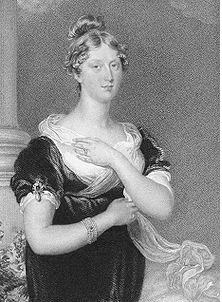
Princess Charlotte of Wales, during her pregnancy

Princess Charlotte of Wales, during her pregnancy

Lady Beauchamp [wrinkling her nose]: Of course. Well, we had met in passing at ton events when she was a child, although rarely with her mother, since her father wished to limit her exposure to her mother’s eccentricities. [Coughing delicately]. Blood will tell, however. Lady de Clifford, who had the charge of her at the time—only a baroness, you know—gave her far too much freedom. The girl had no sense of propriety—quite the hoyden as a child, but it was far worse when she reached adolescence.

Susana: Well, adolescence is a difficult time for everyone. I taught thirteen-year-olds for twenty-five years, you know. The best thing about it is that it eventually passes. I suppose the Princess showed the usual interest in the opposite sex?

Lady Beauchamp [shaking her head]: Oh, much worse than that, my dear Miss Ellis! If it wasn’t one of her cousins (illegitimate, you understand), it was William, Duke of Gloucester. They all took her fancy at one time or another. The rumors were rampant all over Town! Upon this proof that she took after her scandalous mother, the Prince Regent made arrangements for a marriage with William of Orange, hoping for an alliance with the Netherlands. It all came to nothing of course. Stubborn, stubborn girl! Not at all the sort of girl who ought to be a princess!

Susana: Do you know why she didn’t like the Prince of Orange?

Lady Beauchamp [curling her lip]: Indeed I do. She confided in me once—quite soon after she and Prince Leopold had settled at Claremont House—which is near Beauchamp’s estate in Surrey, you know—that he refused to promise to allow her mother to visit them after they were married because of her scandalous reputation, and after that, she steadfastly refused to have him. [Leaning closer to Susana] Of course, by then her mother had already fled to the Continent, and she never saw her again anyway.

Susana: How sad!

Lady Beauchamp [shrugging]: Was it? Many would say it was all for the best.

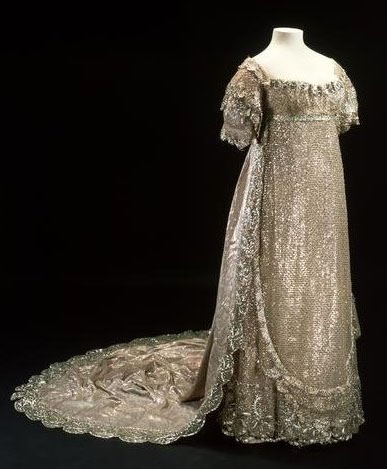
Princess Charlotte's silver lace wedding gown

Princess Charlotte’s silver lace wedding gown

Susana: So you socialized with the royal pair after their marriage. What can you tell us about them?

Lady Beauchamp: Quite a boring pair, really. Prince Leopold—who was quite impoverished, you understand, before he wed the heir to the throne of England—took rather too much of an interest in agriculture for my taste. Of course, he and Beauchamp used to tramp all over looking at crops, of all things. Her Royal Highness thought it was quaint.

Susana: But they got on well together?

Lady Beauchamp [reluctantly]: I suppose they must have. I never heard talk of rows between them, and her manner of dress became more sedate after her marriage. Indeed, Prince Leopold seemed to have a calming influence on her. We shared a box at the races once, and when Her Royal Highness began to show rather more enthusiasm than was proper, her husband caught her attention and said, “Doucement, chérie,” and she immediately smiled and regained her composure.

Susana [eyes filling with tears]: How sweet! What a shame their time together was so short! Were you around her during her pregnancy?

Lady Beauchamp: Her confinement, Miss Ellis. Do try to exercise a bit of restraint in your speech, even though you are American. [Sighing heavily]. Indeed I did see her a few times, although as her condition advanced, she was kept in seclusion. Considering all of the doctors who were consulted, one would have thought at least one would have been able to assist her safely through her trial. But no, she was allowed to eat until she reached elephantine proportions, and then they tried to starve her until she turned despondent. Why, Sir Richard Croft was not even a physician! My own husband would never have allowed a mere accoucheur near me when I was brought to bed. But it’s like my mother says, everything the Prince Regent touches ends in failure. Born under an unlucky star, she believes.

Susana: I understand Prince Leopold never recovered from the death of his wife and son.

Lady Beauchamp: Nor has England either. One would think the world has come to an end. The King has no legitimate grandchildren and his youngest son is over forty. The city closed down for two weeks and within a few days there was no black cloth to be had, as all of England was in mourning. Beauchamp said there wasn’t a dry eye to be seen during the funeral, when she was laid to rest with her son at her feet in St. George’s Chapel at Windsor Castle. To be sure, I can’t imagine what will happen to the succession now. I suppose all of the royal princes will run out and marry and try to sire an heir as quickly as possible. [Pursing her lips] Well, all I can say is they’d be well advised to do it soon, because the King’s health deteriorates as we speak, and the Regent isn’t much better. [Sliding her chair closer to Susana] My dear Miss Ellis, it occurs to me that you must be in possession of—shall we say?—interesting information about what happened with the succession. Perhaps you would be kind enough to indulge my curiosity?

Susana [glancing at her watch]: Oh dear, look at the time! If you do not return immediately, Lady Beauchamp, I fear you will be late for Lady Pritchard’s Venetian Breakfast. Do accept my sincere thanks for condescending to speak with me this morning!

Lady Beauchamp [with narrowed eyes]: As it happens, you are correct, Miss Ellis. I really must take my leave of you. However, you can be sure that I shall seek out Lady Pendleton as soon as may be to discover what she knows. [She waves her arms and disappears.]

Susana [gripping the arms of her chair]: I do wonder how this time travel thing is managed. Lady P has mentioned something about an old lady who runs the apothecary shop on Dapple Street, but she has so far declined to go into detail. [Frowning] When she does return, we are going to have a long chat about a few things I discovered after she left. For one thing, my digital camera is missing…after she went on a photography binge taking pictures of everything, even the engine of the car. And then there is a little matter of charges on my credit card for $800 at Toys R Us and more than $300 at the Battery Warehouse. Did she hear nothing I told her about the Prime Directive?

Lady P will be back soon. As always, please do comment if you have any questions you’d like to ask Lady P about the late Georgian/Regency era. She does love to chat!

The Lady P Series

Episode #1: Susana’s Adventures With Lady P: The Introduction

Episode #2: Lady P Talks About… Pride and Prejudice?

Episode #3: Lady P and the Duchess Who Lost a Billion Dollars

Episode #4: Lady P and the Face On the $100 Bill

Episode #5: In Which Lady P Discovers Sparkly Fabrics and Ponders Violating the Prime Directive

Episode #6: Lady P Dishes the Dirt on the Duchess of Devonshire

Episode #7: The Political Exploits of Lady P and the Duchess of Devonshire

Episode #8: Lady P and the Prince Regent’s Illicit Marriage

Episode #9: In Which Lady P Depletes the Cooking Sherry During Her Discussion of Caroline of Brunswick

Episode #10: Lord Byron: Mad, Bad, and Dangerous to Know

Episode #11: In Which Lady P Talks About Hannah More and the Rights of Women

Episode #12: Lady P’s Revelations Regarding George III and His Peculiar Progeny

Episode #13: Lady P Discusses the Luddite Uprising, the Assassination of Spencer Perceval, and the General Unfairness of Life

Episode #14: In Which Leticia, Lady Beauchamp, Pops In For an Interview On Her Personal Acquaintance With Princess Charlotte of Wales

Episode #15: Lady P On Assignment in 1814 Kent

Lady P Quizzes Jane Livingston, the Hero’s Sister From “A Twelfth Night Tale”
Episode #13: Lady P Discusses the Luddite Uprising, the Assassination of Spencer Perceval, and the General Unfairness of Life

Lady Pendleton, Damian Ashby’s eccentric aunt (see the epilogue to Treasuring Theresa on Susana’s web site), is visiting Susana from the early 19th century. She’s intrigued by life in 21st century Toledo, Ohio, and, of course, Susana is thrilled to have the opportunity to pick her brain about life in Regency England. It certainly gives her a great deal to write about in Susana’s Parlour!

Susana: Lady P and I recently returned to Ohio after spending a month in Florida where she enjoyed taking daily “constitutionals” around the retirement village where my parents live, and eventually condescended to take a dip in the heated pool, although the bathing costume she rigged for herself raised more than a few eyebrows from the other swimmers.

Lady P [indignantly]: My dear Susana, I could not possibly have appeared in public in those-those underthings you and your mother wore. I should have been utterly humiliated!

Susana: They are called swimsuits, Lady P. Bathing costumes. And that’s what everyone else wore.

Lady P [with a hand to her head]: The gentlemen—such as they were—were much worse. I thought I would swoon when I saw those naked chests!

Susana [chuckling]: But surely you have seen a bare-chested man before, Lady P. Why, you and Lord P were married for nearly twenty years, were you not?

Lady P: Well, of course I did, but not in public, Susana. Why, my Pendleton was exceedingly conscious of propriety. He would never have appeared in public half-dressed; why his valet would have slit his own throat before allowing it!

Susana [biting her lips to keep from laughing at the thought of the suicidal valet]: These gentlemen are from the 21st century, Lady P. Frankly, what these men wore was quite modest compared to some of the younger gentlemen. Don’t you remember that day when we went to the beach and saw—

Lady P [shuddering]: Do not even remind me, Susana. The young women’s attire…why they were nearly as naked as the day they were born! Where is their sense of modesty?

Susana [making a mental note to avoid beaches and pools in the future]: Perhaps we should get back to today’s topic—the Luddite revolt in 1811-12. Can you tell my readers what you recall of that uncertain time?

Lady P: Indeed I can, although one could wish to forget it.

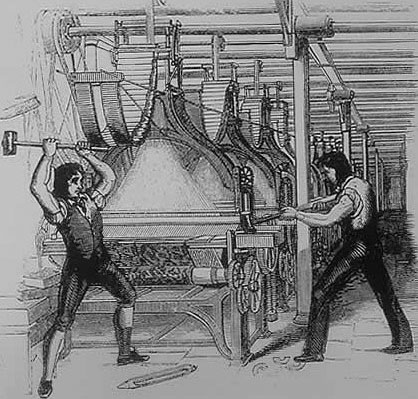
ludditesSusana: It started in the Midlands with the stocking industry, when stockingers, using looms and equipment leased from their employers in their homes, lost more than half their income when they were forced to produce cheap stockings that their employers could sell in larger quantities and increase their profits. Is that correct?

Lady P: How could I forget? Those stockings fell apart after barely a week of wear, and even the servants disdained them!

Susana: That was the same year the harvest failed, and food prices rose to an alarming level, and more and more people were suffering in economic distress.

Lady P: A shilling for a loaf of bread! It was outrageous!

Susana: People became desperate, and before long, gangs of disguised men started going around destroying the frames and looms used to produce the stockings to protest the treatment of the workers and the poverty more and more of them were forced to endure.

Lady P: That may be how it started, Susana, but it escalated into so much more than that. Why, many of us feared an uprising against the monarchy comparable to the French Terror of barely two decades past. And there wasn’t much to be done about it; Pendleton told me that fully half of the militia had taken up the cudgel for General Ludd in stealth and would turn against their officers in a trice if ordered to put down the revolutionaries.

Susana: I’m curious to know what Lord P thought should be done about it. He was a Tory, and the Tories were in power. Did he approve the decision to make frame-breaking a capital offense?

Lady P [shaking her head and sighing]: No, of course he did not. He thought it was incredibly stupid to think that masses of starving insurgents could be deterred by fear of the gibbet if they were caught. [Swallowing hard] He was, in fact, quite moved by Lord Byron’s speech in the House of Lords, where he decried the Tories’ attempt to solve the problem by force. He insisted—quite eloquently, Lord P admitted—that the Midland workers were being exploited to increase the profits of a few hosiers, and that the resulting misery benefitted no one.

Susana [thoughtfully]: The more things change, the more they stay the same. [Seeing Lady P’s raised eyebrow]: I was just thinking of how the Ohio House of Representatives just voted to eliminate the forty-hour work week so that employers won’t have to pay overtime—pay them double—for working more than that.

Lady P: As to that, I can’t say, Susana. But that is one reason I became a Whig. I would never go so far as to overturn the entire government and plunge the country into turmoil and terror such as what happened in France, but I have always believed that certain reforms to prevent the poor from being exploited could be instituted without much upheaval, and that the entire country would be the better for it. [Sighing] Dear Pendleton felt the same, but he was unable to persuade his colleagues to listen to reason. As afraid as they were of a revolution, the only solution the Tories could agree on was to threaten the insurgents.

Susana: It wasn’t long after that the Tories fell out of power, didn’t they? After the assassination of the Prime Minister?

Lady P: Indeed, and it was well-deserved too. Not because the Whigs’ ideas were much better, although they certainly used the Tories’ imprudence to their advantage. The Prince Regent’s intemperate behavior and his treatment of his wife made him vastly unpopular, so the Whigs took up the cudgel for Princess Caroline, proclaiming that she was being badly treated, and causing more riots, spreading to the north.

percevalSusana: And didn’t the people actually cheer the assassin as he was led to his execution a week later? There was that much dissatisfaction with the government that they cheered the murderer of the Prime Minister?

Lady P [tight-lipped]: Poor Lord Perceval. He was a good man. Had twelve children, you know. A family man. He could have gone far, if it weren’t for that Bellingham fellow shooting him in the House of Commons. Do you know the government wouldn’t even give him a public funeral because they were fearful of riots? I hardly knew what to say to his wife Jane when I saw her after that.

Susana [sighing]: Some things seem so unfair, don’t they? Like my friend whose daughter just died of breast cancer at age thirty-seven. Or many of my friends whose husbands lost their jobs and couldn’t find anything comparable afterward because of their age and the cost of health insurance. What do you say? How do you help them?

Lady P [clucking]: I suppose there will always be misery and injustice, no matter how diligently we try to eliminate it.

Susana: But that doesn’t mean we should stop trying.

Lady P [smiling]: Exactly. Now, Susana, don’t you think something should be done about all the weeds in the back garden? Since the weather turned warmer, they seem to be popping up all over the place.

Susana [leaving the room]: Have at ’em, Lady P. There’s a hoe in the shed and some work gloves in the drawer over there.

Lady P [frowning]: And where might you be going, then?

Susana [from the office]: I have a Christmas story to write. Deadline, you know. Can’t be bothered with weeds for awhile.

Lady P makes a beeline for the back door, audibly grumbling about “misplaced priorities,” “writing Christmas stories in May,” and that she “really should go back to the 19th century where there were gardeners to do such onerous tasks.”

As always, please do comment if you have any questions you’d like to ask Lady P about the late Georgian/Regency era. She does love to chat!

The Lady P Series

Episode #1: Susana’s Adventures With Lady P: The Introduction

Episode #2: Lady P Talks About… Pride and Prejudice?

Episode #3: Lady P and the Duchess Who Lost a Billion Dollars

Episode #4: Lady P and the Face On the $100 Bill

Episode #5: In Which Lady P Discovers Sparkly Fabrics and Ponders Violating the Prime Directive

Episode #6: Lady P Dishes the Dirt on the Duchess of Devonshire

Episode #7: The Political Exploits of Lady P and the Duchess of Devonshire

Episode #8: Lady P and the Prince Regent’s Illicit Marriage

Episode #9: In Which Lady P Depletes the Cooking Sherry During Her Discussion of Caroline of Brunswick

Episode #10: Lord Byron: Mad, Bad, and Dangerous to Know

Episode #11: In Which Lady P Talks About Hannah More and the Rights of Women

Episode #12: Lady P’s Revelations Regarding George III and His Peculiar Progeny

Episode #13: Lady P Discusses the Luddite Uprising, the Assassination of Spencer Perceval, and the General Unfairness of Life

Episode #14: In Which Leticia, Lady Beauchamp, Pops In For an Interview On Her Personal Acquaintance With Princess Charlotte of Wales

Episode #15: Lady P On Assignment in 1814 Kent

Lady P Quizzes Jane Livingston, the Hero’s Sister From “A Twelfth Night Tale”

The Dress: Episode #3

In Kansas City at the Romantic Times Convention!

We did it!

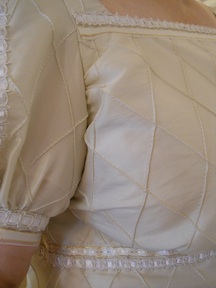
The dress and coat are both done, no thanks to me since I got sick the last couple of days and couldn’t even help with the handwork. The best I could do was show up for fittings, pose for pictures, and eventually, pack up the car for the 1200-mile trip from the Florida retirement community to Kansas City. I still feel a bit like the wicked stepsister, taking off for the ball while leaving Cinderella at home to prepare two houses (mine and hers) for the summer while we head back to Ohio. I seriously owe you, Mom!

gown427-4My mom’s a genius! Not only did she do a fantastic job on both garments, but she sewed on hanger loops and outfitted me with a needle and thread in case something goes wrong. She really deserves to be here at RT on Wednesday night when I wear it to the Ellora’s Cave disco party (not going to do any disco dancing, however) and the 30th Anniversary Ball on Thursday. I’ve promised photos, and they’ll be posted here as well.

Observations on the entire process

  • This is not a project for an amateur. I could never have done this myself, and I do have some sewing experience. The fitted bodice required a LOT of pattern alterations, since we couldn’t use any sort of stretchy fabric and still remain anywhere close to authentic.
  • The gown my sister had made had two separate drawstrings in the bodice to make it more fitted, since she was not available for fittings. That turned out well, but I’m not sure that would have worked well with the pattern we used.
  • We had to fudge on the back closings, since we could not get the eyehole punch to work through two layers of fabric and interfacing. In the end, we used hooks and eyes and snaps, and yes, I do need a lady’s maid to help me into it. (Any volunteers?)

How much did I spend on this project?

  • As to that, I’m not sure I really want to know. The most costly trip to Jo-Ann’s was $143, and that was mostly for the fabric and lining (for both the gown and the coat). The price for the trim and lace was another $100 or so (and totally worth it, I think you will agree), and there were several other trips to Jo-Ann’s in various towns for things like interfacing and other sewing notions. A few things (like the eyehole punch) got returned too, so I can’t tell you the final cost. But I would guess it was at least $350, and that does NOT include the hours and hours my mother put into it. But that’s not all! I also invested a considerable sum in accessories, including:
  • Regency slippers with “diamond” clips, plus clockwork stockings, from American Duchess
  • ringlet hairpiece
  • three different tiaras (couldn’t make up my mind)
  • long white gloves
  • brooch to wear with the coat
  • special “undies” (not authentic, but who’s going to know?)

gown_detailBut it’s not about the money.

It’s never been about the money.

It started with my friend Ellen’s idea for promoting Susana Ellis the author at conferences like this one (although I suspect that I will not be the only one in costume here.) But it became so much more than that. I never could have guessed how much my mother and I bonded during this process—from the first days of discussing the project to the difficult decisions about fabric choice (would you believe we originally intended the blue satin to be the gown and the cream pintuck taffeta to be the coat?) and many setbacks (like when the sleeve had to be redone and then we had to abandon the project for a few days to head north for a funeral) and wondering if it was possible to finish both garments in time for the conference.

Surprisingly, even my father became invested in this project. During the times when he seemed to have some health setbacks himself and Mom started worrying about having to head north earlier than planned and not being able to finish the coat, he told her to quit worrying about him and just finish it! He wanted to see the final product as much as we did, and thus, he started working harder at his physical therapy exercises (he has Parkinson’s).

Today’s the day!

I’m writing this on Wednesday, so by the time this goes live, the first event (the Ellora’s Cave disco party) will be over and hopefully I will have some photos to post. I’m planning to wear the gown for a Club RT appearance at 3:30, and then comes the stage walk with the Ellora’s Cave caveman. Oh yeah!

Click here for the video of the walk across the stage!

coat427-3On Thursday I’ll be wearing it for the Expo from 4-6 and then the RT ball in the evening. On Friday morning I have another appearance at Club RT. By then I’m sure it’ll be ready for the dry cleaner’s and the next opportunity, probably the RWA Conference in Atlanta.

If you are going to be at any of these events, please come up and chat with me and check out the gown in person. I’m looking forward to making lots of reader-author friends while I’m here, and I do hope you will be one of them! Warning: don’t be surprised if I ask you to be “lady’s maid” for me! Regency ball gowns were generally worn by well-off young ladies with abigails to assist them in dressing, and unfortunately, my first choice in lady’s maids—my sister Gloria—had to stay home with her cat. Where is a hunky Ellora’s Cave caveman when you need one?

Oh, and in case you’re wondering: Mom is NOT interested in taking this up as a profession or a hobby. Being retired in itself is a very time-consuming activity. Once is enough…and I’m the lucky one!

The Dress: Episode #1

The Dress: Episode #2

Episode #12: Lady P’s Revelations Regarding George III and His Peculiar Progeny

Lady Pendleton, Damian Ashby’s eccentric aunt (see the epilogue to Treasuring Theresa on Susana’s web site), is visiting Susana from the early 19th century. She’s intrigued by life in 21st century Toledo, Ohio, and, of course, Susana is thrilled to have the opportunity to pick her brain about life in Regency England. It certainly gives her a great deal to write about in Susana’s Parlour!

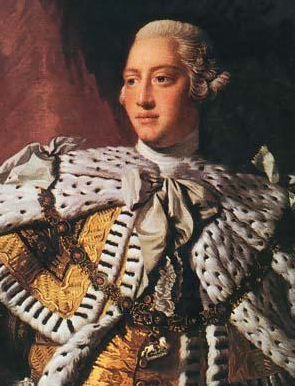
georgeiiiSusana: [to the Reader]: Lady Pendleton’s opinions on George III tend to be diametrically opposed to mine, which she attributes to my “ignorance due to indoctrination by history books written by misguided wretches attempting to justify the dreadful bloodbath caused by the radical colonists.”

It seems doubtful that we will ever come to agreement on that score—too many years of July 4th picnics and fireworks and, pledging allegiance to the flag, and singing “The Star-Spangled Banner”—but I have begun to see George III in a more sympathetic light. More than 200 years have passed and since my trip to England last year, I have come to realize that the English do not see him as the tyrant “we” do (and I say “we” even though at least some of my ancestors still lived in England during that time), and most never did.

And I have to say—in spite of all the patriotism instilled in me over decades—I am intrigued with the idea of growing up speaking with a British accent. (Can I be deported for saying that?)

Lady P: You must admit that the American accent sounds decidedly low class, Susana. Perhaps I could give you lessons in enunciating. Much like that Henry Higgins did to Eliza in that film we saw the other evening. You would never pass for upper class in society, of course, but it would be a definite improvement.

Susana: I thank you for offering, Lady P, but I’ll stick with the lazy American drawl for now. Perhaps some other time.

Lady P: Very well. Shall we discuss His Royal Highness King George III for your readers? Where shall I start?

Susana: At the beginning would be best. Where did you meet him?

Lady P: I was too young to attend his wedding to Queen Charlotte, but I do recall my mother bringing home a flower—was it a camellia or a rose?—but it was pink and she put it in one of the heaviest books in the library for pressing. I remember feeling very sad that she had to destroy such a pretty posy in order to preserve it. I wonder what happened to it? I believe my brother Henry inherited all the books in the library, so perhaps it’s still there. He was never one to read or study overmuch.

Susana: But you did meet him at some point?

Lady P: Goodness, yes. During my come-out—my mother was so vexed that the Royal Pair failed to attend my presentation ball—I was presented to Queen Charlotte, as were all of the young debutantes, you know, and I did meet them once or twice that season. After I was married to Lord Pendleton, we met more often. Lord P was in the House of Lords, you know, and we were obliged to attend certain political events.

Susana: What did you think of him?

Lady P: He was a kindly old man, quite stodgy, you understand. As a young girl, I didn’t appreciate that quality in him. One expected the King to be a cut above the rest of society, and he wasn’t at all. I recall complaining to Pendleton about the plainness of the fare at Windsor Castle and why the King could not have a French chef as skilled as ours, and he said the King didn’t appreciate rich food anymore than he did the French. Good, hearty English fare was good enough, he said.

Susana: I hear his marriage was a love-match.

Lady P [snorting in a very unladylike manner]: Romance again, Susana? Americans seem obsessed with it. The King met his betrothed on the day of the wedding. He wasn’t allowed to marry Lady Sarah Lennox when he wished to because she was only the sister of a duke. Royalty must marry royalty, you know. Or at least they did in my time.

Susana: But they did have fifteen children, so the marriage must have been somewhat of a success.

Lady P: Oh indeed, they got on well after that. Queen Charlotte was not well-favored, but she had a very pleasant disposition. She was a perfect wife for a down-to-earth man like the King.

Susana: So what happened to their children? The sons, at least, did not seem to be able to sustain such happy marriages. Look at the Prince Regent, for example. His life was like the antithesis of his father’s.

Lady P: Indeed. The King disliked his oldest son intensely. Frederick was his favorite. Pendleton told me the King often bemoaned the fact that Frederick was not his oldest son. Brought up to be a military man. He was the Commander-in-Chief of the Army, you know, until the scandal.

Susana: The scandal?

Lady P: Apparently he passed on military secrets to his mistress, a sly little hussy by the name of Mary Anne Clarke. She took bribes in exchange for promotions, and although she was the one to blame, it was his indiscretion in telling her such things that caused him to resign in disgrace. [shaking her head sadly] Should have stuck by his long-suffering wife. Frederica was a most amiable woman.

Susana: So even his favorite had feet of clay. What about the others? Wasn’t one of them accused of murder?

Lady P: Ernest, that was. He was an odd sort. Spread all sorts of cruel rumors about his brothers. His valet turned up with his throat cut, and it was whispered that he’d been seduced by his master, who murdered him when the man attempted to blackmail him.

Susana: Oh my. Homosexuals were hung in those days, were they not?

Lady P: Indeed they were. It would have been a massive scandal had that little fact become known. Which is no doubt why the inquest determined that the man committed suicide.

Susana [shuddering]: Who commits suicide by cutting their throat?

Lady P: Exactly. Not to mention that the man was left-handed, and the deed had to have been done with his right hand. [sighing] But I suppose such things must be done to protect the monarchy and the nation.

Susana: Surely among fifteen children there must have been at least one or two who turned out well. What about the daughters?

Lady P: Poor Amelia died in 1810. She was 27 and unmarried, since she had not been allowed to marry the man of her choice, Charles Fitzroy. She was the youngest and the King’s favorite and he was never the same after that. The other girls—well, the oldest, Princess Charlotte was married to the King of Württemburg—remained unmarried and living at home, and dear me, they never dissembled about expressing how they felt about that. Well, they were all rather plain, like their mother, and ran to fat, but they did adore their father, no matter how unstable he become as the years passed.

Susana: The Prince of Wales was made Regent because of his illness, which has been called dementia. Did you ever see him in that state, or know someone who did?

Lady P: I did not, of course, since he was kept in seclusion as soon as he began to exhibit symptoms. But Pendleton did, on one occasion, when he was attending the King on parliamentary business. [clucking her tongue]. He began speaking in shrill tones, so quickly that he could not be easily understood, calling for “the woman he loved,” a certain Lady Pembroke who served at court. His eyes bulged and he dropped his breeches to reveal his backside. Pendleton was horrified when I nearly fell over laughing when he described it. He said it was a horrifying experience.

Susana: The King of England mooned your husband? Heavens, what a sight that must have been! [grinning broadly]

Lady P: Harrumph! It was, rather. And yet I did feel very sorry for him. He was a fine king and deserved much better than to be afflicted by such an undignified malady. And then to have his sons to be such bounders, and one of his daughters to bear an illegitimate child… It is almost a blessing that such distressing news was kept from him.

Susana [sighing]: My belief in fairytale royal marriages died a tragic death after what happened with Princess Diana. Although I can’t help hoping that Prince William and Kate will end up happily.

Lady P: They do seem a sensible pair, and very well-matched, like my nephew Damian and his wife Theresa. Have I told you Theresa is expecting again?

mi_hacienda_edited-1Susana: You’ve mentioned it a few times. What do you think about Subway for dinner?

Lady P: What was that Spanish place we went to last week? I rather fancy one of those—what do you call them—burros?

Susana: Burritos, Lady P. And it was Mexican, not Spanish. Mi Hacienda, on Glanzman Street. They offer salsa lessons on Wednesday nights. What do you say we paint the town while we’re at it.

Lady P: A burrito will do, Susana. And perhaps some of those savory chips. Never had anything like them before. Do you suppose I can take the recipe back with me for my own cook to prepare?

Susana [shaking her head]: Sorry, Lady P. We’ve had this discussion before. Remember the Prime Directive?

As always, please do comment if you have any questions you’d like to ask Lady P about the late Georgian/Regency era. She does love to chat!

The Lady P Series

Episode #1: Susana’s Adventures With Lady P: The Introduction

Episode #2: Lady P Talks About… Pride and Prejudice?

Episode #3: Lady P and the Duchess Who Lost a Billion Dollars

Episode #4: Lady P and the Face On the $100 Bill

Episode #5: In Which Lady P Discovers Sparkly Fabrics and Ponders Violating the Prime Directive

Episode #6: Lady P Dishes the Dirt on the Duchess of Devonshire

Episode #7: The Political Exploits of Lady P and the Duchess of Devonshire

Episode #8: Lady P and the Prince Regent’s Illicit Marriage

Episode #9: In Which Lady P Depletes the Cooking Sherry During Her Discussion of Caroline of Brunswick

Episode #10: Lord Byron: Mad, Bad, and Dangerous to Know

Episode #11: In Which Lady P Talks About Hannah More and the Rights of Women

Episode #12: Lady P’s Revelations Regarding George III and His Peculiar Progeny

Episode #13: Lady P Discusses the Luddite Uprising, the Assassination of Spencer Perceval, and the General Unfairness of Life

Episode #14: In Which Leticia, Lady Beauchamp, Pops In For an Interview On Her Personal Acquaintance With Princess Charlotte of Wales

Episode #15: Lady P On Assignment in 1814 Kent

Lady P Quizzes Jane Livingston, the Hero’s Sister From “A Twelfth Night Tale”
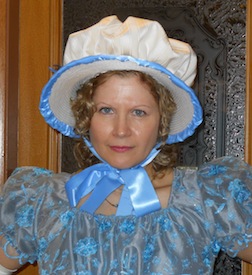
The Dress: Episode 2 + Giveaway

This post is part of a mini-series about the experiences of my mother and me in creating a Regency gown for the Romantic Times Convention on May 1-5, 2013 in Kansas City. You can find Episode 1, where we shopped for fabric and struggled with cutting out the dress pieces here.

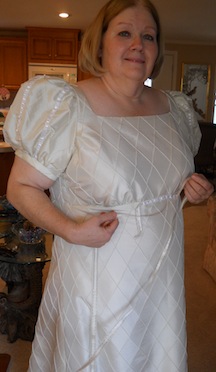
DSCN0032I tried the dress on and it fits!!!

It’s not finished yet. The fastening at the back remains to be done, plus the hem and lots of trim. But it does look like a dress now, and it does look pretty good on me, if I do say myself!

My mom’s a genius!

However, we had a bit of a setback a week ago when my uncle died unexpectedly and we all had to fly north for the funeral. It was cold and nasty and, well, sad, because we had to say goodbye to Uncle Bob, but it was good to see friends and family we haven’t seen for years.

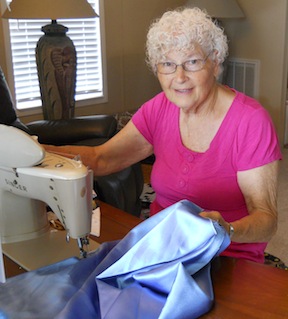
We still have a couple of weeks left, though, before I have to take off for Kansas City, and it’s quite likely we’ll have the blue satin coat done too, by that time. She’s already got the pieces for the gown and the lining cut out, as well as the organdy ruffle at the collar and the sleeve stays. We think this will go faster than the gown, since she’s already worked out the fit issues. But it is still rather a complicated design and she’s something of a perfectionist, so she’ll be putting in a lot of hours. That worries me a little bit, because I don’t want her to wear herself out. I try to help with lunch and errands and Dad, but I am seriously going to owe her after this. Big time.

Mom_sewing

Mom_cutting2

    Mom_fabric

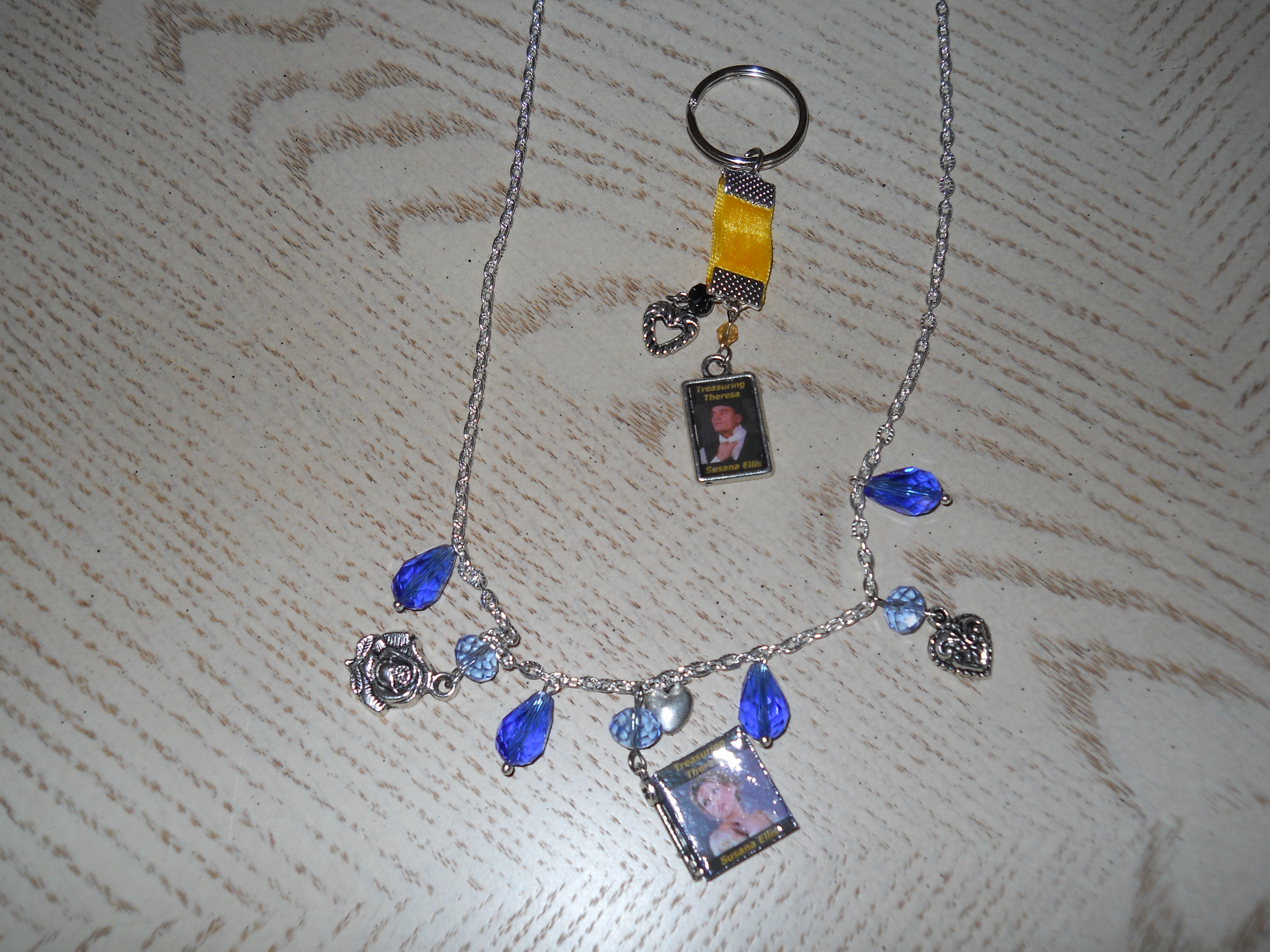
She also just had her 75th birthday on April 15th and wouldn’t let us buy her anything. Of course, I did give her a Treasuring Theresa necklace (see below), but I’m going to have do something really nice for her for Mother’s Day this year. Hmm. What can you give someone who doesn’t want you to “waste” money on her?

TT_necklace_keychain

Please comment with any suggestions you may have of how I can show my appreciation to Mom for her commitment to this massive project. One random commenter will receive a Treasuring Theresa keychain (see above), with Damian on one side and Theresa on the other).

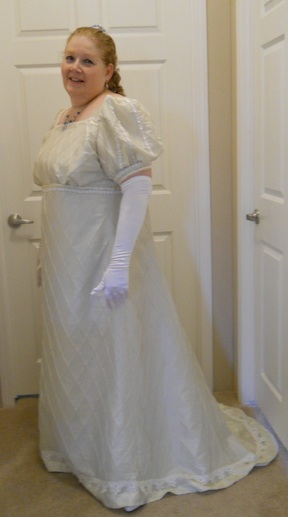
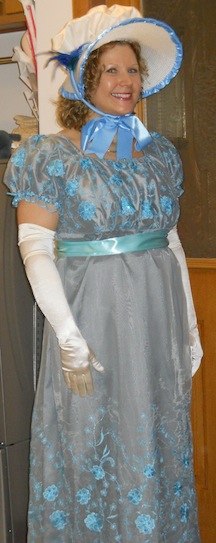
Letitia_gown_bonnet6P.S. Here’s my sister Gloria (aka Letitia, Lady Beauchamp) in the Regency gown she had made from an artisan on Etsy recently (and the hat our mother made). I offered to take her with me to the RT Convention as my lady’s maid (trust me, somebody is going to have to help me in and out of this gown), but she said she can’t leave her cat that long. A cat? Really? Hmm. At least I know where I stand!

Stand by for further reports on the progress with “The Dress.” The deadline approaches, but I have perfect confidence in my mother’s abilities.

Oh, and in case you’re wondering: Mom is NOT interested in taking this up as a profession or a hobby. Being retired is in itself very time-consuming. Once is enough for her…and I’m the lucky one!

The Dress: Episode 1

The idea of wearing a Regency gown to the Romantic Times Book Convention (as well as book signings and other events) originated with my friend Ellen, who has lots of experience promoting her teacher books in conference exhibit halls. She said I should stand in front of the table, not behind it, wearing a period gown, and have a list of questions about the Regency period to ask in exchange for prizes. Wow, that sounded like a lot of fun to me, so I started looking around for gowns.

regencypatternI found a pattern on etsy.com and ordered it (have since found you can get it at Jo-Ann’s in the Butterick catalog), and my mom, who is a superb seamstress, offered to make it for me. (Actually, it’s a gown and coat both.) I don’t think at the time she realized how complicated it was going to get, but she is a woman of her word and determined to see it through.

The first obstacle was shopping for materials. For one thing, fabric has changed a great deal in 200 years. While there are many beautiful fabrics today, many with sparkly threads and sequins that would look great on me, we had to bypass those and look closer to find fabrics that might at least resemble a Regency-era fabric. It was a painstaking process, because as soon as we found something we thought would be perfect, we’d discover there wasn’t enough fabric on the bolt, which turned out to be a constant problem. For some reason, fabric manufacturers have started putting less fabric on the bolts, so unless you find a brand new bolt, chances are there won’t be enough fabric for a long gown on it. Rats! We had this problem with the lining fabrics as well as the gown and coat, and had to find another Jo-Ann’s Fabrics in the next town to get enough. And buy a yard or two extra to make sure we had enough for the extra-long skirt pieces.

Eventually, we ended up with an off-white pintuck taffeta for the gown and a blue satin for the coat.

fabric2smBut that wasn’t the end, because these garments require lots of decorative trim. The coat has an organdy trim at the neckline, but the clerk at the fabric store had never heard of organdy! But we found something that seemed like organdy that will work. Then we needed several kinds of trim for the sleeves and empire waist for the gown and for the coat as well. The problem with this was that it couldn’t be anything too white, and it had to be a specified width. Inevitably we’d find the perfect trim and find that it was too wide or narrow.

As far as the cost, well, that could not be a concern. It was hard enough to find something that would work at all. There was no way I was going to take the time to shop around all the fabric stores in Central Florida to find stuff on sale. Not when this project has to be finished before I leave for RT on April 28! Thanks to Mom, we did have a 15% off coupon, though!

In case you’re wondering, this is definitely not an economical project. I have already spent quite a bit on Regency shoes from American Duchess (with beautiful shoe clips), period stockings, a ringlet hairpiece, and gloves, in addition to the fabric and notions that were so hard to find. (Obtaining the proper undergarments to give me the right shape was also quite costly.) My philosophy is you either do it right or not at all. So I’m not sweating the small (or the large) stuff. And it’s all tax-deductible for a Regency author, right?

So this week we got all the materials and started pulling out the pattern pieces and laying them out on the fabric. We started with the lining, moving the kitchen table in my folks’ house so that we could cut on the floor. NOT a great idea at all! We both ended up with aching backs from maneuvering ourselves into uncomfortable positions and having to get up and down off the floor so many times. After that, we decided to take everything down to the clubhouse (we live in a retirement community in Florida during the winter), move a few tables together, and do our cutting there. Voilà! SO much better. So now we have the lining and dress pieces cut out and ready to put together.

And a few people came in to get their mail and wondered what we were doing, so I took the opportunity to give them a bookmark for Treasuring Theresa. All good!

mom_smile_edited-1One thing that rather astonished me is the need for proper fitting. My own feeble sewing efforts have involved buying the fabric and the pattern and hoping it would fit by the time I was done. That might work with knits and stretchy fabrics, but not with Regency-era fabrics. No indeed. The bodice and the sleeves, at least, have to be fitted closely to the body, and it’s a painstaking process that I couldn’t do in a million years. Thank goodness I have a mother who not only knows how to do it but is willing to put in the hours and hours it takes to make things work!

First she worked on altering the pattern; in spite of having lost 30 pounds recently, the pattern still needed to be made larger to fit properly. Somewhat humiliating, but there’s no point in having a gown that won’t fit! Once she had the pattern right, she could cut out the lining and make a few more adjustments. Now she knows exactly what needs to be done with the bodice of the dress too, where there’s less room for error.

It turns out Mom and I make a pretty good team. She’s the brains and I’m the brawn. And the cook. I provide lunch every day and help her with simple things in the afternoon, like pinning the pattern pieces to the fabric, moving around tables and chairs, cleaning up afterward, things like that.

This is all great research, by the way. Whenever my heroines have to have dresses made, they go to the modiste’s and stand there for hours in their underwear while having pins stuck in them. Now I have a good idea how that feels! Ditto with searching out the right trim, ostrich feathers, etc. (Oh, should I look for an ostrich feather or two?)

My mornings are devoted to writing. I’m hoping to finish the first draft of Cherishing Charlotte in the next few days and then go over it and add some final touches before sending it off to my wonderful critique partners. Then I have another novel to finish, plus a Christmas story to submit for the Ellora’s Cave Christmas Cotillion anthology. Would like to finish all three projects before heading to Scotland on June 20!

Oh, by the way, my sister Gloria (aka Letitia Beauchamp) also has a Regency gown that she had made. She’ll have to come to some book signings with me to wear it. I wonder if her husband Mike (aka Lord Beauchamp) would consent to having a Regency outfit made for him? Sounds like a plan to me!

Stand by for further reports on the progress with “The Dress.” The deadline approaches, but I have perfect confidence in my mother’s abilities.

Oh, and in case you’re wondering: she is NOT interested in taking this up as a profession or a hobby. Being retired in itself is a very time-consuming activity. Once is enough…and I’m the lucky one!

Spotlight On Regency Personage Hannah More

220px-HannahMoreMonday’s Lady P episode mentioned Hannah More as having a significant influence on the changing attitudes toward women in the late Georgian/Regency era. Regency readers will recognize the name as being the author of books that many well-meaning Regency mothers assigned their daughters to read while said daughters preferred to indulge themselves with Mrs. Radcliffe’s novels.

Hannah More grew up in a very religious family. Her father taught in a free school and later opened a girls’ school managed by his daughters while he himself managed a boys’ school. Hannah started writing at a young age, beginning with pastoral plays for the young girls at the school to act out, and eventually moving on to London, where her play Percy was a great success at Covent Garden. For several years she enjoyed the social circle of a well-known group of bluestockings (a pejorative term referring to a female intellectual). Her second play, however, was not a success, and after a falling-out with a poet friend, Hannah withdrew from London’s intellectual circles and began to focus on religious and philanthropic works.

As the Regency period advanced and the older generation of politically-active ladies died or became infirm, fewer women involved themselves directly in politics. In 1815 Hannah More wrote a study on St. Paul’s description of the female character, which instructed women to dress themselves modestly and atone for their spiritual weakness by keeping silent and learning from the men. By daring to publish her writing, Hannah was herself breaking these rules, for which she apologized in all of her works.

  • Thoughts on the Importance of the Manners of the Great to General Society (1788)
  • An Estimate of the Religion of the Fashionable World (1790)
  • Strictures on the Modern System of Female Education (1799)
  • Hints toward Forming the Character of a Young Princess (1805)
  • Coelebs in Search of a Wife (1809)
  • Practical Piety (1811)
  • Christian Morals (1813)
  • Character of St. Paul (1815)
  • Moral Sketches (1819)

stricturesIn spite of the daunting titles, Hannah’s work outsold all of the authors of the aforementioned novels, and she became a force to be reckoned with, responsible for the sudden popularity of “religion of the heart” and countless conversions to the Evangelical faith.

Women could, of course, become involved in charity work to benefit the poor, and Hannah and her sisters threw themselves into establishing a series of schools in rural areas. The schools taught reading, the Bible, and catechism, as well as sewing and knitting, but not writing, as that was thought to give the poor too much power. Even then, they ran into opposition from the farmers, who feared that too much education would prove the end of agriculture, and from the clergy, who claimed that she was teaching Methodism, a religious movement of the lower classes that was considered dangerous by the established churches.

Along with William Wilberforce, she became a major force in the fight to abolish the slave trade, publishing a poem called Slavery in 1788.

The Pendulum Swings the Other Way

Through her writings and philanthropic work, Hannah More wielded a huge influence on English society, urging people to seek God in their hearts through Bible reading, to live their lives in an orderly and circumspect manner, and to help the poor escape their misery.

For the most part, though, her strictures did not address the moral depravity of the upper classes, where debauchery and excesses continued to rule the behavior of the Prince Regent and his brothers on down. The Evangelical movement did not address the inequalities in English society, but took the position that if God chose someone to be rich or poor, there must be a good reason for it, and the best thing to be done was to be content with one’s circumstances and look toward treasures in heaven. Wilberforce, for all of his efforts to help the poor in Africa, condemned as immoral the formation of unions against unfair employers in England. Easy to say for a man who inherited wealth and married more of it.

Another problem with the Evangelical movement that Hannah More was a part of was when the fight against “worldliness” went to extremes. Just about anything pleasurable was considered “worldly,” including dancing, card playing, and taking country walks on Sundays. By the time Thomas Bowdler had begun altering Shakespeare’s works to make them acceptable for reading in mixed company, the puritanical excesses of the Evangelicals were making them a laughingstock.

In Episode #11, Lady P decries the extremism in English morality. Hannah More’s popularity is proof that her “religion of the heart” was a timely one that many were eager to hear. Taken to extremes, as it was by Wilberforce and other Evangelicals, however, that message becomes lost in a sea of strictures and censorship that incites ridicule and rebellion.

Thanks go to:

Our Tempestuous Day by Carolly Erickson, 1986.

Episode #11: In Which Lady P Talks About Hannah More and the Rights of Women

Lady Pendleton, Damian Ashby’s eccentric aunt (see the epilogue to Treasuring Theresa on Susana’s web site), is visiting Susana from the early 19th century. She’s intrigued by life in 21st century Toledo, Ohio, and, of course, Susana is thrilled to have the opportunity to pick her brain about life in Regency England. It certainly gives her a great deal to write about in Susana’s Parlour!

Susana: [to the Reader]:

The other day, Lady P and I got to talking about the position of women in the Regency period and how it evolved from the late 18th century when women such as Georgiana Cavendish held political salons and marched in support of political candidates to a time when women were to be saintly and devout and “protected” from the seamier side of life, leaving the important decisions to their sturdier husbands.

Miss_Hannah_More-304x400Lady P: ‘Twas Hannah More and the Evangelicals that popularized it. Women were to be seen and not heard, at the same time obedient to their husbands and revered by them. [Snorting in an unladylike manner] Pendleton and I laughed about it on many an occasion. I’ve never been the obedient sort, and Lord P would not have wed me if I were. Nor did I wish to be worshiped either. The very idea!

Susana: No doubt it was a reaction against the excesses of the previous generation. The Devonshire ménage-à-trois, for example. The Prince Regent and his illicit marriage, as well as all of his mistresses and excessive spending. The scandalous behavior of Lady Caroline Lamb.

Lady P [Frowning]: There were excesses, of course, which did lead to the pendulum swinging in the other direction. But such extreme changes more often than not led to equally harmful excesses on the other side.

Susana: Indeed. I can certainly see that is true in the 21st century. But do explain what you mean, Lady P. What were the harmful excesses caused by the Evangelical movement?

Lady P: A popular interpretation of the wife-as-saintly approach was that the husband was allowed and even expected to be a sinner.

Susana: Which gave him the freedom to take mistresses and carouse as often as he liked, while his “sainted wife” stayed home and raised the children.

caroline_lambLady P: Well, yes, but it was rather more than that. As unrealistic and unfair as it was to the women, I believe it was equally unfair to the men. Lord Byron, for example. Why would such a dissolute young man choose to marry a staid bluestocking like Annabella Milbanke?

Susana: Because she was an heiress and he was close to bankruptcy?

Lady P: Then why would she agree to marry him? She had turned him down flat in the past, having recognized that he was a loose screw.

Susana: Because opposites attract? Because she thought she could reform him?

Lady P: Exactly! She was quite forthcoming about it, actually, and Lord Byron seemed to agree that she would be a good influence on him, at least at first. But as the wedding drew near, he began to have doubts, complaining to his bosom bows that he feared the medicine would be far more disagreeable than the disease itself.

Susana: It can be tiresome to be preached at all the time. In a true partnership, both partners accept each other, flaws and all.

Lady P: Precisely. In this case, Annabella overestimated her own influence and underestimated the extent of her husband’s vices. She did not know of his immoral relationship with his half-sister Augusta until after the marriage, for example, and like most women who incessantly nag their husbands, she came to be regarded by her husband as a nuisance.

Susana: But as you say, Byron was a bit of a loose screw. Would it have worked between them, do you think, if he’d been on some sort of medication?

Lady P [with a loud harrumph]: Your society seems to be of the opinion that all can be cured with a tiny pill, Susana, but I’m not so sure. We had quacks touting medicines in our day too. Why, the stories I could tell you about laudanum…!

Susana: But getting back to the issue of women’s rights, what did you think of people like Hannah More, Lady P? Was she a good influence or a bad one? She did influence people to care for the poor, did she not?

Lady P: Hannah More and those around her were neither good nor bad, Susana. The mistake, in my opinion, is to paint everything in life broadly as either white or black. Hannah More did a great deal to awaken society to the plight of the poor and stir up support on their behalf, that is true. But I believe that she did a disservice to both women and men in promoting the role of women as subservient to men.

Susana: But women were still legally the chattel of men, were they not? And they were not given the right to vote for another hundred years.

Lady P [somewhat impatiently]: Legally, yes, that is true. But my dear Susana, you must not assume that every marriage was built on such an unequal basis. Discerning women always knew how to manage their husbands, so long as they took care to marry a husband who could be managed, that is. I daresay even the redoubtable Hannah herself could not have managed such a bedlamite as Lord Byron.

Susana: But you said yourself that you never told Lord Pendleton about your Whig activities with the Duchess of Devonshire.

Lady P: Indeed not. It was for his own protection. His family would have been scandalized.

Susana [shaking her head]: Sometimes your logic escapes me, Lady P.

Lady P: I’m not saying that my own marriage was ideal, or that most marriages were not unequal in my day, Susana. There was just as much hypocrisy in society then as there is in your century. Why Hannah herself apologized in her books for having the temerity to write them at all, being a mere woman as she was. My point is that one must consider one’s options and make the wisest choices possible in whatever circumstances one finds oneself. I may have decided to become a Whig, but I wasn’t foolish enough to believe they should have unilateral power. No indeed. Some of their official policies were ridiculous in the extreme, and I was glad there were rational voices on the other side to temper their excesses.

Susana: In that respect, I certainly agree with you, Lady P. I find I cannot blindly accept any philosophy or ideology without considering each facet of it on its own merits. But I find it extremely frustrating that there are so many who do, as though they haven’t a brain to think for themselves.

Lady P [dryly]: So I’ve noticed that about you. But Susana, it does appear that you are missing the point. People are who they are, and there’s not a lot you can do to change them. My counsel in such cases has always been to do what you can and let the rest be, else you work yourself into a state fit for Bedlam.

Susana: [shaking her head]. You remind me so much of Dr. Ellis, author of How To Stubbornly Refuse To Make Yourself Miserable About Anything, Yes Anything.

Lady P: What a singular title for a book! The logic seems sound, however. Why, many was the time when Lord P left me alone to go to his club that I could have spent the night fuming, but I decided instead to use that time to follow my own interests.

Susana: Such as attend the Whig salons at Devonshire house?

Lady P: Yes, and attend balls and musicals that Lord P did not enjoy. It wasn’t fashionable to live in one another’s pockets, in any case. We muddled along well enough, I do believe. How I do miss the dear man! [Sigh]

As always, please do comment if you have any questions you’d like to ask Lady P about the late Georgian/Regency era. She does love to chat!

The Lady P Series

Episode #1: Susana’s Adventures With Lady P: The Introduction

Episode #2: Lady P Talks About… Pride and Prejudice?

Episode #3: Lady P and the Duchess Who Lost a Billion Dollars

Episode #4: Lady P and the Face On the $100 Bill

Episode #5: In Which Lady P Discovers Sparkly Fabrics and Ponders Violating the Prime Directive

Episode #6: Lady P Dishes the Dirt on the Duchess of Devonshire

Episode #7: The Political Exploits of Lady P and the Duchess of Devonshire

Episode #8: Lady P and the Prince Regent’s Illicit Marriage

Episode #9: In Which Lady P Depletes the Cooking Sherry During Her Discussion of Caroline of Brunswick

Episode #10: Lord Byron: Mad, Bad, and Dangerous to Know

Episode #11: In Which Lady P Talks About Hannah More and the Rights of Women

Episode #12: Lady P’s Revelations Regarding George III and His Peculiar Progeny

Episode #13: Lady P Discusses the Luddite Uprising, the Assassination of Spencer Perceval, and the General Unfairness of Life

Episode #14: In Which Leticia, Lady Beauchamp, Pops In For an Interview On Her Personal Acquaintance With Princess Charlotte of Wales

Episode #15: Lady P On Assignment in 1814 Kent

Lady P Quizzes Jane Livingston, the Hero’s Sister From “A Twelfth Night Tale”