Archives

The Dover Road: Blackheath and Dartford

dust jacket

The following post is the fourteenth of a series based on information obtained from a fascinating book Susana recently obtained for research purposes. Coaching Days & Coaching Ways by W. Outram Tristram, first published in 1888, is replete with commentary about travel and roads and social history told in an entertaining manner, along with a great many fabulous illustrations. A great find for anyone seriously interested in English history!

Note: Comment to enter the contest for Susana’s September Giveaway, a lovely necklace from London’s National Gallery (see photo at right).

Blackheath: Dark-Colored Heathland

The area of Blackheath is about seven miles from London Bridge. Originally the name of an open space for public meetings of the ancient hundred of Blackheath, this name was also given to the Victorian suburb that was developed later in the 19th century. While this area was certainly used for burial pits for the victims of the Black Death in the 14th century, it was only one of many used for such a purpose in London and was not the source of the name. Blackheath comes from Old English, “dark-colored heathland,” undoubtedly referring to the color of the soil.

Besides a queen devoted to junketings [Queen Caroline, who lived at Montague House], a letter-writing father, bent on directing his son to the deuce [Lord Chesterfield], and a great warrior [Major General James Wolfe, conqueror of Quebec], rebellion has in the good old days…raised its head on this celebrated spot; and it raised its head in the person of Wat Tyler, who was here in 1381 at the head of one hundred thousand other heads (which was wise of him seeing that he had previously cracked a poll-tax collector’s head at Dartford, after drinking too much ale, I suppose, at the celebrated Bull Inn). Another rebel was here, at Blackheath 1497. Lord Audley to wit, who went through the somewhat aimless exercise of bringing troops all the way from Cornwall, pitching their tents, and immediately afterwards suffering defeat at the hands of Henry the Seventh.
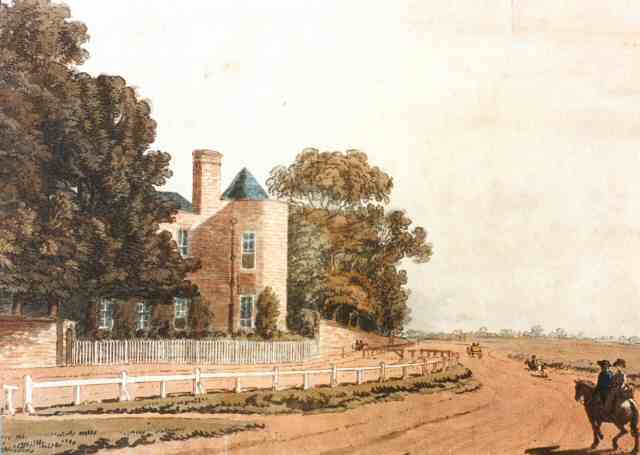
Montague House, residence of Queen Caroline

Montague House, residence of Queen Caroline

The Predecessor of Rotten Row?

For this celebrated spot occupied in the annals of England much the same sort of position apparently as Rotten Row occupies in the annals of contemporary fashion. It was the place where kings and ministers met casually on their way to or from London, and babbled of the weather, the price of corn, the latest hanging, the odds on the next bear-fight, the state of the unemployed, or any other kindred subject which might suggest itself to medieval brains, in an open space, where it was not too windy.
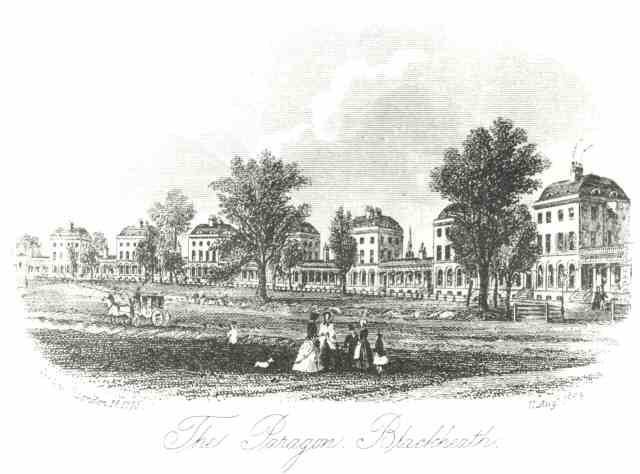
blackheath

Henry the Fifth a Spoilsport?

On his return to London, “The Victor of Agincourt” was greeted here by “the mayor and five hundred citizens of London. The mayor and aldermen had prepared an elaborate reception, with wine and scarlet and gold robes and all the trappings. But Henry “nipped all the worthy mayor’s preparations in the bud,” refusing to accept the praise and thanks that should go to God.

A pious decision, but one which must have been extremely unsatisfactory to town councillors who had launched forth in the way of dress and decorations, and to the thousands of Londoners who had flocked out to Blackheath to see the show.
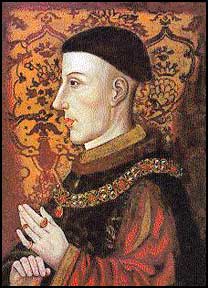
Henry V: not in a proper mood to be fêted

Henry V: not in a proper mood to be fêted

Henry the Eighth: A Guilty Conscience?

It was here on Blackheath that the already muchly married king publicly received his fourth wife, with all due decency and decorum, having already made up his royal mind to put her away privately. For Henry on this occasion did not play fair; and though he pretended to Anne of Cleves herself that it was at this meeting on Blackheath that he had first seen here—in saying so, he said that which was not; for he had already privately inspected her at the Crown Inn at Rochester. It was on this occasion it may be remembered that the bluff Tudor gave way to a regrettable license of speech at first sight of the goods the gods had provided for him, and said many things unfit for publication; which shocked the onlookers, and made Cromwell put his hands to his head to feel if it was still in his shoulders.

Alas, Cromwell, as the advocate for this marriage, paid for his folly with his head. Anne of Cleves, however,

was content to forego the dubious joys of married life for the possession of the several manors in Kent and Sussex that her grateful late lord bestowed upon her. The number of these manors exceeds belief, and at the same time gracefully gauges Henry’s conception of the magnitude of the matrimonial peril past. Indeed, it seems to me that…whenever he had nothing villainous on hand, and was disinclined for tennis, he gave Anne of Cleves a manor or two simply to while away the time.

setWidth320-The-Manor-Gatehouse1

The Manor Gatehouse is all that is left of the manor Henry VIII presented to Anne of Cleves as “one of the first manors granted to this little-married but much-dowered lady.”

Charles II’s Triumphant Procession

…it was in 1660 no doubt that the grandest of its historical pageants was to be seen: when the long reaction against Puritanism had suddenly triumphed, and all England went mad on a May morning at the Restoration of her exiled king; when through sixty-one miles as it were of conduits running wine, triumphal arches, gabled streets hung with tapestry—through battalions of citizens in various bands, some arrayed in coats of black velvet with gold chains, some in military suits of cloth of gold or silver—Charles, who had slept at Rochester the night before, rode on to Blackheath between his brothers, the Dukes of York and Gloucester.

Charles II riding into London

Charles II riding into London

Sir Walter Scott, in his novel Woodstock (1826), paints a picture of Charles catching a glimpse of the characters of the novel in the crowd and making a point to dismount, prevent the aged Sir Henry Lee from rising, and ask for his blessing, after which, “his very faithful servant, having seen the desire of his eyes, was gathered to his fathers.”Quite a poignant scene, but could not have happened in real life since Sir Henry had passed away fifty years earlier. Don’t you just love historical fiction?

Charles Dickens: “veritable genius of the road”

His memory burns by the way—as all but the wicked man who has not read Pickwick and David Copperfield will remember—and indeed A Tale of Two Cities. For in the second chapter of that wonderful book the very spirit of the Dover Road in George the Third’s time is caught as if by magic.

A Tale of Two Cities: read Chapter Two here: http://www.online-literature.com/dickens/twocities/2/

Who does not remember these things? Who has not read them again and again? I declare that I think this second chapter of A Tale of Two Cities a picture of the old coaching days more perfect than any that has been painted. Every detail is there in three pages.

tale

George IV Insulted at the Bull Inn

In 1822

…while the great Fourth George was majestically reposing in his royal post-chaise in front of the old archway he experienced an unpleasant surprise. A very ungentlemanly man named Calligan, a working currier who ought to have known better, suddenly projected his head into the carriage window, and observed in a voice of thunder, “You’re a murderer!” an historical allusion to the king’s late treatment of Queen Caroline, which made the royal widower “sit up”. Upon which a bystander named Morris knocked the personal currier down,and the window of the post-chaise was pulled up, and the post-boy told to drive on as quickly as possible.
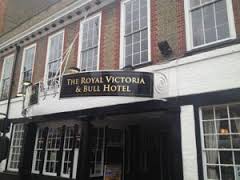
The Royal Victoria and Bull Inn (formerly the Bull Inn)

The Royal Victoria and Bull Hotel (formerly the Bull Inn)


 Index to all the posts in this series

1: The Bath Road: The (True) Legend of the Berkshire Lady

2: The Bath Road: Littlecote and Wild William Darrell

3: The Bath Road: Lacock Abbey

4: The Bath Road: The Bear Inn at Devizes and the “Pictorial Chronicler of the Regency”

5: The Exeter Road: Flying Machines, Muddy Roads and Well-Mannered Highwaymen

6: The Exeter Road: A Foolish Coachman, a Dreadful Snowstorm and a Romance

7: The Exeter Road in 1823: A Myriad of Changes in Fifty Years

8: The Exeter Road: Basingstoke, Andover and Salisbury and the Events They Witnessed

9: The Exeter Road: The Weyhill Fair, Amesbury Abbey and the Extraordinary Duchess of Queensberry

10: The Exeter Road: Stonehenge, Dorchester and the Sad Story of the Monmouth Uprising

11: The Portsmouth Road: Royal Road or Road of Assassination?

12: The Brighton Road: “The Most Nearly Perfect, and Certainly the Most Fashionable of All”

13: The Dover Road: “Rich crowds of historical figures”

14: The Dover Road: Blackheath and Dartford

15: The Dover Road: Rochester and Charles Dickens

16: The Dover Road: William Clements, Gentleman Coachman

17: The York Road: Hadley Green, Barnet

18: The York Road: Enfield Chase and the Gunpowder Treason Plot

19: The York Road: The Stamford Regent Faces the Peril of a Flood

20: The York Road: The Inns at Stilton

21: The Holyhead Road: The Gunpowder Treason Plot

22: The Holyhead Road: Three Notable Coaching Accidents

23: The Holyhead Road: Old Lal the Legless Man and His Extraordinary Flying Machine

24: The Holyhead Road: The Coachmen “More Celebrated Even Than the Most Celebrated of Their Rivals” (Part I)

25: The Holyhead Road: The Coachmen “More Celebrated Even Than the Most Celebrated of Their Rivals” (Part II)

26: Flying Machines and Waggons and What It Was Like To Travel in Them

27: “A few words on Coaching Inns” and Conclusion

The Dover Road: “Rich crowds of historical figures”

dust jacket

The following post is the thirteenth of a series based on information obtained from a fascinating book Susana recently obtained for research purposes. Coaching Days & Coaching Ways by W. Outram Tristram, first published in 1888, is replete with commentary about travel and roads and social history told in an entertaining manner, along with a great many fabulous illustrations. A great find for anyone seriously interested in English history!

Note: Comment to enter the contest for Susana’s September Giveaway, a lovely necklace from London’s National Gallery (see photo at right).

“Rich crowds of historical figures”

One can almost imagine Mr. Tristram trembling with anticipation to relate to us the countless numbers of historical personages who passed along this timeworn route—so many that he skips over the Romans and barely mentions the pilgrims on their way to Canterbury. In fact, he admits

And here I may perhaps remark with advantage—to myself (in case it may appear that I am on a history bent rather than on coaching)—that the purely coaching record of the Dover Road is a thing only to be touched on briefly. For in point of fact it is “thin”, as dramatic critics would say, in the extreme.

dover road

Deptford: Elizabeth I, Christopher Marlowe, Sayes Court

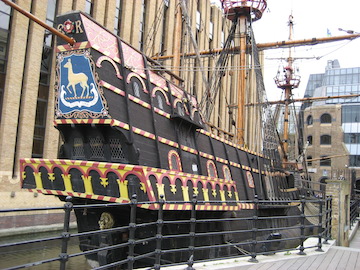
In 1581 Elizabeth I traveled along a turnpike that ran from New Cross to Deptford to board Drake’s ship, the Golden Hind, that circumnavigated the globe. Apparently it was later

converted into a sort of dining-house for London visitors; in which case all I can say is that I hope that they recollected in what sort of sanctuary of heroism they were dining, and drank the health reverently of the great man who made English commerce possible, and so, indirectly, enabled them to pay the bill.

Replica of the Golden Hind

Replica of the Golden Hind

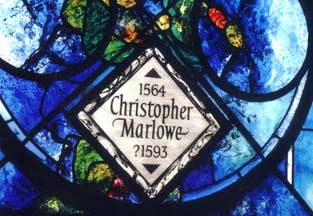
It was in Deptford that “the greatest perhaps of our Elizabethan dramatists was killed here in a tavern brawl.” Our author goes on about Christopher Marlowe‘s birth at Canterbury and insinuates that “the greatest of our poets is unrepresented in our pedantic Pantheon,” that other lesser poets were honored with slabs of marble while he only with an unmarked grave in the churchyard at St. Nicholas’s Church in Deptford. As to that, I feel I must add that had he not died at the age of thirty (under circumstances that are murky at best), his achievements might have been unequalled even by Shakespeare or Cervantes. And that a memorial window in Poets’ Corner at Westminster Abbey was laid in for him in 2002, which must have given great gratification to all Marlowe devotees.

Memorial window to Christopher Marlowe, Poets' Corner, Westminst

Sayes Court, known for its exquisite gardens, was the setting for “some of the most brilliant scenes in Kenilworth” by Sir Walter Scott. Kenilworth is the story of a secret marriage between Robert Dudley, 1st Earl of Leicester and Amy Robsart. Click here to download this classic for free on your Kindle.

Set in 1575,

the tragic series of events begins when Amy flees her father and her betrothed, Tressilian, to marry the Earl. Amy passionately loves her husband, and the Earl loves her in return, but he is driven by ambition. He is courting the favour of Queen Elizabeth I, and only by keeping his marriage to Amy secret can he hope to rise to the height of power that he desires. At the end of the book, the queen finally discovers the truth, to the shame of the Earl. But the disclosure has come too late, for Amy has been murdered by the Earl’s even more ambitious steward, Varney. (Wikipedia)

sayes court

Sayes Court

Tristram remarks:

I confess that it does me good when in the course of these disjounted rambles along the great roads of England I can find some spot haunted by the, to me, charmed figures which throng the pages of the Waverley Novels. Hitherto I have not reaped much of a harvest of joy in this direction it must be confessed; but Deptford has given me my first opportunity; and the Dover Road, a little further on, will give me my second; with which remark I think I may leave Deptford altogether, lamenting that all that can be seen of Sayes Court is now a parish workhouse, which stands on its site; and marvelling at the imperial relaxation of Peter the Great who stayed here in 1698 (at the Court, not at the workhouse), and who was wont to unbend a mind wearied with shipbuilding, by being driven through the world-famous hedges of the garden in a wheelbarrow.

A Kindred Spirit

It occurs to me that Mr. Tristram, in the above paragraph, has captured for me the essence of my fascination for this book. While I’m always interested in how people lived—and that includes travel—in the past, it’s not the listings of coaches and their travel times that holds my interest, anymore than it’s the grandeur and magnificence of stately homes that draws me to England year after year. It’s the history—the people who traveled there, lived there, had experiences there that catches my imagination. Standing on the same ground where countless others stood so many years ago, I feel privileged to be a part of it. There’s a sense of continuity of life, of gratitude for events and people that made it possible for me to live in relative safety, and sorrow that so much of what could have been learned from the past continues to be replayed again and again in the modern world.

History has so much to teach. If only people would listen to its wisdom!

 Index to all the posts in this series

1: The Bath Road: The (True) Legend of the Berkshire Lady

2: The Bath Road: Littlecote and Wild William Darrell

3: The Bath Road: Lacock Abbey

4: The Bath Road: The Bear Inn at Devizes and the “Pictorial Chronicler of the Regency”

5: The Exeter Road: Flying Machines, Muddy Roads and Well-Mannered Highwaymen

6: The Exeter Road: A Foolish Coachman, a Dreadful Snowstorm and a Romance

7: The Exeter Road in 1823: A Myriad of Changes in Fifty Years

8: The Exeter Road: Basingstoke, Andover and Salisbury and the Events They Witnessed

9: The Exeter Road: The Weyhill Fair, Amesbury Abbey and the Extraordinary Duchess of Queensberry

10: The Exeter Road: Stonehenge, Dorchester and the Sad Story of the Monmouth Uprising

11: The Portsmouth Road: Royal Road or Road of Assassination?

12: The Brighton Road: “The Most Nearly Perfect, and Certainly the Most Fashionable of All”

13: The Dover Road: “Rich crowds of historical figures”

14: The Dover Road: Blackheath and Dartford

15: The Dover Road: Rochester and Charles Dickens

16: The Dover Road: William Clements, Gentleman Coachman

17: The York Road: Hadley Green, Barnet

18: The York Road: Enfield Chase and the Gunpowder Treason Plot

19: The York Road: The Stamford Regent Faces the Peril of a Flood

20: The York Road: The Inns at Stilton

21: The Holyhead Road: The Gunpowder Treason Plot

22: The Holyhead Road: Three Notable Coaching Accidents

23: The Holyhead Road: Old Lal the Legless Man and His Extraordinary Flying Machine

24: The Holyhead Road: The Coachmen “More Celebrated Even Than the Most Celebrated of Their Rivals” (Part I)

25: The Holyhead Road: The Coachmen “More Celebrated Even Than the Most Celebrated of Their Rivals” (Part II)

26: Flying Machines and Waggons and What It Was Like To Travel in Them
27: “A few words on Coaching Inns” and Conclusion

The Brighton Road: “The Most Nearly Perfect, and Certainly the Most Fashionable of All”

dust jacket

The following post is the twelfth of a series based on information obtained from a fascinating book Susana recently obtained for research purposes. Coaching Days & Coaching Ways by W. Outram Tristram, first published in 1888, is chock full of commentary about travel and roads and social history told in an entertaining manner, along with a great many fabulous illustrations. A great find for anyone seriously interested in English history!

The Brighton Road, Mr. Tristram suggests, might be called the “Regent’s Road,” since it was the Prince who, once he determined the health benefits of the seaside city, saw to it that the road was made passable.

For before the Pavilion was, Brighton was about as easy to get at as the Cranmere Pool in the middle of Dartmoor, the moon, the North Pole, the special exits in case of fire at our principal theatres, or anything else on earth totally inaccessible.

It was in 1750 when Brighton was nothing but a small fishing village that Doctor Richard Russell visited and proclaimed that sea water was beneficial to health, which began the exodus of wealthy hypochondriacs to seaside resorts. At that time, however, our author suggests that oxen were required to cope with the deep ruts. “People got into coaches to go to Brighton and only got out of them when they were overturned.”

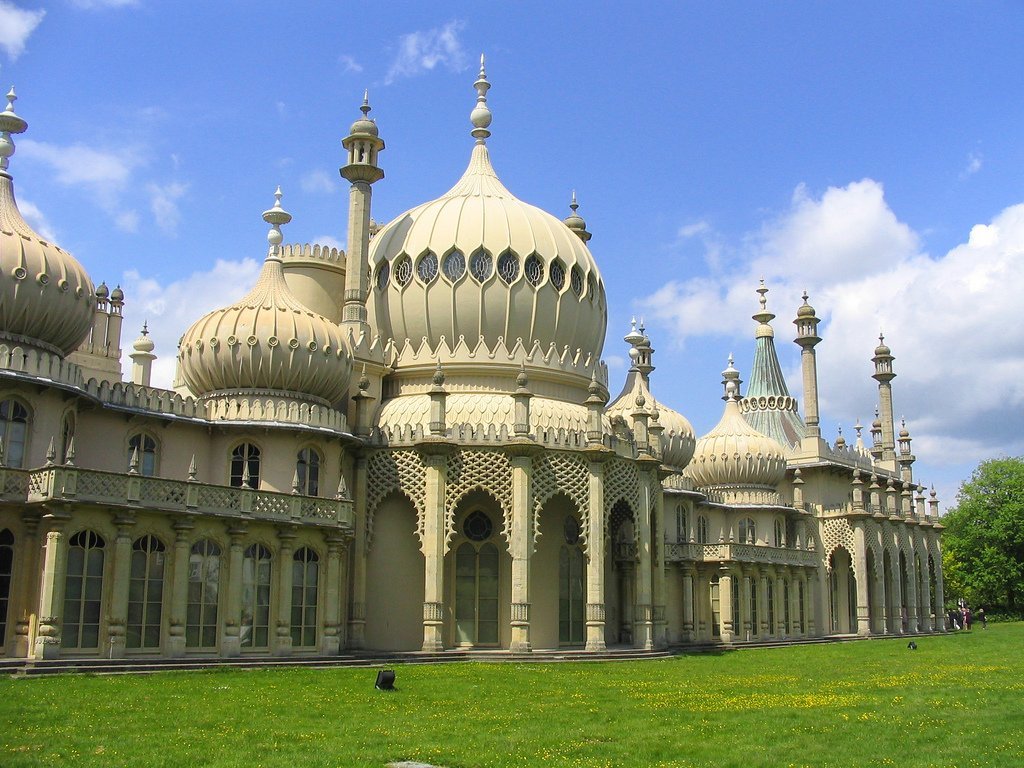
All these horrors of the Brighton Road the much abused George the Fourth did away, with a sweep as it were of his fat, bejewelled and august hand! He built the Pavilion, and people from all parts of the country came straightway to see it and him… the crowds soon found…that if they were to come to Brighton, and to court, they had better have some decent road to come upon. And from this simple bringing home of a plain truth came into existence the Brighton Road—“perhaps the most nearly perfect, and certainly the most fashionable of all.”

Brighton Pavilion1

Brighton Pavilion

Cuckfield Park, Cuckfield, West Sussex

This sixteenth century manor is known for its ghost, said to be that of Anne Sergison, who, already afflicted with a somewhat combative nature, had to fight a long and sordid court battle to get it. It came to light after her brother’s death that the thirteen-year-old girl assumed to be his daughter was actually a “supposititious” (don’t you just love that word?) child imposed on him by his wife. No one knows what happened to the girl and her mother, but Anne’s ghost has been spotted in the corridors and the avenue leading to the house, and some say she particularly attended her granddaughter’s wedding in 1890. No rest for the wicked, so they say.

Cuckfield Park was the inspiration for William Harrison Ainsworth’s novel Rookwood.

Cuckfield Park

Cuckfield Park

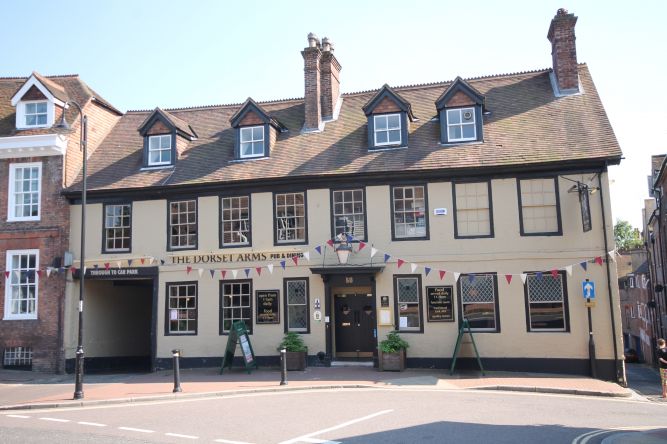
The Dorset Arms, East Grinstead

All distinguished travellers on the Brighton Road pulled up as a matter of course at the Dorset Arms. Amongst those whose names have been handed down as habitual visitors, was Lord Liverpool, who always stayed at the Dorset Arms when on his way to visit the Harcourt seat near Buxted… Another constant guest was Lord Seymour, who died, I believe, in 1837—mean, I am sorry to say…and yet not mean either one way, for if he didn’t eat and drink much, he possessed a passion for illumination which must have produced some respectable items in the bill—thirty wax candles or more burning in his bedroom all night. Spencer Perceval too (the Prime Minister remarkable for great ability and for having been shot in the lobby of the House of Commons in 1812 by John Bellingham) must have been a familiar figure at the Dorset Arms, for the house from which he was married in 1790 to Miss Jane Wilson stands just at the bottom of the Dorset Arms’ garden.

The Dorset Arms

The Dorset Arms

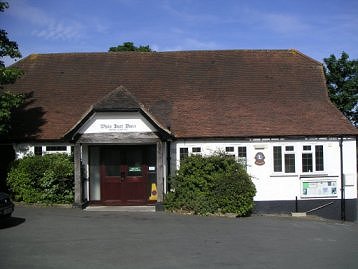
The Clayton Arms, formerly the White Hart and currently the White Hart Barn, Godstone Green

It is said the that in 1815 the Regent, the Tsar of Russia, and many royal visitors stayed at the inn on their way to Blindley Heath, to be present at the fight for the championship of England…Blindley Heath was one of the most popular and celebrated of prize-fighting rendezvous.

“The Fancy were all upon the alert soon after breakfast” (I quote from Boxiana’s description of the Grand Pugilistic combat between Randall and Martin, at Crawley Down, thirty miles from London, on Tuesday, May 4, 1819 “on the Monday to ascertain the seat of action; and as soon as the important whisper had gone forth, that Crawley Down was likely to be the place, the toddlers were off in a twinkling… Between the hours of two and three o’clock in the afternoon upwards of a hundred gigs were counted passing through Croydon… Long before eight o’clock in the evening every bed belonging to the inns and public houses in Godstone, East Grinstead, Reigate, Bletchingley, &c., were doubly and some trebly occupied.”

“Those persons whose blunt enabled them to procure beds, could not obtain any sleep, for carriages of every description were passing through the above towns all night… The brilliants also left Brighton and Worthing at about the same period, and thus were the roads thronged in every direction… It is supposed if the carriages had all been placed in one line they would have reached from London to Crawley. The amateurs were of the highest distinction, and several noblemen and foreigners of rank were upon the ground.”

The White Hart Barn, now the village hall of Godstone Green

The White Hart Barn, now the village hall of Godstone Green

Regent and emperor putting up at a wayside inn to witness a fight for the championship!…The noblemen and foreigners of rank crowding round the twenty-four foot ring! What can give us a better idea of the Brighton Road in its prime than these facts? What paint more vividly what I call its “Regency flavour”, its slang, its coarseness, its virility—in a word, its “Corinthianism”?

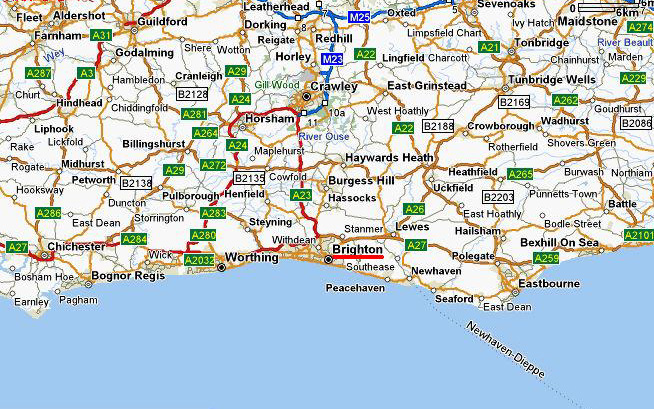
brighton-map

 Index to all the posts in this series

1: The Bath Road: The (True) Legend of the Berkshire Lady

2: The Bath Road: Littlecote and Wild William Darrell

3: The Bath Road: Lacock Abbey

4: The Bath Road: The Bear Inn at Devizes and the “Pictorial Chronicler of the Regency”

5: The Exeter Road: Flying Machines, Muddy Roads and Well-Mannered Highwaymen

6: The Exeter Road: A Foolish Coachman, a Dreadful Snowstorm and a Romance

7: The Exeter Road in 1823: A Myriad of Changes in Fifty Years

8: The Exeter Road: Basingstoke, Andover and Salisbury and the Events They Witnessed

9: The Exeter Road: The Weyhill Fair, Amesbury Abbey and the Extraordinary Duchess of Queensberry

10: The Exeter Road: Stonehenge, Dorchester and the Sad Story of the Monmouth Uprising

11: The Portsmouth Road: Royal Road or Road of Assassination?

12: The Brighton Road: “The Most Nearly Perfect, and Certainly the Most Fashionable of All”

13: The Dover Road: “Rich crowds of historical figures”

14: The Dover Road: Blackheath and Dartford

15: The Dover Road: Rochester and Charles Dickens

16: The Dover Road: William Clements, Gentleman Coachman

17: The York Road: Hadley Green, Barnet

18: The York Road: Enfield Chase and the Gunpowder Treason Plot

19: The York Road: The Stamford Regent Faces the Peril of a Flood

20: The York Road: The Inns at Stilton

21: The Holyhead Road: The Gunpowder Treason Plot

22: The Holyhead Road: Three Notable Coaching Accidents

23: The Holyhead Road: Old Lal the Legless Man and His Extraordinary Flying Machine

24: The Holyhead Road: The Coachmen “More Celebrated Even Than the Most Celebrated of Their Rivals” (Part I)

25: The Holyhead Road: The Coachmen “More Celebrated Even Than the Most Celebrated of Their Rivals” (Part II)

26: Flying Machines and Waggons and What It Was Like To Travel in Them
27: “A few words on Coaching Inns” and Conclusion

The Portsmouth Road: Royal Road or Road of Assassination?

dust jacket

The following post is the eleventh of a series based on information obtained from a fascinating book Susana recently obtained for research purposes. Coaching Days & Coaching Ways by W. Outram Tristram, first published in 1888, is chock full of commentary about travel and roads and social history told in an entertaining manner, along with a great many fabulous illustrations. A great find for anyone seriously interested in English history!

The Portsmouth Road has been described to me by one having authority as the Royal Road: and certainly kings and queens have passed up and down it, eaten and drunken in the Royal Rooms, still to be seen in some of the old inns; snored in the Royal Beds (also in places to be seen, but not slept in), and dreamed of ruts of bogs, and blasted heaths and impassable morasses, and all the sundry and other mild discomforts which our ancestors, whether kings or cobblers, had to put up with; or those among them at all events who travelled when the weather was rainy, and there were no real roads to travel upon.

To me however the Portsmouth Road—so called Royal—presents itself in a less august guise; so much so that if I were asked to give it a name whereby it might be especially distinguished, I should be inclined, I think, to call it the Road of Assassination. And it will be found to have claim to the title.

The Unknown Sailor

The Portsmouth Road after Godalming and Milford consisted of a “gravelly road” for five miles up Hindhead Hill that led them directly to a “silent memorial of murder,” a gravestone reminder

of a barbarous murder committed on the spot on the person of an unknown sailor (who lies buried in Thursley Churchyard, a few miles off); and airs also with some satisfaction the feeling then very prevalent (before Scotland Yard was), that murderers are a class who invariably fall into the hands of justice. We are perhaps not so credulous as this nowadays; but we put our trust in a large detective force when our throats have been cut, and hope for the best. The local police of 1786 however could have given many of our shining lights a lesson, it seems to me; for on the very afternoon of September the 4th in that year (which was the date of the murder) they apprehended three men named Lonegon, Casey, and Marshall, twelve miles further down the road…engaged in the unwise exercise of selling the murdered man’s clothes. For this, and previous indiscretions, they were presently hanged in chains on the top of Hindhead as a warning…

The ill-fated sailor, walking from London to rejoin his ship in Portsmouth, met up with three other sailors in Thursley and treated them to food and drinks before setting off again in their company. His reward was to be murdered and decapitated and thrown into a valley, where he was promptly discovered and the alarm raised. His murderers were apprehended that same day at the Sun Inn in Rake, rather unwisely selling off their victim’s clothing.

220px-Unknown_Sailors_GraveIn memory of

A generous but unfortunate Sailor

Who was barbarously murder’d on Hindhead

On September 24th 1786

By three Villains

After he had liberally treated them

And promised them his farther assistance

On the road to Portsmouth.

The Murders by the Smugglers

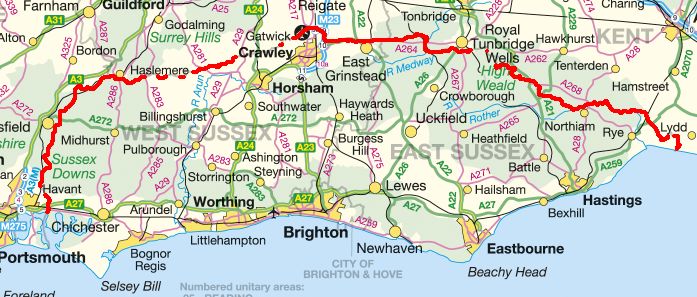
Sussex_Police_Authority_Map

All through the last century, then, it seems the country from Portsmouth…was infested by gangs of smugglers.

From time to time, after some unusually audacious outbreak against custom-house laws had taken place, violent reprisals were made; but on the whole the revenue officers seem to have had decidedly the worst of it, and the smugglers enjoyed an enviable immunity from the retribution of justice. The climax to this condition of affairs came on the 6th and 7th of October, 1747, when a gang of some sixty of these desperadoes assembled secretly in Charlton Forest; made a suddenly raid on Poole; broke open the custom, where a large quantity of tea which had been seized from one of their confederates, was lodged, and made off with the booty, without encountering any resistance from the surprised authorites.

barbarous11

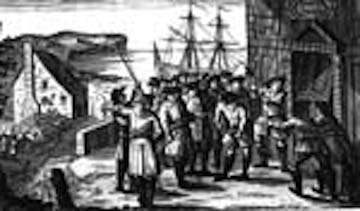
Ye Smugglers breaking open ye King’s Custom House at Poole

The cocky smugglers made a “riotous procession” retreating with their booty, and one of them, a man named Diamond, recognized Daniel Chater, a shoemaker, in the crowd and threw him a bag of tea. The same Diamond was taken into custody at Chichester, and Chater, having been promised a reward, was persuaded to accompany a custom house officer, William Galley, to Chichester for the purpose of identifying said Diamond.

The pair made the unfortunate decision to stay at the White Hart, where the landlady, “friendly of course to smugglers and highwaymen”, suspecting that they meant harm to her friends, sent for seven of them to intervene. Galley and Chater “were prevailed upon with force to stay and drink more rum” and when unconscious, the letter Galley was carrying detailing their errand was intercepted, and the criminals debated whether or not to murder them. Two of the smugglers’ wives who had joined the party urged them to “Hang the dogs, for they came here to hang us.”

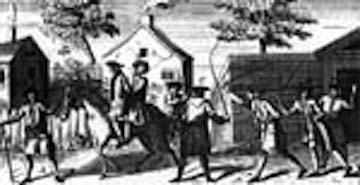
This view of the case seems to have in an instant turned men into monsters. A devilish fury possessed the whole company. Jackson rushed into the room where Chater and Galley were sleeping. He leaped upon the bed and awakened them by spurring them on the forehead. He flogged them about the head with a horsewhip till their faces poured with blood. Then they were taken out to the back yard, and both of them tied on to one horse, their four legs tied together, and these four legs tied under the horse’s belly.

They had not got a hundred yards from the house when Jackson, in one of those sudden accesses of fiendishness continually characteristic of the whole affair, and which seemed a veritable possession of the devil himself, yelled out—“Whip them! Cut them! Slash them! Damn them!” and in an instant the whole gang’s devilish fury was wreaked on their bound and helpless enemies.

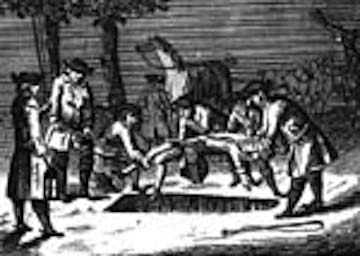
Near Rake Hill, Galley fell off the horse and was presumed to be dead, so they buried him in a foxhole in Harting Coombe. When he was found, however, his hands were covering his eyes, presumably to protect them from the dirt, so he was, in effect, buried alive.

Chater did not find so fortunate a release from his torments. He was kept for over two days chained by the leg in an outhouse of the Red Lion at Rake, “in the most deplorable condition that man was ever in; his mind full of horrors, and his body all over pain and anguish with the blows and scourges they had given him.” All this while the smugglers were calmly debating as to how they should finally make an end of him. At length a decision was come to. Subjected all the way to treatment which I cannot describe, he was taken back to the same Harris Well where it had been originally proposed to murder Galley; and after an unsuccessful attempt at hanging him there, he was thrown down it, and an end put at last to his awful sufferings by heaving stones being thrown on top of him.

The heinousness of the crime demanded swift justice, and the gang was hanged at Chichester on 18th January 1749, except for one, who died of fright the night before the execution.

barbarous8

The unfortunate William Galley put by the Smugglers into the Ground … before he was quite Dead

barbarous12

Mr Galley and Mr Chater put by ye Smugglers on one Horse near Rowland Castle

The Assassination of the Duke of Buckingham

After all this, a simple assassination may strike you as a mere church picnic. But it was at the Spotted Dog Inn in 1628 that James I’s favorite (and some say lover) was assassinated by a discontented half-pay officer who had been turned down for promotion.

buckingham

It remains for me to remark that the journey of Felton to London, where he was hanged, drawn, and quartered at Tyburn, was accomplished amidst scenes of extraordinary and many-sided excitement; and coming, as it does, before a similarly mournful expedition over the same ground on the part of the Duke of Monmouth, seems to me to cast a characteristic gloom over the annals of a road—not remarkable for coaching anecdotes or coaching records—which has been called Royal, and rightly perhaps enough,—but which has yet witnessed, so far as its historical side is concerned, and so far as my knowledge goes, gloomier and more tragic scenes than any other of the great thoroughfares out of London.

These days we have organized police forces and all sorts of high-tech devices and forensic methods to apprehend and prosecute criminals…and yet crime seems to be everywhere, even such horrific murders as described here. Are today’s criminals smarter, do you think, or were more crimes undetected back then?

Comment and enter to win Susana’s September Giveaway, a lovely necklace from London’s National Gallery (see photo at right).

 Index to all the posts in this series

1: The Bath Road: The (True) Legend of the Berkshire Lady

2: The Bath Road: Littlecote and Wild William Darrell

3: The Bath Road: Lacock Abbey

4: The Bath Road: The Bear Inn at Devizes and the “Pictorial Chronicler of the Regency”

5: The Exeter Road: Flying Machines, Muddy Roads and Well-Mannered Highwaymen

6: The Exeter Road: A Foolish Coachman, a Dreadful Snowstorm and a Romance

7: The Exeter Road in 1823: A Myriad of Changes in Fifty Years

8: The Exeter Road: Basingstoke, Andover and Salisbury and the Events They Witnessed

9: The Exeter Road: The Weyhill Fair, Amesbury Abbey and the Extraordinary Duchess of Queensberry

10: The Exeter Road: Stonehenge, Dorchester and the Sad Story of the Monmouth Uprising

11: The Portsmouth Road: Royal Road or Road of Assassination?

12: The Brighton Road: “The Most Nearly Perfect, and Certainly the Most Fashionable of All”

13: The Dover Road: “Rich crowds of historical figures”

14: The Dover Road: Blackheath and Dartford

15: The Dover Road: Rochester and Charles Dickens

16: The Dover Road: William Clements, Gentleman Coachman

17: The York Road: Hadley Green, Barnet

18: The York Road: Enfield Chase and the Gunpowder Treason Plot

19: The York Road: The Stamford Regent Faces the Peril of a Flood

20: The York Road: The Inns at Stilton

21: The Holyhead Road: The Gunpowder Treason Plot

22: The Holyhead Road: Three Notable Coaching Accidents

23: The Holyhead Road: Old Lal the Legless Man and His Extraordinary Flying Machine

24: The Holyhead Road: The Coachmen “More Celebrated Even Than the Most Celebrated of Their Rivals” (Part I)

25: The Holyhead Road: The Coachmen “More Celebrated Even Than the Most Celebrated of Their Rivals” (Part II)

26: Flying Machines and Waggons and What It Was Like To Travel in Them
27: “A few words on Coaching Inns” and Conclusion

The Exeter Road: Stonehenge, Dorchester and the Sad Story of the Monmouth Uprising

dust jacket

The following post is the tenth of a series based on information obtained from a fascinating book Susana recently obtained for research purposes. Coaching Days & Coaching Ways by W. Outram Tristram, first published in 1888, is chock full of commentary about travel and roads and social history told in an entertaining manner, along with a great many fabulous illustrations. A great find for anyone seriously interested in English history!

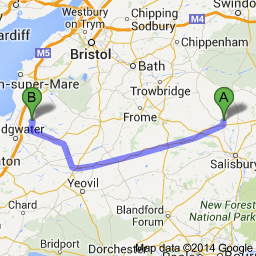
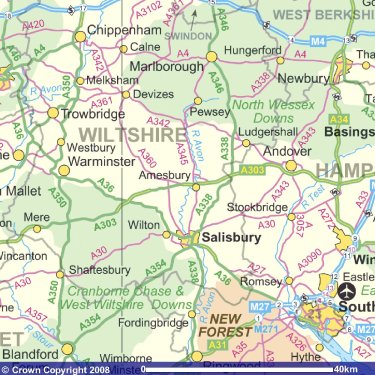
map

A = Stonehenge, B = Sedgemoor

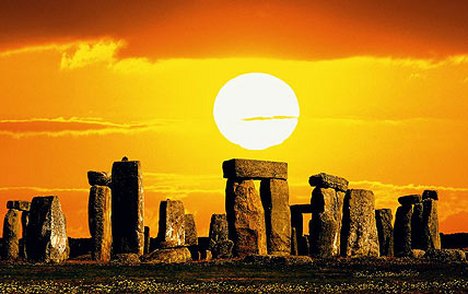
Stonehenge

Mr. Outram declines to say much about Stonehenge

because everybody has written about it, and most people have read what has been written. If anybody however has not seen it, should chance to be in the neighbourhood I would advise them (without troubling themselves much beforehand as to whether it is Druidical, or post Roman, or built by the Belgae) to approach it from Amesbury about sunset, when they will see what they will see, and return home—or I am in error—well-pleased with what they have seen.

Stonehenge2SAT_428x269_to_468x312

The Woodyates Inn and the Taking of Monmouth

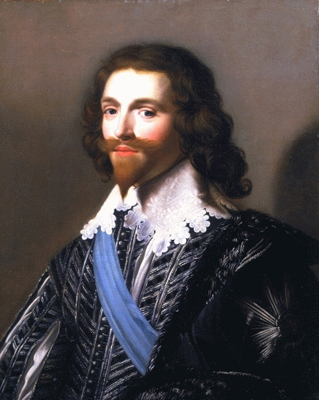
James Scott, Duke of Monmouth was the illegitimate son of Charles II and his mistress, Lucy Walter. There were rumors of a marriage between the two, which would have made the duke heir to the throne, but Charles II himself maintained that his only wife was the queen, Catherine of Braganza. Unfortunately, he and Catherine never had any children, so when he died, the throne passed to his brother, who became James II.

James Scott, Duke of Monmouth

James Scott, Duke of Monmouth

James had Catholic leanings and was married to a Catholic wife, and  this caused a great deal of unrest. Few people wanted to see the sort of bloody inquisition that occurred in the reign of Mary I. Monmouth was good-looking and as charming as his father and decidedly Protestant, so there were many who preferred to believe that he was the true heir, as he did himself, declaring on multiple occasions that he was the true King and even undergoing a coronation of sorts.

It was not to be, however. Monmouth’s forces were defeated by King James II’s armies on the

bleak plain of Sedgemoor, and crushed for ever the daring hopes of the brilliant young nobleman who was for so long the darling of the West. The memory of Monmouth is still preserved about Woodyates. It was close to the Woodyates Inn that the giving in of the desperately ridden horses stopped the flight of Monmouth, Grey, and Buyse to the sea. Here the fugitives turned their horses loose, concealed the bridles and saddles, disguised themselves as rustics, and made their way on foot towards the New Forest; and quite close by they fell into the hands of James’s troopers. Monmouth himself was taken on the Woodlands Estate near Horton, his captors failing for some moments to recognise in the gaunt figure, crouching in a ditch, dressed like a shepherd, with a beard of three days’ growth, already prematurely grey, the once brilliant and graceful son of Charles II and Lucy Walters.

battle-of-sedgemoor

Monument of the Battle of Sedgemoor

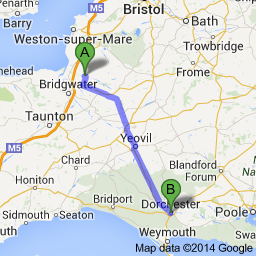
Dorchester and the Bloody Assize of Judge Jeffreys

A = Sedgemoor B = Dorchester

A = Sedgemoor, B = Dorchester

Although he begged forgiveness of his uncle and converted to Catholicism, the wayward Monmouth was executed for treason at Tower Hill. The disposition of his followers is described below.

“The court, writes Macaulay, “was hung, by order of the chief justice, with scarlet, and this innovation, seemed to the multitude to indicate a bloody purpose. It was also rumoured that when the clergyman who preached the assize sermon enforced the duty of mercy, the ferocious countenance of the judge was distorted by an ominous grin. These things made men augur ill of what was to follow.

“More than three hundred prisoners were to be tried. The work seemed heavy, but Jeffreys had a contrivance for making it light. He let it be understood that the only chance of obtaining pardon or respite was to plead guilty. Twenty-nine persons who put themselves on their country and were convicted were ordered to be tied up without delay. The remaining prisoners pleaded guilty by scores. Two hundred and ninety-two received sentence of death.”

Charles Jeffreys, the Hanging Judge

George Jeffreys, the Hanging Judge

James II Deposed

With the birth of a son from his Catholic wife in 1688, the unrest about a Catholic heir increased, and James was deposed, to be replaced by his daughter from his first wife, Mary II, and her husband, William III.


 Index to all the posts in this series

1: The Bath Road: The (True) Legend of the Berkshire Lady

2: The Bath Road: Littlecote and Wild William Darrell

3: The Bath Road: Lacock Abbey

4: The Bath Road: The Bear Inn at Devizes and the “Pictorial Chronicler of the Regency”

5: The Exeter Road: Flying Machines, Muddy Roads and Well-Mannered Highwaymen

6: The Exeter Road: A Foolish Coachman, a Dreadful Snowstorm and a Romance

7: The Exeter Road in 1823: A Myriad of Changes in Fifty Years

8: The Exeter Road: Basingstoke, Andover and Salisbury and the Events They Witnessed

9: The Exeter Road: The Weyhill Fair, Amesbury Abbey and the Extraordinary Duchess of Queensberry

10: The Exeter Road: Stonehenge, Dorchester and the Sad Story of the Monmouth Uprising

11: The Portsmouth Road: Royal Road or Road of Assassination?

12: The Brighton Road: “The Most Nearly Perfect, and Certainly the Most Fashionable of All”

13: The Dover Road: “Rich crowds of historical figures”

14: The Dover Road: Blackheath and Dartford

15: The Dover Road: Rochester and Charles Dickens

16: The Dover Road: William Clements, Gentleman Coachman

17: The York Road: Hadley Green, Barnet

18: The York Road: Enfield Chase and the Gunpowder Treason Plot

19: The York Road: The Stamford Regent Faces the Peril of a Flood

20: The York Road: The Inns at Stilton

21: The Holyhead Road: The Gunpowder Treason Plot

22: The Holyhead Road: Three Notable Coaching Accidents

23: The Holyhead Road: Old Lal the Legless Man and His Extraordinary Flying Machine

24: The Holyhead Road: The Coachmen “More Celebrated Even Than the Most Celebrated of Their Rivals” (Part I)

25: The Holyhead Road: The Coachmen “More Celebrated Even Than the Most Celebrated of Their Rivals” (Part II)

26: Flying Machines and Waggons and What It Was Like To Travel in Them
27: “A few words on Coaching Inns” and Conclusion

The Exeter Road: The Weyhill Fair, Amesbury Abbey and the Extraordinary Duchess of Queensberry

dust jacket

The following post is the ninth of a series based on information obtained from a fascinating book Susana recently obtained for research purposes. Coaching Days & Coaching Ways by W. Outram Tristram, first published in 1888, is chock full of commentary about travel and roads and social history told in an entertaining manner, along with a great many fabulous illustrations. A great find for anyone seriously interested in English history!

map

The Weyhill Fair

The Telegraph, rival of the Quicksilver which our author repeatedly states can do 175 miles in eighteen hours, used to pass through Weyhill, which was famous for its annual fair, “which would make those people who have never seen one stare.”

This festivity, which is indeed quite an un-English and out-of-the-way sight, begins on October 10th (Michaelmas Eve) and goes on for six days, during which all the country-side seems to have broken loose, and high junketings are to be seen. Besides junketings (which prevail chiefly on the last day of the fair in connection with peep-shows of the most blood-curdling description, whirligigs, merry-go-rounds, rifle galleries, and gingerbread) are also to be seen wonderful shows of sheep, magnificent cheeses, the finest hops in England displayed in the Farnham Row, great exhibits of machinery and enormous carthorses, and, enveloping all, a Babel indescribable.

Amesbury and the Abbey

Amesbury is where Guinevere arrived “somewhat late at night, after a ride across the Plain” after her affair with Lancelot was discovered.

“…hither came Queen Elfrida in 980…after her murder of her stepson Edward at Corfe; and, bent like all medieval murderesses suffering from a temporary mental depression, on building a church. When she came to the point however, and had interviewed the architect and the abbot, she went the whole hog and built an abbey.”

Amesbury Abbey (the church)

Amesbury Abbey (the church)

Prior to Henry VIII’s dissolution, the abbey played host, when “the Exeter road at that time was but a medieval cart-track, and a very bad one too,” to Eleanor of Brittany, sister of Prince Arthur and Mary, sixth daughter of Edward I. “Eleanor, Queen of Henry III, died here, and Katharine of Aragon stayed for a while here on her first arrival in England in 1501.”

Following the dissolution, “the abbey of Amesbury became Amesbury Abbey and passed from the Earl of Somerset, to whom it was granted by Henry VIII, into the respective hands of the Aylesburys, Boyles, and Queensberrys…”

The Abbey eventually became the parish church, and the nearby mansion of the same name built by Inigo Jones is now part of a group by the same name that operates nursing and retirement homes in the area.

Amesbury Abbey_thumb

Amesbury Abbey (the stately home)

This is where Kitty, “the charming Duchess of Queensberry played the Lady Bountiful in the place, and by entertaining Prior and Gay the Abbey graced the quaint old Wiltshire town with the memories of two of the not least celebrated of the English humorists.”

The Duchess of Queensberry

According to the Douglas family history, Catherine Douglas, née Hyde, was an outspoken, rather eccentric woman who “loved walking, avoided alcohol and was an enthusiastic planter of trees at her husband’s estates.” She’d grown up “in a household frequented by literary celebrities,” and it was she about whom Prior wrote the poem “The Female Phaeton: Upon Lady Kitty’s First Appearing in Public” when she was sixteen.

Catherine Douglas, Duchess of Queensberry

Catherine Douglas, Duchess of Queensberry

Following her marriage to Charles Douglas, 3rd duke of Queensberry, the acclaimed beauty Kitty became an avid patron of the arts, to the point of being exiled from court when her defense of the playwright John Gay offended King George II. Gay spent the last years of his life at the Abbey, where he wrote the Beggar’s Opera, and was given a lavish funeral at his death in 1732.

The Douglas family history fails to mention the fascinating story of Julius Soubise, a Negro slave from the West Indies who was given to the duchess in 1764 when he was ten years old. She gave him a privileged life, treating him as her own son, and he became a noted fencing and riding master, a member of the most exclusive clubs, and quite popular among upper-class social circles. A violinist and singer, he trained in oratory with the actor David Garrick. At times he claimed to be African royalty, calling himself “Prince Ana-Ana-maboe” or the “Black Prince.” It was rumored that the duchess and her protégé had a sexual relationship, so perhaps that is the reason Soubise was left out of the family history. Is it only coincidence that the duchess died two days after Soubise sailed for India?

julius-soubise

Julius Soubise

One reason I love delving into these family histories is the interesting things you find. The 3rd Duke of Queensberry, it turns out, succeeded his father “due to special remainder,” when his older brother James was declared insane. Both of the 3rd duke’s sons predeceased him and the title passed to a distant cousin, William Douglas, who later became a friend of the Prince of Wales.

The Duchess of Queensberry Rules

Actually, it was the 9th Marquess of Queensberry to whom the  1867 code on which modern boxing is based can be attributed (although he was not the author, merely the endorser). This code, meant for both amateur and professional matches, is and was the first to mention the use of gloves for boxing. The dear duchess had nothing to do with it, having passed on ninety years earlier.

 Index to all the posts in this series

1: The Bath Road: The (True) Legend of the Berkshire Lady

2: The Bath Road: Littlecote and Wild William Darrell

3: The Bath Road: Lacock Abbey

4: The Bath Road: The Bear Inn at Devizes and the “Pictorial Chronicler of the Regency”

5: The Exeter Road: Flying Machines, Muddy Roads and Well-Mannered Highwaymen

6: The Exeter Road: A Foolish Coachman, a Dreadful Snowstorm and a Romance

7: The Exeter Road in 1823: A Myriad of Changes in Fifty Years

8: The Exeter Road: Basingstoke, Andover and Salisbury and the Events They Witnessed

9: The Exeter Road: The Weyhill Fair, Amesbury Abbey and the Extraordinary Duchess of Queensberry

10: The Exeter Road: Stonehenge, Dorchester and the Sad Story of the Monmouth Uprising

11: The Portsmouth Road: Royal Road or Road of Assassination?

12: The Brighton Road: “The Most Nearly Perfect, and Certainly the Most Fashionable of All”

13: The Dover Road: “Rich crowds of historical figures”

14: The Dover Road: Blackheath and Dartford

15: The Dover Road: Rochester and Charles Dickens

16: The Dover Road: William Clements, Gentleman Coachman

17: The York Road: Hadley Green, Barnet

18: The York Road: Enfield Chase and the Gunpowder Treason Plot

19: The York Road: The Stamford Regent Faces the Peril of a Flood

20: The York Road: The Inns at Stilton

21: The Holyhead Road: The Gunpowder Treason Plot

22: The Holyhead Road: Three Notable Coaching Accidents

23: The Holyhead Road: Old Lal the Legless Man and His Extraordinary Flying Machine

24: The Holyhead Road: The Coachmen “More Celebrated Even Than the Most Celebrated of Their Rivals” (Part I)

25: The Holyhead Road: The Coachmen “More Celebrated Even Than the Most Celebrated of Their Rivals” (Part II)

26: Flying Machines and Waggons and What It Was Like To Travel in Them
27: “A few words on Coaching Inns” and Conclusion

The Exeter Road: Basingstoke, Andover and Salisbury and the Events They Witnessed

dust jacket

The following post is the eighth of a series based on information obtained from a fascinating book Susana recently obtained for research purposes. Coaching Days & Coaching Ways by W. Outram Tristram, first published in 1888, is chock full of commentary about travel and roads and social history told in an entertaining manner, along with a great many fabulous illustrations. A great find for anyone seriously interested in English history!

Basingstoke

In 1645 Cromwell took Basing House after a four-year struggle, stripped the lead off the roof of the Abbey in order to cast bullets, leaving the house in ruins. Basingstoke, however was a popular place for coaches to stop for meals.

Between Basingstoke and Andover is a “desolate country” where coaches could make good time. The White Hart in Whitchurch was a “bustling place” where coaches from London to Salisbury and Oxford to Winchester crossed each other.” (Note: it’s still there and has fifteen rooms available should you desire to stay there!)

Andover

Here Henry VII rested from his labours after suppressing the insurrection of Perkin Warbeck; but whether the miserly Tudor put up at the Star and Garter, or the everlasting White Hart, or their medieval equivalents, if there were any, is more than I can say. It was upon Andover to link another royalty with the place, that James II fell back, after the breaking-up of the camp at Salisbury. Here it was that he was deserted by Prince George [Prince of Denmark, his daughter Anne’s husband], remarkable for his impenetrable stupidity and his universal panacea for all contingencies in a catch-word. Whatever happened, “Est-il possible?” was his exclaim. He supped with the king, who was at the moment overwhelmed naturally enough with his misfortunes, said nothing during a dull meal, but directly it was over slipped out to the stable in the company of the Duke of Ormond, mounted, and rode off. James did not exhibit much surprise on learning the adventure, being used to desertion by this time. He merely remarked, “What, is ‘Est-il possible?’ gone too! A good trooper would have been a greater loss;” and left for London—I was going to say by the next coach.

Two important coaching roads diverge about a half-mile out of Andover, which was also the scene of an escaped lioness on the Exeter Mail on October 20, 1816.

Salisbury

salisbury-cathedral-whats-on-in-salisbury“One of the most picturesque towns in the south of England,” Salisbury, where the Quicksilver (which could do 175 miles in 18 hours, our author notes repeatedly) stopped to change horses, “is almost exactly half way between Exeter and London.”

The town of Salisbury, which is eighty miles seven furlongs from Hyde Park Corner, is chiefly remarkable for its cathedral; and it owes this agreeable notoriety to the north wind. This may sounds trange in the ears of those who have not, attired as shepherds, highwaymen or huntsmen, braved the elements in the surrounding plain. Those however who have enjoyed this fortune, will not be surprised to learn, that when the winds raged in the good old days of 1220 round the original church of Old Sarum, which was quite unprotected and perched upon a hill, the congregation were utterly unable to hear the priests say mass; and no doubt they were unable to hear the sermon too. This fact much exercised the good Bishop Poore; and so, a less windy site having opportunely been revealed to him in a dream by the Virgin he got a license from Pope Honorius for removal. Which done—with a medieval disregard for the safety of the local cowherd or government inspector—he aimlessly shot an arrow into the air from the ramparts of Old Sarum, and (unlike Mr. Longfellow’s hero), having marked where it fell, there laid the foundations of the existing beautiful church.

The first among the myriad of royal visitors to Salisbury was Richard II, “who was here immediately before his expedition to Ireland, where he should clearly never have gone.” Apparently the town was not at all impressed with his “amiable inclination towards charging his subjects with his outings,” considering the fact that his household consisted of “ten thousand persons, three hundred of whom were cooks” and for him they had to provide tables. The town “a short time after expressed their thanks for his visit, by, with almost indecent alacrity, espousing the cause of Henry.”

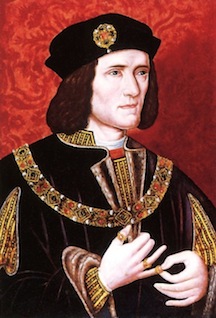
In 1484

Richard III

Richard III

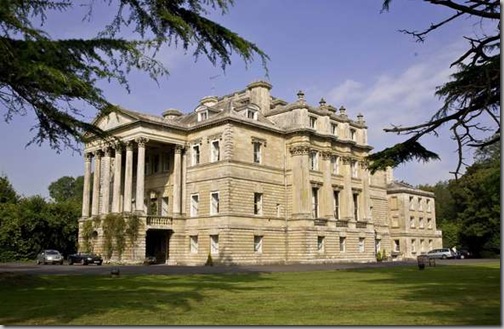
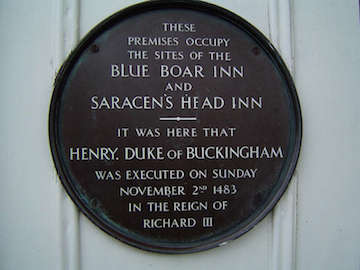
…the hunchbacked Richard honoured Salisbury with his presence; but he was not I expect in the best of tempers, for here to him was brought the Buckingham we have all read of in the play, who had just seized the fleeting opportunity to head an insurrection against the king, in an unprecedentedly wet season in Wales. The result was that he was unable to cross the Severn, and this misfortune brought him too to Salisbury, where Richard was waiting to superintend his execution at what is now the Saracen’s Head.

In the courtyard of this inn, which was then called the Blue Boar, and not “in an open space,” as Shakespeare has described it (as if he were speaking of Salisbury Plain), Buckingham had his head cut oft according to contemporary prescription. We have none of us seen the episode presented on the stage, but we have read the carpenters’ scene, which Shakespeare wrote in, to give the gentleman who originally played Buckingham a chance, and allow a few moments more preparation for Bosworth Field. And we may recollect that it consists princiapply in Buckingham asking whether King Richard will not let him speak to him, and on being told not at all, informing the general company, at some length, that it is All-Souls’ Day, and that as soon as he has been beheaded, he intends to commence “walking”.

plaque2

Although the inn has been replaced by Debenham’s, a department store, some say they have seen or experienced the Duke’s ghost, so ladies, you might want to reconsider using the dressing rooms there—just an FYI.

After Richard and Buckingham, there came to Salisbury in the way of kings, Henry VII in 1491. Henry VIII in 1535 with Ann Boleyn, already in all probability engaged in those sprightly matrimonial differences as to men and the things which culminated the year following on Tower Green. Next in order, came to Salisbury, Elizabeth, bound for Bristol, bent, as on all her royal progresses, on keeping her nobility’s incomes within bounds, and shooting tame stags that were induced to meander before her bedroom windows. After the virgin queen came James I, who liked the solitudes which surrounded the Salisbury of those days, for the two-fold reason, firstly, because they saved him in a large measure from the invasion of importunate suitors (who were afraid of having their purses taken on Salisbury Plain before they could proffer their supplications), and, secondly, because they were well stocked with all sorts of game on which he could wreak his royal and insatiable appetite for hunting. The “open” nature of the country might perhaps be added as another reason for the sporting king’s liking for the place: for James was no horseman, and as he was in no danger of meeting a hedge in an area of thirty miles, the going must have suited him down to the ground.

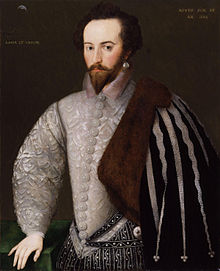
Sir Walter Raleigh

Sir Walter Raleigh

It was also hear that Sir Walter Raleigh, upon his return to England from an unsuccessful expedition to Spain, tried to gain audience with James to explain himself and beg pardon, but was forced to return to London where he was imprisoned and executed.

The merry monarch [Charles II] was here twice, but on neither occasion, I suspect was he peculiarly merry; for after the battle of Worcester, when he lay concealed near the town for a few days, and his companions used to meet at the King’s Arms in John Street, to plan his flight, the Ironsides were much too close on his track to allow opportunity for jesting; and when he came here as king in 1665, all but the most forced mirth was banished from a court which dreaded every day to be stricken by the plague.

 Index to all the posts in this series

1: The Bath Road: The (True) Legend of the Berkshire Lady

2: The Bath Road: Littlecote and Wild William Darrell

3: The Bath Road: Lacock Abbey

4: The Bath Road: The Bear Inn at Devizes and the “Pictorial Chronicler of the Regency”

5: The Exeter Road: Flying Machines, Muddy Roads and Well-Mannered Highwaymen

6: The Exeter Road: A Foolish Coachman, a Dreadful Snowstorm and a Romance

7: The Exeter Road in 1823: A Myriad of Changes in Fifty Years

8: The Exeter Road: Basingstoke, Andover and Salisbury and the Events They Witnessed

9: The Exeter Road: The Weyhill Fair, Amesbury Abbey and the Extraordinary Duchess of Queensberry

10: The Exeter Road: Stonehenge, Dorchester and the Sad Story of the Monmouth Uprising

11: The Portsmouth Road: Royal Road or Road of Assassination?

12: The Brighton Road: “The Most Nearly Perfect, and Certainly the Most Fashionable of All”

13: The Dover Road: “Rich crowds of historical figures”

14: The Dover Road: Blackheath and Dartford

15: The Dover Road: Rochester and Charles Dickens

16: The Dover Road: William Clements, Gentleman Coachman

17: The York Road: Hadley Green, Barnet

18: The York Road: Enfield Chase and the Gunpowder Treason Plot

19: The York Road: The Stamford Regent Faces the Peril of a Flood

20: The York Road: The Inns at Stilton

21: The Holyhead Road: The Gunpowder Treason Plot

22: The Holyhead Road: Three Notable Coaching Accidents

23: The Holyhead Road: Old Lal the Legless Man and His Extraordinary Flying Machine

24: The Holyhead Road: The Coachmen “More Celebrated Even Than the Most Celebrated of Their Rivals” (Part I)

25: The Holyhead Road: The Coachmen “More Celebrated Even Than the Most Celebrated of Their Rivals” (Part II)

26: Flying Machines and Waggons and What It Was Like To Travel in Them
27: “A few words on Coaching Inns” and Conclusion

The Exeter Road in 1823: A Myriad of Changes in Fifty Years

dust jacket

The following post is the seventh of a series based on information obtained from a fascinating book Susana recently obtained for research purposes. Coaching Days & Coaching Ways by W. Outram Tristram, first published in 1888, is chock full of commentary about travel and roads and social history told in an entertaining manner, along with a great many fabulous illustrations. A great find for anyone seriously interested in English history!

Fifty Years Later

Mr. Tristram, our illustrious author, wants us to know that travel has undergone a great deal of change from 1773, so he tells us the story of our hero Mirabel (see previous posts) fifty years later, when he’s in his seventies, having lived most of his life overseas and now is returning to England to take the same route to Exeter. Dressed in much the same way he did then, he waits outside the Gloucester Coffee-house for the Exeter Fly, where the young bucks stare at his old-fashioned attire.

Perhaps Mirabel looks like Mr. Bennet from P&P?

Perhaps Mirabel looks like Mr. Bennet from P&P?

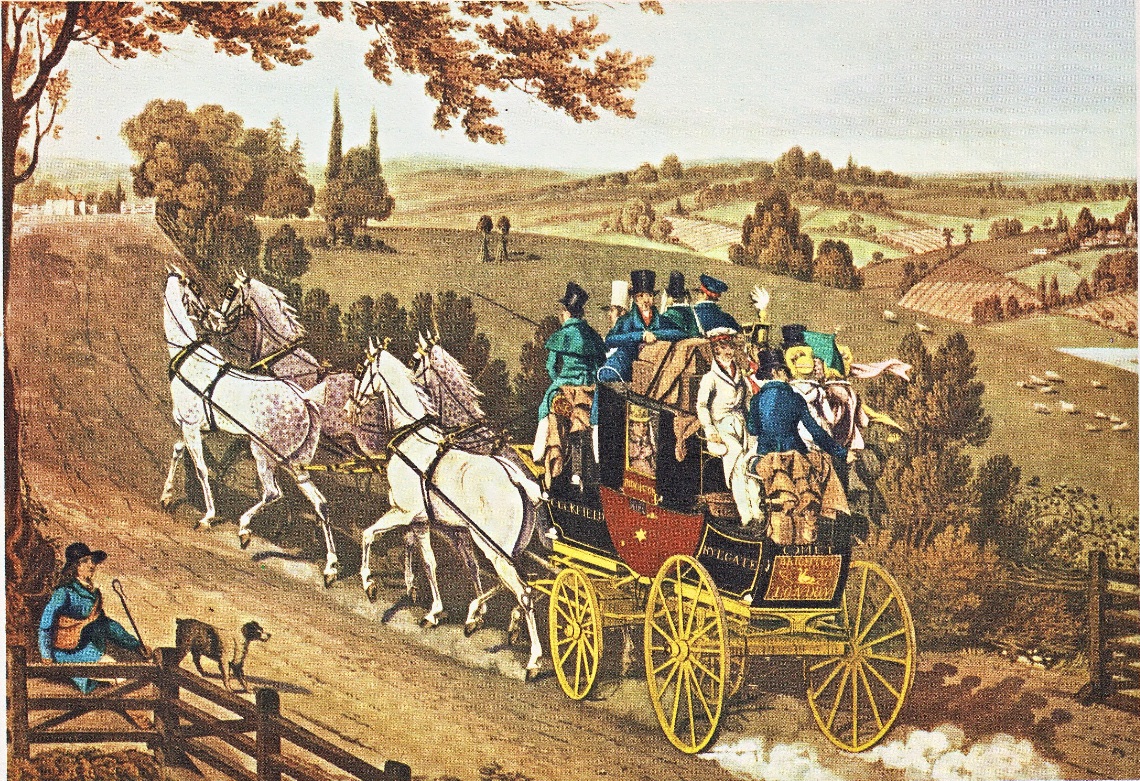
The Comet

He expects to see the Exeter Fly—a trifle improved upon possibly—but still the Exeter Fly. And what does he see in its stead rapidly approaching? Why, a turn-out drawn by four spanking grays, which he takes to be a gentleman’s carriage, and which would do credit to a crowned head.

comet

The Comet on the way to Brighton

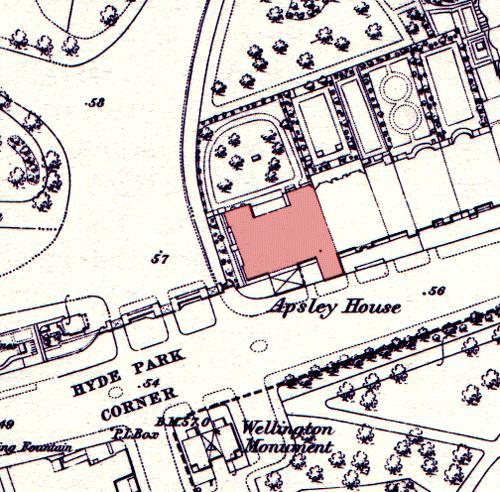
It’s called the Comet and our friend Mirabel soon learns where its name came from. He mistakes the coachman, who is well-dressed and genteel (for he is also the proprietor of the coach) for a gentleman. The Hercules Pillars at Hyde Park Corner no longer exists (recall that Apsley House replaced it soon after our last trip to Exeter), and the roads are macadamized and therefore much smoother than when they were made with stone.

The Comet travels at ten miles an hour and arrives at Hounslow fifty-five minutes after leaving Hyde Park Corner, not stopping at Brentford at all. Mirabel is eager for some breakfast since being told that the coach would change horses there.

The proprietor, smiling superior, blandly tells him that they have changed horses while he was putting on his spectacles. “Only one minute allowed for it at Hounslow, sir, and it is often done in fifty seconds by those nimble-fingered horse-keepers.”

He then proceeds to urge the horses forward in such a way as to cause the coach to rock violently and alarm our valiant Mirabel (remember when he apprehended the highway back in 1773?). In response to his concerns, the proprietor says simply: “Oh, sir, we always ‘spring them’ over these six miles.”

He looks out and sees death and destruction before his eyes, the horses going at the rate of a mile in three minutes, and the coachman in the act of taking a pinch of snuff.

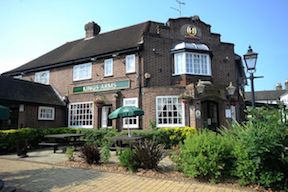
The King's Arms at Bagshot

The King’s Arms at Bagshot

At Staines, the coach takes on a fine thoroughbred “with a twitch on his nose” and Mirabel feels queasy, but the proprietor says, “Let ’em go, and take care of yourselves.” Just as Mirabel expected, the thoroughbred takes off and soon the horses are galloping and the coach rocks unmercifully, but the proprietor manages to steady them, and when Mirabel descends from the Comet at Bagshot, he is grateful to be alive and determined to find a slower and safer coach to take for the remainder of the journey.

The Regulator

Assured that the Regulator will be there in hour, Mirabel finally gets his breakfast and is ready and waiting when the Regulator draws up to the King’s Arms.

He sees…that it is a strong, well-built drag, painted chocolate, bedaubed all over with gilt letters, a bull’s head on the doors, a Saracen’s head on the hind boot, and drawn by four strapping horses.

The inside being full, Mirabel rides on the outside, and is relieved when the Regulator travels at a steady pace for the first five miles out of Bagshot. Once they reach the Hartford Bridge Flats, however, the coachman “springs ’em” to a gallop, and they go so face they catch up to the Comet. In the words of the coachman:

“He [Mirabel] was seated with his back to the horses, his arms extended to each extremity of the guard irons, his teeth set grim as death, his eyes cast down towards the ground, thinking the less he saw of his danger the better;”

and in this state he arrived at Hartford Bridge. Here he dismounted from the Regulator with the alacrity of lightning. “I will walk into Devonshire,” he cries. Then he thinks better of this, and says he will post; then he is told that posting will cost him twenty pounds; and then he says that will never do, and asks whether the landlord of The White Lion can suggest no coach to his notice that does not carry luggage on the top.

The Quicksilver Mail (the Devonshire)

The landlord advises him to take the Quicksilver mail, which travels at night, well-armed, with lamps and guards, and when asked about the speed, demurs and doesn’t mention that the Quicksilver mail (the Devonshire) is the fastest coach in England and commonly called the miracle of the road. But it doesn’t have luggage on top, at least.

Mirabel loses his head, and in spite of the assurances of the passengers that all is right, thrusts it out of the window to see where the deuce they are going to, sees nothing but dust and whirling wheels, and loses his wig.

Alas, we never find out whether or not poor old Mirabel ever got to Exeter, just that the coach reached Basingstoke, and presumably left our elderly hero there.

At least it wasn’t snowing as it did the last time!

 Index to all the posts in this series

1: The Bath Road: The (True) Legend of the Berkshire Lady

2: The Bath Road: Littlecote and Wild William Darrell

3: The Bath Road: Lacock Abbey

4: The Bath Road: The Bear Inn at Devizes and the “Pictorial Chronicler of the Regency”

5: The Exeter Road: Flying Machines, Muddy Roads and Well-Mannered Highwaymen

6: The Exeter Road: A Foolish Coachman, a Dreadful Snowstorm and a Romance

7: The Exeter Road in 1823: A Myriad of Changes in Fifty Years

8: The Exeter Road: Basingstoke, Andover and Salisbury and the Events They Witnessed

9: The Exeter Road: The Weyhill Fair, Amesbury Abbey and the Extraordinary Duchess of Queensberry

10: The Exeter Road: Stonehenge, Dorchester and the Sad Story of the Monmouth Uprising

11: The Portsmouth Road: Royal Road or Road of Assassination?

12: The Brighton Road: “The Most Nearly Perfect, and Certainly the Most Fashionable of All”

13: The Dover Road: “Rich crowds of historical figures”

14: The Dover Road: Blackheath and Dartford

15: The Dover Road: Rochester and Charles Dickens

16: The Dover Road: William Clements, Gentleman Coachman

17: The York Road: Hadley Green, Barnet

18: The York Road: Enfield Chase and the Gunpowder Treason Plot

19: The York Road: The Stamford Regent Faces the Peril of a Flood

20: The York Road: The Inns at Stilton

21: The Holyhead Road: The Gunpowder Treason Plot

22: The Holyhead Road: Three Notable Coaching Accidents

23: The Holyhead Road: Old Lal the Legless Man and His Extraordinary Flying Machine

24: The Holyhead Road: The Coachmen “More Celebrated Even Than the Most Celebrated of Their Rivals” (Part I)

25: The Holyhead Road: The Coachmen “More Celebrated Even Than the Most Celebrated of Their Rivals” (Part II)

26: Flying Machines and Waggons and What It Was Like To Travel in Them
27: “A few words on Coaching Inns” and Conclusion

The Exeter Road: A Foolish Coachman, a Dreadful Snowstorm and a Romance

dust jacket

The following post is the sixth of a series based on information obtained from a fascinating book Susana recently obtained for research purposes. Coaching Days & Coaching Ways by W. Outram Tristram, first published in 1888, is chock full of commentary about travel and roads and social history told in an entertaining manner, along with a great many fabulous illustrations. A great find for anyone seriously interested in English history!

Breakfast at The Three Pigeons Inn, Brentford

Brentford-Market & Three Pigeons

The Brentford Market and the Three Pigeons Inn

In the 17th and 18th centuries when Brentford was a thriving market and resort town, the Three Pigeons Inn was famous for its post-horses, of which it could stable up to one hundred. Its varied entertainments can be found in such literature as The Roaring Girle or Moll Cut-Purse (1611), She Stoops to Conquer (1773), The Merrie Conceited Jests of George Peele—The Jests of George Peele with Four of His Companions at Brainford (1607) and The Alchemist 1610).

Decisions! Decisions!

It’s snowing when our intrepid passengers are refreshed after their breakfast at The Three Pigeons. “…the coachman’s nose beams a benignant purple, and the ostler recommends another glass as an antidote to the weather, of which he presages the worst.”

Following their earlier adventure with the highway (see the previous post), the ladies are more concerned with the possibility of further encounters with outlaws. Mirabel, our gallant hero, squeezes the lovely Belinda’s hand in reassurance and they exchange “delicious looks.”

coach in snow

Upon reaching Hounslow, the coach begins to jolt and stops at The George Inn, where the landlord, who has six empty beds, warns them that the Bath Flying Machine has been snowed up at Colnbrook and that they had best stop for the night. “As sole answer to this appeal, the coachman, full of valour, calls for more brandy, and two more horses to take them over the heath…”

The first thing they encounter is the Salisbury Fly in a snowdrift.

The driver of the Exeter Fly observes this catastrophe, but he does not regard it, or regards it purely as a landmark, and majestically avoids the pit into which his unfortunate brother has fallen.

“The snow drives; the wind blows it full in their faces; the horses begin to show signs of suddenly capitulating.” The coachman whips them unmercifully, but they slow down to a walk. The passengers begin to believe they are lost, but then the snow relents, and the coach pulls in to The Bush at Staines. The landlord counsels them to stay for the night, and the passengers, if truth be told, would like to follow that advice.

Success, stimulant, and the lull in the snow storm have, however, made the coachman daring. He observes thickly that he is an Englishman, and declares his intention of inning at Bagshot for the night, whether the passengers leave the coach or stick to it. Upon this, the young captor of the highwayman [Mirabel] says, blushing with ingenuous shame, that he is willing to go on; upon which the lady [Belinda], blushing also, says that she is willing too. This necessitates the mother also putting her neck in jeopardy, and she, too, re-enters the coach.

brentford to bagshot map

A = Brentford, B = Bagshot

After this, the lawyer and the captain cannot honorably refuse, so the coach takes off with a full quota of passengers, and the snow begins to fall once more. Nerves on edge, the captain and the lawyer bicker, the guard, fearing highwaymen, takes out his blunderbuss, and the coachman tries to urge the horses to go faster as they approach Bagshot Heath. “…but highwaymen are not such fools as to be out in such weather, and the driver, who can see nothing at all, drives into a rut a yard deep.”

The gallant Mirabel takes the opportunity to rescue Belinda and her mother from the overturned coach, then turning to do the same with the rest of the motley crew. At that point he suggests that someone go on ahead to The King’s Arms at Bagshot to get help.

“The only answer to this appeal comes from the guard, who raises his blunderbuss gravely, and mistaking a too curious shepherd who approaches from behind a bush for a footpad, shoots him…”

The injured shepherd is given a bottle of brandy, and Mirabel, realizing he cannot be in two places at one time, confers the safety of the ladies to the lawyer, and takes off on one of the horses to get help. In under an hour, the rescuers approach, only to be shot at by the guard, who is drunk with power at having just shot the shepherd.

All’s Well That Ends Well

All the way to the King’s Arms he [the guard] babbles of the hundred pounds due him for ridding the heath of a footpad; the shepherd consults the lawyer meanwhile as to damages and as to how an action would lie…Mirabel gently presses Belinda’s hand and the pressure is ever so faintly returned…and the party arrive finally at The King’s Arms, Bagshot where a wonderful display of good cheer oppresses a groaning table—“Iris-tinted rounds of beef, marble-veined ribs, gelatinous veal pies, colossal hams, gallons of old ale, bins full of old port and burgundy.”

And here, in the midst of an old English plenty, my travellers are snowed up for nearly a week. And Mirabel proposes to Belinda, and is accepted; and the man of law drinks a congratulatory bottle of port with the fortunate wooer; and proposes himself to the widow next day, and is refused; and Mirabel drinks a bottle of port with him—a consolatory one this time; and the guard is forgiven by the shepherd; and the captain is rude to Betty the chambermaid, and gets his face slapped for his pains in a long oak corridor; and so in the old coaching days, when Exter was five days’ journey from London, and ladies wore hoops and farthingales, and gentlemen bag wigs and three-cornered hats, the old coaching world went round.

kings-arms

I love a happy ending. Don’t you?

BTW, today you could travel from Brentford to Bagshot in 36 minutes. But perhaps not in snowstorm.

Susana’s August Giveaway*

Susana brought back some lovely treasures from her trip to England, and she’d like to share them with you. This month she’s giving away a lovely mug (purchased at Chatsworth) illustrated with a famous painting of the Duchess of Devonshire.

Click on the image of the mug in the right column to enter the Rafflecopter. A runner-up will win “The Regency: Love’s Golden Age” mug. Enter every day if you wish! Good luck!

*International winners will receive the equivalent in gift cards.


 Index to all the posts in this series

1: The Bath Road: The (True) Legend of the Berkshire Lady

2: The Bath Road: Littlecote and Wild William Darrell

3: The Bath Road: Lacock Abbey

4: The Bath Road: The Bear Inn at Devizes and the “Pictorial Chronicler of the Regency”

5: The Exeter Road: Flying Machines, Muddy Roads and Well-Mannered Highwaymen

6: The Exeter Road: A Foolish Coachman, a Dreadful Snowstorm and a Romance

7: The Exeter Road in 1823: A Myriad of Changes in Fifty Years

8: The Exeter Road: Basingstoke, Andover and Salisbury and the Events They Witnessed

9: The Exeter Road: The Weyhill Fair, Amesbury Abbey and the Extraordinary Duchess of Queensberry

10: The Exeter Road: Stonehenge, Dorchester and the Sad Story of the Monmouth Uprising

11: The Portsmouth Road: Royal Road or Road of Assassination?

12: The Brighton Road: “The Most Nearly Perfect, and Certainly the Most Fashionable of All”

13: The Dover Road: “Rich crowds of historical figures”

14: The Dover Road: Blackheath and Dartford

15: The Dover Road: Rochester and Charles Dickens

16: The Dover Road: William Clements, Gentleman Coachman

17: The York Road: Hadley Green, Barnet

18: The York Road: Enfield Chase and the Gunpowder Treason Plot

19: The York Road: The Stamford Regent Faces the Peril of a Flood

20: The York Road: The Inns at Stilton

21: The Holyhead Road: The Gunpowder Treason Plot

22: The Holyhead Road: Three Notable Coaching Accidents

23: The Holyhead Road: Old Lal the Legless Man and His Extraordinary Flying Machine

24: The Holyhead Road: The Coachmen “More Celebrated Even Than the Most Celebrated of Their Rivals” (Part I)

25: The Holyhead Road: The Coachmen “More Celebrated Even Than the Most Celebrated of Their Rivals” (Part II)

26: Flying Machines and Waggons and What It Was Like To Travel in Them
27: “A few words on Coaching Inns” and Conclusion

The Exeter Road: Flying Machines, Muddy Roads and Well-Mannered Highwaymen

dust jacket

The following post is the fifth of a series based on information obtained from a fascinating book Susana recently obtained for research purposes. Coaching Days & Coaching Ways by W. Outram Tristram, first published in 1888, is chock full of commentary about travel and roads and social history told in an entertaining manner, along with a great many fabulous illustrations. A great find for anyone seriously interested in English history!

Traveling in Style

When the elegant and accomplished Barry Lyndon, about the 17th of May, 1773, and shortly after his marriage with the widow of the late Right Honourable Sir Charles Lyndon, K.B., set out to visit his estates in the West of England, where he had never yet set foot, he and his Honoria and suite left London in three chariots, each with four horses; an outrider in livery went before and bespoke lodgings from town to town; the party lay in state at Andover, Ilminster and Exeter; and the fourth evening arrived in time for supper, “before that antique baronial mansion of which the gate was in an odious Gothic taste that would have set Mr. Walpole wild with pleasure.”

George III traveling from Windsor to London

George III traveling from Windsor to London

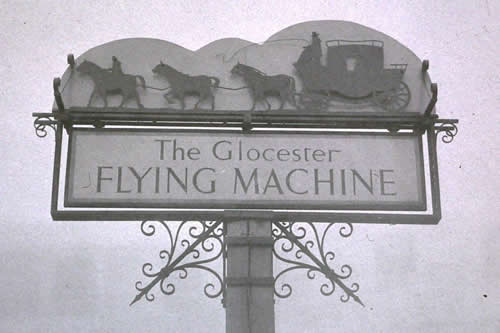
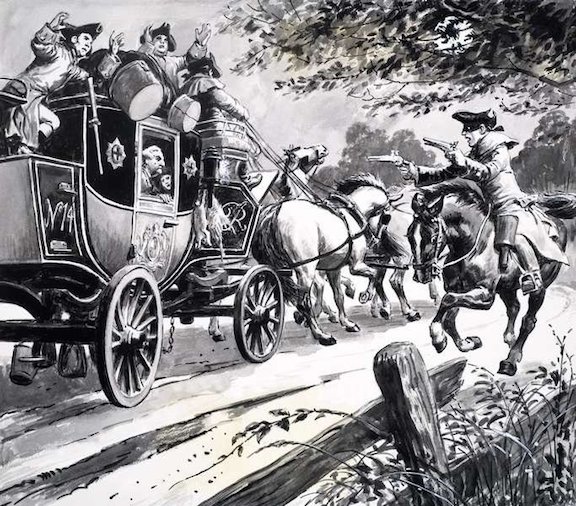
The “Flying Machines”: “a slow form of lingering death”

For travelers who could not afford three carriages pulled by twelve horses and outriders, there were the “Flying Machines,” stagecoaches whose owners boasted could convey you to your destination in the shortest time possible. The following flyer is from around 1670:

“Flying Machine.

“All those desirous to pass from London to Bath, or any other Place on their Road, let them repair to the Belle Savage on Ludgate Hill in London and the White Lion at Bath, at both which places they may be received in a Stage Coach every Monday, Wednesday, and Friday, which performs the whole journey in Three Days (if God permits), and sets forth at five in the Morning.

“Passengers to pay One Pound five Shillings each, who are allowed to carry fourteen Pounds Weight—for all above to pay three halfpence per Pound.”

Brockworth - Flying Machine Sign

You have noticed, of course, the disclaimer that should your journey take more than three days, the fault lies with God and not with stagecoach company itself. Our illustrious author, Mr. Tristram, seems to be of the opinion that such claims were exaggerated and that the travelers in Mr. Lyndon’s large retinue would not only arrive before the so-called “Flying Machines,” but in a great deal more comfort as well. Poor roads, snowdrifts and highwaymen were common hazards for all travelers, but Mr. Lyndon’s retinue was more prepared to deal with them than the vehicle that was described as “six cart horses harnessed to a diving bell.”

The Brighton Comet 1820

The Brighton Comet 1820

Hercules’ Pillars

Apsley_house_on_an_1869_Ordnance_Survey_Map

Before Apsley House was constructed across from Hyde Park Corner by Robert Adam between 1771 and 1778, the site was occupied by an inn called Hercules’ Pillars, where coachmen would stop for a drink. Hercules’ Pillars played a prominent part in a very naughty book by Henry Fielding called The History of Tom Jones, a Foundling or simply Tom Jones. I suppose the drinks gave them courage to head into Knightsbridge, two furlongs away, which was known “as a place of bogs and highwaymen.”

Indeed, what better place for highwaymen to ply their trade than “a great impassable gulf of mud” as could be found in Knightsbridge!

An Amiable Outlaw Meets His Match

Into this great impassable gulf of mud the Exeter Fly presently descended, and after desperate flounderings which only made matters worse, stuck fast. To it, when thus safely anchored, entered a gentleman in a vizor and riding a dark chestnut mare, who good naturedly recommended the coachman to alight, and offered to relieve the passengers of their purses. The first to take advantage of this amiability and give up his purse was the [formerly boastful] warrior from Dettingen, who had been loud in his contempt for highwaymen ever since the Fly left the city, and had sketched, with an elaborate garnishing of oaths, the horrid fate to which any marauder would be subject who ventured to bar the way. He spoke no more now of Dettingen, and of the standard he had taken from the musketeer of the French guard. Far from it. He gave his little all to the gentleman who asked for it, counselled submission to his companions, and disappeared to eat straw in the bottom of the coach. The highwayman now asked the ladies to oblige, parenthetically observing that time pressed. The words were hardly out of his mouth when Mirabel [the name assigned by Tristram to the young man of the party], who had been biding his time, obliged him with a sudden blow on that jaw which he had somewhat ostentatiously intruded upon the company, and at the same moment jumped from coach and seized the bridle of the chestnut mare. The highwayman now said, “Zounds”! and discharged his pistol; but as the chestnut mare reared and fell back with him just as he was firing it, the aim was not so true as the intention; in point of fact, instead of shooting Mirabel through the head, he shot the guard through the hat, who announced in stentorian tones that he was a dead man, and left off his blunderbuss at the morning star. Meanwhile, the highwayman and Mirabel had closed and were wrestling in the mud, the ladies viewing the progress of the strife in a state of pleasing suppressed excitement, and the coachman flogging his horses with a view of driving off and leaving Mirabel and his antagonist to decide their interesting difference in solitude and peace. This genial intention was frustrated by the mud which held the coach fast and by the guard, who, mounting one of the leaders, succeeded in waking some watchmen, who, by way of performing their patrol between Kensington and Knightsbridge, were lying in graceful sleep at The Half-way Public House. They came upon the scene just as Mirabel was binding the highwayman’s hands behind his back, the man having yielded himself for worse when he felt eleven stone and a half kneeling on his chest and saw that the chestnut mare had run away. The watch now with great intrepidity took charge of the bound prisoner, helped the Exeter Fly out of the ditch, and Mirabel into the coach, who joined his companions in a somewhat mud-stained, flushed, and exhausted state, but not inwardly unpleased at what he had done.”

At the time, such stagecoach robberies were nearly a daily occurrence along that road.

highwayman

The Half-way House

Half-way between Knightsbridge and Kensington (until it was demolished in 1846) a disreputable inn frequented by footpads and highwaymen. Needless to say, coachmen generally tended to scramble past it as quickly as possible rather than stopping for a pint.

The Half-way House

The Half-way House


 Index to all the posts in this series

1: The Bath Road: The (True) Legend of the Berkshire Lady

2: The Bath Road: Littlecote and Wild William Darrell

3: The Bath Road: Lacock Abbey

4: The Bath Road: The Bear Inn at Devizes and the “Pictorial Chronicler of the Regency”

5: The Exeter Road: Flying Machines, Muddy Roads and Well-Mannered Highwaymen

6: The Exeter Road: A Foolish Coachman, a Dreadful Snowstorm and a Romance

7: The Exeter Road in 1823: A Myriad of Changes in Fifty Years

8: The Exeter Road: Basingstoke, Andover and Salisbury and the Events They Witnessed

9: The Exeter Road: The Weyhill Fair, Amesbury Abbey and the Extraordinary Duchess of Queensberry

10: The Exeter Road: Stonehenge, Dorchester and the Sad Story of the Monmouth Uprising

11: The Portsmouth Road: Royal Road or Road of Assassination?

12: The Brighton Road: “The Most Nearly Perfect, and Certainly the Most Fashionable of All”

13: The Dover Road: “Rich crowds of historical figures”

14: The Dover Road: Blackheath and Dartford

15: The Dover Road: Rochester and Charles Dickens

16: The Dover Road: William Clements, Gentleman Coachman

17: The York Road: Hadley Green, Barnet

18: The York Road: Enfield Chase and the Gunpowder Treason Plot

19: The York Road: The Stamford Regent Faces the Peril of a Flood

20: The York Road: The Inns at Stilton

21: The Holyhead Road: The Gunpowder Treason Plot

22: The Holyhead Road: Three Notable Coaching Accidents

23: The Holyhead Road: Old Lal the Legless Man and His Extraordinary Flying Machine

24: The Holyhead Road: The Coachmen “More Celebrated Even Than the Most Celebrated of Their Rivals” (Part I)

25: The Holyhead Road: The Coachmen “More Celebrated Even Than the Most Celebrated of Their Rivals” (Part II)

26: Flying Machines and Waggons and What It Was Like To Travel in Them
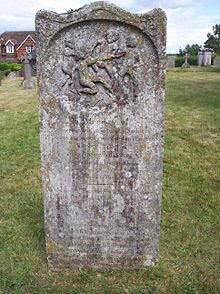
27: “A few words on Coaching Inns” and Conclusion