Archives

A Celebration of Waterloo: Wellington’s Exploring Officers

All the business of war and indeed all the business of life, is to endeavor to find out what you don’t know by what you do: that’s what I call ‘guessing what was on the other side of the hill.’

Arthur Wellesley, 1st Duke of Wellington

 The Business of Spying

Up until the early 19th century, spying was considered an odious and ungentlemanly occupation and few officers would agree to do it.

But by the time the 19th century rolled around, with the spreading of Napoleon’s empire on the continent, General Brownrigg, the Quartermaster-General of the British Army, went to the Commander-in-Chief, Frederick, the Duke of York, to propose that army develop a unit called the Depot of Military Intelligence, and it was done. The problem was—nobody wanted to do it.

Wellington’s Exploring Officers

peninsular war map

When General Wellesley arrived in Portugal, he couldn’t find an accurate map of the country and had to write to his brother-in-law to send him one. Realizing that his lack of information about the movements of the enemy, as well as the terrain and countryside, Wellington established a corps of “Exploring Officers.”

Exploring officers had to be fine horsemen, skilled linguists, and able to express themselves in sketching and writing in the most concise terms. With the assistance of local inhabitants, they would map the countryside four miles to the inch. That done, they would move behind enemy lines, learn troop movements and strategic information, and return to disclose this information to Wellington.

Sir John Waters

Sir John Waters of the Royal Scots

John Waters of the Royal Scots was known as a wily and capable man behind enemy lines. However, he was caught by the French and given up for dead by his regiment. When a man dies, his personal possessions are generally auctioned off to his comrades, but Wellington forbade this, saying that “Waters should be back and would want his things.” And he was right. Waters did come back and supposedly did want his things back.

Most exploring officers wore their uniforms, since soldiers caught behind enemy lines out of uniform was immediately shot as a spy. John Grant was one of the few who went in disguise. He became very friendly with the Portuguese people and adopted their local dress, much to the horror of his fellow officers. After the war, instead of being lauded for their risk-taking, these courageous men were shunned by their former regiments as “gadabouts” who were not really engaged in the business of war.

Colquhoun Grant

From Wikipedia:
Colquhoun Grant, Gentleman Spy

Colquhoun Grant, Gentleman Spy

The youngest of eight brothers in a family from the Scots aristocracy, Grant was commissioned into the 11th Foot in 1795. In 1809 he was posted to the Iberian Peninsula under the command of Arthur Wellesley, who in 1810 appointed him to his personal staff as an exploring officer in the Peninsula Corps of Guides, a special reconnaissance unit who spoke the local languages.

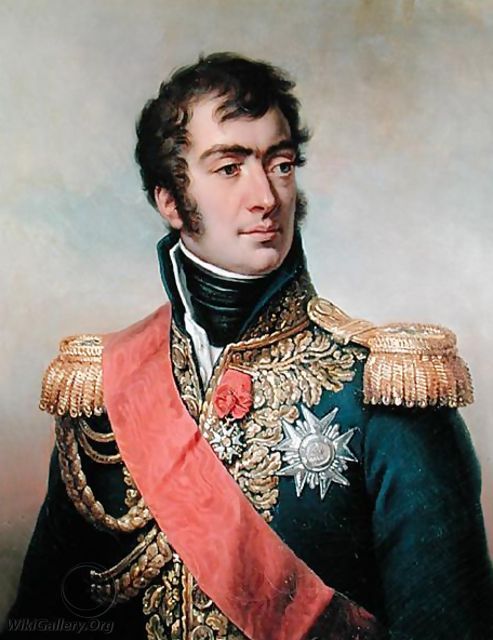
Grant was captured by French forces on 16 April 1812. As he was in uniform he was treated as an officer and gentleman by his captors, who offered him parole, which Grant accepted. Grant was invited to dine with Marshal Marmont who hoped to find out more about Wellington, and who was angered by Grant’s reticence. Marmont had good reason to remain suspicious of Grant, as the latter managed to send and receive secret messages while in captivity.
marmont

Auguste de Marmont

Marmont sent Grant to Paris for interrogation. It is clear from Marmont’s correspondence that he had no intention of exchanging Grant for a prisoner of equal rank among the British, as was the custom of the time, considering him to be a spy. Grant, on seeing a copy of Marmont’s letter, decided that it invalidated his agreement to parole and left him free to escape.

Grant was able to avoid recapture by passing himself off as an American officer, and spent some weeks at liberty in the streets and salons of Paris, sending intelligence reports to Wellington. He then escaped to England, rejoining Wellington in early 1814. Promoted to lieutenant-colonel he was appointed commanding officer of the Corps of Guides and Head of Intelligence for the Peninsular Army.

During the Hundred Days Campaign, Grant was working as intelligence officer in France when Wellington put him in charge of his own intelligence operations. Grant sent in a steady stream of reports regarding the build-up of French troops along the border and returned to Brussels in time to take part in the Battle of Waterloo on 18 June.

Lost and Found Lady

Rupert Ellsworth, the hero in story in the Beaux, Ballrooms, and Battles anthology, is an exploring officer in Wellington’s army in 1812 when he decides to disguise himself as a French soldier following the Battle of Salamanca. Unfortunately, he’s not the greatest horseman and falls off the untrained French horse and hits his head on a rock. Fortunately he is discovered soon after by Catalina, a local girl, who takes it upon herself to nurse him back to health. One thing leads to another and it isn’t long before the pair fall in love. But Catalina is not a whore and Rupert has promised his father to marry a “suitable English girl,” so the future for them looks grim. Between one thing and another, the two are separated… to be reunited several years later in Belgium just as another war is brewing. Circumstances for both of them have drastically changed, and Rupert is bound for the battlefield. Will there be a future for them or is it too late?

waterloo_cover_best web

Amazon.com • Amazon.uk • Amazon.ca • Amazon.au

 Barnes & Noble • iBooks • Kobo

Beaux, Ballrooms, and Battles

Release Day Party: April 1, 2015, 11 a.m. – 11 p.m. EDT

Rafflecopter: ends April 18

Website: www.beauxballroomsandbattles.com

Facebook Page

Jillian Chantal: Jeremiah’s Charge

Emmaline Rothesay has her eye on Jeremiah Denby as a potential suitor. When Captain Denby experiences a life-altering incident during the course of events surrounding the Battle of Waterloo, it throws a damper on Emmaline’s plans.

Téa Cooper: The Caper Merchant

The moon in Gemini is a fertile field of dreams, ideas and adventure and Pandora Wellingham is more than ready to spread her wings. When Monsieur Cagneaux, caper merchant to the rich and famous, introduces her to the handsome dragoon she believes her stars have aligned.

Susana Ellis: Lost and Found Lady

Catalina and Rupert fell in love in Spain in the aftermath of a battle, only to be separated by circumstances. Years later, they find each other again, just as another battle is brewing, but is it too late?

Aileen Fish: Captain Lumley’s Angel

Charged with the duty of keeping his friend’s widow safe, Captain Sam Lumley watches over Ellen Staverton as she recovers from her loss, growing fonder of her as each month passes. When Ellen takes a position as a companion, Sam must confront his feelings before she’s completely gone from his life.

Victoria Hinshaw: Folie Bleue

On the night of the 30th Anniversary of the Battle of Waterloo, Aimée, Lady Prescott, reminisces about meeting her husband in Bruxelles on the eve of the fighting. She had avoided the dashing scarlet-clad British officers, but she could not resist the tempting smile and spellbinding charm of Captain Robert Prescott of the 16th Light Dragoons who—dangerously to Aimée—wore blue.

Heather King: Copenhagen’s Last Charge

When Meg Lacy finds herself riding through the streets of Brussels only hours after the Battle of Waterloo, romance is the last thing on her mind, especially with surly Lieutenant James Cooper. However, their bickering uncovers a strange empathy—until, that is, the lieutenant makes a grave error of judgment that jeopardizes their budding friendship…

Christa Paige: One Last Kiss

The moment Colin held Beatrice in his arms he wanted one last kiss to take with him into battle and an uncertain future. Despite the threat of a soldier’s death, he must survive, for he promises to return to her because one kiss from Beatrice would never be enough.

Sophia Strathmore: A Soldier Lay Dying

Amelia and Anne Evans find themselves orphaned when their father, General Evans, dies. With no other options available, Amelia accepts the deathbed proposal of Oliver Brighton, Earl of Montford, a long time family friend. When Lord Montford recovers from his battle wounds, can the two find lasting love?

David W. Wilkin: Not a Close Run Thing at All

Years, a decade. And now, Robert had come back into her life. Shortly before battle was to bring together more than three hundred thousand soldiers. They had but moments after all those years, and now, would they have any more after?

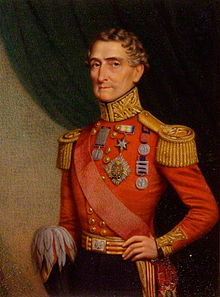
A Celebration of Waterloo: The Romance of Harry and Juana Smith

Beaux, Ballrooms, and Battles:

A Celebration of Waterloo

June 18, 1815 was the day Napoleon Bonaparte’s Grande Armée was definitively routed by the ragtag band of soldiers from the Duke of Wellington’s Allied Army in a little Belgian town called Waterloo. The cost in men’s lives was high—22,000 dead or wounded for the Allied Army and 24,000 for the French. But the war with Napoleon that had dragged on for a dozen years was over for good, and the British people once more felt secure on their island shores.

The bicentenary of the famous battle seemed like an excellent opportunity to use that setting for a story, and before I knew it, I had eight other authors eager to join me,and to make a long story short, in a bit over two weeks our anthology of nine Waterloo-themed stories will be released to the world.

You are all invited to:

The Inspiration for Lost and Found Lady

In my preparatory reading for this project, I discovered the real-life romance of Harry Smith and his wife Juana while reading Georgette Heyer’s The Spanish Bride. Add to that my deep affection for Spain and the Spanish language, and the result is a story of a romance between an injured British soldier and the extraordinary young peasant girl who rescued him after the Battle of Salamanca.

spain_Cadiz_hervas_map

Henry (Harry) George Wakelyn Smith (1787-1860)

220px-Sir_Harry_Smith

Harry was born in Whittlesey, Cambridgeshire, the son of a surgeon. He entered the army in 1805 and saw action in South America (1806-7), but it was his service in the Peninsular War with the 95th Rifles as a scout that brought him into prominence, and that’s where he met his wife. Prior to Waterloo, he served in the United States (witnessed the burning of the capitol in 1814), and after Waterloo, South Africa and India.

Juana María de los Dolores de León Smith (1798-1872)

juanasmith

A descendent of Ponce de León, Juana was orphaned at fourteen and, deprived of all family property after the siege of Badajoz in April of 1812, she and her older sister approached the British Army for protection during the atrocious massacre (indiscriminate looting, killing, and raping of Spanish civilians by British and Portuguese soldiers following the heat of battle). It was love at first sight. Despite her youth (and marriage at that age was not uncommon in Spain at the time), Juana and Harry were married four days later, and remained devoted to each other the rest of their lives.

Despite her convent upbringing, Juana insisted on remaining with Harry throughout the war, bearing the privations of army life so cheerfully that she became the darling of the 95th Rifles. Wellington himself familiarly called her “Juanita”.

From The Autobiography of Lieutenant-General Sir Harry Smith

Now comes a scene of horror I would willingly bury in oblivion. The atrocities committed by our soldiers on the poor innocent and defenceless inhabitants of the city, no words suffice to depict. Civilized man, when let loose and the bonds of morality relaxed, is a far greater beast than the savage, more refined in his cruelty, more fiend-like in every act; and oh, too truly did our heretofore noble soldiers disgrace themselves, though the officers exerted themselves to the utmost to repress it, many who had escaped the enemy being wounded in their merciful attempts! Yet this scene of debauchery, however cruel to many, to me as been the solace and the whole happiness of my life for thirty-three years. A poor defenceless maiden of thirteen years was thrown upon my generous nature through her sister, as described so ably in Johnny Kincaid’s book, of which this in an extract—

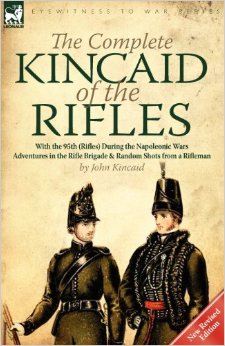
kincaid“I was conversing with a friend the day after, at the door of his tent, when we observed two ladies coming from the city, who made directly towards us; they seemed both young, and when they came near, the elder of the two threw back her mantilla to address us, showing a remarkably handsome figure, with fine features; but her sallow, sun-burnt, and careworn, though still youthful, countenance showed that in her ‘the time for tender thoughts and soft endearments had fled away and gone.’

“She at once addressed us in that confident, heroic manner so characteristic of the high-bred Spanish maiden, told us who they were—the last of an ancient and honourable house—and referred to an officer high in rank in our army, who had been quartered there in the days of her prosperity, for the truth of her tale.

“Her husband, she said, was a Spanish officer in a distant part of the kingdom; he might, or he might not, still be living. But yesterday she and this her young sister were able to live in affluence and in a handsome house; to-day they knew not where to lay their heads, where to get a change of raiment or a morsel of bread. Her house, she said, was a wreck; and, to show the indignities to which they had been subjected, she pointed to where the blood was still trickling down their necks, caused by the wrenching of their ear-rings through the flesh by the hands of worse than savages, who would not take the trouble to unclasp them!

“For herself, she said, she cared not; but for the agitated and almost unconscious maiden by her side, whom she had but lately received over from the hands of her conventual instructresses, she was in despair, and knew not what to do; and that, in the rapine and ruin which was at that moment desolating the city, she saw no security for her but the seemingly indelicate one she had adopted—of coming to the camp and throwing themselves upon the protection of any British officer who would afford it; and so great, she said, was her faith in our national character, that she knew the appeal would not be made in vain, nor the confidence abused. Nor was it made in vain! Nor could it be abused, for she stood by the side of an angel! A being more transcendingly lovely I had never before seen—one more amiable I have never yet known!

“Fourteen summers had not yet passed over her youthful countenance, which was of a delicate freshness—more English than Spanish; her face, though not perhaps rigidly beautiful, was nevertheless so remarkably handsome, and so irresistibly attractive, surmounting a figure cast in nature’s fairest mould, that to look at her was to love her; and I did love her, but I never told my love, and int the mean time another and a more impudent fellow stepped in and won her! But yet I was happy, for in him she found such a one as her loveliness and her misfortunes claimed—a man of honour, and a husband in every way worthy of her!”

“That a being so young, so lovely, and so interesting, just emancipated from the gloom of a convent, unknowing of the world and to the world unknown, should thus have been wrecked on a sea of troubles, and thrown on the mercy of strangers under circumstances so dreadful, so uncontrollable, and not have sunk to rise no more, must be the wonder of every one. Yet from the moment she was thrown on her own resources, her star was in the ascendant.”

“Guided by a just sense of rectitude, an innate purity of mind, a singleness of purpose which defied malice, and a soul that soared above circumstances, she became alike the adored of the camp and of the drawing-room, and eventually the admired associate of princes. She yet lives, in the affections of her gallant husband, in an elevated situation in life, a pattern to her sex, and everybody’s beau ideal of what a wife should be.”

I confess myself to be the “more impudent fellow,” and if any reward is due to a soldier, never was one so honoured and distinguished as I have been by the possession of this dear child (for she was little more than a child at this moment), one with a sense of honour no knight ever exceeded in the most romantic days of chivalry, an understanding superior to her years, a masculine mind with a force of character no consideration could turn from her own just sense of rectitude, and all encased in a frame of Nature’s fairest and most delicate moulding, the figure of an angel, with an eye of light and an expression which then inspired me with a maddening love which, from that period to this (now thirty-three years), has never abated under many and the most trying circumstances. Thus, as good may come out of evil, this scene of devastation and spoil yielded to me a treasure invaluable; to me who, among so many dear friends, had escaped all dangers; to me, a wild youth not meriting such reward, and, however desirous, never able to express half his gratitude to God Almighty for such signal marks of His blessing shown to so young and so thoughtless a being. From that day to this she has been my guardian angel. She has shared with me the dangers and privations, the hardships and fatigues, of a restless life of war in every quarter of the globe. No murmur has ever escaped her. Bereft of every relative, of every tie to her country but the recollection of it, united to a man of different though Christian religion, yet that man has been and is her all…”

The Protagonists of Lost and Found Lady

Rupert Ellsworth, like Harry Smith is an explorer scout with the British Army in Spain. Also like Harry, he’s a younger son seeking to make his own way in life. He might have become a career soldier as Harry did, had his life not taken a different turn in 1812. When he meets Catalina, he’s not looking for love or marriage, and if he were, it certainly wouldn’t be to a penniless Spanish Catholic!

Catalina’s upbringing wasn’t at all like Juana Smith’s. Orphaned at birth, she is taken in by a couple who treat her as an unpaid servant. Her eagerness to learn attracts the attention of a local priest, who takes it upon himself to give her an education comparable to that of an elite gentleman. When she meets Rupert, she is reflecting on her limited options for the future and wondering if she could escape her humdrum life by becoming a nun. At eighteen when she meets Rupert, she’s older than Juana, but, like Harry’s wife, she’s reached a turning point in her life.

What happens when these two meet after the Battle of Salamanca? Hmm…

waterloo_cover_best web

Amazon.comAmazon.uk Amazon.caAmazon.au

 Barnes & Noble • iBooks • Kobo

Beaux, Ballrooms, and Battles

Release Day Party: April 1, 2015, 11 a.m. – 11 p.m. EDT

Rafflecopter: ends April 18

Website: www.beauxballroomsandbattles.com

Facebook Page

Jillian Chantal: Jeremiah’s Charge

Emmaline Rothesay has her eye on Jeremiah Denby as a potential suitor. When Captain Denby experiences a life-altering incident during the course of events surrounding the Battle of Waterloo, it throws a damper on Emmaline’s plans.

Téa Cooper: The Caper Merchant

The moon in Gemini is a fertile field of dreams, ideas and adventure and Pandora Wellingham is more than ready to spread her wings. When Monsieur Cagneaux, caper merchant to the rich and famous, introduces her to the handsome dragoon she believes her stars have aligned.

Susana Ellis: Lost and Found Lady

Catalina and Rupert fell in love in Spain in the aftermath of a battle, only to be separated by circumstances. Years later, they find each other again, just as another battle is brewing, but is it too late?

Aileen Fish: Captain Lumley’s Angel

Charged with the duty of keeping his friend’s widow safe, Captain Sam Lumley watches over Ellen Staverton as she recovers from her loss, growing fonder of her as each month passes. When Ellen takes a position as a companion, Sam must confront his feelings before she’s completely gone from his life.

Victoria Hinshaw: Folie Bleue

On the night of the 30th Anniversary of the Battle of Waterloo, Aimée, Lady Prescott, reminisces about meeting her husband in Bruxelles on the eve of the fighting. She had avoided the dashing scarlet-clad British officers, but she could not resist the tempting smile and spellbinding charm of Captain Robert Prescott of the 16th Light Dragoons who—dangerously to Aimée—wore blue.

Heather King: Copenhagen’s Last Charge

When Meg Lacy finds herself riding through the streets of Brussels only hours after the Battle of Waterloo, romance is the last thing on her mind, especially with surly Lieutenant James Cooper. However, their bickering uncovers a strange empathy—until, that is, the lieutenant makes a grave error of judgment that jeopardizes their budding friendship…

Christa Paige: One Last Kiss

The moment Colin held Beatrice in his arms he wanted one last kiss to take with him into battle and an uncertain future. Despite the threat of a soldier’s death, he must survive, for he promises to return to her because one kiss from Beatrice would never be enough.

Sophia Strathmore: A Soldier Lay Dying

Amelia and Anne Evans find themselves orphaned when their father, General Evans, dies. With no other options available, Amelia accepts the deathbed proposal of Oliver Brighton, Earl of Montford, a long time family friend. When Lord Montford recovers from his battle wounds, can the two find lasting love?

David W. Wilkin: Not a Close Run Thing at All

Years, a decade. And now, Robert had come back into her life. Shortly before battle was to bring together more than three hundred thousand soldiers. They had but moments after all those years, and now, would they have any more after?
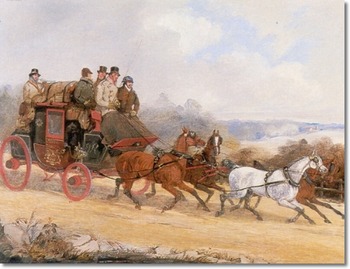
The Holyhead Road: The Gunpowder Treason Plot

dust jacket

The following post is the twenty-first of a series based on information obtained from a fascinating book Susana recently obtained for research purposes. Coaching Days & Coaching Ways by W. Outram Tristram, first published in 1888, is replete with commentary about travel and roads and social history told in an entertaining manner, along with a great many fabulous illustrations. A great find for anyone seriously interested in English history!

Mr. Ambrose Rookwood

…in November, 1605, roads as we now understand them did not exist; but this same route, or at all events tracks across un-inclosed heaths; even then connected the above-mentioned places [St. Albans, Redbourn, Dunstable, Brick-hill, Towcester, Dunchurch, Coventry, Birmingham, and Shrewsbury] with each other and the capital, and marked the shortest way for those riding post to reach Northamptonshire, or the Counties beyond its borders.

Map: St. Albans – Dunstable – Towcester – Daventry

Mr. Ambrose Rookwood

Mr. Ambrose Rookwood

Early then in the November of 1605, certain elaborate preparations which had been made for rapid travelling between London and Dunchurch, 80 miles down in Warwickshire was the common talk of ostlers and loafers at the chief posting-houses at St. Albans, Dunstable, Towcester, and Daventry. At each of these places, a Mr. Ambrose Rookwood, a young Catholic gentleman of fortune, well known on the road for his splendid horses, had placed heavy relays. The heaviness of these relays excited continual discussion. The confused rumour of the tap-room, fed by chance travellers on the road, decreed presently that these heavy relays were to carry Mr. Ambrose Rookwood down to a great hunting party, to be shortly assembled at Dunsmoor. But when this hunting party was to take place, no one seemed to know, or why the young Catholic gentleman should have made such elaborate preparations to reach it so hurriedly.

An Aura of Fear Pervades London

And so the few intervening days passed till the 5th of November, 1605, dawned grayly over London—amidst torrents of driving rain and wild gusts of a west wind which had gathered strength as the night waned, and by daylight had grown into a hurricane—dawned on a city distracted. Narrow streets were already crowded with excited groups, who whispered, gesticulated at street corners. Some men but half dressed rushed from their houses as if the rumour of some monstrous imminent doom had startled them suddenly from sleep. Others with drawn swords in their hands counselled all men to arm in one breath, and, as now and again a woman’s shriek rose above the press everywhere,—but no fixed rumour prevailed. Only each man eyed his neighbour suspiciously, only a vague feeling as of some nightmare had seized upon London that the past darkness had brought forth a portent.

Mr. Ambrose Rookwood and Mr. Thomas Winter Join the Fray

thomas winter

Mr. Thomas Winter

In the dim twilight of that November dawn Mr. Ambrose Rookwood, the young Catholic gentleman, whose relays of fine horses had excited such discussion on the North-western Road—came out into these distracted streets, in company with a friend—one Mr. Thomas Winter. The two gentlemen walked aimlessly here and there for some time, listening attentively to all that was said on all sides, now joining themselves to a group and adding questions on their own part, to the sort of universal interrogatory which prevailed—now shuddering and passing, on their way wuickly as the unformed phantom of the people’s fear began to grow gradually into defined shape. Then as if fearful any longer of uncertainty, they made with extraordinary coolness towards the Parliament House.

The sun had not yet risen; but in the middle of King Street, Westminster, the two found a guard standing. Permission to pass was peremptorily refused. Then as Mr. Rookwood’s friend stood parleying with the guard a white-faced citizen passed by hurriedly, exclaiming in panic-stricken tones, “There is treason discovered! And the king and lords should have been blown up.”

Flight of the Conspirators

The two gentlemen turned without a word, and made for their horses. The heavy relays on the North-western Road were now to be put to their proper use. But great caution had to be exercised. The appalling news had circulated in the city with the rapidity of poison. Barricades were being hastily erected at the ends of the streets; passengers were being stopped and questioned; any appearance of hurry would have led to instant arrest. It was eleven o’clock therefore before the two gentlemen got clear of London—and they were but just in time; for rumours were already in the air of a proclamation forbidding anybody to leave the town for three days. Once clear of London they rode desperately.

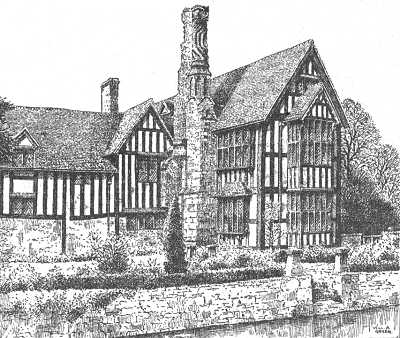
Huddington Court, Worcester

Huddington Court, Worcester

Few incidents I think in history seize the imagination so forcibly as that wild flight of the Gunpowder Conspirators northward. Thomas Winter made for his brother’s house at Huddington in Worcestershire; but Rookwood rode fiercely down the North-western Road to bear the fatal news to the conspirators already assembling on Dunsmoor. Catesby, Piercy, John and Christopher Wright were he knew on the road in front. But the relays already placed for him, and the desperate fear which urged him forwards enabled Rookwood to overtake the others as they were rising the ascent at Brickhill.

In a few words he told them what had happened in London—that Fawkes had been arrested and lodged in the Tower—that at any moment torture might make him give up their names—that the whole scheme had fallen through, and that their only chance of safety lay in instantly joining their friends. From this moment the flight became a stampede. “They devoured the ground,” shouting as they rode through startled towns and villages that they were carrying despatches from the King to Northampton, flinging off their large cloaks, heavy with the rain that still poured remorselessly, that they might add wings even to their precipitate flight. Rookwood rode thirty miles in two hours on one horse. At six in the evening the fugitives arrived at Catesby’s house at Ashby St. Ledgers, about three miles from Daventry. They had ridden the eighty miles from London in seven hours.

Map: Ashby St. Ledgers – Gayhurst

The gatehouse occupied by the Catesbys

The gatehouse occupied by the Catesbys

Here after a brief consultation with Robert Winter, who was staying in the house (it still stands in all its gloomy suggestiveness, this home of England’s most desperate conspirator), they rode off hastily on the same tired horses to join Sir Everard Digby and the pretended hunting gathering on Dunsmoor Heath which the direct road to Holyhead still crosses at the eighty-fifth mile-stone from London.

Sir Everard Digby, knighted by the king three years before he plotted to kill him

Sir Everard Digby, knighted by the king three years before he plotted to kill him

Their further wild course through Warwickshire to Holbeach on the Staffordshire border calls here for no telling, as it is no longer associated with the Road. But so intimately associated with the Gunpowder Treason does the way to Holyhead seem that thought its history is closed so far as the directest route is concerned, the earlier route by Chester has another link to add to its story. A short distance from Newport Pagnell (fifty-one miles from London), stands Gayhurst,the fine Elizabethan house once the home of Sir Everard Digby. Of him a sympathetic historian writes, “His youth, his personal graces, the constancy which he had exhibited whilst he believed himself a martyr in a good cause, the deep sorrow which he testified on becoming sensible of his error, seem to have moved all hearts with pity and even admiration; and if so detestable a villainy as the Gunpowder Plot may be permitted to have its hero Everard Digby was undoubtedly the man.”

Gayhurst House

Gayhurst House

The gray walls of his beautiful Buckinghamshire house were indeed witnesses at all events of some of the most suggestive incidents in the heart-quaking scheme. Fawkes was a frequent guest here—meditating through the prolonged rains which heralded the approach of the destined day, on the state of the powder, by now safely placed under the Parliament House; riding to and fro frequently from London; often an unexpected, always a welcome guest. From Gayhurst, besides, set out that Pilgrimage to St. Winifred’s well, in Flintshire, the motive of which was so much discussed after the discovery of the Conspiracy.

St. Winefride's Well: site of the conspirators' meetings?
St. Winefride’s Well: site of the conspirators’ meetings?

Motives apart however, what is mort important from my point of view is that the company of about thirty persons—all relations of the conspirators; some of the actual conspirators among these, travelled in coaches—proceeded by Daventry to John Grant’s house at Norbrook, a fine melancholy, moated manor once (where is it now?), thence to Robert Winters, at Huddington, and so to Flintshire by Shrewsbury.

holbeche

Holbeche House: where the surviving conspirators were captured


 Index to all the posts in this series

1: The Bath Road: The (True) Legend of the Berkshire Lady

2: The Bath Road: Littlecote and Wild William Darrell

3: The Bath Road: Lacock Abbey

4: The Bath Road: The Bear Inn at Devizes and the “Pictorial Chronicler of the Regency”

5: The Exeter Road: Flying Machines, Muddy Roads and Well-Mannered Highwaymen

6: The Exeter Road: A Foolish Coachman, a Dreadful Snowstorm and a Romance

7: The Exeter Road in 1823: A Myriad of Changes in Fifty Years

8: The Exeter Road: Basingstoke, Andover and Salisbury and the Events They Witnessed

9: The Exeter Road: The Weyhill Fair, Amesbury Abbey and the Extraordinary Duchess of Queensberry

10: The Exeter Road: Stonehenge, Dorchester and the Sad Story of the Monmouth Uprising

11: The Portsmouth Road: Royal Road or Road of Assassination?

12: The Brighton Road: “The Most Nearly Perfect, and Certainly the Most Fashionable of All”

13: The Dover Road: “Rich crowds of historical figures”

14: The Dover Road: Blackheath and Dartford

15: The Dover Road: Rochester and Charles Dickens

16: The Dover Road: William Clements, Gentleman Coachman

17: The York Road: Hadley Green, Barnet

18: The York Road: Enfield Chase and the Gunpowder Treason Plot

19: The York Road: The Stamford Regent Faces the Peril of a Flood

20: The York Road: The Inns at Stilton

21: The Holyhead Road: The Gunpowder Treason Plot

22: The Holyhead Road: Three Notable Coaching Accidents

23: The Holyhead Road: Old Lal the Legless Man and His Extraordinary Flying Machine

24: The Holyhead Road: The Coachmen “More Celebrated Even Than the Most Celebrated of Their Rivals” (Part I)

25: The Holyhead Road: The Coachmen “More Celebrated Even Than the Most Celebrated of Their Rivals” (Part II)

26: Flying Machines and Waggons and What It Was Like To Travel in Them

27: “A few words on Coaching Inns” and Conclusion

The York Road: The Inns at Stilton

dust jacket

The following post is the twentieth of a series based on information obtained from a fascinating book Susana recently obtained for research purposes. Coaching Days & Coaching Ways by W. Outram Tristram, first published in 1888, is replete with commentary about travel and roads and social history told in an entertaining manner, along with a great many fabulous illustrations.

A Vivid Description of an Inn

bell inn2

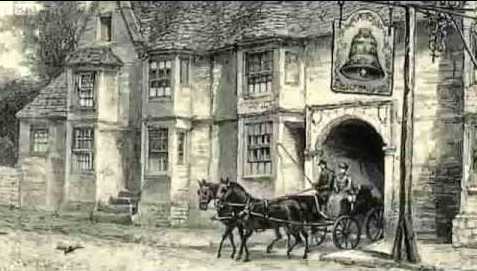
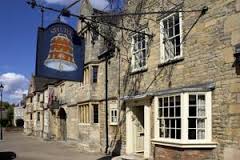
The Bell Inn at Stilton

As I read Mr. Tristram’s description of these inns at Stilton—particularly the Bell—I found myself feeling the emotional impact of his words that made the visual details more alive and real to me. It was almost as though I were there in the innyard, watching the herds get shod for their long trip to London. Or later, watching the Scots prisoners march past from Culloden to await an uncertain future amongst the enemy.

Perhaps it’s just me and my own vivid imagination that responds so intimately to these passages. But I’m reproducing them here in the hope that you will also be able to experience the historical reality of these old inns, as described by W. Outram Tristram. I am convinced that not only will I be setting a scene here at some point in the near future in one of my own stories, but I will put this inn on my list for a place to stay at a future trip, as I find staying overnight in these historical buildings so inspiring!

bell inn

The Bell Inn

Click here for map

“No place more representative of the ‘Coaching Age Decayed,’ than Stilton, is to be found on Earth”

plaque-on-pub-wall

For here the Great Northern way has diverged from the line of the old road, and by doing so, has turned a vast coaching emporium into a corpse of a town… It was rather, in its best days, a village clustering about two magnificent inns, the Angel and the Bell, which still stare at each other stonily across the great North Road. At the Angel, well known in the coaching days as the house of the famed Miss Worthington (stout, smiling, the christener of Stilton cheeses made miles away, but so called because they were sold at her hospitable door), over 300 horses were stabled for coaching and posting purposes. Vast barracks indeed stretching at the back of the old house—one wing of which alone is now open to travellers—tell of the bustle of post-boys, of the hurrying to and fro of fidgety passengers over-eager to be off, the harnessing and unharnessing of horses, of all the many-voiced Babel of travel in fact which fifty years ago surged and swayed round this teeming coaching centre, now lying silent and deserted as the grave. I am told—and from its central position on the great North Road seventy-five miles from London, I can well understand the fact—that at Stilton in the old days the ebb and flow and traffic never ceased. All day coaches and postchaises continually poured into the place and out of it. And by night the great mails running from Johan o’Groat’s almost, into the heart of London, thundered through the splendid broad thoroughfare, visible mediums as it were of an empire’s circulation. And other wayfarers besides postillions and coachmen seemed never off the road—huge flocks of geese destined for the London market, and travelling the seventy-five miles with uncommon ease; enormous droves of oxen, not such roadsters born. Each beast was indeed thrown and shod at Stilton to enable them to bear the journey. And to show the huge press even of this kind of traffic, this business of shoeing oxen was a trade almost in itself, as I have been told by the present landlord of the Angel Inn, who used in his youth to do the office himself, and to whose still active memory I am indebted for most of the foregoing details.

The Bell Inn

The Bell Inn

And to cross the road (the breadth of the great North Road at Stilton at once seizes the imagination, it is royal, the breadth of it, and looks like the artery of a nation), to cross the road from the Angel, and to come to the Angel’s great rival, the Bell, is to bridge a whole period in the history of English travel; to pass in twenty yards from the age of crack coaches and spicy teams to times long antecedent, when Flying Machines were not; when the great roads were hazily marked over desolate heathy tracks; when men travelled on horseback and women rode pillion, and people only felt secure when they went in large companies; when the solitary travellers went in fear of their lives when the gloaming overtook them, and “spurred apace to reach the timely inn.”

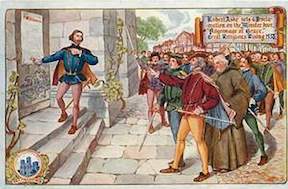
Here is a picture of medieval travel such as I think must have often been witnessed from the windows of such old houses of entertainment as the Bell at Stilton, when the Tudors ruled England. And often sterner episodes of history must have passed beneath its magnificent copper sign than wedding processions of royal princesses, even in the days, when England was called merry, and was merry England indeed. During the year 1536 the Bell at Stilton was no doubt often visited by one of those medley cavalcades so common at the time, consisting of abbots in full armour, waggon-loads of victuals, oxen and sheep, and a banner borne by a retainer on which was worked a plough, a chalice, and a Host, a horn, and the five wounds of Christ—the well-known badge which marked the fiery course of the Pilgrimage of Grace. This great rising, which began in Lincolnshire ran much of its course along the Great North Road—who knows how much of it passed through the now-deserted rooms and corridors of the great Northern inns such as this Bell at Stilton! It was in an inn at Lincoln at all events that on a night of October there was present a gentleman of Yorkshire whose name (Robert Aske) a few weeks later was ringing through every English household in accents of terror or admiration.

robert-aske-leader-of-the-pilgrimage-of-grace1

Robert Aske leading the Pilgrimage of Grace: a rebellion against Henry VIII’s dissolution of the monasteries

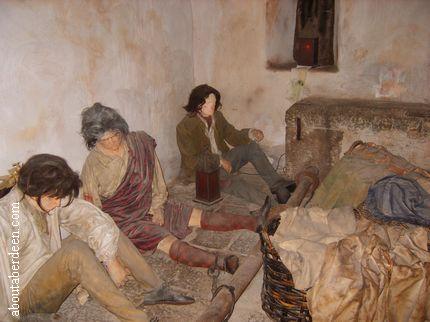
But indeed standing before such a monument of days gone by as this is, it is not a question of this or that romantic episode rising to a fanciful man’s mind as the pageant of a whole nation’s history passing in a sort of ghostly procession. And what episode of that pageant or such part of it at all events as passed on the Great North Road, has not this great deserted house of entertainment seen, fed, sheltered within its now crumbling walls? Gallants of Elizaeth’s day, Cavaliers of Charles the First’s, Ironsides on their way to Marston Moor, Restoration Courtiers flying from the Plague. And in days more modern, King’s messengers spurring to London with the tidings of Culloden—and Cumberland himself fresh from his red victory, and the long line of Jacobite prisoners passing in melancholy procession, their arms pinioned behind them, each prisoner’s horse led by a foot soldier carrying a musket with fixed bayonet; each division preceeded by a troop of horse with drawn swords, the drums insulting the unhappy prisoners by beating a triumphal march in derision.

Jacobite_Prisoners

Jacobite prisoners after Culloden

Why, scenes beyond number such as these must have passed before the long gabled front of this old Bell at Stilton; passed, faded, been succeeded by hundreds more stirring, which in their turn too, vanished like some half-remembered dream. And the old house still seems to keep some mysterious memory of these scenes locked in its old withered heart; as gaunt, ghost-like, deserted, but half alive, it stares night and day on the lonely North Road.

bell inn4

The Bell Inn


 Index to all the posts in this series

1: The Bath Road: The (True) Legend of the Berkshire Lady

2: The Bath Road: Littlecote and Wild William Darrell

3: The Bath Road: Lacock Abbey

4: The Bath Road: The Bear Inn at Devizes and the “Pictorial Chronicler of the Regency”

5: The Exeter Road: Flying Machines, Muddy Roads and Well-Mannered Highwaymen

6: The Exeter Road: A Foolish Coachman, a Dreadful Snowstorm and a Romance

7: The Exeter Road in 1823: A Myriad of Changes in Fifty Years

8: The Exeter Road: Basingstoke, Andover and Salisbury and the Events They Witnessed

9: The Exeter Road: The Weyhill Fair, Amesbury Abbey and the Extraordinary Duchess of Queensberry

10: The Exeter Road: Stonehenge, Dorchester and the Sad Story of the Monmouth Uprising

11: The Portsmouth Road: Royal Road or Road of Assassination?

12: The Brighton Road: “The Most Nearly Perfect, and Certainly the Most Fashionable of All”

13: The Dover Road: “Rich crowds of historical figures”

14: The Dover Road: Blackheath and Dartford

15: The Dover Road: Rochester and Charles Dickens

16: The Dover Road: William Clements, Gentleman Coachman

17: The York Road: Hadley Green, Barnet

18: The York Road: Enfield Chase and the Gunpowder Treason Plot

19: The York Road: The Stamford Regent Faces the Peril of a Flood

20: The York Road: The Inns at Stilton

21: The Holyhead Road: The Gunpowder Treason Plot

22: The Holyhead Road: Three Notable Coaching Accidents

23: The Holyhead Road: Old Lal the Legless Man and His Extraordinary Flying Machine

24: The Holyhead Road: The Coachmen “More Celebrated Even Than the Most Celebrated of Their Rivals” (Part I)

25: The Holyhead Road: The Coachmen “More Celebrated Even Than the Most Celebrated of Their Rivals” (Part II)

26: Flying Machines and Waggons and What It Was Like To Travel in Them

27: “A few words on Coaching Inns” and Conclusion

The York Road: The Stamford Regent Faces the Peril of a Flood

dust jacket

The following post is the nineteenth of a series based on information obtained from a fascinating book Susana recently obtained for research purposes. Coaching Days & Coaching Ways by W. Outram Tristram, first published in 1888, is replete with commentary about travel and roads and social history told in an entertaining manner, along with a great many fabulous illustrations. A great find for anyone seriously interested in English history!

The Playfulness of the River Ouse

Click here to see map.

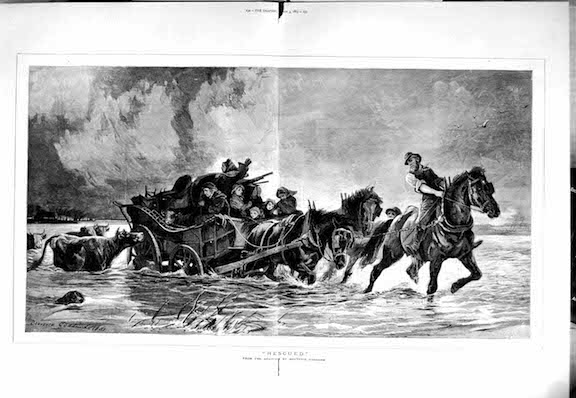
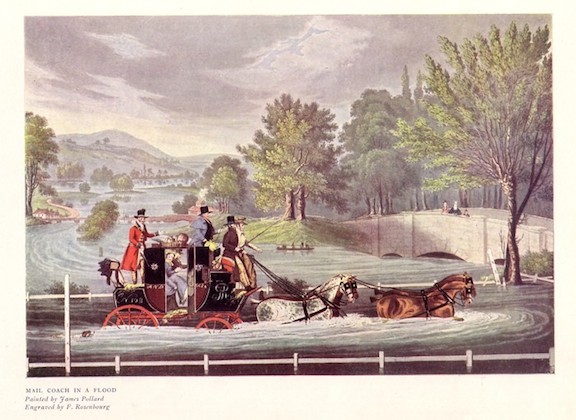
At a place called St. Neot’s, fifty-six miles from London, the Regent coach used to leave the main road, every now and then, for some reason which remains occult, and go round by some paper mills, which were naturally situated on the flat. The river Ouse has a habit, as is well known, of playfully overflowing its banks, and the consequence was that the road lying before the Regent coach lay sometimes for half a mile under water. Now an extra pair of leaders were put on, and ridden by a horsekeeper, who made the best of his way through a situation which was novel not to say precarious. The water was often up to the axle-trees; and on the particular occasion…went beyond this limit and invaded the inside of the coach. For a moment or two the Stamford Regent was afloat, also two old ladies who were inside of it, with their goods and chattels. Their cries and laments when they found the coach gradually be converted into an Ark were heartrending in the extreme. They gave themselves utterly for gone, and prepared for the most comfortable, but noisiest of all deaths. Nor were the outside passengers in very much better plight. For though they were not sitting absolutely in the water, as I am sorry to say the old ladies were; still they were sitting in wet clothes, which is the next thing to it—and in this situation commanded as fine a prospect of water above, below, and around, as has been seen by travellers I should say since the flood. In addition to this not altogether gratifying panorama of flood effects, unseen dangers were on every side; to wit, a large ditch on one side, and a series of huge heaps of stones on the other; both pleasantly invisible by reason of great waters, but both clearly there for a specific purpose; the stones to overturn the carriage; the ditch to receive it when it had been overturned. It must have been a truly critical five minutes for the Rent, Tom Hennessy, the passengers, the horses and everybody else, but they all got safely through and thanked their stairs.

 carriage flood 18831908-horse-carriage-print-river-flood_700_600_O7K9

 Index to all the posts in this series

1: The Bath Road: The (True) Legend of the Berkshire Lady

2: The Bath Road: Littlecote and Wild William Darrell

3: The Bath Road: Lacock Abbey

4: The Bath Road: The Bear Inn at Devizes and the “Pictorial Chronicler of the Regency”

5: The Exeter Road: Flying Machines, Muddy Roads and Well-Mannered Highwaymen

6: The Exeter Road: A Foolish Coachman, a Dreadful Snowstorm and a Romance

7: The Exeter Road in 1823: A Myriad of Changes in Fifty Years

8: The Exeter Road: Basingstoke, Andover and Salisbury and the Events They Witnessed

9: The Exeter Road: The Weyhill Fair, Amesbury Abbey and the Extraordinary Duchess of Queensberry

10: The Exeter Road: Stonehenge, Dorchester and the Sad Story of the Monmouth Uprising

11: The Portsmouth Road: Royal Road or Road of Assassination?

12: The Brighton Road: “The Most Nearly Perfect, and Certainly the Most Fashionable of All”

13: The Dover Road: “Rich crowds of historical figures”

14: The Dover Road: Blackheath and Dartford

15: The Dover Road: Rochester and Charles Dickens

16: The Dover Road: William Clements, Gentleman Coachman

17: The York Road: Hadley Green, Barnet

18: The York Road: Enfield Chase and the Gunpowder Treason Plot

19: The York Road: The Stamford Regent Faces the Peril of a Flood

20: The York Road: The Inns at Stilton

21: The Holyhead Road: The Gunpowder Treason Plot

22: The Holyhead Road: Three Notable Coaching Accidents

23: The Holyhead Road: Old Lal the Legless Man and His Extraordinary Flying Machine

24: The Holyhead Road: The Coachmen “More Celebrated Even Than the Most Celebrated of Their Rivals” (Part I)

25: The Holyhead Road: The Coachmen “More Celebrated Even Than the Most Celebrated of Their Rivals” (Part II)

26: Flying Machines and Waggons and What It Was Like To Travel in Them

27: “A few words on Coaching Inns” and Conclusion

The York Road: Enfield Chase and the Gunpowder Treason Plot

dust jacket

The following post is the eigthteenth of a series based on information obtained from a fascinating book Susana recently obtained for research purposes. Coaching Days & Coaching Ways by W. Outram Tristram, first published in 1888, is replete with commentary about travel and roads and social history told in an entertaining manner, along with a great many fabulous illustrations. A great find for anyone seriously interested in English history!

The Gunpowder Treason Plot

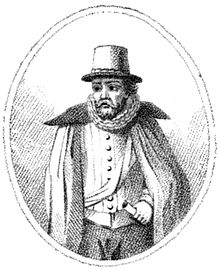
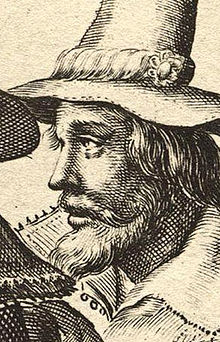
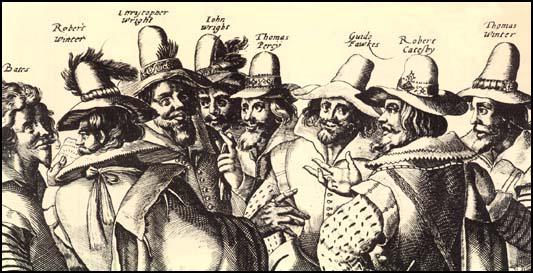
The conspirators

The conspirators

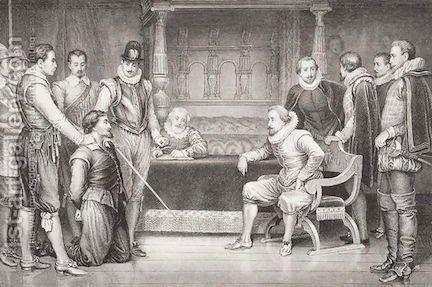
In 1605, a group of English Catholics, led by Robert Catesby, met at a house called White Webbs near Enfield Chase, to plot to assassinate James I and put his daughter Elizabeth on the throne, who, although only nine years old, was to be the Catholic head of state. An anonymous letter galvanized the authorities into action. Guy Fawkes was found in the House of Lords with 36 barrels of gunpowder on October 26, 1605. The other conspirators fled, but were captured, although Catesby was killed in a shootout. The other men, including a Jesuit priest called Father Garnet, were sentenced to be hanged, drawn and quartered. There was speculation that the priest, although he undoubtedly knew of the plot, was innocent because of his vow to the confidentiality of the confessional. Our illustrious author, however, seems to think that Father Garnet was in it up to his eyeballs.

For here, at this lonely house, then in the middle of Enfield Chase, nearly all the actors in the dark catastrophe, imminent at Westminster, at one time or another gathered. Over and over again the ten miles between Enfield Wash and London must have rung to the sound of their horses’ hoofs, as they rode fiercely between White Webbs and London. That Catesby was here ten days before the mediated explosion is evident from Winter’s confession:

“Then was the parliament anew prorogued until the fifth of November, so as we all went down until some ten days before, when Mr. Catesby came up with Mr. Fawkes to an house by Enfield Chase called White Webbs, whither I came to them, and Mr. Catesby willed me to inquire whether the young prince came to the parliament: I tolde him I heard that his grace thought not to be there. ‘Then must we have our horses,’ said Mr. Catesby, ‘beyond the water, and provision of more company to surprise the prince, and leave the duke alone.’”

That a more important factor in the deadly design—if the latest judgment of posterity is to be believed even that Catesby himself was frequently at the old house in Enfield Chase is shown in the examination of James Johnson: that is to say in the examination of Guy Fawkes.

It was stated by him that the place had been taken of Dr. Huicke by his master, Mr. Meaze, of Berkshire, for his sister, Mrs. Perkins (alias Mrs. Ann Vaux); that Mrs. Vaux had spent a month there and mass had been said by a priest whose name deponent did not know.

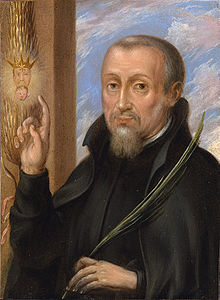
Father Henry Garnet

Father Henry Garnet

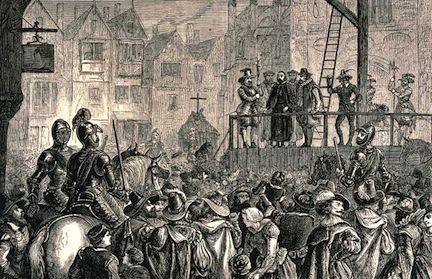
And as Mr. Meaze, of Berkshire, was none other than Henry Garnet, the Provincial of the English Jesuits, the importance of the testimony becomes apparent. And the fact gives birth to a fancy. It is interesting to me to think that Mr. Meaze, of Berkshire, with his candid blue eyes, his fair curling hair, his polished, courteous manners, his form tending to an embonpoint by no means suggestive of asceticism; it is interesting to me, I say, to think that Mr. Meaze of Berkshire, may have been a well-known and respected figure about Enfield Wash. That he may have been recognized as Father Garnet, for the first time as he stood absolutely under the beam on that May morning—”the morrow of the Invention of the Cross”—on the great scaffold at the west of end of old St. Paul’s; that he may have been recognized there by some Enfield yeoman, who had ridden in from Enfield to see the show, little expecting to see in the last victim, in the most distinguished of all the victims perhaps, to a justly outraged justice, the courteous, handsome stranger, who he had so admired and respected down in his quiet Enfield home!

Father Garnet at the gallows

Father Garnet at the gallows

Guy Fawkes Day

Apparently, all that remains of Guy Fawkes Day is an occasional bonfire and the burning of effigies of disliked celebrities, and fireworks. In some places it gets lumped together with Halloween. But it no longer has much to do with religion and politics as it originally did.

Guy Fawkes interrogated by James I

Guy Fawkes interrogated by James I


 Index to all the posts in this series

1: The Bath Road: The (True) Legend of the Berkshire Lady

2: The Bath Road: Littlecote and Wild William Darrell

3: The Bath Road: Lacock Abbey

4: The Bath Road: The Bear Inn at Devizes and the “Pictorial Chronicler of the Regency”

5: The Exeter Road: Flying Machines, Muddy Roads and Well-Mannered Highwaymen

6: The Exeter Road: A Foolish Coachman, a Dreadful Snowstorm and a Romance

7: The Exeter Road in 1823: A Myriad of Changes in Fifty Years

8: The Exeter Road: Basingstoke, Andover and Salisbury and the Events They Witnessed

9: The Exeter Road: The Weyhill Fair, Amesbury Abbey and the Extraordinary Duchess of Queensberry

10: The Exeter Road: Stonehenge, Dorchester and the Sad Story of the Monmouth Uprising

11: The Portsmouth Road: Royal Road or Road of Assassination?

12: The Brighton Road: “The Most Nearly Perfect, and Certainly the Most Fashionable of All”

13: The Dover Road: “Rich crowds of historical figures”

14: The Dover Road: Blackheath and Dartford

15: The Dover Road: Rochester and Charles Dickens

16: The Dover Road: William Clements, Gentleman Coachman

17: The York Road: Hadley Green, Barnet

18: The York Road: Enfield Chase and the Gunpowder Treason Plot

19: The York Road: The Stamford Regent Faces the Peril of a Flood

20: The York Road: The Inns at Stilton

21: The Holyhead Road: The Gunpowder Treason Plot

22: The Holyhead Road: Three Notable Coaching Accidents

23: The Holyhead Road: Old Lal the Legless Man and His Extraordinary Flying Machine

24: The Holyhead Road: The Coachmen “More Celebrated Even Than the Most Celebrated of Their Rivals” (Part I)

25: The Holyhead Road: The Coachmen “More Celebrated Even Than the Most Celebrated of Their Rivals” (Part II)

26: Flying Machines and Waggons and What It Was Like To Travel in Them

27: “A few words on Coaching Inns” and Conclusion

The York Road: Hadley Green, Barnet

dust jacket

The following post is the seventeenth of a series based on information obtained from a fascinating book Susana recently obtained for research purposes. Coaching Days & Coaching Ways by W. Outram Tristram, first published in 1888, is replete with commentary about travel and roads and social history told in an entertaining manner, along with a great many fabulous illustrations. A great find for anyone seriously interested in English history!

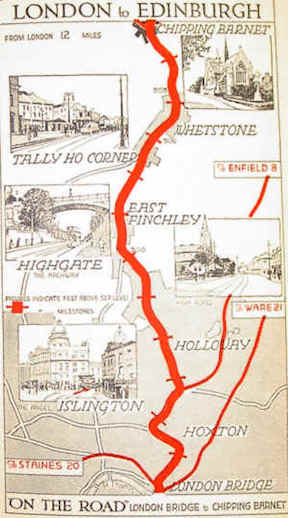
The Great North Road

map

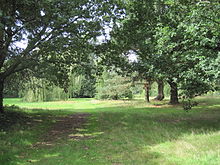
220px-Hadley_GreenAnd Barnet is soon a memory on the great north road. A memory however which shows some claim to “recollection dear”, fixing as it does the site of a great battle and of a highwayman’s exploits, which have occupied almost the same space in history—I mean fiction—No! I mean history. To come to details:—On Hadley Green, half-a-mile to the north of the town, was fought on a raw, cold and dismal Easter Day, in the year 1471, the famous battle between the Houses of York and Lancaster which ended in the death of the king-maker, and established Edward IV on the throne; and behind an oak tree, which still stands opposite the Green Man at the junction of the York and Holyhead Roads, the immortal Dick Turpin used to sit silent on his mare, Black Bess, patiently waiting for some traveller to speak to.

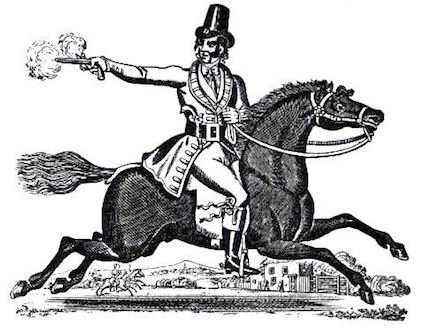
The romanticized Dick Turpin

The romanticized highwayman

A Not-So-Gallant Highwayman

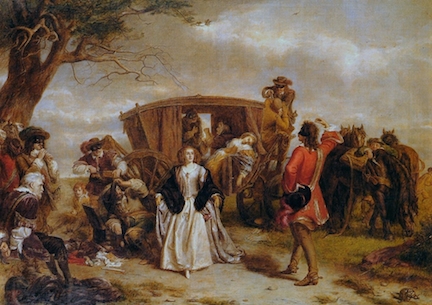
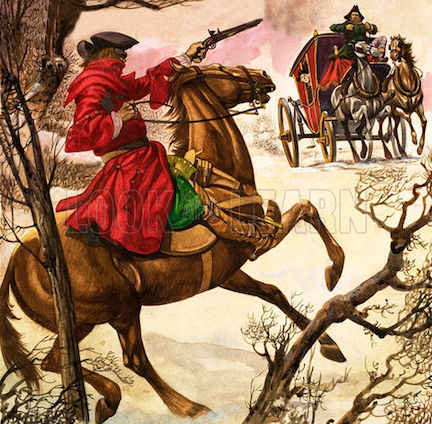
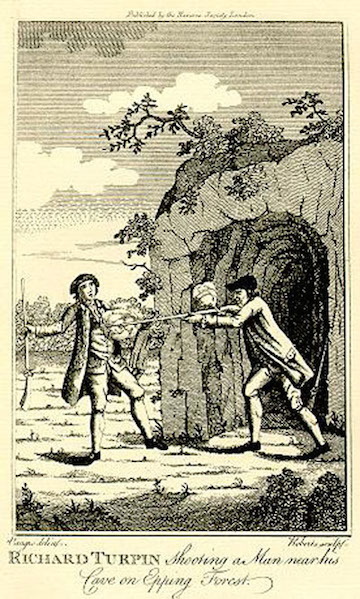
Dick Turpin attacking the mail-coach in Epping ForestLet me preface this by saying that the real Dick Turpin was a violent criminal and not the sort of gallant Robin Hood frequently found in historical romances and in William Harrison Ainsworth’s Rookwood. His gangs robbed, maimed, killed and raped. It was due to men like him that coaches traveling on the highways of England often had armed outriders for protection. Nor was he a particularly handsome fellow. The London Gazette describes him as:

Richard Turpin, a butcher by trade, is a tall fresh coloured man, very much marked with the small pox, about 26 years of age, about five feet nine inches high, lived some time ago in Whitechapel and did lately lodge somewhere about Millbank, Westminster, wears a blue grey coat and a natural wig.

The London Gazette: no. 7379. p. 1. 22 February 1734. )

turpin1

Prior to taking up coach-robbing, Turpin was part of a gang who did what we would call home invasions—beating and torturing the occupants, in one case forcing a bare-buttocked man to sit on the fire. Scenes right out of Criminal Minds! A behavioral analyst would understand this better than I, because I simply cannot imagine why anyone would do this for the piddly amount they came away with—often less than thirty pounds!

That gang—termed the “Essex Gang”—ceased to exist when authorities rounded up and executed many of the members in 1735. That’s when our Dick turned to robbing coaches. He was hiding out in Epping forest when he shot and killed a servant who recognized him.

Dick_turpin_murderer

It having been represented to the King, that Richard Turpin did on Wednesday the 4th of May last, barbarously murder Thomas Morris, Servant to Henry Tomson, one of the Keepers of Epping-Forest, and commit other notorious Felonies and Robberies near London, his Majesty is pleased to promise his most gracious Pardon to any of his Accomplices, and a Reward of 200l. to any Person or Persons that shall discover him, so as he may be apprehended and convicted. Turpin was born at Thacksted in Essex, is about Thirty, by Trade a Butcher, about 5 Feet 9 Inches high, brown Complexion, very much mark’d with the Small Pox, his Cheek-bones broad, his Face thinner towards the Bottom, his Visage short, pretty upright, and broad about the Shoulders.

—The Gentleman’s Magazine (June 1737)

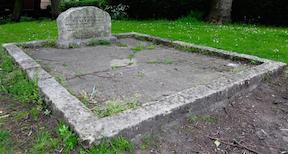
Escaping to the north, he began calling himself Palmer, and under that name, was accused of shooting another man’s cock (a chicken, I believe!) and tossed in the House of Correction at Beverley. Suspected of horse theft, he was transferred to York Castle and sentenced to death for that. It wasn’t until he wrote a letter to his brother-in-law—who promptly refused it—that his true identity was discovered. He was executed at Knavesmire and buried at St. George’s Church in Fishergate. Ironically, his body was robbed by bodysnatchers, who made their living selling bodies to medical schools—but it was recovered soon after and reburied.

Dick-Turpin-Grave

 Index to all the posts in this series

1: The Bath Road: The (True) Legend of the Berkshire Lady

2: The Bath Road: Littlecote and Wild William Darrell

3: The Bath Road: Lacock Abbey

4: The Bath Road: The Bear Inn at Devizes and the “Pictorial Chronicler of the Regency”

5: The Exeter Road: Flying Machines, Muddy Roads and Well-Mannered Highwaymen

6: The Exeter Road: A Foolish Coachman, a Dreadful Snowstorm and a Romance

7: The Exeter Road in 1823: A Myriad of Changes in Fifty Years

8: The Exeter Road: Basingstoke, Andover and Salisbury and the Events They Witnessed

9: The Exeter Road: The Weyhill Fair, Amesbury Abbey and the Extraordinary Duchess of Queensberry

10: The Exeter Road: Stonehenge, Dorchester and the Sad Story of the Monmouth Uprising

11: The Portsmouth Road: Royal Road or Road of Assassination?

12: The Brighton Road: “The Most Nearly Perfect, and Certainly the Most Fashionable of All”

13: The Dover Road: “Rich crowds of historical figures”

14: The Dover Road: Blackheath and Dartford

15: The Dover Road: Rochester and Charles Dickens

16: The Dover Road: William Clements, Gentleman Coachman

17: The York Road: Hadley Green, Barnet

18: The York Road: Enfield Chase and the Gunpowder Treason Plot

19: The York Road: The Stamford Regent Faces the Peril of a Flood

20: The York Road: The Inns at Stilton

21: The Holyhead Road: The Gunpowder Treason Plot

22: The Holyhead Road: Three Notable Coaching Accidents

23: The Holyhead Road: Old Lal the Legless Man and His Extraordinary Flying Machine

24: The Holyhead Road: The Coachmen “More Celebrated Even Than the Most Celebrated of Their Rivals” (Part I)

25: The Holyhead Road: The Coachmen “More Celebrated Even Than the Most Celebrated of Their Rivals” (Part II)

26: Flying Machines and Waggons and What It Was Like To Travel in Them

27: “A few words on Coaching Inns” and Conclusion

Caroline Warfield: Dangerous Works

giveaway

Caroline  is offering a choice of Her Very Major Christmas by Saralee Etter or The Earl’s Christmas Delivery by Susan Gee Heino. Click here for the Rafflecopter.

Discovered in the papers of Andrew Mallet

Notes from my interview with Georgiana Hayden who, though she has hired me to tutor her, persists in being disagreeably autocratic about the work.

Summer, 1816

Cambridge, England

 AM: What on earth made you think you could approach the authorities about access to the library at Magdalene College, that bastion of male superiority?

GH:   How else am I to get the information I need for my work?

AM:   You must have had a maggot in your brain if you thought Watterson would tutor you.

GH:   I hoped interest in the work would draw him. He dismissed the women’s poems as “worthless, minor at best.”

Interviewer note: The daft woman walked right into humiliation. Alphaeus Watterson is a pompous old windbag treats the college as a private fiefdom and delights in cutting down students. He wouldn’t know good work if it bit him in the arse.

AM: How did you come to start this work that means so much to you?

GH: I found the poems of Nossis of Locri quite unexpectedly in the Anthologia Graeca.

AM: Did you actually own a copy of the Greek Anthology?

GH: Not then.

AM: Unusual reading for a woman. Some would call it peculiar. Your mother cannot have been pleased. I can’t believe she would have permitted you to own a book in Greek.

Interviewer’s note: Some would have perhaps, but not her dragon of a mother. I should know. I gave Georgiana her first Greek text when we were in our teens. She hid it behind the palms in her father’s conservatory.

GH: Of course not. She didn’t catch me reading it either.

AM: Where did you find it then?

GH: We were at the house party in the country house of a famous antiquarian. I spent my time in his library. The discovery rocked my world. The inclusion of poems by a woman shocked me. I thought that if she could write them, I could translate them. I never went back. Collecting and translating those poems gave shape to my life ever after.

AM: How many years ago was this?

GH: Six months and fourteen days after you left me waiting in my father’s drawing room for you to call.

Interviewers note: I will not discuss what happened eleven years ago. After fruitless attempts on her part to question me about it, we returned to the work.

AM: Where did you find the other poets?

GH: Here and there. Some simply quoted in books by men. Some in fragments in anthologies. They hide in plain site.

AM: Why is this work so important to you?
GH: I am enraged that they hide, that they aren’t studied as much as Pindar and the other men, that their voices are suppressed, that—

Interviewer’s note: She went on at length and became quite agitated. Georgiana in righteous rage is glorious to behold, but I digress.

AM: You know Greek. What do you want from me?

Interviewer’s note: The look of yearning on her face in response put us on dangerous ground. I rephrased my question.

AM: That is to say, what is it you want me to teach you, about Greek?

GH: It isn’t enough to uncover the literal meaning of words. To do more, I need to know about their world, their lives, and the things female education never teaches. I don’t want these poems to plod along. I want them to sing!

Interviewer’s note: There’s more to understanding love poetry than Greek culture. I fear we will discover how much together.

About Dangerous Works

Lady Georgiana Hayden has struggled for years to do scholarly work in the face of constant opposition and even outright derision from the scholarly community at Cambridge. Her family ignores her as long as she doesn’t draw attention to herself.

DangerousWorks_600x900 copyA little Greek is one thing; the art of love is another. Only one man ever tried to teach Georgiana both. She learned very young to keep her heart safe. She learned to keep loneliness at bay through work. If it takes a scandalous affair to teach her what she needs to complete her work, she will risk it. If the man in question chooses not to teach her, she will use any means at her disposal to change his mind. She is determined to give voice to the ancient women whose poetry has long been neglected.

Some scars cut deeper than others. Major Andrew Mallet returns to Cambridge a battle scarred hero. He dared to love Georgiana once and suffered swift retribution from her powerful family. The encounter cost him eleven years of his life. Determined to avoid her, he seeks work to heal his soul and make his scholar father proud. The work she offers risks his career, his peace of mind, and (worst of all) his heart.

Andrew and Georgiana battle their way through the work to a fragile partnership. Even poetry, with its musical lyrics and sensual traps, can be dangerous when you partner with the love of your life. In Regency Cambridge it can lead a lady quickly past improper to positively scandalous.

Amazon

Excerpt

Georgiana attempted to make her work, as always, her sturdy bulwark against the blows of life. This time, the work only added to her emotional vortex. She read the epigrams with new eyes, and what she found there disturbed her. “Erotos” she knew meant love, certainly, and romantic love at that. How should I translate this line? she wondered.

“‘Nothing is sweeter than love.’”

“‘Nothing is sweeter than Eros.’” In English the meaning tilted slightly with the change of wording. The next phrase appeared to be about delight or pleasure.

“Definitely Eros,” she said to the empty room. Whatever it is, Nossis prefers it to honey. Yesterday, Georgiana wouldn’t have understood. Love has a taste; she knew that now. She recalled the feel of Andrew’s mouth on hers, and the taste when he opened and let her explore. The taste was sweeter than honey, indeed. She felt warmth rise again deep within her. Heat colored her neck and pooled deep in her belly.

The words of Nossis hadn’t changed since yesterday, but Georgiana had.

About the Author

Carol Roddy - AuthorCaroline Warfield has at various times been an army brat, a librarian, a poet, a raiser of children, a nun, a bird watcher, an Internet and Web services manager, a conference speaker, an indexer, a tech writer, a genealogist, and, of course, a romantic. She has sailed through the English channel while it was still mined from WWII, stood on the walls of Troy, searched Scotland for the location of an entirely fictional castle (and found it), climbed the steps to the Parthenon, floated down the Thames from the Tower to Greenwich, shopped in the Ginza, lost herself in the Louvre, gone on a night safari at the Singapore zoo, walked in the Black Forest, and explored the underground cistern of Istanbul. By far the biggest adventure has been life-long marriage to a prince among men.

She sits in front of a keyboard at a desk surrounded by windows, looks out at the trees and imagines. Her greatest joy is when one of those imaginings comes to life on the page and in the imagination of her readers.

 FacebookWebsiteTwitterPinterest

The Dover Road: William Clements, Gentleman Coachman

dust jacket

The following post is the sixteenth of a series based on information obtained from a fascinating book Susana recently obtained for research purposes. Coaching Days & Coaching Ways by W. Outram Tristram, first published in 1888, is replete with commentary about travel and roads and social history told in an entertaining manner, along with a great many fabulous illustrations. A great find for anyone seriously interested in English history!

Artistic License

While I mean no disrespect to Canterbury and its extraordinary history, there is so much already out there on this topic that I’ve decided to skip it and focus on a particular coachman well-known and much respected for his years of service on the Canterbury-Dover Road.

Coaches On the Dover Road

dover road

112 miles round trip proved too much in one day.

Of the coaches on this Dover Road I have refrained from speaking, not because I was reserving the best thing till the last, but in point of fact for an exactly opposite reason. An indisputable subject tells me that, considering its importance as the principal route for travellers between England and France, there were not many coaches running on the Dover Road. I fancy that most people who had the wherewithal and wanted to catch a packet when the tide set, posted, and congratulated themselves. Mr. Jarvis Lorry I know was not amongst this number, but then he travelled by the Dover Mail, which was always an institution, kept good time, and carried in its day historic matter.

Mr. William Clements: Gentleman Coachman

william clements

Mr. William Clements, “Gentleman Coachman”

Of the other coaches on the Dover Road I shall make no mention. For once in the way, a catalogue, if made, would contain no sounding names in coaching story, would register no records in the way of speed, catastrophes, or drivers especially cunning, sober or drunk. Yet one coach besides the Dover Mail on this road I will mention, because next to the Mail it took high rank—in some estimations a rank above it; because with its coachman in its best days, I have had the pleasure of shaking hands. Yes! I have shaken hands with a classic coachman! No tyro he when coaching was the fashion, but an artist to the tips of his fingers—one of the old school, whom I have heard described by one who knew them well, as Grand Gentlemen; parties capable of giving Fatherly advice, to bumptious pretenders—parties who at the end of a trying journey, etc., over heavy roads took their ease at their inn with an air, disembarrassed themselves of their belchers, and sat down to a pint of sterling port.

Yes, in Mr. William Clements, who still enjoys a hale old age at Canterbury, I have chanced on a type now almost extinct, and which another generation will only read of in descriptions more or less fabulous, and wonder whether such people have ever been. Mr. Clements, who still takes a sort of paternal interest in those revivals of the coaching age which delight our millionaires during the prevalence of what we are pleased to call our summer months, lives in a snug house of his own, surrounded by memories of his former triumphs. A duchess might envy the Chippendale furniture in his drawing-room, and the bow window commands an extensive view of a rambling block of buildings which in days gone by houses the treasures of a choice stud.

As I listened to this man, it seemed to me that I came into direct personal contact with the very genius of coaching days and coaching ways—felt the impulse which throbbed in the brains of our ancestors to be at the coaching office early to book the box seat: sat by the side of a consummate master of his craft; was initiated in an instant into all its dark mysteries of “fanning,” “springing,” “pointing,” “chopping,” and “towelling.” I went through snowdrifts, I drank rums and milk; hair-breadth escapes in imminent deadly floods were momentary occurrences; I alighted at galleried inns; waiters all subservient showed me to “Concords” in all quarters of the empire. I revelled in the full glories of the coaching age in short in a moment! For had I not touched hands with its oldest, its most revered representative?

Baily’s Magazine of Sports & Pastimes, Volume 69 (Free on Google Books)

In the early 20’s, when agriculture was at its best, the farmers between Canterbury and London wanted a coach that would land them in London at noon on Monday and bring them back the same day… It was settled offhand to start a coach; Mr. Chapin said, “it must be a light coach and we will call it the Tally-ho!…It was started on that fortnight and either on its first start or soon afterwards, Mr. William Clements, whom I knew for the greater part of my life, was coachman, and at first he drove the early five o’clock Monday coach from Canterbury to London in one day, 112 miles all told; but it proved too much and afterward he drove up to London, 56 miles, and down the next day… The coach was almost always called “Clements’s coach,” and he went by the name of “gentleman coachman,” for he had quite the courtesy of Sir Roger de Coverley, combined with the most finished skill in driving his team, and he seldom went a journey without having a young lady who was travelling alone committed to his charge.

Baily says that he had the pleasure of meeting Mr. Clements and his “bright little wife, who was a very clever and well read lady,” and that, in fact, she had been one of the young ladies entrusted to him when he was a young man, and that they celebrated their golden anniversary before she passed away.

This is Why I Love Research!

In my next story, I believe I shall weave in a scene with this true-to-life “gentleman coachman.” In fact, it is beginning to take shape in my mind already! A young lady traveling to London unaccompanied in need of protection. Fabulous!

Henry Alken Sr. Dover to London Coach Summer

Henry Alken Sr.
Dover to London Coach Summer

 Index to all the posts in this series

1: The Bath Road: The (True) Legend of the Berkshire Lady

2: The Bath Road: Littlecote and Wild William Darrell

3: The Bath Road: Lacock Abbey

4: The Bath Road: The Bear Inn at Devizes and the “Pictorial Chronicler of the Regency”

5: The Exeter Road: Flying Machines, Muddy Roads and Well-Mannered Highwaymen

6: The Exeter Road: A Foolish Coachman, a Dreadful Snowstorm and a Romance

7: The Exeter Road in 1823: A Myriad of Changes in Fifty Years

8: The Exeter Road: Basingstoke, Andover and Salisbury and the Events They Witnessed

9: The Exeter Road: The Weyhill Fair, Amesbury Abbey and the Extraordinary Duchess of Queensberry

10: The Exeter Road: Stonehenge, Dorchester and the Sad Story of the Monmouth Uprising

11: The Portsmouth Road: Royal Road or Road of Assassination?

12: The Brighton Road: “The Most Nearly Perfect, and Certainly the Most Fashionable of All”

13: The Dover Road: “Rich crowds of historical figures”

14: The Dover Road: Blackheath and Dartford

15: The Dover Road: Rochester and Charles Dickens

16: The Dover Road: William Clements, Gentleman Coachman

17: The York Road: Hadley Green, Barnet

18: The York Road: Enfield Chase and the Gunpowder Treason Plot

19: The York Road: The Stamford Regent Faces the Peril of a Flood

20: The York Road: The Inns at Stilton

21: The Holyhead Road: The Gunpowder Treason Plot

22: The Holyhead Road: Three Notable Coaching Accidents

23: The Holyhead Road: Old Lal the Legless Man and His Extraordinary Flying Machine

24: The Holyhead Road: The Coachmen “More Celebrated Even Than the Most Celebrated of Their Rivals” (Part I)

25: The Holyhead Road: The Coachmen “More Celebrated Even Than the Most Celebrated of Their Rivals” (Part II)

26: Flying Machines and Waggons and What It Was Like To Travel in Them

27: “A few words on Coaching Inns” and Conclusion

The Dover Road: Rochester and Charles Dickens

dust jacket

The following post is the fifteenth of a series based on information obtained from a fascinating book Susana recently obtained for research purposes. Coaching Days & Coaching Ways by W. Outram Tristram, first published in 1888, is replete with commentary about travel and roads and social history told in an entertaining manner, along with a great many fabulous illustrations. A great find for anyone seriously interested in English history!

Comment to enter Susana’s October Giveaway, an Anne Boleyn necklace (see right) from Hever Castle in Kent.

Gad’s Hill Place: A Young Boy’s Dream

Gads-hill620_2032271b

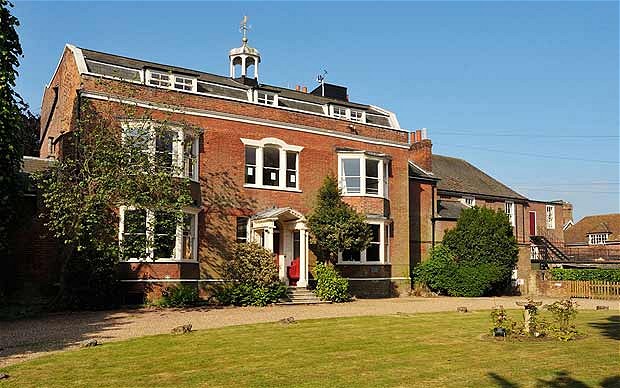
Gad’s Hill Place

John Dickens used to point out this stately home as an incentive to his nine-year-old son Charles to work hard. He meant, of course, that his son might someday own such a home, but his son took it literally and used to walk over from Chatham to inspect his future home.

I used to look at it as a wonderful Mansion (which God knows it is not) when I was a very odd little child with the first faint shadows of all my books in my head – I suppose.

Charles Dickens

Charles Dickens

Years later, after Charles had achieved fame and fortune, he heard the house was for sale and purchased it, and it became his country retreat in 1857.

Here too from his house on Gad’s Hill (and a very hideous house it is) Charles Dickens…gave novel after wonderful novel to an astonished world, which was never sated with a humour and an observation of life which were indeed Shakespearean; but kept craving and calling for more, and more—till the magician’s brain was hurt, and the magic pen began to move painfully and with labour, and the chair on Gad’s Hill was found one June morning to be empty forever.

I remember the shock of that announcement well. It was as if some pulse in the nation’s heart had stopped beating. There was as it were a feeling that some great embodied joy had left the world, and silence had fallen on places of divine laughter… Yes, the feeling was general, I think, that English literature had suffered an irremediable loss by Dickens’s death; and time has confirmed the fear. We have abandoned laughter in these days for documentary evidence, psychology, realism, and other prescriptions for sleep, and have entered on a literary era which has lost all touch and sympathy with Dickens, and is indeed divinely dull.

Mr. Tristram goes on to quote from the numerous works in which Dickens featured Rochester and its environs: The Pickwick Papers, David Copperfield, Great Expectations and Edwin Drood.

According to Wikipedia, Dickens had in his study “dummy” books with titles such as:

  • Socrates on Wedlock

  • King Henry VIII’s Evidences of Christianity

  • The Wisdom of Our Ancestors: I Ignorance, II Superstition, III The Block, IV The Stake, V The Rack, VI Dirt and VII Disease.

  • A very thin volume entitled The Virtues of Our Ancestors

(I’m loving this man’s sense of humor. Aren’t you? I could think of a few such titles for my own office.)

chalet

Dickens’s chalet where he wrote many of his later works on the upper floor

In 1864 his friend, the actor Charles Fechter, gave him a gift of a Swiss chalet, in 94 pieces. Dickens had it assembled across the street and later had constructed a brick-lined tunnel so that he could go back and forth from his house unobserved. His works from then on were written from the upper floor of the chalet.

Note: The chalet was transferred to the now-defunct Dickens Centre at Eastgate House in Rochester, but you can still see the chalet in the garden.

Restoration House in Rochester

There is a passage in Great Expectations referring to this very Restoration House, a place which always took his fancy, and well it might.

restoration-house-satis-house-small

Restoration House, Rochester

“I had stopped,” thus the passage runs, “to look at the house as I passed, and its seared red brick walls, blocked windows, and strong green ivy clasping even the stacks of chimneys with its twigs and tendons, as if with sinewy old arms, made up a rich and attractive mystery.”

This mystery held him to the end. On the occasion of his last visit to Rochester, June 6th, 1870, he was seen leaning on the fence in front of the house, gazing at it, rapt, intent, as if drawing inspiration from its clustering chimneys, its storied walls so rich with memories of the past. It was anticipated, it was hoped, that the next chapter of Edwin Drood would bear the fruits of this reverie. The next chapter was never written.

 Index to all the posts in this series

1: The Bath Road: The (True) Legend of the Berkshire Lady

2: The Bath Road: Littlecote and Wild William Darrell

3: The Bath Road: Lacock Abbey

4: The Bath Road: The Bear Inn at Devizes and the “Pictorial Chronicler of the Regency”

5: The Exeter Road: Flying Machines, Muddy Roads and Well-Mannered Highwaymen

6: The Exeter Road: A Foolish Coachman, a Dreadful Snowstorm and a Romance

7: The Exeter Road in 1823: A Myriad of Changes in Fifty Years

8: The Exeter Road: Basingstoke, Andover and Salisbury and the Events They Witnessed

9: The Exeter Road: The Weyhill Fair, Amesbury Abbey and the Extraordinary Duchess of Queensberry

10: The Exeter Road: Stonehenge, Dorchester and the Sad Story of the Monmouth Uprising

11: The Portsmouth Road: Royal Road or Road of Assassination?

12: The Brighton Road: “The Most Nearly Perfect, and Certainly the Most Fashionable of All”

13: The Dover Road: “Rich crowds of historical figures”

14: The Dover Road: Blackheath and Dartford

15: The Dover Road: Rochester and Charles Dickens

16: The Dover Road: William Clements, Gentleman Coachman

17: The York Road: Hadley Green, Barnet

18: The York Road: Enfield Chase and the Gunpowder Treason Plot

19: The York Road: The Stamford Regent Faces the Peril of a Flood

20: The York Road: The Inns at Stilton

21: The Holyhead Road: The Gunpowder Treason Plot

22: The Holyhead Road: Three Notable Coaching Accidents

23: The Holyhead Road: Old Lal the Legless Man and His Extraordinary Flying Machine

24: The Holyhead Road: The Coachmen “More Celebrated Even Than the Most Celebrated of Their Rivals” (Part I)

25: The Holyhead Road: The Coachmen “More Celebrated Even Than the Most Celebrated of Their Rivals” (Part II)

26: Flying Machines and Waggons and What It Was Like To Travel in Them

27: “A few words on Coaching Inns” and Conclusion