Archives

Strange happenings in Hyde Park: a Bluestocking Belles cross-post

Today on Susana’s Parlour, Jude Knight and I have something special: a stand-alone short story with two characters from the Bluestocking Belles’ holiday box set, Mistletoe, Marriage, and Mayhem. Mary, the heroine of Jude’s story, Gingerbread Bride, meets Agatha Tate, Lady Pendleton, the mother of Julia Tate, the heroine of my story, The Ultimate Escape. In this episode, Lady Pendleton is just returning from a two-week journey into the twentieth century. Yes, she is a time-traveling Regency lady (who has appeared on this blog on several occasions in the past).
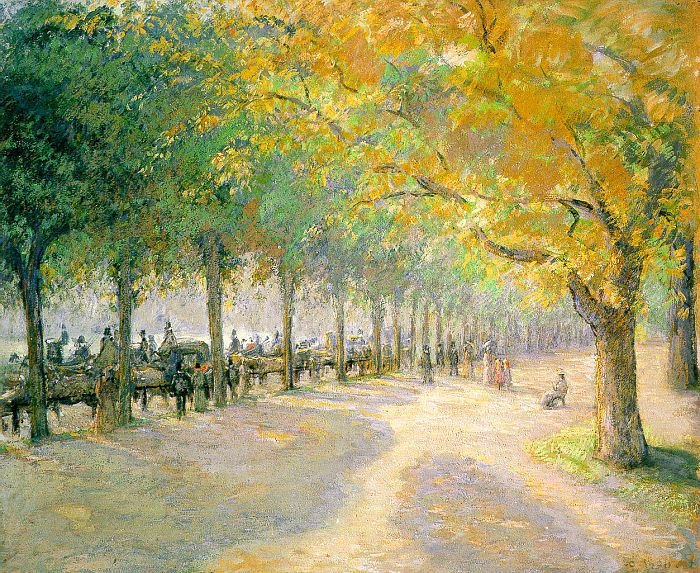
Pissarro_Hyde_Park

Agatha Tate staggered backwards as her feet touched the ground until, unable to reclaim her balance, she toppled over onto the soft grass at Hyde Park.

“Wh-at?” She put a hand to her aching temple and tried to regain her bearings. “Where am I?”

Agatha Tate, Lady Pendleton

Agatha Tate, Lady Pendleton

She opened her eyes and could see a vague image of a young girl in front of her. A girl who had likely seen her materialize out of nowhere, she realized as her wits were restored to her. Good heavens! How was she going to explain something was… well… unexplainable?

The girl—a young woman really, Agatha could see as her vision cleared—stepped forward, blinking rapidly. “May I help you?”

“Uh… who are you?” Agatha asked, her head still throbbing. “How long have you been there?”

Agatha pulled herself up into a sitting position and cast about for her shopping bag, which had landed in a nearby bush. “Oh my, can you get that for me, my dear? I need to change my attire before anyone sees me.”

She was still wearing her animal print leather jeans and denim jacket, which was certain to startle an inhabitant of London in 1799. Of course, she should have changed to her original clothing prior to leaving the twentieth century, but she’d been so stricken by the need to see her family again that she’d collected her bag, pulled out the stone, and uttered the gypsy’s spell before the thought could occur to her.

“Well, before anyone ELSE sees me. I shouldn’t want to cause a scandal.”
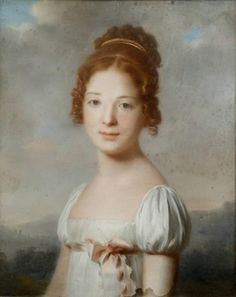
Mary Pritchard

Mary Pritchard

The bemused young lady fetched the bag and handed it to her. Agatha could see that her bright red hair was tousled and she seemed to be short of breath.

“Mary Pritchard, ma’am, at your service.” The young lady curtseyed politely.

“A pleasure to meet you, Miss Pritchard. Please allow me to introduce myself. I am not usually so rag-mannered, but since we have met in such unconventional circumstances…. Oh dear, there I go again! I am Lady Pendleton. My husband is Lord Pendleton, of Wittersham.”

“I am pleased to make your acquaintance, my lady.” She glanced at their surroundings, and returned her gaze toward Agatha with a reassuring smile. “We are hidden here, I think. I will keep a lookout un case Viscount B… in case anyone comes this way while you are changing.”

Agatha smiled, feeling a bit sheepish. “How very kind of you, Miss Pritchard. I was just about to ask if you would do me that small favor.”

She took the bag behind a bush and began to tug at the tight leather jeans. “Oh, I know I shouldn’t have had that last Big Mac,” she groaned.

Upon seeing the look of bewilderment on Miss Pritchard’s face, Agatha rolled her eyes. She already had a great deal to explain to the kind young woman. She’d better watch her tongue from her on in.

She coughed. “I’m afraid I’ve been over-indulging during the past fortnight. I hope my old clothes will still fit.”

“Have you traveled far?” Miss Pritchard asked politely.

Agatha grinned. “You could say that, I suppose.”

A crashing further back in the woods startled them, particularly Miss Pritchard, whose hand went to her chest as she turned toward the origin of the sound. She appeared frightened out of her skin.

Lady Pendleton pulled her yellow morning gown over her head. “Are you well, my child?”

I’m the one who has traveled 200 years and she’s the one who looks white enough to be a ghost.

“I… ah… you must wondering, ma’am, at my being here without an escort. That sound is, I think, my escort. If he finds me, would you be kind enough to say I am with you?”

The poor girl was trembling! Agatha stepped out from behind the bush and folded the girl into her embrace. Why she looked to be only a year or two older than her own daughter Julia!

“Your escort… attacked you? How did that happen?”

After a brief moment, Mary returned her embrace. She was a brave one—or perhaps foolish—to trust a complete stranger, particularly under these circumstances.

“I refused his proposal, and he thought to force me. I… ah… punched him in… ah… I distracted him and ran.”

What are Miss Pritchard’s parents thinking to allow her to be escorted by such a villain?

Miss Pritchard bit her lip. “I do not know what to do. If I tell my aunt, she will say that we must marry, and I would rather throw myself into the Thames than marry a man who only wants my money.” She sighed. “Actually, I would rather throw him into the Thames.”

Agatha straightened up. “This… this… Boswell won’t harm you as long as I’m here, my child.” She grinned. “The Serpentine is a great deal closer. Will that do instead, do you think?”

No. 42, Grosvenor Square, the Pendletons' London home

No. 42, Grosvenor Square, the Pendletons’ London home

She turned her back. “Hurry, do me up and we’ll away from here. I live in Grosvenor Square; it’s not too far.”

The girl chuckled and hastened to oblige. Agatha gathered her discarded clothing and stuffed them into the bag, realizing she would have to keep on her twentieth century boots since she had left the old ones behind.

“Ma’am, I could not help but notice the manner of your arrival and your attire. Would you think me impertinent if I asked where you came from?”

Agatha swallowed. What to say? Perhaps she could avoid the question… a little while longer.

“It’s a long story. What concerns me most at the moment is what your parents could have been thinking to leave you alone with such a rogue.”

Miss Pritchard sighed. “I came to live with my aunt when my papa died. The rogue is her son, I am afraid. She is as keen to have the inheritance my papa left me as her son is.”

Agatha’s nostrils flared. “How disgraceful! Clearly, she is not a fit guardian. Is there no one else who can offer you protection, my dear?” She pressed her lips together. “My husband and I don’t hold with arranged marriages. Not for our three daughters, or for anyone else, if it can possibly be helped.”
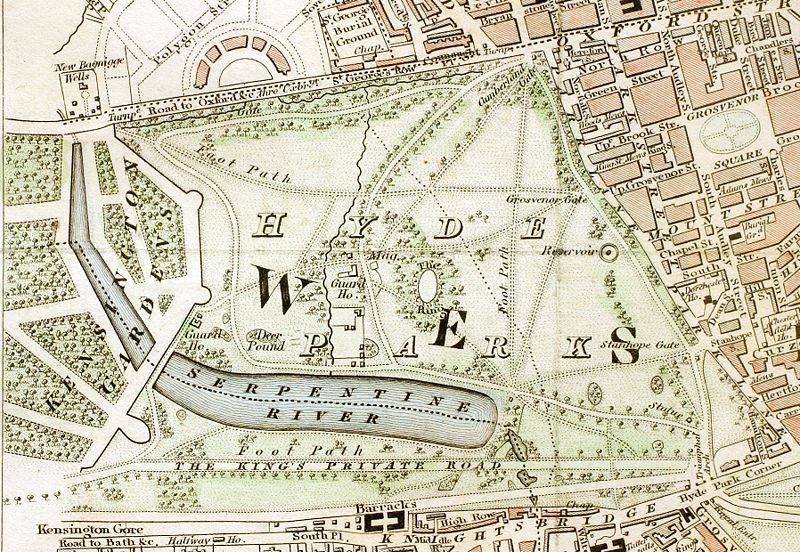
800px-Hyde_Park_London_from_1833_Schmollinger_map

She set a fast pace toward the Grosvenor Gate. She wasn’t about to allow this scoundrel to make off with Miss Pritchard under any circumstances, but it would be best if they avoid a direct confrontation.

“He doesn’t even want me,” her young charge burst out. “I heard him tell his friends that he would park me in the country while spent my lovely money!”

As they approached the gate, Agatha paused and looked cautiously behind her for any sign of a pursuer and sighed with relief at not seeing one. Followed by a moment of uncertainty. The more she thought about her own family and how they must have worried about her disappearance, the more eager she was to hurry home and beg their forgiveness. On the other hand, she wasn’t sure she was quite ready to confront them—particularly not her husband George. In any case, she couldn’t abandon this poor little dove to her mercenary aunt and odious cousin. What to do? What to do?

“I’ve got it,” she said. “Tea!”

“Tea would be very welcome,” said Mary. “I have no wish to go home until I decide what to do about beastly Bosville.”

Agatha knew of a delightful little bookshop on Mount Street that served tea, which frankly she had not enjoyed half so well during her travels into the future.

“Let us have a brief respite at my friend Mrs. Marlowe’s bookshop,” she suggested. “She is very cordial and serves the best tea and biscuits in Town.”

Mary’s face brightened. “I know it!” Mary said. “She has an excellent range of books.”

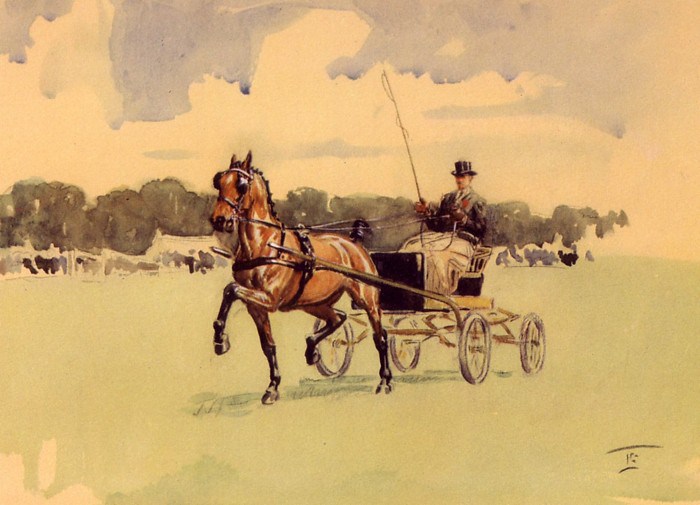
Suddenly she moved to one side, putting Agatha between her and the carriageway, where a dark-haired dandy was driving a phaeton at a furious pace out of the gate and into the street beyond.
1948-TROTTING-HACKNEY-CARRIAGE-HORSE-PRINT_700_600_QVBO

“Forgive me,” she said, “I am not usually so nervous, but that was my cousin, and I would rather he did not see me at present. Although,” she added, “I suppose it is silly of me, for what could he do in all this crowd? And I will take care not to be alone with him again, you may be sure.”

Agatha shook her head. “He looked very angry. It’s best to avoid a confrontation. Let’s away to Mount Street and refresh ourselves while we plan our strategy.” She was thinking “strategies”, because she had to come up with one for her own situation as well.

The bookshop was as busy as ever, with several customers waiting their turn at the counter. Mary led them up the stairs to the tearoom, where little tables invited friendly conversation.
tea table

“Lady Pendleton, I hope you do not think me rude, but I could not help but notice your attire when you—er—arrived. And—it cannot be true, can it? You seemed to appear out of nowhere!”

Agatha blanched. A more prudent woman would not have considered confiding her situation—as strange as it was—to a young girl such as Mary, but then, Agatha had never been known for her prudence.

“I’ll have a cup of Bohea,” she told the waiter. “And some strawberry tarts if you have them. What would you like, my dear?”

“Souchong, please,” Mary said. “And strawberry tarts sound wonderful.”

After the waiter had departed, Agatha turned to Mary. She might as well get it over with. “When you saw me earlier today, I was wearing clothing from the twentieth century. I-uh- was visiting there for the past two weeks. I suppose you might call me—a sort of time traveler.”

Agatha’s hands were clammy. It sounded so ridiculous to say such a thing, and she wouldn’t have believed it herself if she hadn’t experienced it firsthand. But she was going to have to say it again—soon—to her husband, so she’d best get over her fears now rather than later

Mary opened her mouth and closed it again. “How marvelous,” she said at last. “I have traveled much of the world, but to travel in time? How wonderful!” She sat up straight in her chair, her eyes widened.

“Marvelous, yes, it is at that,” Agatha agreed. “Quite fascinating. An amusing and rather unconventional manner of escaping one’s problems. But now… I find myself having to face them after all.”

Mary nodded. “Running away does not solve things. Though it can win you time to find a solution.”

Their conversation was interrupted by the arrival of the tea. Agatha poured for both of them.
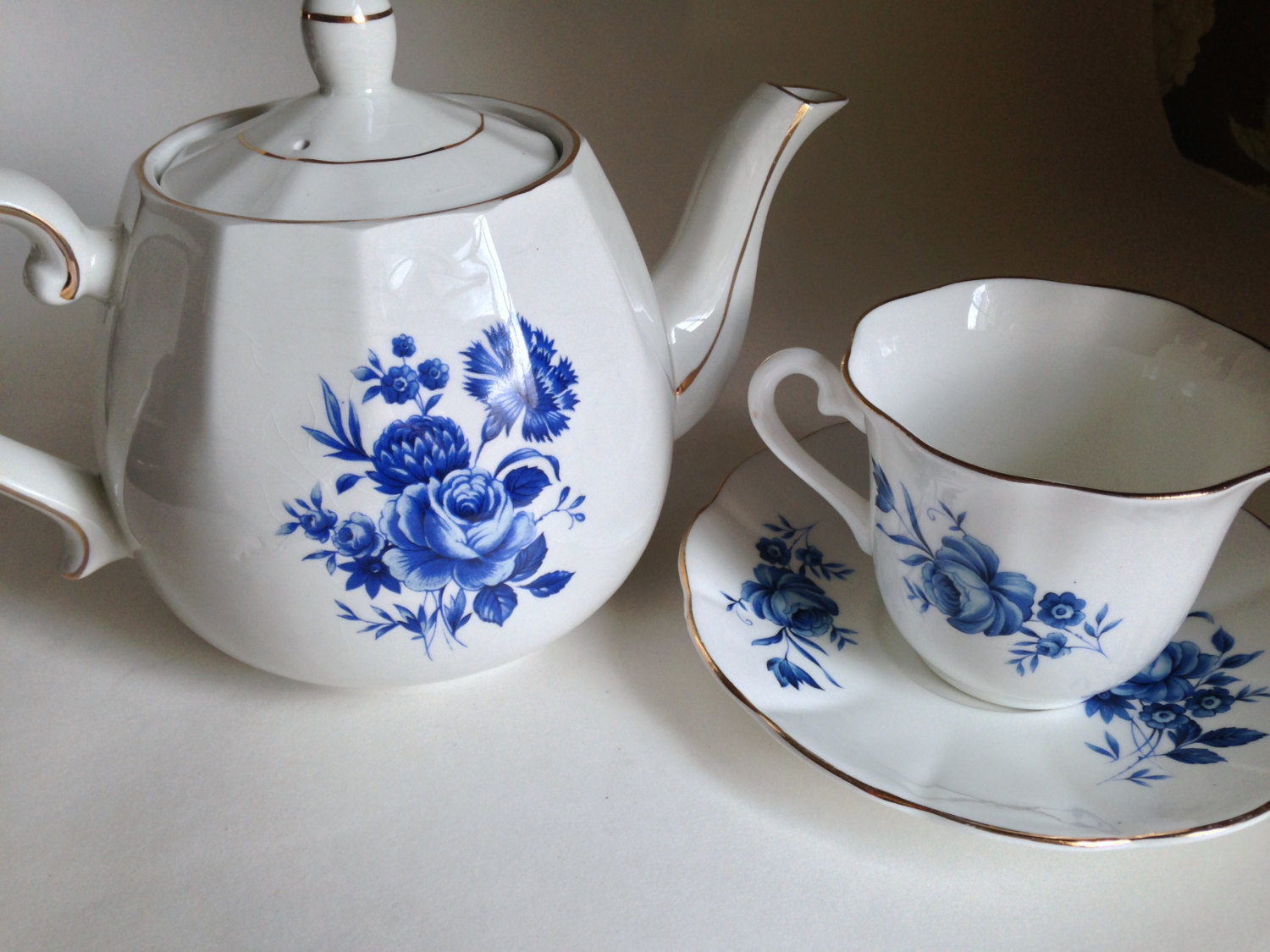
teapot

“You are wise for your age,” she commented as she passed her the plate of tarts.

Mary smiled. “Thank you, ma’am. I am on my own, you see, and must think for myself. And I am of age, though I know I look younger. My youth is a great disadvantage. Were I older, I could move to my own residence, and no one would be in the least scandalized.” She sighed.

Agatha leaned in and lightly stroked Mary’s arm. “I have three daughters at home. Julia, my eldest, is fourteen. I have missed them all so much, and my husband most of all. But I needed time to reflect on my situation, and knew my mother and aunts would only tell me to go back to my husband.”

Lady Julia Tate (at age 27)

Lady Julia Tate (at age 27)

She shook her head. “Marriage is not something to be rushed into. My George and I married for affection and fell in love later. And for the most part, we have rubbed along very well. I never thought he would turn into a—despot.” She winced, knowing in her heart that George was not a despot. Someone had wounded his pride. That holier-than-thou William Wilberforce, who despised some of her political friends because he disapproved of their morals.

Mary grimaced. “But are you going home now?”

Agatha’s mouth went dry and she took another sip of her tea.

“I am,” she said. “I must. I cannot abandon my daughters. Or my husband.”

“Of course not,” Mary agreed.

“But George must know that I won’t have a despot for a husband. While women do not have the sort of freedoms in this century that they will have in the future,”—she saw Mary’s eyes widen in surprised—“we do have options, and he must surely know I would not hesitate to take some of them, undesirable though they would be.”

She licked her lips with cautious hope. “If I know my George, though, he has long ago forgotten his anger amidst his concern for my absence.” She smiled as she imagined a tender reconciliation between them. She felt a sense of calm.

Taking the last sip of tea, she set her cup down. “It appears that my path is quite clear. I must return home and have a serious discussion with my husband. As for you, my dear, I wonder if you haven’t any other relatives you could appeal to, since clearly these Bosvilles are not suitable.”

Mary’s face brightened. “I wonder that I did not think of that! Yes, indeed! I have three more aunts, though I have not met them. Papa said I was to come to London. He thought Aunt Bosville might help me to find a husband.” Her color deepened, her fair skin showing her embarrassment. “I find I am not in the fashionable mode, however. Being raised on a naval ship does not prepare one to talk nonsense, and faint, and be ridiculously frilly and the like. And then…” she gestured at her bright red hair and freckles, “there is how I look.”

Agatha raised an eyebrow. “I see nothing amiss with your appearance. Your coloring may not be the fashion this year, but it does not prevent you from having an appeal of your own. Indeed, my eldest daughter is flame-haired and freckled, and I am quite certain she will grow into her own beauty when she past the tomboy phase.” She grinned. “Red hair is quite popular in the twentieth century. I observed that many of the younger ladies had deliberately colored their hair red, or at least a portion of it.” She frowned. “Of course, there were also shades of blue and green that I could not like at all, but that was the way of things—or will be, I should say. Society is so much more liberated in the future.”

Mary leaned forward. “Lady Pendleton, do you think… Could you tell me how you came to travel through time? Could I do it?”

Agatha wrinkled her brow. “Oh no, my dear! I think it would be quite ill-advised for someone so young to venture off into a completely different world. You may be certain I will not breathe a word of it to any of my daughters, at least not until they are old enough to have learned to resolve their problems rather than try to avoid them. No indeed, dear Mary, we must find a rather more conventional solution to your dilemma.”

“I am familiar with adventures, Lady Pendleton. I have been in a number of tight spots in many parts of the world. Though I have needed rescue from time to time, and I suppose I cannot expect Rick—Lieutenant Redepenning—to follow me two hundred years into the future.”

Now this was a promising development. “This Rick-er-Lieutenant Redepenning… you say he has come to your rescue in the past? Sounds like a delightful young man. The two of you appear to have a great deal in common. Is he eligible, do you think?” She winked. “I must confess that I would like to see my daughter Julia make a match with Oliver, who lives next door to us in Wittersham. They have been close friends forever.” She sighed. “Although it remains to be seen how well they deal with each other as adults.”

“Things can certainly change when one grows up, Mary sighed. “We were good friends when we were younger, but now… Lady Pendleton, a friend would visit a friend, would he not? If he were in London, and she were in London? A lady cannot call upon a gentleman, after all. Aunt would not even allow me to send a note! At first he was recovering from his injury, but he has been seen about Town these past six weeks and has not been to see me.” She sighed again, more deeply this time. “No, eligible or not, Rick the Rogue is not interested in plain Mary Pritchard.”

Then she brightened. “I will go to my aunts in Haslemere, Lady Pendleton. I will make the arrangements today.”

“Do you need a place to stay before you leave, Miss Pritchard?” Agatha patted her hand. “You would be welcome, if you think your return to Lady Bosville’s house would put you at risk.”

Mary shook her head. “I am quite sure that is not necessary, my lady. My cousin is unlikely to dare anything further. If he should return home, that is. He often stays away for days at a time.”

“I do hope that is the case, dear. However,” she added in a maternal tone, “Do not neglect to hire a post chaise, and your own outriders. You have a maid who can accompany you, I take it?”

“The public coach goes straight through to Haslemere, where my aunts live. Yes, I do believe it is the perfect solution. Thank you for your counsel, Lady Pendleton. And best of luck with your own reunion. I am certain your family will be over-the-top excited to have you back again!”

I hope so too, Agatha thought. In any case, it was time she found out. She rose from her seat and reached for Mary’s hand.

“It was a great pleasure to meet you, Miss Pritchard. My sincere thanks for your assistance in the park earlier. I can trust on your discretion, I suppose?”

At Mary’s nod, she clasped Mary’s shoulder. “I wish you well on your journey. And if you need any further assistance, please send for me at Grosvenor Square. Number forty-two.”

And the two of them departed the bookshop to face their own separate destinies.

Click here to read the story from Mary Pritchard’s point of view.

Click here for more information about Mistletoe, Marriage, and Mayhem.

Join us on Facebook for our launch of Mistletoe, Marriage and Mayhem on November 1, 2015.

Our Christmas Party Box Rafflecopter is here.

Celebrate with us!

Close-up-of-explosion-of-champagne-bottle-cork2

The Bluestocking Belles: Mistletoe, Marriage & Mayhem

box set 2

The first joint volume of the Bluestocking Belles—seven Christmas novellas about runaway brides—will be released on November 1, 2015. We’re excited! It’s currently running #12 on Amazon’s Hot New Releases, and if you order it now, you’ll have it on your device by November 1 at only 99¢.

100% of royalties go to the Malala Fund. Find out more here.

About Mistletoe, Marriage & Mayhem

All She Wants for Christmas

Amy Rose Bennett

A frosty bluestocking and a hot-blooded rake. A stolen kiss and a Yuletide wedding. Sparks fly, but will hearts melt this Christmas?

The Ultimate Escape

Susana Ellis

Abandoned on his wedding day, Oliver must choose between losing his bride forever or crossing over two hundred years to find her and win her back.

‘Tis Her Season

Mariana Gabrielle

Charlotte Amberly returns a Christmas gift from her intended—the ring—then hares off to London to take husband-hunting into her own hands. Will she let herself be caught?

Gingerbread Bride

Jude Knight

Travelling with her father’s fleet has not prepared Mary Pritchard for London. When she strikes out on her own, she finds adventure, trouble, and her girlhood hero, riding once more to her rescue.

A Dangerous Nativity

Caroline Warfield

With Christmas coming, can the Earl of Chadbourn repair his widowed sister’s damaged estate, and far more damaged family? Dare he hope for love in the bargain?

Joy to the World

Nicole Zoltack

Eliza Berkeley discovers she is marrying the wrong man—on her wedding day. When the real duke turns up, will her chance at marital bliss be spoiled?

Under the Mistletoe

Sherry Ewing

Margaret Templeton will settle for Captain Morledge’s hand in marriage, until she sees the man she once loved at the Christmas party she presides over for her would-be betrothed.

Available now for pre-order price of 99¢

Amazon.comAmazon.caAmazon.uk Amazon.au

KoboiBooks

About the Bluestocking Belles

The Bluestocking Belles’ books carry you into the past for your happy-ever-after. When you have turned the last page of our novels and novellas, keep up with us (and other historical romance authors) in the Teatime Tattler, a Regency scandal sheet, and join in with the characters you love for impromptu storytelling in the Bluestocking Bookshop on Facebook. Also, look for online games and contests and monthly book chats, and find us at BellesInBlue on Facebook, Twitter, and Pinterest. Come visit at http://www.BluestockingBelles.com and kick up your bluestockinged heels!

Website FacebookTwitterPinterest • Newsletter

Check out our recent publication:

The Bluestocking Belles’ Guide to a Good Time

gamebooktoshare

  • games and puzzles related to historical romance
  • excerpts from some of the Belles’ books
  • information about the Malala Fund, to which all profits from our joint projects are committed

Free download here or purchase here for $4.99

Mariana Gabrielle: La Déesse Noire (Giveaway)

Bluestocking-Belles-logo-01

A Hearty Welcome to Fellow Bluestocking Belle

 Mariana Gabrielle

Susana: How long have you been writing?

Mariana: I’ve been a professional writer almost twenty-five years, writing fiction since 2009.

Susana: What advice would you give to writers just starting out?

MarianaGabrielle copyMariana: Write. Write some more. Keep writing.

Susana: Do you ever suffer from writer’s block? If so, what do you do about it?

Mariana: I tend not to get writer’s block, because I am well-used to switching among projects and formats and genres. On the rare occasions when I do, I typically switch to marketing work for a while.

Susana: What comes first: the plot or the characters?

Mariana: Characters, with plot not far behind. The first draft is almost always the characters filling me in on the story, before I fictionalize [what they think are] their nonfiction accounts.

Susana: Are you a plotter or a pantser?

Mariana: Panster. Full stop. Even in nonfiction, I almost never start with a plan, and if I do, it gets tossed out the window very early. The work evolves.

Susana: Tell us something about your newest release that is NOT in the blurb.

Mariana: There are two heroes, three villains, and two sidekicks in this short novel. I am told I managed to pull it off.

Susana: Are you working on something at present that you would like to tell us about?

Mariana: I am working on a series of three prequel novellas connected to my first novel, Royal Regard, the first of which will appear in the Bluestocking Belles’ holiday box set. In ‘Tis Her Season, Charlotte and Alexander start their life together; in Shipmate, readers will learn how Bella ended up with her first husband; and in the unnamed third book, Bella’s brother, John, meets his wife, Rose.

Susana: What did you want to be when you grew up?

Mariana: I wanted to be a musical theatre star.

Susana: What is one thing your readers would be most surprised to learn about you?

Mariana: I am not—in the least—a romantic (not even a little bit).

Susana: What would we find under your bed?

Mariana: Dust. (Cats, if there are other people in the house.)

Susana: Do you write in multiple genres or just one? If just one, would you consider straying outside your genre?

Mariana: Thus far, I have only published Regency romance, but next year, I will release Blind Tribute, a mainstream historical about a Civil War newspaper reporter with divided loyalties. I am currently working in non-fiction on a marketing book, and I have already released a book-length epic poem about the Mayan underworld. As far as fiction, though, I don’t foresee straying from some form of historical.

Susana: What is something you’d like to accomplish in your writing career next year?

Mariana: I’d like to release all three Royal Regard prequel novellas, and I would like Blind Tribute to be on the verge of publication by this time next year. I wouldn’t mind having a good start on Book One of my Regency family series.

Susana: When was the moment that you knew you had to be a writer

Mariana: During the same week, in my third year of college (the first time around), I was offered an internship at the Denver Post, and was also approached by the Music Department chair to try for an audition at the National Musical Theater Conservatory. I decided writing was a more stable career path. Largely, I was correct.

Susana: Describe the “perfect hero.” What about the “perfect hero” for you?

Mariana: I am the perfect hero (and heroine) for me.

Rafflecopter contest May 15 – June 9

Print

Facebook Launch Party: June 10, 12:00 noon – 8 p.m. EDT

About La Déesse Noire

Sired by a British peer, born of a paramour to Indian royalty, Kali Matai has been destined from birth to enthrall England’s most powerful noblemen—though she hadn’t counted on becoming their pawn. Finding herself under the control of ruthless men, who will not be moved by her legendary allure, she has no choice but to use her beauty toward their malicious and clandestine ends.

When those she holds most dear are placed in peril by backroom political dealings, she enlists some of the most formidable lords in England to thwart her enemies. But even with the help of the prominent gentlemen she has captivated, securing Kali’s freedom, her family, and the man she loves, will require her protectors stop at nothing to fulfill her desires.

Amazon.comAmazon.ukBarnes and NobleKobo

iTunesAll Romance eBooksSmashwordsGoodreads

Excerpt

Mayuri had done her no favors, preparing her for the worst. Fitz had no reason to be gentle, she had been warned, no cause to concern himself with her wishes, desires, or fears. No matter how handsome, how charming, how solicitous in the drawing room, Mayuri had said, there was every possibility he would be driven entirely by his own lust, disregarding even the most basic courtesies. And no matter what he did, Kali was to pretend she had never been more excited by anything in her life.

She turned away to stare into the corner of the garish red-and-gold room, wishing it felt less like a cheap brothel, fingers tripping over the buttons of her dress, trying to speed things up to be finished that much faster.

She couldn’t help glancing at the bed, with a frame as large as a farm wagon. Piles of pillows in shades of rose, bed curtains of garish silk velvet, and a red satin eiderdown quilt nearly as thick as the feather-filled mattress. As comfortable as it all must be, she glared like it concealed a hungry crocodile.

He tugged the shirttail from his waistband and unbuttoned it over his broad chest, then came to her and held her hands motionless, kissing her fingertips.

“I will not hurt you, my sweet, I promise. No more than a pinprick, as with any woman’s first time. Mayuri explained?”

She nodded again, trying to bring her voice back under her own control. “Yes, my lord.” She’d known exactly what to expect for at least ten years.

“My name is Fitz,” he said, recalling her attention to his face, “not ‘my lord.’ I cannot bear such formality from you, Kali. Can you indulge me?”

“Yes, Si—Fitz.”

“Much better,” he said, kissing her cheek, then her earlobe, murmuring, “Now then, I prefer a woman who would invite me to her bed for the enjoyment, so I plan to ensure it. May I bring you pleasure, sweeting? Will you allow it?”

She had no right to deny him anything he wanted in bed, nor anywhere else, truth be told, and she probably knew more than he—theoretically—about the pleasures of the flesh. That he was asking her agreement and treating her as an innocent predisposed her to look past her fear.

“It is my fondest desire to please you in all things, my lor…” She trailed off when she saw his frustration at the pat response. She struggled to salvage the moment, but had no untutored words. She tried to explain this inadequacy with her eyes as she offered, grasping his hands more tightly, “Perhaps I might dance? Or indulge your… more exotic pleasures.”

She had been trained to expect anything and to use every part of her body, her mind, her wardrobe, and myriad implements to enhance any sexual act he chose. She had been told of every possibility before she was fourteen, then experienced all but the final act of coition at the hands of another, older tawaif, or the castrati who staffed Mayuri’s house of male delights.

She had not been trained in how to explain she was frightened, that she couldn’t remember how to put either of them at ease, that she was afraid of what he might ask if he kept her, but petrified he would find her wanting and send her away. It would be much simpler if he threw her across the bed and took his pleasure like a rutting dog. If, in the morning, she could remain indifferent.

About the Author

Mariana Gabrielle is a pseudonym of Mari Christie, a professional writer, editor, and designer with almost twenty-five years’ experience. Published in dozens of nonfiction and poetry periodicals since 1989, she began writing mainstream historical fiction in 2009 and Regency romance in 2013. In all genres, she creates deeply scarred characters in uncommon circumstances who overcome self-imposed barriers to reach their full potential. She is a member of the Bluestocking Belles, the Writing Wenches, and the Rocky Mountain Fiction Writers. Her first Regency romance, Royal Regard, was released in November 2014.

 Website/BlogFacebookTwitter

PinterestAmazon Author Page Goodreads

Jude Knight: Farewell to Kindness

Bluestocking-Belles-logo-01

A Hearty Welcome to Fellow Bluestocking Belle

Jude Knight

A short history of invalid chairs

resized_image2_85fb99c4cad443bb0bf7a55a8aefe5fc copy

One of the many things I love about writing historical romance is the odd bits of knowledge I need to research.

In Farewell to Kindness, I needed a way for my hero’s cousin, an injured soldier, to get around the house under his own steam, which led me to invalid chairs, and ultimately to my little novella, Candle’s Christmas Chair.

Wheels on chairs for invalids go back a very long way. We have documentary evidence of them in a Chinese print reliably dated to AD 525, but human ingenuity quite possibly put chairs and wheels together long before that.

It’s likely, though, that only the rich had such chairs. Certainly, once wheeled chairs for invalids begin to regularly pop up in the documentary record, the posteriors seated in them belonged to the rich and the noble.

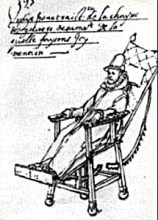
King Phillip's chair

King Phillip’s chair

In 1595, King Philip II of Spain was sketched sitting in a reclining chair with wheels on each leg. It was clunky and heavy, and he needed to be pushed around by a servant, but – hey – king, right?

Self-propelling chairs arrived remarkably quickly after that, unsurprisingly developed by someone who was himself in need of a chair. In 1655, Stephen Farfler, a paraplegic watchmaker, moved himself around in a chair with three wheels. He moved around by turning handles that worked on the geared front wheel.

Most of the sites I looked at when researching wheelchairs jump from Farfler to John Dawson of Bath. But wheelchairs – both ordinary chairs with wheels and more advanced chairs designed specifically to have wheels – continued right through.

And, in any case,  the Bath chair was invented around 1750 by James Heath.  Bath was becoming popular as a spa town, but it was not designed to easily get around in a carriage, and ordinary wheelchairs really only worked well on a flat surface such as inside the house.

Ad for the Bath Chair

The Bath chair was designed to take invalids out and about; primarily down to the Roman Baths for the treatment, and then back home again. Until then, invalids used the sedan chair, which required two attendants to carry. The Bath chair just needed one person at the back pushing. Furthermore, the occupant of the chair had the steering stick and could therefore directly control the direction of travel. I can see that would be appealing to the average wealthy dowager!

You can see from the advertisement that Heath also sold wheelchairs. The example shown appears to have wheels at the front and stabilising legs at the rear, so no doubt the attendant lifted slightly when he pushed.

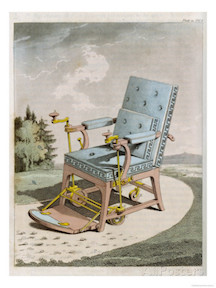
The Merlin chair

The Merlin chair

But the self-propelling chair had not gone away. John Joseph Merlin, a Belgian inventor and watchmaker (and, perhaps not incidentally the inventor of the in-line skate) created a successful chair that became the model for others. Keith Armstrong, in A very short history of the bicycle and wheelchair, says:

In the mid 1770’s he invented roller-skates and presented his new creation by arriving at a London party playing his violin whilst gliding around the room. Merlin received rapacious applause and an encore, the party-goers demanded that he repeated his act, during the second attempt, he quickly discovered that he didn’t known how to stop and he had a major accident. The next we read about him is of the invention of a new type of self-propelled wheelchair… His design was so successful that 120 years later, a London catalogue of medical equipment was able to boast nine different ‘Merlin’ wheelchairs available on their books. Merlin died in 1803.

As far as I can tell, the Merlin chair had small handles on its arms. But the name “Merlin chair” was retained for later chairs where the occupant was able to turn the large rear wheels to get around, and – by the late 19th century – the smaller propelling wheel had arrived, to help people keep their hands clean.

Meanwhile, back at the end of the 18th century, let’s not forget John Dawson. The most prominent Bath chair maker of his time, his chairs outsold everyone else’s. Since, by all accounts, they were not very comfortable, we must assume that the others were worse!

About Farewell to Kindness

farewell to kindness RGB2 copyFor three years, Rede has been searching for those who ordered the murders of his wife and children. Now close to end of his quest, he travels to his country estate to be close to the investigation.

He is fascinated by the lovely widow who lives in one of the cottages he owns. A widow who pays no rent. A widow, moreover, with a small daughter whose distinctive eyes mark her as as the child of his predecessor as Earl.

Six years ago, Anne blackmailed Rede’s predecessor at arrow-point for an income and a place to livein hiding from her guardian’s sinister plans for her and her sisters. He no longer has legal rights over her, but the youngest sister is still only 18. He cannot be allowed to find her.

Rede is everything she has learned not to trust: a man, a peer, a Redepenning. If he discovers who she is, she may lose everything.

To build a future together, Rede and Anne must be prepared to face their pasts.

Regency noir

US99c to 8 April 2015; USD3.49 from 9 April 2015

KoboiBooksBarnes & Noble • SmashwordsAmazon

Excerpt

George was drunk. But not nearly drunk enough. He still saw his young friend’s dying eyes everywhere. In half-caught glimpses of strangers reflected in windows along Bond Street, under the hats of coachmen that passed him along the silent streets to Bedford Square, in the flickering lamps that shone pallidly against the cold London dawn as he stumbled up the steps to his front door.

They followed his every waking hour: hot, angry, hate-filled eyes that had once been warm with admiration.

He drank to forget, but all he could do was remember.

One more flight of stairs, then through the half open door to his private sitting room, already reaching for the waiting decanter of brandy as he crossed the floor.

He had a glass of oblivion halfway to his lips before he noticed the painting.

It stood on an easel, lit by a carefully arranged tree of candles. George’s own face was illuminated—the golden shades of his hair, his intensely blue eyes. The artist had captured his high cheekbones and sculpted jaw. “One of London’s most beautiful men,” he’d been called.

He stalked to the easel, moving with great care to avoid spilling his drink.

Yes. The artist had talent. Who could have given him such a thing?

As he bent forward to look at it more closely, something whipped past his face. With a solid thunk, an arrow struck the painting, to stand quivering between the painted eyes.

Read the first three chapters here.

About the Author

Jude Knight copyJude Knight writes strong determined heroines, heroes who can appreciate a clever capable woman, villains you’ll love to loathe, and all with a leavening of humour.

TwitterFacebookBlog GoodreadsNewsletter


Caroline Warfield: Dangerous Secrets

Bluestocking-Belles-logo-01

A Hearty Welcome to Fellow Bluestocking Belle

Caroline Warfield

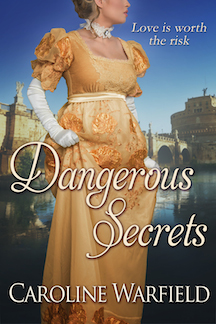
DangerousSecrets_600x900 copy

Giveaway!

Win the right to name characters in an as yet unwritten novella plus an Amazon gift card. Dangerous Secrets Blog Tour 2015 

About Dangerous Secrets

Rome 1820

Major Lord James Heyworth fled to Rome. Behind him lie disgrace, shame, and secrets he is desperate to keep even from powerful friends in London. He accepts employment as an interpreter just to have money to eat. Nora Haley, his employer, is a widow. She came to Rome to help her dying brother and protect his daughter. She can’t trust any man who drinks. She had enough of that in her marriage. She fears deception will destroy everything she desires. Either one, however, will dare anything for the tiny girl in their care. They will even enter a sham marriage to protect her. Will love—and the truth—bind them both together?

Jamie Quizzes His Employer

Early in DANGEROUS SECRETS Jamie Heyworth finds himself curious about the energetic little woman who has hired him to be her interpreter. He is happy to let her buy lunch, (he hasn’t eaten regularly in recent weeks) but he’s puzzled. He can’t figure out why the fool woman is alone in a foreign country to begin with. A little food loosens his tongue and he startles her by speaking into an uncomfortably long silence.

corotstbartbridge182528 copy

Saint Bartholomew Bridge, 1825, by Jean-Baptiste Corot (Wikipedia Commons)

 Excerpt

“You are alone here.” His sudden words proved her wrong. He hadn’t forgotten.

“Aside from Robert.”

“Robert?” he asked.

“My brother.”

“I’m confused. If your brother is here, why can’t he interpret for you?”

“Robert is ill, in the hospital. I have to act for him,” she explained.

“But you came here on your own. Your father permitted such a thing?” he probed.

He reached for another roll. When did this impertinent man eat last?

“My father couldn’t—no, wouldn’t—come when Robert wrote asking for help,” she explained. “He sent me as his surrogate.”

“So he ordered you to come a thousand miles alone to lecture his son on the error of his ways?” the major asked in between bites.

“Not ordered! Permitted. He has his parish to shepherd. Who could have come with me?” Her father actually tried to stop her, but she left for Rome on her own. The memory made her temper snap. “I’m no schoolroom miss. I can take care of myself,” she insisted.

“You’ve managed without difficulty?” The major looked skeptical.

“Yes!” Nora knew she answered too quickly.

The major raised an eyebrow, and she felt her face warm. My troubles with the ship and the sailors are none of his business. I managed them.

“Language is a barrier,” she admitted, but he knew that much already. “That’s why I hired you. Difficulties have been trivial. Robert’s man of business found me rooms and managed to convey me there with signs and gestures. The landlady . . .” She hesitated.

“Landlady?” he prompted.

“Speaks broken English. She tried to make me uneasy. She claimed there were men lurking at the door, but I think she just wanted me to hire a relative as a guide. I refused.”

His deep brown eyes widened when she mentioned lurking strangers, but he said only, “Wise. You wouldn’t want a guide you don’t understand. Didn’t your father think you would need protection?”

“He assumes my virtue to be its own shield! His widowed daughter—plain and practical Eleanora—wouldn’t need protection.” The words tasted as bitter in her mouth as the Italian coffee.

The major, to his credit, ignored that outburst. Instead he asked, “Wasn’t he concerned about his granddaughter?”

Nora felt her heart stutter. She took a deep breath before answering. “He doesn’t know about her.”

The major looked puzzled, waiting for more. Desire to protect Robert’s privacy warred with urge to confide in someone. As her interpreter, he would find out soon enough.

“My niece is Italian,” she began, “and Catholic. Robert kept his marriage secret.”

The shabby major appeared to think that over. “What will your father do with an Italian granddaughter?” he asked at last.

“Deny her. Force conversion. God knows, but it wouldn’t be pleasant. Robert must protect her from that.”

“Does your brother wish her to live in England?”

“Not in Dorset, not near Father. Perhaps in Italy, but he wishes more for her than the convent school.” Nora knew that much with certainty.

“And her Italian relatives?” he asked.

Nora shrugged. “I don’t know. My late, heretofore unknown sister-in-law was an orphan but from a large extended family.” Robert had once implied there was more, but Nora didn’t know any names or places. “What they wish is unknown to me,” she said.

“Would they take the child in? That would solve your problems,” he suggested.

“Robert seems reluctant about that. He hasn’t said why. I think he wants to make sure someone he trusts will see that she is loved, as well as cared for.” When Robert first told her about the girl, Nora had warmed at the thought of having a child to care for. Now she vacillated between hope and fear, neither of which accomplished anything useful. This shabby major doesn’t need to know my pathetic hopes.

The major’s thick brown lashes veiled his eyes as well as he veiled his thoughts. “Are your brother’s wishes in writing?” he asked.

“I don’t know. He pressed a scrap of foolscap into my hand the first day.” She rummaged in her reticule. “It has an Italian name on it. He said that if he died I should contact this man.” She held out the foolscap for him to see.

“Putting you at the mercy of another Italian,” he mumbled, taking the foolscap. The major looked at the name and cursed softly. “And a high class one at that.”

AmazonAmazon.ukAmazon.caAmazon.de

About the Author

Carol Roddy - AuthorCaroline Warfield has at various times been an army brat, a librarian, a poet, a raiser of children, a nun, a bird watcher, an Internet and Web services manager, a conference speaker, an indexer, a tech writer, a genealogist, and, of course, a romantic. She has sailed through the English channel while it was still mined from WWII, stood on the walls of Troy, searched Scotland for the location of an entirely fictional castle (and found it), climbed the steps to the Parthenon, floated down the Thames from the Tower to Greenwich, shopped in the Ginza, lost herself in the Louvre, gone on a night safari at the Singapore zoo, walked in the Black Forest, and explored the underground cistern of Istanbul. By far the biggest adventure has been life-long marriage to a prince among men.

She sits in front of a keyboard at a desk surrounded by windows, looks out at the trees and imagines. Her greatest joy is when one of those imaginings comes to life on the page and in the imagination of her readers.

 WebsiteFacebookTwitterEmail

LibraryThingAmazon AuthorGoodreadsPinterest

Bluestocking Belles

Caroline Warfield: Dangerous Works

giveaway

Caroline  is offering a choice of Her Very Major Christmas by Saralee Etter or The Earl’s Christmas Delivery by Susan Gee Heino. Click here for the Rafflecopter.

Discovered in the papers of Andrew Mallet

Notes from my interview with Georgiana Hayden who, though she has hired me to tutor her, persists in being disagreeably autocratic about the work.

Summer, 1816

Cambridge, England

 AM: What on earth made you think you could approach the authorities about access to the library at Magdalene College, that bastion of male superiority?

GH:   How else am I to get the information I need for my work?

AM:   You must have had a maggot in your brain if you thought Watterson would tutor you.

GH:   I hoped interest in the work would draw him. He dismissed the women’s poems as “worthless, minor at best.”

Interviewer note: The daft woman walked right into humiliation. Alphaeus Watterson is a pompous old windbag treats the college as a private fiefdom and delights in cutting down students. He wouldn’t know good work if it bit him in the arse.

AM: How did you come to start this work that means so much to you?

GH: I found the poems of Nossis of Locri quite unexpectedly in the Anthologia Graeca.

AM: Did you actually own a copy of the Greek Anthology?

GH: Not then.

AM: Unusual reading for a woman. Some would call it peculiar. Your mother cannot have been pleased. I can’t believe she would have permitted you to own a book in Greek.

Interviewer’s note: Some would have perhaps, but not her dragon of a mother. I should know. I gave Georgiana her first Greek text when we were in our teens. She hid it behind the palms in her father’s conservatory.

GH: Of course not. She didn’t catch me reading it either.

AM: Where did you find it then?

GH: We were at the house party in the country house of a famous antiquarian. I spent my time in his library. The discovery rocked my world. The inclusion of poems by a woman shocked me. I thought that if she could write them, I could translate them. I never went back. Collecting and translating those poems gave shape to my life ever after.

AM: How many years ago was this?

GH: Six months and fourteen days after you left me waiting in my father’s drawing room for you to call.

Interviewers note: I will not discuss what happened eleven years ago. After fruitless attempts on her part to question me about it, we returned to the work.

AM: Where did you find the other poets?

GH: Here and there. Some simply quoted in books by men. Some in fragments in anthologies. They hide in plain site.

AM: Why is this work so important to you?
GH: I am enraged that they hide, that they aren’t studied as much as Pindar and the other men, that their voices are suppressed, that—

Interviewer’s note: She went on at length and became quite agitated. Georgiana in righteous rage is glorious to behold, but I digress.

AM: You know Greek. What do you want from me?

Interviewer’s note: The look of yearning on her face in response put us on dangerous ground. I rephrased my question.

AM: That is to say, what is it you want me to teach you, about Greek?

GH: It isn’t enough to uncover the literal meaning of words. To do more, I need to know about their world, their lives, and the things female education never teaches. I don’t want these poems to plod along. I want them to sing!

Interviewer’s note: There’s more to understanding love poetry than Greek culture. I fear we will discover how much together.

About Dangerous Works

Lady Georgiana Hayden has struggled for years to do scholarly work in the face of constant opposition and even outright derision from the scholarly community at Cambridge. Her family ignores her as long as she doesn’t draw attention to herself.

DangerousWorks_600x900 copyA little Greek is one thing; the art of love is another. Only one man ever tried to teach Georgiana both. She learned very young to keep her heart safe. She learned to keep loneliness at bay through work. If it takes a scandalous affair to teach her what she needs to complete her work, she will risk it. If the man in question chooses not to teach her, she will use any means at her disposal to change his mind. She is determined to give voice to the ancient women whose poetry has long been neglected.

Some scars cut deeper than others. Major Andrew Mallet returns to Cambridge a battle scarred hero. He dared to love Georgiana once and suffered swift retribution from her powerful family. The encounter cost him eleven years of his life. Determined to avoid her, he seeks work to heal his soul and make his scholar father proud. The work she offers risks his career, his peace of mind, and (worst of all) his heart.

Andrew and Georgiana battle their way through the work to a fragile partnership. Even poetry, with its musical lyrics and sensual traps, can be dangerous when you partner with the love of your life. In Regency Cambridge it can lead a lady quickly past improper to positively scandalous.

Amazon

Excerpt

Georgiana attempted to make her work, as always, her sturdy bulwark against the blows of life. This time, the work only added to her emotional vortex. She read the epigrams with new eyes, and what she found there disturbed her. “Erotos” she knew meant love, certainly, and romantic love at that. How should I translate this line? she wondered.

“‘Nothing is sweeter than love.’”

“‘Nothing is sweeter than Eros.’” In English the meaning tilted slightly with the change of wording. The next phrase appeared to be about delight or pleasure.

“Definitely Eros,” she said to the empty room. Whatever it is, Nossis prefers it to honey. Yesterday, Georgiana wouldn’t have understood. Love has a taste; she knew that now. She recalled the feel of Andrew’s mouth on hers, and the taste when he opened and let her explore. The taste was sweeter than honey, indeed. She felt warmth rise again deep within her. Heat colored her neck and pooled deep in her belly.

The words of Nossis hadn’t changed since yesterday, but Georgiana had.

About the Author

Carol Roddy - AuthorCaroline Warfield has at various times been an army brat, a librarian, a poet, a raiser of children, a nun, a bird watcher, an Internet and Web services manager, a conference speaker, an indexer, a tech writer, a genealogist, and, of course, a romantic. She has sailed through the English channel while it was still mined from WWII, stood on the walls of Troy, searched Scotland for the location of an entirely fictional castle (and found it), climbed the steps to the Parthenon, floated down the Thames from the Tower to Greenwich, shopped in the Ginza, lost herself in the Louvre, gone on a night safari at the Singapore zoo, walked in the Black Forest, and explored the underground cistern of Istanbul. By far the biggest adventure has been life-long marriage to a prince among men.

She sits in front of a keyboard at a desk surrounded by windows, looks out at the trees and imagines. Her greatest joy is when one of those imaginings comes to life on the page and in the imagination of her readers.

 FacebookWebsiteTwitterPinterest