Archives

Romance of London: Bartholomew Fair

Romance of London: Strange Stories, Scenes And Remarkable Person of the Great Town in 3 Volumes

John Timbs

John Timbs (1801-1875), who also wrote as Horace Welby, was an English author and aficionado of antiquities. Born in Clerkenwell, London, he was apprenticed at 16 to a druggist and printer, where he soon showed great literary promise. At 19, he began to write for Monthly Magazine, and a year later he was made secretary to the magazine’s proprietor and there began his career as a writer, editor, and antiquarian.

This particular book is available at googlebooks for free in ebook form. Or you can pay for a print version.

The vow of a jester

Rahere_Jester_to_Henry_1st

Rahere, jester to King Henry I

This famous Fair, formerly held every year in Smithfield, at Bartholomewtide [August 24], and within the precinct of the Priory of St. Bartholomew, originated in a grant of land from Henry I., to his jester Rahere, who, disgusted by his manner of living, repented him of his sins, and undertook a pilgrimage to Rome. Here, attacked by sickness, he made a vow, that if he recovered his health, he would found a hospital for poor men. Being reinstated, and on his return to England to fulfill his promise, St. Bartholomew is said to have appeared to him in a vision, and commanded him to found a Church in Smithfield, in his name… The site, which had been previously pointed out in a singular manner to Edward the Confessor, as proper for a house of prayer, was a mere marsh, for the most part covered with water; while on that portion which was not so, stood the common gallows—”the Elms,” in Smithfield, which for centuries after continued to be the place of execution.

The Bartholomew Fair

St. Bartholomew's Church

St. Bartholomew’s Church

The Priory, however, looked to temporal as well as spiritual aid, for his foundation; and therefore, obtained a royal charter to hold a Fair annually at Bartholomewtide, for three days—on the eve, the fête-day of the saint, and the day after; “firm peace,” being granted to all persons frequenting the Fair of St. Bartholomew. This brought traders from all parts, to Smithfield: thither resorted clothiers and drapers, not merely of England, but all countries, who there exposed their goods for sale. The stalls or booths were erected within the walls of the priory churchyard, the gates of which were locked each night, and a watch was set in order to protect the various wares…
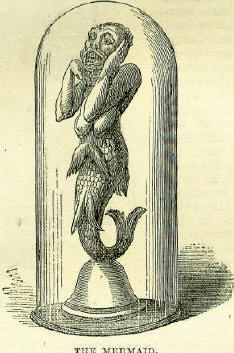
murmaid

At the dissolution of religious houses, the privilege of the Fair was in part transferred to the Mayor and Corporation; and in part to Richard Rich, Lord Rich, who died in 1560, and was ancestor of the Earls of Warwick and Holland. It ceased, however to be a cloth fair of any great importance in the reign of Queen Elizabeth. The drapers of London found another and more extensive market for their woolens; and the clothiers, in the increase of communication between distant places, a wider field for the sale of their manufactures. It subsequently became a Fair of a very diversified character. Monsters, motions, rolls, and rarities were the new attractions to be seen; and the Fair was converted into a kind of London carnival for persons of every condition and degree of life. The Fair was proclaimed by the Lord Mayor, beneath the entrance arch of the priory; and its original connexion with the cloth trade was commemorated in a mock proclamation on the evening before, made by a company of drapers and tailors, who met at the Hand and Shears, a house of call for their fraternity in Cloth Fair, whence they marched and announced the Fair opened and concluded with shouting and the “snapping of shears.”

With respect to the tolls, Strype tells us that “Each person having a booth, paid so much per foot for the first three days. The Earl of Warwick and Holland is concerned in the toll gathered the first three days in the fair, being a penny for each burthen of good brought in or carried out; and to that end there are persons that stand at all the entrances into the Fair…

bartholomewfairup

The Fair lengthens to fourteen days

“In the reign of Charles II., as might be expected, the Fair was extended from three to fourteen days, when all classes, high and low, visited the carnival.” Pepys mentioned walking up and down the fair grounds on August 30, 1667, and discovering Lady Castlemaine at a puppet-play, “and the street full of people, expecting her coming out.” In 1668, Pepys went to the fair “to see the mare that tells money, and many things to admiration, and then the dancing of the ropes, and also the Irish stage play, which is very ridiculous.”
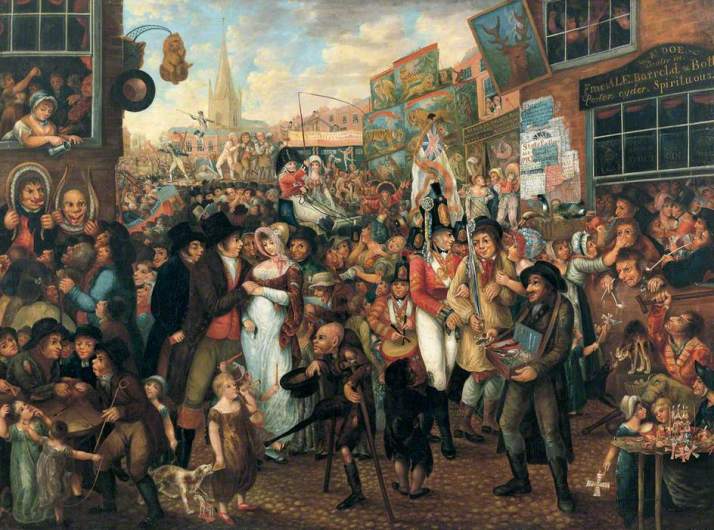
(c) Dover Collections; Supplied by The Public Catalogue Foundation

(c) Dover Collections; Supplied by The Public Catalogue Foundation

Theatrical booths were very popular. “Ben Jonson, the actor (says Dr. Rimbault), was connected with the booth before 1694, in which year he joined Cibber’s company; he was celebrated as the grave-digger in Hamlet…

Here were motions or puppet-shows of Jerusalem, Nineveh, and Norwich; and the Gunpowder Plot played nine times in an afternoon; wild beasts, dwarfs, and other monstrosities; operas and tight-rope-dancing and sarabands [dances]; dogs dancing the morris; the hare beating the tabor; and rolls of every degree.
Bartholomew Fair 1825

Bartholomew Fair 1825

From a newspaper in 1734:

At Goodwin’s Large Theatrical Booth, opposite the White Hart, in West Smithfield, near Cow Lane, the town will be entertained with a humorous Comedy of three acts, called ‘The Intriguing Footman, or the Spaniard Outwitted;’ with a Pantomime entertainment of Dancing, between a Soldier and a Sailor, and a Tinker and a Tailor, and Buxom Joan of Deptford.

At Hippisley and Chapman’s Great Theatrical Booth, in the George Inn Yard, Smithfield, the town will be humorously diverted with an excellent entertainment; Signor Arthurian, who has a most surprising talent at grimace, and will, on this occasion, introduce upwards of fifty whimsical, sorrowful, comical, and diverting faces.”

The fourteen days were found too long, for the excesses committed were very great; and in the year 1708, the period of the Fair was restricted to its old duration of three days.
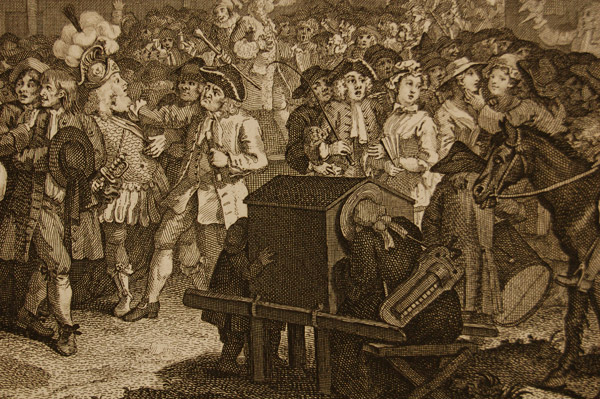
Hogarth 1733

Hogarth 1733

Three days of revelry

The influence of the fair in the neighborhood was to make general holiday… We read that in Little Britain, “during the time of the Fair, there was nothing going on but gossiping and gadding about. The still quiet streets of Little Britain were overrun with an irruption of strange figures and faces; every tavern was a scene of rout and revel. The fiddle and the song are heard from the taproom, morning, noon, and night; and at each window might be seen some group of loose companions, with half-shut eyes, hats on one side, pipe in mouth, tankard in hand, fondling, and prosing, and singing maudlin songs over their liquor. Even the sober decorum of private families was no proof against this saturnalia. There was no such thing as keeping maid-servants within doors. Their brains were absolutely set maddening with Punch and the puppet-show; the flying horses; Signior Polito; the Fire-eater, the celebrated Mr. Paap; and the Irish Giant. The children, too, lavished all their holiday-money in toys and gilt gingerbread, and filled the house with the Lilliputian din of drums, trumpets, and penny whistles.”
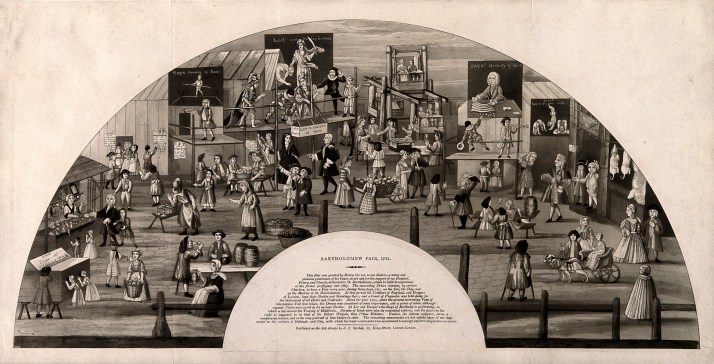
V0014666 Bartholomew Fair, site of St. Bartholomew's Hospital, London Credit: Wellcome Library, London. Wellcome Images images@wellcome.ac.uk http://wellcomeimages.org Bartholomew Fair, site of St. Bartholomew's Hospital, London, pictured in 1721. Aquatint with etching, c. 1800. Published: - Copyrighted work available under Creative Commons Attribution only licence CC BY 4.0 http://creativecommons.org/licenses/by/4.0/

Bartholomew Fan

The end of Bartholomew Fair

The Lord Mayor and Aldermen had, for 300 years, tried by orders, proclamations, juries, and presentments to abolish the Fair, but without effect; when the Court of Common Council took the work in hand. Having obtained entire control over the Fair by the purchase of Lord Kensington’s interest, they refused to let standings for shows and booths; they prevailed upon the Lord Mayor and Sheriffs to give up the practice of going to open the Fair in state, with a herald to proclaim it, and officers to marshal the procession; the posting of the proclamation about the streets, interdicting rioting and debauchery during the days of the Fair and within its precincts, were discontinued… In 1852, not a single show was to be seen on the ground; and in 1855 the Fair expired… and Bartholomew Fair was extinct.

Author’s Note: I’m thinking of having my Regency characters attend the fair, even though it was rather scandalous. What do you think?

Bartholomew-Fair

Romance of London Series

  1. Romance of London: The Lord Mayor’s Fool… and a Dessert
  2. Romance of London: Carlton House and the Regency
  3. Romance of London: The Championship at George IV’s Coronation
  4. Romance of London: Mrs. Cornelys at Carlisle House
  5. Romance of London: The Bottle Conjuror
  6. Romance of London: Bartholomew Fair
  7. Romance of London: The May Fair and the Strong Woman
  8. Romance of London: Nancy Dawson, the Hornpipe Dancer
  9. Romance of London: Milkmaids on May-Day
  10. Romance of London: Lord Stowell’s Love of Sight-seeing
  11. Romance of London: The Mermaid Hoax
  12. Romance of London: The Bluestocking and the Sweeps’ Holiday
  13. Romance of London: Comments on Hogarth’s “Industries and Idle Apprentices”
  14. Romance of London: The Lansdowne Family
  15. Romance of London: St. Margaret’s Painted Window at Westminster
  16. Romance of London: Montague House and the British Museum
  17. Romance of London: The Bursting of the South Sea Bubble
  18. Romance of London: The Thames Tunnel
  19. Romance of London: Sir William Petty and the Lansdowne Family
  20. Romance of London: Marlborough House and Sarah, Duchess of Marlborough
  21. Romance of London: The Duke of Newcastle’s Eccentricities
  22. Romance of London: Voltaire in London
  23. Romance of London: The Crossing Sweeper
  24. Romance of London: Nathan Mayer Rothschild’s Fear of Assassination
  25. Romance of London: Samuel Rogers, the Banker Poet
  26. Romance of London: The Eccentricities of Lord Byron
  27. Romance of London: A London Recluse

Romance of London: The Bottle Conjuror

Romance of London: Strange Stories, Scenes And Remarkable Person of the Great Town in 3 Volumes

John Timbs

John Timbs (1801-1875), who also wrote as Horace Welby, was an English author and aficionado of antiquities. Born in Clerkenwell, London, he was apprenticed at 16 to a druggist and printer, where he soon showed great literary promise. At 19, he began to write for Monthly Magazine, and a year later he was made secretary to the magazine’s proprietor and there began his career as a writer, editor, and antiquarian.

This particular book is available at googlebooks for free in ebook form. Or you can pay for a print version.

A “foolish experiment on the credulity of the public”

2nd Duke of Montagu

2nd Duke of Montagu

The Duke of Montague being in company with some other noblemen, proposed a wager, that let a man advertise to do the most impossible thing in the world, he would find fools enough in London to fill a playhouse, who would think him in earnest. “Surely,” said Lord Chesterfield, “if a man should say that he would jump into a quart bottle, nobody would believe that!” The Duke was somewhat staggered; but for the sake of the jest, determined to make experiment. Accordingly it was advertised that the next day, (Jan. 10, 1749,) a person would, at the Haymarket Theatre, “play on a common walking-cane the music of every instrument then used, to surprising perfection; that he would, on the stage, get into a tavern quart bottle, without equivocation, and while there, sing several songs, and suffer any spectator to handle the bottle; that if any spectator should come masked, he would, if requested, declare who he was; and that, in a private room, he would produce the representation of any person, dead, with which the person requesting it should converse some minutes, as if alive.” The prices of admission were—gallery, 2s; pit, 3s; boxes, 5s; stage, 7s. 6d.

Haymarket Theater

Haymarket Theater

4th Earl of Chesterfield

4th Earl of Chesterfield

At night the house was crowded with curious people, many of them of the highest rank, including no less eminent a person than the Culloden Duke of Cumberland. They sat for a little while with tolerable patience, though uncheered with music; but by-and-by, the performer not appearing, signs of irritation were evinced. In answer to the continued noise of sticks and catcalls, a person belonging to the theatre came forward and explained that, in the event of a failure of performance, the money should be returned. A wag then cried out, that, if the ladies and gentlemen would give double prices, the conjuror would go into a pint bottle, which proved too much for the philosophy of the audience. A young gentleman threw a lighted candle upon the stage, and a general charge upon that part of the house followed. According to a private letter—it was written by a Scotch Jacobite lady—”Cumberland was the first that flew in a rage, and called to pull down the house… He drew his sword and was in such a rage, that somebody slipped in behind him and pulled the sword out of his hand, which was as much as to say, ‘Fools should not have chopping sticks.’ This sword of his has never been heard of, nor the person who took it. Thirty guineas of reward are offered for it. Monster of Nature, I am sure I wish he may never get it.

Haymarket Theater

Haymarket Theater

At that point, most of the audience charged out of the theater, losing items of clothing in the process, but a few stayed long enough to demolish the inside and take away much of the furnishings for a bonfire on the street.

Cumberland-Reynolds

Duke of Cumberland, younger son of George II (and of Culloden fame)


The proprietor of the theatre afterwards stated that, in apprehension of failure, he had reserved all the money taken, in order to give it back; and he would have returned it to the audience if they would have refrained from destroying his house.

The Bottle-hoax proved an excellent subject for the wits, particularly those of the Jacobite party. In Old England appeared this advertisement: “Found entangled in a slit of a lady’s demolished smock petticoat, a gilt-handled sward of martial temper and length, not much the worse of wearing, with the Spey curiously engraven on one side, and the Scheldt on the other; supposed to be taken from the fat sides of a certain great general in his hasty retreat from the Battle of Bottle Noddles, in the Haymarket. Whoever has lost it may inquire for it at the sign of the Bird and Singing Land, in Rotten Row.”

Romance of London Series

  1. Romance of London: The Lord Mayor’s Fool… and a Dessert
  2. Romance of London: Carlton House and the Regency
  3. Romance of London: The Championship at George IV’s Coronation
  4. Romance of London: Mrs. Cornelys at Carlisle House
  5. Romance of London: The Bottle Conjuror
  6. Romance of London: Bartholomew Fair
  7. Romance of London: The May Fair and the Strong Woman
  8. Romance of London: Nancy Dawson, the Hornpipe Dancer
  9. Romance of London: Milkmaids on May-Day
  10. Romance of London: Lord Stowell’s Love of Sight-seeing
  11. Romance of London: The Mermaid Hoax
  12. Romance of London: The Bluestocking and the Sweeps’ Holiday
  13. Romance of London: Comments on Hogarth’s “Industries and Idle Apprentices”
  14. Romance of London: The Lansdowne Family
  15. Romance of London: St. Margaret’s Painted Window at Westminster
  16. Romance of London: Montague House and the British Museum
  17. Romance of London: The Bursting of the South Sea Bubble
  18. Romance of London: The Thames Tunnel
  19. Romance of London: Sir William Petty and the Lansdowne Family
  20. Romance of London: Marlborough House and Sarah, Duchess of Marlborough
  21. Romance of London: The Duke of Newcastle’s Eccentricities
  22. Romance of London: Voltaire in London
  23. Romance of London: The Crossing Sweeper
  24. Romance of London: Nathan Mayer Rothschild’s Fear of Assassination
  25. Romance of London: Samuel Rogers, the Banker Poet
  26. Romance of London: The Eccentricities of Lord Byron
  27. Romance of London: A London Recluse

Romance of London: Mrs. Cornelys at Carlisle House

Romance of London: Strange Stories, Scenes And Remarkable Person of the Great Town in 3 Volumes

John Timbs

John Timbs (1801-1875), who also wrote as Horace Welby, was an English author and aficionado of antiquities. Born in Clerkenwell, London, he was apprenticed at 16 to a druggist and printer, where he soon showed great literary promise. At 19, he began to write for Monthly Magazine, and a year later he was made secretary to the magazine’s proprietor and there began his career as a writer, editor, and antiquarian.

This particular book is available at googlebooks for free in ebook form. Or you can pay for a print version.

Mrs. Cornelys at Carlisle House

Teresa Cornelys - Carlisle House Soho

Teresa Cornelys at Carlisle House, Soho

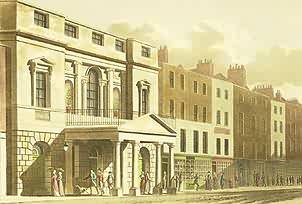
Teresa, by birth a German, and during man-years a public singer in Italy and Germany, settled in London about the year 1756, and for twenty years entertained “the votaries of fashion of both sexes” with great success. For this purpose Mrs. Cornelys obtained possession of Carlisle House, in Soho Square, formerly the mansion of the Earl of Carlisle.

Carlisle House

View of Soho Square and Carlisle House

View of Soho Square and Carlisle House

Carlisle House was of considerable extent: the Catholic chapel in Sutton Street was the banqueting-room, and the connecting passage between it and the house in Soho Square was called “the Chinese Bridge.” The arched entrance below the chapel was exclusively for chairs or sedans.

Mrs. Cornelys's assembly room at Carlisle House

Mrs. Cornelys’s assembly room at Carlisle House

The Antecedent of Almack’s?

TICKET

The nobility and gentry had the entrée of Carlisle House by payment of an annual subscription, for which they received a ticket of admission to all entertainments given there. They had the privilege of lending their tickets to friends, provided they wrote “the name of the person upon the back of the said ticket to whom they have lent it, to prevent any mistake.” Mrs. Cornelys had great success; but she had her troubles in powerful competitors; for we find her issuing this advertisement: “Whereas, it is been industriously reported, to the disadvantage of Mrs. Cornelys, that she has expressed herself dissatisfied with a subscription now on foot to build a large room in opposition to her; she esteems it her duty, in this public manner, to declare that she never once entertained a thought so unjust and unreasonable…” The “large room” here referred to in opposition is thus referred to by Horace Walpole, in a letter dated Dec. 16, 1764: “Mrs. Cornelys, apprehending the future assembly at Almack’s, has enlarged her vast room, and hung it with blue satin, and other with yellow satin; but Almack’s room, which is to be 90 feet long, proposes to swallow up both hers, as easily as Moses’s rod gobbled down those of the magician’s.” However, Mrs. Cornelys made additions to Carlisle House, with new embellishments, furniture, and decorations, which in the year 1765 cost some 2,000l… in consequence of which she was compelled to charge subscribers an additional guinea.

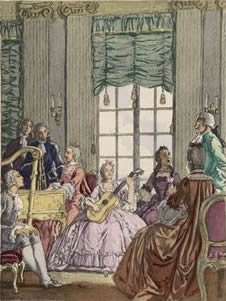
A musical evening at Carlisle House

A musical evening at Carlisle House

The ball on Feb. 26, 1770

…Mrs. Cornelys gave a magnificent fête to some 800 maskers. Walpole devotes great part of a long letter to a description of this masquerade, at which he was present.

Our civil war has been lulled asleep by a Subscription Masquerade, for which the House of Commons literally adjourned yesterday. Instead of Fairfax’s and Cromwells, we have had a crowd of Henry the Eighths, Wolseys, Vandykes, and Harlequins; and because Wilkes was not mask enough, we had a man dressed like him, with a visor in imitation of his squint, and a Cap of Liberty on a pole… The ball was last night at Soho; and, if possible, was more magnificent than the King of Denmark’s…

…The mob was beyond all belief: they held flambeaux to the windows of every coach and demanded to have the masks pulled off and put on at their pleasure, but with extreme good humor and civility. I was with my Lady Hertford and two of her daughters in her coach: the mob took me for Lord Hertford, and huzzaed and blessed me! One fellow cried out, “Are you for Wilkes?” Another said, “D—n you, you fool, what has Wilkes to do with a masquerade?”

Among the company were Lady Waldegrave, Lady Pembroke, the Duchess of Hamilton, Mrs. Crewe, Mrs. Hodges, Lady Algeria Carpenter, &c. The characters assumed were very eccentric. Sir R. Phillips appeared as “a double man,” half-miller, half chimney-sweeper. The Earl of Carlisle figured as a running footman; Mr. James, the painter, as Midas. The Duke of Devonshire was “very fine, but in no particular character.” And “Lord Edg—b, in the character of an old woman, was full as lovely as his lady.” The ladies were superbly dressed. “The Countess Dowager of Waldegrave wore a dress richly trimmed with beads and pearls, in the character of Jane Shore.” “The Duchess of Bolton, in the character of Diana, was captivating.” “Lady Stanhope, as Melpomene, was a striking fine figure.” “Lady August Stuart, as a Vestal, and Lady Caroline as a Fille de Patmos, showed that true elegance may be expressed without gold and diamonds.” “The Countess of Pomfret, in the character of a Greek Sultana, and the two Miss Fredericks, who accompanied her, as Greek slaves, made a complete group;” and to eclipse all, “Miss Moncton, daughter to Lord Galway, appeared in the character of an Indian Sultana, in a robe of cloth of gold and a rich veil. The seams of her habit were embroidered with precious stones, and she had a magnificent cluster of diamonds on her head: the jewels she wore were valued at 30,000l.”

BIGAMOUS DUCHESS OF CHUDLEIGH

The Bigamous Duchess of Kingston

An “opera strife” leads to bankruptcy

In the following year, 1771, Mrs. Cornelys got embroiled in an opera strife. Walpole writes, Feb. 22, 1771: “Our most serious war is between two Operas. Mr. Hobart, Lord Buckingham’s brother, is manager of the Haymarket. Last year he affronted Guadagni, by preferring the Zamperina, his own mistress, to the singing hero’s sister. The Duchess of Northumberland, Lady Harrington, and some of the great ladies, took up the brother, and without a license erected an opera for him at Madame Cornelys’s… Mr. Hobart began to starve, and the managers of the theatre were alarmed. To avoid the Act, she pretended to take no money, and had the assurance to advertise that the subscription was to provide coals for the poor, for she has vehemently courted the mob, and succeed in gaining their princely favour. She then declared her masquerades were for the benefit of commerce.… At last, Mr. Hobart informed against her, and the Bench of Justices, have pronounced against her. Her opera is quashed, and Guadagni… is not only fined, but was threatened to be sent to Bridewell.

Mrs. Cornelys’s masquerades were characterized not only by indecency, but also by mockery of solemn feelings and principles… The lessees of the theatre, injured by her popularity, opposed her; and she was convicted before Sir John Fielding for performing dramatic entertainments without a license.… Next, bills of indictment were preferred to the grand jury, insinuating of Mrs. Cornelys “that she does keep and maintain a common disorderly house, and did permit and suffer diverse loose, idle, and disorderly persons, as well men as women, to be and remain the whole night, rioting and otherwise misbehaving themselves.” In November following, appeared in the bankrupt list of the London Gazette, “Teresa Cornelys, Carlisle House, St. Anne, Soho, dealer.”

Pantheon_from_Papworth's_Select_Views_1816

The Pantheon, one of the competitors of Mrs. Cornelys’s that eventually caused her downfall

Mrs. Cornelys’s last stand

Nevertheless, Mrs. Cornelys resumed her revels here with great spirit in 1776. Two years later, Carlisle House was again advertised to be sold by private contract…

…Mrs. Cornelys attempted to retrieve her fortunes in various places; one being in a large detached mansion, known as Knightsbridge Grove, in Porter’s Lane, approached through a fine avenue of trees from the highway. At length, in 1785, Mrs. Cornelys gave up her precarious trade. “Ten years after,” says Davis’s Memorials of Knightsbridge, “to the great surprise of the public, she reappeared at Knightsbridge as Mrs. Smith, a retailer of asses’ milk. A suite of breakfast-rooms was opened; but her former influence could not be recovered.” The speculation failed; and at length she was confined in the Fleet Prison, where she died August 19, 1797.

In the literature of the day

Murphy, in his Epilogue to Zobeide, 1771, refers to her popularity:

Oh farewell!

For her each haunt that charms a modern belle!

Adieu, Almack’s! Cornelys! Masquerade!

Sweet Ranelagh! Vauxhall’s enchanting shade!

Combe, in his satire, The Diobalady, 1777, thus severely castigates the licentiousness of the amusements:

The ready ministers of hell’s commands, Obedient, fly and take their several stands

At Court,  Cornelys’, and the Coterie;

Where vice, more vicious by effrontery,

Fearless, unblushing, braves the eternal laws

Of God and man, to aid the devil’s cause.

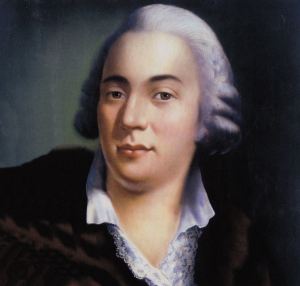
Note: Teresa Cornelys was one of the mistresses of the famous lover, Casanova, to whom she bore a child.

casanova-tour

Giacomo Girolamo Casanova


Romance of London Series

  1. Romance of London: The Lord Mayor’s Fool… and a Dessert
  2. Romance of London: Carlton House and the Regency
  3. Romance of London: The Championship at George IV’s Coronation
  4. Romance of London: Mrs. Cornelys at Carlisle House
  5. Romance of London: The Bottle Conjuror
  6. Romance of London: Bartholomew Fair
  7. Romance of London: The May Fair and the Strong Woman
  8. Romance of London: Nancy Dawson, the Hornpipe Dancer
  9. Romance of London: Milkmaids on May-Day
  10. Romance of London: Lord Stowell’s Love of Sight-seeing
  11. Romance of London: The Mermaid Hoax
  12. Romance of London: The Bluestocking and the Sweeps’ Holiday
  13. Romance of London: Comments on Hogarth’s “Industries and Idle Apprentices”
  14. Romance of London: The Lansdowne Family
  15. Romance of London: St. Margaret’s Painted Window at Westminster
  16. Romance of London: Montague House and the British Museum
  17. Romance of London: The Bursting of the South Sea Bubble
  18. Romance of London: The Thames Tunnel
  19. Romance of London: Sir William Petty and the Lansdowne Family
  20. Romance of London: Marlborough House and Sarah, Duchess of Marlborough
  21. Romance of London: The Duke of Newcastle’s Eccentricities
  22. Romance of London: Voltaire in London
  23. Romance of London: The Crossing Sweeper
  24. Romance of London: Nathan Mayer Rothschild’s Fear of Assassination
  25. Romance of London: Samuel Rogers, the Banker Poet
  26. Romance of London: The Eccentricities of Lord Byron
  27. Romance of London: A London Recluse

Romance of London: The Championship at George IV’s Coronation

Romance of London: Strange Stories, Scenes And Remarkable Person of the Great Town in 3 Volumes

John Timbs

John Timbs (1801-1875), who also wrote as Horace Welby, was an English author and aficionado of antiquities. Born in Clerkenwell, London, he was apprenticed at 16 to a druggist and printer, where he soon showed great literary promise. At 19, he began to write for Monthly Magazine, and a year later he was made secretary to the magazine’s proprietor and there began his career as a writer, editor, and antiquarian.

This particular book is available at googlebooks for free in ebook form. Or you can pay for a print version.

The Championship of England*

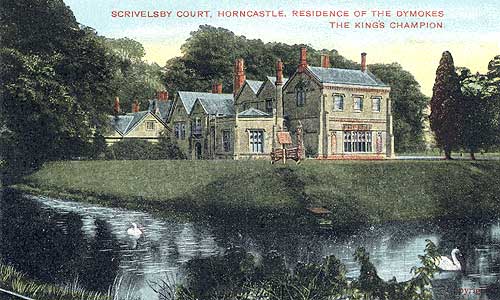
ScrivelsbyCourt

The chivalrous and dignified office of Champion of England at our coronations is conferred by the feudal manor of Scrivelsby, about two miles south of Horncastle, on the road towards Boston in Lincolnshire. By the holding of this manor, the ancient family of the Dymokes have derived the office of champion to the sovereigns of England…

edwardvi

The manor of Scrivesby, which was granted by the Conqueror to Robert de Marmion (Lord of Fontenoy, in Normandy), to be held by grand sergeantry, “to perform the office of champion at the King’s coronation.” The Marmians, it is said, where hereditary champions to the Dukes of Normandy prior to the conquest of England.

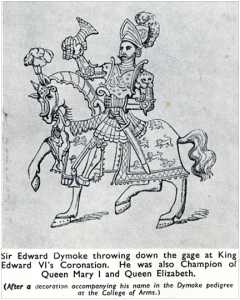
Dymock Champion

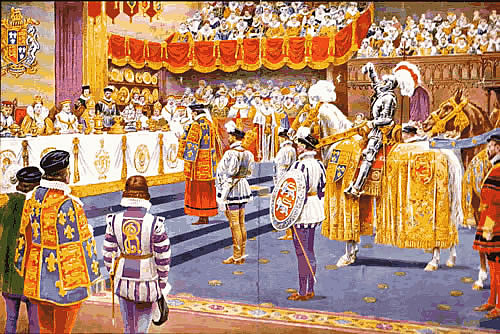
The Kings Champion in full armor in the banqueting hall at the coronation of Queen Elizabeth I

Sir John Dymoke served as Champion of England at the coronation of Richard II. Sir Robert Dymoke did so for Richard II, Henry VII, and Henry VIII. Sir Edward Dymoke was champion for Edward VI, Mary I, and Elizabeth I. John Dymoke was champion for George III, and when the time came for George IV’s coronation, the honor went to his grandson, Sir Henry Dymoke, due to the fact that his son, Rev. John Dymoke, was a cleric.

0020 16.tif

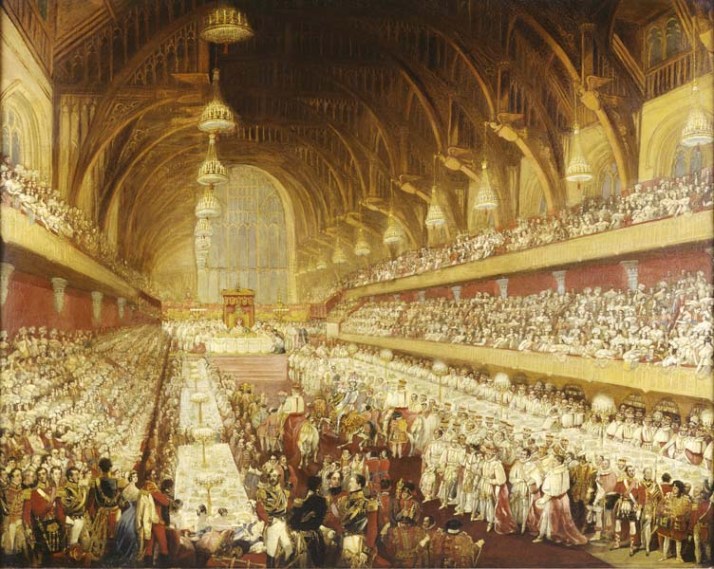
George IV’s coronation banquet was held in Westminster Hall in 1821; it was the last such banquet held.

The entry of the champion at the close of the Banquet in Westminster Hall, at the coronation of George IV., was a splendid spectacle. Haydon, the historical painter, thus describes this ancient feudal ceremony which he witnessed: “The hall-doors were opened, and the flower-girls entered, strewing flowers. The distant trumpets and shouts of the people, the slow march, and at last the appearance of the King, crowned and under a golden canopy, and the universal burst of the assembly at seeing him, affected everybody… After the banquet was over, came the most imposing scene of all, the championship. Wellington, in his coronet, walked down the hall, cheered by the officers of the Guards. He shortly returned, mounted, with Lords Anglesey [formerly the Earl of Uxbridge] and Howard. They rode gracefully to the foot of the throne, and then backed out. The hall doors opened again; and outside, in twilight, a man in dark-shadowed armor appeared against the shining sky. He then moved and passed into darkness under the arch, and suddenly Wellington, Howard, and the champion stood in full view, with doors closed behind them. This was certainly the finest sight of the day. The herald then read the challenge; the glove was thrown down. They all then proceeded to the throne.”

championship

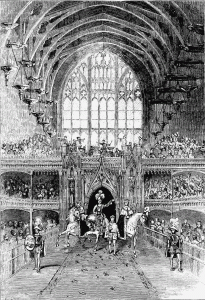
Coronation of George IV, Westminster Hall: the Champion’s Challenge

Sir Walter Scott, in his letter describing the coronation, says, “The Duke of Wellington, with all his laurels, moved and looked deserving the baton, which was never grasped by so worthy a hand. The marquess of Anglesey showed the most exquisite grace in managing his horse, notwithstanding the want of his limb, which he left at Waterloo. I never saw so fine a bridle-hand in my life, and I am rather a judge of horsemanship. Lord Howard’s horse was worse bitted than those of the two former noblemen, but not so much as to derange the ceremony of returning back-out of the hall. The champion was performed (as of right) by young Dymoke, a fine-looking youth, but bearing, perhaps a little too much the appearance of a maiden knight to be the challenger of the world in a King’s behalf. He threw down his gauntlet, however, with becoming manhood, and showed as much horsemanship as the crowds of knights and squires around him would permit to be exhibited. On the whole, this striking part of the exhibition somewhat disappointed me, for I would have had the champion less embarrassed by his assistants, and at liberty to put his horse on the grand pas; and yet, the young Lord of Scrivelsby looked and behaved extremely well.”

Supertunica-stole-and-spurs

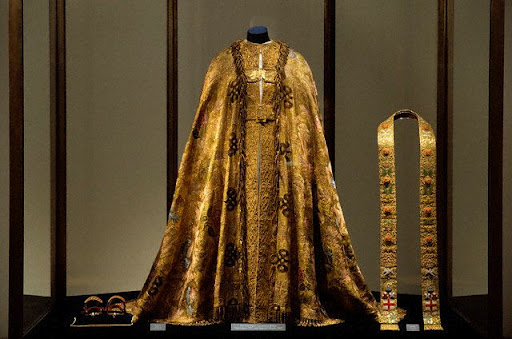
The Imperial Mantle was made for the coronation of George IV in 1821 and is designed in the style of earlier ones worn by the Tudor and Stuart monarchs, it is worn over the Supertunica and the Stole. The Imperial Mantle is made of gold cloth, lined with red silk and woven with colored threads designed with a pattern of crowns, eagles, fleur-de-lis, roses, thistles and shamrock held together at the chest with a gold clasp in the form of an eagle.

*George IV’s was the last coronation to include a championship.


Romance of London Series

  1. Romance of London: The Lord Mayor’s Fool… and a Dessert
  2. Romance of London: Carlton House and the Regency
  3. Romance of London: The Championship at George IV’s Coronation
  4. Romance of London: Mrs. Cornelys at Carlisle House
  5. Romance of London: The Bottle Conjuror
  6. Romance of London: Bartholomew Fair
  7. Romance of London: The May Fair and the Strong Woman
  8. Romance of London: Nancy Dawson, the Hornpipe Dancer
  9. Romance of London: Milkmaids on May-Day
  10. Romance of London: Lord Stowell’s Love of Sight-seeing
  11. Romance of London: The Mermaid Hoax
  12. Romance of London: The Bluestocking and the Sweeps’ Holiday
  13. Romance of London: Comments on Hogarth’s “Industries and Idle Apprentices”
  14. Romance of London: The Lansdowne Family
  15. Romance of London: St. Margaret’s Painted Window at Westminster
  16. Romance of London: Montague House and the British Museum
  17. Romance of London: The Bursting of the South Sea Bubble
  18. Romance of London: The Thames Tunnel
  19. Romance of London: Sir William Petty and the Lansdowne Family
  20. Romance of London: Marlborough House and Sarah, Duchess of Marlborough
  21. Romance of London: The Duke of Newcastle’s Eccentricities
  22. Romance of London: Voltaire in London
  23. Romance of London: The Crossing Sweeper
  24. Romance of London: Nathan Mayer Rothschild’s Fear of Assassination
  25. Romance of London: Samuel Rogers, the Banker Poet
  26. Romance of London: The Eccentricities of Lord Byron
  27. Romance of London: A London Recluse

Romance of London: Carlton House and the Regency

Romance of London: Strange Stories, Scenes And Remarkable Person of the Great Town in 3 Volumes

John Timbs

John Timbs (1801-1875), who also wrote as Horace Welby, was an English author and aficionado of antiquities. Born in Clerkenwell, London, he was apprenticed at 16 to a druggist and printer, where he soon showed great literary promise. At 19, he began to write for Monthly Magazine, and a year later he was made secretary to the magazine’s proprietor and there began his career as a writer, editor, and antiquarian.

This particular book is available at googlebooks for free in ebook form. Or you can pay for a print version.

Carlton1

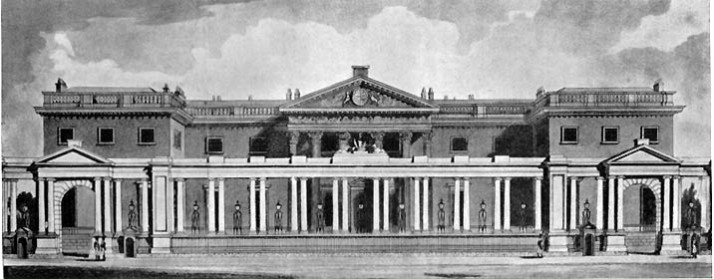
The frontage of Carlton House

Carlton House and the Regency

The Prince Regent’s residence at Carlton House is another place frequently mentioned in historical fiction that is no longer in existence. I had heard that it burned down, but Timbs reports the following:

Carlton House having grown dingy in its fittings, and its history prompting many disagreeable associations, the King projected the enlargement and eventually the rebuilding of Buckingham House; Carlton House was taken down in 1826; the columns of the portico have been transferred to the National Gallery. The exact site of this palace of a century is now the opening between the York Column and the foot of Regent Street.

Plan_of_Carlton_Palace_in_1821

Plan showing the main floor and the suite of reception rooms on the lower ground floor

 Origins

Carlton House, as a royal palace, existed for nearly a century, and was the scene of many important state events, as well as of much prodigality and bad taste. The house, which fronted St. Alban’s Street and St. James’s Park, was originally built by Henry Boyles, Baron Carlton, on a piece of ground leased to him by Queen Anne, in 1709, at 35l. a year; it is described as “parcel of the Royal Garden, near St. James’s Palace,” and “the wood-work and wilderness adjoining.” From Lord Carlton the house and grounds descended to his nephew, Lord Burlington, the architect: he bested it, in 1732, upon his mother, the Countess Dowager of Burlington, who, in the same year, transferred it to Frederick, Prince of Wales, father of George III. The House was a building of red brick, with wings, and was afterwards cased with stone by Sir Robert Taylor. In Lord Burlington’s time, the grounds, which ran westward as far as Marlborough House, were laid out by Kent, in imitation of Pope’s garden at Twickenham. There is a large and fine engraving of the grounds by Woollett; bowers, grottoes, and terminal busts abounding.

Under the Prince Regent (George IV)

When, in 1783, the Prince of Wales, afterwards George IV, was allowed a separate establishment, Carlton House was assigned for his residence, and Holland, the architect, was called in, and added the chief features,—the Ionic screen and the Corinthian portico, fronting Pall Mall. [Horace] Walpole writes to the Countess of Ossor, in the autumn of 1785:

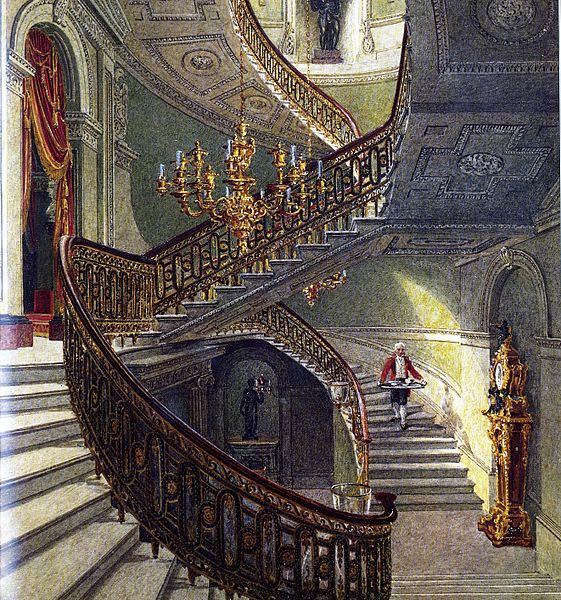
We went to see the Prince’s new palace in Pall Mall; and were charmed. It will be the most perfect in Europe. There is an august simplicity that astonished me. You cannot call it magnificent: it is the taste and propriety that strike. Every ornament is at a proper distance and not one too large, but all delicate and now, with more freedom and variety than Greek ornaments… As Gobert [French architect]… designed the decorations, I expected a more tawdry assemblage of fantastic vagaries than in Mrs. Cornelys’s masquerade-rooms. [Teresa Cornelys, operatic soprano, held many fashionable gatherings at Carlisle House, had many lovers, and bore a child of Casanova.]… There are three most spacious apartments, all looking on the lovely garden, a terrace, the state apartment, and an attic. The portico, vestibule, hall, and staircase will be superb, and, to my taste, full of perspectives; the jewel of all is a small music-room, that opens into a green recess and winding walk of the garden… I forgot to tell you how admirably all the carving, stucco, and ornaments are executed; but whence the money is to come I conceive not—all the tin mines of Cornwall would not pay a quarter. How sick one shall be after this chaste palace, of Mr. Adam’s [Robert Adam, popular 18th century architect] gingerbread and sippets of embroidery!

561px-CarltonStaircase

The main staircase, from Pyne’s Royal Residences (1819)

Timbs’s later assessment was not so kind. He says that the conservatory, “imitated from Henry VII’s Chapel, was a failure,” the blue velvet draperies “heavy and dark”; and the “Gothic dining-room was poor.” He found the armory to be “the most curious collection of arms in the world, [filling] four rooms.”

Here was John Hamden’s sword, said to be the work of Cellini; and a golden throne of the King of Candy was backed with a sun of diamonds and precious stones. Here, too, were arms from all nations—caps, boots, spurs, turbans, shields, bows, dresses, models of horses, helmets, sabres, swords, daggers, canopies, palanquins, guns, coats of mail, and other costly presents from all parts of the world.

In the plate-room were some fine specimens of King Charles’s plate; other plate was disposed in the centre of the room, in columns of gold and silver plates, and dishes, and drawers filled with gold and silver knives, forks, spoons, &c.…

The palace was superbly fitted for the Prince’s marriage: 26,000l. Was voted for furnishing, 28,000l. For jewels and plate, and 27,000l for the expense of the marriage. Here was born the Princess Charlotte, January 16, 1796, and the baptism took place on February 11; here, also, the Princess was married, May 2, 1816.

The Fête of June 19, 1811

The most magnificent State event of the Regency was the event given at Carlton House on June 19, 1811, being then the only experiment ever made to give a supper to 2,000 of the nobility and gentry. Covers were laid for 400 in the palace, and for 1,600 in the pavilions and gardens. The fête was attended by Louis XVIII, and the French princes then in exile; and a vast assemblage of beauty, rank, and fashion. The saloon at the foot of the staircase represented a bower with a grotto, lined with a profusion of shrubs and flowers. The grand table extended the whole length of the conservatory, and across Carlton House to the length of 200 feet. Along the centre of the table, about six inches above the surface, a canal of pure water continued flowing from a silver fountain, beautifully constructed at the head of the table. Its banks were covered with green moss and aquatic flowers; gold and silver fish swam and sported through the bubbling current, which produced a pleasing murmur where it fell, and formed a cascade at the outlet. At the head of the table, above the fountain, sat His Royal Highness the Prince Regent on a plain mahogany chair with a feather back. The most particular friends of the Prince were arranged on each side. They were attended by sixty servitors; seven waited on the Prince, besides six of the King’s, and six of the Queen’s footmen, in their state liveries, with one man in a complete suit of ancient armour.

600px-Saint-George_D'Eon_Robineau

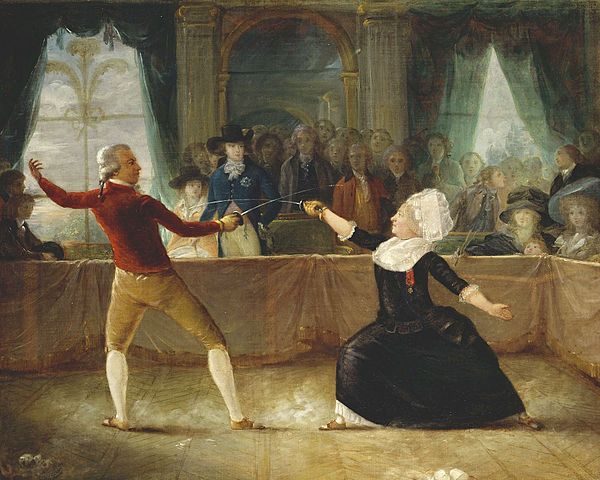
Fencing Match between Chevalier de Saint-Georges and ‘La chevalière D’Eon’ on April 9, 1787 in Carlton House, painting by Charles Jean Robineau

Historical tidbit

Timbs mentions that the portico of Carlton House was the site of the “first public application of the newly-invented lighting by gas.”

Author’s Reflections

I’m thinking the fête might come in hand for a scene in my next story—as an example of the decadence and excess of the Prince Regent. What do you think?


Romance of London Series

  1. Romance of London: The Lord Mayor’s Fool… and a Dessert
  2. Romance of London: Carlton House and the Regency
  3. Romance of London: The Championship at George IV’s Coronation
  4. Romance of London: Mrs. Cornelys at Carlisle House
  5. Romance of London: The Bottle Conjuror
  6. Romance of London: Bartholomew Fair
  7. Romance of London: The May Fair and the Strong Woman
  8. Romance of London: Nancy Dawson, the Hornpipe Dancer
  9. Romance of London: Milkmaids on May-Day
  10. Romance of London: Lord Stowell’s Love of Sight-seeing
  11. Romance of London: The Mermaid Hoax
  12. Romance of London: The Bluestocking and the Sweeps’ Holiday
  13. Romance of London: Comments on Hogarth’s “Industries and Idle Apprentices”
  14. Romance of London: The Lansdowne Family
  15. Romance of London: St. Margaret’s Painted Window at Westminster
  16. Romance of London: Montague House and the British Museum
  17. Romance of London: The Bursting of the South Sea Bubble
  18. Romance of London: The Thames Tunnel
  19. Romance of London: Sir William Petty and the Lansdowne Family
  20. Romance of London: Marlborough House and Sarah, Duchess of Marlborough
  21. Romance of London: The Duke of Newcastle’s Eccentricities
  22. Romance of London: Voltaire in London
  23. Romance of London: The Crossing Sweeper
  24. Romance of London: Nathan Mayer Rothschild’s Fear of Assassination
  25. Romance of London: Samuel Rogers, the Banker Poet
  26. Romance of London: The Eccentricities of Lord Byron
  27. Romance of London: A London Recluse

Em Brown: Master and Temptress Erotic Historical Trilogy

Who was G#?

In Book 3 of the Master and Temptress Erotic Historical trilogy, Granville Sharp makes a “cameo” appearance at a key time for the hero, Charles Gallant. Gallant is standing for Parliament, and the issue of slavery puts him between a rock and a hard place as he attempts to secure the endorsement of key figures in the community, whose support can assure him victory.

The year before, England had formally abolished the slave trade but left the institution of slavery intact in her colonies. At the time, England was the largest slave trafficker in the world. Granville Sharp played a significant role in leading the campaign to abolish the slave trade.

Born into a musical family in 1735, the son of an Archdeacon, Sharp loved to debate and discuss theology. He became active on the issue of slavery after coming across Jonathan Strong, a young black slave beaten so badly that he had to spend four months in the hospital. Sharp and his brother paid for Strong’s medical bills. Sharp started to study English law and “could not believe the law of England was really so injurious to natural rights.”

In 1772, a slave named James Somerset, who had run away from his master, asked Sharp for help. Sharp worked with Somerset’s lawyers, and the case was ruled in Somerset’s favor. The case was a pivotal one in the history of abolition because it effectively set slaves free in English territory (but not her colonies) because Lord Mansfield, the Chief Justice of the King’s Bench, wrote that English law, absent an act of Parliament, did not provide for slavery.

A few years later, Sharp was approached by Quakers, who had been active in the cause of abolition but barred from full participation in English society. The Quakers needed Anglican support, and Sharp was an obvious choice. In 1787, nine Quakers and three Anglicans formed The Society for Effecting the Abolition of the Slave Trade. Working with William Wilberforce, a young MP tapped by Pitt the Younger to lead the cause of abolition in Parliament, Sharp and the Society campaigned for 20 years before Parliament finally passed The Slave Trade Act 1807.

Sharp, who sometimes signed his name “G#”, passed away in 1813 and did not live to see the full abolition of slavery in 1833. A memorial tablet erected for Sharp can be seen in Westminster Abbey.

Master vs. Temptress: The Final Submission (Book 3) is available for only $0.99 until February 28th. Plus, you can now get Seducing the Master (Book 1) for FREE. Click here to get your copy today.

EmBrown_MasterVsTemptresstheFinalSubmission_200

About The Master & Temptress Trilogy

“Ravage Me.”

No man has ever resisted the charms of Miss Terrell before, but Master Gallant refuses to grant her request and have his way with her.

Miss Terrell is spoken for by Sir Arthur, a man with a dubious past but whose wealth and influence hold the key to Charles Gallant’s bid for Parliament. Without Sir Arthur’s support, Charles will not realize his lifelong ambition to win election and succeed where his father before him had failed.
But Terrell cannot quell her scorching desire for Master Gallant, whose deft hand and command of rope bondage inflame her deepest, darkest cravings. She will tempt the Master to surrender. Only love can stop her, but it will devastate them both.

READER ADVISORY: This Regency-set erotic romance contains themes of dominance and submission, BDSM elements, and other forms of wicked wantonness.

Start this epic romance for FREE with Seducing the Master. Click here to get your free ebook today.

Excerpt from Seducing the Master

He pinned her with a solemn stare. “Behave yourself, Miss Terrell, or I will remove you by force.”

“I should like nothing more than to receive your punishment, Master Gallant.”

He inhaled sharply. The saucy jade. Catching her off-guard with a quick movement, he wrapped his arm about her waist and whirled her over to the other side of the doorframe. She landed against the wall with a soft thud. Disengaging himself, he grabbed the handle of the door and pulled, intending to depart without his usual civility.

To his surprise, the door did not open. At first he thought it to be stuck, but then he noticed that the key was missing from the lock. He turned to look at Miss Terrell, whose lips curled in a slight but telling grin.

He could hardly believe the woman—the chit. Did she truly intend to hold him hostage?

“Produce the key, Miss Terrell,” he commanded.

She returned a smoldering stare. “Dominate me first. Do unto me as you had done to Mistress Scarlet.”

He felt his nostrils flare. He needed no second reminders of her, especially from Miss Terrell, who now tested his patience much like Greta had, but for wholly different purposes.

“You think impudence will gain you what you seek?” he asked.

She leaned toward him. “If my impudence displeases you, then punish me for it. Punish me…hard.”

He stared at her in disbelief. No woman had ever made such a request of him. He wanted to reiterate that she knew not what she spoke. She had witnessed but one instance of the punishment he had applied to Miss Greta.

As if guessing his thoughts, she added, “I can withstand anything you desire to do to me, Master Gallant.”

“That is a bold and foolhardy statement. You know nothing of what I am capable.”

Pressing herself back against the wall, she cupped her breasts and caressed her ribs. “Prove me wrong. I dare you to.”

He shook his head. He was done with challenges.

“I vow I can endure more than Mistress Scarlet, more than any person of either sex. I could be the most perfect submissive for you.”

“Unlikely. You have already shown a penchant for misbehavior.”

“You could correct my waywardness.”

He frowned—because the prospect did not repulse him as he would have wanted it to.

“You need have no reservation with me,” she continued. “You would be free to unleash your full strength, to test the breadth of your wicked creativeness.”

His blood pumped forcefully through his veins at her words. “Miss Terrell, this tête-à-tête serves no purpose. I bid you desist from wasting your time as well as mine.”

Stepping forward, she grabbed the lapels of his coat and pulled herself closer to him. Lust burned like anger in her eyes, calling to a primal part of him that he could not ignore. Her skirts brushed against his legs, and her corset nearly touched where his hardened length was fast becoming visible.

“Then ravage me.”

She reached for his burgeoning erection, but, dropping his articles, he grasped both her wrists and pinned them above her head to the door behind.

“Miss Terrell, I am done with this tomfoolery. Produce the key.”

She squirmed a little in his hold. “I should be happy to, Master Gallant, after you have had your way with me. You cannot deny that you desire to do so.”

He pressed his lips together in a grim line. The scent of the pomade she used in her hair wafted into his nose once more. Their bodies were far too close together for comfort. She slid her leg along his. Holding her wrists aloft with one hand, he cupped her chin with the other and lifted her gaze to meet his eyes.

“The key, Miss Terrell,” he demanded, unable to keep the vexation from his voice.

She did not blink and demanded, equally hotly, “Ravage me.

Her words rang in his ears like a song of sirens. The air between them grew thin. With a frustrated grunt, he yanked her from the door and dragged her across the room to the sideboard where he kept the ropes.

GET THIS EBOOK (PLUS 3 MORE!) FROM EM BROWN BY CLICKING HERE.

Romance of London: The Lord Mayor’s Fool… and a Dessert?

romanceoflondonbook

Romance of London: Strange Stories, Scenes (not Scones) And Remarkable Person(s) of the Great Town in 3 Volumes

by John Timbs

John Timbs (1801-1875), who also wrote as Horace Welby, was an English author and aficionado of antiquities. Born in Clerkenwell, London, he was apprenticed at 16 to a druggist and printer, where he soon showed great literary promise. At 19, he began to write for Monthly Magazine, and a year later he was made secretary to the magazine’s proprietor and there began his career as a writer, editor, and antiquarian.

800px-John_Timbs

This particular book is available at googlebooks for free in ebook form. Or you can pay for a print version.

I don’t remember where I heard about John Timbs, but somehow I heard that he wrote some quite intriguing stories about historical London, and purchased this book a year or so ago. After finishing my previous series on Vauxhall, I rummaged among my collection of research books and this one caught my attention. Be aware if you buy it that, like many such books, it was hastily scanned and some of the words didn’t scan correct. For instance, the title “Strange Stories, Scones And Remarkable Person of the Great Town” doesn’t make a lot of sense. Thus far, however, I have found the interior pages quite easy to read.

Among the first stories is one about a jester… and perhaps a dessert?

abbeys2

The Lord Mayor’s Fool

The Lord Mayor’s Fool was a distinguished character of his class; and there was a curious feat which he was bound by his office to perform, in the celebration of Lord Mayor’s Day. He was to leap, clothes and all, into a large bowl of custard, at the Inauguration dinner; and this was a jest so exactly suited to the taste of the lower class of spectators, that it was not easily made stale by repetition. It is alluded to by Shakespeare and Ben Johnson, as follows:—

You have made shift to run into ‘t, boots and spurs, and all, like him that leapt into the custard.” (All’s Well that Ends Well.)

He may, perchance, in tail of a Sheriff’s dinner,

Skip with a rime o’ the table, from new nothing,

And take his Almain leap into a custard,

Shall make my Lady Mayoress and her sisters

Laugh all their hoods over their shoulders—Devil’s an Ass.

Custard was “a food much used in City feasts.” (Johnson’s Dict.)

Now mayors and shrieves all hush’d and satiate lay;

Yet eat, in dreams, the custard of the day.—Pope

Perhaps it is this custard which, in the Staple of News, is called “the custard politick, the Mayor’s.” We have all heard the vulgar comparison—”You are like my Lord Mayor’s Fool, who knows what is good.”

A Fruit Fool?

Somehow, a fool jumping into a vat of custard clicked in my mind. Isn’t fool an English dessert? So I looked it up on Wikipedia, and there staring at me was this lovely creamy, custard-like raspberry fool. Yummy. Where can I find one?

1024px-Raspberry_fool

According to Wikipedia, though, nobody really knows where the term came from. Hmm. Maybe Mr. John Timbs knows more than the all of the wise scholars at Wikipedia? Or am I making an incorrect assumption?

First mentioned in 1598 along with the term trifle, its ingredients are fruit, whipped cream, and sugar. According to Wikipedia, gooseberries are the fruit of choice for a fool, but apples, rhubarb, raspberries, and strawberries are also used.

If you’d like to make one, here are some recipes:

BBC Food

The Kitchn

Serious Eats

JoyofBaking.com

Jamie Oliver

Have you ever had a gooseberry fool? Or any type of (dessert) fool? What in the heck is a gooseberry anyway?

Romance of London Series

  1. Romance of London: The Lord Mayor’s Fool… and a Dessert
  2. Romance of London: Carlton House and the Regency
  3. Romance of London: The Championship at George IV’s Coronation
  4. Romance of London: Mrs. Cornelys at Carlisle House
  5. Romance of London: The Bottle Conjuror
  6. Romance of London: Bartholomew Fair
  7. Romance of London: The May Fair and the Strong Woman
  8. Romance of London: Nancy Dawson, the Hornpipe Dancer
  9. Romance of London: Milkmaids on May-Day
  10. Romance of London: Lord Stowell’s Love of Sight-seeing
  11. Romance of London: The Mermaid Hoax
  12. Romance of London: The Bluestocking and the Sweeps’ Holiday
  13. Romance of London: Comments on Hogarth’s “Industries and Idle Apprentices”
  14. Romance of London: The Lansdowne Family
  15. Romance of London: St. Margaret’s Painted Window at Westminster
  16. Romance of London: Montague House and the British Museum
  17. Romance of London: The Bursting of the South Sea Bubble
  18. Romance of London: The Thames Tunnel
  19. Romance of London: Sir William Petty and the Lansdowne Family
  20. Romance of London: Marlborough House and Sarah, Duchess of Marlborough
  21. Romance of London: The Duke of Newcastle’s Eccentricities
  22. Romance of London: Voltaire in London
  23. Romance of London: The Crossing Sweeper
  24. Romance of London: Nathan Mayer Rothschild’s Fear of Assassination
  25. Romance of London: Samuel Rogers, the Banker Poet
  26. Romance of London: The Eccentricities of Lord Byron
  27. Romance of London: A London Recluse

Vauxhall Gardens: The Final Years, Part IV

vauxhallbook

Vauxhall Gardens: A History

David Coke & Alan Borg

The Vauxhall Pleasure Gardens is one of the places I’d love to slip back in time to visit, just to catch a glimpse of what it was like. After recently splurging to buy this lovely coffee-table book, I thought it might make a wonderful subject for a new blog series. But do buy the book too, if you can! The photos are fabulous!

Financial Setbacks & Bankruptcy

Vauxhall had suffered financial setbacks regularly over the years, but especially in its later years, when it changed hands frequently. Bankruptcy was declared in 1840, when the gardens were closed and auctions were held for “all sorts of fittings and decorations from the gardens, including many of the paintings; the Royal Nassau balloon, which had originally cost over £2000 was sold to [balloonist] Green for £500.”

Nevertheless, it opened again in 1841, when George Catlin’s “Red Indians” were introduced to the gardens. These tableaux vivant were made up of, in Catlin’s own words:

twenty living figures in Indian costumes, forming groups of their ceremonies, domestic scenes and warfare. These were got up and presented with much labour to myself, and gave great satisfaction; as by them I furnished so vivid and lifelike an illustration of Indian life as I had seen it in the wilderness.

From the satirical magazine Punch:

We wended our way to the ‘royal property’, to take a last look at the long-expiring gardens. It was a wet night—the lamps burnt dimly—the military band played in the minor key—the waiters stalked about with so silent, melancholy a tread, that we took their towels for pocket-handkerchiefs; the concert in the open rain went off tamely—dirge-like, in spite of the ‘Siege of Acre’, which was described in a set of quadrilles, embellished with blue fire and maroons, and adorned with a dozen drums, thumped at intervals, like death notes, in various parts of the doomed gardens. The divertissement was anything but diverting, when we reflect upon the impending fate of the ‘Rotunda’, in which it was performed.

Although it was announced that ‘Vauxhall would positively close its doors for ever’ on September 8th, 1841, it did open again for the 1842 season, but despite new acts such as Ducrow’s questions (now under the management of his black protégé, Mungo) and the exhibition of Napoleon’s state carriage taken from Waterloo, the gardens remained unprofitable. Vauxhall did not open at all in 1843.

In 1844, the new lessee brought the “Ioway Indians” to Vauxhall. An native encampment was established “on the old Waterloo Ground, from which the party of fourteen (three chiefs, five braves, four squaws, a child and a papoose) emerged from wigwams. They performed only in the afternoon and stayed in lodgings at night.”

This arrangement was one of very great pleasure to the Indians, as it allowed a free space to exercise in during their leisure hours, amongst trees and shrubbery, affording them almost a complete resumption of Indian life in the wilderness, as they had the uninterrupted range of the gardens during the hours that the public were not there to witness their amusements.

The next few years, surprisingly, were quite profitable for Vauxhall, with upgrades and new acts such as Monsieur Musard, “Napoleon of the Quadrille,” with his band of a hundred musicians.

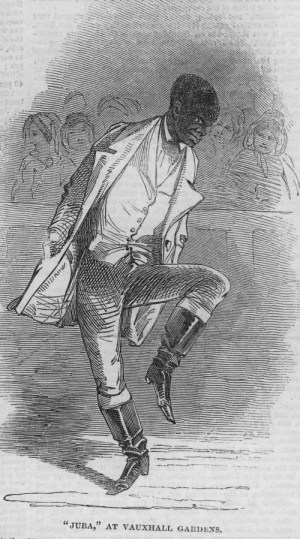
Master Juba

One of the most famous of all Vauxhall performers, William Henry Lane, was an import from the saloons and dance halls of Manhattan.

juba-vauxhall

Anon., Juba at Vauxhall Gardens, engraving (David Coke’s collection) from the Illustrated London News (5 August 1848), 77. William Henry Lane, known as Master Juba, created a sensation in London and was known as the “Dancinest fellow ever was”. He is credited with the invention of tap-dancing.

Playing the banjo and the tambourine, he was known as the “Dancinest fellow ever was’ and hailed as the inventor of tap-dancing. Dickens made him famous in his American Notes, describing a lively young negro, who is the wit of the assembly, and the greatest dancer ever known. He never leaves off making queer faces, and is the delight of all the rest, who grin from ear to ear incessantly.”

Originally one of six so-called “Ethiopian Serenaders”, Juba was unquestionably the most talented although it was at Vauxhall where he became a star attraction. From the Illustrated London News:

How could Juba enter into their wonderful complications so naturally? How could he tie his legs into such knots, and fling them about so recklessly, or make his feet twinkle until you lose sight of them altogether in his energy. The great Boz immortalised him; and he deserved the glory thus conferred.

The Final Seasons

royal vauxhall gardens

Poster advertising Van Amburgh and Juba, 1848 (British Library, London, EVAN.474). This illustrates current attractions at the gardens and features (clockwise from top left): the Grand View of Constantinople; the Grand Orchestra; the Rotunda Theatre; the Ballet Theatre; the Coral Cave; the Pavilion and Musical Promenade; the Neptune Fountain; and C.W. Pell’s Serenaders.

In spite of continued financial problems, Vauxhall limped on a few more years, with a lion tamer renowned for putting his head the lions’ mouths (Van Amburgh), the Algerine Family (“clothed in rich Arabian silks and reclining on luxurious divans”), boat races, masquerades, the Great Italian Singers (1851), military fetes featuring the Crimean War, and the American bareback rider, Mr. James Robinson in 1859.

But when the last night came, on 13 October, it must have been clear to all that Vauxhall could continue no longer.

Susana’s Vauxhall Blog Post Series

  1. Vauxhall Gardens: A History
  2. Vauxhall Gardens: Jonathan Tyers—“The Master Builder of Delight” 
  3. Vauxhall Gardens: A New Direction
  4. Vauxhall Gardens: The Orchestra and the Supper-Boxes 
  5. Vauxhall Gardens: The Organ, the Turkish Tent, and the Rotunda
  6. Vauxhall Gardens: Three Piazzas of Supper-Boxes
  7. Vauxhall Gardens: “whither every body must go or appear a sort of Monster in polite Company”
  8. Vauxhall Gardens: The Competition
  9. Vauxhall Gardens: The Artwork, Part I
  10. Vauxhall Gardens: The Artwork, Part II
  11. Vauxhall Gardens: The Music, 1732-1859
  12. Vauxhall Gardens: The Business Side
  13. Vauxhall Gardens: Developments from 1751-1786
  14. Vauxhall Gardens: Thomas Rowlandson’s Painting (1785)
  15. ‎Vauxhall Gardens: The Third Generation of the Tyers Family and the Jubilee of 1786
  16. Vauxhall Gardens: An Era of Change (1786-1822), Part I
  17. Vauxhall Gardens: An Era of Change (1786-1822), Part II
  18. Vauxhall Gardens: An Era of Change (1786-1822), Part III
  19. Vauxhall Gardens: The Final Years, Part I
  20. Vauxhall Gardens: The Final Years, Part II
  21. Vauxhall Gardens: The Final Years, Part III
  22. Vauxhall Gardens: The Final Years, Part IV
  23. Vauxhall Gardens: Farewell, for ever

Vauxhall Gardens: The Final Decades, Part III

vauxhallbook

Vauxhall Gardens: A History

David Coke & Alan Borg

The Vauxhall Pleasure Gardens is one of the places I’d love to slip back in time to visit, just to catch a glimpse of what it was like. After recently splurging to buy this lovely coffee-table book, I thought it might make a wonderful subject for a new blog series. But do buy the book too, if you can! The photos are fabulous!

The early 1830’s marked a low period in Vauxhall’s fortunes. The weather was often poor, causing cancellations of particular events, especially fireworks. There seems to have been a lack of cash for either further investment or spectacular displays.

Among the newer attractions were Michael Boai, the ‘celebrated Chin Melodist’; Joel, the ‘Altonian Siffleur’, who imitated birds; the Singers of the Alps; Don Santiago, the Lilliputian King, only 27 inches high; the great Boa Constrictor and Anaconda. Forty thousand attended on September 8, 1830 when the gardens were free all day to celebrate the coronation of William IV.

In 1832, charity events, flower shows, and other special events were held as a way of increasing income.  “Many of these events were run under the leadership of aristocratic or even royal patrons and attracted wealthy visitors.” These included a Ladies Bazaar and Fete Champetre in aid of the Royal Dispensary for Diseases of the Ear; a Fancy Fair sponsored by the Duchess of Kent for the cause of restoring the Lady Chapel at St. Saviour’s Church, Southwark; a fete for the abolition of slavery (1834), and the ‘Superb Gala for the benefit of the Distressed Poles’.

Ballooning

Balloon ascents had been taking place at Vauxhall since 1802, but it wasn’t until the 1820’s and Charles Green that regular balloon ascents and rides were held, generating much-needed income to keep the gardens a viable enterprise.

Green’s first flight was from Green Park on 19 July 1821 in honor of William IV’s coronation. Green’s balloons were larger because he used coal gas instead of hydrogen, which was easier and safer to inflate, as well as cheaper and less harmful to the silk canopy.  Green’s

first flights from Vauxhall took place in July 1826. These were the first ever night ascents in Britain and were the climax of the firework displays. The aeronaut could be observed launching rockets and other incendiary devices from the car of the balloon beneath the main canopy.

Not only was Green a serious scientist, but also a skilled showman, which was a winning combination for Vauxhall. “In 1832 he and a ‘scientific gentleman’ went up at 6 p.m. To measure air pressures and carry out other experiments with barometers.”

Balloon ascents were the main reason for daytime opening. For the afternoon openings, Green staged balloon races with his brother and other family members, also giving rides to members of the public. Dickens went to see the spectacle and left a vivid description:

So we retraced our steps to the firework-ground, and mingled with the little crowd of people who were contemplating Mr. Green.

Some half-dozen men were restraining the impetuosity of one of the balloons, which was completely filled, and had the car already attached; and as rumors had gone abroad that a Lord was ‘going up’, the crowd were more than usually anxious and talkative. […] Just at this moment all eyes were directed to the preparations which were being made for starting. The car was attached to the second balloon, the two were brought pretty close together, and a military band commenced playing, with a zeal and fervor which would render the most timid man in existence but too happy to accept any means of quitting that particular spot on earth on which they were stationed. Then Mr. Green, sen., and his noble companion entered one car, and Mr. Green, jun., and his companion the other; and then the balloons went up, and the aerial travelers stood up, and the crowd outside roared with delight, and the two gentlemen who had never ascended before, tried to wave their flags, as if they were not nervous, but held on very fast all the while.

The Royal Vauxhall balloon

The proprietors of the gardens financed part of this balloon, which was intended by Green to be three times bigger than any previous gas ballon.

Measuring 150 feet in circumference and 80 feet high when inflated, it consisted of 2000 yards of raw Italian skill, dyed crimson and white and made up by Mssrs Soper of Spitalfields. Alternate 90-foot lengths were then stitched and glued together, producing a striking striped effect. The whole surface was coated in a varnish devised by Green himself and encased in a net of ropes. The car… was made of wickerwork, oblong in shape, with a bench seat all round the inside. On the exterior there were large gilded eagles at either end, and the sides were draped with purple and crimson velvet, richly embroidered. The cost of the whole machine was put at £2100, but since members of the public were charged for flights at the rate of £21 for gentlemen and £10 10s for ladies, this was soon recouped… Despite the cost, the public demand for flights was insatiable, as Benjamin Disraeli commented in 1837: ‘There is no news today: everything is rather flat and the room is thin as the world have gone to see the monster balloon rise from Vauxhall.

The Great Balloon of Nassau

(c) National Portrait Gallery, London; Supplied by The Public Catalogue Foundation

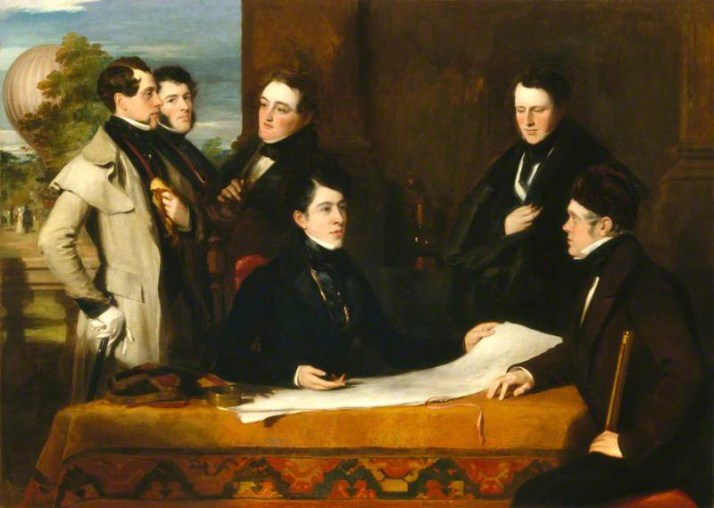
John Hollins, A Consultation prior to the Aerial Voyage to Weilburgh, oil on canvas, 1836. Green is seated on the right, discussing the voyage with Robert Holland; between them stands Thomas Monck Mason, while the group by the window comprises (left to right) Walter Prideaux, Hollins himself and Sir William Melbourne James. The balloon is visible in the gardens behind them. (c) National Portrait Gallery, London; Supplied by The Public Catalogue Foundation

On 7 November 1836—without any prior notice—Thomas Monck Mason, Robert Holland, and Green took off in an attempt at a long-distance record. Financed by Holland, the provisions included 40 pounds of ham, beef and tongue, 45 pounds of fowls, as well as preserves, sugar, bread, and biscuits—not to mention two gallons each of sherry, port and brandy, and a device for heating coffee using quicklime.

Carried along on a north-westerly breeze, they passed Canterbury at 4 p.m., dropping a message for the mayor by parachute. Night fell after their Channel crossing between Dover and Calais so they sat down to a substantial supper.… Once it was light Green began seeking a landing site and brought the balloon safely to earth at 7:30 a.m., near the town of Wilbur in the Duchy of Nassau. The aeronauts had flown 480 miles in eighteen hours, easily setting the world record for the longest balloon flight.

More Balloons

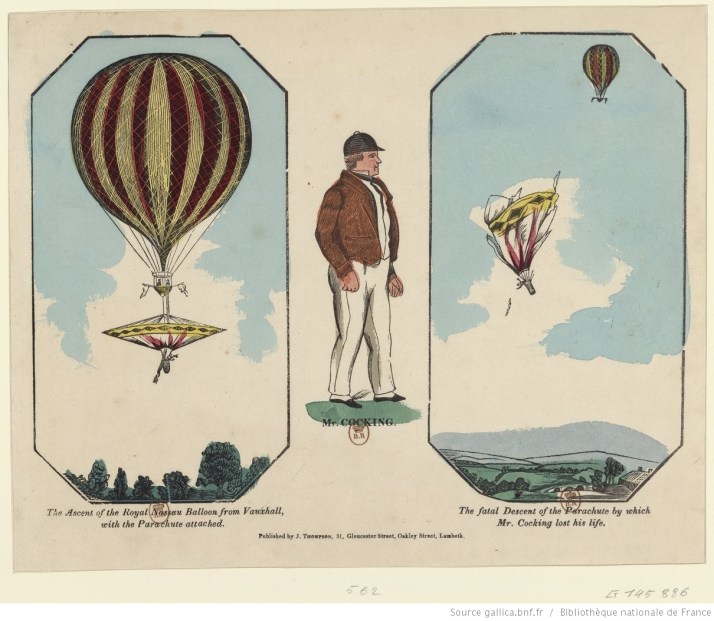
Balloons with parachutes had been done since the 1790’s, and Robert Cocking developed a theory of aerodynamics that unfortunately led to his death. Besides the fact that his theory was faulty, the parachute was far too large and heavy. Green and others tried to dissuade him, but he was adamant, and when the parachute was detached from the balloon, it sunk like a stone, and Cocking died within ten minutes of landing from a serious head wound. Vauxhall held a benefit night for Cocking’s widow and Queen Victoria sponsored a public subscription to raise funds for her as well.

cocking's parachute

The tragedy of Cocking’s upside-down parachute

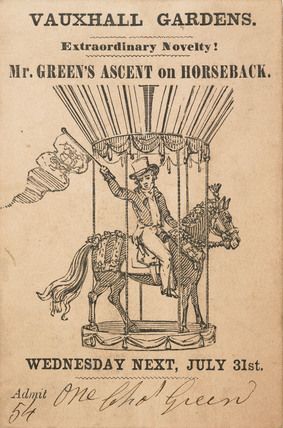
The plan for a lion tamer and a Bengali tiger to ascend never came to fruition, banned by the magistrate. “In 1850 Green went up on horseback, with his unfortunate mount locked onto a wooden platform by its hooves.

Handbill advertising Green's ascent on horseback, 31 July 1850 (Museum of London, A8955). This appears to be a complimentary ticket issued by Green himself. The flight did take place, with the horse firmly locked in place by the hooves.

Handbill advertising Green’s ascent on horseback, 31 July 1850 (Museum of London, A8955). This appears to be a complimentary ticket issued by Green himself. The flight did take place, with the horse firmly locked in place by the hooves.

George Cruikshank’s Comic Almanac for 1851

Would you want to have lived near Vauxhall with all these stunts taking place? The following piece purports to be from a disgruntled local resident:

Sir, I reside near a place of popular amusement ‘al fresco’. I am of a cheerful though quiet disposition, and should be perfectly happy but for one circumstance. During the entire summer season I am in a continual state of terror from balloons.

It was in my front garden that the Ourang-outrang descended in a parachute in 1836. I then said nothing of the annoyance caused by the mob rushing into my lawn and scrambling for fragments of the machine, of the destruction effected among my crockery by the animal attempting to escape through my scullery, nor of the alarm which his sudden appearance in the Dining room excited in the bosoms of myself and my family. I thought the balloon mania had reached its highest pitch—no such thing, Sir. After that came the Nassau Balloon which used to take a dozen people up at once exactly over my house, about once a week; till a terrible dream haunted me of seeing the whole party discharged into my premises.

Then Balloons with fireworks, waking me up every other night, and gazing at one of which, out of a window, I received a sudden blow in the eye from a firework case, descending fifteen hundred feet perpendicularly. My next alarm was occasioned by a hamper of champagne, which during a ‘perilous descent’, when a valve gave way, some intrepid aeronaut pitched through my roof at midnight.

Now folks go up on horseback. Can I walk at ease in my garden and know that the veteran Green is three miles above me, performing equestrian feats in the air? Pray, Sir, exert your influence in my behalf, or we shall shortly hear of a ‘Terrific Ascent in a cab,’ to be eclipsed by ‘First ascent of the Monster Balloon, taking up the Pimlico Omnibus.’.

not in my backyard

Susana’s Vauxhall Blog Post Series

  1. Vauxhall Gardens: A History
  2. Vauxhall Gardens: Jonathan Tyers—“The Master Builder of Delight” 
  3. Vauxhall Gardens: A New Direction
  4. Vauxhall Gardens: The Orchestra and the Supper-Boxes 
  5. Vauxhall Gardens: The Organ, the Turkish Tent, and the Rotunda
  6. Vauxhall Gardens: Three Piazzas of Supper-Boxes
  7. Vauxhall Gardens: “whither every body must go or appear a sort of Monster in polite Company”
  8. Vauxhall Gardens: The Competition
  9. Vauxhall Gardens: The Artwork, Part I
  10. Vauxhall Gardens: The Artwork, Part II
  11. Vauxhall Gardens: The Music, 1732-1859
  12. Vauxhall Gardens: The Business Side
  13. Vauxhall Gardens: Developments from 1751-1786
  14. Vauxhall Gardens: Thomas Rowlandson’s Painting (1785)
  15. ‎Vauxhall Gardens: The Third Generation of the Tyers Family and the Jubilee of 1786
  16. Vauxhall Gardens: An Era of Change (1786-1822), Part I
  17. Vauxhall Gardens: An Era of Change (1786-1822), Part II
  18. Vauxhall Gardens: An Era of Change (1786-1822), Part III
  19. Vauxhall Gardens: The Final Years, Part I
  20. Vauxhall Gardens: The Final Years, Part II
  21. Vauxhall Gardens: The Final Years, Part III
  22. Vauxhall Gardens: The Final Years, Part IV
  23. Vauxhall Gardens: Farewell, for ever

Vauxhall Gardens: The Final Decades, Part II

vauxhallbook

Vauxhall Gardens: A History

David Coke & Alan Borg

The Vauxhall Pleasure Gardens is one of the places I’d love to slip back in time to visit, just to catch a glimpse of what it was like. After recently splurging to buy this lovely coffee-table book, I thought it might make a wonderful subject for a new blog series. But do buy the book too, if you can! The photos are fabulous!

C.H. Simpson: Master of Ceremonies

C.H. Simpson had held this office since 1797, but it wasn’t until 1826 that the decision was made to promote him as a “character” in the Gardens. “Thackeray described him as ‘the gentle Simpson, that kind smiling idiot.'”

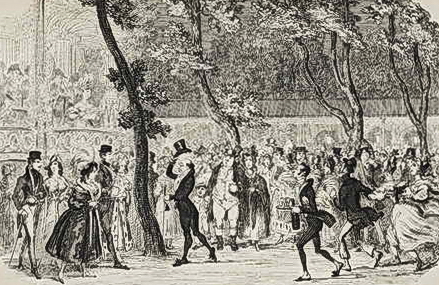
He was renowned for his excessive politeness, servile manner and elaborate bows. With his top hat and silver-mounted cane, trademarks from the beginning his time at Vauxhall, he could easily be seen as a figure of fun. In his later years he came to be regarded as one of the great attractions of the place, greeting all visitors with his special brand obsequious courtesy.

George Cruikshank, with C.H. Simpson in the center raising his hat

George Cruikshank, with C.H. Simpson in the center raising his hat

Simpson’s exaggerated and hyperbolic style is amply demonstrated in the flowery language of his autobiography, The Life and Adventures of C.H. Simpson, Master of Ceremonies at the Royal Gardens, Vauxhall, from his Earliest Youth to the Sixty-fifth Year of his Age (Written by Myself, London, 1835)… He stated that…he was saved from drowning in a bathtub, aged three, by the family’s Newfoundland dog (called William Tell). In 1781 he joined the Royal Navy and took part in a major naval engagement in the Caribbean, the Battles of Saintes. He then enlisted as a second mate on a merchantman and sailed to New Zealand. Another voyage took him to China, but a terrible storm on the return passage determined him not to go to sea again. When he was twenty-one, already working at Vauxhall, he was set to marry a girl called Julia…; on discovering her with another, he broke off the engagement and remained a bachelor all his life.

Since almost every visitor to Vauxhall was met by Simpson there are many descriptions of him.

The appearance of this gentleman was in keeping with the oddity of his character. He was a short man, with a large head, a plain face, pitted with the small-pox, a thin thatch of hair plastered with pomatum and powder. His body and limbs were encased in black cloth of antique cut, and occasionally his head was covered with a hat as heavy as a coal-scuttle, or a life-guardsman’s helmet. This awkwardly constructed piece of felt was more often in his hand than on his head. He was continually bowing to everybody he met […] he was the very climax of obsolete politeness; the most obsequious and painstaking man to oblige everybody and express his gratitude for their condescension in giving trouble, that I ever remember to have met with.

According to another writer: ‘the moment he hears the faintest hum of an uproar, he glides away to the locus in quo, and it is miraculous to see how soon he gets to the core of the commotion. He pierces through the mob like an eel in mud.’

Robert Cruikshank, C.H. Simpson Esq.' M.C.R.G.V., engraving, 1833 (Lambeth Landmark 1301). The Master of Ceremonies is shown welcoming the Duke of Wellington, 19 August 1833, on the occasion of his benefit night. Cruikshank drew this scene in the gardens on the spot; the huge illuminated figure of Simpson was one of the special effects created for the event.

Robert Cruikshank, C.H. Simpson Esq.’ M.C.R.G.V., engraving, 1833 (Lambeth Landmark 1301). The Master of Ceremonies is shown welcoming the Duke of Wellington, 19 August 1833, on the occasion of his benefit night. Cruikshank drew this scene in the gardens on the spot; the huge illuminated figure of Simpson was one of the special effects created for the event.

Simpson’s obsequious manner was also put to use in diffusing difficult situations that arose in the gardens. If he was jostled by drunken diners, or had port splashed over his white gloves and waistcoat, he would ‘bow himself dry again’ and smile upon ‘the boorish Bacchanalian’ as though conferring the highest honour upon him.

The Battle of Waterloo

Although Vauxhall had frequently held military-themed galas and fetes, these were nothing like the stunning re-enactments performed at Astley’s Amphitheatre. Based on a play by Henry Amherst, the battle re-creation had three acts and up to the 90 riders, in addition to a huge cast of soldiers and impressive special effects.

Unsurprisingly, the Vauxhall proprietors figured they could do the same at Vauxhall, with more space and a more realistic setting.

In preparation for the show an area was cleared on either side of the firework tower, with shrubs and ornamental trees removed. The firework gallery itself was enlarged for viewers, and several supper-boxes were removed to give a clearer view from the walks in 1827. The Battle of Waterloo was to be performed by Mr Cooke’s stable of horses and his own troupe of equestrians; Cooke, a rival and imitator of Durrow based at the Royal Amphitheater in Liverpool, claimed that his Vauxhall show would involve more than a thousand performers. Every detail of the action was acted out and the performance concluded with a huge firework display, int he course of which Cooke promised to mount

His celebrated Charger, Bucephalus, and, at full speed, ride up a nearly perpendicular Rock, to the Temple of Fame, at the summit of the Fire-Work Tower, and there deposit the British and French Colours as an Emblem of Amity, in the Temple of Concord, a Feat unequalled in the Annals of Horsemanship.

This indeed took place and all were impressed by the fact that after the fiery ascent Cooke’s mount remained perfectly docile, despite the huge explosions of fireworks all around.

A review from The Times of 19 July 1827:

These Gardens presented the fullest attendance of visitors on Monday evening which we ever remember to have witnessed in that favorite scene of amusement. The leading attraction on this occasion consisted of a grand spectacle representing the Battle of Waterloo. […] We were by no means prepared to anticipate so high a degree of illusion as the exhibition of last Monday occasionally produced in the mind. […] As near a resemblance of the field of action as possible, with the various buildings of the farm-houses of La Belle Alliance, Hogomont &c was effected, aided by the trees, which, without much effort of imagination, where converted into the original wood that covered the rear of the British line. Here several hundred soldiers, horse and foot, personated the French and British troops; and after going through numerous evolutions, which were somewhat tedious, commenced the engagement, by the former attacking the wood and chateau of Hugomont, the walls of which were loopholed by British soldiers. The various features of the great battle of Waterloo were then successively presented, some of which were managed in a way that excited feelings of considerable interest. Others were, as might be expected, rather feeble, but the general effect was certainly striking; particularly when the chateau was in flames and the hostile armies furiously engaged in front of it; while here and there detached objects, such as an ammunition wagon blowing up, various single combats on horseback and on foot, Buonaparte flying from the field in his chariot, together with the roaring of the artillery, the continued discharge of musketry, and the dense clouds of smoke in which the whole scene was occasionally enveloped, imparted to it an appearance of reality, that almost rendered it independent of any effort of fancy for the moment to produce a strong illusion. The spectators seemed very much delighted with the spectacle, and from time to time loudly applauded the performance.

Of course, not everyone was so complimentary. Older folk lamented the days when one could go to Vauxhall for a pleasant evening of music and social discourse. The younger generation tended to think it was fabulous. Twelve-year-old Albert Smith:

The Battle of Waterloo was being represented on the firework ground, and I could not divest myself of the idea that it was a real engagement I was witnessing, as the sharpshooters fired from behind the trees, the artillery wagon blew up, and the struggle and conflagration took place at Hougomont. When I stood years afterwards at the real battle-field, I was disappointed in its effect, I thought it ought to have been a great deal more like Vauxhall.

Susana’s Vauxhall Blog Post Series

  1. Vauxhall Gardens: A History
  2. Vauxhall Gardens: Jonathan Tyers—“The Master Builder of Delight” 
  3. Vauxhall Gardens: A New Direction
  4. Vauxhall Gardens: The Orchestra and the Supper-Boxes 
  5. Vauxhall Gardens: The Organ, the Turkish Tent, and the Rotunda
  6. Vauxhall Gardens: Three Piazzas of Supper-Boxes
  7. Vauxhall Gardens: “whither every body must go or appear a sort of Monster in polite Company”
  8. Vauxhall Gardens: The Competition
  9. Vauxhall Gardens: The Artwork, Part I
  10. Vauxhall Gardens: The Artwork, Part II
  11. Vauxhall Gardens: The Music, 1732-1859
  12. Vauxhall Gardens: The Business Side
  13. Vauxhall Gardens: Developments from 1751-1786
  14. Vauxhall Gardens: Thomas Rowlandson’s Painting (1785)
  15. ‎Vauxhall Gardens: The Third Generation of the Tyers Family and the Jubilee of 1786
  16. Vauxhall Gardens: An Era of Change (1786-1822), Part I
  17. Vauxhall Gardens: An Era of Change (1786-1822), Part II
  18. Vauxhall Gardens: An Era of Change (1786-1822), Part III
  19. Vauxhall Gardens: The Final Years, Part I
  20. Vauxhall Gardens: The Final Years, Part II
  21. Vauxhall Gardens: The Final Years, Part III
  22. Vauxhall Gardens: The Final Years, Part IV
  23. Vauxhall Gardens: Farewell, for ever